EP2879656B2 - Farbstoffzusammensetzung in cremeform mit mindestens einem öl und wenig oder keinem fettalkohol, färbeverfahren und dafür passende vorrichtung - Google Patents
Farbstoffzusammensetzung in cremeform mit mindestens einem öl und wenig oder keinem fettalkohol, färbeverfahren und dafür passende vorrichtung Download PDFInfo
- Publication number
- EP2879656B2 EP2879656B2 EP13747818.6A EP13747818A EP2879656B2 EP 2879656 B2 EP2879656 B2 EP 2879656B2 EP 13747818 A EP13747818 A EP 13747818A EP 2879656 B2 EP2879656 B2 EP 2879656B2
- Authority
- EP
- European Patent Office
- Prior art keywords
- weight
- composition
- associative
- nonionic
- carbon atoms
- Prior art date
- Legal status (The legal status is an assumption and is not a legal conclusion. Google has not performed a legal analysis and makes no representation as to the accuracy of the status listed.)
- Active
Links
Classifications
-
- A—HUMAN NECESSITIES
- A61—MEDICAL OR VETERINARY SCIENCE; HYGIENE
- A61K—PREPARATIONS FOR MEDICAL, DENTAL OR TOILETRY PURPOSES
- A61K8/00—Cosmetics or similar toiletry preparations
- A61K8/18—Cosmetics or similar toiletry preparations characterised by the composition
- A61K8/30—Cosmetics or similar toiletry preparations characterised by the composition containing organic compounds
- A61K8/40—Cosmetics or similar toiletry preparations characterised by the composition containing organic compounds containing nitrogen
- A61K8/41—Amines
- A61K8/411—Aromatic amines, i.e. where the amino group is directly linked to the aromatic nucleus
-
- A—HUMAN NECESSITIES
- A61—MEDICAL OR VETERINARY SCIENCE; HYGIENE
- A61K—PREPARATIONS FOR MEDICAL, DENTAL OR TOILETRY PURPOSES
- A61K8/00—Cosmetics or similar toiletry preparations
- A61K8/18—Cosmetics or similar toiletry preparations characterised by the composition
- A61K8/19—Cosmetics or similar toiletry preparations characterised by the composition containing inorganic ingredients
- A61K8/22—Peroxides; Oxygen; Ozone
-
- A—HUMAN NECESSITIES
- A61—MEDICAL OR VETERINARY SCIENCE; HYGIENE
- A61K—PREPARATIONS FOR MEDICAL, DENTAL OR TOILETRY PURPOSES
- A61K8/00—Cosmetics or similar toiletry preparations
- A61K8/18—Cosmetics or similar toiletry preparations characterised by the composition
- A61K8/30—Cosmetics or similar toiletry preparations characterised by the composition containing organic compounds
- A61K8/31—Hydrocarbons
-
- A—HUMAN NECESSITIES
- A61—MEDICAL OR VETERINARY SCIENCE; HYGIENE
- A61K—PREPARATIONS FOR MEDICAL, DENTAL OR TOILETRY PURPOSES
- A61K8/00—Cosmetics or similar toiletry preparations
- A61K8/18—Cosmetics or similar toiletry preparations characterised by the composition
- A61K8/30—Cosmetics or similar toiletry preparations characterised by the composition containing organic compounds
- A61K8/33—Cosmetics or similar toiletry preparations characterised by the composition containing organic compounds containing oxygen
- A61K8/34—Alcohols
- A61K8/342—Alcohols having more than seven atoms in an unbroken chain
-
- A—HUMAN NECESSITIES
- A61—MEDICAL OR VETERINARY SCIENCE; HYGIENE
- A61K—PREPARATIONS FOR MEDICAL, DENTAL OR TOILETRY PURPOSES
- A61K8/00—Cosmetics or similar toiletry preparations
- A61K8/18—Cosmetics or similar toiletry preparations characterised by the composition
- A61K8/30—Cosmetics or similar toiletry preparations characterised by the composition containing organic compounds
- A61K8/40—Cosmetics or similar toiletry preparations characterised by the composition containing organic compounds containing nitrogen
- A61K8/41—Amines
- A61K8/415—Aminophenols
-
- A—HUMAN NECESSITIES
- A61—MEDICAL OR VETERINARY SCIENCE; HYGIENE
- A61K—PREPARATIONS FOR MEDICAL, DENTAL OR TOILETRY PURPOSES
- A61K8/00—Cosmetics or similar toiletry preparations
- A61K8/18—Cosmetics or similar toiletry preparations characterised by the composition
- A61K8/30—Cosmetics or similar toiletry preparations characterised by the composition containing organic compounds
- A61K8/46—Cosmetics or similar toiletry preparations characterised by the composition containing organic compounds containing sulfur
- A61K8/463—Cosmetics or similar toiletry preparations characterised by the composition containing organic compounds containing sulfur containing sulfuric acid derivatives, e.g. sodium lauryl sulfate
-
- A—HUMAN NECESSITIES
- A61—MEDICAL OR VETERINARY SCIENCE; HYGIENE
- A61K—PREPARATIONS FOR MEDICAL, DENTAL OR TOILETRY PURPOSES
- A61K8/00—Cosmetics or similar toiletry preparations
- A61K8/18—Cosmetics or similar toiletry preparations characterised by the composition
- A61K8/72—Cosmetics or similar toiletry preparations characterised by the composition containing organic macromolecular compounds
- A61K8/73—Polysaccharides
- A61K8/737—Galactomannans, e.g. guar; Derivatives thereof
-
- A—HUMAN NECESSITIES
- A61—MEDICAL OR VETERINARY SCIENCE; HYGIENE
- A61K—PREPARATIONS FOR MEDICAL, DENTAL OR TOILETRY PURPOSES
- A61K8/00—Cosmetics or similar toiletry preparations
- A61K8/18—Cosmetics or similar toiletry preparations characterised by the composition
- A61K8/92—Oils, fats or waxes; Derivatives thereof, e.g. hydrogenation products thereof
-
- A—HUMAN NECESSITIES
- A61—MEDICAL OR VETERINARY SCIENCE; HYGIENE
- A61Q—SPECIFIC USE OF COSMETICS OR SIMILAR TOILETRY PREPARATIONS
- A61Q5/00—Preparations for care of the hair
- A61Q5/10—Preparations for permanently dyeing the hair
-
- A—HUMAN NECESSITIES
- A61—MEDICAL OR VETERINARY SCIENCE; HYGIENE
- A61K—PREPARATIONS FOR MEDICAL, DENTAL OR TOILETRY PURPOSES
- A61K2800/00—Properties of cosmetic compositions or active ingredients thereof or formulation aids used therein and process related aspects
- A61K2800/20—Chemical, physico-chemical or functional or structural properties of the composition as a whole
- A61K2800/30—Characterized by the absence of a particular group of ingredients
-
- A—HUMAN NECESSITIES
- A61—MEDICAL OR VETERINARY SCIENCE; HYGIENE
- A61K—PREPARATIONS FOR MEDICAL, DENTAL OR TOILETRY PURPOSES
- A61K2800/00—Properties of cosmetic compositions or active ingredients thereof or formulation aids used therein and process related aspects
- A61K2800/40—Chemical, physico-chemical or functional or structural properties of particular ingredients
- A61K2800/42—Colour properties
- A61K2800/43—Pigments; Dyes
- A61K2800/432—Direct dyes
- A61K2800/4324—Direct dyes in preparations for permanently dyeing the hair
-
- A—HUMAN NECESSITIES
- A61—MEDICAL OR VETERINARY SCIENCE; HYGIENE
- A61K—PREPARATIONS FOR MEDICAL, DENTAL OR TOILETRY PURPOSES
- A61K2800/00—Properties of cosmetic compositions or active ingredients thereof or formulation aids used therein and process related aspects
- A61K2800/40—Chemical, physico-chemical or functional or structural properties of particular ingredients
- A61K2800/54—Polymers characterized by specific structures/properties
- A61K2800/542—Polymers characterized by specific structures/properties characterized by the charge
-
- A—HUMAN NECESSITIES
- A61—MEDICAL OR VETERINARY SCIENCE; HYGIENE
- A61K—PREPARATIONS FOR MEDICAL, DENTAL OR TOILETRY PURPOSES
- A61K2800/00—Properties of cosmetic compositions or active ingredients thereof or formulation aids used therein and process related aspects
- A61K2800/80—Process related aspects concerning the preparation of the cosmetic composition or the storage or application thereof
- A61K2800/88—Two- or multipart kits
- A61K2800/882—Mixing prior to application
Definitions
- the present invention relates to a dye composition free of oxidizing agent other than atmospheric oxygen, in the form of a cream, comprising oxidation dye precursors, at least a first surfactant, at least one oil, not more than 0.5% by weight of at least one solid fatty alcohol, and at least one thickener, and also to a dyeing process using the said composition in the presence of an oxidizing agent other than atmospheric oxygen.
- the present invention also relates to a suitable multi-compartment device.
- oxidation dyeing or permanent dyeing. More particularly, this form of dyeing uses one or more oxidation dyes, usually one or more oxidation bases optionally combined with one or more couplers.
- the oxidation bases are chosen from ortho- or para-phenylenediamines, ortho or para-aminophenols and heterocyclic compounds. These oxidation bases are colourless or weakly coloured compounds, which, when combined with oxidizing products, can give access to coloured species.
- the shades obtained with these oxidation bases are often varied by combining them with one or more couplers, these couplers being chosen especially from aromatic meta-diamines, meta-aminophenols, meta-diphenols and certain heterocyclic compounds, such as indole compounds.
- Permanent dyeing processes thus consist in using, with the dye composition containing the oxidation dyes, an aqueous composition comprising at least one oxidizing agent such as hydrogen peroxide, under alkaline pH conditions in the vast majority of cases.
- the alkaline agent conventionally used is aqueous ammonia or it may be chosen from other alkaline agents, such as alkanolamines.
- FR2954095 and FR2954092 disclose oxidative hair dye compositions comprising at least 30% by weight of oil components.
- the object of the present invention is thus to improve the mixability of dye compositions with the oxidizing composition, and also the working qualities of dye compositions that are in cream form, comprising high contents of fatty substances, without causing any reduction in the dyeing performance qualities of such compositions.
- composition for dyeing human keratin fibres, such as the hair which is free of oxidizing agent other than atmospheric oxygen and which is defined in claim 1.
- a subject of the invention is also a dyeing process in which such a composition is used, in the presence of an oxidizing agent other than atmospheric oxygen.
- the invention relates to a multi-compartment device comprising a compartment containing a composition as defined in claim 1.
- composition of the invention makes it possible to obtain good dyeing properties, such as strength of the colour, resistance to external agents (shampooing, perspiration, light) and homogeneity, which are particularly efficient.
- the composition according to the invention is easy to mix with the oxidizing composition and easy to apply to the fibres. Similarly, it rinses off easily after the leave-on time.
- the human keratin fibres treated by means of the process according to the invention are preferably the hair.
- the composition is in the form of a cream.
- the composition has a viscosity of at least 5 poises measured at 25°C using a Rheomat 180 viscometer and at a shear rate of 60 s -1 .
- the viscosity may range from 5 poises to 500 poises, more particularly from 7 poises to 250 poises and preferably from 8 poises to 100 poises.
- the dyeing composition according to the invention comprises at least one oxidation dye precursor.
- oxidation dye precursors use may be made of oxidation bases and couplers as defined in claim 1.
- the oxidation bases are chosen from para-phenylenediamines, bis(phenyl)alkylenediamines, para-aminophenols, ortho-aminophenols and the addition salts thereof.
- para-phenylenediamines that may be mentioned, for example, are para-phenylenediamine, para-tolylenediamine, 2-chloro-para-phenylenediamine, 2,3-dimethyl-para-phenylenediamine, 2,6-dimethyl-para-phenylenediamine, 2,6-diethyl-para-phenylenediamine, 2,5-dimethyl-para-phenylenediamine, N,N-dimethyl-para-phenylenediamine, N,N-diethyl-para-phenylenediamine, N,N-dipropyl-para-phenylenediamine, 4-amino-N,N-diethyl-3-methylaniline, N,N-bis( ⁇ -hydroxyethyl)-para-phenylenediamine, 4-N,N-bis( ⁇ -hydroxyethyl)amino-2-methylaniline, 4-N,N-bis( ⁇ -hydroxyethyl)a
- para-phenylenediamine para-tolylenediamine, 2-isopropyl-para-phenylenediamine, 2-(5-hydroxyethyl-para-phenylenediamine, 2- ⁇ -hydroxyethyloxy-para-phenylenediamine, 2,6-dimethyl-para-phenylenediamine, 2,6-diethyl-para-phenylenediamine, 2,3-dimethyl-para-phenylenediamine, N,N-bis( ⁇ -hydroxyethyl)-para-phenylenediamine, 2-chloro-para-phenylenediamine and 2- ⁇ -acetylaminoethyloxy-para-phenylenediamine, and the addition salts thereof with an acid, are particularly preferred.
- para-aminophenols that may be mentioned, for example, are para-aminophenol, 4-amino-3-methylphenol, 4-amino-3-fluorophenol, 4-amino-3-chlorophenol, 4-amino-3-hydroxymethylphenol, 4-amino-2-methylphenol, 4-amino-2-hydroxymethylphenol, 4-amino-2-methoxymethylphenol, 4-amino-2-aminomethylphenol, 4-amino-2-( ⁇ -hydroxyethylaminomethyl)phenol and 4-amino-2-fluorophenol, and the addition salts thereof with an acid.
- para-aminophenol 4-amino-3-methylphenol, 4-amino-3-fluorophenol, 4-amino-3-chlorophenol, 4-amino-3-hydroxymethylphenol, 4-amino-2-methylphenol, 4-amino-2-hydroxymethylphenol, 4-amino-2-methoxymethylphenol, 4-amino-2-aminomethylphenol, 4-amino-2-( ⁇ -hydroxyethyla
- ortho-aminophenols examples that may be mentioned include 2-aminophenol, 2-amino-5-methylphenol, 2-amino-6-methylphenol, 5-acetamido-2-aminophenol and the addition salts thereof.
- couplers that may be used in the composition according to the invention, mention may be made in particular of meta-phenylenediamines, meta-aminophenols, meta-diphenols, naphthalene-based couplers, heterocyclic couplers, for instance indole derivatives, indoline derivatives, sesamol and derivatives thereof, pyridine derivatives, pyrazolotriazole derivatives, pyrazolones, indazoles, benzimidazoles, benzothiazoles, benzoxazoles, 1,3-benzodioxoles, quinolines, and the addition salts of these compounds with an acid.
- meta-phenylenediamines meta-aminophenols, meta-diphenols, naphthalene-based couplers
- heterocyclic couplers for instance indole derivatives, indoline derivatives, sesamol and derivatives thereof, pyridine derivatives, pyrazolotriazole derivatives, pyr
- couplers are more particularly chosen from 2,4-diamino-1-( ⁇ -hydroxyethyloxy)benzene, 2-methyl-5-aminophenol, 5-N-( ⁇ -hydroxyethyl)amino-2-methylphenol, 3-aminophenol, 1,3-dihydroxybenzene, 1,3-dihydroxy-2-methylbenzene, 4-chloro-1,3-dihydroxybenzene, 2-amino-4-( ⁇ -hydroxyethylamino)-1-methoxybenzene, 1,3-diaminobenzene, 1,3-bis(2,4-diaminophenoxy)propane, sesamol, 1-amino-2-methoxy-4,5-methylenedioxybenzene, ⁇ -naphthol, 6-hydroxyindole, 4-hydroxyindole, 4-hydroxy-N-methylindole, 6-hydroxyindoline, 2,6-dihydroxy-4-methylpyridine, 1H-3-methylpyrazol-5-one, 1-
- the addition salts of the oxidation bases and couplers are in particular chosen from the addition salts with an acid, such as the hydrochlorides, hydrobromides, sulfates, citrates, succinates, tartrates, lactates, tosylates, benzenesulfonates, phosphates and acetates.
- an acid such as the hydrochlorides, hydrobromides, sulfates, citrates, succinates, tartrates, lactates, tosylates, benzenesulfonates, phosphates and acetates.
- the oxidation base(s) are generally each present in an amount from 0.0001% to 10% by weight relative to the total weight of the composition of the invention, and preferably from 0.005% to 5% by weight relative to the total weight of the composition.
- the coupler(s) each generally represent from 0.0001% to 10% by weight relative to the total weight of the composition and preferably from 0.005% to 5% by weight relative to the total weight of the composition of the invention.
- composition used in the process according to the invention may optionally comprise synthetic or natural, cationic or nonionic, direct dyes.
- Examples of particularly suitable direct dyes include nitrobenzene dyes; azo direct dyes; azomethine direct dyes; methine direct dyes; azacarbocyanin direct dyes, for instance tetraazacarbocyanins (tetraazapentamethines); quinone and in particular anthraquinone, naphthoquinone or benzoquinone direct dyes; azine direct dyes; xanthene direct dyes; triarylmethane direct dyes; indoamine direct dyes; indigoid direct dyes; phthalocyanine direct dyes, porphyrin direct dyes and natural direct dyes, alone or as mixtures.
- direct dyes from among: azo; methine; carbonyl; azine; nitro (hetero)aryl; tri(hetero)arylmethane; porphyrin; phthalocyanine and natural direct dyes, alone or as mixtures.
- the direct dye(s) more particularly represent from 0.0001% to 10% by weight of the total weight of the dye composition and preferably from 0.005% to 5% by weight.
- the dye composition according to the invention also comprises at least one ionic surfactant chosen from anionic,amphoteric or zwitterionic surfactants, or mixtures thereof, at least one ionic surfactant chosen from anionic surfactants of alkyl sulfate or alkyl ether sulfate type.
- amphoteric or zwitterionic surfactant(s), which are preferably non-silicone, which are usable in the present invention may especially be derivatives of optionally quaternized aliphatic secondary or tertiary amines, in which derivatives the aliphatic group is a linear or branched chain comprising from 8 to 22 carbon atoms, the said amine derivatives containing at least one anionic group, for instance a carboxylate, sulfonate, sulfate, phosphate or phosphonate group.
- cocoamphodiacetate sold by the company Rhodia under the trade name Miranol ® C2M Concentrate.
- amphoteric or zwitterionic surfactants use is preferably made of (C 8 -C 20 )alkylbetaines such as cocoylbetaine, (C 8 -C 20 )alkylamido(C 3 -C 8 )alkylbetaines such as cocamidopropylbetaine, and mixtures thereof, and the compounds of formula (B'2), such as the sodium salt of diethylaminopropyl laurylaminosuccinamate (INCI name: sodium diethylaminopropyl cocoaspartamide).
- amphoteric or zwitterionic surfactant(s) are chosen from cocamidopropylbetaine and cocoylbetaine, the sodium salt of diethylaminopropyl laurylaminosuccinamate, or mixtures thereof.
- anionic surfactants that may be used in the dye composition according to the invention, mention may be made of alkyl sulfates, alkyl ether sulfates, and the corresponding non-salified forms of all these compounds; the alkyl of all these compounds comprising from 6 to 40 carbon atoms
- These compounds can be oxyethylenated and then preferably comprise from 1 to 50 ethylene oxide units.
- anionic surfactant(s) When the anionic surfactant(s) are in salt form, it/they may be chosen from alkali metal salts such as the sodium or potassium salt and preferably the sodium salt, ammonium salts, amine salts and in particular amino alcohol salts or alkaline-earth metal salts such as the magnesium salts.
- alkali metal salts such as the sodium or potassium salt and preferably the sodium salt, ammonium salts, amine salts and in particular amino alcohol salts or alkaline-earth metal salts such as the magnesium salts.
- amino alcohol salts By way of examples of amino alcohol salts, mention may in particular be made of monoethanolamine, diethanolamine and triethanol amine salts, monoisopropanolamine, diisopropanolamine or triisopropanolamine salts, 2-amino-2-methyl-1-propanol salts, 2-amino-2-methyl-1,3-propanediol salts and tris(hydroxymethyl)aminomethane salts.
- Alkali metal or alkaline-earth metal salts and in particular sodium or magnesium salts, are preferably used.
- Use is preferably made, among the additional anionic surfactants mentioned, of (C 6 -C 24 )alkyl sulfates, (C 6 -C 24 )alkyl ether sulfates comprising from 2 to 50 ethylene oxide units, in particular in the form of alkali metal, ammonium, amino alcohol and alkaline-earth metal salts, or a mixture of these compounds.
- (C 12 -C 20 )alkyl sulfates In particular, it is preferable to use (C 12 -C 20 )alkyl sulfates, (C 12 -C 20 )alkyl ether sulfates comprising from 2 to 20 ethylene oxide units, in particular in the form of alkali metal, ammonium, amino alcohol and alkaline-earth metal salts, or a mixture of these compounds.
- (C 12 -C 20 )alkyl sulfates comprising from 2 to 20 ethylene oxide units, in particular in the form of alkali metal, ammonium, amino alcohol and alkaline-earth metal salts, or a mixture of these compounds.
- sodium lauryl ether sulfate containing 2.2 mol of ethylene oxide.
- composition of the invention may comprise, in addition to the ionic surfactant, at least one nonionic surfactant.
- nonionic surfactants that may be used in the dye composition used according to the invention are described, for example, in the Handbook of Surfactants by M.R. Porter, published by Blackie & Son (Glasgow and London), 1991, pp. 116-178 .
- nonionic additional surfactants examples include oxyalkylenated, or glycerolated, nonionic surfactants, in particular the following surfactants, alone or as mixtures:
- the oxyalkylene units are more particularly oxyethylene or oxypropylene units, or a combination thereof, preferably oxyethylene units.
- the number of moles of ethylene oxide and/or of propylene oxide preferably ranges from 1 to 100, more particularly from 2 to 50; the number of moles of glycerol ranges in particular from 1 to 30.
- the nonionic surfactants do not comprise oxypropylene units.
- glycerolated nonionic surfactants use may preferably be made of monoglycerolated or polyglycerolated C 8 -C 40 alcohols comprising from 1 to 30 mol of glycerol, preferably from 1 to 10 mol of glycerol.
- Examples of compounds of this type include lauryl alcohol containing 4 mol of glycerol (INCI name: Polyglyceryl-4 Lauryl Ether), lauryl alcohol containing 1.5 mol of glycerol, oleyl alcohol containing 4 mol of glycerol (INCI name: Polyglyceryl-4 Oleyl Ether), oleyl alcohol containing 2 mol of glycerol (INCI name: Polyglyceryl-2 Oleyl Ether), cetearyl alcohol containing 2 mol of glycerol, cetearyl alcohol containing 6 mol of glycerol, oleocetyl alcohol containing 6 mol of glycerol, and octadecanol containing 6 mol of glycerol.
- glycerolated alcohols it is more particularly preferred to use C 8 /C 10 alcohol containing 1 mol of glycerol, C 10 /C 12 alcohol containing 1 mol of glycerol and C 12 alcohol containing 1.5 mol of glycerol.
- the nonionic surfactant(s) are chosen from:
- composition of the invention comprises at least one anionic surfactant chosen from alkyl sulfate or alkyl ether sulfate.
- the composition of the invention comprises at least one nonionic surfactant even more preferentially chosen from saturated or unsaturated, linear or branched C 8 -C 30 acid esters of sorbitol, which are preferably oxyethylenated.
- the content of ionic surfactant(s) ranges from 0.5% to 10% by weight and more preferably from 1% to 5% by weight, relative to the total weight of the composition.
- the content of surfactant(s) ranges from 0.1% to 30% by weight, preferably from 0.5% to 20% by weight and more preferably from 1% to 10% by weight, relative to the total weight of the composition.
- composition of the invention comprises at least one oil.
- the emulsion (A) may contain one or more oils of different nature.
- oil means a "fatty substance” that is liquid, i.e. that is capable of flowing under the action of its own weight at room temperature (25°C) and at atmospheric pressure (10 5 Pa).
- the viscosity at a temperature of 25°C and at a shear rate of 1 s -1 of the oil is between 10 -3 Pa.s and 2 Pa.s. It may be measured using a Thermo Haake RS600 rheometer with cone-plate geometry or an equivalent machine.
- fatty substance means an organic compound that is insoluble in water at room temperature (25°C) and at atmospheric pressure (760 mmHg) (solubility of less than 5%, preferably 1% and even more preferentially 0.1%). They have in their structure at least one hydrocarbon-based chain containing at least 6 carbon atoms or a sequence of at least two siloxane groups.
- the fatty substances are generally soluble in organic solvents under the same temperature and pressure conditions, for instance chloroform, ethanol, benzene, liquid petrolatum or decamethylcyclopentasiloxane.
- oils of the invention do not contain any salified carboxylic acid groups.
- oils of the invention are not (poly)oxyalkylenated or (poly)glycerolated ethers.
- esters are preferably liquid esters of saturated or unsaturated, linear or branched C 1 -C 26 aliphatic monoacids or polyacids and of saturated or unsaturated, linear or branched C 1 -C 26 aliphatic monoalcohols or polyalcohols, the total number of carbon atoms of the esters being greater than or equal to 10.
- At least one of the alcohol or of the acid from which the esters of the invention result is branched.
- ethyl palmitate isopropyl palmitate
- alkyl myristates such as isopropyl myristate or ethyl myristate
- isocetyl stearate 2-ethylhexyl isononanoate
- isodecyl neopentanoate isostearyl neopentanoate.
- Esters of C 4 -C 22 dicarboxylic or tricarboxylic acids and of C 1 -C 22 alcohols and esters of monocarboxylic, dicarboxylic or tricarboxylic acids and of C 4 -C 26 dihydroxy, trihydroxy, tetrahydroxy or pentahydroxy alcohols may also be used.
- esters mentioned above it is preferred to use ethyl, isopropyl, myristyl, cetyl or stearyl palmitate, 2-ethylhexyl palmitate, 2-octyldecyl palmitate, alkyl myristates such as isopropyl, butyl, cetyl or 2-octyldodecyl myristate, hexyl stearate, propylene glycol dicaprylate, butyl stearate, isobutyl stearate; dioctyl malate, hexyl laurate, 2-hexyldecyl laurate, isononyl isononanoate or cetyl octanoate.
- alkyl myristates such as isopropyl, butyl, cetyl or 2-octyldodecyl myristate, hexyl stearate, propylene glycol dicap
- composition may also comprise, as liquid fatty ester, sugar esters and diesters of C 6 -C 30 and preferably C 12 -C 22 fatty acids.
- sugar esters and diesters of C 6 -C 30 and preferably C 12 -C 22 fatty acids.
- sugar esters and diesters of C 6 -C 30 and preferably C 12 -C 22 fatty acids.
- sugar esters and diesters of C 6 -C 30 and preferably C 12 -C 22 fatty acids.
- sugar esters and diesters of C 6 -C 30 and preferably C 12 -C 22 fatty acids.
- suitable sugars include saccharose, glucose, galactose, ribose, fucose, maltose, fructose, mannose, arabinose, xylose and lactose, and derivatives thereof, especially alkyl derivatives, such as methyl derivatives, for instance methylglucose.
- the sugar esters of fatty acids may be chosen especially from the group comprising the esters or mixtures of esters of sugars described previously and of linear or branched, saturated or unsaturated C 6 -C 30 and preferably C 12 -C 22 fatty acids. If they are unsaturated, these compounds may comprise one to three conjugated or unconjugated carbon-carbon double bonds.
- esters according to this variant may also be chosen from mono-, di-, tri- and tetraesters, and polyesters, and mixtures thereof.
- esters may be, for example, oleates, laurates, palmitates, myristates, behenates, cocoates, stearates, linoleates, linolenates, caprates and arachidonates, or mixtures thereof, such as, in particular, oleopalmitate, oleostearate or palmitostearate mixed esters.
- monoesters and diesters and in particular of sucrose, glucose or methylglucose mono- or dioleates, stearates, behenates, oleopalmitates, linoleates, linolenates or oleostearates.
- the oil may be a fluoro oil, for instance perfluoromethylcyclopentane and perfluoro-1,3-dimethylcyclohexane, sold under the names Flutec ® PC1 and Flutec ® PC3 by the company BNFL Fluorochemicals; perfluoro-1,2-dimethylcyclobutane; perfluoroalkanes such as dodecafluoropentane and tetradecafluorohexane, sold under the names PF 5050 ® and PF 5060 ® by the company 3M, or bromoperfluorooctyl sold under the name Foralkyl ® by the company Atochem; nonafluoromethoxybutane and nonafluoroethoxyisobutane; perfluoromorpholine derivatives such as 4-trifluoromethylperfluoromorpholine sold under the name PF 5052 ® by the company 3M.
- fluoro oil for instance perfluoromethylcyclopent
- the oil according to the invention may also be a liquid silicone oil.
- liquid silicone means an organopolysiloxane that is liquid at ordinary temperature (25°C) and at atmospheric pressure (760 mmHg; i.e. 1.013 ⁇ 10 5 Pa).
- the silicone is chosen from liquid polydialkylsiloxanes, in particular liquid polydimethylsiloxanes (PDMSs), and liquid polyorganosiloxanes comprising at least one aryl group.
- PDMSs liquid polydimethylsiloxanes
- silicones may also be organomodified.
- organomodified silicones that may be used in accordance with the invention are liquid silicones as defined previously, comprising in their structure one or more organofunctional groups attached via a hydrocarbon-based group.
- Organopolysiloxanes are defined in greater detail in Walter Noll's Chemistry and Technology of Silicones (1968), Academic Press . They may be volatile or non-volatile.
- the silicones are more particularly chosen from those having a boiling point of between 60°C and 260°C, and more particularly still from:
- An example is decamethyltetrasiloxane sold in particular under the name SH 200 by the company Toray Silicone.
- Silicones falling within this category are also described in the article published in Cosmetics and Toiletries, Vol. 91, Jan. 76, pp. 27-32, Todd & Byers Volatile Silicone Fluids for Cosmetics .
- the viscosity of the silicones is measured at 25°C according to Standard ASTM 445 Appendix C.
- Non-volatile polydialkylsiloxanes may also be used.
- non-volatile silicones are more particularly chosen from polydialkylsiloxanes, among which mention may be made mainly of polydimethylsiloxanes containing trimethylsilyl end groups.
- CTFA dimethiconol
- silicones containing aryl groups are polydiarylsiloxanes, in particular polydiphenylsiloxanes and polyalkylarylsiloxanes. Examples that may be mentioned include the products sold under the following names:
- the organomodified liquid silicones may especially contain polyethyleneoxy and/or polypropyleneoxy groups. Mention may thus be made of the silicone KF-6017 proposed by Shin-Etsu, and the oils Silwet ® L722 and L77 from the company Union Carbide.
- the oil(s) are chosen from C 6 -C 16 lower alkanes; glycerides of plant or synthetic origin; linear or branched hydrocarbons of mineral or synthetic origin containing more than 16 carbon atoms; liquid fatty alcohols; liquid fatty esters; or mixtures thereof.
- the oil(s) are chosen from C 6 -C 16 lower alkanes; linear or branched hydrocarbons of mineral or synthetic origin containing more than 16 carbon atoms; liquid fatty alcohols; or mixtures thereof.
- the oil(s) are chosen from mineral oils such as liquid petroleum jelly, polydecenes, octyldodecanol and isostearyl alcohol, or mixtures thereof.
- the oil is chosen from isododecane and mineral oils, such as liquid petroleum jelly.
- composition according to the invention comprises at least 25% by weight, and up to 70% by weight of oil(s), relative to the total weight of the composition.
- the composition according to the invention optionally comprises at least one fatty alcohol that is solid at room temperature (25°C, 760 mmHg); its contents, if it is present, being between 0 exclusive and 0.5% by weight relative to the weight of the composition.
- the fatty alcohols that are solid at room temperature are more particularly chosen from linear or branched, saturated or unsaturated alcohols comprising from 8 to 30 carbon atoms.
- the fatty alcohol(s) are chosen from saturated, linear fatty alcohols containing from 8 to 30 and preferably from 10 to 22 carbon atoms.
- the fatty alcohols do not comprise any oxyalkylenated C 2 -C 3 unit(s) or any glycerolated unit(s). Examples that may be mentioned include cetyl alcohol, stearyl alcohol and behenyl alcohol, and mixtures thereof (cetylstearyl alcohol).
- composition according to the invention does not comprise any solid fatty alcohol.
- composition according to the invention may comprise, besides the oils and the solid fatty alcohols, other solid fatty substances.
- These additional solid fatty substances may in particular be esters and ceramides, in particular ceramides.
- these additional fatty substances other than the oils and the solid fatty alcohols represent less than 0.5% by weight relative to the weight of the composition.
- the composition also comprises at least one thickening polymer.
- This thickening polymer is chosen from ionic and nonionic non-associative polymers, or from nonionic, anionic, cationic and amphoteric associative polymers, and also mixtures thereof.
- thickening polymer means a polymer which, when introduced at 1% in a pure aqueous solution or an aqueous-alcoholic solution containing 30% ethanol, and at pH 7, makes it possible to achieve a viscosity of at least 100 cps and preferably of at least 500 cps, at 25°C and at a shear rate of 1 s -1 . This viscosity may be measured using a cone/plate viscometer (Haake R600 rheometer or the like).
- these polymers increase, by virtue of their presence, the viscosity of the compositions into which they are introduced by at least 50 cps and preferably 200 cps, at 25° C and a shear rate of 1s -1 .
- non-associative thickening polymers are thickening polymers not containing any C 8 -C 30 fatty chains.
- non-associative thickening polymers mention may be made of:
- a first family of suitable non-associative thickening polymers is represented by crosslinked acrylic acid homopolymers, such as those crosslinked with an allyl ether of an alcohol from the sugar series, for instance the products sold under the names Carbopol 980, 981, 954, 2984 and 5984 by the company Noveon or the products sold under the names Synthalen M and Synthalen K by the company 3 VSA.
- the nonassociative thickening polymers may also be crosslinked (meth)acrylic acid copolymers, such as the polymer sold under the name Aqua SF1 by the company Noveon.
- the nonassociative thickening polymers may be chosen from crosslinked 2-acrylamido-2-methylpropanesulfonic acid homopolymers and the crosslinked acrylamide copolymers thereof.
- polymers comprising from 90% to 99.9% by weight, relative to the total weight of the polymer, of units of formula (j) below: in which X + denotes a cation or a mixture of cations, or a proton.
- the cations are chosen from alkali metals (for instance sodium or potassium), ammonium ions optionally substituted with 1 to 3 alkyl radicals, which may be identical or different, containing from 1 to 6 carbon atoms, optionally bearing at least one hydroxyl radical, cations derived from N-methylglucamine or from basic amino acids, for instance arginine and lysine.
- the cation is an ammonium or sodium ion.
- the polymer comprises from 0.01% to 10% by weight, relative to the total weight of the polymer, of crosslinking units derived from at least one monomer containing at least two ethylenic unsaturations (carbon-carbon double bond).
- the crosslinking monomers containing at least two ethylenic unsaturations are chosen, for example, from diallyl ether, triallyl cyanurate, diallyl maleate, allyl (meth)acrylate, dipropylene glycol diallyl ether, polyglycol diallyl ethers, triethylene glycol divinyl ether, hydroquinone diallyl ether, tetraallyloxyethane, tetra- or diethylene glycol di(meth)acrylate, triallylamine, tetraallylethylenediamine, trimethylolpropane diallyl ether, trimethylolpropane triacrylate, methylenebis(meth)acrylamide or divinylbenzene, allylic ethers of alcohols of the sugar series, or other allylic or vinyl ethers of polyfunctional alcohols, and also allylic esters of phosphoric and/or vinylphosphonic acid derivatives, or mixtures of these compounds.
- composition may similarly comprise, as nonassociative thickening polymers, ammonium acrylate homopolymers or copolymers of ammonium acrylate and of acrylamide.
- ammonium acrylate homopolymers that may be mentioned is the product sold under the name Microsap PAS 5193 by the company Hoechst.
- copolymers of ammonium acrylate and of acrylamide that may be mentioned is the product sold under the name Bozepol C Wunsch or the product PAS 5193 sold by the company Hoechst.
- composition may also comprise dimethylaminoethyl methacrylate homopolymers quaternized with methyl chloride or dimethylaminoethyl methacrylate copolymers quaternized with methyl chloride and acrylamide.
- Non-associative thickening polymers that may be mentioned include nonionic guar gums, for instance the unmodified nonionic guar gums sold under the name Vidogum GH 175 by the company Unipectine and under the name Jaguar C by the company Meyhall.
- the nonionic guar gums that may be used according to the invention are preferably modified with C 1 -C 6 hydroxyalkyl groups.
- hydroxyalkyl groups that may be mentioned, for example, are hydroxymethyl, hydroxyethyl, hydroxypropyl and hydroxybutyl groups.
- guar gums are well known in the prior art and may be prepared, for example, by reacting the corresponding alkene oxides, for instance propylene oxides, with the guar gum so as to obtain a guar gum modified with hydroxypropyl groups.
- the degree of hydroxyalkylation which corresponds to the number of alkylene oxide molecules consumed by the number of free hydroxyl functions present on the guar gum, preferably ranges from 0.4 to 1.2.
- nonionic guar gums optionally modified with hydroxyalkyl groups are sold, for example, under the trade names Jaguar HP8, Jaguar HP60 and Jaguar HP120, Jaguar DC 293 and Jaguar HP 105 by the company Meyhall or under the name Galactasol 4H4FD2 by the company Aqualon.
- Suitable non-associative thickening polymers include biopolysaccharide gums of microbial origin such as scleroglucan gum or xanthan gum.
- Gums that are also suitable for use are those derived from plant exudates, such as gum arabic, ghatti gum, karaya gum and gum tragacanth; celluloses, in particular hydroxypropyl- or carboxymethyl- celluloses; pectins and alginates.
- associative polymers are hydrophilic polymers that are capable, in an aqueous medium, of reversibly associating with each other or with other molecules.
- Their chemical structure more particularly comprises at least one hydrophilic region and at least one hydrophobic region.
- hydrophobic group means a radical or polymer with a saturated or unsaturated, linear or branched hydrocarbon-based chain, comprising at least 8 carbon atoms, preferably from 10 to 30 carbon atoms, in particular from 12 to 30 carbon atoms and more preferentially from 18 to 30 carbon atoms.
- the hydrocarbon-based group is derived from a monofunctional compound.
- the hydrophobic group may be derived from a fatty alcohol such as stearyl alcohol, dodecyl alcohol or decyl alcohol. It may also denote a hydrocarbon-based polymer, for instance polybutadiene.
- Anionic associative polymers of this type are described and prepared, according to an emulsion polymerization process, in patent EP-0 216 479 .
- anionic associative polymers those that are particularly preferred according to the invention are polymers formed from 20% to 60% by weight of acrylic acid and/or of methacrylic acid, from 5% to 60% by weight of lower alkyl (meth)acrylates, from 2% to 50% by weight of fatty-chain allyl ether of formula (I), and from 0 to 1% by weight of a crosslinking agent which is a well-known copolymerizable unsaturated polyethylenic monomer, for instance diallyl phthalate, allyl (meth)acrylate, divinylbenzene, (poly)ethylene glycol dimethacrylate or methylenebisacrylamide.
- a crosslinking agent which is a well-known copolymerizable unsaturated polyethylenic monomer, for instance diallyl phthalate, allyl (meth)acrylate, divinylbenzene, (poly)ethylene glycol dimethacrylate or methylenebisacrylamide.
- crosslinked terpolymers of methacrylic acid, of ethyl acrylate and of polyethylene glycol (10 EO) stearyl alcohol ether (Steareth-10), in particular those sold by the company Ciba under the names Salcare SC 80 ® and Salcare SC 90 ® , which are aqueous 30% emulsions of a crosslinked terpolymer of methacrylic acid, of ethyl acrylate and of steareth-10 allyl ether (40/50/10);
- anionic associative polymers comprising at least one hydrophilic unit of unsaturated olefinic carboxylic acid type and at least one hydrophobic unit of the type such as a (C 10 -C 30 )alkyl ester of an unsaturated carboxylic acid.
- polymers are preferably chosen from those in which the hydrophilic unit of unsaturated olefinic carboxylic acid type corresponds to the monomer having the following formula (II): in which R 1 denotes H or CH 3 or C 5 H 5 , i.e. acrylic acid, methacrylic acid or ethacrylic acid units, and of which the hydrophobic unit of the type such as a (C 10 -C 30 )alkyl ester of an unsaturated carboxylic acid corresponds to the monomer having the following formula (III): in which R 2 denotes H or CH 3 or C 2 H 5 (i.e. acrylate, methacrylate or ethacrylate units) and preferably H (acrylate units) or CH 3 (methacrylate units), R 3 denoting a C 10 -C 30 and preferably C 12 -C 22 alkyl radical.
- R 1 denotes H or CH 3 or C 5 H 5 , i.e. acrylic acid, methacrylic acid or eth
- (C 10 -C 30 )alkyl esters of unsaturated carboxylic acids according to the invention include, for example, lauryl acrylate, stearyl acrylate, decyl acrylate, isodecyl acrylate and dodecyl acrylate, and the corresponding methacrylates, lauryl methacrylate, stearyl methacrylate, decyl methacrylate, isodecyl methacrylate and dodecyl methacrylate.
- anionic associative polymers of this type that will be used more particularly are polymers formed from a monomer mixture comprising:
- anionic associative polymers of this type that will be used more particularly are those consisting of from 95% to 60% by weight of acrylic acid (hydrophilic unit), 4% to 40% by weight of C 10 -C 30 alkyl acrylate (hydrophobic unit) and 0 to 6% by weight of crosslinking polymerizable monomer, or alternatively those consisting of from 98% to 96% by weight of acrylic acid (hydrophilic unit), 1% to 4% by weight of C 10 -C 30 alkyl acrylate (hydrophobic unit) and 0.1% to 0.6% by weight of crosslinking polymerizable monomer such as those described above.
- those most particularly preferred according to the present invention are the products sold by the company Goodrich under the trade names Pemulen TR1 ® , Pemulen TR2 ® and Carbopol 1382 ® , and even more preferentially Pemulen TR1 ® , and the product sold by the company SEPPIC under the name Coatex SX ® .
- This additional monomer may especially be a vinyllactam and in particular vinylpyrrolidone.
- polystyrene resin sold under the name Acrylidone LM by the company ISP.
- these compounds also comprise as monomer an ester of an ⁇ , ⁇ -monoethylenically unsaturated carboxylic acid and of a C 1 -C 4 alcohol.
- Aculyn 22 ® sold by the company Röhm & Haas, which is a methacrylic acid/ethyl acrylate/oxyalkylenated stearyl methacrylate terpolymer.
- the alkyl radicals borne by the above quaternized celluloses or hydroxyethylcelluloses preferably comprise from 8 to 30 carbon atoms.
- the aryl radicals preferably denote phenyl, benzyl, naphthyl or anthryl groups.
- Examples of quaternized alkylhydroxyethylcelluloses containing C 8 -C 30 fatty chains that may be mentioned include the products Quatrisoft LM 200 ® , Quatrisoft LM-X 529-18-A ® , Quatrisoft LM-X 529-18B ® (C 12 alkyl) and Quatrisoft LM-X 529-8 ® (C 18 alkyl) sold by the company Amerchol, and the products Crodacel QM ® , Crodacel QL ® (C 12 alkyl) and Crodacel QS ® (C 18 alkyl) sold by the company Croda.
- the cationic polymer(s) obtained by polymerization of a monomer mixture comprising one or more vinyl monomers substituted with one or more amino groups, one or more hydrophobic nonionic vinyl monomers, and one or more associative vinyl monomers.
- Polyacrylate-1 Crosspolymer is the product of polymerization of a monomer mixture comprising:
- the monomers of formulae (Ibis) and (IIbis) of the present invention are preferably chosen from the group consisting of:
- the monomer of formula (Ibis) is chosen from acrylamidopropyltrimethylammonium chloride and methacrylamidopropyltrimethylammonium chloride.
- the monomers of formula (IIIbis) of the present invention are preferably chosen from the group consisting of acrylic acid, methacrylic acid, crotonic acid and 2-methylcrotonic acid. More particularly, the monomer of formula (VII) is acrylic acid.
- the monomers of formula (IV) of the present invention are preferably chosen from the group formed by C 12 -C 22 and more particularly C 16 -C 18 alkyl acrylates or methacrylates.
- the monomers constituting the fatty-chain amphoteric polymers of the invention are preferably already neutralized and/or quaternized.
- the ratio of the number of cationic charges/anionic charges is preferably equal to about 1.
- amphoteric associative polymers according to the invention preferably comprise from 1 mol% to 10 mol% of the monomer comprising a fatty chain (monomer of formula (Ibis), (IIbis) or (IVbis)), and preferably from 1.5 mol% to 6 mol%.
- the weight-average molecular weights of the amphoteric associative polymers according to the invention may range from 500 to 50 000 000 and are preferably between 10 000 and 5 000 000.
- amphoteric associative polymers according to the invention may also contain other monomers such as nonionic monomers and in particular such as C 1 -C 4 alkyl acrylates or methacrylates.
- Amphoteric associative polymers according to the invention are described and prepared, for example, in patent application WO 98/44012 .
- amphoteric associative polymers the ones that are preferred are acrylic acid/(meth)acrylamidopropyltrimethylammonium chloride/stearyl methacrylate terpolymers.
- alkylphenyl polyalkylene glycol ether groups such as the product Amercell Polymer HM-1500 ® (polyethylene glycol (15) nonylphenyl ether) sold by the company Amerchol.
- the thickening polymer(s) are chosen from nonionic, anionic and cationic polymers and even more preferentially from nonionic and cationic polymers.
- the thickening polymer(s) are chosen from nonionic non-associative polymers and in particular from guar gums.
- the content of thickening polymer ranges from 0.01% to 10% by weight, preferably from 0.1% to 5% by weight and better still from 0.2% to 3% by weight relative to the total weight of the composition.
- composition according to the invention may optionally comprise at least one alkaline agent.
- This agent may be chosen from mineral or organic or hybrid alkaline agents, or mixtures thereof.
- the mineral alkaline agent(s) are preferably chosen from aqueous ammonia, alkali metal carbonates or bicarbonates such as sodium or potassium carbonates and sodium or potassium bicarbonates, sodium hydroxide or potassium hydroxide, or mixtures thereof.
- the organic alkaline agent(s) are preferably chosen from organic amines with a pKb at 25°C of less than 12, preferably less than 10 and even more advantageously less than 6. It should be noted that it is the pKb corresponding to the function of highest basicity.
- the organic alkaline agent(s) are chosen, for example, from alkanolamines, oxyethylenated and/or oxypropylenated ethylenediamines, amino acids and the compounds having the formula below: in which W is a C 1 -C 6 alkylene residue optionally substituted with a hydroxyl group or a C 1 -C 6 alkyl radical; Rx, Ry, Rz and Rt, which may be identical or different, represent a hydrogen atom or a C 1 -C 6 alkyl, C 1 -C 6 hydroxyalkyl or C 1 -C 6 aminoalkyl radical.
- Examples of such amines that may be mentioned include 1,3-diaminopropane, 1,3-diamino-2-propanol, spermine and spermidine.
- alkanolamine means an organic amine comprising a primary, secondary or tertiary amine function, and one or more linear or branched C 1 -C 8 alkyl groups bearing one or more hydroxyl radicals.
- Alkanolamines such as monoalkanolamines, dialkanolamines or trialkanolamines comprising from one to three identical or different C 1 -C 4 hydroxyalkyl radicals are in particular suitable for implementing the invention.
- amino acids that may be used are of natural or synthetic origin, in their L, D or racemic form, and comprise at least one acid function chosen more particularly from carboxylic acid, sulfonic acid, phosphonic acid or phosphoric acid functions.
- the amino acids can be in the neutral or ionic form.
- amino acids which can be used in the present invention, of aspartic acid, glutamic acid, alanine, arginine, ornithine, citrulline, asparagine, carnitine, cysteine, glutamine, glycine, histidine, lysine, isoleucine, leucine, methionine, N-phenylalanine, proline, serine, taurine, threonine, tryptophan, tyrosine and valine.
- amino acids which can be used in the present invention, of aspartic acid, glutamic acid, alanine, arginine, ornithine, citrulline, asparagine, carnitine, cysteine, glutamine, glycine, histidine, lysine, isoleucine, leucine, methionine, N-phenylalanine, proline, serine, taurine, threonine, tryptophan, tyrosine and valine.
- the amino acids are basic amino acids comprising an additional amine function optionally included in a ring or in a ureido function.
- Such basic amino acids are preferably chosen from those corresponding to the formula below: in which R denotes a group chosen from: -(CH 2 ) 2 NH 2 -(CH 2 ) 3 NH 2 -(CH 2 ) 2 NHCONH 2
- the compounds corresponding to the formula above are histidine, lysine, arginine, ornithine and citrulline.
- the organic amine may also be chosen from organic amines of heterocyclic type. Besides histidine that has already been mentioned in the amino acids, mention may be made in particular of pyridine, piperidine, imidazole, triazole, tetrazole and benzimidazole.
- the organic amine can also be chosen from amino acid dipeptides.
- amino acid dipeptides that may be used in the present invention, mention may be made especially of carnosine, anserine and balenine.
- the organic amine is chosen from compounds comprising a guanidine function.
- amines of this type that may be used in the present invention, besides arginine, which has already been mentioned as an amino acid, mention may be made especially of creatine, creatinine, 1,1-dimethylguanidine, 1,1-diethylguanidine, glycocyamine, metformin, agmatine, N-amidinoalanine, 3-guanidinopropionic acid, 4-guanidinobutyric acid and 2-([amino(imino)methyl]amino)ethane-1-sulfonic acid.
- the dye composition used in the process of the invention contains, as alkaline agent, aqueous ammonia and/or at least one alkanolamine and/or at least one basic amino acid, more advantageously aqueous ammonia and/or at least one alkanolamine.
- the alkaline agent is chosen from aqueous ammonia and monoethanolamine, or mixtures thereof.
- the alkaline agent is an alkanolamine and better still is monoethanolamine.
- the composition has a content of alkaline agent(s), and preferably of organic amine(s), when they are present, ranging from 0.01% to 30% by weight, preferably from 0.1% to 20% by weight and better still from 1% to 10% by weight, relative to the weight of the said composition. It should be noted that this content is expressed as NH 3 when the alkaline agent is aqueous ammonia.
- compositions for dyeing or lightening the hair may also contain various adjuvants conventionally used in compositions for dyeing or lightening the hair, such as anionic or nonionic polymers, or mixtures thereof; cationic surfactants; antioxidants; penetrants; sequestrants; fragrances; dispersants; film-forming agents; ceramides; preserving agents; vitamins, opacifiers.
- adjuvants conventionally used in compositions for dyeing or lightening the hair, such as anionic or nonionic polymers, or mixtures thereof; cationic surfactants; antioxidants; penetrants; sequestrants; fragrances; dispersants; film-forming agents; ceramides; preserving agents; vitamins, opacifiers.
- the above adjuvants are generally present in an amount, for each of them, of between 0.01% and 20% by weight relative to the weight of the composition.
- composition of the invention contains at least one vitamin.
- the vitamins that may be of use in the composition of the invention can in particular be chosen from vitamin C, A vitamins, B vitamins, D vitamins, vitamin E and vitamin F, and derivatives thereof.
- Vitamin C corresponds to ascorbic acid which is generally in L form, since it is usually extracted from natural products.
- Ascorbic acid derivatives are, more particularly, its salts, such as in particular sodium ascorbate, magnesium ascorbyl phosphate or sodium ascorbyl phosphate; it esters, for instance in particular its esters such as ascorbyl acetate, ascorbyl palmitate and ascorbyl propionate; its oxidized form, dehydroascorbic acid; or its sugars, such as in particular glycosylated ascorbic acid, and mixtures thereof.
- Vitamin B3 also known as vitamin PP, is a compound of formula in which R can be -CONH 2 (niacinamide), -COOH (nicotinic acid or niacin), or CH 2 OH (nicotinyl alcohol), -CO-NH-CH 2 -COOH (nicotinuric acid) or -CO-NH-OH (niconityl hydroxamic acid).
- vitamin B3 derivatives mention may, for example, be made of nicotinic acid esters such as tocopheryl nicotinate, amides derived from niacinamide by substitution of hydrogen groups of -CONH 2 , products of reaction with carboxylic acids and amino acids, and esters of nicotinyl alcohol and of carboxylic acids such as acetic acid, salicylic acid, glycolic acid or palmitic acid.
- nicotinic acid esters such as tocopheryl nicotinate, amides derived from niacinamide by substitution of hydrogen groups of -CONH 2 , products of reaction with carboxylic acids and amino acids, and esters of nicotinyl alcohol and of carboxylic acids such as acetic acid, salicylic acid, glycolic acid or palmitic acid.
- vitamin B3 derivatives mention may also be made of its inorganic salts, such as chlorides, bromides, iodides or carbonates, and its organic salts, such as the salts obtained by reaction with carboxylic acids, such as acetate, salicylate, glycolate, lactate, malate, citrate, mandelate, tartrate, etc.
- carboxylic acids such as acetate, salicylate, glycolate, lactate, malate, citrate, mandelate, tartrate, etc.
- Vitamin B5 is pantothenic acid
- panthenol or panthenyl alcohol or 2,4-dihydroxy-N-(3-hydroxypropyl)-3,3-dimethylbutanamide in its various forms: D-panthenol, DL-panthenol which is the alcohol form of pantothenic acid and one of its precursors.
- Use may also be made, as derivatives, of calcium pantothenate, pantethine, pantotheine, panthenyl ethyl ether, pangamic acid, pyridoxine, pantoyl lactose, and natural compounds containing same, such as royal jelly.
- vitamin D As vitamin D, mention may be made of vitamin D1(lumisterol(1)/calciferol(1) complex), vitamin D2 (calciferol) and vitamin D3 (colecalciferol). By way of derivatives, mention may be made of vitamin D analogues such as those described in document WO-A-00/26167 , for instance:
- Vitamin F is a mixture of essential fatty acids, i.e. of unsaturated acids which have at least one double bond, such as linoleic acid or 9,12-octadecadienoic acid and its stereoisomers, linolenic acid in ⁇ form (9,12,15-octadecatrienoic acid) or y form (6,9,12- octadecatrienoic acid) and their stereoisomers, arachidonic acid or 5,8,11,14-eicosatetraenoic acid and its stereoisomers.
- unsaturated acids which have at least one double bond
- linoleic acid or 9,12-octadecadienoic acid and its stereoisomers such as linoleic acid or 9,12-octadecadienoic acid and its stereoisomers, linolenic acid in ⁇ form (9,12,15-octadecatrienoic acid) or y form (6,9,12
- Vitamin F or mixtures of unsaturated acids which have at least one double bond and in particular mixtures of linoleic acid, linolenic acid and arachidonic acid, or the compounds containing same, and in particular oils of vegetable origin containing same, for instance jojoba oil, can be used in the composition of the present invention.
- Vitamin E is alpha-tocopherol.
- the vitamin E derivatives can be chosen from esters of vitamin E, and in particular the acetate, succinate or nicotinate.
- composition of the invention can comprise one or more vitamins, of the same category or of different categories.
- the vitamins are chosen from water-soluble vitamins and in particular vitamins B or C.
- the composition comprises at least vitamin C in ascorbic acid form.
- the vitamin(s) may be present in an amount ranging from 0.005% to 1% by weight, and preferably from 0.1% to 1% by weight, of active material relative to the total weight of the composition.
- composition according to the invention may comprise water and/or one or more organic solvents.
- organic solvents examples include linear or branched and preferably saturated monoalcohols or diols, comprising 2 to 10 carbon atoms, such as ethyl alcohol, isopropyl alcohol, hexylene glycol (2-methyl-2,4-pentanediol), neopentyl glycol and 3-methyl-1,5-pentanediol, butylene glycol, dipropylene glycol and propylene glycol; aromatic alcohols such as benzyl alcohol or phenylethyl alcohol; polyols containing more than two hydroxyl functions, such as glycerol; polyol ethers, for instance ethylene glycol monomethyl, monoethyl or monobutyl ether, propylene glycol or ethers thereof, for instance propylene glycol monomethyl ether; and also diethylene glycol alkyl ethers, especially C 1 -C 4 alkyl ethers, for instance diethylene glycol monoethyl
- the organic solvents when they are present, generally represent between 1% and 40% by weight relative to the total weight of the dye composition, and preferably between 5% and 30% by weight relative to the total weight of the dye composition.
- the composition is preferably aqueous.
- it preferably comprises from 30% to 95% by weight of water, better still from 40% to 90% by weight of water and even better still from 50% to 85% by weight of water relative to the total weight of the composition.
- the pH of the composition according to the invention generally ranges from 6 to 12 and preferentially from 8.5 to 11.
- acidifying agents such as hydrochloric acid, (ortho)phosphoric acid, sulfuric acid, boric acid, and also carboxylic acids, for instance acetic acid, lactic acid or citric acid, or sulfonic acids.
- Alkaline agents such as those previously mentioned may also be used.
- composition described previously is applied to wet or dry keratin fibres, in the presence of at least one oxidizing agent other than atmospheric oxygen.
- the oxidizing agent(s) suitable for use in the present invention are chosen, for example, from hydrogen peroxide, urea peroxide, alkali metal bromates or ferricyanides, peroxygenated salts, for instance persulfates, perborates, peracids and precursors thereof and percarbonates of alkali metals or alkaline-earth metals.
- the oxidizing agent is hydrogen peroxide.
- composition according to the invention in the presence of the oxidizing agent, is usually left in place on the fibres for a time generally of from 1 minute to 1 hour and preferably from 5 minutes to 30 minutes.
- the temperature during the dyeing process is conventionally between room temperature (between 15°C and 25°C) and 80°C and preferably between room temperature and 60°C.
- the human keratin fibres are advantageously rinsed with water. They can optionally be washed with a shampoo, followed by rinsing with water, before being dried or left to dry.
- composition applied in the process according to the invention is generally prepared extemporaneously before the application, by mixing at least two compositions.
- composition (A) according to the invention free of oxidizing agent other than atmospheric oxygen and comprising at least one oxidation dye is mixed with a composition (B) comprising at least one oxidizing agent other than atmospheric oxygen.
- compositions (A) and (B) are aqueous.
- aqueous composition means a composition comprising at least 5% by weight of water relative to the weight of this formulation.
- an aqueous composition comprises more than 10% by weight of water and even more advantageously more than 20% by weight of water.
- composition (A) is a direct emulsion (oil-in-water: O/W) or an inverse emulsion (water-in-oil: W/O), and preferably a direct emulsion (O/W).
- composition (A) comprises at least one basifying agent.
- composition (B) comprising the oxidizing agent as defined previously, it may also comprise one or more acidifying agents as indicated previously.
- the pH of the oxidizing composition when it is aqueous, is less than 7.
- the oxidizing composition comprises hydrogen peroxide as oxidizing agent, in aqueous solution, the concentration of which varies, more particularly, from 0.1% to 50%, more particularly between 0.5% and 20% and even more preferably between 1% and 15% by weight, relative to the weight of the oxidizing composition.
- composition (B) comprises at least one oil.
- the oil content is at least 5% by weight, even more preferentially at least 10% by weight and better still at least 15% of fatty substances that are liquid at room temperature (25°C), relative to the weight of this formulation.
- composition (B) comprises at least one cationic polymer.
- composition (B) comprises less than 7% of solid fatty alcohols.
- compositions (A) and (B) are preferably mixed together before use, in an (A)/(B) weight ratio ranging from 0.2 to 10 and better still from 0.5 to 2.
- composition used in the process according to the invention i.e. the composition resulting from mixing together the two compositions (A) and (B)
- compositions (A) and (B) Everything that has been described previously concerning the ingredients of the composition according to the invention remains valid in the case of compositions (A) and (B), the contents taking into account the degree of dilution during mixing.
- compositions are prepared (the amounts are expressed in g% of active material):
- Composition 1 is a composition of Composition 1:
- Resorcinol 0.5 Ethanolamine 5 Sodium laureth sulfate containing 2.2 EO 1.75 Hydroxypropyl guar 1 Ascorbic acid 0.5 N,N-Bis(2-hydroxyethyl)-p-phenylenediamine sulfate 0.073 meta-Aminophenol 0.18 EDTA 0.2 2-Methylresorcinol 0.1 PEG-40 hydrogenated castor oil 1 2,4-Diaminophenoxyethanol hydrochloride 0.019 Sodium metabisulfite 0.5 Mineral oil 60 2,5-Toluenediamine 0.6732 Water qs 100
- Composition 2 is a composition of Composition 2:
- compositions are mixed together at the time of use in the following proportions: 10 g of composition 1 with 15 g of composition 2.
- the mixture thus obtained is readily applied to locks at a rate of 10 g of mixture per 1 g of hair, for 30 minutes at room temperature (20°C).
- the hair is then easily rinsed, then washed with a standard shampoo and dried.
- a light chestnut colour is obtained.
- compositions are prepared (the amounts are expressed in g% of active material):
- Composition 1 is a composition of Composition 1:
- Resorcinol 0.5 Ethanolamine 5 Sodium laureth sulfate containing 2.2 EO 1.75 Hydroxypropyl guar 1 Ascorbic acid 0.5 N,N-Bis(2-hydroxyethyl)-p-phenylenediamine sulfate 0.073 meta-Aminophenol 0.18 EDTA 0.2 2-Methylresorcinol 0.1 PEG-40 hydrogenated castor oil 1 2,4-Diaminophenoxyethanol hydrochloride 0.019 Polysorbate 21 2 Sodium metabisulfite 0.5 Mineral oil 60 2,5-Toluenediamine 0.673 Water qs 100
- Composition 2 is a composition of Composition 2:
- compositions are mixed together at the time of use in the following proportions: 10 g of composition 1 with 15 g of composition 2.
- the mixture thus obtained is readily applied to locks at a rate of 10 g of mixture per 1 g of hair, for 30 minutes at room temperature (20°C).
Landscapes
- Health & Medical Sciences (AREA)
- Life Sciences & Earth Sciences (AREA)
- Veterinary Medicine (AREA)
- Public Health (AREA)
- General Health & Medical Sciences (AREA)
- Animal Behavior & Ethology (AREA)
- Epidemiology (AREA)
- Birds (AREA)
- Emergency Medicine (AREA)
- Chemical & Material Sciences (AREA)
- Inorganic Chemistry (AREA)
- Oil, Petroleum & Natural Gas (AREA)
- Cosmetics (AREA)
Claims (15)
- Zusammensetzung zum Färben von menschlichen Keratinfasern, die frei von Oxidationsmittel, das von Luftsauerstoff verschieden ist, ist und in Cremeform vorliegt, umfassend:(a) mindestens eine Oxidationsfarbstoff-Vorstufe, die aus Oxidationsbasen und Kupplern ausgewählt ist;(b) mindestens ein ionisches Tensid, das aus anionischen Tensiden vom Alkylsulfat- oder Alkylethersulfat-Typ ausgewählt ist;(c) mindestens ein Öl;(d) mindestens einen Fettalkohol, der bei Raumtemperatur (25 °C) und 760 mmHg stabil ist, der dann, wenn er vorhanden ist, in einem Gehalt von höchstens 0,5 Gew.-%, bezogen auf das Gewicht der Zusammensetzung, vorliegt;(e) mindestens ein verdickendes Polymer,wobei die Konzentration von Öl bzw. Ölen mindestens 25 Gew.-% und bis zu 70 Gew.-%, bezogen auf das Gesamtgewicht der Zusammensetzung, beträgt;wobei die Oxidationsbasen aus para-Phenylendiaminen, Bis(phenyl)alkylendiaminen, para-Aminophenolen, ortho-Aminophenolen und den Additionssalzen davon ausgewählt sind,wobei der Gehalt an ionischem Tensid bzw. ionischen Tensiden im Bereich von 0,5 bis 10 Gew.-%, bezogen auf das Gesamtgewicht der Zusammensetzung, liegt.
- Zusammensetzung nach Anspruch 1, dadurch gekennzeichnet, dass die Kuppler aus meta-Phenylendiaminen, meta-Aminophenolen, meta-Diphenolen, auf Naphthalin basierenden Kupplern und heterocyclischen Kupplern, und den Additionssalzen dieser Verbindungen mit einer Säure ausgewählt sind.
- Zusammensetzung nach einem der vorhergehenden Ansprüche, dadurch gekennzeichnet, dass sie nichtionische Tenside enthält, insbesondere ausgewählt aus:- oxyalkylenierten (C8-C24)Alkylphenolen;- gesättigten oder ungesättigten, linearen oder verzweigten, oxyalkylenierten oder glycerinierten C8-C30-Alkoholen;- gesättigten oder ungesättigten, linearen oder verzweigten, oxyalkylenierten C8-C30-Amiden;- Estern von gesättigten oder ungesättigten, linearen oder verzweigten C8-C30-Säuren und Polyethylenglykolen;- Estern von gesättigten oder ungesättigten, linearen oder verzweigten C8-C30-Säuren und Sorbitol, die vorzugsweise oxyethyleniert sind;- Fettsäureestern von Saccharose;- (C8-C30) Alkylpolyglycosiden, (C8-C30) Alkenylpolyglycosiden, die gegebenenfalls oxyalkyleniert sind (0 bis 10 Oxyalkylen-Einheiten) und die 1 bis 15 Glucose-Einheiten enthalten, (C8-C30)-Alkylglucosidestern;- oxyethylenierten und gesättigten oder ungesättigten Pflanzenölen;- Kondensaten von Ethylenoxid und/oder Propylenoxid, alleine oder als Mischungen;- N-(C8-C30) Alkylglucaminderivaten und N-(C8-C30) - Acylmethylglucaminderivaten;- Aldobionamiden;- Aminoxiden;- oxyethylenierten und/oder oxypropylenierten Silikonen;Mischungen davon.
- Zusammensetzung nach einem der vorhergehenden Ansprüche, dadurch gekennzeichnet, dass sie mindestens ein nichtionisches Tensid umfasst, das noch weiter bevorzugt aus Estern von gesättigten oder ungesättigten, linearen oder verzweigten C8-C30-Säuren und Sorbitol, die vorzugsweise oxyethyleniert sind, ausgewählt ist.
- Zusammensetzung nach einem der vorhergehenden Ansprüche, dadurch gekennzeichnet, dass der Gehalt an Tensid bzw. Tensiden im Bereich von 0,1 bis 30 Gew.-%, vorzugsweise von 0,5 bis 20 Gew.-% und weiter bevorzugt von 1 bis 10 Gew.-%, bezogen auf das Gesamtgewicht der Zusammensetzung, liegt.
- Zusammensetzung nach einem der vorhergehenden Ansprüche, dadurch gekennzeichnet, dass das Öl bzw. die Öle aus Mineralölen wie Vaselineöl, Polydecenen, Octyldecanol und Isostearylalkohol oder Mischungen davon und vorzugsweise aus Isododecan und Mineralölen, wie Vaselineöl, ausgewählt ist bzw. sind.
- Zusammensetzung nach einem der vorhergehenden Ansprüche, dadurch gekennzeichnet, dass es sich bei dem verdickenden Polymer um ein ionisches oder nichtionisches nichtassoziatives Polymer oder ein nichtionisches, anionisches, kationisches oder amphoteres assoziatives Polymer sowie Mischungen davon handelt und insbesondere ausgewählt ist aus:nicht assoziativen Polymeren:a) vernetzten Homopolymeren oder Copolymeren von Acryl- oder Methacrylsäure,b) vernetzten Homopolymeren von 2-Acrylamido-2-methylpropansulfonsäure und vernetzten Acrylamid-Copolymeren davon,c) Ammoniumacrylat-Homopolymeren oder Copolymeren von Ammoniumacrylat und Acrylamid,d) nichtionischen Guargummen,e) Biopolysaccharidgummen mikrobiellen Ursprungs, Gummen, die sich von Pflanzenexsudaten ableiten,f) Cellulosen, insbesondere Hydroxypropyl- oder Carboxymethylcellulosen,g) Pektinen und Alginaten,h) Mischungen davon;assoziativen Polymeren:a) anionischen assoziativen Polymeren, die mindestens eine hydrophile Einheit des Typs wie ein ethylenisch ungesättigtes anionisches Monomer, insbesondere Vinylcarbonsäure, und mindestens eine Fettketten-Allylether-Einheit mit 8 bis 30 Kohlenstoffatomen umfassen;b) anionischen assoziativen Polymeren, die mindestens eine hydrophile Einheit vom Typ ungesättigte olefinische Carbonsäure und mindestens eine hydrophobe Einheit des Typs wie ein (C10-C30)Alkylester einer ungesättigten Carbonsäure umfassen;c) anionischen assoziativen Maleinsäureanhydrid/C30-C38-α-Olefin/Alkylmaleat-Terpolymeren;d) anionischen assoziativen Acryl-Terpolymeren, umfassend:(i) 20 bis 70 Gew.-% einer α,β-monoethylenisch ungesättigten Carbonsäure,(ii) 20 bis 80 Gew.-% eines nichttensidischen α,β-monoethylenisch ungesättigten Monomers, das von (i) verschieden ist,(iii) 0,5 bis 60 Gew.-% eines nichtionischen Monourethans, bei dem es sich um das Produkt der Reaktion eines einwertigen Tensids mit einem monoethylenisch ungesättigten Monoisocyanat handelt,e) anionischen assoziativen Copolymeren, die unter ihren Monomeren eine α,β-monoethylenisch ungesättigte Carbonsäure und einen Ester einer α,β-monoethylenisch ungesättigten Carbonsäure und eines oxyethylenierten Fettalkohols umfassen;f) assoziativen Cellulosen, die mit Gruppen, die mindestens eine Fettkette mit 8 bis 30 Kohlenstoffatomen umfassen, modifiziert sind;g) quaternisierten Hydroxyethylcellulosen, die mit Gruppen, die mindestens eine Fettkette mit 8 bis 30 Kohlenstoffatomen umfassen, modifiziert sind;h) dem kationischen Polymer bzw. den kationischen Polymeren, die durch Polymerisation einer Monomermischung, die ein oder mehrere Vinylmonomere, die durch eine oder mehrere Aminogruppen substituiert sind, ein oder mehrere hydrophobe nichtionische Vinylmonomere und ein oder mehrere assoziative Vinylmonomere umfasst, erhalten wird bzw. werden;i) amphoteren assoziativen Polymeren, hergestellt durch Copolymerisation von:1) mindestens einem Monomer der nachstehenden Formel (Ibis) oder (IIbis):
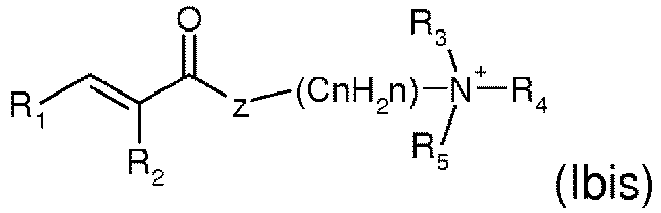
 Z für eine NH-Gruppe oder ein Sauerstoffatom steht,n für eine ganze Zahl von 2 bis 5 steht,2) mindestens einem Monomer der Formel (IIIbis):
und3) mindestens einem Monomer der Formel (IVbis):wobei mindestens eines der Monomere der Formel (Ibis), (IIbis) oder (IIIbis) mindestens eine Fettkette mit 8 bis 30 Kohlenstoffatomen umfasst; j) nichtionischen assoziativen Cellulosen, die mit Gruppen, die mindestens eine Fettkette mit 8 bis 30 Kohlenstoffatomen umfassen, oder mit Alkylphenylpolyalkylenglykolethergruppen modifiziert sind;k) assoziativen nichtionischen Hydroxypropylguars, die mit Gruppen, die mindestens eine Fettkette mit 8 bis 30 Kohlenstoffatomen umfassen, modifiziert sind;l) assoziativen nichtionischen Copolymeren von Vinylpyrrolidon und hydrophoben Fettketten-Monomeren mit 8 bis 30 Kohlenstoffatomen;m) assoziativen nichtionischen Copolymeren von C1-C6-Alkylmethacrylaten oder -acrylaten und amphiphilen Monomeren, die mindestens eine Fettkette mit 8 bis 30 Kohlenstoffatomen umfassen;n) assoziativen nichtionischen Copolymeren von hydrophilen Acrylaten oder Methacrylaten und hydrophoben Monomeren, die mindestens eine Fettkette mit 8 bis 30 Kohlenstoffatomen umfassen;o) assoziativen nichtionischen Polyurethanpolyethern, die in ihrer Kette sowohl hydrophile Blöcke, die vorzugsweise polyoxyethyleniert sind, und hydrophobe Blöcke, bei denen es sich um aliphatische Sequenzen alleine und/oder cycloaliphatische und/oder aromatische Sequenzen, die 8 bis 30 Kohlenstoffatome umfassen, handeln kann, umfassen;p) assoziativen nichtionischen Polymeren mit einer Aminoplast-Ether-Hauptkette, die mindestens eine Fettkette mit 8 bis 30 Kohlenstoffatomen trägt;q) Mischungen davon.
 - Zusammensetzung nach dem vorhergehenden Anspruch, dadurch gekennzeichnet, dass das verdickende Polymer aus nichtionischen, anionischen und kationischen Polymeren noch weiter bevorzugt aus nichtionischen und kationischen Polymeren, vorzugsweise aus nichtionischen nichtassoziativen Polymeren und insbesondere aus Guargummen ausgewählt ist.
- Zusammensetzung nach einem der vorhergehenden Ansprüche, dadurch gekennzeichnet, dass der Gehalt an verdickendem Polymer bzw. verdickenden Polymeren im Bereich von 0,01 bis 10 Gew.-%, vorzugsweise von 0,1 bis 5 Gew.-% und noch besser von 0,2 bis 3 Gew.-%, bezogen auf das Gesamtgewicht der Zusammensetzung, liegt.
- Zusammensetzung nach einem der vorhergehenden Ansprüche, dadurch gekennzeichnet, dass der feste Fettalkohol bzw. die festen Fettalkohole aus gesättigten linearen Alkoholen mit 8 bis 30 Kohlenstoffatomen ausgewählt ist bzw. sind.
- Zusammensetzung nach einem der Ansprüche 1 bis 9, dadurch gekennzeichnet, dass die Zusammensetzung keinen festen Fettalkohol umfasst.
- Verfahren zum Färben von menschlichen Keratinfasern, bei dem man eine Zusammensetzung nach einem der Ansprüche 1 bis 11 in Gegenwart von mindestens einem Oxidationsmittel, das von Luftsauerstoff verschieden ist, vorzugsweise Wasserstoffperoxid, aufbringt.
- Verfahren zum Färben von menschlichen Keratinfasern, bei dem man eine durch extemporales Mischen der Zusammensetzung nach einem der Ansprüche 1 bis 11 mit einer oxidierenden Zusammensetzung, die mindestens ein Oxidationsmittel, das von Luftsauerstoff verschieden ist, vorzugsweise Wasserstoffperoxid, umfasst, vor dem Aufbringen erhaltene gebrauchsfertige Zusammensetzung aufbringt.
- Verfahren nach Anspruch 13, dadurch gekennzeichnet, dass die Zusammensetzung, die das Oxidationsmittel, das von Luftsauerstoff verschieden ist, umfasst, ein oder mehrere Öle umfasst, das bzw. die die mindestens 10 Gew.-%, vorteilhafterweise mindestens 15 Gew.-%, spezieller mindestens 20 Gew.-%, vorzugsweise mindestens 25 Gew.-% und noch spezieller mindestens 30 Gew.-%, bezogen auf das Gesamtgewicht der Zusammensetzung, die das Oxidationsmittel, das von Luftsauerstoff verschieden ist, umfasst, und bis zu 70 Gew.-%, bezogen auf das Gesamtgewicht der Zusammensetzung, ausmacht bzw. ausmachen.
- Vorrichtung mit mehreren Kompartimenten, die zur Durchführung des Verfahrens nach einem der Ansprüche 12 bis 14 geeignet ist, umfassend ein erstes Kompartiment, das eine Zusammensetzung, die frei von Oxidationsmittel, das von Luftsauerstoff verschieden ist, ist, nach einem der Ansprüche 1 bis 11 enthält, und ein zweites Kompartiment, das eine oxidierende Zusammensetzung, die mindestens ein Oxidationsmittel, das von Luftsauerstoff verschieden ist, umfasst, enthält.
Applications Claiming Priority (3)
| Application Number | Priority Date | Filing Date | Title |
|---|---|---|---|
| FR1257535A FR2994084B1 (fr) | 2012-08-02 | 2012-08-02 | Composition de coloration sous forme de creme comprenant au moins une huile, pas ou peu d'alcool gras solide, procede de coloration et dispositif approprie |
| US201261698785P | 2012-09-10 | 2012-09-10 | |
| PCT/EP2013/066263 WO2014020145A1 (en) | 2012-08-02 | 2013-08-02 | Dye composition in cream form comprising at least one oil and little or no solid fatty alcohol, dyeing process and suitable device |
Publications (3)
| Publication Number | Publication Date |
|---|---|
| EP2879656A1 EP2879656A1 (de) | 2015-06-10 |
| EP2879656B1 EP2879656B1 (de) | 2019-05-29 |
| EP2879656B2 true EP2879656B2 (de) | 2024-07-17 |
Family
ID=47501365
Family Applications (1)
| Application Number | Title | Priority Date | Filing Date |
|---|---|---|---|
| EP13747818.6A Active EP2879656B2 (de) | 2012-08-02 | 2013-08-02 | Farbstoffzusammensetzung in cremeform mit mindestens einem öl und wenig oder keinem fettalkohol, färbeverfahren und dafür passende vorrichtung |
Country Status (8)
| Country | Link |
|---|---|
| US (1) | US10201483B2 (de) |
| EP (1) | EP2879656B2 (de) |
| CN (2) | CN112472619A (de) |
| BR (1) | BR112015002206B1 (de) |
| ES (1) | ES2735600T5 (de) |
| FR (1) | FR2994084B1 (de) |
| RU (1) | RU2015106991A (de) |
| WO (1) | WO2014020145A1 (de) |
Families Citing this family (9)
| Publication number | Priority date | Publication date | Assignee | Title |
|---|---|---|---|---|
| CN109199922A (zh) | 2012-08-02 | 2019-01-15 | 莱雅公司 | 染色组合物、染色方法和合适的装置 |
| RU2015106908A (ru) | 2012-08-02 | 2016-09-20 | Л'Ореаль | Красящая композиция, содержащая по меньшей мере одно жирное вещество, по меньшей мере один окисляющий агент и по меньшей мере одно неионное, анионное и амфотерное поверхностно-активное вещество |
| FR2994091B1 (fr) | 2012-08-02 | 2014-08-01 | Oreal | Composition de coloration comprenant de la gomme de guar non ionique ou l'un de ses derives non ionique, procede et dispositif |
| US20180185252A1 (en) * | 2015-06-18 | 2018-07-05 | Rhodia Operations | An emulsion composition having high content of oil |
| CN107049841A (zh) * | 2017-06-20 | 2017-08-18 | 广州市花安堂生物科技有限公司 | 一种永久型染发组合物 |
| CN111542304B (zh) | 2017-11-15 | 2023-12-19 | 新加坡国立大学 | 可用于使头发和皮肤着色的ppd衍生物 |
| EP3989924A4 (de) * | 2019-06-28 | 2023-08-16 | L'oreal | Kosmetische zusammensetzung zum oxidativen färben von keratinfasern |
| US12403085B2 (en) | 2022-07-27 | 2025-09-02 | L'oreal | Hair coloring with coconut oil |
| CN120569183A (zh) * | 2023-02-27 | 2025-08-29 | 莱雅公司 | 用于染色角蛋白纤维的着色剂组合物及包含其的染色套装 |
Family Cites Families (179)
| Publication number | Priority date | Publication date | Assignee | Title |
|---|---|---|---|---|
| US2271378A (en) | 1939-08-30 | 1942-01-27 | Du Pont | Pest control |
| US2273780A (en) | 1939-12-30 | 1942-02-17 | Du Pont | Wax acryalte ester blends |
| US2261002A (en) | 1941-06-17 | 1941-10-28 | Du Pont | Organic nitrogen compounds |
| US2388614A (en) | 1942-05-05 | 1945-11-06 | Du Pont | Disinfectant compositions |
| US2375853A (en) | 1942-10-07 | 1945-05-15 | Du Pont | Diamine derivatives |
| US2454547A (en) | 1946-10-15 | 1948-11-23 | Rohm & Haas | Polymeric quaternary ammonium salts |
| GB738585A (en) | 1952-07-17 | 1955-10-19 | May & Baker Ltd | Improvements in or relating to tetrazolium compounds |
| US2798053A (en) | 1952-09-03 | 1957-07-02 | Goodrich Co B F | Carboxylic polymers |
| BE535125A (de) | 1954-01-25 | |||
| US2961347A (en) | 1957-11-13 | 1960-11-22 | Hercules Powder Co Ltd | Process for preventing shrinkage and felting of wool |
| DE1078081B (de) | 1958-02-25 | 1960-03-24 | Thera Chemie Chemisch Therapeu | Mittel zum Faerben von Haaren oder Pelzen |
| BE626050A (de) | 1962-03-30 | |||
| US3227615A (en) | 1962-05-29 | 1966-01-04 | Hercules Powder Co Ltd | Process and composition for the permanent waving of hair |
| US3206462A (en) | 1962-10-31 | 1965-09-14 | Dow Chemical Co | Quaternary poly(oxyalkylene)alkylbis(diethylenetriamine) compounds |
| DE1492175A1 (de) | 1965-07-07 | 1970-02-12 | Schwarzkopf Gmbh Hans | Verfahren zum Faerben von lebenden Haaren |
| NL130871C (de) | 1965-07-30 | |||
| US3867456A (en) | 1965-07-30 | 1975-02-18 | Oreal | Mono-omega-haloalkyl amines |
| FR1516943A (fr) | 1966-01-10 | 1968-02-05 | Oreal | Colorants basiques utilisables pour la teinture des cheveux |
| LU50233A1 (de) | 1966-01-10 | 1967-07-10 | ||
| FR1540423A (fr) | 1966-07-25 | 1968-09-27 | Oreal | Nouveaux colorants, leurs procédés de fabrication et leurs applications |
| US3817698A (en) | 1966-07-25 | 1974-06-18 | Oreal | Keratinic fiber dye compositions containing n,n'-di-nitrophenyl or nitrophenyl - anthraquinone substituted alkylene diamine dyes and the mono-quaternary ammonium salts thereof |
| CH469060A (de) | 1966-08-05 | 1969-02-28 | Durand & Huguenin Ag | Verfahren zur Herstellung von wasserlöslichen, kationischen Monoazofarbstoffen und Verwendung derselben |
| LU53050A1 (de) | 1967-02-22 | 1968-08-27 | ||
| LU53095A1 (de) | 1967-03-01 | 1968-11-29 | ||
| US3524842A (en) | 1967-08-04 | 1970-08-18 | Durand & Huguenin Ag | Water-soluble cationic phenylazo-naphthol dyestuffs containing a quaternary ammonium group |
| CH491153A (de) | 1967-09-28 | 1970-05-31 | Sandoz Ag | Verfahren zur Herstellung von neuen kationaktiven, wasserlöslichen Polyamiden |
| US3589978A (en) | 1967-09-29 | 1971-06-29 | Gen Mills Inc | Process of making water repellent paper using a fatty polyisocyanate and a cationic gum ether and product therefrom |
| US3709437A (en) | 1968-09-23 | 1973-01-09 | Hershel Earl Wright | Method and device for producing foam |
| US3910862A (en) | 1970-01-30 | 1975-10-07 | Gaf Corp | Copolymers of vinyl pyrrolidone containing quarternary ammonium groups |
| SE375780B (de) | 1970-01-30 | 1975-04-28 | Gaf Corp | |
| US3912808A (en) | 1970-02-25 | 1975-10-14 | Gillette Co | Hair waving and straightening process and composition containing water-soluble amino and quaternary ammonium polymers |
| IT1035032B (it) | 1970-02-25 | 1979-10-20 | Gillette Co | Composizione cosmetica e confezione che la contiente |
| US3985499A (en) | 1971-06-04 | 1976-10-12 | L'oreal | Diazamerocyanines for dyeing keratinous fibers |
| US4151162A (en) | 1971-06-04 | 1979-04-24 | L'oreal | Diazomerocyanines and mesomeric forms thereof |
| LU70835A1 (de) | 1974-08-30 | 1976-08-19 | ||
| FR2140205B1 (de) | 1971-06-04 | 1977-12-23 | Oreal | |
| FR2280361A2 (fr) | 1974-08-02 | 1976-02-27 | Oreal | Compositions de traitement et de conditionnement de la chevelure |
| LU64371A1 (de) | 1971-11-29 | 1973-06-21 | ||
| US4013787A (en) | 1971-11-29 | 1977-03-22 | Societe Anonyme Dite: L'oreal | Piperazine based polymer and hair treating composition containing the same |
| LU65539A1 (de) | 1972-06-19 | 1973-12-21 | ||
| GB1394353A (en) | 1972-06-29 | 1975-05-14 | Gillette Co | Hair treating composition |
| US3986825A (en) | 1972-06-29 | 1976-10-19 | The Gillette Company | Hair coloring composition containing water-soluble amino and quaternary ammonium polymers |
| DE2359399C3 (de) | 1973-11-29 | 1979-01-25 | Henkel Kgaa, 4000 Duesseldorf | Haarfärbemittel |
| USRE30199E (en) | 1973-11-29 | 1980-01-29 | Henkel Kommanditgesellschaft Auf Aktien (Henkel Kgaa) | Oxidation hair dyes based upon tetraaminopyrimidine developers |
| US4003699A (en) | 1974-11-22 | 1977-01-18 | Henkel & Cie G.M.B.H. | Oxidation hair dyes based upon tetraaminopyrimidine developers |
| FR2368508A2 (fr) | 1977-03-02 | 1978-05-19 | Oreal | Composition de conditionnement de la chevelure |
| US4172887A (en) | 1973-11-30 | 1979-10-30 | L'oreal | Hair conditioning compositions containing crosslinked polyaminopolyamides |
| LU68901A1 (de) | 1973-11-30 | 1975-08-20 | ||
| US4189468A (en) | 1973-11-30 | 1980-02-19 | L'oreal | Crosslinked polyamino-polyamide in hair conditioning compositions |
| US4277581A (en) | 1973-11-30 | 1981-07-07 | L'oreal | Polyamino-polyamide crosslinked with crosslinking agent |
| US3929990A (en) | 1973-12-18 | 1975-12-30 | Millmaster Onyx Corp | Microbiocidal polymeric quaternary ammonium compounds |
| US3874870A (en) | 1973-12-18 | 1975-04-01 | Mill Master Onyx Corp | Microbiocidal polymeric quarternary ammonium compounds |
| US4025627A (en) | 1973-12-18 | 1977-05-24 | Millmaster Onyx Corporation | Microbiocidal polymeric quaternary ammonium compounds |
| DK659674A (de) | 1974-01-25 | 1975-09-29 | Calgon Corp | |
| US4166894A (en) | 1974-01-25 | 1979-09-04 | Calgon Corporation | Functional ionene compositions and their use |
| IT1050562B (it) | 1974-05-16 | 1981-03-20 | Oreal | Agente cosmetico a base di polimeri quaternizzati |
| US4948579A (en) | 1974-05-16 | 1990-08-14 | Societe Anonyme Dite: L'oreal | Quaternized polymer for use as a cosmetic agent in cosmetic compositions for the hair and skin |
| US4422853A (en) | 1974-05-16 | 1983-12-27 | L'oreal | Hair dyeing compositions containing quaternized polymer |
| US5196189A (en) | 1974-05-16 | 1993-03-23 | Societe Anonyme Dite: L'oreal | Quaternized polymer for use as a cosmetic agent in cosmetic compositions for the hair and skin |
| GB1514466A (en) | 1974-06-21 | 1978-06-14 | Ici Ltd | Preparation of bipyridilium compounds |
| CH606154A5 (de) | 1974-07-02 | 1978-11-15 | Goodrich Co B F | |
| US4005193A (en) | 1974-08-07 | 1977-01-25 | Millmaster Onyx Corporation | Microbiocidal polymeric quaternary ammonium compounds |
| LU71015A1 (de) | 1974-09-27 | 1976-08-19 | ||
| US3966904A (en) | 1974-10-03 | 1976-06-29 | Millmaster Onyx Corporation | Quaternary ammonium co-polymers for controlling the proliferation of bacteria |
| US4026945A (en) | 1974-10-03 | 1977-05-31 | Millmaster Onyx Corporation | Anti-microbial quaternary ammonium co-polymers |
| US4025617A (en) | 1974-10-03 | 1977-05-24 | Millmaster Onyx Corporation | Anti-microbial quaternary ammonium co-polymers |
| US4001432A (en) | 1974-10-29 | 1977-01-04 | Millmaster Onyx Corporation | Method of inhibiting the growth of bacteria by the application thereto of capped polymers |
| US4027020A (en) | 1974-10-29 | 1977-05-31 | Millmaster Onyx Corporation | Randomly terminated capped polymers |
| US3937364A (en) | 1975-04-03 | 1976-02-10 | Hershel Earl Wright | Foam dispensing device |
| US4184615A (en) | 1975-04-03 | 1980-01-22 | Wright Hershel E | Foam dispensing device |
| US4022351A (en) | 1975-04-03 | 1977-05-10 | Hershel Earl Wright | Foam dispenser |
| US4025653A (en) | 1975-04-07 | 1977-05-24 | Millmaster Onyx Corporation | Microbiocidal polymeric quaternary ammonium compounds |
| US4027008A (en) | 1975-05-14 | 1977-05-31 | The Gillette Company | Hair bleaching composition containing water-soluble amino and quaternary ammonium polymers |
| US4197865A (en) | 1975-07-04 | 1980-04-15 | L'oreal | Treating hair with quaternized polymers |
| AT365448B (de) | 1975-07-04 | 1982-01-11 | Oreal | Kosmetische zubereitung |
| CH599389B5 (de) | 1975-12-23 | 1978-05-31 | Ciba Geigy Ag | |
| US4031307A (en) | 1976-05-03 | 1977-06-21 | Celanese Corporation | Cationic polygalactomannan compositions |
| US4223009A (en) | 1977-06-10 | 1980-09-16 | Gaf Corporation | Hair preparation containing vinyl pyrrolidone copolymer |
| US4165367A (en) | 1977-06-10 | 1979-08-21 | Gaf Corporation | Hair preparations containing vinyl pyrrolidone copolymer |
| CA1091160A (en) | 1977-06-10 | 1980-12-09 | Paritosh M. Chakrabarti | Hair preparation containing vinyl pyrrolidone copolymer |
| US4117914A (en) | 1977-06-22 | 1978-10-03 | John M. Snyder | Slidable suitcase handle |
| US4157388A (en) | 1977-06-23 | 1979-06-05 | The Miranol Chemical Company, Inc. | Hair and fabric conditioning compositions containing polymeric ionenes |
| LU78153A1 (fr) | 1977-09-20 | 1979-05-25 | Oreal | Compositions cosmetiques a base de polymeres polyammonium quaternaires et procede de preparation |
| US4147306A (en) | 1977-09-28 | 1979-04-03 | Bennett Robert S | Foam producing apparatus |
| US4131576A (en) | 1977-12-15 | 1978-12-26 | National Starch And Chemical Corporation | Process for the preparation of graft copolymers of a water soluble monomer and polysaccharide employing a two-phase reaction system |
| DE2806098C2 (de) | 1978-02-14 | 1984-08-30 | Hoechst Ag, 6230 Frankfurt | Verwendung von vernetzten Polymeren zur Erhöhung der Viskosität bei kosmetischen, pharmazeutischen und technischen Präparaten |
| US4970066A (en) | 1978-06-15 | 1990-11-13 | L'oreal | Hair dye or bleach supports of quaternized polymers |
| US4348202A (en) | 1978-06-15 | 1982-09-07 | L'oreal | Hair dye or bleach supports |
| FR2471777A1 (fr) | 1979-12-21 | 1981-06-26 | Oreal | Nouveaux agents cosmetiques a base de polymeres polycationiques, et leur utilisation dans des compositions cosmetiques |
| LU83349A1 (fr) | 1981-05-08 | 1983-03-24 | Oreal | Composition sous forme de mousse aerosol a base de polymere cationique et de polymere anionique |
| DE3273489D1 (en) | 1981-11-30 | 1986-10-30 | Ciba Geigy Ag | Mixtures of quaternary polymeric acrylic ammonium salts, quaternary mono- or oligomeric ammonium salts and surfactants, their preparation and their use in cosmetic compositions |
| LU84708A1 (fr) | 1983-03-23 | 1984-11-14 | Oreal | Composition epaissie ou gelifiee de conditionnement des cheveux contenant au moins un polymere cationique,au moins un polymere anionique et au moins une gomme de xanthane |
| DE3375135D1 (en) | 1983-04-15 | 1988-02-11 | Miranol Inc | Polyquaternary ammonium compounds and cosmetic compositions containing them |
| US4598862A (en) | 1983-05-31 | 1986-07-08 | The Dow Chemical Company | Foam generating device and process |
| US4509949A (en) | 1983-06-13 | 1985-04-09 | The B. F. Goodrich Company | Water thickening agents consisting of copolymers of crosslinked acrylic acids and esters |
| US4514552A (en) | 1984-08-23 | 1985-04-30 | Desoto, Inc. | Alkali soluble latex thickeners |
| LU85564A1 (fr) | 1984-10-01 | 1986-06-11 | Oreal | Nouvelles compositions de teinture des fibres keratiniques contenant un colorant azoique,procede de preparation de ce colorant et mise en oeuvre desdites compositions pour la teinture des fibres keratiniques |
| US4615467A (en) | 1985-07-24 | 1986-10-07 | Calmar, Inc. | Liquid foam dispenser |
| AU612965B2 (en) | 1985-08-12 | 1991-07-25 | Ciba Specialty Chemicals Water Treatments Limited | Polymeric thickeners and their production |
| LU86256A1 (fr) | 1986-01-20 | 1988-01-20 | Oreal | Procede de teinture des fibres keratiniques avec du 5,6-dihydroxyindole associe avec un iodure |
| US4719282A (en) | 1986-04-22 | 1988-01-12 | Miranol Inc. | Polycationic block copolymer |
| JPS63169571A (ja) | 1987-01-06 | 1988-07-13 | Nec Corp | ト−ン検出装置 |
| JP2526099B2 (ja) | 1988-07-07 | 1996-08-21 | 花王株式会社 | 角質繊維染色組成物 |
| DE3843892A1 (de) | 1988-12-24 | 1990-06-28 | Wella Ag | Oxidationshaarfaerbemittel mit einem gehalt an diaminopyrazolderivaten und neue diaminopyrazolderivate |
| GB8909095D0 (en) | 1989-04-21 | 1989-06-07 | Allied Colloids Ltd | Thickened aqueous compositions |
| GB9104878D0 (en) | 1991-03-08 | 1991-04-24 | Scott Bader Co | Thickeners for personal care products |
| JPH0563124A (ja) | 1991-09-03 | 1993-03-12 | Mitsubishi Electric Corp | 混成集積回路装置 |
| DE4129926C1 (de) | 1991-09-09 | 1992-07-23 | Kao Corporation Gmbh, 4000 Duesseldorf, De | |
| DE4133957A1 (de) | 1991-10-14 | 1993-04-15 | Wella Ag | Haarfaerbemittel mit einem gehalt an aminopyrazolderivaten sowie neue pyrazolderivate |
| DE4137005A1 (de) | 1991-11-11 | 1993-05-13 | Bitterfeld Wolfen Chemie | Mittel zum faerben von haaren |
| JP3053939B2 (ja) | 1991-12-17 | 2000-06-19 | 花王株式会社 | 角質繊維染色組成物 |
| DE4220388A1 (de) | 1992-06-22 | 1993-12-23 | Bitterfeld Wolfen Chemie | Kationische Azofarbstoffe zum Färben von Keratinmaterialien |
| DE4234887A1 (de) | 1992-10-16 | 1994-04-21 | Wella Ag | Oxidationshaarfärbemittel mit einem Gehalt an 4,5-Diaminopyrazolderivaten sowie neue 4,5-Diaminopyrazolderivate und Verfahren zu ihrer Herstellung |
| US5663366A (en) | 1992-10-16 | 1997-09-02 | Wella Aktiengesellschat | Process for the synthesis of 4,5-diaminopyrazole derivatives useful for dyeing hair |
| DE4234885A1 (de) | 1992-10-16 | 1994-04-21 | Wella Ag | Verfahren zur Herstellung von 4,5-Diaminopyrazol-Derivaten, deren Verwendung zum Färben von Haaren sowie neue Pyrazol-Derivate |
| US5364031A (en) | 1993-06-10 | 1994-11-15 | The Procter & Gamble Company | Foam dispensing nozzles and dispensers employing said nozzles |
| TW311089B (de) | 1993-07-05 | 1997-07-21 | Ciba Sc Holding Ag | |
| FR2712595B1 (fr) | 1993-11-19 | 1995-12-22 | Seppic Sa | Un concentré comportant des alkylglycosides et ses utilisations. |
| TW325998B (en) | 1993-11-30 | 1998-02-01 | Ciba Sc Holding Ag | Dyeing keratin-containing fibers |
| US5888252A (en) | 1993-11-30 | 1999-03-30 | Ciba Specialty Chemicals Corporation | Processes for dyeing keratin-containing fibres with cationicazo dyes |
| FR2722687A1 (fr) | 1994-07-22 | 1996-01-26 | Oreal | Utilisation de gomme de guar dans des compositionsnon rincees pour la teinture des fibres keratiniques et procede de teinture |
| EP0714954B1 (de) | 1994-11-03 | 2002-09-25 | Ciba SC Holding AG | Kationische Imidazolazofarbstoffe |
| DE4440957A1 (de) | 1994-11-17 | 1996-05-23 | Henkel Kgaa | Oxidationsfärbemittel |
| FR2733749B1 (fr) | 1995-05-05 | 1997-06-13 | Oreal | Compositions pour la teinture des fibres keratiniques contenant des diamino pyrazoles, procede de teinture, nouveaux diamino pyrazoles et leur procede de preparation |
| DE19539264C2 (de) | 1995-10-21 | 1998-04-09 | Goldwell Gmbh | Haarfärbemittel |
| DE19543988A1 (de) | 1995-11-25 | 1997-05-28 | Wella Ag | Oxidationshaarfärbemittel mit einem Gehalt an 3,4,5-Triaminopyrazolderivaten sowie neue 3,4,5-Triaminopyrazolderivate |
| FR2748932B1 (fr) | 1996-05-23 | 1998-07-03 | Oreal | Composition de teinture directe capillaire comprenant un polymere reticule a motifs acryliques et acrylates d'akyles en c10-c30 |
| FR2750325B1 (fr) | 1996-06-28 | 1998-07-31 | Oreal | Utilisation en cosmetique d'un poly(acide 2-acrylamido 2- methylpropane sulfonique) reticule et neutralise a au moins 90 % et compositions topiques les contenant |
| US5817155A (en) * | 1996-08-08 | 1998-10-06 | Shiseido Co., Ltd. | Emulsion for hair treatment |
| GB9624590D0 (en) | 1996-11-27 | 1997-01-15 | Warner Jenkinson Europ Limited | Dyes |
| FR2757385B1 (fr) | 1996-12-23 | 1999-01-29 | Oreal | Composition de teinture d'oxydation des fibres keratiniques et procede de teinture mettant en oeuvre cette composition |
| FR2757384B1 (fr) | 1996-12-23 | 1999-01-15 | Oreal | Composition de teinture d'oxydation des fibres keratiniques et procede de teinture mettant en oeuvre cette composition |
| FR2759756B1 (fr) | 1997-02-20 | 1999-04-23 | Hutchinson | Dispositif de liaison etanche entre des canaux |
| US5879670A (en) | 1997-03-31 | 1999-03-09 | Calgon Corporation | Ampholyte polymers for use in personal care products |
| FR2771409B1 (fr) | 1997-11-21 | 2000-01-14 | Oreal | Nouveaux composes azoiques, utilisation pour la teinture, compositions les contenant et procedes de teinture |
| EP0920856B1 (de) | 1997-12-05 | 2004-01-28 | L'oreal | Verfahren zur Direkt-Färbung von Keratin-Fasern in zwei Stufen mit Hilfe von Direct Basic Färbungsmitteln |
| US6156076A (en) * | 1998-01-16 | 2000-12-05 | Bristol-Myers Squibb Company | Two-part hair dye compositions containing polyether polyurethanes and conditioning agents |
| DE59915106D1 (de) | 1998-02-10 | 2010-01-07 | Schwarzkopf & Henkel K K | Dauerwellzusammensetzung mit färbendem effekt und verfahren zur haarfärbung unter verwendung derselben |
| FR2776186B1 (fr) | 1998-03-20 | 2001-01-26 | Oreal | Composition de teinture d'oxydation des fibres keratiniques et procede de teinture mettant en oeuvre cette composition |
| FR2782452B1 (fr) | 1998-08-24 | 2001-11-16 | Oreal | Composition de teinture pour fibres keratiniques avec un colorant direct cationique et un agent teniso-actif non-ionique |
| FR2785284B1 (fr) | 1998-11-02 | 2000-12-01 | Galderma Res & Dev | Analogues de la vitamine d |
| FR2788433B1 (fr) | 1999-01-19 | 2003-04-04 | Oreal | Utilisation de composes phenyl-azo-benzeniques cationiques en teinture des fibres keratiniques, compositions tinctoriales et procedes de teinture |
| FR2788773B1 (fr) * | 1999-01-21 | 2001-03-09 | Oreal | Nouveaux methylenedioxy-benzenes cationiques, leur utilisation pour la teinture d'oxydation des fibres keratiniques, compositions tinctoriales et procedes de teinture |
| FR2801308B1 (fr) | 1999-11-19 | 2003-05-09 | Oreal | COMPOSITIONS DE TEINTURE DE FIBRES KERATINIQUES CONTENANT DE DES 3-AMINO PYRAZOLO-[1,(-a]-PYRIDINES, PROCEDE DE TEINTURE, NOUVELLES 3-AMINO PYRAZOLO-[1,5-a]-PYRIDINES |
| FR2803196B1 (fr) | 1999-12-30 | 2002-03-15 | Oreal | Composition pour la teinture d'oxydation des fibres keratiniques comprenant un alcool gras ayant plus de vingt atomes de carbone et un tensioactif non-ionique oxyalkylene de hlb superieure a 5 |
| DE10005162A1 (de) | 2000-02-08 | 2001-08-09 | Henkel Kgaa | Kosmetisches Mittel |
| AU781845B2 (en) | 2000-03-09 | 2005-06-16 | Ciba Specialty Chemicals Holding Inc. | A method of colouring hair using cationic dyes |
| EP1133975B1 (de) | 2000-03-17 | 2008-02-13 | Kao Corporation | Verwendung einer Verbindung zum Haare färben |
| DE20114179U1 (de) | 2001-08-28 | 2001-10-25 | Wella Ag, 64295 Darmstadt | Färbemittel für Keratinfasern |
| DE10143024A1 (de) | 2001-09-01 | 2003-03-20 | Henkel Kgaa | Cremegrundlage für die Herstellung von Haarfärbemitteln |
| CN1556839A (zh) | 2001-09-24 | 2004-12-22 | 西巴特殊化学品控股有限公司 | 阳离子反应性染料 |
| DE10260834A1 (de) | 2002-12-23 | 2004-07-01 | Henkel Kgaa | Neue Kupplerkomponenten |
| US7419511B2 (en) * | 2004-09-13 | 2008-09-02 | L'oreal, S.A. | Compositions comprising at least one substituted carbocyanin derivative, processes for treating keratin fibers using them, device therefor and uses thereof |
| DE102005024813A1 (de) | 2005-05-27 | 2007-01-18 | Henkel Kgaa | Haarfärbemittel mit Aloe-Bestandteilen |
| FR2886136B1 (fr) | 2005-05-31 | 2007-08-10 | Oreal | Composition pour la teinture des fibres keratiniques comprenant au moins un derive de diamino-n,n-dihydro- pyrazolone et un colorant d'oxydation cationique |
| DE102006012575A1 (de) | 2006-03-16 | 2007-02-08 | Henkel Kgaa | Aufhell- und/oder Färbemittel mit reduziertem Ammoniakgehalt |
| EP2076238A1 (de) | 2006-10-25 | 2009-07-08 | L'Oreal | Zusammensetzung zum direkten färben von keratinösen fasern mit mindestens einem ammoniumsalz aus 18mea und mindestens einem direkten farbstoff und von der zusammensetzung ausgehendes färbeverfahren |
| DE102007028266A1 (de) | 2007-06-15 | 2008-12-18 | Henkel Ag & Co. Kgaa | Kit zur Bereitstellung von lagerstabilen Formulierungen |
| DE102008019340A1 (de) | 2008-04-16 | 2009-10-22 | Henkel Ag & Co. Kgaa | Haarbehandlungsmittel mit Cloudberry-Fruchtextrakt |
| FR2940066B1 (fr) | 2008-12-18 | 2011-03-18 | Oreal | Composition delitable de coloration ou decoloration des matieres keratiniques comprenant des fibres de polymere superabsorbant |
| FR2940078B1 (fr) | 2008-12-19 | 2011-05-13 | Oreal | Composition comprenant un corps gras et un polymere cationique, procede de coloration la mettant en oeuvre et dispositifs |
| FR2940061B1 (fr) * | 2008-12-19 | 2011-03-04 | Oreal | Composition de teinture d'oxydation des fibres keratiniques comprenant un corps gras et un derive de diaminopyrazolone. |
| FR2940079B1 (fr) | 2008-12-19 | 2011-02-18 | Oreal | Composition comprenant au moins un alcool gras solide, procede de coloration la mettant en oeuvre et dispositifs |
| US7927381B2 (en) | 2008-12-19 | 2011-04-19 | L'oreal S.A. | Process for lightening or lightening direct dyeing or oxidation dyeing in the presence of an aqueous composition comprising at least one fatty substance, and device |
| FR2940090B1 (fr) | 2008-12-19 | 2011-02-25 | Oreal | Composition oxydante pour le traitement des fibres keratiniques comprenant une huile, un alcool gras et un alcool gras oxyalkylene |
| FR2940106B1 (fr) | 2008-12-19 | 2013-04-12 | Oreal | Composition comprenant un corps gras et un silicate, procede de coloration la mettant en oeuvre et dispositifs |
| DE102009003002A1 (de) | 2009-05-11 | 2010-11-18 | Henkel Ag & Co. Kgaa | Färbemittel mit Tensid/Emulgator-Kombination |
| WO2010133640A2 (en) | 2009-05-19 | 2010-11-25 | L'oreal | Dyeing composition comprising a secondary para-phenylenediamine oxidation base and a heterocyclic oxidation base |
| EP2272493A1 (de) | 2009-07-08 | 2011-01-12 | KPSS-Kao Professional Salon Services GmbH | Zusammensetzung und Verfahren zum Ausgleichen der Haarfarbe |
| EP2277497A1 (de) | 2009-07-22 | 2011-01-26 | KPSS-Kao Professional Salon Services GmbH | Zusammensetzung und Verfahren zur Färbung von Haar |
| WO2011076647A2 (en) | 2009-12-22 | 2011-06-30 | L'oreal | Inverse emulsion for treating the hair comprising a particular fatty substance and an alkaline agent |
| FR2954095B1 (fr) * | 2009-12-22 | 2012-04-20 | Oreal | Emulsion inverse pour le traitement des cheveux comprenant un ester gras liquide |
| FR2954159B1 (fr) * | 2009-12-22 | 2012-02-10 | Oreal | Agent de coloration et/ou de decoloration des fibres keratiniques comprenant une composition comprenant un agent alcalinisant et une composition anhydre comprenant un oxydant, l'une ou l'autre des compositions pouvant contenir un corps gras |
| FR2954092B1 (fr) * | 2009-12-22 | 2012-10-26 | Oreal | Emulsion inverse pour le traitement des cheveux comprenant un hydrocarbure liquide |
| DE102011017519A1 (de) | 2011-04-26 | 2012-10-31 | Beiersdorf Ag | Kosmetische Zubereitung zur Färbung von Haaren |
| CN109199922A (zh) | 2012-08-02 | 2019-01-15 | 莱雅公司 | 染色组合物、染色方法和合适的装置 |
| RU2015106908A (ru) | 2012-08-02 | 2016-09-20 | Л'Ореаль | Красящая композиция, содержащая по меньшей мере одно жирное вещество, по меньшей мере один окисляющий агент и по меньшей мере одно неионное, анионное и амфотерное поверхностно-активное вещество |
| FR2994091B1 (fr) | 2012-08-02 | 2014-08-01 | Oreal | Composition de coloration comprenant de la gomme de guar non ionique ou l'un de ses derives non ionique, procede et dispositif |
| FR3000675B1 (fr) | 2013-01-09 | 2014-12-26 | Oreal | Composition de coloration exempte d'agent oxydant chimique comprenant un colorant d'oxydation, un alkylsulfate, un alkylpolyglycoside, un corps gras et de la gomme de guar non ionique |
-
2012
- 2012-08-02 FR FR1257535A patent/FR2994084B1/fr not_active Expired - Fee Related
-
2013
- 2013-08-02 US US14/418,746 patent/US10201483B2/en active Active
- 2013-08-02 WO PCT/EP2013/066263 patent/WO2014020145A1/en not_active Ceased
- 2013-08-02 RU RU2015106991A patent/RU2015106991A/ru not_active Application Discontinuation
- 2013-08-02 ES ES13747818T patent/ES2735600T5/es active Active
- 2013-08-02 BR BR112015002206A patent/BR112015002206B1/pt active IP Right Grant
- 2013-08-02 CN CN202011502984.5A patent/CN112472619A/zh active Pending
- 2013-08-02 EP EP13747818.6A patent/EP2879656B2/de active Active
- 2013-08-02 CN CN201380040710.0A patent/CN104582680A/zh active Pending
Also Published As
| Publication number | Publication date |
|---|---|
| BR112015002206A2 (pt) | 2017-07-04 |
| FR2994084B1 (fr) | 2014-10-31 |
| RU2015106991A (ru) | 2016-09-20 |
| CN112472619A (zh) | 2021-03-12 |
| WO2014020145A1 (en) | 2014-02-06 |
| EP2879656A1 (de) | 2015-06-10 |
| ES2735600T3 (es) | 2019-12-19 |
| CN104582680A (zh) | 2015-04-29 |
| FR2994084A1 (fr) | 2014-02-07 |
| ES2735600T5 (en) | 2024-12-17 |
| US20150257994A1 (en) | 2015-09-17 |
| BR112015002206B1 (pt) | 2019-10-22 |
| EP2879656B1 (de) | 2019-05-29 |
| US10201483B2 (en) | 2019-02-12 |
Similar Documents
| Publication | Publication Date | Title |
|---|---|---|
| EP2879656B1 (de) | Farbstoffzusammensetzung in cremeform mit mindestens einem öl und wenig oder keinem fettalkohol, färbeverfahren und dafür passende vorrichtung | |
| EP2879649B2 (de) | Färbezusammensetzungen mit mindestens einer fettigen substanz, mindestens einem oxidationsmittel und mindestens einem nichtionischen, anionischen und amphoteren tensid | |
| EP2879650B1 (de) | Färbezusammensetzung enthaltend einen fettkörper, ein nicht-ionisches guar gummi, ein amphoteres tensid, ein nicht-ionisches oder anionisches tensid, und ein oxidationsmittel, sowie verfahren zur färbung und geeignete vorrichtung | |
| FR2994088B1 (fr) | Composition de coloration comprenant au moins un compose sulfonique, un polymere epaississant, procede de coloration et dispositif approprie | |
| US7931698B2 (en) | Ready-to-use composition for oxidation dyeing of keratin fibers comprising at least one fatty substance, at least one thickener, at least one dye precursor, at least one oxidizing agent, and at least one alkaline agent, and process and kits therewith | |
| US7198649B2 (en) | Oxidation dyeing composition for keratinous fibers comprising glycerine and a polyol other than glycerine in a specific ratio | |
| JP2003226626A (ja) | オキシアルキレン化カルボン酸エーテル、会合性ポリマー及び不飽和脂肪アルコールを含有するケラチン繊維の酸化染色組成物 | |
| US11446222B2 (en) | Composition for treating keratin fibers comprising an amphoteric or cationic polymer and neutralized fatty acid | |
| WO2014053504A2 (en) | Agent for altering the color of keratin fibers containing a fatty substance and a rheology modifying polymer in an emulsion system | |
| FR2994085A1 (fr) | Composition de coloration comprenant au moins un corps gras, au moins un agent oxydant et au moins un tensioactif non ionique, anionique et amphotere | |
| US20230270643A1 (en) | Dyeing and/or lightening composition comprising an anthraquinone cationic direct dye, a fatty substance, a chemical oxidizing agent and a basifying agent and/or an oxidation dye precursor | |
| US8721740B2 (en) | Agent for altering the color of keratin fibers containing a fatty substance and a rheology modifying polymer in a neutral to acidic system | |
| US8398723B2 (en) | Emulsion dyeing composition containing at least one quaternary amine, at least one nonionic surfactant and at least one phosphate ester, and method of using same | |
| FR3000676A1 (fr) | Composition de coloration d'oxydation comprenant un extrait huileux de fleurs de lotus, procede de coloration et dispositif approprie | |
| FR2917973A1 (fr) | Composition anhydre sous forme de pate comprenant au moins un colorant d'oxydation, au moins un complexe de peroxyde d'hydrogene et d'un polymere particulier et procede de coloration la mettant en oeuvre | |
| US8915973B1 (en) | Agent for altering the color of keratin fibers containing a rheology modifying polymer and a fatty substance in an alkaline cream system | |
| FR2994087A1 (fr) | Composition de coloration comprenant un corps gras, une gomme de guar non ionique, un tensioactif anionique et non ionique, un polymere cationique, et un agent oxydant, procede de coloration et dispositif approprie | |
| FR2994086A1 (fr) | Composition de coloration comprenant un corps gras, une gomme de guar non ionique, un tensioactif amphotere et un tensioactif non ionique ou anionique, un agent oxydant, procede de coloration et dispositif approprie | |
| WO2017102650A1 (en) | Device for dispensing a product for dyeing and/or lightening keratin fibres comprising an associative polymer |
Legal Events
| Date | Code | Title | Description |
|---|---|---|---|
| PUAI | Public reference made under article 153(3) epc to a published international application that has entered the european phase |
Free format text: ORIGINAL CODE: 0009012 |
|
| 17P | Request for examination filed |
Effective date: 20150302 |
|
| AK | Designated contracting states |
Kind code of ref document: A1 Designated state(s): AL AT BE BG CH CY CZ DE DK EE ES FI FR GB GR HR HU IE IS IT LI LT LU LV MC MK MT NL NO PL PT RO RS SE SI SK SM TR |
|
| AX | Request for extension of the european patent |
Extension state: BA ME |
|
| DAX | Request for extension of the european patent (deleted) | ||
| STAA | Information on the status of an ep patent application or granted ep patent |
Free format text: STATUS: EXAMINATION IS IN PROGRESS |
|
| 17Q | First examination report despatched |
Effective date: 20170406 |
|
| GRAP | Despatch of communication of intention to grant a patent |
Free format text: ORIGINAL CODE: EPIDOSNIGR1 |
|
| STAA | Information on the status of an ep patent application or granted ep patent |
Free format text: STATUS: GRANT OF PATENT IS INTENDED |
|
| RIC1 | Information provided on ipc code assigned before grant |
Ipc: A61Q 5/10 20060101ALI20181113BHEP Ipc: A61K 8/44 20060101ALI20181113BHEP Ipc: A61K 8/92 20060101ALI20181113BHEP Ipc: A61K 8/46 20060101AFI20181113BHEP Ipc: A61K 8/31 20060101ALI20181113BHEP |
|
| INTG | Intention to grant announced |
Effective date: 20181213 |
|
| GRAS | Grant fee paid |
Free format text: ORIGINAL CODE: EPIDOSNIGR3 |
|
| GRAA | (expected) grant |
Free format text: ORIGINAL CODE: 0009210 |
|
| STAA | Information on the status of an ep patent application or granted ep patent |
Free format text: STATUS: THE PATENT HAS BEEN GRANTED |
|
| AK | Designated contracting states |
Kind code of ref document: B1 Designated state(s): AL AT BE BG CH CY CZ DE DK EE ES FI FR GB GR HR HU IE IS IT LI LT LU LV MC MK MT NL NO PL PT RO RS SE SI SK SM TR |
|
| REG | Reference to a national code |
Ref country code: GB Ref legal event code: FG4D |
|
| REG | Reference to a national code |
Ref country code: CH Ref legal event code: EP |
|
| REG | Reference to a national code |
Ref country code: AT Ref legal event code: REF Ref document number: 1137844 Country of ref document: AT Kind code of ref document: T Effective date: 20190615 |
|
| REG | Reference to a national code |
Ref country code: DE Ref legal event code: R096 Ref document number: 602013056025 Country of ref document: DE |
|
| REG | Reference to a national code |
Ref country code: IE Ref legal event code: FG4D |
|
| REG | Reference to a national code |
Ref country code: NL Ref legal event code: MP Effective date: 20190529 |
|
| REG | Reference to a national code |
Ref country code: LT Ref legal event code: MG4D |
|
| PG25 | Lapsed in a contracting state [announced via postgrant information from national office to epo] |
Ref country code: NO Free format text: LAPSE BECAUSE OF FAILURE TO SUBMIT A TRANSLATION OF THE DESCRIPTION OR TO PAY THE FEE WITHIN THE PRESCRIBED TIME-LIMIT Effective date: 20190829 Ref country code: AL Free format text: LAPSE BECAUSE OF FAILURE TO SUBMIT A TRANSLATION OF THE DESCRIPTION OR TO PAY THE FEE WITHIN THE PRESCRIBED TIME-LIMIT Effective date: 20190529 Ref country code: FI Free format text: LAPSE BECAUSE OF FAILURE TO SUBMIT A TRANSLATION OF THE DESCRIPTION OR TO PAY THE FEE WITHIN THE PRESCRIBED TIME-LIMIT Effective date: 20190529 Ref country code: PT Free format text: LAPSE BECAUSE OF FAILURE TO SUBMIT A TRANSLATION OF THE DESCRIPTION OR TO PAY THE FEE WITHIN THE PRESCRIBED TIME-LIMIT Effective date: 20190930 Ref country code: SE Free format text: LAPSE BECAUSE OF FAILURE TO SUBMIT A TRANSLATION OF THE DESCRIPTION OR TO PAY THE FEE WITHIN THE PRESCRIBED TIME-LIMIT Effective date: 20190529 Ref country code: LT Free format text: LAPSE BECAUSE OF FAILURE TO SUBMIT A TRANSLATION OF THE DESCRIPTION OR TO PAY THE FEE WITHIN THE PRESCRIBED TIME-LIMIT Effective date: 20190529 Ref country code: HR Free format text: LAPSE BECAUSE OF FAILURE TO SUBMIT A TRANSLATION OF THE DESCRIPTION OR TO PAY THE FEE WITHIN THE PRESCRIBED TIME-LIMIT Effective date: 20190529 |
|
| PG25 | Lapsed in a contracting state [announced via postgrant information from national office to epo] |
Ref country code: RS Free format text: LAPSE BECAUSE OF FAILURE TO SUBMIT A TRANSLATION OF THE DESCRIPTION OR TO PAY THE FEE WITHIN THE PRESCRIBED TIME-LIMIT Effective date: 20190529 Ref country code: BG Free format text: LAPSE BECAUSE OF FAILURE TO SUBMIT A TRANSLATION OF THE DESCRIPTION OR TO PAY THE FEE WITHIN THE PRESCRIBED TIME-LIMIT Effective date: 20190829 Ref country code: GR Free format text: LAPSE BECAUSE OF FAILURE TO SUBMIT A TRANSLATION OF THE DESCRIPTION OR TO PAY THE FEE WITHIN THE PRESCRIBED TIME-LIMIT Effective date: 20190830 Ref country code: LV Free format text: LAPSE BECAUSE OF FAILURE TO SUBMIT A TRANSLATION OF THE DESCRIPTION OR TO PAY THE FEE WITHIN THE PRESCRIBED TIME-LIMIT Effective date: 20190529 |
|
| REG | Reference to a national code |
Ref country code: AT Ref legal event code: MK05 Ref document number: 1137844 Country of ref document: AT Kind code of ref document: T Effective date: 20190529 |
|
| REG | Reference to a national code |
Ref country code: ES Ref legal event code: FG2A Ref document number: 2735600 Country of ref document: ES Kind code of ref document: T3 Effective date: 20191219 |
|
| PG25 | Lapsed in a contracting state [announced via postgrant information from national office to epo] |
Ref country code: RO Free format text: LAPSE BECAUSE OF FAILURE TO SUBMIT A TRANSLATION OF THE DESCRIPTION OR TO PAY THE FEE WITHIN THE PRESCRIBED TIME-LIMIT Effective date: 20190529 Ref country code: SK Free format text: LAPSE BECAUSE OF FAILURE TO SUBMIT A TRANSLATION OF THE DESCRIPTION OR TO PAY THE FEE WITHIN THE PRESCRIBED TIME-LIMIT Effective date: 20190529 Ref country code: CZ Free format text: LAPSE BECAUSE OF FAILURE TO SUBMIT A TRANSLATION OF THE DESCRIPTION OR TO PAY THE FEE WITHIN THE PRESCRIBED TIME-LIMIT Effective date: 20190529 Ref country code: EE Free format text: LAPSE BECAUSE OF FAILURE TO SUBMIT A TRANSLATION OF THE DESCRIPTION OR TO PAY THE FEE WITHIN THE PRESCRIBED TIME-LIMIT Effective date: 20190529 Ref country code: AT Free format text: LAPSE BECAUSE OF FAILURE TO SUBMIT A TRANSLATION OF THE DESCRIPTION OR TO PAY THE FEE WITHIN THE PRESCRIBED TIME-LIMIT Effective date: 20190529 Ref country code: NL Free format text: LAPSE BECAUSE OF FAILURE TO SUBMIT A TRANSLATION OF THE DESCRIPTION OR TO PAY THE FEE WITHIN THE PRESCRIBED TIME-LIMIT Effective date: 20190529 Ref country code: DK Free format text: LAPSE BECAUSE OF FAILURE TO SUBMIT A TRANSLATION OF THE DESCRIPTION OR TO PAY THE FEE WITHIN THE PRESCRIBED TIME-LIMIT Effective date: 20190529 |
|
| PG25 | Lapsed in a contracting state [announced via postgrant information from national office to epo] |
Ref country code: SM Free format text: LAPSE BECAUSE OF FAILURE TO SUBMIT A TRANSLATION OF THE DESCRIPTION OR TO PAY THE FEE WITHIN THE PRESCRIBED TIME-LIMIT Effective date: 20190529 |
|
| REG | Reference to a national code |
Ref country code: DE Ref legal event code: R026 Ref document number: 602013056025 Country of ref document: DE |
|
| PLBI | Opposition filed |
Free format text: ORIGINAL CODE: 0009260 |
|
| PLAX | Notice of opposition and request to file observation + time limit sent |
Free format text: ORIGINAL CODE: EPIDOSNOBS2 |
|
| PG25 | Lapsed in a contracting state [announced via postgrant information from national office to epo] |
Ref country code: TR Free format text: LAPSE BECAUSE OF FAILURE TO SUBMIT A TRANSLATION OF THE DESCRIPTION OR TO PAY THE FEE WITHIN THE PRESCRIBED TIME-LIMIT Effective date: 20190529 |
|
| 26 | Opposition filed |
Opponent name: KAO GERMANY GMBH Effective date: 20200228 |
|
| PG25 | Lapsed in a contracting state [announced via postgrant information from national office to epo] |
Ref country code: PL Free format text: LAPSE BECAUSE OF FAILURE TO SUBMIT A TRANSLATION OF THE DESCRIPTION OR TO PAY THE FEE WITHIN THE PRESCRIBED TIME-LIMIT Effective date: 20190529 |
|
| PG25 | Lapsed in a contracting state [announced via postgrant information from national office to epo] |
Ref country code: LI Free format text: LAPSE BECAUSE OF NON-PAYMENT OF DUE FEES Effective date: 20190831 Ref country code: SI Free format text: LAPSE BECAUSE OF FAILURE TO SUBMIT A TRANSLATION OF THE DESCRIPTION OR TO PAY THE FEE WITHIN THE PRESCRIBED TIME-LIMIT Effective date: 20190529 Ref country code: CH Free format text: LAPSE BECAUSE OF NON-PAYMENT OF DUE FEES Effective date: 20190831 Ref country code: MC Free format text: LAPSE BECAUSE OF FAILURE TO SUBMIT A TRANSLATION OF THE DESCRIPTION OR TO PAY THE FEE WITHIN THE PRESCRIBED TIME-LIMIT Effective date: 20190529 Ref country code: LU Free format text: LAPSE BECAUSE OF NON-PAYMENT OF DUE FEES Effective date: 20190802 |
|
| REG | Reference to a national code |
Ref country code: BE Ref legal event code: MM Effective date: 20190831 |
|
| PLBB | Reply of patent proprietor to notice(s) of opposition received |
Free format text: ORIGINAL CODE: EPIDOSNOBS3 |
|
| PG25 | Lapsed in a contracting state [announced via postgrant information from national office to epo] |
Ref country code: IE Free format text: LAPSE BECAUSE OF NON-PAYMENT OF DUE FEES Effective date: 20190802 |
|
| PG25 | Lapsed in a contracting state [announced via postgrant information from national office to epo] |
Ref country code: BE Free format text: LAPSE BECAUSE OF NON-PAYMENT OF DUE FEES Effective date: 20190831 |
|
| PG25 | Lapsed in a contracting state [announced via postgrant information from national office to epo] |
Ref country code: CY Free format text: LAPSE BECAUSE OF FAILURE TO SUBMIT A TRANSLATION OF THE DESCRIPTION OR TO PAY THE FEE WITHIN THE PRESCRIBED TIME-LIMIT Effective date: 20190529 |
|
| PG25 | Lapsed in a contracting state [announced via postgrant information from national office to epo] |
Ref country code: IS Free format text: LAPSE BECAUSE OF FAILURE TO SUBMIT A TRANSLATION OF THE DESCRIPTION OR TO PAY THE FEE WITHIN THE PRESCRIBED TIME-LIMIT Effective date: 20190929 |
|
| PG25 | Lapsed in a contracting state [announced via postgrant information from national office to epo] |
Ref country code: HU Free format text: LAPSE BECAUSE OF FAILURE TO SUBMIT A TRANSLATION OF THE DESCRIPTION OR TO PAY THE FEE WITHIN THE PRESCRIBED TIME-LIMIT; INVALID AB INITIO Effective date: 20130802 Ref country code: MT Free format text: LAPSE BECAUSE OF FAILURE TO SUBMIT A TRANSLATION OF THE DESCRIPTION OR TO PAY THE FEE WITHIN THE PRESCRIBED TIME-LIMIT Effective date: 20190529 |
|
| APBM | Appeal reference recorded |
Free format text: ORIGINAL CODE: EPIDOSNREFNO |
|
| APBP | Date of receipt of notice of appeal recorded |
Free format text: ORIGINAL CODE: EPIDOSNNOA2O |
|
| APAH | Appeal reference modified |
Free format text: ORIGINAL CODE: EPIDOSCREFNO |
|
| APBM | Appeal reference recorded |
Free format text: ORIGINAL CODE: EPIDOSNREFNO |
|
| APBP | Date of receipt of notice of appeal recorded |
Free format text: ORIGINAL CODE: EPIDOSNNOA2O |
|
| APBQ | Date of receipt of statement of grounds of appeal recorded |
Free format text: ORIGINAL CODE: EPIDOSNNOA3O |
|
| PG25 | Lapsed in a contracting state [announced via postgrant information from national office to epo] |
Ref country code: MK Free format text: LAPSE BECAUSE OF FAILURE TO SUBMIT A TRANSLATION OF THE DESCRIPTION OR TO PAY THE FEE WITHIN THE PRESCRIBED TIME-LIMIT Effective date: 20190529 |
|
| RAP4 | Party data changed (patent owner data changed or rights of a patent transferred) |
Owner name: L'OREAL |
|
| APBU | Appeal procedure closed |
Free format text: ORIGINAL CODE: EPIDOSNNOA9O |
|
| PUAH | Patent maintained in amended form |
Free format text: ORIGINAL CODE: 0009272 |
|
| STAA | Information on the status of an ep patent application or granted ep patent |
Free format text: STATUS: PATENT MAINTAINED AS AMENDED |
|
| 27A | Patent maintained in amended form |
Effective date: 20240717 |
|
| AK | Designated contracting states |
Kind code of ref document: B2 Designated state(s): AL AT BE BG CH CY CZ DE DK EE ES FI FR GB GR HR HU IE IS IT LI LT LU LV MC MK MT NL NO PL PT RO RS SE SI SK SM TR |
|
| REG | Reference to a national code |
Ref country code: DE Ref legal event code: R102 Ref document number: 602013056025 Country of ref document: DE |
|
| REG | Reference to a national code |
Ref country code: ES Ref legal event code: DC2A Ref document number: 2735600 Country of ref document: ES Kind code of ref document: T5 Effective date: 20241217 |
|
| PGFP | Annual fee paid to national office [announced via postgrant information from national office to epo] |
Ref country code: ES Payment date: 20250902 Year of fee payment: 13 |
|
| PGFP | Annual fee paid to national office [announced via postgrant information from national office to epo] |
Ref country code: DE Payment date: 20250611 Year of fee payment: 13 |
|
| PGFP | Annual fee paid to national office [announced via postgrant information from national office to epo] |
Ref country code: IT Payment date: 20250722 Year of fee payment: 13 |
|
| PGFP | Annual fee paid to national office [announced via postgrant information from national office to epo] |
Ref country code: GB Payment date: 20260615 Year of fee payment: 14 |
|
| PGFP | Annual fee paid to national office [announced via postgrant information from national office to epo] |
Ref country code: FR Payment date: 20260608 Year of fee payment: 14 |