EP2824194B1 - Method for producing silicon steel normalizing substrate - Google Patents
Method for producing silicon steel normalizing substrate Download PDFInfo
- Publication number
- EP2824194B1 EP2824194B1 EP12870723.9A EP12870723A EP2824194B1 EP 2824194 B1 EP2824194 B1 EP 2824194B1 EP 12870723 A EP12870723 A EP 12870723A EP 2824194 B1 EP2824194 B1 EP 2824194B1
- Authority
- EP
- European Patent Office
- Prior art keywords
- furnace
- section
- normalizing
- pressure
- throat
- Prior art date
- Legal status (The legal status is an assumption and is not a legal conclusion. Google has not performed a legal analysis and makes no representation as to the accuracy of the status listed.)
- Active
Links
Images
Classifications
-
- C—CHEMISTRY; METALLURGY
- C21—METALLURGY OF IRON
- C21D—MODIFYING THE PHYSICAL STRUCTURE OF FERROUS METALS; GENERAL DEVICES FOR HEAT TREATMENT OF FERROUS OR NON-FERROUS METALS OR ALLOYS; MAKING METAL MALLEABLE, e.g. BY DECARBURISATION OR TEMPERING
- C21D8/00—Modifying the physical properties of ferrous metals or ferrous alloys by deformation combined with, or followed by, heat treatment
- C21D8/12—Modifying the physical properties of ferrous metals or ferrous alloys by deformation combined with, or followed by, heat treatment during manufacturing of articles with special electromagnetic properties
- C21D8/1244—Modifying the physical properties of ferrous metals or ferrous alloys by deformation combined with, or followed by, heat treatment during manufacturing of articles with special electromagnetic properties characterised by the heat treatment
- C21D8/1261—Modifying the physical properties of ferrous metals or ferrous alloys by deformation combined with, or followed by, heat treatment during manufacturing of articles with special electromagnetic properties characterised by the heat treatment following hot rolling
-
- C—CHEMISTRY; METALLURGY
- C21—METALLURGY OF IRON
- C21D—MODIFYING THE PHYSICAL STRUCTURE OF FERROUS METALS; GENERAL DEVICES FOR HEAT TREATMENT OF FERROUS OR NON-FERROUS METALS OR ALLOYS; MAKING METAL MALLEABLE, e.g. BY DECARBURISATION OR TEMPERING
- C21D8/00—Modifying the physical properties of ferrous metals or ferrous alloys by deformation combined with, or followed by, heat treatment
- C21D8/02—Modifying the physical properties of ferrous metals or ferrous alloys by deformation combined with, or followed by, heat treatment during manufacturing of plates or strips
-
- C—CHEMISTRY; METALLURGY
- C21—METALLURGY OF IRON
- C21D—MODIFYING THE PHYSICAL STRUCTURE OF FERROUS METALS; GENERAL DEVICES FOR HEAT TREATMENT OF FERROUS OR NON-FERROUS METALS OR ALLOYS; MAKING METAL MALLEABLE, e.g. BY DECARBURISATION OR TEMPERING
- C21D1/00—General methods or devices for heat treatment, e.g. annealing, hardening, quenching or tempering
- C21D1/26—Methods of annealing
- C21D1/28—Normalising
-
- C—CHEMISTRY; METALLURGY
- C21—METALLURGY OF IRON
- C21D—MODIFYING THE PHYSICAL STRUCTURE OF FERROUS METALS; GENERAL DEVICES FOR HEAT TREATMENT OF FERROUS OR NON-FERROUS METALS OR ALLOYS; MAKING METAL MALLEABLE, e.g. BY DECARBURISATION OR TEMPERING
- C21D1/00—General methods or devices for heat treatment, e.g. annealing, hardening, quenching or tempering
- C21D1/34—Methods of heating
-
- C—CHEMISTRY; METALLURGY
- C21—METALLURGY OF IRON
- C21D—MODIFYING THE PHYSICAL STRUCTURE OF FERROUS METALS; GENERAL DEVICES FOR HEAT TREATMENT OF FERROUS OR NON-FERROUS METALS OR ALLOYS; MAKING METAL MALLEABLE, e.g. BY DECARBURISATION OR TEMPERING
- C21D8/00—Modifying the physical properties of ferrous metals or ferrous alloys by deformation combined with, or followed by, heat treatment
- C21D8/12—Modifying the physical properties of ferrous metals or ferrous alloys by deformation combined with, or followed by, heat treatment during manufacturing of articles with special electromagnetic properties
-
- C—CHEMISTRY; METALLURGY
- C21—METALLURGY OF IRON
- C21D—MODIFYING THE PHYSICAL STRUCTURE OF FERROUS METALS; GENERAL DEVICES FOR HEAT TREATMENT OF FERROUS OR NON-FERROUS METALS OR ALLOYS; MAKING METAL MALLEABLE, e.g. BY DECARBURISATION OR TEMPERING
- C21D9/00—Heat treatment, e.g. annealing, hardening, quenching or tempering, adapted for particular articles; Furnaces therefor
- C21D9/52—Heat treatment, e.g. annealing, hardening, quenching or tempering, adapted for particular articles; Furnaces therefor for wires; for strips ; for rods of unlimited length
- C21D9/54—Furnaces for treating strips or wire
- C21D9/56—Continuous furnaces for strip or wire
- C21D9/561—Continuous furnaces for strip or wire with a controlled atmosphere or vacuum
-
- H—ELECTRICITY
- H01—ELECTRIC ELEMENTS
- H01F—MAGNETS; INDUCTANCES; TRANSFORMERS; SELECTION OF MATERIALS FOR THEIR MAGNETIC PROPERTIES
- H01F41/00—Apparatus or processes specially adapted for manufacturing or assembling magnets, inductances or transformers; Apparatus or processes specially adapted for manufacturing materials characterised by their magnetic properties
Definitions
- the present invention relates to a method for producing high-quality normalized silicon steel substrates.
- Non-oriented electrical steel both at home and abroad has gradually entered into the era of excess capacity, and low-grade oriented silicon steel products have also stepped into the stage of saturation; in order to secure the products a place in the fierce competition in the market, it is of penetrating significance to continue to achieve product quality upgrade, or continue to reduce production cost.
- Silicon steel production methods include steelmaking, hot rolling, normalizing, acid pickling, cold rolling and subsequent annealing.
- Non-oriented silicon steel is often subject to normalizing treatment for the purpose of obtaining a coarse grain structure for the hot rolled sheet before cold rolling, so as to achieve a high-strength 0vw structure for the cold-rolled sheet upon annealing.
- Oriented silicon steel products are produced by adjusting the grain size and texture, realizing hard-phase control, generating free C and N, precipitating ALN and so on.
- Japan is a world leader in terms of silicon production technology level.
- the Japanese Patent Publication SHO 48-19048 focused on how to strengthen the acid pickling treatment to remove the dense oxides already produced as much as possible.
- Domestic published literature, Electrical Steel edited by He Zhongzhi also explores how to eliminate the oxides attached on the substrate surface. The specific descriptions are as follows: Subject the annealed steel sheet to acid pickling treatment in concentrated hydrochloric acid containing 10% HF or 1 ⁇ 2% HF +6% HNO 3 at 70°C, or subject it to H 3 PO 4 + HF chemical polishing or electrolytic polishing; after complete removal of attached oxides, subject the substrate to subsequent treatment, and the iron loss of the finished silicon steel products will be significantly reduced.
- CN201201973Y disclosed a method for producing normalized silicon steel substrates, including steps of hot rolling and normalizing, wherein the normalizing furnace comprises sequentially, along the running direction of the strip steel, preheating section (entry side sealed chamber), non-oxidation heating section, furnace throat, multiple subsequent normalizing treatment furnace sections, and outlet sealed chamber, wherein the normalizing furnace has a RJC (recycling atmosphere (N2) jet cooling) through which the strip is cooled down to 550°C before going to the outlet sealed chamber with ambient atmosphere.
- RJC repeating atmosphere (N2) jet cooling
- the object of the present invention is to provide a method for producing high-quality normalized silicon steel substrates.
- "High quality" means that, after normalizing treatment by this method, no dense oxides which can not be removed by subsequent acid pickling are produced on the substrate.
- the method of the present invention can successfully prevent the formation of dense oxides in the normalizing treatment process, and improve the quality of normalized silicon steel substrate. By the method of the present invention, the steps following normalization are simplified and the cost is reduced.
- the present invention provides a method for producing normalized silicon steel substrates according to claims 1-7.
- the method of the present invention can successfully prevent the formation of dense oxides in the normalizing treatment process, and improve the quality of normalized silicon steel substrate.
- the steps following normalization are simplified and the cost is reduced.
- the production method of the normalized silicon steel substrate include steps of steelmaking, hot rolling and normalization; and in the normalization step, the normalizing furnace includes along the running direction of the strip steel successively preheating section, non-oxidation heating section, furnace throat (furnace chamber height abruptly reduced), various subsequent normalizing treatment sections and outlet sealed chamber, among which the various subsequent normalizing treatment furnace sections include at least one furnace section selected from radiant tube heating/cooling section, electric/radiant tube soaking section and radiant tube/water jacket cooling section, and the said various subsequent normalizing treatment furnace sections are arranged in a random sequence.
- the heating before furnace throat is non-oxidation heating by direct flame combustion, and the protective gas N 2 is charged between furnace throat and outlet sealed chamber (including furnace throat and outlet sealed chamber).
- the functions of the normalizing furnace include preheating, heating, soaking and cooling.
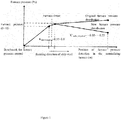
- furnace pressures of the preheating section, the non-oxidation heating section, the downstream furnace section adjacent to the furnace throat and the last furnace section of various subsequent normalizing treatment furnace sections are detected and provided in Figure 1 .
- Furnace pressure refers to the internal pressure of the furnace chamber.
- the furnace pressure detected in the preheating section is referred as the benchmark for furnace pressure control.
- the present invention via a new type of furnace pressure distribution in the normalizing furnace shown in Figure 1 , eradicates the backward flow of smoke, prevents the production of dense oxides on the surface of the hot-rolled steel sheet in the course of subsequent normalizing treatment which can not be effectively removed by acid pickling, and thus improves the quality of the normalized substrate.
- the weight percentages of the main elements of the hot-rolled steel sheet are described below: 0.5 ⁇ Si ⁇ 6.5%, 0.05 ⁇ Mn ⁇ 0.55%, 0.05 ⁇ Al ⁇ 0.7%, C ⁇ 0.05%, P ⁇ 0.03%, S ⁇ 0.03%; it also contains Fe and some unavoidable impurity elements.
- This is just a general chemical composition of the hot-rolled steel sheet, and the present invention is not limited thereto and can also include other chemicals.
- the furnace throat is rarely or only slightly supplemented with the protective gas N 2 in the course of normal production.
- the combustion load will change as well; particularly, in the course of transition strip production, the differences in the material, specification or usage frequency of the transition strip will cause wild fluctuation of furnace atmosphere and thus result in the backward flow of smoke of the non-oxidation heating furnace section to the latter furnace section of the furnace throat.
- the imperfectly combusted and consumed air (containing oxygen in high volume) and smoke (containing gaseous H 2 O) will react with the high-temperature strip steel, and gradually form dense oxides on the substrate surface.
- the distribution of the new furnace pressure of the present invention as shown in Figure 1 is described below:
- the downstream furnace section adjacent to the furnace throat along the running direction of the strip steel has the highest furnace pressure; the furnace pressure gradually declines from the furnace section possessing the highest furnace pressure to the furnace section in the inlet direction of the normalizing furnace; it also gradually declines from the furnace section possessing the highest furnace pressure to the furnace section in the outlet direction of the normalizing furnace.
- the protective gas N 2 is charged into the furnace section between furnace throat and outlet sealed chamber, and the supply of the protective gas N 2 in the furnace section between furnace throat and outlet sealed chamber is adjusted to realize the distribution of the new furnace pressure. For example, it may be realized by adjusting the flow of the protective gas N 2 in the furnace throat and various subsequent normalizing treatment furnace sections.
- the specific practice is to charge a certain amount of the protective gas N 2 into the furnace throat, and thus form a protective curtain effectively cut off by N 2 .
- the amount of N 2 charged into the furnace throat and that charged into various subsequent normalizing treatment furnace sections need to satisfy the following relation: N 2 inlet in furnace throat / total N 2 inlet in various subsequent normalizing treatment furnace sections ⁇ 1.2.
- the furnace pressure difference between the downstream furnace section adjacent to the furnace throat along the running direction of the strip steel and the non-oxidation heating section is controlled between 0 and 10Pa, and should preferablly be controlled between 5 and 10Pa.
- the fuel supplied in the non-oxidation heating furnace combusts inside the furnace.
- the furnace pressure can be stably controlled around the benchmark for furnace pressure control.
- the benchmark for furnace pressure control is set between 10 and 25Pa.
- the benchmark for furnace pressure control is less than 10Pa, air will be taken in from the inlet sealed roller of the normalizing furnace in large amount; if it is above 25Pa, smoke will overflow out of the furnace chamber in large amount, which not only causes significant heat loss but also poses a safety hazard to equipment nearby.
- the N 2 amount of the outlet sealed chamber is regulated to adjust the slope K' outlet direction of furnace pressure reduction from the downstream furnace section adjacent to the furnace throat along the running direction of the strip steel to the furnace section in the outlet direction of the normalizing furnace , i.e., the slope of furnace pressure reduction from the highest point to the outlet direction of the normalizing furnace.
- K ' outlet direction furnace pressure of the last furnace section among the various subsequent normalizing treatment sections along the running direction of the strip steel ⁇ furnace pressure of the downstream furnace section adjacent to the furnace throat along the running direction of the strip steel / distance between the correspondinng two furnace sections .
- the slope K' outlet direction of furnace pressure reduction from the downstream furnace section adjacent to the furnace throat along the running direction of the strip steel to the furnace section in the outlet direction of the normalizing furnace is between - 0.05 and - 0.25.
- K inlet direction furnace pressure of the non-oxidation heating section ⁇ the benchmark for furnace pressure control / distance between the correseponding two furnace sections
- the slope K inlet direction of furnace pressure reduction from the non-oxidation heating section to the furnace section in the inlet direction of the normalizing furnace is between 0.55 and 0.8. If the slope is above 0.8, it will cause inadequate effective heat exchange between smoke and steel strip, raise smoke exhaust temperature and result in energy waste; if the slope is less than 0.55, gradient distribution of furnace pressure can not be formed inside the furnace chamber, and air flow inside the furnace is not smooth, which will then affect the stable combustion at the nozzle of the non-oxidation heating furnace.
- a protective curtain effectively cut off by N 2 is formed in the furnace throat, and by effectively controlling the slopes of furnace pressure reduction from the furnace throat to the inlet and outlet directions, we can completely eradicate the backward flow of smoke, prevent the production of dense oxides on the surface of the hot-rolled steel sheet in the course of subsequent normalizing treatment which can not be effectively removed by acid pickling, and thus improves the quality of the normalized substrate.
- Hot rolled steel coil production methods include such steps as steelmaking and hot rolling, as described below:
- the N 2 supply ratio (the ratio of N 2 inlet in furnace throat (Nm 3 /hr)/total N 2 inlet in various subsequent normalizing treatment furnace sections (Nm 3 /hr)) is set at 1.3.
- the furnace pressure difference between the downstream furnace section adjacent to the furnace throat along the running direction of the strip steel and the non-oxidation heating section is 5Pa;
- the slope K' outlet direction of furnace pressure reduction from the downstream furnace section adjacent to the furnace throat along the running direction of the strip steel to the furnace section in the outlet direction of the normalizing furnace is - 0.1;
- the slope K inlet direction of furnace pressure reduction from the non-oxidation heating section to the furnace section in the inlet direction of the normalizing furnace is 0.70.
- the downstream furnace section adjacent to the furnace throat along the running direction of the strip steel has the highest furnace pressure; the furnace pressure gradually declines from the furnace section possessing the highest furnace pressure to the furnace section in the inlet direction of the normalizing furnace; it also gradually declines from the furnace section possessing the highest furnace pressure to the furnace section in the outlet direction of the normalizing furnace, which realizes the furnace pressure distribution mode of the present invention.
- the Example 1 forms a protective curtain effectively cut off by N 2 in the furnace throat and realizes the furnace pressure distribution mode of the present invention, so there is no oxide residue on the normalized substrate after acid pickling.
- the benchmark for furnace pressure control is set at 20Pa to realize the stable control of furnace pressure.
- the N 2 supply ratio (the ratio of N 2 inlet in furnace throat (Nm 3 /hr)/total N 2 inlet in various subsequent normalizing treatment furnace sections (Nm 3 /hr)) is set at 1.35.
- the furnace pressure difference between the downstream furnace section adjacent to the furnace throat along the running direction of the strip steel and the non-oxidation heating section is 7Pa;
- the slope K' outlet direction of furnace pressure reduction from the downstream furnace section adjacent to the furnace throat along the running direction of the strip steel to the furnace section in the outlet direction of the normalizing furnace is - 0.15;
- the slope K inlet direction of furnace pressure reduction from the non-oxidation heating section to the furnace section in the inlet direction of the normalizing furnace is 0.80.
- the downstream furnace section adjacent to the furnace throat along the running direction of the strip steel has the highest furnace pressure ; the furnace pressure gradually declines from the furnace section possessing the highest furnace pressure to the furnace section in the inlet direction of the normalizing furnace; it also gradually declines from the furnace section possessing the highest furnace pressure to the furnace section in the outlet direction of the normalizing furnace, which realizes the furnace pressure distribution mode of the present invention.
- the Example 2 forms a protective curtain effectively cut off by N 2 in the furnace throat and realizes the furnace pressure distribution mode of the present invention, so there is no oxide residue on the normalized substrate after acid pickling.
- the benchmark for furnace pressure control is set at 15Pa to realize the stable control of furnace pressure.
- the N 2 supply ratio (the ratio of N 2 inlet in furnace throat (Nm 3 /hr)/total N 2 inlet in various subsequent normalizing treatment furnace sections (Nm 3 /hr)) is set at 1.15.
- the furnace pressure difference between the downstream furnace section adjacent to the furnace throat along the running direction of the strip steel and the non-oxidation heating section is - 5Pa. It can be seen from the above data that, the non-oxidation heating section has the highest furnace pressure, so the furnace pressure distribution of the present invention is not realized.
- the N 2 supply ratio (the ratio of N 2 inlet in furnace throat (Nm 3 /hr)/total N 2 inlet in various subsequent normalizing treatment furnace sections (Nm 3 /hr)) is less than 1.2, neither can a protective curtain effectively cut off by N 2 be formed in the furnace throat, nor can the furnace pressure distribution mode of the present invention be realized, so the backward flow of smoke occurs, and there are oxide residues on the normalized substrate after acid pickling.
- the N 2 supply ratio (the ratio of N 2 inlet in furnace throat (Nm 3 /hr)/total N 2 inlet in various subsequent normalizing treatment furnace sections (Nm 3 /hr)) is set at 1.1.
- the furnace pressure difference between the downstream furnace section adjacent to the furnace throat along the running direction of the strip steel and the non-oxidation heating section is - 4Pa. It can be seen from the above data that, the non-oxidation heating section has the highest furnace pressure, so the furnace pressure distribution of the present invention is not realized.
- the N 2 supply ratio (the ratio of N 2 inlet in furnace throat (Nm 3 /hr)/total N 2 inlet in various subsequent normalizing treatment furnace sections (Nm 3 /hr)) is less than 1.2, neither can a protective curtain effectively cut off by N 2 be formed in the furnace throat, nor can the furnace pressure distribution mode of the present invention be realized, so the backward flow of smoke occurs, and there are oxide residues on the normalized substrate after acid pickling.
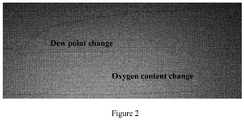
- Figure 3 provides the change tendency chart of both dew point and oxygen content detected in subsequent furnace sections of the furnace throat of the normalizing furnace when the smoke of the non-oxidation heating section flows backward in the furnace throat, and in this course, hardly removable oxides are formed on the strip steel surface of normalized substrate produced after acid pickling.
- Dew point refers to the water content of smoke.
- the method of producing a high quality normalized silicon steel substrate of the present invention can successfully prevent the formation of dense oxides in the normalizing treatment process, and improve the quality of normalized silicon steel substrate.
- the steps following normalization are simplified and the cost is reduced, and it may be used for the large-scale production of high-quality normalized silicon steel substrate.
Landscapes
- Chemical & Material Sciences (AREA)
- Engineering & Computer Science (AREA)
- Physics & Mathematics (AREA)
- Organic Chemistry (AREA)
- Crystallography & Structural Chemistry (AREA)
- Mechanical Engineering (AREA)
- Materials Engineering (AREA)
- Metallurgy (AREA)
- Thermal Sciences (AREA)
- Manufacturing & Machinery (AREA)
- Power Engineering (AREA)
- Electromagnetism (AREA)
- Heat Treatment Of Strip Materials And Filament Materials (AREA)
- Manufacturing Of Steel Electrode Plates (AREA)
- Chemical Vapour Deposition (AREA)
- Silicon Compounds (AREA)
Applications Claiming Priority (2)
| Application Number | Priority Date | Filing Date | Title |
|---|---|---|---|
| CN201210060176.7A CN103305744B (zh) | 2012-03-08 | 2012-03-08 | 一种高质量硅钢常化基板的生产方法 |
| PCT/CN2012/000368 WO2013131212A1 (zh) | 2012-03-08 | 2012-03-27 | 一种硅钢常化基板的生产方法 |
Publications (3)
| Publication Number | Publication Date |
|---|---|
| EP2824194A1 EP2824194A1 (en) | 2015-01-14 |
| EP2824194A4 EP2824194A4 (en) | 2016-01-13 |
| EP2824194B1 true EP2824194B1 (en) | 2018-07-25 |
Family
ID=49115844
Family Applications (1)
| Application Number | Title | Priority Date | Filing Date |
|---|---|---|---|
| EP12870723.9A Active EP2824194B1 (en) | 2012-03-08 | 2012-03-27 | Method for producing silicon steel normalizing substrate |
Country Status (9)
| Country | Link |
|---|---|
| US (1) | US9738946B2 (enExample) |
| EP (1) | EP2824194B1 (enExample) |
| JP (1) | JP5893766B2 (enExample) |
| KR (1) | KR20140115366A (enExample) |
| CN (1) | CN103305744B (enExample) |
| IN (1) | IN2014MN01786A (enExample) |
| MX (1) | MX356617B (enExample) |
| RU (1) | RU2585913C2 (enExample) |
| WO (1) | WO2013131212A1 (enExample) |
Families Citing this family (4)
| Publication number | Priority date | Publication date | Assignee | Title |
|---|---|---|---|---|
| CN104726682B (zh) * | 2013-12-23 | 2017-03-29 | 鞍钢股份有限公司 | 一种无取向硅钢向取向硅钢工艺转换的方法 |
| CN107119180B (zh) * | 2016-02-25 | 2019-09-06 | 宝山钢铁股份有限公司 | 改善无取向硅钢板板形的方法 |
| CN106011655A (zh) * | 2016-08-08 | 2016-10-12 | 浙江华赢特钢科技有限公司 | 一种高效硅钢常化基板的生产方法 |
| CN112974523B (zh) * | 2021-02-23 | 2023-04-07 | 山西太钢不锈钢精密带钢有限公司 | 一种用于密封垫的309s极薄精密不锈带钢的生产方法 |
Family Cites Families (29)
| Publication number | Priority date | Publication date | Assignee | Title |
|---|---|---|---|---|
| US3307981A (en) * | 1963-11-14 | 1967-03-07 | Inland Steel Co | Continuous bluing and annealing process |
| JPS4819048B1 (enExample) | 1969-09-03 | 1973-06-11 | ||
| GB1292403A (en) * | 1969-11-15 | 1972-10-11 | Kobe Steel Ltd | Continous treatment method and apparatus for metals |
| US4490107A (en) * | 1981-12-18 | 1984-12-25 | Kurosaki Furnace Industries Company Limited | Method of processing charges in a continuous combustion furnace |
| JPS6017020A (ja) * | 1983-07-07 | 1985-01-28 | Nippon Kokan Kk <Nkk> | 直火式竪型連続焼鈍炉 |
| JPS6173880A (ja) * | 1984-09-17 | 1986-04-16 | Mitsubishi Heavy Ind Ltd | 真空蒸着メツキ方法及び真空蒸着メツキ装置 |
| AU585531B2 (en) * | 1984-09-17 | 1989-06-22 | Mitsubishi Jukogyo Kabushiki Kaisha | Method and apparatus for vacuum deposition plating |
| FR2583064B1 (fr) * | 1985-06-05 | 1987-08-14 | Air Liquide | Procede de traitement thermique, hotte pour la mise en oeuvre de ce procede et son utilisation dans les fours de traitement thermique |
| JPS62120427A (ja) * | 1985-11-20 | 1987-06-01 | Kawasaki Steel Corp | けい素鋼熱延板の焼鈍方法 |
| US4832757A (en) * | 1987-07-08 | 1989-05-23 | Amax Inc. | Method for producing normalized grade D sucker rods |
| JPH0699749B2 (ja) * | 1988-11-29 | 1994-12-07 | 住友金属工業株式会社 | 磁気特性の良好な無方向性電磁鋼板の製造法 |
| JPH03125897A (ja) * | 1989-10-12 | 1991-05-29 | R I Denshi Kogyo:Kk | 酸素濃度極低下雰囲気炉 |
| JPH05186831A (ja) * | 1991-07-29 | 1993-07-27 | Kenichi Arai | Goss方位に集積した結晶方位を有する方向性珪素鋼板の製造方法 |
| JPH05202419A (ja) * | 1992-01-27 | 1993-08-10 | Kawasaki Steel Corp | けい素鋼熱延板の脱スケール方法 |
| IT1284268B1 (it) * | 1996-08-30 | 1998-05-14 | Acciai Speciali Terni Spa | Procedimento per la produzione di lamierino magnetico a grano orientato, con elevate caratteristiche magnetiche, a partire da |
| RU2126844C1 (ru) * | 1998-02-16 | 1999-02-27 | Открытое акционерное общество "Машиностроительный завод" | Способ непрерывной безокислительной термообработки длинномерных особотонкостенных труб и устройство для его осуществления |
| SE515593C2 (sv) * | 1999-03-01 | 2001-09-03 | Avesta Sheffield Ab | Apparat för värmning av ett metallband |
| CN2471440Y (zh) * | 2000-07-13 | 2002-01-16 | 武汉钢铁(集团)公司 | 新型硅钢热轧板常化退火炉 |
| CA2615962C (en) * | 2005-07-25 | 2011-04-26 | Sumitomo Metal Industries, Ltd. | Continuous heat treatment furnace and utilizing the same, metal pipe and method of heat treatment |
| FR2903122B1 (fr) * | 2006-06-30 | 2008-09-12 | Stein Heurtey | Dispositif de securisation d'un four equipe d'un chauffage et d'un refroidissement rapides fonctionnant sous atmosphere controlee. |
| CN201201973Y (zh) * | 2008-06-19 | 2009-03-04 | 中冶南方(武汉)威仕工业炉有限公司 | 防止带钢氧化的常化机组炉段 |
| CN101812571B (zh) * | 2009-02-24 | 2011-09-21 | 宝山钢铁股份有限公司 | 电工钢热轧带钢常化处理中防止内氧化层的方法 |
| CN101906529B (zh) * | 2009-06-08 | 2012-11-28 | 鞍钢股份有限公司 | 一种碳套炉底辊结瘤的控制和处理方法 |
| RU2407808C1 (ru) * | 2009-08-03 | 2010-12-27 | Открытое акционерное общество "Новолипецкий металлургический комбинат" | Способ производства анизотропной электротехнической стали с низкими удельными потерями на перемагничивание |
| CN101760607B (zh) * | 2009-12-30 | 2012-05-09 | 攀钢集团攀枝花钢钒有限公司 | 一种两烟道加热炉炉膛压力控制方法 |
| CN102268516B (zh) * | 2010-06-07 | 2013-05-01 | 鞍钢股份有限公司 | 高碳含量中低牌号冷轧无取向硅钢脱碳退火工艺 |
| JP5088596B2 (ja) * | 2010-09-30 | 2012-12-05 | 日立金属株式会社 | R−t−b系焼結磁石の製造方法 |
| AT511034B1 (de) * | 2011-02-04 | 2013-01-15 | Andritz Tech & Asset Man Gmbh | Verfahren zum kontrollieren einer schutzgasatmosphäre in einer schutzgaskammer zur behandlung eines metallbandes |
| JP5928939B2 (ja) * | 2012-02-16 | 2016-06-01 | 住友電工ファインポリマー株式会社 | 電離性放射線照射装置および電離性放射線照射方法 |
-
2012
- 2012-03-08 CN CN201210060176.7A patent/CN103305744B/zh active Active
- 2012-03-27 KR KR1020147023541A patent/KR20140115366A/ko not_active Ceased
- 2012-03-27 RU RU2014132739/02A patent/RU2585913C2/ru active
- 2012-03-27 JP JP2014560207A patent/JP5893766B2/ja active Active
- 2012-03-27 WO PCT/CN2012/000368 patent/WO2013131212A1/zh not_active Ceased
- 2012-03-27 MX MX2014010512A patent/MX356617B/es active IP Right Grant
- 2012-03-27 US US14/379,595 patent/US9738946B2/en active Active
- 2012-03-27 EP EP12870723.9A patent/EP2824194B1/en active Active
- 2012-03-27 IN IN1786MUN2014 patent/IN2014MN01786A/en unknown
Non-Patent Citations (1)
| Title |
|---|
| None * |
Also Published As
| Publication number | Publication date |
|---|---|
| US20150013846A1 (en) | 2015-01-15 |
| RU2585913C2 (ru) | 2016-06-10 |
| JP2015515540A (ja) | 2015-05-28 |
| WO2013131212A1 (zh) | 2013-09-12 |
| US9738946B2 (en) | 2017-08-22 |
| KR20140115366A (ko) | 2014-09-30 |
| CN103305744A (zh) | 2013-09-18 |
| IN2014MN01786A (enExample) | 2015-07-03 |
| MX2014010512A (es) | 2014-10-14 |
| CN103305744B (zh) | 2016-03-30 |
| MX356617B (es) | 2018-06-06 |
| EP2824194A4 (en) | 2016-01-13 |
| JP5893766B2 (ja) | 2016-03-23 |
| EP2824194A1 (en) | 2015-01-14 |
| WO2013131212A8 (zh) | 2014-08-21 |
| RU2014132739A (ru) | 2016-04-27 |
Similar Documents
| Publication | Publication Date | Title |
|---|---|---|
| CN101947557B (zh) | 一种减少热轧钢板表面生成氧化铁皮的制备方法 | |
| KR101617288B1 (ko) | 무방향성 전기강판 및 그의 생산방법 | |
| CN103409642B (zh) | 一种低屈强比的高强度换热器用钛卷板的加工方法 | |
| CN103341498B (zh) | 减少热轧钢板表面氧化铁皮厚度的方法 | |
| CN101748264B (zh) | 一种耐候钢板坯的加热方法 | |
| CN103060542A (zh) | 低膨胀合金宽厚板的制造方法 | |
| CN118045863B (zh) | 一种高成材率低成本生产tc4eli钛合金中厚板的方法 | |
| EP2824193A1 (en) | Method for producing silicon steel normalizing substrate | |
| CN108570595A (zh) | 一种新能源汽车驱动电机用低铁损高磁感冷轧无取向电工钢及其生产方法 | |
| CN107790506A (zh) | 一种热轧带钢表面处理方法 | |
| US9738946B2 (en) | Method for producing silicon steel normalizing substrate | |
| CN101899614B (zh) | 一种含V、Nb复合微合金化的热轧钢板及其制备方法 | |
| CN105220070A (zh) | 一种热轧钢板及其表面氧化铁皮的去除方法 | |
| CN114717480B (zh) | 一种b8≥1.90t中温普通取向硅钢及制造方法 | |
| RU2407808C1 (ru) | Способ производства анизотропной электротехнической стали с низкими удельными потерями на перемагничивание | |
| CN102744254B (zh) | 热轧奥氏体不锈钢带钢生产方法 | |
| CN121467468B (zh) | 一种Ti80钛合金EB扁锭单火次直轧制备厚板的方法 | |
| CN117206330B (zh) | 短流程酸洗钢表面异物压入及压痕缺陷的控制方法和装置 | |
| CN120861603A (zh) | 一种防止低温生产无取向硅钢时粗轧翘头的控制方法 | |
| JP5907352B2 (ja) | 鋼スラブの熱間圧延方法 | |
| CN105734450A (zh) | 薄板坯表面品质优异的高强度冷轧钢板及其制造方法 | |
| CN114540698A (zh) | 一种弹簧钢盘条的制备方法 | |
| CN114749484A (zh) | 一种克服直热装热轧钢带表面红铁皮的方法 | |
| KR20120099512A (ko) | 무방향성 규소강의 표면에서 조대한 결정립을 미세하게 하는 방법 |
Legal Events
| Date | Code | Title | Description |
|---|---|---|---|
| PUAI | Public reference made under article 153(3) epc to a published international application that has entered the european phase |
Free format text: ORIGINAL CODE: 0009012 |
|
| 17P | Request for examination filed |
Effective date: 20140822 |
|
| AK | Designated contracting states |
Kind code of ref document: A1 Designated state(s): AL AT BE BG CH CY CZ DE DK EE ES FI FR GB GR HR HU IE IS IT LI LT LU LV MC MK MT NL NO PL PT RO RS SE SI SK SM TR |
|
| AX | Request for extension of the european patent |
Extension state: BA ME |
|
| DAX | Request for extension of the european patent (deleted) | ||
| RA4 | Supplementary search report drawn up and despatched (corrected) |
Effective date: 20151210 |
|
| RIC1 | Information provided on ipc code assigned before grant |
Ipc: C21D 8/02 20060101AFI20151204BHEP Ipc: C21D 9/56 20060101ALI20151204BHEP |
|
| 17Q | First examination report despatched |
Effective date: 20160905 |
|
| STAA | Information on the status of an ep patent application or granted ep patent |
Free format text: STATUS: EXAMINATION IS IN PROGRESS |
|
| GRAP | Despatch of communication of intention to grant a patent |
Free format text: ORIGINAL CODE: EPIDOSNIGR1 |
|
| STAA | Information on the status of an ep patent application or granted ep patent |
Free format text: STATUS: GRANT OF PATENT IS INTENDED |
|
| INTG | Intention to grant announced |
Effective date: 20180327 |
|
| GRAS | Grant fee paid |
Free format text: ORIGINAL CODE: EPIDOSNIGR3 |
|
| GRAA | (expected) grant |
Free format text: ORIGINAL CODE: 0009210 |
|
| STAA | Information on the status of an ep patent application or granted ep patent |
Free format text: STATUS: THE PATENT HAS BEEN GRANTED |
|
| AK | Designated contracting states |
Kind code of ref document: B1 Designated state(s): AL AT BE BG CH CY CZ DE DK EE ES FI FR GB GR HR HU IE IS IT LI LT LU LV MC MK MT NL NO PL PT RO RS SE SI SK SM TR |
|
| REG | Reference to a national code |
Ref country code: GB Ref legal event code: FG4D |
|
| REG | Reference to a national code |
Ref country code: CH Ref legal event code: EP |
|
| REG | Reference to a national code |
Ref country code: AT Ref legal event code: REF Ref document number: 1021837 Country of ref document: AT Kind code of ref document: T Effective date: 20180815 |
|
| REG | Reference to a national code |
Ref country code: IE Ref legal event code: FG4D |
|
| REG | Reference to a national code |
Ref country code: DE Ref legal event code: R096 Ref document number: 602012049010 Country of ref document: DE |
|
| REG | Reference to a national code |
Ref country code: NL Ref legal event code: MP Effective date: 20180725 |
|
| REG | Reference to a national code |
Ref country code: LT Ref legal event code: MG4D |
|
| PG25 | Lapsed in a contracting state [announced via postgrant information from national office to epo] |
Ref country code: NL Free format text: LAPSE BECAUSE OF FAILURE TO SUBMIT A TRANSLATION OF THE DESCRIPTION OR TO PAY THE FEE WITHIN THE PRESCRIBED TIME-LIMIT Effective date: 20180725 |
|
| PG25 | Lapsed in a contracting state [announced via postgrant information from national office to epo] |
Ref country code: PL Free format text: LAPSE BECAUSE OF FAILURE TO SUBMIT A TRANSLATION OF THE DESCRIPTION OR TO PAY THE FEE WITHIN THE PRESCRIBED TIME-LIMIT Effective date: 20180725 Ref country code: BG Free format text: LAPSE BECAUSE OF FAILURE TO SUBMIT A TRANSLATION OF THE DESCRIPTION OR TO PAY THE FEE WITHIN THE PRESCRIBED TIME-LIMIT Effective date: 20181025 Ref country code: LT Free format text: LAPSE BECAUSE OF FAILURE TO SUBMIT A TRANSLATION OF THE DESCRIPTION OR TO PAY THE FEE WITHIN THE PRESCRIBED TIME-LIMIT Effective date: 20180725 Ref country code: SE Free format text: LAPSE BECAUSE OF FAILURE TO SUBMIT A TRANSLATION OF THE DESCRIPTION OR TO PAY THE FEE WITHIN THE PRESCRIBED TIME-LIMIT Effective date: 20180725 Ref country code: FI Free format text: LAPSE BECAUSE OF FAILURE TO SUBMIT A TRANSLATION OF THE DESCRIPTION OR TO PAY THE FEE WITHIN THE PRESCRIBED TIME-LIMIT Effective date: 20180725 Ref country code: IS Free format text: LAPSE BECAUSE OF FAILURE TO SUBMIT A TRANSLATION OF THE DESCRIPTION OR TO PAY THE FEE WITHIN THE PRESCRIBED TIME-LIMIT Effective date: 20181125 Ref country code: NO Free format text: LAPSE BECAUSE OF FAILURE TO SUBMIT A TRANSLATION OF THE DESCRIPTION OR TO PAY THE FEE WITHIN THE PRESCRIBED TIME-LIMIT Effective date: 20181025 Ref country code: RS Free format text: LAPSE BECAUSE OF FAILURE TO SUBMIT A TRANSLATION OF THE DESCRIPTION OR TO PAY THE FEE WITHIN THE PRESCRIBED TIME-LIMIT Effective date: 20180725 Ref country code: GR Free format text: LAPSE BECAUSE OF FAILURE TO SUBMIT A TRANSLATION OF THE DESCRIPTION OR TO PAY THE FEE WITHIN THE PRESCRIBED TIME-LIMIT Effective date: 20181026 |
|
| PG25 | Lapsed in a contracting state [announced via postgrant information from national office to epo] |
Ref country code: HR Free format text: LAPSE BECAUSE OF FAILURE TO SUBMIT A TRANSLATION OF THE DESCRIPTION OR TO PAY THE FEE WITHIN THE PRESCRIBED TIME-LIMIT Effective date: 20180725 Ref country code: LV Free format text: LAPSE BECAUSE OF FAILURE TO SUBMIT A TRANSLATION OF THE DESCRIPTION OR TO PAY THE FEE WITHIN THE PRESCRIBED TIME-LIMIT Effective date: 20180725 Ref country code: AL Free format text: LAPSE BECAUSE OF FAILURE TO SUBMIT A TRANSLATION OF THE DESCRIPTION OR TO PAY THE FEE WITHIN THE PRESCRIBED TIME-LIMIT Effective date: 20180725 |
|
| REG | Reference to a national code |
Ref country code: DE Ref legal event code: R097 Ref document number: 602012049010 Country of ref document: DE |
|
| PG25 | Lapsed in a contracting state [announced via postgrant information from national office to epo] |
Ref country code: CZ Free format text: LAPSE BECAUSE OF FAILURE TO SUBMIT A TRANSLATION OF THE DESCRIPTION OR TO PAY THE FEE WITHIN THE PRESCRIBED TIME-LIMIT Effective date: 20180725 Ref country code: RO Free format text: LAPSE BECAUSE OF FAILURE TO SUBMIT A TRANSLATION OF THE DESCRIPTION OR TO PAY THE FEE WITHIN THE PRESCRIBED TIME-LIMIT Effective date: 20180725 Ref country code: EE Free format text: LAPSE BECAUSE OF FAILURE TO SUBMIT A TRANSLATION OF THE DESCRIPTION OR TO PAY THE FEE WITHIN THE PRESCRIBED TIME-LIMIT Effective date: 20180725 Ref country code: ES Free format text: LAPSE BECAUSE OF FAILURE TO SUBMIT A TRANSLATION OF THE DESCRIPTION OR TO PAY THE FEE WITHIN THE PRESCRIBED TIME-LIMIT Effective date: 20180725 |
|
| PG25 | Lapsed in a contracting state [announced via postgrant information from national office to epo] |
Ref country code: SK Free format text: LAPSE BECAUSE OF FAILURE TO SUBMIT A TRANSLATION OF THE DESCRIPTION OR TO PAY THE FEE WITHIN THE PRESCRIBED TIME-LIMIT Effective date: 20180725 Ref country code: SM Free format text: LAPSE BECAUSE OF FAILURE TO SUBMIT A TRANSLATION OF THE DESCRIPTION OR TO PAY THE FEE WITHIN THE PRESCRIBED TIME-LIMIT Effective date: 20180725 Ref country code: DK Free format text: LAPSE BECAUSE OF FAILURE TO SUBMIT A TRANSLATION OF THE DESCRIPTION OR TO PAY THE FEE WITHIN THE PRESCRIBED TIME-LIMIT Effective date: 20180725 |
|
| PLBE | No opposition filed within time limit |
Free format text: ORIGINAL CODE: 0009261 |
|
| STAA | Information on the status of an ep patent application or granted ep patent |
Free format text: STATUS: NO OPPOSITION FILED WITHIN TIME LIMIT |
|
| 26N | No opposition filed |
Effective date: 20190426 |
|
| PG25 | Lapsed in a contracting state [announced via postgrant information from national office to epo] |
Ref country code: SI Free format text: LAPSE BECAUSE OF FAILURE TO SUBMIT A TRANSLATION OF THE DESCRIPTION OR TO PAY THE FEE WITHIN THE PRESCRIBED TIME-LIMIT Effective date: 20180725 |
|
| PG25 | Lapsed in a contracting state [announced via postgrant information from national office to epo] |
Ref country code: MC Free format text: LAPSE BECAUSE OF FAILURE TO SUBMIT A TRANSLATION OF THE DESCRIPTION OR TO PAY THE FEE WITHIN THE PRESCRIBED TIME-LIMIT Effective date: 20180725 |
|
| REG | Reference to a national code |
Ref country code: CH Ref legal event code: PL |
|
| PG25 | Lapsed in a contracting state [announced via postgrant information from national office to epo] |
Ref country code: LU Free format text: LAPSE BECAUSE OF NON-PAYMENT OF DUE FEES Effective date: 20190327 |
|
| REG | Reference to a national code |
Ref country code: BE Ref legal event code: MM Effective date: 20190331 |
|
| PG25 | Lapsed in a contracting state [announced via postgrant information from national office to epo] |
Ref country code: CH Free format text: LAPSE BECAUSE OF NON-PAYMENT OF DUE FEES Effective date: 20190331 Ref country code: LI Free format text: LAPSE BECAUSE OF NON-PAYMENT OF DUE FEES Effective date: 20190331 Ref country code: IE Free format text: LAPSE BECAUSE OF NON-PAYMENT OF DUE FEES Effective date: 20190327 |
|
| PG25 | Lapsed in a contracting state [announced via postgrant information from national office to epo] |
Ref country code: BE Free format text: LAPSE BECAUSE OF NON-PAYMENT OF DUE FEES Effective date: 20190331 |
|
| PG25 | Lapsed in a contracting state [announced via postgrant information from national office to epo] |
Ref country code: TR Free format text: LAPSE BECAUSE OF FAILURE TO SUBMIT A TRANSLATION OF THE DESCRIPTION OR TO PAY THE FEE WITHIN THE PRESCRIBED TIME-LIMIT Effective date: 20180725 |
|
| PG25 | Lapsed in a contracting state [announced via postgrant information from national office to epo] |
Ref country code: MT Free format text: LAPSE BECAUSE OF NON-PAYMENT OF DUE FEES Effective date: 20190327 Ref country code: PT Free format text: LAPSE BECAUSE OF FAILURE TO SUBMIT A TRANSLATION OF THE DESCRIPTION OR TO PAY THE FEE WITHIN THE PRESCRIBED TIME-LIMIT Effective date: 20181125 |
|
| PG25 | Lapsed in a contracting state [announced via postgrant information from national office to epo] |
Ref country code: CY Free format text: LAPSE BECAUSE OF FAILURE TO SUBMIT A TRANSLATION OF THE DESCRIPTION OR TO PAY THE FEE WITHIN THE PRESCRIBED TIME-LIMIT Effective date: 20180725 |
|
| PG25 | Lapsed in a contracting state [announced via postgrant information from national office to epo] |
Ref country code: HU Free format text: LAPSE BECAUSE OF FAILURE TO SUBMIT A TRANSLATION OF THE DESCRIPTION OR TO PAY THE FEE WITHIN THE PRESCRIBED TIME-LIMIT; INVALID AB INITIO Effective date: 20120327 |
|
| REG | Reference to a national code |
Ref country code: AT Ref legal event code: UEP Ref document number: 1021837 Country of ref document: AT Kind code of ref document: T Effective date: 20180725 |
|
| PG25 | Lapsed in a contracting state [announced via postgrant information from national office to epo] |
Ref country code: MK Free format text: LAPSE BECAUSE OF FAILURE TO SUBMIT A TRANSLATION OF THE DESCRIPTION OR TO PAY THE FEE WITHIN THE PRESCRIBED TIME-LIMIT Effective date: 20180725 |
|
| P01 | Opt-out of the competence of the unified patent court (upc) registered |
Effective date: 20230508 |
|
| PGFP | Annual fee paid to national office [announced via postgrant information from national office to epo] |
Ref country code: GB Payment date: 20260323 Year of fee payment: 15 |
|
| PGFP | Annual fee paid to national office [announced via postgrant information from national office to epo] |
Ref country code: DE Payment date: 20260313 Year of fee payment: 15 |
|
| PGFP | Annual fee paid to national office [announced via postgrant information from national office to epo] |
Ref country code: AT Payment date: 20260224 Year of fee payment: 15 |
|
| PGFP | Annual fee paid to national office [announced via postgrant information from national office to epo] |
Ref country code: IT Payment date: 20260310 Year of fee payment: 15 |
|
| PGFP | Annual fee paid to national office [announced via postgrant information from national office to epo] |
Ref country code: FR Payment date: 20260330 Year of fee payment: 15 |