EP2808686A1 - Alarmausgabevorrichtung und alarmausgabeverfahren - Google Patents
Alarmausgabevorrichtung und alarmausgabeverfahren Download PDFInfo
- Publication number
- EP2808686A1 EP2808686A1 EP12866606.2A EP12866606A EP2808686A1 EP 2808686 A1 EP2808686 A1 EP 2808686A1 EP 12866606 A EP12866606 A EP 12866606A EP 2808686 A1 EP2808686 A1 EP 2808686A1
- Authority
- EP
- European Patent Office
- Prior art keywords
- target value
- upper limit
- time
- limit target
- electric power
- Prior art date
- Legal status (The legal status is an assumption and is not a legal conclusion. Google has not performed a legal analysis and makes no representation as to the accuracy of the status listed.)
- Withdrawn
Links
Images







Classifications
-
- G—PHYSICS
- G01—MEASURING; TESTING
- G01R—MEASURING ELECTRIC VARIABLES; MEASURING MAGNETIC VARIABLES
- G01R11/00—Electromechanical arrangements for measuring time integral of electric power or current, e.g. of consumption
- G01R11/56—Special tariff meters
- G01R11/64—Maximum meters, e.g. tariff for a period is based on maximum demand within that period
-
- G—PHYSICS
- G06—COMPUTING OR CALCULATING; COUNTING
- G06Q—INFORMATION AND COMMUNICATION TECHNOLOGY [ICT] SPECIALLY ADAPTED FOR ADMINISTRATIVE, COMMERCIAL, FINANCIAL, MANAGERIAL OR SUPERVISORY PURPOSES; SYSTEMS OR METHODS SPECIALLY ADAPTED FOR ADMINISTRATIVE, COMMERCIAL, FINANCIAL, MANAGERIAL OR SUPERVISORY PURPOSES, NOT OTHERWISE PROVIDED FOR
- G06Q10/00—Administration; Management
-
- G—PHYSICS
- G01—MEASURING; TESTING
- G01R—MEASURING ELECTRIC VARIABLES; MEASURING MAGNETIC VARIABLES
- G01R11/00—Electromechanical arrangements for measuring time integral of electric power or current, e.g. of consumption
- G01R11/02—Constructional details
-
- G—PHYSICS
- G01—MEASURING; TESTING
- G01R—MEASURING ELECTRIC VARIABLES; MEASURING MAGNETIC VARIABLES
- G01R21/00—Arrangements for measuring electric power or power factor
-
- G—PHYSICS
- G01—MEASURING; TESTING
- G01R—MEASURING ELECTRIC VARIABLES; MEASURING MAGNETIC VARIABLES
- G01R22/00—Arrangements for measuring time integral of electric power or current, e.g. electricity meters
- G01R22/06—Arrangements for measuring time integral of electric power or current, e.g. electricity meters by electronic methods
-
- G—PHYSICS
- G08—SIGNALLING
- G08B—SIGNALLING SYSTEMS, e.g. PERSONAL CALLING SYSTEMS; ORDER TELEGRAPHS; ALARM SYSTEMS
- G08B21/00—Alarms responsive to a single specified undesired or abnormal condition and not otherwise provided for
- G08B21/18—Status alarms
- G08B21/182—Level alarms, e.g. alarms responsive to variables exceeding a threshold
-
- H—ELECTRICITY
- H02—GENERATION; CONVERSION OR DISTRIBUTION OF ELECTRIC POWER
- H02J—ELECTRIC POWER NETWORKS; CIRCUIT ARRANGEMENTS OR SYSTEMS FOR SUPPLYING OR DISTRIBUTING ELECTRIC POWER; SYSTEMS FOR STORING ELECTRIC ENERGY
- H02J3/00—Circuit arrangements for AC mains or AC distribution networks
- H02J3/12—Arrangements for adjusting voltage in AC networks by changing a characteristic of the network load
- H02J3/14—Arrangements for adjusting voltage in AC networks by changing a characteristic of the network load by switching loads on to, or off from, the networks, e.g. progressively balanced loading
-
- G—PHYSICS
- G01—MEASURING; TESTING
- G01R—MEASURING ELECTRIC VARIABLES; MEASURING MAGNETIC VARIABLES
- G01R22/00—Arrangements for measuring time integral of electric power or current, e.g. electricity meters
- G01R22/06—Arrangements for measuring time integral of electric power or current, e.g. electricity meters by electronic methods
- G01R22/10—Arrangements for measuring time integral of electric power or current, e.g. electricity meters by electronic methods using digital techniques
-
- H—ELECTRICITY
- H02—GENERATION; CONVERSION OR DISTRIBUTION OF ELECTRIC POWER
- H02J—ELECTRIC POWER NETWORKS; CIRCUIT ARRANGEMENTS OR SYSTEMS FOR SUPPLYING OR DISTRIBUTING ELECTRIC POWER; SYSTEMS FOR STORING ELECTRIC ENERGY
- H02J2105/00—Networks for supplying or distributing electric power characterised by their spatial reach or by the load
- H02J2105/40—Networks for supplying or distributing electric power characterised by their spatial reach or by the load characterised by the loads connecting to the networks or being supplied by the networks
- H02J2105/42—Home appliances
-
- Y—GENERAL TAGGING OF NEW TECHNOLOGICAL DEVELOPMENTS; GENERAL TAGGING OF CROSS-SECTIONAL TECHNOLOGIES SPANNING OVER SEVERAL SECTIONS OF THE IPC; TECHNICAL SUBJECTS COVERED BY FORMER USPC CROSS-REFERENCE ART COLLECTIONS [XRACs] AND DIGESTS
- Y02—TECHNOLOGIES OR APPLICATIONS FOR MITIGATION OR ADAPTATION AGAINST CLIMATE CHANGE
- Y02B—CLIMATE CHANGE MITIGATION TECHNOLOGIES RELATED TO BUILDINGS, e.g. HOUSING, HOUSE APPLIANCES OR RELATED END-USER APPLICATIONS
- Y02B70/00—Technologies for an efficient end-user side electric power management and consumption
- Y02B70/30—Systems integrating technologies related to power network operation and communication or information technologies for improving the carbon footprint of the management of residential or tertiary loads, i.e. smart grids as climate change mitigation technology in the buildings sector, including also the last stages of power distribution and the control, monitoring or operating management systems at local level
-
- Y—GENERAL TAGGING OF NEW TECHNOLOGICAL DEVELOPMENTS; GENERAL TAGGING OF CROSS-SECTIONAL TECHNOLOGIES SPANNING OVER SEVERAL SECTIONS OF THE IPC; TECHNICAL SUBJECTS COVERED BY FORMER USPC CROSS-REFERENCE ART COLLECTIONS [XRACs] AND DIGESTS
- Y02—TECHNOLOGIES OR APPLICATIONS FOR MITIGATION OR ADAPTATION AGAINST CLIMATE CHANGE
- Y02B—CLIMATE CHANGE MITIGATION TECHNOLOGIES RELATED TO BUILDINGS, e.g. HOUSING, HOUSE APPLIANCES OR RELATED END-USER APPLICATIONS
- Y02B70/00—Technologies for an efficient end-user side electric power management and consumption
- Y02B70/30—Systems integrating technologies related to power network operation and communication or information technologies for improving the carbon footprint of the management of residential or tertiary loads, i.e. smart grids as climate change mitigation technology in the buildings sector, including also the last stages of power distribution and the control, monitoring or operating management systems at local level
- Y02B70/3225—Demand response systems, e.g. load shedding, peak shaving
-
- Y—GENERAL TAGGING OF NEW TECHNOLOGICAL DEVELOPMENTS; GENERAL TAGGING OF CROSS-SECTIONAL TECHNOLOGIES SPANNING OVER SEVERAL SECTIONS OF THE IPC; TECHNICAL SUBJECTS COVERED BY FORMER USPC CROSS-REFERENCE ART COLLECTIONS [XRACs] AND DIGESTS
- Y04—INFORMATION OR COMMUNICATION TECHNOLOGIES HAVING AN IMPACT ON OTHER TECHNOLOGY AREAS
- Y04S—SYSTEMS INTEGRATING TECHNOLOGIES RELATED TO POWER NETWORK OPERATION, COMMUNICATION OR INFORMATION TECHNOLOGIES FOR IMPROVING THE ELECTRICAL POWER GENERATION, TRANSMISSION, DISTRIBUTION, MANAGEMENT OR USAGE, i.e. SMART GRIDS
- Y04S20/00—Management or operation of end-user stationary applications or the last stages of power distribution; Controlling, monitoring or operating thereof
- Y04S20/20—End-user application control systems
- Y04S20/222—Demand response systems, e.g. load shedding, peak shaving
-
- Y—GENERAL TAGGING OF NEW TECHNOLOGICAL DEVELOPMENTS; GENERAL TAGGING OF CROSS-SECTIONAL TECHNOLOGIES SPANNING OVER SEVERAL SECTIONS OF THE IPC; TECHNICAL SUBJECTS COVERED BY FORMER USPC CROSS-REFERENCE ART COLLECTIONS [XRACs] AND DIGESTS
- Y04—INFORMATION OR COMMUNICATION TECHNOLOGIES HAVING AN IMPACT ON OTHER TECHNOLOGY AREAS
- Y04S—SYSTEMS INTEGRATING TECHNOLOGIES RELATED TO POWER NETWORK OPERATION, COMMUNICATION OR INFORMATION TECHNOLOGIES FOR IMPROVING THE ELECTRICAL POWER GENERATION, TRANSMISSION, DISTRIBUTION, MANAGEMENT OR USAGE, i.e. SMART GRIDS
- Y04S20/00—Management or operation of end-user stationary applications or the last stages of power distribution; Controlling, monitoring or operating thereof
- Y04S20/20—End-user application control systems
- Y04S20/242—Home appliances
Definitions
- the present invention provides an alarm output device comprising an upper limit target value setup unit for establishing an upper limit target value for power consumption for a regular interval of time, a power consumption acquisition unit for obtaining electric power expected to be consumed within such interval of time, a determination unit for determining at all times whether or not the electric power acquired through the power consumption acquisition unit exceed the set upper limit target value, and a first alarm output step for outputting an alarm in case that the electric power exceeds the set upper limit target value determined by the determination unit at approximately the point in time at which a predetermined interval of time commences.
- an aspect of the invention provides a first change instruction output unit for outputting instructions to the upper limit target value setup unit for changing the set upper limit target value within a predetermined interval during or following which an alarm is outputted, in case that the electric power exceeds the set upper limit target value determined by the determination unit at approximately the point in time at which the interval of time commences.
- an aspect of the invention provides an alarm output device comprising an upper limit target value setup unit for establishing an upper limit target value for power consumption for a regular interval of time, a power consumption acquisition unit for obtaining electric power expected to be consumed within such interval of time, a standby electric power acquisition unit for obtaining standby electric power expected to be consumed within such interval of time, a determination unit for determining at all times whether or not the electric power acquired through the power consumption acquisition unit exceed the set upper limit target value, and a second alarm output step for outputting an alarm in case that the electric power exceeds the set target value determined by the determination unit, if the upper limit target value for a predetermined interval of time is equal to or less than the amount of standby electric power obtained through the standby electric power acquisition unit.
- the functional block of the devices descried below can be implemented by hardware, software, or both hardware and software.
- the present invention can be implemented not only as an apparatus but also as a method thereof.
- a portion of such inventions may be configured as software.
- a software product used for causing a computer to execute the software, and the recording medium, in which the software is installed, should be included in the technical scope of the present invention (the same applies throughout the entire specification).
- the "upper limit target value setup unit” has a function for establishing an upper limit target value for power consumption for a regular interval of time.
- regular interval of time refers to a time interval as a unit of measurement of power consumption identified by the commencement time and the finish time. For example, it is possible to divide 24 hours on an on-the-hour basis and establish 24 separate intervals of time, such as 0:00-1:00, 1:00-2:00,..., 23:00-24:00. Moreover, it is also possible to divide 24 hours on a 30-minute basis and establish 48 separate intervals of time, such as 0:00-0:30, 0:30-1:00,...23:30-24:00. Furthermore, it is also possible to use 15-minute intervals or hourly intervals.
- each regular interval of time does not have to be the same. It is possible to establish late-night intervals of time that are longer than daytime intervals of time. For example, intervals of time can be established with due attention to the conservation of electricity, and upper limit target values for each interval of time can be finely tuned via the upper limit target value setup unit, thereby allowing the power saving effect to be enhanced. It is preferable that the length of each interval of time be configured to be modifiable by users as necessary.
- the alarm output device of the first embodiment makes it possible for users to be aware of such inappropriate upper limit target values.
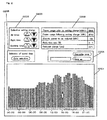
- daily power usage (kWh) in the case of consumption of electric power equivalent to an upper limit target value before and after setup electric power to be reduced by changing of the upper limit target value (kWh) and the rate of reduction thereof (%), and the charges (in yen) for daily power usage are indicated in a "setting data display area" (0203).
- inputting characters in the input window indicated in a "save button display area" (0204) and clicking the save button allows upper limit target values established for each interval of time to be recorded in recording media.
- clicking the selection button indicated in a "selection button display area” (0205) also allows the upper limit target value data recorded in recording media to be loaded.
- the predetermined multiples of the values established by users e.g., values that are 1.3 times as great as the values established by users
- the demand value i.e., the maximum value for average power used in 30 minutes
- daily power usage i.e., daily electricity charges
- CO2 emissions i.e., amount of carbon dioxide discharged upon generation at power plants of electricity for power consumption
- weather, maximum temperature, and minimum temperature for a selected date can be displayed therein.
- Information related to weather, temperature, and the like can be received from predetermined servers via a network, and such information that has been matched with dates for achievement data can be recorded. Additionally, in case that it is possible to obtain information related to weather, temperature, and the like, for certain time frames, such information that has been matched with dates and intervals of time for achievement data can be recorded. Users select the achievement data to be displayed in accordance with relevant weather and temperatures. When it has been determined that such achievement data is appropriate as an upper limit target value, users can store such data as an upper limit target value data for a specific date or period via the save button.
- the upper limit target value setup unit may be also configured to accept setup changes only at approximately the point in time at which a predetermined interval of time commences.
- the upper limit target value setup unit is configured to accept setup changes only at approximately the point in time at which a predetermined interval of time commences, it is possible to maintain means that allow an inappropriate upper limit target value to be adjusted to an appropriate value. At the same time, it is possible to prevent change to an upper limit target value in a careless manner and thus reduce saving actions.
- the "power consumption acquisition unit” has a function for obtaining electric power expected to be consumed within a relevant interval of time.
- the power consumption acquisition unit may execute processing for computing electric power expected to be consumed within a relevant interval of time through receiving measured power consumption data from a measuring instrument.
- the power consumption acquisition unit may receive data on electric power expected to be consumed within a relevant interval of time that has been computed by another measuring instrument.
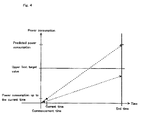
- electric power data it is possible for electric power data to be received directly from an instrument that measures power consumption or via another instrument. Based on power consumption during the period from the time of commencement of a relevant internal of time until the current time, the power consumption up to the time at which such interval is completed can be computed.
- a program for execution of the computation described above is stored beforehand in a storage unit, such as a ROM, is loaded into a RAM, and it is executed by a CPU as necessary.
- the processing for computation of power consumption to be estimated is executed at predetermined intervals of time (e.g., at 15-second intervals, 1-minute intervals, or the like) and prediction data is updated.
- the first alarm output step has a function for outputting an alarm in case that the electric power exceeds the set upper limit target value determined by the determination unit at approximately the point in time at which a predetermined interval of time commences.
- the term "in case that the electric power exceeds the set upper limit target value determined by the determination unit at approximately the point in time at which a predetermined interval of time commences” refers to a case in which the length from the commencement time until the excess is identified is equal to or less than 10% of the length of a relevant interval of time, or the like. More specifically, when the length of a relevant interval of time is 30 minutes, the excess is identified within 3 minutes following the commencement time.
- the CPU stores an upper limit target value for power consumption for each regular interval of time inputted from the input device in the nonvolatile memory, and loads such value into the RAM as needed.
- Data transmitted from a measuring instrument for power consumption is received via the communication device. Based on such data, power consumption from the commencement time until the current time of a relevant interval of time and the predicted value of power consumption until the time at which such interval is completed are computed, and the results of computation are stored in the RAM. Comparing the upper limit target value for power consumption of a relevant interval of time that has been loaded into the RAM with the predicted value of power consumption until the time at which such interval is completed computed above, processing is performed to determine whether or not the predicted power consumption exceeds the upper limit target value. The resultants of such processing are stored in the RAM.
- Fig. 8 is a diagram showing another example of the progression of the process of the alarm output method of the first embodiment.
- the processing flow of Fig. 8 comprises the following steps. Initially, an upper limit target value for power consumption is obtained for a relevant interval of time (upper limit target value step; S0801). Next, the predicted electric power to be consumed within such interval of time is obtained (power consumption acquisition step; S0802). Subsequently, it is determined whether or not the electric power acquired through the power consumption acquisition step exceed the set upper limit target value (determination step; S0803). When it is determined that the electric power exceeds the set upper limit target value, the processing moves on to the step 0804. An alarm that urges setting change is outputted (alarm output step; S0804).
- Fig. 9 is a diagram explicating an example of a functional block for an alarm output device of a second embodiment.
- the "alarm output device" (0900) of the second embodiment comprises an "upper limit target value setup unit” (0901), a “power consumption acquisition unit” (0902), a “standby electric power acquisition unit” (0903), a “determination unit” (0904), and a “second alarm output step” (0905). Explanations of the standby electric power acquisition unit and the second alarm output step, which are not included in the first embodiment, are explained hereinafter.
- the "standby electric power acquisition unit” has a function for predicting standby electric power to be consumed within a relevant interval of time.
- standby electric power refers to the minimum necessary electric power to be consumed. For instance, there is a substantial need for restaurants to keep refrigerators and freezers operating at all times, and the electric power consumed by such refrigerators and freezers can be said to be their standby electric power. Additionally, there is a high demand for server rooms to keep air conditioners operating in summer such that the temperature in the equipment inside the server apparatuses will not become high. Thus, electric power consumed by such air conditioners in summer can be said to be the standby electric power. As described above, whether or not relevant electric power corresponds to standby electric power differs on a case-by-case basis for stores and workplaces.
- the standby electric power acquisition unit can compute standby electric power predicted to be consumed at relevant intervals of time by using electric power consumed at intervals during which persons are not undertaking any actions (e.g., outside business hours). For example, it is possible to consider electric power consumed during the period from 3:00 a.m. to 3:30 a.m. at night and during the period from 12:00 p.m. to 12:30 p.m. while a lunch break is underway to be standby electric power (and this can be the case for any period) for the entire intervals of time at relevant locations and to acquire such standby electric power. It is possible to accept data regarding intervals of time during which persons are not undertaking any actions via an operation input means and a reception means and store such data in recording media in advance.
- measured data may be received from a measuring instrument, or results computed via another device may be received in the same manner as in cases in which the power consumption acquisition unit is used.
- the "second alarm output step” has a function for outputting an alarm in case that the electric power exceeds the set target value determined by the determination unit, if the upper limit target value for a predetermined interval of time is equal to or less than the amount of standby electric power obtained through the standby electric power acquisition unit.
- a display screen that urges setting change may be outputted on a display, a sound that urges setting change may be outputted to a speaker, or a message that urges setting change may be transmitted to a predetermined terminal (e.g., portable terminal, television apparatus, or the like).
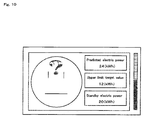
- Fig. 10 is a diagram explicating an example of outputting a display screen that urges setting change on a display connected to the alarm output device via a wire or wireless communication means.
- Fig. 10 shows an example in which, in order to indicate that an upper limit target value for a relevant interval of time is equal to or less than the predicted standby electric power and such upper limit target value is not appropriate for a relevant interval of time, the predicted power consumption, the upper limit target value, and the predicted standby electric power are specifically indicated.
- an inappropriate upper limit target value is indicated by the characteristics of a character face shown on a display. Users can be aware that the upper limit target value established for a relevant interval of time is equal to or less than the predicted standby electric power, and that such value is inappropriate, by looking at the corresponding display screen, and users can change such upper limit target value by using a function of the upper limit target value setup unit.
- characters that urge setting change for an upper limit target value to be shown on a display.
- the specific configuration of the alarm output device of the second embodiment is the same as that of the alarm output device of the first embodiment explained in Fig. 6 .
- the CPU stores an upper limit target value for power consumption for each regular interval of time inputted from the input device in the nonvolatile memory, and loads such value into the RAM as needed.
- Data transmitted from a measuring instrument for power consumption is received via the communication device. Based on such data, power consumption from the commencement time until the current time of a relevant interval of time and the predicted value of power consumption until the time at which such interval is completed are computed, and the results of computation are stored in the RAM.
- Predicted standby electric power values at relevant intervals of time inputted from the input device are stored in nonvolatile memory, and such values are loaded into a RAM as needed.
- Fig. 11 is a diagram showing an example of the progression of the process of the alarm output method of the second embodiment.
- the processing flow of Fig. 11 comprises the following steps. Initially, an upper limit target value for power consumption is obtained for a relevant interval of time (upper limit target value step; S1101). Next, the predicted standby electric power to be consumed within such interval of time is obtained (standby electric power acquisition step; S1102). Subsequently, the electric power expected to be consumed within a relevant interval of time is obtained (power consumption acquisition step; S1103). Thereafter, it is determined whether or not the electric power acquired through the power consumption acquisition step exceed the set upper limit target value (determination step; S1104). When it is determined that the electric power exceeds the set upper limit target value, the processing moves on to the step 1105.
- the processing When it is determined that the electric power does not exceed the set upper limit target value, the processing returns to the step 1103. Whether or not an upper limit target value for a relevant interval of time is equal to or less than the standby electric power obtained through the standby electric power acquisition step is determined (determination step; S1105). In case that it is determined that such upper limit target value for such relevant interval of time is equal to or less than the standby electric power, the processing moves on to the step 1105. In case that it is determined that such an upper limit target value for a relevant interval of time is not equal to or less than the standby electric power, the processing is completed. An alarm that urges setting change is outputted (alarm output step; S1105).
- an alarm that urges setting change of the upper limit target value is outputted, thereby allowing users to understand that setting change of the upper limit target value is necessary.
- An alarm output device of a third embodiment is characterized in that it determines at all times whether or not electric power expected to be consumed within a predetermined interval of time exceed the set upper limit target value and outputs instructions for changing the set upper limit target value within such interval during or following which an alarm is outputted, in case that the electric power exceeds the set upper limit target value determined at approximately the point in time at which the interval of time commences.
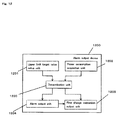
- Fig. 12 is a diagram explicating an example of a functional block for an alarm output device of a third embodiment.
- the "alarm output device" (1200) of the third embodiment comprises an "upper limit target value setup unit” (1201), a “power consumption acquisition unit” (1202), a “determination unit” (1203), an “alarm output unit” (1204), and a “first change instruction output unit” (1205). Explanations of the alarm output unit and the first change instruction output unit, which are not included in the first and second embodiments, are explained hereinafter.
- the "alarm output unit” has a function for outputting an alarm in case that the electric power exceeds the set upper limit target value determined by the determination unit.
- An alarm to be outputted that urges suppression of electricity consumption can be used. However, in case that it is determined that the electric power exceeds the set upper limit target value at approximately the point in time at which the interval of time commences via the first change instruction output unit described below, the nature of the alarm to be outputted may be changed, and an alarm to the effect that an upper limit target value has been automatically changed may be outputted.
- An alarm can be outputted to a display or speaker, or a relevant message can be transmitted to predetermined terminals (e.g., portable terminal, television apparatus, or the like).
- the "first change instruction output unit” has a function for outputting instructions to the upper limit target value setup unit for changing the set upper limit target value within a predetermined interval during or following which an alarm is outputted, in case that the electric power exceeds the set upper limit target value determined by the determination unit at approximately the point in time at which the interval of time commences.
- the expression "in case that the electric power exceeds the set upper limit target value determined by the determination unit at approximately the point in time at which the interval of time commences” refers to a case in which, compared with the length of a relevant interval of time, the length from the commencement time until the excess is identified is relatively short.
- values for the length from the commencement time until the excess is identified and the length of an interval of time are stored in recording media.
- An instruction for changing an upper limit target value within a relevant interval of time may be a signal that designates an appropriate upper limit target value or may be a trigger signal that computes an appropriate upper limit target value via the upper limit target value setup unit.
- an appropriate upper limit target value is calculated via the first change instruction output unit, electric power predicted to be consumed during a relevant interval of time, a prescribed magnification of predicted electric power (e.g., 1.05 times), an average of an upper limit target value before and after a relevant interval of time, or an upper limit target value during the same interval of time obtained based on the previous achievement data may be a new upper limit target value.
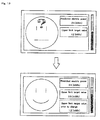
- Fig. 13 is a diagram explicating an example of a display screen as it appears before and after instructions for changing the upper limit target value have been given.
- Fig. 13 shows an example whereby the upper limit target value during such interval of time is inappropriate compared with the predicted power consumption.
- the upper limit target value during such interval of time has been changed to an appropriate value.
- after the upper limit target value has been changed it is also possible to indicate both the value before the change of the upper limit target value and the value thereafter on a display for a certain period.
- Configuration is also possible such that users can establish an upper limit target value to be changed in advance. For example, in case that users cannot predict how much electric power will be consumed during a predetermined interval of time on a given day, users can establish a plurality of candidates for upper limit target values. In case that the lowest upper limit target value candidate is not appropriate compared with the predicted electric power computed during a given interval of time, an appropriate upper limit target value can be selected from among a plurality of upper limit target value candidates. Moreover, when a setting change for an upper limit target value has been accepted via the upper limit target value setup unit, the information on the upper limit target value before the setting change is also maintained.
- the processing for automatically returning such value to the upper limit target value prior to the setting change is also possible.
- the first change instruction output unit it is also preferable for the first change instruction output unit to be configured to maintain extra upper limit target values in advance.
- the specific configuration of the alarm output device of the third embodiment is the same as that of the alarm output device of the first embodiment explained in Fig. 6 .
- the CPU stores an upper limit target value for power consumption for each regular interval of time inputted from the input device in the nonvolatile memory, and loads such value into the RAM as needed. Data transmitted from a measuring instrument for power consumption is received via the communication device. Based on such data, power consumption from the commencement time until the current time of a relevant interval of time and the predicted value of power consumption until the time at which such interval is completed are computed, and the results of computation are stored in the RAM.
- the electric power predicted to be consumed during a given interval of time exceeds an upper limit target value (or is equal to or greater than a certain level)
- the previous demand target value which is based on similar conditions regarding dates, days of the week, and weather conditions, is loaded from a nonvolatile memory into a RAM.
- Such value can be established as a new demand target value during such interval of time.
- Fig. 14 is a diagram showing an example of the progression of the process of the alarm output method of the third embodiment.
- the processing flow of Fig. 14 comprises the following steps. Initially, an upper limit target value for power consumption is obtained for a relevant interval of time (upper limit target value step; S1401). Next, the predicted electric power to be consumed within such interval of time is obtained (power consumption acquisition step; S1402). Subsequently, the electric power expected to be consumed within a relevant interval of time is obtained (power consumption acquisition step; S1403). Thereafter, it is determined whether or not the electric power acquired through the power consumption acquisition step exceed the set upper limit target value (determination step). When it is determined that the electric power exceeds the set upper limit target value, the processing moves on to the step 1404.
- an alarm that urges setting change is outputted (alarm output step; S1404). It is determined whether or not the determination step (S1403) takes place at approximately the point in time at which a predetermined interval of time commences (S1405). When it is determined that the determination step takes place at approximately the point in time at which a predetermined interval of time commences, the processing moves on to the step S1406. When it is determined that the determination step does not take place at approximately the point in time at which a predetermined interval of time commences, the processing is completed. An alarm that urges setting change is outputted (alarm output step; S0705). The upper limit target value within the interval of time is changed (first change instruction output unit; S1406). Next, outputting of an alarm is suspended (S1407). In addition, the time at which outputting of an alarm is suspended may be earlier than that of the step 1406.
- Fig. 15 is a diagram showing another example of the progression of the process of the alarm output method of the third embodiment.
- the processing flow of Fig. 15 comprises the following steps. Initially, an upper limit target value for power consumption is obtained for a relevant interval of time (upper limit target value step; S1501). Next, the predicted electric power to be consumed within such interval of time is obtained (power consumption acquisition step; S1502). Subsequently, it is determined whether or not the electric power acquired through the power consumption acquisition step exceed the set upper limit target value (determination step). When it is determined that the electric power exceeds the set upper limit target value, the processing moves on to the step 1504. The upper limit target value within the interval of time is changed (first upper limit target value change step; S1504). Next, outputting of an alarm is suspended (S1505). In addition, the time at which outputting of an alarm is suspended may be earlier than that of the step 1504.
- the upper limit target value is automatically changed while or after an alarm is outputted. Therefore, it is also possible to omit time and effort expended by users for setting changes.
- An alarm output device of a fourth embodiment is characterized in that it determines at all times whether or not electric power expected to be consumed within a predetermined interval of time exceed the set upper limit target value and outputs instructions for changing the set upper limit target value within such interval during or following which an alarm is outputted, in case that the electric power exceeds the set upper limit target value, if the upper limit target value for the interval of time is equal to or less than the amount of standby electric power.
- Fig. 16 is a diagram explicating an example of a functional block for an alarm output device of a fourth embodiment.
- the "alarm output device" (1600) of the fourth embodiment comprises an "upper limit target value setup unit” (1601), a “power consumption acquisition unit” (1602), a “determination unit” (1603), an “alarm output unit” (1604), and a “change instruction output unit” (1605).
- Explanations of the second change instruction output unit, which are not included in the first to third embodiments, are explained hereinafter.
- the "second change instruction output unit” has a function for outputting instructions to the upper limit target value setup unit for changing the set upper limit target value within a predetermined interval during or following which an alarm is outputted, in case that the electric power exceeds the set upper limit target value determined by the determination unit, if the upper limit target value for the predetermined interval of time is equal to or less than the amount of standby electric power obtained through the standby electric power acquisition unit.
- An instruction for changing an upper limit target value within a relevant interval of time may be a signal that designates an appropriate upper limit target value or may be a trigger signal that computes an appropriate upper limit target value via the upper limit target value setup unit.
- Fig. 17 is a diagram explicating an example of a display screen as it appears before and after instructions for changing the upper limit target value have been given.
- Fig. 17 shows an example whereby the upper limit target value during such interval of time is inappropriate compared with the predicted power consumption.
- the upper limit target value during such interval of time has been changed to an appropriate value.
- after the upper limit target value has been changed it is also possible to indicate both the value before the change of the upper limit target value and the value thereafter on a display for a certain period.
- the specific configuration of the alarm output device of the fourth embodiment is the same as that of the alarm output device of the first embodiment explained in Fig. 6 .
- the CPU stores an upper limit target value for power consumption for each regular interval of time inputted from the input device in the nonvolatile memory, and loads such value into the RAM as needed.
- Data transmitted from a measuring instrument for power consumption is received via the communication device. Based on such data, power consumption from the commencement time until the current time of a relevant interval of time and the predicted value of power consumption until the time at which such interval is completed are computed, and the results of computation are stored in the RAM.
- Predicted standby electric power values at relevant intervals of time inputted from the input device are stored in nonvolatile memory, and such values are loaded into a RAM as needed.
- the previous demand target value which is based on similar conditions regarding dates, days of the week, and weather conditions, is loaded from a nonvolatile memory into a RAM. Such value can be established as a new demand target value during such interval of time.
- Fig. 18 is a diagram showing an example of the progression of the process of the alarm output method of the fourth embodiment.
- the processing flow of Fig. 15 comprises the following steps. Initially, an upper limit target value for power consumption is obtained for a relevant interval of time (upper limit target value step; S1801). Next, the predicted standby electric power to be consumed within such interval of time is obtained (standby electric power acquisition step; S1802). Subsequently, the electric power expected to be consumed within a relevant interval of time is obtained (power consumption acquisition step; S1803). Thereafter, it is determined whether or not the electric power acquired through the power consumption acquisition step exceed the set upper limit target value (determination step; S1804).
- the processing moves on to the step 1805.
- the processing returns to the step 1803.
- An alarm is outputted (alarm output step; S1805).
- the processing is completed.
- the upper limit target value within the interval of time is changed (second upper limit target value change step; S1807).
- outputting of an alarm is suspended (S1808).
- the time at which outputting of an alarm is suspended may be earlier than that of the step 1807.
- the upper limit target value is automatically changed while or after an alarm is outputted. Therefore, it is also possible to omit time and effort expended by users for setting changes.
Landscapes
- Engineering & Computer Science (AREA)
- General Physics & Mathematics (AREA)
- Physics & Mathematics (AREA)
- Business, Economics & Management (AREA)
- Power Engineering (AREA)
- Quality & Reliability (AREA)
- General Business, Economics & Management (AREA)
- Operations Research (AREA)
- Human Resources & Organizations (AREA)
- Strategic Management (AREA)
- Tourism & Hospitality (AREA)
- Entrepreneurship & Innovation (AREA)
- Marketing (AREA)
- Economics (AREA)
- Theoretical Computer Science (AREA)
- Emergency Management (AREA)
- Supply And Distribution Of Alternating Current (AREA)
- Management, Administration, Business Operations System, And Electronic Commerce (AREA)
- Emergency Alarm Devices (AREA)
Priority Applications (1)
| Application Number | Priority Date | Filing Date | Title |
|---|---|---|---|
| EP20181913.3A EP3764108B1 (de) | 2012-01-23 | 2012-05-31 | Alarmausgabevorrichtung und alarmausgabeverfahren |
Applications Claiming Priority (2)
| Application Number | Priority Date | Filing Date | Title |
|---|---|---|---|
| JP2012010877A JP4962813B1 (ja) | 2012-01-23 | 2012-01-23 | アラーム出力装置、アラーム出力方法 |
| PCT/JP2012/064160 WO2013111361A1 (ja) | 2012-01-23 | 2012-05-31 | アラーム出力装置、アラーム出力方法 |
Related Child Applications (1)
| Application Number | Title | Priority Date | Filing Date |
|---|---|---|---|
| EP20181913.3A Division EP3764108B1 (de) | 2012-01-23 | 2012-05-31 | Alarmausgabevorrichtung und alarmausgabeverfahren |
Publications (2)
| Publication Number | Publication Date |
|---|---|
| EP2808686A1 true EP2808686A1 (de) | 2014-12-03 |
| EP2808686A4 EP2808686A4 (de) | 2016-01-20 |
Family
ID=46506071
Family Applications (2)
| Application Number | Title | Priority Date | Filing Date |
|---|---|---|---|
| EP12866606.2A Withdrawn EP2808686A4 (de) | 2012-01-23 | 2012-05-31 | Alarmausgabevorrichtung und alarmausgabeverfahren |
| EP20181913.3A Active EP3764108B1 (de) | 2012-01-23 | 2012-05-31 | Alarmausgabevorrichtung und alarmausgabeverfahren |
Family Applications After (1)
| Application Number | Title | Priority Date | Filing Date |
|---|---|---|---|
| EP20181913.3A Active EP3764108B1 (de) | 2012-01-23 | 2012-05-31 | Alarmausgabevorrichtung und alarmausgabeverfahren |
Country Status (11)
| Country | Link |
|---|---|
| US (1) | US9466201B2 (de) |
| EP (2) | EP2808686A4 (de) |
| JP (1) | JP4962813B1 (de) |
| KR (1) | KR101437300B1 (de) |
| CN (1) | CN103328985B (de) |
| BR (1) | BR112014017757A8 (de) |
| ES (1) | ES3054317T3 (de) |
| MX (1) | MX2014008862A (de) |
| RU (1) | RU2014134461A (de) |
| TW (1) | TW201333869A (de) |
| WO (1) | WO2013111361A1 (de) |
Cited By (1)
| Publication number | Priority date | Publication date | Assignee | Title |
|---|---|---|---|---|
| US10175747B2 (en) | 2012-10-12 | 2019-01-08 | Panasonic Intellectual Property Management Co., Ltd. | Energy management system configured to manage operation states of load apparatuses installed in facility |
Families Citing this family (13)
| Publication number | Priority date | Publication date | Assignee | Title |
|---|---|---|---|---|
| JP5876814B2 (ja) * | 2012-11-12 | 2016-03-02 | 東京瓦斯株式会社 | エネルギー消費量表示装置、エネルギー消費量表示方法 |
| JP6430106B2 (ja) | 2013-08-26 | 2018-11-28 | 東芝ライフスタイル株式会社 | 消費電力出力装置 |
| JPWO2015045156A1 (ja) * | 2013-09-30 | 2017-03-02 | 株式会社ENeL | 電力量制御装置、電力量制御方法、電力量制御システム及び電気機器制御装置 |
| KR101587341B1 (ko) * | 2014-03-20 | 2016-02-03 | 엘에스산전 주식회사 | 에너지관리시스템의 데이터 처리 장치 |
| JP5800978B1 (ja) * | 2014-10-31 | 2015-10-28 | 日本テクノ株式会社 | 省エネ監視装置 |
| CN106406157B (zh) * | 2015-07-30 | 2021-02-02 | 松下知识产权经营株式会社 | 信息终端的控制方法以及节能支援系统 |
| JP2017046482A (ja) * | 2015-08-27 | 2017-03-02 | 株式会社デンソー | 制御装置 |
| JP6103323B1 (ja) * | 2015-10-20 | 2017-03-29 | 国際航業株式会社 | 電気料金情報予測システム |
| WO2017163934A1 (ja) * | 2016-03-23 | 2017-09-28 | 日本電気株式会社 | 電力制御システム、制御装置、制御方法およびコンピュータプログラム |
| KR101925369B1 (ko) * | 2017-06-30 | 2019-02-27 | 주식회사 유시스템 | IoT 기반의 장비 모니터링 장치 |
| KR102312581B1 (ko) * | 2020-09-25 | 2021-10-14 | 주식회사 코리아베스트네트워크 | 스마트 랙 통합 관리 시스템 |
| US12182385B2 (en) * | 2021-11-08 | 2024-12-31 | Tyco Fire & Security Gmbh | Building automation system with resource consumption tracking features |
| WO2024204535A1 (ja) * | 2023-03-29 | 2024-10-03 | 門左衛門合同会社 | 配電システム |
Family Cites Families (22)
| Publication number | Priority date | Publication date | Assignee | Title |
|---|---|---|---|---|
| US4253151A (en) * | 1978-11-03 | 1981-02-24 | Bouve Thomas T | Apparatus for monitoring and controlling consumer power consumption |
| JPH0773407B2 (ja) * | 1985-03-30 | 1995-08-02 | 株式会社東芝 | デマンド監視制御装置 |
| US5987613A (en) * | 1991-02-14 | 1999-11-16 | Dell Computer Corporation | Portable computer with time-sensitive tri-modal power management switch |
| US5596278A (en) * | 1995-09-08 | 1997-01-21 | Duracell Inc. | Condition tester for a battery |
| JP4309191B2 (ja) * | 2003-07-04 | 2009-08-05 | 住金マネジメント株式会社 | 省エネルギー実習システム |
| JP2005308729A (ja) * | 2004-03-26 | 2005-11-04 | Cosmo Life Kk | 使用電力監視システム |
| EP1847959B1 (de) * | 2005-01-21 | 2013-11-27 | NEC Corporation | Schwellenbestimmungseinrichtung, verfahren und programm und personenidentifizierungssystem |
| JP2008026761A (ja) | 2006-07-25 | 2008-02-07 | Sony Corp | 消費電力制御装置、画像処理装置、自発光表示装置、電子機器、消費電力制御方法及びコンピュータプログラム |
| GB0617147D0 (en) * | 2006-08-31 | 2006-10-11 | Ewing Tanya B | Utility monitoring system |
| JP5245442B2 (ja) | 2007-02-08 | 2013-07-24 | 東京電力株式会社 | 消費電力表示システム |
| JP5288782B2 (ja) * | 2007-03-09 | 2013-09-11 | 三洋電機株式会社 | デマンド制御システム、デマンドコントローラ、デマンドプログラム及びデマンド制御方法 |
| GB2449670A (en) * | 2007-05-30 | 2008-12-03 | Jeremy Thomas | Resource consumption monitoring and control |
| SG179140A1 (en) | 2009-09-09 | 2012-04-27 | Panasonic Corp | Power control system |
| US20110095897A1 (en) * | 2009-10-26 | 2011-04-28 | Eaton Corporation | Energy usage index |
| TW201119173A (en) | 2009-11-19 | 2011-06-01 | Zippy Tech Corp | Method of using power supply to execute remote monitoring of an electronic system |
| CN101776737B (zh) * | 2009-12-29 | 2012-07-25 | 四川长虹电器股份有限公司 | 一种定量电量的自动预警方法 |
| KR20110082961A (ko) * | 2010-01-13 | 2011-07-20 | 주식회사 비쥬드림 | 전력정보 모니터링 시스템 및 그 방법 |
| CA2797704C (en) | 2010-04-26 | 2019-02-19 | Belkin International, Inc. | Electrical event detection device and method of detecting and classifying electrical power usage |
| JP5592160B2 (ja) | 2010-05-17 | 2014-09-17 | トヨタホーム株式会社 | エネルギー消費量の判定システム |
| TWI423549B (zh) | 2010-07-02 | 2014-01-11 | Univ Nat Chiao Tung | 辨識電器狀態的電力監測裝置及其電力監測方法 |
| CN201892704U (zh) * | 2010-12-09 | 2011-07-06 | 北京科技大学 | 一种用于数字家庭的电能计量装置 |
| JP2013015883A (ja) * | 2011-06-30 | 2013-01-24 | Hitachi Consumer Electronics Co Ltd | 省エネルギー支援システム |
-
2012
- 2012-01-23 JP JP2012010877A patent/JP4962813B1/ja active Active
- 2012-05-31 BR BR112014017757A patent/BR112014017757A8/pt not_active IP Right Cessation
- 2012-05-31 CN CN201280003949.6A patent/CN103328985B/zh active Active
- 2012-05-31 EP EP12866606.2A patent/EP2808686A4/de not_active Withdrawn
- 2012-05-31 MX MX2014008862A patent/MX2014008862A/es not_active Application Discontinuation
- 2012-05-31 EP EP20181913.3A patent/EP3764108B1/de active Active
- 2012-05-31 RU RU2014134461A patent/RU2014134461A/ru not_active Application Discontinuation
- 2012-05-31 US US14/362,090 patent/US9466201B2/en active Active
- 2012-05-31 KR KR1020137012432A patent/KR101437300B1/ko active Active
- 2012-05-31 ES ES20181913T patent/ES3054317T3/es active Active
- 2012-05-31 WO PCT/JP2012/064160 patent/WO2013111361A1/ja not_active Ceased
-
2013
- 2013-01-22 TW TW102102287A patent/TW201333869A/zh unknown
Cited By (1)
| Publication number | Priority date | Publication date | Assignee | Title |
|---|---|---|---|---|
| US10175747B2 (en) | 2012-10-12 | 2019-01-08 | Panasonic Intellectual Property Management Co., Ltd. | Energy management system configured to manage operation states of load apparatuses installed in facility |
Also Published As
| Publication number | Publication date |
|---|---|
| KR101437300B1 (ko) | 2014-09-03 |
| CN103328985B (zh) | 2016-03-09 |
| EP3764108B1 (de) | 2025-09-10 |
| EP2808686A4 (de) | 2016-01-20 |
| WO2013111361A1 (ja) | 2013-08-01 |
| JP2013148531A (ja) | 2013-08-01 |
| CN103328985A (zh) | 2013-09-25 |
| ES3054317T3 (en) | 2026-02-02 |
| EP3764108A1 (de) | 2021-01-13 |
| MX2014008862A (es) | 2014-10-24 |
| BR112014017757A8 (pt) | 2017-07-11 |
| KR20130114159A (ko) | 2013-10-16 |
| US20150213704A1 (en) | 2015-07-30 |
| US9466201B2 (en) | 2016-10-11 |
| TW201333869A (zh) | 2013-08-16 |
| RU2014134461A (ru) | 2016-03-20 |
| JP4962813B1 (ja) | 2012-06-27 |
| EP3764108C0 (de) | 2025-09-10 |
| BR112014017757A2 (de) | 2017-06-20 |
| TWI496101B (de) | 2015-08-11 |
Similar Documents
| Publication | Publication Date | Title |
|---|---|---|
| EP2808686A1 (de) | Alarmausgabevorrichtung und alarmausgabeverfahren | |
| JP6232020B2 (ja) | 電力需要の管理機能を有するサーバ、通信機器、システムおよび電力使用管理方法 | |
| US20140279711A1 (en) | Visualizing energy consumption and cost trends using virtual billing cycle calculations and statistical analysis | |
| US20150149130A1 (en) | Power consumption prediction apparatus, method, and non-transitory computer readable storage medium thereof | |
| KR101355978B1 (ko) | 전력 관리 시스템 및 전력 사용량 예측 방법 | |
| JP2017034797A (ja) | ベースライン負荷推定装置及びベースライン負荷推定プログラム | |
| TW201810854A (zh) | 需量監視裝置,需量監視系統,需量監視方法及需量監視程式 | |
| JP6867996B2 (ja) | 消費電力推定装置及び消費電力推定方法 | |
| CN105229893B (zh) | 管理装置、设备管理方法、管理系统 | |
| JP6481942B2 (ja) | 電力管理システム、電力管理方法、およびプログラム | |
| JP6437139B2 (ja) | 電力管理装置、サーバ、電力管理システム、電力管理方法、及び、プログラム | |
| JP6893323B2 (ja) | 発電設備情報推定システムおよび発電設備情報推定方法 | |
| HK40042536B (en) | Alarm output device and alarm output method | |
| HK40042536A (en) | Alarm output device and alarm output method | |
| KR101684466B1 (ko) | Leed 크레딧 산출 방법 및 leed 크레딧 산출 서버 | |
| JP6331909B2 (ja) | 電力管理システム | |
| US20170082666A1 (en) | Determining electrical loads | |
| KR101814591B1 (ko) | 정보 제공 장치 및 이를 포함하는 전력 관리 시스템 | |
| JP7110024B2 (ja) | 消費電力管理システム、消費電力管理装置、通信機およびコンピュータプログラム | |
| JP7029163B2 (ja) | エネルギー需要特性を取得する方法 | |
| WO2017109971A1 (ja) | 制御装置、制御システム、制御方法、及び、プログラム | |
| JPWO2017126453A1 (ja) | エネルギー管理装置、及び、プログラム | |
| JP6304706B2 (ja) | 模擬装置、運用パターン決定支援システム及び運用パターン決定支援方法 | |
| JP2017004124A (ja) | 電力管理装置 |
Legal Events
| Date | Code | Title | Description |
|---|---|---|---|
| PUAI | Public reference made under article 153(3) epc to a published international application that has entered the european phase |
Free format text: ORIGINAL CODE: 0009012 |
|
| 17P | Request for examination filed |
Effective date: 20140730 |
|
| AK | Designated contracting states |
Kind code of ref document: A1 Designated state(s): AL AT BE BG CH CY CZ DE DK EE ES FI FR GB GR HR HU IE IS IT LI LT LU LV MC MK MT NL NO PL PT RO RS SE SI SK SM TR |
|
| DAX | Request for extension of the european patent (deleted) | ||
| RA4 | Supplementary search report drawn up and despatched (corrected) |
Effective date: 20151217 |
|
| RIC1 | Information provided on ipc code assigned before grant |
Ipc: G01R 22/00 20060101AFI20151211BHEP Ipc: G06Q 50/06 20120101ALI20151211BHEP Ipc: G01R 11/64 20060101ALI20151211BHEP Ipc: G01R 11/02 20060101ALI20151211BHEP Ipc: G01R 21/00 20060101ALI20151211BHEP |
|
| STAA | Information on the status of an ep patent application or granted ep patent |
Free format text: STATUS: EXAMINATION IS IN PROGRESS |
|
| 17Q | First examination report despatched |
Effective date: 20190116 |
|
| GRAP | Despatch of communication of intention to grant a patent |
Free format text: ORIGINAL CODE: EPIDOSNIGR1 |
|
| STAA | Information on the status of an ep patent application or granted ep patent |
Free format text: STATUS: GRANT OF PATENT IS INTENDED |
|
| INTG | Intention to grant announced |
Effective date: 20241002 |
|
| STAA | Information on the status of an ep patent application or granted ep patent |
Free format text: STATUS: THE APPLICATION IS DEEMED TO BE WITHDRAWN |
|
| 18D | Application deemed to be withdrawn |
Effective date: 20250204 |