EP2798103B1 - Grillage de protection contre les insectes - Google Patents
Grillage de protection contre les insectes Download PDFInfo
- Publication number
- EP2798103B1 EP2798103B1 EP12805681.9A EP12805681A EP2798103B1 EP 2798103 B1 EP2798103 B1 EP 2798103B1 EP 12805681 A EP12805681 A EP 12805681A EP 2798103 B1 EP2798103 B1 EP 2798103B1
- Authority
- EP
- European Patent Office
- Prior art keywords
- fabric
- threads
- core
- coating
- insect screen
- Prior art date
- Legal status (The legal status is an assumption and is not a legal conclusion. Google has not performed a legal analysis and makes no representation as to the accuracy of the status listed.)
- Active
Links
Images
Classifications
-
- D—TEXTILES; PAPER
- D01—NATURAL OR MAN-MADE THREADS OR FIBRES; SPINNING
- D01F—CHEMICAL FEATURES IN THE MANUFACTURE OF ARTIFICIAL FILAMENTS, THREADS, FIBRES, BRISTLES OR RIBBONS; APPARATUS SPECIALLY ADAPTED FOR THE MANUFACTURE OF CARBON FILAMENTS
- D01F8/00—Conjugated, i.e. bi- or multicomponent, artificial filaments or the like; Manufacture thereof
- D01F8/04—Conjugated, i.e. bi- or multicomponent, artificial filaments or the like; Manufacture thereof from synthetic polymers
- D01F8/14—Conjugated, i.e. bi- or multicomponent, artificial filaments or the like; Manufacture thereof from synthetic polymers with at least one polyester as constituent
-
- D—TEXTILES; PAPER
- D01—NATURAL OR MAN-MADE THREADS OR FIBRES; SPINNING
- D01F—CHEMICAL FEATURES IN THE MANUFACTURE OF ARTIFICIAL FILAMENTS, THREADS, FIBRES, BRISTLES OR RIBBONS; APPARATUS SPECIALLY ADAPTED FOR THE MANUFACTURE OF CARBON FILAMENTS
- D01F1/00—General methods for the manufacture of artificial filaments or the like
- D01F1/02—Addition of substances to the spinning solution or to the melt
- D01F1/04—Pigments
-
- D—TEXTILES; PAPER
- D01—NATURAL OR MAN-MADE THREADS OR FIBRES; SPINNING
- D01F—CHEMICAL FEATURES IN THE MANUFACTURE OF ARTIFICIAL FILAMENTS, THREADS, FIBRES, BRISTLES OR RIBBONS; APPARATUS SPECIALLY ADAPTED FOR THE MANUFACTURE OF CARBON FILAMENTS
- D01F8/00—Conjugated, i.e. bi- or multicomponent, artificial filaments or the like; Manufacture thereof
- D01F8/04—Conjugated, i.e. bi- or multicomponent, artificial filaments or the like; Manufacture thereof from synthetic polymers
- D01F8/06—Conjugated, i.e. bi- or multicomponent, artificial filaments or the like; Manufacture thereof from synthetic polymers with at least one polyolefin as constituent
-
- D—TEXTILES; PAPER
- D03—WEAVING
- D03D—WOVEN FABRICS; METHODS OF WEAVING; LOOMS
- D03D15/00—Woven fabrics characterised by the material, structure or properties of the fibres, filaments, yarns, threads or other warp or weft elements used
- D03D15/50—Woven fabrics characterised by the material, structure or properties of the fibres, filaments, yarns, threads or other warp or weft elements used characterised by the properties of the yarns or threads
- D03D15/587—Woven fabrics characterised by the material, structure or properties of the fibres, filaments, yarns, threads or other warp or weft elements used characterised by the properties of the yarns or threads adhesive; fusible
-
- D—TEXTILES; PAPER
- D03—WEAVING
- D03D—WOVEN FABRICS; METHODS OF WEAVING; LOOMS
- D03D9/00—Open-work fabrics
-
- E—FIXED CONSTRUCTIONS
- E06—DOORS, WINDOWS, SHUTTERS, OR ROLLER BLINDS IN GENERAL; LADDERS
- E06B—FIXED OR MOVABLE CLOSURES FOR OPENINGS IN BUILDINGS, VEHICLES, FENCES OR LIKE ENCLOSURES IN GENERAL, e.g. DOORS, WINDOWS, BLINDS, GATES
- E06B9/00—Screening or protective devices for wall or similar openings, with or without operating or securing mechanisms; Closures of similar construction
- E06B9/52—Devices affording protection against insects, e.g. fly screens; Mesh windows for other purposes
-
- D—TEXTILES; PAPER
- D10—INDEXING SCHEME ASSOCIATED WITH SUBLASSES OF SECTION D, RELATING TO TEXTILES
- D10B—INDEXING SCHEME ASSOCIATED WITH SUBLASSES OF SECTION D, RELATING TO TEXTILES
- D10B2321/00—Fibres made from polymers obtained by reactions only involving carbon-to-carbon unsaturated bonds
- D10B2321/02—Fibres made from polymers obtained by reactions only involving carbon-to-carbon unsaturated bonds polyolefins
- D10B2321/021—Fibres made from polymers obtained by reactions only involving carbon-to-carbon unsaturated bonds polyolefins polyethylene
-
- D—TEXTILES; PAPER
- D10—INDEXING SCHEME ASSOCIATED WITH SUBLASSES OF SECTION D, RELATING TO TEXTILES
- D10B—INDEXING SCHEME ASSOCIATED WITH SUBLASSES OF SECTION D, RELATING TO TEXTILES
- D10B2331/00—Fibres made from polymers obtained otherwise than by reactions only involving carbon-to-carbon unsaturated bonds, e.g. polycondensation products
- D10B2331/04—Fibres made from polymers obtained otherwise than by reactions only involving carbon-to-carbon unsaturated bonds, e.g. polycondensation products polyesters, e.g. polyethylene terephthalate [PET]
-
- D—TEXTILES; PAPER
- D10—INDEXING SCHEME ASSOCIATED WITH SUBLASSES OF SECTION D, RELATING TO TEXTILES
- D10B—INDEXING SCHEME ASSOCIATED WITH SUBLASSES OF SECTION D, RELATING TO TEXTILES
- D10B2401/00—Physical properties
- D10B2401/02—Moisture-responsive characteristics
- D10B2401/021—Moisture-responsive characteristics hydrophobic
-
- Y—GENERAL TAGGING OF NEW TECHNOLOGICAL DEVELOPMENTS; GENERAL TAGGING OF CROSS-SECTIONAL TECHNOLOGIES SPANNING OVER SEVERAL SECTIONS OF THE IPC; TECHNICAL SUBJECTS COVERED BY FORMER USPC CROSS-REFERENCE ART COLLECTIONS [XRACs] AND DIGESTS
- Y10—TECHNICAL SUBJECTS COVERED BY FORMER USPC
- Y10T—TECHNICAL SUBJECTS COVERED BY FORMER US CLASSIFICATION
- Y10T428/00—Stock material or miscellaneous articles
- Y10T428/29—Coated or structually defined flake, particle, cell, strand, strand portion, rod, filament, macroscopic fiber or mass thereof
- Y10T428/2913—Rod, strand, filament or fiber
Definitions
- the present disclosure relates to a thread for making insect screen meshes comprising a core, the core having a coating comprising heat-activatable adhesives for bonding to itself or other threads of the fabric, and wherein the core has a higher melting point than the adhesives having.
- the present disclosure relates to a fabric for insect screens having a mesh weave structure comprising warp threads and weft yarns bonded together at junctions with adhesives.
- the present invention relates to an insect screen according to claim 1, comprising a frame and a fabric spanned by the frame.
- the present invention relates to a method of manufacturing insect screen meshes, comprising the steps of a) providing threads as warp threads and weft threads, b) weaving a fabric by means of the warp threads and weft threads, and c) heating the fabric to a temperature higher than the melting point of the adhesives and less than the melting point of the core is for generating cohesive bonds between the warp yarns and the weft yarns at their junctions.
- Insect screens are used behind openable windows. They allow the window to be opened, for example for ventilation, without insects being able to penetrate into the room.
- a fabric is clamped in a suitable frame, which is mounted behind the window frame.
- tissue is understood as meaning manually or mechanically produced products of the weaving mill comprising at least two, in particular at right angles or at right angles, crossed thread systems.
- the fabric as a whole maximum permeability to light and air, but not to insects offers and is as invisible as possible.
- a fabric of the type mentioned is for example from the WO 2004/088078 A2 known.
- the fabric be firmly connected at the node or crossing points between the warp threads and the weft threads.
- an adhesive is suggested for bonding.
- heat fusion of the filaments at the nodes or bonding by means of ultrasonic energy is suggested. It is disclosed as disadvantageous that the adhesive does not have the ultraviolet radiation resistance required for the application.
- Another insect screen with a fabric of the type mentioned is from the WO 2003/067015 A1 known.
- the fabric disclosed there is provided with a thin coating which makes the fabric look dull black and additionally causes a weak solidification at the nodes of the threads.
- a fabric for insect screens is known, in the production of which the warp threads and weft threads are glued together by means of a polyester resin in aqueous solution.
- the resulting fabric is very stable and has a high permeability to light and air.
- the polyester resin blinds a not insignificant number of meshes of the fabric, with the fenestrated meshes being clearly visible to the human eye. Meshes with fenestrated mesh are rejects for their desired use, namely as invisible insect screens as possible.
- the JP 2000 290 856 A describes a foldable fabric for insect screens for attachment to doors or windows.
- the fabric has a mesh weave structure and includes knit yarns and weft yarns bonded together at junctions by means of adhesives.
- the threads are formed as bicomponent threads with a core and a coating.
- the coating contains a heat-activatable adhesive which has a lower melting point than the core.
- the fabric is heated, whereby the warp threads and the weft threads are welded together at their nodes. If the fabric is installed in a humid ambient climate, the meshes of the fabric will fade from the threads due to moisture precipitation.
- the insect screens made of this fabric are clearly visible and disturb the perception of a viewer when looking through the grid.
- the present invention is therefore based on the object to provide an insect screen and a method for producing tissues for insect screens of the type mentioned in order to avoid the disadvantages associated with the prior art.
- the object directed to the thread is achieved with a thread of the type mentioned above, the coating of which comprises hydrophobic repelling agents.
- the thread of the insect screen according to the invention is automatically equipped with the required for its processing adhesive.
- the thread according to the insect screen according to the invention allows a localized bonding of warp threads and weft threads at nodes of the fabric.
- a global application of an adhesive in the form of an aqueous solution, which can lead to the fencing of mesh, is avoided according to the invention.
- the activation of the adhesive takes place in a very simple way, namely by heating.
- the temperature can thus be very accurate control when the thread is adhesively activated or deactivated according to the insect screen according to the invention is.
- the core has a higher melting point than the adhesives.
- the adhesives can be melted and thus tack-activated, but without the core melting or substantially softening to prevent tearing of the thread during bonding.
- the invention encompasses coatings which completely cover the thread, but also those which are formed as strips parallel to the longitudinal axis of the thread or rings of finite width running along the circumference of the thread. Even discrete, dot-like coating patterns are provided according to the invention.
- the thread according to the insect screen according to the invention is particularly efficient for an invisible as possible tissue for insect screens processed.
- the coating according to the invention comprises hydrophobic repellent.
- Such repellents prevent the accumulation of humidity and water droplets on the thread, whereby it remains dry. If the thread is supplied to its determination according to the invention, namely for the manufacture of fabrics for insect screens, the hydrophobic repelling agents prevent the stitching of stitches by water drops, so that the fabric remains invisible even at high humidity or precipitation.
- the coating may also include colorants.
- colorants By adding colorants, the color of the thread can be defined during its production. It is well known that insect screen meshes are perceived by the viewer to be less distracting when viewed through a dark color. So it's special advantageous if the thread from which fabric for insect screens are made, is dark in color.
- the invention comprises the core of a polyester, in particular polyethylene terephthalate (PET), and the coating as an adhesive polyolefin, in particular polyethylene (PE).
- PET and PE are able to make a material connection.
- the coating is inextricably bonded to the core, so that the coating does not peel off, for example, in the case of a strong curving or kinking of the thread.
- the inventive functionality of the thread thus remains in principle for an infinitely long time.
- the pair of PET and PE excellently meets the above melting point condition, since PET has a melting point greater than 250 ° C, but PE melts as low as 130 ° C.
- a process temperature for bonding the warp threads and weft threads of the fabric is therefore to be chosen advantageously from a closed by the two melting points interval.
- the fabric pair PET and PE selected in this embodiment is outstandingly suitable for producing the thread according to the invention by means of coextrusion of core and coating.
- the coating contains as a repellent fluorinated polyolefin, in particular polytetrafluoroethylene (PTFE).
- PTFE polytetrafluoroethylene
- the coating has carbon black as colorant. Soot-enriched PE appears optically black and thus, as a PE-coated fabric, is less visible than milky white fabric.
- the soot particles stabilize the inventive filament against ultraviolet radiation, which is important for sun-exposed fabric of insect screens to extend their durability.
- the thread can be produced by coextrusion of core and coating.
- the Forming processes of extrusion are ideal for producing continuous products, such as threads.
- feed a first extruder PET and a second, independent of the first extruder extruder PE in the nozzle of the extrusion machine the PET strand and the PE strand united in the nozzle and pulled together endlessly by a tool become.
- the core and the coating adhesive in particular cyanoacrylate, are arranged.
- the coating adhesive in particular cyanoacrylate
- damage for example microcracks, would lead to the normally transparent PE becoming milky white perceptible and the fabric for insect screens no longer being invisible.
- the core has a thickness of less than 0.20 mm, in particular equal to 0.15 mm.
- a thread thickness is an optimum in terms of the generally desired low visibility of the fabric on the one hand and the required strength of the fabric on the other hand.
- a fabric of the type mentioned at least some of the warp threads and / or weft threads are formed as threads according to the invention.
- the advantages described in connection with the thread according to the insect screen according to the invention naturally extend to the tissue.
- the thin and stable threads according to the invention allow the weaving of a resistant fabric with a large mesh size relative to the thickness of the threads.
- Such a fabric is very translucent and thus almost invisible.
- the fabric constructed of threads according to the insect screen according to the invention according to the insect screen according to the invention the warp threads and weft threads are glued together at their nodes with great advantage and the mesh size of the fabric permanently fixed. A subsequent shifting of individual threads within the fabric is excluded. Due to the multiple cohesively connected threads fabric of the invention is stable and dimensionally stable, resulting in a particularly simple handling and good processability. Furthermore, the fabric according to the insect screen according to the invention has a high permeability to light and air and is almost invisible.
- the fabric has a mesh size of 0.7 mm to 1.7 mm, in particular 1.1 mm.
- a mesh size chosen from this interval advantageously falls below the size of the slip, which prevents disturbing insects from passing through the tissue, while at the same time ensuring sufficient permeability to air and light.
- the tissue is usually the am Most failure-prone component, which leads to the failure of the entire insect screen.
- the particularly resistant fabric gives the insect screen according to the invention a significantly superior stability and durability compared to conventional insect screens. Thus, less waste arises during the manufacture and assembly of insect screens according to the invention.
- the insect screen according to the invention is invisible in the installation situation.
- the object directed to the method is achieved with a method of the type mentioned above, wherein at least some of the warp threads and / or weft threads are formed as threads according to the invention and it comprises a step d) hydrophobizing the fabric.
- the use of the threads according to the invention enables the production of the extremely advantageous fabrics according to the invention basically.
- it is necessary to activate the adhesive for the actual establishment of the necessary material connection of warp threads and weft threads at their nodes, it is necessary to activate the adhesive. The activation of the adhesive takes place by means of heating.
- the method according to the invention provides a step in which the fabric having threads according to the invention is heated, as a result of which the adhesive is activated and thus material-bonded connections between the warp threads and the weft threads are produced at their nodes. Accordingly, the method according to the invention is outstandingly suitable for producing stable meshes with fixed meshes for insect screens. Since the inventive method, a dipping of the fabric in liquid adhesives or other coating agent containing basins, a windowing of mesh is inventively excluded with great advantage. In addition, the inventive method is particularly efficient and economical, since many cohesive compounds are generated simultaneously and heating a tissue from a process engineering point of view is a very easy to betechnikstelligender process step, without For example, to require additional substances or strict safety measures.
- step c) the fabric is heated to a temperature which is higher than the melting point of the adhesives and lower than the melting point of the core.
- the adhesives are activated to allow the advantageous cohesive connections arise.
- the melting point of the core is not reached, this remains stable and consequently the tissue is obtained and manageable.
- the method according to the invention provides a great advantage of hydrophobizing the woven and bonded fabric, preferably subsequently, in particular finally, as a whole. This process step is equivalent to fully sealing the fabric and provides maximum protection against the deposition of humidity or water droplets on the fabric so that it remains largely invisible even under these adverse environmental conditions.
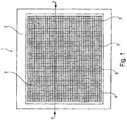
- Fig. 1 is an inventive insect screen 1 in schematic representation shown.
- the insect screen 1 consists essentially of a fabric 2, which is enclosed in a frame 3 in unspecified manner, generally known manner.
- the fabric 2 is constructed from in Fig. 1 vertically extending warp threads 4 and to the warp threads 4 orthogonal weft threads 5.
- warp 4 and weft 5 are known to refer to the manufacturing process of weaving. In the context of the present invention, however, it does not matter which threads are warp threads 4 or weft threads 5 or were in the production of the fabric 2.
- the warp threads 4 form with the weft threads 5 in each case at the crossing points node 6.
- the fabric 2 in Fig. 1 has a weave structure 7 in this way.
- the warp threads 4 and weft threads 5 are bicomponent threads comprising a core and a coating 11.
- the core comprises polyethylene terephthalate (PET) and the coating 11 polyethylene (PE).
- PET polyethylene terephthalate
- PE polyethylene
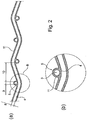
- Fig. 2a is a part of a schematic sectional view of the fabric 2 along the in FIG Fig. 1 marked line II - II shown in a glued state.
- the thread thickness 8 of the warp threads 4 is 0.15 mm.
- the thread thickness 9 of the weft threads 5 is 0.15 mm.
- the mesh size 10 of the mesh 7 is 1.1 mm.
- the stitches 7 are square shaped. Accordingly, the clear area per mesh 7 is accordingly 1.21 mm 2 . In the context of the invention, rectangular or any other mesh shapes are also conceivable.
- the warp threads 4 and weft threads 5 consist essentially of two components, namely a core and a coating 11 surrounding the core.
- the coating 11 is preferably over the entire lateral surface of the core of both the warp threads 4 and the weft threads 5 applied.
- the threads 4, 5 are advantageous means Coextrusion produced.
- the coating 11 contains a heat-activatable adhesive, here PE, and hydrophobic repellents, for example polytetrafluoroethylene (PTFE).
- PE heat-activatable adhesive
- PTFE polytetrafluoroethylene
- the PE and PTFE regions of the coating 11 are then spatially separated from each other.
- the coating 11 comprises coloring agents, for example soot particles, in order to improve the optical properties of the thread 4, 5 according to the invention in that a soot-dyed, black thread 4, 5 is less visible than differently colored threads.
- Fig. 2b is an enlarged detail of the tissue according to the invention in the in Fig. 2a marked area B shown schematically.
- the warp threads 4 and weft threads 5 are connected in the region of their nodes 6 cohesively, namely glued.
- the adhesive PE required for this purpose is provided by the coating 11.
- the coatings 11 of all warp threads 4 and weft threads 5 combine to form a one-part coating arrangement which carries all the warp threads 4 and weft threads 5 as stabilizing elements. Since the connections of warp threads 4 and weft threads 5 are limited locally to the nodes 6 and do not protrude into the stitches 7 or even entire stitches 7 ver multn, the mesh size 10 is practically not reduced. The permeability of the fabric 2 for light and air therefore remains according to the mesh size 10 obtained.
- the method according to the invention provides for the steps known from the prior art a) provision of threads 4, 5 as warp threads 4 and weft threads 5, b) weaving of a fabric 2 by means of the warp threads 4 and weft threads 5 and c) heating the web 2 to a temperature higher than the melting point of the adhesives and lower than the melting point of the core, to generate cohesive bonds between the warp threads 4 and the weft threads 5 at their nodes 6, a step d) hydrophobizing the web Woven fabric 2 before, wherein at least some of the warp threads 4 and / or weft threads. 5 inventive threads 4, 5 are.
- the heating causes activation of the adhesive of the threads 4, 5.
- the woven fabric of these threads 4, 5 is heated to about 140 ° C, whereby the warp threads 4 and Stick weft threads 5 together many times. Since the adhesive is bonded to the core of the threads 4, 5 and is not applied by immersing the fabric 2 in a bath containing liquid adhesive, windowing of meshes 7 is advantageously excluded. After deactivation of the adhesive due to a cooling of the fabric 2 to below 100 ° C, no further compounds can be generated, but the compounds already generated naturally remain.
- the fabric 2 is clearly solidified and has with great advantage fixed nodes, so that the warp threads 4 and weft threads 5 are no longer displaceable relative to each other and a maximum allowable mesh size 10 to effectively retain disturbing insects, under no circumstances is exceeded.
- the fabric 2 does not break down during the step c) by melting the core of the threads 4, 5, it is important to ensure that it is always lower than the melting temperature of the core, here PET.
- the step d) hydrophobizing the fabric 2 causes a subsequent total hydrophobicization of the fabric 2, in particular in areas in which, during the melting process of the coating 11, the hydrophobic repelling agents were covered by the adhesives.
- This process step is equivalent to full sealing of the fabric 2 and ensures maximum protection against precipitation of air moisture or water droplets on the fabric so that it remains largely invisible even under adverse environmental conditions.
- the fabric 2 according to the insect screen according to the invention using the method according to the invention can be produced particularly efficiently.
Landscapes
- Engineering & Computer Science (AREA)
- Textile Engineering (AREA)
- Chemical & Material Sciences (AREA)
- Chemical Kinetics & Catalysis (AREA)
- General Chemical & Material Sciences (AREA)
- Structural Engineering (AREA)
- Life Sciences & Earth Sciences (AREA)
- Insects & Arthropods (AREA)
- Pest Control & Pesticides (AREA)
- Architecture (AREA)
- Civil Engineering (AREA)
- Manufacturing & Machinery (AREA)
- Catching Or Destruction (AREA)
- Woven Fabrics (AREA)
- Knitting Of Fabric (AREA)
Claims (10)
- Grille de protection contre les insectes (1), comprenant un cadre (3) et un tissu (2) tendu au moyen du cadre (3), dans laquelle le tissu présente une structure tissée à mailles (7), comprenant des fils de chaîne (4) et des fils de trame (5) reliés entre eux au moyen d'agents collants au niveau de points de croisement (6), dans laquelle au moins quelques-uns des fils de chaîne (4) et/ou des fils de trame (5) comprennent une partie centrale, dans laquelle la partie centrale présente un revêtement (11), qui comprend des agents collants thermoactivables destinés à être reliés par liaison de matière entre eux ou à d'autres fils du tissu (2), et dans laquelle la partie centrale présente un point de fusion plus élevé que celui des agents collants, caractérisée en ce que le revêtement (11) comprend des moyens répulsifs hydrophobes, et le tissu est rendu hydrophobe.
- Grille de protection contre les insectes (1) selon la revendication 1, caractérisée en ce que le revêtement (11) comprend des colorants.
- Grille de protection contre les insectes (1) selon la revendication 1 ou 2, caractérisée en ce que la partie centrale contient un polyester, en particulier un téréphtalate de polyéthylène (PET), et/ou en ce que le revêtement (11) contient en tant qu'adhésif une polyoléfine, en particulier du polyéthylène (PE).
- Grille de protection contre les insectes (1) selon l'une quelconque des revendications précédentes, caractérisée en ce que le revêtement (11) contient en tant qu'agent répulsif une polyoléfine fluorée, en particulier du polytétrafluoroéthylène (PTFE).
- Grille de protection contre les insectes (1) selon la revendication 2, caractérisée en ce que le revêtement (11) contient en tant que colorant de la suie.
- Grille de protection contre les insectes (1) selon l'une quelconque des revendications précédentes, caractérisée en ce que le fil (4, 5) est fabriqué au moyen d'une coextrusion de la partie centrale et du revêtement (11).
- Grille de protection contre les insectes (1) selon l'une quelconque des revendications précédentes, caractérisée en ce que des agents adhésifs, en particulier du cyanoacrylate, sont disposés entre la partie centrale et le revêtement (11).
- Grille de protection contre les insectes (1) selon l'une quelconque des revendications précédentes, caractérisée en ce que la partie centrale présente une épaisseur inférieure à 0,20 mm, en particulier égale à 0,15 mm.
- Grille de protection contre les insectes (1) selon l'une quelconque des revendications précédentes, caractérisée en ce que le tissu (2) présente une largeur de mailles (10) allant de 0,7 mm à 1,7 mm, en particulier de 1,1 mm.
- Procédé pour fabriquer des tissus (2) pour des grilles de protection contre les insectes (1), comprenant les étapes suivantes : a) fourniture de fils (4, 5) sous la forme de fils de chaîne (4) et de fils de trame (5), dans lequel au moins quelques-uns des fils de chaîne (4) et/ou des fils de trame (5) comprennent une partie centrale, dans lequel la partie centrale présente un revêtement (11), qui comprend des agents collants thermoactivables destinés à être reliés par liaison de matière entre eux ou à d'autres fils du tissu (2), dans lequel la partie centrale présente un point de fusion plus élevé que les agents collants, et dans lequel le revêtement (11) comprend des agents répulsifs hydrophobes ; b) tisser un tissu (2) au moyen des fils de chaîne (4) et des fils de trame (5) ; c) chauffer le tissu (2) à une température, qui est plus élevée que le point de fusion des agents collants et qui est inférieure au point de fusion de la partie centrale, afin de générer des liaisons par liaison de matière entre les fils de chaîne (4) et les fils de trame (5) au niveau de leurs points de croisement (6) ; et d) rendre hydrophobe le tissu (2).
Applications Claiming Priority (2)
| Application Number | Priority Date | Filing Date | Title |
|---|---|---|---|
| DE102011057150.7A DE102011057150B4 (de) | 2011-12-29 | 2011-12-29 | Faden und Gewebe für Insektenschutzgitter, Insektenschutzgitter sowie Verfahren zum Herstellen von Geweben für Insektenschutzgitter |
| PCT/EP2012/076004 WO2013098131A2 (fr) | 2011-12-29 | 2012-12-18 | Fil et structure textile pour grillage de protection contre les insectes |
Publications (2)
| Publication Number | Publication Date |
|---|---|
| EP2798103A2 EP2798103A2 (fr) | 2014-11-05 |
| EP2798103B1 true EP2798103B1 (fr) | 2017-02-22 |
Family
ID=47428629
Family Applications (1)
| Application Number | Title | Priority Date | Filing Date |
|---|---|---|---|
| EP12805681.9A Active EP2798103B1 (fr) | 2011-12-29 | 2012-12-18 | Grillage de protection contre les insectes |
Country Status (7)
| Country | Link |
|---|---|
| US (1) | US20150004410A1 (fr) |
| EP (1) | EP2798103B1 (fr) |
| CN (2) | CN108708032A (fr) |
| DE (1) | DE102011057150B4 (fr) |
| ES (1) | ES2625867T3 (fr) |
| HK (1) | HK1203573A1 (fr) |
| WO (1) | WO2013098131A2 (fr) |
Cited By (1)
| Publication number | Priority date | Publication date | Assignee | Title |
|---|---|---|---|---|
| DE102017011669A1 (de) | 2017-12-16 | 2019-06-19 | Perlon Nextrusion Monofil GmbH | Filtergitter und deren Verwendung |
Families Citing this family (10)
| Publication number | Priority date | Publication date | Assignee | Title |
|---|---|---|---|---|
| US9662422B2 (en) | 2011-09-06 | 2017-05-30 | Allergan, Inc. | Crosslinked hyaluronic acid-collagen gels for improving tissue graft viability and soft tissue augmentation |
| DE102014010462B3 (de) | 2014-07-15 | 2015-05-21 | Giesecke & Devrient Gmbh | Datenseitenkern mit flexibler Innenschicht und Verfahren zur Herstellung |
| CN104476863B (zh) * | 2014-11-17 | 2017-06-16 | 惠州市峄董塑胶科技有限公司 | 由热熔黏性扁纱编织而成的扁纱编织布和复合板材 |
| DE102015001165A1 (de) * | 2015-02-02 | 2016-08-04 | Bundesdruckerei Gmbh | Lasche, Datenseite und buchartiges Sicherheitsdokument sowie Verfahren zum Verbinden einer Datenseite mit einer Lasche |
| DE202015001735U1 (de) * | 2015-03-05 | 2016-06-07 | M.A.C.'s Holding Gmbh | Schutzgitter oder -gewebe einer Insektenschutzvorrichtung |
| CN104862825B (zh) * | 2015-06-10 | 2017-10-27 | 马海燕 | 大直径皮芯型复合单丝及其生产方法 |
| CN105200565B (zh) * | 2015-11-06 | 2016-06-08 | 赵正平 | 一种静电防微尘窗纱 |
| DE102018211039A1 (de) | 2018-01-12 | 2019-07-18 | Trittec Ag | Vorrichtung zur Reinigung von Luft, Anordnung von mehreren Vorrichtungen zur Reinigung von Luft und softwaregestützte Applikation |
| CN109098645A (zh) * | 2018-08-17 | 2018-12-28 | 浙江金海环境技术股份有限公司 | 纱窗网及其制备方法 |
| WO2020219302A2 (fr) | 2019-04-25 | 2020-10-29 | Hunter Douglas Inc. | Revêtement architectural comprenant un matériau tissé |
Family Cites Families (21)
| Publication number | Priority date | Publication date | Assignee | Title |
|---|---|---|---|---|
| JPS6028547A (ja) | 1983-07-20 | 1985-02-13 | チッソ株式会社 | 防虫網 |
| FR2669647B1 (fr) * | 1990-11-26 | 1994-10-14 | Regnault Reynolds Sa | Procede de fabrication de cordes destinees a etre soumises a des tractions, notamment de cordes pour raquettes et instruments de musique, et cordes ainsi obtenues. |
| US5429869A (en) * | 1993-02-26 | 1995-07-04 | W. L. Gore & Associates, Inc. | Composition of expanded polytetrafluoroethylene and similar polymers and method for producing same |
| EP0886031A1 (fr) * | 1997-06-19 | 1998-12-23 | Beiersdorf Aktiengesellschaft | Système de protection pour ouvertures de bâtiment |
| JP2000290856A (ja) | 1999-04-08 | 2000-10-17 | Hagihara Industries Inc | プリーツネット地 |
| JP2001146627A (ja) | 1999-11-18 | 2001-05-29 | Lion Corp | 撥水性粒子含有繊維及びその繊維を使用した繊維物 |
| JP4301370B2 (ja) * | 2001-02-20 | 2009-07-22 | 平岡織染株式会社 | プリント用複層糸条メッシュシート |
| US20030077444A1 (en) * | 2001-05-10 | 2003-04-24 | The Procter & Gamble Company | Multicomponent fibers comprising starch and polymers |
| US6763875B2 (en) | 2002-02-06 | 2004-07-20 | Andersen Corporation | Reduced visibility insect screen |
| JP2006501381A (ja) | 2002-10-01 | 2006-01-12 | シャムロック テクノロジーズ インコーポレーテッド | ポリテトラフルオロエチレン(ptfe)を合成溶融紡糸繊維に組み込んで特性が改善された繊維及び繊維製品を生産する方法 |
| EP1623062A4 (fr) | 2003-03-31 | 2006-08-02 | Gore Enterprise Holdings Inc | Toile moustiquaire presentant des proprietes optiques ameliorees |
| US6818293B1 (en) * | 2003-04-24 | 2004-11-16 | Eastman Chemical Company | Stabilized polyester fibers and films |
| CN2713111Y (zh) * | 2003-05-06 | 2005-07-27 | 涂新尔 | 隔尘防蚊金属纱窗 |
| WO2005017240A1 (fr) * | 2003-08-15 | 2005-02-24 | Foss Manufacturing Co., Inc. | Fibres synthetiques modifiees au ptfe en vue d'en ameliorer les caracteristiques |
| CN2707935Y (zh) * | 2004-06-25 | 2005-07-06 | 高林 | 新型平织折叠纱网 |
| US7401460B2 (en) * | 2004-08-13 | 2008-07-22 | Klaus Bloch | Textile thread having a polytetrafluoroethylene wrapped core |
| US20070123123A1 (en) * | 2005-11-25 | 2007-05-31 | Guffey James V | Anti insect screening |
| CN1884653B (zh) | 2006-07-10 | 2011-10-26 | 孙熙 | 疏水窗纱和过滤网的制备方法 |
| DE102009007748B4 (de) | 2009-02-06 | 2018-03-08 | Saati Deutschland Gmbh | Insektenschutzgewebe |
| CZ2010299A3 (cs) * | 2010-04-16 | 2011-10-26 | Ecoraw, S.R.O. | Výztužná sít |
| EP2591156B1 (fr) * | 2010-07-09 | 2015-05-20 | Trittec AG | Fil, structure plane, grillage de protection contre les insectes et procede de fabrication d'une structure plane |
-
2011
- 2011-12-29 DE DE102011057150.7A patent/DE102011057150B4/de active Active
-
2012
- 2012-12-18 CN CN201810157031.6A patent/CN108708032A/zh active Pending
- 2012-12-18 ES ES12805681.9T patent/ES2625867T3/es active Active
- 2012-12-18 WO PCT/EP2012/076004 patent/WO2013098131A2/fr not_active Ceased
- 2012-12-18 CN CN201280070894.0A patent/CN104136666A/zh active Pending
- 2012-12-18 US US14/369,666 patent/US20150004410A1/en not_active Abandoned
- 2012-12-18 EP EP12805681.9A patent/EP2798103B1/fr active Active
- 2012-12-18 HK HK15103936.4A patent/HK1203573A1/xx unknown
Cited By (1)
| Publication number | Priority date | Publication date | Assignee | Title |
|---|---|---|---|---|
| DE102017011669A1 (de) | 2017-12-16 | 2019-06-19 | Perlon Nextrusion Monofil GmbH | Filtergitter und deren Verwendung |
Also Published As
| Publication number | Publication date |
|---|---|
| CN104136666A (zh) | 2014-11-05 |
| WO2013098131A3 (fr) | 2013-09-26 |
| WO2013098131A2 (fr) | 2013-07-04 |
| ES2625867T3 (es) | 2017-07-20 |
| US20150004410A1 (en) | 2015-01-01 |
| CN108708032A (zh) | 2018-10-26 |
| EP2798103A2 (fr) | 2014-11-05 |
| HK1203573A1 (en) | 2015-10-30 |
| DE102011057150B4 (de) | 2024-03-07 |
| DE102011057150A1 (de) | 2013-07-04 |
Similar Documents
| Publication | Publication Date | Title |
|---|---|---|
| DE102011057150B4 (de) | Faden und Gewebe für Insektenschutzgitter, Insektenschutzgitter sowie Verfahren zum Herstellen von Geweben für Insektenschutzgitter | |
| EP2591156B1 (fr) | Fil, structure plane, grillage de protection contre les insectes et procede de fabrication d'une structure plane | |
| DD154567A5 (de) | Roll-und faltbarer gewaechshausvorhang | |
| DE69206151T2 (de) | Insektennetz. | |
| EP1968791B1 (fr) | Membrane multicouche etanche a l'eau et permeable a la vapeur d'eau | |
| EP1348797A1 (fr) | Tissu et procédé pour sa fabrication | |
| EP2206875B1 (fr) | Tissu de protection contre les insectes | |
| DE102019110753A1 (de) | Klebeband und Verfahren zu dessen Herstellung | |
| DE102009007748B4 (de) | Insektenschutzgewebe | |
| DE102011012222B4 (de) | Textiler Schallabsorber | |
| DE19503428C1 (de) | Verdeck für Fahrzeuge, insbesondere Cabriolets | |
| DE60309814T2 (de) | Vorrichtung zur Abschirmung | |
| EP2062493B1 (fr) | Vêtement à couches multiples avec fermeture à glissière | |
| DE3854579T2 (de) | Gewirktes oder gewobenes textilmaterial, verfahren zur herstellung und blutgefässreparaturblatt sowie kunstblutgefäss daraus. | |
| DE102021117447B4 (de) | Anbindungsband zum Anbinden eines Beschattungsmaterials an eine Führung und Verfahren | |
| EP1605093B1 (fr) | Toile de store ayant un allongement limité | |
| DE10215816B4 (de) | Flexible Bildwand | |
| DE102016110149A1 (de) | Verfahren und Vorrichtung zur Herstellung eines Klebebandes | |
| DE2639840A1 (de) | Laminatartiges textilprodukt, umfassend ein gewebtes textilmaterial und ein mit diesem verbundenes nicht-gewebtes textilmaterial, sowie ein ganz oder teilweise aus einem solchen textilprodukt bestehender gegenstand | |
| DE19940798A1 (de) | Heizelement, insbesondere für Textilien, Verfahren zur Festlegung der Heizelemente an Trägern sowie derartige Heizelemente aufweisende Bekleidungsstücke | |
| DE10035048A1 (de) | Markise mit folienbeschichteter Markisenbahn | |
| DE1919876C (de) | Verfahren zum Herstellen eines Netzes oder eines eine Netzstruktur enthaltenden Gebildes aus einer thermoplastischen Kunststoff-Folie | |
| DE202018102636U1 (de) | Isolierelement und Verwendung eines solchen | |
| EP0330099A1 (fr) | Bande repliable de réflexion, d'isolation et/ou d'obscurcissement | |
| DE102011006405A1 (de) | Flächengebilde zum Abschirmen von Öffnungen |
Legal Events
| Date | Code | Title | Description |
|---|---|---|---|
| PUAI | Public reference made under article 153(3) epc to a published international application that has entered the european phase |
Free format text: ORIGINAL CODE: 0009012 |
|
| 17P | Request for examination filed |
Effective date: 20140729 |
|
| AK | Designated contracting states |
Kind code of ref document: A2 Designated state(s): AL AT BE BG CH CY CZ DE DK EE ES FI FR GB GR HR HU IE IS IT LI LT LU LV MC MK MT NL NO PL PT RO RS SE SI SK SM TR |
|
| DAX | Request for extension of the european patent (deleted) | ||
| GRAP | Despatch of communication of intention to grant a patent |
Free format text: ORIGINAL CODE: EPIDOSNIGR1 |
|
| INTG | Intention to grant announced |
Effective date: 20160510 |
|
| GRAS | Grant fee paid |
Free format text: ORIGINAL CODE: EPIDOSNIGR3 |
|
| GRAA | (expected) grant |
Free format text: ORIGINAL CODE: 0009210 |
|
| AK | Designated contracting states |
Kind code of ref document: B1 Designated state(s): AL AT BE BG CH CY CZ DE DK EE ES FI FR GB GR HR HU IE IS IT LI LT LU LV MC MK MT NL NO PL PT RO RS SE SI SK SM TR |
|
| REG | Reference to a national code |
Ref country code: GB Ref legal event code: FG4D Free format text: NOT ENGLISH |
|
| REG | Reference to a national code |
Ref country code: CH Ref legal event code: EP |
|
| REG | Reference to a national code |
Ref country code: AT Ref legal event code: REF Ref document number: 869357 Country of ref document: AT Kind code of ref document: T Effective date: 20170315 |
|
| REG | Reference to a national code |
Ref country code: IE Ref legal event code: FG4D Free format text: LANGUAGE OF EP DOCUMENT: GERMAN |
|
| REG | Reference to a national code |
Ref country code: DE Ref legal event code: R096 Ref document number: 502012009597 Country of ref document: DE |
|
| REG | Reference to a national code |
Ref country code: NL Ref legal event code: FP |
|
| REG | Reference to a national code |
Ref country code: LT Ref legal event code: MG4D |
|
| REG | Reference to a national code |
Ref country code: CH Ref legal event code: NV Representative=s name: BOVARD AG PATENT- UND MARKENANWAELTE, CH |
|
| REG | Reference to a national code |
Ref country code: ES Ref legal event code: FG2A Ref document number: 2625867 Country of ref document: ES Kind code of ref document: T3 Effective date: 20170720 |
|
| PG25 | Lapsed in a contracting state [announced via postgrant information from national office to epo] |
Ref country code: FI Free format text: LAPSE BECAUSE OF FAILURE TO SUBMIT A TRANSLATION OF THE DESCRIPTION OR TO PAY THE FEE WITHIN THE PRESCRIBED TIME-LIMIT Effective date: 20170222 Ref country code: LT Free format text: LAPSE BECAUSE OF FAILURE TO SUBMIT A TRANSLATION OF THE DESCRIPTION OR TO PAY THE FEE WITHIN THE PRESCRIBED TIME-LIMIT Effective date: 20170222 Ref country code: HR Free format text: LAPSE BECAUSE OF FAILURE TO SUBMIT A TRANSLATION OF THE DESCRIPTION OR TO PAY THE FEE WITHIN THE PRESCRIBED TIME-LIMIT Effective date: 20170222 Ref country code: NO Free format text: LAPSE BECAUSE OF FAILURE TO SUBMIT A TRANSLATION OF THE DESCRIPTION OR TO PAY THE FEE WITHIN THE PRESCRIBED TIME-LIMIT Effective date: 20170522 |
|
| PG25 | Lapsed in a contracting state [announced via postgrant information from national office to epo] |
Ref country code: RS Free format text: LAPSE BECAUSE OF FAILURE TO SUBMIT A TRANSLATION OF THE DESCRIPTION OR TO PAY THE FEE WITHIN THE PRESCRIBED TIME-LIMIT Effective date: 20170222 Ref country code: PT Free format text: LAPSE BECAUSE OF FAILURE TO SUBMIT A TRANSLATION OF THE DESCRIPTION OR TO PAY THE FEE WITHIN THE PRESCRIBED TIME-LIMIT Effective date: 20170622 Ref country code: BG Free format text: LAPSE BECAUSE OF FAILURE TO SUBMIT A TRANSLATION OF THE DESCRIPTION OR TO PAY THE FEE WITHIN THE PRESCRIBED TIME-LIMIT Effective date: 20170522 Ref country code: SE Free format text: LAPSE BECAUSE OF FAILURE TO SUBMIT A TRANSLATION OF THE DESCRIPTION OR TO PAY THE FEE WITHIN THE PRESCRIBED TIME-LIMIT Effective date: 20170222 Ref country code: LV Free format text: LAPSE BECAUSE OF FAILURE TO SUBMIT A TRANSLATION OF THE DESCRIPTION OR TO PAY THE FEE WITHIN THE PRESCRIBED TIME-LIMIT Effective date: 20170222 |
|
| PG25 | Lapsed in a contracting state [announced via postgrant information from national office to epo] |
Ref country code: EE Free format text: LAPSE BECAUSE OF FAILURE TO SUBMIT A TRANSLATION OF THE DESCRIPTION OR TO PAY THE FEE WITHIN THE PRESCRIBED TIME-LIMIT Effective date: 20170222 Ref country code: RO Free format text: LAPSE BECAUSE OF FAILURE TO SUBMIT A TRANSLATION OF THE DESCRIPTION OR TO PAY THE FEE WITHIN THE PRESCRIBED TIME-LIMIT Effective date: 20170222 Ref country code: SK Free format text: LAPSE BECAUSE OF FAILURE TO SUBMIT A TRANSLATION OF THE DESCRIPTION OR TO PAY THE FEE WITHIN THE PRESCRIBED TIME-LIMIT Effective date: 20170222 Ref country code: CZ Free format text: LAPSE BECAUSE OF FAILURE TO SUBMIT A TRANSLATION OF THE DESCRIPTION OR TO PAY THE FEE WITHIN THE PRESCRIBED TIME-LIMIT Effective date: 20170222 |
|
| REG | Reference to a national code |
Ref country code: GR Ref legal event code: EP Ref document number: 20170401407 Country of ref document: GR Effective date: 20171023 |
|
| REG | Reference to a national code |
Ref country code: DE Ref legal event code: R097 Ref document number: 502012009597 Country of ref document: DE |
|
| PG25 | Lapsed in a contracting state [announced via postgrant information from national office to epo] |
Ref country code: SM Free format text: LAPSE BECAUSE OF FAILURE TO SUBMIT A TRANSLATION OF THE DESCRIPTION OR TO PAY THE FEE WITHIN THE PRESCRIBED TIME-LIMIT Effective date: 20170222 Ref country code: DK Free format text: LAPSE BECAUSE OF FAILURE TO SUBMIT A TRANSLATION OF THE DESCRIPTION OR TO PAY THE FEE WITHIN THE PRESCRIBED TIME-LIMIT Effective date: 20170222 Ref country code: PL Free format text: LAPSE BECAUSE OF FAILURE TO SUBMIT A TRANSLATION OF THE DESCRIPTION OR TO PAY THE FEE WITHIN THE PRESCRIBED TIME-LIMIT Effective date: 20170222 |
|
| REG | Reference to a national code |
Ref country code: FR Ref legal event code: PLFP Year of fee payment: 6 |
|
| PLBE | No opposition filed within time limit |
Free format text: ORIGINAL CODE: 0009261 |
|
| STAA | Information on the status of an ep patent application or granted ep patent |
Free format text: STATUS: NO OPPOSITION FILED WITHIN TIME LIMIT |
|
| 26N | No opposition filed |
Effective date: 20171123 |
|
| PGFP | Annual fee paid to national office [announced via postgrant information from national office to epo] |
Ref country code: TR Payment date: 20171218 Year of fee payment: 6 |
|
| PG25 | Lapsed in a contracting state [announced via postgrant information from national office to epo] |
Ref country code: SI Free format text: LAPSE BECAUSE OF FAILURE TO SUBMIT A TRANSLATION OF THE DESCRIPTION OR TO PAY THE FEE WITHIN THE PRESCRIBED TIME-LIMIT Effective date: 20170222 |
|
| REG | Reference to a national code |
Ref country code: IE Ref legal event code: MM4A |
|
| PG25 | Lapsed in a contracting state [announced via postgrant information from national office to epo] |
Ref country code: LU Free format text: LAPSE BECAUSE OF NON-PAYMENT OF DUE FEES Effective date: 20171218 Ref country code: MT Free format text: LAPSE BECAUSE OF FAILURE TO SUBMIT A TRANSLATION OF THE DESCRIPTION OR TO PAY THE FEE WITHIN THE PRESCRIBED TIME-LIMIT Effective date: 20170222 |
|
| PG25 | Lapsed in a contracting state [announced via postgrant information from national office to epo] |
Ref country code: IE Free format text: LAPSE BECAUSE OF NON-PAYMENT OF DUE FEES Effective date: 20171218 |
|
| PGFP | Annual fee paid to national office [announced via postgrant information from national office to epo] |
Ref country code: GR Payment date: 20181213 Year of fee payment: 7 Ref country code: NL Payment date: 20181217 Year of fee payment: 7 |
|
| PGFP | Annual fee paid to national office [announced via postgrant information from national office to epo] |
Ref country code: GB Payment date: 20181127 Year of fee payment: 14 |
|
| PGFP | Annual fee paid to national office [announced via postgrant information from national office to epo] |
Ref country code: ES Payment date: 20190121 Year of fee payment: 7 |
|
| PG25 | Lapsed in a contracting state [announced via postgrant information from national office to epo] |
Ref country code: MC Free format text: LAPSE BECAUSE OF FAILURE TO SUBMIT A TRANSLATION OF THE DESCRIPTION OR TO PAY THE FEE WITHIN THE PRESCRIBED TIME-LIMIT Effective date: 20170222 Ref country code: HU Free format text: LAPSE BECAUSE OF FAILURE TO SUBMIT A TRANSLATION OF THE DESCRIPTION OR TO PAY THE FEE WITHIN THE PRESCRIBED TIME-LIMIT; INVALID AB INITIO Effective date: 20121218 |
|
| PG25 | Lapsed in a contracting state [announced via postgrant information from national office to epo] |
Ref country code: CY Free format text: LAPSE BECAUSE OF FAILURE TO SUBMIT A TRANSLATION OF THE DESCRIPTION OR TO PAY THE FEE WITHIN THE PRESCRIBED TIME-LIMIT Effective date: 20170222 |
|
| PG25 | Lapsed in a contracting state [announced via postgrant information from national office to epo] |
Ref country code: MK Free format text: LAPSE BECAUSE OF FAILURE TO SUBMIT A TRANSLATION OF THE DESCRIPTION OR TO PAY THE FEE WITHIN THE PRESCRIBED TIME-LIMIT Effective date: 20170222 |
|
| PG25 | Lapsed in a contracting state [announced via postgrant information from national office to epo] |
Ref country code: AL Free format text: LAPSE BECAUSE OF FAILURE TO SUBMIT A TRANSLATION OF THE DESCRIPTION OR TO PAY THE FEE WITHIN THE PRESCRIBED TIME-LIMIT Effective date: 20170222 Ref country code: IS Free format text: LAPSE BECAUSE OF FAILURE TO SUBMIT A TRANSLATION OF THE DESCRIPTION OR TO PAY THE FEE WITHIN THE PRESCRIBED TIME-LIMIT Effective date: 20170622 |
|
| REG | Reference to a national code |
Ref country code: CH Ref legal event code: PL |
|
| REG | Reference to a national code |
Ref country code: NL Ref legal event code: MM Effective date: 20200101 |
|
| GBPC | Gb: european patent ceased through non-payment of renewal fee |
Effective date: 20191218 |
|
| PG25 | Lapsed in a contracting state [announced via postgrant information from national office to epo] |
Ref country code: NL Free format text: LAPSE BECAUSE OF NON-PAYMENT OF DUE FEES Effective date: 20200101 |
|
| PG25 | Lapsed in a contracting state [announced via postgrant information from national office to epo] |
Ref country code: GR Free format text: LAPSE BECAUSE OF NON-PAYMENT OF DUE FEES Effective date: 20200707 Ref country code: GB Free format text: LAPSE BECAUSE OF NON-PAYMENT OF DUE FEES Effective date: 20191218 |
|
| PG25 | Lapsed in a contracting state [announced via postgrant information from national office to epo] |
Ref country code: CH Free format text: LAPSE BECAUSE OF NON-PAYMENT OF DUE FEES Effective date: 20191231 Ref country code: LI Free format text: LAPSE BECAUSE OF NON-PAYMENT OF DUE FEES Effective date: 20191231 |
|
| REG | Reference to a national code |
Ref country code: ES Ref legal event code: FD2A Effective date: 20210526 |
|
| PG25 | Lapsed in a contracting state [announced via postgrant information from national office to epo] |
Ref country code: ES Free format text: LAPSE BECAUSE OF NON-PAYMENT OF DUE FEES Effective date: 20191219 |
|
| PG25 | Lapsed in a contracting state [announced via postgrant information from national office to epo] |
Ref country code: TR Free format text: LAPSE BECAUSE OF NON-PAYMENT OF DUE FEES Effective date: 20191218 |
|
| P01 | Opt-out of the competence of the unified patent court (upc) registered |
Effective date: 20230512 |
|
| PGFP | Annual fee paid to national office [announced via postgrant information from national office to epo] |
Ref country code: FR Payment date: 20230515 Year of fee payment: 11 |
|
| PGFP | Annual fee paid to national office [announced via postgrant information from national office to epo] |
Ref country code: BE Payment date: 20230517 Year of fee payment: 11 |
|
| REG | Reference to a national code |
Ref country code: BE Ref legal event code: MM Effective date: 20231231 |
|
| PG25 | Lapsed in a contracting state [announced via postgrant information from national office to epo] |
Ref country code: BE Free format text: LAPSE BECAUSE OF NON-PAYMENT OF DUE FEES Effective date: 20231231 |
|
| PG25 | Lapsed in a contracting state [announced via postgrant information from national office to epo] |
Ref country code: FR Free format text: LAPSE BECAUSE OF NON-PAYMENT OF DUE FEES Effective date: 20231231 |
|
| PG25 | Lapsed in a contracting state [announced via postgrant information from national office to epo] |
Ref country code: FR Free format text: LAPSE BECAUSE OF NON-PAYMENT OF DUE FEES Effective date: 20231231 Ref country code: BE Free format text: LAPSE BECAUSE OF NON-PAYMENT OF DUE FEES Effective date: 20231231 |
|
| PGFP | Annual fee paid to national office [announced via postgrant information from national office to epo] |
Ref country code: DE Payment date: 20251208 Year of fee payment: 14 |
|
| PGFP | Annual fee paid to national office [announced via postgrant information from national office to epo] |
Ref country code: AT Payment date: 20251215 Year of fee payment: 14 |
|
| PGFP | Annual fee paid to national office [announced via postgrant information from national office to epo] |
Ref country code: IT Payment date: 20251231 Year of fee payment: 14 |