EP2783009B1 - Methods and materials for enzymatic synthesis of mogroside compounds - Google Patents
Methods and materials for enzymatic synthesis of mogroside compounds Download PDFInfo
- Publication number
- EP2783009B1 EP2783009B1 EP12819015.4A EP12819015A EP2783009B1 EP 2783009 B1 EP2783009 B1 EP 2783009B1 EP 12819015 A EP12819015 A EP 12819015A EP 2783009 B1 EP2783009 B1 EP 2783009B1
- Authority
- EP
- European Patent Office
- Prior art keywords
- polypeptide
- ugt
- amino acid
- seq
- set forth
- Prior art date
- Legal status (The legal status is an assumption and is not a legal conclusion. Google has not performed a legal analysis and makes no representation as to the accuracy of the status listed.)
- Active
Links
Images


Classifications
-
- C—CHEMISTRY; METALLURGY
- C12—BIOCHEMISTRY; BEER; SPIRITS; WINE; VINEGAR; MICROBIOLOGY; ENZYMOLOGY; MUTATION OR GENETIC ENGINEERING
- C12P—FERMENTATION OR ENZYME-USING PROCESSES TO SYNTHESISE A DESIRED CHEMICAL COMPOUND OR COMPOSITION OR TO SEPARATE OPTICAL ISOMERS FROM A RACEMIC MIXTURE
- C12P33/00—Preparation of steroids
- C12P33/20—Preparation of steroids containing heterocyclic rings
-
- C—CHEMISTRY; METALLURGY
- C12—BIOCHEMISTRY; BEER; SPIRITS; WINE; VINEGAR; MICROBIOLOGY; ENZYMOLOGY; MUTATION OR GENETIC ENGINEERING
- C12P—FERMENTATION OR ENZYME-USING PROCESSES TO SYNTHESISE A DESIRED CHEMICAL COMPOUND OR COMPOSITION OR TO SEPARATE OPTICAL ISOMERS FROM A RACEMIC MIXTURE
- C12P19/00—Preparation of compounds containing saccharide radicals
- C12P19/18—Preparation of compounds containing saccharide radicals produced by the action of a glycosyl transferase, e.g. alpha-, beta- or gamma-cyclodextrins
-
- C—CHEMISTRY; METALLURGY
- C12—BIOCHEMISTRY; BEER; SPIRITS; WINE; VINEGAR; MICROBIOLOGY; ENZYMOLOGY; MUTATION OR GENETIC ENGINEERING
- C12P—FERMENTATION OR ENZYME-USING PROCESSES TO SYNTHESISE A DESIRED CHEMICAL COMPOUND OR COMPOSITION OR TO SEPARATE OPTICAL ISOMERS FROM A RACEMIC MIXTURE
- C12P33/00—Preparation of steroids
Definitions
- This invention relates to methods and materials for enzymatic synthesis of mogroside compounds, and more particularly to glycosylating mogrol using Uridine-5'-diphospho (UDP) dependent glucosyltransferases (UGTs) to produce various mogroside compounds.
- UDP Uridine-5'-diphospho
- UHTs Uridine-5'-diphospho
- Mogrosides are a family of triterpene glycosides isolated from fruits of Siraitia grosvenorii (Swingle), also known as Momordica grosvenori (Swingle). Extracts of the fruits are commercially used as natural sweeteners.
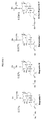
- Mogroside V, Mogroside IV, Siamenoside I, and 11-Oxomogroside V have been identified from the fruits of Siraitia grosvenorii (Swingle) that are responsible for the sweetness of the fruits. See FIG. 1 .
- Mogroside V is the most abundant of these four compounds at approximately 0.57% (w/w) of the dry fruit, followed by Mogroside IV and Siamenoside I, each of which contain four glucose moieties.
- 11-Oxomogroside V has a ketone group instead of a hydroxyl at C-11. See, e.g., Takemoto, et al.., Yakugaku Zasshi, 103, 1151-1154; 1155-1166; 1167-1173, (1983 ); Kasai, et al., Agric. Biol. Chem. 53, 3347-3349 (1989 ); Matsumoto, Chem. Pharm. Bull. 38, 2030-2032 (1990 ); and Prakash, et al., J. Carbohydrate Chem. 30, 16-26 (2011 ).
- mogrosides share the same triterpene core, named mogrol.
- the aglycone mogrol is glycosylated with different numbers of glucose moieties to form various mogroside compounds.
- Mogroside is thought to be synthesized in the following manner: synthesis of cucurbitadienol from the common triterpene precursor squalene; P450 oxidations of cucurbitadienol to produce the aglycone mogrol; and glycosylation of mogrol to add the five glucoses one after another to produce mogroside V. See, Tang, et al., BMC Genomics, 12, 343 (2011 ).
- Uridine-5'- diphospho (UDP) dependent glycosyltransferases (UGTs) from Arabidopsis thaliana and Stevia rebaudiana have been cloned and isolated, see e.g. :
- WO 2008/062165 A2 and WO 2008/065370 A2 disclose the Arabidopsis thaliana UGTs UGT73C3, UGT73C5 and UGT73C6 (figure 5) and recombinant GTs expressed as fusion proteins with glutathione-S-transferase (GST) attached to the N-terminus of the GTs;
- WO 2010/106318 A1 discloses the A. thaliana UDP-glucosyltransferase UGT 73C5 as a part of a vector where is operably linked to a promoter element;
- EP 1 510 573 A1 discloses UGTs corresponding to subfamily 73C of A. thaliana and chimeric proteins thereof, namely UGT73C5 (locus At2g36800) and UGT73C1 (At2g36750), UGT73C2 (At2g36760), UGT73C3 (At2g36780), UGT73C4 (At2g36770) and UGT73C6 (At2g36790);
- US 2008/148432 A1 discloses S.rebaudiana proteins, SEQ.ID.N 10008 corresponds to UGT73E1. It is contemplated to use said DNA for transformation in plants to obtain transgenic plants with enhanced agronomic traits and
- this document features a method of producing a mogroside compound.
- the method includes incubating mogrol with a Uridine-5'-diphospho (UDP) dependent glucosyltransferase (UGT) to produce a mogroside compound (e.g., mogroside Ia, mogroside Ib, or a mogroside compound glycosylated at C25-OH).
- UGT Uridine-5'-diphospho
- UGT Uridine-5'-diphospho
- UGT Uridine-5'-diphospho
- UGT Uridine-5'-diphospho
- UGT Uridine-5'-diphospho
- UGT Uridine-5'-diphospho
- UGT Uridine-5'-diphospho
- UGT Uridine-5'-diphospho
- UGT Uridine-5'-diphospho
- UGT Uridine-5'-diphospho
- UGT Uridine-5'-diphospho
- UGT Uridine-5'-diphospho
- UGT Uridine-5'-di
- This document also features a method of producing a mogroside compound.
- the method includes contacting mogrol with a cell lysate prepared from a recombinant host expressing a UGT to produce a mogroside compound (e.g., mogroside Ia, mogroside Ib, or a mogroside compound glycosylated at C25-OH).
- the UGT can be selected from the group consisting of 73C3, 73C6, 85C2, 73C5, and 73E1.
- UGTs Uridine-5'-diphospho (UDP) dependent glucosyltransferases
- UGTs Uridine-5'-diphospho
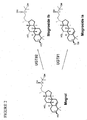
- UGTs 73C3, 73C6, 85C2 and 73E1 glycosylate at the C24-OH position (UGT#2 in FIG. 2 )
- UGT73C5 glycosylates at both the C3-OH (UGT#1 in FIG. 2 ) and C24-OH position (UGT#2).
- UGTs 73C3, 73C5, and 73C6 are from Arabidopsis thaliana.
- UGT 73E1 and 85C2 are from Stevia rebaudiana.
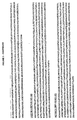
- the amino acid sequences of UGTs 73C3, 73C5, 73C6, 73E1, and 85C2 (SEQ ID NOs:1-5) are set forth in FIG. 3 .
- UGT polypeptides described herein can be produced using any suitable method.
- UGT polypeptides can be produced by chemical synthesis.
- a UGT polypeptide described herein can be produced by standard recombinant technology using heterologous expression vectors encoding that UGT polypeptide.
- Expression vectors can be introduced into host cells (e.g., by transformation or transfection) for expression of the encoded polypeptide, which then can be purified.
- Expression systems that can be used for small or large scale production of UGT polypeptides include, without limitation, microorganisms such as bacteria (e.g., E. coli and B.
- Useful expression systems also include insect cell systems infected with recombinant virus expression vectors (e.g., baculovirus) containing the nucleic acid molecules described herein, and plant cell systems infected with recombinant virus expression vectors (e.g., tobacco mosaic virus) or transformed with recombinant plasmid expression vectors (e.g., Ti plasmid) containing the nucleic acid molecules described herein.
- recombinant virus expression vectors e.g., baculovirus
- plant cell systems infected with recombinant virus expression vectors (e.g., tobacco mosaic virus) or transformed with recombinant plasmid expression vectors (e.g., Ti plasmid) containing the nucleic acid molecules described herein.
- UGT polypeptides also can be produced using manimalian expression system harboring recombinant expression constructs containing promoters derived from the genome of mammalian cells (e.g., the metallothionein promoter) or from mammalian viruses (e.g., the adenovirus late promoter and the cytomegalovirus promoter), along with the nucleic acids described herein.
- UGT polypeptides can have an N-terminal or C-terminal tag as discussed below.
- isolated nucleic acid refers to a nucleic acid that is separated from other nucleic acid molecules that are present in a genome, including nucleic acids that normally flank one or both sides of the nucleic acid in a genome.
- isolated as used herein with respect to nucleic acids also includes any non-naturally-occurring nucleic acid sequence, since such non-naturally-occurring sequences are not found in nature and do not have immediately contiguous sequences in a naturally-occurring genome.
- an isolated nucleic acid can be, for example, a DNA molecule, provided one of the nucleic acid sequences normally found immediately flanking that DNA molecule in a naturally-occurring genome is removed or absent.
- an isolated nucleic acid includes, without limitation, a DNA molecule that exists as a separate molecule (e.g., a chemically synthesized nucleic acid, or a cDNA or genomic DNA fragment produced by PCR or restriction endonuclease treatment) independent of other sequences as well as DNA that is incorporated into a vector, an autonomously replicating plasmid, a virus (e.g., any paramyxovirus, retrovirus, lentivirus, adenovirus, or herpes virus), or into the genomic DNA of a prokaryote or eukaryote.
- a separate molecule e.g., a chemically synthesized nucleic acid, or a cDNA or genomic DNA fragment produced by PCR or restriction endonucleas
- an isolated nucleic acid can include an engineered nucleic acid such as a DNA molecule that is part of a hybrid or fusion nucleic acid.
- a nucleic acid sequence encoding a UGT polypeptide can include a tag sequence that encodes a "tag" designed to facilitate subsequent manipulation (e.g., to facilitate purification or detection), secretion, or localization of the encoded polypeptide.
- Tag sequences can be inserted in the nucleic acid sequence encoding the UGT polypeptide such that the encoded tag is located at either the carboxyl or amino terminus of the UGT polypeptide.
- Non-limiting examples of encoded tags include green fluorescent protein (GFP), glutathione S transferase (GST), HIS tag, and FlagTM tag (Kodak, New Haven, CT).
- Other examples of tags include a chloroplast transit peptide, a mitochondrial transit peptide, an amyloplast peptide, signal peptide, or a secretion tag.
- a functional homolog is a polypeptide that has sequence similarity to a reference polypeptide, and that carries out one or more of the biochemical or physiological function(s) of the reference polypeptide.
- a functional homolog and the reference polypeptide may be natural occurring polypeptides, and the sequence similarity may be due to convergent or divergent evolutionary events. As such, functional homologs are sometimes designated in the literature as homologs, or orthologs, or paralogs. Variants of a naturally occurring functional homolog, such as polypeptides encoded by mutants of a wild type coding sequence, may themselves be functional homologs.
- Functional homologs can also be created via site-directed mutagenesis of the coding sequence for a polypeptide, or by combining domains from the coding sequences for different naturally-occurring polypeptides ("domain swapping").
- Techniques for modifying genes encoding functional UGT polypeptides described herein are known and include, inter alia , directed evolution techniques, site-directed mutagenesis techniques and random mutagenesis techniques, and can be useful to increase specific activity of a polypeptide, alter substrate specificity, alter expression levels, alter subcellular location, or modify polypeptide:polypeptide interactions in a desired manner. Such modified polypeptides are considered functional homologs.
- the term "functional homolog” is sometimes applied to the nucleic acid that encodes a functionally homologous polypeptide.
- Functional homologs can be identified by analysis of nucleotide and polypeptide sequence alignments. For example, performing a query on a database of nucleotide or polypeptide sequences can identify homologs of UGT polypeptides. Sequence analysis can involve BLAST, Reciprocal BLAST, or PSI-BLAST analysis of nonredundant databases using an UGT amino acid sequence as the reference sequence. Amino acid sequence is, in some instances, deduced from the nucleotide sequence. Those polypeptides in the database that have greater than 40% sequence identity are candidates for further evaluation for suitability as a UGT polypeptide.
- Amino acid sequence similarity allows for conservative amino acid substitutions, such as substitution of one hydrophobic residue for another or substitution of one polar residue for another. If desired, manual inspection of such candidates can be carried out in order to narrow the number of candidates to be further evaluated. Manual inspection can be performed by selecting those candidates that appear to have domains present in UGT polypeptides, e.g., conserved functional domains.
- conserveed regions can be identified by locating a region within the primary amino acid sequence of a polypeptide that is a repeated sequence, forms some secondary structure (e.g ., helices and beta sheets), establishes positively or negatively charged domains, or represents a protein motif or domain. See, e.g. , the Pfam web site describing consensus sequences for a variety of protein motifs and domains on the World Wide Web at sanger.ac.uk/Software/Pfam/ and pfam.janelia.org/. The information included at the Pfam database is described in Sonnhammer et al., Nucl.
- conserved regions also can be determined by aligning sequences of the same or related polypeptides from closely related species. Closely related species preferably are from the same family. In some embodiments, alignment of sequences from two different species is adequate.
- polypeptides that exhibit at least about 40% amino acid sequence identity are useful to identify conserved regions.
- conserved regions of related polypeptides exhibit at least 45% amino acid sequence identity (e.g ., at least 50%, at least 60%, at least 70%, at least 80%, or at least 90% amino acid sequence identity).
- a conserved region exhibits at least 92%, 94%, 96%, 98%, or 99% amino acid sequence identity. Sequence identity can be determined as set forth above.
- Mogroside compounds can be produced by incubating a mogrol substrate with one or more of the UGT polypeptides described herein, resulting in the production of a mogroside product.
- the reaction mixture contains a plurality of UGT polypeptides such that a plurality of glycosylations occur in the reaction vessel.
- the reaction mixture contains a single UGT polypeptide and one or more glycosylations catalyzed by that polypeptide take place.
- a first reaction vessel can comprise a substrate and one or more UGT polypeptides for producing an intermediate, which can be introduced into a second reaction vessel containing one or more other UGT polypeptides to produce a subsequent intermediate or a mogroside product. The product produced in the second reaction vessel then can be recovered.
- Each of the UGT polypeptides can be a purified polypeptide, e.g., can be added to a reaction mixture as a solution containing 80%, 90%, 95%, or greater than 99% by weight of the desired UGT.
- the UGT polypeptide(s) can be present in a cell lysate prepared from a recombinant host expressing the UGT(s), and can be added to a reaction mixture as a cell lysate for incubation with the mogrol substrate.
- Levels of products, substrates and intermediates can be determined by extracting samples from the reaction vessel for analysis according to published methods.
- Mogroside compounds can be recovered from the reaction vessel using various techniques known in the art.
- Mogroside V was purified from commercially available monk fruit extracts (PureLo®, Swanson) as follows. Three bottles of PureLo® (240 grams) were dissolved in water (900 mL), then loaded on a column of HP-20 resin (400 gram resin). The column was washed with water (2.5 liters); then further washed with 20% methanol-water. The product was eluted with methanol. After evaporation of solvents and drying under high vacuum, mogroside V (2.5 grams, ⁇ 80% purity, 11-oxomogroside V was the major impurity) was obtained.
- Mogroside V 300 mg was dissolved in 0.1M sodium acetate buffer (pH 4.5, 100mL), and crude pectinase from Aspergillus niger (25mL, Sigma P2736) was added. The mixture was stirred at 50°C for 48 hours. The reaction mixture was extracted with ethyl acetate (2x100ml). The organic extract was dried under vacuum then purified with preparative HPLC. Pure mogrol (40 mg) was obtained and its structure confirmed by NMR and mass spectroscopy. See FIG. 4 .
- Mogroside V (300 mg) was dissolved in 0.1M sodium acetate buffer (pH 4.5, 100ml), and crude pectinase from Aspergillus niger (25ml, Sigma P2736) was added. The mixture was stirred at 50°C for 6.5 hours. The reaction mixture was extracted with ethyl acetate (2x100ml). The organic extract was dried under vacuum then purified with preparative HPLC. Pure mogroside Ia (11.0 mg) and mogroside Ib (8.0 mg) were obtained. Their structures were confirmed by NMR and mass spectroscopy. See FIG. 4 .
- UGTs 73C3, 73C6 and 85C2 were found to convert all the mogrol substrate to mogroside Ib.
- UGT 73C5 makes both mogroside Ia and Ib.
- mogroside Ib was found as the major product, together with a new glycosylated mogrol (neither mogroside Ia nor Ib; exact mass shown as a mogroside I, presumably caused by a glycosylation event on C25-OH).
Landscapes
- Organic Chemistry (AREA)
- Chemical & Material Sciences (AREA)
- Engineering & Computer Science (AREA)
- Zoology (AREA)
- Life Sciences & Earth Sciences (AREA)
- Wood Science & Technology (AREA)
- Chemical Kinetics & Catalysis (AREA)
- Microbiology (AREA)
- General Chemical & Material Sciences (AREA)
- Biotechnology (AREA)
- Health & Medical Sciences (AREA)
- Biochemistry (AREA)
- Bioinformatics & Cheminformatics (AREA)
- General Engineering & Computer Science (AREA)
- General Health & Medical Sciences (AREA)
- Genetics & Genomics (AREA)
- Preparation Of Compounds By Using Micro-Organisms (AREA)
- Enzymes And Modification Thereof (AREA)
Applications Claiming Priority (2)
| Application Number | Priority Date | Filing Date | Title |
|---|---|---|---|
| US201161563303P | 2011-11-23 | 2011-11-23 | |
| PCT/IB2012/002857 WO2013076577A1 (en) | 2011-11-23 | 2012-11-19 | Methods and materials for enzymatic synthesis of mogroside compounds |
Publications (2)
| Publication Number | Publication Date |
|---|---|
| EP2783009A1 EP2783009A1 (en) | 2014-10-01 |
| EP2783009B1 true EP2783009B1 (en) | 2016-04-13 |
Family
ID=47624376
Family Applications (1)
| Application Number | Title | Priority Date | Filing Date |
|---|---|---|---|
| EP12819015.4A Active EP2783009B1 (en) | 2011-11-23 | 2012-11-19 | Methods and materials for enzymatic synthesis of mogroside compounds |
Country Status (14)
| Country | Link |
|---|---|
| US (2) | US9920349B2 (OSRAM) |
| EP (1) | EP2783009B1 (OSRAM) |
| JP (1) | JP6084983B2 (OSRAM) |
| KR (1) | KR101791597B1 (OSRAM) |
| CN (1) | CN103958693B (OSRAM) |
| AU (2) | AU2012342114B2 (OSRAM) |
| BR (1) | BR112014012543A2 (OSRAM) |
| CA (1) | CA2853677C (OSRAM) |
| IN (1) | IN2014CN03557A (OSRAM) |
| MX (1) | MX342851B (OSRAM) |
| MY (1) | MY170686A (OSRAM) |
| RU (1) | RU2633644C2 (OSRAM) |
| SG (1) | SG11201401927PA (OSRAM) |
| WO (1) | WO2013076577A1 (OSRAM) |
Cited By (4)
| Publication number | Priority date | Publication date | Assignee | Title |
|---|---|---|---|---|
| US11060124B2 (en) | 2017-05-03 | 2021-07-13 | Firmenich Incorporated | Methods for making high intensity sweeteners |
| US11357246B2 (en) | 2015-10-29 | 2022-06-14 | Firmenich Incorporated | High intensity sweeteners |
| US12286661B2 (en) | 2018-11-07 | 2025-04-29 | Firmenich Incorporated | Methods for making high intensity sweeteners |
| US12338476B2 (en) | 2018-11-07 | 2025-06-24 | Firmenich Incorporated | Methods for making high intensity sweeteners |
Families Citing this family (34)
| Publication number | Priority date | Publication date | Assignee | Title |
|---|---|---|---|---|
| EP2575432B1 (en) | 2010-06-02 | 2019-08-14 | Evolva, Inc. | Recombinant production of steviol glycosides |
| AU2012294452C1 (en) | 2011-08-08 | 2017-11-30 | Danstar Ferment Ag | Recombinant production of steviol glycosides |
| MY170686A (en) | 2011-11-23 | 2019-08-26 | Evolva Sa | Methods and meterials for enzymatic synthesis of mogroside compounds |
| TW201402599A (zh) * | 2012-05-30 | 2014-01-16 | Suntory Holdings Ltd | 甜菊糖苷糖苷轉化酵素及編碼該酵素之基因 |
| CA2893462A1 (en) | 2012-12-04 | 2014-06-12 | Evolva Sa | Methods and materials for biosynthesis of mogroside compounds |
| BR112015019160A2 (pt) | 2013-02-11 | 2017-08-22 | Dalgaard Mikkelsen Michael | Produção de glicosídeos de esteviol em hospedeiros recombinantes |
| CN114410493A (zh) | 2014-08-11 | 2022-04-29 | 埃沃尔瓦公司 | 在重组宿主中生产甜菊醇糖苷 |
| KR20170052647A (ko) | 2014-09-09 | 2017-05-12 | 에볼바 에스아 | 재조합 숙주에서 스테비올 글리코시드의 생성 |
| EP3191584A4 (en) | 2014-09-11 | 2018-07-18 | The State of Israel - Ministry of Agriculture & Rural Development, Agricultural Research Organization (ARO) (Volcani Center) | Methods of producing mogrosides and compositions comprising same and uses thereof |
| CN107466320B (zh) | 2014-10-01 | 2021-11-05 | 埃沃尔瓦公司 | 用于生物合成罗汉果苷化合物的方法和材料 |
| CA2968331C (en) * | 2014-10-17 | 2024-02-06 | Suntory Holdings Limited | Mogrol glycosyltransferase and gene encoding same |
| US10626430B2 (en) | 2015-01-20 | 2020-04-21 | Suntory Holdings Limited | Method for preparing mogroside having no β-1,6-glucoside bond |
| AU2016211124B2 (en) | 2015-01-30 | 2022-04-14 | Danstar Ferment Ag | Production of steviol glycosides in recombinant hosts |
| EP3271457B1 (en) | 2015-03-16 | 2021-01-20 | DSM IP Assets B.V. | Udp-glycosyltransferases |
| EP3332018B1 (en) | 2015-08-07 | 2022-07-27 | Evolva SA | Production of steviol glycosides in recombinant hosts |
| CN106924274B (zh) * | 2015-12-29 | 2019-01-04 | 成都普睿法药物研发有限公司 | 葫芦烷型四环三萜类化合物抗肺纤维化应用 |
| KR20180132696A (ko) | 2016-04-13 | 2018-12-12 | 에볼바 에스아 | 재조합 숙주에서의 스테비올 글리코사이드의 생산 |
| US10815514B2 (en) | 2016-05-16 | 2020-10-27 | Evolva Sa | Production of steviol glycosides in recombinant hosts |
| CN109477128A (zh) * | 2016-05-16 | 2019-03-15 | 埃沃尔瓦公司 | 在重组宿主中甜菊醇糖苷的生产 |
| JP6845244B2 (ja) * | 2016-07-19 | 2021-03-17 | サントリーホールディングス株式会社 | モグロールまたはモグロール配糖体の生産方法 |
| WO2018083338A1 (en) | 2016-11-07 | 2018-05-11 | Evolva Sa | Production of steviol glycosides in recombinant hosts |
| EP3624595A4 (en) | 2017-05-19 | 2021-03-03 | The Coca-Cola Company | COMPOSITIONS SWEETED WITH SIAMENOSIDE I AND USES THEREOF |
| RU2762719C2 (ru) | 2017-06-02 | 2021-12-22 | Живодан Са | Композиция, модифицирующая сладость |
| WO2018229283A1 (en) | 2017-06-15 | 2018-12-20 | Evolva Sa | Production of mogroside compounds in recombinant hosts |
| CN107189976B (zh) * | 2017-07-28 | 2022-03-11 | 李华政 | 促进罗汉果ugt72b21基因表达的方法 |
| EP3877519B1 (en) | 2018-11-09 | 2026-03-11 | Ginkgo Bioworks, Inc. | Biosynthesis of mogrosides |
| CN110669094B (zh) * | 2019-10-14 | 2021-12-21 | 上海交通大学 | 罗汉果新苷及其制备方法 |
| KR102362135B1 (ko) * | 2019-10-25 | 2022-02-14 | 고려대학교 산학협력단 | 테르펜 당쇄 부가 유도체, 이의 제조방법 및 이를 유효성분으로 함유하는 조성물 |
| EP4120823A4 (en) * | 2020-03-17 | 2024-08-07 | The Coca-Cola Company | NOVEL MOGROSID PRODUCTION SYSTEM AND PROCESS |
| CA3179775A1 (en) | 2020-04-20 | 2021-10-28 | Givaudan Sa | Compositions |
| GB202007984D0 (en) | 2020-05-28 | 2020-07-15 | Givaudan Sa | Compositions |
| CN112063647B (zh) * | 2020-09-17 | 2023-05-02 | 云南农业大学 | 酿酒酵母重组菌Cuol01的构建方法、酿酒酵母重组菌Cuol02及应用 |
| CN116064712B (zh) * | 2022-10-08 | 2025-05-06 | 中国药科大学 | 一种罗汉果醇的生物合成方法 |
| CN121127603A (zh) | 2023-04-20 | 2025-12-12 | 帝斯曼知识产权资产管理有限公司 | 用于产生罗汉果苷的菌株和方法 |
Citations (2)
| Publication number | Priority date | Publication date | Assignee | Title |
|---|---|---|---|---|
| EP1510573A1 (en) * | 2003-09-01 | 2005-03-02 | Austria Wirtschaftsservice Gesellschaft mit beschränkter Haftung | Method for detoxification of mycotoxins |
| US20080148432A1 (en) * | 2005-12-21 | 2008-06-19 | Mark Scott Abad | Transgenic plants with enhanced agronomic traits |
Family Cites Families (12)
| Publication number | Priority date | Publication date | Assignee | Title |
|---|---|---|---|---|
| US6399321B1 (en) * | 1999-08-18 | 2002-06-04 | National Research Council Of Canada | Methods for screening UDP-glucose:glycoprotein glucosyltransferase (UGGT) activity and nucleic acid encoding for UGGT |
| WO2006092449A2 (en) | 2005-03-02 | 2006-09-08 | Metanomics Gmbh | Process for the production of fine chemicals |
| US8257948B1 (en) * | 2011-02-17 | 2012-09-04 | Purecircle Usa | Method of preparing alpha-glucosyl Stevia composition |
| US8956677B2 (en) | 2005-11-23 | 2015-02-17 | The Coca-Cola Company | High-potency sweetener composition with glucosamine and compositions sweetened therewith |
| RU2008122901A (ru) * | 2005-11-23 | 2009-12-27 | Дзе Кока-Кола Компани (US) | Композиция интенсивного подсластителя с сапонином и подслащенные ею композиции |
| US7927851B2 (en) | 2006-03-21 | 2011-04-19 | Vineland Research And Innovation Centre | Compositions having ent-kaurenoic acid 13-hydroxylase activity and methods for producing same |
| US20100143975A1 (en) * | 2006-11-22 | 2010-06-10 | The University Of York | Monoterpenoid modifying enzymes |
| WO2008065370A2 (en) * | 2006-12-01 | 2008-06-05 | The University Of York | Sesquiterpenoid modifying enzymes |
| GB0904639D0 (en) | 2009-03-18 | 2009-04-29 | Univ York | Assay |
| EP2575432B1 (en) | 2010-06-02 | 2019-08-14 | Evolva, Inc. | Recombinant production of steviol glycosides |
| MY170686A (en) | 2011-11-23 | 2019-08-26 | Evolva Sa | Methods and meterials for enzymatic synthesis of mogroside compounds |
| CA2893462A1 (en) | 2012-12-04 | 2014-06-12 | Evolva Sa | Methods and materials for biosynthesis of mogroside compounds |
-
2012
- 2012-11-19 MY MYPI2014001482A patent/MY170686A/en unknown
- 2012-11-19 EP EP12819015.4A patent/EP2783009B1/en active Active
- 2012-11-19 US US14/356,782 patent/US9920349B2/en active Active
- 2012-11-19 JP JP2014542951A patent/JP6084983B2/ja active Active
- 2012-11-19 CA CA2853677A patent/CA2853677C/en active Active
- 2012-11-19 IN IN3557CHN2014 patent/IN2014CN03557A/en unknown
- 2012-11-19 BR BR112014012543A patent/BR112014012543A2/pt unknown
- 2012-11-19 CN CN201280057518.8A patent/CN103958693B/zh active Active
- 2012-11-19 AU AU2012342114A patent/AU2012342114B2/en active Active
- 2012-11-19 KR KR1020147016910A patent/KR101791597B1/ko active Active
- 2012-11-19 SG SG11201401927PA patent/SG11201401927PA/en unknown
- 2012-11-19 MX MX2014006276A patent/MX342851B/es active IP Right Grant
- 2012-11-19 WO PCT/IB2012/002857 patent/WO2013076577A1/en not_active Ceased
- 2012-11-19 RU RU2014125216A patent/RU2633644C2/ru not_active IP Right Cessation
-
2017
- 2017-09-26 AU AU2017235907A patent/AU2017235907A1/en not_active Withdrawn
-
2018
- 2018-02-06 US US15/889,743 patent/US10738340B2/en active Active
Patent Citations (2)
| Publication number | Priority date | Publication date | Assignee | Title |
|---|---|---|---|---|
| EP1510573A1 (en) * | 2003-09-01 | 2005-03-02 | Austria Wirtschaftsservice Gesellschaft mit beschränkter Haftung | Method for detoxification of mycotoxins |
| US20080148432A1 (en) * | 2005-12-21 | 2008-06-19 | Mark Scott Abad | Transgenic plants with enhanced agronomic traits |
Non-Patent Citations (1)
| Title |
|---|
| DATABASE UNIPROT [online] EMBL; 11 February 2011 (2011-02-11), "Stevia rebaudiana protein SEQ ID:10008.", Database accession no. ATZ23684 * |
Cited By (6)
| Publication number | Priority date | Publication date | Assignee | Title |
|---|---|---|---|---|
| US11357246B2 (en) | 2015-10-29 | 2022-06-14 | Firmenich Incorporated | High intensity sweeteners |
| US11758933B2 (en) | 2015-10-29 | 2023-09-19 | Firmenich Incorporated | High intensity sweeteners |
| US11060124B2 (en) | 2017-05-03 | 2021-07-13 | Firmenich Incorporated | Methods for making high intensity sweeteners |
| US12428662B2 (en) | 2017-05-03 | 2025-09-30 | Firmenich Incorporated | Methods for making high intensity sweeteners |
| US12286661B2 (en) | 2018-11-07 | 2025-04-29 | Firmenich Incorporated | Methods for making high intensity sweeteners |
| US12338476B2 (en) | 2018-11-07 | 2025-06-24 | Firmenich Incorporated | Methods for making high intensity sweeteners |
Also Published As
| Publication number | Publication date |
|---|---|
| CA2853677C (en) | 2019-01-29 |
| AU2012342114B2 (en) | 2017-12-21 |
| RU2014125216A (ru) | 2015-12-27 |
| US20140308698A1 (en) | 2014-10-16 |
| US20180237819A1 (en) | 2018-08-23 |
| JP2014533518A (ja) | 2014-12-15 |
| MY170686A (en) | 2019-08-26 |
| AU2012342114A1 (en) | 2014-05-22 |
| AU2017235907A1 (en) | 2017-10-12 |
| IN2014CN03557A (OSRAM) | 2015-10-09 |
| KR101791597B1 (ko) | 2017-10-30 |
| US10738340B2 (en) | 2020-08-11 |
| BR112014012543A2 (pt) | 2017-06-13 |
| CN103958693A (zh) | 2014-07-30 |
| KR20140099281A (ko) | 2014-08-11 |
| EP2783009A1 (en) | 2014-10-01 |
| CN103958693B (zh) | 2016-08-24 |
| WO2013076577A1 (en) | 2013-05-30 |
| HK1200494A1 (zh) | 2015-08-07 |
| CA2853677A1 (en) | 2013-05-30 |
| JP6084983B2 (ja) | 2017-02-22 |
| RU2633644C2 (ru) | 2017-10-16 |
| MX2014006276A (es) | 2014-10-13 |
| US9920349B2 (en) | 2018-03-20 |
| MX342851B (es) | 2016-10-14 |
| SG11201401927PA (en) | 2014-09-26 |
Similar Documents
| Publication | Publication Date | Title |
|---|---|---|
| US10738340B2 (en) | Methods and materials for enzymatic synthesis of mogroside compounds | |
| AU2022204012B2 (en) | Methods and materials for biosynthesis of mogroside compounds | |
| AU2019250137B2 (en) | Methods and materials for biosynthesis of mogroside compounds | |
| Shibuya et al. | Identification and characterization of glycosyltransferases involved in the biosynthesis of soyasaponin I in Glycine max | |
| US20160215306A1 (en) | Method for producing modified resveratrol | |
| US20220154234A1 (en) | Production of steviol glycosides in recombinant hosts | |
| CN104357418A (zh) | 一种糖基转移酶及其突变体在合成人参皂苷Rh2中的应用 | |
| CN113265433A (zh) | 双功能碳苷糖基转移酶及其应用 | |
| Yang et al. | Systems metabolic engineering of Escherichia coli to enhance the production of flavonoid glucuronides | |
| US10415071B2 (en) | Method for producing steviol and steviol glycoside using AOBGL3 homolog | |
| HK1200494B (en) | Methods and materials for enzymatic synthesis of mogroside compounds | |
| Nidetzky | Glycosyltransferase cascades made fit for the biocatalytic production of natural product glycosides | |
| CN113444703B (zh) | 催化糖链延伸的糖基转移酶突变体及其应用 | |
| Nagashima et al. | Cloning and characterization of glucosyltransferase cDNA from Eucalyptus perriniana cultured cells | |
| Masada et al. | Full Text HTML |
Legal Events
| Date | Code | Title | Description |
|---|---|---|---|
| PUAI | Public reference made under article 153(3) epc to a published international application that has entered the european phase |
Free format text: ORIGINAL CODE: 0009012 |
|
| 17P | Request for examination filed |
Effective date: 20140428 |
|
| AK | Designated contracting states |
Kind code of ref document: A1 Designated state(s): AL AT BE BG CH CY CZ DE DK EE ES FI FR GB GR HR HU IE IS IT LI LT LU LV MC MK MT NL NO PL PT RO RS SE SI SK SM TR |
|
| RIN1 | Information on inventor provided before grant (corrected) |
Inventor name: LIU, YAOQUAN Inventor name: KHARE, MONIKA Inventor name: LEE, JUNG, YEOP |
|
| DAX | Request for extension of the european patent (deleted) | ||
| 17Q | First examination report despatched |
Effective date: 20150318 |
|
| REG | Reference to a national code |
Ref country code: HK Ref legal event code: DE Ref document number: 1200494 Country of ref document: HK |
|
| GRAP | Despatch of communication of intention to grant a patent |
Free format text: ORIGINAL CODE: EPIDOSNIGR1 |
|
| INTG | Intention to grant announced |
Effective date: 20151023 |
|
| GRAS | Grant fee paid |
Free format text: ORIGINAL CODE: EPIDOSNIGR3 |
|
| GRAA | (expected) grant |
Free format text: ORIGINAL CODE: 0009210 |
|
| AK | Designated contracting states |
Kind code of ref document: B1 Designated state(s): AL AT BE BG CH CY CZ DE DK EE ES FI FR GB GR HR HU IE IS IT LI LT LU LV MC MK MT NL NO PL PT RO RS SE SI SK SM TR |
|
| REG | Reference to a national code |
Ref country code: GB Ref legal event code: FG4D |
|
| REG | Reference to a national code |
Ref country code: AT Ref legal event code: REF Ref document number: 790206 Country of ref document: AT Kind code of ref document: T Effective date: 20160415 Ref country code: CH Ref legal event code: EP |
|
| REG | Reference to a national code |
Ref country code: IE Ref legal event code: FG4D |
|
| REG | Reference to a national code |
Ref country code: DE Ref legal event code: R096 Ref document number: 602012017168 Country of ref document: DE |
|
| REG | Reference to a national code |
Ref country code: LT Ref legal event code: MG4D |
|
| REG | Reference to a national code |
Ref country code: AT Ref legal event code: MK05 Ref document number: 790206 Country of ref document: AT Kind code of ref document: T Effective date: 20160413 |
|
| REG | Reference to a national code |
Ref country code: NL Ref legal event code: MP Effective date: 20160413 |
|
| PG25 | Lapsed in a contracting state [announced via postgrant information from national office to epo] |
Ref country code: LT Free format text: LAPSE BECAUSE OF FAILURE TO SUBMIT A TRANSLATION OF THE DESCRIPTION OR TO PAY THE FEE WITHIN THE PRESCRIBED TIME-LIMIT Effective date: 20160413 Ref country code: NL Free format text: LAPSE BECAUSE OF FAILURE TO SUBMIT A TRANSLATION OF THE DESCRIPTION OR TO PAY THE FEE WITHIN THE PRESCRIBED TIME-LIMIT Effective date: 20160413 Ref country code: FI Free format text: LAPSE BECAUSE OF FAILURE TO SUBMIT A TRANSLATION OF THE DESCRIPTION OR TO PAY THE FEE WITHIN THE PRESCRIBED TIME-LIMIT Effective date: 20160413 Ref country code: PL Free format text: LAPSE BECAUSE OF FAILURE TO SUBMIT A TRANSLATION OF THE DESCRIPTION OR TO PAY THE FEE WITHIN THE PRESCRIBED TIME-LIMIT Effective date: 20160413 Ref country code: NO Free format text: LAPSE BECAUSE OF FAILURE TO SUBMIT A TRANSLATION OF THE DESCRIPTION OR TO PAY THE FEE WITHIN THE PRESCRIBED TIME-LIMIT Effective date: 20160713 |
|
| REG | Reference to a national code |
Ref country code: FR Ref legal event code: PLFP Year of fee payment: 5 |
|
| PG25 | Lapsed in a contracting state [announced via postgrant information from national office to epo] |
Ref country code: HR Free format text: LAPSE BECAUSE OF FAILURE TO SUBMIT A TRANSLATION OF THE DESCRIPTION OR TO PAY THE FEE WITHIN THE PRESCRIBED TIME-LIMIT Effective date: 20160413 Ref country code: ES Free format text: LAPSE BECAUSE OF FAILURE TO SUBMIT A TRANSLATION OF THE DESCRIPTION OR TO PAY THE FEE WITHIN THE PRESCRIBED TIME-LIMIT Effective date: 20160413 Ref country code: SE Free format text: LAPSE BECAUSE OF FAILURE TO SUBMIT A TRANSLATION OF THE DESCRIPTION OR TO PAY THE FEE WITHIN THE PRESCRIBED TIME-LIMIT Effective date: 20160413 Ref country code: RS Free format text: LAPSE BECAUSE OF FAILURE TO SUBMIT A TRANSLATION OF THE DESCRIPTION OR TO PAY THE FEE WITHIN THE PRESCRIBED TIME-LIMIT Effective date: 20160413 Ref country code: GR Free format text: LAPSE BECAUSE OF FAILURE TO SUBMIT A TRANSLATION OF THE DESCRIPTION OR TO PAY THE FEE WITHIN THE PRESCRIBED TIME-LIMIT Effective date: 20160714 Ref country code: PT Free format text: LAPSE BECAUSE OF FAILURE TO SUBMIT A TRANSLATION OF THE DESCRIPTION OR TO PAY THE FEE WITHIN THE PRESCRIBED TIME-LIMIT Effective date: 20160816 Ref country code: LV Free format text: LAPSE BECAUSE OF FAILURE TO SUBMIT A TRANSLATION OF THE DESCRIPTION OR TO PAY THE FEE WITHIN THE PRESCRIBED TIME-LIMIT Effective date: 20160413 Ref country code: AT Free format text: LAPSE BECAUSE OF FAILURE TO SUBMIT A TRANSLATION OF THE DESCRIPTION OR TO PAY THE FEE WITHIN THE PRESCRIBED TIME-LIMIT Effective date: 20160413 |
|
| PG25 | Lapsed in a contracting state [announced via postgrant information from national office to epo] |
Ref country code: BE Free format text: LAPSE BECAUSE OF FAILURE TO SUBMIT A TRANSLATION OF THE DESCRIPTION OR TO PAY THE FEE WITHIN THE PRESCRIBED TIME-LIMIT Effective date: 20160413 |
|
| REG | Reference to a national code |
Ref country code: DE Ref legal event code: R097 Ref document number: 602012017168 Country of ref document: DE |
|
| PG25 | Lapsed in a contracting state [announced via postgrant information from national office to epo] |
Ref country code: SK Free format text: LAPSE BECAUSE OF FAILURE TO SUBMIT A TRANSLATION OF THE DESCRIPTION OR TO PAY THE FEE WITHIN THE PRESCRIBED TIME-LIMIT Effective date: 20160413 Ref country code: RO Free format text: LAPSE BECAUSE OF FAILURE TO SUBMIT A TRANSLATION OF THE DESCRIPTION OR TO PAY THE FEE WITHIN THE PRESCRIBED TIME-LIMIT Effective date: 20160413 Ref country code: CZ Free format text: LAPSE BECAUSE OF FAILURE TO SUBMIT A TRANSLATION OF THE DESCRIPTION OR TO PAY THE FEE WITHIN THE PRESCRIBED TIME-LIMIT Effective date: 20160413 Ref country code: DK Free format text: LAPSE BECAUSE OF FAILURE TO SUBMIT A TRANSLATION OF THE DESCRIPTION OR TO PAY THE FEE WITHIN THE PRESCRIBED TIME-LIMIT Effective date: 20160413 Ref country code: EE Free format text: LAPSE BECAUSE OF FAILURE TO SUBMIT A TRANSLATION OF THE DESCRIPTION OR TO PAY THE FEE WITHIN THE PRESCRIBED TIME-LIMIT Effective date: 20160413 |
|
| PLBE | No opposition filed within time limit |
Free format text: ORIGINAL CODE: 0009261 |
|
| STAA | Information on the status of an ep patent application or granted ep patent |
Free format text: STATUS: NO OPPOSITION FILED WITHIN TIME LIMIT |
|
| PG25 | Lapsed in a contracting state [announced via postgrant information from national office to epo] |
Ref country code: SM Free format text: LAPSE BECAUSE OF FAILURE TO SUBMIT A TRANSLATION OF THE DESCRIPTION OR TO PAY THE FEE WITHIN THE PRESCRIBED TIME-LIMIT Effective date: 20160413 |
|
| 26N | No opposition filed |
Effective date: 20170116 |
|
| PG25 | Lapsed in a contracting state [announced via postgrant information from national office to epo] |
Ref country code: SI Free format text: LAPSE BECAUSE OF FAILURE TO SUBMIT A TRANSLATION OF THE DESCRIPTION OR TO PAY THE FEE WITHIN THE PRESCRIBED TIME-LIMIT Effective date: 20160413 |
|
| REG | Reference to a national code |
Ref country code: CH Ref legal event code: PL |
|
| PG25 | Lapsed in a contracting state [announced via postgrant information from national office to epo] |
Ref country code: LI Free format text: LAPSE BECAUSE OF NON-PAYMENT OF DUE FEES Effective date: 20161130 Ref country code: CH Free format text: LAPSE BECAUSE OF NON-PAYMENT OF DUE FEES Effective date: 20161130 |
|
| REG | Reference to a national code |
Ref country code: IE Ref legal event code: MM4A |
|
| PG25 | Lapsed in a contracting state [announced via postgrant information from national office to epo] |
Ref country code: LU Free format text: LAPSE BECAUSE OF NON-PAYMENT OF DUE FEES Effective date: 20161130 |
|
| REG | Reference to a national code |
Ref country code: FR Ref legal event code: PLFP Year of fee payment: 6 |
|
| PG25 | Lapsed in a contracting state [announced via postgrant information from national office to epo] |
Ref country code: IE Free format text: LAPSE BECAUSE OF NON-PAYMENT OF DUE FEES Effective date: 20161119 |
|
| PG25 | Lapsed in a contracting state [announced via postgrant information from national office to epo] |
Ref country code: HU Free format text: LAPSE BECAUSE OF FAILURE TO SUBMIT A TRANSLATION OF THE DESCRIPTION OR TO PAY THE FEE WITHIN THE PRESCRIBED TIME-LIMIT; INVALID AB INITIO Effective date: 20121119 |
|
| PG25 | Lapsed in a contracting state [announced via postgrant information from national office to epo] |
Ref country code: MC Free format text: LAPSE BECAUSE OF FAILURE TO SUBMIT A TRANSLATION OF THE DESCRIPTION OR TO PAY THE FEE WITHIN THE PRESCRIBED TIME-LIMIT Effective date: 20160413 Ref country code: CY Free format text: LAPSE BECAUSE OF FAILURE TO SUBMIT A TRANSLATION OF THE DESCRIPTION OR TO PAY THE FEE WITHIN THE PRESCRIBED TIME-LIMIT Effective date: 20160413 Ref country code: IS Free format text: LAPSE BECAUSE OF FAILURE TO SUBMIT A TRANSLATION OF THE DESCRIPTION OR TO PAY THE FEE WITHIN THE PRESCRIBED TIME-LIMIT Effective date: 20160413 Ref country code: MK Free format text: LAPSE BECAUSE OF FAILURE TO SUBMIT A TRANSLATION OF THE DESCRIPTION OR TO PAY THE FEE WITHIN THE PRESCRIBED TIME-LIMIT Effective date: 20160413 |
|
| PG25 | Lapsed in a contracting state [announced via postgrant information from national office to epo] |
Ref country code: BG Free format text: LAPSE BECAUSE OF FAILURE TO SUBMIT A TRANSLATION OF THE DESCRIPTION OR TO PAY THE FEE WITHIN THE PRESCRIBED TIME-LIMIT Effective date: 20160413 |
|
| PG25 | Lapsed in a contracting state [announced via postgrant information from national office to epo] |
Ref country code: MT Free format text: LAPSE BECAUSE OF NON-PAYMENT OF DUE FEES Effective date: 20161119 |
|
| PG25 | Lapsed in a contracting state [announced via postgrant information from national office to epo] |
Ref country code: TR Free format text: LAPSE BECAUSE OF FAILURE TO SUBMIT A TRANSLATION OF THE DESCRIPTION OR TO PAY THE FEE WITHIN THE PRESCRIBED TIME-LIMIT Effective date: 20160413 Ref country code: AL Free format text: LAPSE BECAUSE OF FAILURE TO SUBMIT A TRANSLATION OF THE DESCRIPTION OR TO PAY THE FEE WITHIN THE PRESCRIBED TIME-LIMIT Effective date: 20160413 |
|
| REG | Reference to a national code |
Ref country code: DE Ref legal event code: R082 Ref document number: 602012017168 Country of ref document: DE Representative=s name: WITTHOFF JAEKEL STEINECKE PATENTANWAELTE PARTG, DE |
|
| P01 | Opt-out of the competence of the unified patent court (upc) registered |
Effective date: 20230516 |
|
| REG | Reference to a national code |
Ref country code: DE Ref legal event code: R081 Ref document number: 602012017168 Country of ref document: DE Owner name: DANSTAR FERMENT AG, CH Free format text: FORMER OWNER: EVOLVA SA, REINACH, CH |
|
| REG | Reference to a national code |
Ref country code: GB Ref legal event code: 732E Free format text: REGISTERED BETWEEN 20240725 AND 20240731 |
|
| PGFP | Annual fee paid to national office [announced via postgrant information from national office to epo] |
Ref country code: GB Payment date: 20250925 Year of fee payment: 14 |
|
| PGFP | Annual fee paid to national office [announced via postgrant information from national office to epo] |
Ref country code: FR Payment date: 20250908 Year of fee payment: 14 |
|
| PGFP | Annual fee paid to national office [announced via postgrant information from national office to epo] |
Ref country code: DE Payment date: 20250923 Year of fee payment: 14 |
|
| PGFP | Annual fee paid to national office [announced via postgrant information from national office to epo] |
Ref country code: IT Payment date: 20251022 Year of fee payment: 14 |