EP2777049B1 - Pâte conductrice, et dispositif électronique et photopile comprenant une électrode formée au moyen de la pâte conductrice - Google Patents
Pâte conductrice, et dispositif électronique et photopile comprenant une électrode formée au moyen de la pâte conductrice Download PDFInfo
- Publication number
- EP2777049B1 EP2777049B1 EP12847137.2A EP12847137A EP2777049B1 EP 2777049 B1 EP2777049 B1 EP 2777049B1 EP 12847137 A EP12847137 A EP 12847137A EP 2777049 B1 EP2777049 B1 EP 2777049B1
- Authority
- EP
- European Patent Office
- Prior art keywords
- metallic glass
- based metallic
- electrode
- conductive paste
- glass
- Prior art date
- Legal status (The legal status is an assumption and is not a legal conclusion. Google has not performed a legal analysis and makes no representation as to the accuracy of the status listed.)
- Active
Links
Images


Classifications
-
- H—ELECTRICITY
- H01—ELECTRIC ELEMENTS
- H01B—CABLES; CONDUCTORS; INSULATORS; SELECTION OF MATERIALS FOR THEIR CONDUCTIVE, INSULATING OR DIELECTRIC PROPERTIES
- H01B1/00—Conductors or conductive bodies characterised by the conductive materials; Selection of materials as conductors
- H01B1/20—Conductive material dispersed in non-conductive organic material
- H01B1/22—Conductive material dispersed in non-conductive organic material the conductive material comprising metals or alloys
-
- B—PERFORMING OPERATIONS; TRANSPORTING
- B22—CASTING; POWDER METALLURGY
- B22F—WORKING METALLIC POWDER; MANUFACTURE OF ARTICLES FROM METALLIC POWDER; MAKING METALLIC POWDER; APPARATUS OR DEVICES SPECIALLY ADAPTED FOR METALLIC POWDER
- B22F1/00—Metallic powder; Treatment of metallic powder, e.g. to facilitate working or to improve properties
- B22F1/10—Metallic powder containing lubricating or binding agents; Metallic powder containing organic material
-
- B—PERFORMING OPERATIONS; TRANSPORTING
- B23—MACHINE TOOLS; METAL-WORKING NOT OTHERWISE PROVIDED FOR
- B23K—SOLDERING OR UNSOLDERING; WELDING; CLADDING OR PLATING BY SOLDERING OR WELDING; CUTTING BY APPLYING HEAT LOCALLY, e.g. FLAME CUTTING; WORKING BY LASER BEAM
- B23K35/00—Rods, electrodes, materials, or media, for use in soldering, welding, or cutting
- B23K35/02—Rods, electrodes, materials, or media, for use in soldering, welding, or cutting characterised by mechanical features, e.g. shape
- B23K35/0222—Rods, electrodes, materials, or media, for use in soldering, welding, or cutting characterised by mechanical features, e.g. shape for use in soldering or brazing
- B23K35/0244—Powders, particles or spheres; Preforms made therefrom
-
- B—PERFORMING OPERATIONS; TRANSPORTING
- B23—MACHINE TOOLS; METAL-WORKING NOT OTHERWISE PROVIDED FOR
- B23K—SOLDERING OR UNSOLDERING; WELDING; CLADDING OR PLATING BY SOLDERING OR WELDING; CUTTING BY APPLYING HEAT LOCALLY, e.g. FLAME CUTTING; WORKING BY LASER BEAM
- B23K35/00—Rods, electrodes, materials, or media, for use in soldering, welding, or cutting
- B23K35/02—Rods, electrodes, materials, or media, for use in soldering, welding, or cutting characterised by mechanical features, e.g. shape
- B23K35/0222—Rods, electrodes, materials, or media, for use in soldering, welding, or cutting characterised by mechanical features, e.g. shape for use in soldering or brazing
- B23K35/0244—Powders, particles or spheres; Preforms made therefrom
- B23K35/025—Pastes, creams or slurries
-
- B—PERFORMING OPERATIONS; TRANSPORTING
- B23—MACHINE TOOLS; METAL-WORKING NOT OTHERWISE PROVIDED FOR
- B23K—SOLDERING OR UNSOLDERING; WELDING; CLADDING OR PLATING BY SOLDERING OR WELDING; CUTTING BY APPLYING HEAT LOCALLY, e.g. FLAME CUTTING; WORKING BY LASER BEAM
- B23K35/00—Rods, electrodes, materials, or media, for use in soldering, welding, or cutting
- B23K35/02—Rods, electrodes, materials, or media, for use in soldering, welding, or cutting characterised by mechanical features, e.g. shape
- B23K35/0255—Rods, electrodes, materials, or media, for use in soldering, welding, or cutting characterised by mechanical features, e.g. shape for use in welding
- B23K35/0261—Rods, electrodes or wires
-
- B—PERFORMING OPERATIONS; TRANSPORTING
- B23—MACHINE TOOLS; METAL-WORKING NOT OTHERWISE PROVIDED FOR
- B23K—SOLDERING OR UNSOLDERING; WELDING; CLADDING OR PLATING BY SOLDERING OR WELDING; CUTTING BY APPLYING HEAT LOCALLY, e.g. FLAME CUTTING; WORKING BY LASER BEAM
- B23K35/00—Rods, electrodes, materials, or media, for use in soldering, welding, or cutting
- B23K35/22—Rods, electrodes, materials, or media, for use in soldering, welding, or cutting characterised by the composition or nature of the material
- B23K35/24—Selection of soldering or welding materials proper
- B23K35/28—Selection of soldering or welding materials proper with the principal constituent melting at less than 950°C
- B23K35/286—Al as the principal constituent
-
- B—PERFORMING OPERATIONS; TRANSPORTING
- B23—MACHINE TOOLS; METAL-WORKING NOT OTHERWISE PROVIDED FOR
- B23K—SOLDERING OR UNSOLDERING; WELDING; CLADDING OR PLATING BY SOLDERING OR WELDING; CUTTING BY APPLYING HEAT LOCALLY, e.g. FLAME CUTTING; WORKING BY LASER BEAM
- B23K35/00—Rods, electrodes, materials, or media, for use in soldering, welding, or cutting
- B23K35/22—Rods, electrodes, materials, or media, for use in soldering, welding, or cutting characterised by the composition or nature of the material
- B23K35/24—Selection of soldering or welding materials proper
- B23K35/30—Selection of soldering or welding materials proper with the principal constituent melting at less than 1550°C
- B23K35/3006—Ag as the principal constituent
-
- B—PERFORMING OPERATIONS; TRANSPORTING
- B23—MACHINE TOOLS; METAL-WORKING NOT OTHERWISE PROVIDED FOR
- B23K—SOLDERING OR UNSOLDERING; WELDING; CLADDING OR PLATING BY SOLDERING OR WELDING; CUTTING BY APPLYING HEAT LOCALLY, e.g. FLAME CUTTING; WORKING BY LASER BEAM
- B23K35/00—Rods, electrodes, materials, or media, for use in soldering, welding, or cutting
- B23K35/22—Rods, electrodes, materials, or media, for use in soldering, welding, or cutting characterised by the composition or nature of the material
- B23K35/24—Selection of soldering or welding materials proper
- B23K35/30—Selection of soldering or welding materials proper with the principal constituent melting at less than 1550°C
- B23K35/302—Cu as the principal constituent
-
- B—PERFORMING OPERATIONS; TRANSPORTING
- B23—MACHINE TOOLS; METAL-WORKING NOT OTHERWISE PROVIDED FOR
- B23K—SOLDERING OR UNSOLDERING; WELDING; CLADDING OR PLATING BY SOLDERING OR WELDING; CUTTING BY APPLYING HEAT LOCALLY, e.g. FLAME CUTTING; WORKING BY LASER BEAM
- B23K35/00—Rods, electrodes, materials, or media, for use in soldering, welding, or cutting
- B23K35/22—Rods, electrodes, materials, or media, for use in soldering, welding, or cutting characterised by the composition or nature of the material
- B23K35/24—Selection of soldering or welding materials proper
- B23K35/30—Selection of soldering or welding materials proper with the principal constituent melting at less than 1550°C
- B23K35/3033—Ni as the principal constituent
-
- C—CHEMISTRY; METALLURGY
- C22—METALLURGY; FERROUS OR NON-FERROUS ALLOYS; TREATMENT OF ALLOYS OR NON-FERROUS METALS
- C22C—ALLOYS
- C22C21/00—Alloys based on aluminium
-
- C—CHEMISTRY; METALLURGY
- C22—METALLURGY; FERROUS OR NON-FERROUS ALLOYS; TREATMENT OF ALLOYS OR NON-FERROUS METALS
- C22C—ALLOYS
- C22C45/00—Amorphous alloys
-
- C—CHEMISTRY; METALLURGY
- C22—METALLURGY; FERROUS OR NON-FERROUS ALLOYS; TREATMENT OF ALLOYS OR NON-FERROUS METALS
- C22C—ALLOYS
- C22C45/00—Amorphous alloys
- C22C45/08—Amorphous alloys with aluminium as the major constituent
-
- H—ELECTRICITY
- H01—ELECTRIC ELEMENTS
- H01B—CABLES; CONDUCTORS; INSULATORS; SELECTION OF MATERIALS FOR THEIR CONDUCTIVE, INSULATING OR DIELECTRIC PROPERTIES
- H01B1/00—Conductors or conductive bodies characterised by the conductive materials; Selection of materials as conductors
- H01B1/02—Conductors or conductive bodies characterised by the conductive materials; Selection of materials as conductors mainly consisting of metals or alloys
-
- H—ELECTRICITY
- H10—SEMICONDUCTOR DEVICES; ELECTRIC SOLID-STATE DEVICES NOT OTHERWISE PROVIDED FOR
- H10F—INORGANIC SEMICONDUCTOR DEVICES SENSITIVE TO INFRARED RADIATION, LIGHT, ELECTROMAGNETIC RADIATION OF SHORTER WAVELENGTH OR CORPUSCULAR RADIATION
- H10F10/00—Individual photovoltaic cells, e.g. solar cells
-
- H—ELECTRICITY
- H10—SEMICONDUCTOR DEVICES; ELECTRIC SOLID-STATE DEVICES NOT OTHERWISE PROVIDED FOR
- H10F—INORGANIC SEMICONDUCTOR DEVICES SENSITIVE TO INFRARED RADIATION, LIGHT, ELECTROMAGNETIC RADIATION OF SHORTER WAVELENGTH OR CORPUSCULAR RADIATION
- H10F10/00—Individual photovoltaic cells, e.g. solar cells
- H10F10/10—Individual photovoltaic cells, e.g. solar cells having potential barriers
- H10F10/14—Photovoltaic cells having only PN homojunction potential barriers
- H10F10/146—Back-junction photovoltaic cells, e.g. having interdigitated base-emitter regions on the back side
-
- H—ELECTRICITY
- H10—SEMICONDUCTOR DEVICES; ELECTRIC SOLID-STATE DEVICES NOT OTHERWISE PROVIDED FOR
- H10F—INORGANIC SEMICONDUCTOR DEVICES SENSITIVE TO INFRARED RADIATION, LIGHT, ELECTROMAGNETIC RADIATION OF SHORTER WAVELENGTH OR CORPUSCULAR RADIATION
- H10F71/00—Manufacture or treatment of devices covered by this subclass
- H10F71/128—Annealing
-
- H—ELECTRICITY
- H10—SEMICONDUCTOR DEVICES; ELECTRIC SOLID-STATE DEVICES NOT OTHERWISE PROVIDED FOR
- H10F—INORGANIC SEMICONDUCTOR DEVICES SENSITIVE TO INFRARED RADIATION, LIGHT, ELECTROMAGNETIC RADIATION OF SHORTER WAVELENGTH OR CORPUSCULAR RADIATION
- H10F71/00—Manufacture or treatment of devices covered by this subclass
- H10F71/129—Passivating
-
- H—ELECTRICITY
- H10—SEMICONDUCTOR DEVICES; ELECTRIC SOLID-STATE DEVICES NOT OTHERWISE PROVIDED FOR
- H10F—INORGANIC SEMICONDUCTOR DEVICES SENSITIVE TO INFRARED RADIATION, LIGHT, ELECTROMAGNETIC RADIATION OF SHORTER WAVELENGTH OR CORPUSCULAR RADIATION
- H10F77/00—Constructional details of devices covered by this subclass
- H10F77/20—Electrodes
-
- H—ELECTRICITY
- H10—SEMICONDUCTOR DEVICES; ELECTRIC SOLID-STATE DEVICES NOT OTHERWISE PROVIDED FOR
- H10F—INORGANIC SEMICONDUCTOR DEVICES SENSITIVE TO INFRARED RADIATION, LIGHT, ELECTROMAGNETIC RADIATION OF SHORTER WAVELENGTH OR CORPUSCULAR RADIATION
- H10F77/00—Constructional details of devices covered by this subclass
- H10F77/20—Electrodes
- H10F77/206—Electrodes for devices having potential barriers
- H10F77/211—Electrodes for devices having potential barriers for photovoltaic cells
-
- B—PERFORMING OPERATIONS; TRANSPORTING
- B22—CASTING; POWDER METALLURGY
- B22F—WORKING METALLIC POWDER; MANUFACTURE OF ARTICLES FROM METALLIC POWDER; MAKING METALLIC POWDER; APPARATUS OR DEVICES SPECIALLY ADAPTED FOR METALLIC POWDER
- B22F3/00—Manufacture of workpieces or articles from metallic powder characterised by the manner of compacting or sintering; Apparatus specially adapted therefor ; Presses and furnaces
- B22F3/10—Sintering only
-
- Y—GENERAL TAGGING OF NEW TECHNOLOGICAL DEVELOPMENTS; GENERAL TAGGING OF CROSS-SECTIONAL TECHNOLOGIES SPANNING OVER SEVERAL SECTIONS OF THE IPC; TECHNICAL SUBJECTS COVERED BY FORMER USPC CROSS-REFERENCE ART COLLECTIONS [XRACs] AND DIGESTS
- Y02—TECHNOLOGIES OR APPLICATIONS FOR MITIGATION OR ADAPTATION AGAINST CLIMATE CHANGE
- Y02E—REDUCTION OF GREENHOUSE GAS [GHG] EMISSIONS, RELATED TO ENERGY GENERATION, TRANSMISSION OR DISTRIBUTION
- Y02E10/00—Energy generation through renewable energy sources
- Y02E10/50—Photovoltaic [PV] energy
- Y02E10/547—Monocrystalline silicon PV cells
Definitions
- Example embodiments relate to a conductive paste, and an electronic device and/or a solar cell including at least one electrode formed using the conductive paste.
- a solar cell is a photoelectric conversion device that transforms light (e.g., solar energy) into electrical energy.
- Solar cells have attracted much attention as a potentially infinite and pollution-free next generation energy source.
- a solar cell may include p-type and n-type semiconductors.
- EHP electron-hole pair
- the solar cell produces electrical energy by transferring electrons and holes to the n-type and p-type semiconductors, respectively, and then collecting the electrons and holes in electrodes.
- a solar cell desirably has as high efficiency as possible for producing electrical energy from solar energy.
- the solar cell desirably produces as many electron-hole pairs as possible and then collects the produced charges without loss as well as desirably absorbs light with less loss.
- An electrode for a solar cell may be fabricated using a deposition method.
- Some deposition methods may be complicated, may have a high cost, and/or may take a relatively long time. Accordingly, a simpler method, e.g., screen-printing a conductive paste including a conductive material, has been suggested.
- Document EP2325848 discloses a conductive paste including a conductive powder including a plurality of conductive particles, a metallic glass disposed between adjacent conductive particles of the conductive powder, and an organic vehicle in which the conductive powder and metallic glass are disposed is provided, wherein the metallic glass may include an alloy of copper (Cu), zirconium (Zr), nickel (Ni), iron (Fe), titanium (Ti), magnesium (Mg), or a combination thereof.
- the conductive paste when an electrode is fabricated by using a conductive paste, the conductive paste generally may need to be fired at a relatively high temperature of about 900 °C. The firing at a higher temperature may deteriorate a passivation layer disposed beneath or on the electrode, and thus deteriorate efficiency.
- the electronic device according to the invention has lower resistivity and contact resistance.
- spatially relative terms such as “beneath,” “below,” “lower,” “above,” “upper” and the like, may be used herein for ease of description to describe one element or feature's relationship to another element(s) or feature(s) as illustrated in the figures. It will be understood that the spatially relative terms are intended to encompass different orientations of the device in use or operation in addition to the orientation depicted in the figures. For example, if the device in the figures is turned over, elements described as “below” or “beneath” other elements or features would then be oriented “above” the other elements or features. Thus, the exemplary term “below” can encompass both an orientation of above and below. The device may be otherwise oriented (rotated 90 degrees or at other orientations) and the spatially relative descriptors used herein interpreted accordingly.
- Example embodiments are described herein with reference to cross-sectional illustrations that are schematic illustrations of idealized embodiments (and intermediate structures) of example embodiments. As such, variations from the shapes of the illustrations as a result, for example, of manufacturing techniques and/or tolerances, are to be expected. Thus, example embodiments are not to be construed as limited to the particular shapes of regions illustrated herein but are to include deviations in shapes that result, for example, from manufacturing. For example, an implanted region illustrated as a rectangle may have rounded or curved features and/or a gradient of implant concentration at its edges rather than a binary change from implanted to non-implanted region.
- a buried region formed by implantation may result in some implantation in the region between the buried region and the surface through which the implantation takes place.
- the regions illustrated in the figures are schematic in nature and their shapes are not intended to illustrate the actual shape of a region of a device and are not intended to limit the scope of example embodiments.
- element refers to a metal and a semimetal.
- a conductive paste according to the invention includes a conductive powder, a metallic glass, and an organic vehicle.
- the conductive powder is a silver (Ag)-containing metal (e.g., silver or a silver alloy), an aluminum (Al)-containing metal (e.g., aluminum or an aluminum alloy), a copper (Cu)-containing metal (e.g., copper (Cu) or a copper alloy), a nickel (Ni)-containing metal (e.g., nickel (Ni) or a nickel alloy).
- a silver (Ag)-containing metal e.g., silver or a silver alloy
- Al aluminum
- Cu copper
- Cu copper
- Ni nickel-containing metal
- Ni nickel (Ni) or a nickel alloy
- the conductive powder may have a size (e.g., an average largest particle size) ranging from about 0.1 nanometers (nm) to about 50 micrometers ( ⁇ m).
- the conductive powder may be particles having a substantially spherical shape. However, example embodiments are not limited thereto and the conductive powder may alternatively be a non-spherical shape (e.g., flakes).
- the conductive powder is included in an amount of about 30 to about 99 wt%, based on the total amount of the conductive paste.
- the metallic glass may be an alloy of greater than or equal to two kinds of metals and/or semi-metals at least partly having an amorphous portion, and may be called an amorphous metal.
- the amorphous portion may be about 50 to 100 wt% of the metallic glass, for example, about 70 to 100 wt%, or about 90 to 100 wt%.
- the metallic glass has relatively low resistivity and a relatively high conductivity, unlike conventional glass (e.g., silicate).
- the metallic glass may be formed to include an amorphous structure by heating the metallic glass above its melting temperature (T m ) and then using a rapid quenching process to cool the metallic glass. Rapid quenching processes are well known in the art so a detailed description of a rapid quenching process is omitted herein.
- the metallic glass has a glass transition temperature of less than or equal to 350 °C and has a supercooled liquid region of greater than or equal to 0 K.
- the supercooled liquid region of the metallic glass may be between about 0 K to about 200 K, about 0 K to about 100 K, and/or about 6 K to about 90 K.
- the metallic glass may be plastically deformed at a glass transition temperature and show a liquid-like behavior.
- the liquid-like behavior may be maintained in a supercooled liquid region between a glass transition temperature (Tg) and a crystalline temperature (T c ).
- the metallic glass when the metallic glass shows a liquid-like behavior, the metallic glass may show wettability against a lower layer and thus enlarge a contact area between the conductive paste and the lower layer.
- an electrode for a solar cell formed by applying a conductive paste on a semiconductor substrate according to example embodiments is illustrated referring to FIGS. 1 to 4 .
- FIGS. 1 to 3 are schematic diagrams showing a process in which a conductive paste according to example embodiments is applied on a semiconductor substrate and then heated and transformed by the heat
- FIG. 4 shows a schematic diagram enlarging the region 'A' shown in FIG. 3 .
- a conductive paste including a conductive powder 120a and a metallic glass 115a is applied on a semiconductor substrate 110.
- the conductive powder 120a and the metallic glass 115a respectively may be a particle type, respectively.
- the metallic glass 115a when the conductive paste is heated up to higher than or equal to a glass transition temperature (Tg) of the metallic glass 115a, the metallic glass 115a may soften and change into a liquid-like metallic glass 115b.
- Tg glass transition temperature
- the liquid-like metallic glass 115b has wettability on the semiconductor substrate 110 and thus may contact a larger area of the semiconductor substrate 110.
- the conductive powder 120a when the conductive paste is heated up to higher than or equal to a sintering temperature of a conductive powder 120a, the conductive powder 120a combines to form a conductive powder chunk 120b.
- a portion of the conductive powder 120a is diffused into the liquid-like metallic glass 115b and forms a solid solution therewith.
- a desired (and/or alternatively predetermined) buffer portion 117 may be formed between the conductive powder chunk 120b and the semiconductor substrate 110.
- the buffer portion 117 may include a conductive powder component 120c and a metallic glass component 115c.
- the process shown in FIGS. 2 to 4 may occur at higher than or equal to the glass transition temperature of a metallic glass.
- the conductive paste may have wettability, and form a solid solution and a buffer portion, as aforementioned.
- the conductive paste may be generally fired in a furnace at a process temperature of greater than or equal to about 900 °C when applied to form an electrode.
- the firing at a higher temperature may deteriorate a passivation layer or an organic layer for a flexible electronic device, deteriorating efficiency.
- the conductive paste includes a metallic glass having a glass transition temperature of less than or equal to 350 °C and a supercooled liquid region of greater than or equal to 0 K, and thus may have a sufficient contact area with a lower layer due to the aforementioned wettability, forming of a solid solution and a buffer portion, although fired at a temperature of lower than or equal to 600 °C. Accordingly, the conductive paste may not only secure conductivity of an electrode but also reduce (and/or prevent) degradation of a passivation layer and/or an organic material in a device, and thus reduce (and/or prevent) efficiency deterioration of the device.
- the supercooled liquid region of 0 K refers to a case in which a metallic glass partly has a crystal phase, and thus, no clear glass transition temperature.
- the metallic glass having a glass transition temperature of less than or equal to 350 °C and a supercooled liquid region of greater than or equal to 0 K includes an aluminum-based metallic glass, a cerium-based metallic glass, a strontium-based metallic glass, a gold-based metallic glass, an ytterbium metallic glass, a zinc-based metallic glass, a platinum-based metallic glass, and a palladium-based metallic.
- the aluminum-based metallic glass, cerium-based metallic glass, strontium-based metallic glass, gold-based metallic glass, ytterbium metallic glass, zinc-based metallic glass, platinum-based metallic glass, and palladium-based metallic glass has a glass transition temperature of less than or equal to 350 °C.
- the metallic glass may have a glass transition temperature from 10 to 350 °C.
- the aluminum-based metallic glass, cerium-based metallic glass, strontium-based metallic glass, gold-based metallic glass, ytterbium metallic glass, zinc-based metallic glass, platinum-based metallic glass, and palladium-based metallic glass is alloy including each of aluminum, cerium, strontium, gold, ytterbium, zinc, platinum, and palladium as a main component, respectively, and further including at least one selected from nickel (Ni), yttrium (Y), cobalt (Co), lanthanum (La), zirconium (Zr), iron (Fe), titanium (Ti), calcium (Ca), beryllium (Be), magnesium (Mg), sodium (Na), molybdenum (Mo), tungsten (W), tin (Sn), zinc (Zn), potassium (K), lithium (Li), phosphorus (P), palladium (Pd), platinum (Pt), rubidium (Rb), chromium (Cr), strontium (Sr), cerium (Ce), p
- the aluminum-based metallic glass may be an alloy containing aluminum and at least one of nickel (Ni), yttrium (Y), cobalt (Co), lanthanum (La), zirconium (Zr), iron (Fe), titanium (Ti), and calcium (Ca).
- the cerium-based metallic glass may be an alloy containing cerium and at least one of aluminum (Al), copper (Cu), and niobium (Nb).
- the strontium-based metallic glass may be an alloy containing strontium and at least one of magnesium (Mg), lithium (Li), zinc (Zn), and copper (Cu).
- the gold-based metallic glass may be an alloy containing gold and at least one of copper (Cu), silicon (Si), silver (Ag), and palladium (Pd).
- the ytterbium metallic glass may be an alloy containing ytterbium and at least one of zinc (Zn), magnesium (Mg), copper (Cu), and calcium (Ca); silver (Ag), and mercury (Hg).
- the zinc-based metallic glass may be an alloy containing zinc and at least one of strontium (Sr), ytterbium (Yb), magnesium (Mg), copper (Cu), and calcium (Ca), and lithium (Li).
- the platinum-based metallic glass may be an alloy containing platinum and at least one of nickel (Ni), copper (Cu), and phosphorus (P).
- the palladium-based metallic glass may be an alloy containing palladium and at least one of nickel (Ni), copper (Cu), and phosphorus (P).
- the aluminum-based metallic glass may contain about 84 at% to about 90 at% aluminum (Al) inclusive, and may further contain at least one of nickel (Ni), cobalt (Co), and iron (Fe), and at least one of yttrium (Y), lanthanum (La), and zirconium (Zr).
- the cesium-based metallic glass may be represented by the chemical formula Ce 70-a Cu 20 Al 10 Nb a where a is about 0 at% to about 2 at% inclusive.
- the strontium-based metallic glass may be represented by the formula Sr 60-x Yb x Mg 20-y Li y Zn 20-z Cu z , where x is about 0 at% to about 20 at% inclusive, y is about 0 at% to about 11 at% inclusive, and z is about 0 at% to about 5 at% inclusive.
- the gold-based metallic glass may contain about 50 at% to about 70 at % gold (Au) inclusive, and may further contain copper (Cu), and at least one of silicon (Si), silver (Ag), and palladium (Pd),
- the ytterbium-based glass may contains about 60 at% to about 70 at% yterrbium (Yb) inclusive, and may further contain about 15 at% to about 20 at% zinc (Zn) inclusive, and a balance including at least one of magnesium (Mg) and copper (Cu).
- the zinc-based metallic glass may be represented by the chemical formula Zn 40 Mg 11 Ca 35-n Yb n where n is about 0 at% to about 4 at% inclusive.
- the platinum-based metallic glass may be Pt 57.5 Cu 14.7 Ni 5.3 P 22.5 and Pt 60 Ni 15 P 25 .
- the aluminum-based metallic glass may be selected from the group consisting of Al 86 Ni 8 Y 6 , Al 84.5 Ni 5.5 Y 10 , Al 89 Co 6 La 5 , Al 89.5 Co 3.5 Y 7 , Al 88 Co 4 Y 8 , AL 86.5 Co 4.5 Y 9 , Al 85 Co 5 Y 10 , Al 90 Fe 5 La 5 , Al 88 Fe 5 Y 7 , Al 88 Ni 8 La 4 , Al 88 Ni 7 La 5 , Al 86 Ni 9 La 4 , Al 87 Ni 8 La 5 , Al 86 Ni 9 La 5 , Al 86 Ni 8 La 6 , Al 85 Ni 10 La 5 , Al 84 Ni 11 La 5 , A 184 Ni 10 La 6 , AL 87.5 Fe 5 Y 7 Ti 0.5 , AL 87 Fe 5 Y 7 Ti 1 , Al 86 Fe 5 Y 7 Ti 2 , Al 85 Ni 5 Y 8 Co 2 , Al 86 Ni 8 Y 4.5 La 1.5 , Al 85 Ni 5 Y 10 Y
- the strontium-based metallic glass is selected from the group consisting of Sr 60 Mg 18 Zn 22 , Sr 60 Li 11 Mg 9 Zn 20 , Sr 60 Li 5 Mg 15 Zn 20 , Sr 60 Mg 20 Zn 15 Cu 5 , and Sr 40 Yb 20 Mg 20 Zn 15 Cu 5 .
- the gold-based metallic glass may be selected from the group consisting of Au 50 Cu 33 Si 17 , Au 50 Cu 25.5 Ag 7.5 Si 17 , Au 60 Cu 15.5 Ag 7.5 Si 17 , Au 65 Cu 10.5 Ag 7.5 Si 17 , Au 70 Cu 5.5 Ag 7.5 Si 17 , and Au 49 Cu 26.9 Ag 5.5 Pd 2.3 Si 16.3 .
- the zinc-based metallic glass may be selected from the group consisting of Zn 40 Mg 11 Ca 31 Yb 18 , and Zn 40 Mg 11 Ca 35 Yb 14 .
- the platinum-based metallic glass may be selected from the group consisting of Pt 57.5 Cu 14.7 Ni 5.3 P 22.5 and Pt 60 Ni 15 P 25 .
- the palladium-based metallic glass may be Pd 43 Ni 10 Cu 27 P 20 .
- Table 1 shows glass transition temperatures, crystalline temperatures, and supercooled liquid regions of aluminum-based metallic glasses that may be used in conductive pastes according to example embodiments.
- Table 2 shows glass transition temperatures, crystalline temperatures, and supercooled liquid regions of the cerium-based metallic glass, strontium-based metallic glass, gold-based metallic glass, ytterbium metallic glass, zinc-based metallic glass, calcium-based metallic glass, magnesium-based metallic glass, platinum-based metallic glass, and palladium-based metallic glass.
- the calcium-based metallic glass examples and the magnesium-based metallic glass example in table 2 represent examples not falling under the present invention.
- Table 3 shows glass transition temperatures, crystalline temperatures, and supercooled liquid regions of zirconium-based metallic glass.
- the zirconium-based metallic glass examples in table 3 do not form part of the present invention.
- the metallic glass is included in an amount of about 0.1 to about 20 wt% based on the total amount of the conductive paste.
- the conductive paste may further include a glass frit and/or crystalline powder including the same element as at least one element of the metallic glass, as an additive.
- the organic vehicle may include an organic compound to impart viscosity to the conductive paste when mixed with the conductive powder, metallic glass and the additive, and a solvent capable of dissolving the conductive powder, the metallic glass, and the organic compound.
- the organic compound may include, for example, at least one selected from a (meth)acrylate, a cellulose, e.g., ethyl cellulose, a phenol, an alcohol, tetrafluoroethylene (e.g., TEFLON, a tetrafluoroethylene compound marked by Dupont Corporation), or a combination thereof, and may further include an additive, e.g., a surfactant, a thickener, a stabilizer, or a combination thereof.
- a surfactant e.g., a surfactant, a thickener, a stabilizer, or a combination thereof.
- the solvent may be any solvent that is capable of dissolving or suspending the above compounds and may include, for example, at least one selected from terpineol, butylcarbitol, butylcarbitol acetate, pentanediol, dipentyne, limonene, ethylene glycol alkylether, diethylene glycol alkylether, ethylene glycol alkylether acetate diethylene glycol alkylether acetate, diethylene glycol dialkylether acetate, triethylene glycol alkylether acetate, triethylene glycol alkylether, propylene glycol alkylether, propylene glycol phenylether, dipropylene glycol alkylether, tripropylene glycol alkylether, propylene glycol alkylether acetate, dipropylene glycol alkylether acetate, tripropylene glycol alkyl acetate, dimethylphthalic acid, diethylphthalic acid, dibutyl
- the organic vehicle is included in a balance amount except for the solid components.
- the conductive paste may be prepared by screen printing and firing, and may be used for manufacturing an electrode for an electronic device.
- the electrode for an electronic device may include a sintered product of the conductive paste.
- the sintered product of the conductive paste may not have a glass transition temperature (Tg), different from the conductive paste and a sintered product of a glass frit.
- the electrode may have contact resistance of less than or equal to about 1 kQm2.
- the electrode may have contact resistance ranging from about 1 ⁇ cm2 to about 20 mQm2.
- the electrode may have resistivity less than or equal to about 10 m ⁇ m. When the electrode has resistivity within the range, the electrode may effectively bring about less power loss and effectively improve efficiency of an electronic device, for example, a solar cell.
- the electrode may have resistivity ranging from about 1 ⁇ cm to about 15 ⁇ cm.
- FIG. 5 is a cross-sectional view showing a solar cell according to example embodiments.
- a solar energy incident side of the semiconductor substrate 110 is termed a front side and the opposite side is called a rear side, although alternative configurations are possible.
- a solar cell may include a semiconductor substrate 110 doped with a p-type or n-type impurity.
- the semiconductor substrate 110 may include a semiconductor, for example crystalline silicon or a compound semiconductor.
- the crystalline silicon may be, for example, a silicon wafer.
- the p-type impurity may be a Group III element, e.g., boron (B), and the n-type impurity may be a Group V element, e.g., phosphorus (P).
- the front surface of the semiconductor substrate 110 may be surface textured.
- the surface textured semiconductor substrate 110 may have protrusions and depressions, e.g., a pyramid shape or a porous structure, e.g., a honeycomb shape.
- the surface textured semiconductor substrate 110 may increase the surface area to increase the light absorption rate and reduce reflectance, thereby improving solar cell efficiency.
- the semiconductor substrate 110 may include a first doping region 111a and a second doping region 111b on the rear side of the semiconductor substrate 110.
- the first doping region 111a may be doped with an n-type impurity
- the second doping region 111b may be doped with a p-type impurity.
- the first doping region 111a and the second doping region 111b may be alternately disposed on the rear side of the semiconductor substrate 110.
- the insulation layer 112 is formed on the semiconductor substrate 110.
- the insulation layer 112 may be formed of a material that absorbs less light and has an insulating property, for example, silicon nitride (SiN x ), silicon oxide (SiO 2 ), titanium oxide (TiO 2 ), aluminum oxide (Al 2 O 3 ), magnesium oxide (MgO), cerium oxide (CeO 2 ), and a combination thereof, and may be formed of a single layer or multiple layers.
- the insulation layer 112 may have a thickness of about 200 to 1500 ⁇ .
- the insulation layer 112 may be an anti-reflective coating (ARC) that decreases the reflectivity of light and increases selectivity of a particular wavelength region on the surface of the solar cell, and simultaneously improves properties of silicon on the surface of the semiconductor substrate 110, thereby increasing efficiency of the solar cell.
- ARC anti-reflective coating
- a passivation layer 130 including a plurality of contact holes may be disposed on the rear side of the semiconductor substrate 110.
- the passivation layer 130 may be made of silicon oxide, silicon nitride, and/or aluminum oxide.
- a first electrode 120 electrically connected to the first doping region 111a and a second electrode 140 electrically connected to the second doping region 111b are respectively formed.
- the first electrode 120 may contact the first doping region 111a through contact holes of the passivation layer 130, while the second electrode 140 may contact the second doping region 111b through contact holes of the passivation layer 130.
- the first electrode 120 and the second electrode 140 may be alternately disposed.
- the first electrode 120 may include a first buffer portion 115a in a region contacting a first doping region 111a and a first electrode portion 121 in the regions other than the first buffer portion 115a.
- the second electrode 140 may include a second buffer portion 115b in a region contacting a second doping region 111b and a second electrode portion 141 in the regions other than the second buffer portion 115b.
- the first electrode 120 and the second electrode 140 may be formed of the aforementioned conductive paste.
- the first and second electrodes 120 and 140 are not limited thereto, and either of the first electrode 120 and the second electrode 140 may be formed of the aforementioned conductive paste.
- the first buffer portion 115a and the second buffer portion 115b may be formed from a softened metallic glass of the conductive paste and are thus conductive.
- the first buffer portion 115a may respectively contact the first doping region 111a and the first electrode portion 121, and thus enlarge the area of a path through which charges move from the first doping region 111a to the first electrode portion 121 and prevent or reduce loss of the charges.
- the second buffer portion 115b may respectively contact the second doping region 111b and the second electrode portion 141, and thus enlarge the area of a path through which charges move from the second doping region 111b to the second electrode portion 141 and prevent or reduce loss of the charges.
- a solar cell may include both of the first electrode 120 and the second electrode 140 on the rear side, and thus has a smaller area for a metal on the front side, decreasing light absorption loss and improving efficiency.
- a semiconductor substrate 110 doped with, for example, an n-type impurity is prepared.
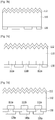
- the semiconductor substrate 110 may be surface-textured, and an insulation layer 112 and passivation layer 130a may be disposed on the front and rear sides of the semiconductor substrate 110, respectively.
- the insulation layer 112 and the passivation layer 130a may be provided by chemical vapor deposition (CVD), for example.
- the passivation layer 130a may be patterned into a passivation layer 130 that exposes portions on the rear side of the semiconductor substrate 110.
- the first doping region 111a and the second doping region 111b may be formed by sequentially doping a p-type impurity and an n-type impurity at a relatively high concentration on portions of the rear side of the semiconductor substrate 110 that are exposed by the passivation layer 130a.
- the first doping region 111a and the second doping region 111b may each have a higher impurity concentration than an impurity concentration of the substrate 110.
- the first doping region 111a and the second doping region 111b may be formed in the rear side of the semiconductor substrate 110 prior to forming the passivation layer 130/130a on the rear side of the semiconductor substrate.
- a lithography pattern may be formed to expose portions of the substrate 110, and impurities may be subsequently implanted into the exposed portions of the substrate 110 in order to form the first doping region 11a and the second doping region 111b, respectively.
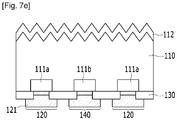
- a conductive paste 120a for forming at least one first electrode is applied on a portion of the passivation layer 130 corresponding to the first doping region 111a
- a conductive paste 140a for forming at least one second electrode is applied on a portion of the passivation layer 130 corresponding to the second doping region 111b.
- the conductive paste 120a for the forming first electrode and the conductive paste 140b for forming the second electrode may be disposed by a screen printing method.
- the conductive paste 120a for forming the first electrode may be one of the above-described conductive pastes according to example embodiments and the conductive paste 140a for forming the second electrode may be one of the above-described conductive pastes according to example embodiments, described with reference to FIGS. 1-4 and Tables 1-2.
- a composition of a conductive paste 120a used to form the first electrode may be the same as or different than a composition of a conductive paste 140a used to form the second electrode.
- the metallic glass, conductive powder, and/or organic vehicle in a conductive paste 120a to form the first electrode may the same as or different than the metallic glass, conductive powder, and/or organic vehicle of a conductive paste 140a used to form the second electrode.
- the conductive paste 120a for forming the first electrode and the conductive paste 120b for forming the second electrode may be fired together or separately.
- the firing may be performed in a furnace at a furnace process temperature of lower than or equal to 600 °C (and/or a temperature of lower than or equal to 350 °C).
- a passivation layer 130 may have defects. Defects in the passivation layer may remarkably deteriorate the efficiency of a solar cell.
- the first electrode 120 and the second electrode 140 structures may be formed on the rear surface of the semiconductor substrate 110 after the conductive pastes 120a and 140a described in FIG. 7D are fired.
- a conductive paste according to the invention includes a metallic glass having a glass transition temperature of less than or equal to 350 °C, and when the conductive paste is heated at a lower temperature than 600 °C, the metallic glass becomes liquid-like. Accordingly, the conductive paste may be sufficiently wet against a semiconductor substrate.
- the conductive paste may be applied to an electrode for a solar cell, but not limited thereto, and may be applied to form an electrode for other electronic devices such as a light-emitting device, an organic-based device, and the like.
- the conductive paste may be used to form an electrode at the temperature of lower than or equal to about 600 °C, and thus, may be efficiently applied to a flexible electronic device including a plurality of organic layers.
- FIGS. 5 and 7A to 7E describe a solar cell and a method of manufacturing a solar cell having first and second electrodes 120 and 140 on a rear side of the solar cell, example embodiments are not limited thereto.
- the electrodes of one of more solar cells according to example embodiments may be electrically connected in series, parallel, and/or series-parallel with the electrodes of one or more solar cells according to example embodiments to form a solar cell module.
- Silver (Ag) powder and metallic glass Al 84.5 Ni 5.5 Y 10 are added to an organic vehicle including an ethylcellulose binder, a surfactant, and a butylcarbitol/butylcarbitol acetate solvent.
- the silver (Ag) powder, the metallic glass Al 84.5 Ni 5.5 Y 10 , and the organic vehicle are respectively mixed in an amount of 82.58 wt%, 3.93 wt%, and 13.49 wt% based on the total amount of the conductive paste.
- the mixture is kneaded with a 3-roll mill, preparing a conductive paste.
- the conductive paste is coated on a silicon wafer 110 by a screen printing method.
- the coated conductive paste is heated to about 600 °C using a belt furnace.
- the heated conductive paste is cooled down, fabricating an electrode sample.
- An electrode sample is fabricated by preparing a conductive paste according to the same method as the example, except for using glass frit having a glass transition temperature of less than or equal to about 450 °C instead of the metallic glass Al 84.5 Ni 5.5 Y 10 .
- An electrode sample is fabricated by preparing a conductive paste according to the same method as the example, except for using Ni 60 Nb 30 Ta 10 having a glass transition temperature of about 650 °C instead of the metallic glass Al 84.5 Ni 5.5 Y 10 .
- the electrode sample according to the example is examined using a transmission electron microscope (TEM).
- TEM transmission electron microscope
- FIG. 6 is the transmission electron microscope (TEM) photograph of the electrode according to the example.
- a buffer portion 115a, 115b is formed between a silicon wafer 111a, 111b and an electrode portion 121, 141 including silver (Ag) as a main component.
- the buffer portion 115a includes both silver (Ag) and aluminum (Al), which is identified through energy dispersive X-ray spectroscopy (EDS) of a transmission electron microscope (TEM).
- the conductivity is calculated by using resistivity and contact resistance.
- the resistivity is calculated by measuring the electrode cross-section with a laser confocal microscope after measuring line resistance with a 2-point probe.
- the contact resistance is calculated by a transmission line method (TLM).
- the electrode according to the example has lower resistivity and contact resistance than the one according to the comparative examples.
- the electrode according to the example is fired at a relatively low temperature of about 600 °C but has sufficiently low resistivity and contact resistance and improved resistivity and contact resistance compared with the electrode fabricated by using a conductive paste including glass frit.
- the electrode according to Comparative Example 2 is not fabricated at a relatively low temperature of about 600 °C, and thus was not measured regarding conductivity.
Landscapes
- Engineering & Computer Science (AREA)
- Mechanical Engineering (AREA)
- Chemical & Material Sciences (AREA)
- Materials Engineering (AREA)
- Metallurgy (AREA)
- Organic Chemistry (AREA)
- Spectroscopy & Molecular Physics (AREA)
- Dispersion Chemistry (AREA)
- Physics & Mathematics (AREA)
- Conductive Materials (AREA)
- Photovoltaic Devices (AREA)
- Manufacturing & Machinery (AREA)
- Life Sciences & Earth Sciences (AREA)
- Sustainable Development (AREA)
- Sustainable Energy (AREA)
- Compositions Of Macromolecular Compounds (AREA)
- Electrodes Of Semiconductors (AREA)
Claims (13)
- Pâte conductrice comprenant :une poudre conductrice, la pâte conductrice étant l'argent (Ag) ou un alliage d'argent, l'aluminium (Al) ou un alliage d'aluminium, le cuivre (Cu) ou un alliage de cuivre, le nickel (Ni) ou un alliage de nickel ;un verre métallique comprenant au moins l'un parmi un verre métallique à base d'aluminium, un verre métallique à base de cérium, un verre métallique à base de strontium, un verre métallique à base d'or, un verre métallique d'ytterbium, un verre métallique à base de cinq, un verre métallique à base de platine, et un verre métallique à base de palladium ; dans laquelle :l'au moins un parmi le verre métallique à base d'aluminium, le verre métallique à base de cérium, le verre métallique à base de strontium, le verre métallique à base d'or, le verre métallique d'ytterbium, le verre métallique à base de zinc, le verre métallique à base de platine et le verre métallique à base de palladium est un alliage comprenant au moins l'un parmi l'aluminium, le cérium, le strontium, l'or, l'ytterbium, le zinc, le platine, et le palladium comme le composant ayant le rapport molaire le plus élevé parmi les composants du verre métallique, respectivement,l'au moins un parmi le verre métallique à base d'aluminium, le verre métallique à base de cérium, le verre métallique à base de strontium, le verre métallique à base d'or, le verre métallique d'ytterbium, le verre métallique à base de zinc, le verre métallique à base de platine et le verre métallique à base de palladium ayant une température de transition vitreuse inférieure ou égale à 350 °C, et l'au moins un parmi le verre métallique à base d'aluminium, le verre métallique à base de cérium, le verre métallique à base de strontium, le verre métallique à base d'or, le verre métallique d'ytterbium, le verre métallique à base de zinc, le verre métallique à base de platine et le verre métallique à base de palladium ayant une région liquide super-refroidie de température supérieure ou égale à 0 K ; etun véhicule organique, dans laquelle la poudre conductrice est présente en une quantité allant de 30 à 99 % en poids, le verre métallique est présent en une quantité allant de 0,1 à 20 % en poids et le véhicule organique est présent en tant qu'équilibre de la quantité totale de la pâte conductrice.
- Pâte conductrice selon la revendication 1, dans laquelle la température de la région liquide super-refroidie du verre métallique va de 0 K à 200 K.
- Pâte conductrice selon la revendication 1 ou la revendication 2, dans laquelle
l'au moins un parmi le verre métallique à base d'aluminium, le verre métallique à base de cérium, le verre métallique à base de strontium, le verre métallique à base d'or, le verre métallique d'ytterbium, le verre métallique à base de zinc, le verre métallique à base de platine, et le verre métallique à base de palladium comprend en outre au moins un parmi le nickel (Ni), l'yttrium (Y), le cobalt (Co), le lanthane (La), le zirconium (Zr), le fer (Fe), le titane (Ti), le calcium (Ca), le béryllium (Be), le magnésium (Mg), le sodium (Na), le molybdène (Mo), le tungstène (W), l'étain (Sn), le zinc (Zn), le potassium (K), le lithium (Li), le phosphore (P), le palladium (Pd), le platine (Pt), le rubidium (Rb), le chrome (Cr), le strontium (Sr), le cérium (Ce), le praséodymium (Pr), le prométhium (Pm), le samarium (Sm), le lutétium (Lu), le néodymium (Nd), le niobium (Nb), le gadolinium (Gd), le terbium (Tb), le dysprosium (Dy), l'holmium (Ho), l'erbium (Er), le thulium (Tm), le thorium (Th), le scandium (Sc), le baryum (Ba), l'ytterbium (Yb), l'europium (Eu), le hafnium (Hf), l'arsenic (As), le plutonium (Pu), le gallium (Ga), le germanium (Ge), l'antimoine (Sb), le silicium (Si), le cadmium (Cd), l'indium (In), le platine (Pt), le manganèse (Mn), niobium (Nb), osmium (Os), le vanadium (V), l'aluminium (Al), le cuivre (Cu), l'argent (Ag), et le mercure (Hg). - Dispositif électronique comprenant :
au moins une électrode pouvant être obtenue par frittage de la pâte conductrice selon l'une quelconque des revendications 1 à 3. - Dispositif électronique selon la revendication 4, dans lequel l'électrode ne possède pas de température de transition vitreuse (Tg).
- Dispositif électronique selon la revendication 4 ou la revendication 5, dans lequel l'électrode comprend en outre au moins l'un parmi un verre fritté et une poudre cristalline, et
l'au moins un parmi le verre fritté et la poudre cristalline contient un élément qui est le même qu'un élément du verre métallique. - Dispositif électronique selon l'une quelconque des revendications 4 à 6, dans lequel une résistance de contact de l'électrode est inférieure ou égale à 1 kΩm2 et/ou dans laquelle une résistivité de l'électrode est inférieure ou égale à 10 mΩm.
- Cellule solaire comprenant :le dispositif électronique selon l'une quelconque des revendications 4 à 7, et un substrat semi-conducteur ;dans laquelle l'au moins une électrode est électriquement reliée au substrat semi-conducteur.
- Cellule solaire selon la revendication 8, dans laquelle :l'au moins une électrode comprend des première et seconde (140) électrodes ayant différents types de conductivité, etles première et seconde électrodes sont positionnées sur un côté arrière du substrat semi-conducteur, respectivement, le côté arrière étant le côté opposé aux côtés incidents de l'énergie solaire du substrat semi-conducteur.
- Cellule solaire selon la revendication 8 ou la revendication 9, comprenant en outre :
une couche de passivation située sur un côté arrière du substrat semi-conducteur. - Cellule solaire selon l'une quelconque des revendications 8 à 10, dans laquelle l'au moins une électrode comprend :
une partie tampon située dans une première région adjacente au substrat semi-conducteur ; et une partie électrode située dans une seconde région différente d'une région où la partie tampon est formée, la partie électrode comprenant un matériau conducteur ; dans laquelle la partie tampon est éventuellement conductrice. - Procédé de fabrication d'une électrode comprenant :le dépôt d'une couche conductrice selon l'une quelconque des revendications 1 à 4 sur un substrat semi-conducteur,le chauffage de la pâte conductrice sur le substrat semi-conducteur dans un four à une température de traitement qui est supérieure à la température de transition vitreuse de la pâte conductrice et inférieure ou égale à 600 °C.
- Procédé selon la revendication 12, dans lequel le chauffage de la pâte conductrice sur le substrat semi-conducteur comprend la conversion d'une partie amorphe du verre métallique en une partie cristalline du verre métallique.
Applications Claiming Priority (3)
| Application Number | Priority Date | Filing Date | Title |
|---|---|---|---|
| KR20110117882 | 2011-11-11 | ||
| KR1020120126835A KR102100291B1 (ko) | 2011-11-11 | 2012-11-09 | 도전성 페이스트, 상기 도전성 페이스트를 사용하여 형성된 전극을 포함하는 전자 소자 및 태양 전지 |
| PCT/KR2012/009528 WO2013070049A1 (fr) | 2011-11-11 | 2012-11-12 | Pâte conductrice, et dispositif électronique et photopile comprenant une électrode formée au moyen de la pâte conductrice |
Publications (3)
| Publication Number | Publication Date |
|---|---|
| EP2777049A1 EP2777049A1 (fr) | 2014-09-17 |
| EP2777049A4 EP2777049A4 (fr) | 2016-06-15 |
| EP2777049B1 true EP2777049B1 (fr) | 2020-01-08 |
Family
ID=48279458
Family Applications (1)
| Application Number | Title | Priority Date | Filing Date |
|---|---|---|---|
| EP12847137.2A Active EP2777049B1 (fr) | 2011-11-11 | 2012-11-12 | Pâte conductrice, et dispositif électronique et photopile comprenant une électrode formée au moyen de la pâte conductrice |
Country Status (6)
| Country | Link |
|---|---|
| US (1) | US9947809B2 (fr) |
| EP (1) | EP2777049B1 (fr) |
| JP (1) | JP2015507315A (fr) |
| KR (1) | KR102100291B1 (fr) |
| CN (1) | CN103477396B (fr) |
| WO (1) | WO2013070049A1 (fr) |
Families Citing this family (15)
| Publication number | Priority date | Publication date | Assignee | Title |
|---|---|---|---|---|
| KR102083994B1 (ko) * | 2013-03-14 | 2020-03-03 | 삼성전기주식회사 | 외부 전극용 도전성 페이스트 및 이를 이용한 적층 세라믹 전자부품 |
| KR102100292B1 (ko) | 2013-04-23 | 2020-04-14 | 삼성전자주식회사 | 금속 유리, 도전성 페이스트 및 전자 소자 |
| CN104217782A (zh) * | 2013-05-30 | 2014-12-17 | 苏州晶银新材料股份有限公司 | 光伏电池用高附着性背电极银浆 |
| CN104751936B (zh) * | 2013-12-27 | 2017-08-22 | 比亚迪股份有限公司 | 一种晶体硅太阳能电池正极导电银浆及其制备方法 |
| US9508878B2 (en) * | 2014-09-23 | 2016-11-29 | Solarworld Americas Inc. | Solar cell having a rear side metallization |
| JP6330108B1 (ja) * | 2016-11-07 | 2018-05-23 | 信越化学工業株式会社 | 高光電変換効率太陽電池及び高光電変換効率太陽電池の製造方法 |
| MY189222A (en) | 2016-12-20 | 2022-01-31 | Zhejiang Kaiying New Mat Co Ltd | Siloxane-containing solar cell metallization pastes |
| WO2018112742A1 (fr) * | 2016-12-20 | 2018-06-28 | Zhejiang Kaiying New Materials Co., Ltd. | Cellules solaires à semiconducteur métal-isolant à contact arrière interdigité avec jonctions tunnel à oxyde imprimé |
| WO2018174898A1 (fr) * | 2017-03-24 | 2018-09-27 | Heraeus Precious Metals North America Conshohocken Llc | Verres à faible gravure et sans contact pour compositions de pâte électroconductrice |
| US11391439B2 (en) | 2018-05-29 | 2022-07-19 | Juganu Ltd. | Lighting systems for general illumination and disinfection |
| KR102076149B1 (ko) | 2018-06-19 | 2020-02-11 | 삼성전기주식회사 | 적층 세라믹 전자부품 및 그 실장 기판 |
| US11101130B2 (en) * | 2018-12-27 | 2021-08-24 | Raytheon Company | Method of filling grooves and holes in a substrate |
| US10749045B1 (en) | 2019-05-23 | 2020-08-18 | Zhejiang Kaiying New Materials Co., Ltd. | Solar cell side surface interconnects |
| US10622502B1 (en) | 2019-05-23 | 2020-04-14 | Zhejiang Kaiying New Materials Co., Ltd. | Solar cell edge interconnects |
| CN111261323A (zh) * | 2020-02-24 | 2020-06-09 | 轻工业部南京电光源材料科学研究所 | 一种烧结型导电银浆 |
Family Cites Families (56)
| Publication number | Priority date | Publication date | Assignee | Title |
|---|---|---|---|---|
| US4434084A (en) | 1981-09-23 | 1984-02-28 | E. I. Du Pont De Nemours And Company | Base metal conductor cathode coating for tantalum capacitors |
| US5271962A (en) | 1990-03-12 | 1993-12-21 | Ferro Corporation | Metallic composition and methods for making and using the same |
| US5170930A (en) | 1991-11-14 | 1992-12-15 | Microelectronics And Computer Technology Corporation | Liquid metal paste for thermal and electrical connections |
| JPH0864029A (ja) | 1994-08-25 | 1996-03-08 | Tokin Corp | 端子電極用ペースト |
| KR19980057847A (ko) | 1996-12-30 | 1998-09-25 | 박병재 | 비정질 합금 |
| US6120586A (en) | 1998-11-13 | 2000-09-19 | Daiken Chemical Co., Ltd. | Metal composition containing metal acetylide, blank having metallic coating formed therewith, and method for forming the metallic coating |
| US6420042B1 (en) | 1999-09-24 | 2002-07-16 | Nippon Steel Corporation | Fe-based amorphous alloy thin strip with ultrathin oxide layer |
| CA2287648C (fr) | 1999-10-26 | 2007-06-19 | Donald W. Kirk | Electrodes de metal amorphe/verre metallique pour processus electrochimiques |
| JP3745177B2 (ja) | 1999-11-18 | 2006-02-15 | Ykk株式会社 | 表面硬化した非晶質合金製成形品及びその製造方法 |
| US20030178057A1 (en) * | 2001-10-24 | 2003-09-25 | Shuichi Fujii | Solar cell, manufacturing method thereof and electrode material |
| JP3988467B2 (ja) | 2002-01-17 | 2007-10-10 | 鳴海製陶株式会社 | 導電性ペースト,導電性被膜被覆ガラス基板及びその製造方法 |
| JP3964342B2 (ja) | 2003-02-17 | 2007-08-22 | 小島化学薬品株式会社 | 導電ペースト |
| WO2003073442A1 (fr) | 2002-02-28 | 2003-09-04 | Kojima Chemical Co., Ltd. | Resisteur |
| KR20040080522A (ko) | 2003-03-12 | 2004-09-20 | 최승철 | 무연 ac-pdp 전극용 은 페이스트 프릿 개발 |
| US7090733B2 (en) | 2003-06-17 | 2006-08-15 | The Regents Of The University Of California | Metallic glasses with crystalline dispersions formed by electric currents |
| JP2005093391A (ja) | 2003-09-19 | 2005-04-07 | Daido Steel Co Ltd | 燃料電池用金属セパレータ、燃料電池用金属セパレータの製造方法及び燃料電池 |
| EP1575099A1 (fr) | 2004-03-09 | 2005-09-14 | RWE SCHOTT Solar GmbH | Procédé de formation d'une structure |
| KR100583230B1 (ko) | 2004-03-29 | 2006-05-25 | 한국과학기술연구원 | 구리계 비정질 합금 조성물 |
| US7473278B2 (en) | 2004-09-16 | 2009-01-06 | Smith & Nephew, Inc. | Method of surface oxidizing zirconium and zirconium alloys and resulting product |
| US20060231802A1 (en) | 2005-04-14 | 2006-10-19 | Takuya Konno | Electroconductive thick film composition, electrode, and solar cell formed therefrom |
| US7628871B2 (en) | 2005-08-12 | 2009-12-08 | Intel Corporation | Bulk metallic glass solder material |
| US8075712B2 (en) | 2005-11-14 | 2011-12-13 | Lawrence Livermore National Security, Llc | Amorphous metal formulations and structured coatings for corrosion and wear resistance |
| JP2009087957A (ja) | 2005-12-28 | 2009-04-23 | Naoetsu Electronics Co Ltd | 太陽電池 |
| KR100784914B1 (ko) | 2006-05-01 | 2007-12-11 | 학교법인연세대학교 | 다단계 변형이 가능한 이상분리 비정질 합금 |
| KR100720940B1 (ko) | 2006-06-29 | 2007-05-23 | 주식회사 아모텍 | 금속 패턴 형성 방법 |
| WO2008038976A1 (fr) | 2006-09-29 | 2008-04-03 | Lg Chem, Ltd. | Composé à base de complexe d'argent organique utilisé dans une pâte pour former une impression conductrice |
| CN101523508B (zh) | 2006-09-29 | 2013-03-27 | Lg化学株式会社 | 用于形成导电图案的胶中使用的有机银配位化合物 |
| KR101241643B1 (ko) | 2006-09-29 | 2013-03-08 | 주식회사 엘지화학 | 도전성 페이스트 및 이를 사용한 기재 |
| US7794553B2 (en) | 2006-12-07 | 2010-09-14 | California Institute Of Technology | Thermoplastically processable amorphous metals and methods for processing same |
| JP4907331B2 (ja) | 2006-12-25 | 2012-03-28 | 京セラ株式会社 | 光電変換素子用導電性ペースト、光電変換素子、および光電変換素子の作製方法 |
| US20080230119A1 (en) | 2007-03-22 | 2008-09-25 | Hideki Akimoto | Paste for back contact-type solar cell |
| WO2008124623A1 (fr) * | 2007-04-04 | 2008-10-16 | California Institute Of Technology | Procédé d'assemblage de matériaux à l'aide de verres métalliques en vrac |
| JP5555163B2 (ja) * | 2007-09-10 | 2014-07-23 | ダイソル・インダストリーズ・プロプライエタリー・リミテッド | 太陽電池を製造する方法 |
| JP2009099371A (ja) | 2007-10-17 | 2009-05-07 | Sanyo Special Steel Co Ltd | 燃料電池用電極の製造方法 |
| JP2009138266A (ja) | 2007-11-16 | 2009-06-25 | Sanyo Special Steel Co Ltd | 高密度かつ非晶質の金属ガラス粉末焼結体の製造方法およびその焼結体 |
| JP2011503910A (ja) | 2007-11-19 | 2011-01-27 | アプライド マテリアルズ インコーポレイテッド | パターン付きエッチング剤を用いた太陽電池コンタクト形成プロセス |
| CN102017176A (zh) | 2008-03-25 | 2011-04-13 | 应用材料股份有限公司 | 结晶太阳能电池的表面清洁与纹理化工艺 |
| KR100978737B1 (ko) | 2008-05-01 | 2010-08-30 | 주식회사 엘 앤 에프 | 내약품성 및 부착력이 우수한 pdp 전극용 도전성페이스트 조성물 및 이의 제조방법 |
| JP5224514B2 (ja) | 2008-07-14 | 2013-07-03 | 国立大学法人東北大学 | ナノサイズ金属ガラス構造体 |
| CN101828267B (zh) | 2008-08-07 | 2013-10-23 | 京都一来电子化学股份有限公司 | 太阳能电池元件的电极形成用导电性糊料及太阳能电池元件以及该太阳能电池元件的制造方法 |
| JP2012501550A (ja) | 2008-08-27 | 2012-01-19 | アプライド マテリアルズ インコーポレイテッド | 印刷誘電体障壁を使用するバックコンタクト太陽電池 |
| JP5236400B2 (ja) | 2008-09-04 | 2013-07-17 | 太陽ホールディングス株式会社 | 導電ペーストおよびそれを用いた電極 |
| KR20100048196A (ko) | 2008-10-30 | 2010-05-11 | 엘지전자 주식회사 | 도전성 전극 페이스트 |
| JP5016631B2 (ja) | 2009-03-31 | 2012-09-05 | 株式会社ノリタケカンパニーリミテド | プラズマディスプレイパネルおよび該パネルの電極形成用ペースト |
| WO2010124161A1 (fr) * | 2009-04-23 | 2010-10-28 | E. I. Du Pont De Nemours And Company | Pâtes métalliques et utilisation de celles-ci dans la fabrication d'électrodes positives sur des surfaces de silicium de type p |
| US8436337B2 (en) | 2009-05-12 | 2013-05-07 | The State of Oregon Acting By and Through The State Board of Higher Education on Behalf of Oregon State Unitiversity | Amorphous multi-component metallic thin films for electronic devices |
| KR20100133867A (ko) | 2009-06-12 | 2010-12-22 | 크루서블 인텔렉츄얼 프라퍼티 엘엘씨. | 주석 함유 비정질 합금 복합물 |
| US20120037223A1 (en) | 2009-07-01 | 2012-02-16 | Isao Yamanaka | Binder resin for conductive paste, conductive paste, and solar cell element |
| KR101144810B1 (ko) | 2009-07-06 | 2012-05-11 | 엘지전자 주식회사 | 태양전지용 전극 페이스트, 이를 이용한 태양전지, 및 태양전지의 제조방법 |
| KR101143296B1 (ko) | 2009-10-13 | 2012-05-08 | (주) 파루 | 그라비아 직접 인쇄방식에 적용 가능한 저온 소성용 도전성 페이스트 |
| EP2325848B1 (fr) | 2009-11-11 | 2017-07-19 | Samsung Electronics Co., Ltd. | Colle conductrice et cellule solaire |
| KR102071006B1 (ko) | 2009-11-11 | 2020-01-30 | 삼성전자주식회사 | 도전성 페이스트 및 태양 전지 |
| KR101166515B1 (ko) | 2010-02-26 | 2012-07-20 | 인하대학교 산학협력단 | 염료감응 태양전지용 광전극, 상기 광전극의 제조 방법 및 상기 광전극을 포함하는 염료감응 태양전지 |
| KR101311098B1 (ko) | 2010-04-07 | 2013-09-25 | 오꾸노 케미칼 인더스트리즈 컴파니,리미티드 | 도전 페이스트 및 도전 패턴 |
| KR101741683B1 (ko) | 2010-08-05 | 2017-05-31 | 삼성전자주식회사 | 도전성 페이스트, 상기 도전성 페이스트를 사용하여 형성된 전극을 포함하는 전자 소자 및 태양 전지 |
| KR101814014B1 (ko) | 2011-03-25 | 2018-01-03 | 삼성전자주식회사 | 도전성 페이스트, 상기 도전성 페이스트를 사용하여 형성된 전극을 포함하는 전자 소자 및 태양 전지 |
-
2012
- 2012-11-09 KR KR1020120126835A patent/KR102100291B1/ko not_active Expired - Fee Related
- 2012-11-09 US US13/673,359 patent/US9947809B2/en not_active Expired - Fee Related
- 2012-11-12 CN CN201280017966.5A patent/CN103477396B/zh not_active Expired - Fee Related
- 2012-11-12 JP JP2014540960A patent/JP2015507315A/ja active Pending
- 2012-11-12 EP EP12847137.2A patent/EP2777049B1/fr active Active
- 2012-11-12 WO PCT/KR2012/009528 patent/WO2013070049A1/fr not_active Ceased
Non-Patent Citations (1)
| Title |
|---|
| None * |
Also Published As
| Publication number | Publication date |
|---|---|
| JP2015507315A (ja) | 2015-03-05 |
| EP2777049A1 (fr) | 2014-09-17 |
| KR102100291B1 (ko) | 2020-04-13 |
| CN103477396B (zh) | 2018-01-30 |
| US20180019350A9 (en) | 2018-01-18 |
| CN103477396A (zh) | 2013-12-25 |
| EP2777049A4 (fr) | 2016-06-15 |
| US9947809B2 (en) | 2018-04-17 |
| US20130118572A1 (en) | 2013-05-16 |
| WO2013070049A1 (fr) | 2013-05-16 |
| KR20130052527A (ko) | 2013-05-22 |
Similar Documents
| Publication | Publication Date | Title |
|---|---|---|
| US9947809B2 (en) | Conductive paste and electronic device and solar cell including an electrode formed using the conductive paste | |
| EP2450908B1 (fr) | Pâte conductrice, électrode et dispositif électronique et cellule solaire incluant une électrode formée utilisant la pâte conductrice | |
| US8974703B2 (en) | Conductive paste and electronic device and solar cell including an electrode formed using the same | |
| EP2416327B1 (fr) | Pâte conductrice et dispositif électronique et cellule solaire incluant une électrode formée utilisant la pâte conductrice | |
| KR101999795B1 (ko) | 도전성 페이스트, 상기 도전성 페이스트를 사용하여 형성된 전극을 포함하는 전자 소자 및 태양 전지 | |
| EP2325848B1 (fr) | Colle conductrice et cellule solaire | |
| US8668847B2 (en) | Conductive paste and electronic device and solar cell including an electrode formed using the conductive paste | |
| US8641927B2 (en) | Conductive paste, and electronic device and solar cell including an electrode formed using the conductive paste | |
| US20130104973A1 (en) | Conductive paste, and electronic device and solar cell including electrode formed using the conductive paste | |
| US9039940B2 (en) | Conductive paste and electronic device, and solar cell including an electrode formed using the conductive paste | |
| KR101960465B1 (ko) | 도전성 페이스트 및 태양 전지 | |
| US9105370B2 (en) | Conductive paste, and electronic device and solar cell including an electrode formed using the same | |
| US9039943B2 (en) | Conductive paste and electronic device and solar cell including an electrode formed using the conductive paste | |
| KR20130065445A (ko) | 도전성 페이스트, 상기 도전성 페이스트를 사용하여 형성된 전극을 포함하는 전자 소자 및 태양 전지 | |
| US9218898B2 (en) | Conductive paste and electronic device and solar cell including an electrode formed using the conductive paste | |
| US8940195B2 (en) | Conductive paste, and electronic device and solar cell including an electrode formed using the same |
Legal Events
| Date | Code | Title | Description |
|---|---|---|---|
| PUAI | Public reference made under article 153(3) epc to a published international application that has entered the european phase |
Free format text: ORIGINAL CODE: 0009012 |
|
| 17P | Request for examination filed |
Effective date: 20140327 |
|
| AK | Designated contracting states |
Kind code of ref document: A1 Designated state(s): AL AT BE BG CH CY CZ DE DK EE ES FI FR GB GR HR HU IE IS IT LI LT LU LV MC MK MT NL NO PL PT RO RS SE SI SK SM TR |
|
| DAX | Request for extension of the european patent (deleted) | ||
| RA4 | Supplementary search report drawn up and despatched (corrected) |
Effective date: 20160513 |
|
| RIC1 | Information provided on ipc code assigned before grant |
Ipc: H01B 1/22 20060101AFI20160509BHEP Ipc: H01L 31/042 20060101ALI20160509BHEP |
|
| STAA | Information on the status of an ep patent application or granted ep patent |
Free format text: STATUS: EXAMINATION IS IN PROGRESS |
|
| 17Q | First examination report despatched |
Effective date: 20190404 |
|
| REG | Reference to a national code |
Ref country code: DE Ref legal event code: R079 Ref document number: 602012067163 Country of ref document: DE Free format text: PREVIOUS MAIN CLASS: H01B0001220000 Ipc: B22F0001000000 |
|
| RIC1 | Information provided on ipc code assigned before grant |
Ipc: B23K 35/02 20060101ALI20190814BHEP Ipc: H01L 31/0224 20060101ALI20190814BHEP Ipc: C22C 45/08 20060101ALI20190814BHEP Ipc: H01L 31/068 20120101ALI20190814BHEP Ipc: B23K 35/30 20060101ALI20190814BHEP Ipc: C22C 21/00 20060101ALI20190814BHEP Ipc: B22F 3/10 20060101ALI20190814BHEP Ipc: B23K 35/28 20060101ALI20190814BHEP Ipc: B22F 1/00 20060101AFI20190814BHEP Ipc: C22C 45/00 20060101ALI20190814BHEP Ipc: H01B 1/22 20060101ALI20190814BHEP |
|
| GRAP | Despatch of communication of intention to grant a patent |
Free format text: ORIGINAL CODE: EPIDOSNIGR1 |
|
| STAA | Information on the status of an ep patent application or granted ep patent |
Free format text: STATUS: GRANT OF PATENT IS INTENDED |
|
| INTG | Intention to grant announced |
Effective date: 20190927 |
|
| GRAS | Grant fee paid |
Free format text: ORIGINAL CODE: EPIDOSNIGR3 |
|
| GRAA | (expected) grant |
Free format text: ORIGINAL CODE: 0009210 |
|
| STAA | Information on the status of an ep patent application or granted ep patent |
Free format text: STATUS: THE PATENT HAS BEEN GRANTED |
|
| AK | Designated contracting states |
Kind code of ref document: B1 Designated state(s): AL AT BE BG CH CY CZ DE DK EE ES FI FR GB GR HR HU IE IS IT LI LT LU LV MC MK MT NL NO PL PT RO RS SE SI SK SM TR |
|
| REG | Reference to a national code |
Ref country code: GB Ref legal event code: FG4D |
|
| REG | Reference to a national code |
Ref country code: CH Ref legal event code: EP |
|
| REG | Reference to a national code |
Ref country code: IE Ref legal event code: FG4D |
|
| REG | Reference to a national code |
Ref country code: DE Ref legal event code: R096 Ref document number: 602012067163 Country of ref document: DE |
|
| REG | Reference to a national code |
Ref country code: AT Ref legal event code: REF Ref document number: 1222074 Country of ref document: AT Kind code of ref document: T Effective date: 20200215 |
|
| REG | Reference to a national code |
Ref country code: NL Ref legal event code: MP Effective date: 20200108 |
|
| REG | Reference to a national code |
Ref country code: LT Ref legal event code: MG4D |
|
| PG25 | Lapsed in a contracting state [announced via postgrant information from national office to epo] |
Ref country code: NL Free format text: LAPSE BECAUSE OF FAILURE TO SUBMIT A TRANSLATION OF THE DESCRIPTION OR TO PAY THE FEE WITHIN THE PRESCRIBED TIME-LIMIT Effective date: 20200108 Ref country code: RS Free format text: LAPSE BECAUSE OF FAILURE TO SUBMIT A TRANSLATION OF THE DESCRIPTION OR TO PAY THE FEE WITHIN THE PRESCRIBED TIME-LIMIT Effective date: 20200108 Ref country code: NO Free format text: LAPSE BECAUSE OF FAILURE TO SUBMIT A TRANSLATION OF THE DESCRIPTION OR TO PAY THE FEE WITHIN THE PRESCRIBED TIME-LIMIT Effective date: 20200408 Ref country code: PT Free format text: LAPSE BECAUSE OF FAILURE TO SUBMIT A TRANSLATION OF THE DESCRIPTION OR TO PAY THE FEE WITHIN THE PRESCRIBED TIME-LIMIT Effective date: 20200531 Ref country code: FI Free format text: LAPSE BECAUSE OF FAILURE TO SUBMIT A TRANSLATION OF THE DESCRIPTION OR TO PAY THE FEE WITHIN THE PRESCRIBED TIME-LIMIT Effective date: 20200108 Ref country code: LT Free format text: LAPSE BECAUSE OF FAILURE TO SUBMIT A TRANSLATION OF THE DESCRIPTION OR TO PAY THE FEE WITHIN THE PRESCRIBED TIME-LIMIT Effective date: 20200108 |
|
| PG25 | Lapsed in a contracting state [announced via postgrant information from national office to epo] |
Ref country code: LV Free format text: LAPSE BECAUSE OF FAILURE TO SUBMIT A TRANSLATION OF THE DESCRIPTION OR TO PAY THE FEE WITHIN THE PRESCRIBED TIME-LIMIT Effective date: 20200108 Ref country code: SE Free format text: LAPSE BECAUSE OF FAILURE TO SUBMIT A TRANSLATION OF THE DESCRIPTION OR TO PAY THE FEE WITHIN THE PRESCRIBED TIME-LIMIT Effective date: 20200108 Ref country code: HR Free format text: LAPSE BECAUSE OF FAILURE TO SUBMIT A TRANSLATION OF THE DESCRIPTION OR TO PAY THE FEE WITHIN THE PRESCRIBED TIME-LIMIT Effective date: 20200108 Ref country code: BG Free format text: LAPSE BECAUSE OF FAILURE TO SUBMIT A TRANSLATION OF THE DESCRIPTION OR TO PAY THE FEE WITHIN THE PRESCRIBED TIME-LIMIT Effective date: 20200408 Ref country code: IS Free format text: LAPSE BECAUSE OF FAILURE TO SUBMIT A TRANSLATION OF THE DESCRIPTION OR TO PAY THE FEE WITHIN THE PRESCRIBED TIME-LIMIT Effective date: 20200508 Ref country code: GR Free format text: LAPSE BECAUSE OF FAILURE TO SUBMIT A TRANSLATION OF THE DESCRIPTION OR TO PAY THE FEE WITHIN THE PRESCRIBED TIME-LIMIT Effective date: 20200409 |
|
| REG | Reference to a national code |
Ref country code: DE Ref legal event code: R097 Ref document number: 602012067163 Country of ref document: DE |
|
| PG25 | Lapsed in a contracting state [announced via postgrant information from national office to epo] |
Ref country code: SK Free format text: LAPSE BECAUSE OF FAILURE TO SUBMIT A TRANSLATION OF THE DESCRIPTION OR TO PAY THE FEE WITHIN THE PRESCRIBED TIME-LIMIT Effective date: 20200108 Ref country code: RO Free format text: LAPSE BECAUSE OF FAILURE TO SUBMIT A TRANSLATION OF THE DESCRIPTION OR TO PAY THE FEE WITHIN THE PRESCRIBED TIME-LIMIT Effective date: 20200108 Ref country code: DK Free format text: LAPSE BECAUSE OF FAILURE TO SUBMIT A TRANSLATION OF THE DESCRIPTION OR TO PAY THE FEE WITHIN THE PRESCRIBED TIME-LIMIT Effective date: 20200108 Ref country code: ES Free format text: LAPSE BECAUSE OF FAILURE TO SUBMIT A TRANSLATION OF THE DESCRIPTION OR TO PAY THE FEE WITHIN THE PRESCRIBED TIME-LIMIT Effective date: 20200108 Ref country code: EE Free format text: LAPSE BECAUSE OF FAILURE TO SUBMIT A TRANSLATION OF THE DESCRIPTION OR TO PAY THE FEE WITHIN THE PRESCRIBED TIME-LIMIT Effective date: 20200108 Ref country code: CZ Free format text: LAPSE BECAUSE OF FAILURE TO SUBMIT A TRANSLATION OF THE DESCRIPTION OR TO PAY THE FEE WITHIN THE PRESCRIBED TIME-LIMIT Effective date: 20200108 Ref country code: SM Free format text: LAPSE BECAUSE OF FAILURE TO SUBMIT A TRANSLATION OF THE DESCRIPTION OR TO PAY THE FEE WITHIN THE PRESCRIBED TIME-LIMIT Effective date: 20200108 |
|
| PLBE | No opposition filed within time limit |
Free format text: ORIGINAL CODE: 0009261 |
|
| STAA | Information on the status of an ep patent application or granted ep patent |
Free format text: STATUS: NO OPPOSITION FILED WITHIN TIME LIMIT |
|
| REG | Reference to a national code |
Ref country code: AT Ref legal event code: MK05 Ref document number: 1222074 Country of ref document: AT Kind code of ref document: T Effective date: 20200108 |
|
| 26N | No opposition filed |
Effective date: 20201009 |
|
| PG25 | Lapsed in a contracting state [announced via postgrant information from national office to epo] |
Ref country code: AT Free format text: LAPSE BECAUSE OF FAILURE TO SUBMIT A TRANSLATION OF THE DESCRIPTION OR TO PAY THE FEE WITHIN THE PRESCRIBED TIME-LIMIT Effective date: 20200108 Ref country code: IT Free format text: LAPSE BECAUSE OF FAILURE TO SUBMIT A TRANSLATION OF THE DESCRIPTION OR TO PAY THE FEE WITHIN THE PRESCRIBED TIME-LIMIT Effective date: 20200108 |
|
| PG25 | Lapsed in a contracting state [announced via postgrant information from national office to epo] |
Ref country code: SI Free format text: LAPSE BECAUSE OF FAILURE TO SUBMIT A TRANSLATION OF THE DESCRIPTION OR TO PAY THE FEE WITHIN THE PRESCRIBED TIME-LIMIT Effective date: 20200108 Ref country code: PL Free format text: LAPSE BECAUSE OF FAILURE TO SUBMIT A TRANSLATION OF THE DESCRIPTION OR TO PAY THE FEE WITHIN THE PRESCRIBED TIME-LIMIT Effective date: 20200108 |
|
| PG25 | Lapsed in a contracting state [announced via postgrant information from national office to epo] |
Ref country code: MC Free format text: LAPSE BECAUSE OF FAILURE TO SUBMIT A TRANSLATION OF THE DESCRIPTION OR TO PAY THE FEE WITHIN THE PRESCRIBED TIME-LIMIT Effective date: 20200108 |
|
| REG | Reference to a national code |
Ref country code: CH Ref legal event code: PL |
|
| PG25 | Lapsed in a contracting state [announced via postgrant information from national office to epo] |
Ref country code: LU Free format text: LAPSE BECAUSE OF NON-PAYMENT OF DUE FEES Effective date: 20201112 |
|
| REG | Reference to a national code |
Ref country code: BE Ref legal event code: MM Effective date: 20201130 |
|
| PG25 | Lapsed in a contracting state [announced via postgrant information from national office to epo] |
Ref country code: LI Free format text: LAPSE BECAUSE OF NON-PAYMENT OF DUE FEES Effective date: 20201130 Ref country code: CH Free format text: LAPSE BECAUSE OF NON-PAYMENT OF DUE FEES Effective date: 20201130 |
|
| PG25 | Lapsed in a contracting state [announced via postgrant information from national office to epo] |
Ref country code: IE Free format text: LAPSE BECAUSE OF NON-PAYMENT OF DUE FEES Effective date: 20201112 |
|
| PG25 | Lapsed in a contracting state [announced via postgrant information from national office to epo] |
Ref country code: TR Free format text: LAPSE BECAUSE OF FAILURE TO SUBMIT A TRANSLATION OF THE DESCRIPTION OR TO PAY THE FEE WITHIN THE PRESCRIBED TIME-LIMIT Effective date: 20200108 Ref country code: MT Free format text: LAPSE BECAUSE OF FAILURE TO SUBMIT A TRANSLATION OF THE DESCRIPTION OR TO PAY THE FEE WITHIN THE PRESCRIBED TIME-LIMIT Effective date: 20200108 Ref country code: CY Free format text: LAPSE BECAUSE OF FAILURE TO SUBMIT A TRANSLATION OF THE DESCRIPTION OR TO PAY THE FEE WITHIN THE PRESCRIBED TIME-LIMIT Effective date: 20200108 |
|
| PG25 | Lapsed in a contracting state [announced via postgrant information from national office to epo] |
Ref country code: MK Free format text: LAPSE BECAUSE OF FAILURE TO SUBMIT A TRANSLATION OF THE DESCRIPTION OR TO PAY THE FEE WITHIN THE PRESCRIBED TIME-LIMIT Effective date: 20200108 Ref country code: AL Free format text: LAPSE BECAUSE OF FAILURE TO SUBMIT A TRANSLATION OF THE DESCRIPTION OR TO PAY THE FEE WITHIN THE PRESCRIBED TIME-LIMIT Effective date: 20200108 |
|
| PG25 | Lapsed in a contracting state [announced via postgrant information from national office to epo] |
Ref country code: BE Free format text: LAPSE BECAUSE OF NON-PAYMENT OF DUE FEES Effective date: 20201130 |
|
| PGFP | Annual fee paid to national office [announced via postgrant information from national office to epo] |
Ref country code: FR Payment date: 20221020 Year of fee payment: 11 |
|
| PGFP | Annual fee paid to national office [announced via postgrant information from national office to epo] |
Ref country code: GB Payment date: 20221020 Year of fee payment: 11 Ref country code: DE Payment date: 20220615 Year of fee payment: 11 |
|
| P01 | Opt-out of the competence of the unified patent court (upc) registered |
Effective date: 20230520 |
|
| REG | Reference to a national code |
Ref country code: DE Ref legal event code: R119 Ref document number: 602012067163 Country of ref document: DE |
|
| GBPC | Gb: european patent ceased through non-payment of renewal fee |
Effective date: 20231112 |
|
| PG25 | Lapsed in a contracting state [announced via postgrant information from national office to epo] |
Ref country code: DE Free format text: LAPSE BECAUSE OF NON-PAYMENT OF DUE FEES Effective date: 20240601 |
|
| PG25 | Lapsed in a contracting state [announced via postgrant information from national office to epo] |
Ref country code: GB Free format text: LAPSE BECAUSE OF NON-PAYMENT OF DUE FEES Effective date: 20231112 |
|
| PG25 | Lapsed in a contracting state [announced via postgrant information from national office to epo] |
Ref country code: FR Free format text: LAPSE BECAUSE OF NON-PAYMENT OF DUE FEES Effective date: 20231130 |
|
| PG25 | Lapsed in a contracting state [announced via postgrant information from national office to epo] |
Ref country code: GB Free format text: LAPSE BECAUSE OF NON-PAYMENT OF DUE FEES Effective date: 20231112 Ref country code: FR Free format text: LAPSE BECAUSE OF NON-PAYMENT OF DUE FEES Effective date: 20231130 Ref country code: DE Free format text: LAPSE BECAUSE OF NON-PAYMENT OF DUE FEES Effective date: 20240601 |