EP2742337B1 - Dual-mode characterization of particulates - Google Patents
Dual-mode characterization of particulates Download PDFInfo
- Publication number
- EP2742337B1 EP2742337B1 EP12775275.6A EP12775275A EP2742337B1 EP 2742337 B1 EP2742337 B1 EP 2742337B1 EP 12775275 A EP12775275 A EP 12775275A EP 2742337 B1 EP2742337 B1 EP 2742337B1
- Authority
- EP
- European Patent Office
- Prior art keywords
- sample
- detecting
- light
- scattered light
- deriving
- Prior art date
- Legal status (The legal status is an assumption and is not a legal conclusion. Google has not performed a legal analysis and makes no representation as to the accuracy of the status listed.)
- Active
Links
Images


Classifications
-
- G—PHYSICS
- G01—MEASURING; TESTING
- G01N—INVESTIGATING OR ANALYSING MATERIALS BY DETERMINING THEIR CHEMICAL OR PHYSICAL PROPERTIES
- G01N21/00—Investigating or analysing materials by the use of optical means, i.e. using sub-millimetre waves, infrared, visible or ultraviolet light
- G01N21/17—Systems in which incident light is modified in accordance with the properties of the material investigated
- G01N21/47—Scattering, i.e. diffuse reflection
- G01N21/49—Scattering, i.e. diffuse reflection within a body or fluid
- G01N21/51—Scattering, i.e. diffuse reflection within a body or fluid inside a container, e.g. in an ampoule
-
- G—PHYSICS
- G01—MEASURING; TESTING
- G01J—MEASUREMENT OF INTENSITY, VELOCITY, SPECTRAL CONTENT, POLARISATION, PHASE OR PULSE CHARACTERISTICS OF INFRARED, VISIBLE OR ULTRAVIOLET LIGHT; COLORIMETRY; RADIATION PYROMETRY
- G01J3/00—Spectrometry; Spectrophotometry; Monochromators; Measuring colours
- G01J3/28—Investigating the spectrum
- G01J3/44—Raman spectrometry; Scattering spectrometry ; Fluorescence spectrometry
-
- G—PHYSICS
- G01—MEASURING; TESTING
- G01N—INVESTIGATING OR ANALYSING MATERIALS BY DETERMINING THEIR CHEMICAL OR PHYSICAL PROPERTIES
- G01N15/00—Investigating characteristics of particles; Investigating permeability, pore-volume or surface-area of porous materials
- G01N15/02—Investigating particle size or size distribution
- G01N15/0205—Investigating particle size or size distribution by optical means
-
- G—PHYSICS
- G01—MEASURING; TESTING
- G01N—INVESTIGATING OR ANALYSING MATERIALS BY DETERMINING THEIR CHEMICAL OR PHYSICAL PROPERTIES
- G01N15/00—Investigating characteristics of particles; Investigating permeability, pore-volume or surface-area of porous materials
- G01N15/10—Investigating individual particles
- G01N15/14—Optical investigation techniques, e.g. flow cytometry
- G01N15/1434—Optical arrangements
-
- G—PHYSICS
- G01—MEASURING; TESTING
- G01N—INVESTIGATING OR ANALYSING MATERIALS BY DETERMINING THEIR CHEMICAL OR PHYSICAL PROPERTIES
- G01N21/00—Investigating or analysing materials by the use of optical means, i.e. using sub-millimetre waves, infrared, visible or ultraviolet light
- G01N21/62—Systems in which the material investigated is excited whereby it emits light or causes a change in wavelength of the incident light
- G01N21/63—Systems in which the material investigated is excited whereby it emits light or causes a change in wavelength of the incident light optically excited
- G01N21/65—Raman scattering
-
- G—PHYSICS
- G01—MEASURING; TESTING
- G01N—INVESTIGATING OR ANALYSING MATERIALS BY DETERMINING THEIR CHEMICAL OR PHYSICAL PROPERTIES
- G01N21/00—Investigating or analysing materials by the use of optical means, i.e. using sub-millimetre waves, infrared, visible or ultraviolet light
- G01N21/17—Systems in which incident light is modified in accordance with the properties of the material investigated
- G01N21/47—Scattering, i.e. diffuse reflection
- G01N2021/4704—Angular selective
- G01N2021/4709—Backscatter
-
- G—PHYSICS
- G01—MEASURING; TESTING
- G01N—INVESTIGATING OR ANALYSING MATERIALS BY DETERMINING THEIR CHEMICAL OR PHYSICAL PROPERTIES
- G01N21/00—Investigating or analysing materials by the use of optical means, i.e. using sub-millimetre waves, infrared, visible or ultraviolet light
- G01N21/75—Systems in which material is subjected to a chemical reaction, the progress or the result of the reaction being investigated
- G01N21/77—Systems in which material is subjected to a chemical reaction, the progress or the result of the reaction being investigated by observing the effect on a chemical indicator
- G01N21/78—Systems in which material is subjected to a chemical reaction, the progress or the result of the reaction being investigated by observing the effect on a chemical indicator producing a change of colour
- G01N21/80—Indicating pH value
-
- G—PHYSICS
- G01—MEASURING; TESTING
- G01N—INVESTIGATING OR ANALYSING MATERIALS BY DETERMINING THEIR CHEMICAL OR PHYSICAL PROPERTIES
- G01N2201/00—Features of devices classified in G01N21/00
- G01N2201/06—Illumination; Optics
- G01N2201/061—Sources
- G01N2201/06113—Coherent sources; lasers
-
- G—PHYSICS
- G01—MEASURING; TESTING
- G01N—INVESTIGATING OR ANALYSING MATERIALS BY DETERMINING THEIR CHEMICAL OR PHYSICAL PROPERTIES
- G01N2201/00—Features of devices classified in G01N21/00
- G01N2201/06—Illumination; Optics
- G01N2201/068—Optics, miscellaneous
Definitions
- the invention relates to methods and apparatus for detecting properties of suspended particles.
- Optical microscopy is a relatively inexpensive technique that can provide a limited amount of size and shape information about cells and highly aggregated proteins.
- Instruments such as those that perform Dynamic Light Scattering (DLS), Static Light Scattering (SLS), or Size Exclusion Chromatography (SEC) can provide higher resolution information about the size of a wide variety of nanomaterials and nanoparticulates but lack the ability to deliver structural or shape information.
- DLS Dynamic Light Scattering
- SLS Static Light Scattering
- SEC Size Exclusion Chromatography
- More sophisticated instruments such as those that perform Circular Dichroism (CD), Raman spectroscopy, or Fourier Transform Infrared (FTIR) spectroscopy can provide yet molecular structural and conformational information about materials such as proteins but lack the ability to provide any direct information about the size or size distribution of those materials.
- the most expensive instruments such as those that perform X-ray crystallography and multidimensional Nuclear Magnetic Resonance (NMR) can provide a substantial amount of structural information about complex nanoparticulates, such as larger proteins, but these instruments can cost a million dollars or more and tend not to be particularly useful for routine measurements or for quality assurance or quality control use.
- LIXIN PENG ET AL "Elastic and Inelastic Light Scattering from Single Bacterial Spores in an Optical Trap Allows the Monitoring of Spore Germination Dynamics", ANALYTICAL CHEMISTRY, vol. 81, no. 10, 15 May 2009 (2009-05-15), pages 4035-4042 discloses an experimental setup for analysis of elastic and inelastic light scattering from a single optically trapped spore.
- EP1913866 discloses a test for diagnosis of neurodegenerative conditions by detecting aggregates in the lens of an animal. Dynamic light scattering and Raman spectroscopy are suggested as techniques that provide complementary information. A fibre optic probe arrangement is disclosed for performing DLS or Raman spectroscopy.
- An optical instrument for detecting properties of a sample, comprising:
- the spectral light detector may be a Raman detector.
- the coherent light source may be a laser.
- the light intensity detector may be a photon-counting detector.
- An attenuator may be positioned between one or more of:
- the attenuator may be configured to be switchable to provide in a first state a predetermined amount of attenuation for light received by the light intensity detector and in a second state a lesser amount of attenuation for light received by the spectral light detector.
- the light intensity detector may be configured not to detect light when the attenuator is in the second state.
- the optical instrument may comprise a filter configured to transmit a selected range of wavelengths of light from the coherent radiation source inelastically scattered by the sample in the sample cell to the spectral light detector.
- the filter may be a notch filter.
- the spectrometric detector may be configured to receive scattered light from the sample cell along a path orthogonal to incident light from the light source and/or along a path reverse to the incident light for detection of backscattered light.
- the coherent radiation source may comprise first and second coherent light sources and the light intensity detector may be responsive to light transmitted by the first coherent light source and the spectral light detector responsive to light transmitted by the second coherent radiation source.
- Both the light intensity detector and the spectral light detector may be configured to receive and measure light during a measurement period while a property of the sample in the sample cell changes.
- the property may for example be one or more of pH and temperature.
- the sample may be excited with light from a common coherent radiation source during detection of both elastically and inelastically scattered light from the excited sample.
- the step of exciting may involve exciting the sample with different coherent radiation sources during the step of detecting elastically scattered radiation and the step of detecting inelastically scattered radiation from the sample.
- the step of exciting the sample may be repeated while a condition of the sample is changed.
- the method may further include the step of performing a correlation between results of the step of detecting elastically scattered radiation from the excited sample and results of the step of detecting inelastically scattered radiation from the excited sample while the condition is changed.
- the condition may for example be temperature or pH.
- the method may further include the step of associating a change in a chemical property of a species in the sample with a changes in the condition based on results of the steps of detecting elastically scattered radiation from the excited sample and detecting inelastically scattered radiation from the excited sample.
- the steps of exciting and detecting may be repeated to evaluate one of manufacturability, stability, shelf life, quality control, quality assurance or formulation of the sample.
- the steps of positioning, exciting, detecting and removing may be performed for a protein suspension, a biopharmaceutical or for one or more of an enzyme, a protein, a DNA sequence, an RNA sequence, a vaccine, a virus and a virus-like particle.
- the method may further including the step of deriving a physical property of the sample from the detected elastically scattered radiation and the step of deriving a chemical property of the sample from the detected inelastically scattered radiation.
- the step of deriving a physical property may include deriving a particle size or polydispersity value and the step of deriving a chemical property includes deriving a measure of chemical identification or molecular structure.
- the steps of positioning, exciting, detecting and removing may be performed for a protein, and the step of deriving a physical property may include deriving a protein aggregation size distribution and the step of deriving a chemical property may include deriving a protein secondary and tertiary structural information from a Raman measurement.
- the step of deriving a chemical property may include deriving information about protein folding or protein denaturation/renaturation.
- a method according to the invention can provide a significant amount of structural and chemical information about nanoparticles and other nanomaterials such as larger proteins at a lesser expense that some of the more expensive X-ray crystallography and multidimensional Nuclear Magnetic Resonance (NMR) instruments. This can come at the price of a relatively simple add-on to an existing DLS/SLS system.
- the dual-mode instrument can use a single radiation source to obtain complementary information about both elastic and inelastic scattering.
- optical instrument for detecting properties of a sample, comprising:
- optical instrument for detecting properties of a sample, comprising:
- the step of performing an inelastic spectral measurement on the sample may include performing a Raman measurement.
- optical instrument for detecting properties of a sample, comprising:
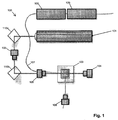
- Systems for performing the method of the invention can be built from the ground up or may be based on a pre-existing off-the-shelf optical instrument. Such a system can be based on an optical instrument 100 such as the Zetasizer nano particle measurement system, which is outlined schematically in figure 1 .
- the Zetasizer particle measurement instrument line is available from Malvern instruments Ltd of Malvern, UK and is described in further detail in WO 2010/04182 .
- the particle measurement system 100 includes a coherent radiation source 101, such as a laser.
- the output of this laser 101 is provided to an attenuator 102, optionally via one or more intervening reflectors 110a, 110b, through a sample cell 103, and on to a transmission monitor 104.
- Classical 90° optics 106 and/or backscatter optics 105 receive scattered radiation from a suspended particulate sample in the sample cell 103 and measure an intensity of light received from the light source 101 and elastically scattered by the sample in the sample cell 103.
- the received scattered radiation for one or both of these sets of optics 105, 106 can then be relayed via an optical fiber 107 to an Avalanche Photo Diode (APD) 108.
- APD Avalanche Photo Diode
- the output of the photodiode 108 can then be correlated using a correlator 109 in the case of DLS, or integrated using an integrator in the case of SLS (not shown).
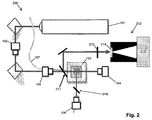
- one approach to modifying the system 100 of figure 1 to achieve dual-mode detection is to add a dielectric filter 211 in the backscatter path.
- This dielectric filter 211 relays longer wavelength light to a spectrometric detector 212, such as a Raman detector.
- the Raman detector 212 can include one or more laser notch filters 213, a diffraction grating 214, and a dimensional detector 215, such as a Charge Coupled Device (CCD).
- CCD Charge Coupled Device
- Raman detection is shown in figure 2 to take place in the backscatter path, it can also or alternatively take place from one or more of a number of different angles including from a pickoff point 216 in the classical 90° path.
- the spectrometric detector 212 may be configured to receive scattered light from the sample cell along a path orthogonal to the incident light and/or along a path reverse to the incident light for detection of backscattered light.
- the laser 101 in the system 200 of figure 2 is used for both DLS and Raman measurements.
- the attenuator 102 is turned on so that the APD 108 ( figure 1 ) is not saturated.
- the attenuator 102 is turned off to allow the high level of illumination used in Raman measurements.
- the system 200 can acquire information about both elastic and inelastic scattering. These two types of detection can provide complementary information about a particular suspension. For example, DLS measurements can provide information about the aggregation of particulates, while Raman measurements can provide information about the cause of the aggregation or whether the structure of individual particles has changed.
- the instrument 200 can also be used to compare one particulate suspension with another. This may be useful for example when comparing one biopharmaceutical formulation from one company with a biosimilar manufactured by another company.
- a system can be built with separate sources for the different measurements organized around separate optical paths.
- the system can also employ a different arrangement of optical elements and/or different selective or switching elements, such as moving mirrors or choppers, to make both types of measurements.
- the attenuator 102 can be placed in the fiber optic 107 path, allowing DLS and Raman measurements to be taken simultaneously.
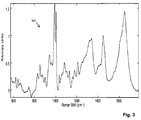
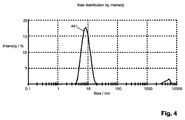
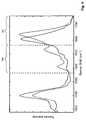
- the system 200 of figure 2 can be operated to provide spectral information, such as a Raman spectrum 301 ( figure 3 ) and physical property information, such as a size distribution 401 ( figure 4 ) for the same sample at effectively the same time. These measurements can also be taken in succession under different conditions, such as sample temperature or pH.
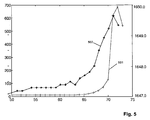
- Figure 5 illustrates plots of DLS average size data 501 (left hand scale, in nm) and Raman shift data 502 (right hand scale, in cm -1 ) as a function of temperature (in °C) for a protein solution.
- both the light intensity detector and the spectral light detector are configured to receive and measure light during a measurement period while a property of the sample in the sample cell changes.
- the property of the sample may be deliberately changed, such as by changing the pH or temperature of the sample, or may change as a result of an ongoing reaction while the sample is being measured.
- the advantage of such dual measurements is therefore clear, in that different measurements can be taken on the same sample over the same measurement period by alternating between DLS and Raman measurements.
- the measurements can be performed manually, or may alternatively be performed automatically using standard robotic loading systems, such as x-y stages or using automated pipetting systems.
- the optical instrument system may be implemented in connection with special-purpose software programs running on general-purpose computer platforms, in which stored program instructions are executed on a processor.
- the system could also be implemented in whole or in part using special-purpose hardware to achieve the same function. While the system can be broken into the series of modules and steps shown for illustration purposes, one of ordinary skill in the art would recognize that it is also possible to combine them and/or split them differently to achieve a different breakdown.
- Another approach to dual-mode characterization of particulates is to perform simultaneous Raman and laser diffraction measurements.
- the technique of laser diffraction is based around the principle that particles passing through a laser beam will scatter light at an angle that is directly related to their size. As the particle size decreases, the observed scattering angle increases logarithmically. The observed scattering intensity is also dependent on particle sizes and diminishes, to a good approximation, in relation to the particle's cross-sectional area. Large particles therefore scatter light at narrow angles with high intensity, whereas small particles scatter at wider angles but with low intensity.
- the primary measurement that is carried out within a laser diffraction system is the capture of the light scattering data from the particles under study.
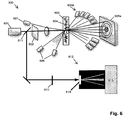
- An exemplary system 300 illustrated schematically in figure 6 , comprises a coherent light source such as a red laser 601 with an optional attenuator 602, for providing a source of coherent, intense light of a fixed wavelength.
- An optional second coherent light source such as a blue laser 621 may also be provided.
- the system 300 further comprises a sample presentation system such as a sample cell 603 configured to pass a material under test through the incident laser beam, preferably as a homogeneous stream of particles 604 in a known, reproducible state of dispersion.
- a first series of detectors including a focal plane detector 605a and an array of large angle detectors 605b, are provided to measure the light pattern produced over a wide range of angles by scattering of incident light by the dispersed particles in the sample cell 603.
- a second series of detectors 606, 612 are provided to measure backscattered light from the sample cell 603 and for Raman detection.
- a dielectric filter 611 may be placed in one of the backscattered light paths, the filter 611 configured to relay longer wavelength light to a spectrometric detector such as a Raman detector 612.
- the Raman detector 612 can include one or more laser notch filters 613, a diffraction grating 614, and a dimensional detector 615, such as a Charge Coupled Device (CCD).
- CCD Charge Coupled Device
- the laser 601 (and/or 621) in the system 300 of figure 6 is used for both laser diffraction and Raman measurements.
- the attenuator 602 is turned on so that the scattering detectors are not saturated.
- the attenuator 602 is turned off to allow the high level of illumination used in Raman measurements.
- the system can acquire complementary information about a particular suspension.
- the laser diffraction measurements can provide information about physical properties of the sample
- the Raman measurements can provide information about the chemical makeup of the sample.
- a system can be built with separate sources for the different measurements organized around separate optical paths.
- the system can also employ a different arrangement of optical elements and/or different selective or switching elements, such as moving mirrors or choppers, to make both types of measurements.
- the attenuator 602 can be placed in such a way as to allow laser diffraction and Raman measurements to be taken simultaneously.
- the size range accessible during the measurement is directly related to the angular range of the scattering measurement.
- Modem laser diffraction instruments make measurements from around 0.02 degrees through to 135 degrees.
- a logarithmic detector sequence where the detectors 605 are grouped closely together at small angles and more widely spaced at wide angles, yields the optimum sensitivity.
- the detector sequence can also be set up such that equal volumes of particles of different sizes produce a similar measured signal. With this approach, the size of the detectors is increased as the measured scattering angle increases.
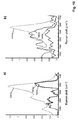
- FIG. 10a illustrates a plot of Raman measurements 1001 a and correlations with DLS polydispersity 1002a and size 1003a for BSA
- figure 10b illustrates Raman measurements 1001b and correlations with DLS polydispersity 1002b and size 1003b for IgG.
- These correlations can be matched with corresponding molecular features to determine which features are likely to have been affected by the physical changes. Using this technique it can be shown, for example, that a protein denatures and/or aggregates differently in response to changes in temperature than it does in response to changes in pH.
- Raman measurements could be used to detect crystallinity of a sample and laser diffraction used to detect size of the sample, while a condition of the sample is varied. This may allow a deeper understanding of the degree to which a sample exhibits crystalline, amorphous, and/or polymorphic properties in different conditions. With this type of understanding, it is possible to perform Raman measurements to learn information about physical properties of a sample in a particular system, such as size, shape, diameter, or aspect ratio.
- DLS Dynamic Light-Samiconductor
- physicochemical properties such as the protein zeta potential, charge or isoelectric point.
- This cross-measurement principle can be used between any types of measurements in a dual-mode system according to different schedules.
- a quality control situation for example, a material under test might be fully characterized with both measurement techniques, but routine testing might then be performed with only one of them.
- the selected technique for routine testing might be selected for a variety of reasons, such as because it is less expensive, quicker, more scalable, or more reliable.
- the method according to the invention can be applicable to a wide variety of applications, including research, quality control, formulation development, stability testing, manufacturability testing, efficiency testing, release testing, and drug discovery. It is also applicable to a wide variety of materials, such as biopharmaceuticals, small- and large-molecule proteins, excipients, and pigments and other industrial powders.
Landscapes
- Physics & Mathematics (AREA)
- Chemical & Material Sciences (AREA)
- Health & Medical Sciences (AREA)
- General Physics & Mathematics (AREA)
- General Health & Medical Sciences (AREA)
- Biochemistry (AREA)
- Analytical Chemistry (AREA)
- Life Sciences & Earth Sciences (AREA)
- Immunology (AREA)
- Pathology (AREA)
- Spectroscopy & Molecular Physics (AREA)
- Dispersion Chemistry (AREA)
- Nuclear Medicine, Radiotherapy & Molecular Imaging (AREA)
- Investigating, Analyzing Materials By Fluorescence Or Luminescence (AREA)
- Investigating Or Analysing Materials By Optical Means (AREA)
Applications Claiming Priority (4)
| Application Number | Priority Date | Filing Date | Title |
|---|---|---|---|
| US201161525669P | 2011-08-19 | 2011-08-19 | |
| US201161560596P | 2011-11-16 | 2011-11-16 | |
| US201261669004P | 2012-07-06 | 2012-07-06 | |
| PCT/GB2012/052019 WO2013027034A1 (en) | 2011-08-19 | 2012-08-17 | Dual-mode characterization of particulates |
Publications (2)
| Publication Number | Publication Date |
|---|---|
| EP2742337A1 EP2742337A1 (en) | 2014-06-18 |
| EP2742337B1 true EP2742337B1 (en) | 2016-05-04 |
Family
ID=47046636
Family Applications (1)
| Application Number | Title | Priority Date | Filing Date |
|---|---|---|---|
| EP12775275.6A Active EP2742337B1 (en) | 2011-08-19 | 2012-08-17 | Dual-mode characterization of particulates |
Country Status (5)
| Country | Link |
|---|---|
| US (1) | US9816922B2 (enExample) |
| EP (1) | EP2742337B1 (enExample) |
| JP (1) | JP2014524581A (enExample) |
| CN (1) | CN103748450A (enExample) |
| WO (1) | WO2013027034A1 (enExample) |
Cited By (1)
| Publication number | Priority date | Publication date | Assignee | Title |
|---|---|---|---|---|
| DE102020129179A1 (de) | 2020-11-05 | 2022-05-05 | Technische Universität Braunschweig | Verfahren, computerprogramm und miniaturisierter optofluidischer chip zum untersuchen von partikeln in einer flüssigen probe |
Families Citing this family (14)
| Publication number | Priority date | Publication date | Assignee | Title |
|---|---|---|---|---|
| WO2015145149A1 (en) * | 2014-03-25 | 2015-10-01 | Malvern Instruments Ltd. | Raman spectroscopic structure investigation of proteins dispersed in a liquid phase |
| JP6348349B2 (ja) * | 2014-06-20 | 2018-06-27 | 大塚電子株式会社 | 動的光散乱測定装置及び動的光散乱測定方法 |
| CN104486792B (zh) * | 2014-12-19 | 2018-02-13 | 宇龙计算机通信科技(深圳)有限公司 | Rrm测量方法及测量系统、终端和基站 |
| EP3088863A1 (en) | 2015-05-01 | 2016-11-02 | Malvern Instruments Limited | Improvements relating to particle characterisation |
| US10371641B2 (en) | 2016-01-21 | 2019-08-06 | TimeGate Instruments Oy | Method and apparatus for measuring inelastic scattering |
| JP2017150963A (ja) * | 2016-02-25 | 2017-08-31 | 株式会社島津製作所 | 凝集体測定方法及び凝集体測定装置 |
| SE1651057A1 (en) * | 2016-07-14 | 2017-12-27 | Brännström Gruppen Ab | Method and apparatus for determining solids content in a liquid medium |
| JP6659062B2 (ja) * | 2016-10-13 | 2020-03-04 | 国立研究開発法人産業技術総合研究所 | ナノ粒子評価方法およびナノ粒子観察装置 |
| US11130686B2 (en) | 2017-01-10 | 2021-09-28 | Vermeer Manufacturing Company | Systems and methods for dosing slurries to remove suspended solids |
| CN108333024B (zh) * | 2018-03-21 | 2020-08-25 | 杭州娃哈哈科技有限公司 | 一种姜黄素纳米混悬剂的稳定性评价方法 |
| CN108663295B (zh) * | 2018-08-06 | 2024-01-23 | 上海景瑞阳实业有限公司 | 一种纳米粒子粒径分布测试仪及测试方法 |
| DE112022001785T5 (de) * | 2021-03-26 | 2024-02-15 | Hamamatsu Photonics K.K. | Vorrichtung zur abgeschwächten Totalreflexionsspektroskopie und Verfahren zur abgeschwächten Totalreflexionsspektroskopie |
| CN113029958B (zh) * | 2021-04-01 | 2023-07-25 | 温州大学 | 一种用于检测dna变性的动态光散射检测装置 |
| EP4654117A1 (en) * | 2024-05-20 | 2025-11-26 | Malvern Panalytical Limited | Material characterisation trend analysis |
Citations (1)
| Publication number | Priority date | Publication date | Assignee | Title |
|---|---|---|---|---|
| EP1913866A1 (en) * | 2000-08-21 | 2008-04-23 | The General Hospital Corporation | Methods for diagnosing a neurodegenerative condition |
Family Cites Families (16)
| Publication number | Priority date | Publication date | Assignee | Title |
|---|---|---|---|---|
| US4586819A (en) * | 1982-07-09 | 1986-05-06 | Hitachi, Ltd. | Laser Raman microprobe |
| JPS6053834A (ja) * | 1983-09-02 | 1985-03-27 | Hitachi Ltd | レ−ザラマンマイクロプロ−ブ |
| US5506678A (en) * | 1992-02-24 | 1996-04-09 | Hewlett Packard Company | System for collecting weakly scattered electromagnetic radiation |
| JP2842064B2 (ja) | 1992-07-30 | 1998-12-24 | 株式会社デンソー | アナログ−ディジタル変換器 |
| WO1994024545A1 (en) * | 1993-04-15 | 1994-10-27 | Board Of Regents, The University Of Texas System | Raman spectrometer |
| WO1998059225A1 (en) * | 1997-06-20 | 1998-12-30 | Plasma Tec, Inc. | Dispersive atomic vapor raman filter |
| JP3829962B2 (ja) * | 1998-01-22 | 2006-10-04 | 富士通株式会社 | 光アッテネータ並びに該光アッテネータを備えたシステム、光増幅器及び端局装置 |
| JP3651755B2 (ja) * | 1998-11-05 | 2005-05-25 | 株式会社東芝 | ガス成分濃度計測装置およびガス成分濃度計測方法 |
| KR20010110420A (ko) * | 1999-01-26 | 2001-12-13 | 추후제출 | 내시경 진단용 자가 형광 영상화 시스템 |
| JP3422725B2 (ja) * | 1999-05-19 | 2003-06-30 | 株式会社堀場製作所 | ラマン分光分析と粒度分布測定を同時に行う分析装置 |
| JP2005306827A (ja) | 2004-04-17 | 2005-11-04 | Isao Shimizu | 生体高分子結晶迅速精製・計測の方法および装置 |
| US7333197B2 (en) * | 2004-11-17 | 2008-02-19 | Honeywell International Inc. | Raman detection based flow cytometer |
| KR100817854B1 (ko) * | 2006-09-19 | 2008-03-31 | 재단법인서울대학교산학협력재단 | 라만 산란광 및 광산란의 동시 검출 장치 |
| PT2087002E (pt) | 2006-10-27 | 2014-11-26 | Lpath Inc | Composições e métodos para a ligação de esfingosina-1- fosfato |
| JP5188758B2 (ja) * | 2007-07-17 | 2013-04-24 | 株式会社堀場製作所 | 粒径分布測定装置 |
| FR2933303B1 (fr) | 2008-06-30 | 2010-12-03 | Univ Paris Curie | Substitut osseux,et procede pour sa preparation. |
-
2012
- 2012-08-17 WO PCT/GB2012/052019 patent/WO2013027034A1/en not_active Ceased
- 2012-08-17 JP JP2014526551A patent/JP2014524581A/ja active Pending
- 2012-08-17 US US14/239,039 patent/US9816922B2/en active Active
- 2012-08-17 EP EP12775275.6A patent/EP2742337B1/en active Active
- 2012-08-17 CN CN201280040414.6A patent/CN103748450A/zh active Pending
Patent Citations (1)
| Publication number | Priority date | Publication date | Assignee | Title |
|---|---|---|---|---|
| EP1913866A1 (en) * | 2000-08-21 | 2008-04-23 | The General Hospital Corporation | Methods for diagnosing a neurodegenerative condition |
Cited By (1)
| Publication number | Priority date | Publication date | Assignee | Title |
|---|---|---|---|---|
| DE102020129179A1 (de) | 2020-11-05 | 2022-05-05 | Technische Universität Braunschweig | Verfahren, computerprogramm und miniaturisierter optofluidischer chip zum untersuchen von partikeln in einer flüssigen probe |
Also Published As
| Publication number | Publication date |
|---|---|
| CN103748450A (zh) | 2014-04-23 |
| US9816922B2 (en) | 2017-11-14 |
| EP2742337A1 (en) | 2014-06-18 |
| WO2013027034A1 (en) | 2013-02-28 |
| JP2014524581A (ja) | 2014-09-22 |
| US20150146202A1 (en) | 2015-05-28 |
Similar Documents
| Publication | Publication Date | Title |
|---|---|---|
| EP2742337B1 (en) | Dual-mode characterization of particulates | |
| US8094294B2 (en) | Multipoint method for identifying hazardous agents | |
| US7486395B2 (en) | System and method for a chemical imaging threat assessor with a probe | |
| US11892402B2 (en) | High throughput method and apparatus for measuring multiple optical properties of a liquid sample | |
| JP4201058B2 (ja) | 中間統計データに基づいて試料を特徴付けする方法 | |
| US7286222B2 (en) | Sample container and system for a handheld spectrometer and method for using therefor | |
| US9366612B2 (en) | Methods and apparatus to obtain suspended particle information | |
| US7542138B2 (en) | Sample container and system for a handheld spectrometer and method for using therefor | |
| EP2889603B1 (en) | Microparticle measuring device | |
| JP6501714B2 (ja) | 光学調査装置 | |
| JP2005515423A (ja) | 病原性微生物の検出方法 | |
| JP2007524389A (ja) | 病原微生物検出のための広視野法 | |
| CN111366558A (zh) | 一种多波长偏振散射测量装置 | |
| EP1019687B1 (en) | A method for characterizing samples by determination of a function of at least one specific physical property of particles of said sample | |
| EP1828748A1 (en) | Systems, illumination subsystems, and methods for increasing fluorescence emitted by a fluorophore | |
| CN113899728A (zh) | 双波长光源拉曼光谱仪系统 | |
| CN111638203A (zh) | 一种拉曼探头的双波长激光共焦点探测方法 | |
| WO2006083316A2 (en) | Multipoint method for identifying hazardous agents | |
| US7330243B2 (en) | Method for monitoring the production of biomolecule crystals | |
| JPH03221835A (ja) | 検体測定装置 |
Legal Events
| Date | Code | Title | Description |
|---|---|---|---|
| PUAI | Public reference made under article 153(3) epc to a published international application that has entered the european phase |
Free format text: ORIGINAL CODE: 0009012 |
|
| 17P | Request for examination filed |
Effective date: 20140220 |
|
| AK | Designated contracting states |
Kind code of ref document: A1 Designated state(s): AL AT BE BG CH CY CZ DE DK EE ES FI FR GB GR HR HU IE IS IT LI LT LU LV MC MK MT NL NO PL PT RO RS SE SI SK SM TR |
|
| DAX | Request for extension of the european patent (deleted) | ||
| 17Q | First examination report despatched |
Effective date: 20141030 |
|
| RIC1 | Information provided on ipc code assigned before grant |
Ipc: G01N 21/51 20060101ALI20150630BHEP Ipc: G01N 21/47 20060101ALI20150630BHEP Ipc: G01N 21/80 20060101ALI20150630BHEP Ipc: G01N 21/65 20060101ALI20150630BHEP Ipc: G01N 15/14 20060101AFI20150630BHEP Ipc: G01J 3/44 20060101ALI20150630BHEP Ipc: G01N 15/02 20060101ALI20150630BHEP |
|
| GRAP | Despatch of communication of intention to grant a patent |
Free format text: ORIGINAL CODE: EPIDOSNIGR1 |
|
| GRAS | Grant fee paid |
Free format text: ORIGINAL CODE: EPIDOSNIGR3 |
|
| INTG | Intention to grant announced |
Effective date: 20160303 |
|
| RIN1 | Information on inventor provided before grant (corrected) |
Inventor name: LEWIS, E. NEIL |
|
| GRAA | (expected) grant |
Free format text: ORIGINAL CODE: 0009210 |
|
| AK | Designated contracting states |
Kind code of ref document: B1 Designated state(s): AL AT BE BG CH CY CZ DE DK EE ES FI FR GB GR HR HU IE IS IT LI LT LU LV MC MK MT NL NO PL PT RO RS SE SI SK SM TR |
|
| REG | Reference to a national code |
Ref country code: GB Ref legal event code: FG4D |
|
| REG | Reference to a national code |
Ref country code: CH Ref legal event code: EP |
|
| REG | Reference to a national code |
Ref country code: AT Ref legal event code: REF Ref document number: 797350 Country of ref document: AT Kind code of ref document: T Effective date: 20160515 |
|
| REG | Reference to a national code |
Ref country code: IE Ref legal event code: FG4D |
|
| REG | Reference to a national code |
Ref country code: DE Ref legal event code: R096 Ref document number: 602012018122 Country of ref document: DE |
|
| REG | Reference to a national code |
Ref country code: FR Ref legal event code: PLFP Year of fee payment: 5 |
|
| REG | Reference to a national code |
Ref country code: NL Ref legal event code: MP Effective date: 20160504 |
|
| REG | Reference to a national code |
Ref country code: LT Ref legal event code: MG4D |
|
| PG25 | Lapsed in a contracting state [announced via postgrant information from national office to epo] |
Ref country code: NO Free format text: LAPSE BECAUSE OF FAILURE TO SUBMIT A TRANSLATION OF THE DESCRIPTION OR TO PAY THE FEE WITHIN THE PRESCRIBED TIME-LIMIT Effective date: 20160804 Ref country code: FI Free format text: LAPSE BECAUSE OF FAILURE TO SUBMIT A TRANSLATION OF THE DESCRIPTION OR TO PAY THE FEE WITHIN THE PRESCRIBED TIME-LIMIT Effective date: 20160504 Ref country code: LT Free format text: LAPSE BECAUSE OF FAILURE TO SUBMIT A TRANSLATION OF THE DESCRIPTION OR TO PAY THE FEE WITHIN THE PRESCRIBED TIME-LIMIT Effective date: 20160504 Ref country code: NL Free format text: LAPSE BECAUSE OF FAILURE TO SUBMIT A TRANSLATION OF THE DESCRIPTION OR TO PAY THE FEE WITHIN THE PRESCRIBED TIME-LIMIT Effective date: 20160504 |
|
| REG | Reference to a national code |
Ref country code: AT Ref legal event code: MK05 Ref document number: 797350 Country of ref document: AT Kind code of ref document: T Effective date: 20160504 |
|
| PG25 | Lapsed in a contracting state [announced via postgrant information from national office to epo] |
Ref country code: GR Free format text: LAPSE BECAUSE OF FAILURE TO SUBMIT A TRANSLATION OF THE DESCRIPTION OR TO PAY THE FEE WITHIN THE PRESCRIBED TIME-LIMIT Effective date: 20160805 Ref country code: RS Free format text: LAPSE BECAUSE OF FAILURE TO SUBMIT A TRANSLATION OF THE DESCRIPTION OR TO PAY THE FEE WITHIN THE PRESCRIBED TIME-LIMIT Effective date: 20160504 Ref country code: PT Free format text: LAPSE BECAUSE OF FAILURE TO SUBMIT A TRANSLATION OF THE DESCRIPTION OR TO PAY THE FEE WITHIN THE PRESCRIBED TIME-LIMIT Effective date: 20160905 Ref country code: HR Free format text: LAPSE BECAUSE OF FAILURE TO SUBMIT A TRANSLATION OF THE DESCRIPTION OR TO PAY THE FEE WITHIN THE PRESCRIBED TIME-LIMIT Effective date: 20160504 Ref country code: ES Free format text: LAPSE BECAUSE OF FAILURE TO SUBMIT A TRANSLATION OF THE DESCRIPTION OR TO PAY THE FEE WITHIN THE PRESCRIBED TIME-LIMIT Effective date: 20160504 Ref country code: SE Free format text: LAPSE BECAUSE OF FAILURE TO SUBMIT A TRANSLATION OF THE DESCRIPTION OR TO PAY THE FEE WITHIN THE PRESCRIBED TIME-LIMIT Effective date: 20160504 Ref country code: LV Free format text: LAPSE BECAUSE OF FAILURE TO SUBMIT A TRANSLATION OF THE DESCRIPTION OR TO PAY THE FEE WITHIN THE PRESCRIBED TIME-LIMIT Effective date: 20160504 |
|
| PG25 | Lapsed in a contracting state [announced via postgrant information from national office to epo] |
Ref country code: IT Free format text: LAPSE BECAUSE OF FAILURE TO SUBMIT A TRANSLATION OF THE DESCRIPTION OR TO PAY THE FEE WITHIN THE PRESCRIBED TIME-LIMIT Effective date: 20160504 Ref country code: BE Free format text: LAPSE BECAUSE OF NON-PAYMENT OF DUE FEES Effective date: 20160831 |
|
| PG25 | Lapsed in a contracting state [announced via postgrant information from national office to epo] |
Ref country code: RO Free format text: LAPSE BECAUSE OF FAILURE TO SUBMIT A TRANSLATION OF THE DESCRIPTION OR TO PAY THE FEE WITHIN THE PRESCRIBED TIME-LIMIT Effective date: 20160504 Ref country code: EE Free format text: LAPSE BECAUSE OF FAILURE TO SUBMIT A TRANSLATION OF THE DESCRIPTION OR TO PAY THE FEE WITHIN THE PRESCRIBED TIME-LIMIT Effective date: 20160504 Ref country code: SK Free format text: LAPSE BECAUSE OF FAILURE TO SUBMIT A TRANSLATION OF THE DESCRIPTION OR TO PAY THE FEE WITHIN THE PRESCRIBED TIME-LIMIT Effective date: 20160504 Ref country code: CZ Free format text: LAPSE BECAUSE OF FAILURE TO SUBMIT A TRANSLATION OF THE DESCRIPTION OR TO PAY THE FEE WITHIN THE PRESCRIBED TIME-LIMIT Effective date: 20160504 Ref country code: DK Free format text: LAPSE BECAUSE OF FAILURE TO SUBMIT A TRANSLATION OF THE DESCRIPTION OR TO PAY THE FEE WITHIN THE PRESCRIBED TIME-LIMIT Effective date: 20160504 |
|
| REG | Reference to a national code |
Ref country code: DE Ref legal event code: R097 Ref document number: 602012018122 Country of ref document: DE |
|
| PG25 | Lapsed in a contracting state [announced via postgrant information from national office to epo] |
Ref country code: SM Free format text: LAPSE BECAUSE OF FAILURE TO SUBMIT A TRANSLATION OF THE DESCRIPTION OR TO PAY THE FEE WITHIN THE PRESCRIBED TIME-LIMIT Effective date: 20160504 Ref country code: PL Free format text: LAPSE BECAUSE OF FAILURE TO SUBMIT A TRANSLATION OF THE DESCRIPTION OR TO PAY THE FEE WITHIN THE PRESCRIBED TIME-LIMIT Effective date: 20160504 Ref country code: AT Free format text: LAPSE BECAUSE OF FAILURE TO SUBMIT A TRANSLATION OF THE DESCRIPTION OR TO PAY THE FEE WITHIN THE PRESCRIBED TIME-LIMIT Effective date: 20160504 Ref country code: BE Free format text: LAPSE BECAUSE OF FAILURE TO SUBMIT A TRANSLATION OF THE DESCRIPTION OR TO PAY THE FEE WITHIN THE PRESCRIBED TIME-LIMIT Effective date: 20160504 |
|
| PLBE | No opposition filed within time limit |
Free format text: ORIGINAL CODE: 0009261 |
|
| STAA | Information on the status of an ep patent application or granted ep patent |
Free format text: STATUS: NO OPPOSITION FILED WITHIN TIME LIMIT |
|
| PG25 | Lapsed in a contracting state [announced via postgrant information from national office to epo] |
Ref country code: MC Free format text: LAPSE BECAUSE OF FAILURE TO SUBMIT A TRANSLATION OF THE DESCRIPTION OR TO PAY THE FEE WITHIN THE PRESCRIBED TIME-LIMIT Effective date: 20160504 |
|
| REG | Reference to a national code |
Ref country code: CH Ref legal event code: PL |
|
| 26N | No opposition filed |
Effective date: 20170207 |
|
| PG25 | Lapsed in a contracting state [announced via postgrant information from national office to epo] |
Ref country code: LI Free format text: LAPSE BECAUSE OF NON-PAYMENT OF DUE FEES Effective date: 20160831 Ref country code: CH Free format text: LAPSE BECAUSE OF NON-PAYMENT OF DUE FEES Effective date: 20160831 |
|
| PG25 | Lapsed in a contracting state [announced via postgrant information from national office to epo] |
Ref country code: SI Free format text: LAPSE BECAUSE OF FAILURE TO SUBMIT A TRANSLATION OF THE DESCRIPTION OR TO PAY THE FEE WITHIN THE PRESCRIBED TIME-LIMIT Effective date: 20160504 |
|
| REG | Reference to a national code |
Ref country code: IE Ref legal event code: MM4A |
|
| REG | Reference to a national code |
Ref country code: FR Ref legal event code: PLFP Year of fee payment: 6 |
|
| PG25 | Lapsed in a contracting state [announced via postgrant information from national office to epo] |
Ref country code: IE Free format text: LAPSE BECAUSE OF NON-PAYMENT OF DUE FEES Effective date: 20160817 |
|
| PG25 | Lapsed in a contracting state [announced via postgrant information from national office to epo] |
Ref country code: LU Free format text: LAPSE BECAUSE OF NON-PAYMENT OF DUE FEES Effective date: 20160817 |
|
| PG25 | Lapsed in a contracting state [announced via postgrant information from national office to epo] |
Ref country code: CY Free format text: LAPSE BECAUSE OF FAILURE TO SUBMIT A TRANSLATION OF THE DESCRIPTION OR TO PAY THE FEE WITHIN THE PRESCRIBED TIME-LIMIT Effective date: 20160504 Ref country code: HU Free format text: LAPSE BECAUSE OF FAILURE TO SUBMIT A TRANSLATION OF THE DESCRIPTION OR TO PAY THE FEE WITHIN THE PRESCRIBED TIME-LIMIT; INVALID AB INITIO Effective date: 20120817 |
|
| PG25 | Lapsed in a contracting state [announced via postgrant information from national office to epo] |
Ref country code: IS Free format text: LAPSE BECAUSE OF FAILURE TO SUBMIT A TRANSLATION OF THE DESCRIPTION OR TO PAY THE FEE WITHIN THE PRESCRIBED TIME-LIMIT Effective date: 20160504 Ref country code: MK Free format text: LAPSE BECAUSE OF FAILURE TO SUBMIT A TRANSLATION OF THE DESCRIPTION OR TO PAY THE FEE WITHIN THE PRESCRIBED TIME-LIMIT Effective date: 20160504 Ref country code: MT Free format text: LAPSE BECAUSE OF NON-PAYMENT OF DUE FEES Effective date: 20160831 |
|
| REG | Reference to a national code |
Ref country code: FR Ref legal event code: PLFP Year of fee payment: 7 |
|
| PG25 | Lapsed in a contracting state [announced via postgrant information from national office to epo] |
Ref country code: BG Free format text: LAPSE BECAUSE OF FAILURE TO SUBMIT A TRANSLATION OF THE DESCRIPTION OR TO PAY THE FEE WITHIN THE PRESCRIBED TIME-LIMIT Effective date: 20160504 |
|
| PG25 | Lapsed in a contracting state [announced via postgrant information from national office to epo] |
Ref country code: TR Free format text: LAPSE BECAUSE OF FAILURE TO SUBMIT A TRANSLATION OF THE DESCRIPTION OR TO PAY THE FEE WITHIN THE PRESCRIBED TIME-LIMIT Effective date: 20160504 Ref country code: AL Free format text: LAPSE BECAUSE OF FAILURE TO SUBMIT A TRANSLATION OF THE DESCRIPTION OR TO PAY THE FEE WITHIN THE PRESCRIBED TIME-LIMIT Effective date: 20160504 |
|
| P01 | Opt-out of the competence of the unified patent court (upc) registered |
Effective date: 20230727 |
|
| PGFP | Annual fee paid to national office [announced via postgrant information from national office to epo] |
Ref country code: DE Payment date: 20250724 Year of fee payment: 14 |
|
| PGFP | Annual fee paid to national office [announced via postgrant information from national office to epo] |
Ref country code: GB Payment date: 20250724 Year of fee payment: 14 |
|
| PGFP | Annual fee paid to national office [announced via postgrant information from national office to epo] |
Ref country code: FR Payment date: 20250725 Year of fee payment: 14 |