EP2576615B1 - Fibronectin based scaffold proteins having improved stability - Google Patents
Fibronectin based scaffold proteins having improved stability Download PDFInfo
- Publication number
- EP2576615B1 EP2576615B1 EP11731571.3A EP11731571A EP2576615B1 EP 2576615 B1 EP2576615 B1 EP 2576615B1 EP 11731571 A EP11731571 A EP 11731571A EP 2576615 B1 EP2576615 B1 EP 2576615B1
- Authority
- EP
- European Patent Office
- Prior art keywords
- seq
- amino acid
- acid sequence
- domain
- protein
- Prior art date
- Legal status (The legal status is an assumption and is not a legal conclusion. Google has not performed a legal analysis and makes no representation as to the accuracy of the status listed.)
- Not-in-force
Links
Images






Classifications
-
- C—CHEMISTRY; METALLURGY
- C07—ORGANIC CHEMISTRY
- C07K—PEPTIDES
- C07K14/00—Peptides having more than 20 amino acids; Gastrins; Somatostatins; Melanotropins; Derivatives thereof
- C07K14/435—Peptides having more than 20 amino acids; Gastrins; Somatostatins; Melanotropins; Derivatives thereof from animals; from humans
- C07K14/78—Connective tissue peptides, e.g. collagen, elastin, laminin, fibronectin, vitronectin or cold insoluble globulin [CIG]
-
- A—HUMAN NECESSITIES
- A61—MEDICAL OR VETERINARY SCIENCE; HYGIENE
- A61P—SPECIFIC THERAPEUTIC ACTIVITY OF CHEMICAL COMPOUNDS OR MEDICINAL PREPARATIONS
- A61P35/00—Antineoplastic agents
-
- A—HUMAN NECESSITIES
- A61—MEDICAL OR VETERINARY SCIENCE; HYGIENE
- A61P—SPECIFIC THERAPEUTIC ACTIVITY OF CHEMICAL COMPOUNDS OR MEDICINAL PREPARATIONS
- A61P35/00—Antineoplastic agents
- A61P35/02—Antineoplastic agents specific for leukemia
-
- C—CHEMISTRY; METALLURGY
- C07—ORGANIC CHEMISTRY
- C07K—PEPTIDES
- C07K16/00—Immunoglobulins [IG], e.g. monoclonal or polyclonal antibodies
- C07K16/18—Immunoglobulins [IG], e.g. monoclonal or polyclonal antibodies against material from animals or humans
-
- C—CHEMISTRY; METALLURGY
- C12—BIOCHEMISTRY; BEER; SPIRITS; WINE; VINEGAR; MICROBIOLOGY; ENZYMOLOGY; MUTATION OR GENETIC ENGINEERING
- C12N—MICROORGANISMS OR ENZYMES; COMPOSITIONS THEREOF; PROPAGATING, PRESERVING, OR MAINTAINING MICROORGANISMS; MUTATION OR GENETIC ENGINEERING; CULTURE MEDIA
- C12N15/00—Mutation or genetic engineering; DNA or RNA concerning genetic engineering, vectors, e.g. plasmids, or their isolation, preparation or purification; Use of hosts therefor
- C12N15/09—Recombinant DNA-technology
- C12N15/63—Introduction of foreign genetic material using vectors; Vectors; Use of hosts therefor; Regulation of expression
-
- A—HUMAN NECESSITIES
- A61—MEDICAL OR VETERINARY SCIENCE; HYGIENE
- A61K—PREPARATIONS FOR MEDICAL, DENTAL OR TOILETRY PURPOSES
- A61K38/00—Medicinal preparations containing peptides
-
- C—CHEMISTRY; METALLURGY
- C07—ORGANIC CHEMISTRY
- C07K—PEPTIDES
- C07K14/00—Peptides having more than 20 amino acids; Gastrins; Somatostatins; Melanotropins; Derivatives thereof
- C07K14/435—Peptides having more than 20 amino acids; Gastrins; Somatostatins; Melanotropins; Derivatives thereof from animals; from humans
- C07K14/705—Receptors; Cell surface antigens; Cell surface determinants
- C07K14/71—Receptors; Cell surface antigens; Cell surface determinants for growth factors; for growth regulators
-
- C—CHEMISTRY; METALLURGY
- C07—ORGANIC CHEMISTRY
- C07K—PEPTIDES
- C07K14/00—Peptides having more than 20 amino acids; Gastrins; Somatostatins; Melanotropins; Derivatives thereof
- C07K14/435—Peptides having more than 20 amino acids; Gastrins; Somatostatins; Melanotropins; Derivatives thereof from animals; from humans
- C07K14/705—Receptors; Cell surface antigens; Cell surface determinants
- C07K14/715—Receptors; Cell surface antigens; Cell surface determinants for cytokines; for lymphokines; for interferons
- C07K14/7155—Receptors; Cell surface antigens; Cell surface determinants for cytokines; for lymphokines; for interferons for interleukins [IL]
-
- C—CHEMISTRY; METALLURGY
- C07—ORGANIC CHEMISTRY
- C07K—PEPTIDES
- C07K16/00—Immunoglobulins [IG], e.g. monoclonal or polyclonal antibodies
- C07K16/18—Immunoglobulins [IG], e.g. monoclonal or polyclonal antibodies against material from animals or humans
- C07K16/28—Immunoglobulins [IG], e.g. monoclonal or polyclonal antibodies against material from animals or humans against receptors, cell surface antigens or cell surface determinants
- C07K16/2863—Immunoglobulins [IG], e.g. monoclonal or polyclonal antibodies against material from animals or humans against receptors, cell surface antigens or cell surface determinants against receptors for growth factors, growth regulators
-
- C—CHEMISTRY; METALLURGY
- C07—ORGANIC CHEMISTRY
- C07K—PEPTIDES
- C07K2317/00—Immunoglobulins specific features
- C07K2317/30—Immunoglobulins specific features characterized by aspects of specificity or valency
- C07K2317/31—Immunoglobulins specific features characterized by aspects of specificity or valency multispecific
-
- C—CHEMISTRY; METALLURGY
- C07—ORGANIC CHEMISTRY
- C07K—PEPTIDES
- C07K2317/00—Immunoglobulins specific features
- C07K2317/30—Immunoglobulins specific features characterized by aspects of specificity or valency
- C07K2317/34—Identification of a linear epitope shorter than 20 amino acid residues or of a conformational epitope defined by amino acid residues
-
- C—CHEMISTRY; METALLURGY
- C07—ORGANIC CHEMISTRY
- C07K—PEPTIDES
- C07K2317/00—Immunoglobulins specific features
- C07K2317/50—Immunoglobulins specific features characterized by immunoglobulin fragments
- C07K2317/56—Immunoglobulins specific features characterized by immunoglobulin fragments variable (Fv) region, i.e. VH and/or VL
-
- C—CHEMISTRY; METALLURGY
- C07—ORGANIC CHEMISTRY
- C07K—PEPTIDES
- C07K2317/00—Immunoglobulins specific features
- C07K2317/50—Immunoglobulins specific features characterized by immunoglobulin fragments
- C07K2317/56—Immunoglobulins specific features characterized by immunoglobulin fragments variable (Fv) region, i.e. VH and/or VL
- C07K2317/565—Complementarity determining region [CDR]
-
- C—CHEMISTRY; METALLURGY
- C07—ORGANIC CHEMISTRY
- C07K—PEPTIDES
- C07K2317/00—Immunoglobulins specific features
- C07K2317/90—Immunoglobulins specific features characterized by (pharmaco)kinetic aspects or by stability of the immunoglobulin
- C07K2317/92—Affinity (KD), association rate (Ka), dissociation rate (Kd) or EC50 value
-
- C—CHEMISTRY; METALLURGY
- C07—ORGANIC CHEMISTRY
- C07K—PEPTIDES
- C07K2317/00—Immunoglobulins specific features
- C07K2317/90—Immunoglobulins specific features characterized by (pharmaco)kinetic aspects or by stability of the immunoglobulin
- C07K2317/94—Stability, e.g. half-life, pH, temperature or enzyme-resistance
-
- C—CHEMISTRY; METALLURGY
- C07—ORGANIC CHEMISTRY
- C07K—PEPTIDES
- C07K2318/00—Antibody mimetics or scaffolds
- C07K2318/20—Antigen-binding scaffold molecules wherein the scaffold is not an immunoglobulin variable region or antibody mimetics
-
- C—CHEMISTRY; METALLURGY
- C07—ORGANIC CHEMISTRY
- C07K—PEPTIDES
- C07K2319/00—Fusion polypeptide
-
- C—CHEMISTRY; METALLURGY
- C07—ORGANIC CHEMISTRY
- C07K—PEPTIDES
- C07K2319/00—Fusion polypeptide
- C07K2319/30—Non-immunoglobulin-derived peptide or protein having an immunoglobulin constant or Fc region, or a fragment thereof, attached thereto
Definitions
- Fibronectin based scaffolds are a family of proteins capable of evolving to bind any compound of interest. These proteins, which generally make use of a scaffold derived from a fibronectin type III (Fn3) or Fn3-like domain, function in a manner characteristic of natural or engineered antibodies (that is, polyclonal, monoclonal, or single-chain antibodies) and, in addition, possess structural advantages. Specifically, the structure of these antibody mimics has been designed for optimal folding, stability, and solubility, even under conditions that normally lead to the loss of structure and function in antibodies.
- An example of fibronectin-based scaffold proteins are AdnectinsTM (Adnexus, a wholly owned subsidiary of Bristol-Myers Squibb).
- Fibronectin is a large protein which plays essential roles in the formation of extracellular matrix and cell-cell interactions; it consists of many repeats of three types (types I, II, and III) of small domains (Baron et al., 1991).
- Fn3 itself is the paradigm of a large subfamily which includes portions of cell adhesion molecules, cell surface hormone and cytokine receptors, chaperones, and carbohydrate-binding domains.
- Fibronectin type III (Fn3) domains comprise, in order from N-terminus to C-terminus, a beta or beta-like strand, A; a loop, AB; a beta or beta-like strand, B; a loop, BC; a beta or beta-like strand, C; a loop, CD; a beta or beta-like strand, D; a loop, DE; a beta or beta-like strand, E; a loop, EF; a beta or beta-like strand, F; a loop, FG; and a beta or beta-like strand, G. Any or all of loops AB, BC, CD, DE, EF and FG may participate in target binding.
- the BC, DE, and FG loops are both structurally and functionally analogous to the complementarity determining regions (CDRs) from immunoglobulins.
- CDRs complementarity determining regions
- U.S. Patent No. 7,115,396 describes Fn3 domain proteins wherein alterations to the BC, DE, and FG loops result in high affinity TNF ⁇ binders.
- U.S. Publication No. 2007/0148126 describes Fn3 domain proteins wherein alterations to the BC, DE, and FG loops result in high affinity VEGFR2 binders.
- Recombinant fusion proteins comprising inter alia a 10 th Fn3 domain are described in WO 2008/153745 .
- WO 2009/133208 describes Fn3-based binding molecules that bind to a specific target antigen as well as bispecific and multispecific Fn3-based binding molecules.
- Protein pharmaceuticals may be associated with physical and chemical instability during their production, purification, storage and delivery. These instability issues can adversely impact the biological properties associated with the protein therapeutic, thereby reducing the efficacy of that protein therapeutic.
- Sola, 2009, J. Pharm Sci, 98(4): 1223-1245 Accordingly, it would be advantageous to obtain improved fibronectin domain scaffold proteins that are associated with improved stability, e.g. reduced fragmentation and/or aggregation, that can be used for both therapeutic and diagnostic purposes.
- the present invention provides for novel fibronectin based scaffold proteins that are associated with increased stability, including reduced fragmentation and/or reduced aggregation.
- novel fibronectin based scaffold proteins are fibronecting-based protein dimers comprising a first fibronectin type III tenth ( 10 Fn3) and a second 10 Fn3 domain, wherein each of the first 10 Fn3 domain and the second 10 Fn3 domain:
- the C-terminal tail further comprises a cysteine residue.
- the fibronectin based scaffold proteins bind to a target that is not bound by a wild-type 10 Fn3 domain. In certain embodiments, fibronectin based scaffold proteins do not bind one or more of EGFR, human serum albumin or PCSK9. In certain embodiments, multivalent fibronectin based scaffold proteins do not bind to one or more of the following combinations of target molecules: i) EGFR and IGF-IR; ii) EGFR and any other target protein; or iii) human serum albumin and any other target protein.
- the 10 Fn3 domains of the fibronectin based scaffold protein further comprises an N-terminal extension comprising from 1-10 amino acids.
- the 10 Fn3 domain of the fibronectin based scaffold protein comprises a sequence selected from the group consisting of: M, MG, G, and any of SEQ ID NOs: 19-21 and 26-31.
- the first and second 10 Fn3 domains bind to different targets.
- the second 10 Fn3 domain further comprises an N-terminal extension comprising from 1-10 amino acids.
- the N-terminal extension comprises a sequence selected from the group consisting of: M, MG, G, and any of SEQ ID NOs: 19-21 and 25-31.
- the first and second 10 Fn3 domains are connected by a polypeptide linker comprising from 1-30 amino acids.
- the application provides for novel fibronectin based scaffold protein dimers that are associated with reduced protein fragmentation as compared to the fibronectin based scaffold protein dimers described in PCT application WO 2009/142773 .
- the fibronectin based scaffold protein dimer comprises the amino acid sequence of SEQ ID NO: 48.
- N1 and N2 are optional N-terminal extensions independently comprising from 0-10 amino acids;
- D1 and D2 are independently selected from the group consisting of: (i) a tenth fibronectin type III domain ( 10 Fn3) domain having at least 95% identity with the amino acid sequence set forth in SEQ ID NO: 2, wherein said 10 Fn3 domain binds to IGF-IR with a K D of less than 100 nM, and (ii) a 10 Fn3 domain having at least 95% identity with the amino acid sequence set forth in SEQ ID NO: 3, wherein said 10 Fn3 domain binds to VEGFR2 with a K D of less than 100 nM;
- L is a polypeptide linker comprising from 0-30 amino acid residues;
- C1 comprises the amino acid sequence set forth in SEQ ID NO: 4; and
- C2 comprises the amino acid sequence set
- the fibronectin based scaffold protein dimers have the structure N1-D1-C1-L-N2-D2-C2, wherein D1 comprises a 10 Fn3 domain having at least 95% identity with the amino acid sequence set forth in SEQ ID NO: 2, and D2 comprises a 10 Fn3 domain having at least 95% identity with the amino acid sequence set forth in SEQ ID NO: 3.
- the fibronectin based scaffold protein dimers have the structure N1-D1-C1-L-N2-D2-C2, wherein D1 comprises a 10 Fn3 domain having at least 95% identity with the amino acid sequence set forth in SEQ ID NO: 3, and D2 comprises a 10 Fn3 domain having at least 95% identity with the amino acid sequence set forth in SEQ ID NO: 2.
- the fibronectin based scaffold protein dimers have the structure N1-D1-C1-L-N2-D2-C2, wherein N1 comprises an amino acid sequence selected from the group consisting of: M, MG, G, and any one of SEQ ID NOs: 19-21 and 26-31. In exemplary embodiments, N1 comprises the amino acid sequence of SEQ ID NO: 19. In some embodiments, the fibronectin based scaffold protein dimers have the structure N1-D1-C1-L-N2-D2-C2, wherein N2 comprises an amino acid sequence selected from the group consisting of: M, MG, G, and any one of SEQ ID NOs: 19-21 and 26-31. In exemplary embodiments, N2 comprises the amino acid sequence of SEQ ID NO: 20.
- the fibronectin based scaffold protein dimers have the structure N1-D1-C1-L-N2-D2-C2, wherein L is a polypeptide linker selected from the group consisting of: a glycine-serine based linker, a glycine-proline based linker, a proline-alanine linker and a Fn-based linker.
- L comprises the amino acid sequence of SEQ ID NO: 7.
- the fibronectin based scaffold proteins further comprise one or more pharmacokinetic (PK) moieties selected from: a polyoxyalkylene moiety, a human serum albumin binding protein, sialic acid, human serum albumin, transferrin, IgG, an IgG binding protein, and an Fc fragment.
- PK pharmacokinetic
- the PK moiety is a polyoxyalkylene moiety and said polyoxyalkylene moiety is polyethylene glycol (PEG).
- the PEG moiety is covalently linked to the fibronectin based scaffold protein via a Cys or Lys amino acid.
- the PEG is between about 0.5 kDa and about 100 kDa.
- the application provides pharmaceutically acceptable compositions comprising a fibronectin based scaffold protein as described herein.
- the composition is essentially pyrogen free.
- the composition is substantially free of microbial contamination making it suitable for in vivo administration.
- the composition may be formulated, for example, for IV, IP or subcutaneous administration.
- the composition comprises a physiologically acceptable carrier.
- the pH of the composition is between 4.0-6.5.
- the pH of the composition is between 4.0-5.5.
- the pH of the composition is 5.5.
- the pH of the composition is 4.0.
- the concentration of the fibronectin based scaffold protein is 5 mg/ml in the composition.
- the application provides a pharmaceutical formulation comprising a fibronectin based scaffold protein, wherein the formulation comprises at least 5 mg/ml of the fibronectin based scaffold protein, has a pH of 4.0, and is suitable for intravenous administration.
- the pharmaceutical formulation is stable for at least 4 weeks at 25 °C.
- the pharmaceutical formulation has less than 4% fragmentation.
- the formulation has less than 4% aggregates.
- Polypeptides can also be modified in any of a variety of standard chemical ways (e.g., an amino acid can be modified with a protecting group; the carboxy-terminal amino acid can be made into a terminal amide group; the amino-terminal residue can be modified with groups to, e.g., enhance lipophilicity; or the polypeptide can be chemically glycosylated or otherwise modified to increase stability or in vivo half-life).
- Polypeptide modifications can include the attachment of another structure such as a cyclic compound or other molecule to the polypeptide and can also include polypeptides that contain one or more amino acids in an altered configuration (i.e., R or S; or, L or D).
- Percent (%) amino acid sequence identity herein is defined as the percentage of amino acid residues in a candidate sequence that are identical with the amino acid residues in a selected sequence, after aligning the sequences and introducing gaps, if necessary, to achieve the maximum percent sequence identity, and not considering any conservative substitutions as part of the sequence identity. Alignment for purposes of determining percent amino acid sequence identity can be achieved in various ways that are within the skill in the art, for instance, using publicly available computer software such as BLAST, BLAST-2, ALIGN, ALIGN-2 or Megalign (DNASTAR) software. Those skilled in the art can determine appropriate parameters for measuring alignment, including any algorithms needed to achieve maximal alignment over the full-length of the sequences being compared.
- % amino acid sequence identity values are obtained as described below by using the sequence comparison computer program ALIGN-2.
- the ALIGN-2 sequence comparison computer program was authored by Genentech, Inc. has been filed with user documentation in the U.S. Copyright Office, Washington D.C., 20559, where it is registered under U.S. Copyright Registration No. TXU510087, and is publicly available through Genentech, Inc., South San Francisco, Calif.
- the ALIGN-2 program should be compiled for use on a UNIX operating system, preferably digital UNIX V4.0D. All sequence comparison parameters are set by the ALIGN-2 program and do not vary.
- the % amino acid sequence identity of a given amino acid sequence A to, with, or against a given amino acid sequence B is calculated as follows: 100 times the fraction X/Y where X is the number of amino acid residues scored as identical matches by the sequence alignment program ALIGN-2 in that program's alignment of A and B, and where Y is the total number of amino acid residues in B. It will be appreciated that where the length of amino acid sequence A is not equal to the length of amino acid sequence B, the % amino acid sequence identity of A to B will not equal the % amino acid sequence identity of B to A.
- the half-life of an amino acid sequence or compound can generally be defined as the time taken for the serum concentration of the polypeptide to be reduced by 50%, in vivo, for example due to degradation of the sequence or compound and/or clearance or sequestration of the sequence or compound by natural mechanisms.
- the half-life can be determined in any manner known per se, such as by pharmacokinetic analysis.
- Half-life can be expressed using parameters such as the t1/2-alpha, t1/2-beta and the area under the curve (AUC).
- an “increase in half-life” refers to an increase in any one of these parameters, such as any two of these parameters, or essentially all three these parameters.
- An “increase in half-life” in particular refers to an increase in the tl/2-beta, either with or without an increase in the t1/2-alpha and/or the AUC or both.
- the present application describes improved fibronectin based scaffold proteins that are associated with increased stability.
- the fibronectin based scaffold proteins described herein comprise human tenth fibronectin type III domains that have been modified so as to bind to one or more desired targets.
- the present application also describes improved VEGFR2/IGF-IR bispecific fibronectin based scaffold protein dimers that are associated with increased stability, comprising two human tenth fibronectin type III domains, one that has been modified so as to bind specifically to VEGFR2 and one that has been modified so as to bind specifically to IGF-IR.
- PCT application WO 2009/142773 describes fibronectin scaffold multimers that may be linked covalently or non-covalently and that bind both VEGFR2 and IGF-IR.
- the application also relates to the surprising discovery that the degree of fragmentation of VEGFR2/IGF-IR binding fibronectin based scaffold proteins is considerably higher than the degree of fragmentation associated with a related fibronectin based scaffold protein, i.e., a bispecific EGFR/IGF-IR binding fibronectin based scaffold protein dimer, despite identical storage conditions and a high percentage of shared sequence identity between these similar proteins.
- the application also demonstrates that fragmentation of a model fibronectin based scaffold protein can be markedly reduced if the DK sites are removed or modified to substitute the aspartate residue for a different amino acid, e.g. glutamic acid.
- improved compositions of fibronectin based scaffold proteins that have increased stability during storage.
- Fn3 refers to a type III domain from fibronectin.
- An Fn3 domain is small, monomeric, soluble, and stable. It lacks disulfide bonds and, therefore, is stable under reducing conditions.
- the overall structure of Fn3 resembles the immunoglobulin fold.
- Fn3 domains comprise, in order from N-terminus to C-terminus, a beta or beta-like strand, A; a loop, AB; a beta or beta-like strand, B; a loop, BC; a beta or beta-like strand, C; a loop, CD; a beta or beta-like strand, D; a loop, DE; a beta or beta-like strand, E; a loop, EF; a beta or beta-like strand, F; a loop, FG; and a beta or beta-like strand, G.
- AdnectinsTM (Adnexus, a Bristol-Myers Squibb Company) are ligand binding scaffold proteins based on the tenth fibronectin type III domain, i.e., the tenth module of Fn3, ( 10 Fn3)
- the amino acid sequence of the naturally occurring human 10 Fn3 is set forth in SEQ ID NO: 37: VSD VPRDL EVVAAT PT SLLI SWDAPAVTVR YYRITYGE TGGNSPV QEFTV PGSKST ATI S GLKPGV DYTITVYAV TGRGDSPASSKPI SINYRT (SEQ ID NO: 37) (the AB, CD and EF loops are underlined, and the BC, FG, and DE loops are emphasized in bold).
- beta strand A corresponds to residues 9-14
- beta strand B corresponds to residues 17-20
- beta strand C corresponds to residues 31-38
- beta strand D corresponds to residues 46-50
- beta strand E corresponds to residues 57-59
- beta strand F corresponds to residues 67-75
- beta strand G corresponds to residues 88-94.
- the strands are connected to each other through the corresponding loop, e.g., strands A and B are connected via loop AB in the order: strand A, loop AB, strand B, etc.
- the first 8 amino acids of SEQ ID NO: 37 may be deleted while still retaining binding activity of the molecule.
- Residues involved in forming the hydrophobic core (the "core amino acid residues") in SEQ ID NO: 37 include the amino acids corresponding to the following amino acids of SEQ ID NO: 37: L8, V10, A13, L18, I20, W22, Y32, I34, Y36, F48, V50, A57, I59, L62, Y68, I70, V72, A74, I88, I90 and Y92, wherein the core amino acid residues are represented by the single letter amino acid code followed by the position at which they are located within SEQ ID NO: 37. See e.g., Dickinson et al., J. Mol. Biol. 236: 1079-1092 (1994 ).
- the BC loop may be defined by amino acids corresponding to residues 23-29 of SEQ ID NO: 37
- the DE loop may be defined by amino acids corresponding to residues 52-55 of SEQ ID NO: 37
- the FG loop may be defined by amino acids corresponding to residues 77-86 of SEQ ID NO: 37.
- the FG loop of the EGFR binder having SEQ ID NO: 39 is longer in length than the corresponding FG loop of the wild-type 10 Fn3 domain, i.e., the 10 residues 77-86 of SEQ ID NO: 37 were replaced with the fifteen residues 69-83 of SEQ ID NO: 39.
- x is 7 amino acids
- y is 4 amino acids
- z is 6, 10 or 15 amino acids.
- the sequences of the beta strands may have anywhere from 0 to 10, from 0 to 8, from 0 to 6, from 0 to 5, from 0 to 4, from 0 to 3, from 0 to 2, or from 0 to 1 substitutions, deletions or additions across all 7 scaffold regions relative to the corresponding amino acids shown in SEQ ID NO: 38.
- the fibronectin based scaffold protein is a protein dimer that comprises two 10 Fn3 domains.
- the fibronectin based scaffold protein may comprise 2 10 Fn3 domains that are covalently associated.
- the fibronectin based scaffold protein is a bispecific or dimeric protein comprising two 10 Fn3 domains.
- the fibronectin based scaffold protein comprises a first 10 Fn3 domain that binds to a first target molecule and a second 10 Fn3 domain that binds to a second target molecule.
- the first and second target molecules may be the same or different target molecules.
- the 10 Fn3 domains i.e., the binding loops, may be the same or different. Therefore, the first and second 10 Fn3 domains may bind to the same target but at different epitopes.
- each 10 Fn3 domain of the fibronectin based scaffold protein binds to a desired target with a K D of less than 100 nM, 1 nM, 500 pM, 100 pM or less. In exemplary embodiments, each 10 Fn3 domain of the fibronectin based scaffold protein binds specifically to a target that is not bound by a wild-type 10 Fn3 domain, particularly the wild-type human 10 Fn3 domain.
- the sequence of the BC, DE and FG loops have a fixed sequence as shown in bold (e.g., a BC loop having the amino acid sequence of SEQ ID NO: 43, a DE loop having the amino acid sequence of SEQ ID NO: 44, and an FG loop having the amino acid sequence of SEQ ID NO: 45) and the remaining sequence which is underlined (e.g., the sequence of the 7 beta strands and the AB, CD and EF loops) has anywhere from 0 to 20, from 0 to 15, from 0 to 10, from 0 to 8, from 0 to 6, from 0 to 5, from 0 to 4, from 0 to 3, from 0 to 2, or from 0 to 1 substitutions, conservative substitutions, deletions or additions relative to the corresponding amino acids shown in SEQ ID NO: 3.
- the core amino acid residues are fixed and any substitutions, conservative substitutions, deletions or additions occur at residues other than the core amino acid residues.
- the D1 or D2 region is a 10 Fn3 domain that binds to IGF-IR comprising a BC loop having the amino acid sequence of SEQ ID NO: 40, a DE loop having the amino acid sequence of SEQ ID NO: 41, and an FG loop having the amino acid sequence of SEQ ID NO: 42, wherein the 10 Fn3 domain binds to IGF-IR with a K D of less than 100 nM.
- the 10 Fn3 domain that binds to IGF-IR may optionally be linked to an N-terminal extension (N1 or N2) of from 1-20, 1-15, 1-10, 1-8, 1-5, 1-4, 1-3, 1-2, or 1 amino acids in length.
- N-terminal extensions include (represented by the single letter amino acid code) M, MG, G, MGVSDVPRDL (SEQ ID NO: 19), VSDVPRDL (SEQ ID NO: 20), and GVSDVPRDL (SEQ ID NO: 21), or N-terminal truncations of any one of SEQ ID NOs: 19, 20 or 21.
- the 10 Fn3 domain that binds to IGF-IR may optionally comprise a C-terminal tail (C1 or C2).
- C-terminal tails of the fibronectin based scaffold protein dimers of the claimed invention do not contain a DK sequence.
- Exemplary C-terminal tails include polypeptides that are from 1-20, 1-15, 1-10, 1-8, 1-5, 1-4, 1-3, 1-2, or 1 amino acids in length.
- Specific examples of C-terminal tails include EIEKPSQ (SEQ ID NO: 32), EIEKPCQ (SEQ ID NO: 6), and EIEK (SEQ ID NO: 4).
- the fibronectin based scaffold protein dimers described herein have increased stability either in vitro, in vivo or both. In certain embodiments, the fibronectin based scaffold protein dimers described herein have reduced fragmentation and/or decreased aggregation during storage in solution. In certain embodiments, the fibronectin based scaffold protein dimers described herein have increased serum half-life.
- the fibronectin based scaffold protein dimers described herein exhibit a serum half-life that is increased by at least 10%, 20%, 25%, 30%, 40%, 50%, 60%, 70%, 80% or more relative to the serum half-life of a an equivalent version of the fibronectin based scaffold protein dimer that contains one or more DK sequences.
- the fibronectin based scaffold protein dimers described herein exhibit a serum half-life that is increased by at least 2-fold, 3-fold, 5-fold, 10-fold, or more relative to the serum half-life of a an equivalent version of the fibronectin based scaffold protein dimer that contains one or more DK sequences.
- the optimal linker length and amino acid composition may be determined by routine experimentation by methods well known in the art.
- the polypeptide linker is SEQ ID NO: 7.
- the linker does not contain any DK sequences.
- the fibronectin based scaffold proteins may be attached to a moiety that reduces the clearance rate of the polypeptide in a mammal (e.g., mouse, rat, or human) by greater than three-fold relative to the unmodified polypeptide.
- a mammal e.g., mouse, rat, or human
- Other measures of improved pharmacokinetics may include serum half-life, which is often divided into an alpha phase and a beta phase. Either or both phases may be improved significantly by addition of an appropriate moiety.
- a PK moiety refers to any protein, peptide, or moiety that affects the pharmacokinetic properties of a biologically active molecule when fused to the biologically active molecule.
- the fibronectin based scaffold proteins may be attached to a PK moiety comprising a nonproteinaceous polymer.
- the polymer is polyethylene glycol ("PEG"), polypropylene glycol, or polyoxyalkylenes, as described in U.S. Patent Nos. 4,640,835 ; 4,496,689 ; 4,301,144 ; 4,670,417 ; 4,791,192 or 4,179,337 .
- the polymer is a PEG moiety.
- the PEG of the invention terminates on one end with hydroxy or methoxy, i.e., X is H or CH 3 ("methoxy PEG").
- a PEG can contain further chemical groups which are necessary for binding reactions; which results from the chemical synthesis of the molecule; or which is a spacer for optimal distance of parts of the molecule.
- such a PEG can consist of one or more PEG side-chains which are linked together. PEGs with more than one PEG chain are called multiarmed or branched PEGs. Branched PEGs can be prepared, for example, by the addition of polyethylene oxide to various polyols, including glycerol, pentaerythriol, and sorbitol.
- a four-armed branched PEG can be prepared from pentaerythriol and ethylene oxide.
- Branched PEG are described in, for example, European Published Application No. 473084A and U.S. Patent No. 5,932,462 .
- One form of PEGs includes two PEG side-chains (PEG2) linked via the primary amino groups of a lysine ( Monfardini, C., et al., Bioconjugate Chem. 6 (1995) 62-69 ).
- PEG conjugation to peptides or proteins generally involves the activation of PEG and coupling of the activated PEG-intermediates directly to target proteins/peptides or to a linker, which is subsequently activated and coupled to target proteins/peptides (see Abuchowski, A. et al, J. Biol. Chem., 252, 3571 (1977 ) and J. Biol. Chem., 252, 3582 (1977 ), Zalipsky, et al., and Harris et. al., in: Poly(ethylene glycol) Chemistry: Biotechnical and Biomedical Applications; (J. M. Harris ed.) Plenum Press: New York, 1992; Chap.21 and 22 ). It is noted that a fibronectin based scaffold protein containing a PEG molecule is also known as a conjugated protein, whereas the protein lacking an attached PEG molecule can be referred to as unconjugated.
- a variety of molecular mass forms of PEG can be selected, e.g., from about 1,000 Daltons (Da) to 100,000 Da (n is 20 to 2300), for conjugating to fibronectin based scaffold proteins.
- the number of repeating units "n" in the PEG is approximated for the molecular mass described in Daltons. It is preferred that the combined molecular mass of PEG on an activated linker is suitable for pharmaceutical use. Thus, in one embodiment, the molecular mass of the PEG molecules does not exceed 100,000 Da.
- each PEG molecule has the same molecular mass of 12,000 Da (each n is about 270)
- the total molecular mass of PEG on the linker is about 36,000 Da (total n is about 820).
- the molecular masses of the PEG attached to the linker can also be different, e.g., of three molecules on a linker two PEG molecules can be 5,000 Da each (each n is about 110) and one PEG molecule can be 12,000 Da (n is about 270).
- one PEG moiety is conjugated to the fibronectin based scaffold protein.
- the PEG moiety is about 20, 30, 40, 50, 60, 70, 80, or 90 KDa.
- the PEG moiety is about 40 KDa.
- carbonate esters of PEG are used to form the PEG-fibronectin based scaffold protein conjugates.
- N,N'-disuccinimidylcarbonate (DSC) may be used in the reaction with PEG to form active mixed PEG-succinimidyl carbonate that may be subsequently reacted with a nucleophilic group of a linker or an amino group of a fibronectin based scaffold protein (see U.S. Patent No. 5,281,698 and U.S. Patent No. 5,932,462 ).
- 1,1'-(dibenzotriazolyl)carbonate and di-(2-pyridyl)carbonate may be reacted with PEG to form PEG-benzotriazolyl and PEG-pyridyl mixed carbonate ( U.S. Patent No. 5,382,657 ), respectively.
- the pegylated fibronectin based scaffold protein is produced by site-directed pegylation, particularly by conjugation of PEG to a cysteine moiety.
- the Cys residue may be positioned at the N-terminus, between the N-terminus and the most N-terminal beta or beta-like strand, at the C-terminus, or between the C-terminus and the most C-terminal beta or beta-like strand of the fibronectin based scaffold protein.
- the Cys residue may be positioned at the N-terminus of the fibronectin based scaffold protein dimer, between the N-terminus and the most N-terminal beta or beta-like strand of the fibronectin based scaffold protein dimer (i.e., of the N-terminal binding domain of the fibronectin based scaffold protein dimer), or at the C-terminus of the fibronectin based scaffold protein dimer, or between the C-terminus and the most C-terminal beta or beta-like strand of the fibronectin based scaffold protein dimer (i.e., of the C-terminal binding domain of the fibronectin based scaffold protein dimer).
- a Cys residue may be situated at other positions as well, particularly any of the loops that do not participate in target binding or between two binding domains of a multivalent fibronectin based scaffold protein.
- a PEG moiety may also be attached by other chemistry, including by conjugation to amines.
- Pegylation of cysteine residues may be carried out using, for example, PEG-maleimide, PEG-vinylsulfone, PEG-iodoacetamide, or PEG-orthopyridyl disulfide.
- a fibronectin based scaffold protein is pegylated at the C-terminus.
- a protein is pegylated at the C-terminus by the introduction of C-terminal azido-methionine and the subsequent conjugation of a methyl-PEG-triarylphosphine compound via the Staudinger reaction.
- This C-terminal conjugation method is described in Cazalis et al., C-Terminal Site-Specific PEGylation of a Truncated Thrombomodulin Mutant with Retention of Full Bioactivity, Bioconjug Chern. 2004;15(5):1005-1009 .
- a fibronectin based scaffold protein is pegylated in a C-terminal tail region as described further herein.
- exemplary C-terminal tails include, for example, a polypeptide having any one of SEQ ID NOs: 6 or 35.
- the serum clearance rate of PEG-modified fibronectin based scaffold proteins may be decreased by about 10%, 20%, 30%, 40%, 50%, 60%, 70%, 80%, or even 90%, relative to the clearance rate of the unmodified fibronectin based scaffold protein.
- the PEG-modified fibronectin based scaffold protein may have a half-life (t 1/2 ) which is enhanced relative to the half-life of the unmodified fibronectin based scaffold protein.
- Both expression and cloning vectors contain a nucleic acid sequence that enables the vector to replicate in one or more selected host cells.
- this sequence is one that enables the vector to replicate independently of the host chromosomal DNA, and includes origins of replication or autonomously replicating sequences.
- origins of replication or autonomously replicating sequences are well known for a variety of bacteria, yeast, and viruses.
- the origin of replication from the plasmid pBR322 is suitable for most Gram-negative bacteria, the 2 micron plasmid origin is suitable for yeast, and various viral origins (SV40, polyoma, adenovirus, VSV or BPV) are useful for cloning vectors in mammalian cells.
- the origin of replication component is not needed for mammalian expression vectors (the SV40 origin may typically be used only because it contains the early promoter).
- Enhancer sequences are now known from mammalian genes (globin, elastase, albumin, .alpha.- fetoprotein, and insulin). Typically, however, one will use an enhancer from a eukaryotic cell virus. Examples include the SV40 enhancer on the late side of the replication origin (bp 100-270), the cytomegalovirus early promoter enhancer, the polyoma enhancer on the late side of the replication origin, and adenovirus enhancers.
- Suitable host cells include prokaryotes, yeast, mammalian cells, or bacterial cells.
- Suitable bacteria include gram negative or gram positive organisms, for example, E. coli or Bacillus spp. Yeast, preferably from the Saccharomyces species, such as S. cerevisiae, may also be used for production of polypeptides.
- Various mammalian or insect cell culture systems can also be employed to express recombinant proteins. Baculovirus systems for production of heterologous proteins in insect cells are reviewed by Luckow and Summers, (Bio/Technology, 6:47, 1988 ).
- encapsulated proteins When encapsulated proteins remain in the body for a long time, they may denature or aggregate as a result of exposure to moisture at 37°C, resulting in a loss of biological activity and possible changes in immunogenicity. Rational strategies can be devised for stabilization depending on the mechanism involved. For example, if the aggregation mechanism is discovered to be intermolecular S--S bond formation through thio-disulfide interchange, stabilization may be achieved by modifying sulfhydryl residues, lyophilizing from acidic solutions, controlling moisture content, using appropriate additives, and developing specific polymer matrix compositions.
- the fibronectin based scaffold proteins are administered to a subject, in a pharmaceutically acceptable dosage form. They can be administered intravenously as a bolus or by continuous infusion over a period of time, by intramuscular, subcutaneous, intra-articular, intrasynovial, intrathecal, oral, topical, or inhalation routes.
- the protein may also be administered by intratumoral, peritumoral, intralesional, or perilesional routes, to exert local as well as systemic therapeutic effects.
- Suitable pharmaceutically acceptable carriers, diluents, and excipients are well known and can be determined by those of skill in the art as the clinical situation warrants.
- fibronectin based scaffold proteins may occur as described above for therapeutic applications.
- Suitable pharmaceutically acceptable carriers, diluents, and excipients for co-administration will be understood by the skilled artisan to depend on the identity of the particular therapeutic agent being co-administered.
- SEQ ID NO: 23 is the amino acid sequence of the E/I(DK+) bivalent construct.
- E/I(DK+) comprises fibronectin domains that bind to IGF-IR and EGFR.
- the IGF-IR binding fibronectin core has the sequence set forth in SEQ ID NO: 2 and the EGFR2 binding fibronectin core has the sequence set forth in SEQ ID NO: 39.
- the two domains are linked by a glycine-serine polypeptide linker having SEQ ID NO: 9.
- the I binding subunit of E/I(DK+) contains a C-terminal extension (C1) having the amino acid sequence SEQ ID NO: 46, i.e., containing a DK site.
- the E binding subunit of E/I(DK+) contains a C-terminal extension (C2) having the amino acid sequence of SEQ ID NO: 47, i.e., containing a DK site.
- V/I bivalent constructs For expression of V/I bivalent constructs, a nucleotide sequence encoding the construct is cloned into an inducible expression vector and is expressed into intracellular inclusion bodies in E. coli cells.
- Cell bank vials generated from a culture of a single plated colony are used to inoculate a shake flask culture as an inoculum for a large-scale fermentor.
- a seed fermentor is used for an inoculum culture, depending on the final fermentation volume.
- the large-scale fermentation contains a growth phase to accumulate biomass and a production phase to generate the fibronectin based scaffold proteins.
- intracellular inclusion bodies are released from harvested cells using a microfluidizer and recovered by centrifugation, followed by washes with buffer and water.
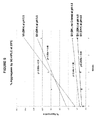
- V/I(DK+) having a protein concentration of 3 mg/mL would be preferred over a concentration of 5 mg/mL in order to minimize aggregation and to ensure sufficient stability for one year.
- V/I(DK+) protein was formulated in 10 mM sodium acetate, 150 mM sodium chloride, pH 5.5, at 5 mg/mL protein concentration.
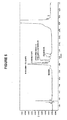
- LC-MS was performed according to the RP-HPLC method described in Example 3 followed by coupling to a Thermo LTQ ion trap mass spectrometer (MS). The HPLC eluent was split 1:5 with 0.2 mL/min flow diverted into the MS. On-line detection at 280 nm was maintained.
- VEGFR-IGFR VEGFR-IGFR
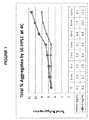
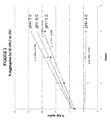
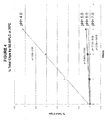
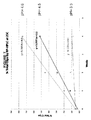
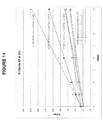
- the stability of two VEGFR-IGFR (VI) fibronectin based scaffold proteins has been compared.
- the first construct is VI(DK+) (SEQ ID NO: 56), and the second construct VI(DK-) (SEQ ID NO: 57) contains substitution of aspartic acid with glutamic acid at positions 94 and 199 of SEQ ID NO: 56.
- Both molecules were formulated at 3 mg/mL protein concentration, in 10 mM succinic acid, 5% sorbitol, at pH 4.0, 4.5 and 5.5. Limited stability of these formulations was performed at 4 and 25°C for up to two months, with periodic time points pulled for analysis by SE-HPLC and RP-HPLC. In addition, LC-MS characterization was performed on the 2-month 25°C samples in order to determine the exact clipped sites in both proteins.
Landscapes
- Health & Medical Sciences (AREA)
- Chemical & Material Sciences (AREA)
- Organic Chemistry (AREA)
- Life Sciences & Earth Sciences (AREA)
- Genetics & Genomics (AREA)
- General Health & Medical Sciences (AREA)
- Medicinal Chemistry (AREA)
- Molecular Biology (AREA)
- Biochemistry (AREA)
- Biophysics (AREA)
- Zoology (AREA)
- Proteomics, Peptides & Aminoacids (AREA)
- Engineering & Computer Science (AREA)
- Toxicology (AREA)
- Gastroenterology & Hepatology (AREA)
- Biotechnology (AREA)
- Biomedical Technology (AREA)
- Wood Science & Technology (AREA)
- Bioinformatics & Cheminformatics (AREA)
- General Engineering & Computer Science (AREA)
- Animal Behavior & Ethology (AREA)
- Veterinary Medicine (AREA)
- Pharmacology & Pharmacy (AREA)
- Nuclear Medicine, Radiotherapy & Molecular Imaging (AREA)
- General Chemical & Material Sciences (AREA)
- Public Health (AREA)
- Chemical Kinetics & Catalysis (AREA)
- Immunology (AREA)
- Plant Pathology (AREA)
- Physics & Mathematics (AREA)
- Microbiology (AREA)
- Hematology (AREA)
- Oncology (AREA)
- Peptides Or Proteins (AREA)
- Medicines That Contain Protein Lipid Enzymes And Other Medicines (AREA)
- Micro-Organisms Or Cultivation Processes Thereof (AREA)
- Medicinal Preparation (AREA)
Priority Applications (1)
| Application Number | Priority Date | Filing Date | Title |
|---|---|---|---|
| EP16160250.3A EP3091028A1 (en) | 2010-05-26 | 2011-05-26 | Fibronectin based scaffold proteins having improved stability |
Applications Claiming Priority (3)
| Application Number | Priority Date | Filing Date | Title |
|---|---|---|---|
| US34864710P | 2010-05-26 | 2010-05-26 | |
| US34866310P | 2010-05-26 | 2010-05-26 | |
| PCT/US2011/038013 WO2011150133A2 (en) | 2010-05-26 | 2011-05-26 | Fibronectin based scaffold proteins having improved stability |
Related Child Applications (1)
| Application Number | Title | Priority Date | Filing Date |
|---|---|---|---|
| EP16160250.3A Division EP3091028A1 (en) | 2010-05-26 | 2011-05-26 | Fibronectin based scaffold proteins having improved stability |
Publications (2)
| Publication Number | Publication Date |
|---|---|
| EP2576615A2 EP2576615A2 (en) | 2013-04-10 |
| EP2576615B1 true EP2576615B1 (en) | 2016-03-30 |
Family
ID=44583357
Family Applications (2)
| Application Number | Title | Priority Date | Filing Date |
|---|---|---|---|
| EP11731571.3A Not-in-force EP2576615B1 (en) | 2010-05-26 | 2011-05-26 | Fibronectin based scaffold proteins having improved stability |
| EP16160250.3A Withdrawn EP3091028A1 (en) | 2010-05-26 | 2011-05-26 | Fibronectin based scaffold proteins having improved stability |
Family Applications After (1)
| Application Number | Title | Priority Date | Filing Date |
|---|---|---|---|
| EP16160250.3A Withdrawn EP3091028A1 (en) | 2010-05-26 | 2011-05-26 | Fibronectin based scaffold proteins having improved stability |
Country Status (6)
| Country | Link |
|---|---|
| US (4) | US9562089B2 (enExample) |
| EP (2) | EP2576615B1 (enExample) |
| JP (2) | JP6023703B2 (enExample) |
| CN (1) | CN103180339B (enExample) |
| ES (1) | ES2573108T3 (enExample) |
| WO (1) | WO2011150133A2 (enExample) |
Families Citing this family (42)
| Publication number | Priority date | Publication date | Assignee | Title |
|---|---|---|---|---|
| WO2005056764A2 (en) | 2003-12-05 | 2005-06-23 | Compound Therapeutics, Inc. | Inhibitors of type 2 vascular endothelial growth factor receptors |
| JP5537946B2 (ja) | 2006-11-22 | 2014-07-02 | ブリストル−マイヤーズ スクイブ カンパニー | Igf−irを含むチロシンキナーゼ受容体に対する改変タンパク質に基づく標的治療薬 |
| JP2011517314A (ja) | 2008-02-14 | 2011-06-02 | ブリストル−マイヤーズ スクイブ カンパニー | Egfrに結合する操作されたタンパク質に基づく標的化された治療薬 |
| PE20091931A1 (es) | 2008-05-22 | 2009-12-31 | Bristol Myers Squibb Co | Proteinas de dominio de armazon basadas en fibronectina multivalentes |
| TWI496582B (zh) * | 2008-11-24 | 2015-08-21 | 必治妥美雅史谷比公司 | 雙重專一性之egfr/igfir結合分子 |
| TW201138808A (en) | 2010-05-03 | 2011-11-16 | Bristol Myers Squibb Co | Serum albumin binding molecules |
| US9562089B2 (en) | 2010-05-26 | 2017-02-07 | Bristol-Myers Squibb Company | Fibronectin based scaffold proteins having improved stability |
| ES2608835T3 (es) | 2011-04-13 | 2017-04-17 | Bristol-Myers Squibb Company | Proteínas de fusión Fc que comprenden nuevos enlazadores o disposiciones |
| US9347058B2 (en) | 2011-05-17 | 2016-05-24 | Bristol-Myers Squibb Company | Methods for the selection of binding proteins |
| US20140187488A1 (en) | 2011-05-17 | 2014-07-03 | Bristol-Myers Squibb Company | Methods for maintaining pegylation of polypeptides |
| JP2015504038A (ja) | 2011-10-31 | 2015-02-05 | ブリストル−マイヤーズ スクイブ カンパニーBristol−Myers Squibb Company | 低減した免疫原性を有するフィブロネクチン結合ドメイン |
| HUE043482T2 (hu) | 2012-09-13 | 2019-08-28 | Bristol Myers Squibb Co | Miosztatint megkötõ fibronektin alapú váz domén proteinek |
| WO2014120891A2 (en) | 2013-02-01 | 2014-08-07 | Bristol-Myers Squibb Company | Fibronectin based scaffold proteins |
| EP2953968B1 (en) | 2013-02-06 | 2018-07-25 | Bristol-Myers Squibb Company | Fibronectin type iii domain proteins with enhanced solubility |
| ES2751735T3 (es) | 2013-02-12 | 2020-04-01 | Bristol Myers Squibb Co | Métodos de replegado de proteínas a elevado pH |
| EP2956468B1 (en) * | 2013-02-12 | 2020-06-10 | Bristol-Myers Squibb Company | Tangential flow filtration based protein refolding methods |
| KR20160067966A (ko) | 2013-10-14 | 2016-06-14 | 얀센 바이오테크 인코포레이티드 | 시스테인 조작된 피브로넥틴 iii형 도메인 결합 분자 |
| EP3129401B1 (en) | 2014-03-20 | 2019-06-12 | Bristol-Myers Squibb Company | Serum albumin-binding fibronectin type iii domains |
| SG11201607818WA (en) * | 2014-03-20 | 2016-10-28 | Bristol Myers Squibb Co | Stabilized fibronectin based scaffold molecules |
| US10183055B2 (en) | 2014-07-21 | 2019-01-22 | Arizona Board Of Regents On Behalf Of The University Of Arizona | Ang-(1-7) derivative oligopeptides for the treatment of pain and other indications |
| EP3171886A4 (en) * | 2014-07-21 | 2018-01-24 | The Arizona Board of Regents On Behalf of the University of Arizona | Ang-(1-7) derviative oligopeptides and methods for using and producing the same |
| US11229713B2 (en) | 2014-11-25 | 2022-01-25 | Bristol-Myers Squibb Company | Methods and compositions for 18F-radiolabeling of biologics |
| WO2016086021A1 (en) | 2014-11-25 | 2016-06-02 | Bristol-Myers Squibb Company | Novel pd-l1 binding polypeptides for imaging |
| US20190316116A1 (en) * | 2014-12-15 | 2019-10-17 | Monash University | Highly stable polypeptide scaffolds |
| CN105753945B (zh) * | 2014-12-15 | 2019-04-09 | 清华大学无锡应用技术研究院 | 一种连接肽及其应用 |
| CN104894091B (zh) * | 2015-06-19 | 2018-08-21 | 北京理工大学 | 一种人工设计糖基修饰提高酶热稳定性的方法 |
| ES2781207T3 (es) | 2015-09-23 | 2020-08-31 | Bristol Myers Squibb Co | Dominios de fibronectina de tipo iii de unión a seroalbúmina con velocidad de disociación rápida |
| US10994033B2 (en) | 2016-06-01 | 2021-05-04 | Bristol-Myers Squibb Company | Imaging methods using 18F-radiolabeled biologics |
| EP3463486A1 (en) | 2016-06-01 | 2019-04-10 | Bristol-Myers Squibb Company | Pet imaging with pd-l1 binding polypeptides |
| WO2017210425A1 (en) * | 2016-06-03 | 2017-12-07 | Janssen Biotech, Inc. | Serum albumin-binding fibronectin type iii domains |
| AU2017281083B2 (en) | 2016-06-21 | 2022-01-27 | Janssen Biotech, Inc. | Cysteine engineered fibronectin type III domain binding molecules |
| EP3554561B1 (en) | 2016-12-14 | 2023-06-28 | Janssen Biotech, Inc. | Cd137 binding fibronectin type iii domains |
| BR112019012154A2 (pt) | 2016-12-14 | 2019-11-12 | Janssen Biotech, Inc. | domínios do tipo iii da fibronectina de ligação a cd8a |
| EP3554535A4 (en) | 2016-12-14 | 2020-10-21 | Janssen Biotech, Inc. | PD-L1 BINDING FIBRONECTIN TYPE III DOMAINS |
| TWI897843B (zh) * | 2017-05-03 | 2025-09-21 | 美商必治妥美雅史谷比公司 | 結合至肌肉生長抑制素以纖維連接蛋白為主之支架結構域蛋白質的穩定調配物 |
| US11781138B2 (en) | 2019-10-14 | 2023-10-10 | Aro Biotherapeutics Company | FN3 domain-siRNA conjugates and uses thereof |
| US12491255B2 (en) | 2019-10-14 | 2025-12-09 | Aro Biotherapeutics Company | EPCAM binding fibronectin type III domains |
| WO2021076546A1 (en) | 2019-10-14 | 2021-04-22 | Aro Biotherapeutics Company | Cd71 binding fibronectin type iii domains |
| CA3161723A1 (en) | 2019-12-18 | 2021-06-24 | Karyn O'neil | Serum albumin-binding fibronectin type iii domains and uses thereof |
| US12239710B2 (en) | 2021-04-14 | 2025-03-04 | Aro Biotherapeutics Company | FN3 domain-siRNA conjugates and uses thereof |
| IL307582A (en) | 2021-04-14 | 2023-12-01 | Aro Biotherapeutics Company | CD71-binding domains of the fibronectin type |
| CN120225552A (zh) * | 2022-11-04 | 2025-06-27 | 庄伟哲 | 纤维黏蛋白第iii型结构域衍生的蛋白质及其应用 |
Citations (1)
| Publication number | Priority date | Publication date | Assignee | Title |
|---|---|---|---|---|
| WO2011130354A1 (en) * | 2010-04-13 | 2011-10-20 | Bristol-Myers Squibb Company | Fibronectin based scaffold domain proteins that bind pcsk9 |
Family Cites Families (160)
| Publication number | Priority date | Publication date | Assignee | Title |
|---|---|---|---|---|
| US3773919A (en) | 1969-10-23 | 1973-11-20 | Du Pont | Polylactide-drug mixtures |
| US4179337A (en) | 1973-07-20 | 1979-12-18 | Davis Frank F | Non-immunogenic polypeptides |
| US4002531A (en) | 1976-01-22 | 1977-01-11 | Pierce Chemical Company | Modifying enzymes with polyethylene glycol and product produced thereby |
| USRE30985E (en) | 1978-01-01 | 1982-06-29 | Serum-free cell culture media | |
| JPS6023084B2 (ja) | 1979-07-11 | 1985-06-05 | 味の素株式会社 | 代用血液 |
| US4419446A (en) | 1980-12-31 | 1983-12-06 | The United States Of America As Represented By The Department Of Health And Human Services | Recombinant DNA process utilizing a papilloma virus DNA as a vector |
| NZ201705A (en) | 1981-08-31 | 1986-03-14 | Genentech Inc | Recombinant dna method for production of hepatitis b surface antigen in yeast |
| US4640835A (en) | 1981-10-30 | 1987-02-03 | Nippon Chemiphar Company, Ltd. | Plasminogen activator derivatives |
| US4601978A (en) | 1982-11-24 | 1986-07-22 | The Regents Of The University Of California | Mammalian metallothionein promoter system |
| US4560655A (en) | 1982-12-16 | 1985-12-24 | Immunex Corporation | Serum-free cell culture medium and process for making same |
| US4657866A (en) | 1982-12-21 | 1987-04-14 | Sudhir Kumar | Serum-free, synthetic, completely chemically defined tissue culture media |
| US4767704A (en) | 1983-10-07 | 1988-08-30 | Columbia University In The City Of New York | Protein-free culture medium |
| US4496689A (en) | 1983-12-27 | 1985-01-29 | Miles Laboratories, Inc. | Covalently attached complex of alpha-1-proteinase inhibitor with a water soluble polymer |
| DE3675588D1 (de) | 1985-06-19 | 1990-12-20 | Ajinomoto Kk | Haemoglobin, das an ein poly(alkenylenoxid) gebunden ist. |
| GB8516415D0 (en) | 1985-06-28 | 1985-07-31 | Celltech Ltd | Culture of animal cells |
| US4927762A (en) | 1986-04-01 | 1990-05-22 | Cell Enterprises, Inc. | Cell culture medium with antioxidant |
| US4791192A (en) | 1986-06-26 | 1988-12-13 | Takeda Chemical Industries, Ltd. | Chemically modified protein with polyethyleneglycol |
| US5514581A (en) | 1986-11-04 | 1996-05-07 | Protein Polymer Technologies, Inc. | Functional recombinantly prepared synthetic protein polymer |
| US6018030A (en) | 1986-11-04 | 2000-01-25 | Protein Polymer Technologies, Inc. | Peptides comprising repetitive units of amino acids and DNA sequences encoding the same |
| US5770697A (en) | 1986-11-04 | 1998-06-23 | Protein Polymer Technologies, Inc. | Peptides comprising repetitive units of amino acids and DNA sequences encoding the same |
| US5641648A (en) | 1986-11-04 | 1997-06-24 | Protein Polymer Technologies, Inc. | Methods for preparing synthetic repetitive DNA |
| US4863457A (en) | 1986-11-24 | 1989-09-05 | Lee David A | Drug delivery device |
| US4997652A (en) | 1987-12-22 | 1991-03-05 | Visionex | Biodegradable ocular implants |
| DE68925971T2 (de) | 1988-09-23 | 1996-09-05 | Cetus Oncology Corp | Zellenzuchtmedium für erhöhtes zellenwachstum, zur erhöhung der langlebigkeit und expression der produkte |
| FR2646437B1 (fr) | 1989-04-28 | 1991-08-30 | Transgene Sa | Nouvelles sequences d'adn, leur application en tant que sequence codant pour un peptide signal pour la secretion de proteines matures par des levures recombinantes, cassettes d'expression, levures transformees et procede de preparation de proteines correspondant |
| US5164188A (en) | 1989-11-22 | 1992-11-17 | Visionex, Inc. | Biodegradable ocular implants |
| US5766897A (en) | 1990-06-21 | 1998-06-16 | Incyte Pharmaceuticals, Inc. | Cysteine-pegylated proteins |
| WO1992002536A1 (en) | 1990-08-02 | 1992-02-20 | The Regents Of The University Of Colorado | Systematic polypeptide evolution by reverse translation |
| JP3051145B2 (ja) | 1990-08-28 | 2000-06-12 | 住友製薬株式会社 | 新規なポリエチレングリコール誘導体修飾ペプチド |
| US5122469A (en) | 1990-10-03 | 1992-06-16 | Genentech, Inc. | Method for culturing Chinese hamster ovary cells to improve production of recombinant proteins |
| KR0185215B1 (ko) | 1990-11-30 | 1999-05-01 | 요시다 쇼오지 | 서방성 안구삽입용 약제 |
| US5773574A (en) | 1990-12-03 | 1998-06-30 | The Scripps Research Institute | Polypeptides for promoting cell attachment |
| US5235041A (en) | 1990-12-28 | 1993-08-10 | Protein Polymer Technologies, Inc. | Purification of structurally ordered recombinant protein polymers |
| JPH04108827U (ja) | 1991-03-04 | 1992-09-21 | カシオ計算機株式会社 | 電子機器におけるスライドスイツチ構造 |
| US5792742A (en) | 1991-06-14 | 1998-08-11 | New York University | Fibrin-binding peptide fragments of fibronectin |
| US5281698A (en) | 1991-07-23 | 1994-01-25 | Cetus Oncology Corporation | Preparation of an activated polymer ester for protein conjugation |
| AU2313392A (en) | 1991-08-01 | 1993-03-02 | University Research Corporation | Systematic polypeptide evolution by reverse translation |
| DE69332377T2 (de) | 1992-07-13 | 2003-07-03 | Bionebraska, Inc. | Verfahren zur modifizierung rekombinanter polypeptide |
| US5382657A (en) | 1992-08-26 | 1995-01-17 | Hoffmann-La Roche Inc. | Peg-interferon conjugates |
| DE69303494T2 (de) | 1992-11-13 | 1997-01-16 | Idec Pharma Corp | Therapeutische verwendung von chimerischen und markierten antikörper gegen menschlichen b lymphozyt beschränkter differenzierung antigen für die behandlung von b-zell-lymphoma |
| WO1994017097A1 (en) | 1993-01-19 | 1994-08-04 | Regents Of The University Of Minnesota | Synthetic fibronectin fragments as inhibitors of retroviral infections |
| EP0654256B1 (en) | 1993-02-26 | 2000-08-02 | Santen Pharmaceutical Co., Ltd. | Biodegradable sclera plug |
| WO1995011922A1 (en) | 1993-10-29 | 1995-05-04 | Affymax Technologies N.V. | In vitro peptide and antibody display libraries |
| US5446090A (en) | 1993-11-12 | 1995-08-29 | Shearwater Polymers, Inc. | Isolatable, water soluble, and hydrolytically stable active sulfones of poly(ethylene glycol) and related polymers for modification of surfaces and molecules |
| US5443505A (en) | 1993-11-15 | 1995-08-22 | Oculex Pharmaceuticals, Inc. | Biocompatible ocular implants |
| US5516522A (en) | 1994-03-14 | 1996-05-14 | Board Of Supervisors Of Louisiana State University | Biodegradable porous device for long-term drug delivery with constant rate release and method of making the same |
| US5824784A (en) | 1994-10-12 | 1998-10-20 | Amgen Inc. | N-terminally chemically modified protein compositions and methods |
| US5932462A (en) | 1995-01-10 | 1999-08-03 | Shearwater Polymers, Inc. | Multiarmed, monofunctional, polymer for coupling to molecules and surfaces |
| US5559000A (en) | 1995-01-18 | 1996-09-24 | The Scripps Research Institute | Encoded reaction cassette |
| US6369116B1 (en) | 1995-06-02 | 2002-04-09 | Oculex Pharmaceuticals, Inc. | Composition and method for treating glaucoma |
| US5869079A (en) | 1995-06-02 | 1999-02-09 | Oculex Pharmaceuticals, Inc. | Formulation for controlled release of drugs by combining hydrophilic and hydrophobic agents |
| DE19646372C1 (de) | 1995-11-11 | 1997-06-19 | Evotec Biosystems Gmbh | Genotyp und Phänotyp koppelnde Verbindung |
| JP3556050B2 (ja) | 1996-06-24 | 2004-08-18 | 株式会社大井製作所 | ドアクロージャ |
| GB9618960D0 (en) | 1996-09-11 | 1996-10-23 | Medical Science Sys Inc | Proteases |
| US5922676A (en) | 1996-09-20 | 1999-07-13 | The Burnham Institute | Methods of inhibiting cancer by using superfibronectin |
| EP0962527B1 (en) | 1996-10-17 | 2004-08-04 | Mitsubishi Chemical Corporation | Molecule that homologizes genotype and phenotype and utilization thereof |
| WO1998031794A1 (fr) | 1997-01-17 | 1998-07-23 | Toa Gosei Co., Ltd. | Polypeptide liant le facteur vegf |
| US6261804B1 (en) | 1997-01-21 | 2001-07-17 | The General Hospital Corporation | Selection of proteins using RNA-protein fusions |
| DK0971946T3 (da) | 1997-01-21 | 2006-10-30 | Gen Hospital Corp | Selektion af proteiner ved anvendelse af RNA-protein-fusioner |
| AU7266698A (en) | 1997-04-30 | 1998-11-24 | Enzon, Inc. | Polyalkylene oxide-modified single chain polypeptides |
| JP3614866B2 (ja) | 1997-06-12 | 2005-01-26 | リサーチ コーポレイション テクノロジーズ,インコーポレイティド | 人工抗体ポリペプチド |
| US6159722A (en) | 1997-12-03 | 2000-12-12 | Boehringer Mannheim Gmbh | Chimeric serine proteases |
| EP1068356B8 (en) | 1998-04-03 | 2007-01-03 | Adnexus Therapeutics, Inc. | Addressable protein arrays |
| US20030045681A1 (en) | 1998-05-11 | 2003-03-06 | Anthony J. Zelano | Specific binding molecules for scintigraphy, conjugates containing them and therapeutic method for treatment of angiogenesis |
| US6818418B1 (en) | 1998-12-10 | 2004-11-16 | Compound Therapeutics, Inc. | Protein scaffolds for antibody mimics and other binding proteins |
| EP1137941B2 (en) | 1998-12-10 | 2013-09-11 | Bristol-Myers Squibb Company | Protein scaffolds for antibody mimics and other binding proteins |
| US7115396B2 (en) | 1998-12-10 | 2006-10-03 | Compound Therapeutics, Inc. | Protein scaffolds for antibody mimics and other binding proteins |
| GB9827228D0 (en) | 1998-12-10 | 1999-02-03 | Univ Nottingham | Cancer detection method and reagents |
| IL145941A (en) | 1999-04-28 | 2007-08-19 | Univ Texas | Compositions and methods for cancer treatment by selectively inhibiting vegf |
| IL147037A0 (en) | 1999-07-27 | 2002-08-14 | Phylos Inc | Peptide acceptor ligation methods |
| AU4445601A (en) | 2000-03-31 | 2001-10-08 | Centre National De La Recherche Scientifique-Cnrs | Peptides blocking vascular endothelial growth factor (vegf)-mediated angiogenesis, polynucleotides encoding said peptides and methods of use thereof |
| JP2004515219A (ja) | 2000-06-15 | 2004-05-27 | ボード・オブ・リージェンツ,ザ・ユニヴァーシティ・オヴ・テキサス・システム | 調節可能な触媒活性な核酸 |
| ES2564161T3 (es) | 2000-07-11 | 2016-03-18 | Research Corporation Technologies, Inc | Polipéptidos de anticuerpos artificiales |
| ATE516820T1 (de) | 2000-09-29 | 2011-08-15 | Schering Corp | Pegyliertes interleukin 10 |
| EP2141243A3 (en) | 2000-10-16 | 2010-01-27 | Brystol-Myers Squibb Company | Protein scaffolds for antibody mimics and other binding proteins |
| US7598352B2 (en) | 2000-11-17 | 2009-10-06 | University Of Rochester | Method of identifying polypeptide monobodies which bind to target proteins and use thereof |
| AU2002236495B2 (en) | 2000-11-29 | 2006-05-11 | Allergan, Inc. | Intraocular implants for preventing transplant rejection in the eye |
| US6509027B2 (en) | 2001-02-12 | 2003-01-21 | Supergen, Inc. | Injectable pharmaceutical composition comprising coated particles of camptothecin |
| AU2002307146B2 (en) | 2001-04-04 | 2007-02-01 | University Of Rochester | AlphaNuBeta3 integrin-binding polypeptide monobodies and their use |
| JP4369662B2 (ja) | 2001-04-26 | 2009-11-25 | アビディア インコーポレイテッド | 単量体ドメインのコンビナトリアルライブラリー |
| WO2003022858A2 (de) | 2001-09-11 | 2003-03-20 | Nascacell Gmbh | Verfahren zum screenen von inhibitoren für die protein-protein-wechselwirkung sowie ribozyme hierzu |
| US20080193445A1 (en) | 2002-01-18 | 2008-08-14 | Liliane Goetsch | Novel anti-IGF-IR antibodies and uses thereof |
| ATE397440T1 (de) | 2002-02-22 | 2008-06-15 | Schering Corp | Pharmazeutische zubereitungen von antineoplastischen wirkstoffen, insbesondere temozolomid, verfahren zu ihrer herstellung und deren verwendung |
| US7498414B2 (en) | 2002-03-04 | 2009-03-03 | Imclone Systems Incorporated | Human antibodies specific to KDR and uses thereof |
| WO2003104418A2 (en) | 2002-06-06 | 2003-12-18 | Research Corporation Technologies, Inc. | Reconstituted polypeptides |
| EP2284192A3 (en) | 2002-11-08 | 2011-07-20 | Ablynx N.V. | Camelidae antibodies for sublingual administration |
| CA2524305C (en) | 2003-05-01 | 2015-12-08 | Imclone Systems Incorporated | Fully human antibodies directed against the human insulin-like growth factor-1 receptor |
| US7053701B2 (en) | 2003-11-04 | 2006-05-30 | Vice Michael W | Power amplifier output stage with multiple power states and improved efficiency |
| JP5261638B2 (ja) | 2003-11-17 | 2013-08-14 | テレズィゴロジー インク. | 締付具 |
| WO2005056764A2 (en) | 2003-12-05 | 2005-06-23 | Compound Therapeutics, Inc. | Inhibitors of type 2 vascular endothelial growth factor receptors |
| US20080220049A1 (en) | 2003-12-05 | 2008-09-11 | Adnexus, A Bristol-Myers Squibb R&D Company | Compositions and methods for intraocular delivery of fibronectin scaffold domain proteins |
| JP5010923B2 (ja) | 2004-02-09 | 2012-08-29 | ヒューマン ジノーム サイエンシーズ, インコーポレイテッド | アルブミン融合蛋白質 |
| US20060182783A1 (en) | 2004-04-30 | 2006-08-17 | Allergan, Inc. | Sustained release intraocular drug delivery systems |
| US20070059336A1 (en) | 2004-04-30 | 2007-03-15 | Allergan, Inc. | Anti-angiogenic sustained release intraocular implants and related methods |
| US20050244469A1 (en) | 2004-04-30 | 2005-11-03 | Allergan, Inc. | Extended therapeutic effect ocular implant treatments |
| US20050244472A1 (en) | 2004-04-30 | 2005-11-03 | Allergan, Inc. | Intraocular drug delivery systems containing excipients with reduced toxicity and related methods |
| WO2006020258A2 (en) | 2004-07-17 | 2006-02-23 | Imclone Systems Incorporated | Novel tetravalent bispecific antibody |
| US7597884B2 (en) | 2004-08-09 | 2009-10-06 | Alios Biopharma, Inc. | Hyperglycosylated polypeptide variants and methods of use |
| WO2006041942A2 (en) | 2004-10-04 | 2006-04-20 | Qlt Usa, Inc. | Ocular delivery of polymeric delivery formulations |
| EP1838307A1 (en) | 2004-12-02 | 2007-10-03 | Schering Corporation | Methods of using temozolomide formulation intrathecally in the treatment of cancers |
| JP2008531557A (ja) | 2005-02-23 | 2008-08-14 | メリマック ファーマシューティカルズ インコーポレーティッド | 生物活性を調節するための二重特異性結合剤 |
| FR2888850B1 (fr) | 2005-07-22 | 2013-01-11 | Pf Medicament | Nouveaux anticorps anti-igf-ir et leurs applications |
| US7612181B2 (en) | 2005-08-19 | 2009-11-03 | Abbott Laboratories | Dual variable domain immunoglobulin and uses thereof |
| US20070072933A1 (en) | 2005-09-26 | 2007-03-29 | Peyman Gholam A | Delivery of an ocular agent |
| BRPI0616883A2 (pt) | 2005-10-07 | 2011-07-05 | Univ California | ácidos nucléicos que codificam enzima modificada de citocromo p450 e métodos de uso dos mesmos |
| WO2007047607A2 (en) | 2005-10-18 | 2007-04-26 | Allergan, Inc. | Ocular therapy using glucocorticoid derivatives selectively penetrating posterior segment tissues |
| US20070099879A1 (en) | 2005-10-31 | 2007-05-03 | Wisconsin Alumni Research Foundation (Warf) | Method of using calcitriol for treating intraocular diseases associated with angiogenesis |
| EP1945767B1 (de) | 2005-11-09 | 2010-04-07 | MorphoSys AG | Identifizierung und charakterisierung von funktionsblockierenden anti-ed-b-fibronektin antikörpern |
| EP2781222B1 (en) | 2005-11-23 | 2017-08-02 | Acceleron Pharma, Inc. | Activin-actriia antagonists in use for promoting bone growth |
| US7964191B2 (en) | 2006-02-02 | 2011-06-21 | Allergan, Inc. | Compositions and methods for the treatment of ophthalmic disease |
| EP1996227A2 (en) | 2006-02-24 | 2008-12-03 | CHIESI FARMACEUTICI S.p.A. | Anti-amyloid immunogenic compositions, methods and uses |
| CN101426810A (zh) | 2006-04-21 | 2009-05-06 | 特朗斯吉恩股份有限公司 | 基于hpv-18的乳头瘤病毒疫苗 |
| US20070269422A1 (en) | 2006-05-17 | 2007-11-22 | Ablynx N.V. | Serum albumin binding proteins with long half-lives |
| JP5638804B2 (ja) | 2006-08-04 | 2014-12-10 | アストラゼネカ アクチボラグ | ErbB2に対する抗体 |
| US7882645B2 (en) | 2006-08-07 | 2011-02-08 | Boring Colette R | System and method for making an applique |
| WO2008031098A1 (en) | 2006-09-09 | 2008-03-13 | The University Of Chicago | Binary amino acid libraries for fibronectin type iii polypeptide monobodies |
| US20110143953A1 (en) | 2006-10-16 | 2011-06-16 | Arizona Board Of Regents, A Body Corporate Of The State Of Arizona | Synthetic Antibodies |
| JP5537946B2 (ja) | 2006-11-22 | 2014-07-02 | ブリストル−マイヤーズ スクイブ カンパニー | Igf−irを含むチロシンキナーゼ受容体に対する改変タンパク質に基づく標的治療薬 |
| US8476243B2 (en) * | 2006-12-29 | 2013-07-02 | Transderm, Inc. | Methods and compositions for treating keratin hyperproliferative disorders |
| US20100144599A1 (en) | 2007-02-02 | 2010-06-10 | Bristol-Myers Squibb Company | Vegf pathway blockade |
| AU2008223541B2 (en) | 2007-03-02 | 2012-04-05 | Amgen Inc. | Methods and compositions for treating tumor diseases |
| US11078262B2 (en) | 2007-04-30 | 2021-08-03 | Allergan, Inc. | High viscosity macromolecular compositions for treating ocular conditions |
| EP2738257A1 (en) * | 2007-05-22 | 2014-06-04 | Amgen Inc. | Compositions and methods for producing bioactive fusion proteins |
| AU2008287426B2 (en) | 2007-08-10 | 2014-06-26 | Protelica, Inc. | Universal fibronectin type III binding-domain libraries |
| US8470966B2 (en) | 2007-08-10 | 2013-06-25 | Protelica, Inc. | Universal fibronectin type III binding-domain libraries |
| US8680019B2 (en) | 2007-08-10 | 2014-03-25 | Protelica, Inc. | Universal fibronectin Type III binding-domain libraries |
| US20100285000A1 (en) | 2007-08-20 | 2010-11-11 | Bristol-Myers Squibb Company | Use of vegfr-2 inhibitors for treating metastatic cancer |
| WO2009046407A2 (en) | 2007-10-04 | 2009-04-09 | Zymogenetics, Inc. | B7 FAMILY MEMBER zB7H6 AND RELATED COMPOSITIONS AND METHODS |
| RU2010121967A (ru) | 2007-10-31 | 2011-12-10 | Медиммун, Ллк (Us) | Белковые каркасные структуры |
| EP2217274A1 (en) | 2007-11-28 | 2010-08-18 | Bristol-Myers Squibb Company | Combination vegfr2 therapy with mtor inhibitors |
| EP2238247A2 (en) | 2007-12-19 | 2010-10-13 | Centocor Ortho Biotech Inc. | Alternative scaffold protein fusions phage display via fusion to plx of m13 phage |
| WO2009083804A2 (en) | 2007-12-27 | 2009-07-09 | Novartis Ag | Improved fibronectin-based binding molecules and their use |
| JP2011517314A (ja) | 2008-02-14 | 2011-06-02 | ブリストル−マイヤーズ スクイブ カンパニー | Egfrに結合する操作されたタンパク質に基づく標的化された治療薬 |
| US9296810B2 (en) | 2008-05-02 | 2016-03-29 | Novartis Ag | Fibronectin-based binding molecules and uses thereof |
| PE20091931A1 (es) | 2008-05-22 | 2009-12-31 | Bristol Myers Squibb Co | Proteinas de dominio de armazon basadas en fibronectina multivalentes |
| US8415291B2 (en) | 2008-10-31 | 2013-04-09 | Centocor Ortho Biotech Inc. | Anti-TNF alpha fibronectin type III domain based scaffold compositions, methods and uses |
| BRPI0919881B1 (pt) | 2008-10-31 | 2021-09-08 | Centocor Ortho Biotech Inc | Proteína de arcabouço e seu método de geração, biblioteca e seu método de construção, molécula de ácido nucleico, vetor de ácido nucleico, célula hospedeira, composição, dispositivo médico e artigo de fabricação |
| TWI496582B (zh) * | 2008-11-24 | 2015-08-21 | 必治妥美雅史谷比公司 | 雙重專一性之egfr/igfir結合分子 |
| CN102245771B (zh) | 2008-12-16 | 2013-04-10 | 诺瓦提斯公司 | 酵母展示系统 |
| EP2396000A1 (en) | 2009-02-11 | 2011-12-21 | Bristol-Myers Squibb Company | Combination vegfr2 therapy with temozolomide |
| WO2010093627A2 (en) | 2009-02-12 | 2010-08-19 | Centocor Ortho Biotech Inc. | Fibronectin type iii domain based scaffold compositions, methods and uses |
| US8067201B2 (en) | 2009-04-17 | 2011-11-29 | Bristol-Myers Squibb Company | Methods for protein refolding |
| US20120270797A1 (en) | 2009-08-13 | 2012-10-25 | Massachusetts Institute Of Technology | Engineered proteins including mutant fibronectin domains |
| ES2860453T3 (es) | 2009-10-30 | 2021-10-05 | Novartis Ag | Bibliotecas universales del dominio de unión del lado inferior de la fibronectina de tipo III |
| WO2011051466A1 (en) | 2009-11-02 | 2011-05-05 | Novartis Ag | Anti-idiotypic fibronectin-based binding molecules and uses thereof |
| US20110123545A1 (en) | 2009-11-24 | 2011-05-26 | Bristol-Myers Squibb Company | Combination of vegfr2 and igf1r inhibitors for the treatment of proliferative diseases |
| WO2011092233A1 (en) | 2010-01-29 | 2011-08-04 | Novartis Ag | Yeast mating to produce high-affinity combinations of fibronectin-based binders |
| US8961977B2 (en) | 2010-02-12 | 2015-02-24 | University Of Rochester | Antigenic mimics of discontinuous epitopes of pathogen recognized by broadly neutralizing antibodies |
| KR20130010461A (ko) | 2010-02-18 | 2013-01-28 | 브리스톨-마이어스 스큅 컴퍼니 | Il―23에 결합하는 피브로넥틴 기반 스캐폴드 도메인 단백질 |
| CA2796010C (en) | 2010-04-13 | 2020-05-12 | Medimmune, Llc | Trail r2-specific multimeric scaffolds |
| JP5997134B2 (ja) | 2010-04-30 | 2016-09-28 | ヤンセン バイオテツク,インコーポレーテツド | 安定したフィブロネクチンドメイン組成物、方法及び用途 |
| TW201138808A (en) | 2010-05-03 | 2011-11-16 | Bristol Myers Squibb Co | Serum albumin binding molecules |
| US9562089B2 (en) | 2010-05-26 | 2017-02-07 | Bristol-Myers Squibb Company | Fibronectin based scaffold proteins having improved stability |
| MX345300B (es) | 2010-07-30 | 2017-01-24 | Novartis Ag * | Moléculas andamio de fibronectina y bibliotecas de las mismas. |
| WO2012088006A1 (en) | 2010-12-22 | 2012-06-28 | Bristol-Myers Squibb Company | Fibronectin based scaffold domain proteins that bind il-23 |
| ES2608835T3 (es) | 2011-04-13 | 2017-04-17 | Bristol-Myers Squibb Company | Proteínas de fusión Fc que comprenden nuevos enlazadores o disposiciones |
| US20140187488A1 (en) | 2011-05-17 | 2014-07-03 | Bristol-Myers Squibb Company | Methods for maintaining pegylation of polypeptides |
| US9347058B2 (en) | 2011-05-17 | 2016-05-24 | Bristol-Myers Squibb Company | Methods for the selection of binding proteins |
| BR112014007469B1 (pt) | 2011-09-27 | 2022-06-14 | Janssen Biotech, Inc | Método de fabricação de uma biblioteca de domínios de módulo de fibronectina tipo iii (fn3), biblioteca e método para obter um arcabouço de proteína |
| HUE043482T2 (hu) * | 2012-09-13 | 2019-08-28 | Bristol Myers Squibb Co | Miosztatint megkötõ fibronektin alapú váz domén proteinek |
-
2011
- 2011-05-26 US US13/699,458 patent/US9562089B2/en active Active
- 2011-05-26 CN CN201180036862.4A patent/CN103180339B/zh not_active Expired - Fee Related
- 2011-05-26 ES ES11731571.3T patent/ES2573108T3/es active Active
- 2011-05-26 JP JP2013512226A patent/JP6023703B2/ja not_active Expired - Fee Related
- 2011-05-26 EP EP11731571.3A patent/EP2576615B1/en not_active Not-in-force
- 2011-05-26 WO PCT/US2011/038013 patent/WO2011150133A2/en not_active Ceased
- 2011-05-26 EP EP16160250.3A patent/EP3091028A1/en not_active Withdrawn
-
2015
- 2015-10-27 JP JP2015210899A patent/JP2016052315A/ja active Pending
-
2016
- 2016-12-20 US US15/385,222 patent/US10273286B2/en active Active
-
2019
- 2019-03-11 US US16/298,493 patent/US11161893B2/en active Active
-
2021
- 2021-09-29 US US17/489,391 patent/US20220119495A1/en not_active Abandoned
Patent Citations (1)
| Publication number | Priority date | Publication date | Assignee | Title |
|---|---|---|---|---|
| WO2011130354A1 (en) * | 2010-04-13 | 2011-10-20 | Bristol-Myers Squibb Company | Fibronectin based scaffold domain proteins that bind pcsk9 |
Also Published As
| Publication number | Publication date |
|---|---|
| JP2016052315A (ja) | 2016-04-14 |
| US9562089B2 (en) | 2017-02-07 |
| US20190263892A1 (en) | 2019-08-29 |
| WO2011150133A3 (en) | 2012-03-08 |
| EP3091028A1 (en) | 2016-11-09 |
| EP2576615A2 (en) | 2013-04-10 |
| CN103180339A (zh) | 2013-06-26 |
| WO2011150133A2 (en) | 2011-12-01 |
| JP6023703B2 (ja) | 2016-11-09 |
| US10273286B2 (en) | 2019-04-30 |
| ES2573108T3 (es) | 2016-06-06 |
| US20170166627A1 (en) | 2017-06-15 |
| US20130184212A1 (en) | 2013-07-18 |
| JP2013534812A (ja) | 2013-09-09 |
| CN103180339B (zh) | 2016-04-27 |
| US11161893B2 (en) | 2021-11-02 |
| US20220119495A1 (en) | 2022-04-21 |
Similar Documents
| Publication | Publication Date | Title |
|---|---|---|
| US11161893B2 (en) | Fibronectin based scaffold proteins having improved stability | |
| US11408093B2 (en) | Fibronectin binding domains with reduced immunogenicity | |
| TWI508736B (zh) | 結合至il-23之以纖維連接蛋白為主之架構域蛋白質 | |
| US20230242617A1 (en) | Fibronectin based scaffold proteins | |
| US10898538B2 (en) | Methods for maintaining pegylation of polypeptides | |
| KR20160138133A (ko) | 안정화된 피브로넥틴 기반 스캐폴드 분자 |
Legal Events
| Date | Code | Title | Description |
|---|---|---|---|
| PUAI | Public reference made under article 153(3) epc to a published international application that has entered the european phase |
Free format text: ORIGINAL CODE: 0009012 |
|
| 17P | Request for examination filed |
Effective date: 20121119 |
|
| AK | Designated contracting states |
Kind code of ref document: A2 Designated state(s): AL AT BE BG CH CY CZ DE DK EE ES FI FR GB GR HR HU IE IS IT LI LT LU LV MC MK MT NL NO PL PT RO RS SE SI SK SM TR |
|
| DAX | Request for extension of the european patent (deleted) | ||
| 17Q | First examination report despatched |
Effective date: 20130916 |
|
| RAP1 | Party data changed (applicant data changed or rights of an application transferred) |
Owner name: BRISTOL-MYERS SQUIBB COMPANY |
|
| GRAP | Despatch of communication of intention to grant a patent |
Free format text: ORIGINAL CODE: EPIDOSNIGR1 |
|
| INTG | Intention to grant announced |
Effective date: 20150312 |
|
| GRAS | Grant fee paid |
Free format text: ORIGINAL CODE: EPIDOSNIGR3 |
|
| GRAA | (expected) grant |
Free format text: ORIGINAL CODE: 0009210 |
|
| AK | Designated contracting states |
Kind code of ref document: B1 Designated state(s): AL AT BE BG CH CY CZ DE DK EE ES FI FR GB GR HR HU IE IS IT LI LT LU LV MC MK MT NL NO PL PT RO RS SE SI SK SM TR |
|
| REG | Reference to a national code |
Ref country code: GB Ref legal event code: FG4D |
|
| REG | Reference to a national code |
Ref country code: CH Ref legal event code: EP |
|
| REG | Reference to a national code |
Ref country code: FR Ref legal event code: PLFP Year of fee payment: 6 |
|
| REG | Reference to a national code |
Ref country code: AT Ref legal event code: REF Ref document number: 785311 Country of ref document: AT Kind code of ref document: T Effective date: 20160415 |
|
| REG | Reference to a national code |
Ref country code: IE Ref legal event code: FG4D |
|
| REG | Reference to a national code |
Ref country code: DE Ref legal event code: R096 Ref document number: 602011024641 Country of ref document: DE |
|
| REG | Reference to a national code |
Ref country code: ES Ref legal event code: FG2A Ref document number: 2573108 Country of ref document: ES Kind code of ref document: T3 Effective date: 20160606 |
|
| REG | Reference to a national code |
Ref country code: LT Ref legal event code: MG4D |
|
| PG25 | Lapsed in a contracting state [announced via postgrant information from national office to epo] |
Ref country code: GR Free format text: LAPSE BECAUSE OF FAILURE TO SUBMIT A TRANSLATION OF THE DESCRIPTION OR TO PAY THE FEE WITHIN THE PRESCRIBED TIME-LIMIT Effective date: 20160701 Ref country code: HR Free format text: LAPSE BECAUSE OF FAILURE TO SUBMIT A TRANSLATION OF THE DESCRIPTION OR TO PAY THE FEE WITHIN THE PRESCRIBED TIME-LIMIT Effective date: 20160330 Ref country code: NO Free format text: LAPSE BECAUSE OF FAILURE TO SUBMIT A TRANSLATION OF THE DESCRIPTION OR TO PAY THE FEE WITHIN THE PRESCRIBED TIME-LIMIT Effective date: 20160630 Ref country code: FI Free format text: LAPSE BECAUSE OF FAILURE TO SUBMIT A TRANSLATION OF THE DESCRIPTION OR TO PAY THE FEE WITHIN THE PRESCRIBED TIME-LIMIT Effective date: 20160330 |
|
| PGFP | Annual fee paid to national office [announced via postgrant information from national office to epo] |
Ref country code: DE Payment date: 20160518 Year of fee payment: 6 Ref country code: GB Payment date: 20160525 Year of fee payment: 6 |
|
| REG | Reference to a national code |
Ref country code: NL Ref legal event code: MP Effective date: 20160330 |
|
| REG | Reference to a national code |
Ref country code: AT Ref legal event code: MK05 Ref document number: 785311 Country of ref document: AT Kind code of ref document: T Effective date: 20160330 |
|
| PG25 | Lapsed in a contracting state [announced via postgrant information from national office to epo] |
Ref country code: RS Free format text: LAPSE BECAUSE OF FAILURE TO SUBMIT A TRANSLATION OF THE DESCRIPTION OR TO PAY THE FEE WITHIN THE PRESCRIBED TIME-LIMIT Effective date: 20160330 Ref country code: LV Free format text: LAPSE BECAUSE OF FAILURE TO SUBMIT A TRANSLATION OF THE DESCRIPTION OR TO PAY THE FEE WITHIN THE PRESCRIBED TIME-LIMIT Effective date: 20160330 Ref country code: SE Free format text: LAPSE BECAUSE OF FAILURE TO SUBMIT A TRANSLATION OF THE DESCRIPTION OR TO PAY THE FEE WITHIN THE PRESCRIBED TIME-LIMIT Effective date: 20160330 Ref country code: LT Free format text: LAPSE BECAUSE OF FAILURE TO SUBMIT A TRANSLATION OF THE DESCRIPTION OR TO PAY THE FEE WITHIN THE PRESCRIBED TIME-LIMIT Effective date: 20160330 Ref country code: BE Free format text: LAPSE BECAUSE OF NON-PAYMENT OF DUE FEES Effective date: 20160531 |
|
| PG25 | Lapsed in a contracting state [announced via postgrant information from national office to epo] |
Ref country code: NL Free format text: LAPSE BECAUSE OF FAILURE TO SUBMIT A TRANSLATION OF THE DESCRIPTION OR TO PAY THE FEE WITHIN THE PRESCRIBED TIME-LIMIT Effective date: 20160330 |
|
| PG25 | Lapsed in a contracting state [announced via postgrant information from national office to epo] |
Ref country code: IS Free format text: LAPSE BECAUSE OF FAILURE TO SUBMIT A TRANSLATION OF THE DESCRIPTION OR TO PAY THE FEE WITHIN THE PRESCRIBED TIME-LIMIT Effective date: 20160730 Ref country code: PL Free format text: LAPSE BECAUSE OF FAILURE TO SUBMIT A TRANSLATION OF THE DESCRIPTION OR TO PAY THE FEE WITHIN THE PRESCRIBED TIME-LIMIT Effective date: 20160330 Ref country code: EE Free format text: LAPSE BECAUSE OF FAILURE TO SUBMIT A TRANSLATION OF THE DESCRIPTION OR TO PAY THE FEE WITHIN THE PRESCRIBED TIME-LIMIT Effective date: 20160330 |
|
| PGFP | Annual fee paid to national office [announced via postgrant information from national office to epo] |
Ref country code: IT Payment date: 20160713 Year of fee payment: 6 |
|
| PG25 | Lapsed in a contracting state [announced via postgrant information from national office to epo] |
Ref country code: RO Free format text: LAPSE BECAUSE OF FAILURE TO SUBMIT A TRANSLATION OF THE DESCRIPTION OR TO PAY THE FEE WITHIN THE PRESCRIBED TIME-LIMIT Effective date: 20160330 Ref country code: SK Free format text: LAPSE BECAUSE OF FAILURE TO SUBMIT A TRANSLATION OF THE DESCRIPTION OR TO PAY THE FEE WITHIN THE PRESCRIBED TIME-LIMIT Effective date: 20160330 Ref country code: CZ Free format text: LAPSE BECAUSE OF FAILURE TO SUBMIT A TRANSLATION OF THE DESCRIPTION OR TO PAY THE FEE WITHIN THE PRESCRIBED TIME-LIMIT Effective date: 20160330 Ref country code: AT Free format text: LAPSE BECAUSE OF FAILURE TO SUBMIT A TRANSLATION OF THE DESCRIPTION OR TO PAY THE FEE WITHIN THE PRESCRIBED TIME-LIMIT Effective date: 20160330 Ref country code: PT Free format text: LAPSE BECAUSE OF FAILURE TO SUBMIT A TRANSLATION OF THE DESCRIPTION OR TO PAY THE FEE WITHIN THE PRESCRIBED TIME-LIMIT Effective date: 20160801 Ref country code: SM Free format text: LAPSE BECAUSE OF FAILURE TO SUBMIT A TRANSLATION OF THE DESCRIPTION OR TO PAY THE FEE WITHIN THE PRESCRIBED TIME-LIMIT Effective date: 20160330 |
|
| PG25 | Lapsed in a contracting state [announced via postgrant information from national office to epo] |
Ref country code: BE Free format text: LAPSE BECAUSE OF FAILURE TO SUBMIT A TRANSLATION OF THE DESCRIPTION OR TO PAY THE FEE WITHIN THE PRESCRIBED TIME-LIMIT Effective date: 20160330 Ref country code: LU Free format text: LAPSE BECAUSE OF FAILURE TO SUBMIT A TRANSLATION OF THE DESCRIPTION OR TO PAY THE FEE WITHIN THE PRESCRIBED TIME-LIMIT Effective date: 20160526 |
|
| REG | Reference to a national code |
Ref country code: CH Ref legal event code: PL |
|
| REG | Reference to a national code |
Ref country code: DE Ref legal event code: R097 Ref document number: 602011024641 Country of ref document: DE |
|
| PG25 | Lapsed in a contracting state [announced via postgrant information from national office to epo] |
Ref country code: LI Free format text: LAPSE BECAUSE OF NON-PAYMENT OF DUE FEES Effective date: 20160531 Ref country code: DK Free format text: LAPSE BECAUSE OF FAILURE TO SUBMIT A TRANSLATION OF THE DESCRIPTION OR TO PAY THE FEE WITHIN THE PRESCRIBED TIME-LIMIT Effective date: 20160330 Ref country code: CH Free format text: LAPSE BECAUSE OF NON-PAYMENT OF DUE FEES Effective date: 20160531 |
|
| PLBE | No opposition filed within time limit |
Free format text: ORIGINAL CODE: 0009261 |
|
| STAA | Information on the status of an ep patent application or granted ep patent |
Free format text: STATUS: NO OPPOSITION FILED WITHIN TIME LIMIT |
|
| REG | Reference to a national code |
Ref country code: IE Ref legal event code: MM4A |
|
| 26N | No opposition filed |
Effective date: 20170103 |
|
| REG | Reference to a national code |
Ref country code: FR Ref legal event code: PLFP Year of fee payment: 7 |
|
| PG25 | Lapsed in a contracting state [announced via postgrant information from national office to epo] |
Ref country code: SI Free format text: LAPSE BECAUSE OF FAILURE TO SUBMIT A TRANSLATION OF THE DESCRIPTION OR TO PAY THE FEE WITHIN THE PRESCRIBED TIME-LIMIT Effective date: 20160330 Ref country code: IE Free format text: LAPSE BECAUSE OF NON-PAYMENT OF DUE FEES Effective date: 20160526 |
|
| PGFP | Annual fee paid to national office [announced via postgrant information from national office to epo] |
Ref country code: FR Payment date: 20170413 Year of fee payment: 7 |
|
| PGFP | Annual fee paid to national office [announced via postgrant information from national office to epo] |
Ref country code: ES Payment date: 20170602 Year of fee payment: 7 |
|
| REG | Reference to a national code |
Ref country code: DE Ref legal event code: R119 Ref document number: 602011024641 Country of ref document: DE |
|
| GBPC | Gb: european patent ceased through non-payment of renewal fee |
Effective date: 20170526 |
|
| PG25 | Lapsed in a contracting state [announced via postgrant information from national office to epo] |
Ref country code: GB Free format text: LAPSE BECAUSE OF NON-PAYMENT OF DUE FEES Effective date: 20170526 Ref country code: DE Free format text: LAPSE BECAUSE OF NON-PAYMENT OF DUE FEES Effective date: 20171201 |
|
| PG25 | Lapsed in a contracting state [announced via postgrant information from national office to epo] |
Ref country code: CY Free format text: LAPSE BECAUSE OF FAILURE TO SUBMIT A TRANSLATION OF THE DESCRIPTION OR TO PAY THE FEE WITHIN THE PRESCRIBED TIME-LIMIT Effective date: 20160330 Ref country code: IT Free format text: LAPSE BECAUSE OF NON-PAYMENT OF DUE FEES Effective date: 20170526 Ref country code: HU Free format text: LAPSE BECAUSE OF FAILURE TO SUBMIT A TRANSLATION OF THE DESCRIPTION OR TO PAY THE FEE WITHIN THE PRESCRIBED TIME-LIMIT; INVALID AB INITIO Effective date: 20110526 |
|
| PG25 | Lapsed in a contracting state [announced via postgrant information from national office to epo] |
Ref country code: MK Free format text: LAPSE BECAUSE OF FAILURE TO SUBMIT A TRANSLATION OF THE DESCRIPTION OR TO PAY THE FEE WITHIN THE PRESCRIBED TIME-LIMIT Effective date: 20160330 Ref country code: TR Free format text: LAPSE BECAUSE OF FAILURE TO SUBMIT A TRANSLATION OF THE DESCRIPTION OR TO PAY THE FEE WITHIN THE PRESCRIBED TIME-LIMIT Effective date: 20160330 Ref country code: MT Free format text: LAPSE BECAUSE OF NON-PAYMENT OF DUE FEES Effective date: 20160531 Ref country code: MC Free format text: LAPSE BECAUSE OF FAILURE TO SUBMIT A TRANSLATION OF THE DESCRIPTION OR TO PAY THE FEE WITHIN THE PRESCRIBED TIME-LIMIT Effective date: 20160330 |
|
| PG25 | Lapsed in a contracting state [announced via postgrant information from national office to epo] |
Ref country code: BG Free format text: LAPSE BECAUSE OF FAILURE TO SUBMIT A TRANSLATION OF THE DESCRIPTION OR TO PAY THE FEE WITHIN THE PRESCRIBED TIME-LIMIT Effective date: 20160330 |
|
| PG25 | Lapsed in a contracting state [announced via postgrant information from national office to epo] |
Ref country code: AL Free format text: LAPSE BECAUSE OF FAILURE TO SUBMIT A TRANSLATION OF THE DESCRIPTION OR TO PAY THE FEE WITHIN THE PRESCRIBED TIME-LIMIT Effective date: 20160330 |
|
| PG25 | Lapsed in a contracting state [announced via postgrant information from national office to epo] |
Ref country code: FR Free format text: LAPSE BECAUSE OF NON-PAYMENT OF DUE FEES Effective date: 20180531 |
|
| REG | Reference to a national code |
Ref country code: ES Ref legal event code: FD2A Effective date: 20190913 |
|
| PG25 | Lapsed in a contracting state [announced via postgrant information from national office to epo] |
Ref country code: ES Free format text: LAPSE BECAUSE OF NON-PAYMENT OF DUE FEES Effective date: 20180527 |
|
| P01 | Opt-out of the competence of the unified patent court (upc) registered |
Effective date: 20230417 |