EP2535445B1 - Verfahren zur herstellung von porösen kohlenstoffnanofasern mit einem metallalkoxid oder siliziumalkoxid - Google Patents
Verfahren zur herstellung von porösen kohlenstoffnanofasern mit einem metallalkoxid oder siliziumalkoxid Download PDFInfo
- Publication number
- EP2535445B1 EP2535445B1 EP10845848.0A EP10845848A EP2535445B1 EP 2535445 B1 EP2535445 B1 EP 2535445B1 EP 10845848 A EP10845848 A EP 10845848A EP 2535445 B1 EP2535445 B1 EP 2535445B1
- Authority
- EP
- European Patent Office
- Prior art keywords
- fibers
- carbon nanofibers
- porous carbon
- alkoxide
- prepared
- Prior art date
- Legal status (The legal status is an assumption and is not a legal conclusion. Google has not performed a legal analysis and makes no representation as to the accuracy of the status listed.)
- Not-in-force
Links
Images


Classifications
-
- D—TEXTILES; PAPER
- D01—NATURAL OR MAN-MADE THREADS OR FIBRES; SPINNING
- D01D—MECHANICAL METHODS OR APPARATUS IN THE MANUFACTURE OF ARTIFICIAL FILAMENTS, THREADS, FIBRES, BRISTLES OR RIBBONS
- D01D5/00—Formation of filaments, threads, or the like
- D01D5/0007—Electro-spinning
-
- B—PERFORMING OPERATIONS; TRANSPORTING
- B82—NANOTECHNOLOGY
- B82Y—SPECIFIC USES OR APPLICATIONS OF NANOSTRUCTURES; MEASUREMENT OR ANALYSIS OF NANOSTRUCTURES; MANUFACTURE OR TREATMENT OF NANOSTRUCTURES
- B82Y30/00—Nanotechnology for materials or surface science, e.g. nanocomposites
-
- B—PERFORMING OPERATIONS; TRANSPORTING
- B82—NANOTECHNOLOGY
- B82Y—SPECIFIC USES OR APPLICATIONS OF NANOSTRUCTURES; MEASUREMENT OR ANALYSIS OF NANOSTRUCTURES; MANUFACTURE OR TREATMENT OF NANOSTRUCTURES
- B82Y40/00—Manufacture or treatment of nanostructures
-
- D—TEXTILES; PAPER
- D01—NATURAL OR MAN-MADE THREADS OR FIBRES; SPINNING
- D01D—MECHANICAL METHODS OR APPARATUS IN THE MANUFACTURE OF ARTIFICIAL FILAMENTS, THREADS, FIBRES, BRISTLES OR RIBBONS
- D01D5/00—Formation of filaments, threads, or the like
- D01D5/24—Formation of filaments, threads, or the like with a hollow structure; Spinnerette packs therefor
- D01D5/247—Discontinuous hollow structure or microporous structure
-
- D—TEXTILES; PAPER
- D01—NATURAL OR MAN-MADE THREADS OR FIBRES; SPINNING
- D01F—CHEMICAL FEATURES IN THE MANUFACTURE OF ARTIFICIAL FILAMENTS, THREADS, FIBRES, BRISTLES OR RIBBONS; APPARATUS SPECIALLY ADAPTED FOR THE MANUFACTURE OF CARBON FILAMENTS
- D01F9/00—Artificial filaments or the like of other substances; Manufacture thereof; Apparatus specially adapted for the manufacture of carbon filaments
- D01F9/08—Artificial filaments or the like of other substances; Manufacture thereof; Apparatus specially adapted for the manufacture of carbon filaments of inorganic material
- D01F9/12—Carbon filaments; Apparatus specially adapted for the manufacture thereof
- D01F9/14—Carbon filaments; Apparatus specially adapted for the manufacture thereof by decomposition of organic filaments
- D01F9/20—Carbon filaments; Apparatus specially adapted for the manufacture thereof by decomposition of organic filaments from polyaddition, polycondensation or polymerisation products
- D01F9/21—Carbon filaments; Apparatus specially adapted for the manufacture thereof by decomposition of organic filaments from polyaddition, polycondensation or polymerisation products from macromolecular compounds obtained by reactions only involving carbon-to-carbon unsaturated bonds
- D01F9/22—Carbon filaments; Apparatus specially adapted for the manufacture thereof by decomposition of organic filaments from polyaddition, polycondensation or polymerisation products from macromolecular compounds obtained by reactions only involving carbon-to-carbon unsaturated bonds from polyacrylonitriles
-
- H—ELECTRICITY
- H01—ELECTRIC ELEMENTS
- H01G—CAPACITORS; CAPACITORS, RECTIFIERS, DETECTORS, SWITCHING DEVICES, LIGHT-SENSITIVE OR TEMPERATURE-SENSITIVE DEVICES OF THE ELECTROLYTIC TYPE
- H01G11/00—Hybrid capacitors, i.e. capacitors having different positive and negative electrodes; Electric double-layer [EDL] capacitors; Processes for the manufacture thereof or of parts thereof
- H01G11/22—Electrodes
- H01G11/24—Electrodes characterised by structural features of the materials making up or comprised in the electrodes, e.g. form, surface area or porosity; characterised by the structural features of powders or particles used therefor
-
- H—ELECTRICITY
- H01—ELECTRIC ELEMENTS
- H01G—CAPACITORS; CAPACITORS, RECTIFIERS, DETECTORS, SWITCHING DEVICES, LIGHT-SENSITIVE OR TEMPERATURE-SENSITIVE DEVICES OF THE ELECTROLYTIC TYPE
- H01G11/00—Hybrid capacitors, i.e. capacitors having different positive and negative electrodes; Electric double-layer [EDL] capacitors; Processes for the manufacture thereof or of parts thereof
- H01G11/22—Electrodes
- H01G11/30—Electrodes characterised by their material
- H01G11/32—Carbon-based
-
- H—ELECTRICITY
- H01—ELECTRIC ELEMENTS
- H01G—CAPACITORS; CAPACITORS, RECTIFIERS, DETECTORS, SWITCHING DEVICES, LIGHT-SENSITIVE OR TEMPERATURE-SENSITIVE DEVICES OF THE ELECTROLYTIC TYPE
- H01G11/00—Hybrid capacitors, i.e. capacitors having different positive and negative electrodes; Electric double-layer [EDL] capacitors; Processes for the manufacture thereof or of parts thereof
- H01G11/84—Processes for the manufacture of hybrid or EDL capacitors, or components thereof
-
- Y—GENERAL TAGGING OF NEW TECHNOLOGICAL DEVELOPMENTS; GENERAL TAGGING OF CROSS-SECTIONAL TECHNOLOGIES SPANNING OVER SEVERAL SECTIONS OF THE IPC; TECHNICAL SUBJECTS COVERED BY FORMER USPC CROSS-REFERENCE ART COLLECTIONS [XRACs] AND DIGESTS
- Y02—TECHNOLOGIES OR APPLICATIONS FOR MITIGATION OR ADAPTATION AGAINST CLIMATE CHANGE
- Y02E—REDUCTION OF GREENHOUSE GAS [GHG] EMISSIONS, RELATED TO ENERGY GENERATION, TRANSMISSION OR DISTRIBUTION
- Y02E60/00—Enabling technologies; Technologies with a potential or indirect contribution to GHG emissions mitigation
- Y02E60/13—Energy storage using capacitors
-
- Y—GENERAL TAGGING OF NEW TECHNOLOGICAL DEVELOPMENTS; GENERAL TAGGING OF CROSS-SECTIONAL TECHNOLOGIES SPANNING OVER SEVERAL SECTIONS OF THE IPC; TECHNICAL SUBJECTS COVERED BY FORMER USPC CROSS-REFERENCE ART COLLECTIONS [XRACs] AND DIGESTS
- Y10—TECHNICAL SUBJECTS COVERED BY FORMER USPC
- Y10T—TECHNICAL SUBJECTS COVERED BY FORMER US CLASSIFICATION
- Y10T428/00—Stock material or miscellaneous articles
- Y10T428/29—Coated or structually defined flake, particle, cell, strand, strand portion, rod, filament, macroscopic fiber or mass thereof
- Y10T428/2913—Rod, strand, filament or fiber
- Y10T428/2918—Rod, strand, filament or fiber including free carbon or carbide or therewith [not as steel]
Definitions
- the present invention relates to carbon nanofibers, and more particularly, to a method capable of preparing metal oxide-containing porous carbon nanofibers having a high specific surface area by changing the composition of a spinning solution, which is used in a process of preparing carbon nanofiber by electrospinning, and to metal oxide-containing porous carbon nanofibers prepared by the method, and carbon nanofiber products comprising the same.
- activated carbon has a high specific surface area, but the pore structure thereof is very complex, making it difficult to reproduce adsorption and desorption rates.
- the fine pores are exposed to the outside, but have a diameter on the micrometer scale, and thus exhibit limited capacity and reaction rate, which make it difficult to use the activated carbon fibers as energy storage media.
- carbon nanofibers have a uniform pore distribution and high specific surface area, compared to activated carbon, and can be prepared in the form of paper, felt or nonwoven fabric.
- the carbon nanofibers can provide electrode active materials having better performance.
- carbon nanofibers having nanographite structures have a relatively large specific surface area and shallow pore depth and include fine pores having a size of 1-2 nm, which show high adsorption and desorption rates.
- these carbon nanofibers have a uniform pore structure and a narrow pore size distribution, and thus show fast selective adsorption and desorption even when the energy slightly changes. Thus, these carbon nanofibers have very excellent energy storage properties.
- a chemical activation process should be carried out after a heat-treatment process (stabilization or carbonization process) in order to prepare porous carbon nanofibers.
- the chemical activation process is generally carried out by mixing carbon nanofibers with potassium hydroxide (KOH) or sodium hydroxide (NaOH) at high temperature and then heat-treating the mixture at high temperature.
- KOH potassium hydroxide
- NaOH sodium hydroxide
- PAN-based carbon nanofibers are prepared by electrospinning a PAN solution and stabilizing, carbonizing and activating the spun fibers.
- the PAN-based carbon fibers have a low specific surface area and low electrical conductivity, and do not sufficiently exhibit the performance of electrodes for double layer supercapacitors.
- the fiber diameter of the pitch-based carbon nanofibers prepared by the above method is disadvantageously very large because the ability to be spun is low.
- Electric double-layer capacitors are devices that use charges accumulated in an electric double layer formed between a solid electrode and an electrolyte, and have received the attention of various fields. Particularly, capacitors have low energy density compared to cells, but exhibit excellent power density properties and are almost semi-permanent, and thus are expected to be used in various fields. Thus, in the case of electrochemical capacitors, research and development has been actively carried out to improve both the energy density and power density of the capacitors. Among energy storage devices, the performance of supercapacitors greatly varies depending on the material and the fabrication technology, and thus it is very important to fabricate supercapacitors having high energy density using newly developed materials.
- Electrolytes that are used in electric double-layer capacitors are largely classified into water soluble electrolytes, organic solvent-based electrolytes and solid electrolytes. Because the potential difference of EDLC unit cells during use is determined by the electrolyte, the choice of electrolyte is very important. Generally, aqueous electric double-layer capacitors have a shortcoming in that their operating voltage is as low as 1.0 V or lower and the amount of energy that can be stored therein is limited. When an organic solvent electrolyte is used to overcome these shortcomings, the capacitor can be used at high cell voltage, and thus can store a large amount of energy.
- Electrodes for EDLCs are made mainly of activated carbon materials, which have large specific surface areas and are electrically stable and are also highly electrically conductive.
- the electrodes are made mainly of activated carbon materials or activated carbon fibers prepared by activating materials from coal or petroleum pitch, phenol resin, woody and carbon precursor polymers as starting materials using an oxidative gas or an organic salt at a temperature lower than 1200 °C.
- Methods for increasing the energy density of electric double-layer capacitors include methods of fabricating hybrid capacitors (10-20 Wh/kg) using the asymmetric electrode technique, and methods of fabricating electric double-layer capacitors (20-40 Wh/kg) from high-capacity activated carbon prepared using an alkaline activator ( The Korean Institute of Electrical and Electronic Material Engineers, 17, 1079 (2004 ); Mat. Res. Soc. Proc., San Francisco, CA, 397 (1995 ); J. Electrochem. Soc., 148, A930 (2001 ); Electrochem., 69, 487 (2001 ); Carbon, 43, 2960 (2005 )).
- the graphite carbon material is heat-treated with an alkaline material (KOH, NaOH or K 2 CO 3 ) at a high temperature of 700 ⁇ 900 °C, and the activated material has a capacitance of about 30-50 F/mL per electrode volume at 3.5 V.
- an alkaline material KOH, NaOH or K 2 CO 3
- activated carbon materials prepared by the alkaline activation method have problems in that they should be heat-treated during their preparation, corrode containers, the characteristics thereof are deteriorated due to charge/discharge cycles and the production cost thereof is high.
- activated carbon fibers which are currently produced and sold are mainly prepared by obtaining fibers from precursors using an expensive melt-spinning or melt-blown spinning apparatus, and then stabilizing and carbonizing or activating the fibers.
- the process used in this preparation method is complex, and the diameter of the fibers is large, making it difficult to effectively increase the specific surface per volume.
- the prepared fibers are to be used as electrode active materials, a process of crushing the fibers and adding a binder or a conductive material thereto should be carried out. Furthermore, when the fibers are used in the form of woven fabric as an electrode, the density of the electrode is low because of the large diameter of the fibers, and thus the high-speed charge/discharge or high-output properties are deteriorated.
- the present inventors have made extensive efforts to solve the above-described problems and, as a result, have developed a method of preparing carbon nanofibers having a high specific surface area, thereby completing the present invention.
- an aspect of the present invention to provide a method of preparing highly porous carbon nanofibers containing a metal oxide by adding a metal alkoxide to a carbon nanofiber precursor solution and performing a carbonization or activation process, and porous carbon nanofibers prepared by the method, which have a large specific surface area and improved electrical conductivity, as well as products including the carbon nanofibers.
- Another aspect of the present invention is to provide a method of preparing porous carbon nanofibers having ultrafine and highly porous fiber webs in a time and cost-effective manner by a heat-treatment process only without carrying out a chemical activation process, and carbon nanofibers prepared by the method, as well as products comprising the carbon nanofibers.
- Still another aspect of the present invention is to provide a method for preparing carbon nanofibers, in which the properties of the metal oxide-containing carbon nanofibers are easily controlled as desired by controlling one or more of the concentration of the metal alkoxide, the heat-treatment temperature and time and the activation process to control the specific surface area and pore size distribution of the metal alkoxide-containing carbon nanofibers.
- Still another aspect of the present invention is to provide a method for preparing metal oxide-containing porous carbon nanofibers, in which a metal alkoxide is introduced into the carbon crystals of the carbon nanofibers so that the dielectric constant between an electrolyte and the electrode surface can be increased to increase energy density, and the carbon nanofibers can show fast adsorption and desorption even when the energy changes slightly, and thus have excellent storage properties and provide high-performance capacitors, and carbon nanofibers prepared by the method, as well as products comprising the carbon nanofibers.
- Still another aspect of the present invention is to provide a high-capacitance capacitor having excellent electrochemical properties, charge/discharge characteristics, and energy and power densities, the capacitor being fabricated by applying carbon nanofibers having porous fiber webs, prepared through a carbonization process, to an aqueous electrolyte.
- Yet another aspect of the present invention is to provide a supercapacitor which is fabricated by applying porous carbon nanofibers, prepared by an activation process using a steam-containing gas such that a metal oxide remains, to an organic solvent electrolyte, the capacitor having significantly improved electrochemical characteristics, capacitance, power density and energy density and being capable of being applied to power storage devices.
- the present invention provides a method for preparing porous carbon fibers, the method comprising the steps of: preparing a carbon nanofiber precursor solution containing a metal alkoxide [M(OR) n ] or Si-alkoxide; electrospinning the precursor solution to obtain electrospun fibers; stabilizing the electrospun fibers to obtain stabilized fibers; and carbonizing the stabilized fibers to obtain porous carbon fibers.
- the present invention provides a method for preparing porous carbon fibers containing a metal oxide, the method comprising the steps of: preparing a carbon nanofiber precursor solution containing a metal alkoxide [M(OR) n ] or Si-alkoxide; electrospinning the precursor solution to obtain electrospun fibers; stabilizing the electrospun fibers to obtain stabilized fibers; and physically activating the stabilized fibers.
- the precursor solution is prepared to contain the carbon nanofiber precursor and the metal alkoxide or Si-alkoxide at a ratio of 70 to 99: 30 to 1 wt%.
- the metal alkoxide is at least one of Ti-alkoxide, Al-alkoxide, and Zn-alkoxide.
- the stabilization step is carried out by placing the electrospun fibers in a hot air circulating furnace, supplying compressed air to the furnace at a flow rate of 5-20 mL/min, heating the fibers at 200 ⁇ 300 °C at a heating rate of 1 °C /min and maintaining the fibers at that temperature for 30 minutes or more.
- the carbonizing step is carried out by heating the fibers to 700 to 1500 °C at a rate of 5 °C/min in an inert or vacuum atmosphere, and then maintaining the fibers at that temperature for 30 minutes or more.
- the physical activation step is carried out by heating the fibers to 700 to 850 °C at a rate of 5 °C /min, and then maintaining the fibers in an atmosphere of 150 to 250 mL/min of inert gas and 5 to 15 vol% of steam for 30 minutes or more.
- one or more of the diameter and surface porosity of the carbon nanofibers may be controlled by controlling one or more of the concentration of the metal alkoxide, the carbonization temperature, the activation temperature and time.
- the present invention also provides metal oxide-containing porous carbon fibers, which are prepared by any one of the preparation methods according to the first and second aspects.
- the present invention has the following excellent effects.
- highly porous carbon nanofibers can be prepared by adding a metal alkoxide to a carbon fiber precursor solution and carrying out a sol-gel reaction of the metal alkoxide without a chemical activation process.
- the carbon nanofibers prepared by the present invention have a large specific surface area and improved electrical conductivity.
- carbon nanofibers having ultrafine and highly porous fiber webs are prepared through carbonization or physical activation, and thus activated/carbon nanofibers and products comprising the same can be prepared in a cost and time-effective manner.
- the properties of the carbon nanofibers are easily controlled as desired by controlling one or more of the concentration of the metal alkoxide, the heat-treatment temperature and time and the activation process to control the specific surface area and pore size distribution of the metal alkoxide-containing carbon nanofibers.
- a metal alkoxide is introduced into the carbon crystals of the carbon nanofibers so that the dielectric constant between an electrolyte and the electrode surface can be increased to increase energy density, and the carbon nanofibers can show fast adsorption and desorption even when energy changes slightly, and thus have excellent storage properties and provide high-performance capacitors.
- a high-capacitance capacitor having excellent electrochemical properties, charge/discharge characteristics, and energy and power densities can be provided by applying carbon nanofibers having porous fiber webs, prepared by a carbonization process, to an aqueous electrolyte.
- a supercapacitor can be provided by applying porous carbon nanofibers, prepared through an activation process using a steam-containing gas such that a metal oxide remains, to an organic solvent electrolyte, the capacitor having significantly improved electrochemical characteristics, capacitance, power density and energy density and being capable of being applied to power storage devices.
- porous carbon nanofibers In the method of preparing carbon nanofibers by electrospinning according to the present invention, a metal alkoxide is added to a carbon fiber precursor solution at a specific weight ratio, so that porous carbon nanofibers can be prepared using the sol-gel reaction of the metal alkoxide.
- the porous carbon nanofibers thus prepared have excellent properties, including high porosity, high specific surface area, high energy density and high energy storage capacity. Due to such excellent properties, various products comprising the porous carbon nanofibers of the present invention, including supercapacitors, fuel cells, secondary battery electrodes, electromagnetic wave-shielding materials, highly conductive materials, and adsorbents, also have excellent quality.
- the inventive method for preparing porous carbon nanofibers comprises the steps of: preparing a carbon nanofiber precursor solution containing a metal alkoxide [M(OR) n ]; electrospinning the precursor solution to obtain sound precursor fibers; stabilizing the electrospun fibers to obtain stabilized fibers; and then either carbonizing the stabilized fibers to obtain porous carbon nanofibers, or physically activating the stabilized fibers to obtain porous carbon nanofibers.
- M(OR) n metal alkoxide
- the carbon nanofiber precursor that is used in the present invention may be any known material, but, for example, may be a polyacrylonitrile (PAN) for fiber use.
- PAN polyacrylonitrile
- the comonomer may be itaconic acid or methylacrylate (MA).
- the metal alkoxide [(M(OR) n ] that is used in the present invention may be any known material, but, for example, may be any one of metal alkoxides in which M is Si, Ti, Al or Zr, that is, Si-alkoxide, Ti-alkoxide, Al-alkoxide and Zn-alkoxide.
- the metal alkoxide which is contained in the carbon fiber precursor solution may be used at a ratio of 1-30 wt% relative to the carbon fiber precursor.
- the carbon fiber precursor solution is prepared to contain the carbon nanofiber precursor and the metal alkoxide at a ratio of 70-99: 30-1 wt%.
- any solvent may be used without particular limitation, so long as it can dissolve both the carbon fiber precursor and the metal alkoxide.
- any one of dimethylformamide (DMF), DMSO and THF is used.
- the concentration of the carbon fiber precursor in the carbon fiber precursor solution may be 5-30%. If the concentration of the carbon fiber precursor is out of this range, the precursor will be difficult to spin and fibers will not be easily formed.
- the stabilizing step is carried out by placing the fibers in a hot air circulating furnace, supplying compressed air to the furnace at a flow rate of 5-20 mL/min, and maintaining the fibers at 200 ⁇ 300 °C at a heating rate of 1 °C/min for 30 minutes or more.
- the carbonization may be carried out by heating the fibers to 700 ⁇ 1500 °C at a rate of 5 °C/min in an inert or vacuum atmosphere and then maintaining the fibers at that temperature for 30 minutes or more.
- a metal oxide is produced from the metal alkoxide by a sol-gel reaction, water and alcohol are produced as byproducts and are partially removed from the metal oxide during the high-temperature carbonization step, and thus carbon nanofibers having surface pores are prepared.
- the inventive porous carbon nanofibers thus obtained have a diameter of 100-300 nm and a specific surface area of 700-1300 m 2 /g and include fine pores having a size of 1-3 nm.
- the specific surface of the porous carbon nanofibers and the size of the fine pores can be controlled depending on the content of the metal alkoxide and the heat-treatment temperature.
- the activation may be carried out by heating the fibers to 700 ⁇ 850 °C at a rate of 5 °C/min and then maintaining the fibers at that temperature in an atmosphere of 150-250 mL/min of inert gas and 5-15 vol% of steam for 30 minutes, and, for example, in an atmosphere of 200 mL/min of inert gas and 10 vol% of steam for 60 minutes or more.
- steam which is used in the physical activation of the fibers promotes the hydrolysis and condensation of the metal alkoxide, and water and alcohol which are removed during the production of metal oxide accelerate the sol-gel reaction of the metal alkoxide according to Le Chatelier's principle, thereby producing an increased number of fine pores and enlarged pores in the surface.
- the inventive porous activated carbon nanofibers obtained by physical activation as described above have a diameter of 100-250 nm and a specific surface area of 1300-1700 m 2 /g and include fine pores and mesopores, which have a size 2 nm or more.
- carbon nanofiber structures When such carbon nanofiber structures are applied to electrodes for capacitors, they can match the size of organic solvent electrolyte ions, making it possible to fabricate supercapacitors having high energy density.
- one or more of the diameter and surface porosity (including specific surface area and the size of fine pores and mesopores) of the carbon nanofibers can be controlled by controlling the concentration of the metal alkoxide in the carbon nanofiber precursor solution, the carbonization temperature and time and the activation temperature and time.
- a polyacrylonitrile (PAN) homopolymer as a carbon nanofiber precursor and tetraethyl orthosilicate (Si(OEt) 4 , TEOS) (Si-alkoxide) as a metal alkoxide [(M(OR) n ] were prepared.
- the prepared PAN and TEOS were dissolved in the solvent DMF, thereby preparing a carbon nanofiber precursor solution.
- the carbon nanofiber precursor solution was prepared to have a carbon nanofiber precursor concentration of 10% and to contain PAN and Si-alkoxide at a ratio of 80:20 wt%.
- the prepared carbon nanofiber precursor solution was electrospun to prepare nonwoven fabric webs consisting of nanofibers, thereby obtaining electrospun fibers.
- the electrospun fibers resulting from the electrospinning process were stabilized by placing the fibers in a hot air circulating furnace, supplying compressed air to the furnace at a flow rate of 20 mL/min, heating the fibers at a rate of 1 °C/min to 280 °C and maintaining the fibers at that temperature for 50 minutes, thereby obtaining stabilized insoluble fibers.
- the stabilized fibers were carbonized by heating the fibers to 800 °C at a rate of 5 °C/min in an inert atmosphere and then maintaining the fibers at that temperature for 50 minutes, thereby preparing porous carbon nanofibers 1.
- Example 2 The procedure of Example 2 was repeated, except that the carbon nanofiber precursor solution was prepared to contain PAN and Si-alkoxide at a ratio of 70:30 wt%, thereby preparing porous carbon nanofibers 4.
- Example 3 The procedure of Example 3 was repeated, except that the carbon nanofiber precursor solution was prepared to contain PAN and Si-alkoxide at a ratio of 70:30 wt%, thereby preparing porous carbon nanofibers 5.
- Example 4 The procedure of Example 4 was repeated, except that the carbon nanofiber precursor solution was prepared to contain PAN and Si-alkoxide at a ratio of 70:30 wt%, thereby preparing porous carbon nanofibers 6.
- the stabilized fibers obtained in Example 1 were heated to 800 °C at a rate of 5 °C/min and then maintained at that temperature for 60 minutes in an atmosphere of 200 mL/min of inert gas and 10 vol% of steam, thereby preparing porous carbon nanofibers 7.
- Example 8 The procedure of Example 8 was repeated, except that the carbon nanofiber precursor solution was prepared to contain PAN and Si-alkoxide at a ratio of 70:30 wt%, thereby preparing porous carbon nanofibers 8.
- porous carbon fibers 4 to 6 prepared in Examples 5 to 7 were cut to a suitable size and placed on Ni foam collectors to form positive and negative electrodes, and a Celgard (polypropylene) separator was inserted between the positive and negative electrodes, after which a 6M KOH aqueous electrolyte solution was impregnated into the resulting structure, thereby fabricating supercapacitors 1 to 3.
- Celgard polypropylene
- porous carbon fibers 7 and 8 prepared in Examples 8 and 9 were cut to a suitable size and placed on Ni foam collectors to form positive and negative electrodes, and a Celgard (polypropylene) separator was inserted between the positive and negative electrodes, after which a 1.5M organic solvent electrolyte solution of tetraethylammonium tetrafluoroborate in acetonitrile was impregnated into the resulting structure, thereby fabricating supercapacitors 4 and 5.
- Celgard polypropylene
- Comparative carbon nanofibers were prepared in the same manner as in Example 3, except that only PAN was used as the solute without using metal alkoxide.
- Example 1 The electrospun fibers obtained in Example 1 were thermally analyzed at a heating rate of 10 °C/min in an atmosphere of N 2 . The analysis results are shown in FIG. 3 .
- thermogravimetric analysis (TGA) graph in FIG. 3 a major change in weight appeared at 280 ⁇ 330 °C. At 330 °C or higher, a slow decrease in weight appeared, and at 1000 °C, a residual amount of 28% appeared.
- DSC differential scanning calorimetry
- Example 2 The electrospun fibers and stabilized fibers obtained in Example 1 were analyzed by differential scanning calorimetry (DSC) at a heating rate of 10 °C/min in a nitrogen atmosphere. The results are shown graphically in FIG. 4 .
- the electrospun fibers showed a very strong exothermic peak at around 287 °C, and this was believed to be because of the influence of the cyclization of the nitrile group during the stabilization process.
- an exothermic peak appeared over the broad range of 320 ⁇ 350 °C, because the cyclization or crosslinking of the nitrile group remaining in the precursor fibers continuously took place.
- Porous carbon fibers 1 to 3 obtained in Examples 2 to 4 were observed with a scanning electron microscope (SEM), and the SEM photographs are shown in FIGS. 5 to 7 .
- SEM scanning electron microscope
- carbon nanofibers could be easily produced by the method of the present invention without producing particles or beads, and the diameter of the carbon nanofibers decreased as the carbonization temperature increased.
- carbon nanofibers including porous carbon nanofibers 1 to 6, were prepared at varying carbonization temperatures and the average diameters thereof were measured. As a result, as shown in Table 1 below, the average diameter decreased as the carbonization temperature increased.
- Porous carbon nanofibers 3 obtained in Examples 4 were analyzed by energy dispersive X-ray (EXD) analysis, and the analysis results are shown in FIG. 8 .
- EXD energy dispersive X-ray
- C, O and Si elements could be observed in the carbon nanofibers prepared using tetraethyl orthosilicate (Si(OEt) 4 , TEOS) as the metal alkoxide.
- porous carbon nanofibers 1 to 3 obtained in Examples 2 to 4 were observed with a high-magnification scanning electron microscope (SEM), and the SEM photographs are shown in FIGS. 9 to 11 .
- Porous carbon nanofibers 1 to 3, obtained in Examples 2 to 4, and the comparative carbon nanofibers obtained in the Comparative Example were measured for BET specific surface areas, pore volumes and average pore sizes, and the measurement results are shown in Table 2 below.
- the BET specific surface area, pore volume and average pore size of porous carbon fibers 7 and 8 prepared using the physical activation process increased compared to those of porous carbon nanofibers 1 to 3 prepared using the carbonization process. This suggests that steam in the activation process promotes the hydrolysis and condensation of TEOS to accelerate the sol-gel reaction of the TEOS, thereby increasing the mesopore volume fraction.
- the weight ratio of TEOS increases, the amount of precursor that can be subjected to the sol-gel reaction increases, and thus the specific surface area increases.
- the cyclic voltamograms of supercapacitor electrodes 1 to 3 comprising porous carbon nanofibers 4 to 6 prepared in Examples 5 to 7 were measured in a 6M OH aqueous solution as an electrolyte, and the measurement results are shown in FIG. 12 .
- the measurement was carried out at a voltage of 0-1.0 V and a scanning speed of 25 mV/s.
- the carbon temperature decreased (1000 ⁇ 800 °C)
- the specific surface area increased, but the capacitance decreased.
- the cyclic voltamograms did not show a rectangular shape, which is shown in typical EDLCs, but showed a quasi-rectangular shape at the end portion corresponding to 1V.
- the specific capacitances of supercapacitor electrodes 1 to 3 comprising porous carbon nanofibers 4 to 6 prepared in Examples 10 were measured as a function of carbonization temperature, and the results are shown graphically in FIG. 13 .
- the specific capacitances of the carbon nanofibers as a function of carbonization temperature in FIG. 13 showed a tendency similar to those in the results of measurement of CVs shown in FIG. 12 , and the carbon nanofibers showed a high specific capacitance of 161.39 F/g at a low carbonization temperature of 800 °C.
- the carbon nanofibers carbonized at a low temperature of 800 °C contained large amounts of heteroatoms such as silicon (Si), oxygen (O) and nitrogen (N), which allowed the electrode to exhibit high specific capacitance, high energy density and high power density because of electric double-layer capacitance and pseudo-capacitance.
- heteroatoms such as silicon (Si), oxygen (O) and nitrogen (N)
- Porous carbon nanofibers 1 to 6 obtained in Examples 2 to 7 were quantitatively analyzed by X-ray photoelectron spectroscopy (XPS), and the analysis results are shown in Table 4 below.
- XPS X-ray photoelectron spectroscopy
- porous carbon fibers 1 to 6 obtained in Examples 2 to 7 the peaks of carbon (C), oxygen (O) and nitrogen (N) elements were analyzed by X-ray photoelectron spectroscopy, and the percentages of functional groups in these peaks, that is, the XPS of C1s, the XPS of O1s and the XPS of N1s, are shown in Tables 5 to 7, respectively.
- These results show that as the carbonization temperature decreases, the percentage of crystalline graphite structures in the carbon nanofibers decreases, and thus the crystallinity of the fibers decreases, whereas the percentages of functional groups in the carbon nanofiber surface increase.
- Carbonization temperature C-C graphite C-C amorphous C-OH, C-OR COOH, COOR Porous carbon nanofibers 1, 4 carbonized at 800 °C 6.25 53.56 19.67 9.32 Porous carbon nanofibers 2, 5 carbonized at 900 °C 9.32 52.6 20.14 4.93 Porous carbon nanofibers 3, 6 carbonized at 1000 °C 11.87 49.93 18.42 4.46 [Table 6] Carbonization temperature C O carbonyl atoms in ester Amides, anhydrides, and oxygen atoms in hydroxyls or ethers Ether oxygen atoms in esters and anhydrides Porous carbon nanofibers 1, 4 carbonized at 800 °C 2.76 5.38 2.70 Porous carbon nanofibers 2, 5 carbonized at 900 °C 2.20 3.39 2.12 Porous carbon nanofibers 3, 6 carbonized at 1000 °C 2.38 2.39 1.65 [Table 7] Carbonization temperature N-6 (pyridinic nitrogen) N-Q (quaternary nitrogen) Porous carbon nanofibers 1, 4
- the energy and power densities of supercapacitor electrodes 1 to 3 of Example 10 comprising porous carbon nanofibers obtained in Examples 5 to 7 were measured as a function of carbonization temperature in an aqueous electrolyte solution of 6M KOH, and the results are shown in FIG. 17 as Ragon graphs. As can be seen in FIG. 17 , the supercapacitors showed a high energy density of 22 Wh/kg and a high power density of 100 kW/kg.
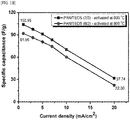
- Example 11 The specific capacitances of supercapacitors 4 and 5 of Example 11 comprising porous carbon nanofibers 7 and 8 obtained in Examples 8 and 9 were measured as a function of the weight ratio of TEOS of the porous carbon nanofibers in the voltage range of 0-2.7 V, and the measurement results are shown in FIG. 18 .
- the capacitors showed specific capacitances of 103.95 and 120.93 F/g, suggesting that these are supercapacitors.
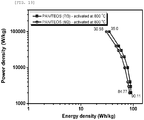
- the energy and power densities of supercapacitors 4 and 5 of Example 11 comprising porous carbon nanofibers 7 and 8 obtained in Examples 8 and 9 were measured as a function of the weight ratio of TEOS, and the measurement results are shown in FIG. 19 as Ragon graphs.
- the supercapacitors showed an energy density of 90-35 Wh/kg and a power density of 2-100 kW/kg in a 1.5 M organic solvent electrolyte solution of tetraethylammonium tetrafluoroborate in acetonitrile.
- the porous carbon nanofibers prepared by carbonization in the preparation method of the present invention contain the metal alkoxide introduced into the carbon crystal, and have a diameter of 100-300 nm and a specific surface area of 700-1500 m 2 /g and include fine pores having a size of 1-3 nm.
- these porous carbon nanofibers can increase the dielectric constant between an electrolyte and the electrode surface or induce the Faraday reaction, thus improving energy density.
- the carbon nanofibers prepared at low carbonization temperature show fast selective adsorption and desorption even when the potential changes slightly.
- carbon nanofibers allow the cost of the carbonization process to be reduced and can be provided with high conductivity, a high specific surface area and fine pores having various sizes, which are controlled depending on the carbonization temperature.
- the porous carbon nanofibers prepared through physical activation in the preparation method of the present invention have a diameter of 100-250 nm and a specific surface area of 1300-1700 m 2 /g and include fine pores and mesopores, which have a size of 2 nm or greater.
- steam which is used in the physical activation process promotes the hydrolysis and condensation of the metal alkoxide to produce a metal oxide
- water and alcohol which are removed when the metal oxide is produced accelerate the sol-gel reaction according to Le Chatelier's principle to increase the production of fine pores in the surface and to produce mesopores.
- the porous carbon nanofibers prepared using the carbonization process or physical activation process of the present invention all have excellent electrochemical properties, capacitance, power density and energy density, and particularly, the porous carbon nanofibers prepared using the physical activation process can provide supercapacitors having high energy density, compared to capacitors comprising the porous carbon nanofibers prepared using the carbonization process.
- porous carbon nanofiber nanofibers prepared by the method of the present invention have excellent properties as demonstrated in the above test examples, and can be used in supercapacitors.
- the porous carbon nanofibers of the present invention can be used in various industrial fields, including adsorbent materials.
- porous carbon nanofibers of the present invention have pores exposed to the outside, contaminants can get close to the carbon nanofibers, suggesting that the carbon nanofibers can be used as filter materials.
- the porous carbon nanofibers are highly useful as materials for electric double-layer supercapacitors and secondary batteries, as well as electromagnetic wave-shielding materials and highly conductive materials.
Landscapes
- Engineering & Computer Science (AREA)
- Chemical & Material Sciences (AREA)
- Power Engineering (AREA)
- Nanotechnology (AREA)
- Materials Engineering (AREA)
- Textile Engineering (AREA)
- Microelectronics & Electronic Packaging (AREA)
- Crystallography & Structural Chemistry (AREA)
- General Physics & Mathematics (AREA)
- Physics & Mathematics (AREA)
- Condensed Matter Physics & Semiconductors (AREA)
- Manufacturing & Machinery (AREA)
- Mechanical Engineering (AREA)
- Composite Materials (AREA)
- Chemical Kinetics & Catalysis (AREA)
- General Chemical & Material Sciences (AREA)
- Electric Double-Layer Capacitors Or The Like (AREA)
- Inorganic Fibers (AREA)
Claims (9)
- Verfahren zur Herstellung poröser Kohlenstofffasern, wobei das Verfahren umfasst:ein Herstellen einer Kohlenstoff-Nanofaser-Vorläuferlösung, die einen Kohlenstoff-Nanofaser-Vorläufer und ein Metallalkoxid [M(OR)n] oder ein Si-Alkoxid enthält,ein Elektrospinnen der Vorläuferlösung, um elektrogesponnene Fasern zu erhalten,ein Stabilisieren der elektrogesponnenen Fasern, um stabilisierte Fasern zu erhalten, undein Karbonisierten oder ein physikalisches Aktivieren der stabilisierten Fasern, um poröse Kohlenstofffasern zu erhalten.
- Verfahren nach Anspruch 1, wobei die stabilisierten Fasern physikalisch aktiviert werden, um die porösen Kohlenstofffasern zu erhalten.
- Verfahren nach Anspruch 1, wobei die stabilisierten Fasern karbonisiert werden, um die porösen Kohlenstofffasern zu erhalten.
- Verfahren nach einem der Ansprüche 1 bis 3, wobei die Vorläuferlösung hergestellt wird, um den Kohlenstoff Nanofaser-Vorläufer und das Metallalkoxid oder das Si-Alkoxid in einem Verhältnis von 70 bis 99 zu 30 bis 1 Gewichtsprozent zu enthalten.
- Verfahren nach einem der Ansprüche 1 bis 3, wobei das Metallalkoxid ein Ti-Alkoxid, ein Al-Alkoxid, ein Zn-Alkoxid oder eine Kombination davon ist.
- Verfahren nach einem der Ansprüche 1 bis 3, wobei die Stabilisierung durchgeführt wird, indem die elektrogesponnenen Fasern in einen Umluftofen gegeben werden, wobei dem Ofen Druckluft mit einer Strömungsrate von 5 bis 20 ml/min zugeführt wird, wobei die Fasern bei einer Aufheizrate von 1°C/min auf 200 bis 300 °C erwärmt werden und wobei die Fasern für 30 Minuten oder mehr bei dieser Temperatur gehalten werden.
- Verfahren nach Anspruch 3, wobei das Karbonisieren durch ein Erwärmen der Fasern auf 700 bis 1500 °C mit einer Aufheizrate von 5 °C/min in einer inerten Atmosphäre oder einer Vakuumatmosphäre durchgeführt wird und dann die Fasern bei dieser Temperatur für 30 Minuten oder mehrs gehalten werden.
- Verfahren nach Anspruch 2, wobei die physikalische Aktivierung durch ein Erhitzen der Fasern auf 700 bis 850 °C mit einer Aufheizrate von 5 °C/min durchgeführt wird und dann die Fasern in einer Atmosphäre von 150 bis 250 ml/min eines inerten Gases und 5 bis 15 Volumenprozent Dampf für 30 Minuten oder mehr gehalten werden.
- Verfahren nach einem der Ansprüche 1 bis 3, wobei eines oder mehrere von einem Durchmesser und von einer Oberflächenporosität der Kohlenstoff-Nanofasern gesteuert werden, indem eines oder mehrere von der Konzentration des Metallalkoxids, von der Temperatur der Karbonisierung und von der Zeit, und von der Temperatur der physikalischen Aktivierung und der Zeit gesteuert werden.
Applications Claiming Priority (2)
| Application Number | Priority Date | Filing Date | Title |
|---|---|---|---|
| KR1020100012830A KR100995154B1 (ko) | 2010-02-11 | 2010-02-11 | 다공성탄소나노섬유 제조방법, 상기 방법으로 제조된 다공성탄소나노섬유, 및 이를 포함하는 탄소나노섬유응용제품 |
| PCT/KR2010/003063 WO2011099677A1 (ko) | 2010-02-11 | 2010-05-14 | 금속옥사이드가 함유된 다공성탄소나노섬유 제조방법, 상기 방법으로 제조된 다공성탄소나노섬유, 및 이를 포함하는 탄소나노섬유응용제품 |
Publications (3)
| Publication Number | Publication Date |
|---|---|
| EP2535445A1 EP2535445A1 (de) | 2012-12-19 |
| EP2535445A4 EP2535445A4 (de) | 2014-03-19 |
| EP2535445B1 true EP2535445B1 (de) | 2017-07-12 |
Family
ID=43409866
Family Applications (1)
| Application Number | Title | Priority Date | Filing Date |
|---|---|---|---|
| EP10845848.0A Not-in-force EP2535445B1 (de) | 2010-02-11 | 2010-05-14 | Verfahren zur herstellung von porösen kohlenstoffnanofasern mit einem metallalkoxid oder siliziumalkoxid |
Country Status (5)
| Country | Link |
|---|---|
| US (1) | US9546091B2 (de) |
| EP (1) | EP2535445B1 (de) |
| KR (1) | KR100995154B1 (de) |
| CN (1) | CN102762784A (de) |
| WO (1) | WO2011099677A1 (de) |
Families Citing this family (28)
| Publication number | Priority date | Publication date | Assignee | Title |
|---|---|---|---|---|
| EP2461395B1 (de) | 2009-06-30 | 2019-01-23 | LG Chem, Ltd. | Verfahren zur herstellung einer elektrode mit einer porösen beschichtung |
| US9102570B2 (en) | 2011-04-22 | 2015-08-11 | Cornell University | Process of making metal and ceramic nanofibers |
| AU2012301877B2 (en) * | 2011-08-30 | 2017-03-16 | Cornell University | Metal and ceramic nanofibers |
| KR101348202B1 (ko) | 2011-11-30 | 2014-01-16 | 전남대학교산학협력단 | 금속산화물-탄소입자-탄소나노섬유복합체, 상기 복합체 제조방법, 및 상기 복합체를 포함하는 탄소섬유응용제품 |
| KR101418864B1 (ko) * | 2012-09-11 | 2014-07-17 | 인하대학교 산학협력단 | 실크 단백질을 이용하여 만든 탄소나노플레이트 및 그 제조방법 |
| US9816206B2 (en) | 2012-09-17 | 2017-11-14 | Cornell University | Carbonaceous metal/ceramic nanofibers |
| KR101544538B1 (ko) | 2012-10-23 | 2015-08-17 | 전남대학교산학협력단 | 단일 배향성 고밀도 탄소나노섬유펠트, 상기 탄소나노섬유펠트 제조방법 및 상기 탄소나노섬유펠트를 포함하는 탄소나노섬유펠트 응용제품 |
| KR101510311B1 (ko) * | 2013-05-14 | 2015-04-10 | 한국원자력연구원 | 방사선조사에 의한 금속 나노입자가 함유된 탄소소재의 제조방법 및 이에 따라 제조되는 금속 나노입자가 함유된 탄소소재 |
| CN103628182B (zh) * | 2013-11-29 | 2015-12-09 | 东南大学 | 一种碳基纳米纤维的制备方法 |
| CN105734831B (zh) * | 2014-12-10 | 2019-01-25 | 中国科学院大连化学物理研究所 | 一种纳米碳纤维毡及其制备和在全钒液流电池中的应用 |
| EP3254321A4 (de) * | 2015-02-04 | 2018-07-18 | Axium IP, LLC | Nanostrukturierte silicium-kohlenstoff-verbundwerkstoffe |
| US20170050888A1 (en) * | 2015-08-19 | 2017-02-23 | Cal Poly Pomona Foundation Inc. | Production of Ceramic Metal Oxide Membranes by Means of Reactive Electrospinning |
| CN106763335A (zh) * | 2016-12-28 | 2017-05-31 | 山东正凯机械科技有限公司 | 一种轻质化的改性碳纤维基刹车盘的制备方法 |
| WO2018183638A1 (en) * | 2017-03-30 | 2018-10-04 | The University Of North Carolina At Greensboro | Separator-free energy storage devices and methods |
| US10584072B2 (en) | 2017-05-17 | 2020-03-10 | Eden Innovations Ltd. | Methods and systems for making nanocarbon particle admixtures and concrete |
| CN108396408A (zh) * | 2018-01-30 | 2018-08-14 | 东莞市联洲知识产权运营管理有限公司 | 一种氮掺杂的芳纶基增强多级孔洞碳纤维的制备方法 |
| US11180870B2 (en) * | 2018-08-17 | 2021-11-23 | Cence Inc. | Carbon nanofiber and method of manufacture |
| US20210351401A1 (en) * | 2018-09-06 | 2021-11-11 | Virginia Tech Intellectual Properties, Inc. | Porous carbon fiber electrodes, methods of making thereof, and uses thereof |
| US11590476B2 (en) | 2019-08-15 | 2023-02-28 | Agency For Science, Technology And Research | Free-standing porous carbon fibrous mats and applications thereof |
| US11999654B2 (en) | 2019-08-22 | 2024-06-04 | Eden Innovations Ltd. | Method for making concrete admixtures containing carbon nanoparticles |
| KR20210077391A (ko) | 2019-12-17 | 2021-06-25 | 경남과학기술대학교 산학협력단 | 연성 나노 다공성 탄소 직물 및 그 제조 방법, 이것을 포함하는 흡착제 |
| KR102264667B1 (ko) * | 2020-02-10 | 2021-06-14 | 대구대학교 산학협력단 | 금속산화물/탄소나노섬유 복합체 제조방법, 상기 방법으로 제조된 금속산화물/탄소나노섬유 복합체 및 상기 복합체를 포함하는 탄소섬유응용제품 |
| CN113652648B (zh) * | 2021-08-16 | 2023-03-28 | 武汉纺织大学 | 一种金属材料在碳化过程中与碳纤维网凝华复合的方法 |
| CN113930866A (zh) * | 2021-10-13 | 2022-01-14 | 广州航海学院 | 一种胶囊结构的超级电容器电极材料及其制备方法和应用 |
| CN114420464A (zh) * | 2021-12-04 | 2022-04-29 | 山东阳谷华泰化工股份有限公司 | 一种生物酶扩孔碳纳米纤维电极材料的新方法 |
| CN114232215B (zh) * | 2021-12-20 | 2022-11-29 | 西安工程大学 | 一种具有三维空腔结构的沥青基碳纳米纤维多级无纺布的制备方法及应用 |
| CN114575157B (zh) * | 2022-02-23 | 2022-11-15 | 中国科学院宁波材料技术与工程研究所 | 一种强吸水多孔导电碳纤维棒及其制备方法与应用 |
| CN114974933A (zh) * | 2022-06-10 | 2022-08-30 | 广东石油化工学院 | 一种超级电容器用剑麻纤维碳纸的制备方法 |
Family Cites Families (16)
| Publication number | Priority date | Publication date | Assignee | Title |
|---|---|---|---|---|
| KR20030002759A (ko) | 2001-06-29 | 2003-01-09 | 주식회사 하이닉스반도체 | 반도체 소자의 트랜지스터 제조 방법 |
| KR100517021B1 (ko) | 2002-01-03 | 2005-09-26 | 양갑승 | 정전 방사에 의한 카본나노파이버의 제조와 이의전기이중층 캐퍼시터용 전극 제조 |
| ATE470735T1 (de) * | 2002-09-30 | 2010-06-15 | Teijin Ltd | Verfahren zur herstellung von carbonfasern und carbonfasermatten |
| CN1882724A (zh) * | 2003-09-19 | 2006-12-20 | 帝人株式会社 | 纤维状活性炭和由其制成的无纺布 |
| KR100605006B1 (ko) | 2005-01-18 | 2006-07-28 | (주) 아모센스 | 전기방사법으로 제조한 나노섬유의 탄소화에 의한 나노세공 분포를 갖는 활성탄소섬유의 제조방법 |
| AU2006265193A1 (en) * | 2005-07-01 | 2007-01-11 | Cinvention Ag | Process for the production of porous reticulated composite materials |
| US8313723B2 (en) * | 2005-08-25 | 2012-11-20 | Nanocarbons Llc | Activated carbon fibers, methods of their preparation, and devices comprising activated carbon fibers |
| AU2006303324A1 (en) * | 2005-10-18 | 2007-04-26 | Cinvention Ag | Thermoset particles and methods for production thereof |
| KR100675923B1 (ko) | 2005-12-01 | 2007-01-30 | 전남대학교산학협력단 | 금속산화물 복합 나노 활성탄소섬유와 이를 이용한전기이중층 슈퍼캐퍼시터용 전극 및 그 제조 방법 |
| KR100701627B1 (ko) | 2005-12-22 | 2007-03-29 | 한국생산기술연구원 | 금속산화물 함유 나노활성탄소섬유의 제조방법 및 그로부터수득되는 나노활성탄소섬유를 이용한 슈퍼 캐패시터용전극 |
| US8088323B2 (en) * | 2007-02-27 | 2012-01-03 | Ppg Industries Ohio, Inc. | Process of electrospinning organic-inorganic fibers |
| KR100939938B1 (ko) * | 2007-11-20 | 2010-02-04 | 재단법인대구경북과학기술원 | 아나타제 결정상을 갖는 이산화티탄이 함유된 탄소나노섬유 제조방법 |
| KR101446375B1 (ko) * | 2007-12-19 | 2014-10-01 | 도레이 카부시키가이샤 | 내염 폴리머를 함유하는 분산체, 내염 섬유 및 탄소 섬유 |
| CN101250770B (zh) * | 2008-03-11 | 2010-07-21 | 东华大学 | 一种碳纳米管增强的聚丙烯腈基碳纤维的制备方法 |
| KR20090121143A (ko) | 2008-05-21 | 2009-11-25 | 주식회사 에이엠오 | 전기 방사를 이용하여 제조된 초고용량 커패시터용 전극 및그의 제조방법 |
| US7910082B2 (en) * | 2008-08-13 | 2011-03-22 | Corning Incorporated | Synthesis of ordered mesoporous carbon-silicon nanocomposites |
-
2010
- 2010-02-11 KR KR1020100012830A patent/KR100995154B1/ko not_active Expired - Fee Related
- 2010-05-14 US US13/578,268 patent/US9546091B2/en not_active Expired - Fee Related
- 2010-05-14 WO PCT/KR2010/003063 patent/WO2011099677A1/ko not_active Ceased
- 2010-05-14 EP EP10845848.0A patent/EP2535445B1/de not_active Not-in-force
- 2010-05-14 CN CN2010800636695A patent/CN102762784A/zh active Pending
Also Published As
| Publication number | Publication date |
|---|---|
| US20130027844A1 (en) | 2013-01-31 |
| KR100995154B1 (ko) | 2010-11-18 |
| EP2535445A4 (de) | 2014-03-19 |
| EP2535445A1 (de) | 2012-12-19 |
| WO2011099677A1 (ko) | 2011-08-18 |
| CN102762784A (zh) | 2012-10-31 |
| US9546091B2 (en) | 2017-01-17 |
Similar Documents
| Publication | Publication Date | Title |
|---|---|---|
| US9546091B2 (en) | Method for preparing porous carbon nanofibers containing a metal oxide, porous carbon nanofibers prepared using the method, and carbon nanofiber products including same | |
| Xie et al. | Hierarchical porous carbon microtubes derived from willow catkins for supercapacitor applications | |
| Chen et al. | N-doped mesoporous carbon by a hard-template strategy associated with chemical activation and its enhanced supercapacitance performance | |
| Zhi et al. | Electrospun activated carbon nanofibers for supercapacitor electrodes | |
| Liu et al. | Mesoporous carbon nanofibers with large cage-like pores activated by tin dioxide and their use in supercapacitor and catalyst support | |
| Chang et al. | Fabrication of ultra-thin carbon nanofibers by centrifuged-electrospinning for application in high-rate supercapacitors | |
| Kim et al. | High performance carbon supercapacitor electrodes derived from a triazine-based covalent organic polymer with regular porosity | |
| Sahoo et al. | Significance of optimal N-doping in mesoporous carbon framework to achieve high specific capacitance | |
| KR101348202B1 (ko) | 금속산화물-탄소입자-탄소나노섬유복합체, 상기 복합체 제조방법, 및 상기 복합체를 포함하는 탄소섬유응용제품 | |
| KR101126784B1 (ko) | 망간산화물/탄소나노섬유복합재 제조방법 및 그 탄소나노섬유복합재를 포함하는 고용량 하이브리드 슈퍼의사캐패시터용 전극 | |
| US10008337B2 (en) | Activated carbon for an electric double-layer capacitor electrode and manufacturing method for same | |
| Kim et al. | Silica decorated on porous activated carbon nanofiber composites for high-performance supercapacitors | |
| JP2005136397A (ja) | 活性炭及びそれを用いた電極材料並びに電気二重層キャパシタ | |
| WO2015042016A1 (en) | Ultracapacitor with improved aging performance | |
| US10276312B2 (en) | High surface area carbon materials and methods for making same | |
| KR102157182B1 (ko) | 활성탄과 환원 그래핀옥사이드를 포함하는 수퍼커패시터용 전극, 그 제조방법, 및 이를 포함하는 수퍼커패시터 | |
| Chang et al. | Activated carbon for supercapacitors | |
| Kim et al. | Enhanced electrical capacitance of heteroatom-decorated nanoporous carbon nanofiber composites containing graphene | |
| JP5242090B2 (ja) | 電気二重層キャパシタ電極用活性炭の製造方法 | |
| Kurniawan et al. | Easy approach to synthesize N/P/K co-doped porous carbon microfibers from cane molasses as a high performance supercapacitor electrode material | |
| Li et al. | Synthesis of ultrahigh-surface-area nitrogen-doped porous carbon materials from carboxymethyl cellulose based protic polyanion ionic liquids for high performance supercapacitors | |
| KR101147923B1 (ko) | 금속옥사이드가 함유된 다공성탄소나노섬유 제조방법, 상기 방법으로 제조된 다공성 탄소나노섬유, 및 이를 포함하는 탄소나노섬유응용제품 | |
| Ju et al. | Electrospun activated carbon nanofibers electrodes based on polymer blends | |
| Tian et al. | Preparation and electrochemical characteristics of electrospun water-soluble resorcinol/phenol-formaldehyde resin-based carbon nanofibers | |
| WO2021154332A1 (en) | High-performance supercapacitors from biomass-derived carbon |
Legal Events
| Date | Code | Title | Description |
|---|---|---|---|
| PUAI | Public reference made under article 153(3) epc to a published international application that has entered the european phase |
Free format text: ORIGINAL CODE: 0009012 |
|
| 17P | Request for examination filed |
Effective date: 20120907 |
|
| AK | Designated contracting states |
Kind code of ref document: A1 Designated state(s): AL AT BE BG CH CY CZ DE DK EE ES FI FR GB GR HR HU IE IS IT LI LT LU LV MC MK MT NL NO PL PT RO SE SI SK SM TR |
|
| DAX | Request for extension of the european patent (deleted) | ||
| A4 | Supplementary search report drawn up and despatched |
Effective date: 20140217 |
|
| RIC1 | Information provided on ipc code assigned before grant |
Ipc: D01F 9/12 20060101AFI20140211BHEP Ipc: H01G 11/32 20130101ALI20140211BHEP |
|
| 17Q | First examination report despatched |
Effective date: 20160411 |
|
| GRAP | Despatch of communication of intention to grant a patent |
Free format text: ORIGINAL CODE: EPIDOSNIGR1 |
|
| INTG | Intention to grant announced |
Effective date: 20170113 |
|
| GRAS | Grant fee paid |
Free format text: ORIGINAL CODE: EPIDOSNIGR3 |
|
| GRAA | (expected) grant |
Free format text: ORIGINAL CODE: 0009210 |
|
| AK | Designated contracting states |
Kind code of ref document: B1 Designated state(s): AL AT BE BG CH CY CZ DE DK EE ES FI FR GB GR HR HU IE IS IT LI LT LU LV MC MK MT NL NO PL PT RO SE SI SK SM TR |
|
| REG | Reference to a national code |
Ref country code: GB Ref legal event code: FG4D |
|
| REG | Reference to a national code |
Ref country code: CH Ref legal event code: EP |
|
| REG | Reference to a national code |
Ref country code: AT Ref legal event code: REF Ref document number: 908410 Country of ref document: AT Kind code of ref document: T Effective date: 20170715 |
|
| REG | Reference to a national code |
Ref country code: IE Ref legal event code: FG4D |
|
| REG | Reference to a national code |
Ref country code: DE Ref legal event code: R096 Ref document number: 602010043653 Country of ref document: DE |
|
| REG | Reference to a national code |
Ref country code: NL Ref legal event code: MP Effective date: 20170712 |
|
| REG | Reference to a national code |
Ref country code: LT Ref legal event code: MG4D |
|
| REG | Reference to a national code |
Ref country code: AT Ref legal event code: MK05 Ref document number: 908410 Country of ref document: AT Kind code of ref document: T Effective date: 20170712 |
|
| PG25 | Lapsed in a contracting state [announced via postgrant information from national office to epo] |
Ref country code: LT Free format text: LAPSE BECAUSE OF FAILURE TO SUBMIT A TRANSLATION OF THE DESCRIPTION OR TO PAY THE FEE WITHIN THE PRESCRIBED TIME-LIMIT Effective date: 20170712 Ref country code: SE Free format text: LAPSE BECAUSE OF FAILURE TO SUBMIT A TRANSLATION OF THE DESCRIPTION OR TO PAY THE FEE WITHIN THE PRESCRIBED TIME-LIMIT Effective date: 20170712 Ref country code: NO Free format text: LAPSE BECAUSE OF FAILURE TO SUBMIT A TRANSLATION OF THE DESCRIPTION OR TO PAY THE FEE WITHIN THE PRESCRIBED TIME-LIMIT Effective date: 20171012 Ref country code: FI Free format text: LAPSE BECAUSE OF FAILURE TO SUBMIT A TRANSLATION OF THE DESCRIPTION OR TO PAY THE FEE WITHIN THE PRESCRIBED TIME-LIMIT Effective date: 20170712 Ref country code: HR Free format text: LAPSE BECAUSE OF FAILURE TO SUBMIT A TRANSLATION OF THE DESCRIPTION OR TO PAY THE FEE WITHIN THE PRESCRIBED TIME-LIMIT Effective date: 20170712 Ref country code: AT Free format text: LAPSE BECAUSE OF FAILURE TO SUBMIT A TRANSLATION OF THE DESCRIPTION OR TO PAY THE FEE WITHIN THE PRESCRIBED TIME-LIMIT Effective date: 20170712 Ref country code: NL Free format text: LAPSE BECAUSE OF FAILURE TO SUBMIT A TRANSLATION OF THE DESCRIPTION OR TO PAY THE FEE WITHIN THE PRESCRIBED TIME-LIMIT Effective date: 20170712 |
|
| PG25 | Lapsed in a contracting state [announced via postgrant information from national office to epo] |
Ref country code: BG Free format text: LAPSE BECAUSE OF FAILURE TO SUBMIT A TRANSLATION OF THE DESCRIPTION OR TO PAY THE FEE WITHIN THE PRESCRIBED TIME-LIMIT Effective date: 20171012 Ref country code: ES Free format text: LAPSE BECAUSE OF FAILURE TO SUBMIT A TRANSLATION OF THE DESCRIPTION OR TO PAY THE FEE WITHIN THE PRESCRIBED TIME-LIMIT Effective date: 20170712 Ref country code: LV Free format text: LAPSE BECAUSE OF FAILURE TO SUBMIT A TRANSLATION OF THE DESCRIPTION OR TO PAY THE FEE WITHIN THE PRESCRIBED TIME-LIMIT Effective date: 20170712 Ref country code: GR Free format text: LAPSE BECAUSE OF FAILURE TO SUBMIT A TRANSLATION OF THE DESCRIPTION OR TO PAY THE FEE WITHIN THE PRESCRIBED TIME-LIMIT Effective date: 20171013 Ref country code: IS Free format text: LAPSE BECAUSE OF FAILURE TO SUBMIT A TRANSLATION OF THE DESCRIPTION OR TO PAY THE FEE WITHIN THE PRESCRIBED TIME-LIMIT Effective date: 20171112 Ref country code: PL Free format text: LAPSE BECAUSE OF FAILURE TO SUBMIT A TRANSLATION OF THE DESCRIPTION OR TO PAY THE FEE WITHIN THE PRESCRIBED TIME-LIMIT Effective date: 20170712 |
|
| REG | Reference to a national code |
Ref country code: DE Ref legal event code: R097 Ref document number: 602010043653 Country of ref document: DE |
|
| PG25 | Lapsed in a contracting state [announced via postgrant information from national office to epo] |
Ref country code: RO Free format text: LAPSE BECAUSE OF FAILURE TO SUBMIT A TRANSLATION OF THE DESCRIPTION OR TO PAY THE FEE WITHIN THE PRESCRIBED TIME-LIMIT Effective date: 20170712 Ref country code: CZ Free format text: LAPSE BECAUSE OF FAILURE TO SUBMIT A TRANSLATION OF THE DESCRIPTION OR TO PAY THE FEE WITHIN THE PRESCRIBED TIME-LIMIT Effective date: 20170712 Ref country code: DK Free format text: LAPSE BECAUSE OF FAILURE TO SUBMIT A TRANSLATION OF THE DESCRIPTION OR TO PAY THE FEE WITHIN THE PRESCRIBED TIME-LIMIT Effective date: 20170712 |
|
| PLBE | No opposition filed within time limit |
Free format text: ORIGINAL CODE: 0009261 |
|
| STAA | Information on the status of an ep patent application or granted ep patent |
Free format text: STATUS: NO OPPOSITION FILED WITHIN TIME LIMIT |
|
| REG | Reference to a national code |
Ref country code: FR Ref legal event code: PLFP Year of fee payment: 9 |
|
| PG25 | Lapsed in a contracting state [announced via postgrant information from national office to epo] |
Ref country code: SK Free format text: LAPSE BECAUSE OF FAILURE TO SUBMIT A TRANSLATION OF THE DESCRIPTION OR TO PAY THE FEE WITHIN THE PRESCRIBED TIME-LIMIT Effective date: 20170712 Ref country code: SM Free format text: LAPSE BECAUSE OF FAILURE TO SUBMIT A TRANSLATION OF THE DESCRIPTION OR TO PAY THE FEE WITHIN THE PRESCRIBED TIME-LIMIT Effective date: 20170712 Ref country code: EE Free format text: LAPSE BECAUSE OF FAILURE TO SUBMIT A TRANSLATION OF THE DESCRIPTION OR TO PAY THE FEE WITHIN THE PRESCRIBED TIME-LIMIT Effective date: 20170712 Ref country code: IT Free format text: LAPSE BECAUSE OF FAILURE TO SUBMIT A TRANSLATION OF THE DESCRIPTION OR TO PAY THE FEE WITHIN THE PRESCRIBED TIME-LIMIT Effective date: 20170712 |
|
| 26N | No opposition filed |
Effective date: 20180413 |
|
| PGFP | Annual fee paid to national office [announced via postgrant information from national office to epo] |
Ref country code: DE Payment date: 20180524 Year of fee payment: 9 |
|
| PG25 | Lapsed in a contracting state [announced via postgrant information from national office to epo] |
Ref country code: SI Free format text: LAPSE BECAUSE OF FAILURE TO SUBMIT A TRANSLATION OF THE DESCRIPTION OR TO PAY THE FEE WITHIN THE PRESCRIBED TIME-LIMIT Effective date: 20170712 |
|
| PGFP | Annual fee paid to national office [announced via postgrant information from national office to epo] |
Ref country code: FR Payment date: 20180523 Year of fee payment: 9 |
|
| PGFP | Annual fee paid to national office [announced via postgrant information from national office to epo] |
Ref country code: GB Payment date: 20180523 Year of fee payment: 9 |
|
| REG | Reference to a national code |
Ref country code: CH Ref legal event code: PL |
|
| REG | Reference to a national code |
Ref country code: BE Ref legal event code: MM Effective date: 20180531 |
|
| PG25 | Lapsed in a contracting state [announced via postgrant information from national office to epo] |
Ref country code: MC Free format text: LAPSE BECAUSE OF FAILURE TO SUBMIT A TRANSLATION OF THE DESCRIPTION OR TO PAY THE FEE WITHIN THE PRESCRIBED TIME-LIMIT Effective date: 20170712 |
|
| REG | Reference to a national code |
Ref country code: IE Ref legal event code: MM4A |
|
| PG25 | Lapsed in a contracting state [announced via postgrant information from national office to epo] |
Ref country code: LI Free format text: LAPSE BECAUSE OF NON-PAYMENT OF DUE FEES Effective date: 20180531 Ref country code: CH Free format text: LAPSE BECAUSE OF NON-PAYMENT OF DUE FEES Effective date: 20180531 |
|
| PG25 | Lapsed in a contracting state [announced via postgrant information from national office to epo] |
Ref country code: LU Free format text: LAPSE BECAUSE OF NON-PAYMENT OF DUE FEES Effective date: 20180514 |
|
| PG25 | Lapsed in a contracting state [announced via postgrant information from national office to epo] |
Ref country code: IE Free format text: LAPSE BECAUSE OF NON-PAYMENT OF DUE FEES Effective date: 20180514 |
|
| PG25 | Lapsed in a contracting state [announced via postgrant information from national office to epo] |
Ref country code: BE Free format text: LAPSE BECAUSE OF NON-PAYMENT OF DUE FEES Effective date: 20180531 |
|
| REG | Reference to a national code |
Ref country code: DE Ref legal event code: R119 Ref document number: 602010043653 Country of ref document: DE |
|
| GBPC | Gb: european patent ceased through non-payment of renewal fee |
Effective date: 20190514 |
|
| PG25 | Lapsed in a contracting state [announced via postgrant information from national office to epo] |
Ref country code: MT Free format text: LAPSE BECAUSE OF NON-PAYMENT OF DUE FEES Effective date: 20180514 |
|
| PG25 | Lapsed in a contracting state [announced via postgrant information from national office to epo] |
Ref country code: TR Free format text: LAPSE BECAUSE OF FAILURE TO SUBMIT A TRANSLATION OF THE DESCRIPTION OR TO PAY THE FEE WITHIN THE PRESCRIBED TIME-LIMIT Effective date: 20170712 |
|
| PG25 | Lapsed in a contracting state [announced via postgrant information from national office to epo] |
Ref country code: GB Free format text: LAPSE BECAUSE OF NON-PAYMENT OF DUE FEES Effective date: 20190514 Ref country code: DE Free format text: LAPSE BECAUSE OF NON-PAYMENT OF DUE FEES Effective date: 20191203 |
|
| PG25 | Lapsed in a contracting state [announced via postgrant information from national office to epo] |
Ref country code: PT Free format text: LAPSE BECAUSE OF FAILURE TO SUBMIT A TRANSLATION OF THE DESCRIPTION OR TO PAY THE FEE WITHIN THE PRESCRIBED TIME-LIMIT Effective date: 20170712 Ref country code: HU Free format text: LAPSE BECAUSE OF FAILURE TO SUBMIT A TRANSLATION OF THE DESCRIPTION OR TO PAY THE FEE WITHIN THE PRESCRIBED TIME-LIMIT; INVALID AB INITIO Effective date: 20100514 |
|
| PG25 | Lapsed in a contracting state [announced via postgrant information from national office to epo] |
Ref country code: MK Free format text: LAPSE BECAUSE OF NON-PAYMENT OF DUE FEES Effective date: 20170712 Ref country code: FR Free format text: LAPSE BECAUSE OF NON-PAYMENT OF DUE FEES Effective date: 20190531 Ref country code: CY Free format text: LAPSE BECAUSE OF FAILURE TO SUBMIT A TRANSLATION OF THE DESCRIPTION OR TO PAY THE FEE WITHIN THE PRESCRIBED TIME-LIMIT Effective date: 20170712 |
|
| PG25 | Lapsed in a contracting state [announced via postgrant information from national office to epo] |
Ref country code: AL Free format text: LAPSE BECAUSE OF FAILURE TO SUBMIT A TRANSLATION OF THE DESCRIPTION OR TO PAY THE FEE WITHIN THE PRESCRIBED TIME-LIMIT Effective date: 20170712 |