EP2330276B1 - Oil Pan - Google Patents
Oil Pan Download PDFInfo
- Publication number
- EP2330276B1 EP2330276B1 EP10166914A EP10166914A EP2330276B1 EP 2330276 B1 EP2330276 B1 EP 2330276B1 EP 10166914 A EP10166914 A EP 10166914A EP 10166914 A EP10166914 A EP 10166914A EP 2330276 B1 EP2330276 B1 EP 2330276B1
- Authority
- EP
- European Patent Office
- Prior art keywords
- end portion
- tip end
- ribs
- base end
- oil pan
- Prior art date
- Legal status (The legal status is an assumption and is not a legal conclusion. Google has not performed a legal analysis and makes no representation as to the accuracy of the status listed.)
- Not-in-force
Links
Images




Classifications
-
- F—MECHANICAL ENGINEERING; LIGHTING; HEATING; WEAPONS; BLASTING
- F01—MACHINES OR ENGINES IN GENERAL; ENGINE PLANTS IN GENERAL; STEAM ENGINES
- F01M—LUBRICATING OF MACHINES OR ENGINES IN GENERAL; LUBRICATING INTERNAL COMBUSTION ENGINES; CRANKCASE VENTILATING
- F01M11/00—Component parts, details or accessories, not provided for in, or of interest apart from, groups F01M1/00 - F01M9/00
- F01M11/0004—Oilsumps
-
- F—MECHANICAL ENGINEERING; LIGHTING; HEATING; WEAPONS; BLASTING
- F01—MACHINES OR ENGINES IN GENERAL; ENGINE PLANTS IN GENERAL; STEAM ENGINES
- F01M—LUBRICATING OF MACHINES OR ENGINES IN GENERAL; LUBRICATING INTERNAL COMBUSTION ENGINES; CRANKCASE VENTILATING
- F01M11/00—Component parts, details or accessories, not provided for in, or of interest apart from, groups F01M1/00 - F01M9/00
- F01M11/0004—Oilsumps
- F01M2011/002—Oilsumps with means for improving the stiffness
-
- F—MECHANICAL ENGINEERING; LIGHTING; HEATING; WEAPONS; BLASTING
- F01—MACHINES OR ENGINES IN GENERAL; ENGINE PLANTS IN GENERAL; STEAM ENGINES
- F01M—LUBRICATING OF MACHINES OR ENGINES IN GENERAL; LUBRICATING INTERNAL COMBUSTION ENGINES; CRANKCASE VENTILATING
- F01M11/00—Component parts, details or accessories, not provided for in, or of interest apart from, groups F01M1/00 - F01M9/00
- F01M11/0004—Oilsumps
- F01M2011/0087—Sump being made of different parts
-
- F—MECHANICAL ENGINEERING; LIGHTING; HEATING; WEAPONS; BLASTING
- F01—MACHINES OR ENGINES IN GENERAL; ENGINE PLANTS IN GENERAL; STEAM ENGINES
- F01M—LUBRICATING OF MACHINES OR ENGINES IN GENERAL; LUBRICATING INTERNAL COMBUSTION ENGINES; CRANKCASE VENTILATING
- F01M11/00—Component parts, details or accessories, not provided for in, or of interest apart from, groups F01M1/00 - F01M9/00
- F01M11/0004—Oilsumps
- F01M2011/0091—Oilsumps characterised by used materials
Definitions
- This invention relates to an oil pan which is made from a resin, which is mounted on a lower portion of an engine or a transmission mounted on a vehicle, and which stores a lubricating oil.
- a conventional oil pan is made from a metal to ensure a strength and a rigidity. Accordingly, the oil pan increases a weight of an engine. Therefore, the oil pan adversely affects an engine output or fuel economy.
- Japanese Patent Application Publication No. 2008-121643 discloses an oil pan made from a resin, and devised to decrease a weight of an engine.
- the resin material has a strength which is inferior to a strength of the metal material.
- the oil pan is disposed in a lowest portion of the engine or a transmission case. Therefore, it is not possible to avoid a stone thrown up from a road surface while the vehicle is moving, from hitting against the oil pan. Moreover, it is difficult to ensure the sufficient strength by the resin material with respect to the stone thrown up from the road surface.
- the engine may be disposed on an upper portion of the vehicle body to keep the oil pan away from the road surface.
- the cost is increased.
- the center of gravity of the vehicle may become unstable, or it is necessary to largely vary the layout of the engine.
- a thickness of the oil pan is merely increased for increasing the strength.
- the weight may be increased, and the cost may be increased.
- an object of the present invention to provide an oil pan devised to solve the above-mentioned problems, and to ensure a strength of the oil pan without varying a layout of an engine, or providing another member.
- An oil pan made from a resin material the oil pan comprises: a bottom wall having an outer wall surface; and side walls surrounding the bottom wall, and defining, with the bottom wall, a space for storing a lubricating oil; the bottom wall including a plurality of ribs protruding from the outer wall surface, each of the ribs having; a base end portion protruding from the outer wall surface of the bottom wall, and having a tip end surface, and a tip end portion protruding from the tip end surface of the base end portion, the tip end portion being connected with the base end portion at a connection portion, the connection portion at which the base end portion and the tip end portion are connected with each other, which has a width that is equal to or smaller than a width of a portion at a base end position of the base end portion, and equal to or smaller than a width of a portion at a tip end position of the tip end portion.
- FIG. 1 is a perspective view showing an oil pan according to a first embodiment of the present invention.
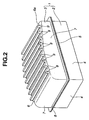
- FIG. 2 is a perspective view showing the oil pan of FIG. 1 .
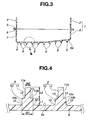
- FIG. 3 is a sectional view taken along a section line A-A of FIG. 1 .
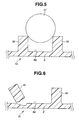
- FIG. 4 is a sectional enlarged view which enlarges a B part of FIG. 3 , and which shows a main part of the oil pan of FIG. 1 .
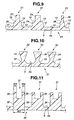
- FIG. 5 is a schematic illustrative view showing a main part of an oil pan of a comparative example.
- FIG. 6 is a schematic illustrative view showing the main part of the oil pan of the comparative example.
- FIG. 7 is a schematic illustrative view showing a main part of the oil pan according to the first embodiment of the present invention.
- FIG. 8 is a schematic illustrative view showing a main part of the oil pan according to the first embodiment of the present invention.
- FIG. 9 is a schematic illustrative view showing a main part of an oil pan according to a second embodiment of the present invention.
- FIG. 10 is a schematic illustrative view showing a main part of an oil pan according to a third embodiment of the present invention.
- FIG. 11 is a schematic illustrative view showing a main part of an oil pan according to a fourth embodiment of the present invention.
- FIG. 12 is a schematic illustrative view showing a main part of an oil pan according to a fifth embodiment of the present invention.
- FIG. 13 is a schematic illustrative view showing a main part of an oil pan according to a sixth embodiment of the present invention.
- FIG. 14 is a schematic illustrative view showing a main part of an oil pan according to a seventh embodiment of the present invention.
- FIGS. 1 and 2 are schematic views showing an oil pan 1 according to the first embodiment of the present invention.
- FIG. 1 is a perspective view showing the oil pan 1 as viewed from an upper side.
- FIG. 2 is a perspective view showing the oil pan 1 as viewed from a lower side.
- the oil pan 1 is made from a resin material.
- the oil pan 1 is mounted on a lower surface of a cylinder block (not shown) of an internal combustion engine of a vehicle.
- the oil pan 1 stores a lubricating oil (lubricant) supplied to various parts of the internal combustion engine.
- the oil pan 1 is shaped like an elongated plate (pan or dish).
- the oil pan 1 includes an oil pan upper member 2 which is mounted on a lower surface of the cylinder block (not shown), and which has a flange 5 formed on a peripheral portion on a lower side of the oil pan upper member 2; and an oil pan lower member 3 mounted on the flange 5 of the oil pan upper member 2.
- the oil pan upper member 2 includes four side walls 4, and the flange 5 formed on lower surfaces of the four side walls 4.
- the oil pan lower member 3 includes a bottom wall 6 forming a bottom of the oil pan 1; four side walls 7 surrounding the bottom wall 6; and a flange 8 formed on upper surfaces of the four side walls 7, and mounted on the flange 5 on the lower surface of the oil pan upper member 2.
- the oil pan lower member 3 includes a plurality of ribs 9 which are formed at regular intervals on an outer wall surface 6a of the bottom wall 6, and which protrude from the outer wall surface 6a.
- each of the ribs 9 includes a base end portion 10 protruding from the outer wall surface 6a of the bottom wall 6 to a tip end surface 10a; and a tip end portion 11 protruding from the tip end surface 10a of the base end portion 10, and having a width narrower (smaller) than a width of the base end portion 10.
- the base end portion 10 has a rectangular section having a width W1.
- the tip end portion 11 has a rectangular section having a width W2. That is, each of the ribs 9 has a T-shaped cross section.
- Each of the ribs 9 is formed so that the width W1 of the base end portion 10 is greater than the width W2 of the tip end portion 11.
- each of the ribs 9 is formed so that a width of a connection portion at which the base end portion 10 and the tip end portion 11 are connected (continuous) with each other is equal to or smaller than a width of a portion at a base end position of the base end portion 10, and equal to or smaller than a width of a portion at the tip end position of the tip end portion 11.
- Each of the ribs 9 includes a first corner portion 12 at which the base end portion 10 and the outer wall surface 6a of the bottom wall 6 are connected (continuous) with each other, and which is formed by the side wall surface 10b of the base end portion 10 and the outer wall surface 6a of the bottom wall 6; and a second corner portion 13 at which the base end portion 10 and the tip end portion 11 are connected (continuous) with each other, and which is formed by the tip end surface 10a of the base end portion 10 and a side wall surface 11a of the tip end portion 11.
- the first corner portion 12 has a curved surface having a predetermined radius of curvature (curvature radius) R1.
- the second corner portion 13 has a curved surface having a predetermined radius of curvature (curvature radius) R2.
- Each of the ribs 9 is formed so that the radius of curvature R1 is greater than the radius of curvature R2.
- the portion at which the base end portion 10 and the outer wall surface 6a of the bottom wall 6 are connected (continuous) with each other is the first corner portion 12 which is the curved surface.
- the width of the first corner portion 12 becomes greater than the width of the base end portion 10 as the first corner portion 12 is positioned closer to the bottom wall 6.
- the width of the portion at which the base end portion 10 and the outer wall surface 6a of the bottom wall 6 are connected with each other is defined as (by) a width that the curved surface of the first corner portion 12 is not considered, that is, a width that the curved surface is not set at the portion at which the base end portion 10 and the outer wall surface 6a are connected with each other.
- the width W1 of the base end portion 10 is the width of the portion at which the base end portion 10 and the outer wall surface 6a of the bottom wall 6 are connected with each other since the base end portion 10 has the rectangular section.
- the width of the portion at which the base end portion 10 and the tip end portion 11 are connected with each other is defined as (by) a width that the curved surface of the second corner portion 13 is not considered, that is, a width that a curved surface is not set at the portion at which the base end portion 10 and the tip end portion 11 are connected with each other.
- the width W2 of the tip end portion 11 is the width of the portion at which the base end portion 10 and the tip end portion 11 are connected with each other since the tip end portion 11 is rectangular section.
- Each of the ribs 9 is formed so that a length L2 of the tip end portion 11 is greater than a length L1 of the base end portion 10.
- a ratio of the length L1 of the base end portion 10 to the length L2 of the tip end portion 11 is set to 2:3.
- the plurality of ribs 9 are formed at the predetermined regular intervals.
- the plurality of ribs 9 are formed at the predetermined regular intervals such that a stone (that is, 6-size crushed stone (No. 6-sized crushed stone) having a size of about ⁇ 5- ⁇ 13 (particle size of 5-13 mm) is caught in (stuck with) a gap between the tip end portions 11 and 11 of the ribs 9 and 9 adjacent to each other (cf. FIG. 7 described later).
- the oil pan 1 is mounted on the vehicle so that the bottom wall 6 confronts a road surface.
- the ribs 9 of the oil pan 1 are formed so that longitudinal directions of the ribs 9 (a direction perpendicular to a plane of a paper of FIGS. 3 and 4 ) are perpendicular to a traveling direction of the vehicle. That is, in this embodiment, the oil pan 1 is mounted on the vehicle so that the longitudinal direction of the oil pan 1 is parallel with the forward and rearward directions of the vehicle. Accordingly, the ribs 9 of the oil pan 1 are formed in a direction perpendicular to the longitudinal direction of the oil pan 1.
- FIGS. 5 and 6 are schematic views showing a main part of an oil pan 15 of a comparative example. The following explanation is directed only to points different from the first embodiment, and repetitive explanation is omitted as to similar component parts to which the same reference numerals are given.
- the oil pan 15 of the comparative example has a structure substantially identical to the oil pan 1 according to the above-described first embodiment. However, each of ribs 16 of the oil pan 15 does not have the T-shaped section. Each of the ribs 16 has a rectangular section. Each of the ribs 16 has a height (length) identical to the height (length) of each rib 9 of the first embodiment. Each of the ribs 16 has a width identical to the width W of the base end portion 10 of each rib 9.
- each of the ribs 16 has the simple rectangular section. Accordingly, when the stone 17 thrown up from the road surface hits against the ribs 16 while the vehicle is running, the large stress is acted to the base end portions of the ribs 16.
- a thickness of the bottom wall 6 of the oil pan 15 may become equal to or smaller than a desired thickness, and a strength of the bottom wall 6 of the oil pan 1 may become equal to or smaller than a desired strength.
- each of the ribs 9 has the T-shaped section. Accordingly, when the stone 17 thrown up from the road surface while the vehicle is moving hits against the ribs 9, the stone 17 hits against the tip end portions 11 of the ribs 9, as shown in FIG. 7 . Therefore, the larger stress is acted to a portion near the second corner portion 13 at which the base end portion 10 and the tip end portion 11 are connected with each other, relative to a portion near the first corner portion 12 which is a base end portion of the rib 9.
- each of the ribs 9 has the T-shaped section.
- the width of the connection portion at which the base end portion 10 and the tip end portion 11 are connected (continuous) with each other is equal to or smaller than the width of the portion at the base end position of the base end portion 10, and equal to or smaller than the width of the tip end position of the tip end portion 11.
- a predetermined position between the base end and the tip end of the rib 9, that is, the connection portion at which the base end portion 10 and the tip end portion 11 are connected with each other has a relatively low strength (is a weak portion).
- the rib 9 is not bent and broken at the base end position of the base end portion 10, and the rib 9 is bent and broken at the portion at which the base end portion 10 and the tip end portion 11 are connected with each other, as shown in FIG. 8 .
- the tip end portion 11 of the rib 9 is bent and broken to remain the base end portion 10. Accordingly, it is possible to prevent from directly breaking the bottom wall 6 of the oil pan 1 by bending and breaking the rib 9, as shown in FIG. 8 . Therefore, it is possible to suppress the thickness of the bottom wall 6 of the oil pan 1 from becoming equal to or smaller than the desired thickness, and to suppress the strength of the bottom wall 6 of the oil pan 1 from becoming equal to or smaller than the desired strength.
- the tip end portion 11 has the length longer than the length of the base end portion 10.
- each of the ribs 9 is formed so that the radius of the curvature R1 of the first corner portion 12 is greater than the radius of the curvature R2 of the second corner portion 13.
- the ribs 9 are formed in liner shapes on the bottom wall 6 of the oil pan 1.
- the ribs 9 may be formed in a grid shape (in a reticular pattern) on the bottom wall 6 of the oil pan 1.
- FIG. 9 is a sectional view showing a main part of an oil pan 20 according to a second embodiment of the present invention.
- This oil pan 20 according to the second embodiment has a structure substantially identical to the structure of the first embodiment.
- widths of ribs 21, 22 and 23 protruding from the outer wall surface 6a of the bottom wall 6 of the oil pan 20 are not uniform (even).
- a distance between the ribs 21 and 22, and a distance between the ribs 22 and 23 are not uniform (even).
- the distance between the ribs 22 and 23 is greater than the distance between the ribs 21 and 22.
- a width of a base end portion 24 of the rib 22 is greater than a width of a base end portion 26 of the rib 21 and a width of a base end portion 28 of the rib 23.
- a width of a tip end portion 25 of the rib 22 is greater than a width of a tip end portion 27 of the rib 21 and a tip end portion 29 of the rib 23.
- the width of the base end portion 28 of the rib 23 is smaller than the width of the base end portion 26 of the rib 21 and the base end portion 24 of the rib 22.
- the width of the tip end portion 29 of the rib 23 is smaller than the width of the tip end portion 27 of the rib 21 and the tip end portion 25 of the rib 22.
- the width of the connection portion at which the base end portion and the tip end portion are connected (continuous) with each other is equal to or smaller than the width of the portion at the base end position of the base end portion, and equal to or smaller than the width of the portion at the tip end position of the tip end portion.
- FIG. 10 is a sectional view showing a main part of an oil pan 31 according to a third embodiment of the present invention.
- This oil pan 31 according to the third embodiment has a structure substantially identical to the structure of the oil pan 1 according to the first embodiment.
- the oil pan 31 includes a plurality of ribs 32 protruding from the outer wall surface 6a of the bottom wall 6 of the oil pan 31.
- Each of the ribs 32 includes a base end portion 33 having an isosceles trapezoid section, and a tip end portion 34 having an isosceles trapezoid section.
- the base end portion 33 is formed so that a width on the outer wall surface 6a's side is greater than a width on the tip end side (on the upper side of the base end portion 33 in FIG. 10 ).
- the tip end portion 34 is formed so that a width on the base end portion 33's side is smaller than a width on the tip end side (on the upper side of the tip end portion 34 in FIG. 10 ).
- a width of the tip end of the base end portion 33 is identical to the width of the base end of the tip end portion 34.
- a width of a connection portion at which the base end portion 33 and the tip end portion 34 are connected (continuous) with each other is equal to or smaller than a width of a portion at a base end position of the base end portion 33, and equal to or smaller than a width of a portion at a tip end position of the tip end portion 34.
- the shape of the rib is not limited to the shapes of the above-described embodiments. It is possible to vary the shape of the rib as long as the width of the connection portion at which the base end portion and the tip end portion are connected with each other is equal to or smaller than the width of the portion at the base end position of the base end portion, and equal to or smaller than the width of the portion at the tip end position of the tip end portion.
- rib provided to the oil pan is not limited to the structure having one tip end portion with respect to one base end portion.
- a rib 37 can be formed to have one base end portion 38 having a rectangular section, and two tip end portions 39 and 39 each having a rectangular section, as shown in an oil pan 36 in FIG. 11 .
- FIG. 11 is a schematic view showing an oil pan 37 according to a fourth embodiment of the present invention.
- a width W4 of each tip end portion 39 is set so that the summation of the widths W4 of the two tip end portions 39 and 39 is smaller than a width W3 of the base end portion 38.
- the width (W4) of a connection portion at which the base end portion 38 and the tip end portion 39 are connected (continuous) with each other is equal to or smaller than the width (W3) of the portion at the base end position of the base end portion 38, and equal to or smaller than the width (W4) of the portion at the tip end position of the tip end portion 39. Accordingly, even when the rib 37 is bent and broken by the impact of the stone thrown up from the road surface, the rib 37 is not bent and broken at the base end position of the base end portion 38, and the rib 37 is bent and broken at the connection portion at which the base end portion 38 and the tip end portion 39 are connected with each other. Therefore, the oil pan 36 according to the fourth embodiment makes it possible to attain the effects identical to those of the oil pan according to the first embodiment.
- FIG. 12 is a sectional view showing a main part of an oil pan 41 according to a fifth embodiment of the present invention.
- the oil pan 41 according to the fifth embodiment has a structure substantially identical to the structure of the oil pan 1 according to the first embodiment.
- each of ribs 42 includes a tip end portion 44 protruding from a base end portion 43 to be inclined by a predetermined angle (for example, 45 degrees).
- the tip end portions 44 of the ribs 42 are inclined in the same direction (in the left direction in FIG. 12 ). That is, each of the base end portions 43 is perpendicular to the outer wall surface 6a of the bottom wall 6. All of the tip end portions 44 are inclined in the same direction (in the left direction in FIG. 12 ) by the predetermined angle with respect to the outer wall surface 6a of the bottom wall 6.
- a distance between the base end portions 43 and 43 of the two ribs 42 and 42 adjacent to each other is identical to the distance of the base end portions 10 and 10 of the ribs 9 and 9 of the first embodiment.
- the tip end portions 44 are inclined in the rearward direction of the vehicle. With this, the stone is difficult to hit against the base end portion, relative to inclining the tip end portion 44 in the forward direction of the vehicle.
- the tip end portions of the ribs provided on the outer wall surface 6a of the bottom wall 6 are inclined in the same direction.
- the tip end portions of the two ribs adjacent to each other may be inclined in opposite directions.
- FIG. 13 is a sectional view showing a main part of an oil pan 46 according to a sixth embodiment of the present invention.
- the oil pan 46 according to the sixth embodiment has a structure substantially identical to the structure of the oil pan 1 according to the first embodiment.
- Tip end portions 50 and 52 of two ribs 47 and 48 adjacent to each other are inclined in opposite directions. That is, the tip end portion 50 of the rib 47 protrudes from a base end portion 49 to be inclined by a predetermined angle (for example, 45 degrees) in the right direction of FIG. 13 .
- the tip end portion 52 of the rib 48 protrudes from a base end portion 51 to be inclined by a predetermined angle (for example, 45 degrees) in the left direction of FIG. 13 .
- FIG. 14 is a sectional view showing a main part of an oil pan 54 according to a seventh embodiment of the present invention.
- the oil pan 54 according to the seventh embodiment has a structure substantially identical to the structure of the oil pan 1 according to the first embodiment.
- Tip end portions 58 and 60 of a pair of ribs 55 and 56 adjacent to each other are inclined in opposite directions.
- the tip end portions 58 and 60 of the pair of the ribs 55 and 56 adjacent to each other have different lengths. That is, the tip end portion 58 of the rib 55 protrudes from a base end portion 57 to be inclined by a predetermined angle (for example, 45 degrees) in the right direction of FIG. 14 .
- a predetermined angle for example, 45 degrees
- the tip end portion 60 of the rib 56 protrudes from a base end portion 59 to be inclined by a predetermined angle (for example, 45 degrees) in the left direction of FIG. 14 .
- the tip end portion 58 of the rib 55 has a length longer than a length of the tip end portion 60 of the rib 56.
- the oil pan according to the present invention is not limited to the oil pan mounted on the lower surface of the cylinder block of the internal combustion engine.
- the present invention is applicable to an oil pan which is positioned on a lower surface side of the vehicle, and which is used in a portion confronting the road surface when the oil pan is mounted on the vehicle.
- the present invention is applicable to an oil pan provided on a lower portion of a transmission, and arranged to store a hydraulic fluid supplied to the transmission.
- An oil pan made from a resin material includes: a bottom wall having an outer wall surface; and side walls surrounding the bottom wall, and defining, with the bottom wall, a space for storing a lubricating oil; the bottom wall including a plurality of ribs protruding from the outer wall surface, each of the ribs having; a base end portion protruding from the outer wall surface of the bottom wall, and having a tip end surface, and a tip end portion protruding from the tip end surface of the base end portion, the tip end portion being connected with the base end portion at a connection portion, the connection portion at which the base end portion and the tip end portion are connected with each other, which has a width that is equal to or smaller than a width of a portion at a base end position of the base end portion, and equal to or smaller than a width of a portion at a tip end position of the tip end portion.
- connection portion at which the base end portion and the tip end portion are connected (continuous) with each other is equal to or smaller than the width of the portion at the base end position of the base end portion, and equal to or smaller than the width of the portion at the tip end position of the tip end portion. Therefore, the connection portion which is between the base end and the tip end of the rib, and at which the base end portion and the tip end portion are connected with each other is a relatively weak portion (has a relatively low strength).
- the rib is not bent and broken at the base end position of the base end portion, and the rib is bent and broken at the connection portion at which the base end portion and the tip end portion are connected (continuous) with each other.
- the tip end portion of the rib is bent and broken to remain the base end portion. Accordingly, it is possible to prevent from directly breaking the bottom wall of the oil pan. Therefore, it is possible to suppress the thickness of the bottom wall of the oil pan from becoming equal to or smaller than the desired thickness, and to suppress the strength of the bottom wall of the oil pan from becoming equal to or smaller than the desired strength.
Landscapes
- Engineering & Computer Science (AREA)
- Mechanical Engineering (AREA)
- General Engineering & Computer Science (AREA)
- Lubrication Details And Ventilation Of Internal Combustion Engines (AREA)
- Cylinder Crankcases Of Internal Combustion Engines (AREA)
Applications Claiming Priority (1)
| Application Number | Priority Date | Filing Date | Title |
|---|---|---|---|
| JP2009275052A JP5502441B2 (ja) | 2009-12-03 | 2009-12-03 | オイルパン |
Publications (2)
| Publication Number | Publication Date |
|---|---|
| EP2330276A1 EP2330276A1 (en) | 2011-06-08 |
| EP2330276B1 true EP2330276B1 (en) | 2012-12-26 |
Family
ID=42359473
Family Applications (1)
| Application Number | Title | Priority Date | Filing Date |
|---|---|---|---|
| EP10166914A Not-in-force EP2330276B1 (en) | 2009-12-03 | 2010-06-22 | Oil Pan |
Country Status (3)
| Country | Link |
|---|---|
| US (1) | US20110132913A1 (enExample) |
| EP (1) | EP2330276B1 (enExample) |
| JP (1) | JP5502441B2 (enExample) |
Families Citing this family (2)
| Publication number | Priority date | Publication date | Assignee | Title |
|---|---|---|---|---|
| JP6444596B2 (ja) | 2013-12-26 | 2018-12-26 | 株式会社マーレ フィルターシステムズ | オイルパン |
| JP7039150B2 (ja) * | 2020-03-12 | 2022-03-22 | 本田技研工業株式会社 | 内燃機関のオイルパン構造 |
Family Cites Families (23)
| Publication number | Priority date | Publication date | Assignee | Title |
|---|---|---|---|---|
| US1318706A (en) * | 1919-10-14 | Willakd e | ||
| US1365438A (en) * | 1920-10-21 | 1921-01-11 | Cecil F Adamson | Automobile-crank-case pan |
| US1991618A (en) * | 1930-11-03 | 1935-02-19 | Borg Warner | Radiating type oil pan for internal combustion engines |
| US2577188A (en) * | 1948-04-01 | 1951-12-04 | Michael F Hall | Composite oil pan for engines |
| US3817354A (en) * | 1972-06-01 | 1974-06-18 | Gear Co M W | Oil pan for tractors |
| US4022272A (en) * | 1975-11-14 | 1977-05-10 | Chester O. Houston, Jr. | Transmission fluid heat radiator |
| JPS57109211U (enExample) * | 1980-12-25 | 1982-07-06 | ||
| US4898261A (en) * | 1989-04-10 | 1990-02-06 | Brunswick Corporation | Water cooled plastic oil pan |
| JPH04132445U (ja) * | 1991-05-28 | 1992-12-08 | 三菱自動車工業株式会社 | 樹脂オイルパン |
| DE9319054U1 (de) * | 1993-12-11 | 1995-04-13 | FEV Motorentechnik GmbH & Co. KG, 52078 Aachen | Kolbenmaschine, insbesondere Kolbenbrennkraftmaschine mit versteiftem Motorblock |
| USD424988S (en) * | 1998-03-02 | 2000-05-16 | Roy Rothlisberger | Differential cover |
| US6202736B1 (en) * | 1999-08-19 | 2001-03-20 | Verlyn R. Fast | Vehicle transmission fluid cooler |
| JP2001098915A (ja) * | 1999-09-29 | 2001-04-10 | Fuji Heavy Ind Ltd | 飛沫潤滑式エンジン |
| JP3677189B2 (ja) * | 2000-02-21 | 2005-07-27 | ジー・ピー・ダイキョー株式会社 | オイルストレーナ |
| US6705270B1 (en) * | 2000-04-26 | 2004-03-16 | Basf Corporation | Oil pan module for internal combustion engines |
| US6310771B1 (en) * | 2000-11-14 | 2001-10-30 | Chuan-Fu Chien | CPU heat sink |
| US6584950B1 (en) * | 2002-05-29 | 2003-07-01 | Bayer Corporation | Oil pan |
| US6771508B1 (en) * | 2003-02-14 | 2004-08-03 | Intel Corporation | Method and apparatus for cooling an electronic component |
| DE202005009096U1 (de) * | 2005-06-09 | 2006-10-26 | Mann + Hummel Gmbh | Ölwanne, insbesndere für eine Brennkraftmaschine |
| WO2008044485A1 (fr) * | 2006-10-06 | 2008-04-17 | Kabushiki Kaisha Yaskawa Denki | Structure de montage pour module d'alimentation et dispositif de contrôle du moteur la comportant |
| JP2008121643A (ja) | 2006-11-15 | 2008-05-29 | Mitsubishi Heavy Ind Ltd | 樹脂材製部材をそなえたエンジン |
| US20080311341A1 (en) * | 2007-07-07 | 2008-12-18 | Lee Chul S | Article Having Impact Resistant Surface |
| JP4882991B2 (ja) * | 2007-12-11 | 2012-02-22 | トヨタ紡織株式会社 | オイルパン構造 |
-
2009
- 2009-12-03 JP JP2009275052A patent/JP5502441B2/ja active Active
-
2010
- 2010-06-21 US US12/819,692 patent/US20110132913A1/en not_active Abandoned
- 2010-06-22 EP EP10166914A patent/EP2330276B1/en not_active Not-in-force
Also Published As
| Publication number | Publication date |
|---|---|
| US20110132913A1 (en) | 2011-06-09 |
| JP5502441B2 (ja) | 2014-05-28 |
| EP2330276A1 (en) | 2011-06-08 |
| JP2011117352A (ja) | 2011-06-16 |
Similar Documents
| Publication | Publication Date | Title |
|---|---|---|
| JP4525759B2 (ja) | 内燃機関のチェーンカバー | |
| JP4924268B2 (ja) | 保護部材 | |
| KR101376024B1 (ko) | 차량용 후드 | |
| CN104838097B (zh) | 内燃机的油盘 | |
| JP5702398B2 (ja) | タイヤ | |
| JP4766481B2 (ja) | 燃料タンクアセンブリー | |
| EP2529999A2 (en) | Rubber crawler having metal core for improvement of wheel separation and durability | |
| US9951666B2 (en) | Oil pan | |
| EP2330276A1 (en) | Oil Pan | |
| EP2759004B1 (en) | Battery mounting structure | |
| JP2009185651A (ja) | オイルパン | |
| WO2016143161A1 (ja) | 耕耘爪 | |
| EP2200876B1 (en) | Vehicle inner panel | |
| JP6919562B2 (ja) | フェンダーライナー | |
| US20080311341A1 (en) | Article Having Impact Resistant Surface | |
| JP2008150974A (ja) | エンジンのオイルパン構造 | |
| JP5263375B2 (ja) | アンダーカバー | |
| JP4946583B2 (ja) | コネクティングロッド | |
| US20140216852A1 (en) | Impact resistant article | |
| CN101048311A (zh) | 具有加强衬里的机动车辆引擎罩 | |
| JP2010274885A (ja) | 弾性履帯 | |
| JP5831549B2 (ja) | 切削インサート | |
| CN109518591B (zh) | 钢筋 | |
| JP5062907B2 (ja) | エンジンの回転バランサ | |
| WO2012153792A1 (ja) | エネルギー吸収部材 |
Legal Events
| Date | Code | Title | Description |
|---|---|---|---|
| PUAI | Public reference made under article 153(3) epc to a published international application that has entered the european phase |
Free format text: ORIGINAL CODE: 0009012 |
|
| 17P | Request for examination filed |
Effective date: 20110104 |
|
| AK | Designated contracting states |
Kind code of ref document: A1 Designated state(s): AL AT BE BG CH CY CZ DE DK EE ES FI FR GB GR HR HU IE IS IT LI LT LU LV MC MK MT NL NO PL PT RO SE SI SK SM TR |
|
| AX | Request for extension of the european patent |
Extension state: BA ME RS |
|
| GRAP | Despatch of communication of intention to grant a patent |
Free format text: ORIGINAL CODE: EPIDOSNIGR1 |
|
| RIC1 | Information provided on ipc code assigned before grant |
Ipc: F01M 11/00 20060101AFI20120615BHEP |
|
| GRAS | Grant fee paid |
Free format text: ORIGINAL CODE: EPIDOSNIGR3 |
|
| GRAA | (expected) grant |
Free format text: ORIGINAL CODE: 0009210 |
|
| AK | Designated contracting states |
Kind code of ref document: B1 Designated state(s): AL AT BE BG CH CY CZ DE DK EE ES FI FR GB GR HR HU IE IS IT LI LT LU LV MC MK MT NL NO PL PT RO SE SI SK SM TR |
|
| REG | Reference to a national code |
Ref country code: GB Ref legal event code: FG4D |
|
| REG | Reference to a national code |
Ref country code: CH Ref legal event code: EP |
|
| REG | Reference to a national code |
Ref country code: AT Ref legal event code: REF Ref document number: 590605 Country of ref document: AT Kind code of ref document: T Effective date: 20130115 |
|
| REG | Reference to a national code |
Ref country code: DE Ref legal event code: R096 Ref document number: 602010004279 Country of ref document: DE Effective date: 20130307 |
|
| PG25 | Lapsed in a contracting state [announced via postgrant information from national office to epo] |
Ref country code: HR Free format text: LAPSE BECAUSE OF FAILURE TO SUBMIT A TRANSLATION OF THE DESCRIPTION OR TO PAY THE FEE WITHIN THE PRESCRIBED TIME-LIMIT Effective date: 20121226 Ref country code: SE Free format text: LAPSE BECAUSE OF FAILURE TO SUBMIT A TRANSLATION OF THE DESCRIPTION OR TO PAY THE FEE WITHIN THE PRESCRIBED TIME-LIMIT Effective date: 20121226 Ref country code: FI Free format text: LAPSE BECAUSE OF FAILURE TO SUBMIT A TRANSLATION OF THE DESCRIPTION OR TO PAY THE FEE WITHIN THE PRESCRIBED TIME-LIMIT Effective date: 20121226 Ref country code: NO Free format text: LAPSE BECAUSE OF FAILURE TO SUBMIT A TRANSLATION OF THE DESCRIPTION OR TO PAY THE FEE WITHIN THE PRESCRIBED TIME-LIMIT Effective date: 20130326 Ref country code: LT Free format text: LAPSE BECAUSE OF FAILURE TO SUBMIT A TRANSLATION OF THE DESCRIPTION OR TO PAY THE FEE WITHIN THE PRESCRIBED TIME-LIMIT Effective date: 20121226 |
|
| REG | Reference to a national code |
Ref country code: AT Ref legal event code: MK05 Ref document number: 590605 Country of ref document: AT Kind code of ref document: T Effective date: 20121226 |
|
| REG | Reference to a national code |
Ref country code: LT Ref legal event code: MG4D |
|
| REG | Reference to a national code |
Ref country code: NL Ref legal event code: VDEP Effective date: 20121226 |
|
| PG25 | Lapsed in a contracting state [announced via postgrant information from national office to epo] |
Ref country code: SI Free format text: LAPSE BECAUSE OF FAILURE TO SUBMIT A TRANSLATION OF THE DESCRIPTION OR TO PAY THE FEE WITHIN THE PRESCRIBED TIME-LIMIT Effective date: 20121226 Ref country code: LV Free format text: LAPSE BECAUSE OF FAILURE TO SUBMIT A TRANSLATION OF THE DESCRIPTION OR TO PAY THE FEE WITHIN THE PRESCRIBED TIME-LIMIT Effective date: 20121226 Ref country code: GR Free format text: LAPSE BECAUSE OF FAILURE TO SUBMIT A TRANSLATION OF THE DESCRIPTION OR TO PAY THE FEE WITHIN THE PRESCRIBED TIME-LIMIT Effective date: 20130327 |
|
| PG25 | Lapsed in a contracting state [announced via postgrant information from national office to epo] |
Ref country code: BE Free format text: LAPSE BECAUSE OF FAILURE TO SUBMIT A TRANSLATION OF THE DESCRIPTION OR TO PAY THE FEE WITHIN THE PRESCRIBED TIME-LIMIT Effective date: 20121226 Ref country code: SK Free format text: LAPSE BECAUSE OF FAILURE TO SUBMIT A TRANSLATION OF THE DESCRIPTION OR TO PAY THE FEE WITHIN THE PRESCRIBED TIME-LIMIT Effective date: 20121226 Ref country code: EE Free format text: LAPSE BECAUSE OF FAILURE TO SUBMIT A TRANSLATION OF THE DESCRIPTION OR TO PAY THE FEE WITHIN THE PRESCRIBED TIME-LIMIT Effective date: 20121226 Ref country code: ES Free format text: LAPSE BECAUSE OF FAILURE TO SUBMIT A TRANSLATION OF THE DESCRIPTION OR TO PAY THE FEE WITHIN THE PRESCRIBED TIME-LIMIT Effective date: 20130406 Ref country code: CZ Free format text: LAPSE BECAUSE OF FAILURE TO SUBMIT A TRANSLATION OF THE DESCRIPTION OR TO PAY THE FEE WITHIN THE PRESCRIBED TIME-LIMIT Effective date: 20121226 Ref country code: BG Free format text: LAPSE BECAUSE OF FAILURE TO SUBMIT A TRANSLATION OF THE DESCRIPTION OR TO PAY THE FEE WITHIN THE PRESCRIBED TIME-LIMIT Effective date: 20130326 Ref country code: AT Free format text: LAPSE BECAUSE OF FAILURE TO SUBMIT A TRANSLATION OF THE DESCRIPTION OR TO PAY THE FEE WITHIN THE PRESCRIBED TIME-LIMIT Effective date: 20121226 Ref country code: IS Free format text: LAPSE BECAUSE OF FAILURE TO SUBMIT A TRANSLATION OF THE DESCRIPTION OR TO PAY THE FEE WITHIN THE PRESCRIBED TIME-LIMIT Effective date: 20130426 |
|
| PG25 | Lapsed in a contracting state [announced via postgrant information from national office to epo] |
Ref country code: NL Free format text: LAPSE BECAUSE OF FAILURE TO SUBMIT A TRANSLATION OF THE DESCRIPTION OR TO PAY THE FEE WITHIN THE PRESCRIBED TIME-LIMIT Effective date: 20121226 Ref country code: PL Free format text: LAPSE BECAUSE OF FAILURE TO SUBMIT A TRANSLATION OF THE DESCRIPTION OR TO PAY THE FEE WITHIN THE PRESCRIBED TIME-LIMIT Effective date: 20121226 Ref country code: RO Free format text: LAPSE BECAUSE OF FAILURE TO SUBMIT A TRANSLATION OF THE DESCRIPTION OR TO PAY THE FEE WITHIN THE PRESCRIBED TIME-LIMIT Effective date: 20121226 Ref country code: PT Free format text: LAPSE BECAUSE OF FAILURE TO SUBMIT A TRANSLATION OF THE DESCRIPTION OR TO PAY THE FEE WITHIN THE PRESCRIBED TIME-LIMIT Effective date: 20130426 |
|
| PG25 | Lapsed in a contracting state [announced via postgrant information from national office to epo] |
Ref country code: DK Free format text: LAPSE BECAUSE OF FAILURE TO SUBMIT A TRANSLATION OF THE DESCRIPTION OR TO PAY THE FEE WITHIN THE PRESCRIBED TIME-LIMIT Effective date: 20121226 |
|
| PLBE | No opposition filed within time limit |
Free format text: ORIGINAL CODE: 0009261 |
|
| STAA | Information on the status of an ep patent application or granted ep patent |
Free format text: STATUS: NO OPPOSITION FILED WITHIN TIME LIMIT |
|
| PG25 | Lapsed in a contracting state [announced via postgrant information from national office to epo] |
Ref country code: CY Free format text: LAPSE BECAUSE OF FAILURE TO SUBMIT A TRANSLATION OF THE DESCRIPTION OR TO PAY THE FEE WITHIN THE PRESCRIBED TIME-LIMIT Effective date: 20121226 |
|
| 26N | No opposition filed |
Effective date: 20130927 |
|
| PG25 | Lapsed in a contracting state [announced via postgrant information from national office to epo] |
Ref country code: IT Free format text: LAPSE BECAUSE OF FAILURE TO SUBMIT A TRANSLATION OF THE DESCRIPTION OR TO PAY THE FEE WITHIN THE PRESCRIBED TIME-LIMIT Effective date: 20121226 |
|
| REG | Reference to a national code |
Ref country code: DE Ref legal event code: R097 Ref document number: 602010004279 Country of ref document: DE Effective date: 20130927 |
|
| PG25 | Lapsed in a contracting state [announced via postgrant information from national office to epo] |
Ref country code: MC Free format text: LAPSE BECAUSE OF FAILURE TO SUBMIT A TRANSLATION OF THE DESCRIPTION OR TO PAY THE FEE WITHIN THE PRESCRIBED TIME-LIMIT Effective date: 20121226 |
|
| REG | Reference to a national code |
Ref country code: IE Ref legal event code: MM4A |
|
| PG25 | Lapsed in a contracting state [announced via postgrant information from national office to epo] |
Ref country code: IE Free format text: LAPSE BECAUSE OF NON-PAYMENT OF DUE FEES Effective date: 20130622 |
|
| REG | Reference to a national code |
Ref country code: CH Ref legal event code: PL |
|
| GBPC | Gb: european patent ceased through non-payment of renewal fee |
Effective date: 20140622 |
|
| PG25 | Lapsed in a contracting state [announced via postgrant information from national office to epo] |
Ref country code: MT Free format text: LAPSE BECAUSE OF FAILURE TO SUBMIT A TRANSLATION OF THE DESCRIPTION OR TO PAY THE FEE WITHIN THE PRESCRIBED TIME-LIMIT Effective date: 20121226 |
|
| PG25 | Lapsed in a contracting state [announced via postgrant information from national office to epo] |
Ref country code: CH Free format text: LAPSE BECAUSE OF NON-PAYMENT OF DUE FEES Effective date: 20140630 Ref country code: LI Free format text: LAPSE BECAUSE OF NON-PAYMENT OF DUE FEES Effective date: 20140630 |
|
| PG25 | Lapsed in a contracting state [announced via postgrant information from national office to epo] |
Ref country code: SM Free format text: LAPSE BECAUSE OF FAILURE TO SUBMIT A TRANSLATION OF THE DESCRIPTION OR TO PAY THE FEE WITHIN THE PRESCRIBED TIME-LIMIT Effective date: 20121226 Ref country code: GB Free format text: LAPSE BECAUSE OF NON-PAYMENT OF DUE FEES Effective date: 20140622 |
|
| PG25 | Lapsed in a contracting state [announced via postgrant information from national office to epo] |
Ref country code: TR Free format text: LAPSE BECAUSE OF FAILURE TO SUBMIT A TRANSLATION OF THE DESCRIPTION OR TO PAY THE FEE WITHIN THE PRESCRIBED TIME-LIMIT Effective date: 20121226 |
|
| PG25 | Lapsed in a contracting state [announced via postgrant information from national office to epo] |
Ref country code: HU Free format text: LAPSE BECAUSE OF FAILURE TO SUBMIT A TRANSLATION OF THE DESCRIPTION OR TO PAY THE FEE WITHIN THE PRESCRIBED TIME-LIMIT; INVALID AB INITIO Effective date: 20100622 Ref country code: LU Free format text: LAPSE BECAUSE OF NON-PAYMENT OF DUE FEES Effective date: 20130622 Ref country code: MK Free format text: LAPSE BECAUSE OF FAILURE TO SUBMIT A TRANSLATION OF THE DESCRIPTION OR TO PAY THE FEE WITHIN THE PRESCRIBED TIME-LIMIT Effective date: 20121226 |
|
| REG | Reference to a national code |
Ref country code: FR Ref legal event code: PLFP Year of fee payment: 7 |
|
| REG | Reference to a national code |
Ref country code: FR Ref legal event code: PLFP Year of fee payment: 8 |
|
| REG | Reference to a national code |
Ref country code: FR Ref legal event code: PLFP Year of fee payment: 9 |
|
| PG25 | Lapsed in a contracting state [announced via postgrant information from national office to epo] |
Ref country code: AL Free format text: LAPSE BECAUSE OF FAILURE TO SUBMIT A TRANSLATION OF THE DESCRIPTION OR TO PAY THE FEE WITHIN THE PRESCRIBED TIME-LIMIT Effective date: 20121226 |
|
| REG | Reference to a national code |
Ref country code: DE Ref legal event code: R081 Ref document number: 602010004279 Country of ref document: DE Owner name: MAHLE JAPAN LTD., JP Free format text: FORMER OWNER: MAHLE FILTER SYSTEMS JAPAN CORPORATION, TOKYO, JP |
|
| P01 | Opt-out of the competence of the unified patent court (upc) registered |
Effective date: 20230524 |
|
| PGFP | Annual fee paid to national office [announced via postgrant information from national office to epo] |
Ref country code: FR Payment date: 20230620 Year of fee payment: 14 |
|
| PGFP | Annual fee paid to national office [announced via postgrant information from national office to epo] |
Ref country code: DE Payment date: 20240626 Year of fee payment: 15 |
|
| PG25 | Lapsed in a contracting state [announced via postgrant information from national office to epo] |
Ref country code: FR Free format text: LAPSE BECAUSE OF NON-PAYMENT OF DUE FEES Effective date: 20240630 |
|
| REG | Reference to a national code |
Ref country code: DE Ref legal event code: R119 Ref document number: 602010004279 Country of ref document: DE |
|
| PG25 | Lapsed in a contracting state [announced via postgrant information from national office to epo] |
Ref country code: DE Free format text: LAPSE BECAUSE OF NON-PAYMENT OF DUE FEES Effective date: 20260101 |