EP2300497B1 - A process of purifying coagulation factor viii - Google Patents
A process of purifying coagulation factor viii Download PDFInfo
- Publication number
- EP2300497B1 EP2300497B1 EP09769279A EP09769279A EP2300497B1 EP 2300497 B1 EP2300497 B1 EP 2300497B1 EP 09769279 A EP09769279 A EP 09769279A EP 09769279 A EP09769279 A EP 09769279A EP 2300497 B1 EP2300497 B1 EP 2300497B1
- Authority
- EP
- European Patent Office
- Prior art keywords
- fviii
- resin
- buffer
- chromatography
- multimodal
- Prior art date
- Legal status (The legal status is an assumption and is not a legal conclusion. Google has not performed a legal analysis and makes no representation as to the accuracy of the status listed.)
- Active
Links
Images



Classifications
-
- C—CHEMISTRY; METALLURGY
- C07—ORGANIC CHEMISTRY
- C07K—PEPTIDES
- C07K1/00—General methods for the preparation of peptides, i.e. processes for the organic chemical preparation of peptides or proteins of any length
- C07K1/14—Extraction; Separation; Purification
- C07K1/16—Extraction; Separation; Purification by chromatography
-
- A—HUMAN NECESSITIES
- A61—MEDICAL OR VETERINARY SCIENCE; HYGIENE
- A61K—PREPARATIONS FOR MEDICAL, DENTAL OR TOILETRY PURPOSES
- A61K38/00—Medicinal preparations containing peptides
-
- A—HUMAN NECESSITIES
- A61—MEDICAL OR VETERINARY SCIENCE; HYGIENE
- A61K—PREPARATIONS FOR MEDICAL, DENTAL OR TOILETRY PURPOSES
- A61K38/00—Medicinal preparations containing peptides
- A61K38/04—Peptides having up to 20 amino acids in a fully defined sequence; Derivatives thereof
-
- A—HUMAN NECESSITIES
- A61—MEDICAL OR VETERINARY SCIENCE; HYGIENE
- A61K—PREPARATIONS FOR MEDICAL, DENTAL OR TOILETRY PURPOSES
- A61K38/00—Medicinal preparations containing peptides
- A61K38/16—Peptides having more than 20 amino acids; Gastrins; Somatostatins; Melanotropins; Derivatives thereof
- A61K38/17—Peptides having more than 20 amino acids; Gastrins; Somatostatins; Melanotropins; Derivatives thereof from animals; from humans
- A61K38/36—Blood coagulation or fibrinolysis factors
- A61K38/37—Factors VIII
-
- A—HUMAN NECESSITIES
- A61—MEDICAL OR VETERINARY SCIENCE; HYGIENE
- A61K—PREPARATIONS FOR MEDICAL, DENTAL OR TOILETRY PURPOSES
- A61K38/00—Medicinal preparations containing peptides
- A61K38/16—Peptides having more than 20 amino acids; Gastrins; Somatostatins; Melanotropins; Derivatives thereof
- A61K38/55—Protease inhibitors
- A61K38/57—Protease inhibitors from animals; from humans
-
- B—PERFORMING OPERATIONS; TRANSPORTING
- B01—PHYSICAL OR CHEMICAL PROCESSES OR APPARATUS IN GENERAL
- B01D—SEPARATION
- B01D15/00—Separating processes involving the treatment of liquids with solid sorbents; Apparatus therefor
- B01D15/08—Selective adsorption, e.g. chromatography
- B01D15/26—Selective adsorption, e.g. chromatography characterised by the separation mechanism
- B01D15/38—Selective adsorption, e.g. chromatography characterised by the separation mechanism involving specific interaction not covered by one or more of groups B01D15/265 and B01D15/30 - B01D15/36, e.g. affinity, ligand exchange or chiral chromatography
- B01D15/3847—Multimodal interactions
-
- C—CHEMISTRY; METALLURGY
- C07—ORGANIC CHEMISTRY
- C07K—PEPTIDES
- C07K1/00—General methods for the preparation of peptides, i.e. processes for the organic chemical preparation of peptides or proteins of any length
- C07K1/14—Extraction; Separation; Purification
- C07K1/36—Extraction; Separation; Purification by a combination of two or more processes of different types
-
- C—CHEMISTRY; METALLURGY
- C07—ORGANIC CHEMISTRY
- C07K—PEPTIDES
- C07K14/00—Peptides having more than 20 amino acids; Gastrins; Somatostatins; Melanotropins; Derivatives thereof
- C07K14/435—Peptides having more than 20 amino acids; Gastrins; Somatostatins; Melanotropins; Derivatives thereof from animals; from humans
-
- C—CHEMISTRY; METALLURGY
- C07—ORGANIC CHEMISTRY
- C07K—PEPTIDES
- C07K14/00—Peptides having more than 20 amino acids; Gastrins; Somatostatins; Melanotropins; Derivatives thereof
- C07K14/435—Peptides having more than 20 amino acids; Gastrins; Somatostatins; Melanotropins; Derivatives thereof from animals; from humans
- C07K14/745—Blood coagulation or fibrinolysis factors
-
- C—CHEMISTRY; METALLURGY
- C07—ORGANIC CHEMISTRY
- C07K—PEPTIDES
- C07K14/00—Peptides having more than 20 amino acids; Gastrins; Somatostatins; Melanotropins; Derivatives thereof
- C07K14/435—Peptides having more than 20 amino acids; Gastrins; Somatostatins; Melanotropins; Derivatives thereof from animals; from humans
- C07K14/745—Blood coagulation or fibrinolysis factors
- C07K14/755—Factors VIII, e.g. factor VIII C (AHF), factor VIII Ag (VWF)
-
- C—CHEMISTRY; METALLURGY
- C12—BIOCHEMISTRY; BEER; SPIRITS; WINE; VINEGAR; MICROBIOLOGY; ENZYMOLOGY; MUTATION OR GENETIC ENGINEERING
- C12N—MICROORGANISMS OR ENZYMES; COMPOSITIONS THEREOF; PROPAGATING, PRESERVING, OR MAINTAINING MICROORGANISMS; MUTATION OR GENETIC ENGINEERING; CULTURE MEDIA
- C12N9/00—Enzymes; Proenzymes; Compositions thereof; Processes for preparing, activating, inhibiting, separating or purifying enzymes
- C12N9/14—Hydrolases (3)
- C12N9/48—Hydrolases (3) acting on peptide bonds (3.4)
- C12N9/50—Proteinases, e.g. Endopeptidases (3.4.21-3.4.25)
- C12N9/64—Proteinases, e.g. Endopeptidases (3.4.21-3.4.25) derived from animal tissue
- C12N9/6421—Proteinases, e.g. Endopeptidases (3.4.21-3.4.25) derived from animal tissue from mammals
- C12N9/6424—Serine endopeptidases (3.4.21)
- C12N9/647—Blood coagulation factors not provided for in a preceding group or according to more than one of the proceeding groups
Definitions
- the present invention pertains to a process of purifying coagulation factor VIII (abbreviated as FVIII) and a fraction containing FVIII obtainable by the process of the invention.
- FVIII coagulation factor VIII
- Hemophilia is a group of hereditary genetic disorders that impair the body's ability to control blood clotting or coagulation. In its most common form, Hemophilia A, clotting FVIII is deficient, Hemophilia A occurs in about 1 in 5,000-10,000 male births.
- the FVIII protein is an essential cofactor in blood coagulation with multifunctional properties.
- the deficiency of FVIII can be treated with plasma-derived concentrates of FVIII or with recombinantly produced FVIII. The treatment with FVIII concentrates has led to a normalized life of the hemophilia patients.
- Hemophilia A has been treated with FVIII originating from human blood plasma. In blood plasma, under normal conditions, the FVIII molecule is always associated with its cofactor; von Willebrandt factor (vWf), which stabilizes the FVIII molecule from different forms of degeneration.
- vWf von Willebrandt factor
- Plasma derived FVIII products occur on the market with different purities and with more or less amounts of vWf present. Commonly, products with low amount of vWf contain added human albumin and or other stabilizers including increased salt concentration to stabilize the FVIII molecule).
- the methods used to purify FVIII were normally a combination of different precipitation methods such as cryo precipitation, aluminum hydroxide precipitation etc. and chromatography steps mainly ion exchange, affinity and gel filtration steps.
- affinity chromatography In order to improve FVIII products affinity chromatography was employed, which effectively removed contaminants to a high degree of FVIII purity including the possibility to reduce also vWf ( Farrugia et al., Biotechnology and plasma fractionation industry; The impact of advances in the production of coagulation FVIII. Biotechnology, Vol. 3, No. 1, February 1993 ).
- the disadvantage with immuno affinity chromatography was that it is relatively expensive and that the monoclonal antibodies used as affinity ligands, where of animal origin.
- vWf is absent in all rFVIII products, certain measures have to be taken to stabilize the FVIII molecule against loss of activity (aggregation, proteases, surface adsorption etc.).
- a chelating agent EDTA etc.
- albumin aprotinin, insulin or even to co-express rFVIII with vWf (and remove it down stream in the purification cycle) are strategies which have been performed to increase the stability of the rFVIII molecule (ref. Bhattacharyya et al., Review article; Recombinant FVIII for Haemophilia "An overview of production technologies". CRIPS Vol.4, No.3, July-September 2003 ).
- WO-A-2009/007451 discloses a purification method of FVIII using a mixed-mode or multimodal resin.
- the purification method is based on contacting FVIII protein with a multimodal or mixed-mode resin containing ligands which comprise a hydrophobic part and a negatively charged part and eluting said FVIII protein with an elution buffer containing at least 1.5 M salt and at least 40% (w/v) of ethylene glycol, propylene glycol or a mixture thereof, and calcium ions.
- EP-A-1707634 discloses a method for isolation of recombinantly produced proteins i.a. by various methods such as immuno-affinity chromatography, affinity chromatography, protein precipitation, buffer exchanges, ionic exchange chromatography, hydrophobic interaction chromatography, mixed-mode hydrophobic/ion exchange chromatography media, chelating chromatography, carbohydrate affinity like lectin or heparin affinity chromatography, size-exclusion chromatography, electrophoresis, dialysis, different precipitation agents such as polyethylene glycol, ammonium sulphate, ethanol, hydroxy apatite adsorption, filter membrane adsorption, ligands coupled to magnetic particles etc. However, it is identifying particular chromatographic purification steps.
- WO-A-2005-082483 discloses a process for the purification of antibodies from one or more impurities in a liquid, which process comprises contacting said liquid with a first chromatography resin comprised of a support to which multimodal ligands have been immobilised to adsorb the antibodies to the resin, wherein each multi-modal ligand comprises at least one cation-exchanging group and at least one aromatic or heteroaromatic ring system.
- An eluant is added to release the antibodies from the resin and the eluate is contacted with a second chromatography resin.
- WO-A-2005/121163 discloses a process for the isolation of one or more proteins from a protein solution.
- the process comprises the steps of providing a protein solution comprising one or more specific proteins and having a preset pH and a preset ionic strength or conductivity, applying the protein solution to a packed bed or expanded bed column comprising an absorbent, and obtaining one or more proteins from the column; wherein the protein solution has been supplemented with an alcohol.
- One object of the invention was to avoid the drawbacks of the purification processes of prior art by providing a novel process.
- Another object of the invention was to provide a process of purifying FVIII in particular from sources having high salt content, in particular as they are used in the manufacturing of recombinant FVIII.
- multimodal resin means a chromatographic material having a support and moieties bound to the support which moieties interact with chemical groups of the substances to be separated and are able to interact with FVIII in a mixture by ionic interactions and other types of interactions such as hydrogen bonding and/or hydrophobic interaction.
- a process is provided of purifying or enriching coagulation FVIII employing chromatography comprising the steps of providing a fraction containing FVIII in an aqueous solution having a high ionic strength; contacting the fraction containing FVIII with a multimodal resin; optionally washing the multimodal resin having FVIII adsorbed with an aqueous washing buffer; eluting FVIII containing fractions by an aqueous elution buffer comprising at least one amino acid which is positively charged at pH 6 to 8; and optionally collecting FVIII containing fractions in purified or enriched form.
- Multi modal (or mixed mode) chromatography is a tool for purifying proteins. Described in, for example, Manufacturer data sheet GE Health Care (11-0035-45AA) Capto Adhere, Manufacturer data sheet GE Health Care (28-9078-88AA) Capto MMC and patent application EP 07114856.3 "A process for the isolation and purification of a target protein, free of prion proteins".
- the techniques have certain advantages and disadvantages.
- One advantage being the possibility to bind proteins within a higher salt concentration, compared to the more often used ion exchange chromatography.
- a disadvantage is that the elution often includes relatively harsh conditions like for example pH below or above neutral pH, alone or in combination with other elution parameters.
- FVIII is a relatively unstable protein, for example in regard of pH values outside the neutral value; pH 6-8 ( Wang et.al, Coagulation FVIII, structure and stability. International Journal of Pharmaceuticals, 259 (2003), 1-15 .).
- the invention solves this problem by mild elution conditions in a pH range about neutral which retains the activity of the FVIII molecule and facilitates the use of multi modal chromatography in combination with the stabilisation effects of the increased salt concentration, described in for example in EP-A-1 707 634 .
- the multi modal chromatography may be performed in a chromatographic column. This may be regarded as a first capture step.
- the process of the invention can also be performed in a batch mode.
- the present invention also facilitates a process of purification without addition of human or animal derived stabilizing additives and the use of a whole process which is absent thereof (monoclonal antibody based immuno affinity resins).
- the use of the multi-modal resin, in particular as capture step facilitates also a higher binding capacity in comparison with conventional ion exchangers, which results in a more concentrated product eluate from the step, which is of advantage for the product stability.
- the process of the invention is typically related with the purification of recombinant FVIII (FVIII), in particular B-domain deleted recombinant FVIII.
- the solution comprises FVIII in a high salt concentration solution corresponding to a conductivity of from about 25 to about 200 mS/cm at 25 °C.
- FVIII is applied to the multimodal resin and after binding to the multimodal resin subsequently eluted with a suitable buffer.
- the FVIII molecule is eluted from the multimodal resin using an elution buffer comprising at least one amino acid which is positively charged at a pH 6 to 8, in particular the amino acid which is positively charged at a pH of 6 to 8 is lysine, arginine and/or histidine.
- the buffer may be comprising at least one hydroxyl group containing organic compound such as an alcohol, at least one amino group containing organic compound such as an amino acid, a source providing Ca 2+ ions, at least one compound for regulating the ionic strength of the buffer such as inorganic salts e.g. NaCl in particular in concentrations ⁇ 1M, a non-ionic detergent and a buffering substance to regulate the pH from about 6 to about 8 in particular to about a neutral value.
- inorganic salts e.g. NaCl in particular in concentrations ⁇ 1M
- non-ionic detergent e.g. NaCl in particular in concentrations ⁇ 1M
- a buffering substance to regulate the pH from about 6 to about 8 in particular to about a neutral value.
- the alcohol can be selected from the group of methanol, propanol and ethylene glycol;
- the amino acid can be selected from the group of arginine, lysine and histidine;
- the source providing Ca2 + can be CaCl 2 ;
- the inorganic salts can be selected of the group of KCI and NaCl;
- the non-ionic detergent can be selected from the group of Tween 20, Tween 80 and Pluronic F68;
- the buffering substance can be selected from the group of sodium citrate, histidine, HEPES, MES and sodium acetate at a pH between 6-8.
- the concentration of the amino acid which is positively charged at a pH 6 to 8 is present in an amount of at least >0.4M, in particular >0.5M. If concentrations larger than 1M of the particular amino acid is used, this does not lead to further advantages.
- the amount of arginine is in a range of from about 0.4M to about 1.0M, in particular in a range from about 0.7M to about 0.9M.
- the hydroxyl group containing organic compound such as an alcohol e.g. ethylene glycol is in particular present in amounts of from 0 % (v/v) to 30 % (v/v), in particular from about 5% to 15%.
- the calcium ion concentration should be in the range of from 0.0001M to about 0.1M, in particular from about 0.001M to about 0.03M.
- the concentration of the compound for regulating the ionic strength of the buffer should be in the range to provide a conductivity from about 15 to about 200 mS/cm at 25°C.
- the amount of non-ionic detergent is typically in the range from about 0.001% to 1%.
- a wash buffer is applied to the multimodal resin. This can be used to wash away contaminants and retain FVIII, before the FVIII is released.
- the "multimodal" chromatography resin contains at least one of the following moieties:
- the "multimodal" chromatography resin is selected from the following commercially available resins HEP HypercelTM; PPA HypercelTM ; Capto AdhereTM; Capto MMCTM; MEP HypercelTM.
- the multimodal chromatography step is combined with a FVIII affinity chromatography step wherein the affinity is provided by a protein ligand such as an antibody fragment which is expressed in yeast.
- the purification sequence further comprises pathogen removal/inactivation steps comprising a chemically based inactivation step, a size based removal step, chromatography steps or combinations thereof which steps are based on different physiological properties directed to the pathogen to be removed.
- the elution conditions of the cation exchange step are based on Ca 2+ -ions, concentration ranging from 0.15-0.25 M and the total conductivity of the elution buffer not increasing 25 mS/cm at 25°C.
- the purity of the obtainable product is > 4000 IU/mg, after the last purification step preferably >9000 IU/mg and more preferably >10 000/mg protein and ⁇ 1 000 pg/1000 IU FVIII, preferably ⁇ 100 pg/ 1000 IU FVIII and more preferably ⁇ 10 pg/1000IU FVIII in regard of DNA contamination.
- composition of matter is subject of the invention which composition of matter is comprising a purified recombinant FVIII obtainable by the process according to the invention (without the addition or use of any human or animal additatives like albumin or monoclonal antibody based immunoaffinity ligands).
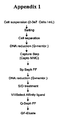
- Appendix 1 shows a flow sheet of a process according to the invention wherein the capture step is performed on a multimodal resin.
- a cell suspension is processed by adding salt, separation of the cells followed by a DNA reduction step, preferably on a Q membrane.
- the Q membrane (for example Sartobind Q from Sartorious) is a strong basic anion exchanger with quaternary ammonium groups as anion exchange moiety. Within specific ranges of pH and conductivity the Q membrane binds specifically DNA, whereas the product (and host cell proteins) remains in the flow through. In opposite to conventional ion exchange column chromatography, the charged ligand is bound to a membrane support which facilitate a high throughput and easy-to-use..
- the capture step comprises the method of the invention using the multimodal resin.
- the capture step is followed by a separation on a cation exchanger, SP Sepharose FFTM (GE HealtCare) followed by a further DNA reduction on a Q membrane.
- a virus inactivation treatment by the solvent detergent method (S/D method) as for example disclosed in EP-A-131740 is performed and a further purification step on e.g. VIII SelectTM affinity resin.
- a further concentration / polishing step is performed on an anion exchanger column, for example on Q Sepharose FFTM (GE HealtCare).
- the concentrated product is thereafter processed on a gelfiltration column (e.g. Superdex 200 p.g.TM (GE Healthcare)) to exchange buffer and remove potential aggregates and fragments.
- the resulting product, GF eluate, is collected.
- the respective steps are explained in more detail in the Examples.
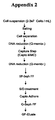
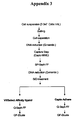
- Appendix 2 and 3 shows an alternative embodiment wherein the specific affinity step (VIIISelectTM (GE HealtCare)) as described in Appendix 1, is replaced by a multimodal chromatography; Capto AdhereTM (GE HealtCare) .Suprisingly, the purification sequence, as described in Appendix 2, exerted the same purity as the purification sequence described in Appendix 1 (including the specific antibody based affinity step). This result was repeated with the same starting material, as described in Appendix 3.
- the specific affinity step VIIISelectTM (GE HealtCare)
- Capto AdhereTM GE HealtCare
- M (Molar) is mol/Kg (i.e. 10 gram of salt is added to 1000 gram of water - not 10 gram of salt is added water up to 1000 mL)
- Example 1 Production of FVIII containing cell suspension.
- the cell line used is a derivative of human embryonic kidney cell 293 (HEK 293), which was adapted to serum-free growth.
- This host, HEK 293F was stably transfected with an expression cassette carrying the gene for B-domain deleted human FVIII under control of a strong promoter ( EP-A-1 739 179 ).
- the cells were cultivated in serum-free medium in general equipment and according to general methods well known in the art, for example shaken or stirred cultures in t-flasks, shaker flasks and bioreactors (disposable systems and conventional stirred tanks) run as batch, fed-batch, perfusion or continuous chemostat cultures ( Freshney, R I (2000), Culture of animal cells: a manual of basic technique, 4th ed, Wiley- Liss ; Spier, R E ed (2000), Encyclopedia of cell technology, Wiley, New York ; Enfors, S-O and Häggström, L (2000), Bioprocess technology: fundamentals and applications, Högskoletryckeriet, Royal Institute of Technology, Sweden ; Vinci, V A and Parekh, S R (2003), Handbook of industrial cell culture: mammalian, microbial, and plant cells, Humana Press, USA ).
- perfusion of medium was used to increase cell numbers and product titers beyond standard batch culture levels.
- the cell suspension is the harvest.
- the properties of the harvest (product titres and impurities as mentioned above) differ depending on the cultivation mode used.
- the cell free FVIII starting material for the chromatographic purification was achieved as follows. A stock solution of sodium chloride and calcium chloride was added to the cell-suspension, produced according to example 1, to give final concentrations of 0.3M and 30mM respectively, and a conductivity of 30-40 mS/cm at 25 °C. The solution was mixed for about 30 minutes, where after the cells were removed by centrifugation and followed by a filtration step to remove any remaining cell debris (to inhibit clogging of the following column steps).
- Example 3a evaluation of different salt concentration and pH to elute FVIII from Capto MMC resin (reference example).
- the Capto MMC resin was obtained from GE Healthcare (Cat. No.17-5317).
- the starting materials used were a protein solution containing rFVIII, obtained as described in example 2.
- the column was equilibrated with equilibration buffer followed by loading of the starting material with a flow rate of 5 mL/min. FVIII bound to the resin during these buffer conditions (no FVIII could be detected in the flow through). The resin was thereafter subjected to different elution conditions as described in Table 1 and the resulting amount of FVIII coming out from the column where analyzed with a FVIII:C method and calculated in % in relation to the applied amount of FVIII.
- the Capto MMC resin was obtained from GE Healthcare (Cat. No.17-5317).
- the starting materials used were a protein solution containing rFVIII, obtained as described in example 2.
- the column was equilibrated with equilibration buffer followed by loading of the starting material with a flow rate of 1 mL/min. FVIII bound to the resin during these buffer conditions (no FVIII could be detected in the flow through). The resin was thereafter subjected to different elution conditions as described in Table 2 and the resulting amount of FVIII coming out from the column were analyzed with a FVIII:C method and calculated in % in relation to the applied amount of FVIII.
- the binding of FVIII to the Capto MMC column can be inhibited by a combination of ethylene glycol and NaCl.
- 50% Ethylene glycol is commonly used as elution buffer for conventional protein based affinity resins.
- the elution of FVIII is improved if ethylene glycol is combined with an increased sodium chloride concentration up to 1.5M.
- Two different pH tested (pH 6.5 and 7.5) do not change the FVIII recovery, indicating that the pH cannot be used as an elution parameter for FVIII, within the stability limits for the protein (approximately. 6-8).
- An elevation of the NaCl concentration to 2.5M did not improve the recovery of FVIII:C in the eluate.
- the Capto MMC resin was obtained from GE Healthcare (Cat. No.17-5317-10).
- the starting materials used were a protein solution containing rFVIII, obtained as described in example 2.
- the column was equilibrated with equilibration buffer followed by loading of the starting material with a flow rate of 0.6 mL/min. FVIII is bound to the resin during these buffer conditions (no FVIII could be detected in the flow through).
- the resin was thereafter subjected to different sequential elution conditions (approximately 10 column volume (CV) each) as described in Table 3 and the resulting amount of FVIII eluting from the column where analyzed with FVIII:C method and calculated in % in relation to the applied amount of FVIII.
- the binding of FVIII to the Capto MMC column can surprisingly be inhibited by a combination of ethylene glycol and arginine. Elution of FVIII is observed in eluates containing up to 0.9M arginine together with 20% (w/w) ethylene glycol.
- Example 3d (according to the invention), comparison of arginine and lysine as an elution component for Capto MMC
- the Capto MMC resin was obtained from GE Healthcare (Cat. No.17-5317).
- the starting materials used were a protein solution containing rFVIII, obtained as described in example 2.
- the column was equilibrated with equilibration buffer followed by loading of the starting material with a flow rate representing a contact time of 1-2 minutes. FVIII bound to the resin during these buffer conditions (no FVIII could be detected in the flow through). The resin was thereafter subjected to different elution conditions as described in Table 4 and the resulting amount of FVIII coming out from the column where analyzed with FVIII:C method and calculated in % in relation to the applied amount of FVIII.
- Example 3e evaluation of purity and recovery using different wash and elution conditions for the Capto MMC resin.
- the Capto MMC resin was packed in different column sizes (2-9cm bed height, volume 1.6 - 48 mL).
- the Capto MMC resin was obtained from GE Healthcare (Cat. No.17-5317).
- the starting materials used were protein solutions containing rFVIII, obtained as described in example 2, with a typical purity of app. 100 IU FVIII / mg protein (as can be seen in example 9, table 18).
- the column was equilibrated with equilibration buffer followed by loading of the starting material with appropriate flow rates (depending on column size, approximately 13-300 cm/h). FVIII bound to the resin during these buffer conditions (no FVIII could be detected in the flow through). The resin was thereafter subjected to different wash and elution conditions as described in Table 5 and the resulting amount of FVIII coming out from the column where analyzed with FVIII:C method and calculated in % in relation to the applied amount of FVIII.
- Capto MMC cation multimodal resin
- high salt high salt
- hydrophobic interaction resins low salt
- An increased amount of charged amino acid alone or in combination with ethylene glycol could surprisingly release the bound FVIII molecule from the Capto MMC resin.
- NaCl, arginine, lysine and ethylene glycol concentrations could be varied during wash and elution of the resin, to optimize recovery and purity of the Capto MMC eluate.
- the Capto Adhere resin was packed to a bed height of 13.5 cm in a C10/20 column.
- the Capto Adhere resin was obtained from GE Healthcare (Cat. No.17-5444).
- the starting materials used were a protein solution containing rFVIII, obtained as described in example 6C.
- Example 5 Comparison of a conventional cation exchange step (SP Sepharose FF) with a cation multimodal resin (Capto MMC) as a purification step (capture step)
- the Capto MMC resin was obtained from GE Healthcare (Cat. No.17-5317).
- the SP Sepharose FF resin was obtained from GE Healthcare (Cat. No.17-0729).
- the starting materials used were a protein solution containing rFVIII, obtained as described in example 2 (identical start material was used for both experiments).
- the starting material was diluted with dilution buffer to a conductivity of 12 mS before applying to the resin, for FVIII to be able to bind.
- the columns was equilibrated with equilibration buffer followed by loading of the starting material at a flow rate of 5 mL/min respectively 40 mL/min. FVIII bound to the resins during these buffer conditions (no FVIII could be detected in the flow through).
- the resin was thereafter subjected to different wash and elution conditions, the principle described in example 3d (wash 0.75M lysine + 20% ethylene glycol) and example 3b (elution 1.5M NaCl + 50% ethylene glycol) for the Capto MMC step and in example 6b for the SP Sepharose FF step (wash 0.15M NaCl and elution 0.36M NaCl).
- Table 7 the differences between the two purification steps can be studied.
- Example 6 Specific elution (Ca) and wash components for FVIII and purification thereof on a cation exchange resin (SP Sepharose FF) (comparative).
- Example 6a Sodium chloride and arginine as specific elution and wash component used on a cation exchange resin (SP Sepharose FF).
- the SP Sepharose FF resin was packed to a bed height of 15 cm in a XK16 column.
- the SP Sepharose FF resin was obtained from GE Healthcare (Cat. No.17-0729).
- the starting materials used were a protein solution containing rFVIII, obtained as described in example 2 and further processed on a Capto MMC resin, as described in example 9.
- the eluate from the Capto MMC column was diluted 12x with a dilution buffer to lower the conductivity to approximately 12 mS/cm, which enables the binding of the target protein to the SP Sepharose FF resin.
- the bound FVIII was effectively eluted from the SP Sepharose FF column when an eluting buffer with a conductivity of 36mS/cm was used. This conductivity was an effect of the NaCl concentration and partly of the CaCl 2 and arginine concentrations.
- the sorbitol and arginine was included in the buffer to stabilize the FVIII molecule during processing, freezing and thawing.
- Example 6b Sodium chloride as a specific elution and wash component used on a cation exchange resin (SP Sepharose FF).
- the SP Sepharose FF resin was packed to a bed height of 15 cm in a C10/20 column.
- the SP Sepharose FF resin was obtained from GE Healthcare (Cat. No.17-0729).
- the starting materials used were a protein solution containing rFVIII, obtained as described in example 2 and example 9.
- the eluate from the Capto MMC column was diluted 12x with a dilution buffer to lower the conductivity, which enables the binding of the target protein to the SP Sepharose FF resin.
- Example 6c Calcium chloride as a specific elution and wash component used on a cation exchange resin.
- the SP Sepharose FF resin was packed to a bed height of 15.5 cm in a XK26 column.
- the SP Sepharose FF resin was obtained from GE Healthcare (Cat. No.17-0729).
- the starting materials used were a protein solution containing rFVIII, obtained as described in example 2 and example 9.
- the eluate from the Capto MMC column was diluted 12x with a dilution buffer to lower the conductivity, which enables the binding of the target protein to the SP Sepharose FF resin.
- Example 7 Purification with a yeast derived FVIII affinity ligand.
- a C10/20 column was packed with the VIIISelect resin to a bed height of seven cm.
- the VIIISelect resin was obtained from GE Healthcare (Cat. No.17-5450).
- the starting material used was a SP Sepharose eluate containing rFVIII, obtained as principle described in example 6b for the SP Sepharose FF step (wash 0.15M NaCl and elution 0.36M NaCl).
- the equilibration, washing and elution buffers are not limited to the stated pH, concentrations, and type of buffer, salts or detergent.
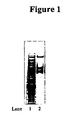
- Figure 1 Silver stained SDS-PAGE showing purity profile for starting material (Lane 1) and VIIISelect eluate (Lane 2) after the affinity chromatography step.
- the VIIISelect step is a powerful purification step that yields a pure eluate.
- Example 8 Comparison of a purification sequence with VIIISelect affinity resin or a multi modal resin (Capto Adhere) instead (Appendix 3).
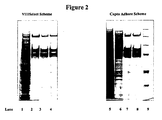
- Figure 2 shows SDS Page silver staining of samples described in Table 12; Comparison of VIIISelect purification scheme and Capto Adhere purification scheme.
- Lane 1 shows the purity of the starting material (SP-filtrate) before the VIIISelect column loaded at a FVIII concentration of 483 IU/ml.
- Lane 2 shows the purity of the VIIISelect eluate loaded at a FVIII concentration of 500 IU/ml.
- Lane 3 shows the purity after the purification sequence SP-VIIISelect-Q Seph , loaded at a FVIII concentration of 500 IU/ml.
- Lane 4 shows the purity after the purification sequence SP-VIIISelect-Q Seph- gelfiltration, loaded at a FVIII concentration of 385 IU/ml.
- Lane 5 shows the purity of the starting material (SP-filtrate) before the Capto Adhere column loaded at a FVIII concentration of 493 IU/ml.
- Lane 6 shows the purity of the Capto adhere eluate loaded at a FVIII concentration of 500 IU/ml.
- Lane 7 shows the purity after the purification sequence SP-Capto Adhere-Q Seph , loaded at a FVIII concentration of 500 IU/ml.
- Lane 8 shows the purity after the purification sequence SP-Capto Adhere-Q Sephgelfiltration, loaded at a FVIII concentration of 493 IU/ml.
- Lane 9 shows a molecular marker
- the same purity can be achieved either by using the VIIISelect affinity step or the Capto Adhere chromatography step, if the purity is compared in the final product (GF-eluate).
- the purity after the VIIISelect step is higher compared to after the Capto Adhere step, but after the remaining purification steps (Q and GF) no difference in purity can be noticed with used analytical methods.
- the recovery using the Capto Adhere step is slightly higher compared to the sequence using VIIISelect.
- Example 9 Industrial scale purification sequence, including VIIISelect affinity resin To study the reproducability of recovery and purity, purification Steps 1-9 described below, were performed on 3-4 batches in pilot scale. Each batch originating from 40-100L cellsuspension, as described in example 1-2.
- the cellfiltrate (from example 2) is processed through the Q-membrane and the product-containing flow-through is collected.
- the membrane is washed with equilibration buffer to recover any FVIII remaining in the membrane.
- the primary product purification and concentration (capture) is performed at 500-10,000 IU of FVIII/ml of multi-modal cation exchange chromatography (Capto MMC) gel.
- the gel is before product application equilibrated with Capto MMC equilibration buffer.
- the filtrate from step 1 is loaded to the Capto MMC column which thereafter is rinsed with Capto MMC equilibration buffer and thereafter washed sequentially with wash buffer 1-3 followed by elution of FVIII, as described in Table 14.
- Wash Buffer 3 0.3 mol/kg NaCl, 0.01mol/kg CaCl 2 , 0.01 mol/kg L-histidine, 0.4 mol/kg L-arginine hydrochloride, 10% (w/w) ethylene glycol, 0.02% Polysorbate 80 (w/w), pH 6.5 Elution Buffer 0.3 mol/kg NaCl, 0.02mol/kg CaCl 2 , 0.02 mol/kg L-histidine, 0.8 mol/kg L-arginine hydrochloride 10% (w/w) ethylene glycol, 0.02% Polysorbate 80 (w/w), pH 6.5
- the FVIII-containing solution (Capto MMC eluate) from step 2 is further purified using a SP-Sepharose FF gel (GE Healthcare Cat. No.17-0729). Before product application the column is equilibrated with SP-Sepharose equilibration buffer and the protein solution is diluted to meet the ionic strength and pH of the equilibration buffer, to be able to bind FVIII to the gel. The diluted protein solution is applied to the SP Sepharose column, which thereafter is rinsed with equilibration buffer and thereafter washed with wash buffer followed by elution of FVIII, as described in Table 15.
- SP-Sepharose FF gel GE Healthcare Cat. No.17-0729
- the SP-eluate from step 3 is filtered through the Q-membrane, the product-containing flow-through is collected for further processing.
- the membrane is washed with equilibration buffer to recover any FVIII remaining in the membrane.
- the filtrate from step 4 is virus inactivated through S/D (Solvent/Detergent) treatment with 1% Triton X-100 and 0.3% Tri- (N-Butyl)-Phosphate (TNBP). Virus inactivation is performed under agitation at room temperature for approximately 1h.
- the virus inactivated FVIII solution from step 5 is processed through a VIIISelect affinity column according to description in example 7. Approximately 5-20,000 IU FVIII is loaded per mL resin.
- the VIIISelect eluate from step 6 is nanofiltered for removal of potential adventitious agents such as non-enveloped viruses, using a Planova 20N nanofilter (Asahi Kasei Medical). The product containing flow through is collected.
- the Q Sepharose FF resin was obtained from GE Healthcare (Cat. No.17-0510).
- the starting material used is a nanofiltrate obtained from step 7, wherase the salt and pH has been adjusted to be comparable to the equilibration buffer in Table 17.
- the diluted protein solution is applied to the Q Sepharose FF column with a load of 5,000 - 25,000 IU/mL gel, which thereafter is rinsed with equilibration buffer and thereafter washed with wash buffer followed by elution of FVIII, as described in Table 17.
- Table17 Buffer used for anion exchange step (Q-Sepharose FF) Anion exchanger / Q-Sepharose FF Equilibration Buffer 0.1 mol/kg NaCl, 0.02mol/kg CaCl 2 , 0.02mol/kg L-histidine, 0.02% Polysorbate 80, pH 7.5 Wash Buffer 0.3 mol/kg NaCl, 0.02mol/kg CaCl 2 , 0.02mol/kg L-histidine, 0.02% Polysorbate 80 pH 7.5 Elution Buffer 0.4 mol/kg NaCl, 0.02mol/kg CaCl 2 , 0.02mol/kg L-histidine, 0.02% Polysorbate 80 pH 6.0
- a gelfiltration resin (Superdex 200pg, GE Healthcare Cat. No.17-1043) was packed to a bed height of 60-75 cm.
- the starting material used is the Q-eluate obtained from step 8.
- the column is equilibrated with a physiological acceptable composition which protect the product from surface adsorption and stabilize it during freezing, storage, freeze drying etc.
- the Q-eluate is applied to the gelfiltration column with a volume of 2-8% of the total column volume.
- the formulated FVIII containing eluate, devoid of fragment and aggregates, is collected after the column (GF-eluate).
- Figure 3 shows SDS-PAGE silver staining pattern of the final product before (Lane 3 - BPP083, Lane 7 - BPP084) and after (Lane 6 - C810A139, Lane 8 - C811A139) formulation, purified according to example 9 (Table18-19).
- Lane 2 shows a molecular marker
- Lane 3 shows a FVIII control sample
- Lane 4 shows a commercially available FVIII product (ReFacto® - Lot C66202).
- Figure 4 shows Western blotting of FVIII using polyclonal anti-human FVIII antibodies.
- Lanes 1 and 10 are Empty
- Lane 2 shows a Molecular mass standard (Precision Plus Protein Western C from Bio-rad)
- Lane 3 shows a commercially available FVIII product ReFacto® lot C66202
- Lane 4-6 shows a FVIII control samples
- Lanes 7-9 shows final formulated products of batches BPP079, BPP083 and BPP084 purified purified according to example 9 (Table17-18). Samples were diluted to a FVIII concentration corresponding to 5 IU FVIII:C/ml before applying to the western blot.
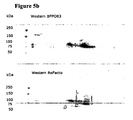
- Figure 5 shows 2-D-PAGE following silver-staining and western blotting of final formulated products of batches BPP079 and BPP083 , final product (GF-eluate) of batches BPP079 GF eluate and BPP083 GF eluate, purified according to example 9 (Table17-18).
- a commercially available FVIII product (ReFacto®, Lot 70591) was used as a reference.
- Left pane Silver stained images of gels with BPP079 and BPP083 GF-eluates and ReFacto®.
- Right pane Western blot images with BPP083 GF-eluates and ReFacto®.
- the described purification process can be performed in industrial scale in a way, which is reproducible in regard of recovery, purity and product quality. In additional it fulfils the high demand for purity to be able to use the product for treatment of humans.
- Example 10 Industrial scale of purification sequence without specific affinity ligand (anion multimodal resin; Capto Adhere instead)
- the anion exchange multi modal column (Capto Adhere, GE Healthcare, Cat. No.17-5444) was loaded in the range of 5,000 -10,000 IU FVIII / mL resin.
- the gel is before product application equilibrated with equilibration buffer.
- the virus inactivated solution (as described in example 9, step 5) is loaded to the Capto Adhere column which thereafter is rinsed with equilibration buffer and washed sequentially with wash buffer 1-3 followed by elution of FVIII, as described in Table 20.
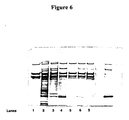
- Figure 6 shows a SDS-PAGE silver staining gel of samples from pilot batch BPP071 purified according to example 10.
- Lane 1 shows a commercially available FVIII product (ReFacto®).
- Lane 2 shows the starting material (SP-filtrate) before the Capto Adhere Step.
- Lane 3 shows the purity profile of the Capto Adhere eluate.
- Lane 4 shows the purity after the purification sequence SP filtrate - Capto Adhere - Q Seph.
- Lane 5 shows the purity after the purification sequence SP filtrate - Capto Adhere - Q Seph - Gel filtration.
- Figure 7 shows a Western Blot gel of samples from pilot batch BPP071 purified according to example 10.
- Lane 1 shows a commercially available FVIII product (ReFacto®).
- Lane 2 shows the Capto Adhere eluat.
- Lane 3 shows the result of the purification sequence SP filtrate - Capto Adhere - Q Seph.
- Lane 4 shows the results after the purification sequence SP filtrate - Capto Adhere - Q Seph - Gelfiltration.
- stage one activated factor X (Xa) is generated via the intrinsic pathway where FVIII: C acts as a co-factor.
- stage two Factor Xa is then determined by the use of a synthetic chromogenic substrate, S-2222 in the presence of a thrombin inhibitor I-2581 to prevent hydrolysis of the substrate by thrombin. The reaction is stopped with acid, and the VIII: C activity, which is proportional to the release of pNA (para-nitroaniline), is determined photo metrically at 405 nm against a reagent blank.
- pNA para-nitroaniline
- the method complies with the requirements in the European Pharmacopoeia.
- the unit of FVIII: C is expressed in international units (IU) as defined in the current International Concentrate Standard (IS) established by the World Health Organization (WHO).
- IS International Concentrate Standard
- WHO World Health Organization
- the routine using buffer containing 1 % BSA instead of severe hemophilic plasma for predilutions has been validated. See also literature references ( European Pharmacopoeia Supplement 2000, general Methods, 2.7.4. Assay of Blood Coagulation FVIII ; Rosén S (1984) Assay of FVIII: C with a Chromogenic Substrate.
- Protein determination according to Bradford is based on the observation that the absorbance maximum for an acidic solution of Coomassie Brilliant Blue G-250 shifts from 465 nm to 595 nm when binding to protein occurs. Both hydrophobic and ionic interactions stabilize the anionic form of the dye, causing a visible colour change.
- the assay is useful since the extinction coefficient of a dye-albumin complex solution is constant over a 10-fold concentration range. See also reference Bradford, MM. A rapid and sensitive method for the quantisation of microgram quantities of protein utilizing the principle of protein-dye binding. Analytical Biochemistry 72: 248-254. 1976 . for further information.
- the results of aspartic acid and glutamic acid represent the sum of aspartic acid/asparagine (Asx) and glutamic acid/glutamine (Glx), respectively, in the original sample. Tryptophan is not generating a distinct response using this method, and, thus, is not quantified by the AAA. Cysteine is destroyed during the hydrolysis and is not quantified.
- the AAA is further described in reference: Total protein AAA analytical method. Spackman, D. H., Stein, W. H., and Moore, S. (1958) Anal. Biochem. 30: 1190-1206 .
- the purity (or also called specific activity) for a sample is calculated taking the value achieved from the FVIII:C analysis and divide it with the value achieved from the analysis of total protein.
- SDS polyacrylamide gel electrophoresis involves the separation of proteins based on their size. This method describes the SDS-PAGE of proteins, which is run under reduced conditions. By heating the sample under denaturing and reducing conditions, proteins become unfolded and coated with anionic detergent sodium dodecyl sulphate (SDS), acquiring a high net negative charge that is proportional to the length of the polypeptide chain.
- SDS anionic detergent sodium dodecyl sulphate
- the negatively charged protein molecules migrate towards the positively charged electrode and are separated by a molecular sieving effect, i.e. by their molecular weight. Polyacrylamide gels restrain larger molecules from migrating as fast as smaller molecules.
- the assay is a real time quantitative PCR (qPCR) assay based on SYBR Green 1 chemistry. It is based on a publication of Umetani et al. with some added improvements ( Umetani N, Kim J, Hiramatzu S, Reber HA, Hines OJ, Bilchik AJ and Hoon DSB. Increased Integrity of Free Circulating DNA in Sera of Patients with Colorectal or Periampullary Cancer: Direct Quantitative PCR for ALU Repeats. Clin Chem 2006;52:1062-1069 ). During each PCR cycle a 115 base pair fragment from the ALU sequence families is amplified by the primers, ALU115-F and ALU115-R.
- qPCR real time quantitative PCR
- the highly abundant ALU sequence family is limited to genome of the family Hominidae (Chimpanzee, Gorilla, Human and Orang-utan), but the assay only amplify DNA from human origin.
- the procedure allows for high through put analysis of residual HEK293F DNA in cell free tissue culture media and it's downstream purification processes.
- Proteins and peptides in FVIII preparations are separated according to molecular mass by sodium dodecyl sulphate (SDS) polyacrylamide gel electrophoresis (PAGE) under reducing conditions. Thereafter, the proteins are transferred electrophoretically from the gel matrix to a nitrocellulose membrane which is subsequently incubated with a blocking agent. Polyclonal sheep antibodies directed to the whole FVIII molecule is then added followed by a secondary antibody which is specific for the Fc part of goat/sheep antibodies. As a third step soluble complexes of goat antibody to horseradish peroxidase (HRP) and HRP are added. FVIII polypeptides are then detected by occurrence of blue bands after incubation with the substrate 4-chloro-1-naphtol.
- SDS sodium dodecyl sulphate
- PAGE polyacrylamide gel electrophoresis
- 2-D-PAGE was carried out in order to study the electrophoretic band pattern of the protein chains of Human-cl rhFVIII. Isoelectric focusing was performed as the first dimension run using a linear pH gradient of pH 3 to 10. The second dimension SDS-PAGE was run using polyacrylamide gradient (3-8%) gels. The gels were either stained with silver-stain following the second dimension run or were submitted to western blotting ( O' Farrell PH (1975) High resolution two-dimensional electrophoresis of proteins. J Biol Chem 250: 4007-4021 ).
Landscapes
- Health & Medical Sciences (AREA)
- Chemical & Material Sciences (AREA)
- Life Sciences & Earth Sciences (AREA)
- Organic Chemistry (AREA)
- Medicinal Chemistry (AREA)
- General Health & Medical Sciences (AREA)
- Proteomics, Peptides & Aminoacids (AREA)
- Zoology (AREA)
- Genetics & Genomics (AREA)
- Engineering & Computer Science (AREA)
- Gastroenterology & Hepatology (AREA)
- Molecular Biology (AREA)
- Biochemistry (AREA)
- Hematology (AREA)
- Bioinformatics & Cheminformatics (AREA)
- Biophysics (AREA)
- Animal Behavior & Ethology (AREA)
- Veterinary Medicine (AREA)
- Public Health (AREA)
- Epidemiology (AREA)
- Pharmacology & Pharmacy (AREA)
- Immunology (AREA)
- Toxicology (AREA)
- Analytical Chemistry (AREA)
- Biomedical Technology (AREA)
- Wood Science & Technology (AREA)
- Chemical Kinetics & Catalysis (AREA)
- Biotechnology (AREA)
- Microbiology (AREA)
- General Engineering & Computer Science (AREA)
- Peptides Or Proteins (AREA)
Priority Applications (5)
| Application Number | Priority Date | Filing Date | Title |
|---|---|---|---|
| EP12179389.7A EP2537862B1 (en) | 2008-06-24 | 2009-06-24 | A process of purifying coagulation factor VIII |
| EP09769279A EP2300497B1 (en) | 2008-06-24 | 2009-06-24 | A process of purifying coagulation factor viii |
| DK12179389.7T DK2537862T3 (en) | 2008-06-24 | 2009-06-24 | A method of purifying coagulation factor VIII |
| PL09769279T PL2300497T3 (pl) | 2008-06-24 | 2009-06-24 | Sposób oczyszczania czynnika krzepnięcia VIII |
| SI200930362T SI2300497T1 (sl) | 2008-06-24 | 2009-06-24 | Postopek za äťiĺˇäťenje koagulacijskega faktorja viii |
Applications Claiming Priority (4)
| Application Number | Priority Date | Filing Date | Title |
|---|---|---|---|
| US12940208P | 2008-06-24 | 2008-06-24 | |
| EP08158893 | 2008-06-24 | ||
| EP09769279A EP2300497B1 (en) | 2008-06-24 | 2009-06-24 | A process of purifying coagulation factor viii |
| PCT/EP2009/057883 WO2009156430A1 (en) | 2008-06-24 | 2009-06-24 | A process of purifying coagulation factor viii |
Related Child Applications (1)
| Application Number | Title | Priority Date | Filing Date |
|---|---|---|---|
| EP12179389.7A Division EP2537862B1 (en) | 2008-06-24 | 2009-06-24 | A process of purifying coagulation factor VIII |
Publications (2)
| Publication Number | Publication Date |
|---|---|
| EP2300497A1 EP2300497A1 (en) | 2011-03-30 |
| EP2300497B1 true EP2300497B1 (en) | 2012-08-08 |
Family
ID=40076764
Family Applications (2)
| Application Number | Title | Priority Date | Filing Date |
|---|---|---|---|
| EP09769279A Active EP2300497B1 (en) | 2008-06-24 | 2009-06-24 | A process of purifying coagulation factor viii |
| EP12179389.7A Revoked EP2537862B1 (en) | 2008-06-24 | 2009-06-24 | A process of purifying coagulation factor VIII |
Family Applications After (1)
| Application Number | Title | Priority Date | Filing Date |
|---|---|---|---|
| EP12179389.7A Revoked EP2537862B1 (en) | 2008-06-24 | 2009-06-24 | A process of purifying coagulation factor VIII |
Country Status (19)
| Country | Link |
|---|---|
| US (1) | US8329871B2 (enExample) |
| EP (2) | EP2300497B1 (enExample) |
| JP (1) | JP5619738B2 (enExample) |
| KR (3) | KR101700722B1 (enExample) |
| CN (1) | CN102066417B (enExample) |
| AU (1) | AU2009264282B2 (enExample) |
| BR (1) | BRPI0914695B1 (enExample) |
| CA (1) | CA2728047C (enExample) |
| DK (2) | DK2300497T3 (enExample) |
| ES (2) | ES2538706T3 (enExample) |
| IL (3) | IL209758A (enExample) |
| MX (1) | MX2010013908A (enExample) |
| PL (1) | PL2300497T3 (enExample) |
| PT (1) | PT2300497E (enExample) |
| RU (2) | RU2567811C2 (enExample) |
| SI (1) | SI2300497T1 (enExample) |
| UA (1) | UA100901C2 (enExample) |
| WO (1) | WO2009156430A1 (enExample) |
| ZA (1) | ZA201009162B (enExample) |
Cited By (1)
| Publication number | Priority date | Publication date | Assignee | Title |
|---|---|---|---|---|
| US12258540B2 (en) | 2017-10-30 | 2025-03-25 | Takeda Pharmaceutical Company Limited | Environmentally compatible detergents for inactivation of lipid-enveloped viruses |
Families Citing this family (41)
| Publication number | Priority date | Publication date | Assignee | Title |
|---|---|---|---|---|
| BRPI0814220B8 (pt) | 2007-07-11 | 2021-05-25 | Novo Nordisk As | purificação de fator viii usando uma resina multimodal ou de modo misto |
| EP2027875A1 (en) * | 2007-08-23 | 2009-02-25 | Octapharma AG | A Process for Isolation and Purification of a Target Protein free of Prion Protein (PrPSC) |
| WO2010020690A1 (en) | 2008-08-21 | 2010-02-25 | Octapharma Ag | Recombinantly produced human factor viii and ix |
| KR101691070B1 (ko) * | 2008-09-03 | 2016-12-29 | 옥타파마 아게 | 재조합에 의해 제조된 인자 ⅷ을 위한 신규한 보호 조성물 |
| WO2010030222A1 (en) * | 2008-09-12 | 2010-03-18 | Ge Healthcare Bio-Sciences Ab | Enhanced protein aggregate removal with multimodal anion exchangers in the presence of protein-excluded zwitterions |
| EP2552948B1 (en) * | 2010-03-30 | 2016-07-13 | Octapharma AG | Process for the purification of growth factor protein g-csf |
| CN102858971B (zh) * | 2010-03-30 | 2016-06-01 | 奥克塔法马股份有限公司 | 纯化维生素k依赖性蛋白如凝血因子ix的方法 |
| CA2796729C (en) | 2010-04-20 | 2020-06-23 | Octapharma Ag | Melezitose for stabilizing human blood plasma proteins |
| WO2012049285A1 (en) | 2010-10-14 | 2012-04-19 | Octapharma Ag | A method for the quantitative glycosylation analysis of proteins |
| WO2012059495A1 (en) * | 2010-11-05 | 2012-05-10 | F. Hoffmann-La Roche Ag | Optimized method for antibody capturing by mixed mode chromatography |
| RU2600886C2 (ru) * | 2011-05-13 | 2016-10-27 | Октафарма Аг | Способ повышения продуктивности эукариотических клеток в продуцировании рекомбинантного fviii |
| WO2012173260A1 (ja) | 2011-06-17 | 2012-12-20 | 学校法人東日本学園・北海道医療大学 | ループスアンチコアグラント検出用血液凝固時間の測定方法 |
| EP2771358A4 (en) * | 2011-10-26 | 2015-08-26 | Bio Rad Laboratories | ELIMINATION OF VIRAL AGENTS IN MIXED MODE CHROMATOGRAPHY |
| MX379269B (es) * | 2012-10-24 | 2025-03-11 | Genzyme Corp | Elucion de biomoleculas de resinas multimodales utilizando mes y mops como modificadores de fase movil. |
| US10188965B2 (en) | 2012-12-05 | 2019-01-29 | Csl Behring Gmbh | Hydrophobic charge induction chromatographic depletion of a protein from a solution |
| US20140154233A1 (en) | 2012-12-05 | 2014-06-05 | Csl Limited | Method of purifying therapeutic proteins |
| CN103880947B (zh) * | 2012-12-21 | 2016-01-13 | 武汉禾元生物科技股份有限公司 | 一种分离纯化高纯度重组人血清白蛋白的层析方法 |
| AU2014226126B2 (en) * | 2013-03-08 | 2019-02-14 | Genzyme Corporation | Continuous purification of therapeutic proteins |
| WO2014201400A2 (en) * | 2013-06-13 | 2014-12-18 | Biogen Idec Ma Inc. | Anti-factor viii antibodies or uses thereof |
| US10519194B2 (en) | 2013-07-12 | 2019-12-31 | Merck Patent Gmbh | Removal of fragments from a sample containing a target protein using activated carbon |
| EP3875106A1 (en) * | 2013-08-08 | 2021-09-08 | Bioverativ Therapeutics Inc. | Purification of chimeric fviii molecules |
| CN112195169A (zh) | 2013-09-24 | 2021-01-08 | 辉瑞大药厂 | 包含重组人凝血因子Xa蛋白的异质性群体的组合物 |
| TWI709569B (zh) | 2014-01-17 | 2020-11-11 | 美商健臻公司 | 無菌層析樹脂及其用於製造方法的用途 |
| TWI709570B (zh) * | 2014-01-17 | 2020-11-11 | 美商健臻公司 | 無菌層析法及製法 |
| WO2015107222A1 (en) * | 2014-01-20 | 2015-07-23 | Octapharma Ag | A process for manufacturing factor viii having an improved ratio of fviii:c/fviii:ag |
| DK3461891T3 (da) * | 2014-01-24 | 2020-08-10 | Am-Pharma Bv | Nedstrømsbehandling af en alkalisk phosphatase |
| NZ722391A (en) * | 2014-02-04 | 2022-12-23 | Biogen Ma Inc | Use of cation-exchange chromatography in the flow-through mode to enrich post-translational modifications |
| CN104861060A (zh) * | 2014-02-21 | 2015-08-26 | 神州细胞工程有限公司 | 一种纯化凝血因子viii的方法 |
| WO2015183183A1 (en) | 2014-05-29 | 2015-12-03 | Agency For Science, Technology And Research | Protein Extraction Methods |
| US10626164B2 (en) * | 2014-07-25 | 2020-04-21 | Csl Limited | Purification of VWF |
| GB201506117D0 (en) | 2015-04-10 | 2015-05-27 | Ge Healthcare Bio Sciences Ab | Method for chromatography |
| GB201506113D0 (en) | 2015-04-10 | 2015-05-27 | Ge Healthcare Bio Sciences Ab | Method for chromatography |
| WO2016207328A1 (en) * | 2015-06-24 | 2016-12-29 | Glycotope Gmbh | PROCESS FOR THE PURIFICATION OF γ-CARBOXYLATED POLYPEPTIDES |
| EP3205665A1 (en) | 2016-02-11 | 2017-08-16 | Octapharma AG | Method of separating factor viii from blood products |
| GB201617240D0 (en) * | 2016-10-11 | 2016-11-23 | Profactor Pharma Ltd | Purification process |
| EP3642225A1 (en) * | 2017-06-23 | 2020-04-29 | Baxalta Incorporated | Purification of factor viii subspecies |
| CN107226859B (zh) * | 2017-08-10 | 2020-11-24 | 博雅生物制药集团股份有限公司 | 一种人凝血因子ⅷ的制备方法 |
| CN111065735B (zh) * | 2017-08-31 | 2023-07-07 | 株式会社绿十字 | 用于纯化硫酸酯酶蛋白的方法 |
| JP7699537B2 (ja) | 2018-08-31 | 2025-06-27 | ジェンザイム・コーポレーション | 無菌クロマトグラフィー樹脂および製造方法におけるその使用 |
| WO2021147857A1 (en) * | 2020-01-20 | 2021-07-29 | Wuxi Biologics (Shanghai) Co., Ltd | A novel wash buffer solution for affinity chromatography |
| CN118217951B (zh) * | 2024-04-01 | 2025-05-23 | 山东建筑大学 | 一种水中的高纯度磷回收装置和方法 |
Family Cites Families (19)
| Publication number | Priority date | Publication date | Assignee | Title |
|---|---|---|---|---|
| US4540573A (en) | 1983-07-14 | 1985-09-10 | New York Blood Center, Inc. | Undenatured virus-free biologically active protein derivatives |
| US5605884A (en) * | 1987-10-29 | 1997-02-25 | Rhone-Poulenc Rorer Pharmaceuticals Inc. | Factor VIII formulations in high ionic strength media |
| US5316680A (en) * | 1992-10-21 | 1994-05-31 | Cornell Research Foundation, Inc. | Multimodal chromatographic separation media and process for using same |
| WO1994029992A1 (en) | 1993-06-11 | 1994-12-22 | Northern Telecom Limited | Method and apparatus for providing user controlled call management services |
| DE4337573C1 (de) * | 1993-11-04 | 1995-05-18 | Octapharma Ag | Verfahren zur Herstellung einer virusinaktivierten Faktor VIII enthaltenden Fraktion mittels chromatographischer Methoden |
| SE9403915D0 (sv) | 1994-11-14 | 1994-11-14 | Annelie Almstedt | Process A |
| AUPR638801A0 (en) * | 2001-07-13 | 2001-08-09 | Life Therapeutics Limited | Factor viii separation |
| KR101150050B1 (ko) | 2004-02-27 | 2012-07-05 | 지이 헬스케어 바이오-사이언시스 에이비 | 항체 정제 방법 |
| US9624260B2 (en) * | 2004-06-07 | 2017-04-18 | Therapure Biopharma Inc. | Process for isolation of plasma or serum proteins |
| EP1707634A1 (en) * | 2005-03-29 | 2006-10-04 | Octapharma AG | Method for isolation of recombinantly produced proteins |
| FR2887883B1 (fr) * | 2005-06-29 | 2007-08-31 | Lab Francais Du Fractionnement | Procede de separation des proteines fibrinogene, facteur xiii et colle biologique d'une fraction plasmatique solubilisee et de preparation de concentres lyophilises desdites proteines |
| EP1739179A1 (en) | 2005-06-30 | 2007-01-03 | Octapharma AG | Serum-free stable transfection and production of recombinant human proteins in human cell lines |
| CN101506222B (zh) | 2006-07-14 | 2013-10-02 | 健泰科生物技术公司 | 重组蛋白的重折叠 |
| RU2324495C1 (ru) * | 2006-08-31 | 2008-05-20 | Федеральное государственное унитарное предприятие "Научно-производственное объединение по медицинским иммунобиологическим препаратам "Микроген" Министерства здравоохранения Российской Федерации | Способ получения препарата фактора свертывания viii крови человека |
| US8022187B2 (en) * | 2007-02-01 | 2011-09-20 | Baxter International Inc. | FVIII-independent FIX-mutant proteins for hemophilia A treatment |
| PL2167117T3 (pl) * | 2007-06-13 | 2013-01-31 | Csl Behring Gmbh | Zastosowanie stabilizowanego VWP preparatu FVIII do podawania pozanaczyniowego w terapii i profilaktyce zaburzeń krzepliwości krwi |
| BRPI0814220B8 (pt) * | 2007-07-11 | 2021-05-25 | Novo Nordisk As | purificação de fator viii usando uma resina multimodal ou de modo misto |
| GB0723712D0 (en) * | 2007-12-04 | 2008-01-16 | Apitope Technology Bristol Ltd | Peptides |
| DE102008032361A1 (de) * | 2008-07-10 | 2010-01-21 | Csl Behring Gmbh | Der Einsatz von Faktor VIII und vWF bzw. vWF-enthaltenden Konzentraten zur Therapie der durch Thrombocyten-Inhibitoren induzierte Koagulopathie |
-
2009
- 2009-06-24 US US12/737,230 patent/US8329871B2/en active Active
- 2009-06-24 MX MX2010013908A patent/MX2010013908A/es active IP Right Grant
- 2009-06-24 DK DK09769279.2T patent/DK2300497T3/da active
- 2009-06-24 RU RU2011102437/10A patent/RU2567811C2/ru active
- 2009-06-24 ES ES12179389.7T patent/ES2538706T3/es active Active
- 2009-06-24 KR KR1020107028866A patent/KR101700722B1/ko active Active
- 2009-06-24 AU AU2009264282A patent/AU2009264282B2/en active Active
- 2009-06-24 UA UAA201100699A patent/UA100901C2/ru unknown
- 2009-06-24 CA CA2728047A patent/CA2728047C/en active Active
- 2009-06-24 SI SI200930362T patent/SI2300497T1/sl unknown
- 2009-06-24 CN CN200980123974.6A patent/CN102066417B/zh active Active
- 2009-06-24 BR BRPI0914695-4A patent/BRPI0914695B1/pt active IP Right Grant
- 2009-06-24 KR KR1020167023450A patent/KR20160104740A/ko not_active Abandoned
- 2009-06-24 DK DK12179389.7T patent/DK2537862T3/en active
- 2009-06-24 RU RU2015141849A patent/RU2698392C2/ru active
- 2009-06-24 EP EP09769279A patent/EP2300497B1/en active Active
- 2009-06-24 ES ES09769279T patent/ES2391613T3/es active Active
- 2009-06-24 PL PL09769279T patent/PL2300497T3/pl unknown
- 2009-06-24 PT PT09769279T patent/PT2300497E/pt unknown
- 2009-06-24 KR KR1020177024076A patent/KR101804136B1/ko active Active
- 2009-06-24 WO PCT/EP2009/057883 patent/WO2009156430A1/en not_active Ceased
- 2009-06-24 EP EP12179389.7A patent/EP2537862B1/en not_active Revoked
- 2009-06-24 JP JP2011515372A patent/JP5619738B2/ja active Active
-
2010
- 2010-12-05 IL IL209758A patent/IL209758A/en active IP Right Grant
- 2010-12-05 IL IL229583A patent/IL229583B/en active IP Right Grant
- 2010-12-21 ZA ZA2010/09162A patent/ZA201009162B/en unknown
-
2013
- 2013-11-24 IL IL229583A patent/IL229583A0/en unknown
Cited By (1)
| Publication number | Priority date | Publication date | Assignee | Title |
|---|---|---|---|---|
| US12258540B2 (en) | 2017-10-30 | 2025-03-25 | Takeda Pharmaceutical Company Limited | Environmentally compatible detergents for inactivation of lipid-enveloped viruses |
Also Published As
Similar Documents
| Publication | Publication Date | Title |
|---|---|---|
| EP2537862B1 (en) | A process of purifying coagulation factor VIII | |
| EP2553095B1 (en) | A process for purifying vitamin K dependent proteins such as coagulation factor IX | |
| KR101780518B1 (ko) | 음이온 교환 수지상에서의 2가 양이온 결합 단백질의 정제 방법 | |
| EP3097118A1 (en) | A process for manufacturing factor viii having an improved ratio of fviii:c/fviii:ag | |
| EP2970376B1 (en) | Purification method for vitamin k dependent proteins by anion exchange chromatography | |
| HK1219285B (en) | Purification method for vitamin k dependent proteins by anion exchange chromatography |
Legal Events
| Date | Code | Title | Description |
|---|---|---|---|
| PUAI | Public reference made under article 153(3) epc to a published international application that has entered the european phase |
Free format text: ORIGINAL CODE: 0009012 |
|
| 17P | Request for examination filed |
Effective date: 20110110 |
|
| AK | Designated contracting states |
Kind code of ref document: A1 Designated state(s): AT BE BG CH CY CZ DE DK EE ES FI FR GB GR HR HU IE IS IT LI LT LU LV MC MK MT NL NO PL PT RO SE SI SK TR |
|
| AX | Request for extension of the european patent |
Extension state: AL BA RS |
|
| RAX | Requested extension states of the european patent have changed |
Extension state: RS Payment date: 20110110 |
|
| GRAP | Despatch of communication of intention to grant a patent |
Free format text: ORIGINAL CODE: EPIDOSNIGR1 |
|
| GRAJ | Information related to disapproval of communication of intention to grant by the applicant or resumption of examination proceedings by the epo deleted |
Free format text: ORIGINAL CODE: EPIDOSDIGR1 |
|
| GRAP | Despatch of communication of intention to grant a patent |
Free format text: ORIGINAL CODE: EPIDOSNIGR1 |
|
| GRAS | Grant fee paid |
Free format text: ORIGINAL CODE: EPIDOSNIGR3 |
|
| GRAA | (expected) grant |
Free format text: ORIGINAL CODE: 0009210 |
|
| AK | Designated contracting states |
Kind code of ref document: B1 Designated state(s): AT BE BG CH CY CZ DE DK EE ES FI FR GB GR HR HU IE IS IT LI LT LU LV MC MK MT NL NO PL PT RO SE SI SK TR |
|
| AX | Request for extension of the european patent |
Extension state: RS |
|
| REG | Reference to a national code |
Ref country code: GB Ref legal event code: FG4D |
|
| REG | Reference to a national code |
Ref country code: CH Ref legal event code: EP Ref country code: AT Ref legal event code: REF Ref document number: 569741 Country of ref document: AT Kind code of ref document: T Effective date: 20120815 |
|
| REG | Reference to a national code |
Ref country code: IE Ref legal event code: FG4D |
|
| REG | Reference to a national code |
Ref country code: DE Ref legal event code: R096 Ref document number: 602009008887 Country of ref document: DE Effective date: 20120927 |
|
| REG | Reference to a national code |
Ref country code: CH Ref legal event code: NV Representative=s name: SCHMAUDER & PARTNER AG PATENT- UND MARKENANWAELTE |
|
| REG | Reference to a national code |
Ref country code: SE Ref legal event code: TRGR |
|
| REG | Reference to a national code |
Ref country code: DK Ref legal event code: T3 |
|
| REG | Reference to a national code |
Ref country code: PT Ref legal event code: SC4A Free format text: AVAILABILITY OF NATIONAL TRANSLATION Effective date: 20121018 |
|
| REG | Reference to a national code |
Ref country code: NL Ref legal event code: T3 |
|
| REG | Reference to a national code |
Ref country code: ES Ref legal event code: FG2A Ref document number: 2391613 Country of ref document: ES Kind code of ref document: T3 Effective date: 20121128 |
|
| REG | Reference to a national code |
Ref country code: NO Ref legal event code: T2 Effective date: 20120808 |
|
| REG | Reference to a national code |
Ref country code: GR Ref legal event code: EP Ref document number: 20120402307 Country of ref document: GR Effective date: 20121122 |
|
| REG | Reference to a national code |
Ref country code: LT Ref legal event code: MG4D Effective date: 20120808 |
|
| PG25 | Lapsed in a contracting state [announced via postgrant information from national office to epo] |
Ref country code: CY Free format text: LAPSE BECAUSE OF FAILURE TO SUBMIT A TRANSLATION OF THE DESCRIPTION OR TO PAY THE FEE WITHIN THE PRESCRIBED TIME-LIMIT Effective date: 20120808 Ref country code: LT Free format text: LAPSE BECAUSE OF FAILURE TO SUBMIT A TRANSLATION OF THE DESCRIPTION OR TO PAY THE FEE WITHIN THE PRESCRIBED TIME-LIMIT Effective date: 20120808 Ref country code: HR Free format text: LAPSE BECAUSE OF FAILURE TO SUBMIT A TRANSLATION OF THE DESCRIPTION OR TO PAY THE FEE WITHIN THE PRESCRIBED TIME-LIMIT Effective date: 20120808 Ref country code: IS Free format text: LAPSE BECAUSE OF FAILURE TO SUBMIT A TRANSLATION OF THE DESCRIPTION OR TO PAY THE FEE WITHIN THE PRESCRIBED TIME-LIMIT Effective date: 20121208 Ref country code: FI Free format text: LAPSE BECAUSE OF FAILURE TO SUBMIT A TRANSLATION OF THE DESCRIPTION OR TO PAY THE FEE WITHIN THE PRESCRIBED TIME-LIMIT Effective date: 20120808 |
|
| PG25 | Lapsed in a contracting state [announced via postgrant information from national office to epo] |
Ref country code: LV Free format text: LAPSE BECAUSE OF FAILURE TO SUBMIT A TRANSLATION OF THE DESCRIPTION OR TO PAY THE FEE WITHIN THE PRESCRIBED TIME-LIMIT Effective date: 20120808 |
|
| REG | Reference to a national code |
Ref country code: PL Ref legal event code: T3 |
|
| REG | Reference to a national code |
Ref country code: SK Ref legal event code: T3 Ref document number: E 12995 Country of ref document: SK |
|
| PG25 | Lapsed in a contracting state [announced via postgrant information from national office to epo] |
Ref country code: RO Free format text: LAPSE BECAUSE OF FAILURE TO SUBMIT A TRANSLATION OF THE DESCRIPTION OR TO PAY THE FEE WITHIN THE PRESCRIBED TIME-LIMIT Effective date: 20120808 Ref country code: EE Free format text: LAPSE BECAUSE OF FAILURE TO SUBMIT A TRANSLATION OF THE DESCRIPTION OR TO PAY THE FEE WITHIN THE PRESCRIBED TIME-LIMIT Effective date: 20120808 |
|
| PLBE | No opposition filed within time limit |
Free format text: ORIGINAL CODE: 0009261 |
|
| STAA | Information on the status of an ep patent application or granted ep patent |
Free format text: STATUS: NO OPPOSITION FILED WITHIN TIME LIMIT |
|
| 26N | No opposition filed |
Effective date: 20130510 |
|
| REG | Reference to a national code |
Ref country code: HU Ref legal event code: AG4A Ref document number: E015820 Country of ref document: HU |
|
| PG25 | Lapsed in a contracting state [announced via postgrant information from national office to epo] |
Ref country code: BG Free format text: LAPSE BECAUSE OF FAILURE TO SUBMIT A TRANSLATION OF THE DESCRIPTION OR TO PAY THE FEE WITHIN THE PRESCRIBED TIME-LIMIT Effective date: 20121108 |
|
| PGFP | Annual fee paid to national office [announced via postgrant information from national office to epo] |
Ref country code: NO Payment date: 20130620 Year of fee payment: 5 Ref country code: SK Payment date: 20130614 Year of fee payment: 5 Ref country code: IE Payment date: 20130621 Year of fee payment: 5 Ref country code: CZ Payment date: 20130612 Year of fee payment: 5 |
|
| PGFP | Annual fee paid to national office [announced via postgrant information from national office to epo] |
Ref country code: PL Payment date: 20130612 Year of fee payment: 5 Ref country code: PT Payment date: 20130614 Year of fee payment: 5 Ref country code: SI Payment date: 20130613 Year of fee payment: 5 Ref country code: HU Payment date: 20130619 Year of fee payment: 5 |
|
| REG | Reference to a national code |
Ref country code: DE Ref legal event code: R097 Ref document number: 602009008887 Country of ref document: DE Effective date: 20130510 |
|
| PGFP | Annual fee paid to national office [announced via postgrant information from national office to epo] |
Ref country code: BE Payment date: 20130619 Year of fee payment: 5 |
|
| PG25 | Lapsed in a contracting state [announced via postgrant information from national office to epo] |
Ref country code: MC Free format text: LAPSE BECAUSE OF FAILURE TO SUBMIT A TRANSLATION OF THE DESCRIPTION OR TO PAY THE FEE WITHIN THE PRESCRIBED TIME-LIMIT Effective date: 20120808 |
|
| REG | Reference to a national code |
Ref country code: GR Ref legal event code: ML Ref document number: 20120402307 Country of ref document: GR Effective date: 20140103 |
|
| PG25 | Lapsed in a contracting state [announced via postgrant information from national office to epo] |
Ref country code: GR Free format text: LAPSE BECAUSE OF NON-PAYMENT OF DUE FEES Effective date: 20140103 |
|
| REG | Reference to a national code |
Ref country code: PT Ref legal event code: MM4A Free format text: LAPSE DUE TO NON-PAYMENT OF FEES Effective date: 20141226 |
|
| PG25 | Lapsed in a contracting state [announced via postgrant information from national office to epo] |
Ref country code: CZ Free format text: LAPSE BECAUSE OF NON-PAYMENT OF DUE FEES Effective date: 20140624 Ref country code: PT Free format text: LAPSE BECAUSE OF NON-PAYMENT OF DUE FEES Effective date: 20141226 |
|
| PG25 | Lapsed in a contracting state [announced via postgrant information from national office to epo] |
Ref country code: MT Free format text: LAPSE BECAUSE OF FAILURE TO SUBMIT A TRANSLATION OF THE DESCRIPTION OR TO PAY THE FEE WITHIN THE PRESCRIBED TIME-LIMIT Effective date: 20120808 |
|
| REG | Reference to a national code |
Ref country code: SK Ref legal event code: MM4A Ref document number: E 12995 Country of ref document: SK Effective date: 20140624 |
|
| REG | Reference to a national code |
Ref country code: IE Ref legal event code: MM4A |
|
| REG | Reference to a national code |
Ref country code: SI Ref legal event code: KO00 Effective date: 20150213 |
|
| PG25 | Lapsed in a contracting state [announced via postgrant information from national office to epo] |
Ref country code: IE Free format text: LAPSE BECAUSE OF NON-PAYMENT OF DUE FEES Effective date: 20140624 Ref country code: HU Free format text: LAPSE BECAUSE OF NON-PAYMENT OF DUE FEES Effective date: 20140625 Ref country code: SK Free format text: LAPSE BECAUSE OF NON-PAYMENT OF DUE FEES Effective date: 20140624 Ref country code: NO Free format text: LAPSE BECAUSE OF NON-PAYMENT OF DUE FEES Effective date: 20140630 |
|
| PG25 | Lapsed in a contracting state [announced via postgrant information from national office to epo] |
Ref country code: SI Free format text: LAPSE BECAUSE OF NON-PAYMENT OF DUE FEES Effective date: 20140625 |
|
| REG | Reference to a national code |
Ref country code: FR Ref legal event code: PLFP Year of fee payment: 7 |
|
| PG25 | Lapsed in a contracting state [announced via postgrant information from national office to epo] |
Ref country code: LU Free format text: LAPSE BECAUSE OF NON-PAYMENT OF DUE FEES Effective date: 20130624 Ref country code: MK Free format text: LAPSE BECAUSE OF FAILURE TO SUBMIT A TRANSLATION OF THE DESCRIPTION OR TO PAY THE FEE WITHIN THE PRESCRIBED TIME-LIMIT Effective date: 20120808 |
|
| REG | Reference to a national code |
Ref country code: PL Ref legal event code: LAPE |
|
| PG25 | Lapsed in a contracting state [announced via postgrant information from national office to epo] |
Ref country code: PL Free format text: LAPSE BECAUSE OF NON-PAYMENT OF DUE FEES Effective date: 20140624 |
|
| REG | Reference to a national code |
Ref country code: DE Ref legal event code: R082 Ref document number: 602009008887 Country of ref document: DE Representative=s name: PATENT- UND RECHTSANWAELTE ULLRICH & NAUMANN P, DE |
|
| REG | Reference to a national code |
Ref country code: FR Ref legal event code: PLFP Year of fee payment: 8 |
|
| REG | Reference to a national code |
Ref country code: FR Ref legal event code: PLFP Year of fee payment: 9 |
|
| PG25 | Lapsed in a contracting state [announced via postgrant information from national office to epo] |
Ref country code: BE Free format text: LAPSE BECAUSE OF NON-PAYMENT OF DUE FEES Effective date: 20140630 |
|
| REG | Reference to a national code |
Ref country code: FR Ref legal event code: PLFP Year of fee payment: 10 |
|
| P01 | Opt-out of the competence of the unified patent court (upc) registered |
Effective date: 20230524 |
|
| PGFP | Annual fee paid to national office [announced via postgrant information from national office to epo] |
Ref country code: GB Payment date: 20250620 Year of fee payment: 17 Ref country code: DK Payment date: 20250618 Year of fee payment: 17 |
|
| PGFP | Annual fee paid to national office [announced via postgrant information from national office to epo] |
Ref country code: NL Payment date: 20250618 Year of fee payment: 17 |
|
| PGFP | Annual fee paid to national office [announced via postgrant information from national office to epo] |
Ref country code: FR Payment date: 20250618 Year of fee payment: 17 |
|
| PGFP | Annual fee paid to national office [announced via postgrant information from national office to epo] |
Ref country code: AT Payment date: 20250616 Year of fee payment: 17 |
|
| PGFP | Annual fee paid to national office [announced via postgrant information from national office to epo] |
Ref country code: TR Payment date: 20250620 Year of fee payment: 17 |
|
| PGFP | Annual fee paid to national office [announced via postgrant information from national office to epo] |
Ref country code: SE Payment date: 20250618 Year of fee payment: 17 |
|
| PGFP | Annual fee paid to national office [announced via postgrant information from national office to epo] |
Ref country code: ES Payment date: 20250718 Year of fee payment: 17 |
|
| PGFP | Annual fee paid to national office [announced via postgrant information from national office to epo] |
Ref country code: DE Payment date: 20250829 Year of fee payment: 17 |
|
| PGFP | Annual fee paid to national office [announced via postgrant information from national office to epo] |
Ref country code: IT Payment date: 20250630 Year of fee payment: 17 |
|
| PGFP | Annual fee paid to national office [announced via postgrant information from national office to epo] |
Ref country code: CH Payment date: 20250701 Year of fee payment: 17 |