EP2228454B1 - Multiplex quantitative nucleic acid amplification and melting assay - Google Patents
Multiplex quantitative nucleic acid amplification and melting assay Download PDFInfo
- Publication number
- EP2228454B1 EP2228454B1 EP10002350.6A EP10002350A EP2228454B1 EP 2228454 B1 EP2228454 B1 EP 2228454B1 EP 10002350 A EP10002350 A EP 10002350A EP 2228454 B1 EP2228454 B1 EP 2228454B1
- Authority
- EP
- European Patent Office
- Prior art keywords
- nucleic acid
- target nucleic
- amplification
- melting
- labeled
- Prior art date
- Legal status (The legal status is an assumption and is not a legal conclusion. Google has not performed a legal analysis and makes no representation as to the accuracy of the status listed.)
- Active
Links
Images


Classifications
-
- C—CHEMISTRY; METALLURGY
- C12—BIOCHEMISTRY; BEER; SPIRITS; WINE; VINEGAR; MICROBIOLOGY; ENZYMOLOGY; MUTATION OR GENETIC ENGINEERING
- C12Q—MEASURING OR TESTING PROCESSES INVOLVING ENZYMES, NUCLEIC ACIDS OR MICROORGANISMS; COMPOSITIONS OR TEST PAPERS THEREFOR; PROCESSES OF PREPARING SUCH COMPOSITIONS; CONDITION-RESPONSIVE CONTROL IN MICROBIOLOGICAL OR ENZYMOLOGICAL PROCESSES
- C12Q1/00—Measuring or testing processes involving enzymes, nucleic acids or microorganisms; Compositions therefor; Processes of preparing such compositions
- C12Q1/68—Measuring or testing processes involving enzymes, nucleic acids or microorganisms; Compositions therefor; Processes of preparing such compositions involving nucleic acids
- C12Q1/6844—Nucleic acid amplification reactions
- C12Q1/6851—Quantitative amplification
Definitions
- the invention relates generally to in vitro amplification, detection and quantification of nucleic acids. Specifically, the invention relates to a single-tube multiplex assay, capable of simultaneously amplifying, detecting and quantifying multiple nucleic acid targets, using multiple hybridization probes, labeled with the same fluorescent reporter label. The assay can be further multiplexed with the use of several fluorescent reporters.
- PCR polymerase chain reaction
- PCR is now well known in the art and has been described extensively in the scientific literature (see PCR Applications, (1999) Innis et al., eds., Academic Press, San Diego ; PCR Strategies, (1995) Innis et al., eds., Academic Press, San Diego ; PCR Protocols, (1990) Innis et al., eds., Academic Press, San Diego , and PCR Technology, (1989) Erlich, ed., Stockton Press, New York ).
- a "real-time" PCR assay is able to simultaneously amplify and detect and quantify the starting amount of the target sequence.
- the basic TaqMan real-time PCR assay using nuclease activity of the DNA polymerase is described in Holland et al., (1991) Proc. Natl. Acad. Sci. 88:7276-7280 and U.S. Patent No. 5,210,015 .
- the real-time PCR without the nuclease activity has been described in a U.S. application Serial No. 12/330,694 filed on December 9, 2008 (Publication number US2010/0143901 ).
- the use of fluorescent probes in real-time PCR is described in U.S. Patent No. 5,538,848 .
- a typical real-time PCR protocol involves the use of a labeled probe, specific for each target sequence.
- the probe is preferably labeled with one or more fluorescent moieties, which emit light of a detectable wavelength.
- the probe Upon hybridizing to the target sequence or its amplicon, the probe exhibits a detectable change in fluorescent emission.
- the major challenge of the real-time assay however remains the ability to analyze numerous targets in a single tube.
- the number of loci of interest increases rapidly. For example, multiple loci must be analyzed in forensic DNA profiling, pathogenic microorganism detection, multi-locus genetic disease screening and multi-gene expression studies, to name a few.
- the ability to multiplex an assay is limited by the detection instruments. Specifically, the use of multiple probes in the same reaction requires the use of distinct fluorescent labels. To simultaneously detect multiple probes, an instrument must be able to discriminate among the light signals emitted by each probe.
- the current technology does not permit detection of more than four separate wavelengths in the same reaction vessel. For example, Bell et al. ("Real-time quantitative PCR in parasitology," Trends in Parasitol. (2002) 18(8):337-342 .) have recently surveyed available real-time quantitative PCR thermal cyclers and reported that none have more than four optical detection channels. Therefore, using one uniquely-labeled probe per target, no more than four separate targets can be detected in the same vessel.
- At least one target is usually a control nucleic acid. Accordingly, in practice, no more than three experimental targets can be detected in the same tube. Since the optical hardware may offer at most, a small incremental improvement, the ability to multiplex an assay will not keep pace with the clinical needs, unless radical changes in the amplification and detection strategy are made.
- a post-PCR melting assay An additional ability to multiplex a real-time amplification reaction is provided by a post-PCR melting assay (see US2007-0072211 filed on June 23, 2006 ).
- a melting assay the amplified nucleic acid is identified by its unique melting profile.
- a melting assay involves determining the melting temperature (melting point) of a double-stranded target, or a duplex between the labeled probe and the target. As described in U.S. Patent No. 5,871,908 , to determine melting temperature using a fluorescently labeled probe, a duplex between the target nucleic acid and the probe is gradually heated (or cooled) in a controlled temperature program.
- the dissociation of the duplex changes the distance between interacting fluorophores or fluorophore and quencher.
- the interacting fluorophores may be conjugated to separate probe molecules, as described in U.S. Patent No. 6,174,670 .
- one fluorophore may be conjugated to a probe, while the other fluorophore may be intercalated into a nucleic acid duplex, as described in U.S. Patent No. 5,871,908 .
- the fluorophores may be conjugated to a single probe oligonucleotide. Upon the melting of the duplex, the fluorescence is quenched as the fluorophore to the quencher are brought together in the now single-stranded probe.
- the melting of the nucleic acid duplex is monitored by measuring the associated change in fluorescence.
- the change in fluorescence may be represented on a graph referred to as "melting profile.”
- melting profile a graph referred to as "melting profile.”
- different probe-target duplexes may be designed to melt (or re-anneal) at different temperatures, each probe will generate a unique melting profile.
- Properly designed probes would have melting temperatures that are dearly distinguishable from those of the other probes in the same assay.
- Many existing software tools enable one to design probes for a same-tube multiplex assay with these goals in mind. For example, Visual OMP" software (DNA Software, Inc., Ann Arbor, Mich.) enables one to determine melting temperatures of nucleic acid duplexes under various reaction conditions.
- the post-amplification melting assay is most commonly used for qualitative purposes, i.e. to identify target nucleic acids, see U.S. Patent Nos, 6,174,670 , 6,427,156 and 5,871,908 . It is known to obtain a melting peak by differentiating the melting curve function. Ririe et al. ("Product differentiation by analysis of DNA melting curves during the polymerases chain reaction,” (1997) Anal. Biochem. 245:154-160 ) observed that differentiation helps resolve melting curves generated by mixtures of products, After differentiation, the melting peaks generated by each component of the mixture become easily distinguishable. It was also previously known that the post-amplification melting signal, i.e. melting peak, is higher in proportion to the amount of the nucleic acid in the sample.
- U.S. Patent No. 6,245,514 teaches a post-amplification melt assay using a duplex-intercalating dye, to generate a derivative melting peak, and then, using proprietary software, to integrate the peak.
- the integration provides information about the efficiency of amplification and relative amount of the amplified nucleic acid.
- WO 00/18965 discloses multiplex genotyping methods using fluorescent hybridization (FRET) probe sets, wherein each probe set hybridizes to different genetic loci and has a distinct melting temperature and wherein the probe sets are labeled with the same fluorescence resonance pair.
- FRET fluorescent hybridization
- a melting curve analysis is performed to qualitatively determine the target nucleic acid, while no quantification of the target nucleic acid may be performed.
- methods for multiplex analysis of polynucleotide samples employing sequence-specific signal-quencher probe pairs having differential relative melting temperatures without requiring the use of different distinguishable labels.
- a melting curve analysis is performed to qualitatively determine the target nucleic acid, while no quantification of the target nucleic acid may be performed.
- US 2006/0177841 discloses a non-symmetric amplification and detection method (LATE-PCR) for the analysis of multiple amplicons, wherein in the amplification reaction one or more low-temperature detection probes labeled with the same fluorophore and having distinct melting temperatures for each target are present.
- a melting curve analysis is performed to qualitatively determine the target nucleic acid, while no quantification of each single target nucleic acid may be performed when multiple targets are present.
- Zhang et al J Pharmacol Exp Ther, 2004 ; 311(1):373-81 ) disclose a method for the measurement of relative allelic expression and identification comprising performing a first-strand cDNA synthesis, a 1 st RT-PCR, a nested PCR followed by a melting curve analysis using allele-specific, fluorescently labeled probes, The peak-height ratio between two alleles is calculated to obtain the template ratio based on standard curves.
- the method is not suitable for multiplex applications and may only detect the ratio of two alleles of a target nucleic acid.
- the signal generated by the labeled probe is proportional to the amount of input target nucleic acid.
- the existing methods are limited in their ability to simultaneously quantify multiple targets.
- the limiting factor is the optical detector.
- state-of-the-art optical technology is not able to obtain distinct signals from more than four separate fluorescently labeled probes in the same tube.
- the technology now in development promises detection of no more than six separate labels. Therefore a radically different experimental approach is needed to permit both amplification, detection and quantification of numerous nucleic acid targets during real-time PCR.
- the present invention relates to a method for simultaneous multiplex real-time PCR amplification, detection and quantification of one or more target nucleic acids in a single sample container comprising the steps of contacting a sample, suspected of containing one or more target nucleic acids, with at least one set of oligonucleotide probes, each oligonucleotide probe within the set labeled with the same one or more reporter moieties, wherein each of said labeled oligonucleotide probes is sufficiently complementary to at least a subsequence of at least one target nucleic acid and is capable of binding to the corresponding target nucleic acid with a melting temperature distinct from the melting temperatures of the other labeled oligonucleotide probes within the same set; amplifying the target nucleic acids in the sample in a cycle of an amplification reaction that includes a temperature change interval, wherein said labeled oligonucleotide probes dissociate from the hybrids with the corresponding target nucle
- a control nucleic acid of known concentration is subjected to the steps previous describes steps simultaneously with said target nucleic acids and the value determined for each target nucleic acid is compared to the value determined for the control nucleic acid, thereby determining the absolute amount of each said target nucleic acid.
- each of said oligonucleotides is labeled with a single reporter moiety, wherein in particular aspects said reporter moiety is fluorescent.
- each of said oligonucleotides is labeled with a reporter moiety and a quencher moiety, wherein said reporter moiety and said quencher moiety in particular aspects are fluorophores.
- said reporter moiety is a fluorophore and said quencher moiety is a dark quencher.
- the reporter and quencher moiety are separated by a nuclease cleavage site.
- the method may be further multiplexed by using several sets of oligonucleotides, each set of oligonucleotides labeled with a separate reporter moiety, up to the number of moieties distinguishable by the detection instrument.
- reaction mixture for amplification, detection and quantification of one or more target nucleic acids in a single sample container comprising at least one set of oligonucleotides, each oligonucleotide labeled with the same one or more reporter moieties, wherein each of said labeled oligonucleotides is sufficiently complementary to at least a subsequence of at least one target nucleic acid and is capable of binding to the corresponding target nucleic acid with a melting temperature distinct from the melting temperatures of the other labeled oligonucleotides within the same set and at least one reagent necessary for amplification of target nucleic acids.
- each said oligonucleotide is labeled with a single reporter moiety.
- each of said oligonucleotides is labeled with a reporter moiety and a quencher moiety, wherein in certain aspects said reporter moiety is a fluorophore and said quencher moiety is a dark quencher.
- the reaction mixture further comprises a control nucleic acid of known concentration.
- kits for amplification, detection and quantification of one or more target nucleic acids in a single sample container comprising at least one set of oligonucleotides, each oligonucleotide labeled with the same one or more reporter moieties, wherein each of said labeled oligonucleotides is sufficiently complementary to at least a subsequence of at least one target nucleic acid and is capable of binding to the corresponding target nucleic acid with a melting temperature distinct from the melting temperatures of the other labeled oligonucleotides within the same set and at least one reagent necessary for amplification of target nucleic acids.
- the kit further comprises reagents for the prevention of carryover contamination of amplification reactions.
- the kit further comprises a control nucleic acid of known concentration.
- An “asymmetric PCR” is a PCR wherein the amounts of two amplification primers are unequal.
- the primer present at a higher amount is referred to as the “excess primer” and the primer present at a lower amount is referred to as the "limiting primer.”
- the strand resulting from extension of the excess primer is accumulated in excess and is called “the excess strand.”
- the other strand, resulting from extension of the limiting primer is accumulated in smaller amounts and is called “the limiting strand.”
- a “chromophore” is a compound or a moiety attached for example, to a nucleic acid, which is capable of selective light absorption resulting in coloration.
- a chromophore may or may not emit the light radiation when excited.
- a “fluorescent dye” or a “fluorophore” is a compound or a moiety attached for example, to a nucleic acid, which is capable of emitting light radiation when excited by a light of a suitable wavelength.
- Typical fluorescent dyes include rhodamine dyes, cyanine dyes, fluorescein dyes and BODIPY ® dyes.
- a fluorophore is a fluorescent chromophore.
- FRET fluorescent resonance energy transfer
- Foerster resonance energy transfer is a transfer of energy between at least two chromophores, a donor chromophore and an acceptor chromophore (referred to as a quencher).
- the donor typically transfers the energy to the acceptor when the donor is excited by light radiation with a suitable wavelength.
- the acceptor typically re-emits the transferred energy in the form of light radiation with a different wavelength. When the acceptor is a "dark" quencher, it dissipates the transferred energy in a form other than light. Whether a particular fluorophore acts as a donor or an acceptor depends on the properties of the other member of the FRET pair.
- Commonly used donor-acceptor pairs include the FAM-TAMRA pair.
- Commonly used quenchers are DABCYL and TAMRA.
- Commonly used dark quenchers are BlackHole QuenchersTM (BHQ), Biosearch Technologies, Inc. (Novato, Cal.), Iowa BlackTM, Integrated DNA Tech., Inc. (Coralville, Iowa), BlackBerryTM Quencher 650 (BBQ-650), Berry & Assoc., (Dexter, Mich.).
- Commonly used donor-quencher pairs include the FAM-BHQ pair.
- a "growth curve" in the context of a nucleic acid amplification assay is a graph of a function, where an independent variable is the number of amplification cycles and a dependent variable is an amplification-dependent measurable parameter measured at each cycle of amplification.
- the amplification-dependent measurable parameter is the amount of fluorescence emitted by the probe upon hybridization, or upon the hydrolysis of the probe by the nuclease activity of the nucleic acid polymerase, see Holland et al., (1991) Proc. Natl. Acad. Sci. 88:7276-7280 and U.S. Patent No. 5,210,015 .
- a growth curve comprises a segment of exponential growth followed by a plateau.
- a growth curve is typically characterized by a "cycles to threshold" value or "C t " value, which is a number of cycles where a predetermined magnitude of the measurable parameter is achieved.
- C t cycles to threshold
- a lower C t value represents more rapid completion of amplification, while the higher C t value represents slower completion of amplification.
- the lower C t value is reflective of the higher starting amount of the target nucleic acid, while the higher C t value is reflective of the lower starting amount of the target nucleic acid.
- a control nucleic acid of known concentration it becomes possible to determine the absolute amount of the target nucleic acid by comparing the C t values of the target and control nucleic acids.
- a “hot start” in the context of a nucleic acid amplification reaction is a protocol, where at least one critical reagent is withheld from the reaction mixture (or, if present in the reaction mixture, the reagent remains inactive) until the temperature is raised sufficiently to provide the necessary hybridization specificity of the primer or primers.
- a “hot start enzyme” is an enzyme, typically a nucleic acid polymerase, capable of acting as the "withheld” or inactive reagent in a hot start protocol.
- Hybridization is an interaction between two usually single-stranded or at least partially single-stranded nucleic acids. Hybridization occurs as a result of base-pairing between nucleobases and involves physicochemical processes such as hydrogen bonding, solvent exclusion, base stacking and the like. Hybridization can occur between fully-complementary or partially complementary nucleic acid strands. The ability of nucleic acids to hybridize is influenced by temperature and other hybridization conditions, which can be manipulated in order for the hybridization of even partially complementary nucleic acids to occur. Hybridization of nucleic acids is well known in the art and has been extensively described in Ausubel (Eds.) Current Protocols in Molecular Biology, v. I, II and III (1997 ).
- label refers to a moiety attached (covalently or non-covalently), to a molecule, which moiety is capable of providing information about the molecule.
- exemplary labels include fluorescent labels, radioactive labels, and mass-modifying groups.
- nucleic acid refers to polymers of nucleotides (e.g., ribonucleotides and deoxyribonucleotides, both natural and non-natural) such polymers being DNA, RNA, and their subcategories, such as cDNA, mRNA, etc.
- a nucleic acid may be single-stranded or double-stranded and will generally contain 5'-3' phosphodiester bonds, although in some cases, nucleotide analogs may have other linkages.
- Nucleic acids may include naturally occurring bases (adenosine, guanosine, cytosine, uracil and thymidine) as well as non-natural bases.
- non-natural bases include those described in, e.g., Seela et al. (1999) Helv. Chim. Acta 82:1640 .
- Certain bases used in nucleotide analogs act as melting temperature (T m ) modifiers.
- T m melting temperature modifiers.
- some of these include 7-deazapurines (e.g., 7-deazaguanine, 7-deazaadenine, etc.), pyrazolo[3,4-d]pyrimidines, propynyl-dN (e.g., propynyl-dU, propynyl-dC, etc.), and the like (see, e.g., U.S. Pat. No. 5,990,303 ).
- heterocyclic bases include, e.g., hypoxanthine, inosine, xanthine; 8-aza derivatives of 2-aminopurine, 2,6-diaminopurine, 2-amino-6-chloropurine, hypoxanthine, inosine and xanthine; 7-deaza-8-aza derivatives of adenine, guanine, 2-aminopurine, 2,6-diaminopurine, 2-amino-6-chloropurine, hypoxanthine, inosine and xanthine; 6-azacytidine; 5-fluorocytidine; 5-chlorocytidine; 5-iodocytidine; 5-bromocytidine; 5-methylcytidine; 5-propynylcytidine; 5-bromovinyluracil; 5-fluorouracil; 5-chlorouracil; 5-iodouracil; 5-bromouracil; 5-trifluoromethyl
- nucleic acid polymerases or simply “polymerases” refers to enzymes, for example, DNA polymerases, that catalyze the incorporation of nucleotides into a nucleic acid.
- Exemplary thermostable DNA polymerases include those from Thermus thermophilus, Thermus caldophilus, Thermus sp. ZO5 (see, e.g., U.S. Patent No. 5,674,738 ), Thermus aquaticus, Thermus flavus, Thermus filiformis, Thermus sp.
- thermostable DNA polymerases The full nucleic acid and amino acid sequences for numerous thermostable DNA polymerases are available in the public databases.
- 5' to 3' nuclease activity or "5'-3' nuclease activity” refers to an activity of a nucleic acid polymerase, typically associated with the nucleic acid strand synthesis, whereby nucleotides are removed from the 5' end of nucleic acid strand, e.g., E. coli DNA polymerase I has this activity, whereas the Klenow fragment does not.
- nucleic acid polymerase substantially lacking the 5'-3' nuclease activity or "5'-3'-nuclease-deficient enzyme", or for simplicity, “nuclease-deficient enzyme” refer to a polymerase that has 50% or less of the 5'-3' activity than Taq DNA polymerase.
- the methods of measuring the 5'-3' nuclease activity and conditions for measurement have been described in U.S. Patent No. 5,466,591 .
- the examples of polymerases lacking the 5'-3' nuclease activity include the Stoffel fragment of Taq DNA polymerase ( U.S. Patent No. 5,466,591 ), mutants of Thermus africanus DNA polymerase ( U.S. Patent No.
- 5'-3' nuclease deficient enzymes may also be chimeras, i.e. chimeric proteins, composed of domains derived from more than one species and having mutations that eliminate the 5'-3' nuclease activity ( U.S. Patent Nos. 5,795,762 and 6,228,628 ).
- oligonucleotide refers to a short nucleic acid, typically ten or more nucleotides in length. Oligonucleotides are prepared by any suitable method known in the art, for example, direct chemical synthesis as described in Narang et al. (1979) Meth. Enzymol. 68:90-99 ; Brown et al. (1979) Meth. Enzymol. 68:109-151 ; Beaucage et al. (1981) Tetrahedron Lett. 22:1859-1862 ; Matteucci et al. (1981) J. Am. Chem. Soc. 103:3185-3191 ; or any other method known in the art.
- a “primer” is an oligonucleotide, which is capable of acting as a point of initiation of extension along a complementary strand of a template nucleic acid.
- a primer that is at least partially complementary to a subsequence of a template nucleic acid is typically sufficient to hybridize with template nucleic acid and for extension to occur.
- a “primer extension” refers to a chemical reaction where one or more nucleotides have been added to the primer.
- a “probe” refers to a labeled oligonucleotide which forms a duplex structure with a sequence in the target sequence, due to at least partial complementarity of the probe and the target sequence.
- a “template” or “target” refers to a nucleic acid which is to be amplified, detected and quantified.
- the target or template is a sequence to which a primer or a probe can hybridize.
- Target nucleic acids can be derived from essentially any source, including microorganisms, complex biological mixtures, tissues, bodily fluids, sera, preserved biological samples, environmental isolates, in vitro preparations or the like.
- the template or target may constitute all or a portion of a nucleic acid molecule.
- thermostable nucleic acid polymerase or “thermostable polymerase” is a polymerase enzyme, which is relatively stable at elevated temperatures when compared, for example, to polymerases from E . coli.
- a thermostable polymerase is suitable for use under temperature cycling conditions typical of the polymerase chain reaction ("PCR").
- a “melting temperature” or “T m” refers to the temperature at which one half of a population of double-stranded (duplex) nucleic acid molecules, in homoduplexes or heteroduplexes becomes dissociated into single strands.
- the T m of a duplex nucleic acid is affected by ionic strength and pH of the solution, as well as concentration, base composition and secondary structure of the nucleic acid itself.
- the T m of a duplex under given conditions can be determined experimentally or predicted with the help of commercial software, such as Visual OMPTM (DNA Software, Inc., Ann Arbor, Mich.)
- a “melting assay,” “melt assay,” or simply “melt” is an assay in which the melting temperature (T m ) can be determined.
- a duplex nucleic acid molecule is heated in a controlled temperature program, and the dissociation of the duplex into single strands is monitored by measuring a parameter, such as fluorescence, which changes with dissociation of the duplex.
- the melting data may be represented as a "melting curve,” i.e. a plot of fluorescence as a function of temperature (F vs. T).
- the melting data may also be represented as a "melting peak,” i.e. a plot of the rate of change in fluorescence over temperature interval as a function of temperature (dF/dT vs. T) or (-dF/dT vs. T), which typically has a parabolic shape.
- the T m of the duplex is represented on a melting peak as the temperature value (T) at the apex of the parabola (dF/dT vs. T) or (-dF/dT vs. T).
- Reagents necessary for amplification of target nucleic acids include but are not limited to materials for the amplification of the target nucleic acid such as at least one primer nucleic acid, a buffer solution, nucleotides, salts, nucleic acid polymerases, etc. Each of these reagents may be present separately in a single vial or as a premixed stock solution or lyophilisate.
- the present invention is a method of simultaneous multiplex amplification, detection and quantification of nucleic acid targets.
- the method comprises real-time PCR, combined with melt analysis.
- the method utilizes multiple probes labeled with the same reporter moiety, but each having a unique duplex melting temperature. Because the probes can be identified by their melting temperature, and not only by their fluorescent label, several probes in the same reaction vessel may be labeled with the same labeling moiety.
- the assay may be further multiplexed by using several sets of probes, each set labeled with a separate reporter moiety, up to the number of moieties distinguishable by the detection instrument.
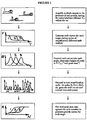
- the method of the present invention involves the generation of melt signals (melting curves) produced by each probe during amplification.
- the melt curve functions may be differentiated into derivative functions or "melting peaks” or “melt peaks.”
- the value of the melting peak maximum is measured.
- the magnitude of the melt peak maximum is proportional to the amount of the target sequence and its amplicon in the reaction mixture.
- melt peak maxima are recorded during the cycles of amplification plotted against the cycle number
- the series of the melt peak maximum values generates an amplification curve, similar in appearance to amplification curves generated in the traditional real-time PCR assays.
- Each labeled probe is able to generate a unique melting profile, distinguishable from the melting profiles of other probes.
- each probe provides independent quantitative data for each target.
- Relative quantification is accomplished by determining C m , the cycle at which a given melt peak reaches a predetermined threshold.
- An earlier (lower) C m indicates a higher input concentration of the target nucleic acid, while a later (higher) C m indicates a lower input concentration of the target nucleic acid.
- the predetermined threshold is set experimentally for each target nucleic acid. Typically, the threshold is a fluorescent level of a melt peak when it first becomes detectable.
- control nucleic acid of known concentration is amplified and detected in the same assay, it becomes possible to determine absolute input amount of the target nucleic acid by comparing the C m values of the target and control nucleic acids.
- the method of the present invention has broader multiplex capabilities.
- a traditional real-time PCR assay is constrained by the detector's inability to separate more than a few wavelengths.
- the ability to multiplex is expanded by measuring multiple distinct melt peaks at any given wavelength.
- the present invention employs a melt assay to expand the multiplexing capability of quantitative real-time PCR.
- the assay of the present invention is a multiplex version of the real-time PCR that allows simultaneous amplification, detection and quantification of multiple target nucleic acid sequences in the same tube, using multiple probes, labeled with the same fluorescent label.
- the probes are detected within the same wavelength channel but distinguished by their unique melting temperature.
- the method of the present invention begins with amplification of several target nucleic acid sequences in the same reaction vessel.
- Each tube contains one or more sets of oligonucleotide probes, each set of oligonucleotide probes labeled with the same fluorescent reporter.
- each oligonucleotide probe is characterized by a unique melting temperature with its target nucleic acid. For the maximum multiplex ability, several sets of probes are present in the same reaction vessel.
- the target nucleic acid may be subjected to the melt step as described below in order to generate a melt curve for each probe-target duplex.
- Each melt curve fluorescence in the temperature interval, or F vs. T
- F vs. T fluorescence in the temperature interval
- dF/dT melt peak curve in the temperature interval
- a set of "melt peak max" values is accumulated for each target-probe complex.
- the melt peak max values are plotted against the number of cycles to generate a growth curve for each target nucleic acid.
- a growth curve similar to typical growth curves obtained in real-time PCR assays is obtained for each target.
- one or more of the probes may be designed to have a melting temperature below the annealing temperature used in amplification. Such a probe would not generate a "traditional" real-time PCR growth curve. However, such a probe would be useful to generate a growth curve according to the present invention.
- the target nucleic acid sequence amplified, detected and quantified by the method of the present invention can be of any length.
- the target nucleic acid is between 100 and 1,000 nucleotides in length.
- longer (several thousand nucleotides) and shorter (between 50 and 100 nucleotides) target sequences may also be used in some embodiments of the present invention.
- a target nucleic acid sequence may be contained within a larger nucleic acid molecule, isolated from a natural or laboratory-derived sample source.
- a "multiplex" reaction is performed where at least two and up to sixteen or more different target sequences are detected. These embodiments generally, but not always, involve the use of a separate pair of amplification primers and a separate probe for each target sequence. However, in some embodiments, the same nucleic acid, which is amplified using the same pair of primers, may be detected with more than one probe. This is advantageous where a single sequence contains several targets or loci of interest, for example, several potential mutation sites. Each probe will be able to detect and quantify the mutation at each site.
- the amplification primers of the present invention are oligonucleotides at least partially complementary to at least one of the existing variants of the target sequence.
- the length of the primer may range between 6 and 100 nucleotides, although most primers typically range between 15 and 35 nucleotides.
- primers are synthetic oligonucleotides, composed of A, C, G and T nucleotides.
- unconventional base nucleotides that can be incorporated into nucleic acids, can also be used in primers.
- certain modified bases are known to increase specificity of amplification, see U.S. Patent No. 6,001,011 .
- thermostable nucleic acid polymerases are known in the art. Any thermostable nucleic acid polymerase can be used in the method of the present invention. Sometimes it is advantageous to use a polymerase lacking the 5'-3' nuclease activity. It is sometimes desirable to use a polymerase without the proof-reading (3'-5'-exonuclease) activity. It may also sometimes be desirable to have an enzyme with a "hot start" capability, such as the reversibly modified enzymes described in U.S. Patent Nos. 5,677,152 and 5,773,528 . The design of hybridization probes is known in the art. The same probe may serve as a hybridization probe or a melt probe or both.
- the design of the probe oligonucleotide is guided by the same principles, known in the art and described herein. These principles may be applied manually or with a help of software.
- more than one probe is present in the reaction mixture subjected to a melt assay.
- One of skill in the art would immediately recognize the design criteria applicable to melt probes useful in multiplex assays.
- the probes capable of being used in the same reaction mixture should be designed to have a distinct hybrid melting temperature with their corresponding target sequences.
- the oligonucleotide probes can be labeled by incorporating one or more chromophores.
- a single chromophore which is a fluorophore, may be used as described in a U.S. Application Serial No. 12/330,694 filed on December 9, 2008 .
- two chromophores one typically is a reporter chromophore and the other is a quencher. Both chromophores may be fluorophores or one of the chromophores may be a non-fluorescent quencher.
- fluorophores examples include dyes of the fluorescein family (FAM, HEX, TET, JOE, NAN and ZOE), rhodamine family (Texas Red, ROX, R110, R6G and TAMRA), cyanine family (Cy2, Cy3, Cy3.5, Cy5, Cy5.5, and Cy7) coumarin family, oxazine family, thiazine family, squaranine family and other families of fluorescent dyes suitable for the labeling and detection of nucleic acids.
- the second chromophore may be incorporated into the same probe oligonucleotide or a separate probe oligonucleotide.
- BlackHole QuenchersTM BHQ
- Biosearch Technologies, Inc. Novato, Cal.
- Iowa BlackTM Iowa Black
- Integrated DNA Tech., Inc. Coralville, Iowa
- BlackBerryTM Quencher 650 BBQ-650
- the present invention involves quantification of the target nucleic acid in a real-time PCR assay.
- an amplification growth curve is generated for each target.
- the curve is generated by measuring a detectable amplification-dependent signal during each cycle of amplification.
- the present invention may measure a novel amplification-dependent signal, not used previously to generate growth curves.
- the method of the present invention measures a melt signal, i.e. a signal generated in a melting assay in order to generate growth curves.
- a hybrid is formed between target DNA and one or more labeled probes.
- the oligonucleotide probe or probes are labeled with one or more chromophore moieties, of which at least one chromophore is a fluorophore.
- the change in temperature that results in melting or formation of the template-probe hybrid is accompanied by a measurable change in fluorescence emitted by the oligonucleotide probe upon excitation by the light of appropriate wavelength.
- the probe is labeled with two chromophores forming a FRET pair.
- both chromophores are fluorophores.
- one chromophore is a non-fluorescent quencher.
- the chromophores forming the FRET pair may be conjugated to the same or separate probe molecules.
- FRET probes in a melting assay has been described in U.S. Patent No. 6,174,670 and in De Silva et al., (1998) "Rapid genotyping and quantification on the LightCyclerTM with hybridization probes," Biochemica, 2:12-15 .
- the probe is labeled with a single chromophore that interacts with a second chromophore either conjugated with or intercalated into the target nucleic acid (see U.S. Patent No. 5,871,908 ).
- a single melting assay is performed after all cycles of amplification have been completed.
- This technology is commonly referred to as "post-amplification melt.”
- the present invention teaches to incorporate a melting assay into the cycles of PCR. This involves adding a melting step to the temperature profile of a PCR cycle. A typical melting step involves an incubation at 95°C (to denature the double-stranded amplicons), followed by lowering the temperature to 40°C (to allow annealing of the melt probe) and then increasing the temperature again (to melt the probe-template duplex). It was observed that the melt signal is poor in the first rounds of amplification. This phenomenon is likely due to insufficient amounts of target nucleic acid present at the early stages of amplification. It is therefore practical to incorporate melting steps into amplification cycles after a substantial number of amplification cycles have already taken place.
- the fluorescence is detected at the annealing step of each cycle.
- the fluorescent data is acquired continuously during a selected portion of the melting step.
- each round of melting of the probe-target duplex yields a melting curve and a melting peak. Differentiating melting curves to obtain melting peaks has been described e.g. in U.S. Patent No. 6,472,156 .
- the height of the melting peak is proportional to the amount of the duplex formed between the melting probe and the target amplicon and this is proportional to the amount of the target amplicon in the sample. Therefore, the cycle at which a given melt peak first reaches a predetermined threshold (C m ) is reflective of the initial amount of target nucleic acid.
- C m predetermined threshold
- the heights of the melt peaks (melt peak max values) measured in each cycle are plotted against the cycles of amplification. As can be seen from Figures 2 and 3 , the resulting plot resembles the traditional real-time PCR growth curve. If a control nucleic acid of known input concentration is co-amplified with the target nucleic acid, an absolute input amount of the target nucleic acid can be determined by comparing C m values measured for the target and control nucleic acids.
- the present invention involves asymmetric PCR.
- one of the amplification primers is present in greater amount than the other primer.
- the primers are referred to as “excess primer” and “limiting primer” respectively.
- the nucleic acid strands resulting from the extension of these primers are referred to as “excess strand” and “limiting strand” respectively.
- the ratio of the excess primer to the limiting primer can be selectively manipulated and be between 200:1 and 2:1, but typically about 9:1 to 5:1. Due to excess of the primer, the excess strand accumulates in a linear fashion in single-stranded form.
- the melt probes are designed to hybridize to the "excess strand," i.e.
- the amplicon strand that results from the extension of the excess primer and accumulates in a single-stranded form.
- the excess single strand is advantageous at the later cycles of PCR.
- the strands of the amplicon accumulate and effectively compete with the hybridization probe for the formation of a duplex.
- An asymmetric PCR is designed so that the excess strand hybridizes with the probe, thus erasing the kinetic disadvantage in later cycles of PCR and allowing detection of a melting peak.
- an enzyme containing 5'-3' nuclease activity it may be advantageous to use an enzyme containing 5'-3' nuclease activity.
- a probe concentration is chosen that ensures a sufficient amount of probe for the melt assay.
- PPP1CA is a gene encoding a catalytic subunit of protein phosphatase 1-alpha and having anti-oncogenic properties (see Castro et al., "PPP1CA contributes to the senescence program induced by oncogenic Ras," Carcinogenesis (2008) 29(3):491-499 .
- SENP1 is a sentrin/SUMO-specific protease, that belongs to the family of Small U biquitin-Like (Ubl) Mo difiers (SUMO), reviewed in Muller et al., "SUMO, ubiquitin's mysterious cousin,” Nat. Rev. Mol. Cell Biol. (2001) 2(3):202-10 and Yeh et al., "Ubiquitin-like proteins: new wines in new bottles,” Gene (2000) 248(1-2):1-14 ).
- Ubl Small U biquitin-Like
- SUMO Small U biquitin-Like
- the method was applied to the detection and quantification of various amounts of SENP1 and PPP1CA RNA in a tissue sample.
- the asymmetric PCR was conducted with a seven-fold excess of the excess primer over the limiting primer.
- the detection was performed with a single hybridization probe labeled with a fluorescein dye and a BlackHoleTM quencher.
- the primer and probe sequences are shown in Table 1. The probes were designed to hybridize to the excess strand.
- Sequence ID Function Sequence 5'-3' SEQ ID NO: 1 Forward primer for SENP1 CAGCTTCAAATACACAATCTGAAGGATCA SEQ ID NO: 2 Reverse primer for SENP1 TGCCTGGAAGAAAGTAGAACTGGGA SEQ ID NO: 3 Probe for SENP1 FGACTCTGTGATTTTACTGAAAGTGAAAGATTCCCAGACTCCQp SEQ ID NO: 4 Forward primer for PPP1CA AACCGCATATATGGTTTCTACGATGE SEQ ID NO: 5 Reverse primer for PPP1CA CGATGAGTGCAAGAGACGCTACAE SEQ ID NO: 6 Probe for PPP1CA FACTGTGGAAAACCTTQp F - cx-FAM reporter dye Q - BHQ-2 quencher dye E - tert-butyl-benzyl dA p - 3'-phosphate group
- Each 100 ⁇ l reaction contained an indicated amount of human fetal spleen RNA (between 0.2 and 2000 nanograms, as indicated on Figures 2 and 3 ) 50 mM Tricine, pH 8.3; 120 mM potassium acetate; 8% glycerol; 33.3 mM of each dATP, dGTP and dCTP, 100 mM dUTP; 40 U ZO5 DNA polymerase; 100 nM Aptamer 46A; 5 U uracil-N-glycosylase (UNG); 3 mM manganese acetate; 100 nM forward (limiting) primers (SEQ ID NO.: 1 and SEQ ID NO: 4); 700 nM reverse (excess) primers (SEQ ID NO: 2 and SEQ ID NO: 5); and 200 nM probes (SEQ ID NO: 3 and SEQ ID NO: 6).
- the amplification and detection were performed using the Roche LightCyclerTM LC480 instrument.
- the reactions were subjected to the following temperature profile: 50°C for 2 min (UNG step); 95°C for 1 min (UNG inactivation); 60°C for 30 min (reverse transcription); followed by 44 amplification cycles of 90°C for 15 sec (denaturation) and 61°C for 60 sec (annealing and extension).
- the melt step was incorporated after the initial 15 cycles of amplification. For cycles 16-27, the melt was performed after every second cycle. For cycles 28-39, the melt was performed after every cycle. For cycles 40-44, the melt was performed after every second cycle.
- the melt step commenced after the completion of the 61°C annealing and extension step and consisted of 90°C for 5 sec at a ramp rate of 1.2°C per second; cooling to 40°C at a rate of 1.8°C per second; and heating to 90°C at a rate of 1.8°C per second with the fluorescent data acquired continuously, at a rate of twice per degree, reading on three channels.
- a melting curve (function F/T) was obtained.
- the derivative function or "melt peak” (dF/dT) was obtained and a value of the melting peak maximum was determined according to the method of the present invention ( Figure 1 ). The resulting melting peak maximum values were plotted against the number of amplification cycles to yield growth curves shown on Figure 2 (for SENP1) and Figure 3 (for PPP1CA).
- Table 2 The quantitative results are shown in Table 2.
- the table shows the number of cycles at which a predetermined "melting threshold” (C m ) was reached.
- C m melting threshold
- the threshold was set at 0.181.
- the threshold was set at 0.055.
- the threshold was reached earlier with the larger initial input of nucleic acid.
- Table 2 Quantitative data (cycles to melting threshold (C m ) values) Input RNA (ng) 0 0.2 2 20 200 2000 SENP11 NC 35.3 32.1 31.1 30.3 29.4 PPPC1A NC 32.3 31.2 30.8 30.1 29.8 NC: not calculated
Landscapes
- Chemical & Material Sciences (AREA)
- Life Sciences & Earth Sciences (AREA)
- Organic Chemistry (AREA)
- Engineering & Computer Science (AREA)
- Zoology (AREA)
- Wood Science & Technology (AREA)
- Proteomics, Peptides & Aminoacids (AREA)
- Health & Medical Sciences (AREA)
- Biophysics (AREA)
- Chemical Kinetics & Catalysis (AREA)
- Immunology (AREA)
- Microbiology (AREA)
- Molecular Biology (AREA)
- Analytical Chemistry (AREA)
- Physics & Mathematics (AREA)
- Biotechnology (AREA)
- Biochemistry (AREA)
- Bioinformatics & Cheminformatics (AREA)
- General Engineering & Computer Science (AREA)
- General Health & Medical Sciences (AREA)
- Genetics & Genomics (AREA)
- Measuring Or Testing Involving Enzymes Or Micro-Organisms (AREA)
- Investigating Or Analysing Biological Materials (AREA)
Applications Claiming Priority (1)
| Application Number | Priority Date | Filing Date | Title |
|---|---|---|---|
| US12/400,966 US8039215B2 (en) | 2009-03-10 | 2009-03-10 | Multiplex quantitative nucleic acid amplification and melting assay |
Publications (2)
| Publication Number | Publication Date |
|---|---|
| EP2228454A1 EP2228454A1 (en) | 2010-09-15 |
| EP2228454B1 true EP2228454B1 (en) | 2016-06-22 |
Family
ID=42224157
Family Applications (1)
| Application Number | Title | Priority Date | Filing Date |
|---|---|---|---|
| EP10002350.6A Active EP2228454B1 (en) | 2009-03-10 | 2010-03-08 | Multiplex quantitative nucleic acid amplification and melting assay |
Country Status (6)
| Country | Link |
|---|---|
| US (1) | US8039215B2 (enExample) |
| EP (1) | EP2228454B1 (enExample) |
| JP (1) | JP5745774B2 (enExample) |
| CN (1) | CN101831496B (enExample) |
| CA (1) | CA2696652C (enExample) |
| ES (1) | ES2589102T3 (enExample) |
Families Citing this family (38)
| Publication number | Priority date | Publication date | Assignee | Title |
|---|---|---|---|---|
| WO2004068110A2 (en) | 2003-01-24 | 2004-08-12 | University Of Utah | Methods of predicting mortality risk by determining telomere length |
| US9921154B2 (en) | 2011-03-18 | 2018-03-20 | Bio-Rad Laboratories, Inc. | Multiplexed digital assays |
| US8951939B2 (en) * | 2011-07-12 | 2015-02-10 | Bio-Rad Laboratories, Inc. | Digital assays with multiplexed detection of two or more targets in the same optical channel |
| ES2433718T3 (es) * | 2008-12-22 | 2013-12-12 | University Of Utah Research Foundation | PCR multiplex monocromática cuantitativa |
| US8039215B2 (en) | 2009-03-10 | 2011-10-18 | Roche Molecular Systems, Inc. | Multiplex quantitative nucleic acid amplification and melting assay |
| US8990059B2 (en) * | 2009-10-21 | 2015-03-24 | Koninklijke Philips N.V. | Analyzing tool for amplification reactions |
| CA2830443C (en) * | 2011-03-18 | 2021-11-16 | Bio-Rad Laboratories, Inc. | Multiplexed digital assays with combinatorial use of signals |
| JP6059453B2 (ja) * | 2011-05-31 | 2017-01-11 | アークレイ株式会社 | 同一又は近傍の検出波長を有する蛍光色素で修飾された複数のオリゴヌクレオチドを用いて、1種類の波長で複数の遺伝子多型を検出する方法 |
| EP2774995A4 (en) * | 2011-10-31 | 2015-04-29 | Arkray Inc | METHOD OF MEASURING THE ABUNDANCE OF GENES |
| US20140302501A1 (en) * | 2011-11-16 | 2014-10-09 | Canon U.S. Life Sciences, Inc. | Mutation detection in highly homologous genomic regions |
| WO2013113748A1 (en) * | 2012-02-02 | 2013-08-08 | Primer Design Ltd | Method for detecting and genotyping target nucleic acid |
| EP4361606A3 (en) | 2012-02-03 | 2024-07-10 | California Institute of Technology | Signal encoding and decoding in multiplexed biochemical assays |
| CN108753932B (zh) * | 2012-08-03 | 2022-12-02 | 加州理工学院 | Pcr中具有减少的硬件和要求的多重化和定量 |
| US9970052B2 (en) | 2012-08-23 | 2018-05-15 | Bio-Rad Laboratories, Inc. | Digital assays with a generic reporter |
| CN102952794B (zh) * | 2012-09-05 | 2015-02-25 | 张家港蓝苏生物工程有限公司 | 靶向基因dna分子探针的制备方法 |
| AU2013312191C1 (en) | 2012-09-10 | 2017-10-19 | Biofire Diagnostics, Llc | Multiple amplification cycle detection |
| WO2014142575A1 (en) * | 2013-03-13 | 2014-09-18 | Seegene, Inc. | Quantification of target nucleic acid using melting peak analysis |
| JP6546158B2 (ja) | 2013-05-22 | 2019-07-17 | テロメア ダイアグノスティクス インコーポレイテッド | 短いテロメアの存在量の測定 |
| WO2015147370A1 (en) | 2014-03-28 | 2015-10-01 | Seegene, Inc. | Detection of target nucleic acid sequences using different detection temperatures |
| EP3034617A1 (en) | 2014-12-16 | 2016-06-22 | Marcos Isamat Riviere | Method for the simultaneous identification of multiple same-genome fragments or multiple fragments from different genomes using a PCR-technique |
| WO2016108954A1 (en) | 2014-12-30 | 2016-07-07 | Telomere Diagnostics, Inc. | Multiplex quantitative pcr |
| ES2899826T3 (es) * | 2015-06-04 | 2022-03-14 | Mizuho Medy Co Ltd | Kit para detectar conjuntamente múltiples ácidos nucleicos diana que difieren entre sí y procedimiento de detección usando el mismo |
| EP3436468B1 (en) | 2016-04-01 | 2023-03-22 | Chromacode, Inc. | Competitive probes for engineering signal generation |
| WO2017218777A1 (en) | 2016-06-17 | 2017-12-21 | California Institute Of Technology | Nucleic acid reactions and related methods and compositions |
| WO2018027185A1 (en) | 2016-08-04 | 2018-02-08 | Duke University | Compositions and methods for measuring bacterial growth |
| DK3512959T3 (da) | 2016-09-15 | 2021-10-18 | Hoffmann La Roche | Fremgangsmåder til udførelse af multipleks PCR |
| CN106868140B (zh) * | 2017-03-02 | 2022-10-18 | 北京酷搏科技有限公司 | 多重荧光定量pcr的方法 |
| US20190093155A1 (en) * | 2017-05-25 | 2019-03-28 | Roche Molecular Systems, Inc. | Multiplex Nucleic Acid Amplification Assay |
| CN111433372B (zh) * | 2017-10-19 | 2024-01-26 | 生物辐射实验室股份有限公司 | 具有光致发光的非常规和/或反向变化的数字扩增试验 |
| KR20200115552A (ko) * | 2018-01-22 | 2020-10-07 | 루미넥스 코포레이션 | 별개의 용융 분석을 위한 방법 및 조성물 |
| EP3781710A4 (en) | 2018-04-17 | 2022-01-05 | Chromacode, Inc. | METHODS AND SYSTEMS FOR MULTIPLEX ANALYSIS |
| IL277870B2 (en) | 2018-04-20 | 2025-02-01 | Seegene Inc | Method and device for identifying diverse targets of nucleic acid sequences in a sample |
| US12203129B2 (en) | 2018-07-03 | 2025-01-21 | ChromaCode, Inc. | Formulations and signal encoding and decoding methods for massively multiplexed biochemical assays |
| WO2023023533A1 (en) * | 2021-08-19 | 2023-02-23 | Luminex Corporation | Digital amplification assay analysis method |
| CN116356075A (zh) * | 2021-12-27 | 2023-06-30 | 迈克生物股份有限公司 | 一种用于检测的引物探针、引物探针组及其应用 |
| JP2025501167A (ja) * | 2021-12-27 | 2025-01-17 | マキュラ バイオテクノロジー カンパニー リミテッド | 標的核酸を検出する方法 |
| CN119790162A (zh) * | 2022-06-29 | 2025-04-08 | 生命科技公司 | 用于使用通道内复用检测核酸的组合物、试剂盒和方法 |
| CN117701689A (zh) * | 2022-09-14 | 2024-03-15 | 迈克生物股份有限公司 | 多重pcr反应体系 |
Citations (2)
| Publication number | Priority date | Publication date | Assignee | Title |
|---|---|---|---|---|
| US20040175752A1 (en) * | 2000-03-07 | 2004-09-09 | Schaffer Michael Edward | Real time quantitative PCR with intercalating dye for single and multiplex target DNA |
| US20050053950A1 (en) * | 2003-09-08 | 2005-03-10 | Enrique Zudaire Ubani | Protocol and software for multiplex real-time PCR quantification based on the different melting temperatures of amplicons |
Family Cites Families (31)
| Publication number | Priority date | Publication date | Assignee | Title |
|---|---|---|---|---|
| US4683202A (en) | 1985-03-28 | 1987-07-28 | Cetus Corporation | Process for amplifying nucleic acid sequences |
| US4683195A (en) | 1986-01-30 | 1987-07-28 | Cetus Corporation | Process for amplifying, detecting, and/or-cloning nucleic acid sequences |
| US4965188A (en) | 1986-08-22 | 1990-10-23 | Cetus Corporation | Process for amplifying, detecting, and/or cloning nucleic acid sequences using a thermostable enzyme |
| DE3529478A1 (de) | 1985-08-16 | 1987-02-19 | Boehringer Mannheim Gmbh | 7-desaza-2'desoxyguanosin-nukleotide, verfahren zu deren herstellung und deren verwendung zur nukleinsaeure-sequenzierung |
| US5374553A (en) | 1986-08-22 | 1994-12-20 | Hoffmann-La Roche Inc. | DNA encoding a thermostable nucleic acid polymerase enzyme from thermotoga maritima |
| US5795762A (en) | 1986-08-22 | 1998-08-18 | Roche Molecular Systems, Inc. | 5' to 3' exonuclease mutations of thermostable DNA polymerases |
| US5455170A (en) | 1986-08-22 | 1995-10-03 | Hoffmann-La Roche Inc. | Mutated thermostable nucleic acid polymerase enzyme from Thermus species Z05 |
| US5466591A (en) | 1986-08-22 | 1995-11-14 | Hoffmann-La Roche Inc. | 5' to 3' exonuclease mutations of thermostable DNA polymerases |
| US5405774A (en) | 1986-08-22 | 1995-04-11 | Hoffmann-La Roche Inc. | DNA encoding a mutated thermostable nucleic acid polymerase enzyme from thermus species sps17 |
| US5210015A (en) | 1990-08-06 | 1993-05-11 | Hoffman-La Roche Inc. | Homogeneous assay system using the nuclease activity of a nucleic acid polymerase |
| ATE197718T1 (de) | 1990-09-28 | 2000-12-15 | Hoffmann La Roche | Gereinigte thermostabile nukleinsäurepolymerase aus thermosipho africanus |
| JPH04234422A (ja) | 1990-10-31 | 1992-08-24 | Internatl Business Mach Corp <Ibm> | 二重硬化エポキシバックシール処方物 |
| DE4234086A1 (de) | 1992-02-05 | 1993-08-12 | Diagen Inst Molekularbio | Verfahren zur bestimmung von in vitro amplifizierten nukleinsaeuresequenzen |
| US5538848A (en) | 1994-11-16 | 1996-07-23 | Applied Biosystems Division, Perkin-Elmer Corp. | Method for detecting nucleic acid amplification using self-quenching fluorescence probe |
| GB9513271D0 (en) | 1995-06-29 | 1995-09-06 | Johnson James G | Stress free fish harvester |
| US5773258A (en) | 1995-08-25 | 1998-06-30 | Roche Molecular Systems, Inc. | Nucleic acid amplification using a reversibly inactivated thermostable enzyme |
| DE69739357D1 (de) | 1996-06-04 | 2009-05-28 | Univ Utah Res Found | Überwachung der hybridisierung während pcr |
| US6427156B1 (en) | 1997-01-21 | 2002-07-30 | Xilinx, Inc. | Configurable logic block with AND gate for efficient multiplication in FPGAS |
| US6228628B1 (en) | 1997-07-09 | 2001-05-08 | Roche Molecular Systems | Mutant chimeric DNA polymerase |
| US6140054A (en) * | 1998-09-30 | 2000-10-31 | University Of Utah Research Foundation | Multiplex genotyping using fluorescent hybridization probes |
| US6472156B1 (en) * | 1999-08-30 | 2002-10-29 | The University Of Utah | Homogeneous multiplex hybridization analysis by color and Tm |
| US7019129B1 (en) * | 2000-05-09 | 2006-03-28 | Biosearch Technologies, Inc. | Dark quenchers for donor-acceptor energy transfer |
| ATE335850T1 (de) | 2001-08-31 | 2006-09-15 | Univ Utah Res Found | Echtzeit-quantifizierung mit internen standards |
| CA2516299A1 (en) * | 2003-02-18 | 2004-09-02 | Applera Corporation | Compositions and methods for multiplex analysis of polynucleotides |
| WO2006040187A2 (en) * | 2004-10-11 | 2006-04-20 | Epigenomics Ag | A method for the carry-over protection in dna amplification systems targeting methylation analysis achieved by a modified pre-treatment of nucleic acids |
| WO2006044994A2 (en) * | 2004-10-18 | 2006-04-27 | Brandeis University | Primers, probes and methods for nucleic acid amplification |
| US7465561B2 (en) | 2005-06-30 | 2008-12-16 | Roche Molecular Systems, Inc. | Probes and methods for hepatitis C virus typing using single probe analysis |
| JP4815980B2 (ja) * | 2005-10-05 | 2011-11-16 | 株式会社島津製作所 | 融解曲線測定による遺伝子増幅産物の解析方法 |
| US20100285468A1 (en) | 2007-09-24 | 2010-11-11 | Allelogic Biosciences Corporation | Detection and/or quantification of nucleic acids |
| EP2336358A1 (en) | 2008-05-06 | 2011-06-22 | QIAGEN GmbH | Simultaneous detection of multiple nucleic acid sequences in a reaction |
| US8039215B2 (en) | 2009-03-10 | 2011-10-18 | Roche Molecular Systems, Inc. | Multiplex quantitative nucleic acid amplification and melting assay |
-
2009
- 2009-03-10 US US12/400,966 patent/US8039215B2/en active Active
-
2010
- 2010-03-08 EP EP10002350.6A patent/EP2228454B1/en active Active
- 2010-03-08 ES ES10002350.6T patent/ES2589102T3/es active Active
- 2010-03-09 JP JP2010052206A patent/JP5745774B2/ja active Active
- 2010-03-09 CA CA2696652A patent/CA2696652C/en active Active
- 2010-03-10 CN CN201010163977.7A patent/CN101831496B/zh active Active
Patent Citations (2)
| Publication number | Priority date | Publication date | Assignee | Title |
|---|---|---|---|---|
| US20040175752A1 (en) * | 2000-03-07 | 2004-09-09 | Schaffer Michael Edward | Real time quantitative PCR with intercalating dye for single and multiplex target DNA |
| US20050053950A1 (en) * | 2003-09-08 | 2005-03-10 | Enrique Zudaire Ubani | Protocol and software for multiplex real-time PCR quantification based on the different melting temperatures of amplicons |
Also Published As
| Publication number | Publication date |
|---|---|
| CN101831496A (zh) | 2010-09-15 |
| JP2010207220A (ja) | 2010-09-24 |
| CN101831496B (zh) | 2017-04-12 |
| CA2696652A1 (en) | 2010-09-10 |
| JP5745774B2 (ja) | 2015-07-08 |
| ES2589102T3 (es) | 2016-11-10 |
| CA2696652C (en) | 2015-09-08 |
| EP2228454A1 (en) | 2010-09-15 |
| US20100233686A1 (en) | 2010-09-16 |
| US8039215B2 (en) | 2011-10-18 |
Similar Documents
| Publication | Publication Date | Title |
|---|---|---|
| CA2696652C (en) | Multiplex quantitative nucleic acid amplification and melting assay | |
| CA3033250C (en) | Methods for performing multiplexed real-time pcr | |
| JP4602945B2 (ja) | 核酸の同定のための後pcr特性の複合した非対称pcr | |
| EP2337865B1 (en) | Allele-specific amplification using a primer with a modified nucleotide | |
| EP2385991B1 (en) | Nucleic acid amplification with allele-specific suppression of sequence variants | |
| US20100143901A1 (en) | Nuclease-Free Real-Time Detection of Nucleic Acids | |
| EP1390542B1 (en) | Nucleic acid detection method | |
| CA2847943C (en) | Use of g-clamp for improved allele-specific pcr | |
| US20120070831A1 (en) | Amplification of Distant Nucleic Acid Targets Using Engineered Primers | |
| EP2071041A1 (en) | Nucleic acid detection probe | |
| CA2733653C (en) | Detection of target variants using a fluorescent label and a soluble quencher | |
| JP2009159945A (ja) | 核酸検出用プローブ | |
| EP1272673B1 (en) | Specific multiplex analysis of nucleic acids | |
| EP4603593A1 (en) | Method for detecting target nucleic acid in sample using two probes with different tm values | |
| WO2009067664A1 (en) | Photoinduced electron transfer (pet) primer for nucleic acid amplification |
Legal Events
| Date | Code | Title | Description |
|---|---|---|---|
| PUAI | Public reference made under article 153(3) epc to a published international application that has entered the european phase |
Free format text: ORIGINAL CODE: 0009012 |
|
| AK | Designated contracting states |
Kind code of ref document: A1 Designated state(s): AT BE BG CH CY CZ DE DK EE ES FI FR GB GR HR HU IE IS IT LI LT LU LV MC MK MT NL NO PL PT RO SE SI SK SM TR |
|
| AX | Request for extension of the european patent |
Extension state: AL BA ME RS |
|
| 17P | Request for examination filed |
Effective date: 20110315 |
|
| 17Q | First examination report despatched |
Effective date: 20110817 |
|
| GRAP | Despatch of communication of intention to grant a patent |
Free format text: ORIGINAL CODE: EPIDOSNIGR1 |
|
| INTG | Intention to grant announced |
Effective date: 20160125 |
|
| GRAS | Grant fee paid |
Free format text: ORIGINAL CODE: EPIDOSNIGR3 |
|
| GRAA | (expected) grant |
Free format text: ORIGINAL CODE: 0009210 |
|
| AK | Designated contracting states |
Kind code of ref document: B1 Designated state(s): AT BE BG CH CY CZ DE DK EE ES FI FR GB GR HR HU IE IS IT LI LT LU LV MC MK MT NL NO PL PT RO SE SI SK SM TR |
|
| REG | Reference to a national code |
Ref country code: GB Ref legal event code: FG4D |
|
| REG | Reference to a national code |
Ref country code: CH Ref legal event code: EP |
|
| REG | Reference to a national code |
Ref country code: IE Ref legal event code: FG4D |
|
| REG | Reference to a national code |
Ref country code: AT Ref legal event code: REF Ref document number: 807704 Country of ref document: AT Kind code of ref document: T Effective date: 20160715 |
|
| REG | Reference to a national code |
Ref country code: DE Ref legal event code: R096 Ref document number: 602010034126 Country of ref document: DE |
|
| REG | Reference to a national code |
Ref country code: LT Ref legal event code: MG4D |
|
| REG | Reference to a national code |
Ref country code: NL Ref legal event code: MP Effective date: 20160622 |
|
| PG25 | Lapsed in a contracting state [announced via postgrant information from national office to epo] |
Ref country code: LT Free format text: LAPSE BECAUSE OF FAILURE TO SUBMIT A TRANSLATION OF THE DESCRIPTION OR TO PAY THE FEE WITHIN THE PRESCRIBED TIME-LIMIT Effective date: 20160622 Ref country code: NO Free format text: LAPSE BECAUSE OF FAILURE TO SUBMIT A TRANSLATION OF THE DESCRIPTION OR TO PAY THE FEE WITHIN THE PRESCRIBED TIME-LIMIT Effective date: 20160922 Ref country code: FI Free format text: LAPSE BECAUSE OF FAILURE TO SUBMIT A TRANSLATION OF THE DESCRIPTION OR TO PAY THE FEE WITHIN THE PRESCRIBED TIME-LIMIT Effective date: 20160622 |
|
| REG | Reference to a national code |
Ref country code: ES Ref legal event code: FG2A Ref document number: 2589102 Country of ref document: ES Kind code of ref document: T3 Effective date: 20161110 |
|
| REG | Reference to a national code |
Ref country code: AT Ref legal event code: MK05 Ref document number: 807704 Country of ref document: AT Kind code of ref document: T Effective date: 20160622 |
|
| PG25 | Lapsed in a contracting state [announced via postgrant information from national office to epo] |
Ref country code: SE Free format text: LAPSE BECAUSE OF FAILURE TO SUBMIT A TRANSLATION OF THE DESCRIPTION OR TO PAY THE FEE WITHIN THE PRESCRIBED TIME-LIMIT Effective date: 20160622 Ref country code: LV Free format text: LAPSE BECAUSE OF FAILURE TO SUBMIT A TRANSLATION OF THE DESCRIPTION OR TO PAY THE FEE WITHIN THE PRESCRIBED TIME-LIMIT Effective date: 20160622 Ref country code: NL Free format text: LAPSE BECAUSE OF FAILURE TO SUBMIT A TRANSLATION OF THE DESCRIPTION OR TO PAY THE FEE WITHIN THE PRESCRIBED TIME-LIMIT Effective date: 20160622 Ref country code: HR Free format text: LAPSE BECAUSE OF FAILURE TO SUBMIT A TRANSLATION OF THE DESCRIPTION OR TO PAY THE FEE WITHIN THE PRESCRIBED TIME-LIMIT Effective date: 20160622 Ref country code: GR Free format text: LAPSE BECAUSE OF FAILURE TO SUBMIT A TRANSLATION OF THE DESCRIPTION OR TO PAY THE FEE WITHIN THE PRESCRIBED TIME-LIMIT Effective date: 20160923 |
|
| PG25 | Lapsed in a contracting state [announced via postgrant information from national office to epo] |
Ref country code: IS Free format text: LAPSE BECAUSE OF FAILURE TO SUBMIT A TRANSLATION OF THE DESCRIPTION OR TO PAY THE FEE WITHIN THE PRESCRIBED TIME-LIMIT Effective date: 20161022 Ref country code: SK Free format text: LAPSE BECAUSE OF FAILURE TO SUBMIT A TRANSLATION OF THE DESCRIPTION OR TO PAY THE FEE WITHIN THE PRESCRIBED TIME-LIMIT Effective date: 20160622 Ref country code: EE Free format text: LAPSE BECAUSE OF FAILURE TO SUBMIT A TRANSLATION OF THE DESCRIPTION OR TO PAY THE FEE WITHIN THE PRESCRIBED TIME-LIMIT Effective date: 20160622 Ref country code: RO Free format text: LAPSE BECAUSE OF FAILURE TO SUBMIT A TRANSLATION OF THE DESCRIPTION OR TO PAY THE FEE WITHIN THE PRESCRIBED TIME-LIMIT Effective date: 20160622 Ref country code: CZ Free format text: LAPSE BECAUSE OF FAILURE TO SUBMIT A TRANSLATION OF THE DESCRIPTION OR TO PAY THE FEE WITHIN THE PRESCRIBED TIME-LIMIT Effective date: 20160622 |
|
| REG | Reference to a national code |
Ref country code: FR Ref legal event code: PLFP Year of fee payment: 8 |
|
| PG25 | Lapsed in a contracting state [announced via postgrant information from national office to epo] |
Ref country code: SM Free format text: LAPSE BECAUSE OF FAILURE TO SUBMIT A TRANSLATION OF THE DESCRIPTION OR TO PAY THE FEE WITHIN THE PRESCRIBED TIME-LIMIT Effective date: 20160622 Ref country code: BE Free format text: LAPSE BECAUSE OF FAILURE TO SUBMIT A TRANSLATION OF THE DESCRIPTION OR TO PAY THE FEE WITHIN THE PRESCRIBED TIME-LIMIT Effective date: 20160622 Ref country code: AT Free format text: LAPSE BECAUSE OF FAILURE TO SUBMIT A TRANSLATION OF THE DESCRIPTION OR TO PAY THE FEE WITHIN THE PRESCRIBED TIME-LIMIT Effective date: 20160622 Ref country code: PT Free format text: LAPSE BECAUSE OF FAILURE TO SUBMIT A TRANSLATION OF THE DESCRIPTION OR TO PAY THE FEE WITHIN THE PRESCRIBED TIME-LIMIT Effective date: 20161024 Ref country code: PL Free format text: LAPSE BECAUSE OF FAILURE TO SUBMIT A TRANSLATION OF THE DESCRIPTION OR TO PAY THE FEE WITHIN THE PRESCRIBED TIME-LIMIT Effective date: 20160622 |
|
| REG | Reference to a national code |
Ref country code: DE Ref legal event code: R097 Ref document number: 602010034126 Country of ref document: DE |
|
| PLBE | No opposition filed within time limit |
Free format text: ORIGINAL CODE: 0009261 |
|
| STAA | Information on the status of an ep patent application or granted ep patent |
Free format text: STATUS: NO OPPOSITION FILED WITHIN TIME LIMIT |
|
| 26N | No opposition filed |
Effective date: 20170323 |
|
| PG25 | Lapsed in a contracting state [announced via postgrant information from national office to epo] |
Ref country code: DK Free format text: LAPSE BECAUSE OF FAILURE TO SUBMIT A TRANSLATION OF THE DESCRIPTION OR TO PAY THE FEE WITHIN THE PRESCRIBED TIME-LIMIT Effective date: 20160622 |
|
| PG25 | Lapsed in a contracting state [announced via postgrant information from national office to epo] |
Ref country code: SI Free format text: LAPSE BECAUSE OF FAILURE TO SUBMIT A TRANSLATION OF THE DESCRIPTION OR TO PAY THE FEE WITHIN THE PRESCRIBED TIME-LIMIT Effective date: 20160622 |
|
| PG25 | Lapsed in a contracting state [announced via postgrant information from national office to epo] |
Ref country code: MC Free format text: LAPSE BECAUSE OF FAILURE TO SUBMIT A TRANSLATION OF THE DESCRIPTION OR TO PAY THE FEE WITHIN THE PRESCRIBED TIME-LIMIT Effective date: 20160622 |
|
| REG | Reference to a national code |
Ref country code: IE Ref legal event code: MM4A |
|
| PG25 | Lapsed in a contracting state [announced via postgrant information from national office to epo] |
Ref country code: LU Free format text: LAPSE BECAUSE OF NON-PAYMENT OF DUE FEES Effective date: 20170308 |
|
| REG | Reference to a national code |
Ref country code: FR Ref legal event code: PLFP Year of fee payment: 9 |
|
| PG25 | Lapsed in a contracting state [announced via postgrant information from national office to epo] |
Ref country code: IE Free format text: LAPSE BECAUSE OF NON-PAYMENT OF DUE FEES Effective date: 20170308 |
|
| PG25 | Lapsed in a contracting state [announced via postgrant information from national office to epo] |
Ref country code: MT Free format text: LAPSE BECAUSE OF NON-PAYMENT OF DUE FEES Effective date: 20170308 |
|
| PG25 | Lapsed in a contracting state [announced via postgrant information from national office to epo] |
Ref country code: HU Free format text: LAPSE BECAUSE OF FAILURE TO SUBMIT A TRANSLATION OF THE DESCRIPTION OR TO PAY THE FEE WITHIN THE PRESCRIBED TIME-LIMIT; INVALID AB INITIO Effective date: 20100308 |
|
| PG25 | Lapsed in a contracting state [announced via postgrant information from national office to epo] |
Ref country code: BG Free format text: LAPSE BECAUSE OF FAILURE TO SUBMIT A TRANSLATION OF THE DESCRIPTION OR TO PAY THE FEE WITHIN THE PRESCRIBED TIME-LIMIT Effective date: 20160622 |
|
| PG25 | Lapsed in a contracting state [announced via postgrant information from national office to epo] |
Ref country code: CY Free format text: LAPSE BECAUSE OF NON-PAYMENT OF DUE FEES Effective date: 20160622 |
|
| PG25 | Lapsed in a contracting state [announced via postgrant information from national office to epo] |
Ref country code: MK Free format text: LAPSE BECAUSE OF FAILURE TO SUBMIT A TRANSLATION OF THE DESCRIPTION OR TO PAY THE FEE WITHIN THE PRESCRIBED TIME-LIMIT Effective date: 20160622 |
|
| PG25 | Lapsed in a contracting state [announced via postgrant information from national office to epo] |
Ref country code: TR Free format text: LAPSE BECAUSE OF FAILURE TO SUBMIT A TRANSLATION OF THE DESCRIPTION OR TO PAY THE FEE WITHIN THE PRESCRIBED TIME-LIMIT Effective date: 20160622 |
|
| REG | Reference to a national code |
Ref country code: CH Ref legal event code: U11 Free format text: ST27 STATUS EVENT CODE: U-0-0-U10-U11 (AS PROVIDED BY THE NATIONAL OFFICE) Effective date: 20260401 |
|
| PGFP | Annual fee paid to national office [announced via postgrant information from national office to epo] |
Ref country code: GB Payment date: 20260220 Year of fee payment: 17 |
|
| PGFP | Annual fee paid to national office [announced via postgrant information from national office to epo] |
Ref country code: DE Payment date: 20260219 Year of fee payment: 17 |
|
| PGFP | Annual fee paid to national office [announced via postgrant information from national office to epo] |
Ref country code: IT Payment date: 20260219 Year of fee payment: 17 |
|
| PGFP | Annual fee paid to national office [announced via postgrant information from national office to epo] |
Ref country code: FR Payment date: 20260219 Year of fee payment: 17 |
|
| PGFP | Annual fee paid to national office [announced via postgrant information from national office to epo] |
Ref country code: ES Payment date: 20260401 Year of fee payment: 17 |
|
| PGFP | Annual fee paid to national office [announced via postgrant information from national office to epo] |
Ref country code: CH Payment date: 20260401 Year of fee payment: 17 |