EP2186830A1 - Interféron alpha 2b modifié par du polyethylèneglycol et procédé de préparation et applications associés - Google Patents
Interféron alpha 2b modifié par du polyethylèneglycol et procédé de préparation et applications associés Download PDFInfo
- Publication number
- EP2186830A1 EP2186830A1 EP07800861A EP07800861A EP2186830A1 EP 2186830 A1 EP2186830 A1 EP 2186830A1 EP 07800861 A EP07800861 A EP 07800861A EP 07800861 A EP07800861 A EP 07800861A EP 2186830 A1 EP2186830 A1 EP 2186830A1
- Authority
- EP
- European Patent Office
- Prior art keywords
- ifn
- ypeg
- peg
- group
- amino acid
- Prior art date
- Legal status (The legal status is an assumption and is not a legal conclusion. Google has not performed a legal analysis and makes no representation as to the accuracy of the status listed.)
- Granted
Links
Images



Classifications
-
- C—CHEMISTRY; METALLURGY
- C07—ORGANIC CHEMISTRY
- C07K—PEPTIDES
- C07K14/00—Peptides having more than 20 amino acids; Gastrins; Somatostatins; Melanotropins; Derivatives thereof
- C07K14/435—Peptides having more than 20 amino acids; Gastrins; Somatostatins; Melanotropins; Derivatives thereof from animals; from humans
- C07K14/52—Cytokines; Lymphokines; Interferons
- C07K14/555—Interferons [IFN]
- C07K14/56—IFN-alpha
-
- A—HUMAN NECESSITIES
- A61—MEDICAL OR VETERINARY SCIENCE; HYGIENE
- A61K—PREPARATIONS FOR MEDICAL, DENTAL OR TOILETRY PURPOSES
- A61K47/00—Medicinal preparations characterised by the non-active ingredients used, e.g. carriers or inert additives; Targeting or modifying agents chemically bound to the active ingredient
- A61K47/50—Medicinal preparations characterised by the non-active ingredients used, e.g. carriers or inert additives; Targeting or modifying agents chemically bound to the active ingredient the non-active ingredient being chemically bound to the active ingredient, e.g. polymer-drug conjugates
- A61K47/51—Medicinal preparations characterised by the non-active ingredients used, e.g. carriers or inert additives; Targeting or modifying agents chemically bound to the active ingredient the non-active ingredient being chemically bound to the active ingredient, e.g. polymer-drug conjugates the non-active ingredient being a modifying agent
- A61K47/56—Medicinal preparations characterised by the non-active ingredients used, e.g. carriers or inert additives; Targeting or modifying agents chemically bound to the active ingredient the non-active ingredient being chemically bound to the active ingredient, e.g. polymer-drug conjugates the non-active ingredient being a modifying agent the modifying agent being an organic macromolecular compound, e.g. an oligomeric, polymeric or dendrimeric molecule
- A61K47/59—Medicinal preparations characterised by the non-active ingredients used, e.g. carriers or inert additives; Targeting or modifying agents chemically bound to the active ingredient the non-active ingredient being chemically bound to the active ingredient, e.g. polymer-drug conjugates the non-active ingredient being a modifying agent the modifying agent being an organic macromolecular compound, e.g. an oligomeric, polymeric or dendrimeric molecule obtained otherwise than by reactions only involving carbon-to-carbon unsaturated bonds, e.g. polyureas or polyurethanes
- A61K47/60—Medicinal preparations characterised by the non-active ingredients used, e.g. carriers or inert additives; Targeting or modifying agents chemically bound to the active ingredient the non-active ingredient being chemically bound to the active ingredient, e.g. polymer-drug conjugates the non-active ingredient being a modifying agent the modifying agent being an organic macromolecular compound, e.g. an oligomeric, polymeric or dendrimeric molecule obtained otherwise than by reactions only involving carbon-to-carbon unsaturated bonds, e.g. polyureas or polyurethanes the organic macromolecular compound being a polyoxyalkylene oligomer, polymer or dendrimer, e.g. PEG, PPG, PEO or polyglycerol
-
- A—HUMAN NECESSITIES
- A61—MEDICAL OR VETERINARY SCIENCE; HYGIENE
- A61P—SPECIFIC THERAPEUTIC ACTIVITY OF CHEMICAL COMPOUNDS OR MEDICINAL PREPARATIONS
- A61P1/00—Drugs for disorders of the alimentary tract or the digestive system
- A61P1/16—Drugs for disorders of the alimentary tract or the digestive system for liver or gallbladder disorders, e.g. hepatoprotective agents, cholagogues, litholytics
-
- A—HUMAN NECESSITIES
- A61—MEDICAL OR VETERINARY SCIENCE; HYGIENE
- A61P—SPECIFIC THERAPEUTIC ACTIVITY OF CHEMICAL COMPOUNDS OR MEDICINAL PREPARATIONS
- A61P11/00—Drugs for disorders of the respiratory system
-
- A—HUMAN NECESSITIES
- A61—MEDICAL OR VETERINARY SCIENCE; HYGIENE
- A61P—SPECIFIC THERAPEUTIC ACTIVITY OF CHEMICAL COMPOUNDS OR MEDICINAL PREPARATIONS
- A61P11/00—Drugs for disorders of the respiratory system
- A61P11/06—Antiasthmatics
-
- A—HUMAN NECESSITIES
- A61—MEDICAL OR VETERINARY SCIENCE; HYGIENE
- A61P—SPECIFIC THERAPEUTIC ACTIVITY OF CHEMICAL COMPOUNDS OR MEDICINAL PREPARATIONS
- A61P19/00—Drugs for skeletal disorders
- A61P19/02—Drugs for skeletal disorders for joint disorders, e.g. arthritis, arthrosis
-
- A—HUMAN NECESSITIES
- A61—MEDICAL OR VETERINARY SCIENCE; HYGIENE
- A61P—SPECIFIC THERAPEUTIC ACTIVITY OF CHEMICAL COMPOUNDS OR MEDICINAL PREPARATIONS
- A61P25/00—Drugs for disorders of the nervous system
-
- A—HUMAN NECESSITIES
- A61—MEDICAL OR VETERINARY SCIENCE; HYGIENE
- A61P—SPECIFIC THERAPEUTIC ACTIVITY OF CHEMICAL COMPOUNDS OR MEDICINAL PREPARATIONS
- A61P29/00—Non-central analgesic, antipyretic or antiinflammatory agents, e.g. antirheumatic agents; Non-steroidal antiinflammatory drugs [NSAID]
-
- A—HUMAN NECESSITIES
- A61—MEDICAL OR VETERINARY SCIENCE; HYGIENE
- A61P—SPECIFIC THERAPEUTIC ACTIVITY OF CHEMICAL COMPOUNDS OR MEDICINAL PREPARATIONS
- A61P31/00—Antiinfectives, i.e. antibiotics, antiseptics, chemotherapeutics
- A61P31/12—Antivirals
-
- A—HUMAN NECESSITIES
- A61—MEDICAL OR VETERINARY SCIENCE; HYGIENE
- A61P—SPECIFIC THERAPEUTIC ACTIVITY OF CHEMICAL COMPOUNDS OR MEDICINAL PREPARATIONS
- A61P31/00—Antiinfectives, i.e. antibiotics, antiseptics, chemotherapeutics
- A61P31/12—Antivirals
- A61P31/14—Antivirals for RNA viruses
-
- A—HUMAN NECESSITIES
- A61—MEDICAL OR VETERINARY SCIENCE; HYGIENE
- A61P—SPECIFIC THERAPEUTIC ACTIVITY OF CHEMICAL COMPOUNDS OR MEDICINAL PREPARATIONS
- A61P31/00—Antiinfectives, i.e. antibiotics, antiseptics, chemotherapeutics
- A61P31/12—Antivirals
- A61P31/20—Antivirals for DNA viruses
-
- A—HUMAN NECESSITIES
- A61—MEDICAL OR VETERINARY SCIENCE; HYGIENE
- A61P—SPECIFIC THERAPEUTIC ACTIVITY OF CHEMICAL COMPOUNDS OR MEDICINAL PREPARATIONS
- A61P35/00—Antineoplastic agents
-
- A—HUMAN NECESSITIES
- A61—MEDICAL OR VETERINARY SCIENCE; HYGIENE
- A61P—SPECIFIC THERAPEUTIC ACTIVITY OF CHEMICAL COMPOUNDS OR MEDICINAL PREPARATIONS
- A61P35/00—Antineoplastic agents
- A61P35/02—Antineoplastic agents specific for leukemia
-
- A—HUMAN NECESSITIES
- A61—MEDICAL OR VETERINARY SCIENCE; HYGIENE
- A61P—SPECIFIC THERAPEUTIC ACTIVITY OF CHEMICAL COMPOUNDS OR MEDICINAL PREPARATIONS
- A61P37/00—Drugs for immunological or allergic disorders
- A61P37/02—Immunomodulators
-
- A—HUMAN NECESSITIES
- A61—MEDICAL OR VETERINARY SCIENCE; HYGIENE
- A61K—PREPARATIONS FOR MEDICAL, DENTAL OR TOILETRY PURPOSES
- A61K38/00—Medicinal preparations containing peptides
-
- Y—GENERAL TAGGING OF NEW TECHNOLOGICAL DEVELOPMENTS; GENERAL TAGGING OF CROSS-SECTIONAL TECHNOLOGIES SPANNING OVER SEVERAL SECTIONS OF THE IPC; TECHNICAL SUBJECTS COVERED BY FORMER USPC CROSS-REFERENCE ART COLLECTIONS [XRACs] AND DIGESTS
- Y02—TECHNOLOGIES OR APPLICATIONS FOR MITIGATION OR ADAPTATION AGAINST CLIMATE CHANGE
- Y02A—TECHNOLOGIES FOR ADAPTATION TO CLIMATE CHANGE
- Y02A50/00—TECHNOLOGIES FOR ADAPTATION TO CLIMATE CHANGE in human health protection, e.g. against extreme weather
- Y02A50/30—Against vector-borne diseases, e.g. mosquito-borne, fly-borne, tick-borne or waterborne diseases whose impact is exacerbated by climate change
Definitions
- the present invention relates to interferon- ⁇ 2b modified with Y-shaped branched polyethylene glycol (PEG) at a single amino acid residue and the preparation thereof, as well as the use of the prepared PEGylated IFN- ⁇ 2b at a single amino acid residue in pharmaceutical field.
- PEG polyethylene glycol
- Interferons are a family of small molecule proteins or glycoproteins produced by eukaryotic cells in response to viral infection and other antigenic stimuli, which display broad-spectrum antiviral, antiproliferative and immunomodulatory effects. IFNs have been widely applied in the treatment of various conditions and diseases, such as viral infections, e.g. hepatitis B, hepatitis C and HIV; inflammatory disorders and diseases, e.g. multiple sclerosis, arthritis, asthma, cystic fibrosis and interstitial lung disease; and tumors, e.g. myelomas, lymphomas, liver cancer, lung cancer, hairy-cell leukemia, and so on ( Kenji Oritani, Paul W Kincade, et al.
- viral infections e.g. hepatitis B, hepatitis C and HIV
- inflammatory disorders and diseases e.g. multiple sclerosis, arthritis, asthma, cystic fibrosis and interstitial lung disease
- tumors e.g. mye
- Type I interferon and limitin a comparison of structures, receptors, and functions. Cytokine and Growth Factor Reviews, 12, 337-348, 2001 ; Yu-Sen Wang, Stephen Youngster, et al. Structural and biological characterization of PEGylated recombinant interferon alpha-2b and its therapeutic implications. Advance Drug Delivery Reviews, 54, 547-570, 2002 ).
- IFNs are classified into four types according to their differences in chemical, immunological, and biological properties: interferon- ⁇ , ⁇ , ⁇ and ⁇ .
- Interferon- ⁇ IFN- ⁇
- Human IFNs- ⁇ are encoded by a multigene family consisting of about 20 genes, the encoded proteins sharing up to about 90% amino acid sequence homology ( Henco K., Brosius F.J., et al. J. Mol. Biol., 185, 227-260, 1985 ).
- Human IFN- ⁇ 2b is one of the subtypes of the ⁇ 2 subfamily of human IFN- ⁇ family, and is a single chain protein with various biological activities.
- the single chain protein consists of 165 amino acid residues with 4 Cys, wherein two intrachain disulfide bonds are formed between Cysl-Cys98 and Cys29-Cys138 respectively and the N-terminal amino acid is Cys with one free ⁇ -NH 2 group.
- the residues in positions 31, 49, 70, 83, 112, 121, 131, 133, 134 and 164 of the amino acid sequence are Lys, each of which contains one free ⁇ -NH 2 group.
- This protein is not glycosylated and sensitive to many proteases.
- the amino acid sequence of human interferon- ⁇ 2b is shown in SEQ ID No: 1.
- IFNs are usually administered parenterally in clinical treatments.
- the short in vivo half-life (2-4h) and strong immunogenicity of IFNs result in a shorter dosing interval and a higher dosing frequency.
- the polyethylene glycol (PEG) modification technology developed in recent years has provided a possible solution to the above problems.
- PEG is an inert, nontoxic and biodegradable organic polymer, and is important in the fields of both biotechnology and pharmaceutics.
- PEG modification technique is to link PEG to an active protein via covalent bond.
- the properties of the protein can be significantly improved, e.g. the prolongation of drug metabolic half-life, the reduction of immunogenicity, the increase of safety, the improvement of therapeutic efficacy, the decrease of dosing frequency, the increase of drug solubility/water solubility, the increase of resistance against proteolysis, the facilitation of drug controlled release and so on.
- PEG modification technique is to link PEG to an active protein via covalent bond.
- the properties of the protein can be significantly improved, e.g. the prolongation of drug metabolic half-life, the reduction of immunogenicity, the increase of safety, the improvement of therapeutic efficacy, the decrease of dosing frequency, the increase of drug solubility/water solubility, the increase of resistance against proteolysis, the facilitation of drug controlled release and so on.
- branched PEG-modified protein exhibited better pH tolerance, thermo-stability and resistance against proteolysis than linear chain PEG-modified proteins ( Monfardini et al. Bioconjugate Chem., 6, 62, 1995 ).
- a PEG molecule modifies a protein by linking itself to the N-terminal ⁇ -amino group or ⁇ -amino groups of a Lys residue within the protein molecule.
- PEGylated proteins have been applied clinically.
- the PEGylated-bovine adenosine deaminase (Adagen) produced by ENZON Inc. was approved by FDA, and used to treat severe combined immunodeficiency disease (pegfamg013102LB, http://www.fda.gov ).
- Adagen the PEGylated-bovine adenosine deaminase
- pegaspargase pegaspargase, Oncaspar
- PEG modified interferon- ⁇ 2b (PEG IFN- ⁇ 2b, PEG-Intron) developed by Schering-Plough was approved by FDA for marketing in 2000 and the PEGylated interferon- ⁇ (PEG IFN- ⁇ 2a, Pegasys) produced by Hoffman-la Roche Ltd. was also approved for marketing in 2002, both of which are used to treat hepatitis (103964s50371b1, pegsche011901LB, http://www.fda.gov ). In 2002, the PEG modified human granulocyte colony-stimulating factor produced by Amgen Inc.
- PEG-filgrastim, Neulasta was also approved by FDA, which is used to treat metastatic breast cancer (pegfamg013102LB, http://www.fda.gov ).
- the FDA also accepted the application for PEGylated human growth factor antagonist developed by Pharmacia.
- the PEG combined TNF- ⁇ antibody fragment from Celltech and the PEG-TNF receptor from Amgen are tested in the advanced clinical trials.
- the first PEG-organic molecule conjugate, PEGylated camptothecin has also entered phase II of clinical trial.
- the PEG modified oligonucleotide (Pegaptanib, Macugen TM ) was approved by FDA.
- the in vivo metabolism of the PEG in the drug (or PEG itself) has already been clearly understood, and PEG has been proven to be a good and safe drug modifier without any adverse effect.
- PEGs that can be linked to a protein drug normally need derivatization, so that one or two terminal groups of the ends of PEGs can be chemically activated to possess a proper functional group which displays activity, and thus can form a stable covalent bond with, at least one functional group of the drug to be linked.
- PEGs can be linked to ⁇ -NH 2 of Lys residue within the protein peptide chain, or to ⁇ -NH 2 of the N-terminal amino acid residue of the protein peptide chain.
- PEG-NHS is linked through nucleophilic substitution to ⁇ -NH 2 of the N-terminal amino acid or ⁇ -NH 2 of Lys in IFN- ⁇ .
- the PEG-NHS mentioned in the above patent is a U-shaped branched PEG derivative (PEG 2 -NHS), the molecular formula thereof as below: wherein, R and R' are independently a low molecular weight alkyl group, n and n' are from 600 to 1500, and the average molecular weight of the PEG is from 26KD to 66KD.
- the molecular formula of the PEG 2 -NHS-modified IFN- ⁇ is as below:
- the obtained products are a mixture of non-PEGylated IFNs- ⁇ , PEGylated IFNs- ⁇ at a single amino acid residue and PEGylated IFN- ⁇ at multiple amino acid residues.
- the PEGylated IFN- ⁇ at a single amino acid residue can be isolated from the obtained products by any appropriate purification means.
- IFN- ⁇ has one N-terminal amino acid and more than one Lys residues, namely several reactive sites for PEG 2 -NHS, so the isolated PEGylated IFNs- ⁇ at a single amino acid residue are a mixture of the isomers of the PEGylated IFNs- ⁇ at different single amino acid residues.
- linear-chain PEG is used to modify IFN, the molecular formula of the modified product as below: wherein R is a low molecular weight alkyl group; R 1 , R 2 , R 3 and R 4 are H or low molecular weight alkyl groups; m is from 1 to the number of possible PEG modification positions in IFN; W is O or NH; x is from 1 to 1000, y and z are from 0 to 1000, x+y+z is from 3 to 1000; and at least one of R 1 , R 2 , R 3 and R 4 is a low molecular weight alkyl group.
- Yu-Sen Wang et al ( Yu-Sen Wang et al, Advanced Drug Delivery Reviews, 54: 547-570, 2002 . Yu-Sen Wang et al, Biochemistry, 39, 10634-10640, 2000 .) have reported the modification of rIFN- ⁇ 2b with 12KD linear monomethoxy-PEG (Peg-Intron) and shown that the products analyzed by HPLC-IE are a mixture of more than 14 isomers modified by PEG at different single amino acid residues.
- the molecular formula of the linear PEGs used by Yu-Sen Wang et al is shown below: wherein the average molecular weight of the PEG is 12KD.
- the PEG derivatives used in the present invention are novel branched, Y-shaped branched PEG derivatives, and their structures are different from those of the U-shaped branched PEGs.
- the biggest difference between these two kinds of PEGs is that: two-branch PEG chains of the Y-shaped PEG derivatives according to the present invention are connected together through N atom, while the two-branch PEG chains of the U-shaped PEG derivatives in EP0809996 are connected together through C atom.
- the molecular composition of the Y-shaped PEG derivatives according to the present invention is shown as below: wherein, P a and P b are same or different PEGs; j is an integer from 1 to 12; R i is H, a substituted or unsubstituted C1-C12 alkyl group, a substituted aryl, an aralkyl or a heteroalkyl; X 1 and X 2 are independently a linking group, wherein X 1 is (CH 2 ) n , and X 2 is selected from the group consisting of (CH 2 ) n , (CH 2 ) n OCO, (CH 2 ) n NHCO, and (CH 2 ) n CO; n is an integer from 1 to 10; and F is a terminal group selected from the group consisting of a hydroxyl group, a carboxyl group, an ester group, acyl chloride, hydrazide, maleimide, pyridine disulfide, capable of reacting
- the Y-shaped PEG derivative molecule is shown as below: wherein, R and R' are independently a C1-C4 alkyl group, preferably methyl; m and m' denote the degree of polymerization and can be any integer; m+m' is preferably from 600 to 1500; R i is H, a substituted or unsubstituted C1-C12 alkyl, a substituted aryl, an aralkyl, or a heteroalkyl group; j is an integer from 1 to 12; and F is a terminal group selected from the group consisting of a hydroxyl group, a carboxyl group, an ester group, carboxylic acid chloride, hydrazide, maleimide, pyridine disulfide, capable of reacting with an amino group, a hydroxyl group or a mercapto group of a therapeutic agent or a substrate to form a covalent bond.
- a possible structural formula of the Y-shaped PEG derivative molecule is shown as formula (I): wherein R and R' are independently a C1-C4 alkyl group, preferably methyl; m and m' denote the degree of polymerization and can be any integer; m+m' is preferably from 600 to 1500; j is an integer from 1 to 12; and the average total molecular weight of the PEGs is about 40000 Dalton.
- the present inventors used Y-shaped branched PEG derivatives (YPEG) to modify interferon- ⁇ 2b (IFN- ⁇ 2b), and isolated the YPEG-IFNs- ⁇ 2b, modified by PEG at a single amino acid residue, by Q-Sepharose FF ion-exchange chromatography.
- YPEG Y-shaped branched PEG derivatives
- YPEG-IFN- ⁇ 2b modified by PEG at a single amino acid residue, were further separated by SP-Sepharose FF chromatography to obtain YPEG-IFN- ⁇ 2b wherein the YPEG is principally linked to the side chain ⁇ -NH 2 of Lys at position 134 in SEQ ID NO.1, which is called YPEG-IFN- ⁇ 2b(134).
- the in vitro activity of the YPEG-IFN- ⁇ 2b(134) is significantly higher than that of the YPEG-IFN- ⁇ 2b in which the YPEG is linked to another amino acid residue, and the half-life of the YPEG-IFN- ⁇ 2b(134) in serum is significantly longer than that of the unmodified IFN- ⁇ 2b.
- the present invention provides PEGylated IFNs- ⁇ 2b at a single amino acid residue, the structure of which is as below: wherein P a and P b are same or different PEGs; j is an integer from 1 to 12; R i is H, a substituted or unsubstituted C1-C12 alkyl group, a substituted aryl, an aralkyl, or a heteroalkyl group; X 1 and X 2 are independently a linking group, wherein X 1 is (CH 2 ) n , and X 2 is selected from the group consisting of (CH 2 ) n , (CH 2 ) n OCO, (CH 2 ) n NHCO and (CH 2 ) n CO, wherein n is an integer from 1 to 10.
- the PEGylated IFNs- ⁇ 2b of the present invention is of the structural formula (II) below: wherein R and R' are independently a C1-C4 alkyl group, preferably methyl; j is an integer from 1 to 12; m and m' denote the degree of polymerization and can be any same or different integers.
- R and R' are independently a C1-C4 alkyl group, preferably methyl; j is an integer from 1 to 12; m and m' denote the degree of polymerization and can be any same or different integers.
- a Y-shaped branched PEG molecule is linked to an IFN- ⁇ 2b molecule via one single amino acid residue.
- the average molecular weight of the YPEG-IFN- ⁇ 2b in formula (II) depends principally on the degree of polymerization, m and m'.
- the corresponding average molecular weight of the YPEG is from about 26000 to about 66000 Dalton.
- m+m' is preferably from 795 to 1030, the corresponding average molecular weight of the YPEG is from about 35000 to about 45000 Dalton.
- m+m' is preferably from 885 to 1030, the corresponding average molecular weight of the YPEG is from about 39000 to about 45000 Dalton.
- m+m' is most preferably 910, the corresponding average molecular weight of the YPEG is 40000 Dalton.
- the ratio of m and m' can be in a range from 0.5 to 1.5, preferably from 0.8 to 1.2.
- a PEG molecule is linked to IFN- ⁇ 2b via an amido bond formed by ⁇ -amino group of the N-terminal amino acid or the side chain ⁇ -amino group of Lys residue of IFN- ⁇ 2b corresponding to position 31, 49, 70, 83, 112, 121, 131, 133, 134, or 164 as shown in SEQ ID No.1.
- a PEG molecule is linked to IFN- ⁇ 2b via an amido bond principally formed by the side chain ⁇ -amino group of Lys residue of IFN- ⁇ 2b corresponding to position 134 as shown in SEQ ID No.1.
- the IFN- ⁇ 2b of the present invention can be extracted from natural sources or obtained by the recombinant biotechnology.
- the IFN- ⁇ 2b is human IFN- ⁇ 2b (hIFN- ⁇ 2b) having the amino acid sequence of SEQ ID No.1, which is extracted from natural sources or obtained by the recombinant biotechnology.
- the human IFN- ⁇ 2b is recombinant human IFN- ⁇ 2b (rhIFN- ⁇ 2b).
- the rhIFN- ⁇ 2b can be artificially synthesized, or be expressed from prokaryotic expression systems such as E.
- IFN- ⁇ 2b or be expressed from eukaryotic yeast expression systems such as Pichia, or be expressed from insect cell expression systems or mammalian cell expression systems such as CHO.
- the preparation methods of the natural or recombinant IFN- ⁇ 2b and the activity tests of IFN- ⁇ 2b and YPEG modified IFN- ⁇ 2b are known in prior art.
- the YPEG-IFN- ⁇ 2b of the present invention can also be used clinically to treat tumors and viral infections, such as hepatitis, hairy-cell leukemia, cell-mediated lympholysis, Kaposi's sarcoma and so on.
- tumors and viral infections such as hepatitis, hairy-cell leukemia, cell-mediated lympholysis, Kaposi's sarcoma and so on.
- the YPEG-IFN- ⁇ 2b of the present invention is clearly improved, as compared to IFN- ⁇ 2b, in stability, solubility, half-life in serum and clinical therapeutic efficacy.
- the YPEG-IFN- ⁇ 2b of the present invention can be administered to the patients in the form of a composition comprising a pharmaceutically effective amount of the YPEG-IFN- ⁇ 2b and a pharmaceutically acceptable carrier or excipient.
- the present invention in another aspect, also provides a composition comprising a pharmaceutically effective amount of the PEGylated IFN- ⁇ 2b of the present invention and a pharmaceutically acceptable carrier or excipient.
- the composition comprises mannitol, amino acids, sodium chloride and sodium acetate, wherein the amino acids are preferably selected from the group consisting of aspartic acid, asparagine and glycine.
- the present invention also provides the use of the PEGylated IFN- ⁇ 2b of the invention or the composition comprising the PEGylated IFN- ⁇ 2b of the invention in the preparation of a medicament for treating a disease in need of IFN- ⁇ 2b treatment.
- the disease in need of IFN- ⁇ 2b treatment is selected from the group consisting of viral infections e.g. hepatitis B, hepatitis C, hepatitis D and condyloma acuminatum, tumors e.g.
- hairy-cell leukemia chronic myeloid leukemia, low-grade malignant non Hodgkin's leukemia, cell-mediated lympholysis, Kaposi's sarcoma, multiple myeloma, malignant melanoma, cutaneous T-cell lymphoma, laryngeal papilloma, recurrent or metastatic renal cell carcinoma, inflammatory disorders and diseases e.g. multiple sclerosis, arthritis, asthma, cystic fibrosis and interstitial lung disease, and myeloproliferative diseases related thrombocythemia.
- the PEG moiety of activated YPEG derivatives such as PEG N-hydroxyl succinimidyl ester (YPEG-NHS) is covalently linked to an amino (-NH 2 ) group of the protein through nucleophilic substitution, wherein the amino group includes N-terminal ⁇ -amino group of the protein and an ⁇ -amino group of Lys residue.
- YPEG-NHS PEG N-hydroxyl succinimidyl ester
- reaction conditions are mild, the pH is in a range from 4.5 to 9.5, the temperature is between 0-25°C, and stirring or other blending measures are necessary.
- pH is in a range from 4.5 to 9.5
- temperature is between 0-25°C
- stirring or other blending measures are necessary.
- All YPEGs with different molecular weights can be linked to IFN- ⁇ 2b using the above method.
- the products include the modified by PEG at a single amino acid residue (YPEG-IFN- ⁇ 2b), the modified by PEG at two amino acid residues (YPEG 2 -IFN- ⁇ 2b) and the modified by PEG at multiple amino acid residues (YPEG n -IFN- ⁇ 2b), wherein the products modified by PEG at a single amino acid residue can be the predominant products by adjusting the reaction condition.
- the YPEG-IFN- ⁇ 2b, modified by PEG at a single amino acid residue can be isolated from the mixture of all kinds of the YPEG modified IFN- ⁇ 2b using a method such as cation exchange chromatography, anion exchange chromatography, or exclusion chromatography, and then the IFNs- ⁇ 2b modified by PEG at different single amino acid residues can be further resolved to obtain the YPEG-IFN- ⁇ 2b in which the YPEG is linked at a specific position.
- Conventional purification methods include cation exchange chromatography, anion exchange chromatography, hydrophobic interaction chromatography and exclusion chromatography. Characteristic analysis can be performed by a known method in the art, e.g.
- the mass spectroscopy, the polyacrylamide gel electrophoresis and the high-performance liquid exclusion chromatography can be used to analyze the molecular weight of the products, so as to distinguish the products modified by PEG at a single amino acid residue from those modified by PEG at two or multiple amino acid residues and unmodified IFN- ⁇ 2b.
- the above mentioned purification methods can also be used to further resolve the products modified by PEG at a single amino acid residue to obtain different isomers with the PEG modification at different single positions.
- the in vitro biological activities of all kinds of the PEG modified products can be measured according to any known assay for IFN-activity, e.g. cytopathic effect inhibition.
- the PEG moieties in the different isomers have different effects on maintaining the active domains of IFNs, resulting in the great differences in the biological activities of different isomers.
- the in vitro activities of IFNs are remarkably decreased after PEG modification.
- the in vitro specific activity of the isolates of three peaks obtained by ion exchange chromatography have been measured, and the results indicate that the isolate of peak 3 (SP2) has significantly higher specific activity than the isolates of other peaks and PEGASYS (Hoffmann-La Roche, Basel, Switzerland), and has significantly longer half-life in serum than unmodified IFN- ⁇ 2b.
- the Y-branched PEG linked peptide isolated from the SP2 is sequenced using Edman degradation, and the results showed that the primary component of SP2 was YPEG-IFN- ⁇ 2b(134).
- the present invention also provides the preparation and purification methods for YPEG-IFN- ⁇ 2b(134), comprising:
- the final concentration of IFN- ⁇ 2b was 4mg/ml, and the reaction molar ratio of IFN- ⁇ 2b and YPEG was 1:2.
- the reaction system was kept under 0-20°C for 2h with stirring.
- the PEGylated IFNs- ⁇ 2b were then generated, and the reaction was stopped by adding glacial acetic acid (Shantou Xilong Chemical Co., Ltd.) to make pH ⁇ 4.0.
- a sample was subjected for SDS-PAGE.
- the reaction system was diluted 50 times with water and then 0.2 ⁇ m filtered before stored at 4°C for further use.
- Q-Sepharose FF Chromatography was used to separate the remaining PEG and PEG hydrolates, IFNs- ⁇ 2b modified by YPEG at multiple amino acid residues, IFNs- ⁇ 2b modified by YPEG at a single amino acid residue and the unmodified IFN- ⁇ 2b.
- the column was equilibrated with 3CV of boric acid/borax buffer (pH9.0), and then 20mM boric acid/borax buffer (pH9.0)-12mM NaCl was used for elution until the first peak was completely eluted, which peak was the remaining PEG.
- 20mM boric acid/borax buffer (pH9.0)-60mM NaCl was then used for elution, and the sample collected in this elution peak was primarily the YPEG-IFNs- ⁇ 2b, modified by PEG at a single amino acid residue.
- 20mM boric acid/borax buffer (pH9.0)-500mM NaCl was used for elution and the elution peak was the unmodified IFN- ⁇ 2b.
- the target products were primarily the YPEG-IFNs- ⁇ 2b modified by PEG at a single amino acid residue, with a yield rate of 20-40%.
- Q-Sepharose FF Chromatography was used to separate the remaining PEG and PEG hydrolates, IFNs- ⁇ 2b modified by YPEG at multiple amino acid residues, IFNs- ⁇ 2b modified by YPEG at a single amino acid residue and the unmodified IFN- ⁇ 2b.
- UV detection wavelength was set at 280nm. The entire sample stored at 4°C was loaded.
- the column was equilibrated with 3CV of boric acid/borax buffer (pH9.0), and then 20mM boric acid/borax buffer (pH9.0)-12mM NaCl was used for elution until the first peak was completely eluted, which peak was the remaining PEG.
- 20mM boric acid/borax buffer (pH9.0)-60mM NaCl was then used for elution, and the sample collected in this elution peak was primarily the YPEG-IFNs- ⁇ 2b modified by PEG at a single amino acid residue.
- 20mM boric acid/borax buffer (pH9.0)-500mM NaCl was used for elution and the elution peak was the unmodified IFN- ⁇ 2b.
- the target products were primarily the YPEG-IFNs- ⁇ 2b modified by PEG at a single amino acid residue, with a yield rate of 35-50%.
- FIG.1 shows SDS-PAGE results for 2 batches of IFNs- ⁇ 2b modified with YPEG (40KD). It can be seen from figure 1 that under the condition, the PEG modification rate of rhIFN- ⁇ 2b was between 35-50% and remained stable.
- the primary modified products were modified by PEG at a single amino acid residue (YPEG-IFN- ⁇ 2b), and there were also some products modified by PEG at multiple amino acid residues (YPEG n -IFN- ⁇ 2b).
- the Q-Sepharose FF captured YPEG-IFNs- ⁇ 2b sample was adjusted to pH 5.0 with 20% acetic acid, then diluted 15 times with 5mM NaAc/HAc (pH5.0, Shantou Xilong Chemical Co., Ltd.). The sample was loaded at 0.5mg/ml loading capacity to SP-Sepharose FF 100m (GE Healthcare) column ( ⁇ 18mm ⁇ 394mm).
- the column was equilibrated with 3CV of 5mM NaAc/HAc (pH5.0), and then eluted with 2.5CV of the gradient of 0%-30% 5mM NaAc/HAc-70mM NaCl (pH5.0), following with 50CV of the gradient of 30%-100% 5mM NaAc/HAc-70mM NaCl (pH5.0).
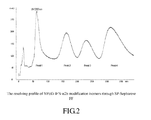
- YPEG-IFN- ⁇ 2b was resolved as 4 elution peaks by SP-Sepharose FF 100ml. The samples were collected according to these peaks and then measured by SDS-PAGE with silver staining respectively.
- peak 1 resolved by SP-Sepharose FF was primarily the products modified by YPEG at multiple amino acid residues (YPEG n -IFN- ⁇ 2b).
- Peak 2 by SP-Sepharose FF was primarily the products modified by PEG at a single amino acid residue (YPEG-IFN- ⁇ 2b), and also contained some products modified by PEG at multiple amino acid residues.
- Peak 3 and peak 4 by SP-Sepharose FF were both the products modified by PEG at a single amino acid residue.
- Peaks 2-4 resolved by SP-Sepharose FF were isomers with YPEG-modification at different single positions, and were named respectively as YPEG-IFN- ⁇ 2b SP1, YPEG-IFN- ⁇ 2b SP2 and YPEG-IFN- ⁇ 2b SP3.
- the resolution profile and silver-stained SAD-PAGE results were shown in FIG. 2 and FIG.3 respectively.
- Every sample of YPEG-IFN- ⁇ 2b SP1-3 was supplemented with sodium chloride, sodium acetate, mannitol, aspartic acid and was sterilized with 0.22 ⁇ m filter before stored at 4°C for further use.
- concentrations of YPEG-IFN- ⁇ 2b modification isomers were determined by Kjeldahl method.
- the apparent molecular weights of YPEG-IFN- ⁇ 2b modification isomers were determined by SDS-PAGE. The method was according to Laemmli et al (Nature 227: 680, 1970 ). The concentration of the gel was 7.5%, and the gel was visualized by silver staining. The apparent molecular weights of YPEG-IFN- ⁇ 2b modification isomers were almost the same, about 123KD ( FIG.4 ).
- MALDI-TOF MS (Autoflex TOF/TOF system, Bruker Daltonics, Germany) was used to determine the molecular weights of YPEG-rHuIFN- ⁇ 2b modification isomers.
- Sinapinic acid (SA, C 11 H 12 O 5 , M.W. 224.22, lot number: 2006 236870 002, Bruker Daltonics, Germany) was used as matrix.
- Protein Calibration Standard II Part No.207234, Bruker Daltonics, Germany
- the MS molecular weights of YPEG-IFN- ⁇ 2b modification isomers were almost the same, about 59000 Dalton ( FIG.5 ).
- IFN The action mechanism of IFN is partially to induce the production of 2',5'-AS (2',5'-oligoadenylate synthetase), which in turn exerts its antiviral effects.
- l25 I the pharmacodynamic parameters of IFN are reflected by the in vivo 2',5'-AS activity.
- 2',5'-AS catalyzes the synthesis of 2',5'-A (2;5'-oligoadenylate) from ATP in the presence of Poly(I) ⁇ Poly(C) agar (The activity of 2',5'-AS can be represented by the concentration of the synthesized 2',5'-A).
- 2',5'-AS in the samples are absorbed and activated by Poly(I).Poly(C) agarose, then catalyzes the substrate ATP to generate 2',5'-A.
- a mixture of 125 I labeled 2',5'-A, anti-2',5'-A serum and secondary antibody is added into the sample which then is incubated and centrifugated to separate the mixture. The supernatant is discarded and a Gamma Counter was used to measure the radioactivity of the sediment. The binding rate of the initially added 125 I labeled 2',5'-A is calculated. Four-parameter Logistic regression is used to generate standard curve, and then the concentration of the 2',5'-AS-induced 2',5'-A products in an unknown sample could be estimated.
- a single s.c. injection of 10, 30 or 100 ⁇ g ⁇ kg -1 YPEG-IFN- ⁇ 2b was given to Crab-eating Macaque.
- 1ml of venous blood was taken from the hind leg opposite to the injected side at the time before, 1h, 2h, 4h, 8h, 10h, 12h, 24h, 48h, 72h, 96h, 168h, 240h, and 312h after administration.
- IFN- ⁇ 2b (30 ⁇ g ⁇ kg -1 )
- 1ml of blood was taken at the time before, 0.5h, 1h, 2h, 3h, 4h, 5h, 6h, 8h, and 24h after administration. After kept at 4°C for 30 min, the blood samples were centrifugated at 2000rpm for 10min under low temperature, then the serum was separated immediately and stored at -20°C for further analysis.
- the quantitative double sandwich immunoassay was used.
- a monoclonal antibody specific to the recombinant human IFN- ⁇ was pre-coated on microtiter plate.
- the standard and the samples were pipetted into the microtiter wells, wherein the IFN- ⁇ 2b or YPEG-IFN- ⁇ 2b SP2 would bind to the immobilized antibody.
- the plate was washed to remove unbound substances, and then anti-human IFN- ⁇ IgG (secondary antibody) was added into the wells. After the reaction was complete, the plate was washed and the horseradish peroxidase (HRP) was added into the wells.
- HR horseradish peroxidase
- the color generated by adding HRP substrate solution into each well was proportional to the amount of the bound IFN- ⁇ 2b or YPEG-rhIFN- ⁇ 2b SP2 in the first step.
- the reaction was stopped and the color intensity was measured.
- the higher the OD value of absorbance the higher the concentration of IFN- ⁇ 2b or YPEG-IFN- ⁇ 2b SP2 in the sample.
- the standard curves were plotted for IFN- ⁇ 2b and YPEG-IFN- ⁇ 2b SP2 respectively so as to measure the serum drug concentration in the blood samples.
- the plate was incubated under room temperature for 1h and washed 4 times. 100 ⁇ l TMB substrate was added into each well, and kept under room temperature in the dark for 15min. 100 ⁇ l stop solution was added to each well, and mixed gently to stop the reaction. The absorbance OD value at 450nm was measured with a microplate reader within 5min to determine the concentration of each sample.
- YPEG-IFN- ⁇ 2b SP2 The solvent system of YPEG-IFN- ⁇ 2b SP2 was changed to 50mM NH 4 HCO 3 (pH8.0) by ultrafiltration with 5K ultrafilter (Millipore, polyethersulfone material), and the protein concentration was determined to be 3.82 mg/ml using UV spectroscopy.
- TPCK Trypsin Promega was dissolved (0.5 ⁇ g/ ⁇ l) in the solution provided by the manufacturer. Samples were added according to Table 3: Table3.
- the reaction system was kept in a water bath at 37°C for 48h, then 1.52ml of 20% acetic acid was added to stop the reaction. A small amount of sample was taken for HPLC-RP C 18 peptide mapping.
- the instrument for analysis was Waters HPLC system, with a controller of type 600, 2487 double wavelength detector, and the software for data processing was Empower 2.
- the HPLC analytical column was Jupiter C 18 (particle diameter 5 ⁇ m, pore diameter 300 ⁇ , ⁇ 4.6 ⁇ 150mm, produced by Phenomenex, USA).
- Mobile phase A was 0.1% TFA/H 2 O
- Mobile phase B was 0.1% TFA/90% ACN/H 2 O
- the flow rate was 1ml/min
- the detection wavelength was set at 214nm.
- Table 4 Please refer to Table 4 for the elution gradients, and the results were shown in FIG.8-10 .
- Table4. The elution gradients for HPLC-RP C18 peptide mapping of the trypsin digested YPEG-IFN- ⁇ 2b SP 2 Time (min) A% B% ACN% 1 0 100 0 0 2 8 100 0 0 3 68 40 60 54 4 72 40 60 54 5 75 100 0 0 6 80 100 0 0 0
- sample from the first elution peak was collected (sample number: YPEG-IFN- ⁇ 2b S100-1, FIG. 11 ), and the solvent system was changed to 5mM PBNa (pH 7.0) with 5K ultrafilter. Vacuum freeze-drying was done.
- the N-terminal amino acids of the freeze-dried sample were determined using Edman degradation, and the sequence of the 7 amino acids at the N-terminus of the sample was XYSPXAW (Table 5), wherein X denotes ⁇ -amino acid cysteine (Cys), a non- ⁇ -amino acid or another modified amino acid that cannot be detected using Edman degradation.
- YPEG-IFN- ⁇ 2b SP2 was primarily the products modified with YPEG at Lys134.
- Table5. Sequencing result for the N-terminal amino acids of YPEG-IFN- ⁇ 2b S100-1 Sample Detected N-terminal Sequence The corresponding PEG modification position.
- YPEG-IFN- ⁇ 2b S100-1 XYSPXAW Lys134 Note: X denotes ⁇ -amino acid cysteine, a non- ⁇ -amino acid or another modified amino acid that cannot be detected using Edman degradation.
Landscapes
- Health & Medical Sciences (AREA)
- Life Sciences & Earth Sciences (AREA)
- Chemical & Material Sciences (AREA)
- Organic Chemistry (AREA)
- General Health & Medical Sciences (AREA)
- Medicinal Chemistry (AREA)
- Pharmacology & Pharmacy (AREA)
- Animal Behavior & Ethology (AREA)
- Public Health (AREA)
- Veterinary Medicine (AREA)
- Chemical Kinetics & Catalysis (AREA)
- General Chemical & Material Sciences (AREA)
- Nuclear Medicine, Radiotherapy & Molecular Imaging (AREA)
- Engineering & Computer Science (AREA)
- Bioinformatics & Cheminformatics (AREA)
- Virology (AREA)
- Molecular Biology (AREA)
- Oncology (AREA)
- Gastroenterology & Hepatology (AREA)
- Pulmonology (AREA)
- Biophysics (AREA)
- Proteomics, Peptides & Aminoacids (AREA)
- Genetics & Genomics (AREA)
- Biochemistry (AREA)
- Zoology (AREA)
- Toxicology (AREA)
- Communicable Diseases (AREA)
- Immunology (AREA)
- Rheumatology (AREA)
- Epidemiology (AREA)
- Neurology (AREA)
- Orthopedic Medicine & Surgery (AREA)
- Pain & Pain Management (AREA)
- Neurosurgery (AREA)
- Physical Education & Sports Medicine (AREA)
- Hematology (AREA)
- Biomedical Technology (AREA)
- Biotechnology (AREA)
- Medicines That Contain Protein Lipid Enzymes And Other Medicines (AREA)
- Peptides Or Proteins (AREA)
Priority Applications (1)
| Application Number | Priority Date | Filing Date | Title |
|---|---|---|---|
| PL07800861T PL2186830T3 (pl) | 2007-09-04 | 2007-09-04 | Interferon alfa 2b zmodyfikowany glikolem polietylenowym, jego wytwarzanie i zastosowanie |
Applications Claiming Priority (1)
| Application Number | Priority Date | Filing Date | Title |
|---|---|---|---|
| PCT/CN2007/002644 WO2009030066A1 (fr) | 2007-09-04 | 2007-09-04 | Interféron alpha 2b modifié par du polyethylèneglycol et procédé de préparation et applications associés |
Publications (3)
| Publication Number | Publication Date |
|---|---|
| EP2186830A1 true EP2186830A1 (fr) | 2010-05-19 |
| EP2186830A4 EP2186830A4 (fr) | 2010-10-20 |
| EP2186830B1 EP2186830B1 (fr) | 2012-03-07 |
Family
ID=40428422
Family Applications (1)
| Application Number | Title | Priority Date | Filing Date |
|---|---|---|---|
| EP07800861A Active EP2186830B1 (fr) | 2007-09-04 | 2007-09-04 | Interféron alpha 2b modifié par du polyethylèneglycol et procédé de préparation et applications associés |
Country Status (17)
| Country | Link |
|---|---|
| US (1) | US8597635B2 (fr) |
| EP (1) | EP2186830B1 (fr) |
| JP (1) | JP5325884B2 (fr) |
| KR (1) | KR101502645B1 (fr) |
| CN (1) | CN101636414B (fr) |
| AT (1) | ATE548382T1 (fr) |
| AU (1) | AU2007358605B8 (fr) |
| BR (1) | BRPI0721984B8 (fr) |
| CA (1) | CA2698173C (fr) |
| DK (1) | DK2186830T3 (fr) |
| ES (1) | ES2382124T3 (fr) |
| MX (1) | MX2010002557A (fr) |
| PL (1) | PL2186830T3 (fr) |
| PT (1) | PT2186830E (fr) |
| RU (1) | RU2485134C2 (fr) |
| WO (1) | WO2009030066A1 (fr) |
| ZA (1) | ZA201001556B (fr) |
Cited By (4)
| Publication number | Priority date | Publication date | Assignee | Title |
|---|---|---|---|---|
| WO2013036032A1 (fr) | 2011-09-05 | 2013-03-14 | Hanmi Science Co., Ltd. | Composition pharmaceutique utilisée dans le traitement du cancer, comprenant un conjugué de l'interféron alpha |
| EA021610B1 (ru) * | 2013-03-28 | 2015-07-30 | Илья Александрович МАРКОВ | Жидкое противовирусное лекарственное средство |
| EA022617B1 (ru) * | 2013-03-28 | 2016-02-29 | Илья Александрович МАРКОВ | Монопегилированный интерферон-альфа разветвленной структуры и фармацевтическая композиция для приготовления лекарственного средства, обладающего активностью интерферона-альфа |
| EA023323B1 (ru) * | 2013-03-28 | 2016-05-31 | Илья Александрович МАРКОВ | Разветвленный ацилазидный пегилирующий агент, способ его получения и способ получения пегилированного интерферона |
Families Citing this family (11)
| Publication number | Priority date | Publication date | Assignee | Title |
|---|---|---|---|---|
| CL2008002399A1 (es) | 2007-08-16 | 2009-01-02 | Pharmaessentia Corp | Conjugado sustancialmente puro que posee una porcion polimerica, una porcion proteica (interferon alfa 2b) y un ligante alifatico de 1 a 10 atomos de carbono, util en el tratamiento de las hepatitis b o c. |
| PL2196475T3 (pl) | 2007-09-04 | 2012-10-31 | Biosteed Gene Expression Tech Co Ltd | Interferon alfa 2a zmodyfikowany rozgałęzioną cząsteczką glikolu polietylenowego, sposób jego syntezy i zastosowanie |
| CN101636414B (zh) | 2007-09-04 | 2012-02-15 | 厦门伯赛基因转录技术有限公司 | 聚乙二醇修饰的干扰素α2b及其制备方法和应用 |
| UA109646C2 (uk) * | 2009-12-10 | 2015-09-25 | Терапевтичне застосування кон'югатів білка з полімером | |
| KR101943821B1 (ko) * | 2011-06-21 | 2019-01-31 | 한국전자통신연구원 | 무선 통신 시스템에서 제어채널 송수신 방법 |
| RS65015B1 (sr) | 2014-11-06 | 2024-01-31 | Pharmaessentia Corp | Režim doziranja pegiliranog interferona |
| EP3272857B1 (fr) * | 2015-03-17 | 2020-08-12 | Shigetaka Shimodaira | Méthode de préparation de cellules dendritiques par culture non-adhésive utilisant de l'ifn |
| CN106146325B (zh) * | 2015-04-24 | 2019-01-29 | 北京键凯科技股份有限公司 | 一种y型多缩乙二醇衍生物及其制备方法 |
| US20220339248A1 (en) | 2019-06-19 | 2022-10-27 | The Research Foundation For The State University Of New York | Methods for treating neointimal hyperlasia using f11r/jam-a inhibitors |
| WO2021209563A1 (fr) | 2020-04-16 | 2021-10-21 | Som Innovation Biotech, S.A. | Composés destinés à être utilisés dans le traitement d'infections virales par un coronavirus associé au syndrome respiratoire |
| WO2021216801A1 (fr) * | 2020-04-22 | 2021-10-28 | Southlake Pharmaceuticals, Inc. | Interféron tau pegylé et compositions et procédés associés |
Family Cites Families (18)
| Publication number | Priority date | Publication date | Assignee | Title |
|---|---|---|---|---|
| US103411A (en) | 1870-05-24 | Improved liniment | ||
| US4179337A (en) * | 1973-07-20 | 1979-12-18 | Davis Frank F | Non-immunogenic polypeptides |
| US5382657A (en) | 1992-08-26 | 1995-01-17 | Hoffmann-La Roche Inc. | Peg-interferon conjugates |
| US5951974A (en) * | 1993-11-10 | 1999-09-14 | Enzon, Inc. | Interferon polymer conjugates |
| TW426523B (en) * | 1995-04-06 | 2001-03-21 | Hoffmann La Roche | Interferon solution |
| TW517067B (en) | 1996-05-31 | 2003-01-11 | Hoffmann La Roche | Interferon conjugates |
| CN1243779A (zh) | 1998-07-31 | 2000-02-09 | 东莞中镇鞋材有限公司 | 纤维板及其制造方法 |
| US6610822B2 (en) * | 2000-09-01 | 2003-08-26 | Merck & Co., Inc. | Purification process |
| US6887462B2 (en) * | 2001-04-09 | 2005-05-03 | Chiron Corporation | HSA-free formulations of interferon-beta |
| DE60315145T2 (de) * | 2002-03-13 | 2008-04-30 | Beijing Jiankai Technology Co., Ltd. | Hydrophiles polymerderivat mit y-verzweigung und herstellungsverfahren dafür; obige verbindung enthaltender medizinischer verbundwerkstoff |
| CA2497777A1 (fr) * | 2002-09-05 | 2004-03-18 | The General Hospital Corporation | Asialo-interferons modifies et utilisations correspondantes |
| EP1556498A1 (fr) * | 2002-11-01 | 2005-07-27 | Cadila Healthcare Ltd. | Procede de production du polypeptide interferon alpha 2b humain de recombinaison dans la levure pichia pastoris |
| WO2004045648A1 (fr) * | 2002-11-15 | 2004-06-03 | F. Hoffmann-La Roche Ag | Isomeres positionnels du peg-interferon alpha-2a |
| CN1997666A (zh) * | 2003-02-26 | 2007-07-11 | 印特缪恩股份有限公司 | 聚乙二醇修饰的干扰素组合物及其使用方法 |
| MX2007014524A (es) * | 2005-05-18 | 2008-02-07 | Maxygen Inc | Polipeptidos desarrollados de interferon-alfa. |
| WO2006133089A2 (fr) * | 2005-06-03 | 2006-12-14 | Ambrx, Inc. | Molecules d'interferons humains ameliorees et utilisations de celles-ci |
| CN101636414B (zh) | 2007-09-04 | 2012-02-15 | 厦门伯赛基因转录技术有限公司 | 聚乙二醇修饰的干扰素α2b及其制备方法和应用 |
| PL2196475T3 (pl) | 2007-09-04 | 2012-10-31 | Biosteed Gene Expression Tech Co Ltd | Interferon alfa 2a zmodyfikowany rozgałęzioną cząsteczką glikolu polietylenowego, sposób jego syntezy i zastosowanie |
-
2007
- 2007-09-04 CN CN2007800505428A patent/CN101636414B/zh active Active
- 2007-09-04 US US12/676,525 patent/US8597635B2/en active Active
- 2007-09-04 KR KR1020107007270A patent/KR101502645B1/ko active Active
- 2007-09-04 RU RU2010106430/10A patent/RU2485134C2/ru active
- 2007-09-04 PL PL07800861T patent/PL2186830T3/pl unknown
- 2007-09-04 JP JP2010523253A patent/JP5325884B2/ja active Active
- 2007-09-04 BR BRPI0721984A patent/BRPI0721984B8/pt active IP Right Grant
- 2007-09-04 PT PT07800861T patent/PT2186830E/pt unknown
- 2007-09-04 AU AU2007358605A patent/AU2007358605B8/en active Active
- 2007-09-04 CA CA2698173A patent/CA2698173C/fr active Active
- 2007-09-04 AT AT07800861T patent/ATE548382T1/de active
- 2007-09-04 WO PCT/CN2007/002644 patent/WO2009030066A1/fr not_active Ceased
- 2007-09-04 MX MX2010002557A patent/MX2010002557A/es active IP Right Grant
- 2007-09-04 DK DK07800861.2T patent/DK2186830T3/da active
- 2007-09-04 ES ES07800861T patent/ES2382124T3/es active Active
- 2007-09-04 EP EP07800861A patent/EP2186830B1/fr active Active
-
2010
- 2010-03-03 ZA ZA2010/01556A patent/ZA201001556B/en unknown
Cited By (8)
| Publication number | Priority date | Publication date | Assignee | Title |
|---|---|---|---|---|
| WO2013036032A1 (fr) | 2011-09-05 | 2013-03-14 | Hanmi Science Co., Ltd. | Composition pharmaceutique utilisée dans le traitement du cancer, comprenant un conjugué de l'interféron alpha |
| KR20140084023A (ko) * | 2011-09-05 | 2014-07-04 | 한미사이언스 주식회사 | 인터페론 알파 결합체를 포함하는 암 치료용 약학적 조성물 |
| EP2753348A4 (fr) * | 2011-09-05 | 2015-05-27 | Hanmi Science Co Ltd | Composition pharmaceutique utilisée dans le traitement du cancer, comprenant un conjugué de l'interféron alpha |
| AU2012305062B2 (en) * | 2011-09-05 | 2017-06-22 | Beijing Hanmi Pharmaceutical Co., Ltd. | A pharmaceutical composition for treating cancer, comprising interferon alpha conjugate |
| US9789202B2 (en) | 2011-09-05 | 2017-10-17 | Hanmi Science Co., Ltd. | Method for treating cancer using an interferon alpha conjugate |
| EA021610B1 (ru) * | 2013-03-28 | 2015-07-30 | Илья Александрович МАРКОВ | Жидкое противовирусное лекарственное средство |
| EA022617B1 (ru) * | 2013-03-28 | 2016-02-29 | Илья Александрович МАРКОВ | Монопегилированный интерферон-альфа разветвленной структуры и фармацевтическая композиция для приготовления лекарственного средства, обладающего активностью интерферона-альфа |
| EA023323B1 (ru) * | 2013-03-28 | 2016-05-31 | Илья Александрович МАРКОВ | Разветвленный ацилазидный пегилирующий агент, способ его получения и способ получения пегилированного интерферона |
Also Published As
| Publication number | Publication date |
|---|---|
| ZA201001556B (en) | 2010-12-29 |
| KR20100082774A (ko) | 2010-07-19 |
| RU2010106430A (ru) | 2011-10-10 |
| CA2698173A1 (fr) | 2009-03-12 |
| EP2186830B1 (fr) | 2012-03-07 |
| JP2010538022A (ja) | 2010-12-09 |
| RU2485134C2 (ru) | 2013-06-20 |
| CA2698173C (fr) | 2015-02-03 |
| BRPI0721984B8 (pt) | 2021-05-25 |
| AU2007358605A1 (en) | 2009-03-12 |
| PL2186830T3 (pl) | 2012-09-28 |
| BRPI0721984A2 (pt) | 2014-03-18 |
| KR101502645B1 (ko) | 2015-03-13 |
| CN101636414B (zh) | 2012-02-15 |
| EP2186830A4 (fr) | 2010-10-20 |
| MX2010002557A (es) | 2011-12-16 |
| DK2186830T3 (da) | 2012-04-02 |
| US8597635B2 (en) | 2013-12-03 |
| BRPI0721984B1 (pt) | 2020-11-17 |
| PT2186830E (pt) | 2012-06-20 |
| US20110158943A1 (en) | 2011-06-30 |
| ATE548382T1 (de) | 2012-03-15 |
| AU2007358605B2 (en) | 2011-09-08 |
| AU2007358605B8 (en) | 2012-02-02 |
| ES2382124T3 (es) | 2012-06-05 |
| JP5325884B2 (ja) | 2013-10-23 |
| CN101636414A (zh) | 2010-01-27 |
| WO2009030066A1 (fr) | 2009-03-12 |
Similar Documents
| Publication | Publication Date | Title |
|---|---|---|
| EP2186830B1 (fr) | Interféron alpha 2b modifié par du polyethylèneglycol et procédé de préparation et applications associés | |
| Ramon et al. | PEGylated Interferon-α2b: A Branched 40K Polyethylene Glycol Derivative: Ramon et al. | |
| AU739359B2 (en) | Improved interferon polymer conjugates | |
| US20130287733A1 (en) | Interferon alpha mutant and its polyethylene glycol derivative | |
| EP2196475B1 (fr) | INTERFERON ALPHA 2a MODIFIÉ PAR POLYETHYLÈNEGLYCOL, SON PROCESSUS DE SYNTHÈSE ET SON APPLICATION | |
| RU2488598C2 (ru) | Гормон роста, модифицированный двухцепочечным полиэтиленгликолем, способ его получения и применение | |
| RU2575796C9 (ru) | Пегилированный конъюгат варианта рекомбинантного консенсусного интерферона и способ его получения, и применение | |
| RU2575796C2 (ru) | Пегилированный конъюгат варианта рекомбинантного консенсусного интерферона и способ его получения, и применение | |
| CN101880326B (zh) | 干扰素‑β复合物 | |
| CN106749608B (zh) | 干扰素α缀合物 | |
| KR102039493B1 (ko) | 신규 엑세나타이드 변이체-고분자 복합체 |
Legal Events
| Date | Code | Title | Description |
|---|---|---|---|
| PUAI | Public reference made under article 153(3) epc to a published international application that has entered the european phase |
Free format text: ORIGINAL CODE: 0009012 |
|
| 17P | Request for examination filed |
Effective date: 20100309 |
|
| AK | Designated contracting states |
Kind code of ref document: A1 Designated state(s): AT BE BG CH CY CZ DE DK EE ES FI FR GB GR HU IE IS IT LI LT LU LV MC MT NL PL PT RO SE SI SK TR |
|
| AX | Request for extension of the european patent |
Extension state: AL BA HR MK RS |
|
| A4 | Supplementary search report drawn up and despatched |
Effective date: 20100922 |
|
| RIC1 | Information provided on ipc code assigned before grant |
Ipc: A61P 25/00 20060101ALI20100916BHEP Ipc: A61P 31/12 20060101ALI20100916BHEP Ipc: A61K 38/21 20060101ALI20100916BHEP Ipc: A61P 1/16 20060101ALI20100916BHEP Ipc: A61P 11/06 20060101ALI20100916BHEP Ipc: A61K 47/48 20060101ALI20100916BHEP Ipc: C07K 17/08 20060101ALI20100916BHEP Ipc: C07K 14/48 20060101ALI20100916BHEP Ipc: A61P 35/00 20060101ALI20100916BHEP Ipc: A61P 19/02 20060101ALI20100916BHEP Ipc: A61P 11/00 20060101ALI20100916BHEP Ipc: C07K 14/56 20060101AFI20100916BHEP |
|
| REG | Reference to a national code |
Ref country code: DE Ref legal event code: R079 Ref document number: 602007021195 Country of ref document: DE Free format text: PREVIOUS MAIN CLASS: C07K0017080000 Ipc: C07K0014560000 |
|
| GRAP | Despatch of communication of intention to grant a patent |
Free format text: ORIGINAL CODE: EPIDOSNIGR1 |
|
| RIC1 | Information provided on ipc code assigned before grant |
Ipc: A61P 25/00 20060101ALI20110505BHEP Ipc: C07K 14/48 20060101ALI20110505BHEP Ipc: A61K 38/21 20060101ALI20110505BHEP Ipc: A61P 11/00 20060101ALI20110505BHEP Ipc: A61P 1/16 20060101ALI20110505BHEP Ipc: C07K 17/08 20060101ALI20110505BHEP Ipc: C07K 14/56 20060101AFI20110505BHEP Ipc: A61K 47/48 20060101ALI20110505BHEP Ipc: A61P 11/06 20060101ALI20110505BHEP Ipc: A61P 35/00 20060101ALI20110505BHEP Ipc: A61P 31/12 20060101ALI20110505BHEP Ipc: A61P 19/02 20060101ALI20110505BHEP |
|
| GRAS | Grant fee paid |
Free format text: ORIGINAL CODE: EPIDOSNIGR3 |
|
| GRAA | (expected) grant |
Free format text: ORIGINAL CODE: 0009210 |
|
| AK | Designated contracting states |
Kind code of ref document: B1 Designated state(s): AT BE BG CH CY CZ DE DK EE ES FI FR GB GR HU IE IS IT LI LT LU LV MC MT NL PL PT RO SE SI SK TR |
|
| AX | Request for extension of the european patent |
Extension state: AL BA HR MK RS |
|
| REG | Reference to a national code |
Ref country code: GB Ref legal event code: FG4D |
|
| REG | Reference to a national code |
Ref country code: AT Ref legal event code: REF Ref document number: 548382 Country of ref document: AT Kind code of ref document: T Effective date: 20120315 Ref country code: CH Ref legal event code: EP |
|
| REG | Reference to a national code |
Ref country code: DK Ref legal event code: T3 |
|
| REG | Reference to a national code |
Ref country code: IE Ref legal event code: FG4D |
|
| REG | Reference to a national code |
Ref country code: DE Ref legal event code: R096 Ref document number: 602007021195 Country of ref document: DE Effective date: 20120503 |
|
| REG | Reference to a national code |
Ref country code: NL Ref legal event code: T3 |
|
| REG | Reference to a national code |
Ref country code: RO Ref legal event code: EPE |
|
| REG | Reference to a national code |
Ref country code: ES Ref legal event code: FG2A Ref document number: 2382124 Country of ref document: ES Kind code of ref document: T3 Effective date: 20120605 |
|
| REG | Reference to a national code |
Ref country code: SE Ref legal event code: TRGR |
|
| REG | Reference to a national code |
Ref country code: PT Ref legal event code: SC4A Free format text: AVAILABILITY OF NATIONAL TRANSLATION Effective date: 20120604 |
|
| PG25 | Lapsed in a contracting state [announced via postgrant information from national office to epo] |
Ref country code: LV Free format text: LAPSE BECAUSE OF FAILURE TO SUBMIT A TRANSLATION OF THE DESCRIPTION OR TO PAY THE FEE WITHIN THE PRESCRIBED TIME-LIMIT Effective date: 20120307 Ref country code: GR Free format text: LAPSE BECAUSE OF FAILURE TO SUBMIT A TRANSLATION OF THE DESCRIPTION OR TO PAY THE FEE WITHIN THE PRESCRIBED TIME-LIMIT Effective date: 20120608 |
|
| PG25 | Lapsed in a contracting state [announced via postgrant information from national office to epo] |
Ref country code: CY Free format text: LAPSE BECAUSE OF FAILURE TO SUBMIT A TRANSLATION OF THE DESCRIPTION OR TO PAY THE FEE WITHIN THE PRESCRIBED TIME-LIMIT Effective date: 20120307 |
|
| REG | Reference to a national code |
Ref country code: PL Ref legal event code: T3 |
|
| PG25 | Lapsed in a contracting state [announced via postgrant information from national office to epo] |
Ref country code: IS Free format text: LAPSE BECAUSE OF FAILURE TO SUBMIT A TRANSLATION OF THE DESCRIPTION OR TO PAY THE FEE WITHIN THE PRESCRIBED TIME-LIMIT Effective date: 20120707 Ref country code: CZ Free format text: LAPSE BECAUSE OF FAILURE TO SUBMIT A TRANSLATION OF THE DESCRIPTION OR TO PAY THE FEE WITHIN THE PRESCRIBED TIME-LIMIT Effective date: 20120307 Ref country code: SI Free format text: LAPSE BECAUSE OF FAILURE TO SUBMIT A TRANSLATION OF THE DESCRIPTION OR TO PAY THE FEE WITHIN THE PRESCRIBED TIME-LIMIT Effective date: 20120307 Ref country code: EE Free format text: LAPSE BECAUSE OF FAILURE TO SUBMIT A TRANSLATION OF THE DESCRIPTION OR TO PAY THE FEE WITHIN THE PRESCRIBED TIME-LIMIT Effective date: 20120307 |
|
| PG25 | Lapsed in a contracting state [announced via postgrant information from national office to epo] |
Ref country code: SK Free format text: LAPSE BECAUSE OF FAILURE TO SUBMIT A TRANSLATION OF THE DESCRIPTION OR TO PAY THE FEE WITHIN THE PRESCRIBED TIME-LIMIT Effective date: 20120307 |
|
| PLBE | No opposition filed within time limit |
Free format text: ORIGINAL CODE: 0009261 |
|
| STAA | Information on the status of an ep patent application or granted ep patent |
Free format text: STATUS: NO OPPOSITION FILED WITHIN TIME LIMIT |
|
| 26N | No opposition filed |
Effective date: 20121210 |
|
| REG | Reference to a national code |
Ref country code: HU Ref legal event code: AG4A Ref document number: E014730 Country of ref document: HU |
|
| REG | Reference to a national code |
Ref country code: DE Ref legal event code: R097 Ref document number: 602007021195 Country of ref document: DE Effective date: 20121210 |
|
| PG25 | Lapsed in a contracting state [announced via postgrant information from national office to epo] |
Ref country code: BG Free format text: LAPSE BECAUSE OF FAILURE TO SUBMIT A TRANSLATION OF THE DESCRIPTION OR TO PAY THE FEE WITHIN THE PRESCRIBED TIME-LIMIT Effective date: 20120607 |
|
| PG25 | Lapsed in a contracting state [announced via postgrant information from national office to epo] |
Ref country code: MT Free format text: LAPSE BECAUSE OF FAILURE TO SUBMIT A TRANSLATION OF THE DESCRIPTION OR TO PAY THE FEE WITHIN THE PRESCRIBED TIME-LIMIT Effective date: 20120307 |
|
| REG | Reference to a national code |
Ref country code: FR Ref legal event code: PLFP Year of fee payment: 10 |
|
| REG | Reference to a national code |
Ref country code: FR Ref legal event code: PLFP Year of fee payment: 11 |
|
| REG | Reference to a national code |
Ref country code: FR Ref legal event code: PLFP Year of fee payment: 12 |
|
| PGFP | Annual fee paid to national office [announced via postgrant information from national office to epo] |
Ref country code: NL Payment date: 20250827 Year of fee payment: 19 |
|
| REG | Reference to a national code |
Ref country code: CH Ref legal event code: U11 Free format text: ST27 STATUS EVENT CODE: U-0-0-U10-U11 (AS PROVIDED BY THE NATIONAL OFFICE) Effective date: 20251001 |
|
| PGFP | Annual fee paid to national office [announced via postgrant information from national office to epo] |
Ref country code: PT Payment date: 20250816 Year of fee payment: 19 Ref country code: FI Payment date: 20250922 Year of fee payment: 19 |
|
| PGFP | Annual fee paid to national office [announced via postgrant information from national office to epo] |
Ref country code: LT Payment date: 20250821 Year of fee payment: 19 Ref country code: DE Payment date: 20250925 Year of fee payment: 19 Ref country code: DK Payment date: 20250816 Year of fee payment: 19 |
|
| PGFP | Annual fee paid to national office [announced via postgrant information from national office to epo] |
Ref country code: MC Payment date: 20250923 Year of fee payment: 19 |
|
| PGFP | Annual fee paid to national office [announced via postgrant information from national office to epo] |
Ref country code: PL Payment date: 20250822 Year of fee payment: 19 Ref country code: TR Payment date: 20250818 Year of fee payment: 19 Ref country code: LU Payment date: 20250902 Year of fee payment: 19 |
|
| PGFP | Annual fee paid to national office [announced via postgrant information from national office to epo] |
Ref country code: HU Payment date: 20250903 Year of fee payment: 19 Ref country code: BE Payment date: 20250919 Year of fee payment: 19 Ref country code: GB Payment date: 20250922 Year of fee payment: 19 |
|
| PGFP | Annual fee paid to national office [announced via postgrant information from national office to epo] |
Ref country code: FR Payment date: 20250923 Year of fee payment: 19 Ref country code: AT Payment date: 20250918 Year of fee payment: 19 |
|
| PGFP | Annual fee paid to national office [announced via postgrant information from national office to epo] |
Ref country code: SE Payment date: 20250816 Year of fee payment: 19 |
|
| PGFP | Annual fee paid to national office [announced via postgrant information from national office to epo] |
Ref country code: IE Payment date: 20250816 Year of fee payment: 19 |
|
| PGFP | Annual fee paid to national office [announced via postgrant information from national office to epo] |
Ref country code: RO Payment date: 20250901 Year of fee payment: 19 |
|
| PGFP | Annual fee paid to national office [announced via postgrant information from national office to epo] |
Ref country code: IT Payment date: 20250930 Year of fee payment: 19 |
|
| PGFP | Annual fee paid to national office [announced via postgrant information from national office to epo] |
Ref country code: CH Payment date: 20251001 Year of fee payment: 19 |
|
| PGFP | Annual fee paid to national office [announced via postgrant information from national office to epo] |
Ref country code: ES Payment date: 20251020 Year of fee payment: 19 |