EP2163908B1 - Current sensor - Google Patents
Current sensor Download PDFInfo
- Publication number
- EP2163908B1 EP2163908B1 EP09000121A EP09000121A EP2163908B1 EP 2163908 B1 EP2163908 B1 EP 2163908B1 EP 09000121 A EP09000121 A EP 09000121A EP 09000121 A EP09000121 A EP 09000121A EP 2163908 B1 EP2163908 B1 EP 2163908B1
- Authority
- EP
- European Patent Office
- Prior art keywords
- current
- conductor portion
- substrate
- current conductor
- hall effect
- Prior art date
- Legal status (The legal status is an assumption and is not a legal conclusion. Google has not performed a legal analysis and makes no representation as to the accuracy of the status listed.)
- Active
Links
Images








Classifications
-
- G—PHYSICS
- G01—MEASURING; TESTING
- G01R—MEASURING ELECTRIC VARIABLES; MEASURING MAGNETIC VARIABLES
- G01R15/00—Details of measuring arrangements of the types provided for in groups G01R17/00 - G01R29/00, G01R33/00 - G01R33/26 or G01R35/00
- G01R15/14—Adaptations providing voltage or current isolation, e.g. for high-voltage or high-current networks
- G01R15/20—Adaptations providing voltage or current isolation, e.g. for high-voltage or high-current networks using galvano-magnetic devices, e.g. Hall-effect devices, i.e. measuring a magnetic field via the interaction between a current and a magnetic field, e.g. magneto resistive or Hall effect devices
-
- G—PHYSICS
- G01—MEASURING; TESTING
- G01R—MEASURING ELECTRIC VARIABLES; MEASURING MAGNETIC VARIABLES
- G01R15/00—Details of measuring arrangements of the types provided for in groups G01R17/00 - G01R29/00, G01R33/00 - G01R33/26 or G01R35/00
- G01R15/14—Adaptations providing voltage or current isolation, e.g. for high-voltage or high-current networks
- G01R15/20—Adaptations providing voltage or current isolation, e.g. for high-voltage or high-current networks using galvano-magnetic devices, e.g. Hall-effect devices, i.e. measuring a magnetic field via the interaction between a current and a magnetic field, e.g. magneto resistive or Hall effect devices
- G01R15/207—Constructional details independent of the type of device used
-
- G—PHYSICS
- G01—MEASURING; TESTING
- G01R—MEASURING ELECTRIC VARIABLES; MEASURING MAGNETIC VARIABLES
- G01R15/00—Details of measuring arrangements of the types provided for in groups G01R17/00 - G01R29/00, G01R33/00 - G01R33/26 or G01R35/00
- G01R15/14—Adaptations providing voltage or current isolation, e.g. for high-voltage or high-current networks
- G01R15/20—Adaptations providing voltage or current isolation, e.g. for high-voltage or high-current networks using galvano-magnetic devices, e.g. Hall-effect devices, i.e. measuring a magnetic field via the interaction between a current and a magnetic field, e.g. magneto resistive or Hall effect devices
- G01R15/202—Adaptations providing voltage or current isolation, e.g. for high-voltage or high-current networks using galvano-magnetic devices, e.g. Hall-effect devices, i.e. measuring a magnetic field via the interaction between a current and a magnetic field, e.g. magneto resistive or Hall effect devices using Hall-effect devices
-
- H—ELECTRICITY
- H01—ELECTRIC ELEMENTS
- H01L—SEMICONDUCTOR DEVICES NOT COVERED BY CLASS H10
- H01L23/00—Details of semiconductor or other solid state devices
- H01L23/552—Protection against radiation, e.g. light or electromagnetic waves
-
- H—ELECTRICITY
- H01—ELECTRIC ELEMENTS
- H01L—SEMICONDUCTOR DEVICES NOT COVERED BY CLASS H10
- H01L24/00—Arrangements for connecting or disconnecting semiconductor or solid-state bodies; Methods or apparatus related thereto
- H01L24/01—Means for bonding being attached to, or being formed on, the surface to be connected, e.g. chip-to-package, die-attach, "first-level" interconnects; Manufacturing methods related thereto
- H01L24/34—Strap connectors, e.g. copper straps for grounding power devices; Manufacturing methods related thereto
- H01L24/36—Structure, shape, material or disposition of the strap connectors prior to the connecting process
- H01L24/37—Structure, shape, material or disposition of the strap connectors prior to the connecting process of an individual strap connector
-
- H—ELECTRICITY
- H01—ELECTRIC ELEMENTS
- H01L—SEMICONDUCTOR DEVICES NOT COVERED BY CLASS H10
- H01L24/00—Arrangements for connecting or disconnecting semiconductor or solid-state bodies; Methods or apparatus related thereto
- H01L24/01—Means for bonding being attached to, or being formed on, the surface to be connected, e.g. chip-to-package, die-attach, "first-level" interconnects; Manufacturing methods related thereto
- H01L24/34—Strap connectors, e.g. copper straps for grounding power devices; Manufacturing methods related thereto
- H01L24/39—Structure, shape, material or disposition of the strap connectors after the connecting process
- H01L24/40—Structure, shape, material or disposition of the strap connectors after the connecting process of an individual strap connector
-
- H—ELECTRICITY
- H01—ELECTRIC ELEMENTS
- H01L—SEMICONDUCTOR DEVICES NOT COVERED BY CLASS H10
- H01L24/00—Arrangements for connecting or disconnecting semiconductor or solid-state bodies; Methods or apparatus related thereto
- H01L24/01—Means for bonding being attached to, or being formed on, the surface to be connected, e.g. chip-to-package, die-attach, "first-level" interconnects; Manufacturing methods related thereto
- H01L24/34—Strap connectors, e.g. copper straps for grounding power devices; Manufacturing methods related thereto
- H01L24/39—Structure, shape, material or disposition of the strap connectors after the connecting process
- H01L24/41—Structure, shape, material or disposition of the strap connectors after the connecting process of a plurality of strap connectors
-
- H—ELECTRICITY
- H01—ELECTRIC ELEMENTS
- H01L—SEMICONDUCTOR DEVICES NOT COVERED BY CLASS H10
- H01L24/00—Arrangements for connecting or disconnecting semiconductor or solid-state bodies; Methods or apparatus related thereto
- H01L24/73—Means for bonding being of different types provided for in two or more of groups H01L24/10, H01L24/18, H01L24/26, H01L24/34, H01L24/42, H01L24/50, H01L24/63, H01L24/71
-
- H—ELECTRICITY
- H01—ELECTRIC ELEMENTS
- H01L—SEMICONDUCTOR DEVICES NOT COVERED BY CLASS H10
- H01L24/00—Arrangements for connecting or disconnecting semiconductor or solid-state bodies; Methods or apparatus related thereto
- H01L24/91—Methods for connecting semiconductor or solid state bodies including different methods provided for in two or more of groups H01L24/80 - H01L24/90
-
- H—ELECTRICITY
- H10—SEMICONDUCTOR DEVICES; ELECTRIC SOLID-STATE DEVICES NOT OTHERWISE PROVIDED FOR
- H10N—ELECTRIC SOLID-STATE DEVICES NOT OTHERWISE PROVIDED FOR
- H10N52/00—Hall-effect devices
-
- G—PHYSICS
- G01—MEASURING; TESTING
- G01R—MEASURING ELECTRIC VARIABLES; MEASURING MAGNETIC VARIABLES
- G01R1/00—Details of instruments or arrangements of the types included in groups G01R5/00 - G01R13/00 and G01R31/00
- G01R1/02—General constructional details
- G01R1/18—Screening arrangements against electric or magnetic fields, e.g. against earth's field
-
- H—ELECTRICITY
- H01—ELECTRIC ELEMENTS
- H01L—SEMICONDUCTOR DEVICES NOT COVERED BY CLASS H10
- H01L2224/00—Indexing scheme for arrangements for connecting or disconnecting semiconductor or solid-state bodies and methods related thereto as covered by H01L24/00
- H01L2224/01—Means for bonding being attached to, or being formed on, the surface to be connected, e.g. chip-to-package, die-attach, "first-level" interconnects; Manufacturing methods related thereto
- H01L2224/34—Strap connectors, e.g. copper straps for grounding power devices; Manufacturing methods related thereto
- H01L2224/36—Structure, shape, material or disposition of the strap connectors prior to the connecting process
- H01L2224/37—Structure, shape, material or disposition of the strap connectors prior to the connecting process of an individual strap connector
- H01L2224/37001—Core members of the connector
- H01L2224/37099—Material
- H01L2224/371—Material with a principal constituent of the material being a metal or a metalloid, e.g. boron [B], silicon [Si], germanium [Ge], arsenic [As], antimony [Sb], tellurium [Te] and polonium [Po], and alloys thereof
- H01L2224/37138—Material with a principal constituent of the material being a metal or a metalloid, e.g. boron [B], silicon [Si], germanium [Ge], arsenic [As], antimony [Sb], tellurium [Te] and polonium [Po], and alloys thereof the principal constituent melting at a temperature of greater than or equal to 950°C and less than 1550°C
- H01L2224/37147—Copper [Cu] as principal constituent
-
- H—ELECTRICITY
- H01—ELECTRIC ELEMENTS
- H01L—SEMICONDUCTOR DEVICES NOT COVERED BY CLASS H10
- H01L2224/00—Indexing scheme for arrangements for connecting or disconnecting semiconductor or solid-state bodies and methods related thereto as covered by H01L24/00
- H01L2224/01—Means for bonding being attached to, or being formed on, the surface to be connected, e.g. chip-to-package, die-attach, "first-level" interconnects; Manufacturing methods related thereto
- H01L2224/34—Strap connectors, e.g. copper straps for grounding power devices; Manufacturing methods related thereto
- H01L2224/36—Structure, shape, material or disposition of the strap connectors prior to the connecting process
- H01L2224/37—Structure, shape, material or disposition of the strap connectors prior to the connecting process of an individual strap connector
- H01L2224/3754—Coating
- H01L2224/37599—Material
- H01L2224/37686—Material with a principal constituent of the material being a non metallic, non metalloid inorganic material
-
- H—ELECTRICITY
- H01—ELECTRIC ELEMENTS
- H01L—SEMICONDUCTOR DEVICES NOT COVERED BY CLASS H10
- H01L2224/00—Indexing scheme for arrangements for connecting or disconnecting semiconductor or solid-state bodies and methods related thereto as covered by H01L24/00
- H01L2224/01—Means for bonding being attached to, or being formed on, the surface to be connected, e.g. chip-to-package, die-attach, "first-level" interconnects; Manufacturing methods related thereto
- H01L2224/34—Strap connectors, e.g. copper straps for grounding power devices; Manufacturing methods related thereto
- H01L2224/36—Structure, shape, material or disposition of the strap connectors prior to the connecting process
- H01L2224/37—Structure, shape, material or disposition of the strap connectors prior to the connecting process of an individual strap connector
- H01L2224/3754—Coating
- H01L2224/37599—Material
- H01L2224/3769—Material with a principal constituent of the material being a polymer, e.g. polyester, phenolic based polymer, epoxy
-
- H—ELECTRICITY
- H01—ELECTRIC ELEMENTS
- H01L—SEMICONDUCTOR DEVICES NOT COVERED BY CLASS H10
- H01L2224/00—Indexing scheme for arrangements for connecting or disconnecting semiconductor or solid-state bodies and methods related thereto as covered by H01L24/00
- H01L2224/01—Means for bonding being attached to, or being formed on, the surface to be connected, e.g. chip-to-package, die-attach, "first-level" interconnects; Manufacturing methods related thereto
- H01L2224/34—Strap connectors, e.g. copper straps for grounding power devices; Manufacturing methods related thereto
- H01L2224/39—Structure, shape, material or disposition of the strap connectors after the connecting process
- H01L2224/40—Structure, shape, material or disposition of the strap connectors after the connecting process of an individual strap connector
- H01L2224/4005—Shape
- H01L2224/4009—Loop shape
- H01L2224/40095—Kinked
-
- H—ELECTRICITY
- H01—ELECTRIC ELEMENTS
- H01L—SEMICONDUCTOR DEVICES NOT COVERED BY CLASS H10
- H01L2224/00—Indexing scheme for arrangements for connecting or disconnecting semiconductor or solid-state bodies and methods related thereto as covered by H01L24/00
- H01L2224/01—Means for bonding being attached to, or being formed on, the surface to be connected, e.g. chip-to-package, die-attach, "first-level" interconnects; Manufacturing methods related thereto
- H01L2224/34—Strap connectors, e.g. copper straps for grounding power devices; Manufacturing methods related thereto
- H01L2224/39—Structure, shape, material or disposition of the strap connectors after the connecting process
- H01L2224/40—Structure, shape, material or disposition of the strap connectors after the connecting process of an individual strap connector
- H01L2224/401—Disposition
- H01L2224/40151—Connecting between a semiconductor or solid-state body and an item not being a semiconductor or solid-state body, e.g. chip-to-substrate, chip-to-passive
- H01L2224/40221—Connecting between a semiconductor or solid-state body and an item not being a semiconductor or solid-state body, e.g. chip-to-substrate, chip-to-passive the body and the item being stacked
- H01L2224/40245—Connecting between a semiconductor or solid-state body and an item not being a semiconductor or solid-state body, e.g. chip-to-substrate, chip-to-passive the body and the item being stacked the item being metallic
-
- H—ELECTRICITY
- H01—ELECTRIC ELEMENTS
- H01L—SEMICONDUCTOR DEVICES NOT COVERED BY CLASS H10
- H01L2224/00—Indexing scheme for arrangements for connecting or disconnecting semiconductor or solid-state bodies and methods related thereto as covered by H01L24/00
- H01L2224/01—Means for bonding being attached to, or being formed on, the surface to be connected, e.g. chip-to-package, die-attach, "first-level" interconnects; Manufacturing methods related thereto
- H01L2224/42—Wire connectors; Manufacturing methods related thereto
- H01L2224/47—Structure, shape, material or disposition of the wire connectors after the connecting process
- H01L2224/48—Structure, shape, material or disposition of the wire connectors after the connecting process of an individual wire connector
- H01L2224/481—Disposition
- H01L2224/48151—Connecting between a semiconductor or solid-state body and an item not being a semiconductor or solid-state body, e.g. chip-to-substrate, chip-to-passive
- H01L2224/48221—Connecting between a semiconductor or solid-state body and an item not being a semiconductor or solid-state body, e.g. chip-to-substrate, chip-to-passive the body and the item being stacked
- H01L2224/48245—Connecting between a semiconductor or solid-state body and an item not being a semiconductor or solid-state body, e.g. chip-to-substrate, chip-to-passive the body and the item being stacked the item being metallic
- H01L2224/48247—Connecting between a semiconductor or solid-state body and an item not being a semiconductor or solid-state body, e.g. chip-to-substrate, chip-to-passive the body and the item being stacked the item being metallic connecting the wire to a bond pad of the item
-
- H—ELECTRICITY
- H01—ELECTRIC ELEMENTS
- H01L—SEMICONDUCTOR DEVICES NOT COVERED BY CLASS H10
- H01L2224/00—Indexing scheme for arrangements for connecting or disconnecting semiconductor or solid-state bodies and methods related thereto as covered by H01L24/00
- H01L2224/01—Means for bonding being attached to, or being formed on, the surface to be connected, e.g. chip-to-package, die-attach, "first-level" interconnects; Manufacturing methods related thereto
- H01L2224/42—Wire connectors; Manufacturing methods related thereto
- H01L2224/47—Structure, shape, material or disposition of the wire connectors after the connecting process
- H01L2224/48—Structure, shape, material or disposition of the wire connectors after the connecting process of an individual wire connector
- H01L2224/481—Disposition
- H01L2224/48151—Connecting between a semiconductor or solid-state body and an item not being a semiconductor or solid-state body, e.g. chip-to-substrate, chip-to-passive
- H01L2224/48221—Connecting between a semiconductor or solid-state body and an item not being a semiconductor or solid-state body, e.g. chip-to-substrate, chip-to-passive the body and the item being stacked
- H01L2224/48245—Connecting between a semiconductor or solid-state body and an item not being a semiconductor or solid-state body, e.g. chip-to-substrate, chip-to-passive the body and the item being stacked the item being metallic
- H01L2224/4826—Connecting between the body and an opposite side of the item with respect to the body
-
- H—ELECTRICITY
- H01—ELECTRIC ELEMENTS
- H01L—SEMICONDUCTOR DEVICES NOT COVERED BY CLASS H10
- H01L2224/00—Indexing scheme for arrangements for connecting or disconnecting semiconductor or solid-state bodies and methods related thereto as covered by H01L24/00
- H01L2224/73—Means for bonding being of different types provided for in two or more of groups H01L2224/10, H01L2224/18, H01L2224/26, H01L2224/34, H01L2224/42, H01L2224/50, H01L2224/63, H01L2224/71
- H01L2224/732—Location after the connecting process
- H01L2224/73201—Location after the connecting process on the same surface
- H01L2224/73215—Layer and wire connectors
-
- H—ELECTRICITY
- H01—ELECTRIC ELEMENTS
- H01L—SEMICONDUCTOR DEVICES NOT COVERED BY CLASS H10
- H01L2224/00—Indexing scheme for arrangements for connecting or disconnecting semiconductor or solid-state bodies and methods related thereto as covered by H01L24/00
- H01L2224/73—Means for bonding being of different types provided for in two or more of groups H01L2224/10, H01L2224/18, H01L2224/26, H01L2224/34, H01L2224/42, H01L2224/50, H01L2224/63, H01L2224/71
- H01L2224/732—Location after the connecting process
- H01L2224/73201—Location after the connecting process on the same surface
- H01L2224/73221—Strap and wire connectors
-
- H—ELECTRICITY
- H01—ELECTRIC ELEMENTS
- H01L—SEMICONDUCTOR DEVICES NOT COVERED BY CLASS H10
- H01L24/00—Arrangements for connecting or disconnecting semiconductor or solid-state bodies; Methods or apparatus related thereto
- H01L24/01—Means for bonding being attached to, or being formed on, the surface to be connected, e.g. chip-to-package, die-attach, "first-level" interconnects; Manufacturing methods related thereto
- H01L24/42—Wire connectors; Manufacturing methods related thereto
- H01L24/47—Structure, shape, material or disposition of the wire connectors after the connecting process
- H01L24/48—Structure, shape, material or disposition of the wire connectors after the connecting process of an individual wire connector
-
- H—ELECTRICITY
- H01—ELECTRIC ELEMENTS
- H01L—SEMICONDUCTOR DEVICES NOT COVERED BY CLASS H10
- H01L2924/00—Indexing scheme for arrangements or methods for connecting or disconnecting semiconductor or solid-state bodies as covered by H01L24/00
- H01L2924/0001—Technical content checked by a classifier
- H01L2924/00014—Technical content checked by a classifier the subject-matter covered by the group, the symbol of which is combined with the symbol of this group, being disclosed without further technical details
-
- H—ELECTRICITY
- H01—ELECTRIC ELEMENTS
- H01L—SEMICONDUCTOR DEVICES NOT COVERED BY CLASS H10
- H01L2924/00—Indexing scheme for arrangements or methods for connecting or disconnecting semiconductor or solid-state bodies as covered by H01L24/00
- H01L2924/01—Chemical elements
- H01L2924/01005—Boron [B]
-
- H—ELECTRICITY
- H01—ELECTRIC ELEMENTS
- H01L—SEMICONDUCTOR DEVICES NOT COVERED BY CLASS H10
- H01L2924/00—Indexing scheme for arrangements or methods for connecting or disconnecting semiconductor or solid-state bodies as covered by H01L24/00
- H01L2924/01—Chemical elements
- H01L2924/01006—Carbon [C]
-
- H—ELECTRICITY
- H01—ELECTRIC ELEMENTS
- H01L—SEMICONDUCTOR DEVICES NOT COVERED BY CLASS H10
- H01L2924/00—Indexing scheme for arrangements or methods for connecting or disconnecting semiconductor or solid-state bodies as covered by H01L24/00
- H01L2924/01—Chemical elements
- H01L2924/01013—Aluminum [Al]
-
- H—ELECTRICITY
- H01—ELECTRIC ELEMENTS
- H01L—SEMICONDUCTOR DEVICES NOT COVERED BY CLASS H10
- H01L2924/00—Indexing scheme for arrangements or methods for connecting or disconnecting semiconductor or solid-state bodies as covered by H01L24/00
- H01L2924/01—Chemical elements
- H01L2924/01015—Phosphorus [P]
-
- H—ELECTRICITY
- H01—ELECTRIC ELEMENTS
- H01L—SEMICONDUCTOR DEVICES NOT COVERED BY CLASS H10
- H01L2924/00—Indexing scheme for arrangements or methods for connecting or disconnecting semiconductor or solid-state bodies as covered by H01L24/00
- H01L2924/01—Chemical elements
- H01L2924/01024—Chromium [Cr]
-
- H—ELECTRICITY
- H01—ELECTRIC ELEMENTS
- H01L—SEMICONDUCTOR DEVICES NOT COVERED BY CLASS H10
- H01L2924/00—Indexing scheme for arrangements or methods for connecting or disconnecting semiconductor or solid-state bodies as covered by H01L24/00
- H01L2924/01—Chemical elements
- H01L2924/01029—Copper [Cu]
-
- H—ELECTRICITY
- H01—ELECTRIC ELEMENTS
- H01L—SEMICONDUCTOR DEVICES NOT COVERED BY CLASS H10
- H01L2924/00—Indexing scheme for arrangements or methods for connecting or disconnecting semiconductor or solid-state bodies as covered by H01L24/00
- H01L2924/01—Chemical elements
- H01L2924/01033—Arsenic [As]
-
- H—ELECTRICITY
- H01—ELECTRIC ELEMENTS
- H01L—SEMICONDUCTOR DEVICES NOT COVERED BY CLASS H10
- H01L2924/00—Indexing scheme for arrangements or methods for connecting or disconnecting semiconductor or solid-state bodies as covered by H01L24/00
- H01L2924/01—Chemical elements
- H01L2924/01047—Silver [Ag]
-
- H—ELECTRICITY
- H01—ELECTRIC ELEMENTS
- H01L—SEMICONDUCTOR DEVICES NOT COVERED BY CLASS H10
- H01L2924/00—Indexing scheme for arrangements or methods for connecting or disconnecting semiconductor or solid-state bodies as covered by H01L24/00
- H01L2924/01—Chemical elements
- H01L2924/01074—Tungsten [W]
-
- H—ELECTRICITY
- H01—ELECTRIC ELEMENTS
- H01L—SEMICONDUCTOR DEVICES NOT COVERED BY CLASS H10
- H01L2924/00—Indexing scheme for arrangements or methods for connecting or disconnecting semiconductor or solid-state bodies as covered by H01L24/00
- H01L2924/01—Chemical elements
- H01L2924/01079—Gold [Au]
-
- H—ELECTRICITY
- H01—ELECTRIC ELEMENTS
- H01L—SEMICONDUCTOR DEVICES NOT COVERED BY CLASS H10
- H01L2924/00—Indexing scheme for arrangements or methods for connecting or disconnecting semiconductor or solid-state bodies as covered by H01L24/00
- H01L2924/01—Chemical elements
- H01L2924/01082—Lead [Pb]
-
- H—ELECTRICITY
- H01—ELECTRIC ELEMENTS
- H01L—SEMICONDUCTOR DEVICES NOT COVERED BY CLASS H10
- H01L2924/00—Indexing scheme for arrangements or methods for connecting or disconnecting semiconductor or solid-state bodies as covered by H01L24/00
- H01L2924/013—Alloys
- H01L2924/0132—Binary Alloys
- H01L2924/01322—Eutectic Alloys, i.e. obtained by a liquid transforming into two solid phases
-
- H—ELECTRICITY
- H01—ELECTRIC ELEMENTS
- H01L—SEMICONDUCTOR DEVICES NOT COVERED BY CLASS H10
- H01L2924/00—Indexing scheme for arrangements or methods for connecting or disconnecting semiconductor or solid-state bodies as covered by H01L24/00
- H01L2924/013—Alloys
- H01L2924/014—Solder alloys
-
- H—ELECTRICITY
- H01—ELECTRIC ELEMENTS
- H01L—SEMICONDUCTOR DEVICES NOT COVERED BY CLASS H10
- H01L2924/00—Indexing scheme for arrangements or methods for connecting or disconnecting semiconductor or solid-state bodies as covered by H01L24/00
- H01L2924/10—Details of semiconductor or other solid state devices to be connected
- H01L2924/11—Device type
- H01L2924/13—Discrete devices, e.g. 3 terminal devices
- H01L2924/1304—Transistor
- H01L2924/1306—Field-effect transistor [FET]
-
- H—ELECTRICITY
- H01—ELECTRIC ELEMENTS
- H01L—SEMICONDUCTOR DEVICES NOT COVERED BY CLASS H10
- H01L2924/00—Indexing scheme for arrangements or methods for connecting or disconnecting semiconductor or solid-state bodies as covered by H01L24/00
- H01L2924/10—Details of semiconductor or other solid state devices to be connected
- H01L2924/11—Device type
- H01L2924/14—Integrated circuits
-
- H—ELECTRICITY
- H01—ELECTRIC ELEMENTS
- H01L—SEMICONDUCTOR DEVICES NOT COVERED BY CLASS H10
- H01L2924/00—Indexing scheme for arrangements or methods for connecting or disconnecting semiconductor or solid-state bodies as covered by H01L24/00
- H01L2924/15—Details of package parts other than the semiconductor or other solid state devices to be connected
- H01L2924/181—Encapsulation
-
- H—ELECTRICITY
- H01—ELECTRIC ELEMENTS
- H01L—SEMICONDUCTOR DEVICES NOT COVERED BY CLASS H10
- H01L2924/00—Indexing scheme for arrangements or methods for connecting or disconnecting semiconductor or solid-state bodies as covered by H01L24/00
- H01L2924/30—Technical effects
- H01L2924/301—Electrical effects
- H01L2924/3025—Electromagnetic shielding
Definitions
- This invention relates generally to electrical current sensors, and more particularly to a miniaturized current sensor in an integrated circuit package.
- one type of conventional current sensor uses a magnetic field transducer (for example a Hall effect or magnetoresistive transducer) in proximity to a current conductor.
- the magnetic field transducer generates an output signal having a magnitude proportional to the magnetic field induced by a current that flows through the current conductor.
- Some typical Hall effect current sensors include a gapped toroid magnetic flux concentrator, with the Hall effect element positioned in the toroid gap.
- the Hall effect device and toroid are assembled into a housing, which is mountable on a printed circuit board.
- a separate current conductor, such as a wire is passed through the center of the toroid.
- Such devices tend to be undesirably large, both in terms of height and circuit board area.
- Hall effect current sensors include a Hall effect element mounted on a dielectric material, for example a circuit board.
- a Hall effect element mounted on a dielectric material for example a circuit board.
- One such current sensor is described in a European Patent Application No. EP0867725 .
- Still other Hall effect current sensors include a Hall effect element mounted on a substrate, for example a silicon substrate as described in a European Patent Application No. BP1111693 .
- Sensitivity is related to the magnitude of a change in output voltage from the Hall effect transducer in response to a sensed current.
- Linearity is related to the degree to which the output voltage from the Hall effect transducer varies in direct proportion to the sensed current.
- the sensitivity of a current sensor is related to a variety of factors.
- One important factor is the flux concentration of the magnetic field generated in the vicinity of the current conductor and sensed by the Hall effect element For this reason, some current sensors use a flux concentrator.
- Another important factor, in particular for a US Patent Publication No. 2005/045359 discloses an integrated circuit current sensor including a lead frame having at least two leads coupled to provide a current conductor portion, and a substrate having a first surface in which is disposed one or more magnetic field transducers, with the first surface being proximate the current conductor portion and a second surface distal from the current conductor portion.
- the substrate is disposed having the first surface of the substrate above the current conductor portion and the second surface of the substrate above the first surface.
- the substrate is oriented upside-down in the integrated circuit relative to a conventional orientation.
- a current sensor is provided for which the one or more magnetic field transducers are very close to the current conductor portion, resulting in a current sensor having improved sensitivity.
- current sensor in which a flux concentrator is not used, is the physical separation between the Hall effect element and the current conductor.
- an integrated circuit current sensor includes a lead frame having at least two leads coupled to provide a current conductor, portion and a substrate having a first surface in which is disposed one or more magnetic field transducers, with the first surface being proximate the current conductor portion and a second surface distal from the current conductor portion.
- the substrate is disposed having the first surface of the substrate above the current conductor portion and the second surface of the substrate above the first surface.
- the substrate is one upside-down in the integrated circuit relative to a conventional orientation.
- a current sensor is provided with one or more magnetic field transducers positioned in close proximity to the current conductor portion, resulting in improved sensitivity. Further, the current sensor is provided in a small integrated circuit package.
- a method of manufacturing an integrated circuit includes providing a lead frame having a plurality of leads of which at least two are coupled together to form a current conductor portion and etching the current conductor portion to provide the current conductor portion with a cross section having a predetermined shape.
- the predetermined shape is a T-shape.
- the predetermined shape is a rectangular shape having a minimum dimension less than the thickness of the majority of the lead frame.
- a current conductor portion is provided for which the flux density is more concentrated above a surface of the current conductor portion. Therefore, a magnetic field transducer mounted near the current conductor portion experiences an increased magnetic field, resulting in a current sensor having improved sensitivity.
- a magnetic field transducer mounted near the current conductor portion experiences an increased magnetic field, resulting in a current sensor having improved sensitivity.
- an integrated circuit includes a lead frame portion having a plurality of leads, a first current conductor portion comprising at least two of the plurality of leads.
- the integrated circuit also includes a substrate having first and second opposing surfaces, the first surface proximate to said first current conductor portion and the second surface distal from said first current conductor portion.
- One or more magnetic field transducers are disposed on the first surface of said substrate.
- the integrated circuit still further includes a second current conductor portion deposited on the first surface of the substrate, disposed proximate to the one or more magnetic field transducers and coupled to the first current conductor portion.
- an integrated circuit includes a lead frame having a plurality of leads and having a current conductor portion comprising a coupling of at least two of the plurality of leads.
- the integrated circuit also includes a substrate having first and second opposing surfaces. The first surface of the substrate is proximate to the current conductor portion and the second surface of the substrate is distal from the current conductor portion.
- Each one of the leads has a respective length and each one of the leads has a bend in a direction selected to result in each one of the leads being closer to the first surface of the substrate that to the second surface of the substrate throughout the length of the lead.
- the integrated circuit also includes an insulating layer disposed between the substrate and the current conductor portion of the lead frame, and one or more magnetic field transducers disposed on the first surface of the substrate.
- an integrated circuit includes a lead frame portion having a plurality of leads and having a first current conductor portion comprising at least two of the plurality of leads.
- the integrated circuit also includes a substrate having first and second opposing surfaces. The first surface of the substrate is proximate to the first current conductor portion and the second surface of the substrate is distal from the first current conductor portion.
- the integrated circuit also includes one or more magnetic field transducers disposed on the first surface of the substrate.
- the integrated circuit still further includes a second current conductor portion deposited proximate to the first surface of the substrate and disposed proximate to the one or more magnetic field transducers. The second current conductor portion is coupled to the first current conductor portion.
- the integrated circuit still further includes an insulating layer disposed between the second current conductor portion and the first surface of the substrate, As a sixth example,
- an integrated circuit includes a lead frame having a plurality of leads and having a current conductor portion comprising at least two of the plurality of leads.
- the integrated circuit further includes a substrate having first and second opposing surfaces, the first surface proximate to the current conductor portion and the second surface distal from said current conductor portion.
- the integrated circuit further includes one or more magnetic field transducers disposed on the first surface of said substrate and an insulating layer disposed between the substrate and the current conductor portion of the lead frame.
- the insulating layer includes at least one of: an interposing insulating layer comprising a ceramic layer; a lead frame insulating layer associated with the lead frame and comprising at least one of a lead frame sprayed insulating layer, a lead frame deposited insulating layer, or a lead frame oxide insulating layer; or a substrate insulating layer associated with the substrate and comprising at least one of a substrate deposited insulating layer or a substrate oxide insulating layer.
- an integrated circuit in accordance with yet another aspect of the present invention, includes a lead frame portion having a plurality of leads and a current conductor portion comprising at least two of the plurality of leads.
- the integrated circuit also includes a substrate having first and second opposing surfaces. The first surface is proximate to the current conductor portion and the second surface is distal from the current conductor portion.
- the integrated circuit also includes one or more magnetic field sensing elements disposed proximate to the current conductor portion.
- the integrated circuit also includes a current sensing circuit disposed on the first surface of the substrate and coupled to the one or more magnetic field sensing elements. The current sensing circuit is adapted to provide an output signal indicative of a current flowing through the current conductor portion.
- the integrated circuit also includes an overcurrent circuit disposed on the first surface of the substrate.
- the overcurrent circuit is adapted to sense a voltage drop across the current conducteur portion associated with a current and further adapted to provide an output signal in response to the voltage drop.
- the output signal from the overcurrent circuit is indicative of the current sensed by the overcurrent circuit being above a predetermined current.
- an integrated circuit includes a lead frame having a plurality of leads and a first current conductor portion comprising at least two of the plurality of leads.
- the integrated circuit also includes a shunt conductor portion comprising a coupling of the at least two of the plurality of leads.
- the integrated circuit further includes a substrate having first and second opposing surfaces. The first surface of the substrate is proximate to the first current conductor portion and the second surface of the substrate is distal from the first current conductor portion.
- the integrated circuit also includes one or more magnetic field transducers disposed on the first surface of said substrate.
- a current sensor includes a lead frame having a plurality of leads.
- a first current conductor portion includes at least two of the plurality of leads.
- the current sensor also includes a substrate having first and second opposing surfaces. The first surface is proximate to the first current conductor portion and the second surface is distal from the first current conductor portion.
- the current sensor also includes one or more magnetic field transducers disposed on the first surface of said substrate, and an electromagnetic shield disposed proximate to the one or more magnetic field transducers and between the first surface of the substrate and the first current conductor portion.
- the electromagnetic shield has at least one feature selected to reduce an eddy current induced in the electromagnetic shield.
- a current sensor includes a lead frame having a plurality of leads, and a substrate having first and second opposing surfaces. One or more magnetic field transducers are disposed on the first surface of the substrate.
- the current sensor also includes an electromagnetic shield disposed proximate to the one or more magnetic field transducers.
- the electromagnetic shield has at least one feature selected to reduce an eddy current induced in the electromagnetic shield.
- an exemplary current sensor 10 in accordance with the present invention includes a lead frame 12 having a plurality of leads 12a-12h.
- the leads 12a and 12b are coupled to the leads 12c and 12d to form a current path, or current conductor with a narrow portion 14 having a width w1.
- the current sensor 10 also includes a substrate 16 having a first surface 16a and a second, opposing surface 16b.
- the substrate 16 has a magnetic field transducer 18 which, in some embodiments, can be a Hall effect element 18, diffused into the first surface 16a, or otherwise disposed on the first surface 16a.
- the substrate 16 can be comprised of a semiconductor material, e.g., silicon, or, in an alternate embodiment, the substrate 16 can be comprised of an insulating material.
- the substrate 16 is disposed above the lead frame 12 so that the first surface 16a is proximate to the current conductor portion 14 and the second surface 16b is distal from the current conductor portion 14 and more specifically, so that the Hall effect element 18 is in close proximity to the current conductor portion 14.
- the substrate 16 has an orientation that is upside down (i.e., the first surface 16a is directed downward) relative to a conventional orientation with which a substrate is mounted in an integrated circuit package.
- the substrate 16 has bonding pads 20a-20c on the first surface 16a, to which bond wires 22a-22c are coupled.
- the bond wires are further coupled to the leads 12e, 12f, 12h of the lead frame 12.
- An insulator 24 separates the substrate 16 from the lead frame 12.
- the insulator 24 can be provided in a variety of ways.
- a first portion of the insulator 24 includes a four ⁇ m thick layer of a BCB resin material deposited directly on the first surface 16a of the substrate 16.
- a second portion of the insulator 24 may include a layer of underfill material, for example StaychipTM NUF-2071 E (Cookson Electronics Equipment, New Jersey), deposited on the lead frame 12.
- Such an arrangement provides more than one thousand volts of isolation between the substrate 16 and the lead frame 12.
- the current conductor portion 14 is but a part of the total path through which an electrical current flows.
- a current having a direction depicted by arrows 26 flows into the leads 12c, 12d, which are here shown to be electrically coupled in parallel, through the current conductor portion 14, and out of the leads 12a, 12b, which are also shown here to be electrically coupled in parallel.
- the Hall effect element 18 is disposed in close proximity to the current conductor portion 14 and at a predetermined position relative to the conductor portion 14, such that a magnetic field generated by an electrical current passing though the current conductor portion 14, in a direction shown by arrows 26, is in a direction substantially aligned with a maximum response axis of the Hall effect element 18.
- the Hall effect element 18 generates a voltage output proportional to the magnetic field and therefore proportional to the current flowing through the current conductor portion 14.
- the illustrated Hall effect element 18 has a maximum response axis substantially aligned with a z-axis 34.
- the Hall effect element 18 is disposed just to the side (i.e., slightly offset along a y-axis 32) of the current conductor portion 14, as shown, where the magnetic field is pointed substantially along the z-axis 34. This position results in a greater voltage output from the Hall effect element 18, and therefore improved sensitivity.
- a Hall effect element, or another type of magnetic field sensor, for example a magnetoresistance element, having maximum response axis aligned in another direction can be disposed at another position relative to the current conductor portion 14, for example, on top of the current conductor portion 14 (in a direction along z-axis 34).
- Hall effect element 18 is shown on the first surface 16a of the substrate 16, it will be appreciated that more than one Hall effect element can be used, as shown in the embodiments of FIGS. 3 and 5 .
- additional circuitry for example an amplifier, can also be diffused in or otherwise disposed on, or supported by the first and/or second surfaces 16a, 16b of the substrate 16. Exemplary circuitry of this type is shown in FIG. 4 .
- the close proximity between the Hall effect element 18 and the current conductor 14 is achieved by providing the Hall effect element 18 on the first substrate surface 16a, which is positioned closer to the current conductor portion 14 than the second surface.
- this advantageous close proximity is achieved by providing the Hall effect element 18 on the second substrate surface 16b and forming the current conductor portion 14 so as to be in substantial alignment with the second surface 16b, as shown in FIGS. 7 and 8 .
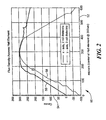
- a graph 50 illustrates the magnetic flux density in the direction of the z-axis 34 ( FIG. 1 ) across the Hall element 18, along an x-axis 30 ( FIG. 1 ) and the y-axis 32 ( FIG. 1 ) in the plane of the Hall effect element 18 ( FIG. 1 ), for a current through current conductor portion 14 on the order of 10A.
- a center (not shown) of the Hall effect element 18 corresponds to three hundred microns on an abscissa 52.
- a mantissa 54 corresponds to magnetic flux.
- a magnetic flux curve 56 corresponds to the change in magnetic flux in the z-axis 34 relative to position along the x-axis 30.
- Magnetic flux curve 58 corresponds to the change in magnetic flux in the z-axis 34 relative to position along the y-axis 32.
- the magnetic flux curves 56, 58 can be characterized as being substantially flat in the vicinity of the Hall element, which is centered at 300 ⁇ m. Therefore, the output of the Hall effect element 18, which is sensitive to magnetic fields in the direction of the z-axis 34, is relatively insensitive to the position of the Hall effect element 18 along the x-axis 30 and along the y-axis 32.
- An illustrative Hall effect element 18 has dimensions along the x-axis 30 and along the y-axis 32 on the order of 200 microns and therefore the Hall effect element 18 lies in a region between 200 microns and 400 microns on the abscissa 52.
- a change of position of the Hall effect element 18 by 50 microns either along the x-axis 30 or along the y-axis 32 results in little change in the magnetic field sensed by the Hall effect element. Therefore, the position of the Hall effect element in the x-axis 30 and the y-axis 32 can vary with manufacturing position tolerances without substantial effect upon the sensitivity of the current sensor 10 ( FIG. 1 ).
- the width w1 ( FIG. 1 ) of the current conductor portion 14 in the x-direction 30 relative to the dimension of the Hall effect element 18 in the x-direction 30 significantly affects the uniformity of the flux density in the z-direction 34 with position along the Hall effect element 18 in the x-direction 30.
- the longer the current conductor portion 14 i.e., the greater the width w1, FIG. 1 ), relative to the width of the Hall effect element 18 in the x-direction 30, the longer the curve 56 remains substantially flat.
- the width w1 ( FIG. 1 ) is selected in accordance with a variety of factors, including, but not limited to a desired sensitivity of the current sensor 10 ( FIG. 1 ), and a desired reduction of performance variation resulting from manufacturing variation in relative position of the current path 14 and the Hall effect element 18. In general, it will be appreciated that selecting the width w1 to be comparable to a width of the Hall effect element 18, provides the greatest sensitivity of the current sensor 10. However, it will also be appreciated that selecting the width w1 to be greater than the width of the Hall effect element 18 provides the smallest performance variation resulting from manufacturing tolerance of Hall element positional placement in the x-direction 30.
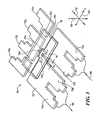
- another exemplary current sensor 70 in accordance with the present invention includes a lead frame 72 having a plurality of leads 72a-72h and a current conductor portion 74 having a width w2.
- the current sensor also includes a substrate 76 having a first surface 76a and a second, opposing surface 76b.
- the substrate 76 has first and second Hall effect elements 78a, 78b diffused into the first surface 76a, or otherwise disposed on or supported by the first surface 76a.
- the substrate 76 is disposed on the lead frame 72 so that the Hall effect element 78 is in close proximity to the current conductor portion 74.
- the substrate 76 has an orientation that is upside down (i.e., the first surface 76a is directed downward) in relation to the conventional orientation of a substrate mounted in an integrated circuit package.
- An insulator (not shown) can separate the substrate 76 from the lead frame 72.
- the insulator can be the same as or similar to the insulator 24 shown in FIG. 1 .
- both of the Hall effect elements 78a, 78b are disposed in close proximity to the current conductor portion 74 and at predetermined positions relative to the current conductor portion 74 such that a magnetic field generated by an electrical current passing though the current conductor portion 74 in a direction shown by arrows 86, is in a direction substantially aligned with a maximum response axis of the Hall effect elements 78a, 78b.
- the Hall effect elements 78a, 78b each have a maximum response axis aligned with a z-axis 94.
- the Hall effect elements 78a, 78b are disposed on opposite sides (i.e., slightly offset along a y-axis 92) of the current conductor portion 74, as shown, where the magnetic field is pointed along the z-axis 94.
- the Hall effect elements 78a, 78b are offset (along the y-axis 92) by substantially equal and opposite amounts about the current conductor portion 74.
- Hall effect elements, or another type of magnetic field sensors, for example magnetoresistance elements, having maximum response axes aligned in another direction can be disposed at other positions relative to the current conductor portion 74, for example, on top (in a direction of the z-axis 94) of the current conductor portion 74.
- the magnetic fields experienced by the first and the second Hall effect elements 78a, 78b are oriented in opposite directions, each aligned along the z-axis 94. Therefore, if polarized in the same direction, the outputs of the two Hall effect elements 78a, 78b will be opposite in polarity. If the output from one of the Hall effect elements 78a, 78b is inverted, for example with an inverting amplifier, and then summed, i.e., differentially summed, with the output of the other of the Hall effect elements 78a, 78b, certain advantages are achieved.
- the outputs of two Hall effect elements 78a, 78b when differentially summed as described above, provide a voltage output of twice the magnitude of the voltage output from a single Hall effect element in the presence of the same current. Therefore, the current sensor 70 has twice the sensitivity of the current sensor 10 of FIG. 1 .
- the current sensor 70 is relatively insensitive to variation in the position of the Hall effect elements 78a, 78b in the direction of the y-axis 92. This is because, when moved in the direction of the y-axis 92, the voltage output from one of the Hall effect elements 78a, 78b tends to increase while the voltage output from the other of the Hall effect elements 78a, 78b tends to decrease. Therefore, the differential sum of the two outputs remains relatively invariant.
- lead frame 72 is shown to have the flat leads 72a-72h suitable for surface mounting to a circuit board, it will be appreciated that a lead frame having bent leads, like the lead frame 12 of FIG. 1 , can also be used. Also, while two Hall effect elements 78a, 78b are shown, more than two or fewer than two Hall effect elements can also be used.
- a summing circuit 100 suitable for performing the differential signal summation described in conjunction with FIG. 3 is shown coupled to two Hall effect elements 102a, 102b.
- the Hall effect elements 102a, 102b can be the same as or similar to the Hall effect elements 78a, 78b of FIG. 3 .
- each of the Hall effect elements 102a, 102b is rotated relative to the other Hall effect element by 90 degrees, as indicated by vectors on the Hall effect elements 102a, 102b. Therefore, in response to opposite magnetic fields 112a, 112b the Hall effect elements 102a, 102b generate output voltages 103a, 103b having the same polarities.
- the output voltage 103a is coupled to amplifier 104a arranged in a non-inverting configuration and the output voltage 103b is coupled to the amplifier 104b arranged in an inverting configuration. Therefore, the amplifier output voltages 106a, 106b move in opposite voltage directions in response to the magnetic fields 112a, 112b.
- the amplifier output voltages 106a, 106b are differentially coupled to an amplifier 108 to generate a differential summation, or a difference of the output voltages 106a, 106b. Therefore, the output voltages 106a, 106b differentially sum to provide a greater output voltage 110 at the output of amplifier 108.
- the summing circuit 100 can be used in the current sensor 70 of FIG. 3 , in which case Hall effect elements 102a, 102b correspond to the Hall effect elements 78a, 78b.
- the summing circuit 100 is diffused into, or otherwise disposed upon, the first surface 76a of the substrate 76.
- the summing circuit 100 is diffused into, or otherwise disposed upon, the second surface 76b of the substrate 76, while the Hall effect elements 78a, 78b remain on the first surface 76a, coupled to the other circuit components though vias or the like.
- another exemplary current sensor 120 includes a substrate 126 having a first surface 126a and a second, opposing surface 126b.
- four Hall effect elements 128a-128d are diffused into or otherwise disposed on the first surface 126a of the substrate 126.
- the substrate 126 is positioned relative to the lead frame 12 such that first and second Hall effect element 128a, 128b respectively are on one side of the current conductor portion 14 along a y-axis 142, and third and fourth Hall effect elements 128c, 128d are on the opposite side of the current conductor portion 14 along the y-axis 42, as shown.
- the Hall effect elements 128a, 128b are offset (along the y-axis 142) from the current conductor portion 14 by an amount equal to and opposite from the amount that the Hall effect elements 128c, 128d are offset (along the y-axis 142) from the current conductor portion 14.
- the Hall effect elements 128a-128d are disposed in close proximity to the current conductor portion 14 and at predetermined positions relative to the conductor portion 14, such that a magnetic field generated by an electrical current passing though the current conductor portion 14 in a direction shown by arrows 86, is in a direction substantially aligned with a maximum response axis of the Hall effect elements 128a-128d.
- each of the Hall effect elements 128a-128d has a maximum response axis aligned with a z-axis 144.
- the Hall effect elements 128a, 128b are disposed on an opposite side (i.e., slightly offset along a y-axis 142) of the current conductor portion 144 than the Hall effect elements 128c, 128d, as shown, where the magnetic field is pointed along the z-axis 144.
- Hall effect elements, or another type of magnetic field sensors, for example magnetoresistance elements, having maximum response axes aligned in another direction can be disposed at other positions relative to the current conductor portion 14, for example, on top (in a direction of the z-axis 144) of the current conductor portion 14.
- first and second Hall effect elements 128a, 128b are exposed to a magnetic field in a direction along the z-axis 144 and the third and forth Hall effect elements 128c, 128d are exposed to a magnetic field in the opposite direction along the z-axis 144.
- the four Hall effect elements 128a-128d can be coupled to an electronic circuit arranged as a summing circuit, understood by one of ordinary skill in the art, in order to achieve certain advantages.
- the summing circuit can include two of the summing circuits 100 of FIG. 4 .
- the summing circuit can couple a first two of the Hall effect elements 128a-128d with a first summing circuit, such as the summing circuit 100 of FIG. 4 , and a second two of the Hall effect elements 128a-128d with a second summing circuit, such as the summing circuit 100.
- an output of the first summing circuit can be summed with an output of the second summing circuit.
- the four Hall effect elements 128a-128d coupled to a summing circuit as described, in the presence of the current, provide a voltage output four times the magnitude of a voltage output from a single Hall effect element, for example the Hall effect element 18 of FIG. 1 , in the presence of the same current. Therefore, the current sensor 120 has four times the sensitivity of the current sensor 10 of FIG. 1 .
- the current sensor 120 is relatively insensitive to variation in the position of the Hall effect elements 128a-128d in the direction of the y-axis 142. This is because, when moved in the direction of the y-axis 142, the voltage output from two of the four Hall effect elements 128a-128d tends to increase while the voltage output from the other two of the four Hall effect elements 128a-128d tends to decrease. Therefore, when coupled as a summing circuit, the circuit output is relatively invariant to the y-axis position of the Hall effect elements.
- an exemplary current sensor 150 in accordance with the present invention includes a lead frame 152 having a plurality of leads 152a-152h and a current conductor portion 154.
- the current sensor 150 also includes a substrate 166 having a first surface 166a and a second, opposing surface 166b.
- the substrate 166 has a Hall effect element 158 diffused into the first surface 166a, or otherwise disposed on the first surface 166a.
- the substrate 166 is disposed on the lead frame 152 so that the Hall effect element 158 is in close proximity to the current conductor portion 154.
- the substrate 166 has an orientation that is upside down (i.e., the first surface 166a is directed downward) in relation to the conventional orientation with which a substrate is mounted into an integrated circuit package.
- the substrate 166 is a flip-chip having solder balls 160a-160c on the first surface 166a of the substrate 166.
- the solder balls 160a-160c couple directly to the leads 152e-152h as shown.
- An insulator 164 separates the substrate 166 from the lead frame 152.
- the insulator 164 can be the same as or similar to the insulator 24 shown in FIG. 1 .
- the Hall effect element 158 is disposed in close proximity to the current conductor portion 154 and at a predetermined position relative to the conductor portion 154, such that a magnetic field generated by an electrical current passing though the current conductor portion 154 in a direction shown by arrows 168, is in a direction substantially aligned with a maximum response axis of the Hall effect element 158.
- the Hall effect element 158 has a maximum response axis aligned with a z-axis 174. Therefore, the Hall effect element 158 is disposed just to the side (i.e., slight offset along a y-axis 172) of the current conductor portion 14, as shown, where the magnetic field is pointed along the z-axis 174.
- a Hall effect element or another type of magnetic field sensor, for example a magnetoresistance element, having a maximum response axis aligned in another direction, can be disposed at another position relative to the current conductor portion 154, for example, on top (in a direction of the z-axis 174) of the current conductor portion 154.
- Operation of the current sensor 150 is like the above-described operation of the current sensor 10 of FIG. 1 .
- the Hall effect element 158 being is close proximity to the current conductor portion 154, results in a greater output voltage from the Hall effect element 158, and therefore an improved sensitivity.
- Hall effect element 158 is shown on the first surface 166a of the substrate 166, it will be appreciated that more than one Hall effect element can be used with this invention.
- Other circuitry for example an amplifier, can also be diffused in or otherwise coupled to or supported by the first and/or second surfaces 166a, 166b of the substrate 166.
- solder balls 160a-160c any number of solder balls can be provided, including dummy solder balls for stabilizing the substrate 166. Also, while solder balls 160a-160c are shown, other connection methods can also be used, including, but not limited to gold bumps, eutectic or high lead solder bumps, no-lead solder bumps, gold stud bumps, polymeric conductive bumps, anisotropic conductive paste, or conductive film.
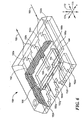
- an exemplary current sensor 180 in accordance with the present invention includes a flux concentrator 182 and a flux concentrating layer 184.
- the flux concentrator is located proximate the Hall effect sensor 158, adjacent to and below the first surface 166a of the substrate 166.
- the flux concentrating layer 184 is disposed on (or adjacent to and above) the second surface 166b of the substrate 166.
- the flux concentrator 182 and the flux concentrating layer 184 each tend to concentrate the magnetic flux generated by the current passing through the current conductor portion 154 so as to cause the current sensor 180 to have a higher sensitivity than the current sensor 150 of FIG. 6 .
- the flux concentrator 182 and the flux concentrating layer 184 can each be comprised of a variety of materials, including but not limited to, ferrite, Permalloy, and iron.
- An adhesion layer (not shown), for example, a titanium or chromium layer, may be present and would be understood by one skilled in the art.
- the flux concentrator 182 is shown having a cubic shape, in other embodiments, the flux concentrator can have another shape, for example, a polyhedral shape, an elliptical shape, or a spherical shape. While both the flux concentrator 182 and the flux concentrating layer 184 are shown, in other embodiments, only one of the flux concentrator 182 and the flux concentrating layer 184 can be provided. Also, while the flux concentrator 182 and the flux concentrating layer 184 are shown in conjunction with one magnetic field transducer 158, it should be appreciated that the flux concentrator 182 and the flux concentrating layer 184 can also be applied to configurations having more than the one magnetic field transducer 158, for example, the configurations shown in FIGS. 1 , 3 , and 5 .
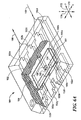
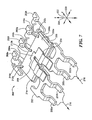
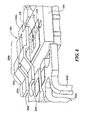
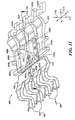
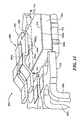
- another exemplary current sensor 200 in accordance with the present invention includes a lead frame 202 having a plurality of leads 202a-202h.
- the current sensor 200 also includes a substrate 206 having a first surface 206a and a second, opposing surface 206b.
- the substrate 206 has a Hall effect element 208 diffused into the first surface 206a, or otherwise disposed on the first surface 206a.
- a conductive clip 204 having a current conductor portion 204a is coupled to the leads 202a-202d. Features of the conductive clip 204 are shown in FIG. 8 .
- the conductive clip is formed having a bend such that the conductive clip 204 passes up and over the first surface 206a of the substrate 206.
- the substrate 206 is disposed on the lead frame 202 so that the Hall effect element 208 is in close proximity to the current conductor portion 204a.
- the substrate 206 has a conventional mounting orientation with the first surface 206a directed upward.
- the substrate 206 has bonding pads 212a-212c on the first surface 206a, to which bond wires 210a-210c are coupled.
- the bond wires 210a-210c are further coupled to the leads 202e, 202f, 202h.
- An insulator 214 can be provided to isolate the substrate 206 from the conductive clip 204.
- the insulator 214 can be the same as or similar to the insulator 24 shown in FIG. 1 .
- the Hall effect element 208 is disposed in close proximity to the current conductor portion 204a, which passes up and over the first surface 206a of the substrate 206.
- the Hall effect element 208 is disposed at a predetermined position relative to the conductor portion 204a such that a magnetic field generated by an electrical current passing though the current conductor portion 204a in a direction shown by arrows 216, is in a direction substantially aligned with a maximum response axis of the Hall effect element 208.
- the Hall effect element 208 has a maximum response axis aligned with a z-axis 224.
- the Hall effect element 208 is disposed just to the side (i.e., slight offset along a y-axis 222) of the current conductor portion 204a, as shown, where the magnetic field is pointed along the z-axis 224.
- a Hall effect element, or another type of magnetic field sensor for example a magnetoresistance element, having a maximum response axis aligned in another direction, can be disposed at another position relative to the current conductor portion 204a, for example, essentially aligned above or below (in a direction of the z-axis 224) with the current conductor portion 204a.
- the Hall effect element 208 is in very close proximity to the current conductor portion 204a and at a predetermined position relative to the current conductor portion 204a in which the magnetic field generated by the current is substantially aligned with the maximum response axis of the Hall effect element 208. This position results in a greater voltage output from the Hall effect element 208, and therefore improved sensitivity.
- Hall effect element 208 is shown on the second surface 206b of the substrate 206, it will be appreciated that more than one Hall effect element can be used.
- an embodiment having two Hall effect elements can be similar to the current sensor 70 of FIG. 3 and an embodiment having four Hall effect elements can be similar to the current sensor 120 of FIG. 5 .
- additional circuitry for example an amplifier, can be diffused in or otherwise coupled to the first and/or second surfaces 206a, 206b of the substrate 206.
- the conductive clip 204 can be formed in a variety of ways and from a variety of materials.
- the conductive clip 204 is stamped, for example, from a copper sheet.
- the conductive clip 204 is formed from foil, for example copper foil.
- the conductive clip 204 is formed by an etching process. The conductive clip 204 allows the use of the conventional mounting orientation of the substrate 206 while bringing the current conductor portion 204a very close to the Hall effect element 208.
- the conductive clip 204 can be provided having a thickness selected in accordance with an amount of current that will pass through the conductive clip 204. Therefore, if a current sensor adapted to sense relatively high currents is desired, the conductive clip can be relatively thick, whereas, if a current sensor adapted to sense relatively low currents is desired, the conductive clip 204 can be relatively thin. In another embodiment, if a current sensor adapted to sense relatively high currents is desired, more than one conductive clip 204 can be stacked in contact with other conductive clips to provide an increased effective thickness that is thicker than any one conductive clip 204, and therefore, able to carry more current.
- the close proximity between the Hall effect element 208 and the current conductor portion 204a is achieved by providing the Hall effect element 208 on the first substrate surface 206a, which is positioned closer to the current conductor portion 204a than the second surface 206b. In other embodiments, this advantageous close proximity is achieved by providing the Hall effect element 208 on the second substrate surface 206b and forming the current conductor portion 204a so as to be in substantial alignment with the second surface 206b.
- the conductive clip 204 is shown before it is coupled to the leads 202a-202d.
- the conductive clip 204 includes the current conductor portion 204a, a transition region 204b, a bend region 204c, and a bonding region 204d.
- the bonding region 204d includes two portions 204e, 204f which couple to the leads 202a-202d.
- the transition region 204b can be elevated relative to the current conductor portion 204a to avoid contact with the substrate 206.
- Hall effect elements have been shown and described in association with embodiments of this invention, it will be recognized that other types of magnetic field sensors can be used.
- magnetoresistance elements can be used in place of the Hall effect elements.
- a conventional magnetoresistance element has a maximum response axis that is perpendicular to the maximum response axis of a conventional Hall effect element.
- One of ordinary skill in the art will understand how to position one or more magnetoresistance elements relative to a current conductor portion in accordance with embodiments of the present invention to achieve the same results as the Hall effect element embodiments herein described.
- an insulating layer 220 can be disposed between the conductive clip 204 and the first surface 206a of the substrate 206.
- the insulating layer 220 can be formed from a variety of materials, including but not limited to, silicon dioxide and polymer.
- an electromagnetic shield 222 can also be disposed between the conductive clip 204 and the first surface 206a of the substrate 206.
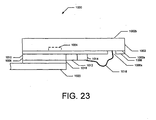
- the electromagnetic shield 222 can be disposed either under or over the insulating layer 220, in proximity to the Hall effect element 208. In other arrangements, shown, for example, in FIG. 23 , there can be two insulating layers, one above and one below the electromagnetic shield 222.
- the electromagnetic shield 222 tends to reduce the affect of electromagnetic fields upon the Hall effect element 208, which would tend to make the current sensor 200 less accurate, i.e., to be sensitive to electrical effects other than the magnetic field generated by a current. It will be understood that it is desirable to have the Hall effect element 208 be sensitive only to magnetic fields, and not to electromagnetic fields.
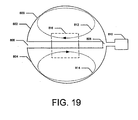
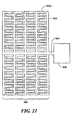
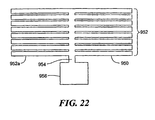
- the electromagnetic shield 222 is described in greater detail below in conjunction with FIGS. 19-22 .
- electromagnetic shield 222 is shown in conjunction with the current sensor 200 of FIGS. 7 and 8 , it should be appreciated that any of the current sensors described herein, including flip-chip arrangements and non flip-chip arrangements, can have an electromagnetic shield the same as or similar to the electromagnetic shield 222, disposed in proximity to an associated Hall effect element.
- a lead frame 250 is shown having a shape similar to the lead frame 72 of FIG. 3 and the lead frame 152 of FIG. 6 .
- the lead frame 250 has a plurality of thinned portions 252a-252n that are thinner than other portions of the lead frame 250.
- the thinner portions can be provided by a variety of processes, including, but not limited to, chemical etching and stamping.
- a current conductor portion 254 has a surface 254a and a thickness t1 which can be the same as or similar to the thickness of others of the thinned portion 252b-252n. Other portions of the lead frame have a thickness t2. In one particular embodiment, the thickness t1 of the current carrying portion 254 is the same as the thickness of the other thinned portions 252b-252n, and the thickness t1 is approximately half of the thickness t2. In one embodiment, the current conductor portion 254 has a cross section that is essentially rectangular, having the thickness t1.
- the current conductor portion 254 in the presence of a current passing through the current conductor portion 254, the current conductor portion 254 being thinner, for example, than the current conductor portion 74 of FIG. 3 , has a higher current density near the surface 254a than the current conductor portion 74 of FIG. 3 has near the surface 74a in the presence of a similar current.
- the current is compressed to be closer to the surface 254a than it would otherwise be with a thicker current conductor portion.
- a magnetic field generated by the current has a higher flux density in proximity to the surface 254a.
- the Hall effect elements 78a, 78b experience a greater magnetic field, resulting in a more sensitive current sensor.
- the other thinned portions 252b-252n tend to lock the lead frame 250 more rigidly into the molded body.
- the thickness t1 is selected in accordance with a variety of factors, including, but not limited to, a maximum current to be passed through the current conductor portion 254.
- an alternate current conductor portion 270 suitable for replacing the current conductor portion 254 of FIG. 9 , has a T-shaped cross section as would be seen from a cross-section taken along line 9A-9A of FIG. 9 .
- the T-shape has a surface 270a, a first thickness t3, and a second thickness t4.
- the thickness t3 can be the same as or similar to the thickness t1 of FIG. 9
- the thickness t4 can be the same as or similar to the thickness t2 of FIG. 9 .
- the thickness t3 is approximately half of the thickness t4.
- a magnetic field generated in response to a current passing through the current conductor portion 270 is higher in proximity to the surface 270a than it would be if the current conductor portion 270 had a uniform thickness t4.
- another exemplary current sensor 300 in accordance with the present invention includes a lead frame 302 (also referred to herein as a lead frame portion) having a plurality of leads 302a-302h and a current conductor portion 304 provided as a combination of a first current conductor portion 304a and a second current conductor portion 304b.
- the current sensor 300 also includes a substrate 306 having a first surface 306a and a second, opposing, surface 306b.
- the substrate 306 has a Hall effect element 308 diffused into the first surface 306a, or otherwise disposed on or supported by the first surface 306a.
- the substrate 306 is disposed on the lead frame 302 so that the Hall effect element 308 is in close proximity to the current conductor portion 304.
- the substrate 306 has an orientation that is upside down (i.e., the first surface 306a is directed downward) in relation to the conventional orientation of a substrate mounted in an integrated circuit package.
- the substrate 306 is a flip-chip having solder balls 320a-320e on the first surface 306a of the substrate 306.
- the solder balls 320a-320e couple directly to the leads 302e-302h.
- An insulating layer 330 can separate the substrate 306 from the lead frame 302.
- the insulating layer 330 can be the same as or similar to the insulator 24 shown in FIG. 1 .
- the second current conductor portion 304b is deposited directly on the first surface 306a of the substrate 306 and no insulating layer 330 is used.
- the second current conductor portion 304b can be deposited by any conventional integrated circuit deposition technique, including, but not limited to, sputtering and electroplating.
- the second current conductor portion 304b is a conductive structure separate from but proximate to the first surface 306a of the substrate 306, and the insulating layer 330 is disposed between the second current conductor portion 304b and the first surface 306a of the substrate 306.
- Hall effect element 308, the insulating layer 330, the second current conductor portion 304b, and the first current conductor portion are under the substrate 306 as shown.
- the Hall effect element 308 is disposed in close proximity to the current conductor portion 304 and at a predetermined position relative to the current conductor portion 304 such that a magnetic field generated by an electrical current 316 passing though the current conductor portion 304 is in a direction substantially aligned with a maximum response axis of the Hall effect element 308.
- the Hall effect element 308 has a maximum response axis aligned with a z-axis 326. Therefore, the Hall effect element 308 is disposed to a side (i.e., slightly offset along a y-axis 324) of the current conductor portion 304, as shown, where the magnetic field is pointed along the z-axis 326.
- a Hall effect element or another type of magnetic field sensor, for example, a magnetoresistance element, having a maximum response axis aligned in another direction, can be disposed at another position relative to the current conductor portion 304, for example, on top (in a direction of the z-axis 326) of the current conductor portion 304.
- the insulating layer 330 can be an interposing insulating layer or a substrate insulating layer associated with the substrate 306. In some embodiments for which the insulating layer 330 is an interposing insulating layer, the insulating layer 330 is a ceramic interposing insulating layer.
- the insulating layer 330 is a substrate insulating layer associated with the substrate 306
- the insulating layer 330 is a substrate taped insulating layer formed with a taping process.
- the substrate taped insulating layer can be comprised of a tape applied to the substrate, including but not limited to, a polymer tape, for example a Kapton® tape.
- the insulating layer 330 is a substrate deposited insulating layer formed with a deposition process.
- the deposition process used to form the insulating layer 330 can include a variety of processes, including, but not limited to, a screen printing process, a spin depositing process, a sputtering process, a plasma enhanced chemical vapor deposition (PECVD) process, and a low-pressure chemical vapor deposition (LPCVD) process.
- the screen printing process can result in a substrate insulating layer comprised of a variety materials, including but not limited to, polymer or ceramic materials.
- the spin depositing process can result in a substrate insulting layer comprised of a variety materials, including but not limited to a polymer, for example, polyimide (e.g., trade name Pyralin®) or bisbenzocyclobutene (BCB) (e.g., trade name Cyclotene®).
- the sputtering process can result in a substrate insulting layer comprised of a variety materials, including but not limited to, nitride or oxide.
- the PECVD process can result in a substrate insulting layer comprised of a variety materials, including but not limited to, nitride or oxide.
- the LPCVD process can result in a substrate insulting layer comprised of a variety materials, including but not limited to, nitride or oxide.
- the insulating layer 330 is a substrate insulating layer associated with the substrate 306
- the insulating layer 330 is a substrate oxide insulating layer formed with an oxide generation process.
- the substrate oxide insulating layer can be comprised, for example, of a silicon dioxide.
- the current 316 flows into the leads 302c, 302d, which are coupled in parallel, through the current conductor portion 304, and out of the leads 302a, 302b, which are also coupled in parallel.
- the current flowing though the current conductor portion 304 generates a magnetic field, which is sensed by the Hall effect element 308.
- the Hall effect element 308 is in very close proximity to the current conductor portion 304 and at a predetermined position relative to the current conductor portion 304 at which the magnetic field generated by the current is substantially aligned with the maximum response axis of the Hall effect element 308. This placement results in a greater voltage output from the Hall effect element 308, and therefore greater sensitivity.
- lead frame 302 is shown to have the bent leads 302a-302h suitable for surface mounting to a circuit board, it will be appreciated that a lead frame having leads with other shapes can also be used, including but not limited to, through hole leads having a straight shape.
- Hall effect element 308 While only one Hall effect element 308 is shown on the first surface 306a of the substrate 306, it will be appreciated that more than one Hall effect element can be used with this invention.
- Other circuitry for example an amplifier, can also be diffused in or otherwise coupled to or supported by the first and/or second surfaces 306a, 306b of the substrate 306.
- solder balls 320a-320e While five solder balls 320a-320e are shown, any number of solder balls can be provided, including dummy solder balls for stabilizing the substrate 306. Also, while solder balls 320a-320e are shown, other connection methods can also be used, including, but not limited to gold bumps, eutectic or high lead solder bumps, no-lead solder bumps, gold stud bumps, polymeric conductive bumps, anisotropic conductive paste, conductive film, or wire bonds.
- the substrate 306 is shown in a flip-chip arrangement, in other embodiments, the substrate 306 can be conventionally mounted such that the first surface 306a is above the second surface 306b when the integrated circuit 300 is mounted to an uppermost surface of a circuit board. With these arrangements, the first and second current conductor portions 304a, 304b, respectively, are each above the first surface 306a of the substrate 306.
- a current sensor 350 differs from the current sensor 300 of FIG. 10 by providing a current conductor portion 354 different than the current conductor portion 304 of FIG. 10 .
- the current conductor portion 354 includes a first current conductor portion 354a and the second current conductor portion 304b.
- a lead frame 352 having the first current conductor portion 354a does not form a continuous current path, unlike the lead frame 302 having the first current conductor portion 304a of FIG. 10 .
- the substrate 306 can be conventionally mounted such that the first surface 306a is above the second surface 306b when the integrated circuit 300 is mounted to an uppermost surface of a circuit board.
- the first and second current conductor portions 354a, 304b, respectively, are each above the first surface 306a of the substrate 306.
- a current sensor 400 differs from the current sensor 300 of FIG. 10 by providing a current conductor portion 304 having only the current conductor portion 304a (i.e., there is no current conductor portion 304b, FIG. 10 ).
- the lead frame 302 having the first current conductor portion 304a forms a continuous current path. With this arrangement, it will be appreciated that all of the current 316 passes through the current conductor portion 304a.
- An insulating layer 402 is disposed between the current conductor portion 304a and the first surface 306a of the substrate 306.
- the insulating layer 402 is an interposing insulating layer, for example a ceramic layer as described above in conjunction with FIG. 10 .
- the insulating layer 402 is a substrate insulating layer associated with the substrate.
- the insulating layer 402 is a lead frame insulating layer associated with the lead frame 302. It will be appreciated that, when associated with the lead frame, the insulating layer 402 can extend beyond the substrate 306 in a direction along the y-axis 324. This arrangement provides enhanced reliability, since an edge of the substrate 306 is less likely to contact the lead frame 302.
- Interposing insulating layers and substrate insulating layers are described above, in conjunction with FIG. 10 .
- the insulating layer 402 is a lead frame insulating layer associated with the lead frame 302
- the insulating layer 402 is a lead frame taped insulating layer formed with a taping process.
- the lead frame taped insulating layer can be comprised of a tape applied to the lead frame, including but not limited to, a polymer tape, for example, a Kapton® tape.
- the insulating layer 402 is a lead frame insulating layer associated with the lead frame 302
- the insulating layer 402 is a lead frame sprayed insulating layer formed with a spraying process.
- the lead frame sprayed insulting layer can be comprised of a variety of materials, including but not limited to a polymer, for example, a polyimide (e.g., trade name Pyralin®), a bisbenzocyclobutene (BCB) (e.g., trade name Cyclotene®) a sprayed dielectric, (e.g., trade names 3M Scotch® Insulating Spray 1601 and Loctite® ShadowCure® 3900), or a spray ceramic coating.
- a polyimide e.g., trade name Pyralin®
- BCB bisbenzocyclobutene
- Cyclotene® a sprayed dielectric
- trade names 3M Scotch® Insulating Spray 1601 and Loctite® ShadowCure® 3900
- the insulating layer 402 is a lead frame deposited insulating layer formed with a deposition process.
- the lead frame deposited insulating layer can be formed with a variety of processes, including, but not limited to a screen printing process.
- the screen printing process can result in a lead frame deposited insulting layer comprised of a variety of materials, including but not limited to, polymers or ceramics.
- the lead frame deposited insulating layer is formed with a vacuum deposition process.
- the lead frame deposited insulating layer can be comprised, for example, of a polymer, for example, parylene.
- the insulating layer 402 is a lead frame insulating layer associated with the lead frame 302
- the insulating layer 402 is a lead frame oxide insulating layer formed with an oxide generation process.
- the lead frame oxide insulating layer can be comprised, for example, of a sputtered oxide layer disposed onto the lead frame 302.
- another exemplary current sensor 450 includes a lead frame 452 (also referred to herein as a lead frame portion) having a plurality of leads 452a-452h and a current conductor portion 454.
- the lead frame 452 can be similar to the lead frame 302 of FIG. 12 .
- the current sensor 450 also includes a substrate 456 having a first surface 456a and a second, opposing, surface 456b.
- the substrate 456 has a Hall effect element 458 diffused into the first surface 456a, or otherwise disposed on or supported by the first surface 456a.
- the substrate 456 is disposed on the lead frame 452 so that the Hall effect element 458 is in close proximity to the current conductor portion 454.
- the substrate 456 has an orientation that is upside down (i.e., the first surface 456a is directed downward) in relation to the conventional orientation of a substrate mounted in an integrated circuit package.
- the substrate 456 is arranged as a flip-chip having solder balls 460a-460e on the first surface 456a of the substrate 456.
- the solder balls 460a-460e couple directly to the leads 452e-452h.
- An insulating layer 470 can separate the substrate 456 from the lead frame 452.
- the insulating layer 470 can be the same as or similar to the insulator 24 shown in FIG. 1 .
- the insulating layer 470 can cover a substantial portion of the surface 456a.
- the insulating layer has regions 470a, 470b, which are devoid of insulating material, as will become more apparent from the discussion of FIG. 13A below.
- the current conductor portion 454 has two features 454a, 454b (also referred to herein as bumps), which extend upward from the current conductor portion 454 in a direction of a z-axis 476.
- the bumps 454a, 454b have a size and a shape selected to provide electrical contact between the current conductor portion 454 and the first surface 456a of the substrate 456.
- the two bumps 454a, 454b provide electrical contact to metalized features (not shown) upon the first surface 456a of the substrate 456, providing an electrical coupling to circuits (not shown) also disposed on the first surface 456a of the substrate 456.
- the electrical coupling and the circuits coupled thereto are discussed below in greater detail in conjunction with FIG. 15 .
- the lead frame 452 having the first current conductor portion 454 forms a continuous current path.
- the insulating layer 470 is an interposing insulating layer, for example a ceramic layer. In other embodiments, the insulating layer 470 is a substrate insulating layer associated with the substrate. In other embodiments, the insulating layer 470 is a lead frame insulating layer associated with the lead frame 452.
- Interposing insulating layers, substrate insulating layers, and lead frame insulating layers are described above in conjunction with FIG. 10 .
- the bumps 454a, 454b can provide a connection, which couples the current conductor portion 454 to circuitry adapted to detect an overcurrent condition, i.e., adapted to detect a current passing through the current conductor portion 452a, which is greater than a predetermined current level or current threshold.
- the circuitry can detect a voltage difference between the first bump 454a and the second bump 454b, which is larger than a predetermined voltage drop or voltage threshold.
- the second current conductor portion can be the same as or similar to the second current conductor portion 304b of FIG. 10 , and can be similarly disposed upon the first surface 456a of the substrate 456 or upon the insulator 470.
- the current conductor portion 454 includes the bump 454a, which couples the current conductor portion 454 through the region 470a of the insulating layer 470 to the first surface 456a of the substrate 456.
- the Hall effect element 458 is disposed in or on the first surface 456a of the substrate 456.
- Other circuitry 480, electrically coupled to the bump 454a, can also be disposed in or on the first surface 456a of the substrate 456. Exemplary circuitry 480 is described below in conjunction with FIG. 15 .
- a wire bond 478 or the like can be used to couple the current conductor portion 454 through the region 470a of the insulating layer 470 to the first surface 456a of the substrate 456. It will be understood that a second wire bond (not shown) can be used in place of the other bump 454b of FIG. 13 . While the wire bond 478 appears to terminate to the substrate 456 directly above the current conductor portion 454, it will be appreciated that the termination can be to the side of the current conductor portion 454.
- another exemplary current sensor 500 includes a lead frame 502 having a plurality of leads 502a-502h. Only leads 502c and 502d shown for clarity, however, it will be understood that other ones of the leads 502a-502h are arranged in a conventional lead arrangement.
- the current sensor 500 also includes a substrate 506 having a first surface 506a and a second, opposing, surface 506b.
- the substrate 506 has a Hall effect element 508 diffused into the first surface 506a, or otherwise disposed on the first surface 506a.
- a conductive clip 503 having a current conductor portion 504 is coupled to the leads 502a-502d.
- the current conductor portion 504 includes two bumps 504a, 504b.
- the conductive clip 503 is formed having a bend such that the conductive clip 503 passes up and over the first surface 506a of the substrate 506.
- the substrate 506 is disposed on the lead frame 502 so that the Hall effect element 508 is in close proximity to the current conductor portion 504.
- the substrate 506 has a conventional mounting orientation with the first surface 506a directed upward.
- An insulator 514 (also referred to herein as an insulating layer) can insulate the substrate 506 from the conductive clip 503.
- the insulator 514 has two regions 514a, 514b devoid of any insulating material.
- the insulator 514 can be similar to the insulator 24 shown in FIG. 1 .
- the bumps 504a, 504b align with and extend into the regions 514a, 514b of the insulating layer 514, which are devoid of insulating material.
- the bumps 504a, 504b have a size and a shape selected to provide electrical contact between the current conductor portion 504 and the first surface 506a of the substrate 506.
- the two bumps 504a, 504b provide electrical contact to metalized features (not shown) upon the first surface 506a of the substrate 506, providing electrical coupling to circuits (not shown) also disposed on the first surface 506a of the substrate 506.
- the electrical coupling and the circuits coupled thereto are discussed below in greater detail in conjunction with FIG. 15 .
- the second current conductor portion can be the same as or similar to the second current conductor portion 304b of FIG. 10 , and can be similarly disposed upon the first surface 506a of the substrate 506 or upon the insulator 514.
- the current conductor portion 504 includes the bump 504a, which couples the current conductor portion 504 through the region 514a of the insulating layer 514 to the substrate 506.
- the Hall effect element 508 is disposed in or on the surface 506a of the substrate 506.
- Other circuitry 530, electrically coupled to the bump 504a can also be disposed in or on the surface 506a of the substrate 506. Exemplary circuitry 530 is described below in conjunction with FIG. 15 .
- a wire bond 532 or the like can be used to couple the current conductor portion 504 through the region 514a of the insulating layer 514 to the first surface 506a of the substrate 506. It will be understood that a second wire bond (not shown) can be used in place of the other bump 504b of FIG. 14 . While the wire bond 532 appears to terminate to the substrate 506 under the current conductor portion 506, it will be appreciated that the termination can be to the side of the current conductor portion 506.
- exemplary circuitry 550 can be the same as or similar to the circuitry 480 used in the current sensor 450 of FIG. 13A or the circuitry 530 used in the current sensor 500 of FIG. 14A .
- the circuitry 550 can be coupled to a Hall effect element 552.
- the Hall effect element 552 can be the same as or similar to the Hall effect element 458 of FIG. 13 and 13A , or the Hall effect element 508 of FIGS. 14 and 14A .
- the Hall effect element 552 is coupled to a current sensing circuit 554, which includes a dynamic offset cancellation circuit 553.
- the dynamic offset cancellation circuit 553 provides a DC offset adjustment for DC voltage errors associated with the Hall effect element 552.
- the dynamic offset cancellation circuit 553 is coupled to an amplifier 556 that amplifies the offset adjusted Hall output signal.
- the amplifier 556 is coupled to a filter 558 that can be a low pass filter, a high pass filter, a band pass filter, and/or a notch filter.
- the filter 558 is selected in accordance with a variety of factors including, but not limited to, a desired response time, and a frequency spectrum of noise associated with the Hall effect element 552, the dynamic offset cancellation circuit 553, and the amplifier 556.
- the filter 558 is a low pass filter.
- the filter 558 is coupled to an output driver 560 that provides a current sensor output signal 571 at a node 572 for transmission to other electronics (not shown). As described more fully below, the current sensor output signal is indicative of a magnitude of a current passing though a conductor.
- a trim control circuit 564 is coupled to node 570.
- the node 570 can receive a trim signal that permits various current sensor parameters to be trimmed, typically during manufacture.
- the trim control circuit 564 includes one or more counters enabled by an appropriate signal applied to the node 570.
- the trim control circuit 564 is coupled to a quiescent output voltage (Qvo) circuit 562.
- the quiescent output voltage is the voltage of the output signal 571 when the current sensed by the Hall effect element 552 is zero. Nominally, for a unipolar supply voltage, Qvo is equal to Vcc/2. Qvo can be trimmed by applying a suitable trim signal through the node 570 to a first trim control circuit counter within the trim control circuit 564, which, in turn, controls a digital-to-analog converter (DAC) within the Qvo circuit 562.
- DAC digital-to-analog converter
- the trim control circuit 564 is further coupled to a sensitivity adjustment circuit 566.
- the sensitivity adjustment circuit 566 permits adjustment of the gain of the amplifier 556 in order to adjust the sensitivity of the current sensor 550.
- the sensitivity can be trimmed by applying a suitable trim signal through the node 570 to a second trim control circuit counter within the trim control circuit 564, which, in turn, controls a DAC within the sensitivity adjustment circuit 566.
- the trim control circuit 564 is further coupled to a sensitivity temperature compensation circuit 568.
- the sensitivity temperature compensation circuit 568 permits adjustment of the gain of the amplifier 556 in order to compensate for gain variations due to temperature.
- the sensitivity temperature compensation circuit 568 can be trimmed by applying a suitable trim signal through the node 570 to a third trim control circuit counter within the trim control circuit 564, which, in turn, controls a DAC within the sensitivity temperature compensation circuit 568.
- the Hall effect element 552 is placed in proximity to a current conductor portion 604, here shown to be apart from the Hall effect element 552 for clarity.
- the current conductor portion 604 can be the same as or similar to the current conductor portion 454 of FIGS. 13 and 13A and the current conductor portion 504 of FIGS. 14 and 14A , formed by a coupling of integrated circuit leads.
- a current 584 enters a node 574 of the current sensor 550, passes through the current conductor portion 604 and out a node 576, where it passes though a switch 580 and through a load 586, both of which can be external to the integrated circuit 550.
- the switch 580 can be, for example, a relay or a field effect transistor (FET).
- an overcurrent circuit 590 can detect the overcurrent condition.
- the overcurrent circuit 590 includes a comparator 591 coupled to receive the current sensor output signal 571 and also coupled to a voltage reference 592. An output 593 of the comparator 591 is coupled to a logic gate 594.
- the logic gate 594 is coupled to a gate driver, which generates a control signal 597 at a node 578 of the circuitry 550.
- the node 578 is coupled to a control node of the switch 580 and is operable to open the switch 580, stopping the current 584, in response to detection of the overcurrent condition by the Hall effect element 552.
- the logic gate 594 is also coupled to a fault circuit 598, which generates a fault output signal 599 at a node 588 of the integrated circuit 550.
- the fault output signal 599 is indicative of the overcurrent condition, i.e., the current 584 being above a predetermined current.
- the amplifier 591 and the voltage reference 592 are responsive to the current sensor output signal 571, which is responsive to signals generated by the Hall effect element 552. It will be appreciated that the Hall effect element 552 has a relatively slow response time. Therefore, if the switch 580 were controlled only in the fashion described above in response to signals generated by the Hall effect element 552, some rapid overcurrent conditions might damage the integrated circuit 550 or the load 586 before the switch 580 could be opened. Circuitry described below can provide a faster response time to the overcurrent condition.
- a comparator 600 and a voltage reference 602 are coupled to the current conductor portion 604 of the integrated circuit 550.
- the current conductor portion 604 can be the same as or similar to the current conductor portion 454 of FIGS. 13 and 13A and the current conductor portion 504 of FIGS. 14 and 14A , formed by a coupling of integrated circuit leads.
- the coupling from the current conductor portion 604 to the voltage reference 602 and to the comparator 600 can be provided in a variety of ways, including but not limited to, the bumps 454a and 454b of FIGS. 13 and 13A and the bumps 504a, 504b of FIGS. 14 and 14A .
- circuitry 550 shown in FIG. 15 is illustrative of exemplary circuitry that may be associated with and integrated into a current sensor, like the current sensor 450 of FIGS. 13 and 13A and the current sensor 500 of FIGS. 14 and 14A .
- the switch 580 can be integrated into the current sensor circuitry 550.
- another exemplary current sensor 650 is like the current sensor of 500 of FIG. 14 , however, the current sensor 650 includes a second substrate 655 described more fully below.
- the current sensor 650 includes a lead frame 652 having a plurality of leads 552a-552h.
- the current sensor 650 also includes a substrate 656 having a first surface 656a and a second, opposing, surface 656b.
- a conductive clip 654 having a current conductor portion 655 is coupled to the leads 652a-652d.
- the current conductor portion 605 includes two bumps 655a, 655b.
- a second substrate 666 having a magnetic field sensing element disposed thereon, for example, a magnetoresistance element (not shown), can be disposed upon the current conductor portion 655.
- the magnetic field sensing element on the second substrate 666 can be coupled to the first surface 656a of the substrate 656 with wire bonds 668a, 668b or the like.
- the conductive clip 654 is formed having a bend such that the conductive clip 654 passes up and over the first surface 656a of the substrate 656.
- the substrate 656 has a conventional mounting orientation with the first surface 656a directed upward.
- An insulator 664 (also referred to herein as an insulating layer) can insulate the substrate 656 from the conductive clip 654.
- the insulator 664 has two regions 664a, 664b devoid of any insulating material.
- the insulator 664 can be similar to the insulator 24 shown in FIG. 1 .
- the bumps 655a, 655b align with and extend into the regions 664a, 664b of the insulating layer 664, which are devoid of insulating material.
- the bumps 655a, 655b have a size and a shape selected to provide electrical contact between the current conductor portion 655 and the first surface 656a of the substrate 656.
- the two bumps 655a, 655b provide electrical contact to metalized features (not shown) upon the first surface 656a of the substrate 656, providing electrical coupling to circuits (not shown) also disposed on the first surface 656a of the substrate 656.
- the electrical coupling and the circuits coupled thereto are discussed above in greater detail in conjunction with FIG. 15 .
- the second current conductor portion can be the same as or similar to the second current conductor portion 304b of FIG. 10 , and can be similarly disposed upon the first surface 656a of the substrate 656 or upon the insulator 664.
- the current sensor 650 has two substrate 656, 666.
- the current sensor 650 shows but one arrangement that can provide two substrates, while also providing a current carrying conductor, e.g., 655, in close proximity to a magnetic field sensing element, and/or while including an overcurrent circuit as described above in conjunction with FIG. 15 .
- Other two substrate arrangements are described in U.S. Patent Application number 11/335,944 , entitled “Arrangements for an Integrated Sensor," having attorney docket number ALLEG-162PUS, having inventors Michael C. Doogue, Vijay Mangtani, and William P. Taylor, filed on January 20, 2006, which application is incorporated by reference herein in its entirety. Any of the arrangements described therein can be combined with a current carry conductor and/or with an overcurrent circuit.
- the current sensor 450 of FIGS. 13 and 13A , the current sensor 500 of FIGS. 14 and 14A , the current sensor 550 of FIG. 15 , and the current sensor 650 of FIG. 16 and are shown having couplings between current conductor portions 454, 504, 604, and 655, respectively, and associated overcurrent circuitry, which is represented by the circuitry 590 of FIG. 15 .
- other current sensors similar to the current sensors 450, 500, 550, and 650 have no couplings between the current conductor portions 454, 504, 604, and 655 and associated overcurrent circuitry, i.e., no bumps or wire bonds.
- the overcurrent circuitry 590 ( FIG. 15 ), remains coupled to the nodes 574 and 576, and the nodes 574 and 576 couple to another circuit element apart from the current sensor 550.
- the nodes 574, 576 can couple to a circuit trace on a circuit board which carries the same current as that which passes through the current conductor portion 604 ( FIG. 15 ).
- the overcurrent circuit 590 is able to sense a voltage drop resulting from current passing though the circuit trace, providing essentially the same effect, wherein the overcurrent circuit 590 provides similar functions to those described above.
- a current sensor 700 includes a lead frame 702 (also referred to herein as a lead frame portion) having a plurality of leads 702a-702h and a shunt conductor portion 706.
- the current sensor 700 like the current sensor 300 of FIG. 10 , also includes the current conductor portion 304 provided as a combination of the first current conductor portion 304a and the second current conductor portion 304b.
- the lead frame 702 has two couplings of the leads 702a, 702b to the leads 702c, 702d. A first coupling is provided by the current conductor portion 304 and a second coupling is provided by the shunt conductor portion 706.
- the current sensor 700 can also include a first flux concentrator 708 disposed upon the shunt conductor portion 706 and/or a second flux concentrator 710, which may also be referred to as a magnetic shield (also as a flux shield or shield portion), disposed generally between the shunt conductor portion 706 and the Hall effect element 308.
- the first and second flux concentrators 708, 710 can each be comprised of a variety of soft-magnetic materials, including but not limited to, ferrite, Permalloy, or nickel-iron alloys.
- the flux concentrators 708, 710 can be applied in a variety of ways. For example, the flux concentrators can be deposited upon the lead frame 706 with a deposition process.
- the flux concentrator 708 can be formed through an electroplating process directly on the lead frame 702, or through the use of a kapton tape applied to the shunt conductor portion 706, wherein the other side of the Kapton tape can have a soft magnetic material which may be formed through a lamination or tape process.
- the shield portion 710 can be placed into the lead frame and fixed with an adhesive during package assembly.
- the current conductor portion 304 provides a current path for a portion of the current 316
- the shunt conductor portion 706 provides another current path for another portion of the current 316.
- the current sensor 700 has a sensitivity to the current 316 related to the portion of the current 316 that flows through the current conductor portion 304.
- the current sensor 700 can have a lower sensitivity to the current 316 than the current sensor 300 of FIG. 10 , which does not have the shunt conductor portion 706. Therefore, the current sensor 700 can operate over a greater range of currents without saturating circuitry coupled to the Hall effect element 308 (e.g., the circuit 554 of FIG. 15 ).
- the greater range of currents is due not only to the affect upon the Hall effect element 308 provided by the shunt conductor portion 706, but also, the lead frame 702, having the shunt conductor portion 706, is able to sustain a greater amount of current without overheating since it can have a lower total resistance current path than the lead frame 302 of FIG. 10 .
- the first and second flux concentrators 708, 710 tend to concentrate or shield the magnetic field generated by the portion of the current 316 flowing through the shunt conductor portion 706, therefore, the first and second flux concentrators 708, 710, respectively, tend to keep that magnetic flux away from the Hall effect element 308.
- a separation distance between the shunt conductor portion 706 and the Hall effect element 308 can be selected to control and/or to minimize the affect upon the Hall effect element 308 from the magnetic field generated by the portion of the current 316 flowing through the shunt conductor portion 706. It will be understood that a larger separation distance tends to reduce the affect.
- Sizing of the shunt conductor portion 706 in a way that affects a resistance of the shunt conductor portion 706 can influence the portion of the current 316 flowing through the shunt conductor portion 706 relative to the portion of the current 316 flowing through the current conductor portion 304.
- a size and a shape of the shunt conductor portion 706 can be selected accordingly to provide a selected resistance. Therefore, the sizing can affect the overall sensitivity of the current sensor 700
- a current sensor 750 includes a conductive clip 754 having a current conductor portion 756 coupled to leads 752a-752d (752a, 752b not shown, but arranged in the same manner as leads 202a, 202b of FIG. 7 , respectively) of a lead frame 752.
- the conductive clip 754 also includes a shunt conductor portion 758 having similar features and operational characteristics to those described above in conjunction with the shunt conductor portion 706 of FIG. 17 .
- the integrated circuit 750 can also include one or more of a first or a second flux concentrator 764, 766, respectively, having similar features and operational characteristics to the first and second flux concentrators 758, 760, respectively, described above in conjunction with FIG. 17 .
- the conductive clip 754 has a shape selected to pass up and over a first surface 760a of a substrate 760.
- a magnetic field sensing element 762 for example, a Hall effect element, is disposed in or on the first surface 760a of the substrate 760.
- shunt conductor portions 706, 758 and flux concentrators 708, 710, 764, 766 of FIGS, 17 and 18 are shown in association with particular current sensor arrangements, it will be understood that a similar shunt conductor portion and similar associated flux concentrators can be included in any of the flip-chip or non flip-chip arrangements shown herein.
- an electromagnetic shield 800 can be the same as or similar to the electromagnetic shield 212 of FIG. 8 .
- the electromagnetic shield 800 is placed generally over a Hall effect element 880, which can be the same as or similar to the Hall effect element 208 of FIG. 8 .
- the electromagnetic shield 800 includes a first portion 802 and a second portion 804 separated by a slit 806.
- the first portion 802 and the second portion 804 are coupled with a conductive region 808.
- a bonding pad 810 allows the electromagnetic shield 800 to be coupled to a DC voltage, for example, a ground voltage.
- the electromagnetic shield 800 can be formed from a metal layer during manufacture of a current sensor, for example, the current sensor 200 of FIG. 8 .
- the metal layer can be comprised of a variety of materials, for example, aluminum, copper, gold, titanium, tungsten, chromium, or nickel.
- AC eddy currents 812, 814 can be induced in the electromagnetic shield 800.
- the eddy currents 812, 814 form into closed loops as shown.
- the closed loop eddy currents 812, 814 tend to result in a smaller magnetic field in proximity to the electromagnetic shield 800 than the magnetic field that induced the eddy current 812, 814. Therefore, if the electromagnetic shield 800 were placed near a Hall effect element, for example, the Hall effect element 208 of FIG. 8 , the Hall effect element 208 experiences a smaller magnetic field than it would otherwise experience, resulting in a less sensitive current sensor, which is generally undesirable. Furthermore, if the magnetic field associated with the eddy current is not uniform or symmetrical about the Hall effect element 208, the Hall effect element 208 might also generate an undesirable offset voltage.
- the slit 806 tends to reduce a size (i.e., a diameter or path length) of the closed loops in which the eddy currents 812, 814 travel. It will be understood that the reduced size of the closed loops in which the eddy currents 812, 814 travel results in smaller eddy currents 812, 814 and a smaller local affect on the AC magnetic field that induced the eddy current. Therefore, the sensitivity of a current sensor on which the Hall effect element 816 and the electromagnetic shield 800 are used is less affected by the smaller eddy currents.
- the shield 800 in relation to the Hall effect element 816 as shown, so that the slit 806 passes over the Hall effect element 816, it will be understood that the magnetic field associated with any one of the eddy currents 812, 814 tends to form magnetic fields passing through the Hall effect element 816 in two directions, canceling over at least a portion of the area of the Hall effect element 816.
- an electromagnetic shield 850 can be the same as or similar to the electromagnetic shield 212 of FIG. 8 .
- the electromagnetic shield 850 includes four portions 852-858 separated by four slits 860-866.
- the four portions 852-858 are coupled with a conductive region 876.
- a bonding pad 878 allows the electromagnetic shield 850 to be coupled to a DC voltage, for example, a ground voltage.
- eddy currents 868-874 can be induced in the electromagnetic shield 850. Due to the four slits 860-866, it will be understood that a size (i.e., a diameter or a path length) of the closed loops eddy currents 866-874 tends to be smaller than the size of the closed loop eddy currents 812, 814 of FIG. 19 . It will be understood that the reduced size of the closed loops in which the eddy currents 868-874 travel results in smaller eddy currents 868-874 and a smaller local affect on the AC magnetic field that induced the eddy current than that which results from the shield 800 of FIG. 19 . Therefore, the sensitivity of a current sensor on which the Hall effect element 880 and the electromagnetic shield 850 are used is less affected by the smaller eddy currents 868-874 than the sensitivity of a current sensor using the shield 800 of FIG. 19 .
- the shield 850 in relation to the Hall effect element 880 as shown, so that the slits 860-866 pass over the Hall effect element 880, it will be understood that the magnetic field associated with any one of the eddy currents 868-874, tends to form magnetic fields passing through the Hall effect element 880 in two directions, canceling over at least a portion of the area of the Hall effect element 880.
- an electromagnetic shield 900 can be the same as or similar to the electromagnetic shield 212 of FIG. 8 .
- the electromagnetic shield 900 includes a shielding portion 902 having interdigitated members, of which member 902a is but one example.
- the interdigitated members are coupled though a conductor portion 904 to a bonding pad 906, which allows the electromagnetic shield 900 to be coupled to a DC voltage, for example, a ground voltage.
- the electromagnetic shield 900 is able to support eddy currents having a much smaller size (i.e., diameter of path length) than the electromagnetic shield 850 of FIG. 20 or the electromagnetic shield 800 of FIG. 19 . Therefore, the electromagnetic shield 900 tends to have an even smaller negative affect on sensitivity of a current sensor than that described above.
- an electromagnetic shield 950 can be the same as or similar to the electromagnetic shield 212 of FIG. 8 .
- the electromagnetic shield 950 includes a shielding portion 952 having a plurality of members, of which member 952a is but one example.
- the members are coupled though a conductor portion 954 to a bonding pad 956, which allows the electromagnetic shield 950 to be coupled to a DC voltage, for example, a ground voltage.
- a side view of a portion of a current sensor 1000 includes a substrate 1002 having a first surface 1002a and a second surface 1002b.
- a Hall effect element 1004 is disposed on or in the first surface 1002a of the substrate 1002.
- An insulating layer 1006 is disposed under the first surface 1002a of the substrate 1002.
- An electromagnetic shield 1008 is disposed under the insulating layer 1006.
- the electromagnetic shield can be the same as or similar to one of the electromagnetic shields 800, 850, 900, 950 of FIGS. 19-22 , respectively.
- the electromagnetic shield 1008 includes a shielding portion 1010, a conductor portion 1012, and a bonding pad 1014, which can be the same as or similar to similar structures in FIGS. 19-22 .
- a bonding wire 1016, or another bonding method can couple the bonding pad 1014 to the first surface 1002a of the substrate 1002, and, in particular, to a metal layer (not shown) on the first surface 1002a of the substrate 1002.
- this coupling is instead made via a metal layer deposited as part of the integrated circuit fabrication process, for example, a base process plus an additional metal layer, in which case, the bonding wire 1016 can be omitted.
- the current sensor 1000 can also include another insulating layer 1018 disposed under the electromagnetic shield 1008.
- the current sensor 1000 can further include a current conductor portion 1020 disposed under the insulating layer 1018.
- the current conductor portion 1020 can be the same as or similar to the various current conductor portions described herein, for example, the current conductor portion 304b of FIG. 11 .
- the current sensor 1000 is shown in a flip-chip arrangement, in other embodiments, the structure can be reversed to provide a non flip-chip arrangement.
Landscapes
- Engineering & Computer Science (AREA)
- Computer Hardware Design (AREA)
- Microelectronics & Electronic Packaging (AREA)
- Power Engineering (AREA)
- Physics & Mathematics (AREA)
- General Physics & Mathematics (AREA)
- Health & Medical Sciences (AREA)
- Electromagnetism (AREA)
- Toxicology (AREA)
- Condensed Matter Physics & Semiconductors (AREA)
- Measuring Instrument Details And Bridges, And Automatic Balancing Devices (AREA)
- Hall/Mr Elements (AREA)
- Lead Frames For Integrated Circuits (AREA)
- Measuring Fluid Pressure (AREA)
- Investigating Or Analyzing Materials By The Use Of Electric Means (AREA)
Applications Claiming Priority (6)
| Application Number | Priority Date | Filing Date | Title |
|---|---|---|---|
| US11/140,250 US6995315B2 (en) | 2003-08-26 | 2005-05-27 | Current sensor |
| US11/144,970 US7166807B2 (en) | 2003-08-26 | 2005-06-03 | Current sensor |
| US11/336,602 US7075287B1 (en) | 2003-08-26 | 2006-01-20 | Current sensor |
| US11/401,160 US7476816B2 (en) | 2003-08-26 | 2006-04-10 | Current sensor |
| US11/383,021 US20060219436A1 (en) | 2003-08-26 | 2006-05-12 | Current sensor |
| EP06770974A EP1891452B1 (en) | 2005-05-27 | 2006-05-23 | Current sensor |
Related Parent Applications (3)
| Application Number | Title | Priority Date | Filing Date |
|---|---|---|---|
| EP06770974A Division EP1891452B1 (en) | 2005-05-27 | 2006-05-23 | Current sensor |
| EP06770974.1 Division | 2006-05-23 | ||
| WOPCT/US2006/019953 Previously-Filed-Application | 2006-05-23 |
Publications (2)
| Publication Number | Publication Date |
|---|---|
| EP2163908A1 EP2163908A1 (en) | 2010-03-17 |
| EP2163908B1 true EP2163908B1 (en) | 2012-05-16 |
Family
ID=36955377
Family Applications (5)
| Application Number | Title | Priority Date | Filing Date |
|---|---|---|---|
| EP09000121A Active EP2163908B1 (en) | 2005-05-27 | 2006-05-23 | Current sensor |
| EP09000123.1A Active EP2157436B1 (en) | 2005-05-27 | 2006-05-23 | Current sensor |
| EP10183958.7A Active EP2295993B1 (en) | 2005-05-27 | 2006-05-23 | Current Sensor |
| EP09000122.3A Active EP2402770B1 (en) | 2005-05-27 | 2006-05-23 | Current sensor |
| EP06770974A Active EP1891452B1 (en) | 2005-05-27 | 2006-05-23 | Current sensor |
Family Applications After (4)
| Application Number | Title | Priority Date | Filing Date |
|---|---|---|---|
| EP09000123.1A Active EP2157436B1 (en) | 2005-05-27 | 2006-05-23 | Current sensor |
| EP10183958.7A Active EP2295993B1 (en) | 2005-05-27 | 2006-05-23 | Current Sensor |
| EP09000122.3A Active EP2402770B1 (en) | 2005-05-27 | 2006-05-23 | Current sensor |
| EP06770974A Active EP1891452B1 (en) | 2005-05-27 | 2006-05-23 | Current sensor |
Country Status (7)
| Country | Link |
|---|---|
| US (2) | US20060219436A1 (enExample) |
| EP (5) | EP2163908B1 (enExample) |
| JP (1) | JP5468776B2 (enExample) |
| KR (1) | KR101231830B1 (enExample) |
| AT (1) | ATE443266T1 (enExample) |
| DE (1) | DE602006009256D1 (enExample) |
| WO (1) | WO2006130393A1 (enExample) |
Families Citing this family (184)
| Publication number | Priority date | Publication date | Assignee | Title |
|---|---|---|---|---|
| US6853178B2 (en) * | 2000-06-19 | 2005-02-08 | Texas Instruments Incorporated | Integrated circuit leadframes patterned for measuring the accurate amplitude of changing currents |
| US20060219436A1 (en) * | 2003-08-26 | 2006-10-05 | Taylor William P | Current sensor |
| US7768083B2 (en) | 2006-01-20 | 2010-08-03 | Allegro Microsystems, Inc. | Arrangements for an integrated sensor |
| US7573112B2 (en) * | 2006-04-14 | 2009-08-11 | Allegro Microsystems, Inc. | Methods and apparatus for sensor having capacitor on chip |
| US7687882B2 (en) * | 2006-04-14 | 2010-03-30 | Allegro Microsystems, Inc. | Methods and apparatus for integrated circuit having multiple dies with at least one on chip capacitor |
| US20070279053A1 (en) * | 2006-05-12 | 2007-12-06 | Taylor William P | Integrated current sensor |
| US20080013298A1 (en) | 2006-07-14 | 2008-01-17 | Nirmal Sharma | Methods and apparatus for passive attachment of components for integrated circuits |
| US9823090B2 (en) | 2014-10-31 | 2017-11-21 | Allegro Microsystems, Llc | Magnetic field sensor for sensing a movement of a target object |
| US7936164B2 (en) * | 2008-07-03 | 2011-05-03 | Allegro Microsystems, Inc. | Folding current sensor |
| US8093670B2 (en) | 2008-07-24 | 2012-01-10 | Allegro Microsystems, Inc. | Methods and apparatus for integrated circuit having on chip capacitor with eddy current reductions |
| US8063634B2 (en) * | 2008-07-31 | 2011-11-22 | Allegro Microsystems, Inc. | Electronic circuit and method for resetting a magnetoresistance element |
| US20100052424A1 (en) * | 2008-08-26 | 2010-03-04 | Taylor William P | Methods and apparatus for integrated circuit having integrated energy storage device |
| US9222992B2 (en) * | 2008-12-18 | 2015-12-29 | Infineon Technologies Ag | Magnetic field current sensors |
| US20110006763A1 (en) * | 2009-07-07 | 2011-01-13 | Anthonius Bakker | Hall effect current sensor system and associated flip-chip packaging |
| WO2011011479A1 (en) * | 2009-07-22 | 2011-01-27 | Allegro Microsystems, Inc. | Circuits and methods for generating a diagnostic mode of operation in a magnetic field sensor |
| CH702193A2 (de) * | 2009-11-05 | 2011-05-13 | Polycontact Ag | Positionsmeldeeinrichtung. |
| JP5500956B2 (ja) * | 2009-11-26 | 2014-05-21 | 本田技研工業株式会社 | 電流検出装置 |
| DE102009047235A1 (de) * | 2009-11-27 | 2011-06-01 | Robert Bosch Gmbh | Schaltungseinrichtung und Leistungsschaltkreis mit der Schaltungseinrichtung |
| US20110133732A1 (en) * | 2009-12-03 | 2011-06-09 | Allegro Microsystems, Inc. | Methods and apparatus for enhanced frequency response of magnetic sensors |
| US8717016B2 (en) | 2010-02-24 | 2014-05-06 | Infineon Technologies Ag | Current sensors and methods |
| US10111333B2 (en) * | 2010-03-16 | 2018-10-23 | Intersil Americas Inc. | Molded power-supply module with bridge inductor over other components |
| US9013890B2 (en) | 2010-03-26 | 2015-04-21 | Infineon Technologies Ag | Semiconductor packages and methods for producing the same |
| US8760149B2 (en) * | 2010-04-08 | 2014-06-24 | Infineon Technologies Ag | Magnetic field current sensors |
| US8461824B2 (en) * | 2010-06-07 | 2013-06-11 | Infineon Technologies Ag | Current sensor |
| US8680843B2 (en) * | 2010-06-10 | 2014-03-25 | Infineon Technologies Ag | Magnetic field current sensors |
| US8283742B2 (en) | 2010-08-31 | 2012-10-09 | Infineon Technologies, A.G. | Thin-wafer current sensors |
| US9723766B2 (en) | 2010-09-10 | 2017-08-01 | Intersil Americas LLC | Power supply module with electromagnetic-interference (EMI) shielding, cooling, or both shielding and cooling, along two or more sides |
| RU2453853C2 (ru) * | 2010-09-27 | 2012-06-20 | Федеральное Государственное Унитарное Предприятие "Государственный научно-производственный ракетно-космический центр "ЦСКБ-Прогресс" (ФГУП "ГНПРКЦ "ЦСКБ-Прогресс") | Способ измерения силы тока в проводнике и устройство для его осуществления |
| CH703903B1 (de) | 2010-10-01 | 2014-04-30 | Melexis Tessenderlo Nv | Stromsensor. |
| JP5556603B2 (ja) * | 2010-11-10 | 2014-07-23 | 三菱電機株式会社 | 磁気アイソレータ |
| US8878531B2 (en) | 2010-11-18 | 2014-11-04 | Infineon Technologies Ag | Current sensor |
| US9103853B2 (en) | 2010-11-18 | 2015-08-11 | Infineon Technologies Ag | Current sensor |
| US9476915B2 (en) | 2010-12-09 | 2016-10-25 | Infineon Technologies Ag | Magnetic field current sensors |
| US8975889B2 (en) | 2011-01-24 | 2015-03-10 | Infineon Technologies Ag | Current difference sensors, systems and methods |
| US8963536B2 (en) | 2011-04-14 | 2015-02-24 | Infineon Technologies Ag | Current sensors, systems and methods for sensing current in a conductor |
| US8113412B1 (en) * | 2011-05-13 | 2012-02-14 | Taiwan Semiconductor Manufacturing Company, Ltd | Methods for detecting defect connections between metal bumps |
| US8604777B2 (en) | 2011-07-13 | 2013-12-10 | Allegro Microsystems, Llc | Current sensor with calibration for a current divider configuration |
| JP5695195B2 (ja) * | 2011-07-13 | 2015-04-01 | 旭化成エレクトロニクス株式会社 | 電流センサ用基板及び電流センサ |
| US8907437B2 (en) * | 2011-07-22 | 2014-12-09 | Allegro Microsystems, Llc | Reinforced isolation for current sensor with magnetic field transducer |
| JP5793059B2 (ja) * | 2011-10-31 | 2015-10-14 | 旭化成エレクトロニクス株式会社 | 磁気センサ |
| US8629539B2 (en) | 2012-01-16 | 2014-01-14 | Allegro Microsystems, Llc | Methods and apparatus for magnetic sensor having non-conductive die paddle |
| US9000761B2 (en) * | 2012-01-19 | 2015-04-07 | Avago Technologies General Ip (Singapore) Pte. Ltd. | Hall-effect sensor isolator |
| TWI458992B (zh) * | 2012-02-02 | 2014-11-01 | Delta Electronics Inc | 整合式電流感測裝置 |
| US9201122B2 (en) | 2012-02-16 | 2015-12-01 | Allegro Microsystems, Llc | Circuits and methods using adjustable feedback for self-calibrating or self-testing a magnetic field sensor with an adjustable time constant |
| US9812588B2 (en) | 2012-03-20 | 2017-11-07 | Allegro Microsystems, Llc | Magnetic field sensor integrated circuit with integral ferromagnetic material |
| US9666788B2 (en) * | 2012-03-20 | 2017-05-30 | Allegro Microsystems, Llc | Integrated circuit package having a split lead frame |
| US10234513B2 (en) | 2012-03-20 | 2019-03-19 | Allegro Microsystems, Llc | Magnetic field sensor integrated circuit with integral ferromagnetic material |
| US9494660B2 (en) | 2012-03-20 | 2016-11-15 | Allegro Microsystems, Llc | Integrated circuit package having a split lead frame |
| JP6256819B2 (ja) * | 2012-03-29 | 2018-01-10 | マレクシス テクノロジーズ エヌヴィー | 電流センサ及び電流測定装置 |
| US10215550B2 (en) | 2012-05-01 | 2019-02-26 | Allegro Microsystems, Llc | Methods and apparatus for magnetic sensors having highly uniform magnetic fields |
| US9817078B2 (en) | 2012-05-10 | 2017-11-14 | Allegro Microsystems Llc | Methods and apparatus for magnetic sensor having integrated coil |
| JP6017182B2 (ja) * | 2012-05-23 | 2016-10-26 | 旭化成エレクトロニクス株式会社 | 電流センサ |
| JP5911065B2 (ja) * | 2012-06-12 | 2016-04-27 | 公立大学法人大阪市立大学 | 漏電検出装置 |
| DE102012012759A1 (de) * | 2012-06-27 | 2014-01-02 | Sensitec Gmbh | Anordnung zur Strommessung |
| WO2014032084A1 (en) * | 2012-08-28 | 2014-03-06 | Hatch Associates Pty Limited | Magnetic shielding for measuring a plurality of input and/or output currents to an electrolytic cell |
| US8860153B2 (en) | 2012-11-30 | 2014-10-14 | Infineon Technologies Ag | Semiconductor packages, systems, and methods of formation thereof |
| US9482700B2 (en) * | 2013-01-20 | 2016-11-01 | Lenovo Enterprise Solutions (Singapore) Pte. Ltd. | Current detector to sense current without being in series with conductor |
| US9176203B2 (en) * | 2013-02-05 | 2015-11-03 | Texas Instruments Incorporated | Apparatus and method for in situ current measurement in a conductor |
| CH707687B1 (de) * | 2013-03-08 | 2016-09-15 | Melexis Technologies Nv | Stromsensor. |
| US10725100B2 (en) | 2013-03-15 | 2020-07-28 | Allegro Microsystems, Llc | Methods and apparatus for magnetic sensor having an externally accessible coil |
| US9523720B2 (en) | 2013-03-15 | 2016-12-20 | Infineon Technologies Ag | Multiple current sensor device, a multiple current shunt device and a method for providing a sensor signal |
| US9190606B2 (en) | 2013-03-15 | 2015-11-17 | Allegro Micosystems, LLC | Packaging for an electronic device |
| US10345343B2 (en) | 2013-03-15 | 2019-07-09 | Allegro Microsystems, Llc | Current sensor isolation |
| US9411025B2 (en) | 2013-04-26 | 2016-08-09 | Allegro Microsystems, Llc | Integrated circuit package having a split lead frame and a magnet |
| CH708052B1 (de) | 2013-05-07 | 2016-09-15 | Melexis Technologies Nv | Vorrichtung zur Strommessung. |
| US10145908B2 (en) | 2013-07-19 | 2018-12-04 | Allegro Microsystems, Llc | Method and apparatus for magnetic sensor producing a changing magnetic field |
| US10495699B2 (en) | 2013-07-19 | 2019-12-03 | Allegro Microsystems, Llc | Methods and apparatus for magnetic sensor having an integrated coil or magnet to detect a non-ferromagnetic target |
| US9810519B2 (en) | 2013-07-19 | 2017-11-07 | Allegro Microsystems, Llc | Arrangements for magnetic field sensors that act as tooth detectors |
| TWI504904B (zh) * | 2013-07-30 | 2015-10-21 | 旭化成微電子股份有限公司 | Current sensor |
| DE112014004058T5 (de) | 2013-09-05 | 2016-06-02 | Asahi Kasei Microdevices Corporation | Stromsensor |
| EP2884289A1 (en) | 2013-12-10 | 2015-06-17 | ams AG | Chip scale current sensor package and method of producing a current sensor package |
| US9846180B2 (en) | 2013-12-11 | 2017-12-19 | Eaton Corporation | Current sensing assembly employing magnetic sensors |
| EP2905626B1 (en) | 2014-02-05 | 2019-09-11 | ams AG | Integrated current sensor system and method for producing an integrated current sensor system |
| US9645220B2 (en) | 2014-04-17 | 2017-05-09 | Allegro Microsystems, Llc | Circuits and methods for self-calibrating or self-testing a magnetic field sensor using phase discrimination |
| US9735773B2 (en) | 2014-04-29 | 2017-08-15 | Allegro Microsystems, Llc | Systems and methods for sensing current through a low-side field effect transistor |
| EP3163312B1 (en) * | 2014-06-27 | 2019-05-22 | Asahi Kasei Microdevices Corporation | Current sensor |
| USD812001S1 (en) | 2014-08-27 | 2018-03-06 | Lem Intellectual Property Sa | Current transducer |
| USD766180S1 (en) * | 2014-08-27 | 2016-09-13 | Lem Intellectual Property Sa | Current transducer |
| US10712403B2 (en) | 2014-10-31 | 2020-07-14 | Allegro Microsystems, Llc | Magnetic field sensor and electronic circuit that pass amplifier current through a magnetoresistance element |
| US9823092B2 (en) | 2014-10-31 | 2017-11-21 | Allegro Microsystems, Llc | Magnetic field sensor providing a movement detector |
| US9720054B2 (en) | 2014-10-31 | 2017-08-01 | Allegro Microsystems, Llc | Magnetic field sensor and electronic circuit that pass amplifier current through a magnetoresistance element |
| US9719806B2 (en) | 2014-10-31 | 2017-08-01 | Allegro Microsystems, Llc | Magnetic field sensor for sensing a movement of a ferromagnetic target object |
| US9322887B1 (en) | 2014-12-01 | 2016-04-26 | Allegro Microsystems, Llc | Magnetic field sensor with magnetoresistance elements and conductive-trace magnetic source |
| GB2533570A (en) | 2014-12-19 | 2016-06-29 | Hall Element Devices Ltd | Apparatus for measure of quantity and associated method of manufacturing |
| DE102015100991B4 (de) * | 2015-01-23 | 2019-08-14 | Infineon Technologies Ag | Sensoranordnung, Schaltungsanordnung und Verfahren zum Herstellen einer Sensoranordnung |
| US9857398B2 (en) | 2015-01-30 | 2018-01-02 | Lenovo Enterprise Solutions (Singapore) Pte. Ltd. | Inter-circuit board connector with current sensor |
| US9638764B2 (en) | 2015-04-08 | 2017-05-02 | Allegro Microsystems, Llc | Electronic circuit for driving a hall effect element with a current compensated for substrate stress |
| JP6533101B2 (ja) * | 2015-06-04 | 2019-06-19 | アルプスアルパイン株式会社 | 電流センサ |
| US9470765B1 (en) | 2015-08-07 | 2016-10-18 | Allegro Microsystems, Llc | Magnetic sensor having enhanced linearization by applied field angle rotation |
| US10411498B2 (en) | 2015-10-21 | 2019-09-10 | Allegro Microsystems, Llc | Apparatus and methods for extending sensor integrated circuit operation through a power disturbance |
| JP6659350B2 (ja) * | 2015-12-18 | 2020-03-04 | 旭化成エレクトロニクス株式会社 | センサ装置および電流センサ |
| US9810721B2 (en) * | 2015-12-23 | 2017-11-07 | Melexis Technologies Sa | Method of making a current sensor and current sensor |
| US10283699B2 (en) | 2016-01-29 | 2019-05-07 | Avago Technologies International Sales Pte. Limited | Hall-effect sensor isolator |
| US10107873B2 (en) | 2016-03-10 | 2018-10-23 | Allegro Microsystems, Llc | Electronic circuit for compensating a sensitivity drift of a hall effect element due to stress |
| US10041810B2 (en) | 2016-06-08 | 2018-08-07 | Allegro Microsystems, Llc | Arrangements for magnetic field sensors that act as movement detectors |
| US10260905B2 (en) | 2016-06-08 | 2019-04-16 | Allegro Microsystems, Llc | Arrangements for magnetic field sensors to cancel offset variations |
| US10012518B2 (en) | 2016-06-08 | 2018-07-03 | Allegro Microsystems, Llc | Magnetic field sensor for sensing a proximity of an object |
| US10162017B2 (en) | 2016-07-12 | 2018-12-25 | Allegro Microsystems, Llc | Systems and methods for reducing high order hall plate sensitivity temperature coefficients |
| EP3489697B1 (en) * | 2016-07-22 | 2022-08-24 | Asahi Kasei Microdevices Corporation | Current sensor |
| US10247758B2 (en) | 2016-08-08 | 2019-04-02 | Allegro Microsystems, Llc | Current sensor |
| US10114044B2 (en) | 2016-08-08 | 2018-10-30 | Allegro Microsystems, Llc | Current sensor |
| JP6650045B2 (ja) * | 2016-09-14 | 2020-02-19 | 旭化成エレクトロニクス株式会社 | 電流センサ |
| US10156614B2 (en) | 2016-11-29 | 2018-12-18 | Allegro Microsystems, Llc | Systems and methods for sensing a voltage transient in a magnetic field sensor integrated circuit |
| US10352969B2 (en) | 2016-11-29 | 2019-07-16 | Allegro Microsystems, Llc | Systems and methods for integrated shielding in a current sensor |
| JP7049102B2 (ja) * | 2016-12-07 | 2022-04-06 | 旭化成エレクトロニクス株式会社 | 電流センサ |
| US10128434B2 (en) * | 2016-12-09 | 2018-11-13 | Rohm Co., Ltd. | Hall element module |
| US10290554B2 (en) | 2016-12-12 | 2019-05-14 | Melexis Technologies Sa | Current sensor and method of making a current sensor |
| CN106653999A (zh) * | 2016-12-22 | 2017-05-10 | 上海南麟电子股份有限公司 | 一种单芯片霍尔电流传感器及其制备方法 |
| US10481181B2 (en) * | 2017-04-25 | 2019-11-19 | Allegro Microsystems, Llc | Systems and methods for current sensing |
| US10324141B2 (en) | 2017-05-26 | 2019-06-18 | Allegro Microsystems, Llc | Packages for coil actuated position sensors |
| US11428755B2 (en) | 2017-05-26 | 2022-08-30 | Allegro Microsystems, Llc | Coil actuated sensor with sensitivity detection |
| US10310028B2 (en) | 2017-05-26 | 2019-06-04 | Allegro Microsystems, Llc | Coil actuated pressure sensor |
| US10641842B2 (en) | 2017-05-26 | 2020-05-05 | Allegro Microsystems, Llc | Targets for coil actuated position sensors |
| US10996289B2 (en) | 2017-05-26 | 2021-05-04 | Allegro Microsystems, Llc | Coil actuated position sensor with reflected magnetic field |
| US10837943B2 (en) | 2017-05-26 | 2020-11-17 | Allegro Microsystems, Llc | Magnetic field sensor with error calculation |
| US10557873B2 (en) | 2017-07-19 | 2020-02-11 | Allegro Microsystems, Llc | Systems and methods for closed loop current sensing |
| US10520559B2 (en) | 2017-08-14 | 2019-12-31 | Allegro Microsystems, Llc | Arrangements for Hall effect elements and vertical epi resistors upon a substrate |
| US10074713B1 (en) | 2017-09-15 | 2018-09-11 | Allegro Microsystems, Llc | Signal isolator integrated circuit package |
| US11619658B2 (en) | 2017-12-08 | 2023-04-04 | Texas Instruments Incorporated | Semiconductor integrated fluxgate device shielded by discrete magnetic plate |
| EP3508863B1 (en) * | 2018-01-05 | 2023-06-07 | Melexis Technologies SA | Offset current sensor structure |
| US11525701B2 (en) | 2018-01-22 | 2022-12-13 | Melexis Technologies Sa | Inductive position sensor |
| EP3514502B1 (en) | 2018-01-22 | 2021-07-14 | Melexis Technologies SA | Inductive position sensor |
| EP3514559B1 (en) * | 2018-01-22 | 2021-08-25 | Melexis Technologies SA | Sensor package |
| US10866117B2 (en) | 2018-03-01 | 2020-12-15 | Allegro Microsystems, Llc | Magnetic field influence during rotation movement of magnetic target |
| US10978897B2 (en) | 2018-04-02 | 2021-04-13 | Allegro Microsystems, Llc | Systems and methods for suppressing undesirable voltage supply artifacts |
| DE102018207308B4 (de) * | 2018-05-09 | 2020-07-02 | Infineon Technologies Ag | Halbleiterbauteil mit integriertem shunt-widerstand und verfahren zu dessen herstellung |
| CN112424617B (zh) * | 2018-07-11 | 2024-03-12 | 莱姆国际股份有限公司 | 具有集成的主导体的电流传感器 |
| US11255700B2 (en) | 2018-08-06 | 2022-02-22 | Allegro Microsystems, Llc | Magnetic field sensor |
| US10935612B2 (en) | 2018-08-20 | 2021-03-02 | Allegro Microsystems, Llc | Current sensor having multiple sensitivity ranges |
| US10823586B2 (en) | 2018-12-26 | 2020-11-03 | Allegro Microsystems, Llc | Magnetic field sensor having unequally spaced magnetic field sensing elements |
| CN111487446B (zh) * | 2019-01-25 | 2024-05-17 | 福禄克公司 | 电子测量设备 |
| US11061084B2 (en) | 2019-03-07 | 2021-07-13 | Allegro Microsystems, Llc | Coil actuated pressure sensor and deflectable substrate |
| US11131727B2 (en) * | 2019-03-11 | 2021-09-28 | Tdk Corporation | Magnetic sensor device |
| US10955306B2 (en) | 2019-04-22 | 2021-03-23 | Allegro Microsystems, Llc | Coil actuated pressure sensor and deformable substrate |
| US10892405B2 (en) * | 2019-05-07 | 2021-01-12 | Texas Instruments Incorporated | Hall-effect sensor package with added current path |
| US11047928B2 (en) | 2019-07-15 | 2021-06-29 | Allegro Microsystems, Llc | Methods and apparatus for frequency effect compensation in magnetic field current sensors |
| US11029373B2 (en) | 2019-07-16 | 2021-06-08 | Allegro Microsystems, Llc | Magnetic field sensors having a magnetic anti-aliasing filter |
| US10914765B1 (en) | 2019-07-31 | 2021-02-09 | Allegro Microsystems, Llc | Multi-die integrated current sensor |
| US10991644B2 (en) | 2019-08-22 | 2021-04-27 | Allegro Microsystems, Llc | Integrated circuit package having a low profile |
| WO2021039264A1 (ja) * | 2019-08-26 | 2021-03-04 | 株式会社村田製作所 | 電流センサ |
| US11289406B2 (en) | 2019-09-18 | 2022-03-29 | Allegro Microsystems, Llc | Signal isolator having enhanced creepage characteristics |
| US11280637B2 (en) | 2019-11-14 | 2022-03-22 | Allegro Microsystems, Llc | High performance magnetic angle sensor |
| US11237020B2 (en) | 2019-11-14 | 2022-02-01 | Allegro Microsystems, Llc | Magnetic field sensor having two rows of magnetic field sensing elements for measuring an angle of rotation of a magnet |
| US11024576B1 (en) * | 2019-12-31 | 2021-06-01 | Texas Instruments Incorporated | Semiconductor package with underfill between a sensor coil and a semiconductor die |
| US11561112B2 (en) | 2020-03-13 | 2023-01-24 | Allegro Microsystems, Llc | Current sensor having stray field immunity |
| US11169223B2 (en) | 2020-03-23 | 2021-11-09 | Allegro Microsystems, Llc | Hall element signal calibrating in angle sensor |
| DE102020108880B4 (de) | 2020-03-31 | 2024-05-08 | Infineon Technologies Ag | Sensorvorrichtungen mit Bypassstrompfad und zugehörige Herstellungsverfahren |
| GB2594294B (en) * | 2020-04-21 | 2022-08-10 | Paragraf Ltd | Apparatus |
| WO2021220620A1 (ja) * | 2020-04-30 | 2021-11-04 | 株式会社村田製作所 | 電流センサ |
| US11262422B2 (en) | 2020-05-08 | 2022-03-01 | Allegro Microsystems, Llc | Stray-field-immune coil-activated position sensor |
| US11800813B2 (en) * | 2020-05-29 | 2023-10-24 | Allegro Microsystems, Llc | High isolation current sensor |
| EP3943952A1 (en) * | 2020-07-24 | 2022-01-26 | LEM International SA | Current transducer |
| US11519941B2 (en) * | 2020-07-27 | 2022-12-06 | Analog Devices International Unlimited Company | Current sensing device having an integrated electrical shield |
| US11320466B1 (en) * | 2020-10-29 | 2022-05-03 | Allegro Microsystems, Llc | Differential current sensor |
| JP7367657B2 (ja) * | 2020-11-10 | 2023-10-24 | Tdk株式会社 | 電流センサ及び電気制御装置 |
| US11366141B1 (en) * | 2021-01-28 | 2022-06-21 | Allegro Microsystems, Llc | Multipath wide bandwidth current sensor |
| US11493361B2 (en) | 2021-02-26 | 2022-11-08 | Allegro Microsystems, Llc | Stray field immune coil-activated sensor |
| US11402409B1 (en) | 2021-03-22 | 2022-08-02 | Allegro Microsystems, Llc | Differential current sensor package |
| US11630130B2 (en) | 2021-03-31 | 2023-04-18 | Allegro Microsystems, Llc | Channel sensitivity matching |
| US11567108B2 (en) | 2021-03-31 | 2023-01-31 | Allegro Microsystems, Llc | Multi-gain channels for multi-range sensor |
| US11519946B1 (en) | 2021-08-23 | 2022-12-06 | Allegro Microsystems, Llc | Packaged current sensor integrated circuit |
| US12163983B2 (en) | 2021-08-23 | 2024-12-10 | Allegro Microsystems, Llc | Packaged current sensor integrated circuit |
| US11768229B2 (en) | 2021-08-23 | 2023-09-26 | Allegro Microsystems, Llc | Packaged current sensor integrated circuit |
| US12487254B2 (en) | 2021-08-23 | 2025-12-02 | Allegro Microsystems, Llc | Packaged current sensor integrated circuit |
| US11578997B1 (en) | 2021-08-24 | 2023-02-14 | Allegro Microsystems, Llc | Angle sensor using eddy currents |
| JP7614992B2 (ja) * | 2021-09-16 | 2025-01-16 | 株式会社東芝 | 電流検出装置 |
| CN113866475B (zh) * | 2021-09-30 | 2025-02-18 | 意瑞半导体(上海)有限公司 | 电流传感器的引线框架及电流传感器 |
| US11644485B2 (en) | 2021-10-07 | 2023-05-09 | Allegro Microsystems, Llc | Current sensor integrated circuits |
| CN114137280A (zh) * | 2021-11-26 | 2022-03-04 | 成都芯进电子有限公司 | 一种霍尔效应电流传感器 |
| US11892476B2 (en) | 2022-02-15 | 2024-02-06 | Allegro Microsystems, Llc | Current sensor package |
| US11821924B2 (en) | 2022-03-02 | 2023-11-21 | Globalfoundries Singapore Pte. Ltd. | On-chip current sensor |
| EP4460700A1 (en) * | 2022-03-10 | 2024-11-13 | Allegro MicroSystems, LLC | Packaged current sensor integrated circuit |
| US12112865B2 (en) | 2022-03-15 | 2024-10-08 | Allegro Microsystems, Llc | Multiple branch bus bar for coreless current sensing application |
| US11768230B1 (en) | 2022-03-30 | 2023-09-26 | Allegro Microsystems, Llc | Current sensor integrated circuit with a dual gauge lead frame |
| US11940470B2 (en) | 2022-05-31 | 2024-03-26 | Allegro Microsystems, Llc | Current sensor system |
| US12078662B2 (en) | 2022-06-27 | 2024-09-03 | Allegro Microsystems, Llc | Techniques for reducing an eddy current in a ground plane of a coreless sensor |
| US12282075B2 (en) | 2022-07-01 | 2025-04-22 | Allegro Microsystems, Llc | Sensor package and system |
| JP7328429B1 (ja) | 2022-10-04 | 2023-08-16 | 旭化成エレクトロニクス株式会社 | 電流センサ |
| JP7328430B1 (ja) | 2022-10-04 | 2023-08-16 | 旭化成エレクトロニクス株式会社 | 電流センサ |
| EP4375678A1 (en) | 2022-11-28 | 2024-05-29 | LEM International SA | Integrated circuit current transducer |
| US20240295585A1 (en) * | 2023-03-03 | 2024-09-05 | Asahi Kasei Microdevices Corporation | Current sensor |
| WO2024184224A1 (en) * | 2023-03-09 | 2024-09-12 | Lem International Sa | Magnetic field gradient transducer and current transducer therewith |
| US12493057B2 (en) | 2023-11-17 | 2025-12-09 | Allegro Microsystems, Llc | Current sensor integrated circuit |
| US12455301B2 (en) | 2023-12-11 | 2025-10-28 | Allegro Microsystems, Llc | Hall plate current sensor having stress compensation |
Family Cites Families (73)
| Publication number | Priority date | Publication date | Assignee | Title |
|---|---|---|---|---|
| US4425596A (en) * | 1980-09-26 | 1984-01-10 | Tokyo Shibaura Denki Kabushiki Kaisha | Electric circuit breaker |
| EP0086772B1 (en) * | 1981-08-20 | 1988-11-09 | Caterpillar Inc. | Load responsive system controls |
| US4548366A (en) * | 1982-05-17 | 1985-10-22 | Rieter Machine Works, Ltd. | Chuck drive system |
| EP0110732B1 (en) * | 1982-12-07 | 1987-03-11 | Asahi Kasei Kogyo Kabushiki Kaisha | Process for producing diphenylmethane dicarbamates |
| JPS6171649A (ja) | 1984-09-17 | 1986-04-12 | Seiko Instr & Electronics Ltd | Icパツケ−ジ |
| JPS63191069A (ja) * | 1986-12-12 | 1988-08-08 | Mitsubishi Electric Corp | 電流検出器 |
| US5041780A (en) * | 1988-09-13 | 1991-08-20 | California Institute Of Technology | Integrable current sensors |
| US4893073A (en) * | 1989-01-30 | 1990-01-09 | General Motors Corporation | Electric circuit board current sensor |
| US5124642A (en) * | 1989-12-21 | 1992-06-23 | Sigma Instruments, Inc. | Power line post insulator with dual inductor current sensor |
| JPH04364472A (ja) | 1991-06-12 | 1992-12-16 | Fuji Electric Co Ltd | 磁電変換装置 |
| EP0537419A1 (de) * | 1991-10-09 | 1993-04-21 | Landis & Gyr Business Support AG | Anordnung mit einem integrierten Magnetfeldsensor sowie einem ferromagnetischen ersten und zweiten Magnetfluss-Konzentrator und Verfahren zum Einbau einer Vielzahl von Anordnungen in je einem Kunststoffgehäuse |
| JPH05126865A (ja) * | 1991-10-22 | 1993-05-21 | Hitachi Ltd | 電流検出装置あるいは電流検出方法 |
| DE4141386C2 (de) * | 1991-12-16 | 1995-06-29 | Itt Ind Gmbh Deutsche | Hallsensor |
| US5442228A (en) * | 1992-04-06 | 1995-08-15 | Motorola, Inc. | Monolithic shielded integrated circuit |
| JP3007553B2 (ja) * | 1995-03-24 | 2000-02-07 | 日本レム株式会社 | 電流センサ |
| US5615075A (en) * | 1995-05-30 | 1997-03-25 | General Electric Company | AC/DC current sensor for a circuit breaker |
| JPH10267965A (ja) | 1997-03-24 | 1998-10-09 | Nana Electron Kk | 電流センサ |
| US6356068B1 (en) * | 1997-09-15 | 2002-03-12 | Ams International Ag | Current monitor system and a method for manufacturing it |
| US6150714A (en) * | 1997-09-19 | 2000-11-21 | Texas Instruments Incorporated | Current sense element incorporated into integrated circuit package lead frame |
| JPH11265649A (ja) * | 1998-03-18 | 1999-09-28 | Mitsubishi Electric Corp | 電流検出器及び電流検出器を備えた電力開閉器 |
| US6545456B1 (en) * | 1998-08-12 | 2003-04-08 | Rockwell Automation Technologies, Inc. | Hall effect current sensor package for sensing electrical current in an electrical conductor |
| JP2000174357A (ja) | 1998-10-02 | 2000-06-23 | Sanken Electric Co Ltd | ホ―ル効果素子を有する半導体装置 |
| US6424018B1 (en) * | 1998-10-02 | 2002-07-23 | Sanken Electric Co., Ltd. | Semiconductor device having a hall-effect element |
| TW434411B (en) * | 1998-10-14 | 2001-05-16 | Tdk Corp | Magnetic sensor apparatus, current sensor apparatus and magnetic sensing element |
| TW534999B (en) * | 1998-12-15 | 2003-06-01 | Tdk Corp | Magnetic sensor apparatus and current sensor apparatus |
| EP1067391B1 (en) * | 1999-01-21 | 2004-10-06 | TDK Corporation | Current sensor |
| US6445171B2 (en) * | 1999-10-29 | 2002-09-03 | Honeywell Inc. | Closed-loop magnetoresistive current sensor system having active offset nulling |
| JP3852554B2 (ja) | 1999-12-09 | 2006-11-29 | サンケン電気株式会社 | ホール素子を備えた電流検出装置 |
| JP2001165963A (ja) * | 1999-12-09 | 2001-06-22 | Sanken Electric Co Ltd | ホール素子を備えた電流検出装置 |
| JP4164615B2 (ja) | 1999-12-20 | 2008-10-15 | サンケン電気株式会社 | ホ−ル素子を備えた電流検出装置 |
| JP3230580B2 (ja) | 2000-02-04 | 2001-11-19 | サンケン電気株式会社 | ホ−ル素子を備えた電流検出装置 |
| DE10007868B4 (de) * | 2000-02-21 | 2010-02-18 | Robert Bosch Gmbh | Elektronische Steuerschaltung |
| US6468891B2 (en) * | 2000-02-24 | 2002-10-22 | Micron Technology, Inc. | Stereolithographically fabricated conductive elements, semiconductor device components and assemblies including such conductive elements, and methods |
| JP3553457B2 (ja) * | 2000-03-31 | 2004-08-11 | シャープ株式会社 | 半導体装置およびその製造方法 |
| JP2001339109A (ja) | 2000-05-26 | 2001-12-07 | Sanken Electric Co Ltd | ホ−ル素子を備えた電流検出装置 |
| US6853178B2 (en) * | 2000-06-19 | 2005-02-08 | Texas Instruments Incorporated | Integrated circuit leadframes patterned for measuring the accurate amplitude of changing currents |
| JP2002026419A (ja) | 2000-07-07 | 2002-01-25 | Sanken Electric Co Ltd | 磁電変換装置 |
| JP2002131342A (ja) * | 2000-10-19 | 2002-05-09 | Canon Electronics Inc | 電流センサ |
| JP2002202327A (ja) | 2000-10-23 | 2002-07-19 | Sanken Electric Co Ltd | ホール素子を備えた電流検出装置 |
| JP4164629B2 (ja) | 2000-10-23 | 2008-10-15 | サンケン電気株式会社 | ホール素子を備えた電流検出装置 |
| EP1267173A3 (en) * | 2001-06-15 | 2005-03-23 | Sanken Electric Co., Ltd. | Hall-effect current detector |
| JP4164626B2 (ja) * | 2001-06-15 | 2008-10-15 | サンケン電気株式会社 | ホ−ル素子を備えた電流検出装置 |
| DE60219561T2 (de) * | 2001-07-06 | 2008-01-03 | Sanken Electric Co. Ltd., Niiza | Hall-Effekt-Stromdetektor |
| US6667682B2 (en) * | 2001-12-26 | 2003-12-23 | Honeywell International Inc. | System and method for using magneto-resistive sensors as dual purpose sensors |
| DE10236175B4 (de) * | 2002-08-07 | 2005-05-19 | Dornier Medtech Systems Gmbh | Lasersystem mit fasergebundener Kommunikation |
| US6781359B2 (en) * | 2002-09-20 | 2004-08-24 | Allegro Microsystems, Inc. | Integrated current sensor |
| JP3896590B2 (ja) * | 2002-10-28 | 2007-03-22 | サンケン電気株式会社 | 電流検出装置 |
| JP2004207477A (ja) * | 2002-12-25 | 2004-07-22 | Sanken Electric Co Ltd | ホール素子を有する半導体装置 |
| US7259545B2 (en) * | 2003-02-11 | 2007-08-21 | Allegro Microsystems, Inc. | Integrated sensor |
| US7476816B2 (en) * | 2003-08-26 | 2009-01-13 | Allegro Microsystems, Inc. | Current sensor |
| US7709754B2 (en) * | 2003-08-26 | 2010-05-04 | Allegro Microsystems, Inc. | Current sensor |
| US7166807B2 (en) * | 2003-08-26 | 2007-01-23 | Allegro Microsystems, Inc. | Current sensor |
| US20060219436A1 (en) * | 2003-08-26 | 2006-10-05 | Taylor William P | Current sensor |
| US6995315B2 (en) * | 2003-08-26 | 2006-02-07 | Allegro Microsystems, Inc. | Current sensor |
| US7075287B1 (en) * | 2003-08-26 | 2006-07-11 | Allegro Microsystems, Inc. | Current sensor |
| US6867573B1 (en) * | 2003-11-07 | 2005-03-15 | National Semiconductor Corporation | Temperature calibrated over-current protection circuit for linear voltage regulators |
| KR100565636B1 (ko) * | 2003-12-02 | 2006-03-30 | 엘지전자 주식회사 | 유기 el 소자 및 그의 제조방법 |
| JP4433820B2 (ja) * | 2004-02-20 | 2010-03-17 | Tdk株式会社 | 磁気検出素子およびその形成方法ならびに磁気センサ、電流計 |
| KR101053864B1 (ko) * | 2004-06-23 | 2011-08-03 | 엘지디스플레이 주식회사 | 백라이트 유닛과 이를 이용한 액정표시장치 |
| JP4360998B2 (ja) * | 2004-10-01 | 2009-11-11 | Tdk株式会社 | 電流センサ |
| JP4105142B2 (ja) * | 2004-10-28 | 2008-06-25 | Tdk株式会社 | 電流センサ |
| JP4105145B2 (ja) * | 2004-11-30 | 2008-06-25 | Tdk株式会社 | 電流センサ |
| JP4105147B2 (ja) * | 2004-12-06 | 2008-06-25 | Tdk株式会社 | 電流センサ |
| JP4131869B2 (ja) * | 2005-01-31 | 2008-08-13 | Tdk株式会社 | 電流センサ |
| US7358724B2 (en) * | 2005-05-16 | 2008-04-15 | Allegro Microsystems, Inc. | Integrated magnetic flux concentrator |
| JP4466487B2 (ja) * | 2005-06-27 | 2010-05-26 | Tdk株式会社 | 磁気センサおよび電流センサ |
| JP2007064851A (ja) * | 2005-08-31 | 2007-03-15 | Tdk Corp | コイル、コイルモジュールおよびその製造方法、ならびに電流センサおよびその製造方法 |
| JP4298691B2 (ja) | 2005-09-30 | 2009-07-22 | Tdk株式会社 | 電流センサおよびその製造方法 |
| JP4415923B2 (ja) * | 2005-09-30 | 2010-02-17 | Tdk株式会社 | 電流センサ |
| KR100756237B1 (ko) * | 2005-10-04 | 2007-09-07 | 삼성전자주식회사 | 헤드 짐벌 어셈블리 및 하드디스크 드라이브 |
| JP4224483B2 (ja) * | 2005-10-14 | 2009-02-12 | Tdk株式会社 | 電流センサ |
| JP2007218700A (ja) * | 2006-02-15 | 2007-08-30 | Tdk Corp | 磁気センサおよび電流センサ |
| US20070279053A1 (en) * | 2006-05-12 | 2007-12-06 | Taylor William P | Integrated current sensor |
-
2006
- 2006-05-12 US US11/383,021 patent/US20060219436A1/en not_active Abandoned
- 2006-05-23 EP EP09000121A patent/EP2163908B1/en active Active
- 2006-05-23 AT AT06770974T patent/ATE443266T1/de not_active IP Right Cessation
- 2006-05-23 DE DE602006009256T patent/DE602006009256D1/de active Active
- 2006-05-23 KR KR1020077028301A patent/KR101231830B1/ko active Active
- 2006-05-23 JP JP2008513632A patent/JP5468776B2/ja active Active
- 2006-05-23 WO PCT/US2006/019953 patent/WO2006130393A1/en not_active Ceased
- 2006-05-23 EP EP09000123.1A patent/EP2157436B1/en active Active
- 2006-05-23 EP EP10183958.7A patent/EP2295993B1/en active Active
- 2006-05-23 EP EP09000122.3A patent/EP2402770B1/en active Active
- 2006-05-23 EP EP06770974A patent/EP1891452B1/en active Active
-
2008
- 2008-07-11 US US12/171,651 patent/US7598601B2/en not_active Expired - Lifetime
Also Published As
| Publication number | Publication date |
|---|---|
| EP2402770B1 (en) | 2014-03-12 |
| DE602006009256D1 (de) | 2009-10-29 |
| US20060219436A1 (en) | 2006-10-05 |
| EP2295993A1 (en) | 2011-03-16 |
| KR20080012938A (ko) | 2008-02-12 |
| US20080297138A1 (en) | 2008-12-04 |
| WO2006130393A1 (en) | 2006-12-07 |
| JP2008545964A (ja) | 2008-12-18 |
| EP1891452B1 (en) | 2009-09-16 |
| US7598601B2 (en) | 2009-10-06 |
| EP2163908A1 (en) | 2010-03-17 |
| EP2157436A1 (en) | 2010-02-24 |
| EP2295993B1 (en) | 2014-03-05 |
| ATE443266T1 (de) | 2009-10-15 |
| EP2157436B1 (en) | 2014-06-11 |
| JP5468776B2 (ja) | 2014-04-09 |
| KR101231830B1 (ko) | 2013-02-08 |
| EP2402770A1 (en) | 2012-01-04 |
| EP1891452A1 (en) | 2008-02-27 |
Similar Documents
| Publication | Publication Date | Title |
|---|---|---|
| EP2163908B1 (en) | Current sensor | |
| US7476816B2 (en) | Current sensor | |
| US7075287B1 (en) | Current sensor | |
| US7166807B2 (en) | Current sensor | |
| US6995315B2 (en) | Current sensor | |
| EP1658508B1 (en) | Current sensor | |
| US10753963B2 (en) | Current sensor isolation | |
| JP5248588B2 (ja) | 電流センサ | |
| JP2011069837A5 (enExample) | ||
| JP2011075576A5 (enExample) |
Legal Events
| Date | Code | Title | Description |
|---|---|---|---|
| PUAI | Public reference made under article 153(3) epc to a published international application that has entered the european phase |
Free format text: ORIGINAL CODE: 0009012 |
|
| AC | Divisional application: reference to earlier application |
Ref document number: 1891452 Country of ref document: EP Kind code of ref document: P |
|
| AK | Designated contracting states |
Kind code of ref document: A1 Designated state(s): AT BE BG CH CY CZ DE DK EE ES FI FR GB GR HU IE IS IT LI LT LU LV MC NL PL PT RO SE SI SK TR |
|
| 17P | Request for examination filed |
Effective date: 20100917 |
|
| AKX | Designation fees paid |
Designated state(s): AT BE DE FR |
|
| 17Q | First examination report despatched |
Effective date: 20110223 |
|
| GRAP | Despatch of communication of intention to grant a patent |
Free format text: ORIGINAL CODE: EPIDOSNIGR1 |
|
| GRAS | Grant fee paid |
Free format text: ORIGINAL CODE: EPIDOSNIGR3 |
|
| GRAA | (expected) grant |
Free format text: ORIGINAL CODE: 0009210 |
|
| AC | Divisional application: reference to earlier application |
Ref document number: 1891452 Country of ref document: EP Kind code of ref document: P |
|
| AK | Designated contracting states |
Kind code of ref document: B1 Designated state(s): AT BE DE FR |
|
| REG | Reference to a national code |
Ref country code: AT Ref legal event code: REF Ref document number: 558329 Country of ref document: AT Kind code of ref document: T Effective date: 20120615 |
|
| REG | Reference to a national code |
Ref country code: DE Ref legal event code: R096 Ref document number: 602006029594 Country of ref document: DE Effective date: 20120719 |
|
| PLBE | No opposition filed within time limit |
Free format text: ORIGINAL CODE: 0009261 |
|
| STAA | Information on the status of an ep patent application or granted ep patent |
Free format text: STATUS: NO OPPOSITION FILED WITHIN TIME LIMIT |
|
| 26N | No opposition filed |
Effective date: 20130219 |
|
| REG | Reference to a national code |
Ref country code: DE Ref legal event code: R097 Ref document number: 602006029594 Country of ref document: DE Effective date: 20130219 |
|
| REG | Reference to a national code |
Ref country code: DE Ref legal event code: R082 Ref document number: 602006029594 Country of ref document: DE Representative=s name: GRUENECKER, KINKELDEY, STOCKMAIR & SCHWANHAEUS, DE |
|
| REG | Reference to a national code |
Ref country code: DE Ref legal event code: R082 Ref document number: 602006029594 Country of ref document: DE Representative=s name: GRUENECKER PATENT- UND RECHTSANWAELTE PARTG MB, DE Effective date: 20130617 Ref country code: DE Ref legal event code: R081 Ref document number: 602006029594 Country of ref document: DE Owner name: ALLEGRO MICROSYSTEMS, LLC, WORCESTER, US Free format text: FORMER OWNER: ALLEGRO MICROSYSTEMS, INC., WORCESTER, MASS., US Effective date: 20130617 Ref country code: DE Ref legal event code: R081 Ref document number: 602006029594 Country of ref document: DE Owner name: ALLEGRO MICROSYSTEMS, LLC, WORCESTER, US Free format text: FORMER OWNER: ALLEGRO MICROSYSTEMS, LLC., WORCESTER, MASS., US Effective date: 20130708 Ref country code: DE Ref legal event code: R082 Ref document number: 602006029594 Country of ref document: DE Representative=s name: GRUENECKER PATENT- UND RECHTSANWAELTE PARTG MB, DE Effective date: 20130708 Ref country code: DE Ref legal event code: R082 Ref document number: 602006029594 Country of ref document: DE Representative=s name: GRUENECKER, KINKELDEY, STOCKMAIR & SCHWANHAEUS, DE Effective date: 20130708 Ref country code: DE Ref legal event code: R081 Ref document number: 602006029594 Country of ref document: DE Owner name: ALLEGRO MICROSYSTEMS, LLC, US Free format text: FORMER OWNER: ALLEGRO MICROSYSTEMS, INC., WORCESTER, US Effective date: 20130617 Ref country code: DE Ref legal event code: R082 Ref document number: 602006029594 Country of ref document: DE Representative=s name: GRUENECKER, KINKELDEY, STOCKMAIR & SCHWANHAEUS, DE Effective date: 20130617 Ref country code: DE Ref legal event code: R081 Ref document number: 602006029594 Country of ref document: DE Owner name: ALLEGRO MICROSYSTEMS, LLC, US Free format text: FORMER OWNER: ALLEGRO MICROSYSTEMS, LLC., WORCESTER, US Effective date: 20130708 |
|
| REG | Reference to a national code |
Ref country code: AT Ref legal event code: HC Ref document number: 558329 Country of ref document: AT Kind code of ref document: T Owner name: ALLEGRO MICROSYSTEMS, LLC, US Effective date: 20130704 |
|
| REG | Reference to a national code |
Ref country code: FR Ref legal event code: CJ Effective date: 20130821 Ref country code: FR Ref legal event code: CD Owner name: ALLEGRO MICROSYSTEMS, LLC, US Effective date: 20130821 |
|
| REG | Reference to a national code |
Ref country code: FR Ref legal event code: PLFP Year of fee payment: 11 |
|
| REG | Reference to a national code |
Ref country code: FR Ref legal event code: PLFP Year of fee payment: 12 |
|
| REG | Reference to a national code |
Ref country code: FR Ref legal event code: PLFP Year of fee payment: 13 |
|
| REG | Reference to a national code |
Ref country code: FR Ref legal event code: PLFP Year of fee payment: 18 |
|
| PGFP | Annual fee paid to national office [announced via postgrant information from national office to epo] |
Ref country code: DE Payment date: 20250325 Year of fee payment: 20 |
|
| PGFP | Annual fee paid to national office [announced via postgrant information from national office to epo] |
Ref country code: BE Payment date: 20250410 Year of fee payment: 20 |
|
| PGFP | Annual fee paid to national office [announced via postgrant information from national office to epo] |
Ref country code: FR Payment date: 20250401 Year of fee payment: 20 |
|
| PGFP | Annual fee paid to national office [announced via postgrant information from national office to epo] |
Ref country code: AT Payment date: 20250425 Year of fee payment: 20 |