EP2144880B1 - Bis(hydroxychinolin)-metallkomplexe als bleichkatalysatoren - Google Patents
Bis(hydroxychinolin)-metallkomplexe als bleichkatalysatoren Download PDFInfo
- Publication number
- EP2144880B1 EP2144880B1 EP08736070A EP08736070A EP2144880B1 EP 2144880 B1 EP2144880 B1 EP 2144880B1 EP 08736070 A EP08736070 A EP 08736070A EP 08736070 A EP08736070 A EP 08736070A EP 2144880 B1 EP2144880 B1 EP 2144880B1
- Authority
- EP
- European Patent Office
- Prior art keywords
- washing
- alkyl
- mutually independently
- ligands
- alkoxycarbonyl
- Prior art date
- Legal status (The legal status is an assumption and is not a legal conclusion. Google has not performed a legal analysis and makes no representation as to the accuracy of the status listed.)
- Not-in-force
Links
- 229910052751 metal Inorganic materials 0.000 title claims abstract description 17
- 239000002184 metal Substances 0.000 title claims abstract description 17
- 239000007844 bleaching agent Substances 0.000 title abstract description 54
- 239000003054 catalyst Substances 0.000 title abstract description 44
- MCJGNVYPOGVAJF-UHFFFAOYSA-N quinolin-8-ol Chemical compound C1=CN=C2C(O)=CC=CC2=C1 MCJGNVYPOGVAJF-UHFFFAOYSA-N 0.000 title abstract description 5
- -1 hydroxy, amino Chemical group 0.000 claims description 100
- 238000005406 washing Methods 0.000 claims description 54
- 239000003446 ligand Substances 0.000 claims description 46
- 239000012459 cleaning agent Substances 0.000 claims description 23
- 238000004140 cleaning Methods 0.000 claims description 22
- 125000000217 alkyl group Chemical group 0.000 claims description 20
- 125000005161 aryl oxy carbonyl group Chemical group 0.000 claims description 18
- 229910052739 hydrogen Inorganic materials 0.000 claims description 18
- 229910052760 oxygen Inorganic materials 0.000 claims description 18
- 125000004453 alkoxycarbonyl group Chemical group 0.000 claims description 17
- 238000004061 bleaching Methods 0.000 claims description 17
- 239000001257 hydrogen Substances 0.000 claims description 17
- QGZKDVFQNNGYKY-UHFFFAOYSA-O Ammonium Chemical compound [NH4+] QGZKDVFQNNGYKY-UHFFFAOYSA-O 0.000 claims description 13
- 125000001476 phosphono group Chemical group [H]OP(*)(=O)O[H] 0.000 claims description 13
- 125000000020 sulfo group Chemical group O=S(=O)([*])O[H] 0.000 claims description 13
- 239000004753 textile Substances 0.000 claims description 13
- 229910052736 halogen Inorganic materials 0.000 claims description 12
- 150000002367 halogens Chemical class 0.000 claims description 12
- ORTFAQDWJHRMNX-UHFFFAOYSA-N hydroxidooxidocarbon(.) Chemical group O[C]=O ORTFAQDWJHRMNX-UHFFFAOYSA-N 0.000 claims description 12
- 125000003545 alkoxy group Chemical group 0.000 claims description 11
- 239000004744 fabric Substances 0.000 claims description 11
- 125000000449 nitro group Chemical group [O-][N+](*)=O 0.000 claims description 11
- 229910052717 sulfur Inorganic materials 0.000 claims description 11
- 125000003118 aryl group Chemical group 0.000 claims description 10
- 125000002924 primary amino group Chemical group [H]N([H])* 0.000 claims description 9
- 229920000742 Cotton Polymers 0.000 claims description 8
- 230000003647 oxidation Effects 0.000 claims description 8
- 238000007254 oxidation reaction Methods 0.000 claims description 8
- 125000005100 aryl amino carbonyl group Chemical group 0.000 claims description 7
- 125000005129 aryl carbonyl group Chemical group 0.000 claims description 7
- 125000004404 heteroalkyl group Chemical group 0.000 claims description 7
- 125000001072 heteroaryl group Chemical group 0.000 claims description 7
- 125000004446 heteroarylalkyl group Chemical group 0.000 claims description 7
- 125000005222 heteroarylaminocarbonyl group Chemical group 0.000 claims description 7
- 125000005223 heteroarylcarbonyl group Chemical group 0.000 claims description 7
- 125000005226 heteroaryloxycarbonyl group Chemical group 0.000 claims description 7
- 125000000592 heterocycloalkyl group Chemical group 0.000 claims description 7
- 125000002887 hydroxy group Chemical group [H]O* 0.000 claims description 7
- 229910052757 nitrogen Inorganic materials 0.000 claims description 7
- 229920003171 Poly (ethylene oxide) Polymers 0.000 claims description 6
- 125000003342 alkenyl group Chemical group 0.000 claims description 6
- 125000004457 alkyl amino carbonyl group Chemical group 0.000 claims description 6
- 125000004696 alkyl sulfanyl carbonyl group Chemical group 0.000 claims description 6
- 125000000304 alkynyl group Chemical group 0.000 claims description 6
- 125000003710 aryl alkyl group Chemical group 0.000 claims description 6
- 125000001589 carboacyl group Chemical group 0.000 claims description 6
- 125000001316 cycloalkyl alkyl group Chemical group 0.000 claims description 6
- 125000000753 cycloalkyl group Chemical group 0.000 claims description 6
- 125000002485 formyl group Chemical group [H]C(*)=O 0.000 claims description 6
- 229910052748 manganese Inorganic materials 0.000 claims description 6
- 125000002023 trifluoromethyl group Chemical group FC(F)(F)* 0.000 claims description 6
- 125000004423 acyloxy group Chemical group 0.000 claims description 5
- 125000004644 alkyl sulfinyl group Chemical group 0.000 claims description 5
- 125000004414 alkyl thio group Chemical group 0.000 claims description 5
- 125000005199 aryl carbonyloxy group Chemical group 0.000 claims description 5
- 125000005163 aryl sulfanyl group Chemical group 0.000 claims description 5
- 125000005135 aryl sulfinyl group Chemical group 0.000 claims description 5
- 125000004391 aryl sulfonyl group Chemical group 0.000 claims description 5
- 229910052802 copper Inorganic materials 0.000 claims description 5
- 125000005241 heteroarylamino group Chemical group 0.000 claims description 5
- 125000005204 heteroarylcarbonyloxy group Chemical group 0.000 claims description 5
- 125000005553 heteroaryloxy group Chemical group 0.000 claims description 5
- 125000005143 heteroarylsulfonyl group Chemical group 0.000 claims description 5
- 229910052742 iron Inorganic materials 0.000 claims description 5
- 229910052720 vanadium Inorganic materials 0.000 claims description 5
- UFHFLCQGNIYNRP-UHFFFAOYSA-N Hydrogen Chemical compound [H][H] UFHFLCQGNIYNRP-UHFFFAOYSA-N 0.000 claims description 4
- 125000005138 alkoxysulfonyl group Chemical group 0.000 claims description 4
- 125000004390 alkyl sulfonyl group Chemical group 0.000 claims description 4
- 229910052782 aluminium Inorganic materials 0.000 claims description 4
- 125000004104 aryloxy group Chemical group 0.000 claims description 4
- 229910052745 lead Inorganic materials 0.000 claims description 4
- RIFHJAODNHLCBH-UHFFFAOYSA-N methanethione Chemical group S=[CH] RIFHJAODNHLCBH-UHFFFAOYSA-N 0.000 claims description 4
- 229910052750 molybdenum Inorganic materials 0.000 claims description 4
- 229910052759 nickel Inorganic materials 0.000 claims description 4
- 229910052702 rhenium Inorganic materials 0.000 claims description 4
- 229910052719 titanium Inorganic materials 0.000 claims description 4
- 229910052725 zinc Inorganic materials 0.000 claims description 4
- 229910052684 Cerium Inorganic materials 0.000 claims description 3
- 229910052709 silver Inorganic materials 0.000 claims description 3
- 125000004169 (C1-C6) alkyl group Chemical group 0.000 claims description 2
- 150000002431 hydrogen Chemical class 0.000 claims 6
- 229920001131 Pulp (paper) Polymers 0.000 claims 1
- 239000011572 manganese Substances 0.000 description 40
- 239000003599 detergent Substances 0.000 description 38
- MHAJPDPJQMAIIY-UHFFFAOYSA-N Hydrogen peroxide Chemical compound OO MHAJPDPJQMAIIY-UHFFFAOYSA-N 0.000 description 31
- 125000004432 carbon atom Chemical group C* 0.000 description 29
- 238000012360 testing method Methods 0.000 description 28
- 229920006395 saturated elastomer Polymers 0.000 description 26
- 239000003795 chemical substances by application Substances 0.000 description 18
- 108090000854 Oxidoreductases Proteins 0.000 description 17
- 102000004316 Oxidoreductases Human genes 0.000 description 17
- 102000004190 Enzymes Human genes 0.000 description 16
- 108090000790 Enzymes Proteins 0.000 description 16
- 229940088598 enzyme Drugs 0.000 description 16
- 150000003254 radicals Chemical class 0.000 description 16
- BGRWYDHXPHLNKA-UHFFFAOYSA-N Tetraacetylethylenediamine Chemical compound CC(=O)N(C(C)=O)CCN(C(C)=O)C(C)=O BGRWYDHXPHLNKA-UHFFFAOYSA-N 0.000 description 14
- 239000000203 mixture Substances 0.000 description 13
- 229920000642 polymer Polymers 0.000 description 12
- 239000007921 spray Substances 0.000 description 12
- 238000004851 dishwashing Methods 0.000 description 11
- 239000008187 granular material Substances 0.000 description 11
- 238000000034 method Methods 0.000 description 11
- 239000000758 substrate Substances 0.000 description 11
- XLYOFNOQVPJJNP-UHFFFAOYSA-N water Substances O XLYOFNOQVPJJNP-UHFFFAOYSA-N 0.000 description 11
- 239000010949 copper Substances 0.000 description 10
- 239000003112 inhibitor Substances 0.000 description 10
- 239000000126 substance Substances 0.000 description 10
- 229910001868 water Inorganic materials 0.000 description 10
- OKKJLVBELUTLKV-UHFFFAOYSA-N Methanol Chemical compound OC OKKJLVBELUTLKV-UHFFFAOYSA-N 0.000 description 9
- 150000003624 transition metals Chemical group 0.000 description 9
- QVGXLLKOCUKJST-UHFFFAOYSA-N atomic oxygen Chemical compound [O] QVGXLLKOCUKJST-UHFFFAOYSA-N 0.000 description 8
- 239000001301 oxygen Substances 0.000 description 8
- 239000007787 solid Substances 0.000 description 8
- ITWBWJFEJCHKSN-UHFFFAOYSA-N 1,4,7-triazonane Chemical compound C1CNCCNCCN1 ITWBWJFEJCHKSN-UHFFFAOYSA-N 0.000 description 7
- 239000002253 acid Substances 0.000 description 7
- 125000004435 hydrogen atom Chemical class [H]* 0.000 description 7
- 239000007788 liquid Substances 0.000 description 7
- 125000001424 substituent group Chemical group 0.000 description 7
- 108010015776 Glucose oxidase Proteins 0.000 description 6
- 239000012190 activator Substances 0.000 description 6
- 239000011230 binding agent Substances 0.000 description 6
- 239000002245 particle Substances 0.000 description 6
- 239000012071 phase Substances 0.000 description 6
- 239000000243 solution Substances 0.000 description 6
- 239000004094 surface-active agent Substances 0.000 description 6
- 229910052723 transition metal Inorganic materials 0.000 description 6
- WKBOTKDWSSQWDR-UHFFFAOYSA-N Bromine atom Chemical compound [Br] WKBOTKDWSSQWDR-UHFFFAOYSA-N 0.000 description 5
- ZAMOUSCENKQFHK-UHFFFAOYSA-N Chlorine atom Chemical compound [Cl] ZAMOUSCENKQFHK-UHFFFAOYSA-N 0.000 description 5
- GDTBXPJZTBHREO-UHFFFAOYSA-N bromine Substances BrBr GDTBXPJZTBHREO-UHFFFAOYSA-N 0.000 description 5
- 229910052794 bromium Inorganic materials 0.000 description 5
- 239000000460 chlorine Substances 0.000 description 5
- 229910052801 chlorine Inorganic materials 0.000 description 5
- 239000004615 ingredient Substances 0.000 description 5
- 239000002689 soil Substances 0.000 description 5
- 229910020366 ClO 4 Inorganic materials 0.000 description 4
- LFQSCWFLJHTTHZ-UHFFFAOYSA-N Ethanol Chemical compound CCO LFQSCWFLJHTTHZ-UHFFFAOYSA-N 0.000 description 4
- 108010015133 Galactose oxidase Proteins 0.000 description 4
- 150000007513 acids Chemical class 0.000 description 4
- 125000001931 aliphatic group Chemical group 0.000 description 4
- 230000008901 benefit Effects 0.000 description 4
- 150000001875 compounds Chemical class 0.000 description 4
- 230000007797 corrosion Effects 0.000 description 4
- 238000005260 corrosion Methods 0.000 description 4
- 230000000694 effects Effects 0.000 description 4
- 238000009472 formulation Methods 0.000 description 4
- 125000005842 heteroatom Chemical group 0.000 description 4
- 108010018734 hexose oxidase Proteins 0.000 description 4
- 239000000463 material Substances 0.000 description 4
- 150000004965 peroxy acids Chemical class 0.000 description 4
- 229920002451 polyvinyl alcohol Polymers 0.000 description 4
- 235000019422 polyvinyl alcohol Nutrition 0.000 description 4
- 108010001816 pyranose oxidase Proteins 0.000 description 4
- 125000006552 (C3-C8) cycloalkyl group Chemical group 0.000 description 3
- ZCYVEMRRCGMTRW-UHFFFAOYSA-N 7553-56-2 Chemical compound [I] ZCYVEMRRCGMTRW-UHFFFAOYSA-N 0.000 description 3
- VTLYFUHAOXGGBS-UHFFFAOYSA-N Fe3+ Chemical compound [Fe+3] VTLYFUHAOXGGBS-UHFFFAOYSA-N 0.000 description 3
- PXGOKWXKJXAPGV-UHFFFAOYSA-N Fluorine Chemical compound FF PXGOKWXKJXAPGV-UHFFFAOYSA-N 0.000 description 3
- 239000004366 Glucose oxidase Substances 0.000 description 3
- 229910019142 PO4 Inorganic materials 0.000 description 3
- HEMHJVSKTPXQMS-UHFFFAOYSA-M Sodium hydroxide Chemical compound [OH-].[Na+] HEMHJVSKTPXQMS-UHFFFAOYSA-M 0.000 description 3
- 230000004913 activation Effects 0.000 description 3
- 239000000654 additive Substances 0.000 description 3
- 125000003277 amino group Chemical group 0.000 description 3
- 239000012876 carrier material Substances 0.000 description 3
- 125000002091 cationic group Chemical group 0.000 description 3
- 239000000975 dye Substances 0.000 description 3
- 229910052731 fluorine Inorganic materials 0.000 description 3
- 239000011737 fluorine Substances 0.000 description 3
- 239000006260 foam Substances 0.000 description 3
- 239000011521 glass Substances 0.000 description 3
- 229940116332 glucose oxidase Drugs 0.000 description 3
- 235000019420 glucose oxidase Nutrition 0.000 description 3
- 239000011630 iodine Substances 0.000 description 3
- 229910052740 iodine Inorganic materials 0.000 description 3
- 235000021317 phosphate Nutrition 0.000 description 3
- 230000008569 process Effects 0.000 description 3
- 150000003839 salts Chemical class 0.000 description 3
- 235000019832 sodium triphosphate Nutrition 0.000 description 3
- 238000012546 transfer Methods 0.000 description 3
- 239000011701 zinc Substances 0.000 description 3
- MOWSBSPBYZOYAQ-UHFFFAOYSA-N 2-[(8-hydroxyquinolin-2-yl)-methylamino]quinolin-8-ol Chemical compound C1=CC=C(O)C2=NC(N(C=3N=C4C(O)=CC=CC4=CC=3)C)=CC=C21 MOWSBSPBYZOYAQ-UHFFFAOYSA-N 0.000 description 2
- 108010025188 Alcohol oxidase Proteins 0.000 description 2
- 108091023020 Aldehyde Oxidase Proteins 0.000 description 2
- 102000048262 Aldehyde oxidases Human genes 0.000 description 2
- QGZKDVFQNNGYKY-UHFFFAOYSA-N Ammonia Chemical compound N QGZKDVFQNNGYKY-UHFFFAOYSA-N 0.000 description 2
- 108030002655 Aryl-aldehyde oxidases Proteins 0.000 description 2
- IJGRMHOSHXDMSA-UHFFFAOYSA-N Atomic nitrogen Chemical compound N#N IJGRMHOSHXDMSA-UHFFFAOYSA-N 0.000 description 2
- BVKZGUZCCUSVTD-UHFFFAOYSA-L Carbonate Chemical compound [O-]C([O-])=O BVKZGUZCCUSVTD-UHFFFAOYSA-L 0.000 description 2
- 108010089254 Cholesterol oxidase Proteins 0.000 description 2
- 108010000659 Choline oxidase Proteins 0.000 description 2
- 108030000949 D-mannitol oxidases Proteins 0.000 description 2
- 108010001103 Glutathione oxidase Proteins 0.000 description 2
- 108030002649 Glyoxylate oxidases Proteins 0.000 description 2
- 108030002645 Indole-3-acetaldehyde oxidases Proteins 0.000 description 2
- 108010008292 L-Amino Acid Oxidase Proteins 0.000 description 2
- 102000007070 L-amino-acid oxidase Human genes 0.000 description 2
- 108030000910 L-aspartate oxidases Proteins 0.000 description 2
- 108010069325 L-glutamate oxidase Proteins 0.000 description 2
- FYYHWMGAXLPEAU-UHFFFAOYSA-N Magnesium Chemical compound [Mg] FYYHWMGAXLPEAU-UHFFFAOYSA-N 0.000 description 2
- TWRXJAOTZQYOKJ-UHFFFAOYSA-L Magnesium chloride Chemical compound [Mg+2].[Cl-].[Cl-] TWRXJAOTZQYOKJ-UHFFFAOYSA-L 0.000 description 2
- 108010063734 Oxalate oxidase Proteins 0.000 description 2
- ZLMJMSJWJFRBEC-UHFFFAOYSA-N Potassium Chemical compound [K] ZLMJMSJWJFRBEC-UHFFFAOYSA-N 0.000 description 2
- 108010042687 Pyruvate Oxidase Proteins 0.000 description 2
- CDBYLPFSWZWCQE-UHFFFAOYSA-L Sodium Carbonate Chemical compound [Na+].[Na+].[O-]C([O-])=O CDBYLPFSWZWCQE-UHFFFAOYSA-L 0.000 description 2
- UIIMBOGNXHQVGW-UHFFFAOYSA-M Sodium bicarbonate Chemical compound [Na+].OC([O-])=O UIIMBOGNXHQVGW-UHFFFAOYSA-M 0.000 description 2
- 244000269722 Thea sinensis Species 0.000 description 2
- 108030003984 Thiol oxidases Proteins 0.000 description 2
- PTFCDOFLOPIGGS-UHFFFAOYSA-N Zinc dication Chemical compound [Zn+2] PTFCDOFLOPIGGS-UHFFFAOYSA-N 0.000 description 2
- 239000003082 abrasive agent Substances 0.000 description 2
- 239000004480 active ingredient Substances 0.000 description 2
- 230000000996 additive effect Effects 0.000 description 2
- 229910052783 alkali metal Inorganic materials 0.000 description 2
- 229910000288 alkali metal carbonate Inorganic materials 0.000 description 2
- 150000008041 alkali metal carbonates Chemical class 0.000 description 2
- 229910000318 alkali metal phosphate Inorganic materials 0.000 description 2
- 229910052910 alkali metal silicate Inorganic materials 0.000 description 2
- 150000001412 amines Chemical class 0.000 description 2
- 125000000129 anionic group Chemical group 0.000 description 2
- 239000002216 antistatic agent Substances 0.000 description 2
- TZCXTZWJZNENPQ-UHFFFAOYSA-L barium sulfate Chemical compound [Ba+2].[O-]S([O-])(=O)=O TZCXTZWJZNENPQ-UHFFFAOYSA-L 0.000 description 2
- 230000015572 biosynthetic process Effects 0.000 description 2
- 239000007853 buffer solution Substances 0.000 description 2
- 239000004202 carbamide Substances 0.000 description 2
- 229910052799 carbon Inorganic materials 0.000 description 2
- 125000002915 carbonyl group Chemical group [*:2]C([*:1])=O 0.000 description 2
- 125000005708 carbonyloxy group Chemical group [*:2]OC([*:1])=O 0.000 description 2
- 238000001816 cooling Methods 0.000 description 2
- CEJLBZWIKQJOAT-UHFFFAOYSA-N dichloroisocyanuric acid Chemical compound ClN1C(=O)NC(=O)N(Cl)C1=O CEJLBZWIKQJOAT-UHFFFAOYSA-N 0.000 description 2
- VTIIJXUACCWYHX-UHFFFAOYSA-L disodium;carboxylatooxy carbonate Chemical compound [Na+].[Na+].[O-]C(=O)OOC([O-])=O VTIIJXUACCWYHX-UHFFFAOYSA-L 0.000 description 2
- 239000003792 electrolyte Substances 0.000 description 2
- 239000000835 fiber Substances 0.000 description 2
- 239000003205 fragrance Substances 0.000 description 2
- 239000007789 gas Substances 0.000 description 2
- 108010054790 glycerol-3-phosphate oxidase Proteins 0.000 description 2
- 238000011065 in-situ storage Methods 0.000 description 2
- 229910052749 magnesium Inorganic materials 0.000 description 2
- 239000011777 magnesium Substances 0.000 description 2
- CESXSDZNZGSWSP-UHFFFAOYSA-L manganese(2+);diacetate;tetrahydrate Chemical compound O.O.O.O.[Mn+2].CC([O-])=O.CC([O-])=O CESXSDZNZGSWSP-UHFFFAOYSA-L 0.000 description 2
- 125000002496 methyl group Chemical group [H]C([H])([H])* 0.000 description 2
- 230000000813 microbial effect Effects 0.000 description 2
- 125000002950 monocyclic group Chemical group 0.000 description 2
- 125000004108 n-butyl group Chemical group [H]C([H])([H])C([H])([H])C([H])([H])C([H])([H])* 0.000 description 2
- 239000002736 nonionic surfactant Substances 0.000 description 2
- 230000003287 optical effect Effects 0.000 description 2
- 229920000620 organic polymer Polymers 0.000 description 2
- 230000001590 oxidative effect Effects 0.000 description 2
- 125000005740 oxycarbonyl group Chemical group [*:1]OC([*:2])=O 0.000 description 2
- 125000004430 oxygen atom Chemical group O* 0.000 description 2
- 125000001997 phenyl group Chemical group [H]C1=C([H])C([H])=C(*)C([H])=C1[H] 0.000 description 2
- 150000003013 phosphoric acid derivatives Chemical class 0.000 description 2
- 125000003367 polycyclic group Chemical group 0.000 description 2
- 229910052700 potassium Inorganic materials 0.000 description 2
- 239000011591 potassium Substances 0.000 description 2
- 238000002360 preparation method Methods 0.000 description 2
- 239000003380 propellant Substances 0.000 description 2
- 108010091812 pyridoxal oxidase Proteins 0.000 description 2
- 235000020095 red wine Nutrition 0.000 description 2
- 238000010992 reflux Methods 0.000 description 2
- 239000003352 sequestering agent Substances 0.000 description 2
- 239000011734 sodium Substances 0.000 description 2
- 229940045872 sodium percarbonate Drugs 0.000 description 2
- 239000007790 solid phase Substances 0.000 description 2
- 239000002904 solvent Substances 0.000 description 2
- 241000894007 species Species 0.000 description 2
- 239000003381 stabilizer Substances 0.000 description 2
- 125000004434 sulfur atom Chemical group 0.000 description 2
- 239000002562 thickening agent Substances 0.000 description 2
- 125000001544 thienyl group Chemical group 0.000 description 2
- 125000002813 thiocarbonyl group Chemical group *C(*)=S 0.000 description 2
- 125000004454 (C1-C6) alkoxycarbonyl group Chemical group 0.000 description 1
- 125000004738 (C1-C6) alkyl sulfinyl group Chemical group 0.000 description 1
- 125000004739 (C1-C6) alkylsulfonyl group Chemical group 0.000 description 1
- UYXFOIMFLBVYDL-UHFFFAOYSA-N 1,2,4,7-tetramethyl-1,4,7-triazonane Chemical compound CC1CN(C)CCN(C)CCN1C UYXFOIMFLBVYDL-UHFFFAOYSA-N 0.000 description 1
- YRIZYWQGELRKNT-UHFFFAOYSA-N 1,3,5-trichloro-1,3,5-triazinane-2,4,6-trione Chemical compound ClN1C(=O)N(Cl)C(=O)N(Cl)C1=O YRIZYWQGELRKNT-UHFFFAOYSA-N 0.000 description 1
- HHBCEKAWSILOOP-UHFFFAOYSA-N 1,3-dibromo-1,3,5-triazinane-2,4,6-trione Chemical compound BrN1C(=O)NC(=O)N(Br)C1=O HHBCEKAWSILOOP-UHFFFAOYSA-N 0.000 description 1
- KEQGZUUPPQEDPF-UHFFFAOYSA-N 1,3-dichloro-5,5-dimethylimidazolidine-2,4-dione Chemical compound CC1(C)N(Cl)C(=O)N(Cl)C1=O KEQGZUUPPQEDPF-UHFFFAOYSA-N 0.000 description 1
- WLDGDTPNAKWAIR-UHFFFAOYSA-N 1,4,7-trimethyl-1,4,7-triazonane Chemical compound CN1CCN(C)CCN(C)CC1 WLDGDTPNAKWAIR-UHFFFAOYSA-N 0.000 description 1
- LRPVVAOGGZFVFO-UHFFFAOYSA-N 1,5,9-trimethyl-1,5,9-triazacyclododecane Chemical compound CN1CCCN(C)CCCN(C)CCC1 LRPVVAOGGZFVFO-UHFFFAOYSA-N 0.000 description 1
- FSBGUSGSQKUNCC-UHFFFAOYSA-N 2-(1,3-dioxoisoindol-2-yl)hexaneperoxoic acid Chemical compound C1=CC=C2C(=O)N(C(CCCC)C(=O)OO)C(=O)C2=C1 FSBGUSGSQKUNCC-UHFFFAOYSA-N 0.000 description 1
- HIMQMYKCIOUSMC-UHFFFAOYSA-N 2-(8-hydroxyquinolin-2-yl)oxyquinolin-8-ol Chemical compound C1=CC=C(O)C2=NC(OC3=CC=C4C=CC=C(C4=N3)O)=CC=C21 HIMQMYKCIOUSMC-UHFFFAOYSA-N 0.000 description 1
- 102100038837 2-Hydroxyacid oxidase 1 Human genes 0.000 description 1
- RICKBIVCHVFZEY-UHFFFAOYSA-N 2-[(8-hydroxyquinolin-2-yl)methyl]quinolin-8-ol Chemical compound C1=CC=C(O)C2=NC(CC3=CC=C4C=CC=C(C4=N3)O)=CC=C21 RICKBIVCHVFZEY-UHFFFAOYSA-N 0.000 description 1
- CDAWCLOXVUBKRW-UHFFFAOYSA-N 2-aminophenol Chemical class NC1=CC=CC=C1O CDAWCLOXVUBKRW-UHFFFAOYSA-N 0.000 description 1
- YOSJCQJJIHEUKA-UHFFFAOYSA-N 2-bromo-4,6-dimethylaniline Chemical class CC1=CC(C)=C(N)C(Br)=C1 YOSJCQJJIHEUKA-UHFFFAOYSA-N 0.000 description 1
- NZCIWANIJJJEML-UHFFFAOYSA-N 2-methyl-1,4,7-triazonane Chemical compound CC1CNCCNCCN1 NZCIWANIJJJEML-UHFFFAOYSA-N 0.000 description 1
- XSVSPKKXQGNHMD-UHFFFAOYSA-N 5-bromo-3-methyl-1,2-thiazole Chemical compound CC=1C=C(Br)SN=1 XSVSPKKXQGNHMD-UHFFFAOYSA-N 0.000 description 1
- UZJGVXSQDRSSHU-UHFFFAOYSA-N 6-(1,3-dioxoisoindol-2-yl)hexaneperoxoic acid Chemical compound C1=CC=C2C(=O)N(CCCCCC(=O)OO)C(=O)C2=C1 UZJGVXSQDRSSHU-UHFFFAOYSA-N 0.000 description 1
- 239000005725 8-Hydroxyquinoline Substances 0.000 description 1
- QTBSBXVTEAMEQO-UHFFFAOYSA-M Acetate Chemical compound CC([O-])=O QTBSBXVTEAMEQO-UHFFFAOYSA-M 0.000 description 1
- 101710131969 Aldehyde oxidase 1 Proteins 0.000 description 1
- 101710131965 Aldehyde oxidase 4 Proteins 0.000 description 1
- 101710112892 Alditol oxidase Proteins 0.000 description 1
- 108030000948 Alditol oxidases Proteins 0.000 description 1
- 102000013142 Amylases Human genes 0.000 description 1
- 108010065511 Amylases Proteins 0.000 description 1
- OMPJBNCRMGITSC-UHFFFAOYSA-N Benzoylperoxide Chemical compound C=1C=CC=CC=1C(=O)OOC(=O)C1=CC=CC=C1 OMPJBNCRMGITSC-UHFFFAOYSA-N 0.000 description 1
- 239000004604 Blowing Agent Substances 0.000 description 1
- CPELXLSAUQHCOX-UHFFFAOYSA-M Bromide Chemical compound [Br-] CPELXLSAUQHCOX-UHFFFAOYSA-M 0.000 description 1
- 125000000882 C2-C6 alkenyl group Chemical group 0.000 description 1
- 125000003601 C2-C6 alkynyl group Chemical group 0.000 description 1
- UXVMQQNJUSDDNG-UHFFFAOYSA-L Calcium chloride Chemical compound [Cl-].[Cl-].[Ca+2] UXVMQQNJUSDDNG-UHFFFAOYSA-L 0.000 description 1
- QDHHCQZDFGDHMP-UHFFFAOYSA-N Chloramine Chemical class ClN QDHHCQZDFGDHMP-UHFFFAOYSA-N 0.000 description 1
- VEXZGXHMUGYJMC-UHFFFAOYSA-M Chloride anion Chemical compound [Cl-] VEXZGXHMUGYJMC-UHFFFAOYSA-M 0.000 description 1
- KRKNYBCHXYNGOX-UHFFFAOYSA-K Citrate Chemical compound [O-]C(=O)CC(O)(CC([O-])=O)C([O-])=O KRKNYBCHXYNGOX-UHFFFAOYSA-K 0.000 description 1
- 108700033313 EC 1.1.3.25 Proteins 0.000 description 1
- 108700033762 EC 1.1.3.3 Proteins 0.000 description 1
- 108700033916 EC 1.1.3.39 Proteins 0.000 description 1
- 108700033895 EC 1.4.3.17 Proteins 0.000 description 1
- 108700033138 EC 1.4.3.6 Proteins 0.000 description 1
- 239000001692 EU approved anti-caking agent Substances 0.000 description 1
- KRHYYFGTRYWZRS-UHFFFAOYSA-M Fluoride anion Chemical compound [F-] KRHYYFGTRYWZRS-UHFFFAOYSA-M 0.000 description 1
- GYHNNYVSQQEPJS-UHFFFAOYSA-N Gallium Chemical compound [Ga] GYHNNYVSQQEPJS-UHFFFAOYSA-N 0.000 description 1
- WQZGKKKJIJFFOK-GASJEMHNSA-N Glucose Natural products OC[C@H]1OC(O)[C@H](O)[C@@H](O)[C@@H]1O WQZGKKKJIJFFOK-GASJEMHNSA-N 0.000 description 1
- 108010004237 Glycine oxidase Proteins 0.000 description 1
- SHBUUTHKGIVMJT-UHFFFAOYSA-N Hydroxystearate Chemical compound CCCCCCCCCCCCCCCCCC(=O)OO SHBUUTHKGIVMJT-UHFFFAOYSA-N 0.000 description 1
- DGAQECJNVWCQMB-PUAWFVPOSA-M Ilexoside XXIX Chemical compound C[C@@H]1CC[C@@]2(CC[C@@]3(C(=CC[C@H]4[C@]3(CC[C@@H]5[C@@]4(CC[C@@H](C5(C)C)OS(=O)(=O)[O-])C)C)[C@@H]2[C@]1(C)O)C)C(=O)O[C@H]6[C@@H]([C@H]([C@@H]([C@H](O6)CO)O)O)O.[Na+] DGAQECJNVWCQMB-PUAWFVPOSA-M 0.000 description 1
- 108010004733 L-lysine oxidase Proteins 0.000 description 1
- 108030001003 Long-chain-alcohol oxidases Proteins 0.000 description 1
- 150000001169 Lutetium Chemical class 0.000 description 1
- PWHULOQIROXLJO-UHFFFAOYSA-N Manganese Chemical compound [Mn] PWHULOQIROXLJO-UHFFFAOYSA-N 0.000 description 1
- 108010062431 Monoamine oxidase Proteins 0.000 description 1
- 108030001010 Nucleoside oxidases Proteins 0.000 description 1
- 102000035195 Peptidases Human genes 0.000 description 1
- 108091005804 Peptidases Proteins 0.000 description 1
- 229920002845 Poly(methacrylic acid) Polymers 0.000 description 1
- 239000004698 Polyethylene Substances 0.000 description 1
- 239000004365 Protease Substances 0.000 description 1
- 240000004808 Saccharomyces cerevisiae Species 0.000 description 1
- 235000014680 Saccharomyces cerevisiae Nutrition 0.000 description 1
- 229920002125 Sokalan® Polymers 0.000 description 1
- ATJFFYVFTNAWJD-UHFFFAOYSA-N Tin Chemical class [Sn] ATJFFYVFTNAWJD-UHFFFAOYSA-N 0.000 description 1
- 239000007983 Tris buffer Substances 0.000 description 1
- 108030004586 Tryptophan alpha,beta-oxidases Proteins 0.000 description 1
- XSQUKJJJFZCRTK-UHFFFAOYSA-N Urea Chemical compound NC(N)=O XSQUKJJJFZCRTK-UHFFFAOYSA-N 0.000 description 1
- 235000003095 Vaccinium corymbosum Nutrition 0.000 description 1
- 235000017537 Vaccinium myrtillus Nutrition 0.000 description 1
- 244000077233 Vaccinium uliginosum Species 0.000 description 1
- HCHKCACWOHOZIP-UHFFFAOYSA-N Zinc Chemical compound [Zn] HCHKCACWOHOZIP-UHFFFAOYSA-N 0.000 description 1
- FVRSQWGTUKVMMG-UHFFFAOYSA-I [O-]P([O-])(=O)OP(=O)([O-])OP(=O)([O-])[O-].[K+].[K+].[K+].[K+].[K+].[K+] Chemical compound [O-]P([O-])(=O)OP(=O)([O-])OP(=O)([O-])[O-].[K+].[K+].[K+].[K+].[K+].[K+] FVRSQWGTUKVMMG-UHFFFAOYSA-I 0.000 description 1
- 239000006096 absorbing agent Substances 0.000 description 1
- 230000009471 action Effects 0.000 description 1
- 239000013543 active substance Substances 0.000 description 1
- 230000002411 adverse Effects 0.000 description 1
- 239000000443 aerosol Substances 0.000 description 1
- 230000002776 aggregation Effects 0.000 description 1
- 238000004220 aggregation Methods 0.000 description 1
- 150000001298 alcohols Chemical class 0.000 description 1
- 150000001299 aldehydes Chemical class 0.000 description 1
- 150000001340 alkali metals Chemical class 0.000 description 1
- 150000003973 alkyl amines Chemical class 0.000 description 1
- HSFWRNGVRCDJHI-UHFFFAOYSA-N alpha-acetylene Natural products C#C HSFWRNGVRCDJHI-UHFFFAOYSA-N 0.000 description 1
- XAGFODPZIPBFFR-UHFFFAOYSA-N aluminium Chemical compound [Al] XAGFODPZIPBFFR-UHFFFAOYSA-N 0.000 description 1
- 108010078123 amadoriase Proteins 0.000 description 1
- 125000004103 aminoalkyl group Chemical group 0.000 description 1
- 229910021529 ammonia Inorganic materials 0.000 description 1
- 239000002280 amphoteric surfactant Substances 0.000 description 1
- 235000019418 amylase Nutrition 0.000 description 1
- 229940025131 amylases Drugs 0.000 description 1
- 229920006318 anionic polymer Polymers 0.000 description 1
- 239000003945 anionic surfactant Substances 0.000 description 1
- 239000012736 aqueous medium Substances 0.000 description 1
- 239000007864 aqueous solution Substances 0.000 description 1
- 150000005840 aryl radicals Chemical class 0.000 description 1
- 125000003785 benzimidazolyl group Chemical group N1=C(NC2=C1C=CC=C2)* 0.000 description 1
- 125000000499 benzofuranyl group Chemical group O1C(=CC2=C1C=CC=C2)* 0.000 description 1
- 125000004196 benzothienyl group Chemical group S1C(=CC2=C1C=CC=C2)* 0.000 description 1
- 235000019400 benzoyl peroxide Nutrition 0.000 description 1
- 125000001797 benzyl group Chemical group [H]C1=C([H])C([H])=C(C([H])=C1[H])C([H])([H])* 0.000 description 1
- 235000021014 blueberries Nutrition 0.000 description 1
- 125000004369 butenyl group Chemical class C(=CCC)* 0.000 description 1
- 125000000480 butynyl group Chemical class [*]C#CC([H])([H])C([H])([H])[H] 0.000 description 1
- 239000001110 calcium chloride Substances 0.000 description 1
- 229910001628 calcium chloride Inorganic materials 0.000 description 1
- 125000003917 carbamoyl group Chemical group [H]N([H])C(*)=O 0.000 description 1
- BVKZGUZCCUSVTD-UHFFFAOYSA-N carbonic acid Chemical class OC(O)=O BVKZGUZCCUSVTD-UHFFFAOYSA-N 0.000 description 1
- 150000004649 carbonic acid derivatives Chemical class 0.000 description 1
- 150000001733 carboxylic acid esters Chemical class 0.000 description 1
- 230000003197 catalytic effect Effects 0.000 description 1
- 239000003093 cationic surfactant Substances 0.000 description 1
- 150000001768 cations Chemical class 0.000 description 1
- 108010026119 cellobiose oxidase Proteins 0.000 description 1
- 239000000919 ceramic Substances 0.000 description 1
- 238000006243 chemical reaction Methods 0.000 description 1
- 150000001805 chlorine compounds Chemical class 0.000 description 1
- 239000011248 coating agent Substances 0.000 description 1
- 238000000576 coating method Methods 0.000 description 1
- 230000000052 comparative effect Effects 0.000 description 1
- 230000000536 complexating effect Effects 0.000 description 1
- 238000010668 complexation reaction Methods 0.000 description 1
- 239000012141 concentrate Substances 0.000 description 1
- 229920001577 copolymer Polymers 0.000 description 1
- 150000004699 copper complex Chemical class 0.000 description 1
- 239000013078 crystal Substances 0.000 description 1
- 125000000113 cyclohexyl group Chemical group [H]C1([H])C([H])([H])C([H])([H])C([H])(*)C([H])([H])C1([H])[H] 0.000 description 1
- 125000000058 cyclopentadienyl group Chemical group C1(=CC=CC1)* 0.000 description 1
- 125000001511 cyclopentyl group Chemical group [H]C1([H])C([H])([H])C([H])([H])C([H])(*)C1([H])[H] 0.000 description 1
- UNWDCFHEVIWFCW-UHFFFAOYSA-N decanediperoxoic acid Chemical compound OOC(=O)CCCCCCCCC(=O)OO UNWDCFHEVIWFCW-UHFFFAOYSA-N 0.000 description 1
- 239000008367 deionised water Substances 0.000 description 1
- 229910021641 deionized water Inorganic materials 0.000 description 1
- 239000000412 dendrimer Substances 0.000 description 1
- 229920000736 dendritic polymer Polymers 0.000 description 1
- 239000000645 desinfectant Substances 0.000 description 1
- 239000012933 diacyl peroxide Substances 0.000 description 1
- BRDYCNFHFWUBCZ-UHFFFAOYSA-N dodecaneperoxoic acid Chemical compound CCCCCCCCCCCC(=O)OO BRDYCNFHFWUBCZ-UHFFFAOYSA-N 0.000 description 1
- ZSWFCLXCOIISFI-UHFFFAOYSA-N endo-cyclopentadiene Natural products C1C=CC=C1 ZSWFCLXCOIISFI-UHFFFAOYSA-N 0.000 description 1
- 239000003623 enhancer Substances 0.000 description 1
- 125000001301 ethoxy group Chemical group [H]C([H])([H])C([H])([H])O* 0.000 description 1
- 125000003754 ethoxycarbonyl group Chemical group C(=O)(OCC)* 0.000 description 1
- 125000001495 ethyl group Chemical group [H]C([H])([H])C([H])([H])* 0.000 description 1
- 125000004672 ethylcarbonyl group Chemical group [H]C([H])([H])C([H])([H])C(*)=O 0.000 description 1
- 125000006125 ethylsulfonyl group Chemical group 0.000 description 1
- 125000004705 ethylthio group Chemical group C(C)S* 0.000 description 1
- 125000002534 ethynyl group Chemical group [H]C#C* 0.000 description 1
- 235000011389 fruit/vegetable juice Nutrition 0.000 description 1
- 125000002541 furyl group Chemical group 0.000 description 1
- 229910052733 gallium Inorganic materials 0.000 description 1
- 239000000499 gel Substances 0.000 description 1
- 229910052732 germanium Inorganic materials 0.000 description 1
- GNPVGFCGXDBREM-UHFFFAOYSA-N germanium atom Chemical compound [Ge] GNPVGFCGXDBREM-UHFFFAOYSA-N 0.000 description 1
- 239000008103 glucose Substances 0.000 description 1
- 150000002357 guanidines Chemical class 0.000 description 1
- 125000001188 haloalkyl group Chemical group 0.000 description 1
- 125000000623 heterocyclic group Chemical group 0.000 description 1
- 125000006038 hexenyl group Chemical class 0.000 description 1
- 125000004051 hexyl group Chemical class [H]C([H])([H])C([H])([H])C([H])([H])C([H])([H])C([H])([H])C([H])([H])* 0.000 description 1
- 125000005980 hexynyl group Chemical class 0.000 description 1
- 229920001519 homopolymer Polymers 0.000 description 1
- 150000001469 hydantoins Chemical class 0.000 description 1
- XMBWDFGMSWQBCA-UHFFFAOYSA-N hydrogen iodide Chemical compound I XMBWDFGMSWQBCA-UHFFFAOYSA-N 0.000 description 1
- 230000007062 hydrolysis Effects 0.000 description 1
- 238000006460 hydrolysis reaction Methods 0.000 description 1
- 125000002768 hydroxyalkyl group Chemical group 0.000 description 1
- 125000002883 imidazolyl group Chemical group 0.000 description 1
- 125000003453 indazolyl group Chemical group N1N=C(C2=C1C=CC=C2)* 0.000 description 1
- 229910052738 indium Inorganic materials 0.000 description 1
- APFVFJFRJDLVQX-UHFFFAOYSA-N indium atom Chemical compound [In] APFVFJFRJDLVQX-UHFFFAOYSA-N 0.000 description 1
- 125000001041 indolyl group Chemical group 0.000 description 1
- 238000011835 investigation Methods 0.000 description 1
- 125000000959 isobutyl group Chemical group [H]C([H])([H])C([H])(C([H])([H])[H])C([H])([H])* 0.000 description 1
- 125000001449 isopropyl group Chemical group [H]C([H])([H])C([H])(*)C([H])([H])[H] 0.000 description 1
- 125000002183 isoquinolinyl group Chemical group C1(=NC=CC2=CC=CC=C12)* 0.000 description 1
- 125000001786 isothiazolyl group Chemical group 0.000 description 1
- 150000003951 lactams Chemical class 0.000 description 1
- 239000010985 leather Substances 0.000 description 1
- 239000012669 liquid formulation Substances 0.000 description 1
- 239000007791 liquid phase Substances 0.000 description 1
- 229910001629 magnesium chloride Inorganic materials 0.000 description 1
- 108010080601 malate oxidase Proteins 0.000 description 1
- 150000002696 manganese Chemical class 0.000 description 1
- 238000004519 manufacturing process Methods 0.000 description 1
- 238000005259 measurement Methods 0.000 description 1
- 238000010297 mechanical methods and process Methods 0.000 description 1
- 230000005226 mechanical processes and functions Effects 0.000 description 1
- 238000010907 mechanical stirring Methods 0.000 description 1
- 230000007246 mechanism Effects 0.000 description 1
- 239000002609 medium Substances 0.000 description 1
- 229910021645 metal ion Inorganic materials 0.000 description 1
- 125000000956 methoxy group Chemical group [H]C([H])([H])O* 0.000 description 1
- 125000001160 methoxycarbonyl group Chemical group [H]C([H])([H])OC(*)=O 0.000 description 1
- 125000002816 methylsulfanyl group Chemical group [H]C([H])([H])S[*] 0.000 description 1
- 125000006216 methylsulfinyl group Chemical group [H]C([H])([H])S(*)=O 0.000 description 1
- 125000004170 methylsulfonyl group Chemical group [H]C([H])([H])S(*)(=O)=O 0.000 description 1
- 238000002156 mixing Methods 0.000 description 1
- 125000002757 morpholinyl group Chemical group 0.000 description 1
- 125000004123 n-propyl group Chemical group [H]C([H])([H])C([H])([H])C([H])([H])* 0.000 description 1
- 125000001624 naphthyl group Chemical group 0.000 description 1
- 125000004998 naphthylethyl group Chemical group C1(=CC=CC2=CC=CC=C12)CC* 0.000 description 1
- 125000004923 naphthylmethyl group Chemical group C1(=CC=CC2=CC=CC=C12)C* 0.000 description 1
- 229920005615 natural polymer Polymers 0.000 description 1
- 150000002825 nitriles Chemical class 0.000 description 1
- 239000013110 organic ligand Substances 0.000 description 1
- 239000003960 organic solvent Substances 0.000 description 1
- 125000002971 oxazolyl group Chemical group 0.000 description 1
- 125000004043 oxo group Chemical group O=* 0.000 description 1
- 229960003540 oxyquinoline Drugs 0.000 description 1
- 238000004806 packaging method and process Methods 0.000 description 1
- 239000003973 paint Substances 0.000 description 1
- NFHFRUOZVGFOOS-UHFFFAOYSA-N palladium;triphenylphosphane Chemical compound [Pd].C1=CC=CC=C1P(C=1C=CC=CC=1)C1=CC=CC=C1.C1=CC=CC=C1P(C=1C=CC=CC=1)C1=CC=CC=C1.C1=CC=CC=C1P(C=1C=CC=CC=1)C1=CC=CC=C1.C1=CC=CC=C1P(C=1C=CC=CC=1)C1=CC=CC=C1 NFHFRUOZVGFOOS-UHFFFAOYSA-N 0.000 description 1
- 235000011837 pasties Nutrition 0.000 description 1
- HWGNBUXHKFFFIH-UHFFFAOYSA-I pentasodium;[oxido(phosphonatooxy)phosphoryl] phosphate Chemical compound [Na+].[Na+].[Na+].[Na+].[Na+].[O-]P([O-])(=O)OP([O-])(=O)OP([O-])([O-])=O HWGNBUXHKFFFIH-UHFFFAOYSA-I 0.000 description 1
- 125000002255 pentenyl group Chemical class C(=CCCC)* 0.000 description 1
- 125000001147 pentyl group Chemical class C(CCCC)* 0.000 description 1
- 125000005981 pentynyl group Chemical class 0.000 description 1
- 125000000864 peroxy group Chemical group O(O*)* 0.000 description 1
- XCRBXWCUXJNEFX-UHFFFAOYSA-N peroxybenzoic acid Chemical compound OOC(=O)C1=CC=CC=C1 XCRBXWCUXJNEFX-UHFFFAOYSA-N 0.000 description 1
- 150000004968 peroxymonosulfuric acids Chemical class 0.000 description 1
- JRKICGRDRMAZLK-UHFFFAOYSA-L persulfate group Chemical group S(=O)(=O)([O-])OOS(=O)(=O)[O-] JRKICGRDRMAZLK-UHFFFAOYSA-L 0.000 description 1
- 125000000286 phenylethyl group Chemical group [H]C1=C([H])C([H])=C(C([H])=C1[H])C([H])([H])C([H])([H])* 0.000 description 1
- NBIIXXVUZAFLBC-UHFFFAOYSA-K phosphate Chemical compound [O-]P([O-])([O-])=O NBIIXXVUZAFLBC-UHFFFAOYSA-K 0.000 description 1
- 239000010452 phosphate Substances 0.000 description 1
- 125000004193 piperazinyl group Chemical group 0.000 description 1
- 125000003386 piperidinyl group Chemical group 0.000 description 1
- 229920003023 plastic Polymers 0.000 description 1
- 239000004033 plastic Substances 0.000 description 1
- 229920001515 polyalkylene glycol Polymers 0.000 description 1
- 229920005646 polycarboxylate Polymers 0.000 description 1
- 229920000573 polyethylene Polymers 0.000 description 1
- 229920000139 polyethylene terephthalate Polymers 0.000 description 1
- 239000005020 polyethylene terephthalate Substances 0.000 description 1
- 238000006116 polymerization reaction Methods 0.000 description 1
- 229920000036 polyvinylpyrrolidone Polymers 0.000 description 1
- 235000013855 polyvinylpyrrolidone Nutrition 0.000 description 1
- 229910052573 porcelain Inorganic materials 0.000 description 1
- 239000000843 powder Substances 0.000 description 1
- 239000002243 precursor Substances 0.000 description 1
- 230000002028 premature Effects 0.000 description 1
- 125000004368 propenyl group Chemical group C(=CC)* 0.000 description 1
- 125000002568 propynyl group Chemical group [*]C#CC([H])([H])[H] 0.000 description 1
- 108090000623 proteins and genes Proteins 0.000 description 1
- 125000003373 pyrazinyl group Chemical group 0.000 description 1
- 125000003226 pyrazolyl group Chemical group 0.000 description 1
- 125000002098 pyridazinyl group Chemical group 0.000 description 1
- 125000004076 pyridyl group Chemical group 0.000 description 1
- 125000005344 pyridylmethyl group Chemical group [H]C1=C([H])C([H])=C([H])C(=N1)C([H])([H])* 0.000 description 1
- 125000000714 pyrimidinyl group Chemical group 0.000 description 1
- 125000000719 pyrrolidinyl group Chemical group 0.000 description 1
- 125000000168 pyrrolyl group Chemical group 0.000 description 1
- 125000002943 quinolinyl group Chemical group N1=C(C=CC2=CC=CC=C12)* 0.000 description 1
- 230000009467 reduction Effects 0.000 description 1
- 239000005871 repellent Substances 0.000 description 1
- 230000002940 repellent Effects 0.000 description 1
- 150000003303 ruthenium Chemical class 0.000 description 1
- 238000005201 scrubbing Methods 0.000 description 1
- 150000003335 secondary amines Chemical class 0.000 description 1
- 150000004760 silicates Chemical class 0.000 description 1
- 229910052708 sodium Inorganic materials 0.000 description 1
- 229910000030 sodium bicarbonate Inorganic materials 0.000 description 1
- 235000017557 sodium bicarbonate Nutrition 0.000 description 1
- 229910000029 sodium carbonate Inorganic materials 0.000 description 1
- 235000017550 sodium carbonate Nutrition 0.000 description 1
- 239000012418 sodium perborate tetrahydrate Substances 0.000 description 1
- 229910000031 sodium sesquicarbonate Inorganic materials 0.000 description 1
- 235000018341 sodium sesquicarbonate Nutrition 0.000 description 1
- IBDSNZLUHYKHQP-UHFFFAOYSA-N sodium;3-oxidodioxaborirane;tetrahydrate Chemical compound O.O.O.O.[Na+].[O-]B1OO1 IBDSNZLUHYKHQP-UHFFFAOYSA-N 0.000 description 1
- MWNQXXOSWHCCOZ-UHFFFAOYSA-L sodium;oxido carbonate Chemical compound [Na+].[O-]OC([O-])=O MWNQXXOSWHCCOZ-UHFFFAOYSA-L 0.000 description 1
- 108010038899 sorbitol oxidase Proteins 0.000 description 1
- 230000001954 sterilising effect Effects 0.000 description 1
- 239000003206 sterilizing agent Substances 0.000 description 1
- 238000003756 stirring Methods 0.000 description 1
- 239000004575 stone Substances 0.000 description 1
- 125000004964 sulfoalkyl group Chemical group 0.000 description 1
- 125000000542 sulfonic acid group Chemical group 0.000 description 1
- 150000003467 sulfuric acid derivatives Chemical class 0.000 description 1
- 239000000725 suspension Substances 0.000 description 1
- 229950009390 symclosene Drugs 0.000 description 1
- 229920001059 synthetic polymer Polymers 0.000 description 1
- 125000000999 tert-butyl group Chemical group [H]C([H])([H])C(*)(C([H])([H])[H])C([H])([H])[H] 0.000 description 1
- 125000003718 tetrahydrofuranyl group Chemical group 0.000 description 1
- 125000003507 tetrahydrothiofenyl group Chemical group 0.000 description 1
- 125000000335 thiazolyl group Chemical group 0.000 description 1
- 125000004568 thiomorpholinyl group Chemical group 0.000 description 1
- 125000004306 triazinyl group Chemical group 0.000 description 1
- ZKWDCFPLNQTHSH-UHFFFAOYSA-N tribromoisocyanuric acid Chemical compound BrN1C(=O)N(Br)C(=O)N(Br)C1=O ZKWDCFPLNQTHSH-UHFFFAOYSA-N 0.000 description 1
- 239000001226 triphosphate Substances 0.000 description 1
- UNXRWKVEANCORM-UHFFFAOYSA-I triphosphate(5-) Chemical compound [O-]P([O-])(=O)OP([O-])(=O)OP([O-])([O-])=O UNXRWKVEANCORM-UHFFFAOYSA-I 0.000 description 1
- WCTAGTRAWPDFQO-UHFFFAOYSA-K trisodium;hydrogen carbonate;carbonate Chemical compound [Na+].[Na+].[Na+].OC([O-])=O.[O-]C([O-])=O WCTAGTRAWPDFQO-UHFFFAOYSA-K 0.000 description 1
- AQLJVWUFPCUVLO-UHFFFAOYSA-N urea hydrogen peroxide Chemical compound OO.NC(N)=O AQLJVWUFPCUVLO-UHFFFAOYSA-N 0.000 description 1
- 125000000391 vinyl group Chemical group [H]C([*])=C([H])[H] 0.000 description 1
- 239000002023 wood Substances 0.000 description 1
Classifications
-
- C—CHEMISTRY; METALLURGY
- C07—ORGANIC CHEMISTRY
- C07D—HETEROCYCLIC COMPOUNDS
- C07D215/00—Heterocyclic compounds containing quinoline or hydrogenated quinoline ring systems
- C07D215/02—Heterocyclic compounds containing quinoline or hydrogenated quinoline ring systems having no bond between the ring nitrogen atom and a non-ring member or having only hydrogen atoms or carbon atoms directly attached to the ring nitrogen atom
- C07D215/16—Heterocyclic compounds containing quinoline or hydrogenated quinoline ring systems having no bond between the ring nitrogen atom and a non-ring member or having only hydrogen atoms or carbon atoms directly attached to the ring nitrogen atom with hetero atoms or with carbon atoms having three bonds to hetero atoms with at the most one bond to halogen, e.g. ester or nitrile radicals, directly attached to ring carbon atoms
- C07D215/20—Oxygen atoms
- C07D215/24—Oxygen atoms attached in position 8
-
- C—CHEMISTRY; METALLURGY
- C11—ANIMAL OR VEGETABLE OILS, FATS, FATTY SUBSTANCES OR WAXES; FATTY ACIDS THEREFROM; DETERGENTS; CANDLES
- C11D—DETERGENT COMPOSITIONS; USE OF SINGLE SUBSTANCES AS DETERGENTS; SOAP OR SOAP-MAKING; RESIN SOAPS; RECOVERY OF GLYCEROL
- C11D3/00—Other compounding ingredients of detergent compositions covered in group C11D1/00
- C11D3/16—Organic compounds
- C11D3/168—Organometallic compounds or orgometallic complexes
-
- C—CHEMISTRY; METALLURGY
- C11—ANIMAL OR VEGETABLE OILS, FATS, FATTY SUBSTANCES OR WAXES; FATTY ACIDS THEREFROM; DETERGENTS; CANDLES
- C11D—DETERGENT COMPOSITIONS; USE OF SINGLE SUBSTANCES AS DETERGENTS; SOAP OR SOAP-MAKING; RESIN SOAPS; RECOVERY OF GLYCEROL
- C11D3/00—Other compounding ingredients of detergent compositions covered in group C11D1/00
- C11D3/39—Organic or inorganic per-compounds
- C11D3/3902—Organic or inorganic per-compounds combined with specific additives
- C11D3/3905—Bleach activators or bleach catalysts
- C11D3/3932—Inorganic compounds or complexes
Definitions
- the present invention relates to bis (hydroxyquinoline) metal complexes and their use as bleach catalysts.
- bleach activators such as, for example, TAED, which are converted by perhydrolysis into the active species.
- Another possibility for generating activated species is the enzymatically catalyzed perhydrolysis of carboxylic acid esters or nitrile compounds using perhydrolases.
- bleach catalysts to produce activated species, wherein a bleach catalyst is to be understood as meaning a substance which can improve the bleaching performance of hydrogen peroxide on a bleachable substance without itself being involved stoichiometrically in the reaction.
- bleach catalysts has the advantage over the other methods of bleach activation that sub-stoichiometric amounts of the compound are sufficient to achieve space and weight savings in the formulation of the bleach-containing product. Furthermore, the reduction in weight, in particular in washing and cleaning applications, also has the advantage that there is less introduction of substances into the environment, which is particularly advantageous for ecological reasons. In addition, this also transport and packaging costs can be saved.
- bleach activators such as nitriles or TAED in the presence of water
- this problem can be largely avoided when using bleach catalysts.
- the production of acids from non-catalytic bleach activation from the peracids causes a pH shift which may adversely affect bleaching performance.
- the bleaching performance of most bleach activators is often insufficient at low temperatures.
- metal complexes of organic ligands such as salenes, sodimines, tris [salicylideneaminoethyl] amines, monocyclic polyazaalkanes, cross-bridged polycyclic polyazaalkanes, terpyridines and tetraamido ligands are described in particular.
- a disadvantage of the metal complexes described, however, is that they either do not have sufficient bleaching performance, especially at low temperature, or that, with sufficient bleaching performance, undesired damage to paints and possibly also the textile fibers occurs.
- N-alkyl-2,2'-imino-bis (8-hydroxyquinoline) metal complexes have already been described in the prior art. So describes DE19825737 Zinc, magnesium, aluminum, gallium, indium and lutetium complexes of such ligands and the use of these complexes in an electroluminescent device. Agustin et al. (J. Organomet. Chem. 592 (1999) 1-10 ) describe germanium and tin complexes of N-methyl-2,2'-imino-bis (8-hydroxyquinoline) and Fagan et al. (J. Am. Chem. Soc.
- a first subject of the present invention are therefore detergents and cleaning agents containing ligands and / or metal-ligand complexes of ligands of the general formula (I) where (N) means that optionally one or two CH groups of the corresponding aryl radical can be replaced by N.
- the basic structure may in particular be selected from
- X is NR 1 , NR 1 R 2 (+) , PR 1 , PR 1 R 2 (+) , P (O) R 1 , O, S, BR 1 , BR 1 R 2 (-) , CR 3 R 4 or SiR 3 R 4 , Y and Z are independently of one another OH, SH, NH 2 , NHR 5 or NR 5 R 6 , A, B, C, D, R 1 , R 2 , R 3 and R 4 independently of one another are hydrogen, alkyl, in particular C 1-22- alkyl, preferably C 1-18 -alkyl, trifluoromethyl, cycloalkyl, in particular C 3 8 -cycloalkyl, cycloalkylalkyl, in particular C 3-8 -cycloalkyl-C 1-12 -alkyl, alkenyl, in particular C 2-18 -alkenyl, alkynyl, in particular C 2-18 -alkynyl, heteroalkyl
- A, B, C, D, R 3 , R 4 , R 5 and R 6 have the abovementioned meanings and R 1 and R 2 independently of one another are hydrogen, alkyl, in particular C 1-22- alkyl, preferably C 1-18 -alkyl, cycloalkyl, in particular C 3-8 -cycloalkyl, cycloalkyl-alkyl, in particular C 3-8 -cycloalkyl-C 1-12 -alkyl, alkenyl, in particular C 2-18 -alkenyl, alkynyl, in particular C 2- 18- alkynyl, heteroalkyl, heterocycloalkyl, alkanoyl, in particular C 1-18 -alkanoyl, alkoxycarbonyl, in particular C 1-18 -alkoxycarbonyl, alkylaminocarbonyl, in particular C 1-18 -alkylaminocarbonyl, alkylsulfanylcarbonyl, in particular C 1
- X is NR 1 , NR 1 R 2 (+) , PR 1 or PR 1 R 2 (+) and have A, B, C, D, Y, Z, R 1 , R 2 , R 3 , R 4 , R 5 and R 6 have the abovementioned meaning.
- Y and Z are OH and A, B, C, D, X, R 1 , R 2 , R 3 , R 4 , R 5 and R 6 have the abovementioned meaning.
- A, B, C and D independently of one another are hydrogen, alkyl, in particular C 1-18 -alkyl, ammonium, hydroxycarbonyl, alkoxycarbonyl, in particular C 1-18 -alkoxycarbonyl, aryloxycarbonyl, in particular C 6-10 -aryloxycarbonyl, amidocarbonyl, halogen, in particular chlorine, bromine, iodine or fluorine, nitro, sulfato, sulfo, amidosulfo, phosphato, phosphono, amidophosphono, hydroxy, al
- At least one of the radicals A, B, C, D and X comprises at least one group selected from ammonium, nitro, sulfato, sulfo, amidosulfo, hydroxycarbonyl, alkoxycarbonyl, aryloxycarbonyl, amidocarbonyl, phosphato, phosphono, amidophosphono, hydroxy, Alkoxy, amino, polyoxyethylene and halogen as substituents, wherein the radical here may in particular be selected from sulfo, sulfoalkyl, in particular sulfoC 1-18 -alkyl, hydroxycarbonyl, hydroxycarbonylalkyl, in particular hydroxycarbonylC 1-18 -alkyl, phosphono, phosphonoalkyl, in particular phosphonoC 1-18 -alkyl hydroxy , Hydroxyalkyl, in particular hydroxyC 1-18 -alkyl, amino, aminoalkyl, in particular aminoC 1-18 -alkyl,
- C 1-18 alkyl in the present invention are each independently, all saturated linear and branched alkyl radicals having up to 18 carbon atoms, wherein C 1-8 -alkyl radicals are preferred.
- C 1-6 -alkyl according to the invention represents all saturated linear and branched alkyl radicals having up to 6 C atoms, in particular methyl, ethyl, n-propyl, isopropyl, n-butyl, isobutyl, t-butyl as well as all isomers of pentyl and hexyl.
- C 3-8 -cycloalkyl in each case independently of one another represents all cyclic alkyl radicals having 3 to 8 C atoms, preferably having 5 to 6 C atoms, where the radicals may be saturated or unsaturated, in particular cyclopentyl, cyclohexyl or cyclopentadienyl ,
- C 2-18 -alkenyl in each case independently of one another represents all linear and branched alkyl radicals having up to 18 C atoms which contain at least one double bond, preference being given to C 2-6 -alkenyl radicals.
- C 2-6 alkenyl is according to the invention for all linear and branched alkyl radicals having up to 6 C atoms which contain at least one double bond, in particular ethenyl, propenyl, i-propenyl and all isomers of butenyl, pentenyl and hexenyl.
- C 2-18 -alkynyl is, independently of one another, independently of all linear and unbranched alkyl radicals having up to 18 C atoms which contain at least one triple bond, preference being given to C 2-6 -alkynyl radicals.
- C 2-6 -alkynyl according to the invention represents all linear and unbranched alkyl radicals having up to 6 C atoms which contain at least one triple bond, in particular ethynyl, propynyl, i-propynyl and all isomers of butynyl, pentynyl and hexynyl.
- Heteroalkyl according to the invention is in each case independently of one another for all saturated and mono- or polyunsaturated, linear or branched alkyl radicals containing at least one, preferably exactly one heteroatom, in particular selected from O, S and N, wherein the sum of C and Heteroatoms preferably up to 18, more preferably up to 6, is.
- Heterocycloalkyl according to the invention is in each case independently of one another for all cyclic alkyl radicals which contain at least one, preferably exactly one, heteroatom, in particular selected from O, S or N, wherein the ring preferably three to Stammgliederig, more preferably Georgiabis six-membered.
- these are tetrahydrofuranyl, tetrahydrothiophenyl, pyrrolidinyl, 2-thiazolinyl, tetrahydrothiazolyl, tetrahydrooxazolyl, piperidinyl, piperazinyl, morpholinyl and thiomorpholinyl.
- C 1-18 -alkoxy in each case independently of one another represents all saturated and unsaturated, linear and branched alkyl radicals having up to 18 C atoms which are bonded via an oxygen atom, preference being given to C 1-6 -alkoxy radicals are.
- C 1-6 -alkoxy in each case independently of one another represents all saturated and unsaturated, linear and branched alkyl radicals having up to 6 C atoms which are bonded via an oxygen atom, in particular for methoxy and ethoxy.
- C 1-18 alkylsulfanyl is according to the invention are each independently, all saturated and unsaturated, linear and branched alkyl radicals having up to 18 carbon atoms bonded via a sulfur atom, wherein C 1-6 alkylsulfanyl radicals preferably are.
- C 1-6 -alkylsulfanyl according to the invention represents all saturated and unsaturated, linear and branched alkyl radicals having up to 6 C atoms, which are bonded via a sulfur atom, in particular for methylsulfanyl and ethylsulfanyl.
- C 1-18 alkylsulfinyl according to the invention is in each case independently of one another for all saturated and unsaturated, linear and branched alkyl radicals having up to 18 carbon atoms, which are bonded via an SO group, said C 1-6 alkylsulfonyl radicals preferably are.
- C 1-6 -alkylsulfinyl is according to the invention for all saturated and unsaturated, linear and branched alkyl radicals having up to 6 C-atoms, which are bonded via an SO group, in particular methylsulfinyl and ethylsulfinyl.
- C 1-18 -alkylsulfonyl in each case independently of one another represents all saturated and unsaturated, linear and branched alkyl radicals having up to 18 C atoms which are bonded via an SO 2 group, where C 1-6 -alkylsulfoxidyl radicals are preferred.
- C 1-6 -alkylsulfonyl represents all saturated and unsaturated, linear and branched alkyl radicals having up to 6 C atoms which are bonded via an SO 2 group, in particular methylsulfonyl and ethylsulfonyl.
- C 1-18 -alkanoyl in each case independently of one another represents all saturated and unsaturated, linear and branched alkyl radicals having up to 18 C atoms which are bonded via a carbonyl group, preference being given to C 1-6 -alkanoyl radicals are.
- C 1-6 -alkanoyl represents all saturated and unsaturated, linear and branched alkyl radicals having up to 6 C atoms which are bonded via a carbonyl group, in particular for methycarbonyl and ethylcarbonyl.
- C 1-18 -alkanoyloxy in each case independently of one another represents all saturated and unsaturated, linear and branched alkyl radicals having up to 18 C atoms which are bonded via a carbonyloxy group, preference being given to C 1-6 -alkanoyloxy radicals are.
- C 1-6 -alkanoyloxy represents all saturated and unsaturated, linear and branched alkyl radicals having up to 6 C atoms which are bonded via a carbonyloxy group, in particular methanoyloxy, ethanoyloxy, n-propanoyloxy and i-propanoyloxy ,
- C 1-18 -alkoxycarbonyl in each case independently of one another represents all saturated and unsaturated, linear and branched alkyl radicals having up to 18 C atoms which are bonded via an oxycarbonyl group, preference being given to C 1-6 -alkoxycarbonyl radicals are.
- C 1-6 -alkoxycarbonyl is according to the invention for all saturated and unsaturated, linear and branched alkyl radicals having up to 6 C-atoms, which are bonded via an oxycarbonyl group, in particular for methoxycarbonyl and ethoxycarbonyl.
- C 1-18 -alkylaminocarbonyl in each case independently of one another represents an aminocarbonyl group which is monosubstituted or disubstituted by a saturated or unsaturated, linear or branched alkyl radical having up to 18 carbon atoms, where one or two times C 1-6 alkyl groups substituted aminocarbonyl radicals, especially monomethylaminocarbonyl, diemethylaminocarbonyl, monoethylaminocarbonyl and diethylaminocarbonyl, are preferred.
- C 1-18 -alkylsulfanylcarbonyl in each case independently of one another represents all saturated and unsaturated, linear and branched alkyl radicals having up to 18 C atoms which are bonded via a thiocarbonyl group, preference being given to C 1-6 -alkylsulfanylcarbonyl radicals are.
- C 1-6 -alkylsulfanylcarbonyl according to the invention represents all saturated and unsaturated, linear and branched alkyl radicals having up to 6 C atoms which are bonded via a thiocarbonyl group, in particular methylthiocarbonyl and ethylthiocarbonyl.
- NH 4 represents, independently of one another, all saturated and unsaturated, linear and branched alkyl radicals having up to 18 C atoms which are bonded via a hydrogenamino group, where (C 1-6 -alkyl) NH is preferred.
- (C 1-6 -alkyl) NH is according to the invention for all saturated and unsaturated, linear and branched alkyl radicals having up to 6 C-atoms, which are bonded via a hydrogenamino group, in particular for CH 3 NH and C 2 H 5 NH.
- di- (C 1-18 -alkyl) N is, independently of one another, each of all saturated and unsaturated, linear and branched alkyl radicals having up to 18 C atoms which are bonded via a (C 1-18 -alkyl) amino group wherein di (C 1-6 alkyl) N is preferred.
- the two alkyl radicals here may be the same or different from each other.
- Di- (C 1-6 -alkyl) N is according to the invention for all saturated and unsaturated, linear and branched alkyl radicals with bis to 6 C atoms which are bonded via a (C 1-6 alkyl) amino group, in particular for (CH 3 ) 2 N and (C 2 H 5 ) 2 N.
- C 6-10 -aryl is according to the invention, in particular also in C 6-10 -aryl-C 1-12 -alkyl, C 6-10 -aryloxy, C 6-10 -arylamino, C 6-10 -arylsulfanyl, C 6- 10 -arylsulfonyl, C 6-10 -arylsulfoxidyl, C 6-10 -arylcarbonyl, C 6-10 -arylcarbonyloxy, C 6-10 -aryloxycarbonyl, C 6-10 -arylaminocarbonyl and C 6-10 -arylsulfanylcarbonyl, preferably phenyl or Naphthyl, especially preferred for phenyl.
- Heteroaryl is according to the invention, in particular also in heteroaryl-C 1-12 -alkyl, heteroaryloxy, heteroarylamino, heteroarylsulfanyl, heteroarylsulfonyl, heteroarylsulfoxidyl, heteroarylcarbonyl, heteroarylcarbonyloxy, heteroaryloxycarbonyl, heteroarylaminocarbonyl and heteroarylsulfanylcarbonyl, unless stated otherwise, for at least one heteroatom selected from O, S and N containing aromatic radical having 5 to 10, preferably 5 or 6, ring members, preferably selected from furanyl, thienyl, thiophenyl, pyrrolyl, isopyrrolyl, pyrazolyl, imidazolyl, oxazolyl, thiazolyl, isothiazolyl, pyridinyl, pyridazinyl, pyrimidinyl, pyrazinyl, triazinyl , Benzofur
- alkyl radical may be saturated or unsaturated, branched or unbranched.
- Preferred radicals are benzyl, phenylethyl, naphthylmethyl and naphthylethyl.
- Amino stands for any substituted or unsubstituted amino group, in particular -NH 2, -NH (C 1-18 -alkyl), -N (C 1-18 -alkyl) 2 , -NH (C 6-10 -) Aryl) or -N (C 6-10 -aryl) 2 .
- ammonium represents any substituted or unsubstituted ammonium group, in particular -NH 3 (+) , -NH 2 (C 1-18 -alkyll), -NH (C 1-18 -alkyl) 2 (+) or - N (C 1-18 alkyl) 3 (+) ,
- “Sulfato” according to the invention is in particular -OS (O) 2 -OR, “sulfo” is -S (O) 2 -OR, “amidosulfo” is -OS (O) 2 -NR 2 , “phosphato” is -OP ( O) (OR) 2 , “phosphono” for -P (O) (OR) 2 "amidophosphono” for -OP (O) (NR 2 ) 2 or-OP (O) (OR) (NR 2 ) and "amidocarbonyl "for -C (O) -NR 2 , wherein each R is independently H, M (+) , C 1-18 alkyl, C 6-10 aryl or C 1-18 alkyl C 6-10 - Aryl stands.
- the metal-ligand complex according to the invention is preferably a complex with a metal selected from Ag, Al, Ce, Co, Cu, Fe, Mo, Mn, Ni, Pb, Re, Ti, V and Zn in any desired oxidation states where the metal is preferably selected from Co (II), Co (III), Cu (I), Cu (II), Fe (II), Fe (III), Mn (II), Mn (III), Ni (II), Pb (II) and Zn (II), more preferably from Mn ( II) and Mn (III).
- the preparation of the metal-ligand complex can generally be carried out in a simple manner by mixing a metal salt of the corresponding metal with the corresponding ligand in an aqueous environment. By setting a suitable redox potential, the formation of a desired oxidation state can be promoted.
- any counterion in question in particular acetate, tetrafluoroborate, fluoride, bromide, iodide or chloride.
- Another object of the present invention is also the use of detergents and cleaning agents according to the invention for cleaning textile fabrics and for cleaning hard surfaces.
- the metal-ligand complexes are also referred to below as "bleaching catalysts according to the invention".
- the metal-ligand complexes of ligands of the general formula (I), in particular of the general formula (II), preferably of the general formula (III), are in particular characterized in that the transition metal atom is selected from Ag, Ce, Co, Cu, Fe, Mo, Mn, Ni, Pb, Re, Ti and V in any oxidation states, in particular from Co (II), Co (III), Cu ( I), Cu (II), Fe (II), Fe (III), Mn (II), Mn (III), Ni (II) and Pb (II), more preferably Mn (II) and Mn (III) .
- X is NR 1 , NR 1 R 2 (+) , PR 1 , PR 1 R 2 (+) , P (O) R 1 , O, S, BR 1 , BR 1 R 2 (-) , CR 3 R 4 or SiR 3 R 4 , Y and Z independently of one another are OH, SH, NH 2 , NHR 5 or NR 5 R 6 , A, B, C, D, R 1 , R 2 , R 3 , R 4 , R 5 and R 6 independently of one another represent one of the abovementioned radicals, further characterized in that at least one of the radicals A, B, C, D, R 1 , R 2 , R 3 , R 4 , R 5 and R 6 is a substituent other than hydrogen, preferably wherein at least one of the radicals A, B, C, D, R 1 , R 2 , R 3 , R 4 , R 5 and R 6 represent a substituent comprising a group selected from ammonium, nitro,
- Metal-ligand complexes of ligands of the general formula (I), in particular of the general formula (II), preferably of the general formula (III), are in particular characterized in that the transition metal atom is selected from Ag, Al, Ce, Co, Cu, Fe, Mo, Mn, Ni, Pb, Re, Ti, U, V and Zn in any oxidation states, in particular from Co (II), Co (III), Cu (I), Cu (II), Fe (II), Fe (III), Mn (II), Mn (III), Ni (II), Pb (II), U (IV) and Zn (II), more preferably from Mn (II) and Mn (III), X is PR 1 , PR 1 R 2 (+) , P (O) R 1 , O, S, BR 1 , BR 1 R 2 (-) , CR 3 R 4 or SiR 3 R 4 , Y and Z independently of one another are OH, SH, NH 2 , NHR 5 or NR 5 R 6
- Another object of the present invention is also the use of ligands according to the invention and / or metal-ligand complexes in detergents or cleaners, in particular for the cleaning of textile fabrics and for cleaning hard surfaces.
- Another object of the present invention is also the use of ligands according to the invention and / or metal-ligand complexes, in particular as auxiliaries, for the cleaning of textile fabrics and for the cleaning of hard surfaces.
- Another object of the present invention is also the use of ligands according to the invention and / or metal-ligand complexes for bleaching pulp and / or raw cotton.
- the detergents and cleaning agents according to the invention may be any conceivable type of cleaning agent, both concentrates and agents to be used undiluted, for use on a commercial scale, in the washing machine or in hand washing or cleaning.
- These include, for example, detergents for textiles, carpets, or natural fibers, for which according to the present invention the term laundry detergent is used.
- laundry detergent includes, for example, dishwashing detergents for dishwashers or manual dishwashing detergents or cleaners for hard surfaces such as metal, glass, porcelain, ceramics, tiles, stone, painted surfaces, plastics, wood or leather; for such according to the present invention, the term cleaning agent is used.
- sterilizing and disinfecting agents are to be regarded as detergents and cleaners in the sense of the invention.
- Embodiments of the present invention include all of the prior art and / or all suitable administration forms of the washing or cleaning agents according to the invention. These include, for example, solid, powdery, liquid, gelatinous or pasty agents, optionally also of several phases, compressed or uncompressed; further include, for example: extrudates, granules, tablets or pouches, packed both in large containers and in portions.
- the detergents or cleaners according to the invention contain the above-described bleach catalysts according to the invention in an amount of up to 5% by weight, in particular from 0.001% by weight to 1% by weight and more preferably of 0.01% by weight. -% to 0.5 wt .-%, especially from 0.01 to 0.25 wt .-%, each based on the total weight of the detergent or cleaning agent.
- bleaching catalysts according to the invention it is also possible where appropriate for other bleaching catalysts to additionally be present in the agents according to the invention.
- These substances may generally be any bleach-enhancing transition metal salt or transition metal complex. Suitable transition metals here are in particular Mn, Fe, Co, Ru, Mo, Ti, V or Cu in different oxidation states.
- complexing ligands are, in particular, as described in the literature, guanidines, aminophenols, amine oxides, salene, Saldimine, lactams, monocyclic and cross-bridged polycyclic polyazaalkanes, terpyridines, dendrimers, tetraamido ligands, bis- and tetrakis (pyridylmethyl) alkylamines, secondary amines and polyoxometalates.
- a complex of manganese in the oxidation state II, III, IV or V which preferably contains one or more macrocyclic ligands having the donor functions N, NR, PR, O and / or S.
- ligands are used which have nitrogen donor functions.
- a bleach catalyst in the compositions according to the invention which has as its macromolecular ligands 1,4,7-trimethyl-1,4,7-triazacyclononane (Me-TACN), 1,4,7-triazacyclononane (TACN).
- Suitable manganese complexes are, for example, [Mn III 2 ( ⁇ -O) 1 ( ⁇ -OAc) 2 (TACN) 2 ] (ClO 4 ) 2 , [Mn III Mn IV ( ⁇ -O) 2 ( ⁇ -OAc) 1 (TACN ) 2 ] (BPh 4 ) 2 , [Mn IV 4 ( ⁇ -O) 6 (TACN) 4 ] (ClO 4 ) 4 , [Mn III 2 ( ⁇ -O) 1 ( ⁇ -OA C ) 2 (MeOH)].
- the additional bleach catalyst if used, in the inventive compositions preferably in an amount of up to 5 wt .-%, in particular from 0.0025 wt .-% to 1 wt .-% and particularly preferably of 0.01 wt. % to 0.25% by weight, in each case based on the total weight of the washing or cleaning agent.
- the detergents and cleaners according to the invention preferably contain bleaches which preferably represent and / or supply the substrate for the bleach catalysts according to the invention.
- bleaches which preferably represent and / or supply the substrate for the bleach catalysts according to the invention.
- any compound that provides hydrogen peroxide in an aqueous medium Among the compounds serving as bleaches in water H 2 O 2 , sodium percarbonate, sodium perborate tetrahydrate and sodium perborate monohydrate are of particular importance.
- Other useful bleaching agents are, for example, peroxopyrophosphates, citrate perhydrates and H 2 O 2 -producing peracidic salts or peracids, such as persulfates or persulfuric acid.
- urea peroxohydrate percarbamide which can be described by the formula H 2 N-CO-NH 2 .H 2 O 2 .
- they may, if desired, also contain bleaching agents from the group of organic bleaches, although their use is also possible in principle for laundry detergents.
- Typical organic bleaches are the diacyl peroxides, such as dibenzoyl peroxide.
- Other typical organic bleaches are the peroxyacids, examples of which include the alkyl peroxyacids and the aryl peroxyacids.
- Preferred representatives are (a) the peroxybenzoic acid and its ring-substituted derivatives, such as alkylperoxybenzoic acids, but also peroxy- ⁇ -naphthoic acid and magnesium monoperphthalate, (b) the aliphatic or substituted aliphatic peroxyacids, such as peroxylauric acid, peroxystearic acid, ⁇ -phthalimidoperoxycaproic acid (Phthalimidoperoxyhexanoic acid, PAP and (c) aliphatic and araliphatic peroxydicarboxylic acids such as 1,12-diperoxycarboxylic acid, 1,9-diperoxyazelaic acid, diperoxysebacic acid, diperoxybrassic acid, the diperoxyphthalic acids, 2-decyldiperoxybutane-1,4 diacid, N, N-terephthaloyl-di (6-aminopercaproic acid).
- chlorine or bromine releasing substances can be used.
- suitable chlorine or bromine releasing materials are, for example, heterocyclic N-bromo- and N-chloroamides, for example trichloroisocyanuric acid, tribromoisocyanuric acid, dibromoisocyanuric acid and / or dichloroisocyanuric acid (DICA) and / or their salts with cations such as potassium and sodium.
- DICA dichloroisocyanuric acid
- Hydantoin compounds such as 1,3-dichloro-5,5-dimethylhydantoin are also suitable.
- the use of hydrogen peroxide-yielding substances is dispensed with and oxygen is used instead as the bleaching agent, it being possible for the oxygen to be atmospheric oxygen or for oxygen released from an oxygen-supplying agent.
- washing or cleaning agents in particular automatic dishwashing agents, are preferred which contain up to 45% by weight, in particular 1 to 35% by weight, preferably 2.5 to 30% by weight, particularly preferably 3.5 to 20% by weight .-% and in particular 5 to 15 wt .-% bleach, preferably sodium percarbonate.
- the active oxygen content of the washing or cleaning agents, in particular the automatic dishwashing agents in each case based on the total weight of the composition, preferably between 0.4 and 10 wt .-%, particularly preferably between 0.5 and 8 wt .-% and in particular between 0.6 and 5 wt .-%.
- Particularly preferred compositions have an active oxygen content above 0.3 wt .-%, preferably above 0.7 wt .-%, more preferably above 0.8 wt .-% and in particular above 1.0 wt .-% to.
- oxidoreductases which can transfer electrons from - as a rule - an organic substrate, such as glucose, to oxygen as an electron acceptor and thus allow the formation of the desired hydrogen peroxide in situ.
- the oxidoreductase can be used here together with the corresponding organic substrate.
- the use of the oxidoreductases can optionally also be carried out without addition of the corresponding substrate.
- the hydrogen peroxide-producing oxidoreductase is preferably an oxidoreductase which produces hydrogen peroxide by using oxygen as the electron acceptor.
- oxidoreductases of EC classes EC 1.1.3 CH-OH as electron donor
- EC 1.2.3 aldehyde or oxo group as electron donor
- EC 1.4.3 CH-NH 2 as donor
- EC 1.7 are used.
- 3 N-containing group as donor
- EC 1.8.3 S-containing group as donor
- Preferred enzymes are in particular selected from the group consisting of malate oxidase (EC 1.1.3.3), glucose oxidase (EC 1.1.3.4), hexose oxidase (EC 1.1.3.5), cholesterol oxidase (EC 1.1.3.6), Galactose oxidase (EC 1.1.3.9), pyranose oxidase (EC 1.1.3.10), alcohol oxidase (EC 1.1.3.13), choline oxidase (EC 1.1.3.17, see in particular WO 04/58955 ), Oxidases for long-chain alcohols (EC 1.1.3.20), glycerol-3-phosphate oxidase (EC 1.1.3.21), cellobiose oxidase (EC 1.1.3.25), nucleoside oxidase (EC 1.1.3.39), D-mannitol Oxidase (EC 1.1.3.40), xylitol oxidase (EC 1.1.3.41), aldeh
- the hydrogen peroxide-producing oxidoreductase in a preferred embodiment, is one which uses a sugar as an electron donor.
- the hydrogen peroxide-producing and sugar oxidizing oxidoreductase according to the invention is preferably selected from glucose oxidase (EC 1.1.3.4), hexose oxidase (EC 1.1.3.5), galactose oxidase (EC 1.1.3.9) and pyranose oxidase (EC 1.1.3.10 ).
- Particularly preferred according to the invention is the glucose oxidase (EC 1.1.3.4).
- a hydrogen peroxide-producing oxidoreductase additionally preferably organic, more preferably aromatic, interacting with the enzymes compounds added to enhance the activity of the respective oxidoreductases (enhancer) or to the electron flow at greatly different redox potentials between the oxidizing enzymes and the stains ensure (mediators).
- the hydrogen peroxide-producing oxidoreductase is used in the washing and cleaning agents according to the invention, if used, preferably in such an amount that the total agent has an oxidoreductase-based enzyme activity of from 30 U / g to 20,000 U / g, in particular of 60 U / g to 15,000 U / g.
- the unit 1 U corresponds to the activity of that amount of enzyme which converts 1 ⁇ mol of its substrate at pH 7 and 25 ° C in one minute.
- the substrate optionally to be used when using such a hydrogen peroxide-producing oxidoreductase is generally obtained directly from the name of the particular oxidoreductase.
- agents according to the invention may also contain bleach activators as additional bleach additive.
- bleach activators as additional bleach additive.
- a washing or cleaning agent according to the invention optionally contains further ingredients such as further enzymes, enzyme stabilizers, surfactants, in particular nonionic, anionic, cationic and / or amphoteric surfactants, builders (builders, cobuilders) , Polymers, solvents, thickeners, sequestering agents, electrolytes, gas-evolving effervescent systems, optical brighteners, grayness inhibitors, glass corrosion inhibitors, corrosion inhibitors, dye transfer inhibitors, foam inhibitors, disintegration aids, abrasives, dyes, fragrances, microbial active ingredients, UV absorbers, synthetic anti-caking agents, antistatic agents, so-called soil Release agents or soil repellents, blowing agents and optionally other conventional ingredients.
- further ingredients such as further enzymes, enzyme stabilizers, surfactants, in particular nonionic, anionic, cationic and / or amphoteric surfactants, builders (builders, cobuilders) , Polymers, solvents, thickeners, sequestering
- enzymes enzyme stabilizers, surfactants, builders, polymers, solvents, thickeners, sequestering agents, electrolytes, Acidisersstoffn, optical brighteners, grayness inhibitors, glass corrosion inhibitors, corrosion inhibitors, color transfer inhibitors, foam inhibitors, disintegration aids, abrasives, dyes, fragrances, microbial agents, UV -Absorbenzien, anti-wrinkling agents, antistatic agents, soil release agents and propellants and their preferred amounts is applied to the published patent application WO2008 / 135337 directed.
- the optionally used further bleach catalyst according to a) here is preferably selected from the further bleach catalysts mentioned above.
- Suitable support materials b) are in principle all substances or mixtures of substances which can be used in detergents and cleaners and compatible with the other ingredients, in particular the builders enumerated above, especially the carbonates, including the hydrogencarbonates, the sulfates, the chlorides, the silicates and the phosphates .
- Particularly suitable carrier materials here are alkali metal carbonates, alkali metal hydrogencarbonates, alkali metal sesquicarbonates, alkali silicates, alkali metal silicates, alkali metal phosphates and mixtures of these Substances, preference being given to using alkali metal carbonates, in particular sodium carbonate, sodium bicarbonate or sodium sesquicarbonate, and / or alkali metal phosphates for the purposes of this invention.
- the carrier used is the pentasodium triphosphate, Na 5 P 3 O 10 (sodium tripolyphosphate) or the corresponding potassium salt pentapotassium triphosphate, K 5 P 3 O 10 (potassium tripolyphosphate).
- the proportion by weight of the support material b) in the total weight of the bleach catalyst granules can be varied within the limits given above, with particular weight percentages above 20 wt .-%, preferably above 40 wt. Regarding the processability and the actual bleaching performance after assembly with other washing and cleaning active ingredients .-% and in particular above 60 wt .-% have proven to be advantageous. Consequently, in the context of the present application, bleach catalyst granules are preferred in which the weight fraction of the carrier material b) in the total weight of the granules is from 20 to 99% by weight, preferably between 40 and 95% by weight and in particular between 60 and 90% by weight ,
- the bleach activator granules of the invention contain a binder c) from the group of organic polymers.
- the polymers may be nonionic, anionic, cationic or amphoteric in nature. Natural polymers and modified polymers of natural origin are usable as well as synthetic polymers.
- the group of nonionic polymers used with particular preference as a binder c) include polyvinyl alcohols, acetalated polyvinyl alcohols, polyvinylpyrrolidones and polyalkylene glycols, especially polyethylene oxides.
- Preferred polyvinyl alcohols and acetalated polyvinyl alcohols have molecular weights in the range from 10,000 to 100,000 gmol -1 , preferably from 11,000 to 90,000 gmol -1 , particularly preferably from 12,000 to 80,000 gmol -1 and in particular from 13,000 to 70,000 gmol -1 .
- Preferred polyethylene oxides have molecular weights in the range of about 200 to 5,000,000 g / mol, corresponding to degrees of polymerization n of about 5 to> 100,000.
- the group of anionic polymers used with particular preference as a binder c) include, in particular, homo- or copolymeric polycarboxylates, polyacrylic acids and polymethacrylic acids, in particular those which have been mentioned previously as organic builders useful for detergents and cleaners, and polymers containing sulfonic acid groups, in particular those which have been previously mentioned as useful softeners.
- the weight fraction of the binder c) in the total weight of the granulate is between 0.2 and 4.5% by weight, preferably between 0.5 and 4.0% by weight and in particular between 1.0 and 4, 0% by weight.
- the bleach catalyst granules preferably have an average particle size between 0.1 and 1.0 mm, more preferably between 0.2 and 0.8 mm and in particular between 0.3 and 0.7 mm, wherein the proportion by weight of the particles having a particle size below 0 , 1 mm preferably at least 4 wt .-%, particularly preferably at least 6 wt .-% and in particular at least 8 wt .-%, but at the same time preferably at most 80 wt .-%, particularly preferably at most 60 wt .-% and in particular at most 40 Wt .-%, and the weight fraction of the particles having a particle size between 0.2 and 0.8 mm, preferably between 30 and 70 wt .-%, particularly preferably between 45 and 65 wt .-% and in particular between 40 and 60 wt .-% is
- enzymes or other ingredients, in particular sensitive can also be formulated in the manner described above.
- a separate subject of the invention are processes for cleaning textiles or hard surfaces, in which at least one of the process steps uses a bleach catalyst according to the invention.
- Embodiments include, for example, hand washing, manual removal of stains from textiles or hard surfaces, or use in conjunction with a machine process, with mechanical processes, particularly for cleaning textiles, due to their more precise controllability, such as the amounts and exposure times employed are concerned, are preferred. Accordingly, the above-mentioned concentration ranges apply correspondingly for these uses.
- the textile fabrics are preferably cleaned at temperatures of 20.degree.-95.degree. C., in a preferred embodiment at temperatures of 20.degree.-60.degree. C., in particular at temperatures of 20.degree.-40.degree. C., and preferably at a pH of 5-12 , especially from 8-11.
- Methods for cleaning textiles are generally distinguished by the fact that various cleaning-active substances are applied to the items to be cleaned in a plurality of process steps and washed off after the action time, or that the items to be cleaned are otherwise treated with a detergent or a solution of this agent.
- a detergent or a solution of this agent is applied to procedures for cleaning all materials other than textiles, which are under the term "hard surfaces”. All conceivable washing or cleaning processes can be enriched in at least one of the process steps by a bleach catalyst according to the invention, and then represent embodiments of the present invention.
- the bleach catalysts according to the invention are in this case provided in the context of one of the formulations set out above for agents according to the invention, preferably detergents or cleaners.
- Another object of the present invention is also a product comprising a composition according to the invention or a detergent or cleaning agent according to the invention, in particular a hard surface cleaner according to the invention, and a spray dispenser.
- the product may be both a single-chamber and a multi-chamber container, in particular a two-chamber container.
- the spray dispenser is preferably a manually activated spray dispenser, in particular selected from the group consisting of aerosol spray dispensers (pressurized gas containers, also known as spray can), pressure-building spray dispensers, pump spray dispensers and trigger spray dispensers, in particular pump spray dispensers and trigger spray dispensers with a transparent polyethylene or polyethylene terephthalate container.
- Spray dispensers are more detailed in the WO 96/04940 (Procter & Gamble) and the US patents cited therein to Sprühspendern, to which all reference is made in this regard and the contents of which are hereby incorporated into this application described.
- Triggersprühspender and pump sprayer have over compressed gas tanks the advantage that no propellant must be used.
- suitable particles-passing attachments, nozzles, etc. so-called “nozzle valves”
- optionally contained enzyme in this embodiment can optionally also be added to the composition in a form immobilized on particles and thus metered in as a cleaning foam.
- compositions according to the invention can take place in different ways.
- the compositions according to the invention can be present in solid or liquid form as well as a combination of solid and liquid forms.
- Powder, granules, extrudates or compactates, in particular tablets, are particularly suitable as firm supply forms.
- the liquid supply forms based on water and / or organic solvents may be thickened, in the form of gels.
- Inventive agents can be formulated in the form of single-phase or multi-phase products.
- automatic dishwashing detergents with one, two, three or four phases are preferred.
- Machine dishwashing detergent characterized in that it is in the form of a prefabricated dosing unit with two or more phases, are particularly preferred.
- the individual phases of multiphase agents may have the same or different states of aggregation.
- Machine dishwashing detergents which have at least two different solid phases and / or at least two liquid phases and / or at least one solid and at least one solid phase are preferred.
- Automatic dishwasher detergents according to the invention are preferably prefabricated to form metering units. These metering units preferably comprise those for a cleaning cycle necessary amount of washing or cleaning substances. Preferred metering units have a weight between 12 and 30 g, preferably between 14 and 26 g and in particular between 16 and 22 g.
- the volume of the aforementioned metering units and their spatial form are selected with particular preference so that a metering of the prefabricated units is ensured via the metering chamber of a dishwasher.
- the volume of the dosing unit is therefore preferably between 10 and 35 ml, preferably between 12 and 30 ml and in particular between 15 and 25 ml.
- the automatic dishwasher detergents according to the invention in particular the prefabricated metering units, have a water-soluble coating, with particular preference.
- the complexes can be prepared by reacting the corresponding bisq ligand with 1.5 equivalents of manganese (II) acetate tetrahydrate in methanol.
- the complexes can be prepared by reacting the corresponding bisq ligand with 1 equivalent of manganese (II) acetate tetrahydrate in an ammoniacal medium.
- IR (KBr): 2928, 2858, 1640, 1613, 1586, 1555, 1495, 1443, 1383, 1333, 1301, 1199, 1154, 1130, 1097, 1025, 997, 965, 860, 816, 787, 749, 733 , 706, 664, 645, 590, 560, 512 cm -1 .
- Example 2 Test for damage and primary washing performance in the miniaturized washing test of the Mn-N-n-Bu-bisq complex
- a cotton substrate with the respective soiling was clamped in the sample container and the container was rotated in the microwave for 1 h at the given temperature, so that the liquid in the cavities constantly comes into contact with the cotton.
- the treated fabric substrate was washed out under running lukewarm water and then dried and color tested.
- a cotton strip with a defined width (number of threads) was placed in each well of the sample container and the container was rotated in the microwave at 60 ° C. for 1 h. This treatment was repeated 20 times. The strips were dried and dipped in a mesh solution before being torn using a constant rate testing machine. The tensile strength of the treated cotton was compared with the tensile strength of the untreated cotton and the wet tensile strength loss in% calculated.
- the primary washing power of the Mn-N-nBu-bisq complex at 30 ° C at the different pHs tested is generally weaker than that of the Mn-TACN, but still has an acceptable value.
- the big advantage over Mn-TACN is that the wet tensile strength loss when using Mn-timp is significantly lower than when using Mn-TACN, so that overall the quotient between detergency and damage in Mn-timp is significantly better than in Mn-TACN ,
- the washing test is carried out in a temperature-controlled multi-jet apparatus.
- test vessels used are 1 liter beakers in which a device for mechanical stirring of the wash liquor exists.
- the agitator mechanism is designed so that on the one hand all beakers are stirred at the same speed and on the other hand the stirring direction changes periodically.
- the laundry chambers are loaded with approx. 16 g of ballast wash and approx. 6 g of soiled fabric (the fabric pieces are cut into square shape with approx. 6 cm edge length and are made of cotton). All test fabrics are manufactured by CFT B.V. (Netherlands).
- the soiled tissue is the following bleach-relevant test substrates: CS-103 red wine CS-3 Red wine aged BC-1 tea BC-3 tea CS-15 Blueberry juice
- the tristimulus value Y (brightness value) of the bleached tissue is determined and compared with the reference samples.
Landscapes
- Chemical & Material Sciences (AREA)
- Organic Chemistry (AREA)
- Inorganic Chemistry (AREA)
- Life Sciences & Earth Sciences (AREA)
- Engineering & Computer Science (AREA)
- Chemical Kinetics & Catalysis (AREA)
- Oil, Petroleum & Natural Gas (AREA)
- Wood Science & Technology (AREA)
- Detergent Compositions (AREA)
Abstract
Description
- Die vorliegende Erfindung betrifft Bis(hydroxychinolin)-Metallkomplexe sowie deren Verwendung als Bleichkatalysatoren.
- Zur effektiven Bleiche mit Wasserstoffperoxid muss dieses in eine bleichaktivere Spezies umgewandelt werden. Eine Möglichkeit zur Erzeugung aktivierter Peroxy-Verbindungen besteht in der Verwendung von Persäurevorläufern, sogenannter Bleichaktivatoren wie z.B. TAED, die durch Perhydrolyse in die aktive Spezies umgewandelt werden.
- Eine weitere Möglichkeit zur Erzeugung aktivierter Spezies besteht in der enzymatisch katalysierten Perhydrolyse von Carbonsäureestern oder Nitrilverbindungen unter Verwendung von Perhydrolasen.
- Schließlich ist es auch bekannt, Bleichkatalysatoren zur Erzeugung aktivierter Spezies zu verwenden, wobei unter einem Bleichkatalysator ein Stoff zu verstehen ist, der die Bleichleistung von Wasserstoffperoxid an einem bleichbaren Stoff verbessern kann, ohne selbst stöchiometrisch an der Reaktion beteiligt zu sein.
- Die Verwendung von Bleichkatalysatoren hat gegenüber den anderen Verfahren der Bleichaktivierung den Vorteil, dass substöchiometrische Mengen der Verbindung ausreichen, wodurch in der Formulierung des bleichehaltigen Produkts eine Raum- und Gewichtsersparnis erreicht werden kann. Weiterhin ist mit der Reduzierung des Gewichts, insbesondere bei Wasch-und Reinigungsanwendungen, auch der Vorteil verknüpft, dass es zu einem geringeren Stoffeintragung in die Umwelt kommt, was aus ökologischen Gründen besonders vorteilhaft ist. Daneben können hierdurch auch Transport- und Verpackungskosten eingespart werden.
- Weiterhin ist zu berücksichtigen, dass es bei Verwendung von Bleichaktivatoren wie Nitrilen oder TAED in Gegenwart von Wasser zu einer vorzeitigen Hydrolyse kommen kann, während dieses Problem bei Verwendung von Bleichkatalysatoren weitestgehend vermieden werden kann. Darüber hinaus verursacht die bei der nichtkatalytischen Bleichaktivierung ausgehend von den Persäuren erfolgende Entstehung von Säuren eine Verschiebung des pH-Wertes, die sich ungünstig auf die Bleichleistung auswirken kann. Des Weiteren ist die Bleichleistung der meisten Bleichaktivatoren bei niedrigen Temperaturen oft unzureichend.
- Aus den oben genannten Gründen ist die Verwendung von Bleichkatalysatoren von besonderem Interesse gegenüber den anderen Techniken der Bleichaktivierung, so dass grundsätzlich Bedarf an neuen Bleichkatalysatoren besteht.
- Als Bleichkatalysatoren sind insbesondere Metall-Komplexe von organischen Liganden wie Salenen, Saldiminen, Tris[salicylidenaminoethyl]aminen, monocyclischen Polyazaalkanen, querverbrückten polycyclischen Polyazaalkanen, Terpyridinen und Tetraamido-Liganden beschrieben. Ein Nachteil der beschriebenen Metallkomplexe besteht jedoch darin, dass sie entweder, insbesondere bei niedriger Temperatur, keine ausreichende Bleichleistung besitzen oder es aber bei ausreichender Bleichleistung zu einer unerwünschten Schädigung von Farben und gegebenenfalls auch der Textilfasern kommt.
- Überraschenderweise wurde nun gefunden, dass Bis(hydroxychinolin)-Metallkomplexe hervorragend als Oxidationskatalysator geeignet sind und sich gleichzeitig schonender gegenüber Wäsche verhalten als die heute gebräuchlichen Bleichkatalysatoren.
- N-Alkyl-2,2'-imino-bis-(8-hydroxychinolin)-Metallkomplexe sind im Stand der Technik bereits beschrieben. So beschreibt
DE19825737 Zink-, Magnesium-, Aluminium-, Gallium-, Indium- und Lutetium-Komplexe derartiger Liganden sowie die Verwendung dieser Komplexe in einer elektrolumineszierenden Anordnung. Agustin et al. (J. Organomet. Chem. 592 (1999) 1-10) beschreiben Germanium- und Zinn-Komplexe von N-Methyl-2,2'-imino-bis(8-hydroxychinolin) und Fagan et al. (J. Am. Chem. Soc. 122 (2000) 5043-5051) beschreiben den Kupfer-Komplex dieses Liganden sowie dessen Untersuchung auf die Eigenschaft hin, 2-Brom-4,6-dimethylaniline zu phenoxylieren. Stockwell et al. (J. Am. Chem. Soc. 121 (1999) 10662-10663) untersuchen den Einfluss von N-Methyl-2,2'-imino-bis(8-hydroxychinolin) auf die Expression unterschiedlicher Gene in Saccharomyces cerevisiae und untersuchen außerdem die Komplexbildungskonstante dieses Liganden in Bezug auf unterschiedliche Metallionen. - Wang et al. (Inorganica Chimica Acta 321 (2001) 215-220) beschreiben Ruthenium-Komplexe des Bis(8-hydroxychinolin-2-yl)ethers. In
DE2650764 wird die Verwendung von 2,2'-Methylen-bis(8-hydroxychinolin) als polyfunktioneller Kuppler zur Entwicklung von Farbbildern beschrieben. - Die Verwendung der Liganden und Metall-Ligand-Komplexe als Bleichkatalysatoren oder als Zusatzstoff für Wasch- und Reinigungsmittel wird in den genannten Dokumenten nicht beschrieben.
- Ein erster Gegenstand der vorliegenden Erfindung sind daher Wasch- und Reinigungsmittel enthaltend Liganden und/oder Metall-Ligand-Komplexe von Liganden der allgemeinen Formel (I)

- Die Grundstruktur kann hierbei insbesondere ausgewählt sein aus


- Bevorzugt sind Liganden der allgemeinen Formel (II)

- Besonders bevorzugt sind Bishydroxychinoline der allgemeinen Formel (III)

- In den Formeln stehen
X für NR1, NR1R2(+), PR1, PR1R2(+), P(O)R1, O, S, BR1, BR1R2(-), CR3R4 oder SiR3R4,
Y und Z unabhängig voneinander für OH, SH, NH2, NHR5 oder NR5R6,
A, B, C, D, R1, R2, R3 und R4 unabhängig voneinander für Wasserstoff, Alkyl, insbesondere C1-22-Alkyl, vorzugsweise C1-18-Alkyl, Trifluormethyl, Cycloalkyl, insbesondere C3-8-Cycloalkyl, Cycloalkylalkyl, insbesondere C3-8-Cycloalkyl-C1-12-alkyl, Alkenyl, insbesondere C2-18-Alkenyl, Alkinyl, insbesondere C2-18-Alkinyl, Heteroalkyl, Heterocycloalkyl, Alkoxy, insbesondere C1-18-Alkoxy, Alkylsulfanyl, insbesondere C1-18-Alkylsulfanyl, Alkylsulfinyl, insbesondere C1-18-Alkylsulfinyl, Alkylsulfonyl, insbesondere C1-18-Alkylsulfonyl , Alkanoyl, insbesondere C1-18-Alkanoyl, Alkanoyloxy, insbesondere C1-18-Alkanoyloxy, Alkoxycarbonyl, insbesondere C1-18-Alkoxycarbonyl, Alkylaminocarbonyl, insbesondere C1-18-Alkylaminocarbonyl, Alkylsulfanylcarbonyl, insbesondere C1-18-Alkylsulfanylcarbonyl, Hydroxy, Amino, Aryl, insbesondere C6-10-Aryl, Arylalkyl, insbesondere C6-10-Aryl-C1-12-alkyl, Aryloxy, insbesondere C6-10-Aryloxy, Arylsulfanyl, insbesondere C6-10-Arylsulfanyl, Arylsulfinyl, insbesondere C6-10-Arylsulfinyl, Arylsulfonyl, insbesondere C6-10-Arylsulfonyl, Arylcarbonyl, insbesondere C6-10-Arylcarbonyl, Arylcarbonyloxy, insbesondere C6-10-Arylcarbonyloxy, Aryloxycarbonyl, insbesondere C6-10-Aryloxycarbonyl, Arylaminocarbonyl, insbesondere C6-10-Arylaminocarbonyl, Arylsulfanylcarbonyl, insbesondere C6-10-Arylsulfanylcarbonyl, Heteroaryl, Heteroarylalkyl, insbesondere Heteroaryl-C1-12-alkyl, Heteroaryloxy, Heteroarylamino, Heteroarylsulfanyl, Heteroarylsulfonyl, Heteroarylsulfoxidyl, Heteroarylcarbonyl, Heteroarylcarbonyloxy, Heteroaryloxycarbonyl, Heteroarylaminocarbonyl, Heteroarylsulfanylcarbonyl, Alkoxysulfonyl, insbesondere C1-18-Alkoxysulfonyl, Alkoxycarbinol, insbesondere C1-12-Alkoxycarbinol, Ammonium, Hydroxycarbonyl, Alkoxycarbonyl, insbesondere C1-18-Alkoxycarbonyl, Aryloxycarbonyl, insbesondere C6-10-Aryloxycarbonyl, Amidocarbonyl, Halogen, insbesondere Chlor, Brom, Iod oder Fluor, Nitro, Sulfato, Sulfo, Amidosulfo, Phosphato, Phosphono, Amidophosphono, Formyl, Thioformyl, -(CH2-CH2-O-)nH und -(CH2-CH2-CH2-O)nH mit n = 1 bis 20, vorzugsweise 3 bis 20,
R5 und R6 unabhängig voneinander für Wasserstoff oder Alkyl, insbesondere C1-18-Alkyl, wobei alle Reste des sich so ergebenden Moleküls, insbesondere die aliphatischen und aromatischen Reste jeweils unabhängig voneinander gegebenenfalls auch ein- oder mehrfach, insbesondere ein-, zwei- oder dreifach, vorzugsweise einfach, substituiert sein können, insbesondere durch Substituenten ausgewählt aus den zuvor genannten Resten. - In einer bevorzugten Ausführungsform haben A, B, C, D, R3, R4, R5 und R6 die zuvor genannten Bedeutungen und stehen R1 und R2 unabhängig voneinander für Wasserstoff, Alkyl, insbesondere C1-22-Alkyl, vorzugsweise C1-18-Alkyl, Cycloalkyl, insbesondere C3-8Cycloalkyl, Cycloalkylalkyl, insbesondere C3-8-Cycloalkyl-C1-12-alkyl, Alkenyl, insbesondere C2-18-Alkenyl, Alkinyl, insbesondere C2-18-Alkinyl, Heteroalkyl, Heterocycloalkyl, Alkanoyl, insbesondere C1-18-Alkanoyl, Alkoxycarbonyl, insbesondere C1-18-Alkoxycarbonyl, Alkylaminocarbonyl, insbesondere C1-18-Alkylaminocarbonyl, Alkylsulfanylcarbonyl, insbesondere C1-18-Alkylsulfanylcarbonyl, Aryl, insbesondere C6-10-Aryl, Arylalkyl, insbesondere C6-10-Aryl-C1-12-alkyl, Arylcarbonyl, insbesondere C6-10-Arylcarbonyl, Aryloxycarbonyl, insbesondere C6-10-Aryloxycarbonyl, Arylaminocarbonyl, insbesondere C6-10-Arylaminocarbonyl, Arylsulfanylcarbonyl, insbesondere C6-10-Arylsulfanylcarbonyl, Heteroaryl, Heteroarylalkyl, insbesondere Heteroaryl-C1-12-alkyl, Heteroarylcarbonyl, Heteroaryloxycarbonyl, Heteroarylaminocarbonyl, Heteroarylsulfanylcarbonyl, Trifluormethyl, Formyl, -(CH2-CH2-O-)nH oder -(CH2-CH2-CH2-O)nH mit n = 1 bis 20,
wobei alle Reste des sich so ergebenden Moleküls, insbesondere die aliphatischen und aromatischen Reste, jeweils unabhängig voneinander gegebenenfalls auch ein- oder mehrfach, insbesondere ein-, zwei- oder dreifach, vorzugsweise einfach, substituiert sein können, insbesondere durch Substituenten ausgewählt aus den zuvor genannten Resten sowie ausgewählt aus Ammonium, Hydroxycarbonyl, Alkoxycarbonyl, insbesondere C1-18-Alkoxycarbonyl, Aryloxycarbonyl, insbesondere C6-10-Aryloxycarbonyl, Amidocarbonyl, Halogen, insbesondere Chlor, Brom, Iod oder Fluor, Nitro, Sulfato, Sulfo, Amidosulfo, Phosphato, Phosphono, Amidophosphono, Hydroxy, Alkoxy, insbesondere C1-18-Alkoxy, Amino und Alkanoyloxy, insbesondere C1-18-Alkanoyloxy. - In einer weiteren bevorzugten Ausführungsform steht X für NR1, NR1R2(+), PR1 oder PR1R2(+) und haben A, B, C, D, Y, Z, R1, R2, R3, R4, R5 und R6 die zuvor genannte Bedeutung.
- In einer weiteren bevorzugten Ausführungsform stehen Y und Z für OH und haben A, B, C, D, X, R1, R2, R3, R4, R5 und R6 die zuvor genannten Bedeutung.
- In einer besonders bevorzugten Ausführungsform stehen
X für NR1, NR1R2(+), PR1, PR1R2(+) oder S,
Y und Z für OH,
R1 und R2 unabhängig voneinander für Wasserstoff, C1-8-Alkyl, -(CH2-CH2-O-)nH oder -(CH2-CH2-CH2-O)nH mit n = 1 bis 20,
A, B, C und D unabhängig voneinander für Wasserstoff, Alkyl, insbesondere C1-18-Alkyl, Ammonium, Hydroxycarbonyl, Alkoxycarbonyl, insbesondere C1-18-Alkoxycarbonyl, Aryloxycarbonyl, insbesondere C6-10-Aryloxycarbonyl, Amidocarbonyl, Halogen, insbesondere Chlor, Brom, Iod oder Fluor, Nitro, Sulfato, Sulfo, Amidosulfo, Phosphato, Phosphono, Amidophosphono, Hydroxy, Alkoxy, insbesondere C1-18-Alkoxy, oder Amino, wobei alle Reste des sich so ergebenden Moleküls jeweils unabhängig voneinander gegebenenfalls auch ein- oder mehrfach, insbesondere ein-, zwei- oder dreifach, vorzugsweise einfach, substituiert sein können, insbesondere durch Substituenten ausgewählt aus den zuvor genannten Resten. - In einer weiteren bevorzugten Ausführungsform umfasst mindestens einer der Reste A, B, C, D und X mindestens eine Gruppe ausgewählt aus Ammonium, Nitro, Sulfato, Sulfo, Amidosulfo, Hydroxycarbonyl, Alkoxycarbonyl, Aryloxycarbonyl, Amidocarbonyl, Phosphato, Phosphono, Amidophosphono, Hydroxy, Alkoxy, Amino, Polyoxyethylen und Halogen als Substituenten, wobei der Rest hierbei insbesondere ausgewählt sein kann aus Sulfo, Sulfoalkyl, insbesondere Sulfo-C1-18-Alkyl, Hydroxycarbonyl, Hydroxycarbonylalkyl, insbesondere Hydroxycarbonyl-C1-18-alkyl, Phosphono, Phosphonoalkyl, insbesondere Phosphono-C1-18-alkyl Hydroxy, Hydroxyalkyl, insbesondere Hydroxy-C1-18-alkyl, Amino, Aminoalkyl, insbesondere Amino-C1-18-alkyl, Halogen, Haloalkyl, insbesondere Halo-C1-18-alkyl, -(CH2-CH2-O-)nH und C1-18-alkyl-(CH2-CH2-O-)nH mit jeweils n = 1 bis 20, vorzugsweise 3 bis 20.
- C1-18-Alkyl steht erfindungsgemäß jeweils unabhängig voneinander für alle gesättigten linearen und verzweigten Alkyl-Reste mit bis zu 18 C-Atomen, wobei C1-8-Alkyl-Reste bevorzugt sind. C1-6-Alkyl steht erfindungsgemäß für alle gesättigten linearen und verzweigten Alkyl-Reste mit bis zu 6 C-Atomen, insbesondere für Methyl, Ethyl, n-Propyl, i-Propyl, n-Butyl, i-Butyl, t-Butyl sowie alle Isomere des Pentyl und des Hexyl.
- C3-8-Cycloalkyl steht erfindungsgemäß jeweils unabhängig voneinander für alle cyclischen Alkyl-Reste mit 3 bis 8 C-Atomen, vorzugsweise mit 5 bis 6 C-Atomen, wobei die Reste gesättigt oder ungesättigt sein können, insbesondere für Cyclopentyl, Cyclohexyl oder Cyclopentadienyl.
- C2-18-Alkenyl steht erfindungsgemäß jeweils unabhängig voneinander für alle linearen und verzweigten Alkyl-Reste mit bis zu 18 C-Atomen, die mindestens eine Doppelbindung enthalten, wobei C2-6-Alkenyl-Reste bevorzugt sind. C2-6-Alkenyl steht erfindungsgemäß für alle linearen und verzweigten Alkyl-Reste mit bis zu 6 C-Atomen, die mindestens eine Doppelbindung enthalten, insbesondere für Ethenyl, Propenyl, i-Propenyl sowie alle Isomere des Butenyl, Pentenyl und Hexenyl.
- C2-18-Alkinyl steht erfindungsgemäß jeweils unabhängig voneinander für alle linearen und unverzweigten Alkyl-Reste mit bis zu 18 C-Atomen, die mindestens eine Dreifachbindung enthalten, wobei C2-6-Alkinyl-Reste bevorzugt sind. C2-6-Alkinyl steht erfindungsgemäß für alle linearen und unverzweigten Alkyl-Reste mit bis zu 6 C-Atomen, die mindestens eine Dreifachbindung enthalten, insbesondere für Ethinyl, Propinyl, i-Propinyl sowie alle Isomere des Butinyl, Pentinyl und Hexinyl.
- Heteroalkyl steht erfindungsgemäß jeweils unabhängig voneinander für alle gesättigten und ein-oder mehrfach ungesättigten, linearen oder verzweigten Alkyl-Reste, die mindestens ein, bevorzugt genau ein Heteroatom, insbesondere ausgewählt aus O, S und N, enthalten, wobei die Summe aus C- und Hetero-Atomen bevorzugt bis zu 18, besonders bevorzugt bis zu 6, beträgt.
- Heterocycloalkyl steht erfindungsgemäß jeweils unabhängig voneinander für alle cyclischen Alkyl-Reste, die mindestens ein, bevorzugt genau ein, Heteroatom, insbesondere ausgewählt aus O, S oder N, enthalten, wobei der Ring vorzugsweise drei- bis achtgliederig, besonders bevorzugt fünfbis sechsgliedrig ist. Beispiele hierfür sind Tetrahydrofuranyl, Tetrahydrothiophenyl, Pyrrolidinyl, 2-Thiazolinyl, Tetrahydrothiazolyl, Tetrahydrooxazolyl, Piperidinyl, Piperazinyl, Morpholinyl und Thiomorpholinyl.
- C1-18-Alkoxy steht erfindungsgemäß jeweils unabhängig voneinander für alle gesättigten und ungesättigten, linearen und verzweigten Alkyl-Reste mit bis zu 18 C-Atomen, die über ein Sauerstoff-Atom gebunden sind, wobei C1-6-Alkoxy-Reste bevorzugt sind. C1-6-Alkoxy steht erfindungsgemäß jeweils unabhängig voneinander für alle gesättigten und ungesättigten, linearen und verzweigten Alkyl-Reste mit bis zu 6 C-Atomen, die über ein Sauerstoff-Atom gebunden sind, insbesondere für Methoxy und Ethoxy.
- C1-18-Alkylsulfanyl steht erfindungsgemäß jeweils unabhängig voneinander für alle gesättigten und ungesättigten, linearen und verzweigten Alkyl-Reste mit bis zu 18 C-Atomen, die über ein Schwefel-Atom gebunden sind, wobei C1-6-Alkylsulfanyl-Reste bevorzugt sind. C1-6-Alkylsulfanyl steht erfindungsgemäß für alle gesättigten und ungesättigten, linearen und verzweigten Alkyl-Reste mit bis zu 6 C-Atomen, die über ein Schwefel-Atom gebunden sind, insbesondere für Methysulfanyl und Ethylsulfanyl.
- C1-18-Alkylsulfinyl steht erfindungsgemäß jeweils unabhängig voneinander für alle gesättigten und ungesättigten, linearen und verzweigten Alkyl-Reste mit bis zu 18 C-Atomen, die über eine SO-Gruppe gebunden sind, wobei C1-6-Alkylsulfonyl-Reste bevorzugt sind. C1-6-Alkylsulfinyl steht erfindungsgemäß für alle gesättigten und ungesättigten, linearen und verzweigten Alkyl-Reste mit bis zu 6 C-Atomen, die über eine SO-Gruppe gebunden sind, insbesondere für Methylsulfinyl und Ethylsulfinyl.
- C1-18-Alkylsulfonyl steht erfindungsgemäß jeweils unabhängig voneinander für alle gesättigten und ungesättigten, linearen und verzweigten Alkyl-Reste mit bis zu 18 C-Atomen, die über eine SO2-Gruppe gebunden sind, wobei C1-6-Alkylsulfoxidyl-Reste bevorzugt sind. C1-6-Alkylsulfonyl steht erfindungsgemäß für alle gesättigten und ungesättigten, linearen und verzweigten Alkyl-Reste mit bis zu 6 C-Atomen, die über eine SO2-Gruppe gebunden sind, insbesondere für Methylsulfonyl und Ethylsulfonyl.
- C1-18-Alkanoyl steht erfindungsgemäß jeweils unabhängig voneinander für alle gesättigten und ungesättigten, linearen und verzweigten Alkyl-Reste mit bis zu 18 C-Atomen, die über eine Carbonyl-Gruppe gebunden sind, wobei C1-6-Alkanoyl-Reste bevorzugt sind. C1-6-Alkanoyl steht erfindungsgemäß für alle gesättigten und ungesättigten, linearen und verzweigten Alkyl-Reste mit bis zu 6 C-Atomen, die über eine Carbonyl-Gruppe gebunden sind, insbesondere für Methycarbonyl und Ethylcarbonyl.
- C1-18-Alkanoyloxy steht erfindungsgemäß jeweils unabhängig voneinander für alle gesättigten und ungesättigten, linearen und verzweigten Alkyl-Reste mit bis zu 18 C-Atomen, die über eine Carbonyloxy-Gruppe gebunden sind, wobei C1-6-Alkanoyloxy-Reste bevorzugt sind. C1-6-Alkanoyloxy steht erfindungsgemäß für alle gesättigten und ungesättigten, linearen und verzweigten Alkyl-Reste mit bis zu 6 C-Atomen, die über eine Carbonyloxy-Gruppe gebunden sind, insbesondere für Methanoyloxy, Ethanoyloxy, n-Propanoyloxy und i-Propanoyloxy.
- C1-18-Alkoxycarbonyl steht erfindungsgemäß jeweils unabhängig voneinander für alle gesättigten und ungesättigten, linearen und verzweigten Alkyl-Reste mit bis zu 18 C-Atomen, die über eine Oxycarbonyl-Gruppe gebunden sind, wobei C1-6-Alkoxycarbonyl-Reste bevorzugt sind. C1-6-Alkoxycarbonyl steht erfindungsgemäß für alle gesättigten und ungesättigten, linearen und verzweigten Alkyl-Reste mit bis zu 6 C-Atomen, die über eine Oxycarbonyl-Gruppe gebunden sind, insbesondere für Methoxycarbonyl und Ethoxycarbonyl.
- C1-18-Alkylaminocarbonyl steht erfindungsgemäß jeweils unabhängig voneinander für eine Aminocarbonyl-Gruppe, die ein- oder zweifach durch einen gesättigten oder ungesättigten, linearen oder verzweigten Alkyl-Rest mit bis zu 18 C-Atomen substituiert ist, wobei ein- oder zweifach durch C1-6-Alkyl-Gruppen substituierte Aminocarbonyl-Reste, insbesondere Monomethylaminocarbonyl, Diemethylaminocarbonyl, Monoethylaminocarbonyl und Diethylaminocarbonyl, bevorzugt sind.
- C1-18-Alkylsulfanylcarbonyl steht erfindungsgemäß jeweils unabhängig voneinander für alle gesättigten und ungesättigten, linearen und verzweigten Alkyl-Reste mit bis zu 18 C-Atomen, die über eine Thiocarbonyl-Gruppe gebunden sind, wobei C1-6-Alkylsulfanylcarbonyl-Reste bevorzugt sind. C1-6-Alkylsulfanylcarbonyl steht erfindungsgemäß für alle gesättigten und ungesättigten, linearen und verzweigten Alkyl-Reste mit bis zu 6 C-Atomen, die über eine Thiocarbonyl-Gruppe gebunden sind, insbesondere für Methylthiocarbonyl und Ethylthiocarbonyl.
- (C1-18-Alkyl)NH steht erfindungsgemäß jeweils unabhängig voneinander für alle gesättigten und ungesättigten, linearen und verzweigten Alkylreste mit bis zu 18 C-Atomen, die über eine Hydrogenamino-Gruppe gebunden sind, wobei (C1-6-Alkyl)NH bevorzugt ist. (C1-6-Alkyl)NH steht erfindungsgemäß für alle gesättigten und ungesättigten, linearen und verzweigten Alkyl-Reste mit bis zu 6 C-Atomen, die über eine Hydrogenamino-Gruppe gebunden sind, insbesondere für CH3NH und C2H5NH.
- Di-(C1-18-Alkyl)N steht erfindungsgemäß jeweils unabhängig voneinander für alle gesättigten und ungesättigten, linearen und verzweigten Alkylreste mit bis zu 18 C-Atomen, die über eine (C1-18-Alkyl)amino-Gruppe gebunden sind, wobei Di-(C1-6-Alkyl)N bevorzugt ist. Die beiden Alkyl-Reste können hierbei gleich oder unterschiedlich voneinander sein. Di-(C1-6-Alkyl)N steht erfindungsgemäß für alle gesättigten und ungesättigten, linearen und verzweigten Alkylreste mit bis zu 6 C-Atomen, die über eine (C1-6-Alkyl)amino-Gruppe gebunden sind, insbesondere für (CH3)2N und (C2H5)2N.
- C6-10-Aryl steht erfindungsgemäß, insbesondere auch in C6-10-Aryl-C1-12-alkyl, C6-10-Aryloxy, C6-10-Arylamino, C6-10-Arylsulfanyl, C6-10-Arylsulfonyl, C6-10-Arylsulfoxidyl, C6-10-Arylcarbonyl, C6-10-Arylcarbonyloxy, C6-10-Aryloxycarbonyl, C6-10-Arylaminocarbonyl und C6-10-Arylsulfanylcarbonyl, vorzugsweise für Phenyl oder Naphthyl, besonders bevorzugt für Phenyl.
- Heteroaryl steht erfindungsgemäß, insbesondere auch in Heteroaryl-C1-12-alkyl, Heteroaryloxy, Heteroarylamino, Heteroarylsulfanyl, Heteroarylsulfonyl, Heteroarylsulfoxidyl, Heteroarylcarbonyl, Heteroarylcarbonyloxy, Heteroaryloxycarbonyl, Heteroarylaminocarbonyl und Heteroarylsulfanylcarbonyl, sofern nicht anders angegeben, für einen mindestens ein Heteroatom ausgewählt aus O, S und N enthaltenden aromatischen Rest mit 5 bis 10, vorzugsweise 5 oder 6, Ringgliedern, vorzugsweise ausgewählt aus Furanyl, Thienyl, Thiophenyl, Pyrrolyl, Isopyrrolyl, Pyrazolyl, Imidazolyl, Oxazolyl, Thiazolyl, Isothiazolyl, Pyridinyl, Pyridazinyl, Pyrimidinyl, Pyrazinyl, Triazinyl, Benzofuranyl, Benzothiophenyl, Indolyl, Chinolinyl, Isochinolinyl, Benzimidazolyl, Indazolyl, Pyridofuranyl und Pyridothienyl.
- In C6-10-Aryl-C1-12-alkyl und Heteroarylalkyl kann der Alkyl-Rest gesättigt oder ungesättigt, verzweigt oder unverzweigt sein. Bevorzugte Reste sind Benzyl, Phenylethyl, Naphthylmethyl und Naphthylethyl.
- "Amino" steht erfindungsgemäß für jede beliebige substituierte oder unsubstituierte Aminogruppe, insbesondere für -NH2, -NH(C1-18-Alkyl), -N(C1-18-Alkyl)2, -NH(C6-10-Aryl) oder -N(C6-10-Aryl)2.
- "Ammonium" steht erfindungsgemäß für jede beliebige substituierte oder unsubstituierte Ammoniumgruppe, insbesondere für -NH3 (+), -NH2(C1-18-Alkyll), -NH(C1-18-Alkyl)2 (+) oder -N(C1-18-Alkyl)3 (+),
- "Sulfato" steht erfindungsgemäß insbesondere für -O-S(O)2-O-R, "Sulfo" für -S(O)2-O-R, "Amidosulfo" für -O-S(O)2-NR2, "Phosphato" für -O-P(O)(OR)2, "Phosphono" für -P(O)(OR)2 "Amidophosphono" für -O-P(O)(NR2)2 oder-O-P(O)(OR)(NR2) und "Amidocarbonyl" für -C(O)-NR2, wobei R jeweils unabhängig voneinander für H, M(+), C1-18-Alkyl, C6-10-Aryl oder C1-18-Alkyl-C6-10-Aryl steht.
- Bei dem erfindungsgemäßen Metall-Ligand-Komplex handelt es sich vorzugsweise um einen Komplex mit einem Metall ausgewählt aus Ag, Al, Ce, Co, Cu, Fe, Mo, Mn, Ni, Pb, Re, Ti, V und Zn in beliebigen Oxidationsstufen, wobei das Metall vorzugsweise ausgewählt ist aus Co(II), Co(III), Cu(I), Cu(II), Fe(II), Fe(III), Mn(II), Mn(III), Ni(II), Pb(II) und Zn(II), besonders bevorzugt aus Mn(II) und Mn(III).
- Die Herstellung des Metall-Ligand-Komplexes kann in der Regel auf einfache Weise dadurch erfolgen, dass ein Metallsalz des entsprechenden Metalls mit dem entsprechenden Ligand in wässriger Umgebung vermischt wird. Durch Einstellen eines geeigneten Redoxpotentials kann die Entstehung einer gewünschten Oxidationsstufe begünstigt werden.
- Zur Absättigung der nach Bindung an den Liganden noch freien Valenzen und/oder noch freien Ladung kommt grundsätzlich jedes beliebige Gegenion in Frage, insbesondere Acetat, Tetrafluoroborat, Fluorid, Bromid, Iodid oder Chlorid.
- Weiterer Gegenstand der vorliegenden Erfindung ist ebenfalls die Verwendung erfindungsgemäßer Wasch- und Reinigungsmittel zur Reinigung textiler Flächengebilde sowie zur Reinigung harter Oberflächen.
- Die Metall-Ligand-Komplexe werden im Folgenden auch "erfindungsgemäße Bleichkatalysatoren" genannt.
- Die Metall-Ligand-Komplexe von Liganden der allgemeinen Formel (I), insbesondere der allgemeinen Formel (II), vorzugsweise der allgemeinen Formel (III), sind insbesondere
dadurch gekennzeichnet, dass das Übergangsmetallatom ausgewählt ist aus Ag, Ce, Co, Cu, Fe, Mo, Mn, Ni, Pb, Re, Ti und V in beliebigen Oxidationsstufen, insbesondere aus Co(II), Co(III), Cu(I), Cu(II), Fe(II), Fe(III), Mn(II), Mn(III), Ni(II) und Pb(II), besonders bevorzugt aus Mn(II) und Mn(III),
X für NR1, NR1R2(+), PR1, PR1R2(+), P(O)R1, O, S, BR1, BR1R2(-), CR3R4 oder SiR3R4 steht,
Y und Z unabhängig voneinander für OH, SH, NH2, NHR5 oder NR5R6 stehen,
A, B, C. D, R1, R2, R3, R4, R5 und R6 unabhängig voneinander für einen der zuvor genannten Reste stehen,
ferner dadurch gekennzeichnet, dass mindestens einer der Reste A, B, C, D, R1, R2, R3, R4, R5 und R6 für einen anderen Substituenten als Wasserstoff steht, wobei vorzugsweise mindestens einer der Reste A, B, C, D, R1, R2, R3, R4, R5 und R6 für einen Substituenten umfassend eine Gruppe ausgewählt aus Ammonium, Nitro, Sulfato, Sulfo, Amidosulfo, Hydroxycarbonyl, Alkoxycarbonyl, Aryloxycarbonyl, Amidocarbonyl, Phosphato, Phosphono, Amidophosphono, Hydroxy, Alkoxy, Amino, Polyoxyethylen und Halogen steht. - Metall-Ligand-Komplexe von Liganden der allgemeinen Formel (I), insbesondere der allgemeinen Formel (II), vorzugsweise der allgemeinen Formel (III), sind insbesondere
dadurch gekennzeichnet, dass das Übergangsmetallatom ausgewählt ist aus Ag, Al, Ce, Co, Cu, Fe, Mo, Mn, Ni, Pb, Re, Ti, U, V und Zn in beliebigen Oxidationsstufen, insbesondere aus Co(II), Co(III), Cu(I), Cu(II), Fe(II), Fe(III), Mn(II), Mn(III), Ni(II), Pb(II), U(IV) und Zn(II), besonders bevorzugt aus Mn(II) und Mn(III),
X für PR1, PR1R2(+), P(O)R1, O, S, BR1, BR1R2(-), CR3R4 oder SiR3R4 steht,
Y und Z unabhängig voneinander für OH, SH, NH2, NHR5 oder NR5R6 stehen,
A, B, C, D, R1, R2, R3, R4, R5 und R6 unabhängig voneinander für einen der zuvor genannten Reste stehen, wobei vorzugsweise mindestens einer der Reste A, B, C, D, R1, R2, R3, R4, R5 und R6 für einen Substituenten umfassend eine Gruppe ausgewählt aus Ammonium, Nitro, Sulfato, Sulfo, Amidosulfo, Hydroxycarbonyl, Alkoxycarbonyl, Aryloxycarbonyl, Amidocarbonyl, Phosphato, Phosphono, Amidophosphono, Hydroxy, Alkoxy, Amino, Polyoxyethylen und Halogen steht. - Weiterer Gegenstand der vorliegenden Erfindung ist ebenso die Verwendung erfindungsgemäßer Liganden und/oder Metall-Ligand-Komplexe in Wasch- oder Reinigungsmitteln, insbesondere zur Reinigung textiler Flächengebilde sowie zur Reinigung harter Oberflächen.
- Weiterer Gegenstand der vorliegenden Erfindung ist ebenso die Verwendung erfindungsgemäßer Liganden und/oder Metall-Ligand-Komplexe, insbesondere als Hilfsmittel, zur Reinigung textiler Flächengebilde sowie zur Reinigung harter Oberflächen.
- Weiterer Gegenstand der vorliegenden Erfindung ist ebenso die Verwendung erfindungsgemäßer Liganden und/oder Metall-Ligand-Komplexe zum Bleichen von Zellstoff und/oder Roh-Baumwolle.
- Bei den erfindungsgemäßen Wasch- und Reinigungsmitteln kann es sich um alle denkbaren Reinigungsmittelarten handeln, sowohl um Konzentrate als auch um unverdünnt anzuwendende Mittel, zum Einsatz im kommerziellen Maßstab, in der Waschmaschine oder bei der Hand-Wäsche, beziehungsweise -Reinigung. Dazu gehören beispielsweise Waschmittel für Textilien, Teppiche, oder Naturfasern, für die nach der vorliegenden Erfindung die Bezeichnung Waschmittel verwendet wird. Dazu gehören beispielsweise auch Geschirrspülmittel für Geschirrspülmaschinen oder manuelle Geschirrspülmittel oder Reiniger für harte Oberflächen wie Metall, Glas, Porzellan, Keramik, Kacheln, Stein, lackierte Oberflächen, Kunststoffe, Holz oder Leder; für solche wird nach der vorliegenden Erfindung die Bezeichnung Reinigungsmittel verwendet. Im weiteren Sinne sind auch Sterilisations- und Desinfektionsmittel als Wasch- und Reinigungsmittel im erfindungsgemäßen Sinne anzusehen.
- Ausführungsformen der vorliegenden Erfindung umfassen alle nach dem Stand der Technik etablierten und/oder alle zweckmäßigen Darreichungsformen der erfindungsgemäßen Wasch- oder Reinigungsmittel. Dazu zählen beispielsweise feste, pulverförmige, flüssige, gelförmige oder pastöse Mittel, gegebenenfalls auch aus mehreren Phasen, komprimiert oder nicht komprimiert; ferner gehören beispielsweise dazu: Extrudate, Granulate, Tabletten oder Pouches, sowohl in Großgebinden als auch portionsweise abgepackt.
- In einer bevorzugten Ausführungsform enthalten die erfindungsgemäßen Wasch- oder Reinigungsmittel die oben beschriebenen erfindungsgemäßen Bleichkatalysatoren in einer Menge von bis zu 5 Gew.-%, insbesondere von 0,001 Gew.-% bis 1 Gew.-% und besonders bevorzugt von 0,01 Gew.-% bis 0,5 Gew.-%, vor allem von 0,01 bis 0,25 Gew.-%, jeweils bezogen auf das Gesamtgewicht des Wasch- oder Reinigungsmittels.
- Neben den erfindungsgemäßen Bleichkatalysatoren können gegebenenfalls zusätzlich auch andere Bleichkatalysatoren in den erfindungsgemäßen Mitteln enthalten sein. Bei diesen Stoffen kann es sich generell um jedes beliebige bleichverstärkende Übergangsmetallsalz beziehungsweise jeden beliebigen Übergangsmetallkomplex handeln. Als Übergangsmetalle kommen hierbei insbesondere Mn, Fe, Co, Ru, Mo, Ti, V oder Cu in unterschiedlichen Oxidationsstufen in Betracht. Als mögliche komplexierende Liganden kommen insbesondere, wie in der Literatur beschrieben, Guanidine, Aminophenole, Aminoxide, Salene, Saldimine, Lactame, monocyclische sowie querverbrückte polycyclische Polyazaalkane, Terpyridine, Dendrimere, Tetraamido-Liganden, Bis- und Tetrakis(pyridylmethyl)alkylamine, sekundäre Amine und Polyoxometallate in Betracht.
- In einer bevorzugten Ausführungsform wird als zusätzlicher Bleichkatalysator ein Komplex des Mangans in der Oxidationsstufe II, III, IV oder V eingesetzt, der vorzugsweise einen oder mehrere makrocyclische Liganden mit den Donorfunktionen N, NR, PR, O und/oder S enthält. Vorzugsweise werden hierbei Liganden eingesetzt, die Stickstoff-Donorfunktionen aufweisen. Dabei ist es besonders bevorzugt, zusätzlich einen Bleichkatalysator in den erfindungsgemäßen Mitteln einzusetzen, der als makromolekularen Liganden 1,4,7-Trimethyl-1,4,7-triazacyclononan (Me-TACN), 1,4,7-Triazacyclononan (TACN), 1,5,9-Trimethyl-1,5,9-triazacyclododecan (Me-TACD), 2-Methyl-1,4,7-trimethyl-1,4,7-triazacyclononan (Me/Me-TACN) und/oder 2-Methyl-1,4,7-triazacyclononan (Me/TACN) enthält. Geeignete Mangankomplexe sind beispielsweise [MnIII 2(µ-O)1(µ-OAc)2(TACN)2](ClO4)2, [MnIIIMnIV(µ-O)2(µ-OAc)1(TACN)2](BPh4)2, [MnIV 4(µ-O)6(TACN)4](ClO4)4, [MnIII 2(µ-O)1(µ-OAC)2(Me-TACN)2](ClO4)2, [MnIIIMnIV(µ-O)1(µ-OAc)2(Me-TACN)2](ClO4)3, [MnIV 2(µ-O)3(Me-TACN)2](PF6)2 und [MnIV 2(µ-O)3(Me/Me-TACN)2](PF6)2 (OAc = OC(O)CH3).
- Auch der zusätzliche Bleichkatalysator ist, soweit eingesetzt, in den erfindungsgemäßen Mitteln vorzugsweise in einer Menge von bis zu 5 Gew.-%, insbesondere von 0,0025 Gew.-% bis 1 Gew.-% und besonders bevorzugt von 0,01 Gew.-% bis 0,25 Gew.-%, jeweils bezogen auf das Gesamtgewicht des Wasch- oder Reinigungsmittels, enthalten.
- Des Weiteren sind in den erfindungsgemäßen Wasch- und Reinigungsmitteln vorzugsweise Bleichmittel enthalten, die vorzugsweise das Substrat für die erfindungsgemäßen Bleichkatalysatoren darstellen und/oder liefern. Unter einem Bleichmittel ist in diesem Sinne zum einen Wasserstoffperoxid selbst und zum anderen jede Verbindung, die in wässrigem Medium Wasserstoffperoxid liefert, zu verstehen. Unter den als Bleichmittel dienenden, in Wasser H2O2 liefernden Verbindungen haben das Natriumpercarbonat, das Natriumperborattetrahydrat und das Natriumperboratmonohydrat besondere Bedeutung. Weitere brauchbare Bleichmittel sind beispielsweise Peroxopyrophosphate, Citratperhydrate sowie H2O2 liefernde persaure Salze oder Persäuren, wie Persulfate beziehungsweise Perschwefelsäure. Brauchbar ist auch das Harnstoffperoxohydrat Percarbamid, das durch die Formel H2N-CO-NH2·H2O2 beschrieben werden kann. Insbesondere beim Einsatz der Mittel für das Reinigen harter Oberflächen, zum Beispiel beim maschinellen Geschirrspülen, können sie gewünschtenfalls auch Bleichmittel aus der Gruppe der organischen Bleichmittel enthalten, obwohl deren Einsatz prinzipiell auch bei Mitteln für die Textilwäsche möglich ist. Typische organische Bleichmittel sind die Diacylperoxide, wie zum Beispiel Dibenzoylperoxid. Weitere typische organische Bleichmittel sind die Peroxysäuren, wobei als Beispiele besonders die Alkylperoxysäuren und die Arylperoxysäuren genannt werden. Bevorzugte Vertreter sind (a) die Peroxybenzoesäure und ihre ringsubstituierten Derivate, wie Alkylperoxybenzoesäuren, aber auch Peroxy-α-Naphthoesäure und Magnesium-monoperphthalat, (b) die aliphatischen oder substituiert aliphatischen Peroxysäuren, wie Peroxylaurinsäure, Peroxystearinsäure, ε-Phthalimidoperoxycapronsäure (Phthalimidoperoxyhexansäure, PAP), o-Carboxybenzamidoperoxycapronsäure, N-Nonenylamidoperadipinsäure und N-Nonenylamidopersuccinate, und (c) aliphatische und araliphatische Peroxydicarbonsäuren, wie 1,12-Diperoxycarbonsäure, 1,9-Diperoxyazelainsäure, Diperoxysebacinsäure, Diperoxybrassylsäure, die Diperoxyphthalsäuren, 2-Decyldiperoxybutan-1,4-disäure, N,N-Terephthaloyl-di(6-aminopercapronsäure).
- Als Bleichmittel können auch Chlor oder Brom freisetzende Substanzen eingesetzt werden. Unter den geeigneten Chlor oder Brom freisetzenden Materialien kommen beispielsweise heterozyklische N-Brom- und N-Chloramide, beispielsweise Trichlorisocyanursäure, Tribromisocyanursäure, Dibromisocyanursäure und/oder Dichlorisocyanursäure (DICA) und/oder deren Salze mit Kationen wie Kalium und Natrium in Betracht. Hydantoinverbindungen, wie 1,3-Dichlor-5,5-dimethylhydanthoin sind ebenfalls geeignet.
- In einer besonderen erfindungsgemäßen Ausführungsform wird auf den Einsatz von Wasserstoffperoxid liefernden Substanzen verzichtet und als Bleichmittel wird stattdessen Sauerstoff eingesetzt, wobei es sich bei dem Sauerstoff um Luftsauerstoff handeln kann oder um Sauerstoff, der aus einem Sauerstoff liefernden Mittel freigesetzt wird.
- Erfindungsgemäß werden Wasch- oder Reinigungsmittel, insbesondere maschinelle Geschirrspülmittel, bevorzugt, die bis zu 45 Gew.-%, insbesondere 1 bis 35 Gew.-%, vorzugsweise 2,5 bis 30 Gew.-%, besonders bevorzugt 3,5 bis 20 Gew.-% und insbesondere 5 bis 15 Gew.-% Bleichmittel, vorzugsweise Natriumpercarbonat, enthalten.
- Der Aktivsauerstoffgehalt der Wasch- oder Reinigungsmittel, insbesondere der maschinellen Geschirrspülmittel, beträgt, jeweils bezogen auf das Gesamtgewicht des Mittels, vorzugsweise zwischen 0,4 und 10 Gew.-%, besonders bevorzugt zwischen 0,5 und 8 Gew.-% und insbesondere zwischen 0,6 und 5 Gew.-%. Besonders bevorzugte Mittel weisen einen Aktivsauerstoffgehalt oberhalb 0,3 Gew.-%, bevorzugt oberhalb 0,7 Gew.-%, besonders bevorzugt oberhalb 0,8 Gew.-% und insbesondere oberhalb 1,0 Gew.-% auf.
- Alternativ zu als auch gleichzeitig mit den Bleichmitteln können zum Bereitstellen des Wasserstoffperoxids auch Enzyme eingesetzt werden, die ausgehend von anderen Substraten dazu in der Lage sind, Wasserstoffperoxid in situ zu erzeugen. Es handelt sich hierbei um Oxidoreduktasen, die Elektronen von - in der Regel - einem organischen Substrat, etwa der Glucose, auf Sauerstoff als Elektronenakzeptor transferieren können und so die Ausbildung des gewünschten Wasserstoffperoxids in situ ermöglichen. Die Oxidoreduktase kann hierbei zusammen mit dem entsprechenden organischen Substrat eingesetzt werden. Da die zu behandelnden Anschmutzungen jedoch bereits das erforderliche Substrat enthalten können, kann der Einsatz der Oxidoreduktasen gegebenenfalls auch ohne Zusatz des entsprechenden Substrats erfolgen.
- Bei der Wasserstoffperoxid erzeugenden Oxidoreduktase handelt es sich vorzugsweise um eine Oxidoreduktase, die Wasserstoffperoxid produziert, indem sie Sauerstoff als Elektronenakzeptor verwendet. Hierbei kommen insbesondere Oxidoreduktasen der EC-Klassen E.C. 1.1.3 (CH-OH als Elektronendonor), E.C. 1.2.3 (Aldehyd oder Oxo-Gruppe als Elektronendonor), E.C. 1.4.3 (CH-NH2 als Donor), E.C. 1.7.3 (N-haltige Gruppe als Donor) und E.C. 1.8.3 (S-haltige Gruppe als Donor) in Betracht, wobei Enzyme der EC-Klasse E.C. 1.1.3 bevorzugt sind.
- Bevorzugte Enzyme sind insbesondere ausgewählt aus der Gruppe bestehend aus Malat-Oxidase (EC 1.1.3.3), Glucose-Oxidase (EC 1.1.3.4), Hexose-Oxidase (EC 1.1.3.5), Cholesterin-Oxidase (EC 1.1.3.6), Galactose-Oxidase (EC 1.1.3.9), Pyranose-Oxidase (EC 1.1.3.10), Alkohol-Oxidase (EC 1.1.3.13), Cholin-Oxidase (EC 1.1.3.17, siehe insbesondere
WO 04/58955 DE102005053529 beschrieben. - Bei der Wasserstoffperoxid produzierenden Oxidoreduktase handelt es sich in einer bevorzugten Ausführungsform um eine, die einen Zucker als Elektronendonor verwendet. Die Wasserstoffperoxid produzierende und Zucker oxidierende Oxidoreduktase ist erfindungsgemäß vorzugsweise ausgewählt aus Glucose-Oxidase (EC 1.1.3.4), Hexose-Oxidase (EC 1.1.3.5), Galactose-Oxidase (EC 1.1.3.9) und Pyranose-Oxidase (EC 1.1.3.10). Besonders bevorzugt ist erfindungsgemäß die Glucose-Oxidase (EC 1.1.3.4).
- Vorteilhafterweise werden bei Verwendung einer Wasserstoffperoxid erzeugenden Oxidoreduktase zusätzlich vorzugsweise organische, besonders bevorzugt aromatische, mit den Enzymen wechselwirkende Verbindungen zugegeben, um die Aktivität der betreffenden Oxidoreduktasen zu verstärken (Enhancer) oder um bei stark unterschiedlichen Redoxpotentialen zwischen den oxidierenden Enzymen und den Anschmutzungen den Elektronenfluß zu gewährleisten (Mediatoren).
- Die Wasserstoffperoxid produzierende Oxidoreduktase wird in den erfindungsgemäßen Wasch-und Reinigungsmitteln, falls sie verwendet werd, vorzugsweise in einer solchen Menge eingesetzt, dass das gesamte Mittel eine auf die Oxidoreduktase bezogene Enzym-Aktivität von 30 U/g bis 20.000 U/g, insbesondere von 60 U/g bis 15.000 U/g aufweist. Die Einheit 1 U (Unit) entspricht hierbei der Aktivität derjenigen Enzymmenge, die 1 µmol ihres Substrats bei pH 7 und 25 °C in einer Minute umsetzt.
- Das gegebenenfalls bei Verwendung einer solchen Wasserstoffperoxid produzierenden Oxidoreduktase einzusetzende Substrat ergibt sich in der Regel unmittelbar aus der Bezeichnung der jeweiligen Oxidoreduktase.
- Erfindungsgemäße Mittel können gegebenenfalls auch Bleichaktivatoren als zusätzlichen Bleichhilfsstoff enthalten. Hinsichtlich erfindungsgemäß vorzugsweise einsetzbarer Bleichaktivatoren und deren bevorzugten Einsatzmengen wird auf die Offenlegungsschrift
WO2008/135337 verwiesen. - Neben einem erfindungsgemäßen Bleichkatalysator und den zuvor genannten Bleichmitteln und optional enthaltenen weiteren Bleichhilfsstoffen enthält ein erfindungsgemäßes Wasch- oder Reinigungsmittel gegebenenfalls weitere Inhaltsstoffe wie weitere Enzyme, Enzymstabilisatoren, Tenside, insbesondere nichtionische, anionische, kationische und/oder amphotere Tenside, Gerüststoffe (Builder, Cobuilder), Polymere, Lösungsmittel, Verdicker, Sequestrierungsmittel, Elektrolyte, gasentwickelnde Brausesysteme, optische Aufheller, Vergrauungsinhibitoren, Glaskorrosionsinhibitoren, Korrosionsinhibitoren, Farbübertragungsinhibitoren, Schauminhibitoren, Desintegrationshilfsstoffe, Abrasivstoffe, Farbstoffe, Duftstoffe, mikrobielle Wirkstoffe, UV-Absorbenzien, synthetische Knitterschutzmittel, Antistatika, sogenannte Soil-Release-Wirkstoffe bzw. Soil-Repellents, Treibmittel sowie gegebenenfalls weitere übliche Inhaltsstoffe.
- Hinsichtlich erfindungsgemäß vorzugsweise einsetzbaren weiteren Enzymen, Enzymstabilisatoren, Tensiden, Gerüststoffen, Polymeren, Lösungsmitteln, Verdickern, Sequestrierungsmitteln, Elektrolyten, Acidifizierungsmitteln, optischen Aufhellern, Vergrauungsinhibitoren, Glaskorrosionsinhibitoren, Korrosionsinhibitoren, Farbobertragungsinhibitoren, Schauminhibitoren, Desintegrationshilfsstoffen, Abrasivstoffen, Farbstoffen, Duftstoffen, mikrobiellen Wirkstoffen, UV-Absorbenzien, Knitterschutzmitteln, Antistatika, Soil-Release-Wirkstoffen und Treibmitteln sowie deren bevorzugten Einsatzmengen wird auf die Offenlegungsschrift
WO2008/135337 verwiesen. - Als besonders vorteilhafte Bleichkatalysatorgranulate haben sich solche herausgestellt, die bezogen auf das Gesamtgewicht des Granulats
- a) 0,1 bis 30 Gew.-% eines erfindungsgemäßen Bleichkatalysators sowie gegebenenfalls weiteren Bleichkatalysator,
- b) 10 bis 99 Gew.-% eines Trägermaterials, sowie
- c) 0,1 bis 5 Gew.-% eines Bindemittels aus der Gruppe der organischen Polymere enthalten.
- Der gegebenenfalls einzusetzende weitere Bleichkatalysator gemäß a) ist hierbei vorzugsweise ausgewählt aus den bereits zuvor genannten weiteren Bleichkatalysatoren.
- Als Trägermaterial b) eignen sich grundsätzlich alle in Wasch- und Reinigungsmitteln einsetzbaren mit den übrigen Inhaltsstoffen kompatiblen Substanzen oder Substanzgemische, insbesondere die bereits zuvor aufgezählten Gerüststoffe, vor allem die Carbonate, einschließlich der Hydrogencarbonate, die Sulfate, die Chloride, die Silikate und die Phosphate. Als Tragermaterial eignen sich hierbei Insbesondere Alkalimetallcarbonate, Alkalimetallhydrogencarbonate, Alkalimetallsesquicarbonate, Alkalisilikate, Alkalimetasilikate, Alkaliphosphate und Mischungen dieser Stoffe, wobei im Sinne dieser Erfindung bevorzugt die Alkalicarbonate, insbesondere Natriumcarbonat, Natriumhydrogencarbonat oder Natriumsesquicarbonat, und/oder Alkaliphosphate eingesetzt werden. In einer besonders bevorzugten Ausführungsform wird als Trägermaterial das Pentanatriumtriphosphat, Na5P3O10 (Natriumtripolyphosphat) oder das entsprechende Kaliumsalz Pentakaliumtriphosphat, K5P3O10 (Kaliumtripolyphosphat) eingesetzt.
- Der Gewichtsanteil des Trägermaterials b) am Gesamtgewicht der Bleichkatalysatorgranulate kann in eingangs angegebenen Grenzen variiert werden, wobei sich hinsichtlich der Verarbeitbarkeit und der tatsächlichen Bleichleistung nach der Konfektionierung mit weiteren wasch- und reinigungsaktiven Inhaltsstoffen insbesondere Gewichtsanteile oberhalb 20 Gew.-%, vorzugsweise oberhalb 40 Gew.-% und insbesondere oberhalb 60 Gew.-% als vorteilhaft erwiesen haben. Folglich werden im Rahmen der vorliegenden Anmeldung Bleichkatalysatorgranulate bevorzugt, bei denen der Gewichtsanteil des Trägermaterials b) am Gesamtgewicht des Granulats 20 bis 99 Gew.-%, vorzugsweise zwischen 40 und 95 Gew.-% und insbesondere zwischen 60 und 90 Gew.-% beträgt.
- Als dritten Inhaltsstoff enthalten die erfindungsgemäßen Bleichaktivatorgranulate ein Bindemittel c) aus der Gruppe der organischen Polymere. Die Polymere können nichtionischer, anionscher, kationischer oder amphoterer Natur sein. Natürliche Polymere und modifizierte Polymere natürlichen Ursprungs sind ebenso einsetzbar wie synthetische Polymere.
- Zur Gruppe der mit besonderem Vorzug als Bindemittel c) eingesetzten nichtionischen Polymere zählen Polyvinylalkohole, acetalisierte Polyvinylalkohole, Polyvinylpyrrolidone und Polyalkylenglykole, insbesondere Polyethylenoxide. Bevorzugte Polyvinylalkohole und acetalisierte Polyvinylalkohole weisen Molekulargewicht im Bereich von 10.000 bis 100.000 gmol-1, vorzugsweise von 11.000 bis 90.000 gmol-1, besonders bevorzugt von 12.000 bis 80.000 gmol-1 und insbesondere von 13.000 bis 70.000 gmol-1 auf. Bevorzugte Polyethylenoxide haben Molmassen im Bereich von ca. 200 bis 5.000.000 g/mol, entsprechend Polymerisationsgraden n von ca. 5 bis >100.000.
- Zu der Gruppe der mit besonderem Vorzug als Bindemittel c) eingesetzten anionischen Polymere gehören insbesondere homo- oder copolymere Polycarboxylate, Polyacrylsäuren und Polymethacrylsäuren, insbesondere solche, die bereits zuvor als für Wasch- und Reinigungsmittel brauchbare organische Gerüstsubstanzen genannt wurden, sowie Sulfonsäuregruppen-haltige Polymere, insbesondere solche, die bereits zuvor als brauchbare Enthärter genannt wurden.
- Hinsichtlich der Gruppe der mit besonderem Vorzug als Bindemittel c) eingesetzten kationischen und amphoteren Polymere wird auf die bereits zuvor als wasch- und reinigungsaktive Polymere aufgezählten Polymere verwiesen.
- In erfindungsgemäß bevorzugten Bleichkatalysatorgranulaten beträgt der Gewichtsanteil des Bindemittels c) am Gesamtgewicht des Granulats zwischen 0,2 und 4,5 Gew.-%, bevorzugt zwischen 0,5 und 4,0 Gew.-% und insbesondere zwischen 1,0 und 4,0 Gew.-%.
- Die Bleichkatalysatorgranulate besitzen vorzugsweise eine mittlere Teilchengröße zwischen 0,1 und 1,0 mm, besonders bevorzugt zwischen 0,2 und 0,8 mm und insbesondere zwischen 0,3 und 0,7 mm, wobei der Gewichtsanteil der Teilchen mit einer Teilchengröße unterhalb 0,1 mm vorzugsweise mindestens 4 Gew.-%, besonders bevorzugt mindestens 6 Gew.-% und insbesondere mindestens 8 Gew.-%, jedoch gleichzeitig vorzugsweise maximal 80 Gew.-%, besonders bevorzugt maximal 60 Gew.-% und insbesondere maximal 40 Gew.-% beträgt, und der Gewichtsanteil der Teilchen mit einer Teilchengröße zwischen 0,2 und 0,8 mm vorzugsweise zwischen 30 und 70 Gew.-%, besonders bevorzugt zwischen 45 und 65 Gew.-% und insbesondere zwischen 40 und 60 Gew.-% beträgt
- Außer dem Bleichkatalysator können auch Enzyme oder andere Inhaltsstoffe, insbesondere sensitive, auf die zuvor beschriebene Art und Weise konfektioniert werden.
- Einen eigenen Erfindungsgegenstand stellen Verfahren zur Reinigung von Textilien oder von harten Oberflächen dar, bei denen wenigstens in einem der Verfahrensschritte ein erfindungsgemäßer Bleichkatalysator verwendet wird.
- Hierunter fallen sowohl manuelle als auch maschinelle Verfahren. Ausführungsformen stellen beispielsweise die Handwäsche, die manuelle Entfernung von Flecken von Textilien oder von harten Oberflächen oder die Verwendung im Zusammenhang mit einem maschinellen Verfahren dar, wobei maschinelle Verfahren, insbesondere zur Reinigung von Textilien, aufgrund ihrer präziseren Steuerbarkeit, was beispielsweise die eingesetzten Mengen und Einwirkzeiten angeht, bevorzugt sind. Entsprechend bevorzugt gelten für diese Verwendungen die oben angeführten Konzentrationsbereiche.
- Die Reinigung der textilen Flächengebilde erfolgt vorzugsweise bei Temperaturen von 20 - 95°C, in einer bevorzugten Ausführungsform bei Temperaturen von 20 - 60°C, insbesondere bei Temperaturen von 20 - 40°C, sowie vorzugsweise bei einem pH-Wert von 5-12, insbesondere von 8-11.
- Verfahren zur Reinigung von Textilien zeichnen sich im allgemeinen dadurch aus, dass in mehreren Verfahrensschritten verschiedene reinigungsaktive Substanzen auf das Reinigungsgut aufgebracht und nach der Einwirkzeit abgewaschen werden, oder dass das Reinigungsgut in sonstiger Weise mit einem Waschmittel oder einer Lösung dieses Mittels behandelt wird. Das gleiche gilt für Verfahren zur Reinigung von allen anderen Materialien als Textilien, welche unter dem Begriff "harte Oberflächen" zusammengefasst werden. Alle denkbaren Wasch- oder Reinigungsverfahren können in wenigstens einem der Verfahrensschritte um einen erfindungsgemäßen Bleichkatalysator bereichert werden, und stellen dann Ausführungsformen der vorliegenden Erfindung dar.
- In einer bevorzugten Ausführungsform dieser Verwendung werden die erfindungsgemäßen Bleichkatalysatoren hierbei im Rahmen einer der oben ausgeführten Rezepturen für erfindungsgemäße Mittel, vorzugsweise Wasch- beziehungsweise Reinigungsmittel, bereitgestellt.
- Ein weiterer Gegenstand der vorliegenden Erfindung ist auch ein Erzeugnis, enthaltend eine erfindungsgemäße Zusammensetzung bzw. ein erfindungsgemäßes Wasch- oder Reinigungsmittel, insbesondere einen erfindungsgemäßen Reiniger für harte Oberflächen, und einen Sprühspender. Bei dem Erzeugnis kann es sich hierbei sowohl um ein Einkammer- als auch um ein Mehrkammerbehältnis, insbesondere ein Zweikammerbehältnis handeln. Bevorzugt ist der Sprühspender hierbei ein manuell aktivierter Sprühspender, insbesondere ausgewählt aus der Gruppe umfassend Aerosolsprühspender (Druckgasbehälter; auch u.a. als Spraydose bezeichnet), selbst Druck aufbauende Sprühspender, Pumpsprühspender und Triggersprühspender, insbesondere Pumpsprühspender und Triggersprühspender mit einem Behälter aus transparentem Polyethylen oder Polyethylenterephthalat. Sprühspender werden ausführlicher in der
WO 96/04940 - Erfindungsgemäß besonders bevorzugte maschinelle Geschirrspülmittel umfassen
- 5 bis 70 Gew.-%, vorzugsweise 10 bis 60 Gew.-% und insbesondere 20 bis 50 Gew.-% Gerüstoff(e), mit Ausnahme wasch- und reinigungsaktiver Polymere;
- 2 bis 28 Gew.-%, vorzugsweise 4 bis 20 Gew.-% und insbesondere 6 bis 15 Gew.-% wasch-und reinigungsaktive Polymere;
- 0,5 bis 10 Gew.-%, vorzugsweise 1 bis 8 Gew.-% und insbesondere 2 bis 6 Gew.-% Tensid(e), vorzugsweise nichtionische(s) und/oder amphotere(s) Tensid(e);
- 0,5 bis 8 Gew.-%, vorzugsweise 1 bis 7 Gew.-% und insbesondere 2 bis 6 Gew.-% Enzym(e);
- 2 bis 20 Gew.-%, vorzugsweise 4 bis 15 Gew.-% und insbesondere 6 bis 12 Gew.-% Bleichmittel;
- 0,01 bis 5 Gew.-%, vorzugsweise 0,02 bis 4 Gew.-% und insbesondere 0,05 bis 3 Gew.-% erfindungsgemäße Bleichkatalysatoren; sowie gegebenenfalls
- 0,01 bis 5 Gew.-%, vorzugsweise 0,02 bis 4 Gew.-% und insbesondere 0,05 bis 3 Gew.-% weitere Bleichkatalysatoren.
- Ganz besonders bevorzugte maschinelle Geschirrspülmittel umfassen
- 5 bis 70 Gew.-%, vorzugsweise 10 bis 60 Gew.-% und insbesondere 20 bis 50 Gew.-% Phosphate;
- 2 bis 28 Gew.-%, vorzugsweise 4 bis 20 Gew.-% und insbesondere 6 bis 15 Gew.-% wasch-und reinigungsaktive Polymere;
- 0,5 bis 10 Gew.-%, vorzugsweise 1 bis 8 Gew.-% und insbesondere 2 bis 6 Gew.-% nichtionische(s) Tensid(e);
- 0,5 bis 8 Gew.-%, vorzugsweise 1, bis 7 Gew.-% und insbesondere 2 bis 6 Gew.-% Enzym(e) ausgewählt aus Amylasen, Proteasen und Amadoriasen;
- 2 bis 20 Gew.-%, vorzugsweise 4 bis 15 Gew.-% und insbesondere 6 bis 12 Gew.-% Percarbonat;
- 0,01 bis 5 Gew.-%, vorzugsweise 0,02 bis 4 Gew.-% und insbesondere 0,05 bis 3 Gew.-% erfindungsgemäße Bleichkatalysatoren; sowie gegebenenfalls
- 0,01 bis 5 Gew.-%, vorzugsweise 0,02 bis 4 Gew.-% und insbesondere 0,05 bis 3 Gew.-% weitere Bleichkatalysatoren.
- Die Konfektionierung erfindungsgemäßer maschineller Geschirrspülmittel kann in unterschiedlicher Weise erfolgen. Die erfindungsgemäßen Mittel können in fester oder flüssiger sowie als Kombination fester und flüssiger Angebotsformen vorliegen.
- Als feste Angebotsformen eignen sich insbesondere Pulver, Granulate, Extrudate oder Kompaktate, insbesondere Tabletten. Die flüssigen Angebotsformen auf Basis von Wasser und/oder organischen Lösungsmitteln können verdickt, in Form von Gelen vorliegen.
- Erfindungsgemäße Mittel können in Form einphasiger oder mehrphasiger Produkte konfektioniert werden. Bevorzugt werden insbesondere maschinelle Geschirrspülmittel mit einer, zwei, drei oder vier Phasen. Maschinelle Geschirrspülmittel, dadurch gekennzeichnet, dass es in Form einer vorgefertigten Dosiereinheit mit zwei oder mehr Phasen vorliegt, werden besonders bevorzugt.
- Die einzelnen Phasen mehrphasiger Mittel können die gleiche oder unterschiedliche Aggregatzustände aufweisen. Bevorzugt werden insbesondere maschinelle Geschirrspülmittel, die mindestens zwei unterschiedliche feste Phasen und/oder mindestens zwei flüssige Phasen und/oder mindestens eine feste und mindestens eine feste Phase aufweisen.
- Erfindungsgemäße maschinelle Geschirrspülmittel werden vorzugsweise zu Dosiereinheiten vorkonfektioniert. Diese Dosiereinheiten umfassen vorzugsweise die für einen Reinigungsgang notwendige Menge an wasch- oder reinigungsaktiven Substanzen. Bevorzugte Dosiereinheiten weisen ein Gewicht zwischen 12 und 30 g, bevorzugt zwischen 14 und 26 g und insbesondere zwischen 16 und 22 g auf.
- Das Volumen der vorgenannten Dosiereinheiten sowie deren Raumform sind mit besonderem Vorzug so gewählt, dass eine Dosierbarkeit der vorkonfektionierten Einheiten über die Dosierkammer einer Geschirrspülmaschine gewährleistet ist. Das Volumen der Dosiereinheit beträgt daher bevorzugt zwischen 10 und 35 ml, vorzugsweise zwischen 12 und 30 ml und insbesondere zwischen 15 und 25 ml.
- Die erfindungsgemäßen maschinellen Geschirrspülmittel, insbesondere die vorgefertigten Dosiereinheiten weisen mit besonderem Vorzug eine wasserlösliche Umhüllung auf.
- Die nachfolgenden Beispiele erläutern die Erfindung weiter, ohne sie darauf zu beschränken.
-
3 C19H15N3O2 + 2 Mn(OAc)2*4 H2O → [Mn3(N-Me-bisq)2(L)2(OAc)2]
3 C22H21N3O2 + 2 Mn(OAc)2*4 H2O → [Mn3(N-nBu-bisq)2(L)2(OAc)2]
- Die Darstellung der Komplexe gelingt durch Umsetzung des entsprechenden bisq-Liganden mit 1,5 Äquivalenten Mangan(II)acetat-tetrahydrat in Methanol.
- Dazu werden jeweils 3 mmol des Liganden (Fluka) eingewogen, mit 30 ml Methanol oder Ethanol versetzt und zum Rückfluss erhitzt. Im Anschluss erfolgt die Zugabe von 1 mmol Mn(OAC)2 als Feststoff oder methanolische Lösung, wobei sich nahezu sofort eine Suspension eines orangen Feststoffs in gelblicher Lösung bildet. Der Komplex kann nach Abkühlen auf Raumtemperatur quantitativ als orangener, feinkristalliner Feststoff abgetrennt werden.
-
- IR (KBr): 3039, 2964, 2799, 1616, 1589, 1559, 1497, 1469, 1441, 1386, 1373, 1332, 1288, 1214, 1132, 1288, 1214, 1132, 1100, 1046, 858, 824, 794, 744, 661, 592, 540, 514, 430 cm-1.
- Vgl. Kristallstuktur: JDK51
-
(C19H13N3O2)(NH4 +)2 + Mn(OAc)2*4 H2O → [Mn (N-Me-bisq)(L)]
(C22H19N3O2)(NH4 +)2 + Mn(OAC)2*4 H2O → [Mn(N-nBu-bisq)(L)]
- Die Darstellung der Komplexe gelingt durch Umsetzung des entsprechenden bisq-Liganden mit 1 Äquivalent Mangan(II)acetat-tetrahydrat in ammoniakalischem Milieu.
- Es wird jeweils 1 mmol des Liganden (Fluka) eingewogen, mit 30 ml Ethanol sowie 10 Tropfen konzentrierten Ammoniak versetzt und zum Rückfluss erhitzt. Im Anschluss erfolgt die Zugabe von 1 mmol Mn(OAc)2 als wässrige Lösung. Der Komplex kann nach Abkühlen auf Raumtemperatur quantitativ als orangener, kristalliner Feststoff abgetrennt werden.
- IR (KBr): 2928, 2858, 1640, 1613, 1586, 1555, 1495, 1443, 1383, 1333, 1301, 1199, 1154, 1130, 1097, 1025, 997, 965, 860, 816, 787, 749, 733, 706, 664, 645, 590, 560, 512 cm-1.
-

- Mn-bisq-Komplexe mit R = Wasserstoff (bisq), n-Butyl (N-n-Bu-bisq) oder R = Methyl (N-n-Me-bisq)

- Primärwaschkraft und Naßreißkraftverlust wurden in einem miniaturisierten Waschtest getestet. Es wurde mit einer kompletten flüssigen Waschmittelrezeptur gearbeitet. Die pH-Werte wurden in der Flüssigrezeptur mittels NaOH so eingestellt, dass bei einer Dosierung von 4,4 g/l und nach Zugabe der sonstigen Additive der jeweilige pH-Wert in der Waschformulierung vorlag. In Wasser mit 16°dH wurde 4,4 g/l Flüssigwaschmittel, 0, 35 g/l H2O2 und 3,6 mg/l Mn-N-nBu-bisq zugegeben. Die Kavitäten des MLA wurden mit jeweils 10 ml der Waschlauge gefüllt.
- Für die Primärwaschleistung wurde ein Baumwollsubstrat mit der jeweiligen Anschmutzung im Probenbehälter eingespannt und der Behälter 1 h bei der gegebenen Temperatur in der Mikrowelle gedreht, so dass die Flüssigkeit in den Kavitäten mit der Baumwolle ständig in Kontakt kommt. Das behandelte Stoffsubstrat wurde unter fließendem lauwarmem Wasser ausgewaschen und anschließend getrocknet und Farbvermessen.
- Für die Naßreißkraftverlust wurde in jede Kavität des Probenbehälters einen Baumwollstreifen mit definierter Breite (Fadenanzahl) hineingelegt und der Behälter 1 h bei 60°C in der Mikrowelle gedreht. Diese Behandlung wurde 20 Mal wiederholt. Die Streifen wurden getrocknet und in eine Netzlösung eingetaucht bevor sie mittels einer Zugprüfmaschine mit konstanter Prüfgeschwindigkeit zerrissen wurden. Die Zerreißkraft der behandelten Baumwolle wurde mit der Zerreißkraft der unbehandelten Baumwolle verglichen und die Naßreißkraftverlust in % berechnet.
- Es wurden für die Primärwaschkraft und die Naßreißkraftverlust 5fach-Bestimmungen durchgeführt
Tabelle 1: Versuchsergebnisse zu Mn-N-nBu-bisq pH Primärwaschkraft [Y-Wert] BC1, T= 30°C Primärwaschkraft [Y-Wert] BC3, T = 30°C Primärwaschkraft [Y-Wert] BC1, T = 60°C Naßreißkraftverlust [%] 7 48,1 47 49,2 7 8 47,9 46,9 50,8 5 9 48,9 46,8 52 5 10 49.6 48,1 54,9 5 11 51,4 50,2 58,6 10 - Zum Vergleich sind im Folgenden die Ergebnisse für den Bleichkatalysator Mn-TACN dargestellt.
Tabelle 2: Versuchsergebnisse zu MnTACN pH Primärwaschkraft [Y-Wert] BC1. T = 30°C Primärwaschkraft [Y-Wert] BC3, T = 30°C Primärwaschkraft [Y-Wert] BC1, T = 60°C Naßreißkraftverlust [%] 7 50,4 48,4 n.d. 20 8 52,0 51,3 n.d. 31 9 53,8 54,4 n.d. 33 10 57,0 56,2 n.d. 57 11 60,3 58,5 n.d. 83 - Es ist zu erkennen, dass die Primärwaschkraft des Mn-N-nBu-bisq-Komplexes bei 30°C bei den verschiedenen getesteten pH-Werten zwar insgesamt schwächer ist als die des Mn-TACN, aber dennoch einen akzeptablen Wert aufweist. Der große Vorteil gegenüber Mn-TACN ist, dass der Naßreißkraftverlust bei Verwendung von Mn-timp deutlich geringer ist als bei Verwendung von Mn-TACN, so dass insgesamt der Quotient zwischen Waschkraft und Schädigung beim Mn-timp deutlich besser ist als beim Mn-TACN.
- Der Waschtest wird in einer temperierbaren Multirührapparatur durchgeführt.
- Als Testgefäße dienen 1l Bechergläser, in denen eine Vorrichtung zum mechanischen Rühren der Waschflotte existiert. Die Rührmechanik ist so ausgelegt, dass zum einen alle Bechergläser mit der selben Geschwindigkeit gerührt werden und zum anderen die Rührrichtung periodisch wechselt. Die Beladung der Waschkammern erfolgt mit ca. 16 g Ballastwäsche und ca. 6 g angeschmutztem Gewebe (die Gewebestücke werden in quadratische Form von ca. 6 cm Kantenlänge geschnitten und bestehen aus Baumwolle). Alle Testgewebe werden von der Firma CFT B.V. (Niederlande) hergestellt.
- Bei dem angeschmutzten Gewebe handelt es sich um folgende bleichrelevante Testsubstrate:
CS-103 Rotwein CS-3 Rotwein gealtert BC-1 Tee BC-3 Tee CS-15 Heidelbeersaft - Aus diesen 5 Testgeweben wird ein Satz von acht angeschmutzten Gewebestücken für die Tests zusammengestellt. Dies bedeutet, dass drei Anschmutzungen doppelt im Test vertreten sind.
- Um die Bleichleistung zu ermitteln wird der Tristimulusvalue Y (Helligkeitswert) der gebleichten Gewebe ermittelt und mit den Referenzproben verglichen. Der Tristimulusvalue Y wird aus dem gemessenen L-Wert über folgende mathematische Beziehung berechnet:

- Die Messung der L-Werte wird mit einem Minolta Spektrophotometer CM-508d durchgeführt. Es werden grundsätzlich zwei Testszenarien für Waschtests zur Ermittlung der Bleichaktivität angewendet. Zum einen Waschtests mit einer kompletten Waschmittelrezeptur ohne TAED (Waschtest mit Vollwaschmittel ohne TAED) und zum anderen ein vereinfachter Waschtest, der nur Wasserstoffperoxid und Tenside enthält (H2O2-Test). Folgende Testparameter kommen beim Waschtest mit Vollwaschmittel ohne TAED zur Anwendung:
- Volumen der Waschmittellösung: 750 ml
- Menge Waschmittel mit TAED: (100 g VWM pro 16 l Flotte, folglich 4,69 g pro 750 ml)
- Menge Waschmittel ohne TAED: 4,55 g pro 750 ml
- Metallkatalysator: 0,0086 mmol pro Übergangsmetallatom
- Temperatur: 30 °C
- Waschzeit: 60 min
- Spülvolumen: 500 ml
- Spülzeit: 15 min
- Wasserqualität: künstl. gehärtetes VE-Wasser mit
CaCl2 x 2 H2O (8,73 g pro 25 I) und MgCl2 x 6
H2O (2,42 g pro 25 I) = 16° dH)
pH-Wert 10,5 (Carbonatpufferlösung) - Die Waschergebnisse für die verschiedenen Übergangsmetallkomplexe in Vollwaschmittel ohne TAED sind in folgender Tabelle gezeigt. Als Vergleichswerte sind der Wert für Vollwaschmittel ohne TAED und ohne Übergangsmetallkomplexe ("ohne Katalysator") sowie der Wert für Vollwaschmittel mit TAED angegeben.
Tabelle 3: Waschtests mit Vollwaschmittel ohne TAED Mn-N-n-Bu-bisq 76 Mn-N-Me-bisq 73 ohne Katalysator 71,7 TAED 75,8 - Folgende Testparameter kommen beim vereinfachten Waschtest (H2O2-Test) zur Anwendung:
- Volumen der Waschmittellösung: 750 ml
- Menge H2O2: 10 mmol pro I
- Tenside: LAS = 0,58 g; LT07 = 0,12 g
- Metallkatalysator: 0,0086 mmol pro Übergangsmetallatom
- Temperatur: 30 °C
- Waschzeit: 60 min
- Wasserqualität: VE-Wasser
- pH-Wert 10,5 (Carbonatpufferlösung)
- Die Waschergebnisse für die verschiedenen Übergangsmetallkomplexe nach dem vereinfachten Waschtest (H2O2-Test) sind in folgender Tabelle gezeigt.
Tabelle 4: Vereinfachter Waschtest (H2O2-Test) Mn-N-n-Bu-bisq n.d. Mn-N-Me-bisq 75 Mn-N-H-bisq 75 Mn-S-bisq 75
Claims (12)
- Wasch- oder Reinigungsmittel enthaltend Liganden und/oder Metall-Ligand-Komplexe von Liganden der allgemeinen Formel (I)

X für NR1, NR1R2(+), PR1, PR1R2(+), P(O)R1, O, S, BR1, BR1R2(-), CR3R4 oder SiR3R4 steht,
Y und Z unabhängig voneinander für OH, SH, NH2, NHR5 oder NR5R6 stehen, A, B, C, D, R1, R2, R3 und R4 unabhängig voneinander für Wasserstoff, Alkyl, Trifluormethyl, Cycloalkyl, Cycloalkylalkyl, Alkenyl, Alkinyl, Heteroalkyl, Heterocycloalkyl, Alkoxy, Alkylsulfanyl, Alkylsulfinyl, Alkylsulfonyl, Alkanoyl, Alkanoyloxy, Alkoxycarbonyl, Alkylaminocarbonyl, Alkylsulfanylcarbonyl, Hydroxy, Amino, Aryl, Arylalkyl, Aryloxy, Arylsulfanyl, Arylsulfinyl, Arylsulfonyl, Arylcarbonyl, Arylcarbonyloxy, Aryloxycarbonyl, Arylaminocarbonyl, Arylsulfanylcarbonyl, Heteroaryl, Heteroarylalkyl, Heteroaryloxy, Heteroarylamino, Heteroarylsulfanyl, Heteroarylsulfonyl, Heteroarylsulfoxidyl, Heteroarylcarbonyl, Heteroarylcarbonyloxy, Heteroaryloxycarbonyl, Heteroarylaminocarbonyl, Heteroarylsulfanylcarbonyl, Alkoxysulfonyl, Alkoxycarbinol, Ammonium, Hydroxycarbonyl, Alkoxycarbonyl, Aryloxycarbonyl, Amidocarbonyl, Halogen, Nitro, Sulfato, Sulfo, Amidosulfo, Phosphato, Phosphono, Amidophosphono, Formyl, Thioformyl, -(CH2-CH2-O-)nH und -(CH2-CH2-CH2-O)nH mit n = 1 bis 20,
R5 und R6 unabhängig voneinander für Wasserstoff oder Alkyl stehen,
wobei alle Reste des sich so ergebenden Moleküls jeweils unabhängig voneinander gegebenenfalls auch ein- oder mehrfach substituiert sein können, wobei (N) bedeutet, dass optional ein oder zwei CH-Gruppen des entsprechenden Arylrests durch N ersetzt sein können. - Wasch- oder Reinigungsmittel nach Anspruch 1, dadurch gekennzeichnet, dass es sich bei den Liganden um Liganden der allgemeinen Formel (II)

- Wasch- oder Reinigungsmittel nach Anspruch 2, dadurch gekennzeichnet, dass es sich um Liganden der allgemeinen Formel (III)

- Wasch- oder Reinigungsmittel nach einem der Ansprüche 1 bis 3, dadurch gekennzeichnet, dass R1 und R2 unabhängig voneinander für Wasserstoff, Alkyl, Cycloalkyl, Cycloalkylalkyl, Alkenyl, Alkinyl, Heteroalkyl, Heterocycloalkyl, Alkanoyl, Alkoxycarbonyl, Alkylaminocarbonyl, Alkylsulfanylcarbonyl, Aryl, Arylalkyl, Arylcarbonyl, Aryloxycarbonyl, Arylaminocarbonyl, Arylsulfanylcarbonyl, Heteroaryl, Heteroarylalkyl, Heteroarylcarbonyl, Heteroaryloxycarbonyl, Heteroarylaminocarbonyl, Heteroarylsulfanylcarbonyl, Trifluormethyl, Formyl, -(CH2-CH2-O-)nH oder -(CH2-CH2-CH2-O)nH mit n = 1 bis 20, stehen, wobei alle Reste des sich so ergebenden Moleküls jeweils unabhängig voneinander gegebenenfalls auch ein- oder mehrfach substituiert sein können.
- Wasch- oder Reinigungsmittel nach einem der Ansprüche 1 bis 4, dadurch gekennzeichnet, dass X für NR1, NR1R2(+), PR1 oder PR1R2(+) steht.
- Wasch- oder Reinigungsmittel nach einem der Ansprüche 1, 2, 4 5, und dadurch gekennzeichnet, dass Y und Z für OH stehen.
- Wasch- oder Reinigungsmittel nach einem der Ansprüche 1 bis 6, dadurch gekennzeichnet, dass
X für NR1, NR1R2(+), PR1 oder PR1R2(+) steht,
Y und Z für OH stehen,
R1 für Wasserstoff, C1-6-Alkyl, -(CH2-CH2-O-)nH oder -(CH2-CH2-CH2-O)nH mit n = 1 bis 20 steht,
A, B, C und D unabhängig voneinander für Wasserstoff, Alkyl, Ammonium, Hydroxycarbonyl, Alkoxycarbonyl, Aryloxycarbonyl, Amidocarbonyl, Halogen, Nitro, Sulfato, Sulfo, Amidosulfo, Phosphato, Phosphono, Amidophosphono, Hydroxy, Alkoxy oder Amino stehen,
wobei alle Reste des sich so ergebenden Moleküls jeweils unabhängig voneinander gegebenenfalls auch ein- oder mehrfach substituiert sein können. - Wasch- oder Reinigungsmittel nach einem der Ansprüche 1 bis 7, dadurch gekennzeichnet, dass mindestens einer der Reste A, B, C, D und X eine Gruppe ausgewählt aus Ammonium, Hydroxycarbonyl, Alkoxycarbonyl, Aryloxycarbonyl, Amidocarbonyl, Halogen, Nitro, Sulfato, Sulfo, Amidosulfo, Phosphato, Phosphono, Amidophosphono, Hydroxy, Alkoxy, Amino und Polyoxyethylen umfasst.
- Wasch- oder Reinigungsmittel nach einem der Ansprüche 1 bis 8, dadurch gekennzeichnet, dass das Metall des Metall-Ligand-Komplexes ausgewählt ist aus Ag, Al, Ce, Co, Cu, Fe, Mo, Mn, Ni, Pb, Re, Ti, V und Zn in beliebigen Oxidationsstufen.
- Verwendung von Wasch- oder Reinigungsmitteln nach einem der Ansprüche 1 bis 9 zur Reinigung textiler Flächengebilde oder harter Oberflächen.
- Verwendung von Liganden und/oder Ligand-Metall-Komplexen von Liganden der allgemeinen Formel (I)

X für NR1, NR1R2(+), PR1, PR1R2(+), P(O)R1, O, S, BR1, BR1R2(-), CR3R4 oder SiR3R4 steht,
Y und Z unabhängig voneinander für OH, SH, NH2, NHR5 oder NR5R6 stehen,
A, B, C, D, R1, R2, R3 und R4 unabhängig voneinander für Wasserstoff, Alkyl, Trifluormethyl, Cycloalkyl, Cycloalkylalkyl, Alkenyl, Alkinyl, Heteroalkyl, Heterocycloalkyl, Alkoxy, Alkylsulfanyl, Alkylsulfinyl, Alkylsulfonyl, Alkanoyl, Alkanoyloxy, Alkoxycarbonyl, Alkylaminocarbonyl, Alkylsulfanylcarbonyl, Hydroxy, Amino, Aryl, Arylalkyl, Aryloxy, Arylsulfanyl, Arylsulfinyl, Arylsulfonyl, Arylcarbonyl, Arylcarbonyloxy, Aryloxycarbonyl, Arylaminocarbonyl, Arylsulfanylcarbonyl, Heteroaryl, Heteroarylalkyl, Heteroaryloxy, Heteroarylamino, Heteroarylsulfanyl, Heteroarylsulfonyl, Heteroarylsulfoxidyl, Heteroarylcarbonyl, Heteroarylcarbonyloxy, Heteroaryloxycarbonyl, Heteroarylaminocarbonyl, Heteroarylsulfanylcarbonyl, Alkoxysulfonyl, Alkoxycarbinol, Ammonium, Hydroxycarbonyl, Alkoxycarbonyl, Aryloxycarbonyl, Amidocarbonyl, Halogen, Nitro, Sulfato, Sulfo, Amidosulfo, Phosphato, Phosphono, Amidophosphono, Formyl, Thioformyl, -(CH2-CH2-O-)nH und -(CH2-CH2-CH2-O)nH mit n = 1 bis 20,
R5 und R6 unabhängig voneinander für Wasserstoff oder Alkyl stehen,
wobei alle Reste des sich so ergebenden Moleküls jeweils unabhängig voneinander gegebenenfalls auch ein- oder mehrfach substituiert sein können.
zur Reinigung textiler Flächengebilde oder harter Oberflächen. - Verwendung von Liganden und/oder Ligand-Metall-Komplexen von Liganden der allgemeinen Formel (I)
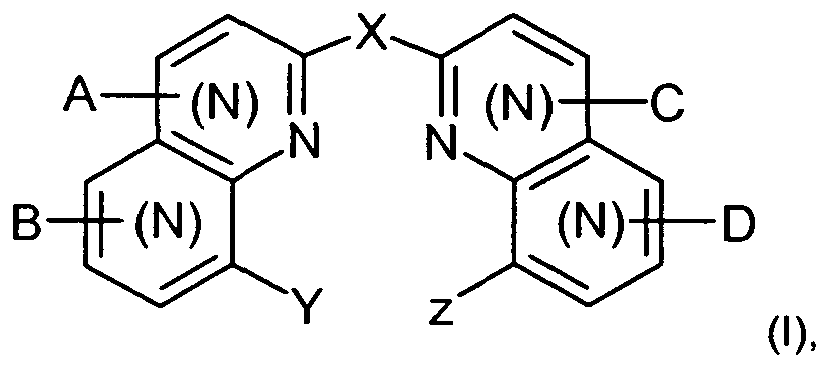
X für NR1, NR1R2(+), PR1, PR1R2(+), P(O)R1, O, S, BR1, BR1R2(-), CR3R4 oder SiR3R4 steht,
Y und Z unabhängig voneinander für OH, SH, NH2, NHR5 oder NR5R6 stehen,
A, B, C, D, R1, R2, R3 und R4 unabhängig voneinander für Wasserstoff, Alkyl, Trifluormethyl, Cycloalkyl, Cycloalkylalkyl, Alkenyl, Alkinyl, Heteroalkyl, Heterocycloalkyl, Alkoxy, Alkylsulfanyl, Alkylsulfinyl, Alkylsulfonyl, Alkanoyl, Alkanoyloxy, Alkoxycarbonyl, Alkylaminocarbonyl, Alkylsulfanylcarbonyl, Hydroxy, Amino, Aryl, Arylalkyl, Aryloxy, Arylsulfanyl, Arylsulfinyl, Arylsulfonyl, Arylcarbonyl, Arylcarbonyloxy, Aryloxycarbonyl, Arylaminocarbonyl, Arylsulfanylcarbonyl, Heteroaryl, Heteroarylalkyl, Heteroaryloxy, Heteroarylamino, Heteroarylsulfanyl, Heteroarylsulfonyl, Heteroarylsulfoxidyl, Heteroarylcarbonyl, Heteroarylcarbonyloxy, Heteroaryloxycarbonyl, Heteroarylaminocarbonyl, Heteroarylsulfanylcarbonyl, Alkoxysulfonyl, Alkoxycarbinol, Ammonium, Hydroxycarbonyl, Alkoxycarbonyl, Aryloxycarbonyl, Amidocarbonyl, Halogen, Nitro, Sulfato, Sulfo, Amidosulfo, Phosphato, Phosphono, Amidophosphono, Formyl, Thioformyl, -(CH2-CH2-O-)nH und -(CH2-CH2-CH2-O)nH mit n = 1 bis 20,
R5 und R6 unabhängig voneinander für Wasserstoff oder Alkyl stehen,
wobei alle Reste des sich so ergebenden Moleküls jeweils unabhängig voneinander gegebenenfalls auch ein- oder mehrfach substituiert sein können.
zum Bleichen von Zellstoff und/oder Roh-Baumwolle.
Priority Applications (1)
| Application Number | Priority Date | Filing Date | Title |
|---|---|---|---|
| PL08736070T PL2144880T3 (pl) | 2007-04-12 | 2008-04-10 | Kompleksy bis-(hydroksychinolina)-metal jako katalizatory bielenia |
Applications Claiming Priority (2)
| Application Number | Priority Date | Filing Date | Title |
|---|---|---|---|
| DE102007017654A DE102007017654A1 (de) | 2007-04-12 | 2007-04-12 | Bis(hydroxychinolin)-Metallkomplexe als Bleichkatalysatoren |
| PCT/EP2008/054349 WO2008135337A1 (de) | 2007-04-12 | 2008-04-10 | Bis(hydroxychinolin)-metallkomplexe als bleichkatalysatoren |
Publications (2)
| Publication Number | Publication Date |
|---|---|
| EP2144880A1 EP2144880A1 (de) | 2010-01-20 |
| EP2144880B1 true EP2144880B1 (de) | 2012-05-30 |
Family
ID=39473807
Family Applications (1)
| Application Number | Title | Priority Date | Filing Date |
|---|---|---|---|
| EP08736070A Not-in-force EP2144880B1 (de) | 2007-04-12 | 2008-04-10 | Bis(hydroxychinolin)-metallkomplexe als bleichkatalysatoren |
Country Status (6)
| Country | Link |
|---|---|
| US (1) | US8318650B2 (de) |
| EP (1) | EP2144880B1 (de) |
| DE (1) | DE102007017654A1 (de) |
| ES (1) | ES2386923T3 (de) |
| PL (1) | PL2144880T3 (de) |
| WO (1) | WO2008135337A1 (de) |
Families Citing this family (23)
| Publication number | Priority date | Publication date | Assignee | Title |
|---|---|---|---|---|
| ES2393813T3 (es) * | 2007-04-04 | 2012-12-28 | Henkel Ag & Co. Kgaa | Detergente o agente de lavado que contiene un medio de blanqueo |
| DE102007017654A1 (de) | 2007-04-12 | 2008-10-16 | Henkel Ag & Co. Kgaa | Bis(hydroxychinolin)-Metallkomplexe als Bleichkatalysatoren |
| BRPI0909022B1 (pt) | 2008-04-09 | 2020-11-10 | Basf Se | uso de pelo menos um composto, composição detergente, limpadora, desinfetante ou alvejante, e, grânulo |
| DE102009047037A1 (de) * | 2009-11-24 | 2011-05-26 | Henkel Ag & Co. Kgaa | Wasch- oder Reinigungsmittel mit gegebenenfalls in situ erzeugtem bleichverstärkendem Übergangsmetallkomplex |
| WO2012000846A1 (en) | 2010-06-28 | 2012-01-05 | Basf Se | Metal free bleaching composition |
| GB201105397D0 (en) | 2011-03-31 | 2011-05-11 | Reckitt Benckiser Nv | Detergent composition |
| US20140298591A1 (en) | 2011-10-25 | 2014-10-09 | Basf Se | Use of comb or block copolymers as soil antiredeposition agents and soil release agents in laundry processes |
| CN104145012A (zh) | 2011-10-25 | 2014-11-12 | 巴斯夫欧洲公司 | 丙烯酸酯共聚物作为抗污垢再沉积剂和去污剂在洗衣过程中的用途 |
| EP2700633A1 (de) | 2012-08-23 | 2014-02-26 | Bayer MaterialScience AG | Verfahren zur Herstellung von linearen und/oder cyclischen Carbonatestern |
| CA2900652C (en) | 2013-02-15 | 2021-05-04 | Kala Pharmaceuticals, Inc. | Therapeutic compounds and uses thereof |
| CN107915751A (zh) | 2013-02-20 | 2018-04-17 | 卡拉制药公司 | 治疗性化合物和其用途 |
| US9688688B2 (en) | 2013-02-20 | 2017-06-27 | Kala Pharmaceuticals, Inc. | Crystalline forms of 4-((4-((4-fluoro-2-methyl-1H-indol-5-yl)oxy)-6-methoxyquinazolin-7-yl)oxy)-1-(2-oxa-7-azaspiro[3.5]nonan-7-yl)butan-1-one and uses thereof |
| KR20150135489A (ko) | 2013-03-27 | 2015-12-02 | 바스프 에스이 | 세탁 과정에서 오염물 방출제로서 블록 공중합체 |
| WO2015066482A1 (en) | 2013-11-01 | 2015-05-07 | Kala Pharmaceuticals, Inc. | Crystalline forms of therapeutic compounds and uses thereof |
| US9890173B2 (en) | 2013-11-01 | 2018-02-13 | Kala Pharmaceuticals, Inc. | Crystalline forms of therapeutic compounds and uses thereof |
| HUE035705T2 (en) | 2013-11-27 | 2018-05-28 | Basf Se | Random copolymers in the washing process as a dirt remover |
| CN105255620A (zh) * | 2015-11-18 | 2016-01-20 | 华文蔚 | 一种皮革清洗剂 |
| WO2017186480A1 (en) | 2016-04-26 | 2017-11-02 | Basf Se | Metal free bleaching composition |
| AU2017324713B2 (en) | 2016-09-08 | 2020-08-13 | KALA BIO, Inc. | Crystalline forms of therapeutic compounds and uses thereof |
| AU2017324716B2 (en) | 2016-09-08 | 2020-08-13 | KALA BIO, Inc. | Crystalline forms of therapeutic compounds and uses thereof |
| MX2019002629A (es) | 2016-09-08 | 2019-10-07 | Kala Pharmaceuticals Inc | Formas cristalinas de compuestos terapéuticos y usos de los mismos. |
| EP3724310A4 (de) | 2017-12-15 | 2021-07-21 | Rhodia Operations | Zusammensetzung mit lanthanidmetallkomplex |
| WO2025195357A1 (en) | 2024-03-19 | 2025-09-25 | Basf Se | Bleaching catalyst and use thereof in hydrogen peroxide bleaching |
Family Cites Families (63)
| Publication number | Priority date | Publication date | Assignee | Title |
|---|---|---|---|---|
| US9167A (en) * | 1852-08-03 | Composition eor preserving butter | ||
| US49165A (en) * | 1865-08-01 | Improvement in coal-stoves | ||
| US227626A (en) * | 1880-05-18 | William heston | ||
| US259222A (en) * | 1882-06-06 | shelburne | ||
| US170745A (en) * | 1875-12-07 | Improvement in oatmeal-machines | ||
| US26269A (en) * | 1859-11-29 | Josee johnson | ||
| US156454A (en) * | 1874-11-03 | Improvement in harness-saddle pads | ||
| US120555A (en) * | 1871-10-31 | Improvement in bathing apparatus | ||
| US128129A (en) * | 1872-06-18 | Improvement in casters | ||
| US235125A (en) * | 1880-12-07 | busby | ||
| US282261A (en) * | 1883-07-31 | Hame-tip | ||
| LU60582A1 (de) * | 1970-03-24 | 1971-10-06 | ||
| JPS6011342B2 (ja) | 1975-11-07 | 1985-03-25 | 小西六写真工業株式会社 | ハロゲン化銀写真感光材料の画像形成方法 |
| ATE134669T1 (de) | 1988-08-26 | 1996-03-15 | Procter & Gamble | Schmutzabweisende mittel mit von allylgruppen abgeleiteten sulphonierten endgruppen |
| ES2144990T3 (es) | 1989-08-25 | 2000-07-01 | Henkel Of America Inc | Enzima proteolitica alcalina y metodo de produccion. |
| EP0506178B1 (de) | 1991-03-25 | 1996-10-16 | Koninklijke Philips Electronics N.V. | Speisegerät |
| US5340735A (en) | 1991-05-29 | 1994-08-23 | Cognis, Inc. | Bacillus lentus alkaline protease variants with increased stability |
| US5783630A (en) | 1993-07-13 | 1998-07-21 | Huntsman Petrochemical Corporation | Polyether amine modification of polypropylene |
| DK0701605T3 (da) | 1994-02-24 | 2008-07-28 | Henkel Ag & Co Kgaa | Forbedrede enzymer og detergenter indeholdende disse |
| DE59508590D1 (de) | 1994-05-20 | 2000-08-24 | Henkel Kgaa | Schmutzablösevermögende polyester |
| DE4426216A1 (de) | 1994-07-23 | 1996-01-25 | Merck Patent Gmbh | Benzyliden-Norcampher-Derivate |
| DE4426215A1 (de) | 1994-07-23 | 1996-01-25 | Merck Patent Gmbh | Ketotricyclo [5.2.1.0] decan-Derivate |
| WO1996004940A1 (en) | 1994-08-12 | 1996-02-22 | The Procter & Gamble Company | Composition for reducing malodor impression on inanimate surfaces |
| GB9503474D0 (en) | 1995-02-22 | 1995-04-12 | Ciba Geigy Ag | Compounds and their use |
| DE19507522C2 (de) * | 1995-03-03 | 2003-05-28 | Basf Ag | Verfahren zur Herstellung von 3,4-Dihydroisochinolinverbindungen und 3,4-Dihydroisochinolinium-Salzen |
| DE19601063A1 (de) | 1995-03-06 | 1996-09-12 | Hoechst Ag | Kristallines Natriumschichtsilikat |
| ES2150607T3 (es) | 1995-03-06 | 2000-12-01 | Clariant Gmbh | Silicato de sodio estratificado cristalino. |
| CN1182451A (zh) | 1995-03-17 | 1998-05-20 | 诺沃挪第克公司 | 新的内切葡聚糖酶 |
| WO1996034092A2 (en) | 1995-04-28 | 1996-10-31 | Genencor International, Inc. | Detergents comprising cellulases |
| WO1997014804A1 (en) | 1995-10-17 | 1997-04-24 | Röhn Enzyme Finland OY | Cellulases, the genes encoding them and uses thereof |
| JP2000503051A (ja) | 1995-12-29 | 2000-03-14 | アライド コロイド リミテッド | 酵素含有粒子及び濃縮液状洗剤 |
| FR2745014B1 (fr) | 1996-02-20 | 1998-04-03 | Rhone Poulenc Chimie | Procede de traitement antisalissure des articles a base de coton tisse |
| EP1293504A3 (de) | 1996-07-08 | 2003-11-05 | Ciba SC Holding AG | Triazinderivate als UV-Filter in kosmetischen Mitteln |
| BR9711479B1 (pt) | 1996-09-17 | 2009-08-11 | variante de celulase tendo uma resistência aumentada a tensìdeo de ánion. | |
| DE19712033A1 (de) | 1997-03-21 | 1998-09-24 | Basf Ag | Photostabile UV-Filter enthaltende kosmetische und pharmazeutische Zubereitungen |
| DE19713852A1 (de) | 1997-04-04 | 1998-10-08 | Henkel Kgaa | Aktivatoren für Persauerstoffverbindungen in Wasch- und Reinigungsmitteln |
| DE19732751A1 (de) | 1997-07-30 | 1999-02-04 | Henkel Kgaa | Neue Beta-Glucanase aus Bacillus |
| DE19825737A1 (de) | 1998-06-09 | 1999-12-16 | Bayer Ag | Elektrolumineszierende Anordnungen mit N-Alkyl-2,2'-imino-bis-(8-hydroxychinolin)-Metallkomplexen |
| JP2000048956A (ja) * | 1998-07-28 | 2000-02-18 | Toray Ind Inc | 発光素子 |
| DE19918267A1 (de) | 1999-04-22 | 2000-10-26 | Henkel Kgaa | Handgeschirrspülmittel mit Mikrokapseln |
| DE19956382A1 (de) | 1999-11-24 | 2001-05-31 | Henkel Kgaa | Verfahren zur Herstellung von mikroverkapselten Enzymen |
| HUP0300840A2 (hu) | 2000-07-28 | 2003-07-28 | Henkel Kommanditgesellschaft Auf Aktien | Új, Bacillus sp. A 7-7 (DSM 12368)-ból extrahált amilolitikus enzim, valamint használata mosó- és tisztítószerekben |
| ES2290184T3 (es) | 2000-11-28 | 2008-02-16 | Henkel Kommanditgesellschaft Auf Aktien | Ciclodextrina-glucanotransferasa (cgtasa) a partir de bacillus agaradherens (dsm 9948) asi como agentes para el lavado y la limpeiza con esta nueva ciclodextrina-glucanotransferasa. |
| DE10121463A1 (de) | 2001-05-02 | 2003-02-27 | Henkel Kgaa | Neue Alkalische Protease-Varianten und Wasch- und Reinigungsmittel enthaltend diese neuen Alkalischen Protease-Varianten |
| DE10131441A1 (de) | 2001-06-29 | 2003-01-30 | Henkel Kgaa | Eine neue Gruppe von alpha-Amylasen sowie ein Verfahren zur Identifizierung und Gewinnung neuer alpha-Amylasen |
| DE10138753B4 (de) | 2001-08-07 | 2017-07-20 | Henkel Ag & Co. Kgaa | Wasch- und Reinigungsmittel mit Hybrid-Alpha-Amylasen |
| DE10153792A1 (de) | 2001-10-31 | 2003-05-22 | Henkel Kgaa | Neue Alkalische Protease-Varianten und Wasch- und Reinigungsmittel enthaltend diese neuen Alkalischen Protease-Varianten |
| DE10162728A1 (de) | 2001-12-20 | 2003-07-10 | Henkel Kgaa | Neue Alkalische Protease aus Bacillus gibsonii (DSM 14393) und Wasch-und Reinigungsmittel enthaltend diese neue Alkalische Protease |
| DE10162727A1 (de) | 2001-12-20 | 2003-07-10 | Henkel Kgaa | Neue Alkalische Protease aus Bacillus gibsonii (DSM 14391) und Wasch-und Reinigungsmittel enthaltend diese neue Alkalische Protease |
| DE10163748A1 (de) | 2001-12-21 | 2003-07-17 | Henkel Kgaa | Neue Glykosylhydrolasen |
| DE10163883A1 (de) | 2001-12-22 | 2003-07-10 | Henkel Kgaa | Neue Alkalische Protease aus Bacillus sp. (DSM 14390) und Wasch- und Reinigungsmittel enthaltend diese neue Alkalische Protease |
| DE10163884A1 (de) | 2001-12-22 | 2003-07-10 | Henkel Kgaa | Neue Alkalische Protease aus Bacillus sp. (DSM 14392) und Wasch- und Reinigungsmittel enthaltend diese neue Alkalische Protease |
| AU2002950217A0 (en) * | 2002-07-16 | 2002-09-12 | Prana Biotechnology Limited | 8- Hydroxy Quinoline Derivatives |
| DE10260903A1 (de) | 2002-12-20 | 2004-07-08 | Henkel Kgaa | Neue Perhydrolasen |
| DE10260930A1 (de) | 2002-12-20 | 2004-07-15 | Henkel Kgaa | Neue Cholinoxidasen |
| DK2664670T3 (da) | 2003-12-03 | 2015-07-27 | Danisco Us Inc | Perhydrolase |
| DE102004029475A1 (de) | 2004-06-18 | 2006-01-26 | Henkel Kgaa | Neues enzymatisches Bleichsystem |
| FR2889525A1 (fr) | 2005-08-04 | 2007-02-09 | Palumed Sa | Nouveaux derives de polyquinoleines et leur utilisation therapeutique. |
| DE102005053529A1 (de) | 2005-11-08 | 2007-06-21 | Henkel Kgaa | System zur enzymatischen Generierung von Wasserstoffperoxid |
| DE102006018780A1 (de) | 2006-04-20 | 2007-10-25 | Henkel Kgaa | Granulat eines sensitiven Wasch- oder Reinigungsmittelinhaltsstoffs |
| DE102006022216A1 (de) | 2006-05-11 | 2007-11-15 | Henkel Kgaa | Neue Alkalische Protease aus Bacillus gibsonii und Wasch- und Reinigungsmittel enthaltend diese neue Alkalische Protease |
| DE102006022224A1 (de) | 2006-05-11 | 2007-11-15 | Henkel Kgaa | Subtilisin aus Bacillus pumilus und Wasch- und Reinigungsmittel enthaltend dieses neue Subtilisin |
| DE102007017654A1 (de) | 2007-04-12 | 2008-10-16 | Henkel Ag & Co. Kgaa | Bis(hydroxychinolin)-Metallkomplexe als Bleichkatalysatoren |
-
2007
- 2007-04-12 DE DE102007017654A patent/DE102007017654A1/de not_active Withdrawn
-
2008
- 2008-04-10 PL PL08736070T patent/PL2144880T3/pl unknown
- 2008-04-10 ES ES08736070T patent/ES2386923T3/es active Active
- 2008-04-10 EP EP08736070A patent/EP2144880B1/de not_active Not-in-force
- 2008-04-10 WO PCT/EP2008/054349 patent/WO2008135337A1/de not_active Ceased
-
2009
- 2009-10-12 US US12/577,450 patent/US8318650B2/en not_active Expired - Fee Related
Also Published As
| Publication number | Publication date |
|---|---|
| EP2144880A1 (de) | 2010-01-20 |
| WO2008135337A1 (de) | 2008-11-13 |
| US8318650B2 (en) | 2012-11-27 |
| US20100048447A1 (en) | 2010-02-25 |
| DE102007017654A1 (de) | 2008-10-16 |
| PL2144880T3 (pl) | 2012-10-31 |
| ES2386923T3 (es) | 2012-09-06 |
Similar Documents
| Publication | Publication Date | Title |
|---|---|---|
| EP2171028B1 (de) | Biheteroaryl-metallkomplexe als bleichkatalysatoren | |
| EP2144882B1 (de) | Tris(heterocyclyl)-metallkomplexe als bleichkatalysatoren | |
| US8318650B2 (en) | Bis(hydroxyquinoline) metal complexes as bleach catalysts | |
| EP1445305B1 (de) | Verwendung von Übergangsmetallkomplexen als Bleichkatalysatoren | |
| EP2714877B1 (de) | Aktivatorsysteme für persauerstoffverbindungen | |
| EP3221441B1 (de) | Wasserlöslich umhülltes portionswaschmittel | |
| EP0968270A1 (de) | Übergangsmetallkomplex-haltige systeme als aktivatoren für persauerstoffverbindungen | |
| DE102012219359A1 (de) | Wasch- und Reinigungsmittel mit verbesserter Hygieneleistung | |
| DE19649375A1 (de) | Acetonitril-Derivate als Bleichaktivatoren in Reinigungsmitteln | |
| EP3030642A1 (de) | Waschmittel mit erhöhter primärwaschkraft | |
| EP3406698A1 (de) | Bleichendes wasch- oder reinigungsmittel mit oxaziridin-vorläufer | |
| DE19713851B4 (de) | Verwendung von Komplexen des Molybdäns, Vanadiums oder Wolframs zur Verstärkung der Bleichwirkung | |
| DE19529904A1 (de) | Reinigungsmittel mit Aktivatorkomplexen für Persauerstoffverbindungen | |
| EP3497193B1 (de) | Wasch- und reinigungsmittel mit anionischen tensiden aus nachwachsenden rohstoffen | |
| WO2000032731A1 (de) | Verwendung von übergangsmetallkomplexen mit stickstoffhaltigen heterocyclischen liganden zur verstärkung der bleichwirkung von persauerstoffverbindungen | |
| EP3212751A1 (de) | Verfahren zum waschen von textilien in einer waschmaschine mit aktivierungseinrichtung | |
| EP3942007B1 (de) | Neue anionische tenside und wasch- und reinigungsmittel, welche diese enthalten | |
| EP0864641A1 (de) | Verwendung von in Käfigverbindungen eingeschlossenen Übergangsmetallkomplexen zur Verstärkung der Bleichwirkung | |
| EP3409757B1 (de) | Bleichendes wasch- oder reinigungsmittel | |
| EP3075835A2 (de) | Partikuläres waschmittel mit bleichekatalysator | |
| EP1969112B1 (de) | Reinigungsmittel mit bleichkatalytisch aktiven komplexen | |
| EP3409756A1 (de) | Bleichendes wasch- oder reinigungsmittel | |
| DE102012217062A1 (de) | Aktivatoren für Persauerstoffverbindungen | |
| EP2294172A1 (de) | Bacitracin-metall-komplexe als bleichkatalysatoren | |
| WO2017102473A1 (de) | Partikuläres mittel zur verstärkung der bleichwirkung |
Legal Events
| Date | Code | Title | Description |
|---|---|---|---|
| PUAI | Public reference made under article 153(3) epc to a published international application that has entered the european phase |
Free format text: ORIGINAL CODE: 0009012 |
|
| 17P | Request for examination filed |
Effective date: 20090624 |
|
| AK | Designated contracting states |
Kind code of ref document: A1 Designated state(s): AT BE BG CH CY CZ DE DK EE ES FI FR GB GR HR HU IE IS IT LI LT LU LV MC MT NL NO PL PT RO SE SI SK TR |
|
| AX | Request for extension of the european patent |
Extension state: AL BA MK RS |
|
| RIN1 | Information on inventor provided before grant (corrected) |
Inventor name: RYBINSKI VON, WOLFGANG Inventor name: SCHMIEDEL, PETER Inventor name: HAETZELT, ANDRE Inventor name: SUNDERMEYER, JOERG Inventor name: LEOPOLD, STEFAN Inventor name: NORDSKOG, ANETTE Inventor name: DOERING, JAN |
|
| DAX | Request for extension of the european patent (deleted) | ||
| 17Q | First examination report despatched |
Effective date: 20100629 |
|
| GRAP | Despatch of communication of intention to grant a patent |
Free format text: ORIGINAL CODE: EPIDOSNIGR1 |
|
| RIC1 | Information provided on ipc code assigned before grant |
Ipc: C07D 215/24 20060101AFI20111202BHEP Ipc: C11D 3/39 20060101ALI20111202BHEP Ipc: C11D 3/16 20060101ALI20111202BHEP |
|
| GRAS | Grant fee paid |
Free format text: ORIGINAL CODE: EPIDOSNIGR3 |
|
| GRAA | (expected) grant |
Free format text: ORIGINAL CODE: 0009210 |
|
| AK | Designated contracting states |
Kind code of ref document: B1 Designated state(s): AT BE BG CH CY CZ DE DK EE ES FI FR GB GR HR HU IE IS IT LI LT LU LV MC MT NL NO PL PT RO SE SI SK TR |
|
| REG | Reference to a national code |
Ref country code: GB Ref legal event code: FG4D Free format text: NOT ENGLISH |
|
| REG | Reference to a national code |
Ref country code: CH Ref legal event code: EP |
|
| REG | Reference to a national code |
Ref country code: AT Ref legal event code: REF Ref document number: 560024 Country of ref document: AT Kind code of ref document: T Effective date: 20120615 |
|
| REG | Reference to a national code |
Ref country code: IE Ref legal event code: FG4D Free format text: LANGUAGE OF EP DOCUMENT: GERMAN |
|
| REG | Reference to a national code |
Ref country code: DE Ref legal event code: R096 Ref document number: 502008007321 Country of ref document: DE Effective date: 20120726 |
|
| REG | Reference to a national code |
Ref country code: ES Ref legal event code: FG2A Ref document number: 2386923 Country of ref document: ES Kind code of ref document: T3 Effective date: 20120906 |
|
| REG | Reference to a national code |
Ref country code: NL Ref legal event code: VDEP Effective date: 20120530 |
|
| REG | Reference to a national code |
Ref country code: LT Ref legal event code: MG4D Effective date: 20120530 |
|
| PG25 | Lapsed in a contracting state [announced via postgrant information from national office to epo] |
Ref country code: LT Free format text: LAPSE BECAUSE OF FAILURE TO SUBMIT A TRANSLATION OF THE DESCRIPTION OR TO PAY THE FEE WITHIN THE PRESCRIBED TIME-LIMIT Effective date: 20120530 Ref country code: CY Free format text: LAPSE BECAUSE OF FAILURE TO SUBMIT A TRANSLATION OF THE DESCRIPTION OR TO PAY THE FEE WITHIN THE PRESCRIBED TIME-LIMIT Effective date: 20120530 Ref country code: NO Free format text: LAPSE BECAUSE OF FAILURE TO SUBMIT A TRANSLATION OF THE DESCRIPTION OR TO PAY THE FEE WITHIN THE PRESCRIBED TIME-LIMIT Effective date: 20120830 Ref country code: SE Free format text: LAPSE BECAUSE OF FAILURE TO SUBMIT A TRANSLATION OF THE DESCRIPTION OR TO PAY THE FEE WITHIN THE PRESCRIBED TIME-LIMIT Effective date: 20120530 Ref country code: IS Free format text: LAPSE BECAUSE OF FAILURE TO SUBMIT A TRANSLATION OF THE DESCRIPTION OR TO PAY THE FEE WITHIN THE PRESCRIBED TIME-LIMIT Effective date: 20120930 Ref country code: FI Free format text: LAPSE BECAUSE OF FAILURE TO SUBMIT A TRANSLATION OF THE DESCRIPTION OR TO PAY THE FEE WITHIN THE PRESCRIBED TIME-LIMIT Effective date: 20120530 |
|
| REG | Reference to a national code |
Ref country code: PL Ref legal event code: T3 |
|
| PG25 | Lapsed in a contracting state [announced via postgrant information from national office to epo] |
Ref country code: HR Free format text: LAPSE BECAUSE OF FAILURE TO SUBMIT A TRANSLATION OF THE DESCRIPTION OR TO PAY THE FEE WITHIN THE PRESCRIBED TIME-LIMIT Effective date: 20120530 Ref country code: LV Free format text: LAPSE BECAUSE OF FAILURE TO SUBMIT A TRANSLATION OF THE DESCRIPTION OR TO PAY THE FEE WITHIN THE PRESCRIBED TIME-LIMIT Effective date: 20120530 Ref country code: GR Free format text: LAPSE BECAUSE OF FAILURE TO SUBMIT A TRANSLATION OF THE DESCRIPTION OR TO PAY THE FEE WITHIN THE PRESCRIBED TIME-LIMIT Effective date: 20120831 Ref country code: SI Free format text: LAPSE BECAUSE OF FAILURE TO SUBMIT A TRANSLATION OF THE DESCRIPTION OR TO PAY THE FEE WITHIN THE PRESCRIBED TIME-LIMIT Effective date: 20120530 |
|
| PG25 | Lapsed in a contracting state [announced via postgrant information from national office to epo] |
Ref country code: EE Free format text: LAPSE BECAUSE OF FAILURE TO SUBMIT A TRANSLATION OF THE DESCRIPTION OR TO PAY THE FEE WITHIN THE PRESCRIBED TIME-LIMIT Effective date: 20120530 Ref country code: SK Free format text: LAPSE BECAUSE OF FAILURE TO SUBMIT A TRANSLATION OF THE DESCRIPTION OR TO PAY THE FEE WITHIN THE PRESCRIBED TIME-LIMIT Effective date: 20120530 Ref country code: RO Free format text: LAPSE BECAUSE OF FAILURE TO SUBMIT A TRANSLATION OF THE DESCRIPTION OR TO PAY THE FEE WITHIN THE PRESCRIBED TIME-LIMIT Effective date: 20120530 Ref country code: NL Free format text: LAPSE BECAUSE OF FAILURE TO SUBMIT A TRANSLATION OF THE DESCRIPTION OR TO PAY THE FEE WITHIN THE PRESCRIBED TIME-LIMIT Effective date: 20120530 Ref country code: DK Free format text: LAPSE BECAUSE OF FAILURE TO SUBMIT A TRANSLATION OF THE DESCRIPTION OR TO PAY THE FEE WITHIN THE PRESCRIBED TIME-LIMIT Effective date: 20120530 |
|
| PG25 | Lapsed in a contracting state [announced via postgrant information from national office to epo] |
Ref country code: PT Free format text: LAPSE BECAUSE OF FAILURE TO SUBMIT A TRANSLATION OF THE DESCRIPTION OR TO PAY THE FEE WITHIN THE PRESCRIBED TIME-LIMIT Effective date: 20121001 |
|
| PLBE | No opposition filed within time limit |
Free format text: ORIGINAL CODE: 0009261 |
|
| STAA | Information on the status of an ep patent application or granted ep patent |
Free format text: STATUS: NO OPPOSITION FILED WITHIN TIME LIMIT |
|
| 26N | No opposition filed |
Effective date: 20130301 |
|
| REG | Reference to a national code |
Ref country code: DE Ref legal event code: R097 Ref document number: 502008007321 Country of ref document: DE Effective date: 20130301 |
|
| PG25 | Lapsed in a contracting state [announced via postgrant information from national office to epo] |
Ref country code: BG Free format text: LAPSE BECAUSE OF FAILURE TO SUBMIT A TRANSLATION OF THE DESCRIPTION OR TO PAY THE FEE WITHIN THE PRESCRIBED TIME-LIMIT Effective date: 20120830 |
|
| BERE | Be: lapsed |
Owner name: HENKEL A.G. & CO. KGAA Effective date: 20130430 |
|
| PG25 | Lapsed in a contracting state [announced via postgrant information from national office to epo] |
Ref country code: MC Free format text: LAPSE BECAUSE OF FAILURE TO SUBMIT A TRANSLATION OF THE DESCRIPTION OR TO PAY THE FEE WITHIN THE PRESCRIBED TIME-LIMIT Effective date: 20120530 |
|
| REG | Reference to a national code |
Ref country code: CH Ref legal event code: PL |
|
| GBPC | Gb: european patent ceased through non-payment of renewal fee |
Effective date: 20130410 |
|
| REG | Reference to a national code |
Ref country code: IE Ref legal event code: MM4A |
|
| PG25 | Lapsed in a contracting state [announced via postgrant information from national office to epo] |
Ref country code: BE Free format text: LAPSE BECAUSE OF NON-PAYMENT OF DUE FEES Effective date: 20130430 Ref country code: GB Free format text: LAPSE BECAUSE OF NON-PAYMENT OF DUE FEES Effective date: 20130410 Ref country code: CH Free format text: LAPSE BECAUSE OF NON-PAYMENT OF DUE FEES Effective date: 20130430 Ref country code: LI Free format text: LAPSE BECAUSE OF NON-PAYMENT OF DUE FEES Effective date: 20130430 |
|
| PG25 | Lapsed in a contracting state [announced via postgrant information from national office to epo] |
Ref country code: IE Free format text: LAPSE BECAUSE OF NON-PAYMENT OF DUE FEES Effective date: 20130410 |
|
| REG | Reference to a national code |
Ref country code: AT Ref legal event code: MM01 Ref document number: 560024 Country of ref document: AT Kind code of ref document: T Effective date: 20130410 |
|
| PG25 | Lapsed in a contracting state [announced via postgrant information from national office to epo] |
Ref country code: AT Free format text: LAPSE BECAUSE OF NON-PAYMENT OF DUE FEES Effective date: 20130410 |
|
| PG25 | Lapsed in a contracting state [announced via postgrant information from national office to epo] |
Ref country code: MT Free format text: LAPSE BECAUSE OF FAILURE TO SUBMIT A TRANSLATION OF THE DESCRIPTION OR TO PAY THE FEE WITHIN THE PRESCRIBED TIME-LIMIT Effective date: 20120530 |
|
| PG25 | Lapsed in a contracting state [announced via postgrant information from national office to epo] |
Ref country code: TR Free format text: LAPSE BECAUSE OF FAILURE TO SUBMIT A TRANSLATION OF THE DESCRIPTION OR TO PAY THE FEE WITHIN THE PRESCRIBED TIME-LIMIT Effective date: 20120530 |
|
| PG25 | Lapsed in a contracting state [announced via postgrant information from national office to epo] |
Ref country code: LU Free format text: LAPSE BECAUSE OF NON-PAYMENT OF DUE FEES Effective date: 20130410 Ref country code: HU Free format text: LAPSE BECAUSE OF FAILURE TO SUBMIT A TRANSLATION OF THE DESCRIPTION OR TO PAY THE FEE WITHIN THE PRESCRIBED TIME-LIMIT; INVALID AB INITIO Effective date: 20080410 |
|
| REG | Reference to a national code |
Ref country code: FR Ref legal event code: PLFP Year of fee payment: 9 |
|
| REG | Reference to a national code |
Ref country code: FR Ref legal event code: PLFP Year of fee payment: 10 |
|
| REG | Reference to a national code |
Ref country code: FR Ref legal event code: PLFP Year of fee payment: 11 |
|
| PGFP | Annual fee paid to national office [announced via postgrant information from national office to epo] |
Ref country code: PL Payment date: 20180323 Year of fee payment: 11 |
|
| PGFP | Annual fee paid to national office [announced via postgrant information from national office to epo] |
Ref country code: CZ Payment date: 20180409 Year of fee payment: 11 Ref country code: ES Payment date: 20180525 Year of fee payment: 11 Ref country code: DE Payment date: 20180420 Year of fee payment: 11 |
|
| PGFP | Annual fee paid to national office [announced via postgrant information from national office to epo] |
Ref country code: IT Payment date: 20180423 Year of fee payment: 11 Ref country code: FR Payment date: 20180420 Year of fee payment: 11 |
|
| REG | Reference to a national code |
Ref country code: DE Ref legal event code: R119 Ref document number: 502008007321 Country of ref document: DE |
|
| PG25 | Lapsed in a contracting state [announced via postgrant information from national office to epo] |
Ref country code: CZ Free format text: LAPSE BECAUSE OF NON-PAYMENT OF DUE FEES Effective date: 20190410 Ref country code: DE Free format text: LAPSE BECAUSE OF NON-PAYMENT OF DUE FEES Effective date: 20191101 |
|
| PG25 | Lapsed in a contracting state [announced via postgrant information from national office to epo] |
Ref country code: FR Free format text: LAPSE BECAUSE OF NON-PAYMENT OF DUE FEES Effective date: 20190430 |
|
| PG25 | Lapsed in a contracting state [announced via postgrant information from national office to epo] |
Ref country code: IT Free format text: LAPSE BECAUSE OF NON-PAYMENT OF DUE FEES Effective date: 20190410 |
|
| REG | Reference to a national code |
Ref country code: ES Ref legal event code: FD2A Effective date: 20200828 |
|
| PG25 | Lapsed in a contracting state [announced via postgrant information from national office to epo] |
Ref country code: ES Free format text: LAPSE BECAUSE OF NON-PAYMENT OF DUE FEES Effective date: 20190411 |
|
| PG25 | Lapsed in a contracting state [announced via postgrant information from national office to epo] |
Ref country code: PL Free format text: LAPSE BECAUSE OF NON-PAYMENT OF DUE FEES Effective date: 20190410 |