EP2104430B1 - Vorrichtung zur positionierung und öffnung von schalentieren - Google Patents
Vorrichtung zur positionierung und öffnung von schalentieren Download PDFInfo
- Publication number
- EP2104430B1 EP2104430B1 EP08723992.7A EP08723992A EP2104430B1 EP 2104430 B1 EP2104430 B1 EP 2104430B1 EP 08723992 A EP08723992 A EP 08723992A EP 2104430 B1 EP2104430 B1 EP 2104430B1
- Authority
- EP
- European Patent Office
- Prior art keywords
- shellfish
- assembly
- mussel
- opening
- station
- Prior art date
- Legal status (The legal status is an assumption and is not a legal conclusion. Google has not performed a legal analysis and makes no representation as to the accuracy of the status listed.)
- Active
Links
- 235000015170 shellfish Nutrition 0.000 title claims description 111
- 238000012545 processing Methods 0.000 claims description 21
- 235000013372 meat Nutrition 0.000 claims description 19
- 238000000034 method Methods 0.000 claims description 19
- 235000014676 Phragmites communis Nutrition 0.000 claims description 6
- 230000007246 mechanism Effects 0.000 claims description 5
- 241000237536 Mytilus edulis Species 0.000 description 164
- 235000020638 mussel Nutrition 0.000 description 164
- 239000002699 waste material Substances 0.000 description 20
- 230000000712 assembly Effects 0.000 description 10
- 238000000429 assembly Methods 0.000 description 10
- 230000008569 process Effects 0.000 description 10
- 230000003213 activating effect Effects 0.000 description 7
- 210000003205 muscle Anatomy 0.000 description 6
- 238000012546 transfer Methods 0.000 description 5
- 238000005520 cutting process Methods 0.000 description 4
- 230000009471 action Effects 0.000 description 3
- 238000001514 detection method Methods 0.000 description 3
- 230000006870 function Effects 0.000 description 3
- 239000000463 material Substances 0.000 description 3
- 238000012986 modification Methods 0.000 description 3
- 230000004048 modification Effects 0.000 description 3
- 230000004044 response Effects 0.000 description 3
- 230000008859 change Effects 0.000 description 2
- 230000036541 health Effects 0.000 description 2
- 230000003252 repetitive effect Effects 0.000 description 2
- 239000007921 spray Substances 0.000 description 2
- XLYOFNOQVPJJNP-UHFFFAOYSA-N water Substances O XLYOFNOQVPJJNP-UHFFFAOYSA-N 0.000 description 2
- 241000237502 Ostreidae Species 0.000 description 1
- 241000237503 Pectinidae Species 0.000 description 1
- 239000000654 additive Substances 0.000 description 1
- 230000008901 benefit Effects 0.000 description 1
- 230000015556 catabolic process Effects 0.000 description 1
- 238000004140 cleaning Methods 0.000 description 1
- 238000004891 communication Methods 0.000 description 1
- 230000002860 competitive effect Effects 0.000 description 1
- 238000011109 contamination Methods 0.000 description 1
- 230000006378 damage Effects 0.000 description 1
- 230000001419 dependent effect Effects 0.000 description 1
- 238000009826 distribution Methods 0.000 description 1
- 238000011143 downstream manufacturing Methods 0.000 description 1
- 230000008570 general process Effects 0.000 description 1
- 230000005484 gravity Effects 0.000 description 1
- 238000009499 grossing Methods 0.000 description 1
- 230000002452 interceptive effect Effects 0.000 description 1
- 238000012423 maintenance Methods 0.000 description 1
- 238000004519 manufacturing process Methods 0.000 description 1
- 239000002184 metal Substances 0.000 description 1
- 238000012544 monitoring process Methods 0.000 description 1
- 235000020636 oyster Nutrition 0.000 description 1
- 230000002085 persistent effect Effects 0.000 description 1
- 230000001681 protective effect Effects 0.000 description 1
- 230000003134 recirculating effect Effects 0.000 description 1
- 238000004064 recycling Methods 0.000 description 1
- 238000005096 rolling process Methods 0.000 description 1
- 235000020637 scallop Nutrition 0.000 description 1
- 238000000926 separation method Methods 0.000 description 1
- 229910001220 stainless steel Inorganic materials 0.000 description 1
- 239000010935 stainless steel Substances 0.000 description 1
- 239000000126 substance Substances 0.000 description 1
- 230000003319 supportive effect Effects 0.000 description 1
- 230000001052 transient effect Effects 0.000 description 1
- 230000007704 transition Effects 0.000 description 1
- 230000001960 triggered effect Effects 0.000 description 1
- 238000011144 upstream manufacturing Methods 0.000 description 1
- 239000002351 wastewater Substances 0.000 description 1
Images











Classifications
-
- A—HUMAN NECESSITIES
- A22—BUTCHERING; MEAT TREATMENT; PROCESSING POULTRY OR FISH
- A22C—PROCESSING MEAT, POULTRY, OR FISH
- A22C29/00—Processing shellfish or bivalves, e.g. oysters, lobsters; Devices therefor, e.g. claw locks, claw crushers, grading devices; Processing lines
- A22C29/04—Processing bivalves, e.g. oysters
-
- A—HUMAN NECESSITIES
- A22—BUTCHERING; MEAT TREATMENT; PROCESSING POULTRY OR FISH
- A22C—PROCESSING MEAT, POULTRY, OR FISH
- A22C25/00—Processing fish ; Curing of fish; Stunning of fish by electric current; Investigating fish by optical means
- A22C25/12—Arranging fish, e.g. according to the position of head and tail
-
- A—HUMAN NECESSITIES
- A22—BUTCHERING; MEAT TREATMENT; PROCESSING POULTRY OR FISH
- A22C—PROCESSING MEAT, POULTRY, OR FISH
- A22C29/00—Processing shellfish or bivalves, e.g. oysters, lobsters; Devices therefor, e.g. claw locks, claw crushers, grading devices; Processing lines
- A22C29/04—Processing bivalves, e.g. oysters
- A22C29/046—Opening or shucking bivalves
-
- Y—GENERAL TAGGING OF NEW TECHNOLOGICAL DEVELOPMENTS; GENERAL TAGGING OF CROSS-SECTIONAL TECHNOLOGIES SPANNING OVER SEVERAL SECTIONS OF THE IPC; TECHNICAL SUBJECTS COVERED BY FORMER USPC CROSS-REFERENCE ART COLLECTIONS [XRACs] AND DIGESTS
- Y02—TECHNOLOGIES OR APPLICATIONS FOR MITIGATION OR ADAPTATION AGAINST CLIMATE CHANGE
- Y02A—TECHNOLOGIES FOR ADAPTATION TO CLIMATE CHANGE
- Y02A40/00—Adaptation technologies in agriculture, forestry, livestock or agroalimentary production
- Y02A40/80—Adaptation technologies in agriculture, forestry, livestock or agroalimentary production in fisheries management
- Y02A40/81—Aquaculture, e.g. of fish
Definitions
- the invention relates to a shellfish positioning and opening apparatus.
- the invention is directed particularly but not solely towards an apparatus and method for use with shellfish or bivalve shellfish.
- Processing shellfish like for example any bivalve such as mussels or oysters or scallops can be very labour intensive. Initially one has to position each shellfish to enable the inserting of a cutting implement to separate into two halves. This type of work is extremely repetitive and dependent on the different skill levels of each person carrying out this work. Therefore output can be erratic and hard to predict.
- WO 98/4219 7 discloses a shell feeder apparatus including a primary conveyor means to receive shells and transport them to another location, to orient the shellfish in a specific orientation.
- the conveyor means includes a belt with apertures to receive a shell and means for orientating the shells.
- the apparatus can include a carousel with arms with suction cups to remove the shells from the primary conveyor belt which can then be transferred to a secondary conveyor for downstream processing. This inventions appears to be attempting to solve the problem of incorrect shellfish orientation which can cause them to not be able to be further processed.
- Some mechanical apparatus used to carry out such work can also suffer from being expensive to build and maintain and be so large as to require special housing. Some machines can be too complicated and be sensitive to simple breakdowns. Reliability is another problem for any complicated machinery making problem-detecting very difficult. Some machines can be difficult to clean which can further cause problems in excessive machine downtime.
- the invention resides in a shellfish positioning and opening apparatus having at least one processing lane whereby the apparatus including the following stations of an in-feed and singulation station followed by a reorientation assembly station utilizing a vision system and a holding and opening assembly station whereby said stations are operatively connected in that order together to receive shellfish having meat therein to position said shellfish according to their shape and orientation to enable shellfish to be halved so that one shellfish half has the shellfish meat thereon, wherein the in-feed and singulation station includes a pair of parallel rollers to rotatably form a single row of semi upright or on-edge oriented shellfish, wherein the in-feed and singulation station includes a hopper operatively connected to a scroll feeding mechanism and then to a trough which feeds the shellfish to the pair of parallel rollers to rotatably form a single row of semi upright or on-edge oriented shellfish.
- the apparatus includes a conveyor which operatively takes each shellfish from station to station.
- the reorientation assembly is adapted to reorient the position of a singulated shellfish by movement in four different axes of direction whereby each shellfish is clamped, vertically lifted and held and then rotated
- the reorientation assembly includes a support means and a vertically slidably clamping assembly which such clamping can also be rotated horizontally to reorient each shellfish such that keel and point are properly oriented.
- a vertical alignment device is located procedurally after the reorientation assembly so the device is lowered to be in front of the shellfish to ensure they are aligned in the vertical plane.
- a primary ejector being located between the vision system and the reorientation assembly can eject any shellfish from the conveyor which do not meet any predetermined position wherein the ejector comprises pneumatically operated piston controlled by a controller.
- a secondary ejector being located between the reorientation assembly and the vertical alignment device also ejects any shellfish wrongly positioned to allow any vertical alignment by the vertical alignment device wherein the ejector comprises pneumatically operated piston controlled by a controller.
- various sensors are operatively located with respect to all station components such as scroll feeder sensor, two singulation sensors, presence sensor in before vertical alignment device and in lifting or loader assembly, single vacuum sensor, and reed switches on cylinders. These are on some of the pneumatic actuators and generally detect when the cylinder is fully extended or fully retracted or is at or going past some intermediary position. Reed switches can be seen on the cylinders in most of the figures.
- the lifting or loader assembly which is located after the re-orientation assembly includes a cradle slidably supported by a support which in use locates the shellfish in a general vertical plane which is vertically raised to allow the holding & opening assembly to operate.
- the holding and opening assembly operatively includes a support means, slidable vacuum cup assembly and hinge breaker which is adapted to grab a shellfish from the lifting or loader assembly to hold it against the hinge breaker, apply a vacuum to create a gape whereby a knife assembly slidably operates to cut the meat from one shellfish half and then the cups move apart to break the hinge.
- the invention resides in a method of shellfish positioning and opening wherein a shellfish positioning and opening apparatus is provided having at least one processing lane whereby the apparatus including the following stations of an in-feed and singulation station followed by a reorientation assembly station utilizing a vision system, a lifting or loader assembly and a holding and opening assembly station whereby said stations are operatively connected in that order together to receive shellfish having meat therein to position said shellfish according to their shape and orientation to enable shellfish to be halved so that one shellfish half has the shellfish meat thereon, the in-feed and singulation station includes a hopper operatively connected to a scroll feeding mechanism and then to a trough which feeds the shellfish to a pair of parallel rollers to rotatably form a single row of semi upright or on-edge oriented shellfish, a vertical alignment device is located procedurally after the reorientation assembly so the device is lowered to be in front of the shellfish to ensure they are aligned in the vertical plane, the holding and
- a primary ejector located between the vision system and the reorientation assembly ejects any shellfish from the conveyor which do not meet any predetermined position wherein the ejector comprises pneumatically operated piston controlled by a controller.
- a secondary ejector located between the reorientation assembly and the vertical alignment device also ejects any shellfish wrongly positioned to allow any vertical alignment by the vertical alignment device wherein the ejector comprises pneumatically operated piston controlled by a controller.
- the in-feed and singulation station includes an in-feed chute, hopper, lifting conveyor and in-feed tray and vibration means whereby the hopper receives mussels which then is lifted by the lifting conveyor to the in-feed tray which is vibrated by a vibrating system such that the mussels are singulated.
- the in-feed tray has a first tray followed by a second tray and deflector whereby the second tray is a step below the first tray.
- the apparatus includes a chain conveyor to move singulated mussels from the in-feed and singulation station to the orientation station.
- the orientation station is located adjacent to the chain conveyor and includes a vision system and reorientation assembly whereby the vision system includes a camera acting as a line scan system to measure the mussel profile and two algorithms are then used to determine the orientation of a mussel which can trigger the orientation assembly using 2 axes to make sure the mussel is on its long edge or to reject using an ejection system.
- the vision system includes a camera acting as a line scan system to measure the mussel profile and two algorithms are then used to determine the orientation of a mussel which can trigger the orientation assembly using 2 axes to make sure the mussel is on its long edge or to reject using an ejection system.
- an ejection system is located adjacent to the orientation assembly to reject any mussels not meeting the pre-programmed mussel shape to enable recycling.
- a vertical alignment device is located past the orientation device operatively adjacent to the conveyor with which to correctly align the mussel in the vertical plane.
- an opening station which is located operatively adjacent to the chain conveyor, includes stopping and lifting assembly, holding and opening assembly and knife assembly to first lift a mussel so the holding and opening assembly can firstly hold a mussel to gape it open whereby the knifing assembly severs the adductor muscle and then the mussel hinge is then broken by rotating a portion of the holding and opening assembly.
- the holding assembly includes an opening head having vacuum cups to grip the mussel and mussel hinge breaker.
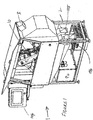
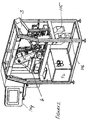
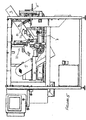
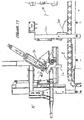
- FIGS. 1-21 show a shellfish positioning and opening apparatus 1 in general terms there are the following components or assemblies operatively connected in a frame or housing 2 with various guards or covers together in an almost consequential sequence as follows:
- the shellfish positioning and opening apparatus is designed to take one mussel or several mussels and singulate and orient them in a generally vertical orientation for opening and then cutting or scrapping the adductor muscle to produce two separate shell halves with one half having the shellfish meat thereon and the other being a waste shell.
- Various components such as the covers or guards, viewing windows and means for activating various apparatus, assemblies, components, parts or devices are included can be said to be known and so are not explained or shown in detail.
- activating means are the pneumatics or electric operating systems or motors etc.
- the supporting frame 2 and covers can be varied to suit structural or access requirements for maintenance or cleaning.
- a mussel can be said to almost disc shaped having an edge border or mussel edge/join such that the edges define a first plane or vertical in use axis whereby in use during processing using the apparatus of the present invention, the mussel first plane is generally oriented substantially in the vertical direction or where the mussel is oriented on its edges or where from the defined points on a mussel the orientation can be determined and then used re-orientate if necessary (e.g. if in the horizontal plane or pointing in the wrong direction) to enable processing with a leading edge or any selection mussel position to be oriented with respect to any apparatus component, to halve the mussel.
- Each mussel 20 as shown in figure 4 has the following parts point 21, hinge 22, keel 23, leading edge 24 and long edge 25.
- Figure 4(b) shows the mussel after opening and before separation into halves 26 and 27 with broken hinge 28, product or shellfish meat 29, location of adductor muscle 30 on waste shell 26 and adductor muscle 31.
- the mussel length L can be defined as being from the leading edge 24 to the point 21.
- the mussel machine consists of the following process steps whereby a mussel is tracked through the components or assemblies or devices of the apparatus:
- the process includes feeding as many mussels as necessary or as the apparatus can handle.
- the in-feed chute 3 is oriented to enable the mussels to drop by gravity into the hopper 4 and onto the lifting conveyor 5 which is also angled with respect to the vertical to enable so many mussels to be separated somewhat and then dropped into the in-feed tray.
- In-feed tray 6 is horizontally supported with respect to the chute and lifting conveyor 5. These components are supported by the apparatus frame 2.
- Lifting conveyor 5 includes a motor driven means 40 and stepped platform 41 partially enclosed by side members 42.
- In-feed tray 6 includes a horizontal support 43 and angled L-shaped tray 44 which in use causes the mussels to be gathered in the corner of tray 44 as shown in figure 9 .
- Angled tray or first tray 44 is joined to another tray or second tray 45 in a similar orientation but at a lower level to thereby further singulate the mussels and go some way to causing them to lie in a certain position.
- In-feed tray 6 also has an angled deflecting member 46 to assist in singulation.
- a vibrator 7 Operatively connected to in-feed tray 6 is a vibrator 7 which is fixedly attached to the apparatus frame and activating means to vibrate in-feed tray and its contents.
- the chute and lifting conveyor assist in the smoothing out of the number of mussels entering the machine to enable the later stations to be able to cope with a maximum number of mussels entering the machine to be processed.
- each mussel After being processed by the in-feed tray 6 each mussel is dropped onto a moving conveyor 8 which then forms a central important part of the apparatus as a whole thereby enabling a mussel to move past various assemblies or devices to be processed.
- Conveyor 8 is a chain conveyor being operatively connected to activating means (for example motor 47 as seen in figure 15 ) and includes as shown in figure 11 , a body 50 and movable chain comprising two walls of upright metal plates 51 and 52 being located on each side of the conveyor body 50 to form a specified space or width dimension therebetween for at least one mussel to sit in a substantially vertical orientation or lie on the mussel edge or mussel-join between the mussel halves. Later stations of the apparatus will detect and reorient or reject a mussel if it is not in this general vertical orientation.
- activating means for example motor 47 as seen in figure 15
- activating means for example motor 47 as seen in figure 15
- body 50 and movable chain comprising two walls of upright metal plates 51 and 52 being located on each side of the conveyor body 50 to form a specified space or width dimension therebetween for at least one mussel to sit in a substantially vertical orientation or lie on the mussel edge or mussel-join between the mussel halves
- the camera is acting as a line scan system, i.e., it uses a vertical line from each frame to determine the overall profile of the mussel as it passes by.
- the mussel is back lit to provide a strong silhouette.
- two algorithms are applied to determine the orientation of the point and the keel, respectively.
- the algorithm also takes into account the presence of the conveyor 8, which obscures part of the mussel profile.
- a mussel is reoriented from a keel down, point back orientation to the required keel up, point back orientation. This actually involves rotations about both axes as described below.
- the reorientation device 10 of figure 13 consists of a pneumatic gripper 60, triggered by the vision system 9 that closes on the mussel as it moves along the conveyor 8.
- the gripper 60 is connected to another pneumatic system 61 that lifts the mussel up to allow sufficient space for the reorientation.
- the gripper 60 and pneumatic system are movably supported by the support means 54 which in turn is connected to the apparatus frame 2 of the apparatus.
- the gripper 60 includes the two arms 55 and 56 (having ends that can move towards each other in direction 62 as shown in figure 13 to grip a mussel.
- Gripper 60 is rotatably mounted to enable rotation in the horizontal plane about a vertical axis. (See note earlier - the end portions 57 and 58 rotate to provide the second axis of rotation.)
- the reorientation device 10 also has two axes of rotation: one axis whereby the grippers rotate the mussel end over end - this is used to change the keel orientation (and, incidentally, the point orientation) whilst a second axis rotates 65 the gripper assembly end to end to change the point orientation without affecting the keel orientation.
- Adjacent device 10 as shown in detail in figure 14 is the ejection system 11 comprising a support member 67 and telescoping or piston assembly 68.
- Member 67 can be removably and supportively attached to the conveyor 8 as shown whereby piston assembly 68 can horizontally push off a rejected mussel (incorrectly oriented, incorrectly singulated or those of which the vision system 9 has been unable to determine the orientation) in response to sensing means via the vision system.
- the vertical alignment device 12 as shown in figures 10 and 15 is supportively attached to the conveyor body of conveyor 8 though the apparatus frame 2 or another support can be used as long as the device 12 can operate without obstructing the flow of mussels through the apparatus 1.
- Device 12 comprises a vertically mounted frame 70 that houses a piston rod mechanism 71 that includes at its distal end or operating end a vertical mounted angle portion 72.
- the apparatus has a combination of systems to reference each mussel to enable successful operation of the opening blade consisting of:
- Lifter assembly 13 in detail in figure 19 comprises a vertically slidably movable carriage or platform 75 slidably attached to a vertical rail system 76.
- the vertical rail system 76 is attached to support 77 via a moving means in such a manner that allows the carriage to be vertically moved as required.
- the carriage 75 includes two arms having upright guide members 78 and 79 thereon, whereby said guide members are able to straddle the conveyor 8 without interfering with its movement and stop member 80 is able to stop the front end of a mussel i.e. the leading edge 24.
- a mussel is moved by conveyor 8 through and between the arms whereby it is then stopped by stop member 80 and the mussel is then lifted for application of the holding and opening assembly 14.
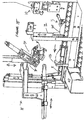
- Holding and opening assembly 14 is shown in detail in figure 20 which includes an overhead inclined support 85 supported by a part of frame 2 and housing a cylinder mount subassembly which includes a slidable piston member.
- Support 85 has a distal end or operating end having a pivotally sprung arm system 87 and a top referencing arm 88.
- Suction means 91 is operatively connected to activating means such as a vacuum pump 92 and can include vacuum cups driven by a linkage system to grip, hold and open the shells of a mussel.
- Top referencing arm or hinge breaker 88 comprises a 'T' bar cross sectional shape with a web portion 93 being supportively linked to holding assembly support 85 and a bar portion 94 comprising a flat planar member having a groove 95 to help align the mussel and an asymmetric profile 94 to ensure the two shells are separated.
- Holding and opening assembly 14 also can include a profiled finger 96 whereby in use a mussel is firstly gripped by the suction cups and pulled apart to engage on the profiled finger and to form a gap between the shellfish halves whereby the knife of the opening assembly is then inserted to separate the adductor muscle so that then the vacuum cups further pull the two halves completely apart against the hinge breaker 88 whereby the mussel hinge is broken.
- the shell halves still being held by each suction cup can rotate in a substantially vertical plane with each shell half about the groove 95 of the hinge breaker 88 in a sort of vertical rolling action in opposing directions-splaying action.
- the axis of rotation is actually about the axis of the pivot on the opening head which is approximately co-axial with the line of the hinge.
- the hinge breaker 88 ensures the mussel doesn't rotate away from this position and also levers apart the two mussel shells.
- the apparatus is designed and intended to run continuously. There will be a number of mussels being processed within the system at any one time to obtain the desired throughput rate.
- the apparatus includes various stations with different apparatus, devices which operate simultaneously and in parallel to achieve a high processing through-put.
- the apparatus can include various control means 104 which can include a viewable screen e.g. LCD and Human Machine Interface (HMI) and control cabinet to assist in the checking of progress and any problems whereby both manual and machine and automatic control is possible.
- control means 104 can include a viewable screen e.g. LCD and Human Machine Interface (HMI) and control cabinet to assist in the checking of progress and any problems whereby both manual and machine and automatic control is possible.
- HMI Human Machine Interface
- FIG. 1-3 there can be two out-feed chutes with one being a product out-feed chute 105 and the other being a waste and rework chute 106 whereby a diversion flap can be activated to ensure any product that is not waste does not go out the waste stream.
- the single chute 105 is for product and also for unopened mussels ejected by the ejection device.
- the double chute 106 is used to separate, by means of a diversion flap inside the chute, waste shells from mussels that may not have been correctly processed, referred to as rework.
- the logic works like this:
- the diversion flap remains in the default position so that any mussel that is incorrectly processed, e.g., knocked out by the knife or has the product shell still attached because the hinge isn't fully broken and the product shell has come away from its vacuum cup, will not go to waste but exit out the rework chute.
- chute 106 and the exit of chute 105 are at the same level so that they can both feed onto a common out-feed conveyor to take product and rework away from the machine.
- the apparatus and its various machines or devices or assemblies can be powered using single phase mains power (240V). This powers the vacuum pump, the 3-phase drive motors for the two conveyors 5 and 8 as well as the control system 104 (PLC, PC for the vision system and HMI, and sensors).
- the apparatus is also supplied with compressed air to drive the various pneumatic actuators such as for example for the reorientation assembly 10, holding and opening assembly 14.
- the other services to the apparatus are the chemicals and water, including high pressure water, for the Clean In Place (CIP) system.
- CIP Clean In Place
- the apparatus can have a number of sensors such as:
- Additional sensors can be used as required. For example a sensor to help with the feed and singulation of the mussels from the in-feed tray to keep the in-feed tray vibrating if there is a gap in the mussel stream entering the apparatus for processing. This can assist in ensuring the maximum possible throughput.
- the vision system uses a camera as already described.
- the sensors are used to detect that a mussel has reached a stop.
- the LCD screen is part of the PC that controls the vision system. It also acts as the HMI for the machine. It can be a touch screen that displays various operating modes and parameters to the user.
- the camera is connected directly to it using a FireWire cable run through conduit via the control cabinet.
- the program running on the PC communicates with the PLC to enable changes and display of the various control parameters.
- There is a flexible conduit between the control cabinet and the HMI enclosure which also carries the power supply and a connection to a USB port on the PC.
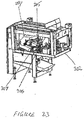
- Figures 22-32 relate to a second embodiment of the shellfish positioning and opening apparatus 200.
- this apparatus 200 utilizes similar components of the previous apparatus whereby the following are still used such as the reorientation device assembly, vertical alignment device, lifting or loader assembly, holding & opening assembly and knife assembly. There have been some minor modifications to these but in essence they still function as previously disclosed in this specification.
- the in-feed portion now uses a trough to roller system and the apparatus as a whole operates with two parallel lines of shellfish processing from a single in-feed hopper. This means that there are two hopper in-feeds leading to two lines or lanes of shellfish processing whereby there are two reorientation devices and two vacuum cup assemblies and two knife assemblies. This two line processing is only one example as there may be at least one processing line or as many lines or lanes as required.
- apparatus 200 includes a supporting frame 202 which can include various components such as legs, casing or housing and guards being removably and fixedly attached together.
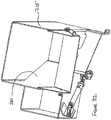
- Apparatus 200 includes the following general process components of in-feed 203, singulation and orientation, conveying 206, vision system 207 (see new Fig 26 ), primary ejection 208 (see Fig 26 ), reorientation device 209, vertical aligner 210 and secondary ejection 211 (see Fig 26 ), lifting assembly 212, holding and opening head 213, knife assembly 214 and out feed chutes 215 (see: Fig 32 shows the one of the out-feed chutes), which generally follow the same process steps as shown in figures 1-21 .
- assemblies 1 and 200 are:
- the fundamental control philosophy for this process is open loop for the product feed along a conveyor and through an opening head. This means that product is pushed onto the conveyor at a time interval that is no less than a set minimum time. This time is slightly longer than the slowest operation in the opening process, i.e., reorientation, vertical alignment, loading or opening.
- hopper in-feed member 220 operatively connects to two hopper in-feed members 226 & 227 with each member being shaped as an open channel member.
- Each hopper in-feed member 226 or 227 leads to the scroll feeders 222 and hopper out feed sensor 224 which act as distribution control means which inturn provides a prescribed time and number of shellfish to singulation rollers 225.
- Each scroll feeder 222 controls the delivery of mussels from the hopper to the singulation rollers 225.
- Each scroll feeder 222 comprises a rotatable floor portion that interfits with the floor of the channel members 226 & 227, that floor portion in use rotates or rolls forward and back and has a step that lifts say 2-3 mussels at a time and drops them onto the singulation rollers (see Fig 25 ). It effectively replaces the lift conveyor 5 as shown in figure 9 with the step in the scroll acting as a flight.
- Ejection system is driven by a pneumatic cylinder.
- Reorientation device 209 is similar to the device labelled as '10' as shown in figure 13 .
- the device 209 is able to reorient the product such as a mussel in four axes.
- the lifting axis 235 relates to a vertical slidable movement of a lower portion 240 with respect to an upper portion 241 of the device 209.
- Grip axis 236 relates to a pair of opposing grip blocks 242 which in use move horizontally together to grip the mussel in the first instance to allow for the other axis movement as required.
- the vertical aligner 210 of figures 22-32 is simply a piece of angle similar to that of the vertical alignment device 12 of figures 1-21 .
- a mussel on the conveyor 206 runs up to the angle and is stopped by it.
- the mussels run into the corner of the angle and are thus aligned in the vertical plane.
- the vertical aligner 210 ideally never lands on top of a mussel but is lowered after a mussel has passed and before the next mussel arrives.
- the secondary ejector 211 as shown in figure 26 at this point functions primarily to enable the apparatus to be emptied quickly and automatically.
- vertical aligner 210 can be formed as part of the supporting structure for the loader 212 or it can be formed as a separate item above the conveyor 206.
- Lifting assembly or loader 212 is comparable to lifting assembly 13 as shown in figure 15 but with some changes whereby the loader 212 is combined in a supportive structure 245 to the vertical alignment device 210 and the opening head 213 (comparable to the knife assembly 15).
- the loader 212 is formed as a cradle 246 as operatively part of a vertical slidable assembly 247 which allows the loader to move vertically to meet the holding and opening assembly. (the loader always operated on a vertical slide, it's just mounted at the in-feed end now rather than out the out-feed end)
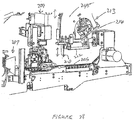
- Holding and opening assembly 213 as shown in figure 30 is comparable to the holding and opening assembly 14 as shown in figures 15-18 and 20a & b .
- cup assembly 252 comprises two mutually opposing cups which in use rotate in a direction at right angles to the axis of the support 251 to grab the mussel.
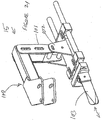
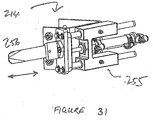
- Knife assembly 214 which is similar to knife assembly 15 of figure 21 is shown with some changes to affect better stability during its use. Knife assembly 214 comprises a support portion 255 and knife member 256.
- Cup assembly 214 also has a hinge breaker 253 which is similar to the hinge breaker of figure 20a & b.
- the cutting and opening operates similarly to that described on page 12 as for the figures 1-21 which has a hinge breaker 88 as shown in figure 20b .
- Mussel is grabbed and is held against the hinge breaker, vacuum is applied to create a gape in the mussel allowing the knife 256 to be inserted therebetween to sever the meat from one shell half. Cups then move apart to break the hinge to allow separate retrieval of the shell halves.
- Out-feeds chutes 215 ( figure 32 ) comprise trough members having controllable flap 261 which function to provide automatic method of separating the empty shell half from the other shell half containing the meat
- each component or portion of an assembly can move either automatically or manually or to allow adjustment/movement or rotation in various axes or planes.
- the apparatus is designed to process as many mussels as possible which may or many not mean more than one mussel will be located at any one point in or on the apparatus during the complete process.
- the invention may broadly be said to consist in the parts, elements and features referred to or indicated in the specification of the application individually or collectively in any and all combinations of any two or more of the parts, elements or features and where specific integers are mentioned herein which have known equivalents, such equivalents are deemed to be incorporated herein as if individually set forth.
Landscapes
- Life Sciences & Earth Sciences (AREA)
- Engineering & Computer Science (AREA)
- Wood Science & Technology (AREA)
- Zoology (AREA)
- Food Science & Technology (AREA)
- Farming Of Fish And Shellfish (AREA)
- Meat, Egg Or Seafood Products (AREA)
- Processing Of Meat And Fish (AREA)
- Sorting Of Articles (AREA)
Claims (10)
- Vorrichtung (200) zur Positionierung und Öffnung von Muscheln mit mindestens einer Verarbeitungsbahn, wobei die Vorrichtung (200) folgende Stationen der Zuführung und Vereinzelung (203, 206, 222, 226, 227) umfasst, gefolgt von einer Baugruppenstation zur Neuorientierung (209), welche ein Sichtsystem (207) benutzt, und einer Baugruppenstation zur Halterung und Öffnung (213), wobei diese Stationen in dieser Reihenfolge operativ miteinander verbunden sind, um die Muschelfleisch enthaltenden Muscheln aufzunehmen und je nach Form und Orientierung zu positionieren, so dass die Muschelschalen getrennt werden können, so dass eine Hälfte das darauf befindliche Muschelfleisch enthält, wobei die Zuführungs- und Vereinzelungsstation (203, 206, 222, 226, 227) ein Paar Parallelroller (225) umfasst, das rotierbar eine einzige Reihe halbaufrechter oder auf der Kante stehender Muscheln bildet, wobei die Zuführungs- und Vereinzelungsstation (203, 206, 222, 226, 227) einen Trichter (220) umfasst, der operativ mit einem Rollzufuhrmechanismus (222) und dann mit einer Mulde verbunden ist und die Muschel dem Paar Parallelroller (225) zuführt, um dann rotierbar eine einzige Reihe halbaufrechter oder auf der Kante stehender Muscheln zu bilden.
- Vorrichtung nach Anspruch 1, wobei die Vorrichtung ein Förderband (206) umfasst, das die Muscheln operativ von Station zu Station befördert.
- Vorrichtung nach Anspruch 2, wobei die Neuorientierungsbaugruppe (209) so angepasst ist, dass sie die Position einer vereinzelten Muschel durch Bewegung in vier verschiedene Richtungsachsen dreht, wobei die jeweilige Muschel eingeklemmt ist, vertikal angehoben und gehalten und dann gedreht wird, wobei die Neuorientierungsbaugruppe (209) ein Stützmittel und eine vertikal verschiebbare Klemmvorrichtung (240, 242) umfasst und die Klemmung ebenfalls um eine horizontale und vertikale Achse gedreht werden kann, um die Muschel neu zu orientieren, so dass Kiel und Spitze geeignet orientiert sind.
- Vorrichtung nach Anspruch 3, wobei ein vertikales Ausrichtungsbauteil (210) nach der Neuorientierungsbaugruppe (209) angebracht ist, so dass das Bauteil (210) gesenkt wird, bis es sich vor den Muscheln befindet, um sicherzustellen, dass sie in der vertikalen Ebene ausgerichtet sind.
- Vorrichtung nach Anspruch 4, wobei ein primärer Auswerfer (208, 211) zwischen dem Sichtsystem (207) und der Neuorientierungsbaugruppe (209) eine jegliche Muschel vom Förderband (206) auswerfen kann, die nicht der vorgegebenen Position entspricht, wobei der Auswerfer (208, 211) einen pneumatisch betriebenen Kolben aufweist, der von einer Steuerung gesteuert wird.
- Vorrichtung nach Anspruch 5, wobei sich ein zweiter Auswerfer (211) zwischen der Neuorientierungsbaugruppe (209) und dem vertikalen Ausrichtungsbauteil (210) befindet, der ebenfalls falsch positionierte Muscheln auswirft, um die vertikale Ausrichtung des vertikalen Ausrichtungsbauteils (210) zu erlauben, wobei der Auswerfer (211) einen pneumatisch betriebenen Kolben umfasst, der von einer Steuerung gesteuert wird.
- Vorrichtung nach Anspruch 6, wobei diverse Sensoren operativ bezüglich aller Stationskomponenten angebracht sind, wie Rollenzufuhrsensor (223, 224), zwei Vereinzelungssensoren (230, 231), Belegungssensor (239), vor dem vertikalen Ausrichtungsbauteil (210) und in der Hebe- oder Ladebaugruppe (212), Einzelvakuumssensor und Reedschalter auf Zylinder.
- Vorrichtung nach Anspruch 7, wobei die Hebe- oder Ladebaugruppe (212), die sich nach der Neuorientierungsbaugruppe befindet, eine Wiege aufweist, die verschiebbar von einer Stütze gestützt wird, die im Gebrauch die Muschel in einer allgemein vertikalen Ebene ortet, so dass diese vertikal angehoben wird, um den Betrieb der Halte- und Öffnungsbaugruppe (213) zu ermöglichen.
- Vorrichtung nach Anspruch 8, wobei die Halte- und Öffnungsbaugruppe (213) operativ ein Stützmittel, eine verschiebbare Vakuumsaugerbaugruppe (214) und einen Scharnierbrecher (253) umfasst und so angepasst ist, dass sie die Muschel von dem Lader ergreift und gegen den Scharnierbrecher (253) hält, ein Vakuum anwendet, um einen Spalt zu erzeugen, wo eine Messerbaugruppe (256) verschiebbar in Betrieb gesetzt wird, um das Muschelfleisch von einer Muschelhälfte zu schneiden, woraufhin sich die Sauger voneinander entfernen, um das Scharnier zu brechen.
- Verfahren zur Positionierung und Öffnung von Muscheln, wobei eine Muschelpositionierungs- und -öffnungsvorrichtung (200) bereitgestellt wird, die mindestens eine Verarbeitungsbahn aufweist, wobei die Vorrichtung folgende Stationen der Zuführung und Vereinzelung (203, 206) umfasst, gefolgt von einer Baugruppenstation zur Neuorientierung (209), welche ein Sichtsystem (207) benutzt, einer Hebe- oder Ladebaugruppe (212) und einer Halte- und Öffnungsbaugruppe (213), wobei diese Stationen in dieser Reihenfolge operativ miteinander verbunden sind, um die Muschelfleisch enthaltenden Muscheln aufzunehmen und je nach Form und Orientierung so zu positionieren, dass die Muschelschalen getrennt werden können, so dass eine Hälfte das darauf befindliche Muschelfleisch enthält, wobei die Zuführungs- und Vereinzelungsstation (203, 206) einen Trichter (220) umfasst, der operativ mit einem Rollzufuhrmechanismus (222) und dann mit einer Mulde verbunden ist und die Muschel einem Paar Parallelroller (225) zuführt, um dann rotierbar eine einzige Reihe halbaufrechter oder auf der Kante stehender Muscheln zu bilden, wobei sich ein vertikales Ausrichtungsbauteil (210) verfahrensmäßig nach der Neuorientierungsbaugruppe (209) befindet, so dass das Bauteil (210) gesenkt wird, bis es sich vor der Muschel befindet, um sicherzustellen dass sie in vertikaler Ebene ausgerichtet ist, wobei die Halte- und Öffnungsbaugruppe (213) operativ ein Stützmittel, eine verschiebbare Vakuumsaugerbaugruppe (214) und einen Scharnierbrecher (253) aufweist und so angepasst ist, dass sie eine Muschel von der Hebe- oder Ladebaugruppe (212) ergreift und gegen den Scharnierbrecher (253) hält, ein Vakuum anwendet, um einen Spalt zu erzeugen, wobei eine Messerbaugruppe (256) verschiebbar in Betrieb gesetzt wird, um das Muschelfleisch von einer Muschelschale zu schneiden, woraufhin sich die Sauger (204) voneinander entfernen, um das Scharnier zu brechen, wobei das Verfahren die folgenden Schritte zur Verarbeitung mindestens einer Muschel auf einem Förderband (206) zwischen den genannten Stationen aufweist:- Vereinzelung der Muschel durch Anpassung der Zufuhr, die zu den rotierenden Rollen (225) führt;- Anwendung des Sichtsystems (207) zum Ermitteln und Vergleichen der Orientierung der Muschel;- Neuorientierung jeder Muschel, so dass die Muschel in die richtige Richtung zeigt;- Halten der Muschel gegen das vertikale Ausrichtungsbauteil (209), so dass die Muschel im Wesentlichen aufrecht steht;- Laden der Muschel auf die Hebe- oder Ladebaugruppe (212) zum Anheben der Muschel, um die Halte- und Öffnungsbaugruppe (213) in die Lage zu versetzen, sie gegen den Scharnierbrecher (253) zu halten, ein Vakuum anzuwenden, um einen Spalt zu erzeugen, wobei die Messerbaugruppe (256) verschiebbar in Betrieb gesetzt wird, um das Muschelfleisch von einer Muschelhälfte zu schneiden, woraufhin die Sauger sich voneinander entfernen, um das Scharnier zu brechen.
Applications Claiming Priority (2)
| Application Number | Priority Date | Filing Date | Title |
|---|---|---|---|
| NZ552626A NZ552626A (en) | 2007-01-16 | 2007-01-16 | Shellfish positioning and opening apparatus |
| PCT/NZ2008/000002 WO2008088229A1 (en) | 2007-01-16 | 2008-01-15 | Shellfish positioning and opening apparatus |
Publications (3)
| Publication Number | Publication Date |
|---|---|
| EP2104430A1 EP2104430A1 (de) | 2009-09-30 |
| EP2104430A4 EP2104430A4 (de) | 2016-11-23 |
| EP2104430B1 true EP2104430B1 (de) | 2017-09-20 |
Family
ID=39636165
Family Applications (1)
| Application Number | Title | Priority Date | Filing Date |
|---|---|---|---|
| EP08723992.7A Active EP2104430B1 (de) | 2007-01-16 | 2008-01-15 | Vorrichtung zur positionierung und öffnung von schalentieren |
Country Status (13)
| Country | Link |
|---|---|
| US (1) | US8109810B2 (de) |
| EP (1) | EP2104430B1 (de) |
| KR (1) | KR101428830B1 (de) |
| CN (1) | CN101626691B (de) |
| AR (1) | AR064932A1 (de) |
| AU (1) | AU2008205763B2 (de) |
| BR (1) | BRPI0806217B1 (de) |
| CA (1) | CA2675446C (de) |
| CL (1) | CL2008000126A1 (de) |
| MY (1) | MY149558A (de) |
| NZ (1) | NZ552626A (de) |
| TW (1) | TWI445501B (de) |
| WO (1) | WO2008088229A1 (de) |
Families Citing this family (25)
| Publication number | Priority date | Publication date | Assignee | Title |
|---|---|---|---|---|
| AU2008230036B2 (en) * | 2008-10-22 | 2015-12-03 | Michael Steven Siminis | Apparatus for shucking oysters |
| CN103004942B (zh) * | 2012-12-30 | 2014-12-24 | 西南科技大学 | 贝类产品壳肉分离方法 |
| JP6172790B2 (ja) * | 2013-03-11 | 2017-08-02 | 佐藤 一雄 | 2枚貝加工装置 |
| US9968104B2 (en) | 2014-05-15 | 2018-05-15 | Merry Shellfish Farm LLC | Method and apparatus for washing, sorting, counting, and bagging shellfish |
| CN104970082B (zh) * | 2015-04-27 | 2016-11-30 | 魏仕槚 | 一种自动开河蚌装置 |
| CN105454100B (zh) * | 2015-06-11 | 2017-12-19 | 浙江工业职业技术学院 | 一种流水作业自动连续上料开蚌装置 |
| CN105192046B (zh) * | 2015-09-29 | 2017-12-22 | 大连工业大学 | 扇贝自动脱壳取肉机 |
| CN106069949B (zh) * | 2016-07-15 | 2018-11-23 | 中国计量大学 | 河蚌自动开壳取珠方法 |
| CA3033124C (en) * | 2017-05-03 | 2019-11-26 | Vineland Research and Innovations Centre Inc. | Gripper, system and process for gripping, orienting and handling a biological horticultural object |
| CN110996657A (zh) * | 2017-08-07 | 2020-04-10 | 法马克公共有限责任公司 | 活鱼处理系统和相关联的方法 |
| CN108244217B (zh) * | 2018-02-25 | 2020-06-19 | 惠安盛荣发机械有限责任公司 | 扇贝取丁机的开壳取丁装置及其开壳取丁工艺 |
| CN108935618B (zh) * | 2018-07-18 | 2020-08-14 | 王根节 | 开口张开装置 |
| CN109258771B (zh) * | 2018-09-30 | 2021-04-09 | 秦皇岛润昌科技开发有限公司 | 一种水产养殖虾夷扇贝的自动处理装置 |
| CN109275700B (zh) * | 2018-09-30 | 2021-03-26 | 秦皇岛润昌科技开发有限公司 | 一种水产养殖虾夷扇贝自动化加工夹固输送装置 |
| CN108887372B (zh) * | 2018-09-30 | 2021-05-07 | 秦皇岛润昌科技开发有限公司 | 一种多工位往复循环式扇贝开壳取肉机 |
| CN109042828B (zh) * | 2018-09-30 | 2021-04-09 | 秦皇岛润昌科技开发有限公司 | 一种扇贝多级输送仿生开壳装置 |
| US11172687B2 (en) * | 2019-02-14 | 2021-11-16 | Prime Equipment Group, Llc | Keel harvesting apparatus and method |
| CN110065796B (zh) * | 2019-03-18 | 2020-10-23 | 中国农业机械化科学研究院 | 一种对虾排序定向装置 |
| CN110405110A (zh) * | 2019-07-26 | 2019-11-05 | 浙江亘古电缆股份有限公司 | 一种柔性耐火阻燃电缆加工用切割设备 |
| CA3147307A1 (en) | 2019-08-01 | 2021-02-04 | Clearwater Seafoods Limited Partnership | Apparatus and methods for mollusc processing |
| CN110353027B (zh) * | 2019-08-06 | 2021-05-25 | 山东省农业机械科学研究院 | 一种多通道扇贝自动摊铺定位装置及方法 |
| CN111771827B (zh) * | 2020-07-13 | 2022-06-03 | 肖人华 | 一种水产养殖用扇贝甩出装置 |
| KR102588447B1 (ko) * | 2021-06-29 | 2023-10-12 | 장사영 | 굴 껍질 오프너 |
| CN116584529B (zh) * | 2023-04-14 | 2025-07-18 | 佛山市松川机械设备有限公司 | 一种采用机械手剥虾的剥虾系统 |
| CN120304453A (zh) * | 2024-10-28 | 2025-07-15 | 诸城市盛尔发食品机械有限公司 | 鱼类深加工成套设备及工艺 |
Family Cites Families (14)
| Publication number | Priority date | Publication date | Assignee | Title |
|---|---|---|---|---|
| DE2758233A1 (de) * | 1977-12-27 | 1979-07-05 | Geba Geraetebau Gmbh | Verfahren zum schaelen von krabben |
| US4236277A (en) * | 1979-05-14 | 1980-12-02 | Amfac Foods, Inc. | Crustacean shelling apparatus |
| US4439893A (en) * | 1981-08-26 | 1984-04-03 | Gregor Jonsson Associates, Inc. | Spring cam for shrimp clamp |
| US4715093A (en) * | 1985-09-16 | 1987-12-29 | The Laitram Corporation | Trimming and cutting apparatus for the preparation of crabs for meat extraction |
| US4718145A (en) * | 1986-02-18 | 1988-01-12 | Southern Seafoods | Apparatus and method for eviscerating scallops |
| CN1043859A (zh) * | 1988-12-30 | 1990-07-18 | 上海真空电子器件股份有限公司 | 牡蛎开壳方法及装置 |
| JPH08289718A (ja) | 1995-04-25 | 1996-11-05 | Susumu Ebisaki | ホタテ貝の貝柱切断装置 |
| AUPO380996A0 (en) * | 1996-11-25 | 1996-12-19 | Octa Technologies Pty Ltd | Scallop processing |
| AUPO578697A0 (en) * | 1997-03-21 | 1997-04-17 | Octa Technologies Pty Ltd | A shell feeder apparatus |
| FR2761232B1 (fr) | 1997-03-26 | 2000-03-10 | Rhone Merieux | Procede et moyens d'eradication des puces dans les locaux habites par les petits mammiferes |
| AUPP099197A0 (en) * | 1997-12-18 | 1998-01-15 | Boschen, Graeme | Method and apparatus for processing molluscs |
| JPH11285345A (ja) * | 1998-04-03 | 1999-10-19 | Shinwa:Kk | 帆立貝加工装置 |
| US6508699B1 (en) * | 2001-09-20 | 2003-01-21 | Frank J Santoriello | Apparatus for rinsing and scraping bi-valve mollusks |
| US7867067B2 (en) * | 2009-03-12 | 2011-01-11 | Gregor Jonsson Inc. | Shrimp processing machine |
-
2007
- 2007-01-16 NZ NZ552626A patent/NZ552626A/en unknown
-
2008
- 2008-01-15 CN CN200880007615XA patent/CN101626691B/zh not_active Expired - Fee Related
- 2008-01-15 AU AU2008205763A patent/AU2008205763B2/en not_active Ceased
- 2008-01-15 BR BRPI0806217-0A patent/BRPI0806217B1/pt not_active IP Right Cessation
- 2008-01-15 CA CA2675446A patent/CA2675446C/en active Active
- 2008-01-15 WO PCT/NZ2008/000002 patent/WO2008088229A1/en not_active Ceased
- 2008-01-15 MY MYPI20092977A patent/MY149558A/en unknown
- 2008-01-15 KR KR1020097017064A patent/KR101428830B1/ko not_active Expired - Fee Related
- 2008-01-15 EP EP08723992.7A patent/EP2104430B1/de active Active
- 2008-01-15 TW TW097101454A patent/TWI445501B/zh not_active IP Right Cessation
- 2008-01-15 US US12/523,355 patent/US8109810B2/en active Active
- 2008-01-16 AR ARP080100200A patent/AR064932A1/es active IP Right Grant
- 2008-01-16 CL CL200800126A patent/CL2008000126A1/es unknown
Also Published As
| Publication number | Publication date |
|---|---|
| CN101626691A (zh) | 2010-01-13 |
| WO2008088229A1 (en) | 2008-07-24 |
| EP2104430A1 (de) | 2009-09-30 |
| EP2104430A4 (de) | 2016-11-23 |
| KR101428830B1 (ko) | 2014-09-23 |
| TW200911125A (en) | 2009-03-16 |
| BRPI0806217A2 (pt) | 2011-08-30 |
| AR064932A1 (es) | 2009-05-06 |
| CL2008000126A1 (es) | 2008-07-04 |
| US20100048113A1 (en) | 2010-02-25 |
| NZ552626A (en) | 2009-04-30 |
| KR20090110354A (ko) | 2009-10-21 |
| CN101626691B (zh) | 2012-04-11 |
| AU2008205763A1 (en) | 2008-07-24 |
| TWI445501B (zh) | 2014-07-21 |
| BRPI0806217B1 (pt) | 2017-07-04 |
| CA2675446C (en) | 2013-09-17 |
| AU2008205763B2 (en) | 2012-06-07 |
| US8109810B2 (en) | 2012-02-07 |
| CA2675446A1 (en) | 2008-07-24 |
| MY149558A (en) | 2013-09-13 |
Similar Documents
| Publication | Publication Date | Title |
|---|---|---|
| US8109810B2 (en) | Shellfish positioning and opening apparatus | |
| EP3160241B1 (de) | Verfahren und vorrichtung zur entfernung von fremdkörpern aus lebensmittelstücken | |
| EP2433500A1 (de) | System zum säubern, schneiden und verarbeiten von fisch | |
| JPH08118288A (ja) | 2つ以上の食物の塊をスライスする装置及び方法 | |
| US5478428A (en) | Label separator and method for separating a label from a backing | |
| EP0525756B1 (de) | Vorrichtung zum Schneiden und Entfernen von Verpackungsmaterial | |
| JP3187713B2 (ja) | 帯状物切断除去装置 | |
| CN115057068A (zh) | 烟草开袋系统及其控制方法 | |
| US20060266005A1 (en) | Vacuum packaging machine and loading system | |
| JP2006510555A6 (ja) | 真空包装機および装填システム | |
| EP1980335B1 (de) | Anlage zur Trennung von feststoffabfallartigem Siedlungsabfall, im Besonderen zur Wiedergewinnung von langem, biegsamem Material | |
| US20240375885A1 (en) | Handling Installation, Food Processing Installation, and Method for Handling Food Items | |
| US12063939B2 (en) | Systems and methods for fowl keel removal | |
| JP3680653B2 (ja) | パック食品の生ごみ分別方法及びその装置 | |
| JP7316448B2 (ja) | 除骨装置および除骨方法 | |
| JP3001306U (ja) | ネギの加工装置およびネギの皮むき機 | |
| US9596863B2 (en) | Automatic leg skinner | |
| KR20260018409A (ko) | 재활용 폐기물 선별장치 | |
| CN121817246A (zh) | 一种生蚝自动开壳取肉设备 |
Legal Events
| Date | Code | Title | Description |
|---|---|---|---|
| PUAI | Public reference made under article 153(3) epc to a published international application that has entered the european phase |
Free format text: ORIGINAL CODE: 0009012 |
|
| 17P | Request for examination filed |
Effective date: 20090703 |
|
| AK | Designated contracting states |
Kind code of ref document: A1 Designated state(s): AT BE BG CH CY CZ DE DK EE ES FI FR GB GR HR HU IE IS IT LI LT LU LV MC MT NL NO PL PT RO SE SI SK TR |
|
| AX | Request for extension of the european patent |
Extension state: AL BA MK RS |
|
| RA4 | Supplementary search report drawn up and despatched (corrected) |
Effective date: 20161026 |
|
| RIC1 | Information provided on ipc code assigned before grant |
Ipc: A22C 29/02 20060101ALI20161020BHEP Ipc: A22C 25/12 20060101ALI20161020BHEP Ipc: A22C 29/04 20060101AFI20161020BHEP |
|
| GRAP | Despatch of communication of intention to grant a patent |
Free format text: ORIGINAL CODE: EPIDOSNIGR1 |
|
| STAA | Information on the status of an ep patent application or granted ep patent |
Free format text: STATUS: GRANT OF PATENT IS INTENDED |
|
| RIC1 | Information provided on ipc code assigned before grant |
Ipc: A22C 29/04 20060101AFI20170403BHEP Ipc: A22C 29/02 20060101ALI20170403BHEP Ipc: A22C 25/12 20060101ALI20170403BHEP |
|
| INTG | Intention to grant announced |
Effective date: 20170503 |
|
| GRAS | Grant fee paid |
Free format text: ORIGINAL CODE: EPIDOSNIGR3 |
|
| GRAA | (expected) grant |
Free format text: ORIGINAL CODE: 0009210 |
|
| STAA | Information on the status of an ep patent application or granted ep patent |
Free format text: STATUS: THE PATENT HAS BEEN GRANTED |
|
| AK | Designated contracting states |
Kind code of ref document: B1 Designated state(s): AT BE BG CH CY CZ DE DK EE ES FI FR GB GR HR HU IE IS IT LI LT LU LV MC MT NL NO PL PT RO SE SI SK TR |
|
| AX | Request for extension of the european patent |
Extension state: AL BA MK RS |
|
| REG | Reference to a national code |
Ref country code: GB Ref legal event code: FG4D |
|
| REG | Reference to a national code |
Ref country code: CH Ref legal event code: EP |
|
| REG | Reference to a national code |
Ref country code: AT Ref legal event code: REF Ref document number: 929445 Country of ref document: AT Kind code of ref document: T Effective date: 20171015 |
|
| REG | Reference to a national code |
Ref country code: IE Ref legal event code: FG4D |
|
| REG | Reference to a national code |
Ref country code: DE Ref legal event code: R096 Ref document number: 602008052178 Country of ref document: DE |
|
| REG | Reference to a national code |
Ref country code: NL Ref legal event code: MP Effective date: 20170920 |
|
| PG25 | Lapsed in a contracting state [announced via postgrant information from national office to epo] |
Ref country code: NO Free format text: LAPSE BECAUSE OF FAILURE TO SUBMIT A TRANSLATION OF THE DESCRIPTION OR TO PAY THE FEE WITHIN THE PRESCRIBED TIME-LIMIT Effective date: 20171220 Ref country code: HR Free format text: LAPSE BECAUSE OF FAILURE TO SUBMIT A TRANSLATION OF THE DESCRIPTION OR TO PAY THE FEE WITHIN THE PRESCRIBED TIME-LIMIT Effective date: 20170920 Ref country code: SE Free format text: LAPSE BECAUSE OF FAILURE TO SUBMIT A TRANSLATION OF THE DESCRIPTION OR TO PAY THE FEE WITHIN THE PRESCRIBED TIME-LIMIT Effective date: 20170920 Ref country code: LT Free format text: LAPSE BECAUSE OF FAILURE TO SUBMIT A TRANSLATION OF THE DESCRIPTION OR TO PAY THE FEE WITHIN THE PRESCRIBED TIME-LIMIT Effective date: 20170920 Ref country code: FI Free format text: LAPSE BECAUSE OF FAILURE TO SUBMIT A TRANSLATION OF THE DESCRIPTION OR TO PAY THE FEE WITHIN THE PRESCRIBED TIME-LIMIT Effective date: 20170920 |
|
| REG | Reference to a national code |
Ref country code: LT Ref legal event code: MG4D |
|
| REG | Reference to a national code |
Ref country code: AT Ref legal event code: MK05 Ref document number: 929445 Country of ref document: AT Kind code of ref document: T Effective date: 20170920 |
|
| PG25 | Lapsed in a contracting state [announced via postgrant information from national office to epo] |
Ref country code: BG Free format text: LAPSE BECAUSE OF FAILURE TO SUBMIT A TRANSLATION OF THE DESCRIPTION OR TO PAY THE FEE WITHIN THE PRESCRIBED TIME-LIMIT Effective date: 20171220 Ref country code: GR Free format text: LAPSE BECAUSE OF FAILURE TO SUBMIT A TRANSLATION OF THE DESCRIPTION OR TO PAY THE FEE WITHIN THE PRESCRIBED TIME-LIMIT Effective date: 20171221 Ref country code: LV Free format text: LAPSE BECAUSE OF FAILURE TO SUBMIT A TRANSLATION OF THE DESCRIPTION OR TO PAY THE FEE WITHIN THE PRESCRIBED TIME-LIMIT Effective date: 20170920 |
|
| PG25 | Lapsed in a contracting state [announced via postgrant information from national office to epo] |
Ref country code: NL Free format text: LAPSE BECAUSE OF FAILURE TO SUBMIT A TRANSLATION OF THE DESCRIPTION OR TO PAY THE FEE WITHIN THE PRESCRIBED TIME-LIMIT Effective date: 20170920 |
|
| PG25 | Lapsed in a contracting state [announced via postgrant information from national office to epo] |
Ref country code: CZ Free format text: LAPSE BECAUSE OF FAILURE TO SUBMIT A TRANSLATION OF THE DESCRIPTION OR TO PAY THE FEE WITHIN THE PRESCRIBED TIME-LIMIT Effective date: 20170920 Ref country code: PL Free format text: LAPSE BECAUSE OF FAILURE TO SUBMIT A TRANSLATION OF THE DESCRIPTION OR TO PAY THE FEE WITHIN THE PRESCRIBED TIME-LIMIT Effective date: 20170920 Ref country code: RO Free format text: LAPSE BECAUSE OF FAILURE TO SUBMIT A TRANSLATION OF THE DESCRIPTION OR TO PAY THE FEE WITHIN THE PRESCRIBED TIME-LIMIT Effective date: 20170920 Ref country code: ES Free format text: LAPSE BECAUSE OF FAILURE TO SUBMIT A TRANSLATION OF THE DESCRIPTION OR TO PAY THE FEE WITHIN THE PRESCRIBED TIME-LIMIT Effective date: 20170920 |
|
| PG25 | Lapsed in a contracting state [announced via postgrant information from national office to epo] |
Ref country code: AT Free format text: LAPSE BECAUSE OF FAILURE TO SUBMIT A TRANSLATION OF THE DESCRIPTION OR TO PAY THE FEE WITHIN THE PRESCRIBED TIME-LIMIT Effective date: 20170920 Ref country code: IT Free format text: LAPSE BECAUSE OF FAILURE TO SUBMIT A TRANSLATION OF THE DESCRIPTION OR TO PAY THE FEE WITHIN THE PRESCRIBED TIME-LIMIT Effective date: 20170920 Ref country code: IS Free format text: LAPSE BECAUSE OF FAILURE TO SUBMIT A TRANSLATION OF THE DESCRIPTION OR TO PAY THE FEE WITHIN THE PRESCRIBED TIME-LIMIT Effective date: 20180120 Ref country code: EE Free format text: LAPSE BECAUSE OF FAILURE TO SUBMIT A TRANSLATION OF THE DESCRIPTION OR TO PAY THE FEE WITHIN THE PRESCRIBED TIME-LIMIT Effective date: 20170920 Ref country code: SK Free format text: LAPSE BECAUSE OF FAILURE TO SUBMIT A TRANSLATION OF THE DESCRIPTION OR TO PAY THE FEE WITHIN THE PRESCRIBED TIME-LIMIT Effective date: 20170920 |
|
| REG | Reference to a national code |
Ref country code: DE Ref legal event code: R097 Ref document number: 602008052178 Country of ref document: DE |
|
| PLBE | No opposition filed within time limit |
Free format text: ORIGINAL CODE: 0009261 |
|
| STAA | Information on the status of an ep patent application or granted ep patent |
Free format text: STATUS: NO OPPOSITION FILED WITHIN TIME LIMIT |
|
| PG25 | Lapsed in a contracting state [announced via postgrant information from national office to epo] |
Ref country code: DK Free format text: LAPSE BECAUSE OF FAILURE TO SUBMIT A TRANSLATION OF THE DESCRIPTION OR TO PAY THE FEE WITHIN THE PRESCRIBED TIME-LIMIT Effective date: 20170920 |
|
| REG | Reference to a national code |
Ref country code: DE Ref legal event code: R119 Ref document number: 602008052178 Country of ref document: DE |
|
| 26N | No opposition filed |
Effective date: 20180621 |
|
| REG | Reference to a national code |
Ref country code: CH Ref legal event code: PL |
|
| GBPC | Gb: european patent ceased through non-payment of renewal fee |
Effective date: 20180115 |
|
| PG25 | Lapsed in a contracting state [announced via postgrant information from national office to epo] |
Ref country code: DE Free format text: LAPSE BECAUSE OF NON-PAYMENT OF DUE FEES Effective date: 20180801 Ref country code: LU Free format text: LAPSE BECAUSE OF NON-PAYMENT OF DUE FEES Effective date: 20180115 Ref country code: FR Free format text: LAPSE BECAUSE OF NON-PAYMENT OF DUE FEES Effective date: 20180131 |
|
| REG | Reference to a national code |
Ref country code: IE Ref legal event code: MM4A |
|
| REG | Reference to a national code |
Ref country code: FR Ref legal event code: ST Effective date: 20180928 |
|
| REG | Reference to a national code |
Ref country code: BE Ref legal event code: MM Effective date: 20180131 |
|
| PG25 | Lapsed in a contracting state [announced via postgrant information from national office to epo] |
Ref country code: BE Free format text: LAPSE BECAUSE OF NON-PAYMENT OF DUE FEES Effective date: 20180131 Ref country code: CH Free format text: LAPSE BECAUSE OF NON-PAYMENT OF DUE FEES Effective date: 20180131 Ref country code: GB Free format text: LAPSE BECAUSE OF NON-PAYMENT OF DUE FEES Effective date: 20180115 Ref country code: LI Free format text: LAPSE BECAUSE OF NON-PAYMENT OF DUE FEES Effective date: 20180131 Ref country code: SI Free format text: LAPSE BECAUSE OF FAILURE TO SUBMIT A TRANSLATION OF THE DESCRIPTION OR TO PAY THE FEE WITHIN THE PRESCRIBED TIME-LIMIT Effective date: 20170920 |
|
| PG25 | Lapsed in a contracting state [announced via postgrant information from national office to epo] |
Ref country code: IE Free format text: LAPSE BECAUSE OF NON-PAYMENT OF DUE FEES Effective date: 20180115 |
|
| PG25 | Lapsed in a contracting state [announced via postgrant information from national office to epo] |
Ref country code: MC Free format text: LAPSE BECAUSE OF FAILURE TO SUBMIT A TRANSLATION OF THE DESCRIPTION OR TO PAY THE FEE WITHIN THE PRESCRIBED TIME-LIMIT Effective date: 20170920 |
|
| PG25 | Lapsed in a contracting state [announced via postgrant information from national office to epo] |
Ref country code: MT Free format text: LAPSE BECAUSE OF NON-PAYMENT OF DUE FEES Effective date: 20180115 |
|
| PG25 | Lapsed in a contracting state [announced via postgrant information from national office to epo] |
Ref country code: TR Free format text: LAPSE BECAUSE OF FAILURE TO SUBMIT A TRANSLATION OF THE DESCRIPTION OR TO PAY THE FEE WITHIN THE PRESCRIBED TIME-LIMIT Effective date: 20170920 |
|
| PG25 | Lapsed in a contracting state [announced via postgrant information from national office to epo] |
Ref country code: PT Free format text: LAPSE BECAUSE OF FAILURE TO SUBMIT A TRANSLATION OF THE DESCRIPTION OR TO PAY THE FEE WITHIN THE PRESCRIBED TIME-LIMIT Effective date: 20170920 Ref country code: HU Free format text: LAPSE BECAUSE OF FAILURE TO SUBMIT A TRANSLATION OF THE DESCRIPTION OR TO PAY THE FEE WITHIN THE PRESCRIBED TIME-LIMIT; INVALID AB INITIO Effective date: 20080115 |
|
| PG25 | Lapsed in a contracting state [announced via postgrant information from national office to epo] |
Ref country code: CY Free format text: LAPSE BECAUSE OF FAILURE TO SUBMIT A TRANSLATION OF THE DESCRIPTION OR TO PAY THE FEE WITHIN THE PRESCRIBED TIME-LIMIT Effective date: 20170920 |