EP2048024A1 - Sitz, Sitzkissen und Rückenlehne dafür - Google Patents
Sitz, Sitzkissen und Rückenlehne dafür Download PDFInfo
- Publication number
- EP2048024A1 EP2048024A1 EP08253311A EP08253311A EP2048024A1 EP 2048024 A1 EP2048024 A1 EP 2048024A1 EP 08253311 A EP08253311 A EP 08253311A EP 08253311 A EP08253311 A EP 08253311A EP 2048024 A1 EP2048024 A1 EP 2048024A1
- Authority
- EP
- European Patent Office
- Prior art keywords
- air guide
- guide hole
- pad
- backrest
- seat cushion
- Prior art date
- Legal status (The legal status is an assumption and is not a legal conclusion. Google has not performed a legal analysis and makes no representation as to the accuracy of the status listed.)
- Withdrawn
Links
- 230000000903 blocking effect Effects 0.000 claims abstract description 15
- 230000000149 penetrating effect Effects 0.000 claims description 8
- 239000000463 material Substances 0.000 description 24
- 210000001217 buttock Anatomy 0.000 description 8
- 210000000689 upper leg Anatomy 0.000 description 4
- 229920005830 Polyurethane Foam Polymers 0.000 description 3
- 238000007664 blowing Methods 0.000 description 3
- 239000011496 polyurethane foam Substances 0.000 description 3
- 238000005187 foaming Methods 0.000 description 2
- 238000004080 punching Methods 0.000 description 2
- 210000000988 bone and bone Anatomy 0.000 description 1
- 239000004744 fabric Substances 0.000 description 1
- 239000006260 foam Substances 0.000 description 1
- 239000002184 metal Substances 0.000 description 1
- 230000004048 modification Effects 0.000 description 1
- 238000012986 modification Methods 0.000 description 1
- 230000035699 permeability Effects 0.000 description 1
- 239000002994 raw material Substances 0.000 description 1
- 239000011347 resin Substances 0.000 description 1
- 229920005989 resin Polymers 0.000 description 1
- 210000002268 wool Anatomy 0.000 description 1
Images



Classifications
-
- B—PERFORMING OPERATIONS; TRANSPORTING
- B60—VEHICLES IN GENERAL
- B60R—VEHICLES, VEHICLE FITTINGS, OR VEHICLE PARTS, NOT OTHERWISE PROVIDED FOR
- B60R11/00—Arrangements for holding or mounting articles, not otherwise provided for
- B60R11/02—Arrangements for holding or mounting articles, not otherwise provided for for radio sets, television sets, telephones, or the like; Arrangement of controls thereof
- B60R11/0264—Arrangements for holding or mounting articles, not otherwise provided for for radio sets, television sets, telephones, or the like; Arrangement of controls thereof for control means
-
- B—PERFORMING OPERATIONS; TRANSPORTING
- B60—VEHICLES IN GENERAL
- B60N—SEATS SPECIALLY ADAPTED FOR VEHICLES; VEHICLE PASSENGER ACCOMMODATION NOT OTHERWISE PROVIDED FOR
- B60N2/00—Seats specially adapted for vehicles; Arrangement or mounting of seats in vehicles
- B60N2/56—Heating or ventilating devices
- B60N2/5607—Heating or ventilating devices characterised by convection
- B60N2/5621—Heating or ventilating devices characterised by convection by air
- B60N2/5657—Heating or ventilating devices characterised by convection by air blown towards the seat surface
-
- B—PERFORMING OPERATIONS; TRANSPORTING
- B60—VEHICLES IN GENERAL
- B60R—VEHICLES, VEHICLE FITTINGS, OR VEHICLE PARTS, NOT OTHERWISE PROVIDED FOR
- B60R11/00—Arrangements for holding or mounting articles, not otherwise provided for
- B60R2011/0001—Arrangements for holding or mounting articles, not otherwise provided for characterised by position
- B60R2011/0003—Arrangements for holding or mounting articles, not otherwise provided for characterised by position inside the vehicle
- B60R2011/0012—Seats or parts thereof
Definitions
- the present invention relates to a seat, a seat cushion and a backrest thereof, and more particularly to a seat having a ventilating function, and a seat cushion and a backrest thereof.
- a vehicular seat which has a function of blowing air out of a surface of a seat cushion for receiving buttocks of an occupant or out of a surface of a backrest for receiving a back of the occupant, has been known.
- a plurality of blowout holes are formed to penetrate the seat cushion from the lower surface to the upper surface, a blower and a duct are attached to the lower surface of the seat cushion, and the plurality of blowout holes communicate with the duct on the lower surface side of the seat cushion.
- air sent by the blower passes through the duct to be divided into a plurality of blowout holes, and then blown from the blowout holes.
- An object of the present invention is to dispense with the duct or to miniaturize the duct.
- a backrest of a seat comprises:
- a seat cushion comprises:
- a seat comprises: a seat cushion; and the backrest as defined in the first aspect, the backrest being upright from a rear end of the seat cushion.
- a seat comprises:
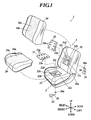
- FIG. 1 is an exploded perspective view illustrating a vehicle seat 1.
- the vehicle seat 1 includes a seat cushion 2 for receiving buttocks of an occupant, and a backrest 3 disposed in an upright state in a rear end of the seat cushion 2.
- the seat cushion 2 is connected to a floor of a vehicle via a front-and-rear position adjusting mechanism and a height adjusting mechanism.
- a front-and-rear position of the seat cushion 2 is adjusted by the position adjusting mechanism, and a height of the seat cushion 2 is adjusted by the height adjusting mechanism.
- Well-known units can be used for the position adjusting mechanism and the height adjusting mechanism.
- the backrest 3 is connected to the rear end of the seat cushion 2 via a reclining mechanism.
- the reclining mechanism adjusts an angle of the backrest 3 with respect to the seat cushion 2.
- the backrest 3 inclines backwardly and rises forwardly by the reclining mechanism, and the reclining mechanism locks the backrest 3.
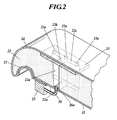
- FIG. 2 is a perspective sectional view illustrating the seat cushion 2 in the state of cutting the seat cushion 2.
- the seat cushion 2 includes a frame 27, a pad 22 disposed on the frame 27, a lining material 21 as a base member for the pad 22, a cover 23 disposed on the pad 22, a top cover member 24 for covering the pad 22 together with the cover 23, and a duct 26 and a blower 25 disposed below the frame 27.
- the frame 27 constitutes a bone structure of the seat cushion 2, and made of, for example, metal.
- a spring is disposed in the frame 27, and the pad 22 is mounted on the frame 27 and the spring.
- the pad 22 is made of a polyurethane foam material, and formed by foaming.
- the lining material 21 is stuck to a lower surface of the pad 22.
- the lining material 21 is integrated with the pad 22.
- a foam resin raw material is supplied to the mold to be foamed and cured.
- the pad 22 is formed and the lining material 21 is integrated with the pad 22.
- the lining material 21 is felt, press-felt, wool, or unwoven cloth.
- the press-felt disclosed in Japanese Patent Application Laid-Open No. 2005-18530 is used as the lining material 21.
- the air permeability of the lining material 21 is preferably low.
- an air guide hole 22a is formed into an H slit shape.
- the air guide hole 22a penetrates the pad 22 from the upper surface to the lower surface.
- a position of the air guide hole 22a is preferably set such that a middle of the air guide hole 22a in a left-and-right direction is a middle of the pad 22 in a left-and-right direction.
- FIG. 3 is a plan view illustrating the air guide hole 22a in the upper surface of the pad 22 as viewed in a penetrating direction of the air guide hole 22a.
- This air guide hole 22a includes a lateral belt portion 22b extending in a left-and-right direction, and a pair of longitudinal belt portions 22c and 22c extending in the front-and-rear direction at both ends of the lateral belt portion 22b.
- a width Wl of the lateral belt portion 22b is preferably set to 10 to 30 mm, more preferably 20 mm.
- a width W2 of the longitudinal belt portion 22c is preferably set to 10 to 30 mm, more preferably 20 mm.
- the lateral belt portion 22b intersects the longitudinal belt portions 22c and 22c at the both ends thereof. Thereby, intersections 22d and 22d are formed. Because the air guide hole 22a is formed in the H slit shape, the air guide hole 22a in the upper surface of the pad 22 is formed in a concaved polygonal, and includes reentrant corners 22e, 22e, 22e and 22e. Since the lateral belt portion 22b intersects the longitudinal belt portions 22c and 22c, a wall surface of the air guide hole 22a forms external corners 22f, 22f, 22f, and 22f.
- the pad 22 includes a protruded portion 22h protruded from the front side toward the rear side of the air guide hole 22a and a protruded portion 22h protruded from the rear side toward the front side of the air guide hole 22a, respectively.
- the lateral belt portion 22b extends in a left-and-right direction between the protruded portions 22h and 22h.
- the air guide hole 22a is blocked by the lining material 21, because the lining material 21 is disposed in the lower surface of the pad 22.
- an inlet hole 21a penetrates the lining material 21 up and down.
- the inlet hole 21a communicates with the lateral belt portion 22b, and a left-and-right position of the inlet hole 21a is in a middle of the lateral belt portion 22b in a left-and-right direction.
- a concaved portion 22d is formed in the upper surface of the pad 22.
- the air guide hole 22a is formed in a bottom of the concaved portion 22d.
- a cover 23 made of a slab polyurethane foam material is fitted to the concaved portion 22d to block the air guide hole 22a from above by the cover 23.
- a surface of the cover 23 and the upper surface of the pad 22 form the same surface.
- a plurality of outlet holes 23a, 23a, ... are formed in the cover 23. These outlet holes 23a, 23a, ... penetrate the cover 23 up and down.
- the outlet holes 23a, 23a, ... are arrayed back and forth in two rows.
- the outlet holes 23a, 23a, ... of one row are arrayed along one longitudinal belt portion 22c to penetrate the cover 23 at one longitudinal belt portion 22c.
- the outlet holes 23a, 23a, ... of the other row are arrayed along the other longitudinal belt portion 22c to penetrate the cover 23 at the other longitudinal belt portion 22c.
- the outlet holes may be formed in the cover 23 between both rows to communicate with the lateral belt portion 22b.
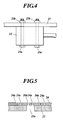
- FIG. 4 is a side view illustrating a fixing structure of the blower 25.
- the blower 25 is fixed to a lower surface of the frame 27 by bolts 25a and nuts 25b.
- One end of the duct 26 is connected to the blower 25, and the other end of the duct 26 is connected to the inlet hole 21a.
- a flange 26a is formed at the other end of the duct 26, the other end of the duct 26 is fitted in the inlet hole 21a, and the flange 26a is hooked on an upper surface of the lining material 21 around the inlet hole 21a.
- a position of disposing the blower 25 is preferably in the front portion or the rear portion of the frame 27. If the blower 25 is disposed in the middle of the frame 27, the middle of the frame 27 is deformed most when an occupant sits on the seat cushion 2.
- FIG. 5 is a sectional view illustrating the top cover member 24 and the cover 23.
- a plurality of microholes 24a are formed in the top cover member 24. These microholes 24a are formed by punching. Because many microholes 24a are distributed in the top cover member 24, some of them overlap the outlet holes 23a and exhaustion is carried out through the outlet holes 23a and the microholes 24a. When the top cover member 24 is highly permeable, there is no need to form microholes 24a in the top cover member 24.
- the air guide hole 22a is formed in the pad 22, the inlet hole 21a formed in the lining material 21 communicates with the air guide hole 22a, and the plurality of outlet holes 23a formed in the cover 23 communicate with the air guide hole 22a.
- the air guide hole 22a functions as a duct. Because the air guide hole 22a functioning as a duct is formed in the pad 22, it is not required that the duct 26 is branched. As a result, the duct 26 can be miniaturized.
- One blower 25 can be shared for the plurality of outlet holes 23a.
- the air guide hole 22a is disposed in symmetrical fashion.
- the inlet hole 21 communicates with the center of the air guide hole 22a.
- a plurality of output holes 23a, 23a, ... are arrayed in two rows.
- the outlet holes 23a of one row are symmetrical to the outlet holes 23a of the other row. Thus, air is uniformly blown out from the outlet holes 23a, 23a, ...
- the air guide hole 22a is formed into the H slit shape by combining a plurality of belt portions.
- the buttocks or the thigh of the seated occupant does not sink in the air guide hole 22a.
- the buttocks or the thigh of the occupant abuts on the protruded portions 22h or the external corners 22f around the intersections 22d to be supported by the protruded portions 22h or the external corners 22f, and the lateral belt portion 22b and the longitudinal belt portions 22c are elongated.
- the air guide hole 22a is formed into not a simple linear slit shape but the H slit shape.
- the air guide hole 22a reaches a wide range of the upper surface of the pad 22. As a result, air is blown out to a wide range of the buttocks or the thigh of the occupant.
- FIG. 6 is a perspective sectional view illustrating the backrest 3 in the state of cutting the backrest 3.
- a pad 32 is disposed on a frame 37 of the backrest 3.
- a lining material 31 is stuck to a back of the pad 32, and the pad 32 is formed by foaming.
- the lining material 31 and the pad 32 are integrated.
- An inlet hole 31a is formed in a center of the lining material 31.
- a concaved portion 32d is formed in a front surface of the pad 32, and an air guide hole 32a is formed in a bottom of the concaved portion 32d.
- the air guide hole 32a penetrates from the bottom of the concaved portion 32d to a rear surface of the pad 32.
- the air guide hole 32a is formed into an H slit shape.
- the air guide hole 32a includes a lateral belt portion 32b extending in a left-and-right direction, and a pair of longitudinal belt portions 32c and 32c extending up and down in both ends of the lateral belt portion 32b. Because the air guide hole 32a is formed in the H slit shape, as in the case of the air guide hole 22a, intersections 32b are formed between the lateral belt portion 32b and the longitudinal belt portions 32c. Further, external corners 32f are formed by a wall surface of the air guide hole 32a, and the air guide hole 32a in the front surface of the pad 32 has a reentrant corner 32e.
- the pad 32 includes a protruded portion 32h protruded from the upper portion toward the lower portion of the air guide hole 32a and a protruded portion 32h protruded from lower portion toward the upper portion of the air guide hole 32a.
- a middle of the air guide hole 32a in a left-and-right direction is preferably a middle of the pad 32 in a left-and-right direction.
- a rear opening of the air guide hole 32a is blocked by the lining material 31.
- the inlet hole 31a formed in the lining material 31 communicates with the air guide hole 32a in a center of the lateral belt portion 32b.
- a cover 33 made of a slab polyurethane foam material is fitted to the concaved portion 32d, and a front opening of the air guide hole 32a is blocked by the cover 33.
- a surface of the cover 33 and the front surface of the pad 32 form the same surface.
- a plurality of outlet holes 33a, 33a, ... are formed in the cover 33.
- the outlet holes 33a, 33a, ... are arrayed up and down in two rows.
- the outlet holes 33a, 33a, ... of one row are arrayed along one longitudinal belt portion 32c to penetrate the cover 33 at one longitudinal belt portion 32c.
- the outlet holes 33a, 33a, ... of the other row are arrayed along the other longitudinal belt portion 32c to penetrate the cover 33 at the other longitudinal belt portion 32c.
- a blower 35 is fixed to a back surface of the frame 37.
- One end of the duct 36 is connected to the blower 35.
- the other end of the duct 36 is fitted in the inlet hole 31a, and a flange 36a of the other end is hooked in a front surface of the frame 37 around the inlet hole 31a.
- the blower 35 is preferably disposed on the lower portion of the frame 37. If the blower 35 is disposed in a middle of the frame 37, the middle of the frame 37 is deformed most when the occupant leans on the backrest 3. If the blower 35 is disposed on the upper portion of the frame 37, the blower 35 becomes obtrusive to an occupant behind the seat 1.
- the top cover member 34 covers the cover 33 and the pad 32 from above the cover 33.
- the top cover member 34 includes a plurality of microholes 34a formed by punching. Some of these microholes 34a overlap the outlet holes 33a, and exhaustion is carried out through the outlet holes 33a and the microholes 34a. If the top cover member 34 is highly permeable, there is no need to form microholes 34a in the top cover member 34.
- the air guide holes 22a and 32a are formed into the H slit shapes.
- other shapes may be employed by combining and communicating a plurality of belt portions with one another.
- the air guide holes 22a and 32a may be formed into E, F, I, M, N, T, U, V, W, X, Y, Z or horseshoe slit shapes.
- the air guide holes having any shapes are used, the air guide holes 22a and 32a can reach wide ranges of the pads 22 and 32, and the back or the buttocks of the seated occupant can be prevented from sinking in the air guide holes 22a and 32a.
- the directions of these character shapes are not limited. However, these shapes are directed so as to be symmetrical.
- a plurality of outlet holes 23a and 33a are preferably arrayed along the shapes of the air guide holes 22a and 32a, and more preferably the outlet holes 23a and 33a are arrayed so as to be symmetrical.
- the inlet holes 21a and 31a are more preferably formed in the lining materials 21 and 31 at the middle portions of the air guide holes 22a and 32a in the left-and-right direction.
- FIG. 7 is a plan view illustrating an air guide hole 51 having a U slit shape as viewed in a penetrating direction of the air guide hole 51.
- the air guide hole 51 includes a pair of longitudinal belt portions 51a and 51a, and a bent portion 51b connected with the end of each of the longitudinal belt portions 51a and 51a.
- the pads 22 and 32 includes protruded portions 52 protruded from one side of the air guide hole 51 toward the opposite side.
- FIG. 8 is a plan view illustrating an air guide hole 61 having a horseshoe slit shape as viewed in a penetrating direction of the air guide hole 61.
- the air guide hole 61 includes a pair of longitudinal belt portions 61a and 61a, and a lateral belt portion 62b connected with the end of each of the longitudinal belt portions 61a and 61a. Since the end of each of the longitudinal belt portions 61a are connected with both ends of the lateral belt portion 62b, the connected portions form bent portions 61c.
- the air guide hole 61 is formed in a horseshoe slit shape, the air guide hole 61 includes reentrant corners 61d and 61d, and external corners 61e and 61e are formed by a wall surface of the air guide hole 61.
- the pads 22 and 32 include protruded portions 62 protruded from one side of the air guide hole 61 toward the opposite side.
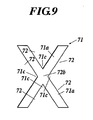
- FIG. 9 is a plan view illustrating an air guide hole 71 having an X slit shape as viewed in a penetrating direction of the air guide hole 71.
- the air guide hole 71 includes oblique belt portions 71a and 71a intersecting each other.
- external corners 71c, 71c, 71c and 71c are formed by a wall surface of the air guide hole 71.
- the air guide hole 71 includes reentrant corners at the external corners 71c.
- blowers 25 and 35 and the ducts 26 and 36 are disposed.
- outlets of an in-room air conditioner of an automobile may be connected with the inlet holes 21a and 31a by a duct to allow air blown from the in-room air conditioner to flow through the duct into the inlet holes 21a and 31a.
- the blowers 25 and 35 may be directly connected to the inlet holes 21a and 31a to directly send air from the blowers 25 and 35 to the inlet holes 21a and 31a.
- the seat according to the present invention is applied to the vehicle seat of the automobile.
- the seat may be applied to seats of other types of vehicles (e.g., airplane and ship).
- the seat of the invention may be applied to other than vehicles.
- the air guide holes 22a and 32a are blocked by the lining materials 21 and 31. However, these holes may be blocked by the frames 27 and 37.
- inlet holes are formed in the frames 27 and 37.
- the frames 27 and 37 are base members.
- forming positions of the inlet holes 21a and 31a have been described.
- forming positions of the inlet holes 21a and 31a are not limited to those of the embodiment. In view of uniform air blowing, forming positions of the inlet holes 21a and 31a, which are described in the embodiment, are preferable.
- a backrest of a seat comprises:
- the air guide hole comprises one of a curved portion, a bent portion and an intersection portion.
- a profile of the air guide hole on the front surface of the pad comprises a reentrant corner.
- a wall surface of the air guide hole forms an external corner.
- the pad comprises a protruded portion protruded from one side of the air guide hole toward an opposite side of the air guide hole as viewed in a penetrating direction of the air guide hole.
- the air guide hole is symmetrical.
- a seat cushion comprises:
- the air guide hole comprises one of a curved portion, a bent portion and an intersection portion.
- a profile of the air guide hole on the upper surface of the pad comprising a reentrant corner.
- a wall surface of the air guide hole forms an external corner.
- the pad comprises a protruded portion protruded from one side of the air guide hole toward an opposite side of the air guide hole as viewed in a penetrating direction of the air guide hole.
- the air guide hole is symmetrical.
- a seat comprises:
- a seat comprises:
- the air guide hole is formed in the pad and the plurality of outlet holes are formed in the cover for blocking the air guide hole, the air guide hole functions as a duct. Air blown into the inlet hole is blown out from each of the outlet holes. Thus, there is no need to dispose any large duct in the backrest or the seat cushion, and one blowing source can be shared for the plurality of outlet holes.
Landscapes
- Engineering & Computer Science (AREA)
- Mechanical Engineering (AREA)
- Aviation & Aerospace Engineering (AREA)
- Transportation (AREA)
- Chair Legs, Seat Parts, And Backrests (AREA)
- Seats For Vehicles (AREA)
Applications Claiming Priority (1)
| Application Number | Priority Date | Filing Date | Title |
|---|---|---|---|
| JP2007265574A JP2009090016A (ja) | 2007-10-11 | 2007-10-11 | シート並びにその座部及びバックレスト |
Publications (1)
| Publication Number | Publication Date |
|---|---|
| EP2048024A1 true EP2048024A1 (de) | 2009-04-15 |
Family
ID=40263118
Family Applications (1)
| Application Number | Title | Priority Date | Filing Date |
|---|---|---|---|
| EP08253311A Withdrawn EP2048024A1 (de) | 2007-10-11 | 2008-10-10 | Sitz, Sitzkissen und Rückenlehne dafür |
Country Status (4)
| Country | Link |
|---|---|
| US (1) | US7857395B2 (de) |
| EP (1) | EP2048024A1 (de) |
| JP (1) | JP2009090016A (de) |
| CN (1) | CN101406351A (de) |
Cited By (1)
| Publication number | Priority date | Publication date | Assignee | Title |
|---|---|---|---|---|
| US20240181946A1 (en) * | 2017-07-31 | 2024-06-06 | Ts Tech Co., Ltd. | Sensor disposition structure in seat |
Families Citing this family (29)
| Publication number | Priority date | Publication date | Assignee | Title |
|---|---|---|---|---|
| JP5251018B2 (ja) * | 2007-07-04 | 2013-07-31 | トヨタ紡織株式会社 | 通気性クッション及びその製造方法 |
| CN101795893A (zh) * | 2007-10-29 | 2010-08-04 | W.E.T.汽车系统股份公司 | 用于座椅的空气调节装置 |
| JP4499167B2 (ja) * | 2008-03-31 | 2010-07-07 | 本田技研工業株式会社 | 温調シート |
| DE102009058996B4 (de) * | 2008-12-21 | 2012-12-06 | W.E.T. Automotive Systems Ag | Belüftungseinrichtung |
| JP5050032B2 (ja) * | 2009-10-16 | 2012-10-17 | ブリヂストンサイクル株式会社 | クッション、子供用座席装置及び二輪車 |
| JP5556156B2 (ja) * | 2009-12-08 | 2014-07-23 | トヨタ紡織株式会社 | 車両用シート |
| JP5591059B2 (ja) * | 2010-10-14 | 2014-09-17 | 株式会社イノアックコーポレーション | ダクト入りシートパッド及びその製造方法 |
| JP2012218655A (ja) * | 2011-04-13 | 2012-11-12 | Nissan Motor Co Ltd | 車両用シート |
| JP2013023003A (ja) * | 2011-07-19 | 2013-02-04 | Toyota Boshoku Corp | 車両用シート |
| WO2014058429A1 (en) * | 2012-10-11 | 2014-04-17 | Kongsberg Automotive, Inc. | Ventilated and heated vehicle seat assembly |
| US9168852B2 (en) | 2012-12-03 | 2015-10-27 | Ford Global Technologies, Llc | Climate comfort seat assembly |
| US9731639B2 (en) * | 2012-12-31 | 2017-08-15 | Kbautotech Co., Ltd. | Vehicle seat provided with channel |
| JP2014172511A (ja) * | 2013-03-08 | 2014-09-22 | Denso Corp | 乗員着座検知用荷重検出装置の取付け構造 |
| JP6094323B2 (ja) * | 2013-03-29 | 2017-03-15 | トヨタ紡織株式会社 | 乗物用シート |
| CN104207521B (zh) * | 2013-06-03 | 2018-09-18 | 陶伟龙 | 一种多项健康功能的通用座椅装置 |
| WO2015030195A1 (ja) * | 2013-08-30 | 2015-03-05 | テイ・エス テック株式会社 | シート |
| JP6305780B2 (ja) * | 2014-02-04 | 2018-04-04 | 美津濃株式会社 | 車両用座席 |
| US9746190B2 (en) * | 2014-06-06 | 2017-08-29 | Intellihot, Inc. | Combined heating system capable of bi-directional heating |
| JP6288851B2 (ja) * | 2014-08-06 | 2018-03-07 | 株式会社タチエス | 通気性シートおよびシートの空調システム |
| JP6355845B2 (ja) * | 2014-10-28 | 2018-07-11 | ジェンサーム オートモーティブ システムズ チャイナリミテッド | ランバースペーサ |
| JP6582068B2 (ja) | 2015-07-21 | 2019-09-25 | ジェンサーム オートモーティブ システムズ チャイナリミテッド | 温度調節される支持装置のためのコネクタ |
| JP6639926B2 (ja) * | 2016-01-25 | 2020-02-05 | 株式会社イノアックコーポレーション | 車両用シートパッド及びその製造方法 |
| JP2017144804A (ja) * | 2016-02-15 | 2017-08-24 | 株式会社イノアックコーポレーション | 車両用シートパッド及びその製造方法 |
| WO2018061602A1 (ja) | 2016-09-30 | 2018-04-05 | テイ・エス テック株式会社 | シート |
| KR20180037679A (ko) * | 2016-10-05 | 2018-04-13 | 현대자동차주식회사 | 자동차용 통풍 시트 |
| JP6652199B2 (ja) * | 2016-10-24 | 2020-02-19 | 株式会社デンソー | 通風シートおよび座席空調装置 |
| KR20200033578A (ko) * | 2018-09-20 | 2020-03-30 | 현대트랜시스 주식회사 | 차량용 통풍 시트 |
| USD889154S1 (en) * | 2018-12-04 | 2020-07-07 | Spec Seats Technologies Inc. | Seat and back cushions for a chair |
| KR102597544B1 (ko) * | 2021-04-02 | 2023-11-03 | 주식회사 디에스시동탄 | 시트용 서포트 구동부 및 이를 포함하는 서포트 어셈블리 |
Citations (10)
| Publication number | Priority date | Publication date | Assignee | Title |
|---|---|---|---|---|
| WO2002053400A2 (en) * | 2001-01-05 | 2002-07-11 | Johnson Controls Technology Company | Air distribution system for ventilated seat |
| US6481801B1 (en) * | 1999-09-21 | 2002-11-19 | Johnson Controls Technology Company | Seat paddings for vehicle seats |
| US20040090093A1 (en) * | 2002-11-13 | 2004-05-13 | Toshifumi Kamiya | Vehicle seat air conditioning system |
| US20040139758A1 (en) * | 2003-01-14 | 2004-07-22 | Toshifumi Kamiya | Seat air conditioner for vehicle and seat structure |
| JP2005018530A (ja) | 2003-06-27 | 2005-01-20 | Toshiba Corp | 情報処理装置、情報処理プログラム及び情報処理方法 |
| JP2005287532A (ja) | 2004-03-31 | 2005-10-20 | T S Tec Kk | 車両用シート |
| US20050264086A1 (en) * | 2004-05-25 | 2005-12-01 | John Lofy | Climate controlled seat |
| WO2006102509A1 (en) * | 2005-03-23 | 2006-09-28 | Amerigon, Inc. | Vehicle seat with thermal elements |
| US20070040421A1 (en) * | 2005-08-22 | 2007-02-22 | Lear Corporation | Seat assembly having an air plenum member |
| JP2007265574A (ja) | 2006-03-29 | 2007-10-11 | Fujifilm Corp | 磁気記録媒体 |
Family Cites Families (30)
| Publication number | Priority date | Publication date | Assignee | Title |
|---|---|---|---|---|
| US3550523A (en) | 1969-05-12 | 1970-12-29 | Irving Segal | Seat construction for automotive air conditioning |
| DE2510182C3 (de) | 1975-03-08 | 1980-06-26 | Walter 4018 Langenfeld Ismer | Sitz- bzw. Rückenpolster, insbesondere für Fahrzeugsitze |
| JPS63149333A (ja) | 1986-12-15 | 1988-06-22 | Nkk Corp | 焼成塊成鉱用生ペレツトの粉コ−クス被覆方法 |
| US5226188A (en) * | 1992-06-26 | 1993-07-13 | Liou Yaw Tyng | Ventilated foam cushion |
| JPH0648448A (ja) | 1992-07-20 | 1994-02-22 | Adoheya Sansho Kk | 封筒およびその封緘方法 |
| US5597200A (en) | 1993-11-22 | 1997-01-28 | Amerigon, Inc. | Variable temperature seat |
| SE504973C2 (sv) | 1995-09-14 | 1997-06-02 | Walinov Ab | I en ventilerad fordonsstol ingående fläktanordning |
| US5645314A (en) * | 1995-09-21 | 1997-07-08 | Liou; Yaw-Tyng | Ventilation cushion for chairs |
| US5749111A (en) | 1996-02-14 | 1998-05-12 | Teksource, Lc | Gelatinous cushions with buckling columns |
| JP3666774B2 (ja) | 1997-04-09 | 2005-06-29 | 本田技研工業株式会社 | 自動車用シート構造 |
| JP3705395B2 (ja) | 1997-04-22 | 2005-10-12 | 本田技研工業株式会社 | 自動車用シート構造 |
| US5927817A (en) * | 1997-08-27 | 1999-07-27 | Lear Corporation | Ventilated vehicle seat assembly |
| DE19745521C2 (de) | 1997-10-15 | 2001-12-13 | Daimler Chrysler Ag | Polster für einen Fahrzeugsitz |
| JPH11123124A (ja) | 1997-10-21 | 1999-05-11 | Ts Tec Kk | 通気性シート |
| US6179706B1 (en) | 1998-06-19 | 2001-01-30 | Denso Corporation | Seat air conditioner for vehicle |
| DE19847384C1 (de) | 1998-10-14 | 2000-06-21 | Daimler Chrysler Ag | Polster für Sitzteil und/oder Rückenlehne eines Fahrzeugsitzes |
| JP2001047848A (ja) | 1999-08-03 | 2001-02-20 | Denso Corp | 車両用シート空調装置 |
| FR2815901B1 (fr) | 2000-10-31 | 2003-08-08 | Faurecia Sieges Automobile | Element rembourre pour vehicule et son procede de fabrication |
| JP3861674B2 (ja) | 2001-11-30 | 2006-12-20 | 株式会社デンソー | 車両用シート空調装置および空調装置内蔵型車両用シート |
| JP2003235676A (ja) * | 2002-02-18 | 2003-08-26 | Daihatsu Motor Co Ltd | 車両の座席構造 |
| JP2003235677A (ja) * | 2002-02-19 | 2003-08-26 | Daihatsu Motor Co Ltd | 温調シート |
| JP3804566B2 (ja) | 2002-03-28 | 2006-08-02 | 株式会社デンソー | 車両用シート空調装置 |
| JP3835329B2 (ja) | 2002-03-28 | 2006-10-18 | 株式会社デンソー | 車両用シート空調装置 |
| JP4062952B2 (ja) | 2002-04-09 | 2008-03-19 | 松下電器産業株式会社 | 空調座席装置 |
| JP2004073429A (ja) * | 2002-08-15 | 2004-03-11 | Nhk Spring Co Ltd | 通気性シート |
| JP2004082960A (ja) | 2002-08-28 | 2004-03-18 | Johnson Controls Automotive Systems Corp | 乗り物用シート |
| US6857697B2 (en) | 2002-08-29 | 2005-02-22 | W.E.T. Automotive Systems Ag | Automotive vehicle seating comfort system |
| JP4347646B2 (ja) * | 2003-09-24 | 2009-10-21 | 東洋ゴム工業株式会社 | クッションパッド |
| CA2558828C (en) * | 2004-03-31 | 2012-01-24 | Shinya Ishima | Vehicle seat |
| US20080073966A1 (en) * | 2006-08-30 | 2008-03-27 | Lear Corporation | Vehicle seat assembly having a hardness gradient via hollowed sections and/or protrusions |
-
2007
- 2007-10-11 JP JP2007265574A patent/JP2009090016A/ja active Pending
-
2008
- 2008-10-03 US US12/285,411 patent/US7857395B2/en active Active
- 2008-10-10 EP EP08253311A patent/EP2048024A1/de not_active Withdrawn
- 2008-10-13 CN CN200810170177.0A patent/CN101406351A/zh active Pending
Patent Citations (10)
| Publication number | Priority date | Publication date | Assignee | Title |
|---|---|---|---|---|
| US6481801B1 (en) * | 1999-09-21 | 2002-11-19 | Johnson Controls Technology Company | Seat paddings for vehicle seats |
| WO2002053400A2 (en) * | 2001-01-05 | 2002-07-11 | Johnson Controls Technology Company | Air distribution system for ventilated seat |
| US20040090093A1 (en) * | 2002-11-13 | 2004-05-13 | Toshifumi Kamiya | Vehicle seat air conditioning system |
| US20040139758A1 (en) * | 2003-01-14 | 2004-07-22 | Toshifumi Kamiya | Seat air conditioner for vehicle and seat structure |
| JP2005018530A (ja) | 2003-06-27 | 2005-01-20 | Toshiba Corp | 情報処理装置、情報処理プログラム及び情報処理方法 |
| JP2005287532A (ja) | 2004-03-31 | 2005-10-20 | T S Tec Kk | 車両用シート |
| US20050264086A1 (en) * | 2004-05-25 | 2005-12-01 | John Lofy | Climate controlled seat |
| WO2006102509A1 (en) * | 2005-03-23 | 2006-09-28 | Amerigon, Inc. | Vehicle seat with thermal elements |
| US20070040421A1 (en) * | 2005-08-22 | 2007-02-22 | Lear Corporation | Seat assembly having an air plenum member |
| JP2007265574A (ja) | 2006-03-29 | 2007-10-11 | Fujifilm Corp | 磁気記録媒体 |
Cited By (3)
| Publication number | Priority date | Publication date | Assignee | Title |
|---|---|---|---|---|
| US20240181946A1 (en) * | 2017-07-31 | 2024-06-06 | Ts Tech Co., Ltd. | Sensor disposition structure in seat |
| EP4467390A3 (de) * | 2017-07-31 | 2025-02-26 | TS Tech Co., Ltd. | Anordnungsstruktur von sensoren in bezug auf einen sitz |
| US12325343B2 (en) * | 2017-07-31 | 2025-06-10 | Ts Tech Co., Ltd. | Sensor disposition structure in seat |
Also Published As
| Publication number | Publication date |
|---|---|
| US20090096256A1 (en) | 2009-04-16 |
| CN101406351A (zh) | 2009-04-15 |
| US7857395B2 (en) | 2010-12-28 |
| JP2009090016A (ja) | 2009-04-30 |
Similar Documents
| Publication | Publication Date | Title |
|---|---|---|
| US7857395B2 (en) | Seat, seat cushion and backrest thereof | |
| US11932141B2 (en) | Vehicle seat | |
| JP5103114B2 (ja) | 空調シート | |
| US6145925A (en) | Backrest for vehicle seats | |
| US7229129B2 (en) | Ventilated seat | |
| US7533941B2 (en) | Seat pad for vehicle | |
| JP4013765B2 (ja) | 車両用シート空調装置 | |
| US7287812B2 (en) | Vehicle seat | |
| JP5377895B2 (ja) | 通気装置を備える車両用シート | |
| EP1007386A2 (de) | Belüfteter fahrzeugsitzaufbau | |
| CN106470872A (zh) | 用于汽车的多硬度衬垫和具有通风结构的多硬度衬垫 | |
| JP2013255829A (ja) | シート | |
| WO2004020231A1 (ja) | 乗り物用シート | |
| JP7832866B2 (ja) | 車両用シート | |
| JP2007084039A (ja) | 車両用シートパッド | |
| US12377764B2 (en) | Ventilated seat and method of making | |
| JP2007215695A (ja) | 車両用シート | |
| JP6067789B2 (ja) | シート | |
| JP6597589B2 (ja) | シート | |
| US20180312088A1 (en) | Vehicle seating cushion with lines to interconnect with line detents on a structural support | |
| JP2019147513A (ja) | シートパッド及び座席 | |
| JP2025131401A (ja) | 空調シート | |
| JP2024033228A (ja) | 車両用シート | |
| KR19980068492U (ko) | 차량용 시이트 |
Legal Events
| Date | Code | Title | Description |
|---|---|---|---|
| PUAI | Public reference made under article 153(3) epc to a published international application that has entered the european phase |
Free format text: ORIGINAL CODE: 0009012 |
|
| AK | Designated contracting states |
Kind code of ref document: A1 Designated state(s): AT BE BG CH CY CZ DE DK EE ES FI FR GB GR HR HU IE IS IT LI LT LU LV MC MT NL NO PL PT RO SE SI SK TR |
|
| AX | Request for extension of the european patent |
Extension state: AL BA MK RS |
|
| AKX | Designation fees paid | ||
| REG | Reference to a national code |
Ref country code: DE Ref legal event code: 8566 |
|
| STAA | Information on the status of an ep patent application or granted ep patent |
Free format text: STATUS: THE APPLICATION IS DEEMED TO BE WITHDRAWN |
|
| 18D | Application deemed to be withdrawn |
Effective date: 20091016 |