EP2000438A2 - Matériau d'électrode positive et batterie au zinc-nickel - Google Patents
Matériau d'électrode positive et batterie au zinc-nickel Download PDFInfo
- Publication number
- EP2000438A2 EP2000438A2 EP08013269A EP08013269A EP2000438A2 EP 2000438 A2 EP2000438 A2 EP 2000438A2 EP 08013269 A EP08013269 A EP 08013269A EP 08013269 A EP08013269 A EP 08013269A EP 2000438 A2 EP2000438 A2 EP 2000438A2
- Authority
- EP
- European Patent Office
- Prior art keywords
- beta
- nickel oxyhydroxide
- type nickel
- positive electrode
- alkaline
- Prior art date
- Legal status (The legal status is an assumption and is not a legal conclusion. Google has not performed a legal analysis and makes no representation as to the accuracy of the status listed.)
- Withdrawn
Links
Images







Classifications
-
- H—ELECTRICITY
- H01—ELECTRIC ELEMENTS
- H01M—PROCESSES OR MEANS, e.g. BATTERIES, FOR THE DIRECT CONVERSION OF CHEMICAL ENERGY INTO ELECTRICAL ENERGY
- H01M10/00—Secondary cells; Manufacture thereof
- H01M10/24—Alkaline accumulators
- H01M10/30—Nickel accumulators
-
- C—CHEMISTRY; METALLURGY
- C01—INORGANIC CHEMISTRY
- C01G—COMPOUNDS CONTAINING METALS NOT COVERED BY SUBCLASSES C01D OR C01F
- C01G53/00—Compounds of nickel
- C01G53/04—Oxides
-
- H—ELECTRICITY
- H01—ELECTRIC ELEMENTS
- H01M—PROCESSES OR MEANS, e.g. BATTERIES, FOR THE DIRECT CONVERSION OF CHEMICAL ENERGY INTO ELECTRICAL ENERGY
- H01M4/00—Electrodes
- H01M4/02—Electrodes composed of, or comprising, active material
- H01M4/24—Electrodes for alkaline accumulators
- H01M4/32—Nickel oxide or hydroxide electrodes
-
- H—ELECTRICITY
- H01—ELECTRIC ELEMENTS
- H01M—PROCESSES OR MEANS, e.g. BATTERIES, FOR THE DIRECT CONVERSION OF CHEMICAL ENERGY INTO ELECTRICAL ENERGY
- H01M4/00—Electrodes
- H01M4/02—Electrodes composed of, or comprising, active material
- H01M4/36—Selection of substances as active materials, active masses, active liquids
- H01M4/48—Selection of substances as active materials, active masses, active liquids of inorganic oxides or hydroxides
- H01M4/52—Selection of substances as active materials, active masses, active liquids of inorganic oxides or hydroxides of nickel, cobalt or iron
-
- C—CHEMISTRY; METALLURGY
- C01—INORGANIC CHEMISTRY
- C01P—INDEXING SCHEME RELATING TO STRUCTURAL AND PHYSICAL ASPECTS OF SOLID INORGANIC COMPOUNDS
- C01P2002/00—Crystal-structural characteristics
- C01P2002/70—Crystal-structural characteristics defined by measured X-ray, neutron or electron diffraction data
- C01P2002/72—Crystal-structural characteristics defined by measured X-ray, neutron or electron diffraction data by d-values or two theta-values, e.g. as X-ray diagram
-
- C—CHEMISTRY; METALLURGY
- C01—INORGANIC CHEMISTRY
- C01P—INDEXING SCHEME RELATING TO STRUCTURAL AND PHYSICAL ASPECTS OF SOLID INORGANIC COMPOUNDS
- C01P2004/00—Particle morphology
- C01P2004/01—Particle morphology depicted by an image
- C01P2004/03—Particle morphology depicted by an image obtained by SEM
-
- C—CHEMISTRY; METALLURGY
- C01—INORGANIC CHEMISTRY
- C01P—INDEXING SCHEME RELATING TO STRUCTURAL AND PHYSICAL ASPECTS OF SOLID INORGANIC COMPOUNDS
- C01P2004/00—Particle morphology
- C01P2004/30—Particle morphology extending in three dimensions
- C01P2004/32—Spheres
-
- C—CHEMISTRY; METALLURGY
- C01—INORGANIC CHEMISTRY
- C01P—INDEXING SCHEME RELATING TO STRUCTURAL AND PHYSICAL ASPECTS OF SOLID INORGANIC COMPOUNDS
- C01P2004/00—Particle morphology
- C01P2004/51—Particles with a specific particle size distribution
-
- C—CHEMISTRY; METALLURGY
- C01—INORGANIC CHEMISTRY
- C01P—INDEXING SCHEME RELATING TO STRUCTURAL AND PHYSICAL ASPECTS OF SOLID INORGANIC COMPOUNDS
- C01P2004/00—Particle morphology
- C01P2004/60—Particles characterised by their size
- C01P2004/61—Micrometer sized, i.e. from 1-100 micrometer
-
- C—CHEMISTRY; METALLURGY
- C01—INORGANIC CHEMISTRY
- C01P—INDEXING SCHEME RELATING TO STRUCTURAL AND PHYSICAL ASPECTS OF SOLID INORGANIC COMPOUNDS
- C01P2006/00—Physical properties of inorganic compounds
- C01P2006/10—Solid density
-
- C—CHEMISTRY; METALLURGY
- C01—INORGANIC CHEMISTRY
- C01P—INDEXING SCHEME RELATING TO STRUCTURAL AND PHYSICAL ASPECTS OF SOLID INORGANIC COMPOUNDS
- C01P2006/00—Physical properties of inorganic compounds
- C01P2006/11—Powder tap density
-
- C—CHEMISTRY; METALLURGY
- C01—INORGANIC CHEMISTRY
- C01P—INDEXING SCHEME RELATING TO STRUCTURAL AND PHYSICAL ASPECTS OF SOLID INORGANIC COMPOUNDS
- C01P2006/00—Physical properties of inorganic compounds
- C01P2006/12—Surface area
-
- C—CHEMISTRY; METALLURGY
- C01—INORGANIC CHEMISTRY
- C01P—INDEXING SCHEME RELATING TO STRUCTURAL AND PHYSICAL ASPECTS OF SOLID INORGANIC COMPOUNDS
- C01P2006/00—Physical properties of inorganic compounds
- C01P2006/40—Electric properties
-
- C—CHEMISTRY; METALLURGY
- C01—INORGANIC CHEMISTRY
- C01P—INDEXING SCHEME RELATING TO STRUCTURAL AND PHYSICAL ASPECTS OF SOLID INORGANIC COMPOUNDS
- C01P2006/00—Physical properties of inorganic compounds
- C01P2006/80—Compositional purity
-
- H—ELECTRICITY
- H01—ELECTRIC ELEMENTS
- H01M—PROCESSES OR MEANS, e.g. BATTERIES, FOR THE DIRECT CONVERSION OF CHEMICAL ENERGY INTO ELECTRICAL ENERGY
- H01M4/00—Electrodes
- H01M4/02—Electrodes composed of, or comprising, active material
- H01M4/62—Selection of inactive substances as ingredients for active masses, e.g. binders, fillers
- H01M4/624—Electric conductive fillers
- H01M4/625—Carbon or graphite
-
- Y—GENERAL TAGGING OF NEW TECHNOLOGICAL DEVELOPMENTS; GENERAL TAGGING OF CROSS-SECTIONAL TECHNOLOGIES SPANNING OVER SEVERAL SECTIONS OF THE IPC; TECHNICAL SUBJECTS COVERED BY FORMER USPC CROSS-REFERENCE ART COLLECTIONS [XRACs] AND DIGESTS
- Y02—TECHNOLOGIES OR APPLICATIONS FOR MITIGATION OR ADAPTATION AGAINST CLIMATE CHANGE
- Y02E—REDUCTION OF GREENHOUSE GAS [GHG] EMISSIONS, RELATED TO ENERGY GENERATION, TRANSMISSION OR DISTRIBUTION
- Y02E60/00—Enabling technologies; Technologies with a potential or indirect contribution to GHG emissions mitigation
- Y02E60/10—Energy storage using batteries
Definitions
- the present invention relates to beta-type nickel oxyhydroxide and a method of producing thereof, and yet, also relates to a positive electrode active material composed of beta-type nickel oxyhydroxide. Further, the present invention relates to a nickel-zinc battery incorporating a positive electrode comprising beta-type nickel oxyhydroxide as a positive electrode active material and a negative electrode comprising zinc as a negative electrode active material.
- compact-size portable electronic apparatuses especially portable game players, digital cameras and digital video-camera recorders, or the like, have been propagated very significantly. It is expected that these compact-size portable electronic apparatus will be propagated furthermore from now on, and thus, demand for compact-size battery serving as a power-supply source for these compact-size portable electronic apparatuses will also be promoted quickly.
- any of those compact-size portable electronic apparatuses utilizes a high operating voltage and requires a large amount of current, and thus, a usable power source must be distinguished in discharge characteristic under heavy load.
- alkaline-manganese battery has already been propagated most widely, which comprises manganese dioxide for composing the positive electrode and zinc for the negative electrode, and yet, it also comprises highly concentrated alkaline aqueous solution for composing electrolytic solution.
- manganese dioxide and zinc are respectively inexpensive, and yet, because of high energy density per weight, not only for the power-supply source of compact-size portable electronic apparatuses, but the alkaline-manganese battery is also utilized extensively.
- the nickel-zinc battery comprises its positive electrode comprising nickel oxyhydroxide and its negative electrode comprising zinc, which contains such an operating voltage and durability to heavy load respectively being higher than those of the above alkaline-manganese battery.
- nickel oxyhydroxide as a positive electrode active material easily generates oxygen and a large amount of self-discharge as problems to solve.
- HEISEI-10-214621 (1998 ) proposes such a nickel-zinc battery having an "inside-out" type structure with a less amount of self-discharge by utilizing gamma-type nickel oxyhydroxide ( ⁇ -NiOOH) for composing a positive electrode active material.
- ⁇ -NiOOH nickel oxyhydroxide
- Such a battery utilizing the above-cited gamma-type nickel oxyhydroxide has a small amount of self-discharge, and has higher operating potential than that of an alkaline manganese battery.
- it is a problem that such a battery cannot have large discharge capacity because the above gamma-type nickel oxyhydroxide has relatively low density.
- the object of the present invention is to provide such a nickel-zinc battery having such a discharge voltage higher than that of an alkaline-manganese battery and distinguished in the large-current discharge characteristic.
- the present invention introduces such a positive electrode active material comprising beta-type nickel oxyhydroxide consisting of substantially spherical particles.
- mean particle size of the beta-type nickel oxyhydroxide is within a range from 19 ⁇ m to a maximum of 40 ⁇ m.
- bulk density of the beta-type nickel oxyhydroxide is within a range from 1.6 g/cm 3 to a maximum of 2.2g/cm 3 .
- tap density is within a range from 2.2 g/cm 3 to a maximum of 2.7g/cm 3 .
- specific surface area of beta-type nickel oxyhydroxide based on BET method is within a range from 3m 2 /g to a maximum of 50m 2 /g.
- the above-referred beta-type nickel oxyhydroxide for composing the positive electrode active material used for implementing the present invention is previously treated with alkaline aqueous solution and contains alkaline cation between layers of the beta-type nickel oxyhydroxide.
- the nickel-zinc battery proposed by the present invention utilizes the above-referred beta-type nickel oxyhydroxide for composing positive electrode active material.
- the positive electrode at least contains beta-type nickel oxyhydroxide and graphite powder, where the weight ratio of graphite powder against a total weight of the positive electrode is defined within a range from 4% to a maximum of 8%.
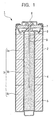
- FIG. 1 is a vertical cross-sectional view of a nickel-zinc battery 1 as an example of a battery according to an embodiment of the present invention.
- the nickel-zinc battery 1 comprises the following: a battery can 2, a positive electrode 3, a separator 4, a negative electrode mixture 5, a sealing member 6, a washer 7, a negative electrode terminal plate 8, and a current collecting pin 9.
- the battery can 2 is made of iron plated with nickel, for example, which constitutes an external positive electrode terminal of the nickel-zinc battery 1.
- the positive electrode 3 is of a hollow cylindrical form. Beta-type nickel oxyhydroxide, graphite powder as electrically conductive agent, and electrolytic aqueous solution of potassium hydride jointly formulate positive electrode mixture.
- the positive electrode mixture is molded into a hollow cylindrical form to prepare positive electrode pellets 3a, 3b, and 3c, which are serially laminated inside of the battery can 2.
- the separator 4 is of hollow cylindrical form and disposed inside of the positive electrode 3.
- the negative electrode mixture 5 comprises zinc particles for composing a negative electrode active material, electrolytic solution using aqueous solution of potassium hydride, and gelling agent which initially gels the negative electrode mixture 5 and then causes zinc particles to be dispersed in the electrolytic solution evenly.
- the battery can 2 internally stores the positive electrode 3 and the separator 4 filled with the negative electrode mixture 5.
- An aperture of the battery can 2 is coupled with the sealing member 6 for sealing the aperture.
- the sealing member 6 is made of plastic material. Further, by way of concealing the sealing member 6, the washer 7 and the negative electrode terminal plate 8 are secured to the sealing member 6. Further, the current collecting pin 9 made of brass is inserted into a through-hole of the sealing member 6 secured with the washer 7 from the upper position.
- the current-collecting pin 9 By way of inserting the nail-form current-collecting pin 9 welded to the negative electrode terminal plate 8 into a through-hole formed at the center of the sealing member 6, the current-collecting pin 9 reaches the negative electrode mixture whereby enabling the negative electrode to collect current.
- the positive electrode By way of connecting the positive electrode 3 to the battery can 2, the positive electrode can collect current.
- External circumferential surface of the battery can 2 is fully concealed by an external label (not shown).
- a positive electrode terminal is positioned to the bottom of the battery can 2.
- the inventive battery comprising the above structural components generates own positive electrode reaction, negative electrode reaction, total reaction, and theoretical electromotive force by way of the following:
- nickel hydride and zinc oxide are respectively generated from nickel oxyhydroxide and zinc via discharge reaction.
- Nickel oxyhydroxide for composing a positive electrode active material is used for composing activating material of secondary batteries such as a nickel-hydrogen battery and a nickel-cadmium battery. It is well known that these batteries proved surpassing discharge performance.
- Nickel oxyhydroxide includes two kinds consisting of beta-type and gamma-type. Normally, these components can easily be generated by way of electrolytically oxidizing nickel hydroxide via so-called electrolytic oxidizing method.
- the synthesized nickel oxyhydroxide in particular, the beta-type nickel oxyhydroxide generates substantial self-discharge to result in the generation of oxygen gas, and thus, in terms of storage characteristic and resistant characteristic against leakage of electrolytic solution, the beta-type nickel oxyhydroxide is not desired for use.
- the beta-type nickel oxyhydroxide in order to use the beta-type nickel oxyhydroxide for composing active material of the primary batteries, it is essential that self-discharge rate be lowered effectively.
- gamma-type nickel oxyhydroxide with less self-discharge rate has been used against the beta-type nickel oxyhydroxide.
- nickel oxyhydroxide itself is multi-layer compound constituted with cadmium iodide crystals.
- nickel oxyhydroxide was synthesized.
- Oxidation reaction generated in the above experiment is expressed by way of the following: 2Ni(OH) 2 + ClO - ⁇ 2NiOOH + Cl - + H 2 O
- type of the resultant nickel oxyhydroxide differs depending on pH value in the chemical solution. More particularly, when the pH value is less than a certain value, high-density beta-type nickel oxyhydroxide with 4.68g/cm 3 of theoretical density is generated. On the other hand, when the pH value exceeds a certain value, low-density gamma-type nickel oxyhydroxide with 3.79g/cm 3 of theoretical density is generated.
- nickel-zinc battery 1 in order to secure a greater capacity for the battery, among the above-referred nickel oxyhydroxides generated via the above-referred chemical oxidizing method, it is preferred that high-density beta-type nickel oxyhydroxide be used for composing positive electrode active material.
- high-density nickel hydroxide comprising substantially spherical particles be used for a starting raw material.
- conventional nickel hydroxide comprises non-spherical particles each having 1.4 - 1.8g/cm 3 of tap density and 1.0 - 1.4g/cm 3 of bulk density.
- the above-referred high-density nickel hydroxide comprises substantially spherical particles each having 2.0 - 2.5g/cm 3 of tap density and 1.4 - 1.8g/cm 3 of bulk density respectively being higher than those of conventional nickel hydroxide.
- the tap density and the bulk density of beta-type nickel oxyhydroxide for forming positive electrode active material specified in the embodiment of the present invention shall remain in a range defined below. More particularly, the tap density of the beta-type nickel oxyhydroxide shall remain in a range of 2.2 - 2.7g/cm 3 , whereas the bulk density of the beta-type nickel oxyhydroxide shall remain in a range of 1.6 - 2.2g/cm 3 . This is because, if the tap density and the bulk density remain less than the lower limit values, it is quite difficult to expand discharge capacity, and yet, it is quite difficult to produce such beta-type nickel oxyhydroxide having greater values of the tap density and the bulk density beyond the upper limit of the defined ranges.
- FIG. 2A exemplifies the inventive beta-type nickel oxyhydroxide comprising substantially spherical particles.
- FIG. 2B exemplifies conventional beta-type nickel oxyhydroxide comprising non-spherical particles.
- the upper side shown in FIGs. 2A and 2B designates photographs of the inventive beta-type nickel oxyhydroxide and the conventional beta-type nickel oxyhydroxide taken via an electronic microscope. Photographs shown in the lower side designate external form of particles shown in the upper side.
- the inventive beta-type nickel oxyhydroxide comprises substantially spherical particles. More particularly, particle surface is relatively smooth without presence of projections. Although there are some of slender and flat particles, as a whole, particles are substantially spherical.
- conventional beta-type nickel oxyhydroxide comprises nonspherical particles showing such a form crushed into powder from a large mass, where each particle is squarish, and yet, there are a variety of forms including flat form, slender form, and substantially cubic form.
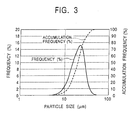
- FIG. 3 exemplifies an example of grading distribution of the inventive beta-type nickel oxyhydroxide.
- the inventive beta-type nickel oxyhydroxide for composing a positive electrode active material for implementing the present invention shall remain within such a mean particle size and a grading distribution specified below. More particularly, it is desired that the inventive beta-type nickel oxyhydroxide shall remain in a range of 19 - 40 ⁇ m of mean particle size. This is because, if the mean particle size is less than 19 ⁇ m or beyond 40 ⁇ m, it causes production of batteries to become quite difficult. It is further desired that the inventive beta-type nickel oxyhydroxide shall remain in a range of 5 ⁇ 80 ⁇ m of the grading distribution.
- mean particle size of the beta-type nickel oxyhydroxide shall remain in a range of 19 ⁇ 25 ⁇ m and the grading distribution shall remain in a range of 5 ⁇ 70 ⁇ m.
- minimum and maximum values of the grading distribution are defined as follows: when 5% of the entire grading values are a value or less than the value, the value is defined to be the minimum value, and when 95% of the entire grading value are a value or less than the value, the value is defined to be the maximum value.
- specific surface area of the beta-type nickel oxyhydroxide based on the BET method shall remain in a range of 3 ⁇ 50m 2 /g. If the specific surface area based on the BET method is less than 3m 2 /g., it will result in the difficulty to expand discharge capacity when discharging large current in particular. Conversely, if the specific surface area based on the BET method exceeds 50m 2 /g., even the beta-type nickel oxyhydroxide has a relatively large amount of self-discharge, which results in difficulty in securing sufficient storage characteristic.
- beta-type nickel oxyhydroxide yielded from nickel hydroxide via chemical oxidation process with such an aqueous solution (devoid of oxidizing agent) comprising one kind among lithium hydroxide, sodium hydroxide, and potassium hydroxide, or two kinds or more than two kinds selected therefrom, and then, by causing alkaline cation to infiltrate into interface of layers of beta-type nickel oxyhydroxide, the inventors discovered that such beta-type nickel oxyhydroxide having such a storage characteristic surpassing that of conventional beta-type nickel oxyhydroxide was secured while preserving high-density proper to the beta-type nickel oxyhydroxide.
- composition of alkaline cation in the beta-type nickel oxyhydroxide generated via the above method shall remain in a range of 2 ⁇ 5% by weight. It is further preferred that the composition of alkaline cation shall remain in a range of 3 ⁇ 5% by weight. If the composition is less than 2% by weight, then, the amount of alkaline cation infiltrated between layers of the beta-type nickel oxyhydroxide will become short whereby storage characteristic can hardly be improved.
- alkaline cation Although a greater amount of alkaline cation may be able to infiltrate between layers by applying higher pressure via an autoclave, for example, if the composition of alkaline cation exceeds 5% by weight, then, the above beta-type nickel oxyhydroxide will be transmuted into low-density gamma-type nickel oxyhydroxide to lose own high-density of the positive electrode active material.
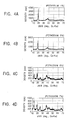
- FIG. 4 exemplifies the relationship between the composition of potassium in the beta-type nickel oxyhydroxide after being treated with aqueous solution of potassium hydroxide and the diffraction figure of powder via an X-ray treatment.
- the X-ray diffraction patterns shown in FIG. 4A and FIG. 4B designate patterns of the beta-type nickel oxyhydroxide. These drawings represent that nickel oxyhydroxide still preserves the beta-form when the contents of potassium ion is less than 5% by weight.
- the X-ray diffraction patterns shown in FIG. 4C and FIG. 4D designate patterns of the gamma-type nickel oxyhydroxide. It is thus understood that the beta-type nickel oxyhydroxide is transmuted into the gamma-type nickel oxyhydroxide when the contents of potassium ion exceeds 6% by weight.
- nickel oxyhydroxide As a positive electrode active material, there is a technical problem to solve because nickel oxyhydroxide and nickel hydroxide generated from nickel oxyhydroxide via discharge respectively contain a low degree of electron conductivity. Accordingly, in order to promote utility of the positive electrode active material, it is preferred to mix graphite powder with the positive electrode mixture.
- the nickel-zinc battery 1 realized by the present invention can secure optimal electron conductivity and storage capacity throughout service life.
- a first beta-type nickel oxyhydroxide was generated.
- the above high-density nickel hydroxide was composed of substantially spherical particles based on 2.3g/cm 3 of tap density and 1.8g/cm 3 of bulk density.
- the above first beta-type nickel oxyhydroxide was composed of substantially spherical particles based on 2.5g/cm 3 of tap density; 2.0g/cm 3 of bulk density, 20 ⁇ m of mean particle size; and 5 ⁇ 70 ⁇ m of grading distribution.
- the above chemical oxidation was executed in alkaline solution containing sodium hypochlorite.
- a gamma-type nickel oxyhydroxide was generated by chemically oxidizing in the same manner as described above.
- the above gamma-type nickel oxyhydroxide was composed of substantially spherical particles based on 1.8g/cm 3 of tap density and 1.6g/cm 3 of bulk density.
- a second beta-type nickel oxyhydroxide was generated by chemically oxidizing a gamma-type nickel oxyhydroxide and conventional nickel hydroxide.
- the second beta-type nickel oxyhydroxide was composed of non-spherical particles based on 1.8g/cm 3 of tap density and 1.4g/cm 3 of bulk density.
- the prepared positive electrode active agents were pressurized by applying identical condition to mold them into a hollow cylindrical configuration before completing the positive electrodes related to the present invention.
- the mixed graphite had 6 ⁇ m of mean particle size, 1 ⁇ 25 ⁇ m of grading distribution, and a maximum of 0.3% by weight of ash component, as formulated into high-purity powder particles.
- the positive electrode component was inserted in a battery can.
- a separator comprising a polyolefin non-woven fabric complete with hydrophilic treatment was inserted into the positive electrode component.
- gelled negative electrode mixture comprising mixture of zinc, gelling agent, and electrolytic solution was further inserted into the battery can.
- aperture of the battery can was sealed with a sealing member attached with a washer and a current-collecting pin before completing production of alkaline batteries conforming to "AA"-size format as samples 1 ⁇ 4.
- FIG. 11 represents composition (% by weight) of component materials for constituting the positive electrode and filling amount (g) of positive electrode mixture per nickel-zinc battery.
- Sample 1 represents an alkaline-manganese battery.
- Sample 2 represents a nickel-zinc battery using beta-type nickel oxyhydroxide generated via chemical oxidation of high-density nickel hydroxide (this is referred to as a first beta nickel-zinc battery henceforth).
- Sample 3 represents a nickel-zinc battery using gamma-type nickel oxyhydroxide generated via chemical oxidation of high-density nickel hydride (this is referred to as a gamma nickel-zinc battery henceforth).
- Sample 4 represents a nickel-zinc battery using beta-type nickel oxyhydroxide generated via chemical oxidation of conventional nickel hydroxide (this is referred to as a second beta nickel-zinc battery). Note that filling amount of positive electrode mixture per battery differs between respective samples. This is because density of the used positive electrode active material differs between respective samples.
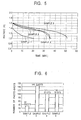
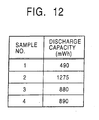
- Discharge curve and discharge capacity of the sample batteries 1 ⁇ 4 are respectively shown in FIG. 5 and FIG. 12 .
- Test result via loading of sample batteries 1 ⁇ 4 in the digital cameras is shown in FIG. 6 .
- the first beta nickel-zinc battery corresponding to sample 2 the gamma nickel-zinc battery corresponding to sample 3, and the second beta nickel-zinc battery corresponding to sample 4 respectively generate quite distinguished discharge characteristic under heavy load.
- those batteries corresponding to samples 2 ⁇ 4 are respectively durable to use for a longer period of time than the alkaline-manganese battery corresponding to sample 1 even when actually being loaded in a compact-size portable electronic apparatus.
- the first beta nickel-zinc battery as sample 2 Compared to the gamma nickel-zinc battery as sample 3 and the second beta nickel-zinc battery as sample 4, the first beta nickel-zinc battery as sample 2 generates more distinguished discharge characteristic. Inasmuch as the nickel oxyhydroxide contained in the sample 2 is of the highest density, it is thus conceived that the sample 2 contains a greater weight of positive electrode mixture per battery than that of the samples 3 and 4, in other words, the sample 2 contains a greater capacity of the positive electrode.
- beta-type nickel oxyhydroxide comprising substantially spherical particles were generated by chemically oxidizing high-density nickel hydroxide, where the high-density nickel hydroxide was composed of substantially spherical particles based on 2.3g/cm 3 of tap density and 1.8g/cm 3 of bulk density; the above chemical oxidizing process was executed in alkaline solution containing sodium hypochlorite.
- a variety of beta-type nickel oxyhydroxides with specific surface area in a range of 1 ⁇ 60m 2 /g based on BET method were prepared.
- gamma-type nickel oxyhydroxides were generated by chemical oxidation.
- a variety of gamma-type nickel oxyhydroxide with specific surface area in a range of 3 ⁇ 50m 2 /g based on BET method were prepared. Except for those which were used for composing a positive electrode active material, as in the sample 3, "AA"-size format alkaline batteries were prepared as Samples 21 ⁇ 24.
- discharge test was executed against the prepared samples 5 ⁇ 28 by continuously discharging voltage until reaching 1.0V at 1500mW of constant power at 20°C of atmospheric temperature.
- One of the discharge tests was executed against those sample batteries aged for two weeks at 20°C after the formation of batteries.
- Other tests were executed against those which were stored for 20 days at 60° C of atmosphere after elapsing two weeks of initial storage period at 20°C from the date of completing production thereof.
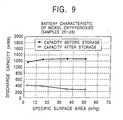
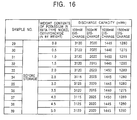
- Results of discharge test executed against samples 5 ⁇ 28 are shown in FIG. 13 and FIGs. 7 ⁇ 9 .
- samples 7 ⁇ 18 utilizing beta-type nickel oxyhydroxide each having 3 ⁇ 50m 2 /g of specific surface area based on BET method respectively generate quite distinguished discharge characteristic under heavy load and durable storage characteristic.
- those samples 21 ⁇ 24 utilizing gamma-type nickel oxyhydroxide for composing a positive electrode via chemical oxidation process respectively fail to generate distinguished discharge characteristic under heavy load.
- those samples 25 ⁇ 28 utilizing beta-type nickel oxyhydroxide for composing positive electrode via electrolytic oxidation process respectively prove to be noticeably poor in the storage durability.
- beta-type nickel oxyhydroxide generated via chemical oxidation of high-density nickel hydroxide should desirably be utilized for composing positive electrode active material. It is further understood that use of such a beta-type nickel oxyhydroxide having own specific surface area within a range of 3 ⁇ 50m 2 /g via BET method is desirable.
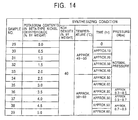
- beta-type nickel oxyhydroxide generated by chemical oxidation of high-density nickel hydroxide was mixed with aqueous solution of potassium hydroxide, and then, adjustment was effected against density of aqueous solution of potassium hydroxide, mixing temperature, mixing time, and mixing pressure. It was so arranged that net contents of potassium in the final formulation of the beta-type nickel oxyhydroxide precisely range from 0.5% by weight to a maximum of 5.0% by weight.
- the above-referred high-density nickel hydroxide was composed of substantially spherical particles based on 2.3g/cm 3 of tap density and 1.8g/cm 3 of bulk density.
- the above chemical oxidation process was executed in alkaline solution containing sodium hypochlorite.
- the resultant beta-type nickel oxyhydroxide was composed of substantially spherical particles each having 20 ⁇ m of mean particle size based on 2.5g/cm 3 of tap density, 2.0g/cm 3 of bulk density, and 5 ⁇ 70 ⁇ m of grading distribution.
- the processing condition is shown in FIG. 14 .
- reaction is implemented via an autoclave.
- the beta-type nickel oxyhydroxide and potassium hydroxide (40% by weight) prior to treatment were arranged to be 1:5 of weight ratio. After completing the treatment, separation and washing were executed against the beta-type nickel oxyhydroxide.
- concentration of potassium hydroxide be in a range from 30% by weight to a maximum of 45% by weight. If concentration of potassium remains below 30% by weight, then it will become difficult to terminate reaction. On the other hand, it is quite hard to procure such potassium hydroxide aqueous solution having more than 45% by weight of concentration from industrial sources.
- a positive electrode mixture was prepared by fully mixing the beta-type nickel oxyhydroxide generated via chemical oxidation of high-density nickel hydroxide, the other beta-type nickel oxyhydroxide generated via an alkaline treatment process, graphite powder, and aqueous solution of potassium hydroxide.
- the graphite power is formulated as high-purity graphite powder comprising 6 ⁇ m of mean particle size, 1 ⁇ 25 ⁇ m of grading distribution, and a maximum of 0.3% by weight of ash component.
- a number of "AA-size format alkaline batteries were produced as samples 29 ⁇ 39.
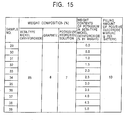
- FIG. 15 designates composition (% by weight) of component materials for composing the positive electrode, composition (% by weight) of potassium dispersed in the beta-type nickel oxyhydroxide, and filling amount (gram) of the positive electrode mixture per battery.
- Composition (% by weight) of potassium dispersed in the beta-type nickel oxyhydroxide was quantitatively analyzed by applying an atomic light-absorptive analysis method.
- the sample 33 incorporating more than 2% by weight of potassium in the beta-type nickel oxyhydroxide incurred less degradation of capacity after storage as a result of treatment with alkaline solution. It was further clarified from the test results of samples 35 ⁇ 39 that further degradation of capacity could be prevented from occurrence by way of providing a minimum of 3% by weight of potassium composition. When there is a maximum of 2% by weight of potassium composition in the beta-type nickel oxyhydroxide, improved effect can hardly be generated in the storage characteristic of batteries.
- potassium ion present in electrolytic solution is absorbed into the beta-type nickel oxyhydroxide during storage, whereby causing concentration of the electrolytic solution to be diluted.
- composition of the alkaline cationic seed after completion of the process should desirably be arranged to be in a range from 2% by weight to a maximum of 5% by weight, more preferably, in a range from 3% by weight to a maximum of 5% by weight before utilizing the beta-type nickel oxyhydroxide to serve as the positive electrode active material.
- beta-type nickel oxyhydroxide comprising substantially spherical particles. It should be understood, however that the form of the beta-type nickel oxyhydroxide is not solely limited to the above substantially spherical configuration, but the present invention is also applicable to a variety of forms other than the spherical configuration as well.
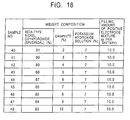
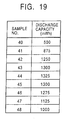
- beta-type nickel oxyhydroxide generated via chemical oxidation of high-density nickel hydroxide, graphite, and 40% by weight of aqueous solution of potassium hydroxide, were fully mixed with each other to produce positive electrode mixture, and then, like the above example, a number of "AA"-size format alkaline batteries were produced as samples 40 ⁇ 48.
- the above beta-type nickel oxyhydroxide was composed of substantially spherical particles each having 20 ⁇ m of mean particle size, based on 2.5g/cm 3 of tap density, 2.0g/cm 3 of bulk density, and 5 ⁇ 70 ⁇ m of grading distribution.
- the above-referred high-density nickel hydroxide is composed of substantially spherical particles based on 2.3g/cm 3 of tap density and 1.8g/cm 3 of bulk density.
- the above chemical oxidation was executed in alkaline solution containing sodium hypochlorite.
- the above graphite was formulated as high-purity graphite powder comprising 6 ⁇ m of mean particle size, 1 ⁇ 25 ⁇ m of grading distribution, and a maximum of 0.3% of ash component.
- the amount of graphite to be included in the positive electrode mixture should desirably be defined to be a minimum of 4% by weight and a maximum of 8% by weight against the total weight of the positive electrode.
- the above description pertaining to practical aspects for embodying the present invention has solely referred to the nickel-zinc battery as a primary battery. It should be understood however that the scope of the present invention is by no means restricted to the primary battery, but the scope of the present invention is also applicable to other nickel-zinc batteries serving as a secondary battery.
- the above description has also referred to a cylindrical nickel-zinc battery.
- the scope of the present invention is not solely limited to the cylindrical battery, but the present invention is also applicable to those nickel-zinc batteries with a flat shape and other shapes as well.
- beta-type nickel oxyhydroxide comprising substantially spherical particles.
- the mean particle size of said beta-type nickel oxyhydroxide may remain in a range from 19 ⁇ m to a maximum of 40 ⁇ m.
- the grading distribution of said beta-type nickel oxyhydroxide may remain in a range from 5 ⁇ m to a maximum of 80 ⁇ m.
- the bulk density of said beta-type nickel oxyhydroxide may remain in a range from 1.6g/cm 3 to a maximum of 2.2g/cm 3
- tap density of said beta-type nickel oxyhydroxide may remain in a range from 2.2g/cm 3 to a maximum of 2.7g/cm 3 .
- the specific surface area based on BET method may range from 3m 2 /g to a maximum of 50m 2 /g.
- beta-type nickel oxyhydroxide containing alkaline cation disposed between layers thereof.
- the beta-type nickel oxyhydroxide may comprise substantially spherical particles.
- the alkaline cation substance may comprise any one of or a combination of more than two selected from a group of Li+, Na+, and K+.
- the beta-type nickel oxyhydroxide may contain 2% by weight up to a maximum of 5% by weight of alkaline cation.
- a method of producing beta-type nickel oxyhydroxide may comprise a step of oxidizing nickel hydroxide in alkaline solution containing sodium hypochlorite.
- a method of producing beta-type nickel oxyhydroxide may comprise a step of initially oxidizing nickel hydroxide in alkaline solution containing sodium hypochlorite, and a step of mixing yielded beta-type nickel oxyhydroxide in alkaline solution to cause alkaline cation to be disposed between layers of said beta-type nickel oxyhydroxide.
- the nickel hydroxide may comprise substantially spherical particles.
- Nickel hydroxide may also comprise substantially spherical particles each having bulk density ranging from 1.4g/cm 3 to a maximum of 1.8g/cm 3 and tap density ranging from 2.0g/cm3 to a maximum of 2.5g/cm 3 .
- the alkaline solution for having alkaline cation between layers of said beta-type nickel oxyhydroxide may comprise any one of or a combination of more than two of alkaline salts selected from a group comprising lithium hydroxide, sodium hydroxide, and potassium hydroxide.
- a positive electrode active material comprising beta-type nickel oxyhydroxide, wherein said beta-type nickel oxyhydroxide may comprise substantially spherical particles.
- the mean particle size of said beta-type nickel oxyhydroxide may range from 19 ⁇ m to a maximum of 40 ⁇ m.
- the grading distribution of said beta-type nickel oxyhydroxide may range from 5 ⁇ m to a maximum of 80 ⁇ m.
- the bulk density of said beta-type nickel oxyhydroxide may range from 1.6g/cm 3 to a maximum of 2.2g/cm 3
- tap density of said beta-type nickel oxyhydroxide may range from 2.2g/cm 3 to a maximum of 2.7g/cm 3 .
- specific surface area of said beta-type nickel oxyhydroxide based on BET method may range from 3m 2 /g to a maximum of 50m 2 /g.
- Another possible embodiment may include a positive electrode active material comprising beta-type nickel oxyhydroxide, wherein said beta-type nickel oxyhydroxide has alkaline cation between its own layers.
- the beta-type nickel oxyhydroxide may comprise substantially spherical particles.
- the alkaline cation substance may comprise any one of or a combination of more than two selected from a group comprising Li+, Na+, and K+.
- the beta-type nickel oxyhydroxide may contain 2% by weight to a maximum of 5% by weight of alkaline cation substance therein.
- a further embodiment may include a nickel-zinc battery comprising: a positive electrode comprising mixed powder containing at least beta-type nickel oxyhydroxide being a positive electrode active material and graphite powder being an electric conductive agent; a negative electrode comprising gelled compound containing at least zinc being a negative electrode active material, electrolytic solution, and gelling agent for uniformly dispersing said zinc and electrolytic solution; and a separator being disposed between said positive electrode and said negative electrode; wherein said beta-type nickel oxyhydroxide comprises substantially spherical particles.
- the mean particle size of said beta-type nickel oxyhydroxide may range from 19 ⁇ m to a maximum of 40 ⁇ m.
- grading distribution of said beta-type nickel oxyhydroxide may range from 5 ⁇ m to a maximum of 80 ⁇ m.
- bulk density of said beta-type nickel oxyhydroxide may range from 1.6g/cm 3 to a maximum of 2.2g/cm 3
- tap density of said beta-type nickel oxyhydroxide may range from 2.2g/cm 3 to a maximum of 2.7g/cm 3 .
- specific surface area of said beta-type nickel oxyhydroxide based on BET method may range from 3m 2 /g to a maximum of 50m 2 /g.
- a nickel-zinc battery comprising a positive electrode comprising mixed powder containing at least beta-type nickel oxyhydroxide being a positive electrode active material and graphite powder being an electric conductive agent, a negative electrode comprising gelled compound containing at least zinc being a negative electrode active material, electrolytic solution, and gelling agent for uniformly dispersing zinc and electrolytic solution, and a separator being disposed between said positive electrode and said negative electrode, wherein said beta-type nickel oxyhydroxide has alkaline cation between its own layers.
- Said beta-type nickel oxyhydroxide may comprise substantially spherical particles.
- the alkaline cation substance may comprise any one of or a combination of more than two selected from a group comprising Li+, Na+, and K+.
- beta-type nickel oxyhydroxide may contain 2% by weight to a maximum of 5% by weight of alkaline cation substance therein.
- the positive electrode may be molded into a hollow cylindrical configuration and disposed on an external peripheral portion, said negative electrode in gelled form may be disposed at a center portion, whereas said separator may be disposed between said positive electrode and said negative electrode, whereby forming an "inside-out" structure.
- the positive electrode may also contain 4% by weight to a maximum of 8% by weight of graphite powder against own total weight of said positive electrode.
- a nickel-zinc battery comprising a positive electrode comprising mixed powder containing at least beta-type nickel oxyhydroxide being a positive electrode active material and graphite powder being an electric conductive agent, a negative electrode comprising gelled compound containing at least zinc being a negative electrode active material, electrolytic solution, and gelling agent for uniformly dispersing said zinc and electrolytic solution, and a separator being disposed between said positive electrode and said negative electrode, wherein said beta-type nickel oxyhydroxide comprises substantially spherical particles, and wherein said positive electrode is molded into a hollow cylindrical configuration and disposed on an external peripheral portion, said negative electrode in gelled form is disposed at a center portion, whereas said seperator is disposed between said positive electrode and said negative electrode, whereby forming an "inside-out" structure.
- Still another possible embodiment may include a nickel-zinc battery comprising, a positive electrode comprising mixed powder containing at least beta-type nickel oxyhydroxide being a positive electrode active material and graphite powder being an electric conductive agent, a negative electrode comprising gelled compound containing at least zinc being a negative electrode active material, electrolytic solution, and gelling agent for uniformly dispersing said zinc and electrolytic solution, and a separator being disposed between said positive electrode and said negative electrode, wherein said beta-type nickel oxyhydroxide comprises substantially spherical particles, and wherein said positive electrode may contain 4% by weight to a maximum of 8% by weight of graphite powder against own total weight of said positive electrode.
Landscapes
- Chemical & Material Sciences (AREA)
- Chemical Kinetics & Catalysis (AREA)
- Electrochemistry (AREA)
- General Chemical & Material Sciences (AREA)
- Inorganic Chemistry (AREA)
- Organic Chemistry (AREA)
- Engineering & Computer Science (AREA)
- Manufacturing & Machinery (AREA)
- Battery Electrode And Active Subsutance (AREA)
Applications Claiming Priority (4)
| Application Number | Priority Date | Filing Date | Title |
|---|---|---|---|
| JP2000121339 | 2000-04-21 | ||
| JP2000145601A JP4599659B2 (ja) | 2000-05-17 | 2000-05-17 | ニッケル亜鉛電池 |
| JP2001060394A JP2002008650A (ja) | 2000-04-21 | 2001-03-05 | 正極活物質およびニッケル亜鉛電池 |
| EP01109789A EP1148029A3 (fr) | 2000-04-21 | 2001-04-20 | Matière active d'électrode positive et pile au nickel-zinc l'utilisant |
Related Parent Applications (2)
| Application Number | Title | Priority Date | Filing Date |
|---|---|---|---|
| EP01109789.6 Division | 2001-04-20 | ||
| EP01109789A Division EP1148029A3 (fr) | 2000-04-21 | 2001-04-20 | Matière active d'électrode positive et pile au nickel-zinc l'utilisant |
Publications (2)
| Publication Number | Publication Date |
|---|---|
| EP2000438A2 true EP2000438A2 (fr) | 2008-12-10 |
| EP2000438A3 EP2000438A3 (fr) | 2012-10-17 |
Family
ID=27343166
Family Applications (2)
| Application Number | Title | Priority Date | Filing Date |
|---|---|---|---|
| EP08013269A Withdrawn EP2000438A3 (fr) | 2000-04-21 | 2001-04-20 | Matériau d'électrode positive et batterie au zinc-nickel |
| EP01109789A Withdrawn EP1148029A3 (fr) | 2000-04-21 | 2001-04-20 | Matière active d'électrode positive et pile au nickel-zinc l'utilisant |
Family Applications After (1)
| Application Number | Title | Priority Date | Filing Date |
|---|---|---|---|
| EP01109789A Withdrawn EP1148029A3 (fr) | 2000-04-21 | 2001-04-20 | Matière active d'électrode positive et pile au nickel-zinc l'utilisant |
Country Status (5)
| Country | Link |
|---|---|
| US (3) | US6686091B2 (fr) |
| EP (2) | EP2000438A3 (fr) |
| KR (1) | KR100835871B1 (fr) |
| CN (1) | CN100413123C (fr) |
| TW (1) | TW520575B (fr) |
Families Citing this family (25)
| Publication number | Priority date | Publication date | Assignee | Title |
|---|---|---|---|---|
| JP3976482B2 (ja) * | 2000-08-08 | 2007-09-19 | 三洋電機株式会社 | アルカリ蓄電池用正極活物質の製造方法およびこの正極活物質を用いたニッケル電極ならびにこのニッケル電極を用いたアルカリ蓄電池 |
| AU2002223126A1 (en) * | 2000-11-17 | 2002-05-27 | Toshiba Battery Co., Ltd. | Enclosed nickel-zinc primary battery, its anode and production methods for them |
| EP1445812A4 (fr) * | 2001-10-17 | 2006-11-29 | Sony Corp | Batterie alcaline |
| CN1269247C (zh) * | 2001-11-22 | 2006-08-09 | 索尼公司 | 非水原电池 |
| US6740451B2 (en) | 2001-12-20 | 2004-05-25 | The Gillette Company | Gold additive for a cathode including nickel oxyhydroxide for an alkaline battery |
| RU2207664C1 (ru) * | 2002-02-18 | 2003-06-27 | Григорьева Людмила Константиновна | Положительный электрод щелочного аккумулятора |
| JP2003346795A (ja) * | 2002-03-19 | 2003-12-05 | Tanaka Chemical Corp | 電解酸化によるオキシ水酸化ニッケルの製造方法 |
| JP2004022507A (ja) * | 2002-06-20 | 2004-01-22 | Sony Corp | 電極およびそれを用いた電池 |
| US7273680B2 (en) | 2002-08-28 | 2007-09-25 | The Gillette Company | Alkaline battery including nickel oxyhydroxide cathode and zinc anode |
| US6991875B2 (en) * | 2002-08-28 | 2006-01-31 | The Gillette Company | Alkaline battery including nickel oxyhydroxide cathode and zinc anode |
| US20070248879A1 (en) * | 2002-08-28 | 2007-10-25 | Durkot Richard E | Alkaline battery including nickel oxyhydroxide cathode and zinc anode |
| US20040076881A1 (en) * | 2002-10-17 | 2004-04-22 | Bowden William L. | Method of making a battery |
| US7435395B2 (en) | 2003-01-03 | 2008-10-14 | The Gillette Company | Alkaline cell with flat housing and nickel oxyhydroxide cathode |
| CN1303705C (zh) * | 2003-06-09 | 2007-03-07 | 日立麦克赛尔株式会社 | 碱性电池用正极和碱性电池 |
| AR045219A1 (es) * | 2003-08-08 | 2005-10-19 | Pharmacopeia Inc | Aminas ciclicas inhibidoras de base - 1 que poseen un sustiuyente heterociclico |
| US7291422B2 (en) * | 2003-10-10 | 2007-11-06 | Nissan Motor Co., Ltd. | Battery and related method |
| US7718315B2 (en) * | 2003-11-06 | 2010-05-18 | Panasonic Corporation | Alkaline battery and positive electrode material for alkaline battery comprising nickel oxyhydroxide and manganese dioxide |
| JP4872189B2 (ja) * | 2004-06-02 | 2012-02-08 | 株式会社豊田中央研究所 | アルカリ蓄電池 |
| JP4809592B2 (ja) * | 2004-06-02 | 2011-11-09 | 株式会社豊田中央研究所 | アルカリ電池用の正極活物質の製造方法 |
| US7579105B2 (en) * | 2005-02-18 | 2009-08-25 | The Gillette Company | End cap assembly and vent for high power cells |
| JP2007095544A (ja) * | 2005-09-29 | 2007-04-12 | Sanyo Electric Co Ltd | アルカリ二次電池用正極板およびアルカリ二次電池 |
| US20080038640A1 (en) * | 2006-08-09 | 2008-02-14 | Trainer Philip D | Alkaline cell with nickel oxyhydroxide cathode and zinc anode |
| JP2008053222A (ja) * | 2006-08-23 | 2008-03-06 | Matsushita Electric Ind Co Ltd | 水酸化ニッケル粉末、オキシ水酸化ニッケル粉末、これらの製造方法およびアルカリ乾電池 |
| CN102024994B (zh) * | 2010-11-30 | 2011-12-28 | 辽宁九夷三普电池有限公司 | 一种镍锌二次电池及其制备方法 |
| US20130108931A1 (en) * | 2011-10-31 | 2013-05-02 | General Electric Company | Positive electrode compositions useful for energy storage and other applications; and related devices |
Citations (6)
| Publication number | Priority date | Publication date | Assignee | Title |
|---|---|---|---|---|
| JPS5530133A (en) | 1978-08-25 | 1980-03-03 | Toshiba Corp | Alkali cell |
| US4605604A (en) | 1985-06-18 | 1986-08-12 | Westinghouse Electric Corp. | Nickel-aluminum dry charge reserve battery |
| JPH06196161A (ja) | 1992-12-22 | 1994-07-15 | Sanyo Electric Co Ltd | アルカリ蓄電池 |
| JPH1081522A (ja) | 1996-09-04 | 1998-03-31 | Sakai Chem Ind Co Ltd | 粒子状組成物及びその製造方法 |
| JPH10214621A (ja) | 1997-01-30 | 1998-08-11 | Sanyo Electric Co Ltd | 密閉型アルカリ蓄電池 |
| EP0872904A2 (fr) | 1997-04-14 | 1998-10-21 | Matsushita Electric Industrial Co., Ltd. | Pile au nickel/hydrure de métal |
Family Cites Families (19)
| Publication number | Priority date | Publication date | Assignee | Title |
|---|---|---|---|---|
| JP2765029B2 (ja) * | 1989-03-31 | 1998-06-11 | 日本電池株式会社 | 水酸化ニッケル電極の製造方法 |
| US5085743A (en) * | 1990-05-02 | 1992-02-04 | Physical Sciences, Inc. | Electrode for current-limited cell, cell including the electrode method for using the cell and a method of making the electrode |
| US5700596A (en) * | 1991-07-08 | 1997-12-23 | Matsushita Electric Industrial Co., Ltd. | Nickel hydroxide active material powder and nickel positive electrode and alkali storage battery using them |
| CA2133906A1 (fr) * | 1993-10-20 | 1995-04-21 | Kuninobu Makimoto | Methode de preparation de particules d'hydroxyde de nickel |
| US5626988A (en) * | 1994-05-06 | 1997-05-06 | Battery Technologies Inc. | Sealed rechargeable cells containing mercury-free zinc anodes, and a method of manufacture |
| DE4417744C1 (de) * | 1994-05-20 | 1995-11-23 | Bayer Ag | Verfahren zur Herstellung stabiler Graphitkathoden für die Salzsäureelektrolyse und deren Verwendung |
| JP3606290B2 (ja) * | 1995-04-28 | 2005-01-05 | 日本電池株式会社 | 非水系電池の正極活物質用コバルト含有ニッケル酸リチウムの製造方法 |
| US5905003A (en) * | 1995-06-26 | 1999-05-18 | Energy Conversion Devices, Inc. | Beta to gamma phase cycleable electrochemically active nickel hydroxide material |
| JP3624539B2 (ja) * | 1996-04-01 | 2005-03-02 | 日本電池株式会社 | ニッケル酸リチウム正極板の製造方法およびリチウム電池 |
| JPH1032005A (ja) * | 1996-07-16 | 1998-02-03 | Japan Storage Battery Co Ltd | ニッケル酸リチウム正極活物質およびその製造方法ならびに前記活物質を備えたリチウム電池 |
| US6020088A (en) * | 1997-11-18 | 2000-02-01 | Moltech Power Systems, Inc. | Gamma niooh nickel electrodes |
| JPH11167933A (ja) * | 1997-12-02 | 1999-06-22 | Sanyo Electric Co Ltd | 密閉型アルカリ亜鉛蓄電池 |
| JP4284711B2 (ja) * | 1998-01-23 | 2009-06-24 | パナソニック株式会社 | アルカリ蓄電池用正極活物質 |
| EP0963952A3 (fr) * | 1998-06-12 | 2001-08-29 | Japan Storage Battery Company Limited | Procédé de préparation d'un composé de nickel contenant du lithium |
| US6228535B1 (en) * | 1998-08-17 | 2001-05-08 | Ovonic Battery Company, Inc. | Nickel hydroxide positive electrode material exhibiting improved conductivity and engineered activation energy |
| US6416903B1 (en) * | 1998-08-17 | 2002-07-09 | Ovonic Battery Company, Inc. | Nickel hydroxide electrode material and method for making the same |
| US6576368B1 (en) * | 1998-10-02 | 2003-06-10 | Sanyo Electric Co., Ltd. | Positive active material for use in sealed alkaline storage batteries |
| JP2000113904A (ja) * | 1998-10-07 | 2000-04-21 | Matsushita Electric Ind Co Ltd | アルカリ蓄電池 |
| CN1067659C (zh) * | 1998-12-11 | 2001-06-27 | 清华大学 | 用控制结晶法制备高密度球形氢氧化镍的工艺 |
-
2001
- 2001-04-18 TW TW090109294A patent/TW520575B/zh not_active IP Right Cessation
- 2001-04-19 US US09/838,453 patent/US6686091B2/en not_active Expired - Fee Related
- 2001-04-20 EP EP08013269A patent/EP2000438A3/fr not_active Withdrawn
- 2001-04-20 CN CNB01116672XA patent/CN100413123C/zh not_active Expired - Fee Related
- 2001-04-20 EP EP01109789A patent/EP1148029A3/fr not_active Withdrawn
- 2001-04-21 KR KR1020010021587A patent/KR100835871B1/ko not_active Expired - Fee Related
-
2003
- 2003-06-09 US US10/457,288 patent/US6908707B2/en not_active Expired - Fee Related
- 2003-06-09 US US10/457,638 patent/US7122169B2/en not_active Expired - Fee Related
Patent Citations (6)
| Publication number | Priority date | Publication date | Assignee | Title |
|---|---|---|---|---|
| JPS5530133A (en) | 1978-08-25 | 1980-03-03 | Toshiba Corp | Alkali cell |
| US4605604A (en) | 1985-06-18 | 1986-08-12 | Westinghouse Electric Corp. | Nickel-aluminum dry charge reserve battery |
| JPH06196161A (ja) | 1992-12-22 | 1994-07-15 | Sanyo Electric Co Ltd | アルカリ蓄電池 |
| JPH1081522A (ja) | 1996-09-04 | 1998-03-31 | Sakai Chem Ind Co Ltd | 粒子状組成物及びその製造方法 |
| JPH10214621A (ja) | 1997-01-30 | 1998-08-11 | Sanyo Electric Co Ltd | 密閉型アルカリ蓄電池 |
| EP0872904A2 (fr) | 1997-04-14 | 1998-10-21 | Matsushita Electric Industrial Co., Ltd. | Pile au nickel/hydrure de métal |
Non-Patent Citations (4)
| Title |
|---|
| DELAHAYE-VIDAL ET AL.: "ELECTROCHEMICAL SOCIETY PROCEEDINGS", 1989, ELECTROCHEMICAL SOCIETY, pages: 44 - 60 |
| GLEMSER O. ET AL., ZEITSCHRIFT FUR ANORGANISCHE UND ALLGEMEINE CHEMIE, 1950, pages 26 - 51 |
| LEGER C, JOURNAL OF THE ELECTROCHEMICAL SOCIETY, 1999, pages 924 |
| MELENDRES C. A. ET AL., JOURNAL OF THE ELECTROCHEMICAL SOCIETY, 1987, pages 762 - 763 |
Also Published As
| Publication number | Publication date |
|---|---|
| US20030211033A1 (en) | 2003-11-13 |
| US20020034470A1 (en) | 2002-03-21 |
| EP1148029A2 (fr) | 2001-10-24 |
| KR20010098798A (ko) | 2001-11-08 |
| US20030211393A1 (en) | 2003-11-13 |
| US7122169B2 (en) | 2006-10-17 |
| US6686091B2 (en) | 2004-02-03 |
| EP2000438A3 (fr) | 2012-10-17 |
| TW520575B (en) | 2003-02-11 |
| KR100835871B1 (ko) | 2008-06-09 |
| CN100413123C (zh) | 2008-08-20 |
| EP1148029A3 (fr) | 2008-09-10 |
| US6908707B2 (en) | 2005-06-21 |
| CN1320977A (zh) | 2001-11-07 |
Similar Documents
| Publication | Publication Date | Title |
|---|---|---|
| EP2000438A2 (fr) | Matériau d'électrode positive et batterie au zinc-nickel | |
| US6399247B1 (en) | Nickel-metal hydride secondary battery | |
| EP0383991B2 (fr) | Accumulateur alcalis utilisant un alliage absorbant l'hydrogène | |
| CA1310362C (fr) | Cellule electrochimique rechargeable a electrolyte alkakin et cathode zinc-dioxyde de manganese, a capacite amelioree | |
| US20040209166A1 (en) | Nickel hydrogen secondary battery | |
| EP1195832A1 (fr) | Batterie nickel-hydrogene haute temperature et son procede de fabrication | |
| US5759718A (en) | Alkaline storage battery and method for making same | |
| EP1176649A1 (fr) | Accumulateur secondaire alcalin avec une électrode positive au nickel améliorée et procédure pour son activation | |
| JP4599659B2 (ja) | ニッケル亜鉛電池 | |
| JPH07122271A (ja) | ニッケル極用水酸化ニッケルの製造方法、およびその水酸化ニッケルを用いたニッケル極の製造方法、ならびにそのニッケル極を組込んだアルカリ二次電池 | |
| JP2002289187A (ja) | ベータ型オキシ水酸化ニッケルおよびその製造方法、正極活物質、電池用正極、並びにニッケル亜鉛電池 | |
| JP4882163B2 (ja) | アルカリ亜鉛電池用正極およびアルカリ亜鉛電池 | |
| JP4281275B2 (ja) | アルカリ亜鉛電池 | |
| US6368748B1 (en) | Nickel-metal hydride storage cell having a high capacity and an excellent cycle characteristic and manufacturing | |
| JP2002008650A (ja) | 正極活物質およびニッケル亜鉛電池 | |
| JP4701500B2 (ja) | ニッケル亜鉛電池 | |
| JP4759900B2 (ja) | アルカリ亜鉛電池 | |
| JP2002338252A (ja) | ベータ型オキシ水酸化ニッケルおよびその製造方法、電池用正極、並びに電池 | |
| JP4240871B2 (ja) | アルカリ亜鉛電池 | |
| US6573006B2 (en) | Non-sintered type positive electrode for alkaline storage battery and alkaline storage battery | |
| JP2003168473A (ja) | 円筒型蓄電池 | |
| JP4892796B2 (ja) | アルカリ亜鉛電池 | |
| JP2005183339A (ja) | アルカリ蓄電池用ニッケル極及びアルカリ蓄電池 | |
| JP2010238671A (ja) | アルカリ亜鉛電池 |
Legal Events
| Date | Code | Title | Description |
|---|---|---|---|
| PUAI | Public reference made under article 153(3) epc to a published international application that has entered the european phase |
Free format text: ORIGINAL CODE: 0009012 |
|
| AC | Divisional application: reference to earlier application |
Ref document number: 1148029 Country of ref document: EP Kind code of ref document: P |
|
| AK | Designated contracting states |
Kind code of ref document: A2 Designated state(s): AT BE CH CY DE DK ES FI FR GB GR IE IT LI LU MC NL PT SE TR |
|
| AX | Request for extension of the european patent |
Extension state: AL LT LV MK RO SI |
|
| PUAL | Search report despatched |
Free format text: ORIGINAL CODE: 0009013 |
|
| AK | Designated contracting states |
Kind code of ref document: A3 Designated state(s): DE FR GB |
|
| RIC1 | Information provided on ipc code assigned before grant |
Ipc: C01G 53/04 20060101ALI20120913BHEP Ipc: C01G 1/02 20060101AFI20120913BHEP Ipc: H01M 4/52 20100101ALI20120913BHEP Ipc: H01M 10/30 20060101ALI20120913BHEP Ipc: H01M 4/32 20060101ALI20120913BHEP |
|
| 17P | Request for examination filed |
Effective date: 20121219 |
|
| AKX | Designation fees paid |
Designated state(s): DE FR GB |
|
| STAA | Information on the status of an ep patent application or granted ep patent |
Free format text: STATUS: THE APPLICATION IS DEEMED TO BE WITHDRAWN |
|
| 18D | Application deemed to be withdrawn |
Effective date: 20131101 |