EP1950531A2 - Vorrichtung und Verfahren zur Bereitstellung eines Zeitplans und einer Routenquerverweis an damit in Zusammenhang stehende Anwendungen - Google Patents
Vorrichtung und Verfahren zur Bereitstellung eines Zeitplans und einer Routenquerverweis an damit in Zusammenhang stehende Anwendungen Download PDFInfo
- Publication number
- EP1950531A2 EP1950531A2 EP08100096A EP08100096A EP1950531A2 EP 1950531 A2 EP1950531 A2 EP 1950531A2 EP 08100096 A EP08100096 A EP 08100096A EP 08100096 A EP08100096 A EP 08100096A EP 1950531 A2 EP1950531 A2 EP 1950531A2
- Authority
- EP
- European Patent Office
- Prior art keywords
- event
- route
- schedule
- time
- information
- Prior art date
- Legal status (The legal status is an assumption and is not a legal conclusion. Google has not performed a legal analysis and makes no representation as to the accuracy of the status listed.)
- Withdrawn
Links
Images




Classifications
-
- G—PHYSICS
- G01—MEASURING; TESTING
- G01C—MEASURING DISTANCES, LEVELS OR BEARINGS; SURVEYING; NAVIGATION; GYROSCOPIC INSTRUMENTS; PHOTOGRAMMETRY OR VIDEOGRAMMETRY
- G01C21/00—Navigation; Navigational instruments not provided for in groups G01C1/00 - G01C19/00
- G01C21/26—Navigation; Navigational instruments not provided for in groups G01C1/00 - G01C19/00 specially adapted for navigation in a road network
- G01C21/34—Route searching; Route guidance
- G01C21/3407—Route searching; Route guidance specially adapted for specific applications
- G01C21/343—Calculating itineraries
-
- G—PHYSICS
- G01—MEASURING; TESTING
- G01C—MEASURING DISTANCES, LEVELS OR BEARINGS; SURVEYING; NAVIGATION; GYROSCOPIC INSTRUMENTS; PHOTOGRAMMETRY OR VIDEOGRAMMETRY
- G01C21/00—Navigation; Navigational instruments not provided for in groups G01C1/00 - G01C19/00
- G01C21/26—Navigation; Navigational instruments not provided for in groups G01C1/00 - G01C19/00 specially adapted for navigation in a road network
- G01C21/34—Route searching; Route guidance
-
- G—PHYSICS
- G01—MEASURING; TESTING
- G01C—MEASURING DISTANCES, LEVELS OR BEARINGS; SURVEYING; NAVIGATION; GYROSCOPIC INSTRUMENTS; PHOTOGRAMMETRY OR VIDEOGRAMMETRY
- G01C21/00—Navigation; Navigational instruments not provided for in groups G01C1/00 - G01C19/00
- G01C21/26—Navigation; Navigational instruments not provided for in groups G01C1/00 - G01C19/00 specially adapted for navigation in a road network
-
- G—PHYSICS
- G01—MEASURING; TESTING
- G01C—MEASURING DISTANCES, LEVELS OR BEARINGS; SURVEYING; NAVIGATION; GYROSCOPIC INSTRUMENTS; PHOTOGRAMMETRY OR VIDEOGRAMMETRY
- G01C21/00—Navigation; Navigational instruments not provided for in groups G01C1/00 - G01C19/00
- G01C21/26—Navigation; Navigational instruments not provided for in groups G01C1/00 - G01C19/00 specially adapted for navigation in a road network
- G01C21/34—Route searching; Route guidance
- G01C21/3453—Special cost functions, i.e. other than distance or default speed limit of road segments
- G01C21/3484—Personalized, e.g. from learned user behaviour or user-defined profiles
-
- G—PHYSICS
- G06—COMPUTING OR CALCULATING; COUNTING
- G06Q—INFORMATION AND COMMUNICATION TECHNOLOGY [ICT] SPECIALLY ADAPTED FOR ADMINISTRATIVE, COMMERCIAL, FINANCIAL, MANAGERIAL OR SUPERVISORY PURPOSES; SYSTEMS OR METHODS SPECIALLY ADAPTED FOR ADMINISTRATIVE, COMMERCIAL, FINANCIAL, MANAGERIAL OR SUPERVISORY PURPOSES, NOT OTHERWISE PROVIDED FOR
- G06Q10/00—Administration; Management
- G06Q10/04—Forecasting or optimisation specially adapted for administrative or management purposes, e.g. linear programming or "cutting stock problem"
- G06Q10/047—Optimisation of routes or paths, e.g. travelling salesman problem
-
- G—PHYSICS
- G08—SIGNALLING
- G08G—TRAFFIC CONTROL SYSTEMS
- G08G1/00—Traffic control systems for road vehicles
- G08G1/09—Arrangements for giving variable traffic instructions
- G08G1/0962—Arrangements for giving variable traffic instructions having an indicator mounted inside the vehicle, e.g. giving voice messages
- G08G1/0968—Systems involving transmission of navigation instructions to the vehicle
- G08G1/0969—Systems involving transmission of navigation instructions to the vehicle having a display in the form of a map
-
- G—PHYSICS
- G06—COMPUTING OR CALCULATING; COUNTING
- G06Q—INFORMATION AND COMMUNICATION TECHNOLOGY [ICT] SPECIALLY ADAPTED FOR ADMINISTRATIVE, COMMERCIAL, FINANCIAL, MANAGERIAL OR SUPERVISORY PURPOSES; SYSTEMS OR METHODS SPECIALLY ADAPTED FOR ADMINISTRATIVE, COMMERCIAL, FINANCIAL, MANAGERIAL OR SUPERVISORY PURPOSES, NOT OTHERWISE PROVIDED FOR
- G06Q10/00—Administration; Management
- G06Q10/10—Office automation; Time management
- G06Q10/109—Time management, e.g. calendars, reminders, meetings or time accounting
Definitions
- the present invention relates to an apparatus and method of providing a schedule and a route, and in particular, to an apparatus and method of providing a schedule and a route that provides a route according to a schedule of a user in consideration of various factors related to activity patterns and activities of the user.
- vigation There are known apparatuses (hereinafter, referred to as "navigation") that provide a route of a road using a tracking system, such as GPS, etc.
- the navigation confirms its own position using a GPS receiver and provides a route to a user from the current position to a destination using the confirmed position and a map stored in a storage unit.
- the navigation in providing a route from a start point to a destination, provides a highway-oriented route, a surface street-oriented route, a shortest route, or a recommended route according to the selection of the user.
- the user can select one of the routes to be provided according to his/her preference and can be provided with the corresponding route.
- the user can input his/her schedule in a portable apparatus, such as a cellular phone or a PDA, and can confirm the schedule through a notice message from the portable apparatus.
- a portable apparatus such as a cellular phone or a PDA
- the user can follow the route according to the schedule using the navigation and the portable apparatus.
- the navigation searches a route on the basis of the location of the portable apparatus, and it is difficult to provide a route according to the user's preference and schedule.
- the portable apparatus provides the route according to the user's schedule, but has a disadvantage in that the user is not able to input the detailed schedule.
- An aspect of the present embodiments is to provide an apparatus and method that plans a user's schedule in consideration of various factors related to activity patterns and activities of a user and provides a route according to the planned schedule.
- an apparatus providing a schedule and a route
- the apparatus including an information collection unit analyzing input information and extracting an event to be added to a first schedule, a pattern recognition unit extracting an activity pattern of a user with reference to a past route and past event information, and a generation unit applying the activity pattern to at least one event of the first schedule and the extracted event to generate a second schedule, generating a first route between event locations with reference to position information and time information of each event in the second schedule, generating a third schedule, to which an additional event is added, with reference to a transition time between the event locations and an actual event time, and generating a second route for the additional event in the third schedule.
- a method of providing a schedule and a route including analyzing input information and extracting an event to be added to a first schedule, extracting an activity pattern of a user with reference to a past route and past event information, applying the activity pattern to at least one event of the first schedule and the extracted event to generate a second schedule, generating a first route between event locations with reference to position information and time information of each event in the second schedule, generating a third schedule, to which an additional event is added, with reference to a transition time between the event locations and an actual event time, and generating a second route for the additional event in the third schedule.
- an apparatus providing a schedule and a route for a user, the apparatus including an information collecting unit receiving and analyzing input information; and a generation unit generating a route between at least a first event location and a second event location and a schedule of events, based on location information, time information and the analyzed input information.
- FIG. 1 is a diagram showing a case where a schedule and a route are generated according to an embodiment of the present invention.
- the present embodiment plans a schedule and provides a route according to the planned schedule in consideration of event locations and event times such that the user can perform as many required or desired events as possible within a given period. Further, according to the present embodiment, in planning a schedule, an event at a current position of the user or an event at an adjacent location are added to a schedule, thereby reducing transition time. Further, a desired event, not an indispensable event, may be added to a schedule on the basis of the location for the indispensable event.
- FIG. 1 is a diagram showing a case where an apparatus to provide a schedule and a route (hereinafter, referred to as "schedule and route providing apparatus") 200 provides a route according to a user's schedule with reference to various kinds of information, such as location information 110, time information 120, and priority information 130.
- switchedule and route providing apparatus provides a route according to a user's schedule with reference to various kinds of information, such as location information 110, time information 120, and priority information 130.
- the location information 110 includes the current position of the user and event locations. That is, the schedule and route providing apparatus 200 provides a route with the current position of the user as the start point. Alternatively, when the user inputs a specified point as the start point, the schedule and route providing apparatus 200 may provide a route with the input point as the start point.
- the time information 120 includes the current time, a transition time, and an event time. That is, the schedule and route providing apparatus 200 provides the route with reference to a time from the current time until the user transits, starts the event, and then completes the event. Further, when the user inputs a specified time as the start time, the schedule and route providing apparatus 200 may provide the route with reference to an expected time from the input time until the user transits, performs the event, and then completes the event.
- the priority information 130 is an event priority. Specifically, the schedule and route providing apparatus 200 causes an event having a high priority 130 to be necessarily performed and determines whether or not to perform an event having a low priority 130 with reference to the location information or the time information.
- the route that is provided by the schedule and route providing apparatus 200 may be determined according to event location groups.
- FIG. 1 shows three event location groups 140, 150, and 160.
- the schedule and route providing apparatus 200 constructs a schedule and provides a route such that the user preferentially performs the events of a specified event location group. Further, the route may include the transition between the event location groups according to the location information 110, the time information 120, and the priority information 130.
- the schedule and route providing apparatus 200 causes the user to sequentially perform, for example, events A and B in the first group 140 and then to perform an event C in the second group 150.
- the schedule and route providing apparatus 200 causes the user to perform an event D in the third group 160 and then to perform the events E and F in the second group 150, instead of causing the user to perform the event E after the event C is completed.
- the schedule and route providing apparatus 200 may provide the schedule and the route in consideration of a transition means and a transition time, as well as various kinds of information, such as weather or traffic, and the current position of the user and the current time, or may provide the schedule and the route with reference to an activity pattern of the user.
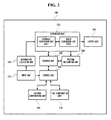
- FIG. 2 is a block diagram showing a schedule and route providing apparatus 200 according to an embodiment of the present invention.
- the schedule and route providing apparatus 200 includes an input unit 210, an information collection unit 220, a generation unit 230, a storage unit 240, a control unit 250, a position confirmation unit 260, a time confirmation unit 270, a pattern recognition unit 280, and an output unit 290.
- the input unit 210 receives group position information about event location groups, each having at least one predetermined event, and group time information about the start time of the event.
- the input unit 210 may be an input device, such as a button, a wheel, a touch pad, or a touch screen, etc., or may be a communication device that receives an email or a short message.
- the user can input the position information of the event location group and the start time of the event in the corresponding event location group so as to receive the schedule and the route from the schedule and route providing apparatus 200.
- the user can input the position information of the first group and the start time of the event A through the input unit 210.
- control unit 250 can determine an event location group and an event start time using the current position and the current time confirmed by the position confirmation unit 260 and the time confirmation unit 270.
- the input unit 210 can receive information (hereinafter, referred to as "event information") about an event that the user wants to perform in the future.
- the event information may include an event location, an event start time, an estimated event completion time, an event name, and a priority level.
- the input unit 210 can receive a state of the event. For example, when the event is completed, the user can input, through the input unit 210, a flag indicating that the corresponding event is completed. Meanwhile, when the user should transit to the next event location, in a state where the corresponding event is not completed, the user can input, through the input unit 210, a flag indicating that the corresponding event is not completed. The judgment of the event completion may be performed by the control unit 250.
- control unit 250 can judge, with reference to the current position and the current time confirmed by the position confirmation unit 260 and the time confirmation unit 270, whether or not the event is completed. For example, when the user stops at a location for a specified event for a predetermined time and then transits to the next event location, the control unit 250 judges that the specified event is completed.
- control unit 250 confirms the events performed by the user and the events not performed by the user, and stores the confirmed events in the storage unit 240.
- the user may perform the events according to the corresponding information or may correct the schedule and route and perform the events according to the corrected schedule and route.
- the control unit 250 confirms the schedule and the route actually performed by the user (hereinafter, referred to as "past event information") regardless of the information output from the output unit 290 and stores the confirmed schedule and route in the storage unit 240.
- the information input through the input unit 210 is transferred to the information collection unit 220, and the information collection unit 220 analyzes the information input through the input unit 210 to extract an event to be added to the schedule. For example, when an email or a short message is input through the input unit 210, the information collection unit 220 analyzes terms, words, or sentence structures of the email or the short message to extract details related to an event to be performed by the user, that is, the event location and event time.
- the generation unit 230 includes a schedule generation unit 231 and a route generation unit 232.
- the event information input through the input unit 210 and the event information extracted by the information collection unit 220 are transferred to the schedule generation unit 231, and the schedule generation unit 231 generates a schedule relative to events including at least one of an event name, group position information, event position information, event time information, and a priority, and updates the schedule table with the generated schedule.
- the details of the schedule table will be described below with reference to FIG. 5 .
- the schedule generation unit 231 may correct the event information (for example, the start time of each event) described in the schedule table with reference to the activity pattern of the user or add additional event information. For example, when the user usually has lunch from noon to 1 p.m., even if the user does not input corresponding event information, the schedule generation unit 231 may add the corresponding event information to the schedule table. Further, when an event described in the schedule table is set from 11:30 to 12:30, the schedule generation unit 231 may correct the schedule table such that the event time of the corresponding event is changed to 11:00 to 12:00 and the lunch time is changed to 12:00 to 1:00. Alternatively, when the priority of the corresponding event is low, the event time of the corresponding event may be reset after 1:00.
- the event information for example, the start time of each event
- the activity pattern of the user can be judged by the pattern recognition unit 280. That is, the pattern recognition unit 280 extracts the activity pattern of the user with reference to the route (that is, the past route) searched by the route generation unit 232 and the past event information stored in the storage unit 240.
- the event location group can be set by the schedule generation unit 231. That is, the schedule generation unit 231 sets an event location group including at least one event with reference to position information of each event in the schedule table and the activity pattern of the user. Further, the schedule generation unit 231 can extract an expected time required for each event in the event location group to generate a schedule, and then update the schedule table using the generated schedule.
- the event location group may be set on the basis of districts, for example, or may have events within a predetermined radius on the basis of a specified point.
- the schedule generation unit 231 may set the event location group with reference to terms in the names of the event locations.
- the storage unit 240 stores the schedule table, the past route, and the past event information.
- the storage unit 240 is a module in which information can be input and output to and from, such as a hard disk, a flash memory, a CF card (Compact Flash Card), an SD card (Secure Digital Card), an SM card (Smart Media Card), an MMC card (Multimedia Card), a memory stick, etc.
- the storage unit 240 may be provided in the schedule and route providing apparatus 200 or may be provided in a separate apparatus. When the storage unit 240 is provided in a separate apparatus, the schedule and route providing apparatus 200 may include a communication device (not shown) that can perform communication with the storage unit 240.
- the route generation unit 232 searches the route between event locations with reference to at least one of the group position information, the group time information, the event position information about the event location where the event is performed, the event time information about the event time, and the transition time between the event locations.
- the generation unit 230 can generate the schedule and route of the user with reference to the priorities of the events. For example, the generation unit 230 allows the events having a higher priority to be performed preferentially, and allows the events having a lower priority to be performed when there is extra time.
- the generation unit 230 can determine whether or not to include an event location, in which an event in a different event location group from a specified event location group is performed, in the route. For example, the generation unit 230 allows the event in the event location group at the current position of the user to be performed preferentially, and allows the events in a different event location group to be performed when there is extra time. At this time, the generation unit 230 can determine whether or not to perform the event in the different event location group with reference to the transition time between the current event location group and the different event location group and with reference to available transportation.
- the route generation unit 232 may refer to current position information and current time information. Specifically, when the user inputs a specified event location group or a specified event, the route generation unit 232 searches a route considering a transition time between the event locations, an event time of each event, and available transportation between the event locations with the current position of the user and the current time as the start point and start time, such that the user can perform an event in the corresponding event location group or can perform a specified event.
- the current position information and the current time information can be confirmed by the position confirmation unit 260 and the time confirmation unit 270.
- the position confirmation unit 260 confirms information about a geographical position where the schedule and route providing apparatus 200 is located.
- the position confirmation unit 260 may have a GPS receiver, or any other position determining device.
- the position confirmation unit 260 can confirm the current position using various systems, including, for example, a cell tracking system using a mobile phone network and a distance calculation system that senses electric wave signals to be received in a frequency band allocated by a frequency sharing system, in addition to a system using a GPS.
- the cell tracking system is a method that uses analysis of electric wave sensitivities between base stations, and an error tolerance may be 500 to 1,500 m.
- the time confirmation unit 270 may include and use, for example, a predetermined timer, may use a clock of the GPS receiver provided in the position confirmation unit 260, or any other time confirming device.
- the generation unit 230 can regenerate a schedule including only events which can be performed between the start time and completion time input by the user among the events in the schedule, and can generate a route with reference to the regenerated schedule. Accordingly, if the user inputs a time range, such as a day, a week, or a month, the user can be provided with a schedule relative to the corresponding time range.
- the output unit 290 outputs the schedule generated by the generation unit 230 and the route searched by the route generation unit 232.
- the output unit 290 may display the schedule and route on a screen, output voice information, etc.
- the output unit 290 may include a display unit (not shown), a speaker (not shown), and a conversion unit (not shown) that analyzes the schedule and the route to convert them into voice information.
- the output unit 290 may include a predetermined network device.
- the output unit 290 may transmit the search result through a network using the network device.
- FIG. 3 is a block diagram showing the detailed structure of the route generation unit 232 shown in FIG. 2 .
- the route generation unit 232 includes a position-based search unit 310, a priority-based search unit 320, a transition time search unit 330, and a transportation search unit 340.
- the position-based search unit 310 searches a route on the basis of the current position of the user or an event location. For example, in searching a route to cause the user to perform a plurality of events in an event location group, the position-based search unit 310 searches a route such that the event locations are located at a close range.
- the priority-based search unit 320 searches a route according to the priorities allocated to the individual events. That is, the priority-based search unit 320 searches the route such that the events having a higher priority among a plurality of events in the event location group are performed preferentially.
- the transition time search unit 330 searches a route on the basis of the transition time between the event locations. That is, the transition time search unit 330 searches the route such that the transition time between the event locations is minimized.
- the transportation search unit 340 searches transportation that can be rapidly and easily used by the user between the event locations.
- the route generation unit 232 searches the route of the user according to various conditions. In addition, the route generation unit 232 can search the route in consideration of all the conditions.
- the route generation unit 232 can search the route of the user by applying weighted values of the conditions. For example, it is assumed that point A is close to the current point and the event at point A has a lower priority, while point B is distant from the current point and the event at point B has a higher priority.
- the route generation unit 232 connects the current point and point A.
- the route generation unit 232 connects the current point and point B.
- the weighted value may be set by the user or may be set by the generation unit 230 after the activity pattern of the user is confirmed.
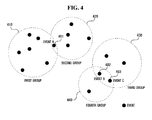
- FIG. 4 is a diagram showing a case where the events of the user are grouped by the locations according to an embodiment of the present invention.
- each of groups 410, 420, 430, and 440 includes a plurality of events.
- the groups 410, 420, 430, and 440 may be divided on the basis of districts or may be set by the user.
- the districts may have various sizes according to the units, higher districts may form one group, lower districts may form another group, and one group may include another group therein.
- the user can set a group including all events within a predetermined radius on the basis of a specified event location or a specified point. Further, the user can set a range of a group in a polygonal shape or a geometrical shape.
- Two or more groups can include a specified event simultaneously.
- an event A 401 can be included in the first group 410 and the second group 420 simultaneously
- an event B 402 and an event C 403 may be included in the third group 430 and the fourth group 440 simultaneously.
- the route generation unit 232 can more efficiently search the route between the event in the corresponding event location group and the event in a different event location group.
- FIG. 5 is a diagram showing a schedule table relative to the events of the user according to an embodiment of the present invention.
- the schedule table 500 includes an event time field 510, an event name field 520, a group position field 530, an event location field 540, and a priority field 550.
- the event time field 510 includes a date field 511 and a detail time field 512.
- the date field 511 describes the date on which an event is to be performed
- the detail time field 512 describes the start time and completion time of the corresponding event.
- the date may be a calendar time concept, such as year, month, and day, or a time concept, such as a weekday, weekend, the first Saturday, or before Thanksgiving, the time concept being any concept the user uses in the user's personal life.
- the generation unit 230 converts the time concept into a calendar date and thereby generates the schedule and route.
- the event name described in the event name field 520 can be selected and input by the user.
- the user can confirm the event on the basis of the event name output through the output unit 290.
- the group position field 530 describes the position information of the event location group including the location where the corresponding event is performed.
- the event location group includes natural features, districts, points of interest (POI), or a location range assigned by the user.
- the position information thereof may be the group position information.
- the event location field 540 describes position information about the location where the corresponding event is to be performed.
- the event position information may be more detailed position information than the group position information.
- the event position information may include coordinates on a map, such as WGS-84 (World Geodetic System 1984).
- the priority of the event described in the priority field 550 may be set by the user or may be set by the schedule generation unit 231.
- the schedule generation unit 231 may correct the event information described in the schedule table 500 or may add an additional event with reference to the activity pattern of the user. In correcting the specified event or adding the additional event, the schedule generation unit 231 may set the priority of the corresponding event according to the activity pattern of the user.
- the date field 511, the detail time field 512, the group position field 530, or the event location field 540 relative to the specified event may not be described. That is, when the date is not important to perform the event even if the event should be performed at a specified detail time and a specified location, the user may not describe the date. For example, when the user who has a lunch engagement with another person at a specified location is near another person, the route generation unit 232 may include lunch with another person in the route with reference to time information, that is, lunchtime, and position information, that is, the specified location, regardless of the date.
- FIG. 6 is a diagram showing a schedule and a route according to an embodiment of the present invention.
- FIG. 6 shows events in each of groups 610, 620, and 630 and routes determined according to the example situations.
- the event information collected by the input unit 210 or the information collection unit 220 is transferred to the schedule generation unit 231, and the schedule generation unit 231 generates a schedule using the transferred event information. Accordingly, the events 611 in group A 610 include "ART SCHOOL” and "LUNCH”.
- the route generation unit 232 searches a route that connects group A 610 and group C 630. In searching the route, the route generation unit 232 can refer to the expected transition time between group A 610 and group C 630 and usable transportation 660. Referring to FIG. 6 , since the event "LUNCH” is expected to be completed at 14:30, the start time of the event “ENJOY PERFORMANCE” is just 16:00, and the transition time is 40 minutes, it can be expected that all the events can be performed reasonably. Therefore, the route generation unit 232 can generate the route that connects group A 610 and group C 630.
- the route generation unit 232 can exclude one of either the event 611 in group A 610 or the event in group C 630 in consideration of the priority of each event, possible transportation, and transition to a different event location and generate a route for the user to perform the other event.
- the schedule generation unit 231 adds this event to the schedule table 500.
- the route generation unit 232 can generate a route that connects group A 610 and group B 620. At this time, the route generation unit 232 can determine whether or not to include group B 620 in the route with reference to an expected transition time from group A 610 to group B 620 and usable transportation 640, and an expected transition time from group B 620 to group C 630 and usable transportation 650.
- FIG. 7 is a diagram showing a case where a schedule and a route are output according to an embodiment.
- FIG. 7 shows events in each of event location groups 710, 720, 730, and 740, routes between event locations, and routes between the event location groups.
- the user can confirm the schedule and the route shown in FIG. 7 output through the output unit 290, and can transit to the event location or the group position. Meanwhile, though not described in FIG. 7 , the transition time between the event locations or the group positions and transportation can be displayed.
- FIG. 7 shows the schedule and the route that are visually displayed on the display unit of the output unit 290.
- the schedule and the route can be output through the speaker of the output unit 290 auditorily.
- a route indicated by a dotted line represents a route according to a low priority. That is, the route generation unit 232 preferentially searches a route following the events "ART SCHOOL", “LUNCH”, and “SHOPPING” in group B 720. When the event "ART SCHOOL” is completed earlier than an expected time, the route generation unit 232 may insert the event "PURCHASE SCHOOL UNIFORM" before the event "LUNCH”.
- the route generation unit 232 can generate group B 720 and group C 730 connected to group A 710 simultaneously, and group B 720 and group C 730 can be output through the output unit 290.
- two routes can be output simultaneously.
- one route can be selected by the user, and a route according to the selected route can be successively generated.
- the route generation unit 232 excludes transition to group C 730 in the route. Then, transition to group D 740 is excluded in the route. Meanwhile, when the user selects transition from group A 710 to group C 730, the route generation unit 232 excludes transition to group A 710 from the path and determines whether or not to transit to group D 740.
- FIG. 8 is a flowchart showing a process of generating a schedule and a route according to an embodiment.
- the information collection unit 210 of the schedule and route providing apparatus 200 analyzes information input through the input unit 210 to extract an event to be added to a schedule (S810).
- the collected information is transferred to the schedule generation unit 231, and the schedule generation unit 231 generates a schedule table 500 relative to the extracted events (S820).
- the generated schedule table 500 is stored in the storage unit 240, and the control unit 250 controls the position confirmation unit 260 and the time confirmation unit 270 to confirm current position information and time (S830) and receives the confirmed current position information and time. Meanwhile, when the position confirmation unit 260 and the time confirmation unit 270 are not provided in the schedule and route providing apparatus 200, the confirmation process of the current position information and time may be omitted.
- the confirmed position information and time are transferred to the route generation unit 232, and the route generation unit 232 searches a route according to the schedule table 500 stored in the storage unit 240 (S840). That is, the route generation unit 232 searches the route between the event locations and the event location groups in consideration of position, priority, transition time, and transportation such that the user can effectively perform as many events as possible within a given time.
- the searched route is stored in the storage unit 240, and the schedule generation unit 231 may reconstruct the schedule relative to the events with reference to the searched route (S850). In reconstructing the schedule, the schedule generation unit 231 can use the activity pattern of the user recognized by the pattern recognition unit 280.
- the schedule and route providing apparatus 200 may consider at the completion time of the specified event that the corresponding event is completed. Further, the user may transit to the corresponding event location, and when the event is completed, may input a flag indicating that the event is completed. In such a manner, when the user inputs the flag indicating that the specified event is completed or when the schedule and route providing apparatus 200 judges that the event is completed, the control unit 250 confirms a time difference between the just-completed event and an event to be subsequently performed (S860). Then, when it is judged that an event having the lower priority can be sufficiently performed, the control unit 250 controls the generation unit 230 to regenerate a schedule and a route for the event having the lower priority (S870).
- the regenerated schedule and route are transferred to the output unit 290, and the output unit 290 outputs the transferred schedule and route (S880). That is, the output unit 290 outputs the route visually or auditorily.
- the route of the user is provided in consideration of various factors related to the activity patterns and the activities of the user, such that the user can perform as many events as possible within a given time.
Landscapes
- Engineering & Computer Science (AREA)
- Radar, Positioning & Navigation (AREA)
- Remote Sensing (AREA)
- General Physics & Mathematics (AREA)
- Physics & Mathematics (AREA)
- Business, Economics & Management (AREA)
- Human Resources & Organizations (AREA)
- Automation & Control Theory (AREA)
- Economics (AREA)
- Strategic Management (AREA)
- Entrepreneurship & Innovation (AREA)
- Operations Research (AREA)
- Health & Medical Sciences (AREA)
- Game Theory and Decision Science (AREA)
- General Health & Medical Sciences (AREA)
- Social Psychology (AREA)
- Marketing (AREA)
- Development Economics (AREA)
- Quality & Reliability (AREA)
- Tourism & Hospitality (AREA)
- General Business, Economics & Management (AREA)
- Theoretical Computer Science (AREA)
- Management, Administration, Business Operations System, And Electronic Commerce (AREA)
- Navigation (AREA)
Applications Claiming Priority (1)
| Application Number | Priority Date | Filing Date | Title |
|---|---|---|---|
| KR1020070001597A KR101329289B1 (ko) | 2007-01-05 | 2007-01-05 | 일정 및 경로를 생성하는 장치 및 방법 |
Publications (2)
| Publication Number | Publication Date |
|---|---|
| EP1950531A2 true EP1950531A2 (de) | 2008-07-30 |
| EP1950531A3 EP1950531A3 (de) | 2014-11-26 |
Family
ID=39495724
Family Applications (1)
| Application Number | Title | Priority Date | Filing Date |
|---|---|---|---|
| EP08100096.0A Withdrawn EP1950531A3 (de) | 2007-01-05 | 2008-01-04 | Vorrichtung und Verfahren zur Bereitstellung eines Zeitplans und einer Routenquerverweis an damit in Zusammenhang stehende Anwendungen |
Country Status (5)
| Country | Link |
|---|---|
| US (1) | US7864073B2 (de) |
| EP (1) | EP1950531A3 (de) |
| JP (1) | JP5253820B2 (de) |
| KR (1) | KR101329289B1 (de) |
| CN (1) | CN101216318B (de) |
Families Citing this family (80)
| Publication number | Priority date | Publication date | Assignee | Title |
|---|---|---|---|---|
| EP1407624A2 (de) * | 2001-07-16 | 2004-04-14 | Wavemarket, Inc. | Sytem zur lesitung von alarm-basierenden diensten zu mobilstationen in einem drahtlosen kommunikationsnetzwerk |
| US7739040B2 (en) | 2006-06-30 | 2010-06-15 | Microsoft Corporation | Computation of travel routes, durations, and plans over multiple contexts |
| EP3239919A1 (de) | 2008-03-05 | 2017-11-01 | eBay Inc. | Verfahren und vorrichtung für bilderkennungsdienste |
| US9495386B2 (en) | 2008-03-05 | 2016-11-15 | Ebay Inc. | Identification of items depicted in images |
| US8208941B2 (en) * | 2008-10-02 | 2012-06-26 | Nokia Corporation | Method, apparatus, and computer program product for providing access to a media item based at least in part on a route |
| US9164577B2 (en) | 2009-12-22 | 2015-10-20 | Ebay Inc. | Augmented reality system, method, and apparatus for displaying an item image in a contextual environment |
| US10956999B2 (en) | 2010-03-02 | 2021-03-23 | International Business Machines Corporation | Service class prioritization within a controllable transit system |
| US20110218835A1 (en) * | 2010-03-02 | 2011-09-08 | International Business Machines Corporation | Changing priority levels within a controllable transit system |
| US20110218833A1 (en) * | 2010-03-02 | 2011-09-08 | International Business Machines Corporation | Service class prioritization within a controllable transit system |
| JP5279761B2 (ja) * | 2010-05-11 | 2013-09-04 | 株式会社エヌ・ティ・ティ・ドコモ | 情報処理装置、情報処理方法およびプログラム |
| CN101883148B (zh) * | 2010-06-24 | 2012-12-26 | 华为终端有限公司 | 一种添加日程的方法及装置 |
| US8725174B2 (en) | 2010-10-23 | 2014-05-13 | Wavemarket, Inc. | Mobile device alert generation system and method |
| US20120197764A1 (en) * | 2011-02-02 | 2012-08-02 | Ebay Inc. | Method and process of using metadata associated with a digital media to search for local inventory |
| US9449342B2 (en) | 2011-10-27 | 2016-09-20 | Ebay Inc. | System and method for visualization of items in an environment using augmented reality |
| US9240059B2 (en) | 2011-12-29 | 2016-01-19 | Ebay Inc. | Personal augmented reality |
| US8630800B1 (en) * | 2012-02-02 | 2014-01-14 | Google Inc. | Travel routes interface |
| US9412273B2 (en) | 2012-03-14 | 2016-08-09 | Autoconnect Holdings Llc | Radar sensing and emergency response vehicle detection |
| WO2014172327A1 (en) | 2013-04-15 | 2014-10-23 | Flextronics Ap, Llc | Synchronization between vehicle and user device calendar |
| US9349234B2 (en) | 2012-03-14 | 2016-05-24 | Autoconnect Holdings Llc | Vehicle to vehicle social and business communications |
| US9378601B2 (en) | 2012-03-14 | 2016-06-28 | Autoconnect Holdings Llc | Providing home automation information via communication with a vehicle |
| US9082239B2 (en) | 2012-03-14 | 2015-07-14 | Flextronics Ap, Llc | Intelligent vehicle for assisting vehicle occupants |
| US9384609B2 (en) | 2012-03-14 | 2016-07-05 | Autoconnect Holdings Llc | Vehicle to vehicle safety and traffic communications |
| US10846766B2 (en) | 2012-06-29 | 2020-11-24 | Ebay Inc. | Contextual menus based on image recognition |
| US8949334B2 (en) * | 2012-07-26 | 2015-02-03 | Microsoft Corporation | Push-based recommendations |
| KR102053901B1 (ko) * | 2012-08-16 | 2019-12-09 | 삼성전자주식회사 | 일정 관리 방법, 일정 관리 서버 및 그를 위한 이동 단말 |
| CN103776457A (zh) * | 2012-10-23 | 2014-05-07 | 昆山研达电脑科技有限公司 | 自动智能导航方法 |
| EP2817591A4 (de) * | 2013-04-15 | 2015-10-07 | Flextronics Ap Llc | Verhaltensänderung durch geänderte zuordnungsrouten auf basis von anwenderprofilinformationen |
| US9773018B2 (en) | 2013-08-13 | 2017-09-26 | Ebay Inc. | Mapping item categories to ambiguous queries by geo-location |
| CN103442072B (zh) * | 2013-09-02 | 2017-03-15 | 百度在线网络技术(北京)有限公司 | 与用户日程相关的交通信息推送方法和装置 |
| CN103699643A (zh) * | 2013-12-25 | 2014-04-02 | 三星电子(中国)研发中心 | 移动终端中的事务记录实现方法及装置 |
| WO2015146202A1 (ja) | 2014-03-24 | 2015-10-01 | 日本電気株式会社 | ルート算出装置、ナビゲーション装置、ルート算出方法、ナビゲーション方法、および通信システム |
| US9510152B2 (en) | 2014-04-11 | 2016-11-29 | Location Labs, Inc. | System and method for scheduling location measurements |
| US9146116B1 (en) * | 2014-06-04 | 2015-09-29 | Google Inc. | Automatic continued search |
| US20170167882A1 (en) * | 2014-08-04 | 2017-06-15 | Xerox Corporation | System and method for generating available ride-share paths in a transportation network |
| US9389094B2 (en) * | 2014-09-05 | 2016-07-12 | Paypal, Inc. | Methods and systems for determining routing |
| JP2016066124A (ja) * | 2014-09-22 | 2016-04-28 | 富士通株式会社 | スケジューリング方法及び情報処理装置 |
| KR20160051231A (ko) | 2014-11-03 | 2016-05-11 | 삼성전자주식회사 | 약속 장소 위치 예측 방법 및 이를 제공하는 전자 장치 |
| CN107076563B (zh) * | 2014-12-09 | 2020-09-25 | 索尼公司 | 信息处理设备、控制方法和程序 |
| DE102015205482A1 (de) * | 2015-03-26 | 2016-09-29 | Volkswagen Aktiengesellschaft | Vorrichtung, Verfahren und Computerprogramm zum Erstellen einer zeitlichen Abfolge von Aktivitäten eines Nutzers |
| CN104881717A (zh) * | 2015-05-28 | 2015-09-02 | 魅族科技(中国)有限公司 | 一种路线推荐方法及用户终端 |
| CN104966188B (zh) * | 2015-06-15 | 2019-06-25 | 联想(北京)有限公司 | 一种信息处理方法及电子设备 |
| US10692126B2 (en) | 2015-11-17 | 2020-06-23 | Nio Usa, Inc. | Network-based system for selling and servicing cars |
| CN105512857A (zh) * | 2015-11-30 | 2016-04-20 | 惠州华阳通用电子有限公司 | 一种基于车载模式的事件提醒方法及装置 |
| CN105488591B (zh) * | 2015-11-30 | 2020-01-31 | 惠州华阳通用电子有限公司 | 一种基于步行模式的事件提醒方法及装置 |
| JP6494550B2 (ja) * | 2016-03-23 | 2019-04-03 | Kddi株式会社 | 作業管理装置、パッケージ生成方法及びパッケージ生成プログラム |
| US20180012197A1 (en) | 2016-07-07 | 2018-01-11 | NextEv USA, Inc. | Battery exchange licensing program based on state of charge of battery pack |
| US9928734B2 (en) | 2016-08-02 | 2018-03-27 | Nio Usa, Inc. | Vehicle-to-pedestrian communication systems |
| US10031523B2 (en) | 2016-11-07 | 2018-07-24 | Nio Usa, Inc. | Method and system for behavioral sharing in autonomous vehicles |
| US10708547B2 (en) | 2016-11-11 | 2020-07-07 | Nio Usa, Inc. | Using vehicle sensor data to monitor environmental and geologic conditions |
| US10694357B2 (en) | 2016-11-11 | 2020-06-23 | Nio Usa, Inc. | Using vehicle sensor data to monitor pedestrian health |
| US10410064B2 (en) | 2016-11-11 | 2019-09-10 | Nio Usa, Inc. | System for tracking and identifying vehicles and pedestrians |
| US10699305B2 (en) | 2016-11-21 | 2020-06-30 | Nio Usa, Inc. | Smart refill assistant for electric vehicles |
| US10249104B2 (en) | 2016-12-06 | 2019-04-02 | Nio Usa, Inc. | Lease observation and event recording |
| CN106650974B (zh) * | 2016-12-30 | 2021-10-22 | 深圳天珑无线科技有限公司 | 基于日程的事件项目规划方法和装置 |
| US10074223B2 (en) | 2017-01-13 | 2018-09-11 | Nio Usa, Inc. | Secured vehicle for user use only |
| US9984572B1 (en) | 2017-01-16 | 2018-05-29 | Nio Usa, Inc. | Method and system for sharing parking space availability among autonomous vehicles |
| US10031521B1 (en) | 2017-01-16 | 2018-07-24 | Nio Usa, Inc. | Method and system for using weather information in operation of autonomous vehicles |
| US10471829B2 (en) | 2017-01-16 | 2019-11-12 | Nio Usa, Inc. | Self-destruct zone and autonomous vehicle navigation |
| US10464530B2 (en) | 2017-01-17 | 2019-11-05 | Nio Usa, Inc. | Voice biometric pre-purchase enrollment for autonomous vehicles |
| US10286915B2 (en) | 2017-01-17 | 2019-05-14 | Nio Usa, Inc. | Machine learning for personalized driving |
| US10897469B2 (en) | 2017-02-02 | 2021-01-19 | Nio Usa, Inc. | System and method for firewalls between vehicle networks |
| US10929818B2 (en) | 2017-02-16 | 2021-02-23 | Seoul National University R&Db Foundation | Wearable sensor-based automatic scheduling device and method |
| KR101891181B1 (ko) * | 2017-02-16 | 2018-08-23 | 서울대학교산학협력단 | 웨어러블 센서 기반 일정 자동 관리 장치 및 방법 |
| JP6855909B2 (ja) * | 2017-04-27 | 2021-04-07 | 富士通株式会社 | 作業支援システム、情報処理装置、及び作業支援方法 |
| US10234302B2 (en) | 2017-06-27 | 2019-03-19 | Nio Usa, Inc. | Adaptive route and motion planning based on learned external and internal vehicle environment |
| US10369974B2 (en) | 2017-07-14 | 2019-08-06 | Nio Usa, Inc. | Control and coordination of driverless fuel replenishment for autonomous vehicles |
| US10710633B2 (en) | 2017-07-14 | 2020-07-14 | Nio Usa, Inc. | Control of complex parking maneuvers and autonomous fuel replenishment of driverless vehicles |
| US10837790B2 (en) | 2017-08-01 | 2020-11-17 | Nio Usa, Inc. | Productive and accident-free driving modes for a vehicle |
| US10499191B1 (en) | 2017-10-09 | 2019-12-03 | Snap Inc. | Context sensitive presentation of content |
| US10635109B2 (en) | 2017-10-17 | 2020-04-28 | Nio Usa, Inc. | Vehicle path-planner monitor and controller |
| US10935978B2 (en) | 2017-10-30 | 2021-03-02 | Nio Usa, Inc. | Vehicle self-localization using particle filters and visual odometry |
| US10606274B2 (en) | 2017-10-30 | 2020-03-31 | Nio Usa, Inc. | Visual place recognition based self-localization for autonomous vehicles |
| US10717412B2 (en) | 2017-11-13 | 2020-07-21 | Nio Usa, Inc. | System and method for controlling a vehicle using secondary access methods |
| US11532064B2 (en) | 2017-12-27 | 2022-12-20 | Nissan Motor Co., Ltd. | Destination proposal system, proposal device, and proposal method |
| JP7040947B2 (ja) * | 2018-01-22 | 2022-03-23 | トヨタ自動車株式会社 | 情報処理装置、情報処理方法、及びプログラム |
| JP6894575B2 (ja) * | 2018-02-15 | 2021-06-30 | 本田技研工業株式会社 | 経路案内装置、経路案内方法、およびプログラム |
| US10369966B1 (en) | 2018-05-23 | 2019-08-06 | Nio Usa, Inc. | Controlling access to a vehicle using wireless access devices |
| CN109670786B (zh) * | 2018-12-13 | 2021-03-30 | Oppo广东移动通信有限公司 | 日程生成方法、装置、电子设备、计算机可读存储介质 |
| KR102540494B1 (ko) * | 2021-03-30 | 2023-06-05 | 서울시립대학교 산학협력단 | 이동수단 선택 장치 및 방법 |
| US12140436B2 (en) * | 2021-06-22 | 2024-11-12 | Capital One Services, Llc | Waypoint identification in association with route navigation |
Family Cites Families (23)
| Publication number | Priority date | Publication date | Assignee | Title |
|---|---|---|---|---|
| JP3443975B2 (ja) * | 1994-08-31 | 2003-09-08 | 株式会社エクォス・リサーチ | 案内装置 |
| US5790974A (en) * | 1996-04-29 | 1998-08-04 | Sun Microsystems, Inc. | Portable calendaring device having perceptual agent managing calendar entries |
| JPH1030933A (ja) * | 1996-07-17 | 1998-02-03 | Toshiba Corp | 経路検索装置および移動履歴利用システム |
| JPH10267677A (ja) * | 1997-03-28 | 1998-10-09 | Nec Home Electron Ltd | ナビゲーション装置 |
| JP3589124B2 (ja) * | 1999-11-18 | 2004-11-17 | トヨタ自動車株式会社 | ナビゲーション装置 |
| US6603489B1 (en) * | 2000-02-09 | 2003-08-05 | International Business Machines Corporation | Electronic calendaring system that automatically predicts calendar entries based upon previous activities |
| US6381534B2 (en) * | 2000-02-14 | 2002-04-30 | Fujitsu Limited | Navigation information presenting apparatus and method thereof |
| JP2002107174A (ja) | 2000-09-28 | 2002-04-10 | Mitsubishi Electric Corp | ナビゲーション装置および検索方法 |
| JP2003139553A (ja) * | 2001-11-02 | 2003-05-14 | Nippon Telegr & Teleph Corp <Ntt> | 寄り道を考慮した経路探索方法,経路探索装置,そのプログラムおよびそのプログラムの記録媒体 |
| JP2003148986A (ja) * | 2001-11-16 | 2003-05-21 | Alpine Electronics Inc | ドライブ情報提供装置 |
| JP2003256621A (ja) * | 2002-03-04 | 2003-09-12 | Navit Co Ltd | 巡回経路探索型スケジューラーシステム |
| US7318040B2 (en) * | 2002-09-17 | 2008-01-08 | International Business Machines Corporation | Predicting and adjusting users' working hours and electronic calendar events |
| KR20040037324A (ko) | 2002-10-28 | 2004-05-07 | 주식회사 아이월드네트워킹 | 교통 정보 자동 통보 시스템 및 방법 |
| JP2004271335A (ja) * | 2003-03-07 | 2004-09-30 | Denso Corp | ナビゲーション装置 |
| JP2004295351A (ja) * | 2003-03-26 | 2004-10-21 | Fujitsu Social Science Laboratory Ltd | 経路選択機能付き交通費日当自動精算方法及びシステム |
| JP2004333136A (ja) * | 2003-04-30 | 2004-11-25 | Sony Corp | ナビゲーション装置 |
| JP2005128772A (ja) * | 2003-10-23 | 2005-05-19 | Casio Comput Co Ltd | スケジュール管理装置及びプログラム |
| JP4292062B2 (ja) | 2003-12-02 | 2009-07-08 | 国立大学法人 奈良先端科学技術大学院大学 | 経路探索システム、サーバ、携帯端末、経路探索装置、経路探索プログラム |
| JP4266173B2 (ja) * | 2004-02-17 | 2009-05-20 | 株式会社ケンウッド | 案内経路探索装置 |
| JP4419621B2 (ja) * | 2004-03-17 | 2010-02-24 | アイシン・エィ・ダブリュ株式会社 | 旅行計画作成管理システム |
| JP4271107B2 (ja) * | 2004-08-18 | 2009-06-03 | 株式会社東芝 | ナビゲーションシステム |
| US20060235856A1 (en) * | 2004-12-16 | 2006-10-19 | Halcrow Michael A | Route generation for task completion by a location-aware device |
| KR20060081193A (ko) | 2005-01-07 | 2006-07-12 | 삼성전자주식회사 | 스케쥴 기능과 연계한 네비게이션 기능이 구현된 이동통신 단말기에서의 경로 안내 제공 방법 |
-
2007
- 2007-01-05 KR KR1020070001597A patent/KR101329289B1/ko not_active Expired - Fee Related
- 2007-11-08 US US11/979,789 patent/US7864073B2/en not_active Expired - Fee Related
-
2008
- 2008-01-04 JP JP2008000116A patent/JP5253820B2/ja not_active Expired - Fee Related
- 2008-01-04 EP EP08100096.0A patent/EP1950531A3/de not_active Withdrawn
- 2008-01-04 CN CN2008100015035A patent/CN101216318B/zh not_active Expired - Fee Related
Also Published As
| Publication number | Publication date |
|---|---|
| US20080165032A1 (en) | 2008-07-10 |
| JP5253820B2 (ja) | 2013-07-31 |
| KR101329289B1 (ko) | 2013-11-14 |
| EP1950531A3 (de) | 2014-11-26 |
| US7864073B2 (en) | 2011-01-04 |
| KR20080064556A (ko) | 2008-07-09 |
| JP2008171423A (ja) | 2008-07-24 |
| CN101216318A (zh) | 2008-07-09 |
| CN101216318B (zh) | 2013-07-10 |
Similar Documents
| Publication | Publication Date | Title |
|---|---|---|
| US7864073B2 (en) | Apparatus and method of providing schedule and route | |
| US8798914B2 (en) | Navigating at a wireless device | |
| EP2624235A2 (de) | Routenleitsystem, Routenleitservervorrichtung und Navigationsendgerätevorrichtung | |
| US8768739B2 (en) | Location and time sensitive wireless calendaring | |
| US7937214B2 (en) | Guidance route search device, navigation device, and method of searching guidance route | |
| US20110246059A1 (en) | Information processing apparatus, behavior prediction display method, and computer program therefor | |
| CN101836081A (zh) | 处理定位数据的方法 | |
| CN103109161A (zh) | 导航装置及方法 | |
| CN110296711A (zh) | 一种行程规划方法及装置 | |
| CN101799989A (zh) | 交通工具定时提醒系统和方法 | |
| WO2016135310A1 (en) | Methods and systems for generating routing policies and routes | |
| JP2002148061A (ja) | 情報端末、気象予測情報サービスシステム、気象予測情報サービス方法及び天気情報付きカーナビゲーションシステム | |
| JP2002041554A (ja) | 施設に関する施設情報の通信方法、通信システム、サーバおよび移動端末 | |
| CN109151168A (zh) | 乘车码的切换方法、装置、移动终端及可读存储介质 | |
| CN110749330B (zh) | 导航路径规划方法及装置 | |
| WO2005032177A1 (en) | Method and system for providing map data search service | |
| CN106323306B (zh) | 一种导航信息处理方法及电子设备 | |
| JP2010236869A (ja) | 目標時間内に到達可能な施設を検索する装置及び方法 | |
| JPH09102094A (ja) | 携帯型ナビゲーション装置 | |
| JP2009092492A (ja) | ナビゲーション装置 | |
| CN101957211A (zh) | 一种通过辨识网页信息导览地理位置的系统与方法 | |
| JP5921972B2 (ja) | 経路案内装置、経路案内方法およびコンピュータプログラム | |
| KR100716981B1 (ko) | 대중교통의 최적경로 검색방법 및 이를 이용한 휴대용 기기 | |
| JP6231405B2 (ja) | 経路探索装置および経路探索方法 | |
| TWI290215B (en) | Path planning method |
Legal Events
| Date | Code | Title | Description |
|---|---|---|---|
| PUAI | Public reference made under article 153(3) epc to a published international application that has entered the european phase |
Free format text: ORIGINAL CODE: 0009012 |
|
| AK | Designated contracting states |
Kind code of ref document: A2 Designated state(s): AT BE BG CH CY CZ DE DK EE ES FI FR GB GR HR HU IE IS IT LI LT LU LV MC MT NL NO PL PT RO SE SI SK TR |
|
| AX | Request for extension of the european patent |
Extension state: AL BA MK |
|
| RAP1 | Party data changed (applicant data changed or rights of an application transferred) |
Owner name: SAMSUNG ELECTRONICS CO., LTD. |
|
| PUAL | Search report despatched |
Free format text: ORIGINAL CODE: 0009013 |
|
| AK | Designated contracting states |
Kind code of ref document: A3 Designated state(s): AT BE BG CH CY CZ DE DK EE ES FI FR GB GR HR HU IE IS IT LI LT LU LV MC MT NL NO PL PT RO SE SI SK TR |
|
| AX | Request for extension of the european patent |
Extension state: AL BA MK |
|
| RIC1 | Information provided on ipc code assigned before grant |
Ipc: G01C 21/34 20060101AFI20141021BHEP Ipc: G06Q 10/00 20120101ALI20141021BHEP |
|
| 17P | Request for examination filed |
Effective date: 20150526 |
|
| RBV | Designated contracting states (corrected) |
Designated state(s): AT BE BG CH CY CZ DE DK EE ES FI FR GB GR HR HU IE IS IT LI LT LU LV MC MT NL NO PL PT RO SE SI SK TR |
|
| AKX | Designation fees paid |
Designated state(s): DE FR GB |
|
| AXX | Extension fees paid |
Extension state: AL Extension state: BA Extension state: MK |
|
| STAA | Information on the status of an ep patent application or granted ep patent |
Free format text: STATUS: THE APPLICATION IS DEEMED TO BE WITHDRAWN |
|
| 18D | Application deemed to be withdrawn |
Effective date: 20170801 |