EP1816476B1 - A testing method of nucleic acid binding protein based on biochip - Google Patents
A testing method of nucleic acid binding protein based on biochip Download PDFInfo
- Publication number
- EP1816476B1 EP1816476B1 EP04797371A EP04797371A EP1816476B1 EP 1816476 B1 EP1816476 B1 EP 1816476B1 EP 04797371 A EP04797371 A EP 04797371A EP 04797371 A EP04797371 A EP 04797371A EP 1816476 B1 EP1816476 B1 EP 1816476B1
- Authority
- EP
- European Patent Office
- Prior art keywords
- nucleic acid
- acid binding
- binding protein
- probes
- acid capture
- Prior art date
- Legal status (The legal status is an assumption and is not a legal conclusion. Google has not performed a legal analysis and makes no representation as to the accuracy of the status listed.)
- Expired - Lifetime
Links
- 102000044158 nucleic acid binding protein Human genes 0.000 title claims abstract description 48
- 108700020942 nucleic acid binding protein Proteins 0.000 title claims abstract description 48
- 238000000018 DNA microarray Methods 0.000 title claims abstract description 21
- 238000012360 testing method Methods 0.000 title abstract 3
- 239000000523 sample Substances 0.000 claims abstract description 147
- 150000007523 nucleic acids Chemical class 0.000 claims abstract description 89
- 102000039446 nucleic acids Human genes 0.000 claims abstract description 87
- 108020004707 nucleic acids Proteins 0.000 claims abstract description 87
- 108091008324 binding proteins Proteins 0.000 claims abstract description 39
- 238000009739 binding Methods 0.000 claims abstract description 32
- 230000027455 binding Effects 0.000 claims abstract description 31
- 238000009396 hybridization Methods 0.000 claims abstract description 31
- 239000012472 biological sample Substances 0.000 claims abstract description 3
- 239000000758 substrate Substances 0.000 claims abstract description 3
- 102000023732 binding proteins Human genes 0.000 claims abstract 16
- 238000000034 method Methods 0.000 claims description 72
- 108091023040 Transcription factor Proteins 0.000 claims description 40
- 102000040945 Transcription factor Human genes 0.000 claims description 40
- 108090000623 proteins and genes Proteins 0.000 claims description 38
- 108020004414 DNA Proteins 0.000 claims description 36
- 102000053602 DNA Human genes 0.000 claims description 32
- 102000004169 proteins and genes Human genes 0.000 claims description 29
- 230000003321 amplification Effects 0.000 claims description 27
- 238000003199 nucleic acid amplification method Methods 0.000 claims description 27
- 238000002372 labelling Methods 0.000 claims description 17
- YBJHBAHKTGYVGT-ZKWXMUAHSA-N (+)-Biotin Chemical compound N1C(=O)N[C@@H]2[C@H](CCCCC(=O)O)SC[C@@H]21 YBJHBAHKTGYVGT-ZKWXMUAHSA-N 0.000 claims description 14
- 239000000203 mixture Substances 0.000 claims description 11
- 230000000295 complement effect Effects 0.000 claims description 9
- 239000007850 fluorescent dye Substances 0.000 claims description 8
- 238000002955 isolation Methods 0.000 claims description 8
- 229960002685 biotin Drugs 0.000 claims description 7
- 235000020958 biotin Nutrition 0.000 claims description 7
- 239000011616 biotin Substances 0.000 claims description 7
- LTMHDMANZUZIPE-AMTYYWEZSA-N Digoxin Natural products O([C@H]1[C@H](C)O[C@H](O[C@@H]2C[C@@H]3[C@@](C)([C@@H]4[C@H]([C@]5(O)[C@](C)([C@H](O)C4)[C@H](C4=CC(=O)OC4)CC5)CC3)CC2)C[C@@H]1O)[C@H]1O[C@H](C)[C@@H](O[C@H]2O[C@@H](C)[C@H](O)[C@@H](O)C2)[C@@H](O)C1 LTMHDMANZUZIPE-AMTYYWEZSA-N 0.000 claims description 6
- 108020004682 Single-Stranded DNA Proteins 0.000 claims description 6
- LTMHDMANZUZIPE-PUGKRICDSA-N digoxin Chemical compound C1[C@H](O)[C@H](O)[C@@H](C)O[C@H]1O[C@@H]1[C@@H](C)O[C@@H](O[C@@H]2[C@H](O[C@@H](O[C@@H]3C[C@@H]4[C@]([C@@H]5[C@H]([C@]6(CC[C@@H]([C@@]6(C)[C@H](O)C5)C=5COC(=O)C=5)O)CC4)(C)CC3)C[C@@H]2O)C)C[C@@H]1O LTMHDMANZUZIPE-PUGKRICDSA-N 0.000 claims description 6
- 229960005156 digoxin Drugs 0.000 claims description 6
- LTMHDMANZUZIPE-UHFFFAOYSA-N digoxine Natural products C1C(O)C(O)C(C)OC1OC1C(C)OC(OC2C(OC(OC3CC4C(C5C(C6(CCC(C6(C)C(O)C5)C=5COC(=O)C=5)O)CC4)(C)CC3)CC2O)C)CC1O LTMHDMANZUZIPE-UHFFFAOYSA-N 0.000 claims description 6
- PCHJSUWPFVWCPO-UHFFFAOYSA-N gold Chemical compound [Au] PCHJSUWPFVWCPO-UHFFFAOYSA-N 0.000 claims description 6
- 239000010931 gold Substances 0.000 claims description 6
- 229910052737 gold Inorganic materials 0.000 claims description 6
- 239000002105 nanoparticle Substances 0.000 claims description 6
- 239000002245 particle Substances 0.000 claims description 6
- 230000008569 process Effects 0.000 claims description 6
- 239000000975 dye Substances 0.000 claims description 5
- 102000044126 RNA-Binding Proteins Human genes 0.000 claims description 4
- 108700020471 RNA-Binding Proteins Proteins 0.000 claims description 4
- 238000000746 purification Methods 0.000 claims description 4
- 238000010828 elution Methods 0.000 claims description 3
- 239000002773 nucleotide Substances 0.000 claims description 3
- 125000003729 nucleotide group Chemical group 0.000 claims description 3
- 108091028043 Nucleic acid sequence Proteins 0.000 claims description 2
- 238000005251 capillar electrophoresis Methods 0.000 claims description 2
- 238000005520 cutting process Methods 0.000 claims description 2
- 238000001914 filtration Methods 0.000 claims description 2
- 238000001502 gel electrophoresis Methods 0.000 claims description 2
- 239000012528 membrane Substances 0.000 claims description 2
- 108091008104 nucleic acid aptamers Proteins 0.000 claims description 2
- 238000011084 recovery Methods 0.000 abstract 1
- 102000014914 Carrier Proteins Human genes 0.000 description 23
- 238000001514 detection method Methods 0.000 description 23
- 239000000499 gel Substances 0.000 description 12
- 238000001962 electrophoresis Methods 0.000 description 11
- 230000014509 gene expression Effects 0.000 description 9
- 238000002360 preparation method Methods 0.000 description 9
- 102100023132 Transcription factor Jun Human genes 0.000 description 8
- 239000000872 buffer Substances 0.000 description 8
- 108010018242 Transcription Factor AP-1 Proteins 0.000 description 7
- 238000006243 chemical reaction Methods 0.000 description 7
- 238000010586 diagram Methods 0.000 description 7
- PEDCQBHIVMGVHV-UHFFFAOYSA-N Glycerine Chemical compound OCC(O)CO PEDCQBHIVMGVHV-UHFFFAOYSA-N 0.000 description 6
- 239000000047 product Substances 0.000 description 6
- 230000035897 transcription Effects 0.000 description 6
- 238000013518 transcription Methods 0.000 description 6
- 108091003079 Bovine Serum Albumin Proteins 0.000 description 5
- 229940098773 bovine serum albumin Drugs 0.000 description 5
- 238000013461 design Methods 0.000 description 5
- 239000000243 solution Substances 0.000 description 5
- XLYOFNOQVPJJNP-UHFFFAOYSA-N water Substances O XLYOFNOQVPJJNP-UHFFFAOYSA-N 0.000 description 5
- KCXVZYZYPLLWCC-UHFFFAOYSA-N EDTA Chemical compound OC(=O)CN(CC(O)=O)CCN(CC(O)=O)CC(O)=O KCXVZYZYPLLWCC-UHFFFAOYSA-N 0.000 description 4
- TWRXJAOTZQYOKJ-UHFFFAOYSA-L Magnesium chloride Chemical compound [Mg+2].[Cl-].[Cl-] TWRXJAOTZQYOKJ-UHFFFAOYSA-L 0.000 description 4
- 102100023050 Nuclear factor NF-kappa-B p105 subunit Human genes 0.000 description 4
- FAPWRFPIFSIZLT-UHFFFAOYSA-M Sodium chloride Chemical compound [Na+].[Cl-] FAPWRFPIFSIZLT-UHFFFAOYSA-M 0.000 description 4
- 230000004913 activation Effects 0.000 description 4
- 239000011543 agarose gel Substances 0.000 description 4
- 239000012148 binding buffer Substances 0.000 description 4
- UQLDLKMNUJERMK-UHFFFAOYSA-L di(octadecanoyloxy)lead Chemical compound [Pb+2].CCCCCCCCCCCCCCCCCC([O-])=O.CCCCCCCCCCCCCCCCCC([O-])=O UQLDLKMNUJERMK-UHFFFAOYSA-L 0.000 description 4
- 238000002474 experimental method Methods 0.000 description 4
- 239000000463 material Substances 0.000 description 4
- 238000009987 spinning Methods 0.000 description 4
- 239000011534 wash buffer Substances 0.000 description 4
- 229920000936 Agarose Polymers 0.000 description 3
- 239000003298 DNA probe Substances 0.000 description 3
- IAZDPXIOMUYVGZ-UHFFFAOYSA-N Dimethylsulphoxide Chemical compound CS(C)=O IAZDPXIOMUYVGZ-UHFFFAOYSA-N 0.000 description 3
- 108010090804 Streptavidin Proteins 0.000 description 3
- 102000004586 YY1 Transcription Factor Human genes 0.000 description 3
- 108010042669 YY1 Transcription Factor Proteins 0.000 description 3
- 230000033228 biological regulation Effects 0.000 description 3
- 230000022131 cell cycle Effects 0.000 description 3
- 108020004999 messenger RNA Proteins 0.000 description 3
- 239000002096 quantum dot Substances 0.000 description 3
- 239000011541 reaction mixture Substances 0.000 description 3
- 230000001105 regulatory effect Effects 0.000 description 3
- 238000012216 screening Methods 0.000 description 3
- 230000035945 sensitivity Effects 0.000 description 3
- 239000000126 substance Substances 0.000 description 3
- QKNYBSVHEMOAJP-UHFFFAOYSA-N 2-amino-2-(hydroxymethyl)propane-1,3-diol;hydron;chloride Chemical compound Cl.OCC(N)(CO)CO QKNYBSVHEMOAJP-UHFFFAOYSA-N 0.000 description 2
- 241000894006 Bacteria Species 0.000 description 2
- 108090000790 Enzymes Proteins 0.000 description 2
- 102000004190 Enzymes Human genes 0.000 description 2
- 241000206602 Eukaryota Species 0.000 description 2
- 101000979342 Homo sapiens Nuclear factor NF-kappa-B p105 subunit Proteins 0.000 description 2
- 101001050288 Homo sapiens Transcription factor Jun Proteins 0.000 description 2
- -1 HuB Proteins 0.000 description 2
- 229920001213 Polysorbate 20 Polymers 0.000 description 2
- 102000006290 Transcription Factor TFIID Human genes 0.000 description 2
- 108010083268 Transcription Factor TFIID Proteins 0.000 description 2
- 239000007983 Tris buffer Substances 0.000 description 2
- 230000021736 acetylation Effects 0.000 description 2
- 238000006640 acetylation reaction Methods 0.000 description 2
- 238000004458 analytical method Methods 0.000 description 2
- KGBXLFKZBHKPEV-UHFFFAOYSA-N boric acid Chemical compound OB(O)O KGBXLFKZBHKPEV-UHFFFAOYSA-N 0.000 description 2
- 239000004327 boric acid Substances 0.000 description 2
- UDSAIICHUKSCKT-UHFFFAOYSA-N bromophenol blue Chemical group C1=C(Br)C(O)=C(Br)C=C1C1(C=2C=C(Br)C(O)=C(Br)C=2)C2=CC=CC=C2S(=O)(=O)O1 UDSAIICHUKSCKT-UHFFFAOYSA-N 0.000 description 2
- 201000011510 cancer Diseases 0.000 description 2
- 230000001413 cellular effect Effects 0.000 description 2
- 239000002299 complementary DNA Substances 0.000 description 2
- 201000010099 disease Diseases 0.000 description 2
- 208000037265 diseases, disorders, signs and symptoms Diseases 0.000 description 2
- 239000003596 drug target Substances 0.000 description 2
- 230000000694 effects Effects 0.000 description 2
- 238000005516 engineering process Methods 0.000 description 2
- 229940088598 enzyme Drugs 0.000 description 2
- 238000000605 extraction Methods 0.000 description 2
- 230000013595 glycosylation Effects 0.000 description 2
- 238000006206 glycosylation reaction Methods 0.000 description 2
- 230000006872 improvement Effects 0.000 description 2
- 229910001629 magnesium chloride Inorganic materials 0.000 description 2
- 238000004519 manufacturing process Methods 0.000 description 2
- 238000012775 microarray technology Methods 0.000 description 2
- 230000004048 modification Effects 0.000 description 2
- 238000012986 modification Methods 0.000 description 2
- 230000026731 phosphorylation Effects 0.000 description 2
- 238000006366 phosphorylation reaction Methods 0.000 description 2
- 230000001766 physiological effect Effects 0.000 description 2
- 239000000256 polyoxyethylene sorbitan monolaurate Substances 0.000 description 2
- 235000010486 polyoxyethylene sorbitan monolaurate Nutrition 0.000 description 2
- 238000011160 research Methods 0.000 description 2
- 239000011780 sodium chloride Substances 0.000 description 2
- 238000013519 translation Methods 0.000 description 2
- LENZDBCJOHFCAS-UHFFFAOYSA-N tris Chemical compound OCC(N)(CO)CO LENZDBCJOHFCAS-UHFFFAOYSA-N 0.000 description 2
- 108091032973 (ribonucleotides)n+m Proteins 0.000 description 1
- 108091023037 Aptamer Proteins 0.000 description 1
- 101100421423 Caenorhabditis elegans spl-1 gene Proteins 0.000 description 1
- 230000004568 DNA-binding Effects 0.000 description 1
- 102000016662 ELAV Proteins Human genes 0.000 description 1
- 108010053101 ELAV Proteins Proteins 0.000 description 1
- 206010028980 Neoplasm Diseases 0.000 description 1
- 108700020796 Oncogene Proteins 0.000 description 1
- 102000043276 Oncogene Human genes 0.000 description 1
- 102100027584 Protein c-Fos Human genes 0.000 description 1
- 239000003242 anti bacterial agent Substances 0.000 description 1
- 229940088710 antibiotic agent Drugs 0.000 description 1
- 238000011091 antibody purification Methods 0.000 description 1
- 230000006907 apoptotic process Effects 0.000 description 1
- 239000007864 aqueous solution Substances 0.000 description 1
- 238000003556 assay Methods 0.000 description 1
- 238000000376 autoradiography Methods 0.000 description 1
- 239000011324 bead Substances 0.000 description 1
- 230000030570 cellular localization Effects 0.000 description 1
- 230000019522 cellular metabolic process Effects 0.000 description 1
- 230000007960 cellular response to stress Effects 0.000 description 1
- 239000007795 chemical reaction product Substances 0.000 description 1
- 238000007796 conventional method Methods 0.000 description 1
- 239000013256 coordination polymer Substances 0.000 description 1
- 238000003745 diagnosis Methods 0.000 description 1
- 238000002337 electrophoretic mobility shift assay Methods 0.000 description 1
- 239000011521 glass Substances 0.000 description 1
- 231100001261 hazardous Toxicity 0.000 description 1
- 238000000338 in vitro Methods 0.000 description 1
- 230000003993 interaction Effects 0.000 description 1
- 230000007246 mechanism Effects 0.000 description 1
- 230000009871 nonspecific binding Effects 0.000 description 1
- 238000002264 polyacrylamide gel electrophoresis Methods 0.000 description 1
- 230000001124 posttranscriptional effect Effects 0.000 description 1
- 230000001323 posttranslational effect Effects 0.000 description 1
- 230000009145 protein modification Effects 0.000 description 1
- 230000014493 regulation of gene expression Effects 0.000 description 1
- 230000008844 regulatory mechanism Effects 0.000 description 1
- GOMLCFUVZKLQCO-HTLAMOOLSA-N thrombin aptamer Chemical compound O=C1NC(=O)C(C)=CN1[C@@H]1O[C@H](COP(O)(=O)O[C@@H]2[C@H](O[C@H](C2)N2C(NC(=O)C(C)=C2)=O)COP(O)(=O)O[C@H]2[C@H]([C@@H](O[C@@H]2COP(O)(=O)O[C@H]2[C@H]([C@@H](O[C@@H]2COP(O)(=O)O[C@@H]2[C@H](O[C@H](C2)N2C(NC(=O)C(C)=C2)=O)COP(O)(=O)O[C@H]2[C@H]([C@@H](O[C@@H]2COP(O)(=O)O[C@@H]2[C@H](O[C@H](C2)N2C(NC(=O)C(C)=C2)=O)COP(O)(=O)O[C@H]2[C@H]([C@@H](O[C@@H]2COP(O)(=O)O[C@H]2[C@H]([C@@H](O[C@@H]2COP(O)(=O)O[C@@H]2[C@H](O[C@H](C2)N2C(NC(=O)C(C)=C2)=O)COP(O)(=O)O[C@@H]2[C@H](O[C@H](C2)N2C(NC(=O)C(C)=C2)=O)COP(O)(=O)O[C@H]2[C@H]([C@@H](O[C@@H]2COP(O)(=O)O[C@H]2[C@H]([C@@H](O[C@@H]2CO)N2C3=C(C(NC(N)=N3)=O)N=C2)O)N2C3=C(C(NC(N)=N3)=O)N=C2)O)N2C3=C(C(NC(N)=N3)=O)N=C2)O)N2C3=C(C(NC(N)=N3)=O)N=C2)O)N2C3=C(C(NC(N)=N3)=O)N=C2)O)N2C3=C(C(NC(N)=N3)=O)N=C2)O)N2C3=C(C(NC(N)=N3)=O)N=C2)O)[C@@H](OP(O)(=O)OC[C@@H]2[C@H]([C@@H](O)[C@@H](O2)N2C3=C(C(NC(N)=N3)=O)N=C2)OP(O)(=O)OC[C@@H]2[C@H]([C@@H](O)[C@@H](O2)N2C3=C(C(NC(N)=N3)=O)N=C2)O)C1 GOMLCFUVZKLQCO-HTLAMOOLSA-N 0.000 description 1
- 230000002103 transcriptional effect Effects 0.000 description 1
- 238000005406 washing Methods 0.000 description 1
Images



Classifications
-
- G—PHYSICS
- G01—MEASURING; TESTING
- G01N—INVESTIGATING OR ANALYSING MATERIALS BY DETERMINING THEIR CHEMICAL OR PHYSICAL PROPERTIES
- G01N33/00—Investigating or analysing materials by specific methods not covered by groups G01N1/00 - G01N31/00
- G01N33/48—Biological material, e.g. blood, urine; Haemocytometers
- G01N33/50—Chemical analysis of biological material, e.g. blood, urine; Testing involving biospecific ligand binding methods; Immunological testing
- G01N33/53—Immunoassay; Biospecific binding assay; Materials therefor
- G01N33/543—Immunoassay; Biospecific binding assay; Materials therefor with an insoluble carrier for immobilising immunochemicals
- G01N33/54366—Apparatus specially adapted for solid-phase testing
-
- C—CHEMISTRY; METALLURGY
- C12—BIOCHEMISTRY; BEER; SPIRITS; WINE; VINEGAR; MICROBIOLOGY; ENZYMOLOGY; MUTATION OR GENETIC ENGINEERING
- C12Q—MEASURING OR TESTING PROCESSES INVOLVING ENZYMES, NUCLEIC ACIDS OR MICROORGANISMS; COMPOSITIONS OR TEST PAPERS THEREFOR; PROCESSES OF PREPARING SUCH COMPOSITIONS; CONDITION-RESPONSIVE CONTROL IN MICROBIOLOGICAL OR ENZYMOLOGICAL PROCESSES
- C12Q1/00—Measuring or testing processes involving enzymes, nucleic acids or microorganisms; Compositions therefor; Processes of preparing such compositions
- C12Q1/68—Measuring or testing processes involving enzymes, nucleic acids or microorganisms; Compositions therefor; Processes of preparing such compositions involving nucleic acids
- C12Q1/6806—Preparing nucleic acids for analysis, e.g. for polymerase chain reaction [PCR] assay
-
- C—CHEMISTRY; METALLURGY
- C12—BIOCHEMISTRY; BEER; SPIRITS; WINE; VINEGAR; MICROBIOLOGY; ENZYMOLOGY; MUTATION OR GENETIC ENGINEERING
- C12Q—MEASURING OR TESTING PROCESSES INVOLVING ENZYMES, NUCLEIC ACIDS OR MICROORGANISMS; COMPOSITIONS OR TEST PAPERS THEREFOR; PROCESSES OF PREPARING SUCH COMPOSITIONS; CONDITION-RESPONSIVE CONTROL IN MICROBIOLOGICAL OR ENZYMOLOGICAL PROCESSES
- C12Q1/00—Measuring or testing processes involving enzymes, nucleic acids or microorganisms; Compositions therefor; Processes of preparing such compositions
- C12Q1/68—Measuring or testing processes involving enzymes, nucleic acids or microorganisms; Compositions therefor; Processes of preparing such compositions involving nucleic acids
- C12Q1/6813—Hybridisation assays
- C12Q1/6834—Enzymatic or biochemical coupling of nucleic acids to a solid phase
- C12Q1/6837—Enzymatic or biochemical coupling of nucleic acids to a solid phase using probe arrays or probe chips
Definitions
- This invention discloses methods for detecting nucleic acid binding proteins, especially a biochip-based method for detecting nucleic acid binding proteins.
- Nucleic acid binding proteins include double-stranded DNA binding (dsDNA) proteins, single-stranded DNA (ssDNA) binding proteins and RNA binding proteins, etc.
- dsDNA binding proteins are a group of proteins or protein molecule complexes which bind to specific sequences of dsDNA.
- dsDNA binding proteins include repressors and operator proteins of prokaryotes and transcription factors (TF) of eukaryotes, etc. These dsDNA binding proteins can activate, inhibit, reduce or enhance expression of target genes via binding to specific sequences of dsDNA (operator/promoter).
- TF transcription factors
- Cell cycle, apoptosis, and tumorgenesis, etc. are all related to specific transcription factors.
- expression of protein encoding genes includes: transcription activation via transcription factors, transcription, modification after transcription (splicing and 5' and 3' capping of RNA), translation, modification after translation (phosphorylation, glycosylation, acetylation, etc.), and is regulated at pre-transcriptional, post-transcriptional and post-translational levels.
- transcription activation via transcription factors is the first and important step in gene expression regulation network. Most of the stress reactions of an biological system to outside environment involve activation or turning off certain genes via specific transcription factors. Research indicates that expression of most of the eukaryotic genes is regulated by one or more specific transcription factors. More complicated organisms have more transcription factors and more complicated gene expression regulation mechanisms. As estimated, more than 5% protein encoding genes encode transcription factors. Many transcription factors are tightly related to cancers. For example, some transcription factors are only expressed in malignant tumors or can enhance expression of oncogenes (such as FOS and C-Myc); other transcription factors express weakly or do not express in malignant tumors (such as p53 and E2F).
- oncogenes such as FOS and C-Myc
- other transcription factors express weakly or do not express in malignant tumors (such as p53 and E2F).
- detecting levels of certain or all transcription factors in an organism at a certain time allows obtaining regulation information before transcription. This information could be used for diagnosing tumorgenesis in a tissue, screening for drug target, studying mechanisms of cell stress responses, and observing activation and closing of cellular signal path, etc.
- cDNA microarray technology is able to give mRNA profiling of all the transcription factor encoding genes of the genome. But only active transcription factors contribute to the regulation of gene expression. Activities of transcription factors usually are regulated by multiple protein modifications including phosphorylation, acetylation, glycosylation, etc. or intracellular localization of the transcription factors. Therefore, the quantities of active transcription factors do not always correlate with the quantities of transcription factors' mRNAs or proteins. For example, mRNA and protein expression level of the transcription factor Yin Yang 1 (YY1) are steady during cell cycle, but the level of the active YY1 changes greatly in different cell cycle stages. Thus, cDNA microarray technology cannot provide transcription factor expression information that researchers are interested in.
- MercuryTM transcription factor kit is a product from BD Biosciences Clontech Inc. (Palo Alto, CA). This kit provides a 96-well plate for detection of transcription factors. dsDNA probes which can be bound specifically by a transcription factor are immobilized onto the inner surface of each well. After a protein sample is added into the well, the immobilized dsDNA probes will bind to the corresponding transcription factors in the sample. After washing, primary antibody that specifically recognizes the transcription factor and enzyme-labeled secondary antibody which specifically recognizes the primary antibody are added one by one. Chemical dye is used for assay detection. This method is faster than the traditional EMSA method, and chemical dye is used instead of bio-hazardous radioisotopes.
- WO 02/052037 A2 discloses a method for screening and/or identifying nucleic acid binding factors or nucleic acid binding elements, that are differentially active between two phenotypically different cell lines, in a particular cell type before and after a given treatment, or between two completely heterologous cell lines.
- nucleic acid binding factors are contacted with nucleic acid binding elements, and the complexes formed between the nucleic acid binding factors and the nucleic acid binding elements are identified; in the next step, the nucleic acid binding factors are separated from the complexes to obtain the nucleic acid binding elements that bind to the nucleic acid binding factors, and the thus obtained nucleic acid binding elements are marked to obtain marked nucleic acid binding elements. Subsequently, the marked nucleic acid binding elements are contacted with probes of known nucleic acid binding elements bound to support under conditions to promote hybridization. In a last step, the hybridization is analyzed, in order to identify the marked nucleic binding elements.
- sequence-specific ssDNA binding proteins and RNA binding proteins which regulate physiological activities in biological systems. More and more "antibody-like" aptamers which can specifically bind to target protein molecules are acquired by in vitro evolution method in recent years. There are no high-throughput methods for detecting these nucleic acid binding proteins.
- the object of the present invention is to provide a biochip-based, high-throughput, sensitive and specific method for detecting nucleic acid binding proteins.
- the invention provides a biochip-based method of detecting nucleic acid binding proteins, comprising the following steps: 1) adding a solution containing several groups of nucleic acid capture probes to a biological sample containing target nucleic acid binding proteins, whereby complexes between the nucleic acid capture probes and the nucleic acid binding proteins are formed, wherein the nucleic acid capture probes contain at least a sequence that target nucleic acid binding proteins can bind, and wherein one strand of the nucleic acid capture probes in each group has a 3' overhang sequence; 2) isolating the nucleic acid capture probe-nucleic acid binding protein complexes and collecting the nucleic acid capture probes in the complexes; 3) amplifying the collected nucleic acid capture probes by single-strand amplification with a primer, wherein the primer can hybridize to the 3' overhang sequence of the nucleic acid capture probes; 4) hybridizing the amplified capture probes in step 3) with single stranded immobilization probes im
- the isolation of the nucleic acid capture probe-nucleic acid binding protein complexes in step 2) may be performed using any of the five process described below: a) gel electrophoresis of the mixture from step 1), cutting gel slices, and recovering with gel purification kit or electro-elution method to obtain the isolated nucleic acid capture probe-nucleic acid binding protein complexes; b) chromatographying the mixture from step 1) to obtain the isolated nucleic acid capture probe-nucleic acid binding protein complexes; c) filtering the mixture from step 1) with a membrane capable of adsorbing proteins to obtain the isolated nucleic acid capture probe-nucleic acid binding protein complexes; d) adding antibodies specifically recognizing each nucleic acid binding protein to the mixture from step 1) and isolating via antibody purification method (for example, using protein A/G coated agarose beads to bind antibodies) to obtain the isolated nucleic acid capture probe-nucleic acid binding protein complexes; and e) separating the mixture
- the invention (named “end-label method”) is used to detect nucleic acid binding proteins, for example dsDNA binding proteins, ssDNA binding proteins, RNA binding proteins (such as HuB, HuC, ELAV, etc.), non-natural protein binding nucleic acid aptamers developed by in vitro evolution (such as thrombin aptamer).
- nucleic acid binding proteins for example dsDNA binding proteins, ssDNA binding proteins, RNA binding proteins (such as HuB, HuC, ELAV, etc.), non-natural protein binding nucleic acid aptamers developed by in vitro evolution (such as thrombin aptamer).
- the nucleic acid binding proteins are dsDNA binding proteins; more preferably, are transcription factors, such as AP1, Sp1, p53, E2F, etc.
- said nucleic acid capture probes comprise a nucleic acid sequence which can bind to a target nucleic acid binding protein; and one strand of each nucleic acid capture probes has an overhang.
- said immobilization probes are completely complementary to the overhang sequence of the corresponding nucleic acid capture probes.
- the overhang of the nucleic acid capture probes is labeled with a labeling molecule.
- the preferred labeling molecules are biotin, digoxin, fluorescent dyes, quantum dots, gold particles or nano-particles.
- a higher sensitivity is reached with the following improvement (“pre-hybridization single strand amplification method”): one strand of each said nucleic acid capture probes has a 3' overhang; before the hybridization reaction in step 3), the collected nucleic acid capture probes are amplified using one primer whose sequence can hybridize with the 3' overhang sequence for later nucleic acid amplification procedures.
- the 3' overhang sequence in each nucleic acid capture probes is identical, and the primer sequence is completely complementary to the 3' overhang sequence.
- labeling molecules may be added into the system.
- the primer may be end-labeled before amplification; or labeled nucleotides, added into the amplification materials, may be used during amplification.
- the preferred labeling molecules are biotin, digoxin, fluorescent dyes, quantum dots, gold particles or nano-particles.
- one strand of each said nucleic acid capture probes has both a 3' overhang and a 5' overhang; before hybridization reaction in step 3), the collected nucleic acid capture probes are amplified using two primers in which one primer can hybridize with the 3' overhang of the strand of the nucleic acid capture probes having both the 3' overhang and the 5' overhang, and the other primer sequence is the same as the 5' overhang of the strand of the nucleic acid capture probes having both the 3' overhang and the 5' overhang.
- the 3' overhang sequence in each nucleic acid capture probes having both the 3' overhang and the 5' overhang is identical, and the 5' overhang sequence in each nucleic acid capture probes having both the 3' overhang and the 5' overhang is identical; and one primer sequence used can hybridize with the 3' overhang sequence of the nucleic acid capture probes having both the 3' overhang and the 5' overhang, and the other primer sequence is the same as the 5' overhang of the nucleic acid capture probes having both the 3' overhang and the 5' overhang.
- Capture probes 1 and target proteins 3 are mixed; nucleic acid capture probe-nucleic acid binding protein complexes 4 are isolated and capture probes in the complexes are collected; two primers 6 are used to amplify the collected capture probes; the amplified products are hybridized with immobilization probes 2 immobilized on the biochip; and the hybridization signal is detected to obtain the results.
- the capture probes contain a target protein binding sequence; one strand of the two strands has a 3' overhang and a 5' overhang; primer 1 sequence is complementary to the 3' overhang, and primer 2 sequence is the same as the 5' overhang; and the sequence of the immobilization probe is the same as the binding sequence.
- labeling molecules may be added into the system.
- the primer may be end-labeled before amplification; or labeled nucleotides, added into the amplification materials may be used during amplification.
- the preferred labeling molecules are biotin, digoxin, fluorescent dyes, quantum dots, gold particles or nano-particles.
- Example 1 Using DNA biochip to simultaneously detect three nucleic acid binding proteins AP1, NFkB and Sp1 (end labeling method)
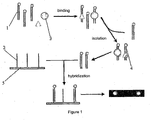
- the end labeled capture probes 1 were mixed with target proteins 3 (represented by the circle and the triangle in the Figure).
- the nucleic acid capture probe-nucleic acid binding protein complexes 4 formed were then isolated and the capture probes in the complexes were collected.
- the collected capture probes were hybridized with immobilization probes 2 immobilized on a biochip 5, and the hybridization signal was detected to obtain the result.
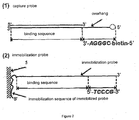
- Figure 2 shows a preferred design for capture probes and immobilized probes.
- the double stranded capture probe contains a sequence that a target nucleic acid binding protein binds.
- One strand in the capture probe contains an overhang which is labeled with a labeling molecule, a biotin in the Figure.
- the immobilization probe is complementary to the longer strand of the capture probe.
- the transcription factor AP-1(c-Jun) (#E3061), NFkB(p50) (#E3770) and Sp1 (#E6391) were obtained from Promega (Madison, WI).
- the general binding buffer contained 10 mM Tris-HCl (pH 7.5), 4% glycerol, 1 mM MgCl2, 0.5 mM EDTA, 5mM DTT, 50 mM NaCl, and 0.05 mg/mL poly (dI-dC)•(dI-dC).
- the electrophoresis buffer was 0.5 ⁇ TBE (0.9 M Tris, 0.9 M boric acid, 0.02 M EDTA, pH 8.0).
- PBST PBS, 0.1% Tween 20
- the agarose for electrophoresis was obtained from Biowest (Miami, FL).
- Bovine serum albumin (BSA) was obtained from Amresco (Solon, OH).
- the Cy3-labeled streptavidin was obtained from Amersham Biosciences (Uppsala, Sweden).
- Example 2 Using DNA biochip to simultaneously detect three nucleic acid binding proteins AP1, NFkB and Sp1 (single strand amplification).
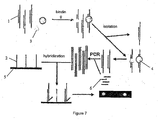
- Figure 4 shows an operation diagram of detection using single strand amplification method.
- Capture probes 1 were mixed with target protein 3 (represented by the circle and the triangle in the Figure).
- the capture probe-nucleic acid binding protein complexes 4 formed were isolated and the capture probes were collected.
- Primer 6 was used to amplify the capture probes collected, and the amplified product was hybridized with immobilization probes 2 immobilized on biochip 5. The hybridization signal was detected to obtain the result.
- Figure 5 shows a preferred design for capture probes, immobilization probes and primers.
- the double stranded capture probe contains a sequence that a nucleic acid binding protein binds, and one strand contains a 3' overhang.
- the primer sequence is complementary to the 3' overhand.
- the sequence of the immobilization probe is consistent with the binding sequence.
- Transcription factors AP-1(c-Jun) (#E3061), NFkB(p50) (#E3770) and Sp1 (#E6391) were obtained from Promega (Madison, WI).
- the general binding buffer contained 10 mM Tris-HCl (pH 7.5), 4% glycerol, 1 mM MgCl2, 0.5 mM EDTA, 5mM DTT, 50 mM NaCl, and 0.05 mg/mL poly (dI-dC)•(dI-dC).
- the electrophoresis buffer was 0.5 ⁇ TBE (0.9 M Tris, 0.9 M boric acid and 0.02 M EDTA, pH 8.0).
- Washing buffer was PBST (PBS, and 0.1% Tween 20).
- the agarose for electrophoresis was obtained from Biowest (Miami, FL).
- Bovine serum albumin (BSA) was obtained from Amresco (Solon, OH).
- the Cy3-labeled streptavidin was obtained from Amersham Biosciences (Uppsala, Sweden).
- the "end-label method" described in Example 1 was used to detect the three transcription proteins in this example and was used as a control for result comparison.
- Figure 6A shows the result of the detection with "single strand amplification method”.
- Figure 6B shows the result of the detection with "end-label method” in Example 1.
- A1-A5 is the result of detection of AP1;
- B1-B5 is the result of detection of NFkB;
- C1-C5 is the hybridization control (HC; see Table 1 for sequence of HC-IP and HC-LP);
- D1-D5 is the result of detection of Sp1.
- Probe Name Probe Sequence 1 AP-1 1 AP-1-IP 22 AP-1-LFP 26 AP-1-LP' 2 NF ⁇ B 5 NF ⁇ B-IP 23 NF ⁇ B-LFP 27 NF ⁇ B-LP' 3 SP1 9 SP1-IP 24 SP1-LFP 28 SP1-LP' 4 25 T7 Pro
- the present invention uses biochip method to detect nucleic acid binding proteins, especially transcription factors.
- the method includes detection of hybridization signals between the capture probe and immobilization probe. It is a highly sensitive and a high-throughput method.
- the two improved methods of the present invention single strand amplification before hybridization, double strand amplification before hybridization
- the primer can be pre-labeled, there is no need to label each group of capture probes.
- the experimental cost can be significantly reduced.
- the present method can be widely used for disease diagnosis, drug target screening, and study of disease process.
Landscapes
- Chemical & Material Sciences (AREA)
- Health & Medical Sciences (AREA)
- Life Sciences & Earth Sciences (AREA)
- Engineering & Computer Science (AREA)
- Organic Chemistry (AREA)
- Immunology (AREA)
- Wood Science & Technology (AREA)
- Molecular Biology (AREA)
- Proteomics, Peptides & Aminoacids (AREA)
- Analytical Chemistry (AREA)
- Zoology (AREA)
- Biochemistry (AREA)
- General Health & Medical Sciences (AREA)
- Biotechnology (AREA)
- Physics & Mathematics (AREA)
- Microbiology (AREA)
- Bioinformatics & Cheminformatics (AREA)
- Hematology (AREA)
- General Engineering & Computer Science (AREA)
- Biophysics (AREA)
- Genetics & Genomics (AREA)
- Biomedical Technology (AREA)
- Urology & Nephrology (AREA)
- Chemical Kinetics & Catalysis (AREA)
- Cell Biology (AREA)
- Food Science & Technology (AREA)
- Medicinal Chemistry (AREA)
- General Physics & Mathematics (AREA)
- Pathology (AREA)
- Measuring Or Testing Involving Enzymes Or Micro-Organisms (AREA)
Applications Claiming Priority (2)
| Application Number | Priority Date | Filing Date | Title |
|---|---|---|---|
| CNB2004100904233A CN1296492C (zh) | 2004-11-18 | 2004-11-18 | 一种基于生物芯片检测能结合特异序列的核酸结合蛋白的方法 |
| PCT/CN2004/001340 WO2006053463A1 (en) | 2004-11-18 | 2004-11-23 | A testing method of nucleic acid binding protein based on biochip |
Publications (3)
| Publication Number | Publication Date |
|---|---|
| EP1816476A1 EP1816476A1 (en) | 2007-08-08 |
| EP1816476A4 EP1816476A4 (en) | 2008-08-20 |
| EP1816476B1 true EP1816476B1 (en) | 2012-02-08 |
Family
ID=34847597
Family Applications (1)
| Application Number | Title | Priority Date | Filing Date |
|---|---|---|---|
| EP04797371A Expired - Lifetime EP1816476B1 (en) | 2004-11-18 | 2004-11-23 | A testing method of nucleic acid binding protein based on biochip |
Country Status (8)
| Country | Link |
|---|---|
| US (1) | US8680016B2 (enExample) |
| EP (1) | EP1816476B1 (enExample) |
| JP (1) | JP4664373B2 (enExample) |
| CN (1) | CN1296492C (enExample) |
| AT (1) | ATE545030T1 (enExample) |
| AU (1) | AU2004324960A1 (enExample) |
| CA (1) | CA2586408A1 (enExample) |
| WO (1) | WO2006053463A1 (enExample) |
Cited By (1)
| Publication number | Priority date | Publication date | Assignee | Title |
|---|---|---|---|---|
| CN103048463A (zh) * | 2012-05-02 | 2013-04-17 | 中国科学院广州生物医药与健康研究院 | 一种基于不同严谨度的用于检测dna结合蛋白的微孔板核酸杂交elisa方法 |
Families Citing this family (19)
| Publication number | Priority date | Publication date | Assignee | Title |
|---|---|---|---|---|
| CA2659745A1 (en) | 2006-08-02 | 2008-02-07 | California Institute Of Technology | Methods and systems for detecting and/or sorting targets |
| US8394590B2 (en) | 2006-08-02 | 2013-03-12 | California Institute Of Technology | Capture agents and related methods and systems for detecting and/or sorting targets |
| US20090053732A1 (en) | 2007-07-16 | 2009-02-26 | Ophir Vermesh | Microfluidic devices, methods and systems for detecting target molecules |
| EP2274443A4 (en) * | 2008-04-09 | 2012-03-28 | California Inst Of Techn | MUG AND PROCESSES AND SYSTEMS ASSOCIATED WITH DETECTING AND / OR SORTING TARGETS |
| KR101090982B1 (ko) | 2009-03-16 | 2011-12-08 | 경희대학교 산학협력단 | 양자점-앱타머 접합체를 이용한 생분석 방법 |
| US8741559B2 (en) * | 2009-04-24 | 2014-06-03 | Discoverx Corporation | Cellular assay employing detectable protein |
| DK3489685T3 (da) | 2011-11-21 | 2023-12-04 | Zoetis Services Llc | Signalforstærkning i sidestrømning og tilsvarende immunoassays |
| JP6197039B2 (ja) | 2012-08-24 | 2017-09-13 | イェール ユニバーシティーYale University | ハイスループット多重検出用システム、装置及び方法 |
| WO2015060511A1 (ko) * | 2013-10-22 | 2015-04-30 | 주식회사 바이오이즈 | 생체분자와 핵산의 결합정보를 생성하기 위한 마커, 이의 제조방법, 이를 이용한 생체분자 분석방법 및 장치 |
| TWI691716B (zh) | 2014-08-13 | 2020-04-21 | 美商艾巴希斯公司 | 電漿特異性結合搭配物檢定中之信號放大 |
| WO2016090148A1 (en) | 2014-12-03 | 2016-06-09 | IsoPlexis Corporation | Analysis and screening of cell secretion profiles |
| US11353448B2 (en) | 2015-02-13 | 2022-06-07 | California Institute Of Technology | Methods and compositions for quantifying metabolites and proteins from single cells |
| JP6944438B2 (ja) | 2015-08-04 | 2021-10-06 | ゾエティス サービシズ リミテッド ライアビリティ カンパニー | 溶液ベースのプラズモン特異的結合パートナーアッセイにおけるシグナル増幅 |
| WO2018049418A1 (en) | 2016-09-12 | 2018-03-15 | IsoPlexis Corporation | System and methods for multiplexed analysis of cellular and other immunotherapeutics |
| EP4036578A1 (en) | 2016-11-11 | 2022-08-03 | Isoplexis Corporation | Compositions and methods for the simultaneous genomic, transcriptomic and proteomic analysis of single cells |
| CN110226084A (zh) | 2016-11-22 | 2019-09-10 | 伊索普莱克西斯公司 | 用于细胞捕获的系统、装置和方法,以及其制造方法 |
| KR102654470B1 (ko) | 2017-01-30 | 2024-04-05 | 조에티스 서비시즈 엘엘씨 | 용액-기반 플라스몬 특이적-결합 파트너 검정 및 금속성 나노구조체 |
| EP3963070A4 (en) * | 2019-04-30 | 2023-02-22 | Encodia, Inc. | METHODS OF PREPARATION OF ANALYTES AND RELATED KITS |
| EP4644564A1 (en) * | 2022-12-28 | 2025-11-05 | BGI Shenzhen | Detection composition and protein capture detection method |
Family Cites Families (14)
| Publication number | Priority date | Publication date | Assignee | Title |
|---|---|---|---|---|
| US5449603A (en) * | 1989-10-24 | 1995-09-12 | Stratagene | Method for hybridizing nucleic acids using single-stranded nucleic acid binding protein |
| AU3595493A (en) * | 1992-01-28 | 1993-09-01 | President And Fellors Of Harvard College | Method for nucleic acid hybridization using single-stranded DNA binding protein |
| US20030054378A1 (en) * | 1997-05-08 | 2003-03-20 | Isao Karube | Method for detecting target nucleotide sequence |
| US20030207295A1 (en) * | 1999-04-20 | 2003-11-06 | Kevin Gunderson | Detection of nucleic acid reactions on bead arrays |
| US20060292560A1 (en) * | 2000-08-14 | 2006-12-28 | Robert Burgess | Transcription factor target gene discovery |
| CA2327561A1 (en) * | 2000-12-27 | 2002-06-27 | Pierre Rousseau | Methods for the screening and/or for the identification of differentially active nucleic acid binding factors of nucleic acid binding elements using dna microarray technology (dpa):dna proteomic array |
| US20020177218A1 (en) * | 2001-03-30 | 2002-11-28 | Yu Fang | Methods of detecting multiple DNA binding protein and DNA interactions in a sample, and devices, systems and kits for practicing the same |
| AU2002305585A1 (en) * | 2001-04-23 | 2002-11-05 | Michael F. Chou | Transcription factor network discovery methods |
| US20030219801A1 (en) * | 2002-03-06 | 2003-11-27 | Affymetrix, Inc. | Aptamer base technique for ligand identification |
| AU2003256814A1 (en) * | 2002-07-26 | 2004-02-16 | Alfa Wasserman, Inc. | Macromolecular protection assay |
| AU2003295692A1 (en) * | 2002-11-15 | 2004-06-15 | Sangamo Biosciences, Inc. | Methods and compositions for analysis of regulatory sequences |
| US20040115794A1 (en) * | 2002-12-12 | 2004-06-17 | Affymetrix, Inc. | Methods for detecting transcriptional factor binding sites |
| CN1435492A (zh) * | 2003-03-05 | 2003-08-13 | 东南大学 | 一种非标记检测dna结合蛋白的芯片及其制备、应用方法 |
| JP3944576B2 (ja) * | 2003-03-28 | 2007-07-11 | 独立行政法人産業技術総合研究所 | マイクロアレイを用いたアプタマーの取得方法 |
-
2004
- 2004-11-18 CN CNB2004100904233A patent/CN1296492C/zh not_active Expired - Fee Related
- 2004-11-23 CA CA002586408A patent/CA2586408A1/en not_active Abandoned
- 2004-11-23 JP JP2007541638A patent/JP4664373B2/ja not_active Expired - Fee Related
- 2004-11-23 WO PCT/CN2004/001340 patent/WO2006053463A1/zh not_active Ceased
- 2004-11-23 AT AT04797371T patent/ATE545030T1/de active
- 2004-11-23 US US11/791,157 patent/US8680016B2/en not_active Expired - Fee Related
- 2004-11-23 EP EP04797371A patent/EP1816476B1/en not_active Expired - Lifetime
- 2004-11-23 AU AU2004324960A patent/AU2004324960A1/en not_active Abandoned
Cited By (1)
| Publication number | Priority date | Publication date | Assignee | Title |
|---|---|---|---|---|
| CN103048463A (zh) * | 2012-05-02 | 2013-04-17 | 中国科学院广州生物医药与健康研究院 | 一种基于不同严谨度的用于检测dna结合蛋白的微孔板核酸杂交elisa方法 |
Also Published As
| Publication number | Publication date |
|---|---|
| EP1816476A1 (en) | 2007-08-08 |
| CN1635165A (zh) | 2005-07-06 |
| JP2008520212A (ja) | 2008-06-19 |
| AU2004324960A1 (en) | 2006-05-26 |
| US20090018025A1 (en) | 2009-01-15 |
| US8680016B2 (en) | 2014-03-25 |
| EP1816476A4 (en) | 2008-08-20 |
| CA2586408A1 (en) | 2006-05-26 |
| CN1296492C (zh) | 2007-01-24 |
| JP4664373B2 (ja) | 2011-04-06 |
| ATE545030T1 (de) | 2012-02-15 |
| WO2006053463A1 (en) | 2006-05-26 |
Similar Documents
| Publication | Publication Date | Title |
|---|---|---|
| EP1816476B1 (en) | A testing method of nucleic acid binding protein based on biochip | |
| JP6404714B2 (ja) | 多変量診断アッセイ及びこれを用いるための方法 | |
| US20170160271A1 (en) | Miniaturized Lateral Flow Device for Rapid and Sensitive Detection of Proteins or Nucleic Acids | |
| JP2003530116A (ja) | アレー上での相同ヌクレオチド配列の検出による生物学的(微)生物の同定 | |
| Bilitewski | DNA microarrays: an introduction to the technology | |
| CN101591705B (zh) | 一种dna结合蛋白高灵敏高通量的检测方法 | |
| JP2008520212A5 (enExample) | ||
| EP3103884A1 (en) | Nucleic acid detection and assay method using mask oligonucleotide, and device for same | |
| EP2679689B1 (en) | Method for improved quantification of miRNAs | |
| US10640821B2 (en) | Method and kit for detecting target nucleic acid | |
| EP1612282B1 (en) | Probe set and substrate for detecting nucleic acid | |
| US9416401B2 (en) | Method for determining amounts of polynucleotide sequences present in cell or tissue samples | |
| US20100029492A1 (en) | Nucleic acid chip for obtaining binding profile of single strand nucleic acid and unknown biomolecule, manufacturing method thereof and analysis method of unknown biomolecule using nucleic acid chip | |
| AU2002226448A1 (en) | A method and test kit for quantitative determination of variations in polynucleotide amounts in cell or tissue samples | |
| HK1104852A (en) | A testing method of nucleic acid binding protein based on biochip | |
| EP3447154A1 (en) | Method for detection of mutations, polymorphisms and specific dna sequences on dna matrices with dna imaging techniques for the use in medical diagnostics and forensic genetics | |
| US20080096767A1 (en) | Method For Expanding The Dynamic Detection Range In Microarrays | |
| Rupp | Microarray technologies in fungal diagnostics | |
| HK1079552A1 (en) | A biochip-based method for nucleic acid capable of combining specific sequence binding proteins assay | |
| HK1079552B (en) | A biochip-based method for nucleic acid capable of combining specific sequence binding proteins assay | |
| WO2025132546A1 (en) | Method for reducing nonspecific signals in in-situ hybridization assays | |
| JP2010136657A (ja) | ハイブリダイゼーション用カバー及びそれを用いた標的核酸の検出方法 | |
| JP2004061170A (ja) | Dnaチップの測定法 | |
| HK1230675A1 (en) | Nucleic acid detection and assay method using mask oligonucleotide, and device for same | |
| KR20150101092A (ko) | 저급 지방족 포화 알데하이드 류 특이적 메틸화 마커 유전자 및 이를 이용한 저급 지방족 포화 알데하이드 류 노출 여부 확인 방법 |
Legal Events
| Date | Code | Title | Description |
|---|---|---|---|
| PUAI | Public reference made under article 153(3) epc to a published international application that has entered the european phase |
Free format text: ORIGINAL CODE: 0009012 |
|
| 17P | Request for examination filed |
Effective date: 20070522 |
|
| AK | Designated contracting states |
Kind code of ref document: A1 Designated state(s): AT BE BG CH CY CZ DE DK EE ES FI FR GB GR HU IE IS IT LI LU MC NL PL PT RO SE SI SK TR |
|
| REG | Reference to a national code |
Ref country code: HK Ref legal event code: DE Ref document number: 1104852 Country of ref document: HK |
|
| DAX | Request for extension of the european patent (deleted) | ||
| A4 | Supplementary search report drawn up and despatched |
Effective date: 20080721 |
|
| 17Q | First examination report despatched |
Effective date: 20090112 |
|
| GRAP | Despatch of communication of intention to grant a patent |
Free format text: ORIGINAL CODE: EPIDOSNIGR1 |
|
| GRAS | Grant fee paid |
Free format text: ORIGINAL CODE: EPIDOSNIGR3 |
|
| GRAA | (expected) grant |
Free format text: ORIGINAL CODE: 0009210 |
|
| AK | Designated contracting states |
Kind code of ref document: B1 Designated state(s): AT BE BG CH CY CZ DE DK EE ES FI FR GB GR HU IE IS IT LI LU MC NL PL PT RO SE SI SK TR |
|
| REG | Reference to a national code |
Ref country code: GB Ref legal event code: FG4D |
|
| REG | Reference to a national code |
Ref country code: AT Ref legal event code: REF Ref document number: 545030 Country of ref document: AT Kind code of ref document: T Effective date: 20120215 Ref country code: CH Ref legal event code: EP |
|
| REG | Reference to a national code |
Ref country code: SE Ref legal event code: TRGR |
|
| REG | Reference to a national code |
Ref country code: DE Ref legal event code: R096 Ref document number: 602004036448 Country of ref document: DE Effective date: 20120405 |
|
| REG | Reference to a national code |
Ref country code: NL Ref legal event code: VDEP Effective date: 20120208 |
|
| PG25 | Lapsed in a contracting state [announced via postgrant information from national office to epo] |
Ref country code: IS Free format text: LAPSE BECAUSE OF FAILURE TO SUBMIT A TRANSLATION OF THE DESCRIPTION OR TO PAY THE FEE WITHIN THE PRESCRIBED TIME-LIMIT Effective date: 20120608 Ref country code: NL Free format text: LAPSE BECAUSE OF FAILURE TO SUBMIT A TRANSLATION OF THE DESCRIPTION OR TO PAY THE FEE WITHIN THE PRESCRIBED TIME-LIMIT Effective date: 20120208 |
|
| PG25 | Lapsed in a contracting state [announced via postgrant information from national office to epo] |
Ref country code: FI Free format text: LAPSE BECAUSE OF FAILURE TO SUBMIT A TRANSLATION OF THE DESCRIPTION OR TO PAY THE FEE WITHIN THE PRESCRIBED TIME-LIMIT Effective date: 20120208 Ref country code: PT Free format text: LAPSE BECAUSE OF FAILURE TO SUBMIT A TRANSLATION OF THE DESCRIPTION OR TO PAY THE FEE WITHIN THE PRESCRIBED TIME-LIMIT Effective date: 20120608 Ref country code: GR Free format text: LAPSE BECAUSE OF FAILURE TO SUBMIT A TRANSLATION OF THE DESCRIPTION OR TO PAY THE FEE WITHIN THE PRESCRIBED TIME-LIMIT Effective date: 20120509 Ref country code: PL Free format text: LAPSE BECAUSE OF FAILURE TO SUBMIT A TRANSLATION OF THE DESCRIPTION OR TO PAY THE FEE WITHIN THE PRESCRIBED TIME-LIMIT Effective date: 20120208 Ref country code: BE Free format text: LAPSE BECAUSE OF FAILURE TO SUBMIT A TRANSLATION OF THE DESCRIPTION OR TO PAY THE FEE WITHIN THE PRESCRIBED TIME-LIMIT Effective date: 20120208 |
|
| REG | Reference to a national code |
Ref country code: AT Ref legal event code: MK05 Ref document number: 545030 Country of ref document: AT Kind code of ref document: T Effective date: 20120208 |
|
| PG25 | Lapsed in a contracting state [announced via postgrant information from national office to epo] |
Ref country code: CY Free format text: LAPSE BECAUSE OF FAILURE TO SUBMIT A TRANSLATION OF THE DESCRIPTION OR TO PAY THE FEE WITHIN THE PRESCRIBED TIME-LIMIT Effective date: 20120208 |
|
| PG25 | Lapsed in a contracting state [announced via postgrant information from national office to epo] |
Ref country code: DK Free format text: LAPSE BECAUSE OF FAILURE TO SUBMIT A TRANSLATION OF THE DESCRIPTION OR TO PAY THE FEE WITHIN THE PRESCRIBED TIME-LIMIT Effective date: 20120208 Ref country code: RO Free format text: LAPSE BECAUSE OF FAILURE TO SUBMIT A TRANSLATION OF THE DESCRIPTION OR TO PAY THE FEE WITHIN THE PRESCRIBED TIME-LIMIT Effective date: 20120208 Ref country code: SI Free format text: LAPSE BECAUSE OF FAILURE TO SUBMIT A TRANSLATION OF THE DESCRIPTION OR TO PAY THE FEE WITHIN THE PRESCRIBED TIME-LIMIT Effective date: 20120208 Ref country code: CZ Free format text: LAPSE BECAUSE OF FAILURE TO SUBMIT A TRANSLATION OF THE DESCRIPTION OR TO PAY THE FEE WITHIN THE PRESCRIBED TIME-LIMIT Effective date: 20120208 Ref country code: EE Free format text: LAPSE BECAUSE OF FAILURE TO SUBMIT A TRANSLATION OF THE DESCRIPTION OR TO PAY THE FEE WITHIN THE PRESCRIBED TIME-LIMIT Effective date: 20120208 |
|
| PG25 | Lapsed in a contracting state [announced via postgrant information from national office to epo] |
Ref country code: IT Free format text: LAPSE BECAUSE OF FAILURE TO SUBMIT A TRANSLATION OF THE DESCRIPTION OR TO PAY THE FEE WITHIN THE PRESCRIBED TIME-LIMIT Effective date: 20120208 Ref country code: SK Free format text: LAPSE BECAUSE OF FAILURE TO SUBMIT A TRANSLATION OF THE DESCRIPTION OR TO PAY THE FEE WITHIN THE PRESCRIBED TIME-LIMIT Effective date: 20120208 |
|
| PLBE | No opposition filed within time limit |
Free format text: ORIGINAL CODE: 0009261 |
|
| STAA | Information on the status of an ep patent application or granted ep patent |
Free format text: STATUS: NO OPPOSITION FILED WITHIN TIME LIMIT |
|
| 26N | No opposition filed |
Effective date: 20121109 |
|
| PG25 | Lapsed in a contracting state [announced via postgrant information from national office to epo] |
Ref country code: AT Free format text: LAPSE BECAUSE OF FAILURE TO SUBMIT A TRANSLATION OF THE DESCRIPTION OR TO PAY THE FEE WITHIN THE PRESCRIBED TIME-LIMIT Effective date: 20120208 |
|
| REG | Reference to a national code |
Ref country code: DE Ref legal event code: R097 Ref document number: 602004036448 Country of ref document: DE Effective date: 20121109 |
|
| PG25 | Lapsed in a contracting state [announced via postgrant information from national office to epo] |
Ref country code: ES Free format text: LAPSE BECAUSE OF FAILURE TO SUBMIT A TRANSLATION OF THE DESCRIPTION OR TO PAY THE FEE WITHIN THE PRESCRIBED TIME-LIMIT Effective date: 20120519 |
|
| REG | Reference to a national code |
Ref country code: CH Ref legal event code: PL |
|
| PG25 | Lapsed in a contracting state [announced via postgrant information from national office to epo] |
Ref country code: LI Free format text: LAPSE BECAUSE OF NON-PAYMENT OF DUE FEES Effective date: 20121130 Ref country code: CH Free format text: LAPSE BECAUSE OF NON-PAYMENT OF DUE FEES Effective date: 20121130 Ref country code: BG Free format text: LAPSE BECAUSE OF FAILURE TO SUBMIT A TRANSLATION OF THE DESCRIPTION OR TO PAY THE FEE WITHIN THE PRESCRIBED TIME-LIMIT Effective date: 20120508 |
|
| REG | Reference to a national code |
Ref country code: IE Ref legal event code: MM4A |
|
| REG | Reference to a national code |
Ref country code: FR Ref legal event code: ST Effective date: 20130731 |
|
| REG | Reference to a national code |
Ref country code: DE Ref legal event code: R119 Ref document number: 602004036448 Country of ref document: DE Effective date: 20130601 |
|
| PG25 | Lapsed in a contracting state [announced via postgrant information from national office to epo] |
Ref country code: IE Free format text: LAPSE BECAUSE OF NON-PAYMENT OF DUE FEES Effective date: 20121123 Ref country code: DE Free format text: LAPSE BECAUSE OF NON-PAYMENT OF DUE FEES Effective date: 20130601 |
|
| PG25 | Lapsed in a contracting state [announced via postgrant information from national office to epo] |
Ref country code: FR Free format text: LAPSE BECAUSE OF NON-PAYMENT OF DUE FEES Effective date: 20121130 |
|
| PG25 | Lapsed in a contracting state [announced via postgrant information from national office to epo] |
Ref country code: MC Free format text: LAPSE BECAUSE OF NON-PAYMENT OF DUE FEES Effective date: 20121130 Ref country code: TR Free format text: LAPSE BECAUSE OF FAILURE TO SUBMIT A TRANSLATION OF THE DESCRIPTION OR TO PAY THE FEE WITHIN THE PRESCRIBED TIME-LIMIT Effective date: 20120208 |
|
| PG25 | Lapsed in a contracting state [announced via postgrant information from national office to epo] |
Ref country code: LU Free format text: LAPSE BECAUSE OF NON-PAYMENT OF DUE FEES Effective date: 20121123 |
|
| REG | Reference to a national code |
Ref country code: HK Ref legal event code: WD Ref document number: 1104852 Country of ref document: HK |
|
| PG25 | Lapsed in a contracting state [announced via postgrant information from national office to epo] |
Ref country code: HU Free format text: LAPSE BECAUSE OF FAILURE TO SUBMIT A TRANSLATION OF THE DESCRIPTION OR TO PAY THE FEE WITHIN THE PRESCRIBED TIME-LIMIT Effective date: 20041123 |
|
| PGFP | Annual fee paid to national office [announced via postgrant information from national office to epo] |
Ref country code: SE Payment date: 20200927 Year of fee payment: 17 |
|
| PGFP | Annual fee paid to national office [announced via postgrant information from national office to epo] |
Ref country code: GB Payment date: 20201027 Year of fee payment: 17 |
|
| GBPC | Gb: european patent ceased through non-payment of renewal fee |
Effective date: 20211123 |
|
| PG25 | Lapsed in a contracting state [announced via postgrant information from national office to epo] |
Ref country code: SE Free format text: LAPSE BECAUSE OF NON-PAYMENT OF DUE FEES Effective date: 20211124 |
|
| PG25 | Lapsed in a contracting state [announced via postgrant information from national office to epo] |
Ref country code: GB Free format text: LAPSE BECAUSE OF NON-PAYMENT OF DUE FEES Effective date: 20211123 |