EP1742993B1 - Rubber composition and tire comprising same - Google Patents
Rubber composition and tire comprising same Download PDFInfo
- Publication number
- EP1742993B1 EP1742993B1 EP04821965.3A EP04821965A EP1742993B1 EP 1742993 B1 EP1742993 B1 EP 1742993B1 EP 04821965 A EP04821965 A EP 04821965A EP 1742993 B1 EP1742993 B1 EP 1742993B1
- Authority
- EP
- European Patent Office
- Prior art keywords
- poly
- rubber composition
- sulfur
- rubber
- weight
- Prior art date
- Legal status (The legal status is an assumption and is not a legal conclusion. Google has not performed a legal analysis and makes no representation as to the accuracy of the status listed.)
- Expired - Lifetime
Links
- 229920001971 elastomer Polymers 0.000 title claims description 140
- 239000000203 mixture Substances 0.000 title claims description 131
- 239000005060 rubber Substances 0.000 title claims description 127
- -1 paraffins Substances 0.000 claims description 116
- 229910052717 sulfur Inorganic materials 0.000 claims description 96
- NINIDFKCEFEMDL-UHFFFAOYSA-N Sulfur Chemical compound [S] NINIDFKCEFEMDL-UHFFFAOYSA-N 0.000 claims description 94
- 239000011593 sulfur Substances 0.000 claims description 94
- 238000000034 method Methods 0.000 claims description 36
- 229920001577 copolymer Polymers 0.000 claims description 25
- 229920003229 poly(methyl methacrylate) Polymers 0.000 claims description 19
- 239000004926 polymethyl methacrylate Substances 0.000 claims description 19
- 239000000463 material Substances 0.000 claims description 18
- 239000004793 Polystyrene Substances 0.000 claims description 16
- 239000003795 chemical substances by application Substances 0.000 claims description 16
- 229920003244 diene elastomer Polymers 0.000 claims description 16
- YXIWHUQXZSMYRE-UHFFFAOYSA-N 1,3-benzothiazole-2-thiol Chemical compound C1=CC=C2SC(S)=NC2=C1 YXIWHUQXZSMYRE-UHFFFAOYSA-N 0.000 claims description 14
- 239000000806 elastomer Substances 0.000 claims description 14
- 229920002223 polystyrene Polymers 0.000 claims description 14
- 238000005538 encapsulation Methods 0.000 claims description 13
- 230000009477 glass transition Effects 0.000 claims description 11
- VKYKSIONXSXAKP-UHFFFAOYSA-N hexamethylenetetramine Chemical compound C1N(C2)CN3CN1CN2C3 VKYKSIONXSXAKP-UHFFFAOYSA-N 0.000 claims description 10
- RRHGJUQNOFWUDK-UHFFFAOYSA-N Isoprene Natural products CC(=C)C=C RRHGJUQNOFWUDK-UHFFFAOYSA-N 0.000 claims description 8
- 229920000139 polyethylene terephthalate Polymers 0.000 claims description 8
- 239000005020 polyethylene terephthalate Substances 0.000 claims description 8
- OWRCNXZUPFZXOS-UHFFFAOYSA-N 1,3-diphenylguanidine Chemical compound C=1C=CC=CC=1NC(=N)NC1=CC=CC=C1 OWRCNXZUPFZXOS-UHFFFAOYSA-N 0.000 claims description 5
- 230000007547 defect Effects 0.000 claims description 5
- AFZSMODLJJCVPP-UHFFFAOYSA-N dibenzothiazol-2-yl disulfide Chemical compound C1=CC=C2SC(SSC=3SC4=CC=CC=C4N=3)=NC2=C1 AFZSMODLJJCVPP-UHFFFAOYSA-N 0.000 claims description 5
- 235000010299 hexamethylene tetramine Nutrition 0.000 claims description 5
- 239000004312 hexamethylene tetramine Substances 0.000 claims description 5
- 229960004011 methenamine Drugs 0.000 claims description 5
- 229920003052 natural elastomer Polymers 0.000 claims description 5
- 229920001194 natural rubber Polymers 0.000 claims description 5
- FUPAJKKAHDLPAZ-UHFFFAOYSA-N 1,2,3-triphenylguanidine Chemical compound C=1C=CC=CC=1NC(=NC=1C=CC=CC=1)NC1=CC=CC=C1 FUPAJKKAHDLPAZ-UHFFFAOYSA-N 0.000 claims description 4
- OPNUROKCUBTKLF-UHFFFAOYSA-N 1,2-bis(2-methylphenyl)guanidine Chemical compound CC1=CC=CC=C1N\C(N)=N\C1=CC=CC=C1C OPNUROKCUBTKLF-UHFFFAOYSA-N 0.000 claims description 4
- GPRYVSOUOYKCHJ-UHFFFAOYSA-N 1-[chloro(fluoro)methoxy]-1,1,2,3,3,3-hexafluoropropane Chemical compound FC(Cl)OC(F)(F)C(F)C(F)(F)F GPRYVSOUOYKCHJ-UHFFFAOYSA-N 0.000 claims description 4
- UWNADWZGEHDQAB-UHFFFAOYSA-N 2,5-dimethylhexane Chemical group CC(C)CCC(C)C UWNADWZGEHDQAB-UHFFFAOYSA-N 0.000 claims description 4
- UDIPTWFVPPPURJ-UHFFFAOYSA-M Cyclamate Chemical compound [Na+].[O-]S(=O)(=O)NC1CCCCC1 UDIPTWFVPPPURJ-UHFFFAOYSA-M 0.000 claims description 4
- VGGSQFUCUMXWEO-UHFFFAOYSA-N Ethene Chemical compound C=C VGGSQFUCUMXWEO-UHFFFAOYSA-N 0.000 claims description 4
- 239000005977 Ethylene Substances 0.000 claims description 4
- LYCAIKOWRPUZTN-UHFFFAOYSA-N Ethylene glycol Chemical compound OCCO LYCAIKOWRPUZTN-UHFFFAOYSA-N 0.000 claims description 4
- 244000043261 Hevea brasiliensis Species 0.000 claims description 4
- FLVIGYVXZHLUHP-UHFFFAOYSA-N N,N'-diethylthiourea Chemical compound CCNC(=S)NCC FLVIGYVXZHLUHP-UHFFFAOYSA-N 0.000 claims description 4
- FCSHMCFRCYZTRQ-UHFFFAOYSA-N N,N'-diphenylthiourea Chemical compound C=1C=CC=CC=1NC(=S)NC1=CC=CC=C1 FCSHMCFRCYZTRQ-UHFFFAOYSA-N 0.000 claims description 4
- 239000004734 Polyphenylene sulfide Substances 0.000 claims description 4
- 239000001913 cellulose Substances 0.000 claims description 4
- 229920002678 cellulose Polymers 0.000 claims description 4
- WITDFSFZHZYQHB-UHFFFAOYSA-N dibenzylcarbamothioylsulfanyl n,n-dibenzylcarbamodithioate Chemical compound C=1C=CC=CC=1CN(CC=1C=CC=CC=1)C(=S)SSC(=S)N(CC=1C=CC=CC=1)CC1=CC=CC=C1 WITDFSFZHZYQHB-UHFFFAOYSA-N 0.000 claims description 4
- LMBWSYZSUOEYSN-UHFFFAOYSA-N diethyldithiocarbamic acid Chemical compound CCN(CC)C(S)=S LMBWSYZSUOEYSN-UHFFFAOYSA-N 0.000 claims description 4
- REQPQFUJGGOFQL-UHFFFAOYSA-N dimethylcarbamothioyl n,n-dimethylcarbamodithioate Chemical compound CN(C)C(=S)SC(=S)N(C)C REQPQFUJGGOFQL-UHFFFAOYSA-N 0.000 claims description 4
- BHGHXAOHFWSPNE-UHFFFAOYSA-N n-phenylethanimine Chemical compound CC=NC1=CC=CC=C1 BHGHXAOHFWSPNE-UHFFFAOYSA-N 0.000 claims description 4
- 229920000069 polyphenylene sulfide Polymers 0.000 claims description 4
- 229920002451 polyvinyl alcohol Polymers 0.000 claims description 4
- IRZFQKXEKAODTJ-UHFFFAOYSA-M sodium;propan-2-yloxymethanedithioate Chemical compound [Na+].CC(C)OC([S-])=S IRZFQKXEKAODTJ-UHFFFAOYSA-M 0.000 claims description 4
- KAKZBPTYRLMSJV-UHFFFAOYSA-N vinyl-ethylene Natural products C=CC=C KAKZBPTYRLMSJV-UHFFFAOYSA-N 0.000 claims description 4
- NEYNBSGIXOOZGZ-UHFFFAOYSA-L zinc;butoxymethanedithioate Chemical compound [Zn+2].CCCCOC([S-])=S.CCCCOC([S-])=S NEYNBSGIXOOZGZ-UHFFFAOYSA-L 0.000 claims description 4
- SZNCKQHFYDCMLZ-UHFFFAOYSA-L zinc;propan-2-yloxymethanedithioate Chemical compound [Zn+2].CC(C)OC([S-])=S.CC(C)OC([S-])=S SZNCKQHFYDCMLZ-UHFFFAOYSA-L 0.000 claims description 4
- 239000004698 Polyethylene Substances 0.000 claims description 3
- 229920002125 Sokalan® Polymers 0.000 claims description 3
- 239000004676 acrylonitrile butadiene styrene Substances 0.000 claims description 3
- 238000000113 differential scanning calorimetry Methods 0.000 claims description 3
- 239000012990 dithiocarbamate Substances 0.000 claims description 3
- 150000004659 dithiocarbamates Chemical class 0.000 claims description 3
- 229950004394 ditiocarb Drugs 0.000 claims description 3
- 229920001200 poly(ethylene-vinyl acetate) Polymers 0.000 claims description 3
- 229920002577 polybenzoxazole Polymers 0.000 claims description 3
- 229920002857 polybutadiene Polymers 0.000 claims description 3
- 239000004417 polycarbonate Substances 0.000 claims description 3
- 229920000515 polycarbonate Polymers 0.000 claims description 3
- 229920000728 polyester Polymers 0.000 claims description 3
- 229920000573 polyethylene Polymers 0.000 claims description 3
- 229920001195 polyisoprene Polymers 0.000 claims description 3
- 239000001993 wax Substances 0.000 claims description 3
- 239000012991 xanthate Substances 0.000 claims description 3
- HMZNNQMHGDXAHG-UHFFFAOYSA-N 1-cyanoethenyl 2-methylprop-2-enoate Chemical compound CC(=C)C(=O)OC(=C)C#N HMZNNQMHGDXAHG-UHFFFAOYSA-N 0.000 claims description 2
- MFJDFPRQTMQVHI-UHFFFAOYSA-N 3,5-dioxabicyclo[5.2.2]undeca-1(9),7,10-triene-2,6-dione Chemical compound O=C1OCOC(=O)C2=CC=C1C=C2 MFJDFPRQTMQVHI-UHFFFAOYSA-N 0.000 claims description 2
- TXLINXBIWJYFNR-UHFFFAOYSA-N 4-phenylpyridine-2-carbonitrile Chemical compound C1=NC(C#N)=CC(C=2C=CC=CC=2)=C1 TXLINXBIWJYFNR-UHFFFAOYSA-N 0.000 claims description 2
- 229920000856 Amylose Polymers 0.000 claims description 2
- 229920008347 Cellulose acetate propionate Polymers 0.000 claims description 2
- 229920002284 Cellulose triacetate Polymers 0.000 claims description 2
- BWGNESOTFCXPMA-UHFFFAOYSA-N Dihydrogen disulfide Chemical compound SS BWGNESOTFCXPMA-UHFFFAOYSA-N 0.000 claims description 2
- PDQAZBWRQCGBEV-UHFFFAOYSA-N Ethylenethiourea Chemical compound S=C1NCCN1 PDQAZBWRQCGBEV-UHFFFAOYSA-N 0.000 claims description 2
- 108010010803 Gelatin Proteins 0.000 claims description 2
- 239000004677 Nylon Substances 0.000 claims description 2
- 229920002302 Nylon 6,6 Polymers 0.000 claims description 2
- 229920003171 Poly (ethylene oxide) Polymers 0.000 claims description 2
- HCHKCACWOHOZIP-UHFFFAOYSA-N Zinc Chemical compound [Zn] HCHKCACWOHOZIP-UHFFFAOYSA-N 0.000 claims description 2
- NNLVGZFZQQXQNW-ADJNRHBOSA-N [(2r,3r,4s,5r,6s)-4,5-diacetyloxy-3-[(2s,3r,4s,5r,6r)-3,4,5-triacetyloxy-6-(acetyloxymethyl)oxan-2-yl]oxy-6-[(2r,3r,4s,5r,6s)-4,5,6-triacetyloxy-2-(acetyloxymethyl)oxan-3-yl]oxyoxan-2-yl]methyl acetate Chemical compound O([C@@H]1O[C@@H]([C@H]([C@H](OC(C)=O)[C@H]1OC(C)=O)O[C@H]1[C@@H]([C@@H](OC(C)=O)[C@H](OC(C)=O)[C@@H](COC(C)=O)O1)OC(C)=O)COC(=O)C)[C@@H]1[C@@H](COC(C)=O)O[C@@H](OC(C)=O)[C@H](OC(C)=O)[C@H]1OC(C)=O NNLVGZFZQQXQNW-ADJNRHBOSA-N 0.000 claims description 2
- 150000001412 amines Chemical class 0.000 claims description 2
- 235000014633 carbohydrates Nutrition 0.000 claims description 2
- 150000001720 carbohydrates Chemical class 0.000 claims description 2
- IAHOJQBGQHVEAZ-UHFFFAOYSA-L copper;oxido-propan-2-yloxy-propan-2-ylsulfanyl-sulfanylidene-$l^{5}-phosphane Chemical compound [Cu+2].CC(C)OP([O-])(=S)SC(C)C.CC(C)OP([O-])(=S)SC(C)C IAHOJQBGQHVEAZ-UHFFFAOYSA-L 0.000 claims description 2
- 125000004210 cyclohexylmethyl group Chemical group [H]C([H])(*)C1([H])C([H])([H])C([H])([H])C([H])([H])C([H])([H])C1([H])[H] 0.000 claims description 2
- 229940116901 diethyldithiocarbamate Drugs 0.000 claims description 2
- POULHZVOKOAJMA-UHFFFAOYSA-M dodecanoate Chemical compound CCCCCCCCCCCC([O-])=O POULHZVOKOAJMA-UHFFFAOYSA-M 0.000 claims description 2
- 229920000159 gelatin Polymers 0.000 claims description 2
- 239000008273 gelatin Substances 0.000 claims description 2
- 235000019322 gelatine Nutrition 0.000 claims description 2
- 235000011852 gelatine desserts Nutrition 0.000 claims description 2
- 150000002357 guanidines Chemical class 0.000 claims description 2
- WGCNASOHLSPBMP-UHFFFAOYSA-N hydroxyacetaldehyde Natural products OCC=O WGCNASOHLSPBMP-UHFFFAOYSA-N 0.000 claims description 2
- 229940070765 laurate Drugs 0.000 claims description 2
- CMAUJSNXENPPOF-UHFFFAOYSA-N n-(1,3-benzothiazol-2-ylsulfanyl)-n-cyclohexylcyclohexanamine Chemical compound C1CCCCC1N(C1CCCCC1)SC1=NC2=CC=CC=C2S1 CMAUJSNXENPPOF-UHFFFAOYSA-N 0.000 claims description 2
- 229920001778 nylon Polymers 0.000 claims description 2
- ZWWQICJTBOCQLA-UHFFFAOYSA-N o-propan-2-yl (propan-2-yloxycarbothioyldisulfanyl)methanethioate Chemical compound CC(C)OC(=S)SSC(=S)OC(C)C ZWWQICJTBOCQLA-UHFFFAOYSA-N 0.000 claims description 2
- 229920001599 poly(2-chlorostyrene) Polymers 0.000 claims description 2
- 229920001620 poly(3-methyl styrene) Polymers 0.000 claims description 2
- 229920001597 poly(4-chlorostyrene) Polymers 0.000 claims description 2
- 239000004584 polyacrylic acid Substances 0.000 claims description 2
- 229920005644 polyethylene terephthalate glycol copolymer Polymers 0.000 claims description 2
- 229920002338 polyhydroxyethylmethacrylate Polymers 0.000 claims description 2
- 229920000182 polyphenyl methacrylate Polymers 0.000 claims description 2
- 239000011118 polyvinyl acetate Substances 0.000 claims description 2
- 229920002689 polyvinyl acetate Polymers 0.000 claims description 2
- 159000000000 sodium salts Chemical class 0.000 claims description 2
- 229920003051 synthetic elastomer Polymers 0.000 claims description 2
- 150000003557 thiazoles Chemical class 0.000 claims description 2
- 150000003585 thioureas Chemical class 0.000 claims description 2
- KUAZQDVKQLNFPE-UHFFFAOYSA-N thiram Chemical compound CN(C)C(=S)SSC(=S)N(C)C KUAZQDVKQLNFPE-UHFFFAOYSA-N 0.000 claims description 2
- 229960002447 thiram Drugs 0.000 claims description 2
- 239000011701 zinc Substances 0.000 claims description 2
- 229910052725 zinc Inorganic materials 0.000 claims description 2
- KMNUDJAXRXUZQS-UHFFFAOYSA-L zinc;n-ethyl-n-phenylcarbamodithioate Chemical compound [Zn+2].CCN(C([S-])=S)C1=CC=CC=C1.CCN(C([S-])=S)C1=CC=CC=C1 KMNUDJAXRXUZQS-UHFFFAOYSA-L 0.000 claims description 2
- 150000000183 1,3-benzoxazoles Chemical class 0.000 claims 1
- IUJLOAKJZQBENM-UHFFFAOYSA-N n-(1,3-benzothiazol-2-ylsulfanyl)-2-methylpropan-2-amine Chemical compound C1=CC=C2SC(SNC(C)(C)C)=NC2=C1 IUJLOAKJZQBENM-UHFFFAOYSA-N 0.000 claims 1
- 229920000058 polyacrylate Polymers 0.000 claims 1
- 239000005061 synthetic rubber Substances 0.000 claims 1
- 125000000999 tert-butyl group Chemical group [H]C([H])([H])C(*)(C([H])([H])[H])C([H])([H])[H] 0.000 claims 1
- 150000001875 compounds Chemical class 0.000 description 77
- 230000032683 aging Effects 0.000 description 34
- 239000003094 microcapsule Substances 0.000 description 30
- 229920000642 polymer Polymers 0.000 description 19
- 230000008859 change Effects 0.000 description 18
- 238000004073 vulcanization Methods 0.000 description 12
- 150000001993 dienes Chemical class 0.000 description 11
- 239000011256 inorganic filler Substances 0.000 description 11
- 239000006229 carbon black Substances 0.000 description 10
- 235000019241 carbon black Nutrition 0.000 description 10
- 229910003475 inorganic filler Inorganic materials 0.000 description 10
- 239000000945 filler Substances 0.000 description 9
- 239000002245 particle Substances 0.000 description 9
- 238000012545 processing Methods 0.000 description 9
- 230000008569 process Effects 0.000 description 8
- 230000003014 reinforcing effect Effects 0.000 description 8
- 239000004005 microsphere Substances 0.000 description 7
- PPBRXRYQALVLMV-UHFFFAOYSA-N Styrene Chemical compound C=CC1=CC=CC=C1 PPBRXRYQALVLMV-UHFFFAOYSA-N 0.000 description 6
- XLOMVQKBTHCTTD-UHFFFAOYSA-N Zinc monoxide Chemical compound [Zn]=O XLOMVQKBTHCTTD-UHFFFAOYSA-N 0.000 description 6
- 238000004519 manufacturing process Methods 0.000 description 6
- 239000000178 monomer Substances 0.000 description 6
- 230000000930 thermomechanical effect Effects 0.000 description 6
- 239000012763 reinforcing filler Substances 0.000 description 5
- 238000012360 testing method Methods 0.000 description 5
- 239000005864 Sulphur Substances 0.000 description 4
- 125000004432 carbon atom Chemical group C* 0.000 description 4
- 239000011248 coating agent Substances 0.000 description 4
- 238000000576 coating method Methods 0.000 description 4
- 238000013270 controlled release Methods 0.000 description 4
- 230000003247 decreasing effect Effects 0.000 description 4
- 125000002897 diene group Chemical group 0.000 description 4
- 239000000839 emulsion Substances 0.000 description 4
- 238000001704 evaporation Methods 0.000 description 4
- 230000008020 evaporation Effects 0.000 description 4
- 238000002360 preparation method Methods 0.000 description 4
- 230000008439 repair process Effects 0.000 description 4
- 238000000935 solvent evaporation Methods 0.000 description 4
- 235000021355 Stearic acid Nutrition 0.000 description 3
- 239000002775 capsule Substances 0.000 description 3
- 239000007822 coupling agent Substances 0.000 description 3
- 239000004615 ingredient Substances 0.000 description 3
- QIQXTHQIDYTFRH-UHFFFAOYSA-N octadecanoic acid Chemical compound CCCCCCCCCCCCCCCCCC(O)=O QIQXTHQIDYTFRH-UHFFFAOYSA-N 0.000 description 3
- OQCDKBAXFALNLD-UHFFFAOYSA-N octadecanoic acid Natural products CCCCCCCC(C)CCCCCCCCC(O)=O OQCDKBAXFALNLD-UHFFFAOYSA-N 0.000 description 3
- 235000019422 polyvinyl alcohol Nutrition 0.000 description 3
- 230000002028 premature Effects 0.000 description 3
- 238000005057 refrigeration Methods 0.000 description 3
- 239000011257 shell material Substances 0.000 description 3
- 239000008117 stearic acid Substances 0.000 description 3
- 230000010512 thermal transition Effects 0.000 description 3
- 229920002554 vinyl polymer Polymers 0.000 description 3
- 239000011787 zinc oxide Substances 0.000 description 3
- MYRTYDVEIRVNKP-UHFFFAOYSA-N 1,2-Divinylbenzene Chemical compound C=CC1=CC=CC=C1C=C MYRTYDVEIRVNKP-UHFFFAOYSA-N 0.000 description 2
- SDJHPPZKZZWAKF-UHFFFAOYSA-N 2,3-dimethylbuta-1,3-diene Chemical compound CC(=C)C(C)=C SDJHPPZKZZWAKF-UHFFFAOYSA-N 0.000 description 2
- PAYRUJLWNCNPSJ-UHFFFAOYSA-N Aniline Chemical compound NC1=CC=CC=C1 PAYRUJLWNCNPSJ-UHFFFAOYSA-N 0.000 description 2
- VQTUBCCKSQIDNK-UHFFFAOYSA-N Isobutene Chemical compound CC(C)=C VQTUBCCKSQIDNK-UHFFFAOYSA-N 0.000 description 2
- VYPSYNLAJGMNEJ-UHFFFAOYSA-N Silicium dioxide Chemical compound O=[Si]=O VYPSYNLAJGMNEJ-UHFFFAOYSA-N 0.000 description 2
- 239000000654 additive Substances 0.000 description 2
- 239000003963 antioxidant agent Substances 0.000 description 2
- 235000006708 antioxidants Nutrition 0.000 description 2
- IISBACLAFKSPIT-UHFFFAOYSA-N bisphenol A Chemical compound C=1C=C(O)C=CC=1C(C)(C)C1=CC=C(O)C=C1 IISBACLAFKSPIT-UHFFFAOYSA-N 0.000 description 2
- 229920005549 butyl rubber Polymers 0.000 description 2
- 238000003490 calendering Methods 0.000 description 2
- 238000006243 chemical reaction Methods 0.000 description 2
- 238000001816 cooling Methods 0.000 description 2
- 238000007334 copolymerization reaction Methods 0.000 description 2
- 239000011162 core material Substances 0.000 description 2
- 238000004132 cross linking Methods 0.000 description 2
- 230000007423 decrease Effects 0.000 description 2
- 239000006185 dispersion Substances 0.000 description 2
- 239000003814 drug Substances 0.000 description 2
- 238000012377 drug delivery Methods 0.000 description 2
- 230000000694 effects Effects 0.000 description 2
- 235000013305 food Nutrition 0.000 description 2
- 238000009472 formulation Methods 0.000 description 2
- 230000006870 function Effects 0.000 description 2
- 229920001519 homopolymer Polymers 0.000 description 2
- 238000004898 kneading Methods 0.000 description 2
- 239000011159 matrix material Substances 0.000 description 2
- 239000012764 mineral filler Substances 0.000 description 2
- 238000002156 mixing Methods 0.000 description 2
- 239000003921 oil Substances 0.000 description 2
- 238000006116 polymerization reaction Methods 0.000 description 2
- 230000002787 reinforcement Effects 0.000 description 2
- 238000011160 research Methods 0.000 description 2
- 239000011347 resin Substances 0.000 description 2
- 229920005989 resin Polymers 0.000 description 2
- 239000002904 solvent Substances 0.000 description 2
- 238000003860 storage Methods 0.000 description 2
- 229920001169 thermoplastic Polymers 0.000 description 2
- 239000004711 α-olefin Substances 0.000 description 2
- APPOKADJQUIAHP-GGWOSOGESA-N (2e,4e)-hexa-2,4-diene Chemical compound C\C=C\C=C\C APPOKADJQUIAHP-GGWOSOGESA-N 0.000 description 1
- PRBHEGAFLDMLAL-GQCTYLIASA-N (4e)-hexa-1,4-diene Chemical compound C\C=C\CC=C PRBHEGAFLDMLAL-GQCTYLIASA-N 0.000 description 1
- OJOWICOBYCXEKR-KRXBUXKQSA-N (5e)-5-ethylidenebicyclo[2.2.1]hept-2-ene Chemical compound C1C2C(=C/C)/CC1C=C2 OJOWICOBYCXEKR-KRXBUXKQSA-N 0.000 description 1
- PMJHHCWVYXUKFD-SNAWJCMRSA-N (E)-1,3-pentadiene Chemical compound C\C=C\C=C PMJHHCWVYXUKFD-SNAWJCMRSA-N 0.000 description 1
- NVZWEEGUWXZOKI-UHFFFAOYSA-N 1-ethenyl-2-methylbenzene Chemical compound CC1=CC=CC=C1C=C NVZWEEGUWXZOKI-UHFFFAOYSA-N 0.000 description 1
- JZHGRUMIRATHIU-UHFFFAOYSA-N 1-ethenyl-3-methylbenzene Chemical compound CC1=CC=CC(C=C)=C1 JZHGRUMIRATHIU-UHFFFAOYSA-N 0.000 description 1
- IGGDKDTUCAWDAN-UHFFFAOYSA-N 1-vinylnaphthalene Chemical compound C1=CC=C2C(C=C)=CC=CC2=C1 IGGDKDTUCAWDAN-UHFFFAOYSA-N 0.000 description 1
- HECLRDQVFMWTQS-RGOKHQFPSA-N 1755-01-7 Chemical compound C1[C@H]2[C@@H]3CC=C[C@@H]3[C@@H]1C=C2 HECLRDQVFMWTQS-RGOKHQFPSA-N 0.000 description 1
- HMWCQCYUKQZPRA-UHFFFAOYSA-N 2,4-dimethyl-3-methylidenepent-1-ene Chemical compound CC(C)C(=C)C(C)=C HMWCQCYUKQZPRA-UHFFFAOYSA-N 0.000 description 1
- SBYMUDUGTIKLCR-UHFFFAOYSA-N 2-chloroethenylbenzene Chemical class ClC=CC1=CC=CC=C1 SBYMUDUGTIKLCR-UHFFFAOYSA-N 0.000 description 1
- PDELBHCVXBSVPJ-UHFFFAOYSA-N 2-ethenyl-1,3,5-trimethylbenzene Chemical group CC1=CC(C)=C(C=C)C(C)=C1 PDELBHCVXBSVPJ-UHFFFAOYSA-N 0.000 description 1
- CTHJQRHPNQEPAB-UHFFFAOYSA-N 2-methoxyethenylbenzene Chemical class COC=CC1=CC=CC=C1 CTHJQRHPNQEPAB-UHFFFAOYSA-N 0.000 description 1
- PJXJBPMWCKMWLS-UHFFFAOYSA-N 2-methyl-3-methylidenepent-1-ene Chemical compound CCC(=C)C(C)=C PJXJBPMWCKMWLS-UHFFFAOYSA-N 0.000 description 1
- OAOZZYBUAWEDRA-UHFFFAOYSA-N 3,4-dimethylidenehexane Chemical compound CCC(=C)C(=C)CC OAOZZYBUAWEDRA-UHFFFAOYSA-N 0.000 description 1
- JLBJTVDPSNHSKJ-UHFFFAOYSA-N 4-Methylstyrene Chemical compound CC1=CC=C(C=C)C=C1 JLBJTVDPSNHSKJ-UHFFFAOYSA-N 0.000 description 1
- BVKZGUZCCUSVTD-UHFFFAOYSA-L Carbonate Chemical compound [O-]C([O-])=O BVKZGUZCCUSVTD-UHFFFAOYSA-L 0.000 description 1
- 229920002943 EPDM rubber Polymers 0.000 description 1
- 239000004606 Fillers/Extenders Substances 0.000 description 1
- 239000006237 Intermediate SAF Substances 0.000 description 1
- 229920000265 Polyparaphenylene Polymers 0.000 description 1
- XBDQKXXYIPTUBI-UHFFFAOYSA-M Propionate Chemical compound CCC([O-])=O XBDQKXXYIPTUBI-UHFFFAOYSA-M 0.000 description 1
- BCKXLBQYZLBQEK-KVVVOXFISA-M Sodium oleate Chemical compound [Na+].CCCCCCCC\C=C/CCCCCCCC([O-])=O BCKXLBQYZLBQEK-KVVVOXFISA-M 0.000 description 1
- 229920001074 Tenite Polymers 0.000 description 1
- NIXOWILDQLNWCW-UHFFFAOYSA-N acrylic acid group Chemical group C(C=C)(=O)O NIXOWILDQLNWCW-UHFFFAOYSA-N 0.000 description 1
- XECAHXYUAAWDEL-UHFFFAOYSA-N acrylonitrile butadiene styrene Chemical compound C=CC=C.C=CC#N.C=CC1=CC=CC=C1 XECAHXYUAAWDEL-UHFFFAOYSA-N 0.000 description 1
- 229920000122 acrylonitrile butadiene styrene Polymers 0.000 description 1
- 230000009471 action Effects 0.000 description 1
- 239000004480 active ingredient Substances 0.000 description 1
- 239000013543 active substance Substances 0.000 description 1
- 239000000956 alloy Substances 0.000 description 1
- 229910045601 alloy Inorganic materials 0.000 description 1
- 230000003078 antioxidant effect Effects 0.000 description 1
- 239000010692 aromatic oil Substances 0.000 description 1
- 230000009286 beneficial effect Effects 0.000 description 1
- 229920000229 biodegradable polyester Polymers 0.000 description 1
- 239000004622 biodegradable polyester Substances 0.000 description 1
- 230000015572 biosynthetic process Effects 0.000 description 1
- 238000007707 calorimetry Methods 0.000 description 1
- 239000011203 carbon fibre reinforced carbon Substances 0.000 description 1
- 150000001734 carboxylic acid salts Chemical class 0.000 description 1
- 229920002301 cellulose acetate Polymers 0.000 description 1
- 238000012512 characterization method Methods 0.000 description 1
- 150000001868 cobalt Chemical class 0.000 description 1
- 230000000052 comparative effect Effects 0.000 description 1
- 238000013329 compounding Methods 0.000 description 1
- 239000000470 constituent Substances 0.000 description 1
- 238000013267 controlled drug release Methods 0.000 description 1
- 239000000599 controlled substance Substances 0.000 description 1
- 230000008878 coupling Effects 0.000 description 1
- 238000010168 coupling process Methods 0.000 description 1
- 238000005859 coupling reaction Methods 0.000 description 1
- 238000004090 dissolution Methods 0.000 description 1
- 229940079593 drug Drugs 0.000 description 1
- 239000003937 drug carrier Substances 0.000 description 1
- 238000004945 emulsification Methods 0.000 description 1
- 239000003995 emulsifying agent Substances 0.000 description 1
- 239000008393 encapsulating agent Substances 0.000 description 1
- 238000005516 engineering process Methods 0.000 description 1
- 238000002474 experimental method Methods 0.000 description 1
- 238000001125 extrusion Methods 0.000 description 1
- 239000003733 fiber-reinforced composite Substances 0.000 description 1
- 238000007667 floating Methods 0.000 description 1
- 239000012530 fluid Substances 0.000 description 1
- 230000002496 gastric effect Effects 0.000 description 1
- 239000008187 granular material Substances 0.000 description 1
- 230000002363 herbicidal effect Effects 0.000 description 1
- 239000004009 herbicide Substances 0.000 description 1
- 239000000416 hydrocolloid Substances 0.000 description 1
- 230000000977 initiatory effect Effects 0.000 description 1
- 229910052809 inorganic oxide Inorganic materials 0.000 description 1
- 239000007788 liquid Substances 0.000 description 1
- 238000002844 melting Methods 0.000 description 1
- 230000008018 melting Effects 0.000 description 1
- 239000012528 membrane Substances 0.000 description 1
- 239000002184 metal Substances 0.000 description 1
- 229910044991 metal oxide Inorganic materials 0.000 description 1
- 239000011325 microbead Substances 0.000 description 1
- 230000004048 modification Effects 0.000 description 1
- 238000012986 modification Methods 0.000 description 1
- 229920005615 natural polymer Polymers 0.000 description 1
- 239000007764 o/w emulsion Substances 0.000 description 1
- 229920000620 organic polymer Polymers 0.000 description 1
- 239000010690 paraffinic oil Substances 0.000 description 1
- PMJHHCWVYXUKFD-UHFFFAOYSA-N piperylene Natural products CC=CC=C PMJHHCWVYXUKFD-UHFFFAOYSA-N 0.000 description 1
- 229920002883 poly(2-hydroxypropyl methacrylate) Polymers 0.000 description 1
- 229920000098 polyolefin Polymers 0.000 description 1
- 229920006324 polyoxymethylene Polymers 0.000 description 1
- 229920001184 polypeptide Polymers 0.000 description 1
- 229920005553 polystyrene-acrylate Polymers 0.000 description 1
- 239000004800 polyvinyl chloride Substances 0.000 description 1
- 229920000915 polyvinyl chloride Polymers 0.000 description 1
- 229920006215 polyvinyl ketone Polymers 0.000 description 1
- 239000000843 powder Substances 0.000 description 1
- 102000004196 processed proteins & peptides Human genes 0.000 description 1
- 108090000765 processed proteins & peptides Proteins 0.000 description 1
- QQONPFPTGQHPMA-UHFFFAOYSA-N propylene Natural products CC=C QQONPFPTGQHPMA-UHFFFAOYSA-N 0.000 description 1
- 125000004805 propylene group Chemical group [H]C([H])([H])C([H])([*:1])C([H])([H])[*:2] 0.000 description 1
- 239000003223 protective agent Substances 0.000 description 1
- 239000011342 resin composition Substances 0.000 description 1
- 238000012552 review Methods 0.000 description 1
- 238000010074 rubber mixing Methods 0.000 description 1
- 229920006395 saturated elastomer Polymers 0.000 description 1
- 238000004626 scanning electron microscopy Methods 0.000 description 1
- 238000010008 shearing Methods 0.000 description 1
- RMAQACBXLXPBSY-UHFFFAOYSA-N silicic acid Chemical compound O[Si](O)(O)O RMAQACBXLXPBSY-UHFFFAOYSA-N 0.000 description 1
- 239000000377 silicon dioxide Substances 0.000 description 1
- 235000012239 silicon dioxide Nutrition 0.000 description 1
- 239000007787 solid Substances 0.000 description 1
- 239000004094 surface-active agent Substances 0.000 description 1
- 238000013268 sustained release Methods 0.000 description 1
- 239000012730 sustained-release form Substances 0.000 description 1
- 229920006027 ternary co-polymer Polymers 0.000 description 1
- ISXSCDLOGDJUNJ-UHFFFAOYSA-N tert-butyl prop-2-enoate Chemical compound CC(C)(C)OC(=O)C=C ISXSCDLOGDJUNJ-UHFFFAOYSA-N 0.000 description 1
- 229940126585 therapeutic drug Drugs 0.000 description 1
- 229920001187 thermosetting polymer Polymers 0.000 description 1
- 229960005486 vaccine Drugs 0.000 description 1
- 239000003981 vehicle Substances 0.000 description 1
- 239000012873 virucide Substances 0.000 description 1
- 230000003442 weekly effect Effects 0.000 description 1
- 235000014692 zinc oxide Nutrition 0.000 description 1
Images
Classifications
-
- C—CHEMISTRY; METALLURGY
- C08—ORGANIC MACROMOLECULAR COMPOUNDS; THEIR PREPARATION OR CHEMICAL WORKING-UP; COMPOSITIONS BASED THEREON
- C08K—Use of inorganic or non-macromolecular organic substances as compounding ingredients
- C08K5/00—Use of organic ingredients
- C08K5/0008—Organic ingredients according to more than one of the "one dot" groups of C08K5/01 - C08K5/59
- C08K5/0016—Plasticisers
-
- C—CHEMISTRY; METALLURGY
- C08—ORGANIC MACROMOLECULAR COMPOUNDS; THEIR PREPARATION OR CHEMICAL WORKING-UP; COMPOSITIONS BASED THEREON
- C08K—Use of inorganic or non-macromolecular organic substances as compounding ingredients
- C08K9/00—Use of pretreated ingredients
- C08K9/10—Encapsulated ingredients
Definitions
- the present invention is in the field of elastomeric compositions, more particularly in the field of fast-curing rubber compositions for use in rubber articles, such as tires, belts, hoses, and tracks.
- One of the first steps in retreading a worn tire is to remove remaining tread material from the tire carcass, for example, by a sanding procedure known as buffing.
- a layer of green (uncured) rubber known as "cushion gum” is applied to the carcass. This layer of extruded uncured rubber may be stitched or adhesively bonded to the carcass.
- a tread layer is applied atop the layer of cushion gum. In the cold recapping process, the tread is cured rubber, and has a tread pattern already impressed in its outer surface.
- the tire is then placed in an autoclave, and heated under pressure for an appropriate time to induce curing of the gum layer, and binding of the gum layer to the tread and the carcass.
- the tread is uncured rubber, and has no tread pattern.
- the tire is then placed in a tire mold and heated under pressure for an appropriate time to cure the gum layer and the tread, and to cause the gum layer to bind with the tread and the carcass.
- cure refers to the formation of cross-links between the elastomer molecules in the rubber compound, otherwise known as vulcanization].
- the present invention is a rubber composition comprising microencapsulated sulfur and free sulfur.
- the composition is particularly useful as a cushion gum in retreading procedures.
- the composition further comprises one or more ultra-accelerator curing agents for rubber.
- the rubber composition has a t 90 (time for completion of 90% of the cure as measured by torque as shown by a rheometer curve) within twenty percent, more preferably within ten percent, and more preferably within five percent of the unaged green rubber composition, after 28 days aging at forty degrees Celsius.
- the rubber composition has a t 0 (time for onset of 0% of the cure as measured by torque) within twenty percent, more preferably within ten percent, and more preferably within five percent of the unaged green rubber composition, after 28 days aging at forty degrees Celsius. In another embodiment of the invention, approximately between forty and fifteen percent, more preferably between thirty and twenty percent, and more preferably approximately twenty-five percent by weight of the sulfur in the composition is encapsulated.
- Another embodiment of the invention is a tire comprising the rubber composition of the invention.
- Another embodiment of the invention is a recapped or repaired tire comprising the rubber composition of the invention.
- a further embodiment of the invention is a method of retreading a tire comprising application of the rubber composition of the invention between the tire tread and the carcass of a tire.
- a further embodiment of the invention comprises a method of repairing a tire comprising application of the rubber composition of the invention to a defect in the tire.
- a further embodiment comprises repair of rubber articles using the composition.
- the present invention is a rubber composition comprising microencapsulated sulfur and free sulfur.
- the composition is particularly useful as a cushion gum in retreading procedures.
- the composition further comprises one or more ultra-accelerator curing agents for rubber.
- the rubber composition has a t 90 (time for completion of 90% of the cure as measured by torque as shown by a rheometer curve) within twenty percent, more preferably within ten percent, and more preferably within five percent of the unaged green rubber composition, after 28 days aging at forty degrees Celsius.
- the rubber composition has a t 0 (time for onset of 0% of the cure as measured by torque) within twenty percent, more preferably within ten percent, and more preferably within five percent of the unaged green rubber composition, after 28 days aging at forty degrees Celsius. In another embodiment of the invention, approximately between forty and fifteen percent, more preferably between thirty and twenty percent, and more preferably approximately twenty-five percent by weight of the sulfur in the composition is encapsulated.
- Another embodiment of the invention is a tire comprising the rubber composition of the invention.
- Another embodiment of the invention is a recapped or repaired tire comprising the rubber composition of the invention.
- a further embodiment of the invention is a method of retreading a tire comprising application of the rubber composition of the invention between the tire tread and the carcass of a tire.
- a further embodiment of the invention comprises a method of repairing a tire comprising application of the rubber composition of the invention to a defect in the tire.
- a further embodiment comprises repair of rubber articles using the composition.
- the present invention permits storage of the rubber composition, particularly useful for retreading of tires, at ambient temperatures, obviating the need for refrigeration. Furthermore, said rubber mix can maintain the same cure rate through storage at ambient temperature, simplifying retreading operations.
- composition in accordance with the invention may further include the customary fillers and additives such as, for instance, carbon black, silica, silicic acid, zinc oxide, stearic acid, cobalt salts, resins, protective agents such as antioxidants, extender oils, tackifying agents, and various processing agents.
- customary fillers and additives such as, for instance, carbon black, silica, silicic acid, zinc oxide, stearic acid, cobalt salts, resins, protective agents such as antioxidants, extender oils, tackifying agents, and various processing agents.
- ASTM D2084 and ISO 3417 describe how to measure cure times (time t 0 for the onset of cure, and time t 90 for 90% completion of cure) for rubber compounds using an oscillating rheometer. These standards are incorporated by reference.
- the t 90 would be within 1%, 2%, 5%, 10%, 15%, 20%, 25%, 30%, 35%, 40%, 45%, and 50% of the unaged green rubber composition.
- the t 0 would be within 1%, 2%, 5%, 10%, 15%, 20%, 25%, 30%, 35%, 40%, 45%, and 50% of the unaged green rubber composition.
- the curing curve is measured before aging according to specific conditions.
- the aging test is performed by placing an uncured sample of the rubber in a laboratory oven typically 40 degrees Celsius.
- the uncured compound is aged in these conditions for several days, zero to 28 days, then the curing curve is measured in the same condition as with the unaged sample, to determine the "green stability" of the compound.
- Polystyrene elastomer or rubber is understood to mean, in known manner, an elastomer resulting at least in part (i.e., a homopolymer or a copolymer) from diene monomers (monomers bearing two double carbon-carbon bonds, whether conjugated or not).
- essentially unsaturated diene elastomer is understood here to mean a diene elastomer resulting at least in part from conjugated diene monomers, having a content of members or units of diene origin (conjugated dienes) which is greater than 15% (mol %).
- diene elastomers such as butyl rubbers or copolymers of dienes and of alpha-olefins of the EPDM type do not fall within the preceding definition, and may in particular be described as "essentially saturated" diene elastomers (low or very low content of units of diene origin which is always less than 15%).
- highly unsaturated diene elastomer is understood to mean in particular a diene elastomer having a content of units of diene origin (conjugated dienes) which is greater than 50%.
- Suitable conjugated dienes include 1,3-butadiene, 2-methyl-1,3-butadiene, 2,3-di(C 1 -C 5 alkyl)-1,3-butadienes such as, for instance, 2,3-dimethyl-1,3-butadiene, 2,3-diethyl-1,3-butadiene, 2-methyl-3-ethyl- 1,3 -butadiene, 2-methyl-3 -isopropyl-1,3-butadiene, an aryl-1,3-butadiene, 1,3-pentadiene and 2,4-hexadiene.
- Suitable vinyl aromatic compounds are, for example, styrene, ortho-, meta- and para-methylstyrene, the commercial mixture "vinyltoluene", para-tert.-butylstyrene, methoxystyrenes, chlorostyrenes, vinylmesitylene, divinylbenzene and vinylnaphthalene.
- the copolymers may contain between 99% and 20% by weight of diene units and between 1% and 80% by weight of vinyl aromatic units.
- the elastomers may have any microstructure, which is a function of the polymerization conditions used, in particular of the presence or absence of a modifying and/or randomizing agent and the quantities of modifying and/or randomizing agent used.
- the elastomers may for example be block, statistical, sequential or microsequential elastomers, and may be prepared in dispersion or in solution; they may be coupled and/or starred or alternatively functionalised with a coupling and/or starring or functionalising agent.
- Polybutadienes are suitable, for example those having a content of 1,2-units of between 4% and 80%, or those having a cis-1,4 content of more than 80%, polyisoprenes, butadiene-styrene copolymers, and those having a styrene content of between 5% and 50% by weight, butadiene-isoprene copolymers, including those having an isoprene content of between 5% and 90% by weight, isoprene-styrene copolymers and those having a styrene content of between 5% and 50% by weight.
- the diene elastomer of the composition according to the invention may be selected from the group of highly unsaturated diene elastomers which consists of polybutadienes (BR), polyisoprenes (IR), natural rubber (NR), butadiene copolymers, isoprene copolymers and mixtures of these elastomers.
- BR polybutadienes
- IR polyisoprenes
- NR natural rubber
- butadiene copolymers butadiene copolymers
- isoprene copolymers and mixtures of these elastomers.
- Such copolymers may also be selected from the group which consists of butadiene-styrene copolymers (SBR), butadiene-isoprene copolymers (BIR), isoprene-styrene copolymers (SIR) and isoprene-butadiene-styrene copolymers (SBIR).
- SBR butadiene-styrene copolymers
- BIR butadiene-isoprene copolymers
- SIR isoprene-styrene copolymers
- SBIR isoprene-butadiene-styrene copolymers
- compositions of the invention may contain a single diene elastomer or a mixture of several diene elastomers, the diene elastomer or elastomers possibly being used in association with any type of synthetic elastomer other than a diene elastomer, or even with polymers other than elastomers, for example thermoplastic polymers.
- thiazoles such as: thiazoles, sulphenamides, guanidines, thiourea derivatives, amine derivatives, and combinations thereof.
- CBS benzothiazyl-2-cyclohexyl sulphenamide
- TBBS benzothiazoyl-2-tert.-butyl sulphenamide
- MBT 2-mercaptobenzothiazole
- ZMBT zinc or sodium salt of 2-mercaptobenzothiazole
- DCBS diphenyl guanidine
- DPG diphenyl guanidine
- TPG Triphenyl guanidine
- DDG diorthotolyl guanidine
- OTBG o-tolylbigaunide
- ETU diethylthiourea
- a combination of primary, secondary, and tertiary accelerators may be used to obtain the desired cure rate.
- the sulfur used is known variously as pulverized sulphur, rubber maker's sulphur, commercial sulphur.
- the specific sulfur employed in the examples was a commercially available sulfur.
- the sulfur is microencapsulated in the following amounts by weight: between approximately 1% to approximately 5%, between approximately 5% to approximately 10%, between approximately 10% to approximately 15%, between approximately 15% to approximately 20%, between approximately 20% to approximately 25%, approximately 25%, between approximately 25% to approximately 30%, between approximately 30% to approximately 35%, between approximately 35% to approximately 40%, between approximately 45% to approximately 50%, between approximately 50% to approximately 55%, between approximately 55% to approximately 60%, between approximately 50% to approximately 60%, between approximately 60% to approximately 65%, between approximately 65% to approximately 70%, between approximately 60% to approximately 70%, between approximately 70% to approximately 75%, between approximately 75% to approximately 80%, between approximately 70% to approximately 80%, between approximately 80% to approximately 85%, between approximately 85% to approximately 90%, between approximately 80% to approximately 90%, between approximately 90% to approximately 95%.
- Micro encapsulation means 'to enclose in microcapsules' (The American Heritage® Dictionary of the English Language, Fourth Editi on). However, in broader industrial terms, the modern origin of 'micro encapsulation' lies in the food and pharmaceutical sectors. Micro encapsulated materials are common in the food and pharmaceutical industries, but in almost all cases the encapsulation is designed to last either for a specific period or until destroyed by a specific trigger (i.e., crushing, rubbing, dissolution, temperature). In these applications, individual particles are coated by the encapsulating agent, and indeed the simplest definition of 'micro encapsulation' is the encasing of small particles within a shell of impermeable material.
- Microencapsulation is the envelopment of small, solid particles, liquid droplets, or gas bubbles with a coating, usually a continuous coating. Many terms are used to describe the contents of a microcapsule such as active agent, active core, core material, fill, internal phase, nucleus, and payload.
- the coating material used to form the outer surface of the microcapsule is called a coating membrane, shell, or wall. It may be an organic polymer hydrocolloid, sugar, wax, metal, or inorganic oxide.
- Microcapsules usually fall in the size range of between 1 and 2000 microns, although smaller and larger sizes are known. Curt Thies, in Encyclopedia of Polymer Science and Engineering, Vol. 9, ed. H. Mark [John Wiley & Sons, New York, 2d edition, 1987 ), incorporated herein by reference.
- a microencapsulation material is selected that has a thermal transition temperature between the processing temperature and the curing temperature of the rubber composition.
- the thermal transition temperature refers to the glass transition temperature of the microencapsulating material.
- a man of skill in the art might refer to the softening point of the material, the melting point of the material, or the VICAT softening temperature (see ASTM D 1525).
- the processing temperature is less than or equal to about 70 degrees Celsius, and the curing temperature is greater than or equal to about 125 degrees Celsius.
- waxes for the temperature parameters of one embodiment of the invention (70 degrees Celsius to 125 degrees Celsius), waxes, paraffins, polyethylene (PE), ethylene-vinyl acetate copolymers, polyvinyl alcohols (PVA) and mixtures of these may be employed. Also suitable are polyacrylic acid and derivatives, polyethylene oxide, polymethylmethacrylate (PMMA), polyvinyl acetate, thermoplastic polymers.
- the processing temperature, [calendering and extrusion] for the rubber compound used for recapping is typically less than 70°C but can be in the range of 50 - 90°C.
- the curing temperature is typically 125°C but can be in a range of 100 - 170°C.
- the polymeric matrix materials for the microcapsule are selected using the knowledge of the maximum processing temperature and the curing temperature.
- the encapsulation material is selected on the basis of the glass transition temperature.
- the VICAT softening temperature [ASTM D1525, temperature at which a standard indenter penetrates into the surface of the test specimen under load] is employed to give additional information.
- the glass transition temperature of the encapsulating polymer should be above the maximum processing temperature of the rubber composition but below the curing temperature. These material properties prevent the reaction of the active product (sulfur in this case) from occurring at temperatures below the curing temperature. See “ Glass Transition Temperature of Polymers,” Chapter VI in Polymer Handbook 4th edition, ed. by J. Brandrup, E. H. Imergut and E. A. Grulke (John Wiley & Sons, NY ), incorporated herein by reference.
- the glass transition temperatures of the polymers was measured using Differential Scanning Calorimetry. Heat flow calorimetry was performed using a Seiko Instruments Inc. (Austin, Texas) Differential Scanning Calorimeter. The polymer samples were heated at a scanning rate of 20 °C/min between 30 and 300°C, to allow the determination of the glass transition temperature (Tg). The Tg is indicated by a discontinuity in the heat capacity (C p ), curve. (see, e.g. http://www.psrc.usm.edu/macrog/dsc).
- Polymer Glass Transition Tg (°C) Polystyrene 90 - 100 Polymethylmethacrylate (syndiotactic) 115 Poly bisphenol A carbonate 150
- polymers which have a glass transition temperature between 70 °C and 125°C may be employed as encapsulation agents.
- Polymer Handbook 4th Edition John Wiley & Sons, New York 2003 ); Mat Web (www.matweb.com)].
- Suitable polymers include natural polymer, carbohydrates, polyacetals, polyesters, polybenzoxazoles, polypyrazoles, polyacrylics, polymethacrylics, polyalkenes, polystyrenes, polyvinyl alcohols, polyvinyl ketones, polyphenylenes and combinations thereof.
- these include, but are not limited to: amylose tributyrate, cellulose, cellulose laurate, cellulose triacetate, gelatin, poly(1,3-dioxa-4,6-cyclohexylenemethylene), poly(acrylic acid), poly(2-methyl-1,3-dioxa-4,6-cyclohexylenemethylene), poly(benzoxazole), poly(4-biphenylyl acrylate), poly (tert-butyl acrylate), poly (acrylonitrile methacrylate), poly(2-hydroxypropyl methacrylate), poly(2-hydroxyethyl methacrylate), poly(isopropyl methacrylate) atactic, poly(isopropyl methacrylate) syndiotactic, poly(phenyl methacrylate), poly(3,3,5-trimethylcyclohexyl methacrylate), poly(cyclohexylethylene), poly[(cyclohexylmethyl)ethylene)], poly(2-(1,
- Suitable copolymers include, but are not limited to: acrylonitrile butadiene styrene (ABS), polycarbonate - polyethylene terephthalate (PC-PET), and polyvinyl chloride acrylic alloys. These polymers and copolymer include, but are not limited to, the following commercial polymers: Dow Styron 612, BASF Plystol 158K, Enichem Edistin N1461, Dow Magnum 213 ABS, Eastman Tenite Propionate 383A-08, Eastman Eastalloy DA107, Eastman Eastar GN101 and Eastman Eastar DN004.
- Phalip "Study of a microencapsulation process of a virucide agent by solvent evaporation technique", J. Microencapsulation, 1995, Vol. 12, No.6, 639-649 ; Cleland, J. L., “Solvent Evaporation Process for the Production of Controlled Release Biodegradable Microsphere Formulations for Therapeutics and Vaccines", Biotechnol. Prog. 1998, vol.14, pp. 102-107 ; Amsden, B., “The Production of Uniformly Sized Polymer Microspheres", Pharmaceutical Research, Vol. 16, No.
- Useful fillers include carbon black, and so-called white, or inorganic fillers.
- the white or inorganic filler used as reinforcing filler may constitute all or only part of the total reinforcing filler, in this latter case associated, for example, with carbon black.
- reinforcing inorganic filler in known manner, is understood to mean an inorganic or mineral filler, whatever its colour and its origin (natural or synthetic), also referred to as “white” filler or sometimes “clear” filler in contrast to carbon black, this inorganic filler being capable, on its own, without any other means than an intermediate coupling agent, of reinforcing a rubber composition intended for the manufacture of tires, in other words which is capable of replacing a conventional tyre-grade carbon black filler in its reinforcement function.
- the reinforcing inorganic filler may be a mineral filler of the siliceous or aluminous type, or a mixture of these two types of fillers.
- reinforcing inorganic filler is also understood to mean mixtures of different reinforcing inorganic fillers, in particular of highly dispersible siliceous and/or aluminous fillers such as described above.
- the reinforcing inorganic filler may also be used in a blend (mixture) with carbon black.
- Suitable carbon blacks are any carbon blacks, including the blacks of the type HAF, ISAF and SAF, which are conventionally used in tires, and particularly in treads for these tires. As non-limitative examples of such blacks, mention may be made of the blacks N115, N134, N234, N339, N347 and N375.
- the amount of carbon black present in the total reinforcing filler may vary within wide limits, this amount in one embodiment being less than the amount of reinforcing inorganic filler present in the rubber composition.
- compositions are produced in suitable mixers, in a manner known to the person skilled in the art, typically using two successive preparation phases, a first phase of thermomechanical working at high temperature, followed by a second phase of mechanical working at lower temperature, as described, for example, in the applications EP-A-0 501 227 , EP-A-0 810 258 or WO99/28376 .
- the first phase of thermomechanical working (sometimes referred to as "non-productive" phase) is intended to mix thoroughly, by kneading, the various ingredients of the composition, with the exception of the vulcanization system. It is carried out in a suitable kneading device, such as an internal mixer or an extruder, until, under the action of the mechanical working and the high shearing imposed on the mixture, a maximum temperature generally between 120°C and 190°C, more narrowly between 130°C and 180°C, is reached.
- a suitable kneading device such as an internal mixer or an extruder
- This first phase may itself comprise a single or several thermomechanical working stages, separated for example by one or more intermediate cooling stages.
- the various ingredients of the composition, elastomer(s), reinforcing filler and its coupling agent, and the various other components (“additives”) may be incorporated in the mixer in one or more steps, either during the first thermomechanical stage, or staggered during the various thermomechanical stages, if applicable.
- thermomechanical working typically between 1 and 20 minutes, for example between 2 and 10 minutes
- the total duration of this thermomechanical working is selected according to the specific operating conditions, in particular the maximum temperature selected, the nature and volume of the constituents, the important thing being that a good dispersion of the various ingredients which inter-react is obtained in the elastomeric matrix, thus permitting firstly good processing of the composition in the uncured state, then a sufficient level of reinforcement, after curing, by the reinforcing filler and its intermediate coupling agent.
- this finishing phase consists of incorporating by mixing the vulcanization (or cross-linking) system (sulphur and accelerator(s)), in a suitable device, for example an open mill. It is performed for an appropriate time (typically between 1 and 30 minutes, for example between 2 and 5 minutes) and at a sufficiently low temperature (typically less than 120°C, for example between 60°C and 100°C), in all cases lower than the vulcanization temperature of the mixture, so as to protect against premature vulcanization (scorching).
- a suitable device for example an open mill. It is performed for an appropriate time (typically between 1 and 30 minutes, for example between 2 and 5 minutes) and at a sufficiently low temperature (typically less than 120°C, for example between 60°C and 100°C), in all cases lower than the vulcanization temperature of the mixture, so as to protect against premature vulcanization (scorching).
- the final composition thus obtained can then calendered, for example in the form of a film or a sheet, in particular for characterization in the laboratory, or alternatively extruded, in order to form for example a rubber profiled element or a repair material.
- the invention relates to the rubber compositions previously described, both in the "uncured” state (i.e. before curing) and in the "cured” or vulcanized state (i.e., after cross-linking or vulcanization).
- compositions according to the invention may be used alone or in a blend with other rubber compositions which can be used for manufacturing tires.
- a typical rubber composition is made as follows:
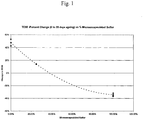
- Fig. 1 shows the percent change in t 90 after ageing for 28 days for compounds containing different percentages of microencapsulated sulfur versus free sulfur (that is, a certain percentage of the total amount of sulfur by weight was microencapsulated).
- the curve shows that the percent change in t 90 after ageing can be adjusted by varying the ratio of microencapsulated sulfur to free sulfur.
- Compounds with no microencapsulated sulfur exhibit an increase in the t 90 of greater than 40% when aged for 28 days.
- the t 90 for a compound containing 100% microencapsulated sulfur was shortened by approximately 30% when compared with the unaged compound. This curve establishes a relationship between the percent microencapsulated sulfur in the rubber compound and its ageing behavior as measured by t 90 .
- stable rubber compounds i.e. compounds with a 0% change in t 90 during ageing
- This curve shows that a compound containing approximately 40% microencapsulated sulfur and approximately 60% sulfur would be a stable compound and exhibit a 0% change in t 90 after aging for 28 days.
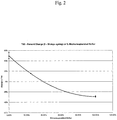
- Fig. 2 shows the relationship between the percent microencapsulated sulfur in the rubber compound and its aging behavior as measured by t 95 .
- the curve shows that the percent change in t 95 after ageing can be adjusted by varying the ratio of microencapsulated sulfur to free sulfur. Compounds with no microencapsulated sulfur exhibit an increase in the t 95 of between 40 to 60 % when aged for 28 days.
- the t 95 for a compound containing 100% microencapsulated sulfur was shortened by approximately 30% when compared with the unaged compound.
- stable rubber compounds i.e., compounds with a 0% change in t 95 during ageing
- This curve shows that a compound containing approximately 40% microencapsulated sulfur and approximately 60% sulfur would be a stable compound and exhibit a 0% change in t 95 after aging for 28 days.
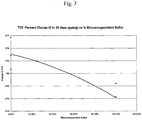
- Fig. 3 shows the relationship between the percent microencapsulated sulfur in the rubber compound and its ageing behavior as measured by t 0 .
- t 0 is the time for the initiation of the vulcanization.
- the curve shows that the percent change in t 0 after ageing can be adjusted by varying the ratio of microencapsulated sulfur to free sulfur.
- Compounds with no microencapsulated sulfur exhibit an average increase in the t 0 of between 10 to 20 % when aged for 28 days.
- the t 0 for a compound containing 100% microencapsulated sulfur was shortened by between 10 to 20% when compared with the unaged compound.
- stable rubber compounds i.e., compounds with a 0% change in t 0 during ageing
- This curve shows that a compound containing between 40 to 60 % microencapsulated sulfur would be a stable compound and exhibit a 0% change in t 0 after ageing for 28 days.
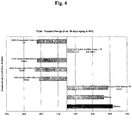
- Fig. 4 shows the percentage change in t 90 for different rubber compounds after ageing for 28 days.
- the rubber compounds are formulated with different percentages of microencapsulated sulfur and unencapsulated sulfur.
- the range for the microencapsulated sulfur is between 0 and 100 %.
- the range for the unencapsulated sulfur is between 0 and 100%.
- the sulfur is microencapsulated in two different polymers, polystyrene or PMMA.
- the bar graph shows that the use of microencapsulated sulfur decreases the t 90 during aging of the rubber compound.
- a standard (witness) rubber mix was prepared as follows:
- Example 1 - This is the rubber compound without encapsulation which shows that on aging for 28 days at 40°C the cure time, as measured by t 90 , increased 53%
- the Figure below shows how the rheometer curve changes during aging.
- Example 2 Sulfur/polymethylmethacrylate microcapsules were prepared using a single emulsion evaporation microencapsulation technique.
- the microcapsules contained 18.7% sulfur.
- Differential scanning calorimetry (DSC) showed the microcapsules underwent a thermal transition at 115 - 122 °C.
- Scanning electron microscopy showed the microcapsules to be spherical.
- a rubber compound was made which contained the same quantity of sulfur as the standard compound, however 25% of the sulfur was microencapsulated sulfur (S/PMMA) and 75% was free sulfur. Aging of this compound for 2 weeks at 40 °C showed that t 90 increased by 14% as compared to the current compound in Example 1 which increased by 53%.
- Example 3 Sulfur/polymethylmethacrylate microcapsules were prepared using a single emulsion evaporation microencapsulation procedure. The microcapsules contained 30% sulfur. Particle size as described by D90 was 30 ⁇ .
- a rubber compound was made which contained the same quantity of sulfur as the standard compound, however 100% of the sulfur was microencapsulated sulfur (S/PMMA). Aging of this compound for 2 weeks at 40 °C showed a decrease in cure time. The t 90 decreased by 37% as compared to compound in Example 1 which increased by 53%.
- Example 4 Sulfur/polystyrene microcapsules were prepared using a single emulsion evaporation microencapsulation procedure.
- the microcapsules contained 21.9% sulfur.
- a rubber compound was made which contained the same quantity of sulfur as the standard compound, however 100% of the sulfur was microencapsulated sulfur (S/PS). Aging of this compound for 2 weeks at 40 °C showed that cure time decreased. t 90 decreased by 19% as compared to current compound in Example 1 which increased by 53%.
- microcapsule shell material This example illustrates that other polymers that have the correct thermal properties to allow the thermal release and reaction of the active product at temperatures near the rubber curing temperature can be employed as microcapsule shell material.
- Example 5 Polystyrene microcapsules were prepared using a single emulsion evaporation microencapsulation procedure. These microcapsules did not contain any active vulcanizing agent.
- a rubber compound was made which contained the same quantity of sulfur as the standard compound, however the empty polystyrene microcapsule were added at a quantity of 3.5 weight percent of the rubber compound. Aging of this compound for 2 weeks at 40 °C showed that cure time increased. t 90 increased by 48% as compared to current compound in Example 1 which increased by 53%.
- microcapsules which do not contain any active vulcanizing product has a negligible effect on the stability and cure rate of the compound.
- the results in this example can be compared with the results described in Example 6 using sulfur/polystyrene microcapsules. After aging the t 90 decreased by 19% for the compound containing the S/PS microcapsules of Example 6 as compared to an increase in t 90 48% for the compound in this example which contained empty polystyrene microcapsules.
- Example 6 (according to the invention) - A rubber compound was made which contained the same quantity of sulfur as the standard compound, however 25% of the sulfur was microencapsulated sulfur (S/PMMA) and 75% was free sulfur. (This experiment repeats the procedure of Example 2). The curing behavior of the compound was measured immediately after rubber mixing. This compound showed a t 90 of 4.5 minutes as compared to a t 90 of 4.54 minutes for the standard which did not contain microencapsulated sulfur. Aging of this compound for 2 weeks at 40 °C showed that t 90 increased to 5.13 minutes as compared to current compound in Example 1 which had an increase in t 90 to 6.94 minutes.
- This example illustrates that a rubber compound containing microencapsulated sulfur can be formulated to have the same initial curing behavior as the standard compound but the use of the microencapsulated sulfur improves the stability of the uncured compound during aging.
Landscapes
- Chemical & Material Sciences (AREA)
- Health & Medical Sciences (AREA)
- Chemical Kinetics & Catalysis (AREA)
- Medicinal Chemistry (AREA)
- Polymers & Plastics (AREA)
- Organic Chemistry (AREA)
- Compositions Of Macromolecular Compounds (AREA)
Applications Claiming Priority (1)
| Application Number | Priority Date | Filing Date | Title |
|---|---|---|---|
| PCT/US2004/010809 WO2005108480A1 (en) | 2004-04-08 | 2004-04-08 | Rubber composition and tire comprising same |
Publications (2)
| Publication Number | Publication Date |
|---|---|
| EP1742993A1 EP1742993A1 (en) | 2007-01-17 |
| EP1742993B1 true EP1742993B1 (en) | 2018-07-04 |
Family
ID=34957595
Family Applications (1)
| Application Number | Title | Priority Date | Filing Date |
|---|---|---|---|
| EP04821965.3A Expired - Lifetime EP1742993B1 (en) | 2004-04-08 | 2004-04-08 | Rubber composition and tire comprising same |
Country Status (4)
| Country | Link |
|---|---|
| EP (1) | EP1742993B1 (enExample) |
| JP (1) | JP5097896B2 (enExample) |
| CN (1) | CN100523069C (enExample) |
| WO (1) | WO2005108480A1 (enExample) |
Families Citing this family (17)
| Publication number | Priority date | Publication date | Assignee | Title |
|---|---|---|---|---|
| EP1769024B1 (en) * | 2004-06-29 | 2016-08-10 | Compagnie Générale des Etablissements Michelin | Rubber composition and tire comprising same |
| US7572850B2 (en) | 2004-06-29 | 2009-08-11 | Michelin Recherche Et Technique S.A. | Rubber composition and tire comprising same |
| KR100920702B1 (ko) * | 2007-11-06 | 2009-10-07 | 한국타이어 주식회사 | 여름용 타이어 트레드 고무 조성물 |
| KR100962630B1 (ko) * | 2008-09-26 | 2010-06-11 | 한국타이어 주식회사 | 저발열 타이어 언더트레드용 고무 조성물 |
| JP5097803B2 (ja) * | 2010-04-05 | 2012-12-12 | 住友ゴム工業株式会社 | タイヤ用ゴム組成物及び空気入りタイヤ |
| US9068063B2 (en) * | 2010-06-29 | 2015-06-30 | Eastman Chemical Company | Cellulose ester/elastomer compositions |
| US9273195B2 (en) | 2010-06-29 | 2016-03-01 | Eastman Chemical Company | Tires comprising cellulose ester/elastomer compositions |
| US20130150493A1 (en) * | 2011-12-07 | 2013-06-13 | Eastman Chemical Company | Process for dispersing cellulose esters into elastomeric compositions |
| CN103232662B (zh) * | 2013-04-16 | 2015-07-15 | 珠海经济特区科茂橡塑材料有限公司 | 橡胶促进剂dptu的应用及卤素羧基型acm橡胶组合配方 |
| JP6721962B2 (ja) * | 2015-10-15 | 2020-07-15 | Toyo Tire株式会社 | トレッド用ゴム組成物およびタイヤ |
| US10077342B2 (en) | 2016-01-21 | 2018-09-18 | Eastman Chemical Company | Elastomeric compositions comprising cellulose ester additives |
| CN105860130A (zh) * | 2016-04-10 | 2016-08-17 | 北京化工大学 | 一种硫化橡胶低温选择性断裂交联网络再生的方法 |
| CN106398000A (zh) * | 2016-09-28 | 2017-02-15 | 清河汽车技术研究院 | 橡胶制品低温硫化促进剂及其制备方法 |
| JP7148911B2 (ja) * | 2018-01-11 | 2022-10-06 | 学校法人福岡大学 | 硫黄コーティング組成物の製造方法、およびゴム組成物 |
| CN110577728A (zh) * | 2018-06-07 | 2019-12-17 | 江苏金发科技新材料有限公司 | 具有高球压温度和耐溶剂性的聚碳酸酯组合物及其制备方法 |
| WO2020128990A1 (en) * | 2018-12-21 | 2020-06-25 | Pirelli Tyre S.P.A. | Capsules comprising vulcanisation accelerant agents, their preparation and use in the vulcanisation of elastomeric compounds for tyres |
| WO2020128985A1 (en) * | 2018-12-21 | 2020-06-25 | Pirelli Tyre S.P.A. | Capsules comprising additives for tyre compounds, preparation method and use for the production of tyres |
Family Cites Families (9)
| Publication number | Priority date | Publication date | Assignee | Title |
|---|---|---|---|---|
| US2623079A (en) * | 1949-09-22 | 1952-12-23 | Cleon R Johnson | Method of vulcanizing rubber with sulfur |
| JPS5269455A (en) * | 1975-12-08 | 1977-06-09 | Bridgestone Corp | Vulcanizable rubber compositions with improved bloom |
| JPS6198751A (ja) * | 1984-10-19 | 1986-05-17 | Yokohama Rubber Co Ltd:The | ゴム用配合剤 |
| JPH051176A (ja) * | 1991-06-26 | 1993-01-08 | Ohtsu Tire & Rubber Co Ltd :The | ゴム組成物 |
| JPH1017706A (ja) * | 1996-04-30 | 1998-01-20 | Bridgestone Corp | ゴム組成物 |
| DE19754341A1 (de) * | 1997-11-25 | 1999-07-29 | Schill & Seilacher | Mikroverkapseltes Kautschukadditiv |
| JP5009457B2 (ja) * | 2000-05-11 | 2012-08-22 | 株式会社ブリヂストン | ゴム組成物及びそれを用いた空気入りタイヤ |
| JP4632555B2 (ja) * | 2001-02-06 | 2011-02-16 | 住友ゴム工業株式会社 | ゴム製品の製造方法 |
| JP4251925B2 (ja) * | 2003-06-26 | 2009-04-08 | Sriスポーツ株式会社 | ゴルフボールの製造方法 |
-
2004
- 2004-04-08 JP JP2007507286A patent/JP5097896B2/ja not_active Expired - Fee Related
- 2004-04-08 EP EP04821965.3A patent/EP1742993B1/en not_active Expired - Lifetime
- 2004-04-08 CN CNB2004800417743A patent/CN100523069C/zh not_active Expired - Fee Related
- 2004-04-08 WO PCT/US2004/010809 patent/WO2005108480A1/en not_active Ceased
Non-Patent Citations (1)
| Title |
|---|
| None * |
Also Published As
| Publication number | Publication date |
|---|---|
| JP5097896B2 (ja) | 2012-12-12 |
| CN1918224A (zh) | 2007-02-21 |
| CN100523069C (zh) | 2009-08-05 |
| WO2005108480A1 (en) | 2005-11-17 |
| EP1742993A1 (en) | 2007-01-17 |
| JP2007532714A (ja) | 2007-11-15 |
Similar Documents
| Publication | Publication Date | Title |
|---|---|---|
| EP1742993B1 (en) | Rubber composition and tire comprising same | |
| US7528181B2 (en) | Rubber composition and tire comprising same | |
| EP1988117A1 (en) | Processes for preparing rubber blend compositions | |
| BR102015009848B1 (pt) | Composições de borracha funcionalizada renovada e método para fabricação desta | |
| JP2012504185A (ja) | リサイクル含有物を含むタイヤ | |
| JP6989702B2 (ja) | 1又は複数のエラストマー化合物を生成する方法 | |
| CN102361922B (zh) | 芳基二腈氧化物在粘合剂组合物中的用途 | |
| US5023292A (en) | Tire compounds | |
| CN108602963A (zh) | 用于制备包含二烯弹性体、有机增强填料和任选的抗氧化剂的母料的方法 | |
| US7572850B2 (en) | Rubber composition and tire comprising same | |
| EP1769024B1 (en) | Rubber composition and tire comprising same | |
| EP3562874B1 (en) | Method of recycling rubber | |
| US7053137B2 (en) | Azodicarbonamide treatment for carbon black and rubber compounds | |
| JPS5887138A (ja) | タイヤ用ゴム組成物 | |
| CN108602962B (zh) | 用于制备包含二烯弹性体、有机增强填料和抗氧化剂的母料的方法 | |
| Premachandra et al. | A novel reclaiming agent for ground rubber tyre (GRT). Part 1: property evaluation of virgin natural rubber (NR)/novel reclaimed GRT blend compounds | |
| RU2365603C2 (ru) | Композиция резиновой смеси для подпротектора шин и способы ее применения | |
| Yohanes et al. | Lanjar; Yanto, DHY; Wulandari, EP; Wiranata, A.; Ibrahim, B. Characterization of Natural Rubber, Styrene Butadiene Rubber, and Nitrile Butadiene Rubber Monomer Blend Composites Loaded with Zinc Stearate to Be Used in the Solid Tire Industry | |
| Shuttleworth et al. | Synthetic polyisoprene rubbers | |
| CN112334322A (zh) | 包含特定橡胶粉末的橡胶组合物 | |
| Gunawan et al. | Optimization of Natural Rubber Formulation for Military Vehicle Tread Using Filler Carbon Black Type N220/N550 | |
| JP2001089601A (ja) | 再生ゴム組成物 | |
| WO2022234443A9 (en) | Method of functionalising an elastomeric material and the use thereof in rubber formulations | |
| JPH06128419A (ja) | ゴム組成物の製造方法 | |
| CN118159428A (zh) | 橡胶组合物 |
Legal Events
| Date | Code | Title | Description |
|---|---|---|---|
| PUAI | Public reference made under article 153(3) epc to a published international application that has entered the european phase |
Free format text: ORIGINAL CODE: 0009012 |
|
| 17P | Request for examination filed |
Effective date: 20061108 |
|
| AK | Designated contracting states |
Kind code of ref document: A1 Designated state(s): AT BE BG CH CY CZ DE DK EE ES FI FR GB GR HU IE IT LI LU MC NL PL PT RO SE SI SK TR |
|
| DAX | Request for extension of the european patent (deleted) | ||
| 17Q | First examination report despatched |
Effective date: 20080228 |
|
| RAP1 | Party data changed (applicant data changed or rights of an application transferred) |
Owner name: COMPAGNIE GENERALE DES ETABLISSEMENTS MICHELIN Owner name: MICHELIN RECHERCHE ET TECHNIQUE S.A. |
|
| RAP1 | Party data changed (applicant data changed or rights of an application transferred) |
Owner name: COMPAGNIE GENERALE DES ETABLISSEMENTS MICHELIN |
|
| RAP1 | Party data changed (applicant data changed or rights of an application transferred) |
Owner name: COMPAGNIE GENERALE DES ETABLISSEMENTS MICHELIN |
|
| REG | Reference to a national code |
Ref country code: DE Ref legal event code: R079 Ref document number: 602004052902 Country of ref document: DE Free format text: PREVIOUS MAIN CLASS: C08K0009080000 Ipc: C08K0005000000 |
|
| GRAP | Despatch of communication of intention to grant a patent |
Free format text: ORIGINAL CODE: EPIDOSNIGR1 |
|
| STAA | Information on the status of an ep patent application or granted ep patent |
Free format text: STATUS: GRANT OF PATENT IS INTENDED |
|
| INTG | Intention to grant announced |
Effective date: 20180201 |
|
| RIC1 | Information provided on ipc code assigned before grant |
Ipc: C08K 9/08 20060101ALI20180119BHEP Ipc: C08L 21/00 20060101ALI20180119BHEP Ipc: C08K 5/00 20060101AFI20180119BHEP Ipc: C08K 9/10 20060101ALI20180119BHEP |
|
| GRAS | Grant fee paid |
Free format text: ORIGINAL CODE: EPIDOSNIGR3 |
|
| GRAA | (expected) grant |
Free format text: ORIGINAL CODE: 0009210 |
|
| STAA | Information on the status of an ep patent application or granted ep patent |
Free format text: STATUS: THE PATENT HAS BEEN GRANTED |
|
| AK | Designated contracting states |
Kind code of ref document: B1 Designated state(s): AT BE BG CH CY CZ DE DK EE ES FI FR GB GR HU IE IT LI LU MC NL PL PT RO SE SI SK TR |
|
| REG | Reference to a national code |
Ref country code: GB Ref legal event code: FG4D |
|
| REG | Reference to a national code |
Ref country code: CH Ref legal event code: EP |
|
| REG | Reference to a national code |
Ref country code: AT Ref legal event code: REF Ref document number: 1014457 Country of ref document: AT Kind code of ref document: T Effective date: 20180715 |
|
| REG | Reference to a national code |
Ref country code: IE Ref legal event code: FG4D |
|
| REG | Reference to a national code |
Ref country code: DE Ref legal event code: R096 Ref document number: 602004052902 Country of ref document: DE |
|
| RAP2 | Party data changed (patent owner data changed or rights of a patent transferred) |
Owner name: COMPAGNIE GENERALE DES ETABLISSEMENTS MICHELIN |
|
| REG | Reference to a national code |
Ref country code: NL Ref legal event code: MP Effective date: 20180704 |
|
| REG | Reference to a national code |
Ref country code: AT Ref legal event code: MK05 Ref document number: 1014457 Country of ref document: AT Kind code of ref document: T Effective date: 20180704 |
|
| PG25 | Lapsed in a contracting state [announced via postgrant information from national office to epo] |
Ref country code: NL Free format text: LAPSE BECAUSE OF FAILURE TO SUBMIT A TRANSLATION OF THE DESCRIPTION OR TO PAY THE FEE WITHIN THE PRESCRIBED TIME-LIMIT Effective date: 20180704 |
|
| PG25 | Lapsed in a contracting state [announced via postgrant information from national office to epo] |
Ref country code: SE Free format text: LAPSE BECAUSE OF FAILURE TO SUBMIT A TRANSLATION OF THE DESCRIPTION OR TO PAY THE FEE WITHIN THE PRESCRIBED TIME-LIMIT Effective date: 20180704 Ref country code: BG Free format text: LAPSE BECAUSE OF FAILURE TO SUBMIT A TRANSLATION OF THE DESCRIPTION OR TO PAY THE FEE WITHIN THE PRESCRIBED TIME-LIMIT Effective date: 20181004 Ref country code: FI Free format text: LAPSE BECAUSE OF FAILURE TO SUBMIT A TRANSLATION OF THE DESCRIPTION OR TO PAY THE FEE WITHIN THE PRESCRIBED TIME-LIMIT Effective date: 20180704 Ref country code: GR Free format text: LAPSE BECAUSE OF FAILURE TO SUBMIT A TRANSLATION OF THE DESCRIPTION OR TO PAY THE FEE WITHIN THE PRESCRIBED TIME-LIMIT Effective date: 20181005 Ref country code: AT Free format text: LAPSE BECAUSE OF FAILURE TO SUBMIT A TRANSLATION OF THE DESCRIPTION OR TO PAY THE FEE WITHIN THE PRESCRIBED TIME-LIMIT Effective date: 20180704 Ref country code: CZ Free format text: LAPSE BECAUSE OF FAILURE TO SUBMIT A TRANSLATION OF THE DESCRIPTION OR TO PAY THE FEE WITHIN THE PRESCRIBED TIME-LIMIT Effective date: 20180704 Ref country code: PL Free format text: LAPSE BECAUSE OF FAILURE TO SUBMIT A TRANSLATION OF THE DESCRIPTION OR TO PAY THE FEE WITHIN THE PRESCRIBED TIME-LIMIT Effective date: 20180704 |
|
| PG25 | Lapsed in a contracting state [announced via postgrant information from national office to epo] |
Ref country code: ES Free format text: LAPSE BECAUSE OF FAILURE TO SUBMIT A TRANSLATION OF THE DESCRIPTION OR TO PAY THE FEE WITHIN THE PRESCRIBED TIME-LIMIT Effective date: 20180704 |
|
| REG | Reference to a national code |
Ref country code: DE Ref legal event code: R097 Ref document number: 602004052902 Country of ref document: DE |
|
| PG25 | Lapsed in a contracting state [announced via postgrant information from national office to epo] |
Ref country code: RO Free format text: LAPSE BECAUSE OF FAILURE TO SUBMIT A TRANSLATION OF THE DESCRIPTION OR TO PAY THE FEE WITHIN THE PRESCRIBED TIME-LIMIT Effective date: 20180704 Ref country code: IT Free format text: LAPSE BECAUSE OF FAILURE TO SUBMIT A TRANSLATION OF THE DESCRIPTION OR TO PAY THE FEE WITHIN THE PRESCRIBED TIME-LIMIT Effective date: 20180704 Ref country code: EE Free format text: LAPSE BECAUSE OF FAILURE TO SUBMIT A TRANSLATION OF THE DESCRIPTION OR TO PAY THE FEE WITHIN THE PRESCRIBED TIME-LIMIT Effective date: 20180704 |
|
| PLBE | No opposition filed within time limit |
Free format text: ORIGINAL CODE: 0009261 |
|
| STAA | Information on the status of an ep patent application or granted ep patent |
Free format text: STATUS: NO OPPOSITION FILED WITHIN TIME LIMIT |
|
| PG25 | Lapsed in a contracting state [announced via postgrant information from national office to epo] |
Ref country code: DK Free format text: LAPSE BECAUSE OF FAILURE TO SUBMIT A TRANSLATION OF THE DESCRIPTION OR TO PAY THE FEE WITHIN THE PRESCRIBED TIME-LIMIT Effective date: 20180704 Ref country code: SK Free format text: LAPSE BECAUSE OF FAILURE TO SUBMIT A TRANSLATION OF THE DESCRIPTION OR TO PAY THE FEE WITHIN THE PRESCRIBED TIME-LIMIT Effective date: 20180704 |
|
| 26N | No opposition filed |
Effective date: 20190405 |
|
| PG25 | Lapsed in a contracting state [announced via postgrant information from national office to epo] |
Ref country code: SI Free format text: LAPSE BECAUSE OF FAILURE TO SUBMIT A TRANSLATION OF THE DESCRIPTION OR TO PAY THE FEE WITHIN THE PRESCRIBED TIME-LIMIT Effective date: 20180704 |
|
| REG | Reference to a national code |
Ref country code: DE Ref legal event code: R119 Ref document number: 602004052902 Country of ref document: DE |
|
| REG | Reference to a national code |
Ref country code: CH Ref legal event code: PL |
|
| REG | Reference to a national code |
Ref country code: BE Ref legal event code: MM Effective date: 20190430 |
|
| GBPC | Gb: european patent ceased through non-payment of renewal fee |
Effective date: 20190408 |
|
| PG25 | Lapsed in a contracting state [announced via postgrant information from national office to epo] |
Ref country code: LU Free format text: LAPSE BECAUSE OF NON-PAYMENT OF DUE FEES Effective date: 20190408 Ref country code: MC Free format text: LAPSE BECAUSE OF FAILURE TO SUBMIT A TRANSLATION OF THE DESCRIPTION OR TO PAY THE FEE WITHIN THE PRESCRIBED TIME-LIMIT Effective date: 20180704 |
|
| PG25 | Lapsed in a contracting state [announced via postgrant information from national office to epo] |
Ref country code: LI Free format text: LAPSE BECAUSE OF NON-PAYMENT OF DUE FEES Effective date: 20190430 Ref country code: GB Free format text: LAPSE BECAUSE OF NON-PAYMENT OF DUE FEES Effective date: 20190408 Ref country code: DE Free format text: LAPSE BECAUSE OF NON-PAYMENT OF DUE FEES Effective date: 20191101 Ref country code: CH Free format text: LAPSE BECAUSE OF NON-PAYMENT OF DUE FEES Effective date: 20190430 |
|
| PG25 | Lapsed in a contracting state [announced via postgrant information from national office to epo] |
Ref country code: BE Free format text: LAPSE BECAUSE OF NON-PAYMENT OF DUE FEES Effective date: 20190430 |
|
| PG25 | Lapsed in a contracting state [announced via postgrant information from national office to epo] |
Ref country code: TR Free format text: LAPSE BECAUSE OF FAILURE TO SUBMIT A TRANSLATION OF THE DESCRIPTION OR TO PAY THE FEE WITHIN THE PRESCRIBED TIME-LIMIT Effective date: 20180704 |
|
| PG25 | Lapsed in a contracting state [announced via postgrant information from national office to epo] |
Ref country code: IE Free format text: LAPSE BECAUSE OF NON-PAYMENT OF DUE FEES Effective date: 20190408 |
|
| PG25 | Lapsed in a contracting state [announced via postgrant information from national office to epo] |
Ref country code: PT Free format text: LAPSE BECAUSE OF FAILURE TO SUBMIT A TRANSLATION OF THE DESCRIPTION OR TO PAY THE FEE WITHIN THE PRESCRIBED TIME-LIMIT Effective date: 20181105 |
|
| PGFP | Annual fee paid to national office [announced via postgrant information from national office to epo] |
Ref country code: FR Payment date: 20200420 Year of fee payment: 17 |
|
| PG25 | Lapsed in a contracting state [announced via postgrant information from national office to epo] |
Ref country code: CY Free format text: LAPSE BECAUSE OF FAILURE TO SUBMIT A TRANSLATION OF THE DESCRIPTION OR TO PAY THE FEE WITHIN THE PRESCRIBED TIME-LIMIT Effective date: 20180704 |
|
| PG25 | Lapsed in a contracting state [announced via postgrant information from national office to epo] |
Ref country code: HU Free format text: LAPSE BECAUSE OF FAILURE TO SUBMIT A TRANSLATION OF THE DESCRIPTION OR TO PAY THE FEE WITHIN THE PRESCRIBED TIME-LIMIT; INVALID AB INITIO Effective date: 20040408 |
|
| PG25 | Lapsed in a contracting state [announced via postgrant information from national office to epo] |
Ref country code: FR Free format text: LAPSE BECAUSE OF NON-PAYMENT OF DUE FEES Effective date: 20210430 |