EP1737916B1 - Surface modified carbon products and their applications - Google Patents
Surface modified carbon products and their applications Download PDFInfo
- Publication number
- EP1737916B1 EP1737916B1 EP05725684A EP05725684A EP1737916B1 EP 1737916 B1 EP1737916 B1 EP 1737916B1 EP 05725684 A EP05725684 A EP 05725684A EP 05725684 A EP05725684 A EP 05725684A EP 1737916 B1 EP1737916 B1 EP 1737916B1
- Authority
- EP
- European Patent Office
- Prior art keywords
- carbon
- metal
- modified carbon
- modified
- particles
- Prior art date
- Legal status (The legal status is an assumption and is not a legal conclusion. Google has not performed a legal analysis and makes no representation as to the accuracy of the status listed.)
- Expired - Lifetime
Links
Images


Classifications
-
- C—CHEMISTRY; METALLURGY
- C09—DYES; PAINTS; POLISHES; NATURAL RESINS; ADHESIVES; COMPOSITIONS NOT OTHERWISE PROVIDED FOR; APPLICATIONS OF MATERIALS NOT OTHERWISE PROVIDED FOR
- C09C—TREATMENT OF INORGANIC MATERIALS, OTHER THAN FIBROUS FILLERS, TO ENHANCE THEIR PIGMENTING OR FILLING PROPERTIES ; PREPARATION OF CARBON BLACK ; PREPARATION OF INORGANIC MATERIALS WHICH ARE NO SINGLE CHEMICAL COMPOUNDS AND WHICH ARE MAINLY USED AS PIGMENTS OR FILLERS
- C09C1/00—Treatment of specific inorganic materials other than fibrous fillers; Preparation of carbon black
- C09C1/44—Carbon
- C09C1/48—Carbon black
- C09C1/56—Treatment of carbon black ; Purification
-
- C—CHEMISTRY; METALLURGY
- C09—DYES; PAINTS; POLISHES; NATURAL RESINS; ADHESIVES; COMPOSITIONS NOT OTHERWISE PROVIDED FOR; APPLICATIONS OF MATERIALS NOT OTHERWISE PROVIDED FOR
- C09C—TREATMENT OF INORGANIC MATERIALS, OTHER THAN FIBROUS FILLERS, TO ENHANCE THEIR PIGMENTING OR FILLING PROPERTIES ; PREPARATION OF CARBON BLACK ; PREPARATION OF INORGANIC MATERIALS WHICH ARE NO SINGLE CHEMICAL COMPOUNDS AND WHICH ARE MAINLY USED AS PIGMENTS OR FILLERS
- C09C1/00—Treatment of specific inorganic materials other than fibrous fillers; Preparation of carbon black
- C09C1/44—Carbon
- C09C1/48—Carbon black
- C09C1/56—Treatment of carbon black ; Purification
- C09C1/565—Treatment of carbon black ; Purification comprising an oxidative treatment with oxygen, ozone or oxygenated compounds, e.g. when such treatment occurs in a region of the furnace next to the carbon black generating reaction zone
-
- B—PERFORMING OPERATIONS; TRANSPORTING
- B01—PHYSICAL OR CHEMICAL PROCESSES OR APPARATUS IN GENERAL
- B01J—CHEMICAL OR PHYSICAL PROCESSES, e.g. CATALYSIS OR COLLOID CHEMISTRY; THEIR RELEVANT APPARATUS
- B01J31/00—Catalysts comprising hydrides, coordination complexes or organic compounds
- B01J31/16—Catalysts comprising hydrides, coordination complexes or organic compounds containing coordination complexes
- B01J31/1616—Coordination complexes, e.g. organometallic complexes, immobilised on an inorganic support, e.g. ship-in-a-bottle type catalysts
- B01J31/1625—Coordination complexes, e.g. organometallic complexes, immobilised on an inorganic support, e.g. ship-in-a-bottle type catalysts immobilised by covalent linkages, i.e. pendant complexes with optional linking groups
-
- B—PERFORMING OPERATIONS; TRANSPORTING
- B01—PHYSICAL OR CHEMICAL PROCESSES OR APPARATUS IN GENERAL
- B01J—CHEMICAL OR PHYSICAL PROCESSES, e.g. CATALYSIS OR COLLOID CHEMISTRY; THEIR RELEVANT APPARATUS
- B01J31/00—Catalysts comprising hydrides, coordination complexes or organic compounds
- B01J31/16—Catalysts comprising hydrides, coordination complexes or organic compounds containing coordination complexes
- B01J31/24—Phosphines, i.e. phosphorus bonded to only carbon atoms, or to both carbon and hydrogen atoms, including e.g. sp2-hybridised phosphorus compounds such as phosphabenzene, phosphole or anionic phospholide ligands
- B01J31/2404—Cyclic ligands, including e.g. non-condensed polycyclic ligands, the phosphine-P atom being a ring member or a substituent on the ring
-
- B—PERFORMING OPERATIONS; TRANSPORTING
- B82—NANOTECHNOLOGY
- B82Y—SPECIFIC USES OR APPLICATIONS OF NANOSTRUCTURES; MEASUREMENT OR ANALYSIS OF NANOSTRUCTURES; MANUFACTURE OR TREATMENT OF NANOSTRUCTURES
- B82Y30/00—Nanotechnology for materials or surface science, e.g. nanocomposites
-
- B—PERFORMING OPERATIONS; TRANSPORTING
- B82—NANOTECHNOLOGY
- B82Y—SPECIFIC USES OR APPLICATIONS OF NANOSTRUCTURES; MEASUREMENT OR ANALYSIS OF NANOSTRUCTURES; MANUFACTURE OR TREATMENT OF NANOSTRUCTURES
- B82Y40/00—Manufacture or treatment of nanostructures
-
- C—CHEMISTRY; METALLURGY
- C01—INORGANIC CHEMISTRY
- C01B—NON-METALLIC ELEMENTS; COMPOUNDS THEREOF; METALLOIDS OR COMPOUNDS THEREOF NOT COVERED BY SUBCLASS C01C
- C01B3/00—Hydrogen; Gaseous mixtures containing hydrogen; Separation of hydrogen from mixtures containing it; Purification of hydrogen; Reversible storage of hydrogen
- C01B3/0005—Reversible storage of hydrogen, e.g. by hydrogen getters or electrodes
- C01B3/001—Reversible storage of hydrogen, e.g. by hydrogen getters or electrodes characterised by the uptaking media; Treatment thereof
- C01B3/0018—Inorganic elements or compounds, e.g. oxides, nitrides, borohydrides or zeolites; Solutions thereof
- C01B3/0021—Elemental carbon, e.g. active carbon, carbon nanotubes or fullerenes
-
- C—CHEMISTRY; METALLURGY
- C01—INORGANIC CHEMISTRY
- C01B—NON-METALLIC ELEMENTS; COMPOUNDS THEREOF; METALLOIDS OR COMPOUNDS THEREOF NOT COVERED BY SUBCLASS C01C
- C01B32/00—Carbon; Compounds thereof
- C01B32/05—Preparation or purification of carbon not covered by groups C01B32/15, C01B32/20, C01B32/25, C01B32/30
-
- C—CHEMISTRY; METALLURGY
- C01—INORGANIC CHEMISTRY
- C01B—NON-METALLIC ELEMENTS; COMPOUNDS THEREOF; METALLOIDS OR COMPOUNDS THEREOF NOT COVERED BY SUBCLASS C01C
- C01B32/00—Carbon; Compounds thereof
- C01B32/15—Nano-sized carbon materials
- C01B32/158—Carbon nanotubes
- C01B32/168—After-treatment
- C01B32/174—Derivatisation; Solubilisation; Dispersion in solvents
-
- C—CHEMISTRY; METALLURGY
- C01—INORGANIC CHEMISTRY
- C01B—NON-METALLIC ELEMENTS; COMPOUNDS THEREOF; METALLOIDS OR COMPOUNDS THEREOF NOT COVERED BY SUBCLASS C01C
- C01B32/00—Carbon; Compounds thereof
- C01B32/30—Active carbon
-
- C—CHEMISTRY; METALLURGY
- C09—DYES; PAINTS; POLISHES; NATURAL RESINS; ADHESIVES; COMPOSITIONS NOT OTHERWISE PROVIDED FOR; APPLICATIONS OF MATERIALS NOT OTHERWISE PROVIDED FOR
- C09C—TREATMENT OF INORGANIC MATERIALS, OTHER THAN FIBROUS FILLERS, TO ENHANCE THEIR PIGMENTING OR FILLING PROPERTIES ; PREPARATION OF CARBON BLACK ; PREPARATION OF INORGANIC MATERIALS WHICH ARE NO SINGLE CHEMICAL COMPOUNDS AND WHICH ARE MAINLY USED AS PIGMENTS OR FILLERS
- C09C1/00—Treatment of specific inorganic materials other than fibrous fillers; Preparation of carbon black
- C09C1/44—Carbon
- C09C1/48—Carbon black
-
- G—PHYSICS
- G01—MEASURING; TESTING
- G01N—INVESTIGATING OR ANALYSING MATERIALS BY DETERMINING THEIR CHEMICAL OR PHYSICAL PROPERTIES
- G01N33/00—Investigating or analysing materials by specific methods not covered by groups G01N1/00 - G01N31/00
- G01N33/48—Biological material, e.g. blood, urine; Haemocytometers
- G01N33/50—Chemical analysis of biological material, e.g. blood, urine; Testing involving biospecific ligand binding methods; Immunological testing
- G01N33/53—Immunoassay; Biospecific binding assay; Materials therefor
- G01N33/543—Immunoassay; Biospecific binding assay; Materials therefor with an insoluble carrier for immobilising immunochemicals
- G01N33/54366—Apparatus specially adapted for solid-phase testing
-
- G—PHYSICS
- G01—MEASURING; TESTING
- G01N—INVESTIGATING OR ANALYSING MATERIALS BY DETERMINING THEIR CHEMICAL OR PHYSICAL PROPERTIES
- G01N33/00—Investigating or analysing materials by specific methods not covered by groups G01N1/00 - G01N31/00
- G01N33/48—Biological material, e.g. blood, urine; Haemocytometers
- G01N33/50—Chemical analysis of biological material, e.g. blood, urine; Testing involving biospecific ligand binding methods; Immunological testing
- G01N33/58—Chemical analysis of biological material, e.g. blood, urine; Testing involving biospecific ligand binding methods; Immunological testing involving labelled substances
-
- G—PHYSICS
- G01—MEASURING; TESTING
- G01N—INVESTIGATING OR ANALYSING MATERIALS BY DETERMINING THEIR CHEMICAL OR PHYSICAL PROPERTIES
- G01N33/00—Investigating or analysing materials by specific methods not covered by groups G01N1/00 - G01N31/00
- G01N33/48—Biological material, e.g. blood, urine; Haemocytometers
- G01N33/50—Chemical analysis of biological material, e.g. blood, urine; Testing involving biospecific ligand binding methods; Immunological testing
- G01N33/58—Chemical analysis of biological material, e.g. blood, urine; Testing involving biospecific ligand binding methods; Immunological testing involving labelled substances
- G01N33/582—Chemical analysis of biological material, e.g. blood, urine; Testing involving biospecific ligand binding methods; Immunological testing involving labelled substances with fluorescent label
-
- H—ELECTRICITY
- H01—ELECTRIC ELEMENTS
- H01B—CABLES; CONDUCTORS; INSULATORS; SELECTION OF MATERIALS FOR THEIR CONDUCTIVE, INSULATING OR DIELECTRIC PROPERTIES
- H01B1/00—Conductors or conductive bodies characterised by the conductive materials; Selection of materials as conductors
- H01B1/06—Conductors or conductive bodies characterised by the conductive materials; Selection of materials as conductors mainly consisting of other non-metallic substances
- H01B1/12—Conductors or conductive bodies characterised by the conductive materials; Selection of materials as conductors mainly consisting of other non-metallic substances organic substances
- H01B1/122—Ionic conductors
-
- H—ELECTRICITY
- H01—ELECTRIC ELEMENTS
- H01M—PROCESSES OR MEANS, e.g. BATTERIES, FOR THE DIRECT CONVERSION OF CHEMICAL ENERGY INTO ELECTRICAL ENERGY
- H01M4/00—Electrodes
- H01M4/02—Electrodes composed of, or comprising, active material
- H01M4/36—Selection of substances as active materials, active masses, active liquids
- H01M4/38—Selection of substances as active materials, active masses, active liquids of elements or alloys
- H01M4/383—Hydrogen absorbing alloys
-
- H—ELECTRICITY
- H01—ELECTRIC ELEMENTS
- H01M—PROCESSES OR MEANS, e.g. BATTERIES, FOR THE DIRECT CONVERSION OF CHEMICAL ENERGY INTO ELECTRICAL ENERGY
- H01M4/00—Electrodes
- H01M4/02—Electrodes composed of, or comprising, active material
- H01M4/36—Selection of substances as active materials, active masses, active liquids
- H01M4/58—Selection of substances as active materials, active masses, active liquids of inorganic compounds other than oxides or hydroxides, e.g. sulfides, selenides, tellurides, halogenides or LiCoFy; of polyanionic structures, e.g. phosphates, silicates or borates
- H01M4/583—Carbonaceous material, e.g. graphite-intercalation compounds or CFx
- H01M4/587—Carbonaceous material, e.g. graphite-intercalation compounds or CFx for inserting or intercalating light metals
-
- H—ELECTRICITY
- H01—ELECTRIC ELEMENTS
- H01M—PROCESSES OR MEANS, e.g. BATTERIES, FOR THE DIRECT CONVERSION OF CHEMICAL ENERGY INTO ELECTRICAL ENERGY
- H01M4/00—Electrodes
- H01M4/86—Inert electrodes with catalytic activity, e.g. for fuel cells
- H01M4/90—Selection of catalytic material
- H01M4/92—Metals of platinum group
- H01M4/925—Metals of platinum group supported on carriers, e.g. powder carriers
- H01M4/926—Metals of platinum group supported on carriers, e.g. powder carriers on carbon or graphite
-
- H—ELECTRICITY
- H01—ELECTRIC ELEMENTS
- H01M—PROCESSES OR MEANS, e.g. BATTERIES, FOR THE DIRECT CONVERSION OF CHEMICAL ENERGY INTO ELECTRICAL ENERGY
- H01M8/00—Fuel cells; Manufacture thereof
- H01M8/04—Auxiliary arrangements, e.g. for control of pressure or for circulation of fluids
- H01M8/04082—Arrangements for control of reactant parameters, e.g. pressure or concentration
- H01M8/04201—Reactant storage and supply, e.g. means for feeding, pipes
- H01M8/04216—Reactant storage and supply, e.g. means for feeding, pipes characterised by the choice for a specific material, e.g. carbon, hydride, absorbent
-
- B—PERFORMING OPERATIONS; TRANSPORTING
- B01—PHYSICAL OR CHEMICAL PROCESSES OR APPARATUS IN GENERAL
- B01J—CHEMICAL OR PHYSICAL PROCESSES, e.g. CATALYSIS OR COLLOID CHEMISTRY; THEIR RELEVANT APPARATUS
- B01J21/00—Catalysts comprising the elements, oxides, or hydroxides of magnesium, boron, aluminium, carbon, silicon, titanium, zirconium, or hafnium
- B01J21/18—Carbon
-
- B—PERFORMING OPERATIONS; TRANSPORTING
- B01—PHYSICAL OR CHEMICAL PROCESSES OR APPARATUS IN GENERAL
- B01J—CHEMICAL OR PHYSICAL PROCESSES, e.g. CATALYSIS OR COLLOID CHEMISTRY; THEIR RELEVANT APPARATUS
- B01J21/00—Catalysts comprising the elements, oxides, or hydroxides of magnesium, boron, aluminium, carbon, silicon, titanium, zirconium, or hafnium
- B01J21/18—Carbon
- B01J21/185—Carbon nanotubes
-
- B—PERFORMING OPERATIONS; TRANSPORTING
- B01—PHYSICAL OR CHEMICAL PROCESSES OR APPARATUS IN GENERAL
- B01J—CHEMICAL OR PHYSICAL PROCESSES, e.g. CATALYSIS OR COLLOID CHEMISTRY; THEIR RELEVANT APPARATUS
- B01J2231/00—Catalytic reactions performed with catalysts classified in B01J31/00
- B01J2231/30—Addition reactions at carbon centres, i.e. to either C-C or C-X multiple bonds
- B01J2231/32—Addition reactions to C=C or C-C triple bonds
- B01J2231/323—Hydrometalation, e.g. bor-, alumin-, silyl-, zirconation or analoguous reactions like carbometalation, hydrocarbation
-
- B—PERFORMING OPERATIONS; TRANSPORTING
- B01—PHYSICAL OR CHEMICAL PROCESSES OR APPARATUS IN GENERAL
- B01J—CHEMICAL OR PHYSICAL PROCESSES, e.g. CATALYSIS OR COLLOID CHEMISTRY; THEIR RELEVANT APPARATUS
- B01J2231/00—Catalytic reactions performed with catalysts classified in B01J31/00
- B01J2231/40—Substitution reactions at carbon centres, e.g. C-C or C-X, i.e. carbon-hetero atom, cross-coupling, C-H activation or ring-opening reactions
- B01J2231/42—Catalytic cross-coupling, i.e. connection of previously not connected C-atoms or C- and X-atoms without rearrangement
- B01J2231/4205—C-C cross-coupling, e.g. metal catalyzed or Friedel-Crafts type
- B01J2231/4211—Suzuki-type, i.e. RY + R'B(OR)2, in which R, R' are optionally substituted alkyl, alkenyl, aryl, acyl and Y is the leaving group
-
- B—PERFORMING OPERATIONS; TRANSPORTING
- B01—PHYSICAL OR CHEMICAL PROCESSES OR APPARATUS IN GENERAL
- B01J—CHEMICAL OR PHYSICAL PROCESSES, e.g. CATALYSIS OR COLLOID CHEMISTRY; THEIR RELEVANT APPARATUS
- B01J2231/00—Catalytic reactions performed with catalysts classified in B01J31/00
- B01J2231/40—Substitution reactions at carbon centres, e.g. C-C or C-X, i.e. carbon-hetero atom, cross-coupling, C-H activation or ring-opening reactions
- B01J2231/42—Catalytic cross-coupling, i.e. connection of previously not connected C-atoms or C- and X-atoms without rearrangement
- B01J2231/4205—C-C cross-coupling, e.g. metal catalyzed or Friedel-Crafts type
- B01J2231/4261—Heck-type, i.e. RY + C=C, in which R is aryl
-
- B—PERFORMING OPERATIONS; TRANSPORTING
- B01—PHYSICAL OR CHEMICAL PROCESSES OR APPARATUS IN GENERAL
- B01J—CHEMICAL OR PHYSICAL PROCESSES, e.g. CATALYSIS OR COLLOID CHEMISTRY; THEIR RELEVANT APPARATUS
- B01J2231/00—Catalytic reactions performed with catalysts classified in B01J31/00
- B01J2231/60—Reduction reactions, e.g. hydrogenation
- B01J2231/64—Reductions in general of organic substrates, e.g. hydride reductions or hydrogenations
- B01J2231/641—Hydrogenation of organic substrates, i.e. H2 or H-transfer hydrogenations, e.g. Fischer-Tropsch processes
-
- B—PERFORMING OPERATIONS; TRANSPORTING
- B01—PHYSICAL OR CHEMICAL PROCESSES OR APPARATUS IN GENERAL
- B01J—CHEMICAL OR PHYSICAL PROCESSES, e.g. CATALYSIS OR COLLOID CHEMISTRY; THEIR RELEVANT APPARATUS
- B01J2531/00—Additional information regarding catalytic systems classified in B01J31/00
- B01J2531/80—Complexes comprising metals of Group VIII as the central metal
- B01J2531/82—Metals of the platinum group
- B01J2531/822—Rhodium
-
- B—PERFORMING OPERATIONS; TRANSPORTING
- B01—PHYSICAL OR CHEMICAL PROCESSES OR APPARATUS IN GENERAL
- B01J—CHEMICAL OR PHYSICAL PROCESSES, e.g. CATALYSIS OR COLLOID CHEMISTRY; THEIR RELEVANT APPARATUS
- B01J2531/00—Additional information regarding catalytic systems classified in B01J31/00
- B01J2531/80—Complexes comprising metals of Group VIII as the central metal
- B01J2531/82—Metals of the platinum group
- B01J2531/824—Palladium
-
- B—PERFORMING OPERATIONS; TRANSPORTING
- B01—PHYSICAL OR CHEMICAL PROCESSES OR APPARATUS IN GENERAL
- B01J—CHEMICAL OR PHYSICAL PROCESSES, e.g. CATALYSIS OR COLLOID CHEMISTRY; THEIR RELEVANT APPARATUS
- B01J2531/00—Additional information regarding catalytic systems classified in B01J31/00
- B01J2531/80—Complexes comprising metals of Group VIII as the central metal
- B01J2531/82—Metals of the platinum group
- B01J2531/828—Platinum
-
- C—CHEMISTRY; METALLURGY
- C01—INORGANIC CHEMISTRY
- C01P—INDEXING SCHEME RELATING TO STRUCTURAL AND PHYSICAL ASPECTS OF SOLID INORGANIC COMPOUNDS
- C01P2004/00—Particle morphology
- C01P2004/01—Particle morphology depicted by an image
- C01P2004/03—Particle morphology depicted by an image obtained by SEM
-
- C—CHEMISTRY; METALLURGY
- C01—INORGANIC CHEMISTRY
- C01P—INDEXING SCHEME RELATING TO STRUCTURAL AND PHYSICAL ASPECTS OF SOLID INORGANIC COMPOUNDS
- C01P2004/00—Particle morphology
- C01P2004/01—Particle morphology depicted by an image
- C01P2004/04—Particle morphology depicted by an image obtained by TEM, STEM, STM or AFM
-
- C—CHEMISTRY; METALLURGY
- C01—INORGANIC CHEMISTRY
- C01P—INDEXING SCHEME RELATING TO STRUCTURAL AND PHYSICAL ASPECTS OF SOLID INORGANIC COMPOUNDS
- C01P2004/00—Particle morphology
- C01P2004/10—Particle morphology extending in one dimension, e.g. needle-like
- C01P2004/13—Nanotubes
-
- Y—GENERAL TAGGING OF NEW TECHNOLOGICAL DEVELOPMENTS; GENERAL TAGGING OF CROSS-SECTIONAL TECHNOLOGIES SPANNING OVER SEVERAL SECTIONS OF THE IPC; TECHNICAL SUBJECTS COVERED BY FORMER USPC CROSS-REFERENCE ART COLLECTIONS [XRACs] AND DIGESTS
- Y02—TECHNOLOGIES OR APPLICATIONS FOR MITIGATION OR ADAPTATION AGAINST CLIMATE CHANGE
- Y02E—REDUCTION OF GREENHOUSE GAS [GHG] EMISSIONS, RELATED TO ENERGY GENERATION, TRANSMISSION OR DISTRIBUTION
- Y02E60/00—Enabling technologies; Technologies with a potential or indirect contribution to GHG emissions mitigation
- Y02E60/10—Energy storage using batteries
-
- Y—GENERAL TAGGING OF NEW TECHNOLOGICAL DEVELOPMENTS; GENERAL TAGGING OF CROSS-SECTIONAL TECHNOLOGIES SPANNING OVER SEVERAL SECTIONS OF THE IPC; TECHNICAL SUBJECTS COVERED BY FORMER USPC CROSS-REFERENCE ART COLLECTIONS [XRACs] AND DIGESTS
- Y02—TECHNOLOGIES OR APPLICATIONS FOR MITIGATION OR ADAPTATION AGAINST CLIMATE CHANGE
- Y02E—REDUCTION OF GREENHOUSE GAS [GHG] EMISSIONS, RELATED TO ENERGY GENERATION, TRANSMISSION OR DISTRIBUTION
- Y02E60/00—Enabling technologies; Technologies with a potential or indirect contribution to GHG emissions mitigation
- Y02E60/30—Hydrogen technology
- Y02E60/32—Hydrogen storage
-
- Y—GENERAL TAGGING OF NEW TECHNOLOGICAL DEVELOPMENTS; GENERAL TAGGING OF CROSS-SECTIONAL TECHNOLOGIES SPANNING OVER SEVERAL SECTIONS OF THE IPC; TECHNICAL SUBJECTS COVERED BY FORMER USPC CROSS-REFERENCE ART COLLECTIONS [XRACs] AND DIGESTS
- Y02—TECHNOLOGIES OR APPLICATIONS FOR MITIGATION OR ADAPTATION AGAINST CLIMATE CHANGE
- Y02E—REDUCTION OF GREENHOUSE GAS [GHG] EMISSIONS, RELATED TO ENERGY GENERATION, TRANSMISSION OR DISTRIBUTION
- Y02E60/00—Enabling technologies; Technologies with a potential or indirect contribution to GHG emissions mitigation
- Y02E60/30—Hydrogen technology
- Y02E60/50—Fuel cells
-
- Y—GENERAL TAGGING OF NEW TECHNOLOGICAL DEVELOPMENTS; GENERAL TAGGING OF CROSS-SECTIONAL TECHNOLOGIES SPANNING OVER SEVERAL SECTIONS OF THE IPC; TECHNICAL SUBJECTS COVERED BY FORMER USPC CROSS-REFERENCE ART COLLECTIONS [XRACs] AND DIGESTS
- Y10—TECHNICAL SUBJECTS COVERED BY FORMER USPC
- Y10T—TECHNICAL SUBJECTS COVERED BY FORMER US CLASSIFICATION
- Y10T428/00—Stock material or miscellaneous articles
- Y10T428/30—Self-sustaining carbon mass or layer with impregnant or other layer
-
- Y—GENERAL TAGGING OF NEW TECHNOLOGICAL DEVELOPMENTS; GENERAL TAGGING OF CROSS-SECTIONAL TECHNOLOGIES SPANNING OVER SEVERAL SECTIONS OF THE IPC; TECHNICAL SUBJECTS COVERED BY FORMER USPC CROSS-REFERENCE ART COLLECTIONS [XRACs] AND DIGESTS
- Y10—TECHNICAL SUBJECTS COVERED BY FORMER USPC
- Y10T—TECHNICAL SUBJECTS COVERED BY FORMER US CLASSIFICATION
- Y10T428/00—Stock material or miscellaneous articles
- Y10T428/31504—Composite [nonstructural laminate]
- Y10T428/31678—Of metal
Definitions
- the present invention relates to the use of modified carbon products in a number of applications. More particularly, the present invention relates to the use of modified carbon products and metal-functionalized modified carbon products in applications such as catalysis, electronic and ionic conduction, adsorption, heat transfer and luminescence.
- Carbon is used in a wide variety of industrial applications that take advantage of its intrinsic characteristics. These characteristics include good electrical conductivity, high surface area, black color, abrasion resistance and intercalation. The electrical conductivity can be controlled, with graphitic materials being more conductive compared to amorphous carbon. This leads to numerous applications in the battery industry and fuel cell industry where carbon is used as an electrode material.
- the typically high surface area with somewhat controllable porosity results in the use of carbon in applications such as catalyst and electrocatalyst supports, where the high surface area produces highly dispersed supported catalysts and absorbents.
- electrocatalysts the characteristics of high surface area and electrical conductivity are combined to create conductive catalyzed gas diffusion electrodes.
- Carbon is also intensely black and a relatively small amount of carbon can be used to impart an intensely black color to objects. As a result, it is used to fill poiymers to make black plastics as well as being used in printing inks to create text and images such as newspaper print or small office/home office printed products. As an extension of this attribute, the inclusion of a filler results in strengthening of the polymer or plastic leading to improved mechanical strength and abrasion resistance and has resulted in the extensive use of carbon in vehicle tires, for example.
- the layer structure of the graphite polymorph of carbon can be intercalated with various materials.
- An example is lithium in lithium ion batteries.
- the surface of the carbon material does not play an active role in most of the foregoing applications. Where it does play a role (e.g., electrocatalysis in zinc-air batteries), it is a very specific role limited to the particular composition of the carbon surface. Indeed, in many applications of carbon materials, the surface of the carbon is coated with surfactants to enhance the dispersion characteristics of the carbon in another medium such as an aqueous, non-aqueous or polymeric vehicle. However, in many applications, the surface chemistry dominates the function of the material in an application, in many cases independent of the characteristics of the bulk material.
- Belmont et al. discloses a modified carbon black product and a method for making a modified carbon black product.
- the modified carbon black is formed by reacting at least one diazonium salt with carbon black in the absence of an externally applied electric current sufficient to reduce the diazonium salt. It is disclosed that the modified carbon black products can be utilized in plastic compositions, rubber compositions, paper compositions and textile compositions.
- US 2002/0004028 A1 relates to the derivatisation of carbon nanotubes, in particular, the side walls of single wall carbon nanotubes.
- the nanotubes may have attached EDTA, bipyridine, carboxylate or hydroxyl groups.
- WO 03/099946 A1 discloses surface modified carbon material comprising a plurality of sulfonate substituents of the formula -SO 3 M, wherein M is hydrogen or a cationic species, such as sodium, potassium, lithium or ammonium.
- the metal functionalization of surface modified carbon is provided where the functional organic groups are used to bind metal species that lead to a wide variety of functionality based on the presence of the metal species bound to the surface of the carbon products.
- the metal is bonded to bulk carbon material for applications such as electrodialysis, electrocatalysis and electrical swing adsorption.
- the carbon is only present at the surface of or otherwise combined with another phase such that the bulk properties of the material are less influenced by the presence of the carbon.
- the present invention provides a modified carbon product comprising a functional group covalently attached to a carbon surface and a metal group attached to said functional group, wherein the functional group is selected from the groups among phosphonic acids, polymer groups, -PR 2 , wherein R is H, alkyl, aryl or any combination thereof, -CONR 2 , -PO 3 H 2 , polyamines, polyphosphines and polycarboxylates.
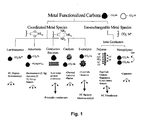
- Fig. 1 illustrates various applications for the modified carbon products according to the present invention for coordinated metal species and for ion- exchangeable metal species.
- the modified carbon product is used in electrodialysis.
- the modified carbon product is used in an electrical conductor.
- the modified carbon product is used in an ionic conductor.
- the modified carbon product is used for immunoassays.
- the modified carbon product is used for luminescence, such as electroluminescence.
- the modified carbon product is used in a thermally conductive fluid. According to another aspect, the modified carbon product is used for hydrogen storage. According to another aspect, the modified carbon product is used for catalysis. According to still another aspect, the modified carbon product is used for capacitors. According to still another aspect, the modified carbon product is used for sensors.
- a method for the manufacture of a modified carbon product includes the steps of providing a carbon support, modifying the carbon support with a functional group by spray processing a precursor solution comprising said carbon support, and attaching a metallic species to the functional group.
- the carbon support comprises carbon black.
- the functional group is ionically charged and coordinating.
- the metallic species is covalently attached to the functional group.
- a modified carbon product comprising a functional group covalently attached to a carbon surface is provided, where the modified carbon product is used for hydrogen storage.
- a modified carbon product comprising a functional group covalently attached to a carbon surface is provided, where the modified carbon product is used for catalysis.
- a modified carbon product comprising a functional group covalently attached to a carbon surface is provided, where the modified carbon product is used for capacitors.
- a modified carbon product comprising a functional group covalently attached to a carbon surface
- the modified carbon product is used for a thermally conductive fluid.
- a modified carbon product comprising a functional group covalently attached to a carbon surface is provided, where the modified carbon product is used for luminescence.
- a modified carbon product comprising a functional group covalently attached to a carbon surface is provided, where the modified carbon product is used for electro dialysis.
- a modified carbon product refers to a carbon material having an organic group attached to the carbon.
- a method for the production of such modified carbon products is described in U.S. Patent No. 5,900,029 by Belmont et al .
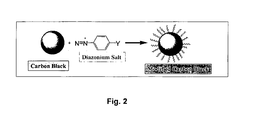
- the process for fabricating the modified carbon product includes the step of reacting at least one diazonium salt with a carbon material, preferably in the absence of an externally applied electric current sufficient to reduce the diazonium salt.
- Another process includes the step of reacting at least one diazonium salt with a carbon product in a protic reaction medium.
- the diazonium salt can include the organic group to be attached to the carbon.
- the organic group can be an aliphatic group, a cyclic organic group or an organic compound having an aliphatic portion and a cyclic portion.
- the organic group can be substituted or unsubstituted and can be branched or unbranched.
- the carbon material can be in the form of, for example, particulate carbon such as carbon black, activated carbon, bulk carbon, carbon flake, carbon fiber, carbon nanotubes and the like including carbon coated materials, carbon composites or carbon containing-materials including carbon films or materials containing carbon films. Also useful are carbon cloths and carbon paper.
- the crystalline nature of the carbon can range from vitreous carbon to graphite carbon.
- the modified carbon product is modified carbon black.
- Carbon black is homologous to graphite and consists of multiple layers of sheet carbon separated by several angstroms.
- the primary particles have a size in the range of from about 9 nanometers to 150 nanometers and the surface area is typically from about 20 m 2 /g to 1500 m 2 /g.
- the carbon material may also comprise a composite carbon material wherein carbon-based material comprises only a portion of the material by weight or volume.
- these composite materials include materials comprised of metal oxides, sulfides, carbides, nitrides and the like, in which the carbon based material may be distributed on all or part of the surface or may be incorporated as particles such that the surface of the second phase remains unaffected.
- the native (unmodified) carbon surface is relatively inert to most organic reactions and the attachment of specific organic groups at high coverage levels has traditionally been difficult.
- the Belmont et al. process significantly improved the ability to modify carbon surfaces with such organic groups.
- the organic groups are covalently bonded to the carbon surface and the groups are highly stable and do not desorb.
- the carbon is modified via a functionalizing agent of the form: X-R-Y where:
- Fig. 2 illustrates the surface modification of a carbon particle according to the Belmont process.
- the carbon can be modified to alter the surface energy, dispersibility, aggregate size and size distribution, dispersion, viscosity and chemical reactivity of the carbon.
- functional organic groups that can be used to modify the carbon black surface according to the present invention include those that are proton conducting such as sulfonic and phosphonic acids or charged (electrostatic) groups, such as sulfonate, carboxylate and tertiary amine salts.
- polymer (steric) groups such as acrylic, polystyrene, polyethylene oxide (PEO), polypropylene oxide (PPO) and polyethylene glycol (PEG) can be used as the functional group as well as neutral groups such as amines, aliphatics and cyclics.
- Particularly preferred according to one embodiment of the present invention are functional groups that alter the hydrophobic or hydrophilic nature of the carbon surface, or that can chemically bind metal ions or metal compounds or that impart proton conductivity.
- Examples of such functional groups are listed in Table I. TABLE I Types of Functional Groups (Y) Examples (RY) Proton conductivity (C 6 H 4 )CO 2 H or (C 10 H 6 )PO 3 NaH Hydrophobic, Hydrophilic (C 6 H 4 )CF 3 , (C 6 H 4 )SO 3 H Metal coordinating (C 10 H 6 )CO 2 H or (C 6 H 4 )NH 2
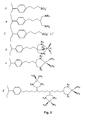
- Examples of specific organic groups are listed in U.S. Patent No. 5,900,029 by Belmont et al. and some are illustrated in Fig. 3 .
- Suitable functional groups include electron donors or electron acceptors.
- chelating ligands with multiple functionality are preferred in order to bind metal species more strongly.
- Examples of preferred chelating ligands include polyamines, polyphosphines, polycarboxylates and ligands with mixed functionality such as aminoacids, EDTA and prochiral ligands to create optically active metal complexes (see Fig. 3 ).
- the present invention relates to the use of modified carbon products in a variety of applications that include catalysis, electronics, ion conduction, adsorbents, heat transfer and luminescence applications.
- modified carbon products that offer the ability to metal functionalize, i.e., the ability to coordinate or bind metals, metal ions or metal-containing species, which are collectively referred to herein as metal groups.
- metal functionalization refers to any of the following situations:
- modified carbon products according to the present invention can be manufactured in accordance with the Belmont process.
- modified carbon products that are useful in accordance with the present invention can be manufactured using spray processing, spray conversion or spray pyrolysis, the methods being collectively referred to herein as spray processing.
- Spray processing generally includes the steps of: providing a liquid precursor suspension which includes the carbon and the diazonium salt or a precursor to the diazonium salt; atomizing the precursor to form dispersed liquid precursor droplets; and removing liquid from the dispersed liquid precursor droplets to form the modified carbon black particles.
- the spray processing method combines: (i) the drying of the diazonium salt, carbon containing droplets; and (ii) the conversion of the diazonium salt to a linking group and functional group covalently bound to a carbon surface, in one step such that both the removal of the solvent and the conversion of a precursor occur essentially simultaneously.
- the spray processing method achieves the drying of the droplets and the conversion to a linking group and functional group can occur in a second step. Combined with a short reaction time, this enables control over the properties of the linking group and functional group bound to the carbon product. By varying reaction time, temperature, type of carbon product and type of precursors, the spray method can produce morphologies and structures that yield improved performance.
- the modified carbon particles are formed while the diazonium salt phase is in intimate contact with the surface of the carbon particles and the diazonium salt is rapidly reacted on the surface of the carbon particles.
- the reaction of the diazonium salt preferably occurs over a very short period of time.
- the diazonium salt is exposed to the elevated reaction temperature to form the modified carbon product for not more than about 600 seconds, more preferably not more than about 100 seconds and even more preferably not more than about 10 seconds.
- the spray processing method is capable of simultaneously forming a spherical aggregate modified carbon particle structure.
- the spherical aggregate particles form as a result of the formation and drying of the droplets during spray processing and the properties of the structure are influenced by the characteristics of the carbon particles such as the particle size, particle size distribution and surface area.
- Spray processing methods for modified carbon production can be grouped by reference to several different attributes of the apparatus used to carry out the method. These attributes include: the main gas flow direction (vertical or horizontal); the type of atomizer (submerged ultrasonic, ultrasonic nozzle, two-fluid nozzle, single nozzle pressurized fluid); the type of gas flow (e.g., laminar with no mixing, turbulent with no mixing, co-current of droplets and hot gas, countercurrent of droplets and gas or mixed flow); the type of heating (e.g., hot wall system, hot gas introduction, combined hot gas and hot wall, plasma or flame); and the type of powder collection system (e.g., cyclone, bag house, electrostatic or settling).
- the main gas flow direction vertical or horizontal
- the type of atomizer submerged ultrasonic, ultrasonic nozzle, two-fluid nozzle, single nozzle pressurized fluid
- the type of gas flow e.g., laminar with no mixing, turbulent with no mixing, co-current of droplets and hot
- modified carbon particles can be prepared by starting with an aqueous-based precursor liquid consisting of colloidal carbon and a diazonium salt.
- the processing temperature of the precursor droplets can be controlled so the diazonium salt reacts, leaving the carbon intact but surface functionalized.
- the precursor liquid can also include a protic reaction medium.
- the first step in the process can include the evaporation of the solvent (typically water) as the droplet is heated resulting in a particle of dried solids and salts.
- the solvent typically water
- a number of methods to deliver heat to the particle are possible: horizontal hot-wall tubular reactors, spray drier and vertical tubular reactors can be used, as well as plasma, flame and laser reactors.
- the diazonium salt reacts.
- the temperature and time that the droplets/particles experience can be controlled and therefore the properties of the resulting linking group and functional group on the carbon surface can also be controlled.
- the atomization technique for generating the droplets has a significant influence over the characteristics of the final modified carbon particles such as the spread of the aggregate particle size distribution (PSD), as well as the production rate of the powder. In extreme cases, some techniques cannot atomize fluids with even moderate carbon particle loadings or high viscosities.
- Ultrasonic transducers are generally submerged in a liquid and the ultrasonic energy produces atomized droplets on the surface of the liquid.
- Two basic ultrasonic transducer disc configurations - planar and point source - can be used. Deeper fluid levels can be atomized using a point source configuration since the energy is focused at a point that is some distance above the surface of the transducer.
- the scale-up of submerged ultrasonic transducers can be accomplished by placing a large number of ultrasonic transducers in an array. Such a system is illustrated in U.S. Patent No. 6,103,393 by Kodas et al . and U.S. Patent No. 6,338,809 by Hampden-Smith et al. .
- Scale-up of nozzle systems can be accomplished by either selecting a nozzle with a larger capacity or by increasing the number of nozzles used in parallel.
- the droplets produced by nozzles are larger than those produced by ultrasonic transducers.
- Particle size is also dependent on the gas flow rate. For a fixed liquid flow rate, an increased airflow decreases the average droplet size and a decreased airflow increases the average droplet size. It is difficult to change droplet size without varying the liquid or airflow rates.
- two-fluid nozzles have the ability to process larger volumes of liquid per time than ultrasonic transducers.
- Ultrasonic spray nozzles also use high frequency energy to atomize a fluid. Ultrasonic spray nozzles have some advantages over single or two-fluid nozzles such as the low velocity of the spray leaving the nozzle and lack of associated gas flow.
- the nozzles are available with various orifice sizes and orifice diameters that allow the system to be scaled for the desired production capacity. In general, higher frequency nozzles are physically smaller, produce smaller droplets, and have a lower flow capacity than nozzles that operate at lower frequencies.
- a drawback of ultrasonic nozzle systems is that scaling up the process by increasing the nozzle size increases the average particle size. If a particular particle size is required, then the maximum production rate per nozzle is set. If the desired production rate exceeds the maximum production rate of the nozzle, additional nozzles or complete production units will be required to achieve the desired production rate.
- the shape of the atomizing surface determines the shape and spread of the spray pattern.
- Conical, microspray and flat atomizing surface shapes are available.
- the conical atomizing surface provides the greatest atomizing capability and has a large spray envelope.
- the flat atomizing surface provides almost as much flow as the conical, but limits the overall diameter of the spray.
- the microspray atomizing surface is for very low flow rates where narrow spray patterns are needed. These nozzles are preferred for configurations where minimal gas flow is required in association with the droplets.
- Particulate carbon suspensions may present several problems with respect to atomization. For example, submerged ultrasonic atomizers re-circulate the suspension through the generation chamber and the suspension concentrates over time. Further, some fraction of the liquid atomizes without carrying the suspended carbon particulates. Other problems encountered when using submerged ultrasonic transducers is that the transducer discs can become coated with the particles over time. Further, the generation rate of carbon suspensions is very low using submerged ultrasonic transducer discs. This is due in part to energy being absorbed or reflected by the suspended particles.
- the aerosol can be generated using three basic methods. These methods differ in the type of energy used to break the liquid masses into small droplets.
- Rotary atomizers (utilization of centrifugal energy) make use of spinning liquid droplets off of a rotating wheel or disc. Rotary atomizers are useful for co-current production of droplets in the range of 20 to 150 ⁇ m in diameter.
- Pressure nozzles (utilization of pressure energy) generate droplets by passing a fluid under high pressure through an orifice. These can be used for both co-current and mixed-flow reactor configurations and typically produce droplets in the range of 50 to 300 ⁇ m.
- Multiple fluid nozzles such as a two fluid nozzle (utilization of kinetic energy) produce droplets by passing a relatively slow moving fluid through an orifice while shearing the fluid stream with a relatively fast moving gas stream.
- multiple fluid nozzles can be used with both co-current and mixed-flow spray dryer configurations. This type of nozzle can typically produce droplets in the range of 5 to 200 ⁇ m.
- two-fluid nozzles are used to produce aerosol sprays in many commercial applications, typically in conjunction with spray drying processes.
- a low-velocity liquid stream encounters a high-velocity gas stream that generates high shear forces to accomplish atomization of the liquid.
- a direct result of this interaction is that the droplet size characteristics of the aerosol are dependent on the relative mass flow rates of the liquid precursor and nozzle gas stream.
- the velocity of the droplets as they leave the generation zone can be quite large which may lead to unacceptable losses due to impaction.
- the aerosol also leaves the nozzle in a characteristic pattern, typically a flat fan, and this may require that the dimensions of the reactor be sufficiently large to prevent unwanted losses on the walls of the system.
- the atomized suspension must be heated to remove solvents and react the diazonium salt.
- a horizontal, tubular hot-wall reactor can be used to heat a gas stream to a desired temperature. Energy is delivered to the system by maintaining a fixed boundary temperature at the wall of the reactor and the maximum temperature of the gas is the wall temperature. Heat transfer within a hot wall reactor occurs through the bulk of the gas. Buoyant forces that occur naturally in horizontal hot wall reactors aid this transfer. The mixing also helps to improve the radial homogeneity of the gas stream. Passive or active mixing of the gas can also increase the heat transfer rate.
- the maximum temperature and the heating rate can be controlled independent of the inlet stream with small changes in residence time.
- the heating rate of the inlet stream can also be controlled using a multi-zone furnace.
- a horizontal hot-wall reactor according to the present invention is preferred to produce particles with a size of not greater than about 5 ⁇ m. Above about 5 ⁇ m, settling of particles can cause significant material losses.
- One disadvantage of such reactors is the poor ability to atomize particulate carbons when using submerged ultrasonics for atomization.
- the horizontal hot-wall reactor can be used with a two-fluid nozzle to atomize the droplets. This approach is preferred for precursor feed streams containing relatively high levels of carbon.
- a horizontal hot-wall reactor can also be used with ultrasonic nozzle atomization techniques. This allows atomization of precursor containing particulate carbons; however the large droplet size leads to losses of materials on reactor walls and other surfaces making this an expensive method for powder production.
- spray processing systems in the configuration of a spray dryer are the generally preferred production method for large quantities of modified carbon powders that are useful in accordance with the present invention.
- Spray drying is a process wherein powders are produced by atomizing a precursor to produce droplets and evaporating the liquid to produce a dry aerosol, wherein thermal decomposition of one or more precursors (e.g., a diazonium salt) may take place to produce the powder.
- the residence time in the spray dryer is the average time the process gas spends in the drying vessel as calculated by the vessel volume divided by the process gas flow using the outlet gas conditions.
- the peak excursion temperature (i.e., the reaction temperature) in the spray dryer is the maximum temperature of a particle, averaged throughout its diameter, while the particle is being processed and/or dried.
- the droplets are heated by supplying a pre-heated carrier gas.
- An open system is useful for general spray drying to form powders using air as an aerosol carrier gas and an aqueous feed solution as a precursor.
- a closed system is useful for spray drying to form powders using an aerosol carrier gas other than air.
- a closed system is also useful when using a non-aqueous or a semi-non-aqueous solution as a precursor.
- a semi-closed system including a self-inertizing system, is useful for spray drying to form modified carbon powders that require an inert atmosphere and/or precursors that are potentially flammable.
- a co-current spray dryer is useful for production of modified carbon products that are sensitive to high temperature excursions (e.g., greater than about 350°C) or that require a rotary atomizer to generate the aerosol.
- Mixed-flow spray dryers are useful for producing modified carbon powders that require relatively high temperature excursions (e.g., greater than about 350°C) or require turbulent mixing forces.
- co-current spray-drying is preferred for the manufacture of modified carbon black products.
- the hot gas is introduced at the top of the unit where the droplets are generated with any of the atomization techniques mentioned above.
- the maximum temperature that a droplet/particle is exposed to in a co-current spray dryer is the temperature of the outlet.
- the outlet temperature is limited to about 200°C, although some designs allow for higher temperatures.
- the particles experience the lowest temperature in the beginning of the time-temperature curve and the highest temperature at the end, the possibility of precursor surface diffusion and agglomeration is high.
- reaction temperatures can be high enough for the reaction of the diazonium salt (e.g., between 25°C and 100°C).
- a mixed-flow spray dryer introduces the hot gas at the top of the unit and the precursor droplets are generated near the bottom and are directed upwardly.
- the droplets/particles are forced towards the top of the unit then fall and flow back down with the gas back down, increasing the residence time in the spray dryer.
- the temperature the particles experience is also higher as compared to a co-current spray dryer.
- the highest temperature in these spray dryers is the inlet temperature (e.g., 180°C), and the outlet temperature can be as low as 50°C. Therefore, the modified carbon particles reach the highest temperature for a relatively short time, which advantageously reduces migration or surface diffusion of the surface groups.
- This spike of high temperature can quickly convert the diazonium salt and is followed by a mild quench since the spray dryer temperature quickly decreases after the maximum temperature is achieved.
- the spike-like temperature profile can be advantageous for the generation of highly dispersed modifying groups on the surface of the carbon.
- residence times for producing modified carbon products depends on the spray dryer design type, atmosphere used, nozzle configuration, feed liquid inlet temperature and the residual moisture content. In general, residence times for the production of modified carbon powders can range from 5 seconds up to 5 minutes.
- the range of useful inlet temperatures for producing modified carbon products depends on a number of factors including solids loading and droplet size, atmosphere used and energy required to perform drying and/or reaction of the diazonium salt.
- Useful inlet temperatures should be sufficiently high to accomplish the drying and/or reaction of the diazonium salt without promoting significant surface diffusion of functional groups to reduce its performance.
- the outlet temperature of the spray dryer determines the residual moisture content of the powder.
- a useful outlet temperature for co-current spray drying ranges from about 50°C to about 80°C.
- Useful inlet temperatures, according to the present invention range from about 130°C to 180°C.
- the carbon solids loading can be up to about 50 wt.%.
- Other equipment that is desirable for producing modified carbon products using a spray dryer includes a heater for the gas and a collection system. Either direct heating or indirect heating, including burning fuel, heating electrically, liquid-phase heating or steam heating, can accomplish heating of the gas. Many collection methods are useful for collecting modified carbon powders produced on a spray dryer. These methods include, but are not limited to those using cyclone, bag/cartridge filter, electrostatic precipitator, and various wet collection techniques.
- Another embodiment of the current invention is the use of spray-based processing, as described above, to produce, in one step, metal-functionalized modified carbon products.
- a metal-containing species is added to the carbon/diazonium precursor medium prior to spray-processing.
- the modified carbon products are metal-functionalized by spray-based processing where the precursor contains modified carbon products (previously produced) and metal-containing species.
- the present invention is based upon the metal-functionalization of surface modified carbon products.
- Carbon products can be modified on their surface to contain covalently bonded surface organic moieties that exhibit a wide range chemical and physical properties. These organic moieties can be further functionalized by reaction with metal-containing species to form metal-functionalized carbon products where a metal species is either ionically or covalently bonded to the surface organic group.
- the organic moieties created on the surface of the carbon products can be used to interact with metal species to form what is referred to herein as metal-functionalized carbon products.
- metal-functionalized carbon products There are two general classes of metal-functionalized carbon. The first type is a carbon material that is functionalized with metal ions that are relatively weakly coordinated to the surface functional group. These metal ions are typically relatively easily exchanged and in general impart an ion-exchange functionality to the material.
- the second class of metal-functionalized carbons includes metal species that are coordinated in a more covalent fashion to create a surface bound coordination complex.
- metals are typically less easily exchangeable and are coordinated in a more rigid ligand environment, and impart a functionality that is based on having a metal species coordinated in a particular environment on the surface, such as catalysis, molecule-specific adsorption, luminescence and the like; or the coordinated metal complex can act as a precursor to a reduced metal species, typically metal nanoparticles that are dispersed over the surface of the support phase.
- a metal species coordinated in a particular environment on the surface such as catalysis, molecule-specific adsorption, luminescence and the like
- the coordinated metal complex can act as a precursor to a reduced metal species, typically metal nanoparticles that are dispersed over the surface of the support phase.
- the extent of ionic versus covalent binding of metal species varies widely and this classification is intended for the convenience of organizing the function and applications of these metal- functionalized materials.
- the surface functional group is typically easily ionizable.
- these groups include sulfonic acids, e.g. -SO 3 - , -PO 3 2- and -NH 3 + .
- the metal group may be in the form of a discrete or hydrated metal ions such as Li + , K + , Na + , Ca 2+ or Mg 2+ as depicted Fig. 3 .
- the surface functional group should contain an electron pair donor such as -NR 2 , -CO 2 - or -SR.
- the metal group formed is a coordination complex where the surface functional group may be neutral (e.g., -NR 2 , -SR) or may be charged such as -CO 2 - .
- Other ligands may also be present in the coordination sphere of the metal ion to satisfy the coordination number of the species such as nitrogen donors (e.g., amines), phosphorus donors (e.g., phosphines), sulfur donors (e.g., thiols), or oxygen donors such as alcohols, ketones, aldehydes and carboxylic acids.
- nitrogen donors e.g., amines
- phosphorus donors e.g., phosphines
- sulfur donors e.g., thiols
- oxygen donors such as alcohols, ketones, aldehydes and carboxylic acids.
- combinations of these two situations may occur where coordination compounds may be bound to the carbon surface via the organic functional moiety which are also charged, either anionically or cationically, or
- the foregoing classification can be used to organize the functionality of these metal-functionalized carbons and as a result, their applications.
- the metal groups that are intentionally ionically bonded can be bonded in a reversible fashion, where the strength of binding can be controlled by the ligand environment and the trigger for binding reversal can be influenced by an external stimulus such as pH, electrical stimulation, change in concentration, or the like.
- an external stimulus such as pH, electrical stimulation, change in concentration, or the like.
- the metal groups may be tightly bound to the modified carbon, but where a ligand within its coordination sphere is reversibly bound, for example, where the ligand is an ionic species such as hydroxide ion that is the basis of the operation of electrochemical capacitors.
- the more covalently bonded metal species are those that are typically bound strongly to the surface modified carbon and the ligand environment of that metal group is controlled to be either: highly static - to achieve, for example, chiral catalysis; or highly dynamic - to achieve reversible adsorption of specific molecules (ligands).
- These metal functionalized carbon species can be used for a variety of applications that vary from catalysis, molecular imprinting, specific gas adsorption and reversible gas storage, where the metal species remains intact on the surface. They can also be used in applications where the metal group acts as a precursor to metal or metal-containing (e.g., metal oxide, nitride, halide or sulfide) materials by conversion at relatively low temperatures.
- metal-functionalized materials are valuable in applications where highly dispersed metal or metal-containing nanoparticles are required to be dispersed over a high surface area support or a continuous phase derived from conversion of the metal species is required in the final product.
- Application areas of these materials according to the present invention include heterogeneous catalysts and electrocatalysts, as well as electronic conductors.
- the metal-functionalized carbon materials may be prepared by a number of approaches.
- a metal complex can be reacted with the surface functional groups of surface modified carbon in a liquid medium (including aqueous or non-aqueous solvents) by contacting the surface modified carbon product with a dissolved or suspended metal-containing reagent.
- a dispersion of the modified carbon black can be stirred while in contact with the metal-containing reagent, heated if necessary and the metal functionalized product can separated from the reaction medium.
- the analogous reaction may also be carried out in the gas phase wherein the modified carbon particles can be fluidized in either a static or moving fluidized bed and contacted with a gaseous metal-containing reagent.
- the same result can also be achieved in a batch type process where a modified carbon powder batch is infiltrated with a vapor phase reagent.
- the modified carbon product is not particulate, but is a fiber-based material such as a woven or non-woven carbon cloth or paper
- it can be contacted with the metal-containing reagent in the liquid or gas phase on a continuous basis to form the metal-functionalized product.
- the metal-functionalized product that has been functionalized with a metal-containing molecule or complex can be converted to a metal-based product (such as a metal, metal oxide, metal nitride and the like) particles by thermal, chemical, photochemical or electrochemical conversion.
- a metal-based product such as a metal, metal oxide, metal nitride and the like
- thermal conversion includes spraying a liquid containing a metal-molecule functionalized carbon suspension into a furnace to convert the metal-molecule into a metal-based species, if necessary in the presence of other reagents to form metal oxides, borides, nitrides etc. as is described in U.S. Patent No. 6,338,809 by Hampden-Smith et al. .
- the modified carbon products are used in electronic applications.
- the functionality that is required for these metal-functionalized carbon products is that the products be electronically conductive.
- the metal-functionalized carbon product can be conductive with or without a post-processing step like, for example, exposure to elevated temperature or a reductive atmosphere. It is also preferred that the products exhibit the maximum electrical conductivity at the lowest cost, which typically means with the least amount of metal.
- electrical conductivity is achieved by forming an intermediate metal functionalized carbon in which the metal that is bound to the modified carbon surface is one that can be converted to a zero valent metal species where the metal species is highly conductive.
- the metal functionalized carbons according to this embodiment are preferably complexes of silver(I), copper(I) or copper(II) or nickel(II) that can be converted to metallic silver, copper or nickel, respectively.
- the advantage in coordinating these metal ions to the surface of the modified carbon products as compared to making a mixture of carbon and metal particles or a mixture of carbon particles and metal complexes, is that the final zero valent metal is distributed over the surface of the carbon product, which enables the best electrical conductivity at the lowest mass and volume fraction of the zero valent metal.
- additional metal species can be added.
- the metal species can be in the form of an additional amount of metal complex, zero valent metal that may be in the form of metal nanoparticles, micro-sized metal particles or metal flakes.
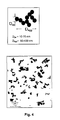
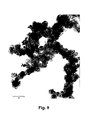
- the metal-functionalized carbon product can include carbon particles, such as VULCAN XC-72 (a carbon black available from Cabot Corp., Boston, MA) which is comprised of smaller substantially spherical particles that range in size from 10 to 75 nm and which are typically agglomerated into aggregates that range in size from 50 to 400 nm. A typical example of these particles is illustrated in Fig. 4 .
- VULCAN XC-72 a carbon black available from Cabot Corp., Boston, MA
- These carbon aggregates can be metal functionalized with a metal, for example, silver.
- concentration and distribution of silver ions bound to the surface of the carbon particles can be controlled through the number and type of surface functional groups.
- the coordinated silver compounds can be converted to silver metal either prior to printing onto a surface or after printing onto a surface. Some examples of the structures that can be produced are shown in Figs. 5 and 6 . At low metal ion concentrations, highly dispersed metal nanoparticles are formed on the surface of the carbon aggregates, while at higher concentrations, metal-coated carbon aggregates are formed.
- the primary carbon aggregates are already necked and therefore limit the deposition of metal where the metal is not useful. This reduces the mass of metal that is required to make a conductive layer.
- the modified carbon products are dispersible in an ink or a paste such that they can be printed or coated onto a surface and subsequently converted into a carbon-filled metallic feature, as depicted in Figs. 7 and 8 .
- the ink or paste may or may not have additional silver containing compounds or silver nanoparticles and the ink or pastes that are comprised of metal-functionalized carbon will have different characteristics of viscosity, shelf life and composition.
- Organically functionalized carbon particles have been disclosed by Belmont et al. to be stable in inks at relatively high loading for ink-jet printing.
- Metal-functionalized carbons are also stable in inks at relatively high loading resulting in low viscosity inks suitable for a variety of analog and digital printing techniques including but not limited to lithographic, flexographic, xerographic, electrostatic, gravure, spray, syringe and ink-jet printing.
- the inks suitable for digital printing, including ink-jet printing often contain other species such as humectants to avoid drying out of the ink in the ink-jet print head.
- inks and pastes may also contain other components such as rheology modifiers.
- inks or pastes may also contain further amounts of metal complexes or metallic particles such as nanoparticles or flakes depending upon the nature of the ink or paste and the desired printing process.
- the silver functionalized carbon particles in the ink can be mixed with silver nanoparticles which are also stabilized by organic groups on the surface of the carbon particles or by other components in the suspension.
- the metal-functionalized carbons can be converted to zero valent metallic phases at low temperatures.
- This low temperature conversion enables the printing or coating of substrates such as papers and plastics (such as polyester and the like) that are temperature sensitive.
- the organic moiety should be chosen such that it can lead to conversion (reduction) of the coordinated metal species at low temperature through thermal, photochemical or chemical means.
- chemical conversion it is well known that carboxylate derivatives of silver(I) can be thermally converted to silver metal at relatively low temperatures such as between 50°C and 150°C.
- the metal-functionalized carbon product should be thermally stable under ambient conditions to avoid premature conversion to silver prior to being printed onto a surface. Other types of chemical reactions can be thermally induced.
- copper metal can be formed from the disproportionation of copper(I) complexes to form copper metal and copper(II). The copper(II) can be removed from the system or can be further converted into copper metal by reduction.
- the silver(I) complex and its surrounding ligands comprises the chromophore and upon irradiation with ultra-violet light the silver(I) compound is reduced to silver metal.
- the metal species in the metallized carbons can be chemically reduced to metal by reaction with a reducing agent such as hydrogen, a metal hydride, alcohol, aldehydes, ketones and the like.
- a reducing agent such as hydrogen, a metal hydride, alcohol, aldehydes, ketones and the like.
- the metal-functionalized carbon species may be designed to act as a catalyst for the reaction of other species on the surface of the carbon particles to form a metallic coating.
- metal-functionalized carbon particles may be deposited onto a surface in a pattern by any one of the printing approaches described above.
- the metal functionalization acts as a catalyst to react with a source of metal containing species to form a coating over the surface of the metal functionalized carbon. This may be achieved by a number of deposition methods including solution-based methods such as electrodeposition, underpotential deposition or electroless deposition, or this can be achieved by vapor-phase deposition methods such as chemical vapor deposition, where the metal-functionalized carbon acts as a nucleation site for deposition and growth of the layer.
- the metal functionalization can also be formed by a vapor phase process where the volatile metal-containing molecule reacts with the surface organic moiety to initially form a metal functionalized carbon, which subsequently reacts to form metal and acts as nucleation sites for further deposition.
- redox active materials can be incorporated to ensure reduction of the oxidized metallic species to the final reduced metal phase.
- a first metal ion may coordinate to the surface of the functionalized carbon particles and a second metal species may be added to the system.
- this reduced first metal species can act as a reducing agent for the second metal.
- the first metal is again re-oxidized and further reduces additional amounts of the second metal species.
- the carbon particles used to support the metallic species have a high absorption cross-section in the infra-red range leading to good thermal absorbtivity. This is important in applications where thermal conversion of the metal-functionalized carbons are required in the presence of other temperature sensitive materials such as polymer substrates, which are likely to have a lower absorption cross section (and therefore become less hot).
- the surface modified carbon products can be used in Atomic Layer Deposition (ALD) processes through sequential introduction of reagents that are chemically matched to the carbon surface for compositionally and dimensionally controlled surface coatings.
- ALD Atomic Layer Deposition
- a surface modified carbon product such as a sulfonyllic acid or carboxylic acid terminated surface can be reacted with a metal compound such as a metal amide such as Ti(NR 2 ) 4 .
- the surface confined titanium compound can be reacted with, e.g., ammonia and subsequently heat treated to form TiN.
- the Ti reagent and then the ammonia reagent can be sequentially reacted in subsequent cycles to deposit layers with molecular level control over deposit thickness and composition.
- a wide variety of metal oxide, nitride, sulfide and carbide surface coatings can be constructed in this manner.
- multiple organic moieties can be present on the surface of the carbon products where each organic moiety has a different functionality.
- one surface organic group may serve to bind the metal ion of choice while others are present to ensure other characteristics such as hydrophobicity, hydrophilicity, reducing properties, and the like.
- using mutli-functional organic species such as polycarboxlates or polysulfonic acids can increase the metal loading of the metal-functionalized carbon materials.
- 4 ⁇ mol of surface functional groups on a carbon product that has a surface area of 600 m 2 /g is equivalent to about 26 wt.% silver if each surface organic group can coordinate one silver ion. If there are 3 functional groups for each surface modification group, then the silver weight loading is increased to 75 wt.%.
- a direct-write deposition tool is a device that deposits a liquid or liquid suspension onto a surface by ejecting the composition through an orifice toward the surface without the tool being in direct contact with the surface.
- the direct-write deposition tool is preferably controllable over an x-y grid.
- a preferred direct-write deposition tool according to the present invention is an ink-jet device.
- Other examples of direct-write deposition tools include aerosol jets and automated syringes, such as the MICROPEN tool, available from Ohmcraft, Inc., of Honeoye Falls, N.Y.
- Ink-jet devices operate by generating droplets of the suspension and directing the droplets toward a surface.
- the position of the ink-jet head is carefully controlled and can be highly automated so that discrete patterns of the modified carbon product can be applied to the surface.
- Ink-jet printers are capable of printing at a rate of 1000 drops per second per jet, or higher, and can print linear features with good resolution at a rate of 10 cm/sec or more, such as up to about 1000 cm/sec.
- Each drop generated by the ink-jet head includes approximately 25 to 100 picoliters of the suspension which is delivered to the surface.
- ink-jet devices are a highly desirable means for depositing materials onto a surface.
- an ink-jet device typically includes an ink-jet head with one or more orifices having a diameter of not greater than about 100 ⁇ m, such as from about 50 ⁇ m to 75 ⁇ m. Droplets are generated and are directed through the orifice toward the surface being printed. Ink-jet printers typically utilize a piezoelectric driven system to generate the droplets, although other variations are also used. Ink-jet devices are described in more detail in, for example, U.S. Patent No. 4,627,875 by Kobayashi et al . and U.S. Patent No. 5,329,293 by Liker .
- the surface tenston is from about 100 to 500 ⁇ N/cm [10 to 50 dynes/cm] such as from about 100 to 500 ⁇ N/cm 200 to 400 ⁇ N/cm [20 to 40 dynes/cm].
- the viscosity of the modified carbon suspensions is preferably not greater than about 50 mPa ⁇ s [centipoise (cp)], such as in the range of from about 10 mPa ⁇ s [(cp)] to about 40 mPa ⁇ s [cp].
- Automated syringes can use compositions having a higher viscosity, such as up to about 5000(cp) mPa ⁇ s.
- the solids loading of particles in the modified carbon suspensions is preferably as high as possible without adversely affecting the viscosity or other necessary properties of the composition.
- a modified carbon suspension can have a particle loading of up to about 20 wt.%, and in one embodiment the particle loading is from about 2 wt.% to about 8 wt.%.
- the surface modification of the carbon product can advantageously enhance the dispersion of the carbon product, and lead to higher obtainable solids loadings.
- the modified carbon suspensions for use in an ink-jet device can also include water and an alcohol. Surfactants can also be used to maintain the particles in suspension. Co-solvents, also known as humectants, can be used to prevent the modified carbon suspensions from crusting and clogging the orifice of the ink-jet head. Biocides can also be added to prevent bacterial growth over time. Examples of such liquid vehicle compositions for use in an ink-jet are disclosed in U.S. Patent No. 5,853,470 by Martin et al. ; U.S. Patent No. 5,679,724 by Sacripante et al. ; U.S. Patent No. 5,725,647 by Carlson et al. ; U.S. Patent No.
- Modified carbon particles can be mixed with the liquid vehicle using a mill or, for example, an ultrasonic processor.
- the modified carbon suspensions according to the present invention can also be deposited by aerosol jet deposition.
- Aerosol jet deposition can enable the formation of modified carbon features having a feature width of not greater than about 200 ⁇ m, such as not greater than 100 ⁇ m, not greater than 75 ⁇ m and even not greater than 50 ⁇ m.
- the modified carbon suspension is aerosolized into droplets and the droplets are transported to the substrate in a flow gas through a flow channel.
- the flow channel is straight and relatively short.
- the viscosity of the suspension is preferably not greater than about 20(cp) mPa ⁇ s.
- the aerosol can be created using a number of atomization techniques. Examples include ultrasonic atomization, two-fluid spray head, pressure atomizing nozzles and the like. Ultrasonic atomization is preferred for compositions with low viscosities and low surface tension. Two-fluid and pressure atomizers are preferred for higher viscosity suspensions.
- the size of the aerosol droplets can vary depending on the atomization technique. In one embodiment, the average droplet size is not greater than about 10 ⁇ m and more preferably is not greater than about 5 ⁇ m. Large droplets can be optionally removed from the aerosol, such as by the use of an impactor.
- the concentration of the aerosol can optionally be increased, such as by using a virtual impactor.
- the concentration of the aerosol can be greater than about 10 6 droplets/cm 3 , such as greater than about 10 7 droplets/cm 3 .
- the concentration of the aerosol can be monitored and the information can be used to maintain the mist concentration within, for example, 10% of the desired mist concentration over a period of time.
- Examples of tools and methods for the deposition of fluids using aerosol jet deposition include U.S. Patent No. 6,251,488 by Miller et al. , U.S. Patent No. 5,725,672 by Schmitt et al . and U.S. Patent No. 4,019,188 by Hochberg et al .
- modified carbon product suspensions and metal functionalized modified carbon product suspensions of the present invention can also be deposited by a variety of other techniques including intaglio, roll printer, spraying, dip coating, spin coating and other techniques that direct discrete units, continuous jets or continuous sheets of fluid to a surface.
- Other printing methods include lithographic and gravure printing.
- gravure printing can be used with modified carbon suspensions having a viscosity of up to about 5000 (centipoise) mPa ⁇ s.
- the gravure method can deposit features having an average thickness of from about 1 ⁇ m to about 25 ⁇ m and can deposit such features at a high rate of speed, such as up to about 700 meters per minute.
- the gravure process also enables the direct formation of patterns onto the surface.
- Lithographic printing methods can also be utilized.
- the inked printing plate contacts and transfers a pattern to a rubber blanket and the rubber blanket contacts and transfers the pattern to the surface being printed.
- a plate cylinder first comes into contact with dampening rollers that transfer an aqueous solution to the hydrophilic non-image areas of the plate.
- a dampened plate then contacts an inking roller and accepts the ink only in the oleophillic image areas.
- the functional groups covalently attached to the carbon product are selected such that they interact with metal ions to reversibly bind to the metal ions.
- the target ions that are bound can preferably be chosen from protons (H + ), the alkali and alkali earth metals, the transition elements, and the elements of Groups 13, 14 and 15 of the periodic table.
- the reversible nature of the metal ion binding enables transport and/or storage of these ions or separation of these ions through a membrane.
- a composite lithium ion transport separation membrane can include a lithium ion functionalized carbon material (e.g., carbon particles, fibers or cloth) imbedded in a polymer matrix to form a separation membrane.
- a lithium ion functionalized carbon material e.g., carbon particles, fibers or cloth
- one problem associated with lithium ion batteries is the reversible uptake of lithium during the charging cycle. During charging of the battery, lithium is removed from the cathode and is intercalated into the graphite anode. However, the capacity for the reversible uptake of lithium into the graphite anode typically degrades over time. According to the present invention, funtionalization of the graphite in the anode with a functional group that reversibly binds lithium ions can provide a mechanism for enhanced capacity of lithium in the anode.
- the modified carbon products are used in electrodialysis and other membrane applications.
- Electrodialysis is an ion separation process that relies on the transport of ions through ion permeable membranes under the influence of an electrical potential gradient. It finds a variety of applications including water desalination and deionization, production of chlorine, acids and bases, and chemical syntheses involving ions selectively transported through the ion-exchange membranes (see, for example, Grebenyuk et al., Russ. J. Electrochem., 38, pp. 806-809 (2002 )).
- the process is similar to electrolysis, in which ionic species in a solution migrate towards the poles of opposite charge.
- ionic species in a solution migrate towards the poles of opposite charge.
- ion-selective membranes in the system enables the separation of ions in distinct channels and is the key to the successful implementation of this process.
- the process has various shortcomings, which are mostly related to the membrane properties. Some of the requirements for electrodialysis membranes are listed in " Perry's Chemical Engineering Handbook", pp. 22-42 to 22-48 .
- the membranes should have physical and mechanical stability, should be inert to changes in the ionic strength of the solution and should tolerate thermal stresses. In addition they should be stable to pH extremes and be capable of withstanding the entire pH range between pH 0 and pH 14.
- the membranes should also have low electrical resistance since they operate inside an electric field.
- ion-exchange membranes that are utilized in electrodialysis systems are manufactured from polymeric materials.
- the important performance parameters of these membranes can be tailored by varying the properties of the polymers, such as cross-link density and ion capacity.
- manufacturers typically encounter situations where the improvement in one property of the membrane leads to the deterioration of another equally important property. For example, increasing the charge density of the membrane enhances its selectivity and reduces its electrical resistance, but leads to increased swelling and reduced mechanical stability. As a consequence, electrodialysis membrane manufacturers are forced to compromise to a sub-optimal membrane composition.
- Re 37,701 describe a composite membrane consisting of a mixture of ion exchange materials and finely divided powders selected from a wide range of organic and inorganic compounds, including carbon black, graphite, nickel, silica, and platinum black to impart effects such as color, electrical and/or thermal conductivity, catalytic effects or certain reactant transport properties to the membrane.
- modified carbon products can be incorporated into electrodialysis membranes or other composite membranes over a wide range of loadings.
- the incorporation of these materials can significantly enhance the performance of the membranes in at least the following ways:
- modified carbon products can also be extended to membranes for other separations.
- membrane separations rely on the ability of the membrane to differentiate the components that need to be separated based on their charge, size, chemical reactivity, solubility, and diffusivity through the membrane.
- the modified carbon products can enhance the properties of membranes utilized in ultrafiltration, diafiltration, reverse osmosis, microfiltration and other separation processes that require specifically designed membrane materials.
- the modified carbon products can enhance properties of the membrane that are key to the separation performance and can also enhance other properties, such as the wettability of the membrane by the liquid with which it is in contact and enhance other properties such as permeability.
- modified carbon products can be used in heat transfer applications.
- Choi et al. see J. Nanoparticle Research, 5, pp. 167-171 (2003 ) and references therein have indicated that conductive nanoparticles dispersed in coolants can provide a significant thermal conductivity increase of the system (>20%), even at very low concentrations.
- Most of the nanoparticles on which Choi et al. and others have focused include metals (like copper or silver) that have high thermal conductivities but are relatively hard to suspend in a stable dispersion. The stability of the dispersion at a relatively high volume fraction is critical for the effective performance of the composite coolant.
- the metallic nanoparticles should not adhere to the heat transfer surfaces.
- Some of the metallic nanoparticle dispersions e.g., silver nanoparticles
- Metallic nanoparticles supported on carbon black particles or other thermally conductive supports e.g., fumed alumina or silica, colloidal alumina or silica, etc.
- thermal conductivity that is significantly better than that expected from the theory of composites put forth by Maxwell, as is described in Choi et al. (2003).
- modified carbon particles can advantageously be dispersible in a variety of coolants by proper surface modification of the carbon support, as compared to the nanoparticles in heat transfer fluids known in the art.
- particles containing Pt deposited on carbon black can be made dispersible in ethylene glycol/water mixtures by the attachment of a benzenesulfonic group on the carbon surface of the composite particle.
- these materials can provide enhanced rheological properties in addition to enhanced thermal conductivity.
- the viscosity of the heat transfer fluid is equally important in its heat transfer performance in convective applications, as is well known in the art. See, for example, Holman, "Heat Transfer", 8th edition, McGraw-Hill (1997 ).
- the enhanced performance of these materials can also be extended to other applications, where improved thermal conductivity is important, such as the enhancement of the properties of thermal pastes used as thermal interface materials for the dissipation of heat from microelectronics.
- Carbon black based dispersions have been reported ( Leong et al., Carbon, 41, pp. 2459-2469, (2003 )) to have enhanced performance in such applications.
- the materials that are used in the interface between a heat source and a heat sink should have low contact resistance, should conform to the surface topography of the surfaces that they join and also should have good thermal properties.
- the materials of the present invention can combine the thermal conductivity of the underlying carbonaceous materials with the enhanced thermal properties associated with the well-dispersed metallic nanoparticles on their surface and the excellent dispersion and compatibility with the matrix that arises from the surface modification of the carbonaceous surface.
- Modified carbon products and metal-functionalized modified carbon products also exhibit catalytic activity and can act as catalyst supports in a number of different forms that can range from an anchored metal complex to supported metal nanoparticles that are derived from a metal complex.
- the metal species is effectively a homogeneous catalyst that is bound to the carbon surface through the organic functionalization.
- These supported metal compounds are typically either organometallic, metal-organic complexes or coordination compounds that are typically used on homogeneous catalysts.
- the modified carbon products of the present invention are an ideal medium for supporting catalysts because they have enhanced properties compared to the catalysts prepared using established methods.
- the performance of catalysts that are supported depends on a variety of properties of the support.
- the physical properties of the support determine how usable it is in the application.
- the particles should have a specific size so that they can be easily handled and utilized in the process. They need to be rigid so that they don't disintegrate during use leading to the creation of fines and the loss of the catalyst.
- Their pore structure should be suitable for the diffusion of the reagents and products to and from the active catalytic sites.
- the surface properties of the support play an important role in determining the activity of the catalyst because they influence the dispersion of catalyst on the surface of the support.
- the surface chemistry is also influential and can enhance or interfere the transport of reagents and products to and from the catalyst particles.
- the materials of the present invention allow the design of the catalyst properties at all levels. Specifically, these carbonaceous materials feature carefully controlled particle size and particle size distribution, microstructure and pore size distribution, rigidity, and flexible surface chemistry that can be tailored for any specific application.
- the materials of the present invention are unique because they can range in size from less than 100 nm (the size of a carbon black aggregate or a single-walled carbon nanotube) to several or hundreds of microns (the diameter of a carbon fiber or the size of a spray processed carbonized resin-bound carbon black particle).
- the larger particles can have tailored porosity that can be determined by:
- the materials of the present invention can also have tailored surface chemistry that allows control over the design of the catalyst particle at the molecular level. This ability can enhance several aspects of the catalyst from its manufacturing processes to its final performance. For example, tailoring the surface before the deposition of the catalyst metal by attaching functional groups that have high affinity for the metal can enable a more uniform distribution of the metal particles. Modifying the surface with groups (e.g., ionic groups or hydrophilic polymer groups) that enable the starting carbon black particles to fully disperse in the precursor solution can enhance the uniformity of deposition of metal particles because the entire surface of the particle will be wetted and accessible. The modification of the surface with custom groups can also occur after the metal deposition depending on the intended application. This may facilitate processes such as the application of catalytic coatings on membranes, monoliths or other devices that may benefit from the presence of a carbon-supported catalyst.
- groups e.g., ionic groups or hydrophilic polymer groups
- the current art focuses almost exclusively on oxygenated groups that are either present on the carbon surface or can be incorporated by a variety of oxidation techniques as the only way to influence the carbon surface chemistry (see for example Radovic et al., in “Chemistry and Physics of Carbon: A Series of Advances, Vol. 25", Marcel Dekker, (1997), pp. 243-358 , and all references within).
- the present invention expands the range of functionalities that are possible on the carbon surfaces to a broad spectrum of organic and inorganic groups.
- the ability to surface modify carbon coated on inorganic oxides enables the combination of unique surface chemistries of materials such as alumina or silica with the enhanced metal dispersion on the carbon fraction of the surface.
- the homogeneous catalysts are strongly bonded to the surface of the modified carbon products (including particle and fiber-based materials), and therefore the separation of the catalytic species from the reaction medium can be very efficiently achieved.
- This separation is a problem in many cases in which the products of the reaction may be contaminated by the presence of residual catalytic species, which also leads to loss of often expensive precious metal based catalytic reagents.
- Another embodiment of the present invention is directed to the use of modified carbon products including metal-functionalized modified carbon products in chemical separation applications.
- a surface moiety that binds a molecule (metal or non-metal containing) and elutes it under a different set of conditions, such as increased or decreased pH, i.e., pseudo-reversible.
- This overall process is useful in a number of applications ranging from chromatography to immunoassays (as described by Kang et.
- the modified carbon products act as an adsorbent and also as a scrubbing material.
- An example of this is the selective removal of mercury (Hg) from waste streams by sulfur functionized moieties like thiols (mercaptans) which are excellent ⁇ donors and hence have an affinity for transition metals.
- mercury is present in gas streams at low concentrations (e.g., ⁇ 100ppm by weight) allowing the removal of mercury by running the gas through a bed containing a high surface area modified carbon product with a high concentration of thiols on the surface, preferably a concentration of more than 2 ⁇ mol/m 2 , more preferably more than 4 ⁇ mol/m 2 .
- This embodiment of the present invention can be extended to a wide range of metals and gases that are potentially environmentally dangerous or toxic, even if in low concentration.
- species which can be selectively, irreversibly removed include H 2 S, HCN, NO x , SO x , as well as other heavy metals such as cadmium, lead and the like.
- a fuel containing an organic sulfur derivative may be partially converted into another chemical form (such as reforming to partially convert to H 2 ) and in the process, the organic sulfur species is converted to H 2 S.
- the H 2 S is removed in a subsequent step by adsorption onto the surface of suitably functionalized modified carbons prior to another step (e.g., a shift reaction) which would otherwise be poisoned by the presence of H 2 S.
- certain organic molecules can be removed from fluids of gases using suitably modified carbon materials.
- suitable carbon materials include removal of thiophene and other sulfur-based organics by coordination to thiophilic MCB-anchored metal species such as Mo or Fe species.
- These organics can be removed from liquids such as high sulfur content fuels including diesel and JP-8 (military fuel) and other fuels such as natural gas.
- These fuels typically have a high organic sulfur content (e.g. 500 ppm) and need to be removed prior to further processing of the fuel, which will otherwise result in the formation of H 2 S.
- the H 2 S thus formed would be poisonous to subsequent chemical processing steps if the fuel is to be reformed into hydrogen, or in the environment if the fuel is used for other purposes (such as combustion).
- a carbon product it is possible to derivatize the surface of a carbon product to differentially adsorb one molecule in the presence of another through shape specific adsorption onto a modified carbon product surface.
- An example is the adsorption of a sterically hindered sulfur compound or amine versus and non-sterically hindered one.
- An example of a sterically hindered sulfur compound is 2 methyl (or i-propyl or tert-butyl) thiophene compared to the non-hindered derivative of thiophene or 3- (or 4-) methyl (or I-propyl or tert butyl) thiophene.
- the order of selective binding of sterically demanding ligands may be predicted based on the concept of Tolman's Cone Angle ( Tolman, C.A. Chem. Rev. 77, 313, 1977 ).
- modified carbons can be derivatized to increase their hydrogen storage capacity and further tailored to affect the temperature and equilibrium of the hydrogen adsorption/desorption kinetics.
- Certain absorbent materials can reversibly store hydrogen (H 2 ).
- Hydrogen storage materials are normally categorized into three different classes according to their compositions and whether the mechanism for hydrogen storage is based on chemisorption or physisorption. Each class of materials has unique properties in terms of the conditions (temperature, pressure, capacity, reversibility) of hydrogen adsorption and desorption, which in turn determine the operating range and possible applications.
- One type of hydrogen storage material is a metal alloy or intermetallic compound that includes a mixed metal, often referred to as a mixed metal hydride.
- Typical mixed metal compositions include AB, AB 2 , AB 3 , AB 5 and A 2 B, where A can be selected from lanthanide elements (e.g., La, Ce, Pr, Nd, Pm, Sm, Eu, Gd, Tb, Dy, Ho, Er, Th, Yb and Lu) as well as Mg, Ti and Zr, and B can be selected from the transition elements (e.g., Sc, Ti, V, Cr, Mn, Fe, Co, Ni, Cu, Zn, Y, Zr, Nb, Mo, Rh, Ru, Pd, Ag, Cd, La, Ce and the like).
- A can be selected from lanthanide elements (e.g., La, Ce, Pr, Nd, Pm, Sm, Eu, Gd, Tb, Dy, Ho, Er, Th, Yb and Lu) as
- LaNi 5 forms a species with the empirical formula LaNi 5 H 6 . 5 and is the material of choice for nickel/metal-hydride batteries.
- Other examples are given in G. Sandrock, Journal of Alloys and Compounds, 293 - 295 (1999) 877-888 , which is incorporated herein by reference.
- Chemical hydrides are stoichiometric chemical compounds, typically molecular or oligomeric, but which can stoichiometrically reversibly chemically react with, or release, hydrogen.
- these materials usually include the hydrides of the lighter elements such as Mg, B, Al, Li, Na, or complexes thereof, including NaBH 4 , AlH 3 , LiAlH 4 , Mg(AlH 4 ) 2 .
- These materials can have hydrogen storage capacities of up to 9 wt.%.
- NaAlH 4 reversibly reacts to form 1/3 NaAlH 6 + 2/3 Al +H 2 which can further reversibly react to form NaH + Al + 3/2H 2 .
- the theoretical hydrogen storage capacity for this reaction is about 5.6 wt.%.
- the third class of hydrogen storage materials are those that physisorb hydrogen, which are typically highly microporous nanostructured materials.
- a range of such materials is described by Nijkamp et al. (Applied Physics A, 72, (2001), pp. 619-623 ).
- These materials are usually inorganic carbon or silica or alumina based materials with high pore volumes, such as activated carbons, zeolites and others.
- organic/metalorganic materials with tailored nanostructures such as those reported by Rosi et al. (Science, 300, (2003), pp. 1127-1129 ).
- the reversible hydrogen storage material includes metals, such as Pt, or metal alloys, mixed with or dispersed on the surface of the carbon particles.
- the carbon particles may also be modified on their surface with organic functional groups to enhance their absorption capability in a number of different ways.
- One mechanism in which surface modification plays a role is in the ability to selectively bind a catalytically active material such as a molecular metal-containing complex or a nanometer-sized catalytically active particle such as a metal.
- Modified carbon blacks comprising metal particles are described in U.S. Patent No. 6,399,202 , U.S. Patent No. 6,280,871 , U.S. Patent No. 6,630,268 , U.S. Patent No.
- the surface functional groups also affect the uptake of the gaseous species that is being absorbed, such as hydrogen, by changing the packing characteristics of the carbon particles as well as the carbon surface characteristics to be, for example, hydrophobic or hydrophilic.
- Typical surface function groups include carboxylic acids, sulfonyllic acids, amines and the like.
- a method by which the surface of the carbon particles can be modified is through reactions with diazonium salts of the desired organic functional groups, as described by Belmont et al. in U.S. Patent Nos. 5,851,280 , 6,494.946 , 6,042,643 , 5,900,029 , 5,554,739 and 5,672,198 .
- carbon materials including graphites, carbon blacks and nanotubes reversibly adsorb H 2 .
- capacity and reversibility of H 2 adsorption by carbon can be improved by dispersing various other materials such as metals over the carbon surface.
- the value of surface modification of carbons to improve the performance of hydrogen storage materials can be manifested in a number of different ways.
- the surface can be modified with functional groups, which bind hydrogen-rich molecules that are known to reversibly and stoichiometrically liberate and react with hydrogen. Examples of compounds in this class are the donor adducts (e.g.
- the surface functional groups may be comprised of metal-containing molecules that are well known to reversibly undergo redox chemistry to form metal hydride complexes.
- metal di-hydrogen complex is in this class (including L 2 PtH 2 , (L 2 ) 2 Fe(H 2 ) 2 , IrL 2 H(H 2 ) 2 , where L is a electron pair donating ligand.
- L is a electron pair donating ligand.
- the presence of these species on the surface of the carbon material may serve to adjust the temperature and pressure of reversible adsorption of hydrogen into the carbon-based material.
- the surface modification can be used to bind metal species like group IA, IIA and IIIA metals and mixtures thereof to the surface of the carbon particles which act as precursors (as described above) for the formation of highly dispersed (nm-sized) metals or metal-based species (such as nitrides, carbides).
- the resulting materials can form reversible hydrogen storage materials, like complex hydrides.
- the highly dispersed metals can also form intermetallic compounds with structures like AB, AB 2 , AB 5 and AB 3 like TiFe, ZrV 2 , LiNi 5 and CaNi 5 .
- the highly dispersed phase may act as a catalyst to split hydrogen molecules for adsorption onto the surface of the carbon and/or may serve to increase the total hydrogen adsorption capacity of the material.
- the best hydrogen storage materials typically only have a reversible H 2 storage capacity of less than 2 wt.% hydrogen, a small improvement can have an enormous impact. These materials can be used to store hydrogen for fuel cell applications and for metal hydride-based battery applications, as well as provide an alternative technology for the storage and transportation of hydrogen as a chemical. ( US patent application, 2002 009 604 8 A1, Cooper et al. )
- Modified carbon products for use in adsorbent applications are disclosed in WO 09747382A1 , and U.S. Patent Application Publication Nos. 2004/028901 , 2002/117446 , 2003/042205 and 2002/0056686 .
- Modified carbon products may also be used as adsorbents or "getters" for volatile species present in electronic devices such as displays.
- a high surface area material that irreversible binds volatile species that may be present is desired to avoid a reduction in device performance caused by the reaction of the volatile species with an active component in the display.
- the modified carbon products such as modified carbon black is also a black pigment that can be used to construct the black matrix in a flat panel display, the modified carbon material may now exhibit a dual functionality of the black matrix and a getter for unwanted materials.
- the modified carbon materials may also be used to desorb species that are coordinated to the modified carbon surface. This may take the form of a slow release over time or could be induced through, pressure, pH mechanical activation or temperature changes.
- coordinated molecule with particular fragrance characteristics could be released from an article such as a watch strap or an article of clothing that is comprised a modified carbon product (such as a fiber or cloth).
- antimicrobial and/or antibacterial species may be bonded to the surface of the modified carbon product.
- a functionalized material is a dispersion of silver nanoparticles on the surface of a modified carbon product. It is well known that silver imparts antibacterial activity both in the form of silver metal and silver complexes. The dispersion of the silver species over the surface of a high surface area functionalized carbon is an effective way to deliver the anti bacterial activity to the point of use.
- An example of an application of this material is in a cream or spray that can be applied to a wound or as part of a surgical wrap or plaster, that is applied to a skin opening to prevent infection.
- modified carbon materials may be surface functionalized with organic groups that serve as ligands that bind light-emitting materials and such an approach has been demonstrated in the past for luminescent assays on carbon nanotubes (see Massey et. al, U.S. Patent No. 5,866,434, which is incorporated herein by reference in its entirety).
- these materials may be chosen from the group of molecular species that are known to luminesce such as rare-earth molecules like Eu, Tb, Er, etc.
- organic light emitting diode applications including but not limited to tris-8-hydroxyquinoline aluminum (Alq 3 ), N, N'-diphenyl-N,N'-(3-methylphenyl)-1,1'-biphenyl-4,4'-diamine (TPD), and poly(para-phenylenevinylene (PPV).
- Alq 3 tris-8-hydroxyquinoline aluminum
- TPD N, N'-diphenyl-N,N'-(3-methylphenyl)-1,1'-biphenyl-4,4'-diamine
- PV poly(para-phenylenevinylene
- highly anisotropic carbon particles such as nanotubes or carbon fibers are derivatized with molecular electroluminescent molecules that are encapsulated into an insulating matrix.
- electroluminescence occurs at the high fields generated at the tips of the anisotropic carbon particles. This phenomenon is analogous to the mechanism of powder electroluminescence that has been described in Shionoya, S., Yen, W. Eds. The Handbook of Phosphors, CRC Press, 1998 .
- the dielectric matrix may be either inorganic based (e.g. a dielectric metal oxide; an organic polymer of a combination of the two.
- the present invention is also applicable to infrared (IR) emitting phosphors.
- the luminescence centers can be attached to the modified carbon products, wherein the luminescence centers absorb radiation at a wavelength above the infrared, but emit light in the IR region.
- Such products are useful, for example, in military applications where IR emitting phosphors can be used to discern friendly troops or equipment.
Landscapes
- Chemical & Material Sciences (AREA)
- Engineering & Computer Science (AREA)
- Health & Medical Sciences (AREA)
- Life Sciences & Earth Sciences (AREA)
- Organic Chemistry (AREA)
- Immunology (AREA)
- Nanotechnology (AREA)
- Urology & Nephrology (AREA)
- Molecular Biology (AREA)
- Hematology (AREA)
- Chemical Kinetics & Catalysis (AREA)
- Biomedical Technology (AREA)
- Materials Engineering (AREA)
- Physics & Mathematics (AREA)
- General Physics & Mathematics (AREA)
- Inorganic Chemistry (AREA)
- Medicinal Chemistry (AREA)
- Biotechnology (AREA)
- Biochemistry (AREA)
- Pathology (AREA)
- Analytical Chemistry (AREA)
- Food Science & Technology (AREA)
- Cell Biology (AREA)
- General Health & Medical Sciences (AREA)
- Microbiology (AREA)
- General Chemical & Material Sciences (AREA)
- Electrochemistry (AREA)
- Condensed Matter Physics & Semiconductors (AREA)
- Crystallography & Structural Chemistry (AREA)
- Manufacturing & Machinery (AREA)
- Combustion & Propulsion (AREA)
- Composite Materials (AREA)
- Spectroscopy & Molecular Physics (AREA)
- Sustainable Development (AREA)
- Sustainable Energy (AREA)
- Carbon And Carbon Compounds (AREA)
- Pigments, Carbon Blacks, Or Wood Stains (AREA)
- Hydrogen, Water And Hydrids (AREA)
- Catalysts (AREA)
- Electroluminescent Light Sources (AREA)
Applications Claiming Priority (6)
| Application Number | Priority Date | Filing Date | Title |
|---|---|---|---|
| US55367204P | 2004-03-15 | 2004-03-15 | |
| US55361204P | 2004-03-15 | 2004-03-15 | |
| US55341304P | 2004-03-15 | 2004-03-15 | |
| US55361104P | 2004-03-15 | 2004-03-15 | |
| US55588804P | 2004-03-24 | 2004-03-24 | |
| PCT/US2005/008666 WO2005090486A2 (en) | 2004-03-15 | 2005-03-15 | Surface modified carbon products and their applications |
Publications (2)
| Publication Number | Publication Date |
|---|---|
| EP1737916A2 EP1737916A2 (en) | 2007-01-03 |
| EP1737916B1 true EP1737916B1 (en) | 2012-08-01 |
Family
ID=34962855
Family Applications (1)
| Application Number | Title | Priority Date | Filing Date |
|---|---|---|---|
| EP05725684A Expired - Lifetime EP1737916B1 (en) | 2004-03-15 | 2005-03-15 | Surface modified carbon products and their applications |
Country Status (7)
| Country | Link |
|---|---|
| US (1) | US7968191B2 (enExample) |
| EP (1) | EP1737916B1 (enExample) |
| JP (1) | JP5377850B2 (enExample) |
| KR (2) | KR20120056900A (enExample) |
| CN (1) | CN101027367B (enExample) |
| CA (1) | CA2560263C (enExample) |
| WO (1) | WO2005090486A2 (enExample) |
Cited By (2)
| Publication number | Priority date | Publication date | Assignee | Title |
|---|---|---|---|---|
| US9287565B2 (en) | 2011-12-22 | 2016-03-15 | Cabot Corporation | Carbon blacks and use in electrodes for lead acid batteries |
| EP3960818A1 (en) | 2020-08-24 | 2022-03-02 | Orion Engineered Carbons Ip Gmbh & Co. Kg | Composite carbon black particles |
Families Citing this family (96)
| Publication number | Priority date | Publication date | Assignee | Title |
|---|---|---|---|---|
| JP4868109B2 (ja) * | 2004-11-25 | 2012-02-01 | 東海カーボン株式会社 | カーボンブラック水分散体の製造方法 |
| US20060199059A1 (en) * | 2005-03-01 | 2006-09-07 | Xu Helen X | Ion conductive polymer electrolyte and its membrane electrode assembly |
| TWI346650B (en) * | 2005-04-22 | 2011-08-11 | Apex Nanotake Corp | Polyporous material having nanoparticle and their preparation |
| US20070029307A1 (en) * | 2005-07-19 | 2007-02-08 | Progressive Coatings Technologies, Inc. | Electrically conductive coatings and method of their use |
| WO2007027917A2 (en) * | 2005-09-02 | 2007-03-08 | University Of Chicago | Lewis acid catalyzed halogenation of activated carbon atoms |
| SG142371A1 (en) | 2005-10-31 | 2008-06-27 | Cabot Corp | Modified colorants and inkjet ink compositions comprising modified colorants |
| TWI333826B (en) * | 2005-11-30 | 2010-11-21 | Heat transfer fluids with carbon nanocapsules | |
| US7871533B1 (en) * | 2006-01-12 | 2011-01-18 | South Dakota School Of Mines And Technology | Carbon nanoparticle-containing nanofluid |
| JP4871177B2 (ja) * | 2006-03-28 | 2012-02-08 | コリア インスティチュート オブ エナジー リサーチ | 超音波振動方式を用いたカーボンナノチューブ合成方法とその装置 |
| US8728223B2 (en) * | 2006-05-16 | 2014-05-20 | Cabot Corporation | Low viscosity, high particulate loading dispersions |
| US8585816B2 (en) * | 2006-05-16 | 2013-11-19 | Cabot Corporation | Low viscosity, high particulate loading dispersions |
| MX349614B (es) | 2006-10-19 | 2017-07-26 | Nanomech Inc | Metodos y aparatos para elaborar recubrimientos utilizando deposicion de rocio ultrasonico. |
| BRPI0715565A2 (pt) * | 2006-10-19 | 2013-07-02 | Univ Arkansas Board Of Regents | mÉtodos e aparelho para fazer revestimentos usando pulverizaÇço eletrostÁtica |
| ZA200902486B (en) * | 2006-11-09 | 2010-07-28 | Eth Zuerich | Carbon coated magnetic nanoparticles and their use in separation processes |
| JP5124769B2 (ja) * | 2006-11-10 | 2013-01-23 | 国立大学法人九州工業大学 | 粒子の電気化学的固定化法 |
| KR100790423B1 (ko) * | 2006-12-20 | 2008-01-03 | 제일모직주식회사 | 친수성 카본블랙 결집체 및 이의 제조 방법과, 이를포함하는 친수성 복합재 및 연료 전지용 바이폴라 플레이트 |
| KR100801596B1 (ko) * | 2006-12-20 | 2008-02-11 | 제일모직주식회사 | 친수성 무기물 결집체 및 이의 제조 방법과, 이를 포함하는친수성 복합재 및 연료 전지용 바이폴라 플레이트 |
| JP5041822B2 (ja) * | 2007-02-09 | 2012-10-03 | グランデックス株式会社 | 耐静電性低摩擦塗膜及び耐静電性低摩擦塗料 |
| US8133311B2 (en) | 2007-04-30 | 2012-03-13 | Cabot Corporation | Pigment dipsersions comprising functionalized non-polymeric dispersants |
| JP4683021B2 (ja) * | 2007-08-02 | 2011-05-11 | トヨタ自動車株式会社 | 燃料電池用電極形成用の触媒担持担体と固体高分子型燃料電池の製造方法 |
| TWI355968B (en) * | 2007-08-10 | 2012-01-11 | Apex Nanotek Corp | Nanosilver porous material and fabricating method |
| US9247368B2 (en) * | 2007-09-13 | 2016-01-26 | Harman International Industries, Incorporated | Loudspeaker cone body |
| US20090181846A1 (en) * | 2007-12-24 | 2009-07-16 | Joung Hyeon Lim | Process for preparing catalyst for synthesis of carbon nanotubes using spray pyrolysis |
| US9017837B2 (en) * | 2008-02-19 | 2015-04-28 | Cabot Corporation | High surface area graphitized carbon and processes for making same |
| BRPI0908448A2 (pt) | 2008-03-17 | 2019-09-24 | Cabot Corp | pigmentos modificados tendo liberação de fosfato reduzida, e dispersões e composições de tinta para jato de tinta com os mesmos |
| JP5453732B2 (ja) * | 2008-05-06 | 2014-03-26 | 株式会社豊田自動織機 | 触媒前駆体、触媒材料およびそれらの製造方法 |
| EP2180539A1 (en) * | 2008-10-21 | 2010-04-28 | Commissariat à l'Energie Atomique | Novel materials and their use for the electrocatalytic evolution or uptake of H2 |
| KR20100087542A (ko) * | 2009-01-28 | 2010-08-05 | 삼성전자주식회사 | 유전체막이 코팅된 탄소 섬유 및 이를 포함하는 섬유형 발광 소자 |
| US8518168B2 (en) * | 2009-01-30 | 2013-08-27 | E I Du Pont De Nemours And Company | Inkjet inks containing a silver salt having increased optical density |
| GB2467928A (en) * | 2009-02-19 | 2010-08-25 | Amit Kumar Roy | Inorganic Fibre Coating by Atomic Layer Deposition |
| US20100240900A1 (en) * | 2009-03-23 | 2010-09-23 | Headwaters Technology Innovation, Llc | Dispersible carbon nanospheres and methods for making same |
| FR2944149B1 (fr) * | 2009-04-06 | 2011-04-29 | Centre Nat Rech Scient | Electrode composite. |
| JPWO2011027462A1 (ja) * | 2009-09-04 | 2013-01-31 | 株式会社アツミテック | 水素吸蔵ユニット |
| JP5653025B2 (ja) | 2009-10-15 | 2015-01-14 | Jx日鉱日石エネルギー株式会社 | 水素吸蔵材 |
| JP5515148B2 (ja) * | 2009-12-22 | 2014-06-11 | Jx日鉱日石エネルギー株式会社 | 水素吸蔵材料及びその製造方法 |
| US9097437B2 (en) * | 2010-01-11 | 2015-08-04 | Donald Bennett Hilliard | Solar receiver and associated energy conversion apparatus |
| US9640334B2 (en) * | 2010-01-25 | 2017-05-02 | Nanotek Instruments, Inc. | Flexible asymmetric electrochemical cells using nano graphene platelet as an electrode material |
| KR101156509B1 (ko) * | 2010-05-07 | 2012-06-18 | 한국기계연구원 | 니켈도금층이 구비된 탄소폼 및 이의 제조방법 |
| US20120058255A1 (en) * | 2010-09-08 | 2012-03-08 | Nanyang Technological University | Carbon nanotube-conductive polymer composites, methods of making and articles made therefrom |
| US20120097886A1 (en) * | 2010-10-21 | 2012-04-26 | Sundara Ramaprabhu | Nanocomposites including carbon nanotubes having metal nanoparticles |
| JP5728203B2 (ja) * | 2010-11-17 | 2015-06-03 | Jx日鉱日石エネルギー株式会社 | 水素吸蔵材 |
| JP2014504947A (ja) * | 2010-11-26 | 2014-02-27 | エルジー・ハウシス・リミテッド | 発熱塗料のコーティング方法及び操向ハンドル |
| PT3496203T (pt) * | 2011-03-07 | 2020-07-16 | Exide Tech | Dispositivos de armazenamento de energia que compreendem aditivos à base de carbono e os seus métodos de produção |
| US10294131B2 (en) | 2011-03-23 | 2019-05-21 | Mespilus Inc. | Polarized electrode for flow-through capacitive deionization |
| KR101405721B1 (ko) * | 2011-04-29 | 2014-06-13 | 한국과학기술연구원 | 소수성이 개선된 기공체 및 그 제조 방법 |
| KR101970840B1 (ko) | 2011-05-17 | 2019-08-13 | 인디애나 유니버시티 리서치 앤드 테크놀로지 코퍼레이션 | 조절된 덴드라틱 성장을 갖는 재충전 가능한 알칼리성 금속 및 알칼리성 접지전극 및 이의 제조 및 사용방법 |
| US8276918B1 (en) * | 2011-07-18 | 2012-10-02 | Gilstad Barbara C | Plunger seal ring |
| DE102011118751A1 (de) * | 2011-11-17 | 2013-05-23 | Stephan Spanner | Schutzmaske zum Binden von Quecksilber |
| US9851161B2 (en) | 2012-01-03 | 2017-12-26 | Lockheed Martin Corporation | Heat exchanger construction using low temperature sinter techniques |
| WO2013123308A1 (en) | 2012-02-15 | 2013-08-22 | Arizona Board Of Regents, A Body Corporate Of The State Of Arizona Acting For And On Behalf Of Arizona State University | Multifunctional materials and composites |
| EP2634293B1 (en) * | 2012-03-02 | 2018-07-18 | Rohm and Haas Electronic Materials, L.L.C. | Composites of carbon black and metal |
| US20130240355A1 (en) * | 2012-03-16 | 2013-09-19 | Lockheed Martin Corporation | Functionalization of graphene holes for deionization |
| KR101274549B1 (ko) * | 2012-10-05 | 2013-06-13 | 주식회사 미르메이트 | 곡선도로의 영상제공 장치. |
| TWI494269B (zh) * | 2012-10-17 | 2015-08-01 | Nat Univ Tsing Hua | 碳材料鍍銀之方法 |
| CN103928620B (zh) * | 2013-01-16 | 2016-11-23 | 国网山东省电力公司德州供电公司 | 一种有机电致发光器件 |
| US9085719B2 (en) | 2013-03-18 | 2015-07-21 | International Business Machines Corporation | Thermally reversible thermal interface materials with improved moisture resistance |
| US9620788B2 (en) | 2013-05-07 | 2017-04-11 | Samsung Sdi Co., Ltd. | Electrode catalyst for fuel cell, electrode for fuel cell including the electrode catalyst, and membrane electrode assembly and fuel cell including the same |
| JP5826226B2 (ja) * | 2013-08-23 | 2015-12-02 | 内山 俊一 | 水素活性化触媒 |
| US9680148B2 (en) * | 2013-10-18 | 2017-06-13 | NOHMs Technologies, Inc. | Functionalized carbons for lithium-sulfur batteries |
| US11939477B2 (en) | 2014-01-30 | 2024-03-26 | Monolith Materials, Inc. | High temperature heat integration method of making carbon black |
| US10138378B2 (en) | 2014-01-30 | 2018-11-27 | Monolith Materials, Inc. | Plasma gas throat assembly and method |
| US10370539B2 (en) | 2014-01-30 | 2019-08-06 | Monolith Materials, Inc. | System for high temperature chemical processing |
| MX392456B (es) | 2014-01-31 | 2025-03-19 | Monolith Mat Inc | Soplete de plasma. |
| JP2014159364A (ja) * | 2014-02-12 | 2014-09-04 | National Institute For Materials Science | フラーレン構造体およびそれを用いた用途 |
| FI20145530A7 (fi) * | 2014-06-09 | 2015-12-10 | Canatu Oy | Katalyyttihiukkanen ja menetelmä sen valmistamiseksi |
| JP2016055228A (ja) * | 2014-09-08 | 2016-04-21 | 株式会社Screenホールディングス | 触媒構造体、触媒構造体の製造方法および製造装置 |
| EP3213334A1 (en) * | 2014-10-31 | 2017-09-06 | OÜ Skeleton Technologies Group | A method for making a high-density carbon material for high-density carbon electrodes |
| CN113171740A (zh) | 2015-02-03 | 2021-07-27 | 巨石材料公司 | 炭黑生成系统 |
| EP3253904B1 (en) | 2015-02-03 | 2020-07-01 | Monolith Materials, Inc. | Regenerative cooling method and apparatus |
| JP6475862B2 (ja) * | 2015-03-24 | 2019-02-27 | 国立大学法人九州大学 | アニオン交換膜及びその製造方法 |
| CN111601447A (zh) | 2015-07-29 | 2020-08-28 | 巨石材料公司 | Dc等离子体焰炬电力设计方法和设备 |
| KR20180094838A (ko) | 2015-08-07 | 2018-08-24 | 모놀리스 머티어리얼스 인코포레이티드 | 카본 블랙의 제조 방법 |
| CN107534118B (zh) * | 2015-08-14 | 2020-06-05 | 株式会社Lg 化学 | 锂空气电池及其制造方法 |
| CN108350281A (zh) | 2015-08-24 | 2018-07-31 | 巨石材料公司 | 制造炭黑的高温热集成方法 |
| US20170066923A1 (en) | 2015-09-09 | 2017-03-09 | Monolith Materials, Inc. | Circular few layer graphene |
| JP6974307B2 (ja) | 2015-09-14 | 2021-12-01 | モノリス マテリアルズ インコーポレイテッド | 天然ガス由来のカーボンブラック |
| MX2018013162A (es) | 2016-04-29 | 2019-07-04 | Monolith Mat Inc | Adicion de calor secundario para el proceso y aparato de produccion de particulas. |
| EP4379005A3 (en) | 2016-04-29 | 2024-10-16 | Monolith Materials, Inc. | Torch stinger method and apparatus |
| CN106323689B (zh) * | 2016-08-22 | 2020-02-21 | 中国食品发酵工业研究院有限公司 | 一种以水质监测为导向的痕量极性有机污染物捕集器 |
| KR20180036107A (ko) * | 2016-09-30 | 2018-04-09 | 코오롱인더스트리 주식회사 | 담체, 연료전지용 전극, 막-전극 접합체 및 이를 포함하는 연료전지 |
| CA3055830A1 (en) | 2017-03-08 | 2018-09-13 | Monolith Materials, Inc. | Systems and methods of making carbon particles with thermal transfer gas |
| CN115746586A (zh) | 2017-04-20 | 2023-03-07 | 巨石材料公司 | 颗粒系统和方法 |
| WO2019046320A1 (en) | 2017-08-28 | 2019-03-07 | Monolith Materials, Inc. | SYSTEMS AND METHODS FOR GENERATING PARTICLES |
| CA3074216A1 (en) | 2017-08-28 | 2019-03-07 | Monolith Materials, Inc. | Particle systems and methods |
| EP3700980A4 (en) | 2017-10-24 | 2021-04-21 | Monolith Materials, Inc. | PARTICULAR SYSTEMS AND PROCEDURES |
| KR102099425B1 (ko) * | 2018-09-15 | 2020-04-09 | 한남대학교 산학협력단 | 실리카 나노입자를 이용한 금속 복합체 메조포러스 탄소 기공막 및 그 제조방법 |
| US20200172701A1 (en) * | 2018-11-29 | 2020-06-04 | Canon Kabushiki Kaisha | Curable silicone rubber mixture, electrophotographic member, and electrophotographic image forming apparatus |
| CN109610187A (zh) * | 2018-12-29 | 2019-04-12 | 福建宝利特科技股份有限公司 | 皮革热反射着色剂 |
| CN110217756B (zh) * | 2019-06-28 | 2022-09-20 | 桂林电子科技大学 | 一种碳负载铋的铝基复合制氢材料的制备方法及应用 |
| WO2021072446A1 (en) | 2019-10-11 | 2021-04-15 | Flood Cody M | Reusable composite filter material and methods for making and using the same for removing and destroying molecular contaminants from water |
| DE102019219184A1 (de) * | 2019-12-09 | 2021-06-10 | Robert Bosch Gmbh | Elektrischer Leiter aus Graphen und/oder Kohlenstoffnanoröhren mit beschichteten Fügestellen |
| KR102915391B1 (ko) * | 2020-11-05 | 2026-01-21 | 삼성디스플레이 주식회사 | 전자장치 |
| JP7665962B2 (ja) * | 2020-11-24 | 2025-04-22 | 株式会社Gsユアサ | 非水電解質蓄電素子用正極及び非水電解質蓄電素子 |
| KR20220091754A (ko) * | 2020-12-24 | 2022-07-01 | 현대자동차주식회사 | 인터메탈릭 촉매 및 이의 제조 방법 |
| KR20220103288A (ko) * | 2021-01-15 | 2022-07-22 | 현대자동차주식회사 | 인터메탈릭 촉매 및 이의 제조 방법 |
| CN116773762B (zh) * | 2023-06-28 | 2024-01-23 | 盐城师范学院 | 一种多相催化废水处理监测系统及方法 |
Family Cites Families (29)
| Publication number | Priority date | Publication date | Assignee | Title |
|---|---|---|---|---|
| DE2846352A1 (de) | 1978-10-25 | 1980-05-08 | Hoechst Ag | Verfahren und vorrichtung zur erhoehung des graphitierungsgrades von russen sowie die verwendung dieser russe |
| US6203814B1 (en) | 1994-12-08 | 2001-03-20 | Hyperion Catalysis International, Inc. | Method of making functionalized nanotubes |
| US5554739A (en) * | 1994-12-15 | 1996-09-10 | Cabot Corporation | Process for preparing carbon materials with diazonium salts and resultant carbon products |
| US5807494A (en) * | 1994-12-15 | 1998-09-15 | Boes; Ralph Ulrich | Gel compositions comprising silica and functionalized carbon products |
| IL116377A (en) * | 1994-12-15 | 2003-05-29 | Cabot Corp | Reaction of carbon black with diazonium salts, resultant carbon black products and their uses |
| BR9707845A (pt) | 1996-03-06 | 1999-07-27 | Hyperion Catalysis Int | Nanotubos funcionalizados |
| US6338809B1 (en) * | 1997-02-24 | 2002-01-15 | Superior Micropowders Llc | Aerosol method and apparatus, particulate products, and electronic devices made therefrom |
| US6660680B1 (en) * | 1997-02-24 | 2003-12-09 | Superior Micropowders, Llc | Electrocatalyst powders, methods for producing powders and devices fabricated from same |
| US6017980A (en) * | 1997-03-27 | 2000-01-25 | Cabot Corporation | Elastomeric compounds incorporating metal-treated carbon blacks |
| US6368239B1 (en) * | 1998-06-03 | 2002-04-09 | Cabot Corporation | Methods of making a particle having an attached stable free radical |
| DE69832720T2 (de) * | 1997-10-31 | 2006-09-07 | Cabot Corp., Boston | Teilchen mit einem daran befestigtem stabilen freien radikal, polymerisierte modifizierte teilchen und verfahren zu deren herstellung |
| JP2002501965A (ja) * | 1998-01-29 | 2002-01-22 | キャボット コーポレイション | 分散体の純化方法及びインクジェットインクの製造方法 |
| US6967183B2 (en) * | 1998-08-27 | 2005-11-22 | Cabot Corporation | Electrocatalyst powders, methods for producing powders and devices fabricated from same |
| US6103380A (en) * | 1998-06-03 | 2000-08-15 | Cabot Corporation | Particle having an attached halide group and methods of making the same |
| US7255954B2 (en) * | 1998-08-27 | 2007-08-14 | Cabot Corporation | Energy devices |
| DE69941294D1 (de) * | 1998-09-18 | 2009-10-01 | Univ Rice William M | Chemische derivatisierung von einwandigen kohlenstoffnanoröhren um ihre solvatation zu erleichtern und verwendung derivatisierter nanoröhren |
| AU4987700A (en) * | 1999-05-06 | 2000-11-21 | Cabot Corporation | Polymerized modified particles and methods of making the same |
| US6280871B1 (en) * | 1999-10-12 | 2001-08-28 | Cabot Corporation | Gas diffusion electrodes containing modified carbon products |
| JP2003523470A (ja) * | 2000-01-25 | 2003-08-05 | キャボット コーポレイション | 変性顔料を含むポリマーおよびその製造方法 |
| JP2002158863A (ja) * | 2000-11-22 | 2002-05-31 | Fuji Photo Film Co Ltd | 医用画像処理方法及び装置 |
| US20030022055A1 (en) * | 2001-04-11 | 2003-01-30 | Jameel Menashi | Fuel cells and other products containing modified carbon products |
| US7541308B2 (en) * | 2001-04-11 | 2009-06-02 | Cabot Corporation | Fuel cells and other products containing modified carbon products |
| WO2003032330A2 (en) * | 2001-07-27 | 2003-04-17 | Tour James M | Molecular electronic interconnects |
| JP4444667B2 (ja) * | 2002-03-27 | 2010-03-31 | キャボット コーポレイション | 粒子に1又は複数の有機基を付着させる方法 |
| US7241334B2 (en) * | 2002-05-23 | 2007-07-10 | Columbian Chemicals Company | Sulfonated carbonaceous materials |
| US6875274B2 (en) * | 2003-01-13 | 2005-04-05 | The Research Foundation Of State University Of New York | Carbon nanotube-nanocrystal heterostructures and methods of making the same |
| KR100891337B1 (ko) * | 2004-03-15 | 2009-04-01 | 캐보트 코포레이션 | 연료전지 및 유사 장치에 이용되는 변성 탄소 산물, 및 관련 방법 |
| US8238376B2 (en) * | 2005-04-13 | 2012-08-07 | Sony Corporation | Synchronized audio/video decoding for network devices |
| US7862792B2 (en) * | 2005-12-30 | 2011-01-04 | Federal State Insitution “Federal Agency for Legal Protection of Military, Special and Dual Use Intellectual Activity Results” Under Ministry of Justics of the Russian Federation | Diamond-carbon material and a method for the production thereof |
-
2005
- 2005-03-15 EP EP05725684A patent/EP1737916B1/en not_active Expired - Lifetime
- 2005-03-15 KR KR1020127012927A patent/KR20120056900A/ko not_active Ceased
- 2005-03-15 US US11/081,771 patent/US7968191B2/en not_active Expired - Lifetime
- 2005-03-15 KR KR1020067021269A patent/KR101184468B1/ko not_active Expired - Fee Related
- 2005-03-15 CA CA2560263A patent/CA2560263C/en not_active Expired - Fee Related
- 2005-03-15 WO PCT/US2005/008666 patent/WO2005090486A2/en not_active Ceased
- 2005-03-15 JP JP2007504048A patent/JP5377850B2/ja not_active Expired - Fee Related
- 2005-03-15 CN CN2005800156220A patent/CN101027367B/zh not_active Expired - Fee Related
Cited By (3)
| Publication number | Priority date | Publication date | Assignee | Title |
|---|---|---|---|---|
| US9287565B2 (en) | 2011-12-22 | 2016-03-15 | Cabot Corporation | Carbon blacks and use in electrodes for lead acid batteries |
| EP3960818A1 (en) | 2020-08-24 | 2022-03-02 | Orion Engineered Carbons Ip Gmbh & Co. Kg | Composite carbon black particles |
| WO2022043254A1 (en) | 2020-08-24 | 2022-03-03 | Orion Engineered Carbons Ip Gmbh & Co. Kg | Composite carbon black particles |
Also Published As
| Publication number | Publication date |
|---|---|
| CA2560263C (en) | 2013-05-07 |
| EP1737916A2 (en) | 2007-01-03 |
| US7968191B2 (en) | 2011-06-28 |
| JP5377850B2 (ja) | 2013-12-25 |
| JP2007529404A (ja) | 2007-10-25 |
| WO2005090486A2 (en) | 2005-09-29 |
| CN101027367A (zh) | 2007-08-29 |
| CN101027367B (zh) | 2012-05-02 |
| US20050244644A1 (en) | 2005-11-03 |
| WO2005090486A3 (en) | 2006-10-26 |
| KR20060133012A (ko) | 2006-12-22 |
| CA2560263A1 (en) | 2005-09-29 |
| KR101184468B1 (ko) | 2012-09-19 |
| KR20120056900A (ko) | 2012-06-04 |
Similar Documents
| Publication | Publication Date | Title |
|---|---|---|
| US7968191B2 (en) | Modified carbon products and their applications | |
| CN101903289B (zh) | 生产氮掺杂的碳纳米管的方法 | |
| US7255954B2 (en) | Energy devices | |
| US20070160899A1 (en) | Alloy catalyst compositions and processes for making and using same | |
| US20050233203A1 (en) | Modified carbon products, their use in fluid/gas diffusion layers and similar devices and methods relating to the same | |
| US8372781B2 (en) | Carbon catalyst and use thereof | |
| Li et al. | Incorporation of Fe3C and pyridinic N active sites with a moderate N/C ratio in Fe–N mesoporous carbon materials for enhanced oxygen reduction reaction activity | |
| Zhang et al. | One-step synthesis of palladium-gold-silver ternary nanoparticles supported on reduced graphene oxide for the electrooxidation of methanol and ethanol | |
| JP5426405B2 (ja) | 電極触媒用組成物並びにその製造及び使用方法 | |
| Zhao et al. | Methanol electrocatalytic oxidation on highly dispersed platinum–ruthenium/graphene catalysts prepared in supercritical carbon dioxide–methanol solution | |
| Orfanidi et al. | Preparation and characterization of Pt on modified multi-wall carbon nanotubes to be used as electrocatalysts for high temperature fuel cell applications | |
| Shahzeydi et al. | Immobilization of N-doped carbon porous networks containing copper nanoparticles on carbon felt fibers for catalytic applications | |
| KR101753126B1 (ko) | 그래핀-백금-금 나노복합체의 제조방법 및 이로부터 제조된 그래핀-백금-금 3차원 나노복합체 | |
| Sathe et al. | Enhanced electrocatalytic performance of interconnected Rh nano-chains towards formic acid oxidation | |
| CN111349245B (zh) | 一种交叠结构纳米片层材料及其制备方法和应用 | |
| Rajesh et al. | The promotional effect of Ag in Pd‐Ag/carbon nanotube‐graphene electrocatalysts for alcohol and formic acid oxidation reactions | |
| RU2402584C2 (ru) | Модифицированные углеродные продукты и их применение | |
| Kong et al. | Templated synthesis of polyaniline nanotubes with Pd nanoparticles attached onto their inner walls and its catalytic activity on the reduction of p-nitroanilinum | |
| Cheng et al. | A spatially confined gC3N4–Pt electrocatalyst with robust stability | |
| Roodbari et al. | GO modification with PANI-PpPDA as support material for Pd-Ni and its application for ethanol electrooxidation | |
| Liu et al. | When Carbon Meets CO2: Functional Carbon Nanostructures for CO2 Utilization | |
| Mu et al. | Synthesis of platinum/multi-wall carbon nanotube catalysts | |
| CN1954392A (zh) | 低铂燃料电池、催化剂及其制备方法 | |
| HK1192514A (en) | Catalysts made using thermally decomposable porous supports |
Legal Events
| Date | Code | Title | Description |
|---|---|---|---|
| PUAI | Public reference made under article 153(3) epc to a published international application that has entered the european phase |
Free format text: ORIGINAL CODE: 0009012 |
|
| 17P | Request for examination filed |
Effective date: 20061016 |
|
| AK | Designated contracting states |
Kind code of ref document: A2 Designated state(s): AT BE BG CH CY CZ DE DK EE ES FI FR GB GR HU IE IS IT LI LT LU MC NL PL PT RO SE SI SK TR |
|
| AX | Request for extension of the european patent |
Extension state: AL BA HR LV MK YU |
|
| DAX | Request for extension of the european patent (deleted) | ||
| 17Q | First examination report despatched |
Effective date: 20090810 |
|
| GRAP | Despatch of communication of intention to grant a patent |
Free format text: ORIGINAL CODE: EPIDOSNIGR1 |
|
| GRAS | Grant fee paid |
Free format text: ORIGINAL CODE: EPIDOSNIGR3 |
|
| GRAA | (expected) grant |
Free format text: ORIGINAL CODE: 0009210 |
|
| AK | Designated contracting states |
Kind code of ref document: B1 Designated state(s): AT BE BG CH CY CZ DE DK EE ES FI FR GB GR HU IE IS IT LI LT LU MC NL PL PT RO SE SI SK TR |
|
| REG | Reference to a national code |
Ref country code: GB Ref legal event code: FG4D |
|
| REG | Reference to a national code |
Ref country code: CH Ref legal event code: EP Ref country code: AT Ref legal event code: REF Ref document number: 568700 Country of ref document: AT Kind code of ref document: T Effective date: 20120815 |
|
| REG | Reference to a national code |
Ref country code: IE Ref legal event code: FG4D |
|
| REG | Reference to a national code |
Ref country code: DE Ref legal event code: R096 Ref document number: 602005035384 Country of ref document: DE Effective date: 20121011 |
|
| REG | Reference to a national code |
Ref country code: NL Ref legal event code: VDEP Effective date: 20120801 |
|
| REG | Reference to a national code |
Ref country code: AT Ref legal event code: MK05 Ref document number: 568700 Country of ref document: AT Kind code of ref document: T Effective date: 20120801 |
|
| REG | Reference to a national code |
Ref country code: LT Ref legal event code: MG4D Effective date: 20120801 |
|
| PG25 | Lapsed in a contracting state [announced via postgrant information from national office to epo] |
Ref country code: AT Free format text: LAPSE BECAUSE OF FAILURE TO SUBMIT A TRANSLATION OF THE DESCRIPTION OR TO PAY THE FEE WITHIN THE PRESCRIBED TIME-LIMIT Effective date: 20120801 Ref country code: LT Free format text: LAPSE BECAUSE OF FAILURE TO SUBMIT A TRANSLATION OF THE DESCRIPTION OR TO PAY THE FEE WITHIN THE PRESCRIBED TIME-LIMIT Effective date: 20120801 Ref country code: CY Free format text: LAPSE BECAUSE OF FAILURE TO SUBMIT A TRANSLATION OF THE DESCRIPTION OR TO PAY THE FEE WITHIN THE PRESCRIBED TIME-LIMIT Effective date: 20120801 Ref country code: IS Free format text: LAPSE BECAUSE OF FAILURE TO SUBMIT A TRANSLATION OF THE DESCRIPTION OR TO PAY THE FEE WITHIN THE PRESCRIBED TIME-LIMIT Effective date: 20121201 Ref country code: FI Free format text: LAPSE BECAUSE OF FAILURE TO SUBMIT A TRANSLATION OF THE DESCRIPTION OR TO PAY THE FEE WITHIN THE PRESCRIBED TIME-LIMIT Effective date: 20120801 |
|
| PG25 | Lapsed in a contracting state [announced via postgrant information from national office to epo] |
Ref country code: PT Free format text: LAPSE BECAUSE OF FAILURE TO SUBMIT A TRANSLATION OF THE DESCRIPTION OR TO PAY THE FEE WITHIN THE PRESCRIBED TIME-LIMIT Effective date: 20121203 Ref country code: BE Free format text: LAPSE BECAUSE OF FAILURE TO SUBMIT A TRANSLATION OF THE DESCRIPTION OR TO PAY THE FEE WITHIN THE PRESCRIBED TIME-LIMIT Effective date: 20120801 Ref country code: PL Free format text: LAPSE BECAUSE OF FAILURE TO SUBMIT A TRANSLATION OF THE DESCRIPTION OR TO PAY THE FEE WITHIN THE PRESCRIBED TIME-LIMIT Effective date: 20120801 Ref country code: GR Free format text: LAPSE BECAUSE OF FAILURE TO SUBMIT A TRANSLATION OF THE DESCRIPTION OR TO PAY THE FEE WITHIN THE PRESCRIBED TIME-LIMIT Effective date: 20121102 Ref country code: SE Free format text: LAPSE BECAUSE OF FAILURE TO SUBMIT A TRANSLATION OF THE DESCRIPTION OR TO PAY THE FEE WITHIN THE PRESCRIBED TIME-LIMIT Effective date: 20120801 Ref country code: SI Free format text: LAPSE BECAUSE OF FAILURE TO SUBMIT A TRANSLATION OF THE DESCRIPTION OR TO PAY THE FEE WITHIN THE PRESCRIBED TIME-LIMIT Effective date: 20120801 |
|
| PG25 | Lapsed in a contracting state [announced via postgrant information from national office to epo] |
Ref country code: NL Free format text: LAPSE BECAUSE OF FAILURE TO SUBMIT A TRANSLATION OF THE DESCRIPTION OR TO PAY THE FEE WITHIN THE PRESCRIBED TIME-LIMIT Effective date: 20120801 |
|
| PG25 | Lapsed in a contracting state [announced via postgrant information from national office to epo] |
Ref country code: RO Free format text: LAPSE BECAUSE OF FAILURE TO SUBMIT A TRANSLATION OF THE DESCRIPTION OR TO PAY THE FEE WITHIN THE PRESCRIBED TIME-LIMIT Effective date: 20120801 Ref country code: DK Free format text: LAPSE BECAUSE OF FAILURE TO SUBMIT A TRANSLATION OF THE DESCRIPTION OR TO PAY THE FEE WITHIN THE PRESCRIBED TIME-LIMIT Effective date: 20120801 Ref country code: EE Free format text: LAPSE BECAUSE OF FAILURE TO SUBMIT A TRANSLATION OF THE DESCRIPTION OR TO PAY THE FEE WITHIN THE PRESCRIBED TIME-LIMIT Effective date: 20120801 Ref country code: ES Free format text: LAPSE BECAUSE OF FAILURE TO SUBMIT A TRANSLATION OF THE DESCRIPTION OR TO PAY THE FEE WITHIN THE PRESCRIBED TIME-LIMIT Effective date: 20121112 Ref country code: CZ Free format text: LAPSE BECAUSE OF FAILURE TO SUBMIT A TRANSLATION OF THE DESCRIPTION OR TO PAY THE FEE WITHIN THE PRESCRIBED TIME-LIMIT Effective date: 20120801 |
|
| PG25 | Lapsed in a contracting state [announced via postgrant information from national office to epo] |
Ref country code: SK Free format text: LAPSE BECAUSE OF FAILURE TO SUBMIT A TRANSLATION OF THE DESCRIPTION OR TO PAY THE FEE WITHIN THE PRESCRIBED TIME-LIMIT Effective date: 20120801 Ref country code: IT Free format text: LAPSE BECAUSE OF FAILURE TO SUBMIT A TRANSLATION OF THE DESCRIPTION OR TO PAY THE FEE WITHIN THE PRESCRIBED TIME-LIMIT Effective date: 20120801 |
|
| PLBE | No opposition filed within time limit |
Free format text: ORIGINAL CODE: 0009261 |
|
| STAA | Information on the status of an ep patent application or granted ep patent |
Free format text: STATUS: NO OPPOSITION FILED WITHIN TIME LIMIT |
|
| 26N | No opposition filed |
Effective date: 20130503 |
|
| PG25 | Lapsed in a contracting state [announced via postgrant information from national office to epo] |
Ref country code: BG Free format text: LAPSE BECAUSE OF FAILURE TO SUBMIT A TRANSLATION OF THE DESCRIPTION OR TO PAY THE FEE WITHIN THE PRESCRIBED TIME-LIMIT Effective date: 20121101 |
|
| REG | Reference to a national code |
Ref country code: DE Ref legal event code: R097 Ref document number: 602005035384 Country of ref document: DE Effective date: 20130503 |
|
| PG25 | Lapsed in a contracting state [announced via postgrant information from national office to epo] |
Ref country code: MC Free format text: LAPSE BECAUSE OF NON-PAYMENT OF DUE FEES Effective date: 20130331 |
|
| REG | Reference to a national code |
Ref country code: CH Ref legal event code: PL |
|
| REG | Reference to a national code |
Ref country code: IE Ref legal event code: MM4A |
|
| PG25 | Lapsed in a contracting state [announced via postgrant information from national office to epo] |
Ref country code: CH Free format text: LAPSE BECAUSE OF NON-PAYMENT OF DUE FEES Effective date: 20130331 Ref country code: IE Free format text: LAPSE BECAUSE OF NON-PAYMENT OF DUE FEES Effective date: 20130315 Ref country code: LI Free format text: LAPSE BECAUSE OF NON-PAYMENT OF DUE FEES Effective date: 20130331 |
|
| PG25 | Lapsed in a contracting state [announced via postgrant information from national office to epo] |
Ref country code: TR Free format text: LAPSE BECAUSE OF FAILURE TO SUBMIT A TRANSLATION OF THE DESCRIPTION OR TO PAY THE FEE WITHIN THE PRESCRIBED TIME-LIMIT Effective date: 20120801 |
|
| PG25 | Lapsed in a contracting state [announced via postgrant information from national office to epo] |
Ref country code: HU Free format text: LAPSE BECAUSE OF FAILURE TO SUBMIT A TRANSLATION OF THE DESCRIPTION OR TO PAY THE FEE WITHIN THE PRESCRIBED TIME-LIMIT; INVALID AB INITIO Effective date: 20050315 Ref country code: LU Free format text: LAPSE BECAUSE OF NON-PAYMENT OF DUE FEES Effective date: 20130315 |
|
| REG | Reference to a national code |
Ref country code: FR Ref legal event code: PLFP Year of fee payment: 12 |
|
| REG | Reference to a national code |
Ref country code: FR Ref legal event code: PLFP Year of fee payment: 13 |
|
| REG | Reference to a national code |
Ref country code: FR Ref legal event code: PLFP Year of fee payment: 14 |
|
| PGFP | Annual fee paid to national office [announced via postgrant information from national office to epo] |
Ref country code: GB Payment date: 20200228 Year of fee payment: 16 |
|
| GBPC | Gb: european patent ceased through non-payment of renewal fee |
Effective date: 20210315 |
|
| PG25 | Lapsed in a contracting state [announced via postgrant information from national office to epo] |
Ref country code: GB Free format text: LAPSE BECAUSE OF NON-PAYMENT OF DUE FEES Effective date: 20210315 |
|
| PGFP | Annual fee paid to national office [announced via postgrant information from national office to epo] |
Ref country code: FR Payment date: 20230209 Year of fee payment: 19 |
|
| PGFP | Annual fee paid to national office [announced via postgrant information from national office to epo] |
Ref country code: DE Payment date: 20230210 Year of fee payment: 19 |
|
| P01 | Opt-out of the competence of the unified patent court (upc) registered |
Effective date: 20230530 |
|
| REG | Reference to a national code |
Ref country code: DE Ref legal event code: R119 Ref document number: 602005035384 Country of ref document: DE |
|
| PG25 | Lapsed in a contracting state [announced via postgrant information from national office to epo] |
Ref country code: DE Free format text: LAPSE BECAUSE OF NON-PAYMENT OF DUE FEES Effective date: 20241001 |
|
| PG25 | Lapsed in a contracting state [announced via postgrant information from national office to epo] |
Ref country code: FR Free format text: LAPSE BECAUSE OF NON-PAYMENT OF DUE FEES Effective date: 20240331 |
|
| PG25 | Lapsed in a contracting state [announced via postgrant information from national office to epo] |
Ref country code: FR Free format text: LAPSE BECAUSE OF NON-PAYMENT OF DUE FEES Effective date: 20240331 Ref country code: DE Free format text: LAPSE BECAUSE OF NON-PAYMENT OF DUE FEES Effective date: 20241001 |