EP1698413B1 - Silberpartikel und Verfahren zur dessen Herstellung - Google Patents
Silberpartikel und Verfahren zur dessen Herstellung Download PDFInfo
- Publication number
- EP1698413B1 EP1698413B1 EP06003855.1A EP06003855A EP1698413B1 EP 1698413 B1 EP1698413 B1 EP 1698413B1 EP 06003855 A EP06003855 A EP 06003855A EP 1698413 B1 EP1698413 B1 EP 1698413B1
- Authority
- EP
- European Patent Office
- Prior art keywords
- silver
- points
- powder
- particles
- tem
- Prior art date
- Legal status (The legal status is an assumption and is not a legal conclusion. Google has not performed a legal analysis and makes no representation as to the accuracy of the status listed.)
- Revoked
Links
Images

Classifications
-
- B—PERFORMING OPERATIONS; TRANSPORTING
- B22—CASTING; POWDER METALLURGY
- B22F—WORKING METALLIC POWDER; MANUFACTURE OF ARTICLES FROM METALLIC POWDER; MAKING METALLIC POWDER; APPARATUS OR DEVICES SPECIALLY ADAPTED FOR METALLIC POWDER
- B22F9/00—Making metallic powder or suspensions thereof
- B22F9/16—Making metallic powder or suspensions thereof using chemical processes
- B22F9/18—Making metallic powder or suspensions thereof using chemical processes with reduction of metal compounds
- B22F9/24—Making metallic powder or suspensions thereof using chemical processes with reduction of metal compounds starting from liquid metal compounds, e.g. solutions
-
- B—PERFORMING OPERATIONS; TRANSPORTING
- B22—CASTING; POWDER METALLURGY
- B22F—WORKING METALLIC POWDER; MANUFACTURE OF ARTICLES FROM METALLIC POWDER; MAKING METALLIC POWDER; APPARATUS OR DEVICES SPECIALLY ADAPTED FOR METALLIC POWDER
- B22F1/00—Metallic powder; Treatment of metallic powder, e.g. to facilitate working or to improve properties
- B22F1/05—Metallic powder characterised by the size or surface area of the particles
-
- B—PERFORMING OPERATIONS; TRANSPORTING
- B22—CASTING; POWDER METALLURGY
- B22F—WORKING METALLIC POWDER; MANUFACTURE OF ARTICLES FROM METALLIC POWDER; MAKING METALLIC POWDER; APPARATUS OR DEVICES SPECIALLY ADAPTED FOR METALLIC POWDER
- B22F1/00—Metallic powder; Treatment of metallic powder, e.g. to facilitate working or to improve properties
- B22F1/05—Metallic powder characterised by the size or surface area of the particles
- B22F1/054—Nanosized particles
-
- B—PERFORMING OPERATIONS; TRANSPORTING
- B22—CASTING; POWDER METALLURGY
- B22F—WORKING METALLIC POWDER; MANUFACTURE OF ARTICLES FROM METALLIC POWDER; MAKING METALLIC POWDER; APPARATUS OR DEVICES SPECIALLY ADAPTED FOR METALLIC POWDER
- B22F1/00—Metallic powder; Treatment of metallic powder, e.g. to facilitate working or to improve properties
- B22F1/10—Metallic powder containing lubricating or binding agents; Metallic powder containing organic material
- B22F1/102—Metallic powder coated with organic material
-
- B—PERFORMING OPERATIONS; TRANSPORTING
- B82—NANOTECHNOLOGY
- B82Y—SPECIFIC USES OR APPLICATIONS OF NANOSTRUCTURES; MEASUREMENT OR ANALYSIS OF NANOSTRUCTURES; MANUFACTURE OR TREATMENT OF NANOSTRUCTURES
- B82Y30/00—Nanotechnology for materials or surface science, e.g. nanocomposites
-
- H—ELECTRICITY
- H01—ELECTRIC ELEMENTS
- H01B—CABLES; CONDUCTORS; INSULATORS; SELECTION OF MATERIALS FOR THEIR CONDUCTIVE, INSULATING OR DIELECTRIC PROPERTIES
- H01B1/00—Conductors or conductive bodies characterised by the conductive materials; Selection of materials as conductors
-
- B—PERFORMING OPERATIONS; TRANSPORTING
- B22—CASTING; POWDER METALLURGY
- B22F—WORKING METALLIC POWDER; MANUFACTURE OF ARTICLES FROM METALLIC POWDER; MAKING METALLIC POWDER; APPARATUS OR DEVICES SPECIALLY ADAPTED FOR METALLIC POWDER
- B22F2998/00—Supplementary information concerning processes or compositions relating to powder metallurgy
-
- Y—GENERAL TAGGING OF NEW TECHNOLOGICAL DEVELOPMENTS; GENERAL TAGGING OF CROSS-SECTIONAL TECHNOLOGIES SPANNING OVER SEVERAL SECTIONS OF THE IPC; TECHNICAL SUBJECTS COVERED BY FORMER USPC CROSS-REFERENCE ART COLLECTIONS [XRACs] AND DIGESTS
- Y10—TECHNICAL SUBJECTS COVERED BY FORMER USPC
- Y10T—TECHNICAL SUBJECTS COVERED BY FORMER US CLASSIFICATION
- Y10T428/00—Stock material or miscellaneous articles
- Y10T428/29—Coated or structually defined flake, particle, cell, strand, strand portion, rod, filament, macroscopic fiber or mass thereof
- Y10T428/2982—Particulate matter [e.g., sphere, flake, etc.]
Definitions
- the present invention relates to a fine (in particular, nanometer-order particle diameter) silver particle powder, and a method of manufacturing the powder. It particularly relates to a silver particle powder and a method of manufacturing the powder that is a suitable material for forming interconnects for fine circuit patterns, such as interconnects formed by the inkjet method, for example.
- the silver particle powder of this invention is a suitable material for forming interconnects used on LSI substrates, electrode and interconnects of flat panel displays (FPD), and interconnects used for trenches, via holes and contact holes and the like.
- the material can also be applied to coloring material such as car paint, and to carriers for adsorbing biochemical substances and the like in the areas of medical treatment, diagnosis and biotechnology.
- Methods of manufacturing nanometer-order silver particle powder are broadly divided into the vapor phase method and the liquid phase method.
- the vapor phase method is usually a vapor deposition method carried out in a gas.
- JP 2001-35255 A (Reference No.1) describes such a method of using vapor deposition of silver in an inert gas atmosphere such as helium at a reduced pressure in the order of 66.67 PA (0.5 Torr).
- JP 11-319538 A discloses a method of obtaining a silver colloid by aqueous phase reduction of silver ions using an amine, and moving the silver deposition phase thus obtained to an organic solvent phase (polymeric dispersant), and JP 2003-253311 A (Reference No.3) describes a method in which a reducing agent (alkaline metallic borohydride or ammonium borohydride ) is used to reduce a silver halide in a solvent in the presence of a thiol-based protective agent.
- JP 54-121270 A (Reference No.4) describes a method of obtaining silver powder by reducing silver nitrate in a solution of water and formalin.
- US 2004 173 666 A1 discloses several methods for producing metallic particles, in which a surface of a core metal produced from a metallic salt, a metallic oxide, or a metallic hydroxide and having a particle diameter of 1 to 100 nm is covered with an organic compound including a functional group having chemisorption capability onto the surface of the core metal.
- WO 97 24 224 A relates to a method of preparing metal nanoparticles having a particle diameter of 10-200°A. The method uses a water phase as a solvent for forming Ag ions, and a reducing agent of hydrides to reduce the Ag ions in the water.
- the silver particles obtained by the vapor phase method of Reference No. 1 have fine diameter and good dispersibility in solvent.
- the technology requires a special apparatus, which makes it difficult to synthesize large quantities of silver nanoparticles for industrial use.
- the liquid phase method is suitable for large-volume synthesis, the agglomeration of metal nanoparticles in the liquid is very high, making it difficult to obtain a nanoparticulate powder dispersed to single particles.
- the method of Reference No.2 synthesizes silver nanoparticles that are stably dispersed and have a high concentration of the source material.
- a polymeric dispersant having a high number average molecular weight of several tens of thousands. The use of such a dispersant poses no problem when the silver nanoparticles are to be used as a coloring material.
- the method of Reference No. 3 uses a reaction with a relatively high concentration of 0.1 mol/L or more to obtain silver particles of 10 nm or below that are dispersed using a dispersant.
- the disclosure describes the use of a thiol-based dispersant having a low molecular weight in the order of 200, which makes it possible to make use of low-temperature firing during interconnect formation.
- the thiol-based surfactant contains sulfur (S), and sulfur causes corrosion of interconnects and other electronic components, making it an unsuitable element for interconnect formation applications.
- silver has good weatherability and corrosion resistance, when the particle size decreases and the CS rises to 50 m 2 /cm 3 or more, it becomes active and prone to the corrosive effects of oxidation and sulfurization. Therefore, even when the silver powder has a small particle size and an even particle size distribution, its high activity and hence its proneness to oxidation and corrosion make it very difficult to handle. Therefore, until firing, the powder particles have to be handled in an inert atmosphere or given a special coating.
- the object of the present invention is to provide a silver spherical-particle powder that has an even particle size distribution suitable for forming fine interconnects, the fluid dispersion of which can be obtained cheaply and in large, high-yield quantities, in addition to which the silver particle powder has good corrosion resistance and oxidation resistant characteristics that make it difficult to adsorb molecules of acid and alkali corrosive substances.
- a silver particle powder and a method of manufacturing a silver particle powder as set forth in claims 1 and 4, respectively, are provided. Further embodiments are inter alia disclosed in the dependent claims.
- the present invention inter alia provides a silver particle powder having a calculated specific surface area (CS) of 50 m 2 /cm 3 or more, an X-ray crystal grain diameter (Dx) of not more than 50 nm, not more than 10.0 basicity points/nm 2 and not more than 10.0 acidity points/nm 2 .
- the invention also provides a silver particle powder having a calculated specific surface area (CS) of 50 m 2 /cm 3 or more and an X -ray crystal grain diameter (Dx) of not more than 50 nm, to the particle surface of which is adhered an organic protective agent (typically one, two or more selected from among fatty acids and amino compounds) having a molecular weight of from 100 to 1000.
- an organic protective agent typically one, two or more selected from among fatty acids and amino compounds
- the invention also provides a method of manufacturing the silver particle powder by reducing a silver compound in an organic solvent, in which the organic solvent is one, two or more selected from an alcohol or polyol having a boiling point of 85°C or higher that function as a reducing agent, and the reduction reaction proceeds in the presence of an organic protective agent (typically one, two or more selected from among fatty acids and amino compounds) and a polarity inhibition agent (typically a hydrocarbon having a boiling point of 85°C or higher).
- an organic protective agent typically one, two or more selected from among fatty acids and amino compounds
- a polarity inhibition agent typically a hydrocarbon having a boiling point of 85°C or higher.
- the silver particle powder thus obtained is dispersed in a non-polar or low-polarity dispersion medium having a boiling point of 60 °C or higher, and coarse particles are separated out from the dispersion thus obtained to obtain a disperse system in which fine silver particles are independently dispersed, having an average particle diameter (D 50 ) of not more than 100 nm, as measured by the dynamic light-scattering method, and a degree of dispersion (D 50 )/(D TEM ) of not more than 5.0.
- the present inventor conducted numerous experiments to manufacture silver powder having nanometer-sized particles by the liquid phase method, and found that it was possible to obtain spherical particles of silver having a uniform particle diameter, by reducing silver nitrate in alcohol having a boiling point of from 85 to 150 °C, at a temperature of from 85 to 150 °C (while refluxing vaporized alcohol to the liquid phase) in the co-presence of a protective agent constituted by an amino compound having a molecular weight of 100 to 400, for example, which is the invention described in the specification and drawings of Japanese Patent Application No. 2005-26805 .
- the present inventor also found that it was possible to obtain spherical particles of silver having a uniform particle diameter, by reducing a silver compound (typically, silver carbonate or silver oxide) in alcohol or polyol having a boiling point of 85 °C or higher, at a temperature of 85°C or higher (while refluxing vaporized alcohol to the liquid phase) in the co-presence of a protective agent constituted by a fatty acid having a molecular weight of 100 to 400, for example, which is the invention described in the specification and drawings of Japanese Patent Application No. 2005-26866 .
- a silver compound typically, silver carbonate or silver oxide
- alcohol or polyol having a boiling point of 85 °C or higher at a temperature of 85°C or higher (while refluxing vaporized alcohol to the liquid phase)
- a protective agent constituted by a fatty acid having a molecular weight of 100 to 400
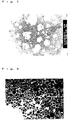
- the monodispersion of Figure 1 was obtained by classifying the silver particle powder slurry directly following the reaction, shown in Figure 2 (also a TEM photograph). This classification operation uses the centrifugal separation method described in columns 0029 and 0030 of Japanese Patent Application No.
- a silver particle powder having a calculated specific surface area (CS) of 50 m 2 /cm 3 or more, an X-ray crystal grain diameter (D X ) of not more than 50 nm, and not more than 10.0 basicity points/nm 2 and not more than 10.0 acidity points/nm 2 .
- An organic protective agent having a molecular weight of from 100 to 1000 is adsorbed on the surface of the particles, and, as calculated from the CS, the relationship between the average particle diameter D 50 and the Dx is D 50 /D X ⁇ 10.
- the calculated specific surface area (CS) is 50 m 2 /cm 3 or more.
- MA mean area diameter, which is the mean diameter weighted by the area.
- a single particle population is assumed, in which, in order from the smallest diameter, particles having the diameter d1, d2, d3 ⁇ di ⁇ dk, number n1, n2, n3 ⁇ ni ⁇ nk, respectively.
- these values can be obtained by measuring the liquid in which the silver particles are dispersed by the dynamic light-scattering method or laser diffraction method. That is to say, with the Microtrack measurement, this is calculated automatically along with the D 50.
- the silver nanoparticles of this invention have an X-ray crystal grain diameter (Dx) of not more than 50 nm.
- the Scherrer formula can be used to obtain the crystal grain diameter from the results of the X-ray diffraction measurement of the crystal grain diameter.
- the number of basicity points present on the particle surface can be evaluated from the number of acidic-substance molecules adsorbed on the surface. If one acidic substance is adsorbed on one basicity point, the number of adsorbed acidic-substance molecules will correspond to the number of basicity points. There is a good correlation between the number of basicity points of the silver powder particles and the amount of CO 2 adsorption (microliters ( ⁇ L)/g) by the particles, and a good correlation between the number of acidity points and the amount of NH 3 adsorption ( ⁇ L/g), so herein, these correlations are used to evaluate the number of basicity points and acidity points of the silver powder particles. The actual measurement is done as follows.
- the powder to be measured is placed in a ChemBET-3000 chemisorption analyzer manufactured by Quantachrome Corporation and, using high-purity CO 2 as the adsorption gas, the amount of CO 2 adsorption ( ⁇ L) per gram of the sample powder is measured.
- dehydration of water adhering to the powder is effected by heating the sample in an inert gas such as N 2 or argon, and air present in the measurement path is purged also by using an inert gas. Then, the CO 2 gas is fed to the sample, and measurement of the CO 2 adsorption amount is initiated.
- the powder to be measured is placed in the ChemBET-3000 chemisorption analyzer and, using high-purity NH 3 as the adsorption gas, the amount of NH 3 adsorption ( ⁇ L) per gram of the sample powder is measured.
- dehydration of water adhering to the powder is effected by heating the sample in an inert gas such as N 2 or helium, and air present in the measurement path is purged also by using an inert gas. Then, the NH 3 gas is fed to the sample, and measurement of the NH 3 adsorption amount is initiated.
- the density G (g/L) of each adsorbed gas can be calculated as follows.
- G g / L ⁇ ⁇ 273.15 / 298.15
- the number of basicity points or acidity points is found by substituting the respective constant into the formula concerned, as follows.
- the specific surface area P of the powder particles is obtained by multiplying the above-described CS (calculated specific surface area in unit m 2 /cm 3 ) by the density of silver (a reference value of 10.50 g/cm 3 ).
- the silver powder is one in which the number of basicity points measured by this method is not more than 10.0 points/nm 2 , and the number of acidity points also is not more than 10.0 points/nm 2 , even though the particles are so fine and active as having a specific surface area of 50 m 2 /cm 3 or more, the powder has high weatherability and does not readily oxidize, even when handled in the atmosphere, and also has good corrosion resistance with respect to sulfurization and the like.
- the weight of the silver particles in the monodispersion is calculated by the procedure described below, after the following washing, dispersion and classification steps.
- the dynamic light-scattering method or the laser diffraction method is used to measure the particle size distribution of the monodispersion obtained in the above classification step, and this particle size distribution is used to obtain the CS by the method described in the foregoing.
- a non-reflecting substrate is coated with the monodispersion concentrated by the vacuum drying.
- the silver particle powder according to this invention preferably has a TEM diameter (D TEM ) of not more than 100 nm, an aspect ratio of not more than 2.0, a CV value of not more than 40%, and a single-crystallinity of not more than 5.0. These are described below.
- D TEM TEM diameter
- the silver nanoparticles according to this invention have an average diameter (D TEM ), measured by observation of the monodispersion with a TEM (transmission electron microscope), that preferably is not more than 100 nm.
- An average value is obtained by measuring the diameter of 300 particles selected at random from a TEM image enlarged 600,000 times.
- the aspect ratio and CV value are also obtained in the same way, from observation.
- the aspect ratio (long diameter/short diameter ratio) of the silver powder particles of this invention is preferably not more than 2.0, which is suitable for forming interconnects. If the aspect ratio exceeds 2.0, particle packing is degraded when the particle dispersion is coated on a substrate and dried, giving rise to pores during firing, increasing the resistance and, in some cases, breakage of interconnects.
- the CV value is an index of particle diameter variation, with a lower CV indicating more uniform particle diameters.
- the particle CV value is preferably not more than 40%, and more preferably is less than 25%, which is suitable for interconnect applications. If the CV value exceeds 40%, as in the above case, particle packing is degraded, giving rise to pores during firing and increasing the resistance, and can cause breakage of interconnects.
- Single-crystallinity roughly corresponds to the number of crystals in one particle.
- a large single-crystallinity signifies the particles concerned are constituted of polycrystals.
- the single-crystallinity in the case of the particles of this invention is preferably not more than 5.0, signifying few crystal grain boundaries in the particles. The higher the number of crystal grain boundaries is, the higher the electrical resistance becomes.
- the silver particles of this invention have a low single-crystallinity, and therefore a low resistance, making them suitable for using as conductive members.
- the silver particles of the invention have an average diameter (D 50 ), as measured by the dynamic light-scattering method, of not more than 100 nm, and a degree of dispersion (D 50 )/(D TEM ) of not more than 5.0.
- the silver particle powder is readily dispersed in the dispersion medium and forms a stable dispersion state therein.
- the dynamic light-scattering method enables the dispersion state of the silver particle powder in the dispersion medium to be evaluated, and also enables the average particle diameter to be calculated.
- the principle of the method is that, generally, the location and orientation of particles having a diameter in the range of 1 nm to 5 ⁇ m are being constantly changed in the dispersion medium by Brownian motion as moving ahead and rotation, and by projecting a laser beam at the particles and detecting the light scattered by the particles, the fluctuations in scattered light intensity caused by the Brownian motion are measured. Measuring these time-based fluctuations in the scattered light intensity enables the velocity of the Brownian motion of the particles (the diffusion coefficient) to be obtained and, in addition, the size of the particles.
- the average diameter of the particles in the dispersion is measured based on this principle, and the measured value is close to the average particle diameter obtained by TEM observation, it signifies that the particles in the liquid are individually dispersed (not attached to each other or agglomerated). That is, the particles in the dispersion medium are spaced apart from each other and therefore can move independently.
- the average particle diameter of the silver particles of the invention in the dispersion medium obtained by the dynamic light-scattering method is compared to the average particle diameter obtained by TEM observation, they are shown to be not so different. That is, the average particle diameter measured by the dynamic light-scattering method is not more than 100 nm, preferably not more than 50 nm, and more preferably not more than 30 nm, which is not very different from the average particle diameter obtained by TEM observation. This shows that a monodispersed state has been achieved, so that in accordance with this invention, a disperse system is provided in which the silver nanoparticles are independently dispersed in the dispersion medium.
- the concentration of the dispersion medium during the measurement must be suitable for the performance and scattered light detection system of the measurement apparatus. Errors are caused by measuring at a concentration that does not ensure sufficient transmission of light.
- the received signal strength is so weak that the effect of any dirt or dust will be strong enough to cause errors, so care must be taken prepare samples and ensure the cleanliness of the measurement environment.
- the laser source used should have an output power of at least 100 mW.
- the medium adsorption layer when the dispersion medium is adsorbed on the particles, the medium adsorption layer will also have an effect, increasing particle diameter even when the particles are completely dispersed. This effect becomes particularly pronounced when particle diameters go below 10 nm.
- the degree of dispersion (D 50 )/(D TEM ) is not more than 5.0, and preferably not more than 3.0.
- the silver particle powder of the invention can be manufactured by reducing a silver compound (such as a silver salt or silver oxide) in alcohol or polyol having a boiling point of 85°C or higher in the presence of an organic protective agent.
- a silver compound such as a silver salt or silver oxide
- an organic protective agent By proceeding the reduction reaction in the presence of the organic protective agent together with an appropriate polarity inhibiting agent, it is possible to obtain silver powder particles with a high monodispersion ratio.
- the organic protective agent used is one, two or more selected from among fatty acids and amino compounds having a molecular weight of from 100 to 1000, and the polarity inhibition agent used is a hydrocarbon having a boiling point of 85°C or higher.
- the alcohol or polyol having a boiling point of 85°C or higher functions as a silver-compound reducing agent and reaction system solvent.
- Preferred alcohols include isobutanol and n-butanol.
- the reduction reaction may be carried out under refluxing condition by repeatedly evaporating and concentrating the solvent and reducing agent by heating.
- Silver compounds that can be used include silver chloride, silver nitrate, silver oxide, and silver carbonate, but from the industrial standpoint, silver nitrate is preferred but the silver compound is not limited thereto.
- the reaction may be carried out with a solution Ag ion concentration of 50 mmol/L or more.
- the organic protective agent may be a fatty acid or amino compound having a molecular weight of from 100 to 1000, particularly a metal coordinated compound having a silver coordination.
- Metal coordinated compounds include isonitrile compounds, sulfur compounds, amino compounds, and fatty acids having a carboxyl group.
- the sulfur content of sulfur compounds can cause corrosion that degrades the reliability of electronic components, isonitrile compounds are toxic. There are no such problems with amino compounds and fatty acids.
- amino compounds primary amines are preferable.
- the fatty acid or amino compound used should have a molecular weight of from 100 to 1000.
- the agglomeration-suppression effect is reduced, while if the molecular weight exceeds 1000, the agglomeration-suppression capability is high but the boiling point is also elevated, so that when the silver particles dispersion system are coated on a substrate and fired, sintering of particles is impeded, increasing the resistance of interconnects and, in some cases, leading to a loss of conductivity.
- the hydrocarbon used as the polarity inhibiting agent should be compatible with the alcohol and/or polyol constituting the solvent/reducing agent, have a melting point that is not above 30°C and a boiling point of 85°C or above.
- a melting point that is over 30°C is undesirable from an industrial standpoint, since during handling constant heating is required.
- the boiling point is less than 85°C, it is difficult to elevate the reaction temperature to 85°C or above without using a special reactor such as an autoclave.
- An amount of polarity inhibiting agent should be used that is equivalent to 5 to 90% of the total liquid amount.
- the amount is also undesirable for the amount to exceed 90%, since the polarity becomes too low, producing an excessive decrease in the solubility of the silver nitrate or other silver source material that results in an uneven reaction system.
- Hydrocarbons that can be used as the polarity inhibiting agent include amylbenzene, isopropylbenzene, ethylbenzene, xylylene, dimethylbenzene, octane, dipentene, decane, decalin, tetralin, kerosene, dodecane, tetradecane, toluene, benzene, and heptane.
- the solution was transferred to a container with a reflux condenser which was then placed in an oil bath and stirred by magnetic stirrer at 200 rpm and heated while nitrogen gas used as an inert gas was blown into the container at the rate of 400 mL/min.
- the solution was heated to 100°C at 2°C/min and refluxed for 5 hours at that temperature to complete the reaction.
- the slurry was washed, dispersed and classified as described in the foregoing, and the properties evaluated by the method described herein.
- the monodispersion ratio was found to be 81.5%.
- the silver particle powder of the monodispersion was found to have a TEM average particle diameter of 7.0 nm, an aspect ratio of 1.2, a CV value of 15.2%, a CS of 228.18 m 2 /cm 3 , an average particle diameter measured by dynamic light-scattering method (D 50 ) of 26.4 nm, a dispersion degree of 3.77, an X-ray crystal grain diameter (D X ) of 8.7 nm, a single-crystallinity of 1.24, 0.08 basicity points/nm 2 , and 0.70 acidity points/nm 2 .
- Example 2 The same procedure as Example 1 was repeated, except that dodecane instead of tetradecane was used as the polarity inhibiting agent, and the properties of the monodispersion thus obtained were evaluated in the same way.
- the monodispersion ratio was found to be 61.7%, the silver particle powder of the monodispersion was found to have a TEM average particle diameter of 7.4 nm, an aspect ratio of 1.1, a CV value of 18.0%, a CS of 180.52 m 2 /cm 3 , a D 50 of 31.0 nm, a dispersion degree of 4.19, a Dx of 7.8 nm, a single-crystallinity of 1.05, 0.11 basicity points/nm 2 , and 0.89 acidity points/nm 2 .
- Example 2 The same procedure as Example 1 was repeated, except that propanol instead of isobutanol was used as the solvent/reducing agent and the reaction temperature was changed to 80°C. Following the reaction, the silver yield in the slurry was found to be a very low 1.1%. In the X-ray diffraction analysis of the precipitate, only silver-based peaks were observed, and the Dx was 15.9 nm. Because of the small sample amount, other measurements could not be performed.
- Example 2 The same procedure as Example 1 was repeated, except that ethanol instead of isobutanol was used as the solvent/reducing agent and the reaction temperature was changed to 75°C. Following the reaction, the silver yield in the slurry was found to be a very low 0.9%. In the X-ray diffraction analysis of the precipitate, only silver-based peaks were observed, and the Dx was 25.4 nm. Because of the small sample amount, other measurements could not be performed.
- the silver yield was very low and productivity was not good, when the alcohol used had a boiling point of less than 85°C and the reaction temperature was less than 80°C.
- Reference No. 3 The method described in Reference No. 3 was used to manufacture silver particle powder by a wet reduction method using an aqueous solvent. Following the reduction reaction, the slurry was filtered and washed, dried for 12 hours at 60°C in an vacuum drier, a sample shredded in a sample mill, 0.45 g of the shredded sample was added to 20 mL of IPA and dispersed with an ultrasonic homogenizer, and the laser diffraction method was used to measure the specific surface area of the particles.
- the particles were found to have a CS of 0.734 m 2 /cm 3 , a D 50 of 3.01 nm, a Dx of 34.8 nm, a single-crystallinity of 86.49, 0.04 basicity points/nm 2 and 204.90 acidity points/nm 2 .
- Figure 3 is a SEM (scanning electron microscope) photograph of the silver particle powder that was obtained. As can be seen in Figure 3 , the particles have irregular shapes, which made it impossible to measure the TEM particle diameter, aspect ratio and CV value.
Landscapes
- Chemical & Material Sciences (AREA)
- Engineering & Computer Science (AREA)
- Nanotechnology (AREA)
- Inorganic Chemistry (AREA)
- General Chemical & Material Sciences (AREA)
- Chemical Kinetics & Catalysis (AREA)
- Condensed Matter Physics & Semiconductors (AREA)
- General Physics & Mathematics (AREA)
- Materials Engineering (AREA)
- Crystallography & Structural Chemistry (AREA)
- Composite Materials (AREA)
- Physics & Mathematics (AREA)
- Manufacture Of Metal Powder And Suspensions Thereof (AREA)
- Powder Metallurgy (AREA)
- Pigments, Carbon Blacks, Or Wood Stains (AREA)
Claims (4)
- Silberpartikelpulver mit einer berechneten spezifischen Oberfläche (CS) von 50 m2/cm3 oder mehr, einem Röntgen-Kristallkorndurchmesser (DX) von nicht mehr als 50 nm, nicht mehr als 10,0 Basizitätspunkten/nm2 und nicht mehr als 10,0 Aziditätspunkten/nm2, wobei an der Partikeloberfläche davon ein organisches Schutzmittel mit einem Molekulargewicht von 100 bis 1000 anhaftet,
wobei DX durch Röntgendiffraktionsmessung unter Verwendung der Scherrer-Formel gemessen wird, die ausgedrückt wird durch die allgemeine Formel
wobei die Anzahl der Basizitätspunkte (Punkte/nm2) berechnet wird durch 0,024779 * Q/P, wobei Q (µL/g) die gemessene Menge an CO2 ist, die von dem Silberpulver adsorbiert wird, und wobei P die spezifische Oberfläche des Pulvers (m2/g) ist, und
wobei die Anzahl der Aziditätspunkte (Punkte/nm2) berechnet wird durch 0,0250131 * R/P, wobei R (µL/g) die gemessene Menge an NH3 ist, das von dem Silberpulver adsorbiert wird, und wobei P die spezifische Oberfläche des Pulvers (m2/g) ist. - Silberpartikelpulver nach Anspruch 1, wobei das organische Schutzmittel Oleylamin ist.
- Silberpartikeldispersionssystem, welches durch die Dispersion des Silberpartikelpulvers nach Anspruch 1 oder 2 in einem nicht polaren organischen Dispersionsmedium gebildet wird, wobei der durchschnittliche Partikeldurchmesser (D50), gemessen durch ein dynamisches Lichtstreuungsverfahren, nicht mehr als 100 nm ist, und wobei der Grad der Dispersion (D50)/(DTEM) nicht mehr als 5,0 ist, wobei DTEM ein durchschnittlicher Partikeldurchmesser ist, der durch Beobachtung der Monodispersion mit einem Transmissionsselektronenmikroskop gemessen wird, wobei DTEM erhalten wird durch Messen der Durchmesser von 300 Partikeln, die zufällig aus einem TEM-Bild ausgewählt werden, das 600.000 mal vergrößert ist.
- Verfahren zur Herstellung eines Silberpartikelpulvers, welches aufweist, eine Silberverbindung in einem organischen Lösungsmittel zu reduzieren, als das organische Lösungsmittel einen Alkohol oder Polyol zu verwenden, der bzw. das als Reduzierungsmittel wirkt und einen Siedepunkt von 85 °C bis 150 °C hat, und mit der Reduktionsreaktion bei einer Temperatur von 85 °C bis 150 °C in Anwesenheit eines organischen Schutzmittels voranzuschreiten, welches eine Aminoverbindung ist, die ein Molekulargewicht von 100 bis 1000 hat, und eines Polarisationsverhinderungsmittels, welches ein Kohlenwasserstoff mit einem Schmelzpunkt ist, der nicht über 30°C ist.
Applications Claiming Priority (1)
| Application Number | Priority Date | Filing Date | Title |
|---|---|---|---|
| JP2005056035A JP4660780B2 (ja) | 2005-03-01 | 2005-03-01 | 銀粒子粉末の製造方法 |
Publications (3)
| Publication Number | Publication Date |
|---|---|
| EP1698413A2 EP1698413A2 (de) | 2006-09-06 |
| EP1698413A3 EP1698413A3 (de) | 2006-09-13 |
| EP1698413B1 true EP1698413B1 (de) | 2018-05-23 |
Family
ID=36615668
Family Applications (1)
| Application Number | Title | Priority Date | Filing Date |
|---|---|---|---|
| EP06003855.1A Revoked EP1698413B1 (de) | 2005-03-01 | 2006-02-24 | Silberpartikel und Verfahren zur dessen Herstellung |
Country Status (6)
| Country | Link |
|---|---|
| US (1) | US7491257B2 (de) |
| EP (1) | EP1698413B1 (de) |
| JP (1) | JP4660780B2 (de) |
| KR (1) | KR101236249B1 (de) |
| CN (1) | CN1895819B (de) |
| TW (1) | TWI277469B (de) |
Families Citing this family (35)
| Publication number | Priority date | Publication date | Assignee | Title |
|---|---|---|---|---|
| JP5164239B2 (ja) * | 2006-09-26 | 2013-03-21 | Dowaエレクトロニクス株式会社 | 銀粒子粉末、その分散液および銀焼成膜の製造法 |
| JP5139659B2 (ja) * | 2006-09-27 | 2013-02-06 | Dowaエレクトロニクス株式会社 | 銀粒子複合粉末およびその製造法 |
| WO2008062548A1 (fr) * | 2006-11-24 | 2008-05-29 | Nihon Handa Co., Ltd. | Composition de particules métalliques pâteuses et procédé de réunion |
| KR100818195B1 (ko) * | 2006-12-14 | 2008-03-31 | 삼성전기주식회사 | 금속 나노입자의 제조방법 및 이에 따라 제조된 금속나노입자 |
| JP5252843B2 (ja) * | 2007-01-09 | 2013-07-31 | Dowaエレクトロニクス株式会社 | 銀インクおよびその製法 |
| JP5232016B2 (ja) * | 2007-01-09 | 2013-07-10 | Dowaエレクトロニクス株式会社 | 配線形成用材料 |
| JP5005362B2 (ja) * | 2007-01-15 | 2012-08-22 | Dowaエレクトロニクス株式会社 | 銀粒子分散液およびその製造方法 |
| KR101371269B1 (ko) * | 2007-02-15 | 2014-03-07 | 도와 일렉트로닉스 가부시키가이샤 | 은 입자 분말의 제조방법 |
| JP5274000B2 (ja) * | 2007-12-07 | 2013-08-28 | Dowaエレクトロニクス株式会社 | 低温焼結性銀微粉および銀塗料ならびにそれらの製造法 |
| JP4911006B2 (ja) * | 2007-12-10 | 2012-04-04 | セイコーエプソン株式会社 | 導体パターン形成用インク、導体パターンおよび配線基板 |
| JP5371247B2 (ja) * | 2008-01-06 | 2013-12-18 | Dowaエレクトロニクス株式会社 | 銀塗料およびその製造法 |
| JP2009179879A (ja) * | 2008-01-06 | 2009-08-13 | Dowa Electronics Materials Co Ltd | 極性媒体との親和性に優れた銀微粉および銀インク |
| JP5286846B2 (ja) * | 2008-03-12 | 2013-09-11 | 日立化成株式会社 | 導電性基板及びその製造方法、並びに銅配線基板及びその製造方法 |
| KR100851815B1 (ko) * | 2008-03-24 | 2008-08-13 | 주식회사 나노엠에스이 | 나노 은분말의 제조방법 |
| JP4514807B2 (ja) | 2008-04-10 | 2010-07-28 | 山本貴金属地金株式会社 | 貴金属微粒子の製造方法 |
| JP5688895B2 (ja) | 2008-12-26 | 2015-03-25 | Dowaエレクトロニクス株式会社 | 微小銀粒子粉末と該粉末を使用した銀ペースト |
| US8858700B2 (en) * | 2009-07-14 | 2014-10-14 | Dowa Electronics Materials Co., Ltd. | Bonding material using metal nanoparticles coated with C6-C8 fatty acids, and bonding method |
| CN101834004B (zh) * | 2010-05-28 | 2013-01-09 | 中国乐凯胶片集团公司 | 一种太阳能电池电极导电银浆用银粉及其制备方法 |
| WO2011155055A1 (ja) * | 2010-06-11 | 2011-12-15 | Dowaエレクトロニクス株式会社 | 低温焼結性接合材および該接合材を用いた接合方法 |
| GB201011660D0 (en) * | 2010-07-09 | 2010-08-25 | Birkeland Innovasjon As | Process |
| DE102010034293B4 (de) * | 2010-08-13 | 2015-09-17 | Fraunhofer-Gesellschaft zur Förderung der angewandten Forschung e.V. | Verfahren zur Herstellung einer Dispersion von Nanopartikeln |
| RU2456356C1 (ru) * | 2011-04-29 | 2012-07-20 | Борис Сергеевич Кустов | Коллоидный раствор наносеребра и способ его получения |
| US20130029034A1 (en) * | 2011-07-28 | 2013-01-31 | Xerox Corporation | Process for producing silver nanoparticles |
| CN104066534B (zh) * | 2012-01-20 | 2016-05-11 | 同和电子科技有限公司 | 接合材料及使用其的接合方法 |
| CN104160490B (zh) * | 2012-03-05 | 2018-07-03 | 纳美仕股份有限公司 | 银微粒烧结体 |
| JP5960568B2 (ja) * | 2012-10-01 | 2016-08-02 | Dowaエレクトロニクス株式会社 | 銀微粒子の製造方法 |
| JP2013151753A (ja) * | 2013-03-04 | 2013-08-08 | Dowa Electronics Materials Co Ltd | 極性媒体との親和性に優れた銀微粉および銀インク |
| US9725614B2 (en) * | 2013-04-19 | 2017-08-08 | Xerox Corporation | Conductive ink compositions and methods for preparation of stabilized metal-containing nanoparticles |
| KR102100289B1 (ko) * | 2013-10-24 | 2020-04-13 | 주식회사 다이셀 | 은 나노 입자 함유 분산액의 제조 방법 및 은 나노 입자 함유 분산액 |
| JP6533371B2 (ja) * | 2014-07-31 | 2019-06-19 | 住友金属鉱山株式会社 | 積層セラミックコンデンサ内部電極用ペースト及びその製造方法、並びに積層セラミックコンデンサ内部電極用ペーストにより得られた導電膜 |
| CN104999072B (zh) * | 2015-06-29 | 2017-09-26 | 南京宜洛辞电子科技有限公司 | 一种可再分散的银纳米线混合物及其制备方法 |
| CN105088157B (zh) * | 2015-07-27 | 2017-12-15 | 河南科技大学 | 一种制备纳米钴薄膜包覆铜颗粒复合颗粒膜的方法 |
| WO2019146412A1 (ja) * | 2018-01-26 | 2019-08-01 | 日清エンジニアリング株式会社 | 銀微粒子の製造方法および銀微粒子 |
| JP6791194B2 (ja) * | 2018-04-06 | 2020-11-25 | 住友金属鉱山株式会社 | 積層セラミックコンデンサ内部電極用ペースト及びその製造方法 |
| US11652052B2 (en) | 2021-03-29 | 2023-05-16 | Tpk Advanced Solutions Inc. | Contact structure and electronic device having the same |
Citations (3)
| Publication number | Priority date | Publication date | Assignee | Title |
|---|---|---|---|---|
| WO1997024224A1 (en) | 1995-12-28 | 1997-07-10 | Heath James R | Organically-functionalized monodisperse nanocrystals of metals |
| US20040173666A1 (en) | 2000-03-22 | 2004-09-09 | Ebara Corporation | Composite metallic ultrafine particles and process for producing the same |
| JP2005036309A (ja) | 2003-06-25 | 2005-02-10 | Toda Kogyo Corp | 銀超微粒子コロイド及びその製造方法 |
Family Cites Families (12)
| Publication number | Priority date | Publication date | Assignee | Title |
|---|---|---|---|---|
| JPS54121270A (en) | 1978-03-14 | 1979-09-20 | Fukuda Metal Foil Powder | Production of finely divided silver powder |
| JP2862521B2 (ja) * | 1997-05-01 | 1999-03-03 | エスケー化研株式会社 | 耐候性の良好なメタリック顔料を使用したメタリック塗料 |
| JPH11319538A (ja) * | 1998-05-20 | 1999-11-24 | Nippon Paint Co Ltd | 貴金属又は銅のコロイドの製造方法 |
| JP4362170B2 (ja) | 1999-07-22 | 2009-11-11 | アルバックマテリアル株式会社 | 銀超微粒子独立分散液 |
| JP4108350B2 (ja) | 2002-03-07 | 2008-06-25 | 独立行政法人科学技術振興機構 | 銀ナノ粒子の製造方法 |
| JP4168371B2 (ja) * | 2002-06-28 | 2008-10-22 | 戸田工業株式会社 | 金属コロイドオルガノゾル及びその製造方法 |
| JP4248857B2 (ja) * | 2002-11-29 | 2009-04-02 | 三ツ星ベルト株式会社 | 銀微粒子の製造方法 |
| JP4414145B2 (ja) * | 2003-03-06 | 2010-02-10 | ハリマ化成株式会社 | 導電性ナノ粒子ペースト |
| JP2005026805A (ja) | 2003-06-30 | 2005-01-27 | Renesas Technology Corp | 半導体集積回路 |
| JP4447860B2 (ja) | 2003-06-30 | 2010-04-07 | ソニー株式会社 | ネットワークカメラ |
| JP4489389B2 (ja) * | 2003-07-29 | 2010-06-23 | 三井金属鉱業株式会社 | 微粒銀粉の製造方法 |
| JP2005048250A (ja) * | 2003-07-30 | 2005-02-24 | Dowa Mining Co Ltd | 金属磁性粒子の集合体およびその製造法 |
-
2005
- 2005-03-01 JP JP2005056035A patent/JP4660780B2/ja not_active Expired - Fee Related
-
2006
- 2006-02-21 TW TW095105706A patent/TWI277469B/zh not_active IP Right Cessation
- 2006-02-24 EP EP06003855.1A patent/EP1698413B1/de not_active Revoked
- 2006-02-24 US US11/360,481 patent/US7491257B2/en not_active Expired - Lifetime
- 2006-02-28 KR KR20060019396A patent/KR101236249B1/ko not_active Expired - Fee Related
- 2006-03-01 CN CN200610121246XA patent/CN1895819B/zh not_active Expired - Fee Related
Patent Citations (3)
| Publication number | Priority date | Publication date | Assignee | Title |
|---|---|---|---|---|
| WO1997024224A1 (en) | 1995-12-28 | 1997-07-10 | Heath James R | Organically-functionalized monodisperse nanocrystals of metals |
| US20040173666A1 (en) | 2000-03-22 | 2004-09-09 | Ebara Corporation | Composite metallic ultrafine particles and process for producing the same |
| JP2005036309A (ja) | 2003-06-25 | 2005-02-10 | Toda Kogyo Corp | 銀超微粒子コロイド及びその製造方法 |
Non-Patent Citations (4)
| Title |
|---|
| F. FIEVET ET AL.: "PREPARING MONODISPERSE METAL POWDERS IN MICROMETER AND SUBMICROMETER SIZES BY THE POLYOL PROCESS", MRS BULLETIN, December 1989 (1989-12-01), pages 29 - 34, XP008025794 |
| HIROKI HIRAMATSU ET AL.: "A Simple Large-Scale Synthesis of Nearly Monodisperse Gold and Silver Nanoparticles with Adjustable Sizes and with Exchangeable Surfactants", CHEMISTRY OF MATERIALS, vol. 16, no. 13, 28 May 2004 (2004-05-28), pages 2509 - 2511, XP002533575 |
| PIERRE-YVES SILVERT ET AL.: "Preparation of colloidal silver dispersoins by the polyol process. Part 2- Mechanism of particle formation", J. MATER. CHEM., vol. 7, no. 2, 1997, pages 293 - 299, XP002397935 |
| T. YAMAMOTO ET AL.: "Microwave-assisted Preparation of Silver Nanoparticles", CHEMISTRY LETTERS, vol. 33, no. 2, 14 January 2004 (2004-01-14), pages 158 - 159, XP009117469 |
Also Published As
| Publication number | Publication date |
|---|---|
| JP2006241494A (ja) | 2006-09-14 |
| EP1698413A3 (de) | 2006-09-13 |
| TWI277469B (en) | 2007-04-01 |
| KR101236249B1 (ko) | 2013-02-22 |
| US7491257B2 (en) | 2009-02-17 |
| EP1698413A2 (de) | 2006-09-06 |
| JP4660780B2 (ja) | 2011-03-30 |
| CN1895819A (zh) | 2007-01-17 |
| TW200633800A (en) | 2006-10-01 |
| KR20060096904A (ko) | 2006-09-13 |
| CN1895819B (zh) | 2011-04-27 |
| US20060199008A1 (en) | 2006-09-07 |
Similar Documents
| Publication | Publication Date | Title |
|---|---|---|
| US7491257B2 (en) | Silver particle powder and method of manufacturing same | |
| US7776442B2 (en) | Particulate powder of silver and method of manufacturing same | |
| EP1844883B1 (de) | Silberpartikelpulver und herstellungsverfahren dafür | |
| Kawasaki | Surfactant-free solution-based synthesis of metallic nanoparticles toward efficient use of the nanoparticles' surfaces and their application in catalysis and chemo-/biosensing. | |
| EP2208559B1 (de) | Silbermikropartikelhaltige zusammensetzung, verfahren zur herstellung der zusammensetzung, verfahren zur herstellung der silbermikropartikel und paste mit den silbermikropartikeln | |
| JP4490201B2 (ja) | 凹凸表面をもつ微細な合金粒子粉末およびその製造法 | |
| JP4674375B2 (ja) | 銀粒子粉末の製造法 | |
| CN101610864A (zh) | 银粒子粉末的制造方法 | |
| US8003019B2 (en) | Silver particle dispersion ink | |
| Romero et al. | Facile preparation of an immobilized surfactant-free palladium nanocatalyst for metal hydride trapping: a novel sensing platform for TXRF analysis | |
| JP5176060B2 (ja) | 銀粒子分散液の製造法 | |
| JP5064423B2 (ja) | 銀の粒子粉末および分散液 | |
| JP4674376B2 (ja) | 銀粒子粉末の製造法 |
Legal Events
| Date | Code | Title | Description |
|---|---|---|---|
| PUAI | Public reference made under article 153(3) epc to a published international application that has entered the european phase |
Free format text: ORIGINAL CODE: 0009012 |
|
| PUAL | Search report despatched |
Free format text: ORIGINAL CODE: 0009013 |
|
| AK | Designated contracting states |
Kind code of ref document: A2 Designated state(s): AT BE BG CH CY CZ DE DK EE ES FI FR GB GR HU IE IS IT LI LT LU LV MC NL PL PT RO SE SI SK TR |
|
| AX | Request for extension of the european patent |
Extension state: AL BA HR MK YU |
|
| AK | Designated contracting states |
Kind code of ref document: A3 Designated state(s): AT BE BG CH CY CZ DE DK EE ES FI FR GB GR HU IE IS IT LI LT LU LV MC NL PL PT RO SE SI SK TR |
|
| AX | Request for extension of the european patent |
Extension state: AL BA HR MK YU |
|
| 17P | Request for examination filed |
Effective date: 20070208 |
|
| AKX | Designation fees paid |
Designated state(s): DE FR GB |
|
| 17Q | First examination report despatched |
Effective date: 20070706 |
|
| RAP1 | Party data changed (applicant data changed or rights of an application transferred) |
Owner name: DOWA HOLDINGS CO., LTD. |
|
| RAP1 | Party data changed (applicant data changed or rights of an application transferred) |
Owner name: DOWA ELECTRONICS MATERIALS CO., LTD. |
|
| STAA | Information on the status of an ep patent application or granted ep patent |
Free format text: STATUS: EXAMINATION IS IN PROGRESS |
|
| REG | Reference to a national code |
Ref country code: DE Ref legal event code: R079 Ref document number: 602006055437 Country of ref document: DE Free format text: PREVIOUS MAIN CLASS: B22F0001000000 Ipc: B82Y0030000000 |
|
| GRAP | Despatch of communication of intention to grant a patent |
Free format text: ORIGINAL CODE: EPIDOSNIGR1 |
|
| STAA | Information on the status of an ep patent application or granted ep patent |
Free format text: STATUS: GRANT OF PATENT IS INTENDED |
|
| RIC1 | Information provided on ipc code assigned before grant |
Ipc: B22F 9/24 20060101ALI20171110BHEP Ipc: B22F 1/02 20060101ALI20171110BHEP Ipc: B22F 1/00 20060101ALI20171110BHEP Ipc: C22C 1/04 20060101ALI20171110BHEP Ipc: B82Y 30/00 20110101AFI20171110BHEP |
|
| INTG | Intention to grant announced |
Effective date: 20171128 |
|
| GRAS | Grant fee paid |
Free format text: ORIGINAL CODE: EPIDOSNIGR3 |
|
| GRAA | (expected) grant |
Free format text: ORIGINAL CODE: 0009210 |
|
| STAA | Information on the status of an ep patent application or granted ep patent |
Free format text: STATUS: THE PATENT HAS BEEN GRANTED |
|
| AK | Designated contracting states |
Kind code of ref document: B1 Designated state(s): DE FR GB |
|
| REG | Reference to a national code |
Ref country code: GB Ref legal event code: FG4D |
|
| REG | Reference to a national code |
Ref country code: DE Ref legal event code: R096 Ref document number: 602006055437 Country of ref document: DE |
|
| REG | Reference to a national code |
Ref country code: DE Ref legal event code: R026 Ref document number: 602006055437 Country of ref document: DE |
|
| PLBI | Opposition filed |
Free format text: ORIGINAL CODE: 0009260 |
|
| PLAX | Notice of opposition and request to file observation + time limit sent |
Free format text: ORIGINAL CODE: EPIDOSNOBS2 |
|
| 26 | Opposition filed |
Opponent name: ISENBRUCK BOESL HOERSCHLER LLP Effective date: 20190222 |
|
| PLAB | Opposition data, opponent's data or that of the opponent's representative modified |
Free format text: ORIGINAL CODE: 0009299OPPO |
|
| R26 | Opposition filed (corrected) |
Opponent name: PATENTANWAELTE ISENBRUCK BOESL HOERSCHLER PARTG MB Effective date: 20190222 |
|
| PLBB | Reply of patent proprietor to notice(s) of opposition received |
Free format text: ORIGINAL CODE: EPIDOSNOBS3 |
|
| REG | Reference to a national code |
Ref country code: DE Ref legal event code: R103 Ref document number: 602006055437 Country of ref document: DE Ref country code: DE Ref legal event code: R064 Ref document number: 602006055437 Country of ref document: DE |
|
| PGFP | Annual fee paid to national office [announced via postgrant information from national office to epo] |
Ref country code: FR Payment date: 20210113 Year of fee payment: 16 |
|
| PGFP | Annual fee paid to national office [announced via postgrant information from national office to epo] |
Ref country code: GB Payment date: 20210217 Year of fee payment: 16 Ref country code: DE Payment date: 20210209 Year of fee payment: 16 |
|
| RDAF | Communication despatched that patent is revoked |
Free format text: ORIGINAL CODE: EPIDOSNREV1 |
|
| RDAG | Patent revoked |
Free format text: ORIGINAL CODE: 0009271 |
|
| STAA | Information on the status of an ep patent application or granted ep patent |
Free format text: STATUS: PATENT REVOKED |
|
| 27W | Patent revoked |
Effective date: 20210415 |
|
| GBPR | Gb: patent revoked under art. 102 of the ep convention designating the uk as contracting state |
Effective date: 20210415 |