EP1683584A2 - Vorrichtung zur Verbesserung der Effizienz der Behandlung von Silicium - Google Patents
Vorrichtung zur Verbesserung der Effizienz der Behandlung von Silicium Download PDFInfo
- Publication number
- EP1683584A2 EP1683584A2 EP06075971A EP06075971A EP1683584A2 EP 1683584 A2 EP1683584 A2 EP 1683584A2 EP 06075971 A EP06075971 A EP 06075971A EP 06075971 A EP06075971 A EP 06075971A EP 1683584 A2 EP1683584 A2 EP 1683584A2
- Authority
- EP
- European Patent Office
- Prior art keywords
- polycrystalline silicon
- cylinder
- indents
- pieces
- mixture
- Prior art date
- Legal status (The legal status is an assumption and is not a legal conclusion. Google has not performed a legal analysis and makes no representation as to the accuracy of the status listed.)
- Granted
Links
Images



Classifications
-
- G—PHYSICS
- G01—MEASURING; TESTING
- G01N—INVESTIGATING OR ANALYSING MATERIALS BY DETERMINING THEIR CHEMICAL OR PHYSICAL PROPERTIES
- G01N15/00—Investigating characteristics of particles; Investigating permeability, pore-volume or surface-area of porous materials
- G01N15/02—Investigating particle size or size distribution
- G01N15/0272—Investigating particle size or size distribution with screening; with classification by filtering
-
- C—CHEMISTRY; METALLURGY
- C30—CRYSTAL GROWTH
- C30B—SINGLE-CRYSTAL GROWTH; UNIDIRECTIONAL SOLIDIFICATION OF EUTECTIC MATERIAL OR UNIDIRECTIONAL DEMIXING OF EUTECTOID MATERIAL; REFINING BY ZONE-MELTING OF MATERIAL; PRODUCTION OF A HOMOGENEOUS POLYCRYSTALLINE MATERIAL WITH DEFINED STRUCTURE; SINGLE CRYSTALS OR HOMOGENEOUS POLYCRYSTALLINE MATERIAL WITH DEFINED STRUCTURE; AFTER-TREATMENT OF SINGLE CRYSTALS OR A HOMOGENEOUS POLYCRYSTALLINE MATERIAL WITH DEFINED STRUCTURE; APPARATUS THEREFOR
- C30B15/00—Single-crystal growth by pulling from a melt, e.g. Czochralski method
-
- B—PERFORMING OPERATIONS; TRANSPORTING
- B07—SEPARATING SOLIDS FROM SOLIDS; SORTING
- B07B—SEPARATING SOLIDS FROM SOLIDS BY SIEVING, SCREENING, SIFTING OR BY USING GAS CURRENTS; SEPARATING BY OTHER DRY METHODS APPLICABLE TO BULK MATERIAL, e.g. LOOSE ARTICLES FIT TO BE HANDLED LIKE BULK MATERIAL
- B07B13/00—Grading or sorting solid materials by dry methods, not otherwise provided for; Sorting articles otherwise than by indirectly controlled devices
- B07B13/02—Apparatus for grading using pockets for taking out particles from aggregates
-
- B—PERFORMING OPERATIONS; TRANSPORTING
- B07—SEPARATING SOLIDS FROM SOLIDS; SORTING
- B07B—SEPARATING SOLIDS FROM SOLIDS BY SIEVING, SCREENING, SIFTING OR BY USING GAS CURRENTS; SEPARATING BY OTHER DRY METHODS APPLICABLE TO BULK MATERIAL, e.g. LOOSE ARTICLES FIT TO BE HANDLED LIKE BULK MATERIAL
- B07B13/00—Grading or sorting solid materials by dry methods, not otherwise provided for; Sorting articles otherwise than by indirectly controlled devices
- B07B13/04—Grading or sorting solid materials by dry methods, not otherwise provided for; Sorting articles otherwise than by indirectly controlled devices according to size
-
- C—CHEMISTRY; METALLURGY
- C30—CRYSTAL GROWTH
- C30B—SINGLE-CRYSTAL GROWTH; UNIDIRECTIONAL SOLIDIFICATION OF EUTECTIC MATERIAL OR UNIDIRECTIONAL DEMIXING OF EUTECTOID MATERIAL; REFINING BY ZONE-MELTING OF MATERIAL; PRODUCTION OF A HOMOGENEOUS POLYCRYSTALLINE MATERIAL WITH DEFINED STRUCTURE; SINGLE CRYSTALS OR HOMOGENEOUS POLYCRYSTALLINE MATERIAL WITH DEFINED STRUCTURE; AFTER-TREATMENT OF SINGLE CRYSTALS OR A HOMOGENEOUS POLYCRYSTALLINE MATERIAL WITH DEFINED STRUCTURE; APPARATUS THEREFOR
- C30B15/00—Single-crystal growth by pulling from a melt, e.g. Czochralski method
- C30B15/02—Single-crystal growth by pulling from a melt, e.g. Czochralski method adding crystallising materials or reactants forming it in situ to the melt
-
- G—PHYSICS
- G01—MEASURING; TESTING
- G01N—INVESTIGATING OR ANALYSING MATERIALS BY DETERMINING THEIR CHEMICAL OR PHYSICAL PROPERTIES
- G01N15/00—Investigating characteristics of particles; Investigating permeability, pore-volume or surface-area of porous materials
- G01N15/02—Investigating particle size or size distribution
- G01N2015/0288—Sorting the particles
Definitions
- This invention relates to a method and apparatus for processing silicon. More particularly, this invention relates to a method and apparatus for processing polycrystalline silicon into source material useful in a Czochralski-type process.
- Polycrystalline silicon may be prepared using a chemical vapor deposition (CVD) process in a cold wall bell jar reactor. Typically, this process is produced by CVD of a high purity silane or chlorosilane onto a heated substrate. The resulting product is a polycrystalline silicon workpiece such as a rod or ribbon. Polycrystalline silicon may be used to form monocrystalline silicon. Most semiconductor chips used in electronic devices are fabricated from monocrystalline silicon prepared by a Czochralski-type (CZ) process.
- CZ Czochralski-type
- a monocrystalline silicon ingot is produced by melting polycrystalline silicon source material in a quartz crucible, stabilizing the crucible and source melt at an equilibrium temperature, dipping a seed crystal into the source melt, withdrawing the seed crystal as the source melt crystallizes on the seed to form a single crystal ingot, and pulling the ingot as it grows. Melting occurs at a temperature of 1412°C to 1420°C in an inert gas environment at low absolute pressure. The crucible is continually rotated about a generally vertical axis as the crystal grows. The rate at which the ingot is pulled from the source melt is selected to form an ingot having a desired diameter.
- polycrystalline silicon workpieces are usually processed before they may be used to form monocrystalline silicon in the CZ process.
- the polycrystalline silicon workpieces are usually broken into pieces suitably sized for loading in the crucible. Mixtures of silicon pieces with different size distributions may be used to maximize the charge loaded in the crucible.
- One method by which polycrystalline silicon workpieces are processed is a hand processing method. Operators in a clean room environment place the polycrystalline silicon workpieces on a low-contaminate work surface and strike the polycrystalline silicon workpieces with a low contamination impact tool to form polycrystalline silicon pieces.
- This invention relates to a method and apparatus for processing silicon. While the invention described below is described in detail with respect to polycrystalline silicon, one skilled in the art would recognize that the method and apparatus described herein may be used for polycrystalline silicon or monocrystalline silicon, or combinations thereof.
- K Kelvin
- Kg means kilograms.
- mm means millimeters.
- m/s means meters per second.
- particle size means the longest straight line between two points on a particle. For example, for spherical particles, particle size is the diameter.
- This invention relates to a method for processing polycrystalline silicon.
- the method comprises preparing different size distributions of polycrystalline silicon pieces, which are suitable for use in a CZ process.
- the method may comprise preparing a polycrystalline silicon workpiece by a chemical vapor deposition process, fracturing the polycrystalline silicon workpiece into a mixture of polycrystalline silicon pieces of varying sizes, and sorting the mixture of polycrystalline silicon pieces having varying sizes into at least two size distributions.
- the polycrystalline silicon workpiece may be fractured by a thermal shock process.
- the method may comprise preparing a mixture of polycrystalline silicon pieces of varying sizes using a fluidized bed reactor process and sorting the mixture of polycrystalline silicon pieces of varying sizes into at least two size distributions.
- a mixture of polycrystalline silicon pieces having varying sizes prepared by either the chemical vapor deposition process or the fluidized bed reactor process may be sorted using a rotary indent classifier, such as the rotary indent classifier of this invention.
- Polycrystalline silicon workpieces that may be used in the method described herein include rods and ribbons that may be prepared by methods known in the art.
- polycrystalline silicon rods may be prepared by a chemical vapor deposition process comprising chemical vapor deposition of a high purity chlorosilane or silane gas onto a heated substrate, see Handbook of Semiconductor Silicon Technology, edited by William C. O'Mara, Robert B. Herring, and Lee P. Hunt, Noyes Publications, Park Ridge, New Jersey, U.S.A., 1990, Ch. 2, pp. 39-58.
- polycrystalline silicon ribbons may be prepared by a chemical vapor deposition process as described by Chandra, et al., in WO 01/61070 A1.
- polycrystalline silicon workpieces may be prepared by a fluidized bed reactor process, such as those described by U.S. Patents 4,092,446 and 4,213,937.
- the polycrystalline silicon workpieces prepared by the fluidized bed reactor process may be suitably sized to be sorted into size distributions by the methods and apparatuses described below (e.g., the fluidized bed reactor process may directly produce a mixture of polycrystalline silicon pieces of varying sizes that do not require fracturing before sorting).
- Polycrystalline silicon workpieces that are not suitably sized to be sorted may be fractured to prepare a mixture of polycrystalline silicon pieces of varying sizes, where the sizes are suitable for sorting by the methods and apparatus described below.
- the polycrystalline silicon workpieces may be fractured, for example, by striking with a low-contamination impact tool such as that disclosed in EP 0 539 097 A1.
- a low-contamination impact tool such as that disclosed in EP 0 539 097 A1.
- the polycrystalline silicon workpieces may be fractured by a thermal shock process such as those disclosed in GB 1 368 224 and EP 0 329 163 B1.
- the polycrystalline silicon workpieces may be fractured by a thermal shock process comprising controlled heating and cooling of the polycrystalline silicon workpiece thereby generating stress cracks throughout the polycrystalline silicon workpiece.
- a separator may be used to extend the cracks and reduce the polycrystalline silicon workpiece to a mixture of polycrystalline silicon pieces of varying sizes.
- the polycrystalline silicon workpiece is heated to a predetermined temperature, and the heated polycrystalline silicon workpiece is cooled with a fluid spray.
- the polycrystalline silicon workpiece may be heated to a temperature of 600 to 1400 °F, alternatively 1200 to 1400 °F, alternatively 600 to 750 °F, alternatively 630 to 750 °F, alternatively 650 to 700 °F.
- the polycrystalline silicon workpiece may be heated by, for example, laser, infra-red, or microwave energy.
- Methods and apparatuses for heating the polycrystalline silicon workpiece include, for example, those disclosed in JP 63-287565, and U.S. Patents 4,565,913 and 5,464,159.
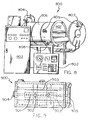
- the controlled atmosphere microwave furnace 800 includes a controlled atmosphere chamber 801 electrically connected to a control cabinet 802 for controlling the temperature inside the chamber 801.
- a microwave supply 803 supplies microwave energy to the chamber 801 through a waveguide assembly 804.
- the chamber 801 has viewports 805 in the side 806 and in the door 807.
- a thermocouple 808 may be used to measure temperature inside the chamber 801.
- the heated polycrystalline silicon workpiece may be cooled using various high-purity fluids, e.g., a gas or a liquid.
- Suitable gases comprise air, inert gases such as nitrogen, or combinations thereof.
- Suitable liquids comprise water or a liquefied inert gas.
- deionized, distilled, or otherwise purified water may be used to minimize contamination of the silicon with impurities that are undesirable to customers.
- solutions of HF or ammonium hydroxide in water may be used.
- the fluid may be sprayed on the heated polycrystalline silicon workpiece from a nozzle, alternatively a plurality of nozzles.
- the size and shape of the silicon pieces generated tends to depend on type of nozzles, the position and orientation of the nozzles, and the fluid flow rate.
- the spacing of nozzles tends to affect size distribution of the mixture of silicon pieces formed.
- the nozzles may be spaced 1 to 6 inches apart, alternatively 2 to 4 inches apart to produce desirable size pieces.
- Nozzle orientation tends to influence the shape of the silicon pieces.
- a flat fan and a tube nozzle oriented perpendicular to the axis of the workpiece tend to produce irregular shaped pieces.
- An axial orientation tends to produce uniform wedge or pie shaped pieces.
- the type of nozzle and spray pattern tend to influence the shape of the pieces.
- a cone spray pattern tends to produce a number of semicircular pieces.
- a flat fan spray tends to produce wedge shaped pieces.
- the size distribution and shape of the pieces also tend to be influenced by the process used to make the polycrystalline silicon workpiece and the internal stresses created thereby.
- One skilled in the art would be able to select nozzle types and orientations without undue experimentation.
- the fluid is sprayed so as to create enough stress to crack the polycrystalline silicon workpiece.
- the velocity of the fluid to be used depends on the method of making the polycrystalline silicon workpiece and the internal stresses created thereby, the type of the fluid to be used, the temperature of the fluid to be used, and the temperature of the workpiece. For example, when air at ambient temperature is used as the fluid, velocity may be greater than 60 m/s for polycrystalline silicon workpieces made by Hemlock Semiconductor Corporation and heated to 973 K. When air at ambient temperature is used as the fluid, velocity is greater than 130 m/s for polycrystalline silicon workpieces made by Hemlock Semiconductor Corporation and heated to 873 K.
- velocity is greater than 1 m/s for polycrystalline silicon workpieces at 973 K.
- velocity is greater than 2.5 m/s for polycrystalline silicon workpieces made by Hemlock Semiconductor Corporation and heated to 873 K.
- the heated polycrystalline silicon workpiece may be cooled in a quench tank.
- Figure 9 is a plan view of an example of a quench tank 900 that may be used for cooling the heated polycrystalline silicon workpiece 901.
- the heated polycrystalline silicon workpiece 901 is placed in the quench tank 900 on supports 902.
- the supports 902 may be made of any material that will cause no (or low) contamination of the heated polycrystalline silicon workpiece 901.
- the heated polycrystalline silicon workpiece 901 is sprayed with a liquid from the nozzles 903. The liquid is fed from the inlet 904 to the outlet 905.
- Figure 10 is a section view of the quench tank 900.
- Figure 10 shows that the orientation of the sets of nozzles 1003 with respect to the heated polycrystalline silicon workpiece 901.
- the liquid may be fed through one set of nozzles 1003, or more than one set of nozzles 1003, at a time.
- the sets of nozzles 1003 may be arranged along pipes 1001.
- the pipes 1001 run parallel to the heated polycrystalline silicon workpiece 901.
- the pipes 1001 are arranged at 60°, 90°, 180°, and 270° from vertical. However, one skilled in the art would recognize that other arrangements of pipes and nozzles may be used.
- the cracked polycrystalline silicon workpiece may require a separator to extend the cracks and reduce the cracked polycrystalline silicon workpiece to a mixture of silicon pieces of varying sizes. Any separator that does not cause significant contamination of the mixture of silicon pieces may be used.
- the separator may be a mechanical, vibrational, or sonic separator.
- a suitable mechanical separator may comprise a hammer, such as a pneumatic, electric, magnetic, or hydraulic hammer.
- Figure 11 shows a section view of a suitable mechanical separator 1100 for use in this invention.
- the mechanical separator 1100 comprises a pneumatic hammer chamber 1101 with a lid 1102.
- a cracked polycrystalline silicon workpiece 1103 may be placed inside the chamber 1101 on supports 1104 made of a material that will cause no (or low) contamination of silicon.
- Arrays of pneumatic hammers 1105, 1106 are arranged parallel to the longitudinal axis of the workpiece 1103 and are positioned at an angle of 25° above horizontal.
- the hammers in one array 1105 may be offset from the hammers in another array 1106, as shown Figure 12, which is a top view of the pneumatic hammer chamber 1101 in Figure 11.
- the arrays of hammers may be inline or offset and that different arrangements of arrays and positions of arrays are possible.
- the mixture of polycrystalline silicon pieces of varying sizes may be sorted into at least two size distributions by a variety of methods.
- the mixture may be sorted by hand or by machine.
- the mixture of polycrystalline silicon pieces may be sorted using methods and apparatuses known in the art, such as the rotary silicon screen disclosed in U.S. Patent 5,165,548.
- the mixture may be fed to a rotary indent classifier that sorts the mixture into at least two size distributions.
- the mixture may be fed to the classifier by any convenient means, such as a hopper, a chute, or a conveyor such as a bucket, belt, or vibratory conveyor.
- the rotary indent classifier may comprise a disk having indents along the circumferential edge or a cylinder having indents along the circumferential edge.
- the indents along the circumferential edge of the cylinder may increase in size from a first end of the cylinder to a second end of the cylinder.
- the cylinder may be solid or hollow.
- the classifier may comprise an assembly comprising two or more arrays comprising one or more disks having indents along the circumferential edge. The indents may have different sizes from disk to disk or array to array.
- the indents are sized to capture silicon pieces of a predetermined size or smaller and to reject silicon pieces of a size larger than the predetermined size.
- the classifier may comprise a single disk or cylinder having indents along the circumferential edge that are equally sized and the size is such that silicon pieces of a predetermined size or smaller are captured and silicon pieces of a larger size than the predetermined size are rejected. This forms two size distributions.
- an assembly comprising a plurality of disks may be used, where the disks have indents of different sizes on different disks.
- the disks are arrayed such that the mixture of silicon pieces pass the disk having the smallest indents first and then pass by subsequent disks having indents in order of increasing size.
- FIG. 1 and 1a An example of such an assembly 100 including a plurality of disks 101 is shown in Figures 1 and 1a.
- the assembly 100 has four arrays 102a, 102b, 102c, and 102d of disks 101 having indents 103 along the circumferential edges 104 thereof.
- Multiple indent disks 101 are arranged along a shaft 105 to form arrays 102a-d, with each array end blocked by a plate 106.
- Indent disks 101 and plates 106 are held in position relative to each other on shaft 105 by means of securing rods 107, which extend the longitudinal length of the assembly 100.
- each disk 101 may be maximized to facilitate efficient separation of the mixture of silicon pieces.
- the disks 101 forming each of arrays 102a-d are sized to capture silicon pieces of a predetermined size or smaller and to reject silicon pieces of a size larger than the predetermined size.
- the depth of each indent 103 may be 40 to 70 percent of the width of the indent, alternatively 55 to 65 percent on the same basis.
- the thickness of each disk 101 may be selected such that indent length is 100 to 120 percent of the width of the indent, alternatively 100 to 110 percent on the same basis.
- Each indent 103 is shaped as half a cylinder (e.g., a cylinder sliced through its longitudinal axis).
- a cylinder having indents formed along the circumferential edge, where the indents are positioned along the longitudinal length of the cylinder so as to increase in size from a first end of the cylinder to a second end of the cylinder may be used.
- the indents effect differential separation of the mixture of silicon pieces by size as the mixture passes along the length of the cylinder.
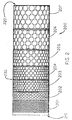
- the cylinder 200 has a first end 210, a second end 220, and a circumferential edge 230 therebetween.
- the cylinder 200 has a first set of indents 201 arrayed along the circumferential edge of the cylinder 200.
- Each indent 201 has a diameter of one-half inch at the surface of the cylinder 200, and each indent 201 extends inward in the shape of half an ellipsoid.
- the rows of indents 201 are offset from one another.
- the cylinder 200 then has a second set of indents 202 adjacent to the first set of indents 201.
- Each of the indents 202 has a diameter of one inch at the surface of the cylinder 200, and each indent 202 extends inward in the shape of half an ellipsoid. There are five rows of indents 202. The rows of indents 202 are offset from one another.
- the cylinder 200 has a third set of indents 203 adjacent to the second set of indents 202.
- Each of the indents 203 has a diameter of one and one-half inches at the surface of the cylinder, and each indent 203 extends inward in the shape of half an ellipsoid.
- the cylinder 200 has a fourth set of indents 204 adjacent to the third set of indents 203.
- Each of the indents 204 has a diameter of two inches at the surface of the cylinder, and each indent 204 extends inward in the shape of half an ellipsoid.
- the rows of indents 204 are offset from one another.
- the cylinder 200 has a fifth set of indents 205 adjacent to the fourth set of indents 204.
- Each of the indents 205 has a diameter of two and one-half inches at the surface of the cylinder, and each indent 205 extends inward in the shape of half an ellipsoid.
- the rows of indents 205 are offset from one another.
- the cylinder 200 has a sixth set of indents 206 adjacent to the fifth set of indents 205.
- Each of the indents 206 has a diameter of three inches at the surface of the cylinder, and each indent 206 extends inward in the shape of half an ellipsoid.
- the rows of indents 206 are offset from one another.
- the cylinder 200 has a seventh set of indents 207 adjacent to the sixth set of indents 206.
- Each of the indents 207 has a diameter of three and one-half inches at the surface of the cylinder, and each indent 207 extends inward in the shape of half an ellipsoid.
- the rows of indents 207 are offset from one another. Each set of indents is spaced one-half inch from the next set of indents.
- the number of indents in the circumference of the each disk or cylinder is not critical, but may be maximized to facilitate efficient separation of the mixture of silicon pieces. Offsetting rows of indents may be done to maximize the number of indents.
- the shape of the indent may be, for example, cubic, cylindrical, half-cylindrical, ellipsoidal, half-ellipsoidal, or wedge-shaped.
- the depth of each indent may be 40 to 70% of the width of the indent measured at the circumferential edge, alternatively 55 to 65% on the same basis.
- One skilled in the art would be able to vary the number of indents, size of indents, spacing of indents, and number of sets or arrays of indents without undue experimentation.
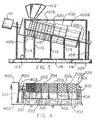
- Figure 3 shows a rotary indent classifier including the assembly 100 shown in figure 1.
- the ends of shaft 105 are rotationally affixed to a support 108, which rests on a base 109.
- the means of rotationally attaching shaft 105 to support 108 may be by standard bearings.
- the assembly 100 may be positioned in supports 108 such that the assembly 100 is at an incline of 5 to 20 degrees, alternatively 10 to 12 degrees above horizontal.
- the slope of the assembly 100 is positioned to facilitate the movement by gravity of a mixture of silicon pieces along slide plate 110.
- Supports 108 may be adjustable in height to facilitate change of the slope.
- Attached to the upper-end of shaft 105 is drive mechanism 111 for imparting rotational energy to the assembly 100.
- the rotational energy may be supplied by any convenient means such as electric motor, or pneumatic or hydraulic drive.
- Drive mechanism 111 may be connected to shaft 105 directly or by any convenient means such as belt, chain, reduction gear box, or combinations thereof.
- the assembly 100 may be rotated at a speed sufficient to provide a tangential velocity of 15 to 32 centimeters per second.
- Feed distributor 112 is positioned at the upper end of the assembly 100.
- the mixture of silicon pieces may be fed by means of feed distributor 112 to array 102a to start the separation process.
- the shape of feed distributor 112 is not critical and may be a chute as shown in figure 3 or any other convenient design for feeding pieces of material to a rotating assembly, including but not limited to a hopper, a conveyor, a slide plate, or a combination thereof.
- the assembly 100 is shown positioned within a collection container 113 comprising outer walls 114 and partition walls 115. Partition walls 115 separate the collection container 113 into a number of chambers to segregate the silicon pieces captured by each of arrays 102a-d. Also positioned in the collection container on an axis generally parallel to shaft 105 is slide plate 110. A slide plate 110 may be positioned on each side of the assembly 100. Slide plate 110 functions to allow gravitational movement of the mixture of silicon pieces along the length of the assembly 100. Slide plate 110 may be statically fixed or may be held in such manner as to allow vibration or movement to facilitate the movement of the silicon pieces down its length.
- assembly 100 need not be positioned in an integral container apparatus as shown, but may have separate collection containers positioned beneath each array 102a-d.
- Bottom container wall 114 and base 109 have located therein occludable ports 116 for removing the sorted silicon pieces from the chambers.
- Figures 4, 5, 6, and 7 show a rotary indent classifier 400 including the cylinder 200 shown in figure 2.
- Figure 4 shows a front view of the rotary indent classifier 400.
- Figure 5 shows a plan view of the rotary indent classifier 400.
- Figure 6 shows a left side view of the rotary indent classifier 400.
- Figure 7 shows a right side view of the rotary indent classifier 400.
- the cylinder 200 has a shaft 403 extending through the center of the longitudinal length of the cylinder 200.
- the cylinder 200 is rotationally mounted to a support 401 by the shaft 403.
- the support 401 rests on a base 402.
- the means of rotationally attaching shaft 403 to support 401 may be by standard bearings.
- the cylinder 200 may be positioned in supports 401 such that the cylinder 200 slopes at an incline of 0 to 20 degrees, alternatively 5 to 12 degrees above horizontal.
- the slope of the cylinder 200 is positioned to facilitate the movement of a mixture of silicon pieces along conveyor 404.
- Supports 401 may be adjustable in height to facilitate change of the slope.
- Attached to the first end 405 of shaft 403 is drive mechanism 407 for imparting rotational energy to the cylinder 200.
- the rotational energy may be supplied by any convenient means such as electric motor, or pneumatic or hydraulic drive.
- Drive mechanism 407 may be connected to shaft 403 directly or by any convenient means such as a belt, chain, reduction gear box, or combinations thereof Alternatively, one skilled in the art would recognize that the drive mechanism may be connected directly to the cylinder by any convenient means, such as those described above.
- the cylinder 200 may be rotated at a speed sufficient to provide a tangential velocity of 15 to 32 centimeters per second.
- Conveyor 404 begins at the first end 210 of the cylinder 200 and runs toward the second end 220 of the cylinder 200.
- the mixture of silicon pieces may be fed by means of conveyor 404 to the first end 210 of the cylinder 200 to start the separation process.
- the conveyor 404 runs longitudinally adjacent the cylinder 200 and conveys the mixture of silicon pieces along the length of the cylinder 200 from the first end 210 to the second end 220.
- the type of conveyor 404 is not critical and may be a vibratory conveyor as shown in figure 4 or any other convenient design, including but not limited to a bucket conveyor or a belt conveyor, for feeding pieces of material to a rotating assembly.
- a hopper, chute, slide plate, or combinations thereof could be used to convey the mixture of silicon pieces along the length of the cylinder 200, such as a hopper, chute, slide plate, or combinations thereof.
- the cylinder 200 is shown positioned behind a collection container 408 comprising outer walls 409 and partition walls 410. Partition walls 410 separate the collection container 408 into a number of chambers to segregate the silicon pieces captured by each set of indents 201-207.
- cylinder 200 may alternatively have separate collection containers positioned beneath each set of indents 201-207.
- the method and apparatus of this invention are useful for sorting a mixture of sizes of silicon pieces into two or more size distributions.
- the method is suitable for sorting semiconductor grade silicon pieces for use, for example, in a Czochralski-type process for making high purity monocrystalline silicon.
- the shapes of silicon pieces that may be sorted by the method and apparatus of this invention include, but are not limited to, chunk, chip, flake, bead, granular, and powder.
- the particle size and weight distribution of the mixture of silicon pieces of varying sizes to be separated using the method depends on various factors including whether a fluidized bed reactor process is used to make the mixture of silicon pieces or whether a chemical vapor deposition process is used to prepare a polycrystalline silicon workpiece, the process used to fracture the polycrystalline silicon workpieces, and the final use of sorted the silicon pieces.
- a mixture of silicon pieces where up to 90 % of the silicon pieces have a particle size of 0.1 to 150 mm may be used. Silicon pieces having particle size greater than 150 mm may be subjected to further fracturing before being fed or re-fed to the classifier.
- the number of size distributions into which the mixture of silicon pieces is separated will depend on the requirements for end use of the silicon pieces.
- the mixture of silicon pieces is separated into at least two size distributions, alternatively at least three size distributions.
- the mixture of silicon pieces may be separated into at least seven size distributions as follows: less than 10 mm, 10 to 25 mm, 25 to 45 mm, 45 to 75 mm, 75 to 100 mm, 100 to 150 mm, and larger than 150 mm.
- pieces in one or more of the size distributions may be combined in any ratio to satisfy customer requirements.
- the apparatuses disclosed herein may be constructed of standard engineering materials. Those components that do not contact the silicon may be constructed of suitable metals such as stainless steel, iron, aluminum, and plastics. Those components contacting the silicon impart no or low surface contamination to the silicon. Therefore, the components that contact silicon anywhere in the process may be constructed of such low contamination materials as ultra high molecular weight polyethylene (UHMWPE), polypropylene, perfluroalkoxy resin (PFA), polyurethane (PU), polyvinylidene fluoride (PVDF), TEFLON®, tungsten carbide, silicon, and ceramic. Indent disks and cylinders may be PVDF, UHMWPE, or silicon.
- UHMWPE ultra high molecular weight polyethylene
- PFA perfluroalkoxy resin
- PU polyurethane
- PVDF polyvinylidene fluoride
- TEFLON® tungsten carbide
- Indent disks and cylinders may be PVDF, UHMWPE, or silicon
- Silicon may optionally be cleaned by methods known in the art one or more times in the above process.
- the silicon workpiece may be cleaned either before or after fracturing, either before or after sorting the mixture of silicon pieces of varying sizes into different size distributions, or combinations thereof.
- the silicon pieces may be cleaned by the process disclosed in U.S. Patent 5,851,303, which comprises sequentially contacting the silicon pieces with gaseous hydrogen fluoride and then with an aqueous solution comprising at least one half percent hydrogen peroxide, and thereafter drying the broken rods.
- the silicon pieces may be surface cleaned by anisotropic etching as described in Canadian Patent No. 954425 or U.S. Patent 4,971,654.
- Other methods for cleaning silicon include those disclosed in U.S. Patents 5,753,567; 5,820,688; and 6,309,467.
- a polycrystalline silicon rod is prepared by a chemical vapor deposition process.
- the rod is approximately cylindrical in shape and weighs 15 to 25 Kg.
- the rod is heated to a temperature of 690 to 710 °F in the microwave cavity described above and shown in figure 8 (from Microwave Materials Technologies, Inc., of Knoxville, Tennessee, U.S.A.).
- the heated rod is transferred to the spray quench apparatus described above and shown in figures 9 and 10.
- the heated rod is sprayed with deionized water at ambient temperature from a plurality of nozzles.
- the heated rod is sprayed for 1 to 5 minutes, and surface temperature decreases to 125 to 175 °F.
- the rod is cracked but still intact.
- the cracked rod is transferred to a mechanical separator described above and shown in figures 11 and 12.
- the mechanical separator comprises a pneumatic hammer chamber.
- the cracked polycrystalline silicon rod is struck with a plurality of pneumatic hammers and fractures.
- the resulting mixture of silicon pieces is transferred to
- the mixture is fed to the rotary intent classifier 400 in figures 4-7 by the vibratory conveyor 404.
- the vibratory feeder vibrates intermittently at the resonance frequency of the mixture of silicon pieces and at lower frequencies to control the feed rate of the mixture of silicon pieces.
- the cylinder 200 rotates at a speed of 5 to 10 r.p.m.
- the mixture of silicon pieces is sorted into five size distributions and collected in the collection bins 408.
- Figure 1 is a three-dimensional view of an assembly 100 comprising a plurality of indent disks 102 for use in a rotary indent classifier according to this invention.
- Figure 1a is an end view of the assembly 100 in Figure 1.
- Figure 2 is a front view of a cylinder 200 for use in a rotary indent classifier according to this invention.
- Figure 3 is a front view of a rotary indent classifier according to this invention and including the assembly 100 of figure 1.
- Figure 4 is a front view of a rotary indent classifier according to this invention and including the cylinder 200 of figure 2.
- Figure 5 is a plan view of the rotary indent classifier in figure 4.
- Figure 6 is a left side view of the rotary indent classifier in figure 4.
- Figure 7 is a right side view of the rotary indent classifier in figure 4.
- Figure 8 is a controlled atmosphere microwave furnace for heating polycrystalline silicon workpieces.
- Figure 9 is a plan view of a quench tank for use in the method of this invention.
- Figure 10 is a section view of the quench tank in figure 9.
- Figure 11 is a section view of a mechanical separator for use in the method of this invention.
- Figure 12 is a top view of a pneumatic hammer chamber in the mechanical separator of figure 11.
- Embodiments of the method for processing silicon as just described are as follows:-
Landscapes
- Chemical & Material Sciences (AREA)
- Engineering & Computer Science (AREA)
- Crystallography & Structural Chemistry (AREA)
- Materials Engineering (AREA)
- Metallurgy (AREA)
- Organic Chemistry (AREA)
- Analytical Chemistry (AREA)
- General Physics & Mathematics (AREA)
- Health & Medical Sciences (AREA)
- Life Sciences & Earth Sciences (AREA)
- Dispersion Chemistry (AREA)
- Biochemistry (AREA)
- General Health & Medical Sciences (AREA)
- Physics & Mathematics (AREA)
- Immunology (AREA)
- Pathology (AREA)
- Silicon Compounds (AREA)
- Crystals, And After-Treatments Of Crystals (AREA)
- Combined Means For Separation Of Solids (AREA)
- Processing And Handling Of Plastics And Other Materials For Molding In General (AREA)
Applications Claiming Priority (2)
| Application Number | Priority Date | Filing Date | Title |
|---|---|---|---|
| US10/227,362 US6874713B2 (en) | 2002-08-22 | 2002-08-22 | Method and apparatus for improving silicon processing efficiency |
| EP03255135A EP1391252B1 (de) | 2002-08-22 | 2003-08-19 | Verfahren zur Verbesserung der Effizienz der Behandlung von Silicium |
Related Parent Applications (1)
| Application Number | Title | Priority Date | Filing Date |
|---|---|---|---|
| EP03255135A Division EP1391252B1 (de) | 2002-08-22 | 2003-08-19 | Verfahren zur Verbesserung der Effizienz der Behandlung von Silicium |
Publications (3)
| Publication Number | Publication Date |
|---|---|
| EP1683584A2 true EP1683584A2 (de) | 2006-07-26 |
| EP1683584A3 EP1683584A3 (de) | 2008-11-12 |
| EP1683584B1 EP1683584B1 (de) | 2009-10-21 |
Family
ID=31188035
Family Applications (2)
| Application Number | Title | Priority Date | Filing Date |
|---|---|---|---|
| EP03255135A Expired - Lifetime EP1391252B1 (de) | 2002-08-22 | 2003-08-19 | Verfahren zur Verbesserung der Effizienz der Behandlung von Silicium |
| EP06075971A Expired - Lifetime EP1683584B1 (de) | 2002-08-22 | 2003-08-19 | Vorrichtung zur Verbesserung der Effizienz der Behandlung von Silicium |
Family Applications Before (1)
| Application Number | Title | Priority Date | Filing Date |
|---|---|---|---|
| EP03255135A Expired - Lifetime EP1391252B1 (de) | 2002-08-22 | 2003-08-19 | Verfahren zur Verbesserung der Effizienz der Behandlung von Silicium |
Country Status (5)
| Country | Link |
|---|---|
| US (2) | US6874713B2 (de) |
| EP (2) | EP1391252B1 (de) |
| JP (2) | JP4585751B2 (de) |
| KR (1) | KR100991110B1 (de) |
| DE (2) | DE60329789D1 (de) |
Families Citing this family (47)
| Publication number | Priority date | Publication date | Assignee | Title |
|---|---|---|---|---|
| US7270706B2 (en) * | 2004-10-04 | 2007-09-18 | Dow Corning Corporation | Roll crusher to produce high purity polycrystalline silicon chips |
| DE102005019873B4 (de) * | 2005-04-28 | 2017-05-18 | Wacker Chemie Ag | Vorrichtung und Verfahren zum maschinellen Zerkleinern von Halbleitermaterialien |
| US8381916B2 (en) * | 2005-05-26 | 2013-02-26 | Paul W. Bossen | Rotary aggregate washing and classification system |
| US20070040055A1 (en) * | 2005-08-17 | 2007-02-22 | Riendeau Robert D | Method and apparatus for pulverizing solid materials |
| DE102006016324A1 (de) * | 2006-04-06 | 2007-10-25 | Wacker Chemie Ag | Vorrichtung und Verfahren zum flexiblen Klassieren von polykristallinen Silicium-Bruchstücken |
| DE102006035081A1 (de) | 2006-07-28 | 2008-01-31 | Wacker Chemie Ag | Verfahren und Vorrichtung zur Herstellung von klassiertem polykristallinen Siliciumbruch in hoher Reinheit |
| GB2451810B (en) * | 2007-08-07 | 2012-08-01 | John Charles Shakespeare | Rotary multi drum soil screener |
| US20100124463A1 (en) * | 2008-11-17 | 2010-05-20 | Rogers Robert V | Method for forming a solid soil base with a material comprising soil and spent lime |
| WO2011001689A1 (ja) * | 2009-07-02 | 2011-01-06 | パナソニック株式会社 | 薄膜製造方法およびその方法に使用できるシリコン材料 |
| MY155554A (en) | 2009-07-28 | 2015-10-30 | Mitsubishi Materials Corp | Method of generating cracks in polycrystalline silicon rod and crack generating apparatus |
| CN101658814B (zh) * | 2009-09-10 | 2011-04-20 | 倪文龙 | 回粉中进式闭路粉磨系统 |
| DE102009044991A1 (de) * | 2009-09-24 | 2011-03-31 | Wacker Chemie Ag | Stabförmiges Polysilicium mit verbesserter Brucheigenschaft |
| WO2011063519A1 (en) | 2009-11-27 | 2011-06-03 | Arrowcorp Inc. | Cylinder exchange device and method for solid material processor |
| DE102010039752A1 (de) | 2010-08-25 | 2012-03-01 | Wacker Chemie Ag | Polykristallines Silicium und Verfahren zu dessen Herstellung |
| CN102059170B (zh) * | 2010-11-26 | 2011-10-19 | 镇江荣德新能源科技有限公司 | 一种破碎多晶硅棒的装置及方法 |
| DE102011003875A1 (de) * | 2011-02-09 | 2012-08-09 | Wacker Chemie Ag | Verfahren und Vorrichtung zum Dosieren und Verpacken von Polysiliciumbruchstücken sowie Dosier- und Verpackungseinheit |
| US8906453B2 (en) | 2011-03-18 | 2014-12-09 | MEMC Electronics Materials, S.p.A. | Tool for harvesting polycrystalline silicon-coated rods from a chemical vapor deposition reactor |
| GB2490543B (en) | 2011-05-06 | 2013-06-12 | Moss Hydro As | Filter arrangement |
| CN102489372B (zh) * | 2011-12-12 | 2013-09-04 | 湖南顶立科技有限公司 | 多晶硅棒破碎方法及设备 |
| DE102012200994A1 (de) * | 2012-01-24 | 2013-07-25 | Wacker Chemie Ag | Verfahren zur Bestimmung einer Oberflächen-Verunreinigung von polykristallinem Silicium |
| EP2809455B1 (de) | 2012-01-30 | 2018-04-04 | Hemlock Semiconductor Operations LLC | Verfahren zur reparatur und/oder zum schutz einer oberfläche in einem reaktor |
| JP5644794B2 (ja) * | 2012-03-08 | 2014-12-24 | 信越半導体株式会社 | リチャージ管及びリチャージ方法 |
| DE102012208473A1 (de) * | 2012-05-21 | 2013-11-21 | Wacker Chemie Ag | Polykristallines Silicium |
| JP5895713B2 (ja) * | 2012-06-01 | 2016-03-30 | 株式会社サタケ | 異物選別機 |
| DE102013203336A1 (de) * | 2013-02-28 | 2014-08-28 | Wacker Chemie Ag | Verpacken von Polysiliciumbruchstücken |
| DE102013218003A1 (de) * | 2013-09-09 | 2015-03-12 | Wacker Chemie Ag | Klassieren von Polysilicium |
| KR102317256B1 (ko) | 2014-02-14 | 2021-10-22 | 가부시키가이샤 도쿠야마 | 청정화된 다결정 실리콘 덩어리 파쇄물의 제조 장치, 및 그 제조 장치를 이용한 청정화된 다결정 실리콘 덩어리 파쇄물의 제조 방법 |
| MY182043A (en) | 2014-10-14 | 2021-01-18 | Tokuyama Corp | Polycrystalline silicon fragment, method for manufacturing polycrystalline silicon fragment, and polycrystalline silicon block fracture device |
| CA2921597C (en) * | 2015-02-24 | 2023-03-21 | Vermeer Manufacturing Company | Trommel screen with different sized apertures |
| US10273596B2 (en) | 2015-08-20 | 2019-04-30 | Globalwafers Co., Ltd. | Systems for selectively feeding chunk polysilicon or granular polysilicon in a crystal growth chamber |
| US10005614B2 (en) | 2016-02-25 | 2018-06-26 | Hemlock Semiconductor Operations Llc | Surface conditioning of conveyor materials or contact surfaces |
| CN106475301B (zh) * | 2016-09-29 | 2019-01-29 | 清华大学 | 一种油茶果鲜果分级脱壳清选机及方法 |
| CN106473166B (zh) * | 2016-09-29 | 2018-10-19 | 清华大学 | 一种切割碾搓组合的油茶果鲜果脱壳清选机及方法 |
| CN106622934A (zh) * | 2016-11-24 | 2017-05-10 | 张云轩 | 一种干燥滚动筛分机筛网布置方法及其干燥滚动筛分方法 |
| CA172569S (en) | 2017-01-16 | 2018-02-08 | Arrowcorp Inc | Grading cylinder |
| CN110621619B (zh) * | 2017-04-24 | 2023-08-01 | 株式会社德山 | 多晶硅破碎物的制造方法、以及管理多晶硅破碎物的表面金属浓度的方法 |
| CN108405035B (zh) * | 2018-02-26 | 2020-07-28 | 亚洲硅业(青海)股份有限公司 | 一种多晶硅棒破碎装置及方法 |
| MX2020009351A (es) * | 2018-03-09 | 2021-05-27 | Green Eco Int Pty Ltd | Sistema y metodo de descomposicion de residuos de alimentos. |
| CN108906570A (zh) * | 2018-07-06 | 2018-11-30 | 安徽香妃茶业有限公司 | 一种茶叶风选机 |
| CN109046988B (zh) * | 2018-08-01 | 2021-06-15 | 广西金智慧科技服务有限公司 | 一种蚕茧分拣装置 |
| CN109772677B (zh) * | 2019-01-23 | 2021-05-25 | 广东萨米特陶瓷有限公司 | 一种多孔径滚笼筛及其制备含颗粒元素陶瓷制品的方法 |
| CN110238027B (zh) * | 2019-07-29 | 2021-07-20 | 内江师范学院 | 一种建筑废弃物制路面砖用筛分装置及使用方法 |
| KR102711635B1 (ko) * | 2019-08-29 | 2024-09-30 | 와커 헤미 아게 | 실리콘 조각의 제조 방법 |
| CN112325589B (zh) * | 2020-11-17 | 2022-09-13 | 江苏绿都环境工程有限公司 | 一种自动筛选均衡烘干的滚筒烘干机 |
| CN112967962B (zh) * | 2021-01-29 | 2022-07-26 | 上海中欣晶圆半导体科技有限公司 | 一种避免硅片在酸腐蚀后转移时造成擦伤的治具及其安装方法 |
| CN118162277B (zh) * | 2024-05-14 | 2024-07-12 | 山西中铝华润有限公司 | 一种电解铝废料回收用粉碎筛选设备 |
| CN120227814B (zh) * | 2025-04-22 | 2026-02-10 | 江苏智微新材料科技有限公司 | 一种半导体专用氧化铜粉生产装置及生产方法 |
Family Cites Families (52)
| Publication number | Priority date | Publication date | Assignee | Title |
|---|---|---|---|---|
| US345725A (en) * | 1886-07-20 | Cockle-machine | ||
| US882955A (en) * | 1907-07-22 | 1908-03-24 | John A Neufeld | Grain-separator. |
| US1250554A (en) * | 1916-03-21 | 1917-12-18 | Daniel R Bryan | Apparatus for separating and recovering domestic refuse. |
| US3289833A (en) * | 1964-05-21 | 1966-12-06 | Daffin Corp | Rotary material separator having adjustable baffle means |
| US3612273A (en) * | 1969-04-21 | 1971-10-12 | Wallace R Pritchett | Separator |
| BE789090A (fr) | 1971-09-22 | 1973-01-15 | Western Electric Co | Procede et solution d'attaque de semi-conducteurs |
| JPS5232828B2 (de) * | 1972-06-29 | 1977-08-24 | ||
| US4092446A (en) | 1974-07-31 | 1978-05-30 | Texas Instruments Incorporated | Process of refining impure silicon to produce purified electronic grade silicon |
| US4213937A (en) | 1976-09-22 | 1980-07-22 | Texas Instruments Incorporated | Silicon refinery |
| US4341311A (en) * | 1980-08-25 | 1982-07-27 | Deere & Company | Method and apparatus for sorting rivets |
| DE3320682A1 (de) * | 1983-06-08 | 1984-12-13 | Linnhoff & Thesenfitz Maschinenbau GmbH, 2090 Winsen | Vorrichtung zum aufbereiten von strassendeckenbelaegen |
| JPS6033210A (ja) * | 1983-08-02 | 1985-02-20 | Komatsu Denshi Kinzoku Kk | 半導体用シリコンの破砕方法 |
| WO1988003444A1 (en) * | 1986-11-14 | 1988-05-19 | Ankal Pty. Limited | Apparatus for grading fibrous material |
| JPS63287565A (ja) | 1987-05-19 | 1988-11-24 | 小松電子金属株式会社 | 半導体用シリコンの破砕方法 |
| JPS6414109A (en) | 1987-07-06 | 1989-01-18 | Mitsui Toatsu Chemicals | Method for crushing high purity silicon |
| DE3728693A1 (de) | 1987-08-27 | 1989-03-09 | Wacker Chemitronic | Verfahren und vorrichtung zum aetzen von halbleiteroberflaechen |
| DE68915465T2 (de) * | 1988-02-18 | 1994-09-08 | Advanced Silicon Materials Inc | Verfahren zur Formung von Teilen vorgewählter Grösse aus Siliciumstäben. |
| DE3811091A1 (de) * | 1988-03-31 | 1989-10-12 | Heliotronic Gmbh | Verfahren zum kontaminationsarmen zerkleinern von massivem stueckigem silicium |
| DD283032A7 (de) | 1988-05-19 | 1990-10-03 | Bauakademie Ddr | Anordnung zur nichtmechanischen zerstoerung von beton/stahlbeton und gesteinen |
| JP2565759B2 (ja) | 1988-12-02 | 1996-12-18 | 高純度シリコン株式会社 | 多結晶シリコンの破砕装置 |
| US5021150A (en) * | 1989-01-18 | 1991-06-04 | Buerklin Werner | Sieve drum for sieving out waste or the like |
| US4978443A (en) * | 1989-05-18 | 1990-12-18 | Carter-Day Company | Separator disc |
| US5165548A (en) | 1990-04-23 | 1992-11-24 | Hemlock Semiconductor Corporation | Rotary silicon screen |
| US5123636A (en) | 1991-01-25 | 1992-06-23 | Dow Corning Corporation | Low-contaminate work surface for processing semiconductor grade silicon |
| JPH04341382A (ja) * | 1991-05-17 | 1992-11-27 | Kubota Corp | 穀物処理設備における精選処理部 |
| US5163565A (en) * | 1991-09-24 | 1992-11-17 | The United States Of America As Represented By The Secretary Of Agriculture | System for separating particles in a rotary separator |
| DE69200756T2 (de) | 1991-10-23 | 1995-04-06 | Hemlock Semiconductor Corp | Schlagwerkzeug mit geringer Verunreinigung zum Brechen von Silizium. |
| DE4218283A1 (de) * | 1992-05-27 | 1993-12-02 | Wacker Chemitronic | Verfahren zum kontaminationsfreien Zerkleinern von Halbleitermaterial, insbesondere Silicium |
| DE4223458A1 (de) | 1992-07-16 | 1994-01-20 | Wacker Chemitronic | Verfahren zur Zerkleinerung von Halbleitermaterial, insbesondere Silicium |
| JPH06271309A (ja) | 1993-03-22 | 1994-09-27 | Sumitomo Sitix Corp | 多結晶シリコンの破砕方法 |
| DE4316626A1 (de) | 1993-05-18 | 1994-11-24 | Wacker Chemitronic | Verfahren und Vorrichtung zur Zerkleinerung von Halbleitermaterial |
| JP3285054B2 (ja) | 1993-08-26 | 2002-05-27 | 三菱マテリアルポリシリコン株式会社 | 多結晶シリコンの破砕方法 |
| US5753567A (en) | 1995-08-28 | 1998-05-19 | Memc Electronic Materials, Inc. | Cleaning of metallic contaminants from the surface of polycrystalline silicon with a halogen gas or plasma |
| JPH09239319A (ja) * | 1996-03-11 | 1997-09-16 | Toyota Motor Corp | 選別装置 |
| US5851303A (en) | 1996-05-02 | 1998-12-22 | Hemlock Semiconductor Corporation | Method for removing metal surface contaminants from silicon |
| DE19618974A1 (de) | 1996-05-10 | 1997-11-13 | Wacker Chemie Gmbh | Verfahren zur Behandlung von Halbleitermaterial |
| JP3357675B2 (ja) | 1996-05-21 | 2002-12-16 | 株式会社 トクヤマ | 多結晶シリコンロッドおよびその製造方法 |
| JPH1015422A (ja) | 1996-07-03 | 1998-01-20 | Sumitomo Sitix Corp | 多結晶シリコンの破砕方法 |
| US5791493A (en) | 1996-07-26 | 1998-08-11 | Memc Electronic Materials, Inc. | Polysilicon particle classifying apparatus |
| DE19716374A1 (de) | 1997-04-18 | 1998-10-22 | Wacker Chemie Gmbh | Brechen von Reinstsilicium auf Eis |
| DE19727441A1 (de) | 1997-06-27 | 1999-01-07 | Wacker Chemie Gmbh | Vorrichtung und Verfahren zum Zerkleinern von Halbleitermaterial |
| DE19741465A1 (de) | 1997-09-19 | 1999-03-25 | Wacker Chemie Gmbh | Polykristallines Silicium |
| DE19749127A1 (de) | 1997-11-06 | 1999-05-20 | Wacker Chemie Gmbh | Verfahren zur Vorbereitung der Zerkleinerung eines Kristalls |
| JP3603142B2 (ja) | 1997-12-17 | 2004-12-22 | 株式会社トクヤマ | 選別装置 |
| JPH11290712A (ja) | 1998-04-08 | 1999-10-26 | Kawasaki Steel Corp | シリコン塊の破砕方法及び装置 |
| DE19840200A1 (de) * | 1998-09-03 | 2000-03-09 | Wacker Chemie Gmbh | Klassiervorrichtung |
| DE19847098A1 (de) | 1998-10-13 | 2000-04-20 | Wacker Chemie Gmbh | Verfahren und Vorrichtung zur Bearbeitung von Halbleitermaterial |
| US6589332B1 (en) * | 1998-11-03 | 2003-07-08 | Memc Electronic Materials, Inc. | Method and system for measuring polycrystalline chunk size and distribution in the charge of a Czochralski process |
| US6284040B1 (en) | 1999-01-13 | 2001-09-04 | Memc Electronic Materials, Inc. | Process of stacking and melting polycrystalline silicon for high quality single crystal production |
| DE19914998A1 (de) * | 1999-04-01 | 2000-10-12 | Wacker Chemie Gmbh | Schwingförderer und Verfahren zur Förderung von Siliciumbruch |
| WO2001061070A1 (en) | 2000-02-18 | 2001-08-23 | G.T. Equipment Technologies Inc. | Method and apparatus for chemical vapor deposition of polysilicon |
| JP4698892B2 (ja) * | 2001-07-06 | 2011-06-08 | 株式会社Sumco | Cz原料供給方法及び供給用治具 |
-
2002
- 2002-08-22 US US10/227,362 patent/US6874713B2/en not_active Expired - Lifetime
-
2003
- 2003-08-19 DE DE60329789T patent/DE60329789D1/de not_active Expired - Lifetime
- 2003-08-19 EP EP03255135A patent/EP1391252B1/de not_active Expired - Lifetime
- 2003-08-19 DE DE60311368T patent/DE60311368T2/de not_active Expired - Lifetime
- 2003-08-19 EP EP06075971A patent/EP1683584B1/de not_active Expired - Lifetime
- 2003-08-20 JP JP2003296785A patent/JP4585751B2/ja not_active Expired - Fee Related
- 2003-08-21 KR KR1020030057822A patent/KR100991110B1/ko not_active Expired - Fee Related
-
2004
- 2004-03-09 US US10/796,351 patent/US7080742B2/en not_active Expired - Lifetime
-
2010
- 2010-06-08 JP JP2010131097A patent/JP5346323B2/ja not_active Expired - Fee Related
Also Published As
| Publication number | Publication date |
|---|---|
| DE60311368D1 (de) | 2007-03-15 |
| JP2010189274A (ja) | 2010-09-02 |
| EP1683584B1 (de) | 2009-10-21 |
| KR20040018176A (ko) | 2004-03-02 |
| DE60311368T2 (de) | 2007-10-18 |
| JP4585751B2 (ja) | 2010-11-24 |
| KR100991110B1 (ko) | 2010-11-02 |
| JP5346323B2 (ja) | 2013-11-20 |
| EP1683584A3 (de) | 2008-11-12 |
| US6874713B2 (en) | 2005-04-05 |
| US20040251333A1 (en) | 2004-12-16 |
| US7080742B2 (en) | 2006-07-25 |
| JP2004091321A (ja) | 2004-03-25 |
| US20040035960A1 (en) | 2004-02-26 |
| DE60329789D1 (de) | 2009-12-03 |
| EP1391252A1 (de) | 2004-02-25 |
| EP1391252B1 (de) | 2007-01-24 |
Similar Documents
| Publication | Publication Date | Title |
|---|---|---|
| US6874713B2 (en) | Method and apparatus for improving silicon processing efficiency | |
| KR100916134B1 (ko) | 유동성 칩과 이의 제조 방법과 이 방법에 사용되는 장치 | |
| US7270706B2 (en) | Roll crusher to produce high purity polycrystalline silicon chips | |
| US5108512A (en) | Cleaning of CVD reactor used in the production of polycrystalline silicon by impacting with carbon dioxide pellets | |
| US8074905B2 (en) | Method and device for comminuting and sorting polysilicon | |
| EP3208236B9 (de) | Polykristallinsiliciumfragment, verfahren zur herstellung eines polykristallinsiliciumfragments und brechvorrichtung für polykristallinsiliciumblock | |
| JP4658453B2 (ja) | 流動性チップ、それを製造する方法及び使用する方法並びにその方法の実施に用いる装置 | |
| US10589318B2 (en) | Classifying polysilicon | |
| CN107771105B (zh) | 用于多晶硅的机械分类的筛选设备的筛板 | |
| EP1553214B1 (de) | Fliessfähige Späne und Verfahren zu iher Verwendung |
Legal Events
| Date | Code | Title | Description |
|---|---|---|---|
| PUAI | Public reference made under article 153(3) epc to a published international application that has entered the european phase |
Free format text: ORIGINAL CODE: 0009012 |
|
| 17P | Request for examination filed |
Effective date: 20060517 |
|
| AC | Divisional application: reference to earlier application |
Ref document number: 1391252 Country of ref document: EP Kind code of ref document: P |
|
| AK | Designated contracting states |
Kind code of ref document: A2 Designated state(s): BE DE IT |
|
| RIN1 | Information on inventor provided before grant (corrected) |
Inventor name: HORSTMAN, TERENCE LEE Inventor name: SCHMIDT, CHRIS TIM Inventor name: MESSNER, KATHRYN ELIZABETH Inventor name: GRAHAM, TODD STANLEY Inventor name: ARVIDSON, ARVID NEIL |
|
| PUAL | Search report despatched |
Free format text: ORIGINAL CODE: 0009013 |
|
| AK | Designated contracting states |
Kind code of ref document: A3 Designated state(s): BE DE IT |
|
| GRAP | Despatch of communication of intention to grant a patent |
Free format text: ORIGINAL CODE: EPIDOSNIGR1 |
|
| AKX | Designation fees paid |
Designated state(s): BE DE IT |
|
| GRAS | Grant fee paid |
Free format text: ORIGINAL CODE: EPIDOSNIGR3 |
|
| GRAA | (expected) grant |
Free format text: ORIGINAL CODE: 0009210 |
|
| RAP1 | Party data changed (applicant data changed or rights of an application transferred) |
Owner name: HEMLOCK SEMICONDUCTOR CORPORATION |
|
| AC | Divisional application: reference to earlier application |
Ref document number: 1391252 Country of ref document: EP Kind code of ref document: P |
|
| AK | Designated contracting states |
Kind code of ref document: B1 Designated state(s): BE DE IT |
|
| REF | Corresponds to: |
Ref document number: 60329789 Country of ref document: DE Date of ref document: 20091203 Kind code of ref document: P |
|
| PG25 | Lapsed in a contracting state [announced via postgrant information from national office to epo] |
Ref country code: BE Free format text: LAPSE BECAUSE OF FAILURE TO SUBMIT A TRANSLATION OF THE DESCRIPTION OR TO PAY THE FEE WITHIN THE PRESCRIBED TIME-LIMIT Effective date: 20091021 |
|
| PLBE | No opposition filed within time limit |
Free format text: ORIGINAL CODE: 0009261 |
|
| STAA | Information on the status of an ep patent application or granted ep patent |
Free format text: STATUS: NO OPPOSITION FILED WITHIN TIME LIMIT |
|
| 26N | No opposition filed |
Effective date: 20100722 |
|
| REG | Reference to a national code |
Ref country code: DE Ref legal event code: R082 Ref document number: 60329789 Country of ref document: DE Representative=s name: FLEISCHER, ENGELS & PARTNER MBB, PATENTANWAELT, DE |
|
| PGFP | Annual fee paid to national office [announced via postgrant information from national office to epo] |
Ref country code: DE Payment date: 20180807 Year of fee payment: 16 |
|
| PG25 | Lapsed in a contracting state [announced via postgrant information from national office to epo] |
Ref country code: IT Free format text: LAPSE BECAUSE OF NON-PAYMENT OF DUE FEES Effective date: 20180819 |
|
| REG | Reference to a national code |
Ref country code: DE Ref legal event code: R119 Ref document number: 60329789 Country of ref document: DE |
|
| PG25 | Lapsed in a contracting state [announced via postgrant information from national office to epo] |
Ref country code: DE Free format text: LAPSE BECAUSE OF NON-PAYMENT OF DUE FEES Effective date: 20200303 |