EP1612792A2 - Digitales Audioaufnahme- und Wiedergabegerät - Google Patents
Digitales Audioaufnahme- und Wiedergabegerät Download PDFInfo
- Publication number
- EP1612792A2 EP1612792A2 EP20050018173 EP05018173A EP1612792A2 EP 1612792 A2 EP1612792 A2 EP 1612792A2 EP 20050018173 EP20050018173 EP 20050018173 EP 05018173 A EP05018173 A EP 05018173A EP 1612792 A2 EP1612792 A2 EP 1612792A2
- Authority
- EP
- European Patent Office
- Prior art keywords
- audio data
- audio
- data
- playback
- writing
- Prior art date
- Legal status (The legal status is an assumption and is not a legal conclusion. Google has not performed a legal analysis and makes no representation as to the accuracy of the status listed.)
- Withdrawn
Links
Images




Classifications
-
- G—PHYSICS
- G11—INFORMATION STORAGE
- G11B—INFORMATION STORAGE BASED ON RELATIVE MOVEMENT BETWEEN RECORD CARRIER AND TRANSDUCER
- G11B27/00—Editing; Indexing; Addressing; Timing or synchronising; Monitoring; Measuring tape travel
- G11B27/10—Indexing; Addressing; Timing or synchronising; Measuring tape travel
- G11B27/34—Indicating arrangements
-
- G—PHYSICS
- G11—INFORMATION STORAGE
- G11B—INFORMATION STORAGE BASED ON RELATIVE MOVEMENT BETWEEN RECORD CARRIER AND TRANSDUCER
- G11B27/00—Editing; Indexing; Addressing; Timing or synchronising; Monitoring; Measuring tape travel
- G11B27/002—Programmed access in sequence to a plurality of record carriers or indexed parts, e.g. tracks, thereof, e.g. for editing
-
- G—PHYSICS
- G11—INFORMATION STORAGE
- G11B—INFORMATION STORAGE BASED ON RELATIVE MOVEMENT BETWEEN RECORD CARRIER AND TRANSDUCER
- G11B27/00—Editing; Indexing; Addressing; Timing or synchronising; Monitoring; Measuring tape travel
- G11B27/02—Editing, e.g. varying the order of information signals recorded on, or reproduced from, record carriers
- G11B27/031—Electronic editing of digitised analogue information signals, e.g. audio or video signals
- G11B27/034—Electronic editing of digitised analogue information signals, e.g. audio or video signals on discs
-
- G—PHYSICS
- G11—INFORMATION STORAGE
- G11B—INFORMATION STORAGE BASED ON RELATIVE MOVEMENT BETWEEN RECORD CARRIER AND TRANSDUCER
- G11B27/00—Editing; Indexing; Addressing; Timing or synchronising; Monitoring; Measuring tape travel
- G11B27/10—Indexing; Addressing; Timing or synchronising; Measuring tape travel
- G11B27/102—Programmed access in sequence to addressed parts of tracks of operating record carriers
- G11B27/105—Programmed access in sequence to addressed parts of tracks of operating record carriers of operating discs
-
- G—PHYSICS
- G11—INFORMATION STORAGE
- G11B—INFORMATION STORAGE BASED ON RELATIVE MOVEMENT BETWEEN RECORD CARRIER AND TRANSDUCER
- G11B27/00—Editing; Indexing; Addressing; Timing or synchronising; Monitoring; Measuring tape travel
- G11B27/36—Monitoring, i.e. supervising the progress of recording or reproducing
-
- G—PHYSICS
- G11—INFORMATION STORAGE
- G11B—INFORMATION STORAGE BASED ON RELATIVE MOVEMENT BETWEEN RECORD CARRIER AND TRANSDUCER
- G11B2220/00—Record carriers by type
- G11B2220/20—Disc-shaped record carriers
- G11B2220/21—Disc-shaped record carriers characterised in that the disc is of read-only, rewritable, or recordable type
- G11B2220/215—Recordable discs
- G11B2220/218—Write-once discs
-
- G—PHYSICS
- G11—INFORMATION STORAGE
- G11B—INFORMATION STORAGE BASED ON RELATIVE MOVEMENT BETWEEN RECORD CARRIER AND TRANSDUCER
- G11B2220/00—Record carriers by type
- G11B2220/20—Disc-shaped record carriers
- G11B2220/25—Disc-shaped record carriers characterised in that the disc is based on a specific recording technology
- G11B2220/2508—Magnetic discs
- G11B2220/2516—Hard disks
-
- G—PHYSICS
- G11—INFORMATION STORAGE
- G11B—INFORMATION STORAGE BASED ON RELATIVE MOVEMENT BETWEEN RECORD CARRIER AND TRANSDUCER
- G11B2220/00—Record carriers by type
- G11B2220/20—Disc-shaped record carriers
- G11B2220/25—Disc-shaped record carriers characterised in that the disc is based on a specific recording technology
- G11B2220/2537—Optical discs
- G11B2220/2545—CDs
Definitions
- the present invention relates to a digital audio recording and playback apparatus which extracts digital audio data from an audio compact disc to record the data, and plays back the digital audio data.
- a playback apparatus for playing back an audio compact disc is widely used, and even a processing apparatus such as a personal computer can play back an audio compact disc.
- a processing apparatus such as a personal computer
- an apparatus having a so-called ripping function of extracting audio data of an audio compact disc and recording the data into a hard disk drive has been practically used.
- a conventional apparatus can perform only an operation of playing back data read out from an audio compact disc as they are, and cannot read out data written into a hard disk drive and monitor the written state.
- the ripping is performed at a rate which is higher than the playback rate (44.1 kHz) of an audio compact disc.
- the invention is characterized by having the following arrangement.
- a usual compact disc drive can read data at a rate which is several times to several tens of times as high as the data rate (44.1 kHz) of the CD-DA standard that is a standard for an audio compact disc.
- ripping can be efficiently performed in a short time period.
- audio data which have been read out at the rate are monitored as they are, however, it is difficult to check whether the ripping is correctly performed or not, because the playback rate and the playback frequency are largely different from the original ones. In this state, moreover, it is impossible to check whether the writing is being correctly performed or not.
- ripping in which audio data that have been read out (at a high rate) from an audio compact disc set in the compact disc drive are written into the large capacity storage unit such as a hard disk drive is performed, and the written audio data are read out at the playback rate of the audio data and then played back.
- the audio data which have been extracted and written can be monitored at a playback rate and a playback frequency that are usually employed. Therefore, it is possible to surely check whether the ripping is being correctly performed or not.
- the audio data when audio data which are received from the outside are to be written on a writable disc medium such as a CD-R, the audio data are once stored in the storing means such as a hard disk drive.
- the storing means such as a hard disk drive.
- the audio data can be written onto the disc medium with previously editing the data, so that writing without waste is enabled.
- the fact that the reading rate of large capacity storing means such as a hard disk drive is higher than the playback rate of audio data is used, so that separate audio data are supplied in parallel from one large capacity storing means to plural audio outputting means, respectively.
- a special operation such as simultaneous playback in two rooms can be performed by using single large capacity storing means.
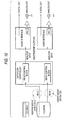
- FIG. 1 is a block diagram of the digital audio recording and playback apparatus.
- a compact disc drive 5 and a hard disk drive 6 are connected to a data flow controller 4 via an IDE bus 7, and a CPU 3 is connected thereto via a CPU bus 8, and a FIFO 2 is connected thereto via a data bus 9.
- Audio output interfaces 13 and 14, and an audio input interface 15 are connected to the data flow controller 4 via respective buffer memories 10, 11, and 12.
- the hard disk drive 6 is a magnetic storage medium.
- the audio interfaces 13, 14, and 15 may be digital interfaces or analog interfaces. In the case of analog interfaces, the interfaces incorporate a DAC or an ADC.
- the hard disk drive 6 has a capacity (for example, about 10 GB) which can store data of several audio compact discs, and its writing and reading rates are sufficiently higher than the reading rate (writing rate) of the compact disc drive.
- the compact disc drive 5 may be either of a CD-ROM drive, a CD-R drive, or a CD-RW drive, and its reading rate is about 10 to 40 times the playback data rate of an audio compact disc. In the case where a CD-R drive is used as the compact disc drive 5, the writing rate is about 4 to 12 times the playback data rate of an audio compact disc.
- the data flow controller 4 is constituted by processing apparatuses such as a DSP, and plays back an audio compact disc (hereinafter, referred to merely as compact disc) set in the compact disc drive 5, in accordance with instructions from the CPU 3 and extracts audio data of the compact disc to write the data into the hard disk drive 6 (ripping).
- ripping the audio data written into the hard disk drive are read out and played back, so that it is possible to monitor whether the audio data are correctly written or not.
- the reading and writing rates of the hard disk drive 6 are sufficiently higher than the reading rate of the compact disc drive 5, that is, sufficiently higher than the playback rate of the compact disc. Therefore, the writing of the ripping, and the monitoring (playback) thereof can be processed in parallel.
- audio data which are input from the outside can be once buffered in the hard disk drive 6, and then written onto the disc medium (CD-R) set in the compact disc drive 5 while being delayed and edited.
- the audio data recorded in the hard disk drive 6 can be separately output to the two audio output interfaces 13 and 14 in parallel. This can be implemented by writing separate audio data into the buffer memories 10 and 11 at a high rate, and causing the audio output interfaces 13 and 14 to read out the audio data written into the buffer memories 10 and 11, at the playback rate.
- the FIFO 2 is used as a buffer for the data transfer from the compact disc drive 5 to the hard disk drive 6, or that from the hard disk drive 6 to the compact disc drive 5.
- a memory 17 and a user interface 18 are connected to the CPU bus 8.
- the user interface 18 includes an operating device for setting the operation mode and for selecting the number (music piece number) of a track to be played back or ripped, an operating device for instructing start/stop of recording and playback, etc.
- the user interface includes also a display device on which information such as the number of a track that is currently played back or ripped is to be displayed.
- terms "track” and "music piece” correspond to each other, and are used as synonyms.
- various modes can be set as the operation mode.
- five of the.modes will be described.
- the user selects the operation mode by using the user interface 18.
- Figs. 2 to 5 are diagrams illustrating the extraction monitor mode.
- Fig. 2 is a diagram showing the signal flow in the extraction monitor mode.
- the data flow controller 4 internally comprises functional blocks, i.e., a read control block for the compact disc drive 5 to read out audio data from the compact disc drive 5, a write control block to write the audio data into the hard disk drive 6 and a read control block for the hard disk drive 6 to read out the audio data written into the hard disk drive 6 and output the audio data to the audio output interfaces.
- the reading (Read) from the compact disc drive 5, and the writing (Write) into the hard disk drive 6, i.e., the operations of ripping must be synchronized with each other, and the reading (playback) from the hard disk drive 6 is performed at a rate which is independent from the rates of Read and Write.
- the playback time period is restricted so as to be equal to the ripping time period.
- Fig. 3 is a diagram illustrating the flow of the process time in the extraction monitor mode.
- the figure shows the case where ripping of audio data of three tracks is performed.
- the middle stage of the figure shows the time streams of the tracks, where each time stream defines a period of actual time needs for playback of each track. Since both the compact disc drive 5 and the hard disk drive 6 perform reading and writing at a high speed; ripping is performed on the tracks for the time periods shown in the upper stage of the figure.
- the extraction monitor mode during a period when ripping is performed on each of the tracks, ripped data of the track is readout and played back.
- the playback monitor sound corresponds only to part of section of the leading portions. This is because playback is performed at the audio playback rate which is lower than the rate of the ripping.
- the data flow controller 4 writes audio data into the buffer memory 10 or 11 so as to prevent underrun and overflow at the audio playback rate.
- Figs. 4 and 5 show the flow of the operation of a control section (the CPU 3 and the data flow controller 4) in this mode.
- Fig. 4 is a flowchart showing the operation of the ripping process
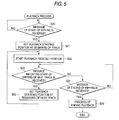
- Fig. 5 is a flowchart showing the operation of the monitor process.
- the user selects tracks to be ripped from the compact disc set in the compact disc drive 5 (s1).
- all tracks are selected by default.
- the user instructs the start of the ripping process (s2)
- the initial track number is written into track management data for managing tracks which are currently ripped (s3), and a message indicating that the ripping process is started is transmitted to the monitor process (playback process) (s4).
- the monitor process playback process
- data of a specified size which are to be written into the hard disk drive 6 are read from the compact disc drive 5 (s5), and it is judged based on the subcode information of the data whether the track information is changed or not (s6). If the track information is not changed, the data are written into the hard disk drive as they are (only with performing isolation of the subcode information) (s7). By contrast, if the track information is changed, the track management data are updated to the new track information (s9), a message indicating of this is transmitted to the monitor process (s10), and the read data are then written into the hard disk drive 6 (s7). In response to the message of s10, the monitor process switches over the track to be played back.
- the track management data are updated (s11), a message indicating that ripping is ended is transmitted to the monitor process (s12), and the ripping process is ended (s13).
- the monitor process is ended.
- Fig. 5 is a flowchart showing the operation of the monitor process.
- the monitor process is started when the message indicating that the ripping process is started (see s4 of Fig. 4) is transmitted from the ripping process of Fig. 4 (s20).
- the position of the beginning of the audio data (track) which are ripped and written at this time into the hard disk drive 6 is set as the playback starting position (s21).
- playback is started from the position (s22).
- the playback of the track is continued until the message indicating that ripping is transferred to the next track (see s10 of Fig. 4) is received (s23).
- the playback position is set to the position of.the beginning of the track (s25), and playback is restarted from the position (s22).
- Figs. 6 and 7 are diagrams illustrating the extraction playback mode.
- the signal flow in the extraction playback mode is identical with that of the above-described extraction monitor mode (see Fig. 2).
- the data flow controller 4 reads out audio data from the compact disc drive 5, writes the audio data into the hard disk drive 6, and reads out the audio data written into the hard disk drive 6 to output the data to the audio output interfaces.
- the playback is performed sequentially on all the audio data which are extracted and written into the hard disk drive 6 in this ripping process. Therefore, the user can listen to the data with sensation similar to that in the case of the playback mode.
- Fig. 6 is a diagram illustrating the flow of the process time in the extraction playback mode.
- the figure shows the case where ripping of audio data of three tracks is performed.
- the middle stage of the figure shows the time streams of the tracks. Since both the compact disc drive 5 and the hard disk drive 6 perform reading and writing at a high speed, ripping is performed on the tracks for the time periods shown in the upper stage of the figure.
- ripped tracks are played back. However, playback is performed on all audio data of each of the tracks independently of a track which is being ripped. As shown in the lower stage, therefore, the monitor sound coincides with the time streams of the tracks.
- Fig. 7 is a flowchart showing the operation of the playback process in the extraction playback mode.
- the ripping process may be identical with the ripping process (Fig. 4) in the extraction monitor mode.
- the playback is started (s30). Initially, the position of the beginning of the audio data which are ripped and written at this time into the hard disk drive is set as the playback starting position (s31). Then, playback is started from the position (s32). Thereafter, audio data are sequentially played back irrespective of the progress of the ripping process. If playback of all the tracks is ended (s33), the playback process is ended (s34).
- the playback process is identical with a usual playback operation. Therefore, control operations such as stop and pause may be made active in the same manner as the usual playback operation.
- Figs. 8 and 9 are diagrams illustrating the external compact disc record mode.
- audio data input through the audio input interface 15 are recorded on a disc medium such as a CD-R set in the compact disc drive 5.
- Fig. 8 is a diagram showing the signal flow in the external compact disc record mode.
- the data flow controller 4 internally comprises functional blocks, i.e., a write control block for the compact disc drive 5, and a write control block and the read control block for the hard disk drive 6.
- the data flow controller writes audio data, which is inputted through the audio input interface 15, into the hard disk drive 6, delays the audio data by a given time period, performs a predetermined process on the audio data, and then writes the audio data onto a compact disc medium set in the compact disc drive 5.
- Figs. 9A and 9B are flowcharts showing the operation of the external compact disc record mode.
- Fig. 9A shows a buffer process
- Fig. 9B shows a writing operation on a compact disc.
- the audio data input through the audio input interface 15 are written into a predetermined area of the hard disk drive 6 (s41).
- the operation of writing input data is continued until the user gives instructions for stopping the recording.
- a process of setting up the compact disc drive 5 is performed (s46).
- the process includes, for example, the OPC (Optimum Power Control) process, and usually requires a time period of several seconds.
- the control waits until preparation for writing audio data is completed (s47).
- the audio data are sequentially read out from the predetermined area of the hard disk drive 6 (s48), and the audio data are then written onto the disc medium (s51). If the read out data include a silence signal lasting a predetermined time period or longer (s50), the data writing is performed while skipping the silence signal (s52).
- a writing ending process is executed (s53) to terminate the operation.
- the time period when the silence signal lasts can be known by reading ahead data.
- the buffered data may not be written into the hard disk drive 6 as they are, but may be written thereinto after being subjected to a filter process of a long time or the like by using the data buffering.
- Fig. 10 is a diagram showing the signal flow in the multi-playback mode.
- the mode separate audio data are output from the hard disk drive 6 or a compact disc set in the compact disc drive 5 to the two audio output interfaces 13 and 14 to be played back.
- An example in which separate audio data are output from the hard disk drive 6 to the two audio output interfaces 13 and 14 will be described.
- Two read control blocks for the hard disk drive 6 are set in the data flow controller 4.
- the read control blocks read out separate audio data (which may be the same, but are not requested to be identical with each other), and then output the audio data to the buffer memories 10 and 11 of the audio output interfaces 13 and 14.
- the reading and writing are performed at a rate which is higher than the audio playback rate, and while checking the size of the free space in the buffer memories 10 and 11.
- the audio output interfaces 13 and 14 read out data of the buffer memories 10 and 11 at the audio playback rate, and outputs the data.
- the data are output as they are, and, in the case of analog audio interfaces, the data are converted into analog signals by the DAC and then output.
- the digital audio data conceptually include a stream signal of the CD-DA format, a WAV file, and the like, and are adequately converted into a suitable format in accordance with the storage means and the transmission path.
- the digital audio recording and playback apparatus may be a dedicated audio apparatus or may be realized by a personal computer and software.
- the number of the audio output interfaces is not limited to two, and a larger number of audio output interfaces may be used.
- audio data are buffered in storing means such as a hard disk drive and then written onto a disc medium such as a CD-R.
- storing means such as a hard disk drive
- a disc medium such as a CD-R.
- audio data can be output separately independently to plural audio outputting means, and hence audio playback functions of plural apparatuses can be realized by a single apparatus.
Landscapes
- Engineering & Computer Science (AREA)
- Multimedia (AREA)
- Signal Processing For Digital Recording And Reproducing (AREA)
Applications Claiming Priority (2)
| Application Number | Priority Date | Filing Date | Title |
|---|---|---|---|
| JP2001251545A JP2003059172A (ja) | 2001-08-22 | 2001-08-22 | ディジタルオーディオ録音再生装置 |
| EP02018801A EP1288949A3 (de) | 2001-08-22 | 2002-08-22 | Digitales Audioaufnahme- und Wiedergabegerät |
Related Parent Applications (1)
| Application Number | Title | Priority Date | Filing Date |
|---|---|---|---|
| EP02018801A Division EP1288949A3 (de) | 2001-08-22 | 2002-08-22 | Digitales Audioaufnahme- und Wiedergabegerät |
Publications (2)
| Publication Number | Publication Date |
|---|---|
| EP1612792A2 true EP1612792A2 (de) | 2006-01-04 |
| EP1612792A3 EP1612792A3 (de) | 2006-02-01 |
Family
ID=19080171
Family Applications (3)
| Application Number | Title | Priority Date | Filing Date |
|---|---|---|---|
| EP20050018172 Withdrawn EP1610325A3 (de) | 2001-08-22 | 2002-08-22 | Digitales Audioaufnahme- und Wiedergabegerät |
| EP02018801A Ceased EP1288949A3 (de) | 2001-08-22 | 2002-08-22 | Digitales Audioaufnahme- und Wiedergabegerät |
| EP20050018173 Withdrawn EP1612792A3 (de) | 2001-08-22 | 2002-08-22 | Digitales Audioaufnahme- und Wiedergabegerät |
Family Applications Before (2)
| Application Number | Title | Priority Date | Filing Date |
|---|---|---|---|
| EP20050018172 Withdrawn EP1610325A3 (de) | 2001-08-22 | 2002-08-22 | Digitales Audioaufnahme- und Wiedergabegerät |
| EP02018801A Ceased EP1288949A3 (de) | 2001-08-22 | 2002-08-22 | Digitales Audioaufnahme- und Wiedergabegerät |
Country Status (3)
| Country | Link |
|---|---|
| US (3) | US7729209B2 (de) |
| EP (3) | EP1610325A3 (de) |
| JP (1) | JP2003059172A (de) |
Families Citing this family (16)
| Publication number | Priority date | Publication date | Assignee | Title |
|---|---|---|---|---|
| US7573785B2 (en) * | 2002-04-15 | 2009-08-11 | Sony Corporation | Method and apparatus for recording audio tracks into large storage device |
| US20060064524A1 (en) * | 2003-09-12 | 2006-03-23 | Logic Controls, Inc. | Rugged industrial computing module |
| US20050060444A1 (en) * | 2003-09-12 | 2005-03-17 | Logic Controls, Inc | Rugged computing module |
| JP2005093010A (ja) * | 2003-09-19 | 2005-04-07 | Ricoh Co Ltd | 記録装置と記録方法とプログラム |
| US20050117466A1 (en) * | 2003-12-02 | 2005-06-02 | Doug Strachota | System and method for converting a CD collection to a different media or format |
| JP4313720B2 (ja) * | 2004-04-28 | 2009-08-12 | パナソニック株式会社 | データ処理プログラムおよびデータ処理装置 |
| TWI266291B (en) * | 2004-07-23 | 2006-11-11 | Mediatek Inc | Method and apparatus of blank detection for optical storage disk |
| US20070091736A1 (en) * | 2005-10-10 | 2007-04-26 | Lectronix, Inc. | System and method for storing and managing digital content |
| US8369971B2 (en) * | 2006-04-11 | 2013-02-05 | Harman International Industries, Incorporated | Media system having preemptive digital audio and/or video extraction function |
| US7681201B2 (en) | 2006-08-04 | 2010-03-16 | Lectronix | Method and system for integrating and controlling components and subsystems |
| EP2053607B1 (de) * | 2007-10-26 | 2016-04-06 | Sony Computer Entertainment Europe Ltd. | Unterhaltungsvorrichtung, Unterhaltungssystem und Verfahren zur Wiedergabe von Medienelementen |
| WO2010001561A1 (ja) * | 2008-07-01 | 2010-01-07 | パナソニック株式会社 | 記録再生装置 |
| US20100039906A1 (en) * | 2008-08-15 | 2010-02-18 | Doug Strachota | System and method for converting a cd collection to a different media or format |
| JP5024237B2 (ja) * | 2008-08-29 | 2012-09-12 | オンキヨー株式会社 | 再生装置及び再生プログラム |
| TWI648732B (zh) * | 2016-05-13 | 2019-01-21 | 景相科技股份有限公司 | 聲音同步存取方法以及使用其之聲音播放系統 |
| CN110428858B (zh) * | 2019-07-11 | 2021-09-24 | 清华大学 | 基于具有滞回特性器件的静态存储器 |
Citations (1)
| Publication number | Priority date | Publication date | Assignee | Title |
|---|---|---|---|---|
| US6172948B1 (en) * | 1997-07-09 | 2001-01-09 | Advanced Audio Devices, Llc | Optical storage device |
Family Cites Families (37)
| Publication number | Priority date | Publication date | Assignee | Title |
|---|---|---|---|---|
| US5963521A (en) * | 1991-02-08 | 1999-10-05 | Sony Corporation | Recording and/or reproducing method and apparatus with dubbing mode |
| JPH05151758A (ja) * | 1991-11-28 | 1993-06-18 | Sharp Corp | 情報記録再生装置 |
| DE4345611B4 (de) * | 1992-04-16 | 2011-06-16 | Mitsubishi Denki K.K. | Wiedergabe-Gerät |
| JP2851977B2 (ja) * | 1992-10-14 | 1999-01-27 | シャープ株式会社 | 再生装置 |
| JP3674872B2 (ja) * | 1993-06-16 | 2005-07-27 | パイオニア株式会社 | オーディオ信号録音装置およびオーディオ信号録音方法 |
| DE69435283D1 (de) * | 1993-12-24 | 2010-04-29 | Sony Corp | Informationsdatenaufzeichnungs- und Wiedergabevorrichtung und Informationsdatenverarbeitungssystem |
| TW250565B (en) * | 1994-10-20 | 1995-07-01 | Digital Audio Disc Corp | Mass production of multisession discs |
| JP3503231B2 (ja) | 1994-11-30 | 2004-03-02 | ソニー株式会社 | 記録装置 |
| JPH09293361A (ja) * | 1996-04-23 | 1997-11-11 | Sony Corp | 記録再生装置 |
| JP3608887B2 (ja) * | 1996-10-30 | 2005-01-12 | パイオニア株式会社 | 情報記録再生装置及び情報記録再生方法 |
| JPH10334596A (ja) | 1997-03-31 | 1998-12-18 | Toshiba Corp | ディスク装置 |
| JPH1145556A (ja) | 1997-05-29 | 1999-02-16 | Sony Corp | オーディオデータの記録装置及びオーディオデータの記録方法 |
| US6587404B1 (en) * | 1997-07-09 | 2003-07-01 | Advanced Audio Devices, Llc | Optical storage device capable of recording a set of sound tracks on a compact disc |
| US6178147B1 (en) * | 1997-08-22 | 2001-01-23 | Sony Corporation | Recording method, recording apparatus, reproducing method and reproducing apparatus |
| JPH1186421A (ja) * | 1997-09-01 | 1999-03-30 | Matsushita Electric Ind Co Ltd | 記録再生装置 |
| JP4588127B2 (ja) * | 1997-09-05 | 2010-11-24 | ソニー株式会社 | ディスク記録方法及びディスク記録装置 |
| EP0910082B1 (de) * | 1997-10-15 | 2001-05-30 | Matsushita Electric Industrial Co., Ltd. | Informationsspeicherplatte, -wiedergabegerät und -verfahren |
| US6480667B1 (en) | 1997-12-23 | 2002-11-12 | Intel Corporation | Method of time shifting to simultaneously record and play a data stream |
| EP0927927B1 (de) * | 1997-12-30 | 2004-12-01 | Victor Company of Japan, Ltd. | Informationswiedergabegerät |
| US6560176B1 (en) * | 1997-12-30 | 2003-05-06 | Macrovision Europe Limited | Method and apparatus for determining the provenance of a data carrying disc |
| WO1999064969A2 (en) | 1998-06-11 | 1999-12-16 | Koninklijke Philips Electronics N.V. | Virtual jukebox |
| US6674692B1 (en) * | 1998-10-20 | 2004-01-06 | Darren Holland | Audio component with integrated digital recording and storage media |
| US6487145B1 (en) * | 1999-04-22 | 2002-11-26 | Roxio, Inc. | Method and system for audio data collection and management |
| JP4003348B2 (ja) * | 1999-05-28 | 2007-11-07 | ソニー株式会社 | 記録再生装置 |
| US6353173B1 (en) * | 1999-06-17 | 2002-03-05 | Roxio, Inc. | Compressed audio data format and file system structures |
| JP2001067100A (ja) | 1999-08-31 | 2001-03-16 | Aiwa Co Ltd | Mp3ポータブルプレーヤ |
| JP2001093226A (ja) * | 1999-09-21 | 2001-04-06 | Sony Corp | 情報通信システムおよび方法、ならびに、情報通信装置および方法 |
| US6693857B1 (en) * | 1999-11-04 | 2004-02-17 | Thomson Licensing S.A. | Data buffer management to enable apparent simultaneous record and playback from a rewritable digital disk |
| US6441723B1 (en) * | 1999-11-15 | 2002-08-27 | General Electric Company | Highly reliable power line communications system |
| US6813317B2 (en) * | 1999-12-14 | 2004-11-02 | Matsushita Electric Industrial Co., Ltd. | Multicarrier transmitting method and multicarrier transmitter circuit |
| JP2001176253A (ja) * | 1999-12-20 | 2001-06-29 | Pioneer Electronic Corp | 記録装置、記録方法及び信号の記録を行うためのコンピュータプログラムを記録した記録媒体 |
| US6560577B1 (en) * | 2000-03-21 | 2003-05-06 | Intel Corporation | Process for encoding audio from an analog medium into a compressed digital format using attribute information and silence detection |
| US6791481B2 (en) * | 2000-05-18 | 2004-09-14 | Echo Mobile Music, Llc | Portable CD-ROM/ISO to HDD/MP3 recorder with simultaneous CD-Read/MP3-Encode/HDD-Write, or HDD-Read/MP3-Decode, to play, power saving buffer, and enhanced sound output |
| KR100838995B1 (ko) * | 2001-01-12 | 2008-06-17 | 소니 가부시끼 가이샤 | 데이터의 복제관리방법 및 장치와 복제관리시스템 |
| JP4830225B2 (ja) * | 2001-07-18 | 2011-12-07 | ソニー株式会社 | 記録装置および方法、記録媒体、並びにプログラム |
| US7042813B2 (en) * | 2002-05-13 | 2006-05-09 | Texas Instruments Incorporated | Shock protection for compressed audio on a CD player |
| JP2004021996A (ja) * | 2002-06-12 | 2004-01-22 | Sony Corp | 記録装置、サーバ装置、記録方法、プログラム、記憶媒体 |
-
2001
- 2001-08-22 JP JP2001251545A patent/JP2003059172A/ja active Pending
-
2002
- 2002-08-22 EP EP20050018172 patent/EP1610325A3/de not_active Withdrawn
- 2002-08-22 EP EP02018801A patent/EP1288949A3/de not_active Ceased
- 2002-08-22 US US10/225,832 patent/US7729209B2/en not_active Expired - Fee Related
- 2002-08-22 EP EP20050018173 patent/EP1612792A3/de not_active Withdrawn
-
2004
- 2004-11-10 US US10/985,427 patent/US7656755B2/en not_active Expired - Fee Related
- 2004-11-10 US US10/986,533 patent/US20050090918A1/en not_active Abandoned
Patent Citations (1)
| Publication number | Priority date | Publication date | Assignee | Title |
|---|---|---|---|---|
| US6172948B1 (en) * | 1997-07-09 | 2001-01-09 | Advanced Audio Devices, Llc | Optical storage device |
Also Published As
| Publication number | Publication date |
|---|---|
| EP1612792A3 (de) | 2006-02-01 |
| EP1610325A3 (de) | 2006-01-18 |
| EP1610325A2 (de) | 2005-12-28 |
| US7729209B2 (en) | 2010-06-01 |
| US20030039178A1 (en) | 2003-02-27 |
| US20050083810A1 (en) | 2005-04-21 |
| EP1288949A3 (de) | 2003-05-21 |
| US20050090918A1 (en) | 2005-04-28 |
| US7656755B2 (en) | 2010-02-02 |
| JP2003059172A (ja) | 2003-02-28 |
| EP1288949A2 (de) | 2003-03-05 |
Similar Documents
| Publication | Publication Date | Title |
|---|---|---|
| US7656755B2 (en) | Method and apparatus for recording digital audio to compact disc from a mass storage device | |
| US6389399B1 (en) | Audio dubbing system for digital audio recorder | |
| JP2002203361A (ja) | ディジタルオーディオ録音装置 | |
| US6525251B1 (en) | Method of displaying the title and words of songs on a digital music player | |
| CA2329570C (en) | Audio recording medium, methods for recording data on and reproducing data from the recording medium, and recording and reproducing apparatuses therefor | |
| CN100499785C (zh) | 重放装置和重放控制方法 | |
| JP2005072799A (ja) | 記録装置と記録方法 | |
| JP4601095B2 (ja) | 再生装置 | |
| JP2002063781A (ja) | 音声情報処理装置及び方法 | |
| JP2002133835A (ja) | 記録装置 | |
| JP3597452B2 (ja) | 曲番号表示方法、並びに、それに用いる情報処理装置およびディジタル録音システム | |
| JP2000207838A (ja) | デジタル記録装置 | |
| JP3975031B2 (ja) | 再生装置及び再生プログラムを記録した記録媒体 | |
| JP2002063761A (ja) | 音声情報処理装置及び方法 | |
| JPH0927189A (ja) | 音声情報再生方式 | |
| JP2000113592A (ja) | 録音装置及び連続録音装置 | |
| JPH05303831A (ja) | ディスク記録再生装置の記録再生制御回路 | |
| JPH11306737A (ja) | 音響再生装置 | |
| JP4366881B2 (ja) | 音声情報再生システム及び方法 | |
| JP2005251360A (ja) | インデックス記録方法及びデータ記録再生装置 | |
| JP2002050113A (ja) | 音声情報処理装置及び方法 | |
| JPH09245465A (ja) | ディスク再生装置 | |
| JPH03198279A (ja) | 再生装置 | |
| JP2002063760A (ja) | 音声情報処理装置及び方法 | |
| JP2007257771A (ja) | 再生装置、再生方法、プログラム及び記録媒体 |
Legal Events
| Date | Code | Title | Description |
|---|---|---|---|
| PUAI | Public reference made under article 153(3) epc to a published international application that has entered the european phase |
Free format text: ORIGINAL CODE: 0009012 |
|
| PUAL | Search report despatched |
Free format text: ORIGINAL CODE: 0009013 |
|
| 17P | Request for examination filed |
Effective date: 20050822 |
|
| AC | Divisional application: reference to earlier application |
Ref document number: 1288949 Country of ref document: EP Kind code of ref document: P |
|
| AK | Designated contracting states |
Kind code of ref document: A2 Designated state(s): AT BE BG CH CY CZ DE DK EE ES FI FR GB GR IE IT LI LU MC NL PT SE SK TR |
|
| AX | Request for extension of the european patent |
Extension state: AL LT LV MK RO SI |
|
| RIC1 | Information provided on ipc code assigned before grant |
Ipc: G11B 20/10 20060101ALI20051201BHEP Ipc: G11B 27/36 20060101ALI20051201BHEP Ipc: G11B 27/034 20060101ALI20051201BHEP Ipc: G11B 27/10 20060101ALI20051201BHEP Ipc: G11B 27/00 20060101AFI20051117BHEP |
|
| AK | Designated contracting states |
Kind code of ref document: A3 Designated state(s): AT BE BG CH CY CZ DE DK EE ES FI FR GB GR IE IT LI LU MC NL PT SE SK TR |
|
| AX | Request for extension of the european patent |
Extension state: AL LT LV MK RO SI |
|
| AKX | Designation fees paid |
Designated state(s): DE FR GB |
|
| RAP1 | Party data changed (applicant data changed or rights of an application transferred) |
Owner name: YAMAHA CORPORATION |
|
| 17Q | First examination report despatched |
Effective date: 20111208 |
|
| STAA | Information on the status of an ep patent application or granted ep patent |
Free format text: STATUS: THE APPLICATION HAS BEEN WITHDRAWN |
|
| 18W | Application withdrawn |
Effective date: 20150810 |