EP1596393A2 - Verfahren und Vorrichtung zur Audiokodierung für eine elektronische Schockschutzfunktion in einem Audiospieler - Google Patents
Verfahren und Vorrichtung zur Audiokodierung für eine elektronische Schockschutzfunktion in einem Audiospieler Download PDFInfo
- Publication number
- EP1596393A2 EP1596393A2 EP05252865A EP05252865A EP1596393A2 EP 1596393 A2 EP1596393 A2 EP 1596393A2 EP 05252865 A EP05252865 A EP 05252865A EP 05252865 A EP05252865 A EP 05252865A EP 1596393 A2 EP1596393 A2 EP 1596393A2
- Authority
- EP
- European Patent Office
- Prior art keywords
- frame
- encoded
- encoding
- audio
- data
- Prior art date
- Legal status (The legal status is an assumption and is not a legal conclusion. Google has not performed a legal analysis and makes no representation as to the accuracy of the status listed.)
- Granted
Links
Images


Classifications
-
- B—PERFORMING OPERATIONS; TRANSPORTING
- B61—RAILWAYS
- B61F—RAIL VEHICLE SUSPENSIONS, e.g. UNDERFRAMES, BOGIES OR ARRANGEMENTS OF WHEEL AXLES; RAIL VEHICLES FOR USE ON TRACKS OF DIFFERENT WIDTH; PREVENTING DERAILING OF RAIL VEHICLES; WHEEL GUARDS, OBSTRUCTION REMOVERS OR THE LIKE FOR RAIL VEHICLES
- B61F5/00—Constructional details of bogies; Connections between bogies and vehicle underframes; Arrangements or devices for adjusting or allowing self-adjustment of wheel axles or bogies when rounding curves
- B61F5/26—Mounting or securing axle-boxes in vehicle or bogie underframes
- B61F5/30—Axle-boxes mounted for movement under spring control in vehicle or bogie underframes
-
- G—PHYSICS
- G11—INFORMATION STORAGE
- G11B—INFORMATION STORAGE BASED ON RELATIVE MOVEMENT BETWEEN RECORD CARRIER AND TRANSDUCER
- G11B20/00—Signal processing not specific to the method of recording or reproducing; Circuits therefor
- G11B20/10—Digital recording or reproducing
- G11B20/10527—Audio or video recording; Data buffering arrangements
-
- B—PERFORMING OPERATIONS; TRANSPORTING
- B60—VEHICLES IN GENERAL
- B60G—VEHICLE SUSPENSION ARRANGEMENTS
- B60G11/00—Resilient suspensions characterised by arrangement, location or kind of springs
- B60G11/14—Resilient suspensions characterised by arrangement, location or kind of springs having helical, spiral or coil springs only
-
- B—PERFORMING OPERATIONS; TRANSPORTING
- B60—VEHICLES IN GENERAL
- B60G—VEHICLE SUSPENSION ARRANGEMENTS
- B60G2202/00—Indexing codes relating to the type of spring, damper or actuator
- B60G2202/10—Type of spring
- B60G2202/12—Wound spring
-
- B—PERFORMING OPERATIONS; TRANSPORTING
- B60—VEHICLES IN GENERAL
- B60G—VEHICLE SUSPENSION ARRANGEMENTS
- B60G2300/00—Indexing codes relating to the type of vehicle
- B60G2300/10—Railway vehicles
-
- B—PERFORMING OPERATIONS; TRANSPORTING
- B60—VEHICLES IN GENERAL
- B60Y—INDEXING SCHEME RELATING TO ASPECTS CROSS-CUTTING VEHICLE TECHNOLOGY
- B60Y2200/00—Type of vehicle
- B60Y2200/30—Railway vehicles
-
- G—PHYSICS
- G11—INFORMATION STORAGE
- G11B—INFORMATION STORAGE BASED ON RELATIVE MOVEMENT BETWEEN RECORD CARRIER AND TRANSDUCER
- G11B20/00—Signal processing not specific to the method of recording or reproducing; Circuits therefor
- G11B20/10—Digital recording or reproducing
- G11B20/10527—Audio or video recording; Data buffering arrangements
- G11B2020/1062—Data buffering arrangements, e.g. recording or playback buffers
- G11B2020/10675—Data buffering arrangements, e.g. recording or playback buffers aspects of buffer control
- G11B2020/10722—Data buffering arrangements, e.g. recording or playback buffers aspects of buffer control wherein the size of the buffer is variable, e.g. by adding additional memory cells for coping with input streams that have high bit rates
Definitions
- the present invention relates to an audio player having an electronic shock protection (ESP) function, and more particularly, to an audio encoding method and apparatus by which when encoding audio data read from a compact disc (CD) is performed before storing the data, if a shock occurs, a point for linking valid audio data in a buffer can be accurately found and encoding is performed irrespective of whether the encoding rate of the audio data is a constant bit rate or a variable bit rate.
- ESP electronic shock protection
- Recording media such as a CD and a DVD are widely used to store audio files because of their relatively low prices and large capacities.
- a user reproduces an audio file, such as an MP3, WMA, or AAC file, encoded and recorded on a CD.
- an audio file such as an MP3, WMA, or AAC file
- a protection against external shock should be provided for seamless reproduction.
- a mechanical buffer or an external electronic shock protection (ESP) chipset is used.
- the ESP function is to output clean sound even when there is an external shock, and not to remove noise caused by a scratched or contaminated CD.
- FIG. 1A if an external shock occurs in a fifth frame, a servo becomes unstable and noise occurs continuously in the fifth, sixth, and seventh frames.
- FIG. 1 B until the servo becomes stable, audio data of frames in which noise occurs is stored in a buffer.
- FIG. 1C a pattern unique to a frame in the fourth frame is selected and data after the unique pattern is discarded.
- FIG. 1D the CD is rewound to the start point of the fourth frame and then audio data is read from the fourth frame, and the unique pattern to the fourth frame is found.
- FIG. 1A if an external shock occurs in a fifth frame, a servo becomes unstable and noise occurs continuously in the fifth, sixth, and seventh frames.
- FIG. 1 B until the servo becomes stable, audio data of frames in which noise occurs is stored in a buffer.
- FIG. 1C a pattern unique to a frame in the fourth frame is selected and data after the unique pattern is discarded.
- FIG. 1D the CD is rewound to the
- the conventional ESP function as described above is set in an audio player, in a normal mode in which a shock does not occur, an audio output is generated directly from data read from a CD and provided to the user, and in an abnormal mode in which a shock occurs, an audio output is generated from data provided from the buffer and provided to the user.
- this conventional ESP function cannot perform its function when an external shock lasts for a long while exceeding a shock protection time.
- audio data read from a CD is encoded before stored. In this case, the shock protection time can vary depending on the size of a buffer and the encoding rate of data.
- the length of each frame that is, the size of an occupying area in the buffer, is different to each other such that an area storing a frame before the frame in which a shock occurs cannot be found only with the frame length information recorded in the start part of each frame in the buffer
- An aspect of the present invention provides an audio encoding method and apparatus by which when encoding audio data read from a CD is performed before storing the data, if a shock occurs, a point for linking valid audio data in a buffer can be accurately found and encoding is performed irrespective of whether the encoding rate of the audio data is a constant bit rate or a variable bit rate.
- a method of generating a frame structure for an electronic shock protection function of an audio player including: encoding original data of a frame and locating the encoded data in a first area that is a start part of the frame structure; and encoding frame length information indicating a size of the encoded data in the frame, and locating the encoded frame length information in a second area that is an end part of the frame structure.
- a method of generating a frame structure for an electronic shock protection function of an audio player including: locating sync information indicating the start of a frame in a first area that is a start part of the frame structure; encoding original data of the frame and locating the encoded data in a second area that is next to the first area; and encoding frame length information indicating a size of the encoded data in the frame, and locating the encoded frame length information in a third area that is an end part of the frame structure.
- an audio encoding method using an encoded frame structure stored in a buffer and including frame length information in an end part of the frame structure, in an audio player having an electronic shock protection function in which a number of frames to be rewound when a shock occurs in the audio player is k the method including: confirming the frame length information of a (t-k)-th frame that is located k frames before a t-th frame in which the shock occurs, from the buffer; confirming, by performing a backward seek in the buffer using the confirmed frame length information, an address at which the (t-k)-th frame begins; and sequentially writing audio data from the (t-k)-th frame read again from a recording medium and encoded, in the buffer from the address at which the (t-k)-th frame begins.
- an audio encoding method using an encoded frame structure stored in a buffer and including sync information in a start part of the frame structure and frame length information in an end part of the frame structure, in an audio player having an electronic shock protection function in which a number of frames to be rewound when a shock occurs in the audio player is k the method including: confirming the frame length information of a (t-k)-th frame that is located k frames before a t-th frame in which the shock occurs, from the buffer; confirming, by performing a backward seek in the buffer by using the confirmed frame length information, an address at which the (t-k)-th frame begins; confirming sync information written in the address at which the (t-k)-th frame begins; and sequentially writing audio data from the (t-k)-th frame read again from a recording medium and encoded, in the buffer from the address at which the (t-k)-th frame begins.
- an encoding apparatus in an audio player having an electronic shock protection function in which a number of frames to be rewound from a t-th frame in which a shock occurs in the audio player is k
- the apparatus including: an encoding unit which encodes audio data read from a recording medium and generates a frame structure formed by sequentially combining encoded data and frame length information; a buffer unit which temporarily stores encoded frame data provided by the encoding unit; and a control unit which: confirms the frame length information of a (t-k)-th frame in the buffer unit; by using the confirmed frame length information, confirms an address at which the (t-k)-th frame begins; and sequentially writes, from the address at which the (t-k)-th frame begins, audio data from the (t-k)-th frame read again from the recording medium and encoded.
- an encoding apparatus in an audio player having an electronic shock protection function in which a number of frames to be rewound from a t-th frame in which a shock occurs in the audio player is k
- the apparatus including: an encoding unit which encodes audio data read from a recording medium and generates a frame structure formed by sequentially combining encoded data and frame length information; a buffer unit which temporarily stores encoded frame data provided by the encoding unit; and a control unit which: confirms the frame length information of a (t-k)-th frame in the buffer unit; by using the confirmed frame length information, confirms an address at which the (t-k)-th frame begins; confirms sync information written in the address at which the (t-k)-th frame begins, and sequentially writes, from the address at which the (t-k)-th frame begins audio data from the (t-k)-th frame read again from the recording medium and encoded.
- a computer readable recording medium having embodied thereon a computer program for the above methods.
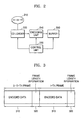
- an audio encoding apparatus includes a CD 210, a CD loader 220, a control unit 230, an encoding unit 240, and a buffer 250.
- ESP electronic shock protection
- the CD loader 220 includes a servo (not shown) and a pickup (not shown), and drives the CD 210 under the control of the control unit 230.
- the CD loader 220 reads audio data stored in a specified sector of the CD 210 and provides the read audio data to the encoding unit 240.
- the data provided by the CD 210 is usually pulse code modulation (PCM) data and is provided with containing M:S:F information.
- PCM pulse code modulation
- M:S:F information M:S:F information.
- F denotes a frame
- S denotes a second
- a second is formed with, for example, 75 Fs.
- M denotes a minute and one minute is formed with 60 Ss.
- an absolute location indicating a location which corresponding audio data is recorded on can be identified.
- the control unit 230 performs control of an overall ESP function and is usually formed with a digital signal processor (DSP).
- DSP digital signal processor
- the control unit 230 controls to generate a valid signal and provide the signal to the CD loader 220 and the encoding unit 240 such that encoding is performed according to a preset encoding procedure and encoded data is stored in the buffer unit 250.
- the control unit 230 In an abnormal mode in which a shock occurs in the CD 210, the control unit 230 generates an invalid signal and provides the signal to the CD loader 220 and the encoding unit 240.
- a normal encoding procedure of the encoding unit 240 is stopped and the CD loader 220 is controlled to move the pickup to a frame a specified number of frames before the frame in which a shock occurs, again read audio data, and encode audio data in a frame after a specified location.
- the control unit 230 receives absolute location information (that is, F:S:M information) in the CD 210 of a frame, for example, a t-th frame, for which encoding is currently performed in the encoding unit 240 at a time when a shock occurs, and information on the last address of the (t-1)-th frame recorded into the buffer unit 250 from the encoding unit 240 immediately before the t-th frame. Then, the control unit 230 controls the CD loader 220 such that the pickup is moved from the t-th frame to the (t-k)-th frame that is preset k frames before the t-th frame, and data is read from the CD 210.
- absolute location information that is, F:S:M information
- the value k indicating the number of frames to be rewound by the pickup from a frame in which a shock occurs, can be set when an audio player having an ESP function is designed or can be manually set by a user. Meanwhile, the value k can also be automatically set in proportion to a time from the occurrence of a shock to stabilization of the servo.
- the encoding unit 240 performs encoding sequentially in units of frames, and provides encoded data to the buffer unit 250. At this time, the encoding unit 240 stores the last address of a frame which is stored latest in the buffer unit 250, and stores data of a frame for which encoding is currently completed, from an address immediately after the last address.
- the encoding operation is stopped during a specified time from sensing the shock to stabilization of the servo, according to control of the control unit 230. Meanwhile, if audio data is read from a frame in the CD 210, k frames before the frame in which the shock occurs, after the servo is stabilized, the audio data is sequentially encoded and provided to the buffer unit 250.
- the buffer unit 250 is formed with, for example, a 16M DRAM buffer, and stores the data encoded in the encoding unit 240, in a specified area according to control of the control unit 230.
- a data writing operation is repeatedly performed such that audio data corresponding to a specified number of frames is filled and then, audio data corresponding to a next specified number of frames is filled again and again.
- the data writing operation is stopped during a specified time taken from sensing the shock to stabilization of the servo, according to control of the control unit 230.
- encoded data and frame length information can be sequentially written in units of frames, or sync information, and encoded data and frame length information can be sequentially written in units of frames.
- FIG. 3 is a diagram of an example of a frame structure finally generated in the encoding unit 240 of the audio encoding apparatus of FIG. 2.
- the frame structure will be explained with reference to FIGS. 2 and 3 and includes a first area 310 and a second area 320 in each frame in the buffer unit 250. That is, the frame structure generated in the encoding unit 240 is formed with encoded data located in the first area 310 of the frame, and encoded frame length information located in the second area 320.
- the size of the second area 320 is constant in all frames, and the size of the first area 310 can vary depending on the encoding rate of a frame.
- FIG. 4 is a diagram of another example of a frame structure finally generated in the encoding unit 240 of the audio encoding apparatus of FIG. 2.
- the frame structure will be explained with reference to FIGS. 2 and 4 and includes a first area 410, a second area 420, and a third area 430 in each frame in the buffer unit 250. That is, the frame structure generated in the encoding unit 240 is formed with sync information located in the first area 410 of the frame, encoded data located in the second area 420, and encoded frame length information located in the third area 430.
- the sizes of the first area 410 and the third area 430 are constant in all frames, and the size of the second area 420 can vary depending on the encoding rate of a frame.
- the reliability and accuracy in a backward seek operation can be further enhanced.
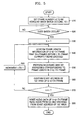
- FIG. 5 is a flowchart illustrating an audio encoding method according to an embodiment of the present invention, and corresponds to a case using the frame structure in FIG. 3.
- the frame number (k) to be rewound in the CD 210 in an abnormal mode is set to i in operation 510.
- operation 520 whether or not a shock occurs in the audio player is continuously monitored.
- a method to monitor whether or not a shock occurs in the audio player a method used in a conventional ESP system is usable.
- k is set to 1.
- the address in the buffer unit 250 of a frame before a current frame, for example, a t-th frame, being currently encoded in the encoding unit 240 is confirmed, that is, the address of the (t-k)-th frame is confirmed, and the frame length information of the (t-k)-th frame stored in the confirmed address of the buffer unit 250 is confirmed. If the frame length information is identified, the size occupied by the first area 310 in which data encoded in the (t-1)-th frame is located can be identified.
- backward seek is performed for addresses corresponding to the frame length from the address of an area in which the frame length information is stored in the (t-k)-th frame, and as a result, confirms the start address of the first area 310 of the (t-k)-th frame in operation 560.
- operation 570 it is determined whether or not k is i, and if k is not i, k is incremented by 1 in operation 580, and the method returns to operation 540, and operations 540 through 570 are performed again. Conversely, if k is i, in operation 590, the audio data of the (t-k)-th frame again read from the CD 210 and encoded is sequentially written from the start address of the first area 310 confirmed in operation 560.
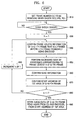
- FIG. 6 is a flowchart illustrating an operation of an audio encoding method according to another embodiment of the present invention, and corresponds to a case using the frame structure in FIG. 4.
- the frame number (k) to be rewound in the CD 210 in an abnormal mode is set to i in operation 610.
- operation 620 whether or not a shock occurs in the CD 210 is continuously monitored.
- k is set to 1.
- the address in the buffer unit 250 of a frame before a current frame, for example, a t-th frame, being currently encoded in the encoding unit 240 is confirmed, that is, the address of the (t-k)-th frame is confirmed, and the frame length information of the (t-k)-th frame stored in the confirmed address of the buffer unit 250 is confirmed. If the frame length information is identified, the size occupied by the second area 420 in which data encoded in the (t-1)-th frame is located can be identified.
- backward seek is performed for addresses corresponding to the frame length from the address of an area in which the frame length information is stored in the (t-k)-th frame.
- sync information located in the start part of the first area 410 of the (t-k)-th frame is confirmed, and the start address of the first area 410 of the (t-k)-th frame is confirmed in operation 670.
- operation 680 it is determined whether or not k is i, and if k is not i, k is incremented by 1 in operation 685, and the method returns to operation 640 and operations 640 through 680 are performed again. Conversely, if k is i, in operation 690, the audio data of the (t-k)-th frame again read from the CD 210 and encoded is sequentially written from the start address of the first area 410 confirmed in operation 670.
- k 1 since the encoding unit 240 stores the last address of the (t-1)-th frame that is stored latest in the buffer unit 250, by using the frame length information stored in the last address, the start address of the (t-1)-th frame can be found.
- k is equal to or greater than 1, for example, 2, by using the (t-1)-th frame length information, backward seek is performed to confirm the start address of the (t-1)-th frame, and by using the start address of the (t-1)-th frame, the frame length information of the (t-2)-th frame located at an address immediately before the (t-1)-th frame can be confirmed. Then, by using the (t-2)-th frame length information, backward seek is performed and the start address of the (t-2)-th frame can be found.
- CD is used as an example of a recording medium in the embodiments described above, it is to be understood that the above-described embodiments of the present invention can be applied to a variety of other media, such as, by way of non-limiting examples, a DVD, HDD, and a Blue-ray Disk (BD).
- a DVD Blu-ray Disk
- BD Blue-ray Disk
- the above-described embodiments of the present invention can also be embodied as computer readable codes on a computer readable recording medium.
- the computer readable recording medium is any data storage device that can store data which can be thereafter read by a computer system. Examples of the computer readable recording medium include read-only memory (ROM), random-access memory (RAM), CD-ROMs, magnetic tapes, floppy disks, optical data storage devices, and carrier waves (such as data transmission through the Internet).
- the computer readable recording medium can also be distributed over network coupled computer systems so that the computer readable code is stored and executed in a distributed fashion.
- a point for linking valid audio data in a buffer can be accurately found and encoding is performed irrespective of whether the encoding rate of the audio data is a constant bit rate or a variable bit rate.
- the shock protection time can be extended because of the encoding, and in addition, when a shock occurs, clean sound can be provided to users during the shock protection time irrespective of an encoding rate.
Landscapes
- Engineering & Computer Science (AREA)
- Multimedia (AREA)
- Signal Processing (AREA)
- Mechanical Engineering (AREA)
- Signal Processing For Digital Recording And Reproducing (AREA)
- Compression, Expansion, Code Conversion, And Decoders (AREA)
Applications Claiming Priority (2)
| Application Number | Priority Date | Filing Date | Title |
|---|---|---|---|
| KR2004033644 | 2004-05-12 | ||
| KR1020040033644A KR100612846B1 (ko) | 2004-05-12 | 2004-05-12 | 오디오 재생기에 있어서 충격보호기능을 위한 오디오부호화 방법 및 장치 |
Publications (3)
| Publication Number | Publication Date |
|---|---|
| EP1596393A2 true EP1596393A2 (de) | 2005-11-16 |
| EP1596393A3 EP1596393A3 (de) | 2006-01-25 |
| EP1596393B1 EP1596393B1 (de) | 2010-03-31 |
Family
ID=34941228
Family Applications (1)
| Application Number | Title | Priority Date | Filing Date |
|---|---|---|---|
| EP05252865A Expired - Lifetime EP1596393B1 (de) | 2004-05-12 | 2005-05-10 | Verfahren und Vorrichtung zur Audiokodierung für eine elektronische Schockschutzfunktion in einem Audiospieler |
Country Status (6)
| Country | Link |
|---|---|
| US (1) | US7652955B2 (de) |
| EP (1) | EP1596393B1 (de) |
| JP (1) | JP4751640B2 (de) |
| KR (1) | KR100612846B1 (de) |
| CN (1) | CN1707663B (de) |
| DE (1) | DE602005020210D1 (de) |
Family Cites Families (25)
| Publication number | Priority date | Publication date | Assignee | Title |
|---|---|---|---|---|
| JP3084916B2 (ja) * | 1992-03-31 | 2000-09-04 | ソニー株式会社 | ディスクプレーヤの再生データ処理回路 |
| JP3176236B2 (ja) * | 1994-11-30 | 2001-06-11 | 株式会社ソニー・コンピュータエンタテインメント | 信号再生装置及び信号再生方法 |
| US5737344A (en) * | 1995-05-25 | 1998-04-07 | International Business Machines Corporation | Digital data storage with increased robustness against data loss |
| US5818801A (en) * | 1995-06-30 | 1998-10-06 | Sanyo Electric Co., Ltd. | Shockproof optical reproduction device |
| JPH0945003A (ja) * | 1995-07-25 | 1997-02-14 | Pioneer Electron Corp | 記録媒体再生装置 |
| US5751951A (en) * | 1995-10-30 | 1998-05-12 | Mitsubishi Electric Information Technology Center America, Inc. | Network interface |
| ATE225961T1 (de) | 1996-08-16 | 2002-10-15 | Tokyo Electron Device Ltd | Halbleiterspeicheranordnung mit fehlerdetektion und -korrektur |
| CA2267450C (en) * | 1997-08-01 | 2004-04-27 | Ntt Mobile Communications Network Inc. | Data sequence generator, transmitter, information data decoder, receiver, transmitter-receiver, data sequence generating method, information data decoding method, and recording medium |
| JP4489248B2 (ja) * | 1999-06-02 | 2010-06-23 | パナソニック株式会社 | 光ディスク、光ディスクに対してデータの記録、再生を行なう装置及び方法 |
| KR100361499B1 (ko) | 1999-09-22 | 2002-11-21 | 엘지전자 주식회사 | 멀티미디어 스트림의 세그먼트간 원인/결과 관계 정보 구성 방법과 세그먼트간 원인/결과 관계 정보를 이용한 비디오 브라우징 방법 |
| DE19951378A1 (de) | 1999-10-26 | 2001-05-03 | Philips Corp Intellectual Pty | Etikettenanordnung |
| JP2001195825A (ja) * | 1999-10-29 | 2001-07-19 | Sony Corp | 記録再生装置および方法 |
| JP2001318696A (ja) * | 1999-12-13 | 2001-11-16 | Texas Instr Inc <Ti> | 圧縮されたオーディオ内容を可聴早送りまたは巻き戻しするための方法並びに装置 |
| FR2802695A3 (fr) * | 1999-12-17 | 2001-06-22 | Ya Horng Electronic Co Ltd | Dispositif electronique de prevention de chocs pour lecteurs de cd |
| JP2001250329A (ja) * | 1999-12-27 | 2001-09-14 | Sanyo Electric Co Ltd | データ記録装置 |
| JP4158309B2 (ja) * | 2000-03-27 | 2008-10-01 | 松下電器産業株式会社 | データ再生方法 |
| JP2002109828A (ja) * | 2000-09-28 | 2002-04-12 | Sanyo Electric Co Ltd | 圧縮オーディオデータの再生装置 |
| JP2002218395A (ja) * | 2001-01-12 | 2002-08-02 | Matsushita Electric Ind Co Ltd | 蓄積フォーマット方式並びに蓄積フォーマットデータ格納および送出装置 |
| EP1384230A1 (de) * | 2001-04-20 | 2004-01-28 | Koninklijke Philips Electronics N.V. | Trickwiedergabe für mp3 |
| JP2003006992A (ja) * | 2001-06-26 | 2003-01-10 | Pioneer Electronic Corp | 情報再生方法及び情報再生装置 |
| JP3869714B2 (ja) * | 2001-12-17 | 2007-01-17 | 三洋電機株式会社 | 画像記録装置 |
| JP3733061B2 (ja) * | 2001-12-18 | 2006-01-11 | 三洋電機株式会社 | 画像記録装置 |
| JP2003308234A (ja) * | 2002-02-18 | 2003-10-31 | Matsushita Electric Ind Co Ltd | ファイル再生装置及びファイル再生方法 |
| JP2003331524A (ja) * | 2002-05-08 | 2003-11-21 | Kenwood Corp | 再生装置及び再生方法 |
| EP1570474A1 (de) * | 2002-12-04 | 2005-09-07 | Koninklijke Philips Electronics N.V. | Tragbarer medienspieler mit adaptiver wiedergabepuffersteurung |
-
2004
- 2004-05-12 KR KR1020040033644A patent/KR100612846B1/ko not_active Expired - Lifetime
-
2005
- 2005-05-10 EP EP05252865A patent/EP1596393B1/de not_active Expired - Lifetime
- 2005-05-10 DE DE602005020210T patent/DE602005020210D1/de not_active Expired - Lifetime
- 2005-05-11 JP JP2005138119A patent/JP4751640B2/ja not_active Expired - Fee Related
- 2005-05-11 US US11/126,258 patent/US7652955B2/en active Active
- 2005-05-12 CN CN2005100695016A patent/CN1707663B/zh not_active Expired - Fee Related
Also Published As
| Publication number | Publication date |
|---|---|
| KR100612846B1 (ko) | 2006-08-14 |
| US7652955B2 (en) | 2010-01-26 |
| CN1707663A (zh) | 2005-12-14 |
| CN1707663B (zh) | 2010-04-28 |
| JP2005327450A (ja) | 2005-11-24 |
| EP1596393A3 (de) | 2006-01-25 |
| US20050256708A1 (en) | 2005-11-17 |
| JP4751640B2 (ja) | 2011-08-17 |
| KR20050108659A (ko) | 2005-11-17 |
| DE602005020210D1 (de) | 2010-05-12 |
| EP1596393B1 (de) | 2010-03-31 |
Similar Documents
| Publication | Publication Date | Title |
|---|---|---|
| JP4327733B2 (ja) | デジタルコンテンツデータのキャッシング方法及び装置 | |
| US7652955B2 (en) | Audio encoding method and apparatus for electronic shock protection function in audio player | |
| JP2006514387A5 (de) | ||
| JP5028307B2 (ja) | デジタルデータ再生装置及びプログラム | |
| JPH09213055A (ja) | 記録再生用ディスクのutoc情報書き替え方法 | |
| US6966023B2 (en) | Encoding method for an optical recorder | |
| JP2005276273A (ja) | デジタル記録再生装置及びそれにおける記録可能時間演算方法 | |
| JP2008217946A (ja) | 再生装置 | |
| JP2793073B2 (ja) | ディスク装置の記録または再生表示制御回路 | |
| JP2002343031A (ja) | ディスク記録装置およびディスク | |
| JPH06150624A (ja) | 記録方式及び記録再生方式 | |
| JP2006323886A (ja) | 圧縮データ再生方法 | |
| JPH0877729A (ja) | ディスク再生装置 | |
| JP3732117B2 (ja) | 情報記録再生装置 | |
| JPH09213059A (ja) | ディスク欠陥位置保存方法 | |
| JP2005276351A (ja) | 光記録媒体再生装置 | |
| JP2009230773A (ja) | 情報再生装置、情報再生方法、情報再生プログラムおよび情報再生プログラムを格納した記録媒体 | |
| JP2000268494A (ja) | 記録装置 | |
| JP2001035097A (ja) | ディスク再生装置 | |
| JP2001014812A (ja) | 記録装置及び記録方法 | |
| JP2005018978A (ja) | データ記録/再生方法,データ再生方法,データ記録/再生装置,データ再生装置 | |
| WO2005119676A1 (ja) | 再生装置、再生処理回路、再生方法、再生プログラム及び再生プログラムを記録したコンピュータ読み取り可能な記録媒体 | |
| JP2005317107A (ja) | データ処理プログラム | |
| JP2007102889A (ja) | オーディオ信号記録装置 | |
| JP2007257730A (ja) | オーディオ記録装置及びオーディオ記録方法 |
Legal Events
| Date | Code | Title | Description |
|---|---|---|---|
| PUAI | Public reference made under article 153(3) epc to a published international application that has entered the european phase |
Free format text: ORIGINAL CODE: 0009012 |
|
| AK | Designated contracting states |
Kind code of ref document: A2 Designated state(s): AT BE BG CH CY CZ DE DK EE ES FI FR GB GR HU IE IS IT LI LT LU MC NL PL PT RO SE SI SK TR |
|
| AX | Request for extension of the european patent |
Extension state: AL BA HR LV MK YU |
|
| PUAL | Search report despatched |
Free format text: ORIGINAL CODE: 0009013 |
|
| AK | Designated contracting states |
Kind code of ref document: A3 Designated state(s): AT BE BG CH CY CZ DE DK EE ES FI FR GB GR HU IE IS IT LI LT LU MC NL PL PT RO SE SI SK TR |
|
| AX | Request for extension of the european patent |
Extension state: AL BA HR LV MK YU |
|
| 17P | Request for examination filed |
Effective date: 20060315 |
|
| AKX | Designation fees paid |
Designated state(s): DE FR GB NL |
|
| GRAP | Despatch of communication of intention to grant a patent |
Free format text: ORIGINAL CODE: EPIDOSNIGR1 |
|
| RIN1 | Information on inventor provided before grant (corrected) |
Inventor name: KIM, SANGWOOK Inventor name: LEE, SHIHWA Inventor name: KIM, DOHYUNG Inventor name: KIM, JUNGHOE |
|
| GRAS | Grant fee paid |
Free format text: ORIGINAL CODE: EPIDOSNIGR3 |
|
| GRAA | (expected) grant |
Free format text: ORIGINAL CODE: 0009210 |
|
| AK | Designated contracting states |
Kind code of ref document: B1 Designated state(s): DE FR GB NL |
|
| REG | Reference to a national code |
Ref country code: GB Ref legal event code: FG4D |
|
| REF | Corresponds to: |
Ref document number: 602005020210 Country of ref document: DE Date of ref document: 20100512 Kind code of ref document: P |
|
| REG | Reference to a national code |
Ref country code: NL Ref legal event code: VDEP Effective date: 20100331 |
|
| PG25 | Lapsed in a contracting state [announced via postgrant information from national office to epo] |
Ref country code: NL Free format text: LAPSE BECAUSE OF FAILURE TO SUBMIT A TRANSLATION OF THE DESCRIPTION OR TO PAY THE FEE WITHIN THE PRESCRIBED TIME-LIMIT Effective date: 20100331 |
|
| PLBE | No opposition filed within time limit |
Free format text: ORIGINAL CODE: 0009261 |
|
| STAA | Information on the status of an ep patent application or granted ep patent |
Free format text: STATUS: NO OPPOSITION FILED WITHIN TIME LIMIT |
|
| 26N | No opposition filed |
Effective date: 20110104 |
|
| REG | Reference to a national code |
Ref country code: FR Ref legal event code: PLFP Year of fee payment: 12 |
|
| REG | Reference to a national code |
Ref country code: FR Ref legal event code: PLFP Year of fee payment: 13 |
|
| REG | Reference to a national code |
Ref country code: FR Ref legal event code: PLFP Year of fee payment: 14 |
|
| P01 | Opt-out of the competence of the unified patent court (upc) registered |
Effective date: 20230519 |
|
| PGFP | Annual fee paid to national office [announced via postgrant information from national office to epo] |
Ref country code: FR Payment date: 20230420 Year of fee payment: 19 Ref country code: DE Payment date: 20230420 Year of fee payment: 19 |
|
| PGFP | Annual fee paid to national office [announced via postgrant information from national office to epo] |
Ref country code: GB Payment date: 20230420 Year of fee payment: 19 |
|
| REG | Reference to a national code |
Ref country code: DE Ref legal event code: R119 Ref document number: 602005020210 Country of ref document: DE |
|
| GBPC | Gb: european patent ceased through non-payment of renewal fee |
Effective date: 20240510 |
|
| PG25 | Lapsed in a contracting state [announced via postgrant information from national office to epo] |
Ref country code: DE Free format text: LAPSE BECAUSE OF NON-PAYMENT OF DUE FEES Effective date: 20241203 |
|
| PG25 | Lapsed in a contracting state [announced via postgrant information from national office to epo] |
Ref country code: FR Free format text: LAPSE BECAUSE OF NON-PAYMENT OF DUE FEES Effective date: 20240531 |
|
| PG25 | Lapsed in a contracting state [announced via postgrant information from national office to epo] |
Ref country code: GB Free format text: LAPSE BECAUSE OF NON-PAYMENT OF DUE FEES Effective date: 20240510 |