EP1587368B1 - Repellentmittel - Google Patents
Repellentmittel Download PDFInfo
- Publication number
- EP1587368B1 EP1587368B1 EP04700127A EP04700127A EP1587368B1 EP 1587368 B1 EP1587368 B1 EP 1587368B1 EP 04700127 A EP04700127 A EP 04700127A EP 04700127 A EP04700127 A EP 04700127A EP 1587368 B1 EP1587368 B1 EP 1587368B1
- Authority
- EP
- European Patent Office
- Prior art keywords
- spp
- ticks
- alkyl
- oder
- methylpyrrolidone
- Prior art date
- Legal status (The legal status is an assumption and is not a legal conclusion. Google has not performed a legal analysis and makes no representation as to the accuracy of the status listed.)
- Expired - Lifetime
Links
- 0 C*C(N(C)Cc(cn1)ccc1Cl)=N[N+]([O-])=O Chemical compound C*C(N(C)Cc(cn1)ccc1Cl)=N[N+]([O-])=O 0.000 description 4
- TUVMNIRBIFHVOG-UHFFFAOYSA-O C=[N+](C=C1[NH+](Cc(c[n-]2)ccc2Cl)CCN1)[O-] Chemical compound C=[N+](C=C1[NH+](Cc(c[n-]2)ccc2Cl)CCN1)[O-] TUVMNIRBIFHVOG-UHFFFAOYSA-O 0.000 description 1
- YIGJDAGQFMKJKJ-UHFFFAOYSA-N CC(N(C)CC(S1C)=CN=C1Cl)=NC#N Chemical compound CC(N(C)CC(S1C)=CN=C1Cl)=NC#N YIGJDAGQFMKJKJ-UHFFFAOYSA-N 0.000 description 1
- OIRKLDAZVOZHMK-AJBSGBCOSA-N CCO[C@@H]([C@H](C)O[C@@H](C)[C@@H]1OC)[C@@H]1OC Chemical compound CCO[C@@H]([C@H](C)O[C@@H](C)[C@@H]1OC)[C@@H]1OC OIRKLDAZVOZHMK-AJBSGBCOSA-N 0.000 description 1
- UGORHXMWBYGXCN-YIZRAAEISA-N C[C@@H](CC1)O[C@H](C)[C@H]1N(C)C Chemical compound C[C@@H](CC1)O[C@H](C)[C@H]1N(C)C UGORHXMWBYGXCN-YIZRAAEISA-N 0.000 description 1
Classifications
-
- A—HUMAN NECESSITIES
- A01—AGRICULTURE; FORESTRY; ANIMAL HUSBANDRY; HUNTING; TRAPPING; FISHING
- A01N—PRESERVATION OF BODIES OF HUMANS OR ANIMALS OR PLANTS OR PARTS THEREOF; BIOCIDES, e.g. AS DISINFECTANTS, AS PESTICIDES OR AS HERBICIDES; PEST REPELLANTS OR ATTRACTANTS; PLANT GROWTH REGULATORS
- A01N37/00—Biocides, pest repellants or attractants, or plant growth regulators containing organic compounds containing a carbon atom having three bonds to hetero atoms with at the most two bonds to halogen, e.g. carboxylic acids
- A01N37/36—Biocides, pest repellants or attractants, or plant growth regulators containing organic compounds containing a carbon atom having three bonds to hetero atoms with at the most two bonds to halogen, e.g. carboxylic acids containing at least one carboxylic group or a thio analogue, or a derivative thereof, and a singly bound oxygen or sulfur atom attached to the same carbon skeleton, this oxygen or sulfur atom not being a member of a carboxylic group or of a thio analogue, or of a derivative thereof, e.g. hydroxy-carboxylic acids
- A01N37/38—Biocides, pest repellants or attractants, or plant growth regulators containing organic compounds containing a carbon atom having three bonds to hetero atoms with at the most two bonds to halogen, e.g. carboxylic acids containing at least one carboxylic group or a thio analogue, or a derivative thereof, and a singly bound oxygen or sulfur atom attached to the same carbon skeleton, this oxygen or sulfur atom not being a member of a carboxylic group or of a thio analogue, or of a derivative thereof, e.g. hydroxy-carboxylic acids having at least one oxygen or sulfur atom attached to an aromatic ring system
-
- A—HUMAN NECESSITIES
- A01—AGRICULTURE; FORESTRY; ANIMAL HUSBANDRY; HUNTING; TRAPPING; FISHING
- A01N—PRESERVATION OF BODIES OF HUMANS OR ANIMALS OR PLANTS OR PARTS THEREOF; BIOCIDES, e.g. AS DISINFECTANTS, AS PESTICIDES OR AS HERBICIDES; PEST REPELLANTS OR ATTRACTANTS; PLANT GROWTH REGULATORS
- A01N31/00—Biocides, pest repellants or attractants, or plant growth regulators containing organic oxygen or sulfur compounds
- A01N31/08—Oxygen or sulfur directly attached to an aromatic ring system
- A01N31/14—Ethers
-
- A—HUMAN NECESSITIES
- A01—AGRICULTURE; FORESTRY; ANIMAL HUSBANDRY; HUNTING; TRAPPING; FISHING
- A01N—PRESERVATION OF BODIES OF HUMANS OR ANIMALS OR PLANTS OR PARTS THEREOF; BIOCIDES, e.g. AS DISINFECTANTS, AS PESTICIDES OR AS HERBICIDES; PEST REPELLANTS OR ATTRACTANTS; PLANT GROWTH REGULATORS
- A01N37/00—Biocides, pest repellants or attractants, or plant growth regulators containing organic compounds containing a carbon atom having three bonds to hetero atoms with at the most two bonds to halogen, e.g. carboxylic acids
- A01N37/34—Nitriles
-
- A—HUMAN NECESSITIES
- A01—AGRICULTURE; FORESTRY; ANIMAL HUSBANDRY; HUNTING; TRAPPING; FISHING
- A01N—PRESERVATION OF BODIES OF HUMANS OR ANIMALS OR PLANTS OR PARTS THEREOF; BIOCIDES, e.g. AS DISINFECTANTS, AS PESTICIDES OR AS HERBICIDES; PEST REPELLANTS OR ATTRACTANTS; PLANT GROWTH REGULATORS
- A01N53/00—Biocides, pest repellants or attractants, or plant growth regulators containing cyclopropane carboxylic acids or derivatives thereof
-
- A—HUMAN NECESSITIES
- A01—AGRICULTURE; FORESTRY; ANIMAL HUSBANDRY; HUNTING; TRAPPING; FISHING
- A01N—PRESERVATION OF BODIES OF HUMANS OR ANIMALS OR PLANTS OR PARTS THEREOF; BIOCIDES, e.g. AS DISINFECTANTS, AS PESTICIDES OR AS HERBICIDES; PEST REPELLANTS OR ATTRACTANTS; PLANT GROWTH REGULATORS
- A01N55/00—Biocides, pest repellants or attractants, or plant growth regulators, containing organic compounds containing elements other than carbon, hydrogen, halogen, oxygen, nitrogen and sulfur
-
- A—HUMAN NECESSITIES
- A61—MEDICAL OR VETERINARY SCIENCE; HYGIENE
- A61P—SPECIFIC THERAPEUTIC ACTIVITY OF CHEMICAL COMPOUNDS OR MEDICINAL PREPARATIONS
- A61P33/00—Antiparasitic agents
-
- A—HUMAN NECESSITIES
- A61—MEDICAL OR VETERINARY SCIENCE; HYGIENE
- A61P—SPECIFIC THERAPEUTIC ACTIVITY OF CHEMICAL COMPOUNDS OR MEDICINAL PREPARATIONS
- A61P33/00—Antiparasitic agents
- A61P33/10—Anthelmintics
-
- A—HUMAN NECESSITIES
- A61—MEDICAL OR VETERINARY SCIENCE; HYGIENE
- A61P—SPECIFIC THERAPEUTIC ACTIVITY OF CHEMICAL COMPOUNDS OR MEDICINAL PREPARATIONS
- A61P33/00—Antiparasitic agents
- A61P33/14—Ectoparasiticides, e.g. scabicides
Definitions
- the present invention relates to the use of an arthropod repelling component of the class of pyrethroids / pyrethrins in combination with an agonist of nicotinic acetylcholine receptors of arthropods for the efficient and long-lasting repositioning of arthropods in warm-blooded animals.
- topical formulations comprising permethrin, (3-phenoxyphenyl) methyl 3- (2,2-dichloroethenyl) -2,2-dimethylcyclopropanecarboxylate, (CAS No [52645-53-1] for controlling parasitic insects on animals is known ( see eg WO 95/17090 . JP 07 247 203 . EP-A-567,368 . EP-A-461 962 . U.S. 5,236,954 and U.S. 5,074,252 ).
- Agonists of the nicotinergic acetylcholine receptors of insects are known, eg from European published patent application no. 464 830 . 428,941 . 425 978 . 386 565 . 383 091 . 375 907 . 364 844 . 315 826 . 25,738 . 25 859 . 235,725 . 212 600 . 192 060 . 163 855 . 154 178 . 136 636 . 303 570 . 302 833 . 306 696 . 189 972 . 455,000 . 135 956 . 471 372 . 302 389 ; German Offenlegungsschriften no. 3 639 877 .
- EH Zeck describes the deterrent effect of a mixture of pyrethrum dust with nicotine dust on the green rice bug (Nezara viridula Linn.) ( Agr.Gaz. NS Wales, 44, 594, 675-82, (1933 ).
- Spot-on formulations based on agonists or antagonists of nicotinergic acetylcholine receptors generally have very good activity against insects. However, they have the disadvantage that they are practically ineffective against ticks and show no repelling effect.
- WO 02/087338 describes the provision of a skin- and environmentally-compatible, user-friendly, anti-parasitic insect control, in particular against ticks and fleas, effective formulation for dermal application containing permethrin and agonists or antagonists of the nicotinergic acetylcholine receptors of insects.
- agents containing pyrethroids / pyrethrins group in combination with agents which act agonistically on the arthropod nicotine receptor have very good repelling properties against arthropods, e.g. Ticks, mosquitoes and flies beyond the repellent effect of formulations containing pyrethroid / pyrethrin alone.
- the agents according to the invention are preferably liquid and are suitable for dermal application, in particular as so-called pour-on or spot-on formulations. Other forms of application are possible (see above).
- agents which can be used according to the invention generally contain customary solvents and spreading agents and, if appropriate, customary auxiliaries.
- the percentages by weight are based on the total weight.
- pyrethroids / pyrethrins into type I pyrethroids, type II pyrethroids, non-ester pyrethroids and natural pyrethrins is further described in Encyclopedic Reference of Parasitology 2nd ed., Disease, Treatment, Therapy, (H.Mehlhorn ed.), 2001, pages 91-96 to which reference is expressly made.
- Type I pyrethroids are e.g. Allethrin, Bioallethrin, Permethrin, Phenothrin, Resmethrin, Tetramethrin.
- Type II pyrethroids are e.g. alpha-cypermethrin, cyfluthrin, cyhalothrin, cypermethrin, deltamethrin, fenvalerate, flucythrinate, flumethrin, tau-fluvalinate.
- Non-ester pyrethroids are e.g. Etofenprox, Silafluofen.
- Natural pyrethrins include pyrethrin I, pyrethrin II, cinerine I, cinerine II, Jasmolin I, Jasmolin II
- the neonicotinoids are preferably named.
- nicotinic agonists from the group of neonicotinoids
- other nicotinic agonists can also be used according to the invention.
- spinosyns are synthetic and semi-synthetic derivatives of natural spinosyns or derivatives which are obtained from genetically modified strains of eg Saccharopolyspora species, as described in WO 02/77004 and WO 02/77005 , the documents referred to are expressly referred to.
- nicotinic receptor agonist active compounds which may also be successfully combined with Group 1 compounds are, for example, nicotine or nithiazine
- the repellent effect of the combination of active substances from the group of nicotinic agonists used according to the invention in combination with active substances of the group of pyrethroids / pyrethrins is surprisingly better than expected from the effects of the individual components.
- the application rates of active ingredient can be reduced and the long-term effect can be increased. Their application therefore brings economic and environmental benefits.
- the combinations used in the invention are eminently suitable for use in parasitic defense and to prevent transmission of pathogens transmitted by such parasites.
- the parasites can be fended off directly on the animal.
- siphonaptera e.g. Ctenocephalides spp., Echidnophaga spp., Ceratophyllus spp., Pulex spp.
- the agents are used for the repellency of arthropods, preferably ticks, fleas, mosquitoes and flies in warm-blooded animals.
- Animals are e.g. Breeding or livestock: mammals such as cattle, horses, sheep, pigs, goats, camels, water buffalo, donkeys, rabbits, fallow deer, reindeer, fur animals such as mink, chinchilla, raccoon; Birds, e.g. Chickens, geese, turkeys, ducks, and ostriches.
- mice are laboratory and experimental animals, such as Mice, rats, guinea pigs, golden hamsters, dogs and cats.
- hobby animals such as e.g. in dogs and cats.
- the treated animals usually also distribute a certain amount of the agent used in the environment, e.g. by friction or with debris, the effect of the agents according to the invention optionally not only directly on the animal but also to a corresponding extent in their environment.
- agents used according to the invention may contain, in addition to the above-mentioned active ingredients, additional suitable active ingredients.
- Examples include growth-inducing agents and synergists, e.g. Pyriproxyfen ⁇ 2- [1-methyl-2- (4-phenoxyphenoxy) -ethoxy] -pyridines CAS No .: 95737-68-1 ⁇ , methoprene [(E, E) -1-methyl-ethyl-11-methoxy-3,7 , 11-trimethyl-2,4-dodecadienoate CAS No .: 40596-69-8] and triflumuron ⁇ 2-chloro-N - [[[4- (trifluoromethoxy) phenyl] amino] carbonyl] benzamide CAS No .: 64628- 44-0 ⁇ .
- methoprene [(E, E) -1-methyl-ethyl-11-methoxy-3,
- repellent-acting substances such as DEET (diethyltoluamide), Bayrepel® (CAS name: 1-piperidinecarboxylic acid, 2- (2-hydroxyethyl) -, 1-methylpropyl ester), 2- (octylthio) ethanol or 3- (N-acetyl-N-butylamino) propionic acid, ethyl.
- the application to the animal is usually directly or in the form of suitable preparations dermal.
- the repellent mechanism of the pyrethroids / pyrethrins requires contact with the active ingredient, it is advisable to distribute the active ingredients on the entire surface to be protected, for example on all body parts of the treated animals.
- skin penetration of the active ingredients is rather disadvantageous, since the active substances penetrated into the skin are no longer available for the repellent effect.
- the dermal application takes place, for example, in the form of spraying or pouring-on and spot-on.
- Solid preparations such as powders, premixes or concentrates, granules, pellets, aerosols and active substance-containing shaped bodies.
- Suitable solvents include: Physiologically acceptable solvents such as water, alcohols such as ethanol, butanol, benzyl alcohol, glycerol, propylene glycol, polyethylene glycols, N-methylpyrrolidone, 2-pyrrolidone and mixtures thereof.
- the active compounds can also be dissolved in physiologically tolerated vegetable or synthetic oils.
- solvents which promote the dissolution of the active ingredient in the main solvent or prevent its precipitation examples are polyvinylpyrrolidone, polyvinyl alcohol, polyoxyethylated castor oil, polyoxyethylated sorbitan esters.
- Preservatives are: benzyl alcohol, trichlorobutanol, p-hydroxybenzoic acid ester, n-butanol.
- Solutions can be applied directly. Concentrates are applied after dilution to the concentration of use.
- Solutions can be applied to the skin, brushed, rubbed, sprayed on or sprayed onto the skin.
- Thickeners are: inorganic thickeners such as bentonites, colloidal silica, aluminum monostearate, organic thickeners such as cellulose derivatives, polyvinyl alcohols and their copolymers, acrylates and methacrylates.
- Gels are applied to the skin or brushed or incorporated into body cavities. Gels are made by preparing solutions as described in the injection solutions have been added with so much thickener that a clear mass with ointment-like consistency arises.
- the thickeners used are the thickeners specified above.
- Pour-on formulations are infused or sprayed onto limited areas of the skin, the active ingredient penetrating the skin and acting systemically.
- Pour-on formulations are prepared by dissolving, suspending or emulsifying the active ingredient in suitable skin-compatible solvents or solvent mixtures. If necessary, more. Excipients such as dyes, absorption-promoting substances, antioxidants, light stabilizers, adhesives added.
- solvents water, alkanols, glycols, polyethylene glycols, polypropylene glycols, glycerol, aromatic alcohols such as benzyl alcohol, phenylethanol, phenoxyethanol, esters such as ethyl acetate, butyl acetate, benzyl benzoate, ethers such as alkylene glycol alkyl ethers such as dipropylene glycol monomethyl ether, diethylene glycol mono-butyl ether, ketones such as acetone, methyl ethyl ketone, cyclic carbonates such as propylene carbonate, ethylene carbonate, aromatic and / or aliphatic hydrocarbons, vegetable or synthetic oils, DMF, dimethylacetamide, n-alkylpyrrolidones such as n-methylpyrrolidone, n-butyl or n-octylpyrrolidone, N-methylpyrrolidone, 2-pyrrolidon
- Dyes are all animal-approved dyes that may be dissolved or suspended.
- Absorption promoting substances are e.g. DMSO, spreading oils such as isopropyl myristate, Dipropylenglykolpelargonat, silicone oils, or their copolymers with polyethers, fatty acid esters, triglycerides, fatty alcohols.
- spreading oils such as isopropyl myristate, Dipropylenglykolpelargonat, silicone oils, or their copolymers with polyethers, fatty acid esters, triglycerides, fatty alcohols.
- Antioxidants are sulfites or metabisulfites such as potassium metabisulfite, ascorbic acid, butylhydroxytoluene, butylhydroxyanisole, tocopherol.
- Sunscreen agents are e.g. Novantisol acid.
- Adhesives are e.g. Cellulose derivatives, starch derivatives, polyacrylates, natural polymers such as alginates, gelatin.
- Emulsions are either water-in-oil type or oil-in-water type.
- hydrophobic phase may be mentioned: paraffin oils, silicone oils, natural vegetable oils such as sesame oil, almond oil, castor oil, synthetic triglycerides such as caprylic / capric acid biglycerid, triglyceride mixture with vegetable fatty acids of chain length C 8-12 or other specially selected natural fatty acids, partial glyceride mixtures saturated or unsaturated fatty acids which may also contain hydroxyl groups, mono- and diglycerides of C 8 / C 10 -fatty acids.
- Fatty acid esters such as ethyl stearate, di-n-butyryl adipate, lauric acid hexyl ester, dipropylene glycol pelargonate, esters of a medium chain branched fatty acid with saturated fatty alcohols of chain length C 16-18 , isopropyl myristate, isopropyl palmitate, caprylic / capric acid esters of saturated fatty alcohols of chain length C 12-18 , isopropyl stearate Oleic acid oleyl ester, oleic acid ethyl ester, ethyl oleate, ethyl lactate, waxy fatty acid esters such as artificial duckbell glands fat, dibutyl phthalate, diisopropyl adipate, the latter related ester mixtures, among others
- Fatty alcohols such as isotridecyl alcohol, 2-octyldodecanol, cetylstearyl alcohol, oleyl alcohol.
- Fatty acids e.g. Oleic acid and its mixtures.
- hydrophilic phase may be mentioned:
- Alcohols such as e.g. Propylene glycol, glycerol, sorbitol and their mixtures.
- Emulsifiers which may be mentioned are: nonionic surfactants, for example polyoxyethylated castor oil, polyoxyethylated sorbitan monooleate, sorbitan monostearate, glycerol monostearate, polyoxyethyl stearate, alkylphenol polyglycol ethers; ampholytic surfactants such as di-Na-N-lauryl- ⁇ -iminodipropionate or lecithin; anionic surfactants such as Na lauryl sulfate, fatty alcohol ether sulfates, mono / dialkyl polyglycol orthophosphoric acid ester monoethanolamine salt; cationic surfactants such as cetyltrimethylammonium chloride.
- nonionic surfactants for example polyoxyethylated castor oil, polyoxyethylated sorbitan monooleate, sorbitan monostearate, glycerol monostearate, polyoxyethyl
- auxiliaries which may be mentioned are: viscosity-increasing and emulsion-stabilizing substances such as carboxymethylcellulose, methylcellulose and other cellulose and starch derivatives, polyacrylates, alginates, gelatin, gum arabic, polyvinylpyrrolidone, polyvinyl alcohol, copolymers of methyl vinyl ether and maleic anhydride, polyethylene glycols, waxes, colloidal Silica or mixtures of listed substances.
- viscosity-increasing and emulsion-stabilizing substances such as carboxymethylcellulose, methylcellulose and other cellulose and starch derivatives, polyacrylates, alginates, gelatin, gum arabic, polyvinylpyrrolidone, polyvinyl alcohol, copolymers of methyl vinyl ether and maleic anhydride, polyethylene glycols, waxes, colloidal Silica or mixtures of listed substances.
- Suspensions are prepared by suspending the active ingredient in a carrier liquid optionally with the addition of further adjuvants such as wetting agents, dyes, absorption-promoting substances, preservatives, antioxidants and light stabilizers.
- carrier liquids As carrier liquids, all homogeneous solvents and solvent mixtures may be mentioned.
- Suitable wetting agents are the surfactants specified above.
- Semi-solid preparations differ from the suspensions and emulsions described above only in their higher viscosity.
- the active compound is mixed with suitable excipients, if appropriate with the addition of auxiliaries, and brought into the desired form.
- Suitable carriers are all physiologically compatible solid inert substances.
- inorganic and organic substances are used.
- Inorganic substances are e.g. Common salt, carbonates such as calcium carbonate, bicarbonates, aluminum oxides, titanium oxide, silicas, clays, precipitated or colloidal silica, phosphates.
- Organic substances are e.g. Sugar, cellulose, food and feed such as milk powder, animal meal, cereal flours and meals, starches.
- Excipients are preservatives, antioxidants, dyes, which have already been listed above.
- Suitable excipients are lubricants and lubricants such as e.g. Magnesium stearate, stearic acid, talc, bentonites, disintegrants such as starch or cross-linked polyvinylpyrrolidone, binders such as e.g. Starch, gelatin or linear polyvinylpyrrolidone and dry binders such as microcrystalline cellulose.
- lubricants and lubricants such as e.g. Magnesium stearate, stearic acid, talc, bentonites, disintegrants such as starch or cross-linked polyvinylpyrrolidone, binders such as e.g. Starch, gelatin or linear polyvinylpyrrolidone and dry binders such as microcrystalline cellulose.
- the active compounds may also be present in the preparations in admixture with synergists or with other active ingredients which act against pathogenic endoparasites.
- Particularly suitable, especially for permethrin-containing agents, are those in WO 02/087338 described formulations.
- N-methylpyrrolidone in a proportion of 27.5 to 62.5 wt .-%, preferably 35 to 50 wt .-%, particularly preferably 40 to 45 wt .-%.
- Antioxidants in a proportion of 0 - 0.5 wt .-%, preferably 0.05 - 0.25 wt .-%, particularly preferably 0.05 -0.15 wt .-%. All the usual antioxidants are suitable; preference is given to phenolic antioxidants, e.g. Butylhydroxytoluene, butylhydroxyanisole, tocopherol.
- Organic acid in a proportion of 0 - 0.5 wt .-%, preferably 0.05 - 0.25 wt .-%, particularly preferably 0.05 -0.15 wt .-%.
- Suitable for use are all pharmaceutically acceptable organic acids, especially carboxylic acids, e.g. Citric acid, tartaric acid, lactic acid, succinic acid and malic acid.
- the organic acids are citric acid and malic acid. Most preferred is citric acid.
- Their amount can be varied in particular in the range 0.05 to 0.25 wide. The amounts in the range 0.075-0.15% are again particularly preferred.
- Co-solvent amounts in a proportion of 2.5-10 wt .-%, preferably 2.5 to 7.5 wt .-%, particularly preferably 3.5 to 6.0 wt .-%.
- Suitable co-solvents are organic solvents having a boiling point> 80 ° C. and a flame point> 75 ° C.
- the co-solvents have a spreading effect.
- attention is drawn to higher-boiling aliphatic and aromatic alcohols, aliphatic polyethers, aliphatic and / or aromatic esters, cyclic and / or acyclic carbonates.
- Co-solvents are preferably aliphatic acyclic or cyclic ethers or polyethers and fatty acid esters, in particular triglycerides used.
- Examples include ethers or polyethers, for example from the series Diethylenglykolmonoethylther, dipropylene glycol monomethyl ether, tetrahydrofurfuryl alcohol and tetrahydrofurfuryl, wherein the latter two are particularly preferred; Fatty acid esters and triglycerides, for example isopropyl myristate, Miglyol 810, Miglyol 812, Miglyol 818, Miglyol 829, Miglyol 840 and Miglyol 8810 (for the definition of the Miglyols see, for example HP Fiedler Lexicon of Excipients for Pharmacy, Cosmetics and Adjacent Areas, pages 1008-1009, Vol. 2, Edito Cantor Verlag Aulendorf (1996 )).
- ethers or polyethers for example from the series Diethylenglykolmonoethylther, dipropylene glycol monomethyl ether, t
- the agents modified with the mentioned cosolvents are distinguished by their very good skin and eye compatibility, excellent biological effectiveness and by their favorable low-temperature behavior in the usual single-dose application tubes.
- compositions of the invention may contain other conventional pharmaceutically acceptable excipients. Examples which may be mentioned as such are: spreading agents and surfactants.
- Spreitffen are, for example, spreading oils such as adipic acid di-2-ethylhexylester, isopropyl myristate, Dipropylenglykolpelargonat, cyclic and acyclic silicone oils, such as Dimetikone and also their co- and terpolymers with ethylene oxide, propylene oxide and formalin, fatty acid esters, triglycerides, fatty alcohols.
- spreading oils such as adipic acid di-2-ethylhexylester, isopropyl myristate, Dipropylenglykolpelargonat, cyclic and acyclic silicone oils, such as Dimetikone and also their co- and terpolymers with ethylene oxide, propylene oxide and formalin, fatty acid esters, triglycerides, fatty alcohols.
- nonionic surfactants for example polyoxyethylated castor oil, polyoxyethylated sorbitan monooleate, sorbitan monostearate, glycerol monostearate, polyoxyethyl stearate, alkylphenol polyglycol ethers; ampholytic surfactants such as di-Na-N-lauryl- ⁇ -iminodipropionate or lecithin; anionic surfactants such as Na lauryl sulfate, fatty alcohol ether sulfates, mono / dialkyl polyglycol orthophosphoric acid ester monoethanolamine salt; cationic surfactants such as cetyltrimethylammonium chloride.
- nonionic surfactants for example polyoxyethylated castor oil, polyoxyethylated sorbitan monooleate, sorbitan monostearate, glycerol monostearate, polyoxyethyl stearate, alkylphenol polygly
- the agents used according to the invention can be prepared by customary processes, for example by mixing the active ingredients with stirring with the other constituents and preparing a solution. This can optionally be filtered.
- plastic tubes are suitable for filling.
- the preferred application volumes for the in WO 02/087338 The formulations described are 0.075-0.25 ml / 1.0 kg [body weight of the animal to be treated], preferably 0.1-0.15 ml / 1.0 kg [body weight of the animal to be treated].
- the funds are still excellent skin-friendly, have a low toxicity and are environmentally friendly due to their biodegradability.
- a homogeneous spot-on solution consisting of 45 g Permethrin with 40% cis and 60% trans isomer content 10 g Imidacloprid (1 - [(6-chloro-3-pyridinyl) methyl] -N-nitro-2-imidazolidinimine) from Bayer AG 44.8 g N-methylpyrrolidone 0.1 g citric acid 0.1 g BHT (butylhydroxytoluene)
- a homogeneous spot on solution consisting of 45 g Permethrin with 40% cis and 60% trans isomer content 10 g imidacloprid 40.8 g N-methylpyrrolidone 4.0 g water 0.1 g citric acid 0.1 g BHT
- a homogeneous spot on solution consisting of 45 g Permethrin with 40% cis and 60% trans isomer content 10g Diacloden (thiamethoxam) from Syngenta AG 44.8 g N-methylpyrrolidone 0.1 g citric acid 0.1 g BHT
- a homogeneous spot on solution consisting of 45 g Permethrin with 40% cis and 60% trans isomer content 10 g Diacloden (thiamethoxam) from Syngenta AG 39.8 g N-methylpyrrolidone 0.1 g citric acid 0.1 g BHT 5.0 g tetrahydrofurfuryl ethoxylate
- a homogeneous spot-on solution consisting of 10 g ⁇ -cypermethrin 10 g imidacloprid 79.8 g N-methylpyrrolidone 0.1 g citric acid 0.1 g BHT (butylhydroxytoluene)
- a homogeneous spot-on solution consisting of 45 g etofenprox 10 g imidacloprid 44.8 g N-methylpyrrolidone 0.1 g citric acid 0.1 g BHT (butylhydroxytoluene)
- a homogeneous spot-on solution consisting of 45 g Pyrethrum extract 10 g imidacloprid 44.8 g N-methylpyrrolidone 0.1 g citric acid 0.1 g BHT (butylhydroxytoluene)
- Each test value is carried out with 30 ticks. All ticks are tested one after the other in the same apparatus. For each test series, a pure solvent test without repellent is performed to test the basal activity of the ticks. As a limit activity for the performance of a test, the change of at least 70% of the ticks on the drum is considered. For each test product a separate test drum is used. After each test series, all equipment used is thoroughly cleaned.
- a standard drum and attachment surface was used (Dautel et al., 1999).
- the attachment area was 1-3 mm above the drum surface.
- the distance between the glass rod of 2 mm diameter and the attachment surface was between 1 and a maximum of 1.5 mm.
- the rotation time of the drum was between 3.9 and 4.1 s / rev corresponding to 7.66 - 8.05 cm / s relative to the tick.
- the surface temperature at the adherend surface was between 34.6 and 35.5 ° C.
- Room temperature and ambient humidity were between 19.1 - 22.3 ° C and 43.4 - 78.1% rh
- the rotation time of the drum was between 5.6 and 6.0 s / rev corresponding to 5.23 - 5.61 cm / s relative to the tick.
- the surface temperature at the adherend surface was between 35 and 36 ° C.
- Room temperature and ambient humidity were between 19.4 - 23.5 ° C and 59.1 - 79.5% r.h.
- Acetone was used as solvent and for the dilutions in all experiments.
- the application was carried out 1-2 hours before the start of the experiment to allow enough time for evaporation of the solvent.
- the active ingredients were applied to the filter papers with a disposable pipette. An even distribution on the larger surface of the molton cloth was achieved by means of a spray apparatus under nitrogen pressure. The exact applied volume was determined by back weighing.
- ticks Only those ticks were used in the test that actively climbed to the top in a glass tube and swiftly switched to a badger hair brush (0 or 1) used to transfer the ticks. These ticks were placed head to drum on the glass rod at a distance of 1.5 cm (I. ricinus) or 2.5-4 cm (R. sanguineus) to the tip of the glass rod. The trial period started as soon as a tick crossed the 1 cm (I. ricinus) or the 2 cm (R. sanguineus) mark on the glass rod. Ticks that fell off the brush or dropped off the glass rod before marking were not counted.
- a total repelling effect relative to the control was calculated by adding together all the ticks that did not go towards the drum, which did not change to the drum and dropped from the attachment surface. All of these ticks were considered repelled.
- Table 1a R. sanguineus: residence time [s] on the treated drum surface.
- Formulation (dosage) n medium SD 95% Conf. control 25 83.8 39.7 67.4 - 100.2
- Example 1 (17/83 ⁇ g / cm 2 ) *) 18 5.5 3.9 3.6 - 7.5 Exspot® (83.3 ⁇ g / cm 2 ) 20 21.9 30.3 7.7 - 36.0 *)
- the first value refers to the amount of imidacloprid, the second to the amount of permethrin
- Example 1 surprisingly shows a significantly stronger repellent effect than the standard (Exspot® contains permethrin as the sole active ingredient). Ticks on the drum fall in Example 1 significantly faster than the standard again.
- the Repellent effect of the standard is enhanced by a factor of 4 in the present example on average.
- Example 1 Compared to the respective control, the formulation of Example 1 according to the invention shows a 100% repellent effect in the relevant dose range for a topically uniformly distributed formulation after spot-on application. Surprisingly, the known commercial product is not able to repel all ticks under the same conditions.
- the example according to the invention surprisingly shows a significantly improved repellent effect.
- the example of the invention shows repellency in the same range as in the higher dosages, while the curve of the repellent effect in the prior art has already decreased by 6 times.
- Formulations according to the invention thus show at the same application rate in the important parameters probability of migration to the surface, residence time on the surface and in the efficacy at lower dosages a significantly improved repellent effect against ticks over the prior art.
- Ticks that were able to coordinate movement were considered alive.
- Ticks that made only small movements with the tarsen or mouthparts or were unable to walk were considered moribund.
- Ticks that remained immobile after CO2 stimulus or high-light pulse were considered dead.
- the formulations according to the invention additionally protect the fact that repelled ticks are already killed even after short contact times of significantly less than 1 minute, and thus further hosts can no longer be attacked by repelled ticks.
Landscapes
- Life Sciences & Earth Sciences (AREA)
- Health & Medical Sciences (AREA)
- General Health & Medical Sciences (AREA)
- Dentistry (AREA)
- Wood Science & Technology (AREA)
- Environmental Sciences (AREA)
- Zoology (AREA)
- Engineering & Computer Science (AREA)
- Plant Pathology (AREA)
- Pest Control & Pesticides (AREA)
- Agronomy & Crop Science (AREA)
- Veterinary Medicine (AREA)
- Nuclear Medicine, Radiotherapy & Molecular Imaging (AREA)
- Public Health (AREA)
- Chemical & Material Sciences (AREA)
- Pharmacology & Pharmacy (AREA)
- Organic Chemistry (AREA)
- Animal Behavior & Ethology (AREA)
- Tropical Medicine & Parasitology (AREA)
- Chemical Kinetics & Catalysis (AREA)
- Medicinal Chemistry (AREA)
- General Chemical & Material Sciences (AREA)
- Agricultural Chemicals And Associated Chemicals (AREA)
- Pharmaceuticals Containing Other Organic And Inorganic Compounds (AREA)
- Catching Or Destruction (AREA)
- Acyclic And Carbocyclic Compounds In Medicinal Compositions (AREA)
Abstract
Description
- Die vorliegende Erfindung betrifft die Verwendung einer Arthropoden repellierenden Komponente aus der Klasse der Pyrethroide/Pyrethrine in Kombination mit einem Agonisten des nicotinergen Acetylcholinrezeptoren von Arthropoden zur effizienten und lang-anhaltenden Repellierung von Arthropoden, bei warmblütigen Tieren.
- Die Verwendung von topischen Formulierungen enthaltend Permethrin, (3-phenoxyphenyl) Methyl 3-(2,2-dichloroethenyl)-2,2-dimethylcyclopropanecarboxylate, (CAS No [52645-53-1] zur Bekämpfung von parasitierenden Insekten an Tieren ist bekannt (vgl. z.B.
WO 95/17090 JP-07 247 203 EP-A-567 368 EP-A-461 962 US-5 236 954 undUS-5 074 252 ). - Agonisten der nicotinergen Acetylcholinrezeptoren von Insekten sind bekannt, z.B. aus den Europäischen Offenlegungsschriften Nr.
464 830 428 941 425 978 386 565 383 091 375 907 364 844 315 826 25 738 25 859 235 725 212 600 192 060 163 855 154 178 136 636 303 570 302 833 306 696 189 972 455 000 135 956 471 372 302 389 3 639 877 ,3 712 307 ; Japanische Offenlegungsschriften Nr.03 220 176 02 207 083 63 307 857 63 287 764 03 246 283 04 9371 03 279 359 03 25 072 US-Patentschriften Nr. 5 034 524 ,4 948 798 ,4 918 086 ,5 039 686 ,5 034 404 ;PCT-Anmeldungen Nr. WO 91/17 659 92/4965 2611 114 03 621 WO 98/27 817 EP-A-682 869 EP 0 976 328 ). - Im Stand der Technik wurden auch bereits Kombinationen von Permethrin mit Agonisten oder Antagonisten der nicotinergenen Acetylcholinrezeptoren von Insekten zur Bekämpfung von Parasiten beschrieben (vgl. z.B.
CN-1 245 637 ,WO 00/54 591 US-6 080 796 ,EP-A-981 955 US-6 033 731 ,JP-07 089 803 US-4 178 384 (Pyrethroid insect repellent.Ensing, Kenneth J., 1979, US 4178384 , betr.: Repellent gegen Schaben), Matthewson et al. (1981, Screening techniques for the evaluation of chemicals with activity as tick repellents. Matthewson, Michael D.; Hughes, Graham; Macpherson, Ian S.; Bernard, Colette P., Pesticide Science, 12(4), 455-62) und Shemanchuk (1981, Repellent action of permethrin, cypermethrin, and resmethrin against black flies (Simulium species) attacking cattle. Shemanchuk, Joseph A., Pesticide Science, 12(4), 412-16) beschrieben die Repellentwirkung von Typ I und Typ II Pyrethroiden gegen Zecken bzw. gegen Fliegen. - E.H. Zeck beschreibt die abschreckende Wirkung einer Mischung von Pyrethrum-Staub mit Nikotinstaub auf die Grüne Reiswanze (Nezara viridula Linn.) (Agr.Gaz. N.S. Wales, 44, 594, 675-82, (1933).
- Der Nachteil der Spot-on-Formulierungen auf z.B. Permethrin-Basis liegt in der geringen Wirksamkeit gegen Flöhe, Mücken und Fliegen.
- Spot-on-Formulierungen auf Basis von Agonisten oder Antagonisten der nicotinergen Acetylcholinrezeptoren (siehe z.B.
WO 96/17520 - Aus diesem Grunde war bislang für eine erfolgreiche Zecken- und Flohbekämpfung sowie die Abwehr von Mücken und Fliegen eine Mehrfachbehandlung der Tiere mit verschiedenen Formulierungen erforderlich. Aus ökologischen und ökonomischen Gründen ist es wünschenswert, diese Formulierungen durch solche zu ersetzen, die gut hautverträglich sowie toxikologisch unbedenklich sind und sich ferner sich bei einem kleinen Applikationsvolumen (z.B. 0,1 ml/1,0 kg [Körpergewicht des zu behandelnden Tieres]) durch ihre gute Langzeitwirkung von mindestens drei bis vier Wochen, vor allem gegen Zecken, Flöhe, Mücken und Fliegen auszeichnen. Weiterhin sollte eine solche Formulierung in allen Klimazonen eine ausreichende Lagerungsstabilität aufweisen, üblicherweise mindestens drei Jahre z.B. in den herkömmlichen Spot-on-Tuben.
-
WO 02/087338 - Es wurde nun überraschenderweise gefunden, dass Mittel, die Wirkstoffe aus der Gruppe der Pyrethroide/Pyrethrine in Kombination mit Wirkstoffen, die am Arthropoden-Nicotinrezeptor agonistisch wirken, enthalten, sehr gute repellierende Eigenschaften gegenüber Arthropoden, wie z.B. Zecken, Mücken und Fliegen aufweisen, die über den repellierenden Effekt von Formulierungen, die Pyrethroid/Pyrethrin alleine enthalten, hinausgehen. Dies betrifft die relativen Kontaktzeiten der Ektoparasiten mit dem behandelten Tier. Dabei ist, wie aus vergleichenden in-vitro Untersuchungen hervorgeht, dieser Effekt nicht auf die Formulierung zurückzuführen.
- Diese Kombinationsformulierungen des unten näher beschriebenen Typs verhindern überraschenderweise sehr effizient den akuten Befall und damit die potentielle Übertragung von Krankheitserregern durch Arthropoden, insbesondere Zecken, Mücken und saugende Fliegen.
- Die vorliegende Erfindung betrifft die
- 1. Verwendung eines Pyrethroids oder Pyrethrins in Kombination mit einem nicotinischen Agonisten zur Repellierung von Arthropoden bei warmblütigen Tieren.
- 2. Verwendung gemäß Punkt 1, wobei das Pyrethroid ausgewählt wird aus der Gruppe:
- I. Typ-I Pyrethroide
- II. Typ-II Pyrethroide
- III. Nicht-Ester-Pyrethroide
- IV. Natürlichen Pyrethrine
- 3. Verwendung gemäß Punkt 1, wobei der nicotinische Agonist ausgewählt wird aus der Gruppe:
- V. Neonicotinoide
- VI. Nithiazin
- VII. Spinosyne
- 4. Verwendung gemäß Punkt 1 zur Repellierung von Zecken, Flöhen, Mücken und/oder Fliegen an warmblütigen Tieren.
- 5. Verfahren zur Repellierung von Arthropoden von warmblütigen Tieren, bei dem man ein Pyrethroid oder Pyrethrin in Kombination mit einem nicotinischen Agonisten topisch auf den Warmblüter appliziert.
- Die erfindungsgemäßen Mittel sind vorzugsweise flüssig und eignen sich für die dermale Applikation, insbesondere als sogenannte Pour-on- oder Spot-on-Formulierungen. Andere Applikationsformen sind denkbar (s.u.).
- Sie enthalten das Pyrethroid oder Pyrethrin üblicherweise in folgenden Mengen:
- 1. Typ-I Pyrethroide wie z.B. Permethrin: 15-75 Gew.-%, bevorzugt 33 - 55 Gew.-%
- II. Typ-II Pyrethroide wie z.B. Cypermethrin: 1-20 Gew.-%, bevorzugt 5-15 Gew.%.
- III. Nicht-Ester-Pyrethroide wie z.B. Etofenprox, Silafluofen: 15 - 75 Gew.-%, bevorzugt 40 - 60 Gew.-%.
- IV. Natürliche Pyrethrine wie z.B. Pyrethrin I, Jasmolin I, Cinnerin I, Pyrethrin II, Jasmolin II, Cinnerin II: 25 - 75 Gew.-%, bevorzugt 30 - 50 Gew.-%.
Die erfindungsgemäß verwendbaren Mittel enthalten einen Wirkstoff aus der Klasse der nicotinischen Agonisten V-VII in folgenden Mengen: - V. Neonicotinoide mit 1-25 Gew.-%, bevorzugt 5-15 Gew.-%. Beispielhaft seien hier genannt: Imidacloprid, Thiacloprid, Clothianidin, Nitenpyram, Dinotefuran, Thiamethoxam
- VI. Nithiazin mit 20 - 40 Gew.-%, bevorzugt 25 - 35 Gew.-%.
- VII. Spinosyne mit 1-25 Gew.-%, bevorzugt 5-15 Gew.-%. Beispielhaft seien hier genannt: Spinosad, Butyl-Spinosad.
- Weiterhin enthalten die erfindungsgemäß verwendbaren Mittel in der Regel übliche Lösung- und Spreitmittel sowie ggf. übliche Hilfsstoffe.
- Die Angaben in Gewichtsprozent beziehen sich auf das Gesamtgewicht.
- Die Einteilung der Pyrethroide/Pyrethrine in Typ-I Pyrethroide, Typ-II Pyrethroide, Nicht-Ester-Pyrethroide und natürliche Pyrethrine ist näher erläutert in Encyclopedic Reference of Parasitology 2nd ed., Disease, Treatment, Therapy, (H. Mehlhorn ed.), 2001, Seiten 91-96, worauf ausdrücklich Bezug genommen wird.
- Typ-I Pyrethroide sind z.B. Allethrin, Bioallethrin, Permethrin, Phenothrin, Resmethrin, Tetramethrin.
- Type-II Pyrethroide sind z.B. alpha-Cypermethrin, Cyfluthrin, Cyhalothrin, Cypermethrin, Deltamethrin, Fenvalerate, Flucythrinate, Flumethrin, tau-Fluvalinate.
- Nicht-Ester-Pyrethroide sind z.B. Etofenprox, Silafluofen.
- Natürliche Pyrethrine sind z.B. Pyrethrin I, Pyrethrin II, Cinerin I, Cinerin II, Jasmolin I, Jasmolin II
- Als Agonisten der nicotinergen Acetylcholinrezeptoren von Insekten werden vorzugsweise die Neonicotinoide genannt.
- Unter Neonicotinoiden sollen insbesondere Verbindungen der Formel (I) verstanden werden:

- R
- für Wasserstoff, gegebenenfalls substituierte Reste der Gruppe Acyl, Alkyl, Aryl, Aralkyl, Heteroaryl, Heteroarylalkyl oder Heterocyclylalkyl steht;
- A
- für eine monofunktionelle Gruppe aus der Reihe Wasserstoff, Acyl, Alkyl, Aryl steht oder für eine bifunktionelle Gruppe steht, die mit dem Rest Z verknüpft ist;
- E
- für einen elektronenziehenden Rest steht;
- X
- für die Reste -CH= oder =N- steht, wobei der Rest -CH= anstelle eines H-Atoms mit dem Rest Z verknüpft sein kann;
- Z
- für eine monofunktionelle Gruppe aus der Reihe Alkyl, -O-R, -S-R,

wobei
R für gleiche oder verschiedene Reste steht und die oben angegebene Bedeutung hat, oder Z für eine bifunktionelle Gruppe steht, die mit dem Rest A oder dem Rest X verknüpft ist. - Besonders bevorzugt sind Verbindungen der Formel (I), in welcher die Reste folgende Bedeutung haben:
- R
- steht für Wasserstoff sowie für gegebenenfalls substituierte Reste aus der Reihe Acyl, Alkyl, Aryl, Aralkyl, Heteroaryl, Heteroarylalkyl, Heterocyclylalkyl.
Als Acylreste seien genannt Formyl, (C1-8-Alkyl)-carbonyl, (C6-10-Aryl)-carbonyl, (C1-8-Alkyl)-sulfonyl, (C6-10-Aryl)-sulfonyl, (C1-8-Alkyl)-(C6-10-Aryl)-phosphoryl, die ihrerseits substituiert sein können.
Als Alkyl seien genannt C1-10-Alkyl, insbesondere C1-4-Alkyl, im einzelnen Methyl, Ethyl, 1-Propyl, sec.- oder t.-Butyl, die ihrerseits substituiert sein können.
Aryl ist insbesondere C6-10-Aryl, als Beispiele seien genannt Phenyl, Naphthyl, insbesondere Phenyl.
Aralkyl ist insbesondere (C6-10-Aryl)-(C1-4-Alkyl), als Beispiele seien genannt Phenylmethyl, Phenethyl.
Als Heteroaryl seien genannt Heteroaryl mit bis zu 10 Ringatomen und N, O, S insbesondere N als Heteroatomen. Im einzelnen seien genannt Thienyl, Furyl, Thiazolyl, Imidazolyl, Pyridyl, Benzthiazolyl.
Heteroarylalkyl ist insbesondere Heteroaryl-(C1-4-Alkyl), wobei Heteroaryl wie vorstehend definiert ist. Als Beispiele seien genannt Heteroarylmethyl, Heteroarylethyl mit bis zu 6 Ringatomen und N, O, S, insbesondere N als Heteroatomen.
Heterocyclyl ist insbesondere ein ungesättiger aber nicht aromatischer oder gesättigter Heterocyclus mit bis zu 6 Ringatomen, enthaltend bis zu 3 Heteroatome ausgewählt aus N, O, S, zum Beispiel Tetrahydrofuryl.
Heterocyclylalkyl ist insbesondere Heterocyclyl-C1-2-Alkyl, z. B.: Tetrahydrofuranylmethyl und Tetrahydrofuranylethyl.
Als Substituenten seien beispielhaft und vorzugsweise aufgeführt:
Alkyl mit vorzugsweise 1 bis 4, insbesondere 1 oder 2 Kohlenstoffatomen, wie Methyl, Ethyl, n- und i-Propyl und n-, i- und t-Butyl; Alkoxy mit vorzugsweise 1 bis 4, insbesondere 1 oder 2 Kohlenstoffatomen, wie Methoxy, Ethoxy, n- und i-Propyloxy und n-, i- und t-Butyloxy; Alkylthio mit vorzugsweise 1 bis 4, insbesondere 1 oder 2 Kohlenstoffatomen, wie Methylthio, Ethylthio, n- und i-Propylthio und n-, i- und t-Butylthio; Halogenalkyl mit vorzugsweise 1 bis 4, insbesondere 1 oder 2 Kohlenstoffatomen und vorzugsweise 1 bis 5, insbesondere 1 bis 3 Halogenatomen, wobei die Halogenatome gleich oder verschieden sind und als Halogenatome, vorzugsweise Fluor, Chlor oder Brom, insbesondere Fluor stehen, wie Trifluormethyl; Hydroxy; Halogen, vorzugsweise Fluor, Chlor, Brom und Jod, insbesondere Fluor, Chlor und Brom; Cyano;
Nitro; Amino; Monoalkyl- und Dialkylamino mit vorzugsweise 1 bis 4, insbesondere 1 oder 2 Kohlenstoffatomen je Alkylgruppe, wie Methylamino, Methyl-ethyl-amino, n- und 1-propylamin und Methyl-n-butylamino; Carboxyl; Carbalkoxy mit vorzugsweise 2 bis 4, insbesondere 2 oder 3 Kohlenstoffatomen, wie Carbomethoxy und Carboethoxy; Sulfo (-SO3H) Alkylsulfonyl mit vorzugsweise 1 bis 4, insbesondere 1 oder 2 Kohlenstoffatomen, wie Methylsulfonyl und Ethylsulfonyl; Arylsulfonyl mit vorzugsweise 6 oder 10 Arylkohlenstoffatomen, wie Phenylsulfonyl sowie Heteroarylamino und Heteroarylalkylamin wie Chlorpyridylamino und Chlorpyridylmethylamino. - A
- steht besonders bevorzugt für Wasserstoff sowie für gegebenenfalls substituierte Reste aus der Reihe Acyl, Alkyl, Aryl, die bevorzugt die bei R angegebenen Bedeutungen haben. A steht ferner für eine bifunktionelle Gruppe. Genannt sei gegebenenfalls substituiertes Alkylen mit 1-4, insbesondere 1-2 C-Atomen, wobei als Substituenten die weiter oben aufgezählten Substituenten genannt seien und wobei die Alkylengruppen durch Heteroatome aus der Reihe N, O, S unterbrochen sein können.
- A und Z
- können gemeinsam mit den Atomen, an welche sie gebunden sind, einen gesättigten oder ungesättigten heterocyclischen Ring bilden. Der heterocyclische Ring kann weitere 1 oder 2 gleiche oder verschiedene Heteroatome und/oder Heterogruppen enthalten. Als Heteroatome stehen vorzugsweise Sauerstoff, Schwefel oder Stickstoff und als Heterogruppen N-Alkyl, wobei Alkyl der N-Alkyl-Gruppe vorzugsweise 1 bis 4, insbesondere 1 oder 2 Kohlenstoffatome enthält. Als Alkyl seien Methyl, Ethyl, n- und i-Propyl und n-, i- und t-Butyl genannt. Der heterocyclische Ring enthält 5 bis 7, vorzugsweise 5 oder 6 Ringglieder.
Als Beispiele für den heterocyclischen Ring seien Pyrrolidin, Piperidin, Piperazin, Hexamethylenimin, Hexahydro-1,3,5-triazin, Morpholin und Oxadiazin genannt, die gegebenenfalls bevorzugt durch Methyl substituiert sein können. - E
- steht für einen elektronentziehenden Rest, wobei insbesondere NO2 CN, Halogenalkylcarbonyl wie Halogen-C1-4-alkylcarbonyl mit 1 bis 9 Halogenatomen, insbesondere COCF3, sowie C1-4-Alkylsulfonyl und Halogen-C1-4-alkylsulfonyl mit 1 bis 9 Halogenatomen, insbesondere SO2CF3 genannt seien.
- X
- steht für -CH= oder -N=
- Z
- steht für gegebenenfalls substituierte Reste Alkyl, -OR, -SR, -NRR, wobei R und die Substituenten bevorzugt die oben angegebene Bedeutung haben.
- Z
- kann außer dem obengenannten Ring gemeinsam mit dem Atom, an welches es gebunden ist und dem Rest

Als Beispiele für den heterocyclischen Ring seien Pyrrolidin, Piperidin, Piperazin, Hexamethylenimin, Morpholin und N-Methylpiperazin genannt. - Als ganz besonders bevorzugt erfindungsgemäß verwendbare Verbindungen seien Verbindungen der allgemeinen Formeln (II), (III) und (IV) genannt:
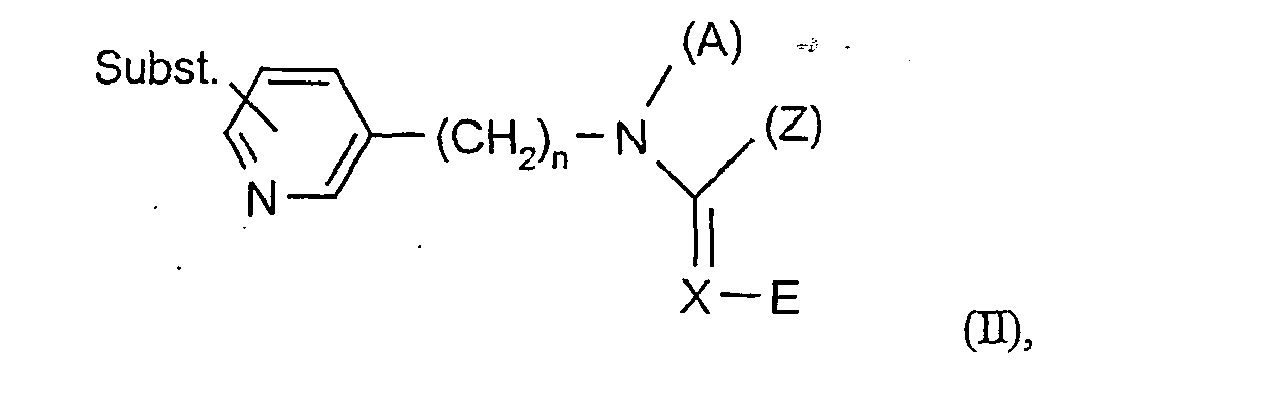


- n
- für 1 oder 2 steht,
- m
- für 0, 1 oder 2 steht,
- A, Z, X und E die oben angegebenen Bedeutungen haben.
- Im einzelnen seien folgende Verbindungen genannt:


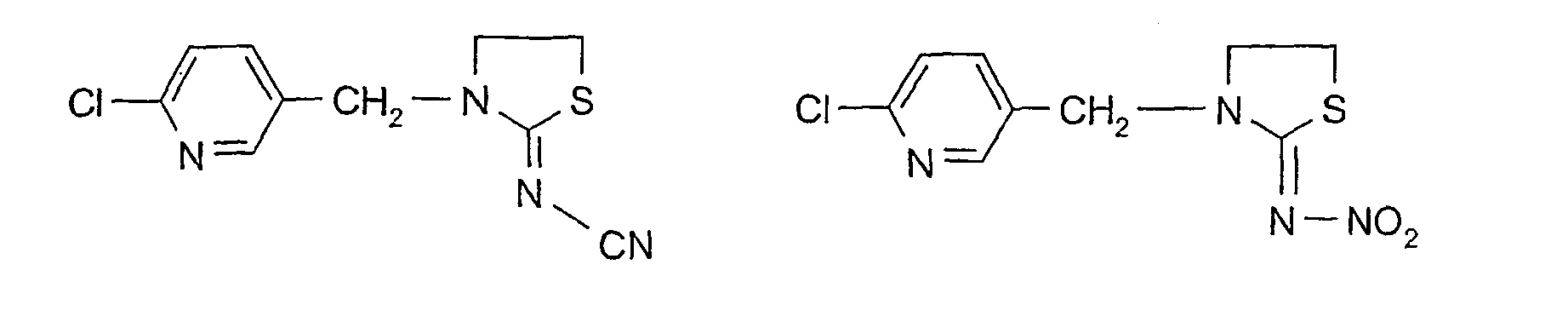
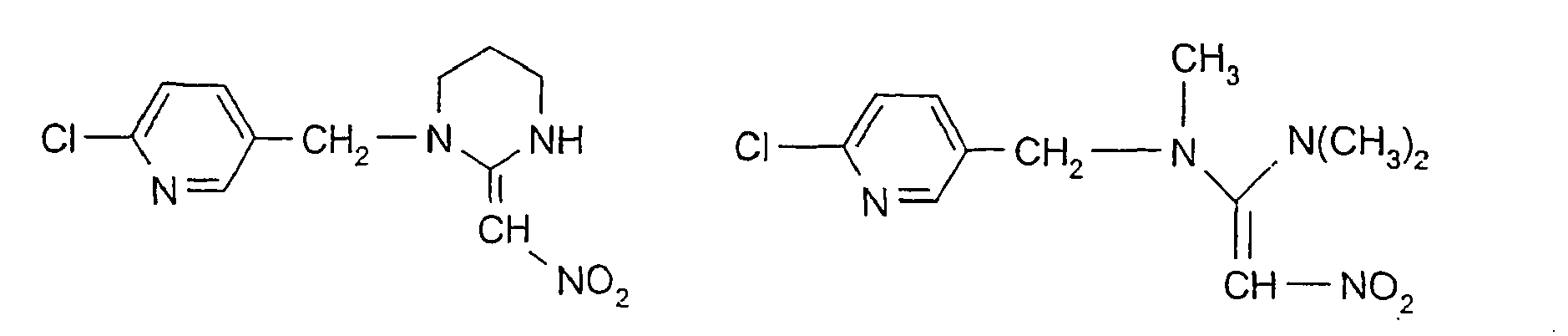


- Im einzelnen seien folgende besonders bevorzugte Verbindungen genannt:


- Neben nicotinischen Agonisten aus der Gruppe der Neonicotinoide können erfindungsgemäß auch andere nicotinische Agonisten eingesetzt werden.
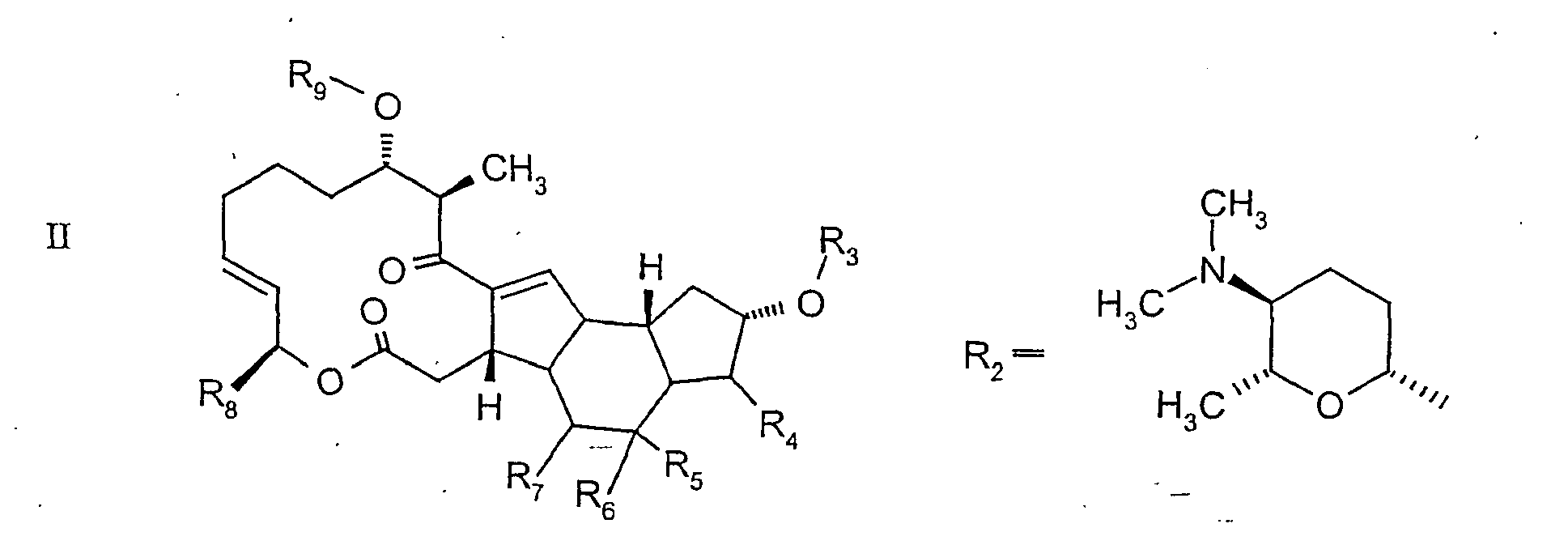
- Beispielhaft seien hier genannt Verbindungen aus der Gruppe der Spinosyne, insbesondere Spinosyn A und D


Boeck et al. in EP 375316 A1 Deamicis et al. in WO 97/00265 A1 - Ebenfalls als Spinosyne werden hier verstanden synthetische und semi-synthetische Derivate der natürlichen Spinosyne bzw. Derivate die aus gentechnisch modifizierten Stämmen von z.B. Saccharopolyspora Spezies gewonnen werden, wie beschrieben in
WO 02/77004 WO 02/77005 - Beispielhaft genannt seien Verbindungen der Formeln I und II wobei R3 ein Glykosid (R3 = R1) ist, R4 ist H, OH oder Alkoxy (üblicherweise mit 1 bis 8, bevorzugt 1 bis 4 Kohlenstoffatomen); R5 ist H, Methyl, R6 und R7 sind H oder zur Doppelbindung oder zu einer Epoxygruppe kombiniert, R8 in Formel I ist trans-1-butenyl, 1,3-butadienyl, Butyl, 3-hydroxy-butenyl, Propyl, 1-propenyl, 1,2-epoxy-1-butyl, 3-oxo-1-butenyl, CH3CH(OCH3)CH=CH-, CH3CH=CHCH(CH2CO2CH3)-, oder CH3CH=CHCH[CH2CON(CH3)2]-; R9 ist H oder Glykosid (R9=R2).

- Andere am nicotinischen Rezeptor als Agonisten wirksame Verbindungen; die ebenfalls erfolgreich mit Verbindungen der Gruppe 1 kombiniert werden können, sind beispielsweise Nicotin oder Nithiazin

- Der repellierende Effekt der erfindungsgemäß verwendeten Kombination von Wirkstoffen aus der Gruppe der nicotinischen Agonisten in Kombination mit Wirkstoffen der Gruppe der Pyrethroide/Pyrethrine ist überraschenderweise besser als von den Wirkungen der Einzelkomponenten zu erwarten war. Durch Anwendung dieser Mittel können daher die Aufwandmengen an Wirkstoff reduziert sowie die Langzeitwirkung erhöht werden. Ihre Anwendung bringt demzufolge ökonomische und ökologische Vorteile.
- Die erfindungsgemäß verwendeten Kombinationen eignen sich hervorragend für den Einsatz bei der Parasitenabwehr und zur Verhinderung der Übertragung von Krankheitserregern, die von solchen Parasiten übertragen werden. Die Parasiten können direkt am Tier abgewehrt werden.
- Als Parasiten seien genannt:
- Aus der Ordnung der Anoplura z.B. Haematopinus spp., Linognathus spp., Solenopotes spp., Pediculus spp., Pthirus spp.;
- aus der Ordnung der Mallophaga z.B. Trimenopon spp., Menopon spp., Eomenacanthus spp., Menacanthus spp., Trichodectes spp., Felicola spp., Damalinea spp., Bovicola spp;
- aus der Ordnung der Diptera z.B. Aedes spp., Culex spp., Simulium spp., Phlebotomus spp., Lutzomyia spp., Chrysops spp., Tabanus spp., Musca spp., Hydrotaea spp., Muscina spp., Haematobosca spp., Haematobia spp., Stomoxys spp., Fannia spp., Glossina spp., Lucilia spp., Calliphora spp., Auchmeromyia spp., Cordylobia spp., Cochliomyia spp., Chrysomyia spp., Sarcophaga spp., Wohlfartia spp., Gasterophilus spp., Oesteromyia spp., Oedemagena spp., Hypoderma spp., Oestrus spp., Rhinoestrus spp., Melophagus spp., Hippobosca spp..
- Aus der Ordnung der Siphonaptera z.B. Ctenocephalides spp., Echidnophaga spp., Ceratophyllus spp., Pulex spp.
- Aus der Ordnung der Metastigmata z.B. Hyalomma spp., Rhipicephalus spp., Boophilus spp., Amblyomma spp., Haemaphysalis spp., Dermacentor spp., Ixodes spp., Argas spp., Ornithodorus spp., Otobius spp.;
aus der Ordnung der Mesostigmata z.B. Dermanyssus spp., Ornithonyssus spp., Pneumonyssus spp.. - Aus der Ordnung der Prostigmata z.B. Cheyletiella spp., Psorergates spp., Myobia spp., Demodex spp., Neotrombicula spp.;
aus der Ordnung der Astigmata z.B. Acarus spp., Myocoptes spp., Psoroptes spp., Chorioptes spp., Otodectes spp., Sarcoptes spp., Notoedres spp., Knemidocoptes spp., Neoknemidocoptes spp. Cytodites spp., Laminosioptes spp.. - Erfindungsgemäß werden die Mittel zur Repellierung von Arthropoden, vorzugsweise von Zecken, Flöhen, Mücken und Fliegen bei warmblütigen Tieren eingesetzt.
- Tiere sind z.B. Zucht oder Nutztiere: Säugetiere wie Rinder, Pferde, Schafe, Schweine, Ziegen, Kamele, Wasserbüffel, Esel, Kaninchen, Damwild, Rentiere, Pelztiere wie Nerze, Chinchilla, Waschbär; Vögel, wie z.B. Hühner, Gänse, Puten, Enten, und Strauße.
- Weiterhin sind dies Labor- und Versuchstiere, wie z.B. Mäuse, Ratten, Meerschweinchen, Goldhamster, Hunde und Katzen.
- Besonders bevorzugt ist der Einsatz bei Hobbytieren, wie z.B. bei Hunden und Katzen.
- Da die behandelten Tiere in der Regel auch eine gewisse Menge des eingesetzten Mittels in der Umgebung verteilen, z.B. durch Reibung oder mit Debris, tritt die Wirkung der erfindungsgemäßen Mittel gegebenenfalls nicht nur direkt am Tier sondern auch in entsprechendem Maße in deren Umgebung ein.
- Selbstverständlich können die erfindungsgemäß verwendeten Mittel neben den oben genannten Wirkstoffen noch zusätzliche geeignete Wirkstoffe enthalten.
- Als Beispiele seien wachstumsheinmende Wirkstoffe und Synergisten genannt, z.B. Pyriproxyfen {2-[1-methyl-2-(4-phenoxyphenoxy)-ethoxy]-pyridine CAS Nr.: 95737-68-1}, Methopren [(E,E)-1-methylethyl 11-methoxy-3,7,11-trimethyl-2,4-dodecadienoate CAS Nr.: 40596-69-8] und Triflumuron {2-chloro-N-[[[4-(trifluoromethoxy)phenyl]amino]carbonyl]benzamide CAS Nr.: 64628-44-0}.
- Denkbar ist auch der Zusatz von weiteren repellent wirkenden Stoffen, wie DEET (Diethyltoluamid), Bayrepel® (CAS-Name: 1-Piperidinecarboxylic acid, 2-(2-hydroxyethyl)-, 1-methylpropylester), 2-(Octylthio)-ethanol oder 3-(N-Acetyl-N-butylamino)propionsäureethyl.
- Die Anwendung am Tier erfolgt direkt oder in Form von geeigneten Zubereitungen in aller Regel dermal.
- Da der Repellentmechanismus der Pyrethroide/Pyrethrine eine Kontaktmöglichkeit mit dem Wirkstoff erfordert, ist es empfehlenswert die Wirkstoffe auf der ganzen zu schützenden Fläche zu verteilen, beispielsweise auf allen Körperteilen der behandelten Tiere. Für die Repellentwirkung ist eine Hautpenetration der Wirkstoffe dabei eher nachteilig, da die in die Haut eingedrungenen Wirkstoffe nicht mehr für die Repellentwirkung zur Verfügung stehen.
- Die dermale Anwendung geschieht z.B. in Form des Sprühens (Sprayen) oder Aufgießens (pour-on and spot-on).
- Geeignete Zubereitungen sind:
- Lösungen oder Konzentrate zur Verabreichung nach Verdünnung zum Gebrauch auf der Haut oder in Körperhöhlen, Aufgußformulierungen, Gele;
- Emulsionen und Suspensionen, halbfeste Zubereitungen;
- Formulierungen bei denen der Wirkstoff in einer Salbengrundlage oder in einer Öl in Wasser oder Wasser in Öl Emulsionsgrundlage verarbeitet ist;
- Feste Zubereitungen wie Pulver, Premixe oder Konzentrate, Granulate, Pellets, Aerosole und wirkstoffhaltige Formkörper.
- Als Lösungsmittel seien genannt: Physiologisch verträgliche Lösungsmittel wie Wasser, Alkohole wie Ethanol, Butanol, Benzylalkohol, Glycerin, Propylenglykol, Polyethylenglykole, N-Methylpyrrolidon, 2-Pyrrolidon sowie Gemische derselben.
- Die Wirkstoffe lassen sich gegebenenfalls auch in physiologisch verträglichen pflanzlichen oder synthetischen Ölen, lösen.
- Als Lösungsvermittler seien genannt: Lösungsmittel, die die Lösung des Wirkstoffs im Hauptlösungsmittel fördern oder sein Ausfallen verhindern. Beispiele sind Polyvinylpyrrolidon, Polyvinylalkohol, polyoxyethyliertes Rhizinusöl, polyoxyethylierte Sorbitanester.
- Konservierungsmittel sind: Benzylalkohol, Trichlorbutanol, p-Hydroxybenzoesäureester, n-Butanol.
- Lösungen können direkt angewendet werden. Konzentrate werden nach vorheriger Verdünnung auf die Anwendungskonzentration angewendet.
- Lösungen können auf die Haut aufgeträufelt, aufgestrichen, eingerieben, aufgespritzt oder aufgesprüht werden.
- Es kann vorteilhaft sein, bei der Herstellung Verdickungsmittel zuzufügen. Verdickungsmittel sind: Anorganische Verdickungsmittel wie Bentonite, kolloidale Kieselsäure, Aluminiummonostearat, organische Verdickungsmittel wie Cellulosederivate, Polyvinylalkohole und deren Copolymere, Acrylate und Metacrylate.
- Gele werden auf die Haut aufgetragen oder aufgestrichen oder in Körperhöhlen eingebracht. Gele werden hergestellt indem Lösungen, die wie bei den Injektionslösungen beschrieben hergestellt worden sind, mit soviel Verdickungsmittel versetzt werden, dass eine klare Masse mit salbenartiger Konsistenz entsteht. Als Verdickungsmittel werden die weiter oben angegebenen Verdickungsmittel eingesetzt.
- Aufgieß-Formulierungen werden auf begrenzte Bereiche der Haut aufgegossen oder aufgespritzt, wobei der Wirkstoff die Haut durchdringt und systemisch wirkt.
- Aufgieß-Formulierungen werden hergestellt, indem der Wirkstoff in geeigneten hautverträglichen Lösungsmitteln oder Lösungsmittelgemischen gelöst, suspendiert oder emulgiert wird. Gegebenenfalls werden weitere . Hilfsstoffe wie Farbstoffe, resorptionsfördernde Stoffe, Antioxidantien, Lichtschutzmittel, Haftmittel zugefügt.
- Als Lösungsmittel seien genannt: Wasser, Alkanole, Glycole, Polyethylenglycole, Polypropylenglycole, Glycerin, aromatische Alkohole wie Benzylalkohol, Phenylethanol, Phenoxyethanol, Ester wie Essigester, Butylacetat, Benzylbenzoat, Ether wie Alkylenglykolalkylether wie Dipropylenglykolmonomethylether, Diethylenglykolmono-butylether, Ketone wie Aceton, Methylethylketon, cyclische Carbonate wie Propylencarbonat, Ethylencarbonat, aromatische und/oder aliphatische Kohlenwasserstoffe, pflanzliche oder synthetische Öle, DMF, Dimethylacetamid, n-Alkylpyrrolidone wie n-Methylpyrrolidon, n-Butyl- oder n-Octylpyrrolidon, N-Methylpyrrolidon, 2-Pyrrolidon, 2,2-Dimethyl-4-oxy-methylen-1,3-dioxolan und Glycerinformal.
- Farbstoffe sind alle zur Anwendung am Tier zugelassenen Farbstoffe, die gelöst oder suspendiert sein können.
- Resorptionsfördernde Stoffe sind z.B. DMSO, spreitende Öle wie Isopropylmyristat, Dipropylenglykolpelargonat, Silikonöle, bzw. deren Copolymerisate mit Polyethern, Fettsäureester, Triglyceride, Fettalkohole.
- Antioxidantien sind Sulfite oder Metabisulfite wie Kaliummetabisulfit, Ascorbinsäure, Butylhydroxytoluol, Butylhydroxyanisol, Tocopherol.
- Haftmittel sind z.B. Cellulosederivate, Stärkederivate, Polyacrylate, natürliche Polymere wie Alginate, Gelatine.
- Emulsionen sind entweder vom Typ Wasser in Öl oder vom Typ Öl in Wasser.
- Sie werden hergestellt, indem man den Wirkstoff entweder in der hydrophoben oder in der hydrophilen Phase löst und diese unter Zuhilfenahme geeigneter Emulgatoren und gegebenenfalls weiterer Hilfsstoffe wie Farbstoffe, resorptionsfördernde Stoffe, Konservierungsstoffe, Antioxidantien, Lichtschutzmittel, viskositätserhöhende Stoffe, mit dem Lösungsmittel der anderen Phase homogenisiert.
- Als hydrophobe Phase (Öle) seien genannt: Paraffinöle, Silikonöle, natürliche Pflanzenöle wie Sesamöl, Mandelöl, Rizinusöl, synthetische Triglyceride wie Capryl/ Caprinsäure-biglycerid, Triglyceridgemisch mit Pflanzenfettsäuren der Kettenlänge C8-12 oder anderen speziell ausgewählten natürlichen Fettsäuren, Partialglyceridgemische gesättigter oder ungesättigter eventuell auch hydroxylgruppenhaltiger Fettsäuren, Mono- und Diglyceride der C8/C10-Fettsäuren.
- Fettsäureester wie Ethylstearat, Di-n-butyryl-adipat, Laurinsäurehexylester, Dipropylenglykolpelargonat, Ester einer verzweigten Fettsäure mittlerer Kettenlänge mit gesättigten Fettalkoholen der Kettenlänge C16-18, Isopropylmyristat, Isopropylpalmitat, Capryl/Caprinsäureester von gesättigten Fettalkoholen der Kettenlänge C12-18, Isopropylstearat, Ölsäureoleylester, Ölsäuredecylester, Ethyloleat, Milchsäureethylester, wachsartige Fettsäureester wie künstliches Entenbürzeldrüsenfett, Dibutylphthalat, Adipinsäurediisopropylester, letzterem verwandte Estergemische u.a.
- Fettalkohole wie Isotridecylalkohol, 2-Octyldodecanol, Cetylstearyl-alkohol, Oleylalkohol.
- Fettsäuren wie z.B. Ölsäure und ihre Gemische.
- Wasser, Alkohole wie z.B. Propylenglycol, Glycerin, Sorbitol und ihre Gemische.
- Als Emulgatoren seien genannt: nichtionogene Tenside, z.B. polyoxyethyliertes Rizinusöl, polyoxyethyliertes Sorbitan-monooleat, Sorbitanmonostearat, Glycerinmonostearat, Polyoxyethylstearat, Alkylphenolpolyglykolether;
ampholytische Tenside wie Di-Na-N-lauryl-ß-iminodipropionat oder Lecithin;
anionaktive Tenside, wie Na-Laurylsulfat, Fettalkoholethersulfate, Mono/Dialkylpolyglykoletherorthophosphorsäureester-monoethanolaminsalz;
kationaktive Tenside wie Cetyltrimethylammoniumchlorid. - Als weitere Hilfsstoffe seien genannt: Viskositätserhöhende und die Emulsion stabilisierende Stoffe wie Carboxymethylcellulose, Methylcellulose und andere Cellulose- und Stärke-Derivate, Polyacrylate, Alginate, Gelatine, Gummi-arabicum, Polyvinylpyrrolidon, Polyvinylalkohol, Copolymere aus Methylvinylether und Maleinsäureanhydrid, Polyethylenglykole, Wachse, kolloidale Kieselsäure oder Gemische der aufgeführten Stoffe.
- Suspensionen werden hergestellt, indem man den Wirkstoff in einer Trägerflüssigkeit gegebenenfalls unter Zusatz weiterer Hilfsstoffe wie Netzmittel, Farbstoffe, resorptionsfördernde Stoffe, Konservierungsstoffe, Antioxidantien Lichtschutzmittel suspendiert.
- Als Trägerflüssigkeiten seien alle homogenen Lösungsmittel und Lösungsmittelgemische genannt.
- Als Netzmittel (Dispergiermittel) seien die weiter oben angegebene Tenside genannt.
- Als weitere Hilfsstoffe seien die weiter oben angegebenen genannt.
- Halbfeste Zubereitungen unterscheiden sich von den oben beschriebenen Suspensionen und Emulsionen nur durch ihre höhere Viskosität.
- Zur Herstellung fester Zubereitungen wird der Wirkstoff mit geeigneten Trägerstoffen gegebenenfalls unter Zusatz von Hilfsstoffen vermischt und in die gewünschte Form gebracht.
- Als Trägerstoffe seien genannt alle physiologisch verträglichen festen Inertstoffe. Als solche dienen anorganische und organische Stoffe. Anorganische Stoffe sind z.B. Kochsalz, Carbonate wie Calciumcarbonat, Hydrogencarbonate, Aluminiumoxide, Titanoxid, Kieselsäuren, Tonerden, gefälltes oder kolloidales Siliciumdioxid, Phosphate.
- Organische Stoffe sind z.B. Zucker, Zellulose, Nahrungs-und Futtermittel wie Milchpulver, Tiermehle, Getreidemehle und -schrote, Stärken.
- Hilfsstoffe sind Konservierungsstoffe, Antioxidantien, Farbstoffe, die bereits weiter oben aufgeführt worden sind.
- Weitere geeignete Hilfsstoffe sind Schmier- und Gleitmittel wie z.B. Magnesiumstearat, Stearinsäure, Talkum, Bentonite, zerfallsfördernde Substanzen wie Stärke oder quervernetztes Polyvinylpyrrolidon, Bindemittel wie z.B. Stärke, Gelatine oder linerares Polyvinylpyrrolidon sowie Trockenbindemittel wie mikrokristalline Cellulose.
- Die Wirkstoffe können in den Zubereitungen auch in Mischung mit Synergisten oder mit anderen Wirkstoffe, die gegen pathogene Endoparasiten wirken, vorliegen.
- Besonders geeignet, insbesondere für Permethrin-haltige Mittel, sind die in
WO 02/087338 - Diese enthalten: N-Methylpyrrolidon in einem Anteil von 27,5 bis 62,5 Gew.-%, bevorzugt 35 bis 50 Gew.-%, besonders bevorzugt 40 bis 45 Gew.-%.
- Antioxidantien in einem Anteil von 0 - 0,5 Gew.-%, bevorzugt 0,05 - 0,25 Gew.-%, besonders bevorzugt 0,05 -0,15 Gew.-%. Es kommen alle üblichen Antioxidantien in Frage, bevorzugt sind phenolische Antioxidantien wie z.B. Butylhydröxytoluol, Butylhydroxyanisol, Tocopherol.
- Organische Säure in einem Anteil von 0 - 0,5 Gew.-%, bevorzugt 0,05 - 0,25 Gew.-%, besonders bevorzugt 0,05 -0,15 Gew.-%. Zum Einsatz eignen sich alle pharmazeutisch verträglichen organischen Säuren, insbesondere Carbonsäuren, wie z.B. Citronensäure, Weinsäure, Milchsäure, Bernsteinsäure und Apfelsäure. Besonders bevorzugt sind die organischen Säuren Citronensäure und Apfelsäure. Ganz besonders bevorzugt ist Citronensäure. Ihre Menge kann insbesondere im Bereich 0,05 bis 0,25 breit variiert werden. Wobei die Mengen im Bereich 0,075 - 0,15 % wiederum besonders bevorzugt werden.
- Co-Lösungsmittel-Mengen in einem Anteil von 2,5-10 Gew.-%, bevorzugt 2,5 - 7,5 Gew.-%, besonders bevorzugt 3,5 - 6,0 Gew.-%.
- Als Co-Lösungsmittel kommen organische Lösungsmittel mit einem Siedepunkt >80°C und einem Flammenpunkt >75°C in Betracht. Bevorzugt haben die Co-Lösungsmitteln eine spreitende Wirkung. In diesem Zusammenhang sei auf höhersiedende aliphatische sowie aromatische Alkohole, aliphatische Polyether, aliphatische und/oder aromatische Ester, cyclische und/oder acyclische Carbonate hingewiesen.
- Co-Lösungsmittel sind vorzugsweise aliphatische acyclische oder cyclische Ether bzw. Polyether sowie Fettsäureester insbesondere Triglyceride eingesetzt.
- Beispielhaft genannt sind Ether bzw. Polyether beispielsweise aus der Reihe Diethylenglykolmonoethylther, Dipropylenglykolmonomethylether, Tetrahydrofurfurylalkohol und Tetrahydrofurfurylethoxylat, wobei die beiden letztgenannten besonders zu bevorzugen sind; Fettsäureester sowie Triglyceride, beispielsweise Isopropylmyristat, Miglyol 810, Miglyol 812, Miglyol 818, Miglyol 829, Miglyol 840 und Miglyol 8810 (zur Definition der Miglyole siehe beispielsweise H.P. Fiedler Lexikon der Hilfsstoffe für Pharmazie, Kosmetik und angrenzende Gebiete, Seiten 1008-1009, Bd. 2, Edito Cantor Verlag Aulendorf (1996)).
- Die mit den genannten Co-Lösungsmitteln modifizierten Mittel zeichnen sich durch ihre sehr gute Haut- und Augenverträglichkeit, ausgezeichnete biologische Wirksamkeit sowie durch ihr günstiges Kältestabilitätsverhalten in den üblichen Single-dose-Applikationstuben aus.
- Neben den oben aufgeführten Bestandteilen können die erfindungsgemäße Mittel weitere übliche, pharmazeutisch annehmbare Hilfsstoffe enthalten. Als solche seien beispielsweise genannt: Spreitmittel und Tenside.
- Spreitmittel sind beispielsweise spreitende Öle wie Adipinsäure-di-2-ethylhexylester, Isopropylmyristat, Dipropylenglykolpelargonat, cyclische und acyclische Silikonöle, wie Dimetikone und ferner deren Co- und Terpolymerisate mit Ethylenoxid, Propylenoxid und Formalin, Fettsäureester, Triglyceride, Fettalkohole.
- Als Tenside seien genannt: Nichtionogene Tenside, z.B. polyoxyethyliertes Rizinusöl, polyoxyethyliertes Sorbitan-monooleat, Sorbitanmonostearat, Glycerinmonostearat, Polyoxyethylstearat, Alkylphenolpolyglykolether;
ampholytische Tenside wie Di-Na-N-lauryl-β-iminodipropionat oder Lecithin;
anionaktive Tenside, wie Na-Laurylsulfat, Fettalkoholethersulfate, Mono/Dialkylpolyglykoletherorthophosphorsäureester-monoethanolaminsalz;
kationaktive Tenside wie Cetyltrimethylammoniumchlorid. - Die erfindungsgemäß verwendeten Mittel können nach üblichen Verfahren hergestellt werden, beispielsweise in dem man die Wirkstoffe unter Rühren mit den weiteren Bestandteilen vermischt und eine Lösung herstellt. Diese kann gegebenenfalls filtriert werden. Zur Abfüllung eignen sich beispielsweise Kunststofftuben.
- Die bevorzugten Applikationsvolumina für die in
WO 02/087338 - Sie eignen sich hervorragend zum Abfüllen und Ausbieten in lagerungskritischen Behältern, wie z.B. der "Single dose Polypropylenkunststofftuben" der Wandstärke von 300-500 µm und des Abfüllvolumens 1,0 bis 4,0 ml.
- Die Mittel sind weiterhin ausgezeichnet hautverträglich, weisen eine geringe Toxizität auf und sind aufgrund ihrer biologischen Abbaubarkeit umweltverträglich.
- Eine homogene Spot-on-Lösung bestehend aus
45 g Permethrin mit 40 % cis und 60 % trans-Isomerenanteil 10 g Imidacloprid (1-[(6-Chlor-3-pyridinyl)methyl]-N-nitro-2-imidazolidinimin) der Fa. Bayer AG 44,8 g N-Methylpyrrolidon 0,1 g Citronensäure 0,1 g BHT (Butylhydroxytoluol) - Eine homogene Spot on Lösung bestehend aus
45 g Permethrin mit 40 % cis und 60 % trans-Isomerenanteil 10 g Imidacloprid 40,8 g N-Methylpyrrolidon 4,0 g Wasser 0,1 g Citronensäure 0,1 g BHT - Eine homogene Spot on Lösung bestehend aus
45 g Permethrin mit 40 % cis und 60 % trans-Isomerenanteil 10 g Ti 435, Chlothianidine Fa. Takeda AG 44,8 g N-Methylpyrrolidon 0,1 g Citronensäure 0,1 g BHT - Eine homogene Spot on Lösung bestehend aus
45 g Permethrin mit 40 % cis und 60 % trans-Isomerenanteil 10g Diacloden (Thiamethoxam) der Fa. Syngenta AG 44,8 g N-Methylpyrrolidon 0,1 g Citronensäure 0,1 g BHT - Eine homogene Spot on Lösung bestehend aus
45 g Permethrin mit 40 % cis und 60 % trans-Isomerenanteil 10 g Spinosad (8.5 g Spinosyn A; 1.5 g Spinosyn D) Fa. Dow Agrosciences 44,8 g N-Methylpyrrolidon 0,1 g Citronensäure 0,1 g BHT - Eine homogene Spot on Lösung bestehend aus
45 g Permethrin mit 40 % cis und 60 % trans-Isomerenanteil 20 g Nithiazin Fa. Shell AG 34,8 g N-Methylpyrrolidon 0,1 g Citronensäure 0,1 g BHT - Eine homogene Spot on Lösung.bestehend aus
45 g Permethrin mit 40 % cis und 60 % trans-Isomerenanteil 10 g Ti 435, Chlothianidine Fa. Takeda AG 39,8 g N-Methylpyrrolidon 0,1 g Citronensäure 0,1 g BHT 5,0 g Tetrahydrofurfurylalkohol - Eine homogene Spot on Lösung bestehend aus
45 g Permethrin mit 40 % cis und 60 % trans-Isomerenanteil 10 g Diacloden (Thiamethoxam) der Fa. Syngenta AG 39,8 g N-Methylpyrrolidon 0,1 g Citronensäure 0,1 g BHT 5,0 g Tetrahydrofurfurylethoxylat - Eine homogene Spot on Lösung bestehend aus
45 g Permethrin mit 40 % cis und 60 % trans-Isomerenanteil 10 g Spinosad (8.5 g Spinosyn A; 1.5 g Spinosyn D) Fa. Dow Agrosciences 39,8 g N-Methylpyrrolidon 0,1 g Citronensäure 0,1g BHT 5,0 g Tetrahydrofurfurylethoxylat - Eine homogene Spot on Lösung bestehend aus
45 g Permethrin mit 40 % cis und 60 % trans-Isomerenanteil 20 g Nithiazin Fa. Shell AG 29,8 g N-Methylpyrrolidon 0,1 g Citronensäure 0,1 g BHT 5,0 g Tetrahydrofurfurylethoxylat - Eine homogene Spot-on-Lösung bestehend aus
10 g α-Cypermethrin 10 g Imidacloprid 79,8 g N-Methylpyrrolidon 0,1 g Citronensäure 0,1 g BHT (Butylhydroxytoluol) - Eine homogene Spot on Lösung bestehend aus
10g α-Cypermethrin 10 g Imidacloprid 75,8 g N-Methylpyrrolidon 4,0 g Wasser 0,1 g Citronensäure 0,1 g BHT - Eine homogene Spot on Lösung bestehend aus
10 g α-Cypermethrin 10 g Ti 435, Chlothianidine Fa. Takeda AG 79,8 g N-Methylpyrrolidon 0,1 g Citronensäure 0,1 g BHT - Eine homogene Spot on Lösung bestehend aus
10 g α-Cypermethrin 10 g Diacloden (Thiamethoxam) der Fa. Syngenta AG 79,8 g N-Methylpyrrolidon 0,1 g Citronensäure 0,1 g BHT - Eine homogene Spot on Lösung bestehend aus
10 g α-Cypermethrin 10 g Spinosad (8.5 g Spinosyn A; 1.5 g Spinosyn D) Fa. Dow Agrosciences 79,8 g N-Methylpyrrolidon 0,1 g Citronensäure 0,1 g BHT - Eine homogene Spot on Lösung bestehend aus
10 g α-Cypermethrin 20 g Nithiazin Fa. Shell AG 69,8 g N-Methylpyrrolidon 0,1 g Citronensäure 0,1 g BHT - Eine homogene Spot on Lösung bestehend aus
10 g α-Cypermethrin 10 g Ti 435, Chlothianidine Fa. Takeda AG 74,8 g N-Methylpyrrolidon 0,1 g Citronensäure 0,1 g BHT 5,0 g Tetrahydrofurfurylalkohol - Eine homogene Spot on Lösung bestehend aus
10 g α-Cypermethrin 10 g Diacloden (Thiamethoxam) der Fa. Syngenta AG 74,8 g N-Methylpyrrolidon 0,1 g Citronensäure 0,1 g BHT 5,0 g Tetrahydrofurfurylethoxylat - Eine homogene Spot on Lösung bestehend aus
10 g α-Cypermethrin 10 g Spinosad (8.5 g Spinosyn A; 1.5 g Spinosyn D) Fa. Dow Agrosciences 74,8 g N-Methylpyrrolidon 0,1 g Citronensäure 0,1 g BHT 5,0 g Tetrahydrofurfurylethoxylat - Eine homogene Spot on Lösung bestehend aus
10 g α-Cypermethrin 20 g Nithiazin Fa. Shell AG 64,8 g N-Methylpyrrolidon 0,1 g Citronensäure 0,1 g BHT 5,0 g Tetrahydrofurfurylethoxylat - Eine homogene Spot-on-Lösung bestehend aus
45 g Etofenprox 10 g Imidacloprid 44,8 g N-Methylpyrrolidon 0,1 g Citronensäure 0,1 g BHT (Butylhydroxytoluol) - Eine homogene Spot on Lösung bestehend aus
45 g Etofenprox 10 g Imidacloprid 40,8 g N-Methylpyrrolidon 4,0 g Wasser 0,1 g Citronensäure 0,1 g BHT - Eine homogene Spot on Lösung bestehend aus
45 g Etofenprox 10 g Ti 435, Chlothianidine Fa. Takeda AG 44,8 g N-Methylpyrrolidon 0,1 g Citronensäure 0,1 g BHT - Eine homogene Spot on Lösung bestehend aus
45 g Etofenprox 10 g Diacloden (Thiamethoxam) der Fa. Syngenta AG 44,8 g N-Methylpyrrolidon 0,1 g Citronensäure 0,1 g BHT - Eine homogene Spot on Lösung bestehend aus
45 g Etofenprox 10 g Spinosad (8.5 g Spinosyn A; 1.5 g Spinosyn D) Fa. Dow Agrosciences 44,8 g N-Methylpyrrolidon 0,1 g Citronensäure 0,1 g BHT - Eine homogene Spot on Lösung bestehend aus
45 g Etofenprox 20 g Nithiazin Fa. Shell AG 34,8 g N-Methylpyrrolidon 0,1 g Citronensäure 0,1 g BHT - Eine homogene Spot on Lösung bestehend aus
45 g Etofenprox 10 g Ti 435, Chlothianidine Fa. Takeda AG 39,8 g N-Methylpyrrolidon 0,1 g Citronensäure 0,1 g BHT 5,0 g Tetrahydrofurfurylalkohol - Eine homogene Spot on Lösung bestehend aus
45 g Etofenprox 10 g Diacloden (Thiamethoxam) der Fa. Syngenta AG 39,8 g N-Methylpyrrolidon 0,1 g Citronensäure 0,1 g BHT 5,0 g Tetrahydrofurfurylethoxylat - Eine homogene Spot on Lösung bestehend aus
45 g Etofenprox 10 g Spinosad (8.5 g Spinosyn A; 1.5 g Spinosyn D) Fa. Dow Agrosciences 39,8 g N-Methylpyrrolidon 0,1 g Citronensäure 0,1 g BHT 5,0 g Tetrahydrofurfurylethoxylat - Eine homogene Spot on Lösung bestehend aus
45 g Etofenprox 20 g Nithiazin Fa. Shell AG 29,8 g N-Methylpyrrolidon 0,1 g Citronensäure 0,1 g BHT 5,0 g Tetrahydrofurfurylethoxylat - Eine homogene Spot-on-Lösung bestehend aus
45 g Pyrethrum Extrakt 10 g Imidacloprid 44,8 g N-Methylpyrrolidon 0,1 g Citronensäure 0,1 g BHT (Butylhydroxytoluol) - Eine homogene Spot on Lösung bestehend aus
45 g Pyrethrum Extrakt 10 g Imidacloprid 40,8 g N-Methylpyrrolidon 4,0 g Wasser 0,1 g Citronensäure 0,1 g BHT - Eine homogene Spot on Lösung bestehend aus
45 g Pyrethrum Extrakt 10 g Ti 435, Chlothianidine Fa. Takeda AG 44,8 g N-Methylpyrrolidon 0,1 g Citronensäure 0,1 g BHT - Eine homogene Spot on Lösung bestehend aus
45 g Pyrethrum Extrakt 10 g Diacloden (Thiamethoxam) der Fa. Syngenta AG 44,8 g N-Methylpyrrolidon 0,1 g Citronensäure 0,1 g BHT - Eine homogene Spot on Lösung bestehend aus
45 g Pyrethrum Extrakt 10 g Spinosad (8.5 g Spinosyn A; 1.5 g Spinosyn D) Fa. Dow Agrosciences 44,8 g N-Methylpyrrolidon 0,1 g Citronensäure 0,1 g BHT - Eine homogene Spot on Lösung bestehend aus
45 g Pyrethrum Extrakt 20 g Nithiazin Fa. Shell AG 34,8 g N-Methylpyrrolidon 0,1 g Citronensäure 0,1 g BHT - Eine homogene Spot on Lösung bestehend aus
45 g Pyrethrum Extrakt 10 g Ti 435, Chlothianidine Fa. Takeda AG 39,8 g N-Methylpyrrolidon 0,1 g Citronensäure 0,1 g BHT 5,0 g Tetrahydrofurfurylalkohol - Eine homogene Spot on Lösung bestehend aus
45 g Pyrethrum Extrakt 10 g Diacloden (Thiamethoxam) der Fa. Syngenta AG 39,8 g N-Methylpyrrolidon 0,1 g Citronensäure 0,1 g BHT 5,0 g Tetrahydrofurfurylethoxylat - Eine homogene Spot on Lösung bestehend aus
45 g Pyrethrum Extrakt 10 g Spinosad (8.5 g Spinosyn A; 1.5 g Spinosyn D) Fa. Dow Agrosciences 39,8 g N-Methylpyrrolidon 0,1 g Citronensäure 0,1 g BHT 5,0 g Tetrahydrofurfurylethoxylat - Eine homogene Spot on Lösung bestehend aus
45 g Pyrethrum Extrakt 20 g Nithiazin Fa. Shell AG 29,8 g N-Methylpyrrolidon 0,1 g Citronensäure 0,1 g BHT 5,0 g Tetrahydrofurfurylethoxylat - Kurzbeschreibung: Einzelne Zecken nähern sich einer erwärmten langsam rotierenden vertikalen Trommel auf einem horizontal stehenden Glasstab. Die Zecken werden von der Wärme der Trommel angelockt und wechseln auf eine Anheftungsstelle auf der rotierenden Trommel über. Wenn auf diese Anheftungsstelle ein Repellent aufgetragen wird, kann der Repellenteffekt entweder i) an einer abnehmenden Zahl von auf die Trommel zustrebenden Zecken, oder ii) durch eine reduzierte Zahl von Zecken, die auf die Anheftungsstelle wechseln oder iii) durch eine steigende Zahl von Zecken, die sich vorzeitig von der Anheftungsstelle wieder fallen lassen, gemessen. Als Vergleich dient eine Trommel mit einer unbehandelten Kontrolle. Es können sowohl Kontakt- als auch Distanz-Repellenzien gemessen werden.
- Jeder Testwert wird mit 30 Zecken durchgeführt. Alle Zecken werden einzeln nacheinander in der gleichen Apparatur geprüft. Zu jeder Testreihe wird Kontrolltest mit reinem Lösungsmittel ohne Repellent durchgeführt, um die Grundaktivität der Zecken zu prüfen. Als Grenzaktivität für die Durchführung eines Tests wird das Wechseln von mindestens 70% der Zecken auf die Trommel gewertet. Für jedes Testprodukt wird eine eigene Testirommel verwendet. Nach jeder Testreihe werden alle verwendeten Geräte sorgfältig gereinigt.
- Für die Prüfung von Ixodes ricinus und Rhipicephalus sanguineus Zecken wurden folgende Bedingungen eingestellt.
- Eine Standardtrommel und Anheftungsfläche wurde verwendet (Dautel et al. (1999)). Die Anheftungsfläche lag 1-3 mm oberhalb der Trommeloberfläche. Der Abstand zwischen dem Glasstab von 2 mm Durchmesser und der Anheftungsfläche betrug zwischen 1 und maximal 1,5 mm.
- Die Rotationszeit der Trommel betrug zwischen 3,9 und 4,1 s / Umdrehung entsprechend 7,66 - 8,05 cm/s relativ zur Zecke. Die Oberflächentemperatur an der Anheftungsfläche betrug zwischen 34,6 und 35,5°C. Raumtemperatur und Umgebungsfeuchte lagen zwischen 19,1 - 22,3 °C bzw. 43,4 - 78,1 % r.h.
- Adulte R. sanguineus haben eine höhere Laufgeschwindigkeit als I. ricinus Nymphen. Daher muss die Anheftungsfläche auf der Trommel derart vergrößert werden, dass eine Kontaktzeit von mindestens 10 sec auch für schnell laufende Exemplare garantiert werden kann. Es dient hier somit die gesamte Trommel als Anheftungsstelle. Aufgrund der geringen Anheftung der Zecken auf Filterpapier wurde die Trommel mit Moltontuch bespannt. Der Abstand zwischen Molton und Glasstab (4 mm Durchmesser) betrug 1-3 mm womit die Zecken zu jeder Zeit in der Lage waren, vom Glasstab auf die Trommel überzuwechseln.
- Die Rotationszeit der Trommel betrug zwischen 5,6 und 6,0 s / Umdrehung entsprechend 5,23 - 5,61 cm/s relativ zur Zecke. Die Oberflächentemperatur an der Anheftungsfläche betrug zwischen 35 und 36°C. Raumtemperatur und Umgebungsfeuchte lagen zwischen 19,4 - 23,5 °C bzw. 59,1 - 79,5 % r.h.
- Aceton wurde als Lösungsmittel und für die Verdünnungen bei allen Versuchen verwendet. Die Applikation erfolgte 1-2 Stunden vor Versuchsbeginn, um ausreichend Zeit zum Verdunsten des Lösungsmittels zu lassen.
- Die Wirkstoffe wurden auf die Filterpapiere mit einer Wegwerfpipette aufgetragen. Eine gleichmäßige Verteilung auf der größeren Oberfläche des Moltontuches wurde mit Hilfe einer Sprühapparatur unter Stickstoffdruck erzielt. Das genaue applizierte Volumen wurde hier durch Rückwiegen ermittelt.
- Es wurden nur solche Zecken im Test eingesetzt, die aktiv in einem Glasröhrchen zum oberen Rand kletterten und zügig auf einen Dachshaarpinsel (0 oder 1) wechselten der zum Übertragen der Zecken verwendet wurde. Diese Zecken wurden mit dem Kopf zur Trommel auf den Glasstab gesetzt in einem Abstand von 1,5 cm (I. ricinus) oder 2.5-4 cm (R. sanguineus) zur Spitze des Glasstabs. Die Versuchszeit startete sobald eine Zecke die 1 cm (I. ricinus) bzw. die 2 cm (R. sanguineus) Markierung auf dem Glasstab überquert hatte. Zecken, die vom Pinsel fielen oder sich vor der Markierung vom Glasstab fallen ließen wurden nicht gewertet.
- Folgende Zeitabschnitte wurden mittels Stoppuhr festgehalten:
- Zeit vom Überqueren der Marke bis zum Erreichen des Endes des Glasstabes
- Zeit vom Erreichen der Spitze des Glasstabes bis zum Übertritt auf die Trommel
- Zeit, die die Zecke auf dem Filter oder auf dem Moltontuch bleibt bis sie sich fallen lässt oder die behandelte Fläche verlässt.
- Für jeden dieser Zeitabschnitte waren maximal 120 sec. vorgesehen. Nach 2 Minuten wurde die Zecke entfernt und der Zeitraum als 120 sec. gewertet.
- Eine Gesamtrepellentwirkung relativ zur Kontrolle wurde berechnet, indem alle Zecken zusammengerechnet wurden, die nicht Richtung Trommel gingen, die nicht auf die Trommel wechselten und die sich von der Anheftungsfläche fallen ließen. Alle diese Zecken wurden als repelliert gewertet. Die Repellentwirkung wird wie folgt berechnet:

wobei R die Repellentwirkung, pt der Prozentsatz der nicht repellierten Zecken und pc der Prozentsatz der nicht repellierten Kontrollzecken ist. -
Tabelle 1a: R. sanguineus: Aufenthaltszeit [s] auf der behandelten Trommeloberfläche. Formulierung (Dosierung) n Mittel SD 95 % Conf. Kontrolle 25 83,8 39,7 67,4 - 100,2 Beispiel 1 (17/83 µg/cm2) *) 18 5,5 3,9 3,6 - 7,5 Exspot® (83,3 µg/cm2) 20 21,9 30,3 7,7 - 36,0 *) Der erste Wert bezieht sich auf die Imidacloprid-Menge, der zweite auf die Permethrin-Menge - Die Formulierung aus Beispiel 1 zeigt überraschenderweise eine deutlich stärkere Repellentwirkung als der Standard (Exspot® enthält Permethrin als einzigen Wirkstoff). Zecken die auf die Trommel übergehen fallen bei Beispiel 1 signifikant schneller wieder ab als beim Standard. Die Repellentwirkung des Standards wird im vorliegenden Beispiel im Mittel um einen Faktor 4 verstärkt.
Tabelle 1b: R. sanguineus: Zeitdauer [s] zum Übertritt von der Glasstabspitze auf die Trommel. Formulierung (Dosierung) n Mittel SD 95 % Conf. Kontrolle 30 3,5 6,2 1,2 - 5,8 Beispiel 1 (17/83 µg/cm2) *) 30 7,9 22,1 0,3 - 16,2 Exspot® (83,3 µg/cm2) 27 2,8 6,9 0,0 - 5,5 *) Der erste Wert bezieht sich auf die Imidacloprid-Menge, der zweite auf die Permethrin-Menge - Ein weiteres Zeichen für die verbesserte Repellentwirkung ist das verzögerte Übertreten vom Glasstab auf die Trommel. Auch hier zeigen Zecken bei Beispiel 1 gegenüber dem Standard ein im Mittel um den Faktor 3 verlängertes Zeitintervall. Der Standard liegt hierbei im Bereich einer Kontrolle.
Tabelle 2: R. sanguineus: MO-Biotest-Bewertung: Erfindungsgemäße Formulierung und Stand der Technik (Exspot®, Fa. Schering-Plough) gegen Kontrolle Dosis Kontrolle Beispiel 1 Kontrolle Exspot® 16,6/83,1 µg/cm2 8,3µglcm2 Nicht repellierte Zecken 27 0 25 3 Repellierte Zecken 3 30 5 27 % nicht repelliert 90,0 0,0 83,3 10 Repellentwirkung 88,0 [% der Kontrolle] 100,0 - Gegenüber der jeweiligen Kontrolle zeigt die erfindungsgemäße Formulierung aus Beispiel 1 eine 100 %ige Repellentwirkung im relevanten Dosisbereich für eine topikal gleichmäßig verteilte Formulierung nach spot-on Anwendung. Das bekannte Handelsprodukt ist unter den gleichen Bedingungen überraschenderweise nicht in der Lage alle Zecken zu repellieren.
-
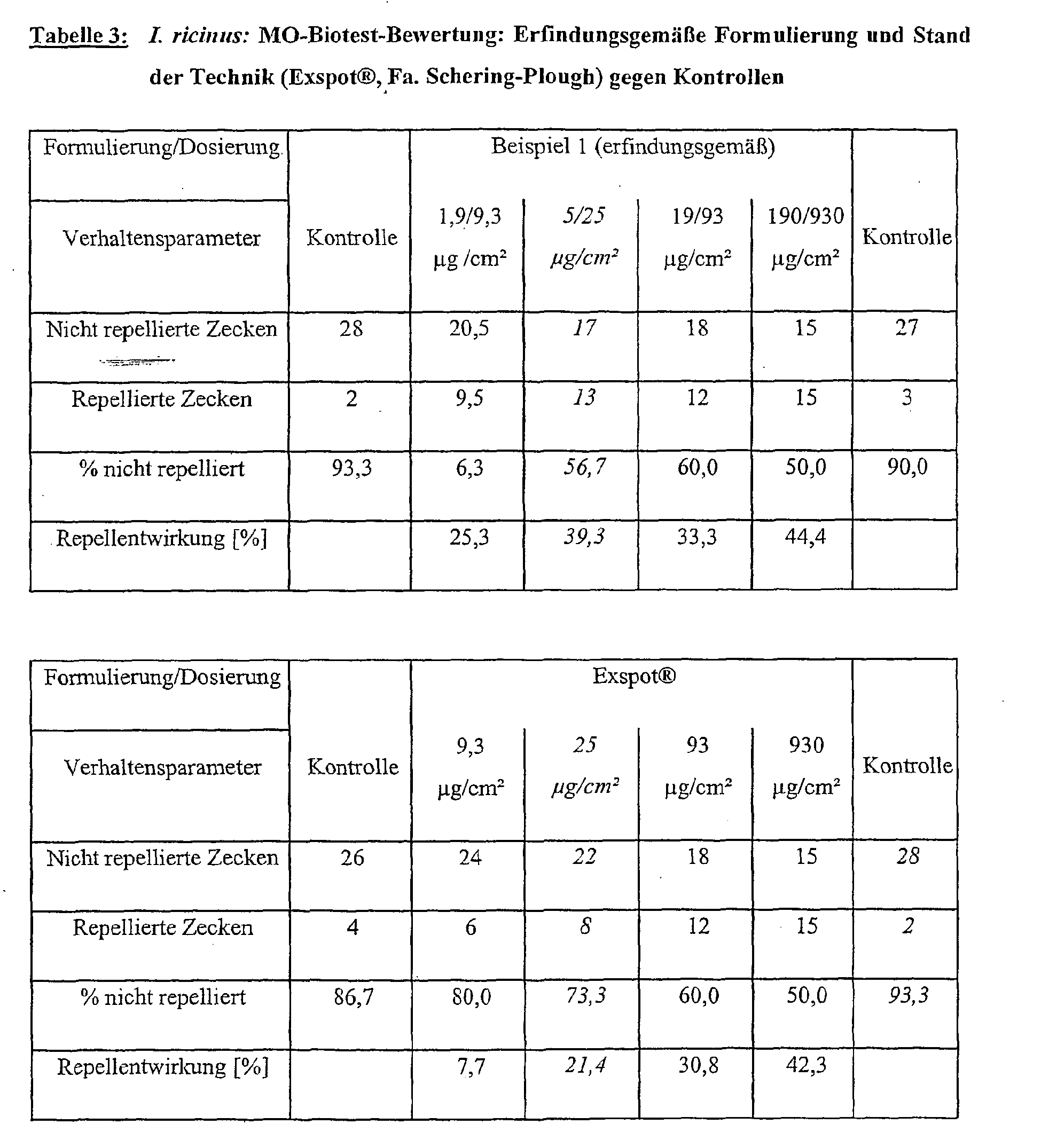
- Auch bei Ixodes, einer Zecke, die durch Exspot® nicht gut repelliert wird, zeigt das erfindungsgemäße Beispiel überraschenderweise eine deutlich verbesserte Repellentwirkung. Insbesondere bei geringen Dosierungen, wie sie zu Beginn einer Behandlung an von der Auftragsstelle des Spot-ons weiter entfernten Körperoberflächen sowie am Ende der Wirkdauer auf dem gesamten Tier zu erwarten sind zeigt das erfindungsgemäße Beispiel Repellenz im gleichen Bereich wie in den höheren Dosierungen, während die Kurve der Repellentwirkung beim Stand der Technik bereits um das 6-fache abgenommen hat.
- Erfindungsgemäße Formulierungen zeigen bei gleicher Aufwandmenge somit in den wichtigen Parametern Übertrittswahrscheinlichkeit auf die Oberfläche, Aufenthaltsdauer auf der Oberfläche sowie bei der Wirksamkeit bei geringeren Dosierungen eine deutlich verbesserte Repellentwirkung gegen Zecken gegenüber dem Stand der Technik.
- Kurzbeschreibung: Nach Exposition wurden die Zecken einzeln in Eppendorfgefäße mit gelochtem Deckel überführt und bei 90 % r.h. und 20°C aufbewahrt. Nach 24 Stunden und nach 7 Tagen wurden die Zecken mittels Binokular untersucht. Zecken, die zur koordinierten Bewegung in der Lage waren, wurden als lebendig gewertet. Zecken, die nur kleine Bewegungen mit den Tarsen oder Mundwerkzeugen machten oder unfähig zum Laufen waren, wurden als moribund gewertet. Zecken, die nach CO2-Stimulus oder Starklichtimpuls unbeweglich blieben, wurden als tot gewertet.
- Die Untersuchungen sollten zeigen, ob es einen Zusammenhang zwischen Expositionszeit (=Aufenthaltszeit auf der behandelten Trommelfläche während eines MO-Biotests) und der Mortalität bei unterschiedlichen Konzentrationen verschiedener Formulierungen im Vergleich zum Stand der Technik gibt.
Tabelle 1: R. sanguineus: Mortalität (d 7) und Kontaktzeiten bei verschiedenen Konzentrationen von Test Formulierungen im MO-Biotest. Formulierung Dosierung Mortalität Kontaktzeit [s] (a.i.) n % Mittel SD 95% Conf. Beispiel 1 16,6/83,1 µg/cm2 21 70 % 4,2 4,4 2,2-6,2 Exspot® 83,3 µg/cm2 16 53 % 24,7 33,5 6,9-42,6 Tabelle 2: I. ricinus: Mortalität (d 7)und Kontaktzeiten bei verschiedenen Konzentrationen von Test Formulierungen im MO-Biotest. Formulierung Dosierung Mortalität kontaktzeit [s] (a.i.) n % Mittel SD 95% Conf. Beispiel 1 19/93 µg/cm2 *) 27 90 33,7 30,6 21,6-45,9 Exspot® 93 µg/cm2 26 87 41,9 31,1 29,3-54,4 *) Der erste Wert bezieht sich auf die Imidacloprid-Menge, der zweite auf die Permethrin-Menge - Sowohl Ixodes als auch Rhipicephalus Zecken werden zu einem höheren Prozentsatz abgetötet, nachdem sie Kontakt mit der Trommeloberfläche hatten. Die für diese höhere Mortalität benötigte mittlere Kontaktzeit war dabei bei erfindungsgemäßen Formulierungen sogar noch kürzer als beim Stand der Technik.
- Somit schützen die erfmdungsgemäßen Formulierungen zusätzlich dadurch, dass repellierte Zecken auch nach kurzen Kontaktzeiten von deutlich weniger als 1 Minuten bereits abgetötet werden und somit weitere Wirte nicht mehr von repellierten Zecken befallen werden können.
Claims (5)
- Verwendung eines Pyrethroids oder Pyrethrins in Kombination mit einem Agonisten der nicotinergen Acetylcholinrezeptoren von Arthropoden zur Repellierung von Arthropoden bei warmblütigen Tieren.
- Verwendung gemäß Anspruch 1, wobei das Pyrethroid ausgewählt wird aus der Gruppe:I. Typ-1 PyrethroideII. Typ-II PyrethroideIII. Nicht-Ester-PyrethroideIV. Natürlichen Pyrethrine
- Verwendung gemäß Anspruch 1, wobei der nicotinische Agonist ausgewählt wird aus der Gruppe:V. NeonicotinoideVI. NithiazinVII. Spinosyne
- Verwendung gemäß Anspruch 1 zur Repellierung von Zecken, Flöhen, Mücken und/oder Fliegen an warmblütigen Tieren.
- Verfahren zur Repellierung von Arthropoden von warmblütigen Tieren, bei dem man ein Pyrethroid oder Pyrethrin in Kombination mit einem nicotinischen Agonisten topisch auf den Warmblüter appliziert.
Priority Applications (1)
| Application Number | Priority Date | Filing Date | Title |
|---|---|---|---|
| SI200431185T SI1587368T1 (sl) | 2003-01-17 | 2004-01-05 | Repelent |
Applications Claiming Priority (3)
| Application Number | Priority Date | Filing Date | Title |
|---|---|---|---|
| DE10301906 | 2003-01-17 | ||
| DE10301906A DE10301906A1 (de) | 2003-01-17 | 2003-01-17 | Repellentmittel |
| PCT/EP2004/000017 WO2004064522A1 (de) | 2003-01-17 | 2004-01-05 | Repellentmittel |
Publications (2)
| Publication Number | Publication Date |
|---|---|
| EP1587368A1 EP1587368A1 (de) | 2005-10-26 |
| EP1587368B1 true EP1587368B1 (de) | 2009-05-27 |
Family
ID=32602749
Family Applications (1)
| Application Number | Title | Priority Date | Filing Date |
|---|---|---|---|
| EP04700127A Expired - Lifetime EP1587368B1 (de) | 2003-01-17 | 2004-01-05 | Repellentmittel |
Country Status (32)
| Country | Link |
|---|---|
| US (1) | US20060211655A1 (de) |
| EP (1) | EP1587368B1 (de) |
| JP (5) | JP2006516970A (de) |
| KR (1) | KR20050094435A (de) |
| CN (1) | CN100591209C (de) |
| AR (1) | AR042898A1 (de) |
| AT (1) | ATE432008T1 (de) |
| AU (1) | AU2004206720B2 (de) |
| BR (1) | BRPI0406788A (de) |
| CA (1) | CA2513269C (de) |
| CO (1) | CO5640058A2 (de) |
| CR (1) | CR7898A (de) |
| DE (2) | DE10301906A1 (de) |
| DK (1) | DK1587368T3 (de) |
| ES (1) | ES2325504T3 (de) |
| GT (1) | GT200400005A (de) |
| HR (1) | HRP20050716B1 (de) |
| IL (1) | IL169515A (de) |
| MX (1) | MXPA05007246A (de) |
| MY (1) | MY148978A (de) |
| NO (1) | NO332114B1 (de) |
| NZ (1) | NZ541280A (de) |
| PE (1) | PE20040890A1 (de) |
| PL (1) | PL218068B1 (de) |
| PT (1) | PT1587368E (de) |
| RU (1) | RU2350079C2 (de) |
| SI (1) | SI1587368T1 (de) |
| TW (1) | TWI358991B (de) |
| UA (1) | UA83817C2 (de) |
| UY (1) | UY28165A1 (de) |
| WO (1) | WO2004064522A1 (de) |
| ZA (1) | ZA200505575B (de) |
Cited By (1)
| Publication number | Priority date | Publication date | Assignee | Title |
|---|---|---|---|---|
| EP4545067A1 (de) | 2023-10-25 | 2025-04-30 | Infectopharm Arzneimittel und Consilium GmbH | Hochdosierte dermal applizierbare permethrin-zubereitung mit erhöhtem drugload im zielkompartiment zur verbesserten behandlung von ektoparasiten befall |
Families Citing this family (36)
| Publication number | Priority date | Publication date | Assignee | Title |
|---|---|---|---|---|
| DE10301906A1 (de) * | 2003-01-17 | 2004-07-29 | Bayer Healthcare Ag | Repellentmittel |
| DE10320505A1 (de) * | 2003-05-08 | 2004-11-25 | Bayer Healthcare Ag | Mittel zum Bekämpfen von Parasiten an Tieren |
| JP2007518737A (ja) * | 2004-01-09 | 2007-07-12 | エフ エム シー コーポレーション | 一般家庭害虫の駆除のための殺虫剤組成物 |
| WO2005096820A1 (en) * | 2004-03-25 | 2005-10-20 | Fmc Corporation | Liquid termiticide compositions of pyrethroids and a neonicitinoids |
| DE102004020721A1 (de) * | 2004-04-28 | 2005-11-24 | Bayer Healthcare Ag | Dermal applizierbare flüssige Formulierungen zur Bekämpfung von parasitierenden Insekten an Tieren |
| EP1796463A4 (de) * | 2004-09-08 | 2012-09-19 | Summit Vetpharm Llc | Topische endoparasitizid- und ektoparasitizid-formulierungen |
| CN101180543B (zh) * | 2005-02-23 | 2014-06-18 | 美国陶氏益农公司 | 使用烟碱乙酰胆碱受体亚单位的新检测方法 |
| SG10201510684QA (en) * | 2007-06-07 | 2016-01-28 | Bayer Animal Health Gmbh | Control of ectoparasites |
| FR2922108A1 (fr) * | 2007-10-11 | 2009-04-17 | Virbac Sa | Utilisation d'un derive de 1-n-(halo-3-pyridylmethyle)-n-methylamino-1-alkylamino -2- nitroethylene pour la preparation d'une composition pharmaceutique veterinaire pour lutter contre les puces |
| EP2347652A1 (de) * | 2008-01-25 | 2011-07-27 | Rhodia Opérations | Esteramiden, deren Herstellung und deren Verwendung |
| ES2645751T3 (es) * | 2008-09-12 | 2017-12-07 | Dow Agrosciences Llc | Composiciones plaguicidas estabilizadas |
| US9005981B2 (en) | 2008-12-30 | 2015-04-14 | Dow Agrosciences Llc | Assays utilizing nicotinic acetylcholine receptor subunits |
| CN101874486B (zh) * | 2010-07-30 | 2014-02-12 | 湖南大方农化有限公司 | 含多杀菌素和醚菊酯的杀虫剂组合物 |
| WO2012124795A1 (en) * | 2011-03-17 | 2012-09-20 | Sumitomo Chemical Company, Limited | Pest control composition and pest control method |
| US9925167B2 (en) | 2011-06-30 | 2018-03-27 | Hansen-Ab Gmbh | Agents for the control of parasites on animals |
| CN102239878A (zh) * | 2011-07-05 | 2011-11-16 | 江苏丘陵地区镇江农业科学研究所 | 含有呋虫胺的杀虫剂组合物、剂型及其制备方法 |
| CN102246803A (zh) * | 2011-08-18 | 2011-11-23 | 南宁市德丰富化工有限责任公司 | 一种含呋虫胺的杀虫剂 |
| CN102396486A (zh) * | 2011-11-25 | 2012-04-04 | 陕西美邦农药有限公司 | 一种含醚菊酯和噻虫胺的杀虫组合物 |
| AR093342A1 (es) | 2012-11-06 | 2015-06-03 | Makhteshim Chem Works Ltd | Mezcla para el control de pestes |
| WO2014131786A1 (en) * | 2013-02-27 | 2014-09-04 | Krka, D.D., Novo Mesto | Veterinary composition for dermal application |
| US20160029638A1 (en) * | 2013-03-14 | 2016-02-04 | Sergeant's Pet Care Products, Inc. | Spot-on pesticide composition comprising a neonicotinoid and a pyrethroid |
| KR20160033103A (ko) * | 2013-07-18 | 2016-03-25 | 에프엠씨 코포레이션 | 선충 퇴치 조성물 |
| AU2014290035B2 (en) * | 2013-07-18 | 2017-01-19 | Fmc Corporation | Insect repellent |
| US8853282B1 (en) | 2014-05-22 | 2014-10-07 | Sumitomo Corporation | Topical liquid insecticide compositions |
| CA2992279C (en) | 2015-07-17 | 2019-07-09 | Evergreen Animal Health, Llc | Spot-on formulation for the control ectoparasites in animals |
| EP3175714B1 (de) | 2015-12-04 | 2019-01-16 | Universite D'angers | Synergistische insektizide zusammensetzungen enhaltend thiamethoxam und n-butyl-n-acetyl-3-ethylaminpropionat |
| US10492491B2 (en) | 2015-12-04 | 2019-12-03 | Universite D'angers | Insecticide composition including a synergistic agent |
| JP7175765B2 (ja) * | 2016-10-25 | 2022-11-21 | 三井化学アグロ株式会社 | 農薬液剤 |
| CN106577804B (zh) * | 2016-10-28 | 2019-09-20 | 华南农业大学 | 一种驱避天敌昆虫和蜜蜂的屏蔽保护型杀虫剂 |
| CN106561726B (zh) * | 2016-10-28 | 2019-09-20 | 华南农业大学 | 一种驱避天敌昆虫和蜜蜂的屏蔽保护型杀虫剂 |
| ES2792056T3 (es) | 2017-01-17 | 2020-11-06 | Evergreen Animal Health Llc | Novedosa formulación de un principio activo para unción puntual |
| RU2688302C1 (ru) * | 2018-01-10 | 2019-05-21 | Федеральное государственное бюджетное образовательное учреждение высшего образования "Ивановский государственный химико-технологический университет" (ИГХТУ) | Способ получения средства для защиты от укусов кровососущих насекомых |
| EP3771335A1 (de) | 2019-07-31 | 2021-02-03 | Athenion AG | Abweisende zusammensetzung |
| RU2733659C1 (ru) * | 2020-01-14 | 2020-10-06 | Общество с ограниченной ответственностью ГЕТ | Твердый инсектицид |
| US20230157281A1 (en) * | 2020-03-24 | 2023-05-25 | Texas Tech University System | Compositions and methods for repelling animals from an object |
| CN115530178A (zh) * | 2022-10-31 | 2022-12-30 | 原上科技(河南)有限公司 | 一种驱避触杀蜱虫的组合物及其制备方法和应用 |
Family Cites Families (35)
| Publication number | Priority date | Publication date | Assignee | Title |
|---|---|---|---|---|
| US4178384A (en) * | 1976-03-22 | 1979-12-11 | Fmc Corporation | Pyrethroid insect repellent |
| GB8612826D0 (en) * | 1986-05-27 | 1986-07-02 | Boots Co Plc | Insecticidal compositions |
| JP2553530B2 (ja) * | 1986-11-14 | 1996-11-13 | 日本バイエルアグロケム株式会社 | 農園芸用殺虫組成物 |
| DE59002510D1 (de) * | 1989-03-17 | 1993-10-07 | Bayer Ag | Mittel gegen Keratinschädlinge. |
| US5283229A (en) * | 1989-12-11 | 1994-02-01 | Isp Investments Inc. | Delivery system for agricultural chemicals |
| DE9012996U1 (de) * | 1990-09-12 | 1991-10-10 | Perycut-Chemie AG, Zürich | Insektizides Produkt |
| DE4141953A1 (de) * | 1991-12-19 | 1993-06-24 | Bayer Ag | Mikrobizide mittel |
| DE4417742A1 (de) * | 1994-05-20 | 1995-11-23 | Bayer Ag | Nicht-systemische Bekämpfung von Parasiten |
| DE4443888A1 (de) * | 1994-12-09 | 1996-06-13 | Bayer Ag | Dermal applizierbare Formulierungen von Parasitiziden |
| AU4648996A (en) * | 1995-06-07 | 1996-12-30 | Proguard, Inc. | Repellent compositions containing flavonoid aldehydes |
| DE19613334A1 (de) * | 1996-04-03 | 1997-10-09 | Bayer Ag | Mittel zur Bekämpfung parasitierender Insekten und Milben an Menschen |
| DK0915656T3 (da) * | 1996-04-29 | 2003-11-10 | Syngenta Participations Ag | Pesticid sammensætning |
| CN1176052A (zh) * | 1997-07-23 | 1998-03-18 | 张天良 | 一种杀虫剂 |
| GR1008462B (el) * | 1998-01-16 | 2015-04-08 | Novartis Ag, | Χρηση νεονικοτινοειδων στον ελεγχο ζιζανιων |
| DE19807630A1 (de) * | 1998-02-23 | 1999-08-26 | Bayer Ag | Wasserhaltige Mittel zur Bekämpfung parasitierender Insekten und Milben an Menschen |
| JP4196427B2 (ja) * | 1998-04-09 | 2008-12-17 | 住友化学株式会社 | 有害節足動物駆除組成物 |
| CN1236547A (zh) * | 1998-05-21 | 1999-12-01 | 张天良 | 一种杀虫剂 |
| US6646011B2 (en) * | 1998-06-03 | 2003-11-11 | Johnson & Johnson Consumer Companies, Inc. | Insect repellant compositions |
| NZ509118A (en) * | 1998-07-02 | 2003-02-28 | Lilly Co Eli | Formulations for controlling human lice containing spinosyn |
| US6201017B1 (en) * | 1998-07-27 | 2001-03-13 | Sumitomo Chemical Co., Ltd. | Ectoparasite controlling agent for animals |
| CN1234181A (zh) * | 1999-01-08 | 1999-11-10 | 吕玉成 | 高效氯氰菊脂吡虫啉乳油 |
| JP2001139403A (ja) * | 1999-11-10 | 2001-05-22 | Sumika Life Tech Co Ltd | 動物の外部寄生虫駆除剤 |
| US6660690B2 (en) * | 2000-10-06 | 2003-12-09 | Monsanto Technology, L.L.C. | Seed treatment with combinations of insecticides |
| US6838473B2 (en) * | 2000-10-06 | 2005-01-04 | Monsanto Technology Llc | Seed treatment with combinations of pyrethrins/pyrethroids and clothiandin |
| US6903093B2 (en) * | 2000-10-06 | 2005-06-07 | Monsanto Technology Llc | Seed treatment with combinations of pyrethrins/pyrethroids and thiamethoxam |
| EP1330163B1 (de) * | 2000-10-07 | 2004-06-23 | Bayer CropScience GmbH | Pestizide zusammensetzung |
| AU2002223608A1 (en) * | 2000-10-17 | 2002-04-29 | Telefonaktiebolaget Lm Ericsson (Publ) | Communications systems |
| JP4972843B2 (ja) * | 2000-11-09 | 2012-07-11 | 住友化学株式会社 | 動物外部寄生虫防除用経皮投与剤 |
| AU778580B2 (en) * | 2000-11-09 | 2004-12-09 | Sumitomo Chemical Company, Limited | Ectoparasite control compositions |
| US20020103233A1 (en) * | 2000-11-30 | 2002-08-01 | Arther Robert G. | Compositions for enhanced acaricidal activity |
| DE10115225A1 (de) * | 2001-03-28 | 2002-12-19 | Bayer Ag | Wirkstoffhaltige Formkörper auf Basis thermoplastisch verarbeitbarer Polyurethane zur Bekämpfung von Parasiten |
| DE10117676A1 (de) * | 2001-04-09 | 2002-10-10 | Bayer Ag | Dermal applizierbare flüssige Formulierungen zur Bekämpfung von parasitierenden Insekten an Tieren |
| JP4865964B2 (ja) * | 2001-08-08 | 2012-02-01 | 住化エンビロサイエンス株式会社 | 環状シート型害虫駆除剤 |
| JP4145033B2 (ja) * | 2001-08-22 | 2008-09-03 | 有限会社コーエン | 防蟻性非発泡合成樹脂シート、およびその製造方法 |
| DE10301906A1 (de) * | 2003-01-17 | 2004-07-29 | Bayer Healthcare Ag | Repellentmittel |
-
2003
- 2003-01-17 DE DE10301906A patent/DE10301906A1/de not_active Withdrawn
-
2004
- 2004-01-05 DK DK04700127T patent/DK1587368T3/da active
- 2004-01-05 KR KR1020057013030A patent/KR20050094435A/ko not_active Ceased
- 2004-01-05 PT PT04700127T patent/PT1587368E/pt unknown
- 2004-01-05 AT AT04700127T patent/ATE432008T1/de active
- 2004-01-05 HR HRP20050716AA patent/HRP20050716B1/hr not_active IP Right Cessation
- 2004-01-05 RU RU2005125895/04A patent/RU2350079C2/ru active
- 2004-01-05 ES ES04700127T patent/ES2325504T3/es not_active Expired - Lifetime
- 2004-01-05 DE DE502004009524T patent/DE502004009524D1/de not_active Expired - Lifetime
- 2004-01-05 WO PCT/EP2004/000017 patent/WO2004064522A1/de not_active Ceased
- 2004-01-05 US US10/541,087 patent/US20060211655A1/en not_active Abandoned
- 2004-01-05 PL PL376299A patent/PL218068B1/pl unknown
- 2004-01-05 JP JP2006500515A patent/JP2006516970A/ja active Pending
- 2004-01-05 UA UAA200508125A patent/UA83817C2/ru unknown
- 2004-01-05 SI SI200431185T patent/SI1587368T1/sl unknown
- 2004-01-05 MX MXPA05007246A patent/MXPA05007246A/es active IP Right Grant
- 2004-01-05 NZ NZ541280A patent/NZ541280A/en not_active IP Right Cessation
- 2004-01-05 EP EP04700127A patent/EP1587368B1/de not_active Expired - Lifetime
- 2004-01-05 BR BR0406788-6A patent/BRPI0406788A/pt active IP Right Grant
- 2004-01-05 CA CA2513269A patent/CA2513269C/en not_active Expired - Lifetime
- 2004-01-05 CN CN200480002274A patent/CN100591209C/zh not_active Expired - Lifetime
- 2004-01-05 AU AU2004206720A patent/AU2004206720B2/en not_active Expired
- 2004-01-14 MY MYPI20040094A patent/MY148978A/en unknown
- 2004-01-15 GT GT200400005A patent/GT200400005A/es unknown
- 2004-01-16 PE PE2004000072A patent/PE20040890A1/es not_active Application Discontinuation
- 2004-01-16 AR ARP040100120A patent/AR042898A1/es unknown
- 2004-01-16 TW TW093101098A patent/TWI358991B/zh not_active IP Right Cessation
- 2004-01-19 UY UY28165A patent/UY28165A1/es not_active Application Discontinuation
-
2005
- 2005-07-04 IL IL169515A patent/IL169515A/en active IP Right Grant
- 2005-07-06 CR CR7898A patent/CR7898A/es not_active Application Discontinuation
- 2005-07-12 ZA ZA200505575A patent/ZA200505575B/en unknown
- 2005-08-12 NO NO20053811A patent/NO332114B1/no not_active IP Right Cessation
- 2005-08-17 CO CO05081495A patent/CO5640058A2/es not_active Application Discontinuation
-
2011
- 2011-04-07 JP JP2011085589A patent/JP5728666B2/ja not_active Expired - Lifetime
-
2014
- 2014-12-18 JP JP2014256669A patent/JP2015096534A/ja active Pending
-
2017
- 2017-02-28 JP JP2017036183A patent/JP6863771B2/ja not_active Expired - Lifetime
-
2018
- 2018-12-26 JP JP2018242294A patent/JP2019059788A/ja not_active Withdrawn
Cited By (2)
| Publication number | Priority date | Publication date | Assignee | Title |
|---|---|---|---|---|
| EP4545067A1 (de) | 2023-10-25 | 2025-04-30 | Infectopharm Arzneimittel und Consilium GmbH | Hochdosierte dermal applizierbare permethrin-zubereitung mit erhöhtem drugload im zielkompartiment zur verbesserten behandlung von ektoparasiten befall |
| WO2025088039A1 (de) | 2023-10-25 | 2025-05-01 | Infectopharm Arzneimittel Und Consilium Gmbh | Hochkonzentrierte dermal applizierbare permethrin-zubereitung mit erhöhtem drugload im zielkompartiment zur verbesserten behandlung von ektoparasiten-befall |
Also Published As
Similar Documents
| Publication | Publication Date | Title |
|---|---|---|
| WO2004064522A1 (de) | Repellentmittel | |
| EP1379138B1 (de) | Dermal applizierbare flüssige formulierungen zur bekämpfung von parasitierenden insekten an tieren | |
| EP1624756B1 (de) | Mittel zum bekämpfen von parasiten an tieren | |
| EP2104428B1 (de) | Kombinationsprodukt zur bekämpfung von parasiten an tieren | |
| EP1241943B1 (de) | Verwendung von polysiloxanen mit quartären aminogruppen als formulierungshilfsmittel und mittel enthaltend dieselben | |
| EP2725899B1 (de) | Mittel zur bekämpfung von parasiten an tieren | |
| DE69920828T2 (de) | Mittel zur Bekämpfung von Ektoparasiten bei Tieren | |
| WO2005089550A2 (de) | Parasitizide mittel | |
| HK1088790B (en) | Repellent |
Legal Events
| Date | Code | Title | Description |
|---|---|---|---|
| PUAI | Public reference made under article 153(3) epc to a published international application that has entered the european phase |
Free format text: ORIGINAL CODE: 0009012 |
|
| 17P | Request for examination filed |
Effective date: 20050817 |
|
| AK | Designated contracting states |
Kind code of ref document: A1 Designated state(s): AT BE BG CH CY CZ DE DK EE ES FI FR GB GR HU IE IT LI LU MC NL PT RO SE SI SK TR |
|
| AX | Request for extension of the european patent |
Extension state: AL LT LV MK |
|
| DAX | Request for extension of the european patent (deleted) | ||
| 17Q | First examination report despatched |
Effective date: 20071011 |
|
| RAP1 | Party data changed (applicant data changed or rights of an application transferred) |
Owner name: BAYER ANIMAL HEALTH GMBH |
|
| GRAP | Despatch of communication of intention to grant a patent |
Free format text: ORIGINAL CODE: EPIDOSNIGR1 |
|
| RIC1 | Information provided on ipc code assigned before grant |
Ipc: A01N 31/14 20060101ALI20081119BHEP Ipc: A01N 37/38 20060101ALI20081119BHEP Ipc: A01N 53/00 20060101AFI20081119BHEP Ipc: A01N 55/00 20060101ALI20081119BHEP Ipc: A01N 37/34 20060101ALI20081119BHEP |
|
| GRAS | Grant fee paid |
Free format text: ORIGINAL CODE: EPIDOSNIGR3 |
|
| GRAA | (expected) grant |
Free format text: ORIGINAL CODE: 0009210 |
|
| AK | Designated contracting states |
Kind code of ref document: B1 Designated state(s): AT BE BG CH CY CZ DE DK EE ES FI FR GB GR HU IE IT LI LU MC NL PT RO SE SI SK TR |
|
| REG | Reference to a national code |
Ref country code: GB Ref legal event code: FG4D Free format text: NOT ENGLISH |
|
| REG | Reference to a national code |
Ref country code: CH Ref legal event code: EP |
|
| REG | Reference to a national code |
Ref country code: IE Ref legal event code: FG4D Free format text: LANGUAGE OF EP DOCUMENT: GERMAN |
|
| REF | Corresponds to: |
Ref document number: 502004009524 Country of ref document: DE Date of ref document: 20090709 Kind code of ref document: P |
|
| REG | Reference to a national code |
Ref country code: PT Ref legal event code: SC4A Free format text: AVAILABILITY OF NATIONAL TRANSLATION Effective date: 20090707 |
|
| REG | Reference to a national code |
Ref country code: CH Ref legal event code: NV Representative=s name: E. BLUM & CO. AG PATENT- UND MARKENANWAELTE VSP |
|
| REG | Reference to a national code |
Ref country code: DK Ref legal event code: T3 Ref country code: ES Ref legal event code: FG2A Ref document number: 2325504 Country of ref document: ES Kind code of ref document: T3 |
|
| REG | Reference to a national code |
Ref country code: EE Ref legal event code: FG4A Ref document number: E003376 Country of ref document: EE Effective date: 20090807 |
|
| PG25 | Lapsed in a contracting state [announced via postgrant information from national office to epo] |
Ref country code: FI Free format text: LAPSE BECAUSE OF FAILURE TO SUBMIT A TRANSLATION OF THE DESCRIPTION OR TO PAY THE FEE WITHIN THE PRESCRIBED TIME-LIMIT Effective date: 20090527 |
|
| PG25 | Lapsed in a contracting state [announced via postgrant information from national office to epo] |
Ref country code: SE Free format text: LAPSE BECAUSE OF FAILURE TO SUBMIT A TRANSLATION OF THE DESCRIPTION OR TO PAY THE FEE WITHIN THE PRESCRIBED TIME-LIMIT Effective date: 20090827 |
|
| REG | Reference to a national code |
Ref country code: HU Ref legal event code: AG4A Ref document number: E006265 Country of ref document: HU |
|
| PG25 | Lapsed in a contracting state [announced via postgrant information from national office to epo] |
Ref country code: RO Free format text: LAPSE BECAUSE OF FAILURE TO SUBMIT A TRANSLATION OF THE DESCRIPTION OR TO PAY THE FEE WITHIN THE PRESCRIBED TIME-LIMIT Effective date: 20090527 |
|
| PG25 | Lapsed in a contracting state [announced via postgrant information from national office to epo] |
Ref country code: BG Free format text: LAPSE BECAUSE OF FAILURE TO SUBMIT A TRANSLATION OF THE DESCRIPTION OR TO PAY THE FEE WITHIN THE PRESCRIBED TIME-LIMIT Effective date: 20090827 |
|
| PLBE | No opposition filed within time limit |
Free format text: ORIGINAL CODE: 0009261 |
|
| STAA | Information on the status of an ep patent application or granted ep patent |
Free format text: STATUS: NO OPPOSITION FILED WITHIN TIME LIMIT |
|
| 26N | No opposition filed |
Effective date: 20100302 |
|
| PG25 | Lapsed in a contracting state [announced via postgrant information from national office to epo] |
Ref country code: MC Free format text: LAPSE BECAUSE OF NON-PAYMENT OF DUE FEES Effective date: 20100131 |
|
| PG25 | Lapsed in a contracting state [announced via postgrant information from national office to epo] |
Ref country code: GR Free format text: LAPSE BECAUSE OF FAILURE TO SUBMIT A TRANSLATION OF THE DESCRIPTION OR TO PAY THE FEE WITHIN THE PRESCRIBED TIME-LIMIT Effective date: 20090828 |
|
| PG25 | Lapsed in a contracting state [announced via postgrant information from national office to epo] |
Ref country code: CY Free format text: LAPSE BECAUSE OF FAILURE TO SUBMIT A TRANSLATION OF THE DESCRIPTION OR TO PAY THE FEE WITHIN THE PRESCRIBED TIME-LIMIT Effective date: 20090527 |
|
| PG25 | Lapsed in a contracting state [announced via postgrant information from national office to epo] |
Ref country code: LU Free format text: LAPSE BECAUSE OF NON-PAYMENT OF DUE FEES Effective date: 20100105 |
|
| PG25 | Lapsed in a contracting state [announced via postgrant information from national office to epo] |
Ref country code: TR Free format text: LAPSE BECAUSE OF FAILURE TO SUBMIT A TRANSLATION OF THE DESCRIPTION OR TO PAY THE FEE WITHIN THE PRESCRIBED TIME-LIMIT Effective date: 20090527 |
|
| REG | Reference to a national code |
Ref country code: CH Ref legal event code: PUE Owner name: BAYER INTELLECTUAL PROPERTY GMBH, DE Free format text: FORMER OWNER: BAYER ANIMAL HEALTH GMBH, DE |
|
| REG | Reference to a national code |
Ref country code: HU Ref legal event code: GB9C Owner name: BAYER INTELLECTUAL PROPERTY GMBH, DE Free format text: FORMER OWNER(S): BAYER ANIMAL HEALTH GMBH, DE Ref country code: HU Ref legal event code: FH1C Free format text: FORMER REPRESENTATIVE(S): DR. KERENY JUDIT, DANUBIA SZABADALMI ES VEDJEGY IRODA KFT., HU Representative=s name: DANUBIA SZABADALMI ES JOGI IRODA KFT., HU |
|
| REG | Reference to a national code |
Ref country code: DE Ref legal event code: R081 Ref document number: 502004009524 Country of ref document: DE Owner name: BAYER INTELLECTUAL PROPERTY GMBH, DE Free format text: FORMER OWNER: BAYER ANIMAL HEALTH GMBH, 51373 LEVERKUSEN, DE Effective date: 20121119 |
|
| REG | Reference to a national code |
Ref country code: SI Ref legal event code: SP73 Owner name: BAYER INTELLECTUAL PROPERTY GMBH; DE Effective date: 20121204 |
|
| REG | Reference to a national code |
Ref country code: SK Ref legal event code: PC4A Ref document number: E 5727 Country of ref document: SK Owner name: BAYER INTELLECTUAL PROPERTY GMBH, MONHEIM AM R, DE Free format text: FORMER OWNER: BAYER ANIMAL HEALTH GMBH, LEVERKUSEN, DE Effective date: 20121011 |
|
| REG | Reference to a national code |
Ref country code: PT Ref legal event code: PC4A Owner name: BAYER INTELLECTUAL PROPERTY GMBH, DE Effective date: 20130206 Ref country code: EE Ref legal event code: GB1A Ref document number: E003376 Country of ref document: EE |
|
| REG | Reference to a national code |
Ref country code: FR Ref legal event code: TP Owner name: BAYER INTELLECTUAL PROPERTY GMBH, DE Effective date: 20130320 |
|
| REG | Reference to a national code |
Ref country code: ES Ref legal event code: PC2A Owner name: BAYER INTELLECTUAL PROPERTY GMBH Effective date: 20130417 |
|
| REG | Reference to a national code |
Ref country code: AT Ref legal event code: PC Ref document number: 432008 Country of ref document: AT Kind code of ref document: T Owner name: BAYER INTELLECTUAL PROPERTY GMBH, DE Effective date: 20131211 |
|
| REG | Reference to a national code |
Ref country code: GB Ref legal event code: 732E Free format text: REGISTERED BETWEEN 20140306 AND 20140312 |
|
| REG | Reference to a national code |
Ref country code: NL Ref legal event code: SD Effective date: 20140820 |
|
| REG | Reference to a national code |
Ref country code: FR Ref legal event code: PLFP Year of fee payment: 13 |
|
| REG | Reference to a national code |
Ref country code: FR Ref legal event code: PLFP Year of fee payment: 14 |
|
| REG | Reference to a national code |
Ref country code: DE Ref legal event code: R008 Ref document number: 502004009524 Country of ref document: DE Ref country code: DE Ref legal event code: R039 Ref document number: 502004009524 Country of ref document: DE |
|
| REG | Reference to a national code |
Ref country code: FR Ref legal event code: PLFP Year of fee payment: 15 |
|
| REG | Reference to a national code |
Ref country code: DE Ref legal event code: R040 Ref document number: 502004009524 Country of ref document: DE |
|
| PGFP | Annual fee paid to national office [announced via postgrant information from national office to epo] |
Ref country code: SK Payment date: 20221221 Year of fee payment: 20 Ref country code: NL Payment date: 20221220 Year of fee payment: 20 Ref country code: IE Payment date: 20221227 Year of fee payment: 20 Ref country code: GB Payment date: 20221214 Year of fee payment: 20 Ref country code: FR Payment date: 20221216 Year of fee payment: 20 Ref country code: EE Payment date: 20221219 Year of fee payment: 20 Ref country code: CZ Payment date: 20221223 Year of fee payment: 20 |
|
| PGFP | Annual fee paid to national office [announced via postgrant information from national office to epo] |
Ref country code: PT Payment date: 20221227 Year of fee payment: 20 Ref country code: BE Payment date: 20221220 Year of fee payment: 20 |
|
| PGFP | Annual fee paid to national office [announced via postgrant information from national office to epo] |
Ref country code: ES Payment date: 20230208 Year of fee payment: 20 Ref country code: DK Payment date: 20230103 Year of fee payment: 20 Ref country code: CH Payment date: 20230201 Year of fee payment: 20 Ref country code: AT Payment date: 20221227 Year of fee payment: 20 |
|
| PGFP | Annual fee paid to national office [announced via postgrant information from national office to epo] |
Ref country code: SI Payment date: 20221221 Year of fee payment: 20 Ref country code: IT Payment date: 20230116 Year of fee payment: 20 Ref country code: HU Payment date: 20221219 Year of fee payment: 20 Ref country code: DE Payment date: 20221215 Year of fee payment: 20 |
|
| REG | Reference to a national code |
Ref country code: DE Ref legal event code: R071 Ref document number: 502004009524 Country of ref document: DE |
|
| REG | Reference to a national code |
Ref country code: DK Ref legal event code: EUP Expiry date: 20240105 |
|
| REG | Reference to a national code |
Ref country code: NL Ref legal event code: MK Effective date: 20240104 |
|
| REG | Reference to a national code |
Ref country code: CH Ref legal event code: PL |
|
| REG | Reference to a national code |
Ref country code: GB Ref legal event code: PE20 Expiry date: 20240104 Ref country code: SK Ref legal event code: MK4A Ref document number: E 5727 Country of ref document: SK Expiry date: 20240105 |
|
| REG | Reference to a national code |
Ref country code: ES Ref legal event code: FD2A Effective date: 20240126 |
|
| REG | Reference to a national code |
Ref country code: BE Ref legal event code: MK Effective date: 20240105 |
|
| PG25 | Lapsed in a contracting state [announced via postgrant information from national office to epo] |
Ref country code: SI Free format text: LAPSE BECAUSE OF EXPIRATION OF PROTECTION Effective date: 20240106 Ref country code: CZ Free format text: LAPSE BECAUSE OF EXPIRATION OF PROTECTION Effective date: 20240105 |
|
| REG | Reference to a national code |
Ref country code: AT Ref legal event code: MK07 Ref document number: 432008 Country of ref document: AT Kind code of ref document: T Effective date: 20240105 |
|
| REG | Reference to a national code |
Ref country code: IE Ref legal event code: MK9A |
|
| PG25 | Lapsed in a contracting state [announced via postgrant information from national office to epo] |
Ref country code: IE Free format text: LAPSE BECAUSE OF EXPIRATION OF PROTECTION Effective date: 20240105 Ref country code: ES Free format text: LAPSE BECAUSE OF EXPIRATION OF PROTECTION Effective date: 20240106 |
|
| PG25 | Lapsed in a contracting state [announced via postgrant information from national office to epo] |
Ref country code: IE Free format text: LAPSE BECAUSE OF EXPIRATION OF PROTECTION Effective date: 20240105 Ref country code: ES Free format text: LAPSE BECAUSE OF EXPIRATION OF PROTECTION Effective date: 20240106 Ref country code: SK Free format text: LAPSE BECAUSE OF EXPIRATION OF PROTECTION Effective date: 20240105 Ref country code: PT Free format text: LAPSE BECAUSE OF EXPIRATION OF PROTECTION Effective date: 20240115 Ref country code: GB Free format text: LAPSE BECAUSE OF EXPIRATION OF PROTECTION Effective date: 20240104 |