EP1549736B1 - Zymomonas pentose-sugar fermentating strains and uses thereof - Google Patents
Zymomonas pentose-sugar fermentating strains and uses thereof Download PDFInfo
- Publication number
- EP1549736B1 EP1549736B1 EP03799754A EP03799754A EP1549736B1 EP 1549736 B1 EP1549736 B1 EP 1549736B1 EP 03799754 A EP03799754 A EP 03799754A EP 03799754 A EP03799754 A EP 03799754A EP 1549736 B1 EP1549736 B1 EP 1549736B1
- Authority
- EP
- European Patent Office
- Prior art keywords
- pentose
- fermenting
- zymomonas
- xylose
- plasmid
- Prior art date
- Legal status (The legal status is an assumption and is not a legal conclusion. Google has not performed a legal analysis and makes no representation as to the accuracy of the status listed.)
- Expired - Lifetime
Links
- 0 C*NC(C)C* Chemical compound C*NC(C)C* 0.000 description 1
Images












Classifications
-
- C—CHEMISTRY; METALLURGY
- C12—BIOCHEMISTRY; BEER; SPIRITS; WINE; VINEGAR; MICROBIOLOGY; ENZYMOLOGY; MUTATION OR GENETIC ENGINEERING
- C12N—MICROORGANISMS OR ENZYMES; COMPOSITIONS THEREOF; PROPAGATING, PRESERVING, OR MAINTAINING MICROORGANISMS; MUTATION OR GENETIC ENGINEERING; CULTURE MEDIA
- C12N9/00—Enzymes; Proenzymes; Compositions thereof; Processes for preparing, activating, inhibiting, separating or purifying enzymes
- C12N9/10—Transferases (2.)
- C12N9/1022—Transferases (2.) transferring aldehyde or ketonic groups (2.2)
-
- C—CHEMISTRY; METALLURGY
- C12—BIOCHEMISTRY; BEER; SPIRITS; WINE; VINEGAR; MICROBIOLOGY; ENZYMOLOGY; MUTATION OR GENETIC ENGINEERING
- C12N—MICROORGANISMS OR ENZYMES; COMPOSITIONS THEREOF; PROPAGATING, PRESERVING, OR MAINTAINING MICROORGANISMS; MUTATION OR GENETIC ENGINEERING; CULTURE MEDIA
- C12N15/00—Mutation or genetic engineering; DNA or RNA concerning genetic engineering, vectors, e.g. plasmids, or their isolation, preparation or purification; Use of hosts therefor
- C12N15/09—Recombinant DNA-technology
- C12N15/11—DNA or RNA fragments; Modified forms thereof; Non-coding nucleic acids having a biological activity
- C12N15/52—Genes encoding for enzymes or proenzymes
-
- C—CHEMISTRY; METALLURGY
- C12—BIOCHEMISTRY; BEER; SPIRITS; WINE; VINEGAR; MICROBIOLOGY; ENZYMOLOGY; MUTATION OR GENETIC ENGINEERING
- C12N—MICROORGANISMS OR ENZYMES; COMPOSITIONS THEREOF; PROPAGATING, PRESERVING, OR MAINTAINING MICROORGANISMS; MUTATION OR GENETIC ENGINEERING; CULTURE MEDIA
- C12N15/00—Mutation or genetic engineering; DNA or RNA concerning genetic engineering, vectors, e.g. plasmids, or their isolation, preparation or purification; Use of hosts therefor
- C12N15/09—Recombinant DNA-technology
- C12N15/63—Introduction of foreign genetic material using vectors; Vectors; Use of hosts therefor; Regulation of expression
- C12N15/74—Vectors or expression systems specially adapted for prokaryotic hosts other than E. coli, e.g. Lactobacillus, Micromonospora
-
- C—CHEMISTRY; METALLURGY
- C12—BIOCHEMISTRY; BEER; SPIRITS; WINE; VINEGAR; MICROBIOLOGY; ENZYMOLOGY; MUTATION OR GENETIC ENGINEERING
- C12N—MICROORGANISMS OR ENZYMES; COMPOSITIONS THEREOF; PROPAGATING, PRESERVING, OR MAINTAINING MICROORGANISMS; MUTATION OR GENETIC ENGINEERING; CULTURE MEDIA
- C12N15/00—Mutation or genetic engineering; DNA or RNA concerning genetic engineering, vectors, e.g. plasmids, or their isolation, preparation or purification; Use of hosts therefor
- C12N15/09—Recombinant DNA-technology
- C12N15/87—Introduction of foreign genetic material using processes not otherwise provided for, e.g. co-transformation
- C12N15/90—Stable introduction of foreign DNA into chromosome
-
- C—CHEMISTRY; METALLURGY
- C12—BIOCHEMISTRY; BEER; SPIRITS; WINE; VINEGAR; MICROBIOLOGY; ENZYMOLOGY; MUTATION OR GENETIC ENGINEERING
- C12N—MICROORGANISMS OR ENZYMES; COMPOSITIONS THEREOF; PROPAGATING, PRESERVING, OR MAINTAINING MICROORGANISMS; MUTATION OR GENETIC ENGINEERING; CULTURE MEDIA
- C12N15/00—Mutation or genetic engineering; DNA or RNA concerning genetic engineering, vectors, e.g. plasmids, or their isolation, preparation or purification; Use of hosts therefor
- C12N15/09—Recombinant DNA-technology
- C12N15/87—Introduction of foreign genetic material using processes not otherwise provided for, e.g. co-transformation
- C12N15/90—Stable introduction of foreign DNA into chromosome
- C12N15/902—Stable introduction of foreign DNA into chromosome using homologous recombination
-
- C—CHEMISTRY; METALLURGY
- C12—BIOCHEMISTRY; BEER; SPIRITS; WINE; VINEGAR; MICROBIOLOGY; ENZYMOLOGY; MUTATION OR GENETIC ENGINEERING
- C12N—MICROORGANISMS OR ENZYMES; COMPOSITIONS THEREOF; PROPAGATING, PRESERVING, OR MAINTAINING MICROORGANISMS; MUTATION OR GENETIC ENGINEERING; CULTURE MEDIA
- C12N9/00—Enzymes; Proenzymes; Compositions thereof; Processes for preparing, activating, inhibiting, separating or purifying enzymes
- C12N9/10—Transferases (2.)
- C12N9/12—Transferases (2.) transferring phosphorus containing groups, e.g. kinases (2.7)
- C12N9/1205—Phosphotransferases with an alcohol group as acceptor (2.7.1), e.g. protein kinases
-
- C—CHEMISTRY; METALLURGY
- C12—BIOCHEMISTRY; BEER; SPIRITS; WINE; VINEGAR; MICROBIOLOGY; ENZYMOLOGY; MUTATION OR GENETIC ENGINEERING
- C12N—MICROORGANISMS OR ENZYMES; COMPOSITIONS THEREOF; PROPAGATING, PRESERVING, OR MAINTAINING MICROORGANISMS; MUTATION OR GENETIC ENGINEERING; CULTURE MEDIA
- C12N9/00—Enzymes; Proenzymes; Compositions thereof; Processes for preparing, activating, inhibiting, separating or purifying enzymes
- C12N9/90—Isomerases (5.)
- C12N9/92—Glucose isomerase (5.3.1.5; 5.3.1.9; 5.3.1.18)
-
- C—CHEMISTRY; METALLURGY
- C12—BIOCHEMISTRY; BEER; SPIRITS; WINE; VINEGAR; MICROBIOLOGY; ENZYMOLOGY; MUTATION OR GENETIC ENGINEERING
- C12P—FERMENTATION OR ENZYME-USING PROCESSES TO SYNTHESISE A DESIRED CHEMICAL COMPOUND OR COMPOSITION OR TO SEPARATE OPTICAL ISOMERS FROM A RACEMIC MIXTURE
- C12P7/00—Preparation of oxygen-containing organic compounds
- C12P7/02—Preparation of oxygen-containing organic compounds containing a hydroxy group
- C12P7/04—Preparation of oxygen-containing organic compounds containing a hydroxy group acyclic
- C12P7/06—Ethanol, i.e. non-beverage
-
- C—CHEMISTRY; METALLURGY
- C12—BIOCHEMISTRY; BEER; SPIRITS; WINE; VINEGAR; MICROBIOLOGY; ENZYMOLOGY; MUTATION OR GENETIC ENGINEERING
- C12P—FERMENTATION OR ENZYME-USING PROCESSES TO SYNTHESISE A DESIRED CHEMICAL COMPOUND OR COMPOSITION OR TO SEPARATE OPTICAL ISOMERS FROM A RACEMIC MIXTURE
- C12P7/00—Preparation of oxygen-containing organic compounds
- C12P7/02—Preparation of oxygen-containing organic compounds containing a hydroxy group
- C12P7/04—Preparation of oxygen-containing organic compounds containing a hydroxy group acyclic
- C12P7/06—Ethanol, i.e. non-beverage
- C12P7/065—Ethanol, i.e. non-beverage with microorganisms other than yeasts
-
- Y—GENERAL TAGGING OF NEW TECHNOLOGICAL DEVELOPMENTS; GENERAL TAGGING OF CROSS-SECTIONAL TECHNOLOGIES SPANNING OVER SEVERAL SECTIONS OF THE IPC; TECHNICAL SUBJECTS COVERED BY FORMER USPC CROSS-REFERENCE ART COLLECTIONS [XRACs] AND DIGESTS
- Y02—TECHNOLOGIES OR APPLICATIONS FOR MITIGATION OR ADAPTATION AGAINST CLIMATE CHANGE
- Y02E—REDUCTION OF GREENHOUSE GAS [GHG] EMISSIONS, RELATED TO ENERGY GENERATION, TRANSMISSION OR DISTRIBUTION
- Y02E50/00—Technologies for the production of fuel of non-fossil origin
- Y02E50/10—Biofuels, e.g. bio-diesel
Definitions
- the present invention relates to the biological conversion of cellulosic substrates into fuels and chemicals, and in particular to recombinant Zymonioizas mobilis strains which ferment xylose, arabinose, and mannose or all of these into ethanol.
- Fermentation technology is useful for the conversion renewable biomass cellulose substrates into fuels and chemicals, such as ethanol.
- a typical substrate is comprised of 35-45% cellulose, 30-40% hemicellulose, and 15% lignin.
- the hydrolysis fraction contains glucose polymers, and the hemicellulose fraction contains mostly xylose.
- Arabinose is also a significant fermentable substrate found in biomass materials, such as switchgrass grass and corn fiber.
- Z. mobilis is widely reported for its ability to rapidly and efficiently convert glucose substrates into ethanol, at a low pH, in an anaerobic culture, and in a medium which contains the inhibitory compounds typically associated with a lignocellulose-hydrolysate.
- a distinct disadvantage in the use of Z. mobiles is, however, that it does not ferment pentose sugars.
- the prior art has focused on recombinant Z. mobilis strains which ferment a mixture of glucose, and xylose or arabinose, or both, using exogenous genes which catalyze the metabolism of xylose and arabinose. These strains, and the cloning ' vectors, are based on the use of multiple-copy plasmids having antibiotic resistance markers.
- US Pat. No. 5,514,583 relates to a transformed Z. mobilis xylose fermenting strain (CP4/pZB4 and pZB5) having exogenous genes, and plasmid vectors (pZB4 and pZB5) encoding xylose isomerase, xylulokinase, transaldolase and transketolase, and further comprising at least one promoter (Pgap and Peno) recognized by Zymomonas which regulates the expression of at least one of said genes.
- the microorganism is capable of growing on xylose as a sole carbon source, and fermenting xylose to ethanol at about 88% of the maximum theoretic yield.
- 5,712,133 and 5,726,053 relates to, inter alia, Z. mobilis arabinose fermenting transformants (39676/pZB 206), containing exogenous genes that encode L-arabinose isomerase, L-ribulokinase and L-ribulose-5-phosphate-4-epimerase, transaldolase and transketolase which impart arabinose to ethanol fermentation capability.
- the plasmid vector (pZB 206) and a process of using the transformants of the fermentation of a glucose and arabinose containing substrate is also described.
- US Pat. No. 5,843,760 discloses a Z.
- mobilis xylose and arabinose fermenting transformant containing exogenous genes encoding xylose isomerase, xylulokinase, L-arabinose isomerase, L-ribulokinase, L-ribulose-5-phosphate 4-epimerase, transaldolase and transketolase, and further comprising at least one promoter recognized by Zymomonas which regulates the expression of at least one of said genes, wherein said microorganism is capable of growing on arabinose and/or xylose, alone or in combination, as the carbon source and fermenting said arabinose and xylose to ethanol.
- hybrid plasmids may be readily maintained in Z. mobilis when cultivated in a monoculture under controlled conditions, they frequently become unstable when the host organism is grown in the absence of selection pressure for plasmid maintenance, i.e., in the presence of antibiotics.
- the exogenous genes in the above referenced strains are capable of stable expression for about forty generations. Instability may be exacerbated when Z. mobilis has to compete with other organisms in a mixed culture, such as a cellulose simultaneous-saccharification-fermentation process.
- antibiotic resistance markers are generally undesirable for industrial application, such as the large-scale production of ethanol.
- the classical method for generating genomic inserts of foreign genes involves the use of specialized 1 phage cloning vectors that can exist stable in the lysogenic state.
- genes can be inserted through homologous recombination, when bracketed with E. coli chromosomal sequences, or by transposition if the genes can be cloned in the permissive sites of a transposon. While transposition has been demonstrated in Z. mobilis, ( Pappas, K. M., et al., (1997) Journal of Applied Microbiology, 82: 379-388 ), it has been limited to mini Mm or Tn5 multiple transposition of random auxotrophy or antibiotic resistance phenotypes for genetic analysis.
- the insertion is reportedly stable for only 5-15 generations(Pappas, K. M., et seq. P. 383, FIG. 1 .) Moreover, site-specific insertion through homologous recombination in Z. mobilis was not demonstrated, and no bacteriophage has ever been isolated from Zynomonas.
- Transposons Tn5 and Tn10 are well known and have been widely used for mutagenesis and insertion of cloned DNA into a variety of gram-negative bacteria.
- a procedure is described for cloning and stable insertion of foreign genes into the chromosome of gram-negative eubacteria by combining two sets of plasmids, (i) the transposition features of Tn10 and Tn5, (ii) the resistance to certain compounds, and (iii) the suicide delivery properties of the R6K-based plasmid pGP704.
- the resulting constructions contain unique NotI or SfiI sites internal to either the 0Tn10 or the Tn5 inverted repeats. These sites are used for cloning DNA fragments with the help of two additional specialized cloning plasmids, pUC18Not and pUC18Sfi.
- the newly derived constructions are maintained only in donor host strains that produce the R6K-specified p protein, which is an essential replication protein for R6K and plasmids derived therefrom.
- Donor plasmids containing hybrid transposons are transformed into a specialized lpri lysogenic E. coli strain, such as E.
- Tn5-derived minitransposons such as Tn5Tc. It may be possible to employ the Tn5-derived minitransposons, such as Tn5Tc, to incorporate foreign DNA fragments into the genome of a variety of gram-negative bacteria.
- the minitransposons consist of genes specifying the resistance to kanamycin, and tetracycline as selection markers and a unique NotI cloning site flanked by 19-base-pair terminal repeat sequences of Tn5.
- the transposons are located on a R6K-based suicide delivery plasmid that provides the IS50R transposase tnp gene in cis but external to the mobile element and whose conjugal transfer to recipients is mediated by RP4 mobilization functions in the donor. Therefore, insertions produced by these elements are generally more stable because of the absence of transposase-mediated secondary transpositions, deletions, and inversions. See also, Berg et al., (1989) Transposable elements and the genetic engineering of bacteria, p.p. 879-926, in D.E. Berg, Mobile DNA, American Society of Microbiology, Washington, DC. Stable insertions can in this way be obtained with elements derived, for instance also from Tn10. Way, J.C. et al., (1984) (Gene 32: 369-379 ).
- mini-TnSTc Herrero, et seq., p. 6569
- the structure of mini-TnSTc, Herrero, et seq., p. 6569, is described for use for insertion mutagenesis or as a transposon vector for the cloning of DNA fragments flanked by NotI sites (isolated by cloning DNA fragments first into the pUC18 derivatives pUC18Not and pUC18Not).
- the Mini-Tn5Tc element is constructed, in vitro, using standard recombinant DNA techniques. Maniatis, T., et al., (1989) Molecular cloning: a laboratory manual. Cold Spring Harbor Laboratory, Cold Spring Harbor, N.Y .
- the determinant for tetracycline (Tc) resistance is obtained as an EcoRI fragment from plasmids bearing them as an interposon.
- the fragment is subsequently cloned into a single EcoRI site of pUC18Sfi, excised as an SfiI fragment, and inserted between the Tn5 19-base pair termini in pUT so that the mobile unit is present in all cases as an XbaI-EcoRI (partial) portion of the delivery plasmid.
- the resulting element is mini-Tn5Tc.
- Tn10-based transposon vector delivery systems are described generally in Herrero, M. et seq. 172:6557-6567.
- Phage 1 a derivative 1RP167, carries a 5.1-kb EcoRI insert containing the mini-Tn10Km element and the transposase gene of IS10R is located outside the inverted repeats of the mobile element and downstream of the PTac promoter.
- the EcoRI insert fragment is ligated to pBORB, a derivative of pGP704 containing laclq gene from plasmid pMJR1560.
- pGP704 contains the conjugal transfer origin (oriT sequence) of the RP4 plasmid and can therefore be transferred to gram-negative bacterial when provided in trans with mobilization (Mob) functions.
- the MluI fragment internal to the inverted repeats containing the original-specified p protein product of the original kanamycin resistance gene of the mini-Tn10 is replaced by a fragment containing a SfiI-Ptt cassette, appropriately modified by the addition of the NotI site and the MluI adapters, which produced the pLODPtt.
- This construction has unique SfiI, NotI, and XbaI cloning sites between the mini-Tn10 inverted repeats.
- the Ptt resistance marker (Ptt') of pLOFPtt is exchanged by kanamycin resistance to produce plasmid pLOFKm.
- Difficulty continues to exist in the area in genetic manipulation of Zymomonas mobilis to produce genetically stable strains that contain the genetic components necessary for pentose sugar fermentation in ethanol production.
- the genetic components necessary to permit Zymomonas to utilize pentose sugars would encode xylose isomerase, xylulokinase, transaldolase and transketolase.
- Commercially valuable strains must also preferably demonstrate a high specific rate of product formation at close to maximum theoretical product yield.
- these enzymes are selected from the group consisting of xylAB, tal/tkt, and araBAD.
- At least one regulator gene for induction of the structural genes, into the Z. mobilis genome is to be included in yet other embodiments of the construct.
- the stable Zymomonas integrants of the present invention demonstrated stability after from 80 to 160 generations.
- the invention provides an improved biocatalyst for use in a cellulose hydrolysate reaction mixture. These biocatalysts are the recombinant Zymomonas described as part of the present invention.
- the present invention also provides a transposon that is useful for stable insertion of foreign genes into a bacterial genome.
- the transposon comprises: at least one operon having structural genes encoding enzymes selected from the group consisting of xylAxylB, araBAD and tal/tkt, and at least one promoter for expression of the structural genes in the bacterium, a pair of inverted insertion sequences, the operons contained inside the insertion sequences, and a transposase gene located outside of the insertion sequences.
- the invention provides a plasmid shuttle vector capable of transforming a bacterial Zymomonas genome with pentose-fermenting enzyme encoding genes.
- the plasmid shuttle vector comprises at least one operon having structural genes encoding enzymes selected from the group consisting of xylAxylB, araBAD and tal/tkt, at least one promoter for expression of the structural genes in the bacterium, and at least two DNA fragments having homology with a gene in the bacterial genome to be transformed.
- the present invention provides methods for integrating at least two operons containing pentose sugar fermenting enzyme encoding genes.
- these two operons are PgapxylAB and Penotaltkt or Pgaptaltkt.
- the complex restriction system of the Zymomonas mobilis ATCC31821 strain may be used to create a stable pentose-fermenting strain in yet another embodiment of the present invention.
- the transposon and shuttle vectors are used in constructing improved and stable Zymomonas mobilis strains that ferment pentose sugar-containing substrate to ethanol.
- a method for converting cellulose derived pentose sugars into fuels and chemicals is also provided using the genetically modified Zymomonas that are stable for expression in a non-selection medium.
- the invention in a particular aspect provides for a process for using a genetically modified Zymomonas producing ethanol from a pentose sugar.
- the process comprises: preparing an integrant Zymomonas strain comprising stably incorporated genes encoding at least four pentose sugar fermenting enzymes, xylose isomerase, xylulokinase, transaldolase, and transketolase, wherein said integration comprises at least two integration events comprising a first homologous recombination step with a first operon to incorporate genes encoding a first and second pentose sugar fermenting enzymes and a second transposition step with a second operon to incorporate genes encoding a third and fourth pentose sugar fermenting enzymes, adding the integrant Zymomonas strain to a feedstock comprising a pentose sugar, and fermenting the pentose sugar to provide a composition comprising ethanol.
- the pentose sugar comprises xylose, arabinose or a combination.
- the pentose sugar in some embodiments may be further described as being derived from a biomass.
- Particular aspects of the process is further defined as employing a Zymomonas mobilis strain ATCC31821.
- the integrant Zymomonas mobilis strain of the invention may be defined as a Z. mobilis ATCC31821 PenotaltktlPgapxylAB integrant.
- the invention provides Zymomonas integrants and derivatives thereof capable of fermenting pentose sugars (xylsoe, arabinose) to ethanol in the presence of relatively high concentration of acetate or acetic acid.
- the invention provides integrants that successfully produce ethanol in the presence of acetate or acetic acid at a concentration of 2, 4, 8, 10, 12 and even up to 16 g/L.
- the invention in another embodiment provides for an integrant Zymomonas capable of fermenting a pentose feedstock to ethanol.
- the integrant are: int2/321, int2/1821, x9t(enott)Pi#4, x9t(enott)Pi#8, 321(5), 481, 2032, 2122, 8b and 321-a.
- the mannose utilizing gene is provided on a plasmid and the plasmid is used to transform Zymomonas mobilis ATCC31821 and 39676, generating mannose-fermenting Zymomonas strains.
- the same transformation method is applied to the integrants mentioned in this invention to generate Zymomonas strains capable of fermenting xylose and mannose, or xylose, arabinose and mannose in a biomass.
- mannose-utilizing gene (manA) and any other genes necessary for mannose utilization is integrated in the genome of Z. mobilis ATCC31821, 39676, derivatives of these and the integrants mentioned herein, generating Z. mobilis integrants strains capable of fermenting xylose and mannose, or xylose, arabinose and mannose in a biomass.
- each operon includes an antibiotic resistance gene for the selection of the integrants.
- homologous recombination integration of the P gap xylAB operon in ldh of strain 31821 used in a 4 kb DNA fragment as homology target having a 1- kb ldh region flanked by pgm and adhI genes.
- This homologous DNA fragment is designated as ldhL4.
- Fragment IdhL4 was amplified as two DNA fragments (5'ldhLR and 3'idhL4) using Pfu polymerase using 31821 DNA as temperate and re-assembled through cloning in vector pZB1861. NotI and Sfil sites were introduced during PCR for the subsequent cloning of P gap xy lAB and Tc r (See Examples below).
- the primers were designated based on the DNA sequence of Z. mobilis CP4 ( Yamano et al (1993) J.Bact. 175:3926-3933 ).
- strain 31821 was found to have restriction system(s), which degrades methylated DNA introduced into the host cells.
- integration of P eno taltkt or Pgaptaltkt operon was accomplished using EZ::TNTM Insertion Kit (Epicentre, Wisconsin), in which an efficient transposase (Tn5-based) and a vector (pMOD) carrying genetically improved insertion sequences (Mosaic ends) was provided.
- transposomes transposase-bound P eno taltkt or Pgaptaltkt
- DNA were prepared from a methylation-deficient host or native Z. mobilis 31821 plasmids integrated with P eno taltkt.
- the methods of the present invention may be modified to independently integrate each of the four pentose utilization genes, where each gene is under the control of its own promoter.
- any number of promoters can be used in the context of the present invention for expression of the target genes, as long as the promoter directs expression of the xylose utilization genes in Z. mobilis.
- Z mobilis genome, or genomic means the genes which, in toto, specify all the expressed and potentially expressible with a given Z. mobilis.
- E. coli bacterial strains C118 ⁇ ( pir ), CC118( pir ) (mini-tn5Tc), SM/0 ⁇ ( pir ), and plasmids pUC19, pLOF/Km, pUC18sfi, pUT/Tc containing minitransposon Tn5, Tn 10 and pUC18 were obtained from Dr. K. Timmis, GBF - Deutschen Fur Biotechnololgische Anlagen mbH, Mascheroder weg 1D - 38124 Braunschweig, Federal Republic of Germany.
- E. coli DH5 ⁇ (Life Technologies) was used as a host for the construction of the plasmids.
- coli SM10 ⁇ pir was used as donor strain in mating experiments.
- Strains of Z. mobilis ATCC 39676 and its derivative, 206C ( US Pat. No. 5,843,760 ) were used s recipients in accordance with the invention.
- Tn 10 -based plasmids were constructed and maintained in E. coli CC118. Integrative plasmids were used to transform methylation-deficient E . coli hosts such as JM110 and DM1 before the transformation in Z. mobilis ATCC 31821 host or its derivetive 5C, which was obtained by curing the plasmid from 31821/pZB5.
- E. coli strains were cultured in LB medium at 37°C with shaking (200 rpm).
- MM g/L yeast extract, 2 g/L KH 2 PO 4
- All strains containing plasmids were grown in the presence of the appropriate antibiotic, tetracycline (Tc), 10 ⁇ g/ml in liquid for Z. mobilis and E. coli, 20 ⁇ g/ml in agar for Z. mobilis and 15 ⁇ g/ml in agar for E . coli; ampicillin (Ap), 100 ⁇ g/ml for E . coli; chloramphenicol (Cm), 120 ⁇ g/ml for Z.
- Tc tetracycline
- 10 ⁇ g/ml in liquid for Z. mobilis and E. coli 20 ⁇ g/ml in agar for Z. mobilis and 15 ⁇ g/ml in agar for E . coli
- ampicillin (Ap) 100 ⁇ g/ml for E . coli
- chloramphenicol (Cm) 120 ⁇ g/ml for Z.
- mating plates (MMG or MMX; 10 g/L yeast extract, 5 g/L tryptone, 2.5 g/L (NH 4 ) 2 SO 4 , 0.2 g/L K 2 HPO 4 and 50 g/L sugar)
- tetracycline or nalidixic acid (20 ⁇ g/ml
- integrants containing all four genes were grown in xylose medium. Integrants were transferred from RMGTcCm into RMX (1:50) and cultured at 30°C. For adaptation in RMX, xylose-grown cultures were transferred into fresh RXM whenever the estimated exponential stage was reached. The growth was monitored routinely by OD600 measurement in a Spectronic 601 (Milton Roy).
- Plasmid pZB701 was constructed by cloning a DNA fragment containing P pdcmanA in a shuttle vector pZB188.
- the Ppdc and structural gene of ManA were amplified using PCR individually and combined by a third PCR (overlap extension PCR) to precisely fuse the 5' transcriptional and translational regulation region including promoter RBS and the start codon of the PDC gene to the manA structural gene.
- Genomic DNA of Z. mobilis was extracted using three-milliliters of overnight cells resuspended in 250 ml of 50 mM Tris-50 mM EDTA buffer.
- RNAase final concentration equal to 20 ng/ml
- a phenolchloroform extraction was performed twice, to remove the proteins.
- Genomic DNA was recovered by ethanol precipitation.
- genomic total DNA of Z. mobilis was extracted using Puregen kits (Gentra System, MN). Plasmid DNA extraction was carried out using Qiaprep Spin Miniprep kits (Qiagen, CA).
- Plasmids were transferred from donor strains E. coli SM10 ⁇ pir or S17-1 into Z. mobilis strains by conjugation with a filter mating technique (Conway et al., 1987).
- EZ::TNTM Insertion Kit was used to generate transposomes for the transposition.
- Plasmid pMODP eno taltkt Cm was treated with transposase according to the manufacturer's protocols with minor modifications.
- integrative plasmids were treated with transposase at 37°C for 2 hours in the presence of native plasmids (target DNA) of Z. mobilis 31821.
- the reaction was then heated at 70°C for 10 minutes in the presence of 0.1% SDS and dialyzed against 5% glycerol and 5 mM Tris (pH 7.6) before transformation in Z. molilis 31821.
- integrative plasmids were treated with transposase at room temperature for one hour followed by electroporation (Bio-Rad Gene Pulser, 0.1-cm gap cuvettes, 1.6 kV, 200 ohms, 25 ⁇ FD).
- Plasmid DNAs were also transformed into either Z. mobilis 39676 or E. coil cells by electroporation as described in Zhang et al., (1995) Science 267:240-243 .
- DNA probes Tc, xylB, Tnp, and Tal were digoxigenin-UTP labeled by Polymerase Chain Reactions (PCR).
- Tc 5'-TTGCTAACGCAGTCAGGC-3' (SEQ ID NO: 1) 5'-GAATCCGTTAGCGAGGTG-3', (SEQ ID NO: 2) xylB 5'-TATGGGTTCAGCGGCATGAG-3' (SEQ ID NO: 3) 5'-ATGGGCATGAGATCCATAGCC-3' (SEQ ID NO: 4) Tnp 5'-TCCTAACATGGTAACGTTC-3' (SEQ ID NO: 5) 5'-CCAACCTTACCAGAGGGC-3' (SEQ ID NO: 6) Tal:
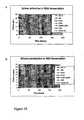
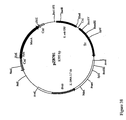
- the integrative plasmid pZB510xTc (see Figure 19(A) ) was then constructed by inserting P gap xyl AB (from pZB4) and Tc r (PCR product) in NotI and SfiI sites between 5'IdhL4 (1.9 kb) and 3'IdhL4 (2.4 kb) fragments.
- Plasmid pZB512XTc (see Figure 19(B) ) was constructed in a similar fashion except the orientation of the P gap xyl AB was opposite to that in pZB510XTc.
- a PCR-generated Cm r fragment was cloned in the SmaI site of vector pMOD (Epicentre, WI) resulting in pMODCm.
- a BgIII fragment from pUC taltk Zhang et al (1995) Science 267:240-243 ) was then cloned into pMODCm at BamHI site to form pMODP eno taltktCm (see Figure 20 ).
- the fragments cloned into pMOD are flanked by the two 19 bp Mosaic ends (IS), which can be recognized by transposase for transposition.
- RMGTcCm Overnight cultures of Z. mobilis SC/pZB512XTc grown in RMGTcCm (30°C) were sub-cultured (1:100) daily in 5 ml RMG tubes at 37°C for up to 10 transfers. At each transfer, cultures were plated and monitored for the loss of plasmid by comparing the colony numbers on RMG and RMGCm plates. When the population of plasmid-bearing cells is less than 10% of the total, cultures were inoculated (1:100) in RMGTc to enrich the growth of potential P gapxyl ABTc integrants. RMGTc enriched cultures were plated onto RMGTc plates and replica-plated onto RMGTc and RMGCm plates. Colonies with Tc r Cm s phenotype would be further analyzed to confirm the integration.
- Xylose isomerase (XI), xylulokinase (XK), transketolase (TKT) and transaldolase (TAL) were assayed, in some cases, using cell-free extracts of Z. mobilis integrants and control strains according to Zhang et al., (1995) Science 267:240-243 with modification.
- Cell-free extracts of Z. mobilis were prepared by collecting the cultures at late-log phase (30°, OD600 approx. 1.2) washed once with sonication buffer (10 mM Tris-Cl, pH 7.6, 10 mM MgCl 2 ) followed by sonication. Cell debris was removed by centrifugation (14,000 rpm, 45 min, 4°C).
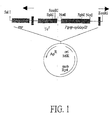
- Mini-Tn5Tc containing genes encoding the xylose assimilation enzymes was constructed by inserting a Pgap-xylAxylB operon into the unique NotI site of Mini-Tn5Tc contained in plasmid pGP704. See, Figure 1 .
- Mini-Tn5Tc xylAlxylB (X4) and Mini-Tn5Tc xylAxylB (X5) were transformed into the donor strain E . coli SM10 ⁇ pir by electroporation and mated with either Z. mobilis ATCC 39676 or 206C strains.
- Z. mobilis 206C is disclosed in US Pat. No. 5,843,760 .
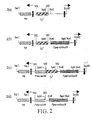
- Tc r transconjugates were obtained from both SM10 ⁇ pir donors containing Mini-Tn5Tc xyLAxylB (X4) and Mini-Tn5 Tc xylAxylB (X5) by selection on media containing Tc and nalidixic acid. See, Figure 2(b) .
- Genomic and plasmid DNA from the nine Z. mobilis Tc r transconjugates was then subjected to Southern blot analyses. Genomic and plasmid DNA from the transconjugates was digested with SphI, which cuts in the hybrid transposon and in the xylose operon, and the blots were then hybridized to either a Tc probe, a XylB probe, or a transposase Tnp probe.
- This example demonstrates the utility of a integration event method to create a Zymomonas integrant that express four pentose fermenting genes.
- a Zymomonas integrant with improved genetic stability in the absence of antibiotic selection is created by this proess.
- the xylose assimilation genes xylA and xylB, encoding xylose isomerase and xylulokinase, and pentose phosphate pathway genes, talB and tktA, encoding transaldolase and transketolase, need to be introduced into the Z. mobilis genome using mini-Tn5 in order to accomplish the creation of pentose-fermenting strains.
- Enzymatic analysis of xylose isomerase, xylulokinase, transaldolase and transaldolase indicated that all the genes were coordinately expressed, and that the integrated strains produced about 30-70% of the enzymatic activities of the plasmid-bearing strains. These enzymatic levels were sufficient for the organism to grow and ferment a particular pentose, xylose, to ethanol.
- the Bg/11 fragment containing the operon P eno-talB / tktA was inserted into the BamHI site of a newly constructed auxiliary plasmid, pUSCfiMCS as shown in Figure 3 .
- the auxiliary plasmid, pUSCfiMCS was constructed by inserting a Eco R I -Hind III fragment containing the multicloning sites from pUC19 into pUCSfi.
- PUC taltkt was then constructed from pUCpfiMCS and pUCtaltktSfi, as shown in the Figure 3 .
- the P eno-talB / tktA was then excised, from pUCtaltktSfi, as a Sfi I fragment and was used to clone into mini-tn5-Tc- xylAxylB .
- the Tc r gene is flanked by Sfi I sites on the Tn5-Tc -xylAxylB cassette.
- Mini-tn5-Tc- xylAxylB was partially and completely digested with Sfi I and ligated to the P eno-talB / tktAS ⁇ i fragment, as shown in Figure 2(c) .
- the partial digestion yielded a plasmid containing the Tc r gene, designated as mini-tn5- Tc talltkt-xylAxylB (( Fig. 2(c) ), while complete digestion yielded a plasmid, according to the invention herein, without the Tc r gene, designated as miniTn5- tal / tkt-xylAxylB. See Figure 2(d) .
- Both plasmids were transformed into the donor strain E. coli, S17-1 and mated with Z. mobilis 206C.
- the resulting transconjugates were selected on mating media containing glucose, Tc, and nalidixic acid for miniTn5- tal / tkt-xylAxylB-Tc.
- mini-tn5 -tal / tkt-xylAxylB the transconjugates were directly selected on mating media, containing xylose and nalidixic acid.
- a number of Tc r transconjugates (glucose-grown) were obtained for mini-tn5 tal / tkt-xylAxylB- Tc.
- Several xylose-grown transconjugates were obtained for mini-tn5- talltkt-.xylAxylB.
- Xylose and ethanol were analyzed using a Hewlett-Packard 1090L HPLC equipped with an P 1047. A refractive index detector and a Biorad HPX-87H organic acid analysis column operating at 65° C, with a 0.01 N sulfuric acid mobile phase flow rate of 0.6 ml/min. The ethanol yield was calculated using either the weight of sugar fermented or the total available sugar in the medium. The maximum theoretical yield was based on 0.51 g ethanol/g xylose.
- Xylose isomerase, xylulokinase, transaldolase and transketolase activities were measured as previously described in (Zhang et al., 1995), for the Z. mobilis transconjugates. As set forth above, it had been observed that expression of a single P gap-xylAxylB copy on the genome was about one-half that of the XI and XK enzymatic yield for the plasmid-bearing strains.
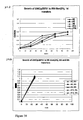
- Stability of these genomic integrated strains and three plasmid bearing strains was measured in a non-selective medium. All strains were cultured in an RMG medium, and serially transferred about every 10 generations daily. At every 40 generations, the cells were used to inoculate a flask of RM media containing 1% glucose, and 5% xylose in order to measure their ability to ferment xylose to ethanol. Ethanol process yields and xylose utilization rates were used as the milestones for stability.
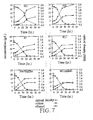
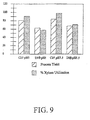
- strains C25 and D95 analyzed in an RM medium contained a different concentrations of total glucose and xylose (1% glucose and 5% xylose; 3% glucose and 3% xylose; and 4.5% glucose and 4.5% xylose) under pH controlled conditions.
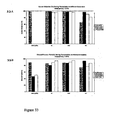
- strain C25 demonstrated greater xylose utilization and ethanol process yields at both pH 5, and pH 5.5 in RM containing 4.5% glucose and 4.5% xylose better than D92.
- the three arabinose assimilating genes were integrated into the C25 genome.
- Plasmid pZB1862-1dhL-ara described below, was used to transform Z. mobilis or E . coli by electroporation. Transformants were selected on mating plates supplemented with glucose and tetracycline. Tc r colonies were further confirmed to be Ara + Xyl + by growth on RM supplemented with xylose or arabinose (RMX and RMA). Plasmid Tn 10 G, also described below, was transferred from an E . coil SM10 ⁇ pir donor to Z. mobilis C25 by conjugation with a filter mating technique (Conway et al., 1987). The resulting transconjugates were selected on mating plates containing arabinose.
- ldhL The ldhL fragment was amplified by PCR using Pfu (Stratagene, La Jolla, CA) DNA polymerase (Qiagen, Valencia, CA). PCR product for ldhLis 2.5 kb.
- the following primer sequences were used: ldhL: 5'-TCGC GGATCC TCTATCCCTTTATTTTTCTATCCCCATCACCTCGG-3' (SEQ ID NO: 17) 5'-TCGCGGATCCGCGGCTGACATACATCTTGCGAATATAGGG-3' (SEQ ID NO: 18)
- a Not I site was introduced in ldh L by insertion of an oligonucleotide 5'-CATGCGCGGCCGCC-3' (SEQ ID NO: 19) at Nco I site, which is located in the middle of the ldh gene.
- the new Not I site was approximately 1.4 and 1.1 kb from either end of the ldh L .
- a BamHI fragment of ldh L (2.5 kb) containing the NotI site was ligated into pZB1862 at a Bcl I site.
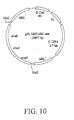
- a 4.4-kb Pgap-araBAD isolated from pZB206 ( US Pat. Nos. 5,712,133 and 5,726,053 ), was cloned into the Not I site of ldh L , to form the integrative plasmid, pZB1862-ldhL-ara. See, Figure 10 .
- the P gap-araBAD- operon containing the three arabinose-assimilating genes, was integrated into the ldh site in the C25 genome through homologous recombination.
- pZB1862-ldhL-ara was constructed in E. coli DH5 ⁇ .
- the plasmid pZB1862-ldhL-ara was transferred into C25 by electroporation.
- the Tc resistant transformants were selected and tested for growth on arabinose.
- P gap-ara-BAD could be integrated in the genome of C25 by the replacement of IdhL with the ldh L '-araBAD-ldh L ' cassette (from the plasmid) through homologous recombination.
- Plasmid pZB1862-ldhL-ara will replicate in Z. mobilis. However, Z. mobilis tends to lose foreign plasmids at sub-optimal growth conditions (e.g., 37° C). Using this characteristic, curing of pZB1862-ldhL-ara was achieved by subculturing C25 transformants at 37° C in the absence of Tc for several transfers. Cultures from each transfer were constantly monitored for the loss of the plasmid. By the third transfer, 100% of the cells became Tc 5 , indicating a loss of the plasmid.
- Mini-Tn5 was used for constructing C25 with P eno-tal / tkt and P gap-xylAB operons. Although the transposase gene did not exist in C25, mini Tn 10 was used for the subsequent integration of P gap-araBAD to avoid any possible incompatibility between the same transposons.
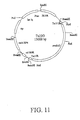
- Plasmid Tn 10 G ( Fig. 11 ) was constructed based on the Tn 10 -based delivery plasmid, pLOFKm. The Km r gene was replaced by a NotI fragment of P gap-araBAD, isolated from pZB206. Tn 10 G was constructed and maintained in E. coli C118. The plasmid was then transferred into the mating donor, E.
- Tn 10 G is a suicide plasmid in Z. mobilis
- transconjugates with araBAD integration were able to grow on mating plates, supplemented with arabinose.
- the E. coli SAM10 ⁇ pir donor was inhibited, in the plates, by the presence of nalidixic acid.
- Transconjugates appeared on mating/ara plates in 7 days. Colonies were replica-picked onto RMA and RMX to confirm their phenotypes. Eighty-six percent of the colonies picked were Xyl + Ara + . Twenty colonies from the pick-plates were cross-transferred to different plates (from xylose plates to arabinose plates or vice versa).
- Digoxygenin (DIG)-labeled ldh, ara, and tnp probes were amplified by PCR using Taq DNA polymerase (Qiagen, Valencia, CA). DIG-UTP was purchased from Boehringer Mannheim, Indianapolis, IN. A tnp probe was used to probe for IS 10 R , the transposase gene of Tn 10 . PCR products for ldh, ara, and tnp are 1, 1.4 and 0.8 kb, respectively. The following primer sequences were used:
- FIGS 13(a) and (b) show the Southern hybridization results using DIG-labeled Tnp and ara probes, respectively, for the eight P gap-araBAD transposon integrants generated by Tn 10 transposition.
- DNA was digested with a PstI restriction enzyme.
- PstI cuts Tn 10 G into two fragments, which hybridized with an ara probe. According to the blots, only G8, G11 G15 and GH17 were ara-positive and tnp -negative. Different band patterns indicated that Pgap-araBAD was integrated at different loci in the genome.
- transposase gene was not expected to remain in the genome of the integrants, four strains (G5, G6, G14 and G19), out of the eight, contained the transposase gene. Furthermore, G14, and G19 contained the transposase gene on the plasmid. With an ara probe, two bands from the integrants were expected. However, only single bands were observed. To solve this ambiguity, PCR was conducted, for the integrants, using ara primers and it was confirmed that all eight integrants contained P gap-af-aBAD in the genome.
- Xylose isomerase (XI), xylulokinase (XK), L-arabinose isomerase (L-AI), L-ribulokinase (L-RK), L-ribulose-5-P-4-epimerase (L-Repi), transketolase (TKT) and transaldolase (TAL) were assayed, using cell-free extracts of the Z. mobilis integrants and control strains, according to Zhang, et al., 1995; and Deanda et al., 1996, with minor modifications.
- Cell-free extracts were prepared by collecting the cultures at late-log phase (30° C, OD 600 approximately 1.2), washing once with sonication buffer (10mM Tris-HCl, pH 7.6 . 10mM MgCl 2 ) and sonicating. The cell debris was removed by centrifugation (14,000 rpm, 45 min 4° C). In the L-AI assay, the volumes of timed samples were scaled down by half (50 ⁇ l), 70% H 2 SO 4 (1.5 ml) and 0.12% carbazole (50 ⁇ l). All of the tubes were maintained in a 25° C water bath, both before and after the addition of 70% H 2 SO 4 , until reading the absorbency. The samples were taken at 0, 5, 10, and 20 min during the reaction.
- the integrants from both homologous recombination and transposon integration, were able to grow on D-xylose and L-arabinose.
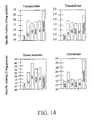
- the expression level of the integrated genes was determined by measuring enzymatic activity. Isolates C25/AX1, C25/AX101, and C25/G8 were chosen for the enzymatic assays because they were the most stable integrants, as determined in the stability studies described below.
- the results of the enzymatic assays are summarized in Figures 14 and 15 . For all assays (with and exception of xylulokinase), integrants showed positive activities as compared to the controls (C25 and/or 206C).
- the cultures were inoculated into test tubes containing RMG, incubated overnight at 30° C, and transferred daily to RMG tubes.
- the inoculum was controlled to allow transfer every 10 generations.
- the cells were used to inoculate flasks, containing a mixture of sugars, to test the fermentation capabilities on the sugars without pH control at 30° C.
- Batch fermentation studies were performed at 30° C with pH control in Bio-StatQ R chemostats, using 500 ml as the working volume.
- the pH was automatically controlled with 2N KOH. Initial sugar concentration and pH varied between each batch, depending on the culture conditions. All the sugars used were reagent grade.
- Z. mobilis 31821 has been shown previously to have increased tolerance to high sugar feed streams, high temperatures and acetic acid. As such, Z. mobilis 31821 is an excellent target for integrating the four genes for xylose utilization (tal, tkt, xylA and xylB).
- strain 31821 was found to be very difficult to transform using DNA from a normal E. coli host. It was found that the strain appears to have a unique genetic background which restricts DNA from a methylation host. The existing method using minTn5Tc via transconjugation using E.
- Tc r 1.5 kb
- PgapxylABTc PenotaltktCm
- a transposition method based on transformation instead of conjugation into the host was developed (using EZ::TN insertion kit see below) and an enlarged homology region for homologous recombination has been developed due to strain 31821's low recombination efficiency.
- Each operon would be connected to an antibiotic marker (Tc r or Cm r ) for the initial selection of integrants. This way, integrants can be selected by antibiotic resistance.
- Two integration methods were used for xylose utilization genes into 31821-5C (homologous recombination and transposition).
- a Tc r gene was integrated in the ldh of 31821-5C using a 2-kb homology region including ldh (namely IdhL).
- IdhL namely IdhL
- integrants were not able to grow on xylose when a plasmid containing PgapxylAB was transformed into the integrants.
- a PCR fragment using ldh-specific primers and the integrant genomic DNA as template was made and analyzed by DNA sequencing. The result indicated no mutation was introduced in the Penotaltkt operon.
- Two potential problems were examined. First, the orientation of taltkt genes was opposite to that of a gene, pgm, which is immediately upstream to ldh in the genome. There are strong promoters in the pgm gene, which might counteract the expression of taltkt. Secondly, the Peno is a relatively weak promoter in Zymomonas.
- Penotaltkt Single copy of Penotaltkt in the integrant may not be enough for the gene expression. Integration of Penotaltkt was then attempted by transposition (since ldh site could present a problem of upstream strong promoter) and PgapxylAB by homologous recombination. More importantly, the homology region for integration needed to be expanded beyond the 2-kb ldhL region in order to increase the recombination efficiency. The new homology region was extended and included the flanking regions of ldh (pgm and adhI genes). The total homology size was approximately 4 kb (designated ldhL4).
- a strategy was developed for integration of the P gapxyl AB operon into the 31821 genome by constructing pZB51OXTc and pZB512XTc (see Figures 19A and 19B ) and two more similar plasmids (pZB511XTc and pZB513XTc) with different organization of the genes in the cassette based on replicative plasmid, pZB1861.
- the homology fragment ldhL4 was generated by two PCR reactions, resulting in 5'- and 3'- fragments.
- PCR-generated fragments 5'ldhL4 (1.9 kb) and 3'ldhL4 (2.4 kb) were sequentially inserted into BamHI-XbaI site and BamHI site of shuttle vector, pZB861. NotI and SfiI restriction sites were introduced in between 5'ldhH and 3'ldhL4 during PCR.
- the integrative plasmid pZB510xTc was then constructed by inserting P gapxyl AB (from pZB4) and Tc r (PCR product) in NotI and SfiI sites. Plasmid pZB512XTc was constructed in a similar fashion except the orientation of the P gap xyl AB was opposite to that in pZB510XTc.
- Plasmids pZB510XTc, pZB512XTc, pZB511XTc and pZB513XTc were used to transform 31821-SC. After several attempts, transformants with pZB510XTc and pZB512XTc were obtained. No transformants with pZB511XTc and pZB513XTc were obtained.
- Tc r marker was included in the integration cassette and used for the selection of integrants. Cm r marker however was located outside the cassette on the vector background. Tc r Cm r transformants were selected and cultured in the presence of Tc for 2 to 4 daily transfers. During propagation of the transformants, P gapxy /ABTc was integrated in the ldh of the host through homologous recombination. To enrich and isolate the integrants, plasmid curing was conducted. Curing of plasmids can be achieved by sub-culturing the transformants at 37°C in the absence of antibiotics for several daily transfers for about 7 to 14 days. Constant monitoring of the loss of plasmids was performed for the cultures from each transfer.
- the P gapxyl AB integrants (x4i, x6i, x91 and x10i) were transformed with a Zymomonas replicative plasmid pZB192, which carries Penotaltkt, but not P gapxyl AB.
- the transformants were able to grow in RMX, indicating single copy of integrated P gapxyl AB provided sufficient xylose isomerase and xylulokinase activities for xylose utilization when tal and tkt genes were supplied on a plasmid (multiple copies).
- the results also ensured that we could further integrate Penotaltkt in the P gapxyl AB integrants to construct a fully integrated xylose-fermenting 31821 strain (see Example VI).
- Mini-Tn5 or mini-Tn10 transposition was not applicable for 31821 because of the lack of a methylation-deficient donor host for conjugation.
- a new transposition method (EZ::TN insertion kit) was adopted. The nature of the method requires the transposases to bind to the Mosaic ends flanking P enotaltkt Cm and cleave the fragment out while remaining bound to the ends when electroporated into the cells. Inside the cells, the transposases trigger the transposition of the DNA fragment into the genome of the host.
- Integrative plasmid pMODP enotaltkt Cm is a non-replicative plasmid in Zymomonas prepared from a methylation -deficient E. coli host. Electroporated cells were plated on MMGCm plates. The Cm r transformants should be integrants. Three Cm r integrants resulted using this transposition method, referred to herein as int1, int2 and int3. Integrants were confirmed by PCR screening using primers for tal or Cm. Also, confirmation was acquired by back-transformation of plasmid from integrants into E.
- a stronger Zymomonas promoter such as P pdc (of pyruvate decarboxlase gene) and P gap (of glyceraldehydes phosphate dehydrogenase gene) may be able to compensate the low-copy-number effect to the taltkt expression.
- the following example illustrates the construction of P enotaltkt /P gapxyl AB integrants. Attempts to integrate the four xylose utilization genes was not successful using either transposition or homologous recombination. Since single copy of P enotaltkt into the 31821-sic genome did not support strain growth on xylose when providing xylose assimilation genes on a plasmid. The applicants tried to increase the copy number of integrated Penotaltkt by in vitro transposition of pMODP enotaltkt Cm into strain 31821 native plasmids. The transposed native plasmids were then electroporated into a P gapxyl AB integrant, x9i.
- Tc r Cm r The final integrants selected by Tc r Cm r were designated x9t(enott)Pi. Plasmids isolated from integrants were used to back transform Z. mobilis 31821-SC and E . coli DH5a. Back transformants were obtained for Z. mobilis, but not for E. coli, indicating the genes were integrated in the native plasmids of x9i. In another approach, integrative plasmids, pZB510XTc and pZB512XTc containing P gapxyl A-BTc r were prepared from E . coli DM1 and transformed to int2. Tc r Cm r transformants were obtained after many attempts of electroporation.
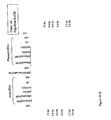
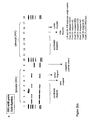
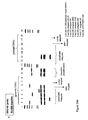
- Hybridization was performed using a xylB probe digested with SphI ( Figure 21A ) using total DNA and plasmid DNA prepared from these integrants.
- Plasmid pZB512XTc (as a control) was expected to have two bands, 5.4 and 2.5 kb, of which the 2.5 kb band is common to total DNA of integrants x9t(enott)Pi#4, #8 and int2/321.
- Plasmid pZB510XTc was expected to have two bands, 4.2 and 3.7 kb, of which the 3.7 kb is common to total DNA of integrant in2/1821.
- All the integrants were based on x9i, in which PgapxylAB was integrated in the LDH locus in the genome. All of the integrants have one band common to their respective integrative plasmids as well as a second band, which is different from the bands generated from the plasmids as expected. All the integrants contained bands in the total DNA preps but not in the plasmid DNA preps, indicating the P gapxyl AB was integrated in the chromosome instead of in the native plasmids of ATCC31821. In hybridization with tkt probe, total DNA and plasmid DNA prepared from these integrants were digested with BssHII ( Figure 21B ).
- Plasmid pMODP eno taltkt Cm (as a control) was expected to have 4 bands including 4.2, 1.5, 0.9 and 0.1 k, of which 1.5 and 0.9 kb bands are common to the total DNA of all the integrants. The 0.1 kb band was too small to be retained on the gel.
- x9t(enott)Pi#4, #8 contained the 1.5 and 0.9 kb bands in both the total and plasmid DNA preps, confirming that the P eno taltkt was integrated in the native plasmid.
- the third band, which is missing from the #4 and #8 on the blot might be to small to be on the gel.
- this band could be as small as 0.4 kb.
- int2/321 and int2/1821 possessed a 6.4 kb band, which is different from that of the plasmid, indicating that P eno taltkt was integrated in the chromosome of these two integrants.
- the following example illustrates the enzymatic activity of the integrant Zymomonas.
- the following example illustrates that the Z . mobilis 38121-5C P eno taltkt /P gap xyl AB integrants are able to ferment D-xylose to ethanol after a series of adaptation on RMX. Integrants were inoculated in RMX (containing 2% of xylose) tubes sealed with parafilm to prevent evaporation. The growth was monitored routinely by OD600 measurements. Cultures from exponential stage were transferred to fresh RMX. As shown in Figure 23 , a comparison was made of growth curves between the 1 st and 4th transfers.
- the growth rate and final OD600 reading were improved over the period of adaptation.
- the final OD was increased from 0.08 (first transfer) to 0.6 (fourth transfer).
- the growth rates and maximal OD600 readings were stabilized after the fifth transfer. It is believed that mutation of the cultures occurred during the process of adaptation.
- RMX provided the natural selection of mutants with more effective utilization.
- two showed the highest rates of growth and ODs, the x9t(enott)Pi#4 and int2/321. Samples from the cultures of the fourth/third transfers were taken at 140-hour time point for HPLC analysis.
- the present example illustrates the construction of pMODPgaptaltktCm for transposition in Z . mobilis.
- a similar approach to construct pMODPenotaltktCm was used except two loxP sites was introduced.
- a 2.2-kb tkt fragment was isolated from pUCtaltkt by BglIII/XbaI digestion and cloned in pMOD vector digested with BamHI/XbaI, resulting pMODtkt.
- a PCR fragment Pgaptal was generated by fusing a Zymomonas promoter region of GAP (glyceraldehydes-3-phosphate dehydrogenase gene) to the structural gene of tal.
- the following example illustrates the construction of Pgaptaltkt/PgapxylAB integrants based on Z . mobilis 31821-5C.
- Plasmid pMODPgaptaltktCm prepared from E . coli DMI or JM110 was treated with the EZ::TN transposase to make transposome.
- the transposome mixture was electroporated into a PgapxylAB integrant, x9i.
- the Pgaptaltkt/PgapxylAB integrants were obtained by selection on RMGTcCm (the Tc resistance gene was already integrated in the x9i genome).
- Initial analysis such as back transformation in E.
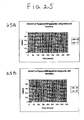
- Tc r Cm r integrants were inoculated in RM containing xylose as the sole carbon source and incubated at 30°C. Growth was monitored by measurement at OD600. All strains were able to grow in RMX initially to OD of 0.3 at slow rates. However, the growth rates and final ODs improved after the 6th transfer in RMX. Growth curves for the two better growers (#20, #21) are shown in Figure 25 .
- the following example illustrates the process of isolating the Penotaltkt/PgapxylAB and Pgaptaltkt/PgapxylAB Zymomonas integrants.
- the cells were streaked out on RMX plates.
- Strains x9t(enott)Pi#4 and x9t(enott)Pi#8 were streaked out after the 4th transfer, int2/xyl321 and int2/xyl1821 were streaked out after the 3rd transfer, and #20 and #21 were streaked out after the 6th transfer. This round of isolation was called 1st isolation. Different sizes of colonies were observed on RMX plates.
- Preliminary fermentation was performed for the four integrants, 321 (5), 481, 2032 and 2122 as well as the control strains, 31821/pZB4 (plasmid-bearing strain), C25 (39676-based xylose-fermenting integrant) and 31821-5C (host).
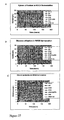
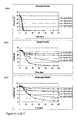
- the fermentation condition was: 80-ml RMX (2% xylose) or RMGX(1% glucose and 2% xylose) in bottles, no pH control, 30°C static. Fermentation was monitored by the HPLC analysis of the supernatants of the fermentation broths. All integrants were able to grow in RMGX and ferment both xylose and glucose to ethanol at maximal yields ( Figures 27A , B and C).
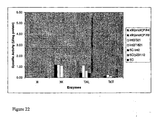
- Enzymatic assays were also performed for the four integrants and the control strains, 31821/pZB5 (plasmid-bearing strain), C25 (39676-based xylose-fermenting integrant) and 31821-5C (host). The data is shown in Table 2 below. All the integrants showed lower activities than 31821/pZB5 and C25. Table 2. Enzymatic activities of integrants.
- the following example illustrates the process of mutagenesis of the Zymomonas integrants in an attempt to improve growth in xylose medium.
- Single colonies of integrants int2/xyl321 and x9t(Penott)Pi#8 were inoculated in RMG and incubated at 30°C overnight.
- Cells were harvested and treated with a chemical mutagen 1-Methyl-3-nitro-1-nitrosoguanidine (MNNG or NTG) at 25 ⁇ g/ml concentration.
- MNNG chemical mutagen 1-Methyl-3-nitro-1-nitrosoguanidine
- the NTG-treated cells were collected, washed in RMG twice and resuspended in RMGX(0.5% glucose and 1.5% xylose) for growth.
- the grown cultures were sub-cultured twice in the same medium followed by streaking on RMX plates. The larger colonies were re-streaked on RMX plates. Largest colonies were picked and inoculated in RMX liquid medium. The grown cultures were again streaked out on RMX plates. Finally, the largest colonies were picked and grown in RMX. Two of the best growers are designated 8b and 2/321-2. One of the strains, 8b, were further evaluated further. Generally, the mutant has improved xylose utilization in the mixture of glucose and xylose as well as in the presence acetate as described in the following examples.
- the following example illustrates fermentation evaluation of the several integrants constructed based on Z . mobilis ATCC31821-5C host. Strain C25 and the plasmid-bearing strain 31821/pZB4 were used as control for fermentation evaluation.
- Fermentation evaluation was done in BioStat-Q fermentors with 500 mL working volume under pH and temperature control conditions. The pH was controlled at 5.5 using KOH (2N) for titration and temperature was controlled at 30°C.
- the fermentation media RM contained a mixture of glucose and xylose (RMGX(1%:6%) and RMGX(3.5%:3.5%)). All components of the growth media were prepared separately as filter sterilized stock solutions as RM (10X), glucose (50%), and xylose (50%). The fermentors were autoclaved and the growth media was added under sterile condition into fermentors. Inoculum was prepared in 250 mL flask containing 200 mL media RMGX (2%:2%).
- strains 8b and 2032 All the strains fermented glucose and xylose to ethanol with strains 8b and 2032 showing the best performance under pH controlled fermentations ( Figures 29 and 30 ) .
- the integrated strains 8b and 2032 showed similar performance as the plasmid-bearing strain 31821/pZB4 and the integrant C25, which is based on the 39676 host.
- the following example illustrates the stability of the Zymomonas integrants.
- the test was done by a serial transfer of the culture in a non-selective medium (RMG), using 15 mL Falcon sterile tubes containing 10 mL medium as (see Figure 31 ). These strains were cultured in RMG medium and serially transferred daily after about 10 generations. At every 40 generations, the cells were used to inoculate a flask containing 2% glucose and 2% xylose for examination of their ability to ferment glucose and xylose to ethanol. Ethanol process yields, and xylose utilization rates, were used as the the indication of stability trait.
- the following example illustrates the effect of the acetic acid concentration on the growth and xylose fermentation of AX101 as well as the effect of pH.
- Acetic acid is normally present in the hydrolysates of pretreated biomass feedstocks, and is inhibitory to the fermentation microorganism. Fermentation was run at pH 5, pH 5.5 and pH 6.0 with and without (pH 5.5) supplementing with 2 g/L acetate to evaluate the performance of strain AX101.
- the culture media used was RMGXA (4%:4%:2%) supplemented with the desired concentration of acetate.
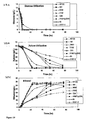
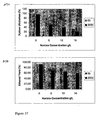
- the result ( Figure 34 ) showed that 2 g/L acetate showed inhibitory effect on growth, xylose utilization and ethanol production of the strain. The inhibition was much stronger at lower pH (pH5.0) as compared at higher pH (pH6.0).
- the following example illustrates the fill and draw process of fermentation of AX101.
- a study was designed to see if gradual adaptation of the strain AX101 to acetate would improve the performance of this strain in culture media with higher concentrations of acetic acid.
- the following example illustrates the continuous fermentation of AX101.
- Continuous fermentations were carried out in MultiGen fermentors (New Bruswick Scientific, NJ, USA) with a 300 mL working volume and 300 rpm agitation.
- the pHs studied were 4.5, 5, and 5.5 5 controlled with KOH (2N). Temperature was kept at 30°C for all the studies.
- Batch fermentation was started with an initial OD of 0.1 at 600nm. Samples were taken periodically throughout the course of the fermentation and analyzed for sugars, ethanol, and byproducts by HPLC. After full glucose utilization and around 10 g/L xylose remaining in the fermentor the continuous fermentation was started by feeding a culture media with desired sugar composition at a low dilution rate (D) of 0.02 (1/hr).
- D low dilution rate
- the strain AX101 was able to ferment a sugar mixture of 80 g/L glucose, 40 g/L xylose, and 15 g/L arabinose in corn steep liquor media supplemented only up to 6 g/L acetate after which wash out stage was observed.
- Acetate is an inhibitiory compound normally found in the hydrolysates from pretreated biomass feedstocks.
- integrants 8b and 2032 are capable growth and ferment xylose to ethanol at acetate concentration of 2g/l to 6g/l in a medium without pH control. The inhibition by acetate at these concentrations on xylose utilization is minimal.
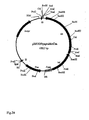
- Z . mobilis strain 39676 and 31821 can be transformed with plasmid pZB701 ( Figure 38 ) containing a E. coli phosphomannose isomerase gene, ManA, under the control of the Zymomonas pyruvate decarboxylase (PDC) promoter, Ppdc.
- PDC Zymomonas pyruvate decarboxylase
- transformants for both strains were able to utilize D-mannose as the sole carbon source.
- all the intermediate and fmal constructs (including pZB801) generated were used to transform a manA(-) host, E.coli GMS407.
- Transformants were plated on McConkey agar containing mannose as the carbon source. Dark pink colonies indicated mannose utilization by the clones.
- Plasmid pZB701 extracted from a dark pink colony was used for the future transformation in Z . mobilis 206C or 31821.
- Z . mobilis transformants were selected on mating medium (MMG) containing tetracycline (Tc r ) followed by the testing in medium containing mannose (RMM).
- MMG mating medium
- Tc r tetracycline
- RMM medium containing mannose
- pZB701 was prepared from E. coli JM110. These Tc r transformants were also able to grow in RMM. Analysis of the supernatants of RMM grown cultures indicated ethanol was produced by both 39676 and 31821 transformants.
- the plasmid pZB701 containing mannose utilizing gene can be further transformed into the genomic-integrated xylose- and arabinose-fermenting strains that the applicants have constructed, such as C25, AX101, AX1, 321(5), 481, 8b, 2032, 2122 based on 39676 and 31821 host strains.
- the success of transformation in Z . mobilis 39676 and 31821 with pZB701 (containing ManA gene) and the fermentation of mannose to ethanol by the transformants has been demonstrated.
- the above Zymomonas integrants may also be transformed with the plasmid pZB701 to obtain Z . mobilis strains capable of fermenting xylose, arabinose, mannose and glucose to ethanol.
- the transformed Zymomonas strains are expected to be capable of utilizing xylose, arabinose, mannose and glucose in the biomass feedstock and ferment all the sugars to ethanol.
Landscapes
- Health & Medical Sciences (AREA)
- Life Sciences & Earth Sciences (AREA)
- Genetics & Genomics (AREA)
- Chemical & Material Sciences (AREA)
- Engineering & Computer Science (AREA)
- Organic Chemistry (AREA)
- Wood Science & Technology (AREA)
- Zoology (AREA)
- Bioinformatics & Cheminformatics (AREA)
- Biotechnology (AREA)
- General Engineering & Computer Science (AREA)
- Biomedical Technology (AREA)
- Molecular Biology (AREA)
- Microbiology (AREA)
- Biochemistry (AREA)
- General Health & Medical Sciences (AREA)
- Plant Pathology (AREA)
- Biophysics (AREA)
- Physics & Mathematics (AREA)
- Medicinal Chemistry (AREA)
- Chemical Kinetics & Catalysis (AREA)
- General Chemical & Material Sciences (AREA)
- Mycology (AREA)
- Micro-Organisms Or Cultivation Processes Thereof (AREA)
- Preparation Of Compounds By Using Micro-Organisms (AREA)
Applications Claiming Priority (3)
| Application Number | Priority Date | Filing Date | Title |
|---|---|---|---|
| US134655 | 2002-04-27 | ||
| US10/134,655 US7223575B2 (en) | 2000-05-01 | 2002-04-27 | Zymomonas pentose-sugar fermenting strains and uses thereof |
| PCT/US2003/012726 WO2004037973A2 (en) | 2002-04-27 | 2003-04-25 | Zymomonas pentose-sugar fermentating strains and uses thereof |
Publications (3)
| Publication Number | Publication Date |
|---|---|
| EP1549736A2 EP1549736A2 (en) | 2005-07-06 |
| EP1549736A4 EP1549736A4 (en) | 2006-12-13 |
| EP1549736B1 true EP1549736B1 (en) | 2009-04-15 |
Family
ID=32174134
Family Applications (1)
| Application Number | Title | Priority Date | Filing Date |
|---|---|---|---|
| EP03799754A Expired - Lifetime EP1549736B1 (en) | 2002-04-27 | 2003-04-25 | Zymomonas pentose-sugar fermentating strains and uses thereof |
Country Status (10)
| Country | Link |
|---|---|
| US (1) | US7223575B2 (enExample) |
| EP (1) | EP1549736B1 (enExample) |
| JP (1) | JP4309845B2 (enExample) |
| CN (1) | CN1665919A (enExample) |
| BR (1) | BRPI0309796B1 (enExample) |
| CA (1) | CA2483574A1 (enExample) |
| DE (1) | DE60327230D1 (enExample) |
| DK (1) | DK1549736T3 (enExample) |
| MX (1) | MXPA04010651A (enExample) |
| WO (1) | WO2004037973A2 (enExample) |
Cited By (1)
| Publication number | Priority date | Publication date | Assignee | Title |
|---|---|---|---|---|
| US8679782B2 (en) | 2009-06-15 | 2014-03-25 | Massachusetts Institute Of Technology | Production of triacylglycerides, fatty acids, and their derivatives |
Families Citing this family (112)
| Publication number | Priority date | Publication date | Assignee | Title |
|---|---|---|---|---|
| US20070029252A1 (en) * | 2005-04-12 | 2007-02-08 | Dunson James B Jr | System and process for biomass treatment |
| US7781191B2 (en) * | 2005-04-12 | 2010-08-24 | E. I. Du Pont De Nemours And Company | Treatment of biomass to obtain a target chemical |
| JP5149785B2 (ja) * | 2005-04-12 | 2013-02-20 | イー・アイ・デュポン・ドウ・ヌムール・アンド・カンパニー | エタノールを得るためのバイオマスの処理 |
| US7659104B2 (en) | 2006-05-05 | 2010-02-09 | E.I. Du Pont De Nemours And Company | Solvent tolerant microorganisms and methods of isolation |
| US7541173B2 (en) | 2006-06-15 | 2009-06-02 | E.I. Du Pont De Nemours And Company | Solvent tolerant microorganisms and methods of isolation |
| MY157916A (en) | 2006-07-21 | 2016-08-15 | Xyleco Inc | Conversion system for biomass |
| US7741119B2 (en) * | 2006-09-28 | 2010-06-22 | E. I. Du Pont De Nemours And Company | Xylitol synthesis mutant of xylose-utilizing zymomonas for ethanol production |
| US7741084B2 (en) | 2006-09-28 | 2010-06-22 | E. I. Du Pont De Nemours And Company | Ethanol production using xylitol synthesis mutant of xylose-utilizing zymomonas |
| US7629156B2 (en) | 2006-09-28 | 2009-12-08 | E.I. Du Pont De Nemours And Company | Ethanol production in fermentation of mixed sugars containing xylose |
| US7807419B2 (en) * | 2007-08-22 | 2010-10-05 | E. I. Du Pont De Nemours And Company | Process for concentrated biomass saccharification |
| US20090053800A1 (en) * | 2007-08-22 | 2009-02-26 | Julie Friend | Biomass Treatment Apparatus |
| US8445236B2 (en) * | 2007-08-22 | 2013-05-21 | Alliance For Sustainable Energy Llc | Biomass pretreatment |
| US7819976B2 (en) * | 2007-08-22 | 2010-10-26 | E. I. Du Pont De Nemours And Company | Biomass treatment method |
| JP4124270B1 (ja) * | 2007-10-05 | 2008-07-23 | 国立大学法人鳥取大学 | グルコース・マンノース・キシロース並行発酵性菌およびそれを用いるバイオエタノールの製造方法 |
| ATE506447T1 (de) | 2007-10-30 | 2011-05-15 | Du Pont | Verfahren zur herstellung von etahnol in einem xylose enthaltenden medium unter verwendung eines rekombinanten zymomonas stammes mit reduzierter hima expression |
| BRPI0817151A8 (pt) * | 2007-10-30 | 2018-12-11 | Du Pont | micro-organismo recombinante e processo para gerar o micro-organismo |
| JPWO2009081941A1 (ja) * | 2007-12-25 | 2011-05-06 | 国立大学法人鳥取大学 | 木質系および草本系バイオマス糖化液からのバイオエタノール並行発酵菌 |
| JP4427583B2 (ja) | 2008-02-01 | 2010-03-10 | 三菱重工業株式会社 | バイオマスの水熱分解装置及び方法、バイオマス原料を用いた有機原料の製造システム |
| JP4524351B2 (ja) | 2008-02-01 | 2010-08-18 | 三菱重工業株式会社 | バイオマス原料を用いた有機原料の製造システム及び方法 |
| JP4427584B2 (ja) | 2008-02-01 | 2010-03-10 | 三菱重工業株式会社 | バイオマスの水熱分解装置及び方法、バイオマス原料を用いた有機原料の製造システム |
| CA2716585C (en) * | 2008-03-27 | 2017-05-09 | E.I. Du Pont De Nemours And Company | Zymomonas recombinant for substituted glyceraldehyde-3-phosphate dehydrogenase promoter and xylose isomerase gene for improved xylose utilization |
| ES2627671T3 (es) * | 2008-03-27 | 2017-07-31 | E. I. Du Pont De Nemours And Company | Promotores de Zymomonas de alta expresión |
| US8329444B2 (en) * | 2008-04-23 | 2012-12-11 | Georgia Tech Research Corporation | Strains of zymomonas mobilis for fermentation of biomass |
| US20100159521A1 (en) * | 2008-12-19 | 2010-06-24 | E. I. Du Pont De Nemours And Company | Ozone treatment of biomass to enhance enzymatic saccharification |
| US8247208B2 (en) | 2008-12-22 | 2012-08-21 | Alliance For Sustainable Energy Llc | Zymomonas with improved xylose utilization in stress conditions |
| US20110143408A1 (en) * | 2009-06-18 | 2011-06-16 | E. I. Du Pont De Nemours And Company | Zymomonas with improved arabinose utilization |
| WO2010151574A2 (en) | 2009-06-25 | 2010-12-29 | Shell Oil Company | Water injection systems and methods |
| US8575471B2 (en) * | 2009-08-31 | 2013-11-05 | Alliance For Sustainable Energy, Llc | Lattice matched semiconductor growth on crystalline metallic substrates |
| US8961687B2 (en) * | 2009-08-31 | 2015-02-24 | Alliance For Sustainable Energy, Llc | Lattice matched crystalline substrates for cubic nitride semiconductor growth |
| US8785159B2 (en) | 2009-11-25 | 2014-07-22 | Alliance For Sustainable Energy, Llc | Extracellular secretion of recombinant proteins |
| WO2011065539A1 (ja) * | 2009-11-30 | 2011-06-03 | 国立大学法人神戸大学 | バイオマスからのエタノールの生産方法 |
| US8507365B2 (en) * | 2009-12-21 | 2013-08-13 | Alliance For Sustainable Energy, Llc | Growth of coincident site lattice matched semiconductor layers and devices on crystalline substrates |
| CN107287250A (zh) | 2009-12-23 | 2017-10-24 | 丹尼斯科美国公司 | 提高同步糖化发酵反应效率的方法 |
| US8647850B2 (en) | 2009-12-23 | 2014-02-11 | E I Du Pont De Nemours And Company | Process for simultaneous saccharification and fermentation for production of ethanol |
| US8721794B2 (en) | 2010-04-28 | 2014-05-13 | E I Du Pont De Nemours And Company | Production of high solids syrup from lignocellulosic biomass hydrolysate fermentation broth |
| US8906235B2 (en) | 2010-04-28 | 2014-12-09 | E I Du Pont De Nemours And Company | Process for liquid/solid separation of lignocellulosic biomass hydrolysate fermentation broth |
| CN102947456A (zh) | 2010-06-18 | 2013-02-27 | 布特马斯先进生物燃料有限责任公司 | 补充脂肪酸以改善醇产量 |
| US9040263B2 (en) | 2010-07-28 | 2015-05-26 | Butamax Advanced Biofuels Llc | Production of alcohol esters and in situ product removal during alcohol fermentation |
| AU2011268220B2 (en) | 2010-06-18 | 2015-01-29 | Butamax(Tm) Advanced Biofuels Llc | Extraction solvents derived from oil for alcohol removal in extractive fermentation |
| US8679822B2 (en) | 2010-06-29 | 2014-03-25 | E I Du Pont De Nemours And Company | Xylose utilization in recombinant zymomonas |
| US8623623B2 (en) | 2010-06-29 | 2014-01-07 | E I Du Pont De Nemours And Company | Xylose utilization in recombinant Zymomonas |
| US8651403B2 (en) | 2010-07-21 | 2014-02-18 | E I Du Pont De Nemours And Company | Anhydrous ammonia treatment for improved milling of biomass |
| CN102399804A (zh) * | 2010-09-15 | 2012-04-04 | 中国农业科学院作物科学研究所 | 木糖异构酶基因的功能及其应用 |
| WO2012047832A2 (en) | 2010-10-07 | 2012-04-12 | Shell Oil Company | Process for the production of alcohols from biomass |
| CN103189526B (zh) | 2010-11-05 | 2015-07-08 | 国际壳牌研究有限公司 | 处理生物质以产生可用于生物燃料的材料 |
| US20120125551A1 (en) | 2010-11-23 | 2012-05-24 | E. I. Du Pont De Nemours And Company | Biomass pretreatment process for a packed bed reactor |
| US20120125548A1 (en) | 2010-11-23 | 2012-05-24 | E. I. Du Pont De Nemours And Company | Continuously fed biomass pretreatment process for a packed bed reactor |
| WO2012074523A1 (en) | 2010-12-01 | 2012-06-07 | Alliance For Sustainable Energy, Llc | Methods of producing free-standing semiconductors using sacrificial buffer layers and recyclable substrates |
| US9425249B2 (en) | 2010-12-01 | 2016-08-23 | Alliance For Sustainable Energy, Llc | Coincident site lattice-matched growth of semiconductors on substrates using compliant buffer layers |
| US8476048B2 (en) | 2010-12-17 | 2013-07-02 | E I Du Pont De Nemours And Company | Xylose utilizing zymomonas mobilis with improved ethanol production in biomass hydrolysate medium |
| WO2012088108A1 (en) | 2010-12-20 | 2012-06-28 | Shell Oil Company | Process for the production of alcohols from biomass |
| US20120196342A1 (en) | 2011-02-01 | 2012-08-02 | Rachel Ruizhen Chen | Industrial Applications of A Novel Aldo/Keto Reductase Of Zymomonas Mobilis |
| US20130040340A1 (en) | 2011-02-07 | 2013-02-14 | E. I. Du Pont De Nemours And Company | Production of alcohol esters in situ using alcohols and fatty acids produced by microorganisms |
| US8759044B2 (en) | 2011-03-23 | 2014-06-24 | Butamax Advanced Biofuels Llc | In situ expression of lipase for enzymatic production of alcohol esters during fermentation |
| US8765425B2 (en) | 2011-03-23 | 2014-07-01 | Butamax Advanced Biofuels Llc | In situ expression of lipase for enzymatic production of alcohol esters during fermentation |
| US8765426B2 (en) | 2011-04-07 | 2014-07-01 | E I Du Pont De Nemours And Company | Pantothenic acid biosynthesis in zymomonas |
| MX2013014327A (es) | 2011-06-17 | 2014-01-23 | Butamax Tm Advanced Biofuels | Coproductos de procesos de produccion de biocombustible y metodos para elaborarlos. |
| CA2838519A1 (en) | 2011-06-17 | 2012-12-20 | Butamax Advanced Biofuels Llc | Lignocellulosic hydrolysates as feedstocks for isobutanol fermentation |
| EP2785853A2 (en) | 2011-12-02 | 2014-10-08 | BP Corporation North America Inc. | Compositions and methods for biomass liquefaction |
| WO2013086222A2 (en) | 2011-12-09 | 2013-06-13 | Butamax(Tm) Advanced Biofuels Llc | Process to remove product alcohols from fermentation broth |
| PL2791344T3 (pl) | 2011-12-15 | 2016-08-31 | Shell Int Research | Sposób obróbki produktów ubocznych z wytwarzania etanolu |
| US8911983B2 (en) | 2011-12-20 | 2014-12-16 | E I Du Pont De Nemours And Company | Pnp gene modification for improved xylose utilization in Zymomonas |
| US20130157332A1 (en) | 2011-12-20 | 2013-06-20 | E I Du Pont De Nemours And Company | Gene inactivation allowing immediate growth on xylose medium by engineered zymomonas |
| CN104254613A (zh) | 2012-02-13 | 2014-12-31 | Bp北美公司 | 木质纤维素水解产物脱毒的方法 |
| US9133278B2 (en) | 2012-02-13 | 2015-09-15 | Bp Corporation North America Inc. | Methods for detoxifying a lignocellulosic hydrolysate |
| JP2015517303A (ja) | 2012-05-04 | 2015-06-22 | ビュータマックス・アドバンスド・バイオフューエルズ・エルエルシー | アルコールの製造および回収のための方法およびシステム |
| CN104395478B (zh) | 2012-05-07 | 2017-07-28 | 国际壳牌研究有限公司 | 处理生物质以生产可用于生物燃料的材料的连续或半连续方法 |
| CA2873309A1 (en) | 2012-05-17 | 2013-11-21 | Phillip Guy Hamilton | Methods and systems for processing biomass material |
| US20140024064A1 (en) | 2012-07-23 | 2014-01-23 | Butamax(Tm) Advanced Biofuels Llc | Processes and systems for the production of fermentative alcohols |
| DK2844731T3 (en) | 2012-08-06 | 2018-05-07 | Danisco Us Inc | MUSHROOM CELLS WHICH MAKE REDUCED QUANTITIES OF PEPTAIBOLS |
| EP2895612A1 (en) | 2012-09-12 | 2015-07-22 | Butamax Advanced Biofuels LLC | Processes and systems for the production of fermentation products |
| US9249076B2 (en) | 2012-09-21 | 2016-02-02 | Butamax Advanced Biofuels Llc | Recyclable extractant compositions |
| AU2013329024A1 (en) | 2012-10-11 | 2015-03-12 | Butamax Advanced Biofuels Llc | Processes and systems for the production of fermentation products |
| WO2014081848A1 (en) | 2012-11-20 | 2014-05-30 | Butamax Advanced Biofuels Llc | Butanol purification |
| BR112015013933A2 (pt) | 2012-12-14 | 2017-07-11 | Bp Corp North America Inc | fermentação sequencial de hidrolisato e sólidos de uma hidrólise de ácido diluído de biomassa para produzir produtos de fermentação |
| US8846357B2 (en) | 2012-12-20 | 2014-09-30 | E I Du Pont De Nemours And Company | Stabilized chlorine dioxide for contamination control in Zymomonas fermentation |
| WO2014130352A1 (en) | 2013-02-21 | 2014-08-28 | Butamax Advanced Biofuels Llc | Recovery of thermal energy as heat source in the production of butanol from a fermentation process |
| WO2014159309A1 (en) | 2013-03-12 | 2014-10-02 | Butamax Advanced Biofuels Llc | Processes and systems for the production of alcohols |
| US20140273105A1 (en) | 2013-03-12 | 2014-09-18 | E I Du Pont De Nemours And Company | Gradient pretreatment of lignocellulosic biomass |
| WO2014160050A1 (en) | 2013-03-14 | 2014-10-02 | Butamax Advanced Biofuels Llc | Glycerol 3- phosphate dehydrogenase for butanol production |
| WO2014160262A1 (en) | 2013-03-14 | 2014-10-02 | Abengoa Bioenergy New Technologies, Llc | Methods for converting cellulosic waste to bioproducts |
| CA2901374A1 (en) | 2013-03-15 | 2014-09-18 | Butamax Advanced Biofuels Llc | Method for production of butanol using extractive fermentation |
| WO2014151645A1 (en) | 2013-03-15 | 2014-09-25 | Butamax Advanced Biofuels Llc | Process for maximizing biomass growth and butanol yield by feedback control |
| WO2014145768A2 (en) | 2013-03-15 | 2014-09-18 | Bp Corporation North America Inc. | Use of non-fungal 5' utrs in filamentous fungi |
| WO2014144643A1 (en) | 2013-03-15 | 2014-09-18 | Butamax Advanced Biofuels Llc | Method for producing butanol using extractive fermentation |
| DE102013205986A1 (de) * | 2013-04-04 | 2014-10-23 | Wacker Chemie Ag | Mikroorganismenstamm und Verfahren zur fermentativen Herstellung von C4-Verbindungen aus C5-Zuckern |
| US9206445B2 (en) | 2013-04-29 | 2015-12-08 | Alliance For Sustainable Energy, Llc | Biocatalysts with enhanced inhibitor tolerance |
| WO2015002913A1 (en) | 2013-07-03 | 2015-01-08 | Butamax Advanced Biofuels Llc | Partial adaptation for butanol production |
| WO2015031561A1 (en) | 2013-08-30 | 2015-03-05 | Bp Corporation North America Inc. | Catalytic conversion of alcohols |
| US20150087040A1 (en) | 2013-09-26 | 2015-03-26 | E I Du Pont De Nemours And Company | Production of ethanol and recycle water in a cellulosic fermentation process |
| US20150087041A1 (en) | 2013-09-26 | 2015-03-26 | E I Du Pont De Nemours And Company | Production of ethanol with reduced contaminants in a cellulosic biomass based process |
| US9139818B2 (en) | 2013-09-26 | 2015-09-22 | E I Du Pont De Nemours And Company | High expression Zymomonas promoters |
| WO2015057517A1 (en) | 2013-10-17 | 2015-04-23 | Danisco Us Inc. | Use of hemicellulases to improve ethanol production |
| US10227623B2 (en) | 2013-11-24 | 2019-03-12 | E I Du Pont De Nemours And Company | High force and high stress destructuring of cellulosic biomass |
| US20150197757A1 (en) | 2014-01-16 | 2015-07-16 | Wisconsin Alumni Research Foundation | Oxygen-responsive bacterial gene switch |
| WO2015160887A1 (en) | 2014-04-17 | 2015-10-22 | Shell Oil Company | Processes for producing fermentation products |
| US9371546B2 (en) | 2014-06-24 | 2016-06-21 | E I Du Pont De Nemours And Company | Enhancing D-xylose and L-arabinose utilization in Zymomonas cells |
| WO2016007350A1 (en) | 2014-07-09 | 2016-01-14 | Danisco Us Inc. | Preconditioning of lignocellulosic biomass |
| CN106536496A (zh) | 2014-08-14 | 2017-03-22 | 国际壳牌研究有限公司 | 从生物质制备糠醛的方法 |
| WO2016025678A1 (en) | 2014-08-14 | 2016-02-18 | Shell Oil Company | Process for preparing furfural from biomass |
| BR112017002204B1 (pt) | 2014-08-14 | 2021-01-12 | Shell Internationale Research Maatschappij B.V. | métodos para recuperar ácido a-hidroxisulfônico em um processo de tratamento de biomassa |
| JP6977231B2 (ja) | 2015-07-13 | 2021-12-08 | マラ リニューアブルズ コーポレーション | C5有機炭素の微生物による代謝の増強 |
| US20180230446A1 (en) | 2015-07-29 | 2018-08-16 | Abengoa Bioenergía Nuevas Tecnologías, S.A. | Expression of recombinant beta-xylosidase enzymes |
| WO2017116840A1 (en) | 2015-12-28 | 2017-07-06 | Danisco Us Inc. | Methods for the production of fermentation products from feedstock |
| US10479773B2 (en) | 2016-05-03 | 2019-11-19 | Shell Oil Company | Lignin-based solvents and methods for their preparation |
| US10899725B2 (en) | 2016-11-01 | 2021-01-26 | Shell Oil Company | Process for the recovery of furfural |
| EP3535248A1 (en) | 2016-11-01 | 2019-09-11 | Shell Internationale Research Maatschappij B.V. | Process for the recovery of furfural |
| CA3039603A1 (en) | 2016-11-01 | 2018-05-11 | Shell Internationale Research Maatschappij B.V. | Process for the recovery of furfural |
| WO2018085182A1 (en) | 2016-11-01 | 2018-05-11 | Shell Oil Company | Process for the recovery of furfural |
| US11787773B2 (en) | 2019-05-22 | 2023-10-17 | Shell Usa, Inc. | Process for the production of furfural |
| CN113444763B (zh) * | 2021-08-16 | 2022-11-08 | 农业部沼气科学研究所 | 树干毕赤酵母与运动发酵单胞菌混菌发酵葡萄糖和木糖产乙醇的方法 |
| AU2024212235A1 (en) | 2023-01-23 | 2025-07-03 | Shell Internationale Research Maatschappij B.V. | Method for treating grains to produce material useful for chemicals and biofuels |
Family Cites Families (7)
| Publication number | Priority date | Publication date | Assignee | Title |
|---|---|---|---|---|
| US5514583A (en) * | 1994-04-15 | 1996-05-07 | Midwest Research Institute | Recombinant zymomonas for pentose fermentation |
| US5843760A (en) * | 1994-04-15 | 1998-12-01 | Midwest Research Institute | Single zymomonas mobilis strain for xylose and arabinose fermentation |
| US5712133A (en) * | 1994-04-15 | 1998-01-27 | Midwest Research Institute | Pentose fermentation by recombinant zymomonas |
| JP4510355B2 (ja) * | 2000-05-01 | 2010-07-21 | ミッドウエスト リサーチ インスティチュート | 安定なチモモナスモビリスのキシロースおよびアラビノース醗酵株 |
| US7374939B1 (en) * | 2000-05-01 | 2008-05-20 | Midwest Research Institute | Method of inactivation of an end product of energy metabolism in Zymomonas mobilis |
| US7354755B2 (en) * | 2000-05-01 | 2008-04-08 | Midwest Research Institute | Stable zymomonas mobilis xylose and arabinose fermenting strains |
| US6566107B1 (en) * | 2000-11-01 | 2003-05-20 | Midwest Research Institute | Recombinant Zymomonas mobilis with improved xylose utilization |
-
2002
- 2002-04-27 US US10/134,655 patent/US7223575B2/en not_active Expired - Fee Related
-
2003
- 2003-04-25 DE DE60327230T patent/DE60327230D1/de not_active Expired - Lifetime
- 2003-04-25 CA CA002483574A patent/CA2483574A1/en not_active Abandoned
- 2003-04-25 WO PCT/US2003/012726 patent/WO2004037973A2/en not_active Ceased
- 2003-04-25 CN CN038152290A patent/CN1665919A/zh active Pending
- 2003-04-25 JP JP2004546658A patent/JP4309845B2/ja not_active Expired - Fee Related
- 2003-04-25 MX MXPA04010651A patent/MXPA04010651A/es not_active Application Discontinuation
- 2003-04-25 BR BRPI0309796A patent/BRPI0309796B1/pt not_active IP Right Cessation
- 2003-04-25 EP EP03799754A patent/EP1549736B1/en not_active Expired - Lifetime
- 2003-04-25 DK DK03799754T patent/DK1549736T3/da active
Cited By (1)
| Publication number | Priority date | Publication date | Assignee | Title |
|---|---|---|---|---|
| US8679782B2 (en) | 2009-06-15 | 2014-03-25 | Massachusetts Institute Of Technology | Production of triacylglycerides, fatty acids, and their derivatives |
Also Published As
| Publication number | Publication date |
|---|---|
| BRPI0309796B1 (pt) | 2016-07-12 |
| EP1549736A4 (en) | 2006-12-13 |
| JP4309845B2 (ja) | 2009-08-05 |
| BR0309796A (pt) | 2005-08-16 |
| CA2483574A1 (en) | 2004-05-06 |
| DK1549736T3 (da) | 2009-07-20 |
| WO2004037973A2 (en) | 2004-05-06 |
| US20030162271A1 (en) | 2003-08-28 |
| JP2005534343A (ja) | 2005-11-17 |
| CN1665919A (zh) | 2005-09-07 |
| EP1549736A2 (en) | 2005-07-06 |
| MXPA04010651A (es) | 2006-02-24 |
| DE60327230D1 (de) | 2009-05-28 |
| US7223575B2 (en) | 2007-05-29 |
| WO2004037973A3 (en) | 2004-09-16 |
Similar Documents
| Publication | Publication Date | Title |
|---|---|---|
| EP1549736B1 (en) | Zymomonas pentose-sugar fermentating strains and uses thereof | |
| US7354755B2 (en) | Stable zymomonas mobilis xylose and arabinose fermenting strains | |
| CN102037120B (zh) | 具有改善的木糖利用率的发酵单胞菌属 | |
| AU2001249926B2 (en) | Stable zymomonas mobilis xylose and arabinose fermenting strains | |
| CN101679939A (zh) | 用于乙醇生产的再工程改造细菌 | |
| JP2004513632A (ja) | 改善されたキシロース利用を有する組換えチモモナスモビリス | |
| AU2001249926A1 (en) | Stable zymomonas mobilis xylose and arabinose fermenting strains | |
| EP2287293B1 (en) | Thermophillic Bacterial Strains for the Production of Ethanol | |
| CA2424890C (en) | Ethanol production in gram-positive bacteria with a stabilized mutation in lactate dehydrogenase | |
| EP1366178B1 (en) | Method of site-specific insertion in zymomonas mobilis | |
| AU2001251397A1 (en) | Method of site-specific insertion in zymomonas mobilis | |
| CN103998607B (zh) | 用于改善发酵单胞菌属(Zymomonas)中的木糖利用率的PNP基因修饰 | |
| CN101974547B (zh) | 含FLP的pBBR1MCS-2重组质粒及运动发酵单胞菌基因组DNA修饰的方法 | |
| AU2003299464B2 (en) | Zymomonas pentose-sugar fermentating strains and uses thereof | |
| CA2304929C (en) | Stable zymomonas mobilis xylose and arabinose fermenting strains | |
| Zhang et al. | Stable Zymomonas mobilis xylose and arabinose fermenting strains | |
| US8735160B2 (en) | Methods for targetted mutagenesis in gram-positive bacteria | |
| HK1143834A (en) | Ethanol production |
Legal Events
| Date | Code | Title | Description |
|---|---|---|---|
| PUAI | Public reference made under article 153(3) epc to a published international application that has entered the european phase |
Free format text: ORIGINAL CODE: 0009012 |
|
| 17P | Request for examination filed |
Effective date: 20041126 |
|
| AK | Designated contracting states |
Kind code of ref document: A2 Designated state(s): AT BE BG CH CY CZ DE DK EE ES FI FR GB GR HU IE IT LI LU MC NL PT RO SE SI SK TR |
|
| AX | Request for extension of the european patent |
Extension state: AL LT LV MK |
|
| RIC1 | Information provided on ipc code assigned before grant |
Ipc: C12N 15/52 20060101ALI20061027BHEP Ipc: C12P 7/10 20060101ALI20061027BHEP Ipc: C12N 1/20 20060101AFI20041206BHEP Ipc: C12N 15/90 20060101ALI20061027BHEP |
|
| A4 | Supplementary search report drawn up and despatched |
Effective date: 20061114 |
|
| 17Q | First examination report despatched |
Effective date: 20071105 |
|
| GRAP | Despatch of communication of intention to grant a patent |
Free format text: ORIGINAL CODE: EPIDOSNIGR1 |
|
| GRAS | Grant fee paid |
Free format text: ORIGINAL CODE: EPIDOSNIGR3 |
|
| GRAA | (expected) grant |
Free format text: ORIGINAL CODE: 0009210 |
|
| AK | Designated contracting states |
Kind code of ref document: B1 Designated state(s): DE DK FR GB |
|
| REG | Reference to a national code |
Ref country code: GB Ref legal event code: FG4D |
|
| REF | Corresponds to: |
Ref document number: 60327230 Country of ref document: DE Date of ref document: 20090528 Kind code of ref document: P |
|
| REG | Reference to a national code |
Ref country code: DK Ref legal event code: T3 |
|
| RAP2 | Party data changed (patent owner data changed or rights of a patent transferred) |
Owner name: ALLIANCE FOR SUSTAINABLE ENERGY, LLC |
|
| REG | Reference to a national code |
Ref country code: GB Ref legal event code: 732E Free format text: REGISTERED BETWEEN 20091001 AND 20091007 |
|
| PLBE | No opposition filed within time limit |
Free format text: ORIGINAL CODE: 0009261 |
|
| STAA | Information on the status of an ep patent application or granted ep patent |
Free format text: STATUS: NO OPPOSITION FILED WITHIN TIME LIMIT |
|
| 26N | No opposition filed |
Effective date: 20100118 |
|
| REG | Reference to a national code |
Ref country code: DE Ref legal event code: R082 Ref document number: 60327230 Country of ref document: DE Representative=s name: MUELLER FOTTNER STEINECKE RECHTSANWAELTE PATEN, DE |
|
| REG | Reference to a national code |
Ref country code: DE Ref legal event code: R082 Ref document number: 60327230 Country of ref document: DE Representative=s name: MUELLER FOTTNER STEINECKE RECHTSANWAELTE PATEN, DE Effective date: 20140225 Ref country code: DE Ref legal event code: R081 Ref document number: 60327230 Country of ref document: DE Owner name: E. I. DU PONT DE NEMOURS AND COMPANY, US Free format text: FORMER OWNER: E. I. DU PONT DE NEMOURS AND COMPANY, WILMINGTON, US Effective date: 20140313 Ref country code: DE Ref legal event code: R082 Ref document number: 60327230 Country of ref document: DE Representative=s name: MUELLER FOTTNER STEINECKE RECHTSANWAELTE PATEN, DE Effective date: 20140313 Ref country code: DE Ref legal event code: R081 Ref document number: 60327230 Country of ref document: DE Owner name: E. I. DU PONT DE NEMOURS AND COMPANY, US Free format text: FORMER OWNER: ALLIANCE FOR SUSTAINABLE ENERGY, LLC, GOLDEN, US Effective date: 20140225 Ref country code: DE Ref legal event code: R082 Ref document number: 60327230 Country of ref document: DE Representative=s name: MUELLER FOTTNER STEINECKE RECHTSANWALTS- UND P, DE Effective date: 20140313 Ref country code: DE Ref legal event code: R081 Ref document number: 60327230 Country of ref document: DE Owner name: E. I. DU PONT DE NEMOURS AND COMPANY, WILMINGT, US Free format text: FORMER OWNER: ALLIANCE FOR SUSTAINABLE ENERGY, LLC, GOLDEN, COL., US Effective date: 20140225 Ref country code: DE Ref legal event code: R081 Ref document number: 60327230 Country of ref document: DE Owner name: E. I. DU PONT DE NEMOURS AND COMPANY, WILMINGT, US Free format text: FORMER OWNER: E. I. DU PONT DE NEMOURS AND COMPANY, WILMINGTON, DEL., US Effective date: 20140313 Ref country code: DE Ref legal event code: R082 Ref document number: 60327230 Country of ref document: DE Representative=s name: MUELLER FOTTNER STEINECKE RECHTSANWALTS- UND P, DE Effective date: 20140225 |
|
| REG | Reference to a national code |
Ref country code: FR Ref legal event code: TP Owner name: E.I. DU PONT DE NEMOURS AND COMPANY, US Effective date: 20140324 |
|
| REG | Reference to a national code |
Ref country code: GB Ref legal event code: 732E Free format text: REGISTERED BETWEEN 20140515 AND 20140521 |
|
| REG | Reference to a national code |
Ref country code: FR Ref legal event code: PLFP Year of fee payment: 14 |
|
| REG | Reference to a national code |
Ref country code: FR Ref legal event code: PLFP Year of fee payment: 15 |
|
| PGFP | Annual fee paid to national office [announced via postgrant information from national office to epo] |
Ref country code: DK Payment date: 20170411 Year of fee payment: 15 |
|
| REG | Reference to a national code |
Ref country code: FR Ref legal event code: PLFP Year of fee payment: 16 |
|
| PGFP | Annual fee paid to national office [announced via postgrant information from national office to epo] |
Ref country code: GB Payment date: 20180329 Year of fee payment: 16 |
|
| REG | Reference to a national code |
Ref country code: DK Ref legal event code: EBP Effective date: 20180430 |
|
| PG25 | Lapsed in a contracting state [announced via postgrant information from national office to epo] |
Ref country code: DK Free format text: LAPSE BECAUSE OF NON-PAYMENT OF DUE FEES Effective date: 20180430 |
|
| REG | Reference to a national code |
Ref country code: DE Ref legal event code: R082 Ref document number: 60327230 Country of ref document: DE Representative=s name: MUELLER FOTTNER STEINECKE RECHTSANWALTS- UND P, DE Ref country code: DE Ref legal event code: R082 Ref document number: 60327230 Country of ref document: DE Representative=s name: WITTHOFF JAEKEL STEINECKE PATENTANWAELTE PARTG, DE |
|
| GBPC | Gb: european patent ceased through non-payment of renewal fee |
Effective date: 20190425 |
|
| REG | Reference to a national code |
Ref country code: DE Ref legal event code: R082 Ref document number: 60327230 Country of ref document: DE Representative=s name: WITTHOFF JAEKEL STEINECKE PATENTANWAELTE PARTG, DE |
|
| PG25 | Lapsed in a contracting state [announced via postgrant information from national office to epo] |
Ref country code: GB Free format text: LAPSE BECAUSE OF NON-PAYMENT OF DUE FEES Effective date: 20190425 |
|
| PGFP | Annual fee paid to national office [announced via postgrant information from national office to epo] |
Ref country code: FR Payment date: 20210413 Year of fee payment: 19 Ref country code: DE Payment date: 20210428 Year of fee payment: 19 |
|
| REG | Reference to a national code |
Ref country code: DE Ref legal event code: R119 Ref document number: 60327230 Country of ref document: DE |
|
| PG25 | Lapsed in a contracting state [announced via postgrant information from national office to epo] |
Ref country code: FR Free format text: LAPSE BECAUSE OF NON-PAYMENT OF DUE FEES Effective date: 20220430 Ref country code: DE Free format text: LAPSE BECAUSE OF NON-PAYMENT OF DUE FEES Effective date: 20221103 |