EP1547263B1 - Videokomprimierungssystem - Google Patents
Videokomprimierungssystem Download PDFInfo
- Publication number
- EP1547263B1 EP1547263B1 EP03723915.9A EP03723915A EP1547263B1 EP 1547263 B1 EP1547263 B1 EP 1547263B1 EP 03723915 A EP03723915 A EP 03723915A EP 1547263 B1 EP1547263 B1 EP 1547263B1
- Authority
- EP
- European Patent Office
- Prior art keywords
- pixel
- video
- pixels
- condition
- bits
- Prior art date
- Legal status (The legal status is an assumption and is not a legal conclusion. Google has not performed a legal analysis and makes no representation as to the accuracy of the status listed.)
- Expired - Lifetime
Links
- 230000006835 compression Effects 0.000 title claims description 47
- 238000007906 compression Methods 0.000 title claims description 47
- 239000003086 colorant Substances 0.000 claims description 39
- 238000000034 method Methods 0.000 claims description 33
- 108091081062 Repeated sequence (DNA) Proteins 0.000 claims 5
- 230000005540 biological transmission Effects 0.000 claims 4
- 239000000872 buffer Substances 0.000 description 21
- 241000699666 Mus <mouse, genus> Species 0.000 description 19
- 238000004891 communication Methods 0.000 description 11
- 230000008901 benefit Effects 0.000 description 10
- 230000008859 change Effects 0.000 description 7
- 230000004044 response Effects 0.000 description 7
- 230000000694 effects Effects 0.000 description 6
- 230000008569 process Effects 0.000 description 5
- 230000001934 delay Effects 0.000 description 4
- 238000005516 engineering process Methods 0.000 description 4
- 230000002452 interceptive effect Effects 0.000 description 4
- 239000003638 chemical reducing agent Substances 0.000 description 3
- 238000012545 processing Methods 0.000 description 3
- 230000009471 action Effects 0.000 description 2
- 230000001629 suppression Effects 0.000 description 2
- 230000002123 temporal effect Effects 0.000 description 2
- 238000012935 Averaging Methods 0.000 description 1
- 208000012661 Dyskinesia Diseases 0.000 description 1
- 241000699670 Mus sp. Species 0.000 description 1
- 230000015556 catabolic process Effects 0.000 description 1
- 230000001186 cumulative effect Effects 0.000 description 1
- 238000006731 degradation reaction Methods 0.000 description 1
- 230000003111 delayed effect Effects 0.000 description 1
- 230000001419 dependent effect Effects 0.000 description 1
- 238000011156 evaluation Methods 0.000 description 1
- 239000000463 material Substances 0.000 description 1
- 238000012544 monitoring process Methods 0.000 description 1
- 230000035755 proliferation Effects 0.000 description 1
- 230000009467 reduction Effects 0.000 description 1
- 238000012552 review Methods 0.000 description 1
- 239000007787 solid Substances 0.000 description 1
- 238000012549 training Methods 0.000 description 1
Images



Classifications
-
- H—ELECTRICITY
- H04—ELECTRIC COMMUNICATION TECHNIQUE
- H04N—PICTORIAL COMMUNICATION, e.g. TELEVISION
- H04N19/00—Methods or arrangements for coding, decoding, compressing or decompressing digital video signals
- H04N19/20—Methods or arrangements for coding, decoding, compressing or decompressing digital video signals using video object coding
-
- H—ELECTRICITY
- H04—ELECTRIC COMMUNICATION TECHNIQUE
- H04N—PICTORIAL COMMUNICATION, e.g. TELEVISION
- H04N19/00—Methods or arrangements for coding, decoding, compressing or decompressing digital video signals
- H04N19/10—Methods or arrangements for coding, decoding, compressing or decompressing digital video signals using adaptive coding
- H04N19/102—Methods or arrangements for coding, decoding, compressing or decompressing digital video signals using adaptive coding characterised by the element, parameter or selection affected or controlled by the adaptive coding
- H04N19/103—Selection of coding mode or of prediction mode
- H04N19/105—Selection of the reference unit for prediction within a chosen coding or prediction mode, e.g. adaptive choice of position and number of pixels used for prediction
-
- H—ELECTRICITY
- H04—ELECTRIC COMMUNICATION TECHNIQUE
- H04N—PICTORIAL COMMUNICATION, e.g. TELEVISION
- H04N19/00—Methods or arrangements for coding, decoding, compressing or decompressing digital video signals
- H04N19/10—Methods or arrangements for coding, decoding, compressing or decompressing digital video signals using adaptive coding
- H04N19/169—Methods or arrangements for coding, decoding, compressing or decompressing digital video signals using adaptive coding characterised by the coding unit, i.e. the structural portion or semantic portion of the video signal being the object or the subject of the adaptive coding
- H04N19/182—Methods or arrangements for coding, decoding, compressing or decompressing digital video signals using adaptive coding characterised by the coding unit, i.e. the structural portion or semantic portion of the video signal being the object or the subject of the adaptive coding the unit being a pixel
-
- H—ELECTRICITY
- H04—ELECTRIC COMMUNICATION TECHNIQUE
- H04N—PICTORIAL COMMUNICATION, e.g. TELEVISION
- H04N19/00—Methods or arrangements for coding, decoding, compressing or decompressing digital video signals
- H04N19/42—Methods or arrangements for coding, decoding, compressing or decompressing digital video signals characterised by implementation details or hardware specially adapted for video compression or decompression, e.g. dedicated software implementation
- H04N19/423—Methods or arrangements for coding, decoding, compressing or decompressing digital video signals characterised by implementation details or hardware specially adapted for video compression or decompression, e.g. dedicated software implementation characterised by memory arrangements
- H04N19/426—Methods or arrangements for coding, decoding, compressing or decompressing digital video signals characterised by implementation details or hardware specially adapted for video compression or decompression, e.g. dedicated software implementation characterised by memory arrangements using memory downsizing methods
-
- H—ELECTRICITY
- H04—ELECTRIC COMMUNICATION TECHNIQUE
- H04N—PICTORIAL COMMUNICATION, e.g. TELEVISION
- H04N19/00—Methods or arrangements for coding, decoding, compressing or decompressing digital video signals
- H04N19/50—Methods or arrangements for coding, decoding, compressing or decompressing digital video signals using predictive coding
- H04N19/503—Methods or arrangements for coding, decoding, compressing or decompressing digital video signals using predictive coding involving temporal prediction
- H04N19/507—Methods or arrangements for coding, decoding, compressing or decompressing digital video signals using predictive coding involving temporal prediction using conditional replenishment
-
- H—ELECTRICITY
- H04—ELECTRIC COMMUNICATION TECHNIQUE
- H04N—PICTORIAL COMMUNICATION, e.g. TELEVISION
- H04N19/00—Methods or arrangements for coding, decoding, compressing or decompressing digital video signals
- H04N19/50—Methods or arrangements for coding, decoding, compressing or decompressing digital video signals using predictive coding
- H04N19/593—Methods or arrangements for coding, decoding, compressing or decompressing digital video signals using predictive coding involving spatial prediction techniques
-
- H—ELECTRICITY
- H04—ELECTRIC COMMUNICATION TECHNIQUE
- H04N—PICTORIAL COMMUNICATION, e.g. TELEVISION
- H04N19/00—Methods or arrangements for coding, decoding, compressing or decompressing digital video signals
- H04N19/90—Methods or arrangements for coding, decoding, compressing or decompressing digital video signals using coding techniques not provided for in groups H04N19/10-H04N19/85, e.g. fractals
- H04N19/93—Run-length coding
-
- G—PHYSICS
- G09—EDUCATION; CRYPTOGRAPHY; DISPLAY; ADVERTISING; SEALS
- G09G—ARRANGEMENTS OR CIRCUITS FOR CONTROL OF INDICATING DEVICES USING STATIC MEANS TO PRESENT VARIABLE INFORMATION
- G09G2370/00—Aspects of data communication
- G09G2370/24—Keyboard-Video-Mouse [KVM] switch
Definitions
- This invention relates to computer data processing, and more particularly to computer video compression.
- Video compression systems can compress a stream of video data so it takes less bandwidth to send over a communication channel.
- Such systems take advantage of redundancies expected to occur in the video they are aiming to compress.
- JPEG and MPEG take advantage of frequent similarities in the colors of adjacent pixels in photographic images.
- MPEG takes advantage of the fact that motion pictures often have many pixels that stay the same color during many frames of video or only shift their positions on the screen as the camera moves.
- Video can be further compressed depending on how much degradation in video quality (or "video loss”) is acceptable to the person (or "user") viewing the video, but the acceptability of different types of video loss is highly dependent on the user's activity (or “application”).
- the four types of video loss are; (1) resolution loss (appears blurred), (2) color depth loss (has fewer shades of colors), (3) frame rate loss (stalling or jerkiness of a motion picture) and (4) time loss or "video delay” (time delay from video capture to its availability for viewing).
- Video delay is not a problem in some applications but it is a serious problem in other applications.
- Different compression systems impose different amounts of delay as they compress the video. Systems that impose more delay achieve higher compression ratios because all the video frames captured, held and examined during the delay provide a better opportunity to decide how to compress them.
- One example might be: "is the camera moving or is just one object in the scene moving”.
- Video delay is not a problem with "one-way” user activities, such as watching movies; therefore, the compression systems used for these applications (such as MPEG) impose a long delay (many seconds or more) before compressing the video and beginning to send it over the communication channel.
- the communication channel is a network with indeterminate bandwidth availability (such as the Internet)
- the video received from the network is often buffered and delayed for many more seconds before it is displayed (to eliminate the stalling caused by network congestion).
- time delay is not a problem with one-way user activities such as watching movies, it is a serious problem for real time "interactive" users, such as users with a mouse, controlling a cursor that is a part of the compressed video image.
- KVM console K eyboard, V ideo display and M ouse
- keyboard and mouse data are sent from the remote console over the communication channel and "switched" to one of a number of "target” server computers, just as if the keyboard and mouse were directly connected to that target server.
- the corresponding video is sent from the target server to the remote console just as if the target server was directly connected to the remote console's video display.
- KVM systems are described in commonly-owned U.S. Patents Nos. 5,721,842 to Beasley et al and 5,732,212 to Perholtz et al , each of which is incorporated herein by reference.
- KVM systems adapted to operate over a network via, for example, Internet protocol (referred to herein for brevity as "KVM/IP" systems) provide limited and indeterminate bandwidth availability compared to a dedicated local cable-based KVM system.
- KVM/IP Internet protocol
- Sending keyboard and mouse information from the remote console to the selected target server in a timely fashion is one concern with KVM/IP systems. A greater concern is sending the relatively high volume of video data back to the remote console in a timely fashion.
- Document US5497434 discloses the general concept of coding images by spatial and temporal copy codes. In case a pixel cannot be coded by a copy code, document US5497434 furthermore allows coding of new pixel values by a sequence of 15 bit values. Document US5497434 is not concerned about coding pixel sequences that only comprise a set of two-colors.
- Document US5046119 discloses the subject-matter of coding pixel blocks comprising one color per block, two colors per block, or four colors per block. Document US5046119 is only concerned about coding of image blocks but does not disclose coding a sequential series of pixels.
- Document WO99/50819 discloses a run length based coding scheme which is particularly adapted to the coding of images comprising text blocks. It is proposed to determine a predominant color, which is coded by a run length code, all other colors are coded by a code indicating a run length, and by a further code indicating the color value. Document WO99/50819 is related to the general case of coding sequences of pixels, but does not discose coding a sequential series of pixels that only comprise a set of two-colors.
- the present invention is a new video compression system that is optimized to take advantage of redundancies typically occurring on computer screens and also is optimized to take advantage of types of video loss acceptable to real time interactive computer users.
- captured frames of computer video are "encoded” into combinations of five different, uniquely chosen “commands”, which are selected and sequenced based on their ability to most efficiently compress the captured video. These commands are sent over the network to the "client” where they continuously instruct (or command) the "decoder” on how to decompress or decode the commands and recreate the captured video frames on the remote video display.
- this embodiment can compress and decompress computer video without resolution loss or color depth loss, but with frame rate loss that is dynamically adjusted depending on available network bandwidth. It also imposes minimal delay during encoding and decoding.
- the five commands are; (1) copy old pixels from an earlier frame (sometimes called “no change from an earlier frame,” “no change” or simply "NC"), (2) copy pixel from the left, (3) copy pixels from above, (4) make a series of pixels using a 2-color set, and (5) make one or more pixels using a specified color.
- Each command provides unique efficiencies when employed in a hierarchical structure.
- the commands are included in comprised of packets that are a fixed length of 8 bits or more, such that they can be easily sent, received and decoded with either software or hardware.
- the present invention is not limited to any command or packet length, but preferred embodiments would use lengths that were a multiple of 8-bits (such as 16, 32 or 64) such that they would be compatible with popular and commonly available components and processors.
- one, two, three, or four of the types of commands described above are used, alone or in any combination thereof.
- the inventor believes that the use of the command to make a series of pixels from a 2-color set alone is unique in compressing video that includes a significant amount of alphanumeric text (such as viewing this document with a word processing program). Further advantages and efficiencies are gained when others of the commands are added thereto in various combinations.
- one, two, three, four, or all five of the commands are used in conjunction with any kind of prior art compression system to enhance the video compression of the known system.
- MPEG, JPEG, and others and all variants thereof (e.g., MPEG2, etc.)
- MPEG2 can be used with one or more of the five commands described herein to enhance the video compression of the prior art compression techniques.
- the present invention can be embodied with the compression encoding implemented with hardware, with software or with a combination of hardware and software.
- the decoding can be implemented with hardware, with software or with a combination.
- the "source” video can be captured by connecting directly to a video controller chip inside a computer.
- the video can be captured from a computer's external analog video output, external digital video interface (DVI) or other external interface.
- DVI digital video interface
- the video is compressed with hardware using an FPGA (field programmable gate array) or ASIC (application specific integrated circuit).
- the video is compressed completely with software before it is made into a video output stream.
- the video compression commands are sent over a network to the remote console where they are decompressed and displayed to the user.
- the remote console can be a conventional PC (personal computer), which decodes the commands using PC software or it could be a small "thin client" device built with a low performance microprocessor.
- the commands are all designed to consist of one or more 8-bit packets so that they can be easily decompressed with software running on a low performance microprocessor.
- a hardware device such as an FPGA or ASIC
- the remote console would not require a computing device for command decoding or a video controller chip for displaying the user's video.
- Such a low-cost hardware (or combined hardware/software) remote console is referred to below as a "microclient.”
- the present invention also has application in computer "blade” technologies, where individual server computers are contained on single cards, and many of these cards are assembled into a common blade chassis to share a common power supply and central control functions.
- Conventional cable-based KVM switch technology on the blades can give local cable-attached users access to each blade computer, but if users need KVM access to the blades over a network, the present invention could be included in the blade chassis or on each blade and the video compression commands could be given to a common network interface in the blade chassis to be sent over the network to the various remote consoles.
- This invention can thus be employed in generally compressing computer video, for sending computer video over LANs, WANs, dial-up or any other networks, for applications in thin client, microclient, and remote console applications (such as KVM/IP systems).
- the present invention can be implemented with any hardware or software that aims to send computer video over a communication channel, including over an intervening network.
- One such example embodiment is shown in Figure 1 , which is described by way of example rather than limitation. Indeed other embodiments will be understood once the artisan reviews the invention, as embodied in the appended Figures and described herein.
- the KVM/IP system 10 includes a remote console client 11 and a server appliance 14.
- the remote console 11 is implemented with PC software in a network-ready PC (which includes a keyboard, video display and mouse).
- the client 11 communicates via an Internet Protocol network 13, to a target server 15 via the KVM/IP appliance 14.
- the appliance 14 and the client 11 include standard network I/O hardware and software to permit them to communicate via any form of Internet protocol connectivity, such as a dial-in, DSL, WAN, LAN, T1, wireless, etc.
- the appliance acts as an intermediary between the target server 15 and the client 11, permitting the client 11 to couple its keyboard, video display and mouse to the server 15 just as though the client 11 was directed connected to it.
- the manner and operation of the system 10 combined with the addressing and switching capability of the IP network is typical of KVM switches such as those sold by the present assignee, and by Cybex Computer Products of Huntsville, Alabama, and by Apex, Inc. of Redmond, Washington.
- the client 11 includes software that facilitates the identification of the target server 15 (via the appliance 14) such as by a standard TCP/IP address.
- the client 11 employs software to send keyboard and mouse data, entered at the client, to appliance 14 via the IP network 13.
- the appliance 14 receives the data switched or routed to it, and applies it to the keyboard and mouse ports of the server 15 just as if the keyboard and mouse were directly attached to the server 15.
- the server 15 acts on the keyboard and mouse data (via whatever application is running on the server 15) to produce new video data, which is output to the appliance 14 via the video output of the server 15.
- appliance 14 receives the video from the server 15, it compresses it by one of the inventive algorithms described below and transmits the resulting video compression commands to the client 11 via IP network 13. Compression can be done with an FPGA, ASIC, or any other hardware or software in the appliance 14. Alternatively, appliance 14 can be "embedded" into the server 15, or it can be eliminated if server 15 includes software to perform the compression and send the resulting commands directly to the IP network 13.
- the client 11 decodes the commands with PC software and reproduces the target server's video on the client PC's screen for viewing by the user. Alternatively, the command decoding could be done with hardware in the client 11.
- the user should perceive the client PC's keyboard, video display and mouse as being directly connected to the server 15, even though the client 11 and the server 15 may be physically located as far away as opposite ends of the globe. Imposing too much delay in getting the keyboard and mouse data to the server 15 via the appliance 14, and in getting the video back can impede that objective.
- the keyboard and mouse require a relatively small amount of data traffic, which can be transported quickly and relatively efficiently, but the high volume of video data presents a more difficult problem.
- the video must be compressed by the appliance 14, transmitted via the IP network 13, decompressed by the client 11, and presented on the user's screen as quickly as possible. Excessive delay is most evident in mouse-cursor response. Even slight lags between mouse movements and the cursor response presented on the screen are annoying to the user.
- Figure 2 illustrates an example embodiment of the present invention. There are many different hardware and software implementations that the present invention can be envisioned within and the embodiment of Figure 2 is not the only such way. After reviewing the present teaching, the artisan will recognize other ways consistent with the breadth of the present invention in which to implement the invention.
- the source video 21 can be in any form, analog or digital. Most current video controller chips have their video output available digitally for use with flat panel displays, such as used in laptop computers.
- the video compressor 23 could connect directly to the output pins of the video controller chip 20 or it could connect to an external connector on the target server 15.
- One type of external connector is DVI (digital video interface), which is a standard for connecting digital video to external digital display devices. Any other type of source video will suffice as well-the invention is not limited as such.
- a color depth reducer 22 can be included in the video compressor 23 to reduce the number of bits defining the color of each pixel. It does this by categorizing pixels' colors into zones.
- the simplest means of color depth reduction is to ignore the least significant bits. For example, 24-bit color could be converted into 15-bit color by ignoring the least significant 3 bits of each of the 8-bit red, green and blue signals. Ignoring the least significant 4 bits of each 8-bit color signal would result in 12-bit color.
- the color depth reducer 22 needs to include an A-to-D (analog to digital) converter.
- A-to-D converter digitizes the intensity of each pixel's three signals by detecting what "zone" they are in (very similar to what the digital color depth reducer described above does).
- a major difference with analog video is noise. When an analog signal is on the edge of a zone, a small amount of analog noise can make the digitizer bounce back and forth from one zone to another in subsequent frames. In such a case, it will appear that the source video 21 is changing even if it is not.
- noise suppression needs to be used to reduce this "zone bouncing." Any noise suppression techniques can be used, but in one example, when the input signal is within a zone, it must get out of that zone by at least a threshold amount before it is considered to be in another zone. This comparison of what zone each pixel's signals were in during the previous frame is done for every pixel in the video frame.
- the particular example embodiment in Figure 2 presumes digital video received from a video controller in the target server 15 will be the source video.
- the output of the video chip 20 is the source video 21, which is a continuing stream of video data.
- the video controller chip 20 need not be controlled by any aspect of the present inventions (though the inventions can certainly be employed in conjunction with some video chip control), that is, the video chip 20 will output video in a continuing stream in accordance with its own internal timing.
- the source video 21 is the input to the video compressor 23.
- the video compressor 23 includes at least two frame buffers 24 and 25, and may include many additional frame buffers or frame buffer types for additional operational complexities and efficiencies.
- the source video 21 Prior to the client 11 establishing a connection over the network 29, the source video 21 is continuously captured (and continuously overwritten) in one of the frame buffers 24 or 25 (at the instant shown in Figure 2 , frame buffer 25 is active, meaning it is capturing the video).
- the video capturing stops and the encoder 26 begins reading and compressing the captured video data in buffer 25. It starts at the beginning of the frame buffer (which is the upper left pixel on the screen) and progresses pixel-by-pixel to the end of the frame buffer (which is the lower right pixel on the screen), looking ahead and building the most efficient sequence of commands. As the encoder 26 builds this series of commands (in accordance with the algorithm embodiments described below), the server CPU 27 is sending them to the client 11 via the I/O 28 and the network 29. After the encoder 26 is finished with the last pixel in the buffer 25, the frame buffers switch and source video begins to be captured in the other frame buffer (buffer 24 in this case). This switch occurs even if the CPU 26 has not finished sending the commands to the network 29. After the switch, the frame in buffer 25 becomes the "old" frame and represents the frame displayed (or soon to be displayed) on the client's screen.
- the source video Since the source video was continuing to run while it was not being captured, it might be half way down the screen or anywhere else in the screen when the capturing begins. Regardless of where the new capture into buffer 24 starts, it continues for one full lap until it gets back to the screen position from which it began capturing. The result is one full "new" frame of video captured from the source video 21. If the CPU 27 has not been able to send all the commands from the first compressed frame over the network (possibly due to network congestion or a slow network) after the new frame of video is captured, then the capturing process will continue overwriting the captured video in buffer 24. When the network is ready for more commands (and at least one frame of video has been captured), the capturing will stop and the same process that occurred for the first frame will continue.
- the encoder 26 will now be able to compare each pixel in the new frame with each pixel in the old frame and if pixels didn't change, the compression will be much better.
- the same process now continues after at least one frame of new video has been captured and the network is ready for more commands. This process of continuing to capture while waiting for the network to be ready lowers the effective frame rate to the client depending on network conditions and displaying the "newest" video takes precedence to displaying "all" of the video. In effect, captured video becomes an expiring commodity.
- the remote console users accept frame rate loss much more than the video delay they would have to tolerate if "all" the video motion was queued and sent later.
- the new frame buffer (formerly the old frame buffer) captures the most recent frame of source video. Then, the old frame (in the old frame buffer) and the new frame (in the new frame buffer) are read by the encoder 26 for the purpose of comparing and compressing the video. There are alternative methods of capturing and comparing video frames for compression and all such methods will not be described here.
- each packet consists of one 8-bit byte.
- the first one to three bits of the first packet of each command is the operation code (or "opcode") and they determine the command's basic function.
- the "E” bit is the "extension” bit and the rest of the bits (R, C and P) are the "payload” bits.
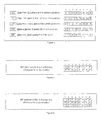
- the general formats of the five commands are shown in Figure 3 , and the more detailed formats of them are shown in Figures 4-10 . For embodiments with different packet lengths, the number of payload bits would be different. For example, 16-bit packets would have 8 additional payload bits.
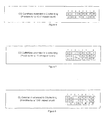
- the MP (make pixel) command has a one in the first bit location (bit position seven) followed by payload bits ("P" bits) that define a color (none of the other commands begin with a one). If the number of color bits used is seven, the MP command is one byte long (as shown in Figure 3 ). If the number of color bits used is fifteen, the MP command will be two bytes long, with the first bit of the first byte being a one (as shown in Figure 4 ). Likewise, if the number of color bits (P bits) is 23, the MP command will be three bytes long (as shown in Figure 5 ), and so on.
- the MP command is the simplest command to understand, and also provides the least compression.
- a "one" in bit-position seven uniquely identifies a make-pixel command. If a "zero" is in bit-position seven, that command is one of the other four commands shown in Figure 3 , with the next two bits (bit positions five and six) identifying which of the other four commands applies. Thus, a 00 in bit locations five and six indicates a CO (copy old or no change) command, a 01 indicates a CL (copy left) command, a 10 indicates a CA (copy above) command, and a 11 indicates a MS (make-series) command. Thereafter, each of these four command types has payload bits that follow the opcode. The payload bits are the R, C and P bits. The E bits will be discussed below under the MS command.
- the payload bits (R bits) in the CO, CL and CA commands indicate the number of times the command operation is repeated.
- the CO command instructs the client that pixels have not changed from pixels currently displayed.
- the encoder 26 compares the old and new frame buffers and evokes CO commands when it determines that current pixels in the "new" frame are no different from pixels at the same locations in the "old” frame. Thus, CO commands are sent for portions of the screen that are not changing in the source video.
- the next two commands compare pixels in terms of locations within a common "new" frame, rather than as between the old and new frame.
- the CL command instructs the client to copy the color from the pixel in the position immediately to the left in the current frame. If the current pixel is the first pixel on a video line, the pixel immediately to the left is the last pixel on the previous line.
- the CA command instructs the client to copy the color from the pixel immediately above in the current frame.
- the CL, CA and CO commands are referred to below as "copy" commands.
- Other commands may be substituted that provide copying of pixels with relations within a common frame or as between old and new frames.
- the presently described commands have particular advantage in computer video because of the proliferation of horizontal and vertical rectangles and lines that exist in computer video. With horizontal lines, for example, CL commands have particular utility and with vertical lines, CA commands have particular utility.
- the final command is the MS or make-series command and is itself unique in the present types of video encoding.
- the MS command takes advantage of a particular aspect of computer video, namely that large portions of typical computer screens are composed of only two colors.
- the classic example of that in computer video is text information in which large portions of the screen are made from with a text foreground color on a solid background color.
- the MS command permits the encoder 26 to create a substantial amount of the video without loss of sharpness in the text, and with very substantial amounts of compression.
- the CO command ( Figures 3 , 6 and 7 ) essentially identifies that a present pixel has not changed from the pixel located in the same location of the previous frame.
- the payload also identifies not only that a present pixel has not changed, but also that some number of consecutive pixels didn't change. What that number will be is described below.
- RRRRR five bits
- the preferred embodiment adds still further efficiency.
- a second immediately consecutive byte with a 000 opcode can follow a first byte with 000 opcode, providing a second five bits to represent from two to thirty three pixels again.
- the decoder 30 will detect two consecutive packets with CO opcodes, and interpret both the five bit payloads as a single CO command with a ten-bit payload.
- the number of consecutive CO pixels extends from 34 to 1025. In other words, with just two eight-bit bytes, a frame of over one thousand pixels can be sent to the client.
- the CO command is escalating in its efficiency.
- a two-byte CO command gets inefficient briefly if the encoder 26 requires a repeat count of 35 or 36, requiring a second byte. But, once the repeat count gets up to a thousand pixels (such as a full line on a 1024x768 resolution screen), just two bytes can compress the whole line. Further, if a third CO command follows the second (as shown in Figure 7 ), the decoder 30 detects a fifteen-bit payload. If there's a fourth CO command, it detects a twenty-bit payload. A four-byte CO command can identify that over one million pixels have not changed, which is more than is needed for a complete frame with 1024x768 resolution. The present invention is not limited to any particular number of consecutive CO commands or any video screen resolution, but for present purposes, a five-byte command (that supports up to 33 million pixels) provides a repeat count large enough for a full frame at the highest video screen resolutions currently envisioned.
- the CL and CA commands operate the same as the CO command described above. They duplicate different pixels (pixels to the left, or pixels above) but they have the same structure, a three-bit opcode followed by a 5-bit RRRRR payload identifying a repeat count. Again, each of the CL and CA commands can be sequenced, as shown in Figure 8 for the CL command, to form 10 bit, 15 bit, 20 bit, or longer payloads.
- the hierarchical priorities between the CO, CL and CA commands only apply if two or more of those commands simultaneously qualify on the current pixel. If the encoder 26 determines that the CO command qualifies on the current pixel and no other copy command qualifies, the encoder temporarily ignores the other copy commands and continues to compare pixels from the old and new frames, to determine how many pixels in a row the CO command qualifies for. The encoder 26 would do the same thing if it discovered that the CA or CL commands alone qualified on a current pixel. At the first instance that the identified (CO, CA or CL) condition is no longer true, the encoder 26 sends one or more consecutive commands of Figure 3 and then evaluates the next pixel for encoding.
- the encoder 26 determines that one repeat count condition is true for a given pixel, and only one repeat count condition is true for a given pixel, it ignores all other command evaluations until the current repeat count condition is no longer valid. When that occurs, it creates the command (opcode and repeat count) and sends it to the client.
- the encoder continues with it until it no longer qualifies. Then the encoder ends that analysis and creates the appropriate bytes. If, however, multiple repeat count conditions (CO, CA or CL) initially qualify on the same pixel, the encoder just starts counting consecutive pixels for which those conditions apply. As long as one of these commands qualifies, the counter continues to run. Eventually, the encoder will choose only one command that applied for the full repeat count so it only counts one counter. It does not need to run three different counters, one for each copy command. Then, as the encoder continues to count, it will discover that some commands no longer qualify. When that occurs enough times so that no command type is "left standing," the encoder 26 creates the opcode for the last surviving command, together with the repeat count identifying the number of pixels that qualified before the last surviving command failed to qualify.
- the encoder determines how many bytes are necessary to identify the repeat count. If the count can be provided in five bits, the encoder generates a one-byte command. If ten bits are required, the encoder generates a two-byte command, and so forth. This aspect of the preferred embodiment is advantageous because it capitalizes optimally on the identification of the longest possible repeat counts. In fact, one can envision other copy commands, other than CA, CL and CO, which identify pixels based on other relational aspects.
- the hierarchical priorities between the CO, CL and CA commands apply if two or more of those commands are equally last standing. In that case, the encoder resorts first to the copy old command.
- the copy old command presents the least burden on the client because the result is only skipping over pixels.
- the client has to work to copy from above or to copy from the left. As between these two copy commands, the copy left is higher priority than copy from above, again because it presents less of a burden to the client.
- the client With a copy left, the client only needs to read the immediately preceding pixel once and write it a number of pixels. To copy from above, however, relies on reading a number of pixels from the video line above and writing to a number of pixels.
- the copy command priority may not matter because the hardware may be dedicated to processing commands.
- the preferred embodiment minimizes the load on a software client by prioritizing the copy commands.
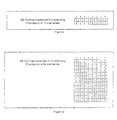
- the fourth command type (and the highest priority of non-copy commands) is the MS (make-series) command shown in Figures 3 , 9 and 10 .
- MS make-series
- the theory on the MS command is that text, no matter what color it is in, is almost always in a two-color mode. Indeed, the inventor examined typical computer screens and determined that large portions of text and other areas of the screen can be defined with long MS commands.
- the MS command provides great efficiency in compressing the text portions of icons, of documents, of labels, and of tool bars. Other compression schemes either do not provide the requisite compression efficiency or do not provide the sharpness demanded by users who have to read text material on the screen.
- each frame is a new group of pixels that need to be encoded.
- the compressor may get some repeat count efficiency by writing CO commands for areas around the text window, but when it hits the adjusted text, repeat count compression becomes inefficient because long repeat counts don't occur.
- the inventor has added efficiency for those text-type areas where copy commands don't work well. Exactly how those MS commands add compression efficiency will now be described.
- the three-bit opcode identifies the MS command.
- the first opcode bit (0) indicates that the command is not a make-pixel command.
- the next two bits (11) identify the command as a make-series command.
- Opportunities to evoke the MS command are identified by the encoder looking ahead four pixels. The artisan should note that the copy commands require no look-ahead operation (though look-ahead operations can be added for the sake of providing additional features). With the MS command, alternatively, more or less pixels can be used for this look-ahead operation.
- the number of pixels in the look ahead should be chosen strategically to be (1) large enough to ensure that repeat count coding won't be more efficient, (2) short enough to make the MS command appropriately applicable, and (3) valued as an integer that accommodates the word length being used. Solely for purposes of example herein, four pixels will be described. MS commands are invoked when the encoder determines that, within the next four pixels, two conditions occur: (1) that aCO, CL or CA command is not going to qualify, and (2) all the pixels in those next four pixels are limited to two different colors.
- the "extended" MS command shown by example in Figures 9 and 10 , extends the MS operation, but only the first byte includes the opcode in bits 5, 6, and 7. The extended MS command is described further below.
- the MS command is used for a series of pixels that are a combination of two different colors.
- the two colors that are included in the set of available colors are the color from the immediately preceding pixel (color 0) and the most recent different color pixel before that (color 1).
- other methods of identifying the two pixel colors for the MS command can be employed from a variety of options, including strict identification of the colors, identification from selected positions in the present frame, or the previous frame, identification from a lookup table of two-color sets, etc.
- the two colors are derived from the immediately preceding two different color pixels, which may have been encoded using make-pixel, copy-above, copy-left, or copy old commands. The MS command does not care how these two pixels got there, just that they will become the two colors for the upcoming MS command's series of pixels.
- the MS command with the two-color set described above is advantageous because it does not require bytes with any color identification bits. That is, the MS commands do not include bits that identify which colors are being used, only which of the two previously identified colors are being used in the series. So, for example, when the encoder reaches the beginning of some text, such as the top left corner of a black letter "H" on a white background, the first pixel on the top left corner of the "H” may be defined with a black MP (make-pixel) command followed by a CL (copy-left) command for a few pixels. As the top center and top right of the H are found by the encoder's look ahead, the encoder will create a make-series command because it is detecting only two colors (text and background) in the coming pixels.
- the first MS command byte has a three-bit opcode followed by an "extension" bit (in bit position 4) that indicates that this command is extended to the next byte. If the extension bit is zero, the MS command is not extended, and it ends after the first byte. In such a case, the four "C" bits in that byte provide the two-color pattern for four pixels and then the present series ends. If, however, the extension bit is on, then another whole byte of MS data will follow the present one. Thus, in Figure 9 , the second byte is an "extended command" byte. Because the extension bit is present in the preceding byte, the next byte need not include the three-bit opcode.
- the identity of the extended command thus comes not from an opcode in the present byte, but from the extension bit in the preceding byte.
- the result provides seven bits for make-series data for every byte following the first byte.
- Each extended command byte includes its own extension bit (in bit position 7) that identifies whether or not a next byte is an extension byte. This extension can go on as long as the E-bits are on. When the E-bit goes off, the present series stops.
- the series of Figure 10 indicates an example of a 13 byte long MS command that will define a series of 88 consecutive pixels.
- the decoder receives the make-series bytes, it begins immediately creating pixels for the client screen, as follows. After reading the opcode 011, the decoder realizes that a make-series is beginning. It reads the color of the preceding pixel and defines that color as "color 0". Then it reads the most recent different color pixel before that and defines that color as "color 1".
- the decoder then reads the E-bit to determine whether the series is one byte, or more. Finally, the decoder reads bits 0-3, in order, and creates pixels from the two available colors based on the binary status of each pixel. For the first byte, the decoder will create four pixels. For example, if the first MS byte is 01110110 and color 0 is black and color 1 is white, the decoder will create four pixels (0110) of black, white, white, and black. Then, because the E-bit is set to 1, the decoder will look to the next byte to create seven more black and white pixels.
- the first byte of an MS command in the preferred embodiment, creates four pixels (eight bits minus three opcode bits minus one extension bit). If the encoder finds that less than four pixels are present in the series (i.e., more than two colors are present in the next four pixels), then the MS command cannot be used in the preferred embodiment. Further, if a first extension byte (a second cumulative byte) of MS command is to be used, the encoder must look ahead to find that the next seven consecutive pixels qualify for MS status (i.e., all from only two color choices and no copy command applies).
- the encoder "looks ahead" before encoding any MS command byte, in order to: (1) determine whether the first four pixels qualify for MS treatment, and (2) determine whether additional bytes of seven pixels will qualify.
- the MS command defines sequential pixels, using sequential bits, such that each bit corresponds to each pixel being either color 0 or color 1.
- the C-bits of the MS commands are like a pixel train.
- the encoder in the MS mode is always looking ahead and won't set the E-bit unless it sees that it will have enough pixels in the coming series of pixels to fill the next seven bits of a next extension command byte. If the encoder looks ahead and encounters a color different from the two-color set, within the next seven pixels, then it ends the make-series command with the current byte (writing a stop bit into the E-bit of the current byte).
- the encoder is doing comparisons for all of the command types for all of the pixels all of the time. In that case, the comparisons are always running in parallel, and are always running for all commands.
- the encoder flags it and determines (based on other comparisons and priorities among the commands) which of the command types is the optimum one for the present situation.
- the video compressor 23 is, for every single pixel, looking for the applicability of each of the five command types, and looking ahead in accordance with the MS command requirements.
- the source video comes from video creation software and a video controller chip, both located in the target server 15.
- Another example embodiment is to have the source video come from video creation software and a video controller chip, both integrated together with the video compressor.
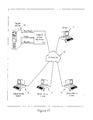
- An example of such an "embedded" fully integrated system is depicted in Figure 14 .
- Another alternative embodiment is to compress the video (using the same types of video commands described above) completely with software that interfaces directly with the video creation software, eliminating the need for a video controller chip.
- An example of such a pure software "controller-less" embodiment is depicted in Figure 15 .
- the command decoder was implemented with PC software.
- An alternative embodiment would implement the decoder completely with hardware or with a combination of hardware and a small low-cost low-performance microprocessor.
- This "embedded” decoder would output its video directly to a video display (without a PC or video controller chip) as shown in Figure 16 .
- This "microclient” could also contain keyboard and mouse interface circuitry and could also be integrated into the video display.
- a microclient would be applicable in applications where it is desirable to have all of the workers computers out of the main work area and in a back room. In the work area, only keyboards, monitors and mice would be present on desktops. When a worker moves from one place to another, they could log onto their computer (or any other computer they were permitted to) from any microclient.
- a second client 16 is added (the same as client 11) which also has the same client software and is also connected to the IP network
- the server appliance 14 could sent the same video compression commands to both clients, permitting both clients to simultaneously "share" access to target server 15.
- this "share mode” one client is accessing the server 15 and the other client is watching.
- the example may occur when a client 11 is employing a server and is in some operational error that the client user wishes a network administrator (who is at another location) to see. This is referred to as the "help desk" mode.
- the share mode is taken to greater extreme in cases where video is multicast, as to a group of trainees sitting at multiple respective client remote consoles 17 and 18.
- UDP uses unacknowledged datagrams, while TCP's datagrams are acknowledged.
- the implosion of acknowledgements with a large number of simultaneous share mode users could flood the server appliance.
- TCP uses unacknowledged datagrams, while TCP's datagrams are acknowledged.
- the implosion of acknowledgements with a large number of simultaneous share mode users could flood the server appliance.
- the advantage of TCP is that no data is lost because everything is sent and re-sent until acknowledged. With video, however, the user cares less about what is lost than about continuous video flow. In other words, just because the screen flickered due to a lost frame, does not mean that the user desires that the video return back to the missed frame and start over.
- the present invention can be employed with TCP, UDP, or any other acknowledged or unacknowledged protocol.
- UDP protocols can contribute to denial of service attacks that maliciously occur on the Internet. Because UDP is unacknowledged, traffic can flood a server with UDP datagrams. To prevent that, firewalls often block UDP. Using the present invention in the example embodiment employing UDP requires the acceptance of UDP datagrams, however training room environments and other applications for large numbers of share-mode users would typically be inside a facility behind the firewall.
- data encryption is applied to the video compression commands, such that the compressed computer screens being transmitted are secure from monitoring.
- Any encryption technology can be employed, but an encryption technology, such as AES encryption, that could be implemented in the same video compressor 23 along with the video compression encoding would be much more desirable from an implementation viewpoint than a separate data encryption device.
Landscapes
- Engineering & Computer Science (AREA)
- Multimedia (AREA)
- Signal Processing (AREA)
- Compression Or Coding Systems Of Tv Signals (AREA)
- Color Television Systems (AREA)
- Compression, Expansion, Code Conversion, And Decoders (AREA)
- Digital Computer Display Output (AREA)
- Image Processing (AREA)
- Compression Of Band Width Or Redundancy In Fax (AREA)
- Two-Way Televisions, Distribution Of Moving Picture Or The Like (AREA)
Claims (35)
- Verfahren zum Komprimieren von Computervideo in n-Bit-Pakete, umfassend:Untersuchen der Farbe jedes Videopixels innerhalb von ausgewählten VideoFrames;Bestimmen welche der nachfolgenden Bedingungen für jedes Pixel in jedem ausgewählten Frame Anwendung findet:eine erste Bedingung, wobei ein aktuelles Pixel unverändert ist gegenüber einem Pixel an derselben Bildschirmposition in dem zuvor ausgewählten Frame;eine zweite Bedingung, wobei das aktuelle Pixel unverändert ist gegenüber einem Pixel direkt links von dem aktuellen Pixel in dem aktuellen Frame;eine dritte Bedingung, wobei das aktuelle Pixel unverändert ist gegenüber einem Pixel direkt über dem aktuellen Pixel in dem aktuellen Frame;eine vierte Bedingung, wobei eine aufeinanderfolgende Serie von x-Pixeln, die mit dem aktuellen Pixel beginnt, nur Farben umfassen aus einem Zweifarbsatz und x zumindest (n-4) ist; undeine fünfte Bedingung, wobei jede der ersten, zweiten, dritten und vierten Bedingung keine Anwendung findet;(a) wenn eine der ersten, zweiten oder dritten Bedingungen Anwendung findet, Bestimmen welche der Bedingungen für die längste Anzahl von aufeinanderfolgenden Pixeln beginnend mit dem aktuellen Pixel Anwendung findet, und(i) wenn die bestimmte Bedingung die erste Bedingung ist, Kodieren eines Pakets, welches beinhaltet:ein Bit, das angibt, dass die fünfte Bedingung keine Anwendung findet, zweite und dritte Bits, die zusammen angeben, dass die erste Bedingung Anwendung findet, und(n-3) Nutzdatenbits, die die Anzahl von aufeinanderfolgenden Pixeln angeben, beginnend mit dem aktuellen Pixel, die unverändert gegenüber Pixeln an denselben Bildschirmpositionen in dem zuvor ausgewählten Frame sind;(ii) wenn die bestimmte Bedingung die zweite Bedingung ist, Kodieren eines Pakets, das beinhaltet:ein Bit, das angibt, dass die fünfte Bedingung keine Anwendung findet,zweite und dritte Bits, die zusammen angeben, dass die zweite Bedingung Anwendung findet, und(n-3) Nutzdatenbits, die die Anzahl von aufeinanderfolgenden Pixeln angeben, beginnend bei dem aktuellen Pixel, die von dem Pixel in dem aktuellen Frame direkt links des aktuellen Pixels kopiert werden können;(iii) wenn die bestimmte Bedingung die dritte Bedingung ist, Kodieren eines Pakets, das beinhaltet:ein Bit, das angibt, dass die fünfte Bedingung keine Anwendung findet,zweite und dritte Bits, die zusammen angeben, dass die dritte Bedingung Anwendung findet, und(n-3) Nutzdatenbits, die eine Anzahl von aufeinanderfolgenden Pixeln angeben, beginnend mit dem aktuellen Pixel, die von der Anzahl von Pixeln in dem aktuellen Frame direkt über jedes von ihnen kopiert werden kann;(b) wenn keine der ersten, zweiten und dritten Bedingung Anwendung findet und die vierte Bedingung Anwendung findet, Kodieren eines oder mehrerer n-Bit-Pakete, die beinhalten:(i) ein erstes Paket, das beinhaltet:ein Bit, das angibt, dass die fünfte Bedingung keine Anwendung findet,zweite und dritte Bits, die zusammen angeben, dass die vierte Bedingung Anwendung findet,ein viertes Bit, das angibt, ob das erste Paket durch ein anderes Paket gefolgt wird, welches der Serie von x-Pixeln entspricht;(n-4) Bits, die angeben, welche Farbe aus dem Zweifarbsatz für jedes der ersten (n-4)-Pixel in der Serie von x-Pixeln Anwendung findet; und(ii) wenn x größer oder gleich (2n-5) ist, ein zusätzliches nachfolgendes Paket für jedes weitere Vielfache von (n-1), wobei jedes beinhaltet:ein Bit, das angibt, ob ein anderes Paket, das der Serie von x-Pixeln entspricht, folgt; und(n-1)-Bits, die angeben, welche Farbe aus dem Zweifarbsatz für jedes der nächsten (n-1)-Pixeln in der Serie von x-Pixeln Anwendung findet; und(c) wenn die fünfte Bedingung Anwendung findet, Kodieren eines n-Bit-Pakets, das beinhaltet:ein Bit, das angibt, dass die fünfte Bedingung Anwendung findet; und(n-1)-Bits, die die Farbe des aktuellen Pixels definieren.
- Verfahren nach Anspruch 1, ferner beinhaltend:Bestimmen, dass mehr als (n-1)-Bits benötigt werden, um Pixelfarben zu definieren, und wobeiein zusätzliches Paket kodiert ist, welches dem Paket folgt, das in Schritt (c) kodiert wurde, welches beinhaltet:n-Bits von zusätzlichen Bits, welche die Farbe definieren, somit insgesamt (2n-1)-Bits erzeugen zum Definieren der Farbe des aktuellen Pixels.
- Verfahren nach Anspruch 2, ferner beinhaltend:Bestimmen, dass mehr als (2n-1)-Bits benötigt werden, um Pixelfarben zu definieren, und wobeiein oder mehrere weitere Pakete kodiert werden, die dem zusätzlichen Paket folgen, wobei jedes weitere Paket beinhaltet:n-Bits von zusätzlichen Bits, die die Farbe definieren, somit insgesamt (Yn-1)-Bits erzeugen zum Definieren der Farbe des aktuellen Pixels, wobei Y die gesamte Summe von kodierten Paketen ist.
- Verfahren nach Anspruch 1, wobei der Kodierschritt (a)(i) Kodieren von Paketen mit (n-3)-Nutzdatenbits beinhaltet, die Wiederholungszähler von zwei bis 2<(n-3)>+1 definieren.
- Verfahren nach Anspruch 4, wobei n=8 und die (n-3)-Nutzdatenbits Wiederholungszähler von zwei bis dreiunddreißig definieren.
- Verfahren nach Anspruch 1, ferner den Schritt beinhaltend von:in den Kodierschritten (a)(i), (a)(ii) oder (a)(iii), wenn der benötigte Wiederholungszähler die Nutzdatenkapazität eines Pakets überschreitet, Kodieren von y-Anzahl von Paketen von entsprechend (n-3)-Nutzdaten, welche zusammen die gesamten kombinierten Nutzdaten gleich y mal (n-3)-Bits bereitstellen.
- Verfahren nach Anspruch 6, wobei:jede einzelnen Paketnutzdaten die Kapazität haben, um Wiederholungszähler bis zu 2<(n-3)> zu definieren, wenn der benötigte Wiederholungszähler 2<(n-g)> überschreitet, wird ein zweites Paket kodiert, um 2*(n-3) gesamte kombinierte Nutzdaten bereitzustellen, und die ersten und zweiten Pakete stellen Wiederholungszähler von 2<(2*(n-3))> bereit, undwenn der benötigte Wiederholungszähler sowohl das verfügbare 2<(n-3)> eines einzelnen Pakets als auch das 2<(2*(n-3))> von zwei Paketen überschreitet, wird ein drittes Paket kodiert, um 3*(n-3) gesamte kombinierte Nutzdaten bereitzustellen und diese ersten, zweiten und dritten Pakete stellen Wiederholungszähler von bis zu 2<(3*(n-3))> bereitzustellen.
- Verfahren nach Anspruch 1, ferner umfassend die Schritte von:Dekodieren der Pakete durch Software, welche sich auf einem Personal Computer befindet.
- Verfahren nach Anspruch 1, wobei die Schritte zum Untersuchen der Farbe jedes Videopixels und Bestimmen, welche der Bedingungen für jedes Pixel Anwendung findet, ferner beinhalten:Weiterlesen von dem aktuellen Pixel zu nachfolgenden Pixeln, um zu bestimmen, ob die vierte Bedingung Anwendung findet; undBestimmen ob mehr als eine der priorisierten Bedingungen für das aktuelle Pixel Anwendung findet, und wenn dem so ist, für den Untersatz von anwendbaren priorisierten Bedingungen:(i) Lesen des nächsten nachfolgenden Pixels, um zu bestimmen, ob der Untersatz von priorisierten Bedingungen auch bei dem nächsten nachfolgenden Pixel Anwendung findet;(ii) wenn eine oder mehrere von dem Untersatz von priorisierten Bedingungen keine Anwendung bei dem nächsten nachfolgenden Pixel finden, Löschen der nicht anwendbaren einen oder mehreren priorisierten Bedingungen aus dem Untersatz von anwendbaren priorisierten Bedingungen; und(iii) Wiederholen der Schritte (i) und (ii) bis keine priorisierte Bedingung weiterhin Anwendung findet und danach:(a) Kodieren des Wiederholungszählers in ein oder mehrere Pakete in Übereinstimmung mit der höchstbewertesten priorisierten Bedingung, welche als letzte übrig blieb.
- Verfahren nach Anspruch 1, wobei das Verfahren ein Verfahren zum Komprimieren von Video umfasst, welches umfasst:Vergleichen einiger Teile von ausgewählten Videoframes mit anderen Teilen, und Kodieren der einigen Teile basierend auf ihrer ortsbezogenen Beziehung zu den anderen Teilen, undIdentifizieren weiterhin von anderen Teilen desselben ausgewählten Videoframes als Pixel, welche nur Farben aus einem Zweifarbsatz umfassen, undKodieren der weiterhin anderen Teile als eine Serie von Bits, welche binäre Zustände aufweisen, welche den zwei Farben in dem Zweifarbensatz entsprechen.
- Verfahren nach Anspruch 1, wobei das Verfahren ein Verfahren zum Kodieren von Video umfasst, welches die Schritte umfasst zum:Vordefinieren eines Satzes an Pixelkopierbefehlen basierend auf Frame-Ortsbeziehungen zwischen dem aktuellen Pixel und anderen Pixeln;für das aktuelle Pixel, Kodieren entsprechend einer hierarchischen Auswahl von einem aus:einem identifizierten Wiederholungszähler, der mit zumindest einem der Pixelkopierbefehle assoziiert ist;eine identifizierte Serie von Pixeln, welche nur aus zwei Farben gezeichnet sind; undeine identifizierte spezifische individuelle Pixelfarbe.
- Verfahren nach Anspruch 11, wobei das Kodieren das Erstellen von Paketen mit fixierter Größe beinhaltet, welche einen Opcode-Teil und einen Nutzdatenteil beinhalten.
- Verfahren nach Anspruch 12, wobei zumindest einige der Pakete mit fixierter Größe beinhalten:ein Bit, das die Hierarchieauswahl identifiziert, die mit individuell gefärbten Pixeln assoziiert ist;zwei zusätzliche Bits, die die Hierarchieauswahlen identifizieren, die mit drei unterschiedlichen Pixelkopierbefehlen und dem Zweifarbserienpixelbefehl assoziiert sind; undNutzdaten von zumindest n Bits.
- Verfahren nach Anspruch 13, wobei andere der Pakete mit fixierter Größe ein Erweiterungsbit, welches das aktuelle Paket mit einem vorherigen Paket verbindet, und Nutzdaten größer als n Bits beinhalten.
- Verfahren nach Anspruch 13, wobei andere der Pakete mit fixierter Größe ein Erweiterungsbit beinhalten, welches das aktuelle Paket mit dem nächsten Paket verbindet, wobei das nächste Paket dann Nutzdaten größer als n Bits beinhaltet.
- Verfahren nach Anspruch 1, wobei das Verfahren ein Verfahren zum Komprimieren eines Videostreams umfasst, welcher an Pixelorten auf einem Bildschirm angezeigt werden soll, umfassend:(a) aufeinanderfolgendes Empfangen von Frames von Informationen des Videostreams umfassend aufeinanderfolgende Serien von entsprechenden Pixelidentifizierern;(b) für einen ersten empfangenen Pixelidentifizierer, Vergleichen des ersten Pixelidentifizierers mit:(i) einem benachbarten Pixelidentifizierer, der benachbart zu dem ersten empfangenen Pixel auf dem Bildschirm ist;(ii) einen Darüber-Pixelidentifizierer, der über dem ersten empfangenen Pixelidentifizierer auf dem Bildschirm ist; und(iii) einen Alt-Pixelidentifizierer, der an demselben Bildschirmort ist wie der erste empfangene Pixelidentifizierer, aber auf einem vorherigem Bildschirm; und(c) Zählen einer Anzahl von Pixeln von dem ersten empfangenen Pixelidentifizierer, für welchen zumindest eine der Bedingungen (i), (ii) und (iii) einen kontinuierlichen Stream von Gleichheitsbedingungen ergibt;(d) Kodieren eines Datenpakets aufweisend:einen Code, der eine der drei Bedingungen (i), (ii), (iii) identifiziert, welche den längsten der kontinuierlichen Streams bereitstellt, undInformationen, die die Länge des längsten kontinuierlichen Streams identifizieren.
- Vorrichtung zum Komprimieren von Computervideo in n-Bit-Pakete, umfassend einen Kodierer (26), der eingerichtet ist zum:(1) Untersuchen der Farbe jedes Pixels in ausgewählten Videoframes;(2) Bestimmen, welche der folgenden Bedingungen für das aktuelle Pixel in dem ausgewählten Frame Anwendung findet:eine erste Bedingung, in welcher ein aktuelles Pixel unverändert gegenüber einem Pixel an derselben Bildschirmposition in dem zuvor ausgewählten Frame ist;eine zweite Bedingung, in welcher das aktuelle Pixel unverändert gegenüber einem Pixel direkt links des aktuellen Pixels in dem aktuellen Frame ist;eine dritte Bedingung, in welcher das aktuelle Pixel unverändert gegenüber einem Pixel direkt über dem aktuellen Pixel in dem aktuellen Frame ist;eine vierte Bedingung, in welcher eine aufeinanderfolgende Serie von x Pixeln, beginnend mit dem aktuellen Pixel, nur Farben umfassen aus einem Zweifarbsatz und x zumindest (n-4) ist; undeine fünfte Bedingung, in welcher jede der ersten, zweiten, dritten und vierten Bedingungen keine Anwendung findet; und(3) Kodieren eines Pakets, welches beinhaltet:(a) wenn bestimmt ist, dass die erste Bedingung Anwendung findet:ein Bit, welches angibt, dass die fünfte Bedingung keine Anwendung findet, zweite und dritte Bits, die zusammen angeben, dass die erste Bedingung Anwendung findet, und(n-3) Nutzdatenbits, die die Anzahl von aufeinanderfolgenden Pixeln angeben, beginnend mit dem aktuellen Pixel, die unverändert sind gegenüber Pixeln an derselben Bildschirmposition in dem zuvor ausgewählten Frame;(b) wenn bestimmt ist, dass die zweite Bedingung, aber nicht die erste Bedingung Anwendung findet:ein Bit, das angibt, dass die fünfte Bedingung keine Anwendung findet, zweite und dritte Bits, die zusammen angeben, dass die zweite Bedingung Anwendung findet, und(n-3) Nutzdatenbits, die die Anzahl von aufeinanderfolgenden Pixeln angeben, beginnend mit dem aktuellen Pixel, die von dem Pixel in dem aktuellen Frame direkt links des aktuellen Pixels kopiert werden können;(c) wenn bestimmt ist, dass die dritte Bedingung, aber nicht die erste oder zweite Bedingung Anwendung findet:ein Bit, das angibt, dass die fünfte Bedingung keine Anwendung findet, zweite und dritte Bits, die zusammen angeben, dass die dritte Bedingung Anwendung findet, und(n-3) Nutzdatenbits, die eine Anzahl von aufeinanderfolgenden Pixeln angeben, beginnend mit dem aktuellen Pixel, die von der Anzahl von Pixeln in dem aktuellen Frame direkt über jedes von ihnen kopiert werden kann;(d) wenn bestimmt ist, dass die vierte Bedingung, aber nicht die erste, zweite oder dritte Bedingung, Anwendung findet:(i) ein erstes Paket, das beinhaltet:ein Bit, das angibt, dass die fünfte Bedingung keine Anwendung findet,zweite und dritte Bits, die zusammen angeben, dass die vierte Bedingung Anwendung findet,ein viertes Bit, das angibt, ob das erste Paket von einem anderen Paket, welches derselben Serie von x Pixeln entspricht, gefolgt wird; und(n-4) Bits, die angeben, welche Farbe, von dem Zweifarbsatz für jedes der (n-4) Pixeln in der Serie von x Pixeln Anwendung findet; und(ii) wenn x größer ist oder gleich ist zu (2n-5), ein zusätzliches nachfolgendes Paket für jedes weitere Vielfache von (n-1), jedes beinhaltend:ein Bit, das angibt, ob ein anderes Paket entsprechend der gleichen Serie von x Pixeln folgt; und(n-1) Bits, die angeben, welche Farbe aus dem Zweifarbsatz für jedes der (n-1) zusätzlichen Pixeln in der Serie von x Pixeln Anwendung findet, und(e) wenn bestimmt ist, dass die fünfte Bedingung Anwendung findet:ein Bit, das angibt, dass die fünfte Bedingung Anwendung findet; und(n-1) Bits, die die Farbe des aktuellen Pixels definieren.
- Vorrichtung nach Anspruch 17, wobei der Kodierer (26) ferner eingerichtet ist zum Bestimmen, ob mehr als (n-1) Bits benötigt werden, um Pixelfarben zu definieren, und wobei
ein oder mehrere weitere Pakete kodiert werden, die dem Paket, welches in Schritt (e) kodiert wurde, folgen, wobei jedes weitere Paket beinhaltet:n Bits von zusätzlichen farbdefinierenden Bits, somit insgesamt (Yn-1) Bits erzeugend, um die Farbe des aktuellen Pixels zu definieren, wobei Y die gesamte Summe der kodierten Pakete ist. - Vorrichtung nach Anspruch 17, wobei der Kodierer (26) ferner eingerichtet ist zum Erzeugen eines Datenpakets, welches eine aktuelle wiederholte Sequenz von Pixeln definiert, durch Kopieren der Farbe eines anderen Pixels, das basierend auf einer Frame-Ort-Beziehung ausgewählt wird, zu der aktuellen wiederholten Sequenz von Pixeln, und zum Auswählen, für die aktuelle wiederholte Sequenz von Pixeln, der ausgewählten Frame-Ort-Beziehung aus einer Gruppe von Frame-Ort-Beziehungsarten, so dass die ausgewählte Frame-Ort-Beziehung die längste wiederholte Sequenz von allen Frame-Ort-Beziehungsarten ergeben wird.
- Vorrichtung nach Anspruch 19, wobei, wenn der Kodierer (26) ermittelt, dass die Länge der wiederholten Sequenz für zwei oder mehr Frame-Ort-Beziehungsarten gleich ist, Auswählen der ausgewählten Frame-Ort-Beziehung basierend auf einer vorbestimmten Hierarchie zwischen den zwei oder mehr Frame-Ort-Beziehungsarten.
- Vorrichtung nach Anspruch 19, wobei:die Gruppe von Frame-Ort-Beziehungsarten beinhaltet:ein Pixel, das links von dem aktuellen Pixel in demselben Frame gelegen ist;ein Pixel, das über dem aktuellen Pixel in demselben Frame gelegen ist; undein Pixel, das in dem vorherigen Frame an demselben Ort wie das aktuelle Pixel gelegen ist.
- Vorrichtung nach Anspruch 19, wobei der Kodierer (26) ferner eingerichtet ist zum Erstellen eines Pakets, welches eine Farbe des aktuellen Pixels aus einem spezifischen Satz von zwei Farben definiert.
- Vorrichtung nach Anspruch 19, wobei der Kodierer (26) ferner eingerichtet ist zum Herstellen eines Pakets, welches eine Farbe des aktuellen Pixels aus einem Testmuster von verfügbaren Farben definiert.
- Vorrichtung nach Anspruch 17, ferner umfassend eine Videokomprimierungsroutine beinhaltend:Untersuchen von Pixeln in ausgewählten früheren und aktuellen Videoframes;für ein gegebenes aktuelles Frame und für ein aktuelles Pixel davon, Erstellen von Paketen mit fixierter Bitlänge, welche zumindest das aktuelle Pixel definieren, wobei die Pakete beinhalten:(1) Pixel-Kopier-Pakete, welche zumindest ein Paketart-Identifizierbit aufweisen und zumindest ein Wiederholungszähleridentifikationsbit aufweisen;(2) farbdefinierende Pakete, die zumindest ein Paketart-Identifizierbit und zumindest ein Farb-Identifizierbit aufweisen.
- Vorrichtung nach Anspruch 24, wobei der Algorithmus ferner beinhaltet:für das aktuelle Frame und das aktuelle Pixel:Erstellen von Zweifarbserien kodierten Paketen, die zumindest ein Paketart-Identifizierbit und eine Serie von binären Farb-Identifizierbits aufweisen, die nur zwei Farben entsprechen und übereinstimmen mit einer Farbe des aktuellen Pixels und einer Anzahl von Pixeln, die dem aktuellen Pixel unmittelbar folgen.
- Videoübertragungssystem, umfassend:die Vorrichtung nach einem der Ansprüche 17 bis 25;eine Videokodierroutine, die eingerichtet ist zum Kodieren von seriellen Pixeldaten an einem ersten Prozessor entsprechend einem Algorithmus, der beinhaltet, für einen gegebenen Satz von Pixeln, Auswählen eines effizienteren von:(1) Kopierpixelkodierung;(2) individuell gefärbte Pixelkodierung; und(3) Zweifarbserienpixelkodierung.
- Videoübertragungssystem nach Anspruch 26, wobei die Kopierpixelkodierung Kodieren basierend auf einer Frame-Ort-Beziehung zwischen dem aktuellen Pixel in dem aktuellen Frame und einem anderen Pixel in dem aktuellen Frame beinhaltet.
- Videoübertragungssystem nach Anspruch 26, wobei die Kopierpixelkodierung Kodieren basierend auf einer Auswahl von Folgenden beinhaltet:eine Beziehung zwischen dem aktuellen Pixel in dem aktuellen Frame und einem anderen Pixel links von dem aktuellen Pixel in dem aktuellen Frame;eine Beziehung zwischen dem aktuellen Pixel in dem aktuellen Frame und einem anderen Pixel über dem aktuellen Pixel in dem aktuellen Frame; undeine Beziehung zwischen dem aktuellen Pixel in dem aktuellen Frame und einem anderen Pixel an demselben Ort, aber in einem vorherigen Frame.
- Videoübertragungssystem nach Anspruch 26, wobei die Zweifarbserienpixelkodierung Kodieren beinhaltet, wobei eine aufeinanderfolgende Serie von x Pixeln, beginnend mit dem aktuellen Pixel, nur zwei Farben aus einem Zweifarbsatz umfassen.
- System, umfassend:die Vorrichtung nach irgendeinem der Ansprüche 17 bis 25;eine Eingabe, die eingerichtet ist zum Empfangen eines seriellen Streams von Informationen, die eine serielle Sequenz von Pixelvideowerten in einer Reihenfolge angeben, in welcher die Pixelvideowerte auf einen Videomonitor geschrieben werden sollen;wobei der Kodierer (26) ferner eingerichtet ist zum kontinuierlichen Lesen des seriellen Streams von Informationen und Bestimmen, ob eine Bedingung eintritt, in welcher eine vorbestimmte Anzahl von aufeinanderfolgenden einen der Pixelvideowerte aus einer Gruppe von nur zwei Farbwerten besteht, und wenn die Bedingung eintritt, Kodieren der vorbestimmten Anzahl von aufeinanderfolgenden einen der Pixelvideowerte durch Erzeugen eines Serienbefehls mit einer Serie von binären Zustandswerten, welche in Folge der aufeinanderfolgenden einen der Pixelvideowerte entsprechen und wobei einer der binären Zustandswerte einem der zwei Pixelvideowerte entspricht und der andere der binären Zustandswerte dem anderen der zwei Pixelvideowerte entspricht; undder Kodierer (26) ferner eingerichtet ist zum Kodieren des seriellen Streams von Informationen unter Verwendung einer alternativen Identifikation des Pixelvideowertes, wenn der Kodierer (26) bestimmt, dass die Bedingung nicht eintritt.
- System nach Anspruch 30, wobei der Kodierer (26) ferner eingerichtet ist zum Erzeugen einer Anweisung entsprechend der Identität von zwei Farbwerten gefolgt durch die Serie von binären Zuständen, die in Folge den aufeinanderfolgenden einen der Pixelvideowerte entspricht.
- System nach Anspruch 31, wobei die Anweisung entsprechend der Identität eine Anweisung ist, welche Bezug nimmt auf die vorigen Pixelvideowerte in dem seriellen Stream von Informationen.
- System nach Anspruch 30, wobei der Kodierer (26) ferner eingerichtet ist, um mit einem Dekodierer (30) zu entsprechen und der Kodierer ferner eingerichtet ist, keine Instruktion dem Dekodierer entsprechend der Identität der zwei Farbwerte bereitzustellen:wenn die Bedingung eintritt, stellt der Kodierer eine Instruktion bereit, die identifiziert, dass die Art des Befehls, der kommuniziert wird, ein Befehl ist, der einer Zweifarbserie entspricht; undder Dekodierer die zwei Farbwerte basierend auf einem zuvor eingerichteten vorherigen Ort der zwei Farbwerte in dem seriellen Stream von Informationen identifiziert.
- System nach Anspruch 30, wobei die alternative Identifikation der Pixelvideowerte eingerichtet ist, um eine Serie von entsprechenden Befehlspaketen zu beinhalten, welche digital aufeinanderfolgenden entsprechenden einen der Pixelvideowerte identifizieren.
- System nach Anspruch 30, wobei der Kodierer (26) ferner eingerichtet ist zum kontinuierlichen Lesen des seriellen Streams von Informationen und Bestimmen, ob eine Bedingung eintritt, in welcher ein aktueller Pixelvideowert in der seriellen Sequenz von Pixelvideowerten identisch ist mit einem vorherigen Pixelvideowert, der über dem aktuellen Pixelvideowert gelegen ist relativ zu ihrer Anzeige auf einem Computermonitor, und wenn die Bedingung eintritt, Ausgeben eines Befehls, um den vorherigen Pixelvideowert zu kopieren, um den aktuellen Pixelvideowert zu bestimmen.
Applications Claiming Priority (3)
| Application Number | Priority Date | Filing Date | Title |
|---|---|---|---|
| US260534 | 2002-10-01 | ||
| US10/260,534 US7321623B2 (en) | 2002-10-01 | 2002-10-01 | Video compression system |
| PCT/US2003/010488 WO2004032356A1 (en) | 2002-10-01 | 2003-04-07 | Video compression system |
Publications (3)
| Publication Number | Publication Date |
|---|---|
| EP1547263A1 EP1547263A1 (de) | 2005-06-29 |
| EP1547263A4 EP1547263A4 (de) | 2011-08-31 |
| EP1547263B1 true EP1547263B1 (de) | 2016-01-13 |
Family
ID=32029707
Family Applications (1)
| Application Number | Title | Priority Date | Filing Date |
|---|---|---|---|
| EP03723915.9A Expired - Lifetime EP1547263B1 (de) | 2002-10-01 | 2003-04-07 | Videokomprimierungssystem |
Country Status (10)
| Country | Link |
|---|---|
| US (12) | US7321623B2 (de) |
| EP (1) | EP1547263B1 (de) |
| JP (6) | JP3831397B2 (de) |
| CN (3) | CN101184236B (de) |
| AU (1) | AU2003230815A1 (de) |
| CA (4) | CA2625462C (de) |
| IL (1) | IL167787A (de) |
| MY (1) | MY137325A (de) |
| TW (1) | TWI235006B (de) |
| WO (1) | WO2004032356A1 (de) |
Families Citing this family (115)
| Publication number | Priority date | Publication date | Assignee | Title |
|---|---|---|---|---|
| US20020091850A1 (en) | 1992-10-23 | 2002-07-11 | Cybex Corporation | System and method for remote monitoring and operation of personal computers |
| US5721842A (en) * | 1995-08-25 | 1998-02-24 | Apex Pc Solutions, Inc. | Interconnection system for viewing and controlling remotely connected computers with on-screen video overlay for controlling of the interconnection switch |
| WO2003103178A1 (en) * | 2002-05-29 | 2003-12-11 | Pixonics, Inc. | Video interpolation coding |
| US7818480B2 (en) * | 2002-08-29 | 2010-10-19 | Raritan Americas, Inc. | Wireless management of remote devices |
| US8558795B2 (en) * | 2004-03-12 | 2013-10-15 | Riip, Inc. | Switchless KVM network with wireless technology |
| US7606314B2 (en) * | 2002-08-29 | 2009-10-20 | Raritan America, Inc. | Method and apparatus for caching, compressing and transmitting video signals |
| US8068546B2 (en) * | 2002-08-29 | 2011-11-29 | Riip, Inc. | Method and apparatus for transmitting video signals |
| US7684483B2 (en) * | 2002-08-29 | 2010-03-23 | Raritan Americas, Inc. | Method and apparatus for digitizing and compressing remote video signals |
| JP4601895B2 (ja) * | 2002-09-26 | 2010-12-22 | 富士通コンポーネント株式会社 | 切替器及びコンピュータシステム |
| US7321623B2 (en) | 2002-10-01 | 2008-01-22 | Avocent Corporation | Video compression system |
| US20060126718A1 (en) * | 2002-10-01 | 2006-06-15 | Avocent Corporation | Video compression encoder |
| US20040221009A1 (en) * | 2003-03-04 | 2004-11-04 | Soronti, Inc. | Keyboard-video-mouse (KVM) loop back configuration for virtual presence architecture (VPA) |
| US20040215742A1 (en) * | 2003-03-04 | 2004-10-28 | Soronti, Inc. | Image perfection for virtual presence architecture (VPA) |
| US7580380B2 (en) * | 2003-05-28 | 2009-08-25 | Artimi Ltd | Communications systems and methods |
| US9560371B2 (en) * | 2003-07-30 | 2017-01-31 | Avocent Corporation | Video compression system |
| US7362355B1 (en) * | 2003-08-04 | 2008-04-22 | Pixim, Inc. | Digital CMOS image sensor incorporating a programmable multi-functional lookup table |
| US7430329B1 (en) | 2003-11-26 | 2008-09-30 | Vidiator Enterprises, Inc. | Human visual system (HVS)-based pre-filtering of video data |
| US7809061B1 (en) * | 2004-01-22 | 2010-10-05 | Vidiator Enterprises Inc. | Method and system for hierarchical data reuse to improve efficiency in the encoding of unique multiple video streams |
| US7853663B2 (en) * | 2004-03-12 | 2010-12-14 | Riip, Inc. | Wireless management system for control of remote devices |
| JP4451181B2 (ja) * | 2004-03-26 | 2010-04-14 | オリンパス株式会社 | 画像圧縮方法及び画像圧縮装置 |
| TWI241492B (en) * | 2004-05-13 | 2005-10-11 | Sunplus Technology Co Ltd | Method and chips being able to expand I/O pins of chip |
| US7006700B2 (en) * | 2004-06-25 | 2006-02-28 | Avocent Corporation | Digital video compression command priority |
| US7457461B2 (en) * | 2004-06-25 | 2008-11-25 | Avocent Corporation | Video compression noise immunity |
| US8442311B1 (en) | 2005-06-30 | 2013-05-14 | Teradici Corporation | Apparatus and method for encoding an image generated in part by graphical commands |
| US7747086B1 (en) | 2005-07-28 | 2010-06-29 | Teradici Corporation | Methods and apparatus for encoding a shared drawing memory |
| US20060039464A1 (en) * | 2004-08-23 | 2006-02-23 | Emerson Theodore F | Method and apparatus for capturing video data to a virtual screen buffer |
| US7574059B2 (en) * | 2004-10-29 | 2009-08-11 | Broadcom Corporation | System, method, and apparatus for providing massively scaled down video using iconification |
| US7228154B2 (en) * | 2004-11-03 | 2007-06-05 | Sony Corporation | Method and system for processing wireless digital multimedia |
| US20060119602A1 (en) * | 2004-12-07 | 2006-06-08 | Fisher Andrew J | Address based graphics protocol |
| US7516255B1 (en) | 2005-03-30 | 2009-04-07 | Teradici Corporation | Method and apparatus for providing a low-latency connection between a data processor and a remote graphical user interface over a network |
| US8560753B1 (en) | 2005-03-30 | 2013-10-15 | Teradici Corporation | Method and apparatus for remote input/output in a computer system |
| US7430681B1 (en) | 2005-03-30 | 2008-09-30 | Teradici Corporation | Methods and apparatus for interfacing a drawing memory with a remote display controller |
| WO2006105743A1 (de) * | 2005-04-08 | 2006-10-12 | Firma Pepperl + Fuchs Gmbh | Thin-client-terminal und client-server-system mit einem derartigen terminal |
| US7640382B2 (en) * | 2005-04-29 | 2009-12-29 | Avocent Corporation | Virtual media systems, methods and devices |
| CN1332300C (zh) * | 2005-04-30 | 2007-08-15 | 广东威创日新电子有限公司 | 一种基于服务器端\客户端结构远程显示处理方法 |
| JP2007034376A (ja) * | 2005-07-22 | 2007-02-08 | Fujitsu Component Ltd | 切り替え装置、並びに、その制御方法および制御プログラム |
| US7822278B1 (en) | 2005-09-20 | 2010-10-26 | Teradici Corporation | Methods and apparatus for encoding a digital video signal |
| US8107527B1 (en) | 2005-07-28 | 2012-01-31 | Teradici Corporation | Progressive block encoding using region analysis |
| US8345768B1 (en) * | 2005-07-28 | 2013-01-01 | Teradici Corporation | Progressive block encoding using region analysis |
| US7634076B2 (en) * | 2005-08-03 | 2009-12-15 | Indicium Media, Llc | Network, system and method for distributing digital media |
| US7230560B2 (en) * | 2005-08-05 | 2007-06-12 | Microsoft Corporation | Image compression and decompression |
| US7817849B2 (en) * | 2005-08-18 | 2010-10-19 | Hewlett-Packard Development Company, L.P. | Method and apparatus for graphical data compression |
| US8478884B2 (en) * | 2005-09-30 | 2013-07-02 | Riip, Inc. | Wireless remote device management utilizing mesh topology |
| US7752339B2 (en) * | 2005-10-11 | 2010-07-06 | Aten International Co., Ltd. | Matrix architecture for KVM extenders |
| US20060053212A1 (en) * | 2005-10-28 | 2006-03-09 | Aspeed Technology Inc. | Computer network architecture for providing display data at remote monitor |
| US7689677B2 (en) * | 2006-02-17 | 2010-03-30 | Avocent Huntsville Corporation | Dynamic power cycling |
| US7555570B2 (en) * | 2006-02-17 | 2009-06-30 | Avocent Huntsville Corporation | Device and method for configuring a target device |
| US8718147B2 (en) * | 2006-02-17 | 2014-05-06 | Avocent Huntsville Corporation | Video compression algorithm |
| US20070261116A1 (en) * | 2006-04-13 | 2007-11-08 | Verisign, Inc. | Method and apparatus to provide a user profile for use with a secure content service |
| US7782961B2 (en) * | 2006-04-28 | 2010-08-24 | Avocent Corporation | DVC delta commands |
| TW200834329A (en) * | 2006-08-10 | 2008-08-16 | Avocent Huntsville Corp | USB based virtual media system |
| US20080040527A1 (en) * | 2006-08-14 | 2008-02-14 | Filipov Metodi N | Management module |
| US20080062121A1 (en) * | 2006-09-08 | 2008-03-13 | Aten Interational Co., Ltd. | Shuttle control system for controlling kvm switch and method thereof |
| JP4946399B2 (ja) * | 2006-11-30 | 2012-06-06 | カシオ計算機株式会社 | 画像処理装置およびプログラム |
| WO2008121226A2 (en) * | 2007-03-29 | 2008-10-09 | Thomson Licensing | Method and apparatus for content distribution to and playout with a digital cinema system |
| JP5137499B2 (ja) * | 2007-08-24 | 2013-02-06 | 富士通コンポーネント株式会社 | Kvmスイッチ及びその制御方法 |
| US8411740B2 (en) * | 2007-09-10 | 2013-04-02 | Ncomputing Inc. | System and method for low bandwidth display information transport |
| US8954876B1 (en) * | 2007-10-09 | 2015-02-10 | Teradici Corporation | Method and apparatus for providing a session status indicator |
| US8203573B1 (en) * | 2007-12-17 | 2012-06-19 | Nvidia Corporation | Systems and methods for assembling image data for transmission across a digital video interface |
| GB2459684A (en) * | 2008-04-30 | 2009-11-04 | British Broadcasting Corp | Television Signal having high frame rate |
| US20100026783A1 (en) * | 2008-08-01 | 2010-02-04 | Real D | Method and apparatus to encode and decode stereoscopic video data |
| WO2010017166A2 (en) | 2008-08-04 | 2010-02-11 | Dolby Laboratories Licensing Corporation | Overlapped block disparity estimation and compensation architecture |
| EP2391122A4 (de) * | 2009-01-23 | 2012-09-05 | Nec Corp | Vorrichtung zur erzeugung von videodeskriptoren |
| US20100226441A1 (en) * | 2009-03-06 | 2010-09-09 | Microsoft Corporation | Frame Capture, Encoding, and Transmission Management |
| US8385338B2 (en) * | 2009-04-24 | 2013-02-26 | Futurewei Technologies, Inc. | Implementation to avoid the acknowledgement-implosion in a multicast group |
| US20110191810A1 (en) * | 2010-02-01 | 2011-08-04 | Thomas Christopher L | Method and System for Distribution of Computer and Entertainment Information |
| TWI395490B (zh) * | 2010-05-10 | 2013-05-01 | Univ Nat Central | 實施於電子裝置之影像編碼方法 |
| WO2012027354A1 (en) * | 2010-08-24 | 2012-03-01 | Avocent Corporation | Method and system for block and dvc video compression |
| US20120106650A1 (en) * | 2010-08-24 | 2012-05-03 | Siegman Craig S | Method and System for Block and DVC Compression |
| US8968080B1 (en) | 2010-11-05 | 2015-03-03 | Wms Gaming, Inc. | Display of third party content on a wagering game machine |
| US8639053B2 (en) * | 2011-01-18 | 2014-01-28 | Dimension, Inc. | Methods and systems for up-scaling a standard definition (SD) video to high definition (HD) quality |
| DK2673585T3 (en) | 2011-02-08 | 2019-03-25 | Carrier Corp | HARDWOOD PLATE HEAT EXCHANGE FOR WATER COOLED HEAT REJECTION IN COOLING CYCLE |
| US9578336B2 (en) | 2011-08-31 | 2017-02-21 | Texas Instruments Incorporated | Hybrid video and graphics system with automatic content detection process, and other circuits, processes, and systems |
| CN102710935A (zh) * | 2011-11-28 | 2012-10-03 | 杭州华银教育多媒体科技股份有限公司 | 计算机与移动设备间通过增量混合压缩编码进行屏幕传输的方法 |
| CN103186544B (zh) * | 2011-12-28 | 2017-11-14 | 广东新岸线计算机系统芯片有限公司 | 一种色位深度存取方法和系统 |
| US8897586B2 (en) * | 2012-06-15 | 2014-11-25 | Comcast Cable Communications, Llc | Dynamic generation of a quantization matrix for compression of a digital object |
| US9578201B2 (en) * | 2012-11-28 | 2017-02-21 | Duquesne University Of The Holy Spirit | Method of detecting steganographically hidden images via low-order bit comparisons |
| US9898575B2 (en) | 2013-08-21 | 2018-02-20 | Seven Bridges Genomics Inc. | Methods and systems for aligning sequences |
| US9116866B2 (en) | 2013-08-21 | 2015-08-25 | Seven Bridges Genomics Inc. | Methods and systems for detecting sequence variants |
| US11049587B2 (en) | 2013-10-18 | 2021-06-29 | Seven Bridges Genomics Inc. | Methods and systems for aligning sequences in the presence of repeating elements |
| US10832797B2 (en) | 2013-10-18 | 2020-11-10 | Seven Bridges Genomics Inc. | Method and system for quantifying sequence alignment |
| CN105793689B (zh) | 2013-10-18 | 2020-04-17 | 七桥基因公司 | 用于将遗传样本基因分型的方法和系统 |
| EP3058093B1 (de) | 2013-10-18 | 2019-07-17 | Seven Bridges Genomics Inc. | Verfahren und systeme zur identifikation krankheitsinduzierter mutationen |
| US9063914B2 (en) | 2013-10-21 | 2015-06-23 | Seven Bridges Genomics Inc. | Systems and methods for transcriptome analysis |
| US11350015B2 (en) | 2014-01-06 | 2022-05-31 | Panamorph, Inc. | Image processing system and method |
| US9584701B2 (en) * | 2014-01-06 | 2017-02-28 | Panamorph, Inc. | Image processing system and method |
| KR102120865B1 (ko) * | 2014-01-14 | 2020-06-17 | 삼성전자주식회사 | 디스플레이 장치, 디스플레이 장치의 드라이버, 이를 포함하는 전자 장치 및 디스플레이 시스템 |
| WO2015177804A1 (en) | 2014-05-19 | 2015-11-26 | Ramesh Rajagopal | A leverage assembly for energy generation |
| EP3021583B1 (de) * | 2014-11-14 | 2019-10-23 | Axis AB | Verfahren zur Identifizierung relevanter Bereiche in Digitalbildern, Verfahren zur Codierung von Digitalbildern und Codierungssystem |
| US10275567B2 (en) | 2015-05-22 | 2019-04-30 | Seven Bridges Genomics Inc. | Systems and methods for haplotyping |
| US10793895B2 (en) | 2015-08-24 | 2020-10-06 | Seven Bridges Genomics Inc. | Systems and methods for epigenetic analysis |
| US10724110B2 (en) | 2015-09-01 | 2020-07-28 | Seven Bridges Genomics Inc. | Systems and methods for analyzing viral nucleic acids |
| US10584380B2 (en) | 2015-09-01 | 2020-03-10 | Seven Bridges Genomics Inc. | Systems and methods for mitochondrial analysis |
| US11347704B2 (en) | 2015-10-16 | 2022-05-31 | Seven Bridges Genomics Inc. | Biological graph or sequence serialization |
| CN105469772A (zh) * | 2015-12-30 | 2016-04-06 | 广东威创视讯科技股份有限公司 | 一种远程kvm控制方法、远程kvm控制端及系统 |
| US10364468B2 (en) | 2016-01-13 | 2019-07-30 | Seven Bridges Genomics Inc. | Systems and methods for analyzing circulating tumor DNA |
| US10460829B2 (en) | 2016-01-26 | 2019-10-29 | Seven Bridges Genomics Inc. | Systems and methods for encoding genetic variation for a population |
| CN106028029B (zh) * | 2016-05-25 | 2018-11-06 | 杭州比特瑞旺电脑有限公司 | 低延时低复杂度的数字kvm切换器视频无损压缩方法及系统 |
| CN106101703B (zh) * | 2016-06-20 | 2018-11-06 | 杭州比特瑞旺电脑有限公司 | 一种面向数字kvm切换器的屏幕视频压缩方法 |
| US11250931B2 (en) | 2016-09-01 | 2022-02-15 | Seven Bridges Genomics Inc. | Systems and methods for detecting recombination |
| CN106713922B (zh) * | 2017-01-13 | 2020-03-06 | 京东方科技集团股份有限公司 | 图像处理方法和电子设备 |
| US11768545B2 (en) | 2017-04-05 | 2023-09-26 | Fibernet Ltd. | Secured KVM switching device with unidirectional communications |
| CN107124613B (zh) * | 2017-06-27 | 2020-08-14 | 洛阳市气象局 | 对多普勒天气雷达第二类产品数据进行重编码处理的方法 |
| WO2019217754A1 (en) | 2018-05-09 | 2019-11-14 | Hifipix, Inc. | Image processing system and method |
| US10796621B2 (en) * | 2018-09-14 | 2020-10-06 | Chongqing Hkc Optoelectronics Technology Co., Ltd. | Method for processing data, display device and computer readable storage medium |
| CN109640065A (zh) * | 2018-10-26 | 2019-04-16 | 深圳市华星光电技术有限公司 | 一种针对画面数据处理的方法 |
| US11165559B2 (en) | 2019-01-07 | 2021-11-02 | International Business Machines Corporation | Machine learning based video compression |
| CN111757168B (zh) * | 2019-03-29 | 2022-08-19 | 腾讯科技(深圳)有限公司 | 音频解码方法、装置、存储介质及设备 |
| IL265789B2 (en) | 2019-04-02 | 2025-04-01 | Fibernet Ltd | Secure video streaming device |
| IL266118B2 (en) | 2019-04-17 | 2023-08-01 | Fibernet Ltd | Device for secure streaming of audio |
| US11962788B2 (en) | 2021-08-03 | 2024-04-16 | Vertiv It Systems, Inc. | DVCX and DVCY extensions to DVC video compression |
| US11968409B2 (en) | 2022-04-26 | 2024-04-23 | Pinterest, Inc. | Intelligent video playback |
| CN115022628B (zh) * | 2022-08-04 | 2022-12-13 | 之江实验室 | 基于jpeg-ls的高吞吐率无损图像压缩方法 |
| CN116469336B (zh) * | 2023-06-20 | 2023-08-18 | 联士光电(深圳)有限公司 | 一种彩色微显示芯片的数字驱动方法 |
| US12169589B1 (en) * | 2023-09-13 | 2024-12-17 | Zecurity, Llc | Apparatus and methods relying on non-flashable circuitry for improving security for a system connected to a public or private network |
Family Cites Families (207)
| Publication number | Priority date | Publication date | Assignee | Title |
|---|---|---|---|---|
| US2630532A (en) * | 1947-07-14 | 1953-03-03 | Patelhold Patentverwertung | Directed beam antenna system |
| US3710011A (en) | 1970-12-04 | 1973-01-09 | Computer Image Corp | System for automatically producing a color display of a scene from a black and white representation of the scene |
| US3925762A (en) | 1973-10-25 | 1975-12-09 | Gen Electric | Patient monitoring and data processing system |
| US3935379A (en) | 1974-05-09 | 1976-01-27 | General Dynamics Corporation | Method of and system for adaptive run length encoding of image representing digital information |
| US4005411A (en) | 1974-12-30 | 1977-01-25 | International Business Machines Corporation | Compression of gray scale imagery to less than one bit per picture element |
| JPS5816667B2 (ja) | 1976-07-21 | 1983-04-01 | ケイディディ株式会社 | フアクシミリ信号のインタ−ライン符号化方式 |
| MX4130E (es) | 1977-05-20 | 1982-01-04 | Amdahl Corp | Mejoras en sistema de procesamiento de datos y escrutinio de informacion utilizando sumas de comprobacion |
| US4384327A (en) | 1978-10-31 | 1983-05-17 | Honeywell Information Systems Inc. | Intersystem cycle control logic |
| FR2461405A1 (fr) | 1979-07-09 | 1981-01-30 | Temime Jean Pierre | Systeme de codage et de decodage d'un signal visiophonique numerique |
| US4764769A (en) | 1983-10-19 | 1988-08-16 | Vega Precision Laboratories, Inc. | Position coded pulse communication system |
| FI842333A7 (fi) | 1984-06-08 | 1985-12-09 | Valtion Teknillinen Tutkimuskeskus | Foerfarande foer identifiering av de mest foeraendrade bildomraodena i levande videosignal. |
| CA1287161C (en) | 1984-09-17 | 1991-07-30 | Akihiro Furukawa | Apparatus for discriminating a moving region and a stationary region in a video signal |
| JPS6277935A (ja) | 1985-10-01 | 1987-04-10 | Morisawa:Kk | 写真植字装置の描画装置 |
| JPS63108879A (ja) | 1986-10-25 | 1988-05-13 | Nippon Telegr & Teleph Corp <Ntt> | 映像符号化伝送装置 |
| CA1283962C (en) | 1986-12-08 | 1991-05-07 | Gerald F. Youngblood | Apparatus and method for communication between host cpu and remote terminal |
| ZA883232B (en) | 1987-05-06 | 1989-07-26 | Dowd Research Pty Ltd O | Packet switches,switching methods,protocols and networks |
| US4774587A (en) | 1987-06-02 | 1988-09-27 | Eastman Kodak Company | Still video transceiver processor |
| JPH0695727B2 (ja) * | 1987-09-18 | 1994-11-24 | 富士通株式会社 | 画像データ圧縮装置 |
| US4873515A (en) * | 1987-10-16 | 1989-10-10 | Evans & Sutherland Computer Corporation | Computer graphics pixel processing system |
| JPH01162480A (ja) | 1987-12-18 | 1989-06-26 | Sanyo Electric Co Ltd | 符号化方法 |
| JPH01303988A (ja) | 1988-06-01 | 1989-12-07 | Hitachi Ltd | 連続画像符号化方法および復号方法ならびに符号化装置および復号装置 |
| US5136717A (en) | 1988-11-23 | 1992-08-04 | Flavors Technology Inc. | Realtime systolic, multiple-instruction, single-data parallel computer system |
| US4959833A (en) | 1989-03-08 | 1990-09-25 | Ics Electronics Corporation | Data transmission method and bus extender |
| JPH034351A (ja) | 1989-04-26 | 1991-01-10 | Dubner Computer Syst Inc | システム・バス・データ・リンク装置 |
| JPH03130767A (ja) | 1989-10-16 | 1991-06-04 | Brother Ind Ltd | 圧力現像装置 |
| JPH03192457A (ja) | 1989-12-22 | 1991-08-22 | Toshiba Corp | アクセス・コントロール方式 |
| JP3092135B2 (ja) | 1990-03-13 | 2000-09-25 | 株式会社日立製作所 | アプリケーシヨン実行制御方法 |
| US5046119A (en) * | 1990-03-16 | 1991-09-03 | Apple Computer, Inc. | Method and apparatus for compressing and decompressing color video data with an anti-aliasing mode |
| JP2530466Y2 (ja) | 1990-04-13 | 1997-03-26 | 日本ケーブル株式会社 | 自動循環式索道の加速及び減速移送装置 |
| US5083214A (en) | 1990-05-02 | 1992-01-21 | Eastman Kodak Company | Apparatus and methods for extracting data from a scanned bit-mapped data strip |
| US5757973A (en) | 1991-01-11 | 1998-05-26 | Sony Corporation | Compression of image data seperated into frequency component data in a two dimensional spatial frequency domain |
| DE69225621T2 (de) | 1991-01-17 | 1998-11-12 | Mitsubishi Electric Corp | Vorrichtung zur Kodierung eines Videosignals |
| KR930011971B1 (ko) | 1991-01-29 | 1993-12-23 | 삼성전자 주식회사 | 색신호 경계면 보정장치 |
| US5339164A (en) | 1991-12-24 | 1994-08-16 | Massachusetts Institute Of Technology | Method and apparatus for encoding of data using both vector quantization and runlength encoding and using adaptive runlength encoding |
| JP3192457B2 (ja) | 1992-01-29 | 2001-07-30 | バブコック日立株式会社 | 非消耗電極アーク溶接方法および装置 |
| US5526024A (en) | 1992-03-12 | 1996-06-11 | At&T Corp. | Apparatus for synchronization and display of plurality of digital video data streams |
| US5325126A (en) | 1992-04-01 | 1994-06-28 | Intel Corporation | Method and apparatus for real time compression and decompression of a digital motion video signal |
| GB2267624B (en) | 1992-05-05 | 1995-09-20 | Acorn Computers Ltd | Image data compression |
| US5408542A (en) | 1992-05-12 | 1995-04-18 | Apple Computer, Inc. | Method and apparatus for real-time lossless compression and decompression of image data |
| US5664029A (en) | 1992-05-13 | 1997-09-02 | Apple Computer, Inc. | Method of disregarding changes in data in a location of a data structure based upon changes in data in nearby locations |
| DE69327986T2 (de) | 1992-06-03 | 2000-10-05 | Koninklijke Philips Electronics N.V., Eindhoven | System zur automatischen Kompensation der Kabeldämpfung |
| US5430848A (en) | 1992-08-14 | 1995-07-04 | Loral Fairchild Corporation | Distributed arbitration with programmable priorities |
| JPH06153180A (ja) | 1992-09-16 | 1994-05-31 | Fujitsu Ltd | 画像データ符号化方法及び装置 |
| US5566339A (en) | 1992-10-23 | 1996-10-15 | Fox Network Systems, Inc. | System and method for monitoring computer environment and operation |
| US5732212A (en) | 1992-10-23 | 1998-03-24 | Fox Network Systems, Inc. | System and method for remote monitoring and operation of personal computers |
| US5572235A (en) | 1992-11-02 | 1996-11-05 | The 3Do Company | Method and apparatus for processing image data |
| JPH06152970A (ja) * | 1992-11-02 | 1994-05-31 | Fujitsu Ltd | 画像圧縮方法及び画像処理装置 |
| GB2274224B (en) | 1993-01-07 | 1997-02-26 | Sony Broadcast & Communication | Data compression |
| US5812534A (en) | 1993-01-08 | 1998-09-22 | Multi-Tech Systems, Inc. | Voice over data conferencing for a computer-based personal communications system |
| US5563661A (en) | 1993-04-05 | 1996-10-08 | Canon Kabushiki Kaisha | Image processing apparatus |
| US5537142A (en) | 1993-10-20 | 1996-07-16 | Videolan Technologies, Inc. | Local area network for simultaneous, bi-directional transmission of video bandwidth signals, including a switching matrix which defines user connections, upstream connections, and downstream connections and has an efficient configuration to minimize the |
| JP3385077B2 (ja) | 1993-10-28 | 2003-03-10 | 松下電器産業株式会社 | 動きベクトル検出装置 |
| US5465118A (en) * | 1993-12-17 | 1995-11-07 | International Business Machines Corporation | Luminance transition coding method for software motion video compression/decompression |
| US5664223A (en) | 1994-04-05 | 1997-09-02 | International Business Machines Corporation | System for independently transferring data using two independently controlled DMA engines coupled between a FIFO buffer and two separate buses respectively |
| US6195391B1 (en) * | 1994-05-31 | 2001-02-27 | International Business Machines Corporation | Hybrid video compression/decompression system |
| JPH0833000A (ja) | 1994-07-15 | 1996-02-02 | Matsushita Electric Ind Co Ltd | 映像伝送装置および映像伝送方法 |
| US5659707A (en) | 1994-10-07 | 1997-08-19 | Industrial Technology Research Institute | Transfer labeling mechanism for multiple outstanding read requests on a split transaction bus |
| US6972786B1 (en) | 1994-12-30 | 2005-12-06 | Collaboration Properties, Inc. | Multimedia services using central office |
| JPH08223579A (ja) * | 1995-02-13 | 1996-08-30 | Hitachi Ltd | 符号化装置、復号化装置およびそれらを備える通信装置 |
| US5805735A (en) * | 1995-03-02 | 1998-09-08 | Apple Computer, Inc. | Method and apparatus for compression of digitized image data using variable color fidelity |
| JPH08263262A (ja) | 1995-03-20 | 1996-10-11 | Oki Data:Kk | 印刷データの圧縮方法 |
| JP3764505B2 (ja) * | 1995-03-20 | 2006-04-12 | 株式会社大宇エレクトロニクス | 階層的動き推定を採用した動きベクトル決定方法 |
| US5799207A (en) | 1995-03-28 | 1998-08-25 | Industrial Technology Research Institute | Non-blocking peripheral access architecture having a register configure to indicate a path selection for data transfer between a master, memory, and an I/O device |
| DE19513105A1 (de) | 1995-04-07 | 1996-10-10 | Hell Ag Linotype | Verfahren zur Generierung einer Contone-Map |
| US5586121A (en) | 1995-04-21 | 1996-12-17 | Hybrid Networks, Inc. | Asymmetric hybrid access system and method |
| US6661838B2 (en) | 1995-05-26 | 2003-12-09 | Canon Kabushiki Kaisha | Image processing apparatus for detecting changes of an image signal and image processing method therefor |
| AU6035296A (en) | 1995-06-07 | 1996-12-30 | Ast Research, Inc. | Reducing cumulative time delay in synchronizing transfer of data between two mutually asynchronous buses |
| US5844940A (en) | 1995-06-30 | 1998-12-01 | Motorola, Inc. | Method and apparatus for determining transmit power levels for data transmission and reception |
| US5793371A (en) | 1995-08-04 | 1998-08-11 | Sun Microsystems, Inc. | Method and apparatus for geometric compression of three-dimensional graphics data |
| US5764924A (en) | 1995-08-24 | 1998-06-09 | Ncr Corporation | Method and apparatus for extending a local PCI bus to a remote I/O backplane |
| US5721842A (en) | 1995-08-25 | 1998-02-24 | Apex Pc Solutions, Inc. | Interconnection system for viewing and controlling remotely connected computers with on-screen video overlay for controlling of the interconnection switch |
| US5754836A (en) | 1995-09-21 | 1998-05-19 | Videoserver, Inc. | Split bus architecture for multipoint control unit |
| US5781747A (en) | 1995-11-14 | 1998-07-14 | Mesa Ridge Technologies, Inc. | Method and apparatus for extending the signal path of a peripheral component interconnect bus to a remote location |
| US5712986A (en) | 1995-12-19 | 1998-01-27 | Ncr Corporation | Asynchronous PCI-to-PCI Bridge |
| JPH09233467A (ja) | 1996-02-21 | 1997-09-05 | Fujitsu Ltd | 画像データ通信装置及び画像データ通信システムにおける通信データ量調整方法 |
| JPH09321672A (ja) | 1996-03-29 | 1997-12-12 | Fujitsu Ltd | 線路等化器制御方法並びに積分回路,周波数シフト回路及び伝送装置 |
| US5675382A (en) | 1996-04-08 | 1997-10-07 | Connectix Corporation | Spatial compression and decompression for video |
| US5898889A (en) | 1996-04-30 | 1999-04-27 | 3Com Corporation | Qualified burst cache for transfer of data between disparate clock domains |
| US5812169A (en) | 1996-05-14 | 1998-09-22 | Eastman Kodak Company | Combined storage of data for two printheads |
| US5870429A (en) | 1996-06-17 | 1999-02-09 | Motorola, Inc. | Apparatus method, and software modem for utilizing envelope delay distortion characteristics to determine a symbol rate and a carrier frequency for data transfer |
| US5832520A (en) * | 1996-07-03 | 1998-11-03 | Miller, Call, Plauck And Miller | Automatic file differencing and updating system |
| DE69725765T2 (de) | 1996-07-31 | 2004-04-29 | Matsushita Electric Industrial Co., Ltd., Kadoma | Bilddekoder und Verfahren zur Bilddekodierung |
| US5864681A (en) | 1996-08-09 | 1999-01-26 | U.S. Robotics Access Corp. | Video encoder/decoder system |
| US5764479A (en) | 1996-09-23 | 1998-06-09 | International Business Machines Corporation | Split system personal computer having floppy disk drive moveable between accessible and inaccessible positions |
| US6084638A (en) | 1996-10-08 | 2000-07-04 | Hare; Charles S. | Computer interface extension system and method |
| US6094453A (en) * | 1996-10-11 | 2000-07-25 | Digital Accelerator Corporation | Digital data compression with quad-tree coding of header file |
| US5898861A (en) | 1996-10-18 | 1999-04-27 | Compaq Computer Corporation | Transparent keyboard hot plug |
| US5828848A (en) | 1996-10-31 | 1998-10-27 | Sensormatic Electronics Corporation | Method and apparatus for compression and decompression of video data streams |
| US5990852A (en) | 1996-10-31 | 1999-11-23 | Fujitsu Limited | Display screen duplication system and method |
| EP0844567A1 (de) | 1996-11-21 | 1998-05-27 | Hewlett-Packard Company | PCI-Busbrücke für Fernübertragung |
| WO1998026603A1 (en) | 1996-12-09 | 1998-06-18 | Telecom Finland Oy | Method for the transmission of video images |
| US5861764A (en) | 1996-12-31 | 1999-01-19 | Compaq Computer Corporation | Clock skew reduction using spider clock trace routing |
| TW361051B (en) | 1997-01-09 | 1999-06-11 | Matsushita Electric Industrial Co Ltd | Motion vector detection apparatus |
| JPH10215379A (ja) | 1997-01-30 | 1998-08-11 | Fuji Xerox Co Ltd | 画像符号化装置および画像復号化装置 |
| US5731706A (en) | 1997-02-18 | 1998-03-24 | Koeman; Henriecus | Method for efficient calculation of power sum cross-talk loss |
| JPH10257485A (ja) | 1997-03-10 | 1998-09-25 | Victor Co Of Japan Ltd | 繰り返し画像検出回路及び画像符号化装置 |
| US5997358A (en) | 1997-09-02 | 1999-12-07 | Lucent Technologies Inc. | Electrical connector having time-delayed signal compensation |
| AU7601498A (en) | 1997-05-30 | 1998-12-30 | Apex Inc. | Video signal equalization system |
| US6134613A (en) | 1997-06-16 | 2000-10-17 | Iomega Corporation | Combined video processing and peripheral interface card for connection to a computer bus |
| US6425033B1 (en) | 1997-06-20 | 2002-07-23 | National Instruments Corporation | System and method for connecting peripheral buses through a serial bus |
| US6064771A (en) * | 1997-06-23 | 2000-05-16 | Real-Time Geometry Corp. | System and method for asynchronous, adaptive moving picture compression, and decompression |
| US5967853A (en) | 1997-06-24 | 1999-10-19 | Lucent Technologies Inc. | Crosstalk compensation for electrical connectors |
| AU8684098A (en) | 1997-07-31 | 1999-02-22 | Sapphire Communications, Inc. | Means and method for a synchronous network communications system |
| US6304895B1 (en) | 1997-08-22 | 2001-10-16 | Apex Inc. | Method and system for intelligently controlling a remotely located computer |
| US5948092A (en) | 1997-10-07 | 1999-09-07 | International Business Machines Corporation | Local bus IDE architecture for a split computer system |
| US6055597A (en) | 1997-10-30 | 2000-04-25 | Micron Electronics, Inc. | Bi-directional synchronizing buffer system |
| EP0920216A1 (de) * | 1997-11-25 | 1999-06-02 | Deutsche Thomson-Brandt Gmbh | Verfahren und Vorrichtung zur Codierung und zur Decodierung einer Bildsequenz |
| JPH11161782A (ja) * | 1997-11-27 | 1999-06-18 | Seiko Epson Corp | カラー画像の符号化方法およびその符号化装置ならびにカラー画像の復号化方法およびその復号化装置 |
| JP4114988B2 (ja) | 1997-12-22 | 2008-07-09 | コニカミノルタホールディングス株式会社 | データ処理装置 |
| US6240481B1 (en) | 1997-12-22 | 2001-05-29 | Konica Corporation | Data bus control for image forming apparatus |
| JPH11184801A (ja) | 1997-12-22 | 1999-07-09 | Konica Corp | インタフェース装置及びデータ処理システム |
| US6032261A (en) | 1997-12-30 | 2000-02-29 | Philips Electronics North America Corp. | Bus bridge with distribution of a common cycle clock to all bridge portals to provide synchronization of local buses, and method of operation thereof |
| JP2885235B1 (ja) * | 1998-01-14 | 1999-04-19 | 日本電気株式会社 | データ圧縮方法及び圧縮プログラムを記録した機械読み取り可能な記録媒体 |
| US6012101A (en) | 1998-01-16 | 2000-01-04 | Int Labs, Inc. | Computer network having commonly located computing systems |
| US6829301B1 (en) | 1998-01-16 | 2004-12-07 | Sarnoff Corporation | Enhanced MPEG information distribution apparatus and method |
| US6038346A (en) * | 1998-01-29 | 2000-03-14 | Seiko Espoo Corporation | Runs of adaptive pixel patterns (RAPP) for lossless image compression |
| US6360017B1 (en) | 1998-03-05 | 2002-03-19 | Lucent Technologies Inc. | Perceptual-based spatio-temporal segmentation for motion estimation |
| GB9806767D0 (en) * | 1998-03-31 | 1998-05-27 | Philips Electronics Nv | Pixel colour valve encoding and decoding |
| US6097368A (en) | 1998-03-31 | 2000-08-01 | Matsushita Electric Industrial Company, Ltd. | Motion pixel distortion reduction for a digital display device using pulse number equalization |
| JPH11308465A (ja) | 1998-04-17 | 1999-11-05 | Seiko Epson Corp | カラー画像の符号化方法およびその符号化装置ならびにカラー画像の復号化方法およびその復号化装置 |
| US6060890A (en) | 1998-04-17 | 2000-05-09 | Advanced Micro Devices, Inc. | Apparatus and method for measuring the length of a transmission cable |
| JPH11313213A (ja) | 1998-04-27 | 1999-11-09 | Canon Inc | 情報処理装置、情報処理方法及び媒体 |
| US6373890B1 (en) * | 1998-05-05 | 2002-04-16 | Novalogic, Inc. | Video compression and playback process |
| US6571393B1 (en) | 1998-05-27 | 2003-05-27 | The Hong Kong University Of Science And Technology | Data transmission system |
| US6202116B1 (en) | 1998-06-17 | 2001-03-13 | Advanced Micro Devices, Inc. | Write only bus with whole and half bus mode operation |
| US6124811A (en) | 1998-07-02 | 2000-09-26 | Intel Corporation | Real time algorithms and architectures for coding images compressed by DWT-based techniques |
| US6567464B2 (en) | 1998-07-24 | 2003-05-20 | Compaq Information Technologies Group, L.P. | Fast retrain based on communication profiles for a digital modem |
| US6070214A (en) | 1998-08-06 | 2000-05-30 | Mobility Electronics, Inc. | Serially linked bus bridge for expanding access over a first bus to a second bus |
| US6327307B1 (en) | 1998-08-07 | 2001-12-04 | Motorola, Inc. | Device, article of manufacture, method, memory, and computer-readable memory for removing video coding errors |
| US6065073A (en) | 1998-08-17 | 2000-05-16 | Jato Technologies, Inc. | Auto-polling unit for interrupt generation in a network interface device |
| AU5686299A (en) | 1998-08-20 | 2000-03-14 | Raycer, Inc. | Method and apparatus for generating texture |
| US6146158A (en) | 1998-09-14 | 2000-11-14 | Tagnology, Inc. | Self-adjusting shelf mounted interconnect for a digital display |
| JP2000125111A (ja) | 1998-10-20 | 2000-04-28 | Fujitsu Ltd | 画像圧縮方法、画像復元方法、画像圧縮装置、画像読取装置、画像圧縮プログラム記憶媒体、および画像復元プログラム記憶媒体 |
| US6418494B1 (en) | 1998-10-30 | 2002-07-09 | Cybex Computer Products Corporation | Split computer architecture to separate user and processor while retaining original user interface |
| US6233226B1 (en) | 1998-12-14 | 2001-05-15 | Verizon Laboratories Inc. | System and method for analyzing and transmitting video over a switched network |
| US6754241B1 (en) * | 1999-01-06 | 2004-06-22 | Sarnoff Corporation | Computer system for statistical multiplexing of bitstreams |
| GB2350039B (en) | 1999-03-17 | 2004-06-23 | Adder Tech Ltd | Computer signal transmission system |
| US6470050B1 (en) | 1999-04-09 | 2002-10-22 | Matsushita Electric Industrial Co., Ltd. | Image coding apparatus and its motion vector detection method |
| US7085319B2 (en) * | 1999-04-17 | 2006-08-01 | Pts Corporation | Segment-based encoding system using segment hierarchies |
| TW546943B (en) * | 1999-04-29 | 2003-08-11 | Inventec Corp | Chinese character input method and system with virtual keyboard |
| US6516371B1 (en) | 1999-05-27 | 2003-02-04 | Advanced Micro Devices, Inc. | Network interface device for accessing data stored in buffer memory locations defined by programmable read pointer information |
| US6590930B1 (en) | 1999-07-22 | 2003-07-08 | Mysticom Ltd. | Local area network diagnosis |
| JP2001053620A (ja) | 1999-08-13 | 2001-02-23 | Canon Inc | 符号化方法及び符号化装置、復号化方法及び復号化装置、記憶媒体 |
| US7046842B2 (en) | 1999-08-17 | 2006-05-16 | National Instruments Corporation | System and method for color characterization using fuzzy pixel classification with application in color matching and color match location |
| US6377313B1 (en) | 1999-09-02 | 2002-04-23 | Techwell, Inc. | Sharpness enhancement circuit for video signals |
| US6833875B1 (en) | 1999-09-02 | 2004-12-21 | Techwell, Inc. | Multi-standard video decoder |
| EP1219051A1 (de) | 1999-09-24 | 2002-07-03 | Kestrel Solutions, Inc. | Kanal-verstärkungsregelung für ein optisches kommunikationssystem mit frequenzmultiplexierung |
| US7143432B1 (en) * | 1999-10-01 | 2006-11-28 | Vidiator Enterprises Inc. | System for transforming streaming video data |
| JP4350877B2 (ja) | 1999-10-01 | 2009-10-21 | パナソニック株式会社 | 圧縮動画像のシーンチェンジ検出装置、圧縮動画像のシーンチェンジ検出方法及びそのプログラムを記録した記録媒体 |
| US7031385B1 (en) | 1999-10-01 | 2006-04-18 | Matsushita Electric Industrial Co., Ltd. | Method and apparatus for detecting scene change of a compressed moving-picture, and program recording medium therefor |
| US6370191B1 (en) | 1999-11-01 | 2002-04-09 | Texas Instruments Incorporated | Efficient implementation of error approximation in blind equalization of data communications |
| US6664969B1 (en) | 1999-11-12 | 2003-12-16 | Hewlett-Packard Development Company, L.P. | Operating system independent method and apparatus for graphical remote access |
| JP2001148849A (ja) | 1999-11-19 | 2001-05-29 | Aiphone Co Ltd | 集合住宅用映像制御装置 |
| JP2001251632A (ja) | 1999-12-27 | 2001-09-14 | Toshiba Corp | 動きベクトル検出方法および装置並びに動きベクトル検出プログラム |
| US6871008B1 (en) | 2000-01-03 | 2005-03-22 | Genesis Microchip Inc. | Subpicture decoding architecture and method |
| US6522365B1 (en) | 2000-01-27 | 2003-02-18 | Oak Technology, Inc. | Method and system for pixel clock recovery |
| US7158262B2 (en) * | 2000-02-17 | 2007-01-02 | Hewlett-Packard Development Company, L.P. | Multi-level error diffusion apparatus and method of using same |
| US7013255B1 (en) | 2000-06-09 | 2006-03-14 | Avaya Technology Corp. | Traffic simulation algorithm for asynchronous transfer mode networks |
| JP2002043950A (ja) | 2000-07-21 | 2002-02-08 | Canon Inc | 符号化方法および装置並びに復号化方法および装置 |
| US7689510B2 (en) | 2000-09-07 | 2010-03-30 | Sonic Solutions | Methods and system for use in network management of content |
| US7058826B2 (en) | 2000-09-27 | 2006-06-06 | Amphus, Inc. | System, architecture, and method for logical server and other network devices in a dynamically configurable multi-server network environment |
| JP2002165105A (ja) | 2000-11-27 | 2002-06-07 | Canon Inc | 画像処理装置及びその方法並びに記憶媒体 |
| US7093008B2 (en) | 2000-11-30 | 2006-08-15 | Intel Corporation | Communication techniques for simple network management protocol |
| JP3580251B2 (ja) | 2000-12-27 | 2004-10-20 | 日本電気株式会社 | データ圧縮装置及び圧縮方法並びにその制御プログラムを記録した記録媒体 |
| US6888893B2 (en) * | 2001-01-05 | 2005-05-03 | Microsoft Corporation | System and process for broadcast and communication with very low bit-rate bi-level or sketch video |
| US20050249207A1 (en) | 2001-01-29 | 2005-11-10 | Richard Zodnik | Repeater for locating electronic devices |
| US7145676B2 (en) | 2001-01-31 | 2006-12-05 | Hewlett-Packard Development Company, L.P. | Compound document image compression using multi-region two layer format |
| EP1374429A4 (de) | 2001-03-05 | 2009-11-11 | Intervideo Inc | Systeme und verfahren zur codierung und decodierung redundanter bewegungsvektoren in komprimierten videobitströmen |
| JP2004533641A (ja) | 2001-05-02 | 2004-11-04 | ビットストリーム インコーポレーティッド | 非線形カラー・バランスを使用して副画素最適化フォント・ビットマップを生成及び表示するための方法、システム、及びプログラム |
| TWI220036B (en) | 2001-05-10 | 2004-08-01 | Ibm | System and method for enhancing broadcast or recorded radio or television programs with information on the world wide web |
| US6901455B2 (en) | 2001-06-29 | 2005-05-31 | Intel Corporation | Peripheral sharing device with unified clipboard memory |
| US6760235B2 (en) * | 2001-09-13 | 2004-07-06 | Netpower Technologies, Inc. | Soft start for a synchronous rectifier in a power converter |
| JP4109875B2 (ja) | 2002-02-22 | 2008-07-02 | キヤノン株式会社 | 画像符号化装置、画像符号化方法、プログラム、記憶媒体 |
| JP3970007B2 (ja) | 2001-12-07 | 2007-09-05 | キヤノン株式会社 | 画像処理装置、画像処理方法、プログラム、及び記憶媒体 |
| EP1318665B1 (de) * | 2001-12-06 | 2015-02-25 | Canon Kabushiki Kaisha | Bildverarbeitungvorrichtung und -verfahren, Programm und Aufzeichnungsmedium |
| JP2003244448A (ja) | 2002-02-15 | 2003-08-29 | Canon Inc | 符号化方法及び復号方法 |
| US7113012B2 (en) | 2001-12-20 | 2006-09-26 | Bhavik Amin | Skew delay compensator |
| US7221389B2 (en) | 2002-02-15 | 2007-05-22 | Avocent Corporation | Automatic equalization of video signals |
| GB2388504B (en) | 2002-02-26 | 2006-01-04 | Adder Tech Ltd | Video signal skew |
| US6898313B2 (en) | 2002-03-06 | 2005-05-24 | Sharp Laboratories Of America, Inc. | Scalable layered coding in a multi-layer, compound-image data transmission system |
| CA2478691C (en) | 2002-03-15 | 2012-11-27 | Nokia Corporation | Method for coding motion in a video sequence |
| US7373008B2 (en) * | 2002-03-28 | 2008-05-13 | Hewlett-Packard Development Company, L.P. | Grayscale and binary image data compression |
| US7550870B2 (en) | 2002-05-06 | 2009-06-23 | Cyber Switching, Inc. | Method and apparatus for remote power management and monitoring |
| US20030208976A1 (en) * | 2002-05-08 | 2003-11-13 | Tommie Ann Buchanan (Six Mile, Sc) | Prefabricated insulation for HVAC ductwork and other fluid conduits |
| US6986107B2 (en) | 2002-06-18 | 2006-01-10 | Microsoft Corporation | Dynamic generation of visual style variants for a graphical user interface |
| KR100472457B1 (ko) | 2002-06-21 | 2005-03-10 | 삼성전자주식회사 | 차등 영상 압축 방법 및 그 장치 |
| US7321623B2 (en) | 2002-10-01 | 2008-01-22 | Avocent Corporation | Video compression system |
| US20060126718A1 (en) | 2002-10-01 | 2006-06-15 | Avocent Corporation | Video compression encoder |
| TW589871B (en) | 2002-11-19 | 2004-06-01 | Realtek Semiconductor Corp | Method for eliminating boundary image zippers |
| US7428587B2 (en) | 2002-12-19 | 2008-09-23 | Microsoft Corporation | Generating globally unique device identification |
| JP3764143B2 (ja) | 2003-01-10 | 2006-04-05 | エヌ・ティ・ティ・コムウェア株式会社 | 監視システム及び監視方法並びにそのプログラム |
| WO2004075556A1 (ja) | 2003-02-19 | 2004-09-02 | Ishikawajima-Harima Heavy Industries Co., Ltd. | 画像圧縮装置、画像圧縮方法、画像圧縮プログラム、及び圧縮符号化方法、圧縮符号化装置、圧縮符号化プログラム、並びに復合化方法、復合化装置、復合化プログラム |
| WO2004081772A1 (en) | 2003-03-13 | 2004-09-23 | Icd, Inc. D/B/A Display Werks | Electronic display |
| US7367514B2 (en) * | 2003-07-03 | 2008-05-06 | Hand Held Products, Inc. | Reprogramming system including reprogramming symbol |
| US9560371B2 (en) | 2003-07-30 | 2017-01-31 | Avocent Corporation | Video compression system |
| US7606313B2 (en) * | 2004-01-15 | 2009-10-20 | Ittiam Systems (P) Ltd. | System, method, and apparatus for error concealment in coded video signals |
| US20050198245A1 (en) | 2004-03-06 | 2005-09-08 | John Burgess | Intelligent modular remote server management system |
| US7613854B2 (en) | 2004-04-15 | 2009-11-03 | Aten International Co., Ltd | Keyboard video mouse (KVM) switch wherein peripherals having source communication protocol are routed via KVM switch and converted to destination communication protocol |
| US7457461B2 (en) | 2004-06-25 | 2008-11-25 | Avocent Corporation | Video compression noise immunity |
| US7006700B2 (en) | 2004-06-25 | 2006-02-28 | Avocent Corporation | Digital video compression command priority |
| KR20070045282A (ko) | 2004-07-23 | 2007-05-02 | 사이트릭스 시스템스, 인크. | 네트워크 노드 간의 통신을 최적화하기 위한 시스템 및방법 |
| US7466713B2 (en) | 2004-10-29 | 2008-12-16 | Avocent Fremont Corp. | Service processor gateway system and appliance |
| US7683896B2 (en) | 2004-12-20 | 2010-03-23 | Avocent Huntsville Corporation | Pixel skew compensation apparatus and method |
| US7168702B1 (en) * | 2005-07-19 | 2007-01-30 | Shoemaker Stephen P | Amusement device of skill and lottery |
| US7539795B2 (en) | 2006-01-30 | 2009-05-26 | Nokia Corporation | Methods and apparatus for implementing dynamic shortcuts both for rapidly accessing web content and application program windows and for establishing context-based user environments |
| US7782961B2 (en) * | 2006-04-28 | 2010-08-24 | Avocent Corporation | DVC delta commands |
| EP1927949A1 (de) | 2006-12-01 | 2008-06-04 | Thomson Licensing | Verarbeitungselement-Array mit lokalen Registern |
-
2002
- 2002-10-01 US US10/260,534 patent/US7321623B2/en not_active Expired - Lifetime
-
2003
- 2003-04-07 CA CA2625462A patent/CA2625462C/en not_active Expired - Lifetime
- 2003-04-07 CN CN2007101670852A patent/CN101184236B/zh not_active Expired - Lifetime
- 2003-04-07 CN CN2009102231921A patent/CN101977312B/zh not_active Expired - Lifetime
- 2003-04-07 CN CN038163462A patent/CN1669233B/zh not_active Expired - Lifetime
- 2003-04-07 CA CA2627037A patent/CA2627037C/en not_active Expired - Lifetime
- 2003-04-07 AU AU2003230815A patent/AU2003230815A1/en not_active Abandoned
- 2003-04-07 JP JP2004541433A patent/JP3831397B2/ja not_active Expired - Lifetime
- 2003-04-07 CA CA 2625658 patent/CA2625658A1/en not_active Abandoned
- 2003-04-07 CA CA002487550A patent/CA2487550C/en not_active Expired - Lifetime
- 2003-04-07 EP EP03723915.9A patent/EP1547263B1/de not_active Expired - Lifetime
- 2003-04-07 WO PCT/US2003/010488 patent/WO2004032356A1/en not_active Ceased
- 2003-04-18 TW TW92109092A patent/TWI235006B/zh not_active IP Right Cessation
- 2003-04-30 MY MYPI20031653A patent/MY137325A/en unknown
- 2003-05-09 US US10/434,339 patent/US7272180B2/en not_active Expired - Lifetime
-
2005
- 2005-03-31 IL IL16778705A patent/IL167787A/en unknown
-
2006
- 2006-01-26 US US11/339,542 patent/US7515632B2/en not_active Expired - Lifetime
- 2006-01-26 US US11/339,541 patent/US7542509B2/en not_active Expired - Lifetime
- 2006-01-26 US US11/339,537 patent/US7738553B2/en not_active Expired - Lifetime
- 2006-01-27 US US11/340,476 patent/US7515633B2/en not_active Expired - Lifetime
- 2006-02-01 JP JP2006024443A patent/JP4452246B2/ja not_active Expired - Lifetime
- 2006-02-01 JP JP2006024442A patent/JP4452245B2/ja not_active Expired - Lifetime
- 2006-02-01 JP JP2006024444A patent/JP4073457B2/ja not_active Expired - Fee Related
- 2006-09-28 US US11/528,569 patent/US8385429B2/en active Active
- 2006-10-03 JP JP2006271932A patent/JP4519821B2/ja not_active Expired - Lifetime
-
2007
- 2007-04-04 JP JP2007098267A patent/JP5036375B2/ja not_active Expired - Lifetime
- 2007-06-25 US US11/819,047 patent/US7809058B2/en not_active Expired - Lifetime
-
2008
- 2008-12-22 US US12/318,074 patent/US7720146B2/en not_active Expired - Lifetime
-
2010
- 2010-06-02 US US12/801,293 patent/US8457195B2/en not_active Expired - Fee Related
-
2013
- 2013-01-24 US US13/749,219 patent/US9008191B2/en not_active Expired - Fee Related
- 2013-06-03 US US13/908,647 patent/US9743095B2/en not_active Expired - Fee Related
Also Published As
Similar Documents
| Publication | Publication Date | Title |
|---|---|---|
| US7738553B2 (en) | Video compression system | |
| US20040042547A1 (en) | Method and apparatus for digitizing and compressing remote video signals | |
| HK1076551A (en) | Video compression system | |
| CN110536134A (zh) | 视频编码、解码方法和装置、存储介质及电子装置 |
Legal Events
| Date | Code | Title | Description |
|---|---|---|---|
| PUAI | Public reference made under article 153(3) epc to a published international application that has entered the european phase |
Free format text: ORIGINAL CODE: 0009012 |
|
| 17P | Request for examination filed |
Effective date: 20041130 |
|
| AK | Designated contracting states |
Kind code of ref document: A1 Designated state(s): AT BE BG CH CY CZ DE DK EE ES FI FR GB GR HU IE IT LI LU MC NL PT RO SE SI SK TR |
|
| AX | Request for extension of the european patent |
Extension state: AL LT LV MK |
|
| REG | Reference to a national code |
Ref country code: HK Ref legal event code: DE Ref document number: 1072841 Country of ref document: HK |
|
| A4 | Supplementary search report drawn up and despatched |
Effective date: 20110801 |
|
| RIC1 | Information provided on ipc code assigned before grant |
Ipc: H04B 1/66 20060101AFI20110726BHEP |
|
| 17Q | First examination report despatched |
Effective date: 20120327 |
|
| REG | Reference to a national code |
Ref country code: DE Ref legal event code: R079 Ref document number: 60348456 Country of ref document: DE Free format text: PREVIOUS MAIN CLASS: H04B0001660000 Ipc: H04N0019105000 |
|
| GRAP | Despatch of communication of intention to grant a patent |
Free format text: ORIGINAL CODE: EPIDOSNIGR1 |
|
| RIC1 | Information provided on ipc code assigned before grant |
Ipc: H04N 19/182 20140101ALI20150204BHEP Ipc: H04N 19/593 20140101ALI20150204BHEP Ipc: H04N 19/93 20140101ALI20150204BHEP Ipc: H04N 19/105 20140101AFI20150204BHEP Ipc: H04N 19/507 20140101ALI20150204BHEP Ipc: H04N 19/426 20140101ALI20150204BHEP Ipc: H04N 19/20 20140101ALI20150204BHEP |
|
| INTG | Intention to grant announced |
Effective date: 20150304 |
|
| GRAP | Despatch of communication of intention to grant a patent |
Free format text: ORIGINAL CODE: EPIDOSNIGR1 |
|
| INTG | Intention to grant announced |
Effective date: 20150721 |
|
| GRAS | Grant fee paid |
Free format text: ORIGINAL CODE: EPIDOSNIGR3 |
|
| GRAA | (expected) grant |
Free format text: ORIGINAL CODE: 0009210 |
|
| AK | Designated contracting states |
Kind code of ref document: B1 Designated state(s): AT BE BG CH CY CZ DE DK EE ES FI FR GB GR HU IE IT LI LU MC NL PT RO SE SI SK TR |
|
| AX | Request for extension of the european patent |
Extension state: AL LT LV MK |
|
| REG | Reference to a national code |
Ref country code: GB Ref legal event code: FG4D |
|
| REG | Reference to a national code |
Ref country code: DE Ref legal event code: R081 Ref document number: 60348456 Country of ref document: DE Owner name: VERTIV IT SYSTEMS INC., WILMINGTON, US Free format text: FORMER OWNER: AVOCENT CORP., HUNTSVILLE, ALA., US Ref country code: CH Ref legal event code: EP |
|
| REG | Reference to a national code |
Ref country code: IE Ref legal event code: FG4D |
|
| REG | Reference to a national code |
Ref country code: AT Ref legal event code: REF Ref document number: 771183 Country of ref document: AT Kind code of ref document: T Effective date: 20160215 |
|
| REG | Reference to a national code |
Ref country code: DE Ref legal event code: R096 Ref document number: 60348456 Country of ref document: DE |
|
| REG | Reference to a national code |
Ref country code: FR Ref legal event code: PLFP Year of fee payment: 14 |
|
| REG | Reference to a national code |
Ref country code: LT Ref legal event code: MG9D |
|
| REG | Reference to a national code |
Ref country code: NL Ref legal event code: MP Effective date: 20160113 |
|
| REG | Reference to a national code |
Ref country code: AT Ref legal event code: MK05 Ref document number: 771183 Country of ref document: AT Kind code of ref document: T Effective date: 20160113 |
|
| PG25 | Lapsed in a contracting state [announced via postgrant information from national office to epo] |
Ref country code: NL Free format text: LAPSE BECAUSE OF FAILURE TO SUBMIT A TRANSLATION OF THE DESCRIPTION OR TO PAY THE FEE WITHIN THE PRESCRIBED TIME-LIMIT Effective date: 20160113 |
|
| PG25 | Lapsed in a contracting state [announced via postgrant information from national office to epo] |
Ref country code: IT Free format text: LAPSE BECAUSE OF FAILURE TO SUBMIT A TRANSLATION OF THE DESCRIPTION OR TO PAY THE FEE WITHIN THE PRESCRIBED TIME-LIMIT Effective date: 20160113 Ref country code: ES Free format text: LAPSE BECAUSE OF FAILURE TO SUBMIT A TRANSLATION OF THE DESCRIPTION OR TO PAY THE FEE WITHIN THE PRESCRIBED TIME-LIMIT Effective date: 20160113 Ref country code: FI Free format text: LAPSE BECAUSE OF FAILURE TO SUBMIT A TRANSLATION OF THE DESCRIPTION OR TO PAY THE FEE WITHIN THE PRESCRIBED TIME-LIMIT Effective date: 20160113 Ref country code: GR Free format text: LAPSE BECAUSE OF FAILURE TO SUBMIT A TRANSLATION OF THE DESCRIPTION OR TO PAY THE FEE WITHIN THE PRESCRIBED TIME-LIMIT Effective date: 20160414 |
|
| PG25 | Lapsed in a contracting state [announced via postgrant information from national office to epo] |
Ref country code: PT Free format text: LAPSE BECAUSE OF FAILURE TO SUBMIT A TRANSLATION OF THE DESCRIPTION OR TO PAY THE FEE WITHIN THE PRESCRIBED TIME-LIMIT Effective date: 20160513 Ref country code: AT Free format text: LAPSE BECAUSE OF FAILURE TO SUBMIT A TRANSLATION OF THE DESCRIPTION OR TO PAY THE FEE WITHIN THE PRESCRIBED TIME-LIMIT Effective date: 20160113 Ref country code: SE Free format text: LAPSE BECAUSE OF FAILURE TO SUBMIT A TRANSLATION OF THE DESCRIPTION OR TO PAY THE FEE WITHIN THE PRESCRIBED TIME-LIMIT Effective date: 20160113 Ref country code: BE Free format text: LAPSE BECAUSE OF NON-PAYMENT OF DUE FEES Effective date: 20160430 |
|
| REG | Reference to a national code |
Ref country code: DE Ref legal event code: R097 Ref document number: 60348456 Country of ref document: DE |
|
| PG25 | Lapsed in a contracting state [announced via postgrant information from national office to epo] |
Ref country code: EE Free format text: LAPSE BECAUSE OF FAILURE TO SUBMIT A TRANSLATION OF THE DESCRIPTION OR TO PAY THE FEE WITHIN THE PRESCRIBED TIME-LIMIT Effective date: 20160113 Ref country code: DK Free format text: LAPSE BECAUSE OF FAILURE TO SUBMIT A TRANSLATION OF THE DESCRIPTION OR TO PAY THE FEE WITHIN THE PRESCRIBED TIME-LIMIT Effective date: 20160113 |
|
| PLBE | No opposition filed within time limit |
Free format text: ORIGINAL CODE: 0009261 |
|
| STAA | Information on the status of an ep patent application or granted ep patent |
Free format text: STATUS: NO OPPOSITION FILED WITHIN TIME LIMIT |
|
| PG25 | Lapsed in a contracting state [announced via postgrant information from national office to epo] |
Ref country code: SK Free format text: LAPSE BECAUSE OF FAILURE TO SUBMIT A TRANSLATION OF THE DESCRIPTION OR TO PAY THE FEE WITHIN THE PRESCRIBED TIME-LIMIT Effective date: 20160113 Ref country code: CZ Free format text: LAPSE BECAUSE OF FAILURE TO SUBMIT A TRANSLATION OF THE DESCRIPTION OR TO PAY THE FEE WITHIN THE PRESCRIBED TIME-LIMIT Effective date: 20160113 Ref country code: RO Free format text: LAPSE BECAUSE OF FAILURE TO SUBMIT A TRANSLATION OF THE DESCRIPTION OR TO PAY THE FEE WITHIN THE PRESCRIBED TIME-LIMIT Effective date: 20160113 |
|
| REG | Reference to a national code |
Ref country code: CH Ref legal event code: PL |
|
| 26N | No opposition filed |
Effective date: 20161014 |
|
| PG25 | Lapsed in a contracting state [announced via postgrant information from national office to epo] |
Ref country code: LU Free format text: LAPSE BECAUSE OF FAILURE TO SUBMIT A TRANSLATION OF THE DESCRIPTION OR TO PAY THE FEE WITHIN THE PRESCRIBED TIME-LIMIT Effective date: 20160407 Ref country code: BE Free format text: LAPSE BECAUSE OF FAILURE TO SUBMIT A TRANSLATION OF THE DESCRIPTION OR TO PAY THE FEE WITHIN THE PRESCRIBED TIME-LIMIT Effective date: 20160113 |
|
| PG25 | Lapsed in a contracting state [announced via postgrant information from national office to epo] |
Ref country code: CH Free format text: LAPSE BECAUSE OF NON-PAYMENT OF DUE FEES Effective date: 20160430 Ref country code: LI Free format text: LAPSE BECAUSE OF NON-PAYMENT OF DUE FEES Effective date: 20160430 |
|
| PG25 | Lapsed in a contracting state [announced via postgrant information from national office to epo] |
Ref country code: SI Free format text: LAPSE BECAUSE OF FAILURE TO SUBMIT A TRANSLATION OF THE DESCRIPTION OR TO PAY THE FEE WITHIN THE PRESCRIBED TIME-LIMIT Effective date: 20160113 Ref country code: BG Free format text: LAPSE BECAUSE OF FAILURE TO SUBMIT A TRANSLATION OF THE DESCRIPTION OR TO PAY THE FEE WITHIN THE PRESCRIBED TIME-LIMIT Effective date: 20160413 |
|
| REG | Reference to a national code |
Ref country code: FR Ref legal event code: PLFP Year of fee payment: 15 |
|
| REG | Reference to a national code |
Ref country code: FR Ref legal event code: PLFP Year of fee payment: 16 |
|
| PG25 | Lapsed in a contracting state [announced via postgrant information from national office to epo] |
Ref country code: CY Free format text: LAPSE BECAUSE OF FAILURE TO SUBMIT A TRANSLATION OF THE DESCRIPTION OR TO PAY THE FEE WITHIN THE PRESCRIBED TIME-LIMIT Effective date: 20160113 Ref country code: HU Free format text: LAPSE BECAUSE OF FAILURE TO SUBMIT A TRANSLATION OF THE DESCRIPTION OR TO PAY THE FEE WITHIN THE PRESCRIBED TIME-LIMIT; INVALID AB INITIO Effective date: 20030407 |
|
| PG25 | Lapsed in a contracting state [announced via postgrant information from national office to epo] |
Ref country code: MC Free format text: LAPSE BECAUSE OF FAILURE TO SUBMIT A TRANSLATION OF THE DESCRIPTION OR TO PAY THE FEE WITHIN THE PRESCRIBED TIME-LIMIT Effective date: 20160113 Ref country code: TR Free format text: LAPSE BECAUSE OF FAILURE TO SUBMIT A TRANSLATION OF THE DESCRIPTION OR TO PAY THE FEE WITHIN THE PRESCRIBED TIME-LIMIT Effective date: 20160113 |
|
| REG | Reference to a national code |
Ref country code: DE Ref legal event code: R082 Ref document number: 60348456 Country of ref document: DE Ref country code: DE Ref legal event code: R081 Ref document number: 60348456 Country of ref document: DE Owner name: VERTIV IT SYSTEMS INC., WILMINGTON, US Free format text: FORMER OWNER: AVOCENT CORP., HUNTSVILLE, ALA., US |
|
| REG | Reference to a national code |
Ref country code: HK Ref legal event code: WD Ref document number: 1072841 Country of ref document: HK |
|
| PGFP | Annual fee paid to national office [announced via postgrant information from national office to epo] |
Ref country code: IE Payment date: 20220427 Year of fee payment: 20 Ref country code: GB Payment date: 20220427 Year of fee payment: 20 Ref country code: FR Payment date: 20220425 Year of fee payment: 20 Ref country code: DE Payment date: 20220427 Year of fee payment: 20 |
|
| REG | Reference to a national code |
Ref country code: DE Ref legal event code: R071 Ref document number: 60348456 Country of ref document: DE |
|
| REG | Reference to a national code |
Ref country code: GB Ref legal event code: PE20 Expiry date: 20230406 |
|
| REG | Reference to a national code |
Ref country code: IE Ref legal event code: MK9A |
|
| PG25 | Lapsed in a contracting state [announced via postgrant information from national office to epo] |
Ref country code: IE Free format text: LAPSE BECAUSE OF EXPIRATION OF PROTECTION Effective date: 20230407 |
|
| PG25 | Lapsed in a contracting state [announced via postgrant information from national office to epo] |
Ref country code: GB Free format text: LAPSE BECAUSE OF EXPIRATION OF PROTECTION Effective date: 20230406 |
|
| REG | Reference to a national code |
Ref country code: GB Ref legal event code: 732E Free format text: REGISTERED BETWEEN 20250313 AND 20250319 |