EP1546100B1 - Neue benzoylpiperidinverbindungen - Google Patents
Neue benzoylpiperidinverbindungen Download PDFInfo
- Publication number
- EP1546100B1 EP1546100B1 EP03792860A EP03792860A EP1546100B1 EP 1546100 B1 EP1546100 B1 EP 1546100B1 EP 03792860 A EP03792860 A EP 03792860A EP 03792860 A EP03792860 A EP 03792860A EP 1546100 B1 EP1546100 B1 EP 1546100B1
- Authority
- EP
- European Patent Office
- Prior art keywords
- phenyl
- carbon atoms
- compound
- straight
- branched chain
- Prior art date
- Legal status (The legal status is an assumption and is not a legal conclusion. Google has not performed a legal analysis and makes no representation as to the accuracy of the status listed.)
- Expired - Lifetime
Links
- 0 CC(CC(C)(C)*)C(C*(CC1)CCC1C(c1ccccc1)=O)O Chemical compound CC(CC(C)(C)*)C(C*(CC1)CCC1C(c1ccccc1)=O)O 0.000 description 14
Classifications
-
- C—CHEMISTRY; METALLURGY
- C07—ORGANIC CHEMISTRY
- C07D—HETEROCYCLIC COMPOUNDS
- C07D401/00—Heterocyclic compounds containing two or more hetero rings, having nitrogen atoms as the only ring hetero atoms, at least one ring being a six-membered ring with only one nitrogen atom
- C07D401/02—Heterocyclic compounds containing two or more hetero rings, having nitrogen atoms as the only ring hetero atoms, at least one ring being a six-membered ring with only one nitrogen atom containing two hetero rings
- C07D401/06—Heterocyclic compounds containing two or more hetero rings, having nitrogen atoms as the only ring hetero atoms, at least one ring being a six-membered ring with only one nitrogen atom containing two hetero rings linked by a carbon chain containing only aliphatic carbon atoms
-
- A—HUMAN NECESSITIES
- A61—MEDICAL OR VETERINARY SCIENCE; HYGIENE
- A61K—PREPARATIONS FOR MEDICAL, DENTAL OR TOILETRY PURPOSES
- A61K31/00—Medicinal preparations containing organic active ingredients
- A61K31/33—Heterocyclic compounds
- A61K31/395—Heterocyclic compounds having nitrogen as a ring hetero atom, e.g. guanethidine or rifamycins
- A61K31/435—Heterocyclic compounds having nitrogen as a ring hetero atom, e.g. guanethidine or rifamycins having six-membered rings with one nitrogen as the only ring hetero atom
-
- A—HUMAN NECESSITIES
- A61—MEDICAL OR VETERINARY SCIENCE; HYGIENE
- A61K—PREPARATIONS FOR MEDICAL, DENTAL OR TOILETRY PURPOSES
- A61K31/00—Medicinal preparations containing organic active ingredients
- A61K31/33—Heterocyclic compounds
- A61K31/395—Heterocyclic compounds having nitrogen as a ring hetero atom, e.g. guanethidine or rifamycins
- A61K31/435—Heterocyclic compounds having nitrogen as a ring hetero atom, e.g. guanethidine or rifamycins having six-membered rings with one nitrogen as the only ring hetero atom
- A61K31/44—Non condensed pyridines; Hydrogenated derivatives thereof
- A61K31/4427—Non condensed pyridines; Hydrogenated derivatives thereof containing further heterocyclic ring systems
- A61K31/4436—Non condensed pyridines; Hydrogenated derivatives thereof containing further heterocyclic ring systems containing a heterocyclic ring having sulfur as a ring hetero atom
-
- A—HUMAN NECESSITIES
- A61—MEDICAL OR VETERINARY SCIENCE; HYGIENE
- A61K—PREPARATIONS FOR MEDICAL, DENTAL OR TOILETRY PURPOSES
- A61K31/00—Medicinal preparations containing organic active ingredients
- A61K31/33—Heterocyclic compounds
- A61K31/395—Heterocyclic compounds having nitrogen as a ring hetero atom, e.g. guanethidine or rifamycins
- A61K31/435—Heterocyclic compounds having nitrogen as a ring hetero atom, e.g. guanethidine or rifamycins having six-membered rings with one nitrogen as the only ring hetero atom
- A61K31/47—Quinolines; Isoquinolines
- A61K31/472—Non-condensed isoquinolines, e.g. papaverine
- A61K31/4725—Non-condensed isoquinolines, e.g. papaverine containing further heterocyclic rings
-
- A—HUMAN NECESSITIES
- A61—MEDICAL OR VETERINARY SCIENCE; HYGIENE
- A61P—SPECIFIC THERAPEUTIC ACTIVITY OF CHEMICAL COMPOUNDS OR MEDICINAL PREPARATIONS
- A61P25/00—Drugs for disorders of the nervous system
- A61P25/18—Antipsychotics, i.e. neuroleptics; Drugs for mania or schizophrenia
-
- A—HUMAN NECESSITIES
- A61—MEDICAL OR VETERINARY SCIENCE; HYGIENE
- A61P—SPECIFIC THERAPEUTIC ACTIVITY OF CHEMICAL COMPOUNDS OR MEDICINAL PREPARATIONS
- A61P25/00—Drugs for disorders of the nervous system
- A61P25/28—Drugs for disorders of the nervous system for treating neurodegenerative disorders of the central nervous system, e.g. nootropic agents, cognition enhancers, drugs for treating Alzheimer's disease or other forms of dementia
-
- C—CHEMISTRY; METALLURGY
- C07—ORGANIC CHEMISTRY
- C07B—GENERAL METHODS OF ORGANIC CHEMISTRY; APPARATUS THEREFOR
- C07B55/00—Racemisation; Complete or partial inversion
-
- C—CHEMISTRY; METALLURGY
- C07—ORGANIC CHEMISTRY
- C07D—HETEROCYCLIC COMPOUNDS
- C07D211/00—Heterocyclic compounds containing hydrogenated pyridine rings, not condensed with other rings
- C07D211/04—Heterocyclic compounds containing hydrogenated pyridine rings, not condensed with other rings with only hydrogen or carbon atoms directly attached to the ring nitrogen atom
- C07D211/06—Heterocyclic compounds containing hydrogenated pyridine rings, not condensed with other rings with only hydrogen or carbon atoms directly attached to the ring nitrogen atom having no double bonds between ring members or between ring members and non-ring members
- C07D211/08—Heterocyclic compounds containing hydrogenated pyridine rings, not condensed with other rings with only hydrogen or carbon atoms directly attached to the ring nitrogen atom having no double bonds between ring members or between ring members and non-ring members with hydrocarbon or substituted hydrocarbon radicals directly attached to ring carbon atoms
- C07D211/18—Heterocyclic compounds containing hydrogenated pyridine rings, not condensed with other rings with only hydrogen or carbon atoms directly attached to the ring nitrogen atom having no double bonds between ring members or between ring members and non-ring members with hydrocarbon or substituted hydrocarbon radicals directly attached to ring carbon atoms with substituted hydrocarbon radicals attached to ring carbon atoms
- C07D211/30—Heterocyclic compounds containing hydrogenated pyridine rings, not condensed with other rings with only hydrogen or carbon atoms directly attached to the ring nitrogen atom having no double bonds between ring members or between ring members and non-ring members with hydrocarbon or substituted hydrocarbon radicals directly attached to ring carbon atoms with substituted hydrocarbon radicals attached to ring carbon atoms with hydrocarbon radicals, substituted by doubly bound oxygen or sulfur atoms or by two oxygen or sulfur atoms singly bound to the same carbon atom
- C07D211/32—Heterocyclic compounds containing hydrogenated pyridine rings, not condensed with other rings with only hydrogen or carbon atoms directly attached to the ring nitrogen atom having no double bonds between ring members or between ring members and non-ring members with hydrocarbon or substituted hydrocarbon radicals directly attached to ring carbon atoms with substituted hydrocarbon radicals attached to ring carbon atoms with hydrocarbon radicals, substituted by doubly bound oxygen or sulfur atoms or by two oxygen or sulfur atoms singly bound to the same carbon atom by oxygen atoms
-
- C—CHEMISTRY; METALLURGY
- C07—ORGANIC CHEMISTRY
- C07D—HETEROCYCLIC COMPOUNDS
- C07D409/00—Heterocyclic compounds containing two or more hetero rings, at least one ring having sulfur atoms as the only ring hetero atoms
- C07D409/02—Heterocyclic compounds containing two or more hetero rings, at least one ring having sulfur atoms as the only ring hetero atoms containing two hetero rings
- C07D409/06—Heterocyclic compounds containing two or more hetero rings, at least one ring having sulfur atoms as the only ring hetero atoms containing two hetero rings linked by a carbon chain containing only aliphatic carbon atoms
-
- C—CHEMISTRY; METALLURGY
- C07—ORGANIC CHEMISTRY
- C07B—GENERAL METHODS OF ORGANIC CHEMISTRY; APPARATUS THEREFOR
- C07B2200/00—Indexing scheme relating to specific properties of organic compounds
- C07B2200/07—Optical isomers
Definitions
- the present invention relates, in general, to racemic or enantiomerically enriched benzoyl piperidine compounds and pharmaceutically useful salts thereof, and a pharmaceutical composition comprising an effective amount of racemic or enantiomerically enriched benzoyl piperidine compounds to treat central nervous system diseases. More particularly, the present invention relates to racemic or enantiomerically enriched O-carbamoyl, alkoxy, azole or carbonate benzoyl piperidine compounds and pharmaceutically useful salts thereof, useful to treat the diseases of the central nervous system such as psychosis and cognition disorder. Also, the present invention is concerned with a process for preparing the same.
- WO-A-9525721 discloses 1,4-disubstituted piperidine derivatives useful as medicaments acting on the glutamate receptor.
- These piperidine derivatives have the formula in which R 1 means substituted or unsubstituted phenyl, substituted or unsubstituted pyridine, substituted or unsubstituted naphthalene, substituted or unsubstituted quinoline, substituted or unsubstituted isoquinoline, substituted or unsubstituted indole, substituted or unsubstituted benzothiophene, substituted or unsubstituted benzofuran, substituted or unsubstituted tetrahydroquinoline, substituted or unsubstituted tetrahydroisoquinoline, substituted or unsubstituted tetralin, substituted or unsubstituted dihydronaphthalene, substituted or unsubstituted indan, substituted or unsub
- a principal object of the present invention is to provide racemic or enantiomerically enriched benzoyl piperidine compounds, represented by the following structural formula (I) and pharmaceutically acceptable salts thereof: wherein n is an integer from 0 to 2; and A is selected from the group consisting of phenyl which may be substituted with one or more identical or different substituents selected from the group consisting of hydrogen, halogen, straight or branched chain alkyl of from 1 to 4 carbon atoms, straight or branched chain alkoxy of from 1 to 3 carbon atoms, nitro, cyano, trifluoromethyl, trifluoromethoxy, methanesulfonyl and phenyl; thienyl; naphthyl; pyridyl; and quinolyl; X is selected from the group consisting of O-carbamoyl, straight or branched chain alkoxy of from 1 to 4 carbon atoms, imidazole, triazole, tetrazole and
- the present benzoyl piperidine compounds represented by the above formula (I) comprises racemic or enantiomerically enriched compounds represented by the following structural fomula (V), (VIII), (XIV), and (XVI): wherein n is 0; and A is selected from the group consisting of phenyl which may be substituted with one or more identical or different substituents selected from the group consisting of hydrogen, halogen, straight or branched chain alkyl of from 1 to 4 carbon atoms, straight or branched chain alkoxy of from 1 to 3 carbon atoms, nitro and trifluoromethyl; and naphthyl; or n is an integer from 1 to 2; and A is selected from the group consisting of phenyl or phenoxy which may be substituted with one or more identical or different substituents selected from the group consisting of hydrogen, halogen, straight or branched chain alkyl of from 1 to 4 carbon atoms, straight or branched chain alkoxy of from 1 to 3 carbon
- It is another object of the present invention to provide a pharmaceutical composition comprising an effective amount of racemic or enantiomerically enriched benzoyl piperidine compounds represented by the above structural formula (I), in particular, the compounds represented by the above structural formula (V), (VIII), (XIV) and (XVI), for treating disorders of central nervous system such as psychosis and cognition disorder.
- the compound represented by the structural formula I and pharmaceutical acceptable salts thereof can be prepared by the following steps starting from amino alcohol compounds represented by the following general structural formula (II): wherein: n is an integer from 0 to 2; and A is selected from the group consisting of phenyl which may be substituted with one or more identical or different substituents selected from the group consisting of hydrogen, halogen, straight or branched chain alkyl of from 1 to 4 carbon atoms, straight or branched chain alkoxy of from 1 to 3 carbon atoms, nitro, cyano, trifluoromethyl, trifluoromethoxy, methanesulfonyl and phenyl; thienyl; naphthyl; pyridyl; and quinolyl; and Y is selected from the group consisting of hydrogen, halogen, straight or branched chain alkyl of from 1 to 4 carbon atoms and straight or branched chain alkoxy of from 1 to 3 carbon atoms.
- n is an integer
- stereochemistry of the product (I, II, V, VIII, XIV and XVI) depends solely on that of the startling material (III); a starting material (III) with an (S)-enantiomer yields only a product with (S)-enantiomer and a starting material (III) with an (R)-enantiomer yields only a product with (R)-enantiomer.
- n is 0; and A is selected from the group consisting of phenyl which may be substituted with one or more identical or different substituents selected from the group consisting of hydrogen, halogen, straight or branched chain alkyl of from 1 to 4 carbon atoms, straight or branched chain alkoxy of from 1 to 3 carbon atoms, nitro and trifluoromethyl; and naphthyl; or n is an integer from 1 to 2; and A is selected from the group consisting of phenyl or phenoxy which may be substituted with one or more identical or different substituents selected from the group consisting of hydrogen, halogen, straight or branched chain alkyl of from 1 to 4 carbon atoms, straight or branched chain alkoxy of from 1 to 3 carbon atoms, nitro and trifluoromethyl; and naphthyl;
- O-carbamoyl benzoyl piperidine compounds represented by the general structural formula (V) are prepared by reacting amino alcohol represented by the general structural formula (II) with 1,1'-carbonyldiimidazole and then with amine base represented by the following general structural formula (VI); R1R2NH (VI) wherein R1 and R2 are the same as defined above.
- reaction conditions described in Reaction Scheme I are as follows.
- concentration of the starting material (II) is about 0.005 to 0.1 moles with 1,1'-carbonyldiimidazole ranging from about 2.0 to 3.0 equivalents.
- This reaction is preferably carried out at a temperature of 10 to 30°C.
- the resulting intermediate is treated with 1 to 1,000 equivalents of amine base represented by the general formula (VI) at a temperature of 10 to 30 °C to give the compound of the general formula (V).
- an ethereal solvent such as diethyl ether and tetrahydrofuran, a halogenated hydrocarbon solvent such as dichloromethane and chloroform, or the mixture thereof may be used.
- HX represents an acid capable of forming a pharmacologically useful salt with the basic nitrogen atom.
- anhydrous acid used for the preparation of the compound (VII) from the compound (V) include hydrochloric acid, sulfuric acid, phosphoric acid, acetic acid, benzoic acid, citric acid, malonic acid, salicylic acid, malic acid, fumaric acid, oxalic acid, succinic acid, tartaric acid, lactic acid, gluconic acid, ascorbic acid, maleic acid, aspartic acid, benzene sulfonic acid, methane sulfonic acid, ethane sulfonic acid, hydroxymethane sulfonic acid and hydroxyethane sulfonic acid and the like.
- Additional acids can refer to " Pharmaceutical Salts", J. Pharm. Sci., 1977; 66(1): 1-19 .
- This preparation is executed in a reaction media which can be exemplified by an ethereal solvent such as tetrahydrofuran, an alcoholic solvent such as methanol, an ester solvent such as ethyl acetate, a halogenated hydrocarbon solvent, and the mixtures thereof.
- An ethereal solvent is recommended as an addition solution, including ethyl ether, propyl ether, isopropyl ether, butyl ether, isobutyl ether.
- the concentration of the compound (V) is on the order of about 0.01 to 5 moles.
- n is an integer from 0 to 2; and A is selected from the group consisting of phenyl which may be substituted with one or more identical or different substituents selected from the group consisting of hydrogen, halogen, straight or branched chain alkyl of from 1 to 4 carbon atoms, straight or branched chain alkoxy of from 1 to 3 carbon atoms, nitro, cyano, trifluoromethyl, trifluoromethoxy, methanesulfonyl, phenyl; thienyl; naphthyl; pyridyl; and quinolyl; Y is selected from the group consisting of hydrogen, halogen, straight or branched chain alkyl of from 1 to 4 carbon atoms, and straight or branched chain alkoxy of from 1 to 3 carbon atoms; and R3 is selected from the group consisting of straight
- alkoxy benzoyl piperidine compounds represented by the general structural formula (VIII) is prepared by reacting amino alcohol represented by the general structural formula (II) with methanesulfonyl chloride and triethylamine and then with alcohol represented by the following general structural formula (IX); R3OH (IX) wherein R3 is the same as defined above.
- the pharmaceutically acceptable salts thereof can be obtained by treating alkoxy benzoyl piperidine compounds (VIII) with an anhydrous acid in a solution without further purification.
- reaction conditions described in Reaction Scheme II are as follows.
- concentration of the starting material (II) is about 0.005 to 0.1 moles with methanesulfonyl chloride ranging from about 3.0 to 4.0 equivalents and triethylamine ranging from about 3.0 to 4.0 equivalents.
- This reaction is preferably carried out at a temperature of 0 to 30°C.
- the resulting intermediate is treated with 1 to 1,000 equivalents of alcohol represented by the general formula (IX) at a temperature of 30 to 90 °C to give the compound of the general formula (VIII).
- an ethereal solvent such as diethyl ether and tetrahydrofuran, a halogenated hydrocarbon solvent such as dichloromethane and chloroform, an alcohol solvent such as methanol, ethanol and propanol, or the mixture thereof may be used.
- the concentration of the starting material (II) is about 0.01 to 0.1 moles with sodium hydride ranging from about 1.0 to 2.0 equivalents.
- the mixture is treated with 1.0 to 2.0 equivalents of alkyl halide represented by the general formula (X).
- This reaction is preferably carried out at a temperature of 0 to 20°C.
- an ethereal solvent such as diethyl ether and tetrahydrofuran, a halogenated hydrocarbon solvent such as dichloromethane and chloroform, or the mixture thereof may be used.
- HX represents an acid capable of forming a pharmacologically useful salt with the basic nitrogen atom.
- n is an integer from 0 to 2;
- A is selected from the group consisting of phenyl which may be substituted with one or more identical or different substituents selected from the group consisting of hydrogen, halogen, straight or branched chain alkyl of from 1 to 4 carbon atoms, straight or branched chain alkoxy of from 1 to 3 carbon atoms, nitro and trifluoromethyl; and naphthyl;
- Y is selected from the group consisting of hydrogen, halogen, straight or branched chain alkyl of from 1 to 4 carbon atoms, and straight or branched chain alkoxy of from 1 to 3 carbon atoms; and
- X is imidazole, triazole, or tetrazole moiety having the following formula (XII):
- azole benzoyl piperidine compounds represented by the general structural formula (XIV) in which X is imidazole, triazole or tetrazole moiety having the general structural formula (XII) is prepared by reacting amino alcohol represented by the general structural formula (II) with methanesulfonyl chloride and triethylamine and then with azole represented by the following general structural formula (XIII):
- the pharmaceutically acceptable salts thereof can be obtained by treating azole benzoyl piperidine compounds with an anhydrous acid in a solution without further purification.
- reaction conditions described in Reaction Scheme III are as follows.
- concentration of the starting material (II) is about 0.005 to 0.1 moles with methanesulfonyl chloride ranging from about 1.0 to 3.0 equivalents and triethylamine ranging from about 1.0 to 3.0 equivalents.
- This reaction is preferably carried out at a temperature of 0 to 30°C.
- the resulting intermediate is treated with 3 to 4 equivalents of azole represented by the general formula (XIII) at a temperature of 30 to 90 °C to give the compound of the general formula (XV).
- an ethereal solvent such as diethyl ether and tetrahydrofuran, a halogenated hydrocarbon solvent such as dichloromethane and chloroform, or the mixture thereof may be used.
- HX represents an acid capable of forming a pharmacologically useful salt with the basic nitrogen atom.
- n is 0; and A is selected from the group consisting of phenyl which may be substituted with one or more identical or different substituents selected from the group consisting of hydrogen, halogen, straight or branched chain alkyl of from 1 to 4 carbon atoms, straight or branched chain alkoxy of from 1 to 3 carbon atoms, nitro, cyano and trifluoromethyl; or n is an integer from 1 to 2; and A is selected from the group consisting of phenyl or phenoxy which may be substituted with one or more identical or different substituents selected from the group consisting of hydrogen, halogen, straight or branched chain alkyl of from 1 to 4 carbon atoms, straight or branched chain alkoxy of from 1 to 3 carbon atoms, nitro, cyano and trifluoromethyl; Y is selected from the group consisting of hydrogen,
- the carbonate benzoyl piperidine compounds represented by the general structural formula (XVI) is prepared by reacting amino alcohol represented by the general structural formula (II) with 1,1'-carbonyldiimidazole and then with alcohol represented by the following general structural formula (XVII): R4OH (XVII) wherein R4 is the same as defined above.
- the pharmaceutically acceptable salts thereof can be obtained by treating carbonate benzoyl piperidine compounds with an anhydrous acid in a solution without further purification.
- reaction conditions described in Reaction Scheme IV are as follows.
- concentration of the starting material (II) is about 0.005 to 0.1 moles with 1,1'-carbonyldiimidazole ranging from about 2.0 to 3.0 equivalents.
- This reaction is preferably carried out at a temperature of 10 to 30°C.
- the resulting intermediate is treated with 1 to 1,000 equivalents of alcohol represented by the general formula (XVII) at a temperature of 10 to 30 °C to give the compound of the general formula (XVI).
- an ethereal solvent such as diethyl ether and tetrahydrofuran, a halogenated hydrocarbon solvent such as dichloromethane and chloroform, or the mixture thereof may be used.
- HX represents an acid capable of forming a pharmacologically useful salt with the basic nitrogen atom.
- the compounds of the invention have use in the treatment of psychosis and cognition disorders in a mammal.
- Such treatment comprises administering the composition of the compound of structural formula (I), (V), (VIII), (XIV) and (XVI) to a mammal in need of psychosis and cognition therapy.
- test for suppressing the climbing behaviour induced by apomorphine in mice.
- a designated amount of the test compound was intraperitoneally or orally administered to several groups of ICR CD strain male mice (body weight, 20 to 25g; one group, 6 mice), and each of the animals was charged in an individual column cage of 12cm in diameter and 14cm in height having metal poles (each pole, 2mm in diameter) vertically installed and arranged along the periphery with interval of 1 cm.
- Compounds to be tested for antipsychotic activity are injected intraperitoneally or given orally at various time intervals, e.g. 30 minutes, 60 minutes, etc., prior to the apomorphine challenge at a screening dose of 0.1-60mg/kg.
- the climbing scores are individually totaled (maximal score: 12 per mouse over 3 readings) and the total score of the control group (vehicle intraperitoneally-apomorphine subcutaneously) is set to 100%.
- ED50 values with 95% confidence limits, calculated by a linear regression analysis, of some of the compounds of the instant invention as well as a standard antipsychotic agent are presented in Table I.
- Table 1 Climbing Mouse Assay COMPOUND ED 50 mg/kg i.p. p.o.
- the compounds of the present invention are administered to patients at a dosage of from 0.7 to 7,000mg per day.
- a dosage of from 0.7 to 7,000mg per day For a normal human adult with a body weight of approximately 70kg, the administration amount is translated into a daily dose of 0.01 to 100mg per kg of body weight.
- the specific dosage employed may vary depending upon the requirements of the patient, the severity of patient's condition and the activity of the compound. The determination of optimum dosages for a particular situation must clinically be done and is within the skill of the art.
- the compounds having the general formula I is preferably combined with a pharmaceutical carrier.
- the ratio of the carrier to the compound of structural formula I is not critical to express the effects of the medicine on the central nervous system, and they can vary considerably depending on whether the composition is to be filled into capsules or formed into tablets.
- various edible pharmaceutical carriers or the mixture thereof can be used. Suitable carriers, for example, are a mixture of lactose, diabasic calcium phosphate and/or corn starch. Other pharmaceutically acceptable ingredients can be further added, including lubricants such as magnesium stearate.
- Example 2 The procedure given in Example 1 was followed using (S)-styrene oxide as a reactant, instead of styrene oxide, to give (S)-carbamic acid 2-[4-(4-fluoro-benzoyl)-piperidin-1-yl]-1-phenyl-ethyl ester; hydrochloride.
- 1H-NMR DMSO-d6, 200MHz) ⁇ 10.9(br, 1H), 8.1(m, 2H), 7.4(m, 7H), 6.8(br, 2H), 6.0(d, 1H), 3.4(m, 7H), 2.0(m, 4H)
- Example 2 The procedure given in Example 1 was followed using (R)-styrene oxide as a reactant, instead of styrene oxide, to give (R)-carbamic acid 2-[4-(4-fluoro-benzoyl)-piperidin-1-yl]-1-phenyl-ethyl ester; hydrochloride.
- 1H-NMR DMSO-d6, 200MHz) ⁇ 10.9(br, 1H), 8.1(m, 2H), 7.4(m, 7H), 6.8(br, 2H), 6.0(d, 1H), 3.4(m, 7H), 2.0(m, 4H)
- Example 2 The procedure given in Example 1 was followed using 3-chlorostyrene oxide as a reactant, instead of styrene oxide, to give carbamic acid 1-(3-chloro-phenyl)-2-[4-(4-fluoro-benzoyl)-piperidin-1-yl]-ethyl ester; hydrochloride.
- 1H-NMR DMSO-d6, 200MHz
- 6.85(br, 2H) 6.0(d, 1H), 3.4(m, 7H), 2.0(m, 4H)
- Example 2 The procedure given in Example 1 was followed using 3,4-dichlorostyrene oxide as a reactant, instead of styrene oxide, to give carbamic acid 1-(3,4-dichloro-phenyl)-2-[4-(4-fluorobenzoyl)-piperidin-1-y1]-ethyl ester; hydrochloride.
- 1H-NMR DMSO-d6, 200MHz
- 7.4(m, 3H) 6.9(br, 2H)
- Example 2 The procedure given in Example 1 was followed using benzyl amine as a reactant, instead of ammonium hydroxide, to give benzyl-carbamic acid 2-[4-(4-fluoro-benzoyl)-piperidin-1-yl]-1-phenyl-ethyl ester; hydrochloride.
- 1H-NMR DMSO-d6, 200MHz
- ⁇ 9.5(br, 1H) 8.1(m, 3H), 7.3.(m, 12H), 6.0(d, 1H), 3.6(m, 9H), 2.0(m, 4H)
- Example 2 The procedure given in Example 1 was followed using 3-nitrostyrene oxide as a reactant, instead of styrene oxide, to give carbamic acid 2-[4-(4-fluoro-benzoyl)-piperidin-1-yl]-1-(3-nitrophenyl)-ethyl ester; hydrochloride.
- 1H-NMR DMSO-d6, 200MHz) ⁇ 10.8(br, 1H), 8.2(m, 4H), 7.8(m, 2H), 7.4(m, 2H), 6.95(br, 2H), 6.2(d, 1H), 3.6(m, 7H), 2.0(m, 4H)
- Example 2 The procedure given in Example 1 was followed using 4-trifluoromethylstyrene oxide as a reactant, instead of styrene oxide, to give carbamic acid 2-[4-(4-fluoro-benzoyl)-piperidin-1-yl]-1-(4-trifluoromethyl-phenyl)-ethyl ester; hydrochloride.
- 1H-NMR DMSO-d6, 200MHz) ⁇ 10.8(br, 1H), 8.15(m, 2H), 7.8(d, 2H), 7.65(d, 2H), 7.4(m, 2H), 6.9(br, 2H), 6.15(d, 1H), 3.5(m, 7H), 2.0(m, 4H)
- Example 2 The procedure given in Example 1 was followed using 4-fluorostyrene oxide as a reactant, instead of styrene oxide, to give carbamic acid 2-[4-(4-fluoro-benzoyl)-piperidin-1-yl]-1-(4-fluorophenyl)-ethyl ester; hydrochloride.
- Example 2 The procedure given in Example 1 was followed using 4-chlorostyrene oxide as a reactant, instead of styrene oxide, to give carbamic acid 1-(4-chloro-phenyl)-2-[4-(4-fluoro-benzoyl)-piperidin-1-yl]-ethyl ester; hydrochloride.
- 1H-NMR DMSO-d6, 200MHz
- 6.8(br, 2H) 6.0(d, 1H), 3.4(m, 7H), 2.0(m, 4H)
- Example 2 The procedure given in Example 1 was followed using (S)-4-chlorostyrene oxide as a reactant, instead of styrene oxide, to give (S)-carbamic acid 1-(4-chloro-phenyl)-2-[4-(4-fluorobenzoyl)-piperidin-1-yl]-ethyl ester; hydrochloride.
- 1H-NMR DMSO-d6, 200MHz) ⁇ 10.5(br, 1H), 8.1(m, 2H), 7.4(m, 6H), 6.8(br, 2H), 6.0(d, 1H), 3.4(m, 7H), 2.0(m, 4H)
- Example 2 The procedure given in Example 1 was followed using (R)-4-chlorostyrene oxide as a reactant, instead of styrene oxide, to give (R)-carbamic acid 1-(4-chloro-phenyl)-2-[4-(4-fluorobenzoyl)-piperidin-1-yl]-ethyl ester; hydrochloride.
- 1H-NMR DMSO-d6, 200MHz) ⁇ 10.5(br, 1H), 8.1(m, 2H), 7.4(m, 6H), 6.8(br, 2H), 6.0(d, 1H), 3.4(m, 7H), 2.0(m, 4H)
- Example 2 The procedure given in Example 1 was followed using 2-chlorostyrene oxide as a reactant, instead of styrene oxide, to give carbamic acid 1-(2-chloro-phenyl)-2-[4-(4-fluoro-benzoyl)-piperidin-1-yl]-ethyl ester; hydrochloride.
- Example 2 The procedure given in Example 1 was followed using 2,4-dichlorostyrene oxide as a reactant, instead of styrene oxide, to give carbamic acid 1-(2,4-dichloro-phenyl)-2-[4-(4-fluorobenzoyl)-piperidin-1-yl]-ethyl ester; hydrochloride.
- 1H-NMR DMSO-d6, 200MHz
- 3.4(m, 7H) 2.0(m, 4H)
- Example 2 The procedure given in Example 1 was followed using 2-methylstyrene oxide as a reactant, instead of styrene oxide, to give carbamic acid 2-[4-(4-fluoro-benzoyl)-piperidin-1-yl]-1-o-tolyl-ethyl ester.
- 1H-NMR (CDCl3, 200MHz) ⁇ 7.95(m, 2H), 7.35(m, 1H), 7.15(m, 5H), 6.1(d, 1H), 4.85(br, 2H), 3.0(m, 4H), 2.5(dd, 1H), 2.4(s, 3H), 2.3(m, 2H), 1.8(m, 4H)
- Example 2 The procedure given in Example 1 was followed using 4-methylstyrene oxide as a reactant, instead of styrene oxide, to give carbamic acid 2-[4-(4-fluoro-benzoyl)-piperidin-1-yl]-1-p-tolyl-ethyl ester.
- 1H-NMR (CDCl3, 200MHz) ⁇ 7.95(m, 2H), 7.2(m, 6H), 5.85(dd, 1H), 4.7(br, 2H), 3.0(m, 4H), 2.6(dd, 1H), 2.35(s, 3H), 2.25(m, 2H), 1.8(m, 4H)
- Example 2 The procedure given in Example 1 was followed using 4-nitrostyrene oxide as a reactant, instead of styrene oxide, to give carbamic acid 2-[4-(4-fluoro-benzoyl)-piperidin-1-yl]-1-(4-nitrophenyl)-ethyl ester.
- 1H-NMR (CDCl3, 200MHz) ⁇ 8.2(d, 2H), 7.95(m, 2H), 7.5(d, 2H), 7.1(m, 2H), 5.85(dd, 1H), 4.75(br, 2H), 3.0(m, 4H), 2.6(dd, 1H), 2.3(m, 2H), 1.8(m, 4H)
- Example 2 The procedure given in Example 1 was followed using 4- tert -butylstyrene oxide as a reactant, instead of styrene oxide, to give carbamic acid 1-(4- tert -butyl-phenyl)-2-[4-(4-fluorobenzoyl)-piperidin-1-yl]-ethyl ester.
- 1H-NMR (CDCl3, 200MHz) ⁇ 8.0(d, 2H), 7.35(m, 4H), 7.15(m, 2H), 5.85(dd, 1H), 4.95(s, 2H), 3.1(m, 4H), 2.6(dd, 1H), 2.3(m, 2H), 1.85(m, 4H)
- Example 2 The procedure given in Example 1 was followed using 2-naphthalene oxide as a reactant, instead of styrene oxide, to give carbamic acid 2-[4-(4-fluoro-benzoyl)-piperidin-1-yl]-1-naphthalen-2-yl-ethyl ester.
- Example 2 The procedure given in Example 1 was followed using 2-chlorostyrene oxide and 4-benzoylpiperidine as reactants, instead of styrene oxide and 4-(4-fluorobenzoyl)piperidine, to give carbamic acid 2-(4-benzoyl-piperidin-1-yl)-1-(2-chloro-phenyl)-ethyl ester; hydrochloride.
- 1H-NMR DMSO-d6, 200MHz) ⁇ 11.05(br, 1H), 7.90(m, 2H), 7.45(m, 4H), 7.3(m, 2H), 6.5(br, 2H), 6.25(d, 1H), 3.4(m, 7H), 2.0(m, 4H)
- Example 1 The procedure given in Example 1 was followed using 2-chlorostyrene oxide and 4-(4-methoxybenzoyl) piperidine as reactants, instead of styrene oxide and 4-(4-fluorobenzoyl) piperidine, to give carbamic acid 1-(2-chloro-phenyl)-2-[4-(4-methoxy-benzoyl)-piperidin-1-yl]-ethyl ester; hydrochloride.
- Example 1 The procedure given in Example 1 was followed using 2-chlorostyrene oxide and 4-(4- tert -butylbenzoyl) piperidine as reactants, instead of styrene oxide and 4-(4-fluorobenzoyl) piperidine, to give carbamic acid 2-[4-(4-tert-butyl-benzoyl)-piperidin-1-yl]-1-(2-chloro-phenyl)-ethyl ester.
- Example 2 The procedure given in Example 1 was followed using 2-chlorostyrene oxide and 4-(4-chlorobenzoyl) piperidine as reactants, instead of styrene oxide and 4-(4-fluorobenzoyl) piperidine, to give carbamic acid 2-[4-(4-chloro-benzoyl)-piperidin-1-yl]-1-(2-chloro-phenyl)-ethyl ester; hydrochloride.
- 1H-NMR CD3OD, 200MHz
- Example 24 The procedure given in Example 24 was followed using hexamethyleneimine as a reactant, instead of ammonium hydroxide, to give azepane-1-carboxylic acid 1-[4-(4-fluoro-benzoyl)-piperidin-1-ylmethyl]-2-phenoxy-ethyl ester.
- Example 2 The procedure given in Example 1 was followed using 2-phenethyl-oxirane as a reactant, instead of styrene oxide, to give carbamic acid 1-[4-(4-fluoro-benzoyl)-piperidin-1-ylmethyl]-3-phenyl-propyl ester.
- 1H-NMR (CDCl3, 200MHz) ⁇ 7.95(dd, 2H), 7.15(m, 7H), 5.17(s, 2H), 4.95(m, 1H), 3.15(m, 1H), 2.98(m, 2H), 2.65(m, 2H), 2.55(dd, 1H), 2.4(dd, 1H), 2.16(m, 2H), 1.85(m, 6H)
- Example 1 The procedure given in Example 1 was followed using 2-phenethyl-oxirane and piperidine as reactants, instead of styrene oxide and ammonium hydroxide, to give piperidine-1-carboxylic acid 1-[4-(4-fluoro-benzoyl)-piperidin-1-ylmethyl]-3-phenyl-propyl ester.
- Example 27 The procedure given in Example 27 was followed using 4-chlorophenyl glycidyl ether as a reactant, instead of 1,2-epoxy-3-phenoxypropane, to give carbamic acid 2-(4-chloro-phenoxy)-1-[4-(4-fluoro-benzoyl)-piperidin-1-ylmethyl]-ethyl ester.
- Example 27 The procedure given in Example 27 was followed using glycidyl 4-methoxyphenyl ether as a reactant, instead of 1,2-epoxy-3-phenoxypropane, to give carbamic acid 1-[4-(4-fluorobenzoyl)-piperidin-1-ylmethyl]-2-(4-methoxy-phenoxy)-ethyl ester.
- Example 27 The procedure given in Example 27 was followed using 4-tert-butyl-phenyl glycidyl ether as a reactant, instead of 1,2-epoxy-3-phenoxypropane, to give carbamic acid 2-(4-tert-butyl-phenoxy)-1-[4-(4-fluoro-benzoyl)-piperidin-1-ylmethyl]-ethyl ester 1H-NMR (CDCl3, 200MHz) ⁇ 7.95(dd, 2H), 7.3(d, 2H), 7.15(t, 2H), 6.9(d, 2H), 5.25(br, 2H), 5.2(m, 1H), 4.15(m, 2H), 3.2(m, 1H), 3.05(m, 2H), 2.7(d, 2H), 1.8(m, 4H), 1.3(s, 9H)
- Example 27 The procedure given in Example 27 was followed using pyrrolidine as a reactant, instead of ammonium hydroxide, to give pyrrolidine-1-carboxylic acid 1-[4-(4-fluoro-benzoyl)-piperidin-1-ylmethyl]-2-phenoxy-ethyl ester.
- 1H-NMR (CDCl3, 200MHz) ⁇ 7.99(dd, 2H), 7.17(m, 4H), 6.86(d, 2H), 5.23(m, 1H), 4.18(m, 2H), 3.35(m, 5H), 3.1(m, 2H), 2.82(d, 2H), 2.45(m, 2H), 1.9(m, 8H)
- Example 27 The procedure given in Example 27 was followed using piperidine as a reactant, instead of ammonium hydroxide, to give piperidine-1-carboxylic acid 1-[4-(4-fluoro-benzoyl)-piperidin-1-ylmethyl]-2-phenoxy-ethyl ester.
- 1H-NMR (CDCl3, 200MHz) ⁇ 7.99(dd, 2H), 7.18(m, 4H), 6.86(dd, 2H), 5.18(m, 1H), 4.18(m, 2H), 3.4(m, 4H), 3.2(m, 1H), 3.04(m, 2H), 2.7(d, 2H), 2.3(m, 2H), 1.8(m, 4H), 1.55(m, 6H)
- Example 27 The procedure given in Example 27 was followed using morpholine as a reactant, instead of ammonium hydroxide, to give morpholine-4-carboxylic acid 1-[4-(4-fluoro-benzoyl)-piperidin-1-ylmethyl]-2-phenoxy-ethyl ester.
- 1H-NMR (CDCl3, 200MHz) ⁇ 7.98(dd, 2H), 7.2(m, 4H), 6.86(m, 2H), 5.2(m, 1H), 4.18(m, 2H), 3.65(m, 4H), 3.5(m, 4H), 3.2(m, 1H), 3.07(m, 2H), 2.73(d, 2H), 2.36(m, 2H), 1.85(m, 4H)
- Example 34 The procedure given in Example 34 was followed using (S)-4-nitrostyrene oxide as a reactant, instead of 2-(4-nitro-phenyl) oxirane, to give (S)-(4-fluoro-phenyl)- ⁇ 1-[2-methoxy-2-(4-nitro-phenyl)-ethyl]-piperidin-4-yl ⁇ -methanone.
- Example 34 The procedure given in Example 34 was followed using (R)-4-nitrostyrene oxide as a reactant, instead of 2-(4-nitro-phenyl) oxirane, to give (R)-(4-fluoro-phenyl)- ⁇ 1-[2-methoxy-2-(4-nitro-phenyl)-ethyl]-piperidin-4-yl ⁇ -methanone.
- Example 34 The procedure given in Example 34 was followed using ethanol as a reactant, instead of methanol, to give ⁇ 1-[2-ethoxy-2-(4-nitro-phenyl)-ethyl]-piperidin-4-yl ⁇ -(4-fluoro-phenyl)-methanone.
- Example 34 The procedure given in Example 34 was followed using isopropanol as a reactant, instead of methanol, to give (4-fluoro-phenyl)- ⁇ 1-[2-isopropoxy-2-(4-nitro-phenyl)-ethyl]-piperidin-4-yl ⁇ -methanone.
- Example 34 The procedure given in Example 34 was followed using cyclopentanol as a reactant, instead of methanol, to give ⁇ 1-[2-cyclopentyloxy-2-(4-nitro-phenyl)-ethyl]-piperidin-4-yl ⁇ -(4-fluoro-phenyl)-methanone.
- Example 34 The procedure given in Example 34 was followed using benzyl alcohol as a reactant, instead of methanol, to give ⁇ 1-[2-benzyloxy-2-(4-nitro-phenyl)-ethyl]-piperidin-4-yl ⁇ -(4-fluorophenyl)-methanone.
- 1H-NMR (CDCl3, 200MHz) ⁇ 8.3(m, 2H), 8.0(m, 2H), 7.6(m, 2H), 7.3(m, 5H), 7.1(m, 2H), 4.7(m, 2H), 4.4(m, 1H), 3.2(m, 2H), 2.9(m, 2H), 2.5(m, 1H), 2.4(m, 2H), 1.8(m, 4H)
- Example 34 The procedure given in Example 34 was followed using 4-ethylstyrene oxide as a reactant, instead of 2-(4-nitro-phenyl) oxirane, to give ⁇ 1-[2-(4-ethyl-phenyl)-2-methoxy-ethyl]-piperidin-4-yl ⁇ -(4-fluoro-phenyl)-methanone.
- Example 34 The procedure given in Example 34 was followed using (S)-4-ethylstyrene oxide as a reactant, instead of 2-(4-nitro-phenyl) oxirane, to give (S)- ⁇ 1-[2-(4-ethyl-phenyl)-2-methoxy-ethyl]-piperidin-4-yl ⁇ -(4-fluoro-phenyl)-methanone.
- Example 34 The procedure given in Example 34 was followed using 4-isopropylstyrene oxide as a reactant, instead of 2-(4-nitro-phenyl) oxirane, to give (4-fluoro-phenyl)- ⁇ 1-[2-(4-isopropylphenyl)-2-methoxy-ethyl]-piperidin-4-yl ⁇ -methanone.
- 1H-NMR (CDCl3, 200MHz) ⁇ 8.0(m, 2H), 7.2(m, 6H), 4.4(m, 1H), 3.3(s, 3H), 3.2(m, 3H), 2.9(m, 2H), 2.5(m, 1H), 2.3(m, 2H), 1.8(m, 4H)
- Example 34 The procedure given in Example 34 was followed using (S)-4-isopropylstyrene oxide as a reactant, instead of 2-(4-nitro-phenyl) oxirane, to give (S)-(4-fluoro-phenyl)- ⁇ 1-[2-(4-isopropylphenyl)-2-methoxy-ethyl]-piperidin-4-yl ⁇ -methanone.
- Example 34 The procedure given in Example 34 was followed using 2-naphthalene oxide as a reactant, instead of 2-(4-nitro-phenyl) oxirane, to give (4-fluoro-phenyl)-[1-(2-methoxy-2-naphthalen-2-yl-ethyl)-piperidin-4-yl]-methanone; hydrochloride.
- Example 34 The procedure given in Example 34 was followed using (S)-2-naphthalene oxide as a reactant, instead of 2-(4-nitro-phenyl) oxirane, to give (S)-(4-fluoro-phenyl)-[1-(2-methoxy-2-naphthalen-2-yl-ethyl)-piperidin-4-yl]-methanone; hydrochloride.
- Example 34 The procedure given in Example 34 was followed using 3,4-dimethylstyrene oxide as a reactant, instead of 2-(4-nitro-phenyl) oxirane, to give ⁇ 1-[2-(3,4-dimethyl-phenyl)-2-methoxyethyl]-piperidin-4-yl ⁇ -(4-fluoro-phenyl)-methanone.
- 1H-NMR (CDCl3, 200MHz) ⁇ 8.0(m, 2H), 7.1(m, 5H), 4.3(m, 1H), 3.2(m, 6H), 2.9(m, 1H), 2.5(m, 1H), 2.2(m, 8H), 1.8(m, 4H)
- Example 34 The procedure given in Example 34 was followed using 4-chlorostyrene oxide as a reactant, instead of 2-(4-nitro-phenyl) oxirane, to give ⁇ 1-[2-(4-chloro-phenyl)-2-methoxy-ethyl]-piperidin-4-yl ⁇ -(4-fluoro-phenyl)-methanone.
- 1H-NMR (CDCl3, 200MHz) ⁇ 8.0(m, 2H), 7.2(m, 6H), 4.3(m, 1H), 3.3(m, 5H), 2.9(m, 1H), 2.7(m, 1H), 2.4(m, 1H), 2.2(m, 2H), 1.9(m, 4H)
- Example 34 The procedure given in Example 34 was followed using 2-thiophen-2-yl-oxirane as a reactant, instead of 2-(4-nitro-phenyl) oxirane, to give (4-fluoro-phenyl)-[1-(2-methoxy-2-thiophen-2-yl-ethyl)-piperidin-4-yl]-methanone.
- 1H-NMR (CDCl3, 200MHz) ⁇ 8.0(m, 2H), 7.1(m, 5H), 4.6(m, 1H), 3.4(s, 3H), 3.0(m, 6H), 2.4(m, 2H), 1.8(m, 4H)
- Example 34 The procedure given in Example 34 was followed using 4-trifluoromethylstyrene oxide as a reactant, instead of 2-(4-nitro-phenyl) oxirane, to give (4-fluoro-phenyl)- ⁇ 1-[2-methoxy-2-(4-trifluoromethyl-phenyl)-ethyl]-piperidin-4-yl ⁇ -methanone.
- Example 34 The procedure given in Example 34 was followed using 4-methoxystyrene oxide as a reactant, instead of 2-(4-nitro-phenyl) oxirane, to give (4-fluoro-phenyl)- ⁇ 1-[2-methoxy-2-(4-methoxy-phenyl)-ethyl]-piperidin-4-yl ⁇ -methanone.
- Example 34 The procedure given in Example 34 was followed using 4-oxiranyl-benzonitrile as a reactant, instead of 2-(4-nitro-phenyl) oxirane, to give 4- ⁇ 2-[4-(4-fluoro-benzoyl)-piperidin-1-yl]-1-methoxy-ethyl ⁇ -benzonitrile.
- 1H-NMR (CDCl3, 200MHz) ⁇ 8.0(m, 2H), 7.6(m, 2H), 7.4(m, 2H), 7.0(m, 2H), 4.4(m, 1H), 3.0(br, 8H), 2.4(br, 4H), 1.8(m, 3H)
- Example 34 The procedure given in Example 34 was followed using 2-(4-methanesulfonyl-phenyl)-oxirane as a reactant, instead of 2-(4-nitro-phenyl) oxirane, to give (4-fluoro-phenyl)- ⁇ 1-[2-(4-methanesulfonyl-phenyl)-2-methoxy-ethyl]-piperidin-4-yl ⁇ -methanone.
- Example 34 The procedure given in Example 34 was followed using 2-(4-trifluoromethoxy-phenyl)-oxirane as a reactant, instead of 2-(4-nitro-phenyl) oxirane, to give (4-fluoro-phenyl)- ⁇ 1-[2-methoxy-2-(4-trifluoromethoxy-phenyl)-ethyl]-piperidin-4-yl ⁇ -methanone.
- 1H-NMR (CDCl3, 200MHz) ⁇ 8.0(m, 2H), 7.2(m, 6H), 4.4(m, 1H), 3.2(m, 7H), 2.8(m, 1H), 2.5(m, 1H), 2.3(m, 2H), 1.8(m, 4H)
- Example 34 The procedure given in Example 34 was followed using 2-oxiranyl-pyridine as a reactant, instead of 2-(4-nitro-phenyl) oxirane, to give (4-fluoro-phenyl)-[1-(2-methoxy-2-pyridin-2-yl-ethyl)-piperidin-4-yl]-methanone.
- 1H-NMR (CDCl3, 200MHz) ⁇ 8.4(m, 1H), 7.9(m, 2H), 7.6(m, 1H), 7.3(m, 1H), 7.0(m, 3H), 4.5(m, 1H), 3.0(m, 7H), 2.8(m, 2H), 2.1(m, 2H), 1.8(m, 4H)
- Example 34 The procedure given in Example 34 was followed using 2-oxiranyl-quinoline as a reactant, instead of 2-(4-nitro-phenyl) oxirane, to give (4-fluoro-phenyl)-[1-(2-methoxy-2-quinolin-2-yl-ethyl)-piperidin-4-yl]-methanone.
- Example 34 The procedure given in Example 34 was followed using 4-(4-chlorobenzoyl)piperidine as a reactant, instead of 4-(4-fluorobenzoyl)piperidine, to give (4-chloro-phenyl)- ⁇ 1-[2-methoxy-2-(4-nitro-phenyl)-ethyl]-piperidin-4-yl ⁇ -methanone.
- Example 34 The procedure given in Example 34 was followed using 4-(4-methylbenzoyl)piperidine as a reactant, instead of 4-(4-fluorobenzoyl)piperidine, to give ⁇ 1-[2-methoxy-2-(4-nitro-phenyl)-ethyl]-piperidin-4-yl ⁇ -p-tolyl-methanone.
- Example 59 The procedure given in Example 59 was followed using iodomethane as a reactant, instead of iodoethane, to give (4-fluoro-phenyl)-[1-(2-methoxy-3-phenoxypropyl)-piperidin-4-yl]-methanone.
- 1H-NMR (CDC13, 200MHz) ⁇ 8.0(m, 2H), 7.3(m, 2H), 7.1(m, 2H), 6.9(m, 3H), 4.2(m, 2H), 3.7(m, 1H), 3.5(m, 3H), 3.2(m, 1H), 3.0(m, 2H), 2.6(m, 2H), 2.2(m, 2H), 1.8(m, 4H)
- Example 59 The procedure given in Example 59 was followed using (S)-1,2-epoxy-3-phenoxypropane and iodomethane as reactants, instead of 1,2-epoxy-3-phenoxypropane and iodoethane, to give (S)-(4-fluoro-phenyl)-[1-(2-methoxy-3-phenoxy-propyl)-piperidin-4-yl]-methanone.
- Example 59 The procedure given in Example 59 was followed using (R)-1,2-epoxy-3-phenoxypropane and iodomethane as reactants, instead of 1,2-epoxy-3-phenoxypropane and iodoethane, to give (R)-(4-fluoro-phenyl)-[1-(2-methoxy-3-phenoxy-propyl)-piperidine-4-yl]-methanone.
- Example 59 The procedure given in Example 59 was followed using 4-chlorophenyl glycidyl ether and iodomethane as reactants, instead of 1,2-epoxy-3-phenoxypropane and iodoethane, to give (4-fluoro-phenyl)-[1-(2-methoxy-3-(4-chloro-phenoxy)-propyl)-piperidin-4-yl]-methanone.
- Example 59 The procedure given in Example 59 was followed using glycidyl 4-methoxyphenyl ether and iodomethane as reactants, instead of 1,2-epoxy-3-phenoxypropane and iodoethane, to give (4-fluoro-phenyl)-[1-(2-methoxy-3-(4-methox-phenoxy)-propyl)-piperidin-4-yl]-methanone.
- Example 59 The procedure given in Example 59 was followed using glycidyl 2-methylphenyl ether and iodomethane as reactants, instead of 1,2-epoxy-3-phenoxypropane and iodoethane, to give (4-fluoro-phenyl)-[1-(2-methoxy-3-(2-methyl-phenoxy)-propyl)-piperidin-4-yl]-methanone.
- Example 59 The procedure given in Example 59 was followed using 4-tert-butylphenyl glycidyl ether and iodomethane as reactants, instead of 1,2-epoxy-3-phenoxypropane and iodoethane, to give (4-fluoro-phenyl)-[1-(2-methoxy-3-(4-tert-butyl-phenoxy)-propyl)-piperidin-4-yl]-methanone.
- Example 59 The procedure given in Example 59 was followed using 4-nitrophenyl glycidyl ether and iodomethane as reactants, instead of 1,2-epoxy-3-phenoxypropane and iodoethane, to give (4-fluoro-phenyl)-[1-(2-methoxy-3-(4-nitro-phenoxy)-propyl)-piperidin-4-yl]-methanone.
- Example 59 The procedure given in Example 59 was followed using iodopropane as a reactant, instead of iodoethane, to give (4-fluoro-phenyl)-[1-(2-propyloxy-3-phenoxypropyl)-piperidin-4-yl]-methanone: hydrochloride.
- 1H-NMR (CDC13, 200MHz) ⁇ 12.4(br, 1H), 8.0(m, 2H), 7.3(m, 4H), 6.9(m, 3H), 4.7(m, 1H), 4.1(m, 3H), 3.7(m, 4H), 3.3(m, 4H), 2.8(m, 2H), 2.1(m, 4H), 1.0(m, 3H)
- Example 59 The procedure given in Example 59 was followed using iodobutane as a reactant, instead of iodoethane, to give (4-fluoro-phenyl)-[1-(2-butoxy-3-phenoxypropyl)-piperidin-4-yl]-methanone; hydrochloride.
- Example 59 The procedure given in Example 59 was followed using benzyl bromide as a reactant, instead of iodoethane, to give (4-fluoro-phenyl)-[1-(2-benzyloxy-3-phenoxypropyl)-piperidin-4-yl]-methanone; hydrochloride.
- 1H-NMR (CDCl3, 200MHz) ⁇ 12.0(br, 1H), 8.0(m, 2H), 7.2(m, 8H), 6.9(m, 4H), 4.9(m, 3H), 4.5(m, 1H), 4.1(m, 3H), 3.3(m, 5H), 2.6(m, 2H), 2.2(m, 2H)
- Example 71 The procedure given in Example 71 was followed using styrene oxide as a reactant, instead of 2-(4-isopropylphenyl) oxirane, to give (4-fluoro-phenyl)-[1-(2-phenyl-2-[1,2,4]triazol-1-yl-ethyl)-piperidin-4-yl]-methanone.
- Example 71 The procedure given in Example 71 was followed using 3,4-dimethylstyrene oxide as a reactant, instead of 2-(4-isopropylphenyl) oxirane, to give ⁇ 1-[2-(3,4-dimethyl-phenyl)-2-[1,2,4]triazol-1-yl-ethyl]-piperidin-4-yl ⁇ -(4-fluoro-phenyl)-methanone.
- Example 71 The procedure given in Example 71 was followed using 2-phenethyl-oxirane as a reactant, instead of 2-(4-isopropylphenyl) oxirane, to give (4-fluoro-phenyl)-[1-(4-phenyl-2-[1,2,4]triazol-1-yl-butyl)-piperidin-4-yl]-methanone.
- Example 71 The procedure given in Example 71 was followed using 4-tert-butylstyrene oxide as a reactant, instead of 2-(4-isopropylphenyl) oxirane, to give ⁇ 1-[2-(4-tert-butyl-phenyl)-2-[1,2,4]triazol-1-yl-ethyl]-piperidin-4-yl ⁇ -(4-fluoro-phenyl)-methanone.
- Example 71 The procedure given in Example 71 was followed using 2-chlorostyrene oxide as a reactant, instead of 2-(4-isopropylphenyl) oxirane, to give ⁇ 1-[2-(2-chloro-phenyl)-2-[1,2,4]triazol-1-yl-ethyl]-piperidin-4-yl ⁇ -(4-fluoro-phenyl)-methanone.
- Example 71 The procedure given in Example 71 was followed using 4-nitrostyrene oxide as a reactant, instead of 2-(4-isopropylphenyl) oxirane, to give (4-fluoro-phenyl)- ⁇ 1-[2-(4-nitro-phenyl)-2-[1,2,4]triazol-1-yl-ethyl]-piperidin-4-yl ⁇ -methanone.
- Example 71 The procedure given in Example 71 was followed using 2-naphthalene oxide as a reactant, instead of 2-(4-isopropylphenyl) oxirane, to give (4-fluoro-phenyl)-[1-(2-naphthalen-2-yl-2-[1,2,4]triazol-1-yl-ethyl)-piperidin-4-yl]-methanone.
- Example 71 The procedure given in Example 71 was followed using 4-trifluoromethylstyrene oxide as a reactant, instead of 2-(4-isopropylphenyl) oxirane, to give (4-fluoro-phenyl)- ⁇ 1-[2-[1,2,4]triazol-1-yl-2-(4-trifluoromethyl-phenyl)-ethyl]-piperidin-4-yl ⁇ -methanone. 1H-NMR(CDC) 3 .
- Example 71 The procedure given in Example 71 was followed using styrene oxide and tetrazole as reactants, instead of 2-(4-isopropylphenyl) oxirane and 1,2,4-triazole, to give (4-fluoro-phenyl)-[1-(2-phenyl-2-tetrazol-1-yl-ethyl)-piperidin-4-yl]-methanone.
- Example 71 The procedure given in Example 71 was followed using styrene oxide and 1,2,3-triazole as reactants, instead of 2-(4-isopropylphenyl) oxirane and 1,2,4-triazole, to give (4-fluoro-phenyl)-[1-(2-phenyl-2-[1,2,3]triazol-1-yl-ethyl)-piperidin-4-yl]-methanone.
- Example 71 The procedure given in Example 71 was followed using styrene oxide and imidazole as reactants, instead of 2-(4-isopropylphenyl) oxirane and 1,2,4-triazole, to give (4-fluoro-phenyl)-[1-(2-imidazol-1-yl-2-phenyl-ethyl)-piperidin-4-yl]-methanone.
- Example 83 The procedure given in Example 83 was followed using styrene oxide as a reactant, instead of 2-(4-ethylphenyl)-oxirane, to give carbonic acid 2-[4-(4-fluoro-benzoyl)-piperidin-1-yl]-1-phenyl-ethyl ester methyl ester.
- 1H-NMR (CDCl3, 200MHz) ⁇ 8.0(m, 2H), 7.3(m, 5H), 7.1(m, 2H), 5.9(m, 1H), 3.8(s, 3H), 3.0(m, 4H), 2.6(dd 1H), 2.3(m, 2H), 1.8(m, 4H)
- Example 83 The procedure given in Example 83 was followed using styrene oxide and ethanol as reactants, instead of 2-(4-ethylphenyl)-oxirane and methanol, to give carbonic acid ethyl ester 2-[4-(4-fluoro-benzoyl)-piperidin-1-yl]-1-phenyl-ethyl ester.
- 1H-NMR (CDCl3, 200MHz) ⁇ 8.0(m, 2H), 7.3(m, 5H), 7.1(m, 2H), 5.9(m, 1H), 4.2(m, 2H), 3.0(m, 4H), 2.6(dd 1H), 2.3(m, 2H), 1.8(m, 4H), 1.3(m, 3H)
- Example 83 The procedure given in Example 83 was followed using styrene oxide and propanol as reactants, instead of 2-(4-ethylphenyl)-oxirane and methanol, to give carbonic acid 2-[4-(4-fluorobenzoyl)-piperidin-1-yl]-1-phenyl-ethyl ester propyl ester.
- 1H-NMR (CDCl3, 200MHz) ⁇ 7.9(m, 2H), 7.3(m, 5H), 7.1(m, 2H), 5.8(m, 1H), 4.1(m, 2H), 3.0(m, 4H), 2.6(dd, 1H), 2.2(m, 2H), 1.8(m, 6H), 1.0(m, 3H)
- Example 83 The procedure given in Example 83 was followed using styrene oxide and isopropanol as reactants, instead of 2-(4-ethylphenyl)-oxirane and methanol, to give carbonic acid 2-[4-(4-fluorobenzoyl)-piperidin-1-yl]-1-phenyl-ethyl ester isopropyl ester.
- Example 83 The procedure given in Example 83 was followed using styrene oxide and phenol as a reactant, instead of 2-(4-ethylphenyl)-oxirane and methanol, to give carbonic acid 2-[4-(4-fluorobenzoyl)-piperidin-1-yl]-1-phenyl-ethyl ester phenyl ester.
- 1H-NMR (CDCl3, 200MHz) ⁇ 8.0(m, 2H), 7.4(m, 7H), 7.2(m, 5H), 5.9(m, 1H), 3.1(m, 4H), 2.7(dd, 1H), 2.3(m, 2H), 1.8(m, 4H)
- Example 83 The procedure given in Example 83 was followed using styrene oxide and benzyl alcohol as reactants, instead of 2-(4-ethylphenyl)-oxirane and methanol, to give carbonic acid benzyl ester 2-[4-(4-fluoro-benzoyl)-piperidin-1-yl]-1-phenyl-ethyl ester.
- 1H-NMR (CDCl3, 200MHz) ⁇ 8.0(m, 2H), 7.4(m, 10H), 7.1(m, 2H), 5.8(m, 1H), 5.2(m, 2H), 3.0(m, 4H), 2.6(dd, 1H), 2.2(m, 2H), 1.8(m, 4H)
- Example 83 The procedure given in Example 83 was followed using 2-phenethyl-oxirane as a reactant, instead of 2-(4-ethylphenyl)-oxirane, to give carbonic acid 1-[4-(4-fluoro-benzoyl)-piperidin-1-ylmethyl]-3-phenyl-propyl ester methyl ester.
- 1H-NMR (CDCl3, 200MHz) ⁇ 8.0(m, 2H), 7.2(m, 7H), 4.9(m, 1H), 3.8(s, 3H), 3.0(m, 3H), 2.6(m, 4H), 2.2(m, 2H), 2.0(m, 2H), 1.8(m, 4H)
- Example 83 The procedure given in Example 83 was followed using 3-chlorostyrene oxide and isopropanol as reactants, instead of 2-(4-ethylphenyl)-oxirane and methanol, to give carbonic acid 1-(3-chloro-phenyl)-2-[4-(4-fluoro-benzoyl)-piperidin-1-yl]-ethyl ester isopropyl ester.
- Example 83 The procedure given in Example 83 was followed using 4-chlorostyrene oxide and isopropanol as reactants, instead of 2-(4-ethylphenyl)-oxirane and methanol, to give carbonic acid 1-(4-chloro-phenyl)-2-[4-(4-fluoro-benzoyl)-piperidin-1-yl]-ethyl ester isopropyl ester.
- Example 83 The procedure given in Example 83 was followed using 4-oxiranyl-benzonitrile and isopropanol as reactants, instead of 2-(4-ethylphenyl)-oxirane and methanol, to give carbonic acid 1-(4-cyano-phenyl)-2-[4-(4-fluoro-benzoyl)-piperidin-1-yl]-ethyl ester isopropyl ester.
- Example 83 The procedure given in Example 83 was followed using styrene oxide and isopropanol as reactants, instead of 2-(4-ethylphenyl)-oxirane and methanol, to give carbonic acid 2-[4-(3-chlorobenzoyl)-piperidin-1-yl]-1-phenoxymethyl-ethyl ester isopropyl ester.
Landscapes
- Chemical & Material Sciences (AREA)
- Organic Chemistry (AREA)
- Health & Medical Sciences (AREA)
- Public Health (AREA)
- Veterinary Medicine (AREA)
- General Health & Medical Sciences (AREA)
- Animal Behavior & Ethology (AREA)
- Life Sciences & Earth Sciences (AREA)
- Pharmacology & Pharmacy (AREA)
- Medicinal Chemistry (AREA)
- Bioinformatics & Cheminformatics (AREA)
- Engineering & Computer Science (AREA)
- Biomedical Technology (AREA)
- Epidemiology (AREA)
- Neurosurgery (AREA)
- Neurology (AREA)
- Nuclear Medicine, Radiotherapy & Molecular Imaging (AREA)
- Chemical Kinetics & Catalysis (AREA)
- Psychiatry (AREA)
- General Chemical & Material Sciences (AREA)
- Hospice & Palliative Care (AREA)
- Pharmaceuticals Containing Other Organic And Inorganic Compounds (AREA)
- Plural Heterocyclic Compounds (AREA)
- Hydrogenated Pyridines (AREA)
Claims (36)
- Racemische oder enantiomerenangereicherte Benzoylpiperidinverbindung, dargestellt durch die folgende Strukturformel (I):

n eine ganze Zahl von 0 bis 2 ist und
A aus der Gruppe ausgewählt ist, bestehend aus Phenyl, das mit einem oder mehreren identischen oder unterschiedlichen Substituenten, ausgewählt aus der Gruppe, bestehend aus Wasserstoff, Halogen, gerad- oder verzweigtkettigem Alkyl mit 1 bis 4 Kohlenstoffatomen, gerad- oder verzweigtkettigem Alkoxy mit 1 bis 3 Kohlenstoffatomen, Nitro, Cyano, Trifluormethyl, Trifluormethoxy, Methansulfonyl und Phenyl, substituiert sein kann; Thienyl; Naphthyl; Pyridyl und Chinolyl;
X aus der Gruppe ausgewählt ist, bestehend aus O-Carbamoyl, gerad- oder verzweigtkettigem Alkoxy mit 1 bis 4 Kohlenstoffatomen, Imidazol, Triazol, Tetrazol und Carbonat; und
Y aus der Gruppe ausgewählt ist, bestehend aus Wasserstoff, Halogen, gerad- oder verzweigtkettigem Alkyl mit 1 bis 4 Kohlenstoffatomen und gerad- oder verzweigtkettigem Alkoxy mit 1 bis 3 Kohlenstoffatomen;
und pharmazeutisch akzeptable Salze davon. - Racemische oder enantiomerenangereicherte O-Carbamoylbenzoylpiperidinverbindung, dargestellt durch die Strukturformel (V):

n 0 ist und
A aus der Gruppe ausgewählt ist, bestehend aus Phenyl, das mit einem oder mehreren identischen oder unterschiedlichen Substituenten, ausgewählt aus der Gruppe, bestehend aus Wasserstoff, Halogen, gerad- oder verzweigtkettigem Alkyl mit 1 bis 4 Kohlenstoffatomen, gerad- oder verzweigtkettigem Alkoxy mit 1 bis 3 Kohlenstoffatomen, Nitro und Trifluormethyl, substituiert sein kann; und Naphthyl;
oder
n eine ganze Zahl von 1 bis 2 ist und
A aus der Gruppe ausgewählt ist, bestehend aus Phenyl oder Phenoxy, das mit einem oder mehreren identischen oder unterschiedlichen Substituenten, ausgewählt aus der Gruppe, bestehend aus Wasserstoff, Halogen, gerad- oder verzweigtkettigem Alkyl mit 1 bis 4 Kohlenstoffatomen, gerad- oder verzweigtkettigem Alkoxy mit 1 bis 3 Kohlenstoffatomen, Nitro und Trifluormethyl, substituiert sein kann; und Naphthyl;
Y aus der Gruppe ausgewählt ist, bestehend aus Wasserstoff, Halogen, gerad- oder verzweigtkettigem Alkyl mit 1 bis 4 Kohlenstoffatomen und gerad- oder verzweigtkettigem Alkoxy mit 1 bis 3 Kohlenstoffatomen; und
R1 und R2 dieselben oder voneinander verschieden sein können und unabhängig voneinander aus der Gruppe ausgewählt sind, bestehend aus Wasserstoff, Methoxy, Benzyl und 5- bis 7gliedrigen aliphatischen cyclischen Gruppen;
und pharmazeutisch akzeptable Salze davon. - Racemische oder enantiomerenangereicherte Alkoxybenzoylpiperidinverbindung, dargestellt durch die Strukturformel (VIII):
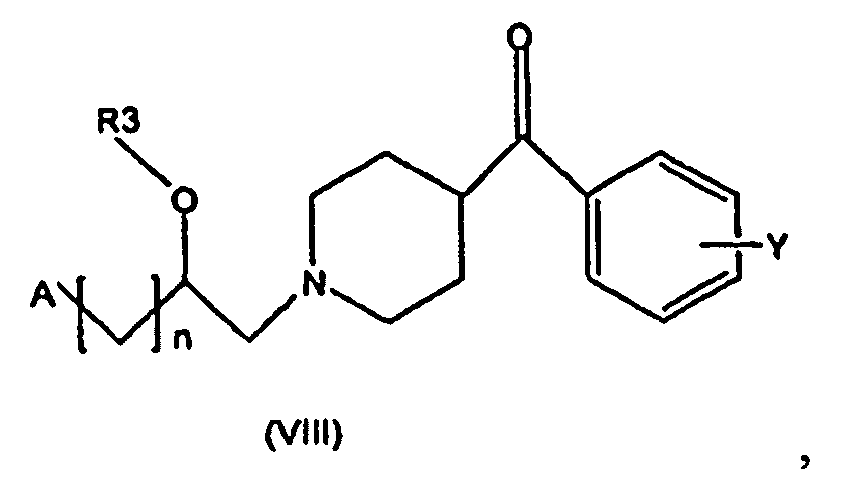
A aus der Gruppe ausgewählt ist, bestehend aus Phenyl, das mit einem oder mehreren identischen oder unterschiedlichen Substituenten, ausgewählt aus der Gruppe, bestehend aus Wasserstoff, Halogen, gerad- oder verzweigtkettigem Alkyl mit 1 bis 4 Kohlenstoffatomen, gerad- oder verzweigtkettigem Alkoxy mit 1 bis 3 Kohlenstoffatomen, Nitro, Cyano, Trifluormethyl, Trifluormethoxy, Methansulfonyl, Phenyl, substituiert sein kann; Thienyl; Naphthyl; Pyridyl und Chinolyl;
Y aus der Gruppe ausgewählt ist, bestehend aus Wasserstoff, Halogen, gerad- oder verzweigtkettigem Alkyl mit 1 bis 4 Kohlenstoffatomen und gerad- oder verzweigtkettigem Alkoxy mit 1 bis 3 Kohlenstoffatomen; und
R3 aus der Gruppe ausgewählt ist, bestehend aus gerad- oder verzweigtkettigem Alkyl mit 1 bis 4 Kohlenstoffatomen, einer aliphatischen cyclischen Gruppe mit 5 bis 7 Kohlenstoffatomen und Benzyl;
und pharmazeutisch akzeptable Salze davon. - Racemische oder enantiomerenangereicherte Azolbenzoylpiperidinverbindung nach Anspruch 1, wobei die Verbindung durch die Strukturformel (XIV):

n eine ganze Zahl von 0 bis 2 ist und
A aus der Gruppe ausgewählt ist, bestehend aus Phenyl, das mit einem oder mehreren identischen oder unterschiedlichen Substituenten, ausgewählt aus der Gruppe, bestehend aus Wasserstoff, Halogen, gerad- oder verzweigtkettigem Alkyl mit 1 bis 4 Kohlenstoffatomen, gerad- oder verzweigtkettigem Alkoxy mit 1 bis 3 Kohlenstoffatomen, Nitro und Trifluormethyl, substituiert sein kann; und Naphthyl;
Y aus der Gruppe ausgewählt ist, bestehend aus Wasserstoff, Halogen, gerad- oder verzweigtkettigem Alkyl mit 1 bis 4 Kohlenstoffatomen und gerad- oder verzweigtkettigem Alkoxy mit 1 bis 3 Kohlenstoffatomen; und
X eine Imidazol-, Triazol- oder Tetrazolkomponente mit der folgenden Formel (XII)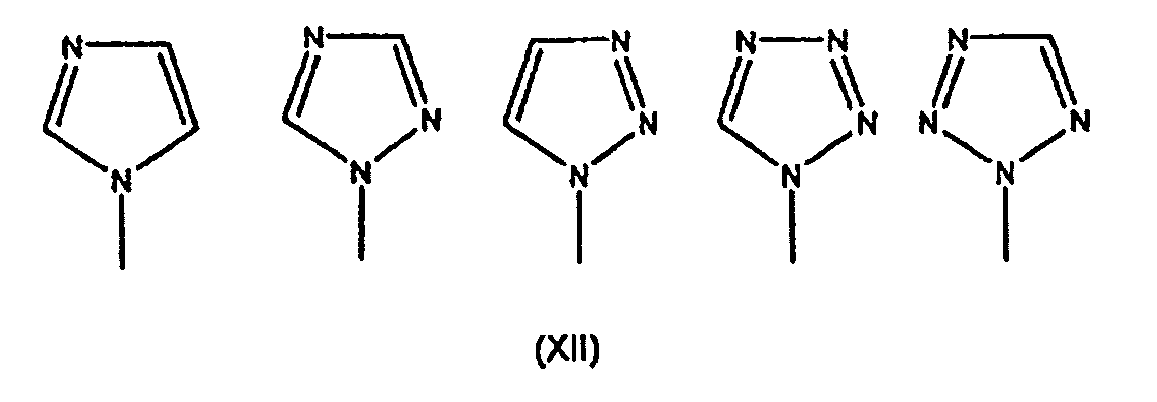
und pharmazeutisch akzeptable Salze davon. - Racemische oder enantiomerenangereicherte Carbonatbenzoylpiperidinverbindung, dargestellt durch die Strukturformel (XVI):
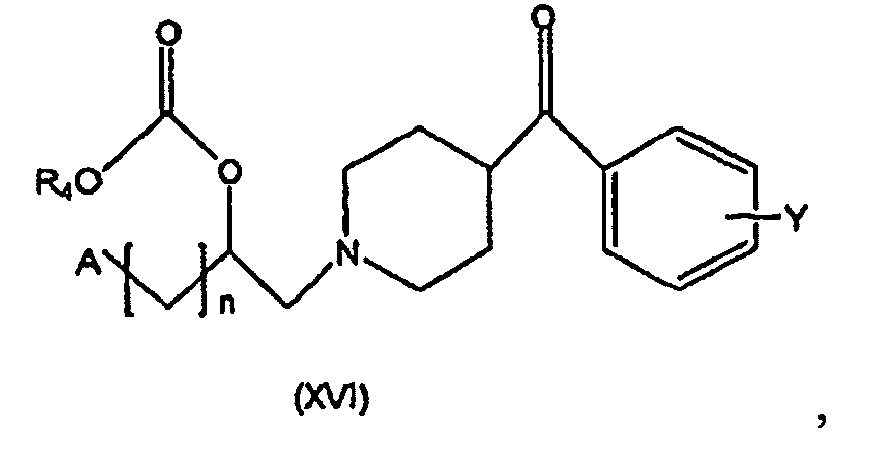
n 0 ist und
A aus der Gruppe ausgewählt ist, bestehend aus Phenyl, das mit einem oder mehreren identischen oder unterschiedlichen Substituenten, ausgewählt aus der Gruppe, bestehend aus Wasserstoff, Halogen, gerad- oder verzweigtkettigem Alkyl mit 1 bis 4 Kohlenstoffatomen, gerad- oder verzweigtkettigem Alkoxy mit 1 bis 3 Kohlenstoffatomen, Nitro, Cyano und Trifluormethyl, substituiert sein kann;
oder
n eine ganzen Zahl von 1 bis 2 ist und
A aus der Gruppe ausgewählt ist, bestehend aus Phenyl oder Phenoxy, das mit einem oder mehreren identischen oder unterschiedlichen Substituenten, ausgewählt aus der Gruppe, bestehend aus Wasserstoff, Halogen, gerad- oder verzweigtkettigem Alkyl mit 1 bis 4 Kohlenstoffatomen, gerad- oder verzweigtkettigem Alkoxy mit 1 bis 3 Kohlenstoffatomen, Nitro, Cyano und Trifluormethyl, substituiert sein kann;
Y aus der Gruppe ausgewählt ist, bestehend aus Wasserstoff, Halogen, gerad- oder verzweigtkettigem Alkyl mit 1 bis 4 Kohlenstoffatomen und gerad- oder verzweigtkettigem Alkoxy mit 1 bis 3 Kohlenstoffatomen; und
R4 aus der Gruppe ausgewählt ist, bestehend aus gerad- oder verzweigtkettigem Alkyl mit 1 bis 3 Kohlenstoffatomen, Phenyl und Benzyl;
und pharmazeutisch akzeptable Salze davon. - Verbindung nach Anspruch 2, wobei die Verbindung Carbamidsäure-2-[4-(4-fluor-benzoyl)-piperidin-1-yl]-1-phenyl-ethylester ist.
- Verbindung nach Anspruch 2, wobei die Verbindung (S)-Carbamidsäure-2-[4-(4-fluor-benzoyl)-piperidin-1-yl]-1-phenyl-ethylester ist.
- Verbindung nach Anspruch 2, wobei die Verbindung (R)-Carbamidsäure-2-[4-(4-fluor-benzoyl)-piperidin-1-yl]-1-phenyl-ethylester ist.
- Verbindung nach Anspruch 2, wobei die Verbindung Carbamidsäure-1-(3-chlor-phenyl)-2-[4-(4-fluor-benzoyl)-piperidin-1-yl]-ethylester ist.
- Verbindung nach Anspruch 2, wobei die Verbindung Carbamidsäure-1-(3,4-dichlorphenyl)-2-[4-(4-fluor-benzoyl)-piperidin-1-yl]-ethylester ist.
- Verbindung nach Anspruch 2, wobei die Verbindung Benzyl-carbamidsäure-2-[4-(4-fluor-benzoyl)-piperidin-1-yl]-1-phenyl-ethylester ist.
- Verbindung nach Anspruch 2, wobei die Verbindung Carbamidsäure-2-[4-(4-fluor-benzoyl)-piperidin-1-yl]-1-(3-nitro-phenyl)-ethylester ist.
- Verbindung nach Anspruch 2, wobei die Verbindung Carbamidsäure-2-[4-(4-fluor-benzoyl)-piperidin-1-yl]-1-(4-trifluormethyl-phenyl)-ethylester ist.
- Verbindung nach Anspruch 2, wobei die Verbindung Carbamidsäure-1-[4-(4-fluor-benzoyl)-piperidin-1-ylmethyl]-2-phenoxy-ethylester ist.
- Verbindung nach Anspruch 2, wobei die Verbindung Carbamidsäure-azepan-1-carbonsäure-1-[4-(4-fluor-benzoyl)-piperidin-1-ylmethyl]-2-phenoxy-ethylester ist.
- Verbindung nach Anspruch 3, wobei die Verbindung (4-Fluor-phenyl)-{1-[2-methoxy-2-(4-nitro-phenyl)-ethyl]-piperidin-4-yl}-methanon ist.
- Verbindung nach Anspruch 3, wobei die Verbindung (S)-(4-Fluor-phenyl)-{1-[2-methoxy-2-(4-nitro-phenyl)-ethyl]-piperidin-4-yl}-methanon ist.
- Verbindung nach Anspruch 3, wobei die Verbindung (R)-(4-Fluor-phenyl)-{1-[2-methoxy-2-(4-nitro-phenyl)-ethyl]-piperidin-4-yl}-methanon ist.
- Verbindung nach Anspruch 3, wobei die Verbindung (4-Fluor-phenyl)-{1-[2-(4-isopropyl-phenyl)-2-methoxy-ethyl]-piperidin-4-yl}-methanon ist.
- Verbindung nach Anspruch 3, wobei die Verbindung (S)-(4-Fluor-phenyl)-{1-[2-(4-isopropyl-phenyl)-2-methoxy-ethyl]-piperidin-4-yl}-methanon ist.
- Verbindung nach Anspruch 3, wobei die Verbindung {1-[2-(4-Ethyl-phenyl)-2-methoxyethyl]-piperidin-4-yl}-(4-fluor-phenyl)-methanon ist.
- Verbindung nach Anspruch 3, wobei die Verbindung (S)-{1-[2-(4-Ethyl-phenyl)-2-methoxy-ethyl]-piperidin-4-yl}-(4-fluor-phenyl)-methanon ist.
- Verbindung nach Anspruch 3, wobei die Verbindung {1-[2-Ethoxy-2-(4-nitro-phenyl)-ethyl]-piperidin-4-yl}-(4-fluor-phenyl)-methanon ist.
- Verbindung nach Anspruch 4, wobei die Verbindung (4-Fluor-phenyl)-{1-[2-(4-isopropyl-phenyl)-2-[1,2,4]triazol-1-yl-ethyl]-piperidin-4-yl}-methanon ist.
- Verbindung nach Anspruch 4, wobei die Verbindung {1-[2-(3,4-Dimethyl-phenyl)-2-[1,2,4]triazol-1-yl-ethyl]-piperidin-4-yl}-(4-fluor-phenyl)-methanon ist.
- Verbindung nach Anspruch 5, wobei die Verbindung Kohlensäure-1-(4-ethyl-phenyl)-2-[4-(4-fluor-benzoyl)-piperidin-1-yl]-ethylestermethylester ist.
- Verbindung nach Anspruch 5, wobei die Verbindung Kohlensäure-1-(3-chlor-phenyl)-2-[4-(4-fluor-benzoyl)-piperidin-1-yl]-isopropylesterisopropylester ist.
- Pharmazeutische Zusammensetzung, die eine wirksame Menge einer racemischen oder enantiomerenangereicherten Verbindung der Formel (I) gemäß Anspruch 1 umfasst, zur Behandlung von Psychose und Wahrnehmungsstörung.
- Pharmazeutische Zusammensetzung, die eine wirksame Menge einer racemischen oder enantiomerenangereicherten Verbindung der Formel (V) gemäß Anspruch 2 umfasst, zur Behandlung von Psychose und Wahrnehmungsstörung.
- Pharmazeutische Zusammensetzung, die eine wirksame Menge einer racemischen oder enantiomerenangereicherten Verbindung der Formel (VIII) gemäß Anspruch 3 umfasst, zur Behandlung von Psychose und Wahrnehmungsstörung.
- Pharmazeutische Zusammensetzung, die eine wirksame Menge einer racemischen oder enantiomerenangereicherten Verbindung der Formel (XIV) gemäß Anspruch 4 umfasst, zur Behandlung von Psychose und Wahrnehmungsstörung.
- Pharmazeutische Zusammensetzung, die eine wirksame Menge einer racemischen oder enantiomerenangereicherten Verbindung der Formel (XVI) gemäß Anspruch 5 umfasst, zur Behandlung von Psychose und Wahrnehmungsstörung.
- Racemische oder enantiomerenangereicherte Benzoylpiperidinverbindung, dargestellt durch die folgende Strukturformel (I):

n 0 ist und
A aus der Gruppe ausgewählt ist, bestehend aus Phenyl, das mit einem oder mehreren identischen oder unterschiedlichen Substituenten, ausgewählt aus der Gruppe, bestehend aus Wasserstoff, Halogen, gerad- oder verzweigtkettigem Alkyl mit 1 bis 4 Kohlenstoffatomen, gerad- oder verzweigtkettigem Alkoxy mit 1 bis 3 Kohlenstoffatomen, Nitro, Cyano, Trifluormethyl, Trifluormethoxy, Methansulfonyl und Phenyl, substituiert sein kann; Thienyl; Naphthyl; Pyridyl und Chinolyl; oder
n eine ganze Zahl von 1 bis 2 ist und
A aus der Gruppe ausgewählt ist, bestehend aus Phenyl oder Phenoxy, das mit einem oder mehreren identischen oder unterschiedlichen Substituenten, ausgewählt aus der Gruppe, bestehend aus Wasserstoff, Halogen, gerad- oder verzweigtkettigem Alkyl mit 1 bis 4 Kohlenstoffatomen, gerad- oder verzweigtkettigem Alkoxy mit 1 bis 3 Kohlenstoffatomen, Nitro, Cyano, Trifluormethyl, Trifluormethoxy, Methansulfonyl und Phenyl, substituiert sein kann; Thienyl; Naphthyl; Pyridyl und Chinolyl;
X aus der Gruppe ausgewählt ist, bestehend aus O-Carbamoyl, Imidazol, Triazol, Tetrazol und Carbonat; und
Y aus der Gruppe ausgewählt ist, bestehend aus Wasserstoff, Halogen, gerad- oder verzweigtkettigem Alkyl mit 1 bis 4 Kohlenstoffatomen und gerad- oder verzweigtkettigem Alkoxy mit 1 bis 3 Kohlenstoffatomen;
und pharmazeutisch akzeptable Salze davon. - Racemische oder enantiomerenangereicherte Benzoylpiperidinverbindung, dargestellt durch die folgende Strukturformel (I):

n eine ganze Zahl von 0 bis 2 ist und
A aus der Gruppe ausgewählt ist, bestehend aus Phenyl, das mit einem oder mehreren identischen oder unterschiedlichen Substituenten, ausgewählt aus der Gruppe, bestehend aus Wasserstoff, Halogen, gerad- oder verzweigtkettigem Alkyl mit 1 bis 4 Kohlenstoffatomen, gerad- oder verzweigtkettigem Alkoxy mit 1 bis 3 Kohlenstoffatomen, Nitro, Cyano, Trifluormethyl, Trifluormethoxy, Methansulfonyl und Phenyl, substituiert sein kann; Thienyl; Naphthyl; Pyridyl und Chinolyl;
X aus der Gruppe ausgewählt ist, bestehend aus O-Carbamoyl, Imidazol, Triazol, Tetrazol und Carhonat; und
Y aus der Gruppe ausgewählt ist, bestehend aus Wasserstoff, Halogen, gerad- oder verzweigtkettigem Alkyl mit 1 bis 4 Kohlenstoffatomen und gerad- oder verzweigtkettigem Alkoxy mit 1 bis 3 Kohlenstoffatomen;
und pharmazeutisch akzeptable Salze davon. - Racemische oder enantiomerenangereicherte Alkoxybenzoylpiperidinverbindung, dargestellt durch die Strukturformel (VIII):

n 0 ist und
A aus der Gruppe ausgewählt ist, bestehend aus Phenyl, das mit einem oder mehreren identischen oder unterschiedlichen Substituenten, ausgewählt aus der Gruppe, bestehend aus Wasserstoff, Halogen, gerad- oder verzweigtkettigem Alkyl mit 1 bis 4 Kohlenstoffatomen, gerad- oder veizweigtkettigem Alkoxy mit 1 bis 3 Kohlenstoffatomen, Nitro, Cyano, Trifluormethyl, Trifluormethoxy, Methansulfonyl, Phenyl, substituiert sein kann; Thienyl; Naphthyl; Pyridyl und Chinolyl; oder
n eine ganze Zahl von 1 bis 2 ist und
A aus der Gruppe ausgewählt ist, bestehend aus Phenyl oder Phenoxy, das mit einem oder mehreren identischen oder unterschiedlichen Substituenten, ausgewählt aus der Gruppe, bestehend aus Wasserstoff, Halogen, gerad- oder verzweigtkettigem Alkyl mit 1 bis 4 Kohlenstoffatomen, gerad- oder verzweigtkettigem Alkoxy mit 1 bis 3 Kohlenstoffatomen, Nitro, Cyano, Trifluormethyl, Trifluormethoxy, Methansulfonyl, Phenyl, substituiert sein kann; Thienyl; Naphthyl; Pyridyl und Chinolyl;
Y aus der Gruppe ausgewählt ist, bestehend aus Wasserstoff, Halogen, gerad- oder verzweigtkettigem Alkyl mit 1 bis 4 Kohlenstoffatomen und gerad- oder verzweigtkettigem Alkoxy mit 1 bis 3 Kohlenstoffatomen; und
R3 aus der Gruppe ausgewählt ist, bestehend aus einer aliphatischen cyclischen Gruppe mit 5 bis 7 Kohlenstoffatomen und Benzyl;
und pharmazeutisch akzeptable Salze davon. - Racemische oder enantiomerenangereicherte Alkoxybenzoylpiperidinverbindung, dargestellt durch die Strukturformel (VIII):

n eine ganze Zahl von 0 bis 2 ist und
A aus der Gruppe ausgewählt ist, bestehend aus Phenyl, das mit einem oder mehreren identischen oder unterschiedlichen Substituenten, ausgewählt aus der Gruppe, bestehend aus Wasserstoff, Halogen, gerad- oder verzweigtkettigem Alkyl mit 1 bis 4 Kohlenstoffatomen, gerad- oder verzweigtkettigem Alkoxy mit 1 bis 3 Kohlenstoffatomen, Nitro, Cyano, Trifluormethyl, Trifluormethoxy, Methansulfonyl, Phenyl, substituiert sein kann; Thienyl; Naphthyl; Pyridyl und Chinolyl;
Y aus der Gruppe ausgewählt ist, bestehend aus Wasserstoff, Halogen, gerad- oder verzweigtkettigem Alkyl mit 1 bis 4 Kohlenstoffatomen und gerad- oder verzweigtkettigem Alkoxy mit 1 bis 3 Kohlenstoffatomen; und
R3 aus der Gruppe ausgewählt ist, bestehend aus einer aliphatischen cyclischen Gruppe mit 5 bis 7 Kohlenstoffatomen und Benzyl;
und pharmazeutisch akzeptable Salze davon.
Applications Claiming Priority (3)
| Application Number | Priority Date | Filing Date | Title |
|---|---|---|---|
| US10/228,869 US6770659B2 (en) | 2002-08-26 | 2002-08-26 | Benzoyl piperidine compounds |
| US228869 | 2002-08-26 | ||
| PCT/KR2003/001665 WO2004018423A1 (en) | 2002-08-26 | 2003-08-19 | New benzoyl piperidine compounds |
Publications (3)
| Publication Number | Publication Date |
|---|---|
| EP1546100A1 EP1546100A1 (de) | 2005-06-29 |
| EP1546100A4 EP1546100A4 (de) | 2007-10-31 |
| EP1546100B1 true EP1546100B1 (de) | 2011-04-20 |
Family
ID=31946347
Family Applications (1)
| Application Number | Title | Priority Date | Filing Date |
|---|---|---|---|
| EP03792860A Expired - Lifetime EP1546100B1 (de) | 2002-08-26 | 2003-08-19 | Neue benzoylpiperidinverbindungen |
Country Status (15)
| Country | Link |
|---|---|
| US (1) | US6770659B2 (de) |
| EP (1) | EP1546100B1 (de) |
| JP (1) | JP4674686B2 (de) |
| KR (1) | KR100614301B1 (de) |
| CN (1) | CN100338037C (de) |
| AT (1) | ATE506348T1 (de) |
| AU (1) | AU2003251206B2 (de) |
| BR (1) | BR0313922A (de) |
| CA (1) | CA2496678C (de) |
| DE (1) | DE60336830D1 (de) |
| ES (1) | ES2364749T3 (de) |
| MX (1) | MXPA05002366A (de) |
| RU (1) | RU2342363C2 (de) |
| TW (1) | TWI334413B (de) |
| WO (1) | WO2004018423A1 (de) |
Families Citing this family (5)
| Publication number | Priority date | Publication date | Assignee | Title |
|---|---|---|---|---|
| US7598279B2 (en) * | 2005-04-22 | 2009-10-06 | Sk Holdings Co., Ltd. | Neurotherapeutic azole compounds |
| RU2396265C2 (ru) * | 2006-02-17 | 2010-08-10 | Ф. Хоффманн-Ля Рош Аг | Производные бензоилпиперидина в качестве модуляторов рецепторов 5ht2 и d3 |
| AU2008251259B2 (en) * | 2007-05-14 | 2013-02-14 | Sk Biopharmaceuticals Co., Ltd. | Novel carbamoyloxy arylalkanoyl arylpiperazine compound, pharmaceutical compositions comprising the compound and method for treating pain, anxiety and depression by administering the compound |
| BR112012005119A2 (pt) * | 2009-09-07 | 2016-11-22 | Vifor Int Ag | novos antagonistas de hepcidina etanodiaminas |
| EA201390876A1 (ru) * | 2010-12-13 | 2013-12-30 | Вайамет Фармасьютикалс, Инк. | Соединения, ингибирующие металлоферменты |
Family Cites Families (16)
| Publication number | Priority date | Publication date | Assignee | Title |
|---|---|---|---|---|
| US3576810A (en) * | 1968-06-20 | 1971-04-27 | Robins Co Inc A H | 1-substituted-3-(-4)-aroylpiperidines |
| US4415581A (en) * | 1982-04-09 | 1983-11-15 | Hoechst-Roussel Pharmaceuticals Inc. | 1-[3-6-Fluoro-1,2-benzisoxazol-3-yl)propyl]-4-hydroxy-4-phenylpiperidines to treat psychoses |
| DK159420C (da) * | 1983-03-09 | 1991-03-11 | Ciba Geigy Ag | N-(piperidinyl-alkyl)-carboxamider og salte deraf, farmaceutiske praeparater indeholdende disse forbindelser samt anvendelsen af forbindelserne til fremstilling af antipsykotiske farmaceutiske praeparater |
| ZA841728B (en) * | 1983-03-09 | 1984-11-28 | Ciba Geigy Ag | Novel carboxamides |
| FR2581993B1 (fr) * | 1985-05-14 | 1988-03-18 | Synthelabo | Derives de (benzoyl-4 piperidino)-2 phenyl-1 alcanols, leur preparation et leur application en therapeutique |
| EP0222702A3 (de) * | 1985-11-06 | 1988-01-07 | Ciba-Geigy Ag | Basische Carbonylverbindungen |
| AU593194B2 (en) * | 1986-09-26 | 1990-02-01 | Sumitomo Pharmaceuticals Company, Limited | Imide derivatives ,and their production and use |
| KR910006138B1 (ko) * | 1986-09-30 | 1991-08-16 | 에자이 가부시끼가이샤 | 환상아민 유도체 |
| US4812456A (en) | 1987-05-13 | 1989-03-14 | Hoechst-Roussel Pharmaceuticals Inc. | 1-(N-(2-alkylthio-10H-phenothiazin-10-yl)alkyl)-4-benzoylpiperidines and pharmaceutical use |
| JPH03130263A (ja) * | 1989-07-19 | 1991-06-04 | Eisai Co Ltd | 光学活性ナフチルエタノール誘導体 |
| US5114936A (en) | 1990-08-23 | 1992-05-19 | Hoechst-Roussel Pharmaceuticals Incorporated | 6,7-dihydro-3-phenyl-1,2-benzisoxazol-4(5h)-ones and -ols, compositions and pharmaceutical use |
| US5143923B1 (en) * | 1991-04-29 | 1993-11-02 | Hoechst-Roussel Pharmaceuticals Incorporated | Benzoisothiazole-and benzisoxazole-3-carboxamides |
| DE4410822A1 (de) | 1994-03-24 | 1995-09-28 | Schering Ag | Neue Piperidin-Derivate |
| IL118768A (en) * | 1995-07-12 | 2000-10-31 | Akzo Nobel Nv | Diphenylmethane piperidine derivatives pharmaceutical compositions containing them and a method for their preparation |
| EP1021440A2 (de) * | 1997-10-07 | 2000-07-26 | Akzo Nobel N.V. | Antipsychotische substituierte piperidinderivative |
| US6363604B1 (en) * | 1999-05-21 | 2002-04-02 | Autonetworks Technologies, Ltd. | Method and apparatus for cutting braided sheath of shielding wire |
-
2002
- 2002-08-26 US US10/228,869 patent/US6770659B2/en not_active Expired - Lifetime
-
2003
- 2003-08-19 ES ES03792860T patent/ES2364749T3/es not_active Expired - Lifetime
- 2003-08-19 CA CA2496678A patent/CA2496678C/en not_active Expired - Fee Related
- 2003-08-19 KR KR1020057003017A patent/KR100614301B1/ko not_active Expired - Fee Related
- 2003-08-19 JP JP2004530642A patent/JP4674686B2/ja not_active Expired - Fee Related
- 2003-08-19 AT AT03792860T patent/ATE506348T1/de not_active IP Right Cessation
- 2003-08-19 WO PCT/KR2003/001665 patent/WO2004018423A1/en not_active Ceased
- 2003-08-19 CN CNB038204177A patent/CN100338037C/zh not_active Expired - Fee Related
- 2003-08-19 AU AU2003251206A patent/AU2003251206B2/en not_active Ceased
- 2003-08-19 DE DE60336830T patent/DE60336830D1/de not_active Expired - Lifetime
- 2003-08-19 EP EP03792860A patent/EP1546100B1/de not_active Expired - Lifetime
- 2003-08-19 RU RU2005108569/04A patent/RU2342363C2/ru not_active IP Right Cessation
- 2003-08-19 BR BR0313922-0A patent/BR0313922A/pt not_active IP Right Cessation
- 2003-08-19 MX MXPA05002366A patent/MXPA05002366A/es active IP Right Grant
- 2003-08-25 TW TW092123268A patent/TWI334413B/zh not_active IP Right Cessation
Also Published As
| Publication number | Publication date |
|---|---|
| CA2496678C (en) | 2011-06-14 |
| JP2006502146A (ja) | 2006-01-19 |
| JP4674686B2 (ja) | 2011-04-20 |
| TWI334413B (en) | 2010-12-11 |
| CN1678582A (zh) | 2005-10-05 |
| ATE506348T1 (de) | 2011-05-15 |
| DE60336830D1 (de) | 2011-06-01 |
| US20040044033A1 (en) | 2004-03-04 |
| CN100338037C (zh) | 2007-09-19 |
| MXPA05002366A (es) | 2005-05-23 |
| WO2004018423A1 (en) | 2004-03-04 |
| KR20050038027A (ko) | 2005-04-25 |
| EP1546100A4 (de) | 2007-10-31 |
| TW200404781A (en) | 2004-04-01 |
| BR0313922A (pt) | 2005-07-19 |
| US6770659B2 (en) | 2004-08-03 |
| AU2003251206A1 (en) | 2004-03-11 |
| AU2003251206B2 (en) | 2009-05-28 |
| ES2364749T3 (es) | 2011-09-13 |
| RU2342363C2 (ru) | 2008-12-27 |
| RU2005108569A (ru) | 2005-08-27 |
| EP1546100A1 (de) | 2005-06-29 |
| KR100614301B1 (ko) | 2006-08-22 |
| CA2496678A1 (en) | 2004-03-04 |
Similar Documents
| Publication | Publication Date | Title |
|---|---|---|
| JP3302351B2 (ja) | 神経栄養活性および神経保護活性を有する4−アリール−1−フェニルアルキル−1,2,3,6−テトラヒドロピリジン | |
| EP1499589B1 (de) | N-¬phenyl(piperidin-2-yl)methyl|benzamidderivate,verfahren zu ihrer herstellung und ihre therapeutische anwendung | |
| US5116846A (en) | N-aralkyl piperidine derivatives as psychotropic drugs | |
| US20020103205A1 (en) | Muscarinic antagonists | |
| EP1737840B1 (de) | 1-aminophthalazinderivate, deren herstellung und deren therapeutische verwendung | |
| JPH03181461A (ja) | 抗不整脈剤 | |
| JP2002509918A (ja) | ムスカリン性レセプタに活性を有する化合物 | |
| EP0160422A1 (de) | N-Aryl-N-(4-piperidinyl)amide und pharmazeutische Zusammensetzungen und Verfahren unter Verwendung dieser Verbindungen | |
| HK181396A (en) | Piperazinyl-and piperidinyl-cyclohexanols | |
| JPH0432821B2 (de) | ||
| EP0374801A2 (de) | N-substituierte azaheterocyclische Carbonsäuren | |
| AU649468B2 (en) | 3-substituted piperidine derivatives | |
| RO121382B1 (ro) | Procedeu şi intermediari pentru prepararea 1-benzil-4-[(5,6-dimetoxi-1-indanon)-2-il-]metilpiperidinei | |
| US4246268A (en) | Neuroleptic-4-(naphthylmethyl)piperidine derivatives | |
| MC1769A1 (fr) | Diphenaylpiperidines n-substituees | |
| KR20020043413A (ko) | 도파민 d3 및 d4 수용체의 선택적 활성을 지닌 신규4,5-디히드로이소옥사졸릴알킬피페라진 유도체와, 이의제조방법 | |
| JPS6135175B2 (de) | ||
| EP0718286B1 (de) | 3-Alkoxybenzylpiperidin-Derivate as melatonergisches Mittel | |
| US6770659B2 (en) | Benzoyl piperidine compounds | |
| EP2913324B1 (de) | Fluorsubstituierte cyclische aminverbindungen und herstellungsverfahren, pharmazeutische zusammensetzungen und verwendungen davon | |
| JP2002532472A (ja) | 5−ht1a受容体活性を有するアリールピペリジンおよびアリール−1,2,5,6−テトラヒドロピリジン尿素誘導体 | |
| HUT65472A (en) | Process for producing 3,4-dihydro-2(1h)-quinolone derivatives and pharmaceutical preparations containing them | |
| JP3281047B2 (ja) | メタノアントラセン化合物、該化合物を含有する神経精神障害治療用薬剤組成物、該化合物の製造方法及び該化合物を製造するための中間体 | |
| EP1978959B1 (de) | Piperidin- und piperazinderivate | |
| JP2002532471A (ja) | 5−ht1a受容体活性を有するアリールピペリジンおよびアリール−1,2,5,6−テトラヒドロピリジンアミド誘導体 |
Legal Events
| Date | Code | Title | Description |
|---|---|---|---|
| PUAI | Public reference made under article 153(3) epc to a published international application that has entered the european phase |
Free format text: ORIGINAL CODE: 0009012 |
|
| 17P | Request for examination filed |
Effective date: 20050219 |
|
| AK | Designated contracting states |
Kind code of ref document: A1 Designated state(s): AT BE BG CH CY CZ DE DK EE ES FI FR GB GR HU IE IT LI LU MC NL PT RO SE SI SK TR |
|
| AX | Request for extension of the european patent |
Extension state: AL LT LV MK |
|
| DAX | Request for extension of the european patent (deleted) | ||
| A4 | Supplementary search report drawn up and despatched |
Effective date: 20071002 |
|
| RIC1 | Information provided on ipc code assigned before grant |
Ipc: A61K 31/45 20060101ALI20070926BHEP Ipc: C07D 401/06 20060101ALI20070926BHEP Ipc: A61P 25/18 20060101ALI20070926BHEP Ipc: C07D 401/12 20060101ALI20070926BHEP Ipc: C07D 211/16 20060101AFI20040318BHEP |
|
| RAP1 | Party data changed (applicant data changed or rights of an application transferred) |
Owner name: SK HOLDINGS CO., LTD. |
|
| 17Q | First examination report despatched |
Effective date: 20090312 |
|
| GRAP | Despatch of communication of intention to grant a patent |
Free format text: ORIGINAL CODE: EPIDOSNIGR1 |
|
| GRAS | Grant fee paid |
Free format text: ORIGINAL CODE: EPIDOSNIGR3 |
|
| GRAA | (expected) grant |
Free format text: ORIGINAL CODE: 0009210 |
|
| AK | Designated contracting states |
Kind code of ref document: B1 Designated state(s): AT BE BG CH CY CZ DE DK EE ES FI FR GB GR HU IE IT LI LU MC NL PT RO SE SI SK TR |
|
| REG | Reference to a national code |
Ref country code: GB Ref legal event code: FG4D |
|
| REG | Reference to a national code |
Ref country code: CH Ref legal event code: EP |
|
| REG | Reference to a national code |
Ref country code: IE Ref legal event code: FG4D |
|
| REF | Corresponds to: |
Ref document number: 60336830 Country of ref document: DE Date of ref document: 20110601 Kind code of ref document: P |
|
| REG | Reference to a national code |
Ref country code: DE Ref legal event code: R096 Ref document number: 60336830 Country of ref document: DE Effective date: 20110601 |
|
| REG | Reference to a national code |
Ref country code: NL Ref legal event code: VDEP Effective date: 20110420 |
|
| REG | Reference to a national code |
Ref country code: ES Ref legal event code: FG2A Ref document number: 2364749 Country of ref document: ES Kind code of ref document: T3 Effective date: 20110913 |
|
| PG25 | Lapsed in a contracting state [announced via postgrant information from national office to epo] |
Ref country code: SE Free format text: LAPSE BECAUSE OF FAILURE TO SUBMIT A TRANSLATION OF THE DESCRIPTION OR TO PAY THE FEE WITHIN THE PRESCRIBED TIME-LIMIT Effective date: 20110420 Ref country code: PT Free format text: LAPSE BECAUSE OF FAILURE TO SUBMIT A TRANSLATION OF THE DESCRIPTION OR TO PAY THE FEE WITHIN THE PRESCRIBED TIME-LIMIT Effective date: 20110822 |
|
| PG25 | Lapsed in a contracting state [announced via postgrant information from national office to epo] |
Ref country code: CY Free format text: LAPSE BECAUSE OF FAILURE TO SUBMIT A TRANSLATION OF THE DESCRIPTION OR TO PAY THE FEE WITHIN THE PRESCRIBED TIME-LIMIT Effective date: 20110420 Ref country code: FI Free format text: LAPSE BECAUSE OF FAILURE TO SUBMIT A TRANSLATION OF THE DESCRIPTION OR TO PAY THE FEE WITHIN THE PRESCRIBED TIME-LIMIT Effective date: 20110420 Ref country code: AT Free format text: LAPSE BECAUSE OF FAILURE TO SUBMIT A TRANSLATION OF THE DESCRIPTION OR TO PAY THE FEE WITHIN THE PRESCRIBED TIME-LIMIT Effective date: 20110420 Ref country code: GR Free format text: LAPSE BECAUSE OF FAILURE TO SUBMIT A TRANSLATION OF THE DESCRIPTION OR TO PAY THE FEE WITHIN THE PRESCRIBED TIME-LIMIT Effective date: 20110721 Ref country code: SI Free format text: LAPSE BECAUSE OF FAILURE TO SUBMIT A TRANSLATION OF THE DESCRIPTION OR TO PAY THE FEE WITHIN THE PRESCRIBED TIME-LIMIT Effective date: 20110420 Ref country code: BE Free format text: LAPSE BECAUSE OF FAILURE TO SUBMIT A TRANSLATION OF THE DESCRIPTION OR TO PAY THE FEE WITHIN THE PRESCRIBED TIME-LIMIT Effective date: 20110420 |
|
| PG25 | Lapsed in a contracting state [announced via postgrant information from national office to epo] |
Ref country code: NL Free format text: LAPSE BECAUSE OF FAILURE TO SUBMIT A TRANSLATION OF THE DESCRIPTION OR TO PAY THE FEE WITHIN THE PRESCRIBED TIME-LIMIT Effective date: 20110420 |
|
| PG25 | Lapsed in a contracting state [announced via postgrant information from national office to epo] |
Ref country code: EE Free format text: LAPSE BECAUSE OF FAILURE TO SUBMIT A TRANSLATION OF THE DESCRIPTION OR TO PAY THE FEE WITHIN THE PRESCRIBED TIME-LIMIT Effective date: 20110420 Ref country code: CZ Free format text: LAPSE BECAUSE OF FAILURE TO SUBMIT A TRANSLATION OF THE DESCRIPTION OR TO PAY THE FEE WITHIN THE PRESCRIBED TIME-LIMIT Effective date: 20110420 |
|
| REG | Reference to a national code |
Ref country code: DE Ref legal event code: R082 Ref document number: 60336830 Country of ref document: DE Representative=s name: KADOR & PARTNER, DE |
|
| PLBE | No opposition filed within time limit |
Free format text: ORIGINAL CODE: 0009261 |
|
| STAA | Information on the status of an ep patent application or granted ep patent |
Free format text: STATUS: NO OPPOSITION FILED WITHIN TIME LIMIT |
|
| PG25 | Lapsed in a contracting state [announced via postgrant information from national office to epo] |
Ref country code: RO Free format text: LAPSE BECAUSE OF FAILURE TO SUBMIT A TRANSLATION OF THE DESCRIPTION OR TO PAY THE FEE WITHIN THE PRESCRIBED TIME-LIMIT Effective date: 20110420 Ref country code: SK Free format text: LAPSE BECAUSE OF FAILURE TO SUBMIT A TRANSLATION OF THE DESCRIPTION OR TO PAY THE FEE WITHIN THE PRESCRIBED TIME-LIMIT Effective date: 20110420 Ref country code: DK Free format text: LAPSE BECAUSE OF FAILURE TO SUBMIT A TRANSLATION OF THE DESCRIPTION OR TO PAY THE FEE WITHIN THE PRESCRIBED TIME-LIMIT Effective date: 20110420 |
|
| REG | Reference to a national code |
Ref country code: GB Ref legal event code: 732E Free format text: REGISTERED BETWEEN 20120216 AND 20120222 |
|
| REG | Reference to a national code |
Ref country code: DE Ref legal event code: R082 Ref document number: 60336830 Country of ref document: DE Representative=s name: KADOR & PARTNER, DE Effective date: 20120131 Ref country code: DE Ref legal event code: R081 Ref document number: 60336830 Country of ref document: DE Owner name: SK BIOPHARMACEUTICALS CO., LTD., KR Free format text: FORMER OWNER: SK HOLDINGS CO., LTD., SEOUL, KR Effective date: 20120131 Ref country code: DE Ref legal event code: R081 Ref document number: 60336830 Country of ref document: DE Owner name: SK BIOPHARMACEUTICALS CO., LTD., KR Free format text: FORMER OWNER: SK CORP., SEOUL/SOUL, KR Effective date: 20110324 Ref country code: DE Ref legal event code: R082 Ref document number: 60336830 Country of ref document: DE Representative=s name: KADOR & PARTNER PART MBB PATENTANWAELTE, DE Effective date: 20120131 Ref country code: DE Ref legal event code: R082 Ref document number: 60336830 Country of ref document: DE Representative=s name: KADOR & PARTNER PARTG MBB PATENTANWAELTE, DE Effective date: 20120131 |
|
| 26N | No opposition filed |
Effective date: 20120123 |
|
| PG25 | Lapsed in a contracting state [announced via postgrant information from national office to epo] |
Ref country code: MC Free format text: LAPSE BECAUSE OF NON-PAYMENT OF DUE FEES Effective date: 20110831 |
|
| REG | Reference to a national code |
Ref country code: CH Ref legal event code: PL |
|
| REG | Reference to a national code |
Ref country code: ES Ref legal event code: PC2A Owner name: SK BIOPHARMACEUTICALS CO., LTD. Effective date: 20120409 |
|
| PG25 | Lapsed in a contracting state [announced via postgrant information from national office to epo] |
Ref country code: CH Free format text: LAPSE BECAUSE OF NON-PAYMENT OF DUE FEES Effective date: 20110831 Ref country code: LI Free format text: LAPSE BECAUSE OF NON-PAYMENT OF DUE FEES Effective date: 20110831 |
|
| REG | Reference to a national code |
Ref country code: DE Ref legal event code: R097 Ref document number: 60336830 Country of ref document: DE Effective date: 20120123 |
|
| REG | Reference to a national code |
Ref country code: IE Ref legal event code: MM4A |
|
| PG25 | Lapsed in a contracting state [announced via postgrant information from national office to epo] |
Ref country code: IE Free format text: LAPSE BECAUSE OF NON-PAYMENT OF DUE FEES Effective date: 20110819 |
|
| PG25 | Lapsed in a contracting state [announced via postgrant information from national office to epo] |
Ref country code: LU Free format text: LAPSE BECAUSE OF NON-PAYMENT OF DUE FEES Effective date: 20110819 |
|
| PG25 | Lapsed in a contracting state [announced via postgrant information from national office to epo] |
Ref country code: BG Free format text: LAPSE BECAUSE OF FAILURE TO SUBMIT A TRANSLATION OF THE DESCRIPTION OR TO PAY THE FEE WITHIN THE PRESCRIBED TIME-LIMIT Effective date: 20110720 |
|
| PG25 | Lapsed in a contracting state [announced via postgrant information from national office to epo] |
Ref country code: TR Free format text: LAPSE BECAUSE OF FAILURE TO SUBMIT A TRANSLATION OF THE DESCRIPTION OR TO PAY THE FEE WITHIN THE PRESCRIBED TIME-LIMIT Effective date: 20110420 |
|
| PG25 | Lapsed in a contracting state [announced via postgrant information from national office to epo] |
Ref country code: HU Free format text: LAPSE BECAUSE OF FAILURE TO SUBMIT A TRANSLATION OF THE DESCRIPTION OR TO PAY THE FEE WITHIN THE PRESCRIBED TIME-LIMIT Effective date: 20110420 |
|
| REG | Reference to a national code |
Ref country code: FR Ref legal event code: PLFP Year of fee payment: 14 |
|
| REG | Reference to a national code |
Ref country code: FR Ref legal event code: PLFP Year of fee payment: 15 |
|
| REG | Reference to a national code |
Ref country code: FR Ref legal event code: PLFP Year of fee payment: 16 |
|
| PGFP | Annual fee paid to national office [announced via postgrant information from national office to epo] |
Ref country code: GB Payment date: 20200825 Year of fee payment: 18 Ref country code: FR Payment date: 20200824 Year of fee payment: 18 Ref country code: ES Payment date: 20200923 Year of fee payment: 18 |
|
| PGFP | Annual fee paid to national office [announced via postgrant information from national office to epo] |
Ref country code: IT Payment date: 20200820 Year of fee payment: 18 |
|
| PGFP | Annual fee paid to national office [announced via postgrant information from national office to epo] |
Ref country code: DE Payment date: 20201029 Year of fee payment: 18 |
|
| REG | Reference to a national code |
Ref country code: DE Ref legal event code: R119 Ref document number: 60336830 Country of ref document: DE |
|
| GBPC | Gb: european patent ceased through non-payment of renewal fee |
Effective date: 20210819 |
|
| PG25 | Lapsed in a contracting state [announced via postgrant information from national office to epo] |
Ref country code: IT Free format text: LAPSE BECAUSE OF NON-PAYMENT OF DUE FEES Effective date: 20210819 Ref country code: GB Free format text: LAPSE BECAUSE OF NON-PAYMENT OF DUE FEES Effective date: 20210819 Ref country code: FR Free format text: LAPSE BECAUSE OF NON-PAYMENT OF DUE FEES Effective date: 20210831 Ref country code: DE Free format text: LAPSE BECAUSE OF NON-PAYMENT OF DUE FEES Effective date: 20220301 |
|
| REG | Reference to a national code |
Ref country code: ES Ref legal event code: FD2A Effective date: 20220929 |
|
| PG25 | Lapsed in a contracting state [announced via postgrant information from national office to epo] |
Ref country code: ES Free format text: LAPSE BECAUSE OF NON-PAYMENT OF DUE FEES Effective date: 20210820 |