EP1545876B1 - In gegenwart eines katalysators mit sowohl einem epoxidanteil als auch einem quarternären salz hergestellte flüssige unvernetzte michael-additionsoligomere - Google Patents
In gegenwart eines katalysators mit sowohl einem epoxidanteil als auch einem quarternären salz hergestellte flüssige unvernetzte michael-additionsoligomere Download PDFInfo
- Publication number
- EP1545876B1 EP1545876B1 EP20030754917 EP03754917A EP1545876B1 EP 1545876 B1 EP1545876 B1 EP 1545876B1 EP 20030754917 EP20030754917 EP 20030754917 EP 03754917 A EP03754917 A EP 03754917A EP 1545876 B1 EP1545876 B1 EP 1545876B1
- Authority
- EP
- European Patent Office
- Prior art keywords
- donor
- diacrylate
- michael
- composition
- functionality
- Prior art date
- Legal status (The legal status is an assumption and is not a legal conclusion. Google has not performed a legal analysis and makes no representation as to the accuracy of the status listed.)
- Expired - Lifetime
Links
- 239000004593 Epoxy Substances 0.000 title claims abstract description 41
- 150000003839 salts Chemical group 0.000 title claims abstract description 29
- 239000003054 catalyst Substances 0.000 title claims abstract description 23
- 239000007788 liquid Substances 0.000 title claims abstract description 23
- 238000006845 Michael addition reaction Methods 0.000 title claims abstract description 19
- 239000000203 mixture Substances 0.000 claims abstract description 50
- NIXOWILDQLNWCW-UHFFFAOYSA-M Acrylate Chemical compound [O-]C(=O)C=C NIXOWILDQLNWCW-UHFFFAOYSA-M 0.000 claims abstract description 18
- WDJHALXBUFZDSR-UHFFFAOYSA-M acetoacetate Chemical compound CC(=O)CC([O-])=O WDJHALXBUFZDSR-UHFFFAOYSA-M 0.000 claims abstract description 12
- -1 sulfonium halide Chemical class 0.000 claims description 38
- 125000003118 aryl group Chemical group 0.000 claims description 27
- VOZRXNHHFUQHIL-UHFFFAOYSA-N glycidyl methacrylate Chemical compound CC(=C)C(=O)OCC1CO1 VOZRXNHHFUQHIL-UHFFFAOYSA-N 0.000 claims description 24
- DAKWPKUUDNSNPN-UHFFFAOYSA-N Trimethylolpropane triacrylate Chemical compound C=CC(=O)OCC(CC)(COC(=O)C=C)COC(=O)C=C DAKWPKUUDNSNPN-UHFFFAOYSA-N 0.000 claims description 23
- 229940096522 trimethylolpropane triacrylate Drugs 0.000 claims description 23
- 238000006243 chemical reaction Methods 0.000 claims description 22
- XYIBRDXRRQCHLP-UHFFFAOYSA-N ethyl acetoacetate Chemical compound CCOC(=O)CC(C)=O XYIBRDXRRQCHLP-UHFFFAOYSA-N 0.000 claims description 21
- 229920005989 resin Polymers 0.000 claims description 21
- 239000011347 resin Substances 0.000 claims description 21
- 125000004386 diacrylate group Chemical group 0.000 claims description 19
- JRMUNVKIHCOMHV-UHFFFAOYSA-M tetrabutylammonium bromide Chemical compound [Br-].CCCC[N+](CCCC)(CCCC)CCCC JRMUNVKIHCOMHV-UHFFFAOYSA-M 0.000 claims description 18
- 125000001931 aliphatic group Chemical group 0.000 claims description 16
- 125000000524 functional group Chemical group 0.000 claims description 13
- YRKCREAYFQTBPV-UHFFFAOYSA-N acetylacetone Chemical compound CC(=O)CC(C)=O YRKCREAYFQTBPV-UHFFFAOYSA-N 0.000 claims description 12
- DYRDKSSFIWVSNM-UHFFFAOYSA-N acetoacetanilide Chemical compound CC(=O)CC(=O)NC1=CC=CC=C1 DYRDKSSFIWVSNM-UHFFFAOYSA-N 0.000 claims description 8
- 239000000178 monomer Substances 0.000 claims description 8
- QGZKDVFQNNGYKY-UHFFFAOYSA-O ammonium group Chemical group [NH4+] QGZKDVFQNNGYKY-UHFFFAOYSA-O 0.000 claims description 7
- 239000007795 chemical reaction product Substances 0.000 claims description 7
- XYFCBTPGUUZFHI-UHFFFAOYSA-O phosphonium Chemical compound [PH4+] XYFCBTPGUUZFHI-UHFFFAOYSA-O 0.000 claims description 7
- IBDVWXAVKPRHCU-UHFFFAOYSA-N 2-(2-methylprop-2-enoyloxy)ethyl 3-oxobutanoate Chemical compound CC(=O)CC(=O)OCCOC(=O)C(C)=C IBDVWXAVKPRHCU-UHFFFAOYSA-N 0.000 claims description 6
- 150000001412 amines Chemical class 0.000 claims description 6
- IISBACLAFKSPIT-UHFFFAOYSA-N bisphenol A Chemical class C=1C=C(O)C=CC=1C(C)(C)C1=CC=C(O)C=C1 IISBACLAFKSPIT-UHFFFAOYSA-N 0.000 claims description 6
- GYZLOYUZLJXAJU-UHFFFAOYSA-N diglycidyl ether Chemical compound C1OC1COCC1CO1 GYZLOYUZLJXAJU-UHFFFAOYSA-N 0.000 claims description 6
- YDKNBNOOCSNPNS-UHFFFAOYSA-N methyl 1,3-benzoxazole-2-carboxylate Chemical compound C1=CC=C2OC(C(=O)OC)=NC2=C1 YDKNBNOOCSNPNS-UHFFFAOYSA-N 0.000 claims description 6
- PSGCQDPCAWOCSH-UHFFFAOYSA-N (4,7,7-trimethyl-3-bicyclo[2.2.1]heptanyl) prop-2-enoate Chemical compound C1CC2(C)C(OC(=O)C=C)CC1C2(C)C PSGCQDPCAWOCSH-UHFFFAOYSA-N 0.000 claims description 5
- MYWOJODOMFBVCB-UHFFFAOYSA-N 1,2,6-trimethylphenanthrene Chemical group CC1=CC=C2C3=CC(C)=CC=C3C=CC2=C1C MYWOJODOMFBVCB-UHFFFAOYSA-N 0.000 claims description 5
- VRWWRSQIOZLGAM-UHFFFAOYSA-N 2,2-bis(3-oxobutanoyloxymethyl)butyl 3-oxobutanoate Chemical compound CC(=O)CC(=O)OCC(CC)(COC(=O)CC(C)=O)COC(=O)CC(C)=O VRWWRSQIOZLGAM-UHFFFAOYSA-N 0.000 claims description 5
- BCFBCLJFXYLWCI-UHFFFAOYSA-N 2,3-bis(3-oxobutanoyloxy)propyl 3-oxobutanoate Chemical compound CC(=O)CC(=O)OCC(OC(=O)CC(C)=O)COC(=O)CC(C)=O BCFBCLJFXYLWCI-UHFFFAOYSA-N 0.000 claims description 5
- PUGOMSLRUSTQGV-UHFFFAOYSA-N 2,3-di(prop-2-enoyloxy)propyl prop-2-enoate Chemical compound C=CC(=O)OCC(OC(=O)C=C)COC(=O)C=C PUGOMSLRUSTQGV-UHFFFAOYSA-N 0.000 claims description 5
- AUHWLIZFLUXUDG-UHFFFAOYSA-N [3-(3-oxobutanoyloxy)-2,2-bis(3-oxobutanoyloxymethyl)propyl] 3-oxobutanoate Chemical group CC(=O)CC(=O)OCC(COC(=O)CC(C)=O)(COC(=O)CC(C)=O)COC(=O)CC(C)=O AUHWLIZFLUXUDG-UHFFFAOYSA-N 0.000 claims description 5
- 125000002947 alkylene group Chemical group 0.000 claims description 5
- VOVUARRWDCVURC-UHFFFAOYSA-N thiirane Chemical compound C1CS1 VOVUARRWDCVURC-UHFFFAOYSA-N 0.000 claims description 5
- PCLLJCFJFOBGDE-UHFFFAOYSA-N (5-bromo-2-chlorophenyl)methanamine Chemical compound NCC1=CC(Br)=CC=C1Cl PCLLJCFJFOBGDE-UHFFFAOYSA-N 0.000 claims description 4
- ZDQNWDNMNKSMHI-UHFFFAOYSA-N 1-[2-(2-prop-2-enoyloxypropoxy)propoxy]propan-2-yl prop-2-enoate Chemical compound C=CC(=O)OC(C)COC(C)COCC(C)OC(=O)C=C ZDQNWDNMNKSMHI-UHFFFAOYSA-N 0.000 claims description 4
- LEJBBGNFPAFPKQ-UHFFFAOYSA-N 2-(2-prop-2-enoyloxyethoxy)ethyl prop-2-enoate Chemical group C=CC(=O)OCCOCCOC(=O)C=C LEJBBGNFPAFPKQ-UHFFFAOYSA-N 0.000 claims description 4
- WISUILQECWFZCN-UHFFFAOYSA-N 2-(oxiran-2-ylmethylsulfanylmethyl)oxirane Chemical compound C1OC1CSCC1CO1 WISUILQECWFZCN-UHFFFAOYSA-N 0.000 claims description 4
- INQDDHNZXOAFFD-UHFFFAOYSA-N 2-[2-(2-prop-2-enoyloxyethoxy)ethoxy]ethyl prop-2-enoate Chemical group C=CC(=O)OCCOCCOCCOC(=O)C=C INQDDHNZXOAFFD-UHFFFAOYSA-N 0.000 claims description 4
- TXBCBTDQIULDIA-UHFFFAOYSA-N 2-[[3-hydroxy-2,2-bis(hydroxymethyl)propoxy]methyl]-2-(hydroxymethyl)propane-1,3-diol Chemical compound OCC(CO)(CO)COCC(CO)(CO)CO TXBCBTDQIULDIA-UHFFFAOYSA-N 0.000 claims description 4
- RZVINYQDSSQUKO-UHFFFAOYSA-N 2-phenoxyethyl prop-2-enoate Chemical compound C=CC(=O)OCCOC1=CC=CC=C1 RZVINYQDSSQUKO-UHFFFAOYSA-N 0.000 claims description 4
- QTBSBXVTEAMEQO-UHFFFAOYSA-M Acetate Chemical compound CC([O-])=O QTBSBXVTEAMEQO-UHFFFAOYSA-M 0.000 claims description 4
- PPBRXRYQALVLMV-UHFFFAOYSA-N Styrene Natural products C=CC1=CC=CC=C1 PPBRXRYQALVLMV-UHFFFAOYSA-N 0.000 claims description 4
- LYCAIKOWRPUZTN-UHFFFAOYSA-N ethylene glycol Substances OCCO LYCAIKOWRPUZTN-UHFFFAOYSA-N 0.000 claims description 4
- 229920003986 novolac Polymers 0.000 claims description 4
- 229920000728 polyester Polymers 0.000 claims description 4
- 239000000758 substrate Substances 0.000 claims description 4
- MUTNCGKQJGXKEM-UHFFFAOYSA-N tamibarotene Chemical compound C=1C=C2C(C)(C)CCC(C)(C)C2=CC=1NC(=O)C1=CC=C(C(O)=O)C=C1 MUTNCGKQJGXKEM-UHFFFAOYSA-N 0.000 claims description 4
- YIJYFLXQHDOQGW-UHFFFAOYSA-N 2-[2,4,6-trioxo-3,5-bis(2-prop-2-enoyloxyethyl)-1,3,5-triazinan-1-yl]ethyl prop-2-enoate Chemical compound C=CC(=O)OCCN1C(=O)N(CCOC(=O)C=C)C(=O)N(CCOC(=O)C=C)C1=O YIJYFLXQHDOQGW-UHFFFAOYSA-N 0.000 claims description 3
- QAUIAXORENGBSN-UHFFFAOYSA-N 2-ethylhexyl 3-oxobutanoate Chemical compound CCCCC(CC)COC(=O)CC(C)=O QAUIAXORENGBSN-UHFFFAOYSA-N 0.000 claims description 3
- PVVNFQFWDCPPNQ-UHFFFAOYSA-N 6-(3-oxobutanoyloxy)hexyl 3-oxobutanoate Chemical compound CC(=O)CC(=O)OCCCCCCOC(=O)CC(C)=O PVVNFQFWDCPPNQ-UHFFFAOYSA-N 0.000 claims description 3
- FIHBHSQYSYVZQE-UHFFFAOYSA-N 6-prop-2-enoyloxyhexyl prop-2-enoate Chemical compound C=CC(=O)OCCCCCCOC(=O)C=C FIHBHSQYSYVZQE-UHFFFAOYSA-N 0.000 claims description 3
- WRQNANDWMGAFTP-UHFFFAOYSA-N Methylacetoacetic acid Chemical compound COC(=O)CC(C)=O WRQNANDWMGAFTP-UHFFFAOYSA-N 0.000 claims description 3
- RASITSWSKYLIEX-UHFFFAOYSA-N [2,2-dimethyl-3-(3-oxobutanoyloxy)propyl] 3-oxobutanoate Chemical compound CC(=O)CC(=O)OCC(C)(C)COC(=O)CC(C)=O RASITSWSKYLIEX-UHFFFAOYSA-N 0.000 claims description 3
- HVVWZTWDBSEWIH-UHFFFAOYSA-N [2-(hydroxymethyl)-3-prop-2-enoyloxy-2-(prop-2-enoyloxymethyl)propyl] prop-2-enoate Chemical compound C=CC(=O)OCC(CO)(COC(=O)C=C)COC(=O)C=C HVVWZTWDBSEWIH-UHFFFAOYSA-N 0.000 claims description 3
- FHLPGTXWCFQMIU-UHFFFAOYSA-N [4-[2-(4-prop-2-enoyloxyphenyl)propan-2-yl]phenyl] prop-2-enoate Chemical class C=1C=C(OC(=O)C=C)C=CC=1C(C)(C)C1=CC=C(OC(=O)C=C)C=C1 FHLPGTXWCFQMIU-UHFFFAOYSA-N 0.000 claims description 3
- DJACTCNGCHPGOI-UHFFFAOYSA-N butyl 2-cyanoacetate Chemical compound CCCCOC(=O)CC#N DJACTCNGCHPGOI-UHFFFAOYSA-N 0.000 claims description 3
- KCHWKBCUPLJWJA-UHFFFAOYSA-N dodecyl 3-oxobutanoate Chemical compound CCCCCCCCCCCCOC(=O)CC(C)=O KCHWKBCUPLJWJA-UHFFFAOYSA-N 0.000 claims description 3
- ZIUSEGSNTOUIPT-UHFFFAOYSA-N ethyl 2-cyanoacetate Chemical compound CCOC(=O)CC#N ZIUSEGSNTOUIPT-UHFFFAOYSA-N 0.000 claims description 3
- ANGDWNBGPBMQHW-UHFFFAOYSA-N methyl cyanoacetate Chemical compound COC(=O)CC#N ANGDWNBGPBMQHW-UHFFFAOYSA-N 0.000 claims description 3
- RZFODFPMOHAYIR-UHFFFAOYSA-N oxepan-2-one;prop-2-enoic acid Chemical compound OC(=O)C=C.O=C1CCCCCO1 RZFODFPMOHAYIR-UHFFFAOYSA-N 0.000 claims description 3
- 229920001610 polycaprolactone Polymers 0.000 claims description 3
- 239000004632 polycaprolactone Substances 0.000 claims description 3
- AXLMPTNTPOWPLT-UHFFFAOYSA-N prop-2-enyl 3-oxobutanoate Chemical compound CC(=O)CC(=O)OCC=C AXLMPTNTPOWPLT-UHFFFAOYSA-N 0.000 claims description 3
- JKUYRAMKJLMYLO-UHFFFAOYSA-N tert-butyl 3-oxobutanoate Chemical compound CC(=O)CC(=O)OC(C)(C)C JKUYRAMKJLMYLO-UHFFFAOYSA-N 0.000 claims description 3
- FTALTLPZDVFJSS-UHFFFAOYSA-N 2-(2-ethoxyethoxy)ethyl prop-2-enoate Chemical compound CCOCCOCCOC(=O)C=C FTALTLPZDVFJSS-UHFFFAOYSA-N 0.000 claims description 2
- OHCUUVLMXARGTH-UHFFFAOYSA-N 2-[2-[2-(2-prop-2-enoyloxypropoxy)propoxy]propoxy]propyl prop-2-enoate Chemical compound C=CC(=O)OCC(C)OCC(C)OCC(C)OCC(C)OC(=O)C=C OHCUUVLMXARGTH-UHFFFAOYSA-N 0.000 claims description 2
- VFZKVQVQOMDJEG-UHFFFAOYSA-N 2-prop-2-enoyloxypropyl prop-2-enoate Chemical compound C=CC(=O)OC(C)COC(=O)C=C VFZKVQVQOMDJEG-UHFFFAOYSA-N 0.000 claims description 2
- DXIJHCSGLOHNES-UHFFFAOYSA-N 3,3-dimethylbut-1-enylbenzene Chemical compound CC(C)(C)C=CC1=CC=CC=C1 DXIJHCSGLOHNES-UHFFFAOYSA-N 0.000 claims description 2
- GFLJTEHFZZNCTR-UHFFFAOYSA-N 3-prop-2-enoyloxypropyl prop-2-enoate Chemical compound C=CC(=O)OCCCOC(=O)C=C GFLJTEHFZZNCTR-UHFFFAOYSA-N 0.000 claims description 2
- IHSFHIUGYHMYNR-UHFFFAOYSA-N 4-(3-oxobutanoyloxy)butyl 3-oxobutanoate Chemical compound CC(=O)CC(=O)OCCCCOC(=O)CC(C)=O IHSFHIUGYHMYNR-UHFFFAOYSA-N 0.000 claims description 2
- JHWGFJBTMHEZME-UHFFFAOYSA-N 4-prop-2-enoyloxybutyl prop-2-enoate Chemical compound C=CC(=O)OCCCCOC(=O)C=C JHWGFJBTMHEZME-UHFFFAOYSA-N 0.000 claims description 2
- XAMCLRBWHRRBCN-UHFFFAOYSA-N 5-prop-2-enoyloxypentyl prop-2-enoate Chemical compound C=CC(=O)OCCCCCOC(=O)C=C XAMCLRBWHRRBCN-UHFFFAOYSA-N 0.000 claims description 2
- LCFVJGUPQDGYKZ-UHFFFAOYSA-N Bisphenol A diglycidyl ether Chemical compound C=1C=C(OCC2OC2)C=CC=1C(C)(C)C(C=C1)=CC=C1OCC1CO1 LCFVJGUPQDGYKZ-UHFFFAOYSA-N 0.000 claims description 2
- 239000004641 Diallyl-phthalate Substances 0.000 claims description 2
- VGGSQFUCUMXWEO-UHFFFAOYSA-N Ethene Chemical compound C=C VGGSQFUCUMXWEO-UHFFFAOYSA-N 0.000 claims description 2
- IYXGSMUGOJNHAZ-UHFFFAOYSA-N Ethyl malonate Chemical compound CCOC(=O)CC(=O)OCC IYXGSMUGOJNHAZ-UHFFFAOYSA-N 0.000 claims description 2
- AOSWRWMLSUAOIP-UHFFFAOYSA-N OC(=O)C=C.OC(=O)C=C.OC(=O)C=C.NC1=NC(N)=NC(N)=N1 Chemical class OC(=O)C=C.OC(=O)C=C.OC(=O)C=C.NC1=NC(N)=NC(N)=N1 AOSWRWMLSUAOIP-UHFFFAOYSA-N 0.000 claims description 2
- 239000004698 Polyethylene Substances 0.000 claims description 2
- BLRPTPMANUNPDV-UHFFFAOYSA-N Silane Chemical compound [SiH4] BLRPTPMANUNPDV-UHFFFAOYSA-N 0.000 claims description 2
- XTXRWKRVRITETP-UHFFFAOYSA-N Vinyl acetate Chemical compound CC(=O)OC=C XTXRWKRVRITETP-UHFFFAOYSA-N 0.000 claims description 2
- GCPWJFKTWGFEHH-UHFFFAOYSA-N acetoacetamide Chemical compound CC(=O)CC(N)=O GCPWJFKTWGFEHH-UHFFFAOYSA-N 0.000 claims description 2
- XYLMUPLGERFSHI-UHFFFAOYSA-N alpha-Methylstyrene Chemical compound CC(=C)C1=CC=CC=C1 XYLMUPLGERFSHI-UHFFFAOYSA-N 0.000 claims description 2
- QUDWYFHPNIMBFC-UHFFFAOYSA-N bis(prop-2-enyl) benzene-1,2-dicarboxylate Chemical compound C=CCOC(=O)C1=CC=CC=C1C(=O)OCC=C QUDWYFHPNIMBFC-UHFFFAOYSA-N 0.000 claims description 2
- GGGZAPAKHRYJCQ-UHFFFAOYSA-N cyclohexane;methanol;3-oxobutanoic acid Chemical compound OC.OC.C1CCCCC1.CC(=O)CC(O)=O.CC(=O)CC(O)=O GGGZAPAKHRYJCQ-UHFFFAOYSA-N 0.000 claims description 2
- KPUWHANPEXNPJT-UHFFFAOYSA-N disiloxane Chemical class [SiH3]O[SiH3] KPUWHANPEXNPJT-UHFFFAOYSA-N 0.000 claims description 2
- JZMPIUODFXBXSC-UHFFFAOYSA-N ethyl carbamate;prop-2-enoic acid Chemical compound OC(=O)C=C.OC(=O)C=C.CCOC(N)=O JZMPIUODFXBXSC-UHFFFAOYSA-N 0.000 claims description 2
- TZMFJUDUGYTVRY-UHFFFAOYSA-N ethyl methyl diketone Natural products CCC(=O)C(C)=O TZMFJUDUGYTVRY-UHFFFAOYSA-N 0.000 claims description 2
- 238000004519 manufacturing process Methods 0.000 claims description 2
- 150000002734 metacrylic acid derivatives Chemical class 0.000 claims description 2
- YPEWWOUWRRQBAX-UHFFFAOYSA-N n,n-dimethyl-3-oxobutanamide Chemical compound CN(C)C(=O)CC(C)=O YPEWWOUWRRQBAX-UHFFFAOYSA-N 0.000 claims description 2
- KYYRTDXOHQYZPO-UHFFFAOYSA-N n-(2-methoxyphenyl)-3-oxobutanamide Chemical compound COC1=CC=CC=C1NC(=O)CC(C)=O KYYRTDXOHQYZPO-UHFFFAOYSA-N 0.000 claims description 2
- HVAMZGADVCBITI-UHFFFAOYSA-M pent-4-enoate Chemical compound [O-]C(=O)CCC=C HVAMZGADVCBITI-UHFFFAOYSA-M 0.000 claims description 2
- FSDNTQSJGHSJBG-UHFFFAOYSA-N piperidine-4-carbonitrile Chemical compound N#CC1CCNCC1 FSDNTQSJGHSJBG-UHFFFAOYSA-N 0.000 claims description 2
- 229920001515 polyalkylene glycol Polymers 0.000 claims description 2
- 229920000671 polyethylene glycol diacrylate Polymers 0.000 claims description 2
- 229920005650 polypropylene glycol diacrylate Polymers 0.000 claims description 2
- 229920001296 polysiloxane Polymers 0.000 claims description 2
- ZZPKLSNHENDBHJ-UHFFFAOYSA-N prop-2-enoic acid 1,3,5-triazine-2,4,6-triamine Chemical class OC(=O)C=C.OC(=O)C=C.OC(=O)C=C.OC(=O)C=C.NC1=NC(N)=NC(N)=N1 ZZPKLSNHENDBHJ-UHFFFAOYSA-N 0.000 claims description 2
- FBCQUCJYYPMKRO-UHFFFAOYSA-N prop-2-enyl 2-methylprop-2-enoate Chemical compound CC(=C)C(=O)OCC=C FBCQUCJYYPMKRO-UHFFFAOYSA-N 0.000 claims description 2
- HJWLCRVIBGQPNF-UHFFFAOYSA-N prop-2-enylbenzene Chemical compound C=CCC1=CC=CC=C1 HJWLCRVIBGQPNF-UHFFFAOYSA-N 0.000 claims description 2
- 229910000077 silane Inorganic materials 0.000 claims description 2
- 125000003011 styrenyl group Chemical group [H]\C(*)=C(/[H])C1=C([H])C([H])=C([H])C([H])=C1[H] 0.000 claims description 2
- 238000000034 method Methods 0.000 claims 2
- 206010010144 Completed suicide Diseases 0.000 claims 1
- 150000001875 compounds Chemical class 0.000 abstract description 8
- 238000000576 coating method Methods 0.000 abstract description 5
- 239000000853 adhesive Substances 0.000 abstract description 2
- 230000001070 adhesive effect Effects 0.000 abstract description 2
- 239000000370 acceptor Substances 0.000 description 12
- 239000000047 product Substances 0.000 description 11
- 238000001644 13C nuclear magnetic resonance spectroscopy Methods 0.000 description 7
- 238000013019 agitation Methods 0.000 description 7
- HTZCNXWZYVXIMZ-UHFFFAOYSA-M benzyl(triethyl)azanium;chloride Chemical compound [Cl-].CC[N+](CC)(CC)CC1=CC=CC=C1 HTZCNXWZYVXIMZ-UHFFFAOYSA-M 0.000 description 7
- 125000000325 methylidene group Chemical group [H]C([H])=* 0.000 description 6
- 239000000126 substance Substances 0.000 description 5
- CWPKTBMRVATCBL-UHFFFAOYSA-N 3-[1-[1-[(2-methylphenyl)methyl]piperidin-4-yl]piperidin-4-yl]-1h-benzimidazol-2-one Chemical compound CC1=CC=CC=C1CN1CCC(N2CCC(CC2)N2C(NC3=CC=CC=C32)=O)CC1 CWPKTBMRVATCBL-UHFFFAOYSA-N 0.000 description 4
- 150000004729 acetoacetic acid derivatives Chemical class 0.000 description 4
- NIXOWILDQLNWCW-UHFFFAOYSA-N acrylic acid group Chemical group C(C=C)(=O)O NIXOWILDQLNWCW-UHFFFAOYSA-N 0.000 description 4
- 239000002904 solvent Substances 0.000 description 4
- ZMANZCXQSJIPKH-UHFFFAOYSA-N Triethylamine Chemical compound CCN(CC)CC ZMANZCXQSJIPKH-UHFFFAOYSA-N 0.000 description 3
- 150000001252 acrylic acid derivatives Chemical class 0.000 description 3
- XAGFODPZIPBFFR-UHFFFAOYSA-N aluminium Chemical compound [Al] XAGFODPZIPBFFR-UHFFFAOYSA-N 0.000 description 3
- 229910052782 aluminium Inorganic materials 0.000 description 3
- 239000011248 coating agent Substances 0.000 description 3
- 230000004927 fusion Effects 0.000 description 3
- HCLJOFJIQIJXHS-UHFFFAOYSA-N 2-[2-[2-(2-prop-2-enoyloxyethoxy)ethoxy]ethoxy]ethyl prop-2-enoate Chemical compound C=CC(=O)OCCOCCOCCOCCOC(=O)C=C HCLJOFJIQIJXHS-UHFFFAOYSA-N 0.000 description 2
- PUAQLLVFLMYYJJ-UHFFFAOYSA-N 2-aminopropiophenone Chemical compound CC(N)C(=O)C1=CC=CC=C1 PUAQLLVFLMYYJJ-UHFFFAOYSA-N 0.000 description 2
- OFOBLEOULBTSOW-UHFFFAOYSA-N Malonic acid Chemical compound OC(=O)CC(O)=O OFOBLEOULBTSOW-UHFFFAOYSA-N 0.000 description 2
- 239000002202 Polyethylene glycol Substances 0.000 description 2
- WDJHALXBUFZDSR-UHFFFAOYSA-N acetoacetic acid Chemical group CC(=O)CC(O)=O WDJHALXBUFZDSR-UHFFFAOYSA-N 0.000 description 2
- 238000004132 cross linking Methods 0.000 description 2
- 150000002118 epoxides Chemical class 0.000 description 2
- 239000000499 gel Substances 0.000 description 2
- SHFJWMWCIHQNCP-UHFFFAOYSA-M hydron;tetrabutylazanium;sulfate Chemical compound OS([O-])(=O)=O.CCCC[N+](CCCC)(CCCC)CCCC SHFJWMWCIHQNCP-UHFFFAOYSA-M 0.000 description 2
- 239000003446 ligand Substances 0.000 description 2
- 229920001223 polyethylene glycol Polymers 0.000 description 2
- 230000005855 radiation Effects 0.000 description 2
- 239000002994 raw material Substances 0.000 description 2
- CSRZQMIRAZTJOY-UHFFFAOYSA-N trimethylsilyl iodide Substances C[Si](C)(C)I CSRZQMIRAZTJOY-UHFFFAOYSA-N 0.000 description 2
- LAHXCXFSMZJBKC-UHFFFAOYSA-N 1-(3-oxobutanoyloxy)butyl 3-oxobutanoate Chemical compound CC(=O)CC(=O)OC(CCC)OC(=O)CC(C)=O LAHXCXFSMZJBKC-UHFFFAOYSA-N 0.000 description 1
- PPNCOQHHSGMKGI-UHFFFAOYSA-N 1-cyclononyldiazonane Chemical compound C1CCCCCCCC1N1NCCCCCCC1 PPNCOQHHSGMKGI-UHFFFAOYSA-N 0.000 description 1
- KWVGIHKZDCUPEU-UHFFFAOYSA-N 2,2-dimethoxy-2-phenylacetophenone Chemical compound C=1C=CC=CC=1C(OC)(OC)C(=O)C1=CC=CC=C1 KWVGIHKZDCUPEU-UHFFFAOYSA-N 0.000 description 1
- GOXQRTZXKQZDDN-UHFFFAOYSA-N 2-Ethylhexyl acrylate Chemical compound CCCCC(CC)COC(=O)C=C GOXQRTZXKQZDDN-UHFFFAOYSA-N 0.000 description 1
- GTELLNMUWNJXMQ-UHFFFAOYSA-N 2-ethyl-2-(hydroxymethyl)propane-1,3-diol;prop-2-enoic acid Chemical class OC(=O)C=C.OC(=O)C=C.OC(=O)C=C.CCC(CO)(CO)CO GTELLNMUWNJXMQ-UHFFFAOYSA-N 0.000 description 1
- OMIGHNLMNHATMP-UHFFFAOYSA-N 2-hydroxyethyl prop-2-enoate Chemical compound OCCOC(=O)C=C OMIGHNLMNHATMP-UHFFFAOYSA-N 0.000 description 1
- WADSJYLPJPTMLN-UHFFFAOYSA-N 3-(cycloundecen-1-yl)-1,2-diazacycloundec-2-ene Chemical compound C1CCCCCCCCC=C1C1=NNCCCCCCCC1 WADSJYLPJPTMLN-UHFFFAOYSA-N 0.000 description 1
- MECNWXGGNCJFQJ-UHFFFAOYSA-N 3-piperidin-1-ylpropane-1,2-diol Chemical compound OCC(O)CN1CCCCC1 MECNWXGGNCJFQJ-UHFFFAOYSA-N 0.000 description 1
- CPELXLSAUQHCOX-UHFFFAOYSA-M Bromide Chemical compound [Br-] CPELXLSAUQHCOX-UHFFFAOYSA-M 0.000 description 1
- BRLQWZUYTZBJKN-UHFFFAOYSA-N Epichlorohydrin Chemical compound ClCC1CO1 BRLQWZUYTZBJKN-UHFFFAOYSA-N 0.000 description 1
- VVQNEPGJFQJSBK-UHFFFAOYSA-N Methyl methacrylate Chemical compound COC(=O)C(C)=C VVQNEPGJFQJSBK-UHFFFAOYSA-N 0.000 description 1
- 238000006957 Michael reaction Methods 0.000 description 1
- 238000005481 NMR spectroscopy Methods 0.000 description 1
- 229920002582 Polyethylene Glycol 600 Polymers 0.000 description 1
- MXHUVJDCDLWMKY-UHFFFAOYSA-N [1-(3-oxobutanoyloxymethyl)cyclohexyl]methyl 3-oxobutanoate Chemical compound CC(=O)CC(=O)OCC1(COC(=O)CC(C)=O)CCCCC1 MXHUVJDCDLWMKY-UHFFFAOYSA-N 0.000 description 1
- SRWLXBHGOYPTCM-UHFFFAOYSA-M acetic acid;ethyl(triphenyl)phosphanium;acetate Chemical compound CC(O)=O.CC([O-])=O.C=1C=CC=CC=1[P+](C=1C=CC=CC=1)(CC)C1=CC=CC=C1 SRWLXBHGOYPTCM-UHFFFAOYSA-M 0.000 description 1
- YBCVMFKXIKNREZ-UHFFFAOYSA-N acoh acetic acid Chemical compound CC(O)=O.CC(O)=O YBCVMFKXIKNREZ-UHFFFAOYSA-N 0.000 description 1
- WNLRTRBMVRJNCN-UHFFFAOYSA-L adipate(2-) Chemical compound [O-]C(=O)CCCCC([O-])=O WNLRTRBMVRJNCN-UHFFFAOYSA-L 0.000 description 1
- RWCCWEUUXYIKHB-UHFFFAOYSA-N benzophenone Chemical compound C=1C=CC=CC=1C(=O)C1=CC=CC=C1 RWCCWEUUXYIKHB-UHFFFAOYSA-N 0.000 description 1
- 239000012965 benzophenone Substances 0.000 description 1
- 230000015572 biosynthetic process Effects 0.000 description 1
- IDSLNGDJQFVDPQ-UHFFFAOYSA-N bis(7-oxabicyclo[4.1.0]heptan-4-yl) hexanedioate Chemical compound C1CC2OC2CC1OC(=O)CCCCC(=O)OC1CC2OC2CC1 IDSLNGDJQFVDPQ-UHFFFAOYSA-N 0.000 description 1
- 239000006227 byproduct Substances 0.000 description 1
- 239000003086 colorant Substances 0.000 description 1
- 239000000470 constituent Substances 0.000 description 1
- 238000007334 copolymerization reaction Methods 0.000 description 1
- 229920006037 cross link polymer Polymers 0.000 description 1
- DGJMPUGMZIKDRO-UHFFFAOYSA-N cyanoacetamide Chemical compound NC(=O)CC#N DGJMPUGMZIKDRO-UHFFFAOYSA-N 0.000 description 1
- HEWDSZMZRDUCKL-UHFFFAOYSA-M dimethyl-(oxiran-2-ylmethyl)-(3-oxopent-4-enyl)azanium;chloride Chemical group [Cl-].C=CC(=O)CC[N+](C)(C)CC1CO1 HEWDSZMZRDUCKL-UHFFFAOYSA-M 0.000 description 1
- 238000010894 electron beam technology Methods 0.000 description 1
- 239000008393 encapsulating agent Substances 0.000 description 1
- 125000003700 epoxy group Chemical group 0.000 description 1
- 150000002148 esters Chemical class 0.000 description 1
- 238000002474 experimental method Methods 0.000 description 1
- 150000002357 guanidines Chemical class 0.000 description 1
- 238000010438 heat treatment Methods 0.000 description 1
- QAOWNCQODCNURD-UHFFFAOYSA-M hydrogensulfate Chemical compound OS([O-])(=O)=O QAOWNCQODCNURD-UHFFFAOYSA-M 0.000 description 1
- 238000011065 in-situ storage Methods 0.000 description 1
- 239000012442 inert solvent Substances 0.000 description 1
- 125000000468 ketone group Chemical group 0.000 description 1
- PBOSTUDLECTMNL-UHFFFAOYSA-N lauryl acrylate Chemical compound CCCCCCCCCCCCOC(=O)C=C PBOSTUDLECTMNL-UHFFFAOYSA-N 0.000 description 1
- 239000000463 material Substances 0.000 description 1
- 239000011159 matrix material Substances 0.000 description 1
- MBCTWXWDQMXVDF-UHFFFAOYSA-N octyl 2-cyanoacetate Chemical compound CCCCCCCCOC(=O)CC#N MBCTWXWDQMXVDF-UHFFFAOYSA-N 0.000 description 1
- WXZMFSXDPGVJKK-UHFFFAOYSA-N pentaerythritol Chemical group OCC(CO)(CO)CO WXZMFSXDPGVJKK-UHFFFAOYSA-N 0.000 description 1
- PXBGQFYGVFUKNE-UHFFFAOYSA-N phosphanium;acetate Chemical class [PH4+].CC([O-])=O PXBGQFYGVFUKNE-UHFFFAOYSA-N 0.000 description 1
- 229920000058 polyacrylate Polymers 0.000 description 1
- 229920000647 polyepoxide Polymers 0.000 description 1
- 230000001737 promoting effect Effects 0.000 description 1
- 150000003856 quaternary ammonium compounds Chemical class 0.000 description 1
- 230000035484 reaction time Effects 0.000 description 1
- 239000011342 resin composition Substances 0.000 description 1
- 239000000565 sealant Substances 0.000 description 1
- 239000007787 solid Substances 0.000 description 1
- 239000012265 solid product Substances 0.000 description 1
- 238000003786 synthesis reaction Methods 0.000 description 1
- 125000005497 tetraalkylphosphonium group Chemical group 0.000 description 1
- JABYJIQOLGWMQW-UHFFFAOYSA-N undec-4-ene Chemical compound CCCCCCC=CCCC JABYJIQOLGWMQW-UHFFFAOYSA-N 0.000 description 1
- 150000003673 urethanes Chemical class 0.000 description 1
- 238000010626 work up procedure Methods 0.000 description 1
Images
Classifications
-
- C—CHEMISTRY; METALLURGY
- C08—ORGANIC MACROMOLECULAR COMPOUNDS; THEIR PREPARATION OR CHEMICAL WORKING-UP; COMPOSITIONS BASED THEREON
- C08F—MACROMOLECULAR COMPOUNDS OBTAINED BY REACTIONS ONLY INVOLVING CARBON-TO-CARBON UNSATURATED BONDS
- C08F20/00—Homopolymers and copolymers of compounds having one or more unsaturated aliphatic radicals, each having only one carbon-to-carbon double bond, and only one being terminated by only one carboxyl radical or a salt, anhydride, ester, amide, imide or nitrile thereof
- C08F20/02—Monocarboxylic acids having less than ten carbon atoms, Derivatives thereof
- C08F20/04—Acids, Metal salts or ammonium salts thereof
- C08F20/06—Acrylic acid; Methacrylic acid; Metal salts or ammonium salts thereof
-
- C—CHEMISTRY; METALLURGY
- C08—ORGANIC MACROMOLECULAR COMPOUNDS; THEIR PREPARATION OR CHEMICAL WORKING-UP; COMPOSITIONS BASED THEREON
- C08F—MACROMOLECULAR COMPOUNDS OBTAINED BY REACTIONS ONLY INVOLVING CARBON-TO-CARBON UNSATURATED BONDS
- C08F222/00—Copolymers of compounds having one or more unsaturated aliphatic radicals, each having only one carbon-to-carbon double bond, and at least one being terminated by a carboxyl radical and containing at least one other carboxyl radical in the molecule; Salts, anhydrides, esters, amides, imides, or nitriles thereof
- C08F222/10—Esters
- C08F222/1006—Esters of polyhydric alcohols or polyhydric phenols
- C08F222/102—Esters of polyhydric alcohols or polyhydric phenols of dialcohols, e.g. ethylene glycol di(meth)acrylate or 1,4-butanediol dimethacrylate
-
- C—CHEMISTRY; METALLURGY
- C08—ORGANIC MACROMOLECULAR COMPOUNDS; THEIR PREPARATION OR CHEMICAL WORKING-UP; COMPOSITIONS BASED THEREON
- C08L—COMPOSITIONS OF MACROMOLECULAR COMPOUNDS
- C08L61/00—Compositions of condensation polymers of aldehydes or ketones; Compositions of derivatives of such polymers
-
- C—CHEMISTRY; METALLURGY
- C08—ORGANIC MACROMOLECULAR COMPOUNDS; THEIR PREPARATION OR CHEMICAL WORKING-UP; COMPOSITIONS BASED THEREON
- C08G—MACROMOLECULAR COMPOUNDS OBTAINED OTHERWISE THAN BY REACTIONS ONLY INVOLVING UNSATURATED CARBON-TO-CARBON BONDS
- C08G2261/00—Macromolecular compounds obtained by reactions forming a carbon-to-carbon link in the main chain of the macromolecule
- C08G2261/10—Definition of the polymer structure
- C08G2261/13—Morphological aspects
- C08G2261/135—Cross-linked structures
-
- C—CHEMISTRY; METALLURGY
- C08—ORGANIC MACROMOLECULAR COMPOUNDS; THEIR PREPARATION OR CHEMICAL WORKING-UP; COMPOSITIONS BASED THEREON
- C08G—MACROMOLECULAR COMPOUNDS OBTAINED OTHERWISE THAN BY REACTIONS ONLY INVOLVING UNSATURATED CARBON-TO-CARBON BONDS
- C08G2261/00—Macromolecular compounds obtained by reactions forming a carbon-to-carbon link in the main chain of the macromolecule
- C08G2261/70—Post-treatment
- C08G2261/76—Post-treatment crosslinking
-
- Y—GENERAL TAGGING OF NEW TECHNOLOGICAL DEVELOPMENTS; GENERAL TAGGING OF CROSS-SECTIONAL TECHNOLOGIES SPANNING OVER SEVERAL SECTIONS OF THE IPC; TECHNICAL SUBJECTS COVERED BY FORMER USPC CROSS-REFERENCE ART COLLECTIONS [XRACs] AND DIGESTS
- Y10—TECHNICAL SUBJECTS COVERED BY FORMER USPC
- Y10T—TECHNICAL SUBJECTS COVERED BY FORMER US CLASSIFICATION
- Y10T428/00—Stock material or miscellaneous articles
- Y10T428/31504—Composite [nonstructural laminate]
- Y10T428/31511—Of epoxy ether
-
- Y—GENERAL TAGGING OF NEW TECHNOLOGICAL DEVELOPMENTS; GENERAL TAGGING OF CROSS-SECTIONAL TECHNOLOGIES SPANNING OVER SEVERAL SECTIONS OF THE IPC; TECHNICAL SUBJECTS COVERED BY FORMER USPC CROSS-REFERENCE ART COLLECTIONS [XRACs] AND DIGESTS
- Y10—TECHNICAL SUBJECTS COVERED BY FORMER USPC
- Y10T—TECHNICAL SUBJECTS COVERED BY FORMER US CLASSIFICATION
- Y10T428/00—Stock material or miscellaneous articles
- Y10T428/31504—Composite [nonstructural laminate]
- Y10T428/31855—Of addition polymer from unsaturated monomers
-
- Y—GENERAL TAGGING OF NEW TECHNOLOGICAL DEVELOPMENTS; GENERAL TAGGING OF CROSS-SECTIONAL TECHNOLOGIES SPANNING OVER SEVERAL SECTIONS OF THE IPC; TECHNICAL SUBJECTS COVERED BY FORMER USPC CROSS-REFERENCE ART COLLECTIONS [XRACs] AND DIGESTS
- Y10—TECHNICAL SUBJECTS COVERED BY FORMER USPC
- Y10T—TECHNICAL SUBJECTS COVERED BY FORMER US CLASSIFICATION
- Y10T428/00—Stock material or miscellaneous articles
- Y10T428/31504—Composite [nonstructural laminate]
- Y10T428/31942—Of aldehyde or ketone condensation product
Definitions
- This invention relates to uncrosslinked liquid oligomers containing polymerizable groups that can be crosslinked using ultraviolet (UV) light without adding costly photoinitiators.
- the uncrosslinked liquid Michael Addition oligomers are prepared In the presence of catalysts having both an epoxy molety and a quaternary salt.
- the uncrosslinked liquid Michael Addition oligomers prepared using the desired catalyst have lower viscosities and lower resin colors, and on crosslinking, lower film color than the same uncrosslinked liquid Michael Addition oligomers prepared in the presence of catalysts commonly used for such purposes.
- U.S. Patent Nos. 5,945,489 and 6,025,410 issued to Ashland Inc. disclose uncrosslinked liquid oligomeric compositions made by the Michael Addition reaction of acetoacetate functional donor compounds with multifunctional acrylate acceptor compounds In the presence of strong base catalysts such as diazabicycloundecene, diazabicyclononane and guanidines.
- U.S. Patent No. 5,565,525 discloses resin compositions curable through the Michael Addition reaction. The crosslinking reaction is catalyzed with a quaternary ammonium compound or other onium salt in the presence of an epoxide.
- the product of the Michael Addition reaction according to patent 5,565,525 is a cured, crosslinked composition and similar to compositions described in "Macromolecular Rapid Communications" in that they form solids.
- liquid, oligomeric acrylic compositions can be prepared via the Michael Addition reaction In the presence of a catalyst system comprising an epoxide moiety and a quaternary salt.
- This invention is the discovery that certain liquid uncrosslinked acrylic oligomers prepared via the Michael Addition reaction, using Michael donors such as beta keto esters and Michael acceptors such as acrylates, In specified ratios and in the presence of a catalyst system having an epoxy moiety and a quaternary salt, results in uncrosslinked liquid Michael Addition acrylic oligomers having lower viscosity and lower color compared to Michael Addition oligomers prepared In the presence of strong base catalysts.
- the oligomers of the present invention are photopolymerizable in the absence of photoinitiators. Polymerized (cured) films are lower in color than those produced from resins made with strong bases and color stability upon exposure to elevated temperatures and/or UV radiation (i.e., sunlight) is greatly enhanced.
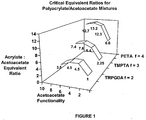
- FIG. 1 The area below the three curves represents ratios of acrylate to acetoacetate that when reacted, form unusable gelled materials outside the scope of the invention. Ratios of acrylate to acetoacetate on or above the curves form the liquid oligomers of this invention.
- the present invention relates to Michael Addition uncrosslinked liquid polyacrylate oligomers prepared by reacting Michael donors with Michael acceptors.
- the reaction is carried out In the presence of a catalyst system suitable for promoting the reaction of a beta-dicarbonyl donor with a compound having multiple acrylate functionalities at low temperatures over short time frames with no required byproduct removal or work-up.
- the catalyst system used in the present invention comprises an epoxy moiety and a quaternary salt.
- oligomers of this invention are multiacrylates such as diacrylate, triacrylates, and tetraacrylates.
- a liquid oilgomeric composition comprising an uncrosslinked Michael addition reaction product of;
- the diacrylate is ethylene or propylene glycol diacrylate, diethylene or dipropylene glycol diacrylate, triethylene or tripropylene glycol diacrylate, tertraethylene or tetrapropylene glycol diacrylate, polyethylene or polypropylene glycol diacrylate, ethoxylated bisphenol A diacrylate, bisphenol A diglycidyl ether diacrylate, resorcinol diglycidyl ether diacrylate, 1,3-propanediol diacrylate, 1,4-butanediol diacrylate, 1,5-pentanediol diacrylate, 1,6-hexanediol diacrylate, neopentyl glycol diacrylate, cyclohexane dimethanol diacrylate, ethoxylated or propoxylated neopentyl glycol diacrylate, ethoxylated or propoxylated cyclohexanedimethanol diacrylate
- the triacrylate is: trimethylol propane triacrylate, glycerol triacrylate, ethoxylated or propoxylated trimethylolpropane triacrylate, tris (2-hydroxyethyl) isocyanurate triacrylate, ethoxylated or propoxylated glycerol triacrylate, pentaerythritol triacrylate, aryl and aliphatic urethane triacrylates, melamine triacrylates, epoxy novolac triacrylates or mixtures thereof.
- Useful triacrylates are:
- the tetraacrylate is pentaerythritol tetraccrylate, ethoxylated or propoxylated pentaerythritol tetraacrylate, dipentaerythritol tetraacrylate, ethoxylated or propoxylated dipentaerythritol tetraacrylate, aryl and aliphatic urethane tetraacrylates, melamine tetraacrylates, epoxy novolac tetraacrylates or mixtures thereof.
- acrylated epoxies such as acrylated epoxy diacrylates, acrylated urethanes, such as aryl and aliphatic urethane acrylates, and acrylated polyesters, such as polyester acrylates.
- the composition of the invention further comprises a monoacrylate.
- the monoacrylate is a simple C 1 - C 18 acrylate ester, isobornyl acrylate (IBOA), tetrahydrofurfuryl acrylate (THFFA), 2-(2-ethoxy ethoxy) ethyl acrylate (EOEOEA), phenoxyethyl acrylate (PEA), hydroxyalkyl acrylate, monoalkyl polyalkylene glycol acrylate, siloxane, silane or silicone acrylate, perfluoroalkyl acrylate and/or caprolactone acrylate.
- IBOA isobornyl acrylate
- THFFA tetrahydrofurfuryl acrylate
- EEOEA 2-(2-ethoxy ethoxy) ethyl acrylate
- PEA phenoxyethyl acrylate
- hydroxyalkyl acrylate monoalkyl polyalkylene glycol
- monofunctional acrylates e.g., simple C 1 -C 18 acrylate ester, isobornyl acrylate, ethyl hexyl acrylate, lauryl acrylate, hydroxyethyl acrylate, caprolactone acrylate, etc.
- monofunctional acrylates may be included to modify resin properties such as adhesion to specific substrates, toughness, flexibility, film gloss, solvent resistance, impact resistance, surface tension and others.
- the Michael donors having 2 reactive functional groups per molecule are methyl acetoacetate, ethyl acetoacetate, t-butyl acetoacetate, allyl acetoacetate, 2-ethylhexyl acetoacetate, lauryl acetoacetate, acetoacetanilide, 2-acetoacetoxyethyl methacrylate (AAEM), 2,4-pentanedlone or mixtures thereof.
- the Michael donors having 4 functional groups per molecule are 1,4 - butanediol diacetoacetate, 1,6 - hexanediol diacetoacetate, neopentyl glycol diacetoacetate, cyclohexane dimethanol diacetoacetate, ethoxylated bisphenol A diacetoacetate or mixtures thereof.
- the Michael donors having 6 functional groups per molecule are trimethylol propane triacetoacetate, glycerol triacetoacetate, polycaprolactone triacetoacetate, ethoxylated or propoxylated trimethylol propane triacetoacetate, ethoxylated or propoxylated glycerol triacetoacetate or mixtures thereof.
- the Michael donor having 8 functional groups per molecule is pentaerythritol tetraacetoacetate, ethoxylated or propoxylated pentaerythritol tetraacetoacetate or mixtures thereof.
- said Michael donor is an acetoacetate, a malonic ester, pentanedione, acetoacetanilide, o- acetoacetanisidide, o-acetoacetatoluidide, acetoacetamide, N,N-dimethyl acetoacetamide, ethyl cyanoacetate, methyl cyanoacetate, butyl cyanoacetate or mixtures thereof.
- Michael donors include esters of malonic acid, 2,4-pentanedione, methyl cyanoacetate, ethyl cyanoacetate, butyl cyanoacetate, octyl cyanoacetate and cyanoacetamide.
- the Michael Addition reaction is typically carried out with an equivalent excess of Michael acceptor to Michael donor.
- Workable ratios to produce liquid oligomeric products are defined in Figure 1 . It Is critical that an appropriate equivalent ratio of acceptor to donor Is used in order to ensure that a liquid oligomeric product is obtained. Examples of these ratios for acrylate acceptors and Michael donors include the following.
- the catalyst system used In the present Invention comprises an epoxy moiety and a quaternary salt.
- the epoxy molety is an aryl or aliphatic glycidyl ether, aryl or aliphatic glycidyl ester, common alkylene oxides, cycloaliphatic epoxy, aryl or aliphatic glycidyl sulfide or amine, and aryl or aliphatic thiirane.
- epoxy moiety-containing compositions useful In the invention include glycidyl methacrylate, trimethylolpropane triglycidyl ether and diglycidyl ether of bisphenol A.
- the quaternary salt is an ammonium, phosphonium or sulfonium halide, acetate or fluoroborate.
- the quaternary salts include tetraalkyl ammonium halides such as tetrabutylammonium bromide, arylalkyl ammonium halides such as benzyltriethylammonium chloride.
- the quaternary salts also Include phosphonium halides such as tetraalkyl phosphonium bromides and phosphonium acetates, such as ethyltriphenylphosphonium acetate acetic acid complex such as "A-1" catalyst from Morton International.
- the quaternary salts also include ammonium, phosphonium or sulfonium fluorborate.
- the catalyst system comprises glycidyl methacrylate and tetrabutylammonium bromide.
- Preferred ranges for the epoxy and quaternary salt are 0.10 -10% and 0.10 -5% by weight, respectively, based on the total acrylate and Michael donor charge. Most preferred ranges would be 0.10 - 5% and 0.10 - 2% by weight, respectively.
- Resin design is application specific and a wide range of epoxy and quaternary salt molety is possible on that basis as the catalyst constituents can directly Influence properties of cured films.
- the epoxy and quaternary salt react to form the catalyst in-situ.
- the epoxy moiety and quaternary salt may be present in one molecule.
- An example would be the reaction product of triethylamine and epichlorohydrin.
- the catalyst can be derived from a quaternary salt with both epoxy and polymerizable ligand functionality.
- An example is acryloylethyl glycidyl dimethylammonium chloride.
- the polymerizable ligand allows for the binding of that composition with the cured product matrix by copolymerization with other acrylic functional groups.
- reaction between a Michael donor and an acrylate occurs in the presence of non-reactive monomers.
- said monomer is styrene, t-butyl styrene, alpha methyl styrene, vinyl toluene, vinyl acetate, allyl acetate, allyl methacrylate, diallyl phthalate, C1 - C 18 methacrylate esters, dimethacrylates, trimethacrylates or mixtures thereof.
- the high selectivity of the Michael reaction permits the use of monomers such as styrene and methyl methacrylate as Inert solvents to give low-viscosity systems that are easily incorporated Into a variety of resins.
- the liquid Michael Addition products of the present invention are curable by ultraviolet light without the need of a photoinitiator and are useful as coatings, adhesives, sealants and encapsulants for a variety of substrates and applications.
- Photoinitiators such as benzophenone and/or 2,2-dimethoxy-2-phenyl acetophenone may be added to these resins to further enhance curing.
- the oligomers of the present invention may also be cured by chemical or thermal means and electron beam radiation.
- the present invention also relates to a method of making a liquid oligomeric composition, comprising the steps of reacting a Michael donor having two, four, six, or eight reactive functional groups per molecule with a Michael acceptor selected from the group consisting of diacrylate, tiacrylate, and tetra-acrylate, In the presence of a catalyst system comprising an epoxy moiety and a quaternary salt, where the reactive equivalent functional ratios are:
- the quaternary salt is an ammonium, phosphonium or sulfonium halide.
- the epoxy moiety is an aryl or aliphatic glycidyl ether, aryl or aliphatic glycidyl ester, alkylene oxide, cycloaliphatic epoxy, aryl or aliphatic glycidyl sulfide or amine, and aryl or aliphatic thiirane.
- the present invention also relates to a crosslinked resin, comprising the reaction product of the liquid oligomeric composition according to the first embodiment.
- the quaternary salt is an ammonium, phosphonium or sulfonium halide, acetate or fluoroborate.
- the invention also relates to a coated article, comprising: a substrate and the crosslinked resin of the invention.
- TMPTA Trimethylolpropane triacrylate
- EAA ethyl acetoacetate
- GMA glycidyl methacrylate
- 0.45 g tetrabutylammonium bromide
- the viscous resin product was applied at a thickness of 2 mils (51 ⁇ m) to an aluminum panel and cured "tack-free" by exposure to a Fusion "H” bulb at a dosage of 500 mJ/cm 2 .
- the cured coating was smooth, glossy, very hard (pencil hardness 8H) and solvent resistant (>200 MEK double-rubs).
- the reactor temperature was set to 85 °C and held for a two-hour period. After two hours, the resin was discharged from the reactor and allowed to cool.
- the viscous resin product was applied at a thickness of 2 mils to an aluminum panel and cured "tack-free" by exposure to a Fusion "H" bulb at a dosage of 500 mJ/cm 2 .
- the cured coating was smooth, glossy, very hard (pencil hardness 8H) and solvent resistant (>200 MEK double-rubs).
- Trimethylolpropane triacrylate (TMPTA), 74.0 g, ethyl acetoacetate (EAA), 14.8 g, and tetrabutylommonium bromide, 0.45 g, were combined In an open reactor with moderate agitation from a mechanical stirrer. The reactor contents were heated at approximately 1 °C/min to the prescribed run temperature of 80 °C and held for a three-hour period. After three hours, the reactor contents were discharged from the reactor and allowed to cool. Twenty-four hours after discharge, conversion of both reactive methylene protons on ethyl acetoacetate was determined to be 0 % by 13 C NMR. Viscosity (cps, 25 °C) 70 Acetoacetate 0 conversion, % Gardner Color N/A
- Trimethylolpropane triacrylate (TMPTA), 74.0 g, ethyl acetoacetate (EAA), 14.8 g, and glycidyl methacrylate, 1.8 g, were combined In an open reactor with moderate agitation from a mechanical stirrer. The reactor contents were heated at approximately 1°C/min to the prescribed run temperature of 80 °C and held for a three-hour period. After three hours, the reactor contents were discharged from the reactor and allowed to cool. Twenty-four hours after discharge, conversion of both reactive methylene protons on ethyl acetoacetate was determined to be 0 % by 13 C NMR. Viscosity (cps, 25 °C) 57 Acetoacetate 0 conversion, % Gardner Color N/A
- Trimethylolpropane triacrylate (TMPTA), 74.0 g, 2,4-pentanedione, 11.8 g, glycidyl methacrylate, 1.8 g, and tetrabutylammonium bromide, 0.44 g were combined In an open reactor with moderate agitation from a mechanical stirrer. The reactor contents were heated at approximately 1°C/min to the prescribed run temperature of 80 °C and held for a three-hour period. After three hours, the reactor contents were discharged from the reactor and allowed to cool. Twenty-four hours after discharge, conversion of both reactive methylene protons on 2,4-pentanedione was determined to be 93.6 % by 13 C NMR. Viscosity (cps, 25 °C) 52,400 2,4-Pentanedione 93.6 conversion, % Gardner Color 5
- the mobile resin product was applied at a thickness of 2 mils (51 ⁇ m) to an aluminum panel and cured "tack-free" by exposure to a Fusion "H” bulb at a dosage of 500 mJ/cm 2 .
- the cured coating was smooth, glossy, hard and solvent resistant (>200 MEK double-rubs).
- Trimethylolpropane triacrylate (TMPTA), 296.0 g, acetoacetanilide, 80.5 g, glycidyl methacrylate. 7.7 g, and tetrabutylammonium bromide, 1.9 g were combined in an open reactor with moderate agitation from a mechanical stirrer. The reactor contents were heated at approximately 1°C/min to the prescribed run temperature of 80 °C and held for a three-hour period. After three hours, the reactor contents were discharged from the reactor and allowed to cool. Twenty-four hours after discharge, conversion of both reactive methylene protons on acetoacetanilide was determined to be 100 % by 13 C NMR. Viscosity (cps, 50 °C) 24,420 Acetoacetanilide 100 conversion, % Gardner Color 4
- TMPTA Trimethylol propane triacrylate
- EAA ethyl acetoacetate
- EAA ethyl acetoacetate
- epoxy and quaternary "salt" compounds as Indicated in Table 1 were combined In a reactor with moderate agitation from a mechanical stirrer. The reactor contents were heated at approximately 1 °C/min to the prescribed run temperature shown In Table 1 and held for the time indicated. After the prescribed reaction time, the reactor contents were discharged from the reactor and allowed to cool. Twenty-four hours after discharge, product viscosity was measured at 25°C and 50°C with a Brookfield Cap 2000 viscometer. Conversion of ethyl acetoacetate was measured by 13 C NMR. Color was measured by a Gardner Delta 212 Color Comparator.
Landscapes
- Chemical & Material Sciences (AREA)
- Health & Medical Sciences (AREA)
- Chemical Kinetics & Catalysis (AREA)
- Medicinal Chemistry (AREA)
- Polymers & Plastics (AREA)
- Organic Chemistry (AREA)
- Epoxy Resins (AREA)
- Addition Polymer Or Copolymer, Post-Treatments, Or Chemical Modifications (AREA)
- Organic Low-Molecular-Weight Compounds And Preparation Thereof (AREA)
- Macromonomer-Based Addition Polymer (AREA)
- Laminated Bodies (AREA)
- Polyoxymethylene Polymers And Polymers With Carbon-To-Carbon Bonds (AREA)
Claims (24)
- Flüssige oligomere Zusammensetzung, umfassend ein unvernetztes Michael-Additions-Reaktionsprodukt vona) einem Diacrylat-, Triacrylat- und/oder Tetraacrylat-Michael-Akzeptor undb) einem Michael-Donator mit Äquivalentverhältnissen voni) Diacrylat:Michael-Donator von≥ 1:1 bei Donatorfunktionalität = 2≥ 4,5:1 bei Donatorfunktionalität = 4≥ 4,5:1 bei Donatorfunktionalität = 6≥ 3,5:1 bei Donatorfunktionalität = 8,ii) Triacrylat:Michael-Donator von≥ 2,25:1 bei Donatorfunktionalität = 2≥ 6,4:1 bei Donatorfunktionalität = 4≥ 7,8:1 bei Donatorfunktionalität = 6≥ 7,4:1 bei Donatorfunktionalität = 8,iii) Tetraacrylat:Michael-Donator von≥ 6,6:1 bei Donatorfunktionalität = 2≥ 12,3:1 bei Donatorfunktionalität = 4≥ 13,2:1 bei Donatorfunktionalität = 6≥ 12,7:1 bei Donatorfunktionalität = 8,wobei das Reaktionsprodukt des Di-, Tri- und/oder Tetraacrylat-Akzeptors und des Michael-Donators in Gegenwart eines Katalysatorsystems, das einen Epoxidanteil und ein quaternäres Salz umfasst, gebildet wird.
- Zusammensetzung nach Anspruch 1, wobei es sich bei dem quaternären Salz um ein Ammonium-, Phosphonium- oder Sulfoniumhalogenid, -acetat oder -fluoroborat handelt.
- Zusammensetzung nach Anspruch 1, wobei es sich bei dem Epoxidanteil um einen Arylglycidylether, einen aliphatischen Glycidylether, einen Arylglycidylester, einen aliphatischen Glycidylester, gängige Alkylenoxide, ein cycloaliphatisches Epoxid, ein Arylglycidylsulfid oder -amin, ein aliphatisches Glycidylsulfid oder -amin und ein Arylthiiran oder aliphatisches Thiiran handelt.
- Zusammensetzung nach Anspruch 1, wobei es sich bei dem Diacrylat um Ethylen- oder Propylenglykoldiacrylat, Diethylen- oder Dipropylenglykoldiacrylat, Triethylen- oder Tripropylenglykoldiacrylat, Tetraethylen- oder Tetrapropylenglykoldiacrylat, Polyethylen- oder Polypropylenglykoldiacrylat, ethoxyliertes Bisphenol-A-diacrylat, Bisphenol-A-diglycidyletherdiacrylat, Resorcinoldiglycidyletherdiacrylat, 1,3-Propandioldiacrylat, 1,4-Butandioldiacrylat, 1,5-Pentandioldiacrylat, 1,6-Hexandioldiacrylat, Neopentylglykoldiacrylat, Cyclohexandimethanoldiacrylat, ethoxyliertes oder propoxyliertes Neopentylglykoldiacrylat, ethoxyliertes oder propoxyliertes Cyclohexandimethanoldiacrylat, acryliertes Epoxydiacrylat, Arylurethandiacrylat, aliphatisches Urethandiacrylat und Polyesterdiacrylat oder Mischungen davon handelt.
- Zusammensetzung nach Anspruch 1, wobei es sich bei dem Triacrylat um Trimethylolpropantriacrylat, Glycerintriacrylat, ethoxyliertes oder propoxyliertes Trimethylolpropantriacrylat, Tris(2-hydroxyethyl)isocyanurattriacrylat, ethoxyliertes oder propoxyliertes Glycerintriacrylat, Pentaerythritoltriacrylat, Arylurethantriacrylate, aliphatische Urethantriacrylate, Melamintriacrylate, Epoxynovolaktriacrylate oder Mischungen davon handelt.
- Zusammensetzung nach Anspruch 1, wobei es sich bei dem Tetraacrylat um Pentaerythritoltetraacrylat, ethoxyliertes oder propoxyliertes Pentaerythritoltetraacrylat, Dipentaerythritoltetraacrylat, ethoxyliertes oder propoxyliertes Dipentaerythritoltetraacrylat, Arylurethantetraacrylate, aliphatische Urethantetraacrylate, Melamintetraacrylate, Epoxynovolaktetraacrylate, oder Mischungen davon handelt.
- Zusammensetzung nach Anspruch 1, die ferner ein Monoacrylat umfasst.
- Zusammensetzung nach Anspruch 1, wobei es sich bei dem Monoacrylat um einen einfachen C1-C18-Acrylat-ester, Isobornylacrylat (IBOA), Tetrahydrofurfurylacrylat (THFFA), 2-(2-Ethoxyethoxy)ethylacrylat (EOEOEA), Phenoxyethylacrylat (PEA), Hydroxyalkylacrylat, Monoalkylpolyalkylenglykolacrylat, Siloxan-, Silan- oder Silikonacrylat, Perfluoralkylacrylat und/oder Caprolactonacrylat handelt.
- Zusammensetzung nach Anspruch 1, wobei es sich bei den Michael-Donatoren mit 2 reaktiven funktionellen Gruppen pro Molekül um Methylacetoacetat, Ethylacetoacetat, t-Butylacetoacetat, Allylacetoacetat, 2-Ethylhexylacetoacetat, Laurylacetoacetat, Acetoacetanilid, 2-Acetoacetoxyethylmethacrylat (AAEM), 2,4-Pentandion oder Mischungen davon handelt.
- Zusammensetzung nach Anspruch 1, wobei es sich bei den Michael-Donatoren mit 4 funktionellen Gruppen pro Molekül um 1,4-Butandioldiacetoacetat, 1,6-Hexandioldiacetoacetat, Neopentylglykoldiacetoacetat, Cyclohexandimethanoldiacetoacetat, ethoxyliertes Bisphenol-A-diacetoacetat oder Mischungen davon handelt.
- Zusammensetzung nach Anspruch 1, wobei es sich bei den Michael-Donatoren mit 6 funktionellen Gruppen pro Molekül um Trimethylolpropantriacetoacetat, Glycerintriacetoacetat, Polycaprolactontriacetoacetat, ethoxyliertes oder propoxyliertes Trimethylolpropantriacetoacetat, ethoxyliertes oder propoxyliertes Glycerintriacetoacetat oder Mischungen davon handelt.
- Zusammensetzung nach Anspruch 1, wobei es sich bei den Michael-Donatoren mit 8 funktionellen Gruppen pro Molekül um Pentaerythritoltetraacetoacetat, ethoxyliertes oder propoxyliertes Pentaerythritoltetraacetoacetat oder Mischungen davon handelt.
- Zusammensetzung nach Anspruch 1, wobei das Katalysatorsystem Glycidylmethacrylat und Tetrabutylammoniumbromid umfasst.
- Zusammensetzung nach Anspruch 1, wobei die Reaktion zwischen einem Michael-Donator und einem Acrylat in Gegenwart von unreaktiven Monomeren stattfindet.
- Zusammensetzung nach Anspruch 14, wobei es sich bei dem Monomer um Styrol, t-Butylstyrol, alpha-Methylstyrol, Vinyltoluol, Vinylacetat, Allylacetat, Allylmethacrylat, Diallylphthalat, C1-C18-Methacrylatester, Dimethacrylate, Trimethacrylate oder Mischungen davon handelt.
- Zusammensetzung nach Anspruch 1, wobei es sich bei dem Michael-Donator um ein Acetoacetat, einen Malonsäureester, Pentandion, Acetoacetanilid, o-Acetoacetanisidid, o-Acetoacetotoluidid, Acetoacetamid, N,N-Dimethylacetoacetamid, Ethylcyanoacetat, Methylcyanoacetat, Butylcyanoacetat oder Mischungen davon handelt.
- Zusammensetzung nach Anspruch 1, wobei der Epoxidanteil und das quaternäre Salz in einem Molekül vorliegen.
- Verfahren zur Herstellung einer flüssigen oligomeren Zusammensetzung, bei dem man einen Michael-Donator mit zwei, vier, sechs oder acht reaktiven funktionellen Gruppen pro Molekül in Gegenwart eines Katalysatorsystems, das einen Epoxidanteil und ein quaternäres Salz umfasst, mit einem Michael-Akzeptor aus der Gruppe bestehend aus Diacrylat, Triacrylat und Tetraacrylat umsetzt, wobei die funktionellen Verhältnisse der reaktiven Äquivalente die folgenden Werte aufweisen:i) Diacrylat:Michael-Donator von≥ 1:1 bei Donatorfunktionalität = 2≥ 4,5:1 bei Donatorfunktionalität = 4≥ 4,5:1 bei Donatorfunktionalität = 6≥ 3,5:1 bei Donatorfunktionalität = 8,ii) Triacrylat:Michael-Donator von≥ 2,25:1 bei Donatorfunktionalität = 2≥ 6,4:1 bei Donatorfunktionalität = 4≥ 7,8:1 bei Donatorfunktionalität = 6iii) Tetraacrylat:Michael-Donator von≥ 6,6:1 bei Donatorfunktionalität = 2≥ 12,3:1 bei Donatorfunktionalität = 4≥ 13,2:1 bei Donatorfunktionalität = 6≥ 12,7:1 bei Donatorfunktionalität = 8.
- Verfahren nach Anspruch 18, wobei es sich bei dem quaternären Salz um ein Ammonium-, Phosphonium-oder Sulfoniumhalogenid handelt.
- Verfahren nach Anspruch 18, wobei es sich bei dem Epoxidanteil um einen Arylglycidylether, einen aliphatischen Glycidylether, einen Arylglycidylester, einen aliphatischen Glycidylester, ein Alkylenoxid, ein cycloaliphatisches Epoxid, ein Arylglycidylsulfid oder -amin, ein aliphatisches Glycidylsulfid oder -amin und ein Arylthiiran oder aliphatisches Thiiran handelt.
- Vernetztes Harz, umfassend das Reaktionsprodukt der flüssigen oligomeren Zusammensetzung gemäß Anspruch 1.
- Vernetztes Harz nach Anspruch 21, wobei es sich bei dem quaternären Salz um ein Ammonium-, Phosphonium- oder Sulfoniumhalogenid, -acetat oder -fluoroborat handelt.
- Vernetztes Harz nach Anspruch 21, wobei es sich bei dem Epoxidanteil um einen Arylglycidylether, einen aliphatischen Glycidylether, einen Arylglycidylester, einen aliphatischen Glycidylester, ein Alkylenoxid, ein cycloaliphatisches Epoxid, ein Arylglycidylsulfid oder -amin, ein aliphatisches Glycidylsulfid oder -amin und ein Arylthiiran oder aliphatisches Thiiran handelt.
- Beschichteter Gegenstand, umfassend ein Substrat und das vernetzte Harz nach Anspruch 21.
Applications Claiming Priority (3)
| Application Number | Priority Date | Filing Date | Title |
|---|---|---|---|
| US10/255,541 US6706414B1 (en) | 2002-09-26 | 2002-09-26 | Liquid uncrosslinked Michael addition oligomers prepared in the presence of a catalyst having both an epoxy moiety and a quaternary salt |
| US255541 | 2002-09-26 | ||
| PCT/US2003/030436 WO2004029118A2 (en) | 2002-09-26 | 2003-09-26 | Liquid uncrosslinked michael addition oligomers prepared in the presence of a catalyst having both an epoxy moiety and a quaternary salt |
Publications (3)
| Publication Number | Publication Date |
|---|---|
| EP1545876A2 EP1545876A2 (de) | 2005-06-29 |
| EP1545876A4 EP1545876A4 (de) | 2008-10-01 |
| EP1545876B1 true EP1545876B1 (de) | 2012-05-09 |
Family
ID=31946508
Family Applications (1)
| Application Number | Title | Priority Date | Filing Date |
|---|---|---|---|
| EP20030754917 Expired - Lifetime EP1545876B1 (de) | 2002-09-26 | 2003-09-26 | In gegenwart eines katalysators mit sowohl einem epoxidanteil als auch einem quarternären salz hergestellte flüssige unvernetzte michael-additionsoligomere |
Country Status (12)
| Country | Link |
|---|---|
| US (1) | US6706414B1 (de) |
| EP (1) | EP1545876B1 (de) |
| JP (1) | JP2006501330A (de) |
| KR (1) | KR20050070006A (de) |
| CN (1) | CN100377874C (de) |
| AT (1) | ATE557049T1 (de) |
| AU (1) | AU2003272716B2 (de) |
| CA (1) | CA2500205C (de) |
| ES (1) | ES2384873T3 (de) |
| MX (1) | MXPA05003246A (de) |
| TW (1) | TW200528512A (de) |
| WO (1) | WO2004029118A2 (de) |
Families Citing this family (35)
| Publication number | Priority date | Publication date | Assignee | Title |
|---|---|---|---|---|
| US6878845B2 (en) * | 2002-10-15 | 2005-04-12 | Ashland Inc. | Oligomers from multifunctional acrylates |
| TW583226B (en) * | 2002-12-17 | 2004-04-11 | Ind Technology Res Inst Materi | Formulation in preparing solid electrolytic capacitor and process thereof |
| EP1431320A1 (de) * | 2002-12-20 | 2004-06-23 | Dainippon Ink And Chemicals, Inc. | Härtbare Harzmischungen enthaltend Acrylat- und beta-Dicarbonyl-Gruppen |
| US8013068B2 (en) * | 2003-01-02 | 2011-09-06 | Rohm And Haas Company | Michael addition compositions |
| US20040166241A1 (en) * | 2003-02-20 | 2004-08-26 | Henkel Loctite Corporation | Molding compositions containing quaternary organophosphonium salts |
| US7169825B2 (en) * | 2003-07-29 | 2007-01-30 | Ashland Licensing And Intellectual Property Llc | Dual cure reaction products of self-photoinitiating multifunctional acrylates with thiols and synthetic methods |
| BRPI0416519A (pt) * | 2003-11-14 | 2007-03-06 | Ashland Licensing & Intellectu | composição oligomérica lìquida, produto polimerizado curado, método para fabricar e para usar uma composição oligomérica lìquida, e, substrato |
| AU2005237474A1 (en) * | 2004-04-21 | 2005-11-10 | Ashland Licensing And Intellectual Property Llc | Radiation curable high gloss overprint varnish compositions |
| CN101027326B (zh) * | 2004-04-21 | 2011-03-23 | 亚什兰许可和知识产权有限公司 | 具有内在光敏引发剂的可辐射固化迈克尔加成树脂 |
| US20050245636A1 (en) * | 2004-04-29 | 2005-11-03 | Ashland Inc. | Radiation-curable coatings for wood substrates from multifunctional acrylate oligomers |
| US7317061B2 (en) * | 2004-04-29 | 2008-01-08 | Ashland Licensing And Intellectual Property Llc | Self-photoinitiating water-dispersible acrylate ionomers and synthetic methods |
| US7214725B2 (en) * | 2004-04-30 | 2007-05-08 | Ashland Licensing And Intellectual Property Llc | Radiation-curable lithographic inks from multifunctional acrylate oligomers |
| US7232540B2 (en) * | 2004-05-02 | 2007-06-19 | Ashland Licensing And Intellectual Property Llc | Radiation-curable coatings for plastic substrates from multifunctional acrylate oligomers |
| CA2565060A1 (en) * | 2004-05-02 | 2005-11-17 | Ashland Licensing And Intellectual Property Llc | Radiation-curable coatings for metal substrates from multifunctional acrylate oligomers |
| EP1647588A3 (de) * | 2004-10-13 | 2006-11-02 | Rohm and Haas Company | An der Oberfläche aktivierte Michaelhärtung |
| US7855262B2 (en) * | 2005-05-17 | 2010-12-21 | Sun Chemical Corporation | Size selective catalysis with ion exchange resins |
| WO2009002726A1 (en) | 2007-06-25 | 2008-12-31 | Sun Chemical Corporation | Process for preparation of oligomeric or polymeric compounds using selective michael addition |
| JP4749443B2 (ja) * | 2007-06-28 | 2011-08-17 | ローム アンド ハース カンパニー | ポリマー溶液 |
| WO2013050622A1 (en) | 2011-10-07 | 2013-04-11 | Nuplex Resins B.V. | A crosslinkable composition cross-linkable by real michael addition reaction and resins for use in said composition |
| JP6534347B2 (ja) * | 2013-03-04 | 2019-06-26 | 東洋合成工業株式会社 | 組成物、樹脂モールド、光インプリント方法、光学素子の製造方法、及び電子素子の製造方法 |
| EP2984133B1 (de) | 2013-04-08 | 2018-03-28 | Allnex Netherlands B.V. | Zusammensetzung vernetzbar durch reale michael addition reaction (rma) |
| US9708444B2 (en) * | 2013-11-25 | 2017-07-18 | Dow Global Technologies Llc | Biodegradable aliphatic polyesters |
| CA2983148C (en) | 2015-04-17 | 2023-05-09 | Allnex Netherlands B.V. | Process for the manufacture of a crosslinkable composition |
| RU2720618C2 (ru) | 2015-04-17 | 2020-05-12 | Аллнекс Незерландс Б.В. | Способ отверждения rma-сшиваемого смоляного покрытия, rma-сшиваемые композиции и смолы для применения в указанном способе |
| JP6837991B2 (ja) | 2015-04-17 | 2021-03-03 | オールネックス・ネザーランズ・ビー.ブイ.Allnex Netherlands B.V. | フロアコーティング組成物 |
| CA2983155C (en) | 2015-04-17 | 2022-03-08 | Allnex Netherlands B.V. | Modified epoxy primer for improved adhesion of rma crosslinkable coating compositions |
| JP7209690B2 (ja) * | 2017-07-31 | 2023-01-20 | ダウ グローバル テクノロジーズ エルエルシー | カプセル化方法 |
| WO2019027631A1 (en) * | 2017-07-31 | 2019-02-07 | Dow Global Technologies Llc | DETERGENT ADDITIVE |
| JP7359520B2 (ja) | 2018-02-22 | 2023-10-11 | ビーエーエスエフ ソシエタス・ヨーロピア | 優れた熱変形耐性および引裂伸びを有するポリウレタンベースのポリマー材料 |
| EP3663326A1 (de) | 2018-12-04 | 2020-06-10 | Allnex Netherlands B.V. | Rma-vernetzbares polymer |
| CN113557275B (zh) | 2019-03-19 | 2024-04-02 | 博斯蒂克股份公司 | 两部分可固化组合物 |
| WO2020187963A1 (en) | 2019-03-19 | 2020-09-24 | Bostik Sa | Two-part curable composition |
| JP2022518976A (ja) | 2019-04-10 | 2022-03-17 | アークサーダ・アー・ゲー | 活性炭で脱色されたアセトアセチル化グリセロールを調製するための方法 |
| CN111484603B (zh) * | 2020-04-16 | 2023-03-31 | 嘉兴学院 | 一种基于迈克尔加成反应的聚合物及其制备方法 |
| CN112457751B (zh) | 2021-02-01 | 2021-07-06 | 佛山宜可居新材料有限公司 | 一种可热固化的粉末涂料组合物及其制备方法 |
Family Cites Families (11)
| Publication number | Priority date | Publication date | Assignee | Title |
|---|---|---|---|---|
| AU672337B2 (en) | 1993-10-27 | 1996-09-26 | Nippon Paint Co., Ltd. | Curable resin composition for coating uses |
| JP3218345B2 (ja) * | 1993-10-27 | 2001-10-15 | 日本ペイント株式会社 | 塗料用硬化樹脂組成物 |
| US5537400A (en) * | 1994-04-15 | 1996-07-16 | Dsc Communications Corporation | Buffered crosspoint matrix for an asynchronous transfer mode switch and method of operation |
| JPH09310042A (ja) * | 1996-05-22 | 1997-12-02 | Nippon Paint Co Ltd | 硬化性水性塗料組成物 |
| CA2205765A1 (en) * | 1996-05-22 | 1997-11-22 | Nippon Paint Co., Ltd. | Curable resin composition for coating use |
| JPH1045993A (ja) * | 1996-05-22 | 1998-02-17 | Nippon Paint Co Ltd | 硬化性樹脂組成物および塗料 |
| US6025410A (en) | 1997-09-19 | 2000-02-15 | Ashland Inc. | Liquid oligomers containing acrylate unsaturation |
| US5945489A (en) | 1997-09-19 | 1999-08-31 | Ashland, Inc. | Liquid oligomers containing unsaturation |
| JPH11100477A (ja) * | 1997-09-26 | 1999-04-13 | Nippon Paint Co Ltd | マイケル反応を利用する硬化性樹脂組成物 |
| JPH11315145A (ja) * | 1998-02-17 | 1999-11-16 | Nippon Paint Co Ltd | 硬化性樹脂組成物、塗料、複層塗膜形成方法及び塗装物 |
| GB2335196A (en) * | 1998-02-17 | 1999-09-15 | Nippon Paint Co Ltd | Curable polymer composition |
-
2002
- 2002-09-26 US US10/255,541 patent/US6706414B1/en not_active Expired - Lifetime
-
2003
- 2003-09-26 CA CA2500205A patent/CA2500205C/en not_active Expired - Fee Related
- 2003-09-26 JP JP2004539988A patent/JP2006501330A/ja not_active Ceased
- 2003-09-26 CN CNB038254050A patent/CN100377874C/zh not_active Expired - Fee Related
- 2003-09-26 ES ES03754917T patent/ES2384873T3/es not_active Expired - Lifetime
- 2003-09-26 AU AU2003272716A patent/AU2003272716B2/en not_active Ceased
- 2003-09-26 AT AT03754917T patent/ATE557049T1/de active
- 2003-09-26 KR KR1020057005203A patent/KR20050070006A/ko not_active Ceased
- 2003-09-26 EP EP20030754917 patent/EP1545876B1/de not_active Expired - Lifetime
- 2003-09-26 MX MXPA05003246A patent/MXPA05003246A/es active IP Right Grant
- 2003-09-26 WO PCT/US2003/030436 patent/WO2004029118A2/en not_active Ceased
-
2004
- 2004-02-24 TW TW93104509A patent/TW200528512A/zh unknown
Also Published As
| Publication number | Publication date |
|---|---|
| KR20050070006A (ko) | 2005-07-05 |
| US6706414B1 (en) | 2004-03-16 |
| ATE557049T1 (de) | 2012-05-15 |
| MXPA05003246A (es) | 2005-07-05 |
| AU2003272716B2 (en) | 2008-02-14 |
| EP1545876A4 (de) | 2008-10-01 |
| ES2384873T3 (es) | 2012-07-13 |
| CN100377874C (zh) | 2008-04-02 |
| WO2004029118A3 (en) | 2004-06-24 |
| WO2004029118A2 (en) | 2004-04-08 |
| TW200528512A (en) | 2005-09-01 |
| JP2006501330A (ja) | 2006-01-12 |
| AU2003272716A1 (en) | 2004-04-19 |
| CA2500205A1 (en) | 2004-04-08 |
| EP1545876A2 (de) | 2005-06-29 |
| CN1708401A (zh) | 2005-12-14 |
| CA2500205C (en) | 2010-07-06 |
Similar Documents
| Publication | Publication Date | Title |
|---|---|---|
| EP1545876B1 (de) | In gegenwart eines katalysators mit sowohl einem epoxidanteil als auch einem quarternären salz hergestellte flüssige unvernetzte michael-additionsoligomere | |
| US7041749B2 (en) | Dual cure reaction products of self-photoinitiating multifunction acrylates with cycloaliphatic epoxy compounds | |
| JP4135703B2 (ja) | 光硬化性樹脂の製造方法 | |
| WO2001000684A1 (en) | Liquid oligomers containing unsaturation | |
| CA2545998A1 (en) | Dual cure reaction products of self-photoinitiating multifunctional acrylates with cycloaliphatic epoxy compounds | |
| CN101027326A (zh) | 具有内在光敏引发剂的可辐射固化迈克尔加成树脂 | |
| US8119740B2 (en) | Curable liquid acryloyl group containing resin composition | |
| AU2003282835B2 (en) | Oligomers from multifunctional acrylates | |
| EP1777269A1 (de) | Härtbare Zusammensetzung und Acrylgruppen enthaltendes härtbares Oligomer und Verfahren zur Herstellung des Acrylgruppen enthaltenden härtbaren Oligomeren. | |
| JP3606260B2 (ja) | 活性エネルギー線硬化型被覆用組成物 | |
| JP2004143344A (ja) | 紫外線吸収能を有する架橋性樹脂組成物 | |
| JPH11148045A (ja) | 活性エネルギー線硬化型塗料組成物及びそれを用いた被膜形成方法 | |
| CN114846033B (zh) | 含环碳酸酯基的(甲基)丙烯酸酯单体及聚合物 | |
| EP1342738B1 (de) | Photohärtbare Zusammensetzung, Verfahren zur Herstellung eines photohärtbaren Harzes und vernetztes Produkt | |
| JP4880249B2 (ja) | 光ラジカル架橋型ポリマー及び光硬化樹脂組成物 | |
| JP7721889B2 (ja) | 活性エネルギー線硬化性組成物 | |
| JPH08291214A (ja) | 新規多官能エポキシ樹脂組成物およびそれを用いた光硬化性樹脂組成物 | |
| JP2602900B2 (ja) | 硬化性樹脂組成物及びその硬化物 | |
| JPS6348309A (ja) | 活性エネルギ−線硬化性組成物 | |
| JP2002265820A (ja) | 活性エネルギー線硬化型粉体塗料用組成物 | |
| JPH01190710A (ja) | シクロアセタール環含有(メタ)アクリレートプレポリマー及びこれを含んでなる硬化性樹脂組成物 |
Legal Events
| Date | Code | Title | Description |
|---|---|---|---|
| PUAI | Public reference made under article 153(3) epc to a published international application that has entered the european phase |
Free format text: ORIGINAL CODE: 0009012 |
|
| 17P | Request for examination filed |
Effective date: 20050422 |
|
| AK | Designated contracting states |
Kind code of ref document: A2 Designated state(s): AT BE BG CH CY CZ DE DK EE ES FI FR GB GR HU IE IT LI LU MC NL PT RO SE SI SK TR |
|
| AX | Request for extension of the european patent |
Extension state: AL LT LV MK |
|
| RAP1 | Party data changed (applicant data changed or rights of an application transferred) |
Owner name: ASHLAND LICENSING AND INTELLECTUAL PROPERTY LLC |
|
| A4 | Supplementary search report drawn up and despatched |
Effective date: 20080829 |
|
| 17Q | First examination report despatched |
Effective date: 20110405 |
|
| REG | Reference to a national code |
Ref country code: DE Ref legal event code: R079 Ref document number: 60340917 Country of ref document: DE Free format text: PREVIOUS MAIN CLASS: B32B0027380000 Ipc: C08F0222100000 |
|
| RIC1 | Information provided on ipc code assigned before grant |
Ipc: C08F 222/10 20060101AFI20110810BHEP Ipc: B32B 27/38 20060101ALI20110810BHEP |
|
| GRAP | Despatch of communication of intention to grant a patent |
Free format text: ORIGINAL CODE: EPIDOSNIGR1 |
|
| GRAS | Grant fee paid |
Free format text: ORIGINAL CODE: EPIDOSNIGR3 |
|
| GRAA | (expected) grant |
Free format text: ORIGINAL CODE: 0009210 |
|
| AK | Designated contracting states |
Kind code of ref document: B1 Designated state(s): AT BE BG CH CY CZ DE DK EE ES FI FR GB GR HU IE IT LI LU MC NL PT RO SE SI SK TR |
|
| AX | Request for extension of the european patent |
Extension state: AL LT LV MK |
|
| REG | Reference to a national code |
Ref country code: GB Ref legal event code: FG4D |
|
| REG | Reference to a national code |
Ref country code: CH Ref legal event code: EP Ref country code: AT Ref legal event code: REF Ref document number: 557049 Country of ref document: AT Kind code of ref document: T Effective date: 20120515 |
|
| REG | Reference to a national code |
Ref country code: IE Ref legal event code: FG4D |
|
| REG | Reference to a national code |
Ref country code: DE Ref legal event code: R096 Ref document number: 60340917 Country of ref document: DE Effective date: 20120628 |
|
| REG | Reference to a national code |
Ref country code: ES Ref legal event code: FG2A Ref document number: 2384873 Country of ref document: ES Kind code of ref document: T3 Effective date: 20120713 |
|
| REG | Reference to a national code |
Ref country code: NL Ref legal event code: VDEP Effective date: 20120509 |
|
| REG | Reference to a national code |
Ref country code: LT Ref legal event code: MG9D Effective date: 20120509 |
|
| PG25 | Lapsed in a contracting state [announced via postgrant information from national office to epo] |
Ref country code: FI Free format text: LAPSE BECAUSE OF FAILURE TO SUBMIT A TRANSLATION OF THE DESCRIPTION OR TO PAY THE FEE WITHIN THE PRESCRIBED TIME-LIMIT Effective date: 20120509 Ref country code: CY Free format text: LAPSE BECAUSE OF FAILURE TO SUBMIT A TRANSLATION OF THE DESCRIPTION OR TO PAY THE FEE WITHIN THE PRESCRIBED TIME-LIMIT Effective date: 20120509 Ref country code: SE Free format text: LAPSE BECAUSE OF FAILURE TO SUBMIT A TRANSLATION OF THE DESCRIPTION OR TO PAY THE FEE WITHIN THE PRESCRIBED TIME-LIMIT Effective date: 20120509 |
|
| REG | Reference to a national code |
Ref country code: AT Ref legal event code: MK05 Ref document number: 557049 Country of ref document: AT Kind code of ref document: T Effective date: 20120509 |
|
| PG25 | Lapsed in a contracting state [announced via postgrant information from national office to epo] |
Ref country code: PT Free format text: LAPSE BECAUSE OF FAILURE TO SUBMIT A TRANSLATION OF THE DESCRIPTION OR TO PAY THE FEE WITHIN THE PRESCRIBED TIME-LIMIT Effective date: 20120910 Ref country code: GR Free format text: LAPSE BECAUSE OF FAILURE TO SUBMIT A TRANSLATION OF THE DESCRIPTION OR TO PAY THE FEE WITHIN THE PRESCRIBED TIME-LIMIT Effective date: 20120810 Ref country code: SI Free format text: LAPSE BECAUSE OF FAILURE TO SUBMIT A TRANSLATION OF THE DESCRIPTION OR TO PAY THE FEE WITHIN THE PRESCRIBED TIME-LIMIT Effective date: 20120509 |
|
| PG25 | Lapsed in a contracting state [announced via postgrant information from national office to epo] |
Ref country code: BE Free format text: LAPSE BECAUSE OF FAILURE TO SUBMIT A TRANSLATION OF THE DESCRIPTION OR TO PAY THE FEE WITHIN THE PRESCRIBED TIME-LIMIT Effective date: 20120509 |
|
| PG25 | Lapsed in a contracting state [announced via postgrant information from national office to epo] |
Ref country code: DK Free format text: LAPSE BECAUSE OF FAILURE TO SUBMIT A TRANSLATION OF THE DESCRIPTION OR TO PAY THE FEE WITHIN THE PRESCRIBED TIME-LIMIT Effective date: 20120509 Ref country code: NL Free format text: LAPSE BECAUSE OF FAILURE TO SUBMIT A TRANSLATION OF THE DESCRIPTION OR TO PAY THE FEE WITHIN THE PRESCRIBED TIME-LIMIT Effective date: 20120509 Ref country code: RO Free format text: LAPSE BECAUSE OF FAILURE TO SUBMIT A TRANSLATION OF THE DESCRIPTION OR TO PAY THE FEE WITHIN THE PRESCRIBED TIME-LIMIT Effective date: 20120509 Ref country code: SK Free format text: LAPSE BECAUSE OF FAILURE TO SUBMIT A TRANSLATION OF THE DESCRIPTION OR TO PAY THE FEE WITHIN THE PRESCRIBED TIME-LIMIT Effective date: 20120509 Ref country code: AT Free format text: LAPSE BECAUSE OF FAILURE TO SUBMIT A TRANSLATION OF THE DESCRIPTION OR TO PAY THE FEE WITHIN THE PRESCRIBED TIME-LIMIT Effective date: 20120509 Ref country code: EE Free format text: LAPSE BECAUSE OF FAILURE TO SUBMIT A TRANSLATION OF THE DESCRIPTION OR TO PAY THE FEE WITHIN THE PRESCRIBED TIME-LIMIT Effective date: 20120509 Ref country code: CZ Free format text: LAPSE BECAUSE OF FAILURE TO SUBMIT A TRANSLATION OF THE DESCRIPTION OR TO PAY THE FEE WITHIN THE PRESCRIBED TIME-LIMIT Effective date: 20120509 |
|
| PLBE | No opposition filed within time limit |
Free format text: ORIGINAL CODE: 0009261 |
|
| STAA | Information on the status of an ep patent application or granted ep patent |
Free format text: STATUS: NO OPPOSITION FILED WITHIN TIME LIMIT |
|
| 26N | No opposition filed |
Effective date: 20130212 |
|
| PG25 | Lapsed in a contracting state [announced via postgrant information from national office to epo] |
Ref country code: MC Free format text: LAPSE BECAUSE OF NON-PAYMENT OF DUE FEES Effective date: 20120930 |
|
| REG | Reference to a national code |
Ref country code: CH Ref legal event code: PL |
|
| REG | Reference to a national code |
Ref country code: DE Ref legal event code: R097 Ref document number: 60340917 Country of ref document: DE Effective date: 20130212 |
|
| REG | Reference to a national code |
Ref country code: IE Ref legal event code: MM4A |
|
| PG25 | Lapsed in a contracting state [announced via postgrant information from national office to epo] |
Ref country code: LI Free format text: LAPSE BECAUSE OF NON-PAYMENT OF DUE FEES Effective date: 20120930 Ref country code: CH Free format text: LAPSE BECAUSE OF NON-PAYMENT OF DUE FEES Effective date: 20120930 Ref country code: BG Free format text: LAPSE BECAUSE OF FAILURE TO SUBMIT A TRANSLATION OF THE DESCRIPTION OR TO PAY THE FEE WITHIN THE PRESCRIBED TIME-LIMIT Effective date: 20120809 Ref country code: IE Free format text: LAPSE BECAUSE OF NON-PAYMENT OF DUE FEES Effective date: 20120926 |
|
| PG25 | Lapsed in a contracting state [announced via postgrant information from national office to epo] |
Ref country code: TR Free format text: LAPSE BECAUSE OF FAILURE TO SUBMIT A TRANSLATION OF THE DESCRIPTION OR TO PAY THE FEE WITHIN THE PRESCRIBED TIME-LIMIT Effective date: 20120509 |
|
| PG25 | Lapsed in a contracting state [announced via postgrant information from national office to epo] |
Ref country code: LU Free format text: LAPSE BECAUSE OF NON-PAYMENT OF DUE FEES Effective date: 20120926 |
|
| PG25 | Lapsed in a contracting state [announced via postgrant information from national office to epo] |
Ref country code: HU Free format text: LAPSE BECAUSE OF FAILURE TO SUBMIT A TRANSLATION OF THE DESCRIPTION OR TO PAY THE FEE WITHIN THE PRESCRIBED TIME-LIMIT Effective date: 20030926 |
|
| REG | Reference to a national code |
Ref country code: FR Ref legal event code: PLFP Year of fee payment: 14 |
|
| REG | Reference to a national code |
Ref country code: FR Ref legal event code: PLFP Year of fee payment: 15 |
|
| PGFP | Annual fee paid to national office [announced via postgrant information from national office to epo] |
Ref country code: GB Payment date: 20170927 Year of fee payment: 15 Ref country code: FR Payment date: 20170925 Year of fee payment: 15 Ref country code: IT Payment date: 20170925 Year of fee payment: 15 |
|
| PGFP | Annual fee paid to national office [announced via postgrant information from national office to epo] |
Ref country code: DE Payment date: 20170927 Year of fee payment: 15 |
|
| PGFP | Annual fee paid to national office [announced via postgrant information from national office to epo] |
Ref country code: ES Payment date: 20171002 Year of fee payment: 15 |
|
| REG | Reference to a national code |
Ref country code: DE Ref legal event code: R119 Ref document number: 60340917 Country of ref document: DE |
|
| GBPC | Gb: european patent ceased through non-payment of renewal fee |
Effective date: 20180926 |
|
| PG25 | Lapsed in a contracting state [announced via postgrant information from national office to epo] |
Ref country code: DE Free format text: LAPSE BECAUSE OF NON-PAYMENT OF DUE FEES Effective date: 20190402 Ref country code: IT Free format text: LAPSE BECAUSE OF NON-PAYMENT OF DUE FEES Effective date: 20180926 |
|
| PG25 | Lapsed in a contracting state [announced via postgrant information from national office to epo] |
Ref country code: FR Free format text: LAPSE BECAUSE OF NON-PAYMENT OF DUE FEES Effective date: 20180930 |
|
| PG25 | Lapsed in a contracting state [announced via postgrant information from national office to epo] |
Ref country code: GB Free format text: LAPSE BECAUSE OF NON-PAYMENT OF DUE FEES Effective date: 20180926 |
|
| REG | Reference to a national code |
Ref country code: ES Ref legal event code: FD2A Effective date: 20191104 |
|
| PG25 | Lapsed in a contracting state [announced via postgrant information from national office to epo] |
Ref country code: ES Free format text: LAPSE BECAUSE OF NON-PAYMENT OF DUE FEES Effective date: 20180927 |