EP1536765B1 - Emulsion aqueuse comprenant un polymere organosilicie - Google Patents
Emulsion aqueuse comprenant un polymere organosilicie Download PDFInfo
- Publication number
- EP1536765B1 EP1536765B1 EP03795439A EP03795439A EP1536765B1 EP 1536765 B1 EP1536765 B1 EP 1536765B1 EP 03795439 A EP03795439 A EP 03795439A EP 03795439 A EP03795439 A EP 03795439A EP 1536765 B1 EP1536765 B1 EP 1536765B1
- Authority
- EP
- European Patent Office
- Prior art keywords
- mixture
- hair
- emulsion
- groups
- component
- Prior art date
- Legal status (The legal status is an assumption and is not a legal conclusion. Google has not performed a legal analysis and makes no representation as to the accuracy of the status listed.)
- Expired - Lifetime
Links
Images
Classifications
-
- A—HUMAN NECESSITIES
- A61—MEDICAL OR VETERINARY SCIENCE; HYGIENE
- A61K—PREPARATIONS FOR MEDICAL, DENTAL OR TOILETRY PURPOSES
- A61K8/00—Cosmetics or similar toiletry preparations
- A61K8/18—Cosmetics or similar toiletry preparations characterised by the composition
- A61K8/72—Cosmetics or similar toiletry preparations characterised by the composition containing organic macromolecular compounds
- A61K8/84—Cosmetics or similar toiletry preparations characterised by the composition containing organic macromolecular compounds obtained by reactions otherwise than those involving only carbon-carbon unsaturated bonds
- A61K8/89—Polysiloxanes
- A61K8/895—Polysiloxanes containing silicon bound to unsaturated aliphatic groups, e.g. vinyl dimethicone
-
- A—HUMAN NECESSITIES
- A61—MEDICAL OR VETERINARY SCIENCE; HYGIENE
- A61K—PREPARATIONS FOR MEDICAL, DENTAL OR TOILETRY PURPOSES
- A61K8/00—Cosmetics or similar toiletry preparations
- A61K8/02—Cosmetics or similar toiletry preparations characterised by special physical form
- A61K8/04—Dispersions; Emulsions
- A61K8/06—Emulsions
- A61K8/062—Oil-in-water emulsions
-
- A—HUMAN NECESSITIES
- A61—MEDICAL OR VETERINARY SCIENCE; HYGIENE
- A61K—PREPARATIONS FOR MEDICAL, DENTAL OR TOILETRY PURPOSES
- A61K8/00—Cosmetics or similar toiletry preparations
- A61K8/18—Cosmetics or similar toiletry preparations characterised by the composition
- A61K8/92—Oils, fats or waxes; Derivatives thereof, e.g. hydrogenation products thereof
-
- A—HUMAN NECESSITIES
- A61—MEDICAL OR VETERINARY SCIENCE; HYGIENE
- A61Q—SPECIFIC USE OF COSMETICS OR SIMILAR TOILETRY PREPARATIONS
- A61Q19/00—Preparations for care of the skin
-
- A—HUMAN NECESSITIES
- A61—MEDICAL OR VETERINARY SCIENCE; HYGIENE
- A61Q—SPECIFIC USE OF COSMETICS OR SIMILAR TOILETRY PREPARATIONS
- A61Q5/00—Preparations for care of the hair
Definitions
- the present invention relates to an aqueous emulsion comprising a linear organosilicon polymer, to a process for producing it, and to cosmetic materials incorporating said emulsion.
- it relates to an aqueous emulsion of an organosilicon polymer superior in dispersibility and adhesive properties, to a process for producing it, and to cosmetic materials capable of imparting superior characteristics such as smoothness and moist feel to the skin and hair.
- organosilicon polymers whose main chain is composed of diorganosiloxane units and alkylene units possess acid resistance and alkali resistance superior to those of diorganopolysiloxanes whose main chain is composed of diorganosiloxane units alone, they have been known as useful alkali-resistant antifoaming agents (see Japanese Patent Application Publication (Kokai) No. Hei 7-60008 ; and equivalent EP 640658 and US 5531929 ). Furthermore, because they exhibit the same superior mold release properties and water repellency as the diorganopolysiloxanes, they have been investigated for possible use in various other fields. For example, they have been investigated for possible use in cosmetic material applications and coating applications.
- Known methods used in the production of such organosilicon polymers include methods, in which diorganopolysiloxanes having silicon-bonded hydrogen atoms only at the two ends of the molecular chain and diolefins having vinyl groups only at the two ends of the molecular chain are addition-polymerized using hydrosilation reaction catalysts (see Japanese Patent Application Publication (Kokai) No.
- US Patent No.6,013,682 describes a method of making a silicone in water emulsion comprising mixing materials comprising (I) a composition containing at least one polysiloxane, at least one organosilicon material that reacts with said polysiloxane by a chain extension reaction and a metal containing catalyst for said chain extension reaction, (II) at least one surfactant and (III) water to form a mixture; and emulsifying the mixture.
- the present inventors have already proposed a process for producing organosilicon polymer emulsions, in which diorganopolysiloxanes having silicon-bonded hydrogen atoms only at the two ends of the molecular chain and diorganopolysiloxanes having silicon-bonded alkenyl groups only at the two ends of the molecular chain are addition-polymerized in an emulsified state (see Japanese Patent Application Publication (Kokai) No. Hei 11-246769 ).
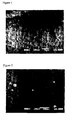
- Fig. 1 is a scanning microscope microphotograph of the hair surface treated in Practical Example 11 with the aqueous emulsion obtained in Practical Example 6.
- Fig. 2 is a scanning microscope microphotograph of the hair surface treated in Comparative Example 9 with the aqueous emulsion obtained in Comparative Example 1.
- the organosilicon polymer of component (A) is composed of diorganosiloxane units and alkylene units. Normally, both ends of each alkylene unit are bonded to the silicon atoms of the adjacent diorganosiloxane units.
- the organosilicon polymer is preferably a linear or partially branched linear high-molecular compound that does not have cross-linked structures in the molecule. Normally, it is soluble in organic solvents such as toluene, etc.
- R stand for hydrogen atoms or monovalent organic groups, with monovalent hydrocarbon groups being representative of such monovalent organic groups.
- the monovalent hydrocarbon groups are exemplified by methyl, ethyl, propyl, butyl, pentyl, hexyl, and other alkyl groups, as well as by phenyl, benzyl, and other aryl groups.
- Hydrogen atoms are preferable.
- R 1 are monovalent organic groups, generally monovalent hydrocarbon groups other than alkenyl.
- alkyl groups such as methyl, ethyl, propyl, butyl, pentyl, hexyl, heptyl, octyl, nonyl, and decyl; cycloalkyl groups, such as cyclopentyl and cyclohexyl; aryl groups, such as phenyl, tolyl, and xylyl; aralkyl groups, such as benzyl and phenetyl, and other unsubstituted monovalent hydrocarbon groups, halogenated alkyl groups, such as 3-chloropropyl and 3,3,3-trifluoropropyl, and other halogen-substituted monovalent hydrocarbon groups.
- alkyl groups such as methyl, ethyl, propyl, butyl, pentyl, hexyl, heptyl, octyl, nonyl, and decyl
- the subscript «a» is an integer of 2 or higher and the subscript «b» is an integer of 1 or higher.
- the subscripts may be identical or different.
- the subscript «a» is 2 ⁇ 10 and the subscript «b» is 10 or higher, and even more preferably, the subscript «a» is 2-6 and the subscript «b» is 100 or higher.
- the main chain of the organosilicon polymer of the present component is composed substantially of the above-mentioned alkylene units and diorganosiloxane units, arylene units may be included as part of it. There are no limitations on the number-average molecular weight of component (A).
- the molecular weight is at least 100,000, still more preferably, at least 200,000, and especially preferably, at least 300,000 up to 10,000,000 or more. Its viscosity at 25°C is preferably at least 100,000 mPa ⁇ s, more preferably, at least 1,000,000 mPa ⁇ s, and still more preferably, at least 100,000,000 mPa ⁇ s. Alkenyl groups and silicon-bonded hydrogen atoms originating from the raw material are present at the ends of the molecular chain of the organosilicon polymer. The two terminal groups may be identical or different.
- the terminal groups of the molecular chain are mostly silicon-bonded hydrogen atoms; when component (a) and component (b) are used in equivalent molar amounts, there are both silicon-bonded hydrogen atoms and alkenyl groups; and when an excessive amount of component (b) is used relative to component (a), the terminal groups are mostly alkenyl groups.
- Dimethylvinylsiloxy, dimethylallylsiloxy, dimethylhexenylsiloxy, and other dialkylalkenylsiloxy groups, as well as dimethylhydrogensiloxy are specifically suggested as the terminal siloxane units.
- dimethylhydroxysiloxy groups may be produced by the hydrolysis of the dimethylhydrogensiloxy groups.
- a diorganopolysiloxane having a silicon-bonded hydrogen atom or a silicon-bonded alkenyl group at one end of the molecular chain and a trialkylsiloxy group at the other end of the molecular chain is used as an end-blocking agent during the synthesis of the present component, the resulting terminal siloxane units are trialkylsiloxy groups.
- a non-crosslinkable silicone oil or an organic oil is suggested as Component (B), which is used to improve the dispersibility and adhesive properties of component (A).
- component (A) when component (A) is synthesized by means of a hydrosilation reaction, the component preferably does not contain alkenyl groups, SiH groups, and other functional groups that may exert influence on the hydrosilation reaction.
- Polyorganosiloxane oils with molecular structures such as linear, partially branched linear, cyclic, branched, etc. are preferable as the silicone oils, with linear or cyclic polyorganosiloxane oils being particularly preferable.
- dimethylpolysiloxanes having both ends of the molecular chain blocked by trimethylsiloxy groups methylphenylpolysiloxanes having both ends of the molecular chain blocked by trimethylsiloxy groups, copolymers of methylphenylsiloxane and dimethylsiloxane having both ends of the molecular chain blocked by trimethylsiloxy groups, copolymers of methyl(3,3,3-trifluoropropyl)siloxane and dimethylsiloxane having both ends of the molecular chain blocked by trimethylsiloxy groups, cyclic dimethylsiloxane, cyclic methylphenylsiloxane, and glycidoxypropyl-containing polyorganosiloxanes.
- polyorganosiloxane oils such as polydimethylsiloxane, etc., as well as isoparaffin oils are preferable.
- the viscosity of the oil component at 25°C is preferably not more than 100,000 mPa ⁇ s, more preferably, not more than 50,000 mPa ⁇ s, and still more preferably, from 0.1mPa ⁇ s up to 30,000 mPa ⁇ s.
- the mixture of component (A) and component (B) is a homogeneous mixture, in which component (A) and component (B) are dissolved without separation.
- component (A) when component (A) is of high viscosity, component (A) dissolves in component (B) and forms a homogeneous mixture.
- the consistency of the mixture at room temperature is either liquid or gummy.
- the mixture is soluble in solvents, the solvents being toluene, xylene, and other aromatic solvents; hexane, heptane, and other aliphatic solvents, as well as ketone solvents and ether solvents.
- the viscosity of the mixture at 25°C is preferably not more than 1,000,000 mPa ⁇ s, more preferably, not more 300,000 mPa ⁇ s, and still more preferably, from 1 mPa ⁇ s up to 100,000 mPa ⁇ s.
- the mixture of component (A) and component (B) can be retrieved from the emulsion of the present invention by removing water by air-drying, hot air drying, vacuum drying, drying under heating, and other means.
- the average particle size of the emulsion of the present invention is preferably in the range of from 0.01 to 500 ⁇ m, and more preferably, in the range of from 0.1 to 50 ⁇ m.
- the amount of the added water preferably, it is in the range of from 10 to 2,000 parts by weight, and more preferably, in the range of from 20 to 1,000 parts by weight per 100 parts by weight of the total of component (A) and component (B).
- the aqueous emulsion of the present invention is preferably prepared using a surface active agent.
- a surface active agent such agents are specifically exemplified by hexylbenzenesulfonic acid, octylbenzenesulfonic acid, decylbenzenesulfonic acid, dodecylbenzenesulfonic acid, cetylbenzenesulfonic acid, myristylbenzenesulfonic acid, their sodium salts, and other anionic surface active agents; octyltrimethylammonium hydroxide, dodecyltrimethylammonium hydroxide, hexamethyltrimethylammonium hydroxide, octyldimethylbenzylammonium hydroxide, decyldimethylbenzylammonium hydroxide, dioctadecyldimethylammonium hydroxide, tallow trimethylammonium hydroxide, coconut oil trimethylammonium hydro
- the amount is preferably in the range of from 0.01 to 50 parts by weight, and more preferably, in the range of from 0.1 to 20 parts by weight, per 100 parts by weight of the total of component (A) and component (B).
- the aqueous emulsion of the present invention can be prepared by a process, in which a mixture of (a) a diorganopolysiloxane having silicon-bonded hydrogen atoms at the two ends of the molecular chain, (b) a diolefin or diorganopolysiloxane having silicon-bonded alkenyl groups at the two ends of the molecular chain, and (c) an oil liquid at room temperature that does not contain hydrosilation-reactive groups is emulsified in water, and, in this state, component (a) and component (b) are addition-polymerized using (d) a hydrosilation reaction catalyst.
- the silicon-bonded hydrogen atoms are preferably only at the two ends of the molecular chain.
- the groups other than the silicon-bonded hydrogen atoms are exemplified by methyl, ethyl, propyl, butyl, pentyl, hexyl, heptyl, octyl, nonyl, decyl, and other alkyl groups; cyclopentyl, cyclohexyl, and other cycloalkyl groups; phenyl, tolyl, xylyl, and other aryl groups; benzyl, phenetyl, and other aralkyl groups; and 3-chloropropyl, 3,3,3-trifluoropropyl and other halogenated alkyl groups.
- the molecular structure of the diorganopolysiloxane is substantially linear, but a portion of the molecular chain may be branched. There are no limitations on its viscosity at 25°C, but in order for it to be emulsified in water, it is preferably not more than 100,000 mPa ⁇ s, and more preferably, not more than 1,000 mPa ⁇ s.
- Component (a) is exemplified by dimethylpolysiloxane having both ends of the molecular chain blocked by dimethylhydrogensiloxy groups and by diorganopolysiloxanes obtained by substituting ethyl, phenyl, 3,3,3-trifluoropropyl, etc. for some of the methyl groups in the dimethylpolysiloxane.
- the diorganopolysiloxane preferably has silicon-bonded alkenyl groups only at the two ends of the molecular chain
- the alkenyl groups are exemplified by vinyl, allyl, butenyl, pentenyl, hexenyl, heptenyl, octenyl, nonenyl, and decenyl. Among them, vinyl and allyl are preferable.
- groups other than the silicon-bonded alkenyl groups are exemplified by methyl, ethyl, propyl, butyl, pentyl, hexyl, heptyl, octyl, nonyl, decyl, and other alkyl groups; cyclopentyl, cyclohexyl, and other cycloalkyl groups; phenyl, tolyl, xylyl, and other aryl groups; benzyl, phenetyl, and other aralkyl groups; and 3-chloropropyl, 3,3,3-trifluoropropyl and other halogenated alkyl groups.
- the molecular structure of the diorganopolysiloxane is substantially linear, but a portion of the molecular chain may be branched. There are no limitations on its viscosity at 25°C, but in order for it to be emulsified in water, it is preferably not more than 100,000 mPa ⁇ s, and more preferably, not more than 10,000 mPa ⁇ s.
- Component (b) is exemplified by dimethylpolysiloxane having both ends of the molecular chain blocked by dimethylvinylsiloxy groups, diorganopolysiloxanes obtained by substituting ethyl, phenyl, 3,3,3-trifluoropropyl, etc. for some of the methyl groups in the dimethylpolysiloxane, and diorganopolysiloxanes obtained by substituting allyl, hexenyl, etc. for the vinyl groups of the diorganopolysiloxanes.
- the diolefins preferably have vinyl groups at the two ends of the molecular chain and are exemplified by 1,3-butadiene, 1,4-pentadiene, 1,5-hexadiene, and 1,7-octadiene. Furthermore, they can be used in combination with divinylbenzene.
- the amount, in which component (b) is added, is 0.2 to 800 parts by weight, per 100 parts by weight of component (a).
- component (c) Compounds that do not contain the hydrosilation-reactive groups in the above-described component (B) are suggested as component (c).
- the amount, in which component (c) is added, is preferably in the range of from 0.1 to 5,000 parts by weight, and more preferably, 5 to 1,000 parts by weight per 100 parts by weight of the total of component (a) and component (b).
- the components may be homogeneously blended together and the blend dispersed in water using publicly known agitating/mixing equipment, such as a Homomixer, a paddle mixer, a Henschel mixer, a homogenizer/disperser, a colloid mixer, a propeller agitator, a homogenizer, a continuous in-line type emulsifier, an ultrasonic emulsifier, or a vacuum kneader.
- agitating/mixing equipment such as a Homomixer, a paddle mixer, a Henschel mixer, a homogenizer/disperser, a colloid mixer, a propeller agitator, a homogenizer, a continuous in-line type emulsifier, an ultrasonic emulsifier, or a vacuum kneader.
- agitating/mixing equipment such as a Homomixer, a paddle mixer, a Henschel mixer, a homogenizer/disperser,
- Platinum catalysts, rhodium catalysts, and palladium catalysts are suggested as component (d), which is a catalyst used for synthesizing component (A) by promoting the addition polymerization reaction of component (a) and component (b).
- platinum catalysts are preferable because they are capable of appreciably promoting addition polymerization.
- Such catalysts are specifically exemplified by microparticulate platinum, platinum supported on silica micropowder, platinum supported on activated charcoal, chloroplatinic acid, alcohol solutions of chloroplatinic acid, platinum-alkenylsiloxane complexes, platinum/olefin complexes, and platinum/carbonyl complexes, with platinum-alkenylsiloxane complexes being especially preferable.
- the allcenylsiloxanes in question are exemplified by 1,3-divinyl-1,1,3,3-tetramethyldisiloxane, 1,3,5,7-tetramethyl-1,3,5,7-tetravinylcyclotetrasiloxane, allcenylsiloxanes obtained by substituting ethyl, phenyl, etc. for some of the methyl groups of these alkenylsiloxanes, and alkenylsiloxanes obtained by substituting allyl, hexenyl, etc. for the vinyl groups of these alkenylsiloxanes.
- 1,3-divinyl-1,1,3,3-tetramethyldisiloxane is preferable because of the good complex stability it provides.
- the volume-average particle size of the liquid catalyst dispersed in liquid droplet form in other words, its average particle size in the volumetric particle size distribution, is preferably not more than 1 ⁇ m, more preferably, not more than 0.8 ⁇ m, and still more preferably, not more than 0.5 ⁇ m.
- the proportion of the catalyst with a particle size of 1 ⁇ m or less is preferably not less than 40 wt%.
- Methods used for the preparation of emulsions obtained by the emulsification of liquid catalysts containing such platinum-alkenylsiloxane complexes as the principal component in water are exemplified, for instance, by a method, in which a liquid catalyst containing a platinum-alkenylsiloxane complex as the principal component is dispersed in water using publicly known agitating/mixing equipment. At such time, in order to improve the stability of the emulsion, it is preferable to use the above-described surface active agents.
- a dispersion of a liquid catalyst containing a platinum-alkenylsiloxane complex as the principal component in a surface active agent is prepared in advance and then added to the emulsion of the mixture of the above-described components (a), (b) and (c), thus dispersing it in water.
- the same surface active agents as the ones mentioned above are suggested as the surface active agents to be used, with nonionic surface active agents being preferable because they exert little influence on the hydrosilation reaction.
- the amount, in which the surface active agents are added is preferably in the range of from 0.01 to 1,000 parts by weight per 100 parts by weight of the liquid catalyst containing a platinum-alkenylsiloxane complex as its principal component.
- the amount, in which component (d) is added is such as to provide 0.1 to 1,000 ppm, more preferably, such as to provide 0.1 to 500 ppm, and still more preferably, such as to provide 1 to 50 ppm of platinum metal by weight relative to the total weight of the above-described component (a) and component (b).
- the blend can be either left stand as is or heated in order to promote the addition polymerization reaction.
- the temperature, to which they are heated is preferably not more than 100°C, and more preferably, not more than 70°C.
- the molecular weight of the resultant organosilicon polymer can be adjusted by adding a diorganopolysiloxane having a silicon-bonded hydrogen atom or a silicon-bonded alkenyl group only at one of the end terminals of the molecular chain and branching can be introduced in the molecular structure of the resultant organosilicon polymer by adding an organopolysiloxane having a single silicon-bonded hydrogen atom or silicon-bonded alkenyl group in a side chain of the molecular chain.
- component (d) can be blended with a mixture of component (a), component (b), and component (c) and then emulsified, leading to formation of a polymer emulsion by the process of US Patent No.6,013,682 .
- the above-described aqueous emulsion of the present invention is a stable emulsion of a homogeneous mixture of an organosilicon polymer and liquid oil.
- the emulsion is characterized by superior compounding stability and dispersibility in water and other components.
- the emulsion of the present invention has excellent adhesive properties with respect to various substrate materials, it has the advantage of readily revealing the characteristics of the organosilicon polymer.
- the emulsion of the present invention is useful as an additive for cosmetics, coating materials, etc., various coating agents, mold release agents used for organic resin molding, organic resin modifiers, lubricating agents, etc.
- the substrate materials, for which the emulsion of the present invention is suitable are exemplified by hair, skin, nails, metals, organic resins, inorganic resins, glass, ceramics, fillers, construction materials, fiber, paper, etc.
- the emulsion of the present invention is particularly suitable for skin cosmetics and hair cosmetics.
- the invention is characterized in that the production process of the present invention permits efficient preparation of emulsions with a small particle size containing a finely dispersed mixture of a high-viscosity organosilicon polymer and an oil.
- the cosmetic materials of the present invention are combined with the above-described aqueous emulsion, they are characterized by having excellent dispersibility and adhesive properties with respect to the skin and hair and by imparting superior moist feel and smoothness to the skin and hair.
- the content of the aqueous emulsion in the cosmetic materials of the present invention is preferably in the range of from 0.1 to 80 wt%, and more preferably, in the range of from 0.5 to 50 wt%.
- the various raw materials that can be compounded with the cosmetic materials of the present invention when the latter are used as skin cosmetics are exemplified by avocado oil, almond oil, olive oil, cacao butter, sesame oil, wheat germ oil, safflower oil, shea butter, turtle oil, tsubaki oil, persic oil, castor oil, grape seed oil, macadamia nut oil, mink oil, egg yolk oil, Japan wax, coconut oil, rose hip oil, hydrogenated oil, or similar oils or fats; Hoplosterbus altanticus oil, carnauba wax, candelilla wax, spermaceti wax, jojoba oil, montan wax, beeswax, lanolin, or similar waxes; liquid paraffin, Vaseline, paraffin, ceresin, microcrystalline wax, squalane, or similar hydro
- hair cosmetics of the present invention are used for the preparation of hair cosmetic materials
- hair cosmetics exhibiting excellent adhesion to hair and capable of imparting a superior moist feel and smoothness
- film-forming agents antifreeze agents, oily components, emulsifiers, wetting agents, anti-dandruff agents, chelating agents, UV absorbers, fragrances, coloring materials, and various other raw materials in addition to the aforementioned anionic surface active agents, non-ionic surface active agents, pH adjusters, antiseptics, anti-mildew agents, rust preventives, etc.
- film-forming agents copolymers of silicone compounds and polymers of (meth)acrylic radical-polymerizable monomers, non-functional silicone resins and silicone resins modified with amino groups and organic groups containing fluorine groups, poly(N-methylpyrrolidone), and poly(N-acylallcyleneimine).
- antifreeze agents There are no special restrictions with regard to the antifreeze agents, but in general these agents can be represented by such substances as ethanol, isopropyl alcohol, 1,3-butylene glycol, ethylene glycol, propylene glycol, and glycerol. Oily components may be those normally used in cosmetics.
- Some representative examples of such substances include microcrystalline wax, paraffin wax, spermaceti wax, beeswax, Japan wax, sugar-cane wax, and other waxes or their mixtures, liquid paraffin, ⁇ -olefin oligomers, squalane, squalene, or similar hydrocarbon oils or their mixtures, cetanol, stearyl alcohol, isostearyl alcohol, hardened castor oil derived alcohol, behenyl alcohol, lanolin alcohol, or similar linear or branched, saturated or unsaturated, unsubstituted or hydroxy-substituted higher alcohols or their mixtures, palmitic acid, myristic acid, oleic acid, stearic acid, hydroxystearic acid, isostearic acid, behenic acid, castor oil fatty acids, coconut oil fatty acids, beef tallow fatty acids and other linear or branched, saturated or unsaturated, unsubstituted or hydroxy-substituted higher fatty
- emulsifiers comprising, e.g., glycerol monostearate, sorbitan monopalmitate, polyoxyethylene cetyl ether, polyoxyethylene stearic acid ester, polyoxyethylene sorbitane monolaurate, or other emulsifiers normally used for these purposes.
- Wetting agents may be represented by hexylene glycol, polyethylene glycol 600, sodium pyroglutamate, and glycerol.
- Anti-dandruff agents may be represented by sulfur, selenium sulfate, zinc pyridium-1-thiol-N-oxide, salicylic acid, 2,4,4'-trichloro-2'-hydroxydiphenyl ether, and 1-hydroxy-2-pyridine compounds.
- Antioxidants may comprise BHA, BHT, and ⁇ -oryzanol.
- Chelating agents may comprise ethyl diamine tetraacetic acid, citric acid, ethane-1-hydroxy-1,1-diphosphonic acid, or their salts.
- UV absorbers can be represented by benzophenone derivatives such as 2-hydroxy-4-methoxybenzophenone, benzotriazole derivatives such as 2-(2'-hydroxy-5'-methylphenyl)benzotriazole, and cinnamic acid esters.
- the cosmetic materials of the invention can also be compounded with various other components, such as glycerin, propylene glycol, dipropylene glycol, 1,3-butylene glycol, or similar polyhydric alcohols, monoalkyltrimethyl ammonium salts, dialkyldimethyl ammonium salts, or similar quaternary ammonium salts, and, more specifically, stearyltrimethylammonium chloride, behenyltrimethylammonium chloride, distearyldimethylammonium chloride, dibehenyldimethylammonium chloride, or similar cationic surface active agents or amphoteric surface active agents, squalane, lanolin, perfluoro polyethers, cationic polymers or similar sensitization improvers, propylene glycol, glycerol, sorbitol, or similar humectants, methyl cellulose, carboxyvinyl polymer, hydroxyethyl cellulose, polyoxyethylene glycol distearate
- hair-cosmetic products to which the cosmetic raw material of the invention is applicable: shampoos, hair rinses, hair conditioners, hair treatments, setting lotions, blow-styling agents, hair sprays, styling foams, styling jels, hair liquids, hair tonics, hair creams, hair-growth stimulators, hair-nourishing preparations, and hair dye compositions.
- Hydroxylation reaction catalysts were used in the form of an emulsion produced by emulsifying in water a liquid catalyst consisting of a 1,3-divinyl-1,1,3,3-tetramethyldisiloxane solution of a platinum-1,3-divinyl-1,1,3,3-tetramethyldisiloxane complex (with a platinum metal concentration of 0.04 wt%).
- the volume-average particle size of the catalyst measured by laser scattering using a Coulter N4 submicron particle sizer (from Coulter Electronics Co., Ltd.), was 0.05 ⁇ m, and the content (vol.%) of catalyst particles with dimensions of 1 ⁇ m or less was 95 wt%
- a uniform mixture was prepared from 19.6 parts by weight of a dimethylpolysiloxane with a viscosity of 55000 mPa ⁇ s having both ends of the molecular chain blocked by dimethylvinylsiloxy groups (vinyl group content: 0.088 wt%), 0.4 parts by weight of a 10 mPa ⁇ s dimethylpolysiloxane having both ends of the molecular chain blocked by dimethylhydrogensiloxy groups (content of silicon-bonded hydrogen atoms: 0.16 wt%), and 80 parts by weight of a 10 mPa ⁇ s dimethylpolysiloxane having both ends of the molecular chain blocked by trimethylsiloxy groups.
- the viscosity of the mixture was 59 mPa ⁇ s.
- the mixture was then combined and mixed with 3.4 parts by weight of a mixture of a secondary tetradecyl ether and a secondary dodecyl ether of (12 moles) of ethylene oxide (the mixture contained 43 wt% of dodecyl groups, 57 wt% of tetradecyl groups, and had an HLB of 14.5), 4.7 parts by weight of a mixture of a secondary tetradecyl ether with a secondary dodecyl ether of (3 moles) of ethylene oxide (the mixture contained 43 wt% of dodecyl groups, 57 wt% of tetradecyl groups, and had an HLB of 8.0), and 10 parts by weight of water.
- emulsion was combined and homogeneously mixed with a catalyst in the form of a liquid catalytic emulsion of a platinum-1,3-divinyl-1,1,3,3-tetramethyldisiloxane complex (with a 0.04 wt% platinum metal concentration), so that the quantity of the platinum metal in weight terms was brought to 5 ppm of platinum metal relative to the total weight of the dimethylpolysiloxane having both ends of the molecular chain blocked by dimethylhydrogensiloxy groups and the dimethylpolysiloxane having both ends of the molecular chain blocked by dimethylvinylsiloxy groups which were contained in the emulsion.
- a catalyst in the form of a liquid catalytic emulsion of a platinum-1,3-divinyl-1,1,3,3-tetramethyldisiloxane complex (with a 0.04 wt% platinum metal concentration), so that the quantity of the platinum metal in weight terms was brought to 5 ppm of platinum metal relative
- the emulsion was subjected to addition polymerization by allowing it to stand for 1 day at room temperature.
- the final emulsion comprised a mixture of an organosilicon polymer of the following formula: with a dimethylpolysiloxane having both ends of the molecular chain blocked by trimethylsiloxy groups, the mixture being emulsified and dispersed in water.
- the emulsion was examined to determine the average size of particles, dispersibility in water, mixture viscosity and appearance, and the number-average molecular weight of the organosilicon polymer. The results are shown in Table 1.
- a uniform mixture was prepared from 19.6 parts by weight of a 55000 mPa ⁇ s dimethylpolysiloxane having both ends of the molecular chain blocked by dimethylvinylsiloxy groups (vinyl group content: 0.088 wt%), 0.4 parts by weight of a 10 mPa ⁇ s dimethylpolysiloxane having both ends of the molecular chain blocked by dimethylhydrogensiloxy groups (content of silicon-bonded hydrogen atoms: 0.16 wt%), and 80 parts by weight of a 100 mPa ⁇ s dimethylpolysiloxane having both ends of the molecular chain blocked by trimethylsiloxy groups.
- the viscosity of the mixture was 407 mPa ⁇ s.
- the mixture was then combined and mixed with 3.4 parts by weight of a mixture of a secondary tetradecyl ether with a secondary dodecyl ether of (12 moles) of ethylene oxide (the mixture contained 43 wt% of dodecyl groups, 57 wt% of tetradecyl groups, and had an HLB of 14.5), 4.7 parts by weight of a mixture of a secondary tetradecyl ether with a secondary dodecyl ether of (3 moles) of ethylene oxide (the mixture contained 43 wt% of dodecyl groups, 57 wt% of tetradecyl groups, and had an HLB of 8.0), and 10 parts by weight of water.
- emulsion was combined and homogeneously mixed with a catalyst in the form of a liquid catalytic emulsion of a platinum-1,3-divinyl-1,1,3,3-tetramethyldisiloxane complex (with a 0.04 wt% platinum metal concentration), so that the quantity of the platinum metal in weight terms was brought to 5 ppm of platinum metal relative to the total weight of the dimethylpolysiloxane having both ends of the molecular chain blocked by dimethylhydrogensiloxy groups and the dimethylpolysiloxane having both ends of the molecular chain blocked by dimethylvinylsiloxy groups which were contained in the emulsion.
- a catalyst in the form of a liquid catalytic emulsion of a platinum-1,3-divinyl-1,1,3,3-tetramethyldisiloxane complex (with a 0.04 wt% platinum metal concentration), so that the quantity of the platinum metal in weight terms was brought to 5 ppm of platinum metal relative
- the emulsion was subjected to addition polymerization by allowing it to stand for 1 day at room temperature.
- the final emulsion comprised a mixture of the organosilicon polymer of the following formula: (where the subscript m is between 6 and 7) and the dimethylpolysiloxane having both ends of the molecular chain blocked by trimethylsiloxy groups, the mixture being emulsified and dispersed in water.
- the emulsion was examined to determine the average size of particles, dispersibility in water, mixture viscosity and appearance, and the number-average molecular weight of the organosilicon polymer. The results are shown in Table 1.
- a uniform mixture was prepared from 19.6 parts by weight of a 55000 mPa ⁇ s dimethylpolysiloxane having both ends of the molecular chain blocked by dimethylvinylsiloxy groups (vinyl group content: 0.088 wt%), 0.4 parts by weight of a 10 mPa ⁇ s dimethylpolysiloxane having both ends of the molecular chain blocked by dimethylhydrogensiloxy groups (content of silicon-bonded hydrogen atoms: 0.16 wt%), and 80 parts by weight of an isoparaffin oil ("Isozole 400K" from Nippon Petrochemicals Co., Ltd.).
- the mixture was then combined and mixed with 3.4 parts by weight of a mixture of a secondary tetradecyl ether with a secondary dodecyl ether of (12 moles) of ethylene oxide (the mixture contained 43 wt% of dodecyl groups, 57 wt% of tetradecyl groups, and had an HLB of 14.5), 4.7 parts by weight of a mixture of a secondary tetradecyl ether with a secondary dodecyl ether of (3 moles) of ethylene oxide (the mixture contained 43 wt% of dodecyl groups, 57 wt% of tetradecyl groups, and had an HLB of 8.0), and 10 parts by weight of water.
- the emulsion was combined and homogeneously mixed with a catalyst in the form of a liquid catalytic emulsion of a platinum-1,3-divinyl-1,1,3,3-tetramethyldisiloxane complex (with a 0.04 wt% platinum metal concentration), so that the quantity of the platinum metal in weight terms was brought to 5 ppm of platinum metal relative to the total weight of the diorganopolysiloxane which were contained in the emulsion.
- the emulsion was subjected to addition polymerization by allowing it to stand for 1 day at room temperature.
- the final emulsion comprised a mixture of the organosilicon polymer of the following formula: with isoparaffin oil, the mixture being emulsified and dispersed in water.
- the emulsion was examined to determine the average size of particles, dispersibility in water, mixture viscosity and appearance, and the number-average molecular weight of the organosilicon polymer. The results are shown in Table 1.
- a uniform mixture was prepared from 1.24 parts by weight of a 1,5-hexadiene, 18.76 parts by weight of a 10 mPa ⁇ s dimethylpolysiloxane having both ends of the molecular chain blocked by dimethylhydrogensiloxy groups (content of silicon-bonded hydrogen atoms: 0.16 wt%), and 80 parts by weight of a 10 mPa ⁇ s dimethylpolysiloxane having both ends of the molecular chain blocked by trimethylsiloxy groups.
- the mixture was then combined and mixed with 3.4 parts by weight of a mixture of a secondary tetradecyl ether with a secondary dodecyl ether of (12 moles) of ethylene oxide (the mixture contained 43 wt% of dodecyl groups, 57 wt% of tetradecyl groups, and had an HLB of 14.5), 4.7 parts by weight of a mixture of a secondary tetradecyl ether with a secondary dodecyl ether of (3 moles) of ethylene oxide (the mixture contained 43 wt% of dodecyl groups, 57 wt% of tetradecyl groups, and had an HLB of 8.0), and 10 parts by weight of water.
- emulsion After mixing the components, 80 parts by weight of water were added, the mixture was emulsified, and an emulsion was obtained.
- the emulsion was combined and homogeneously mixed with a catalyst in the form of a liquid catalytic emulsion of a platinum-1,3-divinyl-1,1,3,3-tetramethyldisiloxane complex (with a 0.04 wt% platinum metal concentration), so that the quantity of the platinum metal in weight terms was brought to 5 ppm of platinum metal relative to the total weight of the dimethylpolysiloxane having both ends of the molecular chain blocked by dimethylliydrogensiloxy groups and 1,5-hexadiene which were contained in the emulsion.
- the emulsion was subjected to addition polymerization by allowing it to stand for 1 day at room temperature.
- the final emulsion comprised a mixture of the organosilicon polymer of the following formula: with dimethylpolysiloxane having both ends of the molecular chain blocked by trimethylsiloxy groups, the mixture being emulsified and dispersed in water.
- the emulsion was examined to determine the average size of particles, dispersibility in water, mixture viscosity and appearance, and the number-average molecular weight of the organosilicon polymer. The results are shown in Table 1.
- a mixture was prepared from 9S parts by weight of a 55000 mPa ⁇ s dimethylpolysiloxane having both ends of the molecular chain blocked by dimethylvinylsiloxy groups (vinyl group content: 0.088 wt%) and 2 parts by weight of 10 mPa ⁇ s dimethylpolysiloxane having both ends of the molecular chain blocked by dimethylhydrogensiloxy groups (content of silicon-bonded hydrogen atoms: 0.16 wt%).
- the mixture was then combined and mixed with 3.4 parts by weight of a mixture of a secondary tetradecyl ether with a secondary dodecyl ether of ethylene oxide (12 moles added) (the mixture contained 43 wt% of dodecyl groups, 57 wt% of tetradecyl groups, and had an HLB of 14.5), 4.7 parts by weight of a mixture of a secondary tetradecyl ether with a secondary dodecyl ether of (3 moles) of ethylene oxide (the mixture contained 43 wt% of dodecyl groups, 57 wt% of tetradecyl groups, and had an HLB of 8.0), and 10 parts by weight of water.
- the emulsion was combined and homogeneously mixed with a catalyst in the form of a liquid catalytic emulsion of a platinum-1,3-divinyl- 1,1,3,3-tetramethyldisiloxane complex (with a 0.04 wt% platinum metal concentration), so that the quantity of the platinum metal in weight terms was brought to 5 ppm of platinum metal relative to the total weight of the diorganosiloxane in the emulsion.
- the emulsion was subjected to addition polymerization by allowing it to stand for 1 day at room temperature.
- the final emulsion comprised an organosilicon polymer of the following formula:
- the emulsion was examined to determine the average size of particles, dispersibility in water, and the number-average molecular weight of the organosilicon polymer. The results are shown in Table 1.
- the viscosity of the obtained emulsion could not be measured by the aforementioned rotary viscometer and was determined using an ARES-type viscoelastomer (from Rheometric Scientific Co., Ltd.). The value of viscosity measured by this instrument at room temperature and under conditions shown below was 1,135 ⁇ 10 5 mPa ⁇ s.
- a mixture was prepared from 98 parts by weight of a 55000 mPa ⁇ s dimethylpolysiloxane having both ends of the molecular chain blocked by dimethylvinylsiloxy groups (vinyl group content: 0.088 wt%) and 2 parts by weight of 10 mPa ⁇ s dimethylpolysiloxane having both ends of the molecular chain blocked by dimethylhydrogensiloxy groups (content of silicon-bonded hydrogen atoms: 0.16 wt%).
- the mixture was then combined and mixed with a catalyst in the form of a platinum-1,3-divinyl-1,1,3,3-tetramethyldisiloxane complex added in such an amount that the content of the platinum metal in weight terms was 5 ppm relative to the total weight of the diorganosiloxane.
- the mixture was subjected to addition polymerization by allowing it to stand for 1 day at room temperature.
- the obtained product comprised a gum-like organosilicon polymer having a number-average molecular weight of 440,000 and expressed by the following formula: (where the subscript m is 7 or 8).
- 100 parts by weight of a 100 mPa ⁇ s dimethylpolysiloxane having both ends of the molecular chain blocked by trimethylsiloxy groups were mixed with 3.4 parts by weight of a mixture of a secondary tetradecyl ether with a secondary dodecyl ether of ethylene oxide (12 moles added) (the mixture contained 43 wt% of dodecyl groups, 57 wt% of tetradecyl groups, and had an HLB of 14.5), 4.7 parts by weight of a mixture of a secondary tetradecyl ether with a secondary dodecyl ether of (3 moles) of ethylene oxide (the mixture contained 43 wt% of dodecyl groups, 57 wt% of tetradecyl groups, and had an HLB of 8.0), and 10 parts by weight of water.
- a uniform mixture was prepared from 19.6 parts by weight of a 55000 mPa ⁇ s dimethylpolysiloxane having both ends of the molecular chain blocked by dimethylvinylsiloxy groups (vinyl group content: 0.088 wt%), 0.4 parts by weight of a 10 mPa ⁇ s dimethylpolysiloxane having both ends of the molecular chain blocked by dimethylhydrogensiloxy groups (content of silicon-bonded hydrogen atoms: 0.16 wt%), and 80 parts by weight of decamethylcyclopentasiloxane (with a viscosity of 4 mPa ⁇ s). The viscosity of the mixture was 33 mPa ⁇ s.
- the mixture was then combined and mixed with 3.4 parts by weight of a mixture of a secondary tetradecyl ether with a secondary dodecyl ether of (12 moles) of ethylene oxide (the mixture contained 43 wt% of dodecyl groups, 57 wt% of tetradecyl groups, and had an HLB of 14.5), 4.7 parts by weight of a mixture of a secondary tetradecyl ether with a secondary dodecyl ether of (3 moles) of ethylene oxide (the mixture contained 43 wt% of dodecyl groups, 57 wt% of tetradecyl groups, and had an HLB of 8.0), and 10 parts by weight of water.
- emulsion was combined and homogeneously mixed with a catalyst in the form of a liquid catalytic emulsion of a platinum-1,3-divinyl-1,1,3,3-tetramethyldisiloxane complex (with a 0.04 wt% platinum metal concentration), so that the quantity of the platinum metal in weight terms was brought to 5 ppm of platinum metal relative to the total weight of the dimethylpolysiloxane having both ends of the molecular chain blocked by dimethylhydrogensiloxy groups and the dimethylpolysiloxane having both ends of the molecular chain blocked by dimethylvinylsiloxy groups which were contained in the emulsion.
- a catalyst in the form of a liquid catalytic emulsion of a platinum-1,3-divinyl-1,1,3,3-tetramethyldisiloxane complex (with a 0.04 wt% platinum metal concentration), so that the quantity of the platinum metal in weight terms was brought to 5 ppm of platinum metal relative
- the emulsion was subjected to addition polymerization by allowing it to stand for 1 day at room temperature.
- the final emulsion comprised a mixture of the organosilicon polymer of the following formula: (where the subscript m is between 5 and 6) and the decamethylcyclopentasiloxane, the mixture being emulsified and dispersed in water.
- the emulsion was examined to determine the average size of particles, dispersibility in water, mixture viscosity and appearance, and the number-average molecular weight of the organosilicon polymer. The results are shown in Table 1.
- a uniform mixture was prepared from 19.6 parts by weight of a 55000 mPa ⁇ s dimethylpolysiloxane having both ends of the molecular chain blocked by dimethylvinylsiloxy groups (vinyl group content: 0.088 wt%), 0.4 parts by weight of a 10 mPa ⁇ s dimethylpolysiloxane having both ends of the molecular chain blocked by dimethylhydrogensiloxy groups (content of silicon-bonded hydrogen atoms: 0.16 wt%), and 20 parts by weight of a 30000 mPa ⁇ s dimethylpolysiloxane having both ends of the molecular chain blocked by trimethylsiloxy groups. Viscosity of the mixture was 33000 mPa ⁇ s.
- the mixture was then combined and mixed with 3.4 parts by weight of a mixture of a secondary tetradecyl ether with a secondary dodecyl ether of (12 moles) of ethylene oxide (the mixture contained 43 wt% of dodecyl groups, 57 wt% of tetradecyl groups, and had an HLB of 14.5), 4.7 parts by weight of a mixture of a secondary tetradecyl ether with a secondary dodecyl ether of (3 moles) of ethylene oxide (the mixture contained 43 wt% of dodecyl groups, 57 wt% of tetradecyl groups, and had an HLB of 8.0), and 10 parts by weight of water.
- emulsion was combined and homogeneously mixed with a catalyst in the form of a liquid catalytic emulsion of a platinum-1,3-divinyl-1,1,3,3-tetramethyldisiloxane complex (with a 0.04 wt% platinum metal concentration), so that the quantity of the platinum metal in weight terms was brought to 5 ppm of platinum metal relative to the total weight of the dimethylpolysiloxane having both ends of the molecular chain blocked by dimethylhydrogensiloxy groups and the dimethylpolysiloxane having both ends of the molecular chain blocked by dimethylvinylsiloxy groups which were contained in the emulsion.
- a catalyst in the form of a liquid catalytic emulsion of a platinum-1,3-divinyl-1,1,3,3-tetramethyldisiloxane complex (with a 0.04 wt% platinum metal concentration), so that the quantity of the platinum metal in weight terms was brought to 5 ppm of platinum metal relative
- the emulsion was subjected to addition polymerization by allowing it to stand for 1 day at room temperature.
- the final emulsion comprised a mixture of the organosilicon polymer of the following formula: (where the subscript m is between 6 and 7) and the 30000 mPa ⁇ s dimethylpolysiloxane having both ends of the molecular chain blocked by trimethylsiloxy groups, the mixture being emulsified and dispersed in water.
- the emulsion was examined to determine the average size of particles, dispersibility in water, mixture viscosity and appearance, and the number-average molecular weight of the organosilicon polymer. The results are shown in Table 1.
- the emulsions obtained in Practical Examples 1 to 4 were diluted with water until the concentration of the mixture the organosilicon polymer and oil reached 0.2 wt%. Furthermore, a 5g lock of hair was washed with an aqueous solution of 1 wt% sodium polyoxylaurylsulfate, the water was drained, and the hair was dried for 12 hours at 25°C. The treated hair was then dipped for 30 sec. to a 500 g aqueous solution of the aforementioned emulsion. After draining the water, the remaining water was wiped off with a kimtowel wiper, and weighed, and the coefficient of adhesion (%) was calculated.
- the hair treated by immersion into the aforementioned solution was evaluated with regard to tactile sensation by a panel of 5 people.
- the symbol “o” corresponds to the case when three or more people evaluated the sensation as smooth and moist
- the symbol “ ⁇ ” corresponds to the case when three or more people considers the hair either not smooth or not moist
- the symbol “ ⁇ ” corresponds to the case was neither "o” nor " ⁇ ”.
- Table 2 The results are shown in Table 2.
- the water was drained, the hair was dried for 12 hours at 25°C.
- the pretreated hair was coated with 1 cc of aforementioned previously obtained shampoos A and B, respectively, after which the hair was combed out with fingers during 1 min and rinsed with water. After draining the water, the remaining water was lightly wiped off with a kimtowel wiper, and the hair lock was dried for 12 hours at 25°C.
- the treated hair was evaluated for tactile sensation (smoothness and softness to the touch) by a panel of 10 people. The results are shown in Table 4.
- the emulsions obtained in Practical Examples 1, 2, and 6 were diluted with water until the concentration of the mixture of the organosilicon compound and oil became reached 0.2 wt%.
- 5 g locks of hair were washed with aqueous solutions of 1 wt% sodium polyoxylaurylsulfate.
- the hair was rinsed with water and dried for 12 hours at 25°C.
- the treated hair locks were immersed for 30 sec into a 500g of an aqueous solution of the emulsions obtained as described earlier. After draining the water, the remaining water was lightly wiped off with a kimtowel wiper, and the hair locks were dried for 12 hours at 25°C.
- the amounts of silicone adhered to the treated hair locks were determined using the Fluorescence X-ray analyzer [Mod. 3270 from Rigaku Co., Ltd.]. The results of the measurements are shown in Table 5.
- the surface condition of the hair in the hair lock treated by the immersion treatment as described above with the aqueous solution of the emulsion obtained in Practical Example 6 was observed using a Scanning Microscope/Energy Dispersion-type X-Ray Analyzer (JSM-5800 LV/JED 2100, manufactured by Nippon Denshi Co., Ltd.). The observation showed that silicone formed uniform coating without adhered grains (Fig. 1).
- a lock of hair was treated with an aqueous solution by the method of Practical Example 11 using the emulsions obtained in Comparative Examples 1, 3, and 4.
- the amount of the adhered silicone was measured by the method of Practical Example 11.
- the results are shown in Table 5.
- the surface condition of the hair treated with an aqueous solution of the emulsion obtained in Comparative Example 1 was observed by the method of Claim 11, the observation revealed silicone grains adhered to the hair surface (Fig. 2).
- the grains reduced the amount of the adhered silicone and made the coating non-uniform. It can be appreciated, therefore, that this emulsion is not sufficiently effective for improving the tactile sensation of hair.
- the aqueous emulsion of the present invention is an aqueous emulsion of a mixture of the above-described component (A) and component (B) and is characterized by superior dispersibility and adhesive properties as well as by possessing excellent lubricating properties.
- the production process of the present invention is characterized by the capability to efficiently produce aqueous emulsions with a small particle size containing a finely dispersed mixture of a high-molecular weight organosilicon polymer and oil.
- the cosmetic materials of the present invention are characterized by imparting superior characteristics such as smoothness and moist feel to the skin and hair.
Landscapes
- Health & Medical Sciences (AREA)
- Life Sciences & Earth Sciences (AREA)
- Animal Behavior & Ethology (AREA)
- General Health & Medical Sciences (AREA)
- Public Health (AREA)
- Veterinary Medicine (AREA)
- Birds (AREA)
- Epidemiology (AREA)
- Chemical & Material Sciences (AREA)
- Oil, Petroleum & Natural Gas (AREA)
- Dispersion Chemistry (AREA)
- Dermatology (AREA)
- Compositions Of Macromolecular Compounds (AREA)
- Cosmetics (AREA)
- Silicon Polymers (AREA)
- Paints Or Removers (AREA)
Claims (9)
- Emulsion aqueuse comprenant, en tant que phase dispersée, un mélange constitué de (A) un polymère organosilicium linéaire dont la chaîne principale est composée d'unités diorganosiloxane et d'unités alkylène et qui a un poids moléculaire de nombre moyen de 100 000 ou plus et de (B) une huile qui est liquide à la température de la pièce et qui ne contient pas de groupes réactifs par hydrosilation, le rapport pondéral du composant (A) au composant (B) dans ledit mélange étant (A)/(B) = de 1/2 à 1/50.
- Emulsion aqueuse selon la revendication 1, dans laquelle la viscosité du mélange à 25°C n'est pas supérieure à 1 000 000 mPa s.
- Emulsion aqueuse selon la revendication 1, dans laquelle le poids moléculaire de nombre moyen du composant (A) est d'au moins 100 000.
- Emulsion aqueuse selon la revendication 1, dans laquelle le composant (B) est une huile d'isoparaffine ou une huile de polyorganosiloxane dont la viscosité à 25°C n'est pas supérieure à 100 000 mPa s.
- Procédé de production d'une émulsion aqueuse selon la revendication 1, dans lequel un mélange de 100 parties en poids de (a) un diorganopolysiloxane ayant des atomes d'hydrogène liés au silicium aux deux extrémités de la chaîne moléculaire, de 0,2 à 800 parties en poids de (b) une dioléfine ou un diorganopolysiloxane ayant des groupes alcényles liés au silicium aux deux extrémités de la chaîne moléculaire, et de (B) une huile qui est liquide à la température de la pièce et qui ne contient pas de groupes réactifs par hydrosilation, est émulsifié dans l'eau, et dans lequel, dans cet état, le composant (a) et le composant (b) sont polymérisés par addition en utilisant de 0,1 à 1 000 ppm de (d) un catalyseur de réaction d'hydrosilation, dans lequel le rapport pondéral du total des composants (a) et (b) au composant (B) dans le mélange est (a) + (b) / (B) = de 1/2 à 1/50.
- Composition cosmétique comprenant des matériaux cosmétiques et une émulsion aqueuse selon l'une quelconque des revendications 1 à 4.
- Composition cosmétique selon la revendication 6 qui est un cosmétique pour la peau choisi parmi les crèmes pour les mains, les crèmes pour la peau, les fonds de teint, des ombres à paupières, les nettoyants pour le visage, et les shampooings pour le corps.
- Composition cosmétique selon la revendication 6 qui est un cosmétique capillaire choisi parmi les shampooings, les après-shampooings, les revitalisants capillaires, les traitements capillaires, les lotions fixantes, les agents gonflants, les laques, les mousses à coiffer, les gels à coiffer, les liquides pour les cheveux, les toniques pour les cheveux, les crèmes pour les cheveux, les stimulateurs de la croissance capillaire, les préparations nourrissantes pour les cheveux, et les compositions pour teinture capillaire.
- Utilisation d'une émulsion aqueuse selon l'une quelconque des revendications 1 à 4 dans les matériaux cosmétiques pour conférer des caractéristiques supérieures telles que la douceur et/ou la sensation de fraîcheur à la peau et aux cheveux.
Applications Claiming Priority (5)
| Application Number | Priority Date | Filing Date | Title |
|---|---|---|---|
| JP2002268949 | 2002-09-13 | ||
| JP2002268949 | 2002-09-13 | ||
| JP2003291014 | 2003-08-11 | ||
| JP2003291014A JP5042442B2 (ja) | 2002-09-13 | 2003-08-11 | 水系エマルジョン、その製造方法および化粧料 |
| PCT/JP2003/011747 WO2004024117A1 (fr) | 2002-09-13 | 2003-09-12 | Emulsion aqueuse comprenant un polymere organosilicie |
Publications (2)
| Publication Number | Publication Date |
|---|---|
| EP1536765A1 EP1536765A1 (fr) | 2005-06-08 |
| EP1536765B1 true EP1536765B1 (fr) | 2007-10-31 |
Family
ID=31996185
Family Applications (1)
| Application Number | Title | Priority Date | Filing Date |
|---|---|---|---|
| EP03795439A Expired - Lifetime EP1536765B1 (fr) | 2002-09-13 | 2003-09-12 | Emulsion aqueuse comprenant un polymere organosilicie |
Country Status (8)
| Country | Link |
|---|---|
| US (1) | US20060104929A1 (fr) |
| EP (1) | EP1536765B1 (fr) |
| JP (1) | JP5042442B2 (fr) |
| CN (1) | CN1332645C (fr) |
| AT (1) | ATE376823T1 (fr) |
| AU (1) | AU2003260968A1 (fr) |
| DE (1) | DE60317210T2 (fr) |
| WO (1) | WO2004024117A1 (fr) |
Cited By (1)
| Publication number | Priority date | Publication date | Assignee | Title |
|---|---|---|---|---|
| EP3778780A4 (fr) * | 2018-03-27 | 2021-12-22 | Dow Toray Co., Ltd. | Particule d'élastomère de silicone contenant un agent huileux et utilisation de celle-ci dans une composition cosmétique, etc |
Families Citing this family (9)
| Publication number | Priority date | Publication date | Assignee | Title |
|---|---|---|---|---|
| JP4955984B2 (ja) | 2005-11-04 | 2012-06-20 | 東レ・ダウコーニング株式会社 | 有機ケイ素重合体およびその製造方法 |
| EP2061828B1 (fr) * | 2006-10-10 | 2018-11-21 | Dow Silicones Corporation | Émulsions de polymère de silicone |
| JP5608566B2 (ja) * | 2008-03-12 | 2014-10-15 | ダウ・コーニング・コーポレイション | シリコーンポリマー分散物およびその形成方法 |
| KR101987005B1 (ko) * | 2015-04-08 | 2019-06-10 | 다우 실리콘즈 코포레이션 | 점액성 실리콘 에멀젼 |
| JP6733562B2 (ja) * | 2017-01-20 | 2020-08-05 | 信越化学工業株式会社 | 水性シリコーン分散液、皮膜及び化粧料 |
| JP7170444B2 (ja) * | 2018-07-20 | 2022-11-14 | 信越化学工業株式会社 | オルガノポリシロキサンエマルション組成物 |
| CN109164114A (zh) * | 2018-09-27 | 2019-01-08 | 苏州市星辰科技有限公司 | 硅系离型膜交联率测试方法 |
| EP4081596B1 (fr) | 2019-12-23 | 2025-01-15 | Dow Silicones Corporation | Émulsion aqueuse comprenant un réseau polymère interpénétré de gomme de silicone et de polymère organique réticulé |
| JP7746153B2 (ja) * | 2021-12-24 | 2025-09-30 | 旭化成ワッカーシリコーン株式会社 | 水中油型ジオルガノポリシロキサンエマルジョン組成物および該組成物の製造方法 |
Family Cites Families (12)
| Publication number | Priority date | Publication date | Assignee | Title |
|---|---|---|---|---|
| JP2630973B2 (ja) * | 1988-02-26 | 1997-07-16 | 日本ユニカー株式会社 | オルガノポリシロキサン―ポリメチレンブロック交互共重合体及びその製造法 |
| JPH0782379A (ja) * | 1993-07-21 | 1995-03-28 | Toray Dow Corning Silicone Co Ltd | 有機ケイ素重合体の製造方法 |
| JP3368005B2 (ja) * | 1993-08-26 | 2003-01-20 | 東レ・ダウコーニング・シリコーン株式会社 | 消泡剤組成物 |
| US6143310A (en) * | 1996-06-27 | 2000-11-07 | The Procter & Gamble Company | Cosmetic compositions |
| GB9708182D0 (en) * | 1997-04-23 | 1997-06-11 | Dow Corning Sa | A method of making silicone in water emulsions |
| JP3987196B2 (ja) * | 1997-12-29 | 2007-10-03 | 東レ・ダウコーニング株式会社 | 有機ケイ素重合体エマルジョンの製造方法 |
| JP3090117B2 (ja) * | 1998-03-26 | 2000-09-18 | 株式会社デンソー | スペクトラム拡散信号復調装置 |
| JP4025454B2 (ja) * | 1998-06-23 | 2007-12-19 | 東レ・ダウコーニング株式会社 | 化粧品原料、化粧品、および化粧品の製造方法 |
| JP3927692B2 (ja) * | 1998-07-21 | 2007-06-13 | 東レ・ダウコーニング株式会社 | 化粧品原料、化粧品、および化粧品の製造方法 |
| JP4152534B2 (ja) * | 1999-08-03 | 2008-09-17 | 東レ・ダウコーニング株式会社 | 化粧料、およびその製造方法 |
| JP4229548B2 (ja) * | 1999-11-16 | 2009-02-25 | 東レ・ダウコーニング株式会社 | 化粧品、および化粧品の製造方法 |
| JP4190176B2 (ja) * | 2001-10-19 | 2008-12-03 | 東レ・ダウコーニング株式会社 | 有機ケイ素重合体エマルジョンおよびその製造方法 |
-
2003
- 2003-08-11 JP JP2003291014A patent/JP5042442B2/ja not_active Expired - Lifetime
- 2003-09-12 DE DE60317210T patent/DE60317210T2/de not_active Expired - Lifetime
- 2003-09-12 AT AT03795439T patent/ATE376823T1/de not_active IP Right Cessation
- 2003-09-12 EP EP03795439A patent/EP1536765B1/fr not_active Expired - Lifetime
- 2003-09-12 AU AU2003260968A patent/AU2003260968A1/en not_active Abandoned
- 2003-09-12 CN CNB038216884A patent/CN1332645C/zh not_active Expired - Lifetime
- 2003-09-12 US US10/526,184 patent/US20060104929A1/en not_active Abandoned
- 2003-09-12 WO PCT/JP2003/011747 patent/WO2004024117A1/fr not_active Ceased
Cited By (2)
| Publication number | Priority date | Publication date | Assignee | Title |
|---|---|---|---|---|
| EP3778780A4 (fr) * | 2018-03-27 | 2021-12-22 | Dow Toray Co., Ltd. | Particule d'élastomère de silicone contenant un agent huileux et utilisation de celle-ci dans une composition cosmétique, etc |
| US12133910B2 (en) | 2018-03-27 | 2024-11-05 | Dow Toray Co., Ltd. | Oil agent-containing silicone elastomer particle and use thereof in cosmetic composition, etc |
Also Published As
| Publication number | Publication date |
|---|---|
| CN1681474A (zh) | 2005-10-12 |
| DE60317210D1 (de) | 2007-12-13 |
| WO2004024117A1 (fr) | 2004-03-25 |
| EP1536765A1 (fr) | 2005-06-08 |
| AU2003260968A1 (en) | 2004-04-30 |
| JP5042442B2 (ja) | 2012-10-03 |
| US20060104929A1 (en) | 2006-05-18 |
| CN1332645C (zh) | 2007-08-22 |
| DE60317210T2 (de) | 2008-08-07 |
| ATE376823T1 (de) | 2007-11-15 |
| JP2004124083A (ja) | 2004-04-22 |
Similar Documents
| Publication | Publication Date | Title |
|---|---|---|
| KR100563747B1 (ko) | 수중실리콘에멀젼및이의제조방법 | |
| KR100744438B1 (ko) | 모발 또는 피부 처리용 화장품 조성물 | |
| JP4025454B2 (ja) | 化粧品原料、化粧品、および化粧品の製造方法 | |
| JP4913972B2 (ja) | シリコーンポリマーエマルジョン | |
| JP4689785B2 (ja) | W1/o/w2型の多重エマルジョンの製造方法 | |
| US6238656B1 (en) | Cosmetic raw materials, cosmetic products, and methods of manufacturing cosmetic products | |
| US8603507B2 (en) | Silicone oil emulsion, method of producing same, and silicone oil composition | |
| EP1069150A2 (fr) | Emulsions huile-dans-huile et émulsions en trois phases | |
| EP1381651B1 (fr) | Composition d'emulsion de polyorganosiloxane et materiau cosmetique fabrique a partie de cette composition | |
| US20060104929A1 (en) | Aqueous emulsion comprising an organosilicon polymer, process for producing the same and cosmetic materials | |
| JP3927692B2 (ja) | 化粧品原料、化粧品、および化粧品の製造方法 | |
| JP4152534B2 (ja) | 化粧料、およびその製造方法 | |
| JP4895336B2 (ja) | ポリオルガノシロキサンエマルジョン組成物の製造方法 | |
| JP4190176B2 (ja) | 有機ケイ素重合体エマルジョンおよびその製造方法 | |
| JP2002069189A (ja) | ポリオルガノシロキサンエマルジョン及びそれを含有する化粧料 | |
| JP2000086436A (ja) | シリコーンエマルジョン組成物およびそれを用いた化粧料 | |
| WO2002062311A1 (fr) | Preparation cosmetique pour le soin de la peau a silicone dispersee de haute viscosite presentant une petite taille de gouttelettes |
Legal Events
| Date | Code | Title | Description |
|---|---|---|---|
| PUAI | Public reference made under article 153(3) epc to a published international application that has entered the european phase |
Free format text: ORIGINAL CODE: 0009012 |
|
| 17P | Request for examination filed |
Effective date: 20050316 |
|
| AK | Designated contracting states |
Kind code of ref document: A1 Designated state(s): AT BE BG CH CY CZ DE DK EE ES FI FR GB GR HU IE IT LI LU MC NL PT RO SE SI SK TR |
|
| AX | Request for extension of the european patent |
Extension state: AL LT LV MK |
|
| DAX | Request for extension of the european patent (deleted) | ||
| RAP1 | Party data changed (applicant data changed or rights of an application transferred) |
Owner name: DOW CORNING TORAY CO., LTD. |
|
| 17Q | First examination report despatched |
Effective date: 20061019 |
|
| RIC1 | Information provided on ipc code assigned before grant |
Ipc: A61Q 5/00 20060101ALI20070307BHEP Ipc: A61K 8/89 20060101ALI20070307BHEP Ipc: A61K 8/97 20060101ALI20070307BHEP Ipc: A61K 8/895 20060101AFI20070307BHEP Ipc: A61Q 19/00 20060101ALI20070307BHEP |
|
| GRAP | Despatch of communication of intention to grant a patent |
Free format text: ORIGINAL CODE: EPIDOSNIGR1 |
|
| GRAS | Grant fee paid |
Free format text: ORIGINAL CODE: EPIDOSNIGR3 |
|
| GRAA | (expected) grant |
Free format text: ORIGINAL CODE: 0009210 |
|
| AK | Designated contracting states |
Kind code of ref document: B1 Designated state(s): AT BE BG CH CY CZ DE DK EE ES FI FR GB GR HU IE IT LI LU MC NL PT RO SE SI SK TR |
|
| REG | Reference to a national code |
Ref country code: GB Ref legal event code: FG4D |
|
| REG | Reference to a national code |
Ref country code: IE Ref legal event code: FG4D |
|
| REG | Reference to a national code |
Ref country code: CH Ref legal event code: EP |
|
| REF | Corresponds to: |
Ref document number: 60317210 Country of ref document: DE Date of ref document: 20071213 Kind code of ref document: P |
|
| ET | Fr: translation filed | ||
| NLV1 | Nl: lapsed or annulled due to failure to fulfill the requirements of art. 29p and 29m of the patents act | ||
| PG25 | Lapsed in a contracting state [announced via postgrant information from national office to epo] |
Ref country code: LI Free format text: LAPSE BECAUSE OF FAILURE TO SUBMIT A TRANSLATION OF THE DESCRIPTION OR TO PAY THE FEE WITHIN THE PRESCRIBED TIME-LIMIT Effective date: 20071031 Ref country code: SE Free format text: LAPSE BECAUSE OF FAILURE TO SUBMIT A TRANSLATION OF THE DESCRIPTION OR TO PAY THE FEE WITHIN THE PRESCRIBED TIME-LIMIT Effective date: 20080131 Ref country code: NL Free format text: LAPSE BECAUSE OF FAILURE TO SUBMIT A TRANSLATION OF THE DESCRIPTION OR TO PAY THE FEE WITHIN THE PRESCRIBED TIME-LIMIT Effective date: 20071031 Ref country code: ES Free format text: LAPSE BECAUSE OF FAILURE TO SUBMIT A TRANSLATION OF THE DESCRIPTION OR TO PAY THE FEE WITHIN THE PRESCRIBED TIME-LIMIT Effective date: 20080211 Ref country code: CH Free format text: LAPSE BECAUSE OF FAILURE TO SUBMIT A TRANSLATION OF THE DESCRIPTION OR TO PAY THE FEE WITHIN THE PRESCRIBED TIME-LIMIT Effective date: 20071031 |
|
| REG | Reference to a national code |
Ref country code: CH Ref legal event code: PL |
|
| PG25 | Lapsed in a contracting state [announced via postgrant information from national office to epo] |
Ref country code: SI Free format text: LAPSE BECAUSE OF FAILURE TO SUBMIT A TRANSLATION OF THE DESCRIPTION OR TO PAY THE FEE WITHIN THE PRESCRIBED TIME-LIMIT Effective date: 20071031 Ref country code: BG Free format text: LAPSE BECAUSE OF FAILURE TO SUBMIT A TRANSLATION OF THE DESCRIPTION OR TO PAY THE FEE WITHIN THE PRESCRIBED TIME-LIMIT Effective date: 20080131 Ref country code: PT Free format text: LAPSE BECAUSE OF FAILURE TO SUBMIT A TRANSLATION OF THE DESCRIPTION OR TO PAY THE FEE WITHIN THE PRESCRIBED TIME-LIMIT Effective date: 20080331 |
|
| PG25 | Lapsed in a contracting state [announced via postgrant information from national office to epo] |
Ref country code: AT Free format text: LAPSE BECAUSE OF FAILURE TO SUBMIT A TRANSLATION OF THE DESCRIPTION OR TO PAY THE FEE WITHIN THE PRESCRIBED TIME-LIMIT Effective date: 20071031 |
|
| PG25 | Lapsed in a contracting state [announced via postgrant information from national office to epo] |
Ref country code: CZ Free format text: LAPSE BECAUSE OF FAILURE TO SUBMIT A TRANSLATION OF THE DESCRIPTION OR TO PAY THE FEE WITHIN THE PRESCRIBED TIME-LIMIT Effective date: 20071031 Ref country code: DK Free format text: LAPSE BECAUSE OF FAILURE TO SUBMIT A TRANSLATION OF THE DESCRIPTION OR TO PAY THE FEE WITHIN THE PRESCRIBED TIME-LIMIT Effective date: 20071031 |
|
| PG25 | Lapsed in a contracting state [announced via postgrant information from national office to epo] |
Ref country code: RO Free format text: LAPSE BECAUSE OF FAILURE TO SUBMIT A TRANSLATION OF THE DESCRIPTION OR TO PAY THE FEE WITHIN THE PRESCRIBED TIME-LIMIT Effective date: 20071031 Ref country code: SK Free format text: LAPSE BECAUSE OF FAILURE TO SUBMIT A TRANSLATION OF THE DESCRIPTION OR TO PAY THE FEE WITHIN THE PRESCRIBED TIME-LIMIT Effective date: 20071031 Ref country code: BE Free format text: LAPSE BECAUSE OF FAILURE TO SUBMIT A TRANSLATION OF THE DESCRIPTION OR TO PAY THE FEE WITHIN THE PRESCRIBED TIME-LIMIT Effective date: 20071031 |
|
| PLBE | No opposition filed within time limit |
Free format text: ORIGINAL CODE: 0009261 |
|
| STAA | Information on the status of an ep patent application or granted ep patent |
Free format text: STATUS: NO OPPOSITION FILED WITHIN TIME LIMIT |
|
| 26N | No opposition filed |
Effective date: 20080801 |
|
| PG25 | Lapsed in a contracting state [announced via postgrant information from national office to epo] |
Ref country code: GR Free format text: LAPSE BECAUSE OF FAILURE TO SUBMIT A TRANSLATION OF THE DESCRIPTION OR TO PAY THE FEE WITHIN THE PRESCRIBED TIME-LIMIT Effective date: 20080201 |
|
| PG25 | Lapsed in a contracting state [announced via postgrant information from national office to epo] |
Ref country code: FI Free format text: LAPSE BECAUSE OF FAILURE TO SUBMIT A TRANSLATION OF THE DESCRIPTION OR TO PAY THE FEE WITHIN THE PRESCRIBED TIME-LIMIT Effective date: 20071031 |
|
| PG25 | Lapsed in a contracting state [announced via postgrant information from national office to epo] |
Ref country code: EE Free format text: LAPSE BECAUSE OF FAILURE TO SUBMIT A TRANSLATION OF THE DESCRIPTION OR TO PAY THE FEE WITHIN THE PRESCRIBED TIME-LIMIT Effective date: 20071031 Ref country code: MC Free format text: LAPSE BECAUSE OF NON-PAYMENT OF DUE FEES Effective date: 20080930 |
|
| PG25 | Lapsed in a contracting state [announced via postgrant information from national office to epo] |
Ref country code: CY Free format text: LAPSE BECAUSE OF FAILURE TO SUBMIT A TRANSLATION OF THE DESCRIPTION OR TO PAY THE FEE WITHIN THE PRESCRIBED TIME-LIMIT Effective date: 20071031 Ref country code: IE Free format text: LAPSE BECAUSE OF NON-PAYMENT OF DUE FEES Effective date: 20080912 |
|
| PG25 | Lapsed in a contracting state [announced via postgrant information from national office to epo] |
Ref country code: LU Free format text: LAPSE BECAUSE OF NON-PAYMENT OF DUE FEES Effective date: 20080912 Ref country code: HU Free format text: LAPSE BECAUSE OF FAILURE TO SUBMIT A TRANSLATION OF THE DESCRIPTION OR TO PAY THE FEE WITHIN THE PRESCRIBED TIME-LIMIT Effective date: 20080501 |
|
| PG25 | Lapsed in a contracting state [announced via postgrant information from national office to epo] |
Ref country code: TR Free format text: LAPSE BECAUSE OF FAILURE TO SUBMIT A TRANSLATION OF THE DESCRIPTION OR TO PAY THE FEE WITHIN THE PRESCRIBED TIME-LIMIT Effective date: 20071031 |
|
| PG25 | Lapsed in a contracting state [announced via postgrant information from national office to epo] |
Ref country code: IT Free format text: LAPSE BECAUSE OF NON-PAYMENT OF DUE FEES Effective date: 20080930 |
|
| REG | Reference to a national code |
Ref country code: DE Ref legal event code: R082 Ref document number: 60317210 Country of ref document: DE Representative=s name: FLEISCHER, ENGELS & PARTNER MBB, PATENTANWAELT, DE |
|
| REG | Reference to a national code |
Ref country code: FR Ref legal event code: PLFP Year of fee payment: 14 |
|
| REG | Reference to a national code |
Ref country code: FR Ref legal event code: PLFP Year of fee payment: 15 |
|
| REG | Reference to a national code |
Ref country code: FR Ref legal event code: PLFP Year of fee payment: 16 |
|
| REG | Reference to a national code |
Ref country code: DE Ref legal event code: R082 Ref document number: 60317210 Country of ref document: DE Representative=s name: FLEISCHER, ENGELS & PARTNER MBB, PATENTANWAELT, DE Ref country code: DE Ref legal event code: R081 Ref document number: 60317210 Country of ref document: DE Owner name: DOW TORAY CO., LTD., JP Free format text: FORMER OWNER: DOW CORNING TORAY CO., LTD., TOKYO, JP |
|
| PGFP | Annual fee paid to national office [announced via postgrant information from national office to epo] |
Ref country code: GB Payment date: 20220721 Year of fee payment: 20 Ref country code: DE Payment date: 20220609 Year of fee payment: 20 |
|
| PGFP | Annual fee paid to national office [announced via postgrant information from national office to epo] |
Ref country code: FR Payment date: 20220709 Year of fee payment: 20 |
|
| P01 | Opt-out of the competence of the unified patent court (upc) registered |
Effective date: 20230525 |
|
| REG | Reference to a national code |
Ref country code: DE Ref legal event code: R071 Ref document number: 60317210 Country of ref document: DE |
|
| REG | Reference to a national code |
Ref country code: GB Ref legal event code: PE20 Expiry date: 20230911 |
|
| PG25 | Lapsed in a contracting state [announced via postgrant information from national office to epo] |
Ref country code: GB Free format text: LAPSE BECAUSE OF EXPIRATION OF PROTECTION Effective date: 20230911 |