EP1533797A1 - Optisches informationsaufzeichnungsmedium - Google Patents
Optisches informationsaufzeichnungsmedium Download PDFInfo
- Publication number
- EP1533797A1 EP1533797A1 EP03795223A EP03795223A EP1533797A1 EP 1533797 A1 EP1533797 A1 EP 1533797A1 EP 03795223 A EP03795223 A EP 03795223A EP 03795223 A EP03795223 A EP 03795223A EP 1533797 A1 EP1533797 A1 EP 1533797A1
- Authority
- EP
- European Patent Office
- Prior art keywords
- pits
- land pre
- optical information
- information recording
- recording media
- Prior art date
- Legal status (The legal status is an assumption and is not a legal conclusion. Google has not performed a legal analysis and makes no representation as to the accuracy of the status listed.)
- Withdrawn
Links
Images








Classifications
-
- G—PHYSICS
- G11—INFORMATION STORAGE
- G11B—INFORMATION STORAGE BASED ON RELATIVE MOVEMENT BETWEEN RECORD CARRIER AND TRANSDUCER
- G11B7/00—Recording or reproducing by optical means, e.g. recording using a thermal beam of optical radiation by modifying optical properties or the physical structure, reproducing using an optical beam at lower power by sensing optical properties; Record carriers therefor
- G11B7/24—Record carriers characterised by shape, structure or physical properties, or by the selection of the material
- G11B7/2407—Tracks or pits; Shape, structure or physical properties thereof
- G11B7/24085—Pits
-
- G—PHYSICS
- G11—INFORMATION STORAGE
- G11B—INFORMATION STORAGE BASED ON RELATIVE MOVEMENT BETWEEN RECORD CARRIER AND TRANSDUCER
- G11B7/00—Recording or reproducing by optical means, e.g. recording using a thermal beam of optical radiation by modifying optical properties or the physical structure, reproducing using an optical beam at lower power by sensing optical properties; Record carriers therefor
- G11B7/007—Arrangement of the information on the record carrier, e.g. form of tracks, actual track shape, e.g. wobbled, or cross-section, e.g. v-shaped; Sequential information structures, e.g. sectoring or header formats within a track
-
- G—PHYSICS
- G11—INFORMATION STORAGE
- G11B—INFORMATION STORAGE BASED ON RELATIVE MOVEMENT BETWEEN RECORD CARRIER AND TRANSDUCER
- G11B7/00—Recording or reproducing by optical means, e.g. recording using a thermal beam of optical radiation by modifying optical properties or the physical structure, reproducing using an optical beam at lower power by sensing optical properties; Record carriers therefor
- G11B7/007—Arrangement of the information on the record carrier, e.g. form of tracks, actual track shape, e.g. wobbled, or cross-section, e.g. v-shaped; Sequential information structures, e.g. sectoring or header formats within a track
- G11B7/00745—Sectoring or header formats within a track
-
- G—PHYSICS
- G11—INFORMATION STORAGE
- G11B—INFORMATION STORAGE BASED ON RELATIVE MOVEMENT BETWEEN RECORD CARRIER AND TRANSDUCER
- G11B7/00—Recording or reproducing by optical means, e.g. recording using a thermal beam of optical radiation by modifying optical properties or the physical structure, reproducing using an optical beam at lower power by sensing optical properties; Record carriers therefor
- G11B7/24—Record carriers characterised by shape, structure or physical properties, or by the selection of the material
- G11B7/2407—Tracks or pits; Shape, structure or physical properties thereof
- G11B7/24073—Tracks
- G11B7/24082—Meandering
Definitions
- This invention relates to optical information recording media, and in particular to optical information recording media having an optical recording layer, comprising at least light absorbing material or similar, and a metal film or other light reflecting layer on a translucent substrate, and which is capable of recording and reproduction at high density and at high speed, using for example short-wavelength red laser light of wavelength 630 to 670 nm or blue laser light of wavelength 400 to 410 nm.
- DVD-R Digital Versatile (or Video) Disc Writable
- CD-R Compact Disc Writable
- Differences include, for example, the fact that the optical pickup uses short-wavelength red laser light of wavelength 630 to 670 nm and an objective lens with a high numerical aperture (NA) of 0.6 to 0.65.
- NA numerical aperture
- Fig. 15 is an enlarged plane view of principal portions of conventional optical information recording media 1 and a graph of the RF signals and land pre-pit signals thereof;
- Fig. 16 is a cross-sectional view along line XVI-XVI in Fig. 15;
- Fig. 17 is a cross-sectional view along line XVII-XVII in Fig. 15;
- Fig. 18 is a cross-sectional view along line XVIII-XVIII in Fig. 15.
- the optical information recording media 1 has a translucent substrate 2, a light absorbing layer 3 (optical recording layer) formed on the substrate 2, a light reflecting layer 4 formed on the light absorbing layer 3, and a protective layer 5 formed on the light reflecting layer 4.
- a spiral-shape pregroove 6 is formed in the above substrate 2. On the left and right of this pregroove are positioned portions other than the pregroove 6, that is, lands 7. Land pre-pits 8 are formed at a prescribed period in the lands 7, and address information and other sector information is recorded.
- the optical information recording media 1 when the optical information recording media 1 is irradiated with laser light 9 (recording light, forming the circular spot 9S in Fig. 15), the light absorbing layer 3 absorbs the energy of this laser light 9 and so is heated, and thermal transformation occurs on the side of the substrate 2 to form the recorded pit 10.
- laser light 9 recording light, forming the circular spot 9S in Fig. 15
- the light absorbing layer 3 absorbs the energy of this laser light 9 and so is heated, and thermal transformation occurs on the side of the substrate 2 to form the recorded pit 10.
- Fig. 15 mainly depicts the pregrooves 6, lands 7, land pre-pits 8, and recorded pit 10, omitting the light reflecting layer 5 and protective layer 5 of the optical information recording media 1.
- the substrate 2 and light absorbing layer 3 are in contact at the first layer interface 11.
- the light absorbing layer 3 and light reflecting layer 4 are in contact at the second layer interface 12.
- the light reflecting layer 4 and protective layer 5 are in contact at the third layer interface 13.
- the translucent substrate 2 is formed primarily from a resin with excellent shock resistance, and which is a material with high transparency and with refractive index for laser light in the range of, for example, 1.4 to 1.6 approximately; for example, polycarbonate, glass plate, acrylic plate, epoxy plate, or similar may be used.
- the light absorbing layer 3 is a layer comprising light absorbing material (light-absorption material) formed on the substrate 2; upon irradiation with laser light 9, this layer undergoes heating, fusion, sublimation, deformation, or degeneration.
- This light absorbing layer 3 uniformly coating the surface of the substrate 2 with a cyanine dye or similar, dissolved in a solvent, using spin-coating or other means.
- an arbitrary optical recording material can be adopted, but an optically absorptive organic dye is preferable.
- the light reflecting layer 4 is a metal film, formed by evaporation deposition, sputtering or similar means from for example gold, silver, copper, aluminum, or an alloy comprising any of these.
- the protective layer 5 is formed from a resin having excellent shock resistance, similar to the substrate 2.
- an ultraviolet-curing resin may be applied by a spin-coating method and then cured by irradiation with ultraviolet rays to form the layer.
- the RF signal (on the left side in the figure) of a recorded pit 10 not adjacent to a land pre-pit 8 is obtained at an appropriate level.
- a land pre-pit signal (in the center of the figure) for a land pre-pit 8 not adjacent to a recorded pit 10 can also be obtained at an appropriate level.
- the signal amplitude decreases, and the AR (Aperture Ratio, an index of the rate of decrease in amplitude) declines.
- the AR is the ratio (as a percentage) of the land pre-pit signal in a portion in which there is a maximum-length recorded pit 10 to the land pre-pit signal in a portion with no recorded pit 10; the DVD-R standard requires that the AR be 15% or higher.
- Fluctuations in the RF signal may lead to RF readout errors; the DVD-R standard requires, as a criterion for fluctuation of RF signals, that RF readout errors be fewer than 250.
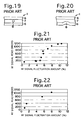
- Fig. 21 is a graph showing RF readout errors in relation to the amount of fluctuation in the RF signal in the case of circular land pre-pits 8.
- Fig. 22 is a graph showing RF readout errors in relation to the amount of fluctuation in the RF signal in the case of meandering land pre-pits 8.
- meandering land pre-pits 8 have a narrower margin with respect to the amount of RF signal fluctuation resulting in an error, and the optimal design range for such pre-pits must be set strictly with respect to various optical pickup types and spot dimensions, as well as angular fluctuations, focal fluctuations, tracking fluctuations, and other disturbances which readily occur at high speeds in particular.
- meandering land pre-pits 8 that the extent or protrusion length on the inside and outside of the arc portion of the meandering shape, or the distance between arc end portions, cannot easily be set in an appropriate combination for the inside and for the outside.
- the amount of RF signal fluctuation is the amount of fluctuation in the level (when there is a land pre-pit 8 adjacent to the recorded pit 10) relative to the level when there is no fluctuation (when there is no land pre-pit 8 adjacent to the recorded pit 10), in percent; in order for there to be fewer than 250 RF readout errors, according to Fig. 22, the RF signal fluctuation amount for meandering land pre-pits 8 must be at least 1% (1% as an absolute value) or lower.
- Fig. 24 is a graph of RF signals for which the unrecorded optical depth is approximately ⁇ /6.2 (similarly, 3T pit signals) and of land pre-pit signals in the same media.
- ⁇ is the wavelength of the laser light 9.
- the unrecorded optical depth can be calculated from the depth of the pregroove 6, the thickness of the dye on the land 7, the thickness of the dye in the pregroove 6, the refractive index n of the dye and substrate 2, and other parameters; but from the graphs of Fig. 23 and Fig. 24, when land pre-pits 8 are circular the extent of fluctuation in the RF signal is seen to depend heavily on the depth of the pregroove 6 and on the thickness of the dye in the deposited film state.
- a meandering land pre-pit 8 is not so greatly influenced by differences in the unrecorded optical depth compared with circular land pre-pits 8, and depending on the deposited film state, optimization is possible without greatly affecting the RF signal.
- meandering land pre-pits 8 when meandering land pre-pits 8 are adopted, if the laser light 9 is shifted from the center direction (detracked) of the optical information recording media 1 (disc) due to some external disturbance, because meandering land pre-pits 8 generally protrude in an arc shape in the outward radial direction of the disc, when a land pre-pit 8 and recorded pit 10 overlap a portion of the land pre-pit 8 encroaches into the recorded pit 10 and affects the shape and size of the recorded pit, so that there is the problem that the recorded pit 10 cannot attain the necessary size and a satisfactory RF signal cannot easily be obtained.
- This invention was devised in light of the above problems, and has as an object the provision of optical information recording media, and in particular DVD-R discs, enabling recording of optical information at high densities.
- a further object of this invention is the provision of optical information recording media in which the shape of meandering land pre-pits is optimized, and address information and other sector information on the optical information recording media can be obtained satisfactorily.
- a further object of this invention is the provision of optical information recording media with optimal design conditions set to reduce land pre-pit readout errors, while simultaneously reducing the RF readout errors of recorded pits.
- a further object of this invention is the provision of optical information recording media enabling the stabilization of RF signal fluctuation amounts up to approximately 1% with respect to meandering land pre-pits in particular, while maintaining a land pre-pit AR (amplitude decrease rate index) of 15% or higher.
- a further object of this invention is the provision of optical information recording media enabling the stabilization of RF signal fluctuation amounts up to approximately 1% even in cases of recording at high speeds of for example four or more times the conventional linear speed (3.5 m/sec), while maintaining a land pre-pit AR (amplitude decrease rate index) of 15% or higher.
- a further object of this invention is the provision of optical information recording media in which, by designing the shape and/or the size of land pre-pits in an optimal relative positional relationship with the energy distribution of the laser light spot, enables acquisition of the land pre-pit signal.
- a further object of this invention is the provision of optical information recording media which can further clarify diffraction of laser light at land pre-pit portions, enabling the acquisition of satisfactory land pre-pit signals.
- a further object of this invention is the provision of optical information recording media enabling optimization of land pre-pit signals, without being greatly influenced by differences in the unrecorded optical depth, and without the state of the deposited film greatly influencing the RF signal.
- a further object of this invention is the provision of optical information recording media in which, by designing the shape and/or the size of land pre-pits in relation to the optimal relative size of recorded pits written by laser light, the signals of the recorded pits and land pre-pits can both be obtained satisfactorily.
- a further object of this invention is the provision of optical information recording media enabling acquisition of the required RF signal, with minimal influence on recorded pits, even when there is shifting from the center direction (detracking) of laser light on the optical information recording media (disc).
- a further object of this invention is the provision of optical information recording media in which, through choice of an appropriate length for land pre-pits in the scanning direction, land pre-pit signals can be obtained.
- this invention is optical information recording media which, focusing on optimization of the shape and/or the size of meandering land pre-pits, the inside protruding portion and outside protruding portion, and the size relative to the laser light spot, has a translucent substrate on which are formed a pregroove and land pre-pits in the lands on either side of the pregroove, an optical recording layer provided on this substrate and enabling recording by recording light, and a light reflecting layer provided on this optical recording layer and which reflects the above recording light, and which enables recording, by irradiation with the above recording light of the above optical recording layer through the above substrate, of information which can be read optically;
- the optical information recording media is characterized in that the above land pre-pits are continuous along the above pregroove and protrude in the radial direction of the above substrate, and that, if e is the base of natural logarithms, then the inside edge portion of the inside protruding portion and the outside edge portion of the outside protru
- the above inside edge portion and the above outside edge portion of the above land pre-pits can be positioned so as to converge toward the center position of the above spot due to the above recording light.
- the shape of meandering land pre-pits can itself be substantially a triangular shape.
- these distances L in and L out can be made smaller than the above spot diameter within the range of the diameter of the spot of the above recording light in the 1/e 2 portion of the Gaussian energy distribution of the spot.
- the inside maximum protrusion portion of the above inside protruding portion, and the outside maximum protrusion portion of the above outside protruding portion can be positioned within the range of the above spot diameter of the above recording light in the 1/e 2 portion of the Gaussian energy distribution of the spot.
- the above inside edge portion and the above outside edge portion can be positioned within the range of the diameter of the spot of the above recording light in the 1/e portion of the Gaussian energy distribution of the spot.
- the shape of meandering land pre-pits which generally protrude in an arc shape, can itself be substantially a triangular shape.
- the above land pre-pits can be made in a triangular shape, an arc shape, a trapezoidal shape, or another arbitrary shape.
- the inside edge portion of the inside protruding portion and the outside edge portion of the outside protruding portion of land pre-pits are positioned to be within the range of the diameter of the spot of the above recording light in the 1/e 2 portion of the Gaussian energy distribution of the spot, so that the diffraction state of laser light irradiating a land pre-pit is satisfactory on the land pre-pit inside and outside and the land pre-pit signal can be more clearly acquired by the laser light, and even when a recorded pit exists near a land pre-pit the effect on the RF signal can be reduced.
- land pre-pit signals can be optimized without being greatly affected by differences in unrecorded optical depths, and depending on the deposited film state, without greatly affecting the RF signal.
- RF fluctuations can be stabilized at approximately 1% during reproduction and the AR of land pre-pits can be maintained at 15% or higher, so that readout errors for RF signals and land pre-pits can be avoided, and necessary sector information can be reliably obtained even from DVD-R discs at high densities and high speeds.
- this invention is optical information recording media which, focusing on optimization of the shape and/or the size of meandering land pre-pits, the inside protruding portion and outside protruding portion, and the size relative to recorded pits, has a translucent substrate on which are formed a pregroove and land pre-pits in the lands on either side of the pregroove, an optical recording layer provided on this substrate and enabling recording of recorded pits by recording light, and a light reflecting layer provided on this optical recording layer and which reflects the above recording light, and which enables recording, by irradiation with the above recording light of the above optical recording layer through the above substrate, of information which can be read optically;
- the optical information recording media is characterized in that the above land pre-pits are continuous along the above pregroove and protrude in the radial direction of the above substrate, and that, if L in is the distance between the two inside edge portions of inside protruding portions of the above land pre-pits, L out is the distance between the
- the above distances L in and L out can be limited to the range 3.36T to 5.22T.
- the above distance L in can be limited to the range 3T to 4T.
- the above distance L in can be limited to the range 3.36T to 3.73T.
- the above distance L out can be limited to the range 4T to 6T.
- the above distance L out can be limited to the range 4.85T to 5.22T.
- the above land pre-pits can be formed in triangular shapes, arc shapes, trapezoidal shapes, or other arbitrary shapes.
- the distance between the two inside edge portions of inside protruding portions of land pre-pits L in and the distance between the two outside edge portions of outside protruding portions of land pre-pits L out are set in the range 3T to 6T, so that even in states in which recorded pits having ten different lengths 3T, 4T, ..., 10T, 11T, 14T overlap with land pre-pits, the RF signal can be obtained satisfactorily without exerting a critical influence on the shape and/or size of recorded pits, and readout errors for land pre-pit signals can also be reduced.
- this invention is optical information recording media which, focusing on appropriate ranges for the distance L in between the two inside edge portions of inside protruding portions of land pre-pits and for the distance L out between the two outside edge portions of outside protruding portions of land pre-pits, has a translucent substrate on which are formed a pregroove and land pre-pits in the lands on either side of the pregroove, an optical recording layer provided on this substrate and enabling recording of recorded pits by recording light, and a light reflecting layer provided on this optical recording layer and which reflects the above recording light, and which enables recording, by irradiation with the above recording light of the above optical recording layer through the above substrate, of information which can be read optically;
- the optical information recording media is characterized in that, when the distance between the two inside edge portions of the above land pre-pits is L in and the distance between the two outside edge portions of the above land pre-pits is L out , these values are set such that 0.40 ⁇ m ⁇ L in ⁇
- the above distances L in and L out can be set such that 0.45 ⁇ m ⁇ L in ⁇ 0.50 ⁇ m and 0.65 ⁇ m ⁇ L out ⁇ 0.70 ⁇ m.
- the above land pre-pits can be formed in a meandering shape.
- the distances L in and L out be in the above range, and so in general the shape of meander-shape or meandering land pre-pits which protrude in an arc shape may be a shape which is substantially triangular.
- the above land pre-pits may be in a triangular shape, an arc shape, a trapezoidal shape, or another arbitrary shape.
- optical information recording media of this invention the third invention
- the conditions for the distances L in and L out of 0.40 ⁇ m ⁇ L in ⁇ 0.80 ⁇ m and 0.40 ⁇ m ⁇ L out ⁇ 0.80 ⁇ m are set, so that the diffraction state of laser light incident on land pre-pits is satisfactory on the land pre-pit outside and inside, a clear land pre-pit signal can be obtained using this laser light, and even when a recorded pit exists near the land pre-pit, the effect on the RF signal can be reduced.
- the land pre-pit signal can be optimized without being greatly influenced by differences in unrecorded optical depth, and depending on the deposited film state, without greatly affecting the RF signal.
- the RF fluctuation amount during reproduction can be stabilized at approximately 1%
- the land pre-pit AR can be maintained at 15% or higher
- readout errors for RF signals and land pre-pits can be avoided, and necessary sector information can be reliably obtained even from DVD-R discs at high densities and high speeds.
- this invention is optical information recording media which, focusing on the arc shape of meandering land pre-pits, the disc radial-direction inside protruding length on the inside of the arc and the radial-direction outside protruding length on the outside of the arc, has a translucent substrate on which are formed a pregroove and land pre-pits in the lands on either side of the pregroove, an optical recording layer provided on this substrate and enabling recording by recording light, and a light reflecting layer provided on this optical recording layer and which reflects the above recording light, and which enables recording, by irradiation with the above recording light of the above optical recording layer through the above substrate, of information which can be read optically;
- the optical information recording media is characterized in that the above land pre-pits are continuous along the above pregroove and protrude in the radial direction of the above substrate in an arc shape, and that, if the inside protrusion length in the radial direction on the inside of the arc
- the above R in and R out can be set such that 0.140 ⁇ m ⁇ R in ⁇ 0.173 ⁇ m and 0.100 ⁇ m ⁇ R out ⁇ 0.192 ⁇ m.
- R in and R out can be set such that R in ⁇ R out .
- R in and R out can be set such that 0.140 ⁇ m ⁇ R in ⁇ 0.156 ⁇ m and 0.156 ⁇ m ⁇ R out ⁇ 0.192 ⁇ m.
- R in and R out can be set such that 0.120 ⁇ m ⁇ R in ⁇ 0.130 ⁇ m and 0.180 ⁇ m ⁇ R out ⁇ 0.244 ⁇ m.
- the recording depth in the unrecorded state in the above pregroove can be set to ⁇ /8 to ⁇ /5.
- the above optical recording layer can comprise light absorbing material capable of absorbing the above recording light.
- optical information recording media of this invention for the inside protrusion length in the radial direction on the inside of the arc R in and the outside protrusion length in the radial direction on the outside of the arc R out , the values 0.120 ⁇ m ⁇ R in ⁇ 0.182 ⁇ m and 0.100 ⁇ m ⁇ R out ⁇ 0.250 ⁇ m are set, so that when a land pre-pit and a recorded pit are adjacent, and/or when there is partial overlap, not only is the outside protruding length R out of the land pre-pit stipulated, but the inside protruding length R in is also stipulated; hence the RF fluctuation during reproduction can be stabilized at approximately 1%, the AR of land pre-pits 8 can be maintained at 15% or higher, readout errors for RF signals and land pre-pits can be avoided, and necessary sector information can be reliably obtained even from DVD-R discs at high densities and high speeds.
- Fig. 1 is an enlarged plane view showing in enlargement the optical information recording media 20 and in particular a portion of a meandering land pre-pit 21 and a portion of a circular spot 9S of laser light 9 irradiating same; the Gaussian energy distribution of the circular spot 9S of laser light 9 is also shown.
- a land pre-pit 21 is formed in a portion of the pregroove 6 in an arc shape, protruding outward in the radial direction of the optical information recording media 20.
- a land pre-pit 21 is delineated by the inside protruding portion 23 which extends in substantially a triangular shape from the pair of inside edge portions 22 on the left and right in the figure, and by the outside protruding portion 25 which extends in substantially a triangular shape from the outside edge portions 24, and is formed so as to protrude in substantially a triangular shape on the side of the land 7 from the pregroove 6 on the outside circumference in the radial direction of the optical information recording media 20.
- Substantially an isosceles triangle is formed between the most prominently protruding edge portion 26 on the inside of the inside protruding portion 23 and the pair of inside edge portions 22.
- Substantially an isosceles triangle is formed between the most prominently protruding edge portion 27 on the outside of the outside protruding portion 25 and the pair of outside edge portions 24.
- inside protruding portion 23 and outside protruding portion 25 can be designed based on the shapes of arbitrary curves.
- optical information recording media 20 are similar to those of the optical information recording media 1 shown in Fig. 15 through Fig. 18.
- the distance between the two inside edge portions 22 of the inside triangular shape of the land pre-pit 21 is L in .
- the distance between the two outside edge portions 24 of the outside triangular shape of the land pre-pit 21 is L out .
- Fig. 2 is a vertical cross-sectional view of the land pre-pit 21, and as shown in the figure, the inside wall of the land pre-pit 21 in the substrate 2 has an inclination angle G of 40 to 80°, and the above distances L in and L out are defined as the width at one-half the depth D of the land pre-pit 21 (the half-maximum width).
- the land pre-pits 21 of this invention are such that the inside edge portions 22 of the inside protruding portion 23 and the outside edge portions 24 of the outside protruding portion 25 of a land pre-pit 21 are positioned within the range of the spot diameter E2 which is the 1/e 2 portion of the Gaussian energy distribution of the circular spot 9S of the laser light 9, where e is the base of natural logarithms (approximately 2.72).
- the distances L in and L out of land pre-pits 21 are made smaller than the spot diameter E2 in the effective energy range, which is the 1/e 2 portion of the Gaussian energy distribution of the circular spot 9S of laser light 9.
- the most prominently protruding inside edge portion 26 of the inside protruding portion 23 and the most prominently protruding outside edge portion 27 of the outside protruding portion 25 be positioned within the spot diameter E2 of the 1/e 2 portion of the Gaussian energy distribution of the circular spot 9S of laser light 9.
- inside edge portions 22 and outside edge portions 24 of land pre-pits 21, and also the most prominently protruding inside edge portion 26 and the most prominently protruding outside edge portion 27 be positioned within the range of the spot diameter E1 of the 1/e portion of the Gaussian energy distribution of the circular spot 9S of laser light 9.
- optical information recording media 20 having land pre-pits 21 configured in this way, intensity differences due to diffraction of laser light at the land pre-pit portions 21 can be made clear and the accuracy of detection of land pre-pits 21 can be improved so that land pre-pit signals can be obtained; in addition, the effect on RF signals can be reduced, and fluctuations therein can be held below a prescribed level.
- Fig. 3 is an enlarged plane view illustrating the state of irradiation with laser light 9 (circular spot 9S) of a land pre-pit 21.
- a land pre-pit 21 When directing the circular spot 9S of the laser light 9 onto a land pre-pit 21 to obtain a signal from the land pre-pit 21, diffraction of the laser light 9 by the land pre-pit 21 results in a clear difference above and below the range of the circular spot 9S (in the spot upper range 9A and spot lower range 9B), enhancing the detection accuracy, so that even if the land pre-pit 21 is in proximity to a recorded pit 10, the AR of the land pre-pit signal is maintained at 15% or higher and readout errors are avoided, while the RF signal fluctuation amount can be held to less than 1%.
- a land pre-pit 21 is positioned within the circular spot 9S of the laser light 9, then adjustment is possible depending on the state of the deposited film in this portion without being greatly affected by differences in the unrecorded optical depth in the range from ⁇ /8 to ⁇ /5 and without greatly affecting the RF signal, so that optimization is possible.
- the shape of the land pre-pits 21 can be chosen arbitrarily.
- Fig. 4 is an enlarged plane view showing another example of a land pre-pit (land pre-pit 30); this land pre-pit 30 protrudes in an arc shape in the outward radial direction of the optical information recording media 20, and the inside edge portions 22 and most prominently protruding inside edge portion 26 of the inside protruding portion 23, as well as the outside edge portions 24 and most prominently protruding outside edge portion 27 of the outside protruding portion 25, are positioned within the range of the circular spot 9S.
- this land pre-pit 30 protrudes in an arc shape in the outward radial direction of the optical information recording media 20, and the inside edge portions 22 and most prominently protruding inside edge portion 26 of the inside protruding portion 23, as well as the outside edge portions 24 and most prominently protruding outside edge portion 27 of the outside protruding portion 25, are positioned within the range of the circular spot 9S.
- Fig. 5 is an enlarged plane view showing still another example of a land pre-pit (land pre-pit 31); this land pre-pit 31 protrudes in a trapezoidal shape in the outward radial direction of the optical information recording media 20, and the inside edge portions 22 and most prominently protruding inside edge portion 26 of the inside protruding portion 23, as well as the outside edge portions 24 and most prominently protruding outside edge portion 27 of the outside protruding portion 25, are positioned within the range of the circular spot 9S.
- optical information recording media 40 of a second aspect of the invention (second invention) is explained, based on Fig. 6 through Fig. 8.
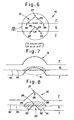
- Fig. 6 is an enlarged plane view showing in enlargement the optical information recording media 40, and in particular a portion of a meandering land pre-pit 21 and a portion of a circular spot 9S of laser light 9 irradiating the media.
- land pre-pits 21 are formed in a portion of the pregroove 6 to protrude in an arc shape in the radial direction on the outer circumference side of the optical information recording media 40.
- the land pre-pits 21 of this invention are such that the distances L in and L out range between the shortest pit length, 3T, to twice this length (6T).
- the distances L in and L out be in the range from 3.36T to 5.22T.
- the distance L in be in the range from 3T to 4T, and more preferably still, in the range from 3.36T to 3.73T.
- the distance L out be in the range from 4T to 6T, and more preferably still, in the range from 4.85T to 5.22T.
- Fig. 7 is an enlarged plane view for a case in which a recorded pit 10 overlaps with a portion of a conventional meandering land pre-pit 8
- Fig. 8 is an enlarged plane view for a case in which a recorded pit 10 overlaps with a portion of a meandering land pre-pit 8 of this invention, showing in particular the state in which the laser light 9 is slightly shifted to the disc radial-direction center side (detracking).
- tracking of the laser light 9 ideally should involve movement of the center 9C along the center line 6C of the pregroove 6; but in actuality, as recording speeds are increased, the center 9C of the laser light 9 deviates from the center line 6C of the pregroove 6, and recorded pits 10 may be recorded.
- the distances L in and L out are within the range 3T to 6T.
- the inside edge portions 22 of the inside protruding portion 23 in particular are positioned closer to each other than in the case of conventional arc-shape land pre-pits 8, so that the area of encroachment of the land 7 (inside protruding portion 23) on the portion of the recorded pit 10 is smaller than in the prior art, and the effect exerted on the shape and size of the recorded pit 10 can be reduced.
- a land pre-pit 21 is positioned within the circular spot 9S of the laser light 9, then adjustment is possible depending on the state of the deposited film in this portion without being greatly affected by differences in the unrecorded optical depth in the range from ⁇ /8 to ⁇ /5 and without greatly affecting the RF signal, so that optimization is possible.
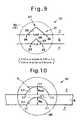
- Fig. 9 is an enlarged plane view showing in enlargement the optical information recording media 50, and in particular a portion of a meandering land pre-pit 21 and a portion of a circular spot 9S of laser light 9 irradiating this pre-pit.
- land pre-pits 21 are formed in a portion of the pregroove 6, protruding in an arc shape in the radial direction on the outer circumference side of the optical information recording media 50.
- the land pre-pits 21 of this invention are such that 0.40 ⁇ m ⁇ L in ⁇ 0.80 ⁇ m, and 0.40 ⁇ m ⁇ L out ⁇ 0.80 ⁇ m.
- the inside edge portions 22 of the inside protruding portion 23 and outside edge portions 24 of the outside protruding portion 25 of these land pre-pits 21 are positioned within the range of the circular spot 9S of the laser light 9.
- the land pre-pits 21 are positioned within the circular spot 9S of the laser light 9.
- optical information recording media 50 having land pre-pits 21 configured in this way, intensity differences due to diffraction of laser light at the land pre-pit portions 21 can be made clear and the accuracy of detection of land pre-pits 21 can be improved so that land pre-pit signals can be obtained; in addition, the effect on RF signals can be reduced, and fluctuations therein can be held below a prescribed level.
- the margin with respect to external disturbances is increased, and moreover the detection accuracy is improved, so that even if the land pre-pit 21 is in proximity to a recorded pit 10, the AR of the land pre-pit signal is maintained at 15% or higher and readout errors are avoided, while the RF signal fluctuation amount can be held to less than 1%.
- a land pre-pit 21 is positioned within the circular spot 9S of the laser light 9, then adjustment is possible depending on the state of the deposited film in this portion without being greatly affected by differences in the unrecorded optical depth in the range from ⁇ /8 to ⁇ /5 and without greatly affecting the RF signal, so that optimization is possible.
- optical information recording media 60 of a fourth aspect of this invention (fourth invention) is explained, based on Fig. 10 through Fig. 14.
- Fig. 10 is an enlarged plane view of a portion of a meandering land pre-pit 8 in the optical information recording media 60.
- Land pre-pits 8 are formed in circular arc shapes or elliptical arc shapes, similarly to those of the prior art shown in Fig. 20, in portions of the pregroove 6 protruding in an arc shape on the outside circumference side in the radial direction of the optical information recording media 60.
- a land pre-pit 8 is delineated by the inside arc-shape portion 62 extending in an arc shape from the pair of inside arc edge portions 61 on the left and right in the figure and by the outside arc-shape portion 64 extending in an arc shape from the outside arc-shape edge portions 63, and is formed protruding in a circular arc shape on the outside circumference side in the radial direction of the optical information recording media 60.
- the inside arc-shape portion 62 and outside arc-shape portion 64 are both based on an elliptical arc shape, and are formed in arc shapes by selecting the curve of a portion of an ellipse.
- the inside arc-shape portion 62 and outside arc-shape portion 64 can be designed based on a triangular shape, arc shape, trapezoidal shape, or other arbitrary shape or arbitrary curve.
- the other portions of the optical information recording media 60 are similar to those of the optical information recording media 1 shown in Fig. 15 through Fig. 18.
- the inside protrusion length in the radial direction on the arc inner side of a land pre-pit 8 (the distance from the additional line connecting the inside arc shape edge portions 61 on both sides to the additional line tangent to the inside arc-shape portion 62 at the most prominently protruding portion 65 of the circular arc of the inside arc-shape portion 62) is R in .
- the outside protrusion length in the radial direction on the arc outer side of a land pre-pit 8 (the distance from the additional line connecting the outside arc shape edge portions 63 on both sides to the additional line tangent to the outside arc-shape portion 64 at the most prominently protruding portion 66 of the circular arc of the outside arc-shape portion 64) is R out .
- the inner wall portion of a land pre-pit 8 in the substrate 2 has an inclination angle G of from 40 to 80°, and each of the above additional lines is drawn at the width at one-half the depth D of the land pre-pit 8 (the half-maximum width).
- the land pre-pits 8 of this invention be such that 0.120 ⁇ m ⁇ R in ⁇ 0.182 ⁇ m, and 0.100 ⁇ m ⁇ R out ⁇ 0.250 ⁇ m. This is explained below.
- the RF signal fluctuation amount must be held to at least less than 1%, and in addition the characteristics of the land pre-pits 8, that is, the AR (amplitude decrease rate index), must be maintained at 15% or higher.
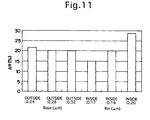
- Fig. 11 is a graph showing the relation of AR to R out and R in ; as indicated in the figure, R out does not greatly affect AR, and the influence of R in dominates.
- This invention (the fourth invention) was devised by discovering regularity between the design values for R in and R out (the meandering shape design values), the amount of RF signal fluctuation, the AR (amplitude decrease rate index), and other measured electrical signal values, and drawing graphs with R in and R out plotted on the vertical and horizontal axes.
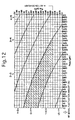
- Fig. 12 is a graph showing the range of RF signal fluctuation amounts and the range over which the AR is 15% or higher, plotting R out on the horizontal axis and R in on the vertical axis.
- the range over which AR is 15% or higher is indicated by an arrow on the R in axis
- RF signal fluctuation amounts are indicated in percentages (%) for regions delineated by arc-shape boundary lines.
- the range over which the AR is 15% or higher and the absolute value of RF signal fluctuations is 1% or less is 0.120 ⁇ m ⁇ R in ⁇ 0.182 ⁇ m and 0.100 ⁇ m ⁇ R out ⁇ 0.250 ⁇ m.
- Fig. 13 shows a case in which the design margins are expanded to stipulate that the AR be 18% or higher and that RF signal fluctuation amounts be less than 0.7%.
- Fig. 13 is a graph showing the range of RF signal fluctuation amounts and the range over which the AR is 18% or higher, plotting R out on the horizontal axis and R in on the vertical axis.
- the range over which the AR is 18% or higher and the absolute value of RF signal fluctuations is less than 0.7% is 0.140 ⁇ m ⁇ R in ⁇ 0.173 ⁇ m and 0.100 ⁇ m ⁇ R out ⁇ 0.192 ⁇ m.
- R in and R out shown in Fig. 13 the range in which the inside protruding length R in is greater than the outside protruding length R out (R out ⁇ R in ) is difficult to realize, considering the fabrication and moldability of the optical information recording media 60 and the stamper therefor; realistically, it is preferable that R in be at maximum approximately 0.156 ⁇ m, and that R in ⁇ R out .
- Fig. 14 is a graph showing the range of RF signal fluctuation amounts and the range over which the AR is 18% or higher, plotting R out on the horizontal axis and R in on the vertical axis.
- the range over which the AR is 18% or higher, the absolute value of RF signal fluctuations is less than 0.7%, and in addition R in is at maximum approximately 0.156 ⁇ m and R in ⁇ R out , is 0.140 ⁇ m ⁇ R in ⁇ 0.156 ⁇ m and 0.156 ⁇ m ⁇ R out ⁇ 0.192 ⁇ m.
- the RF signal and land pre-pit signal are expected to fluctuate according to the extent of this deviation; in order to reduce insofar as possible the influence of this detracking, it is preferable that 0.120 ⁇ m ⁇ R in ⁇ 0.130 ⁇ m and 0.180 ⁇ m ⁇ R out ⁇ 0.244 ⁇ m.
- the inside edge portions and outside edge portions of land pre-pits are positioned within the circular spot of the laser light, which is either recording light or reproduction light, so that laser light diffraction can be made clear and the accuracy of land pre-pit detection can be improved, readout errors can be avoided through reduction in errors for both land pre-pit signals and for RF signals, and the specific shape of land pre-pits can be designed to accommodate high optical information densities and high speeds.
- the distance L in between the pair of inside edge portions and the distance L out between the pair of outside edge portions of a land pre-pit are limited to the range 3T to 6T, so that the effect on recorded pits of even slight deviations in the laser light during recording or reproduction is reduced, errors can be reduced and readout errors avoided for both land pre-pit signals and for RF signals, and the specific shape of land pre-pits can be designed to accommodate high optical information densities and high speeds.
- the laser light diffraction can be made clear and the accuracy of detection of land pre-pits can be improved, errors can be reduced and readout errors avoided for both land pre-pit signals and for RF signals, and the specific shape of land pre-pits can be designed to accommodate high optical information densities and high speeds.
- the fourth invention by designing meandering land pre-pits so as to satisfy the conditions regarding the inside protruding length R in and outside protruding length R out of 0.120 ⁇ m ⁇ R in ⁇ 0.182 ⁇ m and 0.100 ⁇ m ⁇ R out ⁇ 0.250 ⁇ m, RF signal fluctuation amounts can be held to less than 1% and the land pre-pit signal AR can be maintained at 15% or higher, readout errors can be avoided, and the specific shape of land pre-pits can be designed to accommodate high optical information densities and high speeds.
Landscapes
- Optical Recording Or Reproduction (AREA)
- Optical Record Carriers And Manufacture Thereof (AREA)
Applications Claiming Priority (9)
| Application Number | Priority Date | Filing Date | Title |
|---|---|---|---|
| JP2002245481 | 2002-08-26 | ||
| JP2002245497 | 2002-08-26 | ||
| JP2002245497 | 2002-08-26 | ||
| JP2002245481 | 2002-08-26 | ||
| JP2002290975 | 2002-10-03 | ||
| JP2002290975 | 2002-10-03 | ||
| JP2003106113 | 2003-04-10 | ||
| JP2003106113 | 2003-04-10 | ||
| PCT/JP2003/010336 WO2004025631A1 (ja) | 2002-08-26 | 2003-08-14 | 光情報記録媒体 |
Publications (2)
| Publication Number | Publication Date |
|---|---|
| EP1533797A1 true EP1533797A1 (de) | 2005-05-25 |
| EP1533797A4 EP1533797A4 (de) | 2009-04-01 |
Family
ID=31999407
Family Applications (1)
| Application Number | Title | Priority Date | Filing Date |
|---|---|---|---|
| EP03795223A Withdrawn EP1533797A4 (de) | 2002-08-26 | 2003-08-14 | Optisches informationsaufzeichnungsmedium |
Country Status (9)
| Country | Link |
|---|---|
| US (1) | US20060164965A1 (de) |
| EP (1) | EP1533797A4 (de) |
| JP (3) | JPWO2004025631A1 (de) |
| KR (1) | KR100687533B1 (de) |
| CN (1) | CN1324577C (de) |
| AU (1) | AU2003257848A1 (de) |
| CA (1) | CA2486806A1 (de) |
| TW (1) | TWI226630B (de) |
| WO (1) | WO2004025631A1 (de) |
Families Citing this family (5)
| Publication number | Priority date | Publication date | Assignee | Title |
|---|---|---|---|---|
| JP4539657B2 (ja) * | 2007-01-18 | 2010-09-08 | ソニー株式会社 | 反射防止用光学素子 |
| JP4818965B2 (ja) * | 2007-03-19 | 2011-11-16 | 株式会社リコー | 光記録媒体 |
| JP4796555B2 (ja) * | 2007-08-16 | 2011-10-19 | 株式会社リコー | 片面二層型光記録媒体 |
| JP5496226B2 (ja) | 2010-01-08 | 2014-05-21 | パナソニック株式会社 | 光学ドライブ装置 |
| JP2011159376A (ja) * | 2010-01-08 | 2011-08-18 | Panasonic Corp | 光学ドライブ装置 |
Family Cites Families (18)
| Publication number | Priority date | Publication date | Assignee | Title |
|---|---|---|---|---|
| JPH09102143A (ja) * | 1995-10-05 | 1997-04-15 | Nec Corp | 光ディスク |
| JP3201235B2 (ja) * | 1995-10-23 | 2001-08-20 | 株式会社日立製作所 | 情報記録媒体、記録制御情報再生方法及び情報記録再生装置 |
| JP3379961B2 (ja) * | 1996-04-05 | 2003-02-24 | 松下電器産業株式会社 | 動画データとともに複数チャネルの音声データ、副映像データが記録された記録媒体、その再生装置、再生方法 |
| JP3483709B2 (ja) * | 1996-07-09 | 2004-01-06 | シャープ株式会社 | 光記録媒体及びその製造方法並びにそれを用いた光情報再生方法 |
| DE69729606T2 (de) * | 1996-07-09 | 2005-07-07 | Sharp K.K. | Optische Platte mit verteilten Wobbelsektionen, Herstellungsverfahren und Verfahren zur Aufzeichnung und Wiedergabe |
| JPH1194577A (ja) * | 1997-09-17 | 1999-04-09 | Matsushita Electric Ind Co Ltd | カーナビゲーションにおける実用性と、高画質な映像を用いての娯楽性とを兼ね備えた光ディスク及びその再生装置 |
| JP4372867B2 (ja) * | 1998-10-23 | 2009-11-25 | パイオニア株式会社 | 光ディスク及び記録再生装置 |
| JP2000187887A (ja) * | 1998-12-24 | 2000-07-04 | Ricoh Co Ltd | 光ディスク |
| JP2000353321A (ja) * | 1999-04-08 | 2000-12-19 | Pioneer Electronic Corp | 光学式記録媒体及びその製造方法 |
| JP4042272B2 (ja) * | 1999-10-20 | 2008-02-06 | ソニー株式会社 | 記録媒体駆動装置及びチルト検出方法 |
| DE60118105T2 (de) * | 2000-01-14 | 2006-08-31 | Pioneer Corp. | Beschreibbare optische Platte und Aufzeichnungsverfahren |
| JP2001209945A (ja) * | 2000-01-26 | 2001-08-03 | Sharp Corp | 光ディスク及び記録再生装置 |
| JP4136280B2 (ja) * | 2000-07-04 | 2008-08-20 | パイオニア株式会社 | 光学式記録媒体並びにその製造方法及び製造装置 |
| JP2002237102A (ja) * | 2000-07-07 | 2002-08-23 | Tdk Corp | 光記録媒体およびその製造方法 |
| EP1333434A4 (de) * | 2000-10-23 | 2007-07-18 | Mitsui Chemicals Inc | Optisches aufzeichnungsmedium |
| JP2002208187A (ja) * | 2000-11-13 | 2002-07-26 | Nikon Corp | 光情報記録媒体、スタンパー、露光装置、及びスタンパーの製造方法 |
| JP2002237101A (ja) * | 2000-12-08 | 2002-08-23 | Mitsubishi Chemicals Corp | 光記録媒体 |
| JP2002304772A (ja) * | 2001-04-05 | 2002-10-18 | Fuji Photo Film Co Ltd | 光記録媒体 |
-
2003
- 2003-08-14 CA CA002486806A patent/CA2486806A1/en not_active Abandoned
- 2003-08-14 CN CNB038198851A patent/CN1324577C/zh not_active Expired - Fee Related
- 2003-08-14 JP JP2004571934A patent/JPWO2004025631A1/ja not_active Withdrawn
- 2003-08-14 WO PCT/JP2003/010336 patent/WO2004025631A1/ja not_active Ceased
- 2003-08-14 US US10/526,162 patent/US20060164965A1/en not_active Abandoned
- 2003-08-14 TW TW092122402A patent/TWI226630B/zh not_active IP Right Cessation
- 2003-08-14 KR KR1020047020827A patent/KR100687533B1/ko not_active Expired - Fee Related
- 2003-08-14 AU AU2003257848A patent/AU2003257848A1/en not_active Abandoned
- 2003-08-14 EP EP03795223A patent/EP1533797A4/de not_active Withdrawn
-
2008
- 2008-09-26 JP JP2008247105A patent/JP4692974B2/ja not_active Expired - Fee Related
- 2008-09-26 JP JP2008247104A patent/JP2009043401A/ja not_active Withdrawn
Also Published As
| Publication number | Publication date |
|---|---|
| AU2003257848A1 (en) | 2004-04-30 |
| HK1081716A1 (zh) | 2006-05-19 |
| JP4692974B2 (ja) | 2011-06-01 |
| JPWO2004025631A1 (ja) | 2006-01-12 |
| US20060164965A1 (en) | 2006-07-27 |
| HK1108761A1 (zh) | 2008-05-16 |
| JP2009043401A (ja) | 2009-02-26 |
| EP1533797A4 (de) | 2009-04-01 |
| KR20050034649A (ko) | 2005-04-14 |
| TW200407881A (en) | 2004-05-16 |
| CA2486806A1 (en) | 2004-03-25 |
| CN1324577C (zh) | 2007-07-04 |
| TWI226630B (en) | 2005-01-11 |
| JP2008305555A (ja) | 2008-12-18 |
| CN1679089A (zh) | 2005-10-05 |
| HK1108762A1 (zh) | 2008-05-16 |
| KR100687533B1 (ko) | 2007-02-27 |
| HK1105828A1 (zh) | 2008-02-22 |
| WO2004025631A1 (ja) | 2004-03-25 |
Similar Documents
| Publication | Publication Date | Title |
|---|---|---|
| EP1158504B1 (de) | Wiederbeschreibbare cd und deren herstellungsverfahren | |
| CN100399427C (zh) | 光盘及其制造方法和记录再生装置 | |
| US9412407B2 (en) | Multi-stack optical storage medium | |
| JP4692974B2 (ja) | 光情報記録媒体 | |
| US6721265B1 (en) | High-density optical information recording medium and a substrate and a stamper for the manufacture thereof | |
| KR100939850B1 (ko) | 광정보 기록매체, 그 광측정방법 및 광정보 기록/재생방법 | |
| JP2000040261A (ja) | 光情報媒体 | |
| CN100452187C (zh) | 光信息记录媒体 | |
| US20160343398A1 (en) | Multi-stack optical storage mediu | |
| JP2985100B2 (ja) | 光情報記録媒体およびその記録方法 | |
| HK1108761B (en) | Optical information recording medium | |
| HK1105828B (en) | Optical information recording medium | |
| HK1108762B (en) | A recording medium for optical information | |
| JP2002237100A (ja) | 光記録媒体 | |
| JP3964357B2 (ja) | 相変化型光情報記録媒体の記録再生方法 | |
| US20080068977A1 (en) | Information storage medium and disk apparatus | |
| JP2001093189A (ja) | 多層型光ディスク及びその記録再生方法 | |
| JP2004030854A (ja) | 光情報記録媒体のスタンパーおよびその作成方法 | |
| JP2002237101A (ja) | 光記録媒体 | |
| KR20010009503A (ko) | 광기록매체 | |
| HK1074694B (en) | Optical disk, method for producing the same, and recording and reproducing apparatus | |
| WO2010106972A1 (ja) | 光学情報記録媒体 | |
| JP2002157789A (ja) | 光情報媒体 | |
| JP2000048399A (ja) | 相変化光ディスク媒体 |
Legal Events
| Date | Code | Title | Description |
|---|---|---|---|
| PUAI | Public reference made under article 153(3) epc to a published international application that has entered the european phase |
Free format text: ORIGINAL CODE: 0009012 |
|
| 17P | Request for examination filed |
Effective date: 20050222 |
|
| AK | Designated contracting states |
Kind code of ref document: A1 Designated state(s): AT BE BG CH CY CZ DE DK EE ES FI FR GB GR HU IE IT LI LU MC NL PT RO SE SI SK TR |
|
| AX | Request for extension of the european patent |
Extension state: AL LT LV MK |
|
| DAX | Request for extension of the european patent (deleted) | ||
| A4 | Supplementary search report drawn up and despatched |
Effective date: 20090304 |
|
| 17Q | First examination report despatched |
Effective date: 20090612 |
|
| STAA | Information on the status of an ep patent application or granted ep patent |
Free format text: STATUS: THE APPLICATION IS DEEMED TO BE WITHDRAWN |
|
| 18D | Application deemed to be withdrawn |
Effective date: 20091023 |