EP1518604B1 - Mikrostrukturierte Vorrichtung zum entnehmbaren Speichern von kleinen Flüssigkeitsmengen und Verfahren zum Entnehmen der in dieser Vorrichtung gespeicherten Flüssigkeit - Google Patents
Mikrostrukturierte Vorrichtung zum entnehmbaren Speichern von kleinen Flüssigkeitsmengen und Verfahren zum Entnehmen der in dieser Vorrichtung gespeicherten Flüssigkeit Download PDFInfo
- Publication number
- EP1518604B1 EP1518604B1 EP04021864.6A EP04021864A EP1518604B1 EP 1518604 B1 EP1518604 B1 EP 1518604B1 EP 04021864 A EP04021864 A EP 04021864A EP 1518604 B1 EP1518604 B1 EP 1518604B1
- Authority
- EP
- European Patent Office
- Prior art keywords
- cavity
- blocking element
- carrier
- liquid
- force
- Prior art date
- Legal status (The legal status is an assumption and is not a legal conclusion. Google has not performed a legal analysis and makes no representation as to the accuracy of the status listed.)
- Expired - Lifetime
Links
Images



Classifications
-
- F—MECHANICAL ENGINEERING; LIGHTING; HEATING; WEAPONS; BLASTING
- F16—ENGINEERING ELEMENTS AND UNITS; GENERAL MEASURES FOR PRODUCING AND MAINTAINING EFFECTIVE FUNCTIONING OF MACHINES OR INSTALLATIONS; THERMAL INSULATION IN GENERAL
- F16K—VALVES; TAPS; COCKS; ACTUATING-FLOATS; DEVICES FOR VENTING OR AERATING
- F16K99/00—Subject matter not provided for in other groups of this subclass
- F16K99/0001—Microvalves
- F16K99/0003—Constructional types of microvalves; Details of the cutting-off member
- F16K99/0017—Capillary or surface tension valves, e.g. using electro-wetting or electro-capillarity effects
-
- B—PERFORMING OPERATIONS; TRANSPORTING
- B01—PHYSICAL OR CHEMICAL PROCESSES OR APPARATUS IN GENERAL
- B01L—CHEMICAL OR PHYSICAL LABORATORY APPARATUS FOR GENERAL USE
- B01L3/00—Containers or dishes for laboratory use, e.g. laboratory glassware; Droppers
- B01L3/50—Containers for the purpose of retaining a material to be analysed, e.g. test tubes
- B01L3/502—Containers for the purpose of retaining a material to be analysed, e.g. test tubes with fluid transport, e.g. in multi-compartment structures
- B01L3/5027—Containers for the purpose of retaining a material to be analysed, e.g. test tubes with fluid transport, e.g. in multi-compartment structures by integrated microfluidic structures, i.e. dimensions of channels and chambers are such that surface tension forces are important, e.g. lab-on-a-chip
- B01L3/502738—Containers for the purpose of retaining a material to be analysed, e.g. test tubes with fluid transport, e.g. in multi-compartment structures by integrated microfluidic structures, i.e. dimensions of channels and chambers are such that surface tension forces are important, e.g. lab-on-a-chip characterised by integrated valves
-
- F—MECHANICAL ENGINEERING; LIGHTING; HEATING; WEAPONS; BLASTING
- F16—ENGINEERING ELEMENTS AND UNITS; GENERAL MEASURES FOR PRODUCING AND MAINTAINING EFFECTIVE FUNCTIONING OF MACHINES OR INSTALLATIONS; THERMAL INSULATION IN GENERAL
- F16K—VALVES; TAPS; COCKS; ACTUATING-FLOATS; DEVICES FOR VENTING OR AERATING
- F16K99/00—Subject matter not provided for in other groups of this subclass
- F16K99/0001—Microvalves
-
- F—MECHANICAL ENGINEERING; LIGHTING; HEATING; WEAPONS; BLASTING
- F16—ENGINEERING ELEMENTS AND UNITS; GENERAL MEASURES FOR PRODUCING AND MAINTAINING EFFECTIVE FUNCTIONING OF MACHINES OR INSTALLATIONS; THERMAL INSULATION IN GENERAL
- F16K—VALVES; TAPS; COCKS; ACTUATING-FLOATS; DEVICES FOR VENTING OR AERATING
- F16K99/00—Subject matter not provided for in other groups of this subclass
- F16K99/0001—Microvalves
- F16K99/0003—Constructional types of microvalves; Details of the cutting-off member
- F16K99/003—Valves for single use only
-
- F—MECHANICAL ENGINEERING; LIGHTING; HEATING; WEAPONS; BLASTING
- F16—ENGINEERING ELEMENTS AND UNITS; GENERAL MEASURES FOR PRODUCING AND MAINTAINING EFFECTIVE FUNCTIONING OF MACHINES OR INSTALLATIONS; THERMAL INSULATION IN GENERAL
- F16K—VALVES; TAPS; COCKS; ACTUATING-FLOATS; DEVICES FOR VENTING OR AERATING
- F16K99/00—Subject matter not provided for in other groups of this subclass
- F16K99/0001—Microvalves
- F16K99/0034—Operating means specially adapted for microvalves
-
- B—PERFORMING OPERATIONS; TRANSPORTING
- B01—PHYSICAL OR CHEMICAL PROCESSES OR APPARATUS IN GENERAL
- B01L—CHEMICAL OR PHYSICAL LABORATORY APPARATUS FOR GENERAL USE
- B01L2200/00—Solutions for specific problems relating to chemical or physical laboratory apparatus
- B01L2200/16—Reagents, handling or storing thereof
-
- B—PERFORMING OPERATIONS; TRANSPORTING
- B01—PHYSICAL OR CHEMICAL PROCESSES OR APPARATUS IN GENERAL
- B01L—CHEMICAL OR PHYSICAL LABORATORY APPARATUS FOR GENERAL USE
- B01L2300/00—Additional constructional details
- B01L2300/04—Closures and closing means
- B01L2300/041—Connecting closures to device or container
- B01L2300/044—Connecting closures to device or container pierceable, e.g. films, membranes
-
- B—PERFORMING OPERATIONS; TRANSPORTING
- B01—PHYSICAL OR CHEMICAL PROCESSES OR APPARATUS IN GENERAL
- B01L—CHEMICAL OR PHYSICAL LABORATORY APPARATUS FOR GENERAL USE
- B01L2300/00—Additional constructional details
- B01L2300/04—Closures and closing means
- B01L2300/046—Function or devices integrated in the closure
- B01L2300/047—Additional chamber, reservoir
-
- B—PERFORMING OPERATIONS; TRANSPORTING
- B01—PHYSICAL OR CHEMICAL PROCESSES OR APPARATUS IN GENERAL
- B01L—CHEMICAL OR PHYSICAL LABORATORY APPARATUS FOR GENERAL USE
- B01L2300/00—Additional constructional details
- B01L2300/06—Auxiliary integrated devices, integrated components
- B01L2300/0672—Integrated piercing tool
-
- B—PERFORMING OPERATIONS; TRANSPORTING
- B01—PHYSICAL OR CHEMICAL PROCESSES OR APPARATUS IN GENERAL
- B01L—CHEMICAL OR PHYSICAL LABORATORY APPARATUS FOR GENERAL USE
- B01L2400/00—Moving or stopping fluids
- B01L2400/06—Valves, specific forms thereof
- B01L2400/0633—Valves, specific forms thereof with moving parts
- B01L2400/0638—Valves, specific forms thereof with moving parts membrane valves, flap valves
-
- B—PERFORMING OPERATIONS; TRANSPORTING
- B01—PHYSICAL OR CHEMICAL PROCESSES OR APPARATUS IN GENERAL
- B01L—CHEMICAL OR PHYSICAL LABORATORY APPARATUS FOR GENERAL USE
- B01L2400/00—Moving or stopping fluids
- B01L2400/06—Valves, specific forms thereof
- B01L2400/0633—Valves, specific forms thereof with moving parts
- B01L2400/065—Valves, specific forms thereof with moving parts sliding valves
-
- B—PERFORMING OPERATIONS; TRANSPORTING
- B01—PHYSICAL OR CHEMICAL PROCESSES OR APPARATUS IN GENERAL
- B01L—CHEMICAL OR PHYSICAL LABORATORY APPARATUS FOR GENERAL USE
- B01L3/00—Containers or dishes for laboratory use, e.g. laboratory glassware; Droppers
- B01L3/50—Containers for the purpose of retaining a material to be analysed, e.g. test tubes
- B01L3/502—Containers for the purpose of retaining a material to be analysed, e.g. test tubes with fluid transport, e.g. in multi-compartment structures
- B01L3/5025—Containers for the purpose of retaining a material to be analysed, e.g. test tubes with fluid transport, e.g. in multi-compartment structures for parallel transport of multiple samples
-
- B—PERFORMING OPERATIONS; TRANSPORTING
- B01—PHYSICAL OR CHEMICAL PROCESSES OR APPARATUS IN GENERAL
- B01L—CHEMICAL OR PHYSICAL LABORATORY APPARATUS FOR GENERAL USE
- B01L3/00—Containers or dishes for laboratory use, e.g. laboratory glassware; Droppers
- B01L3/50—Containers for the purpose of retaining a material to be analysed, e.g. test tubes
- B01L3/508—Rigid containers without fluid transport within
- B01L3/5085—Rigid containers without fluid transport within for multiple samples, e.g. microtitration plates
-
- B—PERFORMING OPERATIONS; TRANSPORTING
- B01—PHYSICAL OR CHEMICAL PROCESSES OR APPARATUS IN GENERAL
- B01L—CHEMICAL OR PHYSICAL LABORATORY APPARATUS FOR GENERAL USE
- B01L3/00—Containers or dishes for laboratory use, e.g. laboratory glassware; Droppers
- B01L3/52—Containers specially adapted for storing or dispensing a reagent
- B01L3/523—Containers specially adapted for storing or dispensing a reagent with means for closing or opening
-
- Y—GENERAL TAGGING OF NEW TECHNOLOGICAL DEVELOPMENTS; GENERAL TAGGING OF CROSS-SECTIONAL TECHNOLOGIES SPANNING OVER SEVERAL SECTIONS OF THE IPC; TECHNICAL SUBJECTS COVERED BY FORMER USPC CROSS-REFERENCE ART COLLECTIONS [XRACs] AND DIGESTS
- Y10—TECHNICAL SUBJECTS COVERED BY FORMER USPC
- Y10T—TECHNICAL SUBJECTS COVERED BY FORMER US CLASSIFICATION
- Y10T436/00—Chemistry: analytical and immunological testing
- Y10T436/25—Chemistry: analytical and immunological testing including sample preparation
- Y10T436/2575—Volumetric liquid transfer
Definitions
- the present invention relates to a microstructured device for removably storing small quantities of liquid and a method for removing the liquid stored in this device.
- Microstructured devices are known from the prior art, which have a plate-shaped carrier, in which one-sided recesses are introduced. These recesses are connected via channels with removal chambers, via which a liquid can be removed from the device. The recess is also connected via an inlet channel in connection with an inlet chamber, via which a sample or a rinsing liquid can be introduced into the device. The sample is then removed due to transportation forces e.g. transported on the basis of capillary forces or compressive forces to the recess and passes from there via the removal channel to the removal opening. In the initially open recess so-called containers are used. These containers are plastic containers in which e.g. Reagent fluids are introduced.
- the container is opened so that the liquid contained in the container can escape from the container to mix with the supplied via the inlet channel into the recess liquid.
- the known from the prior art containers are standardized and they can be used in various carriers of microstructured devices.
- the carriers usually have a plurality of recesses, in which then various containers can be used with often different reagent fluids.
- the disadvantage of using containers for microstructured devices for removably storing Liquids is that the design of the device is strongly dictated by the shape of the container.
- the containers make it necessary that in the carrier to the container adapted recesses are provided.
- the recesses can therefore not be designed individually for each carrier, which could, for example, lead to a higher packing density of the liquids to be stored.
- Another disadvantage is that initially a relatively large amount of effort is made to bring the liquids in the container to then use the container as such in the carrier. This could also be simplified by storing the liquids directly in the carrier.
- a disadvantage of the document US Pat. No. 6,495,373 B1 disclosed device is that after a loss of the minimum force the There is a risk that the blocking element comes into a position in which it closes the currently released opening. This should be prevented to allow unhindered leakage of liquid from the first section.
- the invention is therefore based on the object to propose a microstructured device for removably storing small amounts of liquid, in which a closure of the opening of the first portion is prevented by the blocking element after elimination of the minimum force.
- This object is achieved by a microstructured device according to claim 1.
- Such a microstructured device may be used for a method according to claim 22.
- a microstructured device for removably storing small quantities of liquid in this case comprises a carrier, wherein in the carrier a cavity is provided with at least a first portion for storing the small amount of liquid.
- the first portion of the cavity is formed in the carrier as a recess.
- This first portion is closed with a cover element and a blocking element and is also advantageously limited by lateral walls formed by the carrier.
- the device according to the invention has a means for transmitting a force from the cover element to the blocking element. By means of this force is a cohesive connection between the blocking element and the carrier destructible or the blocking element itself destructible, so that the amount of liquid from the first portion of the cavity can be removed.
- the amount of liquid is thus not stored in a device according to the invention as in some prior art devices in a special container. Rather, it will the amount of liquid stored directly in the device in a cavity bounded on the one hand by the cover element and the blocking element and lateral walls, which are formed by the carrier.
- the carrier is in one piece. This means that the first cavity is formed in a one-piece carrier.
- a carrier made of several parts or a microstructured device in which the first cavity is not part of the carrier or is not formed in the carrier a compact and simple construction is achieved by the integral nature of the carrier. This construction has particular advantages in the production of the microstructured device.
- the blocking element and the carrier are integrally connected to each other.
- connection between the carrier and the blocking element or the blocking element itself has a predetermined breaking point at which a destruction of the blocking element or the bond between the blocking element and the carrier is easily possible.
- the blocking element is displaceable relative to the carrier into a release position in which the liquid can be removed from the first cavity.
- the cover element according to the invention may be a membrane, a foil or a (micro) structured plate.
- the lid member may be connected to the carrier by lamination, sealing or gluing. It is also possible that the cover element is metallized.
- the cover element of a device according to the invention can be designed such that when the force is exerted to destroy the connection between the blocking element and the carrier or to destroy the blocking element, the cover element itself is indestructible.
- a device according to the invention may be arranged to comprise elements for holding the cover element, with which the minimum force is exerted the lid member can be held in a deflected position. This makes it possible, even after elimination of the minimum (external) force to keep the cover member in the deflected position and thus also to maintain the pressure within the first portion of the cavity upright.
- the cover element of a device according to the invention is designed so that when exerting the minimum force to destroy the connection between the blocking element and the carrier or to destroy the blocking element, the cover element is destructible at least at a predetermined breaking point.
- the predetermined breaking point in the cover element can thereby encompass a region of the cover element that is smaller than a region enclosed by the predetermined breaking point between the support and the blocking element. This makes it possible for that Cover element, or the region of the cover element bordered by the predetermined breaking point from the cover element can be pushed through an opening released from the blocking element.
- a device can comprise a means for destroying the cover element with which the cover element can be destroyed when the minimum force is exerted.
- the first portion of the cavity may be vented, thereby facilitating the escape of the liquid from the first portion of the cavity.
- a device comprises elements for holding the locking element, with which, after the application of the minimum force, the blocking element can be held in a deflected position in order to prevent re-closing of the opening released from the blocking element by the blocking element. If the opening released by the blocking element is permanently open, the liquid stored in the first section of the cavity can escape from the first section even after the minimal force has been eliminated.
- the blocking element has a latching nose, which engages in the deflected position of the blocking element on a projection or the like of the carrier.
- the power transmission means comprises a plunger attached to the locking member.
- the plunger which is provided as a means for transmitting power to a device according to the invention, is not arranged in the middle of the cavity between the cover element and the blocking element, but closer to one of the walls of the first Section of the cavity arranged.
- the force then exerted on the plunger thus does not attack in the center of the locking element.
- the blocking element is preferably destroyed in the area or the connection between the blocking element and the carrier is destroyed in the region in which the plunger is arranged.
- the predetermined breaking point between the blocking element and the carrier can enclose the fastening region of the tappet on the blocking element with the exception of a so-called hinge region.
- the blocking element is thus mounted so to speak articulated on the carrier.
- the locking element mounted in an articulated manner on the support is then fixed in the open position to the support.
- the hinge region is advantageously the region in which the plunger has the greatest possible distance from a wall of the first section of the cavity of the carrier. Opposite this hinge area can then be provided as an element for holding the locking element, the locking lug on the locking element.
- a device according to the invention may comprise a mandrel facing the blocking element on the side of the blocking element facing away from the first section of the cavity.
- the blocking element By a movement of the blocking element due to the action of force in the direction of the tip of this mandrel then the blocking element can be destroyed, so that the liquid from the first cavity or the first portion of the cavity can be removed.
- the first portion of the cavity may be cylindrical. It is also possible that the first portion, in order to facilitate removal from the mold, is frusto-conical.
- a second cavity adjoins the first portion of the cavity, which is separated from the first portion by the blocking element. At least the second cavity advantageously but also the cavity and the first portion of the cavity have walls that are wetted by the liquid.
- the second portion of the cavity or the second cavity may according to the invention have a removal opening.
- the removal opening may be provided in a device according to the invention in a wall of the second portion of the cavity or a wall of the second cavity and indeed in a region which abuts the predetermined breaking point between the carrier and the blocking element as directly as possible. This is intended to ensure that the liquid emerging from the first section of the cavity can reach the removal opening in the second section or in the second cavity as simply as possible.
- the removal opening may be followed by a channel.
- a capillary force enhancing means may be provided in the second portion of the cavity or in the second cavity and / or in the channel, which is connected downstream of the removal opening.
- the capillary force enhancing means serves to accelerate or allow the transport of the liquid into the channel or through the removal opening.
- the capillary force enhancing agent may be Microstructure elements, such as trenches, steles, columns or the like, or to act a fleece insert. It is also possible that the microstructure elements combined with a nonwoven insert form the capillary force enhancing agent.
- In the second portion of the cavity or in the second cavity can also open an inlet channel.
- At least one wall of the second section may be reset at least in sections relative to at least one adjacent wall of the first section.
- This recessed portion may be formed ringnutartig.
- the device may comprise means for destroying the cover element.
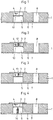
- FIGS. 1 to 16 shown embodiments for microstructured devices have great similarities, therefore, corresponding components are provided with the same reference numerals.
- FIG. 1 shown in section embodiment has an advantageous plate-shaped carrier 1, are introduced into the two opposite sides of each other recesses, which are separated from each other by a blocking element 3.
- the opening of a recess is closed by a cover element 2, whereby a first cavity 4 is formed between the cover element 2, the blocking element 3 and the lateral walls of the recess.
- This first cavity 4 is completely filled with a small amount of liquid. It is also possible that the first cavity 4 is only partially filled with the amount of liquid and contains a small gas bubble.
- the other recess is closed with a film 6, which is applied to the surface of the carrier 1, in which the recess is provided. Characterized a second cavity 5 is formed, which is bounded by the blocking element 3 of the film 6 and the lateral walls of the recesses.
- the carrier 1 also has a through hole 8, which is also closed on one side by the film 6. This through hole forms a removal chamber, which is connected via a removal channel 7 with the second cavity 5.
- the blocking element 3 has a circumferential predetermined breaking point 10, which is formed by a dilution of material on the second cavity 5 facing side.
- the stored in the first cavity 4 small amount of liquid can be removed from the first cavity 4 as follows.
- the cover element By a force acting on the cover element 2, the cover element is pressed in the direction of the amount of liquid. Since the amount of liquid is essentially incompressible, the force acts which is exerted on the cover element 2, transmitted to the locking element 3.
- This force causes as in Fig. 13 is shown, the middle part of the locking element along the circumferential predetermined breaking point 10 is broken out of the remaining blocking element 3 and so a connection between the first cavity 4 and the second cavity 5 is formed. Due to transport forces, these are usually compressive forces, the gravitational force or capillary forces, the liquid is then transported from the first cavity 4 into the second cavity 5, the channel 7 into the removal chamber 8.
- a reagent in liquid or solid form or a sample can be introduced, with which the originally stored in the first cavity amount of liquid is reacted or mixed.
- FIG. 2 illustrated embodiment differs from the in Fig. 1 illustrated embodiment in that the first cavity 4 is not completely filled with the amount of liquid. Rather, a gas-filled space remains between the liquid level and the lid member 2. Thus, the force acting on the lid member 2 for releasing the amount of liquid can still be transmitted to the locking element 10, a plunger is provided between the cover member 2 and the locking element 3, which is integrally connected to the central part of the locking element.
- the in Fig. 3 illustrated embodiment a blocking element, which has no predetermined breaking point 10.
- a mandrel 13 is fixed, which with his Tip is directed to the blocking element 3. If the cover element 2 is now pressed by a force in the direction of the blocking element 3, the mandrel 13 pierces with its tip into the blocking element 3 in order to remove the blocking effect of the blocking element 3.
- the liquid stored in the first cavity 4 can then penetrate into the second cavity 5 through the opening created in the blocking element by means of the mandrel 13.
- Fig. 4 is one of the Fig. 3 described similar embodiment in which, however, the first cavity 4 is completely filled with the amount of liquid, while on the film 6 a projecting towards the locking element 3 mandrel 14 is mounted, which causes the destruction of the blocking element 3 to release the amount of liquid.
- the blocking element 3 is deflected in the direction of the mandrel 14 via the amount of liquid in the first cavity 4, which points into the blocking element with its tip in order to destroy it. So then the amount of liquid from the first cavity 4 can penetrate into the second cavity 5.
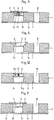
- FIG. 5 illustrated embodiment of a microstructured device is similar to that in Fig. 2 illustrated device formed. Unlike the in Fig. 2 illustrated embodiment, the embodiment in Fig. 5 in the cover element 2 a circumferential predetermined breaking point 11. As soon as the central region of the cover element is pressed down by a force, breaks the predetermined breaking point 11 and the plunger 12 presses on the middle part of the locking element 3, which eventually breaks up along the predetermined breaking point 10.
- the liquid which is stored in the first cavity 4, can enter the second cavity 5, wherein at the same time the first cavity 4 via the opening in the cover element 2 is ventilated.
- the inflowing air facilitates the outflow of the amount of liquid from the first cavity 4 into the second cavity 5.
- Fig. 5a is a variant of in Fig. 5 illustrated embodiment illustrated.
- the predetermined breaking point in the blocking element 10 encompasses an approximately circular region which completely surrounds the plunger 12.
- the predetermined breaking point 11 in the cover element 2 includes a circular area, on the underside of the plunger 12 abuts.
- the region enclosed by the predetermined breaking point 11 in the cover element 2 has a significantly smaller diameter than the region of the blocking element bordered by the predetermined breaking point 10. This has the consequence that when applying the minimum force, which is sufficient in this case, to destroy the predetermined breaking points 10, 11 in the cover element 2 and in the blocking element 3, so that the broken areas with the plunger 12 down into the second cavity 5 can be pressed.
- V in the variant of the device according to the Fig. 5a in the removal channel 7 and in a region of the second cavity 5 before the removal channel a V meneinlage 21 is provided.
- This V subjecteinlage causes an increased capillary force, which allows accelerated transport of the liquid entering the second cavity 5 through the removal channel 8.
- This in Fig. 6 illustrated embodiment of a microstructured device substantially corresponds to in Fig. 1 but different from those in Fig. 1 shown device in Fig. 6 illustrated device has no cylindrically shaped first cavity.
- the first cavity of the in Fig. 6 illustrated embodiment runs rather conically toward the locking element 3 and is thus formed substantially frusto-conical.
- the embodiment according to Fig. 7 essentially corresponds to the embodiment according to Fig. 1 However, it additionally has an inlet channel 9, which opens into the second cavity 5. Via this inlet channel 9, a second liquid can be guided into the second cavity 5, which mixes after the destruction of the blocking element 3 with the amount of liquid from the first cavity 4.
- the supplied liquid, as well as the amount of liquid in the first cavity 4, may be a sample, a reagent liquid or a rinsing liquid.
- This in Fig. 8 embodiment shown also has a first cavity 4 and a second cavity 5, wherein the device according to Fig. 8 manufactured differently than the according to Fig. 1 to 7 ,
- the carrier of the embodiment according to Fig. 8 namely, has a blind-hole-like recess which is introduced on one side into the carrier and which is subdivided into a first cavity 4 and a second cavity 5 by a blocking element 3 glued between the lateral walls. From the recess of the opposite side of the carrier channels 9, 7 are guided from the outside of the carrier to the second cavity 5, which open into the second cavity 5.
- One channel forms an inlet channel 9, while the other channel forms a withdrawal channel 7 forms.
- the glued or shrunk in between the first cavity 4 and the second cavity 5, pressed or shrunk locking element 3 has a designed in the known manner predetermined breaking point 10, on which the locking element 3 can be destroyed.
- the first cavity 4 is completely filled with a liquid amount, so that a force acting on the lid member 2 causes destruction of the locking member 3, whereby the amount of liquid in the first cavity 4 can enter the second cavity 5.
- FIGS. 9 and 14 show an embodiment which is provided with special means for the destruction of the cover element 2.
- the means for destruction are formed by a projecting into the first cavity 4 in a wedge-shaped projection 15 of the lateral wall of the first cavity 4.
- This projection forms a tip, which rests against the cover element 2. If now the cover element 2 is pressed down by the action of force, the tip of the projection 15 presses into the cover element 2 and destroys it.
- the first cavity 4 to vent the first cavity 4 in a release of the liquid contained in the first cavity 4 by destruction of the locking element 3, which facilitates the escape of the liquid from the second cavity 5.
- the first cavity has a cross-sectionally circular cross-section.
- Fig. 15 On the other hand, a cross-section of a similar device is shown, which is circular sector-like. This has the advantage that in a device having a plurality of such first cavities, as it is for example in Fig. 16 is shown, a plurality of first cavities can be compactly arranged one inside the other.
- Fig. 15 shows, moreover, another alternative means of destroying the Cover element 2, which is formed by a wedge 16 which is inserted in a recess of the lateral wall of the first chamber 4, but otherwise similar to the projection 15 according to FIG Fig. 14 destruction of the cover member 2 has a force effect.
- top view of a device shows that a device advantageously has a plurality of first cavities 4 and the blocking element 3 connected thereto.
- the second cavity (not shown) arranged below the first cavity 4 is connected to an inlet chamber 17 via an inlet channel, not shown, and to a removal chamber 8 via a withdrawal channel.
- the inlet chambers 17 can also be interconnected.
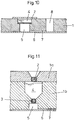
- Fig. 10 an embodiment of a microstructured device is shown, which has in carrier 1 a through hole with a shoulder.
- the through-hole above the heel has a diameter which is larger than below the heel.
- a blocking element 3 forming membrane is placed, which has an outer diameter corresponding to the inner diameter of the through hole.
- the through hole is divided into two separate parts, namely the first cavity and the second cavity 5, wherein the first cavity 4 is closed with the lid member 2 and the second cavity with the film 6.
- the device has a channel 7 designed in the known manner or a removal chamber 8 configured in the known manner.
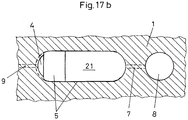
- FIGS. 17 to 17b illustrated embodiment of the invention has a cavity 4 and a second Cavity 5, which are substantially oval in cross section.
- the blocking element 3 is arranged between the two cavities 4, 5, the blocking element 3 is arranged.
- This blocking element 3 is integrally connected to the carrier 1.
- the blocking element 3 is integrally connected to a plunger 12 which is inserted in a first end region of the blocking element 3 between a cover element 2, with which the cavity 4 is closed at the top, and the blocking element 3.
- a predetermined breaking point 10 is provided between the blocking element 3 and the carrier 1, which extends from this end region along the lateral wall of the cavities 4, 5 to the opposite end region, wherein the opposite second end region is not provided with a predetermined breaking point is.
- the blocking element tears off the carrier 1 along the predetermined breaking point.
- the blocking element 3 is then connected to the carrier 1 only more via the second end region. This second end region thus forms a hinge region, on which the blocking element is pivotally mounted.
- a shoulder is formed in the first end region of the locking element 3. This shoulder cooperates with a detent 20 on the first end portion of the detent member 3 as a member for holding the detent member in a deflected position after the minimum force has acted on the lid member 2.
- the locking lug 20 engages by the breaking out and deflection of the locking element 3 down behind the paragraph in the wall of the second cavity 5 a. In this deflected position, the liquid can then flow out of the cavity 4 into the second cavity 5, even after the minimal force no longer acts on the lid element 2.
- V On the bottom of the second cavity 5 a V meneinlage 21 is provided in a central region and the end region. This V meneinlage causes an increased capillary force to transport the liquid entering the second cavity 5 through a removal channel 7 to the removal chamber 8.
- the carrier 1a, 1b of the device according to Fig. 11 is made in two parts and has a plate-shaped upper part 1a and a plate-shaped lower part 1b.
- the upper part has a conical recess, which is followed by a cylindrical bore.
- a preferably slightly elastic ball is sealingly inserted, which forms the cover element 2 of the device.
- the lower part 1b of the carrier which is mounted on the underside of the upper part 1a, has, with the recesses of the upper part 1a and the cover element 2 aligned, a first cylindrical portion, a conical portion and a second cylindrical portion, to which an advantage of the underside introduced cylindrical recess connects.
- a ball is sealingly inserted as a locking element 3, which separates the first cylindrical portion and the conical portion of the introduced from the bottom of the lower part 1b recess.
- the first cylindrical portion and the conical portion thus form the first with a liquid almost completely filled cavity 4.
- a film 6 is applied, whereby the second cavity is formed from the introduced from the bottom cylindrical recess.
- the diameter of the first cavity may be, for example, 1 to 3 mm, preferably 1.5 mm. The same applies to the second cavity.
- the blocking element 3 and the cover element 2 can have a diameter of 0.5 to 0.7 mm.
- the diameter of the first cavity of one of the embodiments according to Fig. 1 to 10 may be 2 to 8 mm, but preferably 2 to 5 mm.
- the height can be 1 to 7 mm and the volume between 10 to 100 mm 3 .
- the carrier 1 and the blocking element 3 may be made of polystyrene or polycarbonate.
- Fig. 12 illustrated embodiment, in contrast to the other embodiments, only one cavity, which has a first portion 4a, a second portion 5a.
- the cavity is variably divisible into the first section 4a and the second section 5a.
- the separation takes place via a blocking element which is displaceably mounted between the lateral walls of the first section.
- This blocking element is connected via a plunger 12 with a likewise displaceably mounted in the first portion 4a lid member 2.
- Die Sperretti 2 und 4 Sind mit dem Deckel 2 sky.
- the first portion 4a facing portion of the second portion 5a of the cavity moreover, the lateral wall of the cavity ringartigartig reset.
- the Fig. 12 shown device can be operated as follows. First, the component formed from the blocking element 3, the plunger 12 and the cover element 2 becomes as far as possible from the pulled out the first portion 4a, that the lid member 2 protrudes from the first portion 4a. By means of a gap which thereby arises between the cover element 2 and the upper end of the first section 4a of the cavity, the liquid can then be introduced into the cavity 4a. In order to then store the liquid in the first section 4a of the cavity, the component of the blocking element 3, the plunger 12 and the cover element 2 is pushed down until the cover element 2 bears sealingly against the lateral walls of the first section 4a of the cavity.
- the cover element 2 is moved downward by the action of force. Then the blocking element 3 projects into the annular groove-like section at the upper end of the second section 5a of the cavity. Through the annular groove, a fluidic connection between the first portion 4a and the second portion 5a of the cavity is then made, so that the liquid from the first portion 4a can enter the second portion 5a.
- Fig. 12a is a variant of the embodiment according to Fig. 12 shown.
- This variant differs in that the second portion 5a of the cavity has a larger diameter than the first portion 4a.
- a device makes it possible to store quantities of liquid in a cavity for a long time before they are then released for carrying out reactions or other chemical processes.
- the previously customary small containers used in the carrier (container), which are previously filled with the liquid and then need to be pierced by tools are no longer necessary. Rather, the liquid is stored directly in the carrier, which has the advantage that a more compact arrangement of the quantities of liquid on a carrier is possible and also the geometry of the liquid-storing cavities can be freely selected, as the needs of the practice require it.
Landscapes
- Engineering & Computer Science (AREA)
- General Engineering & Computer Science (AREA)
- Chemical & Material Sciences (AREA)
- Dispersion Chemistry (AREA)
- Mechanical Engineering (AREA)
- Health & Medical Sciences (AREA)
- Analytical Chemistry (AREA)
- General Health & Medical Sciences (AREA)
- Hematology (AREA)
- Clinical Laboratory Science (AREA)
- Chemical Kinetics & Catalysis (AREA)
- Sampling And Sample Adjustment (AREA)
- Apparatus Associated With Microorganisms And Enzymes (AREA)
- Containers And Packaging Bodies Having A Special Means To Remove Contents (AREA)
- Closures For Containers (AREA)
Applications Claiming Priority (2)
| Application Number | Priority Date | Filing Date | Title |
|---|---|---|---|
| DE10344229A DE10344229A1 (de) | 2003-09-24 | 2003-09-24 | Mikrostruktuierte Vorrichtung zum entnehmbaren Speichern von kleinen Flüssigkeitsmengen und Verfahren zum Entnehmen der in dieser Vorrichtung gespeicherten Flüssigkeit |
| DE10344229 | 2003-09-24 |
Publications (3)
| Publication Number | Publication Date |
|---|---|
| EP1518604A2 EP1518604A2 (de) | 2005-03-30 |
| EP1518604A3 EP1518604A3 (de) | 2009-07-01 |
| EP1518604B1 true EP1518604B1 (de) | 2018-06-13 |
Family
ID=34177921
Family Applications (1)
| Application Number | Title | Priority Date | Filing Date |
|---|---|---|---|
| EP04021864.6A Expired - Lifetime EP1518604B1 (de) | 2003-09-24 | 2004-09-15 | Mikrostrukturierte Vorrichtung zum entnehmbaren Speichern von kleinen Flüssigkeitsmengen und Verfahren zum Entnehmen der in dieser Vorrichtung gespeicherten Flüssigkeit |
Country Status (5)
| Country | Link |
|---|---|
| US (2) | US20050093087A1 (https=) |
| EP (1) | EP1518604B1 (https=) |
| JP (1) | JP2005096866A (https=) |
| CN (1) | CN100467128C (https=) |
| DE (1) | DE10344229A1 (https=) |
Families Citing this family (33)
| Publication number | Priority date | Publication date | Assignee | Title |
|---|---|---|---|---|
| CN101458249B (zh) * | 2007-12-14 | 2013-09-11 | 东莞博识生物科技有限公司 | 一种具有溶液储室兼泵体结构的微流体样品舟 |
| DE102008005686B9 (de) | 2008-01-23 | 2019-06-27 | Tdk Corporation | MEMS-Bauelement und Verfahren zur Herstellung eines MEMS-Bauelements |
| DE102008042196A1 (de) | 2008-09-18 | 2010-03-25 | Robert Bosch Gmbh | Verfahren zum Herstellen eines mikrofluidischen Bauelementes sowie mikrofluidisches Bauelement |
| EP2329884B1 (de) * | 2009-11-04 | 2012-02-22 | Boehringer Ingelheim microParts GmbH | Verfahren zur Aushärtung eines Klebstoffs |
| US8720036B2 (en) | 2010-03-09 | 2014-05-13 | Netbio, Inc. | Unitary biochip providing sample-in to results-out processing and methods of manufacture |
| CN103097883B (zh) * | 2010-03-09 | 2016-03-02 | 网络百奥有限公司 | 提供样本输入至结果输出处理的单体生物芯片以及制造方法 |
| DE102011004125A1 (de) * | 2011-02-15 | 2012-08-16 | Robert Bosch Gmbh | Vorrichtung zur hermetisch abgeschlossenen Bevorratung von Flüssigkeiten für ein mikrofluidisches System |
| CN103608110B (zh) | 2011-03-09 | 2017-06-06 | 彼克斯赛尔医疗科技有限公司 | 用于制备用于分析的包含细胞的样品流体的一次性盒子 |
| DK2720862T3 (en) | 2011-06-17 | 2016-09-19 | Fiberweb Inc | Vapor permeable, water impervious TOTAL MAJOR MULTI-LAYER ARTICLE |
| US10369769B2 (en) | 2011-06-23 | 2019-08-06 | Fiberweb, Inc. | Vapor-permeable, substantially water-impermeable multilayer article |
| ES2643697T3 (es) | 2011-06-23 | 2017-11-23 | Fiberweb, Llc | Artículo multicapa permeable al vapor y prácticamente impermeable al agua |
| WO2012178011A2 (en) | 2011-06-24 | 2012-12-27 | Fiberweb, Inc. | Vapor-permeable, substantially water-impermeable multilayer article |
| US8470153B2 (en) * | 2011-07-22 | 2013-06-25 | Tecan Trading Ag | Cartridge and system for manipulating samples in liquid droplets |
| US9857332B2 (en) | 2011-07-22 | 2018-01-02 | Tecan Trading Ag | System for manipulating samples in liquid droplets |
| US9435765B2 (en) | 2011-07-22 | 2016-09-06 | Tecan Trading Ag | Cartridge and system for manipulating samples in liquid droplets |
| JP6096665B2 (ja) * | 2011-09-20 | 2017-03-15 | 富士紡ホールディングス株式会社 | 試薬容器 |
| US9562540B2 (en) | 2011-09-29 | 2017-02-07 | Protectlife International Biomedical Inc. | Centrifugal rotor |
| CN104994955B (zh) * | 2013-01-09 | 2017-09-26 | 泰肯贸易股份公司 | 用于操纵液滴中的样品的系统 |
| WO2014108184A1 (en) * | 2013-01-09 | 2014-07-17 | Tecan Trading Ag | Cartridge and system for manipulating samples in liquid droplets |
| US10335786B2 (en) | 2013-05-31 | 2019-07-02 | Pixcell Medical Technologies Ltd. | Cartridge for preparing a sample fluid containing cells for analysis |
| DE102013106353B4 (de) * | 2013-06-18 | 2018-06-28 | Tdk Corporation | Verfahren zum Aufbringen einer strukturierten Beschichtung auf ein Bauelement |
| JP6192731B2 (ja) * | 2013-09-30 | 2017-09-06 | 株式会社日立製作所 | 試薬保持容器、送液装置 |
| US9795968B2 (en) * | 2014-04-21 | 2017-10-24 | Lawrence Livermore National Security, LLCq | Multi-chamber nucleic acid amplification and detection device |
| JP5788562B1 (ja) * | 2014-05-01 | 2015-09-30 | 株式会社タスコ | 宝石 |
| EP4115978A1 (en) | 2015-01-14 | 2023-01-11 | Pixcell Medical Technologies Ltd. | Disposable cartridge for sample fluid analysis |
| EP3290928A4 (en) * | 2015-04-30 | 2018-10-10 | Sysmex Corporation | Liquid encapsulation cartridge, sample analysis device, and sample analysis method |
| JP6446146B2 (ja) * | 2016-09-14 | 2018-12-26 | 積水化学工業株式会社 | マイクロチップ |
| JP6421159B2 (ja) * | 2016-10-28 | 2018-11-07 | シスメックス株式会社 | 液体封止カートリッジおよび送液方法 |
| DE102017210459A1 (de) * | 2017-06-22 | 2018-12-27 | Robert Bosch Gmbh | Mikromechanische Vorrichtung mit einer ersten Kaverne und einer zweiten Kaverne |
| US11975321B2 (en) | 2018-03-27 | 2024-05-07 | Lawrence Livermore National Security, Llc | Multi-channel optical detection system and method for multi-chamber assays |
| WO2020053111A1 (en) | 2018-09-11 | 2020-03-19 | F. Hoffmann-La Roche Ag | Cartridge with liquid pack |
| JP2020125915A (ja) * | 2019-02-01 | 2020-08-20 | 株式会社エンプラス | 流体取扱システムおよびカートリッジ |
| JP7445403B2 (ja) * | 2019-09-27 | 2024-03-07 | シスメックス株式会社 | 液体封止カートリッジおよび送液方法 |
Citations (2)
| Publication number | Priority date | Publication date | Assignee | Title |
|---|---|---|---|---|
| US2251501A (en) * | 1939-05-22 | 1941-08-05 | Arthur E Smith | Syringe ampoule |
| US6495373B1 (en) * | 1998-10-14 | 2002-12-17 | Polaroid Corporation | Method and apparatus for performing diagnostic tests |
Family Cites Families (30)
| Publication number | Priority date | Publication date | Assignee | Title |
|---|---|---|---|---|
| US2591706A (en) * | 1950-09-29 | 1952-04-08 | Compule Corp | Plural-compartment admixing hypodermic syringe ampoule for segregated storage of ingredients of liquid medicinal solutions and therapeutic preparations |
| US2773591A (en) * | 1952-10-22 | 1956-12-11 | Novo Terapeutisk Labor As | Vessel with sterile closure for separate storage of at least two substances |
| DE1013756B (de) * | 1954-01-09 | 1957-08-14 | Siemens Ag | Von einer Wechselspannungsquelle gespeiste Schaltungsanordnung zur Lieferung eines konstanten Stromes |
| US3220588A (en) * | 1964-09-17 | 1965-11-30 | Lipari Michael | Compartmental dispensing receptacle with accessories |
| GB1354286A (en) * | 1970-05-13 | 1974-05-22 | Bagshawe K D | Performance of routine chemical reactions |
| US3704206A (en) * | 1971-02-25 | 1972-11-28 | Miles Lab | Device for the detection of bacteria in aqueous fluids |
| CA983358A (en) * | 1971-09-08 | 1976-02-10 | Kenneth D. Bagshawe | Performance of chemical or biological reactions |
| US4324758A (en) * | 1979-04-12 | 1982-04-13 | The United States Of America As Represented By The Secretary Of The Air Force | Analysis of lubricating oils for iron content |
| US4526690A (en) * | 1983-02-04 | 1985-07-02 | Millipore Corporation | Apparatus for nucleic acid quantification |
| US5362654A (en) * | 1984-07-20 | 1994-11-08 | Sangstat Medical Corporation | Self-contained quantitative assay |
| WO1986006488A1 (en) * | 1985-04-29 | 1986-11-06 | Hichem Diagnostics, Inc., Dba Bural Technologies | Diagnostic test kit |
| ES2034186T3 (es) * | 1987-02-17 | 1993-04-01 | Cmb Foodcan Plc | Dispositivo de pruebas analiticas. |
| US4985631A (en) * | 1988-02-16 | 1991-01-15 | Wannlund Jon C | Luminescence exposure apparatus |
| US5147780A (en) * | 1989-12-01 | 1992-09-15 | Sangstat Medical Corporation | Multiwell stat test |
| US5364591A (en) * | 1992-06-01 | 1994-11-15 | Eastman Kodak Company | Device for moving a target-bearing solid through a liquid for detection while being contained |
| US5290518A (en) * | 1992-08-17 | 1994-03-01 | Eastman Kodak Company | Flexible extraction device with burstable sidewall |
| US5500187A (en) * | 1992-12-08 | 1996-03-19 | Westinghouse Electric Corporation | Disposable optical agglutination assay device and method for use |
| DE19545130C2 (de) * | 1995-12-04 | 2001-05-17 | Karl Cammann | Verfahren und Vorrichtungen für ein modulares Mikrosystem für hochgenaue chemische Schnell-Analysen |
| US5863502A (en) * | 1996-01-24 | 1999-01-26 | Sarnoff Corporation | Parallel reaction cassette and associated devices |
| US5710041A (en) * | 1996-06-03 | 1998-01-20 | Remel L.P. | In situ reconstitutable lyophylized bacteria ampoule package |
| DE19828995B4 (de) * | 1997-06-30 | 2006-01-12 | INSTITUT FüR MIKROTECHNIK MAINZ GMBH | Anordnung von Mikroreaktionsgefäßen und Verfahren zur Abgabe einer Flüssigkeit aus einer Anordnung von Mikroreaktionsgefäßen |
| SE511891C2 (sv) | 1997-08-29 | 1999-12-13 | Ericsson Telefon Ab L M | Bipolär effekttransistor och framställningsförfarande |
| CN2423242Y (zh) * | 2000-03-21 | 2001-03-14 | 吴振东 | 侧向按压开启之气压式管状容器 |
| AU2002227305A1 (en) * | 2000-10-27 | 2002-05-06 | Microbiosciences, Inc. | Micro storage, reaction and detection cells and methods and apparatus for use thereof |
| CN1356243A (zh) * | 2000-12-05 | 2002-07-03 | 吴振东 | 一种推压开启式管状容器 |
| DE10137565B4 (de) | 2001-07-30 | 2004-07-15 | Filt Lungen- Und Thoraxdiagnostik Gmbh | Verfahren zur Bestimmung von Parametern eines Atemkondensats |
| DE10137561A1 (de) | 2001-08-01 | 2003-02-13 | Christian Hoernicke | Gelenkstreifen zur Verbindung zweier schrittweise gegeneinander zu verdrehenden Gegenstände |
| ATE430625T1 (de) | 2001-12-12 | 2009-05-15 | Argillon Gmbh | Vorrichtung und verfahren zum zerstäuben einer flüssigkeit in ein volumen |
| GB0129816D0 (en) * | 2001-12-13 | 2002-01-30 | The Technology Partnership Plc | Testing device for chemical or biochemical analysis |
| US6532997B1 (en) * | 2001-12-28 | 2003-03-18 | 3M Innovative Properties Company | Sample processing device with integral electrophoresis channels |
-
2003
- 2003-09-24 DE DE10344229A patent/DE10344229A1/de not_active Ceased
-
2004
- 2004-09-15 EP EP04021864.6A patent/EP1518604B1/de not_active Expired - Lifetime
- 2004-09-24 JP JP2004278569A patent/JP2005096866A/ja not_active Withdrawn
- 2004-09-24 CN CN200410011713.4A patent/CN100467128C/zh not_active Expired - Fee Related
- 2004-09-24 US US10/948,792 patent/US20050093087A1/en not_active Abandoned
-
2008
- 2008-11-10 US US12/292,029 patent/US7964161B2/en not_active Expired - Lifetime
Patent Citations (2)
| Publication number | Priority date | Publication date | Assignee | Title |
|---|---|---|---|---|
| US2251501A (en) * | 1939-05-22 | 1941-08-05 | Arthur E Smith | Syringe ampoule |
| US6495373B1 (en) * | 1998-10-14 | 2002-12-17 | Polaroid Corporation | Method and apparatus for performing diagnostic tests |
Also Published As
| Publication number | Publication date |
|---|---|
| EP1518604A3 (de) | 2009-07-01 |
| EP1518604A2 (de) | 2005-03-30 |
| US7964161B2 (en) | 2011-06-21 |
| CN100467128C (zh) | 2009-03-11 |
| US20090074626A1 (en) | 2009-03-19 |
| DE10344229A1 (de) | 2005-05-19 |
| JP2005096866A (ja) | 2005-04-14 |
| US20050093087A1 (en) | 2005-05-05 |
| CN1608735A (zh) | 2005-04-27 |
Similar Documents
| Publication | Publication Date | Title |
|---|---|---|
| EP1518604B1 (de) | Mikrostrukturierte Vorrichtung zum entnehmbaren Speichern von kleinen Flüssigkeitsmengen und Verfahren zum Entnehmen der in dieser Vorrichtung gespeicherten Flüssigkeit | |
| DE19831791B4 (de) | Patronenartiger Behälter zur Aufnahme von zwei erst bei Gebrauch miteinander in Kontakt kommenden Stoffen | |
| EP3946735B1 (de) | Vorrichtung und verfahren zum aufnehmen und handhaben einer flüssigen probe und einer substanz | |
| EP2413138A2 (de) | Vorrichtung und Verfahren zur Abtrennung von Bestandteilen einer Probenflüssigkeit | |
| EP1140259A1 (de) | Mehrkammer-ampulle zum ausgeben eines aus mehreren substanzen bestehenden gemisches | |
| DE1280697B (de) | Verschlussvorrichtung mit doppelter Abdichtung fuer zwei verschiedene Fluessigkeiten enthaltende Spritzflaschen | |
| DE112011105686B4 (de) | Zentrifugenrotor | |
| EP2089084B1 (de) | Aufsatz für eine spritze oder eine karpule | |
| EP3052407A1 (de) | Kapsel und system zur zubereitung eines flüssigen lebensmittels | |
| EP3108962A1 (de) | Probenträger | |
| EP3406340A1 (de) | Flusszelle mit gehäusebauteil | |
| WO2018001647A1 (de) | Flusszelle mit reagenzspeicher | |
| DE29820832U1 (de) | Anordnung zum Anmischen von Mehrkomponentenmassen, insbesondere für Dentalzwecke | |
| EP2992324B1 (de) | Probengeber für eine analysevorrichtung | |
| EP3045143B1 (de) | Mischkapsel zur herstellung eines dentalpräparats | |
| EP0993819A2 (de) | Beutel für zwei getrennt aufzubewahrende und zu mischende Substanzen | |
| DE10222478A1 (de) | Verteilelement für Flüssigkeiten und Gase, Lab-on-a-Cip, Lab-on-a-Card | |
| EP2153717A1 (de) | Kennzeichnungs- und Probenahmevorrichtung für Tiere | |
| DE602005004551T2 (de) | Applikator für fluide substanzen für den einsatz in der medizin und/oder kosmetik | |
| WO2005124204A2 (de) | Verschluss für einen behälter | |
| EP3652083B1 (de) | Behälterverschluss mit einer standardkapsel | |
| DE3208786A1 (de) | Zweikammerbehaeltnis mit zerstoerbarer trennwand | |
| EP1900652A1 (de) | Behälter | |
| EP4561751A1 (de) | Probenaufnahmevorrichtung | |
| AT509898B1 (de) | Mehrkammerbehälter mit mindestens zwei mit ausgiessbarem inhalt befüllten behältern |
Legal Events
| Date | Code | Title | Description |
|---|---|---|---|
| PUAI | Public reference made under article 153(3) epc to a published international application that has entered the european phase |
Free format text: ORIGINAL CODE: 0009012 |
|
| AK | Designated contracting states |
Kind code of ref document: A2 Designated state(s): AT BE BG CH CY CZ DE DK EE ES FI FR GB GR HU IE IT LI LU MC NL PL PT RO SE SI SK TR |
|
| AX | Request for extension of the european patent |
Extension state: AL HR LT LV MK |
|
| RAP1 | Party data changed (applicant data changed or rights of an application transferred) |
Owner name: BOEHRINGER INGELHEIM MICROPARTS GMBH |
|
| PUAL | Search report despatched |
Free format text: ORIGINAL CODE: 0009013 |
|
| AK | Designated contracting states |
Kind code of ref document: A3 Designated state(s): AT BE BG CH CY CZ DE DK EE ES FI FR GB GR HU IE IT LI LU MC NL PL PT RO SE SI SK TR |
|
| AX | Request for extension of the european patent |
Extension state: AL HR LT LV MK |
|
| 17P | Request for examination filed |
Effective date: 20100104 |
|
| AKX | Designation fees paid |
Designated state(s): AT BE BG CH CY CZ DE DK EE ES FI FR GB GR HU IE IT LI LU MC NL PL PT RO SE SI SK TR |
|
| 17Q | First examination report despatched |
Effective date: 20120525 |
|
| GRAP | Despatch of communication of intention to grant a patent |
Free format text: ORIGINAL CODE: EPIDOSNIGR1 |
|
| RIC1 | Information provided on ipc code assigned before grant |
Ipc: B01L 3/00 20060101AFI20171122BHEP Ipc: F16K 99/00 20060101ALI20171122BHEP |
|
| INTG | Intention to grant announced |
Effective date: 20171220 |
|
| GRAS | Grant fee paid |
Free format text: ORIGINAL CODE: EPIDOSNIGR3 |
|
| GRAA | (expected) grant |
Free format text: ORIGINAL CODE: 0009210 |
|
| AK | Designated contracting states |
Kind code of ref document: B1 Designated state(s): AT BE BG CH CY CZ DE DK EE ES FI FR GB GR HU IE IT LI LU MC NL PL PT RO SE SI SK TR |
|
| REG | Reference to a national code |
Ref country code: GB Ref legal event code: FG4D Free format text: NOT ENGLISH |
|
| REG | Reference to a national code |
Ref country code: CH Ref legal event code: EP Ref country code: AT Ref legal event code: REF Ref document number: 1007916 Country of ref document: AT Kind code of ref document: T Effective date: 20180615 |
|
| REG | Reference to a national code |
Ref country code: DE Ref legal event code: R096 Ref document number: 502004015694 Country of ref document: DE |
|
| REG | Reference to a national code |
Ref country code: IE Ref legal event code: FG4D Free format text: LANGUAGE OF EP DOCUMENT: GERMAN |
|
| REG | Reference to a national code |
Ref country code: FR Ref legal event code: PLFP Year of fee payment: 15 |
|
| REG | Reference to a national code |
Ref country code: NL Ref legal event code: MP Effective date: 20180613 |
|
| PG25 | Lapsed in a contracting state [announced via postgrant information from national office to epo] |
Ref country code: BG Free format text: LAPSE BECAUSE OF FAILURE TO SUBMIT A TRANSLATION OF THE DESCRIPTION OR TO PAY THE FEE WITHIN THE PRESCRIBED TIME-LIMIT Effective date: 20180913 Ref country code: FI Free format text: LAPSE BECAUSE OF FAILURE TO SUBMIT A TRANSLATION OF THE DESCRIPTION OR TO PAY THE FEE WITHIN THE PRESCRIBED TIME-LIMIT Effective date: 20180613 Ref country code: SE Free format text: LAPSE BECAUSE OF FAILURE TO SUBMIT A TRANSLATION OF THE DESCRIPTION OR TO PAY THE FEE WITHIN THE PRESCRIBED TIME-LIMIT Effective date: 20180613 Ref country code: ES Free format text: LAPSE BECAUSE OF FAILURE TO SUBMIT A TRANSLATION OF THE DESCRIPTION OR TO PAY THE FEE WITHIN THE PRESCRIBED TIME-LIMIT Effective date: 20180613 Ref country code: CY Free format text: LAPSE BECAUSE OF FAILURE TO SUBMIT A TRANSLATION OF THE DESCRIPTION OR TO PAY THE FEE WITHIN THE PRESCRIBED TIME-LIMIT Effective date: 20180613 |
|
| PG25 | Lapsed in a contracting state [announced via postgrant information from national office to epo] |
Ref country code: GR Free format text: LAPSE BECAUSE OF FAILURE TO SUBMIT A TRANSLATION OF THE DESCRIPTION OR TO PAY THE FEE WITHIN THE PRESCRIBED TIME-LIMIT Effective date: 20180914 |
|
| REG | Reference to a national code |
Ref country code: CH Ref legal event code: PK Free format text: BERICHTIGUNGEN |
|
| PG25 | Lapsed in a contracting state [announced via postgrant information from national office to epo] |
Ref country code: NL Free format text: LAPSE BECAUSE OF FAILURE TO SUBMIT A TRANSLATION OF THE DESCRIPTION OR TO PAY THE FEE WITHIN THE PRESCRIBED TIME-LIMIT Effective date: 20180613 |
|
| RIC2 | Information provided on ipc code assigned after grant |
Ipc: F16K 99/00 20060101ALI20171122BHEP Ipc: B01L 3/00 20060101AFI20171122BHEP |
|
| PG25 | Lapsed in a contracting state [announced via postgrant information from national office to epo] |
Ref country code: EE Free format text: LAPSE BECAUSE OF FAILURE TO SUBMIT A TRANSLATION OF THE DESCRIPTION OR TO PAY THE FEE WITHIN THE PRESCRIBED TIME-LIMIT Effective date: 20180613 Ref country code: CZ Free format text: LAPSE BECAUSE OF FAILURE TO SUBMIT A TRANSLATION OF THE DESCRIPTION OR TO PAY THE FEE WITHIN THE PRESCRIBED TIME-LIMIT Effective date: 20180613 Ref country code: RO Free format text: LAPSE BECAUSE OF FAILURE TO SUBMIT A TRANSLATION OF THE DESCRIPTION OR TO PAY THE FEE WITHIN THE PRESCRIBED TIME-LIMIT Effective date: 20180613 Ref country code: SK Free format text: LAPSE BECAUSE OF FAILURE TO SUBMIT A TRANSLATION OF THE DESCRIPTION OR TO PAY THE FEE WITHIN THE PRESCRIBED TIME-LIMIT Effective date: 20180613 Ref country code: PL Free format text: LAPSE BECAUSE OF FAILURE TO SUBMIT A TRANSLATION OF THE DESCRIPTION OR TO PAY THE FEE WITHIN THE PRESCRIBED TIME-LIMIT Effective date: 20180613 |
|
| REG | Reference to a national code |
Ref country code: CH Ref legal event code: PK Free format text: BERICHTIGUNGEN |
|
| RIC2 | Information provided on ipc code assigned after grant |
Ipc: B01L 3/00 20060101AFI20171122BHEP Ipc: F16K 99/00 20060101ALI20171122BHEP |
|
| PG25 | Lapsed in a contracting state [announced via postgrant information from national office to epo] |
Ref country code: IT Free format text: LAPSE BECAUSE OF FAILURE TO SUBMIT A TRANSLATION OF THE DESCRIPTION OR TO PAY THE FEE WITHIN THE PRESCRIBED TIME-LIMIT Effective date: 20180613 |
|
| REG | Reference to a national code |
Ref country code: DE Ref legal event code: R097 Ref document number: 502004015694 Country of ref document: DE |
|
| PLBE | No opposition filed within time limit |
Free format text: ORIGINAL CODE: 0009261 |
|
| STAA | Information on the status of an ep patent application or granted ep patent |
Free format text: STATUS: NO OPPOSITION FILED WITHIN TIME LIMIT |
|
| PG25 | Lapsed in a contracting state [announced via postgrant information from national office to epo] |
Ref country code: MC Free format text: LAPSE BECAUSE OF FAILURE TO SUBMIT A TRANSLATION OF THE DESCRIPTION OR TO PAY THE FEE WITHIN THE PRESCRIBED TIME-LIMIT Effective date: 20180613 |
|
| REG | Reference to a national code |
Ref country code: CH Ref legal event code: PL |
|
| 26N | No opposition filed |
Effective date: 20190314 |
|
| PG25 | Lapsed in a contracting state [announced via postgrant information from national office to epo] |
Ref country code: SI Free format text: LAPSE BECAUSE OF FAILURE TO SUBMIT A TRANSLATION OF THE DESCRIPTION OR TO PAY THE FEE WITHIN THE PRESCRIBED TIME-LIMIT Effective date: 20180613 Ref country code: DK Free format text: LAPSE BECAUSE OF FAILURE TO SUBMIT A TRANSLATION OF THE DESCRIPTION OR TO PAY THE FEE WITHIN THE PRESCRIBED TIME-LIMIT Effective date: 20180613 |
|
| REG | Reference to a national code |
Ref country code: BE Ref legal event code: MM Effective date: 20180930 |
|
| REG | Reference to a national code |
Ref country code: IE Ref legal event code: MM4A |
|
| PG25 | Lapsed in a contracting state [announced via postgrant information from national office to epo] |
Ref country code: LU Free format text: LAPSE BECAUSE OF NON-PAYMENT OF DUE FEES Effective date: 20180915 |
|
| PG25 | Lapsed in a contracting state [announced via postgrant information from national office to epo] |
Ref country code: IE Free format text: LAPSE BECAUSE OF NON-PAYMENT OF DUE FEES Effective date: 20180915 |
|
| PG25 | Lapsed in a contracting state [announced via postgrant information from national office to epo] |
Ref country code: LI Free format text: LAPSE BECAUSE OF NON-PAYMENT OF DUE FEES Effective date: 20180930 Ref country code: CH Free format text: LAPSE BECAUSE OF NON-PAYMENT OF DUE FEES Effective date: 20180930 Ref country code: BE Free format text: LAPSE BECAUSE OF NON-PAYMENT OF DUE FEES Effective date: 20180930 |
|
| REG | Reference to a national code |
Ref country code: AT Ref legal event code: MM01 Ref document number: 1007916 Country of ref document: AT Kind code of ref document: T Effective date: 20180915 |
|
| PG25 | Lapsed in a contracting state [announced via postgrant information from national office to epo] |
Ref country code: AT Free format text: LAPSE BECAUSE OF NON-PAYMENT OF DUE FEES Effective date: 20180915 |
|
| PG25 | Lapsed in a contracting state [announced via postgrant information from national office to epo] |
Ref country code: TR Free format text: LAPSE BECAUSE OF FAILURE TO SUBMIT A TRANSLATION OF THE DESCRIPTION OR TO PAY THE FEE WITHIN THE PRESCRIBED TIME-LIMIT Effective date: 20180613 |
|
| PG25 | Lapsed in a contracting state [announced via postgrant information from national office to epo] |
Ref country code: HU Free format text: LAPSE BECAUSE OF FAILURE TO SUBMIT A TRANSLATION OF THE DESCRIPTION OR TO PAY THE FEE WITHIN THE PRESCRIBED TIME-LIMIT; INVALID AB INITIO Effective date: 20040915 Ref country code: PT Free format text: LAPSE BECAUSE OF FAILURE TO SUBMIT A TRANSLATION OF THE DESCRIPTION OR TO PAY THE FEE WITHIN THE PRESCRIBED TIME-LIMIT Effective date: 20180613 |
|
| PGFP | Annual fee paid to national office [announced via postgrant information from national office to epo] |
Ref country code: GB Payment date: 20230920 Year of fee payment: 20 |
|
| PGFP | Annual fee paid to national office [announced via postgrant information from national office to epo] |
Ref country code: FR Payment date: 20230927 Year of fee payment: 20 Ref country code: DE Payment date: 20230920 Year of fee payment: 20 |
|
| REG | Reference to a national code |
Ref country code: DE Ref legal event code: R071 Ref document number: 502004015694 Country of ref document: DE |
|
| REG | Reference to a national code |
Ref country code: GB Ref legal event code: PE20 Expiry date: 20240914 |
|
| PG25 | Lapsed in a contracting state [announced via postgrant information from national office to epo] |
Ref country code: GB Free format text: LAPSE BECAUSE OF EXPIRATION OF PROTECTION Effective date: 20240914 |
|
| PG25 | Lapsed in a contracting state [announced via postgrant information from national office to epo] |
Ref country code: GB Free format text: LAPSE BECAUSE OF EXPIRATION OF PROTECTION Effective date: 20240914 |