EP1517596A2 - Eingebettete Kondensatoren mit hoher Toleranz - Google Patents
Eingebettete Kondensatoren mit hoher Toleranz Download PDFInfo
- Publication number
- EP1517596A2 EP1517596A2 EP04005268A EP04005268A EP1517596A2 EP 1517596 A2 EP1517596 A2 EP 1517596A2 EP 04005268 A EP04005268 A EP 04005268A EP 04005268 A EP04005268 A EP 04005268A EP 1517596 A2 EP1517596 A2 EP 1517596A2
- Authority
- EP
- European Patent Office
- Prior art keywords
- electrode
- capacitor
- electrode layer
- electrode portions
- dielectric
- Prior art date
- Legal status (The legal status is an assumption and is not a legal conclusion. Google has not performed a legal analysis and makes no representation as to the accuracy of the status listed.)
- Withdrawn
Links
Images








Classifications
-
- H—ELECTRICITY
- H05—ELECTRIC TECHNIQUES NOT OTHERWISE PROVIDED FOR
- H05K—PRINTED CIRCUITS; CASINGS OR CONSTRUCTIONAL DETAILS OF ELECTRIC APPARATUS; MANUFACTURE OF ASSEMBLAGES OF ELECTRICAL COMPONENTS
- H05K1/00—Printed circuits
- H05K1/16—Printed circuits incorporating printed electric components, e.g. printed resistors, capacitors or inductors
-
- H—ELECTRICITY
- H01—ELECTRIC ELEMENTS
- H01G—CAPACITORS; CAPACITORS, RECTIFIERS, DETECTORS, SWITCHING DEVICES, LIGHT-SENSITIVE OR TEMPERATURE-SENSITIVE DEVICES OF THE ELECTROLYTIC TYPE
- H01G4/00—Fixed capacitors; Processes of their manufacture
- H01G4/002—Details
- H01G4/005—Electrodes
- H01G4/01—Form of self-supporting electrodes
-
- H—ELECTRICITY
- H01—ELECTRIC ELEMENTS
- H01G—CAPACITORS; CAPACITORS, RECTIFIERS, DETECTORS, SWITCHING DEVICES, LIGHT-SENSITIVE OR TEMPERATURE-SENSITIVE DEVICES OF THE ELECTROLYTIC TYPE
- H01G4/00—Fixed capacitors; Processes of their manufacture
- H01G4/002—Details
- H01G4/255—Means for correcting the capacitance value
-
- H—ELECTRICITY
- H05—ELECTRIC TECHNIQUES NOT OTHERWISE PROVIDED FOR
- H05K—PRINTED CIRCUITS; CASINGS OR CONSTRUCTIONAL DETAILS OF ELECTRIC APPARATUS; MANUFACTURE OF ASSEMBLAGES OF ELECTRICAL COMPONENTS
- H05K1/00—Printed circuits
- H05K1/16—Printed circuits incorporating printed electric components, e.g. printed resistors, capacitors or inductors
- H05K1/162—Printed circuits incorporating printed electric components, e.g. printed resistors, capacitors or inductors incorporating printed capacitors
-
- H—ELECTRICITY
- H05—ELECTRIC TECHNIQUES NOT OTHERWISE PROVIDED FOR
- H05K—PRINTED CIRCUITS; CASINGS OR CONSTRUCTIONAL DETAILS OF ELECTRIC APPARATUS; MANUFACTURE OF ASSEMBLAGES OF ELECTRICAL COMPONENTS
- H05K1/00—Printed circuits
- H05K1/02—Details
- H05K1/09—Use of materials for the conductive, e.g. metallic pattern
- H05K1/092—Dispersed materials, e.g. conductive pastes or inks
-
- H—ELECTRICITY
- H05—ELECTRIC TECHNIQUES NOT OTHERWISE PROVIDED FOR
- H05K—PRINTED CIRCUITS; CASINGS OR CONSTRUCTIONAL DETAILS OF ELECTRIC APPARATUS; MANUFACTURE OF ASSEMBLAGES OF ELECTRICAL COMPONENTS
- H05K2201/00—Indexing scheme relating to printed circuits covered by H05K1/00
- H05K2201/01—Dielectrics
- H05K2201/0183—Dielectric layers
- H05K2201/0195—Dielectric or adhesive layers comprising a plurality of layers, e.g. in a multilayer structure
-
- H—ELECTRICITY
- H05—ELECTRIC TECHNIQUES NOT OTHERWISE PROVIDED FOR
- H05K—PRINTED CIRCUITS; CASINGS OR CONSTRUCTIONAL DETAILS OF ELECTRIC APPARATUS; MANUFACTURE OF ASSEMBLAGES OF ELECTRICAL COMPONENTS
- H05K2201/00—Indexing scheme relating to printed circuits covered by H05K1/00
- H05K2201/03—Conductive materials
- H05K2201/0332—Structure of the conductor
- H05K2201/0335—Layered conductors or foils
- H05K2201/0355—Metal foils
-
- H—ELECTRICITY
- H05—ELECTRIC TECHNIQUES NOT OTHERWISE PROVIDED FOR
- H05K—PRINTED CIRCUITS; CASINGS OR CONSTRUCTIONAL DETAILS OF ELECTRIC APPARATUS; MANUFACTURE OF ASSEMBLAGES OF ELECTRICAL COMPONENTS
- H05K2201/00—Indexing scheme relating to printed circuits covered by H05K1/00
- H05K2201/09—Shape and layout
- H05K2201/09209—Shape and layout details of conductors
- H05K2201/09218—Conductive traces
- H05K2201/09236—Parallel layout
-
- H—ELECTRICITY
- H05—ELECTRIC TECHNIQUES NOT OTHERWISE PROVIDED FOR
- H05K—PRINTED CIRCUITS; CASINGS OR CONSTRUCTIONAL DETAILS OF ELECTRIC APPARATUS; MANUFACTURE OF ASSEMBLAGES OF ELECTRICAL COMPONENTS
- H05K2201/00—Indexing scheme relating to printed circuits covered by H05K1/00
- H05K2201/09—Shape and layout
- H05K2201/09209—Shape and layout details of conductors
- H05K2201/095—Conductive through-holes or vias
- H05K2201/09509—Blind vias, i.e. vias having one side closed
-
- H—ELECTRICITY
- H05—ELECTRIC TECHNIQUES NOT OTHERWISE PROVIDED FOR
- H05K—PRINTED CIRCUITS; CASINGS OR CONSTRUCTIONAL DETAILS OF ELECTRIC APPARATUS; MANUFACTURE OF ASSEMBLAGES OF ELECTRICAL COMPONENTS
- H05K2201/00—Indexing scheme relating to printed circuits covered by H05K1/00
- H05K2201/09—Shape and layout
- H05K2201/09209—Shape and layout details of conductors
- H05K2201/09654—Shape and layout details of conductors covering at least two types of conductors provided for in H05K2201/09218 - H05K2201/095
- H05K2201/09663—Divided layout, i.e. conductors divided in two or more parts
-
- H—ELECTRICITY
- H05—ELECTRIC TECHNIQUES NOT OTHERWISE PROVIDED FOR
- H05K—PRINTED CIRCUITS; CASINGS OR CONSTRUCTIONAL DETAILS OF ELECTRIC APPARATUS; MANUFACTURE OF ASSEMBLAGES OF ELECTRICAL COMPONENTS
- H05K2201/00—Indexing scheme relating to printed circuits covered by H05K1/00
- H05K2201/09—Shape and layout
- H05K2201/09209—Shape and layout details of conductors
- H05K2201/09654—Shape and layout details of conductors covering at least two types of conductors provided for in H05K2201/09218 - H05K2201/095
- H05K2201/09718—Clearance holes
-
- H—ELECTRICITY
- H05—ELECTRIC TECHNIQUES NOT OTHERWISE PROVIDED FOR
- H05K—PRINTED CIRCUITS; CASINGS OR CONSTRUCTIONAL DETAILS OF ELECTRIC APPARATUS; MANUFACTURE OF ASSEMBLAGES OF ELECTRICAL COMPONENTS
- H05K2201/00—Indexing scheme relating to printed circuits covered by H05K1/00
- H05K2201/09—Shape and layout
- H05K2201/09209—Shape and layout details of conductors
- H05K2201/09654—Shape and layout details of conductors covering at least two types of conductors provided for in H05K2201/09218 - H05K2201/095
- H05K2201/09763—Printed component having superposed conductors, but integrated in one circuit layer
-
- H—ELECTRICITY
- H05—ELECTRIC TECHNIQUES NOT OTHERWISE PROVIDED FOR
- H05K—PRINTED CIRCUITS; CASINGS OR CONSTRUCTIONAL DETAILS OF ELECTRIC APPARATUS; MANUFACTURE OF ASSEMBLAGES OF ELECTRICAL COMPONENTS
- H05K2203/00—Indexing scheme relating to apparatus or processes for manufacturing printed circuits covered by H05K3/00
- H05K2203/10—Using electric, magnetic and electromagnetic fields; Using laser light
- H05K2203/107—Using laser light
-
- H—ELECTRICITY
- H05—ELECTRIC TECHNIQUES NOT OTHERWISE PROVIDED FOR
- H05K—PRINTED CIRCUITS; CASINGS OR CONSTRUCTIONAL DETAILS OF ELECTRIC APPARATUS; MANUFACTURE OF ASSEMBLAGES OF ELECTRICAL COMPONENTS
- H05K2203/00—Indexing scheme relating to apparatus or processes for manufacturing printed circuits covered by H05K3/00
- H05K2203/17—Post-manufacturing processes
- H05K2203/171—Tuning, e.g. by trimming of printed components or high frequency circuits
-
- H—ELECTRICITY
- H05—ELECTRIC TECHNIQUES NOT OTHERWISE PROVIDED FOR
- H05K—PRINTED CIRCUITS; CASINGS OR CONSTRUCTIONAL DETAILS OF ELECTRIC APPARATUS; MANUFACTURE OF ASSEMBLAGES OF ELECTRICAL COMPONENTS
- H05K2203/00—Indexing scheme relating to apparatus or processes for manufacturing printed circuits covered by H05K3/00
- H05K2203/17—Post-manufacturing processes
- H05K2203/175—Configurations of connections suitable for easy deletion, e.g. modifiable circuits or temporary conductors for electroplating; Processes for deleting connections
-
- H—ELECTRICITY
- H05—ELECTRIC TECHNIQUES NOT OTHERWISE PROVIDED FOR
- H05K—PRINTED CIRCUITS; CASINGS OR CONSTRUCTIONAL DETAILS OF ELECTRIC APPARATUS; MANUFACTURE OF ASSEMBLAGES OF ELECTRICAL COMPONENTS
- H05K3/00—Apparatus or processes for manufacturing printed circuits
- H05K3/40—Forming printed elements for providing electric connections to or between printed circuits
- H05K3/42—Plated through-holes or plated via connections
- H05K3/429—Plated through-holes specially for multilayer circuits, e.g. having connections to inner circuit layers
-
- H—ELECTRICITY
- H05—ELECTRIC TECHNIQUES NOT OTHERWISE PROVIDED FOR
- H05K—PRINTED CIRCUITS; CASINGS OR CONSTRUCTIONAL DETAILS OF ELECTRIC APPARATUS; MANUFACTURE OF ASSEMBLAGES OF ELECTRICAL COMPONENTS
- H05K3/00—Apparatus or processes for manufacturing printed circuits
- H05K3/46—Manufacturing multilayer circuits
- H05K3/4611—Manufacturing multilayer circuits by laminating two or more circuit boards
-
- H—ELECTRICITY
- H05—ELECTRIC TECHNIQUES NOT OTHERWISE PROVIDED FOR
- H05K—PRINTED CIRCUITS; CASINGS OR CONSTRUCTIONAL DETAILS OF ELECTRIC APPARATUS; MANUFACTURE OF ASSEMBLAGES OF ELECTRICAL COMPONENTS
- H05K3/00—Apparatus or processes for manufacturing printed circuits
- H05K3/46—Manufacturing multilayer circuits
- H05K3/4611—Manufacturing multilayer circuits by laminating two or more circuit boards
- H05K3/4623—Manufacturing multilayer circuits by laminating two or more circuit boards the circuit boards having internal via connections between two or more circuit layers before lamination, e.g. double-sided circuit boards
-
- H—ELECTRICITY
- H05—ELECTRIC TECHNIQUES NOT OTHERWISE PROVIDED FOR
- H05K—PRINTED CIRCUITS; CASINGS OR CONSTRUCTIONAL DETAILS OF ELECTRIC APPARATUS; MANUFACTURE OF ASSEMBLAGES OF ELECTRICAL COMPONENTS
- H05K3/00—Apparatus or processes for manufacturing printed circuits
- H05K3/46—Manufacturing multilayer circuits
- H05K3/4644—Manufacturing multilayer circuits by building the multilayer layer by layer, i.e. build-up multilayer circuits
- H05K3/4652—Adding a circuit layer by laminating a metal foil or a preformed metal foil pattern
Definitions
- the technical field is capacitors. More particularly, the technical field includes high tolerance value capacitors that may be embedded in printed wiring boards.
- PWB printed wiring boards
- Passive circuit elements are typically embedded in panels that are stacked and connected by interconnection circuitry, with the stack of panels forming the printed wiring board.
- the panels can be generally referred to as “innerlayer panels.”
- Capacitors have varying requirements depending upon their intended uses. In many circuits, capacitor tolerance, which is the allowable variation around a target capacitance value, is critical. For example, in timing and analog-to-digital (A/D) conversion applications, capacitors generally have low capacitance values and high tolerances. Some of these capacitors have tolerance requirements of less than +/- 5% variation around their target value. In such cases, the high tolerance requirement is not easily obtained by common embedding techniques, such as screen printing or etching. Such capacitors may therefore be unsuitable for many applications requiring high tolerance.
- U.S, 4,190,854 to Redfern discloses a capacitor suitable for integration into a monolithic integrated circuit which is fabricated in two parallel connected sections. One section, using a thin oxide, constitutes most of the capacitance. A second section which is fabricated on a thick oxide constitutes a smaller capacitance per unit area but can be laser trimmed to provide a precise capacitance without damage to the integrated circuit.
- the trimmable section is desirably made using a conductive electrode material that is readily removed with laser energy.
- a printed wiring board is constructed from innerlayer panels.
- a capacitor in an innerlayer panel is made by forming a first electrode layer comprising a plurality of electrode portions, forming a dielectric contacting the first electrode layer, and forming a second electrode layer spaced from the first electrode layer, wherein the first electrode layer, the dielectric and the second electrode layer form a first capacitor.
- the capacitance of the capacitor may be set to have a capacitance that exceeds a desired or target capacitance value.
- One or more of the electrode portions of the first electrode layer are then trimmed or cut by a laser in order to disconnect a section of electrode from the capacitor so that the capacitance is lowered to a value that is close to or at the target value.
- the capacitor may be encased in organic dielectric material and incorporated into the printed wiring board along with additional innerlayer panels.
- a capacitor comprises a first electrode layer comprising a first plurality of elongated electrode portions, a second electrode layer comprising a second plurality of electrode portions spaced from and interdigitated with the first plurality of electrode portions, and a dielectric disposed between the first and second pluralities of electrode portions.
- One or more of the electrode portions may be trimmed in order to bring the capacitor to a target capacitance value.
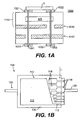
- FIG. 1A is a schematic section view in front elevation of a printed wiring board 1000 according to a first embodiment of the invention.
- the printed wiring board 1000 comprises an innerlayer panel 1100 having an embedded capacitor 105.
- One innerlayer panel 1100 is illustrated in FIG. 1A.
- the printed wiring board 1000 can, however, comprise two or more innerlayer panels.
- the capacitor 105 has trimmable electrodes.
- the capacitor 105 is electrically coupled to two circuit conductors 1001, 1002 extending through the printed wiring board 1000.
- the completed innerlayer panel 1100, before incorporation in the printed wiring board 1000, is illustrated in FIG. 1I.
- the printed wiring board 1000 includes connection circuitry 1021, 1022 and 1031, 1032 at opposite ends of the board 1000.
- the printed wiring board 1000 may also include a power plane 1010 and a ground plane 1012.
- the power plane 1010 may be formed as part of the innerlayer panel 1100.
- An exemplary device D is shown as coupled to the connection circuitry 1021, 1022.
- the device D can be, for example, a semiconductor chip.
- FIG. 1B is a top plan view of the capacitor 105 schematically illustrated in FIG. 1A.
- the capacitor 105 includes a first electrode layer 110, a second electrode layer 120, and a dielectric 130.
- the first electrode layer 110 is separated from the second electrode layer 120 by the dielectric 130. Only a portion of the second electrode layer 120 is shown in FIG. 1B.
- the first electrode layer 110 may be electrically isolated from the second electrode layer 120 by a trench (not shown in FIG. 1B).
- the second electrode layer 120 can be formed from, for example, a metallic foil.
- the first electrode layer 110 includes a plurality of electrode portions 114 of varying size, and a main electrode 112.
- the electrode portions 114 are connected to a conductive portion 126 by conductive portions 116.
- the main electrode 112 is electrically connected to the conductive portion 126 by a conductive portion 113.
- the first electrode layer 110 can be selectively trimmed across the conductive portions 116 in order to control the capacitance provided by the capacitor 105.
- a trim direction is indicated as the arrow T in FIG. 1B, and the trimming operation is discussed in detail below with reference to FIG. 1F.
- the main electrode 112 may be much larger than the electrode portions 114. Inclusion of the smaller trimmable electrode portions 114 allows for fine control of the total capacitance of the capacitor 105.
- FIG. 1I A method of making the innerlayer panel 1100 and a method of incorporating the innerlayer panel 1100 into the printed wiring board 1000 are discussed in detail below with reference to FIGS. 1C-1I.
- the innerlayer panel embodiment discussed below is a polymeric capacitor embodiment. Other materials of construction, however, may be used to form the innerlayer panel 1100.
- FIG. 1C is a section view in front elevation of a first stage of manufacture of the innerlayer panel 1100.
- a metallic foil 10 is provided.
- the foil 10 may be of a type generally available in the industry.
- the foil 10 may be copper, copper-invar-copper, invar, nickel, nickel-coated copper, or other metals.
- Preferred foils include foils comprised predominantly of copper, such as reverse-treated copper foils, double-treated copper foils, and other copper foils commonly used in the multilayer printed circuit board industry.
- the thickness of the foil 10 may be in the range of, for example, about 1-100 microns, preferably 3-75 microns, and most preferably 12-36 microns, corresponding to between about 1/3 oz and 1 oz copper foil.
- the foil 10 is laminated to a first laminate material 160.
- the laminate material 160 may be, for example, FR4 prepreg and/or other organic materials.
- FIG. 1D is a top plan view of the next stage of manufacture
- FIG. 1E is a section view taken on line 1E-1E in FIG. 1D.
- a photo-resist is applied to the foil 10 (reference number 10 is not used in FIGS. 1D and 1E), and the foil 10 is imaged, etched and stripped using, for example, standard printing wiring board processing conditions. Etching the foil 10 results in the second electrode layer 120 and the conductive portion 126 shown in FIG. 1D.
- a trench 122 isolates the second electrode layer 120 from the conductive portion 126.
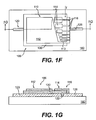
- FIG. 1F is a top plan view of a next stage of manufacture
- FIG. 1G is a section view taken on line 1G-1G in FIG. 1F.
- the dielectric 130 is formed over the second electrode layer 120.
- the dielectric 130 fills the trench 122.
- the dielectric 130 may be formed from, for example, a polymer thick film (PTF) paste, and may be applied by, for example, solution casting or screen printing.
- the dielectric 130 is then cured. Solvents present in the dielectric 130 are removed during the curing process.
- PPF polymer thick film
- a first electrode layer 110 is then formed over the dielectric 130, forming the electrode portions 114, the main electrode 112 and the conductive portions 113, 116.
- the first electrode layer 110 may be formed from, for example, a conductive PTF paste.
- the first electrode layer 110 is then cured.
- one or more of the electrode portions 114 may be selectively removed or disconnected from the capacitor by trimming (or “cutting") one or more of the conductive portions 116.
- a trimming direction is indicated by an arrow T.
- a UV-YAG laser is one preferred device to perform trimming. The UV-YAG laser selectively cuts one or more conductive portions 116 to reduce the total area of the electrode layer 110, thereby reducing the capacitance of the capacitor 105.
- the electrode portions 114 can have successively smaller sizes to provide flexibility in adjusting the capacitance of the capacitor 105.
- the laser may be programmed with the electrode design and use a feedback process in which the laser initially measures total capacitance and calculates the number of electrode portions that are required to be trimmed in order to avoid either undershooting or overshooting the desired value.
- the laser may also measure the capacitance change throughout the trimming process and may be programmed to stop trimming within a certain range of the desired value. High tolerance values can be achieved by selective trimming of the electrode portions 114.
- the resulting article is then laminated to a second laminate material 170.
- a foil 180 is applied to the first laminate material 160, and a foil 190 is applied to the second laminate material 170.
- FIG. 1I illustrates the finished innerlayer panel 1100.
- the foil 180 is imaged, etched and stripped to form an etched portion 1010.
- the etched portion 1010 can be, for example, a power plane.
- the foil 190 is also imaged, etched and stripped to form the connection circuitry 1021, 1022.
- the circuit conductors 1001, 1002 can be formed through the printed wiring board 1000. A section of each of the circuit conductors 1001, 1002 is shown in FIG. 1I.
- the innerlayer panel 1100 can be stacked with other layers, including, for example, additional innerlayer panels.
- the printed wiring board 1000 can be formed from multiple stacked innerlayer panels by, for example, lamination processes. Stacked innerlayer panels can be laminated together in one or more conventional lamination pressings and bonded together using, for example, dielectric prepregs.
- the printed wiring board 1000 may be laminated in multiple stages. For example, subassemblies of innerlayer panels may be processed and laminated, and one or more subassemblies can subsequently be stacked and laminated together to form the finished printed wiring board 1000.
- Each of the innerlayer panels in the printed wiring board 1000 can have a different design, including differing arrangements of circuit elements.
- the term "innerlayer panel” does not imply that a panel must be sandwiched in the interior of the printed wiring board 1000, and an innerlayer panel can also be located on, for example, outside layers of the printed wiring board 1000.
- the first and second circuit conductors 1001, 1002 can be formed as conductive vias, for example, by laser or mechanical drilling through the printed wiring board 1100. The holes formed by drilling are then plated with a conductive material. The resulting conductive vias 1001, 1002, which extend through the entire printed wiring board 1000 shown in FIG. 1A, are typically referred to as "plated through-holes.” Plated through-hole type vias are usually formed after all of the innerlayer panels of a printed wiring board have been laminated together. Additional circuit conductors (not shown) in other parts of the printed wiring board 1000 could extend through subassemblies of innerlayer panels or through individual innerlayer panels.
- buried vias Via circuit conductors extending through only a part of the printed wiring board 1000 are commonly referred to as "buried vias.” Buried vias are typically drilled and plated through a subassembly of innerlayer panels before the subassembly of innerlayer panels is incorporated into a printed wiring board. A small diameter conductive via formed on one or both sides of an innerlayer panel is commonly referred to as a "microvia,” and may be used, for example, to terminate a capacitor within an innerlayer panel. Any of the above-mentioned types of vias may be connected to the innerlayer panel embodiments discussed in this specification.
- the printed wiring board 1000 is complete.
- the printed wiring board 1000 is illustrated as comprising the innerlayer panel 1100, the ground plane 1012, the power plane 1010 and additional laminate layers in a stacked configuration. Any number of innerlayer panels may be included in a printed wiring board according to the embodiments discussed in this specification.
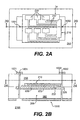
- FIG. 2A is a top plan section view of a portion of an alternative innerlayer panel 2100, taken on line 2A-2A in FIG. 2B.
- FIG. 2B is a section view in front elevation, taken on line 2B-2B in FIG. 2A.
- the innerlayer panel 2100 can be incorporated into a printed wiring board such as, for example, the printed wiring board 1000 illustrated in FIG. 1A.
- FIG. 2B illustrates the innerlayer panel 2100 after its incorporation into the printed wiring board 1000.
- the innerlayer panel 2100 includes a capacitor 205 laminated between layers 250 and 260 of laminate material.
- the capacitor 205 includes a first electrode layer 210 comprised of a plurality of electrode portions 215.
- the electrode portions 215 are interconnected by a plurality of conductive portions 217.
- a dielectric 230 separates the second electrode layer 220 from the first electrode layer 210.
- the first electrode layer 210 including the electrode portions 215 and the conductive portions 217, is electrically connected to a conductive portion 226.
- a trench 222 isolates the second electrode layer 220 from the first electrode layer 210.
- the first electrode layer 210 including the plurality of conductors 215, is electrically coupled to the second circuit conductor 1002.
- the second electrode layer 220 is electrically coupled to the first circuit conductor 1001.
- the circuit conductor sections 1001, 1002 correspond to a portion of the circuit conductors 1001, 1002 illustrated in FIG. 1A.
- the capacitance of the capacitor 205 can be varied to within small variances by trimming one or more of the electrode portions 215.
- the trimming is performed on innerlayer panel 2100 by trimming through the laminate 250 and through the conductive portions 217.
- Circuit conductors 1021, 1022 may serve as probe points, for example, for testing the capacitance of the capacitor 205.
- the electrode portions 215 can be trimmed in a variety of combinations and locations, allowing for fine control of the capacitance provided by the capacitor 205.
- the process for making the innerlayer panel 2100, including the trimming process, is described below with reference to FIGS. 2C-2J.
- the embodiment discussed below is a fired-on-foil embodiment using co-firing of capacitor layers. Other methods of construction, however, may be used to form the innerlayer panel 2100.
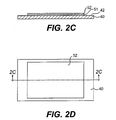
- FIG. 2C is a section view in front elevation of a first stage of manufacturing the innerlayer panel 2100.
- a metallic foil 40 is provided.
- the foil 40 may be of a type generally available in the industry.
- the foil 40 may be copper, copper-invar-copper, invar, nickel, nickel-coated copper, or other metals that have melting points in excess of the firing temperature for thick-film pastes.
- the foil 40 may be pretreated, for example, by applying and firing an underprint 42.
- the underprint 42 is a relatively thin layer applied to a component-side surface of the foil 40.
- the underprint 42 is indicated as a surface coating on the foil 40.
- the underprint 42 adheres well to the metal foil 40 and to layers deposited over the underprint 42.
- the underprint 42 may be formed, for example, from a paste applied to the foil 40, which is then fired at a temperature below the melting point of the foil 40.
- the paste may be printed as an open coating over the entire surface of the foil 40, or printed on selected areas of the foil 40.
- a dielectric material is screen-printed over the underprint 42, forming a first dielectric layer 51.
- the dielectric material may be, for example, a thick-film dielectric ink.
- the dielectric ink may be formed of, for example, a paste.
- the first dielectric layer 51 is then dried.
- a second dielectric layer 52 is then applied and dried.
- a single layer of dielectric material may be deposited through a mesh screen that is coarser than the mesh screen used to form the two separate layers 51, 52. The coarser mesh screen provides an equivalent thickness in one printing step.
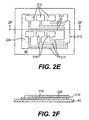
- a first electrode layer 210 is formed over the second dielectric layer 52 (reference numbers 51 and 52 are not used in FIGS. 2E and 2F) and dried.
- the first electrode layer 210 may be formed by, for example, screen-printing a thick-film metallic ink.
- the first electrode layer 210 is comprised of the plurality of electrode portions 215, which are interconnected by the plurality of conductive portions 217. A portion of the first electrode layer 210 extends over the dielectric layer 52 and contacts the foil 40.
- the surface area of the dielectric layer 52 when viewed from a top plan perspective, should be larger than that of the first electrode layer 210.
- the first dielectric layer 51, the second dielectric layer 52, and the first electrode layer 210 are then co-fired.
- "Co-fired" means that the layers 51, 52 are not fired prior to forming the first electrode layer 210.
- the post-fired structure is shown in FIGS. 2E and 2F.
- a dielectric 230 results from the co-firing step.
- the thick-film dielectric layers 51, 52 may be formed of, for example, a high K functional phase such as, for example, barium titanate and a dielectric property-modifying additive such as, for example, zirconium dioxide, mixed with a glass-ceramic frit phase.
- the glass-ceramic frit phase softens, wets the functional and additive phases and coalesces to create a dispersion of the functional phase and the modifying additive in a glass-ceramic matrix.
- the first electrode layer 210 and the foil 40 are wetted by the softened glass-ceramic frit phase and sintered together.
- the first electrode layer 210 and the foil 40 have a strong bond to the high K dielectric 230 that results from the co-firing.
- the structure is laminated on a first side of the foil 40 (reference number 40 is not used in FIG. 2G).
- the component-side face of the foil 40 can be laminated to a laminate material 250 and to a conductive foil 252.
- the lamination can be performed, for example, using FR4 prepreg or other organic materials in standard printing wiring board processes.
- a photo-resist is applied to the foil 40 and the foil 40 is imaged, etched and stripped using, for example, standard printing wiring board processing conditions.
- the second electrode layer 220 results from the etching of the foil 40.
- the etching creates a trench 222 in the foil 40 which breaks electrical contact of the first electrode layer 210 from the second electrode layer 220.
- a portion 226 of the foil 40 is electrically connected to the first electrode layer 210.
- the electrode layers 210 and 220 and the dielectric 230 form the capacitor 205.
- the foil 252 may be etched at this time or at a later time.
- the foil 252 may be etched to form the circuitry 1021, 1022 illustrated in FIG. 2B.
- the resulting article is laminated on a second side of the second electrode layer 220 to a second laminate material 260.
- a foil 262 may be applied to the second laminate material 260.
- the foil 262 may be etched to form circuitry.
- the foil 262 can be etched, for example, to form the power plane 1010 illustrated in FIG. 2B.
- Foil 252 may also be etched at this time.
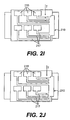
- the first electrode layer 210 may now be selectively trimmed in order to control the capacitance provided by the capacitor 205 (the capacitor 205 is shown in FIGS. 2A and 2B). Methods and patterns of trimming the first electrode layer 210 are discussed in detail below with reference to FIGS. 2I and 2J.
- FIG. 2H illustrates the innerlayer panel 2100 before integration of the innerlayer panel 2100 into the printed wiring board 1000 illustrated in FIG. 1A, and before formation of the circuitry 1021, 1022, 1001, 1002 and the power plane 1010.
- FIGS. 2A and 2B illustrate the innerlayer panel 2100 after its incorporation into the printed wiring board 1000.
- the printed wiring board 1000 can be formed from multiple stacked innerlayer panels by, for example, lamination processes.
- the innerlayer panels can be laminated together in one or more lamination pressings.
- the innerlayer panels can be bonded together using, for example, dielectric prepregs and other organic materials, and may be laminated in multiple stages.
- FIGS. 2I and 2J illustrate two exemplary trimming operations for the electrode 210.
- the electrode layer 210 may be selectively trimmed in order to control the capacitance provided by the capacitor 205 (FIGS. 2A and 2B). Trimming may be performed using, for example, a UV-YAG laser or a CO 2 laser or a combination of both.
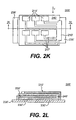
- FIGS. 2K and 2L illustrate an alternative embodiment to the capacitor 205 illustrated in FIGS. 2A and 2B.
- FIG. 2K is a top plan view of a capacitor 205'
- FIG. 2L is a section view in front elevation taken on line 2L-2L in FIG. 2K.
- the capacitor 205' includes a first electrode layer 210', a second electrode layer 220', a third electrode layer 230', and a dielectric 240'.
- the first and third electrode layers 210', 230' are separated from the second electrode layer 220' by the two-layer dielectric 240'.
- the first and third electrode layers 210', 230' are electrically isolated from the second electrode layer 220' by a trench 232'.
- the third electrode layer 230' can be formed from, for example, a metallic foil.
- the first electrode layer 210' includes a plurality of electrode portions 215' which are electrically coupled by conductive portions 217'.
- the first electrode layer 210' can be selectively trimmed in order to control the capacitance provided by the capacitor 205', as discussed above with reference to FIGS. 2I and 2J.
- the three-electrode, two-layer dielectric structure of the capacitor 205' provides a high capacitance.
- the capacitor 205' can be formed in a manner similar to the capacitor 205 (FIGS. 2A and 2B), and can be similarly laminated and incorporated in a printed wiring board.
- additional layers of dielectric are formed over the second electrode layer 220', and the first electrode layer 210' is formed over the additional dielectric layers.
- the capacitor 205' may be fired in one or in multiple firings.
- the article can be fired after forming the second electrode layer 220', and fired again after forming the first electrode layer 210'.
- a single co-firing can be performed after forming the first electrode layer 210'.
- a single co-firing is advantageous in that production costs are reduced. Two separate firings, however, allow for inspection of the second electrode layer 220' for defects, such as printing alignment problems, after the first firing.
- the first and third electrode layers 210', 230' may be electrically connected to a circuit conductor (not shown) contacting the third electrode layer 230'.
- the second electrode layer 220' can be electrically connected to a circuit conductor (not shown) contacting a conductive portion 236'.
- the circuit conductors connecting to the capacitor 205' can be similar to the circuit conductors 1001, 1002 illustrated in FIG. 1A. Other circuit conductor configurations are also possible.
- FIGS. 3A and 3B illustrate yet another alternative embodiment of a capacitor.
- FIG. 3A is a top plan view of a capacitor 305
- FIG. 3B is a section view in front elevation taken on line 3B-3B in FIG. 3A.
- the capacitor 305 includes a first electrode layer 310, a second electrode layer 320, and a dielectric 330.
- the capacitor 305 is formed over an organic laminate material 350.
- the first electrode layer 310 is separated from the second electrode layer 320 by the dielectric 330.
- the first electrode layer 310 may be electrically isolated from the second electrode layer 320 by a trench 322.
- the second electrode layer 320 can be formed from, for example, a metallic foil.
- the first electrode layer 310 includes a plurality of elongated electrode portions 315.
- the electrode portions 315 can be selectively trimmed in order to control the capacitance provided by the capacitor 305, as discussed above with reference to FIGS. 1J and 1K.
- the capacitor 305 can be formed in a manner similar to the capacitor 105 illustrated in FIG. 1B, using polymer thick film dielectric and conductor pastes.
- the capacitor 305 can be laminated and incorporated in a printed wiring board.
- the first electrode layer 310 may be electrically connected to a circuit conductor (not shown) contacting a conductive portion 326.
- the second electrode layer 320 can be electrically connected to a circuit conductor (not shown) contacting the second electrode layer 320.
- the circuit conductors connecting to the capacitor 305 can be similar to the circuit conductors 1001, 1002 illustrated in FIG. 1A.
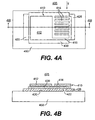
- FIGS. 4A and 4B illustrate yet another alternative embodiment of a capacitor.
- FIG. 4A is a top plan view of a capacitor 405, and FIG. 4B is a section view in front elevation taken on line 4B-4B in FIG. 4A.
- the capacitor 405 includes a first electrode layer 410, a second electrode layer 420, and a dielectric 430.
- the capacitor 405 is formed over a laminate material 450.
- the first electrode layer 410 is separated from the second electrode layer 420 by the dielectric 430.
- the first electrode layer 410 may be electrically isolated from the second electrode layer 420 by a trench 422.
- the second electrode layer 420 can be formed from, for example, a metallic foil.
- the first electrode layer 410 includes a plurality of electrode portions 414.
- the first electrode layer 410 can be selectively trimmed across the electrode portions 414 in order to control the capacitance provided by the capacitor 405.
- the first electrode layer 410 also includes a main electrode 412. Inclusion of the electrode portions 414 allows for fine control of the capacitance of the capacitor 405 because a relatively small portion of the first electrode layer 410 selectively trimmed.
- the capacitor 405 can be formed in a manner similar to the capacitor 105 illustrated in FIG. 1B, using polymer thick film dielectric and conductor pastes.
- the capacitor 405 can be laminated and incorporated in a printed wiring board.
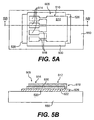
- FIGS. 5A and 5B illustrate yet another alternative embodiment of a capacitor.
- FIG. 5A is a top plan view of a capacitor 505
- FIG. 5B is a section view in front elevation taken on line 5B-5B in FIG. 5A.
- the capacitor 505 includes a first electrode layer 510, a second electrode layer 520, and a dielectric 530.
- the capacitor 505 is formed over a laminate material 550.
- the first electrode layer 510 is separated from the second electrode layer 520 by the dielectric 530.
- the first electrode layer 510 may be electrically isolated from the second electrode layer 520 by a trench 522.
- the second electrode layer 520 can be formed from, for example, a metallic foil.
- the first electrode layer 510 includes a plurality of electrode portions 514.
- the first electrode layer 510 can be selectively trimmed across conductive portions 516 in order to control the capacitance provided by the capacitor 505.
- the first electrode layer 510 also includes a main electrode 512 connected to the electrode portions 514 by the conductive portions 516.
- the main electrode 512 may be much larger than the electrode portions 514. Inclusion of the trimmable electrode portions 514 allows for fine control of the capacitance of the capacitor 505.
- FIGS. 6A-6C illustrate yet another embodiment of a capacitor.
- a capacitor 605 is embedded in an innerlayer panel 6100.
- FIG. 6A is a section view taken on line 6A-6A in FIG. 6C
- FIG. 6B is a section view taken on line 6B-6B in FIG. 6C.
- FIG. 6C is a section view taken on line 6C-6C in FIG. 6A
- the innerlayer panel 6100 comprises the capacitor 605 laminated to laminate materials 660, 670.
- the innerlayer panel 6100 is illustrated as it would appear after incorporation into a printed wiring board, such as the printed wiring board 1000 illustrated in FIG. 1A.
- the capacitor 605 comprises a first electrode layer 610, a second electrode layer 620, and a dielectric 630.
- a trench 622 electrically isolates the first electrode layer 610 from the second electrode layer 620.
- the first electrode layer 610 comprises a plurality of elongated electrode portions 615.
- the capacitance value of the capacitor 605 is above the desired capacitance.
- the first electrode layer 610 can be selectively trimmed at the elongated electrode portions 615 in order to reduce the capacitance of the capacitor 605 to the desired value.
- an electrode portion 615 can be trimmed without damaging the second electrode layer 620. Specifically, when one or more electrode portions 615 are trimmed at the location indicated by the arrow T, if the trimming laser beam passes through the dielectric 630, the laser beam will not damage the second electrode layer 620 because the second electrode layer 620 does not extend over that part of the dielectric 630.
- a method of making the innerlayer panel 6100 is illustrated in FIGS. 6D-6F.
- a foil 60 is provided, and a dielectric 62 is formed over the foil 60.
- the dielectric 62 can be formed in, for example, one or more screen-printing steps.
- a conductive layer 64 is formed over the dielectric 62. The resulting article is co-fired.
- the article is laminated to a laminate material 660, and a foil 690 is formed over the laminate material 660.
- the foil 60 (reference number 60 is not used in FIG. 6E) is then imaged, etched, and stripped. The etching operation results in the first electrode layer 610 having the elongated electrode portions 615. The elongated electrode portions 615 are then trimmed to obtain a desired capacitance.
- the resulting article is laminated to a laminate material 670, and a foil 680 is formed over the laminate material 670.
- the foils 680, 690 may be used to form the circuitry 1021, 1022, 1010 illustrated in the finished innerlayer panel 6100 (FIG. 6C), or other circuitry may be formed.
- Conductive vias can be connected to the capacitor 605, such as the through-hole vias 1001, 1002 illustrated in FIG. 6C.
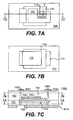
- FIGS. 7A-7C illustrate yet another embodiment of an innerlayer panel 7100, similar to the innerlayer panel 6100 illustrated in FIGS. 6A-6C.
- the innerlayer panel 7100 comprises a capacitor 705 and laminate layers 770, 760, and is illustrated in a state after incorporation into a printed wiring board.
- the capacitor 705 comprises a first electrode layer 710, a second electrode layer 720, and a dielectric 730.
- a trench 722 electrically isolates the first electrode layer 710 from the second electrode layer 720.
- the first electrode layer 710 comprises a plurality of elongated electrode portions 715, and a main electrode 717.
- the first electrode layer 710 can be selectively trimmed at the elongated electrode portions 715 in order to control the capacitance provided by the capacitor 705.
- an electrode portion 715 can be trimmed without damaging the second electrode layer 720.
- one or more electrode portions 715 are trimmed at the location indicated by the arrow T, if the trimming laser beam passes thought the dielectric 730 the laser beam will not damage the second electrode layer 720 because the second electrode layer 720 does not extend over that part of the dielectric 730.
- the capacitor innerlayer panel 7100 can be formed in a manner similar to the capacitor 6100.
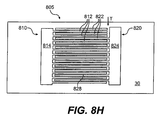
- FIG. 8A is a top plan view of an electrode arrangement comprising interdigitated electrodes 810, 812.
- the electrodes 810, 812 are shown in isolation in FIG. 8A.
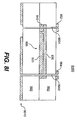
- a complete innerlayer panel 8100, including a capacitor 805 comprising the electrodes 810, 812, is illustrated in FIG. 81.
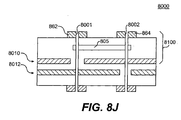
- a printed wiring board 8000 having the innerlayer panel 8100 incorporated therein is illustrated in FIG. 8J.
- the interdigitated electrode capacitor 805 is trimmable in order to adjust its capacitance.
- a first electrode 810 includes a plurality of first elongated electrode portions 812, connected to a first conductive portion 814.
- the second electrode 820 includes a plurality of second elongated electrode portions 822 electrically connected to a second conductive portion 824.
- the conductive portions 814, 824 act as terminations for the electrodes 810, 820, respectively.
- the first elongated electrode portions 812 are interdigitated with the second elongated electrode portions 822.
- the first and second elongated electrode portions 812, 822 are separated by a space 828 having the shape of a serpentine trench.
- the electrode pattern in FIG. 8A may be trimmed for fine capacitance control of the capacitor 805 (the trimming process is shown in FIG. 8H). The trimming process and a method of making the capacitor 805 and the innerlayer panel 8100 are discussed below with reference to FIGS. 8B-8I.
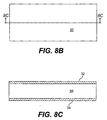
- FIG. 8B is a plan view of a first stage of manufacturing the innerlayer panel 8100.
- FIG. 8C is a section view in front elevation taken on line 8C-8C in FIG. 8B.
- a first foil 32 is provided, and is laminated to a first side of laminate material 30.
- the first foil 32 may be of a type generally available in the industry.
- the foil 32 may be copper, copper-invar-copper, invar, nickel, nickel-coated copper, or other metals.
- the foil 32 may correspond to between about 1 oz and 2 oz copper foil. Thick copper foils are preferred because they form thick electrodes, and provide correspondingly high capacitance densities.
- the laminate material 30 may be, for example, FR4 prepreg or other organic materials.
- a second foil 34 may also be laminated to a second side of the laminate material 30.
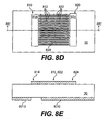
- FIG. 8D is a top plan view of a next stage of manufacture.
- FIG. 8E is a section view taken on line 8E-8E in FIG. 8D.
- a photo-resist is applied to the first foil 32, and the foil 32 is imaged, etched and stripped.
- the electrodes 810, 812, including the first and second elongated electrode portions 812, 814, the serpentine trench 828, and the conductive portions 814, 824 result from the etching step.
- the second foil 34 may also be etched to form circuitry 8010.
- the circuitry 8010 illustrated in FIG. 8E can act as, for example, a power plane 8010 in the finished printed wiring board 8000 (illustrated in FIG. 8J).
- a dielectric layer 38 is applied to the resulting article.
- the dielectric layer 38 is applied to fill the serpentine trench 828 between the elongated electrode portions 812, 822.
- the dielectric layer 38 illustrated in FIG. 8F covers the electrode portions 812 and 822. However, a dielectric layer that only fills the trench 828 between the elongated electrode portions 812, 822, without covering the tops of the electrode portions, is sufficient. Any additional surface area of the dielectric layer 38 provides a tolerance for registration issues.
- the dielectric layer 38 can be formed from, for example, a polymer thick film (PTF) paste.
- the dielectric layer 38 can be applied by, for example, solution casting or screen printing. The dielectric layer 38 is then cured.
- the capacitance is proportional to the depth of the electrodes 812, 822, the width of the dielectric-filled trench 828 between the electrodes 812, 822, and the length of the serpentine trench 828.
- the article shown FIGS. 8F and 8G has a capacitance that is above a target value. The capacitance is reduced to the target value by a trimming operation as described below.
- the dielectric layer 38 and the elongated electrode portions 812, 822 are selectively trimmed.
- the trimming process is illustrated in FIG. 8H.
- the dielectric layer 38 is not shown in FIG. 8H to better illustrate the trimming process.
- the trimming direction is indicated by the arrow T.
- a UV-YAG laser is one preferred laser for trimming.
- the UV-YAG laser may selectively cut portions of either or both of the first and second elongated conductive portions 812, 822, thereby reducing the capacitance of the capacitor 805. High tolerance values can be achieved by the use of relatively short elongated conductive portions 812, 822.
- a dielectric 830 is illustrated as resulting from the dielectric layer 38 after the trimming operation.
- Laminations, etching and via formation processes may be used to form circuitry 8010, 862, 864, laminates 850, 860 and circuit conductors 8001, 8002.
- FIG. 8J is a schematic section view of the printed wiring board 8000.
- the printed wiring board 8000 may be formed by laminating one or more innerlayer panels together, including the innerlayer panel 8100. The lamination can be performed in, for example, one or more conventional lamination pressings.
- the circuit conductors 8001, 8002 correspond to the through-hole vias illustrated in FIG. 8I.
- the through-hole vias 8001, 8002 are preferably drilled and plated after all laminate layers have been pressed together.
- the circuitry 8010 may serve as a power plane.
- a ground plane 8012 may also be included in the printed wiring board 8000.
- high tolerances may be achieved by selective trimming of the various electrode arrangements.
- the thickness of the electrode layers and the dielectric layers may vary. In general, the thickness of the layers may fall in the range of about 10-50 microns.
- circuit conductors may be used in place of or in addition to through-hole vias.
- conductive connections to peripheral edges of electrode layers may be used in place of through-hole vias.
- laminations can be performed, for example, using FR4 prepreg in standard printing wiring board processes.
- Type 106 epoxy prepreg may also be used. Suitable lamination conditions are, for example, 185°C at 208 psig for 1 hour in a vacuum chamber evacuated to about 28 inches of mercury.
- a silicone rubber press pad and a smooth PTFE-filled glass release sheet may be in contact with foils to prevent epoxy from gluing lamination plates together.
- the dielectric prepreg and laminate materials can be any type of dielectric material such as, for example, standard epoxy, high Tg epoxy, polyimide, polytetrafluoroethylene, cyanate ester resins, filled resin systems, BT epoxy, and other organic resins and laminates that provide insulation between circuit layers.
- the printed wiring board embodiments can include a large number of individual capacitors of differing type and arranged in various ways in the printed wiring boards.
- the printed wiring board embodiments discussed above may include additional innerlayer panels, laminate layers, and other layers. Additional interconnect circuitry, other passive components, or active components, may also be included in the printed wiring boards.
- the printed wiring board embodiments discussed above may be formed by fired-on-foil processes or by using polymeric materials.
- Curing can be done at, for example, about 150°C.
- Suitable materials for the paste used to form polymeric conductive layers include, for example, polymer thick-film copper pastes, silver polymer thick-film pastes, which may include copper or silver powders dispersed into an organic vehicle.
- the organic vehicle can be an epoxy solution or other solutions based on other resins.
- a commercially available polymer conductive layer is CB200 available from E. I. du Pont de Nemours and Company.
- Suitable materials for the paste used to form polymer dielectric layers include polymer thick-film dielectric pastes.
- Polymer thick-film dielectric pastes are generally high dielectric constant materials, such as, for example, barium titanate powder, dispersed into an organic vehicle such as an epoxy resin.
- a commercially available high dielectric constant polymeric dielectric layer is 7153 thick-film dielectric available from E. I. Du Pont de Nemours and Company. Curing of the conductive and dielectric layers can be performed at, for example, about 150°C.
- the conductive layers discussed in this specification may also be formed by, for example, electrodeposition processes or evaporation processes. Electrodeposition processes or evaporation processes can be used to form, for example, metallic conductive layers.
- the dielectric layers may alternatively be formed by, for example, thin film sputtering or anodizing.
- One suitable thick-film dielectric material for use in fired-on-foil embodiments has the following composition: Barium titanate powder 64.18 % Zirconium oxide powder 3.78 % Glass A 11.63 % Ethyl cellulose 0.86 % TEXANOL 18.21 % Barium nitrate powder 0.84 % Phosphate wetting agent 0.5 %. Glass A: Germanium oxide 21.5 % Lead tetraoxide 78.5 %.
- a suitable Glass A composition corresponded to Pb 5 Ge 3 O 11 , which precipitates out during the firing, and has a dielectric constant of approximately 70-150.
- a resulting dielectric after firing has a dielectric constant of approximately 1000.
- a suitable thick-film copper electrode ink for use in fired-on-foil embodiments has the following composition: Copper powder 55.1 % Glass A 1.6 % Cuprous oxide powder 5.6 % Ethyl cellulose T-200 1.7 % TEXANOL 36.0 %.
- Thin film ceramic capacitors can be formed via a number of processes that yield thin ceramic layers of less than, for example, 1 micron.
- Examples of such materials include barium titanate or alumina, which can be deposited by sol-gel techniques or sputtering, for example.
- the term "paste" may correspond to a conventional term used in the electronic materials industry, and generally refers to a thick-film composition.
- the metal component of the underprint paste is matched to the metal in the metal foil. For example, if a copper foil were used, then a copper paste could be used as the underprint. Examples of other applications would be pairing silver and nickel foils with a similar metal underprint paste. Thick-film pastes may be used to form both the underprint and the passive components.
- thick-film pastes comprise finely divided particles of ceramic, glass, metal or other solids dispersed in polymers dissolved in a mixture of plasticizer, dispersing agent and organic solvent.
- Preferred capacitor pastes for use on copper foil have an organic vehicle with good burnout in a nitrogen atmosphere.
- Such vehicles generally contain very small amounts of resin, such as high molecular weight ethyl cellulose, where only small amounts are necessary to generate a viscosity suitable for screen-printing.
- an oxidizing component such as barium nitrate powder, blended into the dielectric powder mixture, helps the organic component burn out in the nitrogen atmosphere.
- Solids are mixed with an essentially inert liquid medium (the "vehicle"), then dispersed on a three-roll mill to form a paste-like composition suitable for screen-printing.
- essentially inert liquid may be used as the vehicle.
- various organic liquids, with or without thickening and/or stabilizing agents and/or other common additives, may be used as the vehicle.
- High K thick-film dielectric pastes generally contain at least one high K functional phase powder and at least one glass powder dispersed in a vehicle system composed of at least one resin and a solvent.
- the vehicle system is designed to be screen-printed to provide a dense and spatially well-defined film.
- the high K functional phase powders can comprise perovskite-type ferroelectric compositions with the general formula ABO 3 . Examples of such compositions include BaTiO 3 ; SrTiO 3 ; PbTiO 3 ; CaTiO 3 ; PbZrO 3 ; BaZrO 3 and SrZrO 3.
- compositions are also possible by substitution of alternative elements into the A and/or B position, such as Pb(Mg 1/3 Nb 2/3 )O 3 and Pb(Zn 1/3 Nb 2/3 )O 3 .
- Pb(Mg 1/3 Nb 2/3 )O 3 and Pb(Zn 1/3 Nb 2/3 )O 3 are other possible high K materials.
- Doped and mixed metal versions of the above compositions are also suitable. Doping and mixing is done primarily to achieve the necessary end-use property specifications such as, for example, the necessary temperature coefficient of capacitance (TCC) in order for the material to meet industry definitions, such as "X7R” or "Z5U” standards.
- TCC temperature coefficient of capacitance
- the glasses in the pastes can be, for example, Ca-Al borosilicates, Pb-Ba borosilicates, Mg-Al silicates, rare earth borates, and other similar glass compositions.
- Pastes used to form conductive layers may be based on metallic powders of either copper, nickel, silver, silver-containing precious metal compositions, or mixtures of these compounds. Copper powder compositions are preferred.
- capacitor embodiments can be used within organic printed circuit boards, IC packages, applications of said structures in decoupling applications, and devices such as IC modules and devices or handheld device motherboards.
Landscapes
- Engineering & Computer Science (AREA)
- Power Engineering (AREA)
- Microelectronics & Electronic Packaging (AREA)
- Manufacturing & Machinery (AREA)
- Parts Printed On Printed Circuit Boards (AREA)
- Fixed Capacitors And Capacitor Manufacturing Machines (AREA)
- Production Of Multi-Layered Print Wiring Board (AREA)
- Manufacturing Of Printed Wiring (AREA)
Applications Claiming Priority (2)
| Application Number | Priority Date | Filing Date | Title |
|---|---|---|---|
| US664638 | 1991-03-05 | ||
| US10/664,638 US20050063135A1 (en) | 2003-09-18 | 2003-09-18 | High tolerance embedded capacitors |
Publications (2)
| Publication Number | Publication Date |
|---|---|
| EP1517596A2 true EP1517596A2 (de) | 2005-03-23 |
| EP1517596A3 EP1517596A3 (de) | 2006-11-02 |
Family
ID=34194752
Family Applications (1)
| Application Number | Title | Priority Date | Filing Date |
|---|---|---|---|
| EP04005268A Withdrawn EP1517596A3 (de) | 2003-09-18 | 2004-03-05 | Eingebettete Kondensatoren mit hoher Toleranz |
Country Status (5)
| Country | Link |
|---|---|
| US (2) | US20050063135A1 (de) |
| EP (1) | EP1517596A3 (de) |
| JP (1) | JP2005094017A (de) |
| KR (1) | KR100584803B1 (de) |
| TW (1) | TW200512776A (de) |
Cited By (3)
| Publication number | Priority date | Publication date | Assignee | Title |
|---|---|---|---|---|
| EP1667206A1 (de) * | 2004-12-02 | 2006-06-07 | E.I. Du Pont De Nemours And Company | Dickschichtkondensatoren und Verfahren zu deren Herstellung |
| EP1981046A4 (de) * | 2006-01-30 | 2010-12-08 | Murata Manufacturing Co | Verfahren zum regulieren des kapazitätswerts eines eingebauten kondensators in einem mehrschichtigen keramischen substrat und mehrschichtiges keramisches substrat und herstellungsprozess dafür |
| CN102548211A (zh) * | 2012-01-04 | 2012-07-04 | 桂林电子科技大学 | 一种内埋置电容器的印刷电路板及其制造方法 |
Families Citing this family (24)
| Publication number | Priority date | Publication date | Assignee | Title |
|---|---|---|---|---|
| JP4014432B2 (ja) * | 2002-03-28 | 2007-11-28 | ユーディナデバイス株式会社 | インタディジタルキャパシタ及びその容量調整方法 |
| US7229875B2 (en) | 2002-10-17 | 2007-06-12 | Samsung Electronics Co., Ltd. | Integrated circuit capacitor structure |
| KR100480641B1 (ko) * | 2002-10-17 | 2005-03-31 | 삼성전자주식회사 | 고 커패시턴스를 지니는 금속-절연체-금속 커패시터, 이를구비하는 집적회로 칩 및 이의 제조 방법 |
| KR20070086706A (ko) * | 2004-12-28 | 2007-08-27 | 니뽄 도쿠슈 도교 가부시키가이샤 | 배선 기판 및 배선 기판의 제조 방법 |
| US7548432B2 (en) * | 2005-03-24 | 2009-06-16 | Agency For Science, Technology And Research | Embedded capacitor structure |
| US7700984B2 (en) * | 2005-05-20 | 2010-04-20 | Semiconductor Energy Laboratory Co., Ltd | Semiconductor device including memory cell |
| US20060282999A1 (en) * | 2005-06-20 | 2006-12-21 | Diptarka Majumdar | Electrodes, inner layers, capacitors and printed wiring boards and methods of making thereof - part II |
| US8059423B2 (en) * | 2007-02-06 | 2011-11-15 | Sanmina-Sci Corporation | Enhanced localized distributive capacitance for circuit boards |
| US7672113B2 (en) * | 2007-09-14 | 2010-03-02 | Oak-Mitsui, Inc. | Polymer-ceramic composites with excellent TCC |
| JP2009094333A (ja) * | 2007-10-10 | 2009-04-30 | Nippon Mektron Ltd | キャパシタを内蔵したプリント配線板およびその製造方法 |
| US20100309608A1 (en) * | 2009-06-07 | 2010-12-09 | Chien-Wei Chang | Buried Capacitor Structure |
| US20130120902A1 (en) * | 2010-07-30 | 2013-05-16 | Sanyo Electric Co., Ltd. | Substrate-incorporated capacitor, capacitor-incorporating substrate provided with the same, and method for manufacturing substrate-incorporated capacitor |
| JP5888863B2 (ja) * | 2011-02-25 | 2016-03-22 | 古河電気工業株式会社 | 高比誘電率固体材料、誘電体、及びキャパシタ型蓄電池 |
| JP2014053567A (ja) | 2012-09-10 | 2014-03-20 | Micronics Japan Co Ltd | 電気的膜体の製造方法 |
| JP6025558B2 (ja) * | 2012-12-27 | 2016-11-16 | 株式会社ワコム | 位置指示器及び位置指示器の共振回路の共振周波数の調整方法 |
| JP6024476B2 (ja) * | 2013-01-25 | 2016-11-16 | 株式会社村田製作所 | 熱可塑性樹脂多層基板の製造方法 |
| JP2015038936A (ja) * | 2013-08-19 | 2015-02-26 | 住友電工プリントサーキット株式会社 | コンデンサ、フレキシブルプリント配線板及び電子部品 |
| JP6805702B2 (ja) | 2016-10-11 | 2020-12-23 | Tdk株式会社 | 薄膜コンデンサ |
| JP6737118B2 (ja) | 2016-10-11 | 2020-08-05 | Tdk株式会社 | 薄膜コンデンサ |
| JP2018063989A (ja) | 2016-10-11 | 2018-04-19 | Tdk株式会社 | 薄膜キャパシタ |
| US20230069802A1 (en) * | 2020-01-30 | 2023-03-02 | Anaut Inc. | Recording Medium and Image Playback Method |
| US12356539B2 (en) * | 2020-10-12 | 2025-07-08 | Agc Glass Europe | Laminated assembly comprising radio-frequency interface board |
| US20250014986A1 (en) * | 2023-07-03 | 2025-01-09 | Samsung Electronics Co., Ltd. | Embedded integrated stack capacitor (isc) in substrate build-up layer |
| US20260204488A1 (en) * | 2025-01-14 | 2026-07-16 | Winbond Electronics Corp. | Trimmable capacitor and method for trimming trimmable capacitor |
Family Cites Families (31)
| Publication number | Priority date | Publication date | Assignee | Title |
|---|---|---|---|---|
| US4190854A (en) * | 1978-02-15 | 1980-02-26 | National Semiconductor Corporation | Trim structure for integrated capacitors |
| US4469930A (en) * | 1981-07-17 | 1984-09-04 | Fuji Tool & Die Co., Ltd. | Three-dimensional laser cutting system by a playback method |
| US4470096A (en) * | 1982-06-18 | 1984-09-04 | Motorola Inc. | Multilayer, fully-trimmable, film-type capacitor and method of adjustment |
| GB2131162B (en) * | 1982-11-27 | 1986-04-30 | Ferranti Plc | Aligning objects |
| DD222726A1 (de) * | 1984-03-16 | 1985-05-22 | Hermsdorf Keramik Veb | Schichtkondensator |
| JPS61259560A (ja) * | 1985-05-14 | 1986-11-17 | Nec Corp | 半導体集積回路 |
| US4905358A (en) * | 1989-01-18 | 1990-03-06 | Motorola, Inc. | Thin film active trimmable capacitor/inductor |
| US4978830A (en) * | 1989-02-27 | 1990-12-18 | National Semiconductor Corporation | Laser trimming system for semiconductor integrated circuit chip packages |
| US5034851A (en) * | 1990-05-23 | 1991-07-23 | American Technical Ceramics Corporation | Miniature monolithic multilayered capacitors and method for trimming |
| JPH04208591A (ja) * | 1990-07-13 | 1992-07-30 | Toyobo Co Ltd | セラミック・プリント配線板 |
| JPH05167215A (ja) * | 1991-12-12 | 1993-07-02 | Matsushita Electric Ind Co Ltd | 電子回路装置及びその製造方法 |
| US5347423A (en) * | 1992-08-24 | 1994-09-13 | Murata Erie North America, Inc. | Trimmable composite multilayer capacitor and method |
| JPH0738060A (ja) * | 1993-07-22 | 1995-02-07 | Toshiba Lighting & Technol Corp | 膜型キャパシターおよびそのトリミング方法 |
| US5362534A (en) * | 1993-08-23 | 1994-11-08 | Parlex Corporation | Multiple layer printed circuit boards and method of manufacture |
| JPH07326544A (ja) * | 1994-05-31 | 1995-12-12 | Matsushita Electric Ind Co Ltd | 多層回路基板で形成する可変キャパシタ |
| GB9414362D0 (en) * | 1994-07-15 | 1994-09-07 | Plessey Semiconductors Ltd | Trimmable capacitor |
| JPH08172029A (ja) * | 1994-12-20 | 1996-07-02 | Matsushita Electric Ind Co Ltd | 厚膜印刷コンデンサ及びその容量調整方法 |
| DE19509554A1 (de) * | 1995-03-16 | 1996-09-19 | Bosch Gmbh Robert | Verfahren zur Herstellung einer Multilayerschaltung |
| JPH11191513A (ja) * | 1997-12-26 | 1999-07-13 | Matsushita Electric Ind Co Ltd | 回路基板、および回路基板におけるインダクタンスまたはキャパシタンスの調整方法 |
| US6631551B1 (en) * | 1998-06-26 | 2003-10-14 | Delphi Technologies, Inc. | Method of forming integral passive electrical components on organic circuit board substrates |
| US6552555B1 (en) * | 1998-11-19 | 2003-04-22 | Custom One Design, Inc. | Integrated circuit testing apparatus |
| US6134117A (en) * | 1999-04-16 | 2000-10-17 | Delphi Technologies, Inc. | Method for high resolution trimming of PCB components |
| US6252761B1 (en) * | 1999-09-15 | 2001-06-26 | National Semiconductor Corporation | Embedded multi-layer ceramic capacitor in a low-temperature con-fired ceramic (LTCC) substrate |
| US6317023B1 (en) * | 1999-10-15 | 2001-11-13 | E. I. Du Pont De Nemours And Company | Method to embed passive components |
| US6452776B1 (en) * | 2000-04-06 | 2002-09-17 | Intel Corporation | Capacitor with defect isolation and bypass |
| JP4156184B2 (ja) * | 2000-08-01 | 2008-09-24 | 株式会社キッツエスシーティー | 集積化ガス制御装置 |
| US6418007B1 (en) * | 2000-08-28 | 2002-07-09 | Motorola, Inc. | Trimmable chip stub |
| IL141118A0 (en) * | 2001-01-25 | 2002-02-10 | Cerel Ceramics Technologies Lt | A method for the implementation of electronic components in via-holes of a multi-layer multi-chip module |
| EP2315510A3 (de) * | 2001-06-05 | 2012-05-02 | Dai Nippon Printing Co., Ltd. | Leiterplatte mit passiven Elementen |
| US6860000B2 (en) * | 2002-02-15 | 2005-03-01 | E.I. Du Pont De Nemours And Company | Method to embed thick film components |
| US6910264B2 (en) * | 2003-01-03 | 2005-06-28 | Phoenix Precision Technology Corp. | Method for making a multilayer circuit board having embedded passive components |
-
2003
- 2003-09-18 US US10/664,638 patent/US20050063135A1/en not_active Abandoned
-
2004
- 2004-03-05 EP EP04005268A patent/EP1517596A3/de not_active Withdrawn
- 2004-06-30 TW TW093119623A patent/TW200512776A/zh unknown
- 2004-09-16 JP JP2004270271A patent/JP2005094017A/ja not_active Withdrawn
- 2004-09-17 KR KR1020040074613A patent/KR100584803B1/ko not_active Expired - Fee Related
-
2005
- 2005-02-17 US US11/060,109 patent/US20050195554A1/en not_active Abandoned
Cited By (5)
| Publication number | Priority date | Publication date | Assignee | Title |
|---|---|---|---|---|
| EP1667206A1 (de) * | 2004-12-02 | 2006-06-07 | E.I. Du Pont De Nemours And Company | Dickschichtkondensatoren und Verfahren zu deren Herstellung |
| EP1981046A4 (de) * | 2006-01-30 | 2010-12-08 | Murata Manufacturing Co | Verfahren zum regulieren des kapazitätswerts eines eingebauten kondensators in einem mehrschichtigen keramischen substrat und mehrschichtiges keramisches substrat und herstellungsprozess dafür |
| US7996969B2 (en) | 2006-01-30 | 2011-08-16 | Murata Manufacturing Co., Ltd. | Method for adjusting capacitance value of built-in capacitor in multilayer ceramic substrate, and method for manufacturing a multilayer ceramic substrate |
| CN102548211A (zh) * | 2012-01-04 | 2012-07-04 | 桂林电子科技大学 | 一种内埋置电容器的印刷电路板及其制造方法 |
| CN102548211B (zh) * | 2012-01-04 | 2015-03-11 | 桂林电子科技大学 | 一种内埋置电容器的印刷电路板及其制造方法 |
Also Published As
| Publication number | Publication date |
|---|---|
| EP1517596A3 (de) | 2006-11-02 |
| KR100584803B1 (ko) | 2006-05-30 |
| US20050063135A1 (en) | 2005-03-24 |
| US20050195554A1 (en) | 2005-09-08 |
| TW200512776A (en) | 2005-04-01 |
| KR20050028849A (ko) | 2005-03-23 |
| JP2005094017A (ja) | 2005-04-07 |
Similar Documents
| Publication | Publication Date | Title |
|---|---|---|
| US20050063135A1 (en) | High tolerance embedded capacitors | |
| EP1455558A2 (de) | Leiterplatten mit Kondensatoren und Verfahren zu deren Herstellung | |
| US7701052B2 (en) | Power core devices | |
| US7100277B2 (en) | Methods of forming printed circuit boards having embedded thick film capacitors | |
| EP1408520B1 (de) | Zusammengesinterter Keramik-Kondensator und Verfahren zur Herstellung von Keramik-Kondensatoren für gedruckte Schaltungen | |
| KR101045505B1 (ko) | 다층 프린트 배선판 | |
| KR100687689B1 (ko) | 내층 패널, 내층 패널의 제작 방법 및 내층 패널을 포함하는 인쇄 배선 기판 | |
| US20040108134A1 (en) | Printed wiring boards having low inductance embedded capacitors and methods of making same | |
| KR100754712B1 (ko) | 전력 코어 장치 및 그 제조 방법 | |
| US20070220725A1 (en) | Thick-film capacitors, embedding thick-film capacitors inside printed circuit boards, and methods of forming such capacitors and printed circuit boards | |
| KR100713731B1 (ko) | 낮은 인덕턴스의 내장 커패시터를 구비한 인쇄 배선 기판및 그 제조 방법 | |
| EP1777745A2 (de) | Versorgungvorrichtung mit Kondensator und deren Herstellungsverfahren | |
| KR20090023696A (ko) | 개선된 전극, 내부층, 커패시터 및 인쇄 배선 기판, 및 이들의 제조 방법- 파트 ⅱ | |
| KR100874823B1 (ko) | 내장 커패시터, 이를 포함하는 전자 소자 및 이들의 제조 방법 | |
| JP2005129887A (ja) | コンデンサを有する印刷配線板とその製造方法 |
Legal Events
| Date | Code | Title | Description |
|---|---|---|---|
| PUAI | Public reference made under article 153(3) epc to a published international application that has entered the european phase |
Free format text: ORIGINAL CODE: 0009012 |
|
| AK | Designated contracting states |
Kind code of ref document: A2 Designated state(s): AT BE BG CH CY CZ DE DK EE ES FI FR GB GR HU IE IT LI LU MC NL PL PT RO SE SI SK TR |
|
| AX | Request for extension of the european patent |
Extension state: AL LT LV MK |
|
| PUAL | Search report despatched |
Free format text: ORIGINAL CODE: 0009013 |
|
| AK | Designated contracting states |
Kind code of ref document: A3 Designated state(s): AT BE BG CH CY CZ DE DK EE ES FI FR GB GR HU IE IT LI LU MC NL PL PT RO SE SI SK TR |
|
| AX | Request for extension of the european patent |
Extension state: AL LT LV MK |
|
| RIC1 | Information provided on ipc code assigned before grant |
Ipc: H01G 4/255 20060101ALI20060922BHEP Ipc: H05K 1/16 20060101AFI20041203BHEP |
|
| 17P | Request for examination filed |
Effective date: 20061123 |
|
| AKX | Designation fees paid |
Designated state(s): DE FR GB |
|
| STAA | Information on the status of an ep patent application or granted ep patent |
Free format text: STATUS: THE APPLICATION HAS BEEN WITHDRAWN |
|
| 18W | Application withdrawn |
Effective date: 20081027 |