EP1483439B1 - Mit calixarenen ausgerüstete textile materialien, verfahren zu ihrer herstellung und ihre verwendung - Google Patents
Mit calixarenen ausgerüstete textile materialien, verfahren zu ihrer herstellung und ihre verwendung Download PDFInfo
- Publication number
- EP1483439B1 EP1483439B1 EP03711930A EP03711930A EP1483439B1 EP 1483439 B1 EP1483439 B1 EP 1483439B1 EP 03711930 A EP03711930 A EP 03711930A EP 03711930 A EP03711930 A EP 03711930A EP 1483439 B1 EP1483439 B1 EP 1483439B1
- Authority
- EP
- European Patent Office
- Prior art keywords
- textile material
- calixarene
- alkyl
- dimethylol
- branched
- Prior art date
- Legal status (The legal status is an assumption and is not a legal conclusion. Google has not performed a legal analysis and makes no representation as to the accuracy of the status listed.)
- Expired - Lifetime
Links
- 239000000463 material Substances 0.000 title claims abstract description 109
- 239000004753 textile Substances 0.000 title claims abstract description 89
- VTJUKNSKBAOEHE-UHFFFAOYSA-N calixarene Chemical class COC(=O)COC1=C(CC=2C(=C(CC=3C(=C(C4)C=C(C=3)C(C)(C)C)OCC(=O)OC)C=C(C=2)C(C)(C)C)OCC(=O)OC)C=C(C(C)(C)C)C=C1CC1=C(OCC(=O)OC)C4=CC(C(C)(C)C)=C1 VTJUKNSKBAOEHE-UHFFFAOYSA-N 0.000 title claims abstract description 76
- 238000000034 method Methods 0.000 title claims abstract description 21
- 238000004519 manufacturing process Methods 0.000 title claims abstract description 7
- XLYOFNOQVPJJNP-UHFFFAOYSA-N water Substances O XLYOFNOQVPJJNP-UHFFFAOYSA-N 0.000 claims description 22
- 125000006702 (C1-C18) alkyl group Chemical group 0.000 claims description 20
- 125000001424 substituent group Chemical group 0.000 claims description 14
- 150000004945 aromatic hydrocarbons Chemical group 0.000 claims description 13
- 239000000835 fiber Substances 0.000 claims description 10
- 125000001931 aliphatic group Chemical group 0.000 claims description 9
- 125000003118 aryl group Chemical group 0.000 claims description 9
- 239000012530 fluid Substances 0.000 claims description 9
- 125000000524 functional group Chemical group 0.000 claims description 9
- 125000001072 heteroaryl group Chemical group 0.000 claims description 8
- 239000000203 mixture Substances 0.000 claims description 8
- 239000000178 monomer Substances 0.000 claims description 7
- 125000004169 (C1-C6) alkyl group Chemical group 0.000 claims description 6
- 125000006577 C1-C6 hydroxyalkyl group Chemical group 0.000 claims description 5
- JCXJVPUVTGWSNB-UHFFFAOYSA-N Nitrogen dioxide Chemical compound O=[N]=O JCXJVPUVTGWSNB-UHFFFAOYSA-N 0.000 claims description 5
- OKTJSMMVPCPJKN-UHFFFAOYSA-N Carbon Chemical group [C] OKTJSMMVPCPJKN-UHFFFAOYSA-N 0.000 claims description 4
- 229910052736 halogen Inorganic materials 0.000 claims description 4
- 150000002367 halogens Chemical class 0.000 claims description 4
- 150000002894 organic compounds Chemical class 0.000 claims description 4
- 238000000926 separation method Methods 0.000 claims description 4
- 229910052717 sulfur Inorganic materials 0.000 claims description 4
- 238000007669 thermal treatment Methods 0.000 claims description 4
- 239000002351 wastewater Substances 0.000 claims description 4
- ZEYUSQVGRCPBPG-UHFFFAOYSA-N 4,5-dihydroxy-1,3-bis(hydroxymethyl)imidazolidin-2-one Chemical compound OCN1C(O)C(O)N(CO)C1=O ZEYUSQVGRCPBPG-UHFFFAOYSA-N 0.000 claims description 3
- 239000002253 acid Substances 0.000 claims description 3
- 239000012736 aqueous medium Substances 0.000 claims description 3
- WVJOGYWFVNTSAU-UHFFFAOYSA-N dimethylol ethylene urea Chemical compound OCN1CCN(CO)C1=O WVJOGYWFVNTSAU-UHFFFAOYSA-N 0.000 claims description 3
- 239000006185 dispersion Substances 0.000 claims description 3
- 125000005842 heteroatom Chemical group 0.000 claims description 3
- 229910001410 inorganic ion Inorganic materials 0.000 claims description 3
- 230000007935 neutral effect Effects 0.000 claims description 3
- 229910052760 oxygen Inorganic materials 0.000 claims description 3
- QUBQYFYWUJJAAK-UHFFFAOYSA-N oxymethurea Chemical compound OCNC(=O)NCO QUBQYFYWUJJAAK-UHFFFAOYSA-N 0.000 claims description 3
- 229950005308 oxymethurea Drugs 0.000 claims description 3
- 229910052711 selenium Inorganic materials 0.000 claims description 3
- 125000003107 substituted aryl group Chemical group 0.000 claims description 3
- KFVIYKFKUYBKTP-UHFFFAOYSA-N 2-n-(methoxymethyl)-1,3,5-triazine-2,4,6-triamine Chemical compound COCNC1=NC(N)=NC(N)=N1 KFVIYKFKUYBKTP-UHFFFAOYSA-N 0.000 claims description 2
- 229910006069 SO3H Inorganic materials 0.000 claims description 2
- 150000001805 chlorine compounds Chemical class 0.000 claims description 2
- BGXRJLLPQWKPIH-UHFFFAOYSA-N dimethoxymethylurea Chemical compound COC(OC)NC(N)=O BGXRJLLPQWKPIH-UHFFFAOYSA-N 0.000 claims description 2
- 150000002500 ions Chemical class 0.000 claims description 2
- ZFSLODLOARCGLH-UHFFFAOYSA-N isocyanuric acid Chemical compound OC1=NC(O)=NC(O)=N1 ZFSLODLOARCGLH-UHFFFAOYSA-N 0.000 claims description 2
- 229910052751 metal Inorganic materials 0.000 claims description 2
- 239000002184 metal Substances 0.000 claims description 2
- 150000002739 metals Chemical class 0.000 claims description 2
- 239000002904 solvent Substances 0.000 claims description 2
- 125000000020 sulfo group Chemical group O=S(=O)([*])O[H] 0.000 claims description 2
- 125000000999 tert-butyl group Chemical group [H]C([H])([H])C(*)(C([H])([H])[H])C([H])([H])[H] 0.000 claims description 2
- XYOSFLPUWVWHOA-UHFFFAOYSA-N 2-ethylidenepropane-1,3-diol;urea Chemical compound NC(N)=O.CC=C(CO)CO XYOSFLPUWVWHOA-UHFFFAOYSA-N 0.000 claims 1
- KXDHJXZQYSOELW-UHFFFAOYSA-M Carbamate Chemical compound NC([O-])=O KXDHJXZQYSOELW-UHFFFAOYSA-M 0.000 claims 1
- YGYAWVDWMABLBF-UHFFFAOYSA-N Phosgene Chemical compound ClC(Cl)=O YGYAWVDWMABLBF-UHFFFAOYSA-N 0.000 claims 1
- 229910052770 Uranium Inorganic materials 0.000 claims 1
- 239000004202 carbamide Substances 0.000 claims 1
- 239000002894 chemical waste Substances 0.000 claims 1
- 239000000356 contaminant Substances 0.000 claims 1
- 230000008021 deposition Effects 0.000 claims 1
- 239000003344 environmental pollutant Substances 0.000 claims 1
- 229910001385 heavy metal Inorganic materials 0.000 claims 1
- FQPSGWSUVKBHSU-UHFFFAOYSA-N methacrylamide Chemical compound CC(=C)C(N)=O FQPSGWSUVKBHSU-UHFFFAOYSA-N 0.000 claims 1
- 125000000956 methoxy group Chemical group [H]C([H])([H])O* 0.000 claims 1
- 231100000719 pollutant Toxicity 0.000 claims 1
- 229920001228 polyisocyanate Polymers 0.000 claims 1
- 239000005056 polyisocyanate Substances 0.000 claims 1
- 238000000746 purification Methods 0.000 claims 1
- 238000011084 recovery Methods 0.000 claims 1
- 239000013535 sea water Substances 0.000 claims 1
- JFALSRSLKYAFGM-UHFFFAOYSA-N uranium(0) Chemical compound [U] JFALSRSLKYAFGM-UHFFFAOYSA-N 0.000 claims 1
- 125000005289 uranyl group Chemical group 0.000 claims 1
- 150000003672 ureas Chemical class 0.000 claims 1
- -1 aliphatic radical Chemical class 0.000 description 30
- HEMHJVSKTPXQMS-UHFFFAOYSA-M sodium hydroxide Inorganic materials [OH-].[Na+] HEMHJVSKTPXQMS-UHFFFAOYSA-M 0.000 description 17
- 238000006243 chemical reaction Methods 0.000 description 14
- WSFSSNUMVMOOMR-UHFFFAOYSA-N Formaldehyde Chemical compound O=C WSFSSNUMVMOOMR-UHFFFAOYSA-N 0.000 description 11
- 150000001875 compounds Chemical class 0.000 description 11
- 229920000742 Cotton Polymers 0.000 description 10
- GHLKSLMMWAKNBM-UHFFFAOYSA-N dodecane-1,12-diol Chemical compound OCCCCCCCCCCCCO GHLKSLMMWAKNBM-UHFFFAOYSA-N 0.000 description 10
- YXFVVABEGXRONW-UHFFFAOYSA-N Toluene Chemical compound CC1=CC=CC=C1 YXFVVABEGXRONW-UHFFFAOYSA-N 0.000 description 9
- 239000000243 solution Substances 0.000 description 9
- 239000000126 substance Substances 0.000 description 9
- RTZKZFJDLAIYFH-UHFFFAOYSA-N Diethyl ether Chemical compound CCOCC RTZKZFJDLAIYFH-UHFFFAOYSA-N 0.000 description 7
- 230000001588 bifunctional effect Effects 0.000 description 7
- 150000002989 phenols Chemical group 0.000 description 7
- 229920000728 polyester Polymers 0.000 description 7
- 238000003756 stirring Methods 0.000 description 7
- 125000000217 alkyl group Chemical group 0.000 description 6
- 230000029936 alkylation Effects 0.000 description 6
- 238000005804 alkylation reaction Methods 0.000 description 6
- VSCWAEJMTAWNJL-UHFFFAOYSA-K aluminium trichloride Chemical compound Cl[Al](Cl)Cl VSCWAEJMTAWNJL-UHFFFAOYSA-K 0.000 description 6
- MMYYTPYDNCIFJU-UHFFFAOYSA-N calix[6]arene Chemical compound C1C(C=2)=CC=CC=2CC(C=2)=CC=CC=2CC(C=2)=CC=CC=2CC(C=2)=CC=CC=2CC(C=2)=CC=CC=2CC2=CC=CC1=C2 MMYYTPYDNCIFJU-UHFFFAOYSA-N 0.000 description 6
- 229920002678 cellulose Polymers 0.000 description 6
- 239000001913 cellulose Substances 0.000 description 6
- 241001120493 Arene Species 0.000 description 5
- 150000001350 alkyl halides Chemical group 0.000 description 5
- MGNCLNQXLYJVJD-UHFFFAOYSA-N cyanuric chloride Chemical compound ClC1=NC(Cl)=NC(Cl)=N1 MGNCLNQXLYJVJD-UHFFFAOYSA-N 0.000 description 5
- 239000012154 double-distilled water Substances 0.000 description 5
- 239000000047 product Substances 0.000 description 5
- 229920002994 synthetic fiber Polymers 0.000 description 5
- 239000012209 synthetic fiber Substances 0.000 description 5
- 229920000858 Cyclodextrin Polymers 0.000 description 4
- LFQSCWFLJHTTHZ-UHFFFAOYSA-N Ethanol Chemical compound CCO LFQSCWFLJHTTHZ-UHFFFAOYSA-N 0.000 description 4
- VEXZGXHMUGYJMC-UHFFFAOYSA-N Hydrochloric acid Chemical compound Cl VEXZGXHMUGYJMC-UHFFFAOYSA-N 0.000 description 4
- KWYUFKZDYYNOTN-UHFFFAOYSA-M Potassium hydroxide Chemical compound [OH-].[K+] KWYUFKZDYYNOTN-UHFFFAOYSA-M 0.000 description 4
- FAPWRFPIFSIZLT-UHFFFAOYSA-M Sodium chloride Chemical compound [Na+].[Cl-] FAPWRFPIFSIZLT-UHFFFAOYSA-M 0.000 description 4
- 230000020335 dealkylation Effects 0.000 description 4
- 238000006900 dealkylation reaction Methods 0.000 description 4
- 239000004744 fabric Substances 0.000 description 4
- 125000002887 hydroxy group Chemical group [H]O* 0.000 description 4
- 229910021645 metal ion Inorganic materials 0.000 description 4
- 238000005580 one pot reaction Methods 0.000 description 4
- 238000002360 preparation method Methods 0.000 description 4
- 239000011541 reaction mixture Substances 0.000 description 4
- HFHDHCJBZVLPGP-UHFFFAOYSA-N schardinger α-dextrin Chemical class O1C(C(C2O)O)C(CO)OC2OC(C(C2O)O)C(CO)OC2OC(C(C2O)O)C(CO)OC2OC(C(O)C2O)C(CO)OC2OC(C(C2O)O)C(CO)OC2OC2C(O)C(O)C1OC2CO HFHDHCJBZVLPGP-UHFFFAOYSA-N 0.000 description 4
- UIIMBOGNXHQVGW-UHFFFAOYSA-N sodium;hydron;carbonate Chemical compound [Na+].OC(O)=O UIIMBOGNXHQVGW-UHFFFAOYSA-N 0.000 description 4
- IGFHQQFPSIBGKE-UHFFFAOYSA-N 4-nonylphenol Chemical compound CCCCCCCCCC1=CC=C(O)C=C1 IGFHQQFPSIBGKE-UHFFFAOYSA-N 0.000 description 3
- QHPQWRBYOIRBIT-UHFFFAOYSA-N 4-tert-butylphenol Chemical compound CC(C)(C)C1=CC=C(O)C=C1 QHPQWRBYOIRBIT-UHFFFAOYSA-N 0.000 description 3
- ZMXDDKWLCZADIW-UHFFFAOYSA-N N,N-Dimethylformamide Chemical compound CN(C)C=O ZMXDDKWLCZADIW-UHFFFAOYSA-N 0.000 description 3
- LRHPLDYGYMQRHN-UHFFFAOYSA-N N-Butanol Chemical compound CCCCO LRHPLDYGYMQRHN-UHFFFAOYSA-N 0.000 description 3
- 229920000297 Rayon Polymers 0.000 description 3
- 125000002915 carbonyl group Chemical group [*:2]C([*:1])=O 0.000 description 3
- 238000010668 complexation reaction Methods 0.000 description 3
- 229940097362 cyclodextrins Drugs 0.000 description 3
- 238000004043 dyeing Methods 0.000 description 3
- 150000008040 ionic compounds Chemical class 0.000 description 3
- 239000012948 isocyanate Chemical group 0.000 description 3
- 150000002513 isocyanates Chemical group 0.000 description 3
- 125000002496 methyl group Chemical group [H]C([H])([H])* 0.000 description 3
- 125000000896 monocarboxylic acid group Chemical group 0.000 description 3
- BDERNNFJNOPAEC-UHFFFAOYSA-N propan-1-ol Chemical compound CCCO BDERNNFJNOPAEC-UHFFFAOYSA-N 0.000 description 3
- 238000009987 spinning Methods 0.000 description 3
- IQDKUTQPYBHPJK-UHFFFAOYSA-N 1,3-bis(hydroxymethyl)-1,3-diazinan-2-one Chemical compound OCN1CCCN(CO)C1=O IQDKUTQPYBHPJK-UHFFFAOYSA-N 0.000 description 2
- HMENQNSSJFLQOP-UHFFFAOYSA-N 2-bromoprop-2-enoic acid Chemical compound OC(=O)C(Br)=C HMENQNSSJFLQOP-UHFFFAOYSA-N 0.000 description 2
- CSCPPACGZOOCGX-UHFFFAOYSA-N Acetone Chemical compound CC(C)=O CSCPPACGZOOCGX-UHFFFAOYSA-N 0.000 description 2
- HEDRZPFGACZZDS-UHFFFAOYSA-N Chloroform Chemical compound ClC(Cl)Cl HEDRZPFGACZZDS-UHFFFAOYSA-N 0.000 description 2
- CTQNGGLPUBDAKN-UHFFFAOYSA-N O-Xylene Chemical compound CC1=CC=CC=C1C CTQNGGLPUBDAKN-UHFFFAOYSA-N 0.000 description 2
- NBIIXXVUZAFLBC-UHFFFAOYSA-N Phosphoric acid Chemical compound OP(O)(O)=O NBIIXXVUZAFLBC-UHFFFAOYSA-N 0.000 description 2
- 230000002378 acidificating effect Effects 0.000 description 2
- 239000003513 alkali Substances 0.000 description 2
- 125000004103 aminoalkyl group Chemical group 0.000 description 2
- 230000015572 biosynthetic process Effects 0.000 description 2
- 125000004181 carboxyalkyl group Chemical group 0.000 description 2
- 238000001212 derivatisation Methods 0.000 description 2
- AFOSIXZFDONLBT-UHFFFAOYSA-N divinyl sulfone Chemical class C=CS(=O)(=O)C=C AFOSIXZFDONLBT-UHFFFAOYSA-N 0.000 description 2
- 238000000921 elemental analysis Methods 0.000 description 2
- 230000008030 elimination Effects 0.000 description 2
- 238000003379 elimination reaction Methods 0.000 description 2
- 150000002148 esters Chemical group 0.000 description 2
- 239000000706 filtrate Substances 0.000 description 2
- 239000008098 formaldehyde solution Substances 0.000 description 2
- 239000007789 gas Substances 0.000 description 2
- 238000010348 incorporation Methods 0.000 description 2
- 150000002540 isothiocyanates Chemical class 0.000 description 2
- 150000002678 macrocyclic compounds Chemical class 0.000 description 2
- 125000005358 mercaptoalkyl group Chemical group 0.000 description 2
- ISWSIDIOOBJBQZ-UHFFFAOYSA-N phenol group Chemical group C1(=CC=CC=C1)O ISWSIDIOOBJBQZ-UHFFFAOYSA-N 0.000 description 2
- 229920000642 polymer Polymers 0.000 description 2
- 239000002964 rayon Substances 0.000 description 2
- 239000000523 sample Substances 0.000 description 2
- 239000011780 sodium chloride Substances 0.000 description 2
- 239000007787 solid Substances 0.000 description 2
- 125000000472 sulfonyl group Chemical group *S(*)(=O)=O 0.000 description 2
- 125000004963 sulfonylalkyl group Chemical group 0.000 description 2
- 239000000725 suspension Substances 0.000 description 2
- 238000003786 synthesis reaction Methods 0.000 description 2
- 238000005406 washing Methods 0.000 description 2
- 239000008096 xylene Substances 0.000 description 2
- UUGLSEIATNSHRI-UHFFFAOYSA-N 1,3,4,6-tetrakis(hydroxymethyl)-3a,6a-dihydroimidazo[4,5-d]imidazole-2,5-dione Chemical compound OCN1C(=O)N(CO)C2C1N(CO)C(=O)N2CO UUGLSEIATNSHRI-UHFFFAOYSA-N 0.000 description 1
- SPSSDDOTEZKOOV-UHFFFAOYSA-N 2,3-dichloroquinoxaline Chemical compound C1=CC=C2N=C(Cl)C(Cl)=NC2=C1 SPSSDDOTEZKOOV-UHFFFAOYSA-N 0.000 description 1
- CWJLXOUWYUQFHL-UHFFFAOYSA-N 2-bromoprop-2-enamide Chemical compound NC(=O)C(Br)=C CWJLXOUWYUQFHL-UHFFFAOYSA-N 0.000 description 1
- NEAQRZUHTPSBBM-UHFFFAOYSA-N 2-hydroxy-3,3-dimethyl-7-nitro-4h-isoquinolin-1-one Chemical class C1=C([N+]([O-])=O)C=C2C(=O)N(O)C(C)(C)CC2=C1 NEAQRZUHTPSBBM-UHFFFAOYSA-N 0.000 description 1
- BNCADMBVWNPPIZ-UHFFFAOYSA-N 2-n,2-n,4-n,4-n,6-n,6-n-hexakis(methoxymethyl)-1,3,5-triazine-2,4,6-triamine Chemical compound COCN(COC)C1=NC(N(COC)COC)=NC(N(COC)COC)=N1 BNCADMBVWNPPIZ-UHFFFAOYSA-N 0.000 description 1
- AOSPVUKRNAQARI-UHFFFAOYSA-N 2-n-(trimethoxymethyl)-1,3,5-triazine-2,4,6-triamine Chemical compound COC(OC)(OC)NC1=NC(N)=NC(N)=N1 AOSPVUKRNAQARI-UHFFFAOYSA-N 0.000 description 1
- LHZGEGQZBPULEQ-UHFFFAOYSA-N 3,5-bis(methoxymethyl)-1,3,5-oxadiazinan-4-one Chemical compound COCN1COCN(COC)C1=O LHZGEGQZBPULEQ-UHFFFAOYSA-N 0.000 description 1
- CWTRWPGRAQQDOY-UHFFFAOYSA-N 4,6-dichloropyrimidine-2-carbonitrile Chemical class ClC1=CC(Cl)=NC(C#N)=N1 CWTRWPGRAQQDOY-UHFFFAOYSA-N 0.000 description 1
- IHDBZCJYSHDCKF-UHFFFAOYSA-N 4,6-dichlorotriazine Chemical class ClC1=CC(Cl)=NN=N1 IHDBZCJYSHDCKF-UHFFFAOYSA-N 0.000 description 1
- LSNNMFCWUKXFEE-UHFFFAOYSA-M Bisulfite Chemical compound OS([O-])=O LSNNMFCWUKXFEE-UHFFFAOYSA-M 0.000 description 1
- JPVYNHNXODAKFH-UHFFFAOYSA-N Cu2+ Chemical compound [Cu+2] JPVYNHNXODAKFH-UHFFFAOYSA-N 0.000 description 1
- UFHFLCQGNIYNRP-UHFFFAOYSA-N Hydrogen Chemical compound [H][H] UFHFLCQGNIYNRP-UHFFFAOYSA-N 0.000 description 1
- DGAQECJNVWCQMB-PUAWFVPOSA-M Ilexoside XXIX Chemical compound C[C@@H]1CC[C@@]2(CC[C@@]3(C(=CC[C@H]4[C@]3(CC[C@@H]5[C@@]4(CC[C@@H](C5(C)C)OS(=O)(=O)[O-])C)C)[C@@H]2[C@]1(C)O)C)C(=O)O[C@H]6[C@@H]([C@H]([C@@H]([C@H](O6)CO)O)O)O.[Na+] DGAQECJNVWCQMB-PUAWFVPOSA-M 0.000 description 1
- 229920002821 Modacrylic Polymers 0.000 description 1
- CNCOEDDPFOAUMB-UHFFFAOYSA-N N-Methylolacrylamide Chemical compound OCNC(=O)C=C CNCOEDDPFOAUMB-UHFFFAOYSA-N 0.000 description 1
- 229920002292 Nylon 6 Polymers 0.000 description 1
- 229920002302 Nylon 6,6 Polymers 0.000 description 1
- 229930040373 Paraformaldehyde Natural products 0.000 description 1
- 239000004952 Polyamide Substances 0.000 description 1
- 239000004698 Polyethylene Substances 0.000 description 1
- 239000004743 Polypropylene Substances 0.000 description 1
- 239000004372 Polyvinyl alcohol Substances 0.000 description 1
- 229920001328 Polyvinylidene chloride Polymers 0.000 description 1
- KEAYESYHFKHZAL-UHFFFAOYSA-N Sodium Chemical compound [Na] KEAYESYHFKHZAL-UHFFFAOYSA-N 0.000 description 1
- DBMJMQXJHONAFJ-UHFFFAOYSA-M Sodium laurylsulphate Chemical compound [Na+].CCCCCCCCCCCCOS([O-])(=O)=O DBMJMQXJHONAFJ-UHFFFAOYSA-M 0.000 description 1
- 229920002334 Spandex Polymers 0.000 description 1
- 229920001807 Urea-formaldehyde Polymers 0.000 description 1
- 238000005299 abrasion Methods 0.000 description 1
- 238000010521 absorption reaction Methods 0.000 description 1
- 229920006221 acetate fiber Polymers 0.000 description 1
- 150000007513 acids Chemical class 0.000 description 1
- 230000002411 adverse Effects 0.000 description 1
- 150000001298 alcohols Chemical class 0.000 description 1
- 229910001854 alkali hydroxide Inorganic materials 0.000 description 1
- 229910001413 alkali metal ion Inorganic materials 0.000 description 1
- 229910001860 alkaline earth metal hydroxide Inorganic materials 0.000 description 1
- 229910001420 alkaline earth metal ion Inorganic materials 0.000 description 1
- 125000005233 alkylalcohol group Chemical group 0.000 description 1
- 125000002947 alkylene group Chemical group 0.000 description 1
- 229910000147 aluminium phosphate Inorganic materials 0.000 description 1
- 150000001408 amides Chemical class 0.000 description 1
- 125000003277 amino group Chemical group 0.000 description 1
- 239000007864 aqueous solution Substances 0.000 description 1
- 239000004760 aramid Substances 0.000 description 1
- 229920003235 aromatic polyamide Polymers 0.000 description 1
- 125000004429 atom Chemical group 0.000 description 1
- 239000002585 base Substances 0.000 description 1
- LGSKBXPWZKTEAX-UHFFFAOYSA-N bis(hydroxymethyl)carbamic acid Chemical compound OCN(CO)C(O)=O LGSKBXPWZKTEAX-UHFFFAOYSA-N 0.000 description 1
- 238000009835 boiling Methods 0.000 description 1
- 150000001649 bromium compounds Chemical class 0.000 description 1
- 125000000484 butyl group Chemical group [H]C([*])([H])C([H])([H])C([H])([H])C([H])([H])[H] 0.000 description 1
- 150000001733 carboxylic acid esters Chemical group 0.000 description 1
- 150000001735 carboxylic acids Chemical class 0.000 description 1
- 230000015556 catabolic process Effects 0.000 description 1
- 239000003054 catalyst Substances 0.000 description 1
- 238000006555 catalytic reaction Methods 0.000 description 1
- 229920002301 cellulose acetate Polymers 0.000 description 1
- 238000005352 clarification Methods 0.000 description 1
- 239000000470 constituent Substances 0.000 description 1
- 238000001816 cooling Methods 0.000 description 1
- 229910001431 copper ion Inorganic materials 0.000 description 1
- 238000004132 cross linking Methods 0.000 description 1
- 239000012043 crude product Substances 0.000 description 1
- 239000003814 drug Substances 0.000 description 1
- 230000000694 effects Effects 0.000 description 1
- 125000004494 ethyl ester group Chemical group 0.000 description 1
- 125000001495 ethyl group Chemical group [H]C([H])([H])C([H])([H])* 0.000 description 1
- 125000001153 fluoro group Chemical group F* 0.000 description 1
- 150000003948 formamides Chemical class 0.000 description 1
- 239000003205 fragrance Substances 0.000 description 1
- 125000005843 halogen group Chemical group 0.000 description 1
- 238000010438 heat treatment Methods 0.000 description 1
- 229910052739 hydrogen Inorganic materials 0.000 description 1
- 239000001257 hydrogen Substances 0.000 description 1
- 230000003993 interaction Effects 0.000 description 1
- 230000000670 limiting effect Effects 0.000 description 1
- 239000007788 liquid Substances 0.000 description 1
- 238000004949 mass spectrometry Methods 0.000 description 1
- 239000011159 matrix material Substances 0.000 description 1
- 238000005259 measurement Methods 0.000 description 1
- 239000000155 melt Substances 0.000 description 1
- YDCHPLOFQATIDS-UHFFFAOYSA-N methyl 2-bromoacetate Chemical compound COC(=O)CBr YDCHPLOFQATIDS-UHFFFAOYSA-N 0.000 description 1
- QJGQUHMNIGDVPM-UHFFFAOYSA-N nitrogen group Chemical group [N] QJGQUHMNIGDVPM-UHFFFAOYSA-N 0.000 description 1
- 229920002866 paraformaldehyde Polymers 0.000 description 1
- 230000036961 partial effect Effects 0.000 description 1
- 230000035515 penetration Effects 0.000 description 1
- 239000002798 polar solvent Substances 0.000 description 1
- 229920000058 polyacrylate Polymers 0.000 description 1
- 229920002239 polyacrylonitrile Polymers 0.000 description 1
- 229920001281 polyalkylene Polymers 0.000 description 1
- 229920002647 polyamide Polymers 0.000 description 1
- 238000006068 polycondensation reaction Methods 0.000 description 1
- 229920000573 polyethylene Polymers 0.000 description 1
- 238000006116 polymerization reaction Methods 0.000 description 1
- ODGAOXROABLFNM-UHFFFAOYSA-N polynoxylin Chemical compound O=C.NC(N)=O ODGAOXROABLFNM-UHFFFAOYSA-N 0.000 description 1
- 229920001155 polypropylene Polymers 0.000 description 1
- 229920002451 polyvinyl alcohol Polymers 0.000 description 1
- 229920000915 polyvinyl chloride Polymers 0.000 description 1
- 239000004800 polyvinyl chloride Substances 0.000 description 1
- 239000005033 polyvinylidene chloride Substances 0.000 description 1
- 125000001436 propyl group Chemical group [H]C([*])([H])C([H])([H])C([H])([H])[H] 0.000 description 1
- 230000001681 protective effect Effects 0.000 description 1
- 150000003230 pyrimidines Chemical class 0.000 description 1
- 125000000714 pyrimidinyl group Chemical class 0.000 description 1
- 150000003254 radicals Chemical class 0.000 description 1
- 230000002829 reductive effect Effects 0.000 description 1
- 238000010992 reflux Methods 0.000 description 1
- 230000008929 regeneration Effects 0.000 description 1
- 238000011069 regeneration method Methods 0.000 description 1
- 239000005871 repellent Substances 0.000 description 1
- 230000002441 reversible effect Effects 0.000 description 1
- 239000011734 sodium Substances 0.000 description 1
- 229940083575 sodium dodecyl sulfate Drugs 0.000 description 1
- 239000012312 sodium hydride Substances 0.000 description 1
- 229910000104 sodium hydride Inorganic materials 0.000 description 1
- 235000019333 sodium laurylsulphate Nutrition 0.000 description 1
- 239000002689 soil Substances 0.000 description 1
- 125000000542 sulfonic acid group Chemical group 0.000 description 1
- 150000003462 sulfoxides Chemical class 0.000 description 1
- 210000004243 sweat Anatomy 0.000 description 1
- 229940073455 tetraethylammonium hydroxide Drugs 0.000 description 1
- LRGJRHZIDJQFCL-UHFFFAOYSA-M tetraethylazanium;hydroxide Chemical compound [OH-].CC[N+](CC)(CC)CC LRGJRHZIDJQFCL-UHFFFAOYSA-M 0.000 description 1
- 150000003568 thioethers Chemical class 0.000 description 1
- 125000004306 triazinyl group Chemical class 0.000 description 1
- 238000010792 warming Methods 0.000 description 1
- 210000002268 wool Anatomy 0.000 description 1
Images


Classifications
-
- D—TEXTILES; PAPER
- D06—TREATMENT OF TEXTILES OR THE LIKE; LAUNDERING; FLEXIBLE MATERIALS NOT OTHERWISE PROVIDED FOR
- D06M—TREATMENT, NOT PROVIDED FOR ELSEWHERE IN CLASS D06, OF FIBRES, THREADS, YARNS, FABRICS, FEATHERS OR FIBROUS GOODS MADE FROM SUCH MATERIALS
- D06M13/00—Treating fibres, threads, yarns, fabrics or fibrous goods made from such materials, with non-macromolecular organic compounds; Such treatment combined with mechanical treatment
- D06M13/10—Treating fibres, threads, yarns, fabrics or fibrous goods made from such materials, with non-macromolecular organic compounds; Such treatment combined with mechanical treatment with compounds containing oxygen
- D06M13/152—Treating fibres, threads, yarns, fabrics or fibrous goods made from such materials, with non-macromolecular organic compounds; Such treatment combined with mechanical treatment with compounds containing oxygen having a hydroxy group bound to a carbon atom of a six-membered aromatic ring
-
- D—TEXTILES; PAPER
- D06—TREATMENT OF TEXTILES OR THE LIKE; LAUNDERING; FLEXIBLE MATERIALS NOT OTHERWISE PROVIDED FOR
- D06M—TREATMENT, NOT PROVIDED FOR ELSEWHERE IN CLASS D06, OF FIBRES, THREADS, YARNS, FABRICS, FEATHERS OR FIBROUS GOODS MADE FROM SUCH MATERIALS
- D06M13/00—Treating fibres, threads, yarns, fabrics or fibrous goods made from such materials, with non-macromolecular organic compounds; Such treatment combined with mechanical treatment
- D06M13/322—Treating fibres, threads, yarns, fabrics or fibrous goods made from such materials, with non-macromolecular organic compounds; Such treatment combined with mechanical treatment with compounds containing nitrogen
- D06M13/325—Amines
- D06M13/335—Amines having an amino group bound to a carbon atom of a six-membered aromatic ring
Definitions
- the invention relates to textile materials which are equipped with calixarenes according to claim 1.
- textile materials such as a fiber, a filament, yarn, heap or sheet specifically
- the equipment may, for example, reduce wrinkling, dirt-repelling or dirt-repellent.
- cellulosic textile materials are generally equipped with a urea-formaldehyde product.
- equipment is known by which the soiling behavior of the textile materials, or the washing out of dirt is improved from these.
- soil release equipment products are polymeric compounds.
- the DE-A-40 35 378 discloses textile materials which are provided with cyclodextrins or cyclodextrin derivatives and serve to absorb substances such as dirt, sweat or weld breakdown products.
- cyclodextrin compounds The application of the cyclodextrin compounds is usually carried out directly by spinning. However, the cyclodextrins can also be chemically or physically attached to the textile material.
- the textile material is linked to the cyclodextrin by chemical reaction of a reactive substituent on the corresponding cyclodextrin derivative and a reactive grouping on the fiber.
- cyclodextrins are incorporated into the textile material via anchor groups, which are immobilized in the polymer matrix.
- textile materials which are able to bind organic and inorganic ions, but in particular metal ions, as well as neutral organic compounds of fluid or gaseous media to the textile materials, with the aim of ionic constituents and organic To be able to separate compounds from fluid or gaseous media.
- Calixaienes are first described by A. Zinke and E. Ziegler ( A. Zinke, E. Ziegler: Ber. the German Chem. Ges. 77, 264, 1944 ). These are macrocyclic compounds with alternating arene-methylene units ( CD Gutsche: Monographs in Supramolecular Chemistry, Royal Society of Chemistry, 1989 ). Due to their three-dimensional structure, they can encapsulate smaller molecules and complex charged atoms, in particular metal ions ( S.K.Chang, I.Cho: J. Chem. Soc. Perkin Trans. I, 1986, 211-213 ; S. Shinkai, Y. Shiramama, H. Satoh, O. Manabe: J. Chem. Soc. Perkin Trans II, 1989, 1167-1171 ).
- EP-A-0 237 265 discloses calixarenes containing carbonyl and nitrogen groups.
- EP-A-0 309 291 describes oxacalixarenes and calixarenes, which contain statistically distributed differently substituted phenol units in the macrocycle.
- EP-B-0 432 989 also discloses calixarene and oxacalixarene systems which can be used to separate metals of the major and minor group elements.
- Oxacalixarenes are described by CD Gutsche et al. ( Gutsche et al .: J. Amer. Chem. Soc. 103 3782, 1981 ) and B. Dhawan et al. ( Dhawan et al .: J. Org. Chem. 48, 1536, 1983 ), in US-A-089 717 and in EP-A-0 309 291 been described.
- calixarenes having at least one long aliphatic radical which contains 6 to 25 carbon moieties and may optionally also be further substituted can be chemically or physically bound to these as textile materials.
- the textile materials equipped with calixarenes according to the invention are suitable for binding organic and inorganic ions or even neutral organic molecules from fluids, but especially from aqueous media.
- the calixarenes to be used according to the invention are mainly calixarenes having 4, 6 to 8 ring units, in particular calix [4] arenes, calix [6] arenes and calix [8] arenes, i. with 4, 6 or 8 aryl unit calixarenes, although a different number of aryl units are also permitted.
- the invention related calixarenes with phenolic or substituted phenolic radicals on the lower rim (lower edge) are capable of organic and inorganic ionic compounds, in particular metal ions of the main and To bind sub-group elements, but also non-ionic organic compounds from fluid and gaseous media and thus to remove from them.
- the part of the calixarenes which is referred to as the upper rim (upper edge) and is in particular substituted by alkyl groups, is used according to the invention for chemical and / or physical attachment to the textile materials.
- calixarenes in the invention also means those compounds and derivatives which additionally have further substituents, especially polar groups, as far as they do not adversely affect the incorporation or use in the textile material.
- the calixarenes used in the invention have per molecule at least one arene unit having a long aliphatic radical, with 6 to 25 carbon units, which may also be branched.
- Substituents of the long aliphatic radical in the case of use of the particular calixarene for chemical attachment, need not necessarily be terminally positioned. Accordingly, in addition to a terminal arrangement, secondary or tertiary substituent positions are also permitted.
- Particularly suitable substituents for the long aliphatic radical are polar, reactive groups, such as OH, SH, NH 2 , COOH and SO 3 H, which are capable of reacting with substituents of the textile materials or with a reactive anchor which is also reactive Groups has to respond.
- C 1 -C 6 hydroxyalkyl is understood according to the invention as meaning in particular unbranched aliphatic hydrocarbon radicals; which are substituted by an OH group.
- ⁇ -hydroxymethyl, ⁇ -hydroxyethyl, ⁇ -hydroxypropyl, ⁇ -hydroxybutyl, ⁇ -hydroxypentyt or ⁇ -hydroxyhexyl radicals, etc. may be mentioned here.
- the remaining arene units in the molecule of the calixarenes have in the upper rim (upper edge) generally shorter aliphatic radicals, which may be both linear and branched, but especially are tert-butyl radicals. They serve above all to control the solubility and to set a specific spatial geometry of the calixarenes or calixarene derivatives. Other substituents, such as nitro, amino or substituted amino groups have similar effects.
- Calixarenes with sulfonic acid groups on the upper rim are strong acids that may be of interest for certain uses, such as the incorporation of smaller charged organic molecules.
- textile material materials such as fibers, filaments, yarns, heaps or sheets understood.
- Textile materials are understood as meaning both natural and synthetic or also synthetic fiber-containing materials. Natural textile materials are cotton, wool, linen or silk. Cellulose-based textile fibers are cotton, linen, rayon or rayon. These also include viscose, cupro and acetate fibers.
- synthetic fibers means fully synthetic fibers which are produced from simple building blocks by polymerization, polycondensation or polyaddition. These include elastane, elastoline, fluoro fibers, polyacrylic, modacrylic, polyamide, aramid, polyvinyl chloride, polyvinylidene chloride, polyester, polyethylene, polypropylene and polyvinyl alcohol.
- the synthetic fiber-containing materials are those; which contain both the purely synthetic fiber and natural materials such as those based on cellulose.
- calixarenes there are several possibilities for the calixarenes to be used according to the invention to be chemically and / or physically attached to the textile material or incorporated into it.
- an embodiment of the material according to the invention provides that the catixarene is spun into the fiber, the filament and / or the yarn.
- Physical binding of calixarene is also possible, for example, with those textile materials made by a melt or solvent spinning process, such as in particular polyester, polyamide-6, polyamide-6,6, cellulose, cellulose acetate, polyacrylonitrile and polyalkylene materials.
- the spinning conditions are then selected so that the calixarenes, viewed over the cross section of the fiber, filament and or yarn, are predominantly disposed in the outer region so that the openings of the calixarenes necessary for uptake of ions and / or organic compounds are freely accessible.
- the textile material has the calixarene chemically bonded.
- bonds either directly via freely accessible functional group of the textile material or via corresponding anchor groups, preferably bifunctional compounds and polymeric or oligomeric compounds to the freely available substituents of calixarenes, in particular to the substituents of the long aliphatic radical in the upper rim (upper edge) to be chemically bound.
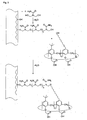
- the aforementioned free functional groups of the textile material with suitable bifunctional compounds such as bifunctional terminal haloalkanes or isocyanates, with elimination of, for example, hydrochloric acid or water can be reacted, in which case in a second reaction step, the same or following the first Reaction, the second free terminal group of the bifunctional compound can react with, for example, freely accessible OH, SH, NH 2 groups of the aliphatic radical of the calixarenes ( Fig. 2 ).
- a further embodiment of the material according to the invention provides that the calixarene is chemically bonded to the textile material via bifunctional condensable monomers. Such a connection is particularly preferred for those textile materials which consist of cellulose or have cellulose components.
- Particularly suitable condensable monomers here are dimethylolurea (DMU), dimethoxymethylurea (DMUMe 2 ), methoxymethylmelamine, in particular trimethoxymethylmelamine to hexamethoxymethylmelamine, dimethylol-alkanediol-diurethane, dimethylol-ethyleneurea (DMEU), dimethylol-dihydroxy-ethyleneurea (DMDHEU), dimethylol-propyleneurea (DMPU), dimethylol-4-methoxy-5,5-dimethylpropyleneurea, dimethylol-5-hydroxy-propylene-urea, dimethylolhexahydrotriazione, dimethoxymethyluron, tetramethylolacetylenediurea, dimethylolcarbamate and / or methylolacrylamide, since these compounds have corresponding contain reactive groups, such as aliphatic OH groups, with the functional groups of the cellulose and with accessible OH groups of the calix
- a further possibility for fixing the calixarenes according to formula I to textile materials provides that calixarenes with a long, aliphatic radical which is terminally not further substituted are used for this purpose.
- the aliphatic radical is incorporated as an anchor group in the textile material.
- the respective anchor group diffuses into the amorphous regions of the polymeric material and thus predominantly causes a physical bond, for example via van der Waals interaction or by hooking sterically demanding alkyl groups (R 2 , R 3 , R 4 are the same or different methyl, ethyl , Propyl, butyl) of the long aliphatic residue with the textile material.
- the type of physically acting anchor group depends on the respective textile materials to be used.
- calixarenes having such anchor groups are preferably selected, which consist in particular of a long aliphatic radical which may additionally be terminally branched.
- calixarenes As reactive chemical anchor groups which can react with the reactive hydrogen of an OH, -SH, NH 2 group, optionally also with an SO 3 H or COOH substituent of the long aliphatic radical of the invention to be used calixarenes come bifunctional aliphatic or also aromatic acid halides, such as aliphatic or aromatic sulfonic or carboxylic acid chlorides or the corresponding bromides and isocyanates or isothiocyanates, vinylsulfones, but also 2-bromoacrylate, 2-bromoacrylamide and halogen-substituted pyrimidyl, triazinyl or quinoxalinyl radicals for use.
- aromatic acid halides such as aliphatic or aromatic sulfonic or carboxylic acid chlorides or the corresponding bromides and isocyanates or isothiocyanates, vinylsulfones, but also 2-bromoacrylate, 2-bromoacrylamide and halogen-substituted pyrimi
- mixed bifunctional anchor groups such as those having a halogen atom and on the other hand having a carbonyl, sulfonyl or corresponding derivative thereof may also be used ( Fig.2 ).
- corresponding acid chlorides isocyanates, isothiocyanates, vinylsulfones, 2-bromoacrylates, dichlorotriazines, Dichlorchinoxaline, cyanodichloropyrimidines, difluorotor pyrimidines and the like which are capable of combining functionalized calixarenes with functional groups of the textile material.
- the chemical anchor compounds are allowed to react both first with the textile material and then with the functionalized on the long aliphatic moiety Calixaren, as well as in reverse order or in a one-pot reaction simultaneously with all components together.
- the corresponding calixarene is first dissolved or dispersed in a suitable fluid. Now treating the textile material to be used at temperatures between 60 ° C and 140 ° C, but preferably between 80 ° C and 130 ° C, with the solution or with the dispersion of calixarene.
- polar solvents such as alcohols, water, but also alkalis of alkali and alkaline earth metal hydroxides and formamides and sulfoxides.
- polar solvents such as alcohols, water, but also alkalis of alkali and alkaline earth metal hydroxides and formamides and sulfoxides.
- ethanol 1-propanol, 1-butanol, N, N-dimethylformamide, water and dilute sodium or potassium hydroxide solution.
- the treatment time varies with such a procedure, depending on the particular textile material to be treated and the treatment temperature between 10 minutes and 90 minutes.
- the amount of calixarene containing the textile material of the invention is determined by the particular application of the textile material.
- the textile material equipped according to the invention has a proportion of 0.1 to 20% by weight of calixarene, based on the textile material. Is preferred the proportion of 0.2 to 10 wt.%. It is understood that mixtures of calicarenes can be used.
- the cavities of the calixarenes used as equipment after a corresponding regeneration, repeatedly serve for the absorption of liquids and gases, but also of solids, such as dissolved ionic compounds, in particular of metal ions, of pharmaceuticals, fragrances and flavorings.
- the base-catalyzed reaction of a mixture of two different in their 4-position substituted phenols with formaldehyde under alkaline reaction conditions provides in a one-pot reaction mixed substituted catixarenes.
- the molar ratio of the differently substituted phenols used can be varied within wide limits.
- first 4-tert-butylphenol is reacted with formaldehyde in an alkaline reaction mixture to give the corresponding tert-butyl calixarene according to the prior art.
- one or more alkyl radicals can be incorporated into the calixarene.
- the alkyl halide the respective aliphatic alkyl chloride is preferably used.
- calixarene derivatives containing at the upper rim long aliphatic radicals which are further substituted with substituents such as OH, SH, carbonyl or sulfonyl groups and for equipping the textile materials according to the invention via chemical bonds directly or are suitable for reactive anchor.
- the resulting water of reaction is separated over the water until the viscous reaction mixture is just stir.
- the 4-nonyl-p-tert-butylcalix [6] arene-hexaacetic acid hexamethyl ester obtained according to Example 2 is prepared by a general procedure of S.-K. Was hydrolyzed by heating in THF in the presence of a 10% aqueous solution of tetraethylammonium hydroxide.
- the equipment test is carried out in a "Turbomat" apparatus from ahiba which is used for dyeing purposes.
- the polyester fleece is then washed with water until the wash liquor runs clear. Thereafter, the sample material is still 3 times with 100 ml of water, 1 time washed with 100 ml of acetone, 2 times with 100 ml of water, 1 time with 100 ml of ethanol and 2 times with 100 ml of water.
- the finished fleece is dried at 80.degree.
- UV spectroscopic remission measurement of the finished polyester material at a wavelength between 240 nm and 270 nm qualitatively detect the aromatics that have entered the textile material.
- the material thus equipped shows excellent properties in the endurance test. Even after repeated use in the separation of uranyl cations from a wastewater, the fleece shows no changes.
- -Butylcalix [6] arene by anhydrous aluminum chloride in absolute toluene at -5 ° C according to the procedure of McMurry et al. and subsequent reaction with 1,12-dodecanediol in phosphoric acid at 180 ° C following a general synthetic procedure for the alkylation of phenols by JP Losev et al. ( JP Losev, OV Simimova: Zhur. Obshchei Khim.
- a material is obtained which, even after repeated use for the separation of copper ions from a wastewater, shows no signs of abrasion of the equipment.
- the calixarene derivative thus obtained is covalently bound in a thermal fixing process at 100 ° C via its reactive anchor to the cotton material.
- 20 g of cotton are immersed in a solution of 8 g monochlorotriazinyl-calix [6] arene and 0.5 g of soda in 100 ml of water and heated to 98 ° C within 45 min. In 15 min intervals while 2.5 g of sodium chloride are added. At 98 ° C, a further 1.5 g of soda are added and then fixed at this temperature for 1 h. The fabric is removed from the bath and rinsed thoroughly with water.
- This material also behaves excellently in continuous operation.
- calix [6] arene functionalized with 1,12-dodecanediol, 25 g of water and 2 g of sodium hydroxide are placed in a round bottom flask.
- 7.4 g of cyanuric chloride was added in three portions with vigorous stirring at a temperature of 2 ° C. After stirring for 2 h, the pH increases to about 7.2.
- the pH is stabilized. The solution is filtered cold, the filtrate was concentrated and dried.
- the calixarene derivative thus obtained is covalently bound in a thermal fixing process at 100 ° C via its reactive anchor to the cotton material.
- 20 g of cotton are immersed in a solution of 8 g Monochlortriaziny-Calix [6] arens and 0.5 g of soda in 100 ml of water and heated to 98 ° C within 45 min. In 15 min intervals while 2.5 g of sodium chloride are added. At 98 ° C, a further 1.5 g of soda are added and then fixed at this temperature for 1 h. The fabric is removed from the bath and rinsed thoroughly with water.
- This material also behaves excellently in continuous operation.
Landscapes
- Engineering & Computer Science (AREA)
- Textile Engineering (AREA)
- Treatments For Attaching Organic Compounds To Fibrous Goods (AREA)
- Organic Low-Molecular-Weight Compounds And Preparation Thereof (AREA)
- Reinforced Plastic Materials (AREA)
- Manufacture Of Macromolecular Shaped Articles (AREA)
- Chemical Or Physical Treatment Of Fibers (AREA)
Description
- Die Erfindung betrifft textile Materialien, die mit Calixarenen gemäß Anspruch 1 ausgerüstet sind.
- Um Eigenschaften von textilen Materialien, wie beispielsweise einer Faser, eines Filaments, Garnes, Haufenwerks oder Flächengebildes gezielt zu verändern, ist bekannt, diese mit einer Ausrüstung zu versehen. Die Ausrüstungen können beispielsweise das Knittern vermindern, schmutzhindernd oder schmutzabweisend sein. So werden cellulosehaltige textile Materialien im allgemeinen mit einem Harnstoff-Formaldehyd-Produkt ausgerüstet. Des weiteren sind Ausrüstungen bekannt, durch die das Anschmutzverhalten der textilen Materialien, bzw. das Auswaschen von Schmutz aus diesen verbessert wird. Es handelt sich bei diesen so genannten Soil-Release Ausrüstungsprodukten um polymere Verbindungen.
- Exemplarisch seien hierfür Polyacrylate genannt, die im Rahmen der Veredlung auf das textile Material aufgebracht werden. Mit dieser Art der Ausrüstung wird eine leichtere Entfernung des Schmutzes ermöglicht und zusätzlich das Eindringen des Schmutzes in das textile Material verhindert.
- Die
DE-A-40 35 378 offenbart textile Materialien, die mit Cyclodextrinen oder Cyclodextrinderivaten versehen sind und der Aufnahme von Substanzen, wie Schmutz, Schweiß oder Schweißabbauprodukten dienen. - Das Auftragen der Cyclodextrinverbindungen erfolgt dabei meist direkt über das Einspinnen. Die Cyclodextrine können aber auch chemisch oder physikalisch an das textile Material angebunden sein.
- Bei der chemischen Variante erfolgt die Verknüpfung des textilen Materials mit dem Cyclodextrin durch chemische Reaktion eines reaktiven Substituenten am entsprechenden Cyclodextrinderivat und einer reaktiven Gruppierung an der Faser.
- Bei der physikalischen Variante werden Cyclodextrine über Ankergruppen in das textile Material eingebunden, die in der Polymermatrix immobilisiert werden.
- Die Herstellung textiler Materialien mit verbesserten oder neuen Gebrauchseigenschaften umfaßt die ständige Suche nach Ausrüstungsvarianten, die den Anforderungen an die textilen Materialien immer umfassender gerecht werden. Insbesondere betrifft das auch Materialien, die nicht unmittelbar für den textilen Bekleidungsbereich bestimmt sind.
- So wäre es für spezielle technische Anwendungen wünschenswert textile Materialien zu haben, die in der Lage sind organische und anorganische Ionen, insbesondere aber Metallionen, sowie neutrale organische Verbindungen aus fluiden oder gasförmigen Medien an die textilen Materialien zu binden, mit dem Ziel ionische Bestandteile sowie organische Verbindungen aus fluiden oder gasförmigen Medien abtrennen zu können.
- Die Aufgabe wird durch textile Materialien gelöst, die Calixarene der nachstehenden Formel I chemisch oder physikalisch gebunden enthält.

- R1
- H, unverzweigtes oder verzweigtes (C1-C18)-Alkyl, NO2, Halogen, SO3H, NR8R9 oder OR7 ist;
- R2 und R3,
- gleich oder verschieden, H oder (C1-C18)-Alkyl sind;
- R4
- (C1-C6)-Alkyl, (C1-C6) Hydroxyalkyl, (C1-C6) Mercaptoalkyl, (C1-C6) Aminoalkyl, (C1-C6) Sulfonylalkyl oder (C1-C6) Carboxyalkyl ist;
- R5 und R6,
- gleich oder verschieden; H, verzweigtes oder unverzweigtes (C1-C18) Alkyl, CH2C(=X)OR7 oder CH2C(=X)NR8R9 ist;
- R7
- H, unverzweigtes oder verzweigtes (C1-C18) Alkyl ist;
- R8 und R9,
- gleich oder verschieden, H, OH, OR7, unverzweigtes oder verzweigtes (C1-C18) Alkyl, Aryl, substituiertes Aryl, Heteroaryl oder substituiertes Heteroaryl sein können, oder
- R8 und R9
- gemeinsam einen aliphatischen fünf- oder sechsgliedrigen Ring bilden, der durch weitere Heteroatome substituiert sein kann;
- X
- O, S oder Se ist;
- Y
- 1 bis 7 ist;
- Z
- 1 bis 3 ist, wobei Y + Z = 4 bis 8 ist; und
- n
- 2 bis 18 ist
- Calixaiene sind erstmals von A. Zinke und E. Ziegler (A. Zinke, E. Ziegler: Ber. der dtsch. Chem. Ges. 77, 264, 1944) beschrieben worden. Es handelt sich dabei um makrocyclische Verbindungen, mit alternierenden Aren-Methylen-Einheiten (C.D. Gutsche: Monographs in Supramolecular Chemistry, Royal Society of Chemistry, 1989). Aufgrund ihrer dreidimensionalen Struktur können sie kleinere Moleküle einkapseln und geladene Atome, insbesondere Metallionen, komplexieren (S.-K.Chang, I.Cho: J. Chem. Soc. Perkin Trans. I, 1986, 211 - 213; S. Shinkai, Y. Shiramama, H. Satoh, O. Manabe: J. Chem. Soc. Perkin Trans II, 1989, 1167-1171).
-
EP-A-0 237 265 offenbart Carbonyl- und Stickstoffgruppen enthaltende Calixarene. InEP-A-0 309 291 werden Oxacalixarene und Calixarene beschrieben, die unterschiedlich substituierten Phenol-Einheiten im Makrocyclus statistisch verteilt enthalten.EP-B-0 432 989 offenbart ebenfalls Calixaren- und Oxacalixarensysteme, die zur Abtrennung von Metallen der Haupt- und Nebengruppenelementen verwendet werden können. - Die Darstellung substituierter Calixarene ist ebenfalls lange bekannt und zum Beispiel von C. D. Gutsche et al., (C. D. Gutsche et al.: Acc. Chem. Res. 16, 161-170 1983) oder in
US 4 556 700 beschrieben worden. Die Darstellung von Arylcalixarenen und deren Derivaten ist inEP-B-0 259 016 offenbart. - Gemischt funktionelle Calixarenderivate sind aus
EP-A-0 196 895 undUS 4 642 362 bekannt, in denen die Aryl-Einheiten unterschiedliche Seitenketten und oder Ether- oder Methylenbrücken aufweisen. - Oxacalixarene sind von C.D. Gutsche et al. (C.D. Gutsche et al.: J. Amer. Chem. Soc. 103 3782, 1981) und B. Dhawan et al. (B. Dhawan et al.: J. Org. Chem. 48, 1536, 1983), in
US-A-089 717 und inEP-A-0 309 291 beschrieben worden. - Überraschend wurde nun gefunden, daß Calixarene mit mindestens einem langen aliphatischen Rest, der 6 bis 25 Kohtenstoffeinheiten enthält und gegebenenfalls auch weiter substituiert sein kann, als Ausrüstung textiler Materialien chemisch oder physikalisch an diesen gebunden werden können.
- Weiterhin wurde gefunden, daß die erfindungsgemäß mit Calixarenen ausgerüsteten textilen Materialien geeignet sind organische und anorganische Ionen oder auch neutrale organische Moleküle aus Fluiden, insbesondere aber aus wäßrigen Medien, zu binden.
- Bei den erfindungsgemäß zu verwendenden Calixarenen handelt es sich hauptsächlich um Calixarene mit 4, 6 bis 8 Ringeinheiten, insbesondere um Calix[4]arene, Calix[6]arene und Calix[8]arene, d.h. um Calixarene mit 4, 6 oder 8 Aryleinheiten, wobei auch eine andere Anzahl an Aryleinheiten zugelassen ist.
- Die erfindungsgemäß verwandten Calixarene mit phenolischen oder substituiert phenolischen Resten am lower rim (unteren Rand) sind in der Lage, organische und anorganische ionische Verbindungen, insbesondere Metallionen der Haupt- und Nebengruppenelemente, aber auch nicht ionische organische Verbindungen aus fluiden und gasförmigen Medien zu binden und damit aus diesen zu entfernen.
- Die Art der Substituenten am lower rim (unteren Rand) steuert die Selektivität der Komplexierung mit ionischen Verbindungen.
- So eignen sich über eine phenolische Etherbrücke substituierte Carbonsäureester (R5, R6 gleich oder verschieden CH2C(=O)OR7), wie die entsprechende Methyl- (R7 gleich CH3) und Ethylester (R7 gleich C2H5), mehr für die Komplexierung von Alkali- und Erdalkalimetallionen, sowie über die phenolische Etherbrücke substituierte Carbonsäuren (R5, R6 gleich oder verschieden CH2C(=O)OH) und Hydroxamsäuren (R5, R6 gleich oder verschieden CH2C(=O)NHOH) sehr selektiv für die Komplexierung von Uranylionen.
- Der als upper rim (oberer Rand) bezeichnete und insbesondere durch Alkylgruppen substituierte Teil der Calixarene, dient erfindungsgemäß zur chemischen und oder physikalischen Anbindung an die textilen Materialien.
- Unter dem Begriff "Calixarene" werden in der Erfindung auch solche Verbindungen und Derivate verstanden, die zusätzlich weitere Substituenten, vor allem polare Gruppierungen aufweisen, soweit diese sich nicht negativ auf die Einbringung oder Verwendung im textilen Material auswirken.
- Die erfindungsgemäß verwendeten Calixarene haben pro Molekül mindestens eine Aren-Einheit mit einem langen aliphatischen Rest, mit 6 bis 25 Kohlenstoffeinheiten, der auch verzweigt sein kann. Substituenten des langen aliphatischen Rests, im Falle einer Verwendung des betreffenden Calixarens für eine chemische Anbindung, müssen nicht unbedingt endständig positioniert sein. Erlaubt sind demzufolge, neben einer endständigen Anordnung, auch sekundäre bzw. tertiäre Substituentenpositionen. Als Substituenten für den langen aliphatischen Rest eignen sich vor allem polare, reaktive Gruppierungen, wie OH, SH, NH2, COOH und SO3H, die in der Lage sind, mit Substituenten der textilen Materialien bzw. mit einem Reaktivanker, der ebenfalls reaktive Gruppen hat, zu reagieren.
- Unter dem Begriff C1-C6 Hydroxyalkyl werden erfindungsgemäß insbesondere unverzweigte aliphatische Kohlenwasserstoff-Reste verstanden; die mit einer OH-Gruppe substituiert sind. Beispielhaft seien hier ω-Hydroxymethyl-, ω-Hydroxyethyl-, ω-Hydroxypropyl-, ω-Hydroxybutyl-, ω-Hydroxypentyt- oder ω-Hydroxyhexyl-Reste u.s.w. genannt.
- Die verbleibenden Aren-Einheiten im Molekül der Calixarene haben im upper rim (oberem Rand) allgemein kürzere aliphatische Reste, die sowohl linear als auch verzweigt sein können, insbesondere aber tert.-Butyl-Reste sind. Sie dienen vor allem der Steuerung der Löslichkeit sowie der Einstellung einer bestimmten räumlichen Geometrie der Calixarene bzw. Calixarenderivate. Weitere Substituenten, wie Nitro-, Amino- oder substituierte Aminogruppen haben ähnliche Effekte.
- Calixarene mit Sulfonsäuregruppen am upper rim (oberen Rand) sind starke Säuren, die für bestimmte Verwendungen, wie für die Einlagerung kleinerer geladener organischer Moleküle, interessant sein können.
- Als Ausrüstungen auf textilen Materialien sind die folgenden Calixarene besonders geeignet und bevorzugt, wobei diese Auswahl nicht auf die hier vorgestellten Verbindungen begrenzt ist.


Y = 4-Z, Y = 6-Z oder Y = 8-Z Z = 1, 2; y + Z = 4, 6, 8 Y = 4-Z, Y = 6-Z oder Y = 8-Z Z=1,2;Y+Z=4,6,8; R7 = Alkyl Formel 1 Formel 2 

Y = 4-Z, Y = 6-Z oder Y = 8-Z Z = 1, 2; Y + Z = 4,6,8 Y = 4-Z, Y = 6-Z oder Y = 8-Z Z=1,2;Y+Z=4,6,8 Formel 3 Formel 4 

Y = 4-Z, Y = 6-Z oder Y = 8-Z Z = 1, 2; Y + Z = 4, 6, 8; Y = 4-Z, Y = 6-Z oder Y = 8-Z Z = 1, 2; Y + Z = 4, 6, 8; R7 = Alkyl Formel 5 Formel 6 

Y = 4-Z, Y = 6-Z oder Y = 8-Z Z=1,2;Y+Z=4,6,8 Y = 4-Z, Y = 6-Z oder Y = 8-Z Z = 1, 2; Y + Z = 4, 6, 8 Formel 7 Formel 8 

Y = 4-Z, Y = 6-Z oder Y = 8-Z Z = 1, 2; Y + Z = 4, 6, 8 Y = 4-Z-, Y = 6-Z oder Y = 8-Z Z = 1,2; Y + Z = 4, 6, 8; R7 = Alkyl Formel 9 Formel 10 

Y = 4-Z, Y = 6-Z oder Y = 8-Z Z=1,2;Y+Z=4,6,8 Y = 4-Z, Y = 6-Z oder Y = 8-Z Z = 1, 2; Y + Z = 4, 6, 8 Formel 11 Formel 12 

Y = 4-Z, Y = 6-Z oder Y = 8-Z Z=1,2;Y+Z=4,6,8 Y = 4-Z, Y = 6-Z oder Y = 8-Z Z = 1, 2; Y+Z = 4, 6, 8; R7 = Alkyl Formel 13 Formel 14 

Y = 4-Z, Y = 6-Z oder Y = 8-Z Z = 1, 2; Y + Z = 4, 6, 8 Y = 4-Z, Y = 6-Z oder Y = 8-Z Z=1,2;Y+Z=4,6,8 Formel 15 Formel 16 - Unter dem Begriff "textiles Material" werden erfindungsgemäß Materialien wie beispielsweise Fasern, Filamente, Garne, Haufwerke oder Flächengebilde verstanden.
- Unter textilen Materialien versteht man sowohl natürliche als auch synthetische oder auch synthesefaserhaltige Materialien. Als natürliche textile Materialien werden Baumwolle, Wolle, Leinen oder Seide verstanden. Textilfasern auf Cellulosebasis sind Baumwolle, Leinen, Zellwolle oder Kunstseide. Hierzu zählen ferner Viskose-, Cupro- und Acetatfasern.
- Unter dem Begriff "synthetische Fasern" versteht man voll synthetische Fasern, die aus einfachen Bausteinen durch Polymerisation, Polykondensation oder Polyaddition hergestellt werden. Hierzu zählen Elastan, Elastolin, Fluorofasem, Polyacryl, Modacryl, Polyamid, Aramid, Polyvinylchlorid, Polyvinylidenchlorid, Polyester, Polyethylen, Polypropylen und Polyvinylalkohol. Bei den synthesefaserhaltigen Materialien handelt es sich um solche; die sowohl die rein synthetische Faser als auch natürliche Materialien, wie solche auf Cellulosebasis, enthalten.
- Es gibt mehrere Möglichkeiten die erfindungsgemäß zu verwendenden Calixarene an das textile Material chemisch und/oder physikalisch anzubinden bzw. in dieses einzubringen.
- So sieht eine Ausführungsform des erfindungsgemäßen Materials vor, daß das Catixaren in die Faser, das Filament und oder das Garn eingesponnen ist. Eine physikalische Bindung des Calixarens ist beispielsweise auch bei solchen textilen Materialien möglich, die durch ein Schmelz- oder Lösungsmittelspinnverfahren hergestellt werden, so insbesondere bei Polyester-, Polyamid-6, Polyamid-6.6-, Cellulose-, Celluloseacetat-, Polyacrylnitril- und Polyalkylenmaterialien.
- Vorzugsweise werden bei derartigen Materialien die Spinnbedingungen dann so gewählt, daß die Calixarene über den Querschnitt der Faser, des Filaments und oder des Garnes gesehen überwiegend im äußeren Bereich angeordnet sind, so daß die für eine Aufnahme von Ionen und oder organischen Verbindungen notwendigen Öffnungen der Calixarene frei zugänglich sind.
- Gemäß einer weiteren Ausführungsform der Erfindung weist das textile Material das Calixaren chemisch gebunden auf.
- Hierbei können die Bindungen entweder direkt über frei zugängliche funktionelle Gruppe des textilen Materials oder über entsprechende Ankergruppen, vorzugsweise bifunktionelle Verbindungen sowie polymere oder oligomere Verbindungen an die frei zugänglichen Substituenten der Calixarene, insbesondere an die Substituenten des langen aliphatischen Rests im upper rim (oberen Rand), chemisch gebunden sein.
- So ist es beispielsweise möglich, freie funktionelle Gruppen des textilen Materials, wie beispielsweise OH, COOH oder auch andere saure Gruppen, sowie NH2 und oder andere basische Gruppen unter Abspaltung von zum Beispiel Wasser direkt mit den frei zugänglichen Substituenten, wie OH, SH, NH2, SO3H oder COOH, der Calixarene unter Ausbildung von Ether-, Thioether-, Amid-, oder Esterfunktionen reagieren zu lassen (
Fig. 1a, 1b ). - Ebenso kann man die vorgenannten freien funktionellen Gruppen des textilen Materials mit geeigneten bifunktionellen Verbindungen, wie beispielsweise mit bifunktionellen endständigen Halogenalkanen oder Isocyanaten, unter Abspaltung von beispielsweise Salzsäure oder Wasser reagieren lassen, wobei dann in einem zweiten Reaktionsschritt, der gleichzeitig oder im Anschluß an die erste Reaktion ablaufen kann, die zweite freie endständige Gruppe der bifunktionellen Verbindung mit zum Beispiel frei zugänglichen OH-, SH-, NH2- Gruppen des aliphatischen Rests der Calixarene reagieren kann (
Fig. 2 ). - Eine weitere Ausführungsform des erfindungsgemäßen Materials sieht vor, daß das Calixaren über bifunktionelle kondensationsfähige Monomere chemisch an das textile Material gebunden wird. Eine derartige Anbindung ist insbesondere bei solchen textilen Materialien bevorzugt, die aus Cellulose bestehen oder Celluloseanteile aufweisen.
- Als kondensationsfähige Monomere haben sich hierbei insbesondere auch Dimethylol-hamstoff (DMU), Dimethoxymethyl-hamstoff (DMUMe2), Methoxymethylmelamin, insbesondere Trimethoxymethylmelamin bis Hexamethoxy-methylmelamin, Dimethylol-alkandiol-diurethane, Dimethylol-ethylenhamstoff (DMEU), Dimethylol-dihydroxy-ethylenhamstoff (DMDHEU), Dimethylol-propylenhamstoff (DMPU), Dimethylol-4-methoxy-5,5-dimethylpropylenhamstoff, Dimethylol-5-hydroxy-propylen-harnstoff, Dimethylolhexahydrotriazion, Dimethoxymethyluron, Tetramethylolacetylendiharnstoff, Dimethylolcarbamat und oder Methylolacrylamid bewährt, da diese Verbindungen über entsprechende reaktionsfähige Gruppen, wie aliphatische OH-Gruppen verfügen, die mit den funktionellen Gruppen der Cellulose und mit zugänglichen OH-Gruppen der Calixarene unter Ausbildung von beispielsweise Etherbrücken reagieren und gleichzeitig noch untereinander zwei oder dreidimensional unter Ausbildung der entsprechenden polymeren oder oligomeren Verbindung vernetzen können. Die Anbindung der Calixarene erfolgt dabei vorzugsweise über die funktionellen OH-Grupppen am langen aliphatischen Rest an ihrem upper rim (
Fig.3 ). - Eine weitere Möglichkeit zur Fixierung der Calixarene gemäß Formel I an textile Materialien sieht vor, daß hierfür Calixarene mit einem langen, aliphatischen Rest, der endständig nicht weiter substituiert ist, eingesetzt werden. Der aliphatische Rest wird als Ankergruppe in das textile Material eingebunden. Dabei diffundiert die jeweilige Ankergruppe in die amorphen Bereiche des polymeren Materials und bewirkt so überwiegend eine physikalische Bindung, zum Beispiel über van der Waals'sche Wechselwirkung oder durch Verhaken sterisch anspruchsvoller Alkylgruppen (R2, R3, R4 gleich oder verschieden Methyl, Ethyl, Propyl, Butyl) des langen aliphatischen Rests mit dem textilen Material.
- Bei der zuvor beschriebenen Ausführungsform des erfindungsgemäßen textilen Materials richtet sich die Art der physikalisch wirkenden Ankergruppe nach den jeweils zu verwendenden textilen Materialien. So werden beispielsweise für Polyestermaterialien Calixarene mit solchen Ankergruppen bevorzugt ausgewählt, die insbesondere aus einem langen aliphatischen Rest, der zusätzlich endständig auch verzweigt sein kann, bestehen.
- Als reaktive chemische Ankergruppen, die mit dem reaktiven Wasserstoff einer OH,-SH-, NH2-Gruppe, gegebenenfalls auch mit einem SO3H- oder COOH-Substituenten des langen aliphatischen Rests der erfindungsgemäß zu verwendenden Calixarene reagieren können, kommen bifunktionelle aliphatische oder auch aromatische Säurehalogenide, wie zum Beispiel aliphatische oder aromatische Sulfon- oder Carbonsäurechloride oder auch die entsprechenden Bromide sowie Isocyanate oder Isothiocyanate, Vinylsulfone, aber auch 2-Bromacrylat, 2-Bromacrylamid sowie halogensubstituierte Pyrimidyl, Triazinyl oder Chinoxalinyl-Reste zur Anwendung.
- Insbesondere gemischt bifunktionelle Ankergruppen, wie beispielsweise solche mit einem Halogenatom und andererseits mit einer Carbonyl-, Sulfonylgruppe oder entsprechenden Derivaten hiervon, können ebenfalls verwendet werden (
Fig.2 ). - Für die erfindungsgemäßen Zwecke besonders geeignet sind entsprechende Säurechloride, Isocyanate, Isothiocyanate, Vinylsulfone, 2-Bromacrylate, Dichlortriazine, Dichlorchinoxaline, Cyanodichlorpyrimidine, Difluorchtor pyrimidine und dergleichen, die geeignet sind funktionalisierte Calixarene mit funktionellen Gruppen des textilen Materials zu verbinden.
- In einer Ausführungsform des erfindungsgemäßen Verfahrens zur Herstellung des zuvor beschriebenen Materials über chemische Reaktivanker läßt man die chemischen Ankerverbindungen sowohl zuerst mit dem textilen Material und anschließend mit dem am langen aliphatischen Rest funktionell ausgestatteten Calixaren reagieren, als auch in umgekehrter Reihenfolge oder in einer Eintopfreaktion gleichzeitig mit allen Komponenten gemeinsam.
- Um bei einer zuvor beschriebenen Ausführungsform des erfindungsgemäßen Verfahrens mit kondensationsfähigen Monomeren auch die erwünschte zwei- und oder dreidimensionale Vernetzung unter chemischer Anbindung des Calixarens an funktionelle Gruppen des textilen Materials über Reaktivanker zu erreichen, führt man eine thermische Behandlung des Materials bei einer Temperatur zwischen 130°C und 190°C während einer Verweilzeit von 1 Minute bis 10 Minuten durch.
- In einer weiteren Ausführungsform des erfindungsgemäßen Verfahrens, bei dem das Calixaren über eine physikalisch wirkende Ankergruppe am textilen Material fixiert ist, löst oder dispergiert man zunächst das entsprechende Calixaren in einem geeigneten Fluid. Nun behandelt man das zu verwendende textile Material bei Temperaturen zwischen 60°C und 140°C, vorzugsweise aber zwischen 80°C und 130°C, mit der Lösung bzw. mit der Dispersion des Calixarens.
- Als Fluid eignen sich polare Lösungsmittel, wie Alkohole, Wasser, aber auch Laugen von Alkali- und Erdalkalihydroxiden sowie Formamide und Sulfoxide. Insbesondere sind Ethanol; 1-Propanol, 1-Butanol, N,N-Dimethylformamid, Wasser sowie verdünnte Natron- oder Kalilauge geeignet.
- Die Behandlungsdauer variiert bei einer derartigen Verfahrensweise, abhängig von dem jeweils zu behandelnden textilen Material und der Behandlungstemperatur zwischen 10 Minuten und 90 Minuten.
- Die Menge an Calixaren, die das erfindungsgemäße textile Material enthält, wird vom jeweiligen Anwendungszweck des textilen Materials bestimmt.
- Allgemein weist das erfindungsgemäß ausgerüstete textile Material einen Anteil von 0,1 bis 20 Gew.% an Calixaren, bezogen auf das textile Material, auf. Bevorzugt ist der Anteil von 0,2 bis 10 Gew.%. Es versteht sich, daß auch Mischungen von Calicarenen eingesetzt werden können.
- Überraschend konnte festgestellt werden, daß bei den erfindungsgemäß ausgerüsteten Materialien eine dauerhafte Ein- bzw. Anbindung der Calixarene erfolgte.
- So können die Hohlräume der als Ausrüstung verwendeten Calixarene, nach einer entsprechenden Regenerierung, wiederholt zur Aufnahme von Flüssigkeiten und Gasen, aber auch von Feststoffen, wie gelösten ionischen Verbindungen, insbesondere von Metallionen, von Pharmazeutika, Duft- sowie Aromastoffen dienen.
- Die Herstellung der erfindungsgemäß zu verwendenden, häufig gemischt substituierten Calixarene durch Aufbaureaktion kleiner phenolischer Einheiten, die in ihrer 4-postition unterschiedlich substituiert sind, ist bekannt. (H. Kämmerer, G. Happel.: Makromol. Chem., Rapid Commun, 1, 461-466, 1980; G. Happel, B. Mathiasch, H. Kämmerer: Die Makromolekulare Chemie 176, 3317-3334, 1975).
- Die basen-katalysierte Reaktion eines Gemisches zweier unterschiedlich in ihrer 4-Position substituierter Phenole mit Formaldehyd unter alkalischen Reaktionsbedingungen liefert in einer Eintopfreaktion gemischt substituierte Catixarene.
- Dabei kann das molare Verhältnis der verwendeten unterschiedlich substituierten Phenole in weiten Grenzen vatiiert werden.
- So reagiert zum Beispiel 4-tert.-Butylphenol und 4-Nonylphenol im molaren Verhältnis von 5:0,8 bis 5:1,25 mit Formaldehyd zum Calix[6]aren der Formel 1 (Y = 6-Z; Z = 1 bis 2; Y + Z = 6).
- In bekannter Weise können durch Variation der Reaktionsbedingungen, durch Verwendung von Paraformaldehyd an Stelle einer wäßrigen Formaldehydlösung sowie durch Variation des verwendeten Basentyps bzw. seiner Konzentration auch entsprechende Calix[4]arene bis Calix[8]arene erhalten werden.
- In einer weiteren Ausführungsform der Erfindung läßt man zunächst 4-tert.-Butylphenol mit Formaldehyd in alkalischer Reaktionsmischung zum entsprechenden tert.-Butylcalixaren gemäß dem Stand der Technik reagieren.
- Bekannt ist, daß man durch überschüssiges wasserfreies Aluminiumchlorid in aromatischen Kohlenwasserstoffen, wie in Toluol, Entalkylierung aller am upper rim (oberen Rand) befindlichen tert.-Butyl-Gruppen erreicht (J.E. Mc Murry, J.Ch. Phelan: Tetrahedron Letters, 32, 5655-5658, 1991).
- Man erhält so aus ursprünglich am upper rim (oberen Rand) tert.-butyl-substituierten Calixarenen entsprechende H-substituierte Derivate.
- In einem zweiten Reaktionsschritt führt man nun durch Alkylierung mit Alkylhalogeniden, Alkylalkoholen oder auch Alkylenen in sauren Medien oder auch mittels Katalysator nach an sich bekannten Alkylierungs-Prozeduren ("Phenole": Houben-Weyl 6/1c) die gewünschten andersartig substituierten Alkylreste ein.
- Eine weitere Möglichkeit ist auch die Herstellung von am upper rim gemischt substituierten Calixarenen in einer Eintopfreaktion durch vollständige oder auch durch partielle Entalkylierung mittels wasserfreien Aluminiumchlorids bei gleichzeitiger selektiver Alkylierung mit langkettigen Alkylhalogeniden in einem aromatischen Kohlenwasserstoff, wie in Toluol.
- Je nach der verwendeten stöchiometrischen Menge des jeweiligen langkettigen Alkylhalogenids lassen sich ein oder auch mehrere Alkylreste in das Calixaren einfügen. Als Alkylhalogenid wird bevorzugt das jeweilige aliphatische Alkylchlorid verwendet.
- Auf diese Weise erhält man Calixarenderivate, die am upper rim lange aliphatische Reste enthalten, die weiter mit Substituenten, wie mit OH-, SH-, Carbonyl- oder Sulfonyl-Gruppen substituiert sind und für eine Ausrüstung der erfindungsgemäß textilen Materialien über chemische Bindungen direkt oder über Reaktivanker geeignet sind.
- Die nachfolgenden Beispiele sollen die vorliegende Erfindung näher erläutern ohne diese jedoch darauf zu begrenzen.
- Unter Schutzgasatmosphäre erhält man in einer Eintopfreaktion ein Calixaren-Gemisch, das in seiner Zusammensetzung hauptsächlich der Verbindung der Formel 1 (Y = 6-Z; Z = 1; Y + Z = 6) entspricht, indem man 477 ml 37 %ige Formaldehydlösung, 52,6 g (0,937 mol) Kaliumhydroxid, 298,8 g (1,995 mol) p-tert.-Butylphenol und 73,2 g (0,333 mol) p-Nonylphenol gemeinsam zum Sieden erhitzt werden.
- Das entstehende Reaktionswasser wird so lange über den Wasserabscheider abgetrennt, bis sich die zähflüssige Reaktionsmischung gerade noch rühren läßt.
- Nun werden 3700 ml Xylol portionsweise zugesetzt und das Reaktionsgemisch so schnell wie möglich wieder zum Sieden gebracht. Man läßt die Mischung weitere 4 h bis 10 h unter Rückfluß sieden. Dabei scheidet sich weiteres Reaktionswasser ab.
- Anschließend wird von der Mischung so viel Xylol (1000 ml bis 2000 ml) unter Rühren abdestilliert, bis nach dem Abkühlen eine ausreichende Menge Produkt ausgefallen ist.
- Diese wird dann auf einer Nutsche abgesaugt. Man trocknet den Feststoff 48 Stunden in einem Vakuumtrockenschrank bei einer Temperatur von 110°C.
- 169 g Rohprodukt werden in 4200 ml Chloroform und 1050 ml konzentrierter Salzsäure unter Rühren gegebenenfalls unter leichter Erwärmung auf etwa 40°C gelöst. Nach einer Klärfiltration trennt man die Phasen. Danach wird die organische Lösung bis zur Trockene eingeengt. Das dabei erhaltene Produkt, trocknet man anschließend in einem Vakuumtrockenschrank bei einer Temperatur von 110°C.
- 4-Nonyl-p-tert.-Butyl-calix[6]aren wird nach einer bekannten Prozedur (S.-K. Chang: J. Chem. Soc. Perkin Trans. I, 211-213, 1968) mit Bromessigsäuremethylester in wasserfreiem THF im Beisein von Natriumhydrid in den 4-Nonyl-p-tert.-butylcalix[6]aren-hexaessigsäurehexamethylester überführt Formel 2, (Y = 6-Z; Z = 1, 2; Y + Z = 6; R7 gleich Methyl).
-
C89H118O18 (1475,92) C H berechnet 72,42 8,06 gefunden 71,95 7,78 - Der gemäß Beispiel 2 erhaltene 4-Nonyl-p-tert.-butylcalix[6]aren-hexaessigsäure-hexamethylester wird nach einer allgemeinen Prozedur von S.-K. Chang durch Erwärmen in THF in Gegenwart einer 10%igen wäßrigen Tetraethylammoniumhydroxidlösung hydrolysiert. Man erhält die 4-Nonyl-p-tert.-butylcalix[6]aren-hexaessigsäure Formel 3 (Y = 6-Z; Z = 1, 2; Y + Z = 6).
-
C83H106O18 (1391,75) C H berechnet 71,63 7,68 gefunden 70,82 7,38 - In einer für Färbezwecke verwendeten Apparatur "Turbomat" der Firma ahiba führt man den Ausrüstungsversuch durch.
- Dazu werden 11 g auszurüstendes Polyestergewebe auf der Färbespindel fixiert und wie folgt behandelt:
- 69,6 mg (0,05 mmol) voranstehende 4-Nonyl-p-tert.-butylcalix[6]aren-hexaessigsäure werden in 350 ml verdünnter Natronlauge (pH 12) 15 min. dispergiert und anschließend mit der Polyesterprobe in die Apparatur eingefüllt. Zunächst wird der Färbezylinder 5 min. in der auf 60 °C vorgeheizten Apparatur temperiert. Dann wird die Temperatur innerhalb einer halben Stunde auf 130 °C erhöht und die Flotte dabei gerührt. Man hält die Temperatur 1 h und reduziert danach diese wieder auf 70 °C. Dann wird die Apparatur auf Raumtemperatur gebracht.
- Das Polyestervlies wird anschließend mit Wasser gewaschen, bis die Waschlauge klar abläuft. Danach wird das Probenmaterial noch 3 mal mit je 100 ml Wasser, 1 mal mit 100 ml Aceton, 2 mal mit je 100 ml Wasser, 1 mal mit 100 ml Ethanol und 2 mal mit je 100 ml Wasser gewaschen. Man trocknet das ausgerüstete Vlies bei 80 °C.
- UV-spektroskopische Remissionsmessung des ausgerüsteten Polyestermaterials bei einer Wellenlänge zwischen 240 nm und 270 nm lassen qualitativ die in das textile Material eingetretenen Aromaten erkennen.
- Das so ausgerüstete Material zeigt ausgezeichnete Eigenschaften im Dauertest. Auch nach wiederholter Verwendung bei der Abtrennung von Uranylkationen aus einem Abwasser zeigt das Vlies keine Veränderungen.
- 5 g Baumwollmaterial werden in einem ersten Reaktionsschritt nach einer an sich bekannten Prozedur mit Cyanursäure ausgerüstet, indem man entschlichtetes, gekochtes und gebleichtes Baumwollgewebe mit einer Lösung aus 0,6 g Natriumdodecylsulfat in 200 ml doppelt destilliertem Wasser behandelt. Eine Lösung aus 3,69 g (0,02 mol) 1,3,5-Trichlor-2,4,6-triazin und 0,8 g (0,02 mol) Natriumhydroxid in 30 ml doppelt destilliertem Wasser werden zugegeben. Das Reaktionsgemisch wird 3 h bei Raumtemperatur gerührt. Danach wird die Baumwolle zuerst mit doppelt destilliertem Wasser, danach mit einer Waschlösung aus Texapon K12-96 in doppelt destilliertem Wasser und abschließend wieder mit doppelt destilliertem Wasser gespült.
- In einem weiteren Reaktionsschritt wird das Calix[6]aren der Formel 13, (Y = 6-Z; Z = 1, 2; Y + Z = 6), hergestellt zunächst durch Entfernung aller Substituenten aus dem upper rim des 4-tert.-Butylcalix[6]arens mittels wasserfreien Aluminiumchlorids in absolutem Toluol bei -5 °C nach der Prozedur von Mc Murry et al. und anschließender Reaktion mit 1,12-Dodecandiol in Phosphorsäure bei 180°C nach einer allgemeinen Syntheseprozedur zur Alkylierung von Phenolen von J.P. Losev et al. (J.P. Losev, O.V. Simimova: Zhur. Obshchei Khim. 28, 363-365, 1958; C.A. 52, 13672d, 1958), in Wasser suspendiert und mit dem ausgerüsteten Baumwollmaterial in Verbindung gebracht. Durch thermische Behandlung bei 60°C bis 100°C wird das Calix[6]aren chemisch an die ausgerüstete Faser über den baumwollfixierten Reaktivanker gebunden.
- Man erhält ein Material, das auch nach wiederholtem Gebrauch zur Abtrennung von Kupferionen aus einem Abwasser keine Abriebserscheinungen der Ausrüstung zeigt.
- Alternativ wird gemäß Beispiel 4a das Calix[6]aren der Formel 9 (Y = 4-Z; Z = 1, 2; Y + Z = 6, zunächst hergestellt durch Entalkylierung von tert.-Butyl-Calix[6]aren nach Mc Murry und anschließender Derivatisierung mit 1,12-Dodecandiol nach einer allgemeinen Syntheseprozedur zur Alkylierung von Phenolen von J.P. Losev et al. in einem weiteren Rektionsschritt mit Cyanurchlorid umgesetzt. Dazu werden 10 g Wasser, 10 g Eis und 1,2 g Natriumhydroxid in einem Rundkolben vorgelegt. Innerhalb von 30 min. wurde unter kräftigem Rühren bei einer Temperatur von 0 - 5 °C 5,5 g Cyanurchlorid in drei Portionen zugegeben. Anschließend tropft man eine Suspension von 2 g des mit 1,12-Dodecandiol funktionalisierten Calix[6]arens in 10 ml Wasser und 1,2 g Natrumhydroxid langsam unter kräftigem Rühren zu. Nach 1,5 h wird die noch kalte Suspension filtriert, das Filtrat eingeengt und getocknet.
- Danach wird das so erhaltene Calixarenderivat in einem thermischen Fixierprozeß bei 100°C über seinen Reaktivanker an das Bauwollmaterial kovalent gebunden. Dazu werden 20 g Baumwolle in eine Lösung aus 8 g Monochlortriazinyl-Calix[6]aren und 0,5 g Soda in 100 ml Wasser getaucht und innerhalb von 45 min auf 98 °C erhitzt. In 15 min Abständen werden dabei je 2,5 g Natriumchlorid zugegeben. Bei 98 °C werden weitere 1,5 g Soda zugegeben und anschließend 1 h bei dieser Temperatur fixiert. Der Stoff wird aus dem Bad genommen und gründlich mit Wasser ausgewaschen.
- Auch dieses Material verhält sich ausgezeichnet im Dauerbetrieb.
- Alternativ wird gemäß Beispiel 4a und 4b das Calix[6]aren Formel 9 (Y = 4-Z; Z = 1, 2; Y + Z = 6), zunächst hergestellt durch Entalkylierung von tert.-Butyl-Calix[6]aren nach Mc Murry und anschließender Derivatisierung mit 1,12-Dodecandiol nach einer allgemeinen Syntheseprozedur zur Alkylierung von Phenolen von J.P. Losev et al. in einem weiteren Rektionsschritt mit Cyanurchlorid zum Dichlortriazinylcalix[6]aren umgesetzt. Dazu werden 2 g des mit 1,12-Dodecandiol funktionalisierten Calix[6]arens, 25 g Wasser und 2 g Natriumhydroxid in einem Rundkolben vorgelegt. Innerhalb von 30 min. wurde unter kräftigem Rühren bei einer Temperatur von 2 °C 7,4 g Cyanurchlorid in drei Portionen zugegeben. Nach 2 h Rühren steigt der pH Wert auf ca. 7,2. Durch Zugabe von 4 g Na2HPO3 und 6 g KH2PO3 in 50 g Wasser wird der pH-Wert stabilisiert. Die Lösung wird kalt filtriert, das Filtrat eingeengt und getocknet.
- Danach wird das so erhaltene Calixarenderivat in einem thermischen Fixierprozeß bei 100°C über seinen Reaktivanker an das Bauwollmaterial kovalent gebunden. Dazu werden 20 g Baumwolle in eine Lösung aus 8 g Monochlortriaziny-Calix[6]arens und 0,5 g Soda in 100 ml Wasser getaucht und innerhalb von 45 min auf 98 °C erhitzt. In 15 min Abständen werden dabei je 2,5 g Natriumchlorid zugegeben. Bei 98 °C werden weitere 1,5 g Soda zugegeben und anschließend 1 h bei dieser Temperatur fixiert. Der Stoff wird aus dem Bad genommen und gründlich mit Wasser ausgewaschen.
- Auch dieses Material verhält sich ausgezeichnet im Dauerbetrieb.
Claims (22)
- Textiles Material, dadurch gekennzeichnet, daß es mit einem Calixaren der nachstehenden Formel I, das chemisch und/oder physikalisch an dem textilen Material fixiert ist, ausgerüstet ist
 R1 H, unverzweigtes oder verzweigtes (C1-C18)-Alkyl, NO2, Halogen, SO3H, NR8R9 oder OR7 ist,R2 und R3 gleich oder verschieden, H oder (C1-C18)-Alkyl sind;R4 (C1-C6)-Alkyl, (C1-C6)-Hydroxyalkyl, (C1-C6)-Mercaptoalkyl. (C1-C6)-Aminoalkyl, (C1-C6)-Sulfonylalkyl oder (C1-C6)-Carboxyalkyl ist;R5 und R6 gleich oder verschieden; H, verzweigtes oder unverzweigtes (C1-C18) Alkyl, CH2C(=X)OR7 oder CH2C(=X)NR8R9 ist;R1 H, unverzweigtes oder verzweigtes (C1-C18) Alkyl ist;R8 und R9 gleich oder verschieden, H, OH, OR7, unverzweigtes oder verzweigtes (C1-C10) Alkyl, Aryl, substituiertes Aryl, Heteroaryl oder substituiertes Heteroaryl sein können, oderR8 und R9 gemeinsam einen aliphatischen fünf- oder sechsgliedrigen Ring bilden, der durch weitere Heteroatome substituiert sein kann;X O, S oder Se ist;Y 1 bis 7 ist;Z 1 bis 3 ist, wobei Y + Z = 4 bis 8 ist; undn 2 bis 18 bedeutet,wobei das Calixaren pro Molekül mindestens eine Aren-Einheit mit einem langen aliphatischen Rest mit 6 bis 25 Kohlenstoffeinheiten aufweist.
 - Textiles Material nach Anspruch 1 dadurch gekennzeichnet, daß in der Formel 1 R1 H oder tert.-Butyl ist, R2 und R3, gleich oder verschieden, H, oder (C1-C6)-Alkyl sind; R4 (C1-C6)-Alkyl ist, n 6 bis 18 ist und R5 und R8 CH2(C=O)OH, CH2(C=O)OCH3, CH2(C=O)OC2H5, CH2(C=O)NHOH sind sowie Y = (6 - Z) und Z 1 oder 2 ist, wobei Y + Z = 6, oder Y = (4 - Z) und Z 1 oder 2 ist, wobei Y + Z = 4, oder y = (8 - Z) und Z 1 oder 2, wobei Y + Z = 8.
- Textiles Material nach Anspruch 1 oder 2, dadurch gekennzeichnet, daß das Calixaren in die Faser, das Filament und/oder das Garn eingesponnen ist.
- Textiles Material nach Anspruch 1 oder 2, dadurch gekennzeichnet, daß das Calixaren mit seinen reaktiven Gruppen chemisch direkt an freie funktionelle Gruppen des textilen Materials gebunden ist.
- Textiles Material nach Anspruch 1 oder 2, dadurch gekennzeichnet, daß das Calixaren chemisch über eine Ankergruppe an das textile Material gebunden ist:
- Textiles Material nach Anspruch 5, dadurch gekennzeichnet, daß die Ankergruppe ein kondensierbares Monomer ist.
- Textiles Material nach Anspruch 5, dadurch gekennzeichnet, daß die Calixarene üher ihre funktionellen Gruppen mit Hilfe von Polyisocyanaten, Cyanursäure, Säurechloriden, Harnstoffderivaten oder Phosgen kovalent an die Faser gebunden sind.
- Textiles Material nach Anspruch 1 bis 7 dadurch gekennzeichnet, daß es 0,2 Gew.-% bis 20 Gew.-% Calixaren bezogen auf das textile Material enthält.
- Textiles Material nach einem der Ansprüche 1 bis 8, dadurch gekennzeichnet, daß es mit einer Mischung von Calixarenen ausgerüstet ist.
- Verfahren zur Herstellung des textilen Materials nach wenigstens einem der Ansprüche 1 bis 9, bei dem das Calixaren chemisch gebunden ist, dadurch gekennzeichnet, daß das textile Material mit gelöstem bzw. dispergiertem Calixaren bei einer Temperatur zwischen 50°C und 150°C derart behandeit wird, daß zugängliche funktionelle Gruppen des textilen Materials, insbesondere unter Abspaltung von Wasser, mit freien protonenhaltigen Substituenten des Calixarens reagieren.
- Verfahren zur Herstellung des textilen Materials nach wenigsten einem der Ansprüche 1 bis 9, bei dem das Calixaren chemisch über einen polymeren oder oligomeren Rest an das textile Material gebunden ist, dadurch gekennzeichnet, daß das Calixaren in einer Menge von 0,2 Gew.% bis 20 Gew.%, bezogen auf das textile Material, zusammen mit einem kondensierbaren Monomeren auf das textile Material aufgebracht und anschließend einer thermischen Behandlung unter Anbinden des Calixarenderivats über das Kondensat an das textile Material unterworfen wird.
- Verfahren nach Anspruch 11, dadurch gekennzeichnet, daß als kondensierbares Monomer Dimethylolhamstoff, Dimethoxymethylhamstoff, Methoxymethylmelamin, Dimethylolalkandioldiurethane, Dimethylol-ethylenhamstoff, Dimethylol-dihydroxy-ethylenharnstoff, Dimethylolpropylenharnstoff, Dimethylol-4-melhoxy-5,5-dimethylpropylenhamstoff, Dimethylol-5-hydroxypropylen-harnstoff, Dimethylol-hexahydrotriazion, Dimethoxymethyluron, Tetramethylolacetylendihamstoff, Dimethylolcarbamat und oder Methylacrylamid eingesetzt wird.
- Verfahren nach Anspruch 11 oder 12, dadurch gekennzeichnet, daß das kondensierbare Monomere in einer Konzentration von 0,1 Gew.% bis 10 Gew.%, insbesondere in einer Konzentration von 0,5 Gew.% bis 6 Gew.%, bezogen auf das textile Material, eingesetzt wird.
- Verfahren nach einem der Ansprüche 11 bis 13, dadurch gekennzeichnet, daß die thermische Behandlung bei einer Temperatur von 130 °C bis 190 °C für 1 bis 10 min. durchgeführt wird.
- Verfahren zur Herstellung des textilen Materials nach wenigstens einem der Ansprüche 1 bis 9, bei dem das Calixaren über eine Ankergruppe an dem textilen Material fixiert ist, dadurch gekennzeichnet, daß das mit der Ankergruppe chemisch verbundene Calixaren in einem geeigneten Fluid gelöst oder dispergiert und das textile Material bei einer Temperatur von 60 °C bis 140 °C, vorzugsweise bei einer Temperatur von 80°C bis 130 °C, mit der Lösung oder Dispersion behandelt wird.
- Verfahren nach Anspruch 15, dadurch gekennzeichnet, daß das textile Material 10 bis 90 min. mit der Lösung bzw. Dispersion des Calixarens behandelt wird.
- Verfahren zur Herstellung des textilen Materials nach einem der Ansprüche 1 bis 9, dadurch gekennzeichnet, daß in einem ersten Schritt das textile Material mit einer wäßrigen und/oder organischen Lösung des Calixarens bei einer Temperatur von 40 °C bis 140 °C, vorzugsweise bei 50 °C bis 90°C, behandelt und nach Entfernung des Lösemittels bei 60°C bis 150°C getrocknet wird.
- Verwendung eines textilen Materials zur Bindung organischer oder anorganischer Ionen oder neutraler organischer Moleküle aus Fluiden, insbesondere aus wässrigen Medien, dadurch gekennzeichnet, dass das textile Material mit einem Calixaren der nachstehenden Formel I, das chemisch und/oder physikalisch an dem textilen Material fixiert ist, ausgerüstet ist:
 R1 H, unverzweigtes oder verzweigtes (C1-C18)-Alkyl, NO2, Halogen, SO3H, NR8R9 oder OR7 ist;R2 und R9 gleich oder verschieden, H oder (C1-C18)-Alkyl sind;R4 (C1-C6)-Alkyl, (C1-C6)-Hydroxyalkyl, (C1-C6)-Mercaptoalkyl, (C1-C6)-Aminoalkyl, (C1-C6)-Sulfonylalkyl oder (C1-C6)-Carboxyalkyl ist;R5 und R6 gleich oder verschieden; H, verzweigtes oder unverzweigtes (C1-C18) Alkyl, CH2C(=X)OR7 oder CH2C(=X)NR8R9 ist;R7 H, unverzweigtes oder verzweigtes (C1-C18) Alkyl ist;R8 und R9 gleich oder verschieden, H, OH, OR7, unverzweigtes oder verzweigtes (C1-C18) Alkyl, Aryl, substituiertes Aryl, Heteroaryl oder substituiertes Heteroaryl sein können, oderR8 und R9 gemeinsam einen aliphatischen fünf- oder sechsgliedrigen Ring bilden, der durch weitere Heteroatome substituiert sein kann;X O, S oder Se ist;Y 1 bis 7 ist;Z 1 bis 3 ist, wobei Y + Z = 4 bis 8 ist; undn 2 bis 18 bedeutet.
 - Verwendung des textilen Materials nach Anspruch 18 bei der Gewinnung und Reinigung von Metallen.
- Verwendung des textilen Materials nach Anspruch 18 bei der Abscheidung von Schadstoffen oder Verunrelnigungen aus fluiden Medien.
- Verwendung des textilen Materials nach Anspruch 18 zur Abscheidung und Abtrennung von Uranyl- und/oder Schwermetall-Ionen aus wäßrigen Medien, insbesondere aus Abwässern ehemaliger Uranbergwerke sowie auch aus dem Meerwasser.
- Verwendung des textilen Materials nach Anspruch 18 zur Abtrennung von organischen Verbindungen aus organisch belasteten Abwässern sowie wäßrigen Chemieabfällen.
Applications Claiming Priority (3)
| Application Number | Priority Date | Filing Date | Title |
|---|---|---|---|
| DE10210115A DE10210115A1 (de) | 2002-03-08 | 2002-03-08 | Mit Calixarenen ausgerüstete textile Materialien, Verfahren zu ihrer Herstellung und ihre Verwendung |
| DE10210115 | 2002-03-08 | ||
| PCT/EP2003/002273 WO2003076708A1 (de) | 2002-03-08 | 2003-03-06 | Mit calixarenen ausgerüstete textile materialien, verfahren zu ihrer herstellung und ihre verwendung |
Publications (2)
| Publication Number | Publication Date |
|---|---|
| EP1483439A1 EP1483439A1 (de) | 2004-12-08 |
| EP1483439B1 true EP1483439B1 (de) | 2009-08-26 |
Family
ID=27762771
Family Applications (1)
| Application Number | Title | Priority Date | Filing Date |
|---|---|---|---|
| EP03711930A Expired - Lifetime EP1483439B1 (de) | 2002-03-08 | 2003-03-06 | Mit calixarenen ausgerüstete textile materialien, verfahren zu ihrer herstellung und ihre verwendung |
Country Status (5)
| Country | Link |
|---|---|
| EP (1) | EP1483439B1 (de) |
| AT (1) | ATE440993T1 (de) |
| AU (1) | AU2003218695A1 (de) |
| DE (2) | DE10210115A1 (de) |
| WO (1) | WO2003076708A1 (de) |
Families Citing this family (3)
| Publication number | Priority date | Publication date | Assignee | Title |
|---|---|---|---|---|
| FR2885901B1 (fr) * | 2005-05-17 | 2008-02-29 | Chelator Sa | Para-tertio-butylcalix(6)arenes portant des fonctions triacides en positions 2,4 et 6, membranes liquides supportees et materiaux supports les comportant et leurs utilisations |
| KR101144448B1 (ko) * | 2009-12-03 | 2012-06-14 | 현대자동차주식회사 | 정전필터제조방법 및 이를 적용한 정전필터 |
| FR3039840B1 (fr) * | 2015-08-05 | 2021-09-10 | Ajelis Sas | Materiau a base de fibres naturelles hydrophiles et son utilisation pour l'extraction des metaux presents dans un milieu aqueux |
Family Cites Families (3)
| Publication number | Priority date | Publication date | Assignee | Title |
|---|---|---|---|---|
| GB2312178A (en) * | 1996-04-16 | 1997-10-22 | Univ Sheffield | New calixarenes and their use in waterproofing |
| AU2392499A (en) * | 1998-05-05 | 1999-11-11 | Rohm And Haas Company | Controlled release compositions |
| JP2000143600A (ja) * | 1998-09-11 | 2000-05-23 | Toray Ind Inc | 有機過酸化物もしくはアゾ系重合開始剤の複合体、それを用いてなる繊維構造物とその製造方法 |
-
2002
- 2002-03-08 DE DE10210115A patent/DE10210115A1/de not_active Withdrawn
-
2003
- 2003-03-06 EP EP03711930A patent/EP1483439B1/de not_active Expired - Lifetime
- 2003-03-06 AT AT03711930T patent/ATE440993T1/de active
- 2003-03-06 WO PCT/EP2003/002273 patent/WO2003076708A1/de not_active Ceased
- 2003-03-06 DE DE50311848T patent/DE50311848D1/de not_active Expired - Lifetime
- 2003-03-06 AU AU2003218695A patent/AU2003218695A1/en not_active Abandoned
Also Published As
| Publication number | Publication date |
|---|---|
| EP1483439A1 (de) | 2004-12-08 |
| ATE440993T1 (de) | 2009-09-15 |
| WO2003076708A1 (de) | 2003-09-18 |
| DE10210115A1 (de) | 2003-09-18 |
| AU2003218695A1 (en) | 2003-09-22 |
| DE50311848D1 (de) | 2009-10-08 |
Similar Documents
| Publication | Publication Date | Title |
|---|---|---|
| EP2152957B1 (de) | Fluorkohlenstoffpolymer-freie zubereitungen auf basis von wasser und/oder organischen lösemitteln und deren anwendung als appretur auf flächengebilden | |
| EP0429983B1 (de) | Wasser- und Ölabweisende Zusammensetzung | |
| AT510909A1 (de) | Flammgehemmte cellulosische man-made-fasern | |
| EP0074057A2 (de) | Perfluoralkylester, Verfahren zu deren Herstellung und ihre Verwendung als schmutzabweisendes Mittel | |
| WO2003040460A1 (de) | Verfahren zur flammschutzausrüstung von cellulosefasern | |
| DE10155781A1 (de) | Verfahren zur Herstellung von reaktiven Cyclodextrinen, ein damit ausgerüstetes textiles Material und deren Verwendung | |
| WO2003076708A1 (de) | Mit calixarenen ausgerüstete textile materialien, verfahren zu ihrer herstellung und ihre verwendung | |
| EP1707665A1 (de) | Verfahren zur flammhemmenden Ausrüstung von Fasermaterialien | |
| DE2405056A1 (de) | Neue benzofuran-derivate, verfahren zu deren herstellung und ihre verwendung als optische aufheller | |
| DE2247791C2 (de) | Alkylbenzoxazolylstilbenderivate | |
| DE1132130B (de) | Verfahren zur Herstellung von flammfesten Phosphorverbindungen | |
| DE2740728A1 (de) | Selbstverloeschende polymermaterialien und verfahren zur herstellung derselben | |
| WO2024160734A1 (de) | Amin-funktionalisiertes cellulosematerial, verfahren zu dessen herstellung und verwendung als co2-adsorber | |
| DE1205097B (de) | Verfahren zur Herstellung neuer Phosphorverbindungen | |
| WO1998029393A1 (de) | Gemische aus alkylierten methylolierten 4,5-dihydroxy-imidazolidin-2-onen | |
| DE1795262A1 (de) | Waschfeste oelabweisende Ausruestung von Textilien | |
| DE19755047A1 (de) | Vliese aus Elektretfasern mit verbesserter Ladungsstabilität, präparierte Faser, vorzugsweise Elektretfaser, Verfahren zu deren Herstellung und ihre Verwendung | |
| DE1518383A1 (de) | Fuer die Behandlung von Cellulosematerialien bestimmte Produkte und chemische Praeparate,Verfahren zur Herstellung und Anwendung derselben und mit ihren behandelte Artikel | |
| AT413824B (de) | Verfahren zur behandlung von lösungsmittelgesponnenen cellulosischen fasern | |
| DE1964757C3 (de) | Phosphoncarbonsäureamidderivate, Verfahren zu deren Herstellung und deren Verwendung | |
| DE2104750A1 (de) | Perfluoralkylalkylmonocarbonsaure ester Verfahren zu deren Herstellung und ihre Verwendung | |
| DD249267A5 (de) | Perfluoralkyl- und epichlorhydrin-gruppen enthaltende urethane, diese urethane enthaltende waessrige dispersionen und ihre verwendung | |
| DE2104731A1 (de) | Perfluoralkylalkylmonocarbonsaure ester, Verfahren zur Herstellung dieser Verbindungen und ihre Verwendung | |
| DE2323759C3 (de) | Färbestabile Modifikation eines Dispersionsfarbstoffs ihre Herstellung und ihre Verwendung | |
| DE2408502C3 (de) | Verfahren zum Flammfestausriisten von zellulosehaltigen Fasermaterialien |
Legal Events
| Date | Code | Title | Description |
|---|---|---|---|
| PUAI | Public reference made under article 153(3) epc to a published international application that has entered the european phase |
Free format text: ORIGINAL CODE: 0009012 |
|
| 17P | Request for examination filed |
Effective date: 20041005 |
|
| AK | Designated contracting states |
Kind code of ref document: A1 Designated state(s): AT BE BG CH CY CZ DE DK EE ES FI FR GB GR HU IE IT LI LU MC NL PT RO SE SI SK TR |
|
| AX | Request for extension of the european patent |
Extension state: AL LT LV MK |
|
| 17Q | First examination report despatched |
Effective date: 20070726 |
|
| GRAP | Despatch of communication of intention to grant a patent |
Free format text: ORIGINAL CODE: EPIDOSNIGR1 |
|
| GRAS | Grant fee paid |
Free format text: ORIGINAL CODE: EPIDOSNIGR3 |
|
| RIN1 | Information on inventor provided before grant (corrected) |
Inventor name: BEST, WALTER Inventor name: JANSEN, KLAUS Inventor name: KEIL, DIETMAR Inventor name: RICHTER, ANDREAS, M. Inventor name: SCHOLLMEYER, ECKHARD Inventor name: BUSCHMANN, HANS-JUERGEN |
|
| GRAA | (expected) grant |
Free format text: ORIGINAL CODE: 0009210 |
|
| AK | Designated contracting states |
Kind code of ref document: B1 Designated state(s): AT BE BG CH CY CZ DE DK EE ES FI FR GB GR HU IE IT LI LU MC NL PT RO SE SI SK TR |
|
| REG | Reference to a national code |
Ref country code: GB Ref legal event code: FG4D Free format text: NOT ENGLISH |
|
| REG | Reference to a national code |
Ref country code: CH Ref legal event code: EP |
|
| REG | Reference to a national code |
Ref country code: IE Ref legal event code: FG4D Free format text: LANGUAGE OF EP DOCUMENT: GERMAN |
|
| REF | Corresponds to: |
Ref document number: 50311848 Country of ref document: DE Date of ref document: 20091008 Kind code of ref document: P |
|
| REG | Reference to a national code |
Ref country code: CH Ref legal event code: NV Representative=s name: KAMINSKI HARMANN PATENTANWAELTE EST. |
|
| PG25 | Lapsed in a contracting state [announced via postgrant information from national office to epo] |
Ref country code: FI Free format text: LAPSE BECAUSE OF FAILURE TO SUBMIT A TRANSLATION OF THE DESCRIPTION OR TO PAY THE FEE WITHIN THE PRESCRIBED TIME-LIMIT Effective date: 20090826 Ref country code: SE Free format text: LAPSE BECAUSE OF FAILURE TO SUBMIT A TRANSLATION OF THE DESCRIPTION OR TO PAY THE FEE WITHIN THE PRESCRIBED TIME-LIMIT Effective date: 20090826 |
|
| PG25 | Lapsed in a contracting state [announced via postgrant information from national office to epo] |
Ref country code: SI Free format text: LAPSE BECAUSE OF FAILURE TO SUBMIT A TRANSLATION OF THE DESCRIPTION OR TO PAY THE FEE WITHIN THE PRESCRIBED TIME-LIMIT Effective date: 20090826 |
|
| PG25 | Lapsed in a contracting state [announced via postgrant information from national office to epo] |
Ref country code: BG Free format text: LAPSE BECAUSE OF FAILURE TO SUBMIT A TRANSLATION OF THE DESCRIPTION OR TO PAY THE FEE WITHIN THE PRESCRIBED TIME-LIMIT Effective date: 20091126 Ref country code: CY Free format text: LAPSE BECAUSE OF FAILURE TO SUBMIT A TRANSLATION OF THE DESCRIPTION OR TO PAY THE FEE WITHIN THE PRESCRIBED TIME-LIMIT Effective date: 20090826 Ref country code: PT Free format text: LAPSE BECAUSE OF FAILURE TO SUBMIT A TRANSLATION OF THE DESCRIPTION OR TO PAY THE FEE WITHIN THE PRESCRIBED TIME-LIMIT Effective date: 20091228 |
|
| REG | Reference to a national code |
Ref country code: IE Ref legal event code: FD4D |
|
| PG25 | Lapsed in a contracting state [announced via postgrant information from national office to epo] |
Ref country code: DK Free format text: LAPSE BECAUSE OF FAILURE TO SUBMIT A TRANSLATION OF THE DESCRIPTION OR TO PAY THE FEE WITHIN THE PRESCRIBED TIME-LIMIT Effective date: 20090826 Ref country code: RO Free format text: LAPSE BECAUSE OF FAILURE TO SUBMIT A TRANSLATION OF THE DESCRIPTION OR TO PAY THE FEE WITHIN THE PRESCRIBED TIME-LIMIT Effective date: 20090826 Ref country code: CZ Free format text: LAPSE BECAUSE OF FAILURE TO SUBMIT A TRANSLATION OF THE DESCRIPTION OR TO PAY THE FEE WITHIN THE PRESCRIBED TIME-LIMIT Effective date: 20090826 Ref country code: IE Free format text: LAPSE BECAUSE OF FAILURE TO SUBMIT A TRANSLATION OF THE DESCRIPTION OR TO PAY THE FEE WITHIN THE PRESCRIBED TIME-LIMIT Effective date: 20090826 Ref country code: ES Free format text: LAPSE BECAUSE OF FAILURE TO SUBMIT A TRANSLATION OF THE DESCRIPTION OR TO PAY THE FEE WITHIN THE PRESCRIBED TIME-LIMIT Effective date: 20091207 Ref country code: EE Free format text: LAPSE BECAUSE OF FAILURE TO SUBMIT A TRANSLATION OF THE DESCRIPTION OR TO PAY THE FEE WITHIN THE PRESCRIBED TIME-LIMIT Effective date: 20090826 |
|
| PG25 | Lapsed in a contracting state [announced via postgrant information from national office to epo] |
Ref country code: SK Free format text: LAPSE BECAUSE OF FAILURE TO SUBMIT A TRANSLATION OF THE DESCRIPTION OR TO PAY THE FEE WITHIN THE PRESCRIBED TIME-LIMIT Effective date: 20090826 |
|
| PLBE | No opposition filed within time limit |
Free format text: ORIGINAL CODE: 0009261 |
|
| STAA | Information on the status of an ep patent application or granted ep patent |
Free format text: STATUS: NO OPPOSITION FILED WITHIN TIME LIMIT |
|
| 26N | No opposition filed |
Effective date: 20100527 |
|
| BERE | Be: lapsed |
Owner name: HEIMBACH G.M.B.H. & CO. Effective date: 20100331 Owner name: DEUTSCHES TEXTILFORSCHUNGSZENTRUM NORD-WEST E.V. Effective date: 20100331 Owner name: SYNTEC G.- FUR CHEMIE UND TECHNOLOGIE DER INFORMA Effective date: 20100331 |
|
| PG25 | Lapsed in a contracting state [announced via postgrant information from national office to epo] |
Ref country code: GR Free format text: LAPSE BECAUSE OF FAILURE TO SUBMIT A TRANSLATION OF THE DESCRIPTION OR TO PAY THE FEE WITHIN THE PRESCRIBED TIME-LIMIT Effective date: 20091127 Ref country code: MC Free format text: LAPSE BECAUSE OF NON-PAYMENT OF DUE FEES Effective date: 20100331 |
|
| GBPC | Gb: european patent ceased through non-payment of renewal fee |
Effective date: 20100306 |
|
| REG | Reference to a national code |
Ref country code: FR Ref legal event code: ST Effective date: 20101130 |
|
| PG25 | Lapsed in a contracting state [announced via postgrant information from national office to epo] |
Ref country code: FR Free format text: LAPSE BECAUSE OF NON-PAYMENT OF DUE FEES Effective date: 20100331 |
|
| PG25 | Lapsed in a contracting state [announced via postgrant information from national office to epo] |
Ref country code: BE Free format text: LAPSE BECAUSE OF NON-PAYMENT OF DUE FEES Effective date: 20100331 |
|
| PG25 | Lapsed in a contracting state [announced via postgrant information from national office to epo] |
Ref country code: GB Free format text: LAPSE BECAUSE OF NON-PAYMENT OF DUE FEES Effective date: 20100306 Ref country code: IT Free format text: LAPSE BECAUSE OF FAILURE TO SUBMIT A TRANSLATION OF THE DESCRIPTION OR TO PAY THE FEE WITHIN THE PRESCRIBED TIME-LIMIT Effective date: 20090826 |
|
| PG25 | Lapsed in a contracting state [announced via postgrant information from national office to epo] |
Ref country code: LU Free format text: LAPSE BECAUSE OF NON-PAYMENT OF DUE FEES Effective date: 20100306 Ref country code: HU Free format text: LAPSE BECAUSE OF FAILURE TO SUBMIT A TRANSLATION OF THE DESCRIPTION OR TO PAY THE FEE WITHIN THE PRESCRIBED TIME-LIMIT Effective date: 20100227 |
|
| PG25 | Lapsed in a contracting state [announced via postgrant information from national office to epo] |
Ref country code: TR Free format text: LAPSE BECAUSE OF FAILURE TO SUBMIT A TRANSLATION OF THE DESCRIPTION OR TO PAY THE FEE WITHIN THE PRESCRIBED TIME-LIMIT Effective date: 20090826 |
|
| PGFP | Annual fee paid to national office [announced via postgrant information from national office to epo] |
Ref country code: DE Payment date: 20140430 Year of fee payment: 12 |
|
| PGFP | Annual fee paid to national office [announced via postgrant information from national office to epo] |
Ref country code: NL Payment date: 20140729 Year of fee payment: 12 Ref country code: CH Payment date: 20140717 Year of fee payment: 12 |
|
| PGFP | Annual fee paid to national office [announced via postgrant information from national office to epo] |
Ref country code: AT Payment date: 20140715 Year of fee payment: 12 |
|
| REG | Reference to a national code |
Ref country code: DE Ref legal event code: R119 Ref document number: 50311848 Country of ref document: DE |
|
| REG | Reference to a national code |
Ref country code: CH Ref legal event code: PL |
|
| REG | Reference to a national code |
Ref country code: AT Ref legal event code: MM01 Ref document number: 440993 Country of ref document: AT Kind code of ref document: T Effective date: 20150306 |
|
| REG | Reference to a national code |
Ref country code: NL Ref legal event code: MM Effective date: 20150401 |
|
| PG25 | Lapsed in a contracting state [announced via postgrant information from national office to epo] |
Ref country code: CH Free format text: LAPSE BECAUSE OF NON-PAYMENT OF DUE FEES Effective date: 20150331 Ref country code: DE Free format text: LAPSE BECAUSE OF NON-PAYMENT OF DUE FEES Effective date: 20151001 Ref country code: LI Free format text: LAPSE BECAUSE OF NON-PAYMENT OF DUE FEES Effective date: 20150331 |
|
| PG25 | Lapsed in a contracting state [announced via postgrant information from national office to epo] |
Ref country code: AT Free format text: LAPSE BECAUSE OF NON-PAYMENT OF DUE FEES Effective date: 20150306 |
|
| PG25 | Lapsed in a contracting state [announced via postgrant information from national office to epo] |
Ref country code: NL Free format text: LAPSE BECAUSE OF NON-PAYMENT OF DUE FEES Effective date: 20150401 |