EP0309291A1 - Nitrogen-containing oxacalixarene and calixarene derivatives, polymers including groups related to such derivatives, polymers including groups related to such derivatives, and use of such compounds - Google Patents
Nitrogen-containing oxacalixarene and calixarene derivatives, polymers including groups related to such derivatives, polymers including groups related to such derivatives, and use of such compounds Download PDFInfo
- Publication number
- EP0309291A1 EP0309291A1 EP88308897A EP88308897A EP0309291A1 EP 0309291 A1 EP0309291 A1 EP 0309291A1 EP 88308897 A EP88308897 A EP 88308897A EP 88308897 A EP88308897 A EP 88308897A EP 0309291 A1 EP0309291 A1 EP 0309291A1
- Authority
- EP
- European Patent Office
- Prior art keywords
- aryl
- formula
- hydrocarbyl
- derivatives
- calixarene
- Prior art date
- Legal status (The legal status is an assumption and is not a legal conclusion. Google has not performed a legal analysis and makes no representation as to the accuracy of the status listed.)
- Granted
Links
- VTJUKNSKBAOEHE-UHFFFAOYSA-N calixarene Chemical class COC(=O)COC1=C(CC=2C(=C(CC=3C(=C(C4)C=C(C=3)C(C)(C)C)OCC(=O)OC)C=C(C=2)C(C)(C)C)OCC(=O)OC)C=C(C(C)(C)C)C=C1CC1=C(OCC(=O)OC)C4=CC(C(C)(C)C)=C1 VTJUKNSKBAOEHE-UHFFFAOYSA-N 0.000 title claims abstract description 44
- 229920000642 polymer Polymers 0.000 title claims abstract description 8
- 150000001875 compounds Chemical class 0.000 title claims description 16
- QJGQUHMNIGDVPM-UHFFFAOYSA-N nitrogen group Chemical group [N] QJGQUHMNIGDVPM-UHFFFAOYSA-N 0.000 title abstract description 7
- 125000003118 aryl group Chemical group 0.000 claims abstract description 34
- 125000001183 hydrocarbyl group Chemical group 0.000 claims abstract description 27
- 229910052751 metal Inorganic materials 0.000 claims abstract description 11
- 239000002184 metal Substances 0.000 claims abstract description 11
- 229910052736 halogen Inorganic materials 0.000 claims abstract description 6
- 150000002367 halogens Chemical class 0.000 claims abstract description 6
- 150000002739 metals Chemical class 0.000 claims abstract description 6
- 238000000034 method Methods 0.000 claims description 17
- 230000014759 maintenance of location Effects 0.000 claims description 9
- 239000004952 Polyamide Substances 0.000 claims description 8
- 229920002647 polyamide Polymers 0.000 claims description 8
- 125000004432 carbon atom Chemical group C* 0.000 claims description 6
- 239000002253 acid Substances 0.000 claims description 5
- NEAQRZUHTPSBBM-UHFFFAOYSA-N 2-hydroxy-3,3-dimethyl-7-nitro-4h-isoquinolin-1-one Chemical compound C1=C([N+]([O-])=O)C=C2C(=O)N(O)C(C)(C)CC2=C1 NEAQRZUHTPSBBM-UHFFFAOYSA-N 0.000 claims description 3
- 125000000217 alkyl group Chemical group 0.000 claims description 3
- 150000001408 amides Chemical class 0.000 claims description 3
- 150000002148 esters Chemical class 0.000 claims description 3
- 125000001495 ethyl group Chemical group [H]C([H])([H])C([H])([H])* 0.000 claims description 3
- 125000003342 alkenyl group Chemical group 0.000 claims description 2
- 230000009919 sequestration Effects 0.000 abstract description 3
- YMWUJEATGCHHMB-UHFFFAOYSA-N Dichloromethane Chemical compound ClCCl YMWUJEATGCHHMB-UHFFFAOYSA-N 0.000 description 21
- -1 alkali metal cation Chemical class 0.000 description 14
- 238000000921 elemental analysis Methods 0.000 description 14
- 239000000047 product Substances 0.000 description 14
- 238000004566 IR spectroscopy Methods 0.000 description 13
- 238000002360 preparation method Methods 0.000 description 12
- OKKJLVBELUTLKV-UHFFFAOYSA-N Methanol Chemical compound OC OKKJLVBELUTLKV-UHFFFAOYSA-N 0.000 description 9
- KWYUFKZDYYNOTN-UHFFFAOYSA-M Potassium hydroxide Chemical compound [OH-].[K+] KWYUFKZDYYNOTN-UHFFFAOYSA-M 0.000 description 9
- 239000010949 copper Substances 0.000 description 8
- 239000000203 mixture Substances 0.000 description 7
- PBKONEOXTCPAFI-UHFFFAOYSA-N 1,2,4-trichlorobenzene Chemical compound ClC1=CC=C(Cl)C(Cl)=C1 PBKONEOXTCPAFI-UHFFFAOYSA-N 0.000 description 6
- IJGRMHOSHXDMSA-UHFFFAOYSA-N Atomic nitrogen Chemical compound N#N IJGRMHOSHXDMSA-UHFFFAOYSA-N 0.000 description 6
- RYGMFSIKBFXOCR-UHFFFAOYSA-N Copper Chemical compound [Cu] RYGMFSIKBFXOCR-UHFFFAOYSA-N 0.000 description 6
- LFQSCWFLJHTTHZ-UHFFFAOYSA-N Ethanol Chemical compound CCO LFQSCWFLJHTTHZ-UHFFFAOYSA-N 0.000 description 6
- 229910052802 copper Inorganic materials 0.000 description 6
- 239000007787 solid Substances 0.000 description 6
- 238000000605 extraction Methods 0.000 description 5
- IKDUDTNKRLTJSI-UHFFFAOYSA-N hydrazine hydrate Chemical compound O.NN IKDUDTNKRLTJSI-UHFFFAOYSA-N 0.000 description 5
- 150000002500 ions Chemical class 0.000 description 5
- 229910052723 transition metal Inorganic materials 0.000 description 5
- 150000003624 transition metals Chemical class 0.000 description 5
- DGAQECJNVWCQMB-PUAWFVPOSA-M Ilexoside XXIX Chemical compound C[C@@H]1CC[C@@]2(CC[C@@]3(C(=CC[C@H]4[C@]3(CC[C@@H]5[C@@]4(CC[C@@H](C5(C)C)OS(=O)(=O)[O-])C)C)[C@@H]2[C@]1(C)O)C)C(=O)O[C@H]6[C@@H]([C@H]([C@@H]([C@H](O6)CO)O)O)O.[Na+] DGAQECJNVWCQMB-PUAWFVPOSA-M 0.000 description 4
- IMNFDUFMRHMDMM-UHFFFAOYSA-N N-Heptane Chemical compound CCCCCCC IMNFDUFMRHMDMM-UHFFFAOYSA-N 0.000 description 4
- BQCADISMDOOEFD-UHFFFAOYSA-N Silver Chemical compound [Ag] BQCADISMDOOEFD-UHFFFAOYSA-N 0.000 description 4
- 229910052783 alkali metal Inorganic materials 0.000 description 4
- 150000004945 aromatic hydrocarbons Chemical class 0.000 description 4
- 239000002244 precipitate Substances 0.000 description 4
- 239000011541 reaction mixture Substances 0.000 description 4
- 229910052709 silver Inorganic materials 0.000 description 4
- 239000004332 silver Substances 0.000 description 4
- 229910052708 sodium Inorganic materials 0.000 description 4
- 239000011734 sodium Substances 0.000 description 4
- XLYOFNOQVPJJNP-UHFFFAOYSA-N water Substances O XLYOFNOQVPJJNP-UHFFFAOYSA-N 0.000 description 4
- ATVJXMYDOSMEPO-UHFFFAOYSA-N 3-prop-2-enoxyprop-1-ene Chemical compound C=CCOCC=C ATVJXMYDOSMEPO-UHFFFAOYSA-N 0.000 description 3
- QTBSBXVTEAMEQO-UHFFFAOYSA-N Acetic acid Chemical compound CC(O)=O QTBSBXVTEAMEQO-UHFFFAOYSA-N 0.000 description 3
- IAZDPXIOMUYVGZ-UHFFFAOYSA-N Dimethylsulphoxide Chemical compound CS(C)=O IAZDPXIOMUYVGZ-UHFFFAOYSA-N 0.000 description 3
- XEKOWRVHYACXOJ-UHFFFAOYSA-N Ethyl acetate Chemical compound CCOC(C)=O XEKOWRVHYACXOJ-UHFFFAOYSA-N 0.000 description 3
- ZMANZCXQSJIPKH-UHFFFAOYSA-N Triethylamine Chemical compound CCN(CC)CC ZMANZCXQSJIPKH-UHFFFAOYSA-N 0.000 description 3
- 150000001340 alkali metals Chemical class 0.000 description 3
- 238000004458 analytical method Methods 0.000 description 3
- 239000000178 monomer Substances 0.000 description 3
- 229910052757 nitrogen Inorganic materials 0.000 description 3
- 229940075930 picrate Drugs 0.000 description 3
- OXNIZHLAWKMVMX-UHFFFAOYSA-M picrate anion Chemical compound [O-]C1=C([N+]([O-])=O)C=C([N+]([O-])=O)C=C1[N+]([O-])=O OXNIZHLAWKMVMX-UHFFFAOYSA-M 0.000 description 3
- OXNIZHLAWKMVMX-UHFFFAOYSA-N picric acid Chemical class OC1=C([N+]([O-])=O)C=C([N+]([O-])=O)C=C1[N+]([O-])=O OXNIZHLAWKMVMX-UHFFFAOYSA-N 0.000 description 3
- NLKNQRATVPKPDG-UHFFFAOYSA-M potassium iodide Chemical compound [K+].[I-] NLKNQRATVPKPDG-UHFFFAOYSA-M 0.000 description 3
- 238000010992 reflux Methods 0.000 description 3
- TYTYIUANSACAEM-UHFFFAOYSA-M silver;2,4,6-trinitrophenolate Chemical compound [Ag+].[O-]C1=C([N+]([O-])=O)C=C([N+]([O-])=O)C=C1[N+]([O-])=O TYTYIUANSACAEM-UHFFFAOYSA-M 0.000 description 3
- ZVUUCUFDAHKLKT-UHFFFAOYSA-M sodium;2,4,6-trinitrophenolate Chemical compound [Na+].[O-]C1=C([N+]([O-])=O)C=C([N+]([O-])=O)C=C1[N+]([O-])=O ZVUUCUFDAHKLKT-UHFFFAOYSA-M 0.000 description 3
- 239000003039 volatile agent Substances 0.000 description 3
- 229920002818 (Hydroxyethyl)methacrylate Polymers 0.000 description 2
- NGNBDVOYPDDBFK-UHFFFAOYSA-N 2-[2,4-di(pentan-2-yl)phenoxy]acetyl chloride Chemical group CCCC(C)C1=CC=C(OCC(Cl)=O)C(C(C)CCC)=C1 NGNBDVOYPDDBFK-UHFFFAOYSA-N 0.000 description 2
- OYPRJOBELJOOCE-UHFFFAOYSA-N Calcium Chemical compound [Ca] OYPRJOBELJOOCE-UHFFFAOYSA-N 0.000 description 2
- VEXZGXHMUGYJMC-UHFFFAOYSA-M Chloride anion Chemical compound [Cl-] VEXZGXHMUGYJMC-UHFFFAOYSA-M 0.000 description 2
- HEDRZPFGACZZDS-UHFFFAOYSA-N Chloroform Chemical compound ClC(Cl)Cl HEDRZPFGACZZDS-UHFFFAOYSA-N 0.000 description 2
- WOBHKFSMXKNTIM-UHFFFAOYSA-N Hydroxyethyl methacrylate Chemical compound CC(=C)C(=O)OCCO WOBHKFSMXKNTIM-UHFFFAOYSA-N 0.000 description 2
- WTDHULULXKLSOZ-UHFFFAOYSA-N Hydroxylamine hydrochloride Chemical compound Cl.ON WTDHULULXKLSOZ-UHFFFAOYSA-N 0.000 description 2
- 229910001209 Low-carbon steel Inorganic materials 0.000 description 2
- QAOWNCQODCNURD-UHFFFAOYSA-N Sulfuric acid Chemical compound OS(O)(=O)=O QAOWNCQODCNURD-UHFFFAOYSA-N 0.000 description 2
- NIXOWILDQLNWCW-UHFFFAOYSA-N acrylic acid group Chemical group C(C=C)(=O)O NIXOWILDQLNWCW-UHFFFAOYSA-N 0.000 description 2
- 239000000853 adhesive Substances 0.000 description 2
- 230000001070 adhesive effect Effects 0.000 description 2
- 239000011575 calcium Substances 0.000 description 2
- 229910052791 calcium Inorganic materials 0.000 description 2
- 150000001768 cations Chemical class 0.000 description 2
- 239000000460 chlorine Substances 0.000 description 2
- 239000003480 eluent Substances 0.000 description 2
- UHESRSKEBRADOO-UHFFFAOYSA-N ethyl carbamate;prop-2-enoic acid Chemical compound OC(=O)C=C.CCOC(N)=O UHESRSKEBRADOO-UHFFFAOYSA-N 0.000 description 2
- 239000007788 liquid Substances 0.000 description 2
- AJFDBNQQDYLMJN-UHFFFAOYSA-N n,n-diethylacetamide Chemical compound CCN(CC)C(C)=O AJFDBNQQDYLMJN-UHFFFAOYSA-N 0.000 description 2
- 230000007935 neutral effect Effects 0.000 description 2
- CTSLXHKWHWQRSH-UHFFFAOYSA-N oxalyl chloride Chemical compound ClC(=O)C(Cl)=O CTSLXHKWHWQRSH-UHFFFAOYSA-N 0.000 description 2
- IOLCXVTUBQKXJR-UHFFFAOYSA-M potassium bromide Chemical compound [K+].[Br-] IOLCXVTUBQKXJR-UHFFFAOYSA-M 0.000 description 2
- BWHMMNNQKKPAPP-UHFFFAOYSA-L potassium carbonate Chemical compound [K+].[K+].[O-]C([O-])=O BWHMMNNQKKPAPP-UHFFFAOYSA-L 0.000 description 2
- 150000003254 radicals Chemical class 0.000 description 2
- GWEIYPMMKONDSU-UHFFFAOYSA-M sodium;2,4,6-trinitrophenol;2,4,6-trinitrophenolate Chemical compound [Na+].OC1=C([N+]([O-])=O)C=C([N+]([O-])=O)C=C1[N+]([O-])=O.[O-]C1=C([N+]([O-])=O)C=C([N+]([O-])=O)C=C1[N+]([O-])=O GWEIYPMMKONDSU-UHFFFAOYSA-M 0.000 description 2
- 239000012265 solid product Substances 0.000 description 2
- 238000003756 stirring Methods 0.000 description 2
- 239000000758 substrate Substances 0.000 description 2
- 239000001117 sulphuric acid Substances 0.000 description 2
- 235000011149 sulphuric acid Nutrition 0.000 description 2
- DVKJHBMWWAPEIU-UHFFFAOYSA-N toluene 2,4-diisocyanate Chemical compound CC1=CC=C(N=C=O)C=C1N=C=O DVKJHBMWWAPEIU-UHFFFAOYSA-N 0.000 description 2
- 230000007704 transition Effects 0.000 description 2
- NWZSZGALRFJKBT-KNIFDHDWSA-N (2s)-2,6-diaminohexanoic acid;(2s)-2-hydroxybutanedioic acid Chemical compound OC(=O)[C@@H](O)CC(O)=O.NCCCC[C@H](N)C(O)=O NWZSZGALRFJKBT-KNIFDHDWSA-N 0.000 description 1
- 0 *c(cc1COCc2cc(S)cc(COCc(cc(*)cc3COC4)c3O)c2O)cc4c1O Chemical compound *c(cc1COCc2cc(S)cc(COCc(cc(*)cc3COC4)c3O)c2O)cc4c1O 0.000 description 1
- PWGJDPKCLMLPJW-UHFFFAOYSA-N 1,8-diaminooctane Chemical compound NCCCCCCCCN PWGJDPKCLMLPJW-UHFFFAOYSA-N 0.000 description 1
- SMZOUWXMTYCWNB-UHFFFAOYSA-N 2-(2-methoxy-5-methylphenyl)ethanamine Chemical compound COC1=CC=C(C)C=C1CCN SMZOUWXMTYCWNB-UHFFFAOYSA-N 0.000 description 1
- OXQGTIUCKGYOAA-UHFFFAOYSA-N 2-Ethylbutanoic acid Chemical compound CCC(CC)C(O)=O OXQGTIUCKGYOAA-UHFFFAOYSA-N 0.000 description 1
- FRIBMENBGGCKPD-UHFFFAOYSA-N 3-(2,3-dimethoxyphenyl)prop-2-enal Chemical compound COC1=CC=CC(C=CC=O)=C1OC FRIBMENBGGCKPD-UHFFFAOYSA-N 0.000 description 1
- GNSFRPWPOGYVLO-UHFFFAOYSA-N 3-hydroxypropyl 2-methylprop-2-enoate Chemical compound CC(=C)C(=O)OCCCO GNSFRPWPOGYVLO-UHFFFAOYSA-N 0.000 description 1
- QHPQWRBYOIRBIT-UHFFFAOYSA-N 4-tert-butylphenol Chemical compound CC(C)(C)C1=CC=C(O)C=C1 QHPQWRBYOIRBIT-UHFFFAOYSA-N 0.000 description 1
- ZCYVEMRRCGMTRW-UHFFFAOYSA-N 7553-56-2 Chemical compound [I] ZCYVEMRRCGMTRW-UHFFFAOYSA-N 0.000 description 1
- QTBSBXVTEAMEQO-UHFFFAOYSA-M Acetate Chemical compound CC([O-])=O QTBSBXVTEAMEQO-UHFFFAOYSA-M 0.000 description 1
- WKBOTKDWSSQWDR-UHFFFAOYSA-N Bromine atom Chemical compound [Br] WKBOTKDWSSQWDR-UHFFFAOYSA-N 0.000 description 1
- ZAMOUSCENKQFHK-UHFFFAOYSA-N Chlorine atom Chemical compound [Cl] ZAMOUSCENKQFHK-UHFFFAOYSA-N 0.000 description 1
- VTLYFUHAOXGGBS-UHFFFAOYSA-N Fe3+ Chemical compound [Fe+3] VTLYFUHAOXGGBS-UHFFFAOYSA-N 0.000 description 1
- PXGOKWXKJXAPGV-UHFFFAOYSA-N Fluorine Chemical compound FF PXGOKWXKJXAPGV-UHFFFAOYSA-N 0.000 description 1
- FYYHWMGAXLPEAU-UHFFFAOYSA-N Magnesium Chemical compound [Mg] FYYHWMGAXLPEAU-UHFFFAOYSA-N 0.000 description 1
- PWHULOQIROXLJO-UHFFFAOYSA-N Manganese Chemical compound [Mn] PWHULOQIROXLJO-UHFFFAOYSA-N 0.000 description 1
- VVQNEPGJFQJSBK-UHFFFAOYSA-N Methyl methacrylate Chemical compound COC(=O)C(C)=C VVQNEPGJFQJSBK-UHFFFAOYSA-N 0.000 description 1
- 229910003110 Mg K Inorganic materials 0.000 description 1
- CTQNGGLPUBDAKN-UHFFFAOYSA-N O-Xylene Chemical compound CC1=CC=CC=C1C CTQNGGLPUBDAKN-UHFFFAOYSA-N 0.000 description 1
- 229930040373 Paraformaldehyde Natural products 0.000 description 1
- 229920002176 Pluracol® Polymers 0.000 description 1
- 239000004793 Polystyrene Substances 0.000 description 1
- LCKIEQZJEYYRIY-UHFFFAOYSA-N Titanium ion Chemical compound [Ti+4] LCKIEQZJEYYRIY-UHFFFAOYSA-N 0.000 description 1
- ZJCCRDAZUWHFQH-UHFFFAOYSA-N Trimethylolpropane Chemical class CCC(CO)(CO)CO ZJCCRDAZUWHFQH-UHFFFAOYSA-N 0.000 description 1
- 238000002835 absorbance Methods 0.000 description 1
- 150000001242 acetic acid derivatives Chemical class 0.000 description 1
- CSCPPACGZOOCGX-UHFFFAOYSA-N acetone Substances CC(C)=O CSCPPACGZOOCGX-UHFFFAOYSA-N 0.000 description 1
- 239000003522 acrylic cement Substances 0.000 description 1
- 230000004913 activation Effects 0.000 description 1
- 239000012190 activator Substances 0.000 description 1
- 239000000654 additive Substances 0.000 description 1
- 230000000996 additive effect Effects 0.000 description 1
- 229910001413 alkali metal ion Inorganic materials 0.000 description 1
- 229910052782 aluminium Inorganic materials 0.000 description 1
- XAGFODPZIPBFFR-UHFFFAOYSA-N aluminium Chemical compound [Al] XAGFODPZIPBFFR-UHFFFAOYSA-N 0.000 description 1
- PNEYBMLMFCGWSK-UHFFFAOYSA-N aluminium oxide Inorganic materials [O-2].[O-2].[O-2].[Al+3].[Al+3] PNEYBMLMFCGWSK-UHFFFAOYSA-N 0.000 description 1
- 230000015572 biosynthetic process Effects 0.000 description 1
- IISBACLAFKSPIT-UHFFFAOYSA-N bisphenol A Chemical class C=1C=C(O)C=CC=1C(C)(C)C1=CC=C(O)C=C1 IISBACLAFKSPIT-UHFFFAOYSA-N 0.000 description 1
- GDTBXPJZTBHREO-UHFFFAOYSA-N bromine Substances BrBr GDTBXPJZTBHREO-UHFFFAOYSA-N 0.000 description 1
- 229910052794 bromium Inorganic materials 0.000 description 1
- 239000000969 carrier Substances 0.000 description 1
- 239000003054 catalyst Substances 0.000 description 1
- 238000006555 catalytic reaction Methods 0.000 description 1
- 238000006243 chemical reaction Methods 0.000 description 1
- 239000007795 chemical reaction product Substances 0.000 description 1
- 239000003795 chemical substances by application Substances 0.000 description 1
- 229910052801 chlorine Inorganic materials 0.000 description 1
- 238000004587 chromatography analysis Methods 0.000 description 1
- 239000011248 coating agent Substances 0.000 description 1
- 238000000576 coating method Methods 0.000 description 1
- XLJKHNWPARRRJB-UHFFFAOYSA-N cobalt(2+) Chemical compound [Co+2] XLJKHNWPARRRJB-UHFFFAOYSA-N 0.000 description 1
- 238000001816 cooling Methods 0.000 description 1
- 150000001879 copper Chemical class 0.000 description 1
- 238000007865 diluting Methods 0.000 description 1
- 238000001035 drying Methods 0.000 description 1
- RTZKZFJDLAIYFH-UHFFFAOYSA-N ether Chemical group CCOCC RTZKZFJDLAIYFH-UHFFFAOYSA-N 0.000 description 1
- 238000006266 etherification reaction Methods 0.000 description 1
- 238000002474 experimental method Methods 0.000 description 1
- 229910052731 fluorine Inorganic materials 0.000 description 1
- 239000011737 fluorine Substances 0.000 description 1
- 238000009472 formulation Methods 0.000 description 1
- 125000005843 halogen group Chemical group 0.000 description 1
- 238000004128 high performance liquid chromatography Methods 0.000 description 1
- 125000004356 hydroxy functional group Chemical group O* 0.000 description 1
- 238000012844 infrared spectroscopy analysis Methods 0.000 description 1
- 239000003999 initiator Substances 0.000 description 1
- 239000011630 iodine Substances 0.000 description 1
- 229910052740 iodine Inorganic materials 0.000 description 1
- IQPQWNKOIGAROB-UHFFFAOYSA-N isocyanate group Chemical group [N-]=C=O IQPQWNKOIGAROB-UHFFFAOYSA-N 0.000 description 1
- 238000002955 isolation Methods 0.000 description 1
- 239000011777 magnesium Substances 0.000 description 1
- 229910052749 magnesium Inorganic materials 0.000 description 1
- 229910052748 manganese Inorganic materials 0.000 description 1
- 239000011572 manganese Substances 0.000 description 1
- WPBNNNQJVZRUHP-UHFFFAOYSA-L manganese(2+);methyl n-[[2-(methoxycarbonylcarbamothioylamino)phenyl]carbamothioyl]carbamate;n-[2-(sulfidocarbothioylamino)ethyl]carbamodithioate Chemical compound [Mn+2].[S-]C(=S)NCCNC([S-])=S.COC(=O)NC(=S)NC1=CC=CC=C1NC(=S)NC(=O)OC WPBNNNQJVZRUHP-UHFFFAOYSA-L 0.000 description 1
- 238000004519 manufacturing process Methods 0.000 description 1
- 239000000463 material Substances 0.000 description 1
- 239000012528 membrane Substances 0.000 description 1
- 125000000325 methylidene group Chemical group [H]C([H])=* 0.000 description 1
- UICBCXONCUFSOI-UHFFFAOYSA-N n'-phenylacetohydrazide Chemical compound CC(=O)NNC1=CC=CC=C1 UICBCXONCUFSOI-UHFFFAOYSA-N 0.000 description 1
- 150000002894 organic compounds Chemical class 0.000 description 1
- 239000012074 organic phase Substances 0.000 description 1
- 239000003960 organic solvent Substances 0.000 description 1
- 125000004043 oxo group Chemical group O=* 0.000 description 1
- 230000020477 pH reduction Effects 0.000 description 1
- 229920002866 paraformaldehyde Polymers 0.000 description 1
- 230000000737 periodic effect Effects 0.000 description 1
- ISWSIDIOOBJBQZ-UHFFFAOYSA-N phenol group Chemical group C1(=CC=CC=C1)O ISWSIDIOOBJBQZ-UHFFFAOYSA-N 0.000 description 1
- 229920001451 polypropylene glycol Polymers 0.000 description 1
- 229920002223 polystyrene Polymers 0.000 description 1
- 229910000027 potassium carbonate Inorganic materials 0.000 description 1
- 239000010970 precious metal Substances 0.000 description 1
- 230000035484 reaction time Effects 0.000 description 1
- CVHZOJJKTDOEJC-UHFFFAOYSA-N saccharin Chemical compound C1=CC=C2C(=O)NS(=O)(=O)C2=C1 CVHZOJJKTDOEJC-UHFFFAOYSA-N 0.000 description 1
- 229940081974 saccharin Drugs 0.000 description 1
- 235000019204 saccharin Nutrition 0.000 description 1
- 239000000901 saccharin and its Na,K and Ca salt Substances 0.000 description 1
- 150000003839 salts Chemical class 0.000 description 1
- 230000035945 sensitivity Effects 0.000 description 1
- 239000002904 solvent Substances 0.000 description 1
- 238000003786 synthesis reaction Methods 0.000 description 1
- 238000005406 washing Methods 0.000 description 1
- 239000003643 water by type Substances 0.000 description 1
- 239000008096 xylene Substances 0.000 description 1
Classifications
-
- C—CHEMISTRY; METALLURGY
- C07—ORGANIC CHEMISTRY
- C07D—HETEROCYCLIC COMPOUNDS
- C07D321/00—Heterocyclic compounds containing rings having two oxygen atoms as the only ring hetero atoms, not provided for by groups C07D317/00 - C07D319/00
-
- C—CHEMISTRY; METALLURGY
- C07—ORGANIC CHEMISTRY
- C07D—HETEROCYCLIC COMPOUNDS
- C07D313/00—Heterocyclic compounds containing rings of more than six members having one oxygen atom as the only ring hetero atom
-
- C—CHEMISTRY; METALLURGY
- C07—ORGANIC CHEMISTRY
- C07D—HETEROCYCLIC COMPOUNDS
- C07D323/00—Heterocyclic compounds containing more than two oxygen atoms as the only ring hetero atoms
Definitions
- This invention relates to novel nitrogen-containing oxacalixarene and calixarene derivatives, to polymers including groups related to such derivatives, and to the use of the novel compounds and certain related compounds, particularly for the sequestration of metals, and/or the catalysis of free radical polymerisation of acrylic monomers of the kind described in British Patent Application No. 8700467.
- the present inventors have prepared other nitrogen-containing calixarene derivatives and oxacalixarene derivatives which have the capability of sequestering metals and/or have other useful properties.
- R3 is H, halogen, or hydrocarbyl, aryl, hydrocarbylaryl or a substituted derivative thereof and R3 may be the same or different on each aryl group;
- R1 and R15 which may be the same or different are H or hydrocarbyl, aryl, hydrocarbylaryl or a substituted derivative thereof;
- R2 is selected from: R4 which is H, or hydrocarbyl, aryl, hydrocarbylaryl or a substituted derivative thereof, wherein R5 and R6 which may be the same or different are H, or hydrocarbyl, aryl, hydrocarbylaryl, or
- the invention also provides a method of sequestering metals which comprises contacting a metal-containing medium with an oxacalixarene or calixarene derivative of formula I as defined above, but also including the compounds excluded from the above definition by the proviso.
- the present invention provides amide-functional oxacalixarene derivatives of formula I above wherein n is at least 1 and R2 is R4.
- Preferred oxacalixarene derivatives are
- the amide-functional calixarene derivatives are also effective as polymerisation catalysts particularly in improving the CTV (Cure through volume) performance in an acrylic adhesive applied across a gap, using a metal salt applied to a surface as free radical initiator.
- the present invention provides oxacalixarene and calixarene hydrazide ester derivatives of formula 1 wherein R2 is and oxacalixarene and calixarene hydroxamic acid derivatives of formula I wherein R2 is -OR1.
- These compounds are selective sequestration agents in that they sequester transition metals such as copper but not alkali metals such as sodium.
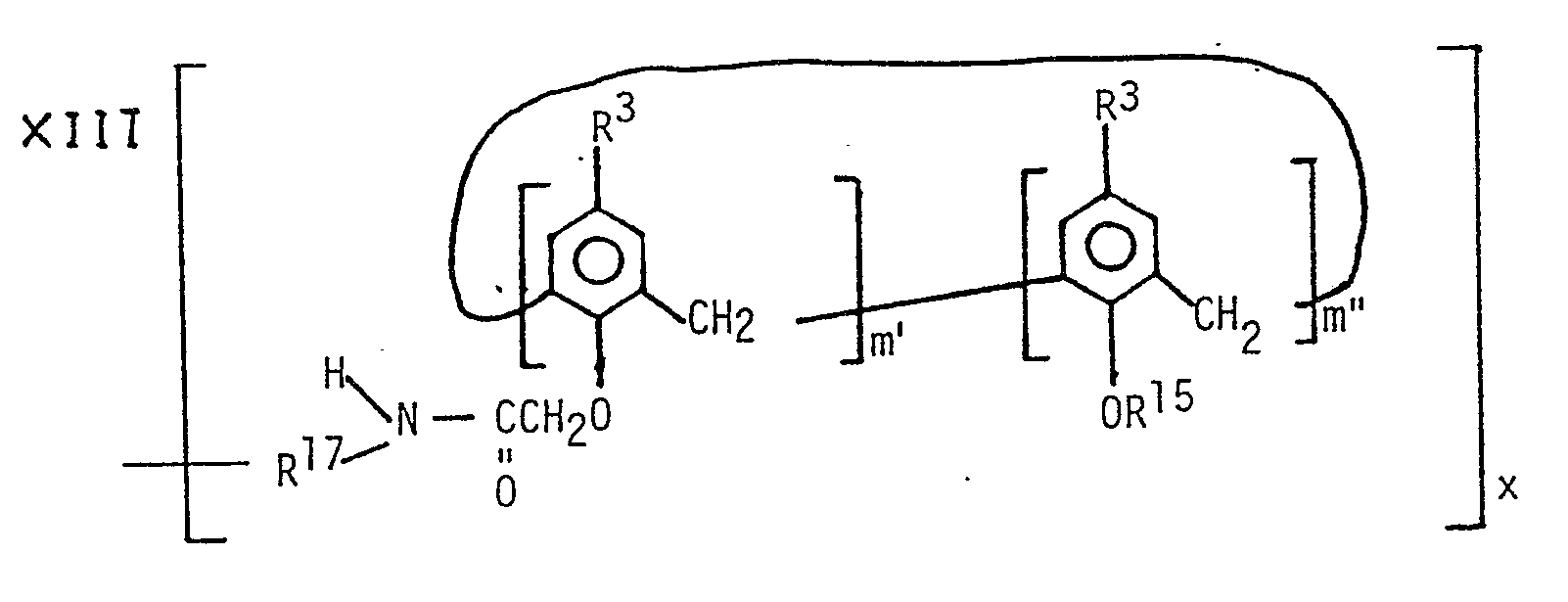
- the invention provides a polyamide polymer having a plurality of calixarene groups bound thereon, of the formula wherein x > 1, m′ 1, m′ ⁇ 2, m′ + m ⁇ ⁇ 4 and R3, R15, R17, are as defined above.
- Such a polyamide may be prepared by reacting a calixarene derivative having at least two acid chloride groups with a polyaminoalkane by methods known per se .
- the hydrocarbyl groups shall preferably contain from 1 to 10 carbon atoms, more preferably from 1 to 5 carbon atoms and the aryl and hydrocarbylaryl group shall preferably have from 6 to 20 carbon atoms, more preferably from 6 to 10 carbon atoms.
- Hydrocarbyl groups are preferred, especially alkyl or alkenyl groups.
- a substituted derivative of the foregoing may suitably be substituted with one or more halo groups or substituted or interrupted by one or more oxo groups.
- Halogen may be chlorine, bromine, fluorine or iodine.
- calixarene derivatives The preparation of calixarene derivatives is known and is described, for example, in C. Gutsche et. al. Acc.Chem.Res., 16, 161-170 (1983); in U.S. Patent 4556700 Harris et al., and in J. Inclusion Phenomena 2 199-206 (1984) D. Reidel Publishing Company; the appropriate disclosures of all of which are incorporated herein by reference.
- aryl groups having the -O-R15 side chain may be interspersed around the ring between the aryl groups having the -OCH2C (O) N(R1) (R2) side chain.
- the methylene and ether bridges may or may not alternate within the oxacalixarene molecule.
- Oxacalixarene compounds may be readily synthesised by methods described in ⁇ . Gutsche et al., J. Am. Chem. Soc. 103 , 3782 (1981); B. Dhawan et al., J. Org. Chem., 48 , 1536 (1983) and US Patent 4 098 717 Buriks et al., the appropriate disclosures of which are incorporated herein by reference.
- Etherified oxacalixarenes of formula I may be produced by reacting a phenolic oxacalixarene with a halomethyl acetone or a haloalkyl acetate. Potassium iodide may be added to accelerate etherification. This method of production and the etherified oxacalixarenes are the subject of Irish Patent Application No. 153/87 filed 21 January 1987 (European Patent Application No. 0,279,521).
- Amide - functional calixarenes and oxacalixarenes of formula I may be prepared by methods described in G. Calestani et al., J. Chem. Soc., Chem. Commun., 1987, 344.
- a 5% methanolic solution of dihydrazide from Example 2 was added to 5% methanolic solution of cupric picrate prepared following a procedure of R.C. Aggarwal and N.K. Singh, Def. Sci. J. 25(4) 1975 pl53 to give a pale green precipitate which was washed several times with hot methanol and dried under vacuum to give a pale green solid which was confirmed to be the hydrazide cupric picrate complex by i.r. spectroscopy and elemental analysis. The solid did not melt up to 265°C.
- reaction mixture was then stirred for 5 hrs at -5°C and then 5 days at room temperature. All volatiles were then removed under vacuum and dilute acetic acid was added to the residue to give 1.5g product which was recrystallised with dichloromethane to give colourless crystalline shiny platelets product, m.p. 198-200°C characterised by i.r. spectroscopy and elemental analysis as i.r.
- the ion binding abilities of nitrogen-containing calixarenes were measured by extraction of metal picrates from aqueous into organic media.
- a solution of the nitrogen-containing calixarene in dichloromethane was prepared at 2.5 X 10 ⁇ 4M.
- Silver and cupric picrates were prepared as aqueous 2.5 X 10 ⁇ 4M solutions (see Aggarwal et al Def. Sci.J., Vol. 25, October 1975, 153).
- a neutral aqueous sodium picrate solution was prepared such that the concentration of sodium picrate was 2.5 x 10 ⁇ 4M. Equal volumes of each solution (5 millimetres) were shaken together for 3 minutes and the percentage extraction of metal picrate into organic phase was determined by measuring the increase in absorbance of dichloromethane layer at ⁇ m ca 355 nm (cupric and silver picrate) and ⁇ m 387 nm (sodium picrate) in a u.v. spectrophotometer. The results are presented in the following table. % ⁇ Compound m.p.
- the adhesive composition was stirred until all of the calixarene derivative composition had gone into solution, then tested on grit blasted mild steel lapshears primed one or both sides with brushed-on copper activator, Loctite's 'Primer N'.
- polyamide bound calixarene compound sequesters transition and precious metals such as copper and silver as well as alkali metals such as sodium.
- polyamide calixarene is linear and so is soluble in organic solvents and may therefore be used to provide easy application of a coating to a substrate.
- Crosslinked polyamides would have to be prepared on a substrate when in formula XIII m′ is greater than 2.
Landscapes
- Chemical & Material Sciences (AREA)
- Organic Chemistry (AREA)
- Organic Low-Molecular-Weight Compounds And Preparation Thereof (AREA)
- Polyamides (AREA)
Abstract

m′ + m˝ = 0-8
n = 0-8
m¹ ≧ 1/₂ (m′ + m˝)
3 ≦ m′ + m˝ + n ≦ 8
if n = 0, m′ + m˝ ≧ 4
R³ is H, halogen, or hydrocarbyl, aryl, hydrocarbylaryl or a substituted derivative thereof and R³ may be the same or different on each aryl group;
R¹ and R¹⁵ which may be the same or different are H or hydrocarbyl, aryl, hydrocarbylaryl or a substituted derivative thereof;
R² is selected from:
R⁴ which is H, or hydrocarbyl, aryl, hydrocarbylaryl or a substituted derivative thereof,
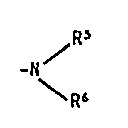
-OR¹, wherein R¹ is as defined above
and R¹⁷ which is a residue of a hydrocarbyl, aryl, or hydrocarbylaryl group or of a substituted derivative thereof providing a bond to another oxacalixarene or calixarene derivative of formula I wherein R² is R¹⁷.
Description
- This invention relates to novel nitrogen-containing oxacalixarene and calixarene derivatives, to polymers including groups related to such derivatives, and to the use of the novel compounds and certain related compounds, particularly for the sequestration of metals, and/or the catalysis of free radical polymerisation of acrylic monomers of the kind described in British Patent Application No. 8700467.
- U.S. Patents 4,556,700 and 4,642,362 Harris et. al. describe certain calixarene derivatives.
- McKervey et. al. J. Chem. Soc. Commun. 1985 p.388 describes the cation transfer properties of alkyl calixaryl acetates.
- Olmstead et al., J. Am. Chem. Soc., 1985, 107, 8087-9091, describe complexes of p-tert.-Butylcalix[4]arene with the transition metals Titanium (IV), Iron (III) and Cobalt (II).
- Izatt et al., J. Am. Chem. Soc., 1985, 107, 63-66 describe cation transport from multiple alkali metal cation mixtures using a liquid membrane system containing a series of calixarene carriers, specifically p-tert.-butylcalix[4]arene, - calix[6]arene, and -calix[8] arene and p.-tert.-pentylcalix[4]arene, -calix[6]arene and-calix[8] arene.
- Calestani et al., J. Chem. Soc., Chem. Commun., 1987 p344 describes the diethylacetamide of p.tert.-butylcalix(4)arene.
- European Patent Application No. 87301900.4 Loctite (Ireland) Limited describes certain nitrogen-containing calixarene derivatives and their use in sequestering transition metals selectively.
- The present inventors have prepared other nitrogen-containing calixarene derivatives and oxacalixarene derivatives which have the capability of sequestering metals and/or have other useful properties.
- The invention provides novel oxacalixarene and calixarene derivatives of the formula:-

m′ + m˝ = 0-8
n = 0-8
m′ ≧ 1/₂ (m′ + m˝)
3 ≦ m′ + m˝ + n ≦ 8
if n = 0, m′ + m˝ ≧ 4
R³ is H, halogen, or hydrocarbyl, aryl, hydrocarbylaryl or a substituted derivative thereof and R³ may be the same or different on each aryl group;
R¹ and R¹⁵ which may be the same or different are H or hydrocarbyl, aryl, hydrocarbylaryl or a substituted derivative thereof;
R² is selected from:
R⁴ which is H, or hydrocarbyl, aryl, hydrocarbylaryl or a substituted derivative thereof,
-OR¹, wherein R¹ is as defined above,
and R¹⁷ which is a residue of a hydrocarbyl, aryl, or hydrocarbylaryl group or of a substituted derivative thereof providing a bond to another oxacalixarene or calixarene derivative of formula 1 wherein R² is R¹⁷,
provided that when m˝ = n = 0, and m′ = 4, R¹ and R² are not ethyl groups. - The invention also provides a method of sequestering metals which comprises contacting a metal-containing medium with an oxacalixarene or calixarene derivative of formula I as defined above, but also including the compounds excluded from the above definition by the proviso.
- In one aspect, the present invention provides amide-functional oxacalixarene derivatives of formula I above wherein n is at least 1 and R² is R⁴. Preferred oxacalixarene derivatives are
- (i) an oxacalix-4-arene of formula

- (ii) a dioxacalix-4-arene of formula

- (iii) a trioxcalix-3-arene of formula

- These amide-functional oxacalixarene derivatives, as well as the amide functional calixarene derivatives of formula I wherein m˝ = n = 0 and R² is R⁴, have the surprising capability of sequestering transition metals such as copper and silver, transition series elements such as manganese, alkaline earth elements such as calcium and magnesium, and Group III elements such as aluminum in addition to alkali metals.
- The amide-functional calixarene derivatives are also effective as polymerisation catalysts particularly in improving the CTV (Cure through volume) performance in an acrylic adhesive applied across a gap, using a metal salt applied to a surface as free radical initiator.
- In another aspect the present invention provides oxacalixarene and calixarene hydrazide ester derivatives of formula 1 wherein R² is

- In a further aspect, the invention provides a polyamide polymer having a plurality of calixarene groups bound thereon, of the formula

- Such a polyamide may be prepared by reacting a calixarene derivative having at least two acid chloride groups with a polyaminoalkane by methods known per se.
- In the above compounds of formula I - IV and XIII, the hydrocarbyl groups shall preferably contain from 1 to 10 carbon atoms, more preferably from 1 to 5 carbon atoms and the aryl and hydrocarbylaryl group shall preferably have from 6 to 20 carbon atoms, more preferably from 6 to 10 carbon atoms. Hydrocarbyl groups are preferred, especially alkyl or alkenyl groups. A substituted derivative of the foregoing may suitably be substituted with one or more halo groups or substituted or interrupted by one or more oxo groups. Halogen may be chlorine, bromine, fluorine or iodine.
- The preferred calixarene or oxacalixarene derivatives of formula I are those in which m˝ = 0.
- The preparation of calixarene derivatives is known and is described, for example, in C. Gutsche et. al. Acc.Chem.Res., 16, 161-170 (1983); in U.S. Patent 4556700 Harris et al., and in J. Inclusion Phenomena 2 199-206 (1984) D. Reidel Publishing Company; the appropriate disclosures of all of which are incorporated herein by reference.
- The preparation of aryl; calixarene derivatives is described in European Patent Application No. 87306963.7 and equivalent applications in other countries.
- Mixed functionality calixarene derivatives are described in European Patent Application No. 0196895 A2 and U.S. Patent 4642362 Harris et al. When m˝ is greater than or equal to 2 in the compounds of formula I, the aryl groups having the -O-R¹⁵ side chain may be interspersed around the ring between the aryl groups having the -OCH₂C (O) N(R¹) (R²) side chain.
- In the oxacalixarene derivatives of formula I when (m′ + m˝) and n are greater than 2, the methylene and ether bridges may or may not alternate within the oxacalixarene molecule.
- Oxacalixarene compounds may be readily synthesised by methods described in Ç. Gutsche et al., J. Am. Chem. Soc. 103, 3782 (1981); B. Dhawan et al., J. Org. Chem., 48, 1536 (1983) and US Patent 4 098 717 Buriks et al., the appropriate disclosures of which are incorporated herein by reference.
- Etherified oxacalixarenes of formula I may be produced by reacting a phenolic oxacalixarene with a halomethyl acetone or a haloalkyl acetate. Potassium iodide may be added to accelerate etherification. This method of production and the etherified oxacalixarenes are the subject of Irish Patent Application No. 153/87 filed 21 January 1987 (European Patent Application No. 0,279,521).
- Amide - functional calixarenes and oxacalixarenes of formula I may be prepared by methods described in G. Calestani et al., J. Chem. Soc., Chem. Commun., 1987, 344.
- The invention is illustrated in the following Examples:-
- 2.48g of the tetraethyl acetate of p-t-butyl calix-4-arene prepared as in U.S. Patent 4556700 by S. Harris et al Loctite (0.0025 mole) was treated with hydrazine mono-hydrate 10g (0.2 mole) following procedure given in Vogels Textbook of Practical Organic Chemistry 4th Edition revised by B.S. Furniss, A.J. Hannaford, V. Rogers, P.W.G. Smith and A.R. Tatchell, Longman Publishers, London and New York, 1978 page 1125. After gentle reflux for 15 minutes just enough absolute ethanol was added through the condenser to produce a clear solution which was then refluxed for a further 3 hours. After cooling colourless shiny platelets of hydrazide ester were formed which were filtered off-yield 2.5g (95%) - which were recrystallised from absolute ethanol to give high purity product m.p.> 280°C characterised by i.r. spectroscopy and elemental analysis as

Elemental Analysis results: (Calc'd for C₅₂H₇₂O₈N₈ C : 66.63, H : 7.76, N : 11.96, O : 13.66; Found C : 65.80, H : 7.61, N : 11.68, O: 13.06). - 0.73g of the diallylether of the diethylacetate of p-t-butylcalix-4-arene prepared as in U.S. Patent 4,642,362 by S. Harris et al Loctite (0.0008 mole) was treated with hydrazine monohydrate 1.5g (0.03 mole) and the same procedure followed as in Example 1 to give 0.7g (94%) as a colourless solid recrystallised from absolute ethanol to give colourless crystalline product m.p. 242-5°C characterised by i.r. spectroscopy and elemental analysis as

Elemental Analysis results: (Calc'd for C₅₄H₇₂O₆N₄ C : 74.28, H : 8.31, N : 6.42, O: 10.99; Found C : 74.71, H:8.47, N : 6.44, O : 10.87). - A 5% methanolic solution of dihydrazide from Example 2 was added to 5% methanolic solution of cupric picrate prepared following a procedure of R.C. Aggarwal and N.K. Singh, Def. Sci. J. 25(4) 1975 pl53 to give a pale green precipitate which was washed several times with hot methanol and dried under vacuum to give a pale green solid which was confirmed to be the hydrazide cupric picrate complex by i.r. spectroscopy and elemental analysis. The solid did not melt up to 265°C.
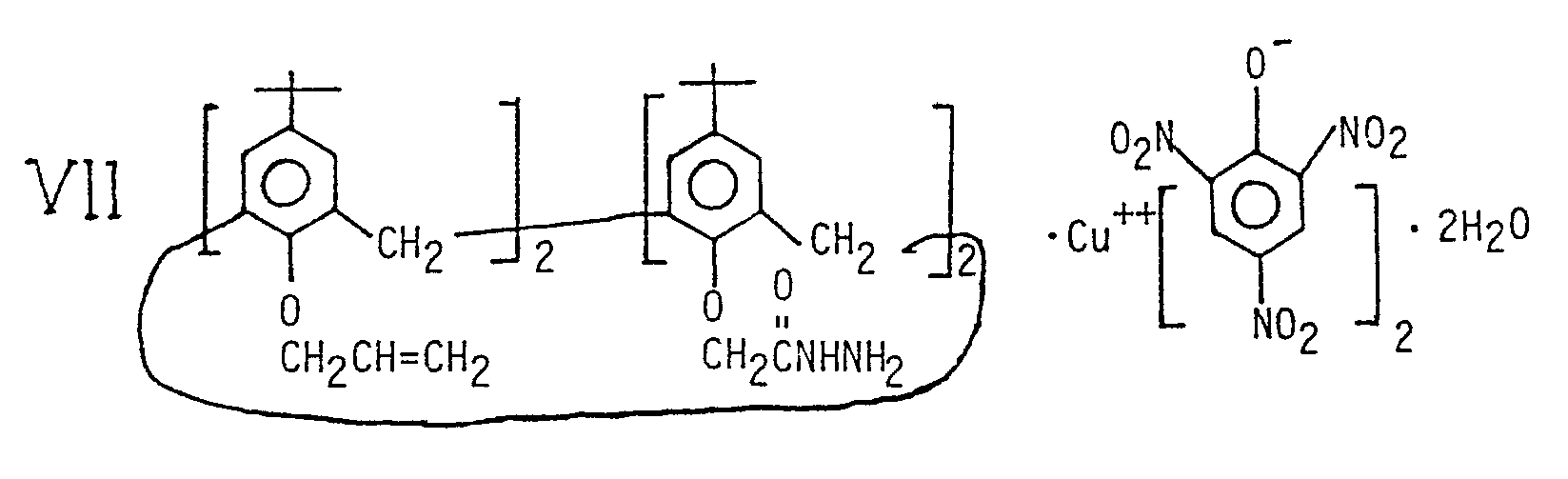
- The complex is probably of the following structure:

i.r. spectroscopy results = ν 1650 sh(m) 1630 sh(s) 1610(s) C = 0, C..... C
Elemental Analysis results : (Calc'd for C₆₆H₈₀O₂₂N₁₀Cu
C : 55.47, H : 5.64, N : 9.80, O : 24.63, Cu : 4.44; Found C : 55.11, H : 5.55, N : 9.60, O : 23.86, Cu 4.56). - To a cooled solution of 1.8g of the tetraethylacetate of p-t-butylcalix-4-arene prepared by U.S. Patent 4556700 S. Harris et al Loctite (0.0073 mole) and 2.02 g (0.029 mole) hydroxylamine hydrochloride in a mixture of 80 mls methanol and 40 mls THF was added a solution of 2.04g (0.036 mole) KOH in a mixture of 24 ml methanol and 12 ml THF dropwise at -5°C following a method of A. Liguori in Gaz. Chim. Ital 116 p379. The reaction mixture was then stirred for 5 hrs at -5°C and then 5 days at room temperature. All volatiles were then removed under vacuum and dilute acetic acid was added to the residue to give 1.5g product which was recrystallised with dichloromethane to give colourless crystalline shiny platelets product, m.p. 198-200°C characterised by i.r. spectroscopy and elemental analysis as

Elemental Analysis results : (Calc'd for C₅₂H₆₈O₁₂N₄
C : 66.36, H : 7.28, O : 20.40; Found : C : 64.59, H : 7.57, O : 20.35). - 0.29g of the ethyl acetate of p-t-butylpseudocalix-4-arene (prepared as in Irish Application 153/87 Loctite (Ireland) Limited which is incorporated herein by reference). (0.00028 mole) was added to 1.1g of hydrazine hydrate (0.022 mole) and the entire was refluxed for twenty minutes following method of Vogel Practical Organic Chemistry 4th Edition revised by B. S. Furniss, A. J. Hannaford, V. Rogers, P. W. G. Smith and A. R. Tatchell, Longman Publishers, London and New York, 1978 p1125. Then sufficient absolute ethanol was added to give a clear solution after which it was further refluxed overnight, then cooled and the volatiles removed to give 0.23g colourless solid product (85%). m.p.>280°C confirmed to be

i.r. spectroscopy results : ν 3320 (m)NH, 1673 (S) C = 0
Elemental Analysis results : (Calc'd for C₅₃H₇₄N₈O₉ C : 65.81,
H : 7.71, N : 11.59, O : 14.89; Found C : 64.90, H : 7.09, N : 11.22, O : 14.63). - To 3.84g p-t-butylpseudocalix-4-arene also called 7, 13, 19, 25-tetra- tert.butyl-27, 28, 29, 30 - tetrahydroxy-2,3-dihomo-3-oxacalix-4-arene prepared following the method of C. D. Gutsche, B. Dhawan, K. H. No and R. Muthikrishnan J. Am. Chem. Soc. 103 p3782 1981 from p-t-butylphenol, paraformaldehyde and aqueous potassium hydroxide in refluxing xylene (0.0056 mole) in 25 mls dry DMSO was added 4.50g (0.030 mole) 2-chloro-NN-diethylacetamide, 2.6g (0.022 mole) potassium bromide and 5.60g (0.041 mole) anhydrous potassium carbonate was stirred under nitrogen at room temperature for 72 hours after which the reaction mixture was poured into 3% sulphuric acid to give an off white precipitate which was washed well with water and dried to give 5.8g (90%) yield of off white product. Chromatography through neutral alumina using dichloromethane as eluent gave off-white product m.p. 111-114°C characterised by infra red spectroscopy and elemental analysis as
i.r. spectroscopy results: ν 1652 (S) C = 0
C : 73.24, H : 9.09; Found C : 73.15, H : 8.77) -

- This compound was prepared following the method of G. Calestani et. al. J. Chem. Soc. Chem. Commun. 1987 p344. In the same reference it is reported that this compound sequesters alkali metal ions e.g. sodium. We have made the rather unexpected discovery that this compound also sequesters transition metals such as copper.
- The ion binding abilities of nitrogen-containing calixarenes were measured by extraction of metal picrates from aqueous into organic media. In each experiment a solution of the nitrogen-containing calixarene in dichloromethane was prepared at 2.5 X 10⁻⁴M. Silver and cupric picrates were prepared as aqueous 2.5 X 10⁻⁴M solutions (see Aggarwal et al Def. Sci.J., Vol. 25, October 1975, 153).
- A neutral aqueous sodium picrate solution was prepared such that the concentration of sodium picrate was 2.5 x 10⁻⁴M. Equal volumes of each solution (5 millimetres) were shaken together for 3 minutes and the percentage extraction of metal picrate into organic phase was determined by measuring the increase in absorbance of dichloromethane layer atλm ca 355 nm (cupric and silver picrate) and λm 387 nm (sodium picrate) in a u.v. spectrophotometer. The results are presented in the following table.
% ε Compound m.p. Silver Picrate Cupric Picrate Sodium Picrate Ex 1 > 280°C 5.9 30.0 < 1 Ex 2 242-5°C < 1 3.8 < 1 Ex 4 198-200°C < 1 3.9 < 1 Ex 5 > 280°C 6.6 31.6 < 1 Ex 6 111-4°C 48.2 10.4 57.0 Ex 7 230-3°C 81.3 9.6 95.4 - To an adhesive formulation based on 16.9% by weight hydroxypropyl methacrylate, 6.1% acrylic acid, 47.1% monomer B (a urethane acrylate prepared by reacting two moles of toluene diisocyanate with one mole of hydrogenated bisphenol A, diluting the reaction mixture with methyl methacrylate and further reacting it with two moles of hydroxyethyl methacrylate in manner disclosed in Example V of U.S. Patent No. 3,425,988), 23.6% monomer A (a urethane-acrylate reaction product of toluene diisocyanate and the hydroxy polyoxypropylene derivative of trimethylol propane (commercially available under the trademark PLURACOL T P 2450) having unreacted isocyanate functionality capped with hydroxyethyl methacrylate), 1% saccharin, 1% acetylphenyl-hydrazine and 1.9% cumene hydroperoxide was added varying quantities of the compound of Example 7 prepared as described in G. Calestani et al. J. Chem. Soc. Chem. Commun. 1987 p344, m.p. 230-3°C.
- The adhesive composition was stirred until all of the calixarene derivative composition had gone into solution, then tested on grit blasted mild steel lapshears primed one or both sides with brushed-on copper activator, Loctite's 'Primer N'.
- The lapshears were at the gaps indicated in the tables below. The composition was cured for 24 hours at room temperature. The results of the tests shown in the Tables below demonstrate that CTV (cure through volume) performance was improved markedly.
Grit Blasted Mild Steel Lapshears; 24 Hour Test Room Temperature; 0.7 mm Gap; Double Sided Activation With Copper Salt Additive 82°C Stability Strength Tensile Shear daNcm⁻² Omm Gap 0.77 mm Gap 0 > 2.5 hrs 289 9 1% Calixarene Derivative > 2.5 hrs 181 16 5% Calixarene Derivative > 2.5 hrs 180 21 - 1.4g of the diallyl ether of the diethyl acetate of p-t-butylcalix-4-arene prepared as in U.S. Patent 4,642,362 S. Harris et al (0.00155 mole) was hydrolysed with excess KOH in water/ethanol by refluxing for 48 hours following the method described in European Patent Application 87 301 900.4 Loctite (Ireland) Limited. Acidification with sulphuric acid and water washing of the colourless precipitated solid gave upon drying 0.95g product as a colourless solid (73%) confirmed by infra red analysis to be the desired diacid product A:

- 0.95g (0.0011 mole) of diacid product A was treated with 2.5g (0.0197 mole) oxalyl chloride in 10 mls dichloromethane under nitrogen with stirring at room temperature following the procedure described in European Patent Application 87 301 900.4 Loctite (Ireland) Limited. Removal of volatiles gave 0.99g (100%) of buff coloured acid chloride product which was not further purified in view of its moisture sensitivity. Infra red analysis confirmed its structure to be the diacid chloride B:

- Following the method of W.R. Sorenson and T.W. Campbell in Preparative Methods of Polymer Chemistry Second Edition Interscience Publishers 1968 p96 the 0.99g of calixarene diacid chloride B (0.00112 mole) in 30 mls of dry 1,2,4-trichlorobenzene (in place of chloroform) was added at room temperature to 0.162g (0.00112 mole) 1,8-diaminooctane and 0.227g (0.00224 mole) triethylamine (as acid acceptor) in 40 mls dry 1,2,4-trichlorobenzene under nitrogen with stirring. After 24 hours reaction time the reaction mixture was poured into 1 litre of heptane to give a white precipitate which quickly fell to the bottom. The precipitate was filtered off and washed well with further heptane and dried to give 0.8g (75%) polyamide calixarene as an off-white solid. The material was further taken up in dichloromethane which was washed well with water to remove amine salts and dried. Following solvent removal, pure off-white solid product was collected which was confirmed by HPLC, infra red and elemental analysis to be polyamide calixarene product

- Polystyrene of 9500 molecular weight as standard; retention volume: 14.3 minutes.
- The calixarene derivative of formula C

- Based on retention volume time, the molecular weight of the actual product XIV obtained was estimated as approximately 5750.
Therefore n′ = 6 approximately (6 x 953 = 5718).
i.r. results:ν 3350 (m) NH, 1653 (S) (NH) C= 0
Elemental Analysis results: (Calculated for C₆₂H₈₄O₆N₂
C: 78.11, H: 8.88, N: 2.94, found C: 78.88 H: 8.81 N: 2.95) - The ion binding ability of the nitrogen-containing calixarene was measured as described above. The results are presented in the following table.
% ε Compound m.p. Silver Picrate Cupric Picrate Sodium Picrate Example 9 168-173°C 9.8 10.8 6.9 - As can be clearly seen the polyamide bound calixarene compound sequesters transition and precious metals such as copper and silver as well as alkali metals such as sodium.
- This particular example is important because the polyamide calixarene is linear and so is soluble in organic solvents and may therefore be used to provide easy application of a coating to a substrate.
- Crosslinked polyamides would have to be prepared on a substrate when in formula XIII m′ is greater than 2.
- The compounds of Examples 6 and 7 were submitted to further ion extraction tests, using the procedure described above but with picrates of other metals as well as silver, copper and sodium. The results are presented in the following tables:
% ε Compound Picrates Ca Mg K Al Mn Example 6 62.4 3.3 17.9 6.6 39.0 Example 7 80.9 10.0 54.0 13.1 48.6 - These results illustrate the surprising capability of the nitrogen-containing calixarene and oxacalixarene derivatives to sequester elements in Groups IIa, III and VIIa of the periodic table. The results for calcium and manganese are particularly good.
Claims (11)

m′ + m˝ = 0-8
n = 0-8
m′ ≧ 1/₂ (m′ + m˝)
3 ≦ m′ + m˝ + n ≦ 8
if n = 0, m′ + m˝ ≧ 4
R³ is H, halogen, or hydrocarbyl, aryl, hydrocarbylaryl or a substituted derivative thereof and R³ may be the same or different on each aryl group;
R¹ and R¹⁵ which may be the same or different are H or hydrocarbyl, aryl, hydrocarbylaryl or a substituted derivative thereof;
R² is selected from:
R⁴ which is H, or hydrocarbyl, aryl, hydrocarbylaryl or a substituted derivative thereof,

-OR¹, wherein R¹ is as defined above
and R¹⁷ which is a residue of a hydrocarbyl, aryl, or hydrocarbylaryl group or of a substituted derivative thereof providing bond to another oxacalixarene or calixarene derivative of formula 1 wherein R² is R¹⁷,
provided that when m˝ = n = 0, and m¹ = 4, R¹ and R² are not ethyl groups.
(i) an oxacalix-4-arene of formula



m′ + m˝ = 0-8
n = 0-8
m′ ≧ 1/₂ (m′ + m˝)
3 ≦ m′ + m˝ + n ≦ 8
if n = 0, m′ + m˝ ≧ 4
R³ is H, halogen, or hydrocarbyl, aryl, hydrocarbylaryl or a substituted derivative thereof and R³ may be the same or different on each aryl group;
R¹ and R¹⁵ which may be the same or different are H or hydrocarbyl, aryl, hydrocarbylaryl or a substituted derivative thereof;
R² is selected from:
R⁴ which is H, or hydrocarbyl, aryl, hydrocarbylaryl or a substituted derivative thereof,

-OR¹, wherein R¹ is as defined above
and R¹⁷ which is a residue of a hydrocarbyl, aryl, or hydrocarbylaryl group or of a substituted derivative thereof providing a bond to another oxacalixarene or calixarene derivative of formula I wherein R² is R¹⁷.

m′ + m˝ = 0-8
n = 0-8
m′ ≧ 1/₂ (m′ + m˝)
3 ≦ m′ + m˝ + n ≦ 8
if n = 0, m′ + m˝ ≧ 4
R³ is H, halogen, or hydrocarbyl, aryl, hydrocarbylaryl or a substituted derivative thereof and R³ may be the same or different on each aryl group;
R¹ and R¹⁵ which may be the same or different are H or hydrocarbyl, aryl, hydrocarbylaryl or a substituted derivative thereof;
R² is selected from:
R⁴ which is H, or hydrocarbyl, aryl, hydrocarbylaryl or a substituted derivative thereof,

and -OR¹, wherein R¹ is as defined above
provided that when m˝ = n = 0, and m′ = 4, R¹ and R² are not ethyl groups.
Applications Claiming Priority (4)
| Application Number | Priority Date | Filing Date | Title |
|---|---|---|---|
| IE257487A IE872574L (en) | 1987-09-24 | 1987-09-24 | Nitrogen-containing oxacalixarene and calixarene¹derivatives, sequestration of metals therewith, and¹polyamide polymers having calixarene groups. |
| IE257487 | 1987-09-24 | ||
| IE344487 | 1987-12-18 | ||
| IE344487 | 1987-12-18 |
Publications (2)
| Publication Number | Publication Date |
|---|---|
| EP0309291A1 true EP0309291A1 (en) | 1989-03-29 |
| EP0309291B1 EP0309291B1 (en) | 1993-10-27 |
Family
ID=26319279
Family Applications (1)
| Application Number | Title | Priority Date | Filing Date |
|---|---|---|---|
| EP88308897A Expired - Lifetime EP0309291B1 (en) | 1987-09-24 | 1988-09-26 | Nitrogen-containing oxacalixarene and calixarene derivatives, polymers including groups related to such derivatives, polymers including groups related to such derivatives, and use of such compounds |
Country Status (3)
| Country | Link |
|---|---|
| US (1) | US5043415A (en) |
| EP (1) | EP0309291B1 (en) |
| DE (1) | DE3885221T2 (en) |
Cited By (11)
| Publication number | Priority date | Publication date | Assignee | Title |
|---|---|---|---|---|
| EP0432989A3 (en) * | 1989-12-13 | 1991-12-04 | Loctite (Ireland) Ltd. | Calixarene and oxacalixarene derivatives and use thereof for sequestration of metals |
| EP0448334A3 (en) * | 1990-03-20 | 1992-01-22 | Loctite (Ireland) Ltd. | Silicon-containing phenoxy ethers, polymers thereof, and use of such polymers |
| US5206437A (en) * | 1989-10-02 | 1993-04-27 | Yutaka Morita | Calixarene derivatives and processes for production thereof |
| US5210216A (en) * | 1985-03-28 | 1993-05-11 | Loctite (Ireland) Limited | Calixarene and oxacalixarene derivatives and use thereof of sequestration metals |
| US5231196A (en) * | 1990-09-13 | 1993-07-27 | Daicel Chemical Industries, Ltd. | Calixarene derivatives and process for the preparation thereof |
| WO1994024126A1 (en) * | 1993-04-21 | 1994-10-27 | Kodak Limited | Ion-sensitive calixarenes |
| WO1995019974A3 (en) * | 1994-01-24 | 1995-09-21 | Stephen J Harris | Calixarene-based compounds having antibacterial, antifungal, anticancer-hiv activity |
| US5760231A (en) * | 1993-04-21 | 1998-06-02 | Eastman Kodak Company | Ion-sensitive compounds |
| FR2797442A1 (en) * | 1999-08-13 | 2001-02-16 | Commissariat Energie Atomique | ACETAMIDO DERIVATIVES OF CALIXARENES, THEIR PREPARATION AND THEIR USE FOR THE EXTRACTION OF STRONTIUM |
| CN106423573A (en) * | 2016-10-28 | 2017-02-22 | 江西理工大学 | Application method of ester-based hydroximic acid collecting agent to mineral flotation |
| CN108164696A (en) * | 2018-01-11 | 2018-06-15 | 天津工业大学 | A kind of polyamide detected with extracting metals ion |
Families Citing this family (5)
| Publication number | Priority date | Publication date | Assignee | Title |
|---|---|---|---|---|
| US5205946A (en) * | 1990-03-31 | 1993-04-27 | Bp Chemicals (Additives) Limited | Process for the production of overbased calixarates |
| WO1995016681A1 (en) * | 1993-12-14 | 1995-06-22 | The Trustees Of The University Of Pennsylvania | Derivatized polythiophenes and devices comprising same |
| GB9502972D0 (en) * | 1995-02-15 | 1995-04-05 | Bp Chemicals Additives | Lubricating oil additive |
| US20080003196A1 (en) * | 2006-06-30 | 2008-01-03 | Jonn Jerry Y | Absorbable cyanoacrylate compositions |
| JP5178220B2 (en) * | 2008-01-31 | 2013-04-10 | 東京応化工業株式会社 | Resist composition and resist pattern forming method |
Citations (3)
| Publication number | Priority date | Publication date | Assignee | Title |
|---|---|---|---|---|
| US4642362A (en) * | 1984-01-30 | 1987-02-10 | Loctite (Ireland) Limited | Polymer bound calixarenes |
| EP0237265A2 (en) * | 1986-03-07 | 1987-09-16 | LOCTITE (IRELAND) Ltd. | Calixarene derivatives and use of such compounds for sequestration of metals |
| EP0279521A1 (en) * | 1987-01-21 | 1988-08-24 | LOCTITE (IRELAND) Ltd. | Functionalised oxacalixarenes, their preparation and use in instant adhesive compositions |
Family Cites Families (5)
| Publication number | Priority date | Publication date | Assignee | Title |
|---|---|---|---|---|
| US4699966A (en) * | 1984-01-30 | 1987-10-13 | Loctite (Ireland) Ltd. | Polymer bound calixarenes |
| US4695615A (en) * | 1984-11-21 | 1987-09-22 | Loctite (Ireland) Limited | Instant adhesive composition utilizing mixed functionality calixarenes as accelerators |
| JPH0729993B2 (en) * | 1986-05-13 | 1995-04-05 | スガイ化学工業株式会社 | Novel Calix allene derivative and method for producing the same |
| EP0259016B1 (en) * | 1986-08-29 | 1990-07-04 | LOCTITE (IRELAND) Ltd. | Calixarene derivatives and use of such compounds as accelerators in instant adhesive compositions |
| IE862567L (en) * | 1986-09-29 | 1988-03-29 | Loctite Ireland Ltd | Encapsulating compositions |
-
1988
- 1988-09-23 US US07/248,874 patent/US5043415A/en not_active Expired - Lifetime
- 1988-09-26 DE DE88308897T patent/DE3885221T2/en not_active Expired - Fee Related
- 1988-09-26 EP EP88308897A patent/EP0309291B1/en not_active Expired - Lifetime
Patent Citations (3)
| Publication number | Priority date | Publication date | Assignee | Title |
|---|---|---|---|---|
| US4642362A (en) * | 1984-01-30 | 1987-02-10 | Loctite (Ireland) Limited | Polymer bound calixarenes |
| EP0237265A2 (en) * | 1986-03-07 | 1987-09-16 | LOCTITE (IRELAND) Ltd. | Calixarene derivatives and use of such compounds for sequestration of metals |
| EP0279521A1 (en) * | 1987-01-21 | 1988-08-24 | LOCTITE (IRELAND) Ltd. | Functionalised oxacalixarenes, their preparation and use in instant adhesive compositions |
Non-Patent Citations (1)
| Title |
|---|
| CHEMICAL ABSTRACTS, Vol. 101, No. 17, October 22, 1984, Columbus, Ohio, USA LEVINE, JEFFREY ALAN "Synthesis and Properties of P-Aminocalix(4) Arenes" page 690, column 2, Abstract-No. 151 561p & Avial. Univ. Microfilms Int., Order No. DA8410626, From Diss. Abstr. Int. B 1984, 45 (2), 562 * |
Cited By (18)
| Publication number | Priority date | Publication date | Assignee | Title |
|---|---|---|---|---|
| US5210216A (en) * | 1985-03-28 | 1993-05-11 | Loctite (Ireland) Limited | Calixarene and oxacalixarene derivatives and use thereof of sequestration metals |
| US5206437A (en) * | 1989-10-02 | 1993-04-27 | Yutaka Morita | Calixarene derivatives and processes for production thereof |
| EP0432989A3 (en) * | 1989-12-13 | 1991-12-04 | Loctite (Ireland) Ltd. | Calixarene and oxacalixarene derivatives and use thereof for sequestration of metals |
| EP0448334A3 (en) * | 1990-03-20 | 1992-01-22 | Loctite (Ireland) Ltd. | Silicon-containing phenoxy ethers, polymers thereof, and use of such polymers |
| US5113003A (en) * | 1990-03-20 | 1992-05-12 | Loctite (Ireland) Limited | Silicon-containing phenoxy ethers, polymers thereof, and use of such polymers |
| US5231196A (en) * | 1990-09-13 | 1993-07-27 | Daicel Chemical Industries, Ltd. | Calixarene derivatives and process for the preparation thereof |
| US5760231A (en) * | 1993-04-21 | 1998-06-02 | Eastman Kodak Company | Ion-sensitive compounds |
| WO1994024126A1 (en) * | 1993-04-21 | 1994-10-27 | Kodak Limited | Ion-sensitive calixarenes |
| US5874584A (en) * | 1993-04-21 | 1999-02-23 | Eastman Kodak Company | Ion-sensitive compounds |
| WO1995019974A3 (en) * | 1994-01-24 | 1995-09-21 | Stephen J Harris | Calixarene-based compounds having antibacterial, antifungal, anticancer-hiv activity |
| FR2797442A1 (en) * | 1999-08-13 | 2001-02-16 | Commissariat Energie Atomique | ACETAMIDO DERIVATIVES OF CALIXARENES, THEIR PREPARATION AND THEIR USE FOR THE EXTRACTION OF STRONTIUM |
| WO2001012586A1 (en) * | 1999-08-13 | 2001-02-22 | Commissariat A L'energie Atomique | Calixarene acetamido derivatives, preparation and use thereof for extracting strontium |
| JP2003507359A (en) * | 1999-08-13 | 2003-02-25 | コミツサリア タ レネルジー アトミーク | Acetamide derivatives of calixarene, their preparation, and use for strontium extraction |
| US6709642B1 (en) | 1999-08-13 | 2004-03-23 | Commissariat A L'energie Atomiguie | Calixarene acetamido derivatives, preparation and use thereof for extracting strontium |
| JP4979171B2 (en) * | 1999-08-13 | 2012-07-18 | コミッサリア ア レネルジー アトミーク エ オ ゼネルジ ザルタナテイヴ | Acetamide derivatives of calixarene, methods for their preparation and use for strontium extraction |
| CN106423573A (en) * | 2016-10-28 | 2017-02-22 | 江西理工大学 | Application method of ester-based hydroximic acid collecting agent to mineral flotation |
| CN106423573B (en) * | 2016-10-28 | 2020-01-10 | 江西理工大学 | Application method of ester hydroxamic acid collecting agent in mineral flotation |
| CN108164696A (en) * | 2018-01-11 | 2018-06-15 | 天津工业大学 | A kind of polyamide detected with extracting metals ion |
Also Published As
| Publication number | Publication date |
|---|---|
| US5043415A (en) | 1991-08-27 |
| DE3885221D1 (en) | 1993-12-02 |
| DE3885221T2 (en) | 1994-05-11 |
| EP0309291B1 (en) | 1993-10-27 |
Similar Documents
| Publication | Publication Date | Title |
|---|---|---|
| US5043415A (en) | Nitrogen-containing oxacalixarene and calixarene derivatives, polymers including groups related to such derivatives, and use of such compounds | |
| KR19990036394A (en) | Radiation Crosslinkable Elastomers and Radiation Crosslinkers | |
| JP6073131B2 (en) | Curing accelerator for anaerobic curable compositions | |
| CA1340884C (en) | Radiation-sensitive, ethylenically unsaturated, copolymerizable compounds and their preparation | |
| US4882449A (en) | Calixarene derivatives, and use of such compounds for sequestration of metals | |
| US4529556A (en) | Bis((aryl)vinyl)benzenes | |
| EP0432989B1 (en) | Calixarene and oxacalixarene derivatives and use thereof for sequestration of metals | |
| US5811521A (en) | Multifunctional crosslinking reagents for hemoglobin, and crosslinked hemoglobin conjugates | |
| JP2500329B2 (en) | ALPHA.-Amino acid polymer having crown compound residue and method for producing the same | |
| US5210216A (en) | Calixarene and oxacalixarene derivatives and use thereof of sequestration metals | |
| US5216185A (en) | Polymerizable calixarene and oxacalixarene derivatives, polymers thereof and use of such derivatives and polymers for sequestration of metals | |
| US4428806A (en) | Process for producing brominated 1,3-dioxolen-2-ones | |
| EP0547231B1 (en) | Phospholipase a2 inhibitor | |
| US6194606B1 (en) | Intermediates | |
| US4064109A (en) | Perfluoroalkylene ether bibenzoxazole polymers | |
| US3691186A (en) | Certain substituted benzthiazole-n-oxides and their preparation | |
| EP0137742A1 (en) | Process for producing arginyl-p-nitroanilide | |
| US3472889A (en) | Aminonitriles | |
| CN116768745B (en) | A method for synthesizing light-induced N-arylbenzamide compounds | |
| Lindgren et al. | Synthesis and photocyclization of some 4‐(5) arylethenylimidazoles | |
| JP2745743B2 (en) | Method for producing reactive polymer | |
| JPH0348179B2 (en) | ||
| EP0802194A2 (en) | Novel thiouracil derivatives and metal surface-treating agent comprising thereof | |
| JPS6086124A (en) | Preparation of polyamino acid resin having regularity | |
| US5200495A (en) | Rigid-rod benzobisazole polymer containing cyclic phosphate ester |
Legal Events
| Date | Code | Title | Description |
|---|---|---|---|
| PUAI | Public reference made under article 153(3) epc to a published international application that has entered the european phase |
Free format text: ORIGINAL CODE: 0009012 |
|
| AK | Designated contracting states |
Kind code of ref document: A1 Designated state(s): DE FR GB IT |
|
| 17P | Request for examination filed |
Effective date: 19890927 |
|
| 17Q | First examination report despatched |
Effective date: 19901203 |
|
| GRAA | (expected) grant |
Free format text: ORIGINAL CODE: 0009210 |
|
| AK | Designated contracting states |
Kind code of ref document: B1 Designated state(s): DE FR GB IT |
|
| ITF | It: translation for a ep patent filed | ||
| REF | Corresponds to: |
Ref document number: 3885221 Country of ref document: DE Date of ref document: 19931202 |
|
| ET | Fr: translation filed | ||
| PLBE | No opposition filed within time limit |
Free format text: ORIGINAL CODE: 0009261 |
|
| STAA | Information on the status of an ep patent application or granted ep patent |
Free format text: STATUS: NO OPPOSITION FILED WITHIN TIME LIMIT |
|
| 26N | No opposition filed | ||
| PGFP | Annual fee paid to national office [announced via postgrant information from national office to epo] |
Ref country code: GB Payment date: 19990902 Year of fee payment: 12 Ref country code: FR Payment date: 19990902 Year of fee payment: 12 Ref country code: DE Payment date: 19990902 Year of fee payment: 12 |
|
| PG25 | Lapsed in a contracting state [announced via postgrant information from national office to epo] |
Ref country code: GB Free format text: LAPSE BECAUSE OF NON-PAYMENT OF DUE FEES Effective date: 20000926 |
|
| GBPC | Gb: european patent ceased through non-payment of renewal fee |
Effective date: 20000926 |
|
| PG25 | Lapsed in a contracting state [announced via postgrant information from national office to epo] |
Ref country code: FR Free format text: LAPSE BECAUSE OF NON-PAYMENT OF DUE FEES Effective date: 20010531 |
|
| PG25 | Lapsed in a contracting state [announced via postgrant information from national office to epo] |
Ref country code: DE Free format text: LAPSE BECAUSE OF NON-PAYMENT OF DUE FEES Effective date: 20010601 |
|
| REG | Reference to a national code |
Ref country code: FR Ref legal event code: ST |
|
| PG25 | Lapsed in a contracting state [announced via postgrant information from national office to epo] |
Ref country code: IT Free format text: LAPSE BECAUSE OF NON-PAYMENT OF DUE FEES Effective date: 20050926 |