EP1478619B1 - Ein verfahren zur herstellung eines phenylalaninderivats und zwischenprodukte davon - Google Patents
Ein verfahren zur herstellung eines phenylalaninderivats und zwischenprodukte davon Download PDFInfo
- Publication number
- EP1478619B1 EP1478619B1 EP03707122A EP03707122A EP1478619B1 EP 1478619 B1 EP1478619 B1 EP 1478619B1 EP 03707122 A EP03707122 A EP 03707122A EP 03707122 A EP03707122 A EP 03707122A EP 1478619 B1 EP1478619 B1 EP 1478619B1
- Authority
- EP
- European Patent Office
- Prior art keywords
- group
- compound
- formula
- salt
- ethyl
- Prior art date
- Legal status (The legal status is an assumption and is not a legal conclusion. Google has not performed a legal analysis and makes no representation as to the accuracy of the status listed.)
- Expired - Lifetime
Links
- 0 *c1ccc(CC(C(O*)=O)N)cc1 Chemical compound *c1ccc(CC(C(O*)=O)N)cc1 0.000 description 3
Classifications
-
- C—CHEMISTRY; METALLURGY
- C07—ORGANIC CHEMISTRY
- C07C—ACYCLIC OR CARBOCYCLIC COMPOUNDS
- C07C233/00—Carboxylic acid amides
- C07C233/64—Carboxylic acid amides having carbon atoms of carboxamide groups bound to carbon atoms of six-membered aromatic rings
- C07C233/81—Carboxylic acid amides having carbon atoms of carboxamide groups bound to carbon atoms of six-membered aromatic rings having the nitrogen atom of at least one of the carboxamide groups bound to a carbon atom of a hydrocarbon radical substituted by carboxyl groups
- C07C233/82—Carboxylic acid amides having carbon atoms of carboxamide groups bound to carbon atoms of six-membered aromatic rings having the nitrogen atom of at least one of the carboxamide groups bound to a carbon atom of a hydrocarbon radical substituted by carboxyl groups with the substituted hydrocarbon radical bound to the nitrogen atom of the carboxamide group by an acyclic carbon atom
- C07C233/87—Carboxylic acid amides having carbon atoms of carboxamide groups bound to carbon atoms of six-membered aromatic rings having the nitrogen atom of at least one of the carboxamide groups bound to a carbon atom of a hydrocarbon radical substituted by carboxyl groups with the substituted hydrocarbon radical bound to the nitrogen atom of the carboxamide group by an acyclic carbon atom of a carbon skeleton containing six-membered aromatic rings
-
- C—CHEMISTRY; METALLURGY
- C07—ORGANIC CHEMISTRY
- C07C—ACYCLIC OR CARBOCYCLIC COMPOUNDS
- C07C231/00—Preparation of carboxylic acid amides
- C07C231/02—Preparation of carboxylic acid amides from carboxylic acids or from esters, anhydrides, or halides thereof by reaction with ammonia or amines
-
- C—CHEMISTRY; METALLURGY
- C07—ORGANIC CHEMISTRY
- C07F—ACYCLIC, CARBOCYCLIC OR HETEROCYCLIC COMPOUNDS CONTAINING ELEMENTS OTHER THAN CARBON, HYDROGEN, HALOGEN, OXYGEN, NITROGEN, SULFUR, SELENIUM OR TELLURIUM
- C07F5/00—Compounds containing elements of Groups 3 or 13 of the Periodic Table
- C07F5/02—Boron compounds
- C07F5/025—Boronic and borinic acid compounds
Definitions
- the present invention relates to a novel process for preparing novel phenylalanine derivatives.
- the present invention also relates to novel compounds useful as intermediates of the process.
- Integrins participate in various in vivo functions through the binding to adhesion molecules classified into immunoglobulin super family, sialomucin family, and the like. Integrins are composed of subunits referred to as alpha ( ⁇ ) and beta ( ⁇ ) subunits, and there have been identified sixteen ⁇ subunits and eight ⁇ subunits so far. The ⁇ 4 subunit associates with the ⁇ 1 or ⁇ 7 subunit, and forms ⁇ 4 ⁇ 1 and ⁇ 4 ⁇ 7 integrins, respectively, which are hereinafter referred to as " ⁇ 4 integrin" collectively.
- ⁇ 4 integrin is involved in various diseases through the adhesion to mucosal addressin cell adhesion molecule-1 (MAdCAM-1), vascular cell adhesion molecule-1 (VCAM-1) or connecting segment 1 (CS-1) on fibronectin. It is also known that when adhesion of ⁇ 4 integrin is inhibited by an anti- ⁇ 4 integrin antibody, the symptoms of allergic bronchitis, inflammatory bowel disease, rheumatoid arthritis, experimental autoimmune encephalomyelitis, and the like are alleviated.
- MAdCAM-1 mucosal addressin cell adhesion molecule-1
- VCAM-1 vascular cell adhesion molecule-1
- CS-1 connecting segment 1
- One of objects of the present invention is to provide a novel process for preparing a phenylalanine derivative of the formula (I): wherein X 1 is a halogen atom, X 2 is a halogen atom, Q is a group of the formula -CH 2 - or -(CH 2 ) 2 - and Y is a lower alkyl group (i.e. a C 1-6 alkyl group), or a pharmaceutically acceptable salt thereof, which has excellent inhibitory activity against ⁇ 4 integrin-mediated cell adhesion.
- the present invention relates to a process for preparing a compound of the formula (I): wherein the symbols are the same as defined above, or a pharmaceutically acceptable salt thereof, comprising :
- the compounds used in the process of the present invention may be in the form of a salt so long as the reactions are not adversely affected.
- the salt include a salt with an inorganic acid such as hydrochloric acid, hydrobromic acid, sulfuric acid, nitric acid or phosphoric acid; a salt with an organic acid such as acetic acid, tartaric acid, citric acid, fumaric acid, maleic acid, toluenesulfonic acid or methanesulfonic acid; a salt with a metal such as sodium, potassium, calcium or alminium; and a salt with a base such as ethylamine, guanidine, ammonium, hydrazine, quinine or cinchonine.
- the compounds used in the reactions are available in the free form, they can be converted into a salt in a conventional manner, and vice versa.
- the coupling reaction of compound (VI) with compound (V) can be carried out in a suitable solvent in the presence of a catalyst and a base.
- the protecting group for the amino group of compound (VI) can be selected from the amino protecting groups that can be removed easily under conventional conditions.
- amino protecting groups include a substituted or unsubstituted aryl-lower alkoxycarbonyl groups (e. g., benzyloxycarbonyl group and p-nitrobenzyloxycarbonyl group), a lower alkoxycarbonyl group (e. g., t-butoxycarbonyl group), 9-fluorenylmethoxycarbonyl group, etc .
- a lower alkoxycarbonyl group is preferred and t -butoxycarbonyl group is most preferred.
- Examples of the protected carboxyl group of compound (VI) include esterified carboxyl groups.
- Specific and preferred examples of the esterified carboxyl groups include carboxyl group esterified with a lower alkyl group, a lower alkenyl group, a lower alkynyl group, an aryl lower alkyl group ( e.g ., benzyl group), an aryl group ( e.g ., phenyl group), and the like.
- Preferred examples of the CO 2 R moiety are a lower alkoxycarbonyl group, a lower alkenyloxycarbonyl group, a lower alkynyloxycarbonyl group, an aryl lower alkoxycarbonyl group ( e.g ., benzyloxycarbonyl group), and an aryloxycarbonyl group ( e.g ., phenyloxycarbonyl group).
- a lower alkoxycarbonyl group is preferred and ethoxycarbonyl or methoxycarbonyl group is most preferred.
- Examples of the leaving group include a halogen atom (e.g ., chlorine atom, bromine atom, iodine atom), an alkanesulfonyloxy group (e. g., methanesulfonyl group) a halogenoalkanesulfonyloxy group ( e.g., trifluoromethanesulfonyloxy group) and an arylsulfonyloxy group (e. g., p-toluenesulfonyloxy group).
- a halogen atom e.g ., chlorine atom, bromine atom, iodine atom
- an alkanesulfonyloxy group e. g., methanesulfonyl group
- a halogenoalkanesulfonyloxy group e.g., trifluoromethanesulfonyloxy group
- halogen atom such as bromine atom and iodine atom
- a halogenoalkanesulfonyloxy group such as trifluoromethanesulfonyloxy group
- bromine atom and trifluoromethanesulfonyloxy group are most preferred.
- the coupling reaction can be carried out under the conditions of Suzuki coupling reaction, making reference to, for example, (a) Synth. Commun. 11: 513 (1981 ); (b) Pure and Appl. Chem. 57: 1749 (1985 ); (c) Chem. Rev. 95: 2457 (1995 ); (d) J. Org. Chem. 57: 379 (1992 ) : (e) Acta Chemica Scandinavica 47: 221 (1993 ); (f) J. Org. Chem., 60: 1060 (1995 ) ; and (g) Organic Letters, 3: 3049 (2001 ).
- the catalyst examples include those used in the Suzuki coupling reaction (e.g., palladium or nickel catalysts).
- Palladium catalysts such as palladium (II) catalysts (e.g ., palladium acetate, palladium chloride, dichlorobis(triphenylphosphine)palladium, etc .) and palladium (0) catalysts (palladium tetrakistriphenylphosphine, etc .) can be used conveniently.
- the palladium catalyst can be used in a catalytic amount, specifically in amount of 1-10 mole %, preferably 4-6 mole %.
- a palladium (II) catalyst which does not have ligands in its molecule, such as palladium acetate or palladium chloride, it is preferable to add a phosphine or a phosphite to the reaction in order to facilitate the reaction.
- the phosphine include tritolylphosphine, triphenylphosphine, trimethylphosphine, triethylphosphine, etc .
- examples of the phosphite include trimethylphosphite, triethylphosphite, tri(n-butyl)phosphite, etc.
- the phosphine or phosphite can be X used in amount of 3-50 mole %, preferably 10-30 mole %.
- palladium acetate and palladium chloride are stable and thus preferred, and palladium acetate is more preferred.
- Examples of the base that can be used in the reaction include conventional bases, for example, inorganic bases such as alkali metal carbonates (sodium carbonate, potassium carbonate, etc .), alkali metal hydrogen carbonates (sodium hydrogen carbonate, potassium hydrogen carbonate, etc .), alkali metal hydroxides (sodium hydroxide, potassium hydroxide, etc .), and organic bases such as alkylamines (diisopropylamine, triethylamine, diisopropylethylamine, etc .), pyridines (pyridine, dimethylaminopyridine, etc .), and cyclic amines (1,8-diazabicyclo[5.4.0]undec-7-ene, 1,4-diazabicyclo[2.2.2]octane, morpholine, 4-methylmorpholine, etc .).
- inorganic bases such as alkali metal carbonates (sodium carbonate, potassium carbonate, etc .), alkali metal hydrogen carbonates
- alkylamines especially diisopropylamine
- cyclic amines especially morpholine
- the base can be conveniently used in an amount of 1.0-3.0 mole equivalents, preferably 1.5-2 mole equivalents.
- any solvents are available so long as the coupling reaction is not adversely affected, and, for example, an organic solvent, water or a mixed solvent thereof can be used.
- organic solvent include amides (e.g ., dimethylformamide and N -methylpyrrolidone), aromatic hydrocarbons ( e.g ., benzene and toluene), ethers ( e.g ., diethyl ether, tetrahydrofuran, dimethoxyethane and dioxane), alcohols ( e.g ., methanol and ethanol), and a mixture thereof. Above all, amides especially N- methylpyrrolidone is preferred.
- the reaction can be carried out at a temperature of - 20°C to 180°C, more preferably at room temperature to 120°C, most preferably at 50°C to 100°C.
- the deprotection method for removing the protecting group from the protected amino group is selected depending on the type of protecting group to be removed.
- the deprotection can be conducted by a method selected from the followings:
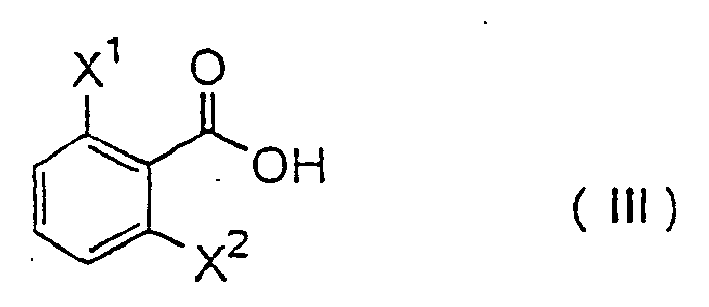
- the condensation of the compound (III) or a salt thereof with the compound (IV) or a salt thereof can be carried out using a condensing agent in the presence or absence of a base in an appropriate solvent or without solvent.
- the condensing agent can be selected from conventional condensing agents for peptide synthesis, for example, chlorobis(2-oxo-3-oxazolidinyl)phosphine(BOP-C1), benzotriazol-1-yloxytris(dimethylamino)phosphonium hexafluorophosphate (BOP reagent), dicyclohexylcarbodiimide, 1-(3-dimethylaminopropyl)-3-ethylcarbodiimide hydrochloride (EDC) or carbonyldiimidazole. It is preferred to use an activator such as 1-hydroxybenzotriazole (HOBT) in association with a condensing agent.
- BOP-C1 chlorobis(2-oxo-3-oxazolidinyl)phosphine
- BOP reagent benzotriazol-1-yloxytris(dimethylamino)phosphonium hexafluorophosphate
- Examples of the base that can be used in the reaction include conventional bases, for example, organic bases such as alkylamines (triethylamine, diisopropylethylamine, etc .), pyridines (pyridine, dimethylaminopyridine, etc .) and cyclic amines (1,8-diazabicyclo[5.4.0]undec-7-erie, 4-methylmorpholine, etc .), and inorganic bases such as alkali metal hydroxides (sodium hydroxide, potassium hydroxide, etc .), alkali metal carbonates (sodium carbonate, potassium carbonate, etc .) and alkali metal hydrogen carbonates (sodium hydrogen carbonate, potassium hydrogen carbonate, etc .).
- organic bases such as alkylamines (triethylamine, diisopropylethylamine, etc .), pyridines (pyridine, dimethylaminopyridine, etc .) and cyclic amines (1,8-diazabic
- any solvents are available so long as the condensation reaction is not adversely affected, and, for example, esters (methyl acetate, ethyl acetate, etc .), halogenated hydrocarbons (dichloromethane, chloroform, dichloroethane, carbon tetrachloride, etc .), aromatic hydrocarbons (benzene and toluene), ethers (diethyl ether, tetrahydrofuran, dioxane, etc .), ketones (acetone, methyl ethyl ketone, etc .), amides (dimethylformamide, N -methylpyrrolidone, etc .), or a mixed solvent thereof can be conveniently used.
- esters methyl acetate, ethyl acetate, etc .
- halogenated hydrocarbons diichloromethane, chloroform, dichloroethane, carbon tetrachloride, etc .
- aromatic hydrocarbons benzene
- the reaction can be carried out at a temperature of - 50°C to 50°C, preferably at 0°C to room temperature.
- condensation reaction of a reactive derivative of compound (III) with a compound (II) or a salt thereof can be carried out in the presence or absence of a base in an appropriate solvent or without solvent.
- Examples of the reactive derivative include an acid halide (acid chloride, etc .), a reactive ester (an ester with p-nitrophenol, etc .) and a mixed acid anhydride with other carboxylic acid (a mixed acid anhydride with isobutyric acid, etc .).
- an acid halide acid chloride, etc .
- a reactive ester an ester with p-nitrophenol, etc .
- a mixed acid anhydride with other carboxylic acid a mixed acid anhydride with isobutyric acid, etc .
- Examples of the base that can be used include conventional bases, for example, organic bases such as alkylamines (triethylamine, diisopropylethylamine, etc .), pyridines (pyridine, dimethylaminopyridine, etc .) and cyclic amines (1,8-diazabicyclo[5.4.0]undec-7-ene, 4-methylmorpholine, etc .), and inorganic bases such as alkali metal hydroxides (sodium hydroxide, potassium hydroxide, etc .), alkali metal carbonates (sodium carbonate, potassium carbonate, etc .) and alkali metal hydrogen carbonates (sodium hydrogen carbonate, potassium hydrogen carbonate, etc .).
- organic bases such as alkylamines (triethylamine, diisopropylethylamine, etc .), pyridines (pyridine, dimethylaminopyridine, etc .) and cyclic amines (1,8-diazabicyclo
- any solvents are available so long as the condensation reaction is not adversely affected, and, for example, esters (methyl acetate, ethyl acetate, etc .), halogenated hydrocarbons (dichloromethane, chloroform, dichloroethane, carbon tetrachloride, etc .), aromatic hydrocarbons (benzene, toluene, etc .), ethers (diethyl ether, tetrahydrofuran, dioxane, etc .), ketones (acetone, methyl ethyl ketone, etc .), amides (dimethylformamide, N-methylpyrrolidone, etc .), water, or a mixed solvent thereof can be conveniently used.
- esters methyl acetate, ethyl acetate, etc .
- halogenated hydrocarbons diichloromethane, chloroform, dichloroethane, carbon tetrachloride, etc .
- the reaction is preferably carried out using an acid halide (preferably, acid chloride) of compound (III) in the presence of an inorganic base such as alkali metal hydrogen carbonate (e.g ., sodium hydrogen carbonate, potassium hydrogen carbonate) in a bilayer system of water and an appropriate organic solvent (e.g ., ethyl acetate and toluene).
- an inorganic base such as alkali metal hydrogen carbonate (e.g ., sodium hydrogen carbonate, potassium hydrogen carbonate) in a bilayer system of water and an appropriate organic solvent (e.g ., ethyl acetate and toluene).
- the reaction can be carried out at a temperature of - 50°C to 50°C, preferably at 0°C to room temperature.
- the deprotection method for removing the protecting group from the protected carboxyl group of compound (II) is selected depending on the type of the protecting group to be removed.
- deprotection can be conducted in a conventional manner such as catalytic reduction, acid treatment, hydrolysis, or the like.
- the protected carboxyl group is an esterified carboxyl group, it can be converted into the carboxyl group by hydrolysis.
- the hydrolysis may vary depending on the kind of the ester group to be removed, it can be conducted with an acid or a base in a suitable solvent or without solvent.
- the acid that can be used include inorganic acids such as hydrochloric acid, nitric acid, sulfuric acid, etc ., and organic acids such as trifluoroacetic acid, p-toluenesulfonic acid, etc .
- Examples of the base that can be used in the reaction include inorganic bases such as alkali metal hydroxides (e.g ., lithium hydroxide and sodium hydroxide), alkali metal carbonates (e.g ., sodium carbonate and potassium carbonate), alkali metal hydrogen carbonates (e.g ., sodium hydrogen carbonate and potassium hydrogen carbonate), alkali earth metal hydroxides (e.g ., calcium hydroxide), etc .
- inorganic bases such as alkali metal hydroxides (e.g ., lithium hydroxide and sodium hydroxide), alkali metal carbonates ( e.g ., sodium carbonate and potassium carbonate), alkali metal hydrogen carbonates (e.g ., sodium hydrogen carbonate and potassium hydrogen carbonate), alkali earth metal hydroxides (e.g ., calcium hydroxide), etc .
- alkali metal hydroxides e.g ., lithium hydroxide and sodium hydroxide
- alkali metal carbonates e.g ., sodium carbonate
- alkali metal alkoxides e.g ., sodium methoxide, sodium ethoxide, potassium methoxide and potassium ethoxide
- alkali earth metal alkoxides e.g ., calcium methoxide and calcium ethoxide
- Alkali metal hydroxides such as lithium hydroxide and sodium hydroxide are preferred. Any solvents are available so long as the hydrolysis is not adversely affected, and, for example, water, an organic solvent or a mixed solvent thereof can be used.
- organic solvent examples include ethers (e.g ., diethyl ether, dioxane and tetrahydrofuran), alcohols (e.g ., methanol, ethanol, propanol and ethyleneglycol), acetonitrile and ketones (e.g ., acetone and methyl ethyl ketone). Above all, alcohols such as methanol and ethanol and ethers such as dioxane and tetrahydrofuran are preferred.
- ethers e.g ., diethyl ether, dioxane and tetrahydrofuran
- alcohols e.g methanol, ethanol, propanol and ethyleneglycol
- acetonitrile and ketones e.g acetone and methyl ethyl ketone
- alcohols such as methanol and ethanol and ethers such as dioxane and tetrahydrofuran are preferred.
- the reaction can be carried out at a temperature of under cooling to the boiling point of the solvent, preferably at room temperature to 50°C.
- the pharmaceutically acceptable salts of the compound (I) include a salt with an inorganic base (e.g ., an alkali metal salt such as a sodium salt, a potassium salt, etc .; an alkali earth metal salt such as magnesium salt, calcium salt, etc .) and a salt with an organic base (e.g ., ammonium salt; a lower alkyl ammonium salt such as methylammonium salt, ethylammonium salt, etc .; pyridinium salt; or a salt with a basic amino acid such as a salt with lysine, etc .).
- the compound (I) can be converted into a pharmaceutically acceptable salt in a conventional manner.
- Examples of the compounds that are preferably used for carrying out the present process include those wherein X 1 is chlorine atom or fluorine atom, X 2 is chlorine atom or fluorine atom, Y is a lower alkyl group having 1 to 4 carbon atoms and CO 2 R is a lower alkoxycarbonyl group.
- More preferred compounds for carrying out the present process include those wherein Q is group of the formula - CH 2 -, Y is methyl group, ethyl group or n-propyl group, and CO 2 R is methoxycarbonyl group, ethoxycarbonyl group or t-butoxycarbonyl group.
- Still more preferred compounds for carrying out the present process include those wherein X 1 is fluorine atom, Y is methyl group or ethyl group, and CO 2 R is methoxycarbonyl group or ethoxycarbonyl group.
- Especially preferred compounds for carrying out the present process include those wherein X 1 is fluorine atom, X 2 is fluorine atom, Y is ethyl group, and CO 2 R is ethoxycarbonyl group, or those wherein X 1 is fluorine atom, X 2 is chlorine atom, Y is ethyl group, and CO 2 R is methoxycarbonyl group or ethoxycarbonyl group.
- the most preferred compound that can be produced according to the present process is ( ⁇ S)- ⁇ -[(2,6-difluorobenzoyl)amino]-4'-ethoxymethyl-2',6'-dimethoxy(1,1'-biphenyl)-4-propionic acid.
- the compound (I) or a pharmaceutically acceptable salt thereof which is an objective compound of the present process, is a novel compound.
- the compound (I) or a pharmaceutically acceptable salt thereof not only shows potent inhibitory activity against ⁇ 4 integrin-mediated cell adhesion but also shows excellent bioavailability after oral administration which reflects overall improvement in metabolic stability, plasma protein binding and aqueous solubility. Accordingly, the compound (I) is useful in treatment of diseases caused by ⁇ 4 integrin-mediated cell adhesion, including rheumatoid arthritis, atopic dermatitis, psoriasis, asthma, bronchitis, multiple sclerosis, inflammatory bowel disease, experimental autoimmune encephalomyelitis, and the like.
- a compound of the formula (IV): wherein the symbols are the same as defined above, or a salt thereof is novel and useful as an intermediate for the process of the present invention.
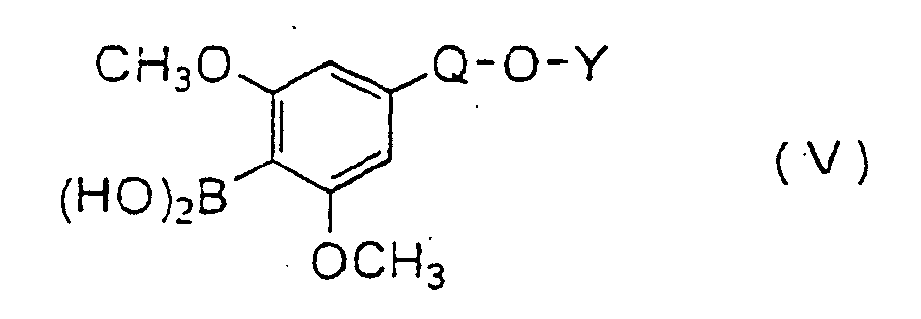
- the compound (V) can be prepared according to the following method.
- the alkylation can be carried out using an alkylating agent in a suitable solvent in the presence of a base.
- alkylating agent examples include di-lower alkyl sulfates such as dimethyl sulfate, diethyl sulfate, etc ., and lower alkyl halides such as methyl iodide, ethyl iodide, etc .
- the base examples include inorganic bases such as alkali metal hydroxides (sodium hydroxide, potassium hydroxide, etc .), alkali metal carbonates (sodium carbonate, potassium carbonate, etc .) and alkali metal hydrogen carbonates (sodium hydrogen carbonate, etc .), and organic bases such as alkylamines (triethylamine, diisopropylethylamine, etc .) and pyridines (pyridine, dimethylaminopyridine, etc .).
- inorganic bases such as alkali metal hydroxides (sodium hydroxide, potassium hydroxide, etc .), alkali metal carbonates (sodium carbonate, potassium carbonate, etc .) and alkali metal hydrogen carbonates (sodium hydrogen carbonate, etc .)
- organic bases such as alkylamines (triethylamine, diisopropylethylamine, etc .) and pyridines (pyridine, dimethylaminopyridine, etc
- any solvents are available so long as the reaction is not adversely affected, and, for example, water, acetonitrile, amides ( N,N -dimethylformamide, etc .), ethers (tetrahydrofuran, etc .), aromatic hydrocarbons (toluene, etc .), halogenated hydrocarbons (dichloromethane, etc .), or a mixed solvent thereof can be used.
- the reaction can be carried out in a suitable solvent at a temperature of about 0°C to about 100°C, preferably at room temperature to about 70°C.
- the present reaction can be expedited by adding a catalytic amount of a phase-transfer catalyst such as triethylammonium benzyl chloride.
- the lithiation and the reaction with tri-lower alkyl borate can be carried out by subjecting a compound to lithiation with an alkyl lithium following by the reaction with a tri-lower alkyl borate in a suitable solvent.
- Preferred alkyl lithium may be methyl lithium, n-butyl lithium, t-butyl lithium, and the like.
- Preferred tri-lower alkyl borate may be trimethyl borate, triethyl borate, and the like.
- Any solvents are available so long as the reaction is not adversely affected, and, for example, organic solvents such as ethers (diethyl ether, tetrahydrofuran, etc .) and a mixed solvent thereof are preferred.
- the present reaction can be carried out at a temperature of under cooling (e.g ., -100°C) to room temperature.
- the hydrolysis can be carried out with an acid in a suitable solvent.
- the acid include organic acids such as acetic acid, trifluoroacetic acid and citric acid and inorganic acids such as hydrochloric acid, sulfuric acid and nitric acid.
- Any solvents are available so long as the reaction is not adversely affected and, for example, organic solvents such as ethers (diethyl ether, tetrahydrofuran, etc .) and a mixed solvent thereof can be used.
- Ethyl ( ⁇ S)- ⁇ -[[(1,1-dimethylethoxy)carbonyl]amino]-4-hydroxybenzene propionate and ethyl ( ⁇ S)- ⁇ -[[(1,1-dimethylethoxy)carbonyl]amino]-4-(trifluoromethanesulfonyloxy)benzene propionate are described in J. Med. Chem., 33: 1620 (1990 ) and JP-A-7-157472 , respectively.
- 4-Bromo-3,5-dimethoxybenzyl alcohol is described in, for example, J. Med. Chem., 20: 299 (1977 ), and can also be prepared according to the following process.
- 4-bromo-3,5-dihydroxybenzoic acid is methylated to give methyl 4-bromo-3,5-dimethoxybenzoate, which is then reduced to yield 4-bromo-3,5-dimethoxy benzyl alcohol.
- the methylation can be carried out by reacting with dimethyl sulfate in the presence of a base in a suitable solvent (e.g ., ethyl acetate).
- the reduction can be carried out by reacting with an reducing agent (e.g ., lithium alminium hydride, sodium borohydride and calcium borohydride) in a suitable solvent (e.g ., tetrahydrofuran).
- lower alkyl means straight- or branched-chain alkyl having 1 to 6 carbon atoms, preferably 1 to 4 carbon atoms, for example, methyl, ethyl, propyl, isopropyl, butyl and the like.
- lower alkoxycarbonyl means straight-or branched-chain alkoxycarbonyl having 2 to 7 carbon atoms, preferably 2 to 5 carbon atoms, for example, methoxycarbonyl, ethoxycarbonyl, propoxycarbonyl, isopropoxycarbonyl, butoxycarbonyl and the like.
- lower alkenyl means straight- or branched-chain alkenyl having 2 to 7 carbon atoms, preferably 2 to 4 carbon atoms, for example, vinyl, allyl, isopropenyl and the like.
- lower alkenyloxycarbonyl means straight- or branched-chain alkenyloxycarbonyl having 2 to 7 carbon atoms, preferably 2 to 4 carbon atoms, for example, vinyloxycarbonyl, allyloxycarbonyl, isopropenyloxycarbonyl and the like.
- lower alkynyl means straight- or branched-chain alkynyl having 2 to 7 carbon atoms, preferably 2 to 4 carbon atoms, for example, ethynyl, 2-propynyl and the like.
- lower alkynyloxycarbonyl means straight- or branched-chain alkynyloxycarbonyl having 2 to 7 carbon atoms, preferably 2 to 4 carbon atoms, for example, ethynyloxycarbonyl, 2-propynyloxycarbonyl and the like.
- t-butoxy means 1,1-dimethylethoxy.
- the process for preparation of the present invention makes it possible to afford a compound of the formula (I) or a pharmaceutically acceptable salt thereof with high-purity, in a high yield and inexpensively, and, therefore, the process of the present invention is industrially very useful.
Landscapes
- Chemical & Material Sciences (AREA)
- Organic Chemistry (AREA)
- Chemical Kinetics & Catalysis (AREA)
- Organic Low-Molecular-Weight Compounds And Preparation Thereof (AREA)
- Acyclic And Carbocyclic Compounds In Medicinal Compositions (AREA)
Claims (13)
- Ein Verfahren zur Herstellung eines Phenylalanin-Derivats der Formel (I):

umfassend das Kondensieren einer Verbindung der Formel (IV):
mit einer Verbindung der Formel (III):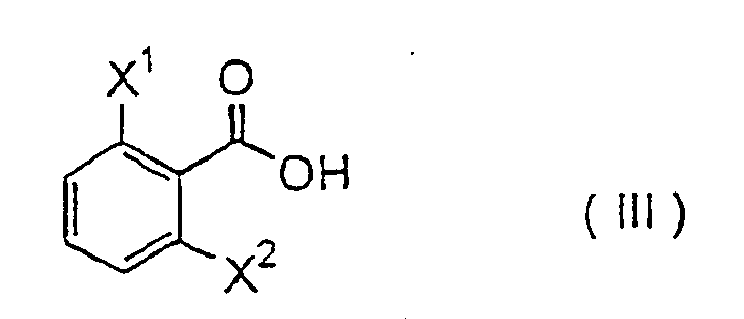

- Ein Verfahren zur Herstellung eines Phenylalanin-Derivats der Formel (I):

umfassend Kuppeln einer Verbindung der Formel (VI):



- Das Verfahren nach Anspruch 1 oder 2, wobei X1 ein Chloratom oder Fluoratom ist, X2 ein Chloratom oder Fluoratom ist, Y ein C1-4-Alkylrest ist und CO2R ein C2-7-Alkoxycarbonylrest ist.
- Das Verfahren nach Anspruch 3, wobei Q ein Rest der Formel -CH2- ist, Y eine Methylgruppe, Ethylgruppe oder n-Propylgruppe ist und CO2R eine Methoxycarbonylgruppe, Ethoxycarbonylgruppe oder t-Butoxycarbonylgruppe ist.
- Das Verfahren nach Anspruch 4, wobei X1 ein Fluoratom ist, Y eine Methylgruppe oder Ethylgruppe ist und CO2R eine Methoxycarbonylgruppe oder Ethoxycarbonylgruppe ist.
- Das Verfahren nach Anspruch 4, wobei X1 ein Fluoratom ist, X2 ein Fluoratom ist, Y eine Ethylgruppe ist und CO2R eine Ethoxycarbonylgruppe ist.
- Das Verfahren nach Anspruch 4, wobei X1 ein Fluoratom ist, X2 ein Chloratom ist, Y eine Ethylgruppe ist und CO2R eine Methoxycarbonylgruppe oder Ethoxycarbonylgruppe ist.
- Eine Verbindung der Formel (IV):

- Die Verbindung nach Anspruch 8, wobei Q ein Rest der Formel -CH2- ist, Y eine Ethylgruppe ist und CO2R eine Ethoxycarbonylgruppe ist.
- Ein Verfahren zur Herstellung einer Verbindung der Formel (IV):


- Das Verfahren nach Anspruch 10, wobei Q ein Rest der Formel -CH2- ist, Y eine Ethylgruppe ist und CO2 eine Ethoxycarbonylgruppe ist.
- Eine Verbindung der Formel (V):

- Die Verbindung nach Anspruch 12, wobei Q ein Rest der Formel -CH2- ist und Y eine Ethylgruppe ist.
Applications Claiming Priority (3)
| Application Number | Priority Date | Filing Date | Title |
|---|---|---|---|
| JP2002052605 | 2002-02-28 | ||
| JP2002052605 | 2002-02-28 | ||
| PCT/JP2003/002181 WO2003072536A1 (en) | 2002-02-28 | 2003-02-27 | A process for preparing a phenylalanine derivative and intermediates thereof |
Publications (2)
| Publication Number | Publication Date |
|---|---|
| EP1478619A1 EP1478619A1 (de) | 2004-11-24 |
| EP1478619B1 true EP1478619B1 (de) | 2011-01-12 |
Family
ID=27764341
Family Applications (1)
| Application Number | Title | Priority Date | Filing Date |
|---|---|---|---|
| EP03707122A Expired - Lifetime EP1478619B1 (de) | 2002-02-28 | 2003-02-27 | Ein verfahren zur herstellung eines phenylalaninderivats und zwischenprodukte davon |
Country Status (21)
| Country | Link |
|---|---|
| US (1) | US7476758B2 (de) |
| EP (1) | EP1478619B1 (de) |
| KR (1) | KR100681224B1 (de) |
| CN (2) | CN100480233C (de) |
| AR (1) | AR038624A1 (de) |
| AT (1) | ATE495147T1 (de) |
| AU (1) | AU2003208618B2 (de) |
| BR (1) | BR0308027A (de) |
| CA (1) | CA2476022C (de) |
| DE (1) | DE60335704D1 (de) |
| ES (1) | ES2359302T3 (de) |
| IL (1) | IL163429A (de) |
| MX (1) | MXPA04008359A (de) |
| MY (1) | MY140707A (de) |
| NO (1) | NO331001B1 (de) |
| NZ (1) | NZ534957A (de) |
| PL (1) | PL211046B1 (de) |
| RU (1) | RU2280641C2 (de) |
| TW (1) | TWI327996B (de) |
| WO (1) | WO2003072536A1 (de) |
| ZA (1) | ZA200406747B (de) |
Families Citing this family (16)
| Publication number | Priority date | Publication date | Assignee | Title |
|---|---|---|---|---|
| TWI312347B (en) | 2001-02-08 | 2009-07-21 | Eisai R&D Man Co Ltd | Bicyclic nitrogen-containing condensed ring compounds |
| RU2308457C2 (ru) | 2001-04-27 | 2007-10-20 | Эйсай Ар Энд Ди Менеджмент Ко., Лтд. | Пиразоло [1, 5-а] пиридины и содержащие их лекарственные средства |
| CN1703395A (zh) * | 2002-08-09 | 2005-11-30 | 特兰斯泰克制药公司 | 芳基和杂芳基化合物以及调节凝血的方法 |
| JP4322211B2 (ja) | 2002-10-22 | 2009-08-26 | エーザイ・アール・アンド・ディー・マネジメント株式会社 | 7−フェニルピラゾロピリジン化合物 |
| US7176216B2 (en) | 2002-10-22 | 2007-02-13 | Eisai Co., Ltd. | 7-phenylpyrazolopyridine compounds |
| WO2005014532A1 (en) * | 2003-08-08 | 2005-02-17 | Transtech Pharma, Inc. | Aryl and heteroaryl compounds, compositions and methods of use |
| US7208601B2 (en) * | 2003-08-08 | 2007-04-24 | Mjalli Adnan M M | Aryl and heteroaryl compounds, compositions, and methods of use |
| CA2610800A1 (en) | 2005-06-09 | 2006-12-14 | Ucb Pharma, S.A. | 2,6 quinolinyl derivatives, processes for preparing them and their use as medicament |
| NZ588376A (en) | 2008-04-15 | 2011-06-30 | Eisai R&D Man Co Ltd | 3-phenylpyrazolo[5,1-b]thiazole compound having antagonism against corticotropin-releasing factor (CRF) receptor |
| AR078521A1 (es) | 2009-10-08 | 2011-11-16 | Eisai R&D Man Co Ltd | Compuesto pirazolotiazol |
| WO2011048091A1 (en) | 2009-10-21 | 2011-04-28 | Glaxo Group Limited | Process for preparing a phenylalanine derivative |
| KR102630416B1 (ko) | 2018-10-30 | 2024-02-01 | 길리애드 사이언시즈, 인코포레이티드 | 알파4베타7 인테그린 억제제로서의 퀴놀린 유도체 |
| JP7189368B2 (ja) | 2018-10-30 | 2022-12-13 | ギリアード サイエンシーズ, インコーポレイテッド | アルファ4ベータ7インテグリンの阻害のための化合物 |
| US11179383B2 (en) | 2018-10-30 | 2021-11-23 | Gilead Sciences, Inc. | Compounds for inhibition of α4β7 integrin |
| WO2020092394A1 (en) | 2018-10-30 | 2020-05-07 | Gilead Sciences, Inc. | Imidazopyridine derivatives as alpha4beta7 integrin inhibitors |
| CN114222730B (zh) | 2019-08-14 | 2024-09-10 | 吉利德科学公司 | 用于抑制α4β7整合素的化合物 |
Family Cites Families (65)
| Publication number | Priority date | Publication date | Assignee | Title |
|---|---|---|---|---|
| AU570710B2 (en) * | 1983-08-12 | 1988-03-24 | Takeda Chemical Industries Ltd. | 4-oxo-2, 3, 4, 5-tetrahydro-1, 5-benzoxazepine derivatives |
| DE3508251A1 (de) | 1985-03-08 | 1986-09-11 | Merck Patent Gmbh, 6100 Darmstadt | Dipeptide |
| GB8625941D0 (en) * | 1986-10-30 | 1986-12-03 | Sandoz Ltd | Substituted alpha-amino acids |
| NZ228855A (en) | 1988-04-25 | 1992-08-26 | Hoffmann La Roche | Tyrosine analogues and peptides containing them especially cholecystokinin (cck) analogues |
| JP2868914B2 (ja) | 1991-03-04 | 1999-03-10 | 日本ケミファ株式会社 | α−アミノ酸誘導体 |
| US5294632A (en) | 1991-05-01 | 1994-03-15 | Ciba-Geigy Corporation | Phosphono/biaryl substituted dipetide derivatives |
| US5455260A (en) * | 1993-05-21 | 1995-10-03 | Rhone-Poulenc Rorer Pharmaceuticals Inc. | Aliphatic amino bis-aryl squalene synthase inhibitors |
| JPH09504302A (ja) * | 1993-11-01 | 1997-04-28 | 日本チバガイギー株式会社 | エンドセリン・レセプター・アンタゴニスト |
| US5432186A (en) * | 1993-11-16 | 1995-07-11 | Ciba-Geigy Corporation | Cyclic amino acid derivatives |
| IL112759A0 (en) * | 1994-02-25 | 1995-05-26 | Khepri Pharmaceuticals Inc | Novel cysteine protease inhibitors |
| MX9604368A (es) | 1994-03-28 | 1997-12-31 | Ciba Geigy Japan Ltd | Antagonistas de receptores de endotelina. |
| US5505244A (en) * | 1994-08-08 | 1996-04-09 | Thumann; Pierce A. | Retractable covering for a door opening |
| WO1996018606A1 (en) * | 1994-12-14 | 1996-06-20 | Santen Pharmaceutical Co., Ltd. | Novel 1,3-dialkylurea derivatives |
| US6306840B1 (en) * | 1995-01-23 | 2001-10-23 | Biogen, Inc. | Cell adhesion inhibitors |
| US5977075A (en) * | 1995-04-21 | 1999-11-02 | Novartis Ag | N-aroylamino acid amides as endothelin inhibitors |
| GB9518553D0 (en) | 1995-09-11 | 1995-11-08 | Fujisawa Pharmaceutical Co | New urea derivatives processes for the preparation thereof and pharmaceutical composition comprising the same |
| JPH0987291A (ja) | 1995-09-26 | 1997-03-31 | Wakamoto Pharmaceut Co Ltd | 新規なアラニン誘導体 |
| AU7130296A (en) | 1995-09-28 | 1997-04-17 | Ciba-Geigy Japan Limited | Antagonists of endothelin receptors |
| IT1277737B1 (it) | 1995-12-28 | 1997-11-12 | Zambon Spa | Derivati tiolici ad attivita' inibitrice delle metallopeptidasi |
| US5849293A (en) * | 1996-01-11 | 1998-12-15 | Cornell Research Foundation, Inc. | Use of human transferrin in controlling insulin levels |
| FR2745571B1 (fr) | 1996-03-04 | 1998-06-19 | Inst Nat Sante Rech Med | Nouveaux derives soufres comportant une liaison amide, leur procede de preparation, leur application a titre de medicaments, et les compositions pharmaceutiques les renfermant |
| WO1997040065A2 (en) | 1996-04-24 | 1997-10-30 | Peptide Therapeutics Limited | Substrates and inhibitors of proteolytic enzymes |
| JPH1036587A (ja) * | 1996-07-24 | 1998-02-10 | Chisso Corp | 二軸延伸ポリプロピレンフィルム |
| SE9700934D0 (sv) * | 1997-03-14 | 1997-03-14 | Astra Ab | New formulation |
| EP1001764A4 (de) | 1997-05-29 | 2005-08-24 | Merck & Co Inc | Heterozyklische amide als zelladhäsionshemmern |
| US6221888B1 (en) * | 1997-05-29 | 2001-04-24 | Merck & Co., Inc. | Sulfonamides as cell adhesion inhibitors |
| US6291511B1 (en) * | 1997-05-29 | 2001-09-18 | Merck & Co., Inc. | Biarylalkanoic acids as cell adhesion inhibitors |
| WO1998054207A1 (en) * | 1997-05-30 | 1998-12-03 | Celltech Therapeutics Limited | Anti-inflammatory tyrosine derivatives |
| US6127341A (en) * | 1997-06-20 | 2000-10-03 | Novo Nordisk A/S | Compounds with growth hormone releasing properties |
| DE69818049T2 (de) * | 1997-06-23 | 2004-07-15 | Tanabe Seiyaku Co., Ltd. | Inhibitoren der alpha4-beta1 vermittelten zelladhäsion |
| CN1265675A (zh) | 1997-07-31 | 2000-09-06 | 伊兰药品公司 | 抑制由vla-4介导的白细胞粘着的苄基化合物 |
| EP1001973A1 (de) | 1997-07-31 | 2000-05-24 | Elan Pharmaceuticals, Inc. | Verbindungen, die die vla-4 vermittelte adhäsion von leukozyten inhibieren |
| AR016133A1 (es) | 1997-07-31 | 2001-06-20 | Wyeth Corp | Compuesto de carbamiloxi que inhiben la adhesion de leucocitos mediada por vla-4, compuestos que son prodrogas de dichos compuestos, composicionfarmaceutica, metodo para fijar vla-4 a una muestra biologica, metodo para el tratamiento de una condicion inflamatoria |
| HUP0004259A3 (en) | 1997-07-31 | 2001-05-28 | Wyeth Corp | Substituted phenylalanine type compounds which inhibit leukocyte adhesion mediated by vla-4, pharmaceutical compositions comprising thereof |
| US6489300B1 (en) * | 1997-07-31 | 2002-12-03 | Eugene D. Thorsett | Carbamyloxy compounds which inhibit leukocyte adhesion mediated by VLA-4 |
| AR016387A1 (es) | 1997-07-31 | 2001-07-04 | Athena Neurosciences Inc | Compuestos que inhiben la adhesion de leucocitos intermediada por vla-4, metodo para adherir vla-4 en una muestra biologica, composicion farmaceutica,metodo de tratamiento con dichos compuestos |
| WO1999006432A1 (en) | 1997-07-31 | 1999-02-11 | Elan Pharmaceuticals, Inc. | Dipeptide and related compounds which inhibit leukocyte adhesion mediated by vla-4 |
| PL338413A1 (en) | 1997-07-31 | 2000-11-06 | Elan Pharm Inc | Compound of 4-amino phenylalanine type inhibiting adhesion of leucocytes through the meditation of vla-4 |
| US6455550B1 (en) * | 1997-08-22 | 2002-09-24 | Hoffmann-La Roche Inc. | N-alkanoylphenylalanine derivatives |
| US6229011B1 (en) * | 1997-08-22 | 2001-05-08 | Hoffman-La Roche Inc. | N-aroylphenylalanine derivative VCAM-1 inhibitors |
| US5988980A (en) * | 1997-09-08 | 1999-11-23 | General Electric Company | Blade assembly with splitter shroud |
| US6069163A (en) * | 1997-10-21 | 2000-05-30 | Merck & Co., Inc. | Azapeptide acids as cell adhesion inhibitors |
| US6191171B1 (en) * | 1997-11-20 | 2001-02-20 | Merck & Co., Inc. | Para-aminomethylaryl carboxamide derivatives |
| US6090841A (en) * | 1997-11-21 | 2000-07-18 | Merck & Co., Inc. | Substituted pyrrole derivatives as cell adhesion inhibitors |
| AU750175B2 (en) * | 1997-11-24 | 2002-07-11 | Merck & Co., Inc. | Cyclic amino acid derivatives as cell adhesion inhibitors |
| US6645939B1 (en) * | 1997-11-24 | 2003-11-11 | Merck & Co., Inc. | Substituted β-alanine derivatives as cell adhesion inhibitors |
| US6197794B1 (en) * | 1998-01-08 | 2001-03-06 | Celltech Therapeutics Limited | Phenylalanine derivatives |
| EP1050525B1 (de) | 1998-01-19 | 2005-08-31 | Takara Bio Inc. | Substanzen, welche apoptose einleiten können |
| MY153569A (en) * | 1998-01-20 | 2015-02-27 | Mitsubishi Tanabe Pharma Corp | Inhibitors of ?4 mediated cell adhesion |
| US6329372B1 (en) * | 1998-01-27 | 2001-12-11 | Celltech Therapeutics Limited | Phenylalanine derivatives |
| ATE273273T1 (de) * | 1998-02-26 | 2004-08-15 | Celltech Therapeutics Ltd | Phenylalaninderivate als inhibitoren von alpha4 integrinen |
| US6521626B1 (en) * | 1998-03-24 | 2003-02-18 | Celltech R&D Limited | Thiocarboxamide derivatives |
| GB9811159D0 (en) * | 1998-05-22 | 1998-07-22 | Celltech Therapeutics Ltd | Chemical compounds |
| GB9812088D0 (en) | 1998-06-05 | 1998-08-05 | Celltech Therapeutics Ltd | Chemical compounds |
| AU8059598A (en) | 1998-06-11 | 1999-12-30 | Merck & Co., Inc. | Heterocyclic amide compounds as cell adhesion inhibitors |
| US6685617B1 (en) * | 1998-06-23 | 2004-02-03 | Pharmacia & Upjohn Company | Inhibitors of α4β1 mediated cell adhesion |
| NL1009753C2 (nl) | 1998-07-28 | 2000-02-01 | Royalty Bugaboo S A R L | Buggy. |
| WO2000037429A2 (en) | 1998-12-22 | 2000-06-29 | Tanabe Seiyaku Co., Ltd. | INHIBITORS OF α4β1 MEDIATED CELL ADHESION |
| WO2000043369A1 (en) | 1999-01-22 | 2000-07-27 | Elan Pharmaceuticals, Inc. | Compounds which inhibit leukocyte adhesion mediated by vla-4 |
| GB2354440A (en) | 1999-07-20 | 2001-03-28 | Merck & Co Inc | Aryl amides as cell adhesion inhibitors |
| US6420418B1 (en) * | 1999-08-16 | 2002-07-16 | Merck & Co., Inc. | Heterocycle amides as cell adhesion inhibitors |
| WO2001014328A2 (en) * | 1999-08-20 | 2001-03-01 | Merck & Co., Inc. | Substituted ureas as cell adhesion inhibitors |
| EP1214292B1 (de) * | 1999-09-24 | 2007-06-13 | Genentech, Inc. | Tyrosinderivate |
| MY129000A (en) * | 2000-08-31 | 2007-03-30 | Tanabe Seiyaku Co | INHIBITORS OF a4 MEDIATED CELL ADHESION |
| US6489511B1 (en) * | 2001-08-16 | 2002-12-03 | Eastman Kodak Company | Azomethine compound manufacture |
-
2003
- 2003-02-21 MY MYPI20030607A patent/MY140707A/en unknown
- 2003-02-25 TW TW092103857A patent/TWI327996B/zh not_active IP Right Cessation
- 2003-02-27 PL PL371386A patent/PL211046B1/pl unknown
- 2003-02-27 KR KR1020047013246A patent/KR100681224B1/ko not_active Expired - Fee Related
- 2003-02-27 AU AU2003208618A patent/AU2003208618B2/en not_active Ceased
- 2003-02-27 ES ES03707122T patent/ES2359302T3/es not_active Expired - Lifetime
- 2003-02-27 EP EP03707122A patent/EP1478619B1/de not_active Expired - Lifetime
- 2003-02-27 NZ NZ534957A patent/NZ534957A/en not_active IP Right Cessation
- 2003-02-27 BR BR0308027-7A patent/BR0308027A/pt not_active IP Right Cessation
- 2003-02-27 RU RU2004128935/04A patent/RU2280641C2/ru not_active IP Right Cessation
- 2003-02-27 US US10/505,723 patent/US7476758B2/en not_active Expired - Fee Related
- 2003-02-27 WO PCT/JP2003/002181 patent/WO2003072536A1/en not_active Ceased
- 2003-02-27 CN CNB200610003782XA patent/CN100480233C/zh not_active Expired - Fee Related
- 2003-02-27 MX MXPA04008359A patent/MXPA04008359A/es active IP Right Grant
- 2003-02-27 DE DE60335704T patent/DE60335704D1/de not_active Expired - Lifetime
- 2003-02-27 CA CA002476022A patent/CA2476022C/en not_active Expired - Fee Related
- 2003-02-27 AT AT03707122T patent/ATE495147T1/de not_active IP Right Cessation
- 2003-02-27 CN CNB038089904A patent/CN100522930C/zh not_active Expired - Fee Related
- 2003-02-28 AR ARP030100662A patent/AR038624A1/es active IP Right Grant
-
2004
- 2004-08-10 IL IL163429A patent/IL163429A/en not_active IP Right Cessation
- 2004-08-25 ZA ZA2004/06747A patent/ZA200406747B/en unknown
- 2004-09-27 NO NO20044087A patent/NO331001B1/no not_active IP Right Cessation
Also Published As
| Publication number | Publication date |
|---|---|
| NO331001B1 (no) | 2011-09-05 |
| MXPA04008359A (es) | 2004-11-26 |
| RU2004128935A (ru) | 2006-02-20 |
| PL211046B1 (pl) | 2012-04-30 |
| IL163429A (en) | 2012-07-31 |
| US7476758B2 (en) | 2009-01-13 |
| TW200303854A (en) | 2003-09-16 |
| TWI327996B (en) | 2010-08-01 |
| CA2476022C (en) | 2008-07-15 |
| BR0308027A (pt) | 2004-12-28 |
| KR20040091665A (ko) | 2004-10-28 |
| EP1478619A1 (de) | 2004-11-24 |
| CA2476022A1 (en) | 2003-09-04 |
| NZ534957A (en) | 2006-11-30 |
| CN100480233C (zh) | 2009-04-22 |
| WO2003072536A1 (en) | 2003-09-04 |
| MY140707A (en) | 2010-01-15 |
| RU2280641C2 (ru) | 2006-07-27 |
| AU2003208618B2 (en) | 2008-06-19 |
| ES2359302T3 (es) | 2011-05-20 |
| KR100681224B1 (ko) | 2007-02-09 |
| CN100522930C (zh) | 2009-08-05 |
| AU2003208618A1 (en) | 2003-09-09 |
| DE60335704D1 (de) | 2011-02-24 |
| AR038624A1 (es) | 2005-01-19 |
| CN1646482A (zh) | 2005-07-27 |
| US20050165107A1 (en) | 2005-07-28 |
| HK1069382A1 (en) | 2005-05-20 |
| CN1817853A (zh) | 2006-08-16 |
| ZA200406747B (en) | 2005-08-31 |
| NO20044087L (no) | 2004-09-27 |
| ATE495147T1 (de) | 2011-01-15 |
| PL371386A1 (en) | 2005-06-13 |
Similar Documents
| Publication | Publication Date | Title |
|---|---|---|
| EP1478619B1 (de) | Ein verfahren zur herstellung eines phenylalaninderivats und zwischenprodukte davon | |
| JP6285968B2 (ja) | (2s,5r)−6−ベンジルオキシ−7−オキソ−1,6−ジアザ−ビシクロ[3.2.1]オクタン−2−カルボン酸のナトリウム塩およびその調製 | |
| JPH03176495A (ja) | ドーパミン及びドーパミン誘導体の4―0―リン酸エステルの製造方法 | |
| WO1999007684A1 (es) | Procedimiento para la obtencion de los enantiomeros de cizolirtina | |
| JP2002502378A (ja) | グアニジル化試薬 | |
| JPH02306947A (ja) | キラルβ―アミノ酸の製造方法 | |
| US20240262805A1 (en) | Method for producing compound or pharmaceutically acceptable salt thereof | |
| HK1069382B (en) | A process for preparing a phenylalanine derivative and intermediates thereof | |
| JP4258227B2 (ja) | フェニルアラニン誘導体の製法およびその合成中間体 | |
| JPH10502050A (ja) | 骨関節疾患の治療に有用なn−〔{4,5−ジヒドロキシ−及び4,5,8−トリヒドロキシ−9,10−ジヒドロ−9,10−ジオキソ−2−アントラセン−イル}カルボニル〕アミノ酸 | |
| JPWO2023058645A5 (de) | ||
| CN102206187B (zh) | 6-苄基-1-乙氧甲基-5-异丙基尿嘧啶及其类似物的合成方法 | |
| CN106458965A (zh) | 杂芳基羧酸酯衍生物的制造方法及其制造中间体 | |
| JPH05500214A (ja) | ターシヤリーアルキルエステル類の新規な合成方法 | |
| HUP0400485A2 (hu) | Eljárás 5-fenil-pentanoil-(S)-alanil-(S)-arginil-(S)-alanil-{(s)-2[(R)-3-amino-2-oxo-pirrolidin-1-il]-propionil}-(S)-alanil-(S)-arginil-(S)alanil-4-amino-fenil-acetamid előállítására | |
| JPH0859576A (ja) | 光学活性アミノケトン及びアミノアルコールの製造方法 | |
| CA3215792A1 (en) | Processes for the synthesis of valbenazine | |
| CN111592531A (zh) | 福瑞塞替的制备方法 | |
| CN112552374A (zh) | 一种肽酰胺类化合物及其中间体的制备方法 | |
| JPH01226854A (ja) | ビシクロ化合物の製法及びその製造中間体 | |
| WO2002048103A1 (en) | Process for preparing active esters | |
| JP2000229907A (ja) | 光学活性プロピオン酸誘導体の製造方法 | |
| JP2003040878A (ja) | チオアルキルチオセファロスポリン誘導体の製法 | |
| WO2002008184A1 (en) | Process for preparing distamycin derivatives |
Legal Events
| Date | Code | Title | Description |
|---|---|---|---|
| PUAI | Public reference made under article 153(3) epc to a published international application that has entered the european phase |
Free format text: ORIGINAL CODE: 0009012 |
|
| 17P | Request for examination filed |
Effective date: 20040917 |
|
| AK | Designated contracting states |
Kind code of ref document: A1 Designated state(s): AT BE BG CH CY CZ DE DK EE ES FI FR GB GR HU IE IT LI LU MC NL PT SE SI SK TR |
|
| AX | Request for extension of the european patent |
Extension state: AL LT LV MK RO |
|
| REG | Reference to a national code |
Ref country code: HK Ref legal event code: DE Ref document number: 1069382 Country of ref document: HK |
|
| RAP1 | Party data changed (applicant data changed or rights of an application transferred) |
Owner name: MITSUBISHI TANABE PHARMA CORPORATION |
|
| 17Q | First examination report despatched |
Effective date: 20090722 |
|
| GRAP | Despatch of communication of intention to grant a patent |
Free format text: ORIGINAL CODE: EPIDOSNIGR1 |
|
| GRAS | Grant fee paid |
Free format text: ORIGINAL CODE: EPIDOSNIGR3 |
|
| RAP1 | Party data changed (applicant data changed or rights of an application transferred) |
Owner name: MITSUBISHI TANABE PHARMA CORPORATION |
|
| GRAA | (expected) grant |
Free format text: ORIGINAL CODE: 0009210 |
|
| AK | Designated contracting states |
Kind code of ref document: B1 Designated state(s): AT BE BG CH CY CZ DE DK EE ES FI FR GB GR HU IE IT LI LU MC NL PT SE SI SK TR |
|
| REG | Reference to a national code |
Ref country code: GB Ref legal event code: FG4D |
|
| REG | Reference to a national code |
Ref country code: CH Ref legal event code: EP |
|
| REG | Reference to a national code |
Ref country code: IE Ref legal event code: FG4D |
|
| REF | Corresponds to: |
Ref document number: 60335704 Country of ref document: DE Date of ref document: 20110224 Kind code of ref document: P |
|
| REG | Reference to a national code |
Ref country code: DE Ref legal event code: R096 Ref document number: 60335704 Country of ref document: DE Effective date: 20110224 |
|
| RAP2 | Party data changed (patent owner data changed or rights of a patent transferred) |
Owner name: MITSUBISHI TANABE PHARMA CORPORATION |
|
| REG | Reference to a national code |
Ref country code: HK Ref legal event code: GR Ref document number: 1069382 Country of ref document: HK |
|
| REG | Reference to a national code |
Ref country code: ES Ref legal event code: FG2A Ref document number: 2359302 Country of ref document: ES Kind code of ref document: T3 Effective date: 20110520 |
|
| REG | Reference to a national code |
Ref country code: NL Ref legal event code: VDEP Effective date: 20110112 |
|
| PG25 | Lapsed in a contracting state [announced via postgrant information from national office to epo] |
Ref country code: PT Free format text: LAPSE BECAUSE OF FAILURE TO SUBMIT A TRANSLATION OF THE DESCRIPTION OR TO PAY THE FEE WITHIN THE PRESCRIBED TIME-LIMIT Effective date: 20110512 Ref country code: GR Free format text: LAPSE BECAUSE OF FAILURE TO SUBMIT A TRANSLATION OF THE DESCRIPTION OR TO PAY THE FEE WITHIN THE PRESCRIBED TIME-LIMIT Effective date: 20110413 Ref country code: SE Free format text: LAPSE BECAUSE OF FAILURE TO SUBMIT A TRANSLATION OF THE DESCRIPTION OR TO PAY THE FEE WITHIN THE PRESCRIBED TIME-LIMIT Effective date: 20110112 |
|
| PG25 | Lapsed in a contracting state [announced via postgrant information from national office to epo] |
Ref country code: BE Free format text: LAPSE BECAUSE OF FAILURE TO SUBMIT A TRANSLATION OF THE DESCRIPTION OR TO PAY THE FEE WITHIN THE PRESCRIBED TIME-LIMIT Effective date: 20110112 Ref country code: AT Free format text: LAPSE BECAUSE OF FAILURE TO SUBMIT A TRANSLATION OF THE DESCRIPTION OR TO PAY THE FEE WITHIN THE PRESCRIBED TIME-LIMIT Effective date: 20110112 Ref country code: CY Free format text: LAPSE BECAUSE OF FAILURE TO SUBMIT A TRANSLATION OF THE DESCRIPTION OR TO PAY THE FEE WITHIN THE PRESCRIBED TIME-LIMIT Effective date: 20110112 Ref country code: FI Free format text: LAPSE BECAUSE OF FAILURE TO SUBMIT A TRANSLATION OF THE DESCRIPTION OR TO PAY THE FEE WITHIN THE PRESCRIBED TIME-LIMIT Effective date: 20110112 Ref country code: SI Free format text: LAPSE BECAUSE OF FAILURE TO SUBMIT A TRANSLATION OF THE DESCRIPTION OR TO PAY THE FEE WITHIN THE PRESCRIBED TIME-LIMIT Effective date: 20110112 Ref country code: NL Free format text: LAPSE BECAUSE OF FAILURE TO SUBMIT A TRANSLATION OF THE DESCRIPTION OR TO PAY THE FEE WITHIN THE PRESCRIBED TIME-LIMIT Effective date: 20110112 Ref country code: BG Free format text: LAPSE BECAUSE OF FAILURE TO SUBMIT A TRANSLATION OF THE DESCRIPTION OR TO PAY THE FEE WITHIN THE PRESCRIBED TIME-LIMIT Effective date: 20110412 |
|
| PG25 | Lapsed in a contracting state [announced via postgrant information from national office to epo] |
Ref country code: MC Free format text: LAPSE BECAUSE OF NON-PAYMENT OF DUE FEES Effective date: 20110228 |
|
| REG | Reference to a national code |
Ref country code: CH Ref legal event code: PL |
|
| PG25 | Lapsed in a contracting state [announced via postgrant information from national office to epo] |
Ref country code: DK Free format text: LAPSE BECAUSE OF FAILURE TO SUBMIT A TRANSLATION OF THE DESCRIPTION OR TO PAY THE FEE WITHIN THE PRESCRIBED TIME-LIMIT Effective date: 20110112 Ref country code: EE Free format text: LAPSE BECAUSE OF FAILURE TO SUBMIT A TRANSLATION OF THE DESCRIPTION OR TO PAY THE FEE WITHIN THE PRESCRIBED TIME-LIMIT Effective date: 20110112 Ref country code: CH Free format text: LAPSE BECAUSE OF NON-PAYMENT OF DUE FEES Effective date: 20110228 Ref country code: LI Free format text: LAPSE BECAUSE OF NON-PAYMENT OF DUE FEES Effective date: 20110228 |
|
| PLBE | No opposition filed within time limit |
Free format text: ORIGINAL CODE: 0009261 |
|
| STAA | Information on the status of an ep patent application or granted ep patent |
Free format text: STATUS: NO OPPOSITION FILED WITHIN TIME LIMIT |
|
| REG | Reference to a national code |
Ref country code: IE Ref legal event code: MM4A |
|
| PG25 | Lapsed in a contracting state [announced via postgrant information from national office to epo] |
Ref country code: CZ Free format text: LAPSE BECAUSE OF FAILURE TO SUBMIT A TRANSLATION OF THE DESCRIPTION OR TO PAY THE FEE WITHIN THE PRESCRIBED TIME-LIMIT Effective date: 20110112 Ref country code: SK Free format text: LAPSE BECAUSE OF FAILURE TO SUBMIT A TRANSLATION OF THE DESCRIPTION OR TO PAY THE FEE WITHIN THE PRESCRIBED TIME-LIMIT Effective date: 20110112 |
|
| 26N | No opposition filed |
Effective date: 20111013 |
|
| PG25 | Lapsed in a contracting state [announced via postgrant information from national office to epo] |
Ref country code: IE Free format text: LAPSE BECAUSE OF NON-PAYMENT OF DUE FEES Effective date: 20110227 |
|
| REG | Reference to a national code |
Ref country code: DE Ref legal event code: R097 Ref document number: 60335704 Country of ref document: DE Effective date: 20111013 |
|
| PG25 | Lapsed in a contracting state [announced via postgrant information from national office to epo] |
Ref country code: LU Free format text: LAPSE BECAUSE OF NON-PAYMENT OF DUE FEES Effective date: 20110227 |
|
| PG25 | Lapsed in a contracting state [announced via postgrant information from national office to epo] |
Ref country code: TR Free format text: LAPSE BECAUSE OF FAILURE TO SUBMIT A TRANSLATION OF THE DESCRIPTION OR TO PAY THE FEE WITHIN THE PRESCRIBED TIME-LIMIT Effective date: 20110112 |
|
| PG25 | Lapsed in a contracting state [announced via postgrant information from national office to epo] |
Ref country code: HU Free format text: LAPSE BECAUSE OF FAILURE TO SUBMIT A TRANSLATION OF THE DESCRIPTION OR TO PAY THE FEE WITHIN THE PRESCRIBED TIME-LIMIT Effective date: 20110112 |
|
| PGFP | Annual fee paid to national office [announced via postgrant information from national office to epo] |
Ref country code: ES Payment date: 20131227 Year of fee payment: 12 |
|
| PGFP | Annual fee paid to national office [announced via postgrant information from national office to epo] |
Ref country code: DE Payment date: 20140320 Year of fee payment: 12 |
|
| PGFP | Annual fee paid to national office [announced via postgrant information from national office to epo] |
Ref country code: IT Payment date: 20140214 Year of fee payment: 12 Ref country code: FR Payment date: 20131227 Year of fee payment: 12 |
|
| PGFP | Annual fee paid to national office [announced via postgrant information from national office to epo] |
Ref country code: GB Payment date: 20140224 Year of fee payment: 12 |
|
| REG | Reference to a national code |
Ref country code: DE Ref legal event code: R119 Ref document number: 60335704 Country of ref document: DE |
|
| GBPC | Gb: european patent ceased through non-payment of renewal fee |
Effective date: 20150227 |
|
| REG | Reference to a national code |
Ref country code: FR Ref legal event code: ST Effective date: 20151030 |
|
| PG25 | Lapsed in a contracting state [announced via postgrant information from national office to epo] |
Ref country code: IT Free format text: LAPSE BECAUSE OF NON-PAYMENT OF DUE FEES Effective date: 20150227 |
|
| PG25 | Lapsed in a contracting state [announced via postgrant information from national office to epo] |
Ref country code: GB Free format text: LAPSE BECAUSE OF NON-PAYMENT OF DUE FEES Effective date: 20150227 Ref country code: DE Free format text: LAPSE BECAUSE OF NON-PAYMENT OF DUE FEES Effective date: 20150901 |
|
| PG25 | Lapsed in a contracting state [announced via postgrant information from national office to epo] |
Ref country code: FR Free format text: LAPSE BECAUSE OF NON-PAYMENT OF DUE FEES Effective date: 20150302 |
|
| REG | Reference to a national code |
Ref country code: ES Ref legal event code: FD2A Effective date: 20160329 |
|
| PG25 | Lapsed in a contracting state [announced via postgrant information from national office to epo] |
Ref country code: ES Free format text: LAPSE BECAUSE OF NON-PAYMENT OF DUE FEES Effective date: 20150228 |