EP1457504B1 - Polyelektrolyt - Google Patents
Polyelektrolyt Download PDFInfo
- Publication number
- EP1457504B1 EP1457504B1 EP20040013725 EP04013725A EP1457504B1 EP 1457504 B1 EP1457504 B1 EP 1457504B1 EP 20040013725 EP20040013725 EP 20040013725 EP 04013725 A EP04013725 A EP 04013725A EP 1457504 B1 EP1457504 B1 EP 1457504B1
- Authority
- EP
- European Patent Office
- Prior art keywords
- polyelectrolyte
- mol
- salt
- resin
- reactions
- Prior art date
- Legal status (The legal status is an assumption and is not a legal conclusion. Google has not performed a legal analysis and makes no representation as to the accuracy of the status listed.)
- Expired - Lifetime
Links
Images

Classifications
-
- C—CHEMISTRY; METALLURGY
- C02—TREATMENT OF WATER, WASTE WATER, SEWAGE, OR SLUDGE
- C02F—TREATMENT OF WATER, WASTE WATER, SEWAGE, OR SLUDGE
- C02F1/00—Treatment of water, waste water, or sewage
- C02F1/42—Treatment of water, waste water, or sewage by ion-exchange
-
- C—CHEMISTRY; METALLURGY
- C08—ORGANIC MACROMOLECULAR COMPOUNDS; THEIR PREPARATION OR CHEMICAL WORKING-UP; COMPOSITIONS BASED THEREON
- C08C—TREATMENT OR CHEMICAL MODIFICATION OF RUBBERS
- C08C19/00—Chemical modification of rubber
- C08C19/22—Incorporating nitrogen atoms into the molecule
-
- B—PERFORMING OPERATIONS; TRANSPORTING
- B01—PHYSICAL OR CHEMICAL PROCESSES OR APPARATUS IN GENERAL
- B01J—CHEMICAL OR PHYSICAL PROCESSES, e.g. CATALYSIS OR COLLOID CHEMISTRY; THEIR RELEVANT APPARATUS
- B01J49/00—Regeneration or reactivation of ion-exchangers; Apparatus therefor
-
- B—PERFORMING OPERATIONS; TRANSPORTING
- B29—WORKING OF PLASTICS; WORKING OF SUBSTANCES IN A PLASTIC STATE IN GENERAL
- B29B—PREPARATION OR PRETREATMENT OF THE MATERIAL TO BE SHAPED; MAKING GRANULES OR PREFORMS; RECOVERY OF PLASTICS OR OTHER CONSTITUENTS OF WASTE MATERIAL CONTAINING PLASTICS
- B29B17/00—Recovery of plastics or other constituents of waste material containing plastics
- B29B17/02—Separating plastics from other materials
-
- C—CHEMISTRY; METALLURGY
- C08—ORGANIC MACROMOLECULAR COMPOUNDS; THEIR PREPARATION OR CHEMICAL WORKING-UP; COMPOSITIONS BASED THEREON
- C08C—TREATMENT OR CHEMICAL MODIFICATION OF RUBBERS
- C08C19/00—Chemical modification of rubber
- C08C19/20—Incorporating sulfur atoms into the molecule
-
- C—CHEMISTRY; METALLURGY
- C08—ORGANIC MACROMOLECULAR COMPOUNDS; THEIR PREPARATION OR CHEMICAL WORKING-UP; COMPOSITIONS BASED THEREON
- C08C—TREATMENT OR CHEMICAL MODIFICATION OF RUBBERS
- C08C19/00—Chemical modification of rubber
- C08C19/24—Incorporating phosphorus atoms into the molecule
-
- C—CHEMISTRY; METALLURGY
- C08—ORGANIC MACROMOLECULAR COMPOUNDS; THEIR PREPARATION OR CHEMICAL WORKING-UP; COMPOSITIONS BASED THEREON
- C08F—MACROMOLECULAR COMPOUNDS OBTAINED BY REACTIONS ONLY INVOLVING CARBON-TO-CARBON UNSATURATED BONDS
- C08F8/00—Chemical modification by after-treatment
- C08F8/44—Preparation of metal salts or ammonium salts
-
- B—PERFORMING OPERATIONS; TRANSPORTING
- B29—WORKING OF PLASTICS; WORKING OF SUBSTANCES IN A PLASTIC STATE IN GENERAL
- B29B—PREPARATION OR PRETREATMENT OF THE MATERIAL TO BE SHAPED; MAKING GRANULES OR PREFORMS; RECOVERY OF PLASTICS OR OTHER CONSTITUENTS OF WASTE MATERIAL CONTAINING PLASTICS
- B29B17/00—Recovery of plastics or other constituents of waste material containing plastics
- B29B17/02—Separating plastics from other materials
- B29B2017/0213—Specific separating techniques
- B29B2017/0293—Dissolving the materials in gases or liquids
-
- B—PERFORMING OPERATIONS; TRANSPORTING
- B29—WORKING OF PLASTICS; WORKING OF SUBSTANCES IN A PLASTIC STATE IN GENERAL
- B29K—INDEXING SCHEME ASSOCIATED WITH SUBCLASSES B29B, B29C OR B29D, RELATING TO MOULDING MATERIALS OR TO MATERIALS FOR MOULDS, REINFORCEMENTS, FILLERS OR PREFORMED PARTS, e.g. INSERTS
- B29K2025/00—Use of polymers of vinyl-aromatic compounds or derivatives thereof as moulding material
-
- B—PERFORMING OPERATIONS; TRANSPORTING
- B29—WORKING OF PLASTICS; WORKING OF SUBSTANCES IN A PLASTIC STATE IN GENERAL
- B29K—INDEXING SCHEME ASSOCIATED WITH SUBCLASSES B29B, B29C OR B29D, RELATING TO MOULDING MATERIALS OR TO MATERIALS FOR MOULDS, REINFORCEMENTS, FILLERS OR PREFORMED PARTS, e.g. INSERTS
- B29K2105/00—Condition, form or state of moulded material or of the material to be shaped
- B29K2105/0005—Condition, form or state of moulded material or of the material to be shaped containing compounding ingredients
- B29K2105/0026—Flame proofing or flame retarding agents
-
- C—CHEMISTRY; METALLURGY
- C02—TREATMENT OF WATER, WASTE WATER, SEWAGE, OR SLUDGE
- C02F—TREATMENT OF WATER, WASTE WATER, SEWAGE, OR SLUDGE
- C02F2303/00—Specific treatment goals
- C02F2303/16—Regeneration of sorbents, filters
-
- C—CHEMISTRY; METALLURGY
- C08—ORGANIC MACROMOLECULAR COMPOUNDS; THEIR PREPARATION OR CHEMICAL WORKING-UP; COMPOSITIONS BASED THEREON
- C08F—MACROMOLECULAR COMPOUNDS OBTAINED BY REACTIONS ONLY INVOLVING CARBON-TO-CARBON UNSATURATED BONDS
- C08F2800/00—Copolymer characterised by the proportions of the comonomers expressed
- C08F2800/10—Copolymer characterised by the proportions of the comonomers expressed as molar percentages
-
- Y—GENERAL TAGGING OF NEW TECHNOLOGICAL DEVELOPMENTS; GENERAL TAGGING OF CROSS-SECTIONAL TECHNOLOGIES SPANNING OVER SEVERAL SECTIONS OF THE IPC; TECHNICAL SUBJECTS COVERED BY FORMER USPC CROSS-REFERENCE ART COLLECTIONS [XRACs] AND DIGESTS
- Y02—TECHNOLOGIES OR APPLICATIONS FOR MITIGATION OR ADAPTATION AGAINST CLIMATE CHANGE
- Y02W—CLIMATE CHANGE MITIGATION TECHNOLOGIES RELATED TO WASTEWATER TREATMENT OR WASTE MANAGEMENT
- Y02W30/00—Technologies for solid waste management
- Y02W30/50—Reuse, recycling or recovery technologies
- Y02W30/62—Plastics recycling; Rubber recycling
Definitions
- the present invention relates to a polyelectrolyte such that ion groups are introduced into polystyrene resin.
- Polystyrene resin has excellent electric characteristic, satisfactory rigidity and sufficient water resistance while exhibiting low costs. Therefore, the polystyrene resin is solely or formed into an alloy combined with a copolymer or another resin so as to be used in buffers (foamable styrol), packing materials, electric products and frames and various parts for automobiles. Thus, the polystyrene resin is a general-purpose resin considered equal to polyolefin resin represented by polyethylene.
- the polystyrene resin is refined into a polyelectrolyte so as to be used as coagulant for waste water treatment, an additive for cement, a material for fluidizing coal slurry, dispersant for inorganic pigment, a material for reinforcing paper, a surface sizing material for paper, a conductive material for an electronic copying machine, a destaticizer, a scale preventive material, dispersant for emulsion polymerization and aqueous glue and the like.
- a method may be employed in which sulfonate or an amine salt subjected to a chloromethylation process is introduced into the polystyrene resin so that the polystyrene resin is formed into a water-soluble polymer.
- EP-A-587 360 describes polymeric compositions comprising unhydrogenated or substantially unhydrogenated sulfonated copolymers of (poly)styrene and a (poly)conjugated diene, containing less than about 1.0 wt.% of bound sulfur.
- DE-A-44 28 541 discloses mesomorphic complexes of polyelectrolytes wherein the mesomorphic complexes consist of anionic polyelectrolytes, cationic polyelectrolytes and/or polyampholytes and of cationic, anionic, non-ionic and/or amphoteric surfactants.
- EP-A-O 037 282 relates to a process for forming of a powder composition of a sulphonated polymer, wherein the powder has a volume density of about 15 to about 30 pounds/cubic foot and a water content of less than 2 wt.% wherein the polymer is selected from neutralized sulphonated elastomeric and thermoplastic polymers.
- GB-A-795 379 is directed to a solid substantially unfractured anion exchange resin wherein the base polymer matrix is a polymerisation product of a solution mixture of a monovinyl aryl compound, containing its linearly polymerised polymerisate, and a polyvinyl aryl and/or a polyolefinic compound.
- the present invention is directed to a polyelectrolyte comprising copolymers composed of styrene and conjugate diene to which ion groups have been introduced, wherein said polyelectrolyte has water solubility and contains an inorganic pigment.
- the inorganic pigment may be removed by filtration using a filter, if necessary.
- the thus-obtained polyelectrolyte can be used variously as a polymer material having no halogen compound contained therein.
- the polyelectrolyte can be used in, for example, coagulant for disposing waster water, dispersant for cement, absorbing resin, a sizing agent for paper, a conducting agent for an electronic copying machine, an antistatic agent, ion exchange resin and chelate resin.
- the polyelectrolyte is effective when used in the dispersant for cement, the absorbing resin or the sizing agent for paper.
- a method of manufacturing the polyelectrolyte will now be described which comprises the steps of introducing ion groups into copolymers of styrene and conjugate diene and crosslinking/polymerizing the conjugate diene units in the copolymers will now be described.
- the molecular weight of the polyelectrolyte can be enlarged.
- the polyelectrolyte obtained by the foregoing method may be used as coagulant for disposing waste water, an additive to cement, superplasticizer for coal slurry, dispersant for inorganic pigment, paper strength enhancer, a surface sizing agent for paper, a conductive agent for an electronic copying machine, an antistatic agent, a scale preventive agent, dispersant for emulsion polymerization and aqueous glue.
- the molecular weight Mw is made to be 600,000 or larger, the above-mentioned polyelectrolyte can be used as coagulant for disposing waste water, absorbing resin, ion exchange resin, chelate resin, paper strength enhancer, a surface sizing agent for paper and superplasticizer for coal slurry.
- the conjugate diene which is copolymerized with styrene is exemplified by butadiene and isoprene.
- the content of the conjugate diene units in the copolymer is 0.05 mol% to 20 mol% with respect to all monomer units, preferably 0.1 mol% to 10 mol%.
- the content of the conjugate diene units in the copolymer is made to be 0.1 mol% to 10 mol% with respect to all monomer units, preferably 0.5 mol% to 5 mol%.
- the quantity of the conjugate diene units in the polystyrene resin is to small, the crosslinking reactions and the polymerizing reaction do not easily take place in the double bond portions. Thus, the effect of enlarging the molecular weight cannot be obtained. If the quantity of the conjugate diene units is too large, the polystyrene resin cannot easily be dissolved in the organic solvent and thus uniform reactions cannot easily be performed. Moreover, the degree of crosslinking and/or polymerization is raised excessively, thus causing gelled products to be easily generated. As a result, introduction of the ion groups into the resin cannot easily be performed.
- the quantity of the styrene units in the polystyrene resin is made to be 80 mol% or more with respect to all monomer units, preferably 90 mol% or more.
- the polystyrene resin for use in the present invention may contain other monomers except for the conjugate diene, the other monomers being exemplified by acrylonitrile, (metha) acrylic acid, (metha), acrylate (aliphatic hydrocarbon having one to four carbon atoms), maleic anhydride, itaconic anhydride and ⁇ -methylstyrene.
- the molecular weight of the polystyrene resin is made to be 2,000 to 2,000,000, preferably 5,000 to 500,000. If the molecular weight is too small, the required characteristics as the polyelectrolyte cannot be obtained. If the molecular weight is too large, the solubility into the organic solvent deteriorates when the sulfonating reactions of the polystyrene resin are performed in the organic solvent. In this case, reactions are performed nonuniformly.
- the above-mentioned polystyrene resin may contain a dye, stabilizer, flame retardant agent, plasticizer, filler and another auxiliary additives.
- the polystyrene resin may be used solely or in combination with polystyrene or another styrene copolymer. It may be alloyed or blended with another polymer.
- the other polymer which is alloyed or blended as described above is exemplified by polyphenylene ether, polycarbonate, polyphenylene sulfide, polyamide (Nylon), polyethylene terephthalate and polybutylene terephthalate.
- the foregoing polymer may be employed solely or plural types of the polymers may be combined.
- polystyrene resin (a virgin material) prepared newly for manufacturing the polyelectrolyte according to the present invention or a refuse (a waste) from a plant, a retail shop, a home or the like may be employed. Virgin materials and wastes may be used together.
- the polystyrene resin may be formed into pellet, powder or rod shape, a molded shape, a foamed shape or granular, fiber or film shape.
- the present invention enables the polystyrene resin products mass-produced as the general-purpose resins to be recycles as described above, a significant advantage can be realized in viewpoint of protection of the global atmosphere.
- the polystyrene resin be wastes rather than the virgin materials. Note that it is preferable that wastes recovered from plants or retail shops be employed because these wastes have relatively uniform compositions as compared with those recovered from homes.
- the ion groups which are introduced into the polystyrene resin are exemplified by a material at least selected from a group consisting of sulfonic acid, its salt, chloromethylated amine salt, carbonic acid, its salt, PO(OH) 2 , its salt, CH 2 PO(OH) 2 and its salt.
- the ion groups are introduced by causing the polystyrene resin (copolymer) to react with various oxidizers.
- oxidizers for example, when the polystyrene resin is caused to react with the oxidizers in organic solvent containing the sulfonating agent represented by sulfuric anhydride, sulfon groups can be introduced. After n-butyl lithium has been added, reaction with dry ice enables carboxyl groups to be introduced. After phosphorous trichloride has been added, a hydrolysis process is performed so that -PO(OH) 2 groups can be introduced. When the chlorine compounds are allowed to react with the above-mentioned acidic group, neutral salts of the above-mentioned acidic groups are, as the ion groups, introduced.
- the polystyrene resin is chloromethylated by chloromethyl ether and Lewis acid, and then caused to react with ammonia or various amine compounds so that chloromethylated tertiary amine salts or chloromethylated quaternary amine salts are introduced.
- hydrolysis is performed by causing the chloromethylated polystyrene resin to react with the phosphorous trichloride.
- -CH 2 PO(OH) 2 groups can be introduced. If reactions with chlorine compounds are further performed, their neutral salts are introduced as the ion groups.
- any one of the following reaction solvents is employed: aliphatic halogen hydrocarbon represented by 1, 2-dichloroethane, chloroform, dichloromethane and 1, 1-dichloroethane; an alicyclic compound represented by cyclohexane, methylcyclohexane and cyclobenzene; nitromethane; and nitrobenzene.
- aliphatic halogen hydrocarbon represented by 1, 2-dichloroethane, chloroform, dichloromethane and 1, 1-dichloroethane
- an alicyclic compound represented by cyclohexane, methylcyclohexane and cyclobenzene
- nitromethane and nitrobenzene.
- the polyelectrolyte containing no halogen compound can be manufactured without discharge of toxic waste.
- the above-mentioned organic solvent may be used solely or in combination of a plurality of organic solvents. The mixture ratio is not limited particularly.
- the above-mentioned organic solvent may be used such that it is mixed with another solvent.
- the other solvent which can be used in the mixture is exemplified by paraffin type hydrocarbon having one to seven carbon atoms, acetonitrile, carbon disulfide, tetrahydrofuran, tetrahydropiran, 1, 2-dimethoxyethane, acetone, methylethylketone and thiophene.
- paraffin type hydrocarbon having one to seven carbon atoms, acetonitrile, tetrahydrofuran and acetone be employed.
- the mixture ratio is not limited particularly. It is preferable that the quantity of the solvent be 1 % to 100 % of the volume of the aliphatic halogen hydrocarbon.
- the solvent once used in the introduction reactions of the ion groups can be recovered by extracting or distillation after the reactions have been performed so as to be used again. It is preferable that the recovery of the solvent be performed prior to adding the chlorine compound or its water solution to the reaction system.
- the concentration of the polystyrene resin is made to be 0.1 wt% to 30 wt%, preferably 0.5 wt% to 20 wt%. If the concentration is too low, the manufacturing efficiency and a rate for introducing sulfon group into the polymer are lowered. If the concentration is too high, the quantities of gelled products and unreacted substances are unintentionally enlarged.
- the sulfonating reaction is performed at 0°C to 100°C, preferably 10°C to 80°C. If the temperature is too low, the reactions cannot easily proceed and yield deteriorates.
- the period of time in which the reactions are performed is made to be 10 minutes to 40 hours, preferably 30 minutes to 20 hours.
- the chlorine compound for use in the neutralization of the ion groups is exemplified by a compound such as oxide, hydride, carbonate, acetate, sulfate or phosphate of alkali metal, such as sodium, lithium or potassium or alkali earth metal, such as magnesium or calcium; ammonia; primary to tertiary alikylamine compound.
- alkali metal such as sodium, lithium or potassium or alkali earth metal, such as magnesium or calcium
- ammonia primary to tertiary alikylamine compound.
- the selected material is, as it is, or in the form of water solution, gradually added to that the neutralizing process is completed.
- the quantity of the ion groups, which are introduced as described above is made to be 20 mol% or more with respect to all monomer units, preferably 40 mol% or more. If the ratio of the introduced ion groups is lower than the above-mentioned range, a polyelectrolyte having sufficient water solubility cannot be obtained.
- the ion groups can be introduced into the polystyrene resin containing the conjugate diene units.
- the conjugate diene units are crosslinked and/or polymerized to refine the same into an electrolyte having larger molecular weight.
- Chemicals for causing the crosslinking reactions and/or polymerizing reactions to take place are exemplified by inorganic or organic peroxide, an azo compound and the like.
- the inorganic peroxide is exemplified by hydrogen peroxide solution, peroxosulfuric acid, its salt compound, peroxocarbonate, peroxophosphoric acid, its salt compound, peroxonitric acid, its salt compound, ozone, perchloric acid, permanganic acid and its salt.
- hydrogen peroxide solution peroxosulfuric acid, its salt compound, peroxocarbonate, peroxophosphoric acid, its salt compound, peroxonitric acid, its salt compound, ozone, perchloric acid, permanganic acid and its salt.
- the organic peroxide is exemplified by the following materials.
- Hydroperoxides t-butylhydroperoxide, cumenehydroperoxide, diisopropyl benzenehydroperoxide, P-menthane hydroperoxide, 2, 5-dimethyl-2, 5-dihydroperoxy hexane, 2, 5-dimethyl-2, 5-dihydroperoxy hexyne-3 and pinene hydroperoxide.
- Dialkylperoxides di-t-butylperoxide, di-t-amilperoxide, t-butylcumylperoxide, dicumylperoxide, 2, 5-dimethyl-2, 5-di (t-butylperoxy) hexane, 2, 5-dimethyl-2, 5-di (t-butylperoxy) hexyne-3, ⁇ , ⁇ '-bis (t-butylperoxy) diisopropyl benzene, 1, 2-bis (t-butylperoxy)-3, 3, 5-trimethyl cyclohexane, n-butyl-4, 4-bis (t-butylperoxy) valleriite, 2, 2-bis (4, 4-di-t-butyl peroxicyclohexyl) propane and 2, 2-bis (t-butylperoxy) butane, 1, 1-di-(t-butylperoxy) cyclohexane.
- Diacylperoxides caprilydeperoxide, lauroyl peroxide, stearoyl peroxide, succinic acid peroxide, benzoyl peroxide, p-chlorobenzoyl peroxide, 2, 4-dichlorobenzoyl peroxide and the like.
- Peroxy esters t-butylpeorxyacetic acid, t-butylperoxy-2-ethylhexanoate, t-butylperoxylaurate, t-butylperoxybenzoate, di-t-butyldiperoxyphthalate, 2, 5-dimethyl-2, 5-di (benzoylperoxy) hexane, 2, 5-dimethyl-2, 5-di (benzoylperoxy) hexyne-3, t-butylperoxy maleic acid, t-butylperoxyisopropyl carbonate and the like.
- Ketone peroxides methylethylketoneperoxide, methylisobutylketone peroxide, cyclohexane peroxide and the like.
- the above-mentioned peroxides may be used together with various reducers or crosslinking assistants.
- the reducers are exemplified by ions of metal, such as cobalt, nickel, iron, copper, manganese, selenium or sodium; and amine compounds, such as dimethylaniline.
- azobisbutylonitrile 1-[(1-cyano-1-methylethyl) azo] formamide, 1, 1-azobis (cyclohexane-1-carbonitrile), 2, 2-azobis (2-methylpropionamidine) dihydrochloride, 2, 2-azobis (2-methylbutylonitrile), 2, 2-azobis (2, 4-dimethylvaleronitrile), 2, 2-azobis (4-methoxy-2, 4-dimethylvaleronitrile), 4, 4'-azobis (4-cyano valeric acid), dimethyl-2, 2'-azobis (2-methylpropionate), 2, 2'-azobis [2-(2-imidazolyne-2-yl) propane] dihydrochloride, 2, 2'-azobis [2-(2-imidazoline-2-yl) propane], 2, 2'-azobis ⁇ 2-methyl-N-[1, 1-bis (hydroxymethyl)-2-hydroxye
- the chemicals for causing the crosslinking and/or polymerizing reactions to take place are further exemplified by tetraalkylthiuramdisulfide, morphine, disulfide compounds, alkylphenoldisulfide, salt of dithioic acid, such as Sediethyldithiocarbamate, sulfur chloride, selenium, tellurium, zinc white, magnesium oxide, litharge, p-quinonedioxime, p, p'-dibenzoylquinoneoxime, tetrachloro-p-benzoquenone and polo-p-dinitrosobenzene.
- tetraalkylthiuramdisulfide morphine, disulfide compounds, alkylphenoldisulfide, salt of dithioic acid, such as Sediethyldithiocarbamate, sulfur chloride, selenium, tellurium, zinc white, magnesium oxide, litharge, p-quino
- the quantity of the foregoing chemicals to be added is made to be 0.001 mol% to 500 mol% with respect to the total quantity of all monomer units in the polystyrene resin, preferably 0.005 mol% to 300 mol%.
- the temperature of the reaction system is made to be 0°C to 100°C, preferably 10°C to 90°C. It is preferable that the concentration of the resin in the above-mentioned reaction system be 0.05 wt% to 39 wt%. Note that the reactions be performed in an atmosphere of inert gas of, for example, nitrogen.
- the conjugate diene units in the polystyrene resin is caused to take place the crosslinking and/or polymerizing reactions.
- the foregoing reactions may be performed before the ion groups are introduced into the styrene or after the ion groups have been introduced.
- the molecular weight Mw of the obtained polyelectrolyte can be made to be 600,000 or larger.
- the thus-obtained electrolyte having the large molecular weight can be used as a preferred coagulant for disposing waste water.
- the obtained polyelectrolyte is used as the coagulant for disposing waste water, it may be used together with another additives, for example, nonionic polymeric coagulant, anionic polymer coagulant, or cationic polymer coagulant.
- nonionic polymeric coagulant, anionic polymer coagulant and cationic polymer coagulant which can be used together with the polyelectrolyte will now be described.
- the polyelectrolyte according to the present invention • may be mixed with the above-mentioned polymer coagulant or the same may sequentially be added.
- the polyelectrolyte is used together with the cationic polymer coagulant, it is preferable that the polyelectrolyte according to the present invention be sequentially added.
- the polyelectrolyte according to the present invention may be used together with a variety of inorganic agglutinant or inorganic coagulant.
- the polyelectrolyte according to the present invention has excellent performance as coagulant for disposing waste water, it contributes to preventing pollution of water and atmosphere.
- the polystyrene resin for use in the present invention may be a waste as well as a virgin material. Wastes of high-impact polystyrene (hereinafter called as "HIPS") frequently contain a large quantity of conjugate diene units. Therefore, the present invention is significantly effective as a method of recycling polystyrene resin products mass-produced as the foregoing general-purpose resin.
- HIPS high-impact polystyrene
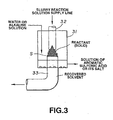
- the foregoing method has the steps of adding and dissolving aromatic polymers to solvents which are supplied continuously, supplying sulfonating agent to the solution to perform sulfonating reactions, separating reactant solid materials and the solvent from each other, and returning the separated solvent so as to be again used in the sulfonating reactions.
- the aromatic polymer for use as the material to be sulfonated is exemplified by styrene-butadiene, styrene-butadiene-acrylonitrile, styrene-butadiene-(metha) acrylates (aliphatic hydrocarbon having one to four carbon atoms), styrene-maleic anhydride, styrene-itaconic anhydride.
- any one of the following material be employed: styrene-butadiene, styrene-butadiene-acrylonitrile, and styrene-butadiene-(metha) acrylates (aliphatic hydrocarbon having one to four carbon atoms). More preferably, it is preferable that styrene-butadiene, styrene-butadiene-acrylonitrile be employed.
- the foregoing copolymer may be used solely or a mixture of the foregoing copolymers may be employed.
- the copolymer may be used as a mixture with polystyrene and another polymer.
- the other polymer is exemplified by polyphenyleneether, polyphenylene sulfide, polycarbonate, polyamide (a so-called Nylon), polyethyleneterephthalate and polybutylene terephthalate.
- the sulfonating agent is exemplified by sulfuric anhydride, fuming sulfuric acid, chlorosulfonic acid and concentrated sulphuric acid.
- the sulfonating agent may be used solely or combination of a plurality of the sulfonating agents may be employed. It is preferable that the quantity of addition be 0.1 mol% to 300 mol% with respect to the aromatic units, more preferably 1 mol% to 200 mol%.
- the sulfonating agent may be used together with a Lewis base.
- the Lewis base is exemplified by alkylphosphate (triethylphosphate, trimethylphosphate or the like), dioxane, acetic anhydride, ethyl acetate, ethyl palmitate, diethylether and thioxane.
- the quantity of the Lewis base to be added be 0.01 mol% to 300 mol% with respect to the aromatic units in the aromatic polymers, more preferably 0.5 mol% to 100 mol%. If the quantity of the added Lewis base is too small, gelled products can easily be generated in the sulfonating reactions. If the quantity is too large, the sulfonating reaction cannot easily proceed. As a result, the yield deteriorates.
- the solvent for use in the reactions is exemplified by (aliphatic halogenated hydrocarbon (preferably, 1, 2-dichloroethane, chloroform, dichloromethane, 1, 1-dichloroethane or the like), nitromethane, nitrobenzene, ariphatic cyclic hydrocarbon (preferably, cyclohexane, methylcyclohexane, cyclopentane or the like), preferably ariphatic cyclic hydrocarbon.
- aliphatic halogenated hydrocarbon preferably, 1, 2-dichloroethane, chloroform, dichloromethane, 1, 1-dichloroethane or the like
- nitromethane nitrobenzene
- ariphatic cyclic hydrocarbon preferably, cyclohexane, methylcyclohexane, cyclopentane or the like
- ariphatic cyclic hydrocarbon preferably, cyclohexane, methylcyclohexane,
- the solvent may be used solely or the mixture of the foregoing solvents may be employed.
- the mixture ratio of the solvent is not limited particularly.
- the foregoing solvent may be mixed with another solvent.
- the solvent which can be mixed is exemplified by paraffin hydrocarbon (having one to seven carbon atoms), acetonitrile, carbon disulfide, tetrahydrofuran, tetrahydropyran, 1, 2-dimethoxyethane, acetone, methylethylketone and thiophene.
- paraffin hydrocarbon having one to seven carbon atoms
- tetrahydrofuran acetone or acetonitrile be employed.
- the mixture ratio of the above-mentioned solvent is not limited particularly. It is preferable that the mixture ratio be 1 volume % to 100 volume %.
- the above-mentioned aromatic polymer, sulfonating agent, Lewis base and the solvent are used to perform the sulfonating reactions.
- the reactant solid material generated in the reaction system and the solvent are separated from each other prior to neutralizing the generated sulfonated material.
- the solvent is, as it is, recovered so as to be again used in the reactions.
- the reactant solid material is removed by drying the residual solvent or dissolved in water or alkaline water solution.
- the alkaline material for use in the alkaline water solution such as a compound, for example, oxide, hydride, carbonate, acetate, sulfate or phosphate of alkali metal (sodium, lithium or calcium) or an oxide of alkaline earth metal (magnesium, calcium or the like), ammonia or primary to tertiary alkylamine compounds, is, as it is, or in the form of water solution, gradually added so that the neutralizing Process is completed.
- a compound for example, oxide, hydride, carbonate, acetate, sulfate or phosphate of alkali metal (sodium, lithium or calcium) or an oxide of alkaline earth metal (magnesium, calcium or the like), ammonia or primary to tertiary alkylamine compounds
- the quantity of water (the alkaline water solution) varies depending upon the molecular weight. It is preferable that the quantity of water be 0.5 part by weight to 100 parts by weight with respect to one part by weight of polymer, more preferably 1 part by weight to 50 parts by weight.
- halogen retardant can be separated simultaneously with introduction of the ion groups (for example, the sulfonating process).
- the plastic containing the halogen retardant are processed with acid in an organic solvent, and then the ion groups are introduced into the resin component to form a water-soluble polymer, followed by separating the halogen retardant in the organic solvent.
- various plastics containing the halogen retardant is processed in the present invention.
- the purpose and the shape of the plastics are not limited.
- the present invention is effective to be used to process plastic waste which is disposed.
- the ion groups which are introduced as described above are exemplified by sulfonic groups, their salts, carboxylic groups, their salts, -OH groups, their salts, -PO(OH) 2 groups or their salts.
- the ion groups are introduced into the resin component by causing the resin component and the various oxidizers to react with one another.
- the resin component and the sulfonating agent are allowed to react with each other so that the sulfonic groups are introduced into the resin component.
- the sulfonating agent sulfuric anhydride, fuming sulfuric acid, chlorosulfonic acid or concentrated sulfonic acid
- carboxylic groups can be introduced into the resin component.
- -OH groups can be introduced.
- -PO(OH) 2 groups can be introduced into the resin components.
- the chlorine compounds for neutralizing the acidic groups are exemplified by oxide, hydride, carbonate, acetate, sulfate or phosphate of alkali metal (sodium, lithium or calcium) or alkaline earth metal (magnesium or calcium), ammonia and various amine compounds (primary alkylamine, secondary alkylamine or tertiary alkylamine).
- reaction temperature be 0°C to 150°C, more preferably 10°C to 100°C. If the temperature is lower than the above-mentioned range, the introduction ratio of the ion groups is lowered. Thus, the resin components lose the water solubility.
- the reaction period of time is determined to be 20 minutes to 40 hours, preferably 30 minutes to 20 hours. If the reaction period of times is shorter than the above-mentioned length, the reactions cannot sufficiently proceed. In this case, the resin components lose the water solubility. If the reaction period of time is longer than the above-mentioned length, the efficiency deteriorates.
- the concentration of the reaction system is made to be 0.1 wt% to 50 wt%, preferably 0.5 wt% to 30 wt%. If the concentration of the reaction system is lower than the above-mentioned range, the efficiency deteriorates. What is worse, the ion groups introduction rate deteriorates, thus resulting in that the resin components lose the water solubility. If the concentration is too high, gelled materials and unreacted materials are generated unintentionally.
- the resin components Since the ion groups are, under the above-mentioned conditions, introduced into plastics containing the halogen retardant, the resin components have the water solubility as the polyelectrolyte and thus the resin components exist in the aqueous layer.
- the halogen retardant exists in a unreacted state such that the halogen retardant is dissolved in the organic solvent layer.
- the aqueous layer After the aqueous layer has been separated from the organic solvent layer and the residual solvents have been removed by distillation, it can be used as water-soluble polyelectrolyte in a variety of purposes, such as coagulant for disposing waste water, dispersant for cement, a surface sizing agent for paper, a conductive material for paper, an antistatic agent for fiber, dispersant for coal-slurry, aqueous glue, a cleaning material, a scale preventive material.
- coagulant for disposing waste water dispersant for cement, a surface sizing agent for paper, a conductive material for paper, an antistatic agent for fiber, dispersant for coal-slurry, aqueous glue, a cleaning material, a scale preventive material.
- the halogen retardant dissolved in the organic solvent layer is recovered as a residue after the solvent has been removed by distillation. Therefore, it may be used in another purpose or may be reclaimed efficiently.
- the polysulfonic acid or its salt is, as the ion group, introduced into the polystyrene resin. That is, sulfonation is performed, sulfon crosslinking takes place and thus the polymers have easily be gelled. If the conjugate diene units exist in the polystyrene resin, sulfon crosslinking in the molecules of the polystyrene resin and between molecules can be prevented. Therefore, gelling can be prevented. Since gelling easily takes place in proportion to the molecular weight of the polymers, the polyelectrolyte having large molecular weight cannot easily be obtained by the conventional technique. The foregoing contrivance enables polyelectrolyte having large molecular weight to easily be manufactured.
- the conjugate diene which is copolymerized with styrene is exemplified by butadiene and isoprene.
- the percentage content of the conjugate diene in the foregoing copolymer is made to be 0.1 mol% to 20 mol% with respect to all monomer units, preferably 0.2 mol% to 10 mol%. If the quantity of the conjugate diene units in the polystyrene resin is too small, side reactions in the sulfonating reactions, that is, the effect of preventing the sulfon crosslinking in the molecules and between molecules cannot be obtained as desired.
- the quantity of the conjugate diene units in the polystyrene resin is made to be 80 mol% or more with respect to all of the monomer units, preferably 90 mol%.
- the stereoscopic constraint of the rigid conjugate diene structure prevents sulfon crosslinking in the molecules and between molecules of the polystyrene resin when the sulfonating process is performed. As a result, gelling can be prevented.
- inorganic pigment may be allowed to exist in the reaction system when the sulfonating process is performed. That is, the above-mentioned polyelectrolyte may contain the inorganic pigment.
- the inorganic pigment When the inorganic pigment is allowed to exist when the sulfonating process is performed, the inorganic pigment traps radicals. Therefore, crosslinking reactions and polymerizing reactions in the conjugate diene units can be prevented. As a result, the long-term stability of the polyelectrolyte can be improved.
- titanium oxide may be employed as the inorganic pigment, it is preferable that carbon black be employed.
- the carbon black may be general carbon black for use in a coloring matter for plastics, a reinforcing material or an electric conductivity agent manufactured by any one of a channel method, a furnace method or a thermal method.
- the carbon black manufactured by any one of the foregoing method may solely be employed or a mixture of plural types of carbon black manufactured by different methods may be employed. It is preferable that the average particle size of the carbon black be 5 ⁇ m to 500 ⁇ m, more preferably 10 ⁇ m to 50 ⁇ m.
- the contents of the carbon black in the sulfonating reaction system is made to be 0.01 wt% to 20 wt% with respect to the polystyrene resin component, preferably 0.1 wt% to 10 wt%. If the content of the carbon black is too small, the effect of preventing the crosslinking reactions and polymerizing reactions in the conjugate diene becomes insufficient. If the content is too large, the performance as a chemical in the polyelectrolyte deteriorates. What is worse, the cost is raised.
- the inorganic pigment When the inorganic pigment is allowed to exist in the sulfonating reaction system, the crosslinking reactions and the polymerizing reactions in the conjugate diene units can be prevented. Therefore, the range for the content of the conjugate diene units in the polystyrene resin can be widened as compared with a structure in which no inorganic pigment exists. If the inorganic pigment is allowed to exist in the sulfonating reaction system, the percentage content of the conjugate diene units with respect to all monomer units is made to be 0.05 mol% to 60 mol%, preferably 0.1 mol% to 40 mol%.
- the percentage of content of the styrene units with respect to all of the monomer units is made to be 40 mol% or higher, preferably 60 mol% or higher.
- the percentage of content of the conjugate diene units is lower than the above-mentioned range, the effect of preventing the sulfon crosslinking reactions becomes insufficient. In this case, the sulfonating reactions cannot stably be performed. If the percentage of content of the conjugate diene is higher than the above-mentioned range, solubility into the organic solvent deteriorates when the sulfonating reactions of the polystyrene resin are performed in the organic solvent. In this case, the reactions are performed nonuniformly. If the percentage of content of the conjugate diene units is raised excessively, the percentage of content of the styrene units is lowered. Thus, also the quantity of the sulfonic acid or its salt which is introduced is reduced. In this case, the polyelectrolyte having sufficient water solubility cannot be obtained.
- the quantity of the sulfonic acid or its salt, which is introduced is made to be 20 mol% or more, preferably 40 mol% or more.
- the improvement in the long-term stability attributable to the inorganic pigment is not limited to the state after the sulfonating process. That is, the improvement is not limited to the introduction of the sulfonic acid or its salt as the ion groups.
- a material selected from a group consisting of chloromethylated amine salt, carboxylic acid, its salt, -PO(OH) 2 , its salt, -CH 2 PO(OH) 2 and its salt is introduced, existence of the inorganic pigment enables the long-term stability of the obtained polyelectrolyte.
- Example 5 0.3 g of triethyl phosphate was added to 70 g of cyclohexane recovered by filtration performed in Example 5, and then the temperature was maintained at 50°C. Then, sulfuric anhydride was added by 0.14 g in the foregoing state. Then, a process similar to that according to Example 1 was performed such that solution in which the polymers were dissolved and sulfuric anhydride were simultaneously dropped into the above-mentioned solution so that sulfonation was performed. Then, a neutralizing process and removal of the solvent were performed so that 30 wt% water solution of polyelectrolyte was obtained which was called a sample water solution according to Reference 1.
- the resins (p) to (r) were obtained by crushing the materials by a shredder.
- a standard material (BCC type having an average particle size of 9 ⁇ m to 14 ⁇ m) for a color product was prepared.
- Example 2 A process similar to that according to Example 2 was performed except for high-impact polystylene (o) being used as the resin so that sulfonation was performed. Then, the solution was neutralized. The thus-obtained polyelectrolyte solution was called sample water solution according to Comparative Example 1.
- sample water solutions were injected into sample bottles made of transparent glass and sample bottles made of light shielding glass, and then allowed to stand at the room temperature for three months. At an interval of one month, the state of each sample water solution was observed. Results of reservation in the sample bottles made of transparent glass were shown in Table 1, while results of reservation in the sample bottles made of light shielding glass were shown in Table 2.
- Example 1 After One Month After Two Months After Three Months Example 1 no change no change no change Example 2 no change no change no change Example 3 no change no change no change Example 4 no change no change no change Example 5 carbon black deposited carbon black deposited carbon black deposited Comparative Example 1 gelled substances gelled substances gelled substances Comparative Example 2 gelled substances gelled substances gelled substances Table 2 After One Month After Two Months After Three Months Example 1 no change no change no change Example 2 no change no change no change Example 3 no change no change no change Example 4 no change no change no change Example 5 carbon black deposited carbon black deposited carbon black deposited Comparative Example 1 no change no change gelled substances generated partially Comparative Example 2 no change no change gelled substances generated partially
- long-term stability can be obtained by introducing the ion groups into the resin, such as resins (p) to (r), previously containing carbon black or by adding carbon black to the reaction system when the ion groups are introduced. If carbon black is added to the polyelectrolyte solution into which the ion groups have been introduced, deterioration of the resin components in the sample water solution with time can be prevented. Since added carbon black cannot uniformly be dispersed and the carbon black is deposited in this case, it is preferable that carbon black be allowed to exist when the ion groups are introduced as is performed in each of Examples 1 to 5.
Landscapes
- Chemical & Material Sciences (AREA)
- Organic Chemistry (AREA)
- Chemical Kinetics & Catalysis (AREA)
- General Chemical & Material Sciences (AREA)
- Health & Medical Sciences (AREA)
- Medicinal Chemistry (AREA)
- Polymers & Plastics (AREA)
- Engineering & Computer Science (AREA)
- Environmental & Geological Engineering (AREA)
- Mechanical Engineering (AREA)
- Hydrology & Water Resources (AREA)
- Water Supply & Treatment (AREA)
- Life Sciences & Earth Sciences (AREA)
- Addition Polymer Or Copolymer, Post-Treatments, Or Chemical Modifications (AREA)
- Separation, Recovery Or Treatment Of Waste Materials Containing Plastics (AREA)
- Processes Of Treating Macromolecular Substances (AREA)
- Compositions Of Macromolecular Compounds (AREA)
Claims (7)
- Polyelektrolyt, umfassend Copolymere, aufgebaut aus Styrol und konjugiertem Dien, in das ionische Gruppen eingeführt wurden, wobei der Polyelektrolyt Wasserlöslichkeit aufweist und ein anorganisches Pigment enthält.
- Polyelektrolyt nach Anspruch 1,
wobei die ionische Gruppe mindestens ein Material darstellt, ausgewählt aus der Gruppe, bestehend aus Sulfonsäure, Sulfonat und chlormethyliertem Aminsalz. - Polyelektrolyt nach Anspruch 2,
wobei 20 Mol-% oder mehr der ionischen Gruppen eingeführt sind, bezogen auf alle Monomereinheiten. - Polyelektrolyt nach Anspruch 1,
wobei die ionische Gruppe mindestens ein Material darstellt, ausgewählt aus der Gruppe, bestehend aus Sulfonsäure, ihr Salz, chlormethyliertes Aminsalz, Carbonsäure, ihr Salz, PO(OH)2, ihr Salz, CH2PO(OH)2 und ihr Salz. - Polyelektrolyt nach Anspruch 1, wobei das anorganische Pigment Carbon black bzw. Ruß oder Titanoxid darstellt.
- Polyelektrolyt nach Anspruch 1,
wobei das Copolymer 0,05 Mol-% bis 60 Mol-% konjugierte Dieneinheiten enthält, bezogen auf alle Monomereinheiten. - Polyelektrolyt nach Anspruch 1,
wobei das Copolymer 0,1 Mol-% bis 40 Mol-% konjugierte Dieneinheiten enthält, bezogen auf alle Monomereinheiten.
Priority Applications (1)
| Application Number | Priority Date | Filing Date | Title |
|---|---|---|---|
| EP20070006391 EP1803746A3 (de) | 1996-07-08 | 1997-07-04 | Verfahren zur Herstellung eines Polyelektrolyts |
Applications Claiming Priority (15)
| Application Number | Priority Date | Filing Date | Title |
|---|---|---|---|
| JP17781596A JP3371320B2 (ja) | 1996-07-08 | 1996-07-08 | 高分子電解質の製造方法 |
| JP17781596 | 1996-07-08 | ||
| JP25698496 | 1996-09-27 | ||
| JP25698296 | 1996-09-27 | ||
| JP25698496A JP3289615B2 (ja) | 1996-09-27 | 1996-09-27 | 高分子電解質およびその製造方法 |
| JP25698296A JP3371322B2 (ja) | 1996-09-27 | 1996-09-27 | 高分子電解質およびその製造方法 |
| JP26204196A JP3470516B2 (ja) | 1996-10-02 | 1996-10-02 | 高分子電解質組成物水溶液及びその製造方法 |
| JP26203996 | 1996-10-02 | ||
| JP26204196 | 1996-10-02 | ||
| JP26203996A JP3371323B2 (ja) | 1996-10-02 | 1996-10-02 | 芳香族ポリマーのスルホン化方法 |
| JP37297 | 1997-01-06 | ||
| JP00037297A JP3446513B2 (ja) | 1997-01-06 | 1997-01-06 | ハロゲン系難燃剤含有プラスチックの処理方法 |
| JP165097A JP3271238B2 (ja) | 1997-01-08 | 1997-01-08 | スルホン化方法 |
| JP165097 | 1997-01-08 | ||
| EP19970111328 EP0818474B1 (de) | 1996-07-08 | 1997-07-04 | Verfahren zur Herstellung von Polyelektrolyten |
Related Parent Applications (1)
| Application Number | Title | Priority Date | Filing Date |
|---|---|---|---|
| EP97111328.7 Division | 1997-07-04 |
Related Child Applications (2)
| Application Number | Title | Priority Date | Filing Date |
|---|---|---|---|
| EP20070006391 Division EP1803746A3 (de) | 1996-07-08 | 1997-07-04 | Verfahren zur Herstellung eines Polyelektrolyts |
| EP07006391.2 Division-Into | 2007-03-28 |
Publications (3)
| Publication Number | Publication Date |
|---|---|
| EP1457504A2 EP1457504A2 (de) | 2004-09-15 |
| EP1457504A3 EP1457504A3 (de) | 2004-11-24 |
| EP1457504B1 true EP1457504B1 (de) | 2010-06-23 |
Family
ID=27563075
Family Applications (6)
| Application Number | Title | Priority Date | Filing Date |
|---|---|---|---|
| EP20040025337 Expired - Lifetime EP1505086B1 (de) | 1996-07-08 | 1997-07-04 | Verfahren zur Herstellung von Polyelektrolyten |
| EP20100010100 Withdrawn EP2258732A1 (de) | 1996-07-08 | 1997-07-04 | Verfahren zur Herstellung eines Polyelektrolyts |
| EP19970111328 Expired - Lifetime EP0818474B1 (de) | 1996-07-08 | 1997-07-04 | Verfahren zur Herstellung von Polyelektrolyten |
| EP04013724A Withdrawn EP1457503A3 (de) | 1996-07-08 | 1997-07-04 | Verfahren zur Herstellung von Polyelektrolyten |
| EP20040013725 Expired - Lifetime EP1457504B1 (de) | 1996-07-08 | 1997-07-04 | Polyelektrolyt |
| EP20070006391 Withdrawn EP1803746A3 (de) | 1996-07-08 | 1997-07-04 | Verfahren zur Herstellung eines Polyelektrolyts |
Family Applications Before (4)
| Application Number | Title | Priority Date | Filing Date |
|---|---|---|---|
| EP20040025337 Expired - Lifetime EP1505086B1 (de) | 1996-07-08 | 1997-07-04 | Verfahren zur Herstellung von Polyelektrolyten |
| EP20100010100 Withdrawn EP2258732A1 (de) | 1996-07-08 | 1997-07-04 | Verfahren zur Herstellung eines Polyelektrolyts |
| EP19970111328 Expired - Lifetime EP0818474B1 (de) | 1996-07-08 | 1997-07-04 | Verfahren zur Herstellung von Polyelektrolyten |
| EP04013724A Withdrawn EP1457503A3 (de) | 1996-07-08 | 1997-07-04 | Verfahren zur Herstellung von Polyelektrolyten |
Family Applications After (1)
| Application Number | Title | Priority Date | Filing Date |
|---|---|---|---|
| EP20070006391 Withdrawn EP1803746A3 (de) | 1996-07-08 | 1997-07-04 | Verfahren zur Herstellung eines Polyelektrolyts |
Country Status (5)
| Country | Link |
|---|---|
| US (5) | US6022928A (de) |
| EP (6) | EP1505086B1 (de) |
| KR (2) | KR100508365B1 (de) |
| CN (5) | CN100335540C (de) |
| DE (3) | DE69739919D1 (de) |
Families Citing this family (38)
| Publication number | Priority date | Publication date | Assignee | Title |
|---|---|---|---|---|
| US6086783A (en) * | 1996-07-08 | 2000-07-11 | Sony Corporation | Polymer electrolyte, a polymer aggregating agent prepared therefrom, and a disposal of waste water |
| US7321783B2 (en) * | 1997-04-25 | 2008-01-22 | Minerva Industries, Inc. | Mobile entertainment and communication device |
| EP0949293A3 (de) * | 1998-04-09 | 2000-11-29 | Matsushita Electric Industrial Co., Ltd. | Eine Methode zur Verarbeitung thermoplastischer Kunstharze,welche Flammhemmer enthalten |
| KR20010087388A (ko) * | 1998-11-13 | 2001-09-15 | 나까니시 히로유끼 | 벤젠설폰산 유도체 화합물, 그 제조 방법 및 그 용도 |
| JP3736237B2 (ja) | 1999-09-17 | 2006-01-18 | 松下電器産業株式会社 | 難燃剤を含有する熱可塑性樹脂組成物の処理方法 |
| JP2001253912A (ja) * | 2000-03-10 | 2001-09-18 | Sony Corp | 抗菌剤及びその製造方法 |
| EP1277767A4 (de) * | 2001-01-22 | 2006-09-20 | Sony Corp | Lösungsmittelabsorbierendes harz und verfahren zu dessen herstellung |
| CN100335538C (zh) | 2001-03-01 | 2007-09-05 | 松下电器产业株式会社 | 含添加剂的热塑性树脂组合物的处理方法及处理装置 |
| EP2256140A3 (de) * | 2001-03-13 | 2011-02-16 | Sony Corporation | Absorber für eine Elektrolytlösung und Verfahren zur Herstellung des Absorbers |
| TW589760B (en) * | 2001-08-09 | 2004-06-01 | Sumitomo Chemical Co | Polymer electrolyte composition and fuel cell |
| KR100599677B1 (ko) * | 2003-10-31 | 2006-07-13 | 삼성에스디아이 주식회사 | 연료전지의 고분자 전해질막용 술폰화 폴리스티렌의제조방법 |
| EP1607416A1 (de) * | 2004-06-18 | 2005-12-21 | Services Petroliers Schlumberger | Anionische amphiphile Copolymere und diese enthaltende Lösung |
| US20100233569A1 (en) * | 2006-01-26 | 2010-09-16 | Kuraray Co., Ltd | Electrolyte multilayer membrane for solid polymer fuel cell, membrane-electrode assembly, and fuel cell |
| WO2007094185A1 (ja) * | 2006-02-13 | 2007-08-23 | Kuraray Co., Ltd. | 高分子電解質膜、膜-電極接合体及び固体高分子型燃料電池 |
| US7696305B2 (en) * | 2006-02-15 | 2010-04-13 | Joseph Douglas Sanders | Polystyrene processing apparatus and method |
| US7592416B2 (en) * | 2006-02-16 | 2009-09-22 | Joseph Douglas Sanders | Polystyrene processing apparatus and method |
| BRPI0809796B1 (pt) * | 2007-04-09 | 2021-09-08 | Evogene Ltd | Métodos para aumentar o teor de óleo, taxa de crescimento, biomassa, vigor e/ou rendimento de uma planta, e para produzir óleo |
| KR101014000B1 (ko) | 2008-08-14 | 2011-02-14 | (주) 시온텍 | 폴리스티렌 수지 또는 그 유도체들을 이용한 전극용 이온교환용액 조성물 제조 및 이를 포함한 이온교환막의 제조방법 |
| JP2011154987A (ja) * | 2009-12-29 | 2011-08-11 | Sony Corp | 非水電解質および非水電解質電池 |
| WO2011136678A1 (en) * | 2010-04-27 | 2011-11-03 | Schlumberger Canada Limited | Heterogeneous proppant placement |
| CN102462151B (zh) * | 2010-11-05 | 2016-05-11 | Hct亚洲有限公司 | 具有磁性细丝的刷子 |
| EP3018742B1 (de) * | 2013-07-02 | 2021-10-27 | Asahi Kasei Kabushiki Kaisha | Elektrolytlösung und verfahren zur herstellung davon, durchlaufauflösevorrichtung, elektrolytmembran, elektrodenkatalysatorschicht, membranelektrodenanordnung und brennstoffzelle |
| CN105486846B (zh) * | 2015-12-24 | 2017-10-17 | 上海微谱化工技术服务有限公司 | 一种丁苯橡胶中胺类抗氧剂的分离及检测方法 |
| CN105585537B (zh) * | 2015-12-24 | 2018-06-29 | 上海微谱化工技术服务有限公司 | Sebs中三嗪类紫外吸收剂的分离及检测方法 |
| CN105561629B (zh) * | 2015-12-24 | 2017-10-24 | 上海微谱化工技术服务有限公司 | Pet纤维中二苯基硅二醇的分离及分析检测方法 |
| CN105482424B (zh) * | 2015-12-24 | 2018-05-15 | 上海微谱化工技术服务有限公司 | 聚碳酸酯塑料中bdp的分离及分析检测方法 |
| CN105628483B (zh) * | 2015-12-24 | 2019-03-19 | 上海微谱化工技术服务有限公司 | 发泡聚苯乙烯中防霉剂的分离及检测方法 |
| CN105606430A (zh) * | 2015-12-24 | 2016-05-25 | 上海微谱化工技术服务有限公司 | 含苯环结构的聚合物中芳香烃类添加剂的分离及分析方法 |
| CN105606415B (zh) * | 2015-12-24 | 2020-09-29 | 上海微谱化工技术服务有限公司 | 发泡聚苯乙烯中荧光增白剂的分离及检测方法 |
| CN105486847B (zh) * | 2015-12-24 | 2018-02-09 | 上海微谱化工技术服务有限公司 | 高抗冲聚苯乙烯中酚类抗氧化剂的分离及检测方法 |
| WO2018099943A1 (en) * | 2016-12-02 | 2018-06-07 | Akzo Nobel Chemicals International B.V. | Stabilized sulfonated polystyrene solutions |
| KR20190078639A (ko) * | 2016-12-02 | 2019-07-04 | 아크조 노벨 케미칼즈 인터내셔널 비.브이. | 안정화된 설폰화 폴리스티렌 용액 |
| KR102375919B1 (ko) | 2019-11-29 | 2022-03-16 | 한남대학교 산학협력단 | 광가교형 음전하 고분자를 이용한 나노입자의 제조방법 |
| KR102308718B1 (ko) | 2019-11-29 | 2021-10-01 | 한남대학교 산학협력단 | 광가교형 양전하 고분자를 이용한 나노입자의 제조방법 |
| CN113035584B (zh) * | 2021-03-01 | 2021-12-17 | 齐鲁工业大学 | 用于高性能全固态超级电容器的凝胶聚合物电解质 |
| CN113219091B (zh) * | 2021-04-28 | 2022-07-22 | 广东省中鼎检测技术有限公司 | 一种快速测定消费品中五种持久性生物累积毒性物质含量的检测方法 |
| CN118026365B (zh) * | 2024-03-28 | 2025-12-12 | 浙江工业大学 | 一种水系中溴代阻燃剂的电化学氧化聚合去除法 |
| CN119186448B (zh) * | 2024-09-18 | 2025-09-12 | 辽宁科技学院 | 一种用于制造凝胶型电解质的方法 |
Family Cites Families (31)
| Publication number | Priority date | Publication date | Assignee | Title |
|---|---|---|---|---|
| GB795379A (en) * | 1954-10-07 | 1958-05-21 | Asahi Chemical Industry Compan | Anion exchange resins |
| US3072619A (en) * | 1959-12-21 | 1963-01-08 | Exxon Research Engineering Co | Method for improving stability of aromatic sulfonates |
| GB959515A (en) * | 1962-05-03 | 1964-06-03 | Wolfen Filmfab Veb | New anion exchange resins |
| US3642728A (en) * | 1968-10-07 | 1972-02-15 | Exxon Research Engineering Co | Sulfonated polymers |
| US3947396A (en) * | 1972-04-28 | 1976-03-30 | The Dow Chemical Company | Coacervation of anion-containing aqueous disperse systems with amphoteric polyelectrolytes |
| US3870841A (en) * | 1972-10-02 | 1975-03-11 | Exxon Research Engineering Co | Flexible polymeric compositions comprising a normally plastic polymer sulfonated to about 0.2 to about 10 mole % sulfonate |
| US4119616A (en) * | 1974-02-11 | 1978-10-10 | Exxon Research & Engineering Co. | Process for sulfonating unsaturated elastomers using acyl sulfates |
| SU517598A1 (ru) * | 1974-02-12 | 1976-06-15 | Институт химических наук АН Казахской ССР | Способ получени водорастворимого полиэлектролита |
| GB1472846A (en) * | 1975-02-28 | 1977-05-11 | Exxon Research Engineering Co | Process for sulphonating polymers |
| US4184988A (en) * | 1977-11-29 | 1980-01-22 | Exxon Research & Engineering Co. | Process for the sulfonation of an elastomeric polymer |
| US4131586A (en) * | 1977-11-29 | 1978-12-26 | Exxon Research & Engineering Co. | Polymeric hydroxyalkyl sulfonates |
| US4157432A (en) * | 1977-11-29 | 1979-06-05 | Exxon Research & Engineering Co. | Bulk sulfonation process |
| US4177331A (en) * | 1978-07-24 | 1979-12-04 | Rohm And Haas Company | Sulfone-crosslinked polystyrene ion exchange resin and process of manufacture |
| SU833997A1 (ru) * | 1979-06-29 | 1981-05-30 | Berdnikov Mikhail P | Способ получени пленкообразующего |
| CA1185049A (en) * | 1980-04-01 | 1985-04-02 | Robert R. Klein | Process for forming powders from ion containing polymers |
| EP0071347A3 (de) * | 1981-07-24 | 1984-04-04 | Exxon Research And Engineering Company | Verfahren zur Sulfonierung von aromatischen Polymerisaten |
| US4412028A (en) * | 1981-12-29 | 1983-10-25 | Exxon Research And Engineering Co. | Conversion of polymer solutions into solids or more viscous solution |
| US4532302A (en) * | 1982-06-01 | 1985-07-30 | Exxon Research And Engineering Co. | Process for the sulfonation of an elastomeric polymer |
| US4511677A (en) * | 1983-11-02 | 1985-04-16 | Phillips Petroleum Company | Ion exchange-active compositions consisting of water-soluble polyelectrolyte upon ion exchange functional substrate |
| JPH0667974B2 (ja) * | 1986-08-09 | 1994-08-31 | 昭和電工株式会社 | 改質されたオレフィン重合体とその製造方法 |
| US5008339A (en) * | 1987-01-20 | 1991-04-16 | California Institute Of Technology | Novel polyelectrolyte copolymer and mixed polymers and composites thereof |
| CA2056550A1 (en) * | 1991-01-30 | 1992-07-31 | Stanley F. Bedell | Sulphonation process |
| US5256181A (en) * | 1991-03-28 | 1993-10-26 | Exxon Research And Engineering Company | Coatings with ionically and covalently crosslinked sulfonated polymers |
| US5164177A (en) * | 1991-06-18 | 1992-11-17 | Helene Curtis, Inc. | Aqueous hair styling aid |
| JPH05295018A (ja) * | 1992-04-17 | 1993-11-09 | Mitsubishi Petrochem Co Ltd | スルホン酸基含有共重合体の製造法 |
| CA2103875C (en) * | 1992-09-03 | 2001-11-20 | Martin L. Gorbaty | Sulfonated unhydrogenated copolymers of styrene and butadiene |
| JP3203280B2 (ja) * | 1993-04-14 | 2001-08-27 | ライオン株式会社 | 芳香族ポリマーのスルホン化方法 |
| US5849818A (en) * | 1993-06-03 | 1998-12-15 | Walles; Wilhelm E. | Skin sulfonated particles in matrices |
| US5624982A (en) * | 1993-12-02 | 1997-04-29 | Bayer Antwerpen Sa/Nv | Stabilizer system for non yellowing polymer composition |
| DE4428641A1 (de) * | 1994-08-12 | 1996-02-15 | Basf Ag | Mesomorphe Komplexe aus Polyelektrolyten und Tensiden, Verfahren zu ihrer Herstellung sowie Filme, Folien, Fasern, Formkörper und Beschichtungen hieraus |
| CA2274397A1 (en) | 1998-06-18 | 1999-12-18 | Sony Corporation | Method and apparatus for recycling styrene resin |
-
1997
- 1997-07-04 EP EP20040025337 patent/EP1505086B1/de not_active Expired - Lifetime
- 1997-07-04 DE DE69739919T patent/DE69739919D1/de not_active Expired - Lifetime
- 1997-07-04 EP EP20100010100 patent/EP2258732A1/de not_active Withdrawn
- 1997-07-04 EP EP19970111328 patent/EP0818474B1/de not_active Expired - Lifetime
- 1997-07-04 EP EP04013724A patent/EP1457503A3/de not_active Withdrawn
- 1997-07-04 EP EP20040013725 patent/EP1457504B1/de not_active Expired - Lifetime
- 1997-07-04 DE DE69739258T patent/DE69739258D1/de not_active Expired - Lifetime
- 1997-07-04 DE DE1997632199 patent/DE69732199T2/de not_active Expired - Lifetime
- 1997-07-04 EP EP20070006391 patent/EP1803746A3/de not_active Withdrawn
- 1997-07-07 US US08/889,011 patent/US6022928A/en not_active Expired - Lifetime
- 1997-07-08 CN CNB031550479A patent/CN100335540C/zh not_active Expired - Lifetime
- 1997-07-08 CN CNB971174423A patent/CN1150221C/zh not_active Expired - Lifetime
- 1997-07-08 CN CNB2004100386696A patent/CN1249099C/zh not_active Expired - Lifetime
- 1997-07-08 CN CNB2004100386681A patent/CN100339404C/zh not_active Expired - Lifetime
- 1997-07-08 KR KR1019970031469A patent/KR100508365B1/ko not_active Expired - Lifetime
-
1999
- 1999-08-25 US US09/383,009 patent/US6210581B1/en not_active Expired - Lifetime
- 1999-08-25 US US09/382,914 patent/US6417288B2/en not_active Expired - Lifetime
- 1999-08-25 US US09/382,949 patent/US6545070B1/en not_active Expired - Lifetime
-
2001
- 2001-09-06 CN CNB011328126A patent/CN1155625C/zh not_active Expired - Lifetime
-
2003
- 2003-09-12 US US10/661,111 patent/US20040054093A1/en not_active Abandoned
-
2005
- 2005-01-21 KR KR1020050005776A patent/KR100533306B1/ko not_active Expired - Lifetime
Also Published As
Similar Documents
| Publication | Publication Date | Title |
|---|---|---|
| EP1505086B1 (de) | Verfahren zur Herstellung von Polyelektrolyten | |
| US6274681B1 (en) | Method of manufacturing polyelectrolyte from styrene polymers | |
| US20080206503A1 (en) | Solid concentrate composition for polymeric chain extension | |
| US4365023A (en) | Method for manufacturing block copolymer | |
| US4582876A (en) | High-impact polyester/styrene-maleic anhydride copolymer blends | |
| EP1572802B1 (de) | Styrolpolymerverbundwerkstoffe | |
| WO1999047318A9 (en) | Process for removing deleterious surface material from polymeric regrind particles | |
| JP3289615B2 (ja) | 高分子電解質およびその製造方法 | |
| AU752379B2 (en) | Method of manufacturing polyelectrolyte | |
| AU2005237160B2 (en) | Method of manufacturing polyelectrolyte | |
| JP3271238B2 (ja) | スルホン化方法 | |
| JPH10128127A (ja) | イオン交換樹脂及びその製造方法 | |
| JP3371322B2 (ja) | 高分子電解質およびその製造方法 | |
| JPH10180123A (ja) | イオン交換樹脂及びその製造方法 | |
| JP3446513B2 (ja) | ハロゲン系難燃剤含有プラスチックの処理方法 | |
| JP3414132B2 (ja) | 高分子電解質およびその製造方法 | |
| Cheung | Modification of polystyrene | |
| US20040230013A1 (en) | Blends of poly (alpha-methylene-gamma-methyl-gamma-butyrolactone-co-glycidyl methacrylate) and polyphenylene sulfide polymer, articles therefrom and preparation thereof | |
| WO2002058090A1 (fr) | Interrupteur electrique de flux et procede de preparation correspondant |
Legal Events
| Date | Code | Title | Description |
|---|---|---|---|
| PUAI | Public reference made under article 153(3) epc to a published international application that has entered the european phase |
Free format text: ORIGINAL CODE: 0009012 |
|
| AC | Divisional application: reference to earlier application |
Ref document number: 0818474 Country of ref document: EP Kind code of ref document: P |
|
| AK | Designated contracting states |
Kind code of ref document: A2 Designated state(s): DE FR GB |
|
| PUAL | Search report despatched |
Free format text: ORIGINAL CODE: 0009013 |
|
| AK | Designated contracting states |
Kind code of ref document: A3 Designated state(s): DE FR GB |
|
| RIN1 | Information on inventor provided before grant (corrected) |
Inventor name: NOGUCHI, TSUTOMU Inventor name: WATANABE, HARUO Inventor name: KUROMIYA, MIYUKI Inventor name: INAGAKI, YASUHITO |
|
| 17P | Request for examination filed |
Effective date: 20050427 |
|
| AKX | Designation fees paid |
Designated state(s): DE FR GB |
|
| 17Q | First examination report despatched |
Effective date: 20061221 |
|
| GRAP | Despatch of communication of intention to grant a patent |
Free format text: ORIGINAL CODE: EPIDOSNIGR1 |
|
| GRAS | Grant fee paid |
Free format text: ORIGINAL CODE: EPIDOSNIGR3 |
|
| GRAA | (expected) grant |
Free format text: ORIGINAL CODE: 0009210 |
|
| RIN1 | Information on inventor provided before grant (corrected) |
Inventor name: KUROMIYA, MIYUKI Inventor name: INAGAKI, YASUHITO Inventor name: WATANABE, HARUO Inventor name: NOGUCHI, TSUTOMU |
|
| RAP1 | Party data changed (applicant data changed or rights of an application transferred) |
Owner name: SONY CORPORATION |
|
| AC | Divisional application: reference to earlier application |
Ref document number: 0818474 Country of ref document: EP Kind code of ref document: P |
|
| AK | Designated contracting states |
Kind code of ref document: B1 Designated state(s): DE FR GB |
|
| REF | Corresponds to: |
Ref document number: 69739919 Country of ref document: DE Date of ref document: 20100805 Kind code of ref document: P |
|
| PLBE | No opposition filed within time limit |
Free format text: ORIGINAL CODE: 0009261 |
|
| STAA | Information on the status of an ep patent application or granted ep patent |
Free format text: STATUS: NO OPPOSITION FILED WITHIN TIME LIMIT |
|
| 26N | No opposition filed |
Effective date: 20110324 |
|
| REG | Reference to a national code |
Ref country code: DE Ref legal event code: R097 Ref document number: 69739919 Country of ref document: DE Effective date: 20110323 |
|
| REG | Reference to a national code |
Ref country code: DE Ref legal event code: R082 Ref document number: 69739919 Country of ref document: DE Representative=s name: MUELLER - HOFFMANN & PARTNER PATENTANWAELTE, DE |
|
| REG | Reference to a national code |
Ref country code: FR Ref legal event code: TP Owner name: DEXERIALS CORPORATION, JP Effective date: 20130402 |
|
| REG | Reference to a national code |
Ref country code: DE Ref legal event code: R082 Ref document number: 69739919 Country of ref document: DE Representative=s name: MUELLER - HOFFMANN & PARTNER PATENTANWAELTE, DE Effective date: 20130319 Ref country code: DE Ref legal event code: R081 Ref document number: 69739919 Country of ref document: DE Owner name: DEXERIALS CORPORATION, JP Free format text: FORMER OWNER: SONY CORP., TOKIO/TOKYO, JP Effective date: 20130319 Ref country code: DE Ref legal event code: R081 Ref document number: 69739919 Country of ref document: DE Owner name: DEXERIALS CORPORATION, JP Free format text: FORMER OWNER: SONY CORPORATION, TOKIO/TOKYO, JP Effective date: 20130319 Ref country code: DE Ref legal event code: R082 Ref document number: 69739919 Country of ref document: DE Representative=s name: MUELLER HOFFMANN & PARTNER PATENTANWAELTE MBB, DE Effective date: 20130319 |
|
| REG | Reference to a national code |
Ref country code: GB Ref legal event code: 732E Free format text: REGISTERED BETWEEN 20130418 AND 20130424 |
|
| REG | Reference to a national code |
Ref country code: FR Ref legal event code: PLFP Year of fee payment: 20 |
|
| PGFP | Annual fee paid to national office [announced via postgrant information from national office to epo] |
Ref country code: GB Payment date: 20160721 Year of fee payment: 20 Ref country code: DE Payment date: 20160722 Year of fee payment: 20 |
|
| PGFP | Annual fee paid to national office [announced via postgrant information from national office to epo] |
Ref country code: FR Payment date: 20160721 Year of fee payment: 20 |
|
| REG | Reference to a national code |
Ref country code: DE Ref legal event code: R071 Ref document number: 69739919 Country of ref document: DE |
|
| REG | Reference to a national code |
Ref country code: GB Ref legal event code: PE20 Expiry date: 20170703 |
|
| PG25 | Lapsed in a contracting state [announced via postgrant information from national office to epo] |
Ref country code: GB Free format text: LAPSE BECAUSE OF EXPIRATION OF PROTECTION Effective date: 20170703 |