EP1429746B1 - Dosage forms having an inner core and outer shell - Google Patents
Dosage forms having an inner core and outer shell Download PDFInfo
- Publication number
- EP1429746B1 EP1429746B1 EP02799684A EP02799684A EP1429746B1 EP 1429746 B1 EP1429746 B1 EP 1429746B1 EP 02799684 A EP02799684 A EP 02799684A EP 02799684 A EP02799684 A EP 02799684A EP 1429746 B1 EP1429746 B1 EP 1429746B1
- Authority
- EP
- European Patent Office
- Prior art keywords
- shell
- dosage form
- core
- thickness
- coating
- Prior art date
- Legal status (The legal status is an assumption and is not a legal conclusion. Google has not performed a legal analysis and makes no representation as to the accuracy of the status listed.)
- Expired - Lifetime
Links
Images






Classifications
-
- A—HUMAN NECESSITIES
- A23—FOODS OR FOODSTUFFS; TREATMENT THEREOF, NOT COVERED BY OTHER CLASSES
- A23G—COCOA; COCOA PRODUCTS, e.g. CHOCOLATE; SUBSTITUTES FOR COCOA OR COCOA PRODUCTS; CONFECTIONERY; CHEWING GUM; ICE-CREAM; PREPARATION THEREOF
- A23G3/00—Sweetmeats; Confectionery; Marzipan; Coated or filled products
- A23G3/02—Apparatus specially adapted for manufacture or treatment of sweetmeats or confectionery; Accessories therefor
- A23G3/04—Sugar-cookers
-
- A—HUMAN NECESSITIES
- A61—MEDICAL OR VETERINARY SCIENCE; HYGIENE
- A61K—PREPARATIONS FOR MEDICAL, DENTAL OR TOILETRY PURPOSES
- A61K9/00—Medicinal preparations characterised by special physical form
- A61K9/20—Pills, tablets, discs, rods
- A61K9/28—Dragees; Coated pills or tablets, e.g. with film or compression coating
-
- A—HUMAN NECESSITIES
- A23—FOODS OR FOODSTUFFS; TREATMENT THEREOF, NOT COVERED BY OTHER CLASSES
- A23G—COCOA; COCOA PRODUCTS, e.g. CHOCOLATE; SUBSTITUTES FOR COCOA OR COCOA PRODUCTS; CONFECTIONERY; CHEWING GUM; ICE-CREAM; PREPARATION THEREOF
- A23G1/00—Cocoa; Cocoa products, e.g. chocolate; Substitutes therefor
- A23G1/30—Cocoa products, e.g. chocolate; Substitutes therefor
- A23G1/50—Cocoa products, e.g. chocolate; Substitutes therefor characterised by shape, structure or physical form, e.g. products with an inedible support
- A23G1/54—Composite products, e.g. layered, laminated, coated or filled
-
- A—HUMAN NECESSITIES
- A23—FOODS OR FOODSTUFFS; TREATMENT THEREOF, NOT COVERED BY OTHER CLASSES
- A23G—COCOA; COCOA PRODUCTS, e.g. CHOCOLATE; SUBSTITUTES FOR COCOA OR COCOA PRODUCTS; CONFECTIONERY; CHEWING GUM; ICE-CREAM; PREPARATION THEREOF
- A23G3/00—Sweetmeats; Confectionery; Marzipan; Coated or filled products
- A23G3/0002—Processes of manufacture not relating to composition and compounding ingredients
- A23G3/0004—Processes specially adapted for manufacture or treatment of sweetmeats or confectionery
- A23G3/0019—Shaping of liquid, paste, powder; Manufacture of moulded articles, e.g. modelling, moulding, calendering
- A23G3/0025—Processes in which the material is shaped at least partially in a mould in the hollows of a surface, a drum, an endless band, or by a drop-by-drop casting or dispensing of the material on a surface, e.g. injection moulding, transfer moulding
- A23G3/0029—Moulding processes for hollow products, e.g. opened shell
-
- A—HUMAN NECESSITIES
- A23—FOODS OR FOODSTUFFS; TREATMENT THEREOF, NOT COVERED BY OTHER CLASSES
- A23G—COCOA; COCOA PRODUCTS, e.g. CHOCOLATE; SUBSTITUTES FOR COCOA OR COCOA PRODUCTS; CONFECTIONERY; CHEWING GUM; ICE-CREAM; PREPARATION THEREOF
- A23G3/00—Sweetmeats; Confectionery; Marzipan; Coated or filled products
- A23G3/34—Sweetmeats, confectionery or marzipan; Processes for the preparation thereof
- A23G3/36—Sweetmeats, confectionery or marzipan; Processes for the preparation thereof characterised by the composition containing organic or inorganic compounds
- A23G3/364—Sweetmeats, confectionery or marzipan; Processes for the preparation thereof characterised by the composition containing organic or inorganic compounds containing microorganisms or enzymes; containing paramedical or dietetical agents, e.g. vitamins
- A23G3/368—Sweetmeats, confectionery or marzipan; Processes for the preparation thereof characterised by the composition containing organic or inorganic compounds containing microorganisms or enzymes; containing paramedical or dietetical agents, e.g. vitamins containing vitamins, antibiotics
-
- A—HUMAN NECESSITIES
- A23—FOODS OR FOODSTUFFS; TREATMENT THEREOF, NOT COVERED BY OTHER CLASSES
- A23G—COCOA; COCOA PRODUCTS, e.g. CHOCOLATE; SUBSTITUTES FOR COCOA OR COCOA PRODUCTS; CONFECTIONERY; CHEWING GUM; ICE-CREAM; PREPARATION THEREOF
- A23G3/00—Sweetmeats; Confectionery; Marzipan; Coated or filled products
- A23G3/34—Sweetmeats, confectionery or marzipan; Processes for the preparation thereof
- A23G3/50—Sweetmeats, confectionery or marzipan; Processes for the preparation thereof characterised by shape, structure or physical form, e.g. products with supported structure
- A23G3/54—Composite products, e.g. layered, coated, filled
-
- A—HUMAN NECESSITIES
- A23—FOODS OR FOODSTUFFS; TREATMENT THEREOF, NOT COVERED BY OTHER CLASSES
- A23L—FOODS, FOODSTUFFS OR NON-ALCOHOLIC BEVERAGES, NOT OTHERWISE PROVIDED FOR; PREPARATION OR TREATMENT THEREOF
- A23L29/00—Foods or foodstuffs containing additives; Preparation or treatment thereof
- A23L29/30—Foods or foodstuffs containing additives; Preparation or treatment thereof containing carbohydrate syrups; containing sugars; containing sugar alcohols, e.g. xylitol; containing starch hydrolysates, e.g. dextrin
-
- A—HUMAN NECESSITIES
- A61—MEDICAL OR VETERINARY SCIENCE; HYGIENE
- A61J—CONTAINERS SPECIALLY ADAPTED FOR MEDICAL OR PHARMACEUTICAL PURPOSES; DEVICES OR METHODS SPECIALLY ADAPTED FOR BRINGING PHARMACEUTICAL PRODUCTS INTO PARTICULAR PHYSICAL OR ADMINISTERING FORMS; DEVICES FOR ADMINISTERING FOOD OR MEDICINES ORALLY; BABY COMFORTERS; DEVICES FOR RECEIVING SPITTLE
- A61J3/00—Devices or methods specially adapted for bringing pharmaceutical products into particular physical or administering forms
- A61J3/005—Coating of tablets or the like
-
- A—HUMAN NECESSITIES
- A61—MEDICAL OR VETERINARY SCIENCE; HYGIENE
- A61J—CONTAINERS SPECIALLY ADAPTED FOR MEDICAL OR PHARMACEUTICAL PURPOSES; DEVICES OR METHODS SPECIALLY ADAPTED FOR BRINGING PHARMACEUTICAL PRODUCTS INTO PARTICULAR PHYSICAL OR ADMINISTERING FORMS; DEVICES FOR ADMINISTERING FOOD OR MEDICINES ORALLY; BABY COMFORTERS; DEVICES FOR RECEIVING SPITTLE
- A61J3/00—Devices or methods specially adapted for bringing pharmaceutical products into particular physical or administering forms
- A61J3/06—Devices or methods specially adapted for bringing pharmaceutical products into particular physical or administering forms into the form of pills, lozenges or dragees
-
- A—HUMAN NECESSITIES
- A61—MEDICAL OR VETERINARY SCIENCE; HYGIENE
- A61J—CONTAINERS SPECIALLY ADAPTED FOR MEDICAL OR PHARMACEUTICAL PURPOSES; DEVICES OR METHODS SPECIALLY ADAPTED FOR BRINGING PHARMACEUTICAL PRODUCTS INTO PARTICULAR PHYSICAL OR ADMINISTERING FORMS; DEVICES FOR ADMINISTERING FOOD OR MEDICINES ORALLY; BABY COMFORTERS; DEVICES FOR RECEIVING SPITTLE
- A61J3/00—Devices or methods specially adapted for bringing pharmaceutical products into particular physical or administering forms
- A61J3/10—Devices or methods specially adapted for bringing pharmaceutical products into particular physical or administering forms into the form of compressed tablets
-
- A—HUMAN NECESSITIES
- A61—MEDICAL OR VETERINARY SCIENCE; HYGIENE
- A61K—PREPARATIONS FOR MEDICAL, DENTAL OR TOILETRY PURPOSES
- A61K9/00—Medicinal preparations characterised by special physical form
- A61K9/0002—Galenical forms characterised by the drug release technique; Application systems commanded by energy
- A61K9/0004—Osmotic delivery systems; Sustained release driven by osmosis, thermal energy or gas
-
- A—HUMAN NECESSITIES
- A61—MEDICAL OR VETERINARY SCIENCE; HYGIENE
- A61K—PREPARATIONS FOR MEDICAL, DENTAL OR TOILETRY PURPOSES
- A61K9/00—Medicinal preparations characterised by special physical form
- A61K9/0012—Galenical forms characterised by the site of application
- A61K9/0053—Mouth and digestive tract, i.e. intraoral and peroral administration
- A61K9/0056—Mouth soluble or dispersible forms; Suckable, eatable, chewable coherent forms; Forms rapidly disintegrating in the mouth; Lozenges; Lollipops; Bite capsules; Baked products; Baits or other oral forms for animals
-
- A—HUMAN NECESSITIES
- A61—MEDICAL OR VETERINARY SCIENCE; HYGIENE
- A61K—PREPARATIONS FOR MEDICAL, DENTAL OR TOILETRY PURPOSES
- A61K9/00—Medicinal preparations characterised by special physical form
- A61K9/20—Pills, tablets, discs, rods
- A61K9/2004—Excipients; Inactive ingredients
- A61K9/2013—Organic compounds, e.g. phospholipids, fats
-
- A—HUMAN NECESSITIES
- A61—MEDICAL OR VETERINARY SCIENCE; HYGIENE
- A61K—PREPARATIONS FOR MEDICAL, DENTAL OR TOILETRY PURPOSES
- A61K9/00—Medicinal preparations characterised by special physical form
- A61K9/20—Pills, tablets, discs, rods
- A61K9/2004—Excipients; Inactive ingredients
- A61K9/2013—Organic compounds, e.g. phospholipids, fats
- A61K9/2018—Sugars, or sugar alcohols, e.g. lactose, mannitol; Derivatives thereof, e.g. polysorbates
-
- A—HUMAN NECESSITIES
- A61—MEDICAL OR VETERINARY SCIENCE; HYGIENE
- A61K—PREPARATIONS FOR MEDICAL, DENTAL OR TOILETRY PURPOSES
- A61K9/00—Medicinal preparations characterised by special physical form
- A61K9/20—Pills, tablets, discs, rods
- A61K9/2004—Excipients; Inactive ingredients
- A61K9/2022—Organic macromolecular compounds
- A61K9/2027—Organic macromolecular compounds obtained by reactions only involving carbon-to-carbon unsaturated bonds, e.g. polyvinyl pyrrolidone, poly(meth)acrylates
-
- A—HUMAN NECESSITIES
- A61—MEDICAL OR VETERINARY SCIENCE; HYGIENE
- A61K—PREPARATIONS FOR MEDICAL, DENTAL OR TOILETRY PURPOSES
- A61K9/00—Medicinal preparations characterised by special physical form
- A61K9/20—Pills, tablets, discs, rods
- A61K9/2004—Excipients; Inactive ingredients
- A61K9/2022—Organic macromolecular compounds
- A61K9/2031—Organic macromolecular compounds obtained otherwise than by reactions only involving carbon-to-carbon unsaturated bonds, e.g. polyethylene glycol, polyethylene oxide, poloxamers
-
- A—HUMAN NECESSITIES
- A61—MEDICAL OR VETERINARY SCIENCE; HYGIENE
- A61K—PREPARATIONS FOR MEDICAL, DENTAL OR TOILETRY PURPOSES
- A61K9/00—Medicinal preparations characterised by special physical form
- A61K9/20—Pills, tablets, discs, rods
- A61K9/2072—Pills, tablets, discs, rods characterised by shape, structure or size; Tablets with holes, special break lines or identification marks; Partially coated tablets; Disintegrating flat shaped forms
-
- A—HUMAN NECESSITIES
- A61—MEDICAL OR VETERINARY SCIENCE; HYGIENE
- A61K—PREPARATIONS FOR MEDICAL, DENTAL OR TOILETRY PURPOSES
- A61K9/00—Medicinal preparations characterised by special physical form
- A61K9/20—Pills, tablets, discs, rods
- A61K9/2072—Pills, tablets, discs, rods characterised by shape, structure or size; Tablets with holes, special break lines or identification marks; Partially coated tablets; Disintegrating flat shaped forms
- A61K9/2077—Tablets comprising drug-containing microparticles in a substantial amount of supporting matrix; Multiparticulate tablets
- A61K9/2081—Tablets comprising drug-containing microparticles in a substantial amount of supporting matrix; Multiparticulate tablets with microcapsules or coated microparticles according to A61K9/50
-
- A—HUMAN NECESSITIES
- A61—MEDICAL OR VETERINARY SCIENCE; HYGIENE
- A61K—PREPARATIONS FOR MEDICAL, DENTAL OR TOILETRY PURPOSES
- A61K9/00—Medicinal preparations characterised by special physical form
- A61K9/20—Pills, tablets, discs, rods
- A61K9/2072—Pills, tablets, discs, rods characterised by shape, structure or size; Tablets with holes, special break lines or identification marks; Partially coated tablets; Disintegrating flat shaped forms
- A61K9/2086—Layered tablets, e.g. bilayer tablets; Tablets of the type inert core-active coat
- A61K9/209—Layered tablets, e.g. bilayer tablets; Tablets of the type inert core-active coat containing drug in at least two layers or in the core and in at least one outer layer
-
- A—HUMAN NECESSITIES
- A61—MEDICAL OR VETERINARY SCIENCE; HYGIENE
- A61K—PREPARATIONS FOR MEDICAL, DENTAL OR TOILETRY PURPOSES
- A61K9/00—Medicinal preparations characterised by special physical form
- A61K9/20—Pills, tablets, discs, rods
- A61K9/2095—Tabletting processes
-
- A—HUMAN NECESSITIES
- A61—MEDICAL OR VETERINARY SCIENCE; HYGIENE
- A61K—PREPARATIONS FOR MEDICAL, DENTAL OR TOILETRY PURPOSES
- A61K9/00—Medicinal preparations characterised by special physical form
- A61K9/20—Pills, tablets, discs, rods
- A61K9/28—Dragees; Coated pills or tablets, e.g. with film or compression coating
- A61K9/2806—Coating materials
- A61K9/282—Organic compounds, e.g. fats
-
- A—HUMAN NECESSITIES
- A61—MEDICAL OR VETERINARY SCIENCE; HYGIENE
- A61K—PREPARATIONS FOR MEDICAL, DENTAL OR TOILETRY PURPOSES
- A61K9/00—Medicinal preparations characterised by special physical form
- A61K9/20—Pills, tablets, discs, rods
- A61K9/28—Dragees; Coated pills or tablets, e.g. with film or compression coating
- A61K9/2806—Coating materials
- A61K9/282—Organic compounds, e.g. fats
- A61K9/2826—Sugars or sugar alcohols, e.g. sucrose; Derivatives thereof
-
- A—HUMAN NECESSITIES
- A61—MEDICAL OR VETERINARY SCIENCE; HYGIENE
- A61K—PREPARATIONS FOR MEDICAL, DENTAL OR TOILETRY PURPOSES
- A61K9/00—Medicinal preparations characterised by special physical form
- A61K9/20—Pills, tablets, discs, rods
- A61K9/28—Dragees; Coated pills or tablets, e.g. with film or compression coating
- A61K9/2806—Coating materials
- A61K9/2833—Organic macromolecular compounds
- A61K9/284—Organic macromolecular compounds obtained by reactions only involving carbon-to-carbon unsaturated bonds, e.g. polyvinyl pyrrolidone
-
- A—HUMAN NECESSITIES
- A61—MEDICAL OR VETERINARY SCIENCE; HYGIENE
- A61K—PREPARATIONS FOR MEDICAL, DENTAL OR TOILETRY PURPOSES
- A61K9/00—Medicinal preparations characterised by special physical form
- A61K9/20—Pills, tablets, discs, rods
- A61K9/28—Dragees; Coated pills or tablets, e.g. with film or compression coating
- A61K9/2806—Coating materials
- A61K9/2833—Organic macromolecular compounds
- A61K9/286—Polysaccharides, e.g. gums; Cyclodextrin
-
- A—HUMAN NECESSITIES
- A61—MEDICAL OR VETERINARY SCIENCE; HYGIENE
- A61K—PREPARATIONS FOR MEDICAL, DENTAL OR TOILETRY PURPOSES
- A61K9/00—Medicinal preparations characterised by special physical form
- A61K9/20—Pills, tablets, discs, rods
- A61K9/28—Dragees; Coated pills or tablets, e.g. with film or compression coating
- A61K9/2806—Coating materials
- A61K9/2833—Organic macromolecular compounds
- A61K9/2873—Proteins, e.g. gelatin
-
- A—HUMAN NECESSITIES
- A61—MEDICAL OR VETERINARY SCIENCE; HYGIENE
- A61K—PREPARATIONS FOR MEDICAL, DENTAL OR TOILETRY PURPOSES
- A61K9/00—Medicinal preparations characterised by special physical form
- A61K9/20—Pills, tablets, discs, rods
- A61K9/28—Dragees; Coated pills or tablets, e.g. with film or compression coating
- A61K9/2886—Dragees; Coated pills or tablets, e.g. with film or compression coating having two or more different drug-free coatings; Tablets of the type inert core-drug layer-inactive layer
-
- A—HUMAN NECESSITIES
- A61—MEDICAL OR VETERINARY SCIENCE; HYGIENE
- A61K—PREPARATIONS FOR MEDICAL, DENTAL OR TOILETRY PURPOSES
- A61K9/00—Medicinal preparations characterised by special physical form
- A61K9/20—Pills, tablets, discs, rods
- A61K9/28—Dragees; Coated pills or tablets, e.g. with film or compression coating
- A61K9/2893—Tablet coating processes
-
- A—HUMAN NECESSITIES
- A61—MEDICAL OR VETERINARY SCIENCE; HYGIENE
- A61P—SPECIFIC THERAPEUTIC ACTIVITY OF CHEMICAL COMPOUNDS OR MEDICINAL PREPARATIONS
- A61P11/00—Drugs for disorders of the respiratory system
-
- A—HUMAN NECESSITIES
- A61—MEDICAL OR VETERINARY SCIENCE; HYGIENE
- A61P—SPECIFIC THERAPEUTIC ACTIVITY OF CHEMICAL COMPOUNDS OR MEDICINAL PREPARATIONS
- A61P43/00—Drugs for specific purposes, not provided for in groups A61P1/00-A61P41/00
-
- B—PERFORMING OPERATIONS; TRANSPORTING
- B30—PRESSES
- B30B—PRESSES IN GENERAL
- B30B11/00—Presses specially adapted for forming shaped articles from material in particulate or plastic state, e.g. briquetting presses, tabletting presses
- B30B11/02—Presses specially adapted for forming shaped articles from material in particulate or plastic state, e.g. briquetting presses, tabletting presses using a ram exerting pressure on the material in a moulding space
- B30B11/08—Presses specially adapted for forming shaped articles from material in particulate or plastic state, e.g. briquetting presses, tabletting presses using a ram exerting pressure on the material in a moulding space co-operating with moulds carried by a turntable
-
- B—PERFORMING OPERATIONS; TRANSPORTING
- B30—PRESSES
- B30B—PRESSES IN GENERAL
- B30B11/00—Presses specially adapted for forming shaped articles from material in particulate or plastic state, e.g. briquetting presses, tabletting presses
- B30B11/34—Presses specially adapted for forming shaped articles from material in particulate or plastic state, e.g. briquetting presses, tabletting presses for coating articles, e.g. tablets
-
- B—PERFORMING OPERATIONS; TRANSPORTING
- B30—PRESSES
- B30B—PRESSES IN GENERAL
- B30B15/00—Details of, or accessories for, presses; Auxiliary measures in connection with pressing
- B30B15/30—Feeding material to presses
- B30B15/302—Feeding material in particulate or plastic state to moulding presses
-
- A—HUMAN NECESSITIES
- A61—MEDICAL OR VETERINARY SCIENCE; HYGIENE
- A61K—PREPARATIONS FOR MEDICAL, DENTAL OR TOILETRY PURPOSES
- A61K9/00—Medicinal preparations characterised by special physical form
- A61K9/20—Pills, tablets, discs, rods
- A61K9/2004—Excipients; Inactive ingredients
- A61K9/2022—Organic macromolecular compounds
- A61K9/205—Polysaccharides, e.g. alginate, gums; Cyclodextrin
- A61K9/2054—Cellulose; Cellulose derivatives, e.g. hydroxypropyl methylcellulose
-
- A—HUMAN NECESSITIES
- A61—MEDICAL OR VETERINARY SCIENCE; HYGIENE
- A61K—PREPARATIONS FOR MEDICAL, DENTAL OR TOILETRY PURPOSES
- A61K9/00—Medicinal preparations characterised by special physical form
- A61K9/20—Pills, tablets, discs, rods
- A61K9/2004—Excipients; Inactive ingredients
- A61K9/2068—Compounds of unknown constitution, e.g. material from plants or animals
-
- A—HUMAN NECESSITIES
- A61—MEDICAL OR VETERINARY SCIENCE; HYGIENE
- A61K—PREPARATIONS FOR MEDICAL, DENTAL OR TOILETRY PURPOSES
- A61K9/00—Medicinal preparations characterised by special physical form
- A61K9/48—Preparations in capsules, e.g. of gelatin, of chocolate
- A61K9/50—Microcapsules having a gas, liquid or semi-solid filling; Solid microparticles or pellets surrounded by a distinct coating layer, e.g. coated microspheres, coated drug crystals
- A61K9/5084—Mixtures of one or more drugs in different galenical forms, at least one of which being granules, microcapsules or (coated) microparticles according to A61K9/16 or A61K9/50, e.g. for obtaining a specific release pattern or for combining different drugs
-
- Y—GENERAL TAGGING OF NEW TECHNOLOGICAL DEVELOPMENTS; GENERAL TAGGING OF CROSS-SECTIONAL TECHNOLOGIES SPANNING OVER SEVERAL SECTIONS OF THE IPC; TECHNICAL SUBJECTS COVERED BY FORMER USPC CROSS-REFERENCE ART COLLECTIONS [XRACs] AND DIGESTS
- Y10—TECHNICAL SUBJECTS COVERED BY FORMER USPC
- Y10T—TECHNICAL SUBJECTS COVERED BY FORMER US CLASSIFICATION
- Y10T428/00—Stock material or miscellaneous articles
- Y10T428/13—Hollow or container type article [e.g., tube, vase, etc.]
- Y10T428/1352—Polymer or resin containing [i.e., natural or synthetic]
Definitions
- This invention relates to a dosage form. More particularly, this invention relates to a dosage form having a core surrounded by a shell, such as a pharmaceutical composition having a core surrounded by a shell.
- Tablets generally refer to relatively compressed powders in various shapes.
- Capsules are typically manufactured using a two piece gelatin shell formed by dipping a steel rod into gelatin so that the gelatin coats the end of the rod. The gelatin is hardened into two half-shells and the rod extracted. The hardened half-shells are then filled with a powder and the two halves joined together to form the capsule. (See generally, HOWARD C. ANGEL ET AL., Pharmaceutical Dosage Forms and Drug Delivery Systems (7th Ed. 1999 ).)
- Film coated tablets are an improvement over uncoated tablets in terms of aesthetics, stability, and swallowability.
- One type of elongated, capsule-shaped film-coated tablet is commonly referred to as a "caplet.”
- Typical film coatings have a thickness from about 5 to about 50 ⁇ m, and comprise various film forming polymers such as cellulose ethers and the like.
- film forming polymers such as cellulose ethers and the like.
- such polymers are applied to the tablets either from solution in organic solvents, or from aqueous dispersion via conventional spraying methods such as those disclosed in U.S. Pat. Nos. 4,973,480 and U.S. 6,113,945 .
- Conventional spray-coating processes do not confer a high level of surface gloss to the dosage forms, and film thickness is limited by both the film properties and processing costs. Additionally, it is not commercially feasible to spray-coat a tablet with a different color coating on each end.
- Sugar coated tablets such as those disclosed in U.S. Pat. Nos. 2,925,365 ; 3,420,931 ; 4,456,629 ; and 3,361,631 , and particularly those which have been polished, for example, with a top coat of carnuba wax, may typically possess higher surface gloss and thicker coatings than film coated tablets, however the sugar coating process is highly time consuming and costly, and the coatings thus prepared can disadvantageously retard the dissolution of the dosage forms. While sugar coatings are typically thicker than film coatings, and can have the effect of rounding the tablet edges, the overall shape of a sugar-coated tablet depends upon and is substantially the same as that of the uncoated core.
- Gelatin-coated tablets are an improvement on gelatin capsules and typically comprise a tablet coated with a glossy gelatinous shell.
- gelcaps are McNeil-PPC, Inc.'s acetaminophen based products sold under the trade name Tylenol®.
- One category of methods for producing such geltabs and gelcaps involve dipping tablets, one half at a time, into coating solutions, which can be of two different colors, see e.g. U.S. Patent Nos.
- Another method of producing gelcaps is via an enrobing process wherein two separate films made of gelatinous material are applied to opposite sides of a tablet by a pair of rotary dies, as disclosed for example, in U.S. Patent Nos. 5,146,730 and 5,459,983 .
- Conventional methods for forming gelcaps are generally performed in a batchwise manner using a number of stand alone machines operating independently.
- Such batch processes typically include the unit operations of granulating, drying, blending, compacting (e.g., in a tablet press), film coating (e.g. by spraying in a coating pan), gelatin dipping, encapsulating or enrobing, drying, and printing.
- Dipped gelcaps and geltabs may suffer from the limitations of variation in coating or shell thickness, and non-uniformity in color of the coating or shell.
- Film formulations for producing gelcaps and geltabs prepared via enrobing methods such as those disclosed in U.S. Patent Nos. 5,146,730 and 5,459,983 typically comprises a water-based gelatin preparation having about 45% gelatin and about 9% plasticizer (glycerin and/or sorbitol) by weight.
- the plasticizer has been reported to play a critical role in such formulations. Low ratios of plasticizer to gelatin result in a brittle coating around the tablet core, while high ratios result in a gelatin coating around the tablet which is flexible and can be peeled from the tablet.
- gelatin formulations having by-weight compositions of 40 percent to 60 percent gelatin, 5 percent to 12 percent plasticizer, 35 percent to 50 percent water, and colorants and pigments in the range of 0.1 percent to 3 percent should be considered.
- Glycerin and sorbitol can be used as single plasticizers or in combination with each other.
- other sugars and poly-hydroxy compounds can be used as additives and plasticizers.
- the ratio of plasticizer to gelatin in the gelatin formulation should be in the range of about 1:5. The need for such plasticizers at such levels imparts limitations to enrobed dosage forms, including a propensity to absorb moisture, which may compromise the physical and chemical stability of the product, as well adding cost to the formulation.
- WO 01/57144 Another current method for forming a shell (or coating), on a core (or substrate), is that disclosed in WO 01/57144 which utilizes the principles of electrostatic deposition to form the coating.
- This method suffers from the limitation that at least one of the core or the shell must incorporate one or more "charge control agents," such as metal salicylates, for example zinc salicylate, magnesium salicylate and calcium salicylate; quaternary ammonium salts; benzalkonium chloride; benzethonium chloride; trimethyl tetradecyl ammonium bromide (cetrimide); and cyclodextrins and their adducts, in an amount from about 1% to about 10% by weight of the shell.
- Charge control agents often cause an unpleasant taste sensation, and additionally may disadvantageously increase oxidation of the shell in which they are employed. It would therefore be advantageous to have a dosage form not employing charge control agents.
- It is another object of this invention to provide a dosage form comprising a core and a shell which surrounds the core, and the shell is free of any raised seam.
- the dosage form of this invention is defined in claim 1. It comprises a core having an outer surface and a shell having outer and inner surfaces, wherein the shell surrounds the core, the dosage form moisture uptake after 60 minutes at 40°C and 75% relative humidity is less than 0.80%, the shell thickness is in the range of about 100-400 ⁇ m, the relative standard deviation of the shell thickness on the dosage form is less than 30%, the dosage form contains less than 1% charge control agents and the shell is free of a raised seam.
- the shell moisture uptake at 60 minutes of exposure to 40°C and 75% relative humidity is less than about 0.65%.
- the core comprises a compressed tablet.
- the dosage form has a belly band, and the difference in a first shell thickness at a first point on the belly band and a second thickness at a second point on the belly band is not more than about 10% of the larger of the two thicknesses.
- the dosage form has a belly band, and the difference in a first shell thickness at a first location on the belly band and a second thickness at a second location on the belly band is not more than about 50 microns.
- the shell surface is substantially free of a raised portion greater than about 1.25 times the shell thickness at a major face.
- the shell surface is substantially free of a raised portion greater than about 50 ⁇ m in height.
- the core has a major face
- the dosage form has a belly band
- the shell thickness at any point on the belly band is not greater than the shell thickness at the center of a major tablet face.
- the core has a major face
- the dosage form has a belly band
- the difference between the shell thickness at any point on the belly band and the shell thickness at the center of a major face is not greater than about 50 ⁇ m.
- the shell is substantially free of humectants.
- the core comprises an insert.
- the shell has a surface gloss value of at least about 150 gloss units.
- the shell has a surface gloss value of at least about 175 gloss units.
- the shell has a surface gloss value of at least about 210 gloss units.
- the core comprises an active ingredient.
- the active ingredient is capable of dissolution and the dissolution of the dosage form conforms to USP specifications for immediate release tablets containing the active ingredient.
- the shell comprises a first shell portion and a second shell portion which are joined at an interface.
- first and second shell portions are visually distinct.
- the core is a tablet having a major face and the total thickness of the shell at the interface is not greater than the thickness of the thickest at the center of the major tablet face.
- the interface is an abutment.
- first and second shell portions form an interlocking pattern at the interface.
- first and second shell portions overlap one another.
- the interface of the first and second shell portions is a flat seam in which the transition from first shell portion to second shell portion lies along a single horizon line.
- the inner surface of the shell has indentations and protrusions corresponding substantially inversely to indentations and protrusions on the outer surface of the core.
- the indentations and protrusions have a length, width, height or depth greater than 10 ⁇ m.
- the shell is substantially free of pores having a pore diameter of 0.5-5.0 ⁇ m.
- Figure 1 is a cross sectional view of an example of a dosage form of this invention.
- Figure 2 depicts a dosage form and measurement positions for determining the relative standard deviation of the shell thickness.
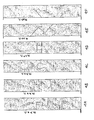
- Figures 3A and 3B are micrographs of commercially available prior art geltabs.
- Figure 4 is a micrograph of the shell and core in one embodiment of this invention.
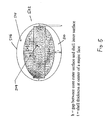
- Figure 5 is a cross-sectional depiction of a core having major faces surrounded by a shell having a gap between the core and shell.
- Figure 6 is an exploded view of the interface between the core and shell in Figure 5 .
- Figure 7A is a cross-sectional view of first and second shell portions which form an abutment without any overhang.
- Figure 7B is a cross-sectional view of first and second shell portions which form an abutment with an overhang. (Not in accordance with the invention.)
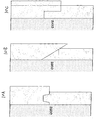
- Figures 8A-8E are cross-sectional views of first and second shell portions which overlap at the interface thereof.
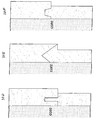
- Figures 9A-9F are cross-sectional views of first and second shell portions which overlap and form an interlocking pattern at the interface thereof.
- FIGS 10A-10F are cross-sectional views of first and second shell portions which form an interface with an overhang. (Not in accordance with the invention.)
- Figures 11A and 11B compare an injection molded dosage form of this invention and a prior art dosage form.
- Figures 12A and 12B depict front and side views of a dosage form of this invention having a belly band.
- Figure 13 is a plot of sample weight change vs. time depicting relative humidity data as described in Example 6 herein.
- the dosage form of this invention comprises a core having an outer surface and a shell having outer and inner surfaces, and comprises further features as defined in claim 1.
- dosage form applies to any solid object, semi-solid, or liquid composition, designed to contain a specific pre-determined amount (i.e. dose) of a certain ingredient, for example an active ingredient as defined below.
- Suitable dosage forms may be pharmaceutical drug delivery systems, including those for oral administration, buccal administration, rectal administration, topical, transdermal, or mucosal delivery, or subcutaneous implants, or other implanted drug delivery systems; or compositions for delivering minerals, vitamins and other nutraceuticals, oral care agents, flavorants, and the like.
- the dosage forms of the present invention are considered to be solid, however they may contain liquid or semi-solid components.
- the dosage form is an orally administered system for delivering a pharmaceutical active ingredient to the gastro-intestinal tract of a human.
- the dosage form is an orally administered "placebo" system containing pharmaceutically inactive ingredients, and the dosage form is designed to have the same appearance as a particular pharmaceutically active dosage form, such as may be used for control purposes in clinical studies to test, for example, the safety and efficacy of a particular pharmaceutically active ingredient.
- Suitable active ingredients for use in this invention include for example pharmaceuticals, minerals, vitamins and other nutraceuticals, oral care agents, flavorants and mixtures thereof.
- suitable pharmaceuticals include analgesics, anti-inflammatory agents, antiarthritics, anesthetics, antihistamines, antitussives, antibiotics, anti-infective agents, antivirals, anticoagulants, antidepressants, antidiabetic agents, antiemetics, antiflatulents, antifungals, antispasmodics, appetite suppressants, bronchodilators, cardiovascular agents, central nervous system agents, central nervous system stimulants, decongestants, diuretics, expectorants, gastrointestinal agents, migraine preparations, motion sickness products, mucolytics, muscle relaxants, osteoporosis preparations, polydimethylsiloxanes, respiratory agents, sleep-aids, urinary tract agents and mixtures thereof.
- Suitable oral care agents include breath fresheners, tooth whiteners, antimicrobial agents, tooth mineralizers, tooth decay inhibitors, topical anesthetics, mucoprotectants, and the like.
- Suitable flavorants include menthol, peppermint, mint flavors, fruit flavors, chocolate, vanilla, bubblegum flavors, coffee flavors, liqueur flavors and combinations and the like.
- Suitable gastrointestinal agents include antacids such as calcium carbonate, magnesium hydroxide, magnesium oxide, magnesium carbonate, aluminum hydroxide, sodium bicarbonate, dihydroxyaluminum sodium carbonate; stimulant laxatives, such as bisacodyl, cascara sagrada, danthron, senna, phenolphthalein, aloe, castor oil, ricinoleic acid, and dehydrocholic acid, and mixtures thereof; H2 receptor antagonists, such as famotadine, ranitidine, cimetadine, nizatidine; proton pump inhibitors such as omeprazole or lansoprazole; gastrointestinal cytoprotectives, such as sucraflate and misoprostol; gastrointestinal prokinetics, such as prucalopride, antibiotics for H.
- antacids such as calcium carbonate, magnesium hydroxide, magnesium oxide, magnesium carbonate, aluminum hydroxide, sodium bicarbonate, dihydroxyaluminum
- pylori such as clarithromycin, amoxicillin, tetracycline, and metronidazole
- antidiarrheals such as diphenoxylate and loperamide
- glycopyrrolate such as glycopyrrolate
- antiemetics such as ondansetron
- analgesics such as mesalamine.
- the active agent may be selected from bisacodyl, famotadine, ranitidine, cimetidine, prucalopride, diphenoxylate, loperamide, lactase, mesalamine, bismuth, antacids, and pharmaceutically acceptable salts, esters, isomers, and mixtures thereof.
- the active agent is selected from analgesics, anti-inflammatories, and antipyretics, e.g. non-steroidal anti-inflammatory drugs (NSAIDs), including propionic acid derivatives, e.g. ibuprofen, naproxen, ketoprofen and the like; acetic acid derivatives, e.g. indomethacin, diclofenac, sulindac, tolmetin, and the like; fenamic acid derivatives, e.g. mefanamic acid, meclofenamic acid, flufenamic acid, and the like; biphenylcarbodylic acid derivatives, e.g.
- NSAIDs non-steroidal anti-inflammatory drugs
- the active agent is selected from propionic acid derivative NSAID, e.g. ibuprofen, naproxen, flurbiprofen, fenbufen, fenoprofen, indoprofen, ketoprofen, fluprofen, pirprofen, carprofen, oxaprozin, pranoprofen, suprofen, and pharmaceutically acceptable salts, derivatives, and combinations thereof.
- NSAID e.g. ibuprofen, naproxen, flurbiprofen, fenbufen, fenoprofen, indoprofen, ketoprofen, fluprofen, pirprofen, carprofen, oxaprozin, pranoprofen, suprofen, and pharmaceutically acceptable salts, derivatives, and combinations thereof.
- the active agent may be selected from acetaminophen, acetyl salicylic acid, ibuprofen, naproxen, ketoprofen, flurbiprofen, diclofenac, cyclobenzaprine, meloxicam, rofecoxib, celecoxib, and pharmaceutically acceptable salts, esters, isomers, and mixtures thereof.
- the active agent may be selected from pseudoephedrine, phenylpropanolamine, chlorpheniramine, dextromethorphan, diphenhydramine, astemizole, terfenadine, fexofenadine, loratadine, desloratadine, cetirizine, mixtures thereof and pharmaceutically acceptable salts, esters, isomers, and mixtures thereof.
- Suitable polydimethylsiloxanes which include, but are not limited to dimethicone and simethicone, are those disclosed in United States Patent Nos. 4,906,478 , 5,275,822 , and 6,103,260 .
- simethicone refers to the broader class of polydimethylsiloxanes, including but not limited to simethicone and dimethicone.
- the active ingredient or ingredients may be present in the dosage form in a therapeutically effective amount, which is an amount that produces the desired therapeutic response upon oral administration and can be readily determined by one skilled in the art. In determining such amounts, the particular active ingredient being administered, the bioavailability characteristics of the active ingredient, the dose regime, the age and weight of the patient, and other factors must be considered, as known in the art.
- the core comprises at least about 85 weight percent of the active ingredient.
- the dosage form comprises at least about 85 weight percent of the active ingredient.
- the active ingredient may be coated with a release-modifying coating, as known in the art.
- modified release active ingredients may also be employed.
- acetaminophen particles which are encapsulated with release-modifying polymers by a coaccervation process may be used in the present invention.
- Coaccervation-encapsulated acetaminophen may be purchased commercially from Eurand America, Inc. (Vandalia, Ohio), or from Circa Inc. (Dayton, Ohio).
- the active ingredient may preferrably be coated with a taste-masking coating, as known in the art.
- suitable taste-masking coatings are described in U.S. Patent Nos. 4,851,226 , 5,075,114 , and 5,489,436 .
- Commercially available taste-masked active ingredients may also be employed.
- acetaminophen particles which are encapsulated with taste-masking polymers by a coaccervation process may be used in the present invention as described above.
- Suitable tablet excipients include fillers, binders, disintegrants, lubricants, glidants, and the like.
- Suitable fillers include water-soluble compressible carbohydrates such as sugars, which include dextrose, sucrose, maltose, and lactose, sugar-alcohols, which include mannitol, sorbitol, maltitol, xylitol, starch hydrolysates, which include dextrins, and maltodextrins, and the like, water insoluble plasticly deforming materials such as microcrystalline cellulose or other cellulosic derivatives, water-insoluble brittle fracture materials such as dicalcium phosphate, tricalcium phosphate and the like and mixtures thereof.
- water-soluble compressible carbohydrates such as sugars, which include dextrose, sucrose, maltose, and lactose
- sugar-alcohols which include mannitol, sorbitol, maltitol, xylitol
- starch hydrolysates which include dextrins, and maltodextrins, and the like
- Suitable binders include dry binders such as polyvinyl pyrrolidone, hydroxypropylmethylcellulose, and the like; wet binders such as water-soluble polymers, including hydrocolloids such as alginates, agar, guar gum, locust bean, carrageenan, tara, gum arabic, tragacanth, pectin, xanthan, gellan, maltodextrin, galactomannan, pusstulan, laminarin, scleroglucan, gum arabic, inulin, pectin, whelan, rhamsan, zooglan, methylan, chitin, cyclodextrin, chitosan, polyvinyl pyrrolidone, cellulosics, starches, and the like; and derivatives and mixtures thereof.
- dry binders such as polyvinyl pyrrolidone, hydroxypropylmethylcellulose, and the like
- Suitable disintegrants include sodium starch glycolate, cross-linked polyvinylpyrrolidone, cross-linked carboxymethylcellulose, starches, microcrystalline cellulose, and the like.
- Suitable lubricants include long chain fatty acids and their salts, such as magnesium stearate and stearic acid, talc, and waxes.
- Suitable glidants include colloidal silicon dioxide, and the like.
- the dosage form of the invention may also incorporate pharmaceutically acceptable adjuvants, including, for example, preservatives, high-intensity sweeteners such as aspartame, acesulfame potassium, sucralose, and saccharin; flavors, antioxidants, surfactants, and coloring agents.
- pharmaceutically acceptable adjuvants including, for example, preservatives, high-intensity sweeteners such as aspartame, acesulfame potassium, sucralose, and saccharin; flavors, antioxidants, surfactants, and coloring agents.
- the active ingredient or ingredients are preferably capable of dissolution upon contact with a fluid such as water, gastric fluid, intestinal fluid or the like.
- a fluid such as water, gastric fluid, intestinal fluid or the like.
- the dissolution characteristics of the active ingredient meet USP specifications for immediate release tablets containing the active ingredient.
- USP 24 specifies that in pH 5.8 phosphate buffer, using USP apparatus 2 (paddles) at 50 rpm, at least 80% of the acetaminophen contained in the dosage form is released therefrom within 30 minutes after dosing, and for ibuprofen tablets, USP 24 specifies that in pH 7.2 phosphate buffer, using USP apparatus 2 (paddles) at 50 rpm, at least 80% of the ibuprofen contained in the dosage form is released therefrom within 60 minutes after dosing. See USP 24, 2000 Version, 19 - 20 and 856 (1999).
- the dissolution characteristics of the active ingredient are modified: e.g. controlled, sustained, extended, retarded, prolonged, delayed and the like.
- a dosage form 10 which comprises a molded shell 18 having a shape which surrounds the outside surface of a core 12 (which may be a molded core or a compressed dosage form or a hard or soft capsule, or any substantially solid edible form) having a different shape than the shell 18.
- Core 12 includes a belly band 14. It will be understood that the shapes of the core and shell in Figure 1 are illustrative,
- the core or substrate may be any solid form.
- the core may be, for example, a compressed dosage form, or may be molded.
- substrate refers to a surface or underlying support, upon which another substance resides or acts
- core refers to a material which is at least partially enveloped or surrounded by another material.
- the core may optionally comprise a sub-core (which may also be referred to as an "insert"), which may be made by any method, for example, compression or molding, and may optionally contain one or more active ingredients.
- the core may be a compressed or molded tablet, hard or soft capsule, suppository, or a confectionery form such as a lozenge, nougat, caramel, fondant, or fat based form.
- the core may comprise a microelectronic device (e.g. an electronic "chip") which may be used for any purpose, including for example as an active component or to detect environmental conditions or to control , for example, release of active ingredients from the dosage form or device.
- a microelectronic device e.g. an electronic "chip”
- the core may comprise a microelectronic device (e.g. an electronic "chip") which may be used for any purpose, including for example as an active component or to detect environmental conditions or to control , for example, release of active ingredients from the dosage form or device.
- the core may be in a variety of different shapes.
- the core may be in the shape of a truncated cone.
- the core may be shaped as a polyhedron, such as a cube, pyramid, prism, or the like; or may have the geometry of a space figure with some non-flat faces, such as a cone, cylinder, sphere, torus, or the like.
- Exemplary core shapes which may be employed include tablet shapes formed from compression tooling shapes described by "The Elizabeth Companies Tablet Design Training Manual" (Elizabeth Carbide Die Co., Inc., p.7 (McKeesport, Pa.) as follows (the tablet shape corresponds inversely to the shape of the compression tooling):
- the core or sub-core may optionally be at least partially covered by a compressed, molded, or sprayed sub-coating.
- the core may be substantially free of the subcoating: i.e. there is no subcoating located between the outer surface of the core and the inner surface of the shell.
- the core is a compressed dosage form, i.e. tablet, obtained from a compressed powder.
- the powder may preferably comprise an active ingredient, and optionally comprise various excipients, such as binders, disintegrants, lubricants, fillers and the like, as is conventional, or the powder may comprise other particulate material of a medicinal or non-medicinal nature, such as inactive placebo blends for tableting, confectionery blends, and the like.
- One particularly preferred formulation comprises active ingredient, powdered wax (such as shellac wax, microcrystalline wax, polyethylene glycol, and the like), and optionally disintegrants and lubricants and is described in more detail at pages 4-11 of copending United States Patent Application Serial No., 09/966,493 .
- the dosage forms of this invention comprise a core made from a powder having an average particle size of about 50 to about 500 ⁇ m.
- the active ingredient has an average particle size of about 50 to about 500 ⁇ m.
- at least one excipient has an average particle size of about 50 to about 500 ⁇ m.
- a major excipient, i.e. and excipient comprising at least 50% by weight of the core has an average particle size of about 50 to about 500 ⁇ m. Particles in this size range are particularly useful for direct compression processes.
- the core may be prepared by a direct compression process.
- the compressed cores are produced by directly compacting a blend of the active agent and any other appropriate inactive ingredients, i.e., excipients.
- any conventional compacting methods for forming a solid dosage form may be used to make the core of the present invention. These methods include, but are not limited to, dry granulation followed by compression, and wet granulation followed by drying and compression. Compression methods include rotary compression, compacting roller technology, such as a chilsonator or drop roller, or by molding, casting, or extrusion technologies. These methods are well known in the art, and are described in detail in, for example, Lachman, et al., The Theory and Practice of Industrial Pharmacy, Chapter 11 (3rd Ed. 1986 ).
- One such method utilizes placing a pre-determined volume of particles or components into a die cavity of a rotary tablet press, which continuously rotates as part of a die table from the filling position to a compaction position. At the compaction position, the particles are compacted between an upper punch and a lower punch. The die table then rotates to an ejection position, at which the resulting tablet is pushed from the die cavity by the lower punch and guided to an ejection chute by a stationary take-off bar.
- the core is a directly compressed tablet, made from a powder which is substantially free of water soluble polymeric binders and hydrated polymers.
- This composition is advantageous for maintaining an immediate release dissolution profile, minimizing processing and material costs, and providing for optimal physical and chemical stability of the dosage form.
- the materials comprising the core e.g. active ingredient or ingredients and excipients, are blended together, preferably as dry powders, and fed into an apparatus that applies pressure and forms a core.
- Any suitable compacting apparatus may be used, including for example a roller compactor such as a chilsonator or drop roller; or a conventional tablet press.
- the core is formed by compaction using a rotary tablet press as known in the art.
- a metered volume of powder is filled into a die cavity, which rotates as part of a "die table" from the filling position to a compaction position where the powder is compacted between an upper and a lower punch to an ejection position where the resulting tablet is pushed from the die cavity by the lower punch.
- the direct compression process enables the minimization or elimination of water-soluble, non-saccharide polymeric binders such as polyvinyl pyrrolidone, alginates, hydroxypropyl cellulose, hydroxypropylmethylcellulose, hydroxyethylcellulose, and the like, which can have an adverse effect on dissolution.
- the core is prepared by a wet-granulation method, in which the active ingredient, appropriate excipients, and a solution or dispersion of a wet binder (e.g an aqueous cooked starch paste, or solution of polyvinyl pyrrolidone) are mixed and granulated.
- a wet binder e.g an aqueous cooked starch paste, or solution of polyvinyl pyrrolidone
- Suitable apparatuses for wet granulation include low shear, e.g. planetary mixers, high shear mixers, and fluid beds, including rotary fluid beds.
- the resulting granulated material is dried, and optionally dry-blended with further ingredients, e.g. adjuvants and/or excipients such as for example lubricants, colorants, and the like.
- the final dry blend is then suitable for compression by the methods described above.
- the core is prepared by the compression methods and apparatus described in copending U.S. patent application Serial No. 09/966,509 , pages 16-27.
- the core is made using a rotary compression module comprising a fill zone, insertion zone, compression zone, ejection zone, and purge zone in a single apparatus having a double row die construction as shown in Figure 6 of U.S. patent application Serial No. 09/966,509 .
- the dies of the compression module are preferably filled using the assistance of a vacuum, with filters located in or near each die.
- the purge zone of the compression module includes an optional powder recovery system to recover excess powder from the filters and return the powder to the dies.
- the core may alternatively be made by the thermal setting molding method and apparatus described in copending U.S. patent application Serial No. 09/966,450 , pages 57-63.
- the core is formed by injecting a starting material in flowable form into a molding chamber.
- the starting material preferably comprises an active ingredient and a thermal setting material at a temperature above the melting point of the thermal setting material but below the decomposition temperature of the active ingredient.
- the starting material is cooled and solidifies in the molding chamber into a shaped core (i.e., having the shape of the mold).
- the starting material must be in flowable form.
- it may comprise solid particles suspended in a molten matrix, for example a polymer matrix.
- the starting material may be completely molten or in the form of a paste.
- the starting material may comprise an active ingredient dissolved in a molten material.
- the starting material may be made by dissolving a solid in a solvent, which solvent is then evaporated from the starting material after it has been molded.
- the starting material may comprise any edible material which is desirable to incorporate into a shaped form, including active ingredients, nutritionals, vitamins, minerals, flavors, sweeteners, and the like.
- the starting material comprises an active ingredient and a thermal setting material.
- the thermal setting material may be any edible material that is flowable at a temperature between about 37 and about 120°C, and that is a solid at a temperature between about 0 and about 35°C.
- Preferred thermal setting materials include water-soluble polymers such as polyalkylene glycols, polyethylene oxides and derivatives, and sucrose esters; fats such as cocoa butter, hydrogenated vegetable oil such as palm kernel oil, cottonseed oil, sunflower oil, and soybean oil; mono-, di-, and triglycerides, phospholipids, waxes such as carnuba wax, spermaceti wax, beeswax, candelilla wax, shellac wax, microcrystalline wax, and paraffin wax; fat-containing mixtures such as chocolate; sugar in the form on an amorphous glass such as that used to make hard candy forms, sugar in a supersaturated solution such as that used to make fondant forms; low-moisture polymer solutions such as mixtures of gelatin and other hydrocolloids at water contents up to about 30% such as those used to make "gummi” confection forms.
- the thermal setting material is a water-soluble polymer such as polyethylene glycol.
- the core may be a hollow or evacuated core.
- the core may be an empty capsule shell.
- a hollow core may be prepared for example by molding. In one such method, flowable material is injected into a mold cavity, and the cavity is brought to a temperature at which the outer surface of the core (which is in contact with the mold) begins to solidify or set. The excess flowable material from the center of the core is then withdrawn from the mold using suitable means, for example a piston pump.
- suitable means for example a piston pump.
- an empty capsule is used as a sub-core, and a coating layer is formed thereon by methods known in the art such as for example spray-coating, dip-coating, or thermal cycle molding as described in copending U.S. patent application Serial No.09/966,497 , pages 27-51.
- thermal cycle molding module 200 comprises a rotor 202 around which a plurality of mold units 204 are disposed.
- the thermal cycle molding module includes a reservoir 206 (see Figure 4 ) for holding flowable material to make the core.
- the thermal cycle molding module is provided with a temperature control system for rapidly heating and cooling the mold units.
- Figures 55 and 56 depict such a temperature control system 600.
- the mold units preferably comprise center mold assemblies 212 and upper mold assemblies 214 as shown in Figure 26C of U.S. patent application Serial No. 09/966,497 , which mate to form mold cavities having the desired shape of the core.
- the opposing center and upper mold assemblies close.
- Core flowable material which is heated to a flowable state in reservoir 206, is injected into the resulting mold cavities.
- the temperature of the core flowable material is then decreased, hardening the core flowable material into cores.
- the mold assemblies open and eject the cores.
- the core is a compressed dosage form which contains one or more inserts.
- the inserts can be made in any shape or size. For instance, irregularly shaped inserts can be made, that is shapes having no more than one axis of symmetry. Cylindrically shaped inserts may also be made.
- the insert is prepared using the above described thermal setting method and apparatus described in copending U.S. patent application Serial No. 09/966,450 , pages 57-63.
- the insert may have an average diameter from about 100 to about 1000 ⁇ m. In another embodiment of this invention, the insert may have an average diameter or thickness from about 10% to about 90% of the diameter or thickness of the core. In yet another embodiment of this invention, the core may comprise a plurality of inserts.
- the insert may have an average diameter, length, or thickness greater than about 90% of the diameter or thickness of the core, for example the insert may have an average length greater than about 100% of the thickness of the core.
- the shell (or coating) of the present invention may comprise any material which can be molded, including for example, film formers, low-melting hydrophobic materials, gelling polymers, thickeners, plasticizers, adjuvants, and excipients.
- the shell comprises at least 80%, most preferably at least about 90% of a material selected from film formers, gelling polymers, low-melting hydrophobic materials, non-crystallizable sugars or sugar alcohols, and mixtures thereof.
- the shell comprises at least about 50%, preferably at least about 80%, most preferably at least about 90% of a material selected from film formers, gelling polymers, low-melting hydrophobic materials, and mixtures thereof.
- the shell is preferably made from a flowable material.
- the flowable material may be any edible material that is flowable at a temperature between about 37°C and 120°C, and that is solid or can form a gel at a temperature between about 0°C and about 35°C.
- the flowable material may comprise a dissolved or molten component, and a solvent such as for example water.
- the solvent may be partially or substantially removed by drying.
- Suitable flowable materials include those comprising film formers, gelling polymers, hydrocolloids, low melting hydrophobic materials such as fats and waxes, non-crystallizable sugars, and the like.
- the flowable material comprises gelatin.
- Gelatin is a natural, thermogelling polymer. It is a tasteless and colorless mixture of derived proteins of the albuminous class which is ordinarily soluble in warm water.
- Two types of gelatin - Type A and Type B - are commonly used.
- Type A gelatin is a derivative of acid-treated raw materials.
- Type B gelatin is a derivative of alkali-treated raw materials. The moisture content of gelatin, as well as its Bloom strength, composition and original gelatin processing conditions, determine its transition temperature between liquid and solid. Bloom is a standard measure of the strength of a gelatin gel, and is roughly correlated with molecular weight.
- Bloom is defined as the weight in grams required to move a 13mm (half-inch) diameter plastic plunger 4 mm into a 6.67% gelatin gel that has been held at 10°C for 17 hours.
- the flowable material is an aqueous solution comprising 20% 275 Bloom pork skin gelatin, 20% 250 Bloom Bone Gelatin, and approximately 60% water.
- sucrose-fatty acid esters may comprise sucrose-fatty acid esters; fats such as cocoa butter, hydrogenated vegetable oil such as palm kernel oil, cottonseed oil, sunflower oil, and soybean oil; mono- di- and triglycerides, phospholipids, waxes such as carnuba wax, spermaceti wax, beeswax, candelilla wax, shellac wax, microcrystalline wax, and paraffin wax; fat-containing mixtures such as chocolate; sugar in the form on an amorphous glass such as that used to make hard candy forms, sugar in a supersaturated solution such as that used to make fondant forms; carbohydrates such as sugar-alcohols (for example, sorbitol, maltitol, mannitol, xylitol), or thermoplastic starch; and low-moisture polymer solutions such as mixtures of gelatin and other hydrocolloids at water contents up to about 30%, such as for example those used to make "gummi" confection forms.
- fats such as
- the flowable material may comprise a film former such as a cellulose ether, e.g. hydroxypropylmethylcellulose or a modified starch, e.g. waxy maize starch; optionally an extender, such as polycarbohydrates, e.g. maltodextrin; optionally a thickener, such as a hydrocolloid, e.g. xanthan gum or carrageenan, or a sugar, e.g. sucrose; optionally a plasticizer, e.g. polyethylene glycol, propylene glycol, vegetable oils such as castor oil, glycerin, and mixtures thereof.
- a film former such as a cellulose ether, e.g. hydroxypropylmethylcellulose or a modified starch, e.g. waxy maize starch
- an extender such as polycarbohydrates, e.g. maltodextrin
- a thickener such as a hydrocolloid, e.g.
- any film former known in the art is suitable for use in the flowable shell material of the present invention.
- suitable film formers include, but are not limited to, polyvinylalcohol (PVA), polyvinylpyrrolidone (PVP), hydroxypropyl starch, hydroxyethyl starch, pullulan, methylethyl starch, carboxymethyl starch, methylcellulose, hydroxypropylcellulose (HPC), hydroxyethylmethylcellulose (HEMC), hydroxypropylmethylcellulose (HPMC), hydroxybutylmethylcellulose (HBMC), hydroxyethylethylcellulose (HEEC), hydroxyethylhydroxypropylmethyl cellulose (HEMPMC), methacrylic acid and methacrylate ester copolymers, polyethylene oxide and polyvinylpyrrolidone copolymers, gelatin, proteins such as whey protein, coaggulatable proteins such as albumin, casein, and casein isolates, soy protein and soy protein isolates, pre
- HPMC 2910 is a cellulose ether having a degree of substitution of about 1.9 and a hydroxypropyl molar substitution of 0.23, and containing, based upon the total weight of the compound, from about 29% to about 30% methoxyl and from about 7% to about 12% hydroxylpropyl groups.
- HPMC 2910 is commercially available from the Dow Chemical Company under the tradename, METHOCEL E.
- METHOCEL E5 which is one grade of HPMC-2910 suitable for use in the present invention, has a viscosity of about 4 to 6 cps (4 to 6 millipascal-seconds) at 20°C in a 2% aqueous solution as determined by a Ubbelohde viscometer.
- METHOCEL E6 which is another grade of HPMC-2910 suitable for use in the present invention, has a viscosity of about 5 to 7 cps (5 to 7 millipascal-seconds) at 20°C in a 2% aqueous solution as determined by a Ubbelohde viscometer.
- METHOCEL E15 which is another grade of HPMC-2910 suitable for use in the present invention, has a viscosity of about 15000 cps (15 millipascal-seconds) at 20°C in a 2% aqueous solution as determined by a Ubbelohde viscometer.
- degree of substitution shall mean the average number of substituent groups attached to a anhydroglucose ring
- hydroxypropyl molar substitution shall mean the number of moles of hydroxypropyl per mole anhydroglucose.
- modified starches include starches that have been modified by crosslinking, chemically modified for improved stability, or physically modified for improved solubility properties.
- pre-gelatinized starches or “instantized starches” refers to modified starches that have been prewetted, then dried to enhance their cold-water solubility.
- Suitable modified starches are commercially available from several suppliers such as, for example, A.E. Staley Manufacturing Company, and National Starch & Chemical Company.
- One suitable modified starch includes the pre-gelatinized waxy maize derivative starches that are commercially available from National Starch & Chemical Company under the tradenames, PURITY GUM and FILMSET, and derivatives, copolymers, and mixtures thereof.
- Such waxy maize starches typically contain, based upon the total weight of the starch, from about 0 percent to about 18 percent of amylose and from about 100% to about 88% of amylopectin.
- Suitable tapioca dextrins include those available from National Starch & Chemical Company under the tradename, CRYSTAL GUM or K-4484, and derivatives thereof such as modified food starch derived from tapioca, which is available from National Starch and Chemical under the tradename, PURITY GUM 40, and copolymers and mixtures thereof.
- any thickener known in the art is suitable for use in the film forming composition of the present invention.
- thickeners include but are not limited to hydrocolloids (also referred to herein as gelling polymers) such as alginates, agar, guar gum, locust bean, carrageenan, tara, gum arabic, tragacanth, pectin, xanthan, gellan, maltodextrin, galactomannan, pusstulan, laminarin, scleroglucan, gum arabic, inulin, pectin, whelan, rhamsan, zooglan, methylan, chitin, cyclodextrin, chitosan, and derivatives and mixtures thereof.
- Additional suitable thickeners include crystallizable sugars, such as glucose (dextrose), fructose, and the like, and derivatives and combinations thereof.
- Suitable xanthan gums include those available from C.P. Kelco Company under the tradename, KELTROL 1000, XANTROL 180, or K9B310.
- plasticizer known in the pharmaceutical art is suitable for use in the present invention, and may include, but not be limited to polyethylene glycol; glycerin; sorbitol; triethyl citrate; tribuyl citrate; dibutyl sebecate; vegetable oils such as castor oil; surfactants such as polysorbates, sodium lauryl sulfates, and dioctylsodium sulfosuccinates; propylene glycol; mono acetate of glycerol; diacetate of glycerol; triacetate of glycerol; natural gums and mixtures thereof.
- an optional plasticizer may be present in an amount, based upon the total weight of the solution, from about 0% to about 40%.
- the flowable material may optionally comprise adjuvants or excipients, in which may comprise up to about 20% by weight of the flowable material.
- suitable adjuvants or excipients include detackifiers, humectants, surfactants, anti-foaming agents, colorants, flavorants, sweeteners, opacifiers, and the like.
- the flowable material comprises less than 5% humectants, or alternately is substantially free of humectants, such as glycerin, sorbitol, maltitol, xylitol, or propylene glycol.
- Humectants have traditionally been included in pre-formed films employed in enrobing processes, such as that disclosed in U.S.
- Patent Nos. 5,146,730 and 5,459,983 assigned to Banner Gelatin Products Corp., in order to ensure adequate flexibility or plasticity and bondability of the film during processing.
- Humectants function by binding water and retaining it in the film.
- Pre-formed films used in enrobing processes can typically comprise up to 45% water.
- the presence of humectant prolongs the drying process, and can adversely affect the stability of the finished dosage form.
- the finished shell of the dosage form contains at least 80%; e.g. at least about 90% of a material selected from film formers, gelling polymers (hydrocolloids), low-melting hydrophobic materials, non-crystallizable sugars, and mixtures thereof.
- the shell of the present invention is formed by injection molding, advantageously minimizing or eliminating the need for direct-compression filler binders such as microcrystalline cellulose, spraydried lactose, mineral salts such as calcium phosphate, crystalline sugars such as sucrose, dextrates and the like. These materials would disadvantageously detract from the clarity and stability of the shell.
- the shell of the present invention comprises less than about 10%, e.g.
- the shells of the present invention are thus an improvement over compression-coated shells, which typically comprise at least about 30% of a direct-compression filler-binder. See for example, WO 00/18447 .
- the shell is substantially free of humectants, such as for example glycerin and/or sorbitol, i.e. the shell contains less than about 5%, e.g. less than about 1%, or less than about 0.1% of a humectant. In another embodiment, the shell contains less than about 5%, e.g. less than about 1% of hygroscopic materials selected from crystallizable sugars, sugar alcohols, and glycerin. In another embodiment, the shell contains less than about 5% of a plasticizer.
- humectants such as for example glycerin and/or sorbitol
- the molded shell or a portion thereof is preferably substantially free of pores having a diameter of 0.5-5.0 ⁇ m.
- substantially free means that the shell has a pore volume of less than about 0.02 cm 3 /g, preferably less than about 0.01 cm 3 /g, more preferably less than about 0.005 cm 3 /g, in the pore diameter range of 0.5 to 5.0 ⁇ m.
- Typical compressed materials have pore volumes of more than about 0.02 cm 3 /g in this pore diameter range.
- the pore volume may be determined using a Quantachrome Instruments PoreMaster 60 mercury intrusion porosimeter and associated computer software program known as "Porowin.” The procedure is documented in the Quantachrome Instruments PoreMaster Operation Manual.
- the PoreMaster determines both pore volume and pore diameter of a solid or powder by forced intrusion of a non-wetting liquid (mercury), which involves evacuation of the sample in a sample cell (penetrometer), filling the cell with mercury to surround the sample with mercury, applying pressure to the sample cell by: (i) compressed air (up to 345kPa (50 psi) maximum); and (ii) a hydraulic (oil) pressure generator (up to 413685kPa (60000 psi) maximum). Intruded volume is measured by a change in the capacitance as mercury moves from outside the sample into its pores under applied pressure.
- the cell (filled with mercury) is then removed and weighed.
- the cell is then emptied into the mercury reservoir, and two tablets from each sample are placed in the cell and the cell is reassembled.
- the weight of the cell and sample are then recorded.
- the cell is then installed in the low-pressure station, the low-pressure option is selected from the menu, and the following parameters are set:
- the shell is applied to the core in the form of a flowable material using the thermal cycle method and apparatus described in copending U.S. patent application Serial No. 09/966,497 , pages 27-51,
- the shell is applied using a thermal cycle molding module having the general configuration shown in Figure 3 therein.
- the thermal cycle molding module 200 comprises a rotor 202 around which a plurality of mold units 204 are disposed.
- the thermal cycle molding module includes a reservoir 206 (see Figure 4 therein) for holding shell flowable material.
- the thermal cycle molding module is provided with a temperature control system for rapidly heating and cooling the mold units.
- Figures 55 and 56 depict the temperature control system 600.
- the thermal cycle molding module is preferably of the type shown in Figure 28A of copending U.S. Application Serial No. 09/966,497 , comprising a series of mold units 204.
- the mold units 204 in turn comprise upper mold assemblies 214, rotatable center mold assemblies 212 and lower mold assemblies 210 as shown in Figure 28C.
- Cores are continuously transferred to the mold assemblies, which then close over the cores.
- the shell flowable material which is heated to a flowable state in reservoir 206, is injected into the mold cavities created by the closed mold assemblies.
- the temperature of the shell flowable material is then decreased, hardening it
- the mold assemblies open and eject the coated cores. Coating is performed in two steps, each half of the cores being coated separately as shown in the flow diagram of Figure 28B of copending U.S. Application Serial No. 09/966,497 via rotation of the center mold assembly.
- the shell of the present invention advantageously preferably has a high surface gloss which is a measure of reflected light determined according to the method set forth in Example 5 herein.
- the surface gloss of the shell and/or finished dosage form is preferably at least about 150 gloss units, e.g. at least about 175 gloss units, or at least about 210 gloss units. Dosage forms with high surface gloss are preferred by consumers due to their aesthetic elegance and perceived swallowability.
- the surface gloss of the shell depends upon a number of factors, including the shell composition, the method of forming the shell, and, if a mold is used, the surface finish on the mold.
- One or more active ingredients may be contained in the dosage form of the invention in the core, the shell, the insert, or any combination thereof.
- only the core comprises one or more active ingredients.
- only the shell comprises one or more active ingredients.
- only the insert comprises one or more active ingredients.
- both the core and shell comprise one or more active ingredients.
- one or more of the core, the shell, or the insert comprises one or more of the active ingredients.
- charge control agents refers to a material having a charge control function, such as those used for electrostatic deposition of coatings onto substrates.
- charge control agents include metal salicylates, for example zinc salicylate, magnesium salicylate and calcium salicylate; quaternary ammonium salts; benzalkonium chloride; benzethonium chloride; trimethyl tetradecyl ammonium bromide (cetrimide); and cyclodextrins and their adducts.
- the shell comprises less than about 50%, preferably less than about 25%, most preferably less than about 5% of a crystallizable sugar.
- the term "substantially conformally” shall mean that the inner surface of the shell has peaks and valleys or indentations and protrusions corresponding substantially inversely to the peaks and valleys of the outer surface of the core. Accordingly, the indentations and protrusions typically have a length, width, height or depth in one dimension of greater than 10 ⁇ m, say greater than 20 ⁇ m, and less than about 30,000 ⁇ m, preferably less than about 2000 ⁇ m.
- the ratio of the height of the greatest gap between the core outer surface and the shell inner surface to the overall theoretical shell thickness at the point of the greatest gap is less than about 1:7.5, more preferably less than about 1:10, most preferably less than about 1:100.
- the ratio of the height of the greatest gap between the core outer surface and the shell inner surface to the shell thickness at the center of a major face is less than about 1:7.5, more preferably less than about 1:10, most preferably less than about 1:100.
- the term "major face,” as used herein, shall apply to all cores, including but not limited to those which are compressed tablets.
- the core has one or more major faces.
- the core may be a polyhedron, such as a cube, pyramid prism or the like; or the core may have the geometry of a space figure with some non-flat faces, such as a cone, cylinder, sphere, torus or the like.
- the shell thickness may be measured using a microscope, for example, an environmental scanning electron microscope, model XL 30 ESEM LaB6, Philips Electronic Instruments Company, Mahwah, WI.
- the shell thickness is measured at 6 different locations on a single dosage form, as shown in Figure 2 .
- the relative standard deviation (RSD) is calculated as the sample standard deviation, devided by the mean, times 100 as known in the art (i.e. the RSD is the standard deviation expressed as a percentage of the mean).
- the RSD in shell thickness provides an indication of the variation in the thickness of the shell on a single dosage form.
- a uniform shell thickness is advantageous for providing aesthetic benefits such as for example uniformity of color, and uniform coverage of the substrate; and is particularly advantageous for embodiments in which the shell provides functional benefits, such as for example modified release of an active ingredient contained within the dosage form.
- the relative standard deviation in shell thickness for dosage forms of the present invention is preferably less than about 40%, e.g less than about 30%, or less than about 20%.
- overall dosage form thickness and diameter are measured for 20 dosage forms using a calibrated electronic digital caliper.
- the caliper is positioned across t as shown in Figure 2 .
- the caliper is positioned at the midsections of the widest point of the dosage form sides shown in Figure 2 as d.
- the relative standard deviation of the thickness of the overall dosage form is less than 30%.
- a high consistency of product characteristics, particularly overall dimensions, are considered advantageous in the pharmaceutical arts as an indication of high product quality and high degree of reliability, repeatability, reproducability and control in the manufacturing process. Consistency in product dimensions is additionally advantageous for the efficiency of downstream operations such as packaging, for example into blister packages, or into bottles via slat-filling machines.
- Figure 3A is a micrograph cross-section of a prior art geltab sold by CVS pharmacies
- the geltab comprises a core 300 having a shell made up of two portions 302 and 304 which interface and abut at 306. Proximate to interface 306 is a gap 308 between shell portions 302, 304 and the outer surface of core 300.
- Figure 3B is a micrograph cross-section of a prior art EXCEDRIN geltab (a product of Bristol-Myers Squibb Co.).
- the geltab comprises a core 350 having a shell made up of two portions 352 and 354 which interface and abut at 356. Proximate to interface 356 is a gap 358 between shell portions 352, 354 and the outer surface of core 350.
- Figure 4 is a micrograph cross-section of a geltab dosage form of the present invention.
- the geltab comprises a core 400 having a shell made up of two portions 402 and 404 which interface and abut at 406.
- the geltab of this invention as shown in Figure 4 has the shell portions 402 and 404 residing substantially conformally upon the outer surface of core 400 without a gap proximate to interface 406.
- Figure 5 is representative of a cross-sectional depiction of a dosage form 502 comprising a core 504 having major faces 503 and 505 and a shell 506 made up of separate shell portions 508 and 510, respectively.
- h is the maximum gap between the core outer surface and the shell inner surface
- t is the shell thickness at the center of a major face. Accordingly, in the embodiment of the invention discussed above, h/t ⁇ 1:7.5, more preferably less than about 1:10, most preferably less than about 1:100.
- Figure 6 depicts an exploded view of the interface between the core and shell of Figure 5 . More specifically, Figure 6 depicts core 504 having an outer surface 501 which interfaces shell portions 508 and 510 as shown. The maximum gap 503 between outer surface 501 and the inner surface of the shell is shown by "h.”
- the shells of this embodiment present invention may advantageously be formed from relatively non-hydroscopic materials, which possess superior stability to elevated humidity conditions.
- the dosage forms of the present invention have a moisture uptake at 10 minutes of exposure to 40°C/75% RH of less than about 0.35%, more preferably less than about 0.30%.
- the dosage forms of the present invention preferably have a moisture uptake at 20 minutes of exposure to 40°C/75% RH of less than about 0.50%, more preferably less than about 0.40%.
- the dosage forms of the present invention preferably have a moisture uptake at 30 minutes of exposure to 40°C/75% RH of less than about 0.60%, more preferably less than about 0.45%.
- the dosage forms of the present invention preferably have a moisture uptake at 60 minutes of exposure to 40°C/75% RH of less than about 0.80%, more preferably less than about 0.65%, when measured by the method set forth in Example 6 herein.
- the core and/or the finished dosage form typically comprises a "belly band," and two opposing faces which may be flat or curved as shown in Figures 12A and 12B.
- Figure 12A shows a front view of a dosage form 10" having an axial horizontal centerline 16" which is the midpoint of belly band 22.
- the length (“1") of the dosage form is shown in Figure 12A
- the width (“w") of the dosage form is shown in Figure 12B .
- the difference in a first shell thickness at a first point on the belly band and a second thickness at a second point on the belly band is not more than about 10% of the larger of the two thicknesses.
- the shell thickness at any point on the belly band is not greater than the shell thickness at the center of a major tablet face.
- the shell is substantially free of a raised portion greater than about 1.25 times the shell thickness at a major face.
- the dosage form has a belly band, and the difference in a first shell thickness at a first location on the belly band and a second thickness at a second location on the belly band is not more than about 50 ⁇ m.
- the shell surface is substantially free of a raised portion greater than about 50 ⁇ m in height.
- the core has a major face
- the dosage form has a belly band
- the difference between the shell thickness at any point on the belly band and the shell thickness at the center of a major face is not greater than about 50 ⁇ m.
- the shell comprises a first shell portion and a second shell portion.
- the first and second shell portions may comprise different shell materials.
- the first and second shell materials may be visually distinct from one another, for example the visually distinct portions may be of different colors, hues, glosses, reflective qualities, brightness, depth, shades, chroma, opacity, etc.
- the shell may have a red portion and a yellow portion, or a flat finish portion and a glossy portion, or an opaque portion and a translucent portion.
- One advantage of the present invention is the ability to deposit more than one shell material onto a single core.
- the shell comprises a first and second portion
- the first and second shell portions are joined at an interface.
- the interface may be substantially flat (i.e., without any raised portion).
- the interface may be in the form of an abutment, i.e., the edges of the first and second portions are adjacent and in contact with one another, but not overlapping, as shown in Figure 7A .
- the interface is substantially flat (i.e., without any raised portion).
- the total shell thickness at the interface is not substantially different from the shell thickness of the first or second shell portions at the center of a major face of the dosage form.
- the shell comprises a first and second portion which are joined at an interface, the interface is substantially flat (i.e., without any raised portion), and the interface is located along the belly-band of the dosage form.
- the total shell thickness at the interface is not substantially different from the shell thickness of the first or second shell portions at any point along the belly band of the dosage form.
- first and second shell portions may overlap one another at the interface.
- the overlap may form various patterns, such as, for example, pointed, diagonal, step, tongue and groove, or truncated, as depicted in Figs. 8A-8E .
- first and second shell portions may overlap and form an interlocking pattern at the interface.
- the interlocking pattern may take various forms, such as, for example, a square interlock, various jigsaw "puzzle piece” configurations, a dove tail, a zigzag, or any number of complex asymmetric forms as depicted in Figures 9A-9F .
- the total shell thickness at the overlap is not greater than the median thickness of each single shell portion, so that the interface does not constitute a raised portion.
- the total shell thickness at the interface is not greater than the shell thickness of the first or second shell portions at the center of a major face of the dosage form.
- the total shell thickness at the interface is not greater than the shell thickness of the first or second shell portions at any point along the belly band of the dosage form.
- Fig. 11A is a micrograph of first and second shell portions 1102 and 1104, respectively, of an injection molded dosage form of this invention.
- the interface of shell portions 1102 and 1104 is a flat seam in which the transition from first shell portion 1102 to second shell portion 1104 lies along a single "horizon line" (shown as a dashed line in Fig. 11A ).
- Fig. 11B depicts a prior art dosage form made from pre-formed overlapping films to form a first shell portion 1152 and second shell portion 1154, as shown.
- Fig. 11A is a micrograph of first and second shell portions 1102 and 1104, respectively, of an injection molded dosage form of this invention.
- the interface of shell portions 1102 and 1104 is a flat seam in which the transition from first shell portion 1102 to second shell portion 1104 lies along a single "horizon line" (shown as a dashed line in Fig. 11A ).
- Fig. 11B depicts a prior art dosage form made from pre-formed overlapping
- the prior art dosage form exhibits a "step" at the interface of first shell portion 1152 and second shell portion 1154, thereby producing separate “horizon lines” (shown as dashed lines in Fig. 11B ).
- Such a step is disadvantageous because it is less visually elegant than a smooth surface and because the step can be felt on the tongue and may be considered abrasive or unpleasant by the consumer. Additionally, the uneven surface or step may get caught in packaging machinery, reducing througbput/efficiency; or the uneven surface or step can serve as an opening point from which one shell layer can be removed either purposely or unintentionally, reducing the tamper-evidence of the dosage form.
- the interface of the first and second shell portions is a flat seam in which the transition from first shell portion to second shell portion lies along a single "horizon line.”
- Part A Compressed tablets The following ingredients were mixed well in a plastic bag: 89.4 parts acetaminophen USP (590 mg/tablet) and 8.0 parts of synthetic wax X-2068 T20 (53 mg/tablet). Next, 2.1 parts of sodium starch glycolate (EXPLOTAB) (13.9 mg/tablet) and 0.09 parts of silicon dioxide (0.6 mg/tablet) were added to the bag, and mixed well. Then 0.36 parts of magnesium stearate NF (2.4 mg/tablet) were added to the bag, and the ingredients were again mixed. The resulting dry blend was compressed into tablets on a compression module as described in copending U.S. Application Serial No. 09/966,509 at pages 16-27.
- EXPLOTAB sodium starch glycolate
- silicon dioxide 0.6 mg/tablet
- the compression module was a double row, rotary apparatus, comprising a fill zone, insertion zone, compression zone, ejection zone, and purge zone as shown in Figure 6 of U.S. Application Serial No. 09/966,509 .
- the dies of the compression module were filled using vacuum assistance, with mesh screen filters located in die wall ports of each die.
- the resulting tablets (cores) had an average weight of 660 mg, thickness of 8mm (0.306 inches), and hardness of 31.4N (3.2 kp).
- Part B Tablet Coating
- the tablets from Part A were conveyed to a thermal cycle molding module as described in copending U.S. Application Serial No. 09/966,497 at pages 27-51 via a transfer device as described in copending U.S. Application Serial No. 09/966,414 at pages 51-57.
- the tablets were coated with red gelatin on one half thereof, and yellow gelatin on the other half thereof to form a shell.
- the thermal cycle molding module which applied the shell to the tablets, was of the type shown in Figure 28A of copending U.S. Application Serial No. 09/966,939 .
- the mold units 204 of the thermal cycle molding module comprised upper mold assemblies 214, rotatable center mold assemblies 212 and lower mold assemblies 210 as shown in Figure 28C. Tablets were transferred to the mold assemblies, which then closed over the tablets.
- Shell flowable material which was heated to a flowable state in reservoir 206, was injected into the mold cavities created by the closed mold assemblies. The temperature of the shell flowable material was then decreased, hardening it.
- the mold assemblies opened and ejected the coated cores. Coating was performed in two steps, each half of the tablets being coated separately as shown in the flow diagram of Figure 28B of copending U.S. Application Serial No. 09/966,939 via rotation of the center mold assembly.
- the red gelatin coating was made as follows: purified water (450 g), Opatint Red DD-1761 (4.4 g), and Opatint Yellow DD-2125 (1.8 g) were mixed at room temperature till uniform. 275 Bloom Pork Skin Gelatin (150 g) and 250 Bloom Bone Gelatin (150 g) were added together in a separate container. The dry gelatin granules were manually stirred to mix. The purified water / Opatint solution was added to the gelatin granules, and mixed for about 1 minute to completely wet the gelatin granules. The gelatin slurry was placed in a water bath and heated to 55°C to melt and dissolve the gelatin.
- the gelatin solution was held at 55°C for approximately 3 hours (holding times at this temperature can generally range between about 2 and about 16 hours). The solution was then mixed until uniform (about 5 to 15 minutes), and transferred to a jacketed feed tank equipped with a propeller-type electric mixer. The gelatin solution was maintained at 55°C with continuous mixing during its use in the thermal cycling molding module.
- the yellow gelatin coating was made as follows: purified water (450 g), and Opatint Yellow DD-2125 (6.2 g) were mixed at room temperature till uniform. 275 Bloom Pork Skin Gelatin (150 g) and 250 Bloom Bone Gelatin (150 g) were added together in a separate container. The dry gelatin granules were stirred manually to mix. The purified water / Opatint solution was added to the gelatin granules, and mixed for about 1 minute to completely wet the gelatin granules. The gelatin slurry was placed in a water bath and heated to 55°C to melt and dissolve the gelatin. The gelatin solution was held at 55°C for approximately 3 hours (holding times at this temperature can generally range between about 2 and about 16 hours). The solution was then mixed until uniform (about 5 to 15 minutes), and transferred to a jacketed feed tank equipped with a propeller-type electric mixer. The gelatin solution was maintained at 55°C with continuous mixing during its use in the thermal cycling molding module.
- Coating thickness was measured for samples of the following tablets:
- Thicknesses and diameters of 20 coated tablets from each of the three samples were also measured. The results are summarized in Table 2 below: TABLE 2 A B C average coated tablet thickness at major faces (across locations 1,4) for 20 tablets 7.67mm 6.55 mm 7.99 mm variability in coated tablet thickness at major faces (locations 1,4) for 20 tablets 0.407% 1.44% 0.292% average coated tablet diameter (across locations 7,8 for 20 tablets) 11.46 mm 12.58 mm 11.74 mm variability in coated tablet diameter (rsd across locations 7,8 for 20 tablets) 0.183% 0.476% 0.275%
- a flowable material suitable for coating a compressed dosage form was made as follows: Material % w/w PEG 1450 (part 1) 30.0 PEG 1450 (part 2) 30 - 50% Polyethylene Oxide 300,000 15.0-25% Glycerin 0 - 10% Red color solution* (3%w/w) 5 *Red color solution composition was 4.85% w/w Propylene Glycol and 0.15% w/w Red #40 dye
- Polyethylene glycol (PEG) 1450 (part 1) and polyethylene oxide (PEO) 300,000 were shaken in a plastic bag until powders were mixed evenly.
- the 4.7L (5 qt) bowl of a planetary mixer (Hobart Corp., Dayton, OH) was heated to 80°C by circulating hot water.
- PEG 1450 (part 2) was poured into the bowl and melted to form a liquid.
- the color solution, and optionally, the glycerin were added while mixing at low speed.
- the PEG/PEO powder mixture was added and the mixture mixed for 15 minutes. The resulting mixture was allowed to stand in the Hobart bowl for 2 hours while maintaining the temperature at 80°C.
- Cast films (approximately 0.8mm thick) were prepared using a stainless steel mold (51mm (2") x 127mm (5") x 0.8mm). The solution was transferred to a jacketed beaker (80°C) and de-aerated by vacuum for 6 hours. A second film was prepared using the same mold.
- the flowable material may be applied using a thermal cycle molding module as described in copending U.S. Application Serial No. 09/966,497 at pages 27-51.
- Another flowable material suitable for coating a compressed dosage form was made as follows: Material %w/w PEG 1450 granular 70 - 75% Polyethylene Oxide 600,000 15% White beeswax 5 - 10% Red color solution* (3%w/w) 5 *Red color solution composition was 4.85% w/w Propylene Glycol and 0.15% w/w Red #40 dye
- the 4.7L (5 qt) bowl of a planetary mixer (Hobart Corp., Dayton, OH) was heated to 80°C by circulating hot water.
- PEG 3350 granular was poured into the bowl and melted to form a liquid.
- the white beeswax, color solution, and polyethylene oxide were added while mixing at low speed.
- the resulting mixture was mixed for a total of 12 minutes, then allowed to stand in the Hobart bowl for 2 hours while maintaining the temperature at 80°C.
- Cast films were prepared using a glass slide.
- the solution was transferred to a jacketed beaker (80°C) and de-aerated by vacuum for 6 hours.
- a second film was prepared using the same mold.
- the white beeswax formula had increased tensile strength compared to the glycerin formulas.
- Examples 3 and 4 illustrate suitable formulations for the flowable material.
- these formulations are solvent (including water) free. This eliminates the need to evaporate solvent from coatings made from such formulations, shortening and simplifying drying.
- the flowable material is substantially solvent-free, that is contains less than about 1 weight percent solvent, and preferably contains solvent.
- the flowable material may be applied using a thermal cycle molding module as described in copending U.S. Application Serial No. 09/966,497 at pages 27-51.
- This instrument utilized a CCD camera detector, employed a flat diffuse light source, compared tablet samples to a reference standard, and determined average gloss values at a 60 degree incident angle. During its operation, the instrument generated a gray-scale image, wherein the occurrence of brighter pixels indicated the presence of more gloss at that given location.
- the instrument also incorporated software that utilized a grouping method to quantify gloss, i.e., pixels with similar brightness were grouped together for averaging purposes.
- the "percent full scale” or “percent ideal” setting (also referred to as the "percent sample group” setting), was specified by the user to designate the portion of the brightest pixels above the threshold that will be considered as one group and averaged within that group.
- “Threshold,” as used herein, is defined as the maximum gloss value that will not be included in the average gloss value calculation. Thus, the background, or the non-glossy areas of a sample were excluded from the average gloss value calculations. The method disclosed in K. Fegley and C.
- the average surface gloss value for the reference standard was determined to be 269.
- a 50-tablet sample prepared according to the method of Example 1 possessed an average surface gloss of 241 gloss units on the yellow faces and 248 gloss units on the red faces.
- Table A Gloss values of commercially available coated tablets Product MOTRIN IB * Caplet (white) EXCEDRIN ** Aspirin free Caplets (red) EXCEDRIN ** Migraine Geltab (green side) EXCEDRIN ** Migraine Geltab (white side) Extra Strength TYLENOL Geltabs * (yellow side) Extra Strength TYLENOL Geltabs * (red side) Type of coating sprayed film sprayed film gelatin enrobed gelatin enrobed dipped Dipped No. of tablets tested 41 40 10 10 112 112 Gloss Value(gl oss units) 125 119 270 264 268 268 * Available from McNEIL-PPC, Inc. ** Available from Bristol-Myers Squibb, Inc.
- Tablets prepared according to the method of Example 1 herein were compared with commercially available gelatin coated tablets for their moisture uptake properties.
- the comparitor samples were selected to represent the prior art methods of dipping (Extra Strength TYLENOL Gelcap from McNeil-PPC Inc.) and enrobing (all other samples, as detailed in Table B below), which have been discussed previously herein.
- Samples were evaluated using a Dynamic Vapor Sorption (DVS) analysis instrument (DVS-2000, available from Surface Measurement Systems Ltd., London, UK).
- DVS Dynamic Vapor Sorption
- the DVS system is a controlled environmental compartment with a precise microbalance. The weight change of the sample at various relative humidities was recorded over time.
- the moisture uptake of the product from Example 1 at 60 minutes of exposure to 40°C/75% RH was about 0.58%, compared to a moisture uptake of about 0.85% for the enrobed product, and a moisture uptake of about 0.56% for the dipped product.
Landscapes
- Health & Medical Sciences (AREA)
- Life Sciences & Earth Sciences (AREA)
- Chemical & Material Sciences (AREA)
- Engineering & Computer Science (AREA)
- Medicinal Chemistry (AREA)
- Veterinary Medicine (AREA)
- General Health & Medical Sciences (AREA)
- Public Health (AREA)
- Pharmacology & Pharmacy (AREA)
- Animal Behavior & Ethology (AREA)
- Epidemiology (AREA)
- Bioinformatics & Cheminformatics (AREA)
- Food Science & Technology (AREA)
- Polymers & Plastics (AREA)
- Nutrition Science (AREA)
- Mechanical Engineering (AREA)
- Molecular Biology (AREA)
- Biophysics (AREA)
- Microbiology (AREA)
- Chemical Kinetics & Catalysis (AREA)
- General Chemical & Material Sciences (AREA)
- Zoology (AREA)
- Physiology (AREA)
- Nuclear Medicine, Radiotherapy & Molecular Imaging (AREA)
- Organic Chemistry (AREA)
- Inorganic Chemistry (AREA)
- Pulmonology (AREA)
- Medicinal Preparation (AREA)
- Acyclic And Carbocyclic Compounds In Medicinal Compositions (AREA)
- Medicines That Contain Protein Lipid Enzymes And Other Medicines (AREA)
- Pharmaceuticals Containing Other Organic And Inorganic Compounds (AREA)
- General Preparation And Processing Of Foods (AREA)
- Infusion, Injection, And Reservoir Apparatuses (AREA)
- Dental Tools And Instruments Or Auxiliary Dental Instruments (AREA)
- Containers And Packaging Bodies Having A Special Means To Remove Contents (AREA)
- Coloring Foods And Improving Nutritive Qualities (AREA)
- Confectionery (AREA)
Abstract
Description
- This invention relates to a dosage form. More particularly, this invention relates to a dosage form having a core surrounded by a shell, such as a pharmaceutical composition having a core surrounded by a shell.
- A variety of dosage forms, such as tablets, capsules and gelcaps are known in the pharmaceutical arts. Tablets generally refer to relatively compressed powders in various shapes. Capsules are typically manufactured using a two piece gelatin shell formed by dipping a steel rod into gelatin so that the gelatin coats the end of the rod. The gelatin is hardened into two half-shells and the rod extracted. The hardened half-shells are then filled with a powder and the two halves joined together to form the capsule. (See generally, HOWARD C. ANGEL ET AL., Pharmaceutical Dosage Forms and Drug Delivery Systems (7th Ed. 1999).)
- Film coated tablets are an improvement over uncoated tablets in terms of aesthetics, stability, and swallowability. One type of elongated, capsule-shaped film-coated tablet is commonly referred to as a "caplet." Typical film coatings have a thickness from about 5 to about 50 µm, and comprise various film forming polymers such as cellulose ethers and the like. Typically, such polymers are applied to the tablets either from solution in organic solvents, or from aqueous dispersion via conventional spraying methods such as those disclosed in
U.S. Pat. Nos. 4,973,480 andU.S. 6,113,945 . Conventional spray-coating processes do not confer a high level of surface gloss to the dosage forms, and film thickness is limited by both the film properties and processing costs. Additionally, it is not commercially feasible to spray-coat a tablet with a different color coating on each end. - Sugar coated tablets, such as those disclosed in
U.S. Pat. Nos. 2,925,365 ;3,420,931 ;4,456,629 ; and3,361,631 , and particularly those which have been polished, for example, with a top coat of carnuba wax, may typically possess higher surface gloss and thicker coatings than film coated tablets, however the sugar coating process is highly time consuming and costly, and the coatings thus prepared can disadvantageously retard the dissolution of the dosage forms. While sugar coatings are typically thicker than film coatings, and can have the effect of rounding the tablet edges, the overall shape of a sugar-coated tablet depends upon and is substantially the same as that of the uncoated core. - Gelatin-coated tablets, commonly known as geltabs and gelcaps, are an improvement on gelatin capsules and typically comprise a tablet coated with a glossy gelatinous shell. Several well known examples of gelcaps are McNeil-PPC, Inc.'s acetaminophen based products sold under the trade name Tylenol®. One category of methods for producing such geltabs and gelcaps involve dipping tablets, one half at a time, into coating solutions, which can be of two different colors, see e.g.
U.S. Patent Nos. 4,820,524 ,5,538,125 ;5,228,916 ;5,436,026 ;5,679,406 ; or dipping tablets of a first color halfway into a coating solution of a second color, see, e.g.U.S. Patent No. 6,113,945 .U.S. Patent Nos. 5,942,034 and6,195,911 describe additional methods and apparatuses for dip coating tablets. Another category of such methods involves shrink-fitting the capsule halves onto a tablet form. See, for example,U.S. Patent Nos. 5,415,868 ;6126767 ;6,080,426 ;5,460,824 ;5,464,631 ;5,795,588 ;5,511,361 ;5,609,010 ;6,245,350 ; andWO 97/37629 U.S. Patent Nos. 5,146,730 and5,459,983 . - Conventional methods for forming gelcaps are generally performed in a batchwise manner using a number of stand alone machines operating independently. Such batch processes typically include the unit operations of granulating, drying, blending, compacting (e.g., in a tablet press), film coating (e.g. by spraying in a coating pan), gelatin dipping, encapsulating or enrobing, drying, and printing.
- Dipped gelcaps and geltabs may suffer from the limitations of variation in coating or shell thickness, and non-uniformity in color of the coating or shell.
- Film formulations for producing gelcaps and geltabs prepared via enrobing methods such as those disclosed in
U.S. Patent Nos. 5,146,730 and5,459,983 typically comprises a water-based gelatin preparation having about 45% gelatin and about 9% plasticizer (glycerin and/or sorbitol) by weight. The plasticizer has been reported to play a critical role in such formulations. Low ratios of plasticizer to gelatin result in a brittle coating around the tablet core, while high ratios result in a gelatin coating around the tablet which is flexible and can be peeled from the tablet. If a gelatin coating which adheres to the product core is desired, then gelatin formulations having by-weight compositions of 40 percent to 60 percent gelatin, 5 percent to 12 percent plasticizer, 35 percent to 50 percent water, and colorants and pigments in the range of 0.1 percent to 3 percent should be considered. Glycerin and sorbitol can be used as single plasticizers or in combination with each other. In addition, other sugars and poly-hydroxy compounds can be used as additives and plasticizers. If a tamper-evident gelatin-coated medicine tablet is the desired end product, then the ratio of plasticizer to gelatin in the gelatin formulation should be in the range of about 1:5. The need for such plasticizers at such levels imparts limitations to enrobed dosage forms, including a propensity to absorb moisture, which may compromise the physical and chemical stability of the product, as well adding cost to the formulation. - Another current method for forming a shell (or coating), on a core (or substrate), is that disclosed in
WO 01/57144 - Other limitations shared by conventional encapsulation and enrobing processes include high cost and complexity, limitations on the thickness of the coating or shell, and the creation of raised seams between capsule halves and/or coatings. It would therefore be desirable to have dosage forms which were not prepared using conventional encapsulation or enrobing processes. Such dosage forms have enhanced versatility for a number of applications, including dosage forms to deliver pharmaceuticals, nutritionals and/or confections, which may be in the form of geltabs or gelcaps, coated tablets, high potency dosage forms and the like. Moreover, such dosage forms have unique and pleasant aesthetic qualities that are valuable in the marketplace.
- It is one object of this invention to provide a dosage form comprising a core and a shell which surrounds and resides substantially conformally upon the core, such that the dosage form does not comprise any charge control agents.
- It is another object of this invention to provide a dosage form comprising a core and a shell which surrounds the core, and the shell is free of any raised seam.
- Other objects, features and advantages of this invention will be apparent to those skilled in the art from the detailed description of the invention provided herein.
- The dosage form of this invention is defined in
claim 1. It comprises a core having an outer surface and a shell having outer and inner surfaces, wherein the shell surrounds the core, the dosage form moisture uptake after 60 minutes at 40°C and 75% relative humidity is less than 0.80%, the shell thickness is in the range of about 100-400 µm, the relative standard deviation of the shell thickness on the dosage form is less than 30%, the dosage form contains less than 1% charge control agents and the shell is free of a raised seam. - In another embodiment, the shell moisture uptake at 60 minutes of exposure to 40°C and 75% relative humidity is less than about 0.65%.
- In another embodiment, the core comprises a compressed tablet.
- In another embodiment, the dosage form has a belly band, and the difference in a first shell thickness at a first point on the belly band and a second thickness at a second point on the belly band is not more than about 10% of the larger of the two thicknesses.
- In another embodiment, the dosage form has a belly band, and the difference in a first shell thickness at a first location on the belly band and a second thickness at a second location on the belly band is not more than about 50 microns.
- In another embodiment, the shell surface is substantially free of a raised portion greater than about 1.25 times the shell thickness at a major face.
- In another embodiment, the shell surface is substantially free of a raised portion greater than about 50 µm in height.
- In another embodiment, the core has a major face, the dosage form has a belly band, and the shell thickness at any point on the belly band is not greater than the shell thickness at the center of a major tablet face.
- In another embodiment, the core has a major face, the dosage form has a belly band, and the difference between the shell thickness at any point on the belly band and the shell thickness at the center of a major face is not greater than about 50 µm.
- In another embodiment, the shell is substantially free of humectants.
- In another embodiment, the core comprises an insert.
- In another embodiment, the shell has a surface gloss value of at least about 150 gloss units.
- In another embodiment, the shell has a surface gloss value of at least about 175 gloss units.
- In another embodiment, the shell has a surface gloss value of at least about 210 gloss units.
- In another embodiment, the core comprises an active ingredient.
- In another embodiment, the active ingredient is capable of dissolution and the dissolution of the dosage form conforms to USP specifications for immediate release tablets containing the active ingredient.
- In another embodiment, there is no subcoating located between the outer surface of the core and the inner surface of the shell.
- In another embodiment, the shell comprises a first shell portion and a second shell portion which are joined at an interface.
- In another embodiment, the first and second shell portions are visually distinct.
- In another embodiment, the core is a tablet having a major face and the total thickness of the shell at the interface is not greater than the thickness of the thickest at the center of the major tablet face.
- In another embodiment, the interface is an abutment.
- In another embodiment, the first and second shell portions form an interlocking pattern at the interface.
- In another embodiment, the first and second shell portions overlap one another.
- In another embodiment, the interface of the first and second shell portions is a flat seam in which the transition from first shell portion to second shell portion lies along a single horizon line.
- The inner surface of the shell has indentations and protrusions corresponding substantially inversely to indentations and protrusions on the outer surface of the core.
- The indentations and protrusions have a length, width, height or depth greater than 10 µm.
- In another embodiment, the shell is substantially free of pores having a pore diameter of 0.5-5.0 µm.
-
Figure 1 is a cross sectional view of an example of a dosage form of this invention. -
Figure 2 depicts a dosage form and measurement positions for determining the relative standard deviation of the shell thickness. -
Figures 3A and 3B are micrographs of commercially available prior art geltabs. -
Figure 4 is a micrograph of the shell and core in one embodiment of this invention. -
Figure 5 is a cross-sectional depiction of a core having major faces surrounded by a shell having a gap between the core and shell. -
Figure 6 is an exploded view of the interface between the core and shell inFigure 5 . -
Figure 7A is a cross-sectional view of first and second shell portions which form an abutment without any overhang. -
Figure 7B is a cross-sectional view of first and second shell portions which form an abutment with an overhang. (Not in accordance with the invention.) -
Figures 8A-8E are cross-sectional views of first and second shell portions which overlap at the interface thereof. -
Figures 9A-9F are cross-sectional views of first and second shell portions which overlap and form an interlocking pattern at the interface thereof. -
Figures 10A-10F are cross-sectional views of first and second shell portions which form an interface with an overhang. (Not in accordance with the invention.) -
Figures 11A and 11B compare an injection molded dosage form of this invention and a prior art dosage form. -
Figures 12A and 12B depict front and side views of a dosage form of this invention having a belly band. -
Figure 13 is a plot of sample weight change vs. time depicting relative humidity data as described in Example 6 herein. - The dosage form of this invention comprises a core having an outer surface and a shell having outer and inner surfaces, and comprises further features as defined in
claim 1. As used herein, the term "dosage form" applies to any solid object, semi-solid, or liquid composition, designed to contain a specific pre-determined amount (i.e. dose) of a certain ingredient, for example an active ingredient as defined below. Suitable dosage forms may be pharmaceutical drug delivery systems, including those for oral administration, buccal administration, rectal administration, topical, transdermal, or mucosal delivery, or subcutaneous implants, or other implanted drug delivery systems; or compositions for delivering minerals, vitamins and other nutraceuticals, oral care agents, flavorants, and the like. Preferably the dosage forms of the present invention are considered to be solid, however they may contain liquid or semi-solid components. In a particularly preferred embodiment, the dosage form is an orally administered system for delivering a pharmaceutical active ingredient to the gastro-intestinal tract of a human. In another preferred embodiment, the dosage form is an orally administered "placebo" system containing pharmaceutically inactive ingredients, and the dosage form is designed to have the same appearance as a particular pharmaceutically active dosage form, such as may be used for control purposes in clinical studies to test, for example, the safety and efficacy of a particular pharmaceutically active ingredient. - Suitable active ingredients for use in this invention include for example pharmaceuticals, minerals, vitamins and other nutraceuticals, oral care agents, flavorants and mixtures thereof. Suitable pharmaceuticals include analgesics, anti-inflammatory agents, antiarthritics, anesthetics, antihistamines, antitussives, antibiotics, anti-infective agents, antivirals, anticoagulants, antidepressants, antidiabetic agents, antiemetics, antiflatulents, antifungals, antispasmodics, appetite suppressants, bronchodilators, cardiovascular agents, central nervous system agents, central nervous system stimulants, decongestants, diuretics, expectorants, gastrointestinal agents, migraine preparations, motion sickness products, mucolytics, muscle relaxants, osteoporosis preparations, polydimethylsiloxanes, respiratory agents, sleep-aids, urinary tract agents and mixtures thereof.
- Suitable oral care agents include breath fresheners, tooth whiteners, antimicrobial agents, tooth mineralizers, tooth decay inhibitors, topical anesthetics, mucoprotectants, and the like.
- Suitable flavorants include menthol, peppermint, mint flavors, fruit flavors, chocolate, vanilla, bubblegum flavors, coffee flavors, liqueur flavors and combinations and the like.
- Examples of suitable gastrointestinal agents include antacids such as calcium carbonate, magnesium hydroxide, magnesium oxide, magnesium carbonate, aluminum hydroxide, sodium bicarbonate, dihydroxyaluminum sodium carbonate; stimulant laxatives, such as bisacodyl, cascara sagrada, danthron, senna, phenolphthalein, aloe, castor oil, ricinoleic acid, and dehydrocholic acid, and mixtures thereof; H2 receptor antagonists, such as famotadine, ranitidine, cimetadine, nizatidine; proton pump inhibitors such as omeprazole or lansoprazole; gastrointestinal cytoprotectives, such as sucraflate and misoprostol; gastrointestinal prokinetics, such as prucalopride, antibiotics for H. pylori, such as clarithromycin, amoxicillin, tetracycline, and metronidazole; antidiarrheals, such as diphenoxylate and loperamide; glycopyrrolate; antiemetics, such as ondansetron, analgesics, such as mesalamine.
- In one embodiment of the invention, the active agent may be selected from bisacodyl, famotadine, ranitidine, cimetidine, prucalopride, diphenoxylate, loperamide, lactase, mesalamine, bismuth, antacids, and pharmaceutically acceptable salts, esters, isomers, and mixtures thereof.
- In another embodiment, the active agent is selected from analgesics, anti-inflammatories, and antipyretics, e.g. non-steroidal anti-inflammatory drugs (NSAIDs), including propionic acid derivatives, e.g. ibuprofen, naproxen, ketoprofen and the like; acetic acid derivatives, e.g. indomethacin, diclofenac, sulindac, tolmetin, and the like; fenamic acid derivatives, e.g. mefanamic acid, meclofenamic acid, flufenamic acid, and the like; biphenylcarbodylic acid derivatives, e.g. diflunisal, flufenisal, and the like; and oxicams, e.g. piroxicam, sudoxicam, isoxicam, meloxicam, and the like. In a particularly preferred embodiment, the active agent is selected from propionic acid derivative NSAID, e.g. ibuprofen, naproxen, flurbiprofen, fenbufen, fenoprofen, indoprofen, ketoprofen, fluprofen, pirprofen, carprofen, oxaprozin, pranoprofen, suprofen, and pharmaceutically acceptable salts, derivatives, and combinations thereof. In a particular embodiment of the invention, the active agent may be selected from acetaminophen, acetyl salicylic acid, ibuprofen, naproxen, ketoprofen, flurbiprofen, diclofenac, cyclobenzaprine, meloxicam, rofecoxib, celecoxib, and pharmaceutically acceptable salts, esters, isomers, and mixtures thereof.
- In another embodiment of the invention, the active agent may be selected from pseudoephedrine, phenylpropanolamine, chlorpheniramine, dextromethorphan, diphenhydramine, astemizole, terfenadine, fexofenadine, loratadine, desloratadine, cetirizine, mixtures thereof and pharmaceutically acceptable salts, esters, isomers, and mixtures thereof.
- Examples of suitable polydimethylsiloxanes, which include, but are not limited to dimethicone and simethicone, are those disclosed in United States Patent Nos.
4,906,478 ,5,275,822 , and6,103,260 . As used herein, the term "simethicone" refers to the broader class of polydimethylsiloxanes, including but not limited to simethicone and dimethicone. - The active ingredient or ingredients may be present in the dosage form in a therapeutically effective amount, which is an amount that produces the desired therapeutic response upon oral administration and can be readily determined by one skilled in the art. In determining such amounts, the particular active ingredient being administered, the bioavailability characteristics of the active ingredient, the dose regime, the age and weight of the patient, and other factors must be considered, as known in the art. In one embodiment, the core comprises at least about 85 weight percent of the active ingredient. In such an embodiment, the dosage form comprises at least about 85 weight percent of the active ingredient.
- If embodiments in which modified release of the active ingredient is desired, the active ingredient may be coated with a release-modifying coating, as known in the art. Commercially available modified release active ingredients may also be employed. For example, acetaminophen particles which are encapsulated with release-modifying polymers by a coaccervation process may be used in the present invention. Coaccervation-encapsulated acetaminophen may be purchased commercially from Eurand America, Inc. (Vandalia, Ohio), or from Circa Inc. (Dayton, Ohio).
- In embodiments in which the dosage form is intended to be chewed or disintegrated in the mouth prior to swallowing, the active ingredient may preferrably be coated with a taste-masking coating, as known in the art. Examples of suitable taste-masking coatings are described in
U.S. Patent Nos. 4,851,226 ,5,075,114 , and5,489,436 . Commercially available taste-masked active ingredients may also be employed. For example, acetaminophen particles which are encapsulated with taste-masking polymers by a coaccervation process may be used in the present invention as described above. - Suitable tablet excipients include fillers, binders, disintegrants, lubricants, glidants, and the like.
- Suitable fillers include water-soluble compressible carbohydrates such as sugars, which include dextrose, sucrose, maltose, and lactose, sugar-alcohols, which include mannitol, sorbitol, maltitol, xylitol, starch hydrolysates, which include dextrins, and maltodextrins, and the like, water insoluble plasticly deforming materials such as microcrystalline cellulose or other cellulosic derivatives, water-insoluble brittle fracture materials such as dicalcium phosphate, tricalcium phosphate and the like and mixtures thereof.
- Suitable binders include dry binders such as polyvinyl pyrrolidone, hydroxypropylmethylcellulose, and the like; wet binders such as water-soluble polymers, including hydrocolloids such as alginates, agar, guar gum, locust bean, carrageenan, tara, gum arabic, tragacanth, pectin, xanthan, gellan, maltodextrin, galactomannan, pusstulan, laminarin, scleroglucan, gum arabic, inulin, pectin, whelan, rhamsan, zooglan, methylan, chitin, cyclodextrin, chitosan, polyvinyl pyrrolidone, cellulosics, starches, and the like; and derivatives and mixtures thereof.
- Suitable disintegrants include sodium starch glycolate, cross-linked polyvinylpyrrolidone, cross-linked carboxymethylcellulose, starches, microcrystalline cellulose, and the like.
- Suitable lubricants include long chain fatty acids and their salts, such as magnesium stearate and stearic acid, talc, and waxes.
- Suitable glidants include colloidal silicon dioxide, and the like.
- The dosage form of the invention may also incorporate pharmaceutically acceptable adjuvants, including, for example, preservatives, high-intensity sweeteners such as aspartame, acesulfame potassium, sucralose, and saccharin; flavors, antioxidants, surfactants, and coloring agents.
- In embodiments in which it is desired for the active ingredient to be absorbed into the systemic circulation of an animal, the active ingredient or ingredients are preferably capable of dissolution upon contact with a fluid such as water, gastric fluid, intestinal fluid or the like. In one embodiment the dissolution characteristics of the active ingredient meet USP specifications for immediate release tablets containing the active ingredient. For example, for acetaminophen tablets, USP 24 specifies that in pH 5.8 phosphate buffer, using USP apparatus 2 (paddles) at 50 rpm, at least 80% of the acetaminophen contained in the dosage form is released therefrom within 30 minutes after dosing, and for ibuprofen tablets, USP 24 specifies that in pH 7.2 phosphate buffer, using USP apparatus 2 (paddles) at 50 rpm, at least 80% of the ibuprofen contained in the dosage form is released therefrom within 60 minutes after dosing. See USP 24, 2000 Version, 19 - 20 and 856 (1999). In another embodiment, the dissolution characteristics of the active ingredient are modified: e.g. controlled, sustained, extended, retarded, prolonged, delayed and the like.
- An overall understanding of the dosage form of this invention may be obtained by reference to
Figure 1 . InFigure 1 , adosage form 10 is depicted which comprises a moldedshell 18 having a shape which surrounds the outside surface of a core 12 (which may be a molded core or a compressed dosage form or a hard or soft capsule, or any substantially solid edible form) having a different shape than theshell 18.Core 12 includes abelly band 14. It will be understood that the shapes of the core and shell inFigure 1 are illustrative, - The core or substrate may be any solid form. The core may be, for example, a compressed dosage form, or may be molded. As used herein, "substrate" refers to a surface or underlying support, upon which another substance resides or acts, and "core" refers to a material which is at least partially enveloped or surrounded by another material. The core may optionally comprise a sub-core (which may also be referred to as an "insert"), which may be made by any method, for example, compression or molding, and may optionally contain one or more active ingredients. For example, the core may be a compressed or molded tablet, hard or soft capsule, suppository, or a confectionery form such as a lozenge, nougat, caramel, fondant, or fat based form. In one embodiment, the core may comprise a microelectronic device (e.g. an electronic "chip") which may be used for any purpose, including for example as an active component or to detect environmental conditions or to control , for example, release of active ingredients from the dosage form or device.
- The core may be in a variety of different shapes. For example, in one embodiment the core may be in the shape of a truncated cone. In other embodiments the core may be shaped as a polyhedron, such as a cube, pyramid, prism, or the like; or may have the geometry of a space figure with some non-flat faces, such as a cone, cylinder, sphere, torus, or the like. Exemplary core shapes which may be employed include tablet shapes formed from compression tooling shapes described by "The Elizabeth Companies Tablet Design Training Manual" (Elizabeth Carbide Die Co., Inc., p.7 (McKeesport, Pa.) as follows (the tablet shape corresponds inversely to the shape of the compression tooling):
- 1. Shallow Concave.
- 2. Standard Concave.
- 3. Deep Concave.
- 4. Extra Deep Concave.
- 5. Modified Ball Concave.
- 6. Standard Concave Bisect.
- 7. Standard Concave Double Bisect.
- 8. Standard Concave European Bisect.
- 9. Standard Concave Partial Bisect.
- 10. Double Radius.
- 11. Bevel & Concave.
- 12. Flat Plain.
- 13. Flat-Faced-Beveled Edge (F.F.B.E.).
- 14. F.F.B.E. Bisect.
- 15. F.F.B.E. Double Bisect.
- 16. Ring.
- 17. Dimple.
- 18. Ellipse.
- 19. Oval.
- 20. Capsule.
- 21. Rectangle.
- 22. Square.
- 23. Triangle.
- 24. Hexagon.
- 25. Pentagon.
- 26. Octagon.
- 27. Diamond.
- 28. Arrowhead.
- 29. Bullet.
- 30. Barrel.
- 31. Half Moon.
- 32. Shield.
- 33. Heart.
- 34. Almond.
- 35. House/Home Plate.
- 36. Parallelogram.
- 37. Trapezoid.
- 38.
Figure 8 /Bar Bell. - 39. Bow Tie.
- 40. Uneven Triangle.
- The core or sub-core may optionally be at least partially covered by a compressed, molded, or sprayed sub-coating. However, in one preferred embodiment, the core may be substantially free of the subcoating: i.e. there is no subcoating located between the outer surface of the core and the inner surface of the shell.
- In another preferred embodiment of this invention, the core is a compressed dosage form, i.e. tablet, obtained from a compressed powder. The powder may preferably comprise an active ingredient, and optionally comprise various excipients, such as binders, disintegrants, lubricants, fillers and the like, as is conventional, or the powder may comprise other particulate material of a medicinal or non-medicinal nature, such as inactive placebo blends for tableting, confectionery blends, and the like. One particularly preferred formulation comprises active ingredient, powdered wax (such as shellac wax, microcrystalline wax, polyethylene glycol, and the like), and optionally disintegrants and lubricants and is described in more detail at pages 4-11 of copending United States Patent Application Serial No.,
09/966,493 - In one embodiment of the invention, the dosage forms of this invention comprise a core made from a powder having an average particle size of about 50 to about 500 µm. In one embodiment, the active ingredient has an average particle size of about 50 to about 500 µm. In another embodiment, at least one excipient has an average particle size of about 50 to about 500 µm. In one such embodiment, a major excipient, i.e. and excipient comprising at least 50% by weight of the core, has an average particle size of about 50 to about 500 µm. Particles in this size range are particularly useful for direct compression processes.
- In a preferred embodiment of the invention, the core may be prepared by a direct compression process. Using this technique, the compressed cores are produced by directly compacting a blend of the active agent and any other appropriate inactive ingredients, i.e., excipients.
- Any conventional compacting methods for forming a solid dosage form may be used to make the core of the present invention. These methods include, but are not limited to, dry granulation followed by compression, and wet granulation followed by drying and compression. Compression methods include rotary compression, compacting roller technology, such as a chilsonator or drop roller, or by molding, casting, or extrusion technologies. These methods are well known in the art, and are described in detail in, for example, Lachman, et al., The Theory and Practice of Industrial Pharmacy, Chapter 11 (3rd Ed. 1986).
- One such method utilizes placing a pre-determined volume of particles or components into a die cavity of a rotary tablet press, which continuously rotates as part of a die table from the filling position to a compaction position. At the compaction position, the particles are compacted between an upper punch and a lower punch. The die table then rotates to an ejection position, at which the resulting tablet is pushed from the die cavity by the lower punch and guided to an ejection chute by a stationary take-off bar.
- In another embodiment of the invention, the core is a directly compressed tablet, made from a powder which is substantially free of water soluble polymeric binders and hydrated polymers. This composition is advantageous for maintaining an immediate release dissolution profile, minimizing processing and material costs, and providing for optimal physical and chemical stability of the dosage form.
- In embodiments in which the core is prepared by direct compression, the materials comprising the core, e.g. active ingredient or ingredients and excipients, are blended together, preferably as dry powders, and fed into an apparatus that applies pressure and forms a core. Any suitable compacting apparatus may be used, including for example a roller compactor such as a chilsonator or drop roller; or a conventional tablet press. Preferably, the core is formed by compaction using a rotary tablet press as known in the art. In a rotary tablet press, a metered volume of powder is filled into a die cavity, which rotates as part of a "die table" from the filling position to a compaction position where the powder is compacted between an upper and a lower punch to an ejection position where the resulting tablet is pushed from the die cavity by the lower punch. The direct compression process enables the minimization or elimination of water-soluble, non-saccharide polymeric binders such as polyvinyl pyrrolidone, alginates, hydroxypropyl cellulose, hydroxypropylmethylcellulose, hydroxyethylcellulose, and the like, which can have an adverse effect on dissolution.
- In another embodiment, the core is prepared by a wet-granulation method, in which the active ingredient, appropriate excipients, and a solution or dispersion of a wet binder (e.g an aqueous cooked starch paste, or solution of polyvinyl pyrrolidone) are mixed and granulated. Suitable apparatuses for wet granulation include low shear, e.g. planetary mixers, high shear mixers, and fluid beds, including rotary fluid beds. The resulting granulated material is dried, and optionally dry-blended with further ingredients, e.g. adjuvants and/or excipients such as for example lubricants, colorants, and the like. The final dry blend is then suitable for compression by the methods described above.
- Methods for direct compression and wet granulation processes are known in the art, and are described in detail in, for example, Lachman, et al., The Theory and Practice of Industrial Pharmacy, Chapter 11 (3rd Ed. 1986).
- In another embodiment, the core is prepared by the compression methods and apparatus described in copending
U.S. patent application Serial No. 09/966,509 , pages 16-27.
Specifically, the core is made using a rotary compression module comprising a fill zone, insertion zone, compression zone, ejection zone, and purge zone in a single apparatus having a double row die construction as shown inFigure 6 ofU.S. patent application Serial No. 09/966,509 . The dies of the compression module are preferably filled using the assistance of a vacuum, with filters located in or near each die. The purge zone of the compression module includes an optional powder recovery system to recover excess powder from the filters and return the powder to the dies. - The core may alternatively be made by the thermal setting molding method and apparatus described in copending
U.S. patent application Serial No. 09/966,450 , pages 57-63.
In this embodiment, the core is formed by injecting a starting material in flowable form into a molding chamber. The starting material preferably comprises an active ingredient and a thermal setting material at a temperature above the melting point of the thermal setting material but below the decomposition temperature of the active ingredient. The starting material is cooled and solidifies in the molding chamber into a shaped core (i.e., having the shape of the mold). - According to this method, the starting material must be in flowable form. For example, it may comprise solid particles suspended in a molten matrix, for example a polymer matrix. The starting material may be completely molten or in the form of a paste. The starting material may comprise an active ingredient dissolved in a molten material. Alternatively, the starting material may be made by dissolving a solid in a solvent, which solvent is then evaporated from the starting material after it has been molded.
- The starting material may comprise any edible material which is desirable to incorporate into a shaped form, including active ingredients, nutritionals, vitamins, minerals, flavors, sweeteners, and the like. Preferably, the starting material comprises an active ingredient and a thermal setting material. The thermal setting material may be any edible material that is flowable at a temperature between about 37 and about 120°C, and that is a solid at a temperature between about 0 and about 35°C. Preferred thermal setting materials include water-soluble polymers such as polyalkylene glycols, polyethylene oxides and derivatives, and sucrose esters; fats such as cocoa butter, hydrogenated vegetable oil such as palm kernel oil, cottonseed oil, sunflower oil, and soybean oil; mono-, di-, and triglycerides, phospholipids, waxes such as carnuba wax, spermaceti wax, beeswax, candelilla wax, shellac wax, microcrystalline wax, and paraffin wax; fat-containing mixtures such as chocolate; sugar in the form on an amorphous glass such as that used to make hard candy forms, sugar in a supersaturated solution such as that used to make fondant forms; low-moisture polymer solutions such as mixtures of gelatin and other hydrocolloids at water contents up to about 30% such as those used to make "gummi" confection forms. In a particularly preferred embodiment, the thermal setting material is a water-soluble polymer such as polyethylene glycol.
- In another embodiment, the core may be a hollow or evacuated core. For example, the core may be an empty capsule shell. Alternatively, a hollow core may be prepared for example by molding. In one such method, flowable material is injected into a mold cavity, and the cavity is brought to a temperature at which the outer surface of the core (which is in contact with the mold) begins to solidify or set. The excess flowable material from the center of the core is then withdrawn from the mold using suitable means, for example a piston pump. Alternatively, an empty capsule is used as a sub-core, and a coating layer is formed thereon by methods known in the art such as for example spray-coating, dip-coating, or thermal cycle molding as described in copending
U.S. patent application Serial No.09/966,497 , pages 27-51. - In the thermal cycle molding method and apparatus of
U.S. patent application Serial No. 09/966,497 , a thermal cycle molding module having the general configuration shown inFigure 3 therein is employed. The thermal cycle molding module 200 comprises a rotor 202 around which a plurality of mold units 204 are disposed. The thermal cycle molding module includes a reservoir 206 (seeFigure 4 ) for holding flowable material to make the core. In addition, the thermal cycle molding module is provided with a temperature control system for rapidly heating and cooling the mold units. Figures 55 and 56 depict such a temperature control system 600. - In this embodiment, the mold units preferably comprise center mold assemblies 212 and upper mold assemblies 214 as shown in Figure 26C of
U.S. patent application Serial No. 09/966,497 , which mate to form mold cavities having the desired shape of the core. As rotor 202 rotates, the opposing center and upper mold assemblies close. Core flowable material, which is heated to a flowable state in reservoir 206, is injected into the resulting mold cavities. The temperature of the core flowable material is then decreased, hardening the core flowable material into cores. The mold assemblies open and eject the cores. - In another embodiment of the invention, the core is a compressed dosage form which contains one or more inserts. The inserts can be made in any shape or size. For instance, irregularly shaped inserts can be made, that is shapes having no more than one axis of symmetry. Cylindrically shaped inserts may also be made. In a preferred embodiment, the insert is prepared using the above described thermal setting method and apparatus described in copending
U.S. patent application Serial No. 09/966,450 , pages 57-63. - In one embodiment of the invention, the insert may have an average diameter from about 100 to about 1000 µm. In another embodiment of this invention, the insert may have an average diameter or thickness from about 10% to about 90% of the diameter or thickness of the core. In yet another embodiment of this invention, the core may comprise a plurality of inserts.
- In another embodiment, the insert may have an average diameter, length, or thickness greater than about 90% of the diameter or thickness of the core, for example the insert may have an average length greater than about 100% of the thickness of the core.
- The shell (or coating) of the present invention may comprise any material which can be molded, including for example, film formers, low-melting hydrophobic materials, gelling polymers, thickeners, plasticizers, adjuvants, and excipients. The shell comprises at least 80%, most preferably at least about 90% of a material selected from film formers, gelling polymers, low-melting hydrophobic materials, non-crystallizable sugars or sugar alcohols, and mixtures thereof. In another embodiment, the shell comprises at least about 50%, preferably at least about 80%, most preferably at least about 90% of a material selected from film formers, gelling polymers, low-melting hydrophobic materials, and mixtures thereof.
- The shell is preferably made from a flowable material. The flowable material may be any edible material that is flowable at a temperature between about 37°C and 120°C, and that is solid or can form a gel at a temperature between about 0°C and about 35°C. When it is in the fluid or flowable state, the flowable material may comprise a dissolved or molten component, and a solvent such as for example water. The solvent may be partially or substantially removed by drying. Suitable flowable materials include those comprising film formers, gelling polymers, hydrocolloids, low melting hydrophobic materials such as fats and waxes, non-crystallizable sugars, and the like.
- In one embodiment of the invention, the flowable material comprises gelatin. Gelatin is a natural, thermogelling polymer. It is a tasteless and colorless mixture of derived proteins of the albuminous class which is ordinarily soluble in warm water. Two types of gelatin - Type A and Type B - are commonly used. Type A gelatin is a derivative of acid-treated raw materials. Type B gelatin is a derivative of alkali-treated raw materials. The moisture content of gelatin, as well as its Bloom strength, composition and original gelatin processing conditions, determine its transition temperature between liquid and solid. Bloom is a standard measure of the strength of a gelatin gel, and is roughly correlated with molecular weight. Bloom is defined as the weight in grams required to move a 13mm (half-inch) diameter plastic plunger 4 mm into a 6.67% gelatin gel that has been held at 10°C for 17 hours. In a preferred embodiment, the flowable material is an aqueous solution comprising 20% 275 Bloom pork skin gelatin, 20% 250 Bloom Bone Gelatin, and approximately 60% water.
- Other preferred flowable materials may comprise sucrose-fatty acid esters; fats such as cocoa butter, hydrogenated vegetable oil such as palm kernel oil, cottonseed oil, sunflower oil, and soybean oil; mono- di- and triglycerides, phospholipids, waxes such as carnuba wax, spermaceti wax, beeswax, candelilla wax, shellac wax, microcrystalline wax, and paraffin wax; fat-containing mixtures such as chocolate; sugar in the form on an amorphous glass such as that used to make hard candy forms, sugar in a supersaturated solution such as that used to make fondant forms; carbohydrates such as sugar-alcohols (for example, sorbitol, maltitol, mannitol, xylitol), or thermoplastic starch; and low-moisture polymer solutions such as mixtures of gelatin and other hydrocolloids at water contents up to about 30%, such as for example those used to make "gummi" confection forms.
- In one preferred embodiment of the invention, the flowable material may comprise a film former such as a cellulose ether, e.g. hydroxypropylmethylcellulose or a modified starch, e.g. waxy maize starch; optionally an extender, such as polycarbohydrates, e.g. maltodextrin; optionally a thickener, such as a hydrocolloid, e.g. xanthan gum or carrageenan, or a sugar, e.g. sucrose; optionally a plasticizer, e.g. polyethylene glycol, propylene glycol, vegetable oils such as castor oil, glycerin, and mixtures thereof.
- Any film former known in the art is suitable for use in the flowable shell material of the present invention. Examples of suitable film formers include, but are not limited to, polyvinylalcohol (PVA), polyvinylpyrrolidone (PVP), hydroxypropyl starch, hydroxyethyl starch, pullulan, methylethyl starch, carboxymethyl starch, methylcellulose, hydroxypropylcellulose (HPC), hydroxyethylmethylcellulose (HEMC), hydroxypropylmethylcellulose (HPMC), hydroxybutylmethylcellulose (HBMC), hydroxyethylethylcellulose (HEEC), hydroxyethylhydroxypropylmethyl cellulose (HEMPMC), methacrylic acid and methacrylate ester copolymers, polyethylene oxide and polyvinylpyrrolidone copolymers, gelatin, proteins such as whey protein, coaggulatable proteins such as albumin, casein, and casein isolates, soy protein and soy protein isolates, pre-gelatinized starches, and polymers and derivatives and mixtures thereof.
- One suitable hydroxypropylmethylcellulose compound is "HPMC 2910", which is a cellulose ether having a degree of substitution of about 1.9 and a hydroxypropyl molar substitution of 0.23, and containing, based upon the total weight of the compound, from about 29% to about 30% methoxyl and from about 7% to about 12% hydroxylpropyl groups. HPMC 2910 is commercially available from the Dow Chemical Company under the tradename, METHOCEL E. METHOCEL E5, which is one grade of HPMC-2910 suitable for use in the present invention, has a viscosity of about 4 to 6 cps (4 to 6 millipascal-seconds) at 20°C in a 2% aqueous solution as determined by a Ubbelohde viscometer. Similarly, METHOCEL E6, which is another grade of HPMC-2910 suitable for use in the present invention, has a viscosity of about 5 to 7 cps (5 to 7 millipascal-seconds) at 20°C in a 2% aqueous solution as determined by a Ubbelohde viscometer. METHOCEL E15, which is another grade of HPMC-2910 suitable for use in the present invention, has a viscosity of about 15000 cps (15 millipascal-seconds) at 20°C in a 2% aqueous solution as determined by a Ubbelohde viscometer. As used herein, "degree of substitution" shall mean the average number of substituent groups attached to a anhydroglucose ring, and "hydroxypropyl molar substitution" shall mean the number of moles of hydroxypropyl per mole anhydroglucose.
- As used herein, "modified starches" include starches that have been modified by crosslinking, chemically modified for improved stability, or physically modified for improved solubility properties. As used herein, "pre-gelatinized starches" or "instantized starches" refers to modified starches that have been prewetted, then dried to enhance their cold-water solubility. Suitable modified starches are commercially available from several suppliers such as, for example, A.E. Staley Manufacturing Company, and National Starch & Chemical Company. One suitable modified starch includes the pre-gelatinized waxy maize derivative starches that are commercially available from National Starch & Chemical Company under the tradenames, PURITY GUM and FILMSET, and derivatives, copolymers, and mixtures thereof. Such waxy maize starches typically contain, based upon the total weight of the starch, from about 0 percent to about 18 percent of amylose and from about 100% to about 88% of amylopectin.
- Suitable tapioca dextrins include those available from National Starch & Chemical Company under the tradename, CRYSTAL GUM or K-4484, and derivatives thereof such as modified food starch derived from tapioca, which is available from National Starch and Chemical under the tradename,
PURITY GUM 40, and copolymers and mixtures thereof. - Any thickener known in the art is suitable for use in the film forming composition of the present invention. Examples of such thickeners include but are not limited to hydrocolloids (also referred to herein as gelling polymers) such as alginates, agar, guar gum, locust bean, carrageenan, tara, gum arabic, tragacanth, pectin, xanthan, gellan, maltodextrin, galactomannan, pusstulan, laminarin, scleroglucan, gum arabic, inulin, pectin, whelan, rhamsan, zooglan, methylan, chitin, cyclodextrin, chitosan, and derivatives and mixtures thereof. Additional suitable thickeners include crystallizable sugars, such as glucose (dextrose), fructose, and the like, and derivatives and combinations thereof.
- Suitable xanthan gums include those available from C.P. Kelco Company under the tradename, KELTROL 1000, XANTROL 180, or K9B310.
- Any plasticizer known in the pharmaceutical art is suitable for use in the present invention, and may include, but not be limited to polyethylene glycol; glycerin; sorbitol; triethyl citrate; tribuyl citrate; dibutyl sebecate; vegetable oils such as castor oil; surfactants such as polysorbates, sodium lauryl sulfates, and dioctylsodium sulfosuccinates; propylene glycol; mono acetate of glycerol; diacetate of glycerol; triacetate of glycerol; natural gums and mixtures thereof. In solutions containing a cellulose ether film former, an optional plasticizer may be present in an amount, based upon the total weight of the solution, from about 0% to about 40%.
- The flowable material may optionally comprise adjuvants or excipients, in which may comprise up to about 20% by weight of the flowable material. Examples of suitable adjuvants or excipients include detackifiers, humectants, surfactants, anti-foaming agents, colorants, flavorants, sweeteners, opacifiers, and the like. In one preferred embodiment, the flowable material comprises less than 5% humectants, or alternately is substantially free of humectants, such as glycerin, sorbitol, maltitol, xylitol, or propylene glycol. Humectants have traditionally been included in pre-formed films employed in enrobing processes, such as that disclosed in
U.S. Patent Nos. 5,146,730 and5,459,983 , assigned to Banner Gelatin Products Corp., in order to ensure adequate flexibility or plasticity and bondability of the film during processing. Humectants function by binding water and retaining it in the film. Pre-formed films used in enrobing processes can typically comprise up to 45% water. Disadvantageously, the presence of humectant prolongs the drying process, and can adversely affect the stability of the finished dosage form. - The finished shell of the dosage form contains at least 80%; e.g. at least about 90% of a material selected from film formers, gelling polymers (hydrocolloids), low-melting hydrophobic materials, non-crystallizable sugars, and mixtures thereof. The shell of the present invention is formed by injection molding, advantageously minimizing or eliminating the need for direct-compression filler binders such as microcrystalline cellulose, spraydried lactose, mineral salts such as calcium phosphate, crystalline sugars such as sucrose, dextrates and the like. These materials would disadvantageously detract from the clarity and stability of the shell. Preferably the shell of the present invention comprises less than about 10%, e.g. less than about 1%, or less than about 0.1% of direct-compression filler-binders. The shells of the present invention are thus an improvement over compression-coated shells, which typically comprise at least about 30% of a direct-compression filler-binder. See for example,
WO 00/18447 - In one embodiment, the shell is substantially free of humectants, such as for example glycerin and/or sorbitol, i.e. the shell contains less than about 5%, e.g. less than about 1%, or less than about 0.1% of a humectant. In another embodiment, the shell contains less than about 5%, e.g. less than about 1% of hygroscopic materials selected from crystallizable sugars, sugar alcohols, and glycerin. In another embodiment, the shell contains less than about 5% of a plasticizer.
- The molded shell or a portion thereof is preferably substantially free of pores having a diameter of 0.5-5.0 µm. As used herein, "substantially free" means that the shell has a pore volume of less than about 0.02 cm3/g, preferably less than about 0.01 cm3/g, more preferably less than about 0.005 cm3/g, in the pore diameter range of 0.5 to 5.0 µm. Typical compressed materials have pore volumes of more than about 0.02 cm3/g in this pore diameter range. The pore volume may be determined using a
Quantachrome Instruments PoreMaster 60 mercury intrusion porosimeter and associated computer software program known as "Porowin." The procedure is documented in the Quantachrome Instruments PoreMaster Operation Manual. The PoreMaster determines both pore volume and pore diameter of a solid or powder by forced intrusion of a non-wetting liquid (mercury), which involves evacuation of the sample in a sample cell (penetrometer), filling the cell with mercury to surround the sample with mercury, applying pressure to the sample cell by: (i) compressed air (up to 345kPa (50 psi) maximum); and (ii) a hydraulic (oil) pressure generator (up to 413685kPa (60000 psi) maximum). Intruded volume is measured by a change in the capacitance as mercury moves from outside the sample into its pores under applied pressure. The corresponding pore size diameter (d) at which the intrusion takes place is calculated directly from the so-called "Washburn Equation": d= -(4γ(cosθ))/P where γ is the surface tension of liquid mercury, θ is the contact angle between mercury and the sample surface and P is the applied pressure. - Equipment used for pore volume measurements:
- (1)
Quantachrome Instruments PoreMaster 60. - (2) Analytical Balance capable of weighing to 0.0001g.
- (3) Desiccator.
- Reagents used for measurements:
- (1) High purity nitrogen.
- (2) Triply distilled mercury.
- (3) High pressure fluid (Dila AX, available from Shell Chemical Co.).
- (4) Liquid nitrogen (for Hg vapor cold trap).
- (5) Isopropanol or methanol for cleaning sample cells.
- (6) Liquid detergent for cell cleaning.
- Procedure:
- The samples remain in sealed packages or as received in the dessicator until analysis. The vacuum pump is switched on, the mercury vapor cold trap is filled with liquid nitrogen, the compressed gas supply is regulated at 379kPa (55 psi), and the instrument is turned on and allowed a warm up time of at least 30 minutes. The empty penetrometer cell is assembled as described in the instrument manual and its weight is recorded. The cell is installed in the low pressure station and "evacuation and fill only" is selected from the analysis menu, and the following settings are employed:
- Fine Evacuation time: 1 min.
- Fine Evacuation rate: 10
- Coarse Evacuation time: 5 min.
- The cell (filled with mercury) is then removed and weighed. The cell is then emptied into the mercury reservoir, and two tablets from each sample are placed in the cell and the cell is reassembled. The weight of the cell and sample are then recorded. The cell is then installed in the low-pressure station, the low-pressure option is selected from the menu, and the following parameters are set:
- Mode: Low pressure
- Fine evacuation rate: 10
- Fine evacuation until: 200µ Hg
- Coarse evacuation time: 10 min.
- Fill pressure: Contact +0.1
- Maximum pressure: 50
- Direction: Intrusion And Extrusion
- Repeat: 0
- Mercury contact angle; 140
- Mercury surface tension: 480
- Data acquisition is then begun. The pressure vs. cumulative volume-intruded plot is displayed on the screen. After low-pressure analysis is complete, the cell is removed from the low-pressure station and reweighed. The space above the mercury is filled with hydraulic oil, and the cell is assembled and installed in the high-pressure cavity. The following settings are used:
- Mode: Fixed rate
- Motor speed: 5
- Start pressure: 20
- End pressure: 60 000
- Direction: Intrusion and extrusion
- Repeat: 0
- Oil fill length: 5
- Mercury contact angle: 140
- Mercury surface tension: 480
- Data acquisition is then begun and graphic plot pressure vs. intruded volume is displayed on the screen. After the high pressure run is complete, the low- and high-pressure data files of the same sample are merged.
- In a preferred embodiment of the invention, the shell is applied to the core in the form of a flowable material using the thermal cycle method and apparatus described in copending
U.S. patent application Serial No. 09/966,497 , pages 27-51, In this embodiment, the shell is applied using a thermal cycle molding module having the general configuration shown inFigure 3 therein. The thermal cycle molding module 200 comprises a rotor 202 around which a plurality of mold units 204 are disposed. The thermal cycle molding module includes a reservoir 206 (seeFigure 4 therein) for holding shell flowable material. In addition, the thermal cycle molding module is provided with a temperature control system for rapidly heating and cooling the mold units. Figures 55 and 56 depict the temperature control system 600. - The thermal cycle molding module is preferably of the type shown in Figure 28A of copending
U.S. Application Serial No. 09/966,497 , comprising a series of mold units 204. The mold units 204 in turn comprise upper mold assemblies 214, rotatable center mold assemblies 212 and lower mold assemblies 210 as shown in Figure 28C. Cores are continuously transferred to the mold assemblies, which then close over the cores. The shell flowable material, which is heated to a flowable state in reservoir 206, is injected into the mold cavities created by the closed mold assemblies. The temperature of the shell flowable material is then decreased, hardening it The mold assemblies open and eject the coated cores. Coating is performed in two steps, each half of the cores being coated separately as shown in the flow diagram of Figure 28B of copendingU.S. Application Serial No. 09/966,497 via rotation of the center mold assembly. - In one embodiment, the shell of the present invention advantageously preferably has a high surface gloss which is a measure of reflected light determined according to the method set forth in Example 5 herein. The surface gloss of the shell and/or finished dosage form is preferably at least about 150 gloss units, e.g. at least about 175 gloss units, or at least about 210 gloss units. Dosage forms with high surface gloss are preferred by consumers due to their aesthetic elegance and perceived swallowability. The surface gloss of the shell depends upon a number of factors, including the shell composition, the method of forming the shell, and, if a mold is used, the surface finish on the mold.
- One or more active ingredients may be contained in the dosage form of the invention in the core, the shell, the insert, or any combination thereof. In one embodiment of the invention, only the core comprises one or more active ingredients. In another embodiment of this invention, only the shell comprises one or more active ingredients. In yet another embodiment of this invention, only the insert comprises one or more active ingredients. In yet another embodiment of this invention, both the core and shell comprise one or more active ingredients. In yet another embodiment of this invention, one or more of the core, the shell, or the insert comprises one or more of the active ingredients.
- AS used herein, the term "charge control agents" refers to a material having a charge control function, such as those used for electrostatic deposition of coatings onto substrates. Such charge control agents include metal salicylates, for example zinc salicylate, magnesium salicylate and calcium salicylate; quaternary ammonium salts; benzalkonium chloride; benzethonium chloride; trimethyl tetradecyl ammonium bromide (cetrimide); and cyclodextrins and their adducts.
- In this embodiment of the invention, the shell comprises less than about 50%, preferably less than about 25%, most preferably less than about 5% of a crystallizable sugar.
- As used herein, the term "substantially conformally" shall mean that the inner surface of the shell has peaks and valleys or indentations and protrusions corresponding substantially inversely to the peaks and valleys of the outer surface of the core. Accordingly, the indentations and protrusions typically have a length, width, height or depth in one dimension of greater than 10 µm, say greater than 20 µm, and less than about 30,000 µm, preferably less than about 2000 µm.
- In one embodiment of this invention, the ratio of the height of the greatest gap between the core outer surface and the shell inner surface to the overall theoretical shell thickness at the point of the greatest gap is less than about 1:7.5, more preferably less than about 1:10, most preferably less than about 1:100.
- In another embodiment, the ratio of the height of the greatest gap between the core outer surface and the shell inner surface to the shell thickness at the center of a major face is less than about 1:7.5, more preferably less than about 1:10, most preferably less than about 1:100. The term "major face," as used herein, shall apply to all cores, including but not limited to those which are compressed tablets. In one embodiment of this invention, the core has one or more major faces. For example, the core may be a polyhedron, such as a cube, pyramid prism or the like; or the core may have the geometry of a space figure with some non-flat faces, such as a cone, cylinder, sphere, torus or the like.
- The shell thickness may be measured using a microscope, for example, an environmental scanning electron microscope,
model XL 30 ESEM LaB6, Philips Electronic Instruments Company, Mahwah, WI. The shell thickness is measured at 6 different locations on a single dosage form, as shown inFigure 2 . The relative standard deviation (RSD) is calculated as the sample standard deviation, devided by the mean, times 100 as known in the art (i.e. the RSD is the standard deviation expressed as a percentage of the mean). The RSD in shell thickness provides an indication of the variation in the thickness of the shell on a single dosage form. A uniform shell thickness is advantageous for providing aesthetic benefits such as for example uniformity of color, and uniform coverage of the substrate; and is particularly advantageous for embodiments in which the shell provides functional benefits, auch as for example modified release of an active ingredient contained within the dosage form. Advantageously the relative standard deviation in shell thickness for dosage forms of the present invention is preferably less than about 40%, e.g less than about 30%, or less than about 20%.
Location 1: center of first major face, tc1
Locations 2 and 3: edges (near punch land) of intersection between first major face and side, tc2 and tc3
Location 4: center of second major face, tc4
Locations 5 and 6: edges (near punch land) of intersection between second major face and side, tc5 and tc6 - To determine RSD in overall dosage form thickness among a plurality of dosage forms, overall dosage form thickness and diameter are measured for 20 dosage forms using a calibrated electronic digital caliper. For thickness, the caliper is positioned across t as shown in
Figure 2 . For diameter, the caliper is positioned at the midsections of the widest point of the dosage form sides shown inFigure 2 as d. - The relative standard deviation of the thickness of the overall dosage form is less than 30%.
A high consistency of product characteristics, particularly overall dimensions, are considered advantageous in the pharmaceutical arts as an indication of high product quality and high degree of reliability, repeatability, reproducability and control in the manufacturing process. Consistency in product dimensions is additionally advantageous for the efficiency of downstream operations such as packaging, for example into blister packages, or into bottles via slat-filling machines. -
Figure 3A is a micrograph cross-section of a prior art geltab sold by CVS pharmacies As shown inFigure 3A , the geltab comprises acore 300 having a shell made up of twoportions gap 308 betweenshell portions core 300. Similarly,Figure 3B is a micrograph cross-section of a prior art EXCEDRIN geltab (a product of Bristol-Myers Squibb Co.). As shown inFigure 3B , the geltab comprises a core 350 having a shell made up of twoportions 352 and 354 which interface and abut at 356. Proximate to interface 356 is a gap 358 betweenshell portions 352, 354 and the outer surface of core 350. -
Figure 4 is a micrograph cross-section of a geltab dosage form of the present invention. As shown inFigure 4 , the geltab comprises acore 400 having a shell made up of two portions 402 and 404 which interface and abut at 406. However, unlike the prior art geltabs shown inFigures 3A and 3B , the geltab of this invention as shown inFigure 4 has the shell portions 402 and 404 residing substantially conformally upon the outer surface ofcore 400 without a gap proximate to interface 406. -
Figure 5 is representative of a cross-sectional depiction of adosage form 502 comprising acore 504 havingmajor faces shell 506 made up ofseparate shell portions Figure 5 , "h" is the maximum gap between the core outer surface and the shell inner surface, and "t" is the shell thickness at the center of a major face. Accordingly, in the embodiment of the invention discussed above, h/t < 1:7.5, more preferably less than about 1:10, most preferably less than about 1:100. -
Figure 6 depicts an exploded view of the interface between the core and shell ofFigure 5 . More specifically,Figure 6 depictscore 504 having an outer surface 501 which interfaces shellportions maximum gap 503 between outer surface 501 and the inner surface of the shell is shown by "h." - In contrast to dosage forms prepared by conventional enrobing processes such as those described in
U.S. Patent Nos. 5,146,730 and5,459,983 , the shells of this embodiment present invention may advantageously be formed from relatively non-hydroscopic materials, which possess superior stability to elevated humidity conditions. Preferably, the dosage forms of the present invention have a moisture uptake at 10 minutes of exposure to 40°C/75% RH of less than about 0.35%, more preferably less than about 0.30%. Alternatively, the dosage forms of the present invention preferably have a moisture uptake at 20 minutes of exposure to 40°C/75% RH of less than about 0.50%, more preferably less than about 0.40%. Alternatively, the dosage forms of the present invention preferably have a moisture uptake at 30 minutes of exposure to 40°C/75% RH of less than about 0.60%, more preferably less than about 0.45%. Alternatively, the dosage forms of the present invention preferably have a moisture uptake at 60 minutes of exposure to 40°C/75% RH of less than about 0.80%, more preferably less than about 0.65%, when measured by the method set forth in Example 6 herein. - In embodiments wherein the core comprises a compressed tablet, the core and/or the finished dosage form typically comprises a "belly band," and two opposing faces which may be flat or curved as shown in
Figures 12A and 12B. Figure 12A shows a front view of adosage form 10" having an axialhorizontal centerline 16" which is the midpoint ofbelly band 22. The length ("1") of the dosage form is shown inFigure 12A , and the width ("w") of the dosage form is shown inFigure 12B . - In one preferred embodiment if the dosage form has a belly band, the difference in a first shell thickness at a first point on the belly band and a second thickness at a second point on the belly band is not more than about 10% of the larger of the two thicknesses.
- In another preferred embodiment, if the dosage form has a belly band, the shell thickness at any point on the belly band is not greater than the shell thickness at the center of a major tablet face.
- In another preferred embodiment, the shell is substantially free of a raised portion greater than about 1.25 times the shell thickness at a major face.
- In another preferred embodiment, the dosage form has a belly band, and the difference in a first shell thickness at a first location on the belly band and a second thickness at a second location on the belly band is not more than about 50 µm.
- In another preferred embodiment, the shell surface is substantially free of a raised portion greater than about 50 µm in height.
- In another preferred embodiment, the core has a major face, the dosage form has a belly band, and the difference between the shell thickness at any point on the belly band and the shell thickness at the center of a major face is not greater than about 50 µm.
- In another embodiment of this invention, the shell comprises a first shell portion and a second shell portion. In one such embodiment, the first and second shell portions may comprise different shell materials. In another such embodiment, the first and second shell materials may be visually distinct from one another, for example the visually distinct portions may be of different colors, hues, glosses, reflective qualities, brightness, depth, shades, chroma, opacity, etc. For example, the shell may have a red portion and a yellow portion, or a flat finish portion and a glossy portion, or an opaque portion and a translucent portion.
- One advantage of the present invention is the ability to deposit more than one shell material onto a single core. In one embodiment wherein the shell comprises a first and second portion, the first and second shell portions are joined at an interface. In one such embodiment, the interface may be substantially flat (i.e., without any raised portion). In another such embodiment, the interface may be in the form of an abutment, i.e., the edges of the first and second portions are adjacent and in contact with one another, but not overlapping, as shown in
Figure 7A . - In one particular embodiment in which the shell comprises a first and second portion which are joined at an interface, the interface is substantially flat (i.e., without any raised portion). In one such embodiment, in which the first and second shell thicknesses are substantially the same, the total shell thickness at the interface is not substantially different from the shell thickness of the first or second shell portions at the center of a major face of the dosage form. In another particular embodiment the shell comprises a first and second portion which are joined at an interface, the interface is substantially flat (i.e., without any raised portion), and the interface is located along the belly-band of the dosage form. In such embodiments, the total shell thickness at the interface is not substantially different from the shell thickness of the first or second shell portions at any point along the belly band of the dosage form.
- In another embodiment, the first and second shell portions may overlap one another at the interface. The overlap may form various patterns, such as, for example, pointed, diagonal, step, tongue and groove, or truncated, as depicted in
Figs. 8A-8E . - In yet another such embodiment, the first and second shell portions may overlap and form an interlocking pattern at the interface. The interlocking pattern may take various forms, such as, for example, a square interlock, various jigsaw "puzzle piece" configurations, a dove tail, a zigzag, or any number of complex asymmetric forms as depicted in
Figures 9A-9F . - In one particular embodiment in which the shell comprises a first and second portion overlapping one another at an interface, the total shell thickness at the overlap is not greater than the median thickness of each single shell portion, so that the interface does not constitute a raised portion. In such embodiments, the total shell thickness at the interface is not greater than the shell thickness of the first or second shell portions at the center of a major face of the dosage form. In another particular embodiment in which the shell comprises a first and second portion overlapping one another at an interface, the total shell thickness at the interface is not greater than the shell thickness of the first or second shell portions at any point along the belly band of the dosage form.
- The advantageous nature of the present invention is further illustrated by
Figs. 11A and 11B. Fig. 11A is a micrograph of first andsecond shell portions 1102 and 1104, respectively, of an injection molded dosage form of this invention. As shown inFig. 11A , the interface ofshell portions 1102 and 1104 is a flat seam in which the transition from first shell portion 1102 tosecond shell portion 1104 lies along a single "horizon line" (shown as a dashed line inFig. 11A ). In contrast,Fig. 11B depicts a prior art dosage form made from pre-formed overlapping films to form afirst shell portion 1152 andsecond shell portion 1154, as shown. As is clear fromFig. 11B , the prior art dosage form exhibits a "step" at the interface offirst shell portion 1152 andsecond shell portion 1154, thereby producing separate "horizon lines" (shown as dashed lines inFig. 11B ). Such a step is disadvantageous because it is less visually elegant than a smooth surface and because the step can be felt on the tongue and may be considered abrasive or unpleasant by the consumer. Additionally, the uneven surface or step may get caught in packaging machinery, reducing througbput/efficiency; or the uneven surface or step can serve as an opening point from which one shell layer can be removed either purposely or unintentionally, reducing the tamper-evidence of the dosage form. - In another preferred embodiment, the interface of the first and second shell portions is a flat seam in which the transition from first shell portion to second shell portion lies along a single "horizon line."
- This invention will be further illustrated by the following examples.
- A series of tablets having a molded gelatin coating thereon were made according to the invention as follows:
- Part A: Compressed tablets
The following ingredients were mixed well in a plastic bag: 89.4 parts acetaminophen USP (590 mg/tablet) and 8.0 parts of synthetic wax X-2068 T20 (53 mg/tablet). Next, 2.1 parts of sodium starch glycolate (EXPLOTAB) (13.9 mg/tablet) and 0.09 parts of silicon dioxide (0.6 mg/tablet) were added to the bag, and mixed well. Then 0.36 parts of magnesium stearate NF (2.4 mg/tablet) were added to the bag, and the ingredients were again mixed. The resulting dry blend was compressed into tablets on a compression module as described in copendingU.S. Application Serial No. 09/966,509 at pages 16-27. using 11mm (7/16) inch extra deep concave tablet tooling. The compression module was a double row, rotary apparatus, comprising a fill zone, insertion zone, compression zone, ejection zone, and purge zone as shown inFigure 6 ofU.S. Application Serial No. 09/966,509 . The dies of the compression module were filled using vacuum assistance, with mesh screen filters located in die wall ports of each die. The resulting tablets (cores) had an average weight of 660 mg, thickness of 8mm (0.306 inches), and hardness of 31.4N (3.2 kp). - Part B: Tablet Coating
The tablets from Part A were conveyed to a thermal cycle molding module as described in copendingU.S. Application Serial No. 09/966,497 at pages 27-51 via a transfer device as described in copendingU.S. Application Serial No. 09/966,414 at pages 51-57.
The tablets were coated with red gelatin on one half thereof, and yellow gelatin on the other half thereof to form a shell. - The thermal cycle molding module, which applied the shell to the tablets, was of the type shown in Figure 28A of copending
U.S. Application Serial No. 09/966,939 . The mold units 204 of the thermal cycle molding module comprised upper mold assemblies 214, rotatable center mold assemblies 212 and lower mold assemblies 210 as shown in Figure 28C. Tablets were transferred to the mold assemblies, which then closed over the tablets. Shell flowable material, which was heated to a flowable state in reservoir 206, was injected into the mold cavities created by the closed mold assemblies. The temperature of the shell flowable material was then decreased, hardening it. The mold assemblies opened and ejected the coated cores. Coating was performed in two steps, each half of the tablets being coated separately as shown in the flow diagram of Figure 28B of copendingU.S. Application Serial No. 09/966,939 via rotation of the center mold assembly. - The red gelatin coating was made as follows: purified water (450 g), Opatint Red DD-1761 (4.4 g), and Opatint Yellow DD-2125 (1.8 g) were mixed at room temperature till uniform. 275 Bloom Pork Skin Gelatin (150 g) and 250 Bloom Bone Gelatin (150 g) were added together in a separate container. The dry gelatin granules were manually stirred to mix. The purified water / Opatint solution was added to the gelatin granules, and mixed for about 1 minute to completely wet the gelatin granules. The gelatin slurry was placed in a water bath and heated to 55°C to melt and dissolve the gelatin. The gelatin solution was held at 55°C for approximately 3 hours (holding times at this temperature can generally range between about 2 and about 16 hours). The solution was then mixed until uniform (about 5 to 15 minutes), and transferred to a jacketed feed tank equipped with a propeller-type electric mixer. The gelatin solution was maintained at 55°C with continuous mixing during its use in the thermal cycling molding module.
- The yellow gelatin coating was made as follows: purified water (450 g), and Opatint Yellow DD-2125 (6.2 g) were mixed at room temperature till uniform. 275 Bloom Pork Skin Gelatin (150 g) and 250 Bloom Bone Gelatin (150 g) were added together in a separate container. The dry gelatin granules were stirred manually to mix. The purified water / Opatint solution was added to the gelatin granules, and mixed for about 1 minute to completely wet the gelatin granules. The gelatin slurry was placed in a water bath and heated to 55°C to melt and dissolve the gelatin. The gelatin solution was held at 55°C for approximately 3 hours (holding times at this temperature can generally range between about 2 and about 16 hours). The solution was then mixed until uniform (about 5 to 15 minutes), and transferred to a jacketed feed tank equipped with a propeller-type electric mixer. The gelatin solution was maintained at 55°C with continuous mixing during its use in the thermal cycling molding module.
- Coating thickness was measured for samples of the following tablets:
- A. Extra Strength TYLENOL GelTabs (available from McNeil - PPC)
- B. EXCEDRIN Migraine Geltabs (available from Bristol-Myers Squibb)
- C. Tablets produced according to Example 1
- Thicknesses and diameters of 20 coated tablets from each of the three samples were also measured. The results are summarized in Table 2 below:
TABLE 2 A B C average coated tablet thickness at major faces (across locations 1,4) for 20 tablets7.67mm 6.55 mm 7.99 mm variability in coated tablet thickness at major faces ( locations 1,4) for 20 tablets0.407% 1.44% 0.292% average coated tablet diameter (across locations 7,8 for 20 tablets) 11.46 mm 12.58 mm 11.74 mm variability in coated tablet diameter (rsd across locations 7,8 for 20 tablets) 0.183% 0.476% 0.275% - A flowable material suitable for coating a compressed dosage form was made as follows:
Material % w/w PEG 1450 (part 1) 30.0 PEG 1450 (part 2) 30 - 50% Polyethylene Oxide 300,000 15.0-25% Glycerin 0 - 10% Red color solution* (3%w/w) 5 *Red color solution composition was 4.85% w/w Propylene Glycol and 0.15% w/ w Red # 40 dye - Polyethylene glycol (PEG) 1450 (part 1) and polyethylene oxide (PEO) 300,000 were shaken in a plastic bag until powders were mixed evenly. The 4.7L (5 qt) bowl of a planetary mixer (Hobart Corp., Dayton, OH) was heated to 80°C by circulating hot water. PEG 1450 (part 2) was poured into the bowl and melted to form a liquid. The color solution, and optionally, the glycerin were added while mixing at low speed. The PEG/PEO powder mixture was added and the mixture mixed for 15 minutes. The resulting mixture was allowed to stand in the Hobart bowl for 2 hours while maintaining the temperature at 80°C. Cast films (approximately 0.8mm thick) were prepared using a stainless steel mold (51mm (2") x 127mm (5") x 0.8mm). The solution was transferred to a jacketed beaker (80°C) and de-aerated by vacuum for 6 hours. A second film was prepared using the same mold.
- Increasing PEO from 15 to 25% (with corresponding decrease in PEG from 85 to 75%) increased yield stress (maximum force per unit area which can be applied before the film will deform permanently), and increased strain (% film elongation at break point).
- Decreasing glycerin from 10% to 2% increased tensile strength (force per unit area required to break the film). Deaerating the glycerin-containing films prior to casting generally decreased tensile strength.
- The flowable material may be applied using a thermal cycle molding module as described in copending
U.S. Application Serial No. 09/966,497 at pages 27-51. - Another flowable material suitable for coating a compressed dosage form was made as follows:
Material %w/w PEG 1450 granular 70 - 75% Polyethylene Oxide 600,000 15% White beeswax 5 - 10% Red color solution* (3%w/w) 5 *Red color solution composition was 4.85% w/w Propylene Glycol and 0.15% w/ w Red # 40 dye - The 4.7L (5 qt) bowl of a planetary mixer (Hobart Corp., Dayton, OH) was heated to 80°C by circulating hot water. PEG 3350 granular was poured into the bowl and melted to form a liquid. The white beeswax, color solution, and polyethylene oxide were added while mixing at low speed. The resulting mixture was mixed for a total of 12 minutes, then allowed to stand in the Hobart bowl for 2 hours while maintaining the temperature at 80°C. Cast films were prepared using a glass slide. The solution was transferred to a jacketed beaker (80°C) and de-aerated by vacuum for 6 hours. A second film was prepared using the same mold.
- The white beeswax formula had increased tensile strength compared to the glycerin formulas.
- Examples 3 and 4 illustrate suitable formulations for the flowable material. Advantageously, these formulations are solvent (including water) free. This eliminates the need to evaporate solvent from coatings made from such formulations, shortening and simplifying drying. Accordingly, in one embodiment of the invention, the flowable material is substantially solvent-free, that is contains less than about 1 weight percent solvent, and preferably contains solvent.
- The flowable material may be applied using a thermal cycle molding module as described in copending
U.S. Application Serial No. 09/966,497 at pages 27-51. - Dosage forms made according to Example 1 were tested for surface gloss using an instrument available from TriCor Systems Inc. (Elgin, IL) under the tradename TRI-COR MODEL 805A/806H SURFACE ANALYSIS SYSTEM and generally in accordance with the procedure described in "TriCor Systems WGLOSS 3.4 Model 805A/806H Surface Analysis System Reference Manual" (1996), except as modified below.
- This instrument utilized a CCD camera detector, employed a flat diffuse light source, compared tablet samples to a reference standard, and determined average gloss values at a 60 degree incident angle. During its operation, the instrument generated a gray-scale image, wherein the occurrence of brighter pixels indicated the presence of more gloss at that given location.
- The instrument also incorporated software that utilized a grouping method to quantify gloss, i.e., pixels with similar brightness were grouped together for averaging purposes.
- The "percent full scale" or "percent ideal" setting (also referred to as the "percent sample group" setting), was specified by the user to designate the portion of the brightest pixels above the threshold that will be considered as one group and averaged within that group. "Threshold," as used herein, is defined as the maximum gloss value that will not be included in the average gloss value calculation. Thus, the background, or the non-glossy areas of a sample were excluded from the average gloss value calculations. The method disclosed in K. Fegley and C. Vesey, "The Effect of Tablet Shape on the Perception of High Gloss Film Coating Systems," which is available at www.colorcon.com as of 18 March, 2002 was used to minimize the effects resulting from different tablet shapes, and to report a metric that was comparable across the industry. (The 50% sample group setting was selected as the setting which best approximated analogous data from tablet surface roughness measurements.)
- After initially calibrating the instrument using a calibration reference plate (190-228; 294 degree standard; no mask,
rotation 0, depth 0), a standard surface gloss measurement was then created using gel-coated caplets available from McNeil-PPC, Inc. under the tradename Extra Strength TYLENOL Gelcaps. The average gloss value for a sample of 112 of such gel-coated caplets was then determined, while employing the 25 mm full view mask (190-280), and configuring the instrument to the following settings: - Rotation: 0
- Depth: 6mm (0.25 inches)
- Gloss Threshold: 95
- % Full Scale: 50%
- Index of Refraction: 1.57
- The average surface gloss value for the reference standard was determined to be 269.
- Each sample of coated tablets was then independently tested in accordance with the same procedure.
- A 50-tablet sample prepared according to the method of Example 1 possessed an average surface gloss of 241 gloss units on the yellow faces and 248 gloss units on the red faces.
- Additional samples of other, commercially available coated tablets were also tested in accordance with the same procedure and compared to the same standard. The results are summarized in Table A below:
Table A: Gloss values of commercially available coated tablets Product MOTRIN IB * Caplet (white) EXCEDRIN ** Aspirin free Caplets (red) EXCEDRIN ** Migraine Geltab (green side) EXCEDRIN ** Migraine Geltab (white side) Extra Strength TYLENOL Geltabs * (yellow side) Extra Strength TYLENOL Geltabs * (red side) Type of coating sprayed film sprayed film gelatin enrobed gelatin enrobed dipped Dipped No. of tablets tested 41 40 10 10 112 112 Gloss Value(gl oss units) 125 119 270 264 268 268 * Available from McNEIL-PPC, Inc.
** Available from Bristol-Myers Squibb, Inc. - This example showed that the dosage forms of the present invention possessed a high surface gloss value (e.g. 241-248 gloss units in this example) that either was comparable or superior to that possessed by commercially available gelatin-coated tablets. In contrast, typical sprayed films possessed a substantially lower surface gloss, e.g. 119 to 125 gloss units in this example.
- Tablets prepared according to the method of Example 1 herein were compared with commercially available gelatin coated tablets for their moisture uptake properties. The comparitor samples were selected to represent the prior art methods of dipping (Extra Strength TYLENOL Gelcap from McNeil-PPC Inc.) and enrobing (all other samples, as detailed in Table B below), which have been discussed previously herein.
- Samples were evaluated using a Dynamic Vapor Sorption (DVS) analysis instrument (DVS-2000, available from Surface Measurement Systems Ltd., London, UK). The DVS system is a controlled environmental compartment with a precise microbalance. The weight change of the sample at various relative humidities was recorded over time.
- Each product was tested by placing three gelatin coated tablets in the DVS system at 40°C and 75% RH for 1 hour. The weight change was recorded. The balance was equilibrated at the test conditions and tared prior to sample testing. The sampling rate was set to collect the weight at intervals of 20 seconds.
Figure 13 shows detailed results. The relative mass after 60 minutes at 40°C and 75% RH (expressed as a percent of the initial mass) is depicted in Table B below.Table B Sample Source Relative mass (%) Example 1 - 100.577 Extra Strength TYLENOL Acetaminophen Gelcap McNeil-PPC Inc 100.557 CVS Non-Aspirin Pain Reliever Geltabs CVS 101.074 Safeway Acetaminophen Gelcap Safeway 101.125 ADVIL Gel Caplets Wyeth 101.347 EXCEDRIN Migraine Geltabs Bristol-Myers Squibb 100.851 EXCEDRIN Geltab extra strength Bristol-Myers Squibb 101.134 - The moisture uptake of the product from Example 1 at 60 minutes of exposure to 40°C/75% RH was about 0.58%, compared to a moisture uptake of about 0.85% for the enrobed product, and a moisture uptake of about 0.56% for the dipped product. These results indicate that the product of the present invention absorbs less moisture over time than products made by prior art enrobing methods, and are similar in moisture absorption properties to gelatin-dipped products. The dosage forms of the present invention will demonstrate superior physical stability to enrobed dosage forms when exposed to similar humidity conditions over longer periods of time.
| A | B | C | |
| average coating thickness at major faces (locations 1,4) for 6 tablets | 145.17 µm | 220.40 µm | 195.37 µm |
| variability in coating thickness at major faces (locations 1,4) for 6 tablets | 10.12% | 5.01% | 8.79% |
| average coating thickness (locations 1-6 for 6 tablets) | 85 µm | 244.83 µm | 209.62 µm |
| coating thickness variability (RSD for locations 1-6 for 6 tablets) | 52.71% | 12.64% | 18.49% |
| average coating thickness at edges | 54.92 µm | 257.05 µm | 216.74 µm |
| coating thickness variability at edges (RSD for locations 2,3,5,6 for 6 tablets) | 19.80 | 11.88 | 20.56 |
| average difference in coating thickness between major face and edge (location 1-location2, location 4-location5) | 63.25% | 16.99% | 15.93% |
| maximum difference in coating thickness between major face and edge (location 1-location2, location 4-location5) | 72% | 33.4% | 40.6% |
| minimum difference in coating thickness between major face and edge (location 1-location2, location 4-location5) | 54% | 7.1% | 4.1% |
Claims (7)
- A dosage form comprising a core having an outer surface and a shell having outer and inner surfaces, wherein the shell surrounds the core, the dosage form moisture uptake at 60 minutes of exposure to 40°C and 75% relative humidity is less than 0.80%, the shell thickness is in the range of 100-400 µm, the relative standard deviation of the shell thickness on the dosage form is less than 30%, the dosage form contains less than 1 % by weight of charge agents selected from metal salicylates; quaternary ammonium salts; benzalkonium chloride; benzethonium chloride; trimethyl tetradecyl ammonium bromide (cetrimide); and cyclodextrins and their adducts; the shell is free of a raised seam, the inner surface of the shell has indentations and protrusions corresponding inversely to indentations and protrusions on the outer surface of the core wherein the indentations and protrusions have a length, width, height or depth greater than 10 µm; the finished shell of the dosage form contains at least 80% of a material selected from film formers, gelling polymers (hydrocolloids), low-melting hydrophobic materials, non-crystallizable sugars, and mixtures thereof, and the shell is formed by injection molding.
- The dosage form of Claim 1, wherein the shell has a surface gloss value of at least 175 gloss units, wherein a gloss unit is a measure of reflected light determined according to the method set forth in Example 5.
- The dosage form of Claim 2, wherein the shell has a surface gloss value of at least 210 gloss units.
- The dosage form of Claim 1, wherein the shell comprises a first shell portion and a second shell portion which are joined at an interface.
- The dosage form of Claim 4, wherein the core is a tablet having a major face and the total thickness of the shell at the interface is not greater than the thickness of the thickest at the center of the major tablet face.
- The dosage form of Claim 4, wherein the first and second shell portions form an interlocking pattern at the interface.
- The dosage form of Claim 1, wherein the shell has a pore volume of less than 0.02 cm3/g of pores having a pore diameter of 0.5-5.0 µm.
Applications Claiming Priority (11)
| Application Number | Priority Date | Filing Date | Title |
|---|---|---|---|
| US966450 | 2001-09-28 | ||
| US967414 | 2001-09-28 | ||
| US966939 | 2001-09-28 | ||
| US966497 | 2001-09-28 | ||
| US09/966,939 US6837696B2 (en) | 2001-09-28 | 2001-09-28 | Apparatus for manufacturing dosage forms |
| US09/966,450 US6982094B2 (en) | 2001-09-28 | 2001-09-28 | Systems, methods and apparatuses for manufacturing dosage forms |
| US09/966,509 US6767200B2 (en) | 2001-09-28 | 2001-09-28 | Systems, methods and apparatuses for manufacturing dosage forms |
| US09/966,497 US7122143B2 (en) | 2001-09-28 | 2001-09-28 | Methods for manufacturing dosage forms |
| US966509 | 2001-09-28 | ||
| US09/967,414 US6742646B2 (en) | 2001-09-28 | 2001-09-28 | Systems, methods and apparatuses for manufacturing dosage forms |
| PCT/US2002/031066 WO2003026612A2 (en) | 2001-09-28 | 2002-09-28 | Dosage forms having an inner core and outer shell |
Publications (2)
| Publication Number | Publication Date |
|---|---|
| EP1429746A2 EP1429746A2 (en) | 2004-06-23 |
| EP1429746B1 true EP1429746B1 (en) | 2008-08-13 |
Family
ID=27542311
Family Applications (12)
| Application Number | Title | Priority Date | Filing Date |
|---|---|---|---|
| EP02799689A Withdrawn EP1438030A2 (en) | 2001-09-28 | 2002-09-28 | Modified release dosage forms |
| EP20020799690 Withdrawn EP1463489A1 (en) | 2001-09-28 | 2002-09-28 | Composite dosage forms |
| EP02799691A Withdrawn EP1432404A1 (en) | 2001-09-28 | 2002-09-28 | Edible composition and dosage form comprising an edible shell |
| EP02782085A Withdrawn EP1429745A2 (en) | 2001-09-28 | 2002-09-28 | Composite dosage forms having an inlaid portion |
| EP02766427A Expired - Lifetime EP1429742B1 (en) | 2001-09-28 | 2002-09-28 | Modified release dosage forms |
| EP02799682A Withdrawn EP1438028A1 (en) | 2001-09-28 | 2002-09-28 | Modified release dosage forms |
| EP02799685A Expired - Lifetime EP1438018B1 (en) | 2001-09-28 | 2002-09-28 | Fondant-based pharmaceutical composition |
| EP02783988A Expired - Lifetime EP1429738B1 (en) | 2001-09-28 | 2002-09-28 | Modified release dosage forms |
| EP02773665A Withdrawn EP1429737A1 (en) | 2001-09-28 | 2002-09-28 | Modified release dosage forms |
| EP02799684A Expired - Lifetime EP1429746B1 (en) | 2001-09-28 | 2002-09-28 | Dosage forms having an inner core and outer shell |
| EP02766426.7A Expired - Lifetime EP1429724B1 (en) | 2001-09-28 | 2002-09-28 | Dosage form containing a confectionery composition |
| EP02773676A Withdrawn EP1429743A1 (en) | 2001-09-28 | 2002-09-28 | Dosage forms having an inner core and outer shell with different shapes |
Family Applications Before (9)
| Application Number | Title | Priority Date | Filing Date |
|---|---|---|---|
| EP02799689A Withdrawn EP1438030A2 (en) | 2001-09-28 | 2002-09-28 | Modified release dosage forms |
| EP20020799690 Withdrawn EP1463489A1 (en) | 2001-09-28 | 2002-09-28 | Composite dosage forms |
| EP02799691A Withdrawn EP1432404A1 (en) | 2001-09-28 | 2002-09-28 | Edible composition and dosage form comprising an edible shell |
| EP02782085A Withdrawn EP1429745A2 (en) | 2001-09-28 | 2002-09-28 | Composite dosage forms having an inlaid portion |
| EP02766427A Expired - Lifetime EP1429742B1 (en) | 2001-09-28 | 2002-09-28 | Modified release dosage forms |
| EP02799682A Withdrawn EP1438028A1 (en) | 2001-09-28 | 2002-09-28 | Modified release dosage forms |
| EP02799685A Expired - Lifetime EP1438018B1 (en) | 2001-09-28 | 2002-09-28 | Fondant-based pharmaceutical composition |
| EP02783988A Expired - Lifetime EP1429738B1 (en) | 2001-09-28 | 2002-09-28 | Modified release dosage forms |
| EP02773665A Withdrawn EP1429737A1 (en) | 2001-09-28 | 2002-09-28 | Modified release dosage forms |
Family Applications After (2)
| Application Number | Title | Priority Date | Filing Date |
|---|---|---|---|
| EP02766426.7A Expired - Lifetime EP1429724B1 (en) | 2001-09-28 | 2002-09-28 | Dosage form containing a confectionery composition |
| EP02773676A Withdrawn EP1429743A1 (en) | 2001-09-28 | 2002-09-28 | Dosage forms having an inner core and outer shell with different shapes |
Country Status (19)
| Country | Link |
|---|---|
| US (15) | US8545887B2 (en) |
| EP (12) | EP1438030A2 (en) |
| JP (11) | JP2005529059A (en) |
| KR (11) | KR20040045033A (en) |
| CN (10) | CN1592612A (en) |
| AT (4) | ATE376826T1 (en) |
| AU (1) | AU2002330164A1 (en) |
| BR (11) | BR0213589A (en) |
| CA (12) | CA2447984A1 (en) |
| CO (1) | CO5570655A2 (en) |
| DE (4) | DE60239945D1 (en) |
| ES (3) | ES2311073T3 (en) |
| HU (1) | HUP0401686A3 (en) |
| MX (12) | MXPA04002977A (en) |
| NO (4) | NO20032362L (en) |
| NZ (3) | NZ532568A (en) |
| PL (1) | PL369134A1 (en) |
| PT (1) | PT1429738E (en) |
| WO (12) | WO2003026616A1 (en) |
Families Citing this family (322)
| Publication number | Priority date | Publication date | Assignee | Title |
|---|---|---|---|---|
| US8071128B2 (en) | 1996-06-14 | 2011-12-06 | Kyowa Hakko Kirin Co., Ltd. | Intrabuccally rapidly disintegrating tablet and a production method of the tablets |
| US6607751B1 (en) * | 1997-10-10 | 2003-08-19 | Intellipharamaceutics Corp. | Controlled release delivery device for pharmaceutical agents incorporating microbial polysaccharide gum |
| AU3024399A (en) * | 1998-04-03 | 1999-10-25 | Bm Research A/S | Controlled release composition |
| US20090149479A1 (en) * | 1998-11-02 | 2009-06-11 | Elan Pharma International Limited | Dosing regimen |
| DE10026698A1 (en) | 2000-05-30 | 2001-12-06 | Basf Ag | Self-emulsifying active ingredient formulation and use of this formulation |
| WO2003024430A1 (en) * | 2001-09-21 | 2003-03-27 | Egalet A/S | Morphine polymer release system |
| EP1429739A1 (en) | 2001-09-21 | 2004-06-23 | Egalet A/S | Polymer release system |
| CA2447984A1 (en) | 2001-09-28 | 2003-04-03 | Mcneil-Ppc, Inc. | Dosage forms having an inner core and outer shell with different shapes |
| US9358214B2 (en) | 2001-10-04 | 2016-06-07 | Adare Pharmaceuticals, Inc. | Timed, sustained release systems for propranolol |
| GB0203296D0 (en) | 2002-02-12 | 2002-03-27 | Glaxo Group Ltd | Novel composition |
| PT1476138E (en) * | 2002-02-21 | 2012-02-14 | Valeant Internat Barbados Srl | Modified release formulations of at least one form of tramadol |
| US8323692B2 (en) | 2002-02-21 | 2012-12-04 | Valeant International Bermuda | Controlled release dosage forms |
| US7067150B2 (en) | 2002-04-16 | 2006-06-27 | Scepter Holdings, Inc. | Delivery systems for functional ingredients |
| US7169450B2 (en) | 2002-05-15 | 2007-01-30 | Mcneil-Ppc, Inc. | Enrobed core |
| US20040161474A1 (en) * | 2002-05-24 | 2004-08-19 | Moerck Rudi E. | Rare earth metal compounds methods of making, and methods of using the same |
| US20060083791A1 (en) | 2002-05-24 | 2006-04-20 | Moerck Rudi E | Rare earth metal compounds methods of making, and methods of using the same |
| US7776314B2 (en) | 2002-06-17 | 2010-08-17 | Grunenthal Gmbh | Abuse-proofed dosage system |
| US8637512B2 (en) | 2002-07-29 | 2014-01-28 | Glaxo Group Limited | Formulations and method of treatment |
| AU2003302881A1 (en) * | 2002-12-11 | 2004-06-30 | Ranbaxy Laboratories Limited | Coating composition for taste masking coating and methods for their application and use |
| GB0229258D0 (en) * | 2002-12-16 | 2003-01-22 | Boots Healthcare Int Ltd | Medicinal compositions |
| US8367111B2 (en) | 2002-12-31 | 2013-02-05 | Aptalis Pharmatech, Inc. | Extended release dosage forms of propranolol hydrochloride |
| US20050220870A1 (en) * | 2003-02-20 | 2005-10-06 | Bonnie Hepburn | Novel formulation, omeprazole antacid complex-immediate release for rapid and sustained suppression of gastric acid |
| EP1610767B1 (en) | 2003-03-26 | 2011-01-19 | Egalet A/S | Morphine controlled release system |
| EP1610768B1 (en) * | 2003-03-26 | 2008-07-02 | Egalet A/S | Matrix compositions for controlled delivery of drug substances |
| CN102525993B (en) | 2003-04-24 | 2017-04-12 | 佳高泰克有限公司 | Delayed release tablet with defined core geometry |
| ATE445393T1 (en) * | 2003-04-24 | 2009-10-15 | Jagotec Ag | TABLET WITH COLORED CORE |
| JP2007502331A (en) * | 2003-05-29 | 2007-02-08 | グリュコン テクノロジーズ グループ エルエルシー | Methods and compositions for stable and controlled delivery of (-)-hydroxycitric acid |
| EP2112920B1 (en) | 2003-06-26 | 2018-07-25 | Intellipharmaceutics Corp. | Proton pump-inhibitor-containing capsules which comprise subunits differently structured for a delayed release of the active ingredient |
| US8993599B2 (en) | 2003-07-18 | 2015-03-31 | Santarus, Inc. | Pharmaceutical formulations useful for inhibiting acid secretion and methods for making and using them |
| PL2446881T3 (en) * | 2003-07-24 | 2014-08-29 | Glaxosmithkline Llc | Orally Dissolving Films |
| US8075872B2 (en) | 2003-08-06 | 2011-12-13 | Gruenenthal Gmbh | Abuse-proofed dosage form |
| DE102004032051A1 (en) | 2004-07-01 | 2006-01-19 | Grünenthal GmbH | Process for the preparation of a secured against misuse, solid dosage form |
| US20070048228A1 (en) | 2003-08-06 | 2007-03-01 | Elisabeth Arkenau-Maric | Abuse-proofed dosage form |
| DE10336400A1 (en) | 2003-08-06 | 2005-03-24 | Grünenthal GmbH | Anti-abuse dosage form |
| DE10361596A1 (en) | 2003-12-24 | 2005-09-29 | Grünenthal GmbH | Process for producing an anti-abuse dosage form |
| DE102005005446A1 (en) | 2005-02-04 | 2006-08-10 | Grünenthal GmbH | Break-resistant dosage forms with sustained release |
| CA2535398C (en) * | 2003-08-12 | 2013-11-12 | Advancis Pharmaceuticals Corporation | Antibiotic product, use and formulation thereof |
| US8377952B2 (en) | 2003-08-28 | 2013-02-19 | Abbott Laboratories | Solid pharmaceutical dosage formulation |
| US8025899B2 (en) | 2003-08-28 | 2011-09-27 | Abbott Laboratories | Solid pharmaceutical dosage form |
| JP2005075826A (en) * | 2003-08-29 | 2005-03-24 | Boehringer Ingelheim Internatl Gmbh | Controlled release preparation comprising porous silica support |
| GB0320854D0 (en) | 2003-09-05 | 2003-10-08 | Arrow No 7 Ltd | Buccal drug delivery |
| US8627828B2 (en) | 2003-11-07 | 2014-01-14 | U.S. Smokeless Tobacco Company Llc | Tobacco compositions |
| CN104397869B (en) | 2003-11-07 | 2016-06-08 | 美国无烟烟草有限责任公司 | Tobacco compositions |
| US8067029B2 (en) | 2004-01-13 | 2011-11-29 | Mcneil-Ppc, Inc. | Rapidly disintegrating gelatinous coated tablets |
| US7879354B2 (en) * | 2004-01-13 | 2011-02-01 | Mcneil-Ppc, Inc. | Rapidly disintegrating gelatinous coated tablets |
| US20050196448A1 (en) * | 2004-03-05 | 2005-09-08 | Hai Yong Huang | Polymeric compositions and dosage forms comprising the same |
| US20050196442A1 (en) * | 2004-03-05 | 2005-09-08 | Huang Hai Y. | Polymeric compositions and dosage forms comprising the same |
| US20050196446A1 (en) * | 2004-03-05 | 2005-09-08 | Huang Hai Y. | Polymeric compositions and dosage forms comprising the same |
| US20050196447A1 (en) * | 2004-03-05 | 2005-09-08 | Huang Hai Y. | Polymeric compositions and dosage forms comprising the same |
| MXPA06010047A (en) * | 2004-03-10 | 2007-03-07 | Taisho Pharma Co Ltd | Solid pharmaceutical preparation containing sparingly water-soluble drug. |
| US8545881B2 (en) | 2004-04-19 | 2013-10-01 | Eurand Pharmaceuticals, Ltd. | Orally disintegrating tablets and methods of manufacture |
| EP1758557B1 (en) | 2004-05-11 | 2011-07-13 | Egalet Ltd. | Swellable dosage form comprising gellan gum |
| US7622137B2 (en) * | 2004-05-21 | 2009-11-24 | Accu-Break Technologies, Inc. | Dosage forms contained within a capsule or sachet |
| US8815916B2 (en) | 2004-05-25 | 2014-08-26 | Santarus, Inc. | Pharmaceutical formulations useful for inhibiting acid secretion and methods for making and using them |
| US8906940B2 (en) | 2004-05-25 | 2014-12-09 | Santarus, Inc. | Pharmaceutical formulations useful for inhibiting acid secretion and methods for making and using them |
| TWI428271B (en) * | 2004-06-09 | 2014-03-01 | Smithkline Beecham Corp | Apparatus and method for pharmaceutical production |
| US20060002986A1 (en) * | 2004-06-09 | 2006-01-05 | Smithkline Beecham Corporation | Pharmaceutical product |
| US20050281876A1 (en) * | 2004-06-18 | 2005-12-22 | Shun-Por Li | Solid dosage form for acid-labile active ingredient |
| DE102004032049A1 (en) | 2004-07-01 | 2006-01-19 | Grünenthal GmbH | Anti-abuse, oral dosage form |
| US8394409B2 (en) | 2004-07-01 | 2013-03-12 | Intellipharmaceutics Corp. | Controlled extended drug release technology |
| US8609198B2 (en) * | 2004-07-21 | 2013-12-17 | Hewlett-Packard Development Company, L.P. | Pharmaceutical dose form with a patterned coating and method of making the same |
| KR20070036797A (en) * | 2004-07-26 | 2007-04-03 | 테바 파마슈티컬 인더스트리즈 리미티드 | Formulations with Enteric Coated Core Tablets |
| US7621734B2 (en) | 2004-07-28 | 2009-11-24 | Mars, Incorporated | Apparatus and process for preparing confectionery having an inclusion therein using forming rolls and a forming pin |
| US20060024361A1 (en) * | 2004-07-28 | 2006-02-02 | Isa Odidi | Disintegrant assisted controlled release technology |
| US20060024368A1 (en) * | 2004-07-30 | 2006-02-02 | Reza Fassihi | Compressed composite delivery system for release-rate modulation of bioactives |
| US10624858B2 (en) * | 2004-08-23 | 2020-04-21 | Intellipharmaceutics Corp | Controlled release composition using transition coating, and method of preparing same |
| EP1639899A1 (en) * | 2004-08-23 | 2006-03-29 | Friesland Brands B.V. | Powdered, cold-water soluble/dispersible, foamable composition |
| EP1944006A3 (en) * | 2004-09-24 | 2008-07-23 | BioProgress Technology Limited | Additional improvements in powder compaction and enrobing |
| KR20070057977A (en) * | 2004-09-24 | 2007-06-07 | 바이오프로그레스 테크놀로지 리미티드 | Further improvement in powder compaction and coating |
| CA2581851C (en) * | 2004-09-30 | 2016-11-01 | Monosolrx Llc | Multi-layer films having uniform content |
| US9884014B2 (en) | 2004-10-12 | 2018-02-06 | Adare Pharmaceuticals, Inc. | Taste-masked pharmaceutical compositions |
| AU2005295609A1 (en) * | 2004-10-15 | 2006-04-27 | Spectrum Pharmaceuticals, Inc. | Phosphate binder with reduced pill burden |
| AU2005299490C1 (en) | 2004-10-21 | 2012-01-19 | Adare Pharmaceuticals, Inc. | Taste-masked pharmaceutical compositions with gastrosoluble pore-formers |
| US20060088587A1 (en) * | 2004-10-27 | 2006-04-27 | Bunick Frank J | Dosage forms having a microreliefed surface and methods and apparatus for their production |
| US20060087051A1 (en) * | 2004-10-27 | 2006-04-27 | Bunick Frank J | Dosage forms having a microreliefed surface and methods and apparatus for their production |
| US20060088586A1 (en) * | 2004-10-27 | 2006-04-27 | Bunick Frank J | Dosage forms having a microreliefed surface and methods and apparatus for their production |
| US20060088593A1 (en) * | 2004-10-27 | 2006-04-27 | Bunick Frank J | Dosage forms having a microreliefed surface and methods and apparatus for their production |
| US20070281022A1 (en) * | 2004-10-27 | 2007-12-06 | Bunick Frank J | Dosage forms having a microreliefed surface and methods and apparatus for their production |
| US8383159B2 (en) | 2004-10-27 | 2013-02-26 | Mcneil-Ppc, Inc. | Dosage forms having a microreliefed surface and methods and apparatus for their production |
| US20070190133A1 (en) * | 2004-10-27 | 2007-08-16 | Bunick Frank J | Dosage forms having a microreliefed surface and methods and apparatus for their production |
| GB0423964D0 (en) * | 2004-10-28 | 2004-12-01 | Jagotec Ag | Dosage form |
| US20060093560A1 (en) * | 2004-10-29 | 2006-05-04 | Jen-Chi Chen | Immediate release film coating |
| AR052225A1 (en) * | 2004-11-04 | 2007-03-07 | Astrazeneca Ab | FORMULATIONS OF MODIFIED RELEASE TABLETS FOR INHIBITORS OF THE PUMP OF PROTONS |
| AR051654A1 (en) * | 2004-11-04 | 2007-01-31 | Astrazeneca Ab | NEW FORMULATIONS OF MODIFIED RELEASE PELLETS FOR PROTON PUMP INHIBITORS |
| JP5258297B2 (en) | 2004-11-19 | 2013-08-07 | グラクソスミスクライン・リミテッド・ライアビリティ・カンパニー | Custom-made dispensing of variable dose drug combination products to tailor therapy to individual |
| US7530804B2 (en) * | 2004-12-07 | 2009-05-12 | Mcneil-Ppc, Inc. | System and process for providing at least one opening in dosage forms |
| US7404708B2 (en) * | 2004-12-07 | 2008-07-29 | Mcneil-Ppc, Inc. | System and process for providing at least one opening in dosage forms |
| US20070129402A1 (en) * | 2004-12-27 | 2007-06-07 | Eisai Research Institute | Sustained release formulations |
| US8481565B2 (en) | 2004-12-27 | 2013-07-09 | Eisai R&D Management Co., Ltd. | Method for stabilizing anti-dementia drug |
| WO2006072577A1 (en) * | 2005-01-07 | 2006-07-13 | Sandoz Ag | Process for preparing granulates comprising amoxicillin |
| DE102005005449A1 (en) | 2005-02-04 | 2006-08-10 | Grünenthal GmbH | Process for producing an anti-abuse dosage form |
| EP1858483A4 (en) * | 2005-03-16 | 2009-07-15 | Reddys Lab Ltd Dr | Delivery system for multiple drugs |
| JP2008535837A (en) * | 2005-04-06 | 2008-09-04 | マリンクロッド・インコーポレイテッド | Matrix-based pulsed release formulations |
| JP2008535922A (en) * | 2005-04-12 | 2008-09-04 | エラン・ファルマ・インターナショナル・リミテッド | Controlled release composition comprising cephalosporin for treating bacterial infections |
| US8673352B2 (en) | 2005-04-15 | 2014-03-18 | Mcneil-Ppc, Inc. | Modified release dosage form |
| US20060233882A1 (en) * | 2005-04-15 | 2006-10-19 | Sowden Harry S | Osmotic dosage form |
| US8802183B2 (en) | 2005-04-28 | 2014-08-12 | Proteus Digital Health, Inc. | Communication system with enhanced partial power source and method of manufacturing same |
| JP5597343B2 (en) * | 2005-04-28 | 2014-10-01 | エーザイ・アール・アンド・ディー・マネジメント株式会社 | Composition containing anti-dementia drug |
| CN102379684B (en) | 2005-04-28 | 2014-11-19 | 普罗透斯数字保健公司 | Pharma-informatics system |
| US9161918B2 (en) | 2005-05-02 | 2015-10-20 | Adare Pharmaceuticals, Inc. | Timed, pulsatile release systems |
| DE602006020133D1 (en) * | 2005-05-18 | 2011-03-31 | Goemar Lab Sa | LAMINARIN-CONTAINING FOODS |
| CA2611081C (en) * | 2005-06-03 | 2016-05-31 | Egalet A/S | A drug delivery system for delivering active substances dispersed in a dispersion medium |
| RU2408368C2 (en) * | 2005-06-27 | 2011-01-10 | Биовэйл Лэборэториз Интернэшнл С.Р.Л. | Modified release bupropion salt preparations |
| US20070009573A1 (en) * | 2005-07-07 | 2007-01-11 | L N K International | Method of forming immediate release dosage form |
| US20070015834A1 (en) * | 2005-07-18 | 2007-01-18 | Moshe Flashner-Barak | Formulations of fenofibrate containing PEG/Poloxamer |
| DE102005034043B4 (en) * | 2005-07-18 | 2019-12-12 | Südzucker Aktiengesellschaft Mannheim/Ochsenfurt | Mixture containing L-carnitine and trehalulose and product containing the mixture |
| JP2009504779A (en) * | 2005-08-17 | 2009-02-05 | アルテアナノ インコーポレイテッド | Treatment of chronic renal failure and other illnesses in livestock: compositions and methods |
| TWI274889B (en) * | 2005-10-06 | 2007-03-01 | Elan Microelectronics Corp | Resistive touch screen measurement system |
| ZA200804086B (en) * | 2005-10-14 | 2009-07-29 | Lundbeck & Co As H | Stable pharmaceutical formulations containing escitalo-pram and bupropion |
| US8357394B2 (en) | 2005-12-08 | 2013-01-22 | Shionogi Inc. | Compositions and methods for improved efficacy of penicillin-type antibiotics |
| US8778924B2 (en) | 2006-12-04 | 2014-07-15 | Shionogi Inc. | Modified release amoxicillin products |
| US10064828B1 (en) | 2005-12-23 | 2018-09-04 | Intellipharmaceutics Corp. | Pulsed extended-pulsed and extended-pulsed pulsed drug delivery systems |
| WO2007086846A1 (en) * | 2006-01-24 | 2007-08-02 | Santarus, Inc. | Pharmaceutical formulations useful for inhibiting acid secretion and methods for making and using them |
| JP2007224012A (en) * | 2006-01-30 | 2007-09-06 | Fujifilm Corp | Enzyme-crosslinked protein nanoparticles |
| US20070184111A1 (en) * | 2006-02-03 | 2007-08-09 | Pharmavite Llc | Hybrid tablet |
| US20070190131A1 (en) * | 2006-02-10 | 2007-08-16 | Perry Ronald L | Press-fit rapid release medicament and method and apparatus of manufacturing |
| US20070224258A1 (en) * | 2006-03-22 | 2007-09-27 | Bunick Frank J | Dosage forms having a randomized coating |
| DE602007008384D1 (en) * | 2006-03-28 | 2010-09-23 | Mcneil Ppc Inc | FORM COATINGS WITH INCORRECT DOSAGE |
| EP2010162A4 (en) * | 2006-04-03 | 2013-01-09 | Isa Odidi | Drug delivery composition |
| WO2007112581A1 (en) | 2006-04-03 | 2007-10-11 | Isa Odidi | Controlled release delivery device comprising an organosol coat |
| US10960077B2 (en) * | 2006-05-12 | 2021-03-30 | Intellipharmaceutics Corp. | Abuse and alcohol resistant drug composition |
| KR101474871B1 (en) * | 2006-05-23 | 2014-12-19 | 오라헬쓰 코포레이션 | Two-layer adhesive adhesive tablet with acacia gum adhesive |
| US20070293587A1 (en) * | 2006-05-23 | 2007-12-20 | Haley Jeffrey T | Combating sinus, throat, and blood infections with xylitol delivered in the mouth |
| MX2008016349A (en) * | 2006-06-19 | 2009-01-28 | Accu Break Technologies Inc | Segmented pharmaceutical dosage forms. |
| SG174026A1 (en) | 2006-08-03 | 2011-09-29 | Nitec Pharma Ag | Delayed-release glucocorticoid treatment of rheumatoid disease |
| SA07280459B1 (en) | 2006-08-25 | 2011-07-20 | بيورديو فارما إل. بي. | Tamper Resistant Oral Pharmaceutical Dosage Forms Comprising an Opioid Analgesic |
| US8399230B2 (en) | 2006-10-12 | 2013-03-19 | Kemin Industries, Inc. | Heat-stable enzyme compositions |
| EP1916006A1 (en) * | 2006-10-19 | 2008-04-30 | Albert Schömig | Implant coated with a wax or a resin |
| CN101563074B (en) * | 2006-10-20 | 2012-11-07 | 麦克内尔-Ppc股份有限公司 | Acetaminophen/Ibuprofen Combo |
| US20080113021A1 (en) * | 2006-10-25 | 2008-05-15 | Robert Shen | Ibuprofen composition |
| EP2104493A2 (en) * | 2007-01-16 | 2009-09-30 | Egalet A/S | Use of i) a polyglycol and n) an active drug substance for the preparation of a pharmaceutical composition for i) mitigating the risk of alcohol induced dose dumping and/or ii) reducing the risk of drug abuse |
| US7767248B2 (en) | 2007-02-02 | 2010-08-03 | Overly Iii Harry J | Soft chew confectionary with high fiber and sugar content and method for making same |
| GB0702974D0 (en) * | 2007-02-15 | 2007-03-28 | Jagotec Ag | Method and apparatus for producing a tablet |
| JP5224790B2 (en) * | 2007-03-02 | 2013-07-03 | 株式会社明治 | Solid food and method for producing the same |
| WO2008109018A1 (en) * | 2007-03-02 | 2008-09-12 | Meda Pharmaceuticals Inc. | Compositions comprising carisoprodol and methods of use thereof |
| DE102007011485A1 (en) | 2007-03-07 | 2008-09-11 | Grünenthal GmbH | Dosage form with more difficult abuse |
| US20080292692A1 (en) * | 2007-05-21 | 2008-11-27 | Shira Pilch | Impermeable Capsules |
| US20080300322A1 (en) * | 2007-06-01 | 2008-12-04 | Atlantic Pharmaceuticals, Inc. | Delivery vehicles containing rosin resins |
| AU2008258596B2 (en) | 2007-06-04 | 2013-02-14 | Egalet Ltd | Controlled release pharmaceutical compositions for prolonged effect |
| AR066862A1 (en) * | 2007-06-11 | 2009-09-16 | Procter & Gamble | SUPPLY PARTICLE CONTAINING BENEFIT AGENTS |
| US20080317677A1 (en) * | 2007-06-22 | 2008-12-25 | Szymczak Christopher E | Laser Marked Dosage Forms |
| US20080317678A1 (en) * | 2007-06-22 | 2008-12-25 | Szymczak Christopher E | Laser Marked Dosage Forms |
| US20090004248A1 (en) * | 2007-06-29 | 2009-01-01 | Frank Bunick | Dual portion dosage lozenge form |
| CA2923102C (en) | 2007-08-13 | 2019-10-15 | Omeho Life Sciences Inc. | Abuse resistant drugs, method of use and method of making |
| US20090060983A1 (en) * | 2007-08-30 | 2009-03-05 | Bunick Frank J | Method And Composition For Making An Orally Disintegrating Dosage Form |
| WO2009036287A1 (en) * | 2007-09-12 | 2009-03-19 | Elan Pharma International Limited | Dosing regimen |
| AR066166A1 (en) * | 2007-09-21 | 2009-07-29 | Organon Nv | DRUG SUPPLY SYSTEM |
| FR2921835B1 (en) * | 2007-10-05 | 2012-05-04 | Soc Dexploitation De Produits Pour Les Industries Chimiques Seppic | COATING COMPOSITION COMPRISING POLYDEXTROSE, PROCESS FOR PREPARING THE SAME, AND USE FOR COATING INFRINGABLE SOLID FORMS |
| US8303573B2 (en) | 2007-10-17 | 2012-11-06 | The Invention Science Fund I, Llc | Medical or veterinary digestive tract utilization systems and methods |
| US8707964B2 (en) * | 2007-10-31 | 2014-04-29 | The Invention Science Fund I, Llc | Medical or veterinary digestive tract utilization systems and methods |
| US8789536B2 (en) | 2007-10-17 | 2014-07-29 | The Invention Science Fund I, Llc | Medical or veterinary digestive tract utilization systems and methods |
| US20090105561A1 (en) * | 2007-10-17 | 2009-04-23 | Searete Llc, A Limited Liability Corporation Of The State Of Delaware | Medical or veterinary digestive tract utilization systems and methods |
| RU2465916C2 (en) † | 2007-10-19 | 2012-11-10 | Оцука Фармасьютикал Ко., Лтд. | Solid pharmaceutical preparation of matrix type |
| US8808276B2 (en) * | 2007-10-23 | 2014-08-19 | The Invention Science Fund I, Llc | Adaptive dispensation in a digestive tract |
| US8333754B2 (en) * | 2007-10-31 | 2012-12-18 | The Invention Science Fund I, Llc | Medical or veterinary digestive tract utilization systems and methods |
| KR101560176B1 (en) * | 2007-10-31 | 2015-10-14 | 맥네일-피피씨, 인코포레이티드 | Orally disintegrated dosage form |
| US20090163894A1 (en) * | 2007-10-31 | 2009-06-25 | Searete Llc, A Limited Liability Corporation Of The State Of Delaware | Medical or veterinary digestive tract utilization systems and methods |
| US8808271B2 (en) * | 2007-10-31 | 2014-08-19 | The Invention Science Fund I, Llc | Medical or veterinary digestive tract utilization systems and methods |
| US8109920B2 (en) * | 2007-10-31 | 2012-02-07 | The Invention Science Fund I, Llc | Medical or veterinary digestive tract utilization systems and methods |
| US20090137866A1 (en) * | 2007-11-28 | 2009-05-28 | Searete Llc, A Limited Liability Corporation Of The State Delaware | Medical or veterinary digestive tract utilization systems and methods |
| WO2009089134A1 (en) | 2008-01-04 | 2009-07-16 | Src, Inc. | Methods for measuring a patint response upon administration of a drug and compositions thereof |
| CA2713128C (en) | 2008-01-25 | 2016-04-05 | Gruenenthal Gmbh | Pharmaceutical dosage form |
| WO2009154810A2 (en) * | 2008-02-25 | 2009-12-23 | Dr. Reddy's Laboratories Ltd. | Delivery systems for multiple active agents |
| US8372432B2 (en) | 2008-03-11 | 2013-02-12 | Depomed, Inc. | Gastric retentive extended-release dosage forms comprising combinations of a non-opioid analgesic and an opioid analgesic |
| US8377453B2 (en) | 2008-03-11 | 2013-02-19 | Depomed, Inc. | Gastric retentive extended-release dosage forms comprising combinations of a non-opioid analgesic and an opioid analgesic |
| BRPI0912014A2 (en) | 2008-05-09 | 2019-03-06 | Grünenthal GmbH | A process for preparing an intermediate powder formulation and a final solid dosage form using a spray freeze step |
| US20090280175A1 (en) * | 2008-05-09 | 2009-11-12 | Ishwar Chauhan | Multilayer Proton Pump Inhibitor Tablets |
| US20110165290A1 (en) * | 2008-05-14 | 2011-07-07 | Cadbury Adams Usa Llc | Confectionery with enzymatically manipulated texture |
| WO2009146537A1 (en) * | 2008-06-02 | 2009-12-10 | Pharmascience Inc. | Multilayer control-release drug delivery system |
| KR200452140Y1 (en) * | 2008-06-20 | 2011-02-08 | 주식회사 부성시스템 | Control device for nonwoven fabric switch in plastic house |
| JP5681626B2 (en) | 2008-07-14 | 2015-03-11 | ポリーペイド リミテッドPolypid Ltd. | Sustained release drug carrier composition |
| KR200450450Y1 (en) * | 2008-07-16 | 2010-10-04 | 이봉석 | Position limit switch case |
| EP2326316A1 (en) * | 2008-08-07 | 2011-06-01 | Avantor Performance Materials, Inc. | Sustained release compositions comprising gums and sugar alcohols |
| US8038424B2 (en) * | 2008-09-22 | 2011-10-18 | Xerox Corporation | System and method for manufacturing sold ink sticks with an injection molding process |
| FR2936952A1 (en) * | 2008-10-09 | 2010-04-16 | Monique Bellec | Product, useful as nutritional supplements, comprises a composition in powder/anhydrous liquid form, having active ingredient and gelling agent e.g. lecithin and alginic acid, where composition is enclosed in edible water-soluble envelope |
| IT1394597B1 (en) * | 2008-11-05 | 2012-07-05 | Politi | DRY GRANULATION IN GAS FLOW. |
| WO2010067478A1 (en) * | 2008-12-12 | 2010-06-17 | 株式会社ミツヤコーポレーション | Food and method for processing the same |
| KR20110112378A (en) * | 2009-01-06 | 2011-10-12 | 프로테우스 바이오메디컬, 인코포레이티드 | High-Production Preparation of Ingestible Event Markers |
| AU2010207740B2 (en) * | 2009-01-26 | 2016-06-16 | Nitec Pharma Ag | Delayed-release glucocorticoid treatment of asthma |
| ES2607209T3 (en) | 2009-02-06 | 2017-03-29 | Egalet Ltd. | Abuse resistant pharmaceutical compositions |
| NZ594207A (en) | 2009-02-06 | 2013-03-28 | Egalet Ltd | Immediate release composition resistant to abuse by intake of alcohol |
| BRPI1007945C8 (en) * | 2009-02-13 | 2021-05-25 | Romark Laboratories Lc | pharmaceutical formulation of controlled release of nitazoxanide, tizoxanide or a combination thereof, and bilayer tablet for oral administration |
| NZ596292A (en) | 2009-04-28 | 2014-04-30 | Proteus Digital Health Inc | Highly reliable ingestible event markers and methods for using the same |
| EP2429504A4 (en) * | 2009-05-12 | 2013-05-01 | Bpsi Holdings Llc | FILM COATINGS CONTAINING FINE PARTICLE ANTI-ADHESIVES AND ASSOCIATED COATED SUBSTRATES |
| WO2010133961A1 (en) | 2009-05-22 | 2010-11-25 | Inventia Healthcare Private Limited | Extended release compositions of cyclobenzaprine |
| WO2010149169A2 (en) | 2009-06-24 | 2010-12-29 | Egalet A/S | Controlled release formulations |
| CN102470105B (en) * | 2009-07-14 | 2015-07-29 | 波利皮得有限公司 | Sustained Release Drug Carrier Composition |
| RU2015138422A (en) | 2009-07-22 | 2018-12-25 | Грюненталь Гмбх | STABLE DURING OXIDATION, STRONG-BREAKED DOSAGE FORM |
| CN102573805A (en) | 2009-07-22 | 2012-07-11 | 格吕伦塔尔有限公司 | Hot-melt extruded controlled release dosage form |
| CA2766775C (en) * | 2009-07-24 | 2015-02-03 | Nihon Kraft Foods Limited | Multiple-region candy and manufacturing method therefor |
| US9284307B2 (en) | 2009-08-05 | 2016-03-15 | Idenix Pharmaceuticals Llc | Macrocyclic serine protease inhibitors |
| WO2011025673A1 (en) * | 2009-08-26 | 2011-03-03 | Aptapharma, Inc. | Multilayer minitablets |
| RU2012112552A (en) * | 2009-08-31 | 2013-10-10 | Дипомед, Инк. | PHARMACEUTICAL COMPOSITIONS REMAINED IN THE STOMACH FOR IMMEDIATE AND LONG RELEASE OF ACETAMINOPHENE |
| RU2012112595A (en) | 2009-09-01 | 2013-10-10 | Родиа Операсьон | POLYMER COMPOSITIONS |
| US8313768B2 (en) * | 2009-09-24 | 2012-11-20 | Mcneil-Ppc, Inc. | Manufacture of tablet having immediate release region and sustained release region |
| US20110070286A1 (en) * | 2009-09-24 | 2011-03-24 | Andreas Hugerth | Process for the manufacture of nicotine-comprising chewing gum and nicotine-comprising chewing gum manufactured according to said process |
| US8343533B2 (en) | 2009-09-24 | 2013-01-01 | Mcneil-Ppc, Inc. | Manufacture of lozenge product with radiofrequency |
| US8858210B2 (en) | 2009-09-24 | 2014-10-14 | Mcneil-Ppc, Inc. | Manufacture of variable density dosage forms utilizing radiofrequency energy |
| EP2316432A1 (en) * | 2009-10-30 | 2011-05-04 | ratiopharm GmbH | Compound containing fesoterodine and roughage |
| WO2011056764A1 (en) | 2009-11-05 | 2011-05-12 | Ambit Biosciences Corp. | Isotopically enriched or fluorinated imidazo[2,1-b][1,3]benzothiazoles |
| UA109424C2 (en) * | 2009-12-02 | 2015-08-25 | PHARMACEUTICAL PRODUCT, PHARMACEUTICAL TABLE WITH ELECTRONIC MARKER AND METHOD OF MANUFACTURING PHARMACEUTICAL TABLETS | |
| KR101765357B1 (en) | 2009-12-02 | 2017-08-04 | 아데어 파마수티컬스 에스.알.엘. | Fexofenadine microcapsules and compositions containing them |
| WO2011071877A2 (en) * | 2009-12-07 | 2011-06-16 | Mcneil-Ppc, Inc. | Partial dip coating of dosage forms for modified release |
| SG181797A1 (en) | 2009-12-18 | 2012-07-30 | Idenix Pharmaceuticals Inc | 5,5-fused arylene or heteroarylene hepatitis c virus inhibitors |
| US10485770B2 (en) | 2009-12-21 | 2019-11-26 | Aptapharma, Inc. | Functionally-coated multilayer tablets |
| AU2011208374B2 (en) | 2010-01-19 | 2016-09-08 | Polypid Ltd. | Sustained-release nucleic acid matrix compositions |
| WO2011094890A1 (en) | 2010-02-02 | 2011-08-11 | Argusina Inc. | Phenylalanine derivatives and their use as non-peptide glp-1 receptor modulators |
| US9579285B2 (en) | 2010-02-03 | 2017-02-28 | Gruenenthal Gmbh | Preparation of a powdery pharmaceutical composition by means of an extruder |
| US9205577B2 (en) * | 2010-02-05 | 2015-12-08 | Allergan, Inc. | Porogen compositions, methods of making and uses |
| US9138309B2 (en) | 2010-02-05 | 2015-09-22 | Allergan, Inc. | Porous materials, methods of making and uses |
| GB201003734D0 (en) * | 2010-03-05 | 2010-04-21 | Univ Strathclyde | Delayed prolonged drug delivery |
| GB201003731D0 (en) * | 2010-03-05 | 2010-04-21 | Univ Strathclyde | Immediate/delayed drug delivery |
| GB201003766D0 (en) | 2010-03-05 | 2010-04-21 | Univ Strathclyde | Pulsatile drug release |
| WO2011112689A2 (en) | 2010-03-11 | 2011-09-15 | Ambit Biosciences Corp. | Saltz of an indazolylpyrrolotriazine |
| EP2544887A1 (en) * | 2010-03-11 | 2013-01-16 | Wockhardt Limited | A device for the manufacture of a dosage form with a hole and method of manufacture |
| US8486013B2 (en) * | 2010-03-18 | 2013-07-16 | Biotronik Ag | Balloon catheter having coating |
| US9743688B2 (en) * | 2010-03-26 | 2017-08-29 | Philip Morris Usa Inc. | Emulsion/colloid mediated flavor encapsulation and delivery with tobacco-derived lipids |
| EP2555737A4 (en) | 2010-04-07 | 2013-09-18 | Proteus Digital Health Inc | INDEPENDENT MINIATURE DEVICE |
| US11202853B2 (en) * | 2010-05-11 | 2021-12-21 | Allergan, Inc. | Porogen compositions, methods of making and uses |
| KR101940207B1 (en) | 2010-05-12 | 2019-01-18 | 스펙트럼 파마슈티컬즈 인크 | Lanthanum carbonate hydroxide, lanthanum oxycarbonate and methods of their manufacture and use |
| US20110280936A1 (en) * | 2010-05-17 | 2011-11-17 | Aptapharma, Inc. | Self Breaking Tablets |
| WO2011161666A2 (en) * | 2010-06-21 | 2011-12-29 | White Innovation Ltd. | Enclosed liquid capsules |
| US8912324B2 (en) | 2010-09-01 | 2014-12-16 | Ambit Biosciences Corporation | Optically active pyrazolylaminoquinazoline, and pharmaceutical compositions and methods of use thereof |
| EP2611792B1 (en) | 2010-09-01 | 2017-02-01 | Ambit Biosciences Corporation | Hydrobromide salts of a pyrazolylaminoquinazoline |
| NZ607392A (en) | 2010-09-02 | 2015-03-27 | Gruenenthal Chemie | Tamper resistant dosage form comprising inorganic salt |
| BR112013005234A2 (en) | 2010-09-02 | 2016-05-03 | Gruenenthal Gmbh | Tamper resistant dosage form comprising an anionic polymer. |
| JP2014504902A (en) | 2010-11-22 | 2014-02-27 | プロテウス デジタル ヘルス, インコーポレイテッド | Ingestible device with medicinal product |
| WO2012078649A1 (en) | 2010-12-06 | 2012-06-14 | Follica, Inc. | Methods for treating baldness and promoting hair growth |
| US10821085B2 (en) * | 2010-12-07 | 2020-11-03 | Kimberly-Clark Worldwide, Inc. | Wipe coated with a botanical composition having antimicrobial properties |
| WO2012080833A2 (en) | 2010-12-13 | 2012-06-21 | Purdue Pharma L.P. | Controlled release dosage forms |
| WO2012080050A1 (en) | 2010-12-14 | 2012-06-21 | F. Hoffmann-La Roche Ag | Solid forms of a phenoxybenzenesulfonyl compound |
| JP2014503597A (en) | 2011-01-31 | 2014-02-13 | セルジーン コーポレイション | Pharmaceutical composition of cytidine analogue and method of use thereof |
| US9353100B2 (en) | 2011-02-10 | 2016-05-31 | Idenix Pharmaceuticals Llc | Macrocyclic serine protease inhibitors, pharmaceutical compositions thereof, and their use for treating HCV infections |
| US20120252721A1 (en) | 2011-03-31 | 2012-10-04 | Idenix Pharmaceuticals, Inc. | Methods for treating drug-resistant hepatitis c virus infection with a 5,5-fused arylene or heteroarylene hepatitis c virus inhibitor |
| EP2717813B1 (en) * | 2011-06-06 | 2020-05-20 | Auritec Pharmaceuticals | Drug delivery device employing wicking release window |
| USD723766S1 (en) | 2011-06-30 | 2015-03-10 | Intercontinental Great Brands Llc | Confectionary article |
| WO2015112603A1 (en) | 2014-01-21 | 2015-07-30 | Proteus Digital Health, Inc. | Masticable ingestible product and communication system therefor |
| US9756874B2 (en) | 2011-07-11 | 2017-09-12 | Proteus Digital Health, Inc. | Masticable ingestible product and communication system therefor |
| RS56527B1 (en) | 2011-07-29 | 2018-02-28 | Gruenenthal Gmbh | Tamper-resistant tablet providing immediate drug release |
| PE20141638A1 (en) | 2011-07-29 | 2014-11-22 | Gruenenthal Chemie | HANDLE PROOF TABLET PROVIDING IMMEDIATE DRUG RELEASE |
| US9084439B2 (en) | 2011-09-22 | 2015-07-21 | R.J. Reynolds Tobacco Company | Translucent smokeless tobacco product |
| US9474303B2 (en) | 2011-09-22 | 2016-10-25 | R.J. Reynolds Tobacco Company | Translucent smokeless tobacco product |
| US9629392B2 (en) | 2011-09-22 | 2017-04-25 | R.J. Reynolds Tobacco Company | Translucent smokeless tobacco product |
| US20130078307A1 (en) | 2011-09-22 | 2013-03-28 | Niconovum Usa, Inc. | Nicotine-containing pharmaceutical composition |
| CA2851544C (en) | 2011-10-14 | 2016-08-09 | Hill's Pet Nutrition, Inc. | Process for preparing a pet food composition |
| KR101384055B1 (en) * | 2012-02-02 | 2014-04-14 | 한국원자력연구원 | Burst type lagged-release controlled composition and preparation method thereof |
| MX356421B (en) | 2012-02-28 | 2018-05-29 | Gruenenthal Gmbh | Tamper-resistant dosage form comprising pharmacologically active compound and anionic polymer. |
| TW201341367A (en) | 2012-03-16 | 2013-10-16 | Axikin Pharmaceuticals Inc | 3,5-diaminopyrazole kinase inhibitors |
| US20130261372A1 (en) * | 2012-03-30 | 2013-10-03 | Elwha LLC, a limited liability company of the State of Delaware | Device, System, and Method for Delivery of Sugar Glass Stabilized Compositions |
| DK2838512T3 (en) | 2012-04-18 | 2018-11-19 | Gruenenthal Gmbh | MANIPULATED AND DOSAGE DUMPED PHARMACEUTICAL DOSAGE FORM |
| US9985320B2 (en) * | 2012-04-30 | 2018-05-29 | Carnegie Mellon University | Water-activated, ingestible battery |
| US9233491B2 (en) | 2012-05-01 | 2016-01-12 | Johnson & Johnson Consumer Inc. | Machine for production of solid dosage forms |
| US9445971B2 (en) * | 2012-05-01 | 2016-09-20 | Johnson & Johnson Consumer Inc. | Method of manufacturing solid dosage form |
| US9511028B2 (en) | 2012-05-01 | 2016-12-06 | Johnson & Johnson Consumer Inc. | Orally disintegrating tablet |
| US10064945B2 (en) | 2012-05-11 | 2018-09-04 | Gruenenthal Gmbh | Thermoformed, tamper-resistant pharmaceutical dosage form containing zinc |
| JP6289367B2 (en) * | 2012-06-05 | 2018-03-07 | 武田薬品工業株式会社 | Dry-coated tablets |
| US9549899B2 (en) | 2012-07-06 | 2017-01-24 | Egalet Ltd. | Abuse deterrent pharmaceutical compositions for controlled release |
| CN102824640A (en) * | 2012-08-06 | 2012-12-19 | 济南圣泉唐和唐生物科技有限公司 | Capsule shell and preparation method thereof |
| US20140193546A1 (en) * | 2013-01-09 | 2014-07-10 | Alexander Vigneri | Coated chocolate confection with improved dye acceptance |
| WO2014120669A1 (en) | 2013-01-29 | 2014-08-07 | Proteus Digital Health, Inc. | Highly-swellable polymeric films and compositions comprising the same |
| DE102013004263A1 (en) | 2013-03-13 | 2014-09-18 | Martin Lipsdorf | Fast-dissolving oral dosage form and method of making the same |
| EP2968162B1 (en) * | 2013-03-15 | 2020-12-02 | Incube Labs, Llc | Multi-stage biodegradable drug delivery platform |
| US10175376B2 (en) | 2013-03-15 | 2019-01-08 | Proteus Digital Health, Inc. | Metal detector apparatus, system, and method |
| WO2014146093A2 (en) | 2013-03-15 | 2014-09-18 | Inspirion Delivery Technologies, Llc | Abuse deterrent compositions and methods of use |
| US9470489B2 (en) * | 2013-05-14 | 2016-10-18 | Kerry Thaddeus Bowden | Airsoft marking round |
| JP6445537B2 (en) | 2013-05-29 | 2018-12-26 | グリュネンタール・ゲゼルシャフト・ミト・ベシュレンクテル・ハフツング | Tamper-resistant dosage forms containing one or more particles |
| AR096439A1 (en) | 2013-05-29 | 2015-12-30 | Gruenenthal Gmbh | DOSAGE METHOD RESISTING TO INDEED USE CONTAINING ONE OR MORE PARTICLES |
| US10624862B2 (en) | 2013-07-12 | 2020-04-21 | Grünenthal GmbH | Tamper-resistant dosage form containing ethylene-vinyl acetate polymer |
| US9796576B2 (en) | 2013-08-30 | 2017-10-24 | Proteus Digital Health, Inc. | Container with electronically controlled interlock |
| NZ631142A (en) | 2013-09-18 | 2016-03-31 | Axikin Pharmaceuticals Inc | Pharmaceutically acceptable salts of 3,5-diaminopyrazole kinase inhibitors |
| WO2015042375A1 (en) | 2013-09-20 | 2015-03-26 | Idenix Pharmaceuticals, Inc. | Hepatitis c virus inhibitors |
| US10084880B2 (en) | 2013-11-04 | 2018-09-25 | Proteus Digital Health, Inc. | Social media networking based on physiologic information |
| AU2014356581C1 (en) | 2013-11-26 | 2020-05-28 | Grunenthal Gmbh | Preparation of a powdery pharmaceutical composition by means of cryo-milling |
| US10596103B2 (en) | 2013-12-11 | 2020-03-24 | Merek Sharp & Dohme B.V. | Drug delivery system for delivery of anti-virals |
| US10413504B2 (en) | 2013-12-11 | 2019-09-17 | Merck Sharp & Dohme Corp. | Intravaginal ring drug delivery system |
| CA2933867A1 (en) * | 2013-12-16 | 2015-06-25 | Massachusetts Institute Of Technology | Micromolded or 3-d printed pulsatile release vaccine formulations |
| US10137092B2 (en) * | 2013-12-23 | 2018-11-27 | Xiaoguang WEN | Double-layer tablet and preparation method thereof |
| US9789066B2 (en) | 2014-01-10 | 2017-10-17 | Johnson & Johnson Consumer Inc. | Process for making tablet using radiofrequency and lossy coated particles |
| US9375033B2 (en) | 2014-02-14 | 2016-06-28 | R.J. Reynolds Tobacco Company | Tobacco-containing gel composition |
| US20170066779A1 (en) | 2014-03-05 | 2017-03-09 | Idenix Pharmaceuticals Llc | Solid forms of a flaviviridae virus inhibitor compound and salts thereof |
| TWI705967B (en) | 2014-03-20 | 2020-10-01 | 美商卡佩拉醫療公司 | Benzimidazole derivatives, and pharmaceutical compositions and methods of use thereof |
| CA3175724C (en) | 2014-03-20 | 2024-01-09 | Capella Therapeutics, Inc. | Benzimidazole derivatives, and pharmaceutical compositions and methods of use thereof |
| MX2016014738A (en) | 2014-05-12 | 2017-03-06 | Gruenenthal Gmbh | Tamper resistant immediate release capsule formulation comprising tapentadol. |
| MX2016015417A (en) | 2014-05-26 | 2017-02-22 | Gruenenthal Gmbh | Multiparticles safeguarded against ethanolic dose-dumping. |
| US10729685B2 (en) | 2014-09-15 | 2020-08-04 | Ohemo Life Sciences Inc. | Orally administrable compositions and methods of deterring abuse by intranasal administration |
| HUE049801T2 (en) | 2014-12-23 | 2020-10-28 | Sma Therapeutics Inc | 3,5-diaminopyrazole kinase inhibitors |
| WO2016116619A1 (en) * | 2015-01-22 | 2016-07-28 | Pfeifer & Langen GmbH & Co. KG | Cellobiose-containing sugar mass |
| US10174275B2 (en) * | 2015-01-30 | 2019-01-08 | Follmann Gmbh & Co. Kg | Thermally opening stable core/shell microcapsules |
| USD765828S1 (en) | 2015-02-19 | 2016-09-06 | Crossford International, Llc | Chemical tablet |
| US9839212B2 (en) | 2015-04-16 | 2017-12-12 | Bio-Lab, Inc. | Multicomponent and multilayer compacted tablets |
| JP2018517676A (en) | 2015-04-24 | 2018-07-05 | グリュネンタール・ゲゼルシャフト・ミト・ベシュレンクテル・ハフツング | Anti-modification formulation with immediate release and resistance to solvent extraction |
| US11051543B2 (en) | 2015-07-21 | 2021-07-06 | Otsuka Pharmaceutical Co. Ltd. | Alginate on adhesive bilayer laminate film |
| AU2016319203A1 (en) | 2015-09-10 | 2018-02-22 | Grünenthal GmbH | Protecting oral overdose with abuse deterrent immediate release formulations |
| US20190022013A1 (en) | 2015-12-19 | 2019-01-24 | First Time Us Generics Llc | Soft-chew tablet pharmaceutical formulations |
| EP3389628A4 (en) | 2015-12-19 | 2019-08-07 | Dixit, Manesh A. | Soft-chew tablet pharmaceutical formulations |
| JP2017158534A (en) * | 2016-03-07 | 2017-09-14 | 焼津水産化学工業株式会社 | Chip-shaped food manufacturing method and chip-shaped food |
| WO2017159653A1 (en) * | 2016-03-15 | 2017-09-21 | アステラス製薬株式会社 | Tablet |
| MX2019000888A (en) | 2016-07-22 | 2019-06-03 | Proteus Digital Health Inc | Electromagnetic sensing and detection of ingestible event markers. |
| KR20190050807A (en) | 2016-09-09 | 2019-05-13 | 메르크 파텐트 게엠베하 | Methods for the preparation of solid pharmaceutical dosage forms |
| CN109789101A (en) | 2016-09-26 | 2019-05-21 | 宝洁公司 | Extend and alleviates dosage form |
| TWI735689B (en) | 2016-10-26 | 2021-08-11 | 日商大塚製藥股份有限公司 | Methods for manufacturing capsules with ingestible event markers |
| CN106945323B (en) * | 2017-03-14 | 2018-11-02 | 常熟市双月机械有限公司 | A kind of efficient metal powder hydraulic press |
| US10493026B2 (en) | 2017-03-20 | 2019-12-03 | Johnson & Johnson Consumer Inc. | Process for making tablet using radiofrequency and lossy coated particles |
| US10604632B2 (en) * | 2017-04-07 | 2020-03-31 | The Procter & Gamble Company | Water-soluble films |
| DE102017107845A1 (en) | 2017-04-11 | 2018-10-11 | Gelita Ag | Gelatin product with a core component and process for its preparation |
| CN110709174A (en) | 2017-06-22 | 2020-01-17 | 宝洁公司 | Film comprising a water-soluble layer and a vapor-deposited organic coating |
| CN110719968A (en) | 2017-06-22 | 2020-01-21 | 宝洁公司 | Film comprising a water-soluble layer and a vapor-deposited inorganic coating |
| US10537585B2 (en) | 2017-12-18 | 2020-01-21 | Dexcel Pharma Technologies Ltd. | Compositions comprising dexamethasone |
| ES2909803T3 (en) * | 2018-03-05 | 2022-05-10 | Amneal Complex Products Res Llc | Programmable pharmaceutical compositions for the chrono-release of drugs |
| EP3587467A1 (en) * | 2018-06-25 | 2020-01-01 | Rudolf GmbH | Functional multi-walled core-shell particle |
| EP4516109A1 (en) * | 2018-06-28 | 2025-03-05 | Mars, Incorporated | Improved edible ink formulations including clacium carbonate |
| KR102151342B1 (en) * | 2019-03-18 | 2020-09-02 | 박문수 | Oral capsule and manufacturing method of the same |
| CN110006918B (en) * | 2019-04-17 | 2021-04-30 | 湖北三环锻造有限公司 | Penetrant flaw detection agent for penetrant flaw detection process |
| WO2021051105A2 (en) | 2019-09-12 | 2021-03-18 | Nulixir Inc. | Controlled release core-shell particles and suspensions including the same |
| US12569446B2 (en) * | 2020-02-11 | 2026-03-10 | Zhejiang Huakang Pharmaceutical Co., Ltd. | Enteral sustained-release sugar alcohol additive and preparation method and application thereof |
| AU2021270750B2 (en) | 2020-05-13 | 2024-06-13 | Massachusetts Institute Of Technology | Compositions of polymeric microdevices and their use in cancer immunotherapy |
| JP2023534810A (en) | 2020-07-15 | 2023-08-14 | シャバー リサーチ アソシエイツ エルエルシー | A unit oral dose composition consisting of ibuprofen and famotidine for treating acute pain and reducing the severity and/or risk of heartburn |
| US12514846B2 (en) | 2020-07-15 | 2026-01-06 | Schabar Research Associates Llc | Unit oral dose compositions composed of ibuprofen or a pharmaceutically acceptable salt thereof and famotidine or a pharmaceutically acceptable salt thereof for the treatment of acute pain and the reduction of the severity and/or risk of heartburn and/or upset stomach |
| CA3124579C (en) | 2020-07-15 | 2026-03-31 | Schabar Research Associates Llc | Unit oral dose compositions composed of naproxen sodium and famotidine for the treatment of acute pain and the reduction of the severity of heartburn and/or the risk of heartburn |
| US12114615B2 (en) | 2021-12-24 | 2024-10-15 | Richard Thomas Johnston | Alcohol soluble biodegradable compositions |
| KR20250121324A (en) * | 2022-11-15 | 2025-08-12 | 트랜스포트 오쏘리티, 인크. | Systems and methods for manufacturing API-injected edible products, and resulting edible products |
| US12303604B1 (en) | 2024-10-16 | 2025-05-20 | Currax Pharmaceuticals Llc | Pharmaceutical formulations comprising naltrexone and/or bupropion |
Citations (1)
| Publication number | Priority date | Publication date | Assignee | Title |
|---|---|---|---|---|
| US5314696A (en) * | 1991-06-27 | 1994-05-24 | Paulos Manley A | Methods for making and administering a blinded oral dosage form and blinded oral dosage form therefor |
Family Cites Families (509)
| Publication number | Priority date | Publication date | Assignee | Title |
|---|---|---|---|---|
| US582438A (en) * | 1897-05-11 | John scheidler | ||
| US231129A (en) * | 1880-08-10 | wiesebrook | ||
| US231117A (en) * | 1880-08-10 | Folding boat | ||
| US542614A (en) * | 1895-07-09 | Office | ||
| US231024A (en) * | 1880-08-10 | Machine for lining sheets of straw-board | ||
| US231062A (en) * | 1880-08-10 | Felt hat | ||
| US231163A (en) * | 1880-08-17 | hamlin | ||
| US3371136A (en) | 1968-02-27 | United States Borax Chem | Detergent tablet forming machine | |
| US599865A (en) * | 1898-03-01 | Emanuel l | ||
| US966450A (en) * | 1909-06-18 | 1910-08-09 | John W S Jones | Couch or bed. |
| US966509A (en) * | 1909-06-25 | 1910-08-09 | Charles A Wulf | Flushing-valve. |
| US967414A (en) * | 1910-02-11 | 1910-08-16 | William W Hallam | Railway-rail. |
| US966939A (en) * | 1910-05-02 | 1910-08-09 | James V Mitchell | Sash-lock. |
| US996497A (en) * | 1911-03-30 | 1911-06-27 | Kokomo Sanitary Mfg Co | Tank-cover fastener. |
| US1036647A (en) | 1911-06-19 | 1912-08-27 | St Louis Briquette Machine Company | Briquet-machine. |
| US1437816A (en) | 1922-07-26 | 1922-12-05 | Howard S Paine | Process for preparing fondant or chocolate soft cream centers |
| US1505827A (en) * | 1923-04-25 | 1924-08-19 | Villasenor Eduardo | Tablet-making machine |
| US1900012A (en) | 1925-09-04 | 1933-03-07 | Western Cartridge Co | Process of and apparatus for making wads |
| US2307371A (en) * | 1941-08-13 | 1943-01-05 | Ray O Vac Co | Molding process |
| US2415997A (en) | 1946-01-12 | 1947-02-18 | John W Eldred | Article handling apparatus |
| US2823789A (en) | 1952-05-06 | 1958-02-18 | Gilman Engineering & Mfg Corp | Parts feeder ribbon |
| US2996431A (en) | 1953-12-16 | 1961-08-15 | Barry Richard Henry | Friable tablet and process for manufacturing same |
| GB759081A (en) | 1954-04-15 | 1956-10-10 | John Holroyd And Company Ltd | Improvements relating to machines for the production of coated tablets and the like |
| US2849965A (en) | 1954-04-15 | 1958-09-02 | John Holroyd & Company Ltd | Machines for use in the production of coated tablets and the like |
| US2966431A (en) | 1956-03-24 | 1960-12-27 | Basf Ag | Separation of filter material from carbon black |
| US2946298A (en) | 1957-11-13 | 1960-07-26 | Arthur Colton Company | Compression coating tablet press |
| US2931276A (en) | 1958-02-10 | 1960-04-05 | Jagenberg Werke Ag | Methods of and means for producing, processing, and for treating articles |
| GB866681A (en) | 1958-05-22 | 1961-04-26 | May & Baker Ltd | N-substituted piperidines |
| GB888038A (en) * | 1959-12-16 | 1962-01-24 | William Warren Triggs C B E | Medicinal tablet |
| GB936386A (en) * | 1959-01-16 | 1963-09-11 | Wellcome Found | Pellets for supplying biologically active substances to ruminants |
| US2963993A (en) | 1959-01-20 | 1960-12-13 | John Holroyd & Company Ltd | Machines for making coated tablets by compression |
| US3096248A (en) | 1959-04-06 | 1963-07-02 | Rexall Drug & Chemical Company | Method of making an encapsulated tablet |
| US3029752A (en) | 1959-07-20 | 1962-04-17 | Stokes F J Corp | Tablet making machine |
| GB972128A (en) * | 1960-01-21 | 1964-10-07 | Wellcome Found | Pellets for supplying biologically active substances to ruminants and the manufacture of such pellets |
| GB990784A (en) | 1960-05-23 | 1965-05-05 | Dunlop Rubber Co | Improvements in or relating to balls |
| US3173876A (en) * | 1960-05-27 | 1965-03-16 | John C Zobrist | Cleaning methods and compositions |
| GB994742A (en) | 1960-09-09 | 1965-06-10 | Wellcome Found | Pharmaceutical tablets containing anthelmintics, and the manufacture thereof |
| US3108046A (en) | 1960-11-25 | 1963-10-22 | Smith Kline French Lab | Method of preparing high dosage sustained release tablet and product of this method |
| NL271831A (en) * | 1960-11-29 | |||
| US3085942A (en) * | 1960-12-28 | 1963-04-16 | Hoffmann La Roche | Antitussive compositions and preparation |
| US3430535A (en) | 1961-08-25 | 1969-03-04 | Independent Lock Co | Key cutter |
| NL297357A (en) | 1962-08-31 | |||
| US3185626A (en) * | 1963-03-06 | 1965-05-25 | Sterling Drug Inc | Tablet coating method |
| US3279995A (en) | 1963-05-31 | 1966-10-18 | Allen F Reid | Shaped pellets |
| US3276586A (en) * | 1963-08-30 | 1966-10-04 | Rosaen Filter Co | Indicating means for fluid filters |
| US3300063A (en) | 1965-01-25 | 1967-01-24 | Mayer & Co Inc O | Vacuum gripping apparatus |
| FR1603314A (en) * | 1965-02-23 | 1971-04-05 | Pharmaceutical tablets - having a core and a matrix material | |
| US3328842A (en) * | 1965-04-23 | 1967-07-04 | Pentronix Inc | Powder compacting press |
| US3279360A (en) | 1965-09-13 | 1966-10-18 | Miehle Goss Dexter Inc | Machine for printing on cylindrical articles |
| US3330400A (en) | 1966-03-08 | 1967-07-11 | Miehle Goss Dexter Inc | Mechanism for transferring cylindrical articles |
| GB1212535A (en) | 1966-10-12 | 1970-11-18 | Shionogi & Co | Method and apparatus for producing molded article |
| US3458968A (en) | 1966-11-16 | 1969-08-05 | Lester Gregory Jr | Dispensing and feed mechanism |
| GB1144915A (en) * | 1966-11-24 | 1969-03-12 | Armour Pharma | Improvements in or relating to pastille formulations |
| US3546142A (en) * | 1967-01-19 | 1970-12-08 | Amicon Corp | Polyelectrolyte structures |
| US3656518A (en) | 1967-03-27 | 1972-04-18 | Perry Ind Inc | Method and apparatus for measuring and dispensing predetermined equal amounts of powdered material |
| US3430532A (en) | 1967-07-13 | 1969-03-04 | Usm Corp | Means for making pellets,particularly explosive pellets |
| US3518866A (en) | 1967-12-12 | 1970-07-07 | Bliss Co | Feed or discharge mechanism for a forming press |
| US3563170A (en) | 1968-04-16 | 1971-02-16 | Reynolds Metals Co | Machine for marking the exterior cylindrical surfaces of cans in a continous nonidexing manner |
| US3605479A (en) | 1968-05-08 | 1971-09-20 | Textron Inc | Forming press |
| US3584114A (en) | 1968-05-22 | 1971-06-08 | Hoffmann La Roche | Free-flowing powders |
| NL6808619A (en) | 1968-06-19 | 1969-12-23 | ||
| US3541006A (en) * | 1968-07-03 | 1970-11-17 | Amicon Corp | Ultrafiltration process |
| FR1581088A (en) | 1968-07-17 | 1969-09-12 | ||
| US3567043A (en) | 1968-08-05 | 1971-03-02 | Sun Chemical Corp | Transfer assembly for use with container printing machines |
| US3627583A (en) * | 1969-04-29 | 1971-12-14 | Sucrest Corp | Direct compression vehicles |
| US3604417A (en) * | 1970-03-31 | 1971-09-14 | Wayne Henry Linkenheimer | Osmotic fluid reservoir for osmotically activated long-term continuous injector device |
| US3640654A (en) * | 1970-06-25 | 1972-02-08 | Wolverine Pentronix | Die and punch assembly for compacting powder and method of assembly |
| US3832252A (en) * | 1970-09-29 | 1974-08-27 | T Higuchi | Method of making a drug-delivery device |
| NL175029C (en) | 1970-12-23 | 1984-09-17 | Boehringer Sohn Ingelheim | DEPOT DRAGEE, COVERED WITH AN INSOLUBLIC AND DESTRUCTIBLE SHELL, WHICH INCREASES A CUT IN ONE OR MORE PLACES. |
| US3811552A (en) | 1971-01-11 | 1974-05-21 | Lilly Co Eli | Capsule inspection apparatus and method |
| US3760804A (en) | 1971-01-13 | 1973-09-25 | Alza Corp | Improved osmotic dispenser employing magnesium sulphate and magnesium chloride |
| US3995631A (en) * | 1971-01-13 | 1976-12-07 | Alza Corporation | Osmotic dispenser with means for dispensing active agent responsive to osmotic gradient |
| US3726622A (en) * | 1971-08-20 | 1973-04-10 | Wolverine Pentronix | Compacting apparatus |
| DE2157465C3 (en) * | 1971-11-19 | 1975-04-24 | Werner & Pfleiderer, 7000 Stuttgart | Filling device for a hydraulic block press |
| GB1371244A (en) * | 1971-12-09 | 1974-10-23 | Howorth Air Conditioning Ltd | Machines acting on continuously running textile yarns |
| BE794951A (en) * | 1972-02-03 | 1973-05-29 | Parke Davis & Co | WATER SOLUBLE PACKAGING |
| US3851751A (en) | 1972-04-26 | 1974-12-03 | Jones & Co Inc R A | Method and apparatus for forming, filling and sealing packages |
| US3975888A (en) | 1972-04-26 | 1976-08-24 | R. A. Jones & Company, Inc. | Method and apparatus for forming, filling and sealing packages |
| US3845770A (en) * | 1972-06-05 | 1974-11-05 | Alza Corp | Osmatic dispensing device for releasing beneficial agent |
| US3912441A (en) | 1972-12-13 | 1975-10-14 | Yasuo Shimada | Compressing roll in rotary power compression molding machine |
| US3851638A (en) | 1973-02-02 | 1974-12-03 | Kam Act Enterprises Inc | Force multiplying type archery bow |
| DE2309202A1 (en) | 1973-02-21 | 1974-08-29 | Schering Ag | MEDICINAL FORMS WITH MICRO-ENCAPSULATED MEDICINAL ACTIVE |
| US3832525A (en) * | 1973-03-26 | 1974-08-27 | Raymond Lee Organization Inc | Automatic heating device to prevent freezing of water supply lines |
| US3916899A (en) * | 1973-04-25 | 1975-11-04 | Alza Corp | Osmotic dispensing device with maximum and minimum sizes for the passageway |
| US3884143A (en) | 1973-09-04 | 1975-05-20 | Hartnett Co R W | Conveyor link for tablet printing apparatus |
| DE2401419A1 (en) | 1974-01-12 | 1975-07-17 | Bosch Gmbh Robert | VEHICLE WITH A HYDROSTATIC AND MECHANICAL DRIVE |
| US3891375A (en) | 1974-01-21 | 1975-06-24 | Vector Corp | Tablet press |
| GB1497044A (en) * | 1974-03-07 | 1978-01-05 | Prodotti Antibiotici Spa | Salts of phenyl-alkanoic acids |
| US3988403A (en) * | 1974-07-09 | 1976-10-26 | Union Carbide Corporation | Process for producing molded structural foam article having a surface that reproducibly and faithfully replicates the surface of the mold |
| US4139589A (en) * | 1975-02-26 | 1979-02-13 | Monique Beringer | Process for the manufacture of a multi-zone tablet and tablet manufactured by this process |
| US4230693A (en) * | 1975-04-21 | 1980-10-28 | Armour-Dial, Inc. | Antacid tablets and processes for their preparation |
| FR2312247A1 (en) * | 1975-05-30 | 1976-12-24 | Parcor | THIENO-PYRIDINE DERIVATIVES, THEIR PREPARATION PROCESS AND THEIR APPLICATIONS |
| DE7535875U (en) | 1975-07-08 | 1976-03-11 | Ateliers De Construction Ed. Courtoy, Halle (Belgien) | DEVICE FOR FEEDING A PRESS FOR COMPRESSING POWDER |
| US4097606A (en) | 1975-10-08 | 1978-06-27 | Bristol-Myers Company | APAP Tablet containing an alkali metal carboxymethylated starch and processes for manufacturing same |
| US4077407A (en) * | 1975-11-24 | 1978-03-07 | Alza Corporation | Osmotic devices having composite walls |
| SE414386B (en) | 1976-03-10 | 1980-07-28 | Aco Laekemedel Ab | VIEW TO PREPARE AND AT THE SAME PACKAGE PHARMACEUTICAL DOSAGE UNITS |
| GB1548022A (en) * | 1976-10-06 | 1979-07-04 | Wyeth John & Brother Ltd | Pharmaceutial dosage forms |
| US4111202A (en) * | 1976-11-22 | 1978-09-05 | Alza Corporation | Osmotic system for the controlled and delivery of agent over time |
| US4218433A (en) * | 1977-03-03 | 1980-08-19 | Nippon Kayaku Kabushiki Kaisha | Constant-rate eluting tablet and method of producing same |
| US4139627A (en) * | 1977-10-06 | 1979-02-13 | Beecham Inc. | Anesthetic lozenges |
| DE2752971C2 (en) | 1977-11-28 | 1982-08-19 | Lev Nikolaevič Moskva Koškin | Injection molding machine for the production of injection molded parts from thermoplastic materials |
| GB2030042A (en) * | 1978-09-21 | 1980-04-02 | Beecham Group Ltd | Antacid fondant |
| DE2849494A1 (en) * | 1978-11-15 | 1980-05-29 | Voss Gunter M | METHOD FOR THE PRODUCTION OF MEDICINAL FORMS |
| US4173626A (en) * | 1978-12-11 | 1979-11-06 | Merck & Co., Inc. | Sustained release indomethacin |
| US4198390A (en) * | 1979-01-31 | 1980-04-15 | Rider Joseph A | Simethicone antacid tablet |
| US4304232A (en) * | 1979-03-14 | 1981-12-08 | Alza Corporation | Unit system having multiplicity of means for dispensing useful agent |
| US4286497A (en) * | 1979-06-18 | 1981-09-01 | Shamah Alfred A | Ratchet-securable toggle retainer |
| US4271142A (en) * | 1979-06-18 | 1981-06-02 | Life Savers, Inc. | Portable liquid antacids |
| JPS5827162B2 (en) | 1979-08-24 | 1983-06-08 | 株式会社ヤクルト本社 | Constant speed transport mechanism |
| DE2936040C2 (en) * | 1979-09-06 | 1982-05-19 | Meggle Milchindustrie Gmbh & Co Kg, 8094 Reitmehring | Coating process and means for carrying out the process, consisting essentially of sucrose, at least one other sugar and water |
| NL7906689A (en) | 1979-09-06 | 1981-03-10 | Dawsonville Corp Nv | TATTOO. |
| US4271206A (en) * | 1979-10-26 | 1981-06-02 | General Foods Corporation | Gasified candy having a predetermined shape |
| US4273793A (en) * | 1979-10-26 | 1981-06-16 | General Foods Corporation | Apparatus and process for the preparation of gasified confectionaries by pressurized injection molding |
| US4543370A (en) | 1979-11-29 | 1985-09-24 | Colorcon, Inc. | Dry edible film coating composition, method and coating form |
| US4318746A (en) * | 1980-01-08 | 1982-03-09 | Ipco Corporation | Highly stable gel, its use and manufacture |
| US4473526A (en) | 1980-01-23 | 1984-09-25 | Eugen Buhler | Method of manufacturing dry-pressed molded articles |
| US4292017A (en) | 1980-07-09 | 1981-09-29 | Doepel Wallace A | Apparatus for compressing tablets |
| US4362757A (en) | 1980-10-22 | 1982-12-07 | Amstar Corporation | Crystallized, readily water dispersible sugar product containing heat sensitive, acidic or high invert sugar substances |
| FR2492661A1 (en) * | 1980-10-28 | 1982-04-30 | Laruelle Claude | NOVEL GALENIC FORM OF ADMINISTRATION OF METOCLOPRAMIDE, ITS PREPARATION METHOD AND MEDICINAL PRODUCT COMPRISING THIS NOVEL FORM |
| US4683256A (en) * | 1980-11-06 | 1987-07-28 | Colorcon, Inc. | Dry edible film coating composition, method and coating form |
| US4327076A (en) * | 1980-11-17 | 1982-04-27 | Life Savers, Inc. | Compressed chewable antacid tablet and method for forming same |
| US4327725A (en) * | 1980-11-25 | 1982-05-04 | Alza Corporation | Osmotic device with hydrogel driving member |
| US4340054A (en) * | 1980-12-29 | 1982-07-20 | Alza Corporation | Dispenser for delivering fluids and solids |
| US5002970A (en) | 1981-07-31 | 1991-03-26 | Eby Iii George A | Flavor masked ionizable zinc compositions for oral absorption |
| IE53102B1 (en) * | 1981-05-12 | 1988-06-22 | Ici Plc | Pharmaceutical spiro-succinimide derivatives |
| US4372942A (en) | 1981-08-13 | 1983-02-08 | Beecham Inc. | Candy base and liquid center hard candy made therefrom |
| DE3144678A1 (en) | 1981-11-10 | 1983-05-19 | Eugen Dipl.-Ing. 8871 Burtenbach Bühler | METHOD AND DEVICE FOR THE PRODUCTION OF MOLDINGS FROM A GIANT CAPABILITY |
| JPS58152813A (en) | 1982-03-08 | 1983-09-10 | Sumitomo Chem Co Ltd | Tablet having clear carved seal and its preparation |
| US4449983A (en) * | 1982-03-22 | 1984-05-22 | Alza Corporation | Simultaneous delivery of two drugs from unit delivery device |
| DK151608C (en) * | 1982-08-13 | 1988-06-20 | Benzon As Alfred | PROCEDURE FOR PREPARING A PHARMACEUTICAL PERORAL POLYDEPOT PREPARATION WITH CONTROLLED RELEASE |
| US4517205A (en) * | 1983-01-03 | 1985-05-14 | Nabisco Brands, Inc. | Co-deposited two-component hard candy |
| US4576604A (en) * | 1983-03-04 | 1986-03-18 | Alza Corporation | Osmotic system with instant drug availability |
| US4882167A (en) | 1983-05-31 | 1989-11-21 | Jang Choong Gook | Dry direct compression compositions for controlled release dosage forms |
| US4533345A (en) * | 1983-06-14 | 1985-08-06 | Fertility & Genetics Associates | Uterine catheter |
| FR2548675B1 (en) * | 1983-07-06 | 1987-01-09 | Seppic Sa | FILM-FORMING COMPOSITIONS FOR COATING SOLID FORMS OF PHARMACEUTICAL OR FOOD PRODUCTS AND PRODUCTS OBTAINED COATED WITH SUCH COMPOSITIONS |
| US4749575A (en) | 1983-10-03 | 1988-06-07 | Bio-Dar Ltd. | Microencapsulated medicament in sweet matrix |
| AU591171B2 (en) | 1983-11-02 | 1989-11-30 | Alza Corporation | Dispenser for delivering thermo-responsive composition |
| US4781714A (en) * | 1983-11-02 | 1988-11-01 | Alza Corporation | Dispenser for delivering thermo-responsive composition |
| NL194820C (en) | 1983-11-02 | 2003-04-03 | Alza Corp | Preparation for the release of a heat-reacting composition. |
| JPS60120247U (en) | 1984-01-24 | 1985-08-14 | トヨタ自動車株式会社 | Piston for internal combustion engine |
| DE3404108A1 (en) * | 1984-02-07 | 1985-08-14 | Kilian & Co GmbH, 5000 Köln | TABLET PRESS |
| US4518335A (en) * | 1984-03-14 | 1985-05-21 | Allied Corporation | Dilatant mold and dilatant molding apparatus |
| US4564525A (en) * | 1984-03-30 | 1986-01-14 | Mitchell Cheryl R | Confection products |
| JPS60217106A (en) | 1984-04-12 | 1985-10-30 | 高橋 信之 | Inorganic-powder freezing molding method |
| US4661521A (en) * | 1984-04-30 | 1987-04-28 | Mallinckrodt, Inc. | Direct tableting acetaminophen compositions |
| US4528335A (en) * | 1984-05-18 | 1985-07-09 | Phillips Petroleum Company | Polymer blends |
| US4666212A (en) * | 1984-06-15 | 1987-05-19 | Crucible S.A. | Metal value recovery |
| US4610884A (en) | 1984-06-29 | 1986-09-09 | The Procter & Gamble Company | Confectionery cremes |
| US4828841A (en) * | 1984-07-24 | 1989-05-09 | Colorcon, Inc. | Maltodextrin coating |
| US4643894A (en) * | 1984-07-24 | 1987-02-17 | Colorcon, Inc. | Maltodextrin coating |
| US4894234A (en) | 1984-10-05 | 1990-01-16 | Sharma Shri C | Novel drug delivery system for antiarrhythmics |
| JPS61100519A (en) * | 1984-10-23 | 1986-05-19 | Shin Etsu Chem Co Ltd | Pharmaceutical hard capsule |
| US4684534A (en) * | 1985-02-19 | 1987-08-04 | Dynagram Corporation Of America | Quick-liquifying, chewable tablet |
| US4874614A (en) * | 1985-03-25 | 1989-10-17 | Abbott Laboratories | Pharmaceutical tableting method |
| US4627971A (en) * | 1985-04-22 | 1986-12-09 | Alza Corporation | Osmotic device with self-sealing passageway |
| CA1234717A (en) * | 1985-06-28 | 1988-04-05 | Leslie F. Knebl | Moist chewing gum composition |
| GB8517073D0 (en) | 1985-07-05 | 1985-08-14 | Hepworth Iron Co Ltd | Pipe pipe couplings &c |
| GB8518301D0 (en) * | 1985-07-19 | 1985-08-29 | Fujisawa Pharmaceutical Co | Hydrodynamically explosive systems |
| DK8603837A (en) * | 1985-08-13 | 1987-02-14 | ||
| US4665116A (en) | 1985-08-28 | 1987-05-12 | Turtle Wax, Inc. | Clear cleaner/polish composition |
| US4663147A (en) * | 1985-09-03 | 1987-05-05 | International Minerals & Chemical Corp. | Disc-like sustained release formulation |
| US5188840A (en) * | 1985-09-26 | 1993-02-23 | Chugai Seiyaku Kabushiki Kaisha | Slow-release pharmaceutical agent |
| US4898733A (en) | 1985-11-04 | 1990-02-06 | International Minerals & Chemical Corp. | Layered, compression molded device for the sustained release of a beneficial agent |
| US4853249A (en) | 1985-11-15 | 1989-08-01 | Taisho Pharmaceutical Co., Ltd. | Method of preparing sustained-release pharmaceutical/preparation |
| US5229164A (en) * | 1985-12-19 | 1993-07-20 | Capsoid Pharma Gmbh | Process for producing individually dosed administration forms |
| DE3601516A1 (en) * | 1986-01-20 | 1987-07-23 | Agie Ag Ind Elektronik | PHOTOELECTRIC BARRIER |
| JPS62230600A (en) | 1986-03-31 | 1987-10-09 | 東洋ゴム工業株式会社 | Forklift with expansible fork |
| DE3610878A1 (en) | 1986-04-01 | 1987-10-08 | Boehringer Ingelheim Kg | PELLET SHAPES |
| US4873231A (en) | 1986-04-08 | 1989-10-10 | Smith Walton J | Decreasing the toxicity of an ibuprofen salt |
| SE8601624D0 (en) * | 1986-04-11 | 1986-04-11 | Haessle Ab | NEW PHARMACEUTICAL PREPARATIONS |
| US4857330A (en) * | 1986-04-17 | 1989-08-15 | Alza Corporation | Chlorpheniramine therapy |
| GB2189699A (en) * | 1986-04-30 | 1987-11-04 | Haessle Ab | Coated acid-labile medicaments |
| US4960416A (en) * | 1986-04-30 | 1990-10-02 | Alza Corporation | Dosage form with improved delivery capability |
| GB2189698A (en) | 1986-04-30 | 1987-11-04 | Haessle Ab | Coated omeprazole tablets |
| US5200196A (en) * | 1986-05-09 | 1993-04-06 | Alza Corporation | Improvement in pulsed drug therapy |
| US4802924A (en) * | 1986-06-19 | 1989-02-07 | Colorcon, Inc. | Coatings based on polydextrose for aqueous film coating of pharmaceutical food and confectionary products |
| IE58401B1 (en) * | 1986-06-20 | 1993-09-08 | Elan Corp Plc | Controlled absorption pharmaceutical composition |
| US4757090A (en) | 1986-07-14 | 1988-07-12 | Mallinckrodt, Inc. | Direct tableting acetaminophen compositions |
| US4762719A (en) * | 1986-08-07 | 1988-08-09 | Mark Forester | Powder filled cough product |
| US4816262A (en) * | 1986-08-28 | 1989-03-28 | Universite De Montreal | Controlled release tablet |
| DE3629994A1 (en) | 1986-09-03 | 1988-03-17 | Weissenbacher Ernst Rainer Pro | Device for administration of medicaments in body cavities or on body surfaces |
| US4803076A (en) * | 1986-09-04 | 1989-02-07 | Pfizer Inc. | Controlled release device for an active substance |
| CA1290526C (en) | 1986-11-07 | 1991-10-15 | Marianne Wieser | Mold and die operation |
| DE3640574A1 (en) * | 1986-11-27 | 1988-06-09 | Katjes Fassin Gmbh & Co Kg | METHOD FOR PRODUCING AN EDIBLE PRALINE-SHAPED PRODUCT AND DEVICE FOR IMPLEMENTING THE METHOD |
| US4828845A (en) * | 1986-12-16 | 1989-05-09 | Warner-Lambert Company | Xylitol coated comestible and method of preparation |
| JPH07116228B2 (en) | 1986-12-23 | 1995-12-13 | 三井東圧化学株式会社 | Process for producing α-L-aspartyl-L-phenylalanine methyl ester |
| IT1201136B (en) | 1987-01-13 | 1989-01-27 | Resa Farma | TABLET FOR PHARMACEUTICAL USE SUITABLE FOR THE RELEASE OF SUBSTANCES OF ACTIVE SUBSTANCES |
| US4801461A (en) * | 1987-01-28 | 1989-01-31 | Alza Corporation | Pseudoephedrine dosage form |
| US5234099A (en) | 1987-02-20 | 1993-08-10 | Mcneil-Ppc, Inc. | Coated medicaments and apparatus and methods for making same |
| US4820524A (en) | 1987-02-20 | 1989-04-11 | Mcneilab, Inc. | Gelatin coated caplets and process for making same |
| US5200193A (en) * | 1987-04-22 | 1993-04-06 | Mcneilab, Inc. | Pharmaceutical sustained release matrix and process |
| US4808413A (en) | 1987-04-28 | 1989-02-28 | E. R. Squibb & Sons, Inc. | Pharmaceutical compositions in the form of beadlets and method |
| US4792448A (en) | 1987-06-11 | 1988-12-20 | Pfizer Inc. | Generic zero order controlled drug delivery system |
| US4813818A (en) * | 1987-08-25 | 1989-03-21 | Michael Sanzone | Apparatus and method for feeding powdered materials |
| US4978483A (en) | 1987-09-28 | 1990-12-18 | Redding Bruce K | Apparatus and method for making microcapsules |
| US4996061A (en) | 1987-10-07 | 1991-02-26 | Merrell Dow Pharmaceuticals Inc. | Pharmaceutical composition for piperidinoalkanol-decongestant combination |
| US4851226A (en) * | 1987-11-16 | 1989-07-25 | Mcneil Consumer Products Company | Chewable medicament tablet containing means for taste masking |
| DE3739551A1 (en) | 1987-11-21 | 1989-06-01 | Focke & Co | DEVICE FOR TRANSPORTING CIGARETTE PACKS IN CONNECTION WITH A PACKING MACHINE |
| IT1221567B (en) | 1987-12-30 | 1990-07-12 | Ima Spa | COMPRESSING MACHINE FOR THE PRODUCTION OF TABLETS |
| US4894236A (en) | 1988-01-12 | 1990-01-16 | Choong-Gook Jang | Direct compression tablet binders for acetaminophen |
| CA1330886C (en) | 1988-01-22 | 1994-07-26 | Bend Research Inc. | Osmotic system for delivery of dilute solutions |
| CH676470A5 (en) * | 1988-02-03 | 1991-01-31 | Nestle Sa | |
| US5030447A (en) | 1988-03-31 | 1991-07-09 | E. R. Squibb & Sons, Inc. | Pharmaceutical compositions having good stability |
| US4929446A (en) * | 1988-04-19 | 1990-05-29 | American Cyanamid Company | Unit dosage form |
| US5279660A (en) * | 1988-05-24 | 1994-01-18 | Berol Nobel Stenungsund Ab | Use of viscosity-adjusting agent to counteract viscosity decrease upon temperature increase of a water-based system |
| US4999226A (en) * | 1988-06-01 | 1991-03-12 | Merrell Dow Pharmaceuticals Inc. | Pharmaceutical compositions for piperidinoalkanol-ibuprofen combination |
| US5088915A (en) | 1988-06-08 | 1992-02-18 | Korsch Ohg Maschinenfabrik | Coated-core press |
| DE3822095A1 (en) | 1988-06-30 | 1990-01-04 | Klinge Co Chem Pharm Fab | NEW MEDICAMENT FORMULATION AND METHOD FOR THE PRODUCTION THEREOF |
| GB8820353D0 (en) * | 1988-08-26 | 1988-09-28 | Staniforth J N | Controlled release tablet |
| DE3830353A1 (en) | 1988-09-07 | 1990-03-15 | Basf Ag | METHOD FOR THE CONTINUOUS PRODUCTION OF SOLID PHARMACEUTICAL FORMS |
| WO1990002546A1 (en) * | 1988-09-09 | 1990-03-22 | The Ronald T. Dodge Company | Pharmaceuticals microencapsulated by vapor deposited polymers and method |
| US5194464A (en) * | 1988-09-27 | 1993-03-16 | Takeda Chemical Industries, Ltd. | Enteric film and preparatoin thereof |
| JPH0816051B2 (en) | 1988-12-07 | 1996-02-21 | エスエス製薬株式会社 | Sustained release suppositories |
| US4906478A (en) * | 1988-12-12 | 1990-03-06 | Valentine Enterprises, Inc. | Simethicone/calcium silicate composition |
| US4984240A (en) * | 1988-12-22 | 1991-01-08 | Codex Corporation | Distributed switching architecture for communication module redundancy |
| US5610214A (en) * | 1988-12-29 | 1997-03-11 | Deknatel Technology Corporation, Inc. | Method for increasing the rate of absorption of polycaprolactone |
| IL92966A (en) * | 1989-01-12 | 1995-07-31 | Pfizer | Dispensing devices powered by hydrogel |
| US5030452A (en) * | 1989-01-12 | 1991-07-09 | Pfizer Inc. | Dispensing devices powered by lyotropic liquid crystals |
| US5032406A (en) * | 1989-02-21 | 1991-07-16 | Norwich Eaton Pharmaceuticals, Inc. | Dual-action tablet |
| US5006297A (en) | 1989-02-22 | 1991-04-09 | Acushnet Company | Method of molding polyurethane covered golf balls |
| US4956182A (en) | 1989-03-16 | 1990-09-11 | Bristol-Myers Company | Direct compression cholestyramine tablet and solvent-free coating therefor |
| US4931286A (en) * | 1989-04-19 | 1990-06-05 | Aqualon Company | High gloss cellulose tablet coating |
| NZ233403A (en) * | 1989-04-28 | 1992-09-25 | Mcneil Ppc Inc | Simulated capsule-like medicament |
| US4990535A (en) * | 1989-05-03 | 1991-02-05 | Schering Corporation | Pharmaceutical composition comprising loratadine, ibuprofen and pseudoephedrine |
| US4960169A (en) * | 1989-06-20 | 1990-10-02 | Modien Manufacturing Co. | Baffle for tubular heat exchanger header |
| US4992277A (en) | 1989-08-25 | 1991-02-12 | Schering Corporation | Immediate release diltiazem formulation |
| EP0419410A3 (en) | 1989-09-19 | 1991-08-14 | Ciba-Geigy Ag | Alkanophenones |
| US5362508A (en) | 1989-09-20 | 1994-11-08 | Nabisco, Inc. | Process for preparing soft centers in food products |
| US5146730A (en) * | 1989-09-20 | 1992-09-15 | Banner Gelatin Products Corp. | Film-enrobed unitary-core medicament and the like |
| DK469989D0 (en) * | 1989-09-22 | 1989-09-22 | Bukh Meditec | PHARMACEUTICAL PREPARATION |
| US5178878A (en) * | 1989-10-02 | 1993-01-12 | Cima Labs, Inc. | Effervescent dosage form with microparticles |
| US5223264A (en) * | 1989-10-02 | 1993-06-29 | Cima Labs, Inc. | Pediatric effervescent dosage form |
| US5275822A (en) * | 1989-10-19 | 1994-01-04 | Valentine Enterprises, Inc. | Defoaming composition |
| JPH03139496A (en) * | 1989-10-25 | 1991-06-13 | Sanshin Ind Co Ltd | Ship propulsion machinery |
| US5169645A (en) | 1989-10-31 | 1992-12-08 | Duquesne University Of The Holy Ghost | Directly compressible granules having improved flow properties |
| FR2655266B1 (en) * | 1989-12-05 | 1992-04-03 | Smith Kline French Lab | CIMETIDINE PHARMACEUTICAL COMPOSITIONS. |
| US5223266A (en) * | 1990-01-24 | 1993-06-29 | Alza Corporation | Long-term delivery device with early startup |
| US5100676A (en) * | 1990-02-02 | 1992-03-31 | Biosurface Technology, Inc. | Cool storage of cultured epithelial sheets |
| US5158777A (en) * | 1990-02-16 | 1992-10-27 | E. R. Squibb & Sons, Inc. | Captopril formulation providing increased duration of activity |
| JP2801728B2 (en) | 1990-03-13 | 1998-09-21 | フロイント産業株式会社 | Sugar-coated product and method for producing the same |
| DE4012114A1 (en) | 1990-04-14 | 1991-10-17 | Hauni Werke Koerber & Co Kg | DEVICE FOR CONVERTING ROD-SHAPED ARTICLES OF TOBACCO-PROCESSING INDUSTRY |
| US4983394A (en) * | 1990-05-03 | 1991-01-08 | Warner-Lambert Company | Flavor enhancing and medicinal taste masking agent |
| US4980169A (en) | 1990-05-03 | 1990-12-25 | Warner-Lambert Company | Flavor enhancing and increasing efficacy of cough drops |
| US5089270A (en) * | 1990-05-15 | 1992-02-18 | L. Perrigo Company | Capsule-shaped tablet |
| US5213738A (en) * | 1990-05-15 | 1993-05-25 | L. Perrigo Company | Method for making a capsule-shaped tablet |
| US5075114A (en) | 1990-05-23 | 1991-12-24 | Mcneil-Ppc, Inc. | Taste masking and sustained release coatings for pharmaceuticals |
| US5464631A (en) * | 1990-06-27 | 1995-11-07 | Warner-Lambert Company | Encapsulated dosage forms |
| US5133892A (en) * | 1990-10-17 | 1992-07-28 | Lever Brothers Company, Division Of Conopco, Inc. | Machine dishwashing detergent tablets |
| US5503673A (en) | 1990-11-05 | 1996-04-02 | Mcneil-Ppc, Inc | Apparatus for dip coating product |
| US5436026A (en) * | 1990-11-05 | 1995-07-25 | Mcneil-Ppc, Inc. | Discharge and transfer system for apparatus for gelatin coating tablets |
| US5538125A (en) * | 1990-11-05 | 1996-07-23 | Mcneil-Ppc, Inc. | Indexing and feeding systems for apparatus for gelatin coating tablets |
| US5228916A (en) * | 1990-11-05 | 1993-07-20 | Mcneil-Ppc, Inc. | Apparatus for creating a gelatin coating |
| US5683719A (en) * | 1990-11-22 | 1997-11-04 | British Technology Group Limited | Controlled release compositions |
| US5098715A (en) | 1990-12-20 | 1992-03-24 | Burroughs Wellcome Co. | Flavored film-coated tablet |
| US5232706A (en) * | 1990-12-31 | 1993-08-03 | Esteve Quimica, S.A. | Oral pharmaceutical preparation containing omeprazol |
| US5782337A (en) | 1991-01-15 | 1998-07-21 | Raychem Corporation | Conveyor belt system and heater utilizing said system |
| DE4101873C2 (en) * | 1991-01-23 | 1993-12-09 | Isis Pharma Gmbh | Orally administrable drug form for the treatment of central dopamine deficiency states |
| IT1245763B (en) | 1991-02-11 | 1994-10-14 | Gd Spa | DEVICE FOR THE TRANSFER OF CIGARETTES OF CIGARETTE FROM A DOUBLE WHEEL PACKAGING MACHINE TO A FILTER FEEDING MACHINE. |
| US5378475A (en) | 1991-02-21 | 1995-01-03 | University Of Kentucky Research Foundation | Sustained release drug delivery devices |
| NZ241613A (en) * | 1991-02-27 | 1993-06-25 | Janssen Pharmaceutica Nv | Highlighting intagliations in tablets |
| CA2061520C (en) * | 1991-03-27 | 2003-04-22 | Lawrence J. Daher | Delivery system for enhanced onset and increased potency |
| US5158728A (en) | 1991-04-12 | 1992-10-27 | Elizabeth-Hata International, Inc. | Multi-layer medicinal tablet forming machine and method for using the same |
| US5286497A (en) * | 1991-05-20 | 1994-02-15 | Carderm Capital L.P. | Diltiazem formulation |
| CA2068402C (en) | 1991-06-14 | 1998-09-22 | Michael R. Hoy | Taste mask coatings for preparation of chewable pharmaceutical tablets |
| YU48263B (en) | 1991-06-17 | 1997-09-30 | Byk Gulden Lomberg Chemische Fabrik Gmbh. | PROCEDURE FOR OBTAINING PANTOPRAZOLE PHARMACEUTICAL PRODUCT |
| US5252338A (en) * | 1991-06-27 | 1993-10-12 | Alza Corporation | Therapy delayed |
| US5190927A (en) | 1991-07-09 | 1993-03-02 | Merck & Co., Inc. | High-glyceryl, low-acetyl gellan gum for non-brittle gels |
| US5464632C1 (en) | 1991-07-22 | 2001-02-20 | Prographarm Lab | Rapidly disintegratable multiparticular tablet |
| US5326570A (en) * | 1991-07-23 | 1994-07-05 | Pharmavene, Inc. | Advanced drug delivery system and method of treating psychiatric, neurological and other disorders with carbamazepine |
| US5200191A (en) * | 1991-09-11 | 1993-04-06 | Banner Gelatin Products Corp. | Softgel manufacturing process |
| US5405617A (en) * | 1991-11-07 | 1995-04-11 | Mcneil-Ppc, Inc. | Aliphatic or fatty acid esters as a solventless carrier for pharmaceuticals |
| US5407686A (en) * | 1991-11-27 | 1995-04-18 | Sidmak Laboratories, Inc. | Sustained release composition for oral administration of active ingredient |
| US5200195A (en) * | 1991-12-06 | 1993-04-06 | Alza Corporation | Process for improving dosage form delivery kinetics |
| DK171536B1 (en) | 1991-12-06 | 1996-12-23 | Rasmussen Kann Ind As | Window with frame of extruded profile items |
| US5274162A (en) | 1991-12-13 | 1993-12-28 | Arnold Glazier | Antineoplastic drugs with bipolar toxification/detoxification functionalities |
| US5200194A (en) * | 1991-12-18 | 1993-04-06 | Alza Corporation | Oral osmotic device |
| GB2284760B (en) | 1993-11-23 | 1998-06-24 | Euro Celtique Sa | A method of preparing pharmaceutical compositions by melt pelletisation |
| EP0620728B1 (en) | 1992-01-13 | 1997-01-08 | Pfizer Inc. | Preparation of tablets of increased strength |
| JP3703481B2 (en) * | 1992-01-17 | 2005-10-05 | バーウィンド・ファーマスーティカル・サーヴィスィーズ・インコーポレーテッド | Film coatings and coating compositions based on cellulose polymers and lactose |
| US5427614A (en) * | 1992-02-14 | 1995-06-27 | Warner-Lambert Company | Starch based formulations |
| US5209746A (en) * | 1992-02-18 | 1993-05-11 | Alza Corporation | Osmotically driven delivery devices with pulsatile effect |
| US5221278A (en) * | 1992-03-12 | 1993-06-22 | Alza Corporation | Osmotically driven delivery device with expandable orifice for pulsatile delivery effect |
| US5421447A (en) | 1992-04-07 | 1995-06-06 | Omega Design Corp. | High rate transfer wheel for orienting unscrambled containers |
| US5656296A (en) * | 1992-04-29 | 1997-08-12 | Warner-Lambert Company | Dual control sustained release drug delivery systems and methods for preparing same |
| US5260068A (en) * | 1992-05-04 | 1993-11-09 | Anda Sr Pharmaceuticals Inc. | Multiparticulate pulsatile drug delivery system |
| GR1002332B (en) | 1992-05-21 | 1996-05-16 | Mcneil-Ppc Inc. | Novel simethicone containing pharmaceutical compositions. |
| EP0572731A1 (en) | 1992-06-01 | 1993-12-08 | The Procter & Gamble Company | Chewable preparation containing a decongestant |
| DE4218122C1 (en) | 1992-06-02 | 1994-01-20 | Fette Wilhelm Gmbh | Process for pressing two-layer tablets in a double rotary press and device for carrying out the process |
| US5317849A (en) * | 1992-08-07 | 1994-06-07 | Sauter Manufacturing Corporation | Encapsulation equipment and method |
| IT1255522B (en) | 1992-09-24 | 1995-11-09 | Ubaldo Conte | COMPRESSED FOR THERAPEUTIC USE SUITABLE FOR SELLING ONE OR MORE ACTIVE SUBSTANCES WITH DIFFERENT SPEEDS |
| JPH07507564A (en) | 1992-09-30 | 1995-08-24 | ファイザー・インク. | Articles containing a core and a coating of variable thickness |
| JP3380594B2 (en) | 1992-10-14 | 2003-02-24 | エーザイ株式会社 | Chemical solution pump and liquid solution filling device using the same |
| KR950703935A (en) | 1992-11-30 | 1995-11-17 | 밋첼 아이, 커시너 | Pharmaceutical compositions that block taste |
| DE4243010C1 (en) | 1992-12-19 | 1994-05-26 | Kronseder Maschf Krones | Packing machine |
| US5375963A (en) | 1993-01-19 | 1994-12-27 | Wohlwend; Clayton E. | Multipurpose lifting apparatus |
| TW272942B (en) * | 1993-02-10 | 1996-03-21 | Takeda Pharm Industry Co Ltd | |
| US5391378A (en) * | 1993-02-22 | 1995-02-21 | Elizabeth-Hata International, Inc. | Two-part medicinal tablet and method of manufacture |
| JP2524955B2 (en) | 1993-04-22 | 1996-08-14 | トーワ株式会社 | Method and apparatus for resin sealing molding of electronic parts |
| PT621032E (en) * | 1993-04-23 | 2001-01-31 | Novartis Ag | FARMACO CONTROLLED LIBERATION DISTRIBUTION DEVICE |
| US5342626A (en) | 1993-04-27 | 1994-08-30 | Merck & Co., Inc. | Composition and process for gelatin-free soft capsules |
| NZ260408A (en) | 1993-05-10 | 1996-05-28 | Euro Celtique Sa | Controlled release preparation comprising tramadol |
| US5415868A (en) * | 1993-06-09 | 1995-05-16 | L. Perrigo Company | Caplets with gelatin cover and process for making same |
| JP3054989B2 (en) * | 1993-06-19 | 2000-06-19 | 八幡 貞男 | Insulated expression container |
| IT1264855B1 (en) * | 1993-06-21 | 1996-10-17 | Zambon Spa | PHARMACEUTICAL COMPOSITIONS CONTAINING S (+) - 2- (4-ISOBUTYLPHENYL) PROPIONIC ACID SALTS WITH BASIC AMINO ACIDS |
| IT1264696B1 (en) | 1993-07-09 | 1996-10-04 | Applied Pharma Res | PHARMACEUTICAL FORMS INTENDED FOR ORAL ADMINISTRATION ABLE TO RELEASE ACTIVE SUBSTANCES AT A CONTROLLED AND DIFFERENTIATED SPEED |
| ZA944949B (en) | 1993-07-12 | 1995-04-05 | Smithkline Beecham Corp | Matrix-entrapped beadlet preparation |
| WO1995006462A1 (en) * | 1993-08-30 | 1995-03-09 | Warner-Lambert Company | Tablet coating based on a melt-spun mixture of a saccharide and apolymer |
| US5773025A (en) | 1993-09-09 | 1998-06-30 | Edward Mendell Co., Inc. | Sustained release heterodisperse hydrogel systems--amorphous drugs |
| US5622719A (en) | 1993-09-10 | 1997-04-22 | Fuisz Technologies Ltd. | Process and apparatus for making rapidly dissolving dosage units and product therefrom |
| US5518551A (en) * | 1993-09-10 | 1996-05-21 | Fuisz Technologies Ltd. | Spheroidal crystal sugar and method of making |
| US5648033A (en) | 1993-09-10 | 1997-07-15 | Fuisz Technologies Ltd. | Method and apparatus for retaining a formed compression dosage unit within a die cavity |
| US5397574A (en) * | 1993-10-04 | 1995-03-14 | Andrx Pharmaceuticals, Inc. | Controlled release potassium dosage form |
| US5433951A (en) * | 1993-10-13 | 1995-07-18 | Bristol-Myers Squibb Company | Sustained release formulation containing captopril and method |
| US5500227A (en) | 1993-11-23 | 1996-03-19 | Euro-Celtique, S.A. | Immediate release tablet cores of insoluble drugs having sustained-release coating |
| DE4341442C2 (en) * | 1993-12-04 | 1998-11-05 | Lohmann Therapie Syst Lts | Device for the controlled release of active substances and their use |
| US5429226A (en) | 1993-12-15 | 1995-07-04 | Rexnord Corporation | Conveyor chain for carrying objects |
| US5458887A (en) * | 1994-03-02 | 1995-10-17 | Andrx Pharmaceuticals, Inc. | Controlled release tablet formulation |
| US6060639A (en) * | 1994-03-04 | 2000-05-09 | Mentor Corporation | Testicular prosthesis and method of manufacturing and filling |
| US5453920A (en) * | 1994-03-08 | 1995-09-26 | Eubanks; William W. | Trouble light having a shroud with see-through opening |
| US5559110A (en) | 1994-03-09 | 1996-09-24 | The Dupont Merck Pharmaceutical Company | Pharmaceutical formulations of cyclic urea type compounds |
| JPH07281423A (en) * | 1994-04-07 | 1995-10-27 | Konica Corp | Plate making method of printing plate |
| JP3518556B2 (en) | 1994-05-11 | 2004-04-12 | 株式会社紀文食品 | Gel coagulated food |
| US5464633A (en) * | 1994-05-24 | 1995-11-07 | Jagotec Ag | Pharmaceutical tablets releasing the active substance after a definite period of time |
| US6020002A (en) * | 1994-06-14 | 2000-02-01 | Fuisz Technologies Ltd. | Delivery of controlled-release system(s) |
| US5672364A (en) | 1994-07-07 | 1997-09-30 | Sankyo Seisakusho Co. & Eisai Co., Ltd. | Apparatus for manufacturing tablets |
| SE9402431D0 (en) * | 1994-07-08 | 1994-07-08 | Astra Ab | New tablet formulation |
| CZ289804B6 (en) | 1994-07-08 | 2002-04-17 | Astrazeneca Ab | Multiple units tableted dosage form |
| US5525179A (en) | 1994-07-18 | 1996-06-11 | Empe-Werke Ernst Pelz Gmbh & Co. Kg | Method of manufacturing a lining part |
| US5788979A (en) * | 1994-07-22 | 1998-08-04 | Inflow Dynamics Inc. | Biodegradable coating with inhibitory properties for application to biocompatible materials |
| IT1274034B (en) * | 1994-07-26 | 1997-07-14 | Applied Pharma Res | PHARMACEUTICAL COMPOSITIONS BASED ON RUBBER TO BE CHEWED AND PROCEDURE FOR THEIR PREPARATION |
| US5849327A (en) | 1994-07-29 | 1998-12-15 | Advanced Polymer Systems, Inc. | Delivery of drugs to the lower gastrointestinal tract |
| WO1996004128A1 (en) | 1994-08-03 | 1996-02-15 | Voss Gunter M | Method or producing coated tablets |
| DE9414065U1 (en) * | 1994-08-31 | 1994-11-03 | Röhm GmbH & Co. KG, 64293 Darmstadt | Thermoplastic plastic for pharmaceutical casings soluble in intestinal juice |
| DE4431653C2 (en) * | 1994-09-06 | 2000-01-20 | Lohmann Therapie Syst Lts | Coated tablet for the controlled release of active substances, a process for their preparation and their use |
| US5733575A (en) * | 1994-10-07 | 1998-03-31 | Bpsi Holdings, Inc. | Enteric film coating compositions, method of coating therewith, and coated forms |
| US5614578A (en) * | 1994-10-28 | 1997-03-25 | Alza Corporation | Injection-molded dosage form |
| US5738875A (en) * | 1994-10-28 | 1998-04-14 | R.P. Scherer Corporation | Process for preparing solid pharmaceutical dosage forms |
| US5593696A (en) * | 1994-11-21 | 1997-01-14 | Mcneil-Ppc, Inc. | Stabilized composition of famotidine and sucralfate for treatment of gastrointestinal disorders |
| US5756123A (en) | 1994-12-01 | 1998-05-26 | Japan Elanco Co., Ltd. | Capsule shell |
| US5626896A (en) * | 1994-12-09 | 1997-05-06 | A.E. Staley Manufacturing Co. | Method for making liquid-centered jelly candies |
| US5582838A (en) * | 1994-12-22 | 1996-12-10 | Merck & Co., Inc. | Controlled release drug suspension delivery device |
| DE4446468A1 (en) | 1994-12-23 | 1996-06-27 | Basf Ag | Process for the production of coated tablets |
| US6471994B1 (en) * | 1995-01-09 | 2002-10-29 | Edward Mendell Co., Inc. | Pharmaceutical excipient having improved compressibility |
| ES2094694B1 (en) * | 1995-02-01 | 1997-12-16 | Esteve Quimica Sa | NEW PHARMACEUTICALLY STABLE FORMULATION OF A COMPOUND OF BENZMIDAZOLE AND ITS PROCESS OF OBTAINING. |
| DE59503520D1 (en) | 1995-02-07 | 1998-10-15 | Hermann Kronseder | Transport star for vessels |
| SE9500478D0 (en) * | 1995-02-09 | 1995-02-09 | Astra Ab | New pharmaceutical formulation and process |
| JP3493563B2 (en) | 1995-03-13 | 2004-02-03 | 富士カプセル株式会社 | Capsule |
| US5736159A (en) * | 1995-04-28 | 1998-04-07 | Andrx Pharmaceuticals, Inc. | Controlled release formulation for water insoluble drugs in which a passageway is formed in situ |
| US5558879A (en) | 1995-04-28 | 1996-09-24 | Andrx Pharmaceuticals, Inc. | Controlled release formulation for water soluble drugs in which a passageway is formed in situ |
| US5827874A (en) | 1995-05-05 | 1998-10-27 | Meyer; Hans | Methods of treating pain and inflammation with proline |
| PT824344E (en) * | 1995-05-09 | 2005-09-30 | Phoqus Pharmaceuticals Ltd | PET COATING COMPOSITION FOR ELECTROSTATIC COATING OF PHARMACEUTICAL SUBSTRATES |
| EP0743267B1 (en) | 1995-05-13 | 1999-02-03 | Hermann Kronseder | Star coneyor for vessels |
| US5627971A (en) * | 1995-06-01 | 1997-05-06 | Northern Telecom Limited | Machine method for determining the eligibility of links in a network |
| US5654005A (en) * | 1995-06-07 | 1997-08-05 | Andrx Pharmaceuticals, Inc. | Controlled release formulation having a preformed passageway |
| US5578336A (en) * | 1995-06-07 | 1996-11-26 | Monte; Woodrow C. | Confection carrier for vitamins, enzymes, phytochemicals and ailmentary vegetable compositions and method of making |
| CA2223768A1 (en) * | 1995-06-09 | 1996-12-27 | R.P. Scherer Corporation | Suspension and soft gelatin capsules containing particulate matter |
| US5614207A (en) * | 1995-06-30 | 1997-03-25 | Mcneil-Ppc, Inc. | Dry mouth lozenge |
| GB9517031D0 (en) | 1995-08-19 | 1995-10-25 | Procter & Gamble | Confection compositions |
| CN1093855C (en) | 1995-09-21 | 2002-11-06 | 帕斯医药股份有限公司 | Novel compositions containing acid-labile omeprazole and processes for their preparation |
| AUPN605795A0 (en) | 1995-10-19 | 1995-11-09 | F.H. Faulding & Co. Limited | Analgesic pharmaceutical composition |
| DE19539361A1 (en) | 1995-10-23 | 1997-04-24 | Basf Ag | Process for the preparation of multilayer, solid pharmaceutical forms for oral or rectal administration |
| IT1279673B1 (en) | 1995-11-07 | 1997-12-16 | Acma Spa | EQUIPMENT AND METHOD FOR THE FORMATION OF ORDERED GROUPS OF PRODUCTS TO BE FOOD BY STEP. |
| US5733578A (en) | 1995-11-15 | 1998-03-31 | Edward Mendell Co., Inc. | Directly compressible high load acetaminophen formulations |
| US5807579A (en) * | 1995-11-16 | 1998-09-15 | F.H. Faulding & Co. Limited | Pseudoephedrine combination pharmaceutical compositions |
| JP3220373B2 (en) * | 1995-11-28 | 2001-10-22 | バイエル薬品株式会社 | Long-acting nifedipine preparation |
| WO1997023765A1 (en) | 1995-12-22 | 1997-07-03 | A/S Brüel & Kjær | A system and a method for measuring a continuous signal |
| US5813513A (en) | 1995-12-26 | 1998-09-29 | Redicon Corporation | Conveyor apparatus |
| US5643984A (en) | 1996-01-03 | 1997-07-01 | Flint Ink Corporation | New Wax composition for the printing ink industry and ink compositions and overprint varnishes containing same |
| US6489346B1 (en) | 1996-01-04 | 2002-12-03 | The Curators Of The University Of Missouri | Substituted benzimidazole dosage forms and method of using same |
| SE9600071D0 (en) | 1996-01-08 | 1996-01-08 | Astra Ab | New oral formulation of two active ingredients I |
| SE9600070D0 (en) | 1996-01-08 | 1996-01-08 | Astra Ab | New oral pharmaceutical dosage forms |
| US5879728A (en) * | 1996-01-29 | 1999-03-09 | Warner-Lambert Company | Chewable confectionary composition and method of preparing same |
| CN1137926A (en) | 1996-02-05 | 1996-12-18 | 杨满寿 | Chinese caterpillar fungus with protective layer and its making method |
| IT1282576B1 (en) | 1996-02-06 | 1998-03-31 | Jagotec Ag | PHARMACEUTICAL TABLET SUITABLE TO GIVE THE ACTIVE SUBSTANCE IN SUBSEQUENT AND PREDETERMINABLE TIMES |
| US6245351B1 (en) * | 1996-03-07 | 2001-06-12 | Takeda Chemical Industries, Ltd. | Controlled-release composition |
| NL1003057C2 (en) | 1996-05-07 | 1997-11-10 | Greefs Wagen Carrosserie | Apparatus and method for supplying, removing and transferring objects, such as fruits. |
| US5711691A (en) * | 1996-05-13 | 1998-01-27 | Air Packaging Technologies, Inc. | Self-closing and self-sealing valve device for use with inflatable structures |
| US5827535A (en) | 1996-06-21 | 1998-10-27 | Banner Pharmacaps, Inc. | Graphically impressed softgel and method for making same |
| US5797898A (en) | 1996-07-02 | 1998-08-25 | Massachusetts Institute Of Technology | Microchip drug delivery devices |
| US5824338A (en) * | 1996-08-19 | 1998-10-20 | L. Perrigo Company | Caplet and gelatin covering therefor |
| US5916881A (en) * | 1996-10-07 | 1999-06-29 | Kabushiki Kaisha Hayashibara Seibutsu Kagaku Kenkyujo | High trehalose content syrup |
| US5807580A (en) | 1996-10-30 | 1998-09-15 | Mcneil-Ppc, Inc. | Film coated tablet compositions having enhanced disintegration characteristics |
| US6077539A (en) | 1996-11-12 | 2000-06-20 | Pozen, Inc. | Treatment of migraine headache |
| GB9624110D0 (en) | 1996-11-20 | 1997-01-08 | Molins Plc | Transferring rod like articles |
| FR2757173A1 (en) | 1996-12-17 | 1998-06-19 | Warner Lambert Co | POLYMERIC COMPOSITIONS OF NON-ANIMAL ORIGIN FOR FILM FORMATION |
| US5830801A (en) * | 1997-01-02 | 1998-11-03 | Motorola, Inc. | Resistless methods of gate formation in MOS devices |
| US5827548A (en) | 1997-01-14 | 1998-10-27 | Lisco, Inc. | Golf ball injection mold |
| US5996768A (en) | 1997-01-22 | 1999-12-07 | R. W. Hartnett Company | Quick change drum |
| US5922352A (en) | 1997-01-31 | 1999-07-13 | Andrx Pharmaceuticals, Inc. | Once daily calcium channel blocker tablet having a delayed release core |
| DE19710213A1 (en) | 1997-03-12 | 1998-09-17 | Basf Ag | Process for the manufacture of solid combination dosage forms |
| US5837301A (en) | 1997-04-28 | 1998-11-17 | Husky Injection Molding Systems Ltd. | Injection molding machine having a high speed turret |
| US6210710B1 (en) | 1997-04-28 | 2001-04-03 | Hercules Incorporated | Sustained release polymer blend for pharmaceutical applications |
| KR20010012402A (en) * | 1997-05-09 | 2001-02-15 | 세이지 파마슈티칼스, 인크. | Stable oral pharmaceutical dosage forms |
| US6149939A (en) | 1997-05-09 | 2000-11-21 | Strumor; Mathew A. | Healthful dissolvable oral tablets, and mini-bars |
| JP2000515559A (en) * | 1997-06-25 | 2000-11-21 | アイ・ピー・アール・インシティチュート・フォー・ファーマシューティカル・リサーチ・エー・ジー | How to lose weight |
| HUP0002296A3 (en) * | 1997-07-01 | 2001-11-28 | Pfizer | Sertraline salts and sustained-release dosage forms of sertraline |
| EP0998270B1 (en) | 1997-07-09 | 2005-01-12 | Swiss Caps Rechte und Lizenzen AG | Method and device for producing a multi-layer, physiologically tolerated presentation form |
| US6103260A (en) * | 1997-07-17 | 2000-08-15 | Mcneil-Ppc, Inc. | Simethicone/anhydrous calcium phosphate compositions |
| US5942034A (en) * | 1997-07-24 | 1999-08-24 | Bayer Corporation | Apparatus for the gelatin coating of medicaments |
| US6110499A (en) * | 1997-07-24 | 2000-08-29 | Alza Corporation | Phenytoin therapy |
| DE19733505A1 (en) * | 1997-08-01 | 1999-02-04 | Knoll Ag | Fast acting analgesic |
| US5840334A (en) | 1997-08-20 | 1998-11-24 | Fuisz Technologies Ltd. | Self-binding shearform compositions |
| KR100387245B1 (en) | 1997-10-17 | 2003-08-19 | 일양약품주식회사 | Enteric coated microgranules for stabilizing lactic acid bacteria |
| US6395298B1 (en) | 1997-10-31 | 2002-05-28 | Pharmacia Corporation | Gellan gum tablet coating |
| US6602522B1 (en) | 1997-11-14 | 2003-08-05 | Andrx Pharmaceuticals L.L.C. | Pharmaceutical formulation for acid-labile compounds |
| US6096340A (en) * | 1997-11-14 | 2000-08-01 | Andrx Pharmaceuticals, Inc. | Omeprazole formulation |
| US6174548B1 (en) | 1998-08-28 | 2001-01-16 | Andrx Pharmaceuticals, Inc. | Omeprazole formulation |
| PT1035834E (en) * | 1997-12-05 | 2002-09-30 | Alza Corp | OSMOTIC DOSE FORMAT COMPREHENDING FIRST AND SECOND COATINGS |
| US6485748B1 (en) * | 1997-12-12 | 2002-11-26 | Andrx Pharmaceuticals, Inc. | Once daily pharmaceutical tablet having a unitary core |
| US6022554A (en) * | 1997-12-15 | 2000-02-08 | American Home Products Corporation | Polymeric microporous film coated subcutaneous implant |
| BR9813808A (en) | 1997-12-19 | 2002-05-28 | Smithkline Beecham Corp | Process for producing tablets for dispersion in the bite |
| WO1999033924A1 (en) | 1997-12-26 | 1999-07-08 | Warner-Lambert Company | Gelatine compositions |
| US5962053A (en) | 1998-02-17 | 1999-10-05 | Viskase Corporation | Edible film and method |
| US6432442B1 (en) * | 1998-02-23 | 2002-08-13 | Mcneil-Ppc, Inc. | Chewable product |
| US6099859A (en) | 1998-03-20 | 2000-08-08 | Andrx Pharmaceuticals, Inc. | Controlled release oral tablet having a unitary core |
| US6110500A (en) | 1998-03-25 | 2000-08-29 | Temple University | Coated tablet with long term parabolic and zero-order release kinetics |
| US6365185B1 (en) * | 1998-03-26 | 2002-04-02 | University Of Cincinnati | Self-destructing, controlled release peroral drug delivery system |
| US6372254B1 (en) | 1998-04-02 | 2002-04-16 | Impax Pharmaceuticals Inc. | Press coated, pulsatile drug delivery system suitable for oral administration |
| FR2778135B1 (en) | 1998-04-30 | 2000-07-07 | Plastic Omnium Cie | PROCESS FOR PRODUCING A PART IN PLASTIC MATERIAL PARTIALLY COATED WITH A FILM, ESPECIALLY DECORATIVE |
| JP2002513690A (en) * | 1998-05-01 | 2002-05-14 | エフイ−アイ エンタープライジズ,リミティド | Injection molding manufacturing method for controlled release device |
| US6365183B1 (en) | 1998-05-07 | 2002-04-02 | Alza Corporation | Method of fabricating a banded prolonged release active agent dosage form |
| JP5048177B2 (en) | 1998-05-15 | 2012-10-17 | 中外製薬株式会社 | Controlled release formulation |
| UA69413C2 (en) * | 1998-05-22 | 2004-09-15 | Брістол-Майерс Сквібб Компані | Enteric coated pharmaceutical composition, pharmaceutical composition in form of spheroid beads, method for manufacturing pharmaceutical composition |
| HK1046638B (en) | 1998-06-03 | 2006-02-24 | 阿尔扎有限公司 | Methods and devices for providing prolonged drug therapy |
| US6106267A (en) * | 1998-06-05 | 2000-08-22 | Aylward; John T. | Apparatus for forming a compression-molded product |
| ES2157726B1 (en) | 1998-06-12 | 2002-03-01 | Bonals S A J | PERFECTION IN THE ROTATING MACHINES FOR THE MANUFACTURE OF TABLETS. |
| US6099865A (en) * | 1998-07-08 | 2000-08-08 | Fmc Corporation | Croscarmellose taste masking |
| UA73092C2 (en) | 1998-07-17 | 2005-06-15 | Брістол-Майерс Сквібб Компані | Tablets with enteric coating and method for their manufacture |
| US6103257A (en) * | 1998-07-17 | 2000-08-15 | Num-Pop, Inc. | System for delivering pharmaceuticals to the buccal mucosa |
| FR2781152B1 (en) * | 1998-07-20 | 2001-07-06 | Permatec Tech Ag | USE OF ACRYLIC-TYPE POLYMER AS A DISAGGREGING AGENT |
| DE19834180A1 (en) * | 1998-07-29 | 2000-02-03 | Benckiser Nv | Composition for use in a dishwasher |
| US6200590B1 (en) * | 1998-08-10 | 2001-03-13 | Naphcare, Inc. | Controlled, phased-release suppository and its method of production |
| US6270790B1 (en) | 1998-08-18 | 2001-08-07 | Mxneil-Ppc, Inc. | Soft, convex shaped chewable tablets having reduced friability |
| DE19840256A1 (en) | 1998-09-03 | 2000-03-09 | Basf Ag | Widely applicable, continuous method for preparing coated solid dosage forms, comprises extruding mixture of drug and thermoplastic binder then applying coating composition in liquid or vapor form |
| US5997905A (en) | 1998-09-04 | 1999-12-07 | Mcneil-Ppc | Preparation of pharmaceutically active particles |
| US6174547B1 (en) * | 1999-07-14 | 2001-01-16 | Alza Corporation | Dosage form comprising liquid formulation |
| US6602521B1 (en) | 1998-09-29 | 2003-08-05 | Impax Pharmaceuticals, Inc. | Multiplex drug delivery system suitable for oral administration |
| DE19847618A1 (en) | 1998-10-15 | 2000-04-20 | Basf Ag | Production of solid dosage forms, used for e.g. pharmaceuticals or insecticides, by preparation of plastic mixture from polymeric binder and active agent under controlled conditions |
| US6322819B1 (en) * | 1998-10-21 | 2001-11-27 | Shire Laboratories, Inc. | Oral pulsed dose drug delivery system |
| JP3449253B2 (en) * | 1998-10-29 | 2003-09-22 | シオノギクオリカプス株式会社 | Manufacturing method of hard capsule |
| US6165512A (en) | 1998-10-30 | 2000-12-26 | Fuisz Technologies Ltd. | Dosage forms containing taste masked active agents |
| US6485747B1 (en) | 1998-10-30 | 2002-11-26 | Monsanto Company | Coated active tablet(s) |
| SE9803772D0 (en) | 1998-11-05 | 1998-11-05 | Astra Ab | Pharmaceutical formulation |
| US6270805B1 (en) * | 1998-11-06 | 2001-08-07 | Andrx Pharmaceuticals, Inc. | Two pellet controlled release formulation for water soluble drugs which contains an alkaline metal stearate |
| DE19853985A1 (en) | 1998-11-23 | 2000-05-25 | Basf Ag | Producing solid dosage form, using molding calender of two cylinders with specific surface structures, avoids problems of misalignment of upper and lower halves of the product |
| US6405853B1 (en) | 1998-11-24 | 2002-06-18 | Steven T. Cook | Conveyor system for can end conversion systems |
| US6183681B1 (en) | 1998-12-07 | 2001-02-06 | Centurion International, Inc. | Multi-stage insert molding method |
| WO2000040223A1 (en) | 1998-12-31 | 2000-07-13 | Hercules Incorporated | Hydroxypropylcellulose and anionic polymer compositions and their use as pharmaceutical film coatings |
| DE19901383A1 (en) | 1999-01-15 | 2000-07-20 | Knoll Ag | Process for the preparation of different solid dosage forms |
| US6276917B1 (en) | 1999-01-28 | 2001-08-21 | Botanicals International | Powder processing apparatus |
| EP1029892B1 (en) | 1999-02-10 | 2002-06-05 | Dr. Suwelack Skin & Health Care AG | Freeze-dried product containing beta-1,3-glucan from Euglena, its preparation and use |
| US6274162B1 (en) | 2000-01-14 | 2001-08-14 | Bpsi Holdings, Inc. | Elegant film coating system |
| US6248361B1 (en) * | 1999-02-26 | 2001-06-19 | Integ, Ltd. | Water-soluble folic acid compositions |
| DE19913692A1 (en) * | 1999-03-25 | 2000-09-28 | Basf Ag | Mechanically stable pharmaceutical dosage forms containing liquid or semi-solid surface-active substances |
| US6090401A (en) * | 1999-03-31 | 2000-07-18 | Mcneil-Ppc, Inc. | Stable foam composition |
| KR20000065822A (en) | 1999-04-09 | 2000-11-15 | 허영섭 | Icecream-type Pharmaceutical Formulation and Process for Preparing the Same |
| US6248760B1 (en) * | 1999-04-14 | 2001-06-19 | Paul C Wilhelmsen | Tablet giving rapid release of nicotine for transmucosal administration |
| JP3716901B2 (en) * | 1999-04-14 | 2005-11-16 | シオノギクオリカプス株式会社 | Cellulose ether film |
| DE19925710C2 (en) * | 1999-06-07 | 2002-10-10 | Byk Gulden Lomberg Chem Fab | New preparation and dosage form containing an acid labile proton pump inhibitor |
| US6375963B1 (en) | 1999-06-16 | 2002-04-23 | Michael A. Repka | Bioadhesive hot-melt extruded film for topical and mucosal adhesion applications and drug delivery and process for preparation thereof |
| US6555139B2 (en) * | 1999-06-28 | 2003-04-29 | Wockhardt Europe Limited | Preparation of micron-size pharmaceutical particles by microfluidization |
| AU5704200A (en) | 1999-06-29 | 2001-01-31 | Taisho Pharmaceutical Co., Ltd. | Dry coated tablet and method for producing the same and production system |
| JP2001072579A (en) | 1999-06-29 | 2001-03-21 | Taisho Pharmaceut Co Ltd | Nucleated tablet, method for producing the same, and production system |
| DE19941997A1 (en) | 1999-09-02 | 2001-03-08 | Gunther Meinhardt Voss | Method and device for producing a tablet or the like |
| US20020102309A1 (en) * | 1999-09-14 | 2002-08-01 | Jane C. I. Hirsh | Controlled release formulation for administration of an anti-inflammatory naphthalene derivative |
| GB9921933D0 (en) | 1999-09-17 | 1999-11-17 | Univ Gent | Solid shaped articles comprising biologically active substances and a method for their production |
| AU1195001A (en) | 1999-10-11 | 2001-04-23 | Monsanto Company | Tablets coated with locust bean gum, guar gum or carrageenan gum |
| IL149282A (en) | 1999-10-29 | 2010-05-31 | Fmc Corp | Edible coating composition |
| DE19954420A1 (en) | 1999-11-12 | 2001-05-31 | Lohmann Therapie Syst Lts | Preparation consisting of a film, foil or wafer-like dosage form with a two-layer structure and integrated labeling |
| DE19960494A1 (en) | 1999-12-15 | 2001-06-21 | Knoll Ag | Device and method for producing solid active substance-containing forms |
| CA2395231C (en) * | 1999-12-23 | 2006-08-15 | Pfizer Products Inc. | Hydrogel-driven layered drug dosage form |
| DE19963569B4 (en) * | 1999-12-29 | 2006-11-16 | Reckitt Benckiser N.V. | Composition for use in a dishwasher |
| US6599532B2 (en) * | 2000-01-13 | 2003-07-29 | Osmotica Corp. | Osmotic device containing alprazolam and an antipsychotic agent |
| EP1251833A1 (en) | 2000-02-01 | 2002-10-30 | MONSANTO COMPANY, Pharmaceutical Ingredients | Gellan gum dipped products |
| US6627223B2 (en) | 2000-02-11 | 2003-09-30 | Eurand Pharmaceuticals Ltd. | Timed pulsatile drug delivery systems |
| FR2807034B1 (en) | 2000-03-29 | 2002-06-14 | Roquette Freres | MANNITOL POWDER AND PROCESS FOR PRODUCING THE SAME |
| US20020028240A1 (en) * | 2000-04-17 | 2002-03-07 | Toyohiro Sawada | Timed-release compression-coated solid composition for oral administration |
| US6372252B1 (en) * | 2000-04-28 | 2002-04-16 | Adams Laboratories, Inc. | Guaifenesin sustained release formulation and tablets |
| GB2362350A (en) | 2000-05-11 | 2001-11-21 | Reckitt Benekiser N V | Process and press for the production of tablets |
| US6499984B1 (en) | 2000-05-22 | 2002-12-31 | Warner-Lambert Company | Continuous production of pharmaceutical granulation |
| US20030086972A1 (en) | 2000-08-09 | 2003-05-08 | Appel Leah E. | Hydrogel-driven drug dosage form |
| US6727200B2 (en) * | 2000-08-31 | 2004-04-27 | Mra Laboratories, Inc. | High dielectric constant very low fired X7R ceramic capacitor, and powder for making |
| AU2001288938A1 (en) | 2000-09-07 | 2002-03-22 | Akpharma Inc. | Edible candy compositions and methods of using the same |
| JP2002095426A (en) | 2000-09-21 | 2002-04-02 | Nagano Prefecture | Edible film |
| WO2002031024A1 (en) | 2000-10-12 | 2002-04-18 | Teijin Limited | Polycarbonate and substrates for optical discs |
| GB0027471D0 (en) * | 2000-11-08 | 2000-12-27 | Smithkline Beecham Plc | Processes |
| WO2002066015A1 (en) | 2001-02-16 | 2002-08-29 | Bristol-Myers Squibb Pharma Company | Use of polyalkylamine polymers in controlled release devices |
| US20030070584A1 (en) * | 2001-05-15 | 2003-04-17 | Cynthia Gulian | Dip coating compositions containing cellulose ethers |
| EP1416922A1 (en) | 2001-07-16 | 2004-05-12 | AstraZeneca AB | Pharmaceutical formulation comprising a proton pump inhibitor and antacids |
| US6558722B2 (en) * | 2001-07-18 | 2003-05-06 | Wm. Wrigley Jr. Company | Use of powdered gum in making a coating for a confection |
| GB0120835D0 (en) | 2001-08-28 | 2001-10-17 | Smithkline Beecham Plc | Process |
| US20030059466A1 (en) * | 2001-09-14 | 2003-03-27 | Pawan Seth | Delayed release tablet of venlafaxin |
| US7323192B2 (en) * | 2001-09-28 | 2008-01-29 | Mcneil-Ppc, Inc. | Immediate release tablet |
| US6742646B2 (en) * | 2001-09-28 | 2004-06-01 | Mcneil-Ppc, Inc. | Systems, methods and apparatuses for manufacturing dosage forms |
| CA2447984A1 (en) | 2001-09-28 | 2003-04-03 | Mcneil-Ppc, Inc. | Dosage forms having an inner core and outer shell with different shapes |
| US7838026B2 (en) | 2001-09-28 | 2010-11-23 | Mcneil-Ppc, Inc. | Burst-release polymer composition and dosage forms comprising the same |
| US20030066068A1 (en) * | 2001-09-28 | 2003-04-03 | Koninklijke Philips Electronics N.V. | Individual recommender database using profiles of others |
| US6767200B2 (en) * | 2001-09-28 | 2004-07-27 | Mcneil-Ppc, Inc. | Systems, methods and apparatuses for manufacturing dosage forms |
| US6982094B2 (en) * | 2001-09-28 | 2006-01-03 | Mcneil-Ppc, Inc. | Systems, methods and apparatuses for manufacturing dosage forms |
| US7217381B2 (en) | 2001-09-28 | 2007-05-15 | Mcneil-Ppc, Inc. | Systems, methods and apparatuses for manufacturing dosage forms |
| US7122143B2 (en) * | 2001-09-28 | 2006-10-17 | Mcneil-Ppc, Inc. | Methods for manufacturing dosage forms |
| US6837696B2 (en) * | 2001-09-28 | 2005-01-04 | Mcneil-Ppc, Inc. | Apparatus for manufacturing dosage forms |
| US20040006111A1 (en) | 2002-01-25 | 2004-01-08 | Kenneth Widder | Transmucosal delivery of proton pump inhibitors |
| CN1688291A (en) | 2002-02-01 | 2005-10-26 | 辉瑞产品公司 | Immediate release dosage forms containing solid drug dispersions |
| AU2003220551A1 (en) | 2002-03-26 | 2003-10-13 | Euro-Celtique S.A. | Sustained-release gel coated compositions |
| EP1764655A3 (en) * | 2002-06-11 | 2007-09-19 | ASML Netherlands B.V. | Lithographic apparatus and device manufacturing method |
| TW578439B (en) * | 2002-10-25 | 2004-03-01 | Ritdisplay Corp | Organic light emitting diode and material applied in the organic light emitting diode |
| EP1633403A2 (en) * | 2003-05-21 | 2006-03-15 | Control Delivery Systems, Inc. | Codrugs of diclofenac |
| US20050074514A1 (en) * | 2003-10-02 | 2005-04-07 | Anderson Oliver B. | Zero cycle molding systems, methods and apparatuses for manufacturing dosage forms |
-
2002
- 2002-09-28 CA CA002447984A patent/CA2447984A1/en not_active Abandoned
- 2002-09-28 CN CNA028233549A patent/CN1592612A/en active Pending
- 2002-09-28 MX MXPA04002977A patent/MXPA04002977A/en unknown
- 2002-09-28 CA CA002461616A patent/CA2461616A1/en not_active Abandoned
- 2002-09-28 WO PCT/US2002/031164 patent/WO2003026616A1/en not_active Ceased
- 2002-09-28 ES ES02799684T patent/ES2311073T3/en not_active Expired - Lifetime
- 2002-09-28 US US10/476,530 patent/US8545887B2/en not_active Expired - Fee Related
- 2002-09-28 KR KR10-2004-7004662A patent/KR20040045033A/en not_active Withdrawn
- 2002-09-28 AT AT02783988T patent/ATE376826T1/en not_active IP Right Cessation
- 2002-09-28 DE DE60239945T patent/DE60239945D1/en not_active Expired - Lifetime
- 2002-09-28 ES ES02783988T patent/ES2295427T3/en not_active Expired - Lifetime
- 2002-09-28 BR BR0213589-2A patent/BR0213589A/en active Search and Examination
- 2002-09-28 EP EP02799689A patent/EP1438030A2/en not_active Withdrawn
- 2002-09-28 US US10/477,334 patent/US7968120B2/en not_active Expired - Fee Related
- 2002-09-28 BR BR0213593-0A patent/BR0213593A/en not_active Application Discontinuation
- 2002-09-28 JP JP2003530261A patent/JP2005529059A/en active Pending
- 2002-09-28 KR KR10-2004-7004642A patent/KR20040037203A/en not_active Withdrawn
- 2002-09-28 EP EP20020799690 patent/EP1463489A1/en not_active Withdrawn
- 2002-09-28 CN CNA028236416A patent/CN1596104A/en active Pending
- 2002-09-28 EP EP02799691A patent/EP1432404A1/en not_active Withdrawn
- 2002-09-28 KR KR10-2004-7004659A patent/KR20040045032A/en not_active Withdrawn
- 2002-09-28 BR BR0213591-4A patent/BR0213591A/en not_active IP Right Cessation
- 2002-09-28 EP EP02782085A patent/EP1429745A2/en not_active Withdrawn
- 2002-09-28 NZ NZ532568A patent/NZ532568A/en unknown
- 2002-09-28 BR BR0206062-0A patent/BR0206062A/en not_active IP Right Cessation
- 2002-09-28 EP EP02766427A patent/EP1429742B1/en not_active Expired - Lifetime
- 2002-09-28 MX MXPA04002974A patent/MXPA04002974A/en active IP Right Grant
- 2002-09-28 KR KR10-2004-7004658A patent/KR20040045031A/en not_active Withdrawn
- 2002-09-28 WO PCT/US2002/031116 patent/WO2003026615A2/en not_active Ceased
- 2002-09-28 CA CA002461656A patent/CA2461656A1/en not_active Abandoned
- 2002-09-28 KR KR10-2004-7004657A patent/KR20040037207A/en not_active Withdrawn
- 2002-09-28 WO PCT/US2002/031066 patent/WO2003026612A2/en not_active Ceased
- 2002-09-28 KR KR10-2004-7004648A patent/KR20040045026A/en not_active Withdrawn
- 2002-09-28 KR KR10-2004-7004663A patent/KR20040045034A/en not_active Withdrawn
- 2002-09-28 CA CA2461659A patent/CA2461659C/en not_active Expired - Fee Related
- 2002-09-28 EP EP02799682A patent/EP1438028A1/en not_active Withdrawn
- 2002-09-28 AT AT02799685T patent/ATE476957T1/en not_active IP Right Cessation
- 2002-09-28 JP JP2003530267A patent/JP2005511515A/en active Pending
- 2002-09-28 MX MXPA04002992A patent/MXPA04002992A/en unknown
- 2002-09-28 NZ NZ532097A patent/NZ532097A/en unknown
- 2002-09-28 JP JP2003530249A patent/JP2005508325A/en active Pending
- 2002-09-28 DE DE60237294T patent/DE60237294D1/en not_active Expired - Lifetime
- 2002-09-28 EP EP02799685A patent/EP1438018B1/en not_active Expired - Lifetime
- 2002-09-28 MX MXPA04002981A patent/MXPA04002981A/en unknown
- 2002-09-28 US US10/432,488 patent/US20040062804A1/en not_active Abandoned
- 2002-09-28 CN CNA028233441A patent/CN1592611A/en active Pending
- 2002-09-28 US US10/476,529 patent/US20050019407A1/en not_active Abandoned
- 2002-09-28 WO PCT/US2002/031022 patent/WO2003026624A1/en not_active Ceased
- 2002-09-28 US US10/476,514 patent/US20040170750A1/en not_active Abandoned
- 2002-09-28 CN CNA028233611A patent/CN1638740A/en active Pending
- 2002-09-28 WO PCT/US2002/031117 patent/WO2003026629A2/en not_active Ceased
- 2002-09-28 BR BR0212946-9A patent/BR0212946A/en not_active Application Discontinuation
- 2002-09-28 MX MXPA04002891A patent/MXPA04002891A/en active IP Right Grant
- 2002-09-28 MX MXPA04002980A patent/MXPA04002980A/en unknown
- 2002-09-28 ES ES02766426.7T patent/ES2444549T3/en not_active Expired - Lifetime
- 2002-09-28 BR BR0212950-7A patent/BR0212950A/en not_active Application Discontinuation
- 2002-09-28 JP JP2003530253A patent/JP2005509605A/en active Pending
- 2002-09-28 PL PL02369134A patent/PL369134A1/en not_active Application Discontinuation
- 2002-09-28 MX MXPA04002884A patent/MXPA04002884A/en not_active Application Discontinuation
- 2002-09-28 KR KR10-2004-7004655A patent/KR20040037206A/en not_active Withdrawn
- 2002-09-28 CA CA2461354A patent/CA2461354C/en not_active Expired - Fee Related
- 2002-09-28 KR KR10-2004-7004656A patent/KR20040045030A/en not_active Withdrawn
- 2002-09-28 MX MXPA04002973A patent/MXPA04002973A/en not_active Application Discontinuation
- 2002-09-28 CA CA002461653A patent/CA2461653A1/en not_active Abandoned
- 2002-09-28 MX MXPA04002978A patent/MXPA04002978A/en unknown
- 2002-09-28 CN CNA028235401A patent/CN1596102A/en active Pending
- 2002-09-28 MX MXPA04002979A patent/MXPA04002979A/en unknown
- 2002-09-28 EP EP02783988A patent/EP1429738B1/en not_active Expired - Lifetime
- 2002-09-28 JP JP2003530262A patent/JP2005508327A/en active Pending
- 2002-09-28 CA CA002461870A patent/CA2461870A1/en not_active Abandoned
- 2002-09-28 WO PCT/US2002/031067 patent/WO2003026613A1/en not_active Ceased
- 2002-09-28 DE DE60223269T patent/DE60223269T2/en not_active Expired - Lifetime
- 2002-09-28 JP JP2003530264A patent/JP2005508329A/en active Pending
- 2002-09-28 CA CA002446760A patent/CA2446760A1/en not_active Abandoned
- 2002-09-28 WO PCT/US2002/031129 patent/WO2003026630A1/en not_active Ceased
- 2002-09-28 CN CNA028236505A patent/CN1596101A/en active Pending
- 2002-09-28 US US10/484,485 patent/US20040241208A1/en not_active Abandoned
- 2002-09-28 EP EP02773665A patent/EP1429737A1/en not_active Withdrawn
- 2002-09-28 CN CNA028236386A patent/CN1596100A/en active Pending
- 2002-09-28 EP EP02799684A patent/EP1429746B1/en not_active Expired - Lifetime
- 2002-09-28 CA CA002446759A patent/CA2446759A1/en not_active Abandoned
- 2002-09-28 WO PCT/US2002/031024 patent/WO2003026625A1/en not_active Ceased
- 2002-09-28 DE DE60228281T patent/DE60228281D1/en not_active Expired - Lifetime
- 2002-09-28 CA CA002461682A patent/CA2461682A1/en not_active Abandoned
- 2002-09-28 JP JP2003530263A patent/JP2005508328A/en active Pending
- 2002-09-28 WO PCT/US2002/031115 patent/WO2003026614A1/en not_active Ceased
- 2002-09-28 PT PT02783988T patent/PT1429738E/en unknown
- 2002-09-28 KR KR10-2004-7004664A patent/KR20040037208A/en not_active Withdrawn
- 2002-09-28 AT AT02799684T patent/ATE404179T1/en not_active IP Right Cessation
- 2002-09-28 BR BR0206061-2A patent/BR0206061A/en not_active Application Discontinuation
- 2002-09-28 JP JP2003530266A patent/JP2005535558A/en active Pending
- 2002-09-28 CN CNA028233476A patent/CN1592610A/en active Pending
- 2002-09-28 AU AU2002330164A patent/AU2002330164A1/en not_active Abandoned
- 2002-09-28 US US10/476,504 patent/US20040213848A1/en not_active Abandoned
- 2002-09-28 KR KR10-2004-7004552A patent/KR20040066094A/en not_active Ceased
- 2002-09-28 EP EP02766426.7A patent/EP1429724B1/en not_active Expired - Lifetime
- 2002-09-28 NZ NZ532096A patent/NZ532096A/en unknown
- 2002-09-28 CA CA002461865A patent/CA2461865A1/en not_active Abandoned
- 2002-09-28 WO PCT/US2002/031063 patent/WO2003026628A2/en not_active Ceased
- 2002-09-28 US US10/476,238 patent/US20040241236A1/en not_active Abandoned
- 2002-09-28 JP JP2003530265A patent/JP2005508330A/en active Pending
- 2002-09-28 JP JP2003530252A patent/JP2005508326A/en active Pending
- 2002-09-28 CN CNB028233727A patent/CN100364515C/en not_active Expired - Fee Related
- 2002-09-28 WO PCT/US2002/031163 patent/WO2003026627A1/en not_active Ceased
- 2002-09-28 MX MXPA04002976A patent/MXPA04002976A/en not_active Application Discontinuation
- 2002-09-28 BR BR0213588-4A patent/BR0213588A/en not_active Application Discontinuation
- 2002-09-28 BR BR0212951-5A patent/BR0212951A/en not_active Application Discontinuation
- 2002-09-28 AT AT02766427T patent/ATE507823T1/en not_active IP Right Cessation
- 2002-09-28 BR BR0206086-8A patent/BR0206086A/en not_active Application Discontinuation
- 2002-09-28 MX MXPA04002975A patent/MXPA04002975A/en unknown
- 2002-09-28 HU HU0401686A patent/HUP0401686A3/en unknown
- 2002-09-28 CA CA002461684A patent/CA2461684A1/en not_active Abandoned
- 2002-09-28 JP JP2003530251A patent/JP2005509604A/en active Pending
- 2002-09-28 BR BR0212921-3A patent/BR0212921A/en not_active Application Discontinuation
- 2002-09-28 WO PCT/US2002/031062 patent/WO2003026626A2/en not_active Ceased
- 2002-09-28 CN CNB028234308A patent/CN100408029C/en not_active Expired - Fee Related
- 2002-09-28 EP EP02773676A patent/EP1429743A1/en not_active Withdrawn
-
2003
- 2003-03-21 US US10/393,765 patent/US20040018327A1/en not_active Abandoned
- 2003-03-21 US US10/393,871 patent/US7416738B2/en not_active Expired - Fee Related
- 2003-03-21 US US10/393,752 patent/US7635490B2/en not_active Expired - Fee Related
- 2003-03-21 US US10/393,610 patent/US20030219484A1/en not_active Abandoned
- 2003-03-21 US US10/393,638 patent/US20030232082A1/en not_active Abandoned
- 2003-05-26 NO NO20032362A patent/NO20032362L/en not_active Application Discontinuation
- 2003-05-26 NO NO20032363A patent/NO20032363L/en not_active Application Discontinuation
- 2003-05-26 NO NO20032364A patent/NO20032364L/en not_active Application Discontinuation
-
2004
- 2004-04-20 NO NO20041613A patent/NO20041613L/en not_active Application Discontinuation
- 2004-04-28 CO CO04038884A patent/CO5570655A2/en unknown
-
2008
- 2008-03-17 US US12/049,628 patent/US20080305150A1/en not_active Abandoned
-
2009
- 2009-02-24 US US12/391,475 patent/US7972624B2/en not_active Expired - Fee Related
Patent Citations (1)
| Publication number | Priority date | Publication date | Assignee | Title |
|---|---|---|---|---|
| US5314696A (en) * | 1991-06-27 | 1994-05-24 | Paulos Manley A | Methods for making and administering a blinded oral dosage form and blinded oral dosage form therefor |
Non-Patent Citations (1)
| Title |
|---|
| DATABASE ESPACENET EPO; 4 September 2007 (2007-09-04) * |
Also Published As
Similar Documents
| Publication | Publication Date | Title |
|---|---|---|
| WO2003026612A2 (en) | Dosage forms having an inner core and outer shell | |
| US7807197B2 (en) | Composite dosage forms having an inlaid portion | |
| US20040146559A1 (en) | Dosage forms having an inner core and outer shell with different shapes | |
| ZA200403166B (en) | Dosage forms having an inner core and outer shell with different shapes. | |
| US7838026B2 (en) | Burst-release polymer composition and dosage forms comprising the same | |
| EP1542661B1 (en) | Modified release dosage form with two cores | |
| CA2500312A1 (en) | Modified release dosage form | |
| AU2002334735A1 (en) | Dosage forms having an inner core and outer shell | |
| AU2002337783A1 (en) | Dosage forms having an inner core and outer shell with different shapes | |
| AU2002337772A1 (en) | Modified release dosage forms | |
| CA2584469A1 (en) | Burst-release polymer composition and dosage forms comprising the same |
Legal Events
| Date | Code | Title | Description |
|---|---|---|---|
| PUAI | Public reference made under article 153(3) epc to a published international application that has entered the european phase |
Free format text: ORIGINAL CODE: 0009012 |
|
| 17P | Request for examination filed |
Effective date: 20040416 |
|
| AK | Designated contracting states |
Kind code of ref document: A2 Designated state(s): AT BE BG CH CY CZ DE DK EE ES FI FR GB GR IE IT LI LU MC NL PT SE SK TR |
|
| AX | Request for extension of the european patent |
Extension state: AL LT LV MK RO SI |
|
| 17Q | First examination report despatched |
Effective date: 20060726 |
|
| GRAP | Despatch of communication of intention to grant a patent |
Free format text: ORIGINAL CODE: EPIDOSNIGR1 |
|
| RIN1 | Information on inventor provided before grant (corrected) |
Inventor name: BURKE, JOHN Inventor name: THOMAS, MARTIN Inventor name: LEE, DER-YANG Inventor name: BUNICK, FRANK, J. Inventor name: SOWDEN, HARRY, S. |
|
| GRAS | Grant fee paid |
Free format text: ORIGINAL CODE: EPIDOSNIGR3 |
|
| GRAA | (expected) grant |
Free format text: ORIGINAL CODE: 0009210 |
|
| AK | Designated contracting states |
Kind code of ref document: B1 Designated state(s): AT BE BG CH CY CZ DE DK EE ES FI FR GB GR IE IT LI LU MC NL PT SE SK TR |
|
| REG | Reference to a national code |
Ref country code: GB Ref legal event code: FG4D |
|
| REG | Reference to a national code |
Ref country code: CH Ref legal event code: EP |
|
| REG | Reference to a national code |
Ref country code: IE Ref legal event code: FG4D |
|
| REF | Corresponds to: |
Ref document number: 60228281 Country of ref document: DE Date of ref document: 20080925 Kind code of ref document: P |
|
| PG25 | Lapsed in a contracting state [announced via postgrant information from national office to epo] |
Ref country code: NL Free format text: LAPSE BECAUSE OF FAILURE TO SUBMIT A TRANSLATION OF THE DESCRIPTION OR TO PAY THE FEE WITHIN THE PRESCRIBED TIME-LIMIT Effective date: 20080813 |
|
| REG | Reference to a national code |
Ref country code: ES Ref legal event code: FG2A Ref document number: 2311073 Country of ref document: ES Kind code of ref document: T3 |
|
| PG25 | Lapsed in a contracting state [announced via postgrant information from national office to epo] |
Ref country code: AT Free format text: LAPSE BECAUSE OF FAILURE TO SUBMIT A TRANSLATION OF THE DESCRIPTION OR TO PAY THE FEE WITHIN THE PRESCRIBED TIME-LIMIT Effective date: 20080813 Ref country code: FI Free format text: LAPSE BECAUSE OF FAILURE TO SUBMIT A TRANSLATION OF THE DESCRIPTION OR TO PAY THE FEE WITHIN THE PRESCRIBED TIME-LIMIT Effective date: 20080813 |
|
| PGFP | Annual fee paid to national office [announced via postgrant information from national office to epo] |
Ref country code: ES Payment date: 20081021 Year of fee payment: 7 |
|
| PG25 | Lapsed in a contracting state [announced via postgrant information from national office to epo] |
Ref country code: BE Free format text: LAPSE BECAUSE OF FAILURE TO SUBMIT A TRANSLATION OF THE DESCRIPTION OR TO PAY THE FEE WITHIN THE PRESCRIBED TIME-LIMIT Effective date: 20080813 |
|
| PGFP | Annual fee paid to national office [announced via postgrant information from national office to epo] |
Ref country code: IT Payment date: 20080927 Year of fee payment: 7 |
|
| PG25 | Lapsed in a contracting state [announced via postgrant information from national office to epo] |
Ref country code: MC Free format text: LAPSE BECAUSE OF NON-PAYMENT OF DUE FEES Effective date: 20080930 Ref country code: DK Free format text: LAPSE BECAUSE OF FAILURE TO SUBMIT A TRANSLATION OF THE DESCRIPTION OR TO PAY THE FEE WITHIN THE PRESCRIBED TIME-LIMIT Effective date: 20080813 Ref country code: BG Free format text: LAPSE BECAUSE OF FAILURE TO SUBMIT A TRANSLATION OF THE DESCRIPTION OR TO PAY THE FEE WITHIN THE PRESCRIBED TIME-LIMIT Effective date: 20081113 |
|
| REG | Reference to a national code |
Ref country code: CH Ref legal event code: PL |
|
| PG25 | Lapsed in a contracting state [announced via postgrant information from national office to epo] |
Ref country code: SK Free format text: LAPSE BECAUSE OF FAILURE TO SUBMIT A TRANSLATION OF THE DESCRIPTION OR TO PAY THE FEE WITHIN THE PRESCRIBED TIME-LIMIT Effective date: 20080813 Ref country code: PT Free format text: LAPSE BECAUSE OF FAILURE TO SUBMIT A TRANSLATION OF THE DESCRIPTION OR TO PAY THE FEE WITHIN THE PRESCRIBED TIME-LIMIT Effective date: 20090113 Ref country code: CZ Free format text: LAPSE BECAUSE OF FAILURE TO SUBMIT A TRANSLATION OF THE DESCRIPTION OR TO PAY THE FEE WITHIN THE PRESCRIBED TIME-LIMIT Effective date: 20080813 |
|
| PLBE | No opposition filed within time limit |
Free format text: ORIGINAL CODE: 0009261 |
|
| STAA | Information on the status of an ep patent application or granted ep patent |
Free format text: STATUS: NO OPPOSITION FILED WITHIN TIME LIMIT |
|
| 26N | No opposition filed |
Effective date: 20090514 |
|
| PG25 | Lapsed in a contracting state [announced via postgrant information from national office to epo] |
Ref country code: EE Free format text: LAPSE BECAUSE OF FAILURE TO SUBMIT A TRANSLATION OF THE DESCRIPTION OR TO PAY THE FEE WITHIN THE PRESCRIBED TIME-LIMIT Effective date: 20080813 |
|
| PG25 | Lapsed in a contracting state [announced via postgrant information from national office to epo] |
Ref country code: LI Free format text: LAPSE BECAUSE OF NON-PAYMENT OF DUE FEES Effective date: 20080930 Ref country code: CH Free format text: LAPSE BECAUSE OF NON-PAYMENT OF DUE FEES Effective date: 20080930 |
|
| PGFP | Annual fee paid to national office [announced via postgrant information from national office to epo] |
Ref country code: IE Payment date: 20090914 Year of fee payment: 8 |
|
| PGFP | Annual fee paid to national office [announced via postgrant information from national office to epo] |
Ref country code: GB Payment date: 20090923 Year of fee payment: 8 |
|
| PG25 | Lapsed in a contracting state [announced via postgrant information from national office to epo] |
Ref country code: SE Free format text: LAPSE BECAUSE OF FAILURE TO SUBMIT A TRANSLATION OF THE DESCRIPTION OR TO PAY THE FEE WITHIN THE PRESCRIBED TIME-LIMIT Effective date: 20081113 |
|
| PGFP | Annual fee paid to national office [announced via postgrant information from national office to epo] |
Ref country code: DE Payment date: 20090923 Year of fee payment: 8 |
|
| PGFP | Annual fee paid to national office [announced via postgrant information from national office to epo] |
Ref country code: FR Payment date: 20091012 Year of fee payment: 8 |
|
| PG25 | Lapsed in a contracting state [announced via postgrant information from national office to epo] |
Ref country code: CY Free format text: LAPSE BECAUSE OF FAILURE TO SUBMIT A TRANSLATION OF THE DESCRIPTION OR TO PAY THE FEE WITHIN THE PRESCRIBED TIME-LIMIT Effective date: 20080813 Ref country code: LU Free format text: LAPSE BECAUSE OF NON-PAYMENT OF DUE FEES Effective date: 20080928 |
|
| PG25 | Lapsed in a contracting state [announced via postgrant information from national office to epo] |
Ref country code: TR Free format text: LAPSE BECAUSE OF FAILURE TO SUBMIT A TRANSLATION OF THE DESCRIPTION OR TO PAY THE FEE WITHIN THE PRESCRIBED TIME-LIMIT Effective date: 20080813 |
|
| PG25 | Lapsed in a contracting state [announced via postgrant information from national office to epo] |
Ref country code: GR Free format text: LAPSE BECAUSE OF FAILURE TO SUBMIT A TRANSLATION OF THE DESCRIPTION OR TO PAY THE FEE WITHIN THE PRESCRIBED TIME-LIMIT Effective date: 20081114 |
|
| PG25 | Lapsed in a contracting state [announced via postgrant information from national office to epo] |
Ref country code: IT Free format text: LAPSE BECAUSE OF NON-PAYMENT OF DUE FEES Effective date: 20090928 |
|
| GBPC | Gb: european patent ceased through non-payment of renewal fee |
Effective date: 20100928 |
|
| REG | Reference to a national code |
Ref country code: FR Ref legal event code: ST Effective date: 20110531 |
|
| REG | Reference to a national code |
Ref country code: ES Ref legal event code: FD2A Effective date: 20110712 |
|
| REG | Reference to a national code |
Ref country code: DE Ref legal event code: R119 Ref document number: 60228281 Country of ref document: DE Effective date: 20110401 |
|
| PG25 | Lapsed in a contracting state [announced via postgrant information from national office to epo] |
Ref country code: FR Free format text: LAPSE BECAUSE OF NON-PAYMENT OF DUE FEES Effective date: 20100930 Ref country code: IE Free format text: LAPSE BECAUSE OF NON-PAYMENT OF DUE FEES Effective date: 20100928 Ref country code: DE Free format text: LAPSE BECAUSE OF NON-PAYMENT OF DUE FEES Effective date: 20110401 Ref country code: ES Free format text: LAPSE BECAUSE OF NON-PAYMENT OF DUE FEES Effective date: 20110630 |
|
| PG25 | Lapsed in a contracting state [announced via postgrant information from national office to epo] |
Ref country code: GB Free format text: LAPSE BECAUSE OF NON-PAYMENT OF DUE FEES Effective date: 20100928 |
|
| PG25 | Lapsed in a contracting state [announced via postgrant information from national office to epo] |
Ref country code: ES Free format text: LAPSE BECAUSE OF NON-PAYMENT OF DUE FEES Effective date: 20090929 |