EP1427240B1 - Procédé de recherche de cellule dans un terminal radio mobile adaptable au moins à deux types de systèmes de téléphonie mobile - Google Patents
Procédé de recherche de cellule dans un terminal radio mobile adaptable au moins à deux types de systèmes de téléphonie mobile Download PDFInfo
- Publication number
- EP1427240B1 EP1427240B1 EP03027848A EP03027848A EP1427240B1 EP 1427240 B1 EP1427240 B1 EP 1427240B1 EP 03027848 A EP03027848 A EP 03027848A EP 03027848 A EP03027848 A EP 03027848A EP 1427240 B1 EP1427240 B1 EP 1427240B1
- Authority
- EP
- European Patent Office
- Prior art keywords
- mobile telephone
- cell search
- priority
- telephone system
- radio terminal
- Prior art date
- Legal status (The legal status is an assumption and is not a legal conclusion. Google has not performed a legal analysis and makes no representation as to the accuracy of the status listed.)
- Expired - Lifetime
Links
Images


Classifications
-
- H—ELECTRICITY
- H04—ELECTRIC COMMUNICATION TECHNIQUE
- H04W—WIRELESS COMMUNICATION NETWORKS
- H04W48/00—Access restriction; Network selection; Access point selection
- H04W48/18—Selecting a network or a communication service
-
- H—ELECTRICITY
- H04—ELECTRIC COMMUNICATION TECHNIQUE
- H04W—WIRELESS COMMUNICATION NETWORKS
- H04W60/00—Affiliation to network, e.g. registration; Terminating affiliation with the network, e.g. de-registration
- H04W60/02—Affiliation to network, e.g. registration; Terminating affiliation with the network, e.g. de-registration by periodical registration
Definitions
- This invention relates to a mobile radio terminal, such as a mobile telephone, adaptable to at least two kinds of mobile telephone systems, such as a GSM (Global System for Mobile communication) (2G) and a third-generation mobile telephone system (3G) and, in particular, to a cell search method for at least two kinds of mobile telephone systems.
- a mobile radio terminal such as a mobile telephone
- 2G Global System for Mobile communication
- 3G third-generation mobile telephone system
- the mobile telephone When a mobile telephone is located outside a service zone of a mobile telephone system or at a time instant of power on, the mobile telephone is in a no-service mode in which location registration is not yet carried out between the mobile telephone and a base station and thus transmission and reception are unavailable. Therefore, the mobile telephone has a cell search function of periodically searching the base station for the purpose of location registration to the base station.
- a cell search cycle has a large influence upon current consumption and user friendliness. Specifically, in order to reduce the current consumption, it is advantageous to lengthen the cell search cycle so that cell search is not so frequently carried out. However, if the cell search cycle is too long, the location registration may not be carried out for a long period of time even after entry into a cell zone. This is because the entry into the cell zone can not be recognized until the cell search is carried out. Thus, user friendliness is not good. On the other hand, if the cell search cycle is shortened, the location registration is carried out immediately after entry into the cell zone. Thus, the user friendliness is improved. However, power consumption required for the cell search is increased.
- the cell search is carried out in a short cycle for a predetermined period of time after the mobile telephone moves out of the service zone and, in case where no cell (i.e., no base station) could be found for the predetermined period of time, the cell search cycle is lengthened stepwise.
- JP-A Japanese Patent Application Publication
- the cell search cycle is lengthened in correspondence to a time duration for which the mobile telephone stays outside the service zone (i.e., the mobile telephone is kept in a no-service mode).
- a predetermined operation for example, presses down a search switch
- the cell search is immediately carried out. If the entry into the cell zone is detected as a result of the cell search, a service mode is immediately started and the location registration is carried out. If the mobile telephone is still located outside the service zone, the no-service mode is displayed and the cell search in a long cycle is carried out again.
- a long cell search cycle is set for each of these systems in case where the mobile telephone is located outside service zones of both of the systems. For example, in a 2G standby state (2G_Idle period) where transmission and reception are available in the 2G system after the mobile telephone enters the service zone of the 2G system and location registration to the 2G system is completed, a cell search cycle in the 3G system is lengthened or the cell search itself is not carried out until a cell search switch is pressed.
- 2G standby state (2G_Idle period
- the mobile telephone enters the service zone of the 3G system during the 2G idle period, the entry into the service zone of the 3G system can not immediately be detected unless the end of the cell search cycle for the 3G system is approaching or unless the cell search switch is pressed.
- transmission is often carried out using the 2G system for which the location registration is already completed. This results in a problem that the chances of utilizing the merits of the 3G system (speech quality, communication rate, and the like) are reduced.
- EP-A-0 724 371 A discloses a wireless communication terminal and a corresponding method for different networks.
- the terminal periodically performs signal level measurements to determine which of the networks are available.
- the terminal uses either a preferred network or the cheapest network.
- WO 01/58190 discloses a method of search for networks on priority basis wherein the search is made at certain intervals.
- the 3G system is given high priority.
- a transmission-related operation such as dialing, input of a mail address, and an unfolding operation in case of a folded-type mobile telephone
- the cell search for the 3G system is immediately carried out even during a 2G idle period.
- a 3G standby state location registration
- transmission start operation pressing down a transmission button
- transmission and reception in the 3G system can be carried out.
- a search cycle for the 3G system (hereinafter may briefly be called a 3G search cycle) is determined to be long in order to suppress power consumption. Only when the user initiates transmission, the 3G search cycle is shortened to raise the probability of detecting the 3G cell. Therefore, in case where the mobile radio terminal is present in a 3G service zone upon transmission even during the 2G idle period, the probability of transition into the 3G standby state and transmission using the 3G system is increased. Thus, for the user, there is an advantage of an increased possibility of transmission using the 3G system. As described above, the cell search cycle is shortened by the "transmission-related operation" of the user as a trigger without requiring a special operation (for example, pressing down of a search switch). Therefore, the user can use this function without being conscious thereof.
- the respective mobile telephone systems are given priorities, for example, as 2G ⁇ 3G. Only during the standby state in a low-priority system (2G), the above-mentioned processing of this invention is carried out. During the standby state in the 3G system as a high-priority system or when the mobile radio terminal is located outside service zones of both of the 2G and the 3G systems, the above-mentioned operation is not carried out. In this manner, it is possible to simultaneously achieve "reduction in power consumption" and "increase in probability of transmission in a high-priority system".
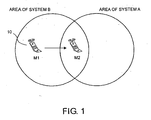
- a mobile radio terminal 10 has a structure adaptable to the two mobile telephone systems A and B. It is assumed here that the systems A and B are given priorities of transmission as A > B
- the mobile radio terminal 10 When the mobile radio terminal 10 is located outside the service areas of the systems A and B, the mobile radio terminal 10 periodically carries out cell search for each of the systems A and B in a long cycle (for example, at intervals of 6 minutes). When the mobile radio terminal 10 is located at a position M1, location registration is carried out between the mobile radio terminal 10 and the mobile telephone system B so that the mobile radio terminal 10 is put into a standby state in the system B. Simultaneously, the mobile radio terminal 10 continuously periodically carries out the cell search for the system A in the long cycle (for example, at intervals of 6 minutes).
- a cell of the mobile telephone system A is detected by the cell search for the system A periodically carried out (for example, at intervals of 6 minutes).
- location registration is carried out between the mobile radio terminal 10 and the mobile telephone system A having a high priority so that the mobile radio terminal 10 is put into a standby state in the system A.
- the cell search for the system A is immediately and temporarily carried out. Then, location registration between the mobile radio terminal 10 and the system A is carried out and the mobile radio terminal 10 is turned into the standby state in the system A.
- transmission in the system A becomes available.
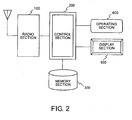
- the mobile radio terminal 10 in this embodiment will be described. In the figure, only the components related to this invention are shown. For convenience of description, a mobile telephone adaptable to two kinds of radio systems including the systems A and B is assumed to be the mobile radio terminal 10 of this embodiment.
- the mobile telephone as the mobile radio terminal 10 comprises a radio section 100 including an antenna and adaptable to both of the systems A and B, a system control section 200 adaptable to both of the systems A and B, a memory section 300, an operating section 400, and a display section 500.
- the operating section 400 includes an unfolding operation detecting function in case where the mobile telephone is of a folded type.
- the control section 200 controls operations of the mobile telephone in accordance with various control programs stored in the memory section 300.
- the respective systems are preliminarily given priorities for the cell search.
- the priorities are stored in the memory section 300.
- the cell search is carried out.
- the user may determine the priorities for the cell search with respect to the individual systems.
- setting is carried out, for example, in the following manner.
- the control section 200 reads the "priorities of the systems memorized in the memory section 300" and judges "which system is a current standby system involved in the standby state". Based on such information, judgment is made about whether or not this technique is to be used.
- a "transmission-related operation" is detected when the mobile telephone is in a standby state in a low-priority system (system B) and when the cell search for a high-priority system (system A) is periodically carried out.
- the cell search cycle of the high-priority system (system A) is changed.
- the operation (for example, dial input) in the step Sy2 is an operation to be followed by transmission but a transmission button is not yet pressed actually.
- the operation in the step Sz1 means an operation of actually determining the transmission (pressing down of the transmission button).
- the cell search by this technique is executed for the systems A and B.
- the foregoing embodiment assumes the mobile telephone of a dual system.
- this invention is also applicable to a plurality of systems or networks in the 3G system.
- the above-mentioned systems A and B are assumed as follows.
- a 3G mobile telephone in a standby state in the network (system B) other than the HPLMN normally searches the HPLMN (system A) at long intervals corresponding to an integral multiple of 6 minutes.
- step Sz2 in the operation upon transmission (Fig. 6), whether or not the above-mentioned step Sz10 is pending is judged. However, without carrying out the judgment, the step Sy4 may immediately be executed. In this case, even if location registration to the system A is pending, a transmitting operation in the system B is immediately carried out and the location registration to the system A is interrupted.
- the "predetermined period of time” is mentioned. Instead of the predetermined period of time, a “predetermined number of times” may be used.
- the "transmission-related operation” is mentioned. However, the operation in the step Sy2 need not be restricted to those related to the transmitting operation.
- the step Sy3 may be executed merely by manipulation of the operating section by the user.
- the control section 200 for carrying out cell search for a high-priority mobile telephone system may further include a function for carrying out, in case where a cell of the high-priority mobile telephone system is not detected, transmission in the low-priority mobile telephone system to which the location registration has been made.
- the mobile telephone or the mobile radio terminal need not have the structure in Fig. 2.
- a plurality of control sections 200 may be provided in one-to-one correspondence to the systems.
- a plurality of radio sections 100 may be provided in one-to-one correspondence to the systems.
- immediate 3G search is carried out and a short cycle is set as the 3G search cycle only when the user starts the "transmission-related operation" in the 2G standby state. Except the above-mentioned situation, the 3G search is skipped or the 3G search cycle is lengthened. Therefore, power consumption can be saved.
- the immediate 3G search is carried out and a short cycle is set as the 3G search cycle.
- This increases the probability of detecting a 3G cell at the time of actual transmission (at the time of pressing the transmission button).
- the chances of enjoying the merits of the 3G system are increased.
- a short cycle is set as the search cycle. Therefore, as compared with a method of carrying out immediate and temporary search only once when the user executes a predetermined operation, detection of a 3G cell is highly probable even after the search is once failed. Thus, the chances of enjoying the merits of the 3G system (speech quality, communication rate, and so on) are further increased.
- the user is not required to execute a special operation (for example, to press down a search switch) in order to switch the mobile communication systems from one to another.
- a special operation for example, to press down a search switch
- the operation of selecting a high-priority system is executed. Therefore, in case of the operation unrelated to the transmission (for example, an operation of adjusting a clock), immediate and temporary cell search or shortening of a search cycle are not carried out. Thus, unnecessary power consumption is suppressed.
- transmission-related operation for example, dialing operation, input of a mail address
Landscapes
- Engineering & Computer Science (AREA)
- Computer Security & Cryptography (AREA)
- Computer Networks & Wireless Communication (AREA)
- Signal Processing (AREA)
- Mobile Radio Communication Systems (AREA)
Claims (14)
- Procédé de recherche de cellule utilisé dans un terminal radio mobile (10) adaptable à un nombre prédéterminé N de types de systèmes de téléphonie mobile (A, B), où N est un nombre entier qui n'est pas inférieur à 1, comprenant les étapes consistant à fixer (Sx2-2) des priorités pour les systèmes de téléphonie mobile, déterminer (Sx1) si ledit terminal radio mobile est dans un état d'attente ou pas dans un des systèmes de téléphonie mobile, détecter (Sy2) une opération orientée transmission dudit terminal radio mobile, exécuter (Sx3, Sx4-2, Sy2, Sy3) une recherche de cellule pour un système de téléphonie mobile avec une priorité élevée immédiatement lorsque l'opération orientée transmission est détectée dans le cas où ledit terminal radio mobile est dans l'état d'attente et où un enregistrement de position dudit terminal radio mobile auprès d'un système de téléphonie mobile de faible priorité a déjà été fait, et effectuer (Sy10), lors de la détection d'une cellule du système de téléphonie mobile de priorité élevée, un enregistrement de position avec le système de téléphonie mobile de priorité élevée pour mettre le terminal radio mobile dans un état d'attente dans le système de téléphonie mobile de priorité élevée.
- Procédé de recherche de cellule selon la revendication 1, dans lequel l'opération orientée transmission est une opération de numérotation ou une opération d'entrée d'adresse électronique.
- Procédé de recherche de cellule selon la revendication 1, dans lequel ledit terminal radio mobile est un téléphone mobile de type repliable et l'opération orientée transmission est une opération consistant à ouvrir le téléphone mobile de type repliable.
- Procédé de recherche de cellule selon la revendication 1, dans lequel, au cas où une cellule du système de téléphonie mobile de priorité élevée ne peut pas être détectée par la recherche de cellule pour le système de téléphonie mobile de priorité élevée après l'opération orientée transmission, la recherche de cellule pour le système de téléphonie mobile de priorité élevée est répétée (Sy5, Sy6, Sy8) dans un cycle de recherche court pendant une période prédéterminée de temps.
- Procédé de recherche de cellule selon la revendication 1, dans lequel, au cas où une cellule du système de téléphonie mobile de priorité élevée ne peut pas être détectée par la recherche de cellule pour le système de téléphonie mobile de priorité élevée après l'opération orientée transmission, la recherche de cellule pour le système de téléphonie mobile de priorité élevée est répétée dans un cycle de recherche court, un nombre prédéterminé de fois.
- Procédé de recherche de cellule selon la revendication 1, dans lequel, au cas où la cellule du système de téléphonie mobile de priorité élevée est détectée, mais que l'enregistrement de position auprès de celle-ci n'est pas terminé au moment de la détection d'une opération de début de transmission par un utilisateur, la transmission est suspendue (Sz1, Sz2, Sz3) jusqu'à ce que l'enregistrement de position auprès du système de téléphonie mobile de priorité élevée soit terminé et la transmission est exécutée (SZ4) immédiatement après la fin de l'enregistrement de position.
- Procédé de recherche de cellule selon la revendication 1, dans lequel, au cas où une cellule du système de téléphonie mobile de priorité élevée n'est pas détectée par la recherche de cellule pour le système de téléphonie mobile de priorité élevée, la transmission est exécutée dans le système de téléphonie mobile de faible priorité auprès duquel l'enregistrement de position a été fait.
- Procédé de recherche de cellule selon la revendication 1, dans lequel les priorités des systèmes de téléphonie mobile peuvent être déterminées et la recherche de cellule est exécutée en référence aux priorités déterminées et aux informations d'un des systèmes de téléphonie mobile en tant que système d'attente courant dans lequel le terminal radio mobile est couramment dans l'état d'attente.
- Terminal radio mobile (10) adaptable à un nombre prédéterminé N de types de systèmes de téléphonie mobile (A, B), où N est un nombre entier non inférieur à 1, caractérisé par : des moyens (200, Sx1) destinés à déterminer si ledit terminal radio mobile est dans un état d'attente ou pas dans un des systèmes de téléphonie mobile, des moyens (200, Sx2-2) destinés à fixer des priorités pour les systèmes de téléphonie mobile, des moyens (200, Sy2) destinés à détecter une opération orientée transmission dudit terminal radio mobile, des moyens (200, Sx3, Sx4-2, Sy2, Sy3) destinés à exécuter une recherche de cellule pour un système de téléphonie mobile de priorité élevée immédiatement lorsque l'opération orientée transmission est détectée dans le cas où ledit terminal radio mobile est dans l'état d'attente et où l'enregistrement de position dudit terminal radio mobile auprès d'un système de téléphonie mobile de faible priorité a été effectué, et des moyens (200, Sy10) destinés à exécuter un enregistrement de position auprès du système de téléphonie mobile de priorité élevée pour démarrer un état d'attente dans le système de téléphonie mobile de priorité élevée lors de la détection d'une cellule du système de téléphonie mobile de priorité élevée par la recherche de cellule.
- Terminal radio mobile selon la revendication 9, dans lequel les moyens destinés à exécuter une recherche de cellule pour un système de téléphonie mobile de priorité élevée ont une fonction (Sy5, Sy6, Sy8) de répétition de la recherche de cellule dans un cycle de recherche court pendant une période prédéterminée de temps.
- Terminal radio mobile selon la revendication 9, dans lequel les moyens destinés à exécuter une recherche de cellule pour un système de téléphonie mobile de priorité élevée ont une fonction de répétition de la recherche de cellule dans un cycle de recherche court, un nombre prédéterminé de fois.
- Terminal radio mobile selon la revendication 9, comprenant des moyens (200, Sz1, Sz2, Sz3, Sz4) destinés à exécuter la transmission après la détection d'une opération de début de transmission (appuyer sur un bouton de transmission) et la fin de l'enregistrement de position auprès du système de priorité élevée.
- Terminal radio mobile selon la revendication 9, dans lequel les moyens destinés à exécuter une recherche de cellule pour un système de téléphonie mobile de priorité élevée comprennent des moyens pour exécuter, au cas où une cellule du système de téléphonie mobile de priorité élevée n'est pas détectée, la transmission dans le système de téléphonie mobile de faible priorité auprès duquel l'enregistrement de position a été fait.
- Programme permettant à un ordinateur de commander une recherche de cellule dans un terminal radio mobile (10) adaptable à un nombre prédéterminé N de types de systèmes de téléphonie mobile (A, B), où N est un nombre entier qui n'est pas inférieur à 1, ledit programme amenant ledit ordinateur à exécuter les opérations consistant à :juger (Sx1) si le terminal radio mobile est dans un état d'attente ou pas dans un des systèmes de téléphonie mobile en tant que système d'attente courant ;rechercher (Sx2-2) les priorités des systèmes de téléphonie mobile auxquels ledit terminal radio mobile est adaptable ;détecter (Sy2) une opération orientée transmission dudit terminal radio mobile ;demander (Sy3), immédiatement lorsque l'opération orientée transmission est détectée dans le cas où ledit terminal radio mobile est dans l'état d'attente et où un système radio mobile de priorité élevée supérieur en priorité par rapport au système d'attente courant est présent, une recherche de cellule pour le système de téléphonie mobile de priorité élevée ;demander (Sy5, Sy6, Sy8) la répétition de la recherche de cellule pour le système de téléphonie mobile de priorité élevée dans un cycle court pendant une période prédéterminée de temps ou un nombre prédéterminé de fois au cas où une cellule du système de téléphonie mobile de priorité élevée n'est pas détectée dans la recherche de cellule ;demander (Sy10) l'achèvement de la recherche de cellule et de l'enregistrement de position auprès du système de téléphonie mobile de priorité élevée si la cellule du système de téléphonie mobile de priorité élevée est détectée; etdemander (Sy9) l'établissement d'un cycle long pour la recherche de cellule pour le système de téléphonie mobile de priorité élevée ou l'arrêt de la recherche de cellule pour le système de téléphonie mobile de priorité élevée et demander la reprise de l'état d'attente dans le système de téléphonie mobile de faible priorité si la cellule du système de téléphonie mobile de priorité élevée n'est pas détectée dans la recherche de cellule exécutée de façon répétée pendant la période prédéterminée de temps ou le nombre prédéterminé de fois.
Applications Claiming Priority (2)
| Application Number | Priority Date | Filing Date | Title |
|---|---|---|---|
| JP2002353036A JP4066165B2 (ja) | 2002-12-04 | 2002-12-04 | 複数の移動電話システムに対応可能な移動無線端末のセルサーチ方法 |
| JP2002353036 | 2002-12-04 |
Publications (2)
| Publication Number | Publication Date |
|---|---|
| EP1427240A1 EP1427240A1 (fr) | 2004-06-09 |
| EP1427240B1 true EP1427240B1 (fr) | 2007-06-20 |
Family
ID=32310729
Family Applications (1)
| Application Number | Title | Priority Date | Filing Date |
|---|---|---|---|
| EP03027848A Expired - Lifetime EP1427240B1 (fr) | 2002-12-04 | 2003-12-04 | Procédé de recherche de cellule dans un terminal radio mobile adaptable au moins à deux types de systèmes de téléphonie mobile |
Country Status (5)
| Country | Link |
|---|---|
| US (1) | US7085569B2 (fr) |
| EP (1) | EP1427240B1 (fr) |
| JP (1) | JP4066165B2 (fr) |
| CN (1) | CN1281096C (fr) |
| DE (1) | DE60314486T2 (fr) |
Families Citing this family (43)
| Publication number | Priority date | Publication date | Assignee | Title |
|---|---|---|---|---|
| KR20050030509A (ko) * | 2003-09-26 | 2005-03-30 | 삼성전자주식회사 | 헤테로지니어스 시스템에서의 억세스 네트워크 선택 방법 |
| JP4691954B2 (ja) * | 2004-10-26 | 2011-06-01 | 日本電気株式会社 | 移動通信端末装置、セルサーチ装置、セルサーチ方法、プログラム及び記録媒体 |
| JP4160568B2 (ja) * | 2005-02-23 | 2008-10-01 | 株式会社東芝 | 移動無線端末 |
| KR100652713B1 (ko) * | 2005-02-26 | 2006-12-01 | 엘지전자 주식회사 | 휴대단말기의 홈시스템 검색장치 및 방법 |
| US20060199608A1 (en) * | 2005-03-01 | 2006-09-07 | Kyocera Wireless Corp. | Systems and methods for motion sensitive roaming in a mobile communication device |
| JP2006303733A (ja) * | 2005-04-18 | 2006-11-02 | Nec Corp | デュアルモード携帯端末の基地局サーチ方式 |
| JP4706919B2 (ja) * | 2005-09-20 | 2011-06-22 | 日本電気株式会社 | 移動通信端末及びセルの切り替え制御方法 |
| JP4777042B2 (ja) * | 2005-10-28 | 2011-09-21 | 京セラ株式会社 | 無線端末装置及び無線通信方法 |
| US20080199538A1 (en) * | 2006-01-10 | 2008-08-21 | Yronne Filopelrick | Compound to enhance lucid erotic dreams |
| GB2434507A (en) * | 2006-01-24 | 2007-07-25 | Samsung Electronics Co Ltd | Network Selection |
| JP4663536B2 (ja) * | 2006-01-27 | 2011-04-06 | 京セラ株式会社 | 無線通信端末及び無線通信方法 |
| CN101052203B (zh) * | 2006-04-06 | 2011-06-08 | 华为技术有限公司 | 多媒体广播组播业务的实现方法 |
| WO2008007512A1 (fr) * | 2006-07-14 | 2008-01-17 | Nec Corporation | Terminal radio et procédé de recherche de station de base par voie de terminal radio |
| EP2092771B1 (fr) * | 2006-10-25 | 2018-06-27 | QUALCOMM Incorporated | Recherche uniforme de dispositifs hors service pour systèmes de communication sans fil |
| JP5008947B2 (ja) * | 2006-10-30 | 2012-08-22 | 京セラ株式会社 | 無線通信端末及び無線通信方法 |
| JP4974142B2 (ja) * | 2006-10-30 | 2012-07-11 | 京セラ株式会社 | 無線通信端末及び無線通信方法 |
| US20100046385A1 (en) * | 2006-10-30 | 2010-02-25 | Kyocera Corporation | Wireless Communication Terminal, Communication Control Method of Wireless Communication Terminal, and Wireless Communication System |
| JP5008948B2 (ja) * | 2006-10-30 | 2012-08-22 | 京セラ株式会社 | 無線通信端末及び無線通信方法 |
| JP5031426B2 (ja) * | 2007-03-29 | 2012-09-19 | 京セラ株式会社 | ハイブリッド通信端末装置、通信端末及び通信方法 |
| JP4879799B2 (ja) * | 2007-03-29 | 2012-02-22 | 京セラ株式会社 | 無線通信端末の制御方法および無線通信端末 |
| JP2008259108A (ja) * | 2007-04-09 | 2008-10-23 | Nec Corp | 移動体端末、移動体通信システム、移動交換センタおよび位置登録方法 |
| US8428637B2 (en) * | 2007-07-10 | 2013-04-23 | Qualcomm Incorporated | Extending access terminal battery life through search rate control |
| JP5094279B2 (ja) * | 2007-08-27 | 2012-12-12 | キヤノン株式会社 | 通信装置 |
| WO2009028516A1 (fr) * | 2007-08-27 | 2009-03-05 | Canon Kabushiki Kaisha | Appareil de communication |
| JP5063261B2 (ja) * | 2007-08-27 | 2012-10-31 | キヤノン株式会社 | 通信装置 |
| KR20100106550A (ko) * | 2008-01-29 | 2010-10-01 | 교세라 가부시키가이샤 | 무선통신단말의 제어방법 및 무선통신단말 |
| JP2009260456A (ja) * | 2008-04-14 | 2009-11-05 | Nec Corp | 無線基地局検索装置、方法、プログラム及び携帯端末 |
| EP2314102A1 (fr) * | 2008-06-16 | 2011-04-27 | Interdigital Patent Holdings, Inc. | Procédé et appareil pour une fonctionnalité de profil dynamique dans un client mih |
| JP5081753B2 (ja) | 2008-07-15 | 2012-11-28 | 株式会社エヌ・ティ・ティ・ドコモ | 移動局及び移動通信方法 |
| WO2010082285A2 (fr) * | 2009-01-15 | 2010-07-22 | シャープ株式会社 | Système de communication sans fil, terminal de communication mobile et procédé de connexion de communication |
| JP4838335B2 (ja) * | 2009-06-29 | 2011-12-14 | 株式会社エヌ・ティ・ティ・ドコモ | 移動局 |
| JP4838336B2 (ja) * | 2009-06-29 | 2011-12-14 | 株式会社エヌ・ティ・ティ・ドコモ | 移動局 |
| EP2489224B1 (fr) * | 2009-10-16 | 2015-12-23 | Telefonaktiebolaget LM Ericsson (publ) | Technique de balayage de fréquence pour procédure de recherche de cellule |
| US8838106B2 (en) | 2010-02-23 | 2014-09-16 | Apple Inc. | Method and apparatus for cell reselection |
| US20120258709A1 (en) * | 2011-04-08 | 2012-10-11 | Qualcomm Incorporated | World mode scanning control |
| US8442516B2 (en) * | 2011-04-08 | 2013-05-14 | Qualcomm Incorporated | World mode scanning control |
| TWI457012B (zh) * | 2011-08-12 | 2014-10-11 | Univ Nat Chiao Tung | 移動預測方法 |
| US9730097B2 (en) * | 2012-07-25 | 2017-08-08 | Mediatek Inc. | Method of efficient blind SCell activation |
| US9380520B2 (en) * | 2013-03-13 | 2016-06-28 | Qualcomm Incorporated | Using motion to improve local wireless network connectivity |
| US9380519B2 (en) | 2013-03-13 | 2016-06-28 | Qualcomm Incorporated | Using motion to improve local wireless network connectivity |
| US9161294B2 (en) | 2013-03-13 | 2015-10-13 | Qualcomm Incorporated | Using motion to optimize place of relevance operations |
| US10805869B2 (en) * | 2017-08-25 | 2020-10-13 | Qualcomm Incorporated | Techniques and apparatuses for search, measurement, and icon display in new radio non-standalone mode |
| WO2020186426A1 (fr) * | 2019-03-18 | 2020-09-24 | 华为技术有限公司 | Procédé de recherche de cellule, dispositif et système |
Family Cites Families (10)
| Publication number | Priority date | Publication date | Assignee | Title |
|---|---|---|---|---|
| JP2658928B2 (ja) * | 1994-11-30 | 1997-09-30 | 日本電気株式会社 | 携帯通信機 |
| EP0724371A1 (fr) | 1995-01-30 | 1996-07-31 | CABLE & WIRELESS PLC | Terminal de communication sans fil |
| US6195532B1 (en) * | 1996-06-28 | 2001-02-27 | At&T Wireless Srcs. Inc. | Method for categorization of multiple providers in a wireless communications service environment |
| EP0980190B1 (fr) | 1998-08-12 | 2004-11-03 | Siemens Aktiengesellschaft | Dispositif de télécommunication multimode de sélection d'un canal |
| US6487399B1 (en) * | 1999-05-26 | 2002-11-26 | Nokia Mobile Phones Ltd. | Mobile terminal employing 30kHz/200kHz carrier identification |
| JP2001145162A (ja) | 1999-11-15 | 2001-05-25 | Toshiba Corp | 移動無線端末装置 |
| SE522317C2 (sv) * | 2000-02-02 | 2004-02-03 | Telia Ab | Metod för val av radionät, samt system och terminal för utnyttjande av metoden |
| JP2002118496A (ja) * | 2000-10-06 | 2002-04-19 | Hitachi Kokusai Electric Inc | セルサーチ判定回路 |
| US6907276B2 (en) | 2001-03-21 | 2005-06-14 | Nec Corporation | Mobile communication terminal with external display unit |
| WO2003032509A1 (fr) * | 2001-10-10 | 2003-04-17 | Samsung Electronics Co., Ltd | Technique de recherche de cellule en cas de mode de reception discontinue dans un systeme de communication mobile |
-
2002
- 2002-12-04 JP JP2002353036A patent/JP4066165B2/ja not_active Expired - Fee Related
-
2003
- 2003-12-04 CN CN200310119593.5A patent/CN1281096C/zh not_active Expired - Fee Related
- 2003-12-04 DE DE60314486T patent/DE60314486T2/de not_active Expired - Lifetime
- 2003-12-04 US US10/729,031 patent/US7085569B2/en not_active Expired - Lifetime
- 2003-12-04 EP EP03027848A patent/EP1427240B1/fr not_active Expired - Lifetime
Non-Patent Citations (1)
| Title |
|---|
| None * |
Also Published As
| Publication number | Publication date |
|---|---|
| DE60314486T2 (de) | 2008-02-21 |
| JP2004187104A (ja) | 2004-07-02 |
| EP1427240A1 (fr) | 2004-06-09 |
| US20040192296A1 (en) | 2004-09-30 |
| JP4066165B2 (ja) | 2008-03-26 |
| CN1281096C (zh) | 2006-10-18 |
| CN1505436A (zh) | 2004-06-16 |
| US7085569B2 (en) | 2006-08-01 |
| DE60314486D1 (de) | 2007-08-02 |
Similar Documents
| Publication | Publication Date | Title |
|---|---|---|
| US7085569B2 (en) | Cell search method for use in a mobile radio terminal adaptable to at least two kinds of mobile telephone systems | |
| AU750112B2 (en) | Multi-mode mobile terminal and methods for operating the same | |
| EP1079652B1 (fr) | Procédé amélioré pour notifier les stations mobiles en itinérance | |
| US6119003A (en) | Methods and apparatus for performing automatic mode selection in a multimode mobile terminal | |
| CN101669391B (zh) | 用于多模设备进行无线网络选择的系统和方法 | |
| KR20080095260A (ko) | 셀룰러 무선 통신 시스템에서 셀들을 재선택하는 것과 관련된 방법, 디바이스 및 시스템 | |
| JP4657459B2 (ja) | 公衆の第1ネットワークと優先ローカルの第2ネットワークの両方において使用するためのマルチスタンダードの移動通信端末 | |
| EP1482754B1 (fr) | Station mobile | |
| US7933551B2 (en) | Mobile communication system and mobile communication method | |
| KR100797121B1 (ko) | 멀티 스탠바이 휴대 단말기의 파워 세이빙 방법 및 그 장치 | |
| EP2134125B1 (fr) | Terminal de communication mobile et procédé de contrôle de communication mobile | |
| US5940760A (en) | Method and apparatus to reduce non-public mode search time in a mobile station | |
| US20040192224A1 (en) | Wireless communication terminal and control method therefor | |
| JP2003348001A (ja) | 移動無線端末 | |
| EP1626599A1 (fr) | Procede permettant d'etablir une connexion de service | |
| EP2437553A2 (fr) | Téléphone mobile et procédé pour une connexion avec un système de communication préféré parmi une pluralité de systèmes de communication avec diverses bandes de fréquence radio | |
| JP3875881B2 (ja) | 移動体通信端末及びその動作方法 | |
| JP3102761B2 (ja) | 移動通信の圏外待ち受け方法 | |
| JPH04241528A (ja) | ディジタル移動通信端末 | |
| JPH11178037A (ja) | 電気通信システム、並びに、電気通信システム用測位方法及び移動局 | |
| JP3102760B2 (ja) | 移動通信の圏外待ち受け方法 | |
| JP3806643B2 (ja) | 移動体通信端末及びその動作方法 | |
| JP2000125334A (ja) | エリア判定方法 | |
| JP2005229437A (ja) | W−cdma/gsmシステム複合携帯情報端末機、及び、その通信モード切り替え方法 | |
| JP2003284137A (ja) | 移動体通信端末及びその動作方法 |
Legal Events
| Date | Code | Title | Description |
|---|---|---|---|
| PUAI | Public reference made under article 153(3) epc to a published international application that has entered the european phase |
Free format text: ORIGINAL CODE: 0009012 |
|
| 17P | Request for examination filed |
Effective date: 20040331 |
|
| AK | Designated contracting states |
Kind code of ref document: A1 Designated state(s): AT BE BG CH CY CZ DE DK EE ES FI FR GB GR HU IE IT LI LU MC NL PT RO SE SI SK TR |
|
| AX | Request for extension of the european patent |
Extension state: AL LT LV MK |
|
| AKX | Designation fees paid |
Designated state(s): DE FR GB IT |
|
| GRAP | Despatch of communication of intention to grant a patent |
Free format text: ORIGINAL CODE: EPIDOSNIGR1 |
|
| GRAS | Grant fee paid |
Free format text: ORIGINAL CODE: EPIDOSNIGR3 |
|
| GRAA | (expected) grant |
Free format text: ORIGINAL CODE: 0009210 |
|
| AK | Designated contracting states |
Kind code of ref document: B1 Designated state(s): DE FR GB IT |
|
| REG | Reference to a national code |
Ref country code: GB Ref legal event code: FG4D |
|
| REF | Corresponds to: |
Ref document number: 60314486 Country of ref document: DE Date of ref document: 20070802 Kind code of ref document: P |
|
| ET | Fr: translation filed | ||
| PLBE | No opposition filed within time limit |
Free format text: ORIGINAL CODE: 0009261 |
|
| STAA | Information on the status of an ep patent application or granted ep patent |
Free format text: STATUS: NO OPPOSITION FILED WITHIN TIME LIMIT |
|
| 26N | No opposition filed |
Effective date: 20080325 |
|
| REG | Reference to a national code |
Ref country code: GB Ref legal event code: 732E Free format text: REGISTERED BETWEEN 20141023 AND 20141029 |
|
| REG | Reference to a national code |
Ref country code: FR Ref legal event code: TP Owner name: LENOVO INNOVATIONS LIMITED (HONG KONG), HK Effective date: 20141119 |
|
| PGFP | Annual fee paid to national office [announced via postgrant information from national office to epo] |
Ref country code: FR Payment date: 20141208 Year of fee payment: 12 |
|
| PGFP | Annual fee paid to national office [announced via postgrant information from national office to epo] |
Ref country code: IT Payment date: 20141203 Year of fee payment: 12 |
|
| REG | Reference to a national code |
Ref country code: FR Ref legal event code: ST Effective date: 20160831 |
|
| PG25 | Lapsed in a contracting state [announced via postgrant information from national office to epo] |
Ref country code: FR Free format text: LAPSE BECAUSE OF NON-PAYMENT OF DUE FEES Effective date: 20151231 |
|
| PG25 | Lapsed in a contracting state [announced via postgrant information from national office to epo] |
Ref country code: IT Free format text: LAPSE BECAUSE OF NON-PAYMENT OF DUE FEES Effective date: 20151204 |
|
| REG | Reference to a national code |
Ref country code: DE Ref legal event code: R082 Ref document number: 60314486 Country of ref document: DE Representative=s name: GLAWE DELFS MOLL PARTNERSCHAFT MBB VON PATENT-, DE Ref country code: DE Ref legal event code: R081 Ref document number: 60314486 Country of ref document: DE Owner name: LENOVO INNOVATIONS LIMITED, HK Free format text: FORMER OWNER: NEC CORP., TOKYO, JP |
|
| PGFP | Annual fee paid to national office [announced via postgrant information from national office to epo] |
Ref country code: GB Payment date: 20181221 Year of fee payment: 16 |
|
| PGFP | Annual fee paid to national office [announced via postgrant information from national office to epo] |
Ref country code: DE Payment date: 20190131 Year of fee payment: 16 |
|
| REG | Reference to a national code |
Ref country code: DE Ref legal event code: R119 Ref document number: 60314486 Country of ref document: DE |
|
| GBPC | Gb: european patent ceased through non-payment of renewal fee |
Effective date: 20191204 |
|
| PG25 | Lapsed in a contracting state [announced via postgrant information from national office to epo] |
Ref country code: GB Free format text: LAPSE BECAUSE OF NON-PAYMENT OF DUE FEES Effective date: 20191204 Ref country code: DE Free format text: LAPSE BECAUSE OF NON-PAYMENT OF DUE FEES Effective date: 20200701 |