EP1418169A2 - Polyhalogenalkylaryle - Google Patents
Polyhalogenalkylaryle Download PDFInfo
- Publication number
- EP1418169A2 EP1418169A2 EP03024919A EP03024919A EP1418169A2 EP 1418169 A2 EP1418169 A2 EP 1418169A2 EP 03024919 A EP03024919 A EP 03024919A EP 03024919 A EP03024919 A EP 03024919A EP 1418169 A2 EP1418169 A2 EP 1418169A2
- Authority
- EP
- European Patent Office
- Prior art keywords
- methyl
- aniline
- bromo
- alkyl
- compounds
- Prior art date
- Legal status (The legal status is an assumption and is not a legal conclusion. Google has not performed a legal analysis and makes no representation as to the accuracy of the status listed.)
- Granted
Links
Classifications
-
- C—CHEMISTRY; METALLURGY
- C07—ORGANIC CHEMISTRY
- C07C—ACYCLIC OR CARBOCYCLIC COMPOUNDS
- C07C231/00—Preparation of carboxylic acid amides
- C07C231/12—Preparation of carboxylic acid amides by reactions not involving the formation of carboxamide groups
-
- C—CHEMISTRY; METALLURGY
- C07—ORGANIC CHEMISTRY
- C07C—ACYCLIC OR CARBOCYCLIC COMPOUNDS
- C07C209/00—Preparation of compounds containing amino groups bound to a carbon skeleton
- C07C209/68—Preparation of compounds containing amino groups bound to a carbon skeleton from amines, by reactions not involving amino groups, e.g. reduction of unsaturated amines, aromatisation, or substitution of the carbon skeleton
-
- C—CHEMISTRY; METALLURGY
- C07—ORGANIC CHEMISTRY
- C07C—ACYCLIC OR CARBOCYCLIC COMPOUNDS
- C07C233/00—Carboxylic acid amides
- C07C233/01—Carboxylic acid amides having carbon atoms of carboxamide groups bound to hydrogen atoms or to acyclic carbon atoms
- C07C233/12—Carboxylic acid amides having carbon atoms of carboxamide groups bound to hydrogen atoms or to acyclic carbon atoms having the nitrogen atom of at least one of the carboxamide groups bound to a carbon atom of a hydrocarbon radical substituted by halogen atoms or by nitro or nitroso groups
- C07C233/15—Carboxylic acid amides having carbon atoms of carboxamide groups bound to hydrogen atoms or to acyclic carbon atoms having the nitrogen atom of at least one of the carboxamide groups bound to a carbon atom of a hydrocarbon radical substituted by halogen atoms or by nitro or nitroso groups with the substituted hydrocarbon radical bound to the nitrogen atom of the carboxamide group by a carbon atom of a six-membered aromatic ring
-
- C—CHEMISTRY; METALLURGY
- C07—ORGANIC CHEMISTRY
- C07C—ACYCLIC OR CARBOCYCLIC COMPOUNDS
- C07C2601/00—Systems containing only non-condensed rings
- C07C2601/04—Systems containing only non-condensed rings with a four-membered ring
-
- C—CHEMISTRY; METALLURGY
- C07—ORGANIC CHEMISTRY
- C07C—ACYCLIC OR CARBOCYCLIC COMPOUNDS
- C07C2601/00—Systems containing only non-condensed rings
- C07C2601/06—Systems containing only non-condensed rings with a five-membered ring
- C07C2601/08—Systems containing only non-condensed rings with a five-membered ring the ring being saturated
Definitions
- the present invention relates to polyhaloalkylaryls, a process for their Production and use of the polyhaloalkylaryls for the production of Active ingredients, especially in agrochemicals and pharmaceuticals.
- Polyhaloalkylaryls are valuable starting materials for the production of Active ingredients in agrochemicals and pharmaceuticals because of the polyhaloalkyl substituents the lipophilicity and thus the membrane permeability of the entire drug molecule increase.
- substituted 4-perfluoroalkylanilines are suitable especially for the production of effective insecticides of the aroylurea type (see also EP-A 919 542 and EP-A 936 212).
- Perfluoroalkylarylene can be prepared, for example, by reacting Aromatics with perfluoroalkyl iodides or bromides in aprotic solvents and either in the presence of metals and sulfur dioxide (EP-A 206 951 and FR-A 2 660 923) or in the presence of alkali metal dithionite (EP-A 298 803).
- perfluoroalkyl chlorides can be converted into dimethyl sulfoxide (Huang et al., J. Fluorine Chem., 111, 2001, 107-113).
- a disadvantage of the methods mentioned is that the implementation is aprotic polar solvents such as especially dimethylformamide or dimethyl sulfoxide must be done that due to their high boiling point difficult from the products detachable and hardly traceable and also physiologically questionable are. Furthermore, all methods have only moderate yields.
- Alkyl or alkylene or alkoxy or alkenyl each independently represents a straight chain, cyclic, branched or unbranched alkyl or alkylene or alkoxy or Alkenyl radical. The same applies to the non-aromatic part of an arylalkyl radical.
- C 1 -C 8 alkoxy represents, for example, methoxy, ethoxy, n-propoxy, isopropoxy, n-butoxy, sec-butoxy and tert-butoxy, n-pentoxy, 1-methylbutoxy, 2-methylbutoxy, 3- Methylbutoxy, neo-pentoxy, 1-ethylpropoxy, cyclo-hexoxy, cyclo-pentoxy, n-hexoxy and n-octoxy, C 1 -C 12 alkoxy furthermore for example for adamantoxy, the isomeric menthoxy radicals, n-decoxy and n-dodecoxy.
- C 1 -C 12 polyfluoroalkyl represents trifluoromethyl, difluorochloromethyl, pentafluoroethyl, 1,1-dichloro-2,2,2-trifluoroethyl, heptafluoroisopropyl, n-nonafluorobutyl, perfluorocyclopentyl, perfluorocyclohexyl and perfluorododecyl.
- Perfluoroalkyl is in each case independently a straight-chain, cyclic, branched or unbranched alkyl radical which is completely substituted by fluorine atoms.
- carbocyclic aromatic radicals with 6 to 14 carbon atoms are for example phenyl, naphthyl, phenanthrenyl, anthracenyl or fluorenyl, heteroaromatic residues with 5 to 14 carbon atoms in which none, one, two or three carbon atoms per cycle, at least in the entire molecule however, a skeletal carbon atom, by heteroatoms, selected from the group Nitrogen, sulfur or oxygen can be substituted, for example Pyridinyl, oxazolyl, benzofuranyl, dibenzofuran-yl or quinolinyl.
- the carbocyclic aromatic residue or heteroaromatic residue can be substituted with up to five identical or different substituents per cycle, which are selected from the group chlorine, fluorine, C 1 -C 12 alkyl, C 1 -C 12 perfluoroalkyl, COO ( C 1 -C 8 alkyl), CON (C 1 -C 8 alkyl) 2 , COO (C 1 -C 8 arylalkyl), COO (C 4 -C 14 aryl), CO (C 1 -C 8 Alkyl), C 5 -C 15 arylalkyl or tri (C 1 -C 6 alkyl) siloxyl.
- substituents per cycle which are selected from the group chlorine, fluorine, C 1 -C 12 alkyl, C 1 -C 12 perfluoroalkyl, COO ( C 1 -C 8 alkyl), CON (C 1 -C 8 alkyl) 2 , COO (C 1 -C 8 arylalkyl), COO
- C 6 -C 15 arylalkyl is, for example and preferably, benzyl.
- Particularly preferred compounds of the formula (I) are 2-methyl-4- (heptafluoro-2-propyl) aniline, N, 2-dimethyl-4- (1,1,1,2,3,3,3-heptafluoro-2-propyl) aniline, 2-methyl-4- (1-bromo-1,1,2,3 , 3,3-hexafluoro-2-propyl) aniline, 2-methyl-4- (2-bromo-1,1,2,2-tetrafluoroethyl) aniline, 2-methyl-4- (2-chloro-1,1,2,2-tetrafluoroethyl) aniline, 2-methyl-4- (1-chloro-1, 1,2,3,3,3-hexafluoro-2-propyl) aniline, 2-methyl-4- (2-bromo-2-chloro-trifluoroethyl) aniline, 2-methyl-4- (2-bromo-1-chlorotrifluoroethyl) aniline, 2-methyl-4- (2-bromo-1-chlorotriflu
- Preferred compounds of the formula (III) are heptafluoro-2-bromopropane, heptafluoro-2-chloropropane, 1,2-dibromotetrafluoroethane, 1,2-dibromo-1-chloro-trifluoroethane, 2,3-dibromo-octafluorobutane, 2,3-dibromo-2,3-dichlorohexafluorobutane, 2,3-dibromo-2,3-dichlorohexafluorobutane, 2,3-dibromo-1,1,1,3,4,4,4-heptafluorobutane, 2,3-dibromo-2-chloro-1,1,1,4,4,4-hexafluorobutane, 1,2-dibromohexafluoropropane and 1,2-dichlorohexafluoropropane, where heptafluoro-2-bromo
- the molar ratio of compounds of the formula (III) to compounds of the Formula (II) can be, for example, 0.7 to 1.8 per equivalent for n, preferably 0.9 to 1.2 and particularly preferably 1.0 to 1.1.
- the process according to the invention is carried out in a multi-phase reaction medium carried out, which has an aqueous and at least one organic phase.
- Particularly suitable organic solvents for multi-phase reaction media are, for example, aliphatic or aromatic, optionally halogenated hydrocarbons such as gasoline fractions, benzene, toluene, xylene, chlorobenzene, Dichlorobenzene, petroleum ether, hexane, cyclohexane, dichloromethane, chloroform or carbon tetrachloride, ethers such as diethyl ether, diisopropyl ether or tert-butyl methyl ether, ketones such as cyclohexanone, butanone or Methyl isobutyl ketone and esters such as methyl acetate or Ethyl acetate.
- aliphatic or aromatic optionally halogenated hydrocarbons
- optionally halogenated hydrocarbons such as gasoline fractions, benzene, toluene, xylene, chlorobenzene, Dichlorobenzene, petroleum ether, he
- process according to the invention is carried out in the presence of a phase transfer catalyst carried out.
- anion - is preferably fluoride, chloride, bromide, iodide, acetate, nitrate, sulfate, hydrogen sulfate, tetrafluoroborate, hexafluorophosphate, tosylate, and triflate, particularly preferably chloride, bromide, iodide, sulfate and hydrogen sulfate.
- phase transfer catalysts are tetra-n-butylammonium iodide, tetra-n-butylammonium bromide, tetra-n-butylammonium hydrogen sulfate, tetra-n-butylammonium chloride, tributyl-methylphosphonium bromide, trimethyl-C13 / C15 -alkylammoniumchlorid, trimethyl-C 13 / C 15 -alkylammoniumbromid, Dibenzyl-dimethyl-ammonium methyl sulfate, dimethyl-C 12 / C 14 -alkyl-benzylammonium chloride, dimethyl-C 12 / C 14 --alkyl-benzylammonium bromide, triethylbenzylammonium chloride, methyltrioctylammonium chloride, trimethylbenzylammonium chloride, tetrakis -diethyla
- the reaction temperature can, for example, -10 ° C to the boiling point of the reaction medium under reaction pressure, but a maximum of 200 ° C is preferred a reaction temperature of 0 to 70 ° C.
- the reaction pressure can be, for example, 0.5 to 100 bar, ambient pressure is preferred.
- the process according to the invention is also carried out in the presence of a reducing agent and / or in the presence of light with a wavelength of 400 nm or performed less.
- Suitable bases are, for example: alkaline earth metal or alkali metal hydroxides, - acetate, phosphates, hydrogen phosphates, carbonates or hydrogen carbonates, such as for example sodium hydroxide, potassium hydroxide, sodium acetate, potassium acetate, Calcium acetate, sodium carbonate, potassium carbonate, potassium hydrogen carbonate or Sodium bicarbonate, ammonium salts such as ammonium acetate, Ammonium carbonate, amines such as trimethylamine, triethylamine, tributylamine, Di-isopropyl-ethylamine, tetramethylguanidine, N, N-dimethylaniline, diazabicyclooctane (DABCO), diazabicyclonones (DBN), diazabicycloundecene (DBU), N-methylpiperidine and piperidine, or aromatic nitrogen compounds such as for example pyridine, 2-, 3- and 4-N, N-dimethylaminopyridine, alkal
- Halogen exchange is preferred in the presence of organic solvent carried out.
- suitable organic solvents are: Ketones such as acetone, 2-butanone or methyl isobutyl ketone; Nitriles such as Acetonitrile, propanitrile, benzonitrile, benzyl nitrile or butyronitrile; Amides like for example N, N-dimethylformamide, N, N-dimethylacetamide, N-methylformanilide, N-methyl-pyrrolidone, N-methylcaprolactam or hexamethylphosphoric triamide; Sulfoxides such as dimethyl sulfoxide, sulfones such as Tetramethylene sulfone, polyethers such as 1,4-dioxane, ethylene glycol dimethyl ether, Ethylene glycol diethyl ether, diethylene glycol dimethyl ether or diethylene glycol diethyl ether or mixtures of such organic solvents.
- the water content of the solvent is preferably at most 1% by weight, preferably at most 0.2% by weight and particularly preferably 0.05% by weight. Preferably such a water content by distillation or drying in a known per se Way achieved.
- the solvent simultaneously in the presence of the alkali metal fluoride used dried or distilled.
- the reaction temperature in the halogen exchange can, for example, 60 ° C to Boiling point of the solvent used at the reaction pressure is maximum however 300 ° C, preferably 110 ° C to the boiling point of the solvent used at reaction pressure, however, a maximum of 200 ° C.
- the reaction pressure can be, for example, 0.5 to 100 bar, 3 being preferred up to 25 bar.
- the reaction time can be, for example, 10 minutes to 72 hours, preferably 2 to 12 Hours.
- the compounds of formula (I) obtainable according to the invention are particularly suitable in a process for the production of active ingredients such as Active ingredients for agrochemicals, such as, in particular, insecticides of the aroylurea type.
- active ingredients for agrochemicals such as, in particular, insecticides of the aroylurea type.
- insecticides of the aroylurea type are those which in EP-A 919 542 and EP-A 936 212.
- Y is preferably chlorine, bromine and hydrogen sulfate.
- a major advantage of the method according to the invention is that the compounds of formula (I) in a simple manner in high yields from readily available Educts can be produced. Furthermore, the compounds of the invention of the formula (XI) and (XII) valuable starting products for the production of active ingredients, in particular for agrochemicals.
Landscapes
- Chemical & Material Sciences (AREA)
- Organic Chemistry (AREA)
- Chemical Kinetics & Catalysis (AREA)
- Organic Low-Molecular-Weight Compounds And Preparation Thereof (AREA)
- Low-Molecular Organic Synthesis Reactions Using Catalysts (AREA)
- Addition Polymer Or Copolymer, Post-Treatments, Or Chemical Modifications (AREA)
Abstract
Description

- R1
- für C1-C12-Alkyl, NR8R9 oder OR10 steht, wobei R8, R9 und R10 jeweils unabhängig voneinander für Wasserstoff, C1-C12-Alkyl, CO(C1-C12-Alkyl), CO(C5-C14-Aryl), CO(C6-C15-Arylalkyl), COO(C1-C12-Alkyl), COO(C5-C14-Aryl), COO(C6-C15-Arylalkyl), COO(C2-C12-Alkenyl), CONH(C1-C12-Alkyl), CONH(C5-C14-Aryl), CONH(C6-C15-Arylalkyl), CON(C1-C12-Alkyl)2, CON(C5-C14-Aryl)2, CON(C6-C15-Arylalkyl)2 oder C6-C15-Arylalkyl stehen, oder NR8R9 als Ganzes für einen cyclischen Rest mit insgesamt 4 bis 16 Kohlenstoffatomen steht und
- R2, R3, R4, R5 und R6
- jeweils unabhängig für Wasserstoff, Fluor, Chlor, Brom oder C1-C12-Polyfluoralkyl stehen und/oder jeweils zwei der Reste R2, R3, R4, R5 und R6 einen oder mehrere cyclische Polyfluoralkylreste mit jeweils insgesamt 4 bis 20 Kohlenstoffatomen bilden, wobei für alle Fälle die Auflage gilt, dass die Summe der Fluoratome am Kohlenstoffatom, das die Bindung zum aromatischen Ring herstellt und den Fluoratomen an dem oder den dazu benachbarten Kohlenstoffatomen mindestens zwei beträgt und
- n
- für eins oder zwei steht und
- R7
- für C1-C12-Alkyl, C5-C14-Aryl, C6-C15-Arylalkyl, Hydroxy, Chlor, Brom,
Fluor, Nitro, Cyano, freies oder geschütztes Formyl, C1-C12-Alkyl, C1-C12-Halogenalkyl,
C5-C14-Aryl, C6-C15-Arylalkyl oder Reste der Formeln (IIa) bis
(IIf) steht,
- A
- fehlt oder für einen C1-C8-Alkylenrest steht und
- B
- fehlt oder für Sauerstoff, Schwefel oder NR12 steht,
wobei- R12
- Wasserstoff, C1-C8-Alkyl, C6-C15-Arylalkyl oder C5-C14-Aryl bedeutet und
- D
- für eine Carbonyl-Gruppe steht und
- E
- für R13, OR13, NHR11 oder N(R11)2 steht,
wobei- R13
- für C1-C8-Alkyl, C6-C15-Arylalkyl oder C5-C14-Aryl und
- R11
- jeweils unabhängig für C1-C8-Alkyl, C6-C15-Arylalkyl oder C6-C14-Aryl steht oder N(R11)2 zusammen für einen cyclischen Aminorest mit 4 bis 12 Kohlenstoffatomen steht und
- W
- für OH, NH2, oder OM steht, wobei M ein Alkalimetallion, ein halbes Äquivalent eines Erdalkalimetallions, ein Ammoniumion oder ein organisches Ammoniumion bedeuten kann oder
- m
- für eine ganze Zahl von 0 bis 5-n steht,
Verbindungen der Formel (II)
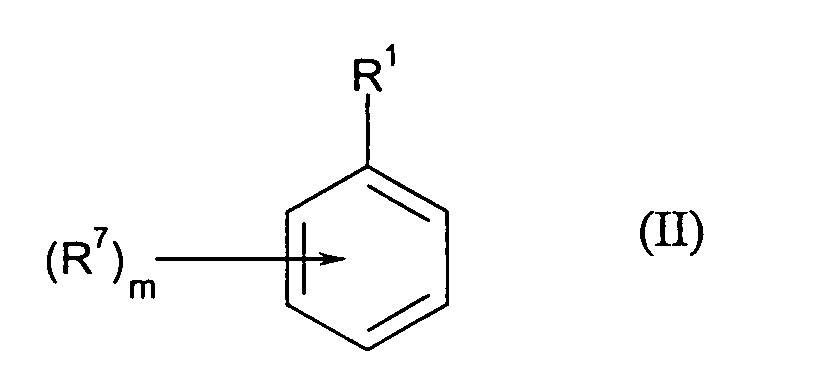
- R1, R7 und m
- die vorstehend genannte Bedeutung besitzen,
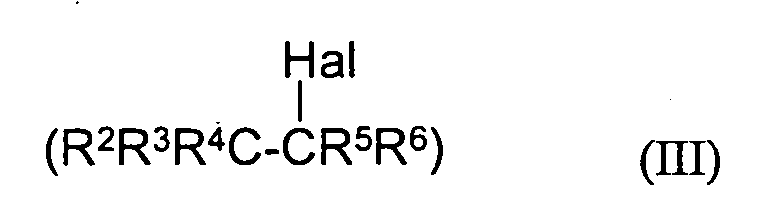
- R2, R3, R4, R5 und R6
- die vorstehend genannte Bedeutung besitzen und
- Hal
- für Brom oder Chlor, bevorzugt für Brom steht und wobei die Umsetzung
- in einem mehrphasigen Reaktionsmedium, das eine wässrige Phase und zumindest eine, bevorzugt genau eine, organische Phase aufweist und
- in Gegenwart von Phasentransferkatalysator und
- in Gegenwart eines Reduktionsmittels und/oder Licht mit einer Wellenlänge von 400 nm oder weniger und
- gegebenenfalls in Gegenwart von Base erfolgt.
- R1
- steht bevorzugt für NR7R8, wobei NR7R8 weiter bevorzugt als Ganzes für NH2 oder NHCO(C1-C12-Alkyl) und noch weiter bevorzugt für NH2 steht.
- R2, R3, R4, R5 und R6
- stehen bevorzugt für Wasserstoff, Chlor, Fluor oder C1-C4-Perfluoralkyl oder R2R3R4C-CR5R6 als Ganzes für einen cyclischen Polyfluoralkylrest mit insgesamt 4 bis 12 Kohlenstoffatomen.
- n
- steht bevorzugt für 1.
- R7
- steht bevorzugt jeweils unabhängig für C1-C4-Alkyl, Chlor, Fluor, Nitro, Cyano oder C1-C4-Alkoxy, besonders bevorzugt für Methyl, Ethyl, Methoxy oder Ethoxy, ganz besonders bevorzugt für Methyl.
- m
- steht bevorzugt für 1 oder 2, besonders bevorzugt für 1.
- (Kation+)
- für substituierte quartäre Ammonium oder Phosphonium-Kationen und
- (Anion-)
- für das Anion einer organischen oder anorganischen Säure steht.
Alkyl)}t)]+
- Pnyc
- für Stickstoff oder Phosphor steht und

- G
- für einen Rest der Formeln (VIIIa) oder (VIIIb) steht
und
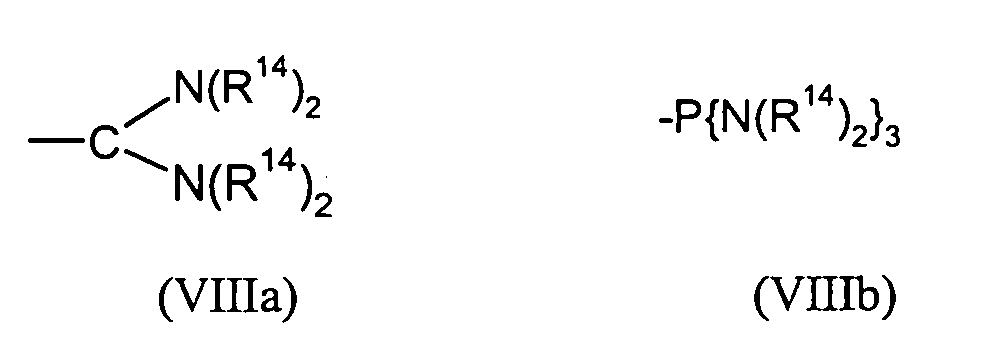
- H
- unabhängig von G für einen Rest der Formeln (VIIIa), (VIIIb), (VIIIc) oder
(VIIId)

wobei
die Reste R14 jeweils unabhängig voneinander für C1-C12-Alkyl, C2-C10-Alkenyl oder C6-C12-Aryl stehen oder
wobei N(R14)2 als Ganzes für einen 3- bis 5-gliedrigen, gesättigten oder ungesättigten Ring stehen kann, oder
wobei die Reste der Formel (VIIIa) und/oder die Gruppeals Ganzes für einen gesättigten oder ungesättigten 4- bis 8-gliedrigen Ring stehen kann, und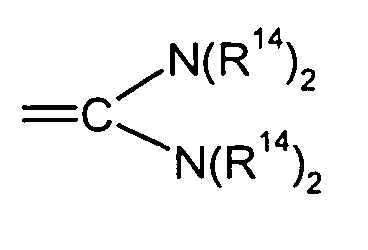
- X
- für Stickstoff oder Phosphor steht und
- An⊖
- für ein Äquivalent eines Anions wie beispielsweise und bevorzugt Chlorid, Bromid, (CH3)3SiF2 ⊖, HF2 ⊖, H2F2 ⊖, Tetrafluoroborat, Hexafluorophosphat, Carbonat oder Sulfat steht.
- G und An⊖
- die bei Formel (X) angegebene Bedeutung besitzen und
- An'
- für Chlor oder Brom und steht,
- G'
- hinsichtlich der Anordnung der Atome die bei Formel (X) für G angegebene Bedeutung hat, jedoch 2-bindig ist, wobei die Umsetzung in Gegenwart einer Base erfolgt.
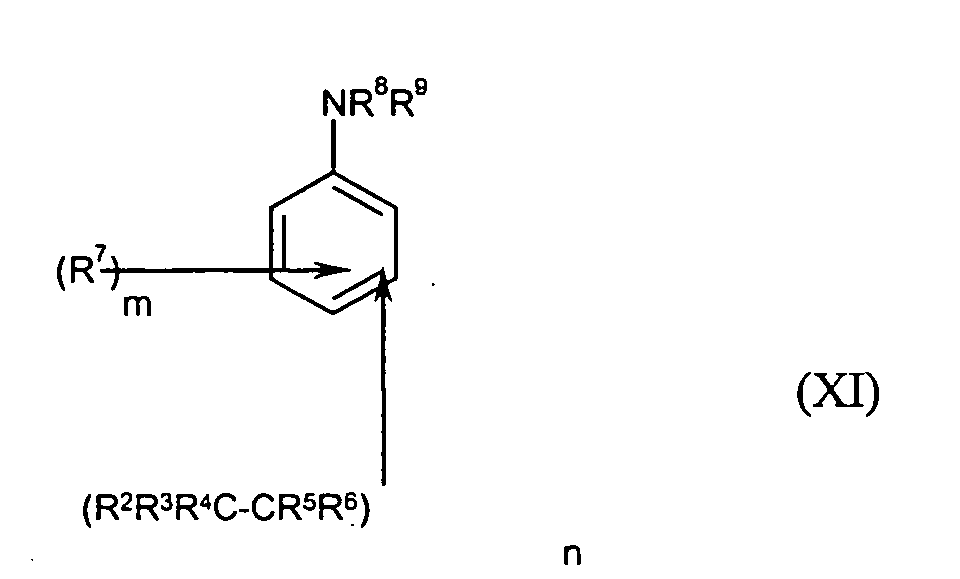
- der Rest R2R3R4C-CR5R6 bezogen auf das Kohlenstoffgerüst ein sekundärer oder tertiärer Rest ist oder
- ein primärer Rest ist, der ausgewählt ist aus der Gruppe 2-Brom-1,1,2,2-tetrafluorethyl, 2-Chlor-1,1,2,2-tetrafluorethyl, 2-Brom-2-chlor-trifluorethyl und 2-Brom-1-chlor-trifluorethyl
- (XIa)
- für Verbindungen der Formel (XI) steht, die zumindest eine primäre, sekundäre oder tertiäre Aminofunktion aufweisen und
- v
- für eine Zahl zwischen 1 und der Zahl der primären, sekundären oder tertiären Aminofunktionen im Molekül (XIa) steht und
- Y
- für ein Anion steht.
Claims (24)
- Verfahren zur Herstellung von Verbindungen der Formel (I),in der

- R1
- für C1-C12-Alkyl, NR8R9 oder OR10 steht, wobei R8, R9 und R10 jeweils unabhängig voneinander für Wasserstoff, C1-C12-Alkyl, CO(C1-C12-Alkyl), CO(C5-C14-Aryl), CO(C6-C15-Arylalkyl), COO(C1-C12-Alkyl), COO(C5-C14-Aryl), COO(C6-C15-Arylalkyl), COO(C2-C12-Alkenyl), CONH(C1-C12-Alkyl), CONH(C5-C14-Aryl), CONH(C6-C15-Arylalkyl), CON(C1-C12-Alkyl)2, CON(C5-C14-Aryl)2, CON(C6-C15-Arylalkyl)2 oder C6-C15-Arylalkyl stehen, oder NR8R9 als Ganzes für einen cyclischen Rest mit insgesamt 4 bis 16 Kohlenstoffatomen steht und
- R2, R3, R4, R5 und R6
- jeweils unabhängig für Wasserstoff, Fluor, Chlor, Brom oder C1-C12-Polyfluoralkyl stehen und/oder jeweils zwei der Reste R2, R3, R4, R5 und R6 einen oder mehrere cyclische Polyfluoralkylreste mit jeweils insgesamt 4 bis 20 Kohlenstoffatomen bilden, wobei für alle Fälle die Auflage gilt, dass die Summe der Fluoratome am Kohlenstoffatom, das die Bindung zum aromatischen Ring herstellt und den Fluoratomen an dem oder den dazu benachbarten Kohlenstoffatomen mindestens zwei beträgt und
- n
- für eins oder zwei steht und
- R7
- für C1-C12-Alkyl, C5-C14-Arylalkl, C6-C15-Arylalkyl, Hydroxy, Chlor,
Brom, Fluor, Nitro, Cyano, freies oder geschütztes Formyl, C1-C12-Alkyl,
C1-C12-Halogenalkyl, C5-C14-Aryl, C6-C15-Arylalkyl oder
Reste der Formeln (IIa) bis (IIf) steht,
- A
- fehlt oder für einen C1-C8-Alkylenrest steht und
- B
- fehlt oder für Sauerstoff, Schwefel oder NR12 steht,
- D
- für eine Carbonyl-Gruppe steht und
- E
- für R13, OR13, NHR11 oder N(R11)2 steht,
wobei R13 für C1-C8-Alkyl, C6-C15-Arylalkyl oder C5-C14-Aryl und - R11
- jeweils unabhängig für C1-C8-Alkyl, C6-C15-Arylalkyl oder C6-C14-Aryl steht oder N(R11)2 zusammen für einen cyclischen Aminorest mit 4 bis 12 Kohlenstoffatomen steht und
- W
- für OH, NH2, oder OM steht, wobei M ein Alkalimetallion, ein halbes Äquivalent eines Erdalkalimetallions, ein Ammoniumion oder ein organisches Ammoniumion bedeuten kann oder
- m
- für eine ganze Zahl von 0 bis 5-n steht,
in der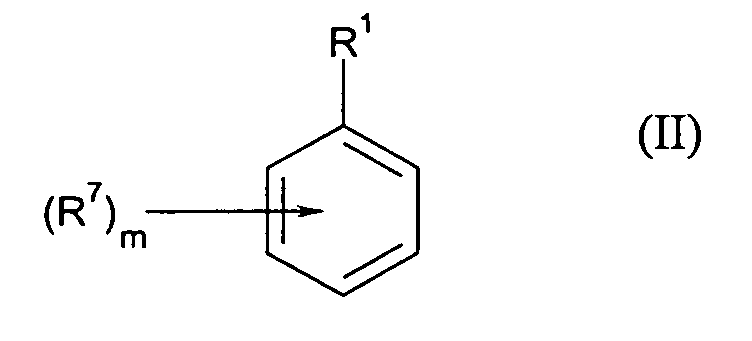
- R1, R7 und m
- die vorstehend genannte Bedeutung besitzen,
in der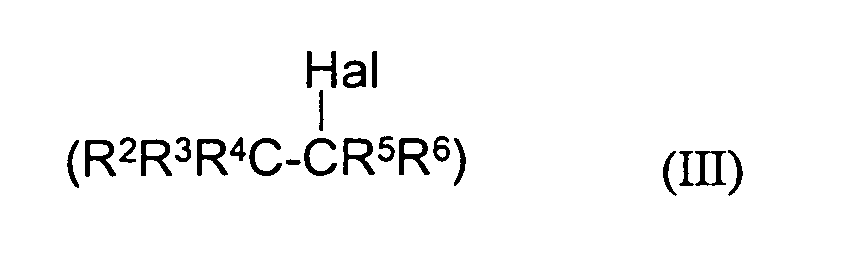
- R2, R3, R4, R5 und R6
- die vorstehend genannte Bedeutung besitzen und
- Hal
- für Brom oder Chlor steht und wobei die Umsetzung
- in einem mehrphasigen Reaktionsmedium, das eine wässrige Phase und zumindest eine, bevorzugt genau eine, organische Phase aufweist und
- in Gegenwart von Phasentransferkatalysator und
- in Gegenwart eines Reduktionsmittels und/oder Licht mit einer Wellenlänge von 400 nm oder weniger erfolgt.
- Verfahren nach Anspruch 1, dadurch gekennzeichnet, dass es in Gegenwart von Base durchgeführt wird.
- Verfahren nach Anspruch 2, dadurch gekennzeichnet, dass als Base Erdalkalioder Alkalimetall-hydroxide, -acetate, -phosphate, -hydrogenphosphate, - carbonate oder -hydrogencarbonate, Ammoniumsalze, Amine oder aromatische Stickstoffverbindungen eingesetzt werden.
- Verfahren nach mindestens einem der Ansprüche 1 bis 3, dadurch gekennzeichnet, dass R1 für NR7R8 steht.
- Verfahren nach mindestens einem der Ansprüche 1 bis 4, dadurch gekennzeichnet, dass R2, R3, R4 und R5 für Wasserstoff, Chlor, Fluor oder C1-C4-Perfluoralkyl stehen oder R2R3R4C-CR5R6 als Ganzes für einen cyclischen Polyfluoralkylrest mit insgesamt 4 bis 12 Kohlenstoffatomen steht.
- Verfahren nach mindestens einem der Ansprüche 1 bis 5, dadurch gekennzeichnet, dass n für 1 steht.
- Verfahren nach mindestens einem der Ansprüche 1 bis 6, dadurch gekennzeichnet, dass R7 jeweils unabhängig für C1-C4-Alkyl, Chlor, Fluor, Nitro, Cyano oder C1-C4-Alkoxy steht.
- Verfahren nach mindestens einem der Ansprüche 1 bis 7, dadurch gekennzeichnet, dass m für 1 oder 2 steht.
- Verfahren nach mindestens einem der Ansprüche 1 bis 8, dadurch gekennzeichnet, dass 2-Methyl-4-(heptafluor-2-propyl)-anilin, N,2-Dimethyl-4-(1,1,1,2,3,3,3-heptafluor-2-propyl)-anilin, 2-Methyl-4-(1-brom-1,1,2,3,3,3-hexafluor-2-propyl)-anilin, 2-Methyl-4-(2-brom-1,1,2,2-tetrafluorethyl)-anilin, sind 2-Methyl-4-(2-chlor-1,1,2,2-tetrafluorethyl)-anilin, sind 2-Methyl-4-(1-chlor-1,1,2,3,3,3-hexafluor-2-propyl)-anilin, sind 2-Methyl-4-(2-brom-2-chlor-trifluorethyl)-anilin, 2-Methyl-4-(2-brom-1-chlor-trifluorethyl)-anilin, 2-Methyl-4-(3-brom-2,3-dichlor-1,1,1,4,4,4-hexafluor-2-butyl)-anilin, 2-Methyl-4-(2-chlor-3,3,4,4-tetrafluor-cyclobutyl)-anilin, 2-Methyl-4-(2-chlor-3,3,4,4,5,5-hexafluor-cyclopentyl)-anilin, 2-Methyl-4-(2-brom-3,3,4,4-tetrafluor-cyclobutyl)-anilin, 2-Methyl-4-(2-brom-3,3,4,4,5,5-hexafluorcyclopentyl)-anilin, Essigsäure-2-methyl-4-(1-brom-1,1,2,3,3,3-hexafluor-2-propyl)-anilid, 2-Methyl-4-(2-brom-1,1,1,2,3,4,4,4-octafluor-3-butyl)-anilin oder 2-Methyl-4-(2-brom-2,3,3,4,4,5,5-octafluorcyclo-1-pentyl)-anilin hergestellt werden.
- Verfahren nach mindestens einem der Ansprüche 1 bis 9, dadurch gekennzeichnet, dass als Verbindungen der Formel (III) Heptafluor-2-brom-propan, Heptafluor-2-chlor-propan, 1,2-Dibromtetrafluorethan, 1,2-Dibrom-1-chlortrifluorethan, 2,3-Dibrom-octafluorbutan, 2,3-Dibrom-2,3-dichlorhexafluorbutan, 2,3-Dibrom-2,3-dichlorhexafluorbutan, 2,3-Dibrom-1,1,1,3,4,4,4-heptafluorbutan, 2,3-Dibrom-2-chlor-1,1,1,4,4,4-hexafluorbutan, 1,2-Dibromhexafluorpropan und 1,2-Dichlorhexafluorpropan eingesetzt werden.
- Verfahren nach mindestens einem der Ansprüche 1 bis 10, dadurch gekennzeichnet, dass als organische Lösungsmittel für mehrphasige Reaktionsmedien aliphatische oder aromatische, gegebenenfalls halogenierte Kohlenwasserstoffe, Ether, Ketone und Ester eingesetzt werden.
- Verfahren nach mindestens einem der Ansprüche 1 bis 11, dadurch gekennzeichnet, dass als Phasentransferkatalysatoren Kronenether, wie 18-Krone-6, 12-Krone-4, Dibenzo-18-Krone-6 oder Dibenzo-12-Krone-4, Kryptanden wie Kryptand[2.2.2] oder Podanden wie Polyglykolether oder solche der Formel (IV) eingesetzt werden,
- (Kation+)
- für substituierte quartäre Ammonium oder Phosphonium-Kationen und
- (Anion-)
- für das Anion einer organischen oder anorganischen Säure steht.
- Verfahren nach Anspruch 12, dadurch gekennzeichnet, dass als Phasentransferkatalysatoren solche der Formel (IV) eingesetzt werden, in denen (Kation+) für Kationen der Formel (V) steht
Alkyl)-O]v-(C1-C6-Alkyl)}t)]+
Pnyc für Stickstoff oder Phosphor steht und
in denen jeweils (q+r+s+t) = 4 ist. - Verfahren nach mindestens einem der Ansprüche 1 bis 13, dadurch gekennzeichnet, dass die Reaktionstemperatur -10°C bis zum Siedepunkt des Reaktionsmediums unter Reaktionsdruck, maximal jedoch 200°C beträgt und der Reaktionsdruck 0,5 bis 100 bar beträgt.
- Verfahren nach mindestens einem der Ansprüche 1 bis 14, dadurch gekennzeichnet, dass als Reduktionsmittel Schwefelverbindungen in den gemittelten formalen Oxidationsstufen +III, +IV und +V gegebenenfalls in Mischung mit einem Metall eingesetzt werden, das ein Standardreduktionspotential von 0 V oder weniger besitzt.
- Verfahren nach mindestens einem der Ansprüche 1 bis 15, dadurch gekennzeichnet, dass Alkalimetalldithionite eingesetzt werden.
- Verfahren nach mindestens einem der Ansprüche 1 bis 16, dadurch gekennzeichnet, dass in einem Folgeschritt Verbindungen der Formel (I), in denen der Rest R2R3R4C-CR5R6 noch mindestens ein Chlor- oder Brom-atom trägt durch Umsetzung mit ionischem Fluorid zu Verbindungen der Formel (I) umgesetzt werden, in denen mindestens ein Chlor- oder Brom-atom durch ein Fluoratom ersetzt sind.
- Verfahren nach Anspruch 17, dadurch gekennzeichnet, dass als ionisches Fluorid quartäre Ammonium- oder Phosphoniumfluoride sowie Alkalimetallfluoride oder Mischungen der genannten Verbindungen oder Mischungen von Phasentransferkatalysatoren und/oder Halex-Katalysatoren mit Alkalimetallfluoriden eingesetzt werden.
- Verfahren nach mindestens einem der Ansprüche 17 und 18, dadurch gekennzeichnet, dass der Halogenaustausch in Gegenwart von organischem Lösungsmittel durchgeführt wird, wobei die Lösungsmittel Ketone, Nitrile, Amide, Sulfoxide, Sulfone, Polyether oder Gemischen solcher organischen Lösungsmittel sind.
- Verbindungen der Formel (XI),in der

R2, R3, R4, R5, R6, R7, R8 und R9 sowie m und n die gleiche Bedeutungen besitzen, die im Anspruch 1 angegeben sind, wobei die Auflage gilt, dass entwederund wobei weiterhin Verbindungen ausgenommen sind, in denen R2R3R4C-CR5R6 als Ganzes einen Perfluoralkylrest darstellt.der Rest R2R3R4C-CR5R6 bezogen auf das Kohlenstoffgerüst ein sekundärer oder tertiärer Rest ist oderein primärer Rest ausgewählt aus der 2-Brom-1,1,2,2-tetrafluorethyl, 2-Chlor-1,1,2,2-tetrafluorethyl, 2-Brom-2-chlor-trifluorethyl und 2-Brom-1-chlor-trifluorethyl ist - 2-Methyl-4-(1-brom-1,1,2,3,3,3-hexafluor-2-propyl)-anilin, 2-Methyl-4-(2-brom-1, 1,2,2-tetrafluorethyl)-anilin, 2-Methyl-4-(2-chlor-1,1,2,2-tetrafluorethyl)-anilin, 2-Methyl-4-(1-chlor-1,1,2,3,3,3-hexafluor-2-propyl)-anilin, 2-Methyl-4-(2-brom-2-chlor-trifluorethyl)-anilin, 2-Methyl-4-(2-brom-1-chlortrifluorethyl)-anilin, 2-Methyl-4-(3-brom-2,3-dichlor-1,1,1,4,4,4-hexafluor-2-butyl)-anilin, 2-Methyl-4-(2-chlor-3,3,4,4-tetrafluor-cyclobutyl)-anilin, 2-Methyl-4-(2-chlor-3,3,4,4,5,5-hexafluor-cyclopentyl)-anilin, 2-Methyl-4-(2-brom-3,3,4,4-tetrafluor-cyclobutyl)-anilin, 2-Methyl-4-(2-brom-3,3,4,4,5,5-hexafluor-cyclopentyl)-anilin, Essigsäure-2-methyl-4-(1-brom-1,1,2,3,3,3-hexafluor-2-propyl)-anilid, 2-Methyl-4-(2-brom-1,1,1,2,3,4,4,4-octafluor-3-butyl)-anilin und 2-Methyl-4-(2-brom-2,3,3,4,4,5,5-octafluorcyclo-1-pentyl)-anilin.
- Verbindungen der Formel (XII)
- (XIa)
- für Verbindungen der Formel (XI) gemäß Anspruch 20 steht, die zumindest eine primäre, sekundäre oder tertiäre Aminofunktion aufweisen und
- v
- für eine Zahl zwischen 1 und der Zahl der primären, sekundären oder tertiären Aminofunktionen im Molekül (XIa) steht und
- Y
- für ein Anion steht.
- Verwendung von Verbindungen nach mindestens einem der Ansprüche 20 und 21, nach Anspruch 22 oder solchen, die gemäß mindestens einem der Ansprüche 1 bis 19 hergestellt wurden in einem Verfahren zur Herstellung von Wirkstoffen.
- Verwendung nach Anspruch 23, dadurch gekennzeichnet, dass die Wirkstoffe Insektizide sind.
Applications Claiming Priority (2)
| Application Number | Priority Date | Filing Date | Title |
|---|---|---|---|
| DE10252273A DE10252273A1 (de) | 2002-11-11 | 2002-11-11 | Polyhalogenalkylaryle |
| DE10252273 | 2002-11-11 |
Publications (3)
| Publication Number | Publication Date |
|---|---|
| EP1418169A2 true EP1418169A2 (de) | 2004-05-12 |
| EP1418169A3 EP1418169A3 (de) | 2004-06-23 |
| EP1418169B1 EP1418169B1 (de) | 2009-02-25 |
Family
ID=32103423
Family Applications (1)
| Application Number | Title | Priority Date | Filing Date |
|---|---|---|---|
| EP03024919A Expired - Lifetime EP1418169B1 (de) | 2002-11-11 | 2003-10-29 | Verfahren zur Herstellung von Polyhalogenalkylaryl-Verbindungen |
Country Status (7)
| Country | Link |
|---|---|
| US (1) | US20040092762A1 (de) |
| EP (1) | EP1418169B1 (de) |
| JP (1) | JP4523263B2 (de) |
| CN (1) | CN100522903C (de) |
| AT (1) | ATE423759T1 (de) |
| DE (2) | DE10252273A1 (de) |
| ES (1) | ES2320747T3 (de) |
Cited By (1)
| Publication number | Priority date | Publication date | Assignee | Title |
|---|---|---|---|---|
| WO2006024412A3 (en) * | 2004-08-31 | 2006-04-27 | Bayer Cropscience Ag | Optically active phthalamides |
Families Citing this family (17)
| Publication number | Priority date | Publication date | Assignee | Title |
|---|---|---|---|---|
| CA2577942A1 (en) * | 2004-08-31 | 2006-03-09 | Bayer Cropscience Ag | Chiral 3-halophthalic acid derivatives |
| JP5003239B2 (ja) * | 2007-03-28 | 2012-08-15 | ダイキン工業株式会社 | 含フッ素アルキル(メタ)アクリレートの製造方法 |
| JP4998042B2 (ja) * | 2007-03-28 | 2012-08-15 | ダイキン工業株式会社 | 含フッ素アルキル(メタ)アクリレートの製造方法 |
| CN102140053B (zh) * | 2011-01-29 | 2013-07-31 | 锦州惠发天合化学有限公司 | 一种卤代烷烃的合成方法 |
| CN103044388B (zh) * | 2011-10-17 | 2015-04-15 | 张家港市国泰华荣化工新材料有限公司 | 一种3,4—二氟环丁砜的制备方法 |
| JP5895454B2 (ja) * | 2011-11-09 | 2016-03-30 | ユニマテック株式会社 | ω−ヨードパーフルオロアルキル置換アニリン誘導体およびその製造法 |
| CN102731321B (zh) * | 2012-07-10 | 2015-01-28 | 中化蓝天集团有限公司 | 一种2-甲基-4-(1,1,1,2,3,3,3-七氟-2-丙基)苯胺的制备方法 |
| CN102731317A (zh) * | 2012-07-10 | 2012-10-17 | 中化蓝天集团有限公司 | 一种全氟烷基化苯胺衍生物的制备方法 |
| BR112016000968B1 (pt) * | 2013-07-23 | 2021-05-18 | Bayer Cropscience Aktiengesellschaft | processo para a preparação de bifenilanilidas halogenadas |
| JP6286968B2 (ja) * | 2013-09-18 | 2018-03-07 | ダイキン工業株式会社 | パーフルオロ分岐アルキルアニリン類の製造方法 |
| CN104058928B (zh) * | 2014-06-19 | 2017-11-21 | 巨化集团技术中心 | 一种含溴氟代烷烃合成中提高装置生产能力的方法 |
| JP2017521441A (ja) | 2014-07-15 | 2017-08-03 | バイエル・アニマル・ヘルス・ゲゼルシャフト・ミット・ベシュレンクテル・ハフツングBayer Animal Health Gmbh | 有害生物防除剤としてのアリール−トリアゾリルピリジン類 |
| CN107285989A (zh) * | 2016-03-30 | 2017-10-24 | 中昊晨光化工研究院有限公司 | 一种1,2-二溴六氟丙烷的制备方法 |
| CN106748807B (zh) * | 2017-01-16 | 2019-03-05 | 衢州学院 | 一种高纯度2-甲基-4-七氟异丙基苯胺制备方法 |
| JP6493484B2 (ja) * | 2017-10-25 | 2019-04-03 | ダイキン工業株式会社 | パーフルオロ分岐アルキルアニリン類の製造方法 |
| RU2743462C1 (ru) * | 2020-07-15 | 2021-02-18 | Общество С Ограниченной Ответственностью «Агратек Био» (Ооо «Агратек Био») | Состав для стимулирования роста растений и устойчивости к стрессовым факторам |
| CN115073300B (zh) * | 2021-03-10 | 2024-04-05 | 江西天宇化工有限公司 | 一种4-(全氟丙烷-2-基)-2-三氟甲基苯胺及其制备方法和应用 |
Family Cites Families (5)
| Publication number | Priority date | Publication date | Assignee | Title |
|---|---|---|---|---|
| DE1911610A1 (de) * | 1969-03-07 | 1970-10-01 | Hoechst Ag | Harnstoffderivate,ihre Herstellung und Anwendung als Herbizide |
| DE3669709D1 (de) * | 1985-05-22 | 1990-04-26 | Rhone Poulenc Chimie | Verfahren zur perfluoralkylierung von aromatischen derivaten. |
| FR2617159B1 (fr) * | 1987-06-23 | 1989-10-27 | Rhone Poulenc Chimie | Procede de perhalogenoalkylation de derives aromatiques |
| AU731777B2 (en) * | 1998-11-30 | 2001-04-05 | Nihon Nohyaku Co., Ltd. | Aniline derivative and process for producing the same |
| JP4217948B2 (ja) * | 2001-05-18 | 2009-02-04 | 日本農薬株式会社 | 置換芳香族アミド誘導体、その中間体及び農園芸用殺虫剤並びにその使用方法 |
-
2002
- 2002-11-11 DE DE10252273A patent/DE10252273A1/de not_active Withdrawn
-
2003
- 2003-10-29 EP EP03024919A patent/EP1418169B1/de not_active Expired - Lifetime
- 2003-10-29 ES ES03024919T patent/ES2320747T3/es not_active Expired - Lifetime
- 2003-10-29 AT AT03024919T patent/ATE423759T1/de not_active IP Right Cessation
- 2003-10-29 DE DE50311208T patent/DE50311208D1/de not_active Expired - Lifetime
- 2003-11-07 US US10/703,835 patent/US20040092762A1/en not_active Abandoned
- 2003-11-11 JP JP2003381135A patent/JP4523263B2/ja not_active Expired - Fee Related
- 2003-11-11 CN CNB2003101148737A patent/CN100522903C/zh not_active Expired - Fee Related
Cited By (1)
| Publication number | Priority date | Publication date | Assignee | Title |
|---|---|---|---|---|
| WO2006024412A3 (en) * | 2004-08-31 | 2006-04-27 | Bayer Cropscience Ag | Optically active phthalamides |
Also Published As
| Publication number | Publication date |
|---|---|
| EP1418169A3 (de) | 2004-06-23 |
| EP1418169B1 (de) | 2009-02-25 |
| US20040092762A1 (en) | 2004-05-13 |
| DE50311208D1 (de) | 2009-04-09 |
| ES2320747T3 (es) | 2009-05-28 |
| DE10252273A1 (de) | 2004-05-27 |
| CN1498881A (zh) | 2004-05-26 |
| CN100522903C (zh) | 2009-08-05 |
| JP2004161768A (ja) | 2004-06-10 |
| ATE423759T1 (de) | 2009-03-15 |
| JP4523263B2 (ja) | 2010-08-11 |
Similar Documents
| Publication | Publication Date | Title |
|---|---|---|
| EP1418169B1 (de) | Verfahren zur Herstellung von Polyhalogenalkylaryl-Verbindungen | |
| DE10300112A1 (de) | Fluorierungsreagenzien und Verfahren zu deren Herstellung | |
| EP1418163A1 (de) | Verfahren zur Herstellung von Polyhalogenalkanen | |
| EP1418171B1 (de) | Process for the preparation of perfluoralkylanilines | |
| DE69205017T2 (de) | Verfahren zur Herstellung von 3,5-difluoro Anilin. | |
| DE3209878A1 (de) | Verfahren zur herstellung von diphenylaethern | |
| DE4311722C1 (de) | Verfahren zur Herstellung von Halogenmethyl-benzoylcyaniden und neue Halogenmethyl-benzoylcyanide | |
| DE3786452T2 (de) | Benzylether-Verbindungen und Verfahren zu ihrer Herstellung. | |
| DE2756560C2 (de) | Verfahren zur Herstellung von Piperonal | |
| DE69802176T2 (de) | ein neues verfahren für die Herstellung von 3-N,N-dicyclobutylamino-8-fluoro-3,4-dihydro-2H-1-benzopyran-5-carboxamide | |
| EP0748798B1 (de) | N-substituierte cis-N-propenyl-acetamide und Verfahren zu ihrer Herstellung | |
| DE69115758T2 (de) | Verfahren zur Herstellung von 3,5-Difluoranilin und dessen Derivat | |
| WO1994014757A1 (de) | Verfahren zur herstellung von hydroxylamin-ethern sowie deren salzen und zwischenprodukte hierfür | |
| CH630877A5 (de) | Verfahren zur herstellung von aromatischen fluorverbindungen. | |
| EP0693466A1 (de) | Verfahren zur Herstellung von aromatischen fluorierten Verbindungen und neue Diamide | |
| EP1544192B1 (de) | Fluorierungsreagenzien enthaltend 1-Fluor-1-aminoolefine, deren Herstellung und Verwendung | |
| EP1957443A2 (de) | Verfahren zur herstellung von sulfonamiden | |
| DE2924712A1 (de) | Verfahren zur herstellung von n-alkylbenzothiazolonderivaten | |
| DE10300113A1 (de) | α, α-Difluoramine und Difluormethylen-α, α-diazoverbindungen | |
| EP0559687B1 (de) | 2-amino-zimtsäureester | |
| EP0893444B1 (de) | Verfahren zur Herstellung von 2,2,3,3-Tetrafluor-1,4-benzodioxanen, neue o-(2-Brom-1,1,2,2,-tetrafluorethoxy)-phenole und neue 2-Brom-1,1,2,2-tetrafluorethoxy-gruppen enthaltende Phenylether | |
| EP0662474B1 (de) | Verfahren zur herstellung von chlorpyridinen | |
| AT360503B (de) | Verfahren zur herstellung von neuen 2-(2',2'- -dichlorvinyl)-cyclobutanonen | |
| DE3644798A1 (de) | Neue nitrohaloalkoxybenzole, verfahren zu ihrer herstellung und ihre verwendung | |
| EP1524261B1 (de) | Verfahren zur Herstellung von fluorhaltigen Anilinen |
Legal Events
| Date | Code | Title | Description |
|---|---|---|---|
| PUAI | Public reference made under article 153(3) epc to a published international application that has entered the european phase |
Free format text: ORIGINAL CODE: 0009012 |
|
| PUAL | Search report despatched |
Free format text: ORIGINAL CODE: 0009013 |
|
| AK | Designated contracting states |
Kind code of ref document: A2 Designated state(s): AT BE BG CH CY CZ DE DK EE ES FI FR GB GR HU IE IT LI LU MC NL PT RO SE SI SK TR |
|
| AX | Request for extension of the european patent |
Extension state: AL LT LV MK |
|
| AK | Designated contracting states |
Kind code of ref document: A3 Designated state(s): AT BE BG CH CY CZ DE DK EE ES FI FR GB GR HU IE IT LI LU MC NL PT RO SE SI SK TR |
|
| AX | Request for extension of the european patent |
Extension state: AL LT LV MK |
|
| 17P | Request for examination filed |
Effective date: 20041223 |
|
| AKX | Designation fees paid |
Designated state(s): AT BE BG CH CY CZ DE DK EE ES FI FR GB GR HU IE IT LI LU MC NL PT RO SE SI SK TR |
|
| RAP1 | Party data changed (applicant data changed or rights of an application transferred) |
Owner name: LANXESS DEUTSCHLAND GMBH |
|
| RAP1 | Party data changed (applicant data changed or rights of an application transferred) |
Owner name: SALTIGO GMBH |
|
| 17Q | First examination report despatched |
Effective date: 20050817 |
|
| RAP1 | Party data changed (applicant data changed or rights of an application transferred) |
Owner name: SALTIGO GMBH |
|
| GRAP | Despatch of communication of intention to grant a patent |
Free format text: ORIGINAL CODE: EPIDOSNIGR1 |
|
| RTI1 | Title (correction) |
Free format text: PROCESS FOR THE PREPARATION OF POLYHALOGENOALKYLARYL COMPOUNDS |
|
| GRAP | Despatch of communication of intention to grant a patent |
Free format text: ORIGINAL CODE: EPIDOSNIGR1 |
|
| GRAS | Grant fee paid |
Free format text: ORIGINAL CODE: EPIDOSNIGR3 |
|
| GRAA | (expected) grant |
Free format text: ORIGINAL CODE: 0009210 |
|
| AK | Designated contracting states |
Kind code of ref document: B1 Designated state(s): AT BE BG CH CY CZ DE DK EE ES FI FR GB GR HU IE IT LI LU MC NL PT RO SE SI SK TR |
|
| REG | Reference to a national code |
Ref country code: GB Ref legal event code: FG4D Free format text: NOT ENGLISH |
|
| REG | Reference to a national code |
Ref country code: CH Ref legal event code: EP |
|
| REG | Reference to a national code |
Ref country code: IE Ref legal event code: FG4D Free format text: LANGUAGE OF EP DOCUMENT: GERMAN |
|
| REF | Corresponds to: |
Ref document number: 50311208 Country of ref document: DE Date of ref document: 20090409 Kind code of ref document: P |
|
| REG | Reference to a national code |
Ref country code: ES Ref legal event code: FG2A Ref document number: 2320747 Country of ref document: ES Kind code of ref document: T3 |
|
| PG25 | Lapsed in a contracting state [announced via postgrant information from national office to epo] |
Ref country code: SI Free format text: LAPSE BECAUSE OF FAILURE TO SUBMIT A TRANSLATION OF THE DESCRIPTION OR TO PAY THE FEE WITHIN THE PRESCRIBED TIME-LIMIT Effective date: 20090225 Ref country code: FI Free format text: LAPSE BECAUSE OF FAILURE TO SUBMIT A TRANSLATION OF THE DESCRIPTION OR TO PAY THE FEE WITHIN THE PRESCRIBED TIME-LIMIT Effective date: 20090225 |
|
| PG25 | Lapsed in a contracting state [announced via postgrant information from national office to epo] |
Ref country code: SE Free format text: LAPSE BECAUSE OF FAILURE TO SUBMIT A TRANSLATION OF THE DESCRIPTION OR TO PAY THE FEE WITHIN THE PRESCRIBED TIME-LIMIT Effective date: 20090525 |
|
| PG25 | Lapsed in a contracting state [announced via postgrant information from national office to epo] |
Ref country code: DK Free format text: LAPSE BECAUSE OF FAILURE TO SUBMIT A TRANSLATION OF THE DESCRIPTION OR TO PAY THE FEE WITHIN THE PRESCRIBED TIME-LIMIT Effective date: 20090225 Ref country code: EE Free format text: LAPSE BECAUSE OF FAILURE TO SUBMIT A TRANSLATION OF THE DESCRIPTION OR TO PAY THE FEE WITHIN THE PRESCRIBED TIME-LIMIT Effective date: 20090225 Ref country code: CZ Free format text: LAPSE BECAUSE OF FAILURE TO SUBMIT A TRANSLATION OF THE DESCRIPTION OR TO PAY THE FEE WITHIN THE PRESCRIBED TIME-LIMIT Effective date: 20090225 Ref country code: PT Free format text: LAPSE BECAUSE OF FAILURE TO SUBMIT A TRANSLATION OF THE DESCRIPTION OR TO PAY THE FEE WITHIN THE PRESCRIBED TIME-LIMIT Effective date: 20090812 |
|
| PG25 | Lapsed in a contracting state [announced via postgrant information from national office to epo] |
Ref country code: RO Free format text: LAPSE BECAUSE OF FAILURE TO SUBMIT A TRANSLATION OF THE DESCRIPTION OR TO PAY THE FEE WITHIN THE PRESCRIBED TIME-LIMIT Effective date: 20090225 Ref country code: SK Free format text: LAPSE BECAUSE OF FAILURE TO SUBMIT A TRANSLATION OF THE DESCRIPTION OR TO PAY THE FEE WITHIN THE PRESCRIBED TIME-LIMIT Effective date: 20090225 |
|
| PLBE | No opposition filed within time limit |
Free format text: ORIGINAL CODE: 0009261 |
|
| STAA | Information on the status of an ep patent application or granted ep patent |
Free format text: STATUS: NO OPPOSITION FILED WITHIN TIME LIMIT |
|
| PG25 | Lapsed in a contracting state [announced via postgrant information from national office to epo] |
Ref country code: BG Free format text: LAPSE BECAUSE OF FAILURE TO SUBMIT A TRANSLATION OF THE DESCRIPTION OR TO PAY THE FEE WITHIN THE PRESCRIBED TIME-LIMIT Effective date: 20090525 |
|
| PGFP | Annual fee paid to national office [announced via postgrant information from national office to epo] |
Ref country code: ES Payment date: 20091117 Year of fee payment: 7 Ref country code: IE Payment date: 20091016 Year of fee payment: 7 |
|
| 26N | No opposition filed |
Effective date: 20091126 |
|
| PGFP | Annual fee paid to national office [announced via postgrant information from national office to epo] |
Ref country code: NL Payment date: 20091004 Year of fee payment: 7 |
|
| PGFP | Annual fee paid to national office [announced via postgrant information from national office to epo] |
Ref country code: GB Payment date: 20091028 Year of fee payment: 7 Ref country code: IT Payment date: 20091022 Year of fee payment: 7 |
|
| PG25 | Lapsed in a contracting state [announced via postgrant information from national office to epo] |
Ref country code: MC Free format text: LAPSE BECAUSE OF NON-PAYMENT OF DUE FEES Effective date: 20091031 |
|
| PGFP | Annual fee paid to national office [announced via postgrant information from national office to epo] |
Ref country code: BE Payment date: 20091019 Year of fee payment: 7 |
|
| PG25 | Lapsed in a contracting state [announced via postgrant information from national office to epo] |
Ref country code: GR Free format text: LAPSE BECAUSE OF FAILURE TO SUBMIT A TRANSLATION OF THE DESCRIPTION OR TO PAY THE FEE WITHIN THE PRESCRIBED TIME-LIMIT Effective date: 20090526 |
|
| PG25 | Lapsed in a contracting state [announced via postgrant information from national office to epo] |
Ref country code: AT Free format text: LAPSE BECAUSE OF NON-PAYMENT OF DUE FEES Effective date: 20091029 |
|
| PG25 | Lapsed in a contracting state [announced via postgrant information from national office to epo] |
Ref country code: LU Free format text: LAPSE BECAUSE OF NON-PAYMENT OF DUE FEES Effective date: 20091029 |
|
| BERE | Be: lapsed |
Owner name: SALTIGO G.M.B.H. Effective date: 20101031 |
|
| REG | Reference to a national code |
Ref country code: NL Ref legal event code: V1 Effective date: 20110501 |
|
| GBPC | Gb: european patent ceased through non-payment of renewal fee |
Effective date: 20101029 |
|
| PG25 | Lapsed in a contracting state [announced via postgrant information from national office to epo] |
Ref country code: HU Free format text: LAPSE BECAUSE OF FAILURE TO SUBMIT A TRANSLATION OF THE DESCRIPTION OR TO PAY THE FEE WITHIN THE PRESCRIBED TIME-LIMIT Effective date: 20090826 |
|
| REG | Reference to a national code |
Ref country code: IE Ref legal event code: MM4A |
|
| PG25 | Lapsed in a contracting state [announced via postgrant information from national office to epo] |
Ref country code: NL Free format text: LAPSE BECAUSE OF NON-PAYMENT OF DUE FEES Effective date: 20110501 Ref country code: BE Free format text: LAPSE BECAUSE OF NON-PAYMENT OF DUE FEES Effective date: 20101031 Ref country code: TR Free format text: LAPSE BECAUSE OF FAILURE TO SUBMIT A TRANSLATION OF THE DESCRIPTION OR TO PAY THE FEE WITHIN THE PRESCRIBED TIME-LIMIT Effective date: 20090225 Ref country code: GB Free format text: LAPSE BECAUSE OF NON-PAYMENT OF DUE FEES Effective date: 20101029 |
|
| PG25 | Lapsed in a contracting state [announced via postgrant information from national office to epo] |
Ref country code: CY Free format text: LAPSE BECAUSE OF FAILURE TO SUBMIT A TRANSLATION OF THE DESCRIPTION OR TO PAY THE FEE WITHIN THE PRESCRIBED TIME-LIMIT Effective date: 20090225 |
|
| PG25 | Lapsed in a contracting state [announced via postgrant information from national office to epo] |
Ref country code: IE Free format text: LAPSE BECAUSE OF NON-PAYMENT OF DUE FEES Effective date: 20101029 |
|
| REG | Reference to a national code |
Ref country code: ES Ref legal event code: FD2A Effective date: 20111118 |
|
| PG25 | Lapsed in a contracting state [announced via postgrant information from national office to epo] |
Ref country code: IT Free format text: LAPSE BECAUSE OF NON-PAYMENT OF DUE FEES Effective date: 20101029 |
|
| PG25 | Lapsed in a contracting state [announced via postgrant information from national office to epo] |
Ref country code: ES Free format text: LAPSE BECAUSE OF NON-PAYMENT OF DUE FEES Effective date: 20101030 |
|
| REG | Reference to a national code |
Ref country code: DE Ref legal event code: R082 Ref document number: 50311208 Country of ref document: DE Representative=s name: WICHMANN, BIRGID, DIPL.-CHEM. DR.RER.NAT., DE |
|
| REG | Reference to a national code |
Ref country code: DE Ref legal event code: R081 Ref document number: 50311208 Country of ref document: DE Owner name: SALTIGO GMBH, DE Free format text: FORMER OWNER: SALTIGO GMBH, 40764 LANGENFELD, DE Effective date: 20131213 Ref country code: DE Ref legal event code: R082 Ref document number: 50311208 Country of ref document: DE Representative=s name: WICHMANN, BIRGID, DIPL.-CHEM. DR.RER.NAT., DE Effective date: 20131213 |
|
| REG | Reference to a national code |
Ref country code: FR Ref legal event code: PLFP Year of fee payment: 13 |
|
| REG | Reference to a national code |
Ref country code: FR Ref legal event code: PLFP Year of fee payment: 14 |
|
| REG | Reference to a national code |
Ref country code: FR Ref legal event code: PLFP Year of fee payment: 15 |
|
| PGFP | Annual fee paid to national office [announced via postgrant information from national office to epo] |
Ref country code: FR Payment date: 20170918 Year of fee payment: 15 |
|
| PGFP | Annual fee paid to national office [announced via postgrant information from national office to epo] |
Ref country code: DE Payment date: 20171025 Year of fee payment: 15 |
|
| PGFP | Annual fee paid to national office [announced via postgrant information from national office to epo] |
Ref country code: CH Payment date: 20171013 Year of fee payment: 15 |
|
| REG | Reference to a national code |
Ref country code: DE Ref legal event code: R119 Ref document number: 50311208 Country of ref document: DE |
|
| REG | Reference to a national code |
Ref country code: CH Ref legal event code: PL |
|
| PG25 | Lapsed in a contracting state [announced via postgrant information from national office to epo] |
Ref country code: DE Free format text: LAPSE BECAUSE OF NON-PAYMENT OF DUE FEES Effective date: 20190501 |
|
| PG25 | Lapsed in a contracting state [announced via postgrant information from national office to epo] |
Ref country code: FR Free format text: LAPSE BECAUSE OF NON-PAYMENT OF DUE FEES Effective date: 20181031 Ref country code: LI Free format text: LAPSE BECAUSE OF NON-PAYMENT OF DUE FEES Effective date: 20181031 Ref country code: CH Free format text: LAPSE BECAUSE OF NON-PAYMENT OF DUE FEES Effective date: 20181031 |