EP1390267B1 - Tüte für lebensmittel mit sichtfenster - Google Patents
Tüte für lebensmittel mit sichtfenster Download PDFInfo
- Publication number
- EP1390267B1 EP1390267B1 EP01986944A EP01986944A EP1390267B1 EP 1390267 B1 EP1390267 B1 EP 1390267B1 EP 01986944 A EP01986944 A EP 01986944A EP 01986944 A EP01986944 A EP 01986944A EP 1390267 B1 EP1390267 B1 EP 1390267B1
- Authority
- EP
- European Patent Office
- Prior art keywords
- bag
- layer
- composite material
- area
- bread
- Prior art date
- Legal status (The legal status is an assumption and is not a legal conclusion. Google has not performed a legal analysis and makes no representation as to the accuracy of the status listed.)
- Expired - Lifetime
Links
- 239000002131 composite material Substances 0.000 claims abstract description 42
- 239000001913 cellulose Substances 0.000 claims abstract description 21
- 229920002678 cellulose Polymers 0.000 claims abstract description 21
- 235000013305 food Nutrition 0.000 claims abstract description 15
- 229920003023 plastic Polymers 0.000 claims abstract description 15
- 239000004033 plastic Substances 0.000 claims abstract description 15
- 239000000463 material Substances 0.000 claims abstract description 13
- 235000011888 snacks Nutrition 0.000 claims abstract description 4
- 235000008429 bread Nutrition 0.000 claims description 25
- 229920001684 low density polyethylene Polymers 0.000 description 11
- 239000004702 low-density polyethylene Substances 0.000 description 11
- 238000004806 packaging method and process Methods 0.000 description 5
- 238000004519 manufacturing process Methods 0.000 description 4
- 238000004026 adhesive bonding Methods 0.000 description 3
- 239000000123 paper Substances 0.000 description 3
- 230000001737 promoting effect Effects 0.000 description 3
- 230000000694 effects Effects 0.000 description 2
- 229920000092 linear low density polyethylene Polymers 0.000 description 2
- 239000004707 linear low-density polyethylene Substances 0.000 description 2
- 230000014759 maintenance of location Effects 0.000 description 2
- 238000000034 method Methods 0.000 description 2
- 238000007789 sealing Methods 0.000 description 2
- 238000003466 welding Methods 0.000 description 2
- 241000251468 Actinopterygii Species 0.000 description 1
- 239000004698 Polyethylene Substances 0.000 description 1
- 235000015173 baked goods and baking mixes Nutrition 0.000 description 1
- 235000012785 bread rolls Nutrition 0.000 description 1
- 235000013351 cheese Nutrition 0.000 description 1
- 239000011248 coating agent Substances 0.000 description 1
- 238000000576 coating method Methods 0.000 description 1
- 238000013270 controlled release Methods 0.000 description 1
- 230000001419 dependent effect Effects 0.000 description 1
- 238000011161 development Methods 0.000 description 1
- 230000018109 developmental process Effects 0.000 description 1
- 238000001035 drying Methods 0.000 description 1
- 235000019688 fish Nutrition 0.000 description 1
- 235000012490 fresh bread Nutrition 0.000 description 1
- 230000005484 gravity Effects 0.000 description 1
- 230000036541 health Effects 0.000 description 1
- 235000013372 meat Nutrition 0.000 description 1
- 229930014626 natural product Natural products 0.000 description 1
- 239000005022 packaging material Substances 0.000 description 1
- 239000010816 packaging waste Substances 0.000 description 1
- 239000011088 parchment paper Substances 0.000 description 1
- -1 polyethylene Polymers 0.000 description 1
- 229920000573 polyethylene Polymers 0.000 description 1
- 238000003825 pressing Methods 0.000 description 1
- 238000004064 recycling Methods 0.000 description 1
- 239000007787 solid Substances 0.000 description 1
- 235000013311 vegetables Nutrition 0.000 description 1
- 230000036642 wellbeing Effects 0.000 description 1
Images

Classifications
-
- B—PERFORMING OPERATIONS; TRANSPORTING
- B65—CONVEYING; PACKING; STORING; HANDLING THIN OR FILAMENTARY MATERIAL
- B65D—CONTAINERS FOR STORAGE OR TRANSPORT OF ARTICLES OR MATERIALS, e.g. BAGS, BARRELS, BOTTLES, BOXES, CANS, CARTONS, CRATES, DRUMS, JARS, TANKS, HOPPERS, FORWARDING CONTAINERS; ACCESSORIES, CLOSURES, OR FITTINGS THEREFOR; PACKAGING ELEMENTS; PACKAGES
- B65D33/00—Details of, or accessories for, sacks or bags
- B65D33/04—Windows or other apertures, e.g. for viewing contents
Definitions
- the present invention relates to a bag for wrapping food, in particular of bread, rolls and snacks with at least one viewing window.
- food packaging has the task of protecting the product from drying out and loss of aroma as well as from harmful external influences. In addition, they must be safe for health. In terms of the shelf life and freshness of the bread, on the one hand it is important that the bread, bread rolls, the snack does not dry out and on the other hand that the crust of the bread nevertheless remains crispy and tasty to the consumer.
- Fresh bread is usually wrapped in bakery paper bows or packaged in bags of paper or plastic or a composite material thereof.
- conventional paper envelopes is disadvantageous that the cut edge of the cut bread is dry and hard after a few hours.
- plastic wrappers on the other hand, the moisture of the bread is held, but the crust absorbs the moisture and thus becomes soft and rubbery.
- the customer has no sense of well-being when a natural product such as bread is packed in a perceptible plastic packaging.
- a bag for food which ensures a sufficiently long shelf life and freshness of a food, especially bread with ease of handling.
- the bag is made of a composite material having at least a first layer of a cellulose-containing material and a second layer of plastic, wherein the first layer has a specific gravity of 15 to 40 g / m 2 and the second layer has a thickness of 6 to 20 ⁇ m, and wherein the composite material is perforated and the ratio of open to closed area of the composite material is between 1/50 and 1/250.
- this bag is breathable through the perforation of the composite in a certain way.
- so much moisture can escape from the bag that, for example, the crust of bread can release the moisture absorbed by the interior of the bread.
- only so little moisture escapes that a sliced bread still has sufficient moisture even after four days, so it is still tasty for the consumer.
- the moisture exchange between bag interior and the environment can be adjusted.
- the moisture transfer from the interior of the bag to the environment is low, while with a high ratio of moisture transfer is large.
- the bag may be used in accordance with selected ratio of open area to the total surface area of the composite material for packaging still oven-warm bread or for packaging the already cooled bread on sale.
- a cellulose-containing layer with a plastic layer, in addition to a controlled release of moisture and a light protection is effected. Also, the cellulose-containing layer, if it is outside, feels more pleasant than a plastic layer, and is also easily printable.
- the composite material is sufficiently tear-resistant and minimized in its mass, so that the packaging waste produced is very small if the bag can no longer be used.
- This bag can be used not only for keeping bread fresh, but also for other foods such as cold cuts, cheese, vegetables, meat or fish.
- the first layer of the composite material preferably consists of paper or cellulose.
- the plastic of the second layer is preferably made of a polyethylene, in particular an LDPE (low-density polyethylene) having a density of 0.915 to 0.925 g / cm 3 or a LLDPE (linear low-density polyethylene) having a density of 0.92 to 0.935 g / cm 3 .
- LDPE low-density polyethylene
- LLDPE linear low-density polyethylene
- the plastic layer especially in bags for baked goods to be packed loaves should be temperature resistant to at least 120 ° C, so that the bread can be packed as soon as possible after removal from the oven.
- the first and second layers may be releasably bonded together so that the composite material can be disassembled as much as possible into its components. This results in particular advantages in recycling.
- the layers of the composite material may also be firmly bonded together, for example in the form that the plastic layer is vapor-deposited on the cellulose-containing layer.
- the bag may have at least one seam in its longitudinal orientation. If, in particular, the second layer forms the inside of the bag, the seam can be formed by sealing, gluing and / or welding the second layer. By welding, gluing and / or sealing the contiguous plastic layers, the overlying first layer of the cellulose-containing material is also bonded to the second layer at the location of the seam. Thus, even with fundamentally detachable layers, the stability and strength of the bag is guaranteed.
- the superimposed composite material on the bottom side of the bag is preferably taken with a double seam in each other.
- the superimposed by folding first layers of the composite material can then be glued together, so that even here a solid bond is possible just in an otherwise dissolvable composite material.
- the invention is based on the object to provide an improved bag for food.
- the invention makes it possible to realize one or more viewing windows on a bag for wrapping food, in particular bread, of a composite material, characterized in that the first layer of the composite material of the cellulose-containing material is interrupted at one or more points. Where the layer of the pulp-containing material is interrupted, the wall of the bag is formed only by the second layer of the composite material made of plastic, which is transparent, perforated or unperforated.
- the interruption of the first layer of the composite material of pulp-containing material does not significantly affect the freshness retention properties of the bag according to the invention, especially not if the size of the interruption does not exceed approximately 1/2, preferably 1/3 of the total bag surface area.
- the keep-fresh property in advantageously be associated with a sales promotional presentation of wrapped by the bag food.
- the second layer of composite material may be perforated or unperforated, which in turn surprisingly does not significantly affect the freshness retention properties of the bag of the present invention unless the area of interruption is significantly above 1/2, preferably 1/3 of the total bag volume. Surface is. Particularly good results are achieved when the second layer is also perforated in the area of the interruption.
- the viewing window or windows can be realized by interrupting the first layer of the pulp-containing material at any point of the bag.
- a middle region of the bag is provided with a viewing window.
- This area can for example be rectangular or strip-shaped over the entire length of the bag.
- This embodiment is particularly suitable for the packaging of loaves, since the bags with the loaves are placed horizontally or obliquely on the shelf, so that the addressed consumer from above can view the bag loaf packed in the bag.
- the cellulose-containing material is recessed in at least one lateral region of the bag.
- This embodiment is particularly advantageous for the sale of sandwiches occupied, baguette and the like, since the side of the interruption of the layer of pulp-containing material, the covering of the roll or baguette is promotional promotional recognizable. Nevertheless, each of the freshness-preserving effect is maintained.
- Fig. 1 shows an embodiment of the bag 1 according to the invention made of a composite material.
- the composite material consists in the embodiment shown of an outer layer Cellulose with a specific weight of about 30 g / m 2 and an inner, about 8 ⁇ m thick layer of LDPE.
- the LDPE layer is applied directly from a blown film extruder on the cellulose layer and adhered and / or glued by selective pressing of the extruded LDPE layer to the cellulose layer during the coating.
- the bag consists of a multiply folded rectangular sheet of composite material that is folded several times in the longitudinal direction so that the LDPE layer forms the inner layer of the bag.
- the inner LDPE layer is thermally sealed at the adjacent free ends of the sheet in the longitudinal direction so that the bag has a seam in the longitudinal direction. Due to the seal, the cellulose layer in the area of the seam is firmly connected to the underlying LDPE layer.
- the superimposed composite material on the bottom side of the bag is wrapped with a double seam into each other and the superimposed by folding outer sides of the composite material are glued together.
- the bag has a regular perforation, which is formed by arranged in different parallel rows holes with a diameter of about 1 mm and a distance of about 15 mm, the rows have a distance of about 15 mm to each other.
- the production of the bag is preferably carried out according to an in-line method.
- the perforation is either applied to the composite prior to processing to the bag with a needle roller, or the bag made from the composite is directly rolled.
- a tubular bag can be carried out so that first a layer of composite material and a layer of composite material is cut with an interruption of the first layer. The two layers are then placed on top of each other and at three outer edges welded together. Due to the interruption of the first layer in the one layer of composite material then results in a bag with viewing window. Alternatively, there is one layer of composite material and the other layer only of the second layer. In this case you get a bag with a viewing window, which occupies 1 ⁇ 2 of the total bag surface.
- the bag 1 has in its central region 2 a strip-shaped interruption of the outer layer of cellulose, so that in this region 2, the wall of the bag is formed only by the LDPE layer. Since the LDPE layer is transparent, this central region 2 thus acts as a viewing window.
- the interruption of the cellulose layer can be realized in the manufacture of the composite material by selecting the widths of the cellulose and LDPE layers fixed to each other with a gluing process.
- the outer layer of cellulose may also be interrupted in one or more of the lateral regions 3 in order to attach lateral viewing windows to the bag 1.
Landscapes
- Engineering & Computer Science (AREA)
- Mechanical Engineering (AREA)
- Bag Frames (AREA)
- Wrappers (AREA)
- Packages (AREA)
- Control And Other Processes For Unpacking Of Materials (AREA)
- Laminated Bodies (AREA)
- Supplying Of Containers To The Packaging Station (AREA)
- Bakery Products And Manufacturing Methods Therefor (AREA)
- Packging For Living Organisms, Food Or Medicinal Products That Are Sensitive To Environmental Conditiond (AREA)
Description
- Die vorliegende Erfindung betrifft eine Tüte zum Umhüllen von Lebensmitteln, insbesondere von Brot, Brötchen und Snacks mit mindestens einem Sichtfenster.
- Lebensmittelverpackungen haben grundsätzlich die Aufgabe, das Produkt vor Austrocknen und Aromaverlust sowie vor schädlichen äußeren Einflüssen zu schützen. Außerdem müssen sie gesundheitlich unbedenklich sein. In Bezug auf die Haltbarkeit und Frische des Brotes kommt es einerseits darauf an, dass das Brot, Brötchen, der Snack nicht austrocknet und andererseits, dass die Kruste des Brotes trotzdem knusprig und für den Verbraucher wohlschmeckend bleibt.
- Frisches Brot wird in Bäckereien üblicherweise in Bögen aus Papier eingepackt oder in Tüten aus Papier oder Kunststoff oder einem Verbundmaterial daraus verpackt. Bei herkömmlichen Umhüllungen aus Papier ist nachteilig, dass die Schnittkante des angeschnittenen Brotes schon nach wenigen Stunden trocken und hart wird. Bei Kunststoffumhüllungen hingegen wird zwar die Feuchtigkeit des Brotes gehalten, jedoch nimmt die Kruste die Feuchtigkeit auf und wird dadurch weich und gummiartig. Darüber hinaus hat der Kunde kein Wohlempfinden, wenn ein Naturprodukt wie Brot in eine seh- und fühlbare Kunststoffverpackung eingepackt wird.
- Eine weitere Anforderung an eine Verpackung für Brot, insbesondere im Einsatz von Bäckereien, ist die leichte Handhabbarkeit. Das Brot soll zügig ohne großen Aufwand eingepackt werden können, damit der Kunde so effizient wie möglich bedient werden kann und alle Krümel in der Tüte bleiben und sich nicht auf dem Tisch verteilen.
- Auch kann die Anforderung bestehen, das Brot direkt nach dem Entnehmen aus dem Ofen noch backwarm zu verpacken. Herkömmlich eingesetzte Verpackungsmaterialien, insbesondere aus Kunststoff, sind hierfür nicht einsetzbar, da das Brot sehr schnell schimmlig wird, wenn es zu warm eingepackt wird.
- Aus der DE 197 120 52 C2 und der EP 0 867 379 A1 ist eine Tüte für Lebensmittel bekannt, die eine ausreichend lange Haltbarkeit und Frische eines Lebensmittels, insbesondere von Brot bei leichter Handhabbarkeit gewährleistet. Die Tüte besteht aus einem Verbundmaterial mit mindestens einer ersten Schicht aus einem zellstoffhaltigen Material und einer zweiten Schicht aus Kunststoff, wobei die erste Schicht ein spezifisches Gewicht von 15 bis 40 g/m2 und die zweite Schicht eine Dicke von 6 bis 20 µm aufweist, und wobei das Verbundmaterial perforiert ist sowie das Verhältnis von offener zu geschlossener Fläche des Verbundmaterials zwischen 1/50 und 1/250 liegt.
- Neben der leichten Handhabbarkeit ist ein besonderer Vorteil dieser Tüte, dass sie durch die Perforation des Verbundwerkstoffs in bestimmter Weise atmungsaktiv ist. Es erfolgt ein geregelter Austausch von Feuchte zwischen dem Tüteninneren und der Umgebung. Einerseits kann so viel Feuchte aus der Tüte entweichen, dass zum Beispiel die Kruste von Brot die vom Inneren des Brotes aufgenommene Feuchte abgeben kann. Andererseits entweicht aber nur so wenig Feuchte, dass ein angeschnittenes Brot selbst nach Ablauf von vier Tagen noch eine ausreichende Feuchte besitzt, so dass es für den Verbraucher immer noch schmackhaft ist.
- Über das Verhältnis von offener Fläche zur Gesamtfläche des Verbundmaterials, d. h. durch die Wahl von Lochgröße und Anzahl der Löcher pro Fläche, kann bei dieser vorbekannten Tüte der Feuchteaustausch zwischen Tüteninnerem und der Umgebung eingestellt werden. So ist bei einem kleinen Verhältnis von offener Fläche zu Gesamtfläche des Verbundmaterials der Feuchte Übergang von dem Tüteninneren zu der Umgebung gering, während bei großem Verhältnis der Feuchte Übergang groß ist. Dadurch kann die Tüte für verschiedene Brottypen - Brot mit harter oder weicher Kruste, saftiges oder härteres Brot - in seinen Eigenschaften optimal angepasst werden. Auch kann die Tüte bei entsprechen gewähltem Verhältnis von offener Fläche zur Gesamtfläche des Verbundmaterials zum Verpackung von noch ofenwarmen Brot oder aber zum Verpacken des bereits erkalteten Brotes im Verkauf eingesetzt werden.
- Durch die Kombination von einer zellstoffhaltigen Schicht mit einer Kunststoffschicht wird neben einer kontrollierten Abgabe von Feuchtigkeit auch ein Lichtschutz bewirkt. Auch fühlt sich die zellstoffhaltige Schicht, sofern sie außen liegt, angenehmer an als eine Kunststoffschicht, und ist zudem leicht bedruckbar.
- Das Verbundmaterial ist gleichzeitig ausreichend reißfest und in seiner Masse auf ein Minimum reduziert, so dass der anfallende Verpackungsmüll sehr gering ist, wenn die Tüte nicht mehr verwendet werden kann. Diese Tüte lässt sich nicht nur zum Frischhalten von Brot, sondern auch von anderen Lebensmitteln wie beispielsweise Aufschnitt, Käse, Gemüse, Fleisch oder Fisch nutzen.
- Die erste Schicht des Verbundmaterials besteht bevorzugt aus Papier oder Zellulose. Der Kunststoff der zweiten Schicht besteht vorzugsweise aus einem Polyethylen, wobei sich insbesondere ein LDPE (Low-Density-Polyethylen) mit einer Dichte von 0,915 bis 0,925 g / cm3 oder ein LLDPE (Linear-Low-Density-Polyethylen) mit einer Dichte von 0,92 bis 0,935 g/ cm3 eignet. Bei der Auswahl ist wesentlich die Reißfestigkeit und auch die Hitzebeständigkeit entscheidend.
- So sollte die Kunststoffschicht insbesondere bei Tüten für Backwaren zu verpackende Brote bis mindestens 120 °C temperaturbeständig sein, damit das Brot möglichst frühzeitig nach Herausnehmen aus dem Ofen eingepackt werden kann.
- Die erste und die zweite Schicht können lösbar miteinander verbunden sein, so dass das Verbundmaterial weitestgehend in seine Komponenten zerlegt werden kann. Hieraus ergeben sich insbesondere Vorteile beim Recycling. Die Schichten des Verbundmaterials können jedoch auch fest miteinander verbunden sein, beispielsweise in der Form, dass die Kunststoffschicht auf die zellstoffhaltige Schicht aufgedampft ist.
- Die Tüte kann in ihrer Längsausrichtung mindestens eine Naht aufweisen. Wenn dabei insbesondere die zweite Schicht die Innenseite der Tüte bildet, kann die Naht durch Versiegelung, Verkleben und/oder Verschweißen der zweiten Schicht gebildet werden. Durch das Verschweißen, Verkleben und/oder Versiegeln der aneinander liegenden Kunststoffschichten wird an der Stelle der Naht auch die darüber liegende erste Schicht aus dem zellstoffhaltigem Material mit der zweiten Schicht verbunden. Somit wird selbst bei grundsätzlich voneinander lösbaren Schichten die Stabilität und Festigkeit der Tüte gewährleistet.
- Das übereinander liegende Verbundmaterial an der Bodenseite der Tüte ist bevorzugt mit einer Doppelfalz in einander eingeschlagen. Die durch das Falzen aufeinander liegenden ersten Schichten des Verbundmaterials können dann miteinander verklebt werden, so dass auch hier ein fester Verbund gerade bei einem ansonsten voneinander lösbaren Verbundmaterial möglich ist.
- Bei der aus der DE 197 12 052 C2 bekannten Tüte wird eine Perforation mit Löchern eines mittleren Durchmessers von 0,3 mm bis 1,5 mm, beispielsweise 1 mm, bevorzugt. Bei dieser Lochgröße ist ein wirksamer Schutz des Brotes vor Lichteinflüssen und Verschmutzung bei gleichzeitigem Feuchteaustausch gewährleistet.
- Von der aus der DE 197 12 052 C2 bekannten Tüte für Lebensmittel ausgehend liegt der Erfindung die Aufgabe zu Grunde, eine verbesserte Tüte für Lebensmittel zu schaffen.
- Die der Erfindung zu Grunde liegende Aufgabe wird mit den Merkmalen des unabhängigen Schutzanspruchs 1 erfüllt. Bevorzugte Weiterbildungen der Erfindung sind in den abhängigen Schutzansprüchen angegeben.
- Die Erfindung erlaubt es, ein oder mehrere Sichtfenster auf einer Tüte zum Umhüllen von Lebensmitteln, insbesondere von Brot, aus einem Verbundmaterial zu realisieren, dadurch dass die erste Schicht des Verbundmaterials aus dem zellstoffhaltigen Material an ein oder mehreren Stellen unterbrochen ist. Dort wo die Schicht aus dem zellstoffhaltigem Material unterbrochen ist, wird die Wandung der Tüte nur durch die zweite Schicht des Verbundmaterials aus Kunststoff gebildet, welche transparent, gelocht oder auch ungelocht, ist.
- Dies ermöglicht eine vorteilhafte Präsentation des in der Tüte eingehüllten Lebensmittels, da es durch das oder die Sichtfenster in dem Verbundmaterial möglich ist, das Lebensmittel in Augenschein zu nehmen. Dieser Vorteil ist von besonderer Wichtigkeit bei dem Verkauf von Lebensmitteln im Selbstbedienungsbereich oder bei der Präsentation von Lebensmitteln auf Verkaufstheken.
- Überraschenderweise beeinflusst die Unterbrechung der ersten Schicht des Verbundmaterials aus zellstoffhaltigem Material die Frischhalte-Eigenschaften der erfindungsgemäßen Tüte nicht wesentlich, vor allem dann nicht, wenn die Größe der Unterbrechung ca. ½, vorzugsweise 1/3 der Gesamttüten-Oberfläche nicht überschreitet. Auf diese Art und Weise kann die Frischhalte-Eigenschaft in vorteilhafter Weise mit einer verkaufsfördernder Präsentation des von der Tüte eingehüllten Lebensmittels verbunden werden.
- Im Bereich der Unterbrechung der ersten Schicht des Verbundmaterials aus zellstoffhaltigem Material bildet also allein die zweite Schicht des Verbundmaterials aus Kunststoff die Wandung der Tüte. In diesem Bereich der Tüte kann die zweite Schicht des Verbundsmaterials aus Kunststoff gelocht oder auch ungelocht sein, was wiederum überraschenderweise die Frischhalte-Eigenschaften der erfindungsgemäßen Tüte nicht wesentlich beeinflusst, sofern der Bereich der Unterbrechung nicht wesentlich über ½, vorzugsweise 1/3 der Gesamttüten-Oberfläche beträgt. Besonders gute Ergebnisse werden dann erzielt, wenn die zweite Schicht auch in dem Bereich der Unterbrechung gelocht ausgeführt ist.
- Grundsätzlich kann das oder die Sichtfenster durch Unterbrechung der ersten Schicht aus dem zellstoffhaltigem Material an jeder beliebigen Stelle der Tüte realisiert werden.
- Nach einer bevorzugten Ausführungsform der Erfindung ist ein mittlerer Bereich der Tüte mit einem Sichtfenster versehen. Dieser Bereich kann beispielsweise rechteckig sein oder sich über die gesamte Länge der Tüte streifenförmig erstrecken. Diese Ausführungsform ist besonders geeignet für die Verpackung von Brotlaiben, da die Tüten mit den Brotlaiben waagerecht oder schräg ins Regal gelegt werden, so dass der angesprochene Verbraucher von oben das in der Tüte verpackte Brotlaib betrachten kann.
- In einer weiteren bevorzugten Ausführungsform der Erfindung ist in zumindest einem seitlichen Bereich der Tüte das zellstoffhaltige Material ausgespart. Diese Ausführungsform ist besonders vorteilhaft für den Verkauf von belegten Brötchen, belegten Baguette und dergleichen, da durch die seitliche Unterbrechung der Schicht aus zellstoffhaltigem Material der Belag des Brötchens oder Baguette verkaufsfördernd erkennbar ist. Trotzdem bleibt jeweils die Frischhalte-Wirkung erhalten.
- Der Gegenstand der Erfindung soll anhand eines bevorzugten Ausführungsbeispiels mit Bezugnahme auf die Fig. 1 näher erläutert werden.
- Die Fig. 1 zeigt eine Ausführungsform der erfindungsgemäßen Tüte 1 aus einem Verbundmaterial. Das Verbundmaterial besteht in dem gezeigten Ausführungsbeispiel aus einer äußeren Schicht aus Zellulose mit einem spezifischen Gewicht von ca. 30 g/ m2 sowie einer inneren, ca. 8µm starken Schicht aus LDPE.
- Bei der Herstellung eines solchen Verbundmaterials wird die LDPE- Schicht direkt aus einer Blasfolienextruder auf die Zelluloseschicht aufgebracht und durch punktuelles Andrücken der extrudierten LDPE- Schicht an die Zelluloseschicht während der Beschichtung angeheftet und/oder verklebt.
- Die Tüte besteht aus einem mehrfach gefalteten rechteckigen Bogen des Verbundmaterials, der in Längsrichtung mehrfach gefaltet ist, so dass die LDPE- Schicht die innere Schicht der Tüte bildet. Die innen liegende LDPE- Schicht ist an den aneinander liegenden freien Enden des Bogens in Längsrichtung thermisch versiegelt, so dass die Tüte in Längsrichtung eine Naht aufweist. Durch die Versiegelung ist die Zellulose- Schicht im Bereich der Naht mit der darunter befindlichen LDPE- Schicht fest verbunden. Das übereinander liegende Verbundmaterial an der Bodenseite der Tüte ist mit einer Doppelfalz ineinander eingeschlagen und die durch das Falzen aufeinander liegenden Außenseiten des Verbundmaterials sind miteinander verklebt.
- Die Tüte weist eine regelmäßige Perforation auf, die durch in verschiedenen parallelen Reihen angeordnete Löcher mit einem Durchmesser von ca. 1 mm und einem Abstand von ca. 15 mm gebildet wird, wobei die Reihen einen Abstand von ca. 15 mm zueinander haben. Das Verhältnis von offener zu gesamter Fläche ergibt sich hier aus
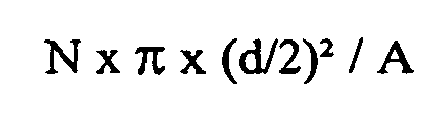
(N = Anzahl der Löcher; d = gemittelter Durchmesser der Löcher; A = Bezugsfläche)
- Die Herstellung der Tüte erfolgt vorzugsweise nach einem Inline-Verfahren. Die Perforation wird mit einer Nadelwalze entweder auf das Verbundmaterial vor seiner Verarbeitung zur Tüte aufgebracht oder es wird direkt die aus dem Verbundmaterial gefertigte Tüte gewalzt.
- Die Herstellung einer schlauchförmigen Tüte kann so erfolgen, dass zunächst jeweils eine Lage aus Verbundmaterial und eine Lage aus Verbundmaterial mit einer Unterbrechung der ersten Schicht zugeschnitten wird. Die beiden Lagen werden dann übereinander gebracht und an drei Aussenkanten miteinander verschweißt. Aufgrund der Unterbrechung der ersten Schicht in der einen Lage aus Verbundmaterial resultiert dann eine Tüte mit Sichtfenster. Alternativ besteht die eine Lage aus Verbundmaterial und die andere Lage nur aus der zweiten Schicht. In diesem Fall erhält man eine Tüte mit einem Sichtfenster, welches ½ der Gesamttüten-Oberfläche einnimmt.
- Die Tüte 1 weist in ihrem mittleren Bereich 2 eine streifenförmige Unterbrechung der äußeren Schicht aus Zellulose auf, so dass in diesem Bereich 2 die Wandung der Tüte nur durch die LDPE-Schicht gebildet wird. Da die LDPE- Schicht transparent ist, wirkt dieser mittlere Bereich 2 somit als Sichtfenster. Die Unterbrechung der Zelluloseschicht kann bei der Fertigung des Verbundmaterials dadurch realisiert werden, dass die Breiten der mit einem Klebevorgang aneinander fixierten Zellulose- und LDPE- Schichten entsprechend gewählt werden.
- Alternativ oder zusätzlich kann die äußere Schicht aus Zellulose auch in einem oder mehreren der seitlichen Bereiche 3 unterbrochen sein, um seitliche Sichtfenster an der Tüte 1 anzubringen.
Claims (5)
- Tüte zum Einhüllen von Lebensmitteln, insbesondere von Brot, Brötchen und Snacks, aus einem Verbundmaterial mit mindestens einer ersten Schicht aus einem zellstoffhaltigem Material und einer zweiten Schicht aus Kunststoff, wobei die zweite Schichte eine Dicke von 6 bis 20 µm aufweist, und wobei das Verbundmaterial perforiert ist, dadurch gekennzeichnet, dass die erste Schicht ein spezifisches Gewicht von 15 bis 50 g / m2, vorzugsweise von 15 bis 40 g / m2, aufweist, und dass das Verhältnis von offener Fläche zur Gesamtfläche des Verbundmaterials zwischen 1/50 und 1/250 liegt und die erste Schicht aus dem zellstoffhaltigem Material in zumindest einem Bereich (2, 3) zur Realisierung eines Sichtfensters unterbrochen ist, wobei das Sichtsfenster perforiert ist und das Sichtfenster zwischen 1/3 und ½ einer Gesamttüten -Oberfläche einnimmt.
- Tüte nach Anspruch 1 , dadurch gekennzeichnet, dass der Bereich im Wesentlichen rechteckig, kreisförmig, ellipsoid oder streifenförmig ausgebildet ist.
- Tüte nach Anspruch 1 und 2, dadurch gekennzeichnet, dass der Bereich im Wesentlichen in der Mitte der Tüte angeordnet ist.
- Tüte nach einem der vorhergehenden Ansprüche 1 bis 3, dadurch gekennzeichnet, dass der Bereich zumindest an einer der Tütenseiten angeordnet ist
- Tüte nach Anspruch 1, dadurch gekennzeichnet, dass das Sichtfenster streifenförmig ausgebildet ist.
Applications Claiming Priority (3)
| Application Number | Priority Date | Filing Date | Title |
|---|---|---|---|
| DE20108128U | 2001-05-14 | ||
| DE20108128U DE20108128U1 (de) | 2001-05-14 | 2001-05-14 | Tüte für Lebensmittel mit Sichtfenster |
| PCT/EP2001/015373 WO2002092448A1 (de) | 2001-05-14 | 2001-12-31 | Tüte für lebensmittel mit sichtfenster |
Publications (2)
| Publication Number | Publication Date |
|---|---|
| EP1390267A1 EP1390267A1 (de) | 2004-02-25 |
| EP1390267B1 true EP1390267B1 (de) | 2006-08-09 |
Family
ID=7956878
Family Applications (1)
| Application Number | Title | Priority Date | Filing Date |
|---|---|---|---|
| EP01986944A Expired - Lifetime EP1390267B1 (de) | 2001-05-14 | 2001-12-31 | Tüte für lebensmittel mit sichtfenster |
Country Status (13)
| Country | Link |
|---|---|
| US (1) | US6988829B2 (de) |
| EP (1) | EP1390267B1 (de) |
| JP (1) | JP4359869B2 (de) |
| CN (1) | CN1318271C (de) |
| AT (1) | ATE335676T1 (de) |
| CA (1) | CA2447250C (de) |
| DE (2) | DE20108128U1 (de) |
| ES (1) | ES2271096T3 (de) |
| MX (1) | MXPA03010378A (de) |
| NO (1) | NO327284B1 (de) |
| RU (1) | RU2003136071A (de) |
| WO (1) | WO2002092448A1 (de) |
| ZA (1) | ZA200308836B (de) |
Families Citing this family (18)
| Publication number | Priority date | Publication date | Assignee | Title |
|---|---|---|---|---|
| US20050269386A1 (en) * | 2004-05-28 | 2005-12-08 | Packaging Dynamics Operating Company | Food wrap |
| GB2418655B (en) * | 2004-10-01 | 2008-03-19 | Freshway Foods Ltd | Packaging for foodstuffs |
| US20060216382A1 (en) * | 2005-03-23 | 2006-09-28 | Santa Cruz Cathy D | Container and process for prolonging the edible lifespan of a food product |
| DE102005016476A1 (de) * | 2005-04-08 | 2006-10-12 | Reuther Verpackung Gmbh | Fensterbeutel sowie Verfahren zu dessen Herstellung |
| CN101077973B (zh) | 2006-05-26 | 2010-09-29 | 大连路明发光科技股份有限公司 | 硅酸盐荧光材料及其制造方法以及使用其的发光装置 |
| CA2552301C (en) * | 2006-07-12 | 2015-01-27 | Genpak Lp | Packaging roll stock with windows |
| DE102006040921A1 (de) * | 2006-08-31 | 2008-03-13 | Papier-Mettler Inhaber Michael Mettler | Verbundpapier sowie Beutel für Lebensmittel, insbesondere für vorgebackene Backwaren, enthaltend das Verbundpapier, und ein Verfahren zur Herstellung des Beutels |
| US20090071850A1 (en) * | 2007-09-18 | 2009-03-19 | Little Caesar Enterprises, Inc. | Packaging For Pizza |
| US20090310891A1 (en) * | 2008-06-13 | 2009-12-17 | Zenith Specialty Bag Co., Inc. | Food package and method of making same |
| US20100151090A1 (en) * | 2008-12-12 | 2010-06-17 | Arthur Thomas J | Packaged frozen precooked dough or batter-based food products and methodes |
| US20100237068A1 (en) * | 2009-03-17 | 2010-09-23 | Rubbermaid Incorporated | Container With In-Molded Exposed Panel |
| CA2746906A1 (en) * | 2011-07-20 | 2013-01-20 | Sacs Industriels Inc. | Takeout food bag |
| DE102013100131A1 (de) * | 2013-01-08 | 2014-07-10 | Windmöller & Hölscher Kg | Verfahren zum Herstellen von Säcken |
| CN103935072B (zh) * | 2014-04-14 | 2016-06-01 | 梁仙芳 | M夹边尖底淋膜预折痕导向纸袋的加工方法 |
| CN103879027B (zh) * | 2014-04-14 | 2016-05-11 | 张丹红 | 底部45度角粘合袋口预折痕尖底淋膜纸袋生产工艺 |
| US11897226B2 (en) | 2019-08-29 | 2024-02-13 | The Paper People LLC | Recyclable compostable paper bag |
| BR202020003666U2 (pt) * | 2020-02-20 | 2021-08-31 | Frederico Hygino De Oliveira Neto | Embalagem com visor transparente para acondicionar alimentos agrícolas |
| USD966903S1 (en) * | 2020-12-10 | 2022-10-18 | Leftcoast Innovations Llc | Retail packaging for consumable products |
Family Cites Families (13)
| Publication number | Priority date | Publication date | Assignee | Title |
|---|---|---|---|---|
| BE477573A (de) * | ||||
| US1770865A (en) * | 1928-04-11 | 1930-07-15 | Thomas M Royal | Method of manufacturing bags |
| US1868069A (en) * | 1931-07-16 | 1932-07-19 | Munson John Mitchell | Composite bag |
| US2158755A (en) * | 1936-09-16 | 1939-05-16 | Theodore A Hodgdon | Laminated sheet material for use in making paper bags or wrappers |
| BE477473A (de) | 1941-05-27 | |||
| US2745593A (en) * | 1952-10-02 | 1956-05-15 | Bemis Bro Bag Co | Bag |
| US3038651A (en) * | 1961-02-23 | 1962-06-12 | L I Snodgrass Company | Lined bag |
| FR1441107A (fr) * | 1965-07-20 | 1966-06-03 | Reuther Papierwerk Gmbh P | Sac d'emballage à fond en croix ou fond plat |
| CA2050145A1 (en) * | 1991-08-28 | 1993-03-01 | Daniel Beliveau | Perforated plastic bag for packaging fruits or vegetables |
| ES2092305T3 (es) * | 1992-04-27 | 1996-11-16 | Dowbrands Inc | Pelicula microperforada y bolsa envasadora fabricada a partir de la misma. |
| DE19712052C2 (de) | 1997-03-23 | 1999-04-01 | Moeller Karl Heinz | Tüte für Lebensmittel |
| US6033114A (en) * | 1998-01-20 | 2000-03-07 | Bagcraft Packaging, L.L.C. | Window bag with polyester lining and method of forming same |
| DE29812038U1 (de) * | 1998-03-14 | 1998-09-24 | Möller, Karl-Heinz, 65191 Wiesbaden | Tüte für Lebensmittel |
-
2001
- 2001-05-14 DE DE20108128U patent/DE20108128U1/de not_active Expired - Lifetime
- 2001-12-31 CN CNB018232515A patent/CN1318271C/zh not_active Expired - Fee Related
- 2001-12-31 WO PCT/EP2001/015373 patent/WO2002092448A1/de not_active Ceased
- 2001-12-31 DE DE50110726T patent/DE50110726D1/de not_active Expired - Lifetime
- 2001-12-31 AT AT01986944T patent/ATE335676T1/de active
- 2001-12-31 MX MXPA03010378A patent/MXPA03010378A/es active IP Right Grant
- 2001-12-31 ES ES01986944T patent/ES2271096T3/es not_active Expired - Lifetime
- 2001-12-31 RU RU2003136071/12A patent/RU2003136071A/ru not_active Application Discontinuation
- 2001-12-31 EP EP01986944A patent/EP1390267B1/de not_active Expired - Lifetime
- 2001-12-31 CA CA002447250A patent/CA2447250C/en not_active Expired - Lifetime
- 2001-12-31 JP JP2002589354A patent/JP4359869B2/ja not_active Expired - Fee Related
-
2003
- 2003-11-07 NO NO20034953A patent/NO327284B1/no not_active IP Right Cessation
- 2003-11-12 US US10/706,310 patent/US6988829B2/en not_active Expired - Lifetime
- 2003-11-13 ZA ZA2003/08836A patent/ZA200308836B/en unknown
Also Published As
| Publication number | Publication date |
|---|---|
| WO2002092448A1 (de) | 2002-11-21 |
| JP4359869B2 (ja) | 2009-11-11 |
| ES2271096T3 (es) | 2007-04-16 |
| CN1318271C (zh) | 2007-05-30 |
| US20040146225A1 (en) | 2004-07-29 |
| NO327284B1 (no) | 2009-06-02 |
| MXPA03010378A (es) | 2005-08-16 |
| NO20034953D0 (no) | 2003-11-07 |
| CA2447250A1 (en) | 2002-11-21 |
| DE20108128U1 (de) | 2001-08-02 |
| CN1507403A (zh) | 2004-06-23 |
| RU2003136071A (ru) | 2004-11-20 |
| DE50110726D1 (de) | 2006-09-21 |
| ATE335676T1 (de) | 2006-09-15 |
| EP1390267A1 (de) | 2004-02-25 |
| JP2004535335A (ja) | 2004-11-25 |
| ZA200308836B (en) | 2005-06-29 |
| US6988829B2 (en) | 2006-01-24 |
| CA2447250C (en) | 2007-11-06 |
Similar Documents
| Publication | Publication Date | Title |
|---|---|---|
| DE29812038U1 (de) | Tüte für Lebensmittel | |
| EP1390267A1 (de) | Tüte für lebensmittel mit sichtfenster | |
| DE69607044T3 (de) | Packaging wrapper closed by twists | |
| DE69304907T2 (de) | Mikroperforierte Folie sowie daraus hergestellter Verpackungsbeutel | |
| DE69013841T2 (de) | Kompakte Verpackung für Nahrungsmittel. | |
| DE60200990T2 (de) | Verfahren zur Herstellung eines Beutels oder Beutelmaterials zur Vakuumverpackung von Gegenständen | |
| DE1536188A1 (de) | Gas- und feuchtigkeitsdichte Verpackung fuer Genussmittel | |
| DE2827803C3 (de) | Verpackung für mit einer Kruste überzogene Backwaren und Verfahren zu ihrer Herstellung | |
| DE19712052C2 (de) | Tüte für Lebensmittel | |
| CH647209A5 (en) | Packaging bag, process for the production thereof, packaging material web and use thereof | |
| EP2535295B1 (de) | Beutel zur Aufnahme von Lebensmitteln, enthaltend eine Perforationsnaht | |
| DE202010007226U1 (de) | Aufschnittpackung | |
| CH642025A5 (de) | Luftfreie skinpackung. | |
| DE4242178A1 (de) | Verpackungsbeutel aus Papier oder Kunststoff sowie Verfahren zu seiner Herstellung | |
| DE20101650U1 (de) | Snack mit portionierten Back- und Wurstwaren | |
| DE102005035508B3 (de) | Verpackung und Verfahren zur Herstellung einer Verpackung | |
| EP0207179A1 (de) | Verpackung für unter Atmosphärenbedingungen einem schnellen Verderb unterliegende Verzehrobjekte wie Appetitgurken (kleine Gurken, Cornichons), Oliven, Zwiebeln, Pepperoni, Maiskölbchen od. dgl. | |
| DE60201396T2 (de) | Leicht zu öffnende Verpackung für Lebensmittel | |
| DE60308004T2 (de) | Nahrungsmittelprodukt, welches zerteilbar ist, indem es zerbrochen wird | |
| EP0705766A2 (de) | Verpackungsbeutel aus Papier, Kunststoff od.dgl. sowie Verfahren zu seiner Herstellung | |
| CH659046A5 (en) | Packaging bag | |
| DE202020100312U1 (de) | Rundum einsehbarer Beutel | |
| EP4613473A1 (de) | Herstellverfahren für einen blockbodenbeutel | |
| DE3432705A1 (de) | Verpackung aus folienmaterial zum verpacken von pflanzen, lebensmitteln wie brot oder broetchen oder aehnlichen gegenstaenden | |
| DE7500692U (de) | Verpackungsbeutel fuer Brotgebaeck |
Legal Events
| Date | Code | Title | Description |
|---|---|---|---|
| PUAI | Public reference made under article 153(3) epc to a published international application that has entered the european phase |
Free format text: ORIGINAL CODE: 0009012 |
|
| 17P | Request for examination filed |
Effective date: 20031108 |
|
| AK | Designated contracting states |
Kind code of ref document: A1 Designated state(s): AT BE CH CY DE DK ES FI FR GB GR IE IT LI LU MC NL PT SE TR |
|
| AX | Request for extension of the european patent |
Extension state: AL LT LV MK RO SI |
|
| 17Q | First examination report despatched |
Effective date: 20050607 |
|
| GRAP | Despatch of communication of intention to grant a patent |
Free format text: ORIGINAL CODE: EPIDOSNIGR1 |
|
| GRAS | Grant fee paid |
Free format text: ORIGINAL CODE: EPIDOSNIGR3 |
|
| GRAA | (expected) grant |
Free format text: ORIGINAL CODE: 0009210 |
|
| AK | Designated contracting states |
Kind code of ref document: B1 Designated state(s): AT BE CH CY DE DK ES FI FR GB GR IE IT LI LU MC NL PT SE TR |
|
| PG25 | Lapsed in a contracting state [announced via postgrant information from national office to epo] |
Ref country code: IE Free format text: LAPSE BECAUSE OF FAILURE TO SUBMIT A TRANSLATION OF THE DESCRIPTION OR TO PAY THE FEE WITHIN THE PRESCRIBED TIME-LIMIT Effective date: 20060809 Ref country code: FI Free format text: LAPSE BECAUSE OF FAILURE TO SUBMIT A TRANSLATION OF THE DESCRIPTION OR TO PAY THE FEE WITHIN THE PRESCRIBED TIME-LIMIT Effective date: 20060809 |
|
| REG | Reference to a national code |
Ref country code: GB Ref legal event code: FG4D Free format text: NOT ENGLISH |
|
| REG | Reference to a national code |
Ref country code: CH Ref legal event code: EP |
|
| REG | Reference to a national code |
Ref country code: IE Ref legal event code: FG4D Free format text: LANGUAGE OF EP DOCUMENT: GERMAN |
|
| REF | Corresponds to: |
Ref document number: 50110726 Country of ref document: DE Date of ref document: 20060921 Kind code of ref document: P |
|
| PG25 | Lapsed in a contracting state [announced via postgrant information from national office to epo] |
Ref country code: DK Free format text: LAPSE BECAUSE OF FAILURE TO SUBMIT A TRANSLATION OF THE DESCRIPTION OR TO PAY THE FEE WITHIN THE PRESCRIBED TIME-LIMIT Effective date: 20061109 |
|
| REG | Reference to a national code |
Ref country code: SE Ref legal event code: TRGR |
|
| GBT | Gb: translation of ep patent filed (gb section 77(6)(a)/1977) |
Effective date: 20061113 |
|
| PG25 | Lapsed in a contracting state [announced via postgrant information from national office to epo] |
Ref country code: BE Free format text: LAPSE BECAUSE OF NON-PAYMENT OF DUE FEES Effective date: 20061231 Ref country code: MC Free format text: LAPSE BECAUSE OF NON-PAYMENT OF DUE FEES Effective date: 20061231 |
|
| PG25 | Lapsed in a contracting state [announced via postgrant information from national office to epo] |
Ref country code: PT Free format text: LAPSE BECAUSE OF FAILURE TO SUBMIT A TRANSLATION OF THE DESCRIPTION OR TO PAY THE FEE WITHIN THE PRESCRIBED TIME-LIMIT Effective date: 20070109 |
|
| ET | Fr: translation filed | ||
| REG | Reference to a national code |
Ref country code: IE Ref legal event code: FD4D |
|
| REG | Reference to a national code |
Ref country code: ES Ref legal event code: FG2A Ref document number: 2271096 Country of ref document: ES Kind code of ref document: T3 |
|
| PLBE | No opposition filed within time limit |
Free format text: ORIGINAL CODE: 0009261 |
|
| STAA | Information on the status of an ep patent application or granted ep patent |
Free format text: STATUS: NO OPPOSITION FILED WITHIN TIME LIMIT |
|
| 26N | No opposition filed |
Effective date: 20070510 |
|
| BERE | Be: lapsed |
Owner name: BMS PAPIER CONCEPT G.M.B.H. Effective date: 20061231 |
|
| PG25 | Lapsed in a contracting state [announced via postgrant information from national office to epo] |
Ref country code: GR Free format text: LAPSE BECAUSE OF FAILURE TO SUBMIT A TRANSLATION OF THE DESCRIPTION OR TO PAY THE FEE WITHIN THE PRESCRIBED TIME-LIMIT Effective date: 20061110 |
|
| PG25 | Lapsed in a contracting state [announced via postgrant information from national office to epo] |
Ref country code: LU Free format text: LAPSE BECAUSE OF NON-PAYMENT OF DUE FEES Effective date: 20061231 Ref country code: TR Free format text: LAPSE BECAUSE OF FAILURE TO SUBMIT A TRANSLATION OF THE DESCRIPTION OR TO PAY THE FEE WITHIN THE PRESCRIBED TIME-LIMIT Effective date: 20060809 |
|
| PG25 | Lapsed in a contracting state [announced via postgrant information from national office to epo] |
Ref country code: CY Free format text: LAPSE BECAUSE OF FAILURE TO SUBMIT A TRANSLATION OF THE DESCRIPTION OR TO PAY THE FEE WITHIN THE PRESCRIBED TIME-LIMIT Effective date: 20060809 |
|
| REG | Reference to a national code |
Ref country code: FR Ref legal event code: PLFP Year of fee payment: 15 |
|
| REG | Reference to a national code |
Ref country code: FR Ref legal event code: PLFP Year of fee payment: 16 |
|
| PGFP | Annual fee paid to national office [announced via postgrant information from national office to epo] |
Ref country code: NL Payment date: 20161221 Year of fee payment: 16 |
|
| REG | Reference to a national code |
Ref country code: FR Ref legal event code: PLFP Year of fee payment: 17 |
|
| REG | Reference to a national code |
Ref country code: NL Ref legal event code: MM Effective date: 20180101 |
|
| PG25 | Lapsed in a contracting state [announced via postgrant information from national office to epo] |
Ref country code: NL Free format text: LAPSE BECAUSE OF NON-PAYMENT OF DUE FEES Effective date: 20180101 |
|
| PGFP | Annual fee paid to national office [announced via postgrant information from national office to epo] |
Ref country code: SE Payment date: 20181228 Year of fee payment: 18 Ref country code: AT Payment date: 20181231 Year of fee payment: 18 |
|
| PGFP | Annual fee paid to national office [announced via postgrant information from national office to epo] |
Ref country code: GB Payment date: 20181228 Year of fee payment: 18 Ref country code: FR Payment date: 20181231 Year of fee payment: 18 |
|
| PGFP | Annual fee paid to national office [announced via postgrant information from national office to epo] |
Ref country code: DE Payment date: 20181228 Year of fee payment: 18 Ref country code: ES Payment date: 20190123 Year of fee payment: 18 Ref country code: CH Payment date: 20190123 Year of fee payment: 18 Ref country code: IT Payment date: 20181231 Year of fee payment: 18 |
|
| REG | Reference to a national code |
Ref country code: DE Ref legal event code: R119 Ref document number: 50110726 Country of ref document: DE |
|
| REG | Reference to a national code |
Ref country code: CH Ref legal event code: PL |
|
| REG | Reference to a national code |
Ref country code: AT Ref legal event code: MM01 Ref document number: 335676 Country of ref document: AT Kind code of ref document: T Effective date: 20191231 |
|
| REG | Reference to a national code |
Ref country code: SE Ref legal event code: EUG |
|
| GBPC | Gb: european patent ceased through non-payment of renewal fee |
Effective date: 20191231 |
|
| REG | Reference to a national code |
Ref country code: SE Ref legal event code: EUG |
|
| PG25 | Lapsed in a contracting state [announced via postgrant information from national office to epo] |
Ref country code: GB Free format text: LAPSE BECAUSE OF NON-PAYMENT OF DUE FEES Effective date: 20191231 Ref country code: IT Free format text: LAPSE BECAUSE OF NON-PAYMENT OF DUE FEES Effective date: 20191231 Ref country code: DE Free format text: LAPSE BECAUSE OF NON-PAYMENT OF DUE FEES Effective date: 20200701 Ref country code: SE Free format text: LAPSE BECAUSE OF NON-PAYMENT OF DUE FEES Effective date: 20200101 Ref country code: FR Free format text: LAPSE BECAUSE OF NON-PAYMENT OF DUE FEES Effective date: 20191231 |
|
| PG25 | Lapsed in a contracting state [announced via postgrant information from national office to epo] |
Ref country code: AT Free format text: LAPSE BECAUSE OF NON-PAYMENT OF DUE FEES Effective date: 20191231 Ref country code: CH Free format text: LAPSE BECAUSE OF NON-PAYMENT OF DUE FEES Effective date: 20191231 Ref country code: LI Free format text: LAPSE BECAUSE OF NON-PAYMENT OF DUE FEES Effective date: 20191231 |
|
| REG | Reference to a national code |
Ref country code: ES Ref legal event code: FD2A Effective date: 20210524 |
|
| PG25 | Lapsed in a contracting state [announced via postgrant information from national office to epo] |
Ref country code: ES Free format text: LAPSE BECAUSE OF NON-PAYMENT OF DUE FEES Effective date: 20200101 |