EP1383132A1 - Sensing memory cells - Google Patents
Sensing memory cells Download PDFInfo
- Publication number
- EP1383132A1 EP1383132A1 EP03254450A EP03254450A EP1383132A1 EP 1383132 A1 EP1383132 A1 EP 1383132A1 EP 03254450 A EP03254450 A EP 03254450A EP 03254450 A EP03254450 A EP 03254450A EP 1383132 A1 EP1383132 A1 EP 1383132A1
- Authority
- EP
- European Patent Office
- Prior art keywords
- memory cell
- cell
- voltage
- reference cell
- memory
- Prior art date
- Legal status (The legal status is an assumption and is not a legal conclusion. Google has not performed a legal analysis and makes no representation as to the accuracy of the status listed.)
- Withdrawn
Links
- 230000015654 memory Effects 0.000 title claims abstract description 200
- 238000000034 method Methods 0.000 claims description 15
- 230000002411 adverse Effects 0.000 abstract description 4
- 230000035945 sensitivity Effects 0.000 abstract description 4
- 238000004891 communication Methods 0.000 abstract description 2
- 230000005291 magnetic effect Effects 0.000 description 31
- 230000005540 biological transmission Effects 0.000 description 9
- 230000008859 change Effects 0.000 description 7
- 230000006870 function Effects 0.000 description 6
- 230000005415 magnetization Effects 0.000 description 6
- 239000008186 active pharmaceutical agent Substances 0.000 description 5
- 238000005259 measurement Methods 0.000 description 4
- 239000004020 conductor Substances 0.000 description 3
- 238000010586 diagram Methods 0.000 description 3
- 239000011159 matrix material Substances 0.000 description 3
- 230000005641 tunneling Effects 0.000 description 3
- 238000004458 analytical method Methods 0.000 description 2
- 238000003491 array Methods 0.000 description 2
- 230000004888 barrier function Effects 0.000 description 2
- 239000003990 capacitor Substances 0.000 description 2
- 238000005516 engineering process Methods 0.000 description 2
- 238000007667 floating Methods 0.000 description 2
- 239000012212 insulator Substances 0.000 description 2
- 238000002955 isolation Methods 0.000 description 2
- 230000008569 process Effects 0.000 description 2
- 230000009471 action Effects 0.000 description 1
- 238000013459 approach Methods 0.000 description 1
- 238000006243 chemical reaction Methods 0.000 description 1
- 238000013500 data storage Methods 0.000 description 1
- 230000001419 dependent effect Effects 0.000 description 1
- 238000013461 design Methods 0.000 description 1
- 230000007613 environmental effect Effects 0.000 description 1
- 230000005294 ferromagnetic effect Effects 0.000 description 1
- 238000003384 imaging method Methods 0.000 description 1
- 238000009413 insulation Methods 0.000 description 1
- 230000007774 longterm Effects 0.000 description 1
- 230000005389 magnetism Effects 0.000 description 1
- 230000014759 maintenance of location Effects 0.000 description 1
- 230000007246 mechanism Effects 0.000 description 1
- 230000003287 optical effect Effects 0.000 description 1
- 229910021420 polycrystalline silicon Inorganic materials 0.000 description 1
- 238000012545 processing Methods 0.000 description 1
- 230000004044 response Effects 0.000 description 1
- 238000005070 sampling Methods 0.000 description 1
- 238000005549 size reduction Methods 0.000 description 1
- 230000003068 static effect Effects 0.000 description 1
Images


Classifications
-
- G—PHYSICS
- G11—INFORMATION STORAGE
- G11C—STATIC STORES
- G11C7/00—Arrangements for writing information into, or reading information out from, a digital store
- G11C7/06—Sense amplifiers; Associated circuits, e.g. timing or triggering circuits
- G11C7/062—Differential amplifiers of non-latching type, e.g. comparators, long-tailed pairs
-
- G—PHYSICS
- G11—INFORMATION STORAGE
- G11C—STATIC STORES
- G11C11/00—Digital stores characterised by the use of particular electric or magnetic storage elements; Storage elements therefor
- G11C11/02—Digital stores characterised by the use of particular electric or magnetic storage elements; Storage elements therefor using magnetic elements
- G11C11/16—Digital stores characterised by the use of particular electric or magnetic storage elements; Storage elements therefor using magnetic elements using elements in which the storage effect is based on magnetic spin effect
-
- G—PHYSICS
- G11—INFORMATION STORAGE
- G11C—STATIC STORES
- G11C11/00—Digital stores characterised by the use of particular electric or magnetic storage elements; Storage elements therefor
- G11C11/02—Digital stores characterised by the use of particular electric or magnetic storage elements; Storage elements therefor using magnetic elements
- G11C11/16—Digital stores characterised by the use of particular electric or magnetic storage elements; Storage elements therefor using magnetic elements using elements in which the storage effect is based on magnetic spin effect
- G11C11/165—Auxiliary circuits
- G11C11/1673—Reading or sensing circuits or methods
-
- G—PHYSICS
- G11—INFORMATION STORAGE
- G11C—STATIC STORES
- G11C2207/00—Indexing scheme relating to arrangements for writing information into, or reading information out from, a digital store
- G11C2207/06—Sense amplifier related aspects
- G11C2207/063—Current sense amplifiers
Definitions
- the present invention pertains to the field of memory sense amplifiers and concerns sensing memory cells. More particularly, this invention relates to adjustable current mode differential amplifiers and to memory differential sense amplifiers having adjustable sense and reference circuitry.
- RAM random access memory
- an amplifier is used to sense the state of an addressed memory cell and provide a signal representing the sensed state to the output of the array.
- This sense amplifier takes different forms, depending on the type of RAM array.
- SRAM static random access memory
- DRAM dynamic random access memory
- the memory is often volatile, that is, not retaining the data when the array is powered off.
- Such memories are often complex and require complex sensing circuitry such as steering (decoder) circuits and clocked, current mode amplifiers.
- a non-volatile memory array such as a cross-point array
- a non-volatile array may be a write-once type having a fuse or anti-fuse at each cross-point cell, or a multiple read-write variety, such as a magnetic random access memory (MRAM) array having cross-point magnetic cells each capable of changing between two or more states.
- MRAM magnetic random access memory
- MRAM cell states are not measured by conductance or non-conductance, as in an anti-fuse memory. Rather the MRAM cell states are determined by minute differences in the conductivity of a thin insulating junction embedded within the MRAM memory cell caused by the relative direction of the magnetization of ferromagnetic layers adjacent to the thin insulating junction.
- the states of an MRAM cell are determined by a data magnetic layer having a magnetic moment either "parallel” or "anti-parallel” relative to a fixed magnetic layer.
- the states are measured by a difference in the resistance caused by the magnetism of the data layer being "parallel” or "anti-parallel” to the fixed layer. .
- This resistance is sensed by the current flow through the insulation layer and the magnitude of the sense current is typically on the order of 500nA, and the difference in the current between the "parallel” and the "anti-parallel” states is typically about 50nA.
- One common sense amplifier is a current mode sense amplifier where the memory cell current must be sensed by a circuit that depends on a precision current mirror as part of the sense amplifier.
- Voltage mode sense amplifiers sometimes require complex circuitry to achieve accuracy.
- one voltage mode differential amplifier requires five transistors in a complex circuit to carry out the necessary sensing, as seen in U.S. Patent No. 6,262,625, granted to Perner et al. on July 17, 2001.
- back gate digital controlled voltages are applied to a pair of transistors so that the sense amplifier offset parameters may be incrementally adjusted.
- Back gate digital control values are stored in a register memory to control the precision of the sense amplifier, further increasing the complexity of the sensing circuit.
- Current mode sense amplifiers are sometimes used for high density, sensitive memory matrix sensing.
- current mode sense amplifiers tend to require a high level of component matching because of the limited dynamic range of such a circuit. If the current of the reference cell is substantially different than the current of the memory cell being sensed, the current mode sense amplifier may not be able to accurately determine the logic state of the memory cell. Adding components, such as additional sense resistors, may compensate for this limited range problem. However, the addition of components to a current sense circuit tends to adversely affect the circuits being sensed.
- ADC analog to digital conversion
- a simple sensing amplifier is needed for measuring memory cell matrices at very low levels of sense currents and voltages.
- Sensing components are needed that will accurately mirror the sense parameters and reflect them to the sensing circuit.
- a sense amplifier is needed that uses a small number of components so that the intrusion into a memory matrix is minimized.
- the present invention provides a useful and unique sensing circuit in the nature of an adjustable current mode differential sense amplifier.
- the amplifier is in communication with a selected memory cell and a reference cell having a predetermined value.
- the amplifier is able to sense current and voltage changes associated with the selected memory cell and compare them to current and voltage changes associated with the reference cell.
- the operating point of the sensing amplifier may be changed by modifying the threshold voltage of isolated transistors in the sense amplifier. This is accomplished in a non-invasive manner by applying a control voltage on back gate electrodes of the isolated transistors.
- This adjusting capability enables currents or voltages of the sense amplifier to be set when a first bias voltage is applied to a selected memory cell in order to maximize the sensitivity of the amplifier.
- a second bias voltage is applied to the memory and reference cells in order to determine the memory cell value
- the amplifier is able to sense slight changes in the currents or voltages associated with the selected memory cell and the reference cell and compare them to determine the state of the memory cell.
- This increased sensitivity enables the amplifier to have a substantially increased dynamic range without introducing components that might adversely affect the memory circuitry parameters.
- An apparatus embodiment of the present invention comprises a sensing circuit for determining the logic state of a memory cell in a resistive memory device.
- the circuit includes a reference cell having a pre-selected logic state.
- a memory cell sensing circuit is adapted to determine a first memory cell voltage associated with the memory cell when a first bias voltage is impressed on the memory cell and to determine a second memory cell voltage associated with the memory cell when a second bias voltage is impressed on the memory cell.
- a reference cell sensing circuit is adapted to determine a first reference cell voltage associated with the reference cell when the first bias voltage is impressed on the reference cell and to determine a second reference voltage associated with the reference cell when the second biasing voltage is impressed on the reference cell.
- An adjusting circuit is used to modify either the first reference cell voltage or the first memory cell voltage so that the first reference cell voltage is equal to the first memory cell voltage at the first bias voltage.
- a state determining circuit is disposed to sense the difference between the second memory cell voltage and the second reference cell voltage at the second bias voltage in order to determine the logic state of the memory cell.
- a method embodiment of the present invention is a method for determining the logic state of a memory cell in a resistive memory device, using a reference cell previously set to a known logic state.
- the method comprises determining the logic state of a memory cell in a resistive memory device relative to a reference cell having a pre-selected logic state.
- a first memory cell voltage associated with the memory cell and a first reference cell voltage associated with the reference cell are sensed when a first bias voltage is impressed on the memory cell and the reference cell.
- the first memory cell voltage or the first reference cell voltage is then adjusted using a non-invasive back gate control voltage so that the first reference cell voltage and the first memory cell voltage are approximately equal to each other.
- a second memory cell voltage associated with the memory cell and a second reference cell voltage associated with the reference cell are sensed when a second bias voltage is applied to the memory cell and to the reference cell. Then the difference between the second memory cell voltage and the second reference cell voltage is measured to determine the logic state of the memory cell.
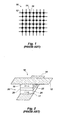
- Figure 1 shows a typical prior art cross-point memory array 10.
- the row conductors 12 running in one direction are referred to as the word lines, and the column conductors 14 extending in a second direction usually perpendicular to the first direction are referred to as the bit lines.
- the memory cells 16 are usually arranged in a square or rectangular array so that each memory cell unit 16 is connected with one word line 12 and an intersecting bit line 14.
- the resistance of each memory cell has more than one state, and the data in the memory cell may be determined by measuring the resistive state of the cell.
- the resistive memory cells may include one or more magnetic layers, a fuse or anti-fuse, or any element that stores or generates information by affecting the magnitude of the nominal resistance of the element.
- Other types of resistive elements used in a resistive RAM array include poly-silicon resistors as part of a read-only memory, and floating gate transistors as part of optical memory, imaging devices or floating gate memory devices.
- MRAM magnetic random access memory
- each memory cell is formed of a plurality of magnetic layers separated by insulating layers.
- One magnetic layer is called a pinned layer or reference layer, in which the magnetic orientation is fixed so as not to rotate in the presence of an applied magnetic field in the range of interest.
- Another magnetic layer is referred to as a sense layer or data layer, in which the magnetic orientation is variable between a state aligned with the state of the pinned layer and a state in misalignment with the state of the pinned layer.
- An insulating tunnel barrier layer sandwiches between the magnetic pinned layer and the magnetic sense layer. This insulating tunnel barrier layer allows quantum mechanical tunneling current to flow between the sense layer and the pinned layer when an external sense voltage is applied.
- the tunneling is electron spin dependent, causing the resistance of the memory cell to be a function of the relative orientations of the magnetizations of the sense layer and the pinned layer.
- the variations in the junction resistance for the two states of the sense layer determine the data stored in the memory cell.
- U.S. Patent 6,169,686, granted to Brug et al. on January 2, 2001 discloses such a magnetic memory cell memory.
- Memory unit 16 is shown as a three-layer magnetic tunnel junction (MTJ) memory cell 20.
- MTJ magnetic tunnel junction
- a bit of information is stored according to the orientation of a changeable magnetic sense layer 22 of the cell 20.
- the cell 20 has two stable magnetic states corresponding to the logic states "1" and "0.”
- the two-way arrow 15 on the sense layer 22 shows this binary-state capability.
- a pinned layer 24 in the cell 20 is separated from the sense layer by a thin insulator 26.
- the resistance across the MTJ memory cell 20 is determined by the characteristics of thin insulator 26 and the orientation of the changeable magnetic sense layer 22.
- Pinned layer 24 has a fixed magnetic orientation, such as shown by the one-way arrow 17 on layer 24.
- the cell magnetization is referred to as "parallel.”
- the cell magnetization is referred to as "anti-parallel.”
- the parallel state might be considered to correspond to a "0" state or logic value of the memory cell and the anti-parallel state might be considered to correspond to a "1" state, although the assignment of "0" and "1" states might be reversed, if desired.
- the magnetic state of a selected memory cell 20 may be changed by applying currents to a word line 12 and a bit line 14 crossing the selected memory cell.
- the currents produce two orthogonal magnetic fields that, when combined, will switch the magnetic orientation of the sense layer of the selected memory cell 20 between the parallel and anti-parallel states.
- Other unselected memory cells receive only a magnetic field from either the word line or the bit line crossing the unselected memory cells. The single field is not strong enough to change the magnetic orientation of the sense layer of the unselected cells, so they retain their magnetic orientation.
- the difference in memory cell logic states is determined by the difference in resistance of a memory cell in a parallel state and in an anti-parallel state.
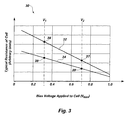
- the resistance level of resistive cells has been found to vary with the application of different levels of bias voltages to the cells.
- the resistance of resistive cells has been found to decrease with an increase in bias voltage.
- Cells in the anti-parallel state shown by line 32, have a higher resistance value than cells in the parallel state, shown by line 34.
- the reference values are provided by a reference cell that is subjected to the same bias voltages as the memory cell.
- a sense circuit compares the currents in both the reference cell and the memory cell at selected bias voltages by comparing both the sense and reference currents in the sense circuit.
- the reference and sense currents result in reference and sense voltages at the input nodes of the sense circuit that vary depending on the bias voltages applied to the reference and memory cells.
- the sense circuit is adjusted so that the first reference voltage is approximately the same value as the first sense voltage. This adjustment proportionately reduces the difference between the first reference voltage and the first sense voltage at the first bias voltage measurement point, thus enabling a close tuning of the circuit. Accordingly, the dynamic range of the current sampling is improved by eliminating common mode differences between the reference memory element and the sensed memory element.
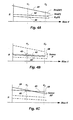
- FIGS 4A, 4B and 4C show the relationship of an inferred, relative resistance of a memory cell to an inferred relative resistance of a reference cell for different bias voltages and at different memory cell logic states.
- This resistance relationship is also indicative of the differences in currents and voltages associated with a selected memory cell and the reference cell.
- the linear relationship of resistances is used here for purposes of simplicity of illustration of the principles applied in the present invention. As will be seen later, it is preferable to sense and adjust the currents indirectly by sensing and adjusting voltages associated with the selected memory cell and the reference cell.
- Figures 4A-C are used to illustrate the concept of sensing a reference element in a known state and comparing it to the selected element.
- the basic parameter being determined is resistance.
- the parameters that are actually being sensed by the sense amplifier are voltage and current.
- the sense currents are modified by sneak paths, so it is impossible to make an absolute resistance measurement. Instead relative values of other parameters are sensed, from which resistance values are inferred.
- the y-axis is the inferred resistance which is a complex function of the applied voltage, amplifier offsets, and sneak path resistances.
- the reference cell resistance R R is set to the parallel state R R (P).
- R R parallel state
- a characteristic of the MRAM cell is a weak dependence on the bias voltage.
- line 40 has only a slight slope.
- the selected memory cell resistance R M is either in a parallel state R M (P), as shown by line 42, or an anti-parallel state R M (AP), as shown by line 44.
- the voltage dependence of the resistance R M of the selected cell will be similar to that of the resistance R R of the reference cell.
- line 42 indicates that, if the selected cell is in the parallel state, there will be relatively little change in resistance R M (P) with a change of bias voltage, compared to line 44 showing the greater slope or change of resistance R M (AP) of the memory cell in the anti-parallel state with changes in bias voltage.
- the reference cell is located physically near the selected memory cell so that the reference and memory cells share the same or very similar processing and environmental conditions.
- Figures 4B and 4C show the differences between the relative resistances R M and R R , depending on whether the selected memory cell is in the parallel state (line 42) or the anti-parallel state (line 44), respectively.
- the current through R R of the reference cell is adjusted so that it is nearly the same as the current through R M of the memory cell.
- the process of adjusting the current through R R adjusts the amplifier offset parameters so that the inferred, relative resistance representing the reference element is approximately equal to the inferred, relative resistance representing R M .
- the current through R R is slightly less than the current through R M , providing a small difference between the current values and a small difference between the inferred relative resistance values, shown as a delta difference 46 in both Figures 4B and 4C.
- the logic state of the memory cell can be determined by comparing the values of the reference and memory cell currents at the second bias voltage point. If the difference 48 between the values of the memory cell and reference cell currents at the second bias voltage V 2 is about the same as the difference 46 between the values of the memory cell and reference cell currents at the first bias voltage V 1 , then the memory cell resistance is understood to be parallel, (which might be the logic value 0) as shown in Figure 4B. If the values of the memory cell and reference cell currents have changed and there has been a cross-over of values, and the memory cell is anti-parallel. If the memory cell current is still higher than the reference current, the memory cell is parallel.
- a resistive memory array 50 shows one context for the sensing circuit of the present invention.
- a row selector circuit 53 and a column decoder circuit 54 are connected to the memory array 50 to select a memory cell 56 by providing voltages on the appropriate row and column of cell 56.
- a sense amplifier 52 is connected through switch 58 in the column decoder circuit 54 to the bit line 60 of the selected memory cell 56.
- the row selector circuit 53 applies a voltage V row to the word line 62 of the selected memory cell 56, and a voltage V read is applied to the bit line 60.
- bit line voltage V read is applied to all of the unselected cells along bit line 60.
- the unselected cells do not receive a word line voltage V row , so they do not provide any substantial output current on the bit line 60.
- an amplifier (not shown) in the sense amp 52 acts to hold column 60 to the voltage V read .
- a memory controller 64 receives read control and select address signals 66 and provides the appropriate row and column select signals to the row select circuit 53 and the column decoder circuit 54 on lines 67 and 68, respectively.
- a comparator clock signal 69 is applied to sense amplifier 52, for purposes of clocking an op amp 76, shown in Figure 6, if a timing pulse is desired.
- the op amp 76 controls a transmission gate to supply a variable voltage to the back gate of transistor 73, as discussed with respect to the circuitry in Figure 6.
- a reference element 57 is connected to word line 62 and reference column line 61.
- V row selects memory cell 56 it also selects reference element 57.
- an operational amplifier (not shown) in the sense amplifier 52 acts to hold reference column 61 at read voltage V read . Accordingly, reference element 57 is subject to the same voltages applied to the selected memory cell 56.
- the sense amplifier 52 receives a signal current at S' from cell 56 indicative of the data stored therein. Likewise, an output signal current at S" from reference element 57 is applied through switch 59 to sense amplifier 52. In turn, sense amplifier 52 compares the sense current at S' from the memory cell to the reference current at S" and provides an output signal V 0 indicative of the data stored in memory cell 56.
- Sense amplifier 52 is an adjustable current mode differential amplifier (ACMDA) having a back gate bias control mechanism for adjusting the threshold voltage of the memory cell sensing circuit.
- ACMDA adjustable current mode differential amplifier
- the ACMDA is basically a current mirror with an adjustable device.
- P channel MOSFET transistors are used.
- NPN or PNP bipolar transistors may also be used to accomplish the purpose of the invention.
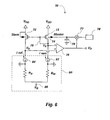
- sense amplifier 52 is shown in the ACDMA 70 shown in Figure 6, wherein the gates of a "slave" transistor 72 and a "master” transistor 73 are connected together to form a mirror device.
- the mirror device is adjusted so that the V DS voltage (drain to source voltage, not shown) across the slave transistor 72 is equal to the V DS voltage across the master transistor 73. Since identical voltages V DD are applied to the sources of transistors 72 and 73 and since the voltages V DS across the two transistors are equal, the voltages V R and V S at the drain nodes of transistors 72 and 73, respectively, will be equal as well.
- the gate of the master transistor 73 is connected to the drain of the master transistor 73 by connector 75. This connection creates a control potential V GS (gate to source voltage, not shown) between the master gate and the master source, based on the drain current I D , which is the same as I sen , as shown.
- the control potential V GS is applied to the gate of the slave transistor 72 which in turn develops a drain current I D in slave transistor 72, which is the same as I ref , as shown. Since V S is equal to V R , then I sen and I ref will be proportional to the physical design and size of the respective transistors.
- the sense and reference currents I ref and I sen flow through generalized circuitry 80 associated with the memory cell R M and the reference cell R R .
- V DS across the master transistor 73 is equal to the voltage V DS across the slave transistor 72.
- the relationship between the respective currents I ref and I sen is determined by only the physical parameters of the respective transistors 73 and 72. If there is an imbalance in currents, the voltage relationship will indicate the current imbalance and the direction of the current imbalance.
- the drain of the master transistor 73 is connected to a node having a voltage V S which is the negative input of an operational amplifier 76.
- the drain of the slave transistor 72 is connected to a node having a voltage V R which is the positive input of the operational amplifier 76.
- the op-amp 76 output V 0 is connected to a transmission gate 77 that selectively connects a ramp generator 78 to the back gate 74 of master transistor 73.
- a capacitor 79 is connected in parallel with back gate 74 to maintain the voltage of the back gate.
- connection between the sense amplifier 70 and circuitry 80 incorporating the memory cell and the reference cell can take different forms.
- the generalized form given in Figure 6 shows a sense current generator 82 connected between V S and ground.
- a reference current generator 84 is connected between V R and ground.
- a selected memory cell R M is connected between ground and an input node 86 for the bias voltages V B(1) and V B(2) .
- a reference cell R R is connected between ground and the input node 86.
- the current generators 82 and 84 are representations of current being generated in the respective sense and reference circuits in response to the bias voltage inputs. It should be noted that the nodes for V S and V R in Figure 6 correspond to bit lines 60 and 61, respectively, in Figure 5. Similarly, resistors R M and R R in Figure 6 correspond to the memory elements 56 and 57, respectively, in Figure 5
- the circuitry 80 is the subject of separate but related inventions described in Applicants'copending applications entitled “Multiple Bias Point MRAM With An Adjustable Current Mode Sense Amplifier and Equi-potential Isolation” (HP docket number 100201678-1) and “Multiple Bias Point MRAM With An Adjustable Current Mode Sense Amplifier and Diode Isolation (HP docket number 100201679-1).
- the first step in setting up the sense amplifier 70 is to establish the back gate bias connection for setting V S equal to V R at given initial values of I sen and I ref where N times I ref equals I sen .
- the variation of the back gate voltage V BG applied to just the master transistor 73 may require potentials greater than V DD to adjust the threshold of the master transistor 73 so that I sen is equal to I ref . In principle, this can be done, but in practice it is difficult to generate voltages greater than the supply voltage V DD .
- N is set to 2 in a 3.3, volt 0.5 micron CMOS technology, where W/L is 20/1 for the slave transistor and W/L is 10/1 for the master transistor, I sen and I ref are approximately equal at about 500 nanoamps and the back gate voltage V BG (not shown) is about 3.2 volts. Similar relationships and values would apply for N channel transistors and bipolar transistor circuits.
- one technique is to use a basic five transistor CMOS op-amp 76 having V S and V R as inputs.
- Op-amp 76 determines when V S is greater than or less than V R and applies an output signal V O to a transmission gate 77.
- This output signal opens the transmission gate 77 and connects a ramp generator 78 to the back gate of the master transistor 73, thereby adjusting the operating point of the master transistor 73 so that V R is approximately equal to V S .
- the output signal V O changes, closing the transmission gate 77 and disconnecting the ramp generator 78 from the back gate of the master transistor 73.
- a second bias voltage V B(2) is applied at a higher value than the first bias voltage V B(1) . If I sen changes so that I sen is less than I ref , V R will be pulled down so that V S is greater than V R . At that point, the output V O of op-amp 76 will go to a logic "0". If I sen is greater than I ref , V S will get pulled down so that V R is greater than V S and the output V O of the op-amp 76 will go to a logic "1".
- the above embodiment describes adjusting the back gate voltage of the master (sense) transistor, in order to make the sense voltage and the reference voltage equal to each other. It is understood that the back gate voltage of the slave (reference) transistor may be adjusted instead or both back gate voltages may be adjusted to accomplish the same result.
- N channel MOSFET transistors in a P-well CMOS process are applied instead of the P channel transistors used in the embodiment shown in Figure 6. Accordingly, the circuitry layout is essentially an inverted mirror image of the circuitry shown in Figure 6.
- a master transistor 94 and a slave transistor 92 have common gates connected together, which are also connected by line 96 to the drain of transistor 94.
- the drain of transistor 94 is also connected to a node having a voltage V S forming the positive input to an op-amp 98.
- the drain of transistor 92 is also connected to a node having a voltage V R forming the negative input to op-amp 98.
- the output of op-amp 98 controls a transmission gate 100 that selectively connects a ramp generator 102 to the back gate of master transistor 94.
- the drain of transistor 94 is also connected to a node providing the sense voltage V S, as well as to a current generator 112 that has the other side connected to V DD .
- the drain of transistor 92 is connected to a node providing the reference voltage V R , as well as to a current generator 114 having the other side connected to V DD .
- the input node 116 is connected through the memory cell R M to V DD and also through the reference cell R R to V DD .
- ACMDA circuits One of the advantages of the above described ACMDA circuits is that a simple differential current sensor circuit using the back gate bias techniques can be applied to sense selected memory cells using a reference cell for applications where the initial currents through the respective memory and reference cells are not equal. When the current relationship of the memory and reference cell changes, the sensor circuit will detect the changes and compare the changes to determine the state of the selected memory cell.
Landscapes
- Engineering & Computer Science (AREA)
- Computer Hardware Design (AREA)
- Read Only Memory (AREA)
- Semiconductor Memories (AREA)
- For Increasing The Reliability Of Semiconductor Memories (AREA)
Applications Claiming Priority (2)
| Application Number | Priority Date | Filing Date | Title |
|---|---|---|---|
| US198278 | 1988-05-25 | ||
| US10/198,278 US6590804B1 (en) | 2002-07-16 | 2002-07-16 | Adjustable current mode differential amplifier |
Publications (1)
| Publication Number | Publication Date |
|---|---|
| EP1383132A1 true EP1383132A1 (en) | 2004-01-21 |
Family
ID=22732698
Family Applications (1)
| Application Number | Title | Priority Date | Filing Date |
|---|---|---|---|
| EP03254450A Withdrawn EP1383132A1 (en) | 2002-07-16 | 2003-07-15 | Sensing memory cells |
Country Status (5)
| Country | Link |
|---|---|
| US (1) | US6590804B1 (https=) |
| EP (1) | EP1383132A1 (https=) |
| JP (1) | JP3965373B2 (https=) |
| CN (1) | CN100481249C (https=) |
| TW (1) | TW200402068A (https=) |
Cited By (2)
| Publication number | Priority date | Publication date | Assignee | Title |
|---|---|---|---|---|
| GB2487723A (en) * | 2011-01-26 | 2012-08-08 | Nds Ltd | Protection device for stored data values comprising a switching circuit |
| US9972387B2 (en) | 2014-10-31 | 2018-05-15 | Hewlett Packard Enterprise Development Lp | Sensing circuit for resistive memory |
Families Citing this family (58)
| Publication number | Priority date | Publication date | Assignee | Title |
|---|---|---|---|---|
| US6577525B2 (en) * | 2001-08-28 | 2003-06-10 | Micron Technology, Inc. | Sensing method and apparatus for resistance memory device |
| US6650562B2 (en) * | 2002-01-23 | 2003-11-18 | Hewlett-Packard Development Company, L.P. | System and method for determining the logic state of a memory cell in a magnetic tunnel junction memory device |
| US6674679B1 (en) * | 2002-10-01 | 2004-01-06 | Hewlett-Packard Development Company, L.P. | Adjustable current mode differential amplifier for multiple bias point sensing of MRAM having equi-potential isolation |
| US6891768B2 (en) * | 2002-11-13 | 2005-05-10 | Hewlett-Packard Development Company, L.P. | Power-saving reading of magnetic memory devices |
| JP2004164766A (ja) * | 2002-11-14 | 2004-06-10 | Renesas Technology Corp | 不揮発性記憶装置 |
| US6781906B2 (en) * | 2002-11-19 | 2004-08-24 | Hewlett-Packard Development Company, L.P. | Memory cell sensing integrator |
| TWI223259B (en) * | 2003-01-07 | 2004-11-01 | Ind Tech Res Inst | A reference mid-point current generator for a magnetic random access memory |
| FR2853444B1 (fr) * | 2003-04-02 | 2005-07-15 | St Microelectronics Sa | Amplificateur de lecture a double etage de lecture |
| US7027318B2 (en) * | 2003-05-30 | 2006-04-11 | Hewlett-Packard Development Company, L.P. | Method and system for adjusting offset voltage |
| EP1484764B1 (en) * | 2003-06-04 | 2006-08-16 | STMicroelectronics S.r.l. | Method for generating a reference current for sense amplifiers connected to cells of a memory matrix, particularly in big-sized flash memories, and corresponding generator |
| US6839280B1 (en) * | 2003-06-27 | 2005-01-04 | Freescale Semiconductor, Inc. | Variable gate bias for a reference transistor in a non-volatile memory |
| US7126844B2 (en) * | 2003-11-30 | 2006-10-24 | Union Semiconductor Technology Corporation | Apparatus to improve stability of an MRAM over process and operational variations |
| US7082050B2 (en) * | 2003-11-30 | 2006-07-25 | Union Semiconductor Technology Corporation | Method to equalize word current circuitry |
| US7054185B2 (en) * | 2003-11-30 | 2006-05-30 | Union Semiconductor Technology Corporation | Optimized MRAM current sources |
| US7113422B2 (en) | 2003-11-30 | 2006-09-26 | Union Semiconductor Technology Corporation | Method for optimizing MRAM circuit performance |
| US7023753B2 (en) * | 2003-11-30 | 2006-04-04 | Union Semiconductor Technology Corporation | Current controlled word and sense source |
| US6862206B1 (en) * | 2003-12-19 | 2005-03-01 | Hewlett-Packard Development Company, L.P. | Memory module hybridizing an atomic resolution storage (ARS) memory and a magnetic memory |
| US7091740B2 (en) * | 2004-07-30 | 2006-08-15 | Microchip Technology Incorporated | Write protection using a two signal control protocol for an integrated circuit device having parameter change capability, chip select and selectable write to non-volatile memory |
| US7130235B2 (en) * | 2004-09-03 | 2006-10-31 | Hewlett-Packard Development Company, L.P. | Method and apparatus for a sense amplifier |
| US7333383B2 (en) * | 2005-08-23 | 2008-02-19 | Infineon Technologies Ag | Fuse resistance read-out circuit |
| KR100735754B1 (ko) | 2006-02-03 | 2007-07-06 | 삼성전자주식회사 | 센스 앰프 플립 플롭 |
| US8395199B2 (en) | 2006-03-25 | 2013-03-12 | 4D-S Pty Ltd. | Systems and methods for fabricating self-aligned memory cell |
| US7649793B1 (en) | 2006-05-04 | 2010-01-19 | Marvell International Ltd. | Channel estimation for multi-level memories using pilot signals |
| US8645793B2 (en) * | 2008-06-03 | 2014-02-04 | Marvell International Ltd. | Statistical tracking for flash memory |
| US7932548B2 (en) | 2006-07-14 | 2011-04-26 | 4D-S Pty Ltd. | Systems and methods for fabricating self-aligned memory cell |
| US7307911B1 (en) * | 2006-07-27 | 2007-12-11 | International Business Machines Corporation | Apparatus and method for improving sensing margin of electrically programmable fuses |
| US20090126129A1 (en) * | 2007-03-21 | 2009-05-21 | D Agostino Michael J | Precast Arch-Shaped Overfilled Structure |
| US7808834B1 (en) | 2007-04-13 | 2010-10-05 | Marvell International Ltd. | Incremental memory refresh |
| TWI336079B (en) * | 2007-07-02 | 2011-01-11 | Ind Tech Res Inst | Magnetic random access memory and data reading circuit therefor |
| US8031526B1 (en) | 2007-08-23 | 2011-10-04 | Marvell International Ltd. | Write pre-compensation for nonvolatile memory |
| US8189381B1 (en) | 2007-08-28 | 2012-05-29 | Marvell International Ltd. | System and method for reading flash memory cells |
| US8085605B2 (en) | 2007-08-29 | 2011-12-27 | Marvell World Trade Ltd. | Sequence detection for flash memory with inter-cell interference |
| US9823090B2 (en) | 2014-10-31 | 2017-11-21 | Allegro Microsystems, Llc | Magnetic field sensor for sensing a movement of a target object |
| JP5596296B2 (ja) * | 2008-03-17 | 2014-09-24 | ピーエスフォー ルクスコ エスエイアールエル | 半導体装置 |
| US7719884B2 (en) * | 2008-05-19 | 2010-05-18 | Qimonda Ag | Integrated circuit, cell arrangement, method of manufacturing an integrated circuit, method of operating an integrated circuit, and memory module |
| JP5529450B2 (ja) * | 2009-07-15 | 2014-06-25 | スパンション エルエルシー | ボディバイアス制御回路及びボディバイアス制御方法 |
| CN102467967B (zh) * | 2010-11-12 | 2015-05-20 | 上海复旦微电子集团股份有限公司 | 用于电可擦写只读存储器的读出电路和读出方法 |
| US9810519B2 (en) | 2013-07-19 | 2017-11-07 | Allegro Microsystems, Llc | Arrangements for magnetic field sensors that act as tooth detectors |
| US10495699B2 (en) | 2013-07-19 | 2019-12-03 | Allegro Microsystems, Llc | Methods and apparatus for magnetic sensor having an integrated coil or magnet to detect a non-ferromagnetic target |
| US9719806B2 (en) | 2014-10-31 | 2017-08-01 | Allegro Microsystems, Llc | Magnetic field sensor for sensing a movement of a ferromagnetic target object |
| US9720054B2 (en) * | 2014-10-31 | 2017-08-01 | Allegro Microsystems, Llc | Magnetic field sensor and electronic circuit that pass amplifier current through a magnetoresistance element |
| US9823092B2 (en) | 2014-10-31 | 2017-11-21 | Allegro Microsystems, Llc | Magnetic field sensor providing a movement detector |
| KR102354350B1 (ko) | 2015-05-18 | 2022-01-21 | 삼성전자주식회사 | 메모리 장치 및 이를 포함하는 메모리 시스템 |
| CN105049007B (zh) * | 2015-06-19 | 2019-05-14 | 西安紫光国芯半导体有限公司 | 高精度抗干扰比较器及方法和应用该比较器的存储结构 |
| US9728253B2 (en) * | 2015-11-30 | 2017-08-08 | Windbond Electronics Corp. | Sense circuit for RRAM |
| WO2017176217A1 (en) * | 2016-04-07 | 2017-10-12 | Agency For Science, Technology And Research | Circuit arrangement, memory column, memory array, and method of forming the same |
| US10260905B2 (en) | 2016-06-08 | 2019-04-16 | Allegro Microsystems, Llc | Arrangements for magnetic field sensors to cancel offset variations |
| US10041810B2 (en) | 2016-06-08 | 2018-08-07 | Allegro Microsystems, Llc | Arrangements for magnetic field sensors that act as movement detectors |
| CN109410997B (zh) * | 2017-08-16 | 2021-04-30 | 华邦电子股份有限公司 | 电阻式存储器存储装置及其写入方法 |
| CN110111821A (zh) * | 2018-02-01 | 2019-08-09 | 上海磁宇信息科技有限公司 | 一种使用分布式参考单元的磁性随机存储器 |
| US10866117B2 (en) | 2018-03-01 | 2020-12-15 | Allegro Microsystems, Llc | Magnetic field influence during rotation movement of magnetic target |
| US11255700B2 (en) | 2018-08-06 | 2022-02-22 | Allegro Microsystems, Llc | Magnetic field sensor |
| US11309005B2 (en) * | 2018-10-31 | 2022-04-19 | Taiwan Semiconductor Manufacturing Co., Ltd. | Current steering in reading magnetic tunnel junction |
| US10823586B2 (en) | 2018-12-26 | 2020-11-03 | Allegro Microsystems, Llc | Magnetic field sensor having unequally spaced magnetic field sensing elements |
| US11280637B2 (en) | 2019-11-14 | 2022-03-22 | Allegro Microsystems, Llc | High performance magnetic angle sensor |
| US11237020B2 (en) | 2019-11-14 | 2022-02-01 | Allegro Microsystems, Llc | Magnetic field sensor having two rows of magnetic field sensing elements for measuring an angle of rotation of a magnet |
| US11574678B2 (en) * | 2020-09-17 | 2023-02-07 | Fujitsu Semiconductor Memory Solution Limited | Resistive random access memory, and method for manufacturing resistive random access memory |
| CN112579002B (zh) * | 2020-12-14 | 2024-02-13 | 北京北大众志微系统科技有限责任公司 | 一种在位线结构中设置有传输门的sram及存取提升方法 |
Citations (4)
| Publication number | Priority date | Publication date | Assignee | Title |
|---|---|---|---|---|
| US5544114A (en) * | 1992-07-24 | 1996-08-06 | Sgs-Thomson Micoroelectronics S.A. | Integrated circuit memory device with balancing circuit including following amplifier coupled to bit line |
| US6191989B1 (en) * | 2000-03-07 | 2001-02-20 | International Business Machines Corporation | Current sensing amplifier |
| US6262625B1 (en) * | 1999-10-29 | 2001-07-17 | Hewlett-Packard Co | Operational amplifier with digital offset calibration |
| US6501697B1 (en) * | 2001-10-11 | 2002-12-31 | Hewlett-Packard Company | High density memory sense amplifier |
Family Cites Families (5)
| Publication number | Priority date | Publication date | Assignee | Title |
|---|---|---|---|---|
| JP2800740B2 (ja) * | 1995-09-28 | 1998-09-21 | 日本電気株式会社 | 半導体記憶装置 |
| US6169686B1 (en) | 1997-11-20 | 2001-01-02 | Hewlett-Packard Company | Solid-state memory with magnetic storage cells |
| FR2801719B1 (fr) * | 1999-11-30 | 2002-03-01 | St Microelectronics Sa | Dispositif de lecture pour memoire en circuit integre |
| JP3920565B2 (ja) * | 2000-12-26 | 2007-05-30 | 株式会社東芝 | 磁気ランダムアクセスメモリ |
| TW520501B (en) * | 2000-12-29 | 2003-02-11 | Amic Technology Taiwan Inc | Bias device for a magneto-resistive random access memory |
-
2002
- 2002-07-16 US US10/198,278 patent/US6590804B1/en not_active Expired - Lifetime
-
2003
- 2003-02-18 TW TW092103303A patent/TW200402068A/zh unknown
- 2003-05-16 CN CNB031238203A patent/CN100481249C/zh not_active Expired - Lifetime
- 2003-07-09 JP JP2003272462A patent/JP3965373B2/ja not_active Expired - Fee Related
- 2003-07-15 EP EP03254450A patent/EP1383132A1/en not_active Withdrawn
Patent Citations (4)
| Publication number | Priority date | Publication date | Assignee | Title |
|---|---|---|---|---|
| US5544114A (en) * | 1992-07-24 | 1996-08-06 | Sgs-Thomson Micoroelectronics S.A. | Integrated circuit memory device with balancing circuit including following amplifier coupled to bit line |
| US6262625B1 (en) * | 1999-10-29 | 2001-07-17 | Hewlett-Packard Co | Operational amplifier with digital offset calibration |
| US6191989B1 (en) * | 2000-03-07 | 2001-02-20 | International Business Machines Corporation | Current sensing amplifier |
| US6501697B1 (en) * | 2001-10-11 | 2002-12-31 | Hewlett-Packard Company | High density memory sense amplifier |
Cited By (3)
| Publication number | Priority date | Publication date | Assignee | Title |
|---|---|---|---|---|
| GB2487723A (en) * | 2011-01-26 | 2012-08-08 | Nds Ltd | Protection device for stored data values comprising a switching circuit |
| US9081990B2 (en) | 2011-01-26 | 2015-07-14 | Cisco Technology, Inc | Preventing unauthorized data extraction |
| US9972387B2 (en) | 2014-10-31 | 2018-05-15 | Hewlett Packard Enterprise Development Lp | Sensing circuit for resistive memory |
Also Published As
| Publication number | Publication date |
|---|---|
| JP2004039231A (ja) | 2004-02-05 |
| TW200402068A (en) | 2004-02-01 |
| JP3965373B2 (ja) | 2007-08-29 |
| CN1501401A (zh) | 2004-06-02 |
| US6590804B1 (en) | 2003-07-08 |
| CN100481249C (zh) | 2009-04-22 |
Similar Documents
| Publication | Publication Date | Title |
|---|---|---|
| US6590804B1 (en) | Adjustable current mode differential amplifier | |
| US6674679B1 (en) | Adjustable current mode differential amplifier for multiple bias point sensing of MRAM having equi-potential isolation | |
| US6754123B2 (en) | Adjustable current mode differential amplifier for multiple bias point sensing of MRAM having diode isolation | |
| EP1302948B1 (en) | Memory sense amplifier | |
| US7161861B2 (en) | Sense amplifier bitline boost circuit | |
| US6985383B2 (en) | Reference generator for multilevel nonlinear resistivity memory storage elements | |
| JP4048194B2 (ja) | 抵抗性クロスポイントメモリ | |
| US7251178B2 (en) | Current sense amplifier | |
| KR100601806B1 (ko) | 온도 보상 rram 회로 | |
| KR100450464B1 (ko) | Mram-메모리의 메모리 셀의 비파괴 판독을 위한 방법및 장치 | |
| US6781906B2 (en) | Memory cell sensing integrator | |
| US8098538B2 (en) | Spin-torque bit cell with unpinned reference layer and unidirectional write current | |
| US20060092689A1 (en) | Reference current source for current sense amplifier and programmable resistor configured with magnetic tunnel junction cells | |
| US7187576B2 (en) | Read out scheme for several bits in a single MRAM soft layer | |
| KR100562203B1 (ko) | Mram 셀을 위한 기준회로 | |
| JP4031447B2 (ja) | オフセット調整可能な差動増幅器 | |
| KR20030045639A (ko) | 메모리 장치 및 메모리 장치 내 기록 전류 발생 방법 | |
| US7042757B2 (en) | 1R1D MRAM block architecture | |
| KR20030086236A (ko) | 정보 저장 장치와 차동 감지 증폭기 | |
| US6894938B2 (en) | System and method of calibrating a read circuit in a magnetic memory | |
| US6804145B2 (en) | Memory cell sensing system and method | |
| HK1065886A (en) | Adjustable current mode differential amplifier |
Legal Events
| Date | Code | Title | Description |
|---|---|---|---|
| PUAI | Public reference made under article 153(3) epc to a published international application that has entered the european phase |
Free format text: ORIGINAL CODE: 0009012 |
|
| AK | Designated contracting states |
Kind code of ref document: A1 Designated state(s): AT BE BG CH CY CZ DE DK EE ES FI FR GB GR HU IE IT LI LU MC NL PT RO SE SI SK TR |
|
| AX | Request for extension of the european patent |
Extension state: AL LT LV MK |
|
| 17P | Request for examination filed |
Effective date: 20040405 |
|
| 17Q | First examination report despatched |
Effective date: 20040429 |
|
| AKX | Designation fees paid |
Designated state(s): DE GB |
|
| STAA | Information on the status of an ep patent application or granted ep patent |
Free format text: STATUS: THE APPLICATION IS DEEMED TO BE WITHDRAWN |
|
| 18D | Application deemed to be withdrawn |
Effective date: 20060110 |