EP1362545A2 - Verfahren zum Betreiben einer Geschirrspülmaschine - Google Patents
Verfahren zum Betreiben einer Geschirrspülmaschine Download PDFInfo
- Publication number
- EP1362545A2 EP1362545A2 EP03006110A EP03006110A EP1362545A2 EP 1362545 A2 EP1362545 A2 EP 1362545A2 EP 03006110 A EP03006110 A EP 03006110A EP 03006110 A EP03006110 A EP 03006110A EP 1362545 A2 EP1362545 A2 EP 1362545A2
- Authority
- EP
- European Patent Office
- Prior art keywords
- rinsing
- liquid
- operating
- circulation pump
- washing liquid
- Prior art date
- Legal status (The legal status is an assumption and is not a legal conclusion. Google has not performed a legal analysis and makes no representation as to the accuracy of the status listed.)
- Granted
Links
Images
Classifications
-
- A—HUMAN NECESSITIES
- A47—FURNITURE; DOMESTIC ARTICLES OR APPLIANCES; COFFEE MILLS; SPICE MILLS; SUCTION CLEANERS IN GENERAL
- A47L—DOMESTIC WASHING OR CLEANING; SUCTION CLEANERS IN GENERAL
- A47L15/00—Washing or rinsing machines for crockery or tableware
- A47L15/0018—Controlling processes, i.e. processes to control the operation of the machine characterised by the purpose or target of the control
- A47L15/0047—Energy or water consumption, e.g. by saving energy or water
-
- A—HUMAN NECESSITIES
- A47—FURNITURE; DOMESTIC ARTICLES OR APPLIANCES; COFFEE MILLS; SPICE MILLS; SUCTION CLEANERS IN GENERAL
- A47L—DOMESTIC WASHING OR CLEANING; SUCTION CLEANERS IN GENERAL
- A47L15/00—Washing or rinsing machines for crockery or tableware
- A47L15/0018—Controlling processes, i.e. processes to control the operation of the machine characterised by the purpose or target of the control
- A47L15/0021—Regulation of operational steps within the washing processes, e.g. optimisation or improvement of operational steps depending from the detergent nature or from the condition of the crockery
- A47L15/0026—Rinsing phases
-
- A—HUMAN NECESSITIES
- A47—FURNITURE; DOMESTIC ARTICLES OR APPLIANCES; COFFEE MILLS; SPICE MILLS; SUCTION CLEANERS IN GENERAL
- A47L—DOMESTIC WASHING OR CLEANING; SUCTION CLEANERS IN GENERAL
- A47L15/00—Washing or rinsing machines for crockery or tableware
- A47L15/42—Details
- A47L15/4214—Water supply, recirculation or discharge arrangements; Devices therefor
- A47L15/4225—Arrangements or adaption of recirculation or discharge pumps
-
- A—HUMAN NECESSITIES
- A47—FURNITURE; DOMESTIC ARTICLES OR APPLIANCES; COFFEE MILLS; SPICE MILLS; SUCTION CLEANERS IN GENERAL
- A47L—DOMESTIC WASHING OR CLEANING; SUCTION CLEANERS IN GENERAL
- A47L2401/00—Automatic detection in controlling methods of washing or rinsing machines for crockery or tableware, e.g. information provided by sensors entered into controlling devices
- A47L2401/04—Crockery or tableware details, e.g. material, quantity, condition
-
- A—HUMAN NECESSITIES
- A47—FURNITURE; DOMESTIC ARTICLES OR APPLIANCES; COFFEE MILLS; SPICE MILLS; SUCTION CLEANERS IN GENERAL
- A47L—DOMESTIC WASHING OR CLEANING; SUCTION CLEANERS IN GENERAL
- A47L2401/00—Automatic detection in controlling methods of washing or rinsing machines for crockery or tableware, e.g. information provided by sensors entered into controlling devices
- A47L2401/10—Water cloudiness or dirtiness, e.g. turbidity, foaming or level of bacteria
-
- A—HUMAN NECESSITIES
- A47—FURNITURE; DOMESTIC ARTICLES OR APPLIANCES; COFFEE MILLS; SPICE MILLS; SUCTION CLEANERS IN GENERAL
- A47L—DOMESTIC WASHING OR CLEANING; SUCTION CLEANERS IN GENERAL
- A47L2501/00—Output in controlling method of washing or rinsing machines for crockery or tableware, i.e. quantities or components controlled, or actions performed by the controlling device executing the controlling method
- A47L2501/01—Water supply, e.g. opening or closure of the water inlet valve
-
- A—HUMAN NECESSITIES
- A47—FURNITURE; DOMESTIC ARTICLES OR APPLIANCES; COFFEE MILLS; SPICE MILLS; SUCTION CLEANERS IN GENERAL
- A47L—DOMESTIC WASHING OR CLEANING; SUCTION CLEANERS IN GENERAL
- A47L2501/00—Output in controlling method of washing or rinsing machines for crockery or tableware, i.e. quantities or components controlled, or actions performed by the controlling device executing the controlling method
- A47L2501/05—Drain or recirculation pump, e.g. regulation of the pump rotational speed or flow direction
-
- Y—GENERAL TAGGING OF NEW TECHNOLOGICAL DEVELOPMENTS; GENERAL TAGGING OF CROSS-SECTIONAL TECHNOLOGIES SPANNING OVER SEVERAL SECTIONS OF THE IPC; TECHNICAL SUBJECTS COVERED BY FORMER USPC CROSS-REFERENCE ART COLLECTIONS [XRACs] AND DIGESTS
- Y02—TECHNOLOGIES OR APPLICATIONS FOR MITIGATION OR ADAPTATION AGAINST CLIMATE CHANGE
- Y02B—CLIMATE CHANGE MITIGATION TECHNOLOGIES RELATED TO BUILDINGS, e.g. HOUSING, HOUSE APPLIANCES OR RELATED END-USER APPLICATIONS
- Y02B40/00—Technologies aiming at improving the efficiency of home appliances, e.g. induction cooking or efficient technologies for refrigerators, freezers or dish washers
Definitions
- the invention relates to a method for operating a dishwasher according to the preamble of claim 1.
- the known manner includes a washing program at least several liquid-carrying Process stages, such as pre-rinsing, cleaning, Intermediate rinsing, rinsing or pre-rinsing, cleaning, rinsing each with a final non-liquid-carrying section Dry.
- the pre-rinse program section mainly takes place a soaking of firmly adhering wash particles on the wash ware and mechanical cleaning of easily removable contaminants from the wash ware instead. In this section of the program usually no chemical substances to improve the Dosing results added.
- washing substances either only substances to dissolve and dissolve the adhering dirt particles include cleaning during the program section or else in a combination preparation, which is a washing substance, a Contains rinse aid substance and a softener substance, so-called 3in1 tabs or 3in1 powder added.
- a combination preparation which is a washing substance, a Contains rinse aid substance and a softener substance, so-called 3in1 tabs or 3in1 powder added.
- Intermediate rinsing will leave both residues of Dirt particles as well as chemical residues of the washing substance away.
- rinse aid has the task of surface tension of water and therefore better draining to allow the adhering water on the wash ware.
- Drying will be the water adhering to the wash ware from the process liquid-carrying sections and the residual moisture from the process liquid-carrying sections away.
- the fresh and therefore supply temperature dependent cold and / or passively heated lukewarm washing liquid supplies to the rinsing liquid is reduced.
- the rinsing liquid previously applied can be the spray breaks together with dirt and possibly detergent residues drain without this time thermal energy drawn off by continuing spraying becomes.
- Switching the circulation pump on and off is particularly advantageous several times in succession with a short duration of Switched on and off, repeated, so that the speed of rotation of the spray arm, the duration of the application with rinsing liquid, which is essentially of the duration the switch-on state of the pump are dependent, as well Movement pattern of the spray arm, which alternately when switched off the pump brakes or stops and when it is switched on moves forward by a predeterminable angular range, periodically replaced. Laboratory tests have shown that preferably the duration of the on and off status of the pump is the same length to choose.
- the contact time of the rinsing liquid with the To reduce washware defines, however, at least the washware In principle, it should at least be wetted once a complete rotation of a spray arm by 360 °. This results in a corresponding minimum duration of the switch-on state in total according to 360 ° divided by ⁇ , multiplied by the duration of a switch-on state. Important is, however, the total time that the circulation pump is switched on is selected at least so long that the desired washing result of the respective program section can.
- the circulation pump with a duty cycle that is between 1 to 10 Seconds and an off time that is between 1 to 15 seconds ongoing.
- the number of changes of the Einund Switching off the circulation pump and / or its duration defined in such a way that on the one hand enables the contact time of the circulated Reduce washing liquid with the items to be cleaned and that on the other hand the dependency of the different Degree of soiling of the wash ware is taken into account. are through various sensors measuring parameters such as the turbidity of the Flushing liquid while the wash program is running, too the pH value and other measurement parameters can be determined by the control of the dishwasher the number of changes of the Switching on and off and their duration can be varied. This is particularly useful if it can be assumed that different Types of combination preparations with several active substances added to the washing program as chemical substances become.
- the repeated switching on and off of the circulation pump creates impulsive loading of the wash ware with washing liquid.
- This type of application of the circulated rinsing liquid can be used with completely fresh rinsing liquid or from a waste of dirty washing liquid from the previous program section with fresh supplied rinsing liquid can be performed. This has in particular also saving water.
- the recorded one Energy of the diluted rinsing liquid caused by the Thinner is less dirty, remains in the dishwasher's system at least partially preserved, so that after Blended with fresh rinsing liquid a higher mixing temperature the washing liquid is present as if the dishwasher completely fresh irrigation fluid, which is essentially is dependent on the supply temperature.
- the ratio of blended amounts i.e. H. determining the Volume of rinsing liquid to be pumped out and freshly supplied, can depending on the speed of the circulation pump, the Ratio of the pulse duration of switching the circulation pump on and off as well as a predefinable minimum fill level the rinsing liquid in the rinsing tank, especially under water-saving ones and energetic aspects can be minimized. So it is z. B. useful for a total filling volume with flushing liquid, that in the cleaning program section with regard to an upper one maximum flushing liquid volume at approx.
- 4 l (12 standard place settings) dimensioned for the continuous loading of the dishes is that in the program section intermediate rinsing, in which a Pulse rinsing of the above Type is carried out, the maximum flushing liquid volume to reduce. Because as a result of the input and Switching off the circulation pump means less rinsing liquid Loading of the wash ware required. This will make the volume reduced, of course, also reduces its energy consumption. This is associated with particularly high energy savings, when cold rinsing liquid is added.
- At least one turbidity measurement is provided by one Turbidity sensor provided during a process section, so the volume of the pumped out and re-fed Flushing liquid advantageous depending on the degree of contamination to be hit. This improves the cleaning result and further reduces energy consumption and water consumption.
- a rinse aid in one Combination preparation can be used for the result of drying be advantageous in a section of the intermediate rinsing heating means provided, in particular at the end of the intermediate rinsing, switch on at short notice, especially if this Process section ended by a dilution step is, so that the preheated rinsing liquid, at least partially, preheated in the subsequent process section of rinse aid is, so that a pH and temperature-dependent resolution Rinse aid dissolves faster and therefore longer during of the rinse aid program section is circulated.
- washware is by means of a selectable wash program can be cleaned.
- a particularly economical one Rinse program with particularly low energy consumption is in the Outlined below.
- the washing container begins to be filled with washing liquid and, at a time t 0/1 , reaches a defined minimum volume in the sump of the dishwasher, which corresponds to a lower filling level. At this filling level, the circulation pump does not suck in air.
- the filling of the rinsing container is ended at a time t 1 .
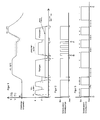
- the washing liquid is circulated in the washing tank as a result of switching on the circulation pump, as shown in FIG. 2, the course of which corresponds to curve A of FIG. 1.
- the rinsing liquid is pressed through the supply line, possibly taking into account various switching states of switching valves in the supply lines to individual spray arms, possibly into a ceiling spray device, and from there the washing items are charged with rinsing liquid.
- a partial volume of the circulated rinsing liquid is pumped out of the rinsing container and after a dead time t 3 -t 4 , which is essentially due to the refilling of storage containers for rinsing liquid or the feed path to the sump, from the point in time t 4 replenished.
- the rinsing liquid volume has again reached the originally maximum filling volume of approximately 4 l and continues to be circulated.
- a dilution step was thus carried out with regard to the degree of contamination of the rinsing liquid.
- the rinsing liquid is pumped out.
- the circulation pump must be switched off because the lower filling level has been reached (see FIG. 2), so that the circulation pump does not suck in air, so that the items to be washed are interrupted with washing liquid.
- the washing liquid has been almost completely emptied from the washing container.
- rinsing liquid is again supplied in the time period t 8 to t 9 .
- the circulation pump can remain in the switched-on state at any time between t 14 and t 17 .
- the circulation pump is switched on and off several times, cf. Fig. 2, wherein the duration of the on and off state is the same length.
- the program flow goes into rinsing during the dilution step.
- the start of rinsing with originally maximum rinsing liquid volume was determined at time t 16 .
- the pumping begins at time t 18 .
- the lower filling level is undershot, so that the circulation pump is switched off at the latest at this time, cf. Fig. 2.
- the rinsing liquid present in the rinsing tank is almost pumped out. Remaining amounts due to steam and water droplets on the wash container walls, ceiling and the wash ware are not shown here. They are removed in the following drying cycle, which is also not shown.
- the temperature profile of the rinsing liquid is initially essentially dependent on the inlet temperature of the water in the pre-rinsing.
- the rinsing liquid is heated to approx. 45 to 55 ° C by heating up as a result of the heating medium being switched on in the Cleaning program section.
- the entire washing container and the items to be washed also assume this temperature value.
- the temperature in this program section remains somewhat higher than a dotted liquid quantity, shown in dotted line in curve A, which has comparatively the same volume as in the cleaning and prewash program sections. Accordingly, in the dilution step t 14 to t 17, the temperature of the reduced maximum rinsing liquid volume rises again more quickly and reaches a maximum temperature of approximately 55 to 70 ° C. as a result of the heating by switching on provided heating means during the rinsing. For a further reduced rinsing liquid volume in crosses A and B, the mixing temperature is the highest and the maximum temperature in rinsing is therefore reached fastest. This temperature decreases continuously in the downstream condensation drying program section, not shown.
- 3 shows a variant of the pulse sequence according to the detail, marked with arrows D - E in Fig. 2, the pulse pattern to Einund Switching off the circulation pump shown in different variants. While in Fig. 2, section D-E, the pulse train periodically with the circulation pump switched on and off for the same length of time shown and accordingly executed, 3 shows one of many alternative pulse sequences of the on / off states the circulation pump.
- the circulation pump is used for a period of time a is switched on and one for a period of time b, which is shorter than the duty cycle a is switched off. It followed by switching on again for a period a and a Switch off for a period of time c, the switch-off period now corresponds essentially to the previous duty cycle a.
- the subsequent switching on takes place for a period of time d, which is essentially the sum of two on states a corresponds. Repeated after switch-off state b the irregular sequence of the pulse pattern.
- the one with the Switching states named with the same letters each have the same Duration, in the exemplary embodiment the duration a is shorter as duration d and greater than duration b and as long as duration c.
- the time period of the switch-on state can be varied further compared to the time period of the switch-off state be reduced or increased, in addition to the periodic Arrangement is also a period in series Pulses of different durations are conceivable, which change regularly or irregularly shorten and / or lengthen so that essentially a non-periodic pulse pattern of the circulation pump arises. Alternatively, when a certain pulse change frequency is reached the pump can be switched off automatically.
- the invention does not limit adaptation and variation options result from the parallel registrations P-10026, title “Method for operating a dishwasher, Dishwasher "from May 16, 2002 and P-10078, title “Dishwasher and method for operating a dishwasher when using a combination preparation with several active ingredients "from May 16, 2002
Landscapes
- Washing And Drying Of Tableware (AREA)
Abstract
Description
- Fig. 1 einen zeitlichen Ablauf eines Spülprogrammes mit den Programmabschnitten Vorspülen mit einem Verdünnungsschritt, Reinigen, Zwischenspülen mit einem Verdünnungsschritt, Klarspülen;
- Fig. 2 ein zum Zeitverlauf der Fig. 1 korrespondierendes Impulsmuster des Ein- und Ausschaltzustandes der Umwälzpumpe; und
- Fig. 3 ine alternative Impulsfolge des Ein- und Ausschaltzustandes der Umwälzpumpe gemäß Abschnitt D-E in Fig. 2.
Claims (10)
- Verfahren zum Betreiben einer Geschirrspülmaschine zum Reinigen darin eingestellten Spülgutes, wobei das Verfahren mehrere flüssigkeitsführende Programmabschnitte, einerseits mit erwärmter, andererseits mit kalter Spülflüssigkeit umfasst, dadurch gekennzeichnet, dass wenigstens teilweise im Verlauf eines Programmabschnittes mit kalter Spülflüssigkeit, welcher einem Programmabschnitt mit erwärmter Spülflüssigkeit folgt, die Umwälzung der Spülflüssigkeit durch wiederholtes Ein- und Ausschalten einer Umwälzpumpe im Sinne eines Impulsspülens mehrfach unterbrochen wird.
- Verfahren zum Betreiben einer Geschirrspülmaschine nach Anspruch 1, dadurch gekennzeichnet, dass die Umwälzpumpe für eine bestimmbare und/oder vorgebbare Dauer ein- und ausgeschaltet wird.
- Verfahren zum Betreiben einer Geschirrspülmaschine nach Anspruch 1 oder 2, dadurch gekennzeichnet, dass die Dauer der Ein- und Ausschaltzustände der Pumpe kurz gewählt wird und wobei Ein- und Ausschaltzeiten vorzugsweise gleich groß sind.
- Verfahren zum Betreiben einer Geschirrspülmaschine nach zumindest einem der vorstehenden Ansprüche, dadurch gekennzeichnet, dass die Einschaltdauer der Umwälzpumpe zwischen ca. 1 bis 10 Sekunden, und das Ausschalten der Umwälzpumpe ca. 1 bis 15 Sekunden beträgt.
- Verfahren zum Betreiben einer Geschirrspülmaschine nach zumindest einem der Ansprüche 2 bis 4, dadurch gekennzeichnet, dass die Anzahl der Wechsel des Ein- und Ausschaltens der Umwälzpumpe und/oder deren Dauer so ausgelegt oder variiert wird, dass die dadurch erzielte Kontaktzeit der umgewälzten Spülflüssigkeit mit dem zu reinigenden Spülgut derart reduziert wird, dass Abkühlvorgänge des Spülgutes infolge des Kontaktes mit kalter oder lauwarmer Spülflüssigkeit minimiert und/oder die Konzentration und Löslichkeit der zugesetzten chemischen Substanzen berücksichtigt werden.
- Verfahren zum Betreiben einer Geschirrspülmaschine nach zumindest einem der vorhergehenden Ansprüche, dadurch gekennzeichnet, dass der Sprüharm zumindest annähernd einmal vollständig um seine Rotationsachse gedreht wird und hierzu die Anzahl und Dauer der wiederholten Ein- und Ausschaltvorgänge der Umwälzpumpe entsprechend ausgelegt ist.
- Verfahren zum Betreiben einer Geschirrspülmaschine nach zumindest einem der vorhergehenden Ansprüche, dadurch gekennzeichnet, dass infolge des Ein- und Ausschaltens der Umwälzpumpe ein Impulsspülen zumindest während eines flüssigkeitsführenden Programmabschnittes mit frisch zugeführter Spülflüssigkeit oder aus einem Verschnitt von verschmutzter Spülflüssigkeit und frischer Spülflüssigkeit durchgeführt wird.
- Verfahren zum Betreiben einer Geschirrspülmaschine nach Anspruch 7, dadurch gekennzeichnet, dass das Volumen der frisch zugeführten oder verschnittenen Spülflüssigkeit für das Impulsspülen bezüglich des Verhältnisses der Impulsdauer des Ein- und Ausschaltens der Umwälzpumpe und der Anzahl der Impulse, der vorgebbaren Drehzahl der Umwälzpumpe und/oder einem unteren vorgegebenen Füllniveau und/oder der Konzentration und des Lösungsverhaltens der zugegebenen chemischen Substanzen, insbesondere von Kombinationspräparaten mit mehreren Wirkstoffen, günstigst reduziert wird.
- Verfahren zum Betreiben einer Geschirrspülmaschine nach zumindest einem der vorhergehenden Ansprüche, dadurch gekennzeichnet, dass zumindest das Volumen der abgepumpten und/oder zugeführten Spülflüssigkeit abhängig von zumindest einer Trübungsmessung während eines flüssigkeitsführenden Verfahrensabschnittes, vorzugsweise vor dem Impulsspülen, bestimmt wird.
- Verfahren zum Betreiben einer Geschirrspülmaschine, nach zumindest einem der vorhergehenden Ansprüche Vorspülen, Reinigen, Zwischenspülen, Klarspülen der flüssigkeitsführenden Programmabschnitte, dadurch gekennzeichnet, dass zumindest ganz oder teilweise der Verfahrensabschnitt Zwischenspülen als Impulsspülen betrieben wird.
Priority Applications (1)
| Application Number | Priority Date | Filing Date | Title |
|---|---|---|---|
| EP10011345.5A EP2292131A3 (de) | 2002-05-16 | 2003-03-18 | Verfahren zum Betreiben einer Geschirrspülmaschine |
Applications Claiming Priority (2)
| Application Number | Priority Date | Filing Date | Title |
|---|---|---|---|
| DE10222215A DE10222215A1 (de) | 2002-05-16 | 2002-05-16 | Verfahren zum Betreiben einer Geschirrspülmaschine |
| DE10222215 | 2002-05-16 |
Related Child Applications (2)
| Application Number | Title | Priority Date | Filing Date |
|---|---|---|---|
| EP10011345.5A Division-Into EP2292131A3 (de) | 2002-05-16 | 2003-03-18 | Verfahren zum Betreiben einer Geschirrspülmaschine |
| EP10011345.5A Division EP2292131A3 (de) | 2002-05-16 | 2003-03-18 | Verfahren zum Betreiben einer Geschirrspülmaschine |
Publications (3)
| Publication Number | Publication Date |
|---|---|
| EP1362545A2 true EP1362545A2 (de) | 2003-11-19 |
| EP1362545A3 EP1362545A3 (de) | 2005-07-20 |
| EP1362545B1 EP1362545B1 (de) | 2019-07-17 |
Family
ID=29265358
Family Applications (2)
| Application Number | Title | Priority Date | Filing Date |
|---|---|---|---|
| EP03006110.5A Expired - Lifetime EP1362545B1 (de) | 2002-05-16 | 2003-03-18 | Verfahren zum Betreiben einer Geschirrspülmaschine |
| EP10011345.5A Withdrawn EP2292131A3 (de) | 2002-05-16 | 2003-03-18 | Verfahren zum Betreiben einer Geschirrspülmaschine |
Family Applications After (1)
| Application Number | Title | Priority Date | Filing Date |
|---|---|---|---|
| EP10011345.5A Withdrawn EP2292131A3 (de) | 2002-05-16 | 2003-03-18 | Verfahren zum Betreiben einer Geschirrspülmaschine |
Country Status (2)
| Country | Link |
|---|---|
| EP (2) | EP1362545B1 (de) |
| DE (1) | DE10222215A1 (de) |
Cited By (5)
| Publication number | Priority date | Publication date | Assignee | Title |
|---|---|---|---|---|
| EP2252193A1 (de) * | 2008-01-28 | 2010-11-24 | BSH Bosch und Siemens Hausgeräte GmbH | Geschirrspülmaschine |
| WO2010142564A1 (de) * | 2009-06-10 | 2010-12-16 | BSH Bosch und Siemens Hausgeräte GmbH | Geschirrspülmaschine mit einer enthärtungseinrichtung sowie zugehöriges wartungsverfahren |
| WO2010142557A1 (de) * | 2009-06-10 | 2010-12-16 | BSH Bosch und Siemens Hausgeräte GmbH | Geschirrspülmaschine mit zwei wasseranschlüssen sowie zugehöriges steuerungsverfahren |
| EP2522267A1 (de) | 2011-05-09 | 2012-11-14 | FagorBrandt SAS | Verfahren zur Reinigung von Geschirr in einer Geschirrspülmaschine |
| EP2798993A3 (de) * | 2013-04-29 | 2015-01-14 | Miele & Cie. KG | Verfahren zur Durchführung eines Spülprogramms |
Families Citing this family (6)
| Publication number | Priority date | Publication date | Assignee | Title |
|---|---|---|---|---|
| DE10358970A1 (de) † | 2003-12-16 | 2005-07-21 | BSH Bosch und Siemens Hausgeräte GmbH | Geschirrspülmaschine mit Zwischenpumpbetrieb |
| DE102004054313A1 (de) * | 2004-11-10 | 2006-05-11 | Electrolux Home Products Corporation N.V. | Verfahren zum Betreiben einer Geschirrspülmaschine und Geschirrspülmaschine zur Durchführung des Verfahrens |
| DE102013104332A1 (de) * | 2013-04-29 | 2014-10-30 | Miele & Cie. Kg | Verfahren zur Durchführung eines Spülprogramms |
| DE102013213969B4 (de) * | 2013-07-17 | 2015-07-09 | BSH Hausgeräte GmbH | Geschirrspülmaschine mit einem in einem Wasserbehälter integrierten Abflussrohrleitungsabschnitt sowie zugehöriges Verfahren zum Betreiben der Geschirrspülmaschine |
| DE102022206334A1 (de) | 2022-06-23 | 2023-12-28 | BSH Hausgeräte GmbH | Spülverfahren mit diskontinuierlichem Abgeben von Spülflotte und Geschirrspülmaschine |
| DE102023200753A1 (de) * | 2023-01-31 | 2024-08-01 | BSH Hausgeräte GmbH | Haushalts-Geschirrspülmaschine und Verfahren |
Family Cites Families (16)
| Publication number | Priority date | Publication date | Assignee | Title |
|---|---|---|---|---|
| DE1428364A1 (de) * | 1962-01-09 | 1969-04-03 | Constructa Werke Gmbh | Geschirrspuelmaschine mit automatischer Steuerung des Spuelwasserstromes |
| JPS607641Y2 (ja) * | 1978-01-11 | 1985-03-14 | シャープ株式会社 | 食器洗浄機 |
| DE2848375A1 (de) * | 1978-11-08 | 1980-05-22 | Licentia Gmbh | Verfahren zum reinigen von geschirr in spuelbehaeltern von geschirrspuelmaschinen |
| IT1256792B (it) | 1992-01-31 | 1995-12-15 | Merloni Elettrodomestici Spa | Macchina lavastoviglie perfezionata. |
| DE4214188A1 (de) * | 1992-04-30 | 1993-11-04 | Licentia Gmbh | Reinigungsverfahren fuer haushalt-geschirrspuelmaschinen |
| IT1268535B1 (it) * | 1993-12-20 | 1997-03-04 | Zanussi Elettrodomestici | Programma operativo per macchina lavastoviglie |
| DE4444147C2 (de) * | 1994-12-12 | 1998-02-05 | Bosch Siemens Hausgeraete | Geschirrspülmaschine mit einem Ultraschall-Generator |
| DE19540871A1 (de) * | 1995-11-02 | 1997-05-07 | Bosch Siemens Hausgeraete | Verfahren zum Betrieb einer programmgesteuerten Geschirrspülmaschine |
| DE19651344A1 (de) * | 1996-12-10 | 1998-06-25 | Bosch Siemens Hausgeraete | Verfahren zum Betreiben einer Geschirrspülmaschine |
| DE19750266A1 (de) * | 1997-11-13 | 1999-05-20 | Miele & Cie | Verfahren zum Betrieb einer Umwälzpumpe bei einer programmgesteuerten Geschirrspülmaschine |
| DE19836739A1 (de) * | 1998-08-13 | 2000-02-17 | Meiko Maschinenbau Gmbh & Co | Geschirrspülmaschine |
| DE19845338C5 (de) * | 1998-10-02 | 2012-12-13 | Electrolux Rothenburg Gmbh Factory And Development | Verfahren zum Betreiben einer Geschirrspülmaschine |
| DE19847151C2 (de) * | 1998-10-13 | 2003-02-06 | Aeg Hausgeraete Gmbh | Geschirrkorb für eine Geschirrspülmaschine |
| DE19857413A1 (de) * | 1998-12-12 | 2000-06-21 | Whirlpool Co | Verfahren zum Reinigen von Geschirr in einer Geschirrspülmaschine |
| DE19951839A1 (de) * | 1999-10-28 | 2001-05-03 | Aeg Hausgeraete Gmbh | Wasserführendes Haushaltsgerät und Verfahren zur Steuerung einer Umwälzpumpe desselben |
| DE10042781A1 (de) * | 2000-08-31 | 2002-03-14 | Aeg Hausgeraete Gmbh | Ventil für eine Geschirrspülmaschine mit einem beweglich angeordneten Verschliesselement |
-
2002
- 2002-05-16 DE DE10222215A patent/DE10222215A1/de not_active Withdrawn
-
2003
- 2003-03-18 EP EP03006110.5A patent/EP1362545B1/de not_active Expired - Lifetime
- 2003-03-18 EP EP10011345.5A patent/EP2292131A3/de not_active Withdrawn
Cited By (7)
| Publication number | Priority date | Publication date | Assignee | Title |
|---|---|---|---|---|
| EP2252193A1 (de) * | 2008-01-28 | 2010-11-24 | BSH Bosch und Siemens Hausgeräte GmbH | Geschirrspülmaschine |
| WO2010142564A1 (de) * | 2009-06-10 | 2010-12-16 | BSH Bosch und Siemens Hausgeräte GmbH | Geschirrspülmaschine mit einer enthärtungseinrichtung sowie zugehöriges wartungsverfahren |
| WO2010142557A1 (de) * | 2009-06-10 | 2010-12-16 | BSH Bosch und Siemens Hausgeräte GmbH | Geschirrspülmaschine mit zwei wasseranschlüssen sowie zugehöriges steuerungsverfahren |
| US9326656B2 (en) | 2009-06-10 | 2016-05-03 | Bsh Hausgeraete Gmbh | Dishwasher having two water connections and corresponding control method |
| EP2522267A1 (de) | 2011-05-09 | 2012-11-14 | FagorBrandt SAS | Verfahren zur Reinigung von Geschirr in einer Geschirrspülmaschine |
| FR2974996A1 (fr) * | 2011-05-09 | 2012-11-16 | Fagorbrandt Sas | Procede de nettoyage de pieces de vaisselle dans une machine a laver la vaisselle. |
| EP2798993A3 (de) * | 2013-04-29 | 2015-01-14 | Miele & Cie. KG | Verfahren zur Durchführung eines Spülprogramms |
Also Published As
| Publication number | Publication date |
|---|---|
| DE10222215A1 (de) | 2003-12-04 |
| EP1362545B1 (de) | 2019-07-17 |
| EP2292131A2 (de) | 2011-03-09 |
| EP1362545A3 (de) | 2005-07-20 |
| EP2292131A3 (de) | 2017-05-03 |
Similar Documents
| Publication | Publication Date | Title |
|---|---|---|
| EP2312987B1 (de) | Wasserführendes haushaltsgerät, insbesondere geschirrspül- oder waschmaschine | |
| EP1362547B2 (de) | Geschirrspülmaschine und Verfahren zum Betreiben einer Geschirrspülmaschine bei Verwendung von einem Kombinationspräparat mit mehreren Wirkstoffen | |
| EP2127585B1 (de) | Geschirrspülmaschine und Verfahren zum Betreiben einer Geschirrspülmaschine bei Verwendung von einem Kombinationspräparat mit mehreren Wirkstoffen | |
| WO2010010166A1 (de) | Spülverfahren für eine geschirrspülmaschine | |
| WO2010010015A1 (de) | Wasserführendes haushaltsgerät, insbesondere geschirrspül- oder waschmaschine | |
| DE60311064T2 (de) | Verfahren zum Betreiben einer Geschirrspülmaschine mit einer zentralen Steuerungseinheit durch Trübungsmessung | |
| EP1362545A2 (de) | Verfahren zum Betreiben einer Geschirrspülmaschine | |
| EP2570069B1 (de) | Verfahren zum Betreiben eines Spülautomaten mit einem Spülflotten-Speicherbehälter | |
| EP2326230B1 (de) | Spülverfahren für ein wasserführendes haushaltsgerät | |
| EP1362546B1 (de) | Verfahren zum Betreiben einer Geschirrspülmaschine und entsprechende Geschirrspülmaschine | |
| DE19651347A1 (de) | Verfahren zum Betreiben einer Geschirrspülmaschine | |
| EP2570068A1 (de) | Verfahren zur Reinigung eines Spülflotten-Speicherbehälters | |
| DE19957243A1 (de) | Geschirrspülmaschine mit einer Programmsteuerung und Verfahren zum Betreiben einer Geschirrspülmaschine | |
| EP2449943B1 (de) | Geschirrspülmaschine | |
| DE102011004949A1 (de) | Geschirrspülmaschine und Verfahren zum Betrieb derselben | |
| EP2105080A1 (de) | Verfahren zur Durchführung eines Spülprogramms mit Teilaustausch der im Spülbehälter befindlichen Spülflüssigkeit | |
| DE19540871A1 (de) | Verfahren zum Betrieb einer programmgesteuerten Geschirrspülmaschine | |
| DE4119319C2 (de) | Verfahren zum Betrieb einer programmgesteuerten Geschirrspülmaschine | |
| DE19845338A1 (de) | Verfahren zum Betreiben einer Geschirrspülmaschine | |
| DE102020130960A1 (de) | Verfahren zum Betreiben eines Spülprogramms zum Reinigen von Spülgut in einer Geschirrspülmaschine | |
| EP3381346B1 (de) | Kurzspülprogramm für einen geschirrspüler | |
| DE102010043330A1 (de) | Geschirrspülmaschine, insbesondere Haushalts-Geschirrspülmaschine | |
| EP3871583A1 (de) | Geschirrspülmaschine und verfahren zum betreiben einer geschirrspülmaschine | |
| EP4543274A1 (de) | Spülverfahren mit diskontinuierlichem abgeben von spülflotte und geschirrspülmaschine | |
| CH695009A5 (de) | Geschirrspueler mit dosierter Klarspuelerzugabe. |
Legal Events
| Date | Code | Title | Description |
|---|---|---|---|
| PUAI | Public reference made under article 153(3) epc to a published international application that has entered the european phase |
Free format text: ORIGINAL CODE: 0009012 |
|
| AK | Designated contracting states |
Kind code of ref document: A2 Designated state(s): AT BE BG CH CY CZ DE DK EE ES FI FR GB GR HU IE IT LI LU MC NL PT RO SE SI SK TR |
|
| AX | Request for extension of the european patent |
Extension state: AL LT LV MK |
|
| PUAL | Search report despatched |
Free format text: ORIGINAL CODE: 0009013 |
|
| AK | Designated contracting states |
Kind code of ref document: A3 Designated state(s): AT BE BG CH CY CZ DE DK EE ES FI FR GB GR HU IE IT LI LU MC NL PT RO SE SI SK TR |
|
| AX | Request for extension of the european patent |
Extension state: AL LT LV MK |
|
| 17P | Request for examination filed |
Effective date: 20051130 |
|
| AKX | Designation fees paid |
Designated state(s): DE GB IT |
|
| RAP1 | Party data changed (applicant data changed or rights of an application transferred) |
Owner name: ELECTROLUX HOME PRODUCTS CORPORATION N.V. |
|
| RAP1 | Party data changed (applicant data changed or rights of an application transferred) |
Owner name: ELECTROLUX HOME PRODUCTS CORPORATION N.V. |
|
| GRAP | Despatch of communication of intention to grant a patent |
Free format text: ORIGINAL CODE: EPIDOSNIGR1 |
|
| RIC1 | Information provided on ipc code assigned before grant |
Ipc: A47L 15/00 20060101AFI20030812BHEP |
|
| STAA | Information on the status of an ep patent application or granted ep patent |
Free format text: STATUS: GRANT OF PATENT IS INTENDED |
|
| INTG | Intention to grant announced |
Effective date: 20190214 |
|
| GRAS | Grant fee paid |
Free format text: ORIGINAL CODE: EPIDOSNIGR3 |
|
| GRAA | (expected) grant |
Free format text: ORIGINAL CODE: 0009210 |
|
| STAA | Information on the status of an ep patent application or granted ep patent |
Free format text: STATUS: THE PATENT HAS BEEN GRANTED |
|
| AK | Designated contracting states |
Kind code of ref document: B1 Designated state(s): DE GB IT |
|
| REG | Reference to a national code |
Ref country code: GB Ref legal event code: FG4D Free format text: NOT ENGLISH |
|
| REG | Reference to a national code |
Ref country code: DE Ref legal event code: R096 Ref document number: 50315857 Country of ref document: DE |
|
| PGFP | Annual fee paid to national office [announced via postgrant information from national office to epo] |
Ref country code: DE Payment date: 20200320 Year of fee payment: 18 |
|
| REG | Reference to a national code |
Ref country code: DE Ref legal event code: R097 Ref document number: 50315857 Country of ref document: DE |
|
| PLBE | No opposition filed within time limit |
Free format text: ORIGINAL CODE: 0009261 |
|
| STAA | Information on the status of an ep patent application or granted ep patent |
Free format text: STATUS: NO OPPOSITION FILED WITHIN TIME LIMIT |
|
| 26N | No opposition filed |
Effective date: 20200603 |
|
| PGFP | Annual fee paid to national office [announced via postgrant information from national office to epo] |
Ref country code: IT Payment date: 20200318 Year of fee payment: 18 |
|
| GBPC | Gb: european patent ceased through non-payment of renewal fee |
Effective date: 20200318 |
|
| PG25 | Lapsed in a contracting state [announced via postgrant information from national office to epo] |
Ref country code: GB Free format text: LAPSE BECAUSE OF NON-PAYMENT OF DUE FEES Effective date: 20200318 |
|
| REG | Reference to a national code |
Ref country code: DE Ref legal event code: R119 Ref document number: 50315857 Country of ref document: DE |
|
| PG25 | Lapsed in a contracting state [announced via postgrant information from national office to epo] |
Ref country code: DE Free format text: LAPSE BECAUSE OF NON-PAYMENT OF DUE FEES Effective date: 20211001 |
|
| PG25 | Lapsed in a contracting state [announced via postgrant information from national office to epo] |
Ref country code: IT Free format text: LAPSE BECAUSE OF NON-PAYMENT OF DUE FEES Effective date: 20210318 |