EP1261574B1 - Process for the recovery of organic acids from aqueous solutions - Google Patents
Process for the recovery of organic acids from aqueous solutions Download PDFInfo
- Publication number
- EP1261574B1 EP1261574B1 EP01918380A EP01918380A EP1261574B1 EP 1261574 B1 EP1261574 B1 EP 1261574B1 EP 01918380 A EP01918380 A EP 01918380A EP 01918380 A EP01918380 A EP 01918380A EP 1261574 B1 EP1261574 B1 EP 1261574B1
- Authority
- EP
- European Patent Office
- Prior art keywords
- acid
- mother liquor
- klg
- grams
- broth
- Prior art date
- Legal status (The legal status is an assumption and is not a legal conclusion. Google has not performed a legal analysis and makes no representation as to the accuracy of the status listed.)
- Expired - Lifetime
Links
- 150000007524 organic acids Chemical class 0.000 title claims abstract description 114
- 238000000034 method Methods 0.000 title claims abstract description 108
- 238000011084 recovery Methods 0.000 title abstract description 123
- 239000007864 aqueous solution Substances 0.000 title abstract description 30
- 235000005985 organic acids Nutrition 0.000 title abstract description 24
- VBUYCZFBVCCYFD-UHFFFAOYSA-N D-arabino-2-Hexulosonic acid Natural products OCC(O)C(O)C(O)C(=O)C(O)=O VBUYCZFBVCCYFD-UHFFFAOYSA-N 0.000 claims abstract description 317
- VBUYCZFBVCCYFD-NUNKFHFFSA-N 2-dehydro-L-idonic acid Chemical compound OC[C@H](O)[C@@H](O)[C@H](O)C(=O)C(O)=O VBUYCZFBVCCYFD-NUNKFHFFSA-N 0.000 claims abstract description 316
- 239000000203 mixture Substances 0.000 claims abstract description 124
- 239000002253 acid Substances 0.000 claims abstract description 108
- 150000001450 anions Chemical class 0.000 claims abstract description 44
- 238000000855 fermentation Methods 0.000 claims abstract description 15
- 230000004151 fermentation Effects 0.000 claims abstract description 15
- CIWBSHSKHKDKBQ-JLAZNSOCSA-N Ascorbic acid Chemical compound OC[C@H](O)[C@H]1OC(=O)C(O)=C1O CIWBSHSKHKDKBQ-JLAZNSOCSA-N 0.000 claims description 83
- 235000010323 ascorbic acid Nutrition 0.000 claims description 41
- 229960005070 ascorbic acid Drugs 0.000 claims description 41
- 239000011668 ascorbic acid Substances 0.000 claims description 41
- 238000000354 decomposition reaction Methods 0.000 claims description 37
- 238000001914 filtration Methods 0.000 claims description 24
- 150000003839 salts Chemical class 0.000 claims description 19
- 238000004448 titration Methods 0.000 claims description 17
- 239000003957 anion exchange resin Substances 0.000 claims description 11
- 150000001768 cations Chemical class 0.000 claims description 11
- 238000000605 extraction Methods 0.000 claims description 9
- 230000015556 catabolic process Effects 0.000 claims description 6
- 238000006243 chemical reaction Methods 0.000 claims description 6
- 238000006731 degradation reaction Methods 0.000 claims description 6
- 150000001735 carboxylic acids Chemical class 0.000 claims description 3
- 238000004064 recycling Methods 0.000 claims description 3
- 238000005119 centrifugation Methods 0.000 claims description 2
- 238000010908 decantation Methods 0.000 claims description 2
- 239000007788 liquid Substances 0.000 claims description 2
- 238000004611 spectroscopical analysis Methods 0.000 claims description 2
- 238000001694 spray drying Methods 0.000 claims description 2
- VBUYCZFBVCCYFD-JJYYJPOSSA-N 2-dehydro-D-gluconic acid Chemical compound OC[C@@H](O)[C@@H](O)[C@H](O)C(=O)C(O)=O VBUYCZFBVCCYFD-JJYYJPOSSA-N 0.000 claims 3
- CIWBSHSKHKDKBQ-DUZGATOHSA-N D-araboascorbic acid Natural products OC[C@@H](O)[C@H]1OC(=O)C(O)=C1O CIWBSHSKHKDKBQ-DUZGATOHSA-N 0.000 claims 1
- 235000010350 erythorbic acid Nutrition 0.000 claims 1
- 239000004318 erythorbic acid Substances 0.000 claims 1
- 229940026239 isoascorbic acid Drugs 0.000 claims 1
- 239000000243 solution Substances 0.000 abstract description 49
- 239000008346 aqueous phase Substances 0.000 abstract description 6
- LVHBHZANLOWSRM-UHFFFAOYSA-N itaconic acid Chemical class OC(=O)CC(=C)C(O)=O LVHBHZANLOWSRM-UHFFFAOYSA-N 0.000 abstract description 2
- 239000012452 mother liquor Substances 0.000 description 338
- 235000010633 broth Nutrition 0.000 description 187
- 238000002425 crystallisation Methods 0.000 description 166
- 230000008025 crystallization Effects 0.000 description 166
- QAOWNCQODCNURD-UHFFFAOYSA-N Sulfuric acid Chemical compound OS(O)(=O)=O QAOWNCQODCNURD-UHFFFAOYSA-N 0.000 description 128
- OKKJLVBELUTLKV-UHFFFAOYSA-N Methanol Chemical compound OC OKKJLVBELUTLKV-UHFFFAOYSA-N 0.000 description 99
- HEMHJVSKTPXQMS-UHFFFAOYSA-M Sodium hydroxide Chemical compound [OH-].[Na+] HEMHJVSKTPXQMS-UHFFFAOYSA-M 0.000 description 81
- 239000000047 product Substances 0.000 description 80
- 239000000706 filtrate Substances 0.000 description 73
- 229910052698 phosphorus Inorganic materials 0.000 description 71
- 238000001035 drying Methods 0.000 description 69
- 238000003828 vacuum filtration Methods 0.000 description 69
- 239000011734 sodium Substances 0.000 description 59
- 229910052708 sodium Inorganic materials 0.000 description 58
- 230000000052 comparative effect Effects 0.000 description 44
- OKTJSMMVPCPJKN-UHFFFAOYSA-N Carbon Chemical compound [C] OKTJSMMVPCPJKN-UHFFFAOYSA-N 0.000 description 42
- 229910052799 carbon Inorganic materials 0.000 description 40
- XLYOFNOQVPJJNP-UHFFFAOYSA-N water Substances O XLYOFNOQVPJJNP-UHFFFAOYSA-N 0.000 description 39
- 229910052700 potassium Inorganic materials 0.000 description 37
- 230000005588 protonation Effects 0.000 description 37
- 238000005341 cation exchange Methods 0.000 description 36
- 239000011777 magnesium Substances 0.000 description 35
- 230000020477 pH reduction Effects 0.000 description 35
- 229910052749 magnesium Inorganic materials 0.000 description 34
- 239000000460 chlorine Substances 0.000 description 29
- 239000003729 cation exchange resin Substances 0.000 description 25
- 239000007787 solid Substances 0.000 description 24
- NWUYHJFMYQTDRP-UHFFFAOYSA-N 1,2-bis(ethenyl)benzene;1-ethenyl-2-ethylbenzene;styrene Chemical class C=CC1=CC=CC=C1.CCC1=CC=CC=C1C=C.C=CC1=CC=CC=C1C=C NWUYHJFMYQTDRP-UHFFFAOYSA-N 0.000 description 23
- 229910052801 chlorine Inorganic materials 0.000 description 23
- 238000001471 micro-filtration Methods 0.000 description 23
- 238000011282 treatment Methods 0.000 description 23
- 229940093915 gynecological organic acid Drugs 0.000 description 21
- 125000004435 hydrogen atom Chemical group [H]* 0.000 description 19
- 238000005349 anion exchange Methods 0.000 description 17
- OAICVXFJPJFONN-UHFFFAOYSA-N Phosphorus Chemical compound [P] OAICVXFJPJFONN-UHFFFAOYSA-N 0.000 description 16
- 150000007513 acids Chemical class 0.000 description 16
- 239000011574 phosphorus Substances 0.000 description 16
- IAZDPXIOMUYVGZ-UHFFFAOYSA-N Dimethylsulphoxide Chemical compound CS(C)=O IAZDPXIOMUYVGZ-UHFFFAOYSA-N 0.000 description 14
- 239000002585 base Substances 0.000 description 14
- 229910052717 sulfur Inorganic materials 0.000 description 13
- -1 N-acetyl-DL-phenylalanine carboxylic acid Chemical class 0.000 description 11
- 239000011575 calcium Substances 0.000 description 11
- VEXZGXHMUGYJMC-UHFFFAOYSA-N Hydrochloric acid Chemical compound Cl VEXZGXHMUGYJMC-UHFFFAOYSA-N 0.000 description 10
- 229910052791 calcium Inorganic materials 0.000 description 10
- 239000012535 impurity Substances 0.000 description 10
- 238000001704 evaporation Methods 0.000 description 9
- 230000008020 evaporation Effects 0.000 description 9
- 238000001556 precipitation Methods 0.000 description 9
- 238000001644 13C nuclear magnetic resonance spectroscopy Methods 0.000 description 8
- 150000007942 carboxylates Chemical class 0.000 description 8
- 238000005259 measurement Methods 0.000 description 8
- QAOWNCQODCNURD-UHFFFAOYSA-L Sulfate Chemical compound [O-]S([O-])(=O)=O QAOWNCQODCNURD-UHFFFAOYSA-L 0.000 description 7
- 125000002887 hydroxy group Chemical group [H]O* 0.000 description 7
- 241000894007 species Species 0.000 description 7
- 150000001732 carboxylic acid derivatives Chemical class 0.000 description 6
- 238000005342 ion exchange Methods 0.000 description 6
- JVTAAEKCZFNVCJ-UHFFFAOYSA-N lactic acid Chemical compound CC(O)C(O)=O JVTAAEKCZFNVCJ-UHFFFAOYSA-N 0.000 description 6
- XNGIFLGASWRNHJ-UHFFFAOYSA-N phthalic acid Chemical compound OC(=O)C1=CC=CC=C1C(O)=O XNGIFLGASWRNHJ-UHFFFAOYSA-N 0.000 description 6
- ZAMOUSCENKQFHK-UHFFFAOYSA-N Chlorine atom Chemical compound [Cl] ZAMOUSCENKQFHK-UHFFFAOYSA-N 0.000 description 5
- 229910019142 PO4 Inorganic materials 0.000 description 5
- PMZURENOXWZQFD-UHFFFAOYSA-L Sodium Sulfate Chemical compound [Na+].[Na+].[O-]S([O-])(=O)=O PMZURENOXWZQFD-UHFFFAOYSA-L 0.000 description 5
- 238000004458 analytical method Methods 0.000 description 5
- 150000001767 cationic compounds Chemical class 0.000 description 5
- 238000010494 dissociation reaction Methods 0.000 description 5
- 230000005593 dissociations Effects 0.000 description 5
- 229910001411 inorganic cation Inorganic materials 0.000 description 5
- 239000002904 solvent Substances 0.000 description 5
- 125000000129 anionic group Chemical group 0.000 description 4
- WDIHJSXYQDMJHN-UHFFFAOYSA-L barium chloride Chemical compound [Cl-].[Cl-].[Ba+2] WDIHJSXYQDMJHN-UHFFFAOYSA-L 0.000 description 4
- 229910001626 barium chloride Inorganic materials 0.000 description 4
- 230000003247 decreasing effect Effects 0.000 description 4
- 229910052500 inorganic mineral Inorganic materials 0.000 description 4
- 150000002500 ions Chemical class 0.000 description 4
- 235000010755 mineral Nutrition 0.000 description 4
- 239000011707 mineral Substances 0.000 description 4
- 230000007935 neutral effect Effects 0.000 description 4
- 229910052938 sodium sulfate Inorganic materials 0.000 description 4
- 235000011152 sodium sulphate Nutrition 0.000 description 4
- XEKOWRVHYACXOJ-UHFFFAOYSA-N Ethyl acetate Chemical compound CCOC(C)=O XEKOWRVHYACXOJ-UHFFFAOYSA-N 0.000 description 3
- UFHFLCQGNIYNRP-UHFFFAOYSA-N Hydrogen Chemical compound [H][H] UFHFLCQGNIYNRP-UHFFFAOYSA-N 0.000 description 3
- KWYUFKZDYYNOTN-UHFFFAOYSA-M Potassium hydroxide Chemical compound [OH-].[K+] KWYUFKZDYYNOTN-UHFFFAOYSA-M 0.000 description 3
- OFOBLEOULBTSOW-UHFFFAOYSA-N Propanedioic acid Natural products OC(=O)CC(O)=O OFOBLEOULBTSOW-UHFFFAOYSA-N 0.000 description 3
- 239000003513 alkali Substances 0.000 description 3
- 230000015572 biosynthetic process Effects 0.000 description 3
- 125000002091 cationic group Chemical group 0.000 description 3
- 239000002131 composite material Substances 0.000 description 3
- 230000006735 deficit Effects 0.000 description 3
- 230000001419 dependent effect Effects 0.000 description 3
- 229910052739 hydrogen Inorganic materials 0.000 description 3
- 239000001257 hydrogen Substances 0.000 description 3
- 239000004310 lactic acid Substances 0.000 description 3
- 235000014655 lactic acid Nutrition 0.000 description 3
- 238000004519 manufacturing process Methods 0.000 description 3
- 235000021317 phosphate Nutrition 0.000 description 3
- 239000011347 resin Substances 0.000 description 3
- 229920005989 resin Polymers 0.000 description 3
- OYPRJOBELJOOCE-UHFFFAOYSA-N Calcium Chemical compound [Ca] OYPRJOBELJOOCE-UHFFFAOYSA-N 0.000 description 2
- VTYYLEPIZMXCLO-UHFFFAOYSA-L Calcium carbonate Chemical compound [Ca+2].[O-]C([O-])=O VTYYLEPIZMXCLO-UHFFFAOYSA-L 0.000 description 2
- CKLJMWTZIZZHCS-UHFFFAOYSA-N D-OH-Asp Natural products OC(=O)C(N)CC(O)=O CKLJMWTZIZZHCS-UHFFFAOYSA-N 0.000 description 2
- QXNVGIXVLWOKEQ-UHFFFAOYSA-N Disodium Chemical class [Na][Na] QXNVGIXVLWOKEQ-UHFFFAOYSA-N 0.000 description 2
- DGABKXLVXPYZII-UHFFFAOYSA-N Hyodeoxycholic acid Natural products C1C(O)C2CC(O)CCC2(C)C2C1C1CCC(C(CCC(O)=O)C)C1(C)CC2 DGABKXLVXPYZII-UHFFFAOYSA-N 0.000 description 2
- CKLJMWTZIZZHCS-UWTATZPHSA-N L-Aspartic acid Natural products OC(=O)[C@H](N)CC(O)=O CKLJMWTZIZZHCS-UWTATZPHSA-N 0.000 description 2
- CKLJMWTZIZZHCS-REOHCLBHSA-N L-aspartic acid Chemical compound OC(=O)[C@@H](N)CC(O)=O CKLJMWTZIZZHCS-REOHCLBHSA-N 0.000 description 2
- 229930192627 Naphthoquinone Natural products 0.000 description 2
- NBIIXXVUZAFLBC-UHFFFAOYSA-N Phosphoric acid Chemical compound OP(O)(O)=O NBIIXXVUZAFLBC-UHFFFAOYSA-N 0.000 description 2
- NINIDFKCEFEMDL-UHFFFAOYSA-N Sulfur Chemical compound [S] NINIDFKCEFEMDL-UHFFFAOYSA-N 0.000 description 2
- 229910052784 alkaline earth metal Inorganic materials 0.000 description 2
- 150000001449 anionic compounds Chemical class 0.000 description 2
- 229960005261 aspartic acid Drugs 0.000 description 2
- 210000000941 bile Anatomy 0.000 description 2
- 239000006227 byproduct Substances 0.000 description 2
- AXCZMVOFGPJBDE-UHFFFAOYSA-L calcium dihydroxide Chemical compound [OH-].[OH-].[Ca+2] AXCZMVOFGPJBDE-UHFFFAOYSA-L 0.000 description 2
- 239000000920 calcium hydroxide Substances 0.000 description 2
- 229910001861 calcium hydroxide Inorganic materials 0.000 description 2
- 125000003178 carboxy group Chemical group [H]OC(*)=O 0.000 description 2
- 229940023913 cation exchange resins Drugs 0.000 description 2
- 230000002950 deficient Effects 0.000 description 2
- 230000000694 effects Effects 0.000 description 2
- 229910001412 inorganic anion Inorganic materials 0.000 description 2
- 229910017053 inorganic salt Inorganic materials 0.000 description 2
- 238000002955 isolation Methods 0.000 description 2
- 150000003893 lactate salts Chemical class 0.000 description 2
- VZCYOOQTPOCHFL-UPHRSURJSA-N maleic acid Chemical compound OC(=O)\C=C/C(O)=O VZCYOOQTPOCHFL-UPHRSURJSA-N 0.000 description 2
- 239000011976 maleic acid Substances 0.000 description 2
- 239000000463 material Substances 0.000 description 2
- 150000002791 naphthoquinones Chemical class 0.000 description 2
- 238000006386 neutralization reaction Methods 0.000 description 2
- 239000010452 phosphate Substances 0.000 description 2
- 235000011007 phosphoric acid Nutrition 0.000 description 2
- 229920001467 poly(styrenesulfonates) Polymers 0.000 description 2
- CDBYLPFSWZWCQE-UHFFFAOYSA-L sodium carbonate Substances [Na+].[Na+].[O-]C([O-])=O CDBYLPFSWZWCQE-UHFFFAOYSA-L 0.000 description 2
- 235000000346 sugar Nutrition 0.000 description 2
- 150000008163 sugars Chemical class 0.000 description 2
- 239000011593 sulfur Substances 0.000 description 2
- JMSVCTWVEWCHDZ-UHFFFAOYSA-N syringic acid Chemical compound COC1=CC(C(O)=O)=CC(OC)=C1O JMSVCTWVEWCHDZ-UHFFFAOYSA-N 0.000 description 2
- VZCYOOQTPOCHFL-UHFFFAOYSA-N trans-butenedioic acid Natural products OC(=O)C=CC(O)=O VZCYOOQTPOCHFL-UHFFFAOYSA-N 0.000 description 2
- PXGZQGDTEZPERC-UHFFFAOYSA-N 1,4-cyclohexanedicarboxylic acid Chemical compound OC(=O)C1CCC(C(O)=O)CC1 PXGZQGDTEZPERC-UHFFFAOYSA-N 0.000 description 1
- XWSGEVNYFYKXCP-UHFFFAOYSA-N 2-[carboxymethyl(methyl)amino]acetic acid Chemical compound OC(=O)CN(C)CC(O)=O XWSGEVNYFYKXCP-UHFFFAOYSA-N 0.000 description 1
- XSDMYDIROCZZIK-UHFFFAOYSA-N 6-[[4-(5-carboxypentylcarbamoyl)benzoyl]amino]hexanoic acid Chemical compound OC(=O)CCCCCNC(=O)C1=CC=C(C(=O)NCCCCCC(O)=O)C=C1 XSDMYDIROCZZIK-UHFFFAOYSA-N 0.000 description 1
- VHUUQVKOLVNVRT-UHFFFAOYSA-N Ammonium hydroxide Chemical compound [NH4+].[OH-] VHUUQVKOLVNVRT-UHFFFAOYSA-N 0.000 description 1
- LFQSCWFLJHTTHZ-UHFFFAOYSA-N Ethanol Chemical compound CCO LFQSCWFLJHTTHZ-UHFFFAOYSA-N 0.000 description 1
- 229930091371 Fructose Natural products 0.000 description 1
- RFSUNEUAIZKAJO-ARQDHWQXSA-N Fructose Chemical compound OC[C@H]1O[C@](O)(CO)[C@@H](O)[C@@H]1O RFSUNEUAIZKAJO-ARQDHWQXSA-N 0.000 description 1
- 239000005715 Fructose Substances 0.000 description 1
- WQZGKKKJIJFFOK-GASJEMHNSA-N Glucose Natural products OC[C@H]1OC(O)[C@H](O)[C@@H](O)[C@@H]1O WQZGKKKJIJFFOK-GASJEMHNSA-N 0.000 description 1
- DGAQECJNVWCQMB-PUAWFVPOSA-M Ilexoside XXIX Chemical compound C[C@@H]1CC[C@@]2(CC[C@@]3(C(=CC[C@H]4[C@]3(CC[C@@H]5[C@@]4(CC[C@@H](C5(C)C)OS(=O)(=O)[O-])C)C)[C@@H]2[C@]1(C)O)C)C(=O)O[C@H]6[C@@H]([C@H]([C@@H]([C@H](O6)CO)O)O)O.[Na+] DGAQECJNVWCQMB-PUAWFVPOSA-M 0.000 description 1
- ZLMJMSJWJFRBEC-UHFFFAOYSA-N Potassium Chemical compound [K] ZLMJMSJWJFRBEC-UHFFFAOYSA-N 0.000 description 1
- 108020004511 Recombinant DNA Proteins 0.000 description 1
- UIIMBOGNXHQVGW-DEQYMQKBSA-M Sodium bicarbonate-14C Chemical compound [Na+].O[14C]([O-])=O UIIMBOGNXHQVGW-DEQYMQKBSA-M 0.000 description 1
- 241000282898 Sus scrofa Species 0.000 description 1
- 238000010564 aerobic fermentation Methods 0.000 description 1
- 150000001299 aldehydes Chemical class 0.000 description 1
- 150000001447 alkali salts Chemical class 0.000 description 1
- 150000001342 alkaline earth metals Chemical class 0.000 description 1
- 229910000147 aluminium phosphate Inorganic materials 0.000 description 1
- QGZKDVFQNNGYKY-UHFFFAOYSA-N ammonia Natural products N QGZKDVFQNNGYKY-UHFFFAOYSA-N 0.000 description 1
- QGZKDVFQNNGYKY-UHFFFAOYSA-O ammonium group Chemical group [NH4+] QGZKDVFQNNGYKY-UHFFFAOYSA-O 0.000 description 1
- 150000003863 ammonium salts Chemical group 0.000 description 1
- 150000008064 anhydrides Chemical class 0.000 description 1
- 239000003125 aqueous solvent Substances 0.000 description 1
- WQZGKKKJIJFFOK-VFUOTHLCSA-N beta-D-glucose Chemical compound OC[C@H]1O[C@@H](O)[C@H](O)[C@@H](O)[C@@H]1O WQZGKKKJIJFFOK-VFUOTHLCSA-N 0.000 description 1
- 239000003613 bile acid Substances 0.000 description 1
- 230000031018 biological processes and functions Effects 0.000 description 1
- 230000003139 buffering effect Effects 0.000 description 1
- 229910000019 calcium carbonate Inorganic materials 0.000 description 1
- 125000004432 carbon atom Chemical group C* 0.000 description 1
- 230000006315 carbonylation Effects 0.000 description 1
- 238000005810 carbonylation reaction Methods 0.000 description 1
- 239000003054 catalyst Substances 0.000 description 1
- 229920001429 chelating resin Polymers 0.000 description 1
- 150000001805 chlorine compounds Chemical class 0.000 description 1
- HUBANNPOLNYSAD-UHFFFAOYSA-N clopyralid Chemical compound OC(=O)C1=NC(Cl)=CC=C1Cl HUBANNPOLNYSAD-UHFFFAOYSA-N 0.000 description 1
- 150000001868 cobalt Chemical class 0.000 description 1
- 229910017052 cobalt Inorganic materials 0.000 description 1
- 239000010941 cobalt Substances 0.000 description 1
- 230000007812 deficiency Effects 0.000 description 1
- 230000001627 detrimental effect Effects 0.000 description 1
- 239000003792 electrolyte Substances 0.000 description 1
- 238000006911 enzymatic reaction Methods 0.000 description 1
- 230000032050 esterification Effects 0.000 description 1
- 238000005886 esterification reaction Methods 0.000 description 1
- 239000007789 gas Substances 0.000 description 1
- 239000008103 glucose Substances 0.000 description 1
- 239000010440 gypsum Substances 0.000 description 1
- 229910052602 gypsum Inorganic materials 0.000 description 1
- QAOWNCQODCNURD-UHFFFAOYSA-M hydrogensulfate Chemical compound OS([O-])(=O)=O QAOWNCQODCNURD-UHFFFAOYSA-M 0.000 description 1
- 230000007062 hydrolysis Effects 0.000 description 1
- 238000006460 hydrolysis reaction Methods 0.000 description 1
- DGABKXLVXPYZII-SIBKNCMHSA-N hyodeoxycholic acid Chemical compound C([C@H]1[C@@H](O)C2)[C@H](O)CC[C@]1(C)[C@@H]1[C@@H]2[C@@H]2CC[C@H]([C@@H](CCC(O)=O)C)[C@@]2(C)CC1 DGABKXLVXPYZII-SIBKNCMHSA-N 0.000 description 1
- 229910001504 inorganic chloride Inorganic materials 0.000 description 1
- 238000004255 ion exchange chromatography Methods 0.000 description 1
- 150000002576 ketones Chemical class 0.000 description 1
- 159000000003 magnesium salts Chemical class 0.000 description 1
- 150000002762 monocarboxylic acid derivatives Chemical class 0.000 description 1
- 150000004682 monohydrates Chemical class 0.000 description 1
- 230000003472 neutralizing effect Effects 0.000 description 1
- 150000002823 nitrates Chemical class 0.000 description 1
- 150000002894 organic compounds Chemical class 0.000 description 1
- 239000012074 organic phase Substances 0.000 description 1
- 150000003013 phosphoric acid derivatives Chemical class 0.000 description 1
- 150000003016 phosphoric acids Chemical class 0.000 description 1
- 239000011591 potassium Substances 0.000 description 1
- 239000002244 precipitate Substances 0.000 description 1
- 230000001376 precipitating effect Effects 0.000 description 1
- 238000002360 preparation method Methods 0.000 description 1
- 229910000029 sodium carbonate Inorganic materials 0.000 description 1
- HGJLYMGBCAKBLK-UHFFFAOYSA-N sodium;trifluoromethanesulfonic acid Chemical compound [Na].OS(=O)(=O)C(F)(F)F HGJLYMGBCAKBLK-UHFFFAOYSA-N 0.000 description 1
- 239000007858 starting material Substances 0.000 description 1
- 239000000126 substance Substances 0.000 description 1
- 150000003467 sulfuric acid derivatives Chemical class 0.000 description 1
- YIBXWXOYFGZLRU-UHFFFAOYSA-N syringic aldehyde Natural products CC12CCC(C3(CCC(=O)C(C)(C)C3CC=3)C)C=3C1(C)CCC2C1COC(C)(C)C(O)C(O)C1 YIBXWXOYFGZLRU-UHFFFAOYSA-N 0.000 description 1
Images

Classifications
-
- C—CHEMISTRY; METALLURGY
- C07—ORGANIC CHEMISTRY
- C07C—ACYCLIC OR CARBOCYCLIC COMPOUNDS
- C07C51/00—Preparation of carboxylic acids or their salts, halides or anhydrides
- C07C51/42—Separation; Purification; Stabilisation; Use of additives
- C07C51/43—Separation; Purification; Stabilisation; Use of additives by change of the physical state, e.g. crystallisation
-
- Y—GENERAL TAGGING OF NEW TECHNOLOGICAL DEVELOPMENTS; GENERAL TAGGING OF CROSS-SECTIONAL TECHNOLOGIES SPANNING OVER SEVERAL SECTIONS OF THE IPC; TECHNICAL SUBJECTS COVERED BY FORMER USPC CROSS-REFERENCE ART COLLECTIONS [XRACs] AND DIGESTS
- Y02—TECHNOLOGIES OR APPLICATIONS FOR MITIGATION OR ADAPTATION AGAINST CLIMATE CHANGE
- Y02P—CLIMATE CHANGE MITIGATION TECHNOLOGIES IN THE PRODUCTION OR PROCESSING OF GOODS
- Y02P20/00—Technologies relating to chemical industry
- Y02P20/50—Improvements relating to the production of bulk chemicals
- Y02P20/582—Recycling of unreacted starting or intermediate materials
-
- Y—GENERAL TAGGING OF NEW TECHNOLOGICAL DEVELOPMENTS; GENERAL TAGGING OF CROSS-SECTIONAL TECHNOLOGIES SPANNING OVER SEVERAL SECTIONS OF THE IPC; TECHNICAL SUBJECTS COVERED BY FORMER USPC CROSS-REFERENCE ART COLLECTIONS [XRACs] AND DIGESTS
- Y10—TECHNICAL SUBJECTS COVERED BY FORMER USPC
- Y10S—TECHNICAL SUBJECTS COVERED BY FORMER USPC CROSS-REFERENCE ART COLLECTIONS [XRACs] AND DIGESTS
- Y10S435/00—Chemistry: molecular biology and microbiology
- Y10S435/803—Physical recovery methods, e.g. chromatography, grinding
-
- Y—GENERAL TAGGING OF NEW TECHNOLOGICAL DEVELOPMENTS; GENERAL TAGGING OF CROSS-SECTIONAL TECHNOLOGIES SPANNING OVER SEVERAL SECTIONS OF THE IPC; TECHNICAL SUBJECTS COVERED BY FORMER USPC CROSS-REFERENCE ART COLLECTIONS [XRACs] AND DIGESTS
- Y10—TECHNICAL SUBJECTS COVERED BY FORMER USPC
- Y10S—TECHNICAL SUBJECTS COVERED BY FORMER USPC CROSS-REFERENCE ART COLLECTIONS [XRACs] AND DIGESTS
- Y10S435/00—Chemistry: molecular biology and microbiology
- Y10S435/8215—Microorganisms
- Y10S435/822—Microorganisms using bacteria or actinomycetales
- Y10S435/874—Pseudomonas
- Y10S435/876—Pseudomonas fluorescens
-
- Y—GENERAL TAGGING OF NEW TECHNOLOGICAL DEVELOPMENTS; GENERAL TAGGING OF CROSS-SECTIONAL TECHNOLOGIES SPANNING OVER SEVERAL SECTIONS OF THE IPC; TECHNICAL SUBJECTS COVERED BY FORMER USPC CROSS-REFERENCE ART COLLECTIONS [XRACs] AND DIGESTS
- Y10—TECHNICAL SUBJECTS COVERED BY FORMER USPC
- Y10S—TECHNICAL SUBJECTS COVERED BY FORMER USPC CROSS-REFERENCE ART COLLECTIONS [XRACs] AND DIGESTS
- Y10S435/00—Chemistry: molecular biology and microbiology
- Y10S435/8215—Microorganisms
- Y10S435/822—Microorganisms using bacteria or actinomycetales
- Y10S435/886—Streptomyces
- Y10S435/896—Streptomyces fradiae
Definitions
- the present invention relates to an improved method for recovering of degradation-sensitive organic acids from a solution.
- solutions containing organic acids can originate from a variety of chemical reactions and biological processes such as fermentation processes.
- a typical approach to dealing with acid recovery involves the protonation of the carboxylate or salt form of the acid to reach a desired pH level.
- U.S. Patent No. 4,202,828 describes a process to recover naphthoquinone and phthalic acid from a gas stream with an aqueous solvent formed by recycling the neutralized filtrate from naphthoquinone extraction and phthalic acid crystallization.
- the filtrate is treated with a base to a pH of 1.2 to 2.5, preferably 1.5 to 2.2, to neutralize only sulfuric acid and maleic acid byproducts without neutralizing unrecovered phthalic acid.
- carboxylic acids especially N-acetyl-DL-phenylalanine carboxylic acid, made via carbonylation using cobalt carbonyl catalyst is taught in U.S. Patent No. 4,699,999.
- carboxylic acid is recovered from the aqueous phase by precipitating it with acids, especially mineral acids such as hydrochloric, sulfuric, or phosphoric acid, with the amount of acid addition based on a target pH of 1.
- N-methyliminodiacetic acid from an aqueous solution containing its disodium salt is described in U.S. Patent No. 5,159,110.
- the solution is acidified using sulfuric acid and concentrated to precipitate sodium sulfate.
- Acidification is controlled by solution pH, with a target of approximately 2, the isoelectric point of the carboxylic acid.
- the desired carboxylic acid may be selectively precipitated by the addition of a stronger acid having a larger acid dissociation constant or smaller (pK a ) than the desired product.
- pK a acid dissociation constant or smaller
- the desired acid decomposes in the presence of a strong acid.
- recovery may actually decrease upon acidification despite the reduced solubility of the acid.
- organic or inorganic impurities only serves to further complicate the recovery process.
- impurities may dissociate into cationic and anionic components, they can either compete for protons with the carboxylic acid or may donate protons into the process. Neither result is desirable.
- the competition for protons effectively reduces recovery of the desired organic acid while donating protons into the process can cause decomposition of the desired acid.
- the level of such impurities is typically small relative to the desired organic acid, such impurities can become concentrated during the process, thus, further magnifying their effect.
- a second problem relates to the presence of anions other than that associated with the acid to be recovered. It is recognized that in the recovery of organic acids from an aqueous solution, the concentration of other anions present in the solution can strongly influence the effectiveness of the recovery process. Because of this, the art has looked towards removing the undesirable anions-as well as adjusting the solution pH-in attempting to improve the recovery process. The ion exchange technique has been employed but is equally ineffective.
- the carboxylate or salt form of the desired acid may be converted to the acid form by treating the aqueous solution with a hydrogen or free-acid form of a cation exchange resin. While this ion exchange technique may remove most, if not all, of the inorganic cations from the aqueous solution, it will also introduce its own set of problems.
- the resin will also protonate other anions in the solution. As was the case above, this can lead to detrimental effects.
- the resultant impurity acids whether organic or inorganic in nature, are often stronger than the desired organic acid and thus may lead to decomposition of the desired acid.
- the ion exchange process may further dilute the solution leading to a still further decrease in recovery.
- KLG 2-keto-L-gulonic acid
- the present invention is based, at least in part, on the surprising discovery that the optimum solution composition to recover desired organic acids cannot be effectively determined by pH measurements-with or without the knowledge of the concentration of the organic acid in the solution.
- the inventive process involves adjusting the proton level in the aqueous phase to a desired proton concentration where the proton concentration is selected, at least in part, relative to the amount of protons needed to associate with the organic acid to be recovered and the acid anions that are weaker than the organic acids to be recovered.
- the present invention is based, at least in part, on the further surprising discovery that optimizing recovery of the desired acid does not require the removal of other anions from the solution. Accordingly, the inventive method can be effectively employed for separating a variety of acids from aqueous environments.
- One aspect of the invention relates to a process for recovering a desired organic acid or salt thereof which is susceptible to acid catalyzed decomposition according to claim 1 comprising the steps of:
- the invention relates to the above mentioned process, wherein the aqueous composition comprises anions, non-proton cations, protons, and weak acid anions; and wherein step (b) comprises the steps of:
- suitable organic acids include ascorbic, succinic, tartaric, glyconic, gulonic, citric, lactic, malic, maleic, acetic, formic, pyruvic, propionic, gluconic, butyric, itaconic acids and mixtures thereof.
- One embodiment of the present invention relates to the recovery of 2-keto-L-gulonic acid (KLG) from aqueous solutions such as fermentation baths.
- KLG 2-keto-L-gulonic acid
- the present invention relates to a method for recovering organic acids and in particular, degradation-sensitive organic acids from a solution, preferably an aqueous solution.
- degradation-sensitive that is referring to those organic acids that are subject to decomposition in the presence of a strong acid.
- preferred organic acids include those acids where the salt form of the acid is more soluble in the solvent than the acid itself.
- organic acid can be employed in the present invention
- carboxylic acids are preferred.
- suitable organic acids that can be recovered by the inventive method include succinic, tartaric, gluconic, glyconic, citric, lactic, malic, maleic, acetic, formic, pyruvic, propionic, butyric, itaconic, ascorbic, and gulonic acids.
- the acid can be present in the acid or anionic form thereof. It is preferred that at least a portion of the acid be present in its anionic form.
- suitable water ions include alkali and alkaline earth salts with specific examples of suitable counter ions including sodium, potassium and calcium.
- the acid can also be present in an ammonium form.
- the solution can include a variety of other components including other acids, acid anions, and/or neutral organics.
- suitable acid anions include phosphates, sulfates, nitrates and chlorides among others while suitable neutral organics include sugars, aldehydes and ketones.
- pH can be kept neutral or near neutral by the addition of a suitable base such as aqueous ammonia, calcium carbonate, calcium hydroxide, sodium hydroxide, sodium bicarbonate, sodium carbonate or the like to convert the organic acid product to carboxylate or salt form.
- a suitable base such as aqueous ammonia, calcium carbonate, calcium hydroxide, sodium hydroxide, sodium bicarbonate, sodium carbonate or the like to convert the organic acid product to carboxylate or salt form.
- unreacted sugars and other feed materials can be present.
- the present invention can be performed without removal of other anions from the solution.
- a first aspect of the inventive method involves a step where the proton concentration is adjusted.
- the aqueous solution is protonated to provide a desired proton concentration, with the desired proton concentration being based, at least in part, on the amount of protons needed to associate with the desired organic acid(s), e.g. those organic acids to be recovered, and acid anions that are weaker than the desired organic acid(s).
- this step of the process preferably involves (i) determining the state of protonation of the desired organic acid(s) and then (ii) adjusting the proton concentration to a desired level.
- an acid is considered to be at equivalence if the solution contains enough protons to associate with the desired organic acid and all acid anions, organic or inorganic, that are weaker than the organic acid of interest, but not enough to associate with acid anions, organic or inorganic, that are stronger than this acid.
- the technique for determining the state of protonation is not critical to the invention.
- the preferred techniques include charge balance, titration, and spectroscopic methods.
- the state of protonation of the organic acid may be determined using compositional analysis of the aqueous solution.
- concentration of all species capable of forming cations or anions by dissociation should be known as well as the dissociation constants of the ionizable species present. This includes inorganic species such as alkali and alkaline earth metals generally present as cations in the solution and sulfur, phosphorus, chlorine, and the like indicative of strong acid anions.
- the concentration of the desired organic acid should be known as well as any other organic acid impurities present in significant quantities. It is especially important to know the concentration of any species capable of forming an acid stronger than the organic acid of interest as it is desirable to counter the negative charge of these anions with an inorganic cation rather than a proton.
- H Total ⁇ ⁇ i A i ⁇ ⁇ ⁇ j C j
- [A i ] is the molar concentration of anionic species i with a negative charge of - v i in its fully dissociated state
- [C j ] is the molar concentration of inorganic (i.e., excluding protons) cationic species j with a positive charge of + v j .
- the total proton concentration [H] Total simply represents the sum of associated and dissociated protons before assigning them to any particular species.
- organic acid contains a single carboxyl group
- sulfur is present as the sulfate anion (SO 4 2- )
- phosphorus is present as phosphate anion (PO 4 3- )
- all chlorine is inorganic chloride.
- the state of protonation of the organic acid is found by determining the concentration of protons available to associate with the organic acid after assigning some of this total to any acid anions present that are weaker (higher pK a ) than the organic acid of interest.
- the molar ratio of available protons to the organic acid equals one at equivalence (for a monocarboxylic acid), this ratio may be used as a quantitative measure of the degree of protonation.
- H Eq O ⁇ H Avail
- O the molar amount of organic acid O present
- H Avail the molar amount of available protons in solution.
- H Eq would be determined by titration with a strong acid titrant in water solvent.
- KLG 2-keto-L-gulonic acid
- Any solvent that is aprotic or at least a very weak acid can be employed in the titration of such organic acids.
- the choice of preferred solvent is dependent on the acid in question. Specifically, dimethyl sulfoxide (DMSO) is preferred for obtaining a good end point with KLG solutions because it is aprotic and a good solvent for the titration components.
- DMSO dimethyl sulfoxide
- the titration could be done without it and a correction made based on the amount of sulfate as determined by ion chromatography or another technique. Similar considerations could be made for other components present at significant concentrations. Also, for the case in which available protons exceed those needed to protonate the organic acid, the titration could be performed with a strong base, or, alternatively, a known amount of strong base added and back titrated with acid.
- a second aspect of the protonation step involves adjusting the proton concentration based, at least in part, on the state of protonation of the desired organic acid(s). This adjustment technique can involve one or more steps depending upon the particular organic acid to be recovered.
- the adjustment can be performed in a single step by adding a proper amount of a strong acid.
- strong acid it is meant an acid that is strong in comparison to the organic acid being recovered.
- strong acids for use with the preferred organic acids include hydrochloric, sulfuric, nitric and phosphoric acids.
- Suitable cation exchange resins include sulfonated polystyrene resins such as Ambersep 200H, Amberlite IR-118 H form, Dowex 50X2-100, 50X2-200, 50X2-400, 50X8-200, 50X8-400, HBK-530 H form, and HBK-550 H form.
- the two-step process may have the advantage of eliminating inorganic salt impurities in the organic acid product by first removing all of the inorganic cations such as calcium that can form insoluble or sparingly soluble salts. Moreover, it can be superior to the use of a cation exchange resin alone in that the strong acids produced by the cation exchange are neutralized so as to avoid decomposition problems.
- a slip stream comprising the carboxylate-containing solution can be bypassed around the cation exchange step and used to neutralize the strong acids formed therein.
- a suitable three-step technique could include:
- Suitable bases include sodium hydroxide and potassium hydroxide.
- This technique can be effectively employed in processes such as those processes where it is important to reduce the load on the cation exchange resin in those cases where the cation forming the salt produces an insoluble or sparingly soluble inorganic salt upon acidification with a mineral acid, such as sulfuric acid or hydrochloric acid.
- a mineral acid such as sulfuric acid or hydrochloric acid.
- the proton concentration can be adjusted to any desired level based upon the state of protonation of the desired organic acid.
- overprotonate i.e., provide a proton concentration greater than the equivalence level
- underprotonate depending upon the particular acid to be recovered and the aqueous solution employed.
- the desired proton concentration is dependent on a number of factors including the precise organic acids to be removed, other anions in the system and the like.
- the aqueous solution be overprotonated relative to equivalence to maximize recovery.
- the proton concentration is preferably about 1 to about 10 % by mole greater than equivalence.
- underprotonation can be preferred.
- preferred proton concentrations are on the order of about 1 to about 10% by mole less than equivalence.
- a preferred application for the inventive process relates to the formation of ascorbic acid and in particular, the recovery of 2-keto-L-gulonic acid.
- the 2-keto-L-gulonic acid can be produced by any technique recognized within the art including fermentation, the Reichstein process and hydrolysis of diactone 2-keto-L-gulonic acid (2,3; 4,6-diisopropylidene-oxo-L-gulonic acid) monohydrate or its anhydride.
- inventive method can be employed with a recovery of variety of organic acids from aqueous solutions, and in particular, those aqueous solutions containing carboxylic genesis discussed within the background of the invention.
- the desired organic acid(s) are removed from the aqueous phase.
- the exact method for recovery is not critical to the claimed invention in that any recovery technique recognized within the art can be employed within the present invention.
- suitable techniques involve isolation of the desired organic acid(s) by crystallizing the acid from the aqueous phase followed by at least one of filtration, centrifugation, decantation, extraction and/or spray drying.
- the inventive method can also include recycling or reuse of various streams produced therein.
- a recycle can include the aqueous phase remaining subsequent to recovery which is recycled by into the starting material in order to provide for additional removal of any remaining organic acid(s).
- recycle stream(s) can be contacted with suitable anion or cation exchange resins prior to reintroduction into the aqueous solution.
- the desired organic acid(s) can be employed in any art-recognized process.
- KLG is to be removed from an aqueous fermentation broth
- the KLG can be used in the formation of ascorbic acid.
- Other uses for the various organic acids are well recognized in the art and as such need not be described in detail here,
- the present invention is capable of providing a proper proton concentration in an aqueous stream containing a desired carboxylate or salt form of organic acid without the need of contacting the aqueous solution with an anion exchange resin. Moreover, this process allows for recovery of the desired acid product to be maximized during subsequent recovery steps, Finally, the present invention is capable of providing this recovery in a cost-effective manner.
- KLG 2-keto-L-gulonic acid
- Examples 1-44 are representative of prior art methods to protonate the KLG prior to crystallization while Examples 45-70 reflect proper protonation of the organic acid herein.
- the KLG-containing broths were prepared by aerobic fermentation of glucose and fructose feeds with a recombinant DNA organism and pH controlled to 5-6 with Ca(OH) 2 addition.
- the broths were typically acidified to pH ⁇ 2 with sulfuric acid and clarified using activated carbon and filtration to remove cells, gypsum, and other inorganic salts before any additional treatments.
- the same broth used as the fresh feed in Examples 1 and 2 was further pretreated by contact with the hydrogen form of a cation exchange resin.
- the resultant broth had a composition given in Table 1, of which 3000.5 grams was subjected to evaporative crystallization at 10°C. The broth was evaporated to the point at which the phosphorus concentration increased by a factor of 4.90 in the mother liquor, or filtrate, relative to that in the feed and 2240 grams of distillate was recovered. After vacuum filtration, a methanol wash, and drying, 215.0 grams of a 88.1 wt% pure (anhydrous basis) KLG product was recovered corresponding to 52.6% KLG recovery.
- the composition of the mother liquor is given in Table 2.
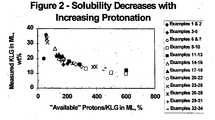
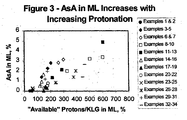
- Example 2 Comparison of the ratio of available protons to KLG in the feed (112.1%) to that in the mother liquor (132.4%) reveals that the feed broth was overprotonated and became more so as KLG was crystallized. This was also reflected by the pH decrease from 1.8 in the feed to 0.44 in the mother liquor and the appearance of ascorbic acid, a byproduct of KLG decomposition, in the mother liquor (1.39 wt%).
- This example further illustrates the inadequacy of using pH as a measure of protonation as the fresh feed pH was the same (1.8) as in Example 1, although by charge balance the feed in Example 1 was underprotonated while in this case it was overprotonated.
- a broth was further pretreated by adding more sulfuric acid, filtration, and contact with the hydrogen form of a cation exchange resin.
- the additional sulfuric acid was intended to fully protonate the KLG and was based upon a C 13 NMR measurement of the degree of proton association with KLG in the broth.
- the resultant broth had a composition given in Table 1, of which 3000.2 grams was subjected to evaporative crystallization at 10°C.
- the broth was evaporated to the point at which the concentration of phosphorus increased by a factor of 6.32 in the mother liquor, or filtrate, relative to that in the feed and 2387.6 grams of distillate was recovered. After vacuum filtration, a methanol wash, and drying, 234.85 grams of a 87.4 wt% pure (anhydrous basis) KLG product was recovered corresponding to 76.9% KLG recovery.
- the composition of the mother liquor is given in Table 2.
- the combination of additional sulfuric acid and cation exchange led to overprotonation as reflected by the ratio of available protons to KLG in the feed of 136.6% and it became more so as KLG was crystallized as the ratio increased to 261.4% in the mother liquor. Again, there was evidence for KLG decomposition as the mother liquor contained 2.85 wt% ascorbic acid.
- the feed broth for this example was pretreated the same as that described in Example 6 except yet even more sulfuric acid was added before cation exchange.
- the resultant broth had a composition given in Table 1, of which 3000.4 grams was subjected to evaporative crystallization at 10°C.
- the broth was evaporated to the point at which the phosphorus concentration increased by a factor of 6.16 in the mother liquor, or filtrate, relative to that in the feed and 231.7.6 grams of distillate was recovered.
- After vacuum filtration, a methanol wash, and drying, 230,42 grams of a 84.9 wt% pure (anhydrous basis) KLG product was recovered corresponding to 59.9% KLG recovery.
- the composition of the mother liquor is given in Table 2.
- the same broth used as the fresh feed in Examples 1 and 2 was further pretreated by adding more sulfuric acid, filtration, and contact with the hydrogen form of a cation exchange resin.
- the additional sulfuric acid was beyond that required to fully protonate the KLG based upon a C 13 NMR measurement of the degree of proton association with KLG in the broth.
- the resultant broth had a composition given in Table 1, of which 3004 grams was subjected to evaporative crystallization at 10°C.
- the broth was evaporated to the point at which the phosphorus concentration increased by a factor of 4.02 in the mother liquor, or filtrate, relative to that in the feed and 2133.4 grams of distillate was recovered. After vacuum filtration, a methanol wash, and drying, 205.27 grams of a 86.5 wt% pure (anhydrous basis) KLG product was recovered corresponding to 48.1% KLG recovery.
- the composition of the mother liquor is given in Table 2.
- the combination of additional sulfuric acid and cation exchange led to overprotonation as reflected by the ratio of available protons to KLG in the feed of 141.3% and it became more so as KLG was crystallized as the ratio increased to 215.5% in the mother liquor. Again, there was evidence for KLG decomposition as the mother liquor contained 1.35 wt% ascorbic acid.
- a broth was further pretreated by contact with the hydrogen form of a cation exchange resin.
- the resultant broth had a composition given in Table 1, of which 3000.1 grams was subjected to evaporative crystallization at 10°C. The broth was evaporated to the point at which the concentration of phosphorus increased by a factor of 5.03 in the mother liquor, or filtrate, relative to that in the feed and 2236.7 grams of distillate was recovered.
- the same broth used as the fresh feed in Examples 1 and 2 was further pretreated by adding more sulfuric acid and filtration.
- the additional sulfuric acid was that required to fully protonate the KLG based upon a C 13 NMR measurement of the degree of proton association with KLG in the broth.
- the resultant broth had a composition given in Table 1, of which 3000 grams was subjected to evaporative crystallization at 10°C.
- the broth was evaporated to the point at which the average concentration of soluble inorganics (K, Na, Mg, and P) increased by a factor of 8.76 in the mother liquor, or filtrate, relative to that in the feed and 2304.1 grams of distillate was recovered. After vacuum filtration, a methanol wash, and drying, 341.58 grams of a 86.6 wt% pure (anhydrous basis) KLG product was recovered corresponding to 65.8% KLG recovery.
- the composition of the mother liquor is given in Table 2.
- the additional sulfuric acid alone led to overprotonation as reflected by the ratio of available protons to KLG in the feed of 110.7% and it became more -o as KLG was crystallized as the ratio increased to 161.2% in the mother liquor.
- This example further illustrates the shortcoming of using pH as a measure of protonation as the pH of the feed in this example was 1.41 while the pH for the feeds in Examples 3 and 14 were both 1.8 despite having similar ratios of available protons to KLG as determined by charge balance (Table 1).
- composition of the resultant mother liquor is given in Table 2. Consistent with the higher degree of concentration by evaporation, overprotonation was somewhat higher in this example than in Examples 17 and 18 as indicated by the ratio of available protons to KLG in the mother liquor (172.7%).
- a broth was further pretreated by adding more sulfuric acid and filtration.
- the additional sulfuric acid was that required to fully protonate the KLG based upon a C 13 NMR measurement of the degree of proton association with KLG in the broth.
- the resultant broth had a composition given in Table 1, of which 3000.3 grams was subjected to evaporative crystallization at 10°C.
- the broth was evaporated to the point at which the average concentration of soluble inorganics (K, Na, Mg, and P) increased by a factor of 8.77 in the mother liquor, or filtrate, relative to that in the feed and 2302.1 grams of distillate was recovered.
- composition of the resultant mother liquor is given in Table 2. Consistent with the slightly higher degree of concentration by evaporation, overprotonation was a little higher in this example than in Examples 20 and 21 as indicated by the ratio of available protons to KLG in the mother liquor (181.0%).
- the same broth used as the fresh feed in Examples 23-25 was further pretreated by adding more sulfuric acid, filtration, and contact with the hydrogen form of a cation exchange resin much like the fresh feed used in Examples 6 and 7.
- the additional sulfuric acid was intended to fully protonate the KLG and was based upon a C 13 NMR measurement of the degree of proton association with KLG in the broth.
- the resultant broth had a composition given in Table 1, of which 3000 grams was subjected to evaporative crystallization at 10°C.
- the broth was evaporated to the point at which the average concentration of soluble inorganics (K, Na, and P) increased by a factor of 5.76 in the mother liquor, or filtrate, relative to that in the feed and 2224.1 grams of distillate was recovered.
- Example 26 Compared to Example 26, the increased concentration factor and addition of even further overprotonated mother liquor to the fresh feed led to a greater surplus of protons as reflected by the ratio of available protons to KLG (377.1 % versus 239.3%). Again, there was evidence for KLG decomposition as the mother liquor contained 1.4 wt% ascorbic acid.
- the same broth used as the fresh feed in Examples 1 and 2 was further pretreated by contact with the hydrogen form of a cation exchange resin.
- the resultant broth had a composition given in Table 1, of which 3000.2 grams was subjected to evaporative crystallization at 10°C.
- the broth was evaporated to the point at which the average concentration of soluble inorganics (K, Na, and P) increased by a factor of 5.65 in the mother liquor, or filtrate, relative to that in the feed and 2231.3 grams of distillate was recovered.
- the same broth used as the fresh feed in Examples 23-25 was further pretreated by adding more sulfuric acid, filtration, and contact with the hydrogen form of a cation exchange resin much like the fresh feed used in Examples 6, 7 and 26-28.
- the additional sulfuric acid was intended to fully protonate the KLG and was based upon a C 13 NMR measurement of the degree of proton association with KLG in the broth.
- the resultant broth had a composition given in Table 1, of which 3100,4 grams was subjected to evaporative crystallization at 10°C.
- the broth was evaporated to the point at which the average concentration of soluble inorganics (Na and P) increased by a factor of 5.95 in the mother liquor, or filtrate, relative to that in the feed and 2341 grams of distillate was recovered.
- Example 32 Compared to Example 32, the increased concentration factor and addition of even further overprotonated mother liquor to the fresh feed led to a greater surplus of protons as reflected by the ratio of available protons to KLG (448.6% versus 242.7%). Again, there was evidence for KLG decomposition as the mother liquor contained 1.4 wt% ascorbic acid.
- the same broth used as the fresh feed in Examples 1 and 2 was further pretreated by contact with the hydrogen form of a cation exchange resin followed by contact with the hydroxyl form of an anion exchange resin.
- the resultant broth had a composition given in Table 1, of which 9013.5 grams was subjected to evaporative crystallization at 10°C, The broth was evaporated to the point at which the average concentration of soluble inorganics (Ca, K, Na, and Mg) increased by a factor of 4.01 in the mother liquor, or filtrate, relative to that in the feed and 6497.7 grams of distillate was recovered.
- Example 35 Compared to Example 35, the increased concentration led to a greater deficit of protons as reflected by both the ratio of available protons .to KLG (88.5% versus 96.9%) and the mother liquor pH (1.8 versus 1.49).
- This example illustrates a shortcoming of simply following cation exchange with anion exchange as a means of properly protonating the solution. Unless the ion exchange steps are nearly perfectly performed, the resultant solution may still be improperly protonated.
- the same broth used as the fresh feed in Examples 1 and 2 was further pretreated by contact with the hydrogen form of a cation exchange resin followed by contact with the hydroxyl form of an anion exchange resin much like Example 35.
- the resultant broth had a composition given in Table 1, of which 8999.9 grams was subjected to evaporative crystallization at 10°C.
- the broth was evaporated to the point at which the average concentration of soluble inorganics (Ca, K, Na, and Mg) increased by a factor of 3.92 in the mother liquor, or filtrate, relative to that in the feed and 6450.1 grams of distillate was recovered.
- Example 37 Compared to Example 37, the increased concentration led to a greater deficit of protons as reflected by both the ratio of available protons to KLG (89.0% versus 97.1%) and the mother liquor pH (1.83 versus 1.5). Again, this example illustrates a shortcoming of simply following cation exchange with anion exchange as a means of properly protonating the solution.
- Example 17 After acidification to pH ⁇ 2 with sulfuric acid, carbon treatment, and microfiltration to remove cells, carbon and other solids, the same broth used as the fresh feed in Examples 1 and 2 was further pretreated by adding more sulfuric acid and filtration much like Example 17. The additional sulfuric acid was that required to fully Protonate the KLG based upon a C 13 NMR measurement of the degree of proton association with KLG in the broth.
- the resultant broth had a composition given in Table 1, of which 9001.6 grams was subjected to evaporative crystallization at 10°C.
- the broth was evaporated to the point at which the average concentration of soluble inorganics (K, Na, Mg, P, and CI) increased by a factor of 5.05 in the mother liquor, or filtrate, relative to that in the feed and 6391.8 grams of distillate was recovered. After vacuum filtration, two water washes, and drying, 797.4 grams of a 79.6 wt% pure (anhydrous basis) KLG product was recovered corresponding to 58.4% KLG recovery.
- the composition of the mother liquor is given in Table 2.
- the additional sulfuric acid alone led to overprotonation as reflected by the ratio of available protons to KLG in the feed of 111.4% and it became more so as KLG was crystallized as the ratio increased to 130.5% in the mother liquor.
- Example 39 Compared to Example 39, the increased concentration led to a greater surplus of protons as reflected by both the ratio of available protons to KLG (199.1% versus 130.5%) and the mother liquor pH (0.46 versus 0.91). There was also evidence for KLG decomposition as the ascorbic acid level in the mother liquor was 2.41 wt%.
- the same broth used as the fresh feed in Examples 1 and 2 was further pretreated by adding more sulfuric acid and filtration much like Examples 17 and 39.
- the additional sulfuric acid was that required to fully protonate the KLG based upon a C 13 NMR measurement of the degree of proton association with KLG in the broth.
- the resultant broth had a composition given in Table 1, of which 9000 grams was subjected to evaporative crystallization at 10°C.
- the broth was evaporated to the point at which the average concentration of soluble inorganics (K, Na, Mg, P, and Cl) increased by a factor of 4.76 in the mother liquor, or filtrate, relative to that in the feed and 6346.1 grams of distillate was recovered, After vacuum filtration, two water washes, and drying, 767.1 grams of a 87.8 wt% pure (anhydrous basis) KLG product was recovered corresponding to 62.2% KLG recovery.
- the composition of the mother liquor is given in Table 2.
- the additional sulfuric acid alone led to overprotonation as reflected by the ratio of available protons to KLG in the feed of 110.2% and it became more so as KLG was crystallized as the ratio increased to 127.3% in the mother liquor.
- Example 41 Compared to Example 41, the increased concentration led to a greater surplus of protons as reflected by both the ratio of available protons to KLG (193.5% versus 127.3%) and the mother liquor pH (0.71 versus 1.05). There was also evidence for KLG decomposition as the ascorbic acid level in the mother liquor was 1.82 wt%.
- the same broth used as the fresh feed in Examples 23-25 was further pretreated by contact with the hydrogen form of a cation exchange resin much like the fresh feed used in Examples 14-16.
- Sodium sulfate salt was subsequently added to the broth in an attempt to moderate the increasing proton concentration upon evaporation.
- the resultant broth had a composition given in Table 1, of which 9000.2 grams was subjected to evaporative crystallization at 10°C.
- the broth was evaporated to the point at which the average concentration of soluble inorganics (Na and P) increased by a factor of 6.21 in the mother liquor, or filtrate, relative to that in the feed and 6858.7 grams of distillate was recovered.
- Example 43 Compared to Example 43, the increased concentration led to a greater surplus of protons as reflected by the ratio of available protons to KLG (202.5% versus 134.8%). There was also evidence for KLG decomposition as the ascorbic acid level in the mother liquor was 1.57 wt%.
- the broth was evaporated to the point at which the average concentration of soluble inorganics (Na and P) increased by a factor of 6.69 in the mother liquor, or filtrate, relative to that in the feed and 6869.2 grams of distillate was recovered. After vacuum filtration, two water washes, and drying, 700.4 grams of a 84.1 wt% pure (anhydrous basis) KLG product was recovered corresponding to 63.2% KLG recovery.
- the composition of the mother liquor is given in Table 2.
- Sodium hydroxide addition was very effective in reducing the overprotonation resulting from cation exchange as the ratio of available protons to KLG in the feed was 101.9% and increased to only 105.7% in the mother liquor.
- Example 46 Consistent with the increased concentration and KLG precipitation relative to Example 46, there was a slightly greater surplus of protons as reflected by the ratio of available protons to KLG in the mother liquor (117.7% versus 113.5%). Again, however, this degree of overacidification was quite modest relative to that observed in Example 44 where sodium sulfate was added to the same cation exchanged broth instead of sodium hydroxide. The degree of KLG decomposition was again low, as the ascorbic acid level in the mother liquor was only 0.89 wt%.
- a broth was further pretreated by contact with the hydrogen form of a cation exchange resin.
- Two separate batches were prepared (designated 49A and 49B) with compositions given in Table 3.
- a one-ml sample of each was transferred to a 100-ml titration vessel and mixed with 0.2 ml of a 1 M barium chloride solution. (This amount of barium chloride was in excess relative to the sulfate present in the sample.)
- To each solution was added 75 ml of dimethyl sulfoxide (DMSO) and 0.3 ml of 0.5M sodium hydroxide.
- DMSO dimethyl sulfoxide
- the broths were blended together.
- the resultant broth had a composition given in Table 1, of which 6500.1 grams was subjected to evaporative crystallization at 10°C.
- the broth was evaporated to the point at which the average concentration of soluble inorganics (Na, Mg, and P) increased by a factor of 5.36 in the mother liquor, or filtrate, relative to that in the feed and 4596.7 grams of distillate was recovered.
- composition of the mother liquor is given in Table 2. Again, sodium hydroxide addition was very effective in reducing the overprotonation resulting from cation exchange as the ratio of available protons to KLG in the feed was 100.7% and increased to only 101.4% in the mother liquor. This was also reflected by the modest decrease in pH from 1.36 in the feed to 1.18 in the mother liquor.
- a broth was further pretreated by contact with the hydrogen form of a cation exchange resin.
- a portion of this cation-exchanged broth was further pretreated by contact with the hydroxyl form of an anion exchange resin.
- some of the cation-exchanged only broth was combined with the cation- and anion-exchanged broth and sodium hydroxide such that the combined feed was near equivalence.
- the resultant broth had a composition given in Table 1, of which 9002.4 grams was subjected to evaporative crystallization at 10°C.
- the broth was evaporated to the point at which the average concentration of soluble inorganics (Na, S, and P) increased by a factor of 7.65 in the mother liquor, or filtrate, relative to that in the feed and 7131.8 grams of distillate was recovered. After vacuum filtration, two water washes, and drying, 652.4 grams of a 87.0 wt% pure (anhydrous basis) KLG product was recovered corresponding to 67.5% KLG recovery.
- the composition of the mother liquor is given in Table 2.
- the combination of partial anion exchange and sodium hydroxide addition was effective in reducing the overprotonation resulting from cation exchange as the ratio of available protons to KLG in the feed was 102.0% and increased to only 106.7% in the mother liquor.
- Example 54 Consistent with the increased concentration and KLG precipitation relative to Example 55, there was a greater surplus of protons as reflected by the ratio of available protons to KLG in the mother liquor (115.2% versus 105.9%).
- the slightly higher pH of the second-stage mother liquor (0.66 versus 0.63) and lower ascorbic acid level (1.27 versus 1.51 wt%) relative to Example 54 likely reflect the smaller degree of concentration.
- a broth was further pretreated by adding more sulfuric acid (to pH 1.8), filtration, and contact with the hydrogen form of a cation exchange resin. Based on charge balance calculations using the pretreated broth composition in Table 3, sodium hydroxide (2.94 grams/kg broth) was added to the blended broth to bring it near equivalence.
- the resultant broth had a composition given in Table 1, of which 9000 grams was subjected to evaporative crystallization at 10°C.
- the broth was evaporated to the point at which the average concentration of soluble inorganics (K, Na, Mg, Cl, and P) increased by a factor of 7.63 in the mother liquor, or filtrate, relative to that in the feed and 6972.9 grams of distillate was recovered. After vacuum filtration, two water washes, and drying, 869.3 grams of a 87.9 wt% pure (anhydrous basis) KLG product was recovered corresponding to 76.5% KLG recovery.
- the composition of the mother liquor is given in Table 2.
- Sodium hydroxide addition was very effective in reducing the overprotonation resulting from cation exchange as the ratio of available protons to KLG in the feed was 99.6% and increased to only 100.8% in the mother liquor. This was also reflected by the small decrease in pH from 1.52 to 1.25 and the low level of ascorbic acid generated (0.34 wt%).
- a broth was further pretreated by adding more sulfuric acid (to pH 1.8), filtration, and contact with the hydrogen form of a cation exchange resin.
- a portion of this cation-exchanged broth was further pretreated by contact with the hydroxyl form of an anion exchange resin.
- some of the cation-exchanged only broth was combined with the cation- and anion-exchanged broth and both sodium hydroxide and sulfuric acid such that the combined feed was near equivalence.
- the resultant broth had a composition given in Table 1, of which 9000.4 grams was subjected to evaporative crystallization at 10°C.
- the broth was evaporated to the point at which the average concentration of soluble inorganics (K, Na, Mg, Cl, and P) increased by a factor of 6.96 in the mother liquor, or filtrate, relative to that in the feed and 7001 grams of distillate was recovered.
- K, Na, Mg, Cl, and P average concentration of soluble inorganics
- a broth was further pretreated by contact with the hydrogen form of a cation exchange resin.
- a portion of this cation-exchanged broth was further pretreated by contact with the hydroxyl form of an anion exchange resin.
- some of the cation-exchanged only broth was combined with the cation-and anion-exchanged broth such that the composite feed was near equivalence.
- the resultant broth had a composition given in Table 1, of which 9000.1 grams was subjected to evaporative crystallization at 10°C.
- the broth was evaporated to the point at which the average concentration of soluble inorganics (K, Na, Mg, and P) increased by a factor of 9.82 in the mother liquor, or filtrate, relative to that in the feed and 7412.7 grams of distillate was recovered.
- the composition of the mother liquor is given in Table 2. Because the cation exchange was relatively incomplete, the feed was somewhat underprotonated as reflected by the ratio of available protons to KLG of 97.7% and become slightly more so (93.5%) in the resulting mother liquor.
- a broth was further pretreated by contact with the hydrogen form of a cation exchange resin. Based on charge balance calculations using the pretreated broth composition in Table 3, sodium hydroxide (7.5 grams/kg broth) was added to the blended broth to bring it near equivalence. The resultant broth had a composition given in Table 1, of which 8999.5 grams was subjected to evaporative crystallization at 10°C.
- the broth was evaporated to the point at which the average concentration of soluble inorganics (Na, Mg, Cl, and P) increased by a factor of 7.12 in the mother liquor, or filtrate, relative to that in the feed and 6541.2 grams of distillate was recovered. After vacuum filtration, two water washes, and drying, 975.7 grams of a 80.6 wt% pure (anhydrous basis) KLG product was recovered corresponding to 72.3% KLG recovery.
- the composition of the mother liquor is given in Table 2.
- Sodium hydroxide addition was effective in reducing the overprotonation resulting from cation exchange as the ratio of available protons to KLG in the feed was 102.3% and increased to only 106.2% in the mother liquor.
- KLG decomposition was minimal as indicated by the low ascorbic acid level of 0.60 wt% in the mother liquor.
- a broth was further pretreated by contact with the hydrogen form of a cation exchange resin.
- a portion of this cation-exchanged broth was further pretreated by contact with the hydroxyl form of an anion exchange resin.
- some of the cation-exchanged only broth was combined with the cation-and anion-exchanged broth and sodium hydroxide such that the composite feed was near equivalence.
- the resultant broth had a composition given in Table 1, of which 9000.1 grams was subjected to evaporative crystallization at 10°C.
- the broth was evaporated to the point at which the average concentration of soluble inorganics (S, Cl, and P) increased by a factor of 6.05 in the mother liquor, or filtrate, relative to that in the feed and 6717.2 grams of distillate was recovered.
- the composition of the mother liquor is given in Table 2.
- a broth was further pretreated by contact with the hydrogen form of a cation exchange resin.
- a portion of this cation-exchanged broth was further pretreated by contact with the hydroxyl form of an anion exchange resin.
- some of the cation-exchanged only broth was combined with the cation- and anion-exchanged broth and sodium hydroxide such that the composite feed was near equivalence.
- the resultant broth had a composition given in Table 1, of which 9000.2 grams was subjected to evaporative crystallization at 10°C.
- the broth was evaporated to the point at which the average concentration of soluble inorganics (Na, S, Cl, and P) increased by a factor of 6.87 in the mother liquor, or filtrate, relative to that in the feed and 6925 grams of distillate was recovered. After vacuum filtration, two water washes, and drying, 689.7 grams of a 85.6 wt% pure (anhydrous basis) KLG product was recovered corresponding to 58.9% KLG recovery.
- the composition of the mother liquor is given in Table 2. Again, the combination of partial anion exchange and sodium hydroxide addition was effective in reducing the overprotonation resulting from cation exchange as the ratio of available protons to KLG in the feed was 100.3% and increased to only 101.8% in the mother liquor.
- a broth was further pretreated by adding more sulfuric acid and filtration. Based on charge balance calculations using the pretreated broth composition in Table 3, the additional sulfuric acid (5.31 grams/kg of broth) was that required to bring the solution near equivalence.
- the resultant broth had a composition given in Table 1, of which 9000 grams was subjected to evaporative crystallization at 10°C.
- the broth was evaporated to the point at which the average concentration of soluble inorganics (K, Na, Mg, Cl, and P) increased by a factor of 4.89 in the mother liquor, or filtrate, relative to that in the feed and 6236.4 grams of distillate was recovered. After vacuum filtration, two water washes, and drying, 861.6 grams of a 83.5 wt% pure (anhydrous basis) KLG product was recovered corresponding to 60.0% KLG recovery.
- the composition of the mother liquor is given in Table 2. Apparently the amount of sulfuric acid added was insufficient to reach equivalence as the feed was somewhat underprotonated as reflected by the ratio of available protons to KLG of 97.0%, and become slightly more so (94.0%) in the resulting mother liquor.
Landscapes
- Chemical & Material Sciences (AREA)
- Organic Chemistry (AREA)
- Crystallography & Structural Chemistry (AREA)
- Engineering & Computer Science (AREA)
- Oil, Petroleum & Natural Gas (AREA)
- Organic Low-Molecular-Weight Compounds And Preparation Thereof (AREA)
- Preparation Of Compounds By Using Micro-Organisms (AREA)
Applications Claiming Priority (3)
| Application Number | Priority Date | Filing Date | Title |
|---|---|---|---|
| US519936 | 1983-08-03 | ||
| US09/519,936 US6670505B1 (en) | 2000-03-07 | 2000-03-07 | Process for the recovery of organic acids from aqueous solutions |
| PCT/US2001/007140 WO2001066508A2 (en) | 2000-03-07 | 2001-03-06 | Process for the recovery of organic acids from aqueous solutions |
Publications (2)
| Publication Number | Publication Date |
|---|---|
| EP1261574A2 EP1261574A2 (en) | 2002-12-04 |
| EP1261574B1 true EP1261574B1 (en) | 2006-11-02 |
Family
ID=24070463
Family Applications (1)
| Application Number | Title | Priority Date | Filing Date |
|---|---|---|---|
| EP01918380A Expired - Lifetime EP1261574B1 (en) | 2000-03-07 | 2001-03-06 | Process for the recovery of organic acids from aqueous solutions |
Country Status (8)
| Country | Link |
|---|---|
| US (2) | US6670505B1 (enExample) |
| EP (1) | EP1261574B1 (enExample) |
| JP (1) | JP2003525923A (enExample) |
| CN (1) | CN100413839C (enExample) |
| AT (1) | ATE344225T1 (enExample) |
| BR (1) | BR0109005A (enExample) |
| DE (1) | DE60124229T2 (enExample) |
| WO (1) | WO2001066508A2 (enExample) |
Families Citing this family (36)
| Publication number | Priority date | Publication date | Assignee | Title |
|---|---|---|---|---|
| DE10007702A1 (de) | 2000-02-19 | 2001-08-23 | Sueddeutsche Kalkstickstoff | Verfahren zur Herstellung von N-(Phosphonomethyl)glycin |
| CA2409745A1 (en) | 2000-05-22 | 2001-12-06 | Monsanto Technology, Llc | Reaction systems for making n-(phosphonomethyl)glycine compounds |
| EP1575968A1 (de) * | 2002-12-19 | 2005-09-21 | Basf Aktiengesellschaft | Verfahren zum extrahieren von 2-keto-l-gulonsäure (kgs) aus einem polaren, vorzugsweise wässrigen lösungsmittel |
| DE10308045B3 (de) * | 2003-02-26 | 2004-06-17 | Lurgi Ag | Verfahren und Vorrichtung zur kontinuierlichen Gewinnung freier Weinsäure aus Kaliumhydrogentartrat enthaltenden Rohstoffen |
| JP4469568B2 (ja) | 2003-07-09 | 2010-05-26 | 三菱化学株式会社 | 有機酸の製造方法 |
| WO2005021770A1 (ja) | 2003-08-28 | 2005-03-10 | Mitsubishi Chemical Corporation | コハク酸の製造方法 |
| WO2005026349A1 (ja) | 2003-09-17 | 2005-03-24 | Mitsubishi Chemical Corporation | 非アミノ有機酸の製造方法 |
| JP4631706B2 (ja) * | 2003-09-30 | 2011-02-16 | 味の素株式会社 | 発酵液からのコハク酸の精製方法 |
| BRPI0510919A (pt) | 2004-05-20 | 2008-05-20 | Ajinomoto Kk | bactéria produtora de ácido succìnico e processo para produzir ácido succìnico |
| CN100389075C (zh) * | 2004-08-10 | 2008-05-21 | 株式会社神钢环境舒立净 | 排水处理方法和排水处理装置 |
| US20090118540A1 (en) * | 2004-10-01 | 2009-05-07 | Ge Healthcare As | Method For Producing Pyruvic Acid |
| WO2007046389A1 (ja) | 2005-10-18 | 2007-04-26 | Ajinomoto Co., Inc. | コハク酸の製造方法 |
| BRPI0707674A2 (pt) | 2006-02-24 | 2011-05-10 | Mitsubishi Chem Corp | bactÉria capaz de produzir Ácido orgÂnico e processo para produÇço do mesmo |
| CN101906032A (zh) * | 2010-07-14 | 2010-12-08 | 华东理工大学 | 回收和循环使用l-(+)-酒石酸的方法 |
| CN108821961A (zh) * | 2011-08-16 | 2018-11-16 | 普拉克生化公司 | 利用用于发酵液处理的盐酸通过沉淀作用从其镁盐中回收羧酸 |
| JP6275038B2 (ja) * | 2011-08-16 | 2018-02-07 | ピュラック バイオケム ビー. ブイ. | 発酵ブロス処理にとって有用な、塩化水素酸を用いた沈殿によるカルボン酸のそれらのマグネシウム塩からの回収 |
| CA2843696C (en) | 2011-08-16 | 2019-09-24 | Purac Biochem B.V. | Recovery of carboxylic acid from their magnesium salts by precipitation using hydrochloric acid, useful for fermentation broth work-up |
| EA027341B1 (ru) | 2011-08-16 | 2017-07-31 | Пурак Биокем Б.В. | Извлечение карбоновой кислоты из ее магниевых солей путем осаждения c применением хлористо-водородной кислоты, пригодное для выделения продукта реакции из ферментативного бульона |
| US9480574B2 (en) | 2013-03-14 | 2016-11-01 | Benvenue Medical, Inc. | Spinal fusion implants and devices and methods for deploying such implants |
| CN103450007B (zh) * | 2013-09-02 | 2015-06-17 | 西安通鑫半导体辅料有限公司 | 一种从硅片脱胶工序产生的废乳酸中回收乳酸的方法 |
| US9422398B2 (en) | 2014-05-30 | 2016-08-23 | Industrial Technology Research Institute | Copolymer, and method for preparing a monomer used to form the copolymer |
| US10314605B2 (en) | 2014-07-08 | 2019-06-11 | Benvenue Medical, Inc. | Apparatus and methods for disrupting intervertebral disc tissue |
| CN104447529B (zh) * | 2014-11-25 | 2017-05-24 | 利尔化学股份有限公司 | 3,6‑二氯吡啶甲酸的提取纯化方法 |
| CN104672078B (zh) * | 2015-02-02 | 2017-05-24 | 江苏索普(集团)有限公司 | 一种羰基合成醋酸副产物提纯制丙酸的工艺 |
| US10022243B2 (en) | 2015-02-06 | 2018-07-17 | Benvenue Medical, Inc. | Graft material injector system and method |
| US10758286B2 (en) | 2017-03-22 | 2020-09-01 | Benvenue Medical, Inc. | Minimal impact access system to disc space |
| US11583327B2 (en) | 2018-01-29 | 2023-02-21 | Spinal Elements, Inc. | Minimally invasive interbody fusion |
| WO2019178575A1 (en) | 2018-03-16 | 2019-09-19 | Benvenue Medical, Inc. | Articulated instrumentation and methods of using the same |
| CN108314164B (zh) * | 2018-03-27 | 2020-06-19 | 浙江大学 | 回收废水中钡的方法 |
| CN108947066A (zh) * | 2018-07-13 | 2018-12-07 | 宁波永顺精细化工有限公司 | 羧酸钡废水中羧酸及钡盐的回收方法 |
| CN113195730A (zh) * | 2018-12-19 | 2021-07-30 | 巴斯夫欧洲公司 | 从包含生物质和至少一种寡糖的溶液中分离生物质的方法 |
| KR102520535B1 (ko) * | 2018-12-24 | 2023-04-11 | 안형일 | 미네랄을 포함하는 사료 첨가 조성물 |
| CN111943836A (zh) * | 2019-05-16 | 2020-11-17 | 帝斯曼知识产权资产管理有限公司 | 回收2-酮-l-古洛糖酸的改进方法 |
| CN111978202B (zh) * | 2020-08-12 | 2022-08-05 | 浙江理工大学上虞工业技术研究院有限公司 | 可碱洗分散染料水解产物的回收方法 |
| CN112552164B (zh) * | 2020-12-08 | 2022-12-09 | 日照金禾博源生化有限公司 | 一种从不合格柠檬酸钠母液中提取苹果酸的工艺方法 |
| WO2023076622A1 (en) * | 2021-10-29 | 2023-05-04 | Alliance For Sustainable Energy, Llc | Process for the recovery of monopotassium glucarate and glucaric acid |
Family Cites Families (31)
| Publication number | Priority date | Publication date | Assignee | Title |
|---|---|---|---|---|
| US2318500A (en) * | 1935-10-21 | 1943-05-04 | Parke Davis & Co | Preparation of ascorbic acid and 1-gulosone |
| US2421612A (en) | 1945-05-04 | 1947-06-03 | Byron E Gray | Preparation of 2-keto gulonic acid and its salts |
| US2421611A (en) * | 1945-05-04 | 1947-06-03 | Byron E Gray | Preparation of 2-keto gulonic acid and its salts |
| US2462251A (en) | 1945-05-16 | 1949-02-22 | Merck & Co Inc | Process for preparing ascorbic acids |
| US2918492A (en) * | 1956-08-24 | 1959-12-22 | Miles Lab | Method of preparing methyl 2-ketogluconate |
| US3043749A (en) * | 1960-07-28 | 1962-07-10 | Pfizer & Co C | Preparation of 2-keto-l-gulonic acid |
| US3234105A (en) * | 1962-09-20 | 1966-02-08 | Takeda Chemical Industries Ltd | Method for producing 2-keto-lgulonic acid |
| US3381027A (en) * | 1964-04-22 | 1968-04-30 | Hoffmann La Roche | Preparation and recovery of methyl 2-ketogluconate |
| US4113771A (en) | 1971-04-07 | 1978-09-12 | Ethyl Corporation | Process for the purification of citric acid |
| US4202828A (en) | 1978-01-10 | 1980-05-13 | Kawasaki Kasei Chemicals Limited | Process for separation of naphthoquinone and phthalic acid |
| FR2421864A1 (fr) | 1978-04-05 | 1979-11-02 | Hoechst France | Procede de fabrication de l'acide hydroxy-4, dimethoxy-3,5 benzoique a partir de l'acide trimethoxy-3,4,5 benzoique |
| US4334074A (en) | 1981-02-02 | 1982-06-08 | The Dow Chemical Company | Method of recovering 3,6-dichloropicolinic acid from basic aqueous solutions of salts thereof |
| DE3345411A1 (de) | 1983-12-15 | 1985-06-27 | Dynamit Nobel Ag, 5210 Troisdorf | Verfahren zur reindarstellung von carbonsaeuren |
| US4771001A (en) | 1986-03-27 | 1988-09-13 | Neurex Corp. | Production of lactic acid by continuous fermentation using an inexpensive raw material and a simplified method of lactic acid purification |
| US5168055A (en) | 1986-06-11 | 1992-12-01 | Rathin Datta | Fermentation and purification process for succinic acid |
| US5202476A (en) * | 1988-04-29 | 1993-04-13 | Takeda Chemical Industries, Ltd. | Purification of 2-keto-L-gulonic acid |
| FR2636343B1 (enExample) | 1988-09-13 | 1994-11-25 | Rhone Poulenc Sante | |
| FR2648136B1 (fr) | 1989-06-12 | 1994-06-17 | Rhone Poulenc Sante | Procede de preparation de l'acide ascorbique |
| CH678057A5 (de) | 1989-06-26 | 1991-07-31 | Enco Eng Ag | Verfahren zur herstellung von natrium- oder kalium-l-ascorbat. |
| US5202475A (en) | 1990-09-27 | 1993-04-13 | Eastman Kodak Company | Process for preparation of cyclohexanedicarboxylic acid |
| EP0483831B1 (en) | 1990-11-02 | 1995-09-06 | Mitsubishi Chemical Corporation | Process for separating an organic acid or acids from an organic acid-containing solution |
| US5210296A (en) | 1990-11-19 | 1993-05-11 | E. I. Du Pont De Nemours And Company | Recovery of lactate esters and lactic acid from fermentation broth |
| US5159110A (en) | 1991-05-16 | 1992-10-27 | W. R. Grace & Co.-Conn. | Process for recovering n-methyliminodiacetic acid from sodium sulfate |
| IT1254254B (it) | 1992-03-11 | 1995-09-14 | Erregierre Ind Chim | Procedimento per la preparazione di acido iodesossicolico ad elevata purezza per impiego farmaceutico |
| CA2126365C (en) | 1993-07-06 | 1999-08-24 | Steven W. Felman | Recovery of citric acid from impure process streams by addition of strong acids and salts thereof |
| US5352825A (en) | 1993-07-06 | 1994-10-04 | Hoarmann & Reimer Corp. | Recovery of organic acid salts from impure process streams by addition of bases |
| US5426219A (en) | 1993-07-26 | 1995-06-20 | A.E. Staley Manufacturing Co. | Process for recovering organic acids |
| US5410076A (en) | 1993-11-12 | 1995-04-25 | Lever Brothers Company, Division Of Conopco, Inc. | Process for the preparation of bis(amidocarboxylic acid) |
| CN1145639A (zh) | 1994-12-09 | 1997-03-19 | 三菱化学株式会社 | L-天冬氨酸的制造方法 |
| US5522995A (en) | 1995-02-28 | 1996-06-04 | Cockrem; Michael C. M. | Process for recovering organic acids from aqueous salt solutions |
| JP3976832B2 (ja) | 1996-04-30 | 2007-09-19 | ディーエスエム アイピー アセッツ ビー.ブイ. | 2−ケト−l−グロン酸の単離方法 |
-
2000
- 2000-03-07 US US09/519,936 patent/US6670505B1/en not_active Expired - Fee Related
-
2001
- 2001-03-06 JP JP2001565329A patent/JP2003525923A/ja not_active Withdrawn
- 2001-03-06 EP EP01918380A patent/EP1261574B1/en not_active Expired - Lifetime
- 2001-03-06 AT AT01918380T patent/ATE344225T1/de not_active IP Right Cessation
- 2001-03-06 WO PCT/US2001/007140 patent/WO2001066508A2/en not_active Ceased
- 2001-03-06 CN CNB018090400A patent/CN100413839C/zh not_active Expired - Fee Related
- 2001-03-06 DE DE60124229T patent/DE60124229T2/de not_active Expired - Fee Related
- 2001-03-06 BR BR0109005-4A patent/BR0109005A/pt not_active IP Right Cessation
- 2001-08-03 US US09/921,946 patent/US20020026077A1/en not_active Abandoned
Also Published As
| Publication number | Publication date |
|---|---|
| EP1261574A2 (en) | 2002-12-04 |
| CN100413839C (zh) | 2008-08-27 |
| JP2003525923A (ja) | 2003-09-02 |
| DE60124229T2 (de) | 2007-02-15 |
| WO2001066508A2 (en) | 2001-09-13 |
| CN1427813A (zh) | 2003-07-02 |
| US20020026077A1 (en) | 2002-02-28 |
| US6670505B1 (en) | 2003-12-30 |
| DE60124229D1 (de) | 2006-12-14 |
| ATE344225T1 (de) | 2006-11-15 |
| BR0109005A (pt) | 2003-06-03 |
| WO2001066508A3 (en) | 2002-05-02 |
Similar Documents
| Publication | Publication Date | Title |
|---|---|---|
| EP1261574B1 (en) | Process for the recovery of organic acids from aqueous solutions | |
| JP2003525923A5 (enExample) | ||
| CN102753514B (zh) | 制备琥珀酸的方法 | |
| KR101767034B1 (ko) | 1가 숙신산 염의 제조방법 | |
| KR101975426B1 (ko) | 카르복실산 및 염 부산물의 제조 방법 | |
| US4828993A (en) | Process for the preparation of organic acids | |
| US6747173B2 (en) | Method for the preparation of lactic acid and calcium sulphate dihydrate | |
| US5254729A (en) | Method for purifying glycine | |
| EP2371802A1 (en) | Process for the crystallization of succinic acid | |
| JPH0130836B2 (enExample) | ||
| CA1236114A (en) | Process for the production of l-malic acid | |
| JPH0549928A (ja) | 活性炭の再生方法 | |
| US4066688A (en) | Chemical process | |
| US7083772B2 (en) | Aqueous solution of zinc nitrite and method for production thereof | |
| DE69423744T2 (de) | VERFAHREN ZUR HERSTELLUNG VON cis-EPOXYBERNSTEINSÄURESALZEN | |
| RU1559773C (ru) | Способ получения 12-вольфрамовофосфорной кислоты | |
| JP2907582B2 (ja) | グリシンの精製方法 | |
| US4388474A (en) | Method for the preparation of guanidine sulfamate | |
| US4484003A (en) | Preparation process of β-chloroalanine | |
| US20230178804A1 (en) | Processes for producing lithium bis(fluorosulfonyl) imide | |
| CA1110637A (en) | Reduction of 2,5-diketogluconic acid | |
| US2139142A (en) | Purification of materials containing nitrite | |
| SU1353727A1 (ru) | Способ получени кристаллического двойного фосфата титана и магни общей формулы @ -TI MG(РО @ ) @ 3Н @ О | |
| US20030044944A1 (en) | Method for the preparation of lactic acid and calcium sulphate dihydrate | |
| US20060205937A1 (en) | Method for producing organic acid salt |
Legal Events
| Date | Code | Title | Description |
|---|---|---|---|
| PUAI | Public reference made under article 153(3) epc to a published international application that has entered the european phase |
Free format text: ORIGINAL CODE: 0009012 |
|
| 17P | Request for examination filed |
Effective date: 20020828 |
|
| AK | Designated contracting states |
Kind code of ref document: A2 Designated state(s): AT BE CH CY DE DK ES FI FR GB GR IE IT LI LU MC NL PT SE TR |
|
| AX | Request for extension of the european patent |
Free format text: AL;LT;LV;MK;RO;SI |
|
| 17Q | First examination report despatched |
Effective date: 20030403 |
|
| GRAP | Despatch of communication of intention to grant a patent |
Free format text: ORIGINAL CODE: EPIDOSNIGR1 |
|
| GRAS | Grant fee paid |
Free format text: ORIGINAL CODE: EPIDOSNIGR3 |
|
| GRAA | (expected) grant |
Free format text: ORIGINAL CODE: 0009210 |
|
| AK | Designated contracting states |
Kind code of ref document: B1 Designated state(s): AT BE CH CY DE DK ES FI FR GB GR IE IT LI LU MC NL PT SE TR |
|
| PG25 | Lapsed in a contracting state [announced via postgrant information from national office to epo] |
Ref country code: IT Free format text: LAPSE BECAUSE OF FAILURE TO SUBMIT A TRANSLATION OF THE DESCRIPTION OR TO PAY THE FEE WITHIN THE PRESCRIBED TIME-LIMIT;WARNING: LAPSES OF ITALIAN PATENTS WITH EFFECTIVE DATE BEFORE 2007 MAY HAVE OCCURRED AT ANY TIME BEFORE 2007. THE CORRECT EFFECTIVE DATE MAY BE DIFFERENT FROM THE ONE RECORDED. Effective date: 20061102 Ref country code: FI Free format text: LAPSE BECAUSE OF FAILURE TO SUBMIT A TRANSLATION OF THE DESCRIPTION OR TO PAY THE FEE WITHIN THE PRESCRIBED TIME-LIMIT Effective date: 20061102 Ref country code: NL Free format text: LAPSE BECAUSE OF FAILURE TO SUBMIT A TRANSLATION OF THE DESCRIPTION OR TO PAY THE FEE WITHIN THE PRESCRIBED TIME-LIMIT Effective date: 20061102 Ref country code: LI Free format text: LAPSE BECAUSE OF FAILURE TO SUBMIT A TRANSLATION OF THE DESCRIPTION OR TO PAY THE FEE WITHIN THE PRESCRIBED TIME-LIMIT Effective date: 20061102 Ref country code: BE Free format text: LAPSE BECAUSE OF FAILURE TO SUBMIT A TRANSLATION OF THE DESCRIPTION OR TO PAY THE FEE WITHIN THE PRESCRIBED TIME-LIMIT Effective date: 20061102 Ref country code: CH Free format text: LAPSE BECAUSE OF FAILURE TO SUBMIT A TRANSLATION OF THE DESCRIPTION OR TO PAY THE FEE WITHIN THE PRESCRIBED TIME-LIMIT Effective date: 20061102 Ref country code: AT Free format text: LAPSE BECAUSE OF FAILURE TO SUBMIT A TRANSLATION OF THE DESCRIPTION OR TO PAY THE FEE WITHIN THE PRESCRIBED TIME-LIMIT Effective date: 20061102 |
|
| REG | Reference to a national code |
Ref country code: GB Ref legal event code: FG4D |
|
| REG | Reference to a national code |
Ref country code: IE Ref legal event code: FG4D |
|
| REG | Reference to a national code |
Ref country code: CH Ref legal event code: EP |
|
| REF | Corresponds to: |
Ref document number: 60124229 Country of ref document: DE Date of ref document: 20061214 Kind code of ref document: P |
|
| PG25 | Lapsed in a contracting state [announced via postgrant information from national office to epo] |
Ref country code: SE Free format text: LAPSE BECAUSE OF FAILURE TO SUBMIT A TRANSLATION OF THE DESCRIPTION OR TO PAY THE FEE WITHIN THE PRESCRIBED TIME-LIMIT Effective date: 20070202 Ref country code: DK Free format text: LAPSE BECAUSE OF FAILURE TO SUBMIT A TRANSLATION OF THE DESCRIPTION OR TO PAY THE FEE WITHIN THE PRESCRIBED TIME-LIMIT Effective date: 20070202 |
|
| PG25 | Lapsed in a contracting state [announced via postgrant information from national office to epo] |
Ref country code: ES Free format text: LAPSE BECAUSE OF FAILURE TO SUBMIT A TRANSLATION OF THE DESCRIPTION OR TO PAY THE FEE WITHIN THE PRESCRIBED TIME-LIMIT Effective date: 20070213 |
|
| PG25 | Lapsed in a contracting state [announced via postgrant information from national office to epo] |
Ref country code: PT Free format text: LAPSE BECAUSE OF FAILURE TO SUBMIT A TRANSLATION OF THE DESCRIPTION OR TO PAY THE FEE WITHIN THE PRESCRIBED TIME-LIMIT Effective date: 20070402 |
|
| NLV1 | Nl: lapsed or annulled due to failure to fulfill the requirements of art. 29p and 29m of the patents act | ||
| REG | Reference to a national code |
Ref country code: CH Ref legal event code: PL |
|
| ET | Fr: translation filed | ||
| PLBE | No opposition filed within time limit |
Free format text: ORIGINAL CODE: 0009261 |
|
| STAA | Information on the status of an ep patent application or granted ep patent |
Free format text: STATUS: NO OPPOSITION FILED WITHIN TIME LIMIT |
|
| 26N | No opposition filed |
Effective date: 20070803 |
|
| PG25 | Lapsed in a contracting state [announced via postgrant information from national office to epo] |
Ref country code: IE Free format text: LAPSE BECAUSE OF NON-PAYMENT OF DUE FEES Effective date: 20070306 Ref country code: MC Free format text: LAPSE BECAUSE OF NON-PAYMENT OF DUE FEES Effective date: 20070331 |
|
| PG25 | Lapsed in a contracting state [announced via postgrant information from national office to epo] |
Ref country code: GR Free format text: LAPSE BECAUSE OF FAILURE TO SUBMIT A TRANSLATION OF THE DESCRIPTION OR TO PAY THE FEE WITHIN THE PRESCRIBED TIME-LIMIT Effective date: 20070203 |
|
| PGFP | Annual fee paid to national office [announced via postgrant information from national office to epo] |
Ref country code: GB Payment date: 20080211 Year of fee payment: 8 |
|
| PGFP | Annual fee paid to national office [announced via postgrant information from national office to epo] |
Ref country code: DE Payment date: 20080331 Year of fee payment: 8 Ref country code: FR Payment date: 20080307 Year of fee payment: 8 |
|
| PG25 | Lapsed in a contracting state [announced via postgrant information from national office to epo] |
Ref country code: CY Free format text: LAPSE BECAUSE OF FAILURE TO SUBMIT A TRANSLATION OF THE DESCRIPTION OR TO PAY THE FEE WITHIN THE PRESCRIBED TIME-LIMIT Effective date: 20061102 Ref country code: LU Free format text: LAPSE BECAUSE OF NON-PAYMENT OF DUE FEES Effective date: 20070306 |
|
| PG25 | Lapsed in a contracting state [announced via postgrant information from national office to epo] |
Ref country code: TR Free format text: LAPSE BECAUSE OF FAILURE TO SUBMIT A TRANSLATION OF THE DESCRIPTION OR TO PAY THE FEE WITHIN THE PRESCRIBED TIME-LIMIT Effective date: 20061102 |
|
| GBPC | Gb: european patent ceased through non-payment of renewal fee |
Effective date: 20090306 |
|
| REG | Reference to a national code |
Ref country code: FR Ref legal event code: ST Effective date: 20091130 |
|
| PG25 | Lapsed in a contracting state [announced via postgrant information from national office to epo] |
Ref country code: DE Free format text: LAPSE BECAUSE OF NON-PAYMENT OF DUE FEES Effective date: 20091001 |
|
| PG25 | Lapsed in a contracting state [announced via postgrant information from national office to epo] |
Ref country code: GB Free format text: LAPSE BECAUSE OF NON-PAYMENT OF DUE FEES Effective date: 20090306 Ref country code: FR Free format text: LAPSE BECAUSE OF NON-PAYMENT OF DUE FEES Effective date: 20091123 |