EP1245968B1 - Laminate comprising a needle-like antimony-containing tin oxide and antireflection film comprising the same - Google Patents
Laminate comprising a needle-like antimony-containing tin oxide and antireflection film comprising the same Download PDFInfo
- Publication number
- EP1245968B1 EP1245968B1 EP02007019A EP02007019A EP1245968B1 EP 1245968 B1 EP1245968 B1 EP 1245968B1 EP 02007019 A EP02007019 A EP 02007019A EP 02007019 A EP02007019 A EP 02007019A EP 1245968 B1 EP1245968 B1 EP 1245968B1
- Authority
- EP
- European Patent Office
- Prior art keywords
- refractive index
- weight
- needle
- meth
- film
- Prior art date
- Legal status (The legal status is an assumption and is not a legal conclusion. Google has not performed a legal analysis and makes no representation as to the accuracy of the status listed.)
- Expired - Lifetime
Links
- 229910052787 antimony Inorganic materials 0.000 title claims description 37
- WATWJIUSRGPENY-UHFFFAOYSA-N antimony atom Chemical compound [Sb] WATWJIUSRGPENY-UHFFFAOYSA-N 0.000 title claims description 37
- XOLBLPGZBRYERU-UHFFFAOYSA-N tin dioxide Chemical compound O=[Sn]=O XOLBLPGZBRYERU-UHFFFAOYSA-N 0.000 title claims description 37
- 229910001887 tin oxide Inorganic materials 0.000 title claims description 37
- 239000000203 mixture Substances 0.000 claims description 124
- NIXOWILDQLNWCW-UHFFFAOYSA-M Acrylate Chemical compound [O-]C(=O)C=C NIXOWILDQLNWCW-UHFFFAOYSA-M 0.000 claims description 71
- 150000001875 compounds Chemical class 0.000 claims description 56
- 125000002887 hydroxy group Chemical group [H]O* 0.000 claims description 49
- 239000000047 product Substances 0.000 claims description 38
- 239000007787 solid Substances 0.000 claims description 34
- 229910052731 fluorine Inorganic materials 0.000 claims description 28
- 239000003960 organic solvent Substances 0.000 claims description 22
- 125000005442 diisocyanate group Chemical group 0.000 claims description 21
- 239000007795 chemical reaction product Substances 0.000 claims description 18
- 150000002894 organic compounds Chemical class 0.000 claims description 13
- 239000012956 1-hydroxycyclohexylphenyl-ketone Substances 0.000 claims description 9
- MQDJYUACMFCOFT-UHFFFAOYSA-N bis[2-(1-hydroxycyclohexyl)phenyl]methanone Chemical compound C=1C=CC=C(C(=O)C=2C(=CC=CC=2)C2(O)CCCCC2)C=1C1(O)CCCCC1 MQDJYUACMFCOFT-UHFFFAOYSA-N 0.000 claims description 9
- 239000002245 particle Substances 0.000 claims description 9
- 238000004381 surface treatment Methods 0.000 claims description 8
- 125000001153 fluoro group Chemical group F* 0.000 claims description 5
- 239000010408 film Substances 0.000 description 168
- 238000000576 coating method Methods 0.000 description 29
- 238000000034 method Methods 0.000 description 29
- 239000011248 coating agent Substances 0.000 description 26
- YCKRFDGAMUMZLT-UHFFFAOYSA-N Fluorine atom Chemical compound [F] YCKRFDGAMUMZLT-UHFFFAOYSA-N 0.000 description 23
- 239000011737 fluorine Substances 0.000 description 23
- ZWEHNKRNPOVVGH-UHFFFAOYSA-N 2-Butanone Chemical compound CCC(C)=O ZWEHNKRNPOVVGH-UHFFFAOYSA-N 0.000 description 22
- 238000004519 manufacturing process Methods 0.000 description 22
- 239000000243 solution Substances 0.000 description 20
- 229920005989 resin Polymers 0.000 description 18
- 239000011347 resin Substances 0.000 description 18
- 239000000758 substrate Substances 0.000 description 18
- -1 benzyldimethylketal Chemical compound 0.000 description 17
- 238000006243 chemical reaction Methods 0.000 description 17
- 229920001577 copolymer Polymers 0.000 description 16
- 239000003795 chemical substances by application Substances 0.000 description 15
- 230000000694 effects Effects 0.000 description 15
- 238000002360 preparation method Methods 0.000 description 13
- 239000000463 material Substances 0.000 description 12
- 239000005058 Isophorone diisocyanate Substances 0.000 description 10
- 239000003054 catalyst Substances 0.000 description 10
- 230000000052 comparative effect Effects 0.000 description 10
- NIMLQBUJDJZYEJ-UHFFFAOYSA-N isophorone diisocyanate Chemical compound CC1(C)CC(N=C=O)CC(C)(CN=C=O)C1 NIMLQBUJDJZYEJ-UHFFFAOYSA-N 0.000 description 10
- WXZMFSXDPGVJKK-UHFFFAOYSA-N pentaerythritol Chemical compound OCC(CO)(CO)CO WXZMFSXDPGVJKK-UHFFFAOYSA-N 0.000 description 10
- 239000000178 monomer Substances 0.000 description 9
- TXBCBTDQIULDIA-UHFFFAOYSA-N 2-[[3-hydroxy-2,2-bis(hydroxymethyl)propoxy]methyl]-2-(hydroxymethyl)propane-1,3-diol Chemical compound OCC(CO)(CO)COCC(CO)(CO)CO TXBCBTDQIULDIA-UHFFFAOYSA-N 0.000 description 8
- NTIZESTWPVYFNL-UHFFFAOYSA-N Methyl isobutyl ketone Chemical compound CC(C)CC(C)=O NTIZESTWPVYFNL-UHFFFAOYSA-N 0.000 description 8
- 230000015572 biosynthetic process Effects 0.000 description 8
- 238000010438 heat treatment Methods 0.000 description 8
- OKKJLVBELUTLKV-UHFFFAOYSA-N Methanol Chemical group OC OKKJLVBELUTLKV-UHFFFAOYSA-N 0.000 description 7
- 239000007822 coupling agent Substances 0.000 description 7
- RRAMGCGOFNQTLD-UHFFFAOYSA-N hexamethylene diisocyanate Chemical compound O=C=NCCCCCCN=C=O RRAMGCGOFNQTLD-UHFFFAOYSA-N 0.000 description 7
- 239000000843 powder Substances 0.000 description 7
- RTZKZFJDLAIYFH-UHFFFAOYSA-N Diethyl ether Chemical compound CCOCC RTZKZFJDLAIYFH-UHFFFAOYSA-N 0.000 description 6
- KFZMGEQAYNKOFK-UHFFFAOYSA-N Isopropanol Chemical compound CC(C)O KFZMGEQAYNKOFK-UHFFFAOYSA-N 0.000 description 6
- UIHCLUNTQKBZGK-UHFFFAOYSA-N Methyl isobutyl ketone Natural products CCC(C)C(C)=O UIHCLUNTQKBZGK-UHFFFAOYSA-N 0.000 description 6
- HVVWZTWDBSEWIH-UHFFFAOYSA-N [2-(hydroxymethyl)-3-prop-2-enoyloxy-2-(prop-2-enoyloxymethyl)propyl] prop-2-enoate Chemical compound C=CC(=O)OCC(CO)(COC(=O)C=C)COC(=O)C=C HVVWZTWDBSEWIH-UHFFFAOYSA-N 0.000 description 6
- 125000000524 functional group Chemical group 0.000 description 6
- 229910010272 inorganic material Inorganic materials 0.000 description 6
- 239000011147 inorganic material Substances 0.000 description 6
- 125000000962 organic group Chemical group 0.000 description 6
- VYPSYNLAJGMNEJ-UHFFFAOYSA-N Silicium dioxide Chemical compound O=[Si]=O VYPSYNLAJGMNEJ-UHFFFAOYSA-N 0.000 description 5
- MPIAGWXWVAHQBB-UHFFFAOYSA-N [3-prop-2-enoyloxy-2-[[3-prop-2-enoyloxy-2,2-bis(prop-2-enoyloxymethyl)propoxy]methyl]-2-(prop-2-enoyloxymethyl)propyl] prop-2-enoate Chemical compound C=CC(=O)OCC(COC(=O)C=C)(COC(=O)C=C)COCC(COC(=O)C=C)(COC(=O)C=C)COC(=O)C=C MPIAGWXWVAHQBB-UHFFFAOYSA-N 0.000 description 5
- 239000010419 fine particle Substances 0.000 description 5
- 239000011521 glass Substances 0.000 description 5
- 229920000642 polymer Polymers 0.000 description 5
- 239000000126 substance Substances 0.000 description 5
- DVKJHBMWWAPEIU-UHFFFAOYSA-N toluene 2,4-diisocyanate Chemical compound CC1=CC=C(N=C=O)C=C1N=C=O DVKJHBMWWAPEIU-UHFFFAOYSA-N 0.000 description 5
- 238000002834 transmittance Methods 0.000 description 5
- IJGRMHOSHXDMSA-UHFFFAOYSA-N Atomic nitrogen Chemical compound N#N IJGRMHOSHXDMSA-UHFFFAOYSA-N 0.000 description 4
- XDTMQSROBMDMFD-UHFFFAOYSA-N Cyclohexane Chemical compound C1CCCCC1 XDTMQSROBMDMFD-UHFFFAOYSA-N 0.000 description 4
- DAKWPKUUDNSNPN-UHFFFAOYSA-N Trimethylolpropane triacrylate Chemical compound C=CC(=O)OCC(CC)(COC(=O)C=C)COC(=O)C=C DAKWPKUUDNSNPN-UHFFFAOYSA-N 0.000 description 4
- YRKCREAYFQTBPV-UHFFFAOYSA-N acetylacetone Chemical compound CC(=O)CC(C)=O YRKCREAYFQTBPV-UHFFFAOYSA-N 0.000 description 4
- 125000003647 acryloyl group Chemical group O=C([*])C([H])=C([H])[H] 0.000 description 4
- 229910052782 aluminium Inorganic materials 0.000 description 4
- XAGFODPZIPBFFR-UHFFFAOYSA-N aluminium Chemical compound [Al] XAGFODPZIPBFFR-UHFFFAOYSA-N 0.000 description 4
- 239000011324 bead Substances 0.000 description 4
- JHIVVAPYMSGYDF-UHFFFAOYSA-N cyclohexanone Chemical compound O=C1CCCCC1 JHIVVAPYMSGYDF-UHFFFAOYSA-N 0.000 description 4
- 230000003247 decreasing effect Effects 0.000 description 4
- KORSJDCBLAPZEQ-UHFFFAOYSA-N dicyclohexylmethane-4,4'-diisocyanate Chemical compound C1CC(N=C=O)CCC1CC1CCC(N=C=O)CC1 KORSJDCBLAPZEQ-UHFFFAOYSA-N 0.000 description 4
- 239000006185 dispersion Substances 0.000 description 4
- FJKIXWOMBXYWOQ-UHFFFAOYSA-N ethenoxyethane Chemical compound CCOC=C FJKIXWOMBXYWOQ-UHFFFAOYSA-N 0.000 description 4
- HCDGVLDPFQMKDK-UHFFFAOYSA-N hexafluoropropylene Chemical group FC(F)=C(F)C(F)(F)F HCDGVLDPFQMKDK-UHFFFAOYSA-N 0.000 description 4
- 239000012948 isocyanate Substances 0.000 description 4
- 150000002513 isocyanates Chemical class 0.000 description 4
- ZFSLODLOARCGLH-UHFFFAOYSA-N isocyanuric acid Chemical compound OC1=NC(O)=NC(O)=N1 ZFSLODLOARCGLH-UHFFFAOYSA-N 0.000 description 4
- 229910044991 metal oxide Inorganic materials 0.000 description 4
- 150000004706 metal oxides Chemical class 0.000 description 4
- 239000011259 mixed solution Substances 0.000 description 4
- 238000003786 synthesis reaction Methods 0.000 description 4
- PYOKUURKVVELLB-UHFFFAOYSA-N trimethyl orthoformate Chemical compound COC(OC)OC PYOKUURKVVELLB-UHFFFAOYSA-N 0.000 description 4
- FDSUVTROAWLVJA-UHFFFAOYSA-N 2-[[3-hydroxy-2,2-bis(hydroxymethyl)propoxy]methyl]-2-(hydroxymethyl)propane-1,3-diol;prop-2-enoic acid Chemical compound OC(=O)C=C.OC(=O)C=C.OC(=O)C=C.OC(=O)C=C.OC(=O)C=C.OCC(CO)(CO)COCC(CO)(CO)CO FDSUVTROAWLVJA-UHFFFAOYSA-N 0.000 description 3
- VUIWJRYTWUGOOF-UHFFFAOYSA-N 2-ethenoxyethanol Chemical compound OCCOC=C VUIWJRYTWUGOOF-UHFFFAOYSA-N 0.000 description 3
- UUEWCQRISZBELL-UHFFFAOYSA-N 3-trimethoxysilylpropane-1-thiol Chemical compound CO[Si](OC)(OC)CCCS UUEWCQRISZBELL-UHFFFAOYSA-N 0.000 description 3
- QTBSBXVTEAMEQO-UHFFFAOYSA-N Acetic acid Chemical compound CC(O)=O QTBSBXVTEAMEQO-UHFFFAOYSA-N 0.000 description 3
- 239000004925 Acrylic resin Substances 0.000 description 3
- LFQSCWFLJHTTHZ-UHFFFAOYSA-N Ethanol Chemical compound CCO LFQSCWFLJHTTHZ-UHFFFAOYSA-N 0.000 description 3
- XEKOWRVHYACXOJ-UHFFFAOYSA-N Ethyl acetate Chemical compound CCOC(C)=O XEKOWRVHYACXOJ-UHFFFAOYSA-N 0.000 description 3
- 239000005057 Hexamethylene diisocyanate Substances 0.000 description 3
- MUBZPKHOEPUJKR-UHFFFAOYSA-N Oxalic acid Chemical compound OC(=O)C(O)=O MUBZPKHOEPUJKR-UHFFFAOYSA-N 0.000 description 3
- XUIMIQQOPSSXEZ-UHFFFAOYSA-N Silicon Chemical compound [Si] XUIMIQQOPSSXEZ-UHFFFAOYSA-N 0.000 description 3
- 229910000831 Steel Inorganic materials 0.000 description 3
- YXFVVABEGXRONW-UHFFFAOYSA-N Toluene Chemical compound CC1=CC=CC=C1 YXFVVABEGXRONW-UHFFFAOYSA-N 0.000 description 3
- UKLDJPRMSDWDSL-UHFFFAOYSA-L [dibutyl(dodecanoyloxy)stannyl] dodecanoate Chemical compound CCCCCCCCCCCC(=O)O[Sn](CCCC)(CCCC)OC(=O)CCCCCCCCCCC UKLDJPRMSDWDSL-UHFFFAOYSA-L 0.000 description 3
- 239000012298 atmosphere Substances 0.000 description 3
- 239000011230 binding agent Substances 0.000 description 3
- 239000004973 liquid crystal related substance Substances 0.000 description 3
- 238000002156 mixing Methods 0.000 description 3
- 239000003505 polymerization initiator Substances 0.000 description 3
- 229910052710 silicon Inorganic materials 0.000 description 3
- 239000010703 silicon Substances 0.000 description 3
- 239000002904 solvent Substances 0.000 description 3
- 239000010959 steel Substances 0.000 description 3
- 238000003860 storage Methods 0.000 description 3
- 239000010409 thin film Substances 0.000 description 3
- 210000002268 wool Anatomy 0.000 description 3
- BQCIDUSAKPWEOX-UHFFFAOYSA-N 1,1-Difluoroethene Chemical compound FC(F)=C BQCIDUSAKPWEOX-UHFFFAOYSA-N 0.000 description 2
- MYWOJODOMFBVCB-UHFFFAOYSA-N 1,2,6-trimethylphenanthrene Chemical compound CC1=CC=C2C3=CC(C)=CC=C3C=CC2=C1C MYWOJODOMFBVCB-UHFFFAOYSA-N 0.000 description 2
- NNOZGCICXAYKLW-UHFFFAOYSA-N 1,2-bis(2-isocyanatopropan-2-yl)benzene Chemical compound O=C=NC(C)(C)C1=CC=CC=C1C(C)(C)N=C=O NNOZGCICXAYKLW-UHFFFAOYSA-N 0.000 description 2
- FKTHNVSLHLHISI-UHFFFAOYSA-N 1,2-bis(isocyanatomethyl)benzene Chemical compound O=C=NCC1=CC=CC=C1CN=C=O FKTHNVSLHLHISI-UHFFFAOYSA-N 0.000 description 2
- VGHSXKTVMPXHNG-UHFFFAOYSA-N 1,3-diisocyanatobenzene Chemical compound O=C=NC1=CC=CC(N=C=O)=C1 VGHSXKTVMPXHNG-UHFFFAOYSA-N 0.000 description 2
- OHLKMGYGBHFODF-UHFFFAOYSA-N 1,4-bis(isocyanatomethyl)benzene Chemical compound O=C=NCC1=CC=C(CN=C=O)C=C1 OHLKMGYGBHFODF-UHFFFAOYSA-N 0.000 description 2
- ALQLPWJFHRMHIU-UHFFFAOYSA-N 1,4-diisocyanatobenzene Chemical compound O=C=NC1=CC=C(N=C=O)C=C1 ALQLPWJFHRMHIU-UHFFFAOYSA-N 0.000 description 2
- SBJCUZQNHOLYMD-UHFFFAOYSA-N 1,5-Naphthalene diisocyanate Chemical compound C1=CC=C2C(N=C=O)=CC=CC2=C1N=C=O SBJCUZQNHOLYMD-UHFFFAOYSA-N 0.000 description 2
- ATOUXIOKEJWULN-UHFFFAOYSA-N 1,6-diisocyanato-2,2,4-trimethylhexane Chemical compound O=C=NCCC(C)CC(C)(C)CN=C=O ATOUXIOKEJWULN-UHFFFAOYSA-N 0.000 description 2
- 229940008841 1,6-hexamethylene diisocyanate Drugs 0.000 description 2
- KWVGIHKZDCUPEU-UHFFFAOYSA-N 2,2-dimethoxy-2-phenylacetophenone Chemical compound C=1C=CC=CC=1C(OC)(OC)C(=O)C1=CC=CC=C1 KWVGIHKZDCUPEU-UHFFFAOYSA-N 0.000 description 2
- DCQBZYNUSLHVJC-UHFFFAOYSA-N 3-triethoxysilylpropane-1-thiol Chemical compound CCO[Si](OCC)(OCC)CCCS DCQBZYNUSLHVJC-UHFFFAOYSA-N 0.000 description 2
- VVBLNCFGVYUYGU-UHFFFAOYSA-N 4,4'-Bis(dimethylamino)benzophenone Chemical compound C1=CC(N(C)C)=CC=C1C(=O)C1=CC=C(N(C)C)C=C1 VVBLNCFGVYUYGU-UHFFFAOYSA-N 0.000 description 2
- UPMLOUAZCHDJJD-UHFFFAOYSA-N 4,4'-Diphenylmethane Diisocyanate Chemical compound C1=CC(N=C=O)=CC=C1CC1=CC=C(N=C=O)C=C1 UPMLOUAZCHDJJD-UHFFFAOYSA-N 0.000 description 2
- UJOBWOGCFQCDNV-UHFFFAOYSA-N 9H-carbazole Chemical compound C1=CC=C2C3=CC=CC=C3NC2=C1 UJOBWOGCFQCDNV-UHFFFAOYSA-N 0.000 description 2
- WFDIJRYMOXRFFG-UHFFFAOYSA-N Acetic anhydride Chemical compound CC(=O)OC(C)=O WFDIJRYMOXRFFG-UHFFFAOYSA-N 0.000 description 2
- 229920000178 Acrylic resin Polymers 0.000 description 2
- GAWIXWVDTYZWAW-UHFFFAOYSA-N C[CH]O Chemical group C[CH]O GAWIXWVDTYZWAW-UHFFFAOYSA-N 0.000 description 2
- 229920002284 Cellulose triacetate Polymers 0.000 description 2
- 229920003270 Cymel® Polymers 0.000 description 2
- JOYRKODLDBILNP-UHFFFAOYSA-N Ethyl urethane Chemical compound CCOC(N)=O JOYRKODLDBILNP-UHFFFAOYSA-N 0.000 description 2
- VEXZGXHMUGYJMC-UHFFFAOYSA-N Hydrochloric acid Chemical compound Cl VEXZGXHMUGYJMC-UHFFFAOYSA-N 0.000 description 2
- 229920000877 Melamine resin Polymers 0.000 description 2
- AFVFQIVMOAPDHO-UHFFFAOYSA-N Methanesulfonic acid Chemical compound CS(O)(=O)=O AFVFQIVMOAPDHO-UHFFFAOYSA-N 0.000 description 2
- LRHPLDYGYMQRHN-UHFFFAOYSA-N N-Butanol Chemical compound CCCCO LRHPLDYGYMQRHN-UHFFFAOYSA-N 0.000 description 2
- NBIIXXVUZAFLBC-UHFFFAOYSA-N Phosphoric acid Chemical compound OP(O)(O)=O NBIIXXVUZAFLBC-UHFFFAOYSA-N 0.000 description 2
- QAOWNCQODCNURD-UHFFFAOYSA-N Sulfuric acid Chemical compound OS(O)(=O)=O QAOWNCQODCNURD-UHFFFAOYSA-N 0.000 description 2
- QYKIQEUNHZKYBP-UHFFFAOYSA-N Vinyl ether Chemical compound C=COC=C QYKIQEUNHZKYBP-UHFFFAOYSA-N 0.000 description 2
- LFOXEOLGJPJZAA-UHFFFAOYSA-N [(2,6-dimethoxybenzoyl)-(2,4,4-trimethylpentyl)phosphoryl]-(2,6-dimethoxyphenyl)methanone Chemical compound COC1=CC=CC(OC)=C1C(=O)P(=O)(CC(C)CC(C)(C)C)C(=O)C1=C(OC)C=CC=C1OC LFOXEOLGJPJZAA-UHFFFAOYSA-N 0.000 description 2
- NNLVGZFZQQXQNW-ADJNRHBOSA-N [(2r,3r,4s,5r,6s)-4,5-diacetyloxy-3-[(2s,3r,4s,5r,6r)-3,4,5-triacetyloxy-6-(acetyloxymethyl)oxan-2-yl]oxy-6-[(2r,3r,4s,5r,6s)-4,5,6-triacetyloxy-2-(acetyloxymethyl)oxan-3-yl]oxyoxan-2-yl]methyl acetate Chemical compound O([C@@H]1O[C@@H]([C@H]([C@H](OC(C)=O)[C@H]1OC(C)=O)O[C@H]1[C@@H]([C@@H](OC(C)=O)[C@H](OC(C)=O)[C@@H](COC(C)=O)O1)OC(C)=O)COC(=O)C)[C@@H]1[C@@H](COC(C)=O)O[C@@H](OC(C)=O)[C@H](OC(C)=O)[C@H]1OC(C)=O NNLVGZFZQQXQNW-ADJNRHBOSA-N 0.000 description 2
- 239000002253 acid Substances 0.000 description 2
- 150000007513 acids Chemical class 0.000 description 2
- 239000000654 additive Substances 0.000 description 2
- 150000001298 alcohols Chemical class 0.000 description 2
- XXROGKLTLUQVRX-UHFFFAOYSA-N allyl alcohol Chemical compound OCC=C XXROGKLTLUQVRX-UHFFFAOYSA-N 0.000 description 2
- 125000003118 aryl group Chemical group 0.000 description 2
- QVGXLLKOCUKJST-UHFFFAOYSA-N atomic oxygen Chemical compound [O] QVGXLLKOCUKJST-UHFFFAOYSA-N 0.000 description 2
- 230000004888 barrier function Effects 0.000 description 2
- HUMNYLRZRPPJDN-UHFFFAOYSA-N benzaldehyde Chemical compound O=CC1=CC=CC=C1 HUMNYLRZRPPJDN-UHFFFAOYSA-N 0.000 description 2
- HIFVAOIJYDXIJG-UHFFFAOYSA-N benzylbenzene;isocyanic acid Chemical class N=C=O.N=C=O.C=1C=CC=CC=1CC1=CC=CC=C1 HIFVAOIJYDXIJG-UHFFFAOYSA-N 0.000 description 2
- 125000000484 butyl group Chemical group [H]C([*])([H])C([H])([H])C([H])([H])C([H])([H])[H] 0.000 description 2
- 238000004132 cross linking Methods 0.000 description 2
- 125000004122 cyclic group Chemical group 0.000 description 2
- SWXVUIWOUIDPGS-UHFFFAOYSA-N diacetone alcohol Chemical compound CC(=O)CC(C)(C)O SWXVUIWOUIDPGS-UHFFFAOYSA-N 0.000 description 2
- 239000012975 dibutyltin dilaurate Substances 0.000 description 2
- 229910001873 dinitrogen Inorganic materials 0.000 description 2
- VFHVQBAGLAREND-UHFFFAOYSA-N diphenylphosphoryl-(2,4,6-trimethylphenyl)methanone Chemical compound CC1=CC(C)=CC(C)=C1C(=O)P(=O)(C=1C=CC=CC=1)C1=CC=CC=C1 VFHVQBAGLAREND-UHFFFAOYSA-N 0.000 description 2
- KPUWHANPEXNPJT-UHFFFAOYSA-N disiloxane Chemical class [SiH3]O[SiH3] KPUWHANPEXNPJT-UHFFFAOYSA-N 0.000 description 2
- LZCLXQDLBQLTDK-UHFFFAOYSA-N ethyl 2-hydroxypropanoate Chemical compound CCOC(=O)C(C)O LZCLXQDLBQLTDK-UHFFFAOYSA-N 0.000 description 2
- VZCYOOQTPOCHFL-OWOJBTEDSA-L fumarate(2-) Chemical compound [O-]C(=O)\C=C\C([O-])=O VZCYOOQTPOCHFL-OWOJBTEDSA-L 0.000 description 2
- 239000007789 gas Substances 0.000 description 2
- 150000002430 hydrocarbons Chemical group 0.000 description 2
- IQPQWNKOIGAROB-UHFFFAOYSA-N isocyanate group Chemical group [N-]=C=O IQPQWNKOIGAROB-UHFFFAOYSA-N 0.000 description 2
- 150000002576 ketones Chemical class 0.000 description 2
- JDSHMPZPIAZGSV-UHFFFAOYSA-N melamine Chemical compound NC1=NC(N)=NC(N)=N1 JDSHMPZPIAZGSV-UHFFFAOYSA-N 0.000 description 2
- 229910001507 metal halide Inorganic materials 0.000 description 2
- 150000005309 metal halides Chemical class 0.000 description 2
- BDAGIHXWWSANSR-UHFFFAOYSA-N methanoic acid Natural products OC=O BDAGIHXWWSANSR-UHFFFAOYSA-N 0.000 description 2
- AYLRODJJLADBOB-QMMMGPOBSA-N methyl (2s)-2,6-diisocyanatohexanoate Chemical compound COC(=O)[C@@H](N=C=O)CCCCN=C=O AYLRODJJLADBOB-QMMMGPOBSA-N 0.000 description 2
- 125000002496 methyl group Chemical group [H]C([H])([H])* 0.000 description 2
- 150000007522 mineralic acids Chemical class 0.000 description 2
- 230000003287 optical effect Effects 0.000 description 2
- 150000007524 organic acids Chemical class 0.000 description 2
- 239000001301 oxygen Substances 0.000 description 2
- 229910052760 oxygen Inorganic materials 0.000 description 2
- 125000001997 phenyl group Chemical group [H]C1=C([H])C([H])=C(*)C([H])=C1[H] 0.000 description 2
- 239000004014 plasticizer Substances 0.000 description 2
- 230000008569 process Effects 0.000 description 2
- 239000002994 raw material Substances 0.000 description 2
- 150000003839 salts Chemical class 0.000 description 2
- 230000003595 spectral effect Effects 0.000 description 2
- 125000001424 substituent group Chemical group 0.000 description 2
- 125000003396 thiol group Chemical group [H]S* 0.000 description 2
- RUELTTOHQODFPA-UHFFFAOYSA-N toluene 2,6-diisocyanate Chemical compound CC1=C(N=C=O)C=CC=C1N=C=O RUELTTOHQODFPA-UHFFFAOYSA-N 0.000 description 2
- VZCYOOQTPOCHFL-UHFFFAOYSA-N trans-butenedioic acid Natural products OC(=O)C=CC(O)=O VZCYOOQTPOCHFL-UHFFFAOYSA-N 0.000 description 2
- XLYOFNOQVPJJNP-UHFFFAOYSA-N water Chemical compound O XLYOFNOQVPJJNP-UHFFFAOYSA-N 0.000 description 2
- JNELGWHKGNBSMD-UHFFFAOYSA-N xanthone Chemical compound C1=CC=C2C(=O)C3=CC=CC=C3OC2=C1 JNELGWHKGNBSMD-UHFFFAOYSA-N 0.000 description 2
- QNODIIQQMGDSEF-UHFFFAOYSA-N (1-hydroxycyclohexyl)-phenylmethanone Chemical compound C=1C=CC=CC=1C(=O)C1(O)CCCCC1 QNODIIQQMGDSEF-UHFFFAOYSA-N 0.000 description 1
- 125000004209 (C1-C8) alkyl group Chemical group 0.000 description 1
- BZPCMSSQHRAJCC-UHFFFAOYSA-N 1,2,3,3,4,4,5,5,5-nonafluoro-1-(1,2,3,3,4,4,5,5,5-nonafluoropent-1-enoxy)pent-1-ene Chemical compound FC(F)(F)C(F)(F)C(F)(F)C(F)=C(F)OC(F)=C(F)C(F)(F)C(F)(F)C(F)(F)F BZPCMSSQHRAJCC-UHFFFAOYSA-N 0.000 description 1
- GJZFGDYLJLCGHT-UHFFFAOYSA-N 1,2-diethylthioxanthen-9-one Chemical compound C1=CC=C2C(=O)C3=C(CC)C(CC)=CC=C3SC2=C1 GJZFGDYLJLCGHT-UHFFFAOYSA-N 0.000 description 1
- BPXVHIRIPLPOPT-UHFFFAOYSA-N 1,3,5-tris(2-hydroxyethyl)-1,3,5-triazinane-2,4,6-trione Chemical compound OCCN1C(=O)N(CCO)C(=O)N(CCO)C1=O BPXVHIRIPLPOPT-UHFFFAOYSA-N 0.000 description 1
- FWWWRCRHNMOYQY-UHFFFAOYSA-N 1,5-diisocyanato-2,4-dimethylbenzene Chemical compound CC1=CC(C)=C(N=C=O)C=C1N=C=O FWWWRCRHNMOYQY-UHFFFAOYSA-N 0.000 description 1
- ARXJGSRGQADJSQ-UHFFFAOYSA-N 1-methoxypropan-2-ol Chemical compound COCC(C)O ARXJGSRGQADJSQ-UHFFFAOYSA-N 0.000 description 1
- XDRLAGOBLZATBG-UHFFFAOYSA-N 1-phenylpenta-1,4-dien-3-one Chemical compound C=CC(=O)C=CC1=CC=CC=C1 XDRLAGOBLZATBG-UHFFFAOYSA-N 0.000 description 1
- POAOYUHQDCAZBD-UHFFFAOYSA-N 2-butoxyethanol Chemical compound CCCCOCCO POAOYUHQDCAZBD-UHFFFAOYSA-N 0.000 description 1
- ZCDADJXRUCOCJE-UHFFFAOYSA-N 2-chlorothioxanthen-9-one Chemical compound C1=CC=C2C(=O)C3=CC(Cl)=CC=C3SC2=C1 ZCDADJXRUCOCJE-UHFFFAOYSA-N 0.000 description 1
- KMNCBSZOIQAUFX-UHFFFAOYSA-N 2-ethoxy-1,2-diphenylethanone Chemical compound C=1C=CC=CC=1C(OCC)C(=O)C1=CC=CC=C1 KMNCBSZOIQAUFX-UHFFFAOYSA-N 0.000 description 1
- ZNQVEEAIQZEUHB-UHFFFAOYSA-N 2-ethoxyethanol Chemical compound CCOCCO ZNQVEEAIQZEUHB-UHFFFAOYSA-N 0.000 description 1
- QPXVRLXJHPTCPW-UHFFFAOYSA-N 2-hydroxy-2-methyl-1-(4-propan-2-ylphenyl)propan-1-one Chemical compound CC(C)C1=CC=C(C(=O)C(C)(C)O)C=C1 QPXVRLXJHPTCPW-UHFFFAOYSA-N 0.000 description 1
- XMLYCEVDHLAQEL-UHFFFAOYSA-N 2-hydroxy-2-methyl-1-phenylpropan-1-one Chemical compound CC(C)(O)C(=O)C1=CC=CC=C1 XMLYCEVDHLAQEL-UHFFFAOYSA-N 0.000 description 1
- LWRBVKNFOYUCNP-UHFFFAOYSA-N 2-methyl-1-(4-methylsulfanylphenyl)-2-morpholin-4-ylpropan-1-one Chemical compound C1=CC(SC)=CC=C1C(=O)C(C)(C)N1CCOCC1 LWRBVKNFOYUCNP-UHFFFAOYSA-N 0.000 description 1
- GCYHRYNSUGLLMA-UHFFFAOYSA-N 2-prop-2-enoxyethanol Chemical compound OCCOCC=C GCYHRYNSUGLLMA-UHFFFAOYSA-N 0.000 description 1
- IGDCJKDZZUALAO-UHFFFAOYSA-N 2-prop-2-enoxypropane-1,3-diol Chemical compound OCC(CO)OCC=C IGDCJKDZZUALAO-UHFFFAOYSA-N 0.000 description 1
- KTALPKYXQZGAEG-UHFFFAOYSA-N 2-propan-2-ylthioxanthen-9-one Chemical compound C1=CC=C2C(=O)C3=CC(C(C)C)=CC=C3SC2=C1 KTALPKYXQZGAEG-UHFFFAOYSA-N 0.000 description 1
- DUNWXOUUFMHWAO-UHFFFAOYSA-N 3-(diethoxymethoxysilyl)propane-1-thiol Chemical compound CCOC(OCC)O[SiH2]CCCS DUNWXOUUFMHWAO-UHFFFAOYSA-N 0.000 description 1
- BDLNYQVUTQYAGX-UHFFFAOYSA-N 3-(diethoxymethylsilyl)propane-1-thiol Chemical compound CCOC(OCC)[SiH2]CCCS BDLNYQVUTQYAGX-UHFFFAOYSA-N 0.000 description 1
- IKYAJDOSWUATPI-UHFFFAOYSA-N 3-[dimethoxy(methyl)silyl]propane-1-thiol Chemical compound CO[Si](C)(OC)CCCS IKYAJDOSWUATPI-UHFFFAOYSA-N 0.000 description 1
- HBFCKUCCFLNUHJ-UHFFFAOYSA-N 3-dimethoxysilylpropane-1-thiol Chemical compound CO[SiH](OC)CCCS HBFCKUCCFLNUHJ-UHFFFAOYSA-N 0.000 description 1
- OJXVWULQHYTXRF-UHFFFAOYSA-N 3-ethenoxypropan-1-ol Chemical compound OCCCOC=C OJXVWULQHYTXRF-UHFFFAOYSA-N 0.000 description 1
- SJECZPVISLOESU-UHFFFAOYSA-N 3-trimethoxysilylpropan-1-amine Chemical group CO[Si](OC)(OC)CCCN SJECZPVISLOESU-UHFFFAOYSA-N 0.000 description 1
- XDLMVUHYZWKMMD-UHFFFAOYSA-N 3-trimethoxysilylpropyl 2-methylprop-2-enoate Chemical group CO[Si](OC)(OC)CCCOC(=O)C(C)=C XDLMVUHYZWKMMD-UHFFFAOYSA-N 0.000 description 1
- KBQVDAIIQCXKPI-UHFFFAOYSA-N 3-trimethoxysilylpropyl prop-2-enoate Chemical group CO[Si](OC)(OC)CCCOC(=O)C=C KBQVDAIIQCXKPI-UHFFFAOYSA-N 0.000 description 1
- OSWFIVFLDKOXQC-UHFFFAOYSA-N 4-(3-methoxyphenyl)aniline Chemical compound COC1=CC=CC(C=2C=CC(N)=CC=2)=C1 OSWFIVFLDKOXQC-UHFFFAOYSA-N 0.000 description 1
- UGVRJVHOJNYEHR-UHFFFAOYSA-N 4-chlorobenzophenone Chemical compound C1=CC(Cl)=CC=C1C(=O)C1=CC=CC=C1 UGVRJVHOJNYEHR-UHFFFAOYSA-N 0.000 description 1
- HMBNQNDUEFFFNZ-UHFFFAOYSA-N 4-ethenoxybutan-1-ol Chemical compound OCCCCOC=C HMBNQNDUEFFFNZ-UHFFFAOYSA-N 0.000 description 1
- UPTYCYWTFGTCCG-UHFFFAOYSA-N 5-(1-piperazinylsulfonyl)isoquinoline Chemical compound C=1C=CC2=CN=CC=C2C=1S(=O)(=O)N1CCNCC1 UPTYCYWTFGTCCG-UHFFFAOYSA-N 0.000 description 1
- BCTDCDYHRUIHSF-UHFFFAOYSA-N 5-ethenoxypentan-1-ol Chemical compound OCCCCCOC=C BCTDCDYHRUIHSF-UHFFFAOYSA-N 0.000 description 1
- ASPUDHDPXIBNAP-UHFFFAOYSA-N 6-ethenoxyhexan-1-ol Chemical compound OCCCCCCOC=C ASPUDHDPXIBNAP-UHFFFAOYSA-N 0.000 description 1
- LPEKGGXMPWTOCB-UHFFFAOYSA-N 8beta-(2,3-epoxy-2-methylbutyryloxy)-14-acetoxytithifolin Natural products COC(=O)C(C)O LPEKGGXMPWTOCB-UHFFFAOYSA-N 0.000 description 1
- REIYHFWZISXFKU-UHFFFAOYSA-N Butyl acetoacetate Chemical compound CCCCOC(=O)CC(C)=O REIYHFWZISXFKU-UHFFFAOYSA-N 0.000 description 1
- MRABAEUHTLLEML-UHFFFAOYSA-N Butyl lactate Chemical compound CCCCOC(=O)C(C)O MRABAEUHTLLEML-UHFFFAOYSA-N 0.000 description 1
- 229920000298 Cellophane Polymers 0.000 description 1
- 238000005033 Fourier transform infrared spectroscopy Methods 0.000 description 1
- YIVJZNGAASQVEM-UHFFFAOYSA-N Lauroyl peroxide Chemical compound CCCCCCCCCCCC(=O)OOC(=O)CCCCCCCCCCC YIVJZNGAASQVEM-UHFFFAOYSA-N 0.000 description 1
- 239000004640 Melamine resin Substances 0.000 description 1
- WRQNANDWMGAFTP-UHFFFAOYSA-N Methylacetoacetic acid Chemical compound COC(=O)CC(C)=O WRQNANDWMGAFTP-UHFFFAOYSA-N 0.000 description 1
- FXHOOIRPVKKKFG-UHFFFAOYSA-N N,N-Dimethylacetamide Chemical compound CN(C)C(C)=O FXHOOIRPVKKKFG-UHFFFAOYSA-N 0.000 description 1
- GRYLNZFGIOXLOG-UHFFFAOYSA-N Nitric acid Chemical compound O[N+]([O-])=O GRYLNZFGIOXLOG-UHFFFAOYSA-N 0.000 description 1
- CTQNGGLPUBDAKN-UHFFFAOYSA-N O-Xylene Chemical compound CC1=CC=CC=C1C CTQNGGLPUBDAKN-UHFFFAOYSA-N 0.000 description 1
- 230000010748 Photoabsorption Effects 0.000 description 1
- 239000004695 Polyether sulfone Substances 0.000 description 1
- ATJFFYVFTNAWJD-UHFFFAOYSA-N Tin Chemical compound [Sn] ATJFFYVFTNAWJD-UHFFFAOYSA-N 0.000 description 1
- ZJCCRDAZUWHFQH-UHFFFAOYSA-N Trimethylolpropane Chemical compound CCC(CO)(CO)CO ZJCCRDAZUWHFQH-UHFFFAOYSA-N 0.000 description 1
- ZCZFEIZSYJAXKS-UHFFFAOYSA-N [3-hydroxy-2,2-bis(hydroxymethyl)propyl] prop-2-enoate Chemical compound OCC(CO)(CO)COC(=O)C=C ZCZFEIZSYJAXKS-UHFFFAOYSA-N 0.000 description 1
- 239000006096 absorbing agent Substances 0.000 description 1
- 235000011054 acetic acid Nutrition 0.000 description 1
- 125000000218 acetic acid group Chemical group C(C)(=O)* 0.000 description 1
- 150000001252 acrylic acid derivatives Chemical class 0.000 description 1
- 239000002671 adjuvant Substances 0.000 description 1
- PWIGYBONXWGOQE-UHFFFAOYSA-N alizarin complexone Chemical compound O=C1C2=CC=CC=C2C(=O)C2=C1C=C(CN(CC(O)=O)CC(=O)O)C(O)=C2O PWIGYBONXWGOQE-UHFFFAOYSA-N 0.000 description 1
- 229910052783 alkali metal Inorganic materials 0.000 description 1
- 150000001340 alkali metals Chemical class 0.000 description 1
- 125000004849 alkoxymethyl group Chemical group 0.000 description 1
- 125000005370 alkoxysilyl group Chemical group 0.000 description 1
- 150000001343 alkyl silanes Chemical class 0.000 description 1
- 229910000147 aluminium phosphate Inorganic materials 0.000 description 1
- 125000003277 amino group Chemical group 0.000 description 1
- 150000003863 ammonium salts Chemical class 0.000 description 1
- PYKYMHQGRFAEBM-UHFFFAOYSA-N anthraquinone Natural products CCC(=O)c1c(O)c2C(=O)C3C(C=CC=C3O)C(=O)c2cc1CC(=O)OC PYKYMHQGRFAEBM-UHFFFAOYSA-N 0.000 description 1
- 150000004056 anthraquinones Chemical class 0.000 description 1
- 230000003667 anti-reflective effect Effects 0.000 description 1
- SZOADBKOANDULT-UHFFFAOYSA-K antimonous acid Chemical compound O[Sb](O)O SZOADBKOANDULT-UHFFFAOYSA-K 0.000 description 1
- 239000003963 antioxidant agent Substances 0.000 description 1
- 239000002216 antistatic agent Substances 0.000 description 1
- 150000004945 aromatic hydrocarbons Chemical class 0.000 description 1
- 238000007611 bar coating method Methods 0.000 description 1
- 150000007514 bases Chemical class 0.000 description 1
- 238000005452 bending Methods 0.000 description 1
- ZLSMCQSGRWNEGX-UHFFFAOYSA-N bis(4-aminophenyl)methanone Chemical compound C1=CC(N)=CC=C1C(=O)C1=CC=C(N)C=C1 ZLSMCQSGRWNEGX-UHFFFAOYSA-N 0.000 description 1
- RFVHVYKVRGKLNK-UHFFFAOYSA-N bis(4-methoxyphenyl)methanone Chemical compound C1=CC(OC)=CC=C1C(=O)C1=CC=C(OC)C=C1 RFVHVYKVRGKLNK-UHFFFAOYSA-N 0.000 description 1
- JKJWYKGYGWOAHT-UHFFFAOYSA-N bis(prop-2-enyl) carbonate Chemical compound C=CCOC(=O)OCC=C JKJWYKGYGWOAHT-UHFFFAOYSA-N 0.000 description 1
- FPCJKVGGYOAWIZ-UHFFFAOYSA-N butan-1-ol;titanium Chemical compound [Ti].CCCCO.CCCCO.CCCCO.CCCCO FPCJKVGGYOAWIZ-UHFFFAOYSA-N 0.000 description 1
- SKFIUGUKJUULEM-UHFFFAOYSA-N butan-1-ol;zirconium Chemical compound [Zr].CCCCO SKFIUGUKJUULEM-UHFFFAOYSA-N 0.000 description 1
- 239000001191 butyl (2R)-2-hydroxypropanoate Substances 0.000 description 1
- OEERIBPGRSLGEK-UHFFFAOYSA-N carbon dioxide;methanol Chemical compound OC.O=C=O OEERIBPGRSLGEK-UHFFFAOYSA-N 0.000 description 1
- 239000012461 cellulose resin Substances 0.000 description 1
- 239000008119 colloidal silica Substances 0.000 description 1
- 238000013329 compounding Methods 0.000 description 1
- 238000007766 curtain coating Methods 0.000 description 1
- 238000000354 decomposition reaction Methods 0.000 description 1
- 238000000151 deposition Methods 0.000 description 1
- 230000008021 deposition Effects 0.000 description 1
- 238000007865 diluting Methods 0.000 description 1
- 238000007598 dipping method Methods 0.000 description 1
- 239000012153 distilled water Substances 0.000 description 1
- ODQWQRRAPPTVAG-GZTJUZNOSA-N doxepin Chemical compound C1OC2=CC=CC=C2C(=C/CCN(C)C)/C2=CC=CC=C21 ODQWQRRAPPTVAG-GZTJUZNOSA-N 0.000 description 1
- 239000000975 dye Substances 0.000 description 1
- 239000000839 emulsion Substances 0.000 description 1
- 125000003700 epoxy group Chemical group 0.000 description 1
- 239000003822 epoxy resin Substances 0.000 description 1
- NKSJNEHGWDZZQF-UHFFFAOYSA-N ethenyl(trimethoxy)silane Chemical group CO[Si](OC)(OC)C=C NKSJNEHGWDZZQF-UHFFFAOYSA-N 0.000 description 1
- 125000001033 ether group Chemical group 0.000 description 1
- XYIBRDXRRQCHLP-UHFFFAOYSA-N ethyl acetoacetate Chemical compound CCOC(=O)CC(C)=O XYIBRDXRRQCHLP-UHFFFAOYSA-N 0.000 description 1
- UHESRSKEBRADOO-UHFFFAOYSA-N ethyl carbamate;prop-2-enoic acid Chemical compound OC(=O)C=C.CCOC(N)=O UHESRSKEBRADOO-UHFFFAOYSA-N 0.000 description 1
- 125000001495 ethyl group Chemical group [H]C([H])([H])C([H])([H])* 0.000 description 1
- 229940116333 ethyl lactate Drugs 0.000 description 1
- 230000001747 exhibiting effect Effects 0.000 description 1
- 239000000284 extract Substances 0.000 description 1
- 238000000605 extraction Methods 0.000 description 1
- 239000000835 fiber Substances 0.000 description 1
- 239000012530 fluid Substances 0.000 description 1
- YLQWCDOCJODRMT-UHFFFAOYSA-N fluoren-9-one Chemical compound C1=CC=C2C(=O)C3=CC=CC=C3C2=C1 YLQWCDOCJODRMT-UHFFFAOYSA-N 0.000 description 1
- RMBPEFMHABBEKP-UHFFFAOYSA-N fluorene Chemical compound C1=CC=C2C3=C[CH]C=CC3=CC2=C1 RMBPEFMHABBEKP-UHFFFAOYSA-N 0.000 description 1
- 150000002222 fluorine compounds Chemical class 0.000 description 1
- 125000003709 fluoroalkyl group Chemical group 0.000 description 1
- 235000019253 formic acid Nutrition 0.000 description 1
- 230000009477 glass transition Effects 0.000 description 1
- 238000007756 gravure coating Methods 0.000 description 1
- 150000004820 halides Chemical class 0.000 description 1
- 125000004435 hydrogen atom Chemical group [H]* 0.000 description 1
- 230000001771 impaired effect Effects 0.000 description 1
- 230000006872 improvement Effects 0.000 description 1
- 239000003112 inhibitor Substances 0.000 description 1
- 239000003999 initiator Substances 0.000 description 1
- 230000000977 initiatory effect Effects 0.000 description 1
- 239000011256 inorganic filler Substances 0.000 description 1
- 229910003475 inorganic filler Inorganic materials 0.000 description 1
- 239000001023 inorganic pigment Substances 0.000 description 1
- 238000005342 ion exchange Methods 0.000 description 1
- 238000010030 laminating Methods 0.000 description 1
- 230000007774 longterm Effects 0.000 description 1
- FSPSELPMWGWDRY-UHFFFAOYSA-N m-Methylacetophenone Chemical compound CC(=O)C1=CC=CC(C)=C1 FSPSELPMWGWDRY-UHFFFAOYSA-N 0.000 description 1
- 150000007974 melamines Chemical class 0.000 description 1
- 229940098779 methanesulfonic acid Drugs 0.000 description 1
- 229940057867 methyl lactate Drugs 0.000 description 1
- BFXIKLCIZHOAAZ-UHFFFAOYSA-N methyltrimethoxysilane Chemical compound CO[Si](C)(OC)OC BFXIKLCIZHOAAZ-UHFFFAOYSA-N 0.000 description 1
- 229910017604 nitric acid Inorganic materials 0.000 description 1
- 229910052757 nitrogen Inorganic materials 0.000 description 1
- UMRZSTCPUPJPOJ-KNVOCYPGSA-N norbornane Chemical compound C1C[C@H]2CC[C@@H]1C2 UMRZSTCPUPJPOJ-KNVOCYPGSA-N 0.000 description 1
- NIHNNTQXNPWCJQ-UHFFFAOYSA-N o-biphenylenemethane Natural products C1=CC=C2CC3=CC=CC=C3C2=C1 NIHNNTQXNPWCJQ-UHFFFAOYSA-N 0.000 description 1
- 125000002347 octyl group Chemical group [H]C([*])([H])C([H])([H])C([H])([H])C([H])([H])C([H])([H])C([H])([H])C([H])([H])C([H])([H])[H] 0.000 description 1
- 235000005985 organic acids Nutrition 0.000 description 1
- 235000006408 oxalic acid Nutrition 0.000 description 1
- NWVVVBRKAWDGAB-UHFFFAOYSA-N p-methoxyphenol Chemical compound COC1=CC=C(O)C=C1 NWVVVBRKAWDGAB-UHFFFAOYSA-N 0.000 description 1
- 238000004806 packaging method and process Methods 0.000 description 1
- QNGNSVIICDLXHT-UHFFFAOYSA-N para-ethylbenzaldehyde Natural products CCC1=CC=C(C=O)C=C1 QNGNSVIICDLXHT-UHFFFAOYSA-N 0.000 description 1
- 239000003504 photosensitizing agent Substances 0.000 description 1
- 229920005668 polycarbonate resin Polymers 0.000 description 1
- 239000004431 polycarbonate resin Substances 0.000 description 1
- 229920000647 polyepoxide Polymers 0.000 description 1
- 229920000728 polyester Polymers 0.000 description 1
- 229920006267 polyester film Polymers 0.000 description 1
- 229920001225 polyester resin Polymers 0.000 description 1
- 239000004645 polyester resin Substances 0.000 description 1
- 229920006393 polyether sulfone Polymers 0.000 description 1
- 238000006116 polymerization reaction Methods 0.000 description 1
- 229920001709 polysilazane Polymers 0.000 description 1
- 230000001737 promoting effect Effects 0.000 description 1
- 125000001436 propyl group Chemical group [H]C([*])([H])C([H])([H])C([H])([H])[H] 0.000 description 1
- 230000005855 radiation Effects 0.000 description 1
- 150000003254 radicals Chemical class 0.000 description 1
- 239000011541 reaction mixture Substances 0.000 description 1
- 238000002310 reflectometry Methods 0.000 description 1
- 238000002407 reforming Methods 0.000 description 1
- 239000005871 repellent Substances 0.000 description 1
- 239000011342 resin composition Substances 0.000 description 1
- 229930195734 saturated hydrocarbon Natural products 0.000 description 1
- RMAQACBXLXPBSY-UHFFFAOYSA-N silicic acid Chemical compound O[Si](O)(O)O RMAQACBXLXPBSY-UHFFFAOYSA-N 0.000 description 1
- 239000000377 silicon dioxide Substances 0.000 description 1
- 229920002050 silicone resin Polymers 0.000 description 1
- 238000001179 sorption measurement Methods 0.000 description 1
- 238000004528 spin coating Methods 0.000 description 1
- 238000005507 spraying Methods 0.000 description 1
- 230000000087 stabilizing effect Effects 0.000 description 1
- SKRWFPLZQAAQSU-UHFFFAOYSA-N stibanylidynetin;hydrate Chemical compound O.[Sn].[Sb] SKRWFPLZQAAQSU-UHFFFAOYSA-N 0.000 description 1
- 239000004094 surface-active agent Substances 0.000 description 1
- 230000002195 synergetic effect Effects 0.000 description 1
- 238000010189 synthetic method Methods 0.000 description 1
- BFKJFAAPBSQJPD-UHFFFAOYSA-N tetrafluoroethene Chemical group FC(F)=C(F)F BFKJFAAPBSQJPD-UHFFFAOYSA-N 0.000 description 1
- YRHRIQCWCFGUEQ-UHFFFAOYSA-N thioxanthen-9-one Chemical compound C1=CC=C2C(=O)C3=CC=CC=C3SC2=C1 YRHRIQCWCFGUEQ-UHFFFAOYSA-N 0.000 description 1
- JOXIMZWYDAKGHI-UHFFFAOYSA-N toluene-4-sulfonic acid Chemical compound CC1=CC=C(S(O)(=O)=O)C=C1 JOXIMZWYDAKGHI-UHFFFAOYSA-N 0.000 description 1
- 230000007704 transition Effects 0.000 description 1
- CPUDPFPXCZDNGI-UHFFFAOYSA-N triethoxy(methyl)silane Chemical compound CCO[Si](C)(OCC)OCC CPUDPFPXCZDNGI-UHFFFAOYSA-N 0.000 description 1
- JXUKBNICSRJFAP-UHFFFAOYSA-N triethoxy-[3-(oxiran-2-ylmethoxy)propyl]silane Chemical group CCO[Si](OCC)(OCC)CCCOCC1CO1 JXUKBNICSRJFAP-UHFFFAOYSA-N 0.000 description 1
- ZNOCGWVLWPVKAO-UHFFFAOYSA-N trimethoxy(phenyl)silane Chemical compound CO[Si](OC)(OC)C1=CC=CC=C1 ZNOCGWVLWPVKAO-UHFFFAOYSA-N 0.000 description 1
- BPSIOYPQMFLKFR-UHFFFAOYSA-N trimethoxy-[3-(oxiran-2-ylmethoxy)propyl]silane Chemical group CO[Si](OC)(OC)CCCOCC1CO1 BPSIOYPQMFLKFR-UHFFFAOYSA-N 0.000 description 1
- ODHXBMXNKOYIBV-UHFFFAOYSA-N triphenylamine Chemical compound C1=CC=CC=C1N(C=1C=CC=CC=1)C1=CC=CC=C1 ODHXBMXNKOYIBV-UHFFFAOYSA-N 0.000 description 1
- 229930195735 unsaturated hydrocarbon Natural products 0.000 description 1
- 239000008096 xylene Substances 0.000 description 1
- 125000005023 xylyl group Chemical group 0.000 description 1
Images
Classifications
-
- G—PHYSICS
- G02—OPTICS
- G02B—OPTICAL ELEMENTS, SYSTEMS OR APPARATUS
- G02B1/00—Optical elements characterised by the material of which they are made; Optical coatings for optical elements
- G02B1/10—Optical coatings produced by application to, or surface treatment of, optical elements
- G02B1/11—Anti-reflection coatings
-
- G—PHYSICS
- G02—OPTICS
- G02B—OPTICAL ELEMENTS, SYSTEMS OR APPARATUS
- G02B1/00—Optical elements characterised by the material of which they are made; Optical coatings for optical elements
- G02B1/10—Optical coatings produced by application to, or surface treatment of, optical elements
- G02B1/11—Anti-reflection coatings
- G02B1/111—Anti-reflection coatings using layers comprising organic materials
-
- C—CHEMISTRY; METALLURGY
- C09—DYES; PAINTS; POLISHES; NATURAL RESINS; ADHESIVES; COMPOSITIONS NOT OTHERWISE PROVIDED FOR; APPLICATIONS OF MATERIALS NOT OTHERWISE PROVIDED FOR
- C09D—COATING COMPOSITIONS, e.g. PAINTS, VARNISHES OR LACQUERS; FILLING PASTES; CHEMICAL PAINT OR INK REMOVERS; INKS; CORRECTING FLUIDS; WOODSTAINS; PASTES OR SOLIDS FOR COLOURING OR PRINTING; USE OF MATERIALS THEREFOR
- C09D4/00—Coating compositions, e.g. paints, varnishes or lacquers, based on organic non-macromolecular compounds having at least one polymerisable carbon-to-carbon unsaturated bond ; Coating compositions, based on monomers of macromolecular compounds of groups C09D183/00 - C09D183/16
-
- C—CHEMISTRY; METALLURGY
- C09—DYES; PAINTS; POLISHES; NATURAL RESINS; ADHESIVES; COMPOSITIONS NOT OTHERWISE PROVIDED FOR; APPLICATIONS OF MATERIALS NOT OTHERWISE PROVIDED FOR
- C09D—COATING COMPOSITIONS, e.g. PAINTS, VARNISHES OR LACQUERS; FILLING PASTES; CHEMICAL PAINT OR INK REMOVERS; INKS; CORRECTING FLUIDS; WOODSTAINS; PASTES OR SOLIDS FOR COLOURING OR PRINTING; USE OF MATERIALS THEREFOR
- C09D4/00—Coating compositions, e.g. paints, varnishes or lacquers, based on organic non-macromolecular compounds having at least one polymerisable carbon-to-carbon unsaturated bond ; Coating compositions, based on monomers of macromolecular compounds of groups C09D183/00 - C09D183/16
- C09D4/06—Organic non-macromolecular compounds having at least one polymerisable carbon-to-carbon unsaturated bond in combination with a macromolecular compound other than an unsaturated polymer of groups C09D159/00 - C09D187/00
-
- G—PHYSICS
- G02—OPTICS
- G02B—OPTICAL ELEMENTS, SYSTEMS OR APPARATUS
- G02B1/00—Optical elements characterised by the material of which they are made; Optical coatings for optical elements
- G02B1/10—Optical coatings produced by application to, or surface treatment of, optical elements
- G02B1/11—Anti-reflection coatings
- G02B1/113—Anti-reflection coatings using inorganic layer materials only
- G02B1/115—Multilayers
- G02B1/116—Multilayers including electrically conducting layers
-
- G—PHYSICS
- G02—OPTICS
- G02B—OPTICAL ELEMENTS, SYSTEMS OR APPARATUS
- G02B1/00—Optical elements characterised by the material of which they are made; Optical coatings for optical elements
- G02B1/10—Optical coatings produced by application to, or surface treatment of, optical elements
- G02B1/14—Protective coatings, e.g. hard coatings
-
- G—PHYSICS
- G02—OPTICS
- G02F—OPTICAL DEVICES OR ARRANGEMENTS FOR THE CONTROL OF LIGHT BY MODIFICATION OF THE OPTICAL PROPERTIES OF THE MEDIA OF THE ELEMENTS INVOLVED THEREIN; NON-LINEAR OPTICS; FREQUENCY-CHANGING OF LIGHT; OPTICAL LOGIC ELEMENTS; OPTICAL ANALOGUE/DIGITAL CONVERTERS
- G02F2201/00—Constructional arrangements not provided for in groups G02F1/00 - G02F7/00
- G02F2201/38—Anti-reflection arrangements
-
- Y—GENERAL TAGGING OF NEW TECHNOLOGICAL DEVELOPMENTS; GENERAL TAGGING OF CROSS-SECTIONAL TECHNOLOGIES SPANNING OVER SEVERAL SECTIONS OF THE IPC; TECHNICAL SUBJECTS COVERED BY FORMER USPC CROSS-REFERENCE ART COLLECTIONS [XRACs] AND DIGESTS
- Y10—TECHNICAL SUBJECTS COVERED BY FORMER USPC
- Y10T—TECHNICAL SUBJECTS COVERED BY FORMER US CLASSIFICATION
- Y10T428/00—Stock material or miscellaneous articles
- Y10T428/31504—Composite [nonstructural laminate]
- Y10T428/31551—Of polyamidoester [polyurethane, polyisocyanate, polycarbamate, etc.]
-
- Y—GENERAL TAGGING OF NEW TECHNOLOGICAL DEVELOPMENTS; GENERAL TAGGING OF CROSS-SECTIONAL TECHNOLOGIES SPANNING OVER SEVERAL SECTIONS OF THE IPC; TECHNICAL SUBJECTS COVERED BY FORMER USPC CROSS-REFERENCE ART COLLECTIONS [XRACs] AND DIGESTS
- Y10—TECHNICAL SUBJECTS COVERED BY FORMER USPC
- Y10T—TECHNICAL SUBJECTS COVERED BY FORMER US CLASSIFICATION
- Y10T428/00—Stock material or miscellaneous articles
- Y10T428/31504—Composite [nonstructural laminate]
- Y10T428/31551—Of polyamidoester [polyurethane, polyisocyanate, polycarbamate, etc.]
- Y10T428/31569—Next to natural rubber
Definitions
- the present invention relates to a laminate having high antistatic properties and high transparency and to an antireflecting film comprising the laminate.
- laminates are required to have low reflectivity, antistatic properties, low haze and further good antiscratching properties represented by anti-steel wool properties.
- JP-A-8-94806 discloses an antireflecting film prepared by laminating a high-refractive index film in which fine particles are localized in a high-refractive index binder resin and a low-refractive index film made of a fluorine type copolymer in this order on a substrate.
- a layer of fine particles such as metal oxide particles is formed in advance on process paper.
- the resultant paper is then pressed to the high-refractive index binder resin on the substrate to embed the fine particle layer in the high-refractive index binder resin, thereby allowing the fine particles to be localized.
- a resin composition comprising a fluorine-containing copolymer of vinylidene fluoride and hexafluoropropylene, a polymerizable compound having an ethylenic unsaturated group and a polymerization initiator is cured to form a thin film.
- JP-A-8-231222, JP-A-8-319118 and JP-A-9-12314 a fine powder of a needle-like metal oxide is disclosed in JP-A-8-231222, JP-A-8-319118 and JP-A-9-12314.
- an antireflecting film using such fine powder is not disclosed.
- metal oxide particles contained in the laminate have a globular form as shown in JP-A-8-94806.
- any consideration is not given to its shape and electroconductivity in general, offering the problems of insufficient antistatic properties and transparency of the laminate.
- EP 0 585 819 discloses an anti-static/antireflection coating for a cathode ray tube.
- the respective coating material comprises a dispersion fluid in which antimony doped tin oxide powder and black colored conductive fine powder is contained.
- the inventors of the present invention have conducted earnest studies and, as a result, found that the aforementioned problem can be solved by containing needle-like metal oxide particles in a second layer in a laminate comprising a first layer formed on the outermost side and the second layer formed under the first layer.
- a laminate comprising: a first layer formed on the outermost side, and a second layer formed under said first layer, said second layer comprising an antimony-containing tin oxide having a needle-like shape with an aspect ratio of 5 or more and a major axis average particle diameter of 0,1 to 3 ⁇ m, whereby the aforementioned problem can be solved.
- the second layer may be laid below the first layer and other layers may be interposed between the first layer and the second layer.
- the laminate By containing a needle-like antimony-containing tin oxide in the second layer, the laminate can have superior antistatic properties, antiscratching properties and transparency.
- the second layer is preferably a cured product prepared by curing an organic solvent type curable composition containing the following compounds (A-1) to (D) in all solids, the total solid concentration of the composition being 0.5 to 75%:
- total solid content is the content of a residue obtained when the curable composition was dried using a 120°C hot plate for one hour.
- Such a structure makes it possible to easily obtain a laminate having high antistatic properties, antiscratching properties and transparency.
- the second layer is preferably a cured product prepared by curing an organic solvent type curable composition containing the following compounds (A-2) to (D) in all solids, the content of the needle-like antimony-containing tin oxide being 40 to 80% by weight of all the solids, the total solid concentration of the composition being 0.5 to 75%:
- the surface treatment of needle-like antimony-containing tin oxide can improve the antiscratching properties of the cured product.
- needle-like antimony-containing tin oxide in surface treated needle-like antimony-containing tin oxide makes it possible to surely obtain a laminate having high antistatic properties, antiscratching properties and transparency.
- the surface treatment preferably comprises combining the needle-like antimony-containing tin oxide with an organic compound having a polymerizable unsaturated group.
- the dispersibility of needle-like antimony-containing tin oxide in the curable composition can be improved. Further, the bonding strength with other components contained in the curable composition can be enhanced by means of the polymerizable unsaturated group of the organic compound bound on the surface of needle-like antimony-containing tin oxide, when the composition is cured.
- the compound (D) preferably contains at least 1-hydroxycyclohexyl phenyl ketone.
- the curable composition can be more firmly cured.
- the aforementioned laminate of the present invention has superior antistatic properties, antiscratching properties and transparency. They may be thus used for antireflecting films, antisoiling films, water-repellent films, electronic parts, optical parts, packaging containers or antistatic films.
- the laminate of the present invention has a high antistatic effect. Specifically, the laminate has low surface resistance. The lower the surface resistance is, the higher the antistatic ability is. If the surface resistance is lower than the order of 10 12 ⁇ / ⁇ , the antistatic ability is particularly increased, thereby preventing adhesion of dusts or the like significantly. The surface resistance is preferably lower than the order of 10 10 ⁇ / ⁇ in view of antistatic ability.
- the laminate of the present invention has high antiscratching properties and adhesiveness.
- the laminate of the present invention can obtain a desired antistatic effect by adding only a smaller amount of antimony-containing tin oxide as compared with a conventional laminate containing a globular antimony-containing tin oxide. This reason is that because an antimony-containing tin oxide has a needle form, a conductive path can be effectively formed in the cured product even by adding it in a small amount. Therefore, the content of antimony-containing tin oxide in the laminate is decreased, so that the transparency is improved.
- the present invention provides an antireflecting film comprising the aforementioned laminate and the first layer is a low-refractive index film and the second layer is a high-refractive index film.
- the laminate of the present invention is used for the antireflecting film, the aforementioned superior antistatic properties, antiscratching properties and transparency can be exhibited.
- the low-refractive index film is preferably constituted of a compound containing a fluorine atom.
- the antireflecting film preferably comprises a hardcoat layer and a substrate below the high-refractive index film.
- the high-refractive index film can be more firmly fixed.
- the laminate comprising the first layer formed on the outermost side and the second layer formed under the first layer, by containing a needle-like antimony-containing tin oxide in the second layer, a laminate having superior antistatic properties, antiscratching properties and transparency can be provided.
- an antireflecting film exhibiting superior antistatic properties, antiscratching properties and transparency can be provided by a simple structure.
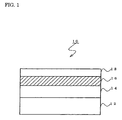
- FIG. 1 is a sectional view of an antireflecting film in one embodiment according to the present invention.
- curable composition As the case may be
- a curable composition as the case may be
- a method of curing the composition will be hereinafter explained.
- a needle-like antimony-containing tin oxide (hereinafter referred to as an ATO as the case may be) is used to improve the antistatic properties of the cured product obtained by curing the curable composition.
- ATO needle-like ATO
- a micropowdery long shape including a fiber form, a columnar form, a bar form and other analogous forms.
- An aspect ratio is preferably 5 or more and more preferably 10 or more.
- a minor-axis average particle diameter is 0.005 to 0.05 ⁇ m
- a major-axis average particle diameter is 0.1 to 3 ⁇ m
- an average aspect ratio is 5 or more.
- the shape of needle-like ATO can be properly selected according to a desired properties, dispersibility in the curable composition and the like.
- examples of the method include a method in which a material product which contains a tin component, an antimony component, a silicon component and a halide of an alkali metal is baked and then soluble salts of the resulting baked material are removed; and a method in which antimony hydroxide is deposited on the particle surface of a needle tin oxide fine powder, the mixture is subjected to fractional extraction and then the extract is baked.
- the additional amount of needle-like ATO is within a range from 40 to 80% by weight.
- the amount to be added is preferably within a rage from 45 to 80% by weight and more preferably within a range from 50 to 80% by weight.
- reaction product (hereinafter referred to simply as a compound (B) as the case may be) between a hydroxyl group-containing polyfunctional (meth)acrylate and a diisocyanate is used to increase the antiscratching properties and hardness of the cured product obtained by curing the curable composition.
- hydroxyl group-containing polyfunctional (meth)acrylate No particular limitation is imposed on the hydroxyl group-containing polyfunctional (meth)acrylate and for example, dipentaerythritol penta(meth)acrylate, pentaerythritol tri(meth)acrylate, pentaerythritol di(meth)acrylate monostearate, isocyanuric acid EO-modified di(meth)acrylate or the like may be preferably used.
- the hydroxyl group-containing polyfunctional (meth)acrylate is commercially available as, for example, KAYARAD DPHA and PET-30 (trademark, manufactured by Nippon Kayaku Co., Ltd.), ARONIX M-215, M-233, M-305 and M-400 (trademark, manufactured by Toagosei Co., Ltd.) and the like.
- hydroxyl group-containing polyfunctional (meth)acrylates may be used either singly or in combinations of two or more.
- diisocyanate No particular limitation is imposed on a diisocyanate as far as it has an isocyanate group capable of reacting with the aforementioned hydroxyl group-containing polyfunctional (meth)acrylate.
- the diisocyanate may include 2,4-tolylenediisocyanate, 2,6-tolylenediisocyanate, 1,3-xylyenediisocyanate, 1,4-xylylenediisocyanate, 1,5-naphthalenediisocyanate, m-phenylenediisocyanate, p-phenylenediisocyanate, 3,3'-dimethyl-4,4'-diphenylmethanediisocyanate, 4,4'-diphenylmethanediisocyanate, 3,3'-dimethylphenylene-diisocyanate, 4,4'-biphenylenediisocyanate, 1,6-hexanediisocyanate, isophoronediis
- 2,4-tolylenediisocyanate, isophoronediisocyanate, xylylenediisocyanate, methylenebis(4-cyclohexylisocyanate) and 1,3-bis(isocyanatemethyl)cyclohexane are more preferable.
- diisocyanates may be used either singly or in combinations of two or more.
- the compound (B) is a compound obtained by reacting the aforementioned hydroxyl group-containing polyfunctional (meth)acrylate with the aforementioned diisocyanate.
- Urethane(meth)acrylate which is represented by the following formula (1) and obtained by reacting one mol of a diisocyanate with 2 mol of the hydroxyl group-containing polyfunctional (meth)acrylate is more preferable.
- Examples of such a compound (B) include single products or combinations of a reaction product between dipentaerythritol penta(meth)acrylate and 1,6-hexamethylenediisocyanate, reaction product between dipentaerythritol penta(meth)acrylate and isophoronediisocyanate, reaction product between dipentaerythritol penta(meth)acrylate and 2,4-tolylenedisiocyanate, reaction product between pentaerythritol tri(meth)acrylate and 1,6-hexamethylenediisocyanate, reaction product between pentaerythritol tri(meth)acrylate and isophoronediisocyanate and reaction product between pentaerythritol tri(meth)acrylate and 2,4-tolylenediisocyanate.
- Examples of a synthetic method include a method in which the diisocyanate and the hydroxyl group-containing polyfunctional (meth)acrylate are charged at the same time and reacted with each other, a method in which the hydroxyl group-containing polyfunctional (meth)acrylate is added dropwise to the isocyanate and the both are reacted with each other and a method in which the diisocyanate and the hydroxyl group-containing polyfunctional (meth)acrylate are charged in the same mols, the both are reacted with each other and then the hydroxyl group-containing polyfunctional (meth)acrylate is again reacted.
- the additional amount of the compound (B) is within a range from 5 to 40% by weight.
- the amount is less than 5% by weight, the antiscratching properties of the cured product may be insufficient when the curable composition is cured, whereas when the amount exceeds 40% by weight, the hardness of the cured product may be insufficient.
- the amount of the compound (B) is preferably within a range from 10 to 30% by weight and more preferably within a range from 10 to 25% by weight.
- the polyfunctional (meth)acrylate is used to improve the antiscratching properties and hardness of the cured product obtained by curing the curable composition.
- the polyfunctional (meth)acrylate is a compound containing at least two (meth)acryloyl groups in its molecule.
- the compound include single products or combinations of the aforementioned hydroxyl group-containing polyfunctional (meth)acrylate such as pentaerythritol tri(meth)acrylate and dipentaerythritol penta(meth)acrylate, dipentaerythritol hexa(meth)acrylate, trimethylolpropane tri(meth)acrylate, pentaerythritol tetra(meth)acrylate, trimethylolpropanetrioxyethyl(meth)acrylate and tris(2-hydroxyethyl)isocyanurate tri(meth)acrylate.
- the additional amount of the polyfunctional (meth)acrylate is within a range from 5 to 30% by weight in the curable composition to be used in the present invention.
- the amount of the polyfunctional (meth)acrylate is preferably within a range from 5 to 30% by weight and more preferably within a range from 8 to 28% by weight.
- the compounds (B) and (C) are both used to improve the antiscratching properties and hardness of the cured product obtained when the curable composition is cured. It is necessary to use the both together.
- the reason why the compounds (B) and (C) are added is to impart moderate elasticity to the cured film and to improve the antiscratching properties and hardness respectively and totally to impart elasticity and to improve the hardness. In order to exhibit the properties of the both, it is preferable to add the compounds (B) and (C) according to Claims.
- the photoinitiator is used to cure the composition.
- photoinitiator examples include single products or combinations of 1-hydroxycyclohexyl phenyl ketone, 2,2-dimethoxy-2-phenylacetophenone, xanthone, fluorenone, benzaldehyde, fluorene, anthraquinone, triphenylamine, carbazole, 3-methylacetophenone, 4-chlorobenzophenone, 4,4'-dimethoxybenzophenone, 4,4'-diaminobenzophenone, Michler's ketone, benzoinpropyl ether, benzoinethyl ether, benzyldimethylketal, 1-(4-isopropylphenyl)-2-hydroxy-2-methylpropan-1-one, 2-hydroxy-2-methyl-1-phenylpropan-1-one, thioxanthone, diethylthioxanthone, 2-isopropylthioxanthone, 2-chlorothioxanthone, 2-methyl-1-[
- 1-hydroxycyclohexyl phenyl ketone, 2,2-dimethoxy-2-phenylacetophenone, 2-2-methyl-1-[4-(methylthio)phenyl]-2-morpholino-propan-1-one, 2,4,6-trimethylbenzoyldiphenylphosphine oxide and bis-(2,6-dimethoxybenzoyl)-2,4,4-trimethylpentylphosphine oxide are preferable.
- the curable composition particularly preferably contains at least 1-hydroxycyclohexyl-phenyl-ketone as the photoinitiator. Also, the content of 1-hydroxycyclohexyl-phenyl-ketone is preferably 1 to 5% by weight.
- the additional amount of the photoinitiator is within a range from 0.5 to 10% by weight in the curable composition to be used in the present invention.
- the curable composition may be insufficiently cured, whereas when the amount exceeds 10% by weight, the photoinitiator itself may work as a plasticizer, decreasing the hardness of the cured product.
- the amount of the photoinitiator is preferably within a range from 0.5 to 8% by weight and more preferably within a range from 0.5 to 5% by weight.
- the surface-treated needle-like ATO is obtained by surface-treating the aforementioned needle-like ATO by using a surface-treating agent such as a coupling agent.
- the surface treatment more improves dispersibility.
- the surface treatment means an operation of reforming the surface by mixing a needle-like antimony tin oxide with a surface-treating agent.
- any one of physical adsorption and a reaction for forming a chemical bond may be used as a method of the operation, the reaction for forming a chemical bond is preferable from the viewpoint of the effect of the surface treatment.
- the content of the needle-like ATO in the surface treated needle-like ATO is 40 to 80% by weight in the total solid.
- the following coupling agents are given as examples of the coupling agent.
- organic compound may include compounds represented by the following formula (2).
- R 4 and R 5 which may be the same or different, respectively represent a hydrogen atom or a C 1-8 alkyl group or aryl group and examples of R 4 or R 5 may include a methyl, an ethyl, a propyl, a butyl, an octyl, a phenyl or a xylyl group.
- p represents an integer from 1 to 3.
- Examples of the group represented by the formula [(R 4 O) p R 5 3-p Si-] may include a trimethoxysilyl group, triethoxysilyl group, triphenoxysilyl group, methyldimethoxysilyl group and dimethylmethoxysilyl group. Among these groups, a trimethoxysilyl group, triethoxysilyl group or the like is preferable.
- R 6 is a divalent organic group having a C 1 -C 12 aliphatic group structure or an aromatic group structure and may contain a chain, branched or cyclic structure.
- R 7 is a divalent organic group and is usually selected from divalent groups having a molecular weight of 14 to 10000 and preferably 76 to 500.
- R 8 is an organic group having (q+1) valences and is preferably selected from chain, branched or cyclic saturated hydrocarbon groups and unsaturated hydrocarbon groups.
- Z represents a monovalent organic group having a polymerizable unsaturated group which enters into an intermolecular crosslinking reaction in the presence of active radical species.
- q is preferably an integer from 1 to 20, more preferably an integer from 1 to 10 and particularly preferably an integer from 1 to 5.
- the organic compound which has a polymerizable unsaturated group and is used in the present invention may be synthesized using, for example, the method described in the publication of JP-A-9-100111. To state in more detail, the organic compound is obtained by reacting a hydroxyl group-containing (meth)acrylate, alkoxysilane and a diisocyanate.
- hydroxyl group-containing (meth)acrylate dipentaerythritol penta(meth)acrylate, pentaerythritol tri(meth)acrylate, dipentaerythritol penta(meth)acrylate, pentaerythritol tri(meth)acrylate, pentaerythritol di(meth)acrylate monostearate, isocyanuric acid EO-modified di(meth)acrylate, hydroxyethyl (meth)acrylate, 2-hydroxypropyl (meth)acrylate, 2-hydroxy-3-phenoxypropyl(meth)acrylate or the like may be preferably used.
- the hydroxyl group-containing polyfunctional (meth)acrylate is commercially available as, for example, KAYARAD DPHA and PET-30 (trademark, manufactured by Nippon Kayaku Co., Ltd.), ARONIX M-215, M-233, M-305 and M-400 (trademark, manufactured by Toagosei Co., Ltd.) and the like.
- alkoxysilane insofar as it has a functional group which reacts with a diisocyanate.
- a thiol group-containing alkoxysilane such as ⁇ -mercaptopropyl-trimethoxysilane, ⁇ -mercaptopropyltriethoxysilane, ⁇ -mercaptopropyldimethoxysilane, ⁇ -mercaptopropyl-diethoxymethoxysilane, ⁇ -mercaptopropyldimethoxy-methylsilane or ⁇ -mercaptopropyldiethoxymethylsilane is preferably used.
- the compound used as diisocyanate as far as it has an isocyanate group which can react with the aforementioned polyfunctional (meth)acrylate and alkoxysilane.
- examples of such a compound include 2,4-tolylenediisocyanate, 2,6-tolylenediisocyanate, 1,3-xylylenediisocyanate, 1,4-xylylenediisocyanate, 1,5-naphthalenediisocyanate, m-phenylenediisocyanate, p-phenylenediisocyanate, 3,3'-dimethyl-4,4'-diphenylmethanediisocyanate, 4,4'-diphenylmethanediisocyanate, 3,3'-dimethylphenylenediisocyanate, 4,4'-biphenylenediisocyanate, 1,6-hexanediisocyanate, isophoronediisocyanate,
- 2,4-tolylenediisocyanate, isophoronediisocyanate, xylylenediisocyanate, methylenebis(4-cyclohexylisocyanate) and 1,3-bis(isocyanatemethyl)cyclohexane are more preferable.
- alkoxysilanes and diisocyanates may be respectively used either singly or in combinations of two or more.
- Examples of other coupling agents suitable for surface treatment include single products or combinations of a compound group having an unsaturated double bond in its molecule such as ⁇ -methacryloxypropyltrimethoxysilane, ⁇ -acryloxypropyltrimethoxysilane and vinyltrimethoxysilane, compound group having an epoxy group in its molecule such as ⁇ -glycidoxypropyltriethoxysilane and ⁇ -glycidoxypropyltrimethoxysilane, compound group having an amino group in its molecule such as 7-aminopropyltriethoxysilane and ⁇ -aminopropyltrimethoxysilane, compound group having a mercapto group in its molecule such as ⁇ -mercaptopropyltriethoxysilane and ⁇ -mercaptopropyltrimethoxysilane, alkylsilanes such as methyltrimethoxysilane, methyltriethoxysilane and phenyltrime
- those having a functional group which copolymerize with an organic resin or enters into a crosslinking reaction with an organic resin are preferable.
- the proportion of the surface treating agent is preferably 0.1 to 125 parts by weight, more preferably 1 to 100 parts by weight and still more preferably 5 to 50 parts by weight based on 100 parts by weight of the needle-like ATO.
- the amount of the surface-treated needle-like ATO is preferably within a range from 40 to 89.5% by weight in the total solid and the content of the needle-like ATO in the total solid is preferably within 40 to 80% by weight. It is desirable to control the amount of the surface-treated needle-like ATO such that it falls in the aforementioned preferable range.
- an organic solvent is preferably compounded.
- the organic solvent it is preferable to use at least one organic solvent selected from the group consisting of ketones such as methyl ethyl ketone, methyl isobutyl ketone, cyclohexanone and acetylacetone, alcohols such as ethanol, isopropyl alcohol, n-butanol and diacetone alcohol, ether group-containing alcohols such as ethyl cellosolve, butyl cellosolve and propylene glycol monomethyl ether, hydroxyesters such as methyl lactate, ethyl lactate and butyl lactate, ⁇ -ketoesters such as ethyl acetoacetate, methyl acetoacetate and butyl acetoacetate and aromatic hydrocarbons such as toluene and xylene.
- ketones such as methyl ethyl ketone, methyl isobutyl ketone, cyclohexanone and acetylacetone
- alcohols such as
- the organic solvent is added such that the total solid content of the curable composition is 0.5 to 75%.
- the amount of the organic solvent to be added is preferably 33.3 to 19900 parts by weight when the total solid content is defined as 100 parts by weight.
- the curable composition to be used in the present invention may further contain additives such as photosensitizers, polymerization inhibitors, polymerization initiator adjuvants, leveling agents, wettability improvers, surfactants, plasticizers, ultraviolet absorbers, antioxidants, antistatic agents, inorganic fillers, pigments and dyes to the extent the object and effect of the present invention are not impaired.
- additives such as photosensitizers, polymerization inhibitors, polymerization initiator adjuvants, leveling agents, wettability improvers, surfactants, plasticizers, ultraviolet absorbers, antioxidants, antistatic agents, inorganic fillers, pigments and dyes to the extent the object and effect of the present invention are not impaired.
- the curable composition to be used in the present invention may be prepared by compounding the aforementioned compounds (A-1) (or (A-2)) to (D), an organic solvent and, as required, additives and by mixing these components at ambient temperature or under heating.
- the composition may be prepared using a mixing machine such as a mixer, kneader, ball mill, three-roll or the like.
- the operation is preferably performed at a temperature lower than the decomposition initiation temperature of the polymerization initiator.
- the curable composition may be diluted with an organic solvent prior to application and then applied.
- the exposure amount is preferably designed to be in a range from 0.01 to 10 J/cm 2 in the case of using, for example, radiation.
- the exposure amount is designed to be in a range preferably from 0.1 to 5 J/cm 2 and more preferably from 0.3 to 3 J/cm 2 .
- the antireflecting film of the present invention may comprise a hardcoat layer and a substrate below the low-refractive index film and high-refractive index film.
- FIG. 1 shows such an antireflecting film 10.
- a hardcoat layer 14 a high-refractive index film 16 and a low-refractive index film 18 are laminated on a substrate 12.
- the high-refractive index film 16 may be formed directly on the substrate 12 without forming the hardcoat layer 14.
- a medium-refractive index film (not shown) may be further disposed between the high-refractive index film 16 and the low-refractive index film 18 or between the high-refractive index film 16 and the hardcoat layer 14.
- the composition preferably contains, as its major components, a single product or a combination of a fluorine type resin (including a fluorine compound), siloxane type resin (including a silicone resin and polysilazane), acrylic resin, polyester type resin, urethane type resin and the like.
- a fluorine type resin including a fluorine compound
- siloxane type resin including a silicone resin and polysilazane
- acrylic resin polyester type resin
- urethane type resin urethane type resin
- these resins can form a firm thin film as the low-refractive index film and as a result, improve the antiscratching properties of the low-refractive index film significantly. Also this is because these resins make it relatively easy to control the refractive index of the low-refractive index film.
- any one of heatcurable and photocurable compositions may be used as the curable composition for the low-refractive index film, which composition is used to form the low-refractive index film.
- the composition is preferably a heatcurable composition containing fluorine because of easy productivity.
- a fluorine-containing composition comprising the following components (a) to (d) may be given.
- fluorine-containing copolymers having a hydroxyl group in the molecule may be preferably used. More concretely, the component (a) may be obtained by copolymerizing a monomer containing a fluorine atom with a monomer containing a hydroxyl group. Also, if necessary, it is desirable to add an ethylenic unsaturated monomer other than these monomers.
- Examples of the monomer containing a fluorine atom include single products or combinations of tetrafluoroethylene, hexafluoropropylene, vinylidene fluoride, chlorotrifluoroethylene, trifluoroethylene, tetrafluoroethylene, (fluoroalkyl)vinyl ether, (fluoroalkoxyalkyl)vinyl ether, perfluoro(alkylvinyl ether), perfluoro(alkoxyvinyl ether) and fluorine-containing (meth)acrylate.
- the amount of the fluorine atom-containing monomer to be compounded is preferably in a range from 10 to 99 mol% and more preferably in a range from 15 to 97 mol%.
- examples of the hydroxyl group-containing monomer include single products or combinations of hydroxyethyl vinyl ether, hydroxypropyl vinyl ether, hydroxybutyl vinyl ether, hydroxypentyl vinyl ether, hydroxyhexyl vinyl ether, hydroxyethyl allyl ether, hydroxybutyl allyl ether, glycerol monoallyl ether, allyl alcohol and hydroxyethyl (meth)acrylate.
- the amount of the hydroxyl group-containing monomer to be compounded is preferably in a range from 1 to 20 mol% and more preferably in a range from 3 to 15 mol%.
- heatcurable agent (hereinafter referred to simply as a heatcurable agent as the case may be) having a functional group which can reacts with a hydroxyl group (hereinafter referred to simply as a heatcurable agent as the case may be)
- a melamine compound having a methylol group and an alkoxymethyl group or two or more of either one of these groups are preferably used.
- methylated melamine compounds such as a hexamethyl etherealized methylol melamine compound, hexabutyl etherealized methylol melamine compound, methylbutyl-mixed etherealized methylol melamine compound, methyl etherealized methylol melamine compound and butyl etherealized methylol melamine compound are more preferable.
- the amount of the heatcurable agent to be added is preferably in a range from 1 to 70 parts by weight based on 100 parts by weight of the fluorine-containing copolymer having a hydroxyl group.
- the curing catalyst those promoting a reaction between the hydroxyl group-containing polymer and the curing agent may be preferably used.
- an organic acid, inorganic acid or salts of these acids and basic compounds may be used and organic acids such as paratoluenesulfonic acid, methanesulfonic acid, oxalic acid, formic acid and acetic acid, inorganic acids such as hydrochloric acid, phosphoric acid, nitric acid and sulfuric acid and ammonium salts of these acids may be exemplified.
- the amount of the curing catalyst to be added is preferably in a range from 0.1 to 30 parts by weight when the total amount of the aforementioned fluorine-containing polymer having a hydroxyl group and the heatcurable agent having a functional group capable of reacting with a hydroxyl group is defined as 100 parts by weight.
- the same type as the organic solvent to be used for the aforementioned curable composition is preferably used.
- the amount of the organic solvent is preferably designed to be in a range from 500 to 10,000 parts by weight based on 100 parts by weight of the fluorine-containing copolymer having a hydroxyl group.
- the refractive index (refractive index of Na-D line, measured at 25°C) of the low-refractive index film is preferably designed to be in a range from 1.35 to 1.50.
- the refractive index of the low-refractive index film is more preferably in a range from 1.35 to 1.45 and still more preferably in a range from 1.35 to 1.42.
- a difference in refractive index between the low-refractive index film and the high-refractive index film is preferably designed to be 0.05 or more. This reason is that if the difference in refractive index between the low refractive index film and the high-refractive index film is less than 0.05, any synergetic effect of these antireflecting films may not be obtained and the antireflecting effect may be lowered on the contrary.
- a difference in refractive index between the low-refractive index film and the high-refractive index film is designed to be more preferably in a range from 0.1 to 0.5 and still more preferably in a range from 0.15 to 0.5.
- the film thickness of the low-refractive index film is preferably in a range from 0.05 to 1 ⁇ m.
- the film thickness is designed to be more preferably in a range from 0.05 to 0.5 ⁇ m and still more preferably in a range from 0.06 to 0.2 ⁇ m.
- the high-refractive index film is coated with the curable composition for the low-refractive index film to form a coating film for the low-refractive index film.
- coating methods such as a dipping method, spraying method, bar coating method, roll coating method, spin coating method, curtain coating method, gravure coating method, silk screen method or ink jet method may be used.
- the coating film consisting of the curable composition for the low-refractive index film is preferably heat-cured because the composition is reacted with a part of the high-refractive index film whereby a firm coating film can be formed as a whole.
- the coating film is preferably heated at 30 to 200°C for 0.1 to 180 minutes. This reason is that such a heating condition enables the preparation of an antireflecting film having excellent antireflecting properties more efficiently without impairing the substrate and the formed antireflecting film.
- the coating film is heated more preferably at 50 to 160°C for 0.2 to 120 minutes and still more preferably at 60 to 140°C for 0.5 to 60 minutes.
- a film obtained by curing the curable composition comprising the above-explained compounds (A-1) or (A-2) to (D) is used as the high refractive index film.
- the refractive index (refractive index of Na-D line, measured at 25°C) of the high-refractive index film is preferably designed to be in a range from 1.45 to 2.1.
- the refractive index of the high-refractive index film is designed to be more preferably in a range from 1.55 to 2.0 and still more preferably in a range from 1.6 to 1.9.
- the film thickness of the high-refractive index film is preferably in a range from 0.01 to 50 ⁇ m.
- the film thickness is designed to be preferably in a range from 0.02 to 10 ⁇ m, more preferably in a range from 0.05 to 2 ⁇ m and still more preferably 0.05 to 0.2 ⁇ m.
- the high-refractive index film may be formed either at a time by single application or in parts by plural separate applications.
- a hardcoat layer enables the high-refractive index film to be secured firmly. Also, this improves the antiscratching properties of the low-refractive index film.
- examples of the structural material of the hardcoat layer may include single products or combinations of a siloxane resin, acrylic resin, melamine resin and epoxy resin.
- examples of the structural materials having high hardness may include heatcurable type hardcoat compositions obtained by reacting an alkylalkoxysilane with colloidal silica in a hydrophilic solvent as described in JP-A-63-117074, ultraviolet-curable hardcoat compositions in which reactive silica particles are dispersed as described in JP-A-9-100111 and known ultraviolet-curable hardcoat composition comprising, as major components, urethane acrylate and a polyfunctional acrylate.
- the film thickness of the hardcoat layer is designed to be preferably in a range from 0.1 to 50 ⁇ m.
- the film thickness of the hardcoat layer is designed to be preferably in a range from 0.5 to 30 ⁇ m and more preferably in a range from 1 to 20 ⁇ m.
- examples of the substrate material may include substrates made of a polyester resin, triacetyl cellulose resin, polycarbonate resin, allylcarbonate resin, polyether sulfone resin, polyacrylate resin, norbornane resin, acrylstyrene resin or glass.
- the antireflecting film made to comprise each of these substrates ensures that not only superior antiscratching properties and transparency as well as an antireflecting effect but also high mechanical strength and durability can be obtained in a wide field of applications for antireflecting films such as lens portions of cameras, image display portions of televisions (CRT) and color filters of liquid crystal display devices.
- the antireflecting film is used as a gas barrier material comprising each of these substrates, the effect of stabilizing the performance of a polarizing film is obtained due to a gas barrier effect in a field of applications such as polarizing films for liquid crystal display panels using a transparent substrate such as triacetyl cellulose having a hygroscopic problem.
- a transparent substrate such as triacetyl cellulose having a hygroscopic problem.
- the long term durability of a solar panel which tends to be deteriorated by moisture and oxygen is bettered.
- superior antiscratching properties and transparency are obtained and also high mechanical strength and durability can be obtained.
- hexafluoropropylene HFP
- HFP hexafluoropropylene
- the intrinsic viscosity (using N,N-dimethylacetamide solvent and measured at 25°C) of the resulting fluorine-containing copolymer having a hydroxyl group was measured, to find that the viscosity was 0.28 dl/g.
- the glass transition temperature of the fluorine-containing copolymer was measured using DSC at a temperature rise rate of 5°C/min in a nitrogen stream, to find that the transition temperature was 31°C.
- the fluorine content of the fluorine-containing copolymer was measured using an Alizarin Complexon method, to find that it was 51.7%.
- the hydroxyl group value of the fluorine-containing copolymer was measured by an acetyl method using acetic acid anhydride, to find that the hydroxyl group value was 102 mg KOH/g.
- a coating solution A as the case may be
- the refractive index of the low-refractive index film obtained from the resulting curable composition for a low-refractive index film was measured as follows.
- the curable composition for a low-refractive index film was applied to a silicon wafer (film thickness: 1 ⁇ m) by using a wire bar coater (#3) and air-dried at ambient temperature for 5 minutes to form a coating film.
- the coating film was heat-cured using an oven in the following heating condition: 140°C and one minute, to form a low-refractive index film having a film thickness of 0.3 ⁇ m.
- the refractive index of Na-D line in the resulting low-refractive index film was measured at 25°C by using a spectral elipsometer. As a result, the refractive index was 1.40.
- a needle-like antimony-containing tin oxide (compound (A-1)) powder (FS-12P, manufactured by Ishihara Techno Corp.) was added to 700 parts by weight of methyl ethyl ketone (hereinafter abbreviated as MEK) and dispersed using glass beads for 10 hours. Then, the glass beads were removed to obtain 950 parts by weight of a MEK needle-like antimony-containing tin oxide sol (hereinafter called a needle-like ATO sol as the case may be).
- a needle-like ATO sol as the case may be.
- 2 g of the resulting needle-like ATO sol was weighed on an aluminum pan and dried on a 120°C hot plate for one hour to measure the total solid concentration, to find that it was 30% by weight.
- pentaerythritol triacrylate (trademark: NK Ester A-TMM-3L, manufactured by Shin-Nakamura Chemical Co., Ltd.) was added dropwise to the reaction solution at 30°C over an hour and further the mixture was stirred at 60°C for 3 hours to obtain a reaction solution.
- the amount of the residual isocyanate in the product contained in the reaction solution, namely, the organic compound having a polymerizable unsaturated group was measured by FT-IR, to find that it was 0.1% by weight and it was thereby confirmed that each reaction was run almost quantitatively. Also, it was confirmed that there were a thiourethane bond, a urethane bond, an alkoxysilyl group and a polymerizable unsaturated group in its molecule.
- a reactive needle-like antimony-containing tin oxide sol (hereinafter called a reactive needle-like ATO sol as the case may be).
- a reactive needle-like ATO sol 2 g of the resulting reactive needle-like ATO sol was weighed on an aluminum pan and dried on a 120°C hot plate for one hour to measure the total solid concentration, to find that the total solid concentration was 33% by weight.
- 2 g of this reactive needle-like ATO sol was weighed in a crucible, pre-dried on an 80°C hot plate for 30 minutes and then baked in a 750°C muffle furnace for one hour.
- the content of the inorganic materials in all solids was measured from the amount of the resulting inorganic residue and the total solid concentration, to find that the content of the inorganic materials was 79% by weight. It is to be noted that the content of the inorganic materials measured in this measuring method corresponds to the content of ATO in all solids.
- M-1 a mixture
- B-1 a reaction product
- the amount of the residual isocyanate in the reaction solution was analyzed, to find that the residual amount was 0.1% by weight or less and it was thereby confirmed that the reaction was run almost quantitatively. Also, the content of B-1 in M-1 was calculated from the charge rate of raw material, to find that it was 44%.
- pentaerythritol acrylate hydroxyl group-containing polyfunctional (meth)acrylate
- C-2 6/4, manufactured by Shin-Nakamura Chemical Co., Ltd.
- a container shielded from ultraviolet rays 190 g (57.0 g as a needle-like ATO fine particles) of the aforementioned needle-like ATO (A-1) sol, 28.9 g (12.7 g as B-1 and 16.2 g as C-1) of the above mixture (M-1), 10.6 g (7.1 g as B-2 and 3.5 g as C-2) of the above mixture (M-2), 3.5 g of 1-hydroxycyclohexyl phenyl ketone (hereinafter referred to as D-1) and 37 g of MEK were respectively compounded and the mixture was stirred at 50°C for 2 hours to obtain a uniform solution of a high-refractive index film curable composition 1 (hereinafter called a coating solution B as the case may be).
- the total solid concentration of this curable composition and the content of inorganic materials in all solids, which were measured in the same manner as above, were 37% by weight and 57% by weight respectively.
- the needle-like ATO (A-1) sol or the reactive needle-like ATO (A-2) sol and the compounds (B) to (D) were compounded according to the proportions shown in Table 1 to prepare curable compositions 2 to 6 for a high-refractive index film.
- the mixture (M-2) was added and trimethylolpropane triacrylate (hereinafter referred to as C-3) was further added for the compounds (B) and (C).
- each compound was mixed in the same manner as in the production of the composition 1 and then the mixture was concentrated using a rotary evaporator until the total solid concentration reached 52% by weight to obtain a curable composition.
- a globular antimony-containing tin oxide fine powder (SN-102P, manufactured by Ishihara Techno Corp.) was added to 700 parts by weight of MEK and dispersed using glass beads for 10 hours. Then, the glass beads were removed to obtain 950 parts by weight of a MEK globular antimony-containing tin oxide sol (hereinafter called a globular ATO sol as the case may be).
- a globular ATO sol as the case may be.
- 2 g of the resulting globular ATO sol was weighed on an aluminum pan and dried on a 120°C hot plate for one hour to measure the total solid concentration, to find that it was 30% by weight.
- the globular ATO sol or the needle-like ATO sol and the compounds (B) to (D) were compounded according to the proportions shown in Table 1 to prepare comparative curable compositions 1 to 6 for high-refractive index films in the same manner as in the Production Example 2(5). It is to be noted that in the case of the comparative composition 4, the mixture of each component was concentrated in the same manner as in the production of the composition 6 to obtain a curable composition.
- a coating solution C As the case may be, 21.9 g of trimethylolpropane triacrylate (trademark: NK Ester A-TMPT, manufactured by Shin-Nakamura Chemical Co., Ltd.), 10.95 g of trimethylolpropanetrioxyethyl acrylate (trademark: NK Ester A-TMPT-3EO, manufactured by Shin-Nakamura Chemical Co., Ltd.) and 3.27 g of 1-hydroxycyclohexyl phenyl ketone (trademark: IRGACURE 184, manufactured by Ciba Specialty Chemicals K.K.) were mixed to prepare a hardcoat composition (hereinafter called a coating solution C as the case may be).
- a coating solution C as the case may be
- the coating solution C obtained in Production Example 3 was applied to a Polyester Film A4300 (substrate) (manufactured by Toyobo Co., Ltd., film thickness: 188 ⁇ m) by using a wire bar coater (#12) and dried at 80°C for one minute in an oven to form a coating film. Then, using a metal halide lamp, the coating film was cured by ultraviolet rays in right-radiation condition of 0.3 J/cm 2 in an atmosphere to form a hardcoat layer having a film thickness of 10 ⁇ m and a refractive index of 1.49.
- the coating solution B of the composition 1 obtained in Production Example 2 was applied to the hardcoat layer by using a wire bar coater (#3). At this time, the coating solution B was diluted with methyl isobutyl ketone until the total solid concentration in the composition reached 5% by weight. It is to be noted that the curable composition corresponding to the composition 3 was applied without diluting with methyl isobutyl ketone. Next, the applied solution was dried at 80°C for one minute in an oven to form a coating film.
- the coating film was cured by ultraviolet rays in right-radiation condition of 0.3 J/cm 2 in an atmosphere to form a high-refractive index film (second layer) having a film thickness of 0.05 ⁇ m and a refractive index of 1.68.
- the coating solution A obtained in Production Example 1 was applied to the high-refractive index film by using a wire bar coater (#3) and air-dried at ambient temperature for 5 minutes to form a coating film.
- This coating film was heated at 140°C for one minute by using an oven to form a low-refractive index film (first layer) having a film thickness of 0.05 ⁇ m and a refractive index of 1.40.
- Example 2 The same procedures as in Example 1 were conducted except that the compositions 2 and 3 prepared in Production Example 2 were respectively used in place of the composition 1 (coating solution B) prepared in Production Example 2, to produce laminates.
- Example 2 The same procedures as in Example 1 were conducted except that the comparative compositions 1 to 3 prepared in Comparative Production Example 1 were respectively used in place of the composition 1 (coating solution B) prepared in Production Example 2, to produce laminates.
- compositions 1 to 6 prepared in Production Example 2 and the comparative compositions 1 to 6 prepared in Comparative Production Example 1 were respectively cured in the same manner as in Example 1 to measure the surface resistance of each cured product by using a measuring method as shown below. Also, the adhesiveness of the resulting cured product, the adhesiveness of the cured product after QUV and the antiscratching properties of the cured product were evaluated according to the following standards.
- the adhesiveness of the cured product filmed on the surface treated for PET-easy-adhesion was evaluated by a film residual rate (%) on total 100 cross-cuts with 1 mm square according to a cross-cut cellophane tape adhesion test of JIS K5400.
- the cured product film was irradiated with ultraviolet rays for 150 hours by using a QUV accelerated weathering test (manufactured by Q-Panel Lab Products) and then the adhesiveness was evaluated in the same manner. The results are shown in Table 1.
- the adhesiveness contributes to the antiscratching properties of the laminate and the adhesiveness after QUV contributes to an improvement in the durability of the laminate.
- the level of antiscratching properties higher than the criterion 3 is practically allowable level, the level of antiscratching properties higher than the criterion 4 is preferable because the practical durability is superior and the level of antiscratching properties higher than the criterion 5 is more preferable because the practical durability is significantly improved.
- the surface resistance, reflectance, all-ray transmittance and turbidity (haze value) of the resulting antireflecting film were measured using the measuring method shown below.
- the surface of the resulting antireflecting film was rubbed 30 times with # 0000 steel wool at a load of 200 g/cm 2 to evaluate the antiscratching properties of the antireflecting film visually based on the same standard as in Reference Test Example. The obtained results are shown in Table 2.
- the reflectance (minimum reflectance at a measuring wavelength) and all-ray transmittance of the resulting antireflecting film were measured at a wavelength ranging from 340 to 700 nm by using a spectral reflectometer (magnetic spectrophotometer U-3410 into which a large sample room integrating sphere attached device 150-09090, manufactured by Hitachi, ltd.) according to JIS K7105 (Measuring method A).
- a spectral reflectometer magnetic spectrophotometer U-3410 into which a large sample room integrating sphere attached device 150-09090, manufactured by Hitachi, ltd.
- the haze value of the resulting antireflecting film was measured using a color haze meter (manufactured by Suga Seisakusho Co., Ltd.) according to ASTM D1003. The obtained results are shown in Table 2.
- the surface resistance ( ⁇ / ⁇ ) of the resulting antireflecting laminate was measured in the same manner as in Reference Test Example. The obtained results are shown in Table 2.
Landscapes
- Physics & Mathematics (AREA)
- Chemical & Material Sciences (AREA)
- Optics & Photonics (AREA)
- General Physics & Mathematics (AREA)
- Materials Engineering (AREA)
- Organic Chemistry (AREA)
- Wood Science & Technology (AREA)
- Life Sciences & Earth Sciences (AREA)
- Engineering & Computer Science (AREA)
- Inorganic Chemistry (AREA)
- Laminated Bodies (AREA)
- Paints Or Removers (AREA)
- Surface Treatment Of Optical Elements (AREA)
- Macromonomer-Based Addition Polymer (AREA)
Applications Claiming Priority (2)
| Application Number | Priority Date | Filing Date | Title |
|---|---|---|---|
| JP2001098113 | 2001-03-30 | ||
| JP2001098113 | 2001-03-30 |
Publications (3)
| Publication Number | Publication Date |
|---|---|
| EP1245968A2 EP1245968A2 (en) | 2002-10-02 |
| EP1245968A3 EP1245968A3 (en) | 2002-10-09 |
| EP1245968B1 true EP1245968B1 (en) | 2004-06-30 |
Family
ID=18951796
Family Applications (1)
| Application Number | Title | Priority Date | Filing Date |
|---|---|---|---|
| EP02007019A Expired - Lifetime EP1245968B1 (en) | 2001-03-30 | 2002-03-27 | Laminate comprising a needle-like antimony-containing tin oxide and antireflection film comprising the same |
Country Status (5)
| Country | Link |
|---|---|
| US (1) | US6916540B2 (enExample) |
| EP (1) | EP1245968B1 (enExample) |
| KR (1) | KR100860917B1 (enExample) |
| DE (1) | DE60200670T2 (enExample) |
| TW (1) | TWI300382B (enExample) |
Cited By (1)
| Publication number | Priority date | Publication date | Assignee | Title |
|---|---|---|---|---|
| DE102006046131A1 (de) * | 2006-09-28 | 2008-04-10 | X-Fab Semiconductor Foundries Ag | Verfahren zur Herstellung einer optischen Schnittstelle für integrierte Optikanwendungen |
Families Citing this family (18)
| Publication number | Priority date | Publication date | Assignee | Title |
|---|---|---|---|---|
| JP3879657B2 (ja) * | 2002-11-20 | 2007-02-14 | 日東電工株式会社 | 反射防止層用硬化性樹脂組成物、反射防止層、反射防止フィルム、光学素子および画像表示装置 |
| JP2004264327A (ja) * | 2003-01-22 | 2004-09-24 | Fuji Photo Film Co Ltd | 反射防止フィルム、偏光板およびディスプレイ装置 |
| WO2004088364A1 (ja) | 2003-03-31 | 2004-10-14 | Lintec Corporation | 光学用フィルム |
| FR2858691B1 (fr) | 2003-08-05 | 2005-11-11 | Essilor Int | Composition de revetement anti-rayures comportant des particules anisotropes, substrat revetu correspondant et son application en optique ophtalmique |
| WO2005059051A1 (ja) * | 2003-12-19 | 2005-06-30 | Nissan Chemical Industries, Ltd. | 低屈折率及び大きい水接触角を有する被膜 |
| US20070261601A1 (en) * | 2004-09-22 | 2007-11-15 | Fujifilm Corporation | Hardening Composition, Antireflective Film, Method of Producing the Same, Polarizing Plate and Image Display Unit |
| JP4429862B2 (ja) * | 2004-10-06 | 2010-03-10 | 日東電工株式会社 | ハードコートフィルム、反射防止ハードコートフィルム、光学素子および画像表示装置 |
| US20060134400A1 (en) * | 2004-12-17 | 2006-06-22 | Nitto Denko Corporation | Hard-coated film and method of manufacturing the same |
| US7550040B2 (en) * | 2005-06-17 | 2009-06-23 | Nissan Chemical Industries, Ltd. | Coating fluid for forming film, and film thereof and film-forming process |
| KR100715099B1 (ko) * | 2005-12-30 | 2007-05-07 | 제일모직주식회사 | 대전방지성 고굴절층 코팅용 조성물, 이를 이용한 반사방지필름 및 이 반사방지 필름을 포함하는 화상 표시장치 |
| JP5297633B2 (ja) * | 2006-11-22 | 2013-09-25 | 富士フイルム株式会社 | 反射防止フィルムの製造方法 |
| EP2172519B1 (en) * | 2007-07-10 | 2018-10-24 | Aica Kogyo Co., Ltd. | Composition, transfer sheet, melamine decorative board, and method for producing melamine decorative board |
| JP5482123B2 (ja) * | 2008-11-26 | 2014-04-23 | コニカミノルタ株式会社 | 電子写真感光体、電子写真感光体の製造方法及び画像形成装置 |
| CN102666941B (zh) * | 2009-11-06 | 2015-01-21 | 夏普株式会社 | 模具的制造方法和模具 |
| KR101234851B1 (ko) * | 2009-12-31 | 2013-02-19 | 제일모직주식회사 | 하드 코팅 조성물 및 하드코트층을 포함하는 적층체 |
| CN103275521B (zh) * | 2013-06-18 | 2014-11-26 | 浙江大学 | 纳米氧化锡锑水性浆料的制备方法 |
| JP7064313B2 (ja) * | 2016-11-25 | 2022-05-10 | リケンテクノス株式会社 | ハードコート積層フィルム |
| KR102282427B1 (ko) * | 2020-11-27 | 2021-07-28 | (주)티디엘 | 영상장치용 면상발열체. |
Family Cites Families (13)
| Publication number | Priority date | Publication date | Assignee | Title |
|---|---|---|---|---|
| JPH0746235B2 (ja) * | 1990-06-04 | 1995-05-17 | 株式会社巴川製紙所 | 導電性支持体 |
| EP0585819B1 (en) * | 1992-08-31 | 1997-04-16 | Sumitomo Cement Co. Ltd. | Anti-static/antireflection coating for a cathode ray tube |
| US5580496A (en) * | 1993-04-05 | 1996-12-03 | Sumitomo Metal Mining Company Limited | Raw material for producing powder of indium-tin oxide aciculae and method of producing the raw material, powder of indium-tin oxide aciculae and method of producing the powder, electroconductive paste and light-transmitting |
| CN1057611C (zh) | 1993-08-31 | 2000-10-18 | 住友水泥株式会社 | 抗反射膜 |
| US5747152A (en) * | 1993-12-02 | 1998-05-05 | Dai Nippon Printing Co., Ltd. | Transparent functional membrane containing functional ultrafine particles, transparent functional film, and process for producing the same |
| JP3592765B2 (ja) | 1994-09-28 | 2004-11-24 | 大日本印刷株式会社 | 光学機能性フィルム及びその製造方法 |
| JP3515625B2 (ja) | 1994-12-27 | 2004-04-05 | 石原産業株式会社 | 針状導電性酸化錫微粉末およびその製造方法 |
| JP3609159B2 (ja) | 1995-06-23 | 2005-01-12 | 石原産業株式会社 | 針状導電性アンチモン含有酸化錫微粉末及びその製造方法 |
| JP3647929B2 (ja) | 1995-05-18 | 2005-05-18 | 石原産業株式会社 | 導電性アンチモン含有酸化錫微粉末の製造方法 |
| JPH09291258A (ja) * | 1996-04-26 | 1997-11-11 | Lintec Corp | 粘着剤組成物およびこれを用いた粘着シート |
| US5731119A (en) * | 1996-11-12 | 1998-03-24 | Eastman Kodak Company | Imaging element comprising an electrically conductive layer containing acicular metal oxide particles and a transparent magnetic recording layer |
| JPH1115184A (ja) * | 1997-06-23 | 1999-01-22 | Sharp Corp | 電子写真感光体およびその製造方法 |
| CN1156525C (zh) * | 1999-02-15 | 2004-07-07 | Dsm有限公司 | 树脂组合物及固化产品 |
-
2002
- 2002-03-27 TW TW091106054A patent/TWI300382B/zh not_active IP Right Cessation
- 2002-03-27 DE DE60200670T patent/DE60200670T2/de not_active Expired - Lifetime
- 2002-03-27 EP EP02007019A patent/EP1245968B1/en not_active Expired - Lifetime
- 2002-03-29 US US10/108,395 patent/US6916540B2/en not_active Expired - Fee Related
- 2002-03-29 KR KR1020020017296A patent/KR100860917B1/ko not_active Expired - Lifetime
Cited By (2)
| Publication number | Priority date | Publication date | Assignee | Title |
|---|---|---|---|---|
| DE102006046131A1 (de) * | 2006-09-28 | 2008-04-10 | X-Fab Semiconductor Foundries Ag | Verfahren zur Herstellung einer optischen Schnittstelle für integrierte Optikanwendungen |
| DE102006046131B4 (de) | 2006-09-28 | 2020-06-25 | X-Fab Semiconductor Foundries Ag | Verfahren zur Herstellung einer optischen Schnittstelle für integrierte Optikanwendungen |
Also Published As
| Publication number | Publication date |
|---|---|
| US6916540B2 (en) | 2005-07-12 |
| DE60200670T2 (de) | 2005-08-18 |
| DE60200670D1 (de) | 2004-08-05 |
| KR100860917B1 (ko) | 2008-09-29 |
| TWI300382B (enExample) | 2008-09-01 |
| US20020197485A1 (en) | 2002-12-26 |
| EP1245968A2 (en) | 2002-10-02 |
| KR20020077234A (ko) | 2002-10-11 |
| EP1245968A3 (en) | 2002-10-09 |
Similar Documents
| Publication | Publication Date | Title |
|---|---|---|
| US6916540B2 (en) | Laminate and antireflection film comprising the same | |
| KR100515995B1 (ko) | 반사방지처리물품 | |
| JP2004307735A (ja) | 液状硬化性組成物、硬化膜及び帯電防止用積層体 | |
| KR100831825B1 (ko) | 경화성 조성물, 그의 경화 생성물 및 적층 재료 | |
| JP4872142B2 (ja) | 帯電防止用硬化性組成物、硬化膜及び帯電防止性反射防止積層体 | |
| JP4892790B2 (ja) | 積層体 | |
| US20060115669A1 (en) | Curable composition, cured product, and laminate | |
| JP4701492B2 (ja) | 構造体 | |
| JP5092744B2 (ja) | 反射防止積層体 | |
| JP2002311208A (ja) | 反射防止膜用硬化性組成物及びそれを用いた反射防止膜 | |
| US20070219314A1 (en) | Curable composition, cured product, and laminate | |
| JP2002120311A (ja) | 構造体 | |
| KR101268700B1 (ko) | 액상 경화성 조성물, 경화막 및 대전 방지용 적층체 | |
| JP4899545B2 (ja) | 硬化性樹脂組成物及びそれからなる硬化膜 | |
| JPWO2006070707A1 (ja) | 反射防止膜 | |
| JP2006306008A (ja) | 帯電防止用積層体 | |
| JP2006206832A (ja) | 積層体の製造方法 | |
| JP2006209050A (ja) | 反射防止膜 | |
| JP4815707B2 (ja) | 光硬化性組成物、その硬化物及び積層体 | |
| KR101220567B1 (ko) | 경화성 수지 조성물 및 이를 포함하는 경화막 및 적층체 | |
| JP5339320B2 (ja) | 硬化性組成物及び反射防止膜 | |
| JP2007277504A (ja) | 硬化性樹脂組成物及び反射防止膜 | |
| JP2008137190A (ja) | 反射防止積層体 | |
| JP2007022071A (ja) | 帯電防止用積層体 | |
| JP2002293839A (ja) | 硬化性組成物およびその硬化物 |
Legal Events
| Date | Code | Title | Description |
|---|---|---|---|
| PUAI | Public reference made under article 153(3) epc to a published international application that has entered the european phase |
Free format text: ORIGINAL CODE: 0009012 |
|
| PUAL | Search report despatched |
Free format text: ORIGINAL CODE: 0009013 |
|
| AK | Designated contracting states |
Kind code of ref document: A2 Designated state(s): AT BE CH CY DE DK ES FI FR GB GR IE IT LI LU MC NL PT SE TR |
|
| AX | Request for extension of the european patent |
Free format text: AL;LT;LV;MK;RO;SI |
|
| AK | Designated contracting states |
Kind code of ref document: A3 Designated state(s): AT BE CH CY DE DK ES FI FR GB GR IE IT LI LU MC NL PT SE TR |
|
| AX | Request for extension of the european patent |
Free format text: AL;LT;LV;MK;RO;SI |
|
| 17P | Request for examination filed |
Effective date: 20021202 |
|
| 17Q | First examination report despatched |
Effective date: 20030212 |
|
| AKX | Designation fees paid |
Designated state(s): DE FR GB |
|
| GRAP | Despatch of communication of intention to grant a patent |
Free format text: ORIGINAL CODE: EPIDOSNIGR1 |
|
| RAP1 | Party data changed (applicant data changed or rights of an application transferred) |
Owner name: JSR CORPORATION |
|
| GRAS | Grant fee paid |
Free format text: ORIGINAL CODE: EPIDOSNIGR3 |
|
| GRAA | (expected) grant |
Free format text: ORIGINAL CODE: 0009210 |
|
| AK | Designated contracting states |
Kind code of ref document: B1 Designated state(s): DE FR GB |
|
| REG | Reference to a national code |
Ref country code: GB Ref legal event code: FG4D |
|
| REG | Reference to a national code |
Ref country code: IE Ref legal event code: FG4D |
|
| REF | Corresponds to: |
Ref document number: 60200670 Country of ref document: DE Date of ref document: 20040805 Kind code of ref document: P |
|
| ET | Fr: translation filed | ||
| PLBE | No opposition filed within time limit |
Free format text: ORIGINAL CODE: 0009261 |
|
| STAA | Information on the status of an ep patent application or granted ep patent |
Free format text: STATUS: NO OPPOSITION FILED WITHIN TIME LIMIT |
|
| 26N | No opposition filed |
Effective date: 20050331 |
|
| PGFP | Annual fee paid to national office [announced via postgrant information from national office to epo] |
Ref country code: FR Payment date: 20130408 Year of fee payment: 12 Ref country code: DE Payment date: 20130321 Year of fee payment: 12 Ref country code: GB Payment date: 20130321 Year of fee payment: 12 |
|
| REG | Reference to a national code |
Ref country code: DE Ref legal event code: R119 Ref document number: 60200670 Country of ref document: DE |
|
| GBPC | Gb: european patent ceased through non-payment of renewal fee |
Effective date: 20140327 |
|
| REG | Reference to a national code |
Ref country code: FR Ref legal event code: ST Effective date: 20141128 |
|
| REG | Reference to a national code |
Ref country code: DE Ref legal event code: R119 Ref document number: 60200670 Country of ref document: DE Effective date: 20141001 |
|
| PG25 | Lapsed in a contracting state [announced via postgrant information from national office to epo] |
Ref country code: FR Free format text: LAPSE BECAUSE OF NON-PAYMENT OF DUE FEES Effective date: 20140331 Ref country code: GB Free format text: LAPSE BECAUSE OF NON-PAYMENT OF DUE FEES Effective date: 20140327 Ref country code: DE Free format text: LAPSE BECAUSE OF NON-PAYMENT OF DUE FEES Effective date: 20141001 |