EP1230932A2 - Verwendung von Antikörpern zur Vakzinierung gegen Krebs - Google Patents
Verwendung von Antikörpern zur Vakzinierung gegen Krebs Download PDFInfo
- Publication number
- EP1230932A2 EP1230932A2 EP02005394A EP02005394A EP1230932A2 EP 1230932 A2 EP1230932 A2 EP 1230932A2 EP 02005394 A EP02005394 A EP 02005394A EP 02005394 A EP02005394 A EP 02005394A EP 1230932 A2 EP1230932 A2 EP 1230932A2
- Authority
- EP
- European Patent Office
- Prior art keywords
- antibody
- antibodies
- use according
- antigen
- cellular membrane
- Prior art date
- Legal status (The legal status is an assumption and is not a legal conclusion. Google has not performed a legal analysis and makes no representation as to the accuracy of the status listed.)
- Granted
Links
Images


Classifications
-
- A—HUMAN NECESSITIES
- A61—MEDICAL OR VETERINARY SCIENCE; HYGIENE
- A61K—PREPARATIONS FOR MEDICAL, DENTAL OR TOILETRY PURPOSES
- A61K39/00—Medicinal preparations containing antigens or antibodies
- A61K39/395—Antibodies; Immunoglobulins; Immune serum, e.g. antilymphocytic serum
-
- C—CHEMISTRY; METALLURGY
- C07—ORGANIC CHEMISTRY
- C07K—PEPTIDES
- C07K16/00—Immunoglobulins [IG], e.g. monoclonal or polyclonal antibodies
- C07K16/18—Immunoglobulins [IG], e.g. monoclonal or polyclonal antibodies against material from animals or humans
- C07K16/28—Immunoglobulins [IG], e.g. monoclonal or polyclonal antibodies against material from animals or humans against receptors, cell surface antigens or cell surface determinants
-
- A—HUMAN NECESSITIES
- A61—MEDICAL OR VETERINARY SCIENCE; HYGIENE
- A61P—SPECIFIC THERAPEUTIC ACTIVITY OF CHEMICAL COMPOUNDS OR MEDICINAL PREPARATIONS
- A61P35/00—Antineoplastic agents
-
- C—CHEMISTRY; METALLURGY
- C07—ORGANIC CHEMISTRY
- C07K—PEPTIDES
- C07K16/00—Immunoglobulins [IG], e.g. monoclonal or polyclonal antibodies
- C07K16/18—Immunoglobulins [IG], e.g. monoclonal or polyclonal antibodies against material from animals or humans
- C07K16/28—Immunoglobulins [IG], e.g. monoclonal or polyclonal antibodies against material from animals or humans against receptors, cell surface antigens or cell surface determinants
- C07K16/30—Immunoglobulins [IG], e.g. monoclonal or polyclonal antibodies against material from animals or humans against receptors, cell surface antigens or cell surface determinants from tumour cells
-
- A—HUMAN NECESSITIES
- A61—MEDICAL OR VETERINARY SCIENCE; HYGIENE
- A61K—PREPARATIONS FOR MEDICAL, DENTAL OR TOILETRY PURPOSES
- A61K39/00—Medicinal preparations containing antigens or antibodies
- A61K2039/505—Medicinal preparations containing antigens or antibodies comprising antibodies
-
- A—HUMAN NECESSITIES
- A61—MEDICAL OR VETERINARY SCIENCE; HYGIENE
- A61K—PREPARATIONS FOR MEDICAL, DENTAL OR TOILETRY PURPOSES
- A61K39/00—Medicinal preparations containing antigens or antibodies
- A61K2039/555—Medicinal preparations containing antigens or antibodies characterised by a specific combination antigen/adjuvant
- A61K2039/55511—Organic adjuvants
- A61K2039/55566—Emulsions, e.g. Freund's adjuvant, MF59
Definitions
- the present invention relates to the use of antibodies against human cellular membrane antigens are directed to producing a Cancer vaccine.
- the present invention is based on the object of further means and To provide methods that enable efficient prophylaxis against or Allow therapy for cancer.
- the invention relates to the use of antibodies against human cellular membrane antigens are directed to producing a Medicament for prophylactic and / or therapeutic vaccination against Cancer.
- cellular membrane antigens relates to structures that the cell membrane of cells are presented.
- receptors e.g. the transferrin receptor, or other molecules, such as. E-Cadherin or Ep-CAM.
- such a cellular membrane antigen is a tumor-associated antigen.
- tumor-associated antigen is understood to mean a structure that is preferably presented by tumor cells and thereby enables a differentiation to non-malignant tissue. Such a tumor-associated antigen is preferably located on or in the cell membrane of a tumor cell. However, it is not excluded that such antigens also occur on non-degenerate cells.
- Tumor-associated antigens can be, for example, polypeptides, in particular glycosylated proteins, or glycosylation patterns of polypeptides.
- Other structures that can represent a tumor-associated antigen are, for example, glycolipids. These include, for example, gangliosides such as GM2.
- tumor-associated antigens can be represented by changes in the composition of lipids in the cell membrane, which can be characteristic of cancer cells.
- tumor-associated antigens are N-CAM, the Lewis Y carbohydrate antigen, CEA and Ep-CAM, which have already been mentioned above.
- Further examples are Sialyl Tn carbohydrate, Globo H carbohydrate, gangliosides such as GD2 / GD3 / GM2, prostate specific antigen (PSA), CA 125, CA 19-9, CA 15-3, TAG-72, EGF receptor, Her2 / Neu receptor , p97, CD20 and CD21.
- Monoclonal antibodies are available against all of these antigens.
- tumor-associated antigens are described, for example, in DeVita et al. (Eds., "Biological Therapy of Cancer", 2nd ed., Chapter 3: Biology of Tumor Antigens, Lippincott Company, ISBN 0-397-51416-6 (1995)).
- antibody is understood to mean antibodies of all kinds, in particular polyclonal or monoclonal or also chemically, biochemically or molecularly biologically produced antibodies. Methods for producing such molecules are known to the person skilled in the art. The type of production of the antibody is not important. The only important thing is its binding specificity for a relevant epitope of a cellular membrane antigen. Monoclonal antibodies are preferably used, very particularly preferably monoclonal antibodies of animal, in particular murine, origin. The murine monoclonal antibody HE-2, which can be produced as described, or an antibody which has the same binding specificity as HE2, is very particularly preferably used.
- the term “antibody” also includes fragments and derivatives of antibodies, these fragments or derivatives recognizing a TAA.
- the therapeutically effective immune response induced by vaccination with suitable antibodies against TAA is determined by the binding region of these antibodies, their idiotype. Therefore, in principle, fragments or derivatives of these antibodies can be used successfully for vaccination instead of intact antibodies, as long as these derivatives continue to contain the idiotype of the respective starting antibody.
- F (ab) ' 2 fragments F (ab)' fragments, Fv fragments, either according to known biochemical methods (enzymatic cleavage) or according to known ones
- Methods of molecular biology can be produced, as well as antibody derivatives, which can be produced according to known chemical, biochemical or molecular biological methods.
- derivative particularly includes products that can be produced by chemical coupling of antibodies (fragments) with molecules that can enhance the immune response, such as tetanus toxoid, Pseudomonas exotoxin, derivatives of Lipid A, GM-CSF, IL -2 or by chemical coupling of antibodies (fragments) with lipids for better incorporation into a liposome formulation.
- derivative also includes molecularly produced fusion proteins of antibodies (fragments) with polypeptides that can enhance the immune response, such as GM-CSF, IL-2, IL-12, C3d etc.
- the antibodies can of course also be used in combination according to the invention become.
- two or more antibodies that recognize different membrane antigens or different epitopes of the same membrane antigen can be administered.
- the various antibodies can be administered simultaneously (together or separately) or in succession.
- Cancer cells often express several TAA at the same time, against which antibodies suitable for vaccination are available or can be generated.
- TAA tumor-associated antigen
- the term “vaccination” means active immunization, ie induction of a specific immune response by administration (for example subcutaneously, intradermally, intramuscularly, possibly also orally, nasally) of small amounts of an antigen (a substance that is derived from the immune system of the vaccinated individual is recognized as foreign and thus immunogenic) in a suitable immunogenic formulation.
- an antigen a substance that is derived from the immune system of the vaccinated individual is recognized as foreign and thus immunogenic
- the antigen is thus used as a "trigger" for the immune system in order to build up an immune response specific for the antigen.
- the quantities of antigen required for this can in principle be very small (some vaccines contain only approx. 5-10 ⁇ g antigen per vaccine dose).
- An active immunization is characterized by a dose-response curve that is only slightly dependent on quantity in large areas. This means that the immune response is approximately the same in a wide dose range. It follows from this that in the case of vaccination the desired effect, that is to say the induction of an immune response, can be achieved with very small amounts of antigen, but can also be achieved in a comparable manner with significantly higher amounts of antigen. However, it is naturally desirable to work with the lowest possible dosages, in particular with regard to side effects, material costs, etc., which is important in the case of vaccination. Vaccination in the sense of the present invention can in principle be carried out both in the therapeutic sense and in the prophylactic sense (as with all antimicrobial vaccines).
- the vaccination against cancer according to the invention can be understood both as a therapeutic and as a prophylactic application.
- preventive protection against the onset of cancer can be achieved.
- Such a prophylactic vaccination is particularly, if not exclusively, possible for people who have an increased risk of developing cancer.
- the use according to the invention differs substantially from the two previously known, principal therapeutic uses of antibodies for the treatment of cancer and permits an unexpectedly effective treatment.
- the binding region of an antibody against a TAA can represent a structurally complementary image of the binding epitope of the respective TAA according to the "key-lock principle". This means that such an antibody carries in its idiotype structural information of the epitope of the TAA against which it is directed. Therefore, if a cancer patient is vaccinated with a suitable immunogenic antibody against a TAA (eg with a murine MAK against a TAA), antibodies are formed in the patient, which are directed against the idiotype of the antibody used as vaccine and according to the " Key-lock principle "that can structurally imitate the epitope of the TAA.
- the human cellular membrane antigen is a structure that plays a role in adhesion processes.
- Adhesion processes are preferably cell-cell interactions, with ligands or receptors on the cell surface being involved.
- Adhesion molecules are therefore ligands or receptors on the cell surface that serve the cell-cell interaction.
- a subset of such adhesion molecules are the self-adhesion molecules. These have the property of being able to bind to themselves.
- the physiological effect of an immune response induced by vaccination with an antibody against a TAA naturally depends on the function of the respective TAA.
- the TAA has a function as a receptor for the adhesion of tumor cells, particularly to a ligand on endothelial cells of the vascular system (such a property is important for the ability of disseminated cancer cells to exit the vascular system and settle in tissue to form a metastasis there ), then this adhesiveness is reduced by vaccination with a suitable antibody against this TAA, because there are permanently induced antibodies in the circulation and in the tissue which compete with the interaction of the TAA with its ligand, since they mimic the TAA in soluble form.
- vaccination with suitable antibodies against TAA which have a function for the malignancy of tumor cells, can result in the induced immune response interfering with the function of the TAA in its interaction with its ligand and making it difficult or preventing it .
- cancer cells cannot exert important properties for the malignant phenotype or cannot exert them sufficiently, which can slow down or stop the development of the disease and, in particular, suppress the formation of metastases in the early stages.
- the cellular membrane antigen capable of self-adhesion i.e. certain epitopes of the antigen are for the homophilic binding with the same antigen on another cell responsible.
- antigens include N-CAM (Neuronal Cellular Adhesion Molecule), CEA (Carcino Embryonic Antigen) and Ep-CAM (Epithelial Cell Adhesion Molecule).
- Antibodies against epitopes of Self-adhesion antigens, which are involved in this function, can be a complementary according to the above Carry structural information of such an epitope. Therefore, according to the above statements, by vaccination with such antibodies Formation of antibodies that induce the properties of these Wear self-adhesion in the binding reaction.
- Vaccination can be achieved through all of the above mechanisms and effects of cancer patients with suitable antibodies against TAA the formation of new ones Suppress metastases and dissemination of the disease at least slow it down.
- the early stages of the disease for example after successful ones Operation of a primary tumor (adjuvant stage), are caused by such Vaccinations prevented residual, disseminated tumor cells from appearing as new ones To establish metastases. This allows the relapse-free lifespan and this also extends the overall survival of such patients.
- Booster shots can provide lifelong protection from the Formation of metastases can be achieved.
- Vaccinations of cancer patients with suitable antibodies against a Self-adhesion TAA because in these cases, as described above, by a additional direct attack of the induced immune response on tumor cells increased therapeutic effect is possible.
- Medicaments produced according to the invention in addition to the antibody at least one adjuvant common in the formulation of vaccines.
- adjuvants can enhance the immune response.
- adjuvants aluminum hydroxide (Aluminum gel), derivatives of lipopolysaccharide, Bacillus Calmette Guerin (BCG), liposome preparations, formulations with additional antigens, against the immune system has already given a strong immune response, such as Tetanus toxoid, pseudomonas exotoxin, or components of influenza viruses, optionally in a liposome preparation, biological adjuvants such as Granulocyte Macrophage Stimulating Factor (GM-CSF), Interleukin 2 (IL-2) or gamma interferon (IFN ⁇ ).
- GM-CSF Granulocyte Macrophage Stimulating Factor
- IL-2 Interleukin 2
- IFN ⁇ gamma interferon
- the medicament produced according to the use according to the invention is suitable for administration for vaccination in a dosage of 0.01 to 4 mg of antibody, preferably of 0.5 mg.
- Vaccination can be done by single application of the above dosage. However, it is preferably carried out by repeated administrations. The number of repetitions is in the range from 1 to 12 per year, particularly preferably in the range from 4 to 8 per year. The dosage can remain the same or decrease.
- Booster shots can be taken at regular intervals, in principle lifelong. Suitable intervals are in the range from about 6 to 24 months and can be followed by tracking the titer of the induced antibodies should be set (refresh should occur as soon as the titers of the induced antibodies have dropped significantly).
- the administration of the antibody can be carried out according to the skilled worker Methods are done.
- the drug preferably contains the antibody suitable for subcutaneous, intradermal or intramuscular administration.
- the present invention further relates to the use of antibodies that a Recognize tumor-associated antigen for vaccination against Cancer, as well as a procedure for the treatment of cancer by vaccination, a patient sufficient for vaccination Amount of one or more antibodies that recognize a TAA administered becomes.
- HE2 murine MAK
- HE2 murine MAK
- the murine monoclonal antibody HE2 was generated according to standard hybridoma technology methods (see, for example, H. Zola. Monoclonal Antibodies: A Manual of Techniques.
- Balb / c- Mice were immunized with human colorectal cancer cells according to standard protocols.
- the spleen cells were fused with the mouse myeloma line P3X63Ag8 and hybridomas were selected that produce antibodies that selectively bind to human colorectal cancer cells but not to melanoma cells.
- a hybrid horn was selected that secretes an IgG2a / kappa antibody.
- This antibody (HE2) binds to Ep-CAM, as can be shown, for example, by Western blot analysis with membrane preparations of KATO III gastric cancer cells in comparison with a known anti-Ep-CAM antibody (KS1-4).
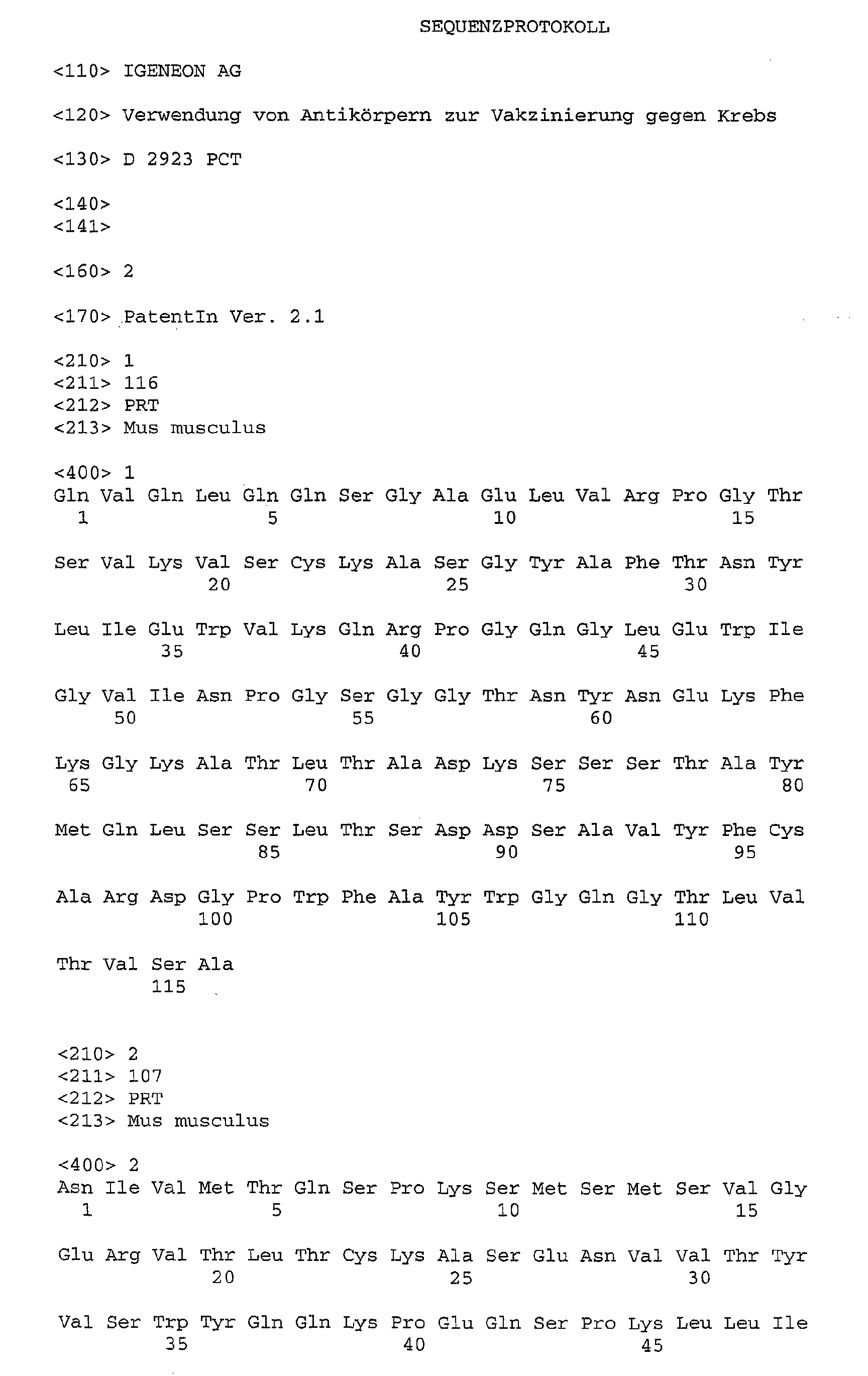
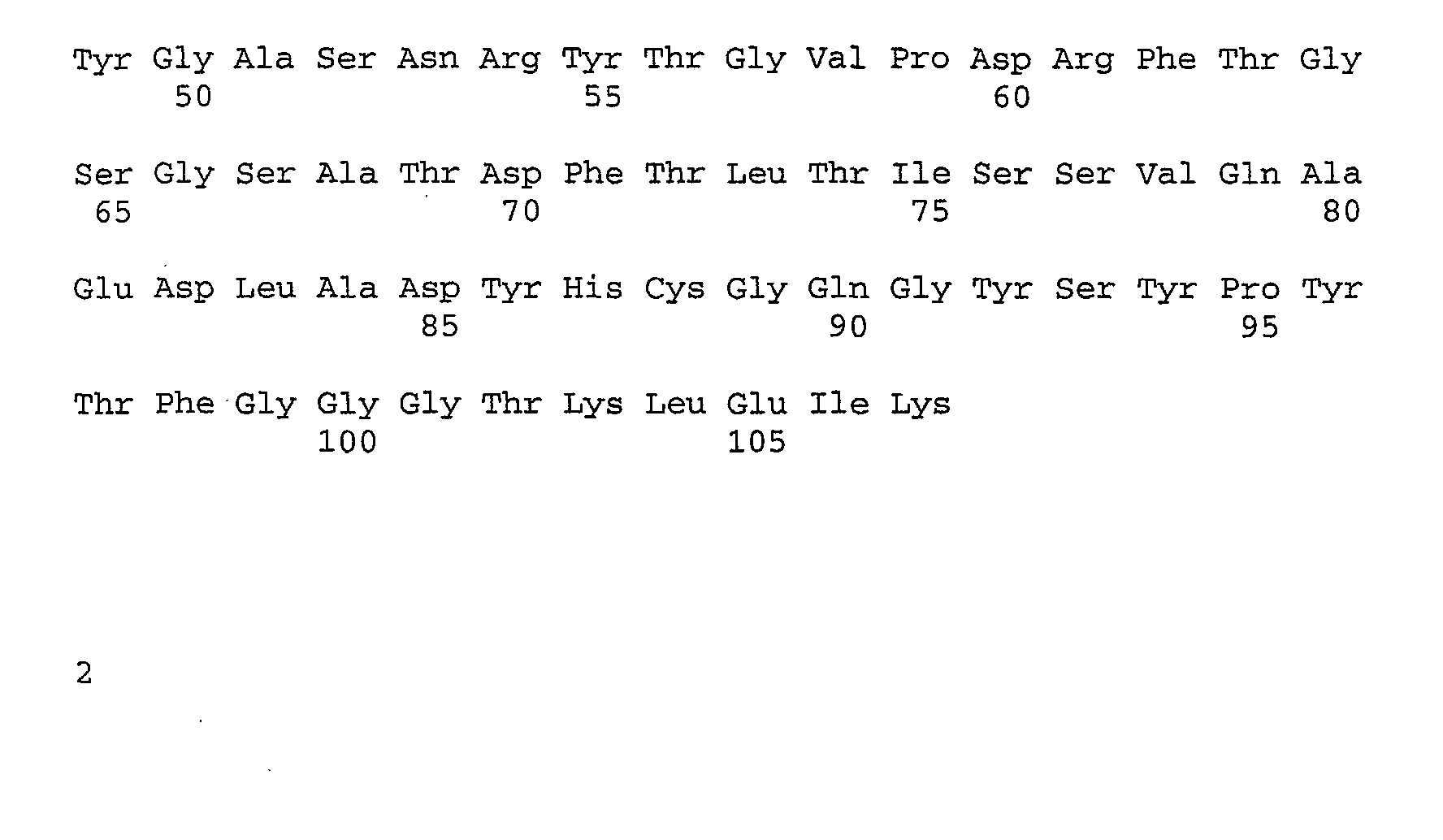
- amino acid sequences of the variable regions of the MAK HE2 are as follows:
- Example 3 The result of this experiment is shown in FIG. 3: The goats have a strong vaccination with the F (ab) ' 2 fragment of the MAK HE2 Immune response against it built up, whereas no antibodies against HE2 are found in a pre-serum.
- the goat immune serum contains immunoglobulins which strongly affect the Ep-CAM positive KATO Cells bind while no binding is detected on the Ep-CAM negative WM9 cells. There are no antibodies in the pre-serum that bind to these cells.
- Example 8 the immune response to HE2 was measured in an ELISA.
- the experimental description is in Example 8. As shown in Figure 8 will become clear titers of antibodies against HE2 as early as day 29 measured.
- Example 8 the immune response against HE2 was measured again in an ELISA.
- the experimental description is in Example 8.
- Figure 10 is shown, all four rhesus monkeys from the HE2 group already have one Vaccination built up a clear humoral immune response against HE2 by The second vaccination is further reinforced while the rhesus monkey is out of the Placebo group did not increase the titers of antibodies to HE2 exhibit.
- Example 7 This patient was given 0.5 ml this formulation (corresponds to 0.5 mg HE2) a total of 4 times subcutaneously in the upper limbs injected (day 1, 50, 78, 114). Before each vaccination and the day 128 blood was drawn for serum collection. It was initially investigated whether the vaccinations induced antibodies to KATO III cells tie. The cell ELISA was used again for these tests experimental description is in Example 9. The results of this Experiments are shown in Figure 12. Through the vaccinations in this Cancer patients apparently induced high titers of antibodies to KATO III Bind cells.
- the Vaccination with suitable antibodies against a self-adhesion TAA such as e.g. Ep-CAM, or their derivatives with the same idiotype as the respective Starting antibody that triggers a humoral immune response that is selective Ties tumor cells that express this self-adhesion TAA.
- the induced Antibodies can have a cytotoxic potential against such tumor cells exhibit. Vaccination with such an antibody can therefore lead to a lead to therapeutic effects in cancer.
- SW2 cells cultured in vitro are centrifuged off, the pellet is taken up in medium A and adjusted to 7 ⁇ 10 4 cells / ml.
- the chambers of a LabTek either 0.1 ml PBS def with 0.3 ml of the cell suspension or 0.1 ml PBS def with 40 ⁇ g HE2 and then with 0.3 ml of the cell suspension are mixed (final concentration HE2 100 ⁇ g / ml).
- the cells are separated with the pipette.
- the respective cell suspensions are photographed in a reversing microscope (magnification 100 times). The cell suspensions are then cultivated for 4 hours at 37 ° C./5% CO 2 and then photographed again.
- Antibody (Zymed) diluted 1 1000 in Dilution buffer A was added and incubated at 37 ° C for 30 minutes. The plate will washed four times with wash buffer A and twice with stain buffer. The Antibody binding is achieved by adding 100 ⁇ l of the specific substrate detected and the color reaction by adding 50 ⁇ l stop solution each canceled about 10 minutes. The evaluation is carried out by measuring the optical Density (OD) at 490nm (wavelength of the reference measurement is 620nm).
- the wells of a microtiter plate are incubated with 100 ⁇ l of a cell suspension of the cell line to be tested in a concentration of 2 ⁇ 10 6 cells / ml in medium A overnight at + 4 ° C. After the supernatant has been suctioned off, the plate is incubated with 50 ⁇ l of fixing solution per hole for 5 minutes at room temperature. After the supernatant has been suctioned off, 200 ⁇ l of blocking buffer B are pipetted in and the plate is incubated at 37 ° C. for 1 hour. After washing twice with 200 .mu.l washing buffer B, 100 .mu.l aliquots of the goat sera to be tested are incubated for 1 hour at 37.degree. C.
- the cleaning is basically described in Proc.Natl.Acad.Sci.USA 81: 216, 1984 and is summarized here as follows:
- a first step the total IgG contained in the goat serum is cleaned on a DEAE anion exchanger column using known methods .
- an immunoaffinity column CH-Sepharose 4B, Pharmacia
- those goat antibodies are bound which are directed against constant regions of the F (ab) ' 2 fragment of HE2, while the fraction of the anti idiotypic goat antibody does not bind to this column.
- This cell ELISA is basically carried out in the same way as in Example 4 described. Instead of serum dilutions, concentrations of 100 ⁇ g / ml up to 0.031 ⁇ g / ml of the immunoaffinity-purified goat IgG or of non-specific purified goat IgG is used.
- This ELISA is basically carried out in the same way as described in Example 3, with the exception that for the detection of the bound rhesus monkey antibodies Peroxidase-conjugated goat anti-human Ig antibody (Zymed) is used. With this reagent, rhesus monkey antibodies can be made in the same way as Detect human antibodies because of the sequence homology of the constant regions of human antibodies and rhesus monkey antibodies is approximately 98%.
- This cell ELISA is basically carried out in the same way as in Example 4 with the exception that for the detection of the bound to the cells Rhesus monkey antibody (or human antibody) a peroxidase conjugated Goat anti-human Ig antibody (Zymed) is used.
- a peroxidase conjugated Goat anti-human Ig antibody Zymed
- a peroxidase conjugated goat anti-mouse IgG Antibodies Zymed
- 1 ml of the gel obtained according to the above instructions is filled into a Pharmacia HR5 / 5 column.
- 0.5 ml of serum is diluted 1:10 with cleaning buffer A.
- This solution is pumped over the column at 1 ml / minute and washed with cleaning buffer A until the UV baseline of the detector is reached again (280 nm).
- Bound immunoglobulins are then eluted with cleaning buffer B and the fraction neutralized with 0.5 M Na 2 HPO 4 immediately after desorption and mixed with 0.02% NaN 3 .
- 50 ⁇ l of the antibody fraction purified in this way are analyzed on a size separation column (SEC, Zorbax 250 GF) and the IgG and IgM fractions are quantified.
- 220 mM phosphate buffer pH 7 + 10% acetonitrile is used as the solvent for the SEC.
- the standard for the SEC is Human IgG and Human IgM, which are chromatographed in several concentrations to create a standard calibration line (peak area vs. concentration).
- the IgG and IgM concentrations in the affinity-purified Rhesuaffe antibody fractions are calculated using linear regression using the standard curves. The concentrations are given as ⁇ g / ml monkey serum used.
- KATO III cells are transferred into fresh medium A and kept in a cell culture flask at 37 ° C./5% CO 2 .
- the cells are first labeled with 51 chromium. 5x10 6 cells in 800 ⁇ l medium A at 37 ° C / 5% CO 2 with 100 ⁇ Ci Na 2 51 CrO 4 are incubated, then washed with medium A and adjusted to a density of 2.5x10 5 cells / ml. 100 ⁇ l aliquots of this cell suspension are pipetted into holes in a microtiter plate.
Landscapes
- Health & Medical Sciences (AREA)
- Chemical & Material Sciences (AREA)
- Organic Chemistry (AREA)
- Life Sciences & Earth Sciences (AREA)
- Immunology (AREA)
- Medicinal Chemistry (AREA)
- General Health & Medical Sciences (AREA)
- Proteomics, Peptides & Aminoacids (AREA)
- Molecular Biology (AREA)
- Genetics & Genomics (AREA)
- Biophysics (AREA)
- Biochemistry (AREA)
- Veterinary Medicine (AREA)
- Pharmacology & Pharmacy (AREA)
- Animal Behavior & Ethology (AREA)
- Cell Biology (AREA)
- Public Health (AREA)
- Engineering & Computer Science (AREA)
- Mycology (AREA)
- Microbiology (AREA)
- Bioinformatics & Cheminformatics (AREA)
- Epidemiology (AREA)
- Chemical Kinetics & Catalysis (AREA)
- General Chemical & Material Sciences (AREA)
- Nuclear Medicine, Radiotherapy & Molecular Imaging (AREA)
- Medicines Containing Antibodies Or Antigens For Use As Internal Diagnostic Agents (AREA)
- Peptides Or Proteins (AREA)
- Medicines Containing Material From Animals Or Micro-Organisms (AREA)
- Medicines That Contain Protein Lipid Enzymes And Other Medicines (AREA)
- Pharmaceuticals Containing Other Organic And Inorganic Compounds (AREA)
Abstract
Description
Direkte therapeutische Anwendungen von MAK gegen TAA beruhen auf passiven Immuntherapien, das heißt, ein MAK oder ein Derivat wird systemisch in geeigneter Menge an Krebspatienten verabreicht und übt eine therapeutische Wirkung nur aus, solange die Konzentration im Organismus dafür genügend groß ist. Die biologische Halbwertszeit solcher Agentien hängt von ihrer Struktur ab und beträgt wenige Stunden bis mehrere Tage. Daher ist es notwendig, wiederholte Applikationen vorzunehmen. Das führt bei Verwendung von xenogenen Antikörpern (z.B. murine MAK) aber zu unerwünschten Immunreaktionen, die eine mögliche therapeutische Wirkung neutralisieren und gefährliche Nebenwirkungen (anaphylaktische Reaktionen) bedingen können. Daher können solche Immuntherapeutika nur für eine begrenzte Zeit verabreicht werden.
Einem anderen Ansatz für Immuntherapie von Krebs liegt die selektive Aktivierung des Immunsystems von Krebspatienten zugrunde, maligne Zellen zu bekämpfen. Das wird mittels verschiedenster Formen von Krebsvakzinen versucht. Dazu gehören Impfungen mit autologen oder allogenen Tumorzellen, chemisch oder molekularbiologisch modifizierten autologen oder allogenen Tumorzellen, isolierten oder mit Hilfe von chemischen oder molekularbiologischen Methoden hergestellten TAA, daraus abgeleiteten Peptiden, neuerdings auch Impfungen mit DNA, die für TAA oder daraus abgeleiteten Strukturen codieren, etc. Eine alternative Methode beruht auf der Verwendung von anti-idiotypischen Antikörpern zur Vakzinierung gegen Krebs. Geeignete anti-idiotypische Antikörper können ein TAA immunologisch nachahmen. Sie induzieren als Fremdproteine (z.B. murine Antikörper, Ziegen-Antikörper etc.) nach Vakzinierung - im Gegensatz zu den eigentlichen menschlichen Tumorantigenen, die als Selbst-Strukturen oft nur wenig immunogen sind - im Menschen eine starke Immunantwort. Daher können anti-idiotypische Antikörper als immunogener Ersatz eines Tumorantigens zur Impfung verwendet werden.
Im Unterschied zur passiven Immuntherapien mit Anti-Tumorantikörpern genügen für die aktive spezifische Krebs-Immuntherapie im Prinzip sehr kleine Mengen eines geeigneten Impfstoffes, um für Monate bis Jahre eine Immunität zu induzieren, die oei Abschwächung durch Booster-Impfungen wieder aufgefrischt werden kann. Darüberhinaus kann bei aktiver Immunisierung sowohl eine humorale als auch eine zelluläre Immunität induziert werden, deren Zusammenspiel eine effektive Schutzwirkung ergeben kann.
Zusammenfassend beruht die bisherige Verwendung von Antikörpern oder von deren Derivaten in der Krebs-Immuntherapie im wesentlichen auf zwei Prinzipien:
- Passive Therapie mit Antikörpern oder deren Derivaten, die gegen TAA gerichtetet sind.
- Aktive Immunisierung (Vakzinierung) mit Antikörpern oder deren Derivaten, die
gegen den Idiotyp von Antikörpern mit Spezifität gegen TAA gerichtet sind.
Im Verlauf der Entdeckung und nachfolgender Charakterisierung von verschiedensten TAA hat sich herausgestellt, daß diese wichtige Funktionen für Krebszellen haben. Sie ermöglichen den entarteten Zellen, charakteristische Eigenschaften für den malignen Phänotyp wie z.B. vermehrte Adhäsionsfähigkeit auszuüben, die für die Etablierung von Metastasen von großer Bedeutung sind. Allerdings können solche Antigene durchaus in bestimmten Stadien auch auf normalen Zellen exprimiert sein, wo sie für normale Funktionen dieser Zellen verantwortlich sind. Ohne Anspruch auf Vollständigkeit seien hier einige Beispiele für solche Antigene angeführt: - N-CAM (Neuronal Cell Adhesion Molecule), das oft auf Tumoren neuronalen Ursprungs exprimiert ist und homophile Adhäsion bewirkt (J.Cell Biol. 118 (1992), 937).
- Das Lewis Y Kohlenhydratantigen, das auf der Mehrzahl der Tumoren epithelialen Ursprungs aufscheint, aber auch während der fötalen Entwicklung epithelialer Gewebe eine wichtige Rolle spielt. Es wurde gezeigt, daß die Expression dieses Antigens in Lungenkrebs stark mit einer ungünstigen Prognose assoziiert ist, da Lewis Y positive Krebszellen offensichtlich ein höheres metastatisches Potential haben (N. Engl. J. Med. 327 (1992), 14).
- CEA (Carcino Embryonic Antigen), das häufig auf epithelialen Tumoren des Gastro-Intestinaltraktes vorkommt und als Selbstadhäsionsmolekül identifiziert wurde (Cell 57 (1989), 327).
- Ep-CAM (Epithelial Cell Adhesion Molecule), daß auf fast allen Tumoren epithelialen Ursprungs exprimiert ist, aber auch auf vielen normalen Epithelien vorkommt, das als Selbstadhäsionsmolekül charakterisiert wurde und daher als pan-epitheliales Adhäsionsantigen klassifiziert werden kann (J. Cell Biol.125 (1994), 437).
Beispiele für Tumor-assoziierte Antigene sind N-CAM, das Lewis Y Kohlenhydratantigen, CEA und Ep-CAM, die bereits oben erwähnt wurden. Weitere Beispiele sind Sialyl Tn Kohlenhydrat, Globo H Kohlenhydrat, Ganglioside wie GD2/GD3/GM2, Prostate Specific Antigen (PSA), CA 125, CA 19-9, CA 15-3, TAG-72, EGF Rezeptor, Her2/Neu Rezeptor, p97, CD20 und CD21. Gegen alle diese Antigene stehen monoclonale Antikörper zur Verfügung. Weitere Tumor-assoziierte Antigene werden z.B. beschrieben in DeVita et al. (Eds., "Biological Therapy of Cancer", 2. Aufl., Kapitel 3: Biology of Tumor Antigens, Lippincott Company, ISBN 0-397-51416-6 (1995)).
Eine Vakzinierung im Sinne der vorliegenden Erfindung kann grundsätzlich sowohl im therapeutischen Sinne als auch im prophylaktischen Sinne (wie bei allen antimikrobiellen Impfstoffen) durchgeführt werden. Das heißt, die erfindungsgemäße Vakzinierung gegen Krebs kann sowohl als therapeutische als auch als prophylaktische Anwendung verstanden werden. Somit kann durch die Vakzinierung von nicht an Krebs erkrankten Personen mit geeigneten Antikörpern gegebenenfalls ein vorbeugender Schutz gegen den Ausbruch einer Krebserkrankung erzielt werden. Für eine solche prophylaktische Vakzinierung kommen insbesondere, wenn auch nicht ausschließlich, Personen in Frage, die ein erhöhtes Risiko aufweisen, eine Krebserkrankung zu entwickeln.
Die Bindungsregion eines Antikörpers gegen ein TAA kann nach dem "Schlüssel-Schloß-Prinzip" ein strukturell komplementäres Abbild des Bindungs-Epitopes des jeweiligen TAA's darstellen. Das bedeutet, daß ein solcher Antikörper in seinem Idiotyp eine Strukturinformation des Epitopes des TAA trägt, gegen das er gerichtet ist. Wird daher ein Krebspatient mit einem geeigneten, immunogenen Antikörper gegen ein TAA geimpft (also z.B. mit einem murinen MAK gegen ein TAA), werden dagegen im Patienten Antikörper gebildet, die zum Teil gegen den Idiotyp des als Vakzine eingesetzten Antikörpers gerichtet sind und nach dem "Schlüssel-Schloß-Prinzip" das Epitop des TAA strukturell nachahmen können.
Die physiologische Wirkung einer durch Impfung mit einem Antikörper gegen ein TAA induzierten Immunantwort hängt naturgemäß von der Funktion des jeweiligen TAA ab. Hat das TAA beispielsweise eine Funktion als Rezeptor für die Adhäsion von Tumorzelien, insbesondere an einen Liganden auf Endothelzellen des Gefäßsystems (eine solche Eigenschaft ist wichtig für die Fähigkeit von disseminierten Krebszellen, aus dem Gefäßsystem auszutreten und sich in Gewebe festzusetzen, um dort eine Metastase auszubilden), dann wird diese Adhäsionsfähigkeit durch Vakzinierung mit einem geeignetem Antikörper gegen dieses TAA herabgesetzt, weil im Kreislauf und im Gewebe permanent induzierte Antikörper vorhanden sind, die die Interaktion des TAA mit seinem Liganden kompetitieren, da sie das TAA in löslicher Form nachahmen.
Allgemein ausgedrückt, kann nach den obenstehenden Ausführungen durch Vakzinierung mit geeigneten Antikörpern gegen TAA, die eine Funktion für die Malignität von Tumorzellen haben, erreicht werden, daß die induzierte Immunantwort mit der Funktion des TAA in dessen Wechselwirkung mit seinem Liganden interferiert und diese erschwert oder verhindert. Das bedeutet, daß Krebszellen für den malignen Phänotyp wichtige Eigenschaften nicht oder nicht ausreichend ausüben können, wodurch die Entwicklung der Erkrankung verlangsamt oder gestoppt werden kann und insbesonders in frühen Stadien die Ausbildung von Metastasen unterdrückt werden kann.
Die Impfung kann durch einmalige Applikation der oben angegebenen Dosierung erfolgen. Vorzugsweise erfolgt sie jedoch durch wiederholte Verabreichungen. Die Zahl der Wiederholungen liegt dabei im Bereich von 1 bis 12 pro Jahr, besonders bevorzugt im Bereich von 4 bis 8 pro Jahr. Die Dosierung kann dabei gleichbleiben oder abnehmen.
- Hohe Dosis (≥ 100 mg / intravenöse Infusion)
- Kurze Wirkung durch Elimination des Wirkstoffes
- Xenogene Antikörper unerwünscht wegen Immunogenität
- Therapiedauer insbesonders bei xenogenen Antikörpern wegen der Induktion einer Immunantwort und der dadurch entstehenden Gefahr von anaphylaktischen Reaktionen bei wiederholter Anwendung limitiert
- Niedrige Dosis (< 1 mg/Impfung; subcutane, intradermale oder intramuskuläre Injektion)
- Lang andauernde Wirkung der direkt induzierten Immunantwort
- Xenogene Antikörper erwünscht, da die Wirkung auf Immunogenität beruht
- Behandlungsdauer unlimitiert (Auffrischungsimpfungen immer wieder möglich)
Der murine monoclonale Antikörper HE2 wurde dafür nach an sich beschriebenen Standardverfahren der Hybridomtechnologie generiert (siehe z.B. H. Zola. Monoclonal Antibodies: A Manual of Techniques. CRC Press, Inc. ISBN 0-8493-6476-0; 1988) Balb/c-Mäuse wurden mit menschlichen Kolorektal-Krebszellen nach Standardprotokollen immunisiert. Die Milzzellen wurden mit der Maus-Myelomlinie P3X63Ag8 fusioniert und Hybridome selektioniert, die Antikörper produzieren, die selektiv an humane kolorektale Krebszellen, aber nicht an Melanomzellen binden. Letztlich wurde ein Hybridorn ausgewählt, das einen IgG2a/kappa Antikörper sezerniert. Dieser Antikörper (HE2) bindet an Ep-CAM, wie z.B. durch Westernblotanalyse mit Membranpräparationen von KATO III Magenkrebszellen im Vergleich mit einem bekannten anti-Ep-CAM Antikörper (KS1-4) gezeigt werden kann.


- Figur 1
- zeigt die Inhibierung in vitro der Selbstadhäsion der kleinzelligen Lungenkrebslinie SW2 durch den MAK HE2.
- Figur 2
- zeigt die Selbstadhäsion in vitro der human kleinzeliigen Lungenkrebslinie SW2 ohne Einfluß des MAK HE2, als Kontrolle zu dem in Figur 1 dargestellten Experiment.
- Figur 3
- zeigt die Induktion einer Antikörperimmunantwort gegen HE2 nach Vakzinierung von Ziegen mit dem F(ab)'2-Fragment von HE2, gemessen in einem ELISA.
- Figur 4
- zeigt die Induktion einer Antikörperimmunantwort gegen Ep-CAM positive human Magenkrebszellen (Kato III) nach Vakzinierung von Ziegen mit dem F(ab)'2-Fragment von HE2, gemessen in einem Zell- ELISA.
- Figur 5
- zeigt das Fehlen einer Anitkörperimmunantwort gegen Ep-CAM negative humane Melanomzellen (WM9) nach Vakzinierung von Ziegen mit dem F(ab)'2-Fragment von HE2, gemessen in einem Zell- ELISA, als Kontrolle zu dem in Figur 4 dargestellten Experiment.
- Figur 6
- zeigt die Bindung einer affinitätsgereinigten Antikörperfraktion aus Serum von Ziegen, die mit dem F(ab)'2-Fragment von HE2 vakziniert wurden, an Ep-CAM positive humane Magenkrebszellen (Kato III), gemessen in einem Zell-ELISA.
- Figur 7
- zeigt das Fehlen der Bindung einer affinitätsgereinigten Antikörperfraktion aus Serum von Ziegen, die mit dem F(ab)'2- Fragment von HE2 vakziniert wurden, an Ep-CAM negative humane Melanomzellen (WM9), gemessen in einem Zell-ELISA, als Kontrolle zu dem in Figur 6 dargestellten Experiment.
- Figur 8
- zeigt die Induktion einer Antikörperimmunantwort gegen HE2 nach Vakzinierung von Rhesusaffen mit 0,5 mg an Aluminiumhydroxid adsorbiertem HE2, gemessen in einem ELISA.
- Figur 9
- zeigt die Induktion einer Antikörperimmunantwort gegen Ep-CAM positive humane Magenkrebszellen (Kato III) nach Vakzinierung von Rhesusaffen mit 0,5 mg an Aluminiumhydroxid adsorbiertem HE2, gemessen in einem Zell-ELISA.
- Figur 10
- zeigt die im Rahmen einer Rhesusaffen-Toxizitätsstudie mit HE2 gefundene Induktion einer Antikörperimmunantwort gegen HE2 nach Vakzinierung einer Gruppe von Rhesusaffen mit 0,5 mg an Aluminiumhydroxid adsorbiertem HE2, sowie das Fehlen einer Immunantwort gegen HE2 nach Behandlung einer anderen Gruppe von Rhesusaffen mit einer Aluminiumhydroxidformulierung ohne Antigen (Plazebo), gemessen in einem ELISA.
- Figur 11
- zeigt beispielshaft die im Rahmen der Rhesusaffen-Toxizitätsstudie mit HE2 gefundene Induktion einer Antikörperimmunantwort gegen Ep-CAM positive humane Magenkrebszellen (Kato III), gemessen in einem Zell-ELISA.
- Figur 12
- zeigt die Induktion einer Antikörperimmunantwort gegen Ep-CAM positive humane Magenkrebszellen (Kato III) nach wiederholter Vakzinierung eines Darmkrebspatienten mit je 0,5 mg an Aluminiumhydroxid adsorbiertem HE2, gemessen in einem Zell- ELISA.
- Figur 13
- zeigt die Induktion einer Serum-Zytotoxizität gegen Ep-CAM positive humane Magenkrebszellen (Kato III) nach wiederholter Vakzinierung eines Darmkrebspatienten mit je 0,5 mg an Aluminiumhydroxid adsorbiertem HE2, gemessen in einem Zell-Lyse-Experiment.
| Affe | Tag | µg / ml IgM gegen | µg / ml IgG gegen |
| 9206m | -14 | 7,7 | 2,8 |
| 43 | 16,3 | 135,2 | |
| 9599m | -14 | 17,9 | 2,5 |
| 43 | 25,4 | 449,3 | |
| 8415f | -14 | 16,0 | 3,2 |
| 43 | 22,5 | 159,9 | |
| 9139f | -14 | 5,3 | 5,0 |
| 43 | 10,3 | 69,8 |
| Mikrotiterplatten | Immuno Plate F96 MaxiSorp (Nunc) für ELISA Cell Culture Cluster (Costar; Cat.Nr. 3598) für Zell-ELISA |
| Zellinien | SW2: menschliche kleinzellige Lungenkarzinomlinie, Ep-CAM positiv |
| KATO III: menschliche Magenkrebszellinie, Ep-CAM positiv (ATCC HTB 103) | |
| WM 9: menschliche Melanomzellinie, Ep-CAM negativ | |
| Kopplungspuffer | 0,1 M NaHCO3 |
| 0,5 M NaCI | |
| pH-Wert 8,0 | |
| Reinigungspuffer A | PBS def |
| 0,2 M NaCI | |
| pH-Wert 7,2 | |
| Reinigungspuffer B | 0,1 M Glycin / HCI |
| 0,2 M NaCI | |
| pH-Wert 2,9 | |
| Medium A | RPMI 1640 + 2 g/l NaHCO3 |
| 100 U/ml Penicillin G | |
| 100 µg/ml Streptomycinsulfat | |
| 4 mM Glutamin | |
| 10 % foetales Kälberserum (hitzeinaktiviert) | |
| Bindungspuffer | 15 mM Na2CO3 |
| 35 mM NaHCO3 | |
| 3 mM NaN3 | |
| pH-Wert: 9,6 | |
| PBS deficient | 138 mM NaCl |
| 1,5 mM KH2PO4 | |
| 2,7 mM KCI | |
| 6,5 mM Na2HPO4 | |
| pH-Wert: 7,2 | |
| Fixierlösung | 0,1 % Glutardialdehyd in physiologischer NaCl-Lösung |
| Waschpuffer A | 2% NaCI |
| 0,2% Triton X-100 | |
| in PBS deficient | |
| Waschpuffer B | 0,05 % Tween 20 in PBS deficient |
| Blockierungspuffer A | 5 % foetales Kälberserum (hitzeinaktiviert) in PBS deficient |
| Blockierungspuffer B | 1 % Rinderserumalbumin |
| 0,1 % NaN3 | |
| in PBS deficient | |
| Verdünnungspuffer A | 2% foetales Kälberserum (hitzeinaktiviert) In PBS deficient |
| Verdünnungspuffer B | PBS deficient |
| Färbepuffer | 24,3 mM Zitronensäure |
| 51,4 mM Na2HPO4 | |
| pH-Wert: 5,0 | |
| Substrat | 40 mg o-Phenylendiamin Dihydrochlorid |
| 100 ml Färbepuffer | |
| 20 µl H2O2 (30%) | |
| Stopplösung | 4 N H2SO4 |
Die Immunaffinitätsreinigung der gegen HE2 gerichteten Antikörperfraktion aus Serum der Rhesusaffen erfolgt nach folgender Vorschrift: Die Immunaffinitätsreinigung wird auf einem FPLC-System (Pharmacia) durchgeführt. 1 ml des nach obiger Vorschrift erhaltenen Gels wird in eine Pharmacia HR5/5 Säule gefüllt. 0,5 ml Serum werden 1:10 mit dem Reinigungspuffer A verdünnt. Diese Lösung wird mit 1 ml / Minute über die Säule gepumpt und mit Reinigungspuffer A nachgewaschen, bis die UV-Basislinie des Detektors wieder erreicht ist (280 nm). Gebundene Immunglobuline werden dann mit Reinigungspuffer B eluiert und die Fraktion mit 0,5 M Na2HPO4 unmittelbar nach Desorption neutralisiert und mit 0,02% NaN3 versetzt. 50µl der so gereinigten Antikörperfraktion werden auf einer Größentrennungssäule (SEC, Zorbax 250 GF) analysiert und die IgG- und IgM- Anteile quantifiziert. Als Laufmittel für die SEC wird 220 mM Phosphatpuffer pH 7 + 10% Acetonitril verwendet. Als Standard für die SEC dient Human IgG und Human IgM, die zum Erstellen einer Standard-Eichgerade jeweils in mehreren Konzentrationen chromatographiert werden (Peakfläche vs. Konzentration). Die Berechnung der IgG- und IgM-Konzentrationen in den affinitätsgereinigten Rhesuaffen-Antikörperfraktionen erfolgt mittels Linearregression anhand der Standardkurven. Die Konzentrationen werden als µg / ml eingesetzten Affenserums angegeben.
Claims (21)
- Verwendung eines Antikörpers, der gegen ein menschliches zelluläres Membranantigen gerichtet ist, zur Herstellung eines Arzneimittels zur prophylaktischen und/oder therapeutischen Vakzinierung gegen Krebs, wobei der Antikörper nicht ein Antikörper ist, der gegen das zelluläre Membranantigen Ep-CAM gerichtet ist.
- Verwendung nach Anspruch 1, wobei das zelluläre Membranantigen ein Tumor-assoziiertes Antigen ist.
- Verwendung nach Anspruch 1 oder 2, wobei das zelluläre Membranantigen eine Rolle bei Adhäsionsvorgängen spielt.
- Verwendung nach einem der Ansprüche 1 bis 3, wobei das zelluläre Membranantigen ein Antigen epithelialer Zellen ist.
- Verwendung nach einem der Ansprüche 1 bis 4, wobei das zelluläre Membranantigen zur Selbstadhäsion fähig ist.
- Verwendung nach Anspruch 5, wobei das zelluläre Membranantigen N-CAM oder CEA ist.
- Verwendung nach einem der Ansprüche 1 bis 6, wobei der Antikörper tierischen Ursprungs ist.
- Verwendung nach einem der Ansprüche 1 bis 7, wobei der Antikörper ein monoclonaler Antikörper ist.
- Verwendung nach einem der Ansprüche 1 bis 8, dadurch gekennzeichnet, dass der Antikörper ausgewählt ist aus der Gruppe bestehend aus intakten Antikörpern, deren Fragmenten und Derivaten mit dem Idiotyp des Ausgangs-Antikörpers.
- Verwendung nach einem der Ansprüche 1 bis 10, wobei zwei oder mehr Antikörper, die gegen verschiedene zelluläre Membranantigene oder gegen verschiedene Epitope eines Membranantigens gerichtet sind, in Kombination verwendet werden.
- Verwendung nach einem der Ansprüche 1 bis 10, wobei das Arzneimittel weiterhin mindestens noch ein Vakzine-Adjuvans enthält.
- Verwendung nach einem der Ansprüche 1 bis 11, wobei das Arzneimittel für die Verabreichung des Antikörpers in einer Dosierung im Bereich von 0,01 bis 4 mg Antikörper geeignet ist.
- Verwendung nach einem der Ansprüche 1 bis 12, wobei das Arzneimittel zur Verabreichung durch subcutane, intradermale oder intramuskuläre Injektionen geeignet ist.
- Vakzine zur prophylaktischen und/oder therapeutischen Behandlung von Krebs enthaltend einen Antikörper, der gegen ein menschliches zelluläres Membranantigen gerichtet ist, in einer Menge von 0,01 bis 4 mg.
- Vakzine zur prophylaktischen und/oder therapeutischen Behandlung von Krebs enthaltend einen Antikörper, der gegen ein menschliches zelluläres Membranantigen gerichtet ist, und mindestens noch ein Vakzine-Adjuvans.
- Vakzine nach Anspruch 14 oder 15, wobei der Antikörper gegen ein Tumor-assoziiertes Antigen gerichtet ist.
- Vakzine nach einem der Ansprüche 14 bis 16, wobei der Antikörper gegen das zelluläre Membranantigen Ep-CAM, N-CAM oder CEA gereichtet ist.
- Vakzine nach einem der Ansprüche 14 bis 17, wobei der Antikörper tierischen Ursprungs ist.
- Vakzine nach einem der Ansprüche 14 bis 18, wobei der Antikörper ein monoclonaler Antikörper ist.
- Vakzine nach einem der Ansprüche 14 bis 19, wobei der Antikörper ausgewählt ist aus der Gruppe bestehend aus intakten Antikörpern, deren Fragmenten und Derivaten mit dem Idiotyp des Ausgangs-Antikörpers.
- Vakzine nach einem der Ansprüche 14 bis 20, wobei zwei oder mehr Antikörper, die gegen verschiedene zelluläre Membranantigene oder gegen verschiedene Epitope eines Membranantigens gerichtet sind, in Kombination enthalten sind.
Applications Claiming Priority (3)
| Application Number | Priority Date | Filing Date | Title |
|---|---|---|---|
| CH5199 | 1999-01-13 | ||
| CH5199 | 1999-01-13 | ||
| EP00906191A EP1140168B1 (de) | 1999-01-13 | 2000-01-12 | Verwendung von antikörpern zur vakzinierung gegen krebs |
Related Parent Applications (1)
| Application Number | Title | Priority Date | Filing Date |
|---|---|---|---|
| EP00906191A Division EP1140168B1 (de) | 1999-01-13 | 2000-01-12 | Verwendung von antikörpern zur vakzinierung gegen krebs |
Publications (3)
| Publication Number | Publication Date |
|---|---|
| EP1230932A2 true EP1230932A2 (de) | 2002-08-14 |
| EP1230932A3 EP1230932A3 (de) | 2003-11-26 |
| EP1230932B1 EP1230932B1 (de) | 2005-01-12 |
Family
ID=4178206
Family Applications (2)
| Application Number | Title | Priority Date | Filing Date |
|---|---|---|---|
| EP00906191A Expired - Lifetime EP1140168B1 (de) | 1999-01-13 | 2000-01-12 | Verwendung von antikörpern zur vakzinierung gegen krebs |
| EP02005394A Expired - Lifetime EP1230932B1 (de) | 1999-01-13 | 2000-01-12 | Verwendung von Antikörpern zur Vakzinierung gegen Krebs |
Family Applications Before (1)
| Application Number | Title | Priority Date | Filing Date |
|---|---|---|---|
| EP00906191A Expired - Lifetime EP1140168B1 (de) | 1999-01-13 | 2000-01-12 | Verwendung von antikörpern zur vakzinierung gegen krebs |
Country Status (28)
| Country | Link |
|---|---|
| US (3) | US7691372B2 (de) |
| EP (2) | EP1140168B1 (de) |
| JP (1) | JP4774551B2 (de) |
| KR (1) | KR100771752B1 (de) |
| CN (1) | CN1188169C (de) |
| AT (2) | ATE219687T1 (de) |
| AU (1) | AU768515B2 (de) |
| CA (1) | CA2360382C (de) |
| CZ (1) | CZ302801B6 (de) |
| DE (2) | DE50009240D1 (de) |
| DK (2) | DK1230932T3 (de) |
| EE (1) | EE05474B1 (de) |
| ES (2) | ES2177509T3 (de) |
| HK (1) | HK1044487B (de) |
| HR (1) | HRP20010526A2 (de) |
| HU (1) | HU226150B1 (de) |
| ID (1) | ID30223A (de) |
| IL (2) | IL144265A0 (de) |
| IS (1) | IS5998A (de) |
| MX (1) | MXPA01007148A (de) |
| NO (1) | NO329917B1 (de) |
| NZ (1) | NZ512722A (de) |
| PL (1) | PL201533B1 (de) |
| PT (2) | PT1140168E (de) |
| SI (2) | SI1230932T1 (de) |
| SK (1) | SK286627B6 (de) |
| TR (1) | TR200102034T2 (de) |
| WO (1) | WO2000041722A1 (de) |
Cited By (4)
| Publication number | Priority date | Publication date | Assignee | Title |
|---|---|---|---|---|
| EP1618890A1 (de) * | 2004-07-20 | 2006-01-25 | Igeneon Krebs-Immuntherapie Forschungs- und Entwicklungs-AG | Verwendung von Antikörpern in einer sehr geringen Dosis zur Impfung gegen Krebs |
| WO2008040044A1 (en) | 2006-10-03 | 2008-04-10 | Stoiber, Wolfgang | Cancer immunotherapy predictive parameters |
| WO2010096941A1 (en) * | 2009-02-24 | 2010-09-02 | Esbatech, An Alcon Biomedical Research Unit Llc | Methods for identifying immunobinders of cell-surface antigens |
| EP2356992A1 (de) | 2007-12-07 | 2011-08-17 | N.V. Nutricia | Bifidobacterium für Hausstaubmilben allergie |
Families Citing this family (13)
| Publication number | Priority date | Publication date | Assignee | Title |
|---|---|---|---|---|
| MXPA01007148A (es) * | 1999-01-13 | 2002-03-27 | Igeneon Krebs Immuntherapie | Uso de anticuerpos para vacunacion anti-cancer. |
| AT410172B (de) | 2000-03-21 | 2003-02-25 | Igeneon Gmbh | Verfahren zur herstellung einer vakzineformulierung |
| AT502293B1 (de) * | 2002-05-15 | 2008-03-15 | Igeneon Krebs Immuntherapie | Immunogener, monoklonaler antikörper |
| AT500647A1 (de) * | 2002-05-21 | 2006-02-15 | Igeneon Krebs Immuntherapie | Verwendung eines impfstoffes |
| AT500650B1 (de) | 2003-04-17 | 2009-11-15 | Altropus Gmbh | Immunogener rekombinanter antikörper |
| AT500651B9 (de) * | 2003-05-27 | 2010-04-15 | Altropus Gmbh | Aktiv immunisierender antikörper |
| JP2008505943A (ja) | 2004-07-14 | 2008-02-28 | イゲネーオン・クレープス−イムンテラピー・フォルシュングス−ウント・エントヴィックルングス−アクチェンゲゼルシャフト | グリコシル化抗体 |
| CN101355928B (zh) * | 2005-04-26 | 2013-05-22 | 卫材R&D管理株式会社 | 用于癌症免疫疗法的组合物和方法 |
| WO2007008943A2 (en) | 2005-07-08 | 2007-01-18 | Xencor, Inc. | Optimized anti-ep-cam antibodies |
| EP1762575A1 (de) * | 2005-09-12 | 2007-03-14 | Ganymed Pharmaceuticals AG | Identifizierung Tumor-assoziierter Antigene für Diagnoseund Therapie |
| US8887373B2 (en) | 2012-02-24 | 2014-11-18 | Covidien Lp | Vessel sealing instrument with reduced thermal spread and method of manufacture therefor |
| US20140276968A1 (en) * | 2013-03-14 | 2014-09-18 | Ethicon, Inc. | Applicator systems for surgical fasteners |
| US10196458B2 (en) * | 2013-07-26 | 2019-02-05 | The Regents Of The University Of California | Anti-immunoglobulin E antibodies and methods of using thereof |
Family Cites Families (12)
| Publication number | Priority date | Publication date | Assignee | Title |
|---|---|---|---|---|
| CA1341281C (en) * | 1986-07-09 | 2001-08-07 | Hubert J.P. Schoemaker | Immunotherapy of tumor with monoclonal antibody against the 17-1a antigen |
| US5270202A (en) * | 1989-11-03 | 1993-12-14 | Syamal Raychaudhuri | Anti-idiotypic antibodies to human melanoma-associated proteoglycan antigen |
| US5965132A (en) * | 1992-03-05 | 1999-10-12 | Board Of Regents, The University Of Texas System | Methods and compositions for targeting the vasculature of solid tumors |
| US5798100A (en) * | 1994-07-06 | 1998-08-25 | Immunomedics, Inc. | Multi-stage cascade boosting vaccine |
| WO1997005597A1 (en) * | 1995-07-31 | 1997-02-13 | Litton Systems Canada Limited | Flat panel pixel array incorporating photoconductive switches |
| EP0857176A1 (de) * | 1995-10-25 | 1998-08-12 | Centocor B.V. | VON HUMANEM EPITHELANTIGEN Ep-CAM ABGELEITETE PEPTIDE UND IHRE ANWENDUNG |
| US6235280B1 (en) * | 1996-04-12 | 2001-05-22 | Malaya Chatterjee | Methods of delaying development of CEA-associated tumors using anti-idiotype antibody 3H1 |
| IL121041A0 (en) * | 1997-06-09 | 1997-11-20 | Yeda Res & Dev | Immunogenic compositions for induction of anti-tumor immunity |
| US6274143B1 (en) * | 1997-06-13 | 2001-08-14 | Malaya Chatterjee | Methods of delaying development of HMFG-associated tumors using anti-idiotype antibody 11D10 |
| ATE480566T1 (de) * | 1998-06-15 | 2010-09-15 | Quest Pharmatech Inc | Immuntherapeutische zusammensetzung und verfahren zur behandlung von prostatakrebs |
| MXPA01007148A (es) * | 1999-01-13 | 2002-03-27 | Igeneon Krebs Immuntherapie | Uso de anticuerpos para vacunacion anti-cancer. |
| WO2001087233A2 (en) * | 2000-05-16 | 2001-11-22 | New York University | Anti-idiotypic antibody against fimh adhesin of uropathogenic type i-fimbriated escherichia coli, compositions and method of use thereof |
-
2000
- 2000-01-12 MX MXPA01007148A patent/MXPA01007148A/es not_active IP Right Cessation
- 2000-01-12 EP EP00906191A patent/EP1140168B1/de not_active Expired - Lifetime
- 2000-01-12 HR HR20010526A patent/HRP20010526A2/hr not_active Application Discontinuation
- 2000-01-12 AT AT00906191T patent/ATE219687T1/de active
- 2000-01-12 WO PCT/EP2000/000174 patent/WO2000041722A1/de not_active Ceased
- 2000-01-12 PL PL364747A patent/PL201533B1/pl not_active IP Right Cessation
- 2000-01-12 DE DE50009240T patent/DE50009240D1/de not_active Expired - Lifetime
- 2000-01-12 NZ NZ512722A patent/NZ512722A/en not_active IP Right Cessation
- 2000-01-12 EP EP02005394A patent/EP1230932B1/de not_active Expired - Lifetime
- 2000-01-12 SK SK964-2001A patent/SK286627B6/sk not_active IP Right Cessation
- 2000-01-12 ES ES00906191T patent/ES2177509T3/es not_active Expired - Lifetime
- 2000-01-12 DE DE50000243T patent/DE50000243D1/de not_active Expired - Lifetime
- 2000-01-12 PT PT00906191T patent/PT1140168E/pt unknown
- 2000-01-12 HK HK02106215.4A patent/HK1044487B/zh not_active IP Right Cessation
- 2000-01-12 DK DK02005394T patent/DK1230932T3/da active
- 2000-01-12 ES ES02005394T patent/ES2236375T3/es not_active Expired - Lifetime
- 2000-01-12 DK DK00906191T patent/DK1140168T3/da active
- 2000-01-12 EE EEP200100366A patent/EE05474B1/xx not_active IP Right Cessation
- 2000-01-12 IL IL14426500A patent/IL144265A0/xx active IP Right Grant
- 2000-01-12 TR TR2001/02034T patent/TR200102034T2/xx unknown
- 2000-01-12 CA CA2360382A patent/CA2360382C/en not_active Expired - Fee Related
- 2000-01-12 AU AU27964/00A patent/AU768515B2/en not_active Ceased
- 2000-01-12 JP JP2000593332A patent/JP4774551B2/ja not_active Expired - Fee Related
- 2000-01-12 ID IDW00200101396A patent/ID30223A/id unknown
- 2000-01-12 CZ CZ20012581A patent/CZ302801B6/cs not_active IP Right Cessation
- 2000-01-12 KR KR1020017008697A patent/KR100771752B1/ko not_active Expired - Fee Related
- 2000-01-12 PT PT02005394T patent/PT1230932E/pt unknown
- 2000-01-12 SI SI200030594T patent/SI1230932T1/xx unknown
- 2000-01-12 HU HU0200527A patent/HU226150B1/hu not_active IP Right Cessation
- 2000-01-12 CN CNB008027641A patent/CN1188169C/zh not_active Expired - Fee Related
- 2000-01-12 SI SI200030015T patent/SI1140168T1/xx unknown
- 2000-01-12 AT AT02005394T patent/ATE286745T1/de active
-
2001
- 2001-06-21 NO NO20013093A patent/NO329917B1/no not_active IP Right Cessation
- 2001-07-10 IS IS5998A patent/IS5998A/is unknown
- 2001-07-11 IL IL144265A patent/IL144265A/en not_active IP Right Cessation
-
2006
- 2006-10-10 US US11/548,269 patent/US7691372B2/en not_active Expired - Fee Related
-
2009
- 2009-09-18 US US12/562,886 patent/US20100233178A1/en not_active Abandoned
-
2011
- 2011-08-12 US US13/209,285 patent/US8444974B2/en not_active Expired - Fee Related
Cited By (10)
| Publication number | Priority date | Publication date | Assignee | Title |
|---|---|---|---|---|
| EP1618890A1 (de) * | 2004-07-20 | 2006-01-25 | Igeneon Krebs-Immuntherapie Forschungs- und Entwicklungs-AG | Verwendung von Antikörpern in einer sehr geringen Dosis zur Impfung gegen Krebs |
| WO2008040044A1 (en) | 2006-10-03 | 2008-04-10 | Stoiber, Wolfgang | Cancer immunotherapy predictive parameters |
| EP2453235A1 (de) | 2006-10-03 | 2012-05-16 | Hans Loibner | Prognostische Krebsimmuntherapieparameter |
| EP2356992A1 (de) | 2007-12-07 | 2011-08-17 | N.V. Nutricia | Bifidobacterium für Hausstaubmilben allergie |
| EP2898889A1 (de) | 2007-12-07 | 2015-07-29 | N.V. Nutricia | Bifidobacterium gegen Staubmilbenallergie |
| WO2010096941A1 (en) * | 2009-02-24 | 2010-09-02 | Esbatech, An Alcon Biomedical Research Unit Llc | Methods for identifying immunobinders of cell-surface antigens |
| US8227199B2 (en) | 2009-02-24 | 2012-07-24 | ESBATech, an Alcon Biomedical Research Unit, LLC | Methods for identifying immunobinders of cell-surface antigens |
| US8465937B2 (en) | 2009-02-24 | 2013-06-18 | ESBATech, an Alcon Biomedical Research Unit, LLC | Methods for identifying B-clones which bind cell-surface antigens |
| US9221905B2 (en) | 2009-02-24 | 2015-12-29 | Esbatech, An Alcon Biomedical Research Unit Llc | Methods for producing immunobinders of cell-surface antigens |
| US9908940B2 (en) | 2009-02-24 | 2018-03-06 | Esbatech, An Alcon Biomedical Research Unit Llc | Humanized immunobinders of cell-surface antigens |
Also Published As
Similar Documents
| Publication | Publication Date | Title |
|---|---|---|
| EP1140168B1 (de) | Verwendung von antikörpern zur vakzinierung gegen krebs | |
| DE69518919T2 (de) | Autoantikörper enthaltende zusammensetzung für tumorbehandlung und -vorbeugung | |
| DE60018761T2 (de) | Therapeutischer antikörper gegen das muc-1-antigen und verfahren zu dessen verwendung | |
| DE69626423T2 (de) | Verfahren und zusammensetzung zum rekonformieren multiepitopischer antigene zum anregen einer immunantwort | |
| DE69033295T2 (de) | Nachweismethode für Harnkarzinom-assoziierte Antigene | |
| DE69034087T2 (de) | Antiidiotypischer Antikörper, der ein Immunantwort gegen ein Glykosphingolipid induziert und seine Verwendung | |
| EP1229936B1 (de) | Verwendung von anti-idiotypischen antikörpern als impfstoffe gegen krebs | |
| DE69734392T2 (de) | Impfstoff gegen tumore der b-lymphozyten | |
| AT500648B1 (de) | Set zur behandlung von krebspatienten | |
| AT500651B9 (de) | Aktiv immunisierender antikörper | |
| DE10296942T5 (de) | Therapeutische Zusammensetzung, welche die Immunitätsreaktion verändert | |
| WO2003097092A1 (de) | Verwendung eines impfstoffes zur aktiven immunisierung gegen krebs | |
| DE3750642T2 (de) | Verfahren und Zusammensetzungen betreffend regressions-assoziierte Antigene. | |
| AT410637B (de) | Verwendung von polyklonalen immunglobulinen | |
| EP1528934B1 (de) | Verwendung von antikörpern gegen ein tumor-assoziiertes antigen | |
| EP1618890A1 (de) | Verwendung von Antikörpern in einer sehr geringen Dosis zur Impfung gegen Krebs | |
| US20040265318A1 (en) | Use of antibodies for the vaccination against cancer | |
| WO2001019388A1 (de) | Contactinhibin enthaltendes arzneimittel sowie arzneimittel, das gegen contactinhibin gerichtete antikörper enthält | |
| EP0406880A2 (de) | Methode zur Stimulierung der Antitumor-Wirkung der Makrophagen und Zusammensetzung dafür |
Legal Events
| Date | Code | Title | Description |
|---|---|---|---|
| PUAI | Public reference made under article 153(3) epc to a published international application that has entered the european phase |
Free format text: ORIGINAL CODE: 0009012 |
|
| AC | Divisional application: reference to earlier application |
Ref document number: 1140168 Country of ref document: EP |
|
| AK | Designated contracting states |
Kind code of ref document: A2 Designated state(s): AT BE CH CY DE DK ES FI FR GB GR IE IT LI LU MC NL PT SE |
|
| AX | Request for extension of the european patent |
Free format text: LT;LV;MK;SI |
|
| PUAL | Search report despatched |
Free format text: ORIGINAL CODE: 0009013 |
|
| RIC1 | Information provided on ipc code assigned before grant |
Ipc: 7A 61K 39/395 A Ipc: 7A 61K 39/39 B Ipc: 7C 07K 16/30 - Ipc: 7A 61P 35/00 B |
|
| AK | Designated contracting states |
Kind code of ref document: A3 Designated state(s): AT BE CH CY DE DK ES FI FR GB GR IE IT LI LU MC NL PT SE |
|
| AX | Request for extension of the european patent |
Extension state: LT LV MK SI |
|
| 17P | Request for examination filed |
Effective date: 20031215 |
|
| 17Q | First examination report despatched |
Effective date: 20040220 |
|
| GRAP | Despatch of communication of intention to grant a patent |
Free format text: ORIGINAL CODE: EPIDOSNIGR1 |
|
| AKX | Designation fees paid |
Designated state(s): AT BE CH CY DE DK ES FI FR GB GR IE IT LI LU MC NL PT SE |
|
| AXX | Extension fees paid |
Extension state: SI Payment date: 20031215 Extension state: MK Payment date: 20031215 Extension state: LV Payment date: 20031215 Extension state: LT Payment date: 20031215 |
|
| GRAS | Grant fee paid |
Free format text: ORIGINAL CODE: EPIDOSNIGR3 |
|
| GRAA | (expected) grant |
Free format text: ORIGINAL CODE: 0009210 |
|
| RAP1 | Party data changed (applicant data changed or rights of an application transferred) |
Owner name: IGENEON KREBS-IMMUNTHERAPIE FORSCHUNGS- UND ENTWIC |
|
| AC | Divisional application: reference to earlier application |
Ref document number: 1140168 Country of ref document: EP Kind code of ref document: P |
|
| AK | Designated contracting states |
Kind code of ref document: B1 Designated state(s): AT BE CH CY DE DK ES FI FR GB GR IE IT LI LU MC NL PT SE |
|
| AX | Request for extension of the european patent |
Extension state: LT LV MK SI |
|
| REG | Reference to a national code |
Ref country code: GB Ref legal event code: FG4D Free format text: NOT ENGLISH |
|
| REG | Reference to a national code |
Ref country code: CH Ref legal event code: EP |
|
| REF | Corresponds to: |
Ref document number: 50009240 Country of ref document: DE Date of ref document: 20050217 Kind code of ref document: P |
|
| REG | Reference to a national code |
Ref country code: IE Ref legal event code: FG4D Free format text: GERMAN |
|
| REG | Reference to a national code |
Ref country code: GR Ref legal event code: EP Ref document number: 20050400429 Country of ref document: GR |
|
| REG | Reference to a national code |
Ref country code: DK Ref legal event code: T3 |
|
| REG | Reference to a national code |
Ref country code: SE Ref legal event code: TRGR |
|
| GBT | Gb: translation of ep patent filed (gb section 77(6)(a)/1977) |
Effective date: 20050404 |
|
| REG | Reference to a national code |
Ref country code: PT Ref legal event code: SC4A Free format text: AVAILABILITY OF NATIONAL TRANSLATION Effective date: 20050301 |
|
| REG | Reference to a national code |
Ref country code: ES Ref legal event code: FG2A Ref document number: 2236375 Country of ref document: ES Kind code of ref document: T3 |
|
| PLBE | No opposition filed within time limit |
Free format text: ORIGINAL CODE: 0009261 |
|
| STAA | Information on the status of an ep patent application or granted ep patent |
Free format text: STATUS: NO OPPOSITION FILED WITHIN TIME LIMIT |
|
| ET | Fr: translation filed | ||
| 26N | No opposition filed |
Effective date: 20051013 |
|
| REG | Reference to a national code |
Ref country code: CH Ref legal event code: PFA Owner name: IGENEON KREBS-IMMUNTHERAPIE FORSCHUNGS- UND ENTWI Free format text: IGENEON KREBS-IMMUNTHERAPIE FORSCHUNGS- UND ENTWICKLUNGS-AG#BRUNNERSTRASSE 69/3#1230 WIEN (AT) -TRANSFER TO- IGENEON KREBS-IMMUNTHERAPIE FORSCHUNGS- UND ENTWICKLUNGS-AG#BRUNNERSTRASSE 69/3#1230 WIEN (AT) |
|
| PGFP | Annual fee paid to national office [announced via postgrant information from national office to epo] |
Ref country code: CY Payment date: 20100107 Year of fee payment: 11 |
|
| PGFP | Annual fee paid to national office [announced via postgrant information from national office to epo] |
Ref country code: LU Payment date: 20110127 Year of fee payment: 12 |
|
| PG25 | Lapsed in a contracting state [announced via postgrant information from national office to epo] |
Ref country code: CY Free format text: LAPSE BECAUSE OF NON-PAYMENT OF DUE FEES Effective date: 20110112 |
|
| PGFP | Annual fee paid to national office [announced via postgrant information from national office to epo] |
Ref country code: CH Payment date: 20120130 Year of fee payment: 13 Ref country code: MC Payment date: 20120124 Year of fee payment: 13 Ref country code: IE Payment date: 20120121 Year of fee payment: 13 |
|
| PGFP | Annual fee paid to national office [announced via postgrant information from national office to epo] |
Ref country code: PT Payment date: 20120110 Year of fee payment: 13 |
|
| PGFP | Annual fee paid to national office [announced via postgrant information from national office to epo] |
Ref country code: SE Payment date: 20120125 Year of fee payment: 13 Ref country code: IT Payment date: 20120119 Year of fee payment: 13 Ref country code: FI Payment date: 20120124 Year of fee payment: 13 Ref country code: GR Payment date: 20120130 Year of fee payment: 13 Ref country code: DK Payment date: 20120123 Year of fee payment: 13 Ref country code: BE Payment date: 20120126 Year of fee payment: 13 |
|
| PGFP | Annual fee paid to national office [announced via postgrant information from national office to epo] |
Ref country code: NL Payment date: 20120130 Year of fee payment: 13 |
|
| PGFP | Annual fee paid to national office [announced via postgrant information from national office to epo] |
Ref country code: AT Payment date: 20120123 Year of fee payment: 13 |
|
| PGFP | Annual fee paid to national office [announced via postgrant information from national office to epo] |
Ref country code: DE Payment date: 20130228 Year of fee payment: 14 Ref country code: FR Payment date: 20130221 Year of fee payment: 14 Ref country code: ES Payment date: 20130205 Year of fee payment: 14 Ref country code: GB Payment date: 20130131 Year of fee payment: 14 |
|
| REG | Reference to a national code |
Ref country code: PT Ref legal event code: MM4A Free format text: LAPSE DUE TO NON-PAYMENT OF FEES Effective date: 20130712 |
|
| BERE | Be: lapsed |
Owner name: *IGENEON KREBS-IMMUNTHERAPIE FORSCHUNGS- UND ENTWI Effective date: 20130131 |
|
| REG | Reference to a national code |
Ref country code: NL Ref legal event code: V1 Effective date: 20130801 |
|
| REG | Reference to a national code |
Ref country code: LT Ref legal event code: MM9D Effective date: 20130112 Ref country code: DK Ref legal event code: EBP |
|
| PG25 | Lapsed in a contracting state [announced via postgrant information from national office to epo] |
Ref country code: MC Free format text: LAPSE BECAUSE OF NON-PAYMENT OF DUE FEES Effective date: 20130131 |
|
| REG | Reference to a national code |
Ref country code: CH Ref legal event code: PL |
|
| REG | Reference to a national code |
Ref country code: SE Ref legal event code: EUG |
|
| REG | Reference to a national code |
Ref country code: AT Ref legal event code: MM01 Ref document number: 286745 Country of ref document: AT Kind code of ref document: T Effective date: 20130131 |
|
| REG | Reference to a national code |
Ref country code: GR Ref legal event code: ML Ref document number: 20050400429 Country of ref document: GR Effective date: 20130802 |
|
| REG | Reference to a national code |
Ref country code: IE Ref legal event code: MM4A |
|
| PG25 | Lapsed in a contracting state [announced via postgrant information from national office to epo] |
Ref country code: BE Free format text: LAPSE BECAUSE OF NON-PAYMENT OF DUE FEES Effective date: 20130131 Ref country code: PT Free format text: LAPSE BECAUSE OF NON-PAYMENT OF DUE FEES Effective date: 20130712 Ref country code: FI Free format text: LAPSE BECAUSE OF NON-PAYMENT OF DUE FEES Effective date: 20130112 Ref country code: CH Free format text: LAPSE BECAUSE OF NON-PAYMENT OF DUE FEES Effective date: 20130131 Ref country code: SE Free format text: LAPSE BECAUSE OF NON-PAYMENT OF DUE FEES Effective date: 20130113 Ref country code: LI Free format text: LAPSE BECAUSE OF NON-PAYMENT OF DUE FEES Effective date: 20130131 Ref country code: AT Free format text: LAPSE BECAUSE OF NON-PAYMENT OF DUE FEES Effective date: 20130131 Ref country code: NL Free format text: LAPSE BECAUSE OF NON-PAYMENT OF DUE FEES Effective date: 20130801 Ref country code: GR Free format text: LAPSE BECAUSE OF NON-PAYMENT OF DUE FEES Effective date: 20130802 |
|
| REG | Reference to a national code |
Ref country code: SI Ref legal event code: KO00 Effective date: 20131107 |
|
| PG25 | Lapsed in a contracting state [announced via postgrant information from national office to epo] |
Ref country code: IE Free format text: LAPSE BECAUSE OF NON-PAYMENT OF DUE FEES Effective date: 20130112 Ref country code: DK Free format text: LAPSE BECAUSE OF NON-PAYMENT OF DUE FEES Effective date: 20130131 |
|
| REG | Reference to a national code |
Ref country code: DE Ref legal event code: R119 Ref document number: 50009240 Country of ref document: DE |
|
| GBPC | Gb: european patent ceased through non-payment of renewal fee |
Effective date: 20140112 |
|
| REG | Reference to a national code |
Ref country code: DE Ref legal event code: R119 Ref document number: 50009240 Country of ref document: DE Effective date: 20140801 |
|
| PG25 | Lapsed in a contracting state [announced via postgrant information from national office to epo] |
Ref country code: DE Free format text: LAPSE BECAUSE OF NON-PAYMENT OF DUE FEES Effective date: 20140801 |
|
| REG | Reference to a national code |
Ref country code: FR Ref legal event code: ST Effective date: 20140930 |
|
| PG25 | Lapsed in a contracting state [announced via postgrant information from national office to epo] |
Ref country code: FR Free format text: LAPSE BECAUSE OF NON-PAYMENT OF DUE FEES Effective date: 20140131 Ref country code: GB Free format text: LAPSE BECAUSE OF NON-PAYMENT OF DUE FEES Effective date: 20140112 |
|
| REG | Reference to a national code |
Ref country code: ES Ref legal event code: FD2A Effective date: 20150601 |
|
| PG25 | Lapsed in a contracting state [announced via postgrant information from national office to epo] |
Ref country code: LU Free format text: LAPSE BECAUSE OF NON-PAYMENT OF DUE FEES Effective date: 20130112 Ref country code: ES Free format text: LAPSE BECAUSE OF NON-PAYMENT OF DUE FEES Effective date: 20140113 |
|
| PG25 | Lapsed in a contracting state [announced via postgrant information from national office to epo] |
Ref country code: IT Free format text: LAPSE BECAUSE OF NON-PAYMENT OF DUE FEES Effective date: 20140112 |