EP1187732B1 - Amphibienfahrzeug - Google Patents
Amphibienfahrzeug Download PDFInfo
- Publication number
- EP1187732B1 EP1187732B1 EP00935154A EP00935154A EP1187732B1 EP 1187732 B1 EP1187732 B1 EP 1187732B1 EP 00935154 A EP00935154 A EP 00935154A EP 00935154 A EP00935154 A EP 00935154A EP 1187732 B1 EP1187732 B1 EP 1187732B1
- Authority
- EP
- European Patent Office
- Prior art keywords
- amphibious vehicle
- drive
- vehicle according
- wheels
- amphibious
- Prior art date
- Legal status (The legal status is an assumption and is not a legal conclusion. Google has not performed a legal analysis and makes no representation as to the accuracy of the status listed.)
- Expired - Lifetime
Links
Images

Classifications
-
- B—PERFORMING OPERATIONS; TRANSPORTING
- B60—VEHICLES IN GENERAL
- B60F—VEHICLES FOR USE BOTH ON RAIL AND ON ROAD; VEHICLES CAPABLE OF TRAVELLING IN OR ON DIFFERENT MEDIA, e.g. AMPHIBIOUS VEHICLES
- B60F3/00—Amphibious vehicles, i.e. vehicles capable of travelling both on land and on water; Land vehicles capable of travelling under water
- B60F3/0007—Arrangement of propulsion or steering means on amphibious vehicles
-
- B—PERFORMING OPERATIONS; TRANSPORTING
- B60—VEHICLES IN GENERAL
- B60F—VEHICLES FOR USE BOTH ON RAIL AND ON ROAD; VEHICLES CAPABLE OF TRAVELLING IN OR ON DIFFERENT MEDIA, e.g. AMPHIBIOUS VEHICLES
- B60F3/00—Amphibious vehicles, i.e. vehicles capable of travelling both on land and on water; Land vehicles capable of travelling under water
- B60F3/003—Parts or details of the vehicle structure; vehicle arrangements not otherwise provided for
- B60F3/0038—Flotation, updrift or stability devices
-
- B—PERFORMING OPERATIONS; TRANSPORTING
- B60—VEHICLES IN GENERAL
- B60F—VEHICLES FOR USE BOTH ON RAIL AND ON ROAD; VEHICLES CAPABLE OF TRAVELLING IN OR ON DIFFERENT MEDIA, e.g. AMPHIBIOUS VEHICLES
- B60F3/00—Amphibious vehicles, i.e. vehicles capable of travelling both on land and on water; Land vehicles capable of travelling under water
- B60F3/0061—Amphibious vehicles specially adapted for particular purposes or of a particular type
- B60F3/0069—Recreational amphibious vehicles
Definitions
- the invention relates generally to an amphibious vehicle, such as is known from US-A-4,74432.
- Motor vehicles of various kinds are increasingly used in the leisure sector for entertainment purposes. Examples include snowmobiles, jet skis or beach choppers, which are formed with three or four balloon tires and therefore can move in the sand.
- a disadvantage of the known vehicles is that they can only be used in one environment or are not suitable for amusement purposes. Examples include snowmobile vehicles or amphibious vehicles.
- the known amphibious vehicles for military or civilian purposes are relatively large and bulky. The reason for this is mainly that the vehicle underside is modeled on a boat hull to ensure buoyancy. In other embodiments, it is attempted to improve conventional motor vehicles by means of modifications such as buoyancy in the buoyancy, wherein the achievable water speeds remain unsatisfactory.
- an amphibious motor vehicle with an engine which drives a water drive directly and a land propulsion via a transmission, wherein in the drive train of the land propulsion a clutch is used whose coupling force during loading and the water ride according to the difference between the actual and target speed of the land propulsion system is variable such that the drive speed is controlled regulated to the target speed.
- the drive motor of the amphibious motor vehicle can also be driven when landing at full speed, so that the water drive, which can be designed as a screw or jet, gives the maximum thrust to support the loading and the water outlet.
- the invention is therefore based on the technical problem of creating an off-road amphibious vehicle, especially for recreational purposes, which can be switched from driving to swimming operation with minimal effort, sufficiently high speeds and an open seating position of the motor vehicle driver in both operating modes.
- the drive motor of the center of gravity of the amphibious vehicle can be moved in the direction of the buoyancy point that the vehicle center of gravity is in the known state above the buoyancy point, so that essentially no torques occur.
- the amphibious vehicle Due to the all-wheel drive, the amphibious vehicle is fully off-road, the trained as a jet propulsion floating drive on the one hand ensures adequate water speeds and on the other, unlike a screw, while driving can not be easily damaged and no risk of injury to third parties.
- the tires of the amphibious vehicle are designed as balloon tires, on the one hand the driving in the sand to good and on the other hand act as a buoyant float at the same time, for driving the rear balloon tires are preferably formed slightly larger than the front balloon tires.
- additional discrete buoyancy bodies which are preferably designed as air tanks, may additionally be provided in the front and / or rear region of the amphibious vehicle.
- these discrete buoyancy body which can be designed to be removable, beyond the buoyancy point can be better adjusted.
- an amphibious vehicle 1 is shown with an open seating arrangement for two people.
- the amphibious vehicle 1 includes a drive motor 2, a motor gear 3, a first clutch 4 for driving a jet engine 5, and two other clutches for independently driving the front wheels 6 and rear wheels 7.
- the amphibious vehicle 1 includes one in the rear of the amphibious vehicle 1 arranged air tank 8 and arranged in the front region air tank 9.
- the drive motor 2 is centrally between the front and the rear axle arranged below the driver. As a result, the center of gravity 10 at vehicle idle weight can be moved in front of the driver's seated position.
- the buoyancy which is essentially generated by the formed with balloon tires front wheels 6 and rear wheels 7 and the two air tanks 8, 9, can be adjusted by their dimensions such that the buoyancy point 11 is at vehicle idle weight below the driver's seating position. Due to the additional weight of the two vehicle occupants who sit relatively high, the center of gravity 12 shifts in total vehicle weight on the one hand up and the other below the driver's seating position. Since the buoyancy point 13 only shifts upward in the case of total vehicle weight, the center of gravity 12 and the lifting point 13 are on a line of action, so that no resulting torque exists and the amphibious vehicle 1 assumes a stable floating position. To improve the flow dynamics of the air tank 9 is formed with a chamfer whose apex to the water surface forms an angle ⁇ of preferably 40 °.
- Another way to improve buoyancy is to increase the axle width of the amphibious vehicle 1 compared to conventional off-road vehicles such as the beach choppers.
- the drive trains comprise the centrally arranged drive motor 2 and the motor drive 3, which are assigned to both the traction drive and the jet drive 5.
- the motor gear 3 is connected via a propeller shaft 14 with a Vorderachsgetriebe 15, via which the front wheels 6 are driven.
- the motor gear 3 is connected via an output shaft 16 with a rear axle 17, via the means of a rigid rear axle 18, the two rear wheels 7 are driven.
- To disconnect the drive train at least two clutches are provided, which are arranged either on the motor gear 3 or in the front axle 15 and rear axle 16.
- the two clutches are independently controllable. Via the clutch 4, the motor gear can be brought into engagement with a bevel gear 19 of the jet drive 5, wherein the clutch 4 is independently controllable.
- the clutch 4 When driving, the clutch 4 is open, and the front wheels 6 and / or rear wheels 7 are driven by the drive motor 2 and the motor gear 3. In the floating mode, the clutch 4 is closed and offset by engagement of the bevel gear 19, a screw in rotation, via a bottom opening Sucking water and presses in the direction of the jet nozzle 20. The ejected water jet then causes a forward pulse on the amphibious vehicle 1, due to which the amphibious vehicle 1 is driven.
- the traction drive train can be disengaged in swimming mode or used to support the buoyancy. For this purpose, the reverse gear is engaged, so that the front wheels 6 and the rear wheels 7 rotate counter to the direction of travel.
- the independent clutches for example, only the rear wheels 7 can be driven.
- the steering in the swim mode is primarily via the pivotable jet nozzle 20, wherein the steering of the front wheels 6 can optionally be used to support.
- the drive torque is controlled or regulated so that the wheels do not dig into the ground.
- an arrangement according to DE 39 16 200 A1 are used.
Landscapes
- Engineering & Computer Science (AREA)
- Combustion & Propulsion (AREA)
- Chemical & Material Sciences (AREA)
- Transportation (AREA)
- Mechanical Engineering (AREA)
- Motorcycle And Bicycle Frame (AREA)
- Vehicle Body Suspensions (AREA)
- Arrangement Or Mounting Of Propulsion Units For Vehicles (AREA)
- Toys (AREA)
- Polymers With Sulfur, Phosphorus Or Metals In The Main Chain (AREA)
- Transition And Organic Metals Composition Catalysts For Addition Polymerization (AREA)
- Automatic Cycles, And Cycles In General (AREA)
- Tires In General (AREA)
- Output Control And Ontrol Of Special Type Engine (AREA)
Description
- Die Erfindung betrifft gattungsgemäßes ein Amphibienfahrzeug, wie z.B aus US-A-4 74432 bekannt ist.
- Kraftfahrzeuge der verschiedensten Art finden verstärkt Einsatz im Freizeitbereich für Vergnügungszwecke. Beispiele hierfür sind Schneemobile, Jet-Skis oder auch Strand-Chopper, die mit drei oder vier Ballonreifen ausgebildet sind und sich daher auch im Sand fortbewegen können. Nachteilig an den bekannten Fahrzeugen ist, daß diese jeweils nur in einer Umgebung einsetzbar sind oder aber nicht für Vergnügungszwecke geeignet sind. Beispiele hierfür sind Schneeraupen-Fahrzeuge oder Amphibienfahrzeuge. Die bekannten Amphibienfahrzeuge für militärische oder zivile Zwecke sind relativ groß und unförmig. Der Grund hierfür liegt hauptsächlich darin, daß die Kraftfahrzeugunterseite einem Bootsrumpf nachgebildet ist, um die Schwimmfähigkeit zu gewährleisten. In anderen Ausführungsformen wird versucht, herkömmliche Kraftfahrzeuge durch Modifikationen wie Schwimmausleger im Auftrieb zu verbessern, wobei die damit erzielbaren Wassergeschwindigkeiten unbefriedigend bleiben.
- Aus der DE 35 22 041 A1 ist ein allradgetriebenes Amphibienfahrzeug mit hoher Wasserfahrt-Geschwindigkeit bekannt, bei dem durch Anordnung eines Schaufel- und Umlenkblechsystems an allen vier Rädern bei der Wasserfahrt starke Auftriebskräfte erzeugt werden, die den Fahzeugkörper aus dem Wasser heben. Nur die Räder mit den Schaufeln bleiben mit dem Wasser in Berührung. Da hierdurch der sonst bei Amphibienfahrzeugen formbedingt besonders hohe Widerstand im Wasser fortfällt, können die ebenfalls durch das Schaufelsystem erzeugten Vortriebskräfte dem Fahrzeug die geforderte hohe Wasserfahrt-Geschwindigkeit verleihen. Die Schaufel des Systems mit ihren Halterungen sind lösbar an den Rädern angeordnet und müssen bei Landfahrt demontiert bzw. vor dem Schwimmbetrieb montiert werden. Alternativ wird vorgeschlagen, Räder und Schaufelsystem permanent miteinander zu verbinden. Nachteilig an den bekannten Amphibienfahrzeugen ist je nach Ausführungsform entweder die umständliche Montage bzw. Demontage oder die hohen Kosten für eine automatische Ein- und Ausschubvorrichtung für das Schaufelsystem.
- Aus der DE 38 32 559 C1 ist ein amphibisches Kraftfahrzeug mit einem Motor bekannt, der einen Wasserantrieb direkt und einen Landantrieb über ein Getriebe antreibt, wobei in den Antriebsstrang des Landantriebs eine Kupplung eingesetzt ist, deren Kupplungskraft während des Anladens und der Wasserfahrt entsprechend der Differenz zwischen Ist- und Soll-Drehzahl des Landantriebs derart veränderbar ist, daß die Antriebsdrehzahl bis auf die Solldrehzahl geregelt regulierbar ist. Dadurch kann der Antriebsmotor des amphibischen Kraftfahrzeuges auch beim Anlanden mit voller Drehzahl gefahren werden, so daß der Wasserantrieb, der als Schraube oder Jet ausgebildet sein kann, den maximalen Schub zur Unterstützung des Anladens und der Wasserausfahrt abgibt.
- Aus der DE 39 16 200 A1 ist eine Antriebsanlage für ein Amphibienfahrzeug bekannt, bei welcher nur ein einziger Antriebsmotor erforderlich ist und trotzdem der Fahrantrieb und der Schwimmantrieb wahlweise voneinander unabhängig oder gleichzeitig betrieben werden können. Dadurch ist es möglich, daß bei gleichzeitigem Betrieb von Fahrantrieb und Schwimmantrieb mit nur einem einzigen Motor, und vorzugsweise bei konstanter Drehzahl des Motors, der Fahrantriebsstrang und der Schwimmantriebsstrang bezüglich Drehzahl und Leistung unabhängig voneinander steuerbar oder regelbar sind. Dies ist insbesondere beim Anlanden (Übergang von Wasser auf Land) und Ablanden (Übergang vom Land in das Wasser) von großem Vorteil, damit z.B. die Räder des Amphibienfahrzeuges sich nicht in weichen Ufergrund eingraben. Für den Fahrantrieb kann ein einziger Fahrantriebsstrang, und für den Schwimmantrieb kann ein einziger Schwimmantriebsstrang genügen. Wenn das Amphibienfahrzeug mehrere Schwimmvortriebseinrichtungen hat, beispielsweise mehrere Propeller oder mehrere Hydrojets, dann ist es von Vorteil, wenn jede dieser Schwimmvortriebseinrichtungen einen eigenen Schimmantriebsstrang hat, welche wahlweise gemeinsam oder unabhängig voneinander steuerbar oder regelbar sind.
- Der Erfindung liegt daher das technische Problem zugrunde, ein geländegängiges Amphibienfahrzeug insbesondere für Freizeitzwecke zu schaffen, das mit minimalem Aufwand vom Fahr- zum Schwimmbetrieb umschaltbar ist, in beiden Betriebsarten ausreichend große Geschwindigkeiten und eine offene Sitzposition des Kraftfahrzeugführers erlaubt.
- Die Lösung des technischen Problems ergibt sich durch die Merkmale des Patentanspruchs 1. Weitere vorteilhafte Ausgestaltungen der Erfindung ergeben sich aus den Unteransprüchen.
- Durch die mittige Anordnung des Antriebsmotors kann der Schwerpunkt des Amphibienfahrzeuges derart in Richtung des Auftriebspunktes verschoben werden, daß sich der Fahrzeugschwerpunkt im bekannten Zustand oberhalb des Auftriebspunktes befindet, so daß im wesentlichen keine Drehmomente auftreten. Dadurch erhält das Amphibienfahrzeug trotz der offenen Sitzanordnung eine stabile Wasserlage, die überhaupt erst einen sinnvollen Wasserbetrieb ermöglicht. Durch den Allradantrieb ist das Amphibienfahrzeug voll geländegängig, wobei der als Jet-Antrieb ausgebildete Schwimmantrieb einerseits ausreichende Wassergeschwindigkeiten gewährleistet und zum anderen, im Gegensatz zu einer Schraube, im Fahrbetrieb nicht so leicht beschädigt werden kann sowie kein Verletzungsrisiko für Dritte darstellt.
- In einer weiteren bevorzugten Ausführungsform sind die Reifen des Amphibienfahrzeuges als Ballonreifen ausgebildet, die einerseits dem Fahrbetrieb im Sand zu Gute kommen und zum anderen gleichzeitig im Schwimmbetrieb als Auftriebskörper wirken, wobei für den Fahrbetrieb die hinteren Ballonreifen vorzugsweise etwas größer als die vorderen Ballonreifen ausgebildet sind.
- Zur Verbesserung des Auftriebs können zusätzlich im vorderen und/oder hinteren Bereich des Amphibienfahrzeuges zusätzliche diskrete Auftriebskörper, die vorzugsweise als Lufttanks ausgebildet sind, vorgesehen sein. Mit diesen diskreten Auftriebskörpers, die demontierbar ausgebildet sein können, läßt sich darüber hinaus der Auftriebspunkt besser einstellen.
- Die Erfindung wird nachfolgend anhand eines bevorzugten Ausführungsbeispiels näher erläutert. Die Fig. zeigen:
- Fig. 1
- eine schematische Seitenansicht eines Amphibienfahrzeuges und
- Fig. 2
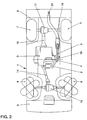
- eine schematische Unteransicht des Amphibienfahrzeuges.
- In der Fig. 1 ist ein Amphibienfahrzeug 1 mit einer offenen Sitzanordnung für zwei Personen dargestellt. Das Amphibienfahrzeug 1 umfaßt einen Antriebsmotor 2, ein Motorgetriebe 3, eine erste Kupplung 4 zum Antreiben eines Jet-Antriebs 5 und zwei weiteren Kupplungen zum unabhängigen Antreiben der Vorderräder 6 und der Hinterräder 7. Des weiteren umfaßt das Amphibienfahrzeug 1 einen im hinteren Bereich des Amphibienfahrzeuges 1 angeordneten Lufttank 8 und einen im vorderen Bereich angeordneten Lufttank 9. Der Antriebsmotor 2 ist mittig zwischen der Vorderachse und der Hinterachse unterhalb des Fahrers angeordnet. Dadurch läßt sich der Schwerpunkt 10 bei Fahrzeugleergewicht vor die Sitzposition des Fahrers verschieben. Der Auftrieb, der im wesentlichen durch die mit Ballonreifen ausgebildeten Vorderräder 6 und Hinterräder 7 sowie die beiden Lufttanks 8, 9 erzeugt wird, läßt sich durch deren Dimensionierung derart einstellen, daß der Auftriebspunkt 11 bei Fahrzeugleergewicht unter der Sitzposition des Fahrers liegt. Durch das zusätzliche Gewicht der beiden Fahrzeuginsassen, die relativ hoch sitzen, verschiebt sich der Schwerpunkt 12 bei Fahrzeuggesamtgewicht einerseits nach oben und zum anderen unterhalb der der Sitzposition des Fahrers. Da der Auftriebspunkt 13 bei Fahrzeuggesamtgewicht sich nur nach oben verschiebt, sind Schwerpunkt 12 und Auftriebspunkt 13 auf einer Wirklinie, so daß kein resultierendes Drehmoment existiert und das Amphibienfahrzeug 1 eine stabile Schwimmlage einnimmt. Zur Verbesserung der Strömungsdynamik ist der Lufttank 9 mit einer Abschrägung ausgebildet, deren Scheitelpunkt zur Wasseroberfläche einen Winkel α von vorzugsweise 40° einschließt.
- Eine weitere Möglichkeit zur Verbesserung des Auftriebs besteht darin, die Achsbreite des Amphibienfahrzeuges 1 im Vergleich zu herkömmlichen off-road-Fahrzeugen, wie beispielsweise den Strand-Choppern, zu vergrößern.
- Aufbau und Wirkungsweise der Antriebsstränge wird nun nachfolgend anhand der schematischen Unteransicht gemäß Fig. 2 erläutert. Die Antriebsstränge umfassen den mittig angeordneten Antriebsmotor 2 und das Motorgetriebe 3, die sowohl dem Fahrantrieb als auch dem Jet-Antrieb 5 zugeordnet sind. Das Motorgetriebe 3 ist über eine Kardanwelle 14 mit einem Vorderachsgetriebe 15 verbunden, über das die Vorderräder 6 antreibbar sind. Des weiteren ist das Motorgetriebe 3 über eine Abtriebswelle 16 mit einem Hinterachsgetriebe 17 verbunden, über das mittels einer starren Hinterachse 18 die beiden Hinterräder 7 antreibbar sind. Zum Abtrennen des Fahrstrangs sind mindestens zwei Kupplungen vorgesehen, die entweder am Motorgetriebe 3 oder aber im Vorderachsgetriebe 15 bzw. Hinterachsgetriebe 16 angeordnet sind. Die beiden Kupplungen sind voneinander unabhängig steuerbar. Über die Kupplung 4 kann das Motorgetriebe mit einem Kegelradgetriebe 19 des Jet-Antriebs 5 in Eingriff gebracht werden, wobei die Kupplung 4 unabhängig steuerbar ist.
- Im Fahrbetrieb ist die Kupplung 4 offen, und die Vorderräder 6 und/oder Hinterräder 7 werden durch den Antriebsmotor 2 und das Motorgetriebe 3 angetrieben. Im Schwimmbetrieb wird die Kupplung 4 geschlossen und durch Eingriff des Kegelradgetriebes 19 eine Schraube in Rotation versetzt, die über eine Bodenöffnung Wasser ansaugt und in Richtung der Jet-Düse 20 preßt. Der ausgestoßene Wasserstrahl bewirkt dann einen Vorwärtsimpuls auf das Amphibienfahrzeug 1, aufgrund dessen das Amphibienfahrzeug 1 angetrieben wird. Der Fahrantriebsstrang kann im Schwimmbetrieb ausgekuppelt werden oder aber zur Unterstützung des Auftriebes genutzt werden. Hierzu wird der Rückwärtsgang eingelegt, so daß die Vorderräder 6 und die Hinterräder 7 entgegen der Fahrtrichtung rotieren. Über die voneinander unabhängigen Kupplungen können beispielsweise auch nur die Hinterräder 7 angetrieben werden. Die Lenkung im Schwimmbetrieb erfolgt primär über die schwenkbare Jet-Düse 20, wobei die Lenkung der Vorderräder 6 gegebenenfalls zur Unterstützung herangezogen werden kann. Beim Anlanden wird dann der Fahrantriebsstrang im Vorwärtsgang zurückgeschaltet, wobei das Antriebsmoment derart gesteuert oder geregelt wird, daß sich die Räder nicht in den Untergrund eingraben. Hier kann beispielsweise eine Anordnung gemäß DE 39 16 200 A1 zur Anwendung kommen.
-
- 1.
- Amphibienfahrzeug
- 2.
- Antriebsmotor
- 3.
- Motorgetriebe
- 4.
- Kupplung
- 5.
- Jet-Antrieb
- 6.
- Vorderräder
- 7.
- Hinterräder
- 8.
- Lufttank
- 9.
- Lufttank
- 10.
- Schwerpunkt bei Fahrzeugleergewicht
- 11.
- Auftriebspunkt bei Fahrzeugleergewicht
- 12.
- Schwerpunkt bei Fahrzeuggesamtgewicht
- 13.
- Auftriebspunkt bei Fahrzeuggesamtgewicht
- 14.
- Kardanwelle
- 15.
- Vorderachsgetriebe
- 16.
- Abtriebswelle
- 17.
- Hinterachsgetriebe
- 18.
- Hinterachse
- 19.
- Kegelradgetriebe
- 20.
- Jet-Düse
Claims (9)
- Amphibienfahrzeug (1), mit einer offenen Sitzanordnung, umfassend einen Antriebsmotor (2), wobei der Antriebsmotor (2) im wesentlichen mittig zwischen den Achsen des Fahrantriebs unterhalb der Sitzanordnung angeordnet ist, dadurch gekennzeichnet, daß der Antriebsmotor zum wechselseitigen oder gleichzeitigen Antreiben eines allradgetriebenen Fahrantriebs und eines als Jet-Antrieb (5) ausgebildeten Schwimm-Antriebs mittels mindestens zweier voneinander unabhängiger Kupplungen ausgebildet ist.
- Amphibienfahrzeug nach Anspruch 1, dadurch gekennzeichnet, daß die Reifen der Vorderräder (6) und der Hinterräder (7) als Ballonreifen ausgebildet sind.
- Amphibienfahrzeug nach Anspruch 2, dadurch gekennzeichnet, daß die hinteren Ballonreifen ein größeres Volumen als die vorderen Ballonreifen aufweisen.
- Amphibienfahrzeug nach einem der vorangegangenen Ansprüche, dadurch gekennzeichnet, daß im vorderen und/oder hinteren Bereich Auftriebskörper angeordnet sind.
- Amphibienfahrzeug nach Anspruch 4, dadurch gekennzeichnet, daß die Auftriebskörper als Lufttanks (8,9) ausgebildet sind.
- Amphibienfahrzeug nach Anspruch 4 oder 5, dadurch gekennzeichnet, daß die vorderen Auftriebskörper einen größeren Auftrieb als die hinteren Auftriebskörper erzeugen.
- Amphibienfahrzeug nach einem der vorangegangenen Ansprüche, dadurch gekennzeichnet, daß die Sitzanordnung als Zweisitzer ausgebildet ist.
- Verfahren zum Betreiben eines Amphibienfahrzeuges nach einem der vorangegangenen Ansprüche, dadurch gekennzeichnet, daß im Schwimmbetrieb der Fahrantrieb zugeschaltet wird und die Vorderräder (6) und/oder die Hinterräder (7) entgegen der Fahrtrichtung angetrieben werden.
- Verfahren zum Betreiben eines Amphibienfahrzeuges nach einem der vorangegangenen Ansprüche, dadurch gekennzeichnet, daß im Schwimmbetrieb die Steuerung über eine schwenkbare Jet-Düse durch die Lenkung der Vorderräder unterstützbar ist.
Applications Claiming Priority (3)
| Application Number | Priority Date | Filing Date | Title |
|---|---|---|---|
| DE19926145 | 1999-06-09 | ||
| DE19926145A DE19926145A1 (de) | 1999-06-09 | 1999-06-09 | Amphibienfahrzeug |
| PCT/EP2000/004980 WO2000076794A1 (de) | 1999-06-09 | 2000-05-31 | Amphibienfahrzeug |
Publications (2)
| Publication Number | Publication Date |
|---|---|
| EP1187732A1 EP1187732A1 (de) | 2002-03-20 |
| EP1187732B1 true EP1187732B1 (de) | 2006-06-14 |
Family
ID=7910580
Family Applications (1)
| Application Number | Title | Priority Date | Filing Date |
|---|---|---|---|
| EP00935154A Expired - Lifetime EP1187732B1 (de) | 1999-06-09 | 2000-05-31 | Amphibienfahrzeug |
Country Status (10)
| Country | Link |
|---|---|
| US (1) | US6672916B1 (de) |
| EP (1) | EP1187732B1 (de) |
| JP (1) | JP2003502201A (de) |
| CN (1) | CN1170697C (de) |
| AT (1) | ATE329771T1 (de) |
| CA (1) | CA2374469C (de) |
| DE (2) | DE19926145A1 (de) |
| ES (1) | ES2263473T3 (de) |
| RU (1) | RU2248280C2 (de) |
| WO (1) | WO2000076794A1 (de) |
Families Citing this family (35)
| Publication number | Priority date | Publication date | Assignee | Title |
|---|---|---|---|---|
| GB0021171D0 (en) | 2000-08-30 | 2000-10-11 | Gibbs Int Tech Ltd | Power train |
| US6968917B2 (en) * | 2000-09-13 | 2005-11-29 | Bombardier Recreational Products Inc. | ATV with improved driver positioning and/or multi passenger capacity |
| GB0102521D0 (en) * | 2001-02-01 | 2001-03-21 | Gibbs Int Tech Ltd | Power train |
| DE10140997A1 (de) * | 2001-08-21 | 2003-03-06 | Stefan Werner | Leichtfahrzeug |
| US20040129485A1 (en) * | 2001-09-13 | 2004-07-08 | Pierre Rondeau | All terrain vehicle with driver and passenger footrests |
| AU2002318941A1 (en) | 2001-12-20 | 2003-07-09 | Arctic Cat Inc. | Tandem four-wheel vehicle |
| US6666735B2 (en) | 2002-04-11 | 2003-12-23 | Dion Benoit | Jet drive assist for off-road vehicle with flotation |
| US7673711B1 (en) * | 2002-06-04 | 2010-03-09 | Polaris Industries Inc. | Tracked vehicle |
| GB0220164D0 (en) * | 2002-08-30 | 2002-10-09 | Gibbs Tech Ltd | Amphibious vehicle |
| RU2291063C2 (ru) * | 2003-02-12 | 2007-01-10 | Александр Евгеньевич Цельман | Транспортное средство (варианты) |
| GB2401831A (en) * | 2003-05-19 | 2004-11-24 | Gibbs Tech Ltd | A propulsion system for an amphibious vehicle |
| GB0422954D0 (en) * | 2004-10-15 | 2004-11-17 | Gibbs Tech Ltd | Amphibious vehicle |
| GB0423463D0 (en) * | 2004-10-22 | 2004-11-24 | Gibbs Tech Ltd | Amphibious vehicle suspension |
| US7311567B2 (en) * | 2004-10-22 | 2007-12-25 | Gibbs Technologies Ltd | Amphibious vehicle |
| GB2423963A (en) | 2004-12-22 | 2006-09-13 | Gibbs Tech Ltd | Amphibious vehicle power train arrangement |
| TWI388450B (zh) * | 2004-12-30 | 2013-03-11 | American Off Road Technologies Llc | 改良縮小尺寸之交通工具 |
| US7207851B1 (en) * | 2005-10-21 | 2007-04-24 | Gibbs Technologies Ltd | Amphibious vehicle |
| US7833071B2 (en) | 2006-06-09 | 2010-11-16 | Hydratrek, Llc | Amphibious all-terrain vehicle |
| GB2441518A (en) * | 2006-08-24 | 2008-03-12 | Gibbs Tech Ltd | An amphibian vehicle having two front wheels and a single rear wheel |
| GB2442215B (en) | 2006-09-29 | 2009-02-18 | Gibbs Tech Ltd | Amphibious vehicle having at least one retractable wheel |
| US7934963B1 (en) | 2007-11-05 | 2011-05-03 | David Carambat | Amphibious vehicle |
| GB2478395B (en) | 2008-06-20 | 2011-12-14 | Gibbs Tech Ltd | A two wheeled planing amphibian with retractable wheels |
| KR101037918B1 (ko) | 2008-08-12 | 2011-05-31 | 김규하 | 핸들 조작형 조향장치가 구비된 수륙 양용 차량 |
| KR20110016180A (ko) * | 2009-08-11 | 2011-02-17 | 이종수 | 수륙양용 전투차량 |
| KR101028825B1 (ko) | 2010-06-14 | 2011-04-12 | 김영근 | 수륙 양용 캠핑카 |
| CN102602257B (zh) * | 2011-04-26 | 2015-04-08 | 肖元治 | 一种智能性水陆两用电蓬车 |
| RU2642023C2 (ru) | 2011-06-13 | 2018-01-23 | Джиббс Текнолоджиз Лимитед | Корпус амфибии |
| USD760623S1 (en) | 2012-10-13 | 2016-07-05 | Gibbs Technologies Limited | Amphibious vehicle |
| WO2015024116A1 (en) | 2013-08-19 | 2015-02-26 | Nuhn Industries Ltd. | Amphibious pumping vehicle |
| JP6471893B2 (ja) * | 2014-10-03 | 2019-02-20 | 飛洋航空機製造開発株式会社 | 砂地走行装置を備えた水陸両用飛行機 |
| GB201509933D0 (en) * | 2015-06-08 | 2015-07-22 | Gibbs Tech Ltd | A power train for an amphibian |
| US9919657B2 (en) | 2015-09-04 | 2018-03-20 | Arctic Cat, Inc. | Retaining device for vehicle racks |
| KR101906950B1 (ko) * | 2016-12-26 | 2018-12-05 | 한화지상방산 주식회사 | 수륙양용차량의 제어장치 및 제어방법 |
| US11865885B2 (en) | 2020-06-18 | 2024-01-09 | Bazooka-Farmstar, LLC | Amphibious vehicle |
| CN116923010A (zh) * | 2023-07-21 | 2023-10-24 | 中国科学院深圳先进技术研究院 | 一种水陆两栖机器人、控制方法及应用 |
Family Cites Families (37)
| Publication number | Priority date | Publication date | Assignee | Title |
|---|---|---|---|---|
| FR514690A (fr) | 1920-04-29 | 1921-03-16 | Romolo Francesco Sabatino Vale | Véhicule automobile routier et nautique |
| US1641574A (en) * | 1924-11-17 | 1927-09-06 | Chavez Felipe | Car speed boat |
| US2341165A (en) * | 1942-12-09 | 1944-02-08 | Gen Motors Corp | Cooling system |
| US2397791A (en) * | 1943-01-08 | 1946-04-02 | Ford Motor Co | Amphibious vehicle |
| US2400132A (en) * | 1943-10-02 | 1946-05-14 | Alvin W Larson | Amphibian vehicle |
| US2406290A (en) * | 1944-09-20 | 1946-08-20 | Fmc Corp | Amphibian |
| CH394849A (de) * | 1962-05-09 | 1965-06-30 | Mowag Motorwagenfabrik Ag | Schwimmfähiges gepanzertes Radfahrzeug |
| DE1190353B (de) | 1962-06-07 | 1965-04-01 | Hermann Walter Gehlen Dipl Ing | Amphibienfahrzeug |
| DE1428756A1 (de) * | 1964-10-02 | 1969-07-31 | Ruf Dipl Ing Walter | Gepanzertes Schuetzenfahrzeug |
| FR1510592A (fr) * | 1966-02-12 | 1968-01-19 | Daimler Benz Ag | Camion automobile susceptible d'être utilisé en véhicule amphibie |
| US3426720A (en) * | 1966-10-10 | 1969-02-11 | Coot Inc | High traction vehicle |
| US3420204A (en) * | 1966-10-17 | 1969-01-07 | Fmc Corp | Reaction propulsion system |
| US3450089A (en) * | 1967-08-15 | 1969-06-17 | Lloyd Lippincott | Wheel driven boat |
| US3444837A (en) * | 1967-09-18 | 1969-05-20 | Donofrio & Co | Utility vehicle |
| US3941074A (en) * | 1974-04-05 | 1976-03-02 | Millerbernd Paul A | Amphibious bus |
| FR2411095A1 (fr) | 1977-12-12 | 1979-07-06 | Saviem | Dispositif de commande de deflecteurs de jets de poussee pour vehicules amphibies |
| US4348195A (en) * | 1979-05-10 | 1982-09-07 | Lantz George H | Multiple step vented hull |
| FR2507973A1 (fr) * | 1981-06-22 | 1982-12-24 | Poncin Gilles | Perfectionnements aux vehicules tous terrains amphibies |
| FR2540794A1 (fr) * | 1983-02-16 | 1984-08-17 | Rossignol Alain | Transmissions et propulsions des vehicules tout-terrain a direction par ripage |
| DE3522041A1 (de) | 1985-06-20 | 1987-01-02 | Wolff Hans Dietrich | Amphibien-fahrzeug mit hoher wasserfahrt-geschwindigkeit |
| US4744324A (en) * | 1986-08-15 | 1988-05-17 | Martinmaas Werner W | Amphibious all terrain vehicle (ATV) and conversion kit |
| US4852521A (en) * | 1987-04-06 | 1989-08-01 | Mariculture Equipment Development, Inc. | Amphibious aquaculture feed distribution machine |
| DE3832559C1 (de) | 1988-09-24 | 1990-02-22 | Eisenwerke Kaiserslautern Goeppner Gmbh, 6750 Kaiserslautern, De | |
| JPH02124306A (ja) * | 1988-10-31 | 1990-05-11 | Suzuki Motor Co Ltd | 水陸両用車輌 |
| DE3916200C2 (de) | 1989-05-18 | 1998-07-02 | Renk Ag | Antriebsanlage für ein Amphibienfahrzeug |
| JPH0463708A (ja) * | 1990-07-04 | 1992-02-28 | Honda Motor Co Ltd | 水陸両用車両 |
| JPH0463709A (ja) * | 1990-07-04 | 1992-02-28 | Honda Motor Co Ltd | 水上推進装置 |
| EP0970825A3 (de) * | 1992-06-23 | 2000-06-28 | Aquastrada International Corporation | Amphibisches Fahrzeug |
| GB2287910A (en) * | 1994-03-28 | 1995-10-04 | William Mctaggart | An amphibious vehicle |
| US5687669A (en) * | 1995-12-08 | 1997-11-18 | Engler; Manfred W. | Amphibious vehicle |
| US6116972A (en) * | 1997-02-04 | 2000-09-12 | A.R.I.S. S.P.A. | Auxiliary flotation, propulsion and steering gear for multipurpose vehicles with amphibian functions |
| DE29815500U1 (de) | 1998-07-13 | 1999-02-25 | Lehrberger, Andreas, 81539 München | Amphibienfahrzeug |
| GB0021007D0 (en) * | 2000-08-26 | 2000-10-11 | Gibbs Int Tech Ltd | Power train |
| GB0021171D0 (en) * | 2000-08-30 | 2000-10-11 | Gibbs Int Tech Ltd | Power train |
| GB0021168D0 (en) * | 2000-08-30 | 2000-10-11 | Gibbs Int Tech Ltd | Power train |
| GB0022397D0 (en) * | 2000-09-13 | 2000-11-01 | Gibbs Int Tech Ltd | Power train |
| GB0102521D0 (en) * | 2001-02-01 | 2001-03-21 | Gibbs Int Tech Ltd | Power train |
-
1999
- 1999-06-09 DE DE19926145A patent/DE19926145A1/de not_active Withdrawn
-
2000
- 2000-05-31 ES ES00935154T patent/ES2263473T3/es not_active Expired - Lifetime
- 2000-05-31 AT AT00935154T patent/ATE329771T1/de not_active IP Right Cessation
- 2000-05-31 EP EP00935154A patent/EP1187732B1/de not_active Expired - Lifetime
- 2000-05-31 RU RU2002100129/11A patent/RU2248280C2/ru not_active IP Right Cessation
- 2000-05-31 JP JP2001503279A patent/JP2003502201A/ja active Pending
- 2000-05-31 DE DE50012992T patent/DE50012992D1/de not_active Expired - Fee Related
- 2000-05-31 CA CA002374469A patent/CA2374469C/en not_active Expired - Fee Related
- 2000-05-31 WO PCT/EP2000/004980 patent/WO2000076794A1/de not_active Ceased
- 2000-05-31 CN CNB008086281A patent/CN1170697C/zh not_active Expired - Fee Related
- 2000-05-31 US US10/009,546 patent/US6672916B1/en not_active Expired - Fee Related
Also Published As
| Publication number | Publication date |
|---|---|
| US6672916B1 (en) | 2004-01-06 |
| RU2248280C2 (ru) | 2005-03-20 |
| DE19926145A1 (de) | 2000-12-14 |
| CN1355746A (zh) | 2002-06-26 |
| EP1187732A1 (de) | 2002-03-20 |
| CA2374469C (en) | 2008-01-22 |
| CA2374469A1 (en) | 2000-12-21 |
| WO2000076794A1 (de) | 2000-12-21 |
| DE50012992D1 (de) | 2006-07-27 |
| ATE329771T1 (de) | 2006-07-15 |
| ES2263473T3 (es) | 2006-12-16 |
| CN1170697C (zh) | 2004-10-13 |
| JP2003502201A (ja) | 2003-01-21 |
Similar Documents
| Publication | Publication Date | Title |
|---|---|---|
| EP1187732A1 (de) | Amphibienfahrzeug | |
| DE3428281C1 (de) | Bodeneffekt-Fahrzeug | |
| DE3900096A1 (de) | Umwandelbares starrfluegel-flugzeug | |
| DE60311260T2 (de) | Seefahrzeugantriebsanordnung und verfahren zum betrieb einer seefahrzeugantriebsanordnung | |
| DE2904151A1 (de) | Schwimmfaehiger personenkraftwagen als reise- und wassersport-mobil | |
| DE102017118965A1 (de) | Senkrecht startendes Luftfahrzeug | |
| DE60107958T2 (de) | Amphibienfahrzeug | |
| EP2773521B1 (de) | Amphibienfahrzeug und verfahren zum betrieb eines amphibienfahrzeugs | |
| EP0807044A1 (de) | Bodeneffektfahrzeug | |
| DE69103873T2 (de) | Fahrzeug mit Mischlenkung. | |
| WO1991007300A1 (de) | Bodeneffekt-fahrzeug | |
| EP0887243A2 (de) | Einsatzfahrzeug, insbesondere Feuerwehrfahrzeug, für den Strassen- und Schienenbetrieb | |
| DE3508139A1 (de) | Bootsantrieb | |
| DE19831324C2 (de) | Amphibienfahrzeug | |
| DE102015000703B4 (de) | Starrflügler-Fluggerät mit abnehmbaren Horizontalantrieben | |
| DE112004000867T5 (de) | Rumpf für ein Amphibienfahrzeug | |
| DE19624159A1 (de) | Bodeneffektfahrzeug | |
| DE1506162A1 (de) | Amphibienfahrzeug | |
| DE2511623A1 (de) | Luftfederungs- bzw. luftkissen-fahrzeug zum frachttransport | |
| DE1250292B (de) | Antriebseinrichtung fur Wasserfahrzeuge | |
| DE2062461C3 (de) | Schwimmvorrichtung fur ein Transportfahrzeug | |
| DE202013010491U1 (de) | Geländefahrzeug, insbesondere Allradfahrzeug mit integriertem Amphibienantrieb | |
| DE29815500U1 (de) | Amphibienfahrzeug | |
| DE69010678T2 (de) | Antriebssystem, geeignet für wasserfahrzeuge. | |
| DE4303619A1 (de) | Verwandlungsflugzeug und Verfahren |
Legal Events
| Date | Code | Title | Description |
|---|---|---|---|
| PUAI | Public reference made under article 153(3) epc to a published international application that has entered the european phase |
Free format text: ORIGINAL CODE: 0009012 |
|
| 17P | Request for examination filed |
Effective date: 20020109 |
|
| AK | Designated contracting states |
Kind code of ref document: A1 Designated state(s): AT BE CH CY DE DK ES FI FR GB GR IE IT LI LU MC NL PT SE |
|
| GRAP | Despatch of communication of intention to grant a patent |
Free format text: ORIGINAL CODE: EPIDOSNIGR1 |
|
| GRAS | Grant fee paid |
Free format text: ORIGINAL CODE: EPIDOSNIGR3 |
|
| GRAA | (expected) grant |
Free format text: ORIGINAL CODE: 0009210 |
|
| AK | Designated contracting states |
Kind code of ref document: B1 Designated state(s): AT BE CH CY DE DK ES FI FR GB GR IE IT LI LU MC NL PT SE |
|
| PG25 | Lapsed in a contracting state [announced via postgrant information from national office to epo] |
Ref country code: IT Free format text: LAPSE BECAUSE OF FAILURE TO SUBMIT A TRANSLATION OF THE DESCRIPTION OR TO PAY THE FEE WITHIN THE PRESCRIBED TIME-LIMIT;WARNING: LAPSES OF ITALIAN PATENTS WITH EFFECTIVE DATE BEFORE 2007 MAY HAVE OCCURRED AT ANY TIME BEFORE 2007. THE CORRECT EFFECTIVE DATE MAY BE DIFFERENT FROM THE ONE RECORDED. Effective date: 20060614 Ref country code: IE Free format text: LAPSE BECAUSE OF FAILURE TO SUBMIT A TRANSLATION OF THE DESCRIPTION OR TO PAY THE FEE WITHIN THE PRESCRIBED TIME-LIMIT Effective date: 20060614 Ref country code: FI Free format text: LAPSE BECAUSE OF FAILURE TO SUBMIT A TRANSLATION OF THE DESCRIPTION OR TO PAY THE FEE WITHIN THE PRESCRIBED TIME-LIMIT Effective date: 20060614 Ref country code: NL Free format text: LAPSE BECAUSE OF FAILURE TO SUBMIT A TRANSLATION OF THE DESCRIPTION OR TO PAY THE FEE WITHIN THE PRESCRIBED TIME-LIMIT Effective date: 20060614 |
|
| REG | Reference to a national code |
Ref country code: GB Ref legal event code: FG4D Free format text: NOT ENGLISH |
|
| REG | Reference to a national code |
Ref country code: CH Ref legal event code: EP |
|
| REG | Reference to a national code |
Ref country code: IE Ref legal event code: FG4D Free format text: LANGUAGE OF EP DOCUMENT: GERMAN |
|
| REF | Corresponds to: |
Ref document number: 50012992 Country of ref document: DE Date of ref document: 20060727 Kind code of ref document: P |
|
| PG25 | Lapsed in a contracting state [announced via postgrant information from national office to epo] |
Ref country code: SE Free format text: LAPSE BECAUSE OF FAILURE TO SUBMIT A TRANSLATION OF THE DESCRIPTION OR TO PAY THE FEE WITHIN THE PRESCRIBED TIME-LIMIT Effective date: 20060914 Ref country code: DK Free format text: LAPSE BECAUSE OF FAILURE TO SUBMIT A TRANSLATION OF THE DESCRIPTION OR TO PAY THE FEE WITHIN THE PRESCRIBED TIME-LIMIT Effective date: 20060914 |
|
| GBT | Gb: translation of ep patent filed (gb section 77(6)(a)/1977) |
Effective date: 20060923 |
|
| PG25 | Lapsed in a contracting state [announced via postgrant information from national office to epo] |
Ref country code: PT Free format text: LAPSE BECAUSE OF FAILURE TO SUBMIT A TRANSLATION OF THE DESCRIPTION OR TO PAY THE FEE WITHIN THE PRESCRIBED TIME-LIMIT Effective date: 20061114 |
|
| NLV1 | Nl: lapsed or annulled due to failure to fulfill the requirements of art. 29p and 29m of the patents act | ||
| REG | Reference to a national code |
Ref country code: ES Ref legal event code: FG2A Ref document number: 2263473 Country of ref document: ES Kind code of ref document: T3 |
|
| REG | Reference to a national code |
Ref country code: IE Ref legal event code: FD4D |
|
| PLBE | No opposition filed within time limit |
Free format text: ORIGINAL CODE: 0009261 |
|
| STAA | Information on the status of an ep patent application or granted ep patent |
Free format text: STATUS: NO OPPOSITION FILED WITHIN TIME LIMIT |
|
| EN | Fr: translation not filed | ||
| 26N | No opposition filed |
Effective date: 20070315 |
|
| BERE | Be: lapsed |
Owner name: VOLKSWAGEN A.G. Effective date: 20070531 |
|
| REG | Reference to a national code |
Ref country code: CH Ref legal event code: PL |
|
| PG25 | Lapsed in a contracting state [announced via postgrant information from national office to epo] |
Ref country code: MC Free format text: LAPSE BECAUSE OF NON-PAYMENT OF DUE FEES Effective date: 20070531 |
|
| PG25 | Lapsed in a contracting state [announced via postgrant information from national office to epo] |
Ref country code: LI Free format text: LAPSE BECAUSE OF NON-PAYMENT OF DUE FEES Effective date: 20070531 Ref country code: CH Free format text: LAPSE BECAUSE OF NON-PAYMENT OF DUE FEES Effective date: 20070531 |
|
| PG25 | Lapsed in a contracting state [announced via postgrant information from national office to epo] |
Ref country code: BE Free format text: LAPSE BECAUSE OF NON-PAYMENT OF DUE FEES Effective date: 20070531 |
|
| PG25 | Lapsed in a contracting state [announced via postgrant information from national office to epo] |
Ref country code: FR Free format text: LAPSE BECAUSE OF FAILURE TO SUBMIT A TRANSLATION OF THE DESCRIPTION OR TO PAY THE FEE WITHIN THE PRESCRIBED TIME-LIMIT Effective date: 20070309 Ref country code: GR Free format text: LAPSE BECAUSE OF FAILURE TO SUBMIT A TRANSLATION OF THE DESCRIPTION OR TO PAY THE FEE WITHIN THE PRESCRIBED TIME-LIMIT Effective date: 20060915 |
|
| PGFP | Annual fee paid to national office [announced via postgrant information from national office to epo] |
Ref country code: DE Payment date: 20080531 Year of fee payment: 9 |
|
| PG25 | Lapsed in a contracting state [announced via postgrant information from national office to epo] |
Ref country code: AT Free format text: LAPSE BECAUSE OF NON-PAYMENT OF DUE FEES Effective date: 20070531 |
|
| PG25 | Lapsed in a contracting state [announced via postgrant information from national office to epo] |
Ref country code: FR Free format text: LAPSE BECAUSE OF FAILURE TO SUBMIT A TRANSLATION OF THE DESCRIPTION OR TO PAY THE FEE WITHIN THE PRESCRIBED TIME-LIMIT Effective date: 20060614 |
|
| PGFP | Annual fee paid to national office [announced via postgrant information from national office to epo] |
Ref country code: ES Payment date: 20090527 Year of fee payment: 10 |
|
| PG25 | Lapsed in a contracting state [announced via postgrant information from national office to epo] |
Ref country code: LU Free format text: LAPSE BECAUSE OF NON-PAYMENT OF DUE FEES Effective date: 20070531 Ref country code: CY Free format text: LAPSE BECAUSE OF FAILURE TO SUBMIT A TRANSLATION OF THE DESCRIPTION OR TO PAY THE FEE WITHIN THE PRESCRIBED TIME-LIMIT Effective date: 20060614 |
|
| PGFP | Annual fee paid to national office [announced via postgrant information from national office to epo] |
Ref country code: GB Payment date: 20090423 Year of fee payment: 10 |
|
| PG25 | Lapsed in a contracting state [announced via postgrant information from national office to epo] |
Ref country code: DE Free format text: LAPSE BECAUSE OF NON-PAYMENT OF DUE FEES Effective date: 20091201 |
|
| GBPC | Gb: european patent ceased through non-payment of renewal fee |
Effective date: 20100531 |
|
| REG | Reference to a national code |
Ref country code: ES Ref legal event code: FD2A Effective date: 20110714 |
|
| PG25 | Lapsed in a contracting state [announced via postgrant information from national office to epo] |
Ref country code: ES Free format text: LAPSE BECAUSE OF NON-PAYMENT OF DUE FEES Effective date: 20110704 Ref country code: GB Free format text: LAPSE BECAUSE OF NON-PAYMENT OF DUE FEES Effective date: 20100531 |
|
| PG25 | Lapsed in a contracting state [announced via postgrant information from national office to epo] |
Ref country code: ES Free format text: LAPSE BECAUSE OF NON-PAYMENT OF DUE FEES Effective date: 20100601 |