EP1162204B1 - Ionische Flüssigkeiten - Google Patents
Ionische Flüssigkeiten Download PDFInfo
- Publication number
- EP1162204B1 EP1162204B1 EP01111953A EP01111953A EP1162204B1 EP 1162204 B1 EP1162204 B1 EP 1162204B1 EP 01111953 A EP01111953 A EP 01111953A EP 01111953 A EP01111953 A EP 01111953A EP 1162204 B1 EP1162204 B1 EP 1162204B1
- Authority
- EP
- European Patent Office
- Prior art keywords
- oder
- ionic liquids
- und
- mit
- solvent
- Prior art date
- Legal status (The legal status is an assumption and is not a legal conclusion. Google has not performed a legal analysis and makes no representation as to the accuracy of the status listed.)
- Expired - Lifetime
Links
- 0 Cc(*(*)c(*)*c1*)c1[Cn] Chemical compound Cc(*(*)c(*)*c1*)c1[Cn] 0.000 description 2
Classifications
-
- H—ELECTRICITY
- H01—ELECTRIC ELEMENTS
- H01G—CAPACITORS; CAPACITORS, RECTIFIERS, DETECTORS, SWITCHING DEVICES, LIGHT-SENSITIVE OR TEMPERATURE-SENSITIVE DEVICES OF THE ELECTROLYTIC TYPE
- H01G9/00—Electrolytic capacitors, rectifiers, detectors, switching devices, light-sensitive or temperature-sensitive devices; Processes of their manufacture
- H01G9/004—Details
- H01G9/022—Electrolytes; Absorbents
-
- H—ELECTRICITY
- H01—ELECTRIC ELEMENTS
- H01M—PROCESSES OR MEANS, e.g. BATTERIES, FOR THE DIRECT CONVERSION OF CHEMICAL ENERGY INTO ELECTRICAL ENERGY
- H01M10/00—Secondary cells; Manufacture thereof
- H01M10/06—Lead-acid accumulators
- H01M10/08—Selection of materials as electrolytes
-
- C—CHEMISTRY; METALLURGY
- C07—ORGANIC CHEMISTRY
- C07D—HETEROCYCLIC COMPOUNDS
- C07D231/00—Heterocyclic compounds containing 1,2-diazole or hydrogenated 1,2-diazole rings
- C07D231/02—Heterocyclic compounds containing 1,2-diazole or hydrogenated 1,2-diazole rings not condensed with other rings
- C07D231/10—Heterocyclic compounds containing 1,2-diazole or hydrogenated 1,2-diazole rings not condensed with other rings having two or three double bonds between ring members or between ring members and non-ring members
- C07D231/12—Heterocyclic compounds containing 1,2-diazole or hydrogenated 1,2-diazole rings not condensed with other rings having two or three double bonds between ring members or between ring members and non-ring members with only hydrogen atoms, hydrocarbon or substituted hydrocarbon radicals, directly attached to ring carbon atoms
-
- C—CHEMISTRY; METALLURGY
- C07—ORGANIC CHEMISTRY
- C07D—HETEROCYCLIC COMPOUNDS
- C07D233/00—Heterocyclic compounds containing 1,3-diazole or hydrogenated 1,3-diazole rings, not condensed with other rings
- C07D233/54—Heterocyclic compounds containing 1,3-diazole or hydrogenated 1,3-diazole rings, not condensed with other rings having two double bonds between ring members or between ring members and non-ring members
- C07D233/56—Heterocyclic compounds containing 1,3-diazole or hydrogenated 1,3-diazole rings, not condensed with other rings having two double bonds between ring members or between ring members and non-ring members with only hydrogen atoms or radicals containing only hydrogen and carbon atoms, attached to ring carbon atoms
-
- C—CHEMISTRY; METALLURGY
- C07—ORGANIC CHEMISTRY
- C07D—HETEROCYCLIC COMPOUNDS
- C07D249/00—Heterocyclic compounds containing five-membered rings having three nitrogen atoms as the only ring hetero atoms
- C07D249/02—Heterocyclic compounds containing five-membered rings having three nitrogen atoms as the only ring hetero atoms not condensed with other rings
- C07D249/08—1,2,4-Triazoles; Hydrogenated 1,2,4-triazoles
-
- C—CHEMISTRY; METALLURGY
- C07—ORGANIC CHEMISTRY
- C07F—ACYCLIC, CARBOCYCLIC OR HETEROCYCLIC COMPOUNDS CONTAINING ELEMENTS OTHER THAN CARBON, HYDROGEN, HALOGEN, OXYGEN, NITROGEN, SULFUR, SELENIUM OR TELLURIUM
- C07F9/00—Compounds containing elements of Groups 5 or 15 of the Periodic Table
- C07F9/02—Phosphorus compounds
- C07F9/28—Phosphorus compounds with one or more P—C bonds
-
- C—CHEMISTRY; METALLURGY
- C10—PETROLEUM, GAS OR COKE INDUSTRIES; TECHNICAL GASES CONTAINING CARBON MONOXIDE; FUELS; LUBRICANTS; PEAT
- C10M—LUBRICATING COMPOSITIONS; USE OF CHEMICAL SUBSTANCES EITHER ALONE OR AS LUBRICATING INGREDIENTS IN A LUBRICATING COMPOSITION
- C10M171/00—Lubricating compositions characterised by purely physical criteria, e.g. containing as base-material, thickener or additive, ingredients which are characterised exclusively by their numerically specified physical properties, i.e. containing ingredients which are physically well-defined but for which the chemical nature is either unspecified or only very vaguely indicated
-
- H—ELECTRICITY
- H01—ELECTRIC ELEMENTS
- H01M—PROCESSES OR MEANS, e.g. BATTERIES, FOR THE DIRECT CONVERSION OF CHEMICAL ENERGY INTO ELECTRICAL ENERGY
- H01M10/00—Secondary cells; Manufacture thereof
- H01M10/05—Accumulators with non-aqueous electrolyte
- H01M10/052—Li-accumulators
-
- H—ELECTRICITY
- H01—ELECTRIC ELEMENTS
- H01M—PROCESSES OR MEANS, e.g. BATTERIES, FOR THE DIRECT CONVERSION OF CHEMICAL ENERGY INTO ELECTRICAL ENERGY
- H01M10/00—Secondary cells; Manufacture thereof
- H01M10/05—Accumulators with non-aqueous electrolyte
- H01M10/056—Accumulators with non-aqueous electrolyte characterised by the materials used as electrolytes, e.g. mixed inorganic/organic electrolytes
- H01M10/0564—Accumulators with non-aqueous electrolyte characterised by the materials used as electrolytes, e.g. mixed inorganic/organic electrolytes the electrolyte being constituted of organic materials only
- H01M10/0566—Liquid materials
- H01M10/0568—Liquid materials characterised by the solutes
-
- C—CHEMISTRY; METALLURGY
- C10—PETROLEUM, GAS OR COKE INDUSTRIES; TECHNICAL GASES CONTAINING CARBON MONOXIDE; FUELS; LUBRICANTS; PEAT
- C10M—LUBRICATING COMPOSITIONS; USE OF CHEMICAL SUBSTANCES EITHER ALONE OR AS LUBRICATING INGREDIENTS IN A LUBRICATING COMPOSITION
- C10M2215/00—Organic non-macromolecular compounds containing nitrogen as ingredients in lubricant Compositions
- C10M2215/22—Heterocyclic nitrogen compounds
- C10M2215/221—Six-membered rings containing nitrogen and carbon only
-
- C—CHEMISTRY; METALLURGY
- C10—PETROLEUM, GAS OR COKE INDUSTRIES; TECHNICAL GASES CONTAINING CARBON MONOXIDE; FUELS; LUBRICANTS; PEAT
- C10M—LUBRICATING COMPOSITIONS; USE OF CHEMICAL SUBSTANCES EITHER ALONE OR AS LUBRICATING INGREDIENTS IN A LUBRICATING COMPOSITION
- C10M2215/00—Organic non-macromolecular compounds containing nitrogen as ingredients in lubricant Compositions
- C10M2215/22—Heterocyclic nitrogen compounds
- C10M2215/223—Five-membered rings containing nitrogen and carbon only
-
- C—CHEMISTRY; METALLURGY
- C10—PETROLEUM, GAS OR COKE INDUSTRIES; TECHNICAL GASES CONTAINING CARBON MONOXIDE; FUELS; LUBRICANTS; PEAT
- C10M—LUBRICATING COMPOSITIONS; USE OF CHEMICAL SUBSTANCES EITHER ALONE OR AS LUBRICATING INGREDIENTS IN A LUBRICATING COMPOSITION
- C10M2215/00—Organic non-macromolecular compounds containing nitrogen as ingredients in lubricant Compositions
- C10M2215/22—Heterocyclic nitrogen compounds
- C10M2215/223—Five-membered rings containing nitrogen and carbon only
- C10M2215/224—Imidazoles
-
- C—CHEMISTRY; METALLURGY
- C10—PETROLEUM, GAS OR COKE INDUSTRIES; TECHNICAL GASES CONTAINING CARBON MONOXIDE; FUELS; LUBRICANTS; PEAT
- C10M—LUBRICATING COMPOSITIONS; USE OF CHEMICAL SUBSTANCES EITHER ALONE OR AS LUBRICATING INGREDIENTS IN A LUBRICATING COMPOSITION
- C10M2215/00—Organic non-macromolecular compounds containing nitrogen as ingredients in lubricant Compositions
- C10M2215/22—Heterocyclic nitrogen compounds
- C10M2215/225—Heterocyclic nitrogen compounds the rings containing both nitrogen and oxygen
-
- C—CHEMISTRY; METALLURGY
- C10—PETROLEUM, GAS OR COKE INDUSTRIES; TECHNICAL GASES CONTAINING CARBON MONOXIDE; FUELS; LUBRICANTS; PEAT
- C10M—LUBRICATING COMPOSITIONS; USE OF CHEMICAL SUBSTANCES EITHER ALONE OR AS LUBRICATING INGREDIENTS IN A LUBRICATING COMPOSITION
- C10M2219/00—Organic non-macromolecular compounds containing sulfur, selenium or tellurium as ingredients in lubricant compositions
- C10M2219/10—Heterocyclic compounds containing sulfur, selenium or tellurium compounds in the ring
- C10M2219/104—Heterocyclic compounds containing sulfur, selenium or tellurium compounds in the ring containing sulfur and carbon with nitrogen or oxygen in the ring
-
- C—CHEMISTRY; METALLURGY
- C10—PETROLEUM, GAS OR COKE INDUSTRIES; TECHNICAL GASES CONTAINING CARBON MONOXIDE; FUELS; LUBRICANTS; PEAT
- C10M—LUBRICATING COMPOSITIONS; USE OF CHEMICAL SUBSTANCES EITHER ALONE OR AS LUBRICATING INGREDIENTS IN A LUBRICATING COMPOSITION
- C10M2223/00—Organic non-macromolecular compounds containing phosphorus as ingredients in lubricant compositions
- C10M2223/06—Organic non-macromolecular compounds containing phosphorus as ingredients in lubricant compositions having phosphorus-to-carbon bonds
- C10M2223/063—Ammonium or amine salts
-
- C—CHEMISTRY; METALLURGY
- C10—PETROLEUM, GAS OR COKE INDUSTRIES; TECHNICAL GASES CONTAINING CARBON MONOXIDE; FUELS; LUBRICANTS; PEAT
- C10N—INDEXING SCHEME ASSOCIATED WITH SUBCLASS C10M RELATING TO LUBRICATING COMPOSITIONS
- C10N2020/00—Specified physical or chemical properties or characteristics, i.e. function, of component of lubricating compositions
- C10N2020/01—Physico-chemical properties
- C10N2020/077—Ionic Liquids
-
- C—CHEMISTRY; METALLURGY
- C10—PETROLEUM, GAS OR COKE INDUSTRIES; TECHNICAL GASES CONTAINING CARBON MONOXIDE; FUELS; LUBRICANTS; PEAT
- C10N—INDEXING SCHEME ASSOCIATED WITH SUBCLASS C10M RELATING TO LUBRICATING COMPOSITIONS
- C10N2030/00—Specified physical or chemical properties which is improved by the additive characterising the lubricating composition, e.g. multifunctional additives
- C10N2030/10—Inhibition of oxidation, e.g. anti-oxidants
-
- C—CHEMISTRY; METALLURGY
- C10—PETROLEUM, GAS OR COKE INDUSTRIES; TECHNICAL GASES CONTAINING CARBON MONOXIDE; FUELS; LUBRICANTS; PEAT
- C10N—INDEXING SCHEME ASSOCIATED WITH SUBCLASS C10M RELATING TO LUBRICATING COMPOSITIONS
- C10N2030/00—Specified physical or chemical properties which is improved by the additive characterising the lubricating composition, e.g. multifunctional additives
- C10N2030/12—Inhibition of corrosion, e.g. anti-rust agents or anti-corrosives
-
- C—CHEMISTRY; METALLURGY
- C10—PETROLEUM, GAS OR COKE INDUSTRIES; TECHNICAL GASES CONTAINING CARBON MONOXIDE; FUELS; LUBRICANTS; PEAT
- C10N—INDEXING SCHEME ASSOCIATED WITH SUBCLASS C10M RELATING TO LUBRICATING COMPOSITIONS
- C10N2040/00—Specified use or application for which the lubricating composition is intended
- C10N2040/08—Hydraulic fluids, e.g. brake-fluids
-
- C—CHEMISTRY; METALLURGY
- C10—PETROLEUM, GAS OR COKE INDUSTRIES; TECHNICAL GASES CONTAINING CARBON MONOXIDE; FUELS; LUBRICANTS; PEAT
- C10N—INDEXING SCHEME ASSOCIATED WITH SUBCLASS C10M RELATING TO LUBRICATING COMPOSITIONS
- C10N2040/00—Specified use or application for which the lubricating composition is intended
- C10N2040/14—Electric or magnetic purposes
-
- H—ELECTRICITY
- H01—ELECTRIC ELEMENTS
- H01M—PROCESSES OR MEANS, e.g. BATTERIES, FOR THE DIRECT CONVERSION OF CHEMICAL ENERGY INTO ELECTRICAL ENERGY
- H01M6/00—Primary cells; Manufacture thereof
- H01M6/14—Cells with non-aqueous electrolyte
- H01M6/16—Cells with non-aqueous electrolyte with organic electrolyte
- H01M6/162—Cells with non-aqueous electrolyte with organic electrolyte characterised by the electrolyte
- H01M6/164—Cells with non-aqueous electrolyte with organic electrolyte characterised by the electrolyte by the solvent
-
- Y—GENERAL TAGGING OF NEW TECHNOLOGICAL DEVELOPMENTS; GENERAL TAGGING OF CROSS-SECTIONAL TECHNOLOGIES SPANNING OVER SEVERAL SECTIONS OF THE IPC; TECHNICAL SUBJECTS COVERED BY FORMER USPC CROSS-REFERENCE ART COLLECTIONS [XRACs] AND DIGESTS
- Y02—TECHNOLOGIES OR APPLICATIONS FOR MITIGATION OR ADAPTATION AGAINST CLIMATE CHANGE
- Y02E—REDUCTION OF GREENHOUSE GAS [GHG] EMISSIONS, RELATED TO ENERGY GENERATION, TRANSMISSION OR DISTRIBUTION
- Y02E60/00—Enabling technologies; Technologies with a potential or indirect contribution to GHG emissions mitigation
- Y02E60/10—Energy storage using batteries
-
- Y—GENERAL TAGGING OF NEW TECHNOLOGICAL DEVELOPMENTS; GENERAL TAGGING OF CROSS-SECTIONAL TECHNOLOGIES SPANNING OVER SEVERAL SECTIONS OF THE IPC; TECHNICAL SUBJECTS COVERED BY FORMER USPC CROSS-REFERENCE ART COLLECTIONS [XRACs] AND DIGESTS
- Y02—TECHNOLOGIES OR APPLICATIONS FOR MITIGATION OR ADAPTATION AGAINST CLIMATE CHANGE
- Y02E—REDUCTION OF GREENHOUSE GAS [GHG] EMISSIONS, RELATED TO ENERGY GENERATION, TRANSMISSION OR DISTRIBUTION
- Y02E60/00—Enabling technologies; Technologies with a potential or indirect contribution to GHG emissions mitigation
- Y02E60/13—Energy storage using capacitors
Definitions
- the invention relates to ionic liquids for use in electrochemical Cells and organic syntheses.
- the subject of the present invention is therefore ionic Provide liquids that have a large fluid area, a high thermal stability and low corrosivity and less expensive synthesized anions.
- ionic liquids are used as solvents in the organic Synthesis, but also for use in electrochemical cells suitable.
- the ionic liquids are for use suitable in the catalysis of chemical reactions.
- They can be used as an inert solvent for highly reactive chemicals be used.
- Another area is the use as a hydraulic Liquid.
- the compounds of the invention are hydrophobic by the use of perfluorinated alkyl chains, wherein longer chain perfluorinated alkyl chains are preferred.
- anhydrous Synthesis also becomes the unwanted entry of water minimized in the system.
- the ionic liquids the Aluminum current collector, commonly used in electrochemical Cells is used, not corrode, but passivate.
- the cycle stability can be increased.
- one could improved thermal stability of the system through use ionic liquids are detected.
- the compounds of the invention meet this criterion and can therefore be used alone or in mixtures with other solvents or conductive salts are used.
- the ionic liquids as in Claim 1 can be defined in mixtures with aprotic solvents be used.
- Suitable solvents are selected from the group of organic carbonates (e.g., ethylene carbonate, Propylene carbonate and its derivatives, butylene carbonate, dimethyl carbonate, Diethyl carbonate, ethylmethyl carbonate, etc.), more organic Carboxylic esters (e.g., ⁇ -butyrolactone, methyl formate, methyl acetate, Ethyl acetate, ethyl propionate, methyl propionate, methyl butyrate, ethyl butyrate etc.), organic carboxylic acid amides (e.g., dimethylformamide, Methylformamide, formamide, etc.), organic ether (e.g., 1,2-dimethoxyethane, Tetrahydrofuran, 2-methyltetrahydrofuran, tetrahydrofuran derivatives, 1,3-dioxolane, dioxane, dioxolane derivatives, etc.) or other aprotic solvents (e
- the compounds of the invention can be used in common electrolytes. They can be contained in mixtures between 1 and 99%. Suitable examples are electrolytes with conductive salts selected from the group LiPF 6 , LiBF 4 , LiClO 4 , LiAsF 6 , LiCF 3 SO 3 , LiN (CF 3 SO 2 ) 2 or LiC (CF 3 SO 2 ) 3 and mixtures thereof.
- the electrolytes may also be organic isocyanates (DE 199 44 603) to reduce the water content.
- R 1 to R 4 which may be identical or different, may contain alkoxy or carboxy radicals (C 1 -C 8 ) which may be directly joined together by a single or double bond.
- These borate salts are prepared by reacting Lithiumtetraalkoholatborat or a 1: 1 mixture of lithium alcoholate with a boric acid ester in an aprotic solvent with a suitable hydroxyl or carboxyl compound in the ratio 2: 1 or 4: 1.
- additives such as silane compounds of the general formula SiR 1 R 2 R 3 R 4 with R 1 to R 4 H C y F 2y + 1-z H z OC y F 2y + 1-z H z OC (O) C y F 2y + 1-z H z OSO 2 C y F 2y + 1-z H z and 1 ⁇ x ⁇ 6 1 ⁇ y ⁇ 8 and 0 ⁇ z ⁇ 2y + 1 and R 1 -R 4 are the same or different with the meaning of an aromatic ring from the group phenyl, naphthyl which is unsubstituted or mono- or polysubstituted by F, C y F 2y + 1-z H z or OC y F 2y + 1-z H z , OC (O) C y F 2y + 1-z H z , OSO 2 C y F 2y + 1-z H z , N (C n F 2n + 1-z H z ) 2 may be substituted, or with the meaning of a hetero
- the process for the preparation of lithium fluoroalkyl phosphates is characterized in that at least one compound of the general formula H m P (C n H 2n + 1 ) 3-m , OP (C n H 2n + 1 ) 3 , Cl m P (C n H 2n + 1 ) 3-m , F m P (C n H 2n + 1 ) 3-m , Cl o P (C n H 2n + 1 ) 5-o , F o P (C n H 2n + 1 ) 5-o , in each case 0 ⁇ m ⁇ 2, 1 ⁇ n ⁇ 8 and 0 ⁇ o ⁇ 4 means is fluorinated by electrolysis in hydrogen fluoride, the resulting mixture of fluorination by extraction, separation and / or distillation is separated, and the resulting fluorinated alkylphosphorane is reacted in an aprotic solvent or solvent mixture with exclusion of moisture with lithium fluoride, and the resulting salt after the cleaned and isolated
- Tetrakisfluoroalkylborat salts is characterized in that at least one compound of the general formula M n + ([B (CN) 4 ] - ) n wherein M n + and n have the meaning given above, by reacting with at least one fluorinating agent in fluorinated at least one solvent and the resulting fluorinated compound is purified and isolated by the usual methods.
- Fluoroalkylphosphat salts are characterized in that at least one compound of general formula H r P (C s H 2s + 1 ) 3-r , OP (C s H 2s + 1 ) 3 , Cl r P (C s H 2s + 1 ) 3-r , R F P (C s H 2s + 1) 3-r, Cl t P (C s H 2s + 1 ) 5-t and or F t P (C s H 2s + 1 ) 5-t , in each case 0 ⁇ r ⁇ 2 3 ⁇ s ⁇ 8 and 0 ⁇ t ⁇ 4, is fluorinated by electrolysis in hydrogen fluoride, the resulting mixture of fluorination is separated and the resulting fluorinated alkylphosphorane in an aprotic solvent or solvent mixture with exclusion of moisture with a compound of the general formula M n + (F - ) n in which M n + and n have the abovementioned
- These compounds are prepared by reacting at least one fluoro- ⁇ , ⁇ -bis (alkylfluorophosphorano) alkane with at least one fluoride salt of the general formula (M a + ) [F - ] a in which (M a + ) and a have the abovementioned meaning, reacted in solution to a fluoroalkyl phosphate salt and this optionally purified by conventional methods and / or isolated.
- the solvent / product mixture can be used directly in the electrolyte become.
- the solvent can also be distilled off and the product obtained are dried to give the indicated Applications to be used.
- Lithium tris (pentafluoroethyl) trifluorophosphate is synthesized according to DE 196 411 38. The product is reacted in acetonitrile according to the following reaction equation:
- reaction mixture is vacuum filtered with cooling over a glass frit, to remove the by-produced LiCl.
- Solvent is distilled off under vacuum and the resulting 1-ethyl-3-methylimidazolium tris (pentafluoroethyl) trifluorophosphate in vacuo dried.
- Lithium tris (pentafluoroethyl) trifluorophosphate is synthesized according to DE 196 411 38. The product is reacted in acetonitrile according to the following reaction equation:
- reaction mixture is vacuum filtered with cooling over a glass frit, to remove the by-produced LiCl.
- Solvent is distilled off under vacuum and the resulting 1,2-dimethyl-3-propylimidazolium tris (pentafluoroethyl) trifluorophosphate in Vacuum dried.
- Lithium tris (nonafluorobutyl) trifluorophosphate is synthesized analogously to lithium tris (pentafluoroethyl) trifluorophosphate.
- the product is reacted in acetonitrile according to the following reaction equation:
- the reaction mixture is vacuum filtered with cooling over a glass frit, to remove the by-produced LiCl.
- the Solvent is distilled off under vacuum and the resulting 1-ethyl-3-methylimidazolium tris (nonafluorobutyl) trifluorophosphate in Vacuum dried.
Landscapes
- Chemical & Material Sciences (AREA)
- Organic Chemistry (AREA)
- Engineering & Computer Science (AREA)
- Chemical Kinetics & Catalysis (AREA)
- General Chemical & Material Sciences (AREA)
- Electrochemistry (AREA)
- Manufacturing & Machinery (AREA)
- Power Engineering (AREA)
- Physics & Mathematics (AREA)
- General Health & Medical Sciences (AREA)
- General Physics & Mathematics (AREA)
- Condensed Matter Physics & Semiconductors (AREA)
- Health & Medical Sciences (AREA)
- Life Sciences & Earth Sciences (AREA)
- Biochemistry (AREA)
- Inorganic Chemistry (AREA)
- Molecular Biology (AREA)
- Oil, Petroleum & Natural Gas (AREA)
- Microelectronics & Electronic Packaging (AREA)
- Secondary Cells (AREA)
- Pyridine Compounds (AREA)
- Organic Low-Molecular-Weight Compounds And Preparation Thereof (AREA)
- Electric Double-Layer Capacitors Or The Like (AREA)
Description
- K+
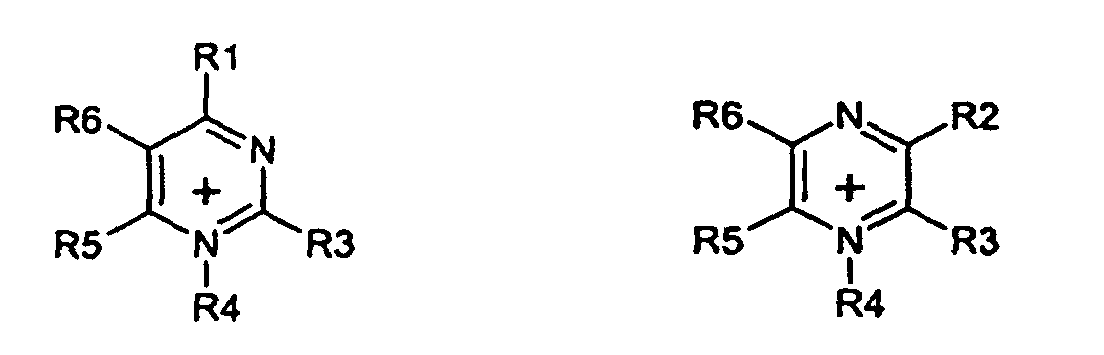
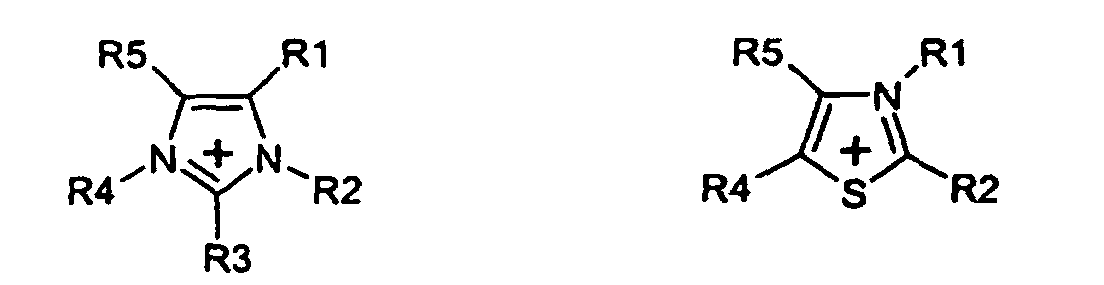
- ein Kation ausgewählt aus der Gruppe

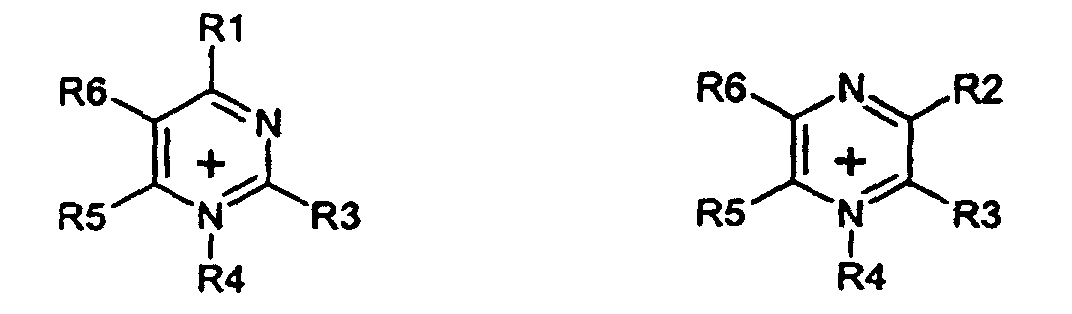
 wobei R1 bis R5 gleich oder verschieden, gegebenenfalls durch eine Einfach- oder Doppelbindung direkt miteinander verbunden sind und jeweils einzeln oder gemeinsam folgende Bedeutung haben: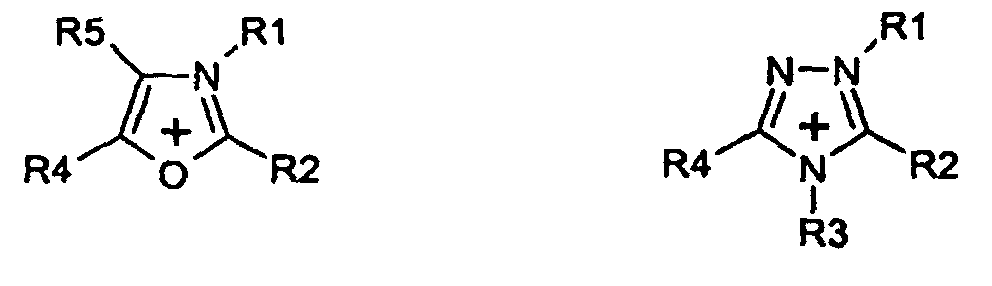
- H,
- Halogen,
- Alkylrest (C1 bis C8) der teilweise oder vollständig durch weitere Gruppen, vorzugsweise F, Cl, N(CnF(2n+1-x)Hx)2, O(CnF(2n+1-x)Hx), SO2(CnF(2n+1-x)Hx), CnF(2n+1-x)Hx mit 1<n<6 und 0<x≤2n+1 substituiert sein kann
- A-
- Tris(pentafluorethyl)trifluorphosphat oder Tris(nonafluorbutyl)trifluorphosphat bedeutet.
- x,y
- 1,2,3
- Mx+
- ein Metallion
- E
- eine Lewis-Säure, ausgewählt aus der Gruppe
R1 bis R5 gleich oder verschieden, gegebenenfalls durch eine Einfach- oder Doppelbildung direkt miteinander verbunden sind, jeweils einzeln oder gemeinsam die Bedeutung
eines Halogens (F, Cl, Br),
eines Alkyl- oder Alkoxyrestes (C1 bis C8) der teilweise oder vollständig durch F, Cl, Br substituiert sein kann,
eines, gegebenenfalls über Sauerstoff gebundenen aromatischen Rings aus der Gruppe Phenyl, Naphthyl, Anthracenyl oder Phenanthrenyl, der unsubstituiert oder ein- bis mehrfach durch Alkyl (C1 bis C8) oder F, Cl, Br substituiert sein kann
eines, gegebenenfalls über Sauerstoff gebundenen aromatischen heterocyclischen Rings aus der Gruppe Pyridyl, Pyrazyl oder Pyrimidyl, der unsubstituiert oder ein- bis mehrfach durch Alkyl (C1 bis C8) oder F, Cl, Br substituiert sein kann, haben können und
Z OR6, NR6R7, CR6R7R8, OSO2R6, N(SO2R6)(SO2R7),
C(SO2R6)(SO2R7)(SO2R8), OCOR6, wobei
R6 bis R8 gleich oder verschieden sind, gegebenenfalls durch eine Einfach- oder Doppelbindung direkt miteinander verbunden sind, jeweils einzeln oder gemeinsam die Bedeutung
eines Wasserstoffs oder die Bedeutung wie R1 bis R5 haben, hergestellt durch Umsetzung von einem entsprechenden Bor- oder Phosphor-Lewis-Säure-Solvenz-Adukt mit einem Lithium- oder Tetraalkylammonium-Imid, -Methanid oder -Triflat, können enthalten sein.
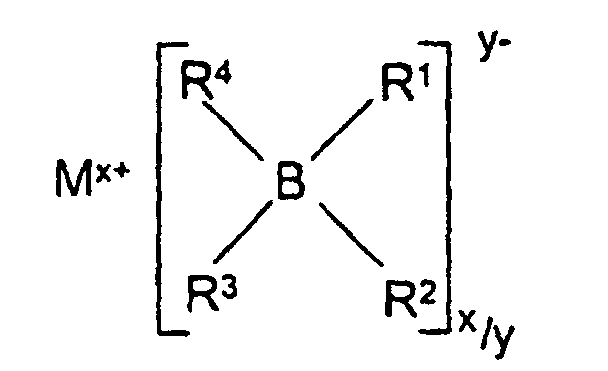
- M
- ein Metallion oder Tetraalkylammoniumion
- x,y
- 1, 2 oder 3
CyF2y+1-zHz
OCyF2y+1-zHz
OC(O)CyF2y+1-zHz
OSO2CyF2y+1-zHz
und 1≤x<6
1≤y≤8 und
0≤z≤2y+1
und
R1-R4 gleich oder verschieden
mit der Bedeutung eines aromatischen Rings aus der Gruppe Phenyl, Naphthyl der unsubstituiert oder ein- oder mehrfach durch F, CyF2y+1-zHz oder OCyF2y+1-zHz, OC(O)CyF2y+1-zHz, OSO2CyF2y+1-zHz, N(CnF2n+1-zHz)2 substituiert sein kann, oder
mit der Bedeutung eines heterocyclischen aromatischen Rings aus der Gruppe Pyridyl, Pyrazyl oder Pyrimidyl, die jeweils ein- oder mehrfach mit F, CyF2y+1-zHz oder OCyF2y+1-zHz, OC(O)CyF2y+1-zHz, OSO2CyF2y+1-zHz, N(CnF2n+1-zHz)2 substituiert sein können (DE 100 276 26), können enthalten sein.
1≤ x ≤ 5
3 ≤ y ≤ 8
0 ≤ z ≤ 2y + 1
bedeuten und die Liganden (CyF2y+1-zHz) gleich oder verschieden sein können, wobei die Verbindungen der allgemeinen Formel,
e eine ganze Zahl von 1 bis 4 bedeuten, mit den Bedingungen, daß b und c nicht gleichzeitig jeweils = 0 bedeuten und die Summe aus a + e gleich 6 ist und die Liganden (CHbFc(CF3)d) gleich oder verschieden sein können, ausgenommen sind (DE 100 089 55). Das Verfahren zur Herstellung von Lithiumfluoralkylphosphaten ist dadurch gekennzeichnet, daß wenigstens eine Verbindung der allgemeinen Formel
0 < m < 2, 1 < n < 8 und 0 < o < 4 bedeutet
durch Elektrolyse in Fluorwasserstoff fluoriert wird, das so erhaltene Gemisch der Fluorierungsprodukte durch Extraktion, Phasentrennung und/oder Destillation aufgetrennt wird, und das so erhaltene fluorierte Alkylphosphoran in einem aprotischen Lösungsmittel oder Lösungsmittelgemisch unter Feuchtigkeitsausschluß mit Lithiumfluorid umgesetzt wird, und das so erhaltene Salz nach den üblichen Methoden gereinigt und isoliert wird.
- K+
- ein Kation ausgewählt aus der Gruppe


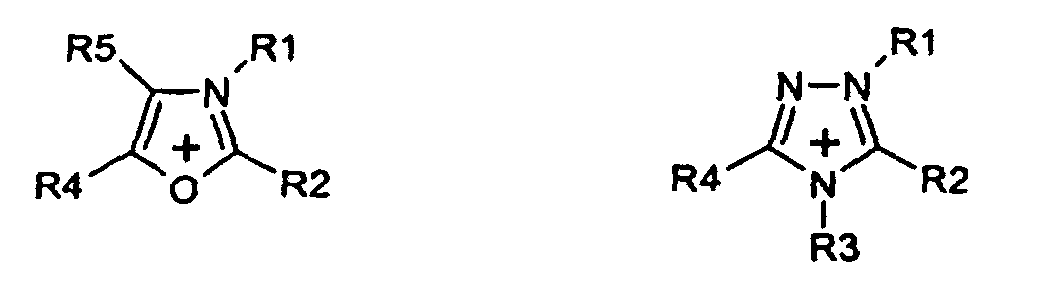
- H,
- Halogen,
- Alkylrest (C1 bis C8) der teilweise oder vollständig durch weitere Gruppen, vorzugsweise F, Cl, N(CnF(2n+1-x)Hx)2, O(CnF(2n+1-x)Hx), SO2(CnF(2n+1-x)Hx), CnF(2n+1-x)Hx mit 1<n<6 und 0<x≤2n+1 substituiert sein kann
- A-
- ein Anion ausgewählt aus der Gruppe
m+n+o+p=4
wobei R1 bis R4 verschieden oder paarweise gleich sind, gegebenenfalls durch eine Einfach- oder Doppelbildung direkt miteinander verbunden sind, jeweils einzeln oder gemeinsam
die Bedeutung eines aromatischen Rings aus der Gruppe Phenyl, Naphthyl, Anthracenyl oder Phenanthrenyl, der unsubstituiert oder ein- oder mehrfach durch CnF(2n+1-x)Hx mit 1 <n<6 und 0<x≤13 oder Halogen (F, Cl, Br) substituiert sein kann, besitzen,
die Bedeutung eines aromatischen heterocyclischen Rings aus der Gruppe Pyridyl, Pyrazyl oder Pyrimidyl, der unsubstituiert oder ein- oder mehrfach durch CnF(2n+1-x)Hx mit 1<n<6 und 0<x≤13 oder Halogen oder Halogen (F, Cl, Br) substituiert sein kann, besitzen,
die Bedeutung eines Alkylrests (C1 bis C8) der teilweise oder vollständig durch weitere Gruppen, vorzugsweise F, Cl, , N(CnF(2n+1-x)Hx)2, O(CnF(2n+1-x)Hx), SO2(CnF(2n+1-x)Hx), CnF(2n+1-x)Hx mit 1<n<6 und 0<x≤13 substituiert sein kann, besitzen,
beziehungsweise OR1 bis OR4
einzeln oder gemeinsam die Bedeutung eines aromatischen oder aliphatischen Carboxyl-, Dicarboxyl-, Oxysulfonyl- oder Oxycarboxylrests, der teilweise oder vollständig durch weitere Gruppen, vorzugsweise F, Cl, , N(CnF(2n+1-x)Hx)2, O(CnF(2n+1-x)Hx), SO2(CnF(2n+1-x)Hx),
CnF(2n+1-x)Hx mit 1<n<6 und 0<x≤13 substituiert sein kann, besitzen (DE 100 265 65), können im Elektrolyten enthalten sein. Auch lonische Flüssigkeiten K+A- mit K+ definiert wie oben und
- R1 und scher
- R2H, CyF2y+1-zHz oder (CnF2n-mHm)X, wobei X ein aromatischer oder heterozyklischer Rest ist, bedeuten und
- R3
- (CnF2n-mHm)Y, wobei Y ein heterozyklischer Rest ist, oder
und wobei n, m, o, p, y und z die folgenden Bedingungen erfüllen:
0 ≤ n ≤ 6,
0 ≤ m ≤ 2n,
2 ≤ o ≤ 6,
0 ≤ p ≤ 2o,
1 ≤ y ≤ 8 und
0 ≤ z ≤ 2y+1, zur Verringerung des Säuregehalts in aprotischen Elektrolytsystemen in elektrochemischen Zellen.
1 ≤ x ≤ 6
1 ≤ y ≤ 8
0 ≤ z ≤ 2y + 1
1 ≤ n ≤ 3 und
Mn+ die Bedeutung eines ein- bis dreiwertigen Kations besitzt, insbesondere:
- mit R1 bis R8
- H, Alkyl und Aryl (C1-C8) die teilweise durch F, Cl oder Br substituiert sein können,
1 ≤ x ≤ 5
1 ≤ y ≤ 8 und
0 ≤ z ≤ 2y + 1 bedeuten und die Liganden (CyF2y+1-zHz) jeweils gleich oder verschieden sind und
Mn+ ein einwertiges, zweiwertiges oder dreiwertiges Kation ist,
die Liganden R jeweils gleich sind und für (CxF2x+1) mit 1 ≤ x ≤ 8 stehen
und n = 1, 2 oder 3 ist (DE 100 558 11) enthalten sein. Das Verfahren zur Herstellung von Tetrakisfluoroalkylborat-Salzen ist dadurch gekennzeichnet, daß wenigstens eine Verbindung der allgemeinen Formel Mn+ ([B(CN)4]-)n worin Mn+ und n die oben angegebene Bedeutung haben, durch Umsetzung mit wenigstens einem Fluorierungsmittel in wenigstens einem Lösungsmittel fluoriert und die so erhaltene fluorierte Verbindung nach den üblichen Methoden gereinigt und isoliert wird.
- M
- ein- bis dreiwertiges Kation (1≤n≤3), außer Kalium und
Barium,
insbesondere:
- Li,
- NR1R2R3R4, PR5R6R7R8, P(NR5R6)kR7 mR8 4-k-m (mit k=1-4, m=0-3 und k+m≤4) oder
- C(NR5R6)(NR7R8)(NR9R10), wobei
- R1 bis R4
- CyF2y+1-zHz und
- R5 bis R10
- H oder CyF2y+1-zHz oder
ein aromatisches heterozyklisches Kation, insbesondere Stickstoff- und/oder Sauerstoff- und/oder Schwefelhaltige aromatische heterozyklische Kationen (DE 101 031 89). Das Verfahren zur Herstellung dieser Verbindungen ist dadurch gekennzeichnet, daß- a) BF3-Lösungsmittel-Komplexe 1:1 mit Alkyllithium unter Kühlung umgesetzt werden, nach langsamer Erwärmung das Lösungsmittel zu einem Großteil entfernt und anschließend der Feststoff abfiltriert und mit einem geeigneten Lösungsmittel gewaschen wird, oder
- b) Lithiumsalze in einem geeigneten Lösungsmittel 1:1 mit B(CF3)F3-salzen umgesetzt werden, bei erhöhter Temperatur gerührt und nach Entfernen des Lösungsmittels das Reaktionsgemisch mit aprotischen nichtwäßrigen Lösungsmitteln, vorzugsweise mit Lösungsmitteln die in elektrochemischen Zellen verwendet werden, versetzt und getrocknet wird, oder
- c) B(CF3)F3-salze 1:1 bis 1:1,5 mit Lithiumsalzen in Wasser bei erhöhter Temperatur umgesetzt und 0,5 bis 2 Stunden am Siedepunkt erhitzt werden, das Wasser entfernt und das Reaktionsgemisch mit aprotischen nichtwäßrigen Lösungsmitteln, vorzugsweise mit Lösungsmitteln die in elektrochemischen Zellen verwendet werden, versetzt getrocknet wird.
Mn+ ein einwertiges, zweiwertiges oder dreiwertiges Kation ist,
1 ≤ x ≤ 5,
1 ≤ y ≤ 8 und
0 ≤ z ≤ 2y + 1 sind, n = 1, 2 oder 3 bedeuten und die Liganden (CyF2y+1-zHz) jeweils gleich oder verschieden sind, wobei die Fluoroalkylphosphat-Salze, in denen Mn+ ein Lithium-Kation ist, sowie die Salze
0 ≤ r ≤ 2
3 ≤ s ≤ 8 und
0 ≤ t ≤ 4 bedeuten, durch Elektrolyse in Fluorwasserstoff fluoriert wird, das so erhaltene Gemisch der Fluorierungsprodukte aufgetrennt wird und das so erhaltene fluorierte Alkylphosphoran in einem aprotischen Lösungsmittel oder Lösungsmittelgemisch unter Feuchtigkeitsausschluß mit einer Verbindung der allgemeinen Formel Mn+(F-)n worin Mn+ und n die oben angegebene Bedeutung haben, umgesetzt wird, und das so erhaltene Fluoroalkylphosphat-Salz nach den üblichen Methoden gereinigt und isoliert wird.
Ma+ ein einwertiges, zweiwertiges oder dreiwertiges Kation,
a = 1, 2 oder 3, b = 2 für a = 1, b = 2 für a = 3, b = 1 für a = 2
und jeweils
1 ≤ n ≤ 8,
0 ≤ m ≤ 2 für n = 1 oder 2,
0 ≤ m ≤ 4 für 3 ≤ n ≤ 8,
1 ≤ x ≤ 12,
0 ≤ y ≤ 2,
wobei R1 und R2 jeweils identisch oder unterschiedlich sind und ausgewählt sind aus der Gruppe der Fluor-, Wasserstoff-, Alkyl-, Fluoralkyl und Perfluoralkylsubstituenten und,
wobei jeweils die Substituenten (CnF2n+1-mHm) identisch oder unterschiedlich sind. Hergestellt werden diese Verbindungen, indem wenigstens ein Fluoro-α,ω-bis(alkylfluorophosphorano)alkan mit wenigstens einem Fluorid-Salz der allgemeinen Formel (Ma+) [F-]a worin (Ma+) und a die oben angegebene Bedeutung hat, in Lösung zu einem Fluoralkylphosphat-Salz umgesetzt und dieses gegebenenfalls nach üblichen Methoden gereinigt und/oder isoliert wird.
wird ein bekanntes Verfahren aus DE 196 411 38 verwendet.





Claims (7)
- Ionische Flüssigkeiten der allgemeinen Formel
- K+
- ein Kation ausgewählt aus der Gruppe
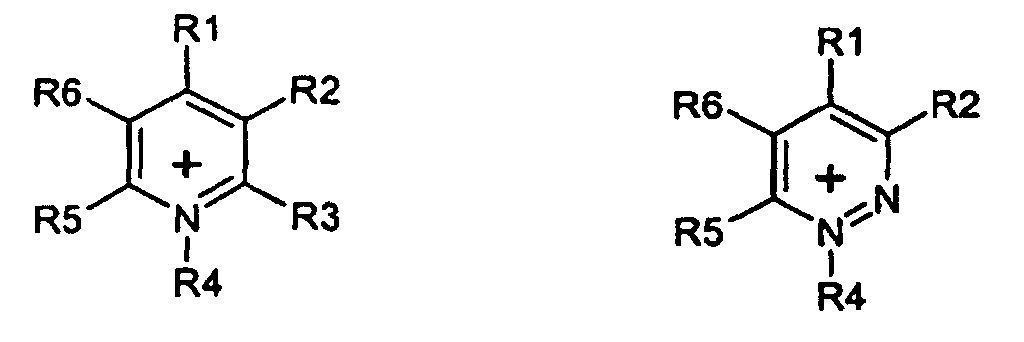
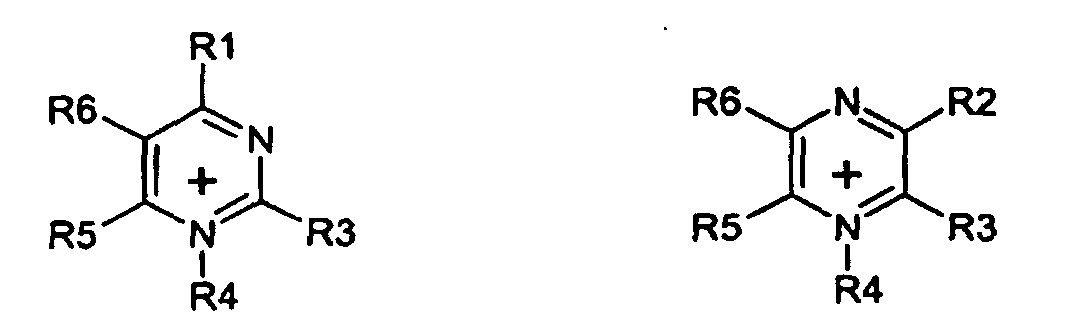
 wobei R1 bis R5 gleich oder verschieden, gegebenenfalls durch eine Einfach- oder Doppelbindung direkt miteinander verbunden sind und jeweils einzeln oder gemeinsam folgende Bedeutung haben:
 undH,Halogen,Alkylrest (C1 bis C8) der teilweise oder vollständig durch weitere Gruppen, vorzugsweise F, Cl, N(CnF(2n+1-x)Hx)2, O(CnF(2n+1-x)Hx), SO2(CnF(2n+1-x)Hx), CnF(2n+1-x)Hx mit 1<n<6 und 0<x≤2n+1 substituiert sein kann
- A-
- Tris(pentafluorethyl)trifluorphosphat oder Tris(nonafluorbutyl)trifluorphosphat bedeutet.
- Verwendung ionischer Flüssigkeiten wie in Anspruch 1 definiert in Mischungen mit aprotischen Lösungsmitteln.
- Verwendung ionischer Flüssigkeiten wie in Anspruch 1 definiert in Mischungen mit anderen Leitsalzen.
- Verwendung ionischerFlüssigkeiten wie in Anspruch 1 definiert in elektrochemischen Zellen.
- Verwendung ionischer Flüssigkeiten wie in Anspruch 1 definiert in Superkondensatoren.
- Verwendung ionischer Flüssigkeiten wie in Anspruch 1 definiert als Lösungsmittel und in der Katalyse von chemischen Reaktionen.
- Verwendung ionischer Flüssigkeiten wie in Anspruch 1 definiert als hydraulische Flüssigkeit.
Applications Claiming Priority (2)
| Application Number | Priority Date | Filing Date | Title |
|---|---|---|---|
| DE10027995 | 2000-06-09 | ||
| DE10027995A DE10027995A1 (de) | 2000-06-09 | 2000-06-09 | Ionische Flüssigkeiten II |
Publications (2)
| Publication Number | Publication Date |
|---|---|
| EP1162204A1 EP1162204A1 (de) | 2001-12-12 |
| EP1162204B1 true EP1162204B1 (de) | 2005-07-20 |
Family
ID=7644877
Family Applications (1)
| Application Number | Title | Priority Date | Filing Date |
|---|---|---|---|
| EP01111953A Expired - Lifetime EP1162204B1 (de) | 2000-06-09 | 2001-05-21 | Ionische Flüssigkeiten |
Country Status (10)
| Country | Link |
|---|---|
| US (1) | US7153974B2 (de) |
| EP (1) | EP1162204B1 (de) |
| JP (1) | JP5236135B2 (de) |
| KR (1) | KR100781473B1 (de) |
| CN (1) | CN100413873C (de) |
| BR (1) | BR0102318A (de) |
| CA (1) | CA2349903C (de) |
| DE (2) | DE10027995A1 (de) |
| RU (1) | RU2272043C2 (de) |
| TW (1) | TWI300780B (de) |
Families Citing this family (36)
| Publication number | Priority date | Publication date | Assignee | Title |
|---|---|---|---|---|
| DE10027995A1 (de) * | 2000-06-09 | 2001-12-13 | Merck Patent Gmbh | Ionische Flüssigkeiten II |
| KR100473433B1 (ko) * | 2000-07-17 | 2005-03-08 | 마쯔시다덴기산교 가부시키가이샤 | 비수전해액 및 그것을 포함하는 비수전해액전지 및 전해콘덴서 |
| DE10038858A1 (de) * | 2000-08-04 | 2002-02-14 | Merck Patent Gmbh | Fluoralkylphosphate zur Anwendung in elektrochemischen Zellen |
| EP1205998A2 (de) | 2000-11-10 | 2002-05-15 | MERCK PATENT GmbH | Elektrolyte |
| DE10055811A1 (de) | 2000-11-10 | 2002-05-29 | Merck Patent Gmbh | Tetrakisfluoroalkylborat-Salze und deren Verwendung als Leitsalze |
| DE10109032A1 (de) * | 2001-02-24 | 2002-09-05 | Merck Patent Gmbh | Fluoralkylphosphat-Salze und Verfahren zur Herstellung dieser Substanzen |
| DE10130940A1 (de) * | 2001-06-27 | 2003-01-16 | Merck Patent Gmbh | Supersäuren, Herstellverfahren und Verwendungen |
| JP2003313171A (ja) * | 2002-04-23 | 2003-11-06 | Kuraray Co Ltd | N−アルキル−n’−アルキルイミダゾリウム塩の製造方法 |
| FR2840916B1 (fr) * | 2002-06-17 | 2004-08-20 | Inst Francais Du Petrole | Procede d'elimination des composes soufres et azotes de coupes hydrocarbonees |
| US7053232B2 (en) | 2002-08-16 | 2006-05-30 | Sachem, Inc. | Lewis acid ionic liquids |
| US7750166B2 (en) * | 2002-08-16 | 2010-07-06 | University Of South Alabama | Ionic liquids containing a sulfonate anion |
| JP4085986B2 (ja) * | 2003-04-01 | 2008-05-14 | ソニー株式会社 | 電池 |
| DE10325051A1 (de) | 2003-06-02 | 2004-12-23 | Merck Patent Gmbh | Ionische Flüssigkeiten mit Guanidinium-Kationen |
| TW200517375A (en) * | 2003-09-18 | 2005-06-01 | Sumitomo Chemical Co | A novel acidic ionic liquid and method of reaction using the same |
| KR101133867B1 (ko) * | 2003-10-10 | 2012-04-06 | 시게유키 모리 | 윤활유 |
| JP2005147394A (ja) * | 2003-10-23 | 2005-06-09 | Sankyo Seiki Mfg Co Ltd | 動圧軸受装置、及び、ディスク駆動装置 |
| JP5376746B2 (ja) * | 2003-11-05 | 2013-12-25 | 協同油脂株式会社 | 半固体状潤滑剤組成物 |
| US7423164B2 (en) * | 2003-12-31 | 2008-09-09 | Ut-Battelle, Llc | Synthesis of ionic liquids |
| US8715521B2 (en) * | 2005-02-04 | 2014-05-06 | E I Du Pont De Nemours And Company | Absorption cycle utilizing ionic liquid as working fluid |
| DE102005007100A1 (de) * | 2005-02-16 | 2006-08-17 | Solvent Innovation Gmbh | Prozess- bzw. Arbeitsmaschine mit ionischer Flüssigkeit als Betriebsflüssigkeit |
| JP4926411B2 (ja) * | 2005-04-08 | 2012-05-09 | 出光興産株式会社 | グリース組成物 |
| JP5074687B2 (ja) * | 2005-07-15 | 2012-11-14 | 出光興産株式会社 | 含油軸受用潤滑剤 |
| EP1953211A4 (de) * | 2005-11-14 | 2011-03-23 | Nippon Synthetic Chem Ind | Synthetisches schmiermittel |
| US7737106B2 (en) * | 2005-11-29 | 2010-06-15 | The Procter & Gamble Company | Process for making an ionic liquid comprising ion actives |
| US20070129568A1 (en) * | 2005-12-06 | 2007-06-07 | Ngimat, Co. | Ionic liquids |
| DE102006005103A1 (de) * | 2006-02-04 | 2007-08-09 | Merck Patent Gmbh | Oxonium- und Sulfoniumsalze |
| CN101454420B (zh) * | 2006-05-31 | 2012-07-11 | 纳幕尔杜邦公司 | 利用离子液体作为压缩机润滑剂的蒸汽压缩 |
| US20080153697A1 (en) * | 2006-12-22 | 2008-06-26 | E. I. Dupont De Nemours And Company | Mixtures of ammonia and ionic liquids |
| DE102007004698A1 (de) * | 2007-01-31 | 2008-08-07 | Merck Patent Gmbh | Verbindungen enthaltend Organofluorochlorophosphatanionen |
| DE102008032825B3 (de) * | 2008-07-11 | 2010-01-14 | Siemens Aktiengesellschaft | Strahlpumpe sowie Verfahren zu deren Betrieb |
| JP2010287431A (ja) * | 2009-06-11 | 2010-12-24 | Sony Corp | 電池 |
| JP2013501365A (ja) | 2009-08-03 | 2013-01-10 | メルク パテント ゲゼルシャフト ミット ベシュレンクテル ハフツング | 電解質システム |
| DE102009058969A1 (de) * | 2009-12-18 | 2011-06-22 | Merck Patent GmbH, 64293 | Verbindung mit (Perfluoralkyl)fluorohydrogenphosphat - Anionen |
| KR20130118322A (ko) | 2010-09-27 | 2013-10-29 | 메르크 파텐트 게엠베하 | 관능화 플루오로알킬 플루오로포스페이트 염 |
| DE102012006896A1 (de) | 2012-04-05 | 2013-10-10 | Merck Patent Gmbh | Silikate mit organischen Kationen |
| HUE055324T2 (hu) | 2019-07-31 | 2021-11-29 | Innolith Tech Ag | SO2 alapú elektrolit újratölthetõ akkumulátorcellához és azt tartalmazó újratölthetõ akkumulátorcella |
Family Cites Families (13)
| Publication number | Priority date | Publication date | Assignee | Title |
|---|---|---|---|---|
| JPS612278A (ja) * | 1984-06-14 | 1986-01-08 | Mitsui Petrochem Ind Ltd | 電池 |
| JP3182793B2 (ja) * | 1991-07-04 | 2001-07-03 | 松下電器産業株式会社 | 電解コンデンサ駆動用溶融塩形電解質 |
| RU2075435C1 (ru) * | 1994-12-21 | 1997-03-20 | Сибирский химический комбинат | Способ получения гексафторфосфата лития |
| WO1997002252A1 (en) * | 1995-06-30 | 1997-01-23 | Covalent Associates, Inc. | Hydrophobic ionic liquids |
| US5827602A (en) * | 1995-06-30 | 1998-10-27 | Covalent Associates Incorporated | Hydrophobic ionic liquids |
| JPH1021914A (ja) * | 1996-07-05 | 1998-01-23 | Mitsubishi Chem Corp | 非水電解液二次電池 |
| GB9616264D0 (en) * | 1996-08-02 | 1996-09-11 | British Nuclear Fuels Plc | Reprocessing irradiated fuel |
| DE19641138A1 (de) * | 1996-10-05 | 1998-04-09 | Merck Patent Gmbh | Lithiumfluorphosphate sowie deren Verwendung als Leitsalze |
| JPH11273734A (ja) * | 1998-03-23 | 1999-10-08 | Sanyo Chem Ind Ltd | 難燃性非水電解液およびそれを用いた二次電池 |
| DE19910968A1 (de) * | 1999-03-12 | 2000-11-09 | Merck Patent Gmbh | Anwendung von Additiven in Elektrolyten für elektrochemische Zellen |
| DE10008955C2 (de) * | 2000-02-25 | 2002-04-25 | Merck Patent Gmbh | Lithiumfluoralkylphosphate, Verfahren zu ihrer Herstellung und deren Verwendung als Leitsalze |
| DE10026565A1 (de) * | 2000-05-30 | 2001-12-06 | Merck Patent Gmbh | Ionische Flüssigkeiten |
| DE10027995A1 (de) * | 2000-06-09 | 2001-12-13 | Merck Patent Gmbh | Ionische Flüssigkeiten II |
-
2000
- 2000-06-09 DE DE10027995A patent/DE10027995A1/de not_active Withdrawn
-
2001
- 2001-05-21 EP EP01111953A patent/EP1162204B1/de not_active Expired - Lifetime
- 2001-05-21 DE DE50106762T patent/DE50106762D1/de not_active Expired - Lifetime
- 2001-06-07 CA CA002349903A patent/CA2349903C/en not_active Expired - Fee Related
- 2001-06-08 KR KR1020010031905A patent/KR100781473B1/ko not_active Expired - Fee Related
- 2001-06-08 RU RU2001115605/04A patent/RU2272043C2/ru not_active IP Right Cessation
- 2001-06-08 CN CNB011228059A patent/CN100413873C/zh not_active Expired - Fee Related
- 2001-06-08 BR BR0102318-7A patent/BR0102318A/pt not_active Application Discontinuation
- 2001-06-08 JP JP2001173307A patent/JP5236135B2/ja not_active Expired - Fee Related
- 2001-06-11 TW TW090114064A patent/TWI300780B/zh not_active IP Right Cessation
- 2001-06-11 US US09/877,259 patent/US7153974B2/en not_active Expired - Fee Related
Also Published As
| Publication number | Publication date |
|---|---|
| TWI300780B (en) | 2008-09-11 |
| DE50106762D1 (de) | 2005-08-25 |
| KR20020017934A (ko) | 2002-03-07 |
| CA2349903A1 (en) | 2001-12-09 |
| CA2349903C (en) | 2010-02-02 |
| CN1327986A (zh) | 2001-12-26 |
| KR100781473B1 (ko) | 2007-12-03 |
| DE10027995A1 (de) | 2001-12-13 |
| BR0102318A (pt) | 2002-02-13 |
| RU2272043C2 (ru) | 2006-03-20 |
| US7153974B2 (en) | 2006-12-26 |
| EP1162204A1 (de) | 2001-12-12 |
| US20020015884A1 (en) | 2002-02-07 |
| CN100413873C (zh) | 2008-08-27 |
| JP5236135B2 (ja) | 2013-07-17 |
| JP2002025610A (ja) | 2002-01-25 |
Similar Documents
| Publication | Publication Date | Title |
|---|---|---|
| EP1162204A1 (de) | Ionische Flüssigkeiten | |
| EP1160249B1 (de) | Ionische Flüssigkeiten | |
| EP1178050B1 (de) | Fluoralkylphosphate zur Anwendung in elektrochemischen Zellen | |
| EP1088814A1 (de) | Fluorierte Sulfonamide als schwer entflammbare Lösungsmittel zum Einsatz in elektrochemischen Zellen | |
| DE60103436T2 (de) | Lithiumfluoralkylphosphate und deren Verwendung als Leitsalze | |
| EP1162682A1 (de) | Silanverbindungen als Additive in Elektrolyten für elektrochemische Zellen | |
| EP1205480B1 (de) | Tetrakisfluoroalkylborat-Salze und deren Verwendung als Leitsalze | |
| EP1106617A2 (de) | Alkylspiroboratsalze zur Anwendung in elektrochemischen Zellen | |
| EP1229038A1 (de) | Boratsalze zur Anwendung in elektrochemischen Zellen | |
| EP1236732B1 (de) | Fluoralkylphosphat-Salze und Verfahren zur Herstellung dieser Substanzen | |
| EP1205998A2 (de) | Elektrolyte | |
| EP1143548A2 (de) | Lithiumsalze, Verfahren zu deren Herstellung, nichtwäsriger Elektrolyt sowie elektrochemische Zelle | |
| EP1069128B1 (de) | Verfahren zur Herstellung von Lithiumkomplexsalzen zur Anwendung in elektrochemischen Zellen | |
| DE10119278C1 (de) | Verfahren zur Herstellung von Fluoralkylphosphaten | |
| EP1081129A2 (de) | Stabile (CF3)2N-Salze, ein Verfahren zu deren Herstellung und ihre Verwendung bei der Synthese von Flüssigkristallverbindungen | |
| DE10042149A1 (de) | Nichtwäßriger Elektrolyt sowie diesen enthaltende elektrochemische Zelle | |
| EP1095942A2 (de) | Komplexsalze zur Anwendung in elektrochemischen Zellen | |
| DE102009058969A1 (de) | Verbindung mit (Perfluoralkyl)fluorohydrogenphosphat - Anionen | |
| DE10058264A1 (de) | Elektrolyte | |
| DE10055812A1 (de) | Fluoroalkylphosphat-Salze und deren Verwendung als Leitsalze | |
| WO2000066547A1 (de) | Verfahren zur aufreinigung von methanid-elektrolyten (ii) |
Legal Events
| Date | Code | Title | Description |
|---|---|---|---|
| PUAI | Public reference made under article 153(3) epc to a published international application that has entered the european phase |
Free format text: ORIGINAL CODE: 0009012 |
|
| AK | Designated contracting states |
Kind code of ref document: A1 Designated state(s): AT BE CH CY DE DK ES FI FR GB GR IE IT LI LU MC NL PT SE TR Kind code of ref document: A1 Designated state(s): DE FR GB |
|
| AX | Request for extension of the european patent |
Free format text: AL;LT;LV;MK;RO;SI |
|
| 17P | Request for examination filed |
Effective date: 20020308 |
|
| 17Q | First examination report despatched |
Effective date: 20020722 |
|
| AKX | Designation fees paid |
Free format text: DE FR GB |
|
| GRAP | Despatch of communication of intention to grant a patent |
Free format text: ORIGINAL CODE: EPIDOSNIGR1 |
|
| GRAS | Grant fee paid |
Free format text: ORIGINAL CODE: EPIDOSNIGR3 |
|
| GRAA | (expected) grant |
Free format text: ORIGINAL CODE: 0009210 |
|
| AK | Designated contracting states |
Kind code of ref document: B1 Designated state(s): DE FR GB |
|
| REG | Reference to a national code |
Ref country code: GB Ref legal event code: FG4D Free format text: NOT ENGLISH |
|
| REF | Corresponds to: |
Ref document number: 50106762 Country of ref document: DE Date of ref document: 20050825 Kind code of ref document: P |
|
| GBT | Gb: translation of ep patent filed (gb section 77(6)(a)/1977) |
Effective date: 20051021 |
|
| ET | Fr: translation filed | ||
| PLBE | No opposition filed within time limit |
Free format text: ORIGINAL CODE: 0009261 |
|
| STAA | Information on the status of an ep patent application or granted ep patent |
Free format text: STATUS: NO OPPOSITION FILED WITHIN TIME LIMIT |
|
| 26N | No opposition filed |
Effective date: 20060421 |
|
| PGFP | Annual fee paid to national office [announced via postgrant information from national office to epo] |
Ref country code: GB Payment date: 20100329 Year of fee payment: 10 |
|
| GBPC | Gb: european patent ceased through non-payment of renewal fee |
Effective date: 20110521 |
|
| PG25 | Lapsed in a contracting state [announced via postgrant information from national office to epo] |
Ref country code: GB Free format text: LAPSE BECAUSE OF NON-PAYMENT OF DUE FEES Effective date: 20110521 |
|
| REG | Reference to a national code |
Ref country code: FR Ref legal event code: PLFP Year of fee payment: 16 |
|
| PGFP | Annual fee paid to national office [announced via postgrant information from national office to epo] |
Ref country code: DE Payment date: 20160518 Year of fee payment: 16 |
|
| PGFP | Annual fee paid to national office [announced via postgrant information from national office to epo] |
Ref country code: FR Payment date: 20160412 Year of fee payment: 16 |
|
| REG | Reference to a national code |
Ref country code: DE Ref legal event code: R119 Ref document number: 50106762 Country of ref document: DE |
|
| REG | Reference to a national code |
Ref country code: FR Ref legal event code: ST Effective date: 20180131 |
|
| PG25 | Lapsed in a contracting state [announced via postgrant information from national office to epo] |
Ref country code: DE Free format text: LAPSE BECAUSE OF NON-PAYMENT OF DUE FEES Effective date: 20171201 |
|
| PG25 | Lapsed in a contracting state [announced via postgrant information from national office to epo] |
Ref country code: FR Free format text: LAPSE BECAUSE OF NON-PAYMENT OF DUE FEES Effective date: 20170531 |